Economic Outlook


Lake County Chamber of Commerce   William Strauss
Vernon Hills, IL                  Senior Economist
February 19, 2013                 and Economic Advisor
                                  Federal Reserve Bank of Chicago
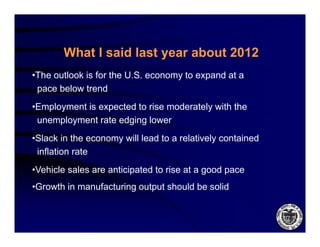
What I said last year about 2012
•The outlook is for the U.S. economy to expand at a
 The                    US
 pace below trend
•Employment is expected to rise moderately with the
 Employment
 unemployment rate edging lower
•Slack in the economy will lead to a relatively contained
 inflation rate
•Vehicle sales are anticipated to rise at a good pace
•Growth in manufacturing output should be solid
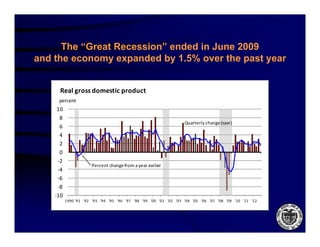
The “Great Recession” ended in June 2009
and the economy expanded by 1.5% over the past year

      Real gross domestic product
     percent
     10
      8
                                                                   Quarterly change (saar)
      6
      4
      2
      0
     ‐2
                      Percent change from a year earlier
     ‐4
     ‐6
     ‐8
    ‐10
          1990 '91 '92 '93 '94 '95 '96 '97 '98 '99 '00 '01 '02 '03 '04 '05 '06 '07 '08 '09 '10 '11 '12
                91 92 93 94 95 96 97 98 99 00 01 02 03 04 05 06 07 08 09 10 11 12
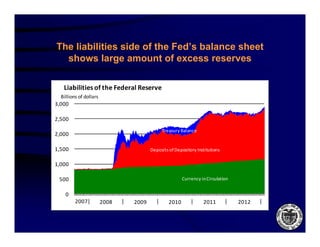
The liabilities side of the Fed’s balance sheet
  shows large amount of excess reserves

   Liabilities of the Federal Reserve
  Billions of dollars
3,000

2,500
                                           Treasury Balance
2,000

1,500                                 Deposits of Depository Institutions

1,000

 500                                                  Currency in Circulation


    0
         2007           2008   2009            2010             2011            2012
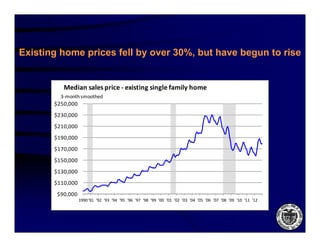
Existing home prices fell by over 30%, but have begun to rise


          Median sales price ‐ existing single family home
         3‐month smoothed
       $250,000
       $230,000
       $210,000
       $190,000
       $170,000
       $150,000
       $130,000
       $130 000
       $110,000
        $90,000
                  1990 '91 '92 '93 '94 '95 '96 '97 '98 '99 '00 '01 '02 '03 '04 '05 '06 '07 '08 '09 '10 '11 '12
                        91 92 93 94 95 96 97 98 99 00 01 02 03 04 05 06 07 08 09 10 11 12
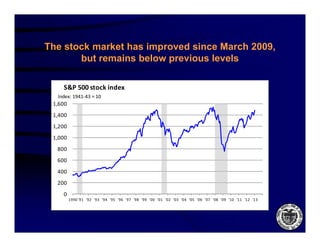
The stock market has improved since March 2009
                                          2009,
       but remains below previous levels

    S&P 500 stock index
  Index: 1941‐43 = 10
 1,600
 1,400
 1,200
 1,000
  800
  600
  400
  200
    0
         1990 '91 '92 '93 '94 '95 '96 '97 '98 '99 '00 '01 '02 '03 '04 '05 '06 '07 '08 '09 '10 '11 '12 '13
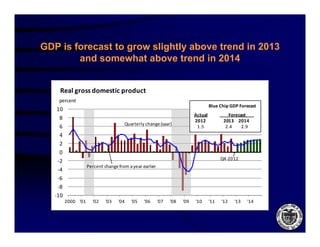
GDP is forecast to grow slightly above trend in 2013
        and somewhat above trend in 2014


     Real gross domestic product
    percent
                                                                                     Blue Chip GDP Forecast
                                                                                             p
    10
                                                                           Actual                  Forecast        
     8                                                                     2012                2013     2014
                                      Quarterly change (saar)
     6                                                                      1.5                   2.4         2.9        
     4
     2
     0
                                                                                              Q4‐2012
    ‐2
                    Percent change from a year earlier
    ‐4
    ‐6
    ‐8
   ‐10
         2000 '01
               01     '02
                       02    '03
                              03   '04
                                    04   '05
                                          05    '06
                                                 06      '07
                                                          07   '08
                                                                08   '09
                                                                      09    '10
                                                                             10      '11
                                                                                      11       '12
                                                                                                12       '13
                                                                                                          13      '14
                                                                                                                   14
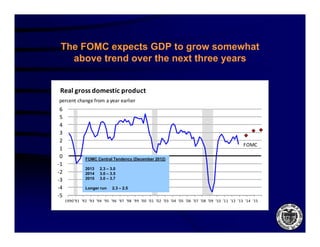
The FOMC expects GDP to grow somewhat
   above trend over the next three years


 Real gross domestic product
percent change from a year earlier
 6
 5
 4
 3
 2
                                                                                                    FOMC
 1
 0             FOMC Central Tendency (December 2012)
‐1
               2013
                0 3    2.3 – 3.0
                         3 30
‐2
 2             2014    3.0 – 3.5
‐3             2015    3.0 – 3.7

‐4             Longer run     2.3 – 2.5
‐5
     1990 91 92 93 94 95 96 97 98 99 00 01 02 03 04 05 06 07 08 09 10 11 12 13 14 15
     1990'91 '92 '93 '94 '95 '96 '97 '98 '99 '00 '01 '02 '03 '04 '05 '06 '07 '08 '09 '10 '11 '12 '13 '14 '15
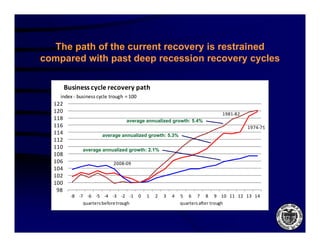
The path of the current recovery is restrained
compared with past deep recession recovery cycles

        Business cycle recovery path
    index ‐ business cycle trough  = 100
  122
  120                                                                      1981‐82
  118                              average annualized growth: 5.4%
  116                                                                                1974‐75
  114                  average annualized growth: 5.3%
  112
  110          average annualized growth: 2.1%
  108
  106                        2008‐09
  104
  102
  100
   98
          ‐8 ‐7 ‐6 ‐5 ‐4 ‐3 ‐2 ‐1          0   1   2   3   4   5 6 7 8 9 10 11 12 13 14
               quarters before trough                          quarters after trough
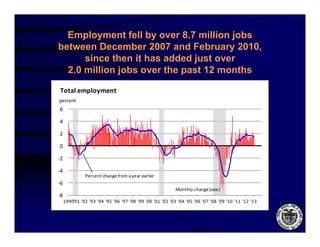
Employment fell by over 8.7 million jobs
between December 2007 and February 2010 2010,
      since then it has added just over
  2.0 million jobs over the past 12 months

Total employment
percent
6

4

2

0

‐2

 4
‐4
               Percent change from a year earlier
‐6
                                                            Monthly change (saar)
‐8
     1990 91 92 93 94 95 96 97 98 99 00 01 02 03 04 05 06 07 08 09 10 11 12 13
     1990'91 '92 '93 '94 '95 '96 '97 '98 '99 '00 '01 '02 '03 '04 '05 '06 '07 '08 '09 '10 '11 '12 '13
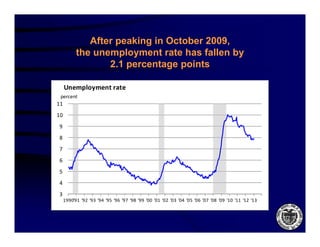
After peaking in October 2009,
                    p     g
           the unemployment rate has fallen by
                  2.1 percentage points

     Unemployment rate
 percent
11
10
9
8
7
6
5
4
3
     1990 91 92 93 94 95 96 97 98 99 00 01 02 03 04 05 06 07 08 09 10 11 12 13
     1990'91 '92 '93 '94 '95 '96 '97 '98 '99 '00 '01 '02 '03 '04 '05 '06 '07 '08 '09 '10 '11 '12 '13
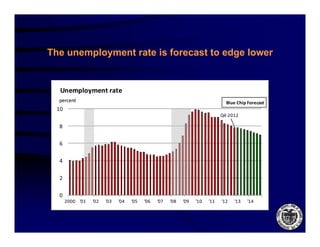
The unemployment rate is forecast to edge lower


  Unemployment rate
  percent                                                                      Blue Chip Forecast
 10
                                                                             Q4‐2012

  8

  6

  4

  2

  0
      2000 '01
            01   '02
                  02   '03
                        03   '04
                              04   '05
                                    05   '06
                                          06   '07
                                                07   '08
                                                      08   '09
                                                            09   '10
                                                                  10   '11
                                                                        11   '12
                                                                              12   '13
                                                                                    13   '14
                                                                                          14
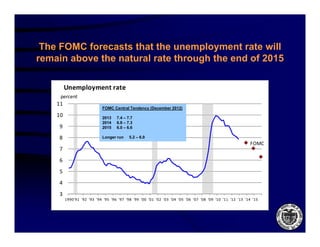
The FOMC forecasts that the unemployment rate will
remain above the natural rate through the end of 2015

         Unemployment rate
     percent
    11
                             FOMC Central Tendency (December 2012)
    10                       2013   7.4 – 7.7
                             2014   6.8 – 7.3
     9                       2015   6.0 – 6.6

     8                       Longer run
                                g          5.2 – 6.0
                                                                                                           FOMC
     7
     6
     5
     4
     3
         1990'91 '92 '93 '94 '95 '96 '97 '98 '99 '00 '01 '02 '03 '04 '05 '06 '07 '08 '09 '10 '11 '12 '13 '14 '15
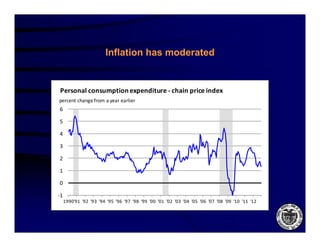
Inflation has moderated


Personal consumption expenditure ‐ chain price index
percent change from a year earlier
6

5

4

3

2

1

0

‐1
     1990 91 92 93 94 95 96 97 98 99 00 01 02 03 04 05 06 07 08 09 10 11 12
     1990'91 '92 '93 '94 '95 '96 '97 '98 '99 '00 '01 '02 '03 '04 '05 '06 '07 '08 '09 '10 '11 '12
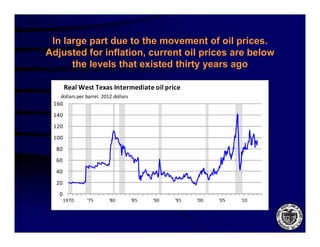
In large part due to the movement of oil prices.
       g p                                  p
Adjusted for inflation, current oil prices are below
      the levels that existed thirty years ago

       Real West Texas Intermediate oil price
   dollars per barrel. 2012 dollars
 160
 140
 120
 100
  80
  60
  40
  20
   0
       1970    '75
                75        '80
                           80         '85
                                       85   '90
                                             90   '95
                                                   95   '00
                                                         00   '05
                                                               05   '10
                                                                     10
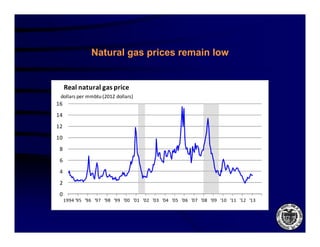
Natural gas prices remain low


     Real natural gas price
 dollars per mmbtu (2012 dollars)
16
14
12
10
 8
 6
 4
 2
 0
     1994 '95 '96 '97 '98 '99 '00 '01 '02 '03 '04 '05 '06 '07 '08 '09 '10 '11 '12 '13
           95 96 97 98 99 00 01 02 03 04 05 06 07 08 09 10 11 12 13
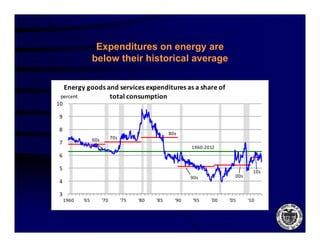
Expenditures on energy are
                  below their historical average

  Energy goods and services expenditures as a share of
 percent        total consumption
10

9

8
                                                      80s
                  60s         70s
7
                                                              1960‐2012
6

5
                                                                                     10s
                                                                                     10
                                                              90s            00s
4

3
     1960   '65
             65         '70
                         70         '75
                                     75   '80
                                           80   '85
                                                 85     '90
                                                         90   '95
                                                               95    '00
                                                                      00   '05
                                                                            05     '10
                                                                                    10
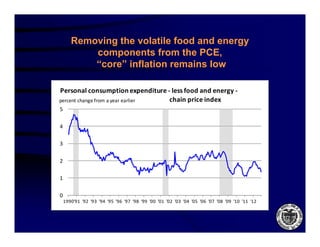
Removing the volatile food and energy
              g                           gy
           components from the PCE,
           “core” inflation remains low

Personal consumption expenditure ‐ less food and energy ‐
percent change from a year earlier chain price index
5

4

3

2

1

0
    1990 91 92 93 94 95 96 97 98 99 00 01 02 03 04 05 06 07 08 09 10 11 12
    1990'91 '92 '93 '94 '95 '96 '97 '98 '99 '00 '01 '02 '03 '04 '05 '06 '07 '08 '09 '10 '11 '12
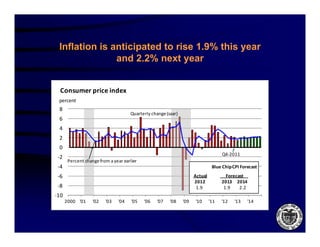
Inflation is anticipated to rise 1 9% this year
                                  1.9%
               and 2.2% next year


  Consumer price index
 percent
 8
                                      Quarterly change (saar)
 6
 4
 2
 0
                                                                                        Q4‐2011
 ‐2
       Percent change from a year earlier
 ‐4                                                                              Blue Chip CPI Forecast
 ‐6                                                                   Actual               Forecast     
                                                                      2012               2013     2014
 ‐8                                                                    1.9                1.9         2.2
‐10
      2000 '01
            01     '02
                    02   '03
                          03    '04
                                 04   '05
                                       05   '06
                                             06   '07
                                                   07    '08
                                                          08    '09
                                                                 09    '10
                                                                        10     '11
                                                                                11     '12
                                                                                        12      '13
                                                                                                 13     '14
                                                                                                         14
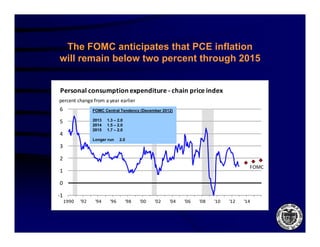
The FOMC anticipates that PCE inflation
will remain below two percent through 2015


Personal consumption expenditure ‐ chain price index
percent change from a year earlier
6                 FOMC Central Tendency (December 2012)

5                 2013   1.3 – 2.0
                  2014   1.5 – 2.0
                  2015   1.7 – 2.0
4
                  Longer run    2.0
                                20
3

2
                                                                                       FOMC
1

0

‐1
     1990   '92
             92    '94
                    94    '96
                           96        '98
                                      98   '00
                                            00   '02
                                                  02   '04
                                                        04   '06
                                                              06   '08
                                                                    08   '10
                                                                          10   '12
                                                                                12   '14
                                                                                      14
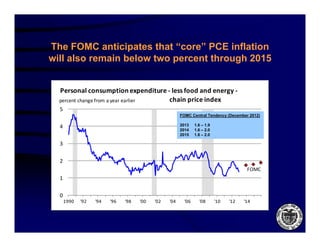
The FOMC anticipates that “core” PCE inflation
will also remain below two percent through 2015


  Personal consumption expenditure ‐ less food and energy ‐
  percent change from a year earlier chain price index
  5
                                                       FOMC Central Tendency (December 2012)

  4                                                    2013    1.6 – 1.9
                                                       2014    1.6 – 2.0
                                                       2015    1.8 – 2.0

  3

  2
                                                                                        FOMC
  1

  0
      1990   '92
              92   '94
                    94   '96
                          96   '98
                                98   '00
                                      00   '02
                                            02   '04
                                                  04     '06
                                                          06     '08
                                                                  08       '10
                                                                            10   '12
                                                                                  12   '14
                                                                                        14
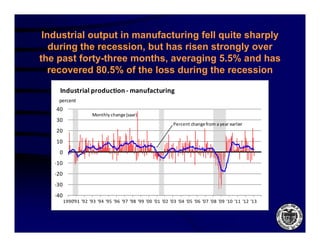
Industrial output in manufacturing fell quite sharply
   during the recession but has risen strongly over
              recession,
the past forty-three months, averaging 5.5% and has
   recovered 80.5% of the loss during the recession

     Industrial production ‐ manufacturing
    percent
   40
                       Monthly change (saar)
   30
                                                               Percent change from a year earlier
   20
   10
    0
   ‐10
   ‐20
   ‐30
   ‐40
         1990 91 92 93 94 95 96 97 98 99 00 01 02 03 04 05 06 07 08 09 10 11 12 13
         1990'91 '92 '93 '94 '95 '96 '97 '98 '99 '00 '01 '02 '03 '04 '05 '06 '07 '08 '09 '10 '11 '12 '13
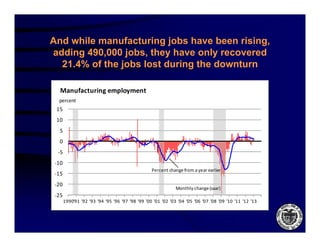
And while manufacturing jobs have been rising,
                        gj                   g
adding 490,000 jobs, they have only recovered
  21.4% of the jobs lost during the downturn

  Manufacturing employment
 percent
 15
 10
  5
  0
 ‐5
‐10
                                                 Percent change from a year
                                                 Percent change from a year earlier
‐15
‐20
                                                             Monthly change (saar)
‐25
      1990 91 92 93 94 95 96 97 98 99 00 01 02 03 04 05 06 07 08 09 10 11 12 13
      1990'91 '92 '93 '94 '95 '96 '97 '98 '99 '00 '01 '02 '03 '04 '05 '06 '07 '08 '09 '10 '11 '12 '13
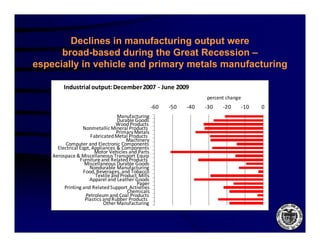
Declines in manufacturing output were
                                  g   p
      broad-based during the Great Recession –
especially in vehicle and primary metals manufacturing

         Industrial output: December 2007  ‐ June 2009
                                                                        percent change
                                                      ‐60
                                                       60   ‐50
                                                             50   ‐40
                                                                   40   ‐30
                                                                         30   ‐20
                                                                               20        ‐10
                                                                                          10   0
                                   Manufacturing
                                   Durable Goods
                                   Wood Products
                  Nonmetallic Mineral Products 
                                   Primary Metals
                       Fabricated Metal Products 
                                        Machinery
                                        M hi
          Computer and Electronic Components
      Electrical Eqpt, Appliances & Components
                        Motor Vehicles and Parts
    Aerospace & Miscellaneous Transport Equip
                 Furniture and Related Products 
                   Miscellaneous Durable Goods
                      Nondurable Manufacturing    g
                   Food, Beverages, and Tobacco
                   F dB                 dT b
                         Textile and Product  Mills
                      Apparel and Leather Goods
                                            Paper
         Printing and Related Support  Activities
                                        Chemicals
                    Petroleum and Coal Products
                    Plastics and Rubber Products 
                             Other Manufacturing
                               h         f
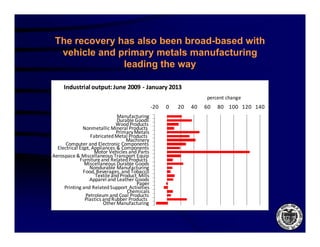
The recovery has also been broad-based with
            y
  vehicle and primary metals manufacturing
               leading the way

     Industrial output: June 2009  ‐ January 2013
                                                                      percent change
                                                  ‐20
                                                   20   0   20   40   60   80 100 120 140
                               Manufacturing
                               Durable Goods
                               Wood Products
              Nonmetallic Mineral Products 
                               Primary Metals
                   Fabricated Metal Products 
                                    Machinery
                                    M hi
      Computer and Electronic Components
  Electrical Eqpt, Appliances & Components
                    Motor Vehicles and Parts
Aerospace & Miscellaneous Transport Equip
             Furniture and Related Products 
               Miscellaneous Durable Goods
                  Nondurable Manufacturing    g
               Food, Beverages, and Tobacco
               F dB                 dT b
                     Textile and Product  Mills
                  Apparel and Leather Goods
                                        Paper
     Printing and Related Support  Activities
                                    Chemicals
                Petroleum and Coal Products
                Plastics and Rubber Products 
                         Other Manufacturing
                           h         f
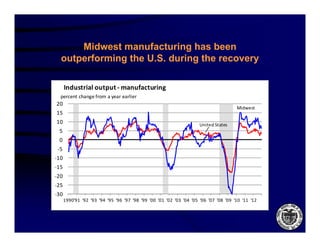
Midwest manufacturing has been
  outperforming the U.S. during the recovery

      Industrial output ‐ manufacturing
  percent change from a year earlier
20
                                                                                       Midwest
15
10                                                                    United States
 5
 0
 ‐5
‐10
‐15
‐20
‐25
‐30
      1990 91 92 93 94 95 96 97 98 99 00 01 02 03 04 05 06 07 08 09 10 11 12
      1990'91 '92 '93 '94 '95 '96 '97 '98 '99 '00 '01 '02 '03 '04 '05 '06 '07 '08 '09 '10 '11 '12
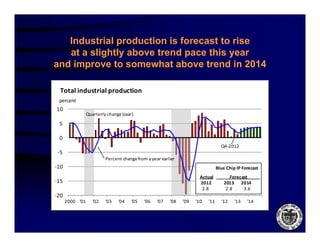
Industrial production is forecast to rise
              p
   at a slightly above trend pace this year
and improve to somewhat above trend in 2014

  Total industrial production
 percent
10
                 Quarterly change (saar)
 5

 0
                                                                                    Q4‐2012
 ‐5
                          Percent change from a year earlier
‐10                                                                               Blue Chip IP Forecast
                                                                                          p
                                                                       Actual           Forecast            
‐15                                                                    2012           2013       2014
                                                                        2.8           2.8           3.6      
‐20
      2000 '01
            01      '02
                     02   '03
                           03   '04
                                 04    '05
                                        05   '06
                                              06   '07
                                                    07   '08
                                                          08   '09
                                                                09   '10
                                                                      10    '11
                                                                             11     '12
                                                                                     12     '13
                                                                                             13      '14
                                                                                                      14
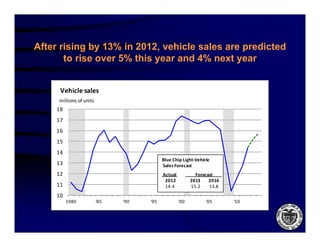
After rising by 13% in 2012 vehicle sales are predicted
                       2012,
       to rise over 5% this year and 4% next year


     Vehicle sales
     millions of units
    18
    17
    16
    15
    14
                                           Blue Chip Light‐Vehicle
    13                                     Sales Forecast
    12                                     Actual              Forecast         
                                            2012             2013        2014
    11                                      14.4             15.2         15.8
    10
         1980            '85
                          85   '90
                                90   '95
                                      95            '00
                                                     00               '05
                                                                       05          '10
                                                                                    10
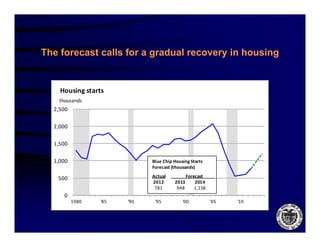
The forecast calls for a gradual recovery in housing


    Housing starts
    thousands
  2,500
  2 500

  2,000

  1,500

  1,000                      Blue Chip Housing Starts
                             Forecast (thousands)

   500                       Actual               Forecast            
                             2012          2013         2014
                              781             948         1,158
      0
          1980   '85
                  85   '90
                        90    '95
                               95               '00
                                                 00               '05
                                                                   05    '10
                                                                          10
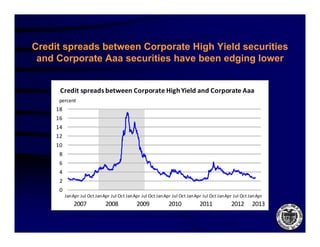
Credit spreads between Corporate High Yield securities
 and Corporate Aaa securities have been edging lower


      Credit spreads between Corporate High Yield and Corporate Aaa
      percent
     18
     16
     14
     12
     10
      8
      6
      4
      2
      0
          JanApr Jul Oct JanApr Jul Oct JanApr Jul Oct JanApr Jul Oct Jan Apr Jul Oct JanApr Jul Oct Jan Apr
              2007            2008           2009            2010            2011           2012       2013
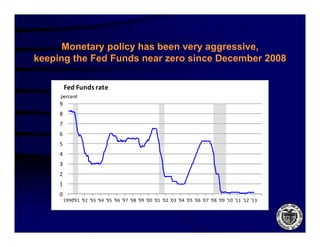
Monetary policy has been very aggressive,
                                    aggressive
keeping the Fed Funds near zero since December 2008

         Fed Funds rate
     percent
     9
     8
     7
     6
     5
     4
     3
     2
     1
     0
         1990 91 92 93 94 95 96 97 98 99 00 01 02 03 04 05 06 07 08 09 10 11 12 13
         1990'91 '92 '93 '94 '95 '96 '97 '98 '99 '00 '01 '02 '03 '04 '05 '06 '07 '08 '09 '10 '11 '12 '13
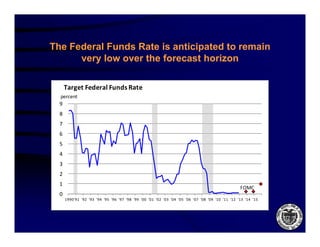
The Federal Funds Rate is anticipated to remain
      very low over the forecast horizon

      Target Federal Funds Rate
  percent
  9
  8
  7
  6
  5
  4
  3
  2
  1
                                                                                                   FOMC
  0
      1990'91 '92 '93 '94 '95 '96 '97 '98 '99 '00 '01 '02 '03 '04 '05 '06 '07 '08 '09 '10 '11 '12 '13 '14 '15
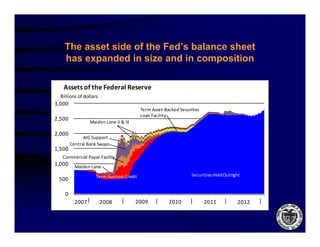
The asset side of the Fed’s balance sheet
    has expanded in size and in composition

   Assets of the Federal Reserve
  Billions of dollars
3,000
                                          Term Asset‐Backed Securities
                                                        k d
                                          Loan Facility
2,500
                 Maiden Lane II & III

2,000
              AIG Support
              AIG Support
        Central Bank Swaps
1,500
   Commercial Paper Facility
1,000     Maiden Lane
                    Term Auction Credit                           Securities Held Outright
 500

    0
          2007          2008            2009           2010              2011           2012
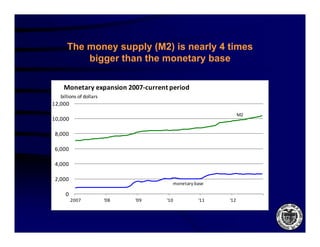
The money supply (M2) is nearly 4 times
          bigger than the monetary base

    Monetary expansion 2007‐current period
   billions of dollars
12,000
                                                             M2
10,000

 8,000

 6,000

 4,000

 2,000
                                       monetary base

     0
         2007            '08
                          08   '09
                                09   '10
                                      10         '11
                                                  11   '12
                                                        12
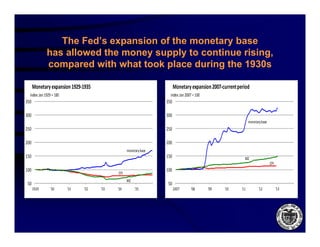
The Fed’s expansion of the monetary base
                              p                     y
              has allowed the money supply to continue rising,
              compared with what took place during the 1930s

      Monetary expansion 1929‐1935                                      Monetary expansion 2007‐current period
  index: Jan 1929 = 100                                             index: Jan 2007 = 100
350                                                               350

300                                                               300
                                                                                                                monetary base
250                                                               250

200                                                               200
                                                  monetary base
150                                                               150                                       M2
                                                                                                                                CPI
100                                                               100
                                            CPI
                                                  M2
 50                                                                50
      1929      '30       '31   '32   '33   '34        '35              2007      '08       '09   '10     '11          '12            '13
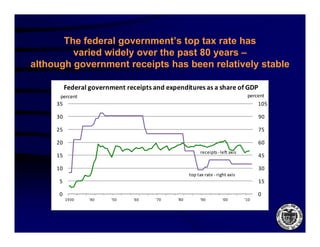
The federal government’s top tax rate has
                   g               p
         varied widely over the past 80 years –
although government receipts has been relatively stable

          Federal government receipts and expenditures as a share of GDP
          Federal government top tax rate and receipts as a share of GDP
      percent                                                                     percent
     35                                                                                105

     30                                                                                90

     25                                                                                75

     20                                                                                60
                                                          receipts ‐ left axis
     15                                                                                45

     10                                                                                30
                                                    top tax rate ‐ right axis
      5                                                                                15

      0                                                                                0
          1930    '40    '50    '60    '70    '80         '90         '00        '10
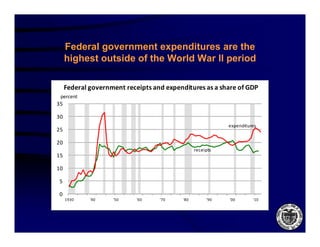
Federal government expenditures are the
     highest outside of the World War II period

     Federal government receipts and expenditures as a share of GDP
 percent
35

30
                                                            expenditures
25

20
                                                 receipts
15

10

5

0
     1930    '40    '50     '60    '70     '80        '90   '00       '10
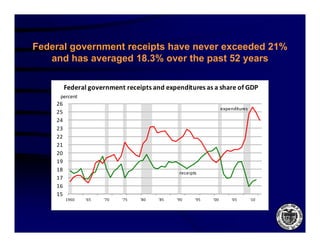
Federal government receipts have never exceeded 21%
   and has averaged 18.3% over the past 52 years

         Federal government receipts and expenditures as a share of GDP
     percent
    26
                                                                  expenditures
                                                                       dit
    25
    24
    23
    22
    21
    20
    19
    18
                                               receipts
    17
    16
    15
         1960   '65   '70   '75   '80   '85   '90     '95   '00       '05        '10
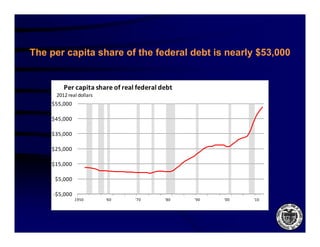
The per capita share of the federal debt is nearly $53,000


         Per capita share of real federal debt
      2012 real dollars
    $55,000

    $45,000

    $35,000

    $25,000

    $15,000

     $5,000

     ‐$5,000
               1950       '60    '70       '80   '90   '00   '10
Summary
•The outlook is for the U.S. economy to expand at a
 pace around trend in 2013 and above trend in 2014
•Employment is expected to rise moderately with the
 unemployment rate edging lower
•Slackness in the economy will lead to a relatively
 contained inflation rate
•Growth in manufacturing output should be around trend this year
 and somewhat above trend next year
www.chicagofed.org
www chicagofed org
www federalreserve gov
www.federalreserve.gov

2013 forecast slide presentation

  • 1.
    Economic Outlook Lake CountyChamber of Commerce William Strauss Vernon Hills, IL Senior Economist February 19, 2013 and Economic Advisor Federal Reserve Bank of Chicago
  • 2.
    What I saidlast year about 2012 •The outlook is for the U.S. economy to expand at a The US pace below trend •Employment is expected to rise moderately with the Employment unemployment rate edging lower •Slack in the economy will lead to a relatively contained inflation rate •Vehicle sales are anticipated to rise at a good pace •Growth in manufacturing output should be solid
  • 3.
    The “Great Recession”ended in June 2009 and the economy expanded by 1.5% over the past year Real gross domestic product percent 10 8 Quarterly change (saar) 6 4 2 0 ‐2 Percent change from a year earlier ‐4 ‐6 ‐8 ‐10 1990 '91 '92 '93 '94 '95 '96 '97 '98 '99 '00 '01 '02 '03 '04 '05 '06 '07 '08 '09 '10 '11 '12 91 92 93 94 95 96 97 98 99 00 01 02 03 04 05 06 07 08 09 10 11 12
  • 4.
    The liabilities sideof the Fed’s balance sheet shows large amount of excess reserves Liabilities of the Federal Reserve Billions of dollars 3,000 2,500 Treasury Balance 2,000 1,500 Deposits of Depository Institutions 1,000 500 Currency in Circulation 0 2007 2008 2009 2010 2011 2012
  • 5.
    Existing home pricesfell by over 30%, but have begun to rise Median sales price ‐ existing single family home 3‐month smoothed $250,000 $230,000 $210,000 $190,000 $170,000 $150,000 $130,000 $130 000 $110,000 $90,000 1990 '91 '92 '93 '94 '95 '96 '97 '98 '99 '00 '01 '02 '03 '04 '05 '06 '07 '08 '09 '10 '11 '12 91 92 93 94 95 96 97 98 99 00 01 02 03 04 05 06 07 08 09 10 11 12
  • 6.
    The stock markethas improved since March 2009 2009, but remains below previous levels S&P 500 stock index Index: 1941‐43 = 10 1,600 1,400 1,200 1,000 800 600 400 200 0 1990 '91 '92 '93 '94 '95 '96 '97 '98 '99 '00 '01 '02 '03 '04 '05 '06 '07 '08 '09 '10 '11 '12 '13
  • 7.
    GDP is forecastto grow slightly above trend in 2013 and somewhat above trend in 2014 Real gross domestic product percent Blue Chip GDP Forecast p 10 Actual Forecast         8 2012                2013     2014 Quarterly change (saar) 6 1.5                   2.4         2.9         4 2 0 Q4‐2012 ‐2 Percent change from a year earlier ‐4 ‐6 ‐8 ‐10 2000 '01 01 '02 02 '03 03 '04 04 '05 05 '06 06 '07 07 '08 08 '09 09 '10 10 '11 11 '12 12 '13 13 '14 14
  • 8.
    The FOMC expectsGDP to grow somewhat above trend over the next three years Real gross domestic product percent change from a year earlier 6 5 4 3 2 FOMC 1 0 FOMC Central Tendency (December 2012) ‐1 2013 0 3 2.3 – 3.0 3 30 ‐2 2 2014 3.0 – 3.5 ‐3 2015 3.0 – 3.7 ‐4 Longer run 2.3 – 2.5 ‐5 1990 91 92 93 94 95 96 97 98 99 00 01 02 03 04 05 06 07 08 09 10 11 12 13 14 15 1990'91 '92 '93 '94 '95 '96 '97 '98 '99 '00 '01 '02 '03 '04 '05 '06 '07 '08 '09 '10 '11 '12 '13 '14 '15
  • 9.
    The path ofthe current recovery is restrained compared with past deep recession recovery cycles Business cycle recovery path index ‐ business cycle trough  = 100 122 120 1981‐82 118 average annualized growth: 5.4% 116 1974‐75 114 average annualized growth: 5.3% 112 110 average annualized growth: 2.1% 108 106 2008‐09 104 102 100 98 ‐8 ‐7 ‐6 ‐5 ‐4 ‐3 ‐2 ‐1 0 1 2 3 4 5 6 7 8 9 10 11 12 13 14 quarters before trough quarters after trough
  • 10.
    Employment fell byover 8.7 million jobs between December 2007 and February 2010 2010, since then it has added just over 2.0 million jobs over the past 12 months Total employment percent 6 4 2 0 ‐2 4 ‐4 Percent change from a year earlier ‐6 Monthly change (saar) ‐8 1990 91 92 93 94 95 96 97 98 99 00 01 02 03 04 05 06 07 08 09 10 11 12 13 1990'91 '92 '93 '94 '95 '96 '97 '98 '99 '00 '01 '02 '03 '04 '05 '06 '07 '08 '09 '10 '11 '12 '13
  • 11.
    After peaking inOctober 2009, p g the unemployment rate has fallen by 2.1 percentage points Unemployment rate percent 11 10 9 8 7 6 5 4 3 1990 91 92 93 94 95 96 97 98 99 00 01 02 03 04 05 06 07 08 09 10 11 12 13 1990'91 '92 '93 '94 '95 '96 '97 '98 '99 '00 '01 '02 '03 '04 '05 '06 '07 '08 '09 '10 '11 '12 '13
  • 12.
    The unemployment rateis forecast to edge lower Unemployment rate percent Blue Chip Forecast 10 Q4‐2012 8 6 4 2 0 2000 '01 01 '02 02 '03 03 '04 04 '05 05 '06 06 '07 07 '08 08 '09 09 '10 10 '11 11 '12 12 '13 13 '14 14
  • 13.
    The FOMC forecaststhat the unemployment rate will remain above the natural rate through the end of 2015 Unemployment rate percent 11 FOMC Central Tendency (December 2012) 10 2013 7.4 – 7.7 2014 6.8 – 7.3 9 2015 6.0 – 6.6 8 Longer run g 5.2 – 6.0 FOMC 7 6 5 4 3 1990'91 '92 '93 '94 '95 '96 '97 '98 '99 '00 '01 '02 '03 '04 '05 '06 '07 '08 '09 '10 '11 '12 '13 '14 '15
  • 14.
    Inflation has moderated Personal consumption expenditure ‐chain price index percent change from a year earlier 6 5 4 3 2 1 0 ‐1 1990 91 92 93 94 95 96 97 98 99 00 01 02 03 04 05 06 07 08 09 10 11 12 1990'91 '92 '93 '94 '95 '96 '97 '98 '99 '00 '01 '02 '03 '04 '05 '06 '07 '08 '09 '10 '11 '12
  • 15.
    In large partdue to the movement of oil prices. g p p Adjusted for inflation, current oil prices are below the levels that existed thirty years ago Real West Texas Intermediate oil price dollars per barrel. 2012 dollars 160 140 120 100 80 60 40 20 0 1970 '75 75 '80 80 '85 85 '90 90 '95 95 '00 00 '05 05 '10 10
  • 16.
    Natural gas pricesremain low Real natural gas price dollars per mmbtu (2012 dollars) 16 14 12 10 8 6 4 2 0 1994 '95 '96 '97 '98 '99 '00 '01 '02 '03 '04 '05 '06 '07 '08 '09 '10 '11 '12 '13 95 96 97 98 99 00 01 02 03 04 05 06 07 08 09 10 11 12 13
  • 17.
    Expenditures on energyare below their historical average Energy goods and services expenditures as a share of percent total consumption 10 9 8 80s 60s 70s 7 1960‐2012 6 5 10s 10 90s 00s 4 3 1960 '65 65 '70 70 '75 75 '80 80 '85 85 '90 90 '95 95 '00 00 '05 05 '10 10
  • 18.
    Removing the volatilefood and energy g gy components from the PCE, “core” inflation remains low Personal consumption expenditure ‐ less food and energy ‐ percent change from a year earlier chain price index 5 4 3 2 1 0 1990 91 92 93 94 95 96 97 98 99 00 01 02 03 04 05 06 07 08 09 10 11 12 1990'91 '92 '93 '94 '95 '96 '97 '98 '99 '00 '01 '02 '03 '04 '05 '06 '07 '08 '09 '10 '11 '12
  • 19.
    Inflation is anticipatedto rise 1 9% this year 1.9% and 2.2% next year Consumer price index percent 8 Quarterly change (saar) 6 4 2 0 Q4‐2011 ‐2 Percent change from a year earlier ‐4 Blue Chip CPI Forecast ‐6 Actual Forecast      2012               2013     2014 ‐8 1.9             1.9         2.2 ‐10 2000 '01 01 '02 02 '03 03 '04 04 '05 05 '06 06 '07 07 '08 08 '09 09 '10 10 '11 11 '12 12 '13 13 '14 14
  • 20.
    The FOMC anticipatesthat PCE inflation will remain below two percent through 2015 Personal consumption expenditure ‐ chain price index percent change from a year earlier 6 FOMC Central Tendency (December 2012) 5 2013 1.3 – 2.0 2014 1.5 – 2.0 2015 1.7 – 2.0 4 Longer run 2.0 20 3 2 FOMC 1 0 ‐1 1990 '92 92 '94 94 '96 96 '98 98 '00 00 '02 02 '04 04 '06 06 '08 08 '10 10 '12 12 '14 14
  • 21.
    The FOMC anticipatesthat “core” PCE inflation will also remain below two percent through 2015 Personal consumption expenditure ‐ less food and energy ‐ percent change from a year earlier chain price index 5 FOMC Central Tendency (December 2012) 4 2013 1.6 – 1.9 2014 1.6 – 2.0 2015 1.8 – 2.0 3 2 FOMC 1 0 1990 '92 92 '94 94 '96 96 '98 98 '00 00 '02 02 '04 04 '06 06 '08 08 '10 10 '12 12 '14 14
  • 22.
    Industrial output inmanufacturing fell quite sharply during the recession but has risen strongly over recession, the past forty-three months, averaging 5.5% and has recovered 80.5% of the loss during the recession Industrial production ‐ manufacturing percent 40 Monthly change (saar) 30 Percent change from a year earlier 20 10 0 ‐10 ‐20 ‐30 ‐40 1990 91 92 93 94 95 96 97 98 99 00 01 02 03 04 05 06 07 08 09 10 11 12 13 1990'91 '92 '93 '94 '95 '96 '97 '98 '99 '00 '01 '02 '03 '04 '05 '06 '07 '08 '09 '10 '11 '12 '13
  • 23.
    And while manufacturingjobs have been rising, gj g adding 490,000 jobs, they have only recovered 21.4% of the jobs lost during the downturn Manufacturing employment percent 15 10 5 0 ‐5 ‐10 Percent change from a year Percent change from a year earlier ‐15 ‐20 Monthly change (saar) ‐25 1990 91 92 93 94 95 96 97 98 99 00 01 02 03 04 05 06 07 08 09 10 11 12 13 1990'91 '92 '93 '94 '95 '96 '97 '98 '99 '00 '01 '02 '03 '04 '05 '06 '07 '08 '09 '10 '11 '12 '13
  • 24.
    Declines in manufacturingoutput were g p broad-based during the Great Recession – especially in vehicle and primary metals manufacturing Industrial output: December 2007  ‐ June 2009 percent change ‐60 60 ‐50 50 ‐40 40 ‐30 30 ‐20 20 ‐10 10 0 Manufacturing Durable Goods Wood Products Nonmetallic Mineral Products  Primary Metals Fabricated Metal Products  Machinery M hi Computer and Electronic Components Electrical Eqpt, Appliances & Components Motor Vehicles and Parts Aerospace & Miscellaneous Transport Equip Furniture and Related Products  Miscellaneous Durable Goods Nondurable Manufacturing g Food, Beverages, and Tobacco F dB dT b Textile and Product  Mills Apparel and Leather Goods Paper Printing and Related Support  Activities Chemicals Petroleum and Coal Products Plastics and Rubber Products  Other Manufacturing h f
  • 25.
    The recovery hasalso been broad-based with y vehicle and primary metals manufacturing leading the way Industrial output: June 2009  ‐ January 2013 percent change ‐20 20 0 20 40 60 80 100 120 140 Manufacturing Durable Goods Wood Products Nonmetallic Mineral Products  Primary Metals Fabricated Metal Products  Machinery M hi Computer and Electronic Components Electrical Eqpt, Appliances & Components Motor Vehicles and Parts Aerospace & Miscellaneous Transport Equip Furniture and Related Products  Miscellaneous Durable Goods Nondurable Manufacturing g Food, Beverages, and Tobacco F dB dT b Textile and Product  Mills Apparel and Leather Goods Paper Printing and Related Support  Activities Chemicals Petroleum and Coal Products Plastics and Rubber Products  Other Manufacturing h f
  • 26.
    Midwest manufacturing hasbeen outperforming the U.S. during the recovery Industrial output ‐ manufacturing percent change from a year earlier 20 Midwest 15 10 United States 5 0 ‐5 ‐10 ‐15 ‐20 ‐25 ‐30 1990 91 92 93 94 95 96 97 98 99 00 01 02 03 04 05 06 07 08 09 10 11 12 1990'91 '92 '93 '94 '95 '96 '97 '98 '99 '00 '01 '02 '03 '04 '05 '06 '07 '08 '09 '10 '11 '12
  • 27.
    Industrial production isforecast to rise p at a slightly above trend pace this year and improve to somewhat above trend in 2014 Total industrial production percent 10 Quarterly change (saar) 5 0 Q4‐2012 ‐5 Percent change from a year earlier ‐10 Blue Chip IP Forecast p Actual Forecast             ‐15 2012           2013       2014 2.8           2.8           3.6       ‐20 2000 '01 01 '02 02 '03 03 '04 04 '05 05 '06 06 '07 07 '08 08 '09 09 '10 10 '11 11 '12 12 '13 13 '14 14
  • 28.
    After rising by13% in 2012 vehicle sales are predicted 2012, to rise over 5% this year and 4% next year Vehicle sales millions of units 18 17 16 15 14 Blue Chip Light‐Vehicle 13 Sales Forecast 12 Actual  Forecast          2012             2013        2014 11 14.4 15.2         15.8 10 1980 '85 85 '90 90 '95 95 '00 00 '05 05 '10 10
  • 29.
    The forecast callsfor a gradual recovery in housing Housing starts thousands 2,500 2 500 2,000 1,500 1,000 Blue Chip Housing Starts Forecast (thousands) 500 Actual Forecast             2012          2013         2014 781             948         1,158 0 1980 '85 85 '90 90 '95 95 '00 00 '05 05 '10 10
  • 30.
    Credit spreads betweenCorporate High Yield securities and Corporate Aaa securities have been edging lower Credit spreads between Corporate High Yield and Corporate Aaa percent 18 16 14 12 10 8 6 4 2 0 JanApr Jul Oct JanApr Jul Oct JanApr Jul Oct JanApr Jul Oct Jan Apr Jul Oct JanApr Jul Oct Jan Apr 2007 2008 2009 2010 2011 2012 2013
  • 31.
    Monetary policy hasbeen very aggressive, aggressive keeping the Fed Funds near zero since December 2008 Fed Funds rate percent 9 8 7 6 5 4 3 2 1 0 1990 91 92 93 94 95 96 97 98 99 00 01 02 03 04 05 06 07 08 09 10 11 12 13 1990'91 '92 '93 '94 '95 '96 '97 '98 '99 '00 '01 '02 '03 '04 '05 '06 '07 '08 '09 '10 '11 '12 '13
  • 32.
    The Federal FundsRate is anticipated to remain very low over the forecast horizon Target Federal Funds Rate percent 9 8 7 6 5 4 3 2 1 FOMC 0 1990'91 '92 '93 '94 '95 '96 '97 '98 '99 '00 '01 '02 '03 '04 '05 '06 '07 '08 '09 '10 '11 '12 '13 '14 '15
  • 33.
    The asset sideof the Fed’s balance sheet has expanded in size and in composition Assets of the Federal Reserve Billions of dollars 3,000 Term Asset‐Backed Securities k d Loan Facility 2,500 Maiden Lane II & III 2,000 AIG Support AIG Support Central Bank Swaps 1,500 Commercial Paper Facility 1,000 Maiden Lane Term Auction Credit Securities Held Outright 500 0 2007 2008 2009 2010 2011 2012
  • 34.
    The money supply(M2) is nearly 4 times bigger than the monetary base Monetary expansion 2007‐current period billions of dollars 12,000 M2 10,000 8,000 6,000 4,000 2,000 monetary base 0 2007 '08 08 '09 09 '10 10 '11 11 '12 12
  • 35.
    The Fed’s expansionof the monetary base p y has allowed the money supply to continue rising, compared with what took place during the 1930s Monetary expansion 1929‐1935 Monetary expansion 2007‐current period index: Jan 1929 = 100 index: Jan 2007 = 100 350 350 300 300 monetary base 250 250 200 200 monetary base 150 150 M2 CPI 100 100 CPI M2 50 50 1929 '30 '31 '32 '33 '34 '35 2007 '08 '09 '10 '11 '12 '13
  • 36.
    The federal government’stop tax rate has g p varied widely over the past 80 years – although government receipts has been relatively stable Federal government receipts and expenditures as a share of GDP Federal government top tax rate and receipts as a share of GDP percent percent 35 105 30 90 25 75 20 60 receipts ‐ left axis 15 45 10 30 top tax rate ‐ right axis 5 15 0 0 1930 '40 '50 '60 '70 '80 '90 '00 '10
  • 37.
    Federal government expendituresare the highest outside of the World War II period Federal government receipts and expenditures as a share of GDP percent 35 30 expenditures 25 20 receipts 15 10 5 0 1930 '40 '50 '60 '70 '80 '90 '00 '10
  • 38.
    Federal government receiptshave never exceeded 21% and has averaged 18.3% over the past 52 years Federal government receipts and expenditures as a share of GDP percent 26 expenditures dit 25 24 23 22 21 20 19 18 receipts 17 16 15 1960 '65 '70 '75 '80 '85 '90 '95 '00 '05 '10
  • 39.
    The per capitashare of the federal debt is nearly $53,000 Per capita share of real federal debt 2012 real dollars $55,000 $45,000 $35,000 $25,000 $15,000 $5,000 ‐$5,000 1950 '60 '70 '80 '90 '00 '10
  • 40.
    Summary •The outlook isfor the U.S. economy to expand at a pace around trend in 2013 and above trend in 2014 •Employment is expected to rise moderately with the unemployment rate edging lower •Slackness in the economy will lead to a relatively contained inflation rate •Growth in manufacturing output should be around trend this year and somewhat above trend next year
  • 41.
    www.chicagofed.org www chicagofed org wwwfederalreserve gov www.federalreserve.gov