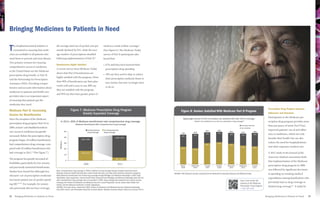
PHARMACEUTICAL RESEARCH
AND MANUFACTURERS OF AMERICA
950 F STREET, NW
WASHINGTON, DC 20004
                                     2012 profile
                                          PHARMACEUTICAL
www.phrma.org | www.innovation.org        INDUSTRY
endnotes
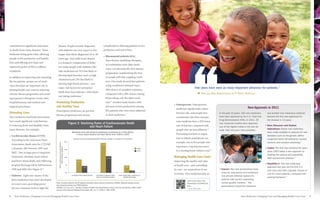
Key Facts                                                                                                  (continued from inside front cover)
                                                                                                           1
                                                                                                            J.A. DiMasi, “New Drug Development in U.S. 1963–1999,” Clinical Pharmacology & Therapeutics 69, no. 5 (2001): 286–296;
                                                                                                           M. Dickson and J.P Gagnon, “Key Factors in the Rising Cost of New Drug Discovery and Development,” Nature Reviews Drug
                                                                                                                             .
Research and Development (R&D)                     Approvals                                               Discovery 3 (May 2004): 417–429; J.A. DiMasi, R.W. Hansen, and H.G. Grabowski, “The Price of Innovation: New Estimates of
                                                                                                           Drug Development Costs,” Journal of Health Economics 22 (2003): 151–185.
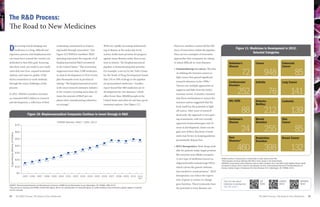
Time to develop a drug = 10 to 15 years1           •	Medicines approved 2001–2011 = 3406                   2
                                                                                                            J.A. DiMasi and H.G. Grabowski, “The Cost of Biopharmaceutical R&D: Is Biotech Different?” Managerial and Decision
                                                   •	In the 29 years since the Orphan Drug Act was         Economics 28, no. 4–5 (2007): 469–479; J.A. DiMasi, R.W. Hansen, and H.G. Grabowski, “The Price of Innovation: New Estimates
Development Costs                                    established, 398 orphan drugs have been               of Drug Development Costs,” Journal of Health Economics 22 (2003): 151–185.
                                                                                                           3
                                                     approved.7                                             Pharmaceutical Research and Manufacturers of America, PhRMA Annual Membership Survey (Washington, DC: PhRMA,
Average cost to develop a drug
                                                                                                           1981–2012).
(including the cost of failures)2                  •	Only 2 of 10 marketed drugs return revenues           4
                                                                                                           Pharmaceutical Research and Manufacturers of America, PhRMA Annual Membership Survey (Washington, DC: PhRMA, 2012).
                                                     that match or exceed R&D costs.8
Early 2000s = $1.2 billion                                                                                 5
                                                                                                            Battelle Technology Partnership Practice, The U.S. Biopharmaceuticals Sector: Economic Contribution of the Nation (Columbus,
                                                                                                           OH: Battelle Memorial Institute, July 2011).
Late 1990s = $800 million*
                                                   Medicines in Development                                6
                                                                                                            Pharmaceutical Research and Manufacturers of America, New Drug Approvals, 2001–2010 (Washington DC: PhRMA, 2002–
Mid-1980s = $320 million*                                                                                  2011); U.S. Food and Drug Administration, “2011 Biological License Application Approvals,” 2 March 2012, http://www.fda.
                                                   2011 = 3,240 compounds9                                 gov/BiologicsBloodVaccines/DevelopmentApprovalProcess/BiologicalApprovalsbyYear/ucm242933.htm (accessed 10 February
1970s = $140 million*                              2001 = 2,040 compounds10                                2012); U.S. Food and Drug Administration, New Molecular Entity Approvals for 2011, 31 January 2012, http://www.fda.gov/
                                                                                                           Drugs/DevelopmentApprovalProcess/DrugInnovation/ucm285554.htm (accessed 10 February 2012).
                                                                                                           7
R&D Spending                                                                                                Food and Drug Administration, Orphan Drug Designations and Approvals Database, www.accessdata.fda.gov/scripts/opdlisting/
                                                   Value of Medicines                                      oopd/index.cfm (accessed 13 March 2012).
                                                                                                           8
Year        PhRMA members3                         •	 Cancer: Since 1980, life expectancy for cancer        J.A. Vernon, J.H. Golec, and J.A. DiMasi, "Drug Development Costs When Financial Risk is Measured Using the Fama-French
                                                                                                           Three-Factor Model," Health Economics Letters 19, no. 8 (2010): 1002–1010.
2011        $49.5 billion (est.)                      patients has increased about 3 years, and 83%
                                                                                                           9
                                                                                                           Adis R&D Insight Database, Wolters Kluwer Health (accessed 10 February 2012).
2010        $50.7 billion                             of those gains are attributable to new treatments,
                                                                                                           10
                                                      including medicines.11 Another study found that          Adis R&D Insight Database, Wolters Kluwer Health, customized run, December 2007.
2009        $46.4 billion
                                                                                                           11
                                                      medicines specifically account for 50% to 60% of      E. Sun, et al., “The Determinants of Recent Gains in Cancer Survival: An Analysis of the Surveillance, Epidemiology, and End
2008        $47.4 billion
                                                      increases in survival rates since 1975.12            Results (SEER) Database,” Journal of Clinical Oncology 26, suppl. 15 (2008): Abstract 6616.
2007        $47.9 billion                                                                                  12
                                                                                                            F. Lichtenberg, “The Expanding Pharmaceutical Arsenal in the War on Cancer,” NBER Working Paper 10328 (National Bureau of
2006        $43.0 billion                          •  Cardiovascular Disease: According to a 2011          Economic Research, February 2004).
2005        $39.9 billion                            statistics update by the American Heart Associa-      13
                                                                                                            V.L. Roger, et al., “Heart Disease and Stroke Statistics 2011 Update: A Report from the American Heart Association,” Circulation,
2004        $37.0 billion                            tion (AHA), death rates for cardiovascular disease    published online, 15 December 2011.
2000        $26.0 billion                            fell a dramatic 31% between 1998 and 2008.13          14
                                                                                                             U.S. Department of Health and Human Services, Centers for Disease Control and Prevention, National Center for Health
1990        $8.4 billion                                                                                   Statistics, Health, United States, 2010: With Special Feature on Death and Dying, table 35 (Hyattsville, MD: HHS, 2011), http://
                                                   •  HIV/AIDS: Since the approval of the antiretroviral   www.cdc.gov/nchs/data/hus/hus10.pdf#045; S.L. Murphy, et al., “Deaths: Final Data for 2010,” National Vital Statistics Reports
1980        $2.0 billion                             treatments (ART) in 1995, the U.S. AIDS death         60, no. 4 (2012): 43 (table 2), http://www.cdc.gov/nchs/data/nvsr/nvsr60/nvsr60_04.pdf (accessed 2 March 2012).
                                                     rate has dropped by more than 80%.14                  15
                                                                                                               IMS Health, analysis for PhRMA, March 2012.
Estimated Percentage of Sales
That Went to R&D in 20114                          Sales
Domestic R&D                                       Generic share of market15
as a percentage of domestic sales = 21.1%
                                                   2000 = 49%
Total R&D
                                                   2011 = 80%
as a percentage of total sales = 16.7%

Economic Impact of the                             See inside back cover for endnotes.
Biopharmaceutical Sector 5
Direct jobs = More than 650,000 in 2009
(most recent data)

Total jobs (including indirect and induced jobs)
= About 4 million in 2009 (most recent data)

*Note: Data is adjusted to 2000 dollars
 based on correspondence with J.A. DiMasi.
2012 profile
     PHARMACEUTICAL
     INDUSTRY
Letter from PhRMA’s
                                                                                                                                                   President and CEO

                                                                                                                                                   Many scientists believe we are in a golden age of the life sciences. We are unraveling the molecular pathways
                                                                                                                                                   underlying many diseases and uncovering new ways to alter the course of illnesses. And researchers in the
                                                                                                                                                                               biopharmaceutical industry are working to translate this new knowledge into
                                                                                                                                                                               medicines that help prevent disease, improve health, and save lives.

                                                                                                                                                                               Thanks to sustained investment in research and development, biopharmaceutical
                                                                                                                                                                               companies have helped to improve the outlook for many diseases. In the past year
                                                                                                                                                                               we’ve seen substantial progress against diseases such as melanoma, lupus and cystic
                                                                                                                                                                               fibrosis, to name a few.

                                                                                                                                                                               At the same time, the biopharmaceutical industry faces many hurdles. The cost of
                                                                                                                                                                               developing new medicines has escalated, in part due to the focus on more complex
                                                                                                                                                                               conditions and increasing regulatory requirements. Market conditions have also
                                                                                                                                                                               become more challenging, and generics now account for 80% of prescriptions filled.

                                                                                                                                                   The industry is well focused on both the scientific potential and the business challenges. Companies are
                                                                                                                                                   working to adapt to the changing conditions through reorganized R&D structures; more efficient drug
                                                                                                                                                   discovery methods; new approaches, such as personalized medicine; and growing partnerships with academic
                                                                                                                                                   medical centers, foundations, and government.

                                                                                                                                                   Biopharmaceutical companies are also continuing to invest in research and development. In 2011, PhRMA
                                                                                                                                                   members alone invested an estimated $49.5 billion in R&D, representing the vast majority of private
                      To enhance the content in the print version      Permission to reproduce is granted if proper credit is given.
                                                                                                                                                   investment in new medicines in the United States. I am pleased to present the 2012 Pharmaceutical Industry
                      of this year’s Profile, we have included quick   Suggested Citation:
                                                                                                                                                   Profile, which tells the evolving story of this complex, vital industry.
                      response (QR) codes that link you directly       Pharmaceutical Research and Manufacturers of America,

                      to additional materials online. You can          Pharmaceutical Industry Profile 2012 (Washington, DC: PhRMA, April 2012).

    find QR code readers for your smart phone or tablet in your        Copyright © 2012

    device’s app store, or you can access the interactive Industry     by the Pharmaceutical Research and Manufacturers of America.

    Profile online at www.phrma.org/industryprofile2012. 

                                                                       Pharmaceutical Research and Manufacturers of America                        					John J. Castellani
                                                                       Washington, DC                                                              					President and Chief Executive Officer	
    Cover image: An extracellular signaling molecule.                  www.phrma.org                                                               					                                          Pharmaceutical Research and Manufacturers of America
    Medicines often target these and other molecules
    in the body to fight disease.                                      2012


                                                                                                                                                                                                                Hear more from
                                                                                                                                                                                                                John J. Castellani here.
                                                                                                                                                                                                                Scan QR code >


0   Chapter title goes in this position, size + color
INTRODUCTION
    Table of Contents

    Introduction
    v     Innovative Solutions for Patients and the Economy


1
    1	    New Medicines: Changing Lives and Managing Health Care Costs	
    4	    Extending Lives
    4	    Promoting Productive and Healthy Lives
    5	    Managing Health Care Costs
                                                                                                       Innovative Solutions for Patients
                                                                                                       and the Economy
2
    13	   Contributing Strongly to the U.S. Economy Despite a Challenging Environment
    14	   A Critical Pillar of the U.S. Economy
    16	   Meeting Challenges Today and Tomorrow
    19	   The U.S. Biopharmaceutical Industry Is Rising to Its Challenges
                                                                                                       E   ach year, the U.S. biopharmaceu-
                                                                                                           tical industry spends billions of
                                                                                                                                                   thousands of jobs and indirectly
                                                                                                                                                   supports millions more across the
                                                                                                                                                                                                   The 2012 Pharmaceutical Industry
                                                                                                                                                                                                   Profile explores the critical role that


3
    21	   Bringing Medicines to Patients in Need                                                       dollars on intensive research to discover   United States. The sector contributes           biopharmaceutical companies play
    22	   Medicare Part D: Increasing Access for Beneficiaries                                         new medicines for patients. Though          significantly to the economy on the             in the lives of patients and in the U.S.
    24	   The Partnership for Prescription Assistance                                                  the research process is long, uncertain,    national, state, and local levels.              economy. Chapter 1 describes recent
                                                                                                       and expensive, the treatments that
                                                                                                       eventually result save lives and im-


4
    27	   The R&D Process: The Road to New Medicines
    30	   The R&D Process                                                                              prove the health of people all around
    36	   PDUFA and Pediatric Research Legislation: Success Stories for Patients                       the world. Recent decades have seen
    38	   Collaboration and Innovation Go Hand in Hand                                                 enormous progress in the fight against
                                                                                                       major causes of death and disability,
    Conclusion                                                                                         including cancer, HIV/AIDS, mental
    41	   Continuing Commitment to World-Class Research and Innovation                                 illness, and diabetes, as well as against
          Leads to Better Health and a Strong Economy                                                  numerous rare diseases. In addition,
                                                                                                       advances by companies in the biophar-
    Appendix                                                                                           maceutical sector play an important
    44	   PhRMA Member Companies                                                                       role in controlling costs of health care
    47	   PhRMA Annual Membership Survey Definition of Terms                                           by reducing hospitalizations, surgeries,
    49	   List of Tables: Detailed Results From the PhRMA Annual Membership Survey                     and other costly care.

                                                                                                       Biopharmaceutical research and
                                                                                                       development is an investment in
                                                                                                       people, services, ideas and products.
                                                                                                       This dynamic and innovative industry
                                                                                                       directly supports hundreds of


                                                                                                       	                                                                                Innovative Solutions for Patients and the Economy     v
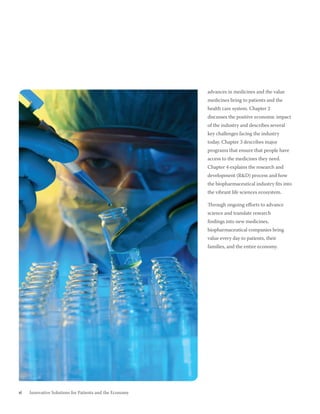
advances in medicines and the value
                                                         medicines bring to patients and the
                                                         health care system. Chapter 2
                                                         discusses the positive economic impact
                                                         of the industry and describes several
                                                         key challenges facing the industry
                                                         today. Chapter 3 describes major
                                                         programs that ensure that people have
                                                         access to the medicines they need.
                                                         Chapter 4 explains the research and
                                                         development (R&D) process and how
                                                         the biopharmaceutical industry fits into
                                                         the vibrant life sciences ecosystem.

                                                         Through ongoing efforts to advance
                                                         science and translate research
                                                         findings into new medicines,
                                                         biopharmaceutical companies bring
                                                         value every day to patients, their
                                                         families, and the entire economy.


vi   Innovative Solutions for Patients and the Economy
1   New Medicines: Changing Lives
    and Managing Health Care Costs
New Medicines: Changing Lives
CHAPTER 1


            and Managing Health Care Costs


                                                                                                     “
            I   n the past year we have marked two
                important anniversaries. Forty years
            ago, in 1971, Congress passed the
                                                         •	 12 million cancer survivors are living
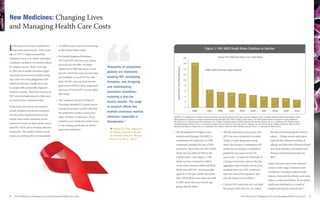
                                                           in the United States today.1                                                                                                            Figure 1: HIV/AIDS Death Rates Continue to Decline
                                                                                                                                                                                               Figure 1: HIV/AIDS Death Rates Continue to Decline
                                                         •	 For people diagnosed between                                                                                                                       Annual HIV/AIDS Death Rate in the United States
            National Cancer Act, which unleashed                                                                                                                               18
                                                           1975 and 1979, the five-year cancer
            a dramatic escalation in research efforts                                                                                                                          16
                                                           survival rate was 49%. For those                                                                                             16.2
            to conquer cancer. Thirty years ago,                                                     Thousands of researchers


                                                                                                                                               Deaths Per 100,000 Population
                                                           diagnosed in 2003 (the most recent                                                                                  14
                                                                                                                                                                                                  1996: HAART becomes widely available
            in 1981, the scientific literature began                                                 globally are intensively
                                                           year for which five-year survival rates                                                                             12
            reporting on previously healthy young
                                                           are available), it was 67%.2 For chil-    studying HIV, developing
            men who were being diagnosed with                                                                                                                                  10
            infectious diseases usually seen only
                                                           dren, the five-year survival rate has     therapies, and designing
                                                           grown from 58% for those diagnosed                                                                                   8
            in people with profoundly impaired                                                       and implementing
                                                           between 1975 and 1977 to more than
            immune systems. These first articles on                                                  prevention modalities—                                                     6
                                                                                                                                                                                                     6.0
                                                           80% today.3                                                                                                                                         5.3          5.0
            HIV were the beginning of a tidal wave                                                   including a thus-far-                                                      4                                                      4.7
                                                                                                                                                                                                                                                   4.2
                                                                                                                                                                                                                                                               3.7
            of research that continues today.            •	 The American Society of Clinical                                                                                                                                                                                 3.3            3.1
                                                                                                     elusive vaccine. The surge                                                 2                                                                                                                         2.7
                                                           Oncology identified 12 major cancer
            In the years since these two seminal                                                     in research efforts has                                                    0
                                                           treatment advances in 2011 that had
            events, biopharmaceutical companies                                                      enabled enormous medical                                                           1995        1997      1999         2001       2003        2005        2007          2008           2009          2010
                                                           the potential to reduce cancer mor-
            and the entire medical research com-
                                                           tality. Of these 12 advances, 10 are      advances, especially in              SOURCES: U.S. Department of Health and Human Services, Centers for Disease Control and Prevention, National Center for Health Statistics, Health, United States, 2003:
            munity have made enormous invest-                                                                                             With Chartbook on Trends in the Health of Americans (Hyattsville, MD: HHS, 2003); Health, United States, 2010: With Special Feature on Death and Dying (Hyattsville,
            ments in research to learn about cancer
                                                           related to new medicines, better ways     therapeutics.”                       MD: HHS, 2011); 2008 data from K.D. Kochanek, et al., “Deaths: Preliminary Data for 2009,” National Vital Statistics Reports 59, no. 4 (Hyattsville, MD: National Center
                                                                                                                                          for Health Statistics, March 2011): 17 (accessed 10 March 2012). 2009 and 2010 data from S.L. Murphy, J. Xu, and K.D. Kochanek, “Deaths: Preliminary Data for 2010,”
                                                           to use existing medicines, or newly                                            National Vital Statistics Reports 60, no. 4 (Hyattsville, MD: National Center for Health Statistics, January 2012): 17 (accessed 10 March 2012).
            and HIV/AIDS and to develop effective
                                                           approved medicines.4                        Anthony S. Fauci, Director of
            treatments. The results of these invest-                                                  the National Institute of Allergy   •	 The development of highly active                                    •	 The life expectancy of a person with                 the risk of transmitting the virus to
            ments are nothing short of remarkable:                                                    and Infectious Diseases, National       antiretroviral therapy (HAART), a                                      HIV was once measured in months.                    others.11 A large recent study spon-
                                                                                                      Institutes of Health, 20115
                                                                                                                                              combination of medicines, in 1995                                      Today, a newly diagnosed young                      sored by the National Institute of
                                                                                                                                              completely changed the face of HIV                                     adult who receives combination HIV                  Allergy and Infectious Diseases found
                                                                                                                                              treatment. Since then, the HIV/AIDS                                    medicines according to established                  that early initiation of antiretroviral
                                                                                                                                              death rate has fallen by 83% in the                                    guidelines can expect to live 50                    therapy reduced transmission by
                                                                                                                                              United States. (See Figure 1.) The    6
                                                                                                                                                                                                                     more years. A study by University of
                                                                                                                                                                                                                                  9
                                                                                                                                                                                                                                                                         96%.12
                                                                                                                                              death rate has continued to fall in                                    Chicago economists reports that the
                                                                                                                                                                                                                                                                      Major advances have been achieved
                                                                                                                                              recent years: between 2009 and 2010,                                   aggregate value of improved survival
                                                                                                                                                                                                                                                                      across a wide range of diseases and
                                                                                                                                              death rates fell 13%.7 Among people                                    resulting from new HIV medicines
                                                                                                                                                                                                                                                                      conditions, including cardiovascular
                                                                                                                                              aged 25 to 44 years, death rates from                                  since the start of the epidemic and
                                                                                                                                                                                                                                                                      disease, rheumatoid arthritis, and many
                                                                                                                                              HIV/AIDS fell by more than one-half                                    into the future is $1.4 trillion.10
                                                                                                                                                                                                                                                                      others, as discussed below. Prescription
                                                                                                                                              in 2007 alone (the most recent age
                                                                                                                                                                                                                 •	 Current HIV medicines not only help               medicines developed as a result of
                                                                                                                                              group-specific data).8
                                                                                                                                                                                                                     the person with HIV but can reduce               biopharmaceutical research have

            2     New Medicines: Changing Lives and Managing Health Care Costs                                                            	                                                                                            New Medicines: Changing Lives and Managing Health Care Costs                  3
CHAPTER 1


            contributed to significant reductions           disease. People recently diagnosed                                                    complications, allowing patients to live
            in deaths from many diseases. These             with diabetes can now expect to live                                                  productive and active lives.


                                                                                                                                                                                                                           “
            medicines bring great value, allowing           longer than those diagnosed 10 or 20
                                                                                                                                                  •	 Rheumatoid arthritis (RA).
            people to live productive and healthy           years ago. And while heart disease
                                                                                                                                                       New disease-modifying therapies,
            lives and offering new hope and                 is a frequent complication of diabe-
                                                                                                                                                       in combination with older medi-
            improved quality of life to millions            tes, today people with diabetes who
                                                                                                                                                       cines, can dramatically slow disease
            of patients.                                    take medicines are 31% less likely to
                                                                                                                                                       progression, transforming the lives
                                                            develop lipid disorders such as high
            In addition to improving and extending                                                                                                     of people with this crippling condi-
                                                            cholesterol and 13% less likely to
            life for patients, proper use of medi-                                                                                                     tion. One study showed that patients
                                                            develop high blood pressure—two
            cines also plays an important role in                                                                                                      using combined treatment had a
                                                            major risk factors for premature                                                                                                                                   Few years have seen as many important advances for patients.”
            limiting health care costs by reducing                                                                                                     50% chance of complete remission,
                                                            death from heart disease—than those
            chronic disease progression and avoid-                                                                                                     compared with a 28% chance among                                            Food and Drug Administration on FY 2011 Approvals   18


                                                            not taking medicines.15
            ing expensive emergency room visits,                                                                                                       those taking only the older medi-
            hospitalizations, and medical and             Promoting Productive                                                                         cine.16 Another study found a 26%
                                                                                                                                                                                                         •	 Osteoporosis. Osteoporosis
            surgical procedures.                          and Healthy Lives                                                                            decrease in lost productivity among
                                                                                                                                                                                                                                                                                New Approvals in 2011
                                                                                                                                                                                                             medicines significantly reduce
                                                          Prescription medicines can prevent                                                           RA patients who were more adherent
            Extending Lives                                                                                                                                                                                  fracture risk, and people who           In the past 10 years, 340 new medicines       and another new melanoma medicine
                                                          disease progression and serious                                                              to their medicines.17
            New medicines and better prevention                                                                                                                                                              consistently take their osteopo-        have been approved by the U.S. Food and       became the first new approvals for
                                                                                                                                                                                                                                                     Drug Administration (FDA). In 2011, 35        the disease in 13 years.
            have made significant contributions                                                                                                                                                              rosis medicine have a 25% lower
                                                                                                    Figure 2: Declining Rates of Cardiovascular Death                                                                                                new molecular entities were approved,
            to reducing death and disability from                                                                                                                                                            rate of fracture compared with                                                      •	Rare Diseases and Orphan 	
                                                                                                                        and Heart Failure
                                                                                                 Figure 2: Declining Rates of Cardiovascular Death and Heart Failure
                                                                                                                                                                                                                                                     one of the highest totals in the last de-
            many diseases. For example:                                                                                                                                                                      people who are less adherent.   19                                                    Indications: Eleven new medicines
                                                                                                                                                                                                                                                     cade. Here are just a few examples:
                                                                                                       Medicines and interventional treatments contributed to a 45% decline                                                                                                                        were made available to patients for rare
                                                                                                           in heart attack deaths and heart failure from 1999 to 2005.                                       Preventing fractures is impor-
            •	 Cardiovascular disease (CVD).                                                                                                                                                                                                                                                       diseases such as the genetic defect
                                                                                                        Adverse Events Among Patients With Coronary Disease in a Study of 14 Countries.                      tant in elderly populations; for                                                      congenital factor XIII deficiency, several
                According to the American Heart
                                                                                                20%
                                                                                                                                                                                                             example, one in five people who                                                       cancers, and scorpion poisoning.22
                                                             Rate of Occurence Among Patients


                Association, death rates for CVD fell                                                                                          19.5%
                                                                                                                                                                                                             experience a hip fracture move
                                                                   With Coronary Disease


                a dramatic 28% between 1997 and                                                                                                                                                  1999                                                                                            •	Lupus: The first new medicine for lupus
                                                                                                15%
                                                                                                                                                                                                 2005        to a nursing home within a year.20                                                    since 1955 takes a new approach to
                2007, due in large part to improved
                     13

                                                                                                                                                                                                                                                                                                   treating this serious and potentially
                treatments. Similarly, heart failure                                            10%
                                                                                                                                                       11.0%
                                                                                                                                                                                                         Managing Health Care Costs                                                                fatal autoimmune disease.23
                and heart attack death rates following                                                        8.4%                                                                                       Improving the quality and value
                                                                                                                                                                                                                                                                                                 •	Hepatitis C: Two new medicines
                hospital discharge fell by half between                                         5%                                                                                                       of health care—and controlling
                                                                                                                      4.6%                                                      4.8%                                                                                                               approved last year are the first in a
                1999 and 2005 (See Figure 2).14                                                                                                                                                          its cost—are imperatives of our             •	Cancer: Two new personalized medi-
                                                                                                                                                                                                                                                                                                   new class and offer a greater chance of
                                                                                                                                                                                       2.0%
                                                                                                                                                                                                                                                       cines for lung cancer and melanoma
                                                                                                0%
                                                                                                                                                                                                         economy. New medicines play an                                                            cure for some patients, compared with
            •	 Diabetes. Eight new classes of dia-                                                    In-Hospital Heart Attack Deaths   In-Hospital Congestive Heart   Heart Attack Within 6 Months of
                                                                                                                                                                                                                                                       now provide effective options for
                                                                                                                                         Failure or Pulmonary Edema          Hospital Discharge                                                                                                    existing therapies.24
                betes medicines have been developed                                                                                                                                                                                                    patients with tumors expressing
                                                                                                                                                                                                                       Learn more about the
                                                          Note: Includes patients with ST-segment elevation acute coronary syndromes (STEMI). Reduced adverse events                                                   importance of adherence         certain genetic markers.21 The
                in recent years, providing power-         also observed among non-STEMI patients.                                                                                                                      here.                           personalized melanoma treatment
                ful new treatment tools to fight the      SOURCE: K.A. Fox, et al., “Decline in Rates of Death and Heart Failure in Acute Coronary Syndromes, 1999–2006,”
                                                                                                                                                                                                                       < Scan QR code
                                                          Journal of the American Medical Association 297, no. 17 (2007): 1892–2000.


            4     New Medicines: Changing Lives and Managing Health Care Costs                                                                                                                           	                                                                New Medicines: Changing Lives and Managing Health Care Costs          5
CHAPTER 1


                                                                                                                                                                                                      •	 Asthma. A program designed to                                                 care. On average, 12-month total
                                                                                                                                                                                                       improve asthma care for children                                                health care costs for the nonadherent
                                                                                                                                                                                                       led to a 47% increase in the use of                                             group exceeded those of adherent
                                                                                                                                                                                                       medicines to prevent asthma attacks,                                            patients by $2,383 per patient. Each
                                                                                                                                                                                                       a 56% reduction in outpatient visits,                                           one percentage point increase in
                                                                                                                                                                                                       and a 91% decrease in emergency                                                 medication adherence reduced total
                                                                                                                                                                                                       room visits for treatment of asthma.                                31
                                                                                                                                                                                                                                                                                       medical costs by $54 while increas-
                                                                                                                                                                                                                                                                                       ing pharmacy costs by $16, for a total
                                                                                                                                                                                                      •	 Parkinson’s disease. A study pub-
                                                                                                                                                                                                                                                                                       offset of $38.32
                                                                                                                                                                                                       lished in 2010 found that relative
                                                                                                                                                                                                       to patients with Parkinson’s disease                                         Correct and consistent use of
                                                                                                                                                                                                       who took their medicines as directed,                                        prescribed medicines is essential to
                                                                                                                                                                                                       nonadherent patients experienced                                             successful treatment, yet studies show

                                                                                                                                                        important role in achieving these criti-       significantly more annual hospitaliza-                                       that medicines often are not used as

                                                                                                                                                        cal goals. Managing health care costs is       tions, office visits, and use of ancillary                                   directed. This can lead to poor

                                                                                                                                                        particularly important given the large
                                                                                                                                                        and growing number of people with                                              Figure 3: 3: High Blood Pressure Medicines Reduce
                                                                                                                                                                                                                                         Figure High Blood Pressure Medicines Reduce
                                                                                                                                                        chronic conditions that can lead over                                                     Hospitalizations and and Deaths
                                                                                                                                                                                                                                                     Hospitalizations Deaths
                                                                                                                                                        time to serious complications. Chronic                                                Appropriate Use of Antihypertensive Medicines Reduces
                                                                                                                                                        conditions affect nearly half of Ameri-                                                       Hospitalizations and Premature Deaths
                                                                                                                                                                                                                                  1,400,000
                                                                                                                                                        cans, and care for these patients ac-
                                                                                                                                                        counts for $3 out of every $4 spent on


                                                                                                                                                                                                       Number of Adverse Events
                                                                                                                                                                                                                                  1,200,000
                                                                                                                                                                                                                                                              420,000
                                              Bringing New Hope to Patients With Rare Diseases                                                          medical care. Examples of the role of
                                                                                                                                                                        29
                                                                                                                                                                                                                                  1,000,000
                                                                                                                                                        medicines in offsetting costs are found
                Much attention is focused on the most common, well-known         orphan drugs received marketing approval, representing new
                                                                                                                                                                                                                                   800,000
                diseases, but scientific advances have also led to innovative    treatment options for more than 200 rare diseases.27 Since             throughout the research literature:
                medicines for rare conditions. Although each rare disease        the mid-1990s there has been a near tripling in the annual                                                                                        600,000
                affects a relatively small number of people—200,000 or           number of orphan drug designations for drugs in develop-               •	 Cardiovascular disease. It is estimat-
                                                                                                                                                                                                                                                              833,000
                fewer in the United States—their cumulative effect is signifi-   ment, from 57 in 1996 to 165 in 2008. Orphan drugs also                    ed that if all patients with high blood                                400,000

                cant.25 More than 6,000 rare diseases are known, and they        represent a growing proportion of FDA approvals, accounting                pressure were given antihypertensive                                   200,000
                affect 25 million Americans.26 Many of these diseases are        for 30% in the most recent five-year period. There has been                                                                                                                                                               89,000
                                                                                                                                                            medications as guidelines recom-
                serious or life threatening, and often no treatment options      great progress in the fight against rare diseases, but many                                                                                             0                                                                 86,000
                                                                                                                                                            mend, 89,000 premature deaths and
                exist, so development of new medicines for these diseases        patients still lack treatment options. Today researchers                                                                                                        Hospitalizations for Stroke/Heart                   Premature Deaths
                is particularly important.                                       are working to meet those needs, with 460 medicines for                    420,000 hospitalizations could be                                                              Attack (2002)                                 (2001)

                                                                                 orphan diseases currently in                                               avoided every year, saving $10.7 bil-                                               Potential Additional Prevention if All Untreated Patients Used Medication
                A recent study by researchers at the FDA’s Office of Orphan                                                  Hear from a rare disease                                                                                           Actual Prevention Based on Patients Treated With Medication
                                                                                 the development pipeline.28                                                lion in direct costs from fewer strokes
                Products Development found that between 1983—when                                                            researcher here.
                the U.S. Orphan Drug Act was passed—and 2008, 326                                                            < Scan QR code                 and $5.8 billion from fewer heart
                                                                                                                                                                                                      SOURCE: D.M. Cutler, et al., “The Value of Antihypertensive Drugs: A Perspective on Medical Innovation,”
                                                                                                                                                            attacks.30 (See Figure 3.)                Health Affairs 26, no. 1 (2007): 97–110.


            6    New Medicines: Changing Lives and Managing Health Care Costs                                                                           	                                                                                      New Medicines: Changing Lives and Managing Health Care Costs                   7
CHAPTER 1


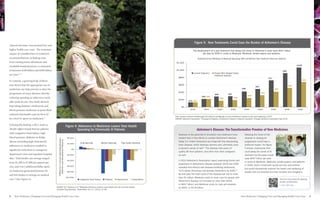
                                                                                                                                                                                                                        Figure 5: New Treatments Could Ease the Burden of Alzheimer’s Disease
            clinical outcomes, lost productivity, and                                                                                                                                                  Figure 5: New Treatments Could Ease the Burden of Alzheimer’s Disease
            higher health care costs. The economic                                                                                                                                                                    The development of a new treatment that delays the onset of Alzheimer’s could save $447 billion
            impact of nonadherence to treatment                                                                                                                                                                                per year by 2050 in costs to Medicare, Medicaid, private payers and patients.
            recommendations, including costs                                                                                                                                                                                Projected Annual Medicare & Medicaid Spending, With and Without New Treatment Advances (Billions)
            from nursing home admissions and                                                                                                                                                    $1,200
            avoidable hospitalizations, is estimated                                                                                                                                                                                                                                                                                                         $1,078

            at between $100 billion and $300 billion                                                                                                                                            $1,000                                                                                                                                        $906
                                                                                                                                                                                                                    ■ Current Trajectory        ■ Project With Delayed Onset
            per year.33, 34
                                                                                                                                                                                                                                                  Treatment Advance
                                                                                                                                                                                                   $800                                                                                                                   $717
            In contrast, a growing body of litera-                                                                                                                                                                                                                                                                                                                    $631

            ture shows that the appropriate use of                                                                                                                                                 $600                                                                                                                                              $522
                                                                                                                                                                                                                                                                                                         $547
            medicines can help prevent or slow the                                                                                                                                                                                                                                     $408                                        $407
                                                                                                                                                                                                   $400
            progression of many diseases, thereby                                                                                                                                                                                                  $240              $307
                                                                                                                                                                                                                                                                                                                 $311
                                                                                                                                                                                                                                  $202 $202                                                    $239
            reducing spending on otherwise avoid-                                                                                                                                                                                                         $190              $196
                                                                                                                                                                                                   $200
            able medical care. One study showed                                                                                                                                                                 $172 $172

            that taking diabetes, cholesterol, and                                                                                                                                                    $0
            blood pressure medicines as prescribed                                                                                                                                                                 2010              2015             2020              2025              2030              2035              2040              2045          2050

            reduced total health costs by $4 to $7
                                                                                                                                                                                               Note: Assumes research breakthroughs that delay the average age of onset of Alzheimer’s disease by five years beginning in 2010.
            for every $1 spent on medicines.35                                                                                                                                                 SOURCE: Alzheimer’s Association, “Changing the Trajectory of Alzheimer’s Disease: A National Imperative” (Chicago: Alzheimer’s Association, May 2010).

            Echoing this finding, a 2011 study in
                                                                                                  Figure 4: Adherence to Medicines Lowers Total Health
                                                                                                   Figure 4: Adherence to Medicines Lowers Total Health
            Health Affairs found that for patients
                                                                                                            Spending for Chronically Ill Patients
                                                                                                            Spending for Chronically Ill Patients                                                                          Alzheimer’s Disease: The Transformative Promise of New Medicines
            with congestive heart failure, high
                                                                                                                                                                                                   Nowhere is the potential of innovative new treatment more                               Delaying the onset of the
            blood pressure, diabetes or dyslip-                                                     $4,000                                                                                         evident than in the efforts to combat Alzheimer’s disease.                              disease or slowing its
                                                          Difference in Annual Spending Between
                                                            Adherent and Nonadherent Patients


            idemia (including high cholesterol),                                                                Drug Spending              Medical Spending    Total Health Spending
                                                                                                                                                                                                   Today 5.1 million Americans are living with this devastating                            progression could have a
                                                                                                    $2,000
            adherence to medicines resulted in                                                                                                                                                     brain disease, which destroys memory and, ultimately, even                              profound impact. As Figure
                                                                                                                                                                                                   a person’s sense of self.37 The disease robs years of                                   5 shows, treatments that
            significant reductions in emergency                                                         $0
                                                                                                                                                                                                   quality life from patients, and often from their caregivers                             could delay the onset of Al-
            department visits and inpatient hospital                                                -$2,000                                                                                        as well.                                                                                zheimer’s by five years could
            days. Total health care savings ranged                                                                                                                                                                                                                                         save $447 billion per year
                                                                                                    -$4,000                                                                                        A 2010 Alzheimer’s Association report examining trends and
            from $1,200 to $7,800 per patient per                                                                                                                                                                                                                                          in costs to Medicare, Medicaid, private payers, and patients
                                                                                                                                                                                                   projections in Alzheimer’s disease between 2010 and 2050
                                                                                                                                                                                                                                                                                           in 2050. Such a treatment would not only save billions
            year, and every additional dollar spent                                                 -$6,000
                                                                                                                                                                                                   revealed that without new disease-modifying treatments,
                                                                                                                                                                                                                                                                                           but would dramatically improve the health and wellbeing of
            on medicines generated between $3                                                       -$8,000
                                                                                                                                                                                                   13.5 million Americans will develop Alzheimer’s by 2050.38
                                                                                                                                                                                                                                                                                           people with the disease and their families and caregivers.
            and $10 dollars in savings on medical                                                                                                                                                  By that year, the total costs of the disease will rise to more
                                                                                                   -$10,000                                                                                        than $1 trillion; Medicare costs to cover care for people with
            care.36 (See Figure 4.)                                                                           ■ Congestive Heart Failure    ■ Diabetes   ■ Hypertension   ■ Dyslipidemia                                                                                                                                                  Find out more about the growing
                                                                                                                                                                                                   Alzheimer’s disease will increase by more than 600%,                                                                                   burden of Alzheimer’s.
                                                                                                                                                                                                   to $627 billion; and Medicaid costs for care will escalate                                                                             < Scan QR code
                                                        SOURCE: M.C. Roebuck, et al. “Medication Adherence Leads to Lower Health Care Use and Costs Despite                                        by 400%, to $178 billion.
                                                        Increased Drug Spending,”  Health Affairs 30, no. 1 (2011): 91–99.


            8    New Medicines: Changing Lives and Managing Health Care Costs                                                                                                              	                                                                                          New Medicines: Changing Lives and Managing Health Care Costs                           9
CHAPTER X


                                                                                                                                               1
                                                                                                                                                U.S. Department of Health and Human Ser-             12
                                                                                                                                                                                                       National Institute of Allergy and Infectious      24
                                                                                                                                                                                                                                                           U.S. Food and Drug Administration, “Notable
                                                                                                                                               vices, Centers for Disease Control and Preven-        Diseases, Treating HIV-infected People with         FY 2011 Approvals,” 15 November 2011,
                                    Medicines Bring Value to Patients—Clinically and Economically                                              tion, “Cancer Survivors—United States, 2007,”
                                                                                                                                               Morbidity and Mortality Weekly Report 60, no. 9
                                                                                                                                                                                                     Antiretrovirals Protects Partners from Infection:
                                                                                                                                                                                                     Findings Result from NIH-Funded International
                                                                                                                                                                                                                                                         http://www.fda.gov/AboutFDA/Reports
                                                                                                                                                                                                                                                         ManualsForms/Reports/ucm276413.htm
                                                                                                                                               (2011): 269–272, http://www.cdc.gov/mmwr/             Study, press release, 12 May 2011, http://          (accessed 29 January 2012).
                                                                                                                                               pdf/wk/mm6009.pdf (accessed 6 December                www.niaid.nih.gov/news/newsreleases/2011/
                                                                                                                                               2011).                                                Pages/HPTN052.aspx.
                                                                                                                                                                                                                                                         25
                                                                                                                                                                                                                                                           National Institutes of Health, Office of Rare
                                                                                                                                                                                                                                                         Diseases Research, Office of Rare Diseases
                                                                                                                                               2
                                                                                                                                                National Cancer Institute, Surveillance Epidemi-      V.L. Roger, et al., “Heart Disease and Stroke
                                                                                                                                                                                                     13
                                                                                                                                                                                                                                                         Research (ORDR) Brochure, online brochure, 11
                                                                                                                                               ology and End Results, http://seer.cancer.gov/        Statistics—2011 Update: A Report from the           March 2009, http://rarediseases.info.nih.gov/
                                                                                                                                               faststats/index.php (accessed 16 December             American Heart Association,” Circulation 123,       Wrapper.aspx?src=asp/resources/
                                                                                                                                               2011).                                                no. 4 (2011): e18-e209.                             ord_brochure.html (accessed 5 December
                                                                                                                                                                                                                                                         2011).
                                                                                                                                               3
                                                                                                                                                A. Jemal, et al., “Cancer Statistics, 2010,”          K.A. Fox, et al., “Decline in Rates of Death
                                                                                                                                                                                                     14

                                                                                                                                               CA: A Cancer Journal for Clinicians 60, no. 5         and Heart Failure in Acute Coronary Syndromes,       Ibid.
                                                                                                                                                                                                                                                         26

                                                                                                                                               (2010): 277–300, http://onlinelibrary.wiley.          1999–2006,” Journal of the American Medical
                                                                                                                                               com/doi/10.3322/caac.20073/full (accessed             Association 297, no. 17 (2007): 1892–1900.           M.M. Braun, et al., “Emergence of Orphan
                                                                                                                                                                                                                                                         27


                                                                                                                                               6 December 2011).                                                                                         Drugs in the United States: a Quantitative As-
                                                                                                                                                                                                     15
                                                                                                                                                                                                       PharMetrics, Examination of Treatment             sessment of the First 25 Years.” Nature Reviews
                                                                                                                                               4
                                                                                                                                                M.G. Kris, et al., American Society of Clinical      Patterns and Effects of Medication-Taking           Drug Discovery 9, no. 7 (2010) 519–522.
                                                                                                                                               Oncology, “Clinical Cancer Advances 2010:             Behaviors Among Patients with Diabetes,
                                                                                                                                               Annual Report on Progress Against Cancer              (Watertown, MA: PharMetrics, 2004) (research
                                                                                                                                                                                                                                                         28
                                                                                                                                                                                                                                                            Pharmaceutical Research and Manufacturers
                                                                                                                                               from the American Society of Clinical Oncology,”      supported by PhRMA).                                of America, Orphan Drugs in Development for
                                                                                                                                               Journal of Clinical Oncology 28, no. 36 (2010):                                                           Rare Diseases 2011 (Washington, DC: PhRMA,
                                                                                                                                               5327–5347.                                             J.M. Kremer, “COMET’s Path, and the New
                                                                                                                                                                                                     16
                                                                                                                                                                                                                                                         2011), http://www.phrma.org/sites/default/
                                                                                                                                                                                                     Biologicals in Rheumatoid Arthritis,” The Lancet    files/878/rarediseases2011.pdf.
                                                                                                                                               5
                                                                                                                                                A.S. Fauci, “After 30 Years of HIV/AIDS, Real        372, No. 9636 (2008): 347–348.                      29
                                                                                                                                                                                                                                                            S.Y. Wu and A. Green, Projection of Chronic
                                                                                                                                               Progress and Much Left To Do,” The Washington         17
                                                                                                                                                                                                       Integrated Benefits Institute, A Broader Reach    Illness Prevalence and Cost Inflation (Santa
                                                                                                                                               Post, 27 May 2011, http://www.washingtonpost.         for Pharmacy Plan Design (San Francisco: IBI,       Monica, CA: RAND Health, 2000).
                                                                                                                                               com/opinions/after-30-years-of-hivaids-real-          May 2007).
                                                                                                                                               progress-and-much-left-to-do/2011/05/27/                                                                  30
                                                                                                                                                                                                                                                           D.M. Cutler, et al., “The Value of Antihyperten-
                                                                                                                                               AGbimyCH_print.html (accessed 31 January              18
                                                                                                                                                                                                       U.S. Food and Drug Administration, FY2011         sive Drugs: A Perspective on Medical Innova-
                                                                                                                                               2012).                                                Innovative Drug Approvals (Washington, DC:          tion,” Health Affairs 26, no. 1 (2007): 97–110.
                                                                                                                                                                                                     FDA, November 2011), http://www.fda.gov/
                                                                                                                                               6
                                                                                                                                                U.S. Department of Health and Human                  AboutFDA/ReportsManualsForms/Reports/                M. Cloutier, et al., “Asthma Guideline Use by
                                                                                                                                                                                                                                                         31

                                                                                                                                               Services, Centers for Disease Control and             ucm276385.htm.                                      Pediatricians in Private Practices and Asthma
                                                                                                                                               Prevention, National Center for Health Statistics,                                                        Morbidity,” Pediatrics 118, no. 5 (2006):
                                                                                                                                               Health, United States, 2003: With Chartbook            J.J. Caro, et al., “The Impact of Compliance
                                                                                                                                                                                                     19
                                                                                                                                                                                                                                                         1880–1887.
                                                                                                                                               on Trends in the Health of Americans (Hyatts-         with Osteoporosis Therapy on Fracture Rates in
                                                                                                                                               ville, MD: HHS, 2003); S.L. Murphy, J. Xu, and        Actual Practice,” Osteoporosis International 15,     K. Davis, et al., “Prevalence and Cost of Medi-
                                                                                                                                                                                                                                                         32

                 Diabetes Patients Can Avoid Painful, 	                         Controlling Asthma in Children Saves Costly 	                  K.D. Kochanek, “Deaths: Preliminary Data for          no. 12 (2004): 1003–1008.                           cation Nonadherence in Parkinson’s Disease:
                 Costly Alternatives	                                           ER Visits and Parents’ Productivity	                           2010,” National Vital Statistics Reports 60, no.                                                          Evidence From Administrative Claims Data,”
                                                                                                                                               4 (Hyattsville, MD: National Center for Health
                                                                                                                                                                                                     20
                                                                                                                                                                                                       U.S. Department of Health and Human Ser-          Movement Disorders 25, no. 4 (2010):
                                                                                                                                               Statistics, January 2012): 17 (accessed 10            vices, Office of the Surgeon General, The 2004      474–480.
                 Control of diabetes is possible today with proper treatment,   Childhood asthma is controllable, but when not controlled                                                            Surgeon General’s Report on Bone Health and
                                                                                                                                               March 2012).                                                                                               L. Osterberg and T. Blaschke, “Adherence to
                                                                                                                                                                                                                                                         33
                 often including medicines. Of the 24 million Americans         often leads to serious asthma attacks that can put children                                                          Osteoporosis: What It Means To You (Washing-
                                                                                                                                               7
                                                                                                                                                S.L. Murphy, J. Xu, and K.D. Kochanek,               ton, DC: HHS, 2004), http://www.                    Medication,” New England Journal of Medicine
                 who have diabetes, only 6 million have their diabetes          in the hospital. While an asthma-related hospitalization       “Deaths: Preliminary Data for 2010,” National         surgeongeneral.gov/library/bonehealth/docs/         353, no. 5 (2005): 487–497.
                 under control.39 We know that uncontrolled diabetes leads      can exceed $7,000,44 the annual cost of providing asthma       Vital Statistics Reports 60, no. 4 (Hyattsville,      OsteoBrochure1mar05.pdf (accessed 5                 34
                                                                                                                                                                                                                                                           M.R. DiMatteo, “Variations in Patients’ Adher-
                                                                                                                                               MD: National Center for Health Statistics, Janu-      December 2011).                                     ence to Medical Recommendations: A Quantita-
                 to many complications, including blindness, amputations,       control medications to children is $1,500.45 In addition to    ary 2012): 17 (accessed 10 March 2012).               21
                                                                                                                                                                                                       U.S. Food and Drug Administration, FY2011         tive Review of 50 Years of Research,” Medical
                 kidney failure, heart attacks, and stroke. In addition to      these medical costs, one-third of children’s caregivers miss                                                                                                             Care 42, no. 3 (2004): 200–209.
                                                                                                                                               8
                                                                                                                                                U.S. Department of Health and Human Servic-          Innovative Drug Approvals, op. cit.
                 the terrible human toll associated with these outcomes,        work because of a child’s asthma.46 This is a particular       es, Centers for Disease Control and Prevention,       22
                                                                                                                                                                                                       J.K. Jenkins, “CDER New Drug Review: 2011          M.C. Sokol, et al., “Impact of Medication Ad-
                                                                                                                                                                                                                                                         35

                 the avoidable financial costs are enormous. For example,       hardship for low-income families,47 where the prevalence       National Center for Health Statistics, Health                                                             herence on Hospitalization Risk and Healthcare
                                                                                                                                               United States, 2010: With Special Feature on          Update,” presentation at the FDA/CMS Summit
                 the average cost of amputation surgery is nearly $40,000.40    of childhood asthma is 60% greater than in high-income                                                               (Washington, DC), 8 December 2011, http://          Cost,” Medical Care 43, no. 6 (2005): 521–530.
                                                                                                                                               Death and Dying, (Hyattsville, MD: NCHS, 2011)
                 A single year of dialysis for kidney failure patients costs    families. Yet medicines can make a huge difference. A          http://www.cdc.gov/nchs/data/hus/hus10.pdf.           www.fda.gov/downloads/AboutFDA/                      M.C. Roebuck, et al., “Medical Adherence
                                                                                                                                                                                                                                                         36
                                                                                                                                                                                                     CentersOffices/OfficeofMedicalProductsand           Leads to Lower Health Care Use and Costs
                 $83,000,41 and a hospital stay following a heart attack        recent study found that inner-city children with asthma who    9
                                                                                                                                                   A.S. Fauci, op. cit.                              Tobacco/CDER/UCM282984.pdf.                         Despite Increased Drug Spending,” Health
                 averages $31,000.42 In contrast, a year’s supply of the        received appropriate controller medications were nearly        10
                                                                                                                                                 A.B. Jena and T.J. Philipson, Innovation and        23
                                                                                                                                                                                                       Food and Drug Administration, “FDA Approves       Affairs 30, no. 1 (2011): 91–99.
                 medicines that can help a patient avoid these outcomes         70% less likely to visit the emergency room, saving            Technology: Adoption in Health Care Markets           Benlysta to Treat Lupus,” press release, 9          37
                                                                                                                                                                                                                                                           Alzheimer’s Association, Changing the Trajecto-
                                                                                                                                               (Washington, DC: AEI Press, 2008).                    March 2011, http://www.fda.gov/NewsEvents/          ry of Alzheimer’s Disease: A National Imperative
                 typically runs about $2,400.43                                 approximately $5,000 per child per year.48                                                                           Newsroom/PressAnnouncements/ucm246489.
                                                                                                                                                D. Donnell, et al., “Heterosexual HIV-1 Trans-
                                                                                                                                               11                                                                                                        (Chicago: Alzheimer’s Association, May 2010),
                                                                                                                                                                                                     htm (accessed 29 January 2012).                     http://www.alz.org/documents_custom/
                                                                                                                                               mission After Initiation of Antiretroviral Therapy:
                                                                                                                                               A Prospective Cohort Analysis,” The Lancet 375,                                                           trajectory.pdf (accessed 5 December 2011).
                                                                                                                                               no. 9731 (2010): 2091–2098.


            10   New Medicines: Changing Lives and Managing Health Care Costs                                                                  	                                                                          New Medicines: Changing Lives and Managing Health Care Costs                    11
CHAPTER 1


             Ibid.
            38


             PhRMA analysis of data from National Health
            39

            and Nutrition Examination Survey for 2003–
            2004 and 2005–2006, Centers for Disease
            Control and Prevention, National Diabetes Fact
            Sheet (Atlanta: CDC, 2007).
             Amputee Coalition, “Fact Sheet: Diabetes
            40

            Lower Extremity Amputations,” 17 August
            2009, http://www.amputee-coalition.org/fact_
            sheets/diabetes_leamp.html (accessed
            2 February 2012).
            41
              Thompson Reuters analysis of U.S. Renal
            Data System, USRDS 2010 Annual Data
            Report: Atlas of Chronic Kidney Disease and
            End-Stage Renal Disease in the United States
            (Bethesda, MD: National Institute of Diabetes
            and Digestive and Kidney Diseases, 2010).
             Thompson Reuters analysis of R.H. Chap-
            42

            man, et al., “Determining initial and follow-up
            costs of cardiovascular events in a U.S.
            managed care population,” BMC Cardiovascular
            Disorders 11 (2011): 11.
             Thompson Reuters analysis of American
            43

            Diabetes Association, “Economic Costs of
            Diabetes in the U.S. in 2007,”Diabetes Care
            31, no. 3 (2008): 596–615; Erratum in:
            Diabetes Care 31, no. 6 (2008): 1271.
            44
              Thompson Reuters analysis of R. Grant,
            et al., “Health Care Savings Attributable to
            Integrating Guidelines-based Asthma Care in
            the Pediatric Medical Home,” Journal of Health
            Care for the Poor and Underserved 21, suppl.
            2 (2010): 82–92 and M. Ash and S. Brandt,
            “Disparities in Asthma Hospitalizations in Mas-
            sachusetts,” American Journal of Public Health
            96 (2006): 358–362.
             Thompson Reuters analysis of R. Grant,
            45

            et al., op. cit.
             E.W. Gelfand, “The Impact of Asthma on the
            46

            Patient, the Family and Society,” Advanced
            Studies in Medicine 8, no. 3 (2008): 57–63.
            47
              Centers for Disease Control and Prevention,
            “Vital Signs: Asthma Prevalence, Disease
            Characteristics, and Self-Management Educa-
            tion—United States, 2001–2009” Morbid-
            ity and Mortality Weekly Report 60 (2011):
            547–552.
             Thompson Reuters analysis of R. Grant,
            48

            et al., op. cit.


            12       New Medicines: Changing Lives and Managing Health Care Costs
2   Contributing Strongly to the U.S. Economy
    Despite a Challenging Environment
Contributing Strongly to the U.S. Economy
CHAPTER 2


            Despite a Challenging Environment


            T    he biopharmaceutical industry is
                 an American success story. Despite
            a challenging economic and research
                                                         generate jobs in a broad range of other
                                                         sectors—from construction to banking
                                                         to food services to child care.3
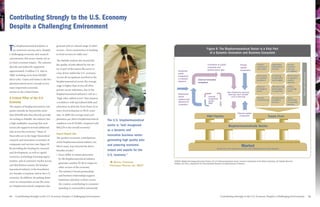
                                                                                                                                                                               Figure 6: The Biopharmaceutical Sector Is VitalFoundation
                                                                                                                                                                                 Figure 6: The Biopharmaceutical Sector Is a the Part
                                                                                                                                                                                   of a Dynamic Innovation and Business Ecosystem
                                                                                                                                                                                    of a Dynamic Innovation and Business Ecosystem
            environment, this sector stands out in
                                                         The Battelle analysis also found that
            its total economic impact. The industry
                                                         the quality of jobs offered by the sec-                                                                                    Innovation at public,                     Private               Finance,            Specialized         General
            directly and indirectly supported                                                                                                                                       university and                            capital               insurance &         professional        business
                                                         tor is part of the reason the sector is                                                                                    private-sector labs                       investment
                                                                                                                                                                                                                                                    real estate         services            services
            approximately 4 million U.S. jobs in                                                                                             Sustained                                                                                                                                      & supplies
                                                         a key driver within the U.S. economy.


                                                                                                                                                                                                                                                                                                              Partial supply chain listing
                                                                                                                                             public
            2009, including more than 650,000                                                                                                investment                                                                                             Instruments         Computing           Clinical trials
                                                         Across all occupations involved in the                                                                                                                                                     & analytical        & infomatics        & regulatory
            direct jobs.1 Gains and losses in the bio-                                                                                       in medical                 External innovation                                                         equipment           technologies        support
                                                         biopharmaceutical sector, the average                                               research                   ecosystem                                                                                                           services
            pharmaceutical sector cascade across


                                                                                                     “
                                                         wage is higher than across all other                                                                                                                                                       Chemical            Manufacturing       Utilities
            many important economic                                                                                                                                                                                                                 & biological        technologies        and energy
                                                         private-sector industries, due to the                                                                                                                                                      inputs              & equipment         inputs
            sectors in the United States.                                                                                                                                                                    New biopharma business
                                                         biopharmaceutical industry’s role as a                                               Biopharma                                                       start-ups, tech transfer
                                                                                                                                              sector                                 Internal                     and in-licensing
            A Critical Pillar of the U.S                 “high value-added sector” that requires                                              support and                            biopharma                                                      Contract            Transportation      Sales,
                                                                                                                                                                                                                                                    manufacturing       & logistics         advertising
                                                                                                                                                                                     sector
            Economy                                      a workforce with specialized skills and                                              demand for
                                                                                                                                                                                     R&D                                                                                services            & marketing
                                                                                                                                              innovation                                                                                                                                    services
            The impact of biopharmaceutical com-         education at all levels, from those of an
            panies extends far beyond the more           entry-level technician to Ph.D. scien-
                                                                                                                                                                                                                           Pharma capital
            than 650,000 jobs they directly provide.     tists. In 2009, the average total com-
                                                                                                                                                                                   R&D Pipeline                              investment                            Supply Chain
            According to Battelle, the industry has      pensation per direct biopharmaceutical      The U.S. biopharmaceutical
            a high multiplier, meaning that each         employee was $118,690, compared with
                                                                                                     sector is “well recognized                                                                                Biopharmaceuticals Sector
            sector job supports several additional       $64,278 in the overall economy.4
            jobs across the economy.2 Many of
                                                                                                     as a dynamic and
                                                         Impact Beyond Jobs
            these jobs are in the larger biomedical                                                  innovative business sector
                                                         The positive economic contributions
            research and innovation ecosystem of                                                     generating high quality jobs
                                                         of the biopharmaceutical industry are
            companies and services (see Figure 6).                                                   and powering economic
            By providing the funding for research
                                                         felt in many ways beyond the direct                                                                                                                                    Market
                                                                                                                                                                                                Demand for new medicines to treat most challenging and costly diseases
                                                         benefits of jobs:5                          output and exports for the
            and development, as well as capital
            resources, technology licensing oppor-
                                                         •	 Every dollar in output generated         U.S. economy.”
                                                           by the biopharmaceutical industry
            tunities, and an extensive market access                                                   Battelle Technology              SOURCE: Battelle Technology Partnership Practice, The U.S. Biopharmaceuticals Sector: Economic Contribution of the Nation (Columbus, OH: Battelle Memorial
                                                           generates another $1.40 in output in                                          Institute, July 2011), prepared for the Pharmaceutical Research and Manufacturers of America.
            and distribution system, the biophar-                                                     Partnership Practice, July 20116
                                                           other sectors of the economy.
            maceutical industry is the foundation
                                                         •	 The industry’s broad partnerships
            of a broader ecosystem vital to the U.S.
                                                           and business relationships support
            economy. In addition, by putting down
                                                           businesses and their workers across
            roots in communities across the coun-
                                                           the country, contributing to consumer
            try, biopharmaceutical companies also
                                                           spending in communities nationwide.


            14     Contributing Strongly to the U.S. Economy Despite a Challenging Environment                                           	                                                          Contributing Strongly to the U.S. Economy Despite a Challenging Environment                                                              15
CHAPTER 2


                                                                        State Governments Recognize the Value of
                                                                             the Biopharmaceutical Industry
            •	 The industry also contributes
                                                            During the past decade, state
              significantly to exports. It is estimat-
                                                            governments have worked hard to
              ed that the value of biopharmaceuti-
                                                            attract and retain biopharmaceutical
              cal exports* was $232 billion between         companies and related life sciences
              2005 and 2010.7 Biopharmaceutical             industries because they recognize that
              exports have grown by 61% over six            these industries are strong drivers of
                                                            economic growth. For example:
              years.
                                                            •	The State of North Carolina invested
            •	 The sector generated nearly $33                $1.2 billion in research facilities,   •	Arizona has developed a statewide
              billion in state and local tax revenue          training programs and other pro-         “bioscience roadmap” to guide the
              and more than $52 billion in federal            grams to grow the bioscience sector      growth of its bioscience industry.
                                                              between 1998 and 2008.11 The             In 2007 alone, this industry contrib-
              tax revenue in 2009 (directly and
                                                              sector contributed $64.6 billion to      uted $12.5 billion in economic
              through multiplier effects).8                   the state’s economy and generated        activity, employed 87,415 workers,
            •	 The overall economic impact of the             $1.92 billion in state and local         and had a total economic impact
                                                              taxes in 2008.                           of more than $21 billion.12
              sector totals more than $918 billion
              annually.9

            The biopharmaceutical industry’s inter-
            connectedness with other sectors and         Meeting Challenges Today                    Researchers are also working to
            its significant investments in technol-      and Tomorrow                                advance new scientific approaches
            ogy, research, and development mean          Success for the biopharmaceutical           that fight disease at the molecular and
            that the industry’s gains and losses can     industry depends on the future discov-      genetic level. Few medicines provide
            have an outsized effect on the economy       ery and development of medicines that       revenues to match their development
            as a whole. The current economic             improve health and quality of life. The     costs—just two out of 10 approved
            climate makes this fact especially           opportunities for continued innovation      medicines earn enough to recoup the
            significant. The Battelle report calcu-      and discovery are significant, and so are   average costs of R&D.13
            lates that a $10 billion per year decline    the challenges.
            in biopharmaceutical sector revenue                                                      The Regulatory and Reimbursement
            caused by changes in policies or operat-     The Science Is Costly and Complicated       Environments Are Challenging
            ing environment could result in the          The drug development process has            The regulatory system today requires
            loss of 130,000 jobs, $29.7 billion in       become increasingly costly and              increasingly complex studies to estab-
            total output and $9.2 billion in personal    complex. In part, this is due to the        lish safety and effectiveness and a
            income.10                                    increased focus on highly complex           growing amount of information on
            __________________________________           chronic and degenerative diseases,          each new medicine. This necessitates
            * Exports refer to domestic exports and do   such as neurodegenerative disorders,        complex clinical trials and the use of
            not include commodities that originated in
                                                         cancer, and autoimmune disorders.           ever larger numbers of clinical trial
            countries outside the United States.


            16    Contributing Strongly to the U.S. Economy Despite a Challenging Environment                                                  	   Contributing Strongly to the U.S. Economy Despite a Challenging Environment   17
CHAPTER 2


                                                                                                                                                        “
                                  The Growth of the Biopharmaceutical Industry Around the World
                                                                                                                                                                                                   participants. Patient recruitment and       The U.S. Biopharmaceutical
                 In recent years, a number of countries have made impressive          The United Kingdom accounts for about 20% of European
                                                                                                                                                                                                   retention in trials is a continual chal-    Industry Is Rising to Its
                 advances in their biomedical research sectors. These advances                        biopharmaceutical R&D spending.14 Only the
                 have been nurtured through multiyear plans, which have led to                        United States and Japan invest more in biophar-
                                                                                                                                                                                                   lenge. (See sidebar, “Developing New        Challenges
                 laws and policies to support the research sector, tax changes                        maceutical R&D. In 2010, the UK re-released                                                  Drugs Is Becoming More Challenging,”        The U.S. biopharmaceutical industry
                 to spur R&D investment, scholarship programs to attract top                          the Life Sciences Blueprint, a comprehensive                                                 on page 33.) At the same time, pay-         is responding and adapting to these
                 talent, and venture capital investments. A few examples from                         strategy to make the country a global leader                                                 ers use tools, such as tiered co-pays,      challenges in a variety of ways. For
                 around the world illustrate this new activity:                       in the life sciences.15 The plan includes calls for building      The UK life sciences industry              formularies, prior authorization, step      example, companies are increasingly
                                                                                      translational research excellence and adopting tax policies
                 Singapore’s significant biopharmaceutical sector contributed
                                                                                      to encourage research.                                            is a high-tech and innovative              therapy, reduced coverage, and finan-       focused on targeting the greatest unmet
                               almost $3.2 billion to its economy in 2007,
                                                                                                                                                        industry which is vital to the             cial incentives to restrain use of brand-   needs in diseases such as Alzheimer’s,
                               an increase of 230% since the beginning of the         China has increased its R&D investment by 10% each year for
                                                                                                                                                                                                   name medicines and encourage the use        cancer, and Parkinson’s, and are making
                               decade. Singapore’s current focus is on ex-                            the last 10 years. It is estimated that China’s   economic prosperity and
                               panding its biologics manufacturing capacity,                          R&D will reach $154 billion in 2011, making                                                  of generics.                                a strong push to advance new frontiers
                               and to that end, the country has concentrated                          it second only to the United States in terms of
                                                                                                                                                        growth of the UK. Life sciences
                                                                                                                                                                                                                                               such as personalized medicine.
                 on workforce development, R&D expansion, engagement of                               total R&D investment. The most recent five-       businesses will help us to meet            Global Competition Is Intense
                 industry leaders, and support for emerging businesses that can                       year plan, released in early 2011,16 defines                                                                                             These responses, combined with posi-
                                                                                                                                                        the big societal challenges of             Beginning in the 1980s, the U.S. bio-
                 commercialize new discoveries.                                       biotechnology as one of seven strategic industries for further
                                                                                                                                                                                                                                               tive, forward-looking public policies
                                                                                      development, and the latest “Medium- to Long-Term Plan for        our age from addressing the                pharmaceutical industry emerged as
                 South Africa aims to move its economy from “farmer to
                                                                                      the Development of Science and Technology,” covering 2006                                                    the leader in biomedical innovation,        that sustain a market-based system
                                 pharma” by creating opportunities to help                                                                              needs of an ageing population
                                                                                      through 2020, includes biotechnology as one of eight frontier                                                surpassing European countries, which        and incentives for innovators, such as
                                 researchers take advantage of the country’s rich
                                                                                      technologies. The country is trying to reverse “brain drain”      through developing advanced                                                            strong intellectual property protec-
                                 biodiversity. Its strategy is focused on drug dis-                                                                                                                had previously been the dominant
                                                                                      across scientific disciplines by offering Chinese researchers     diagnostics and medicines, to
                                 covery, especially research to address prevalent                                                                                                                  global players.19 The rise of the U.S.      tions, will do much to ensure America’s
                                                                                      around the world prestigious positions within the country.
                                 diseases, such as HIV/AIDS, tuberculosis, and                                                                          improving our sustainability               industry resulted from public poli-         continued role as the worldwide leader


                                 “
                 malaria. South Africa also has pursued vigorous efforts to de-                                                                                                                                                                in biopharmaceutical research.
                 velop international collaborations with U.S. and European firms.
                                                                                                                                                        and ability to feed a growing              cies that encourage strong intellectual
                                                                                                                                                        population.”                               property protections (including patents     To foster innovation and the medical
                                                                                                                                                                                                   and data exclusivity), favorable eco-       advances and economic impact that go
                                                               We are confident that we have the human and                                                David Willetts, UK Minister
                                                                                                                                                         of State for Universities and Science,
                                                                                                                                                                                                   nomic conditions, and top-tier research     with it, we must:
                                                               infrastructural capacity to reach our goal of                                             Department of Business, Innovation        universities that were able to attract
                                                                                                                                                                                                                                               •	 Continue to advance regulatory
                                                               becoming one of the top three emerging economies                                          and Skills, Annual Update on the          scientific talent from around the
                                                                                                                                                                                                                                                 science and foster the integration of
                                                                                                                                                         Bioscience & Health Technology            world.20 While the United States has
                                                               in the global pharmaceutical industry.”                                                   Database18                                                                              emerging scientific data and innova-
                                                                                                                                                                                                   been the dominant leader in biophar-
                                                                        Naledi Pandor, South African Minister of Science                                                                                                                        tive approaches into the development
                                                                                                                                                                                                   maceutical research for the last several
                                                                       and Technology (2010)17                                                                                                                                                   and review of new medicines more
                                                                                                                                                                                                   decades, countries around the world
                                                                                                                                                                                                                                                 efficiently, promoting public health
                                                                                                                                                                                                   are vying to become the next world
                                                                                                                                                                                                                                                 in areas such as biomarkers,
                                                                                                                                                                                                   leader in biopharmaceutical R&D,
                                                                                                                                                                                                                                                 pharmacogenomics and rare and
                                                                                                                                                                                                   investing heavily in their own
                                                                                                                                                                                                                                                 orphan drug development.
                                                                                                                                                                                                   biopharmaceutical industries.
                                                                                                                                                                                                   (See sidebar, page 18.)


            18   Contributing Strongly to the U.S. Economy Despite a Challenging Environment                                                               	                                      Contributing Strongly to the U.S. Economy Despite a Challenging Environment           19
CHAPTER 2


                                                                                                           •	 Support the development of workers
                                                                                                                in the fields of science, technology,
                                                                                                                engineering, and mathematics as a
                                                                                                                highly skilled workforce is central
                                                                                                                to the nation’s ability to develop and
                                                                                                                manufacture tomorrow’s new
                                                                                                                treatments.

                                                                                                           •	 Support strong intellectual property
                                                                                                                rights and enforcement in the United
            •	 Advance medical innovation policies              full value of medical advances emerges          States and abroad.
                 as a solution to health system prob-           over time, and to support the ability of   •	 Sustain U.S. global leadership in the
                 lems. For example, to help realize the         physicians and patients to choose from          biosciences through economic, trade,
                 potential of medical innovation as a           the full range of medically appropriate         and related policies to promote a level
                 solution for improving patient out-            treatment options.                              playing field globally.
                 comes and controlling rising health       •	 Support coverage and reimbursement
                 care costs, it is important to recog-          policies that foster the introdution and
                 nize across all policy areas that the          availability of new medical advances.

            1
             Battelle Technology Partnership Practice,      Battelle Technology Partnership Practice,
                                                           11
                                                                                                            KPMG China, China’s 12th Five-Year Plan:
                                                                                                           16

            The U.S. Biopharmaceuticals Sector: Eco-       2010 Evidence and Opportunity: Biotechnol-      Overview (March 2011), http://www.kpmg.
            nomic Contribution to the Nation (Columbus,    ogy Impacts in North Carolina (Columbus,        com/CN/en/IssuesAndInsights/
            OH: Battelle Memorial Institute, July 2011),   OH: Battelle Memorial Institute, September      ArticlesPublications/Publicationseries/
            prepared for the Pharmaceutical Research       2010).                                          5-years-plan/Documents/China-12th-Five-
            and Manufacturers of America.                                                                  Year-Plan-Overview-201104.pdf (accessed
                                                            Battelle Technology Partnership Practice,
                                                           12
                                                                                                           6 February 2012).
            Ibid.
            2
                                                           A Report On: The Impact of the Arizona
                                                           Biosciences Sector (Columbus, OH: Battelle       Department of Science and Technology,
                                                                                                           17
            Ibid.
            3
                                                           Memorial Institute, July 2011).                 Annual Report 2009/2010 (Pretoria: DST,
            Ibid.
            4
                                                                                                           2010), p. 5–6.
                                                            J.A. Vernon, J.H. Golec, and J.A. DiMasi,
                                                           13


            Ibid.
            5                                              “Drug Development Costs When Financial          18
                                                                                                             Strength and Opportunity: The Landscape
                                                           Risk is Measured Using the Fama-French
                                                                                                           of the Medical Technology, Medical Biotech-
            Ibid.
            6
                                                           Three-Factor Model,” Health Economics
                                                                                                           nology and Industrial Biotechnology Sectors
                                                           Letters 19, no. 8 (2010): 1002–1005.
            7
             U.S. International Trade Commission Trade                                                     in the UK, Annual Update, December 2010,
            Data database, http://dataweb.usitc.gov.       14
                                                              The Pharmaceutical Industry in Figures,      http://www.bis.gov.uk/assets/biscore/
                                                           2010 Edition, The European Federation of        business-sectors/docs/s/10-p90-strength-
            8
             Battelle Technology Partnership Practice,     Pharmaceutical Industries and Associa-          and-opportunity-bioscience-and-health-
            op. cit.                                       tions, http://www.efpia.eu/content/default.     technology-sectors.pdf (accessed 2 May
                                                           asp?PageID=559&DocID=9158 (accessed             2011).
            9
             Battelle Technology Partnership Practice,
                                                           15 September 2011).
            op. cit.                                                                                       19
                                                                                                             R.C. DeVol, A. Bedroussian, and B. Yeo,
                                                           15
                                                             HM Government, Office for Life Sciences,      The Global Biomedical Industry: Preserving
             Battelle Technology Partnership Practice,
            10
                                                           Life Sciences 2010: Delivering the Blueprint    U.S. Leadership (Santa Monica, CA: Milken
            op. cit.
                                                           (January 2010).                                 Institute, September 2011).

                                                                                                            Ibid.
                                                                                                           20


            20       Contributing Strongly to the U.S. Economy Despite a Challenging Environment
3   Bringing Medicines to Patients in Need
CHAPTER 3


            Bringing Medicines to Patients in Need

            T    he biopharmaceutical industry is
                 committed to ensuring that medi-
            cines are available to all patients who
                                                           the average total out-of-pocket cost per
                                                           month declined by $31, while the aver-
                                                           age number of prescriptions doubled
                                                                                                                       mind as a result of their coverage.9
                                                                                                                       (See Figure 8.) The Medicare Today
                                                                                                                       survey of Part D participants also
            need them to prevent and treat disease.        following implementation of Part D.              8
                                                                                                                       found that:
            Two primary avenues for ensuring
                                                           Beneficiaries Highly Satisfied                              •	 67% said they have lowered their
            comprehensive access to medicines
                                                           A recent survey from Medicare Today                           prescription drug spending.
            in the United States are the Medicare
                                                           shows that Part D beneficiaries are                         •	 34% say they used to skip or reduce
            prescription drug benefit, or Part D,
                                                           highly satisfied with the program. More                       their prescription medicine doses to
            and the Partnership for Prescription
                                                           than 90% of beneficiaries say their plan                      save money, but now no longer have
            Assistance (PPA). Providing compre-
                                                           works well and is easy to use, 88% say                        to do so.
            hensive and accurate information about
                                                           they are satisfied with the program,
            medicines to patients and health care
                                                           and 95% say they have greater peace of
            providers also is an important aspect
            of ensuring that patients get the
            medicines they need.

                                                                              Figure 7: Medicare Prescription Drug Program                                                                                                                                                                                      Prescription Drug Program Improves
            Medicare Part D: Increasing                                                                                                                                                          Figure 8: Seniors8: Seniors With Medicare Part D Program
                                                                                                                                                                                                            Figure Satisfied Satisfied with Medicare
                                                                           Figure 7: Medicare Expanded Coverage Program
                                                                                        Greatly Prescription Drug
            Access for Beneficiaries
            Since the inception of the Medicare
                                                                                Figure 7: Medicare Prescription Drug Program
                                                                                     Greatly Expanded Coverge
                                                                                                                                                                                                                                          Part D Program
                                                                                                                                                                                                    Eighty-eight percent of Part D enrollees are satisfied with their Part D coverage.
                                                                                                                                                                                                                                                                                                                Adherence and Outcomes
                                                                                                                                                                                                                                                                                                                Participation in the Medicare pre-

            prescription drug program (Part D) in                                         Greatly Expanded Coverge
                                                                 In 2011, 90% of Medicare beneficiaries had comprehensive drug coverage.
                                                                                    Medicare Beneficiaries With Comprehensive Drug Coverage
                                                                                                                                                                                                                 “Overall, how satisfied are you with your prescription drug coverage?”

                                                                                                                                                                                                                                                                                ■ Somewhat Satisfied
                                                                                                                                                                                                                                                                                                                scription drug program provides more
                                                                                                                                                                                                                                                                                                                than just peace of mind. Part D has
            2006, seniors’ and disabled beneficia-                                                                                                                                                       24M, 59%                                                               ■ Very Satisfied
                                                                                                ■ Comprehensive      ■ No Comprehensive                                                                                                           90%                                                           improved patients’ use of and adher-
            ries’ access to medicines has greatly
                                                                In 2011, 90% of Medicare beneficiaries had comprehensive drug coverage.
                                                                          50                                                                                                                                                     89%                              88%                               88%
                                                                                                 Drug Coverage        Drug Coverage                                                               78%            83%                                                               84%
                                                                                                                                                                                                                                 29%              27%
                                                                                                                                                                                                                                                                  29%              31%              36%         ence to medicines, which not only
            increased. Before the prescription drug                                                                                                                                               28%            36%
                                                                          40
            program began, 24 million beneficiaries                                       24M, 59%   Medicare Beneficiaries With Comprehensive Drug Coverage
                                                                                                                  42M, 90%                                                                                                                                                                                      benefits their health, but can also
                                                                                                                                                                                                                                                                                                                reduce the need for hospitalizations
                                                               Millions


                                                                          30
            had comprehensive drug coverage, com-                                                                                                                                                                                60%
                                                                                                                                                                                                                                                 63%
                                                                                                                                                                                                                                                                  59%
                                                                                                                                                                                                                                                                                   53%                          and other expensive medical care.
            pared with 42 million beneficiaries who                       20                                                                                                                      50%                                                                                               52%
                                                                                                                               ■ Comprehensive                          ■ No Comprehensive                       47%
            had coverage in 2011.1,2 (See Figure 7.)
                                                                          10
                                                                             50           17M, 41%
                                                                                                                                 Drug Coverage                            Drug Coverage
                                                                                                                                                                                                                                                                                                                A 2011 study in the Journal of the
                                                                                                                                                                                                                                                                                                                American Medical Association finds
            The program has greatly increased af-                                                                                     5M, 10%
                                                                           0
                                                                                                                                                                                                                                                                                                                that implementation of the Medicare
            fordability, particularly for low-income
                                                                               40            2005                                        2011
                                                                                                                                                                                      42M, 90%
                                                                                                                                                                                            March             September         October         October        November         September          October      prescription drug program in 2006
            and previously uninsured beneficiaries.
                                                                                                                   24M, 59%                                                                      2006           2006             2007            2008            2009             2010              2011
                                                                                                                                                                                                                                                                                                                was followed by significant decreases
            Studies have found that although ben-          Note: Comprehensive drug coverage in 2005 is defined as drug coverage through employer-sponsored plans,
                                                             Millions


                                                           Medicaid, Veterans Health Administration, Indian Health Services, and state pharmaceutical assistance programs.               SOURCE: KRC Research Surveys conducted for the Medicare Rx Education Network and Medicare Today.                       in spending on nondrug medical
            eficiaries’ use of prescription medicines                          30
                                                           Many Medicare beneficiaries had limited drug coverage through Medigap and Medicare Advantage in 2005 (high
                                                           deductibles, high copayments, annual benefit limits). Because these Medigap and Medicare Advantage plans did not                                                                                                                                     expenditures among beneficiaries who
            increased, patient out-of-pocket spend-        offer comprehensive drug coverage, they are excluded in 2005. Drug coverage data obtained from several sources,                                                                                                       Learn more about the
                                                           including: the Centers for Medicare and Medicaid Services; Current Population Survey; Kaiser State Health Fact                                                                                                        impacts of the Medicare        previously had no drug coverage or
            ing fell.3,4,5,6,7 For example, for seniors    Sheets; and the National Conference of State Legislatures.                                                                                                                                                            Prescription Drug Program.     limited drug coverage.10 A study by
            who previously did not have coverage,                              20
                                                           SOURCE: The Lewin Group, September 2006; Centers for Medicare and Medicaid Services, Medicare Advantage,
                                                                                                                                                                                                                                                                                 < Scan QR code
                                                           Cost, PACE, Demo, and Prescription Drug Plan Contract Report—Monthly Summary Report (Data as of January 2011).


            22    Bringing Medicines to Patients in Need                                                           17M, 41%                                                              	                                                                                                                    Bringing Medicines to Patients in Need    23
                                                                               10
3
CHAPTER X


            “
                                                              Figure 9: Nondrug Medical Spending Fell After Part D D Began
                                                                Figure 9: Nondrug Medical Spending Fell After Part Began                                                                                            Disseminating Information About New Medicines
                                                                                                                                                                                    Marketing and promotion efforts by biopharmaceutical com-       The sector has been supportive of congressional efforts to
                                                                  Total nondrug medical spending among newly insured Medicare Part D enrollees
                                                                         was about $1,200 per year less than expected–an overall savings                                            panies can provide patients and health care professionals       increase transparency of interactions between companies
                                                                   to Medicare of $13.4 billion in 2007, the first full year of the Part D program.                                 with access to important information about medicines. Such      and health care professionals. In fact, some companies
                                                                                                                                                                                    information helps ensure that patients are appropriately        have already begun releasing information about payments to
                 In concert with previous                                   Average Annual Reduction in Medical Spending in 2006 and 2007,
                                                                                 for Beneficiaries Gaining Drug Coverage Through Part D                                             treated for their conditions and that health care profession-   health care professionals, such as payments for important
                 studies, these findings                                                                                                                                            als have the most up-to-date information on medicines.          services like clinical trial investigators, consultants, peer
                                                                                      Part A            Part B               Other Nondrug*        Total Nondrug
                                                                                                                                                                                                                                                    speakers, and other valuable work performed on behalf
                 suggest that increased                                $0
                                                                                                                                                  Medical Spending
                                                                                                                                                                                    Biopharmaceutical companies have focused on ensuring that       of companies. These interactions help advance patient
                 medication use and                                                                                                                                                 educational and promotional efforts and interactions with       care and can lead to scientific discoveries and innovative
                                                                   -$200
                                                                                                                                                                                    health care professionals meet high ethical and professional    advances in medical treatments. Company representatives
                 adherence achieved through
                                                                   -$400                                                                                                            standards. In addition to extensive government regulations      also provide scientifically accurate and up-to-date information
                 expanded drug coverage                                                                                                                                             that cover marketing activities, the biopharmaceutical in-      on the benefits and risks of medicines. The vast majority of
                                                                   -$600                                                                                                            dustry has developed principles to guide direct-to-consumer     physicians consider these interactions valuable for dissemi-
                 for seniors have been
                                                                                      -$816                                                                                         advertising and a Code on Interactions with Healthcare          nating and exchanging information to improve patient care,
                 associated with decreased                         -$800
                                                                                                                                                                                    Professionals.                                                  yet they rely more on their clinical practice and experience
                 spending for nondrug                            -$1,000
                                                                                                            -$268                                                                                                                                   when choosing the best treatment options for their specific
                                                                                                                                  -$140
                                                                                                                                                        -$1,224
                                                                                                                                                                                                                                                    patients.15
                 medical care.”                                  -$1,200


                  J.M. McWilliams, et al.,                      -$1,400

                  Journal of the American Medical
                  Association (2011)11                     *Home health, durable medical equipment, hospice, and outpatient institutional services.
                                                           SOURCES: J.M. McWilliams, A.M. Zaslavsky, and H.A. Huskamp, “Implementation of Medicare Part D and Nondrug
                                                           Medical Spending for Elderly Adults With Limited Prior Drug Coverage,” Journal of the American Medical Association
                                                           306 no. 4 (2011): 402; C.C. Afendulis and M.E. Chernew, “State-Level Impacts of Medicare Part D,” American Journal
                                                           of Managed Care 17, suppl. 12 (October 2011).


            Harvard Medical School researchers             A follow-up study by the same authors                       afford them. Since 2005, the Partner-
            echoed these findings. After Medicare          found that the number of avoidable                          ship for Prescription Assistance has
            Part D started, nondrug medical spend-         hospitalizations declined by at least                       provided a central point of access for
            ing in this group was about $1,200 per         1,000 in more than half the U.S. states,                    assistance programs.
            patient per year less than expected.           and seven states had declines of 2,500
                                                                                                                       PPA offers financially struggling
            The savings were driven principally by         or more.13
                                                                                                                       patients a single point of access
            seniors making less use of hospitals and
                                                           The Partnership for Prescription                            to information about 475 patient
            skilled nursing facilities. (See Figure 9.)
                                                           Assistance                                                  assistance programs, almost 200
            Combined with other research showing
                                                                                  Biopharmaceutical                    of which are sponsored by
            that nearly 11 million seniors gained
                                                                                  companies have a long                biopharmaceutical companies.14
            comprehensive drug coverage under
                                                                                  history of providing                 More than 2,500 brand-name
            Part D, these savings imply a potential
                                                                                  access to medicines to               and generic medicines are available
            overall savings to Medicare of $13.4
                                                                                  patients who cannot                  through these programs.
            billion in 2007.12


            24    Bringing Medicines to Patients in Need                                                                                                                        	                                                                                         Bringing Medicines to Patients in Need      25
CHAPTER 3


                                                                                                            health care providers in their
                                                                                                            communities. PPA is sponsored by
                                                                                                            biopharmaceutical research companies,
                                                                                                            who partner with many other health
                                                                                                            care organizations, including
                                                                                                            the American Academy of Family
                                                                                                            Physicians, the American Cancer
                                                                                                            Society, the American College of
                                                                                                            Emergency Physicians, Easter Seals,
                                                                                                            the National Association of Chain
            Since its launch in April 2005, PPA             low-cost prescription medicines. It also        Drug Stores, United Way, and the
            has helped connect nearly 7 million             provides information on nearly 10,000           Urban League.
            people to company-sponsored and                 free clinics and has connected more
            public programs that provide free or            than 300,000 patients with clinics and


            1
             The Lewin Group, Beneficiary Choices           6
                                                             W. Yin, et al., “The Effect of the Medicare    C.C. Afendulis and M.E. Chernew,
                                                                                                           12

            in Medicare Part D and Plan Features in         Part D Prescription Benefit on Drug Utiliza-   “State-Level Impacts of Medicare Part
            2006 (Falls Church, VA: The Lewin Group,        tion and Expenditures,” Annals of Internal     D,” American Journal of Managed Care
            September 2006).                                Medicine 148, no.3 (2008): 1–14.               17, suppl. 12 (October 2011).
            2
             Centers for Medicare and Medicaid              7
                                                             F. Lichtenberg and S.X. Sun, “The Impact      13
                                                                                                             C.C. Afendulis, et al., “The Impact
            Services, Medicare Advantage, Cost, PACE,       of Medicare Part D on Prescription Drug        of Medicare Part D on Hospitalization
            Demo, and Prescription Drug Plan Contract       Use by the Elderly,” Health Affairs 26,        Rates,” Health Services Research 46,
            Report—Monthly Summary Report (Data             no. 6 (2007): 1735–1744.                       no. 4 (2011): 1022–1038.
            as of January 2011), http://www.cms.
            gov/MCRAdvPartDEnrolData/EP/
                                                            8
                                                             Amundsen Group, Verispan Longitudinal         14
                                                                                                             Partnership for Prescription Assistance,
            itemdetail.asp?filterType=none&filterByDID      Data, analysis for PhRMA, May 2008.            Facts About PPA (web page), http://www.
            =-99&sortByDID=2&sortOrder=                                                                    pparx.org/en/about_us/facts_about_ppa
                                                            9
                                                             Medicare Today, Seniors’ Opinions About       (accessed 29 January 2012).
            descending&itemID=CMS1243102&intNu
                                                            Medicare Rx: Sixth Year Update (Washing-
            mPerPage=10.
                                                            ton, DC: KRC Research, October 2011),           KRC Research, Survey of Physicians
                                                                                                           15

            3
             G.F. Joyce, et al., “Medicare Part D After 2   http://www.medicaretoday.org/Oct%20            About Pharmaceutical Biotech Research
            Years,” American Journal of Managed Care        2011%20KRC%20Medicare%20Today%20               Company Activities and Information:
            15, no. 3 (2009): 536–544.                      Survey%20of%20Seniors%20with%20                Nationally Representative Survey of 508
                                                            Medicare%20Rx%2010-14-11%20FINAL.              Physicians (Washington, DC: KRC,
            4
             M.G. Duggan and F.M. Scott Morton,             pdf (accessed 31 October 2011).                March 2011).
            “The Effect of Medicare Part D on Phar-
            maceutical Prices and Utilization,” NBER
                                                            10
                                                              J.M. McWilliams, A.M. Zaslavsky, and
            Working Paper W13917 (National Bureau           H.A. Huskamp, “Implementation of Medi-
            of Economic Research, April 2008).              care Part D and Nondrug Medical Spend-
                                                            ing for Elderly Adults With Limited Prior
            5
             J.D. Ketcham and K. Simon, “Medicare           Drug Coverage,” Journal of the American
            Part D’s Effects on Elderly Drug Costs and      Medical Association 306, no. 4 (2011):
            Utilization,” NBER Working Paper 14326          402–409.
            (National Bureau of Economic Research,
            September 2008).
                                                            11
                                                                Ibid.


            26    Bringing Medicines to Patients in Need
4   The R&D Process:
    The Road to New Medicines
The R&D Process:
CHAPTER 4


            The Road to New Medicines


            D
            expensive process, but biopharmaceuti-
                                                  iscovering and developing new
                                                  medicines is a long, difficult and
                                                                                                    continuing commitment to improv-
                                                                                                    ing health through innovation. (See
                                                                                                    Figure 10.) PhRMA members’ R&D
                                                                                                                                               1
                                                                                                                                                               With our rapidly increasing understand-
                                                                                                                                                               ing of disease at the molecular level,
                                                                                                                                                               science holds more promise for progress
                                                                                                                                                                                                               However, numbers cannot tell the full
                                                                                                                                                                                                               story of innovation within the pipeline.
                                                                                                                                                                                                               Here are two examples of innovative
                                                                                                                                                                                                                                                                        Figure 11: Medicines in Development in 2012:
                                                                                                                                                                                                                                                             Figure 11: Medicines in Selected Categories
                                                                                                                                                                                                                                                                                     Development in 2012: Selected Categories
            cal researchers around the country are                                                  spending represents the majority of all                    against many diseases today than at any         approaches that companies are taking
            dedicated to that lofty goal. Knowing                                                   biopharmaceutical R&D investment                           time in history. The biopharmaceutical          to attack difficult-to-treat diseases:                  Alzheimer’s                        Cancer                             Colorectal
            that their work can result in new medi-                                                 in the United States. This investment
                                                                                                                                  2
                                                                                                                                                               pipeline is demonstrating that promise.                                                                 Disease                                                               Cancer

                                                                                                                                                                                                                                                                                       72                            948                                     85
                                                                                                                                                                                                               •	 Immunotherapy in cancer: The idea
            cines that save lives, expand treatment                                                 supported more than 3,200 medicines                        For example, a survey by the Tufts Center
                                                                                                                                                                                                                   of enlisting the immune system to
            options, and improve quality of life                                                    in clinical development or FDA review,                     for the Study of Drug Development found
                                                                                                                                                                                                                   fight cancer first gained significant
            drives researchers to work tirelessly                                                   plus thousands more in preclinical                         that 12% to 50% of drugs in the pipeline
                                                                                                                                                                                                                   research attention in the 1990s.7                   Cardiovascular                     Arthritis                          Lung Cancer
            through the many challenges of the                                                      testing. The biopharmaceutical sector
                                                                                                              3
                                                                                                                                                               are personalized medicines.5 Another
                                                                                                                                                                                                                   Tumors use multiple approaches to                   Disorders

                                                                                                                                                                                                                                                                                  252                                     76                            141
            process.                                                                                is the most research-intensive industry                    report found that 460 medicines are in
                                                                                                                                                                                                                   suppress and hide from the body’s
                                                                                                    in the country, investing more than 10                     development for rare diseases,6 which
            In 2011, PhRMA members invested                                                                                                                                                                        immune system. Scientists reasoned
                                                                                                    times the amount of R&D per em-                            affect fewer than 200,000 people in the
            an estimated $49.5 billion in research                                                                                                                                                                 that these mechanisms to stymie the
                                                                                                    ployee than manufacturing industries                       United States and often do not have good                                                               HIV/AIDS                            Diabetes                           Leukemia
            and development, a reflection of their                                                                                                                                                                 immune system suggested that the
                                                                                                    on average.4                                               treatment options. (See Figure 11.)                                                                                                        Mellitus

                                                                                                                                                                                                                                                                                       88                            212                                139
                                                                                                                                                                                                                   body itself has the potential to fight
                                                                                                                                                                                                                   off cancer. After years of research
                                                                  Figure 10: Biopharmaceutical Companies Continue to Invest Strongly in R&D                                                                        dead ends, the approach is now gain-
                                                                     Figure 10: Biopharmaceutical Companies Continue to Invest Strongly in R&D                                                                     ing momentum, with two recently                     Parkinson’s                        Mental                             Skin
                                                                                                    PhRMA Member R&D:* 1995–2011                                                                                   approved immunotherapies and 23                     Disease                            Disorders                          Cancer

                                                                                                                                                                                                                                                                                       24                            255                                     85
                                                  $70
                                                                                                                                                                                                                   more in development. Some oncolo-
                                                  $60                                                                                                                                                              gists now believe this form of treat-
             Expenditures (Billions of Dollars)


                                                                                                                                                                                                                   ment may be key to keeping patients
                                                  $50
                                                                                                                                                                                                                                                                       Rare                               Respiratory                        Breast Cancer
                                                                                                                                                                                              $50.7                permanently disease free.                           Diseases*                          Disorders
                                                                                                                                                                      $47.9   $47.4                   $49.5


                                                                                                                                                                                                                                                                                 460                                 398                                132
                                                                                                                                                                                      $46.4
                                                                                                                                                              $43.0
                                                  $40
                                                                                                                                                      $39.9
                                                                                                                                                                                                               •	 RNA therapeutics: Most drugs avail-
                                                                                                                                              $37.0
                                                                                                                                      $34.5                                                                        able for patients today target proteins
                                                  $30
                                                                                                                  $29.8   $31.0
                                                                                                                                                                                                                   like enzymes and cellular receptors.
                                                                                                      $26.0
                                                  $20                                       $22.7                                                                                                                  A new type of medicines known as          Reflects number of compounds in clinical trials or under review by the FDA.
                                                                                    $21.0                                                                                                                                                                    *Rare diseases are those affecting 200,000 or fewer people in the United States.
                                                                            $19.0
                                                                    $16.9                                                                                                                                          oligonucleotides instead target RNA,      SOURCES: Except where noted otherwise, data for listed conditions from: Adis R&D Insight, Wolters Kluwer Health
                                                          $15.2
                                                                                                                                                                                                                                                             (Accessed 9 January 2012). Data for rare diseases are from: Pharmaceutical Research and Manufacturers of
                                                  $10                                                                                                                                                              which carries the genetic informa-        America, Orphan Drugs in Development for Rare Diseases 2011 (Washington, DC: PhRMA, 2011).
                                                                                                                                                                                                                   tion needed to create proteins.8 RNA
                                                    $0
                                                          1995 1996 1997 1998 1999 2000 2001 2002 2003 2004 2005 2006 2007 2008 2009 2010 2011                                                                     therapeutics can reduce the expres-
                                                                                                                                                                                                      (est.)
                                                                                                                                                                                                                   sion of genes or restore or change
                                                                                                                                                                                                                                                                Find out more about                             HIV                      CANCER                     ARTHRITIS
            SOURCE: Pharmaceutical Research and Manufacturers of America, PhRMA Annual Membership Survey (Washington, DC: PhRMA, 1996–2012).
                                                                                                                                                                                                                   gene function. These treatments have         medicines in development.                       VIDEO                    VIDEO                      VIDEO
                                                                                                                                                                                                                                                                Scan QR codes >
            *This year we are reporting only PhRMA member R&D figures. We are not reporting total U.S. estimated figures as market conditions have introduced a greater degree of variability                      the potential to treat diseases not
            into the measures.


            28                                     The R&D Process: The Road to New Medicines                                                                                                                  	                                                                                              The R&D Process: The Road to New Medicines                       29
CHAPTER 4


               treatable with existing medicines and                   pipeline, but the road to approval is                                   The R&D Process
               are particularly promising for some                     long and difficult, with many setbacks                                  The R&D process for a new medicine
               genetic diseases. Two RNA thera-                        and challenges. In fact, for every 5,000                                is long and complex. Many steps are
               peutics have received approval and                      to 10,000 compounds that enter the                                      involved to thoroughly assess the safety
               several more are currently in clinical                  discovery pipeline, only five make it to                                and efficacy of each new medicine. In
               trials.                                                 clinical trials, and only one receives                                  total, it takes about 10 to 15 years to go
                                                                       approval from the FDA.                                                  through the drug discovery and clinical
            Innovative approaches like these are
            plentiful throughout the development                                                                                               development process and bring a                               Learn more about the ins
                                                                                                                                                                                                             and outs of drug discovery.
                                                                                                                                                                                                             < Scan QR code


                                                        Figure 12: The Research and Development Process

                                                          Developing a new medicine takes an average of 10–15 years.

                                                                                                                                                   Scale-Up to     Post-Marketing           medicine to the market.9 The process is        understanding of the disease, they            ment with changes in the compound’s
                                  Drug Discovery           Preclinical                         Clinical Trials           FDA Review               Manufacturing    Monitoring and
                                                                                                                                                                     Research               also costly—the average R&D invest-            select a target for a potential medicine.     chemical structure to discover struc-
                                                                                                                                                                                            ment for each new medicine is $1.2             A target is usually a molecule or gene        tures that might make the compound
                                                                                                                                                                                            billion, including the cost of failures.10     that plays an important role in the dis-      more available, safe, and effective in the
                                                                                                                                                                                            Figure 12 shows the typical R&D                ease. Researchers then conduct studies        human body.
                                                                                                                                                                                            process that potential new medicines           in cells, tissues and in animal models to
                                                                                                                                                                                                                                                                                         Even at this early stage, researchers
                                                                                                                                                                                            must go through.                               determine whether that target can be
                  PRE-DISCOVERY


                                  5,000–10,000
                                   COMPOUNDS
                                                              250                             5                                                                                                                                                                                          begin to think about the final product,
                                                                                                                                                                                                                                           acted upon by a drug.
                                                                                                                                                                                                                                                                                         including its formulation (the recipe for
                                                                                                                                                  ONE FDA-                                  Drug Discovery
                                                                                                                                                 APPROVED                                                                                  Next, researchers search for a promis-        making the medicine) and its delivery
                                                                                                                                                                                            The first step of this stage involves
                                                                                                                                                   DRUG                                                                                    ing molecule—a lead compound—that             mechanism (whether it is taken by
                                                                                                                                                                                            basic studies that allow scientists to
                                                                                                                                                                                                                                           could become a medicine. They do this         mouth, injection, inhaler, etc.).
                                                                                                                                                                                            understand the disease as thoroughly
                                                                                                                                                                                                                                           in various ways, such as finding com-
                                                                                                                                                                                            as possible—its cause or causes, its
                                                                                                                                                                                                                                           pounds from nature, creating mole-            Preclinical Testing
                                                                                                                                                                                            natural development, and its impacts
                                                                                                                                                                                                                                           cules from scratch, using high-through-       Having whittled thousands of potential
                                                                                            PHASE 1    PHASE 2       PHASE 3                                                                on the entire human body. This basic
                                                                                                                                                                                                                                           put screening, or using biotechnology         compounds down to a few hundred,
                                                                                                                                                                                            research can take many years, and
                                                                                                                               NDA SUBMITTED
                                                                            IND SUBMITTED


                                                                                                  NUMBER OF VOLUNTEERS
                                                                                                                                                                                                                                           to genetically engineer living systems        researchers begin the preclinical testing
                                                                                            20–100     100–500   1,000–5,000
                                                                                                                                                                                            builds on work by scientists all across
                                                                                                                                                                                                                                           to produce disease-fighting molecules.        phase. They conduct many laboratory
                                             3–6 YEARS                                                  6 –7 YEARS                              0.5–2 YEARS          INDEFINITE
                                                                                                                                                                                            academia, the government, and the
                                                                                                                                                                                                                                           Lead compounds go through a series            studies and tests in animals to deter-
                                                                                                                                                                                            biopharmaceutical industry.
                                                                                                                                                                                                                                           of safety tests. Teams of biologists and      mine whether a candidate compound is
            SOURCE: Pharmaceutical Research and Manufacturers of America, Drug Discovery and Development: Understanding the R&D Process, www.innovation.org.                                Once scientists have a sufficient              chemists also work together to experi-        suitable to be tested in humans.


            30        The R&D Process: The Road to New Medicines                                                                                                                            	                                                                                    The R&D Process: The Road to New Medicines       31
CHAPTER 4


                                                                                                                                                                                              Developing New Drugs Is Becoming More Challenging
                                                                                                                                                       For several years, reports by the Tufts Center for the                                 and retention rates. Between 2000–2003 and 2004–
                                                                                                                                                       Study of Drug Development have found that clinical                                     2007, the average number of eligibility criteria for
                                                                                                                                                       trials are continuing to become more complex and                                       volunteers increased by 58%, and volunteer enrollment
                                                                                                                                                       time-consuming. Between 2000–2003 and 2008–                                            and retention rates declined by 21% and 30%, respec-
                                                                                                                                                       2011, the median total number of procedures per                                        tively.12 Biopharmaceutical companies are adapting to
                                                                                                                                                       clinical trial increased by 57%, while the total work                                  these changes and are working to find innovative ways
                                                                                                                                                       burden per protocol grew by 64%.11 (See Figure 13.)                                    to streamline the process while ensuring the highest
                                                                                                                                                                                                                                              safety standards.
                                                                                                                                                       As complexity increases, so do eligibility criteria for
                                                                                                                                                       volunteers, leading to lower volunteer recruitment


                                                                                                                                                                                                  Figure 13: Increasing Complexity of Clinical Trials
                                                                                                                                                                                                Figure 13: Increasing Complexity of Clinical Trials

                                                                                                                                                                                                Changes in Clinical Trials: Procedures and Execution Burden,
                                                                                                                                                                                                                   2000–03 to 2008–11
                                                                                                                                                                                      80%


                                                                                                                                                                                      70%


                                                                                                                                                                                      60%                                                                                  64%
                                                                                                                                                                                                                                             57%
                                                                                                                                                                                      50%

                                                                                                                                                                                                               48%
                                                                                                                                                                                      40%

            At the end of this process, which can      This process involves both benefits and      and benefits to potential participants so
                                                                                                                                                                                      30%
            take several years, researchers may have   risks to clinical trial participants, so     that they can provide informed consent
            between one and five compounds that        companies take great care to protect         to their participation.                                                           20%

            are deemed safe and ready to be tested     the safety of trial participants, ensure
                                                                                                    The clinical trials process typically takes                                           0
            in clinical trials. The company submits    that the trials are conducted correctly
                                                                                                    6 to 7 years and involves thousands of                                                           Unique Procedures               Total Procedures              Execution Burden
            an Investigational New Drug Applica-       and with integrity, and to disclose
                                                                                                    participants in several stages of testing.
            tion to the FDA to seek approval for       trial results. All clinical trials must be
            clinical trials.                           reviewed and approved by an Insti-           •	 Phase 1 clinical trials test a candidate       DEFINITIONS
                                                       tutional Review Board (IRB) at the             medicine in a small group (20 to 100)           Procedures: Including lab & blood work, routine exams, x-rays & imaging, questionnaire & subjective assessments, invasive procedures, heart assessment, etc. Execution
            Clinical Trials                                                                                                                           burden: Clinical trial staff work burden. Enrollment rate: Percentage of volunteers meeting the increasing number of protocol eligibility criteria (percentage screened who
                                                       institution where the trial takes place.       of healthy volunteers. The main pur-            were then enrolled). Retention rates: Percentage of volunteers enrolled who then completed the study; declining retention rates mean that firms must enroll more patients
            During the clinical trials stage, a com-                                                                                                  initially and/or recruit more patients during the trial.
                                                       As part of the IRB process, study staff        pose of these trials is to determine the        SOURCE: M. Allison, “Reinventing Clinical Trials,” Nature Biotechnology 30, no. 1 (2012): 41–49.
            pound is tested in human volunteers.
                                                       thoroughly explain the trial and its risks     safety of the compound.

            32    The R&D Process: The Road to New Medicines                                                                                      	                                                                                                                 The R&D Process: The Road to New Medicines                      33
CHAPTER 4


            •	 Phase 2 clinical trials involve a larger   granting approval. The FDA may ask        highest quality standards, each facility
              group (100 to 500) of participants          an independent panel of experts to con-   must adhere to FDA regulations outlin-                                              The Emergence of Personalized Medicine
              who have the disease or condition           sider data presented by the company       ing Good Manufacturing Practices
                                                                                                                                                      Personalized medicine has received a lot of attention    •	 According to the Personalized Medicine Coalition, in
              under study. These trials determine         and FDA representatives and advise the    (GMPs). GMPs are built on the under-
                                                                                                                                                      in recent years, but in the past year new research and     2006 there were 13 prominent examples of personal-
              the effectiveness of the medicine, ex-      agency on whether to approve the ap-      lying premise that quality cannot be              advances have shown that the approach is picking up        ized medicine drugs, treatments and diagnostic products
              amine possible short-term side effects      plication and under what conditions.      inspected or tested into a product, but           steam:                                                     available; by 2011, 72 prominent examples were
              and risks, and determine optimal                                                      must be built in every step of the way.13                                                                    available for patients.16
                                                                                                                                                      •	In 2011 we saw two new personalized medicines
              dose and schedule.                          Manufacturing                                                                                 approved: one for patients with late-stage melanoma    •	 A recent study from the Tufts Center for the Study of
                                                                                                    In many cases, companies must build
                                                          An approved medicine may be used                                                              whose tumors express a gene mutation called BRAF         Drug Development found a 75% increase in personalized
            •	 Phase 3 clinical trials test the medi-                                               new facilities or overhaul existing facili-         V600E,14 and one for patients with late-stage            medicine investment by biopharmaceutical companies in
              cine in a much larger group (1,000 to       for many years by millions of people.
                                                                                                    ties, because the manufacturing process             non-small-cell lung cancer who express an abnormal       the past five years.17
              5,000) of people to generate statisti-      Planning and scaling up facilities for
                                                                                                    for a new medicine can be very differ-              anaplastic lymphoma kinase (ALK) gene.15
              cally significant information about         manufacturing is a highly complicated,                                                        (See sidebar on new approvals in Chapter 1, page 5.)
                                                                                                    ent from those for previous medicines.
              safety, effectiveness, and the overall      long-term undertaking. Even as early as

              benefit-risk ratio of the medicine.         the drug discovery phase, researchers
                                                                                                    Post-Approval Research and Monitoring
              These trials are the longest, and can       must think about how to construct a
                                                                                                    The research process does not end
              take place at many sites across the         compound so that it can be consistently
                                                                                                    when the FDA approves a medicine
              country.                                    and efficiently manufactured.
                                                                                                    for manufacture. In fact, continued
                                                                                                    monitoring of a medicine as it is used
            FDA Review
                                                                                                    by health care providers and patients
            Once all the testing and clinical trials
                                                                                                    in the marketplace provides criti-
            are complete, if results indicate that a
                                                                                                    cally important information about the
            new medicine is both safe and effective,
                                                                                                    medicine’s safety and effectiveness and
            a company submits a New Drug Ap-
                                                                                                    its long-term side effects. Companies
            plication or Biologics License Applica-
                                                                                                    are required to monitor a medicine as
            tion to the FDA to request approval to
                                                                                                    long as it is on the market, submitting
            market the medicine. This application
                                                                                                    periodic reports on safety issues and
            includes all the data from the relevant
                                                          Manufacturing medicines on a large        reporting any adverse events.
            studies and trials, as well as propos-
                                                          scale presents many challenges, some
            als for manufacturing and labeling the                                                  In some cases, the FDA requires a com-
                                                          related to the nature of the medicine.
            medicine.                                                                               pany to conduct Phase 4 clinical trials.
                                                          Many new drugs are extremely com-
                                                                                                    These trials often evaluate a medicine’s
            The FDA carefully reviews these data          plex compounds, and manufacturing
                                                                                                    long-term safety or efficacy.
            and decides whether the medicine              them in large quantities requires great
            should be approved. Sometimes the             skill and expertise. To ensure that       The nature of medical progress is that
            FDA requires more research before             medicines are manufactured under the      research builds on itself over time.


            34    The R&D Process: The Road to New Medicines                                                                                      	                                                                             The R&D Process: The Road to New Medicines   35
CHAPTER 4


                                                                                                                                                                                                                             companies with economic incentives
                                                                                                                                   The Prescription Drug User Fee Act          Pediatric Research Legislation
                                                                                                                                                                                                                             for pediatric research, including an
                                                                                                                                   Twenty years ago, a New Drug Ap-            Historically, medicines prescribed to
                                                                                                                                                                                                                             additional six-month period of market
                                                                                                                                   plication review could take more than       children were not studied in pediatric
                                                                                                                                                                                                                             exclusivity, known as pediatric exclusiv-
                                                                                                                                   two years. Similar approvals in other       populations, resulting in insufficient
                                                                                                                                                                                                                             ity, for conducting studies of drugs in
                                                                                                                                   countries took only months, and many        or no information on dosing, safety,
                                                                                                                                                                                                                             children. PREA, passed in 2003, allows
                                                                                                                                   patients around the world benefited         efficacy, and side effects. Significant
                                                                                                                                                                                                                             the FDA to require pediatric studies
                                                                                                                                   from new medicines long before U.S.         disincentives existed for pediatric test-
                                                                                                                                                                                                                             in certain New Drug Applications and
                                                                                                                                   patients.                                   ing, including the high costs of trials in


            “
                                                                                                                                                                                                                             Biologic License Applications that have
                                                                                                                                                                               pediatric populations.
                                                                                                                                   Passage of the 1992 Prescription Drug                                                     been approved for existing adult indica-
                                                                                                                                   User Fee Act (PDUFA I) reversed that        Growing recognition of the need for           tions. Both laws were reauthorized in
                                                                                                                                   course. PDUFA authorized the FDA to         pediatric-specific information prompt-        2007, but are set to expire on October
                                                                                                                                   collect user fees from biopharmaceuti-      ed action. Congress enacted two laws—         1, 2012 unless reauthorized or made
                                                                                                                                   cal companies to hire additional drug       the Best Pharmaceuticals for Children         permanent by Congress.
                                                                                                                                   reviewers and safety specialists. These     Act (BPCA) and the Pediatric Research
                                                                                                                                                                                                                             As a result of these laws, a wealth
                                                                                                                                   funds are intended to supplement, but       Equity Act (PREA)—to improve testing
                                                                                                                                                                                                                             of useful information now exists for
                 Personalized medicine offers enormous potential to address            Companies often conduct continued           do not replace, Congressional appropri-     of medicines intended for the treatment
                                                                                                                                                                                                                             administering drugs in children, includ-
                 unmet medical needs of patients with cancer, HIV/AIDS, and            research on approved medicines to           ations. Since its initial passage, PDUFA    of children.
                                                                                                                                                                                                                             ing information on dosing, safety, and
                                                                                       better understand their full benefits       has been reauthorized in 1997, 2002,
                 many other serious diseases. It also holds potential to help                                                                                                  BPCA, passed in 2002, provides                effectiveness. Prior to the passage of
                                                                                       and potential to address unmet medical      and 2007.
                 us meet the challenge of rising health care costs by avoiding         needs. Research into potential uses in
                 treatment complications and making sure each patient gets                                                         PDUFA has had an enormous benefi-
                                                                                       other indications, earlier in the disease
                                                                                                                                   cial impact on the availability of needed
                 the most effective care possible.”                                    process, or in combination with other
                                                                                                                                   new medicines by dramatically decreas-
                                                                                       medicines is common and important to
                                              John J. Castellani, Remarks                                                         ing the time necessary for FDA review
                                             to the Personalized Medicine Coalition,
                                                                                       medical progress.
                                                                                                                                   without compromising safety. In the 20
                                             9 June 201118
                                                                                       PDUFA and Pediatric Research                years since PDUFA began, the FDA has
                                                                                       Legislation: Success Stories                approved more than 1,500 new medi-
                                                                                       for Patients                                cines, and the median approval time for
                                                                                       Ensuring timely access to new medicines     review of new product applications has
                                                                                       and the safety of patients who use them     dropped from 29 months in the early
                                                                                       is of paramount importance. Two legisla-    1990s to an estimated 13 months in
                                                                                       tive programs that are due for reauthori-   fiscal year 2009.19
                                                                                       zation in 2012 have played an important
                                                                                       role in helping the FDA fulfill its core
                                                                                       mission—to promote and protect public
                                                                                       health and safety.
            36    The R&D Process: The Road to New Medicines                                                                       	                                                                                The R&D Process: The Road to New Medicines         37
CHAPTER 4


                                                       Research conducted in government,
                                                       universities, nonprofit research institu-
                                                       tions, government laboratories, and
                                                       medical schools plays a critical role in
                                                       establishing the basic research founda-
                                                       tion for subsequent drug development
                                                       work. Small and large biopharmaceuti-
                                                       cal companies then conduct the vast
                                                       majority of research that leads to the
                                                       development of new medicines.

                                                       To meet the challenges posed by an
            these two laws, approximately 70% of       increasingly complex research environ-
            medicines used in children had been        ment, biopharmaceutical companies
            dispensed without adequate pediatric       are turning to a variety of new ap-
            dosing information. However, as of         proaches to spur innovation as well
            2008, an estimated 50% to 60% of pre-      as continuing their commitment to
            scription drugs used to treat children     in-house research. These approaches
            have now been studied in some part of      include large companies providing
            the pediatric population.20 According      venture capital to small startup biotech
            to the FDA, the research conducted as      firms, and companies entering into
            a result of BPCA and PREA has led to       licensing agreements with other
            427 pediatric labeling changes since       companies. Companies also are
            1998.21 As of January 2012, 186 drugs      engaging in partnerships with
            have received pediatric exclusivity        academic institutions, which allows
            under BPCA.22                              them to diversify their portfolios and
                                                       access new technologies that can
            Collaboration and Innovation               lead to a more efficient R&D process.
            Go Hand in Hand
            The vibrant innovation that character-
            izes the biopharmaceutical sector relies
            on a collaborative life science ecosys-
            tem in the United States that is second
            to none.


            38    The R&D Process: The Road to New Medicines                                       	   The R&D Process: The Road to New Medicines   39
CHAPTER 4


            1
             Pharmaceutical Research and Manufacturers          Food and Drug Administration, Current Good
                                                               13

            of America, PhRMA Annual Membership Survey         Manufacturing Practice: Amendment of Certain
            (Washington, DC: PhRMA, 2012).                     Requirements for Finished Pharmaceuticals;
            2
             Burrill & Company, analysis for PhRMA,            Proposed Rule, 61 Fed. Reg. 20104, 20105
            31 January 2012.                                   (May 3, 1996).
            3
             Adis R&D Insight database, accessed 10
                                                               14
                                                                 Food and Drug Administration, “FDA Approves
            February 2012.                                     New Treatment for a Type of Late-Stage Skin
                                                               Cancer,” press release, 25 March 2011,
            4
             PhRMA analysis based on N.D. Pham, The Im-
                                                               http://www.fda.gov/NewsEvents/Newsroom/
            pact of Innovation and the Role of Intellectual
                                                               PressAnnouncements/ucm1193237.htm
            Property Rights on U.S. Productivity, Competi-
                                                               (accessed 26 October 2011).
            tiveness, Jobs, Wages, and Exports (Washing-
            ton, DC: NDP Consulting, April 2010).
                                                               15
                                                                 Food and Drug Administration, “FDA Approves
                                                               Xalkori With Companion Diagnostic for a Type
            5
             Tufts Center for the Study of Drug Develop-
                                                               of Late-Stage Lung Cancer,” press release,
            ment, “Personalized Medicine Is Playing a
                                                               26 August 2011, http://www.fda.gov/
            Growing Role in Development Pipelines,”
                                                               NewsEvents/Newsroom/
            Impact Report 12, no.6 (2010).
                                                               PressAnnouncements/ucm269856.htm
            6
             Pharmaceutical Research and Manufacturers         (accessed 26 October 2011).
            of America, Orphan Drugs in Development for        16
                                                                 Personalized Medicine Coalition, “Personal-
            Rare Diseases 2011 (Washington, DC: PhRMA,
                                                               ized Medicine by the Numbers,” (Washington,
            2011), http://www.phrma.org/sites/default/
                                                               DC: PMC, November 2011), http://www.
            files/878/rarediseases2011.pdf.
                                                               personalizedmedicinecoalition.org/sites/
            7
             T. Gryta, “Enlisting the Body to Fight Cancer,”   default/files/files/PM_by_the_Numbers.pdf.
            Wall Street Journal, 14 June 2011, http://         17
                                                                 Tufts Center for the Study of Drug Develop-
            online.wsj.com/article/SB10001424052
                                                               ment, “Personalized Medicine Is Playing a
            702304778304576377892911572686.
                                                               Growing Role in Development Pipelines,”
            html?mod=googlenews_wsj.
                                                               Impact Report 12, no. 6 (2010).
            8
             R. Kole, A.R. Krainer, and S. Altman, “RNA
                                                                J.J. Castellani, keynote address at the
                                                               18
            Therapeutics: Beyond RNA Interference and
                                                               Seventh Annual State of Personalized Medicine
            Antisense Oligonucleotides,” Nature Reviews
                                                               Luncheon hosted by the Personalized Medicine
            Drug Discovery 11, no. 2 (2012): 125–140.
                                                               Coalition (Washington, DC), 9 June 2011.
            9
             J.A. DiMasi, “New Drug Development in
                                                                Food and Drug Administration, Third Annual
                                                               19
            the United States from 1963 to 1999,” Clini-
                                                               Performance Report: Prescription Drug User
            cal Pharmacology & Therapeutics 69, no. 5
                                                               Fee Act of 1992, Fiscal Year 1995 Report to
            (2001): 286–296; M. Dickson and J.P Gagnon,
                                                 .
                                                               Congress (Silver Spring, MD: FDA, December
            “Key Factors in the Rising Cost of New Drug
                                                               1995); Food and Drug Administration, FY 2010
            Discovery and Development,” Nature Reviews
                                                               Performance Report to the President and the
            Drug Discovery 3 (May 2004): 417–429; J.A.
                                                               Congress for the Prescription Drug User Fee
            DiMasi, R.W. Hansen, and H.G. Grabowski,
                                                               Act (Silver Spring, MD: FDA).
            “The Price of Innovation: New Estimates of
            Drug Development Costs,” Journal of Health
                                                               20
                                                                 Food and Drug Administration, Giving Medica-
            Economics 22 (2003): 151–185.                      tion to Children: Q&A With Dianne Murphy,
                                                               M.D. (Silver Spring, MD: FDA, June 2009).
             J.A. DiMasi and H.G. Grabowski, “The Cost of
            10

            Biopharmaceutical R&D: Is Biotech Different?”
                                                               21
                                                                 Food and Drug Administration, “New Pediatric
            Managerial and Decision Economics 28 (2007):       Labeling Information Database,” http://www.
            469–479.                                           accessdata.fda.gov/scripts/sda/sdNavigation.
                                                               cfm?sd=labelingdatabase.
            11
              M. Allison, “Reinventing Clinical Trials,” Na-
            ture Biotechnology 30, no. 1 (2012): 41–49.
                                                               22
                                                                 Food and Drug Administration, “Pediatric
                                                               Exclusivity Granted,” January 2012,
             Tufts Center for the Study of Drug Develop-
            12
                                                               http://www.fda.gov/downloads/Drugs/
            ment, “Rising Protocol Complexity, Execution
                                                               DevelopmentApprovalProcess/
            Burden Varies Widely by Phase and TA,” Impact
                                                               DevelopmentResources/UCM223058.pdf
            Report 12, no. 3 (May/June 2010).
                                                               (accessed 27 February 2012).


            40     The R&D Process: The Road to New Medicines
Continuing Commitment to World-Class
CONCLUSION


             Research and Innovation Leads to
             Better Health and a Strong Economy


             A   merica’s biopharmaceutical
                  companies remain committed
             to discovering and developing new
                                                      the country are developing more than
                                                      3,200 new medicines.  2
                                                                                                deficiency. These medicines have
                                                                                                transformed health care, allowing
                                                                                                people to live longer, healthier, and
                                                      Advances have led to medicines across
             medicines that save lives and improve                                              more productive lives.
                                                      a broad spectrum, from well-known
             health. In 2011, research and develop-
                                                      and chronic diseases such as cancer,      Despite challenges on many fronts—
             ment spending by PhRMA member
                                                      heart disease, Alzheimer’s disease, and   economic, regulatory, and competi-
             companies reached an estimated
                                                      HIV/AIDS, to rare diseases such as the    tive—the biopharmaceutical indus-
             $49.5 billion,1 and researchers across
                                                      genetic defect congenital factor XIII     try continues to lead the world and

             	 Conclusion                                                                                                               41
CONCLUSION


             contribute substantially to the U.S.      1
                                                        Pharmaceutical Research and
                                                       Manufacturers of America, PhRMA
             economy. These contributions include
                                                       Annual Membership Survey
             billions in direct investments repre-     (Washington, DC: PhRMA, 2012).
             sented by jobs and taxes and additional   2
                                                        Adis R&D Insight Database
             billions in indirect beneficial impacts   (accessed 10 February 2012).
             for communities across the country.
             With sustained support for an
             environment that fosters innovation,
             the United States will continue to lead
             the world in biomedical discovery.


             42    Conclusion
APPENDIX
APPENDIX


PhRMA Member Companies
Members                        Cubist Pharmaceuticals, Inc.       GlaxoSmithKline                  Novo Nordisk, Inc.
                               Lexington, MA                      Research Triangle Park, NC       Princeton, NJ
Abbott
Abbott Park, IL                Daiichi Sankyo, Inc.               Johnson & Johnson                Otsuka America
                               Parsippany, NJ                     New Brunswick, NJ                Pharmaceutical (OAP)
Amgen Inc.                                                                                         Princeton, NJ
Thousand Oaks, CA              Dainippon Sumitomo Pharma          Eli Lilly and Company                Otsuka America Pharmaceutical,
                               Co., Ltd.                          Indianapolis, IN                       Inc. (OAPI)
Astellas Pharma US, Inc.       Osaka, Japan                                                            Otsuka Pharmaceutical
Deerfield, IL                     Sunovion Pharmaceuticals Inc.   Lundbeck Inc.                          Development & Commercial­
                                  Marlborough, MA                 Deerfield, IL                          ization, Inc. (OPDC)
AstraZeneca Pharmaceuticals                                                                            Otsuka Maryland Medicinal
LP                             Eisai Inc.                         Merck & Co., Inc.                      Laboratories (OMML)
Wilmington, DE                 Woodcliff Lake, NJ                 Whitehouse Station, NJ
                                                                     Merck Human Health Division   Pfizer Inc.
Bayer HealthCare LLC           EMD Serono                            Merck Research Laboratories   New York, NY
Wayne, NJ                      Rockland, MA                          Merck Vaccine Division
                                                                                                   Purdue Pharma L.P.                   Research Associate               Depomed, Inc.
Biogen Idec Inc.               Endo Pharmaceuticals, Inc.         Novartis Pharmaceuticals                                              Members                          Menlo Park, CA
                                                                                                   Stamford, CT
Cambridge, MA                  Chadds Ford, PA                    Corporation
                                                                  E. Hanover, NJ                   Sanofi                               Alkermes plc                     Ferring Pharmaceuticals, Inc.
Boehringer Ingelheim                                                                               Bridgewater, NJ                      Waltham, MA                      Parsippany, NJ
Pharmaceuticals, Inc.
                                                                                                       sanofi pasteur
Ridgefield, CT                                                                                                                          Arena Pharmaceuticals, Inc.      Grifols USA, LLC
                                                                                                   Sigma-Tau Pharmaceuticals,           San Diego, CA                    Los Angeles, CA
Bristol-Myers Squibb Company                                                                       Inc.
New York, NY                                                                                       Gaithersburg, MD                     BioMarin Pharmaceuticals, Inc.   Helsinn Therapeutics (U.S.)
                                                                                                                                        Novato, CA                       Inc.
Celgene Corporation                                                                                Takeda Pharmaceuticals North                                          Bridgewater, NJ
Summit, NJ                                                                                         America, Inc.                        CSL Behring, LLC
                                                                                                   Deerfield, IL                        King of Prussia, PA


44   Appendix                                                                                                                                                                               Appendix     45
APPENDIX


                                                                      PhRMA Annual Membership Survey
                                                                      DEFINITION OF TERMS


                                                                      Research and Development                      Domestic R&D: Expenditures within              Approval Phase: From New Drug
                                                                      Expenditure Definitions                       the United States by all PhRMA                 Application (NDA)/Biologic License
                                                                      R&D Expenditures: Expenditures                member companies.                              Application (BLA) submission to
                                                                      within PhRMA member companies’ U.S.           •	 Externally Researched: Agreements           NDA/BLA decision.
                                                                      and/or foreign research laboratories plus       with other companies/universities/           Phase 4 Clinical Testing: Any post-
                                                                      research and development (R&D) funds            research institutions to develop,            marketing R&D activities performed.
                                                                      contracted or granted to commercial lab­        license or acquire promising com­
                                                                                                                                                                   Uncategorized: Represents data for
                                                                      oratories, private practitioners, consul­       pounds, technologies or
                                                                                                                                                                   which detailed classifications were
                                                                      tants, educational and nonprofit research       capabilities. Includes initial pay­
                                                                                                                                                                   unavailable.
                                                                      institutions, manufacturing and other           ments and milestones for new and
                                                                      companies, or other research-perform­           ongoing partnerships, collaborations,        Biologics and Biotechnology R&D:
                                                                      ing organizations located inside/outside        alliances and license agreements and         R&D expenditures devoted to biolog­
                                                                      of the U.S. Includes basic and applied          acquisitions.                                ics and biotechnology products made
Horizon Pharma, Inc.            United Therapeutics                   research, as well as developmental activi­    •	 Self-originated: Products for               from living material (plant, animal or
Northbrook, IL                  Corporation                           ties carried on or supported in the phar­       which the company originates                 microorganism). These products may
                                Silver Spring, MD                     maceutical, biological, chemical, medical,      the compound.                                be derived from natural sources or
Ikaria, Inc.                                                          and related sciences, including psycholo­                                                    engineered in a laboratory. Excluded
                                                                                                                    R&D Abroad: Expenditures outside
Hampton, NJ                     Vertex Pharmaceuticals Incorporated   gy and psychiatry, if the purpose of such                                                    are R&D expenditures for biotech­
                                                                                                                    the United States by U.S.-owned
                                Cambridge, MA                         activities is concerned ultimately with                                                      nology techniques used to produce
                                                                                                                    PhRMA member companies and R&D
Orexigen Therapeutics, Inc.                                           the utilization of scientific principles in                                                  non-biotechnology products. Biotech­
                                                                                                                    conducted abroad by the U.S. divisions
La Jolla, CA                    Vifor Pharma                          understanding diseases or in improving                                                       nology-derived therapeutic proteins
                                                                                                                    of foreign-owned PhRMA member
                                Basking Ridge, NJ                     health. Includes the total cost incurred                                                     includes recombinant protein products
                                                                                                                    companies. R&D performed abroad by
Shionogi Inc.                                                         for all pharmaceutical R&D activities,                                                       and monoclonal antibodies.
                                                                                                                    the foreign divisions of foreign-owned
Florham Park, NJ                Vivus, Inc.                           including salaries, materials, supplies
                                                                                                                    PhRMA member companies                       Sales Definitions
                                Mountain View, CA                     used, and a fair share of overhead, as well
                                                                                                                    is excluded.                                 Sales: Product sales calculated as billed,
Sucampo Pharmaceuticals, Inc.                                         as the cost of developing quality control.
Bethesda, MD                    Xoma Ltd.                                                                           Prehuman/Preclinical Testing:                free on board (FOB) plant or ware­
                                                                      However, it does not include the cost of
                                Berkeley, CA                                                                        From synthesis to first testing              house less cash discounts, Medicaid
                                                                      routine quality control activities, capital
Theravance, Inc.                                                                                                    in humans.                                   rebates, returns, and allowances. These
                                                                      expenditures, or any costs incurred for
South San Francisco, CA                                                                                                                                          include all marketing expenses except
                                                                      drug or medical R&D conducted under a         Phase 1/2/3 Clinical Testing: From
                                                                                                                                                                 transportation costs. Also included is
                                                                      grant or contract for other companies or      first testing in designated phase to first
                                                                                                                                                                 the sales value of products bought and
                                                                      organizations.                                testing in subsequent phase.

46   Appendix                                                                                                                                                                               Appendix       47
APPENDIX


                                                                                                                                     List of Tables
                                                                                                                                     DETAILED RESULTS FROM THE PhRMA
resold without further processing or                                                                                                 ANNUAL MEMBERSHIP SURVEY
repackaging, as well as the dollar value
of products made from the firm’s own
materials for other manufacturers’ re­
sale. Excluded are all royalty payments,
interest, and other income.
                                                                                                                                     R&D, PhRMA Member Companies
  Domestic Sales: Sales generated
  within the United States by all PhRMA                                                                                              1   Domestic R&D and R&D Abroad: 1975–2011..................................................... 50
  member companies.
                                                                                                                                     2   R&D as a Percentage of Sales: 1975–2011 ....................................................... 51
  •	 Private Sector: Sales through regu­
     lar marketing channels for end-use                                                                                              3   Domestic R&D and R&D Abroad: 2010 ................................................................... 52
     other than by government agency                                                                                                 4   Domestic R&D by Source: 2010 .................................................................................... 53
     administration or distribution.
  •	 Public Sector: Sales or shipments
                                                                                                                                     5   R&D by Function: 2010                  .........................................................................................................   53

     made directly to federal, state, or     Scientific, Professional, and Techni-         engaged in technical work at a level      6   R&D by Geographic Area: 2010 ..................................................................................... 54
     local government agencies,              cal Staff: Full-time employees, as well       that requires knowledge in one of
     hospitals, and clinics.                 as full-time equivalents for part-time        the above-mentioned fields who are        7   Biologics and Biotechnology R&D: 2010 ................................................................ 55

                                             employees, whose work requires the            supported through contracts or grants
  Sales Abroad: Sales generated out­
                                             application of R&D knowledge, skills,         to commercial laboratories, private       Sales, PhRMA Member Companies
  side the United States by U.S.-owned
                                             and scientific techniques in the life,        practitioners, consultants, educational
  PhRMA member companies, and
                                             physical, engineering, mathematical,          and nonprofit research institutions,
                                                                                                                                     8   Domestic Sales and Sales Abroad: 1975–2011 .............................................. 56
  sales generated abroad by the U.S.
  divisions of foreign-owned PhRMA
                                             or statistical sciences, as well as persons   manufacturing and other companies,        9   Sales by Geographic Area: 2010 .................................................................................. 57
                                             engaged in technical work at a level          or other research-performing organi­
  member companies. Sales gener­
                                             that requires knowledge in one of the         zations located in the United States.
  ated abroad by the foreign divisions                                                                                               R&D Employment, PhRMA Member Companies
                                             above-mentioned fields. Does not in­          Does not include persons who have
  of foreign-owned PhRMA member
                                             clude persons who have formal training        formal training in the sciences but       10 Domestic R&D Scientific, Professional
  companies are excluded.
                                             in the sciences but who are not actively      who are not actively engaged in R&D.            and Technical Personnel by Function: 2010 ...................................................... 58
  •	 Exports to Other Customers:
                                             engaged in R&D.
     Sales to third parties only, FOB U.S.
     port. Excludes all intrafirm transac­   Supported Scientific, Professional,
     tions, such as sales or shipments to    and Technical Nonstaff: Persons
     subsidiaries or affiliates.             whose work requires the application

  •	 Foreign Sales: Sales consummated        of R&D knowledge, skills, and

     in foreign countries.                   scientific techniques in the life, physi­
                                             cal, engineering, mathematical, or
R&D Employment Definitions                   statistical sciences, as well as persons


48    Appendix                                                                                                                                                                                                                                                                                   Appendix   49
APPENDIX


                   TABLE 1:     Domestic R&D and R&D Abroad,* PhRMA Member Companies: 1975–2011                                               TABLE 2:   R&D as a Percentage of Sales, PhRMA Member Companies: 1975–2011

                                                                (dollar figures in millions)

                                                     Annual                                   Annual                           Annual                                                   Domestic R&D              Total R&D
                                Domestic           Percentage             R&D               Percentage        Total          Percentage                                                as a Percentage         as a Percentage
                Year              R&D               Change               Abroad*             Change           R&D             Change                                 Year             of Domestic Sales         of Total Sales

              2011**          $38,529.9                 -5.3%          $10,946.0                  9.2%    $49,475.9               -2.4%                             2011*                     21.1%                  16.7%
              2010             40,688.1                15.1             10,021.7                 -9.6      50,709.8                9.2                              2010                      22.0                   17.4
              2009             35,356.0                 -0.6            11,085.6                 -6.1      46,441.6               -2.0                              2009                      19.5                   16.8
              2008             35,571.1                 -2.8            11,812.0                  4.6      47,383.1               -1.1                              2008                      19.4                   16.6
              2007             36,608.4                  7.8            11,294.8                25.4       47,903.1              11.5                               2007                      19.8                   17.5
              2006             33,967.9                  9.7             9,005.6                  1.3      42,973.5                7.8                              2006                      19.4                   17.1
              2005             30,969.0                  4.8             8,888.9                19.1       39,857.9                7.7                              2005                      18.6                   16.9
              2004             29,555.5                  9.2             7,462.6                  1.0      37,018.1                7.4                              2004                      18.4                   16.1**
              2003             27,064.9                  5.5             7,388.4                37.9       34,453.3              11.1                               2003                      18.3                   16.5**
              2002             25,655.1                  9.2             5,357.2               -13.9       31,012.2                4.2                              2002                      18.4                   16.1
              2001             23,502.0                10.0              6,220.6                33.3       29,772.7              14.4                               2001                      18.0                   16.7
              2000             21,363.7                15.7              4,667.1                10.6       26,030.8              14.7                               2000                      18.4                   16.2
              1999             18,471.1                  7.4             4,219.6                  9.9      22,690.7                8.2                              1999                      18.2                   15.5
              1998             17,127.9                11.0              3,839.0                  9.9      20,966.9              10.8                               1998                      21.1                   16.8
              1997             15,466.0                13.9              3,492.1                  6.5      18,958.1              12.4                               1997                      21.6                   17.1
              1996             13,627.1                14.8              3,278.5                 -1.6      16,905.6              11.2                               1996                      21.0                   16.6
              1995             11,874.0                  7.0             3,333.5                ***        15,207.4              ***                                1995                      20.8                   16.7
              1994             11,101.6                  6.0             2,347.8                  3.8      13,449.4                5.6                              1994                      21.9                   17.3
              1993             10,477.1                12.5              2,262.9                  5.0      12,740.0              11.1                               1993                      21.6                   17.0
              1992              9,312.1                17.4              2,155.8                21.3       11,467.9              18.2                               1992                      19.4                   15.5
              1991              7,928.6                16.5              1,776.8                  9.9       9,705.4              15.3                               1991                      17.9                   14.6
              1990              6,802.9                13.0              1,617.4                23.6        8,420.3              14.9                               1990                      17.7                   14.4
              1989              6,021.4                15.0              1,308.6                  0.4       7,330.0              12.1                               1989                      18.4                   14.8
              1988              5,233.9                16.2              1,303.6                30.6        6,537.5              18.8                               1988                      18.3                   14.1
              1987              4,504.1                16.2                998.1                15.4        5,502.2              16.1                               1987                      17.4                   13.4
              1986              3,875.0                14.7                865.1                23.8        4,740.1              16.2                               1986                      16.4                   12.9
              1985              3,378.7                13.3                698.9                17.2        4,077.6              13.9                               1985                      16.3                   12.9
              1984              2,982.4                11.6                596.4                  9.2       3,578.8              11.2                               1984                      15.7                   12.1
              1983              2,671.3                17.7                546.3                  8.2       3,217.6              16.0                               1983                      15.9                   11.8
              1982              2,268.7                21.3                505.0                  7.7       2,773.7              18.6                               1982                      15.4                   10.9
              1981              1,870.4                20.7                469.1                  9.7       2,339.5              18.4                               1981                      14.8                   10.0
              1980              1,549.2                16.7                427.5                42.8        1,976.7              21.5                               1980                      13.1                    8.9
              1979              1,327.4                13.8                299.4                25.9        1,626.8              15.9                               1979                      12.5                    8.6
              1978              1,166.1                  9.7               237.9                11.6        1,404.0              10.0                               1978                      12.2                    8.5
              1977              1,063.0                  8.1               213.1                18.2        1,276.1                9.7                              1977                      12.4                    9.0
              1976                983.4                  8.8               180.3                14.1        1,163.7                9.6                              1976                      12.4                    8.9
              1975                903.5                13.9                158.0                  7.0       1,061.5              12.8                               1975                      12.7                    9.0
             Average                                   11.2%                                    12.3%                            11.4%
                                                                                                                                                           *Estimated.
        *R&D Abroad includes expenditures outside the United States by U.S.-owned PhRMA member companies and R&D conducted abroad by the                   **Revised in 2007 to reflect updated data.
        U.S. divisions of foreign-owned PhRMA member companies. R&D performed abroad by the foreign divisions of foreign-owned PhRMA member                SOURCE: Pharmaceutical Research and Manufacturers of America,
        companies are excluded. Domestic R&D, however, includes R&D expenditures within the United States by all PhRMA member companies.                   PhRMA Annual Membership Survey, 2012.
        **Estimated.
        ***R&D Abroad affected by merger and acquisition activity.
        Note: All figures include company-financed R&D only. Total values may be affected by rounding.
        SOURCE: Pharmaceutical Research and Manufacturers of America, PhRMA Annual Membership Survey, 2012.


50   Appendix                                                                                                                                                                                                                    Appendix   51
APPENDIX


                TABLE 3:   Domestic R&D and R&D Abroad,* PhRMA Member Companies: 2010                                 TABLE 4:    Domestic R&D by Source, PhRMA Member Companies: 2010


                                                       (dollar figures in millions)                                                                      (dollar figures in millions)

                    R&D Expenditures                                                                                     Source                                                         Dollars            Share
                                                                                    Dollars               Share
                    for Human-use Pharmaceuticals
                                                                                                                         Externally Researched                                       $6,819.5               16.8%
                    Domestic                                                    $40,337.6               79.5%
                                                                                                                         Self-originated                                             28,866.1               70.9
                    Abroad*                                                      $9,681.3               19.1%
                                                                                                                         Uncategorized                                                  5,002.4             12.3
                    Total Human-use R&D                                         $50,019.0               98.6%
                                                                                                                         TOTAL R&D                                                 $40,688.1              100.0%
                    R&D Expenditures
                    for Veterinary-use Pharmaceuticals                                                                  Note: All figures include company-financed R&D only. Total values may be affected by rounding.
                    Domestic                                                          $350.5              0.7%          SOURCE: Pharmaceutical Research and Manufacturers of America, PhRMA Annual Membership
                                                                                                                        Survey, 2012.
                    Abroad*                                                           $340.3              0.7%

                    Total Vet-use R&D                                                 $690.8              1.4%
                    TOTAL R&D                                                   $50,709.8             100.0%

                   *R&D abroad includes expenditures outside the United States by U.S.-owned PhRMA member
                   companies and R&D conducted abroad by the U.S. divisions of foreign-owned PhRMA member
                   companies. R&D performed abroad by the foreign divisions of foreign-owned PhRMA member companies
                   are excluded. Domestic R&D, however, includes R&D expenditures within the United States by all
                   PhRMA member companies.                                                                                 TABLE 5:      R&D by Function, PhRMA Member Companies: 2010
                   Note: All figures include company-financed R&D only. Total values may be affected by rounding.
                   SOURCE: Pharmaceutical Research and Manufacturers of America, PhRMA Annual Membership
                   Survey, 2012.
                                                                                                                                                         (dollar figures in millions)

                                                                                                                         Function                                                       Dollars             Share
                                                                                                                         Prehuman/Preclinical                                       $12,578.2                24.8%
                                                                                                                         Phase 1                                                         4,130.3             8.1
                                                                                                                         Phase 2                                                         6,483.3            12.8
                                                                                                                         Phase 3                                                        18,598.1            36.7
                                                                                                                         Approval                                                        3,108.3             6.1
                                                                                                                         Phase 4                                                         4,839.0             9.5
                                                                                                                         Uncategorized                                                    972.6               1.9
                                                                                                                         TOTAL R&D                                                  $50,709.8              100.0%

                                                                                                                        Note: All figures include company-financed R&D only. Total values may be affected by rounding.
                                                                                                                        SOURCE: Pharmaceutical Research and Manufacturers of America, PhRMA Annual Membership
                                                                                                                        Survey, 2012.


52   Appendix                                                                                                                                                                                                            Appendix   53
APPENDIX
                                                                                                                                                                                      APPENDIX


                TABLE 6:         R&D by Geographic Area,* PhRMA Member Companies: 2010                                                           TABLE 7:   Biologics and Biotechnology R&D, PhRMA Member Companies: 2010

                                                                 (dollar figures in millions)
                                                                                                                                                                                        (dollar figures in millions)
                Geographic Area*                                                         Dollars   Share
                Africa                                                                                                                                 Type                                                            Dollars            Share
                Egypt                                                                       $1.7     0.0%                                              Biotechnology-derived Therapeutic
                South Africa                                                                34.6     0.1                                                                                                           $9,563.6               18.9%
                                                                                                                                                       Proteins
                Other Africa                                                                 4.5     0.0                                               Vaccines                                                         968.4              1.9
                Americas                                                                                                                               Cell or Gene Therapy                                             268.5              0.5
                United States                                                          $40,688.1    80.2%
                                                                                                                                                       All Other Biologics                                              948.0              1.9
                Canada                                                                     526.1     1.0
                Mexico                                                                      71.8     0.1                                               Total Biologics/Biotechnology R&D                         $11,748.5                23.2%
                Brazil                                                                     125.3     0.2                                               Nonbiologics/Biotechnology R&D                            $38,961.3                76.8%
                Argentina                                                                   44.9     0.1
                                                                                                                                                       TOTAL R&D                                                 $50,709.8              100.0%
                Venezuela                                                                   12.1     0.0
                Columbia                                                                    22.5     0.0
                                                                                                                                                      Note: All figures include company-financed R&D only. Total values may be affected by rounding.
                Chile                                                                        7.4     0.0                                              SOURCE: Pharmaceutical Research and Manufacturers of America, PhRMA Annual Membership
                Peru                                                                        24.1     0.0                                              Survey, 2012.

                Other Latin America                                                         62.4     0.1
                (Other South America, Central America, and all Caribbean nations)

                Asia-Pacific
                Japan                                                                    $695.8      1.4%
                China                                                                     142.9      0.3
                India                                                                      43.9      0.1
                Taiwan                                                                     26.7      0.1
                South Korea                                                                57.7      0.1
                Other Asia-Pacific                                                        424.3      0.8
                Australia
                Australia and New Zealand                                                $205.2      0.4%
                Europe
                France                                                                   $308.4      0.6%
                Germany                                                                    538.9     1.1
                Italy                                                                      158.7     0.3
                                                                                                            *R&D abroad includes
                Spain                                                                      191.2     0.4    expenditures outside the United
                United Kingdom                                                           1,922.6     3.8    States by U.S.-owned PhRMA
                                                                                                            member companies and R&D
                Other Western European                                                   4,003.6     7.9    conducted abroad by the U.S.
                Czech Republic                                                              34.3     0.1    divisions of foreign-owned
                Hungary                                                                     30.9     0.1    PhRMA member companies.
                                                                                                            R&D performed abroad by the
                Poland                                                                      49.2     0.1    foreign divisions of foreign-owned
                Turkey                                                                      38.2     0.1    PhRMA member companies
                                                                                                            are excluded. Domestic
                Russia                                                                      60.0     0.1    R&D, however, includes R&D
                Central and Eastern Europe                         (Cyprus, Estonia,                        expenditures within the United
                Slovenia, Bulgaria, Lithuania, Latvia, Romania, Slovakia, Malta, and       107.3     0.2    States by all PhRMA member
                other Eastern European countries and the Newly Independent States)                          companies.
                Middle East                                                                                 Note: All figures include
                                                                                                            company-financed R&D only.
                Saudi Arabia                                                               $16.6     0.0%   Total values may be affected by
                Middle East (Yemen, United Arab Emirates, Iraq, Iran,                       26.7     0.1    rounding.
                Kuwait, Israel, Jordan, Syria, Afghanistan, and Qatar)
                                                                                                            SOURCE: Pharmaceutical
                Uncategorized	                                                              $1.1     0.0%   Research and Manufacturers
                                                                                                            of America, PhRMA Annual
                TOTAL R&D                                                              $50,709.8   100.0%   Membership Survey, 2012.


54   Appendix                                                                                                                                                                                                                                          Appendix   55
APPENDIX
                                                                                                                                                                                                                      APPENDIX


                  TABLE 8:     Domestic Sales and Sales Abroad,* PhRMA Member Companies: 1975–2011                                                TABLE 9:        Sales by Geographic Area,* PhRMA Member Companies: 2010

                                                                (dollar figures in millions)                                                                                                      (dollar figures in millions)

                                                    Annual                                  Annual                            Annual               Geographic Area*                                                         Dollars    Share
                               Domestic           Percentage               Sales          Percentage         Total          Percentage
                                                                                                                                                   Africa
                Year            Sales               Change                Abroad*           Change           Sales            Change
                                                                                                                                                   Egypt                                                                     $368.1      0.1%
                2011**       $182,702.8                -1.1%            $112,793.4               5.8%   $295,496.2                1.5%             South Africa                                                               789.0      0.3
                2010          184,660.3                 2.0              106,593.2             12.0      291,253.5                5.4              Other Africa                                                               730.9      0.3
                2009          181,116.8                -1.1               95,162.5              -7.5     276,279.3               -3.4              Americas
                2008          183,167.2                -1.1              102,842.4             16.6      286,009.6                4.6
                                                                                                                                                   United States                                                          $184,660.3    63.4%
                2007          185,209.2                 4.2               88,213.4             14.8      273,422.6                7.4
                                                                                                                                                   Canada                                                                    6,787.0     2.3
                2006          177,736.3                 7.0               76,870.2             10.0      254,606.4                7.9
                                                                                                                                                   Mexico                                                                    2,538.5     0.9
                2005          166,155.5                 3.4               69,881.0               0.1     236,036.5                2.4
                                                                                                                                                   Brazil                                                                    4,101.9     1.4
                2004***       160,751.0                 8.6               69,806.9             14.6      230,557.9              10.3
                2003***       148,038.6                 6.4               60,914.4             13.4      208,953.0                8.4              Argentina                                                                   716.2     0.2
                2002          139,136.4                 6.4               53,697.4             12.1      192,833.8                8.0              Venezuela                                                                 1,562.9     0.5
                2001          130,715.9               12.8                47,886.9               5.9     178,602.8              10.9               Columbia                                                                    753.8     0.3
                2000          115,881.8               14.2                45,199.5               1.6     161,081.3              10.4               Chile                                                                       274.7     0.1
                1999          101,461.8               24.8                44,496.6               2.7     145,958.4              17.1               Peru                                                                        190.2     0.1
                1998           81,289.2               13.3                43,320.1             10.8      124,609.4              12.4               Other Latin America                                                       1,461.8     0.5
                1997           71,761.9               10.8                39,086.2               6.1     110,848.1                9.1              (Other South America, Central America, and all Caribbean nations)


                1996           64,741.4               13.3                36,838.7               8.7     101,580.1              11.6               Asia-Pacific
                1995           57,145.5               12.6                33,893.5              ****      91,039.0               ****              Japan                                                                   $13,429.9     4.6%
                1994           50,740.4                 4.4               26,870.7               1.5      77,611.1                3.4              China                                                                     3,286.9     1.1
                1993           48,590.9                 1.0               26,467.3               2.8      75,058.2                1.7              India                                                                     1,091.2     0.4
                1992           48,095.5                 8.6               25,744.2             15.8       73,839.7              11.0               Taiwan                                                                      795.8     0.3
                1991           44,304.5               15.1                22,231.1             12.1       66,535.6              14.1               South Korea                                                               1,479.2     0.5
                1990           38,486.7               17.7                19,838.3             18.0       58,325.0              17.8               Other Asia-Pacific                                                        2,404.7     0.8
                1989           32,706.6               14.4                16,817.9              -4.7      49,524.5                7.1              Australia
                1988           28,582.6               10.4                17,649.3             17.1       46,231.9              12.9
                                                                                                                                                   Australia and New Zealand                                                $4,180.8     1.4%
                1987           25,879.1                 9.4               15,068.4             15.6       40,947.5              11.6
                                                                                                                                                   Europe
                1986           23,658.8               14.1                13,030.5             19.9       36,689.3              16.1
                                                                                                                                                   France                                                                   $9,547.7     3.3%
                1985           20,742.5                 9.0               10,872.3               4.0      31,614.8                7.3
                                                                                                                                                   Germany                                                                   7,753.1     2.7
                1984           19,026.1               13.2                10,450.9               0.4      29,477.0                8.3
                1983           16,805.0               14.0                10,411.2              -2.4      27,216.2                7.1              Italy                                                                     6,669.8     2.3
                1982           14,743.9               16.4                10,667.4               0.1      25,411.3                9.0              Spain                                                                     6,329.4     2.2
                1981           12,665.0                 7.4               10,658.3               1.4      23,323.3                4.6              United Kingdom                                                            5,650.3     1.9
                1980           11,788.6               10.7                10,515.4             26.9       22,304.0              17.8               Other Western European                                                   10,956.9     3.8
                1979            10,651.3              11.2                8,287.8              21.0        18,939.1             15.3               Czech Republic                                                              703.3     0.2
                                                                                                                                                   Hungary                                                                     484.1     0.2
             1978                 9,580.5             12.0                6,850.4              22.2        16,430.9             16.1                                                                                                            *Sales abroad include expenditures
             1977                 8,550.4              7.5                5,605.0              10.2        14,155.4              8.6               Poland                                                                      878.3     0.3    outside the United States by U.S.-owned
             1976                 7,951.0             11.4                5,084.3               9.7        13,035.3             10.8               Turkey                                                                    1,603.7     0.6    PhRMA member companies and sales
                                                                                                                                                                                                                                                generated abroad by the U.S. divisions
             1975                 7,135.7             10.3                4,633.3              19.1        11,769.0             13.6               Russia                                                                    1,410.4     0.5    of foreign-owned PhRMA member
            Average                                    9.6%                                     9.4%                             9.4%              Central and Eastern Europe                         (Cyprus, Estonia,                         companies. Sales generated abroad
                                                                                                                                                   Slovenia, Bulgaria, Lithuania, Latvia, Romania, Slovakia, Malta, and      5,572.6     1.9    by the foreign divisions of foreign-
        *Sales Abroad includes sales generated outside the United States by U.S.-owned PhRMA member companies and sales generated abroad by the    other Eastern European countries and the Newly Independent States)                           owned PhRMA member companies are
        U.S. divisions of foreign-owned PhRMA member companies. Sales generated abroad by the foreign divisions of foreign-owned PhRMA member                                                                                                   excluded. Domestic sales, however,
                                                                                                                                                   Middle East                                                                                  include sales generated within the
        companies are excluded. Domestic sales, however, includes sales generated within the United States by all PhRMA member companies.
        **Estimated.                                                                                                                               Saudi Arabia                                                              $622.2      0.2%   United States by all PhRMA member
        ***Revised in 2007 to reflect updated data.                                                                                                                                                                                             companies.
                                                                                                                                                   Middle East            (Yemen, United Arab Emirates, Iraq, Iran,
                                                                                                                                                                                                                             1,468.0     0.5
        ****Sales abroad affected by merger and acquisition activity.                                                                              Kuwait, Israel, Jordan, Syria, Afghanistan, and Qatar)                                       Note: Total values may be affected by
                                                                                                                                                                                                                                                rounding.
        Note: Total values may be affected by rounding.                                                                                            Uncategorized	                                                                 __     0.0    SOURCE: Pharmaceutical Research
        SOURCE: Pharmaceutical Research and Manufacturers of America, PhRMA Annual Membership Survey, 2012.                                                                                                                                     and Manufacturers of America, PhRMA
                                                                                                                                                   TOTAL SALES                                                            $291,253.5   100.0%
                                                                                                                                                                                                                                                Annual Membership Survey, 2012.

56   Appendix                                                                                                                                                                                                                                                          Appendix           57
TABLE 10:   Domestic R&D Scientific, Professional and Technical Personnel
                              by Function, PhRMA Member Companies: 2010


                    Function                                                Personnel           Share
                    Prehuman/Preclinical                                     22,508             29.0%
                    Phase 1                                                   6,287              8.1
                    Phase 2                                                   8,920             11.5
                    Phase 3                                                  18,166             23.4
                    Approval                                                  4,808              6.2
                    Phase 4                                                   9,427             12.1
                    Uncategorized                                             1,917              2.5
                    Total R&D Staff                                          72,033            92.7
                    Supported R&D Non-staff                                   5,645             7.3
                    TOTAL R&D PERSONNEL                                      77,678           100.0%

                    SOURCE: Pharmaceutical Research and Manufacturers of America, PhRMA Annual Membership
                    Survey, 2012.


58   Appendix

2012 Pharmaceutical Industry Profile

  • 1.
    PHARMACEUTICAL RESEARCH AND MANUFACTURERSOF AMERICA 950 F STREET, NW WASHINGTON, DC 20004 2012 profile PHARMACEUTICAL www.phrma.org | www.innovation.org INDUSTRY
  • 2.
    endnotes Key Facts (continued from inside front cover) 1 J.A. DiMasi, “New Drug Development in U.S. 1963–1999,” Clinical Pharmacology & Therapeutics 69, no. 5 (2001): 286–296; M. Dickson and J.P Gagnon, “Key Factors in the Rising Cost of New Drug Discovery and Development,” Nature Reviews Drug . Research and Development (R&D) Approvals Discovery 3 (May 2004): 417–429; J.A. DiMasi, R.W. Hansen, and H.G. Grabowski, “The Price of Innovation: New Estimates of Drug Development Costs,” Journal of Health Economics 22 (2003): 151–185. Time to develop a drug = 10 to 15 years1 • Medicines approved 2001–2011 = 3406 2 J.A. DiMasi and H.G. Grabowski, “The Cost of Biopharmaceutical R&D: Is Biotech Different?” Managerial and Decision • In the 29 years since the Orphan Drug Act was Economics 28, no. 4–5 (2007): 469–479; J.A. DiMasi, R.W. Hansen, and H.G. Grabowski, “The Price of Innovation: New Estimates Development Costs established, 398 orphan drugs have been of Drug Development Costs,” Journal of Health Economics 22 (2003): 151–185. 3 approved.7 Pharmaceutical Research and Manufacturers of America, PhRMA Annual Membership Survey (Washington, DC: PhRMA, Average cost to develop a drug 1981–2012). (including the cost of failures)2 • Only 2 of 10 marketed drugs return revenues 4 Pharmaceutical Research and Manufacturers of America, PhRMA Annual Membership Survey (Washington, DC: PhRMA, 2012). that match or exceed R&D costs.8 Early 2000s = $1.2 billion 5 Battelle Technology Partnership Practice, The U.S. Biopharmaceuticals Sector: Economic Contribution of the Nation (Columbus, OH: Battelle Memorial Institute, July 2011). Late 1990s = $800 million* Medicines in Development 6 Pharmaceutical Research and Manufacturers of America, New Drug Approvals, 2001–2010 (Washington DC: PhRMA, 2002– Mid-1980s = $320 million* 2011); U.S. Food and Drug Administration, “2011 Biological License Application Approvals,” 2 March 2012, http://www.fda. 2011 = 3,240 compounds9 gov/BiologicsBloodVaccines/DevelopmentApprovalProcess/BiologicalApprovalsbyYear/ucm242933.htm (accessed 10 February 1970s = $140 million* 2001 = 2,040 compounds10 2012); U.S. Food and Drug Administration, New Molecular Entity Approvals for 2011, 31 January 2012, http://www.fda.gov/ Drugs/DevelopmentApprovalProcess/DrugInnovation/ucm285554.htm (accessed 10 February 2012). 7 R&D Spending Food and Drug Administration, Orphan Drug Designations and Approvals Database, www.accessdata.fda.gov/scripts/opdlisting/ Value of Medicines oopd/index.cfm (accessed 13 March 2012). 8 Year PhRMA members3 • Cancer: Since 1980, life expectancy for cancer J.A. Vernon, J.H. Golec, and J.A. DiMasi, "Drug Development Costs When Financial Risk is Measured Using the Fama-French Three-Factor Model," Health Economics Letters 19, no. 8 (2010): 1002–1010. 2011 $49.5 billion (est.) patients has increased about 3 years, and 83% 9 Adis R&D Insight Database, Wolters Kluwer Health (accessed 10 February 2012). 2010 $50.7 billion of those gains are attributable to new treatments, 10 including medicines.11 Another study found that Adis R&D Insight Database, Wolters Kluwer Health, customized run, December 2007. 2009 $46.4 billion 11 medicines specifically account for 50% to 60% of E. Sun, et al., “The Determinants of Recent Gains in Cancer Survival: An Analysis of the Surveillance, Epidemiology, and End 2008 $47.4 billion increases in survival rates since 1975.12 Results (SEER) Database,” Journal of Clinical Oncology 26, suppl. 15 (2008): Abstract 6616. 2007 $47.9 billion 12 F. Lichtenberg, “The Expanding Pharmaceutical Arsenal in the War on Cancer,” NBER Working Paper 10328 (National Bureau of 2006 $43.0 billion • Cardiovascular Disease: According to a 2011 Economic Research, February 2004). 2005 $39.9 billion statistics update by the American Heart Associa- 13 V.L. Roger, et al., “Heart Disease and Stroke Statistics 2011 Update: A Report from the American Heart Association,” Circulation, 2004 $37.0 billion tion (AHA), death rates for cardiovascular disease published online, 15 December 2011. 2000 $26.0 billion fell a dramatic 31% between 1998 and 2008.13 14 U.S. Department of Health and Human Services, Centers for Disease Control and Prevention, National Center for Health 1990 $8.4 billion Statistics, Health, United States, 2010: With Special Feature on Death and Dying, table 35 (Hyattsville, MD: HHS, 2011), http:// • HIV/AIDS: Since the approval of the antiretroviral www.cdc.gov/nchs/data/hus/hus10.pdf#045; S.L. Murphy, et al., “Deaths: Final Data for 2010,” National Vital Statistics Reports 1980 $2.0 billion treatments (ART) in 1995, the U.S. AIDS death 60, no. 4 (2012): 43 (table 2), http://www.cdc.gov/nchs/data/nvsr/nvsr60/nvsr60_04.pdf (accessed 2 March 2012). rate has dropped by more than 80%.14 15 IMS Health, analysis for PhRMA, March 2012. Estimated Percentage of Sales That Went to R&D in 20114 Sales Domestic R&D Generic share of market15 as a percentage of domestic sales = 21.1% 2000 = 49% Total R&D 2011 = 80% as a percentage of total sales = 16.7% Economic Impact of the See inside back cover for endnotes. Biopharmaceutical Sector 5 Direct jobs = More than 650,000 in 2009 (most recent data) Total jobs (including indirect and induced jobs) = About 4 million in 2009 (most recent data) *Note: Data is adjusted to 2000 dollars based on correspondence with J.A. DiMasi.
  • 3.
    2012 profile PHARMACEUTICAL INDUSTRY
  • 4.
    Letter from PhRMA’s President and CEO Many scientists believe we are in a golden age of the life sciences. We are unraveling the molecular pathways underlying many diseases and uncovering new ways to alter the course of illnesses. And researchers in the biopharmaceutical industry are working to translate this new knowledge into medicines that help prevent disease, improve health, and save lives. Thanks to sustained investment in research and development, biopharmaceutical companies have helped to improve the outlook for many diseases. In the past year we’ve seen substantial progress against diseases such as melanoma, lupus and cystic fibrosis, to name a few. At the same time, the biopharmaceutical industry faces many hurdles. The cost of developing new medicines has escalated, in part due to the focus on more complex conditions and increasing regulatory requirements. Market conditions have also become more challenging, and generics now account for 80% of prescriptions filled. The industry is well focused on both the scientific potential and the business challenges. Companies are working to adapt to the changing conditions through reorganized R&D structures; more efficient drug discovery methods; new approaches, such as personalized medicine; and growing partnerships with academic medical centers, foundations, and government. Biopharmaceutical companies are also continuing to invest in research and development. In 2011, PhRMA members alone invested an estimated $49.5 billion in R&D, representing the vast majority of private To enhance the content in the print version Permission to reproduce is granted if proper credit is given. investment in new medicines in the United States. I am pleased to present the 2012 Pharmaceutical Industry of this year’s Profile, we have included quick Suggested Citation: Profile, which tells the evolving story of this complex, vital industry. response (QR) codes that link you directly Pharmaceutical Research and Manufacturers of America, to additional materials online. You can Pharmaceutical Industry Profile 2012 (Washington, DC: PhRMA, April 2012). find QR code readers for your smart phone or tablet in your Copyright © 2012 device’s app store, or you can access the interactive Industry by the Pharmaceutical Research and Manufacturers of America. Profile online at www.phrma.org/industryprofile2012.  Pharmaceutical Research and Manufacturers of America John J. Castellani Washington, DC President and Chief Executive Officer Cover image: An extracellular signaling molecule. www.phrma.org Pharmaceutical Research and Manufacturers of America Medicines often target these and other molecules in the body to fight disease. 2012 Hear more from John J. Castellani here. Scan QR code > 0 Chapter title goes in this position, size + color
  • 5.
    INTRODUCTION Table of Contents Introduction v Innovative Solutions for Patients and the Economy 1 1 New Medicines: Changing Lives and Managing Health Care Costs 4 Extending Lives 4 Promoting Productive and Healthy Lives 5 Managing Health Care Costs Innovative Solutions for Patients and the Economy 2 13 Contributing Strongly to the U.S. Economy Despite a Challenging Environment 14 A Critical Pillar of the U.S. Economy 16 Meeting Challenges Today and Tomorrow 19 The U.S. Biopharmaceutical Industry Is Rising to Its Challenges E ach year, the U.S. biopharmaceu- tical industry spends billions of thousands of jobs and indirectly supports millions more across the The 2012 Pharmaceutical Industry Profile explores the critical role that 3 21 Bringing Medicines to Patients in Need dollars on intensive research to discover United States. The sector contributes biopharmaceutical companies play 22 Medicare Part D: Increasing Access for Beneficiaries new medicines for patients. Though significantly to the economy on the in the lives of patients and in the U.S. 24 The Partnership for Prescription Assistance the research process is long, uncertain, national, state, and local levels. economy. Chapter 1 describes recent and expensive, the treatments that eventually result save lives and im- 4 27 The R&D Process: The Road to New Medicines 30 The R&D Process prove the health of people all around 36 PDUFA and Pediatric Research Legislation: Success Stories for Patients the world. Recent decades have seen 38 Collaboration and Innovation Go Hand in Hand enormous progress in the fight against major causes of death and disability, Conclusion including cancer, HIV/AIDS, mental 41 Continuing Commitment to World-Class Research and Innovation illness, and diabetes, as well as against Leads to Better Health and a Strong Economy numerous rare diseases. In addition, advances by companies in the biophar- Appendix maceutical sector play an important 44 PhRMA Member Companies role in controlling costs of health care 47 PhRMA Annual Membership Survey Definition of Terms by reducing hospitalizations, surgeries, 49 List of Tables: Detailed Results From the PhRMA Annual Membership Survey and other costly care. Biopharmaceutical research and development is an investment in people, services, ideas and products. This dynamic and innovative industry directly supports hundreds of Innovative Solutions for Patients and the Economy v
  • 6.
    advances in medicinesand the value medicines bring to patients and the health care system. Chapter 2 discusses the positive economic impact of the industry and describes several key challenges facing the industry today. Chapter 3 describes major programs that ensure that people have access to the medicines they need. Chapter 4 explains the research and development (R&D) process and how the biopharmaceutical industry fits into the vibrant life sciences ecosystem. Through ongoing efforts to advance science and translate research findings into new medicines, biopharmaceutical companies bring value every day to patients, their families, and the entire economy. vi Innovative Solutions for Patients and the Economy
  • 7.
    1 New Medicines: Changing Lives and Managing Health Care Costs
  • 8.
    New Medicines: ChangingLives CHAPTER 1 and Managing Health Care Costs “ I n the past year we have marked two important anniversaries. Forty years ago, in 1971, Congress passed the • 12 million cancer survivors are living in the United States today.1 Figure 1: HIV/AIDS Death Rates Continue to Decline Figure 1: HIV/AIDS Death Rates Continue to Decline • For people diagnosed between Annual HIV/AIDS Death Rate in the United States National Cancer Act, which unleashed 18 1975 and 1979, the five-year cancer a dramatic escalation in research efforts 16 survival rate was 49%. For those 16.2 to conquer cancer. Thirty years ago, Thousands of researchers Deaths Per 100,000 Population diagnosed in 2003 (the most recent 14 1996: HAART becomes widely available in 1981, the scientific literature began globally are intensively year for which five-year survival rates 12 reporting on previously healthy young are available), it was 67%.2 For chil- studying HIV, developing men who were being diagnosed with 10 infectious diseases usually seen only dren, the five-year survival rate has therapies, and designing grown from 58% for those diagnosed 8 in people with profoundly impaired and implementing between 1975 and 1977 to more than immune systems. These first articles on prevention modalities— 6 6.0 80% today.3 5.3 5.0 HIV were the beginning of a tidal wave including a thus-far- 4 4.7 4.2 3.7 of research that continues today. • The American Society of Clinical 3.3 3.1 elusive vaccine. The surge 2 2.7 Oncology identified 12 major cancer In the years since these two seminal in research efforts has 0 treatment advances in 2011 that had events, biopharmaceutical companies enabled enormous medical 1995 1997 1999 2001 2003 2005 2007 2008 2009 2010 the potential to reduce cancer mor- and the entire medical research com- tality. Of these 12 advances, 10 are advances, especially in SOURCES: U.S. Department of Health and Human Services, Centers for Disease Control and Prevention, National Center for Health Statistics, Health, United States, 2003: munity have made enormous invest- With Chartbook on Trends in the Health of Americans (Hyattsville, MD: HHS, 2003); Health, United States, 2010: With Special Feature on Death and Dying (Hyattsville, ments in research to learn about cancer related to new medicines, better ways therapeutics.” MD: HHS, 2011); 2008 data from K.D. Kochanek, et al., “Deaths: Preliminary Data for 2009,” National Vital Statistics Reports 59, no. 4 (Hyattsville, MD: National Center for Health Statistics, March 2011): 17 (accessed 10 March 2012). 2009 and 2010 data from S.L. Murphy, J. Xu, and K.D. Kochanek, “Deaths: Preliminary Data for 2010,” to use existing medicines, or newly National Vital Statistics Reports 60, no. 4 (Hyattsville, MD: National Center for Health Statistics, January 2012): 17 (accessed 10 March 2012). and HIV/AIDS and to develop effective approved medicines.4  Anthony S. Fauci, Director of treatments. The results of these invest- the National Institute of Allergy • The development of highly active • The life expectancy of a person with the risk of transmitting the virus to ments are nothing short of remarkable: and Infectious Diseases, National antiretroviral therapy (HAART), a HIV was once measured in months. others.11 A large recent study spon- Institutes of Health, 20115 combination of medicines, in 1995 Today, a newly diagnosed young sored by the National Institute of completely changed the face of HIV adult who receives combination HIV Allergy and Infectious Diseases found treatment. Since then, the HIV/AIDS medicines according to established that early initiation of antiretroviral death rate has fallen by 83% in the guidelines can expect to live 50 therapy reduced transmission by United States. (See Figure 1.) The 6 more years. A study by University of 9 96%.12 death rate has continued to fall in Chicago economists reports that the Major advances have been achieved recent years: between 2009 and 2010, aggregate value of improved survival across a wide range of diseases and death rates fell 13%.7 Among people resulting from new HIV medicines conditions, including cardiovascular aged 25 to 44 years, death rates from since the start of the epidemic and disease, rheumatoid arthritis, and many HIV/AIDS fell by more than one-half into the future is $1.4 trillion.10 others, as discussed below. Prescription in 2007 alone (the most recent age • Current HIV medicines not only help medicines developed as a result of group-specific data).8 the person with HIV but can reduce biopharmaceutical research have 2 New Medicines: Changing Lives and Managing Health Care Costs New Medicines: Changing Lives and Managing Health Care Costs 3
  • 9.
    CHAPTER 1 contributed to significant reductions disease. People recently diagnosed complications, allowing patients to live in deaths from many diseases. These with diabetes can now expect to live productive and active lives. “ medicines bring great value, allowing longer than those diagnosed 10 or 20 • Rheumatoid arthritis (RA). people to live productive and healthy years ago. And while heart disease New disease-modifying therapies, lives and offering new hope and is a frequent complication of diabe- in combination with older medi- improved quality of life to millions tes, today people with diabetes who cines, can dramatically slow disease of patients. take medicines are 31% less likely to progression, transforming the lives develop lipid disorders such as high In addition to improving and extending of people with this crippling condi- cholesterol and 13% less likely to life for patients, proper use of medi- tion. One study showed that patients develop high blood pressure—two cines also plays an important role in using combined treatment had a major risk factors for premature Few years have seen as many important advances for patients.” limiting health care costs by reducing 50% chance of complete remission, death from heart disease—than those chronic disease progression and avoid- compared with a 28% chance among  Food and Drug Administration on FY 2011 Approvals 18 not taking medicines.15 ing expensive emergency room visits, those taking only the older medi- hospitalizations, and medical and Promoting Productive cine.16 Another study found a 26% • Osteoporosis. Osteoporosis surgical procedures. and Healthy Lives decrease in lost productivity among New Approvals in 2011 medicines significantly reduce Prescription medicines can prevent RA patients who were more adherent Extending Lives fracture risk, and people who In the past 10 years, 340 new medicines and another new melanoma medicine disease progression and serious to their medicines.17 New medicines and better prevention consistently take their osteopo- have been approved by the U.S. Food and became the first new approvals for Drug Administration (FDA). In 2011, 35 the disease in 13 years. have made significant contributions rosis medicine have a 25% lower Figure 2: Declining Rates of Cardiovascular Death new molecular entities were approved, to reducing death and disability from rate of fracture compared with • Rare Diseases and Orphan and Heart Failure Figure 2: Declining Rates of Cardiovascular Death and Heart Failure one of the highest totals in the last de- many diseases. For example: people who are less adherent. 19 Indications: Eleven new medicines cade. Here are just a few examples: Medicines and interventional treatments contributed to a 45% decline were made available to patients for rare in heart attack deaths and heart failure from 1999 to 2005. Preventing fractures is impor- • Cardiovascular disease (CVD). diseases such as the genetic defect Adverse Events Among Patients With Coronary Disease in a Study of 14 Countries. tant in elderly populations; for congenital factor XIII deficiency, several According to the American Heart 20% example, one in five people who cancers, and scorpion poisoning.22 Rate of Occurence Among Patients Association, death rates for CVD fell 19.5% experience a hip fracture move With Coronary Disease a dramatic 28% between 1997 and 1999 • Lupus: The first new medicine for lupus 15% 2005 to a nursing home within a year.20 since 1955 takes a new approach to 2007, due in large part to improved 13 treating this serious and potentially treatments. Similarly, heart failure 10% 11.0% Managing Health Care Costs fatal autoimmune disease.23 and heart attack death rates following 8.4% Improving the quality and value • Hepatitis C: Two new medicines hospital discharge fell by half between 5% of health care—and controlling 4.6% 4.8% approved last year are the first in a 1999 and 2005 (See Figure 2).14 its cost—are imperatives of our • Cancer: Two new personalized medi- new class and offer a greater chance of 2.0% cines for lung cancer and melanoma 0% economy. New medicines play an cure for some patients, compared with • Diabetes. Eight new classes of dia- In-Hospital Heart Attack Deaths In-Hospital Congestive Heart Heart Attack Within 6 Months of now provide effective options for Failure or Pulmonary Edema Hospital Discharge existing therapies.24 betes medicines have been developed patients with tumors expressing Learn more about the Note: Includes patients with ST-segment elevation acute coronary syndromes (STEMI). Reduced adverse events importance of adherence certain genetic markers.21 The in recent years, providing power- also observed among non-STEMI patients. here. personalized melanoma treatment ful new treatment tools to fight the SOURCE: K.A. Fox, et al., “Decline in Rates of Death and Heart Failure in Acute Coronary Syndromes, 1999–2006,” < Scan QR code Journal of the American Medical Association 297, no. 17 (2007): 1892–2000. 4 New Medicines: Changing Lives and Managing Health Care Costs New Medicines: Changing Lives and Managing Health Care Costs 5
  • 10.
    CHAPTER 1 • Asthma. A program designed to care. On average, 12-month total improve asthma care for children health care costs for the nonadherent led to a 47% increase in the use of group exceeded those of adherent medicines to prevent asthma attacks, patients by $2,383 per patient. Each a 56% reduction in outpatient visits, one percentage point increase in and a 91% decrease in emergency medication adherence reduced total room visits for treatment of asthma. 31 medical costs by $54 while increas- ing pharmacy costs by $16, for a total • Parkinson’s disease. A study pub- offset of $38.32 lished in 2010 found that relative to patients with Parkinson’s disease Correct and consistent use of who took their medicines as directed, prescribed medicines is essential to nonadherent patients experienced successful treatment, yet studies show important role in achieving these criti- significantly more annual hospitaliza- that medicines often are not used as cal goals. Managing health care costs is tions, office visits, and use of ancillary directed. This can lead to poor particularly important given the large and growing number of people with Figure 3: 3: High Blood Pressure Medicines Reduce Figure High Blood Pressure Medicines Reduce chronic conditions that can lead over Hospitalizations and and Deaths Hospitalizations Deaths time to serious complications. Chronic Appropriate Use of Antihypertensive Medicines Reduces conditions affect nearly half of Ameri- Hospitalizations and Premature Deaths 1,400,000 cans, and care for these patients ac- counts for $3 out of every $4 spent on Number of Adverse Events 1,200,000 420,000 Bringing New Hope to Patients With Rare Diseases medical care. Examples of the role of 29 1,000,000 medicines in offsetting costs are found Much attention is focused on the most common, well-known orphan drugs received marketing approval, representing new 800,000 diseases, but scientific advances have also led to innovative treatment options for more than 200 rare diseases.27 Since throughout the research literature: medicines for rare conditions. Although each rare disease the mid-1990s there has been a near tripling in the annual 600,000 affects a relatively small number of people—200,000 or number of orphan drug designations for drugs in develop- • Cardiovascular disease. It is estimat- 833,000 fewer in the United States—their cumulative effect is signifi- ment, from 57 in 1996 to 165 in 2008. Orphan drugs also ed that if all patients with high blood 400,000 cant.25 More than 6,000 rare diseases are known, and they represent a growing proportion of FDA approvals, accounting pressure were given antihypertensive 200,000 affect 25 million Americans.26 Many of these diseases are for 30% in the most recent five-year period. There has been 89,000 medications as guidelines recom- serious or life threatening, and often no treatment options great progress in the fight against rare diseases, but many 0 86,000 mend, 89,000 premature deaths and exist, so development of new medicines for these diseases patients still lack treatment options. Today researchers Hospitalizations for Stroke/Heart Premature Deaths is particularly important. are working to meet those needs, with 460 medicines for 420,000 hospitalizations could be Attack (2002) (2001) orphan diseases currently in avoided every year, saving $10.7 bil- Potential Additional Prevention if All Untreated Patients Used Medication A recent study by researchers at the FDA’s Office of Orphan Hear from a rare disease Actual Prevention Based on Patients Treated With Medication the development pipeline.28 lion in direct costs from fewer strokes Products Development found that between 1983—when researcher here. the U.S. Orphan Drug Act was passed—and 2008, 326 < Scan QR code and $5.8 billion from fewer heart SOURCE: D.M. Cutler, et al., “The Value of Antihypertensive Drugs: A Perspective on Medical Innovation,” attacks.30 (See Figure 3.) Health Affairs 26, no. 1 (2007): 97–110. 6 New Medicines: Changing Lives and Managing Health Care Costs New Medicines: Changing Lives and Managing Health Care Costs 7
  • 11.
    CHAPTER 1 Figure 5: New Treatments Could Ease the Burden of Alzheimer’s Disease clinical outcomes, lost productivity, and Figure 5: New Treatments Could Ease the Burden of Alzheimer’s Disease higher health care costs. The economic The development of a new treatment that delays the onset of Alzheimer’s could save $447 billion impact of nonadherence to treatment per year by 2050 in costs to Medicare, Medicaid, private payers and patients. recommendations, including costs Projected Annual Medicare & Medicaid Spending, With and Without New Treatment Advances (Billions) from nursing home admissions and $1,200 avoidable hospitalizations, is estimated $1,078 at between $100 billion and $300 billion $1,000 $906 ■ Current Trajectory ■ Project With Delayed Onset per year.33, 34 Treatment Advance $800 $717 In contrast, a growing body of litera- $631 ture shows that the appropriate use of $600 $522 $547 medicines can help prevent or slow the $408 $407 $400 progression of many diseases, thereby $240 $307 $311 $202 $202 $239 reducing spending on otherwise avoid- $190 $196 $200 able medical care. One study showed $172 $172 that taking diabetes, cholesterol, and $0 blood pressure medicines as prescribed 2010 2015 2020 2025 2030 2035 2040 2045 2050 reduced total health costs by $4 to $7 Note: Assumes research breakthroughs that delay the average age of onset of Alzheimer’s disease by five years beginning in 2010. for every $1 spent on medicines.35 SOURCE: Alzheimer’s Association, “Changing the Trajectory of Alzheimer’s Disease: A National Imperative” (Chicago: Alzheimer’s Association, May 2010). Echoing this finding, a 2011 study in Figure 4: Adherence to Medicines Lowers Total Health Figure 4: Adherence to Medicines Lowers Total Health Health Affairs found that for patients Spending for Chronically Ill Patients Spending for Chronically Ill Patients Alzheimer’s Disease: The Transformative Promise of New Medicines with congestive heart failure, high Nowhere is the potential of innovative new treatment more Delaying the onset of the blood pressure, diabetes or dyslip- $4,000 evident than in the efforts to combat Alzheimer’s disease. disease or slowing its Difference in Annual Spending Between Adherent and Nonadherent Patients idemia (including high cholesterol), Drug Spending Medical Spending Total Health Spending Today 5.1 million Americans are living with this devastating progression could have a $2,000 adherence to medicines resulted in brain disease, which destroys memory and, ultimately, even profound impact. As Figure a person’s sense of self.37 The disease robs years of 5 shows, treatments that significant reductions in emergency $0 quality life from patients, and often from their caregivers could delay the onset of Al- department visits and inpatient hospital -$2,000 as well. zheimer’s by five years could days. Total health care savings ranged save $447 billion per year -$4,000 A 2010 Alzheimer’s Association report examining trends and from $1,200 to $7,800 per patient per in costs to Medicare, Medicaid, private payers, and patients projections in Alzheimer’s disease between 2010 and 2050 in 2050. Such a treatment would not only save billions year, and every additional dollar spent -$6,000 revealed that without new disease-modifying treatments, but would dramatically improve the health and wellbeing of on medicines generated between $3 -$8,000 13.5 million Americans will develop Alzheimer’s by 2050.38 people with the disease and their families and caregivers. and $10 dollars in savings on medical By that year, the total costs of the disease will rise to more -$10,000 than $1 trillion; Medicare costs to cover care for people with care.36 (See Figure 4.) ■ Congestive Heart Failure ■ Diabetes ■ Hypertension ■ Dyslipidemia Find out more about the growing Alzheimer’s disease will increase by more than 600%, burden of Alzheimer’s. to $627 billion; and Medicaid costs for care will escalate < Scan QR code SOURCE: M.C. Roebuck, et al. “Medication Adherence Leads to Lower Health Care Use and Costs Despite by 400%, to $178 billion. Increased Drug Spending,”  Health Affairs 30, no. 1 (2011): 91–99. 8 New Medicines: Changing Lives and Managing Health Care Costs New Medicines: Changing Lives and Managing Health Care Costs 9
  • 12.
    CHAPTER X 1 U.S. Department of Health and Human Ser- 12 National Institute of Allergy and Infectious 24 U.S. Food and Drug Administration, “Notable vices, Centers for Disease Control and Preven- Diseases, Treating HIV-infected People with FY 2011 Approvals,” 15 November 2011, Medicines Bring Value to Patients—Clinically and Economically tion, “Cancer Survivors—United States, 2007,” Morbidity and Mortality Weekly Report 60, no. 9 Antiretrovirals Protects Partners from Infection: Findings Result from NIH-Funded International http://www.fda.gov/AboutFDA/Reports ManualsForms/Reports/ucm276413.htm (2011): 269–272, http://www.cdc.gov/mmwr/ Study, press release, 12 May 2011, http:// (accessed 29 January 2012). pdf/wk/mm6009.pdf (accessed 6 December www.niaid.nih.gov/news/newsreleases/2011/ 2011). Pages/HPTN052.aspx. 25 National Institutes of Health, Office of Rare Diseases Research, Office of Rare Diseases 2 National Cancer Institute, Surveillance Epidemi- V.L. Roger, et al., “Heart Disease and Stroke 13 Research (ORDR) Brochure, online brochure, 11 ology and End Results, http://seer.cancer.gov/ Statistics—2011 Update: A Report from the March 2009, http://rarediseases.info.nih.gov/ faststats/index.php (accessed 16 December American Heart Association,” Circulation 123, Wrapper.aspx?src=asp/resources/ 2011). no. 4 (2011): e18-e209. ord_brochure.html (accessed 5 December 2011). 3 A. Jemal, et al., “Cancer Statistics, 2010,” K.A. Fox, et al., “Decline in Rates of Death 14 CA: A Cancer Journal for Clinicians 60, no. 5 and Heart Failure in Acute Coronary Syndromes, Ibid. 26 (2010): 277–300, http://onlinelibrary.wiley. 1999–2006,” Journal of the American Medical com/doi/10.3322/caac.20073/full (accessed Association 297, no. 17 (2007): 1892–1900. M.M. Braun, et al., “Emergence of Orphan 27 6 December 2011). Drugs in the United States: a Quantitative As- 15 PharMetrics, Examination of Treatment sessment of the First 25 Years.” Nature Reviews 4 M.G. Kris, et al., American Society of Clinical Patterns and Effects of Medication-Taking Drug Discovery 9, no. 7 (2010) 519–522. Oncology, “Clinical Cancer Advances 2010: Behaviors Among Patients with Diabetes, Annual Report on Progress Against Cancer (Watertown, MA: PharMetrics, 2004) (research 28 Pharmaceutical Research and Manufacturers from the American Society of Clinical Oncology,” supported by PhRMA). of America, Orphan Drugs in Development for Journal of Clinical Oncology 28, no. 36 (2010): Rare Diseases 2011 (Washington, DC: PhRMA, 5327–5347. J.M. Kremer, “COMET’s Path, and the New 16 2011), http://www.phrma.org/sites/default/ Biologicals in Rheumatoid Arthritis,” The Lancet files/878/rarediseases2011.pdf. 5 A.S. Fauci, “After 30 Years of HIV/AIDS, Real 372, No. 9636 (2008): 347–348. 29 S.Y. Wu and A. Green, Projection of Chronic Progress and Much Left To Do,” The Washington 17 Integrated Benefits Institute, A Broader Reach Illness Prevalence and Cost Inflation (Santa Post, 27 May 2011, http://www.washingtonpost. for Pharmacy Plan Design (San Francisco: IBI, Monica, CA: RAND Health, 2000). com/opinions/after-30-years-of-hivaids-real- May 2007). progress-and-much-left-to-do/2011/05/27/ 30 D.M. Cutler, et al., “The Value of Antihyperten- AGbimyCH_print.html (accessed 31 January 18 U.S. Food and Drug Administration, FY2011 sive Drugs: A Perspective on Medical Innova- 2012). Innovative Drug Approvals (Washington, DC: tion,” Health Affairs 26, no. 1 (2007): 97–110. FDA, November 2011), http://www.fda.gov/ 6 U.S. Department of Health and Human AboutFDA/ReportsManualsForms/Reports/ M. Cloutier, et al., “Asthma Guideline Use by 31 Services, Centers for Disease Control and ucm276385.htm. Pediatricians in Private Practices and Asthma Prevention, National Center for Health Statistics, Morbidity,” Pediatrics 118, no. 5 (2006): Health, United States, 2003: With Chartbook J.J. Caro, et al., “The Impact of Compliance 19 1880–1887. on Trends in the Health of Americans (Hyatts- with Osteoporosis Therapy on Fracture Rates in ville, MD: HHS, 2003); S.L. Murphy, J. Xu, and Actual Practice,” Osteoporosis International 15, K. Davis, et al., “Prevalence and Cost of Medi- 32 Diabetes Patients Can Avoid Painful, Controlling Asthma in Children Saves Costly K.D. Kochanek, “Deaths: Preliminary Data for no. 12 (2004): 1003–1008. cation Nonadherence in Parkinson’s Disease: Costly Alternatives ER Visits and Parents’ Productivity 2010,” National Vital Statistics Reports 60, no. Evidence From Administrative Claims Data,” 4 (Hyattsville, MD: National Center for Health 20 U.S. Department of Health and Human Ser- Movement Disorders 25, no. 4 (2010): Statistics, January 2012): 17 (accessed 10 vices, Office of the Surgeon General, The 2004 474–480. Control of diabetes is possible today with proper treatment, Childhood asthma is controllable, but when not controlled Surgeon General’s Report on Bone Health and March 2012). L. Osterberg and T. Blaschke, “Adherence to 33 often including medicines. Of the 24 million Americans often leads to serious asthma attacks that can put children Osteoporosis: What It Means To You (Washing- 7 S.L. Murphy, J. Xu, and K.D. Kochanek, ton, DC: HHS, 2004), http://www. Medication,” New England Journal of Medicine who have diabetes, only 6 million have their diabetes in the hospital. While an asthma-related hospitalization “Deaths: Preliminary Data for 2010,” National surgeongeneral.gov/library/bonehealth/docs/ 353, no. 5 (2005): 487–497. under control.39 We know that uncontrolled diabetes leads can exceed $7,000,44 the annual cost of providing asthma Vital Statistics Reports 60, no. 4 (Hyattsville, OsteoBrochure1mar05.pdf (accessed 5 34 M.R. DiMatteo, “Variations in Patients’ Adher- MD: National Center for Health Statistics, Janu- December 2011). ence to Medical Recommendations: A Quantita- to many complications, including blindness, amputations, control medications to children is $1,500.45 In addition to ary 2012): 17 (accessed 10 March 2012). 21 U.S. Food and Drug Administration, FY2011 tive Review of 50 Years of Research,” Medical kidney failure, heart attacks, and stroke. In addition to these medical costs, one-third of children’s caregivers miss Care 42, no. 3 (2004): 200–209. 8 U.S. Department of Health and Human Servic- Innovative Drug Approvals, op. cit. the terrible human toll associated with these outcomes, work because of a child’s asthma.46 This is a particular es, Centers for Disease Control and Prevention, 22 J.K. Jenkins, “CDER New Drug Review: 2011 M.C. Sokol, et al., “Impact of Medication Ad- 35 the avoidable financial costs are enormous. For example, hardship for low-income families,47 where the prevalence National Center for Health Statistics, Health herence on Hospitalization Risk and Healthcare United States, 2010: With Special Feature on Update,” presentation at the FDA/CMS Summit the average cost of amputation surgery is nearly $40,000.40 of childhood asthma is 60% greater than in high-income (Washington, DC), 8 December 2011, http:// Cost,” Medical Care 43, no. 6 (2005): 521–530. Death and Dying, (Hyattsville, MD: NCHS, 2011) A single year of dialysis for kidney failure patients costs families. Yet medicines can make a huge difference. A http://www.cdc.gov/nchs/data/hus/hus10.pdf. www.fda.gov/downloads/AboutFDA/ M.C. Roebuck, et al., “Medical Adherence 36 CentersOffices/OfficeofMedicalProductsand Leads to Lower Health Care Use and Costs $83,000,41 and a hospital stay following a heart attack recent study found that inner-city children with asthma who 9 A.S. Fauci, op. cit. Tobacco/CDER/UCM282984.pdf. Despite Increased Drug Spending,” Health averages $31,000.42 In contrast, a year’s supply of the received appropriate controller medications were nearly 10 A.B. Jena and T.J. Philipson, Innovation and 23 Food and Drug Administration, “FDA Approves Affairs 30, no. 1 (2011): 91–99. medicines that can help a patient avoid these outcomes 70% less likely to visit the emergency room, saving Technology: Adoption in Health Care Markets Benlysta to Treat Lupus,” press release, 9 37 Alzheimer’s Association, Changing the Trajecto- (Washington, DC: AEI Press, 2008). March 2011, http://www.fda.gov/NewsEvents/ ry of Alzheimer’s Disease: A National Imperative typically runs about $2,400.43 approximately $5,000 per child per year.48 Newsroom/PressAnnouncements/ucm246489. D. Donnell, et al., “Heterosexual HIV-1 Trans- 11 (Chicago: Alzheimer’s Association, May 2010), htm (accessed 29 January 2012). http://www.alz.org/documents_custom/ mission After Initiation of Antiretroviral Therapy: A Prospective Cohort Analysis,” The Lancet 375, trajectory.pdf (accessed 5 December 2011). no. 9731 (2010): 2091–2098. 10 New Medicines: Changing Lives and Managing Health Care Costs New Medicines: Changing Lives and Managing Health Care Costs 11
  • 13.
    CHAPTER 1 Ibid. 38 PhRMA analysis of data from National Health 39 and Nutrition Examination Survey for 2003– 2004 and 2005–2006, Centers for Disease Control and Prevention, National Diabetes Fact Sheet (Atlanta: CDC, 2007). Amputee Coalition, “Fact Sheet: Diabetes 40 Lower Extremity Amputations,” 17 August 2009, http://www.amputee-coalition.org/fact_ sheets/diabetes_leamp.html (accessed 2 February 2012). 41 Thompson Reuters analysis of U.S. Renal Data System, USRDS 2010 Annual Data Report: Atlas of Chronic Kidney Disease and End-Stage Renal Disease in the United States (Bethesda, MD: National Institute of Diabetes and Digestive and Kidney Diseases, 2010). Thompson Reuters analysis of R.H. Chap- 42 man, et al., “Determining initial and follow-up costs of cardiovascular events in a U.S. managed care population,” BMC Cardiovascular Disorders 11 (2011): 11. Thompson Reuters analysis of American 43 Diabetes Association, “Economic Costs of Diabetes in the U.S. in 2007,”Diabetes Care 31, no. 3 (2008): 596–615; Erratum in: Diabetes Care 31, no. 6 (2008): 1271. 44 Thompson Reuters analysis of R. Grant, et al., “Health Care Savings Attributable to Integrating Guidelines-based Asthma Care in the Pediatric Medical Home,” Journal of Health Care for the Poor and Underserved 21, suppl. 2 (2010): 82–92 and M. Ash and S. Brandt, “Disparities in Asthma Hospitalizations in Mas- sachusetts,” American Journal of Public Health 96 (2006): 358–362. Thompson Reuters analysis of R. Grant, 45 et al., op. cit. E.W. Gelfand, “The Impact of Asthma on the 46 Patient, the Family and Society,” Advanced Studies in Medicine 8, no. 3 (2008): 57–63. 47 Centers for Disease Control and Prevention, “Vital Signs: Asthma Prevalence, Disease Characteristics, and Self-Management Educa- tion—United States, 2001–2009” Morbid- ity and Mortality Weekly Report 60 (2011): 547–552. Thompson Reuters analysis of R. Grant, 48 et al., op. cit. 12 New Medicines: Changing Lives and Managing Health Care Costs
  • 14.
    2 Contributing Strongly to the U.S. Economy Despite a Challenging Environment
  • 15.
    Contributing Strongly tothe U.S. Economy CHAPTER 2 Despite a Challenging Environment T he biopharmaceutical industry is an American success story. Despite a challenging economic and research generate jobs in a broad range of other sectors—from construction to banking to food services to child care.3 Figure 6: The Biopharmaceutical Sector Is VitalFoundation Figure 6: The Biopharmaceutical Sector Is a the Part of a Dynamic Innovation and Business Ecosystem of a Dynamic Innovation and Business Ecosystem environment, this sector stands out in The Battelle analysis also found that its total economic impact. The industry the quality of jobs offered by the sec- Innovation at public, Private Finance, Specialized General directly and indirectly supported university and capital insurance & professional business tor is part of the reason the sector is private-sector labs investment real estate services services approximately 4 million U.S. jobs in Sustained & supplies a key driver within the U.S. economy. Partial supply chain listing public 2009, including more than 650,000 investment Instruments Computing Clinical trials Across all occupations involved in the & analytical & infomatics & regulatory direct jobs.1 Gains and losses in the bio- in medical External innovation equipment technologies support biopharmaceutical sector, the average research ecosystem services pharmaceutical sector cascade across “ wage is higher than across all other Chemical Manufacturing Utilities many important economic & biological technologies and energy private-sector industries, due to the inputs & equipment inputs sectors in the United States. New biopharma business biopharmaceutical industry’s role as a Biopharma start-ups, tech transfer sector Internal and in-licensing A Critical Pillar of the U.S “high value-added sector” that requires support and biopharma Contract Transportation Sales, manufacturing & logistics advertising sector Economy a workforce with specialized skills and demand for R&D services & marketing innovation services The impact of biopharmaceutical com- education at all levels, from those of an panies extends far beyond the more entry-level technician to Ph.D. scien- Pharma capital than 650,000 jobs they directly provide. tists. In 2009, the average total com- R&D Pipeline investment Supply Chain According to Battelle, the industry has pensation per direct biopharmaceutical The U.S. biopharmaceutical a high multiplier, meaning that each employee was $118,690, compared with sector is “well recognized Biopharmaceuticals Sector sector job supports several additional $64,278 in the overall economy.4 jobs across the economy.2 Many of as a dynamic and Impact Beyond Jobs these jobs are in the larger biomedical innovative business sector The positive economic contributions research and innovation ecosystem of generating high quality jobs of the biopharmaceutical industry are companies and services (see Figure 6). and powering economic By providing the funding for research felt in many ways beyond the direct Market Demand for new medicines to treat most challenging and costly diseases benefits of jobs:5 output and exports for the and development, as well as capital resources, technology licensing oppor- • Every dollar in output generated U.S. economy.” by the biopharmaceutical industry tunities, and an extensive market access  Battelle Technology SOURCE: Battelle Technology Partnership Practice, The U.S. Biopharmaceuticals Sector: Economic Contribution of the Nation (Columbus, OH: Battelle Memorial generates another $1.40 in output in Institute, July 2011), prepared for the Pharmaceutical Research and Manufacturers of America. and distribution system, the biophar- Partnership Practice, July 20116 other sectors of the economy. maceutical industry is the foundation • The industry’s broad partnerships of a broader ecosystem vital to the U.S. and business relationships support economy. In addition, by putting down businesses and their workers across roots in communities across the coun- the country, contributing to consumer try, biopharmaceutical companies also spending in communities nationwide. 14 Contributing Strongly to the U.S. Economy Despite a Challenging Environment Contributing Strongly to the U.S. Economy Despite a Challenging Environment 15
  • 16.
    CHAPTER 2 State Governments Recognize the Value of the Biopharmaceutical Industry • The industry also contributes During the past decade, state significantly to exports. It is estimat- governments have worked hard to ed that the value of biopharmaceuti- attract and retain biopharmaceutical cal exports* was $232 billion between companies and related life sciences 2005 and 2010.7 Biopharmaceutical industries because they recognize that exports have grown by 61% over six these industries are strong drivers of economic growth. For example: years. • The State of North Carolina invested • The sector generated nearly $33 $1.2 billion in research facilities, • Arizona has developed a statewide billion in state and local tax revenue training programs and other pro- “bioscience roadmap” to guide the and more than $52 billion in federal grams to grow the bioscience sector growth of its bioscience industry. between 1998 and 2008.11 The In 2007 alone, this industry contrib- tax revenue in 2009 (directly and sector contributed $64.6 billion to uted $12.5 billion in economic through multiplier effects).8 the state’s economy and generated activity, employed 87,415 workers, • The overall economic impact of the $1.92 billion in state and local and had a total economic impact taxes in 2008. of more than $21 billion.12 sector totals more than $918 billion annually.9 The biopharmaceutical industry’s inter- connectedness with other sectors and Meeting Challenges Today Researchers are also working to its significant investments in technol- and Tomorrow advance new scientific approaches ogy, research, and development mean Success for the biopharmaceutical that fight disease at the molecular and that the industry’s gains and losses can industry depends on the future discov- genetic level. Few medicines provide have an outsized effect on the economy ery and development of medicines that revenues to match their development as a whole. The current economic improve health and quality of life. The costs—just two out of 10 approved climate makes this fact especially opportunities for continued innovation medicines earn enough to recoup the significant. The Battelle report calcu- and discovery are significant, and so are average costs of R&D.13 lates that a $10 billion per year decline the challenges. in biopharmaceutical sector revenue The Regulatory and Reimbursement caused by changes in policies or operat- The Science Is Costly and Complicated Environments Are Challenging ing environment could result in the The drug development process has The regulatory system today requires loss of 130,000 jobs, $29.7 billion in become increasingly costly and increasingly complex studies to estab- total output and $9.2 billion in personal complex. In part, this is due to the lish safety and effectiveness and a income.10 increased focus on highly complex growing amount of information on __________________________________ chronic and degenerative diseases, each new medicine. This necessitates * Exports refer to domestic exports and do such as neurodegenerative disorders, complex clinical trials and the use of not include commodities that originated in cancer, and autoimmune disorders. ever larger numbers of clinical trial countries outside the United States. 16 Contributing Strongly to the U.S. Economy Despite a Challenging Environment Contributing Strongly to the U.S. Economy Despite a Challenging Environment 17
  • 17.
    CHAPTER 2 “ The Growth of the Biopharmaceutical Industry Around the World participants. Patient recruitment and The U.S. Biopharmaceutical In recent years, a number of countries have made impressive The United Kingdom accounts for about 20% of European retention in trials is a continual chal- Industry Is Rising to Its advances in their biomedical research sectors. These advances biopharmaceutical R&D spending.14 Only the have been nurtured through multiyear plans, which have led to United States and Japan invest more in biophar- lenge. (See sidebar, “Developing New Challenges laws and policies to support the research sector, tax changes maceutical R&D. In 2010, the UK re-released Drugs Is Becoming More Challenging,” The U.S. biopharmaceutical industry to spur R&D investment, scholarship programs to attract top the Life Sciences Blueprint, a comprehensive on page 33.) At the same time, pay- is responding and adapting to these talent, and venture capital investments. A few examples from strategy to make the country a global leader ers use tools, such as tiered co-pays, challenges in a variety of ways. For around the world illustrate this new activity: in the life sciences.15 The plan includes calls for building The UK life sciences industry formularies, prior authorization, step example, companies are increasingly translational research excellence and adopting tax policies Singapore’s significant biopharmaceutical sector contributed to encourage research. is a high-tech and innovative therapy, reduced coverage, and finan- focused on targeting the greatest unmet almost $3.2 billion to its economy in 2007, industry which is vital to the cial incentives to restrain use of brand- needs in diseases such as Alzheimer’s, an increase of 230% since the beginning of the China has increased its R&D investment by 10% each year for name medicines and encourage the use cancer, and Parkinson’s, and are making decade. Singapore’s current focus is on ex- the last 10 years. It is estimated that China’s economic prosperity and panding its biologics manufacturing capacity, R&D will reach $154 billion in 2011, making of generics. a strong push to advance new frontiers and to that end, the country has concentrated it second only to the United States in terms of growth of the UK. Life sciences such as personalized medicine. on workforce development, R&D expansion, engagement of total R&D investment. The most recent five- businesses will help us to meet Global Competition Is Intense industry leaders, and support for emerging businesses that can year plan, released in early 2011,16 defines These responses, combined with posi- the big societal challenges of Beginning in the 1980s, the U.S. bio- commercialize new discoveries. biotechnology as one of seven strategic industries for further tive, forward-looking public policies development, and the latest “Medium- to Long-Term Plan for our age from addressing the pharmaceutical industry emerged as South Africa aims to move its economy from “farmer to the Development of Science and Technology,” covering 2006 the leader in biomedical innovation, that sustain a market-based system pharma” by creating opportunities to help needs of an ageing population through 2020, includes biotechnology as one of eight frontier surpassing European countries, which and incentives for innovators, such as researchers take advantage of the country’s rich technologies. The country is trying to reverse “brain drain” through developing advanced strong intellectual property protec- biodiversity. Its strategy is focused on drug dis- had previously been the dominant across scientific disciplines by offering Chinese researchers diagnostics and medicines, to covery, especially research to address prevalent global players.19 The rise of the U.S. tions, will do much to ensure America’s around the world prestigious positions within the country. diseases, such as HIV/AIDS, tuberculosis, and improving our sustainability industry resulted from public poli- continued role as the worldwide leader “ malaria. South Africa also has pursued vigorous efforts to de- in biopharmaceutical research. velop international collaborations with U.S. and European firms. and ability to feed a growing cies that encourage strong intellectual population.” property protections (including patents To foster innovation and the medical and data exclusivity), favorable eco- advances and economic impact that go We are confident that we have the human and  David Willetts, UK Minister of State for Universities and Science, nomic conditions, and top-tier research with it, we must: infrastructural capacity to reach our goal of Department of Business, Innovation universities that were able to attract • Continue to advance regulatory becoming one of the top three emerging economies and Skills, Annual Update on the scientific talent from around the science and foster the integration of Bioscience & Health Technology world.20 While the United States has in the global pharmaceutical industry.” Database18 emerging scientific data and innova- been the dominant leader in biophar-  Naledi Pandor, South African Minister of Science tive approaches into the development maceutical research for the last several and Technology (2010)17 and review of new medicines more decades, countries around the world efficiently, promoting public health are vying to become the next world in areas such as biomarkers, leader in biopharmaceutical R&D, pharmacogenomics and rare and investing heavily in their own orphan drug development. biopharmaceutical industries. (See sidebar, page 18.) 18 Contributing Strongly to the U.S. Economy Despite a Challenging Environment Contributing Strongly to the U.S. Economy Despite a Challenging Environment 19
  • 18.
    CHAPTER 2 • Support the development of workers in the fields of science, technology, engineering, and mathematics as a highly skilled workforce is central to the nation’s ability to develop and manufacture tomorrow’s new treatments. • Support strong intellectual property rights and enforcement in the United • Advance medical innovation policies full value of medical advances emerges States and abroad. as a solution to health system prob- over time, and to support the ability of • Sustain U.S. global leadership in the lems. For example, to help realize the physicians and patients to choose from biosciences through economic, trade, potential of medical innovation as a the full range of medically appropriate and related policies to promote a level solution for improving patient out- treatment options. playing field globally. comes and controlling rising health • Support coverage and reimbursement care costs, it is important to recog- policies that foster the introdution and nize across all policy areas that the availability of new medical advances. 1 Battelle Technology Partnership Practice, Battelle Technology Partnership Practice, 11 KPMG China, China’s 12th Five-Year Plan: 16 The U.S. Biopharmaceuticals Sector: Eco- 2010 Evidence and Opportunity: Biotechnol- Overview (March 2011), http://www.kpmg. nomic Contribution to the Nation (Columbus, ogy Impacts in North Carolina (Columbus, com/CN/en/IssuesAndInsights/ OH: Battelle Memorial Institute, July 2011), OH: Battelle Memorial Institute, September ArticlesPublications/Publicationseries/ prepared for the Pharmaceutical Research 2010). 5-years-plan/Documents/China-12th-Five- and Manufacturers of America. Year-Plan-Overview-201104.pdf (accessed Battelle Technology Partnership Practice, 12 6 February 2012). Ibid. 2 A Report On: The Impact of the Arizona Biosciences Sector (Columbus, OH: Battelle Department of Science and Technology, 17 Ibid. 3 Memorial Institute, July 2011). Annual Report 2009/2010 (Pretoria: DST, Ibid. 4 2010), p. 5–6. J.A. Vernon, J.H. Golec, and J.A. DiMasi, 13 Ibid. 5 “Drug Development Costs When Financial 18 Strength and Opportunity: The Landscape Risk is Measured Using the Fama-French of the Medical Technology, Medical Biotech- Ibid. 6 Three-Factor Model,” Health Economics nology and Industrial Biotechnology Sectors Letters 19, no. 8 (2010): 1002–1005. 7 U.S. International Trade Commission Trade in the UK, Annual Update, December 2010, Data database, http://dataweb.usitc.gov. 14 The Pharmaceutical Industry in Figures, http://www.bis.gov.uk/assets/biscore/ 2010 Edition, The European Federation of business-sectors/docs/s/10-p90-strength- 8 Battelle Technology Partnership Practice, Pharmaceutical Industries and Associa- and-opportunity-bioscience-and-health- op. cit. tions, http://www.efpia.eu/content/default. technology-sectors.pdf (accessed 2 May asp?PageID=559&DocID=9158 (accessed 2011). 9 Battelle Technology Partnership Practice, 15 September 2011). op. cit. 19 R.C. DeVol, A. Bedroussian, and B. Yeo, 15 HM Government, Office for Life Sciences, The Global Biomedical Industry: Preserving Battelle Technology Partnership Practice, 10 Life Sciences 2010: Delivering the Blueprint U.S. Leadership (Santa Monica, CA: Milken op. cit. (January 2010). Institute, September 2011). Ibid. 20 20 Contributing Strongly to the U.S. Economy Despite a Challenging Environment
  • 19.
    3 Bringing Medicines to Patients in Need
  • 20.
    CHAPTER 3 Bringing Medicines to Patients in Need T he biopharmaceutical industry is committed to ensuring that medi- cines are available to all patients who the average total out-of-pocket cost per month declined by $31, while the aver- age number of prescriptions doubled mind as a result of their coverage.9 (See Figure 8.) The Medicare Today survey of Part D participants also need them to prevent and treat disease. following implementation of Part D. 8 found that: Two primary avenues for ensuring Beneficiaries Highly Satisfied • 67% said they have lowered their comprehensive access to medicines A recent survey from Medicare Today prescription drug spending. in the United States are the Medicare shows that Part D beneficiaries are • 34% say they used to skip or reduce prescription drug benefit, or Part D, highly satisfied with the program. More their prescription medicine doses to and the Partnership for Prescription than 90% of beneficiaries say their plan save money, but now no longer have Assistance (PPA). Providing compre- works well and is easy to use, 88% say to do so. hensive and accurate information about they are satisfied with the program, medicines to patients and health care and 95% say they have greater peace of providers also is an important aspect of ensuring that patients get the medicines they need. Figure 7: Medicare Prescription Drug Program Prescription Drug Program Improves Medicare Part D: Increasing Figure 8: Seniors8: Seniors With Medicare Part D Program Figure Satisfied Satisfied with Medicare Figure 7: Medicare Expanded Coverage Program Greatly Prescription Drug Access for Beneficiaries Since the inception of the Medicare Figure 7: Medicare Prescription Drug Program Greatly Expanded Coverge Part D Program Eighty-eight percent of Part D enrollees are satisfied with their Part D coverage. Adherence and Outcomes Participation in the Medicare pre- prescription drug program (Part D) in Greatly Expanded Coverge In 2011, 90% of Medicare beneficiaries had comprehensive drug coverage. Medicare Beneficiaries With Comprehensive Drug Coverage “Overall, how satisfied are you with your prescription drug coverage?” ■ Somewhat Satisfied scription drug program provides more than just peace of mind. Part D has 2006, seniors’ and disabled beneficia- 24M, 59% ■ Very Satisfied ■ Comprehensive ■ No Comprehensive 90% improved patients’ use of and adher- ries’ access to medicines has greatly In 2011, 90% of Medicare beneficiaries had comprehensive drug coverage. 50 89% 88% 88% Drug Coverage Drug Coverage 78% 83% 84% 29% 27% 29% 31% 36% ence to medicines, which not only increased. Before the prescription drug 28% 36% 40 program began, 24 million beneficiaries 24M, 59% Medicare Beneficiaries With Comprehensive Drug Coverage 42M, 90% benefits their health, but can also reduce the need for hospitalizations Millions 30 had comprehensive drug coverage, com- 60% 63% 59% 53% and other expensive medical care. pared with 42 million beneficiaries who 20 50% 52% ■ Comprehensive ■ No Comprehensive 47% had coverage in 2011.1,2 (See Figure 7.) 10 50 17M, 41% Drug Coverage Drug Coverage A 2011 study in the Journal of the American Medical Association finds The program has greatly increased af- 5M, 10% 0 that implementation of the Medicare fordability, particularly for low-income 40 2005 2011 42M, 90% March September October October November September October prescription drug program in 2006 and previously uninsured beneficiaries. 24M, 59% 2006 2006 2007 2008 2009 2010 2011 was followed by significant decreases Studies have found that although ben- Note: Comprehensive drug coverage in 2005 is defined as drug coverage through employer-sponsored plans, Millions Medicaid, Veterans Health Administration, Indian Health Services, and state pharmaceutical assistance programs. SOURCE: KRC Research Surveys conducted for the Medicare Rx Education Network and Medicare Today. in spending on nondrug medical eficiaries’ use of prescription medicines 30 Many Medicare beneficiaries had limited drug coverage through Medigap and Medicare Advantage in 2005 (high deductibles, high copayments, annual benefit limits). Because these Medigap and Medicare Advantage plans did not expenditures among beneficiaries who increased, patient out-of-pocket spend- offer comprehensive drug coverage, they are excluded in 2005. Drug coverage data obtained from several sources, Learn more about the including: the Centers for Medicare and Medicaid Services; Current Population Survey; Kaiser State Health Fact impacts of the Medicare previously had no drug coverage or ing fell.3,4,5,6,7 For example, for seniors Sheets; and the National Conference of State Legislatures. Prescription Drug Program. limited drug coverage.10 A study by who previously did not have coverage, 20 SOURCE: The Lewin Group, September 2006; Centers for Medicare and Medicaid Services, Medicare Advantage, < Scan QR code Cost, PACE, Demo, and Prescription Drug Plan Contract Report—Monthly Summary Report (Data as of January 2011). 22 Bringing Medicines to Patients in Need 17M, 41% Bringing Medicines to Patients in Need 23 10
  • 21.
    3 CHAPTER X “ Figure 9: Nondrug Medical Spending Fell After Part D D Began Figure 9: Nondrug Medical Spending Fell After Part Began Disseminating Information About New Medicines Marketing and promotion efforts by biopharmaceutical com- The sector has been supportive of congressional efforts to Total nondrug medical spending among newly insured Medicare Part D enrollees was about $1,200 per year less than expected–an overall savings panies can provide patients and health care professionals increase transparency of interactions between companies to Medicare of $13.4 billion in 2007, the first full year of the Part D program. with access to important information about medicines. Such and health care professionals. In fact, some companies information helps ensure that patients are appropriately have already begun releasing information about payments to In concert with previous Average Annual Reduction in Medical Spending in 2006 and 2007, for Beneficiaries Gaining Drug Coverage Through Part D treated for their conditions and that health care profession- health care professionals, such as payments for important studies, these findings als have the most up-to-date information on medicines. services like clinical trial investigators, consultants, peer Part A Part B Other Nondrug* Total Nondrug speakers, and other valuable work performed on behalf suggest that increased $0 Medical Spending Biopharmaceutical companies have focused on ensuring that of companies. These interactions help advance patient medication use and educational and promotional efforts and interactions with care and can lead to scientific discoveries and innovative -$200 health care professionals meet high ethical and professional advances in medical treatments. Company representatives adherence achieved through -$400 standards. In addition to extensive government regulations also provide scientifically accurate and up-to-date information expanded drug coverage that cover marketing activities, the biopharmaceutical in- on the benefits and risks of medicines. The vast majority of -$600 dustry has developed principles to guide direct-to-consumer physicians consider these interactions valuable for dissemi- for seniors have been -$816 advertising and a Code on Interactions with Healthcare nating and exchanging information to improve patient care, associated with decreased -$800 Professionals. yet they rely more on their clinical practice and experience spending for nondrug -$1,000 -$268 when choosing the best treatment options for their specific -$140 -$1,224 patients.15 medical care.” -$1,200 J.M. McWilliams, et al., -$1,400 Journal of the American Medical Association (2011)11 *Home health, durable medical equipment, hospice, and outpatient institutional services. SOURCES: J.M. McWilliams, A.M. Zaslavsky, and H.A. Huskamp, “Implementation of Medicare Part D and Nondrug Medical Spending for Elderly Adults With Limited Prior Drug Coverage,” Journal of the American Medical Association 306 no. 4 (2011): 402; C.C. Afendulis and M.E. Chernew, “State-Level Impacts of Medicare Part D,” American Journal of Managed Care 17, suppl. 12 (October 2011). Harvard Medical School researchers A follow-up study by the same authors afford them. Since 2005, the Partner- echoed these findings. After Medicare found that the number of avoidable ship for Prescription Assistance has Part D started, nondrug medical spend- hospitalizations declined by at least provided a central point of access for ing in this group was about $1,200 per 1,000 in more than half the U.S. states, assistance programs. patient per year less than expected. and seven states had declines of 2,500 PPA offers financially struggling The savings were driven principally by or more.13 patients a single point of access seniors making less use of hospitals and The Partnership for Prescription to information about 475 patient skilled nursing facilities. (See Figure 9.) Assistance assistance programs, almost 200 Combined with other research showing Biopharmaceutical of which are sponsored by that nearly 11 million seniors gained companies have a long biopharmaceutical companies.14 comprehensive drug coverage under history of providing More than 2,500 brand-name Part D, these savings imply a potential access to medicines to and generic medicines are available overall savings to Medicare of $13.4 patients who cannot through these programs. billion in 2007.12 24 Bringing Medicines to Patients in Need Bringing Medicines to Patients in Need 25
  • 22.
    CHAPTER 3 health care providers in their communities. PPA is sponsored by biopharmaceutical research companies, who partner with many other health care organizations, including the American Academy of Family Physicians, the American Cancer Society, the American College of Emergency Physicians, Easter Seals, the National Association of Chain Since its launch in April 2005, PPA low-cost prescription medicines. It also Drug Stores, United Way, and the has helped connect nearly 7 million provides information on nearly 10,000 Urban League. people to company-sponsored and free clinics and has connected more public programs that provide free or than 300,000 patients with clinics and 1 The Lewin Group, Beneficiary Choices 6 W. Yin, et al., “The Effect of the Medicare C.C. Afendulis and M.E. Chernew, 12 in Medicare Part D and Plan Features in Part D Prescription Benefit on Drug Utiliza- “State-Level Impacts of Medicare Part 2006 (Falls Church, VA: The Lewin Group, tion and Expenditures,” Annals of Internal D,” American Journal of Managed Care September 2006). Medicine 148, no.3 (2008): 1–14. 17, suppl. 12 (October 2011). 2 Centers for Medicare and Medicaid 7 F. Lichtenberg and S.X. Sun, “The Impact 13 C.C. Afendulis, et al., “The Impact Services, Medicare Advantage, Cost, PACE, of Medicare Part D on Prescription Drug of Medicare Part D on Hospitalization Demo, and Prescription Drug Plan Contract Use by the Elderly,” Health Affairs 26, Rates,” Health Services Research 46, Report—Monthly Summary Report (Data no. 6 (2007): 1735–1744. no. 4 (2011): 1022–1038. as of January 2011), http://www.cms. gov/MCRAdvPartDEnrolData/EP/ 8 Amundsen Group, Verispan Longitudinal 14 Partnership for Prescription Assistance, itemdetail.asp?filterType=none&filterByDID Data, analysis for PhRMA, May 2008. Facts About PPA (web page), http://www. =-99&sortByDID=2&sortOrder= pparx.org/en/about_us/facts_about_ppa 9 Medicare Today, Seniors’ Opinions About (accessed 29 January 2012). descending&itemID=CMS1243102&intNu Medicare Rx: Sixth Year Update (Washing- mPerPage=10. ton, DC: KRC Research, October 2011), KRC Research, Survey of Physicians 15 3 G.F. Joyce, et al., “Medicare Part D After 2 http://www.medicaretoday.org/Oct%20 About Pharmaceutical Biotech Research Years,” American Journal of Managed Care 2011%20KRC%20Medicare%20Today%20 Company Activities and Information: 15, no. 3 (2009): 536–544. Survey%20of%20Seniors%20with%20 Nationally Representative Survey of 508 Medicare%20Rx%2010-14-11%20FINAL. Physicians (Washington, DC: KRC, 4 M.G. Duggan and F.M. Scott Morton, pdf (accessed 31 October 2011). March 2011). “The Effect of Medicare Part D on Phar- maceutical Prices and Utilization,” NBER 10 J.M. McWilliams, A.M. Zaslavsky, and Working Paper W13917 (National Bureau H.A. Huskamp, “Implementation of Medi- of Economic Research, April 2008). care Part D and Nondrug Medical Spend- ing for Elderly Adults With Limited Prior 5 J.D. Ketcham and K. Simon, “Medicare Drug Coverage,” Journal of the American Part D’s Effects on Elderly Drug Costs and Medical Association 306, no. 4 (2011): Utilization,” NBER Working Paper 14326 402–409. (National Bureau of Economic Research, September 2008). 11 Ibid. 26 Bringing Medicines to Patients in Need
  • 23.
    4 The R&D Process: The Road to New Medicines
  • 24.
    The R&D Process: CHAPTER4 The Road to New Medicines D expensive process, but biopharmaceuti- iscovering and developing new medicines is a long, difficult and continuing commitment to improv- ing health through innovation. (See Figure 10.) PhRMA members’ R&D 1 With our rapidly increasing understand- ing of disease at the molecular level, science holds more promise for progress However, numbers cannot tell the full story of innovation within the pipeline. Here are two examples of innovative Figure 11: Medicines in Development in 2012: Figure 11: Medicines in Selected Categories Development in 2012: Selected Categories cal researchers around the country are spending represents the majority of all against many diseases today than at any approaches that companies are taking dedicated to that lofty goal. Knowing biopharmaceutical R&D investment time in history. The biopharmaceutical to attack difficult-to-treat diseases: Alzheimer’s Cancer Colorectal that their work can result in new medi- in the United States. This investment 2 pipeline is demonstrating that promise. Disease Cancer 72 948 85 • Immunotherapy in cancer: The idea cines that save lives, expand treatment supported more than 3,200 medicines For example, a survey by the Tufts Center of enlisting the immune system to options, and improve quality of life in clinical development or FDA review, for the Study of Drug Development found fight cancer first gained significant drives researchers to work tirelessly plus thousands more in preclinical that 12% to 50% of drugs in the pipeline research attention in the 1990s.7 Cardiovascular Arthritis Lung Cancer through the many challenges of the testing. The biopharmaceutical sector 3 are personalized medicines.5 Another Tumors use multiple approaches to Disorders 252 76 141 process. is the most research-intensive industry report found that 460 medicines are in suppress and hide from the body’s in the country, investing more than 10 development for rare diseases,6 which In 2011, PhRMA members invested immune system. Scientists reasoned times the amount of R&D per em- affect fewer than 200,000 people in the an estimated $49.5 billion in research that these mechanisms to stymie the ployee than manufacturing industries United States and often do not have good HIV/AIDS Diabetes Leukemia and development, a reflection of their immune system suggested that the on average.4 treatment options. (See Figure 11.) Mellitus 88 212 139 body itself has the potential to fight off cancer. After years of research Figure 10: Biopharmaceutical Companies Continue to Invest Strongly in R&D dead ends, the approach is now gain- Figure 10: Biopharmaceutical Companies Continue to Invest Strongly in R&D ing momentum, with two recently Parkinson’s Mental Skin PhRMA Member R&D:* 1995–2011 approved immunotherapies and 23 Disease Disorders Cancer 24 255 85 $70 more in development. Some oncolo- $60 gists now believe this form of treat- Expenditures (Billions of Dollars) ment may be key to keeping patients $50 Rare Respiratory Breast Cancer $50.7 permanently disease free. Diseases* Disorders $47.9 $47.4 $49.5 460 398 132 $46.4 $43.0 $40 $39.9 • RNA therapeutics: Most drugs avail- $37.0 $34.5 able for patients today target proteins $30 $29.8 $31.0 like enzymes and cellular receptors. $26.0 $20 $22.7 A new type of medicines known as Reflects number of compounds in clinical trials or under review by the FDA. $21.0 *Rare diseases are those affecting 200,000 or fewer people in the United States. $19.0 $16.9 oligonucleotides instead target RNA, SOURCES: Except where noted otherwise, data for listed conditions from: Adis R&D Insight, Wolters Kluwer Health $15.2 (Accessed 9 January 2012). Data for rare diseases are from: Pharmaceutical Research and Manufacturers of $10 which carries the genetic informa- America, Orphan Drugs in Development for Rare Diseases 2011 (Washington, DC: PhRMA, 2011). tion needed to create proteins.8 RNA $0 1995 1996 1997 1998 1999 2000 2001 2002 2003 2004 2005 2006 2007 2008 2009 2010 2011 therapeutics can reduce the expres- (est.) sion of genes or restore or change Find out more about HIV CANCER ARTHRITIS SOURCE: Pharmaceutical Research and Manufacturers of America, PhRMA Annual Membership Survey (Washington, DC: PhRMA, 1996–2012). gene function. These treatments have medicines in development. VIDEO VIDEO VIDEO Scan QR codes > *This year we are reporting only PhRMA member R&D figures. We are not reporting total U.S. estimated figures as market conditions have introduced a greater degree of variability the potential to treat diseases not into the measures. 28 The R&D Process: The Road to New Medicines The R&D Process: The Road to New Medicines 29
  • 25.
    CHAPTER 4 treatable with existing medicines and pipeline, but the road to approval is The R&D Process are particularly promising for some long and difficult, with many setbacks The R&D process for a new medicine genetic diseases. Two RNA thera- and challenges. In fact, for every 5,000 is long and complex. Many steps are peutics have received approval and to 10,000 compounds that enter the involved to thoroughly assess the safety several more are currently in clinical discovery pipeline, only five make it to and efficacy of each new medicine. In trials. clinical trials, and only one receives total, it takes about 10 to 15 years to go approval from the FDA. through the drug discovery and clinical Innovative approaches like these are plentiful throughout the development development process and bring a Learn more about the ins and outs of drug discovery. < Scan QR code Figure 12: The Research and Development Process Developing a new medicine takes an average of 10–15 years. Scale-Up to Post-Marketing medicine to the market.9 The process is understanding of the disease, they ment with changes in the compound’s Drug Discovery Preclinical Clinical Trials FDA Review Manufacturing Monitoring and Research also costly—the average R&D invest- select a target for a potential medicine. chemical structure to discover struc- ment for each new medicine is $1.2 A target is usually a molecule or gene tures that might make the compound billion, including the cost of failures.10 that plays an important role in the dis- more available, safe, and effective in the Figure 12 shows the typical R&D ease. Researchers then conduct studies human body. process that potential new medicines in cells, tissues and in animal models to Even at this early stage, researchers must go through. determine whether that target can be PRE-DISCOVERY 5,000–10,000 COMPOUNDS 250 5 begin to think about the final product, acted upon by a drug. including its formulation (the recipe for ONE FDA- Drug Discovery APPROVED Next, researchers search for a promis- making the medicine) and its delivery The first step of this stage involves DRUG ing molecule—a lead compound—that mechanism (whether it is taken by basic studies that allow scientists to could become a medicine. They do this mouth, injection, inhaler, etc.). understand the disease as thoroughly in various ways, such as finding com- as possible—its cause or causes, its pounds from nature, creating mole- Preclinical Testing natural development, and its impacts cules from scratch, using high-through- Having whittled thousands of potential PHASE 1 PHASE 2 PHASE 3 on the entire human body. This basic put screening, or using biotechnology compounds down to a few hundred, research can take many years, and NDA SUBMITTED IND SUBMITTED NUMBER OF VOLUNTEERS to genetically engineer living systems researchers begin the preclinical testing 20–100 100–500 1,000–5,000 builds on work by scientists all across to produce disease-fighting molecules. phase. They conduct many laboratory 3–6 YEARS 6 –7 YEARS 0.5–2 YEARS INDEFINITE academia, the government, and the Lead compounds go through a series studies and tests in animals to deter- biopharmaceutical industry. of safety tests. Teams of biologists and mine whether a candidate compound is SOURCE: Pharmaceutical Research and Manufacturers of America, Drug Discovery and Development: Understanding the R&D Process, www.innovation.org. Once scientists have a sufficient chemists also work together to experi- suitable to be tested in humans. 30 The R&D Process: The Road to New Medicines The R&D Process: The Road to New Medicines 31
  • 26.
    CHAPTER 4 Developing New Drugs Is Becoming More Challenging For several years, reports by the Tufts Center for the and retention rates. Between 2000–2003 and 2004– Study of Drug Development have found that clinical 2007, the average number of eligibility criteria for trials are continuing to become more complex and volunteers increased by 58%, and volunteer enrollment time-consuming. Between 2000–2003 and 2008– and retention rates declined by 21% and 30%, respec- 2011, the median total number of procedures per tively.12 Biopharmaceutical companies are adapting to clinical trial increased by 57%, while the total work these changes and are working to find innovative ways burden per protocol grew by 64%.11 (See Figure 13.) to streamline the process while ensuring the highest safety standards. As complexity increases, so do eligibility criteria for volunteers, leading to lower volunteer recruitment Figure 13: Increasing Complexity of Clinical Trials Figure 13: Increasing Complexity of Clinical Trials Changes in Clinical Trials: Procedures and Execution Burden, 2000–03 to 2008–11 80% 70% 60% 64% 57% 50% 48% 40% At the end of this process, which can This process involves both benefits and and benefits to potential participants so 30% take several years, researchers may have risks to clinical trial participants, so that they can provide informed consent between one and five compounds that companies take great care to protect to their participation. 20% are deemed safe and ready to be tested the safety of trial participants, ensure The clinical trials process typically takes 0 in clinical trials. The company submits that the trials are conducted correctly 6 to 7 years and involves thousands of Unique Procedures Total Procedures Execution Burden an Investigational New Drug Applica- and with integrity, and to disclose participants in several stages of testing. tion to the FDA to seek approval for trial results. All clinical trials must be clinical trials. reviewed and approved by an Insti- • Phase 1 clinical trials test a candidate DEFINITIONS tutional Review Board (IRB) at the medicine in a small group (20 to 100) Procedures: Including lab & blood work, routine exams, x-rays & imaging, questionnaire & subjective assessments, invasive procedures, heart assessment, etc. Execution Clinical Trials burden: Clinical trial staff work burden. Enrollment rate: Percentage of volunteers meeting the increasing number of protocol eligibility criteria (percentage screened who institution where the trial takes place. of healthy volunteers. The main pur- were then enrolled). Retention rates: Percentage of volunteers enrolled who then completed the study; declining retention rates mean that firms must enroll more patients During the clinical trials stage, a com- initially and/or recruit more patients during the trial. As part of the IRB process, study staff pose of these trials is to determine the SOURCE: M. Allison, “Reinventing Clinical Trials,” Nature Biotechnology 30, no. 1 (2012): 41–49. pound is tested in human volunteers. thoroughly explain the trial and its risks safety of the compound. 32 The R&D Process: The Road to New Medicines The R&D Process: The Road to New Medicines 33
  • 27.
    CHAPTER 4 • Phase 2 clinical trials involve a larger granting approval. The FDA may ask highest quality standards, each facility group (100 to 500) of participants an independent panel of experts to con- must adhere to FDA regulations outlin- The Emergence of Personalized Medicine who have the disease or condition sider data presented by the company ing Good Manufacturing Practices Personalized medicine has received a lot of attention • According to the Personalized Medicine Coalition, in under study. These trials determine and FDA representatives and advise the (GMPs). GMPs are built on the under- in recent years, but in the past year new research and 2006 there were 13 prominent examples of personal- the effectiveness of the medicine, ex- agency on whether to approve the ap- lying premise that quality cannot be advances have shown that the approach is picking up ized medicine drugs, treatments and diagnostic products amine possible short-term side effects plication and under what conditions. inspected or tested into a product, but steam: available; by 2011, 72 prominent examples were and risks, and determine optimal must be built in every step of the way.13 available for patients.16 • In 2011 we saw two new personalized medicines dose and schedule. Manufacturing approved: one for patients with late-stage melanoma • A recent study from the Tufts Center for the Study of In many cases, companies must build An approved medicine may be used whose tumors express a gene mutation called BRAF Drug Development found a 75% increase in personalized • Phase 3 clinical trials test the medi- new facilities or overhaul existing facili- V600E,14 and one for patients with late-stage medicine investment by biopharmaceutical companies in cine in a much larger group (1,000 to for many years by millions of people. ties, because the manufacturing process non-small-cell lung cancer who express an abnormal the past five years.17 5,000) of people to generate statisti- Planning and scaling up facilities for for a new medicine can be very differ- anaplastic lymphoma kinase (ALK) gene.15 cally significant information about manufacturing is a highly complicated, (See sidebar on new approvals in Chapter 1, page 5.) ent from those for previous medicines. safety, effectiveness, and the overall long-term undertaking. Even as early as benefit-risk ratio of the medicine. the drug discovery phase, researchers Post-Approval Research and Monitoring These trials are the longest, and can must think about how to construct a The research process does not end take place at many sites across the compound so that it can be consistently when the FDA approves a medicine country. and efficiently manufactured. for manufacture. In fact, continued monitoring of a medicine as it is used FDA Review by health care providers and patients Once all the testing and clinical trials in the marketplace provides criti- are complete, if results indicate that a cally important information about the new medicine is both safe and effective, medicine’s safety and effectiveness and a company submits a New Drug Ap- its long-term side effects. Companies plication or Biologics License Applica- are required to monitor a medicine as tion to the FDA to request approval to long as it is on the market, submitting market the medicine. This application periodic reports on safety issues and includes all the data from the relevant Manufacturing medicines on a large reporting any adverse events. studies and trials, as well as propos- scale presents many challenges, some als for manufacturing and labeling the In some cases, the FDA requires a com- related to the nature of the medicine. medicine. pany to conduct Phase 4 clinical trials. Many new drugs are extremely com- These trials often evaluate a medicine’s The FDA carefully reviews these data plex compounds, and manufacturing long-term safety or efficacy. and decides whether the medicine them in large quantities requires great should be approved. Sometimes the skill and expertise. To ensure that The nature of medical progress is that FDA requires more research before medicines are manufactured under the research builds on itself over time. 34 The R&D Process: The Road to New Medicines The R&D Process: The Road to New Medicines 35
  • 28.
    CHAPTER 4 companies with economic incentives The Prescription Drug User Fee Act Pediatric Research Legislation for pediatric research, including an Twenty years ago, a New Drug Ap- Historically, medicines prescribed to additional six-month period of market plication review could take more than children were not studied in pediatric exclusivity, known as pediatric exclusiv- two years. Similar approvals in other populations, resulting in insufficient ity, for conducting studies of drugs in countries took only months, and many or no information on dosing, safety, children. PREA, passed in 2003, allows patients around the world benefited efficacy, and side effects. Significant the FDA to require pediatric studies from new medicines long before U.S. disincentives existed for pediatric test- in certain New Drug Applications and patients. ing, including the high costs of trials in “ Biologic License Applications that have pediatric populations. Passage of the 1992 Prescription Drug been approved for existing adult indica- User Fee Act (PDUFA I) reversed that Growing recognition of the need for tions. Both laws were reauthorized in course. PDUFA authorized the FDA to pediatric-specific information prompt- 2007, but are set to expire on October collect user fees from biopharmaceuti- ed action. Congress enacted two laws— 1, 2012 unless reauthorized or made cal companies to hire additional drug the Best Pharmaceuticals for Children permanent by Congress. reviewers and safety specialists. These Act (BPCA) and the Pediatric Research As a result of these laws, a wealth funds are intended to supplement, but Equity Act (PREA)—to improve testing of useful information now exists for Personalized medicine offers enormous potential to address Companies often conduct continued do not replace, Congressional appropri- of medicines intended for the treatment administering drugs in children, includ- unmet medical needs of patients with cancer, HIV/AIDS, and research on approved medicines to ations. Since its initial passage, PDUFA of children. ing information on dosing, safety, and better understand their full benefits has been reauthorized in 1997, 2002, many other serious diseases. It also holds potential to help BPCA, passed in 2002, provides effectiveness. Prior to the passage of and potential to address unmet medical and 2007. us meet the challenge of rising health care costs by avoiding needs. Research into potential uses in treatment complications and making sure each patient gets PDUFA has had an enormous benefi- other indications, earlier in the disease cial impact on the availability of needed the most effective care possible.” process, or in combination with other new medicines by dramatically decreas- medicines is common and important to  John J. Castellani, Remarks ing the time necessary for FDA review to the Personalized Medicine Coalition, medical progress. without compromising safety. In the 20 9 June 201118 PDUFA and Pediatric Research years since PDUFA began, the FDA has Legislation: Success Stories approved more than 1,500 new medi- for Patients cines, and the median approval time for Ensuring timely access to new medicines review of new product applications has and the safety of patients who use them dropped from 29 months in the early is of paramount importance. Two legisla- 1990s to an estimated 13 months in tive programs that are due for reauthori- fiscal year 2009.19 zation in 2012 have played an important role in helping the FDA fulfill its core mission—to promote and protect public health and safety. 36 The R&D Process: The Road to New Medicines The R&D Process: The Road to New Medicines 37
  • 29.
    CHAPTER 4 Research conducted in government, universities, nonprofit research institu- tions, government laboratories, and medical schools plays a critical role in establishing the basic research founda- tion for subsequent drug development work. Small and large biopharmaceuti- cal companies then conduct the vast majority of research that leads to the development of new medicines. To meet the challenges posed by an these two laws, approximately 70% of increasingly complex research environ- medicines used in children had been ment, biopharmaceutical companies dispensed without adequate pediatric are turning to a variety of new ap- dosing information. However, as of proaches to spur innovation as well 2008, an estimated 50% to 60% of pre- as continuing their commitment to scription drugs used to treat children in-house research. These approaches have now been studied in some part of include large companies providing the pediatric population.20 According venture capital to small startup biotech to the FDA, the research conducted as firms, and companies entering into a result of BPCA and PREA has led to licensing agreements with other 427 pediatric labeling changes since companies. Companies also are 1998.21 As of January 2012, 186 drugs engaging in partnerships with have received pediatric exclusivity academic institutions, which allows under BPCA.22 them to diversify their portfolios and access new technologies that can Collaboration and Innovation lead to a more efficient R&D process. Go Hand in Hand The vibrant innovation that character- izes the biopharmaceutical sector relies on a collaborative life science ecosys- tem in the United States that is second to none. 38 The R&D Process: The Road to New Medicines The R&D Process: The Road to New Medicines 39
  • 30.
    CHAPTER 4 1 Pharmaceutical Research and Manufacturers Food and Drug Administration, Current Good 13 of America, PhRMA Annual Membership Survey Manufacturing Practice: Amendment of Certain (Washington, DC: PhRMA, 2012). Requirements for Finished Pharmaceuticals; 2 Burrill & Company, analysis for PhRMA, Proposed Rule, 61 Fed. Reg. 20104, 20105 31 January 2012. (May 3, 1996). 3 Adis R&D Insight database, accessed 10 14 Food and Drug Administration, “FDA Approves February 2012. New Treatment for a Type of Late-Stage Skin Cancer,” press release, 25 March 2011, 4 PhRMA analysis based on N.D. Pham, The Im- http://www.fda.gov/NewsEvents/Newsroom/ pact of Innovation and the Role of Intellectual PressAnnouncements/ucm1193237.htm Property Rights on U.S. Productivity, Competi- (accessed 26 October 2011). tiveness, Jobs, Wages, and Exports (Washing- ton, DC: NDP Consulting, April 2010). 15 Food and Drug Administration, “FDA Approves Xalkori With Companion Diagnostic for a Type 5 Tufts Center for the Study of Drug Develop- of Late-Stage Lung Cancer,” press release, ment, “Personalized Medicine Is Playing a 26 August 2011, http://www.fda.gov/ Growing Role in Development Pipelines,” NewsEvents/Newsroom/ Impact Report 12, no.6 (2010). PressAnnouncements/ucm269856.htm 6 Pharmaceutical Research and Manufacturers (accessed 26 October 2011). of America, Orphan Drugs in Development for 16 Personalized Medicine Coalition, “Personal- Rare Diseases 2011 (Washington, DC: PhRMA, ized Medicine by the Numbers,” (Washington, 2011), http://www.phrma.org/sites/default/ DC: PMC, November 2011), http://www. files/878/rarediseases2011.pdf. personalizedmedicinecoalition.org/sites/ 7 T. Gryta, “Enlisting the Body to Fight Cancer,” default/files/files/PM_by_the_Numbers.pdf. Wall Street Journal, 14 June 2011, http:// 17 Tufts Center for the Study of Drug Develop- online.wsj.com/article/SB10001424052 ment, “Personalized Medicine Is Playing a 702304778304576377892911572686. Growing Role in Development Pipelines,” html?mod=googlenews_wsj. Impact Report 12, no. 6 (2010). 8 R. Kole, A.R. Krainer, and S. Altman, “RNA J.J. Castellani, keynote address at the 18 Therapeutics: Beyond RNA Interference and Seventh Annual State of Personalized Medicine Antisense Oligonucleotides,” Nature Reviews Luncheon hosted by the Personalized Medicine Drug Discovery 11, no. 2 (2012): 125–140. Coalition (Washington, DC), 9 June 2011. 9 J.A. DiMasi, “New Drug Development in Food and Drug Administration, Third Annual 19 the United States from 1963 to 1999,” Clini- Performance Report: Prescription Drug User cal Pharmacology & Therapeutics 69, no. 5 Fee Act of 1992, Fiscal Year 1995 Report to (2001): 286–296; M. Dickson and J.P Gagnon, . Congress (Silver Spring, MD: FDA, December “Key Factors in the Rising Cost of New Drug 1995); Food and Drug Administration, FY 2010 Discovery and Development,” Nature Reviews Performance Report to the President and the Drug Discovery 3 (May 2004): 417–429; J.A. Congress for the Prescription Drug User Fee DiMasi, R.W. Hansen, and H.G. Grabowski, Act (Silver Spring, MD: FDA). “The Price of Innovation: New Estimates of Drug Development Costs,” Journal of Health 20 Food and Drug Administration, Giving Medica- Economics 22 (2003): 151–185. tion to Children: Q&A With Dianne Murphy, M.D. (Silver Spring, MD: FDA, June 2009). J.A. DiMasi and H.G. Grabowski, “The Cost of 10 Biopharmaceutical R&D: Is Biotech Different?” 21 Food and Drug Administration, “New Pediatric Managerial and Decision Economics 28 (2007): Labeling Information Database,” http://www. 469–479. accessdata.fda.gov/scripts/sda/sdNavigation. cfm?sd=labelingdatabase. 11 M. Allison, “Reinventing Clinical Trials,” Na- ture Biotechnology 30, no. 1 (2012): 41–49. 22 Food and Drug Administration, “Pediatric Exclusivity Granted,” January 2012, Tufts Center for the Study of Drug Develop- 12 http://www.fda.gov/downloads/Drugs/ ment, “Rising Protocol Complexity, Execution DevelopmentApprovalProcess/ Burden Varies Widely by Phase and TA,” Impact DevelopmentResources/UCM223058.pdf Report 12, no. 3 (May/June 2010). (accessed 27 February 2012). 40 The R&D Process: The Road to New Medicines
  • 31.
    Continuing Commitment toWorld-Class CONCLUSION Research and Innovation Leads to Better Health and a Strong Economy A merica’s biopharmaceutical companies remain committed to discovering and developing new the country are developing more than 3,200 new medicines. 2 deficiency. These medicines have transformed health care, allowing people to live longer, healthier, and Advances have led to medicines across medicines that save lives and improve more productive lives. a broad spectrum, from well-known health. In 2011, research and develop- and chronic diseases such as cancer, Despite challenges on many fronts— ment spending by PhRMA member heart disease, Alzheimer’s disease, and economic, regulatory, and competi- companies reached an estimated HIV/AIDS, to rare diseases such as the tive—the biopharmaceutical indus- $49.5 billion,1 and researchers across genetic defect congenital factor XIII try continues to lead the world and Conclusion 41
  • 32.
    CONCLUSION contribute substantially to the U.S. 1 Pharmaceutical Research and Manufacturers of America, PhRMA economy. These contributions include Annual Membership Survey billions in direct investments repre- (Washington, DC: PhRMA, 2012). sented by jobs and taxes and additional 2 Adis R&D Insight Database billions in indirect beneficial impacts (accessed 10 February 2012). for communities across the country. With sustained support for an environment that fosters innovation, the United States will continue to lead the world in biomedical discovery. 42 Conclusion
  • 33.
  • 34.
    APPENDIX PhRMA Member Companies Members Cubist Pharmaceuticals, Inc. GlaxoSmithKline Novo Nordisk, Inc. Lexington, MA Research Triangle Park, NC Princeton, NJ Abbott Abbott Park, IL Daiichi Sankyo, Inc. Johnson & Johnson Otsuka America Parsippany, NJ New Brunswick, NJ Pharmaceutical (OAP) Amgen Inc. Princeton, NJ Thousand Oaks, CA Dainippon Sumitomo Pharma Eli Lilly and Company Otsuka America Pharmaceutical, Co., Ltd. Indianapolis, IN Inc. (OAPI) Astellas Pharma US, Inc. Osaka, Japan Otsuka Pharmaceutical Deerfield, IL Sunovion Pharmaceuticals Inc. Lundbeck Inc. Development & Commercial­ Marlborough, MA Deerfield, IL ization, Inc. (OPDC) AstraZeneca Pharmaceuticals Otsuka Maryland Medicinal LP Eisai Inc. Merck & Co., Inc. Laboratories (OMML) Wilmington, DE Woodcliff Lake, NJ Whitehouse Station, NJ Merck Human Health Division Pfizer Inc. Bayer HealthCare LLC EMD Serono Merck Research Laboratories New York, NY Wayne, NJ Rockland, MA Merck Vaccine Division Purdue Pharma L.P. Research Associate Depomed, Inc. Biogen Idec Inc. Endo Pharmaceuticals, Inc. Novartis Pharmaceuticals Members Menlo Park, CA Stamford, CT Cambridge, MA Chadds Ford, PA Corporation E. Hanover, NJ Sanofi Alkermes plc Ferring Pharmaceuticals, Inc. Boehringer Ingelheim Bridgewater, NJ Waltham, MA Parsippany, NJ Pharmaceuticals, Inc. sanofi pasteur Ridgefield, CT Arena Pharmaceuticals, Inc. Grifols USA, LLC Sigma-Tau Pharmaceuticals, San Diego, CA Los Angeles, CA Bristol-Myers Squibb Company Inc. New York, NY Gaithersburg, MD BioMarin Pharmaceuticals, Inc. Helsinn Therapeutics (U.S.) Novato, CA Inc. Celgene Corporation Takeda Pharmaceuticals North Bridgewater, NJ Summit, NJ America, Inc. CSL Behring, LLC Deerfield, IL King of Prussia, PA 44 Appendix Appendix 45
  • 35.
    APPENDIX PhRMA Annual Membership Survey DEFINITION OF TERMS Research and Development Domestic R&D: Expenditures within Approval Phase: From New Drug Expenditure Definitions the United States by all PhRMA Application (NDA)/Biologic License R&D Expenditures: Expenditures member companies. Application (BLA) submission to within PhRMA member companies’ U.S. • Externally Researched: Agreements NDA/BLA decision. and/or foreign research laboratories plus with other companies/universities/ Phase 4 Clinical Testing: Any post- research and development (R&D) funds research institutions to develop, marketing R&D activities performed. contracted or granted to commercial lab­ license or acquire promising com­ Uncategorized: Represents data for oratories, private practitioners, consul­ pounds, technologies or which detailed classifications were tants, educational and nonprofit research capabilities. Includes initial pay­ unavailable. institutions, manufacturing and other ments and milestones for new and companies, or other research-perform­ ongoing partnerships, collaborations, Biologics and Biotechnology R&D: ing organizations located inside/outside alliances and license agreements and R&D expenditures devoted to biolog­ of the U.S. Includes basic and applied acquisitions. ics and biotechnology products made Horizon Pharma, Inc. United Therapeutics research, as well as developmental activi­ • Self-originated: Products for from living material (plant, animal or Northbrook, IL Corporation ties carried on or supported in the phar­ which the company originates microorganism). These products may Silver Spring, MD maceutical, biological, chemical, medical, the compound. be derived from natural sources or Ikaria, Inc. and related sciences, including psycholo­ engineered in a laboratory. Excluded R&D Abroad: Expenditures outside Hampton, NJ Vertex Pharmaceuticals Incorporated gy and psychiatry, if the purpose of such are R&D expenditures for biotech­ the United States by U.S.-owned Cambridge, MA activities is concerned ultimately with nology techniques used to produce PhRMA member companies and R&D Orexigen Therapeutics, Inc. the utilization of scientific principles in non-biotechnology products. Biotech­ conducted abroad by the U.S. divisions La Jolla, CA Vifor Pharma understanding diseases or in improving nology-derived therapeutic proteins of foreign-owned PhRMA member Basking Ridge, NJ health. Includes the total cost incurred includes recombinant protein products companies. R&D performed abroad by Shionogi Inc. for all pharmaceutical R&D activities, and monoclonal antibodies. the foreign divisions of foreign-owned Florham Park, NJ Vivus, Inc. including salaries, materials, supplies PhRMA member companies Sales Definitions Mountain View, CA used, and a fair share of overhead, as well is excluded. Sales: Product sales calculated as billed, Sucampo Pharmaceuticals, Inc. as the cost of developing quality control. Bethesda, MD Xoma Ltd. Prehuman/Preclinical Testing: free on board (FOB) plant or ware­ However, it does not include the cost of Berkeley, CA From synthesis to first testing house less cash discounts, Medicaid routine quality control activities, capital Theravance, Inc. in humans. rebates, returns, and allowances. These expenditures, or any costs incurred for South San Francisco, CA include all marketing expenses except drug or medical R&D conducted under a Phase 1/2/3 Clinical Testing: From transportation costs. Also included is grant or contract for other companies or first testing in designated phase to first the sales value of products bought and organizations. testing in subsequent phase. 46 Appendix Appendix 47
  • 36.
    APPENDIX List of Tables DETAILED RESULTS FROM THE PhRMA resold without further processing or ANNUAL MEMBERSHIP SURVEY repackaging, as well as the dollar value of products made from the firm’s own materials for other manufacturers’ re­ sale. Excluded are all royalty payments, interest, and other income. R&D, PhRMA Member Companies Domestic Sales: Sales generated within the United States by all PhRMA 1 Domestic R&D and R&D Abroad: 1975–2011..................................................... 50 member companies. 2 R&D as a Percentage of Sales: 1975–2011 ....................................................... 51 • Private Sector: Sales through regu­ lar marketing channels for end-use 3 Domestic R&D and R&D Abroad: 2010 ................................................................... 52 other than by government agency 4 Domestic R&D by Source: 2010 .................................................................................... 53 administration or distribution. • Public Sector: Sales or shipments 5 R&D by Function: 2010 ......................................................................................................... 53 made directly to federal, state, or Scientific, Professional, and Techni- engaged in technical work at a level 6 R&D by Geographic Area: 2010 ..................................................................................... 54 local government agencies, cal Staff: Full-time employees, as well that requires knowledge in one of hospitals, and clinics. as full-time equivalents for part-time the above-mentioned fields who are 7 Biologics and Biotechnology R&D: 2010 ................................................................ 55 employees, whose work requires the supported through contracts or grants Sales Abroad: Sales generated out­ application of R&D knowledge, skills, to commercial laboratories, private Sales, PhRMA Member Companies side the United States by U.S.-owned and scientific techniques in the life, practitioners, consultants, educational PhRMA member companies, and physical, engineering, mathematical, and nonprofit research institutions, 8 Domestic Sales and Sales Abroad: 1975–2011 .............................................. 56 sales generated abroad by the U.S. divisions of foreign-owned PhRMA or statistical sciences, as well as persons manufacturing and other companies, 9 Sales by Geographic Area: 2010 .................................................................................. 57 engaged in technical work at a level or other research-performing organi­ member companies. Sales gener­ that requires knowledge in one of the zations located in the United States. ated abroad by the foreign divisions R&D Employment, PhRMA Member Companies above-mentioned fields. Does not in­ Does not include persons who have of foreign-owned PhRMA member clude persons who have formal training formal training in the sciences but 10 Domestic R&D Scientific, Professional companies are excluded. in the sciences but who are not actively who are not actively engaged in R&D. and Technical Personnel by Function: 2010 ...................................................... 58 • Exports to Other Customers: engaged in R&D. Sales to third parties only, FOB U.S. port. Excludes all intrafirm transac­ Supported Scientific, Professional, tions, such as sales or shipments to and Technical Nonstaff: Persons subsidiaries or affiliates. whose work requires the application • Foreign Sales: Sales consummated of R&D knowledge, skills, and in foreign countries. scientific techniques in the life, physi­ cal, engineering, mathematical, or R&D Employment Definitions statistical sciences, as well as persons 48 Appendix Appendix 49
  • 37.
    APPENDIX TABLE 1: Domestic R&D and R&D Abroad,* PhRMA Member Companies: 1975–2011 TABLE 2: R&D as a Percentage of Sales, PhRMA Member Companies: 1975–2011 (dollar figures in millions) Annual Annual Annual Domestic R&D Total R&D Domestic Percentage R&D Percentage Total Percentage as a Percentage as a Percentage Year R&D Change Abroad* Change R&D Change Year of Domestic Sales of Total Sales 2011** $38,529.9 -5.3% $10,946.0 9.2% $49,475.9 -2.4% 2011* 21.1% 16.7% 2010 40,688.1 15.1 10,021.7 -9.6 50,709.8 9.2 2010 22.0 17.4 2009 35,356.0 -0.6 11,085.6 -6.1 46,441.6 -2.0 2009 19.5 16.8 2008 35,571.1 -2.8 11,812.0 4.6 47,383.1 -1.1 2008 19.4 16.6 2007 36,608.4 7.8 11,294.8 25.4 47,903.1 11.5 2007 19.8 17.5 2006 33,967.9 9.7 9,005.6 1.3 42,973.5 7.8 2006 19.4 17.1 2005 30,969.0 4.8 8,888.9 19.1 39,857.9 7.7 2005 18.6 16.9 2004 29,555.5 9.2 7,462.6 1.0 37,018.1 7.4 2004 18.4 16.1** 2003 27,064.9 5.5 7,388.4 37.9 34,453.3 11.1 2003 18.3 16.5** 2002 25,655.1 9.2 5,357.2 -13.9 31,012.2 4.2 2002 18.4 16.1 2001 23,502.0 10.0 6,220.6 33.3 29,772.7 14.4 2001 18.0 16.7 2000 21,363.7 15.7 4,667.1 10.6 26,030.8 14.7 2000 18.4 16.2 1999 18,471.1 7.4 4,219.6 9.9 22,690.7 8.2 1999 18.2 15.5 1998 17,127.9 11.0 3,839.0 9.9 20,966.9 10.8 1998 21.1 16.8 1997 15,466.0 13.9 3,492.1 6.5 18,958.1 12.4 1997 21.6 17.1 1996 13,627.1 14.8 3,278.5 -1.6 16,905.6 11.2 1996 21.0 16.6 1995 11,874.0 7.0 3,333.5 *** 15,207.4 *** 1995 20.8 16.7 1994 11,101.6 6.0 2,347.8 3.8 13,449.4 5.6 1994 21.9 17.3 1993 10,477.1 12.5 2,262.9 5.0 12,740.0 11.1 1993 21.6 17.0 1992 9,312.1 17.4 2,155.8 21.3 11,467.9 18.2 1992 19.4 15.5 1991 7,928.6 16.5 1,776.8 9.9 9,705.4 15.3 1991 17.9 14.6 1990 6,802.9 13.0 1,617.4 23.6 8,420.3 14.9 1990 17.7 14.4 1989 6,021.4 15.0 1,308.6 0.4 7,330.0 12.1 1989 18.4 14.8 1988 5,233.9 16.2 1,303.6 30.6 6,537.5 18.8 1988 18.3 14.1 1987 4,504.1 16.2 998.1 15.4 5,502.2 16.1 1987 17.4 13.4 1986 3,875.0 14.7 865.1 23.8 4,740.1 16.2 1986 16.4 12.9 1985 3,378.7 13.3 698.9 17.2 4,077.6 13.9 1985 16.3 12.9 1984 2,982.4 11.6 596.4 9.2 3,578.8 11.2 1984 15.7 12.1 1983 2,671.3 17.7 546.3 8.2 3,217.6 16.0 1983 15.9 11.8 1982 2,268.7 21.3 505.0 7.7 2,773.7 18.6 1982 15.4 10.9 1981 1,870.4 20.7 469.1 9.7 2,339.5 18.4 1981 14.8 10.0 1980 1,549.2 16.7 427.5 42.8 1,976.7 21.5 1980 13.1 8.9 1979 1,327.4 13.8 299.4 25.9 1,626.8 15.9 1979 12.5 8.6 1978 1,166.1 9.7 237.9 11.6 1,404.0 10.0 1978 12.2 8.5 1977 1,063.0 8.1 213.1 18.2 1,276.1 9.7 1977 12.4 9.0 1976 983.4 8.8 180.3 14.1 1,163.7 9.6 1976 12.4 8.9 1975 903.5 13.9 158.0 7.0 1,061.5 12.8 1975 12.7 9.0 Average 11.2% 12.3% 11.4% *Estimated. *R&D Abroad includes expenditures outside the United States by U.S.-owned PhRMA member companies and R&D conducted abroad by the **Revised in 2007 to reflect updated data. U.S. divisions of foreign-owned PhRMA member companies. R&D performed abroad by the foreign divisions of foreign-owned PhRMA member SOURCE: Pharmaceutical Research and Manufacturers of America, companies are excluded. Domestic R&D, however, includes R&D expenditures within the United States by all PhRMA member companies. PhRMA Annual Membership Survey, 2012. **Estimated. ***R&D Abroad affected by merger and acquisition activity. Note: All figures include company-financed R&D only. Total values may be affected by rounding. SOURCE: Pharmaceutical Research and Manufacturers of America, PhRMA Annual Membership Survey, 2012. 50 Appendix Appendix 51
  • 38.
    APPENDIX TABLE 3: Domestic R&D and R&D Abroad,* PhRMA Member Companies: 2010 TABLE 4: Domestic R&D by Source, PhRMA Member Companies: 2010 (dollar figures in millions) (dollar figures in millions) R&D Expenditures Source Dollars Share Dollars Share for Human-use Pharmaceuticals Externally Researched $6,819.5 16.8% Domestic $40,337.6 79.5% Self-originated 28,866.1 70.9 Abroad* $9,681.3 19.1% Uncategorized 5,002.4 12.3 Total Human-use R&D $50,019.0 98.6% TOTAL R&D $40,688.1 100.0% R&D Expenditures for Veterinary-use Pharmaceuticals Note: All figures include company-financed R&D only. Total values may be affected by rounding. Domestic $350.5 0.7% SOURCE: Pharmaceutical Research and Manufacturers of America, PhRMA Annual Membership Survey, 2012. Abroad* $340.3 0.7% Total Vet-use R&D $690.8 1.4% TOTAL R&D $50,709.8 100.0% *R&D abroad includes expenditures outside the United States by U.S.-owned PhRMA member companies and R&D conducted abroad by the U.S. divisions of foreign-owned PhRMA member companies. R&D performed abroad by the foreign divisions of foreign-owned PhRMA member companies are excluded. Domestic R&D, however, includes R&D expenditures within the United States by all PhRMA member companies. TABLE 5: R&D by Function, PhRMA Member Companies: 2010 Note: All figures include company-financed R&D only. Total values may be affected by rounding. SOURCE: Pharmaceutical Research and Manufacturers of America, PhRMA Annual Membership Survey, 2012. (dollar figures in millions) Function Dollars Share Prehuman/Preclinical $12,578.2 24.8% Phase 1 4,130.3 8.1 Phase 2 6,483.3 12.8 Phase 3 18,598.1 36.7 Approval 3,108.3 6.1 Phase 4 4,839.0 9.5 Uncategorized 972.6 1.9 TOTAL R&D $50,709.8 100.0% Note: All figures include company-financed R&D only. Total values may be affected by rounding. SOURCE: Pharmaceutical Research and Manufacturers of America, PhRMA Annual Membership Survey, 2012. 52 Appendix Appendix 53
  • 39.
    APPENDIX APPENDIX TABLE 6: R&D by Geographic Area,* PhRMA Member Companies: 2010 TABLE 7: Biologics and Biotechnology R&D, PhRMA Member Companies: 2010 (dollar figures in millions) (dollar figures in millions) Geographic Area* Dollars Share Africa Type Dollars Share Egypt $1.7 0.0% Biotechnology-derived Therapeutic South Africa 34.6 0.1 $9,563.6 18.9% Proteins Other Africa 4.5 0.0 Vaccines 968.4 1.9 Americas Cell or Gene Therapy 268.5 0.5 United States $40,688.1 80.2% All Other Biologics 948.0 1.9 Canada 526.1 1.0 Mexico 71.8 0.1 Total Biologics/Biotechnology R&D $11,748.5 23.2% Brazil 125.3 0.2 Nonbiologics/Biotechnology R&D $38,961.3 76.8% Argentina 44.9 0.1 TOTAL R&D $50,709.8 100.0% Venezuela 12.1 0.0 Columbia 22.5 0.0 Note: All figures include company-financed R&D only. Total values may be affected by rounding. Chile 7.4 0.0 SOURCE: Pharmaceutical Research and Manufacturers of America, PhRMA Annual Membership Peru 24.1 0.0 Survey, 2012. Other Latin America 62.4 0.1 (Other South America, Central America, and all Caribbean nations) Asia-Pacific Japan $695.8 1.4% China 142.9 0.3 India 43.9 0.1 Taiwan 26.7 0.1 South Korea 57.7 0.1 Other Asia-Pacific 424.3 0.8 Australia Australia and New Zealand $205.2 0.4% Europe France $308.4 0.6% Germany 538.9 1.1 Italy 158.7 0.3 *R&D abroad includes Spain 191.2 0.4 expenditures outside the United United Kingdom 1,922.6 3.8 States by U.S.-owned PhRMA member companies and R&D Other Western European 4,003.6 7.9 conducted abroad by the U.S. Czech Republic 34.3 0.1 divisions of foreign-owned Hungary 30.9 0.1 PhRMA member companies. R&D performed abroad by the Poland 49.2 0.1 foreign divisions of foreign-owned Turkey 38.2 0.1 PhRMA member companies are excluded. Domestic Russia 60.0 0.1 R&D, however, includes R&D Central and Eastern Europe (Cyprus, Estonia, expenditures within the United Slovenia, Bulgaria, Lithuania, Latvia, Romania, Slovakia, Malta, and 107.3 0.2 States by all PhRMA member other Eastern European countries and the Newly Independent States) companies. Middle East Note: All figures include company-financed R&D only. Saudi Arabia $16.6 0.0% Total values may be affected by Middle East (Yemen, United Arab Emirates, Iraq, Iran, 26.7 0.1 rounding. Kuwait, Israel, Jordan, Syria, Afghanistan, and Qatar) SOURCE: Pharmaceutical Uncategorized $1.1 0.0% Research and Manufacturers of America, PhRMA Annual TOTAL R&D $50,709.8 100.0% Membership Survey, 2012. 54 Appendix Appendix 55
  • 40.
    APPENDIX APPENDIX TABLE 8: Domestic Sales and Sales Abroad,* PhRMA Member Companies: 1975–2011 TABLE 9: Sales by Geographic Area,* PhRMA Member Companies: 2010 (dollar figures in millions) (dollar figures in millions) Annual Annual Annual Geographic Area* Dollars Share Domestic Percentage Sales Percentage Total Percentage Africa Year Sales Change Abroad* Change Sales Change Egypt $368.1 0.1% 2011** $182,702.8 -1.1% $112,793.4 5.8% $295,496.2 1.5% South Africa 789.0 0.3 2010 184,660.3 2.0 106,593.2 12.0 291,253.5 5.4 Other Africa 730.9 0.3 2009 181,116.8 -1.1 95,162.5 -7.5 276,279.3 -3.4 Americas 2008 183,167.2 -1.1 102,842.4 16.6 286,009.6 4.6 United States $184,660.3 63.4% 2007 185,209.2 4.2 88,213.4 14.8 273,422.6 7.4 Canada 6,787.0 2.3 2006 177,736.3 7.0 76,870.2 10.0 254,606.4 7.9 Mexico 2,538.5 0.9 2005 166,155.5 3.4 69,881.0 0.1 236,036.5 2.4 Brazil 4,101.9 1.4 2004*** 160,751.0 8.6 69,806.9 14.6 230,557.9 10.3 2003*** 148,038.6 6.4 60,914.4 13.4 208,953.0 8.4 Argentina 716.2 0.2 2002 139,136.4 6.4 53,697.4 12.1 192,833.8 8.0 Venezuela 1,562.9 0.5 2001 130,715.9 12.8 47,886.9 5.9 178,602.8 10.9 Columbia 753.8 0.3 2000 115,881.8 14.2 45,199.5 1.6 161,081.3 10.4 Chile 274.7 0.1 1999 101,461.8 24.8 44,496.6 2.7 145,958.4 17.1 Peru 190.2 0.1 1998 81,289.2 13.3 43,320.1 10.8 124,609.4 12.4 Other Latin America 1,461.8 0.5 1997 71,761.9 10.8 39,086.2 6.1 110,848.1 9.1 (Other South America, Central America, and all Caribbean nations) 1996 64,741.4 13.3 36,838.7 8.7 101,580.1 11.6 Asia-Pacific 1995 57,145.5 12.6 33,893.5 **** 91,039.0 **** Japan $13,429.9 4.6% 1994 50,740.4 4.4 26,870.7 1.5 77,611.1 3.4 China 3,286.9 1.1 1993 48,590.9 1.0 26,467.3 2.8 75,058.2 1.7 India 1,091.2 0.4 1992 48,095.5 8.6 25,744.2 15.8 73,839.7 11.0 Taiwan 795.8 0.3 1991 44,304.5 15.1 22,231.1 12.1 66,535.6 14.1 South Korea 1,479.2 0.5 1990 38,486.7 17.7 19,838.3 18.0 58,325.0 17.8 Other Asia-Pacific 2,404.7 0.8 1989 32,706.6 14.4 16,817.9 -4.7 49,524.5 7.1 Australia 1988 28,582.6 10.4 17,649.3 17.1 46,231.9 12.9 Australia and New Zealand $4,180.8 1.4% 1987 25,879.1 9.4 15,068.4 15.6 40,947.5 11.6 Europe 1986 23,658.8 14.1 13,030.5 19.9 36,689.3 16.1 France $9,547.7 3.3% 1985 20,742.5 9.0 10,872.3 4.0 31,614.8 7.3 Germany 7,753.1 2.7 1984 19,026.1 13.2 10,450.9 0.4 29,477.0 8.3 1983 16,805.0 14.0 10,411.2 -2.4 27,216.2 7.1 Italy 6,669.8 2.3 1982 14,743.9 16.4 10,667.4 0.1 25,411.3 9.0 Spain 6,329.4 2.2 1981 12,665.0 7.4 10,658.3 1.4 23,323.3 4.6 United Kingdom 5,650.3 1.9 1980 11,788.6 10.7 10,515.4 26.9 22,304.0 17.8 Other Western European 10,956.9 3.8 1979 10,651.3 11.2 8,287.8 21.0 18,939.1 15.3 Czech Republic 703.3 0.2 Hungary 484.1 0.2 1978 9,580.5 12.0 6,850.4 22.2 16,430.9 16.1 *Sales abroad include expenditures 1977 8,550.4 7.5 5,605.0 10.2 14,155.4 8.6 Poland 878.3 0.3 outside the United States by U.S.-owned 1976 7,951.0 11.4 5,084.3 9.7 13,035.3 10.8 Turkey 1,603.7 0.6 PhRMA member companies and sales generated abroad by the U.S. divisions 1975 7,135.7 10.3 4,633.3 19.1 11,769.0 13.6 Russia 1,410.4 0.5 of foreign-owned PhRMA member Average 9.6% 9.4% 9.4% Central and Eastern Europe (Cyprus, Estonia, companies. Sales generated abroad Slovenia, Bulgaria, Lithuania, Latvia, Romania, Slovakia, Malta, and 5,572.6 1.9 by the foreign divisions of foreign- *Sales Abroad includes sales generated outside the United States by U.S.-owned PhRMA member companies and sales generated abroad by the other Eastern European countries and the Newly Independent States) owned PhRMA member companies are U.S. divisions of foreign-owned PhRMA member companies. Sales generated abroad by the foreign divisions of foreign-owned PhRMA member excluded. Domestic sales, however, Middle East include sales generated within the companies are excluded. Domestic sales, however, includes sales generated within the United States by all PhRMA member companies. **Estimated. Saudi Arabia $622.2 0.2% United States by all PhRMA member ***Revised in 2007 to reflect updated data. companies. Middle East (Yemen, United Arab Emirates, Iraq, Iran, 1,468.0 0.5 ****Sales abroad affected by merger and acquisition activity. Kuwait, Israel, Jordan, Syria, Afghanistan, and Qatar) Note: Total values may be affected by rounding. Note: Total values may be affected by rounding. Uncategorized __ 0.0 SOURCE: Pharmaceutical Research SOURCE: Pharmaceutical Research and Manufacturers of America, PhRMA Annual Membership Survey, 2012. and Manufacturers of America, PhRMA TOTAL SALES $291,253.5 100.0% Annual Membership Survey, 2012. 56 Appendix Appendix 57
  • 41.
    TABLE 10: Domestic R&D Scientific, Professional and Technical Personnel by Function, PhRMA Member Companies: 2010 Function Personnel Share Prehuman/Preclinical 22,508 29.0% Phase 1 6,287 8.1 Phase 2 8,920 11.5 Phase 3 18,166 23.4 Approval 4,808 6.2 Phase 4 9,427 12.1 Uncategorized 1,917 2.5 Total R&D Staff 72,033 92.7 Supported R&D Non-staff 5,645 7.3 TOTAL R&D PERSONNEL 77,678 100.0% SOURCE: Pharmaceutical Research and Manufacturers of America, PhRMA Annual Membership Survey, 2012. 58 Appendix