THANK YOU!

Funding for this conference was made possible in part
                                              by
   Cooperative Agreement U13AG031125-05 from the
                        National Institute on Aging.

  The views expressed in written conference materials or publications and by speakers and
moderators do not necessarily reflect the official policies of the Department of Health and Human
  Services; nor does mention by trade names, commercial practices, or organizations imply
                           endorsement by the U.S. Government.
Thank You!
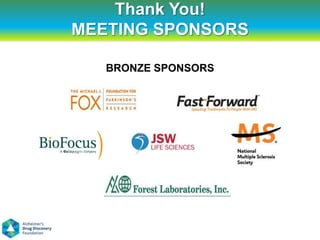
MEETING SPONSORS

   BRONZE SPONSORS
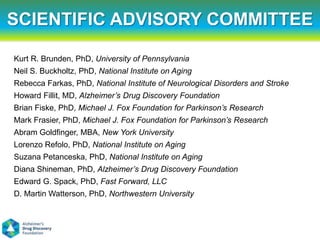
SCIENTIFIC ADVISORY COMMITTEE

  SCIENTIFIC ADVISORY COMMITTEE
Kurt R. Brunden, PhD, University of Pennsylvania
Neil S. Buckholtz, PhD, National Institute on Aging
Rebecca Farkas, PhD, National Institute of Neurological Disorders and Stroke
Howard Fillit, MD, Alzheimer’s Drug Discovery Foundation
Brian Fiske, PhD, Michael J. Fox Foundation for Parkinson’s Research
Mark Frasier, PhD, Michael J. Fox Foundation for Parkinson’s Research
Abram Goldfinger, MBA, New York University
Lorenzo Refolo, PhD, National Institute on Aging
Suzana Petanceska, PhD, National Institute on Aging
Diana Shineman, PhD, Alzheimer’s Drug Discovery Foundation
Edward G. Spack, PhD, Fast Forward, LLC
D. Martin Watterson, PhD, Northwestern University
ADDF Staff

• Diana Shineman, PhD – Assistant Director, Scientific Affairs

• Rachel Lane, PhD – Scientific Program Manager

• Filomena Machleder – Assistant Director, Institutional Partnerships

• Natalie Romatz – Partnerships Assistant, Institutional Partnerships

• Niyati Thakker – Grants Assistant

• World Events Forum – Conference Secretariat
NOTES

 Please remember to complete and submit the
             meeting survey!


  CME Certificates available at the Registration Desk


A webcast of the conference will be available soon on our
                       website:

                 www.alzdiscovery.org
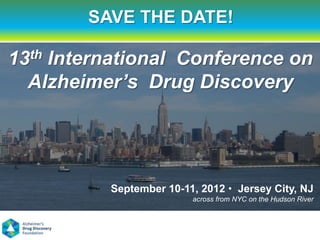
SAVE THE DATE!

13th International Conference on
  Alzheimer’s Drug Discovery


          September 10-11, 2012 • Jersey City, NJ
                         across from NYC on the Hudson River
Goals of the Meeting

• Knowledge:

  – The principles and practice of drug discovery, with a focus
    on the unique aspects for neurodegenerative diseases

• Network:

  – >190 attendees from 20 countries, ~40% from industry

  – Exchange ideas, foster alliances, partnerships and
    collaborations
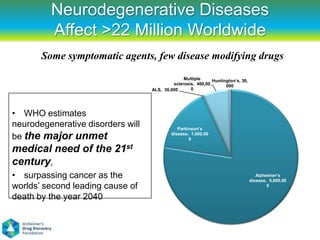
Neurodegenerative Diseases
         Affect >22 Million Worldwide
       Some symptomatic agents, few disease modifying drugs
                                                 Multiple     Huntington’s, 30,
                                            sclerosis, 400,00       000
                                   ALS, 30,000      0


• WHO estimates
neurodegenerative disorders will              Parkinson’s

be the major unmet                         disease, 1,000,00
                                                   0

medical need of the 21st
century,
• surpassing cancer as the                                                           Alzheimer’s
                                                                                  disease, 5,000,00
worlds’ second leading cause of                                                           0

death by the year 2040
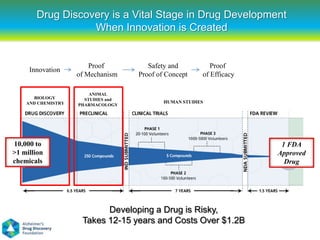
Drug Discovery is a Vital Stage in Drug Development
                  When Innovation is Created


                        Proof          Safety and          Proof
     Innovation
                    of Mechanism    Proof of Concept    of Efficacy

                        ANIMAL
      BIOLOGY         STUDIES and
    AND CHEMISTRY                           HUMAN STUDIES
                    PHARMACOLOGY


10,000 to                                                              1 FDA
>1 million                                                            Approved
chemicals                                                               Drug


                           Developing a Drug is Risky,
                     Takes 12-15 years and Costs Over $1.2B
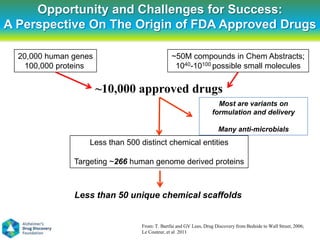
Opportunity and Challenges for Success:
A Perspective On The Origin of FDA Approved Drugs

  20,000 human genes                            ~50M compounds in Chem Abstracts;
    100,000 proteins                             1040-10100 possible small molecules


                       ~10,000 approved drugs
                                                                      Most are variants on
                                                                    formulation and delivery

                                                                       Many anti-microbials
                   Less than 500 distinct chemical entities

               Targeting ~266 human genome derived proteins


               Less than 50 unique chemical scaffolds


                                  From: T. Bartfai and GV Lees, Drug Discovery from Bedside to Wall Street, 2006;
                                  Le Couteur, et al 2011
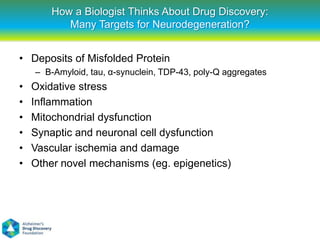
How a Biologist Thinks About Drug Discovery:
           Many Targets for Neurodegeneration?


• Deposits of Misfolded Protein
    – Β-Amyloid, tau, α-synuclein, TDP-43, poly-Q aggregates
•   Oxidative stress
•   Inflammation
•   Mitochondrial dysfunction
•   Synaptic and neuronal cell dysfunction
•   Vascular ischemia and damage
•   Other novel mechanisms (eg. epigenetics)
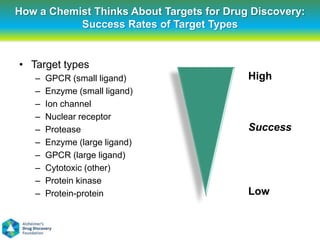
How a Chemist Thinks About Targets for Drug Discovery:
           Success Rates of Target Types


• Target types
   –   GPCR (small ligand)                 High
   –   Enzyme (small ligand)
   –   Ion channel
   –   Nuclear receptor
   –   Protease                            Success
   –   Enzyme (large ligand)
   –   GPCR (large ligand)
   –   Cytotoxic (other)
   –   Protein kinase
   –   Protein-protein                     Low
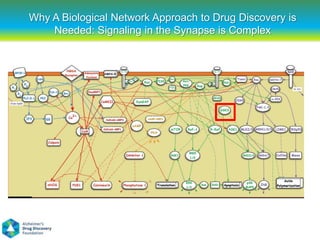
Why A Biological Network Approach to Drug Discovery is
    Needed: Signaling in the Synapse is Complex
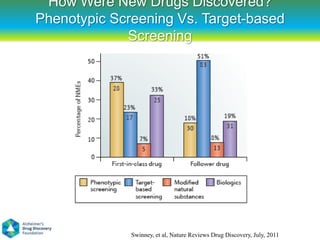
How Were New Drugs Discovered?
Phenotypic Screening Vs. Target-based
             Screening


              Swinney, et al, Nature Reviews Drug Discovery, July, 2011
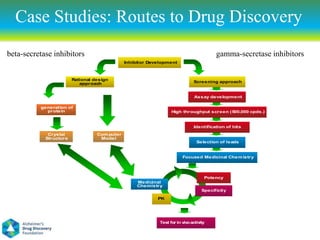
Case Studies: Routes to Drug Discovery
beta-secretase inhibitors                                                               gamma-secretase inhibitors
                                              Inhibitor Development


                        Rational design
                           approach                                           Screening approach


                                                                              Assay development

          generation of
            protein                                               High throughput screen (500,000 cpds.)


                                                                              Identification of hits
             Crystal              Com puter
            Structure              Model
                                                                               Selection of leads


                                                                        Focused Medicinal Chem istry


                                                                                   Potency
                                                   Medicinal
                                                   Chemistry
                                                                                  Specificity

                                                           PK


                                                            Test for in v o activ
                                                                         iv      ity
Improving Success Rates?
      Drug Discovery in Academia
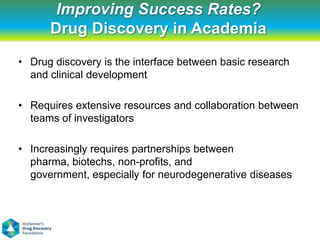
• Drug discovery is the interface between basic research
  and clinical development

• Requires extensive resources and collaboration between
  teams of investigators

• Increasingly requires partnerships between
  pharma, biotechs, non-profits, and
  government, especially for neurodegenerative diseases
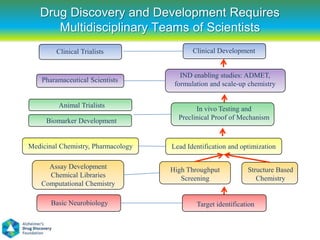
Drug Discovery and Development Requires
      Multidisciplinary Teams of Scientists
        Clinical Trialists                 Clinical Development


                                       IND enabling studies: ADMET,
    Pharamaceutical Scientists
                                     formulation and scale-up chemistry


         Animal Trialists
                                            In vivo Testing and
     Biomarker Development            Preclinical Proof of Mechanism


Medicinal Chemistry, Pharmacology   Lead Identification and optimization

      Assay Development             High Throughput           Structure Based
      Chemical Libraries               Screening                 Chemistry
    Computational Chemistry

       Basic Neurobiology                   Target identification
Feeding the Pipeline:
 The Alzheimer’s Drug Discovery Foundation


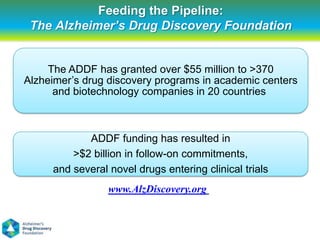
     The ADDF has granted over $55 million to >370
Alzheimer’s drug discovery programs in academic centers
      and biotechnology companies in 20 countries


            ADDF funding has resulted in
         >$2 billion in follow-on commitments,
     and several novel drugs entering clinical trials
                 www.AlzDiscovery.org
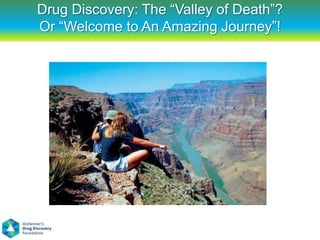
Drug Discovery: The “Valley of Death”?
Or “Welcome to An Amazing Journey”!
Where is drug discovery going?

         Christopher A. Lipinski
  Scientific Advisor, Melior Discovery
    clipinski@meliordiscovery.com


              DDND 2012 Lipinski keynote   20
Outline
• Academic targets and the translational gap
  –is it just a missing resource issue?
• Chemistry & attrition - worse with time
  –reductionism , genomics, HTS to blame?
• Screening diverse compounds
  –the worst way to discover a drug
  –novelty drive comes from patents and not science
• Biology and chemistry networks analysis
  –chemistry due diligence on leads is essential
• What to look for
                     DDND 2012 Lipinski keynote    21
Drivers for discovery changes
• Chemistry, 65% successful predictivity
  • rules and filters, eg. phys chem, structural
  • ADME predictivity worsens outside of RO5 space
• Safety, 50% successful predictivity
• Efficacy, 10% successful predictivity
• Tackle efficacy using academic collaborations
  • systems biology still too new to save us
  • target quality is most likely from rich biology
                     DDND 2012 Lipinski keynote       22
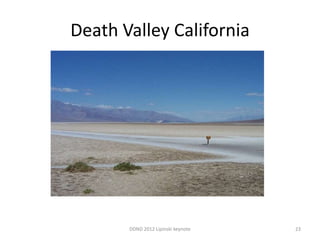
Death Valley California


       DDND 2012 Lipinski keynote   23
Translational valley of death


"curing disease is a byproduct of the [NIH] system and not a goal," says
FasterCures' Simon. Most scientists don't want to and don't have the skills to
translate a discovery into a treatment; researchers at a dedicated center would
try to do that full-time.

                               DDND 2012 Lipinski keynote                     24
Death valley, politically correct causes?
• Academics lack drug discovery skills
• Requires industry / academic collaboration
   • eg. medicinal chemists are mostly in industry
• No access to ADMET, drug met, pharm sci etc.
   • critical disciplines not in academia
• No access to preclinical – clinical interface skills
   • eg. analytical, process chemistry, formulation
• No access to early development skills
   • eg. toxicology, biomarkers, project management
                       DDND 2012 Lipinski keynote     25
Death valley, politically incorrect
              causes?
• Assumption - academic ideas on new targets are
  of high quality
                  WRONG
• Bayer analysis of validation of academic targets
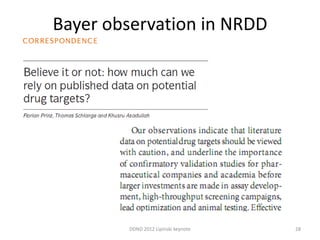
• 50 % of academic targets are wrong
• 25% of academic targets are partially flawed
• Translational death valley exists (in part) because
  of poor quality academic target identification

                    DDND 2012 Lipinski keynote    26
Why the academic target problem
• Culprit is primarily the pressure to publish to
    support both grant applications and career
    development
•   A people problem
•   A government problem
•   Exacerbated by hypothesis driven research

• The positive: infrastructure collaboration
                    DDND 2012 Lipinski keynote      27
Bayer observation in NRDD


        DDND 2012 Lipinski keynote   28
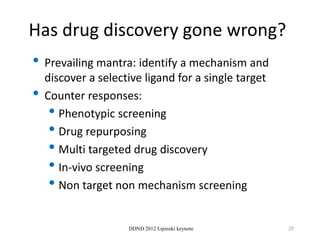
Has drug discovery gone wrong?
• Prevailing mantra: identify a mechanism and
    discover a selective ligand for a single target
•   Counter responses:
     • Phenotypic screening
     • Drug repurposing
     • Multi targeted drug discovery
     • In-vivo screening
     • Non target non mechanism screening

                     DDND 2012 Lipinski keynote       29
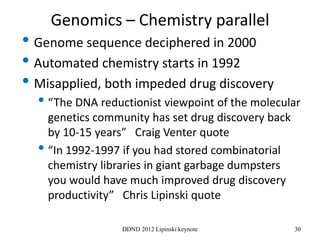
Genomics – Chemistry parallel
• Genome sequence deciphered in 2000
• Automated chemistry starts in 1992
• Misapplied, both impeded drug discovery
  • “The DNA reductionist viewpoint of the molecular
    genetics community has set drug discovery back
    by 10-15 years” Craig Venter quote
  • “In 1992-1997 if you had stored combinatorial
    chemistry libraries in giant garbage dumpsters
    you would have much improved drug discovery
    productivity” Chris Lipinski quote

                  DDND 2012 Lipinski keynote         30
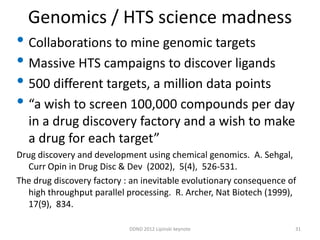
Genomics / HTS science madness
• Collaborations to mine genomic targets
• Massive HTS campaigns to discover ligands
• 500 different targets, a million data points
• “a wish to screen 100,000 compounds per day
   in a drug discovery factory and a wish to make
   a drug for each target”
Drug discovery and development using chemical genomics. A. Sehgal,
   Curr Opin in Drug Disc & Dev (2002), 5(4), 526-531.
The drug discovery factory : an inevitable evolutionary consequence of
   high throughput parallel processing. R. Archer, Nat Biotech (1999),
   17(9), 834.

                            DDND 2012 Lipinski keynote               31
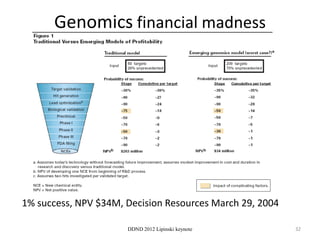
Genomics financial madness


1% success, NPV $34M, Decision Resources March 29, 2004

                      DDND 2012 Lipinski keynote          32
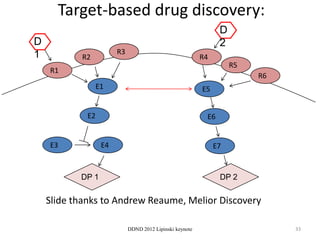
Target-based drug discovery:
                                                                D
D                                                               2
1                       R3
           R2                                             R4
                                                                    R5
    R1
                                                                         R6
                  E1                                      E5


             E2                                            E6


    E3             E4                                          E7


           DP 1                                                 DP 2

    Slide thanks to Andrew Reaume, Melior Discovery

                             DDND 2012 Lipinski keynote                       33
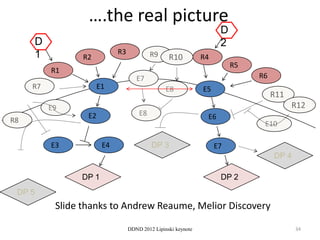
….the real picture
                                                                     D
     D                                                               2
     1                       R3            R9
                 R2                               R10          R4
                                                                         R5
          R1
                                     E7                                       R6
     R7                E1                        E8            E5
                                                                                   R11
          E9                                                                             R12
                  E2                  E8                        E6
R8                                                                             E10

          E3            E4                 DP 3                     E7
                                                                                   DP 4

                DP 1                                                 DP 2
 DP 5
           Slide thanks to Andrew Reaume, Melior Discovery

                                  DDND 2012 Lipinski keynote                              34
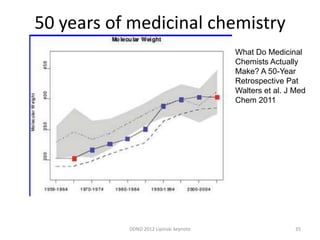
50 years of medicinal chemistry
                                        What Do Medicinal
                                        Chemists Actually
                                        Make? A 50-Year
                                        Retrospective Pat
                                        Walters et al. J Med
                                        Chem 2011


           DDND 2012 Lipinski keynote                    35
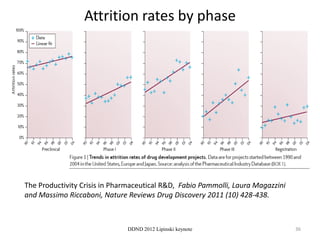
Attrition rates by phase


The Productivity Crisis in Pharmaceutical R&D, Fabio Pammolli, Laura Magazzini
and Massimo Riccaboni, Nature Reviews Drug Discovery 2011 (10) 428-438.


                              DDND 2012 Lipinski keynote                         36
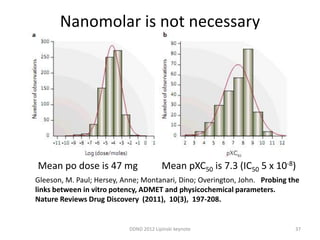
Nanomolar is not necessary


Mean po dose is 47 mg                   Mean pXC50 is 7.3 (IC50 5 x 10⁻⁸)
Gleeson, M. Paul; Hersey, Anne; Montanari, Dino; Overington, John. Probing the
links between in vitro potency, ADMET and physicochemical parameters.
Nature Reviews Drug Discovery (2011), 10(3), 197-208.


                           DDND 2012 Lipinski keynote                       37
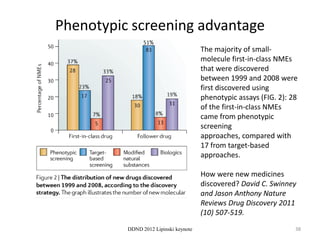
Phenotypic screening advantage
                                       The majority of small-
                                       molecule first-in-class NMEs
                                       that were discovered
                                       between 1999 and 2008 were
                                       first discovered using
                                       phenotypic assays (FIG. 2): 28
                                       of the first-in-class NMEs
                                       came from phenotypic
                                       screening
                                       approaches, compared with
                                       17 from target-based
                                       approaches.

                                       How were new medicines
                                       discovered? David C. Swinney
                                       and Jason Anthony Nature
                                       Reviews Drug Discovery 2011
                                       (10) 507-519.
          DDND 2012 Lipinski keynote                                38
Phenotypic screening
• Finally government is paying attention
• NIH new institute TRND
• 25% of assays are reserved for phenotypic
  screening


                  DDND 2012 Lipinski keynote   39
Chemistry novelty is harmful
• Patents direct towards chemistry novelty
• Chemistry novelty correlates with decreased
    drug discovery success
•   “The role of the patent system in promoting
    pharmaceutical innovation is widely seen as a
    tremendous success story. This view overlooks a
    serious shortcoming in the drug patent system: the
    standards by which drugs are deemed unpatentable
    under the novelty and non-obviousness requirement
    bear little relationship to the social value of those drugs
    or the need for a patent to motivate their development”
    Benjamin N. Roin, Texas Law Review
                 DDND 2012 Lipinski keynote         40
Screening diverse compounds is
  the worst way to discover a drug
• Every publication I know of argues that
  biologically active compounds are not
  uniformly distributed through chemistry space


                   DDND 2012 Lipinski keynote   41
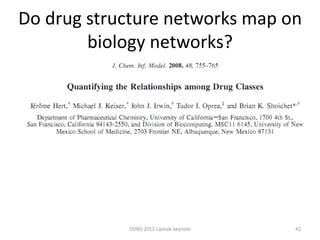
Do drug structure networks map on
        biology networks?


            DDND 2012 Lipinski keynote   42
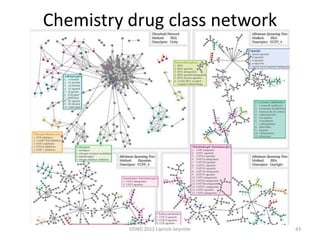
Chemistry drug class network


          DDND 2012 Lipinski keynote   43
Network comparison conclusions
• “A startling result from our initial work on
  pharmacological networks was the
  observation that networks based on ligand
  similarities differed greatly from those based
  on the sequence identities among their
  targets.”
• “Biological targets may be related by their
  ligands, leading to connections unanticipated
  by bioinformatics similarities.”

                   DDND 2012 Lipinski keynote      44
What is going on?
• Old maxim: Similar biology implies similar
    chemistry
•   If strictly true biology and chemistry networks
    should coincide


                     DDND 2012 Lipinski keynote   45
Network comparisons – meaning?
• “Structure of the ligand reflects the target”
• Evolution selects target structure to perform a
    useful biological function
•   Useful target structure is retained against a
    breadth of biology
•   Conservation in chemistry binding motifs
•   Conservation in motifs where chemistry
    binding is not evolutionarily desired
    –eg. protein – protein interactions
                      DDND 2012 Lipinski keynote    46
Hit / lead implications
• You have a screening hit. SAR on the historical
    chemistry of your hit can be useful even if it
    comes from a different biology area
•   Medicinal chemistry principles outside of your
    current biology target can be extrapolated to
    the ligand chemistry (but not biology) of the
    new target
•   Medicinal chemistry due diligence is essential


                    DDND 2012 Lipinski keynote   47
Changes in drug discovery
•   Questioning of reductionist approach
•   A positive development in CNS drug discovery
•   Very few CNS agents are found rationally
•   Experimental observations in the clinic
•   Multiple Sclerosis as a paradigm
•   No drugs until disease progression biomarkers
•   Multiple MS drugs recently available


                    DDND 2012 Lipinski keynote   48
What to look for
• Disease progression biomarkers
  –first impact in drug discovery
  –later impact when therapy arrives
• Orphanization of disease diagnosis
  –new drugs or fitting patients to current drugs?
  –challenges to cost structures
• Exploring drug or target combinations

                    DDND 2012 Lipinski keynote       49

Sunday fillet lipinski

  • 1.
    THANK YOU! Funding forthis conference was made possible in part by Cooperative Agreement U13AG031125-05 from the National Institute on Aging. The views expressed in written conference materials or publications and by speakers and moderators do not necessarily reflect the official policies of the Department of Health and Human Services; nor does mention by trade names, commercial practices, or organizations imply endorsement by the U.S. Government.
  • 2.
  • 3.
    SCIENTIFIC ADVISORY COMMITTEE SCIENTIFIC ADVISORY COMMITTEE Kurt R. Brunden, PhD, University of Pennsylvania Neil S. Buckholtz, PhD, National Institute on Aging Rebecca Farkas, PhD, National Institute of Neurological Disorders and Stroke Howard Fillit, MD, Alzheimer’s Drug Discovery Foundation Brian Fiske, PhD, Michael J. Fox Foundation for Parkinson’s Research Mark Frasier, PhD, Michael J. Fox Foundation for Parkinson’s Research Abram Goldfinger, MBA, New York University Lorenzo Refolo, PhD, National Institute on Aging Suzana Petanceska, PhD, National Institute on Aging Diana Shineman, PhD, Alzheimer’s Drug Discovery Foundation Edward G. Spack, PhD, Fast Forward, LLC D. Martin Watterson, PhD, Northwestern University
  • 4.
    ADDF Staff • DianaShineman, PhD – Assistant Director, Scientific Affairs • Rachel Lane, PhD – Scientific Program Manager • Filomena Machleder – Assistant Director, Institutional Partnerships • Natalie Romatz – Partnerships Assistant, Institutional Partnerships • Niyati Thakker – Grants Assistant • World Events Forum – Conference Secretariat
  • 5.
    NOTES Please rememberto complete and submit the meeting survey! CME Certificates available at the Registration Desk A webcast of the conference will be available soon on our website: www.alzdiscovery.org
  • 6.
    SAVE THE DATE! 13thInternational Conference on Alzheimer’s Drug Discovery September 10-11, 2012 • Jersey City, NJ across from NYC on the Hudson River
  • 7.
    Goals of theMeeting • Knowledge: – The principles and practice of drug discovery, with a focus on the unique aspects for neurodegenerative diseases • Network: – >190 attendees from 20 countries, ~40% from industry – Exchange ideas, foster alliances, partnerships and collaborations
  • 8.
    Neurodegenerative Diseases Affect >22 Million Worldwide Some symptomatic agents, few disease modifying drugs Multiple Huntington’s, 30, sclerosis, 400,00 000 ALS, 30,000 0 • WHO estimates neurodegenerative disorders will Parkinson’s be the major unmet disease, 1,000,00 0 medical need of the 21st century, • surpassing cancer as the Alzheimer’s disease, 5,000,00 worlds’ second leading cause of 0 death by the year 2040
  • 9.
    Drug Discovery isa Vital Stage in Drug Development When Innovation is Created Proof Safety and Proof Innovation of Mechanism Proof of Concept of Efficacy ANIMAL BIOLOGY STUDIES and AND CHEMISTRY HUMAN STUDIES PHARMACOLOGY 10,000 to 1 FDA >1 million Approved chemicals Drug Developing a Drug is Risky, Takes 12-15 years and Costs Over $1.2B
  • 10.
    Opportunity and Challengesfor Success: A Perspective On The Origin of FDA Approved Drugs 20,000 human genes ~50M compounds in Chem Abstracts; 100,000 proteins 1040-10100 possible small molecules ~10,000 approved drugs Most are variants on formulation and delivery Many anti-microbials Less than 500 distinct chemical entities Targeting ~266 human genome derived proteins Less than 50 unique chemical scaffolds From: T. Bartfai and GV Lees, Drug Discovery from Bedside to Wall Street, 2006; Le Couteur, et al 2011
  • 11.
    How a BiologistThinks About Drug Discovery: Many Targets for Neurodegeneration? • Deposits of Misfolded Protein – Β-Amyloid, tau, α-synuclein, TDP-43, poly-Q aggregates • Oxidative stress • Inflammation • Mitochondrial dysfunction • Synaptic and neuronal cell dysfunction • Vascular ischemia and damage • Other novel mechanisms (eg. epigenetics)
  • 12.
    How a ChemistThinks About Targets for Drug Discovery: Success Rates of Target Types • Target types – GPCR (small ligand) High – Enzyme (small ligand) – Ion channel – Nuclear receptor – Protease Success – Enzyme (large ligand) – GPCR (large ligand) – Cytotoxic (other) – Protein kinase – Protein-protein Low
  • 13.
    Why A BiologicalNetwork Approach to Drug Discovery is Needed: Signaling in the Synapse is Complex
  • 14.
    How Were NewDrugs Discovered? Phenotypic Screening Vs. Target-based Screening Swinney, et al, Nature Reviews Drug Discovery, July, 2011
  • 15.
    Case Studies: Routesto Drug Discovery beta-secretase inhibitors gamma-secretase inhibitors Inhibitor Development Rational design approach Screening approach Assay development generation of protein High throughput screen (500,000 cpds.) Identification of hits Crystal Com puter Structure Model Selection of leads Focused Medicinal Chem istry Potency Medicinal Chemistry Specificity PK Test for in v o activ iv ity
  • 16.
    Improving Success Rates? Drug Discovery in Academia • Drug discovery is the interface between basic research and clinical development • Requires extensive resources and collaboration between teams of investigators • Increasingly requires partnerships between pharma, biotechs, non-profits, and government, especially for neurodegenerative diseases
  • 17.
    Drug Discovery andDevelopment Requires Multidisciplinary Teams of Scientists Clinical Trialists Clinical Development IND enabling studies: ADMET, Pharamaceutical Scientists formulation and scale-up chemistry Animal Trialists In vivo Testing and Biomarker Development Preclinical Proof of Mechanism Medicinal Chemistry, Pharmacology Lead Identification and optimization Assay Development High Throughput Structure Based Chemical Libraries Screening Chemistry Computational Chemistry Basic Neurobiology Target identification
  • 18.
    Feeding the Pipeline: The Alzheimer’s Drug Discovery Foundation The ADDF has granted over $55 million to >370 Alzheimer’s drug discovery programs in academic centers and biotechnology companies in 20 countries ADDF funding has resulted in >$2 billion in follow-on commitments, and several novel drugs entering clinical trials www.AlzDiscovery.org
  • 19.
    Drug Discovery: The“Valley of Death”? Or “Welcome to An Amazing Journey”!
  • 20.
    Where is drugdiscovery going? Christopher A. Lipinski Scientific Advisor, Melior Discovery clipinski@meliordiscovery.com DDND 2012 Lipinski keynote 20
  • 21.
    Outline • Academic targetsand the translational gap –is it just a missing resource issue? • Chemistry & attrition - worse with time –reductionism , genomics, HTS to blame? • Screening diverse compounds –the worst way to discover a drug –novelty drive comes from patents and not science • Biology and chemistry networks analysis –chemistry due diligence on leads is essential • What to look for DDND 2012 Lipinski keynote 21
  • 22.
    Drivers for discoverychanges • Chemistry, 65% successful predictivity • rules and filters, eg. phys chem, structural • ADME predictivity worsens outside of RO5 space • Safety, 50% successful predictivity • Efficacy, 10% successful predictivity • Tackle efficacy using academic collaborations • systems biology still too new to save us • target quality is most likely from rich biology DDND 2012 Lipinski keynote 22
  • 23.
    Death Valley California DDND 2012 Lipinski keynote 23
  • 24.
    Translational valley ofdeath "curing disease is a byproduct of the [NIH] system and not a goal," says FasterCures' Simon. Most scientists don't want to and don't have the skills to translate a discovery into a treatment; researchers at a dedicated center would try to do that full-time. DDND 2012 Lipinski keynote 24
  • 25.
    Death valley, politicallycorrect causes? • Academics lack drug discovery skills • Requires industry / academic collaboration • eg. medicinal chemists are mostly in industry • No access to ADMET, drug met, pharm sci etc. • critical disciplines not in academia • No access to preclinical – clinical interface skills • eg. analytical, process chemistry, formulation • No access to early development skills • eg. toxicology, biomarkers, project management DDND 2012 Lipinski keynote 25
  • 26.
    Death valley, politicallyincorrect causes? • Assumption - academic ideas on new targets are of high quality WRONG • Bayer analysis of validation of academic targets • 50 % of academic targets are wrong • 25% of academic targets are partially flawed • Translational death valley exists (in part) because of poor quality academic target identification DDND 2012 Lipinski keynote 26
  • 27.
    Why the academictarget problem • Culprit is primarily the pressure to publish to support both grant applications and career development • A people problem • A government problem • Exacerbated by hypothesis driven research • The positive: infrastructure collaboration DDND 2012 Lipinski keynote 27
  • 28.
    Bayer observation inNRDD DDND 2012 Lipinski keynote 28
  • 29.
    Has drug discoverygone wrong? • Prevailing mantra: identify a mechanism and discover a selective ligand for a single target • Counter responses: • Phenotypic screening • Drug repurposing • Multi targeted drug discovery • In-vivo screening • Non target non mechanism screening DDND 2012 Lipinski keynote 29
  • 30.
    Genomics – Chemistryparallel • Genome sequence deciphered in 2000 • Automated chemistry starts in 1992 • Misapplied, both impeded drug discovery • “The DNA reductionist viewpoint of the molecular genetics community has set drug discovery back by 10-15 years” Craig Venter quote • “In 1992-1997 if you had stored combinatorial chemistry libraries in giant garbage dumpsters you would have much improved drug discovery productivity” Chris Lipinski quote DDND 2012 Lipinski keynote 30
  • 31.
    Genomics / HTSscience madness • Collaborations to mine genomic targets • Massive HTS campaigns to discover ligands • 500 different targets, a million data points • “a wish to screen 100,000 compounds per day in a drug discovery factory and a wish to make a drug for each target” Drug discovery and development using chemical genomics. A. Sehgal, Curr Opin in Drug Disc & Dev (2002), 5(4), 526-531. The drug discovery factory : an inevitable evolutionary consequence of high throughput parallel processing. R. Archer, Nat Biotech (1999), 17(9), 834. DDND 2012 Lipinski keynote 31
  • 32.
    Genomics financial madness 1%success, NPV $34M, Decision Resources March 29, 2004 DDND 2012 Lipinski keynote 32
  • 33.
    Target-based drug discovery: D D 2 1 R3 R2 R4 R5 R1 R6 E1 E5 E2 E6 E3 E4 E7 DP 1 DP 2 Slide thanks to Andrew Reaume, Melior Discovery DDND 2012 Lipinski keynote 33
  • 34.
    ….the real picture D D 2 1 R3 R9 R2 R10 R4 R5 R1 E7 R6 R7 E1 E8 E5 R11 E9 R12 E2 E8 E6 R8 E10 E3 E4 DP 3 E7 DP 4 DP 1 DP 2 DP 5 Slide thanks to Andrew Reaume, Melior Discovery DDND 2012 Lipinski keynote 34
  • 35.
    50 years ofmedicinal chemistry What Do Medicinal Chemists Actually Make? A 50-Year Retrospective Pat Walters et al. J Med Chem 2011 DDND 2012 Lipinski keynote 35
  • 36.
    Attrition rates byphase The Productivity Crisis in Pharmaceutical R&D, Fabio Pammolli, Laura Magazzini and Massimo Riccaboni, Nature Reviews Drug Discovery 2011 (10) 428-438. DDND 2012 Lipinski keynote 36
  • 37.
    Nanomolar is notnecessary Mean po dose is 47 mg Mean pXC50 is 7.3 (IC50 5 x 10⁻⁸) Gleeson, M. Paul; Hersey, Anne; Montanari, Dino; Overington, John. Probing the links between in vitro potency, ADMET and physicochemical parameters. Nature Reviews Drug Discovery (2011), 10(3), 197-208. DDND 2012 Lipinski keynote 37
  • 38.
    Phenotypic screening advantage The majority of small- molecule first-in-class NMEs that were discovered between 1999 and 2008 were first discovered using phenotypic assays (FIG. 2): 28 of the first-in-class NMEs came from phenotypic screening approaches, compared with 17 from target-based approaches. How were new medicines discovered? David C. Swinney and Jason Anthony Nature Reviews Drug Discovery 2011 (10) 507-519. DDND 2012 Lipinski keynote 38
  • 39.
    Phenotypic screening • Finallygovernment is paying attention • NIH new institute TRND • 25% of assays are reserved for phenotypic screening DDND 2012 Lipinski keynote 39
  • 40.
    Chemistry novelty isharmful • Patents direct towards chemistry novelty • Chemistry novelty correlates with decreased drug discovery success • “The role of the patent system in promoting pharmaceutical innovation is widely seen as a tremendous success story. This view overlooks a serious shortcoming in the drug patent system: the standards by which drugs are deemed unpatentable under the novelty and non-obviousness requirement bear little relationship to the social value of those drugs or the need for a patent to motivate their development” Benjamin N. Roin, Texas Law Review DDND 2012 Lipinski keynote 40
  • 41.
    Screening diverse compoundsis the worst way to discover a drug • Every publication I know of argues that biologically active compounds are not uniformly distributed through chemistry space DDND 2012 Lipinski keynote 41
  • 42.
    Do drug structurenetworks map on biology networks? DDND 2012 Lipinski keynote 42
  • 43.
    Chemistry drug classnetwork DDND 2012 Lipinski keynote 43
  • 44.
    Network comparison conclusions •“A startling result from our initial work on pharmacological networks was the observation that networks based on ligand similarities differed greatly from those based on the sequence identities among their targets.” • “Biological targets may be related by their ligands, leading to connections unanticipated by bioinformatics similarities.” DDND 2012 Lipinski keynote 44
  • 45.
    What is goingon? • Old maxim: Similar biology implies similar chemistry • If strictly true biology and chemistry networks should coincide DDND 2012 Lipinski keynote 45
  • 46.
    Network comparisons –meaning? • “Structure of the ligand reflects the target” • Evolution selects target structure to perform a useful biological function • Useful target structure is retained against a breadth of biology • Conservation in chemistry binding motifs • Conservation in motifs where chemistry binding is not evolutionarily desired –eg. protein – protein interactions DDND 2012 Lipinski keynote 46
  • 47.
    Hit / leadimplications • You have a screening hit. SAR on the historical chemistry of your hit can be useful even if it comes from a different biology area • Medicinal chemistry principles outside of your current biology target can be extrapolated to the ligand chemistry (but not biology) of the new target • Medicinal chemistry due diligence is essential DDND 2012 Lipinski keynote 47
  • 48.
    Changes in drugdiscovery • Questioning of reductionist approach • A positive development in CNS drug discovery • Very few CNS agents are found rationally • Experimental observations in the clinic • Multiple Sclerosis as a paradigm • No drugs until disease progression biomarkers • Multiple MS drugs recently available DDND 2012 Lipinski keynote 48
  • 49.
    What to lookfor • Disease progression biomarkers –first impact in drug discovery –later impact when therapy arrives • Orphanization of disease diagnosis –new drugs or fitting patients to current drugs? –challenges to cost structures • Exploring drug or target combinations DDND 2012 Lipinski keynote 49

Editor's Notes

  • #15 Figure 2 | The distribution of new drugs discovered between 1999 and 2008, according to the discovery strategy. The graph illustrates the number of new molecular entities (NMEs) in each category. Phenotypic screening was the most successful approach for first-in-class drugs, whereas target-based screening was the most successful for follower drugs during the period of this analysis. The total number of medicines that were discovered via phenotypic assays was similar for first-in-class and follower drugs — 28 and 30, respectively — whereas the total number of medicines that were discovered via target-based screening was nearly five times higher for follower drugs versus first-in-class drugs (83 to 17, respectively). Nature drug discovery july 2011