Replacing
Requirements
with Hypotheses

             AgileUX NYC 2012
             Feb 25, 2012
             Josh Seiden
             @jseiden
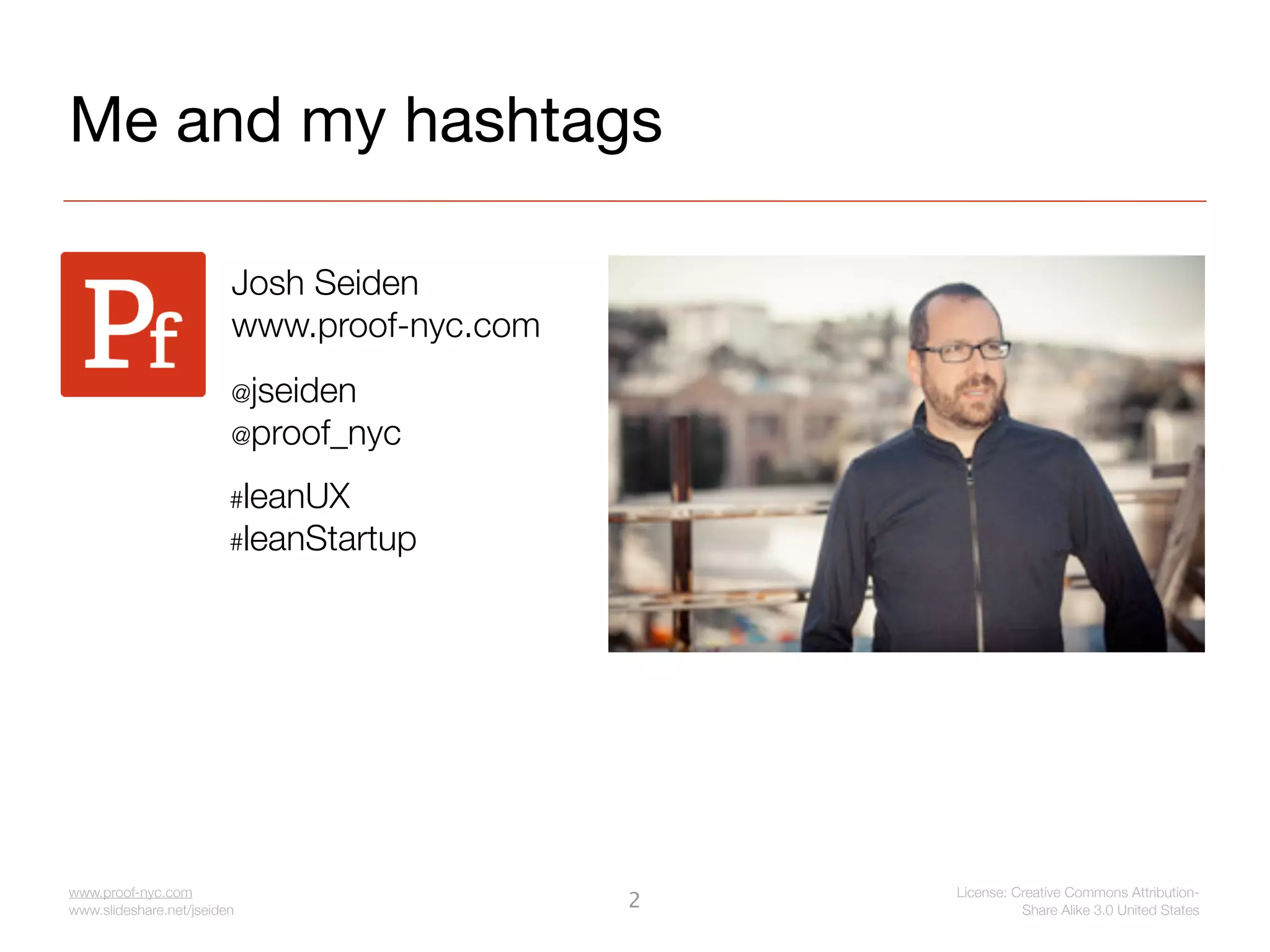
Me and my hashtags

                         Josh Seiden
                         www.proof-nyc.com
                         @jseiden
                         @proof_nyc

                         #leanUX
                         #leanStartup


www.proof-nyc.com                                License: Creative Commons Attribution-
www.slideshare.net/jseiden
                                             2             Share Alike 3.0 United States
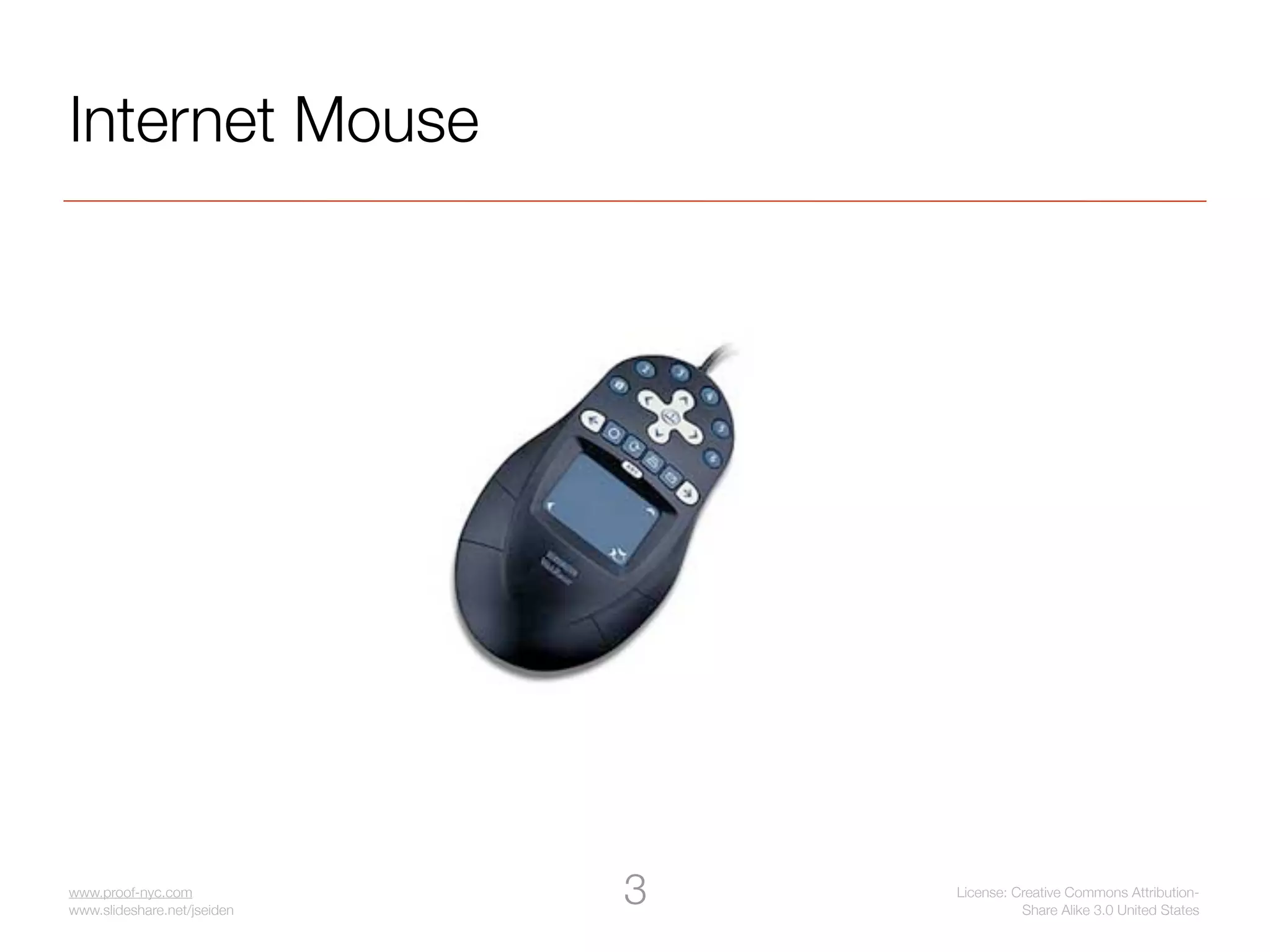
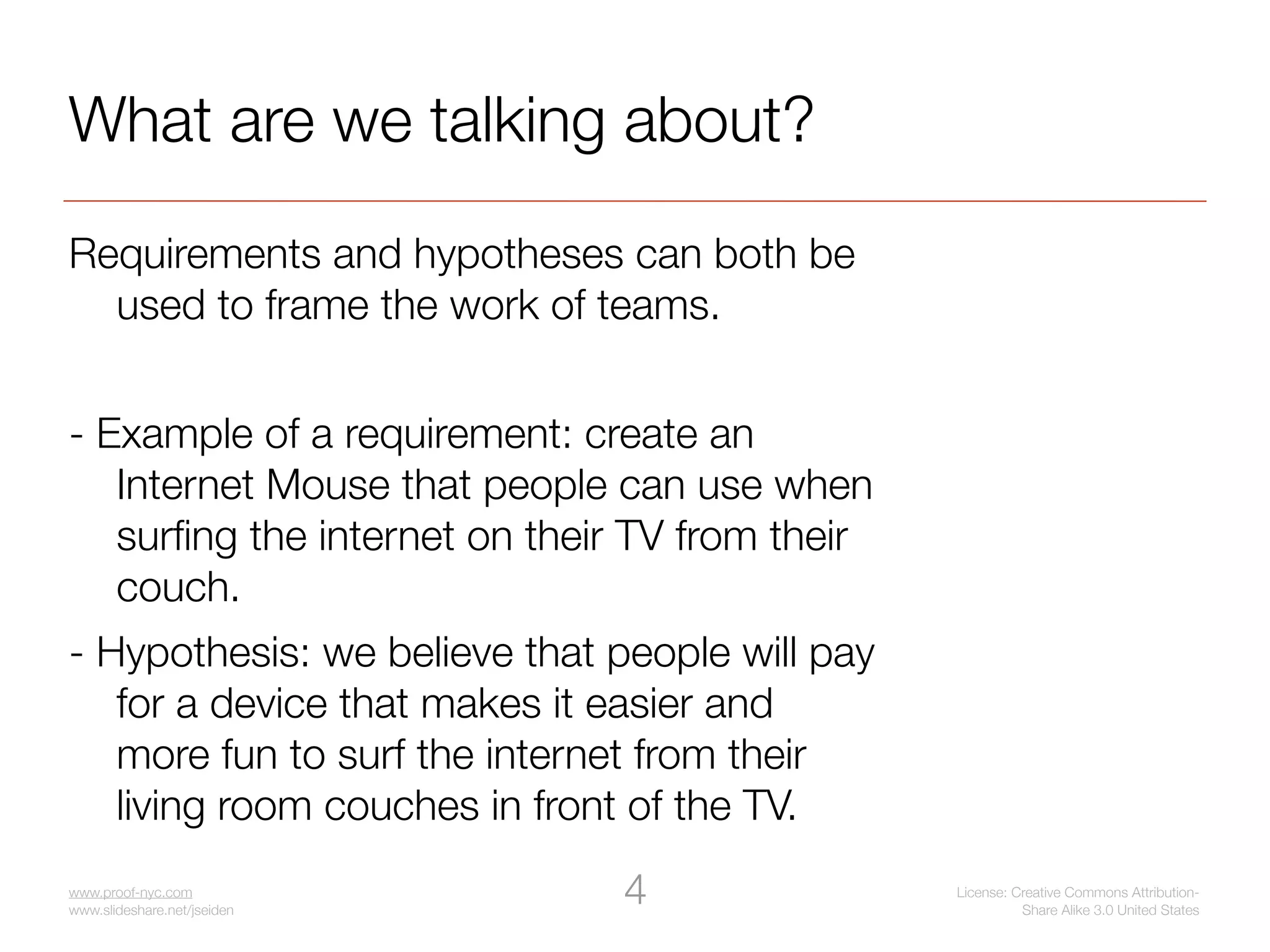
Internet Mouse


www.proof-nyc.com
www.slideshare.net/jseiden
                             3   License: Creative Commons Attribution-
                                           Share Alike 3.0 United States
Internet Mouse


www.proof-nyc.com
www.slideshare.net/jseiden
                             3   License: Creative Commons Attribution-
                                           Share Alike 3.0 United States
What are we talking about?
Requirements and hypotheses can both be
  used to frame the work of teams.


- Example of a requirement: create an
   Internet Mouse that people can use when
   surfing the internet on their TV from their
   couch.
- Hypothesis: we believe that people will pay
   for a device that makes it easier and
   more fun to surf the internet from their
   living room couches in front of the TV.
www.proof-nyc.com
www.slideshare.net/jseiden
                               4                License: Creative Commons Attribution-
                                                          Share Alike 3.0 United States
For many teams, in many
contexts, hypotheses are a
more effective way to
manage your work than
requirements.

                             5
Extreme uncertainty


www.proof-nyc.com
www.slideshare.net/jseiden
                             6   License: Creative Commons Attribution-
                                           Share Alike 3.0 United States
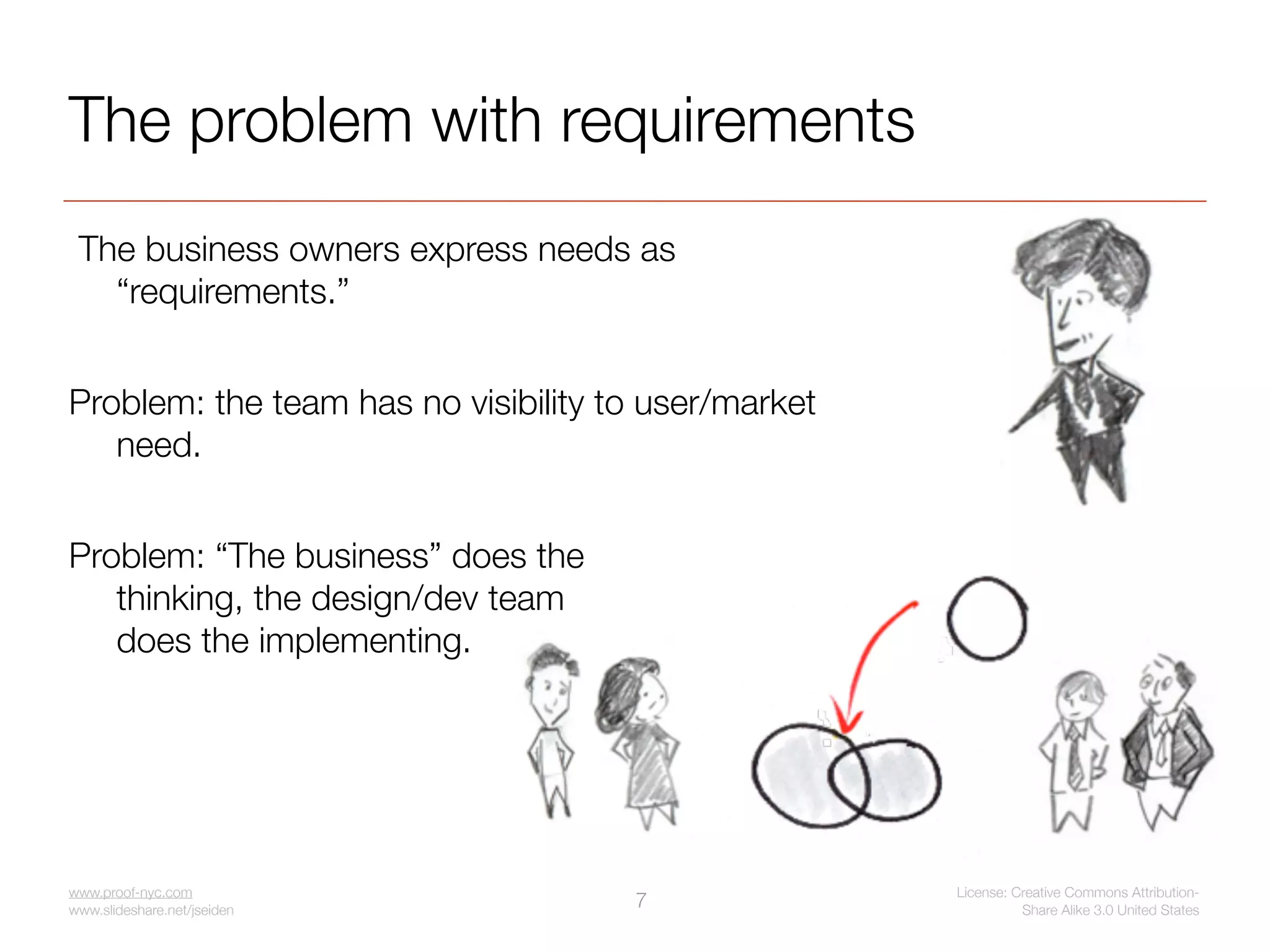
The problem with requirements
 The business owners express needs as
   “requirements.”


Problem: the team has no visibility to user/market
   need.


Problem: “The business” does the
   thinking, the design/dev team
   does the implementing.


www.proof-nyc.com                                    License: Creative Commons Attribution-
www.slideshare.net/jseiden
                                     7                         Share Alike 3.0 United States
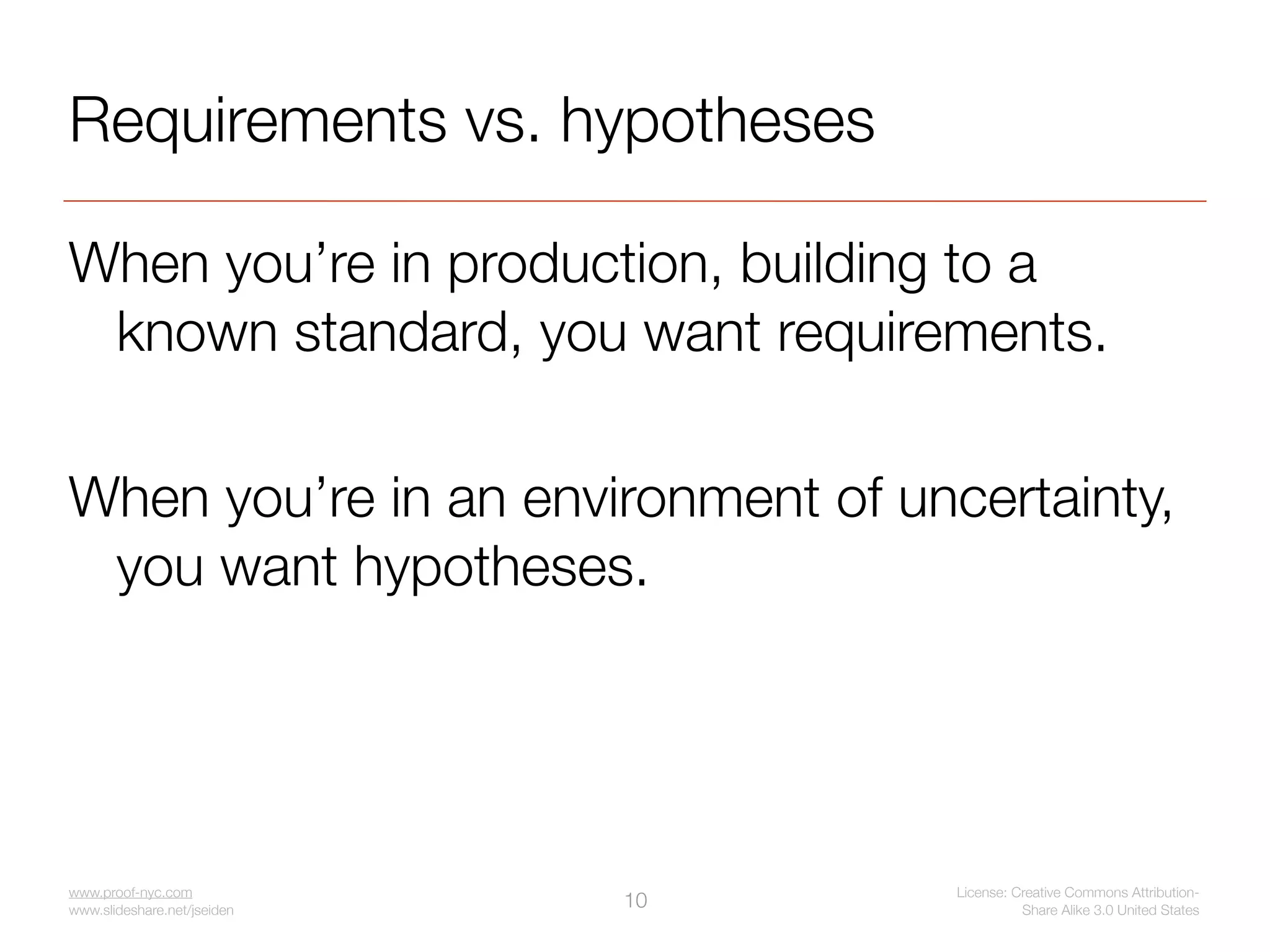
Requirements vs. hypotheses

When you’re in production, building to a
 known standard, you want requirements.

When you’re in an environment of uncertainty,
 you want hypotheses.


www.proof-nyc.com                   License: Creative Commons Attribution-
www.slideshare.net/jseiden
                             10               Share Alike 3.0 United States
Why hypotheses are better
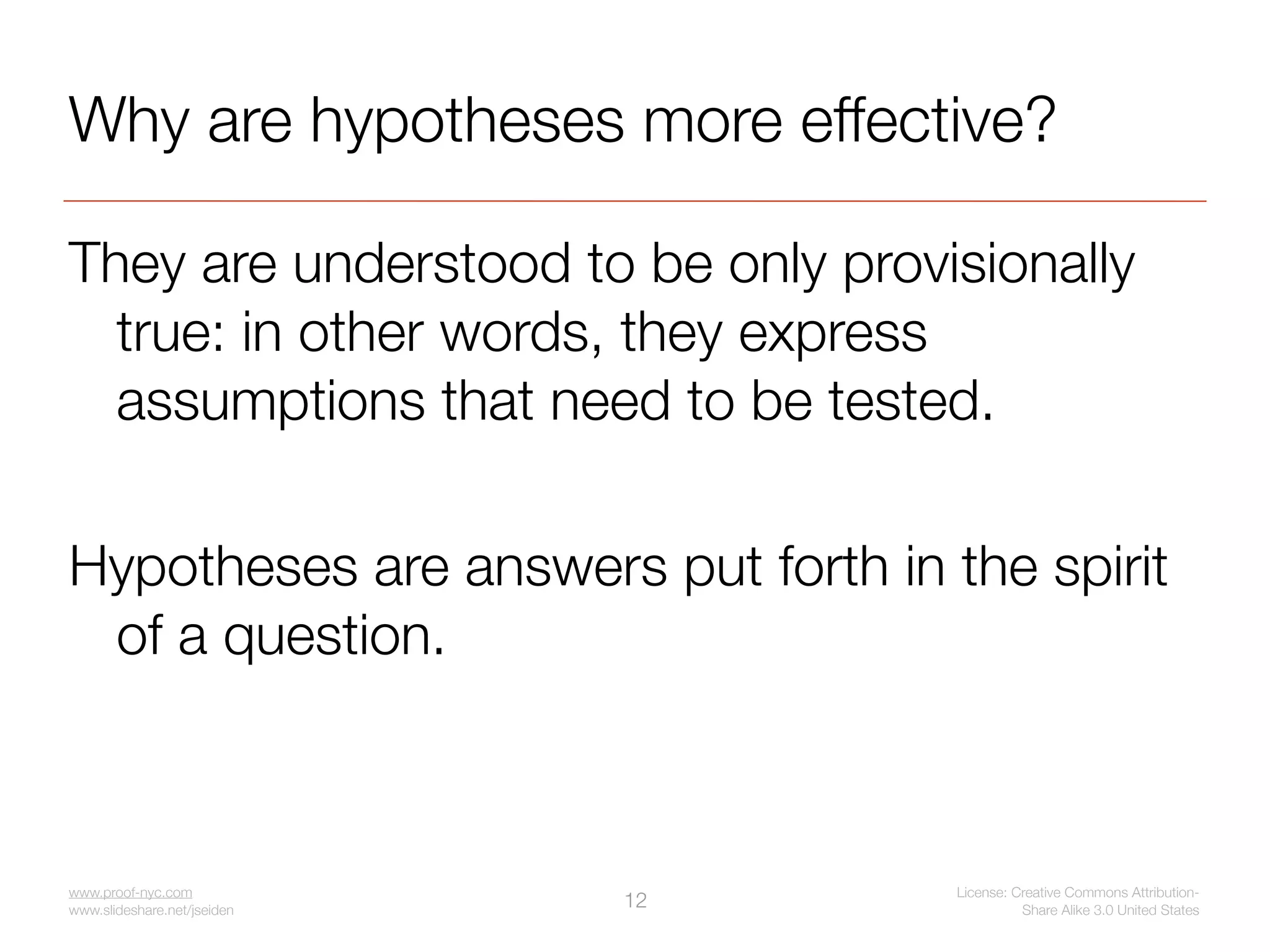
Why are hypotheses more effective?

They are understood to be only provisionally
  true: in other words, they express
  assumptions that need to be tested.

Hypotheses are answers put forth in the spirit
 of a question.


www.proof-nyc.com                    License: Creative Commons Attribution-
www.slideshare.net/jseiden
                             12                Share Alike 3.0 United States
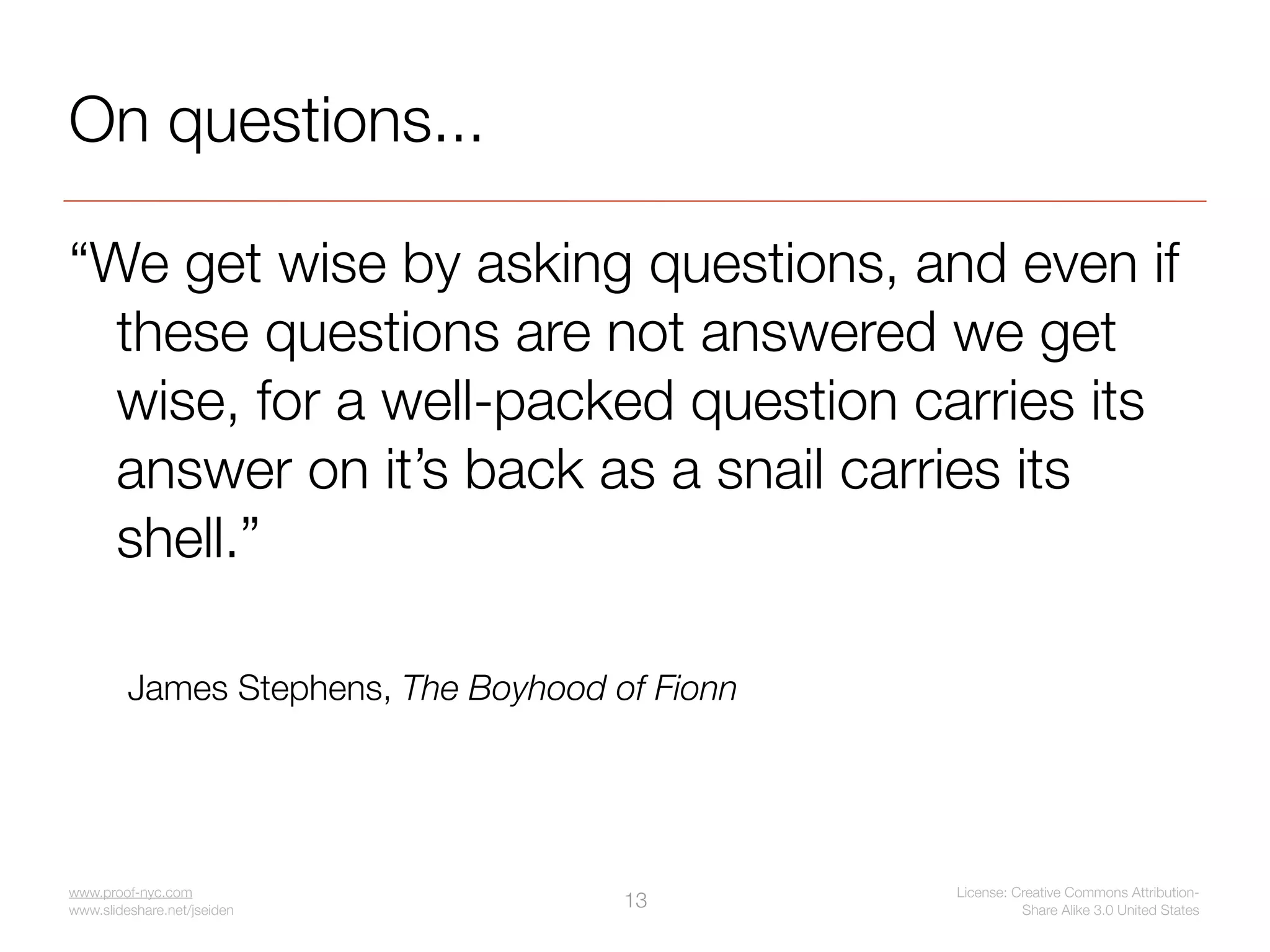
On questions...

“We get wise by asking questions, and even if
  these questions are not answered we get
  wise, for a well-packed question carries its
  answer on it’s back as a snail carries its
  shell.”

         James Stephens, The Boyhood of Fionn


www.proof-nyc.com                               License: Creative Commons Attribution-
www.slideshare.net/jseiden
                                      13                  Share Alike 3.0 United States
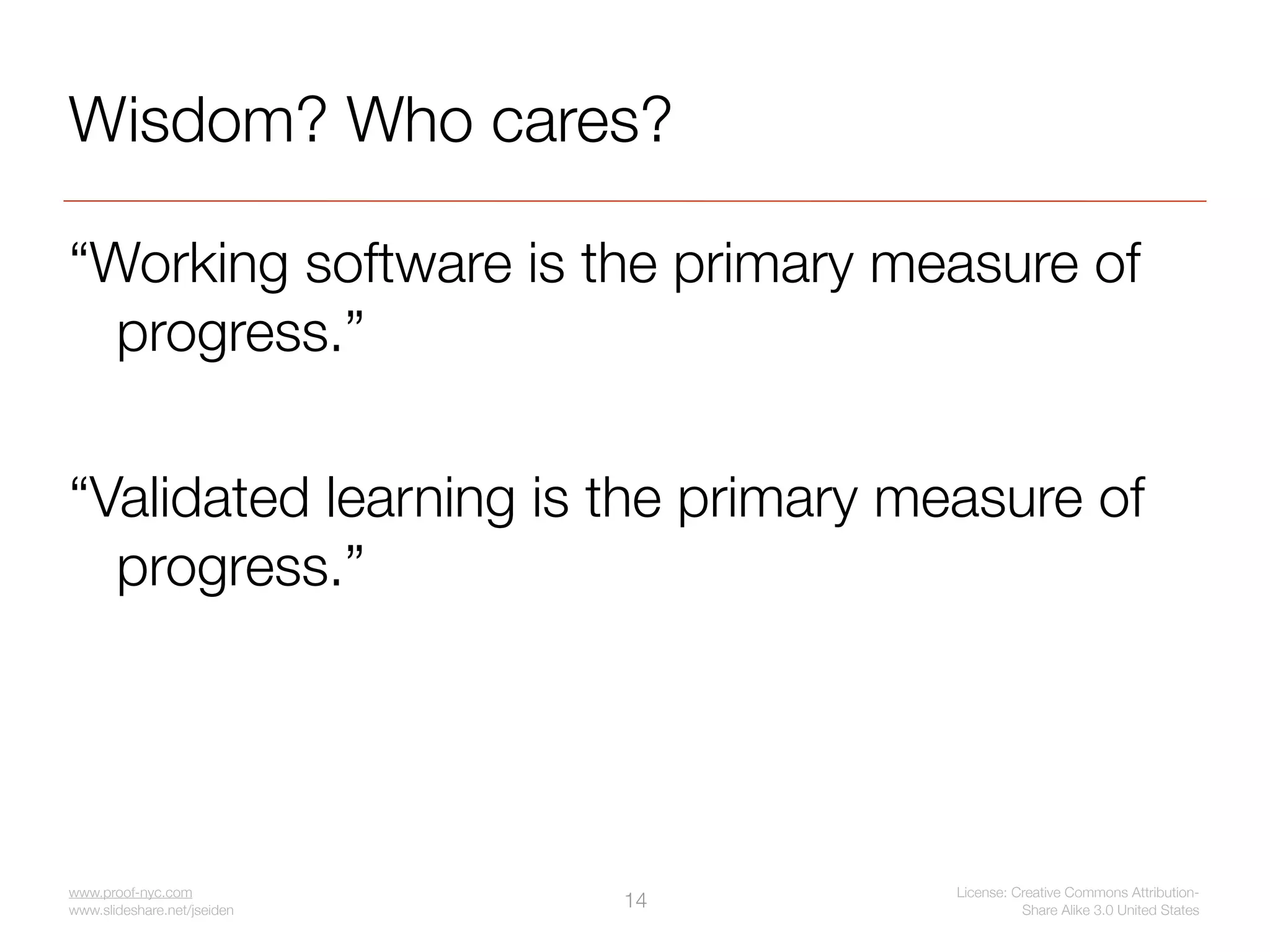
Wisdom? Who cares?

“Working software is the primary measure of
  progress.”

“Validated learning is the primary measure of
  progress.”


www.proof-nyc.com                    License: Creative Commons Attribution-
www.slideshare.net/jseiden
                             14                Share Alike 3.0 United States
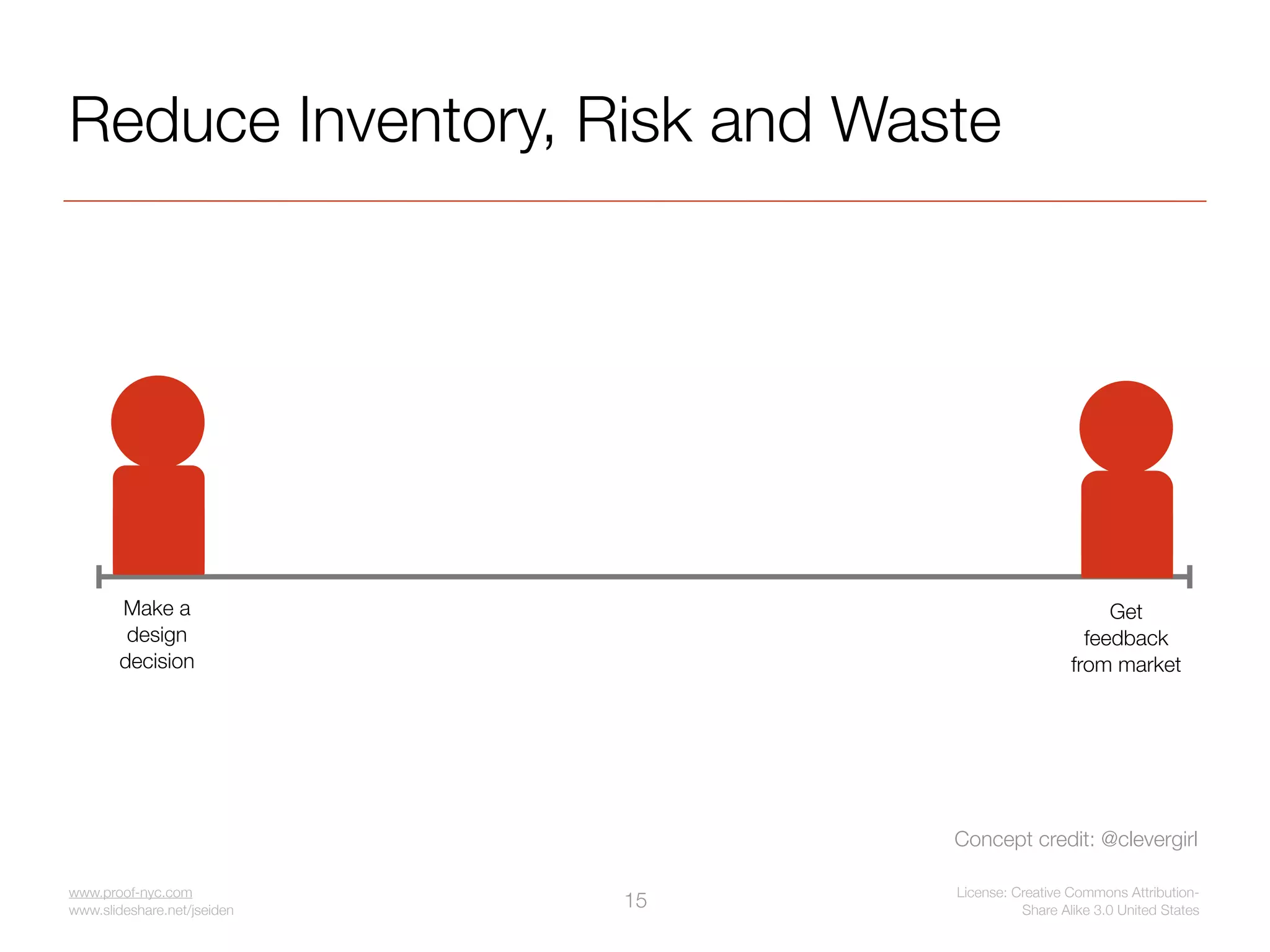
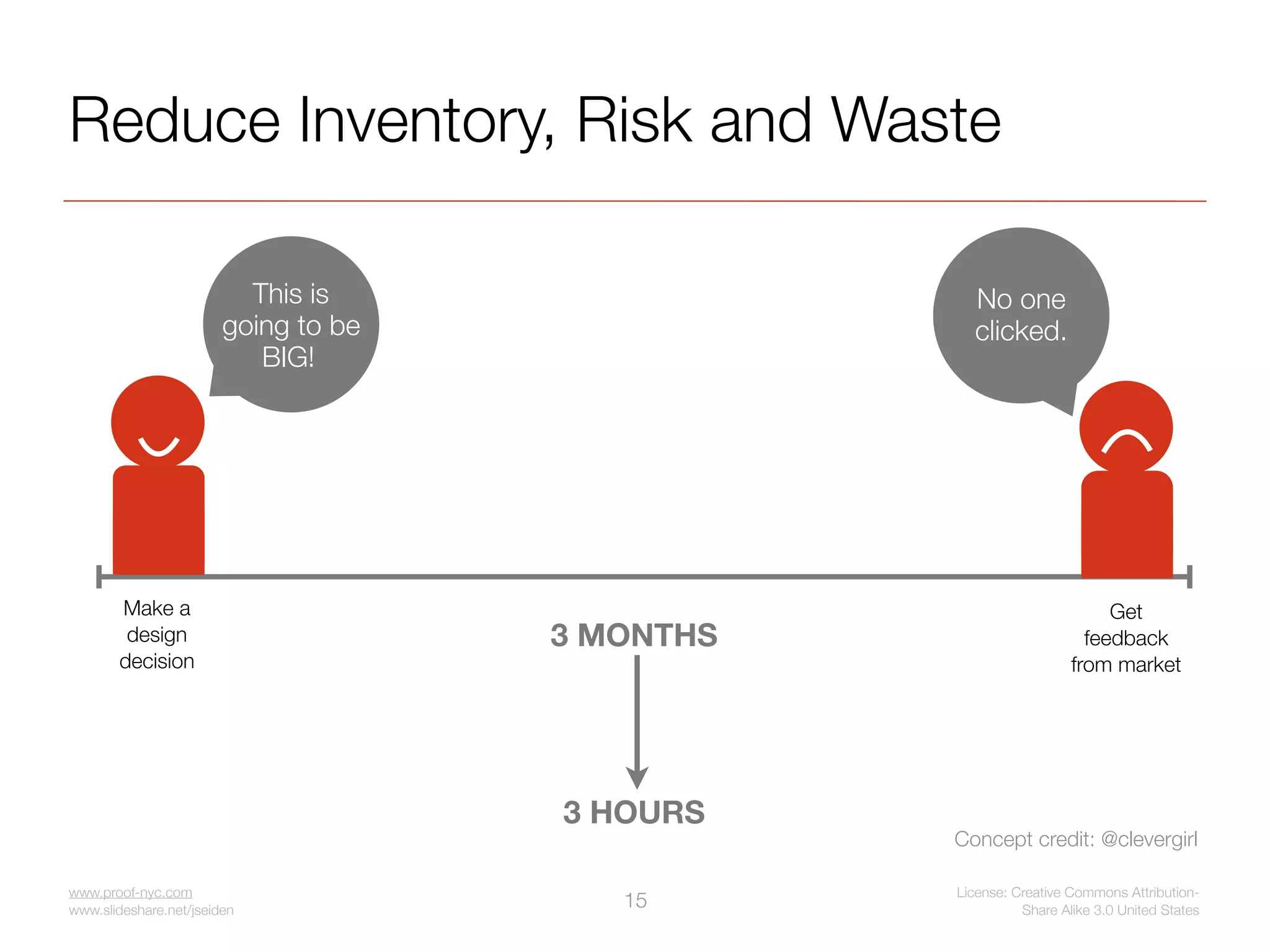
Reduce Inventory, Risk and Waste


       Make a                                            Get
        design                                        feedback
       decision                                     from market


                                  Concept credit: @clevergirl

www.proof-nyc.com                 License: Creative Commons Attribution-
www.slideshare.net/jseiden
                             15             Share Alike 3.0 United States
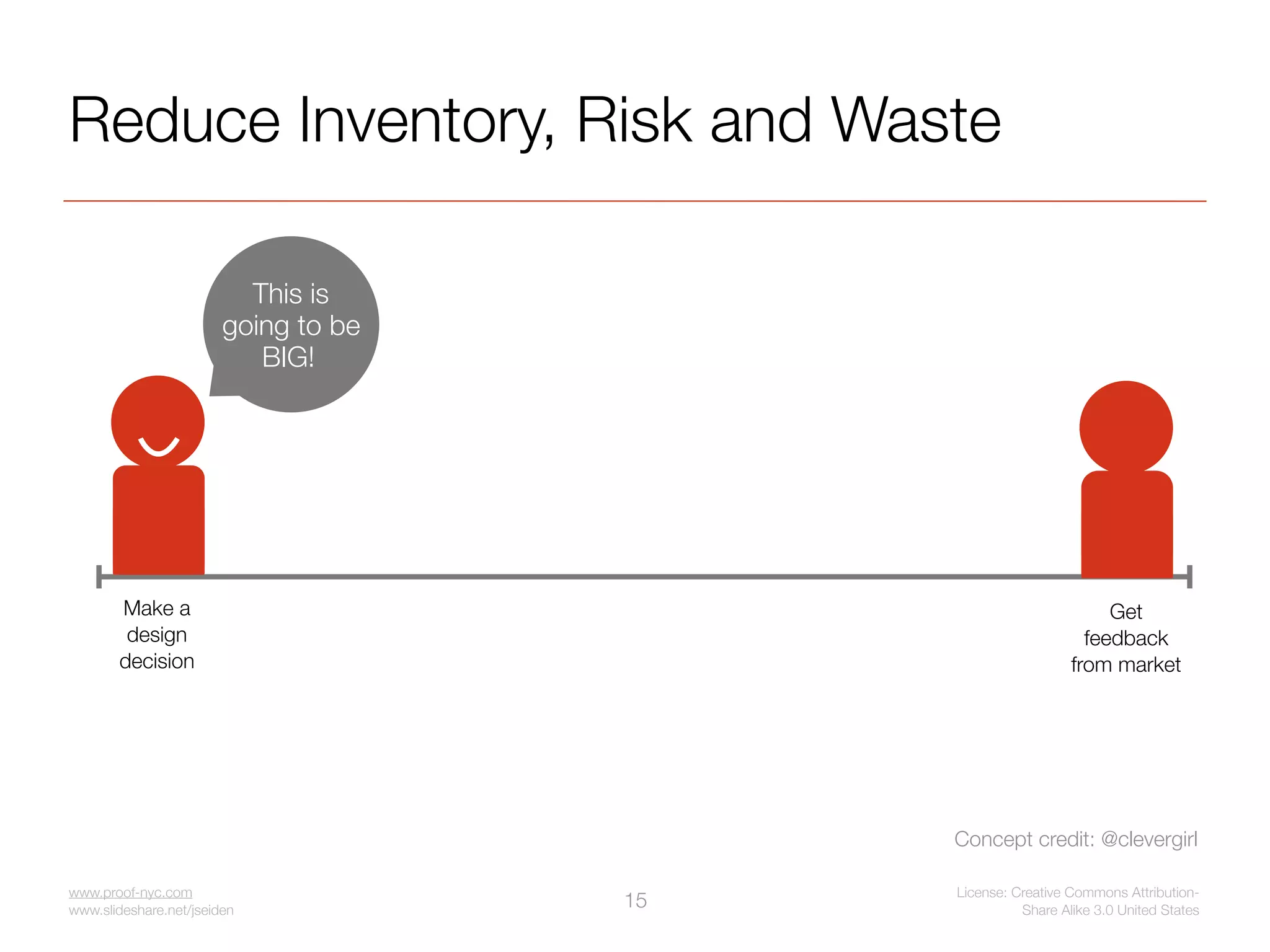
Reduce Inventory, Risk and Waste

                          This is
                        going to be
                           BIG!


       Make a                                                     Get
        design                                                 feedback
       decision                                              from market


                                           Concept credit: @clevergirl

www.proof-nyc.com                          License: Creative Commons Attribution-
www.slideshare.net/jseiden
                                      15             Share Alike 3.0 United States
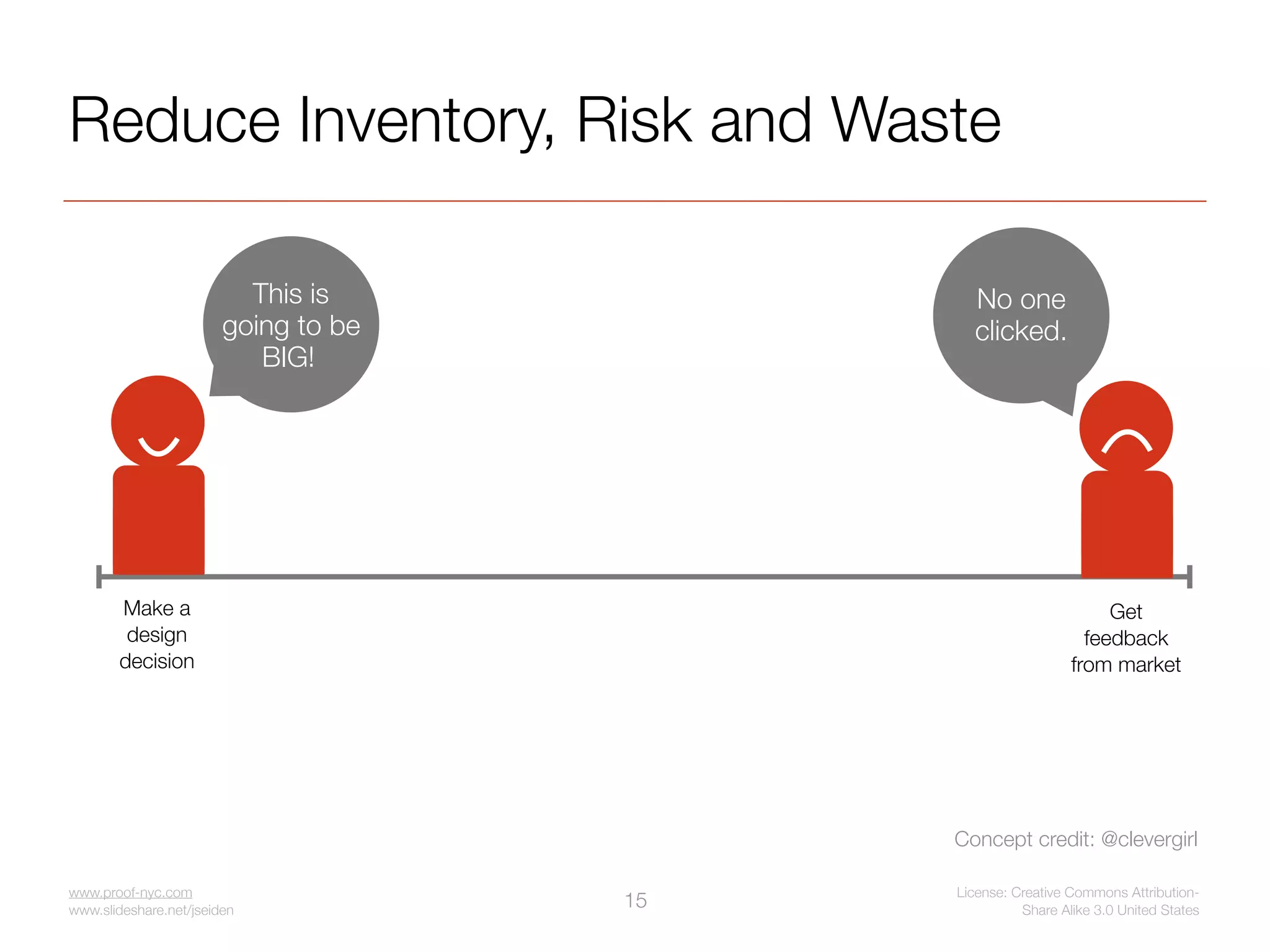
Reduce Inventory, Risk and Waste

                          This is            No one
                        going to be          clicked.
                           BIG!


       Make a                                                     Get
        design                                                 feedback
       decision                                              from market


                                           Concept credit: @clevergirl

www.proof-nyc.com                          License: Creative Commons Attribution-
www.slideshare.net/jseiden
                                      15             Share Alike 3.0 United States
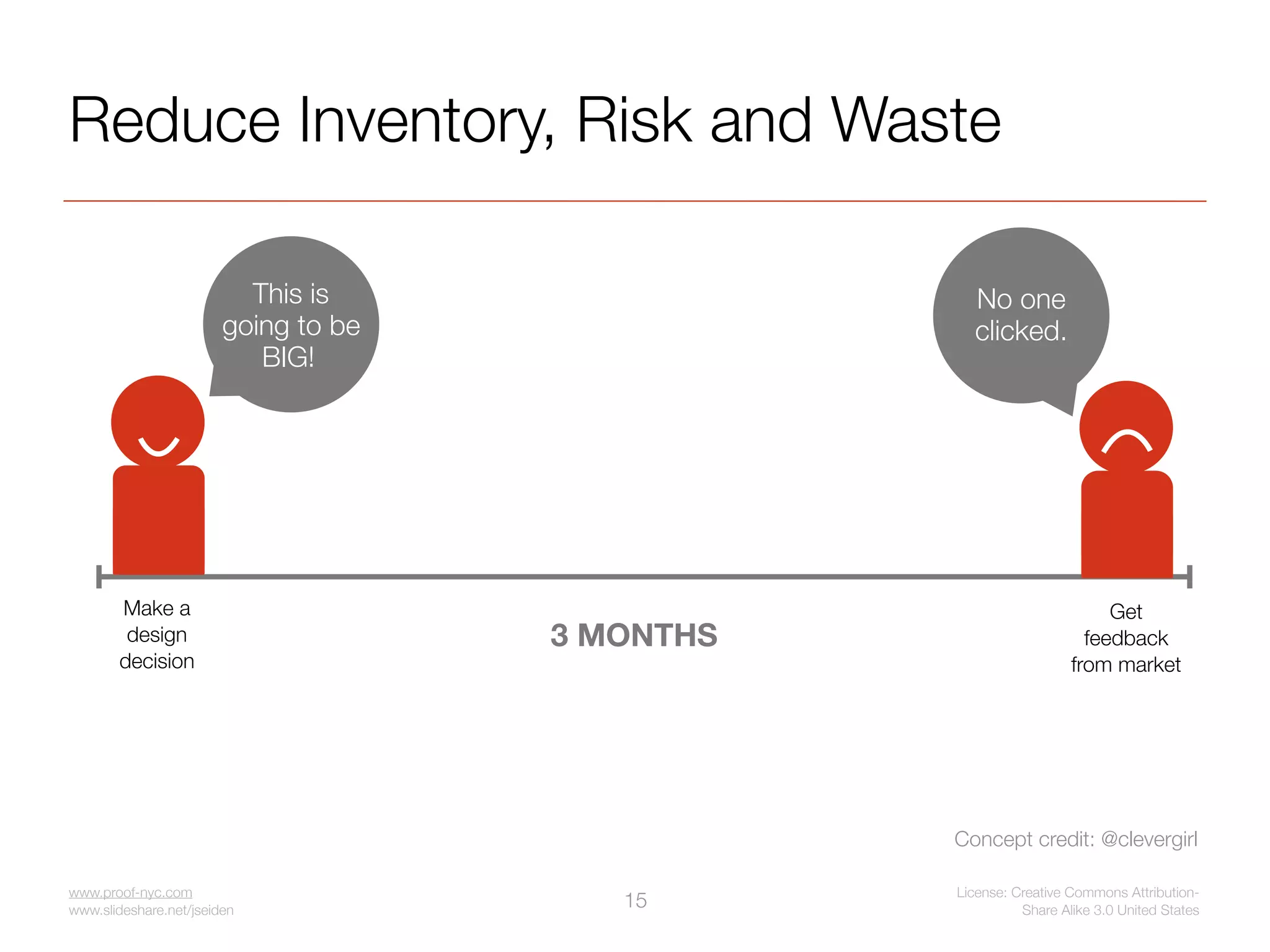
Reduce Inventory, Risk and Waste

                          This is                  No one
                        going to be                clicked.
                           BIG!


       Make a                                                           Get
        design                        3 MONTHS                       feedback
       decision                                                    from market


                                                 Concept credit: @clevergirl

www.proof-nyc.com                                License: Creative Commons Attribution-
www.slideshare.net/jseiden
                                         15                Share Alike 3.0 United States
Reduce Inventory, Risk and Waste

                          This is                  No one
                        going to be                clicked.
                           BIG!


       Make a                                                           Get
        design                        3 MONTHS                       feedback
       decision                                                    from market


                                      3 HOURS
                                                 Concept credit: @clevergirl

www.proof-nyc.com                                License: Creative Commons Attribution-
www.slideshare.net/jseiden
                                         15                Share Alike 3.0 United States
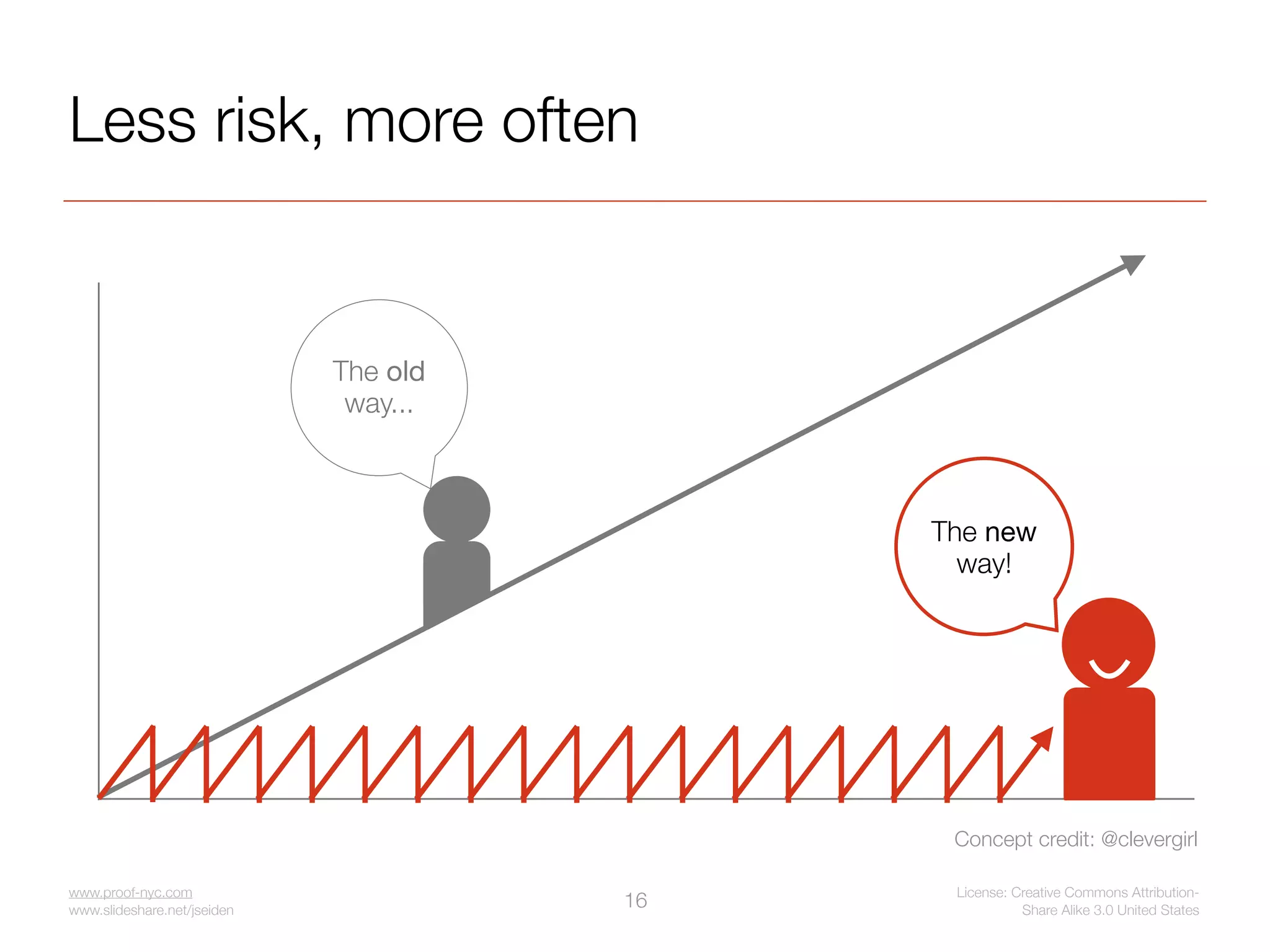
Less risk, more often


                             The old
                              way...


                                            The new
                                              way!


                                             Concept credit: @clevergirl

www.proof-nyc.com                            License: Creative Commons Attribution-
www.slideshare.net/jseiden
                                       16              Share Alike 3.0 United States
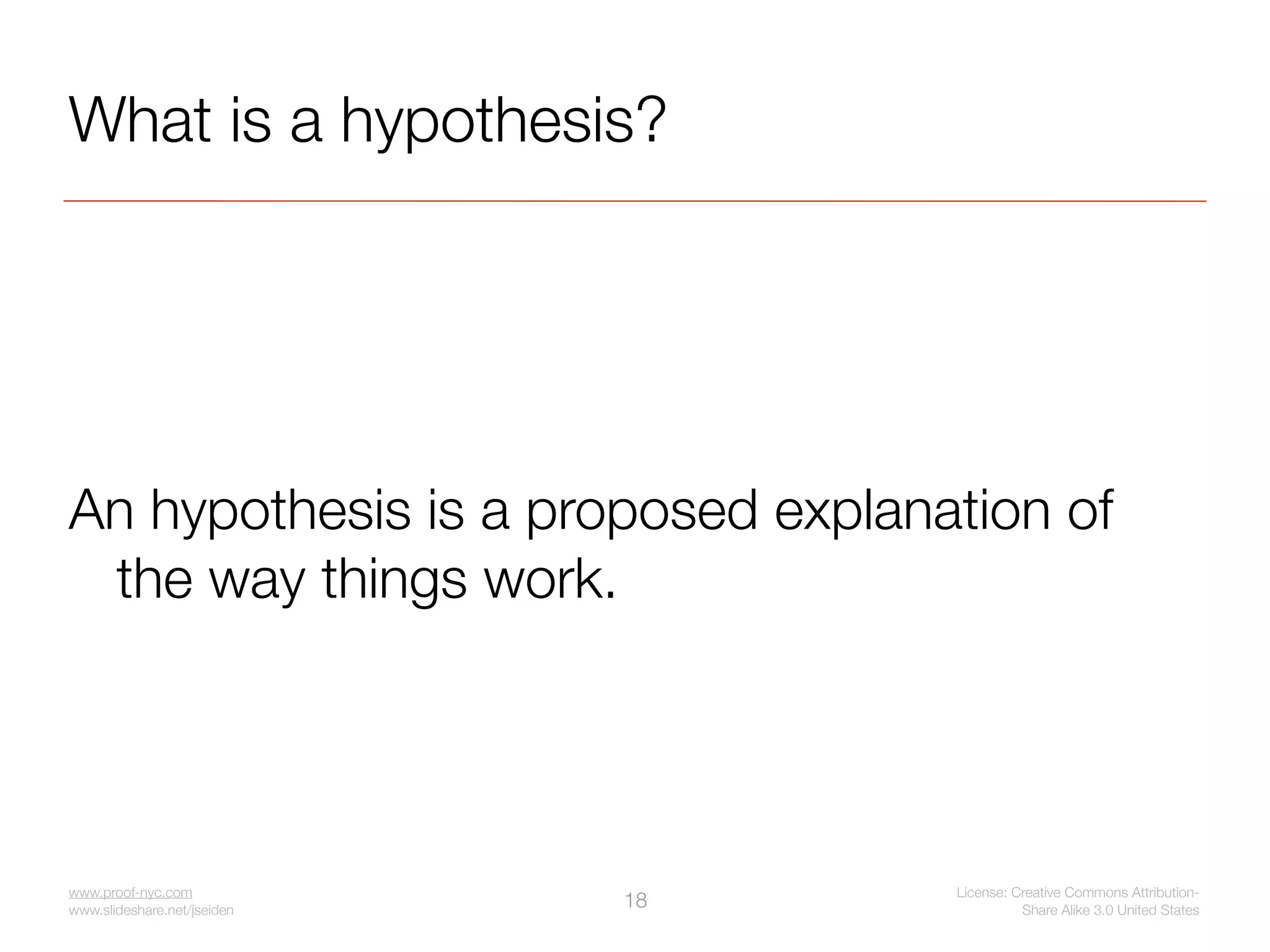
What is a hypothesis?


An hypothesis is a proposed explanation of
 the way things work.


www.proof-nyc.com                  License: Creative Commons Attribution-
www.slideshare.net/jseiden
                             18              Share Alike 3.0 United States
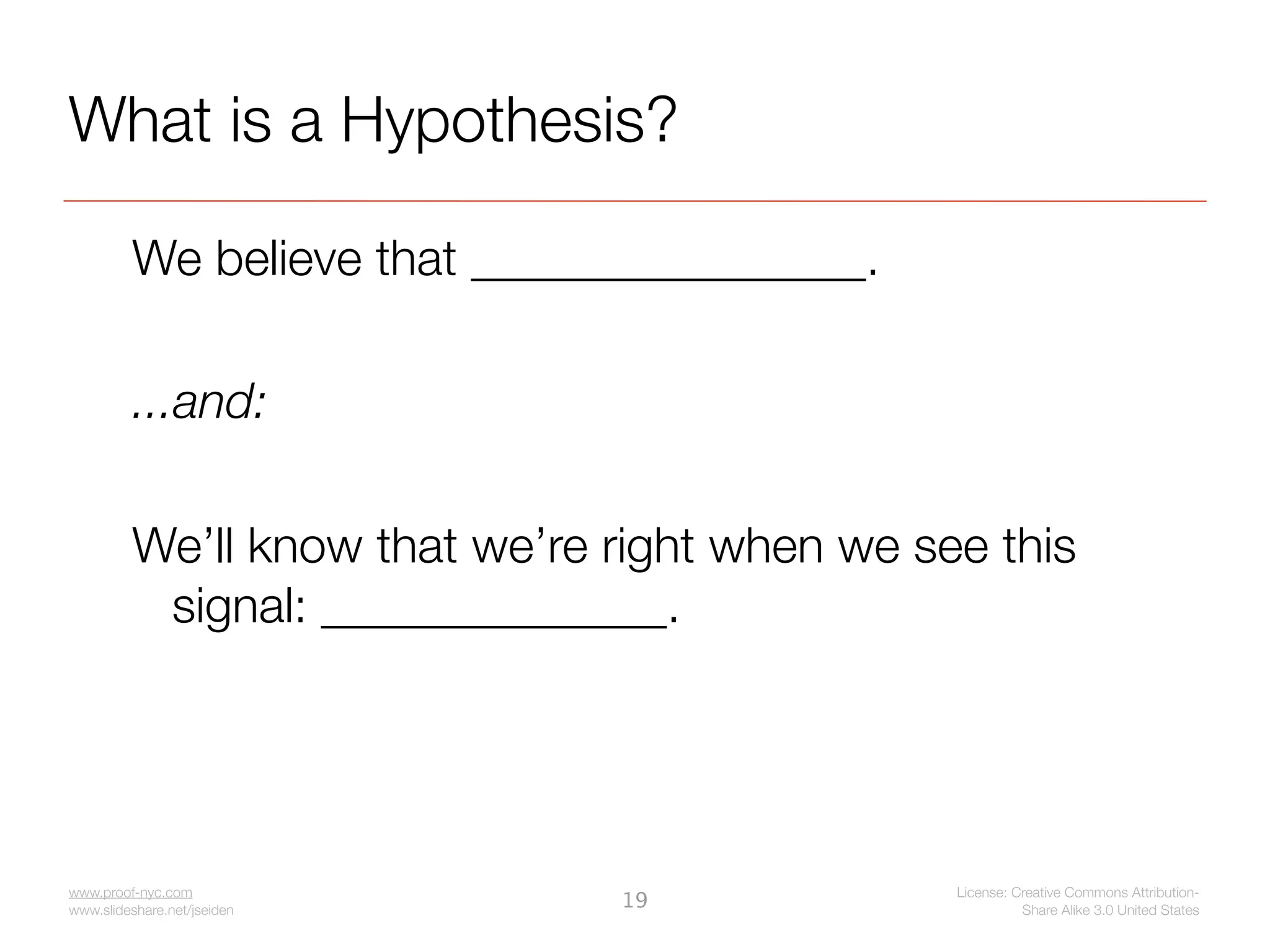
What is a Hypothesis?

         We believe that ________________.

         ...and:

         We’ll know that we’re right when we see this
          signal: ______________.


www.proof-nyc.com                              License: Creative Commons Attribution-
www.slideshare.net/jseiden
                               19                        Share Alike 3.0 United States
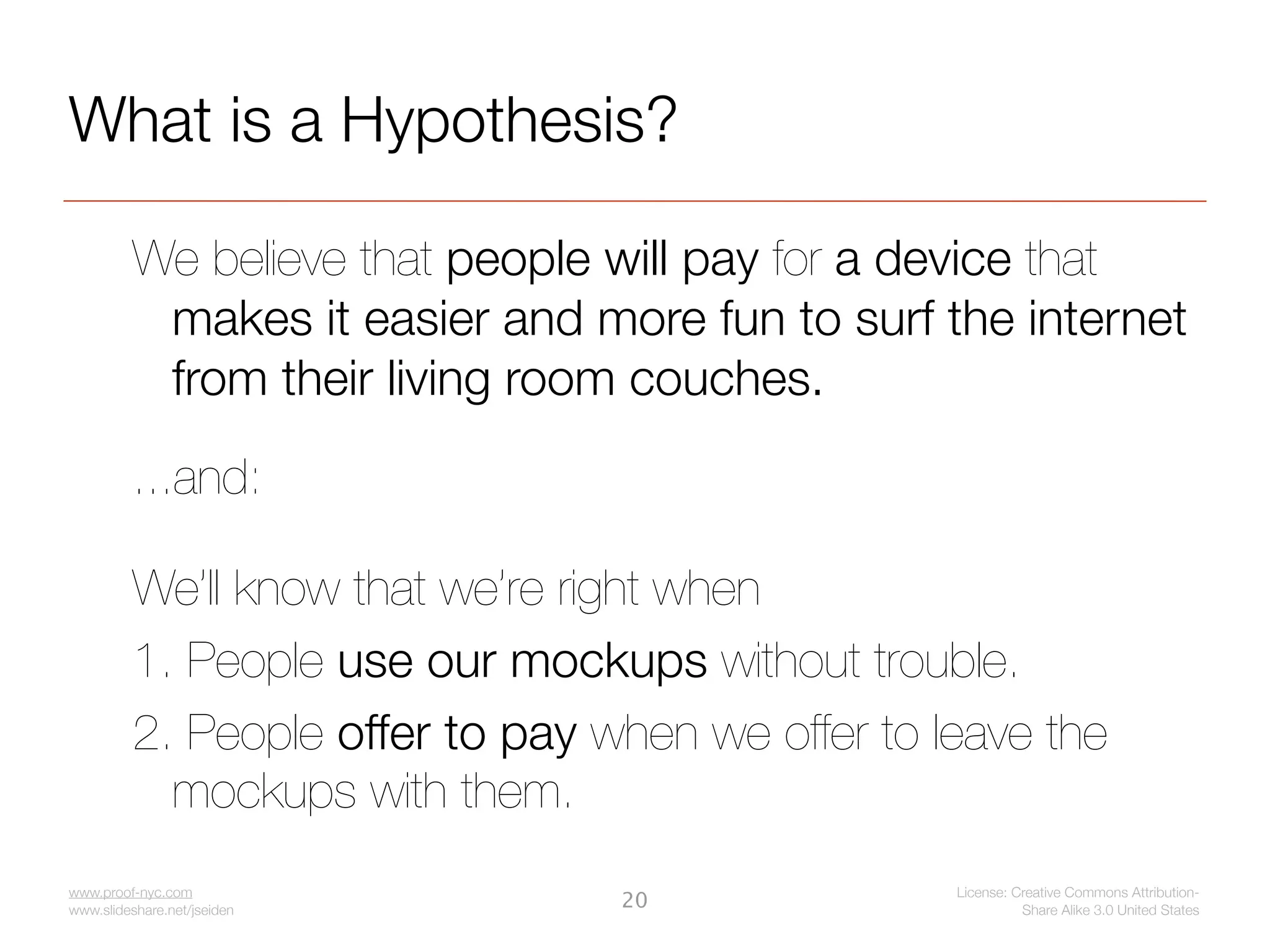
What is a Hypothesis?

         We believe that people will pay for a device that
          makes it easier and more fun to surf the internet
          from their living room couches.

         ...and:

         We’ll know that we’re right when
         1. People use our mockups without trouble.
         2. People offer to pay when we offer to leave the
           mockups with them.
www.proof-nyc.com                                 License: Creative Commons Attribution-
www.slideshare.net/jseiden
                                 20                         Share Alike 3.0 United States
Techniques
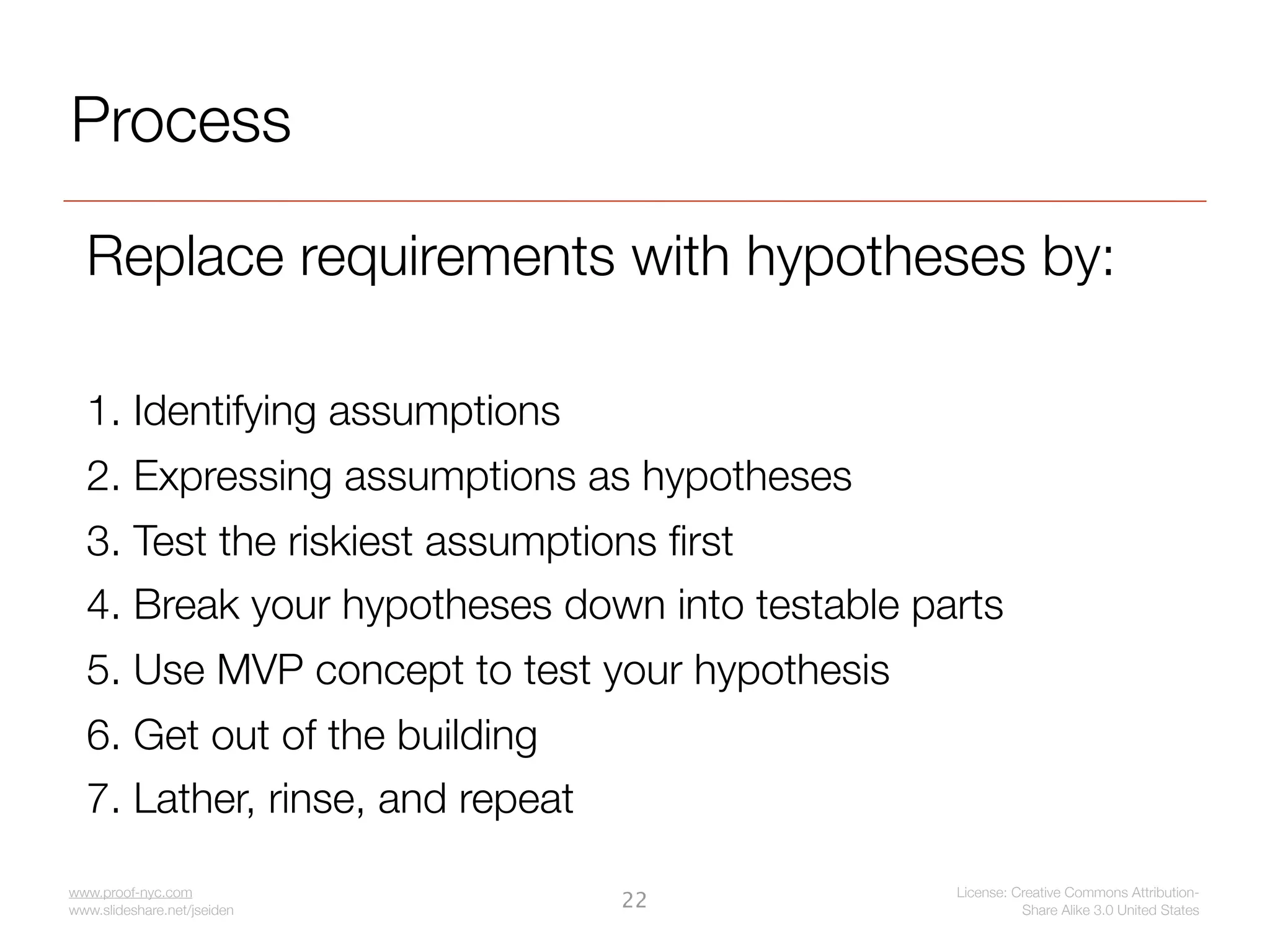
Process

  Replace requirements with hypotheses by:

  1. Identifying assumptions
  2. Expressing assumptions as hypotheses
  3. Test the riskiest assumptions first
  4. Break your hypotheses down into testable parts
  5. Use MVP concept to test your hypothesis
  6. Get out of the building
  7. Lather, rinse, and repeat

www.proof-nyc.com                               License: Creative Commons Attribution-
www.slideshare.net/jseiden
                                 22                       Share Alike 3.0 United States
Method: Declare your assumptions


www.proof-nyc.com            License: Creative Commons Attribution-
www.slideshare.net/jseiden             Share Alike 3.0 United States
Method: Declare your assumptions


What assumptions do you have?


www.proof-nyc.com               License: Creative Commons Attribution-
www.slideshare.net/jseiden                Share Alike 3.0 United States
Method: Declare your assumptions


What assumptions do you have?
…about your customers?


www.proof-nyc.com               License: Creative Commons Attribution-
www.slideshare.net/jseiden                Share Alike 3.0 United States
Method: Declare your assumptions


What assumptions do you have?
…about your customers?
…that if proven false, will cause you to fail?


www.proof-nyc.com                      License: Creative Commons Attribution-
www.slideshare.net/jseiden                       Share Alike 3.0 United States
Method: probe deeply for assumptions
Who is the user? Who is the customer?
Where does our product fit in their work or life?
What problems does our product solve?
When and how is our product used?
What features are important?
How should our product look and behave?
How will we make money?


www.proof-nyc.com                                  License: Creative Commons Attribution-
www.slideshare.net/jseiden                                   Share Alike 3.0 United States
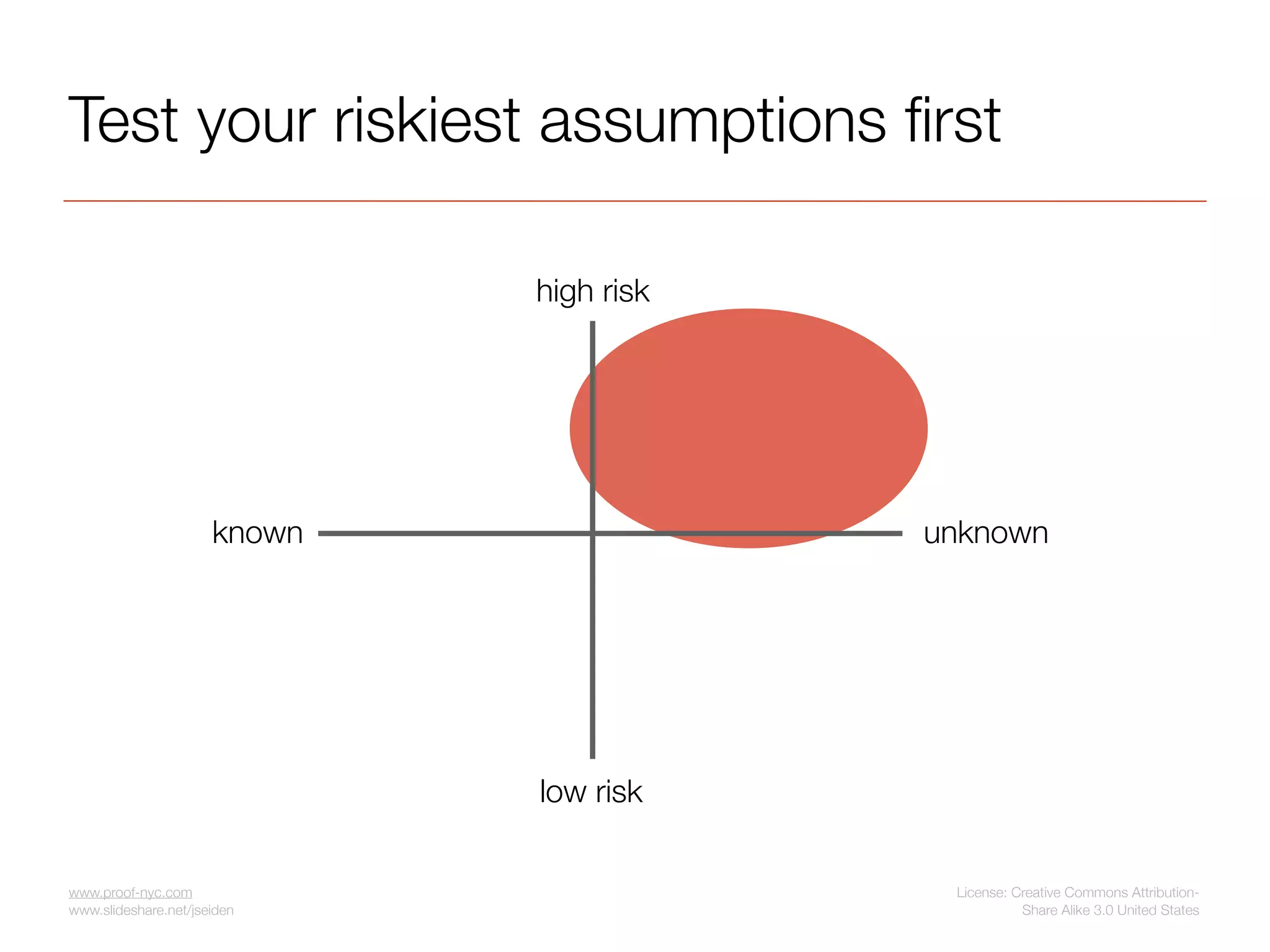
Test your riskiest assumptions first

                              high risk


                      known               unknown


                              low risk


www.proof-nyc.com                          License: Creative Commons Attribution-
www.slideshare.net/jseiden                           Share Alike 3.0 United States
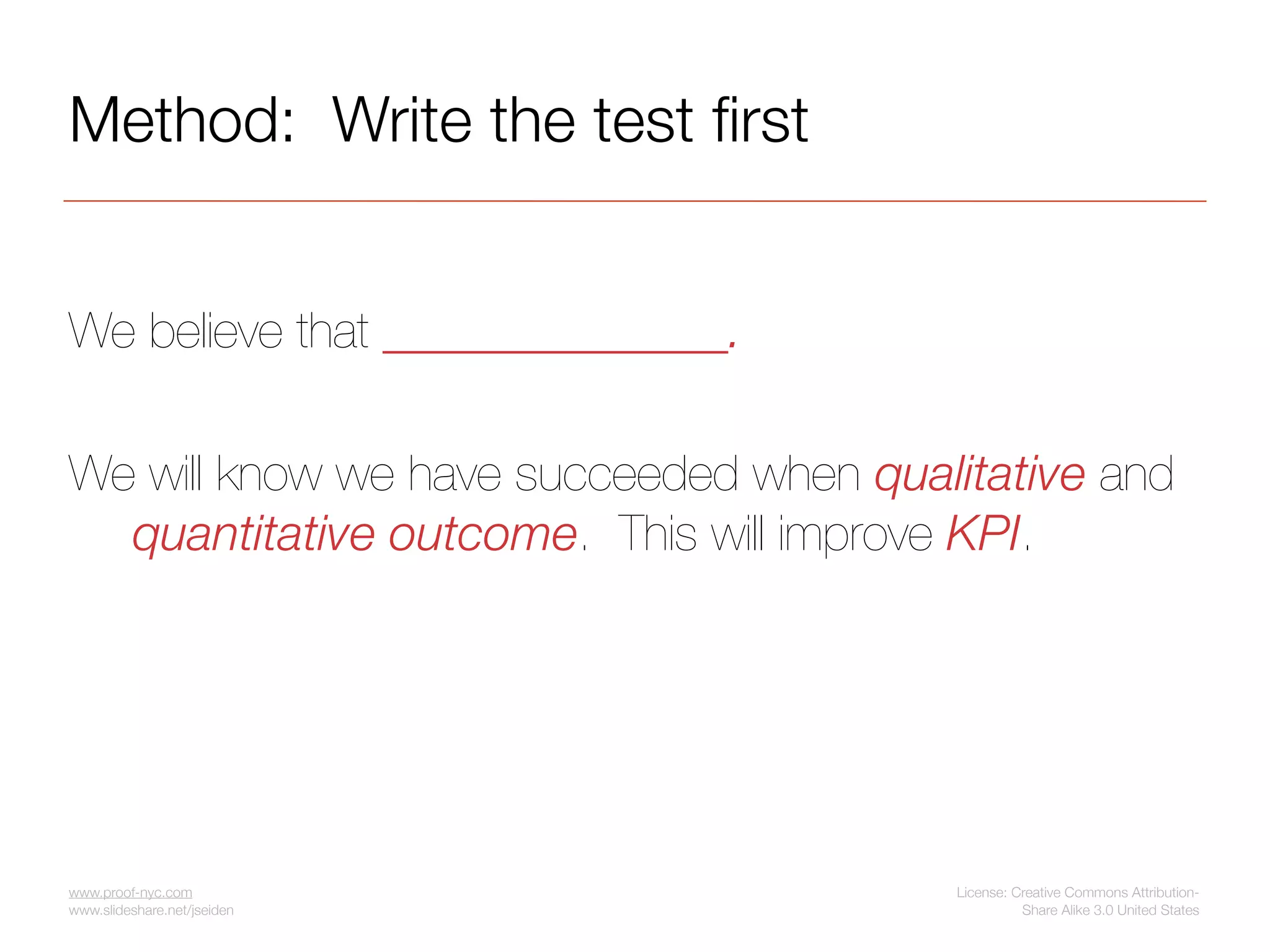
Method: Write the test first


We believe that ______________.

We will know we have succeeded when qualitative and
  quantitative outcome. This will improve KPI.


www.proof-nyc.com                       License: Creative Commons Attribution-
www.slideshare.net/jseiden                        Share Alike 3.0 United States
Method: Minimum Viable Product


www.proof-nyc.com            License: Creative Commons Attribution-
www.slideshare.net/jseiden             Share Alike 3.0 United States
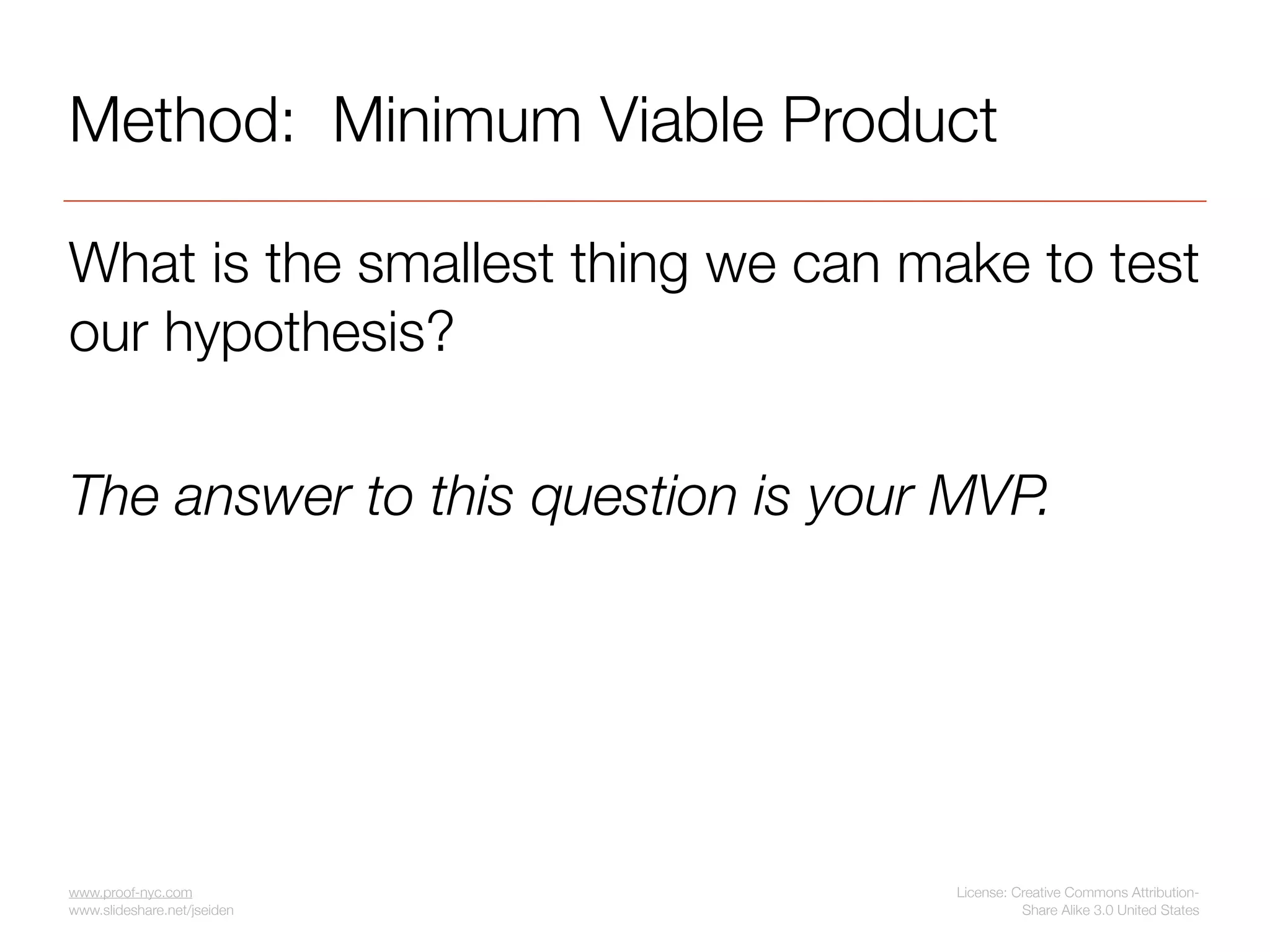
Method: Minimum Viable Product

What is the smallest thing we can make to test
our hypothesis?


www.proof-nyc.com                   License: Creative Commons Attribution-
www.slideshare.net/jseiden                    Share Alike 3.0 United States
Method: Minimum Viable Product

What is the smallest thing we can make to test
our hypothesis?

The answer to this question is your MVP.


www.proof-nyc.com                   License: Creative Commons Attribution-
www.slideshare.net/jseiden                    Share Alike 3.0 United States
An example


             28
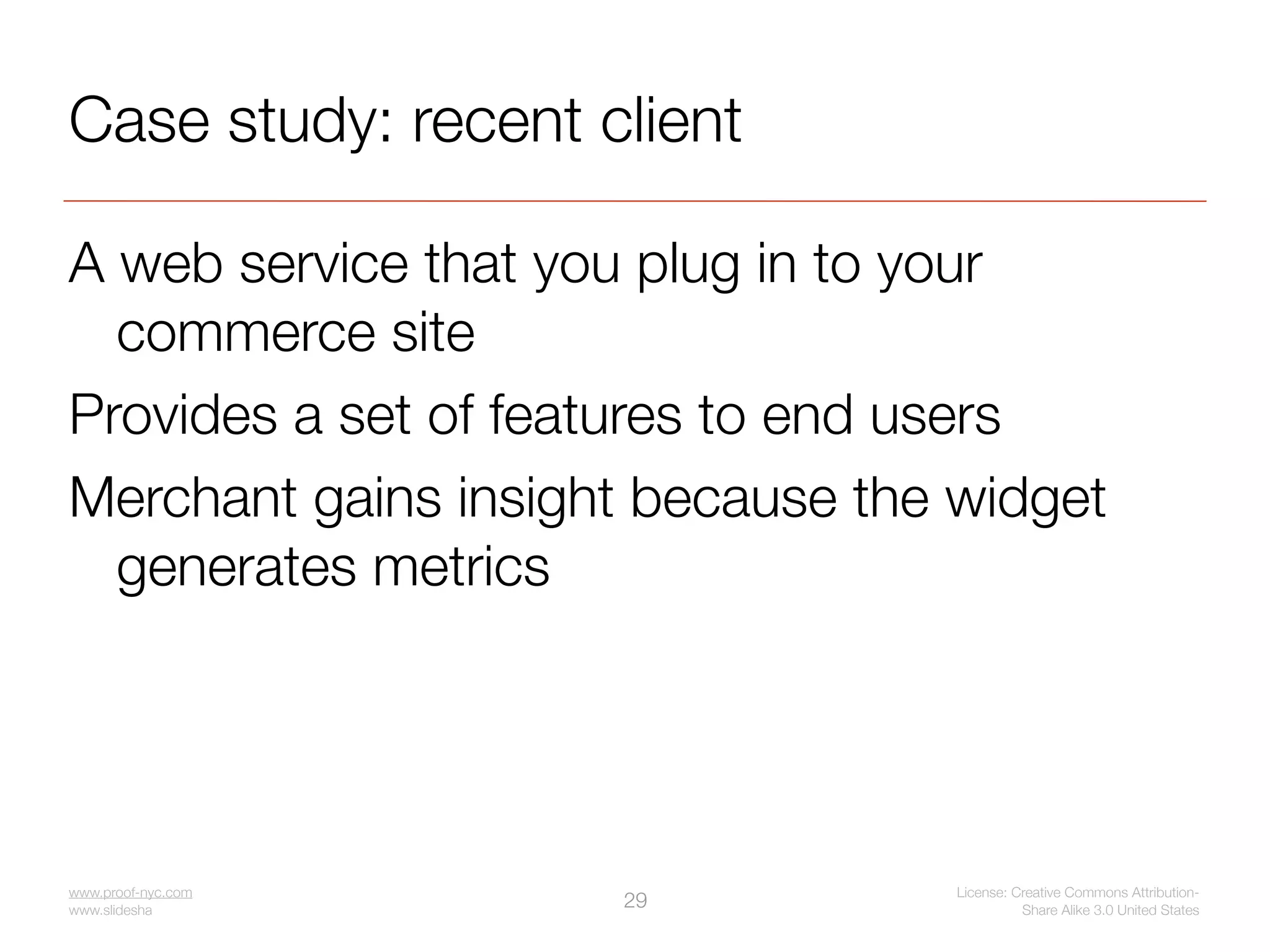
Case study: recent client

A web service that you plug in to your
  commerce site
Provides a set of features to end users
Merchant gains insight because the widget
  generates metrics


www.proof-nyc.com                  License: Creative Commons Attribution-
www.slideshare.net/jseiden
                             29              Share Alike 3.0 United States
Case study: recent client

The problem: they had a feature backlog, and
  were not sure how to prioritize what to work
  on next.


www.proof-nyc.com                   License: Creative Commons Attribution-
www.slideshare.net/jseiden
                             30               Share Alike 3.0 United States
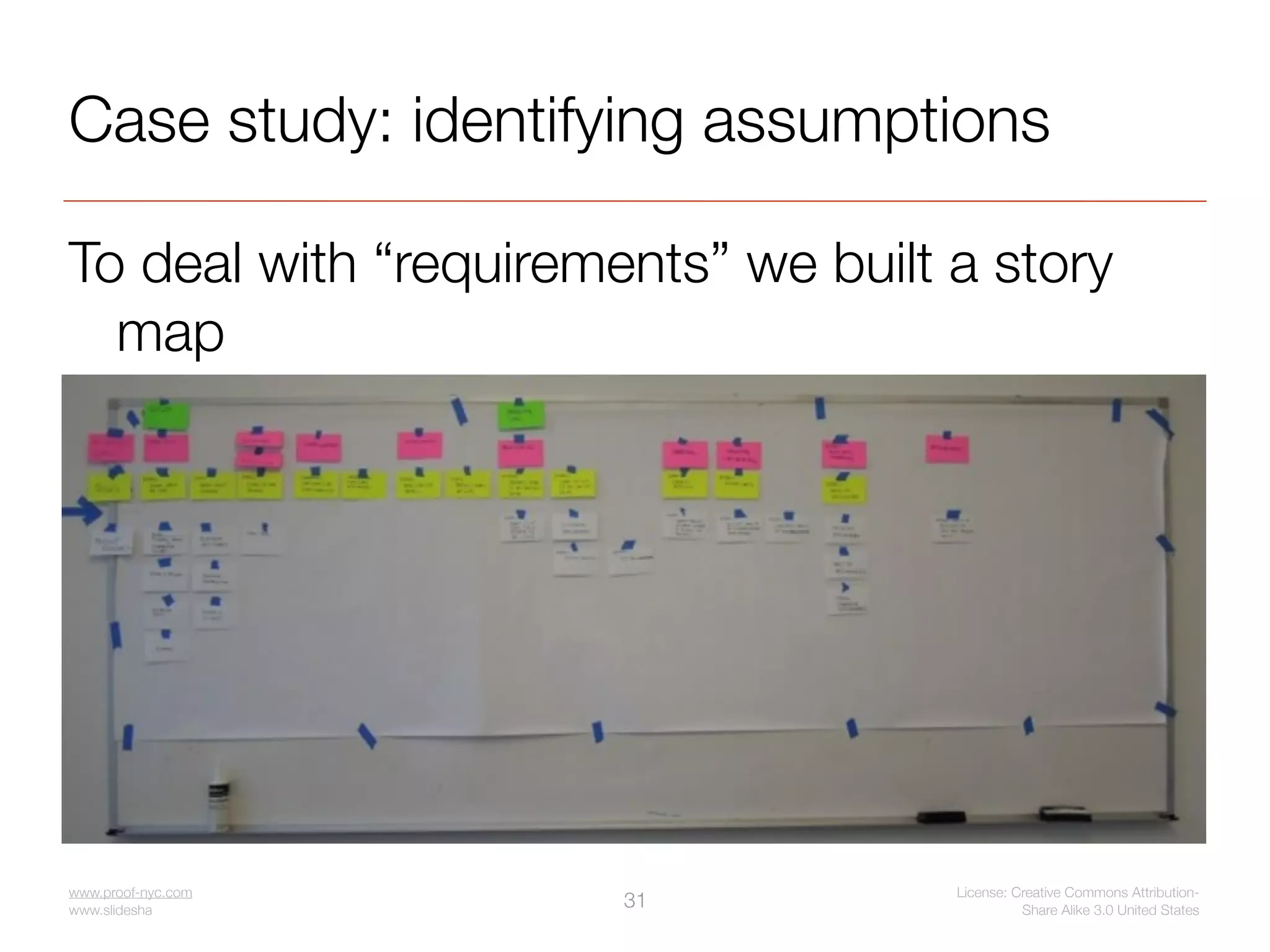
Case study: identifying assumptions

To deal with “requirements” we built a story
  map


www.proof-nyc.com                    License: Creative Commons Attribution-
www.slideshare.net/jseiden
                             31                Share Alike 3.0 United States
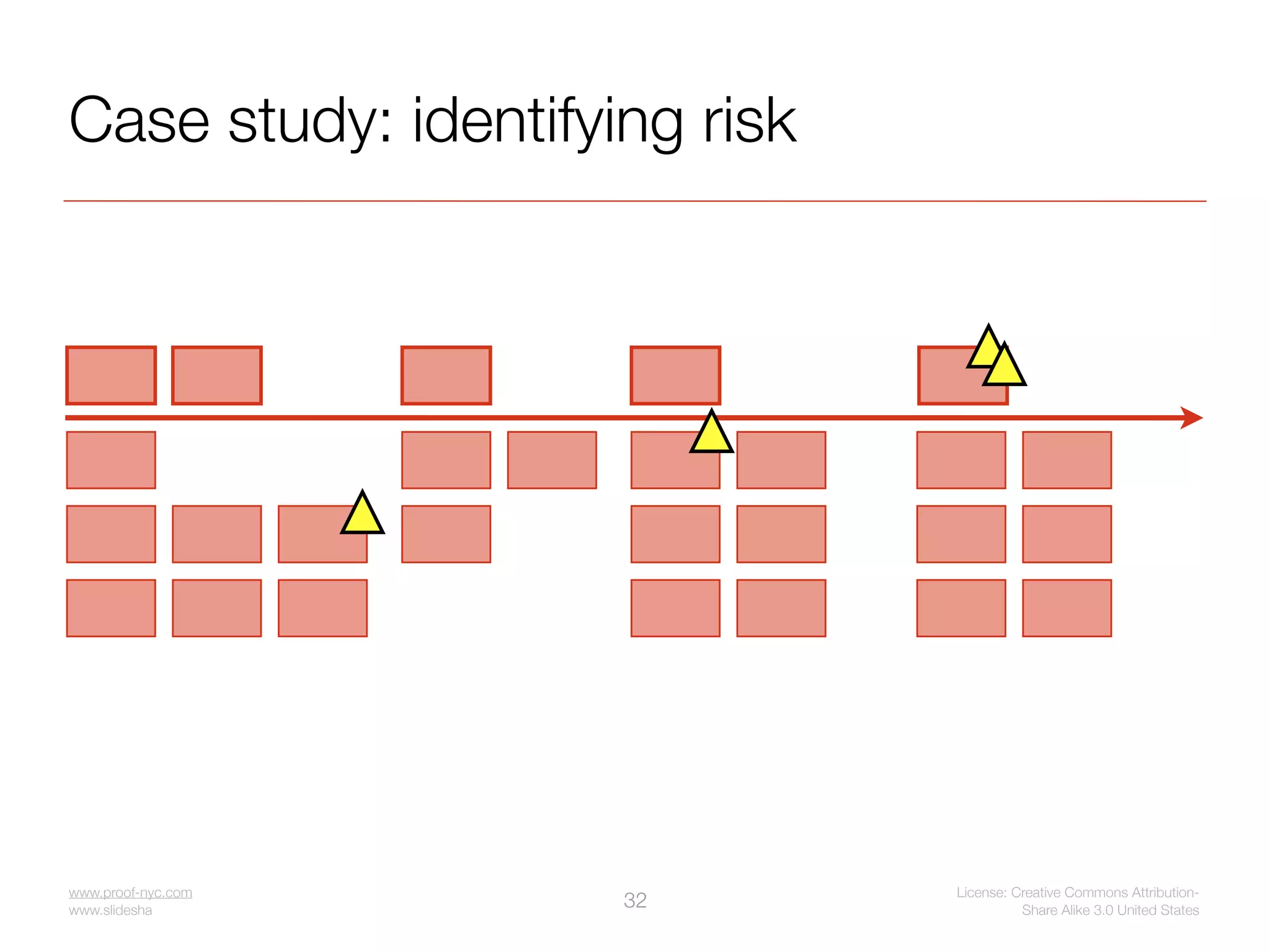
Case study: identifying risk


www.proof-nyc.com                 License: Creative Commons Attribution-
www.slideshare.net/jseiden
                             32             Share Alike 3.0 United States
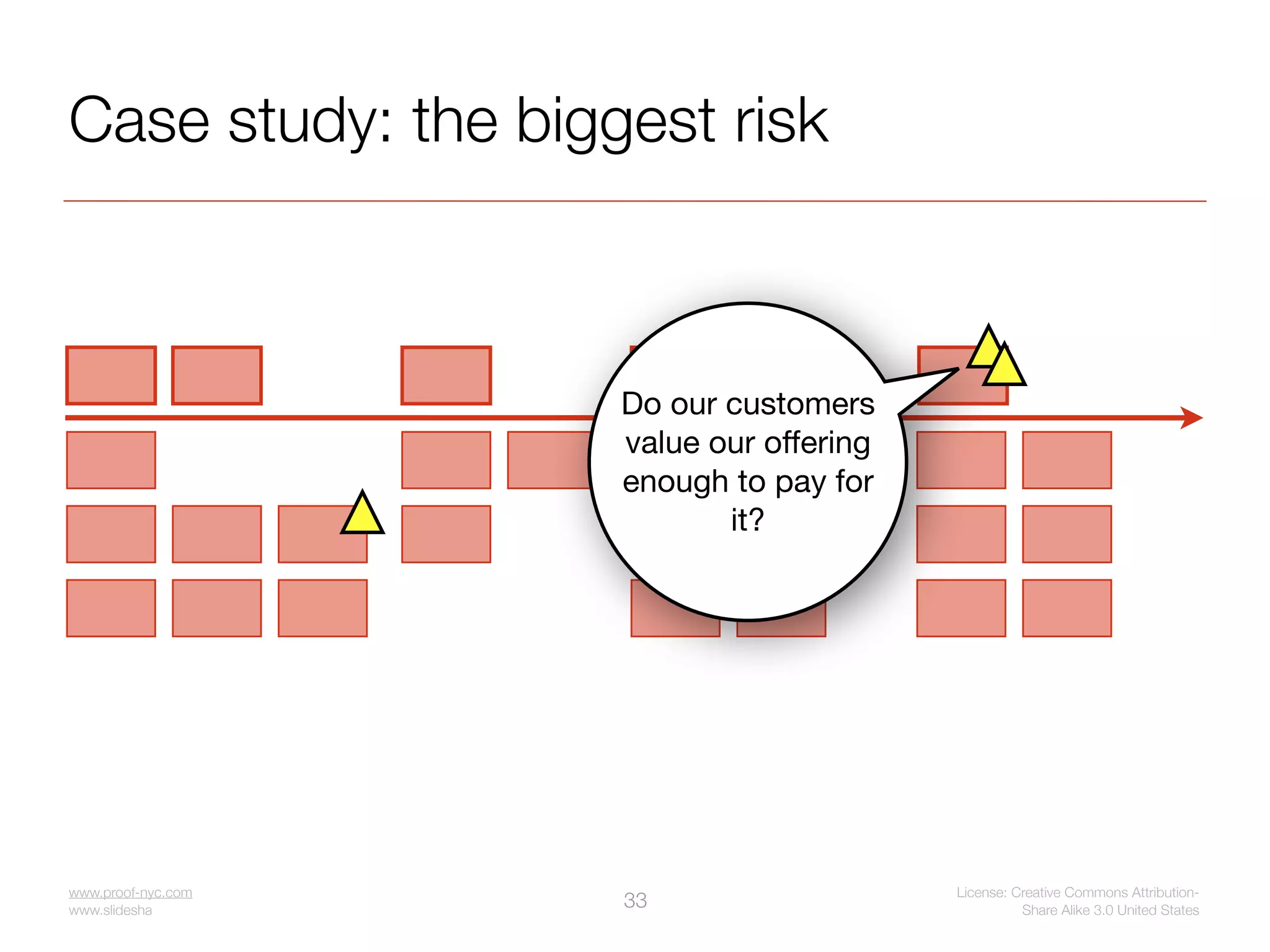
Case study: the biggest risk


                             Do our customers
                             value our offering
                             enough to pay for
                                    it?


www.proof-nyc.com                                 License: Creative Commons Attribution-
www.slideshare.net/jseiden
                             33                             Share Alike 3.0 United States
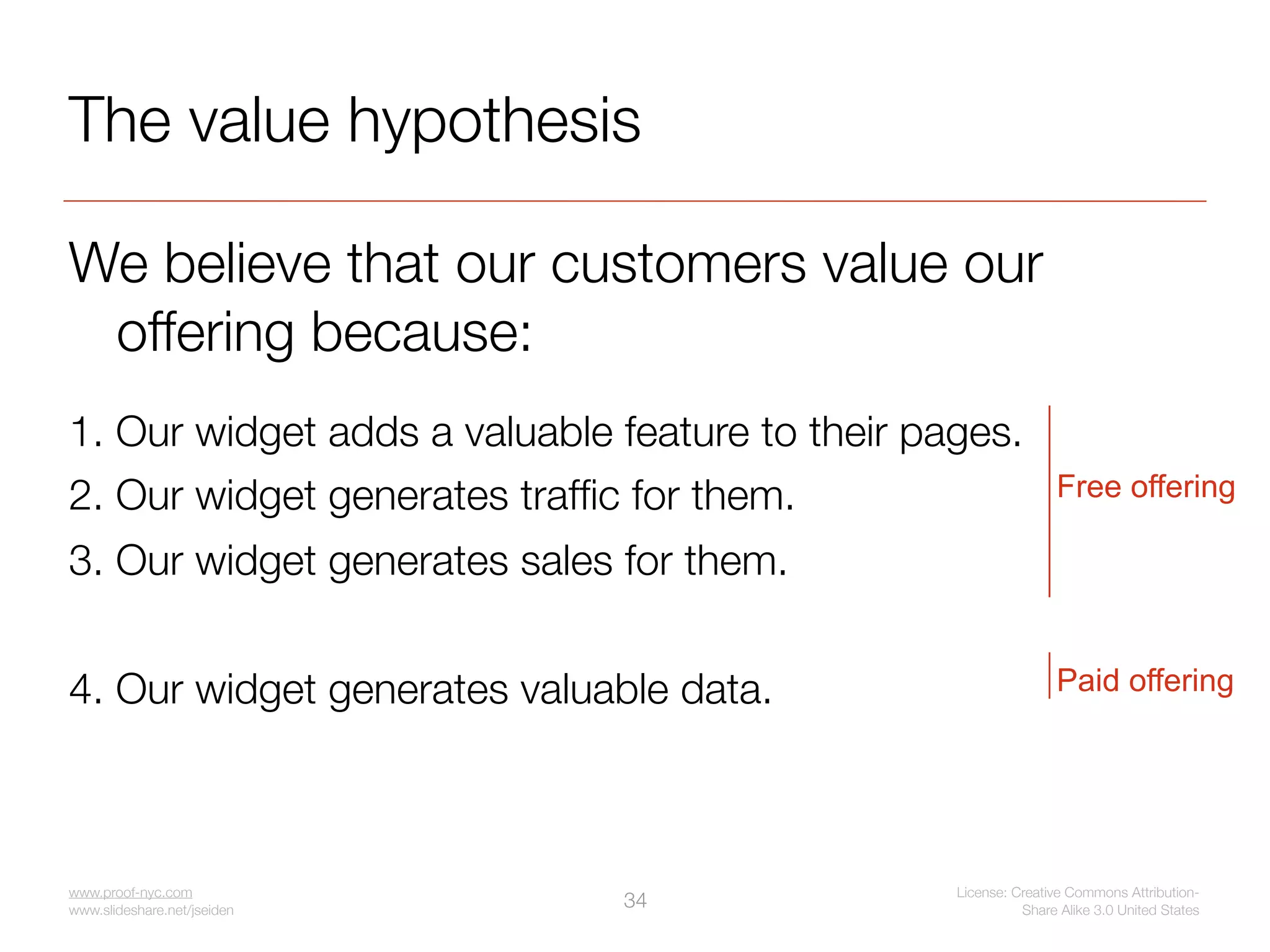
The value hypothesis

We believe that our customers value our
 offering because:
1. Our widget adds a valuable feature to their pages.
2. Our widget generates traffic for them.                         Free offering

3. Our widget generates sales for them.


4. Our widget generates valuable data.                           Paid offering


www.proof-nyc.com                                License: Creative Commons Attribution-
www.slideshare.net/jseiden
                              34                           Share Alike 3.0 United States
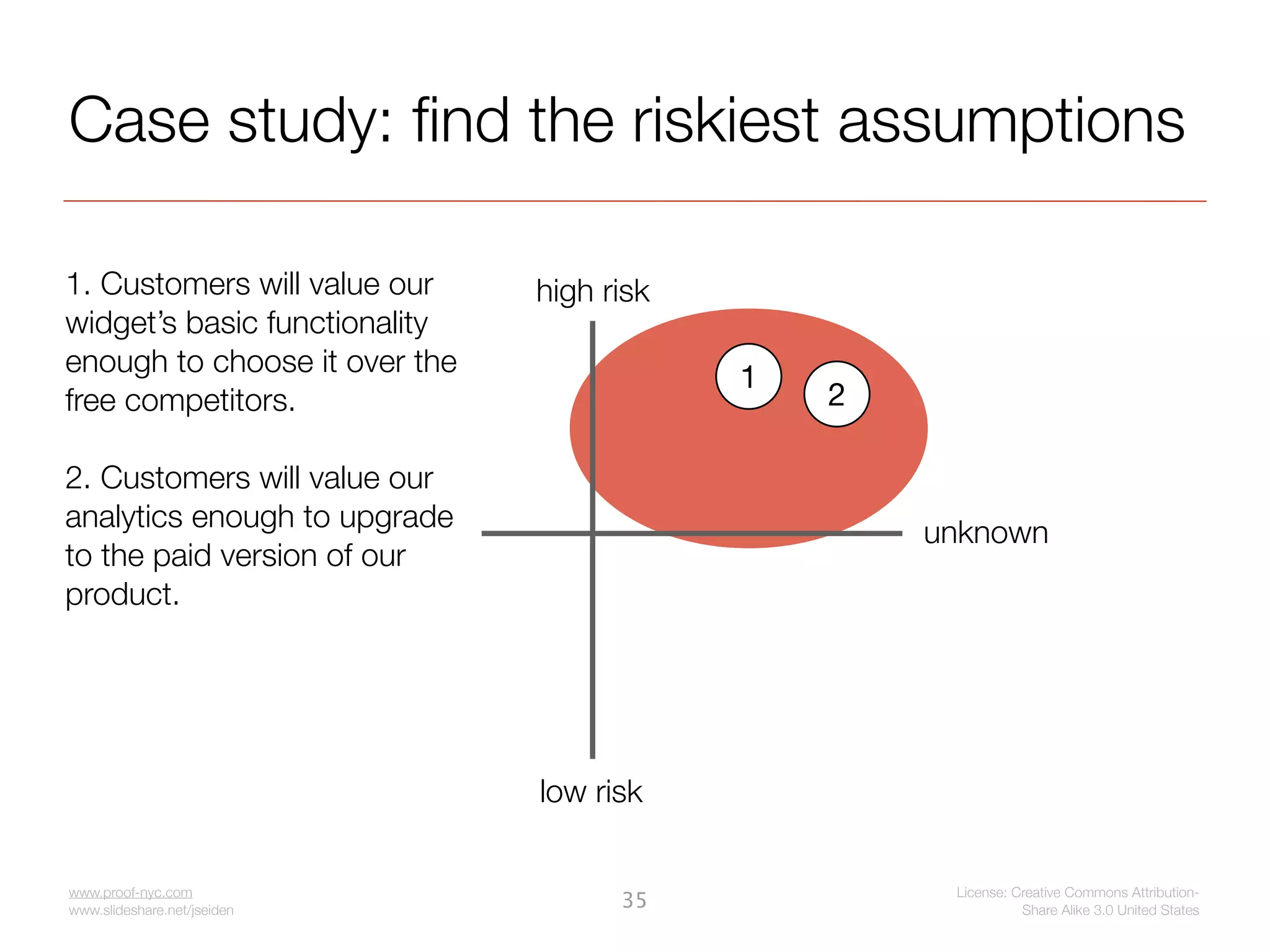
Case study: find the riskiest assumptions

1. Customers will value our    high risk
widget’s basic functionality
enough to choose it over the               1
free competitors.                              2

2. Customers will value our
analytics enough to upgrade
           known                                   unknown
to the paid version of our
product.


                               low risk


www.proof-nyc.com                                   License: Creative Commons Attribution-
www.slideshare.net/jseiden
                                     35                       Share Alike 3.0 United States
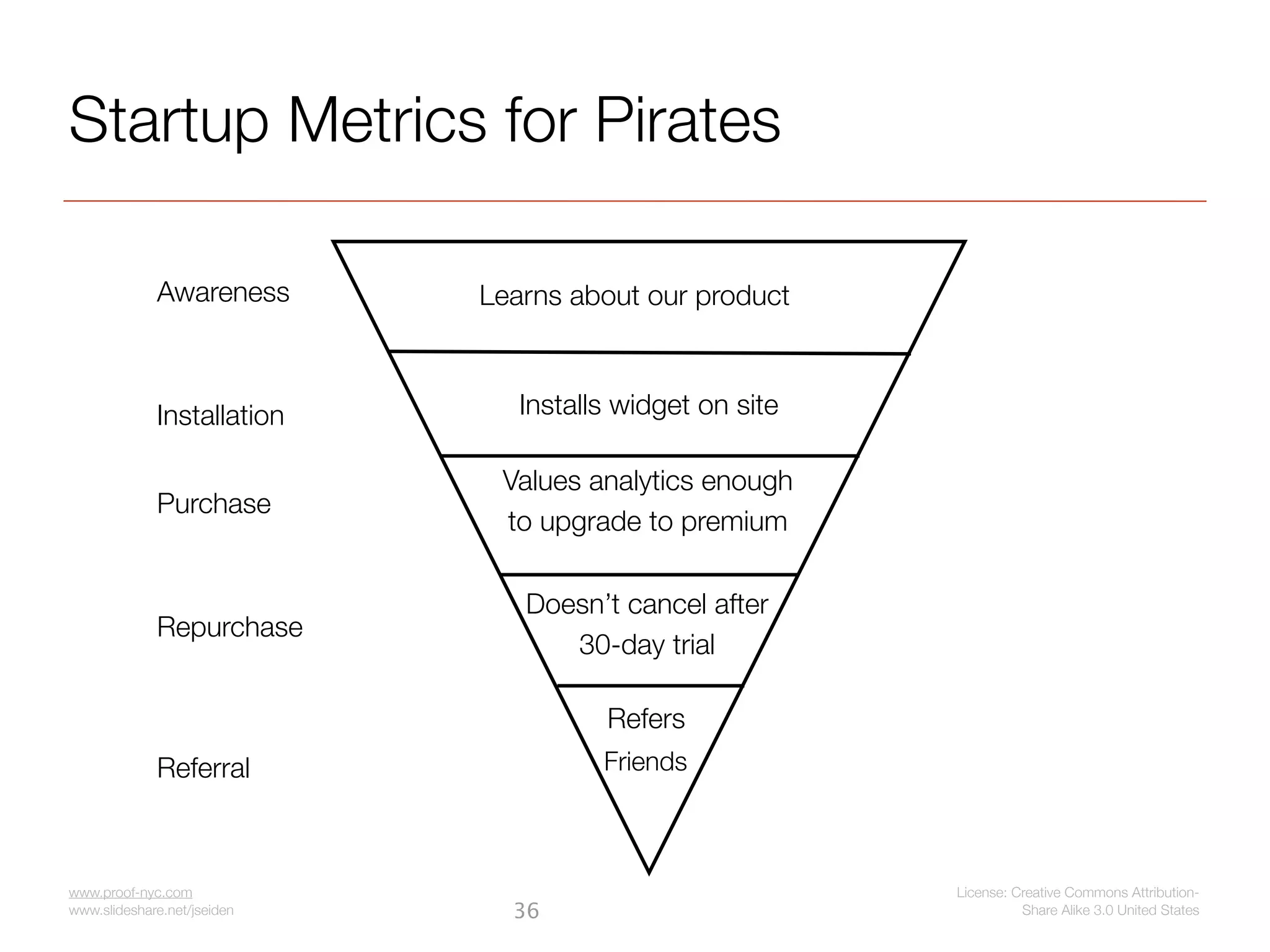
Startup Metrics for Pirates

             Awareness       Learns about our product


             Installation       Installs widget on site

                              Values analytics enough
             Purchase
                              to upgrade to premium

                                Doesn’t cancel after
             Repurchase
                                   30-day trial

                                       Refers
             Referral                  Friends


www.proof-nyc.com                                         License: Creative Commons Attribution-
www.slideshare.net/jseiden     36                                   Share Alike 3.0 United States
Startup Metrics for Pirates
                                                            We believe that if we show
             Awareness                                      Debbie how important [our
                             Learns about our product       functionality] is she will give
                                                            us her email address.


             Installation       Installs widget on site

                              Values analytics enough
             Purchase
                              to upgrade to premium

                                Doesn’t cancel after
             Repurchase
                                   30-day trial

                                       Refers
             Referral                  Friends


www.proof-nyc.com                                         License: Creative Commons Attribution-
www.slideshare.net/jseiden     36                                   Share Alike 3.0 United States
Startup Metrics for Pirates
                                                                We believe that if we show
             Awareness                                          Debbie how important [our
                             Learns about our product           functionality] is she will give
                                                                us her email address.

                                                          We believe that our free offering
             Installation       Installs widget on site   is strong enough that she will
                                                          install us over our competitor.

                              Values analytics enough
             Purchase
                              to upgrade to premium

                                Doesn’t cancel after
             Repurchase
                                   30-day trial

                                       Refers
             Referral                  Friends


www.proof-nyc.com                                             License: Creative Commons Attribution-
www.slideshare.net/jseiden     36                                       Share Alike 3.0 United States
Startup Metrics for Pirates
                                                                      We believe that if we show
             Awareness                                                Debbie how important [our
                             Learns about our product                 functionality] is she will give
                                                                      us her email address.

                                                                We believe that our free offering
             Installation       Installs widget on site         is strong enough that she will
                                                                install us over our competitor.

                              Values analytics enough     We believe that Debbie will value our
             Purchase                                     analytics enough to pay for this level of
                              to upgrade to premium
                                                          service.


                                Doesn’t cancel after
             Repurchase
                                   30-day trial

                                       Refers
             Referral                  Friends


www.proof-nyc.com                                                   License: Creative Commons Attribution-
www.slideshare.net/jseiden     36                                             Share Alike 3.0 United States
Startup Metrics for Pirates
                                                                      We believe that if we show
             Awareness                                                Debbie how important [our
                             Learns about our product                 functionality] is she will give
                                                                      us her email address.

                                                                We believe that our free offering
             Installation       Installs widget on site         is strong enough that she will
                                                                install us over our competitor.

                              Values analytics enough     We believe that Debbie will value our
             Purchase                                     analytics enough to pay for this level of
                              to upgrade to premium
                                                          service.


                                Doesn’t cancel after
             Repurchase
                                   30-day trial

                                       Refers
             Referral                  Friends


www.proof-nyc.com                                                   License: Creative Commons Attribution-
www.slideshare.net/jseiden     36                                             Share Alike 3.0 United States
Hypothesis: activation/installation


www.proof-nyc.com                 License: Creative Commons Attribution-
www.slideshare.net/jseiden
                             37             Share Alike 3.0 United States
Hypothesis: activation/installation

Hypothesis: Our customers will value our free widget
  enough to install it.


www.proof-nyc.com                        License: Creative Commons Attribution-
www.slideshare.net/jseiden
                             37                    Share Alike 3.0 United States
Hypothesis: activation/installation

Hypothesis: Our customers will value our free widget
  enough to install it.
Sub-hypothesis: they will install the free widget only if
  the installation process is easy enough.


www.proof-nyc.com                            License: Creative Commons Attribution-
www.slideshare.net/jseiden
                             37                        Share Alike 3.0 United States
Hypothesis: activation/installation

Hypothesis: Our customers will value our free widget
  enough to install it.
Sub-hypothesis: they will install the free widget only if
  the installation process is easy enough.


www.proof-nyc.com                            License: Creative Commons Attribution-
www.slideshare.net/jseiden
                             37                        Share Alike 3.0 United States
Hypothesis: activation/installation

Hypothesis: Our customers will value our free widget
  enough to install it.
Sub-hypothesis: they will install the free widget only if
  the installation process is easy enough.

Problem: the installation process is too hard for our
  customer. It is preventing us from measuring
  customer behavior.


www.proof-nyc.com                            License: Creative Commons Attribution-
www.slideshare.net/jseiden
                             37                        Share Alike 3.0 United States
Hypothesis: activation/installation

Hypothesis: Our customers will value our free widget
  enough to install it.
Sub-hypothesis: they will install the free widget only if
  the installation process is easy enough.

Problem: the installation process is too hard for our
  customer. It is preventing us from measuring
  customer behavior.


www.proof-nyc.com                            License: Creative Commons Attribution-
www.slideshare.net/jseiden
                             37                        Share Alike 3.0 United States
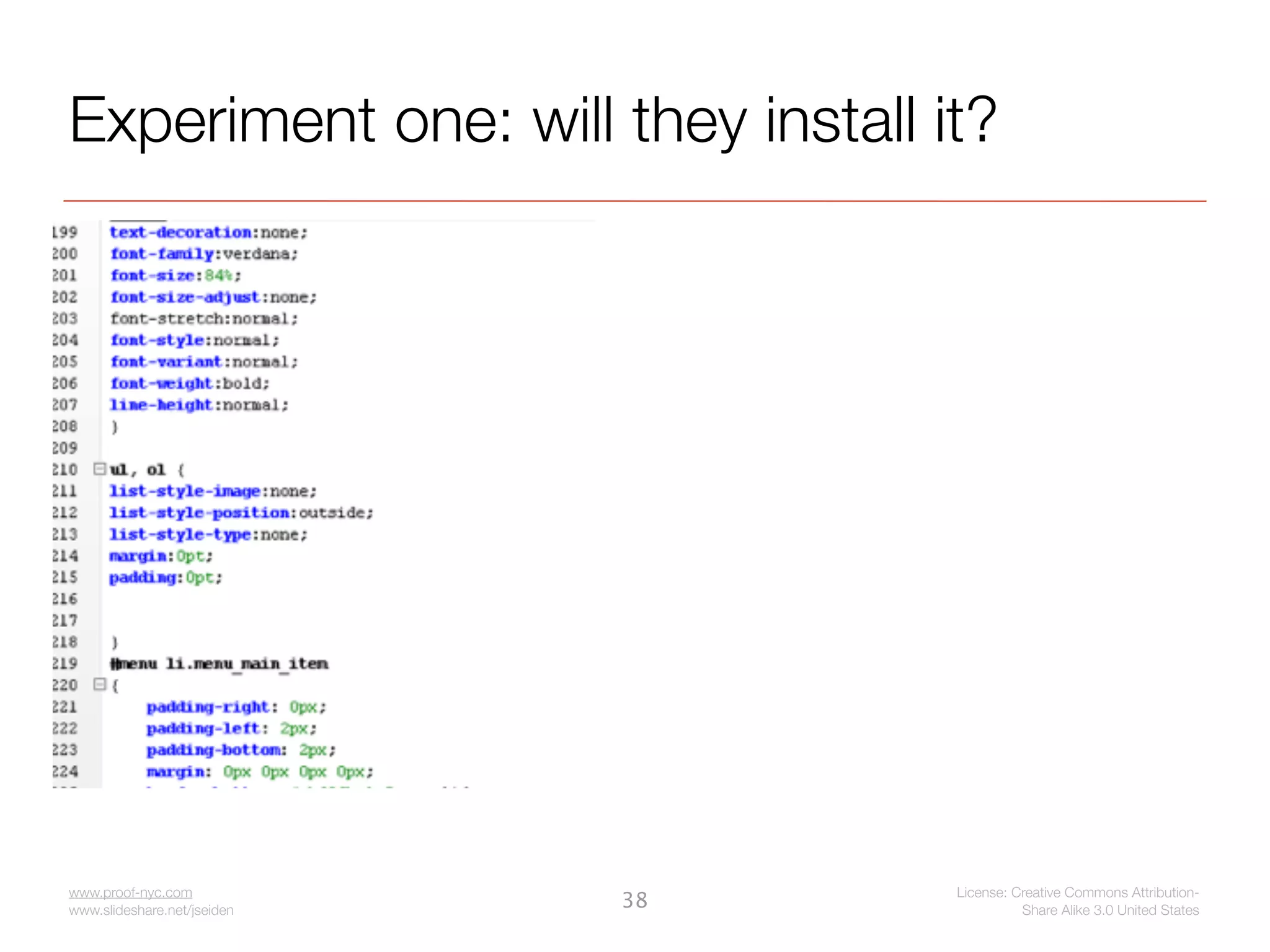
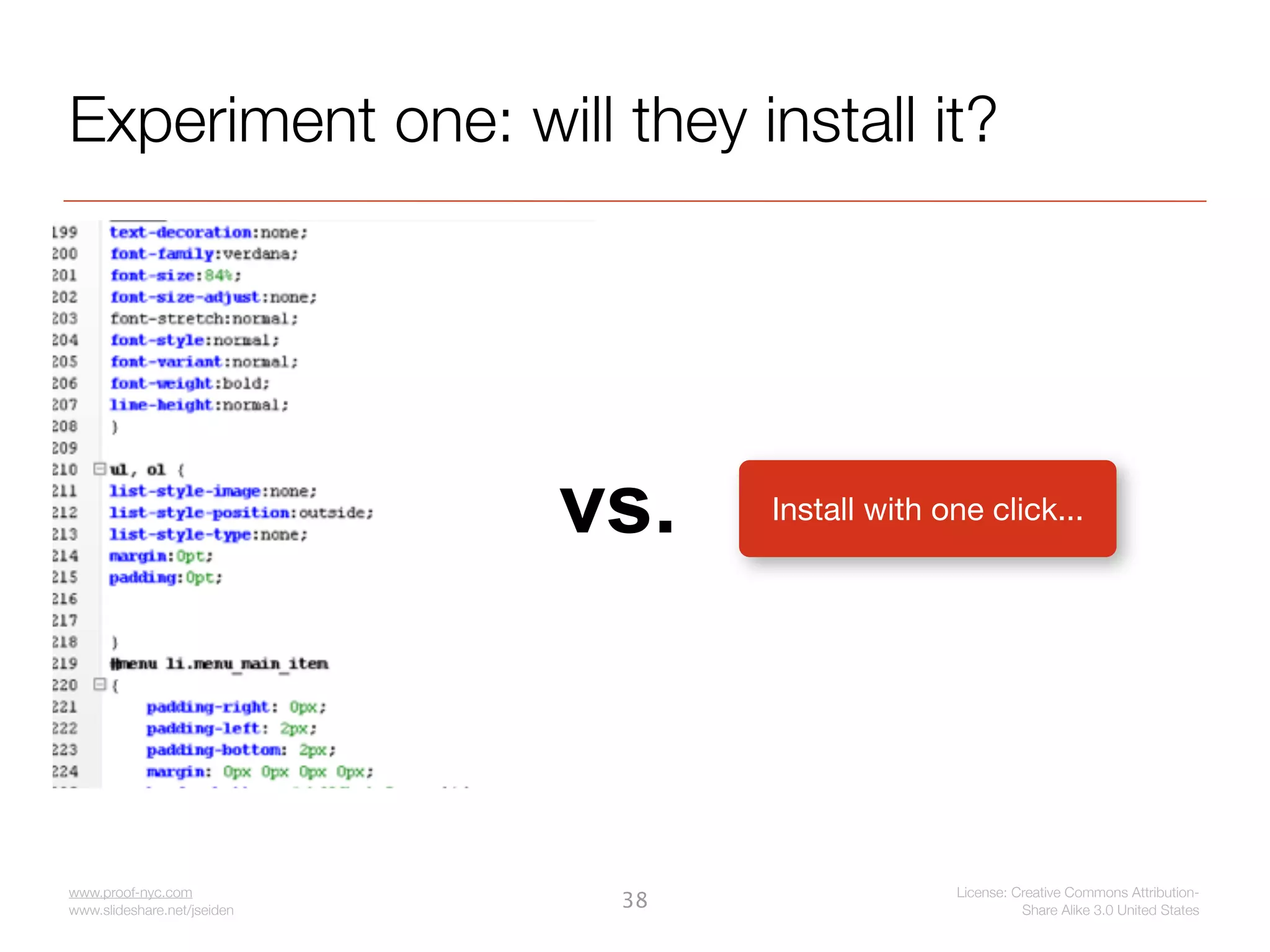
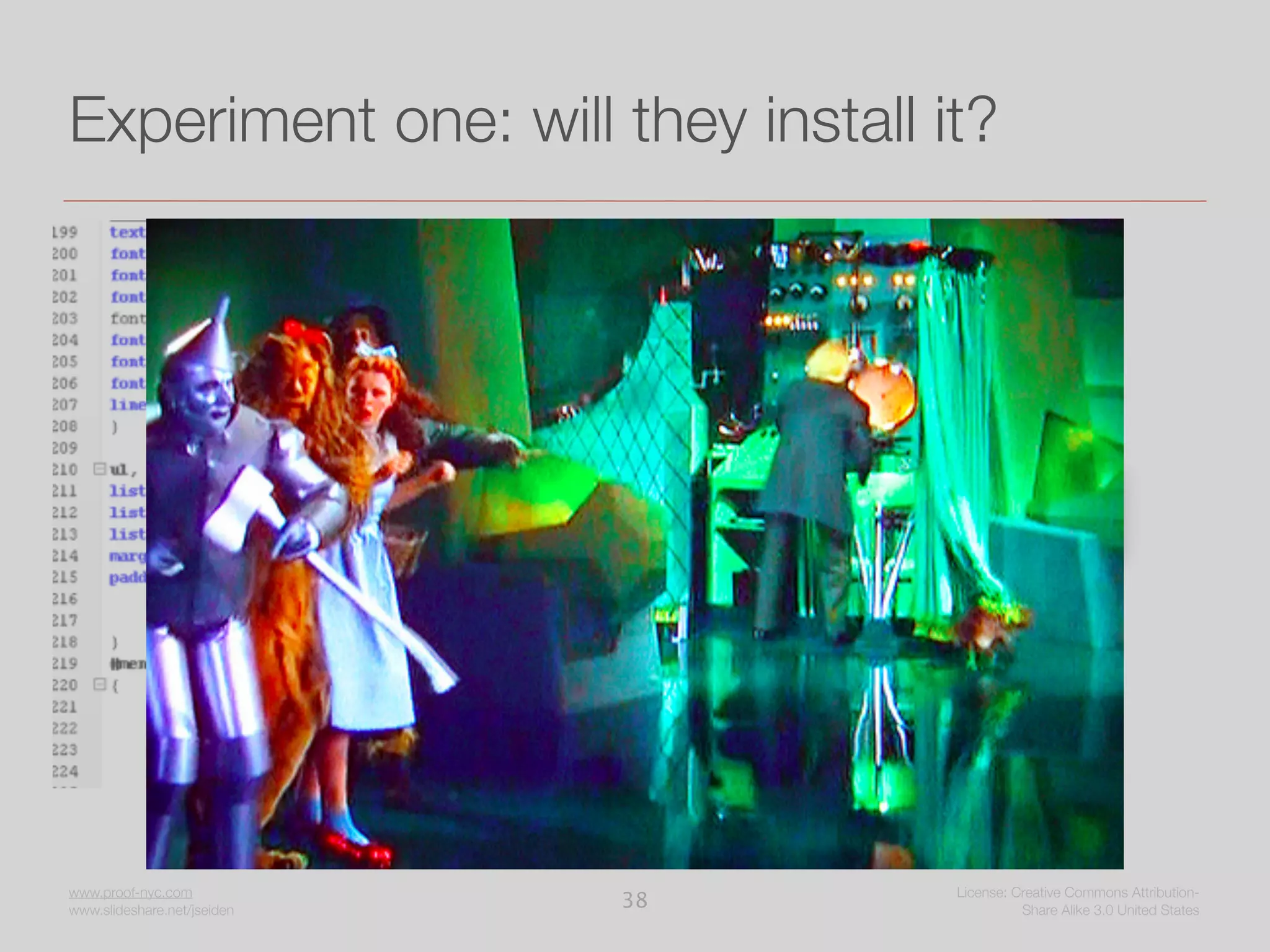
Experiment one: will they install it?


www.proof-nyc.com                  License: Creative Commons Attribution-
www.slideshare.net/jseiden
                             38              Share Alike 3.0 United States
Experiment one: will they install it?


                             vs.   Install with one click...


www.proof-nyc.com                                License: Creative Commons Attribution-
www.slideshare.net/jseiden
                              38                           Share Alike 3.0 United States
Experiment one: will they install it?


                             vs.   Install with one click...


www.proof-nyc.com                                License: Creative Commons Attribution-
www.slideshare.net/jseiden
                              38                           Share Alike 3.0 United States
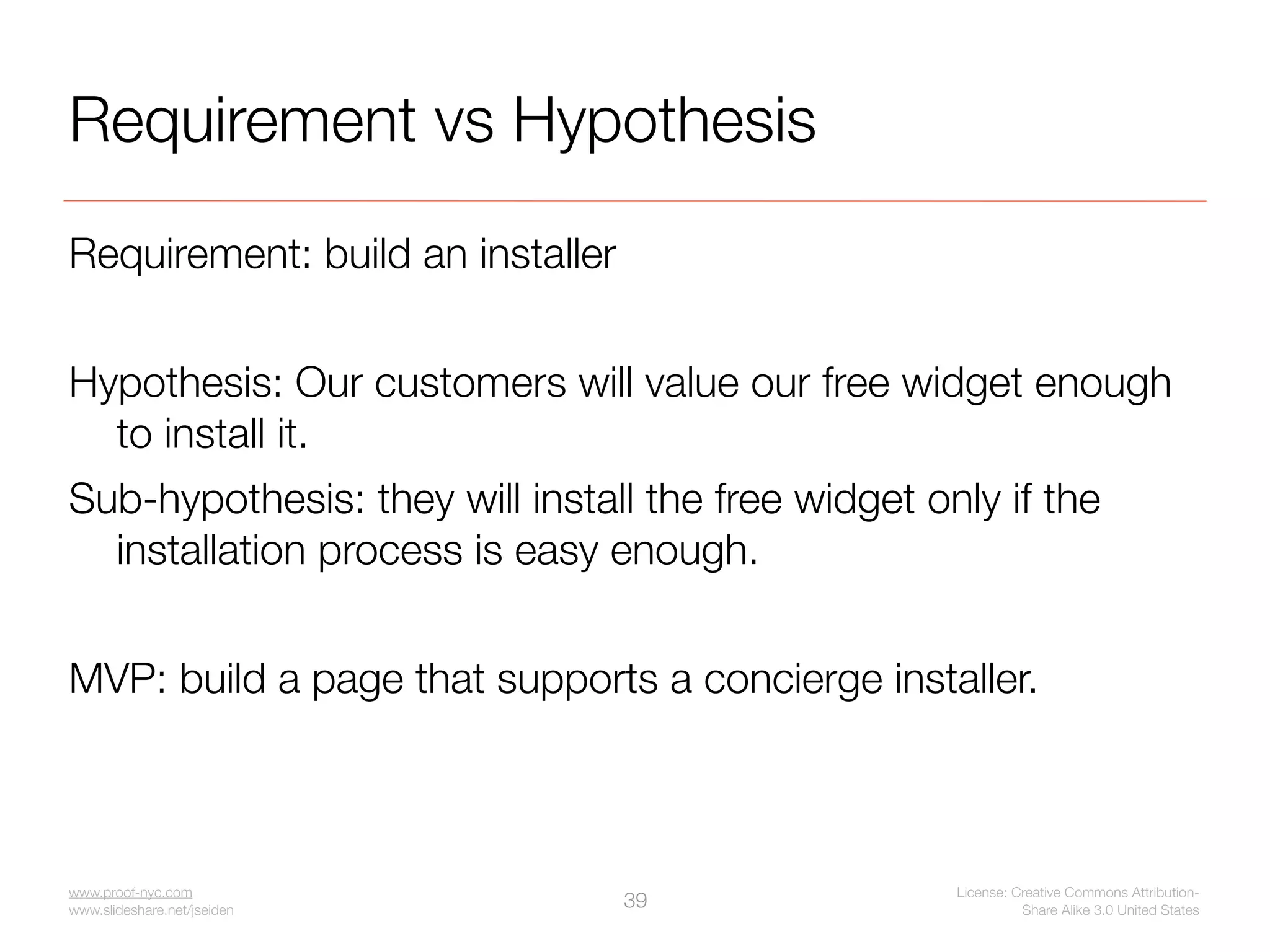
Requirement vs Hypothesis


www.proof-nyc.com                 License: Creative Commons Attribution-
www.slideshare.net/jseiden
                             39             Share Alike 3.0 United States
Requirement vs Hypothesis
Requirement: build an installer


www.proof-nyc.com                      License: Creative Commons Attribution-
www.slideshare.net/jseiden
                                  39             Share Alike 3.0 United States
Requirement vs Hypothesis
Requirement: build an installer


www.proof-nyc.com                      License: Creative Commons Attribution-
www.slideshare.net/jseiden
                                  39             Share Alike 3.0 United States
Requirement vs Hypothesis
Requirement: build an installer


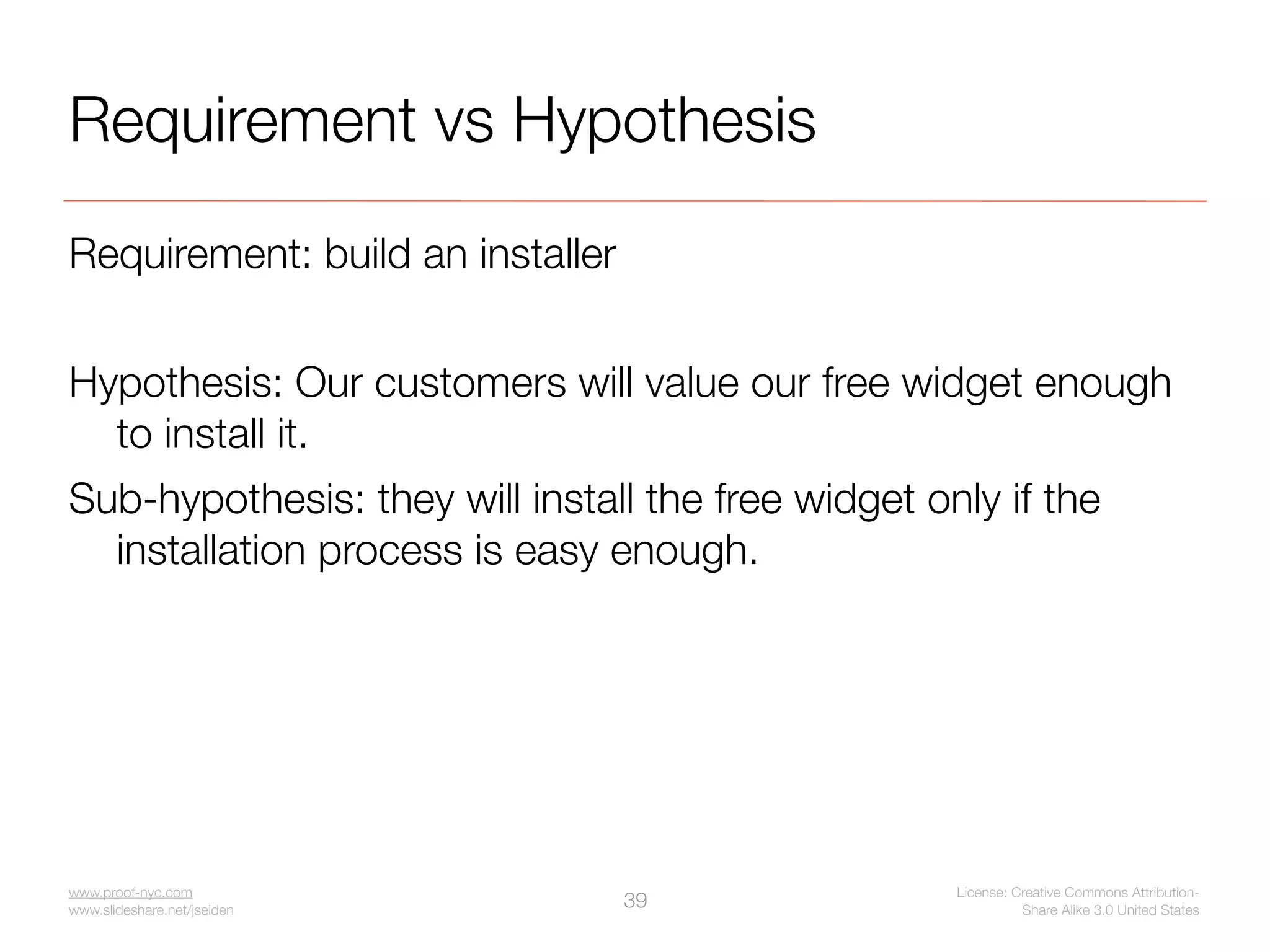
Hypothesis: Our customers will value our free widget enough
  to install it.


www.proof-nyc.com                              License: Creative Commons Attribution-
www.slideshare.net/jseiden
                                  39                     Share Alike 3.0 United States
Requirement vs Hypothesis
Requirement: build an installer


Hypothesis: Our customers will value our free widget enough
  to install it.
Sub-hypothesis: they will install the free widget only if the
  installation process is easy enough.


www.proof-nyc.com                                   License: Creative Commons Attribution-
www.slideshare.net/jseiden
                                  39                          Share Alike 3.0 United States
Requirement vs Hypothesis
Requirement: build an installer


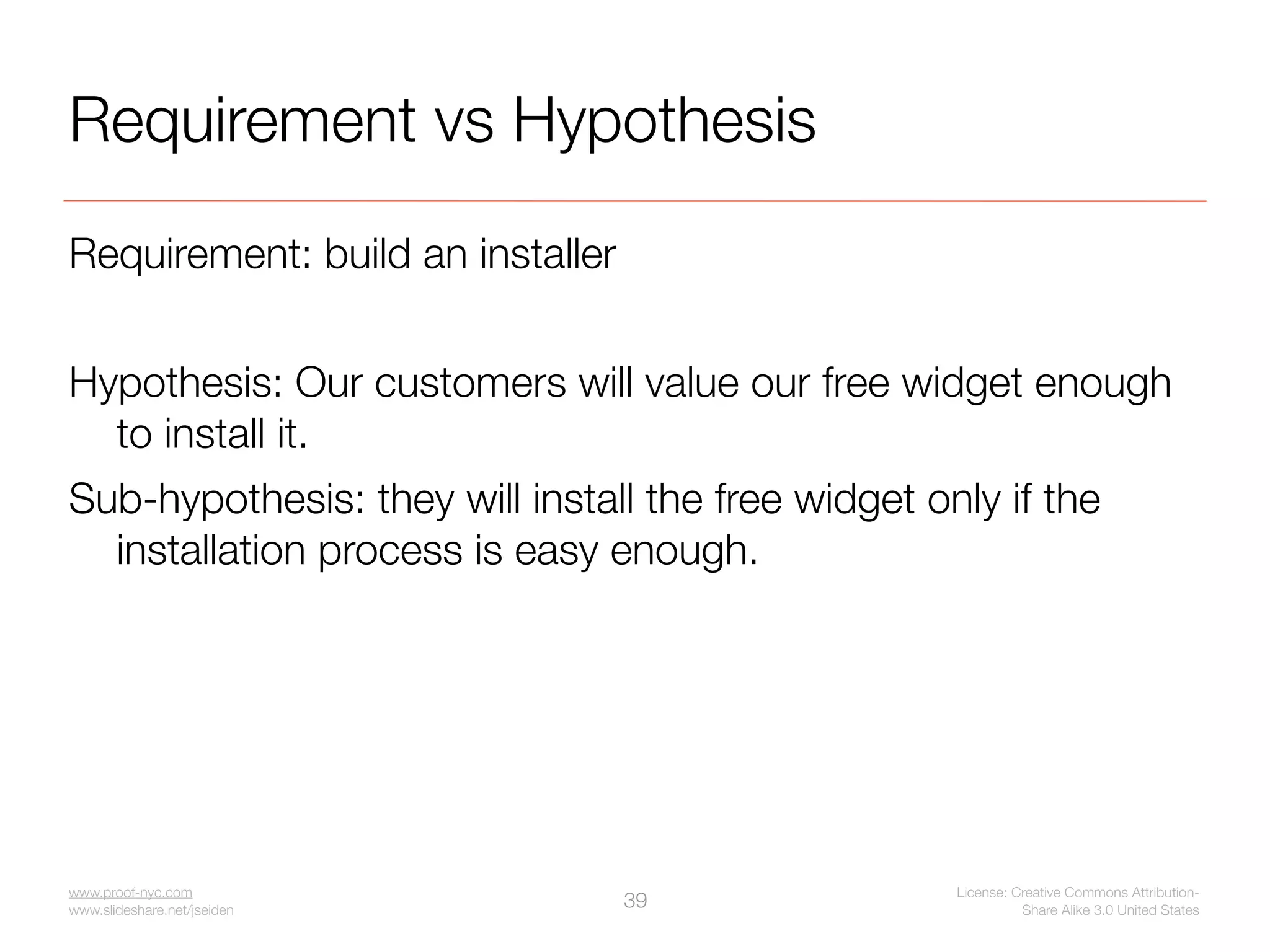
Hypothesis: Our customers will value our free widget enough
  to install it.
Sub-hypothesis: they will install the free widget only if the
  installation process is easy enough.


www.proof-nyc.com                                   License: Creative Commons Attribution-
www.slideshare.net/jseiden
                                  39                          Share Alike 3.0 United States
Requirement vs Hypothesis
Requirement: build an installer


Hypothesis: Our customers will value our free widget enough
  to install it.
Sub-hypothesis: they will install the free widget only if the
  installation process is easy enough.


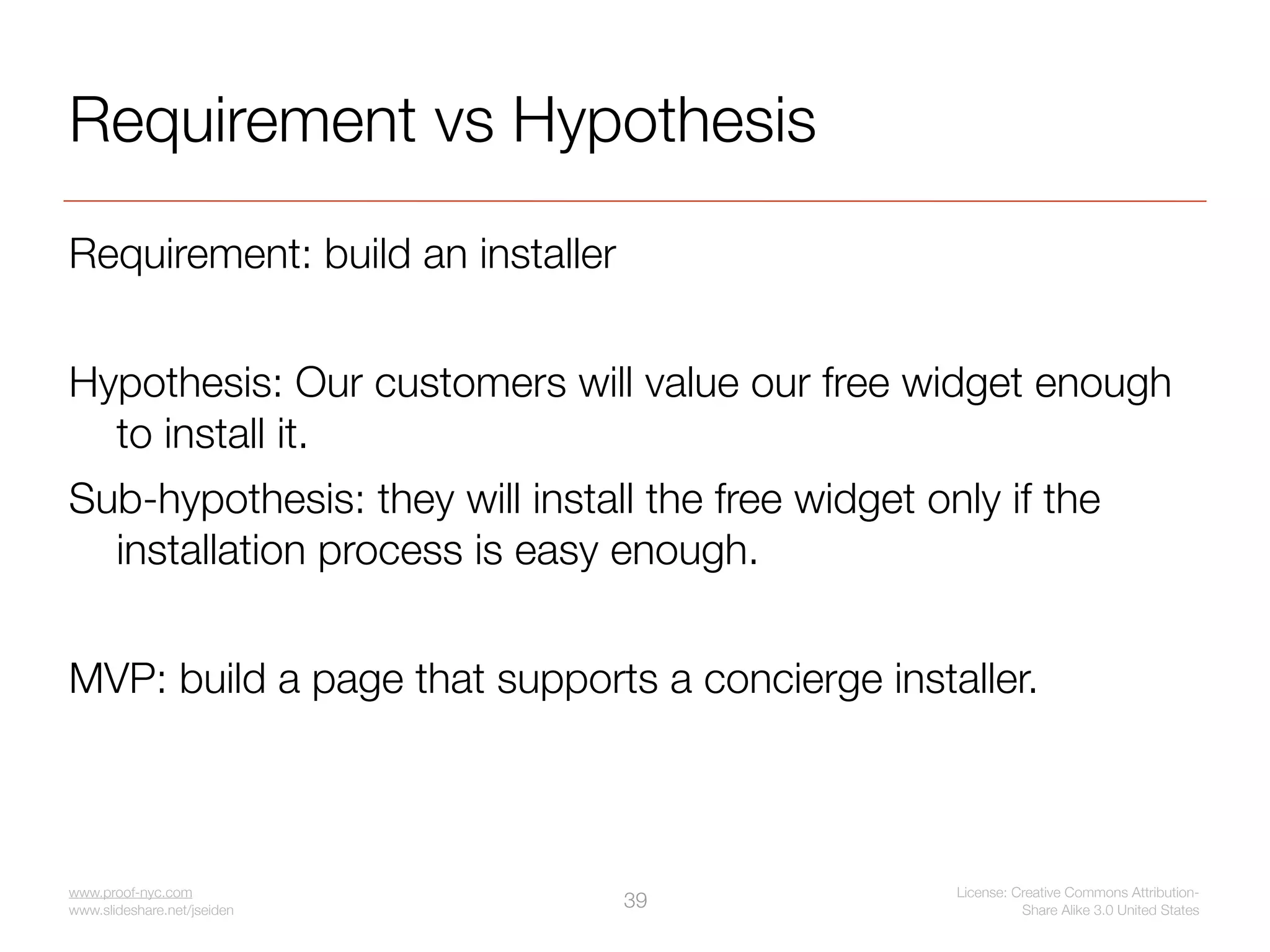
MVP: build a page that supports a concierge installer.


www.proof-nyc.com                                   License: Creative Commons Attribution-
www.slideshare.net/jseiden
                                  39                          Share Alike 3.0 United States
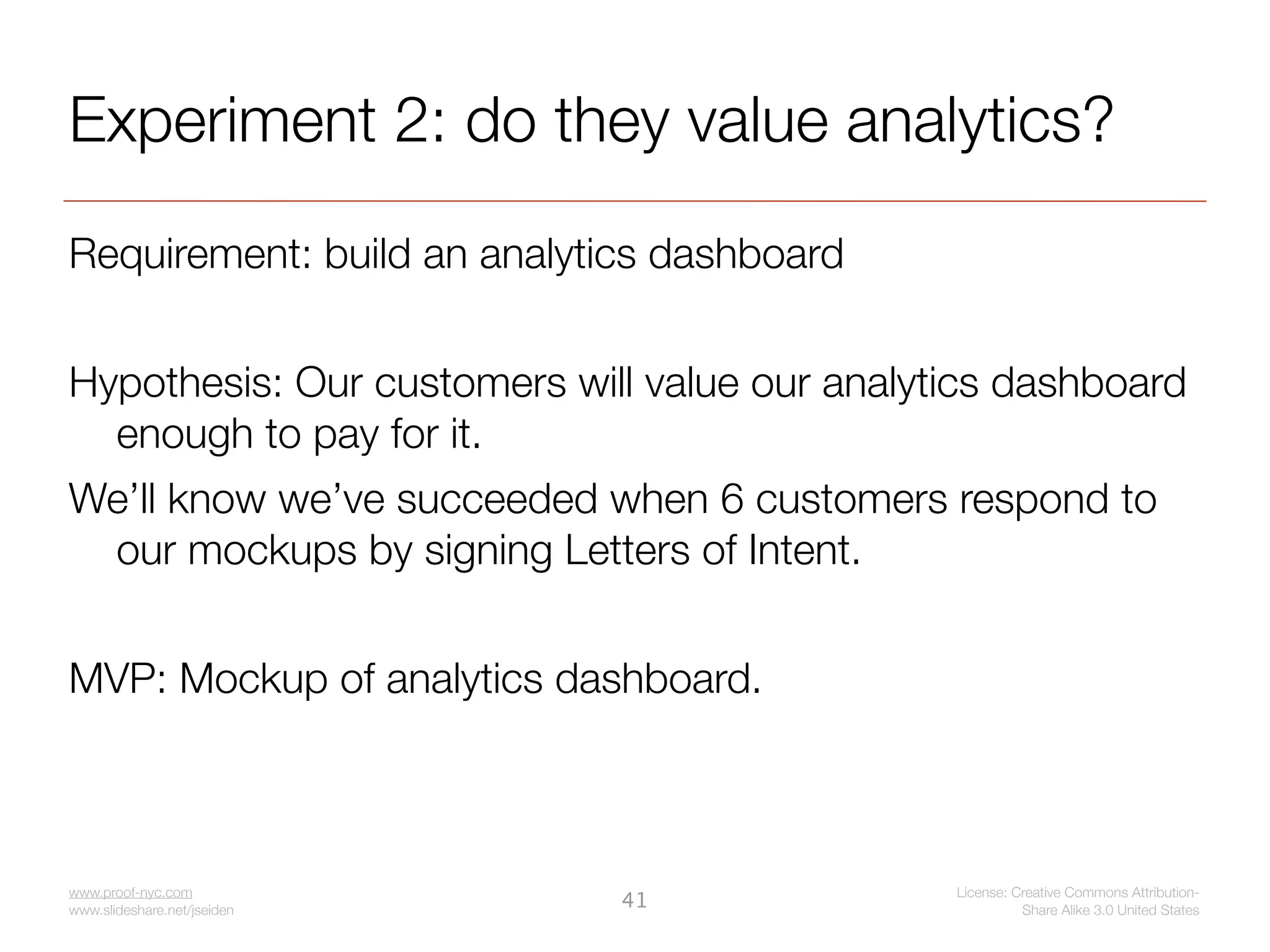
Requirement vs Hypothesis
Requirement: build an installer


Hypothesis: Our customers will value our free widget enough
  to install it.
Sub-hypothesis: they will install the free widget only if the
  installation process is easy enough.


MVP: build a page that supports a concierge installer.


www.proof-nyc.com                                   License: Creative Commons Attribution-
www.slideshare.net/jseiden
                                  39                          Share Alike 3.0 United States
The next hypothesis...
                                                                      We believe that if we show
             Awareness                                                Debbie how important [our
                             Learns about our product                 functionality] is she will give
                                                                      us her email address.

                                                                We believe that our free offering
             Installation       Installs widget on site         is strong enough that she will
                                                                install us over our competitor.

                              Values analytics enough     We believe that Debbie will value our
             Purchase                                     analytics enough to pay for this level of
                              to upgrade to premium
                                                          service.


                                Doesn’t cancel after
             Repurchase
                                   30-day trial

                                       Refers
             Referral                  Friends


www.proof-nyc.com                                                   License: Creative Commons Attribution-
www.slideshare.net/jseiden     40                                             Share Alike 3.0 United States
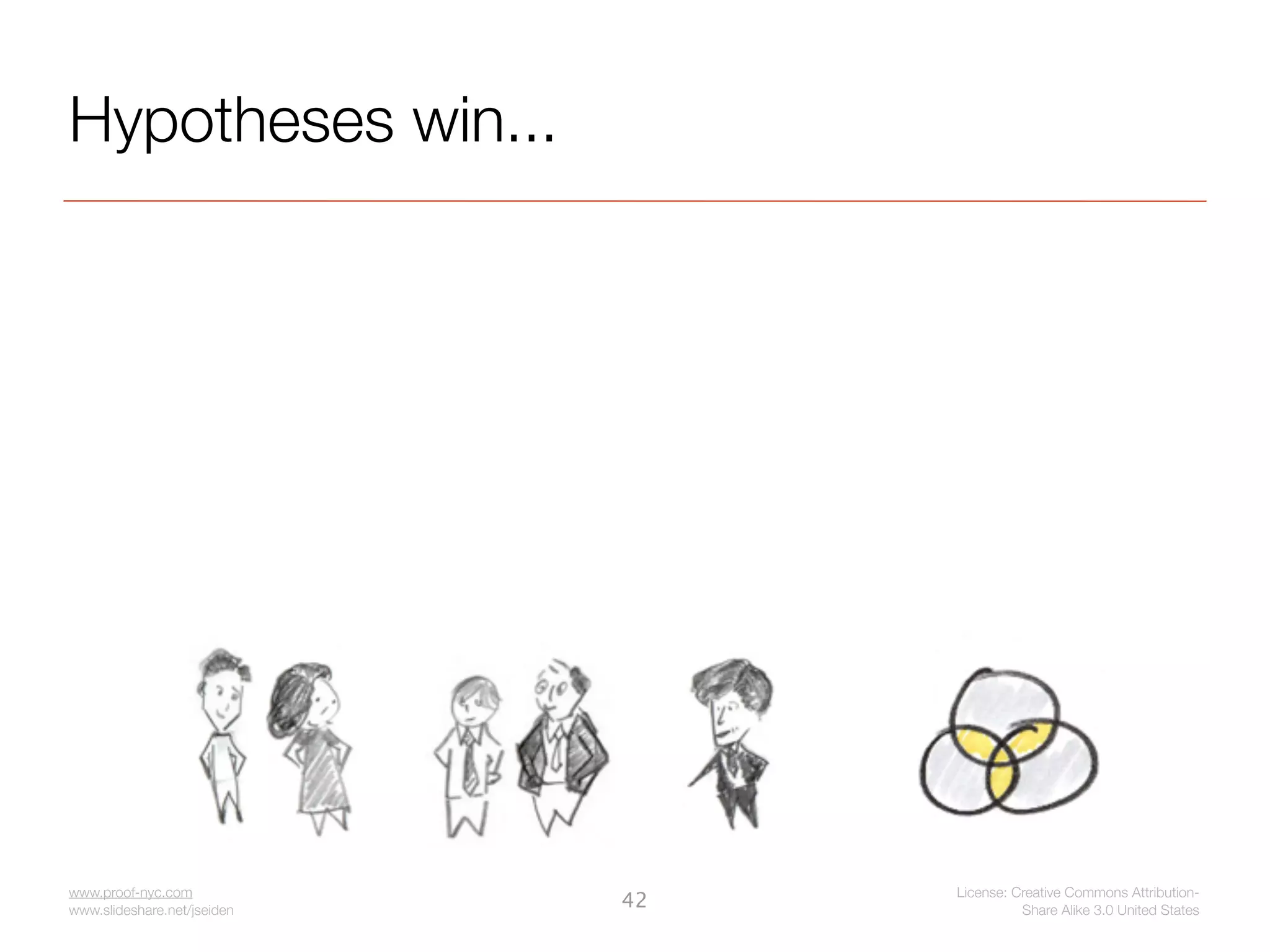
Experiment 2: do they value analytics?
Requirement: build an analytics dashboard


Hypothesis: Our customers will value our analytics dashboard
  enough to pay for it.
We’ll know we’ve succeeded when 6 customers respond to
 our mockups by signing Letters of Intent.


MVP: Mockup of analytics dashboard.


www.proof-nyc.com                              License: Creative Commons Attribution-
www.slideshare.net/jseiden
                             41                          Share Alike 3.0 United States
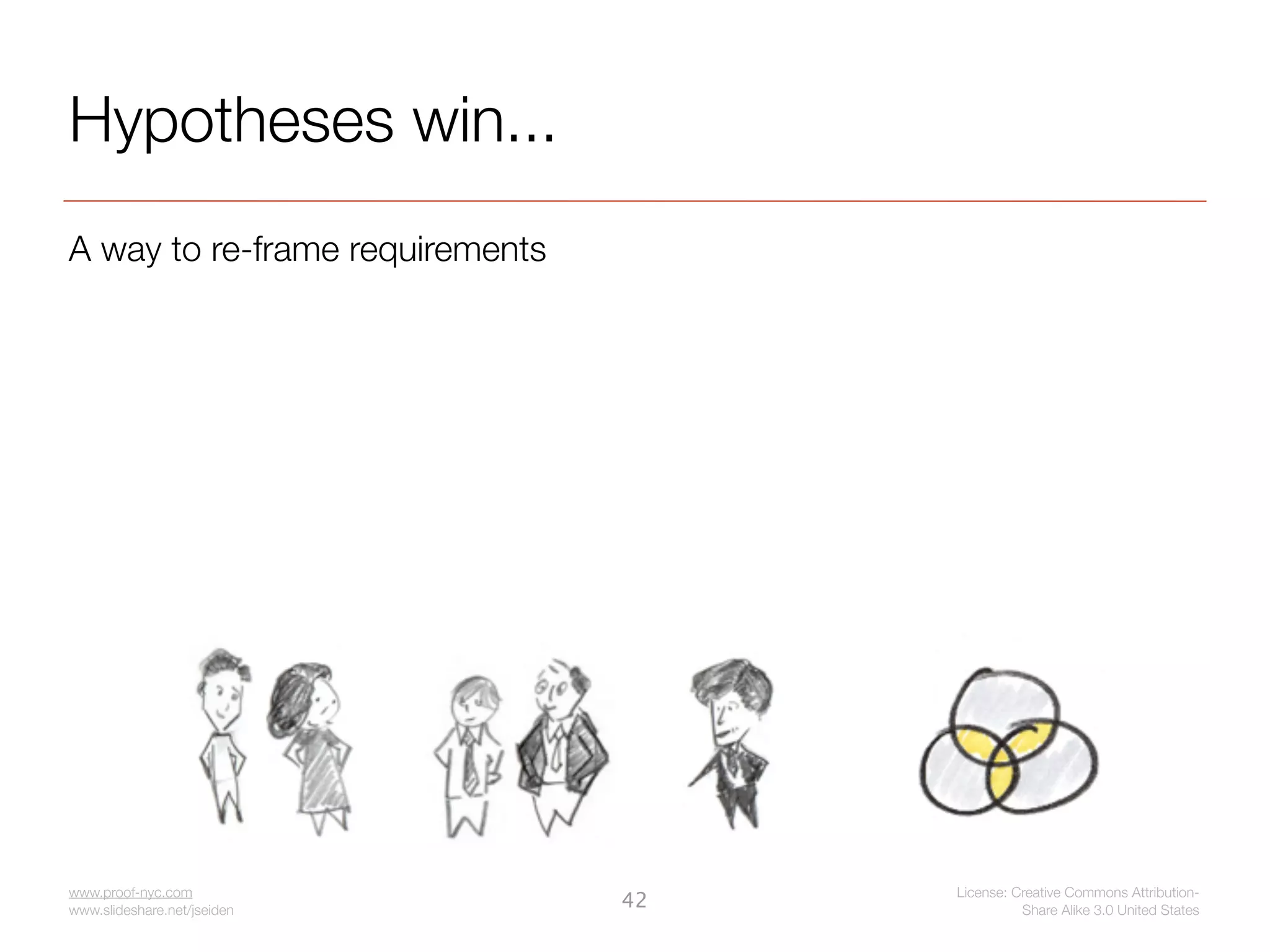
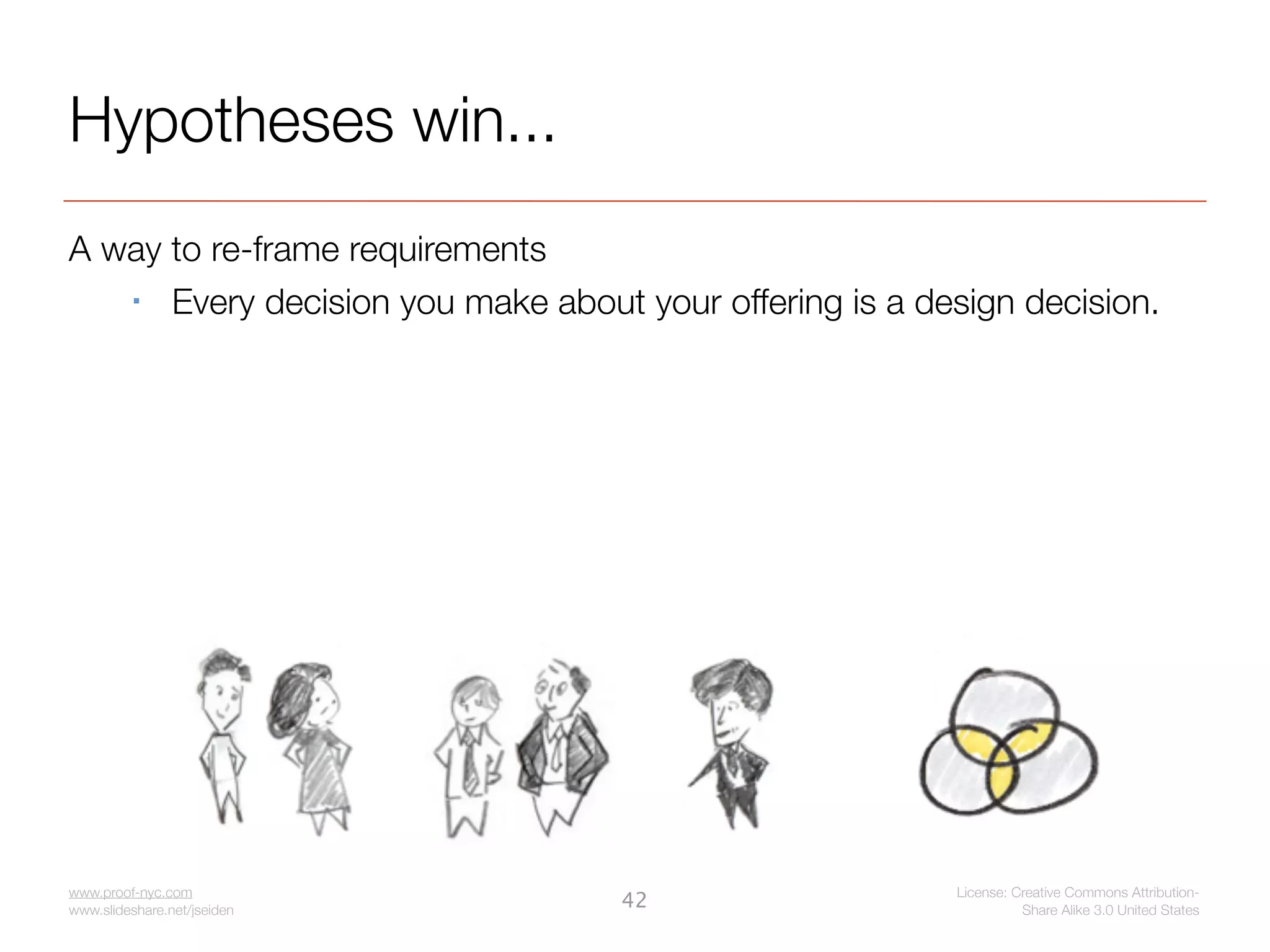
Hypotheses win...


www.proof-nyc.com                 License: Creative Commons Attribution-
www.slideshare.net/jseiden
                             42             Share Alike 3.0 United States
Hypotheses win...
A way to re-frame requirements


www.proof-nyc.com                     License: Creative Commons Attribution-
www.slideshare.net/jseiden
                                 42             Share Alike 3.0 United States
Hypotheses win...
A way to re-frame requirements
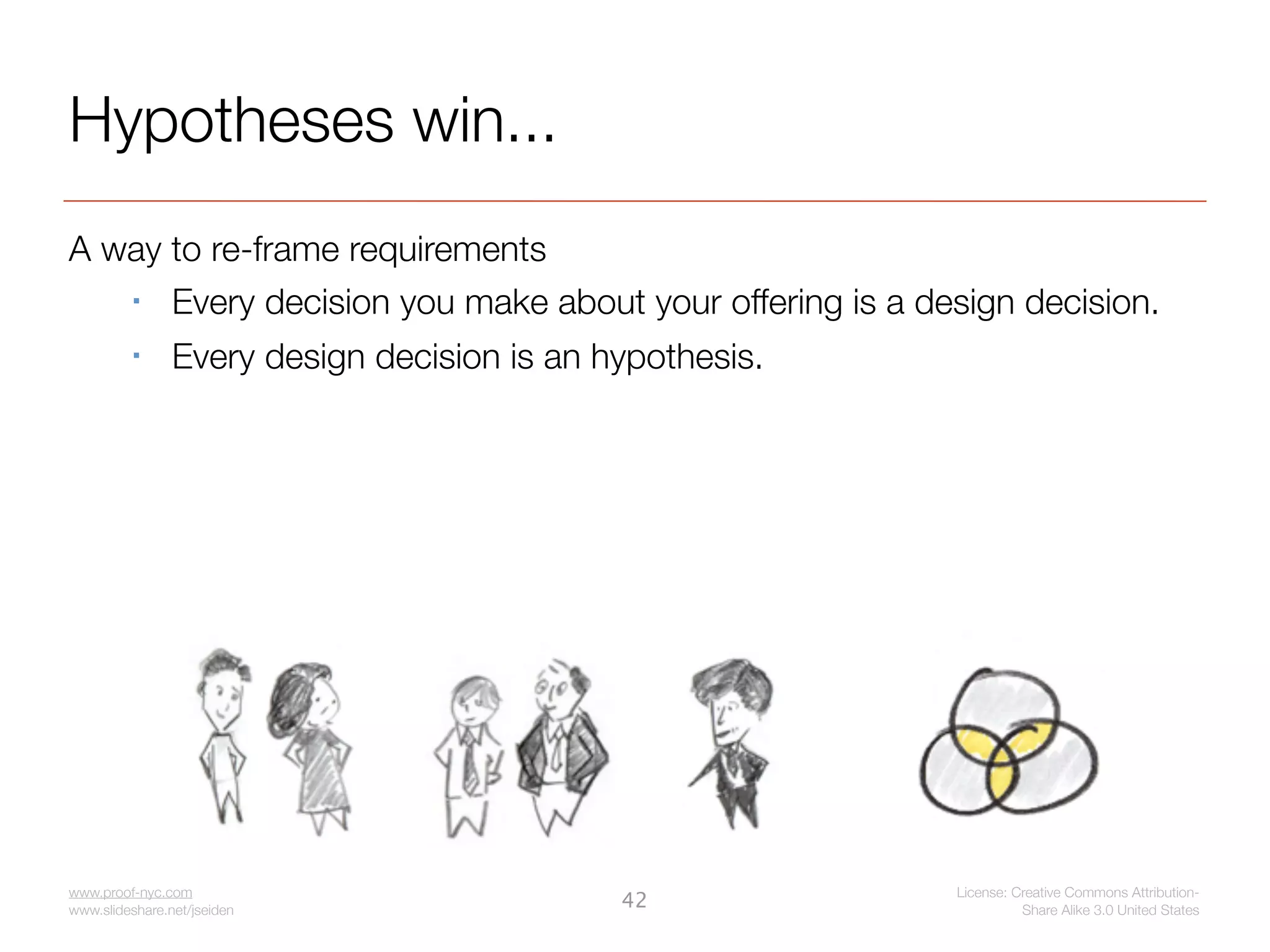
     Every decision you make about your offering is a design decision.


www.proof-nyc.com                                        License: Creative Commons Attribution-
www.slideshare.net/jseiden
                                   42                              Share Alike 3.0 United States
Hypotheses win...
A way to re-frame requirements
     Every decision you make about your offering is a design decision.
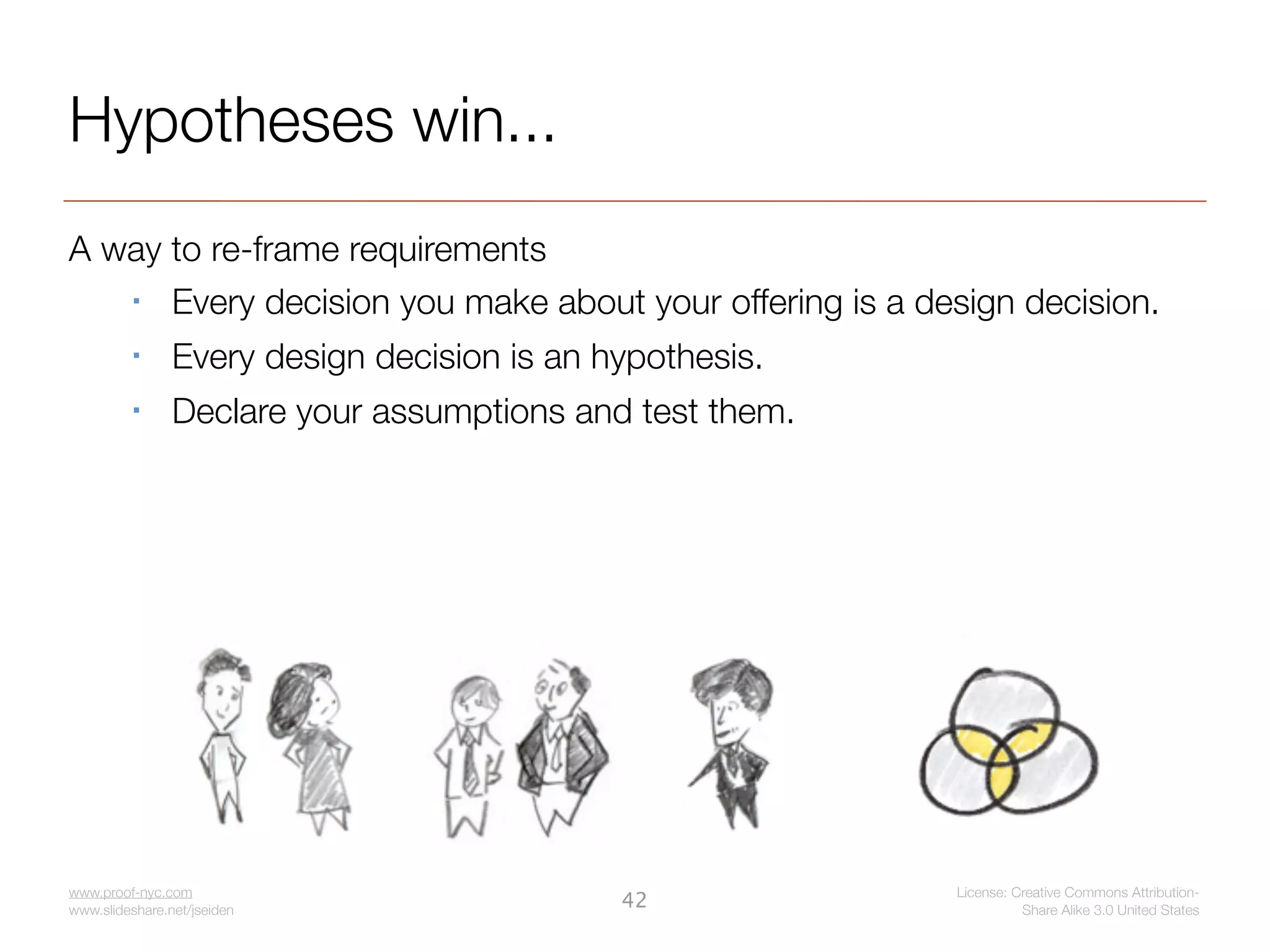
               Every design decision is an hypothesis.


www.proof-nyc.com                                         License: Creative Commons Attribution-
www.slideshare.net/jseiden
                                             42                     Share Alike 3.0 United States
Hypotheses win...
A way to re-frame requirements
     Every decision you make about your offering is a design decision.
               Every design decision is an hypothesis.
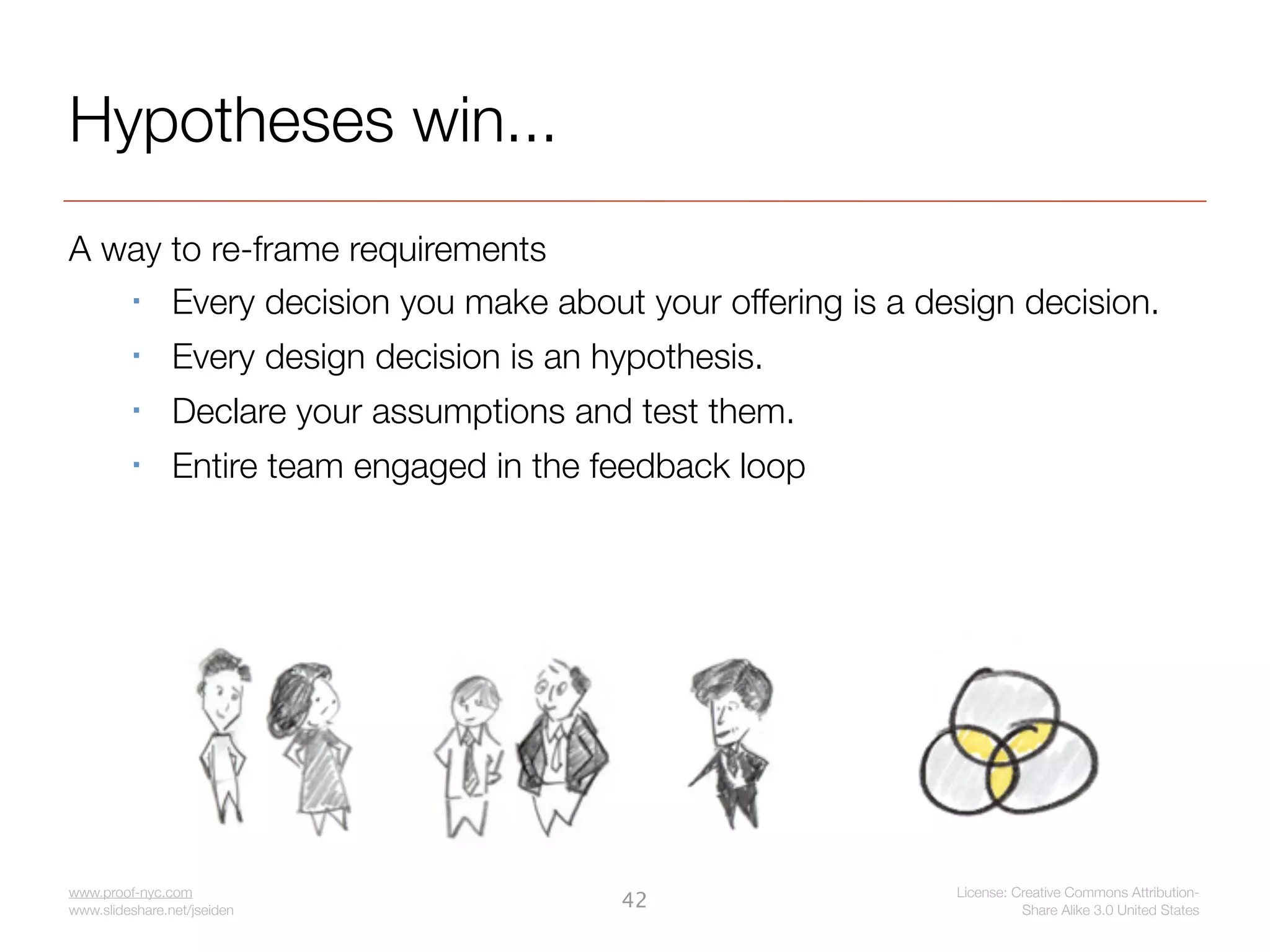
               Declare your assumptions and test them.


www.proof-nyc.com                                         License: Creative Commons Attribution-
www.slideshare.net/jseiden
                                             42                     Share Alike 3.0 United States
Hypotheses win...
A way to re-frame requirements
     Every decision you make about your offering is a design decision.
               Every design decision is an hypothesis.
               Declare your assumptions and test them.
               Entire team engaged in the feedback loop


www.proof-nyc.com                                          License: Creative Commons Attribution-
www.slideshare.net/jseiden
                                             42                      Share Alike 3.0 United States
Enjoy what you saw? Follow @jseiden and @proof_nyc.

      THANK YOU!


www.proof-nyc.com                                           License: Creative Commons Attribution-
www.slideshare.net/jseiden                                              Share Alike 3.0 United States

2012 feb 25 agile ux nyc, seiden, requirements to hypotheses

  • 1.
    Replacing Requirements with Hypotheses AgileUX NYC 2012 Feb 25, 2012 Josh Seiden @jseiden
  • 2.
    Me and myhashtags Josh Seiden www.proof-nyc.com @jseiden @proof_nyc #leanUX #leanStartup www.proof-nyc.com License: Creative Commons Attribution- www.slideshare.net/jseiden 2 Share Alike 3.0 United States
  • 3.
    Internet Mouse www.proof-nyc.com www.slideshare.net/jseiden 3 License: Creative Commons Attribution- Share Alike 3.0 United States
  • 4.
    Internet Mouse www.proof-nyc.com www.slideshare.net/jseiden 3 License: Creative Commons Attribution- Share Alike 3.0 United States
  • 5.
    What are wetalking about? Requirements and hypotheses can both be used to frame the work of teams. - Example of a requirement: create an Internet Mouse that people can use when surfing the internet on their TV from their couch. - Hypothesis: we believe that people will pay for a device that makes it easier and more fun to surf the internet from their living room couches in front of the TV. www.proof-nyc.com www.slideshare.net/jseiden 4 License: Creative Commons Attribution- Share Alike 3.0 United States
  • 6.
    For many teams,in many contexts, hypotheses are a more effective way to manage your work than requirements. 5
  • 7.
    Extreme uncertainty www.proof-nyc.com www.slideshare.net/jseiden 6 License: Creative Commons Attribution- Share Alike 3.0 United States
  • 8.
    The problem withrequirements The business owners express needs as “requirements.” Problem: the team has no visibility to user/market need. Problem: “The business” does the thinking, the design/dev team does the implementing. www.proof-nyc.com License: Creative Commons Attribution- www.slideshare.net/jseiden 7 Share Alike 3.0 United States
  • 11.
    Requirements vs. hypotheses Whenyou’re in production, building to a known standard, you want requirements. When you’re in an environment of uncertainty, you want hypotheses. www.proof-nyc.com License: Creative Commons Attribution- www.slideshare.net/jseiden 10 Share Alike 3.0 United States
  • 12.
  • 13.
    Why are hypothesesmore effective? They are understood to be only provisionally true: in other words, they express assumptions that need to be tested. Hypotheses are answers put forth in the spirit of a question. www.proof-nyc.com License: Creative Commons Attribution- www.slideshare.net/jseiden 12 Share Alike 3.0 United States
  • 14.
    On questions... “We getwise by asking questions, and even if these questions are not answered we get wise, for a well-packed question carries its answer on it’s back as a snail carries its shell.” James Stephens, The Boyhood of Fionn www.proof-nyc.com License: Creative Commons Attribution- www.slideshare.net/jseiden 13 Share Alike 3.0 United States
  • 15.
    Wisdom? Who cares? “Workingsoftware is the primary measure of progress.” “Validated learning is the primary measure of progress.” www.proof-nyc.com License: Creative Commons Attribution- www.slideshare.net/jseiden 14 Share Alike 3.0 United States
  • 16.
    Reduce Inventory, Riskand Waste Make a Get design feedback decision from market Concept credit: @clevergirl www.proof-nyc.com License: Creative Commons Attribution- www.slideshare.net/jseiden 15 Share Alike 3.0 United States
  • 17.
    Reduce Inventory, Riskand Waste This is going to be BIG! Make a Get design feedback decision from market Concept credit: @clevergirl www.proof-nyc.com License: Creative Commons Attribution- www.slideshare.net/jseiden 15 Share Alike 3.0 United States
  • 18.
    Reduce Inventory, Riskand Waste This is No one going to be clicked. BIG! Make a Get design feedback decision from market Concept credit: @clevergirl www.proof-nyc.com License: Creative Commons Attribution- www.slideshare.net/jseiden 15 Share Alike 3.0 United States
  • 19.
    Reduce Inventory, Riskand Waste This is No one going to be clicked. BIG! Make a Get design 3 MONTHS feedback decision from market Concept credit: @clevergirl www.proof-nyc.com License: Creative Commons Attribution- www.slideshare.net/jseiden 15 Share Alike 3.0 United States
  • 20.
    Reduce Inventory, Riskand Waste This is No one going to be clicked. BIG! Make a Get design 3 MONTHS feedback decision from market 3 HOURS Concept credit: @clevergirl www.proof-nyc.com License: Creative Commons Attribution- www.slideshare.net/jseiden 15 Share Alike 3.0 United States
  • 21.
    Less risk, moreoften The old way... The new way! Concept credit: @clevergirl www.proof-nyc.com License: Creative Commons Attribution- www.slideshare.net/jseiden 16 Share Alike 3.0 United States
  • 22.
    What is ahypothesis?
  • 23.
    What is ahypothesis? An hypothesis is a proposed explanation of the way things work. www.proof-nyc.com License: Creative Commons Attribution- www.slideshare.net/jseiden 18 Share Alike 3.0 United States
  • 24.
    What is aHypothesis? We believe that ________________. ...and: We’ll know that we’re right when we see this signal: ______________. www.proof-nyc.com License: Creative Commons Attribution- www.slideshare.net/jseiden 19 Share Alike 3.0 United States
  • 25.
    What is aHypothesis? We believe that people will pay for a device that makes it easier and more fun to surf the internet from their living room couches. ...and: We’ll know that we’re right when 1. People use our mockups without trouble. 2. People offer to pay when we offer to leave the mockups with them. www.proof-nyc.com License: Creative Commons Attribution- www.slideshare.net/jseiden 20 Share Alike 3.0 United States
  • 26.
  • 27.
    Process Replacerequirements with hypotheses by: 1. Identifying assumptions 2. Expressing assumptions as hypotheses 3. Test the riskiest assumptions first 4. Break your hypotheses down into testable parts 5. Use MVP concept to test your hypothesis 6. Get out of the building 7. Lather, rinse, and repeat www.proof-nyc.com License: Creative Commons Attribution- www.slideshare.net/jseiden 22 Share Alike 3.0 United States
  • 28.
    Method: Declare yourassumptions www.proof-nyc.com License: Creative Commons Attribution- www.slideshare.net/jseiden Share Alike 3.0 United States
  • 29.
    Method: Declare yourassumptions What assumptions do you have? www.proof-nyc.com License: Creative Commons Attribution- www.slideshare.net/jseiden Share Alike 3.0 United States
  • 30.
    Method: Declare yourassumptions What assumptions do you have? …about your customers? www.proof-nyc.com License: Creative Commons Attribution- www.slideshare.net/jseiden Share Alike 3.0 United States
  • 31.
    Method: Declare yourassumptions What assumptions do you have? …about your customers? …that if proven false, will cause you to fail? www.proof-nyc.com License: Creative Commons Attribution- www.slideshare.net/jseiden Share Alike 3.0 United States
  • 32.
    Method: probe deeplyfor assumptions Who is the user? Who is the customer? Where does our product fit in their work or life? What problems does our product solve? When and how is our product used? What features are important? How should our product look and behave? How will we make money? www.proof-nyc.com License: Creative Commons Attribution- www.slideshare.net/jseiden Share Alike 3.0 United States
  • 33.
    Test your riskiestassumptions first high risk known unknown low risk www.proof-nyc.com License: Creative Commons Attribution- www.slideshare.net/jseiden Share Alike 3.0 United States
  • 34.
    Method: Write thetest first We believe that ______________. We will know we have succeeded when qualitative and quantitative outcome. This will improve KPI. www.proof-nyc.com License: Creative Commons Attribution- www.slideshare.net/jseiden Share Alike 3.0 United States
  • 35.
    Method: Minimum ViableProduct www.proof-nyc.com License: Creative Commons Attribution- www.slideshare.net/jseiden Share Alike 3.0 United States
  • 36.
    Method: Minimum ViableProduct What is the smallest thing we can make to test our hypothesis? www.proof-nyc.com License: Creative Commons Attribution- www.slideshare.net/jseiden Share Alike 3.0 United States
  • 37.
    Method: Minimum ViableProduct What is the smallest thing we can make to test our hypothesis? The answer to this question is your MVP. www.proof-nyc.com License: Creative Commons Attribution- www.slideshare.net/jseiden Share Alike 3.0 United States
  • 38.
  • 39.
    Case study: recentclient A web service that you plug in to your commerce site Provides a set of features to end users Merchant gains insight because the widget generates metrics www.proof-nyc.com License: Creative Commons Attribution- www.slideshare.net/jseiden 29 Share Alike 3.0 United States
  • 40.
    Case study: recentclient The problem: they had a feature backlog, and were not sure how to prioritize what to work on next. www.proof-nyc.com License: Creative Commons Attribution- www.slideshare.net/jseiden 30 Share Alike 3.0 United States
  • 41.
    Case study: identifyingassumptions To deal with “requirements” we built a story map www.proof-nyc.com License: Creative Commons Attribution- www.slideshare.net/jseiden 31 Share Alike 3.0 United States
  • 42.
    Case study: identifyingrisk www.proof-nyc.com License: Creative Commons Attribution- www.slideshare.net/jseiden 32 Share Alike 3.0 United States
  • 43.
    Case study: thebiggest risk Do our customers value our offering enough to pay for it? www.proof-nyc.com License: Creative Commons Attribution- www.slideshare.net/jseiden 33 Share Alike 3.0 United States
  • 44.
    The value hypothesis Webelieve that our customers value our offering because: 1. Our widget adds a valuable feature to their pages. 2. Our widget generates traffic for them. Free offering 3. Our widget generates sales for them. 4. Our widget generates valuable data. Paid offering www.proof-nyc.com License: Creative Commons Attribution- www.slideshare.net/jseiden 34 Share Alike 3.0 United States
  • 45.
    Case study: findthe riskiest assumptions 1. Customers will value our high risk widget’s basic functionality enough to choose it over the 1 free competitors. 2 2. Customers will value our analytics enough to upgrade known unknown to the paid version of our product. low risk www.proof-nyc.com License: Creative Commons Attribution- www.slideshare.net/jseiden 35 Share Alike 3.0 United States
  • 46.
    Startup Metrics forPirates Awareness Learns about our product Installation Installs widget on site Values analytics enough Purchase to upgrade to premium Doesn’t cancel after Repurchase 30-day trial Refers Referral Friends www.proof-nyc.com License: Creative Commons Attribution- www.slideshare.net/jseiden 36 Share Alike 3.0 United States
  • 47.
    Startup Metrics forPirates We believe that if we show Awareness Debbie how important [our Learns about our product functionality] is she will give us her email address. Installation Installs widget on site Values analytics enough Purchase to upgrade to premium Doesn’t cancel after Repurchase 30-day trial Refers Referral Friends www.proof-nyc.com License: Creative Commons Attribution- www.slideshare.net/jseiden 36 Share Alike 3.0 United States
  • 48.
    Startup Metrics forPirates We believe that if we show Awareness Debbie how important [our Learns about our product functionality] is she will give us her email address. We believe that our free offering Installation Installs widget on site is strong enough that she will install us over our competitor. Values analytics enough Purchase to upgrade to premium Doesn’t cancel after Repurchase 30-day trial Refers Referral Friends www.proof-nyc.com License: Creative Commons Attribution- www.slideshare.net/jseiden 36 Share Alike 3.0 United States
  • 49.
    Startup Metrics forPirates We believe that if we show Awareness Debbie how important [our Learns about our product functionality] is she will give us her email address. We believe that our free offering Installation Installs widget on site is strong enough that she will install us over our competitor. Values analytics enough We believe that Debbie will value our Purchase analytics enough to pay for this level of to upgrade to premium service. Doesn’t cancel after Repurchase 30-day trial Refers Referral Friends www.proof-nyc.com License: Creative Commons Attribution- www.slideshare.net/jseiden 36 Share Alike 3.0 United States
  • 50.
    Startup Metrics forPirates We believe that if we show Awareness Debbie how important [our Learns about our product functionality] is she will give us her email address. We believe that our free offering Installation Installs widget on site is strong enough that she will install us over our competitor. Values analytics enough We believe that Debbie will value our Purchase analytics enough to pay for this level of to upgrade to premium service. Doesn’t cancel after Repurchase 30-day trial Refers Referral Friends www.proof-nyc.com License: Creative Commons Attribution- www.slideshare.net/jseiden 36 Share Alike 3.0 United States
  • 51.
    Hypothesis: activation/installation www.proof-nyc.com License: Creative Commons Attribution- www.slideshare.net/jseiden 37 Share Alike 3.0 United States
  • 52.
    Hypothesis: activation/installation Hypothesis: Ourcustomers will value our free widget enough to install it. www.proof-nyc.com License: Creative Commons Attribution- www.slideshare.net/jseiden 37 Share Alike 3.0 United States
  • 53.
    Hypothesis: activation/installation Hypothesis: Ourcustomers will value our free widget enough to install it. Sub-hypothesis: they will install the free widget only if the installation process is easy enough. www.proof-nyc.com License: Creative Commons Attribution- www.slideshare.net/jseiden 37 Share Alike 3.0 United States
  • 54.
    Hypothesis: activation/installation Hypothesis: Ourcustomers will value our free widget enough to install it. Sub-hypothesis: they will install the free widget only if the installation process is easy enough. www.proof-nyc.com License: Creative Commons Attribution- www.slideshare.net/jseiden 37 Share Alike 3.0 United States
  • 55.
    Hypothesis: activation/installation Hypothesis: Ourcustomers will value our free widget enough to install it. Sub-hypothesis: they will install the free widget only if the installation process is easy enough. Problem: the installation process is too hard for our customer. It is preventing us from measuring customer behavior. www.proof-nyc.com License: Creative Commons Attribution- www.slideshare.net/jseiden 37 Share Alike 3.0 United States
  • 56.
    Hypothesis: activation/installation Hypothesis: Ourcustomers will value our free widget enough to install it. Sub-hypothesis: they will install the free widget only if the installation process is easy enough. Problem: the installation process is too hard for our customer. It is preventing us from measuring customer behavior. www.proof-nyc.com License: Creative Commons Attribution- www.slideshare.net/jseiden 37 Share Alike 3.0 United States
  • 57.
    Experiment one: willthey install it? www.proof-nyc.com License: Creative Commons Attribution- www.slideshare.net/jseiden 38 Share Alike 3.0 United States
  • 58.
    Experiment one: willthey install it? vs. Install with one click... www.proof-nyc.com License: Creative Commons Attribution- www.slideshare.net/jseiden 38 Share Alike 3.0 United States
  • 59.
    Experiment one: willthey install it? vs. Install with one click... www.proof-nyc.com License: Creative Commons Attribution- www.slideshare.net/jseiden 38 Share Alike 3.0 United States
  • 60.
    Requirement vs Hypothesis www.proof-nyc.com License: Creative Commons Attribution- www.slideshare.net/jseiden 39 Share Alike 3.0 United States
  • 61.
    Requirement vs Hypothesis Requirement:build an installer www.proof-nyc.com License: Creative Commons Attribution- www.slideshare.net/jseiden 39 Share Alike 3.0 United States
  • 62.
    Requirement vs Hypothesis Requirement:build an installer www.proof-nyc.com License: Creative Commons Attribution- www.slideshare.net/jseiden 39 Share Alike 3.0 United States
  • 63.
    Requirement vs Hypothesis Requirement:build an installer Hypothesis: Our customers will value our free widget enough to install it. www.proof-nyc.com License: Creative Commons Attribution- www.slideshare.net/jseiden 39 Share Alike 3.0 United States
  • 64.
    Requirement vs Hypothesis Requirement:build an installer Hypothesis: Our customers will value our free widget enough to install it. Sub-hypothesis: they will install the free widget only if the installation process is easy enough. www.proof-nyc.com License: Creative Commons Attribution- www.slideshare.net/jseiden 39 Share Alike 3.0 United States
  • 65.
    Requirement vs Hypothesis Requirement:build an installer Hypothesis: Our customers will value our free widget enough to install it. Sub-hypothesis: they will install the free widget only if the installation process is easy enough. www.proof-nyc.com License: Creative Commons Attribution- www.slideshare.net/jseiden 39 Share Alike 3.0 United States
  • 66.
    Requirement vs Hypothesis Requirement:build an installer Hypothesis: Our customers will value our free widget enough to install it. Sub-hypothesis: they will install the free widget only if the installation process is easy enough. MVP: build a page that supports a concierge installer. www.proof-nyc.com License: Creative Commons Attribution- www.slideshare.net/jseiden 39 Share Alike 3.0 United States
  • 67.
    Requirement vs Hypothesis Requirement:build an installer Hypothesis: Our customers will value our free widget enough to install it. Sub-hypothesis: they will install the free widget only if the installation process is easy enough. MVP: build a page that supports a concierge installer. www.proof-nyc.com License: Creative Commons Attribution- www.slideshare.net/jseiden 39 Share Alike 3.0 United States
  • 68.
    The next hypothesis... We believe that if we show Awareness Debbie how important [our Learns about our product functionality] is she will give us her email address. We believe that our free offering Installation Installs widget on site is strong enough that she will install us over our competitor. Values analytics enough We believe that Debbie will value our Purchase analytics enough to pay for this level of to upgrade to premium service. Doesn’t cancel after Repurchase 30-day trial Refers Referral Friends www.proof-nyc.com License: Creative Commons Attribution- www.slideshare.net/jseiden 40 Share Alike 3.0 United States
  • 69.
    Experiment 2: dothey value analytics? Requirement: build an analytics dashboard Hypothesis: Our customers will value our analytics dashboard enough to pay for it. We’ll know we’ve succeeded when 6 customers respond to our mockups by signing Letters of Intent. MVP: Mockup of analytics dashboard. www.proof-nyc.com License: Creative Commons Attribution- www.slideshare.net/jseiden 41 Share Alike 3.0 United States
  • 70.
    Hypotheses win... www.proof-nyc.com License: Creative Commons Attribution- www.slideshare.net/jseiden 42 Share Alike 3.0 United States
  • 71.
    Hypotheses win... A wayto re-frame requirements www.proof-nyc.com License: Creative Commons Attribution- www.slideshare.net/jseiden 42 Share Alike 3.0 United States
  • 72.
    Hypotheses win... A wayto re-frame requirements  Every decision you make about your offering is a design decision. www.proof-nyc.com License: Creative Commons Attribution- www.slideshare.net/jseiden 42 Share Alike 3.0 United States
  • 73.
    Hypotheses win... A wayto re-frame requirements  Every decision you make about your offering is a design decision.  Every design decision is an hypothesis. www.proof-nyc.com License: Creative Commons Attribution- www.slideshare.net/jseiden 42 Share Alike 3.0 United States
  • 74.
    Hypotheses win... A wayto re-frame requirements  Every decision you make about your offering is a design decision.  Every design decision is an hypothesis.  Declare your assumptions and test them. www.proof-nyc.com License: Creative Commons Attribution- www.slideshare.net/jseiden 42 Share Alike 3.0 United States
  • 75.
    Hypotheses win... A wayto re-frame requirements  Every decision you make about your offering is a design decision.  Every design decision is an hypothesis.  Declare your assumptions and test them.  Entire team engaged in the feedback loop www.proof-nyc.com License: Creative Commons Attribution- www.slideshare.net/jseiden 42 Share Alike 3.0 United States
  • 76.
    Enjoy what yousaw? Follow @jseiden and @proof_nyc. THANK YOU! www.proof-nyc.com License: Creative Commons Attribution- www.slideshare.net/jseiden Share Alike 3.0 United States

Editor's Notes

  • #2 \n
  • #3 \n
  • #4  \n \n \n \n
  • #5  \n \n \n \n
  • #6  \n \n \n \n
  • #7 The basic idea here comes from Eric Ries, who talks about Lean Startup. \n\nEric says a startup is “A human institution designed to creates something new in an environment of extreme uncertainty.” \n\nI’ve been thinking about that definition a lot recently--specifically the part about “extreme uncertainty.” Maybe it’s just me, but in twenty years of doing software product development, I’ve never seen a significant software project that operates in an environment of certainty. So right now, my working theory is that this technique can be used on just about any software project. \n\n \n \n \n
  • #8 * Aligns the business against the AGILE/UX team\n* It’s not clear whether the requirement is wrong, or the the solution is wrong\n* It creates the conditions for “agile-fall”\n\n“Business people and developers must work together on a dialy basis throughout the project.”\n\n
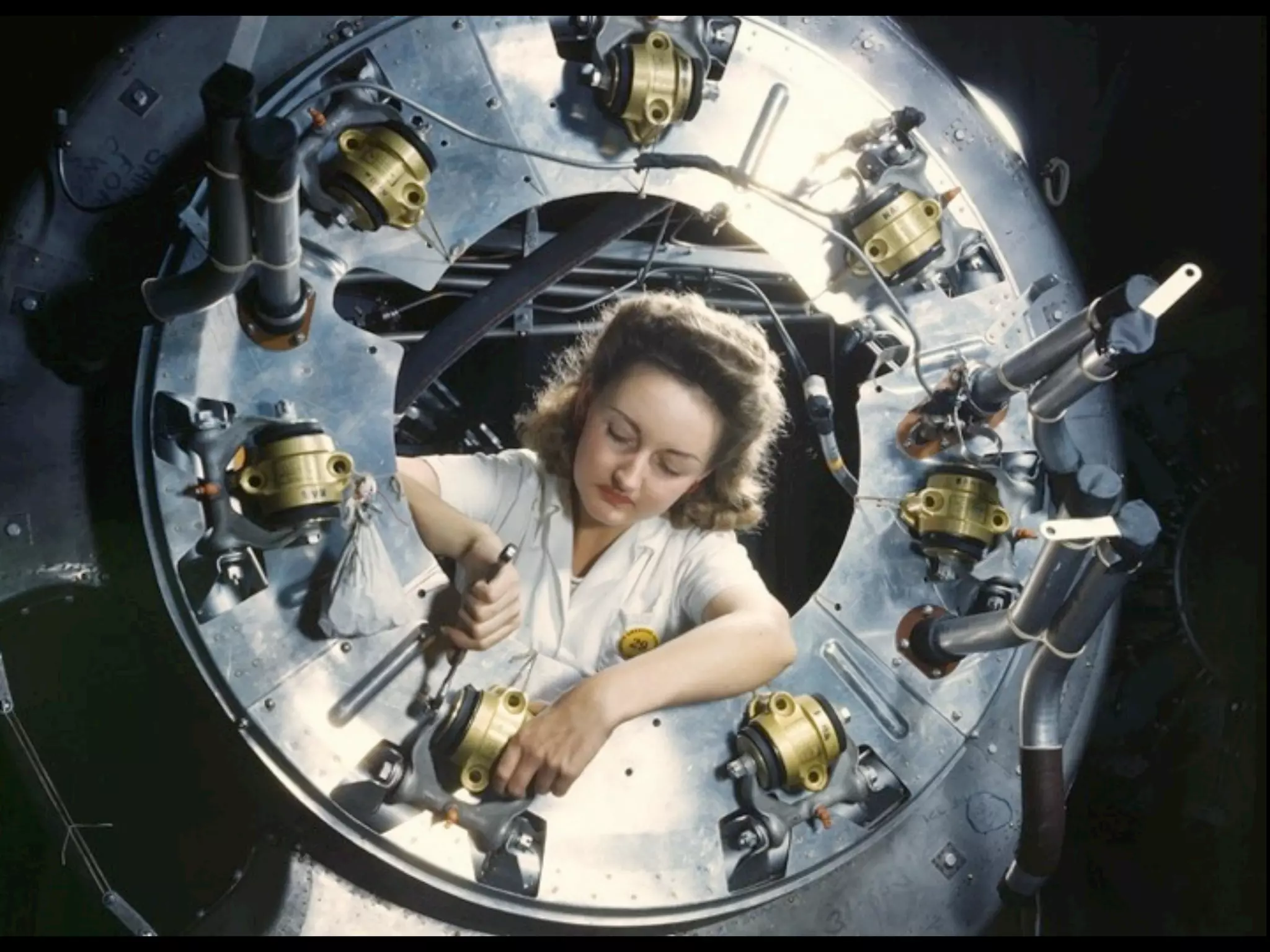
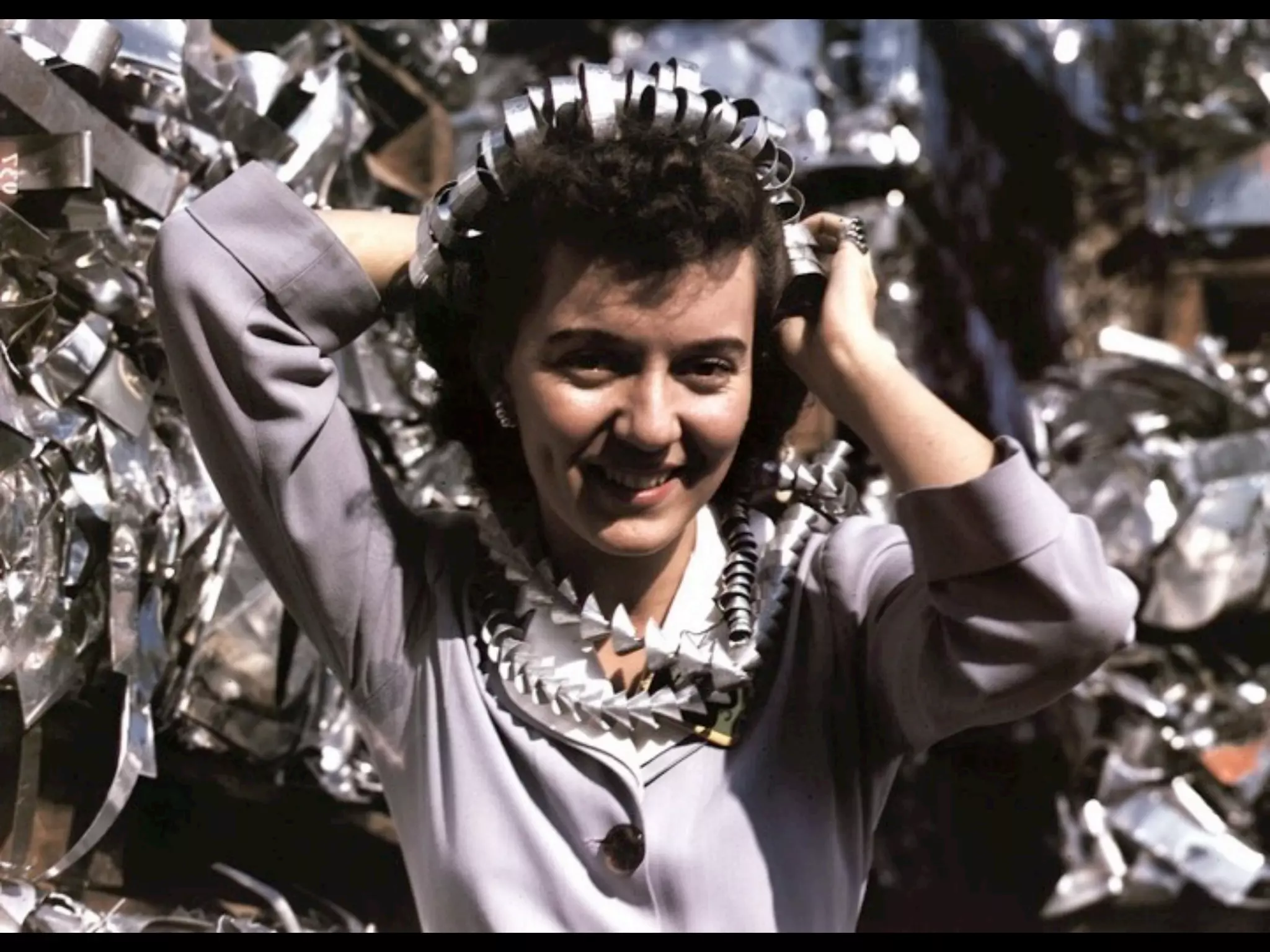
  • #9 When you use requirements, you create a dynamic that limits creativity and learning. There are times when you want this. You don’t want people to be “creative” when they are assembling an airplane, for example. But there are also times when you want to encourage creative problem solving.\n\n\n
  • #10 The problem is, how do you create appropriate constraints on creative problem solving?\n\nDesigners are used to making things in a kind of intuitive way, then putting them in the world and seeing what happens. I think if this as kind of throwing a pebble in a pond and watching the ripples. This is fine, but it’s not an easy process to follow in agile teams, because this kind of intuitive design is hard for teams to participate in. It’s very internal. And just to be clear, I think this an important design technique--a solo designer following his or her intuition. But it’s just not very conducive to agile teams.\n\n
  • #11 \n
  • #12 \n
  • #13 \n
  • #14 James Stephens (February 9, 1882–December 26, 1950) was an Irish novelist and poet.\nJames Stephens wrote many retellings of Irish myths and fairy tales. His retellings are marked by a rare combination of humor and lyricism (Deirdre, and Irish Fairy Tales are often singled out for praise). He also wrote several original novels (Crock of Gold, Etched in Moonlight, Demi-Gods) loosely based on Irish fairy tales. "Crock of Gold," in particular, achieved enduring popularity and was frequently reprinted throughout the author's lifetime.\n\n
  • #15 Albert Szent-Györgyi de Nagyrápolt (Hungarian: Nagyrápolti Szent-Györgyi Albert [ˈnɒɟraːpolti ˈsɛntˌɟørɟi ˈɒlbɛrt]; September 16, 1893 – October 22, 1986) was a Hungarian physiologist who won theNobel Prize in Physiology or Medicine in 1937.[1] He is credited with discovering vitamin C and the components and reactions of the citric acid cycle. He was also active in the Hungarian Resistance during World War II and entered Hungarian politics after the war.\n\n
  • #16 Making progress on features is false progress. In the Lean Startup model, the measure of progress is validated learning. In other words--proving your hypotheses. \n
  • #17 \n
  • #18 \n
  • #19 \n
  • #20 \n
  • #21 \n
  • #22 \n
  • #23 \n
  • #24 \n
  • #25 \n
  • #26 \n
  • #27 \n
  • #28 \n
  • #29 \n
  • #30 \n
  • #31 \n
  • #32 \n
  • #33 \n
  • #34 \n
  • #35 \n
  • #36 \n
  • #37 \n
  • #38 \n
  • #39 \n
  • #40 \n
  • #41 \n
  • #42 \n
  • #43 \n
  • #44 \n
  • #45 \n
  • #46 \n
  • #47 \n
  • #48 \n
  • #49 \n
  • #50 \n
  • #51 \n
  • #52 \n
  • #53 \n
  • #54 \n
  • #55 \n
  • #56 \n
  • #57 \n
  • #58 \n
  • #59 \n
  • #60 \n
  • #61 \n
  • #62 \n
  • #63 \n
  • #64 \n
  • #65 \n
  • #66 \n
  • #67 \n
  • #68 \n
  • #69 \n
  • #70 \n
  • #71 \n
  • #72 \n