
CFSC FARM BILL Virtual Listening SessionFebruary 22, 2011 4:00 – 5:00pm EST
  Today’s SpeakersAndy FisherExecutive Director Kathy MulveyPolicy DirectorMegan LottAssociate Policy Director
AgendaFarm Bill OverviewThe Farm Bill and Community Food SecurityPotential Areas of Action for CFSC in Upcoming Farm BillNext Steps in CFSC Farm Bill Platform Development ProcessParticipant Survey
What is the Farm Bill? Primary piece of agriculture and food policy legislationReauthorized roughly every 5 yearsAccording to the Congressional Research Service, the first Farm Bill was the Food and Agriculture Act of 1965 However, some historians say the first Farm Bill was adopted in 1933
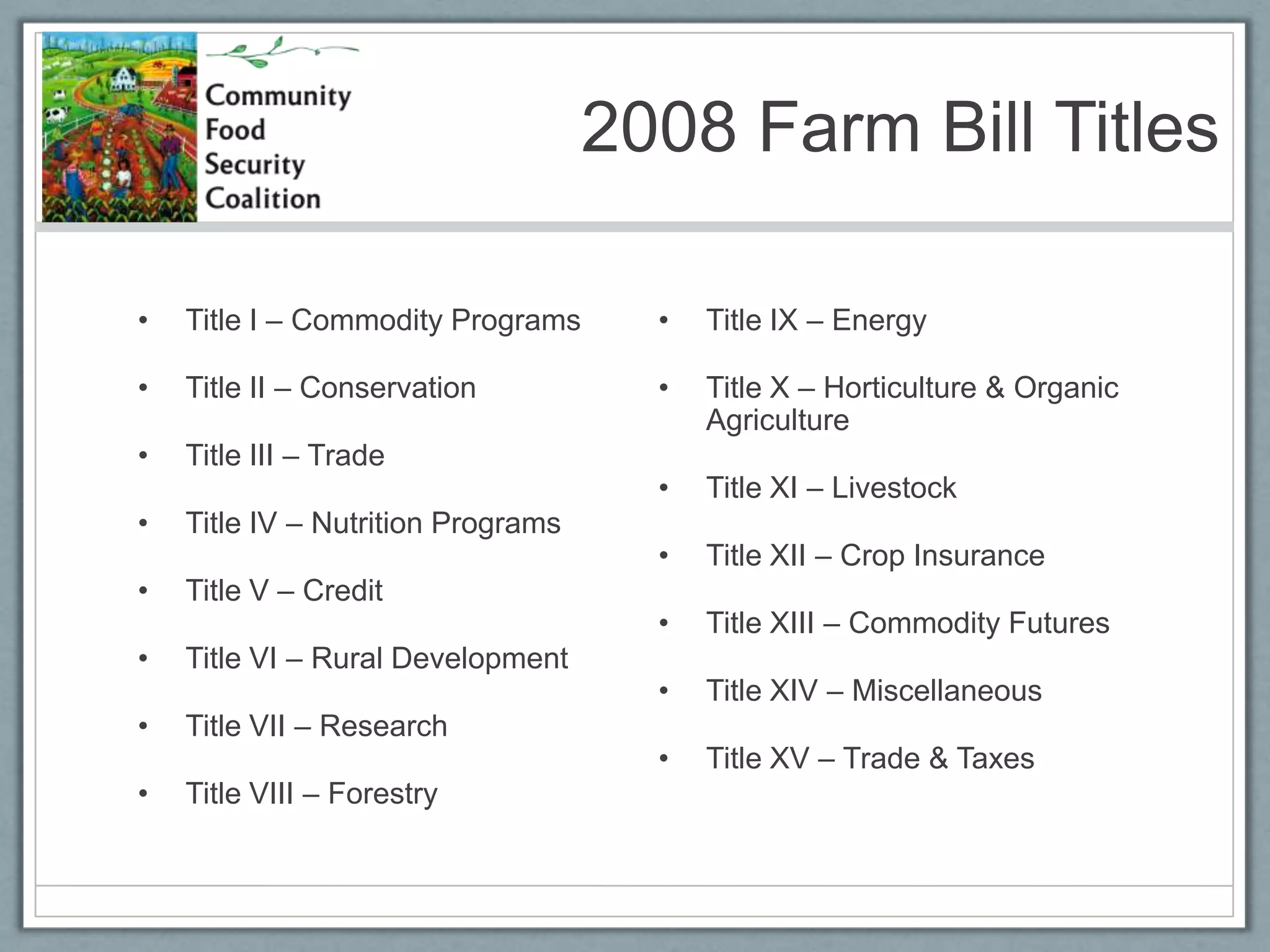
2008 Farm Bill TitlesTitle I – Commodity ProgramsTitle II – ConservationTitle III – TradeTitle IV – Nutrition ProgramsTitle V – CreditTitle VI – Rural DevelopmentTitle VII – ResearchTitle VIII – ForestryTitle IX – EnergyTitle X – Horticulture & Organic AgricultureTitle XI – LivestockTitle XII – Crop InsuranceTitle XIII – Commodity FuturesTitle XIV – MiscellaneousTitle XV – Trade & Taxes
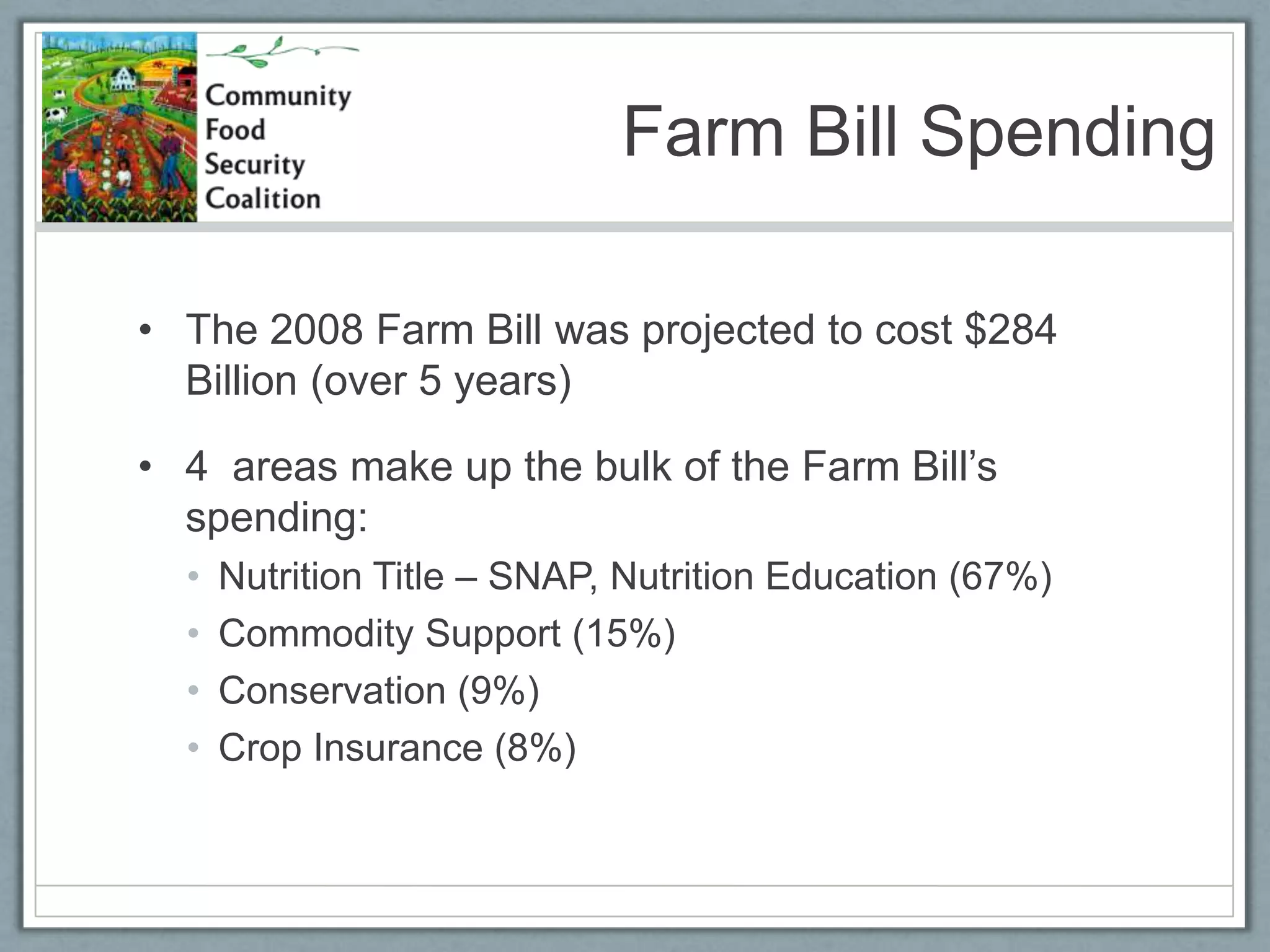
Farm Bill SpendingThe 2008 Farm Bill was projected to cost $284 Billion (over 5 years)
4  areas make up the bulk of the Farm Bill’s spending:
Nutrition Title – SNAP, Nutrition Education (67%)
Commodity Support (15%)
Conservation (9%)
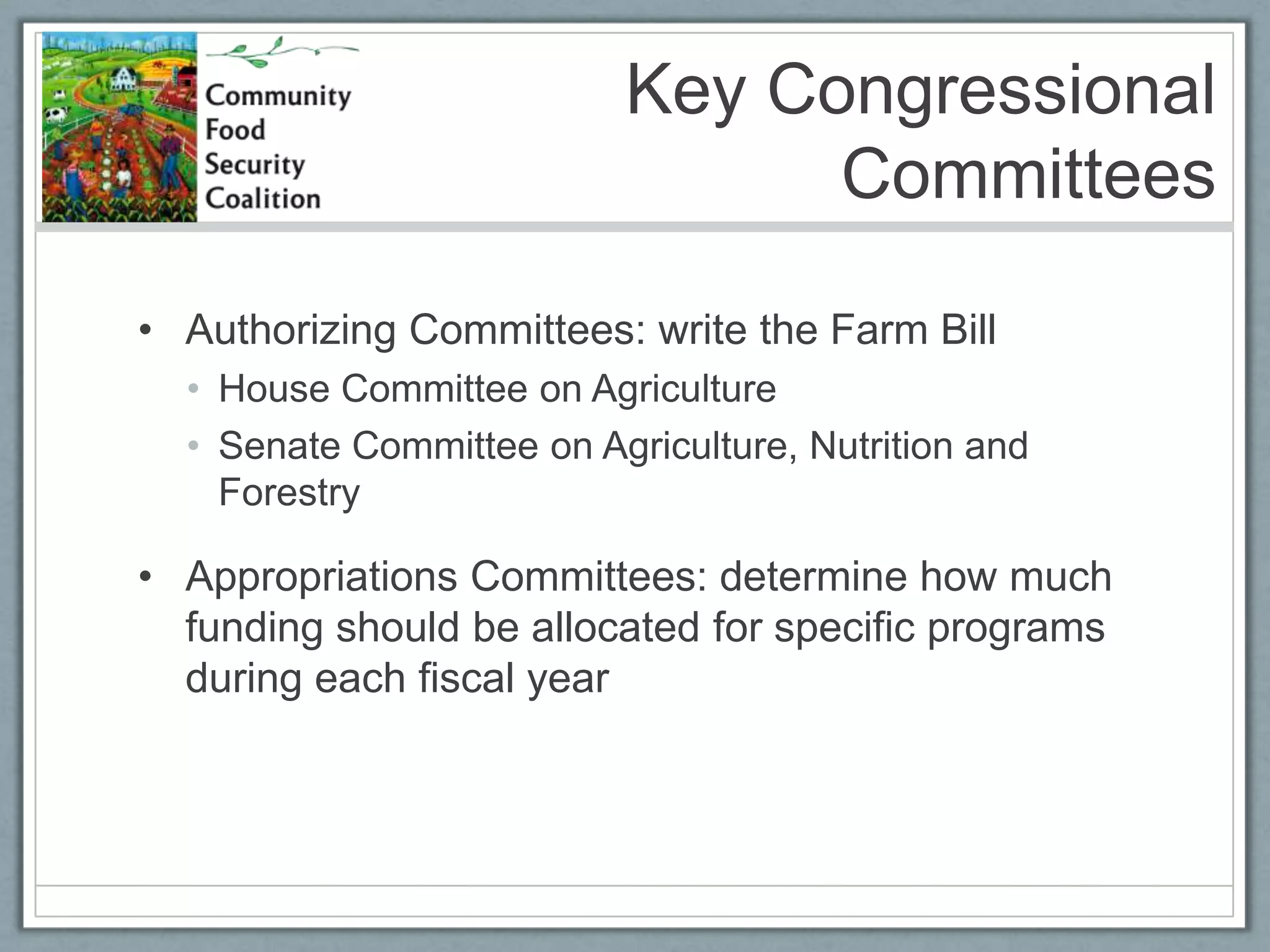
Crop Insurance (8%)Key Congressional CommitteesAuthorizing Committees: write the Farm BillHouse Committee on AgricultureSenate Committee on Agriculture, Nutrition and ForestryAppropriations Committees: determine how much funding should be allocated for specific programs during each fiscal year
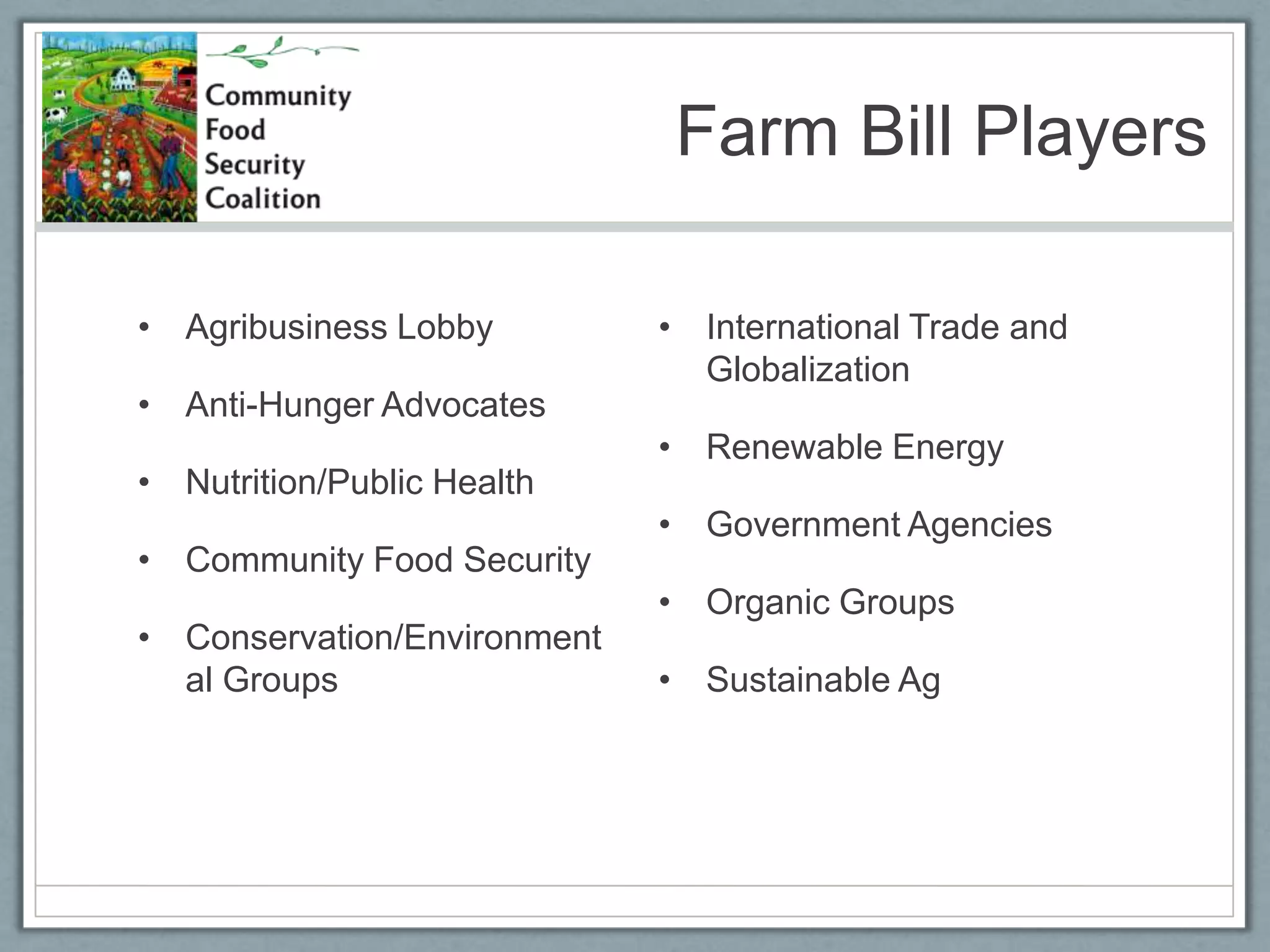
Farm Bill PlayersAgribusiness Lobby Anti-Hunger AdvocatesNutrition/Public HealthCommunity Food SecurityConservation/Environmental GroupsInternational Trade and GlobalizationRenewable EnergyGovernment AgenciesOrganic Groups Sustainable Ag
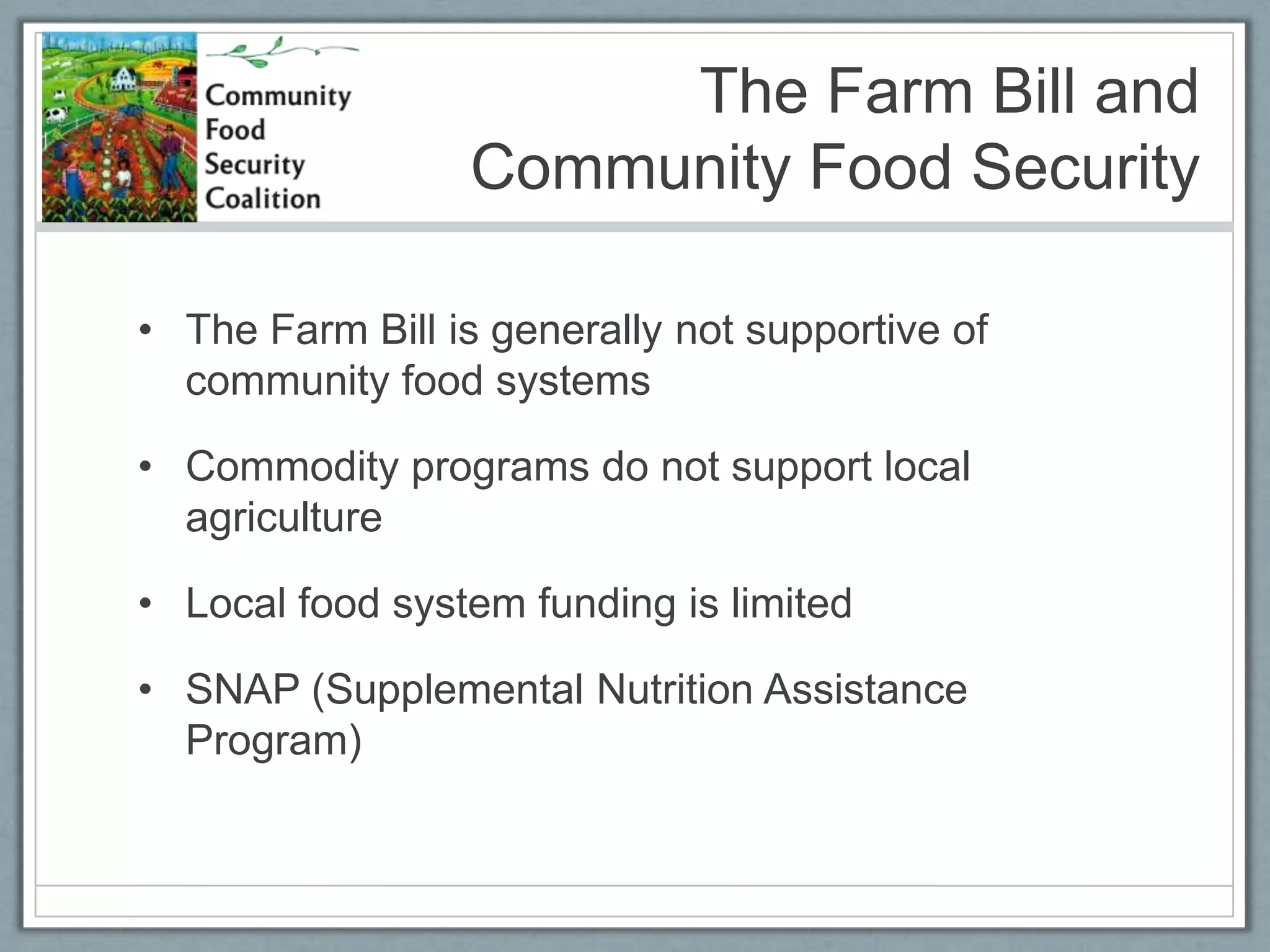
The Farm Bill and Community Food SecurityThe Farm Bill is generally not supportive of community food systemsCommodity programs do not support local agricultureLocal food system funding is limitedSNAP (Supplemental Nutrition Assistance Program)
History of CFSC Involvement in Farm BillsCFSC was founded upon the 1996 Farm BillSeveral folks, including Mark Winne, Andy Fisher, and Bob Gottlieb had a meeting in LA Community Food Security Empowerment ActSince the 1996 Farm Bill, the breadth of issues CFSC has worked on has grown significantly
Farm Bill Issues CFSC has worked on Historically Community Food Projects Farmers MarketsLocal PurchasingHealthy Food AccessNutrition Title Programs  
2012 Farm BillTimeline:House and Senate Ag Committees both have new leadership and new members2011 – Education and Budget negotiations2012 – Farm Bill? How will the federal budget deficit affect the Farm Bill? Little money available for increased spendingAll programs are on the table for budget cuts
So, what does that mean for us? CFSC conducting listening sessions around the country during February and early MarchWe will synthesize this input to develop our draft policy priorities for the upcoming Farm BillThere will be additional opportunities for feedback over the next few monthsTarget: platform ready by July
CFSC Farm BillListening Sessions12 in-person listening sessions across the country, organized in collaboration with local hostsRoughly 500 participantsMost have not worked on a Farm Bill beforeCommon template for all sessions, in-person and virtual
Potential Areas of Action for CFSC in 2012 Farm BillCommunity Food ProjectsLocal Food InfrastructureUrban/Community-Based AgricultureSNAP  (base benefits)Linking SNAP to local and Healthy FoodsFood Access/Food DesertsDirect Marketing/Farmers MarketsFood Policy CouncilsFarm to SchoolOther?
Community Food ProjectsCFSC helped get CFP started in the 1996 Farm Bill and we have been the primary champion ever sinceCurrently receives $5 million per year in mandatory fundingExamples of types of projects funded include: Farm to School, local food processing, community food assessments, and marketing of locally grown food. More examples can be found on our website: 	http://foodsecurity.org/funding.html#samples
Local Food InfrastructureImportant for building regional and local food systems and for reviving local economiesExamples include canneries, slaughterhouses, brokers, transportation, etc. Several existing USDA programs could be enhanced to include these types of projects, or new programs could be created
Urban/Community-based  AgricultureCurrent efforts range from entrepreneurial to backyard gardensThere is currently not any dedicated funding for urban agriculture in the USDA budgetInterest has grown tremendously over the past several years
SNAPSNAP (formerly Food Stamps) is an entitlement programBoost from Thrifty Food Plan to Value Food PlanMay need to focus on restoring cuts – this has come up multiple times during the budget debate as a place to get additional funding
Linking SNAP to local and healthy foods Incentives for the purchase of fruits and vegetablesPossibility to connect a portion of SNAP benefits to community food enterprisesHealthy Incentives Pilot (HIP) from the 2008 Farm Bill – will be getting underway in MA this year
Food Access/Food DesertsSince the last Farm Bill, there has been an increased interest in Food DesertsIn 2009 the Administration set a goal to eliminate Food Deserts within 7 yearsAccess to healthy foods is one of the 4 pillars of the Let’s Move Campaign
Direct Marketing and Farmers’ MarketsUSDA has a history of promoting farmers markets and direct marketingOpportunity to enhance existing efforts through Senior FMNP, FMPPCFSC and the Farmers Market Coalition recently published a report on connecting SNAP recipients with farmers markets: Real Food, Real Choice
Food Policy CouncilsCurrently there is no dedicated source of funds for local food policy councils However, USDA has taken an interest in themPerhaps a competitive pot of funds would stimulate their development or technical assistance could be provided
Farm to SchoolThere are now Farm to School programs in all 50 statesWe had a major win in Child Nutrition Reauthorization – $5 million per year for a new Competitive Grants Program Opportunity to expand on this win in Farm Bill
Now, this is where YOU come in! TAKE OUR SURVEY! Based on your own experience in your community, state or region, and what you know about CFSC and our past Farm Bill successes, pick 3 areas you think it would be most important for CFSC to focus on in the upcoming Farm Bill.For each of these areas, consider the question: “What actions or changes would facilitate progress at the local, state, and/or national level?”
Survey LinkThe Survey will remain open until 11:59 PM EST on Tuesday, March 1st. A link to the survey will be emailed to you following this webinar. If you don’t receive an email, you can find a link to the survey and to the archived webinar on our website at (under 2012 Farm Bill): 	http://foodsecurity.org/policy.html#materials

2012 Farm Bill listening session

  • 1.
    CFSC FARM BILLVirtual Listening SessionFebruary 22, 2011 4:00 – 5:00pm EST
  • 2.
    Today’sSpeakersAndy FisherExecutive Director Kathy MulveyPolicy DirectorMegan LottAssociate Policy Director
  • 3.
    AgendaFarm Bill OverviewTheFarm Bill and Community Food SecurityPotential Areas of Action for CFSC in Upcoming Farm BillNext Steps in CFSC Farm Bill Platform Development ProcessParticipant Survey
  • 4.
    What is theFarm Bill? Primary piece of agriculture and food policy legislationReauthorized roughly every 5 yearsAccording to the Congressional Research Service, the first Farm Bill was the Food and Agriculture Act of 1965 However, some historians say the first Farm Bill was adopted in 1933
  • 5.
    2008 Farm BillTitlesTitle I – Commodity ProgramsTitle II – ConservationTitle III – TradeTitle IV – Nutrition ProgramsTitle V – CreditTitle VI – Rural DevelopmentTitle VII – ResearchTitle VIII – ForestryTitle IX – EnergyTitle X – Horticulture & Organic AgricultureTitle XI – LivestockTitle XII – Crop InsuranceTitle XIII – Commodity FuturesTitle XIV – MiscellaneousTitle XV – Trade & Taxes
  • 6.
    Farm Bill SpendingThe2008 Farm Bill was projected to cost $284 Billion (over 5 years)
  • 7.
    4 areasmake up the bulk of the Farm Bill’s spending:
  • 8.
    Nutrition Title –SNAP, Nutrition Education (67%)
  • 9.
  • 10.
  • 11.
    Crop Insurance (8%)KeyCongressional CommitteesAuthorizing Committees: write the Farm BillHouse Committee on AgricultureSenate Committee on Agriculture, Nutrition and ForestryAppropriations Committees: determine how much funding should be allocated for specific programs during each fiscal year
  • 12.
    Farm Bill PlayersAgribusinessLobby Anti-Hunger AdvocatesNutrition/Public HealthCommunity Food SecurityConservation/Environmental GroupsInternational Trade and GlobalizationRenewable EnergyGovernment AgenciesOrganic Groups Sustainable Ag
  • 13.
    The Farm Billand Community Food SecurityThe Farm Bill is generally not supportive of community food systemsCommodity programs do not support local agricultureLocal food system funding is limitedSNAP (Supplemental Nutrition Assistance Program)
  • 14.
    History of CFSCInvolvement in Farm BillsCFSC was founded upon the 1996 Farm BillSeveral folks, including Mark Winne, Andy Fisher, and Bob Gottlieb had a meeting in LA Community Food Security Empowerment ActSince the 1996 Farm Bill, the breadth of issues CFSC has worked on has grown significantly
  • 15.
    Farm Bill IssuesCFSC has worked on Historically Community Food Projects Farmers MarketsLocal PurchasingHealthy Food AccessNutrition Title Programs  
  • 16.
    2012 Farm BillTimeline:Houseand Senate Ag Committees both have new leadership and new members2011 – Education and Budget negotiations2012 – Farm Bill? How will the federal budget deficit affect the Farm Bill? Little money available for increased spendingAll programs are on the table for budget cuts
  • 17.
    So, what doesthat mean for us? CFSC conducting listening sessions around the country during February and early MarchWe will synthesize this input to develop our draft policy priorities for the upcoming Farm BillThere will be additional opportunities for feedback over the next few monthsTarget: platform ready by July
  • 18.
    CFSC Farm BillListeningSessions12 in-person listening sessions across the country, organized in collaboration with local hostsRoughly 500 participantsMost have not worked on a Farm Bill beforeCommon template for all sessions, in-person and virtual
  • 19.
    Potential Areas ofAction for CFSC in 2012 Farm BillCommunity Food ProjectsLocal Food InfrastructureUrban/Community-Based AgricultureSNAP (base benefits)Linking SNAP to local and Healthy FoodsFood Access/Food DesertsDirect Marketing/Farmers MarketsFood Policy CouncilsFarm to SchoolOther?
  • 20.
    Community Food ProjectsCFSChelped get CFP started in the 1996 Farm Bill and we have been the primary champion ever sinceCurrently receives $5 million per year in mandatory fundingExamples of types of projects funded include: Farm to School, local food processing, community food assessments, and marketing of locally grown food. More examples can be found on our website: http://foodsecurity.org/funding.html#samples
  • 21.
    Local Food InfrastructureImportantfor building regional and local food systems and for reviving local economiesExamples include canneries, slaughterhouses, brokers, transportation, etc. Several existing USDA programs could be enhanced to include these types of projects, or new programs could be created
  • 22.
    Urban/Community-based AgricultureCurrentefforts range from entrepreneurial to backyard gardensThere is currently not any dedicated funding for urban agriculture in the USDA budgetInterest has grown tremendously over the past several years
  • 23.
    SNAPSNAP (formerly FoodStamps) is an entitlement programBoost from Thrifty Food Plan to Value Food PlanMay need to focus on restoring cuts – this has come up multiple times during the budget debate as a place to get additional funding
  • 24.
    Linking SNAP tolocal and healthy foods Incentives for the purchase of fruits and vegetablesPossibility to connect a portion of SNAP benefits to community food enterprisesHealthy Incentives Pilot (HIP) from the 2008 Farm Bill – will be getting underway in MA this year
  • 25.
    Food Access/Food DesertsSincethe last Farm Bill, there has been an increased interest in Food DesertsIn 2009 the Administration set a goal to eliminate Food Deserts within 7 yearsAccess to healthy foods is one of the 4 pillars of the Let’s Move Campaign
  • 26.
    Direct Marketing andFarmers’ MarketsUSDA has a history of promoting farmers markets and direct marketingOpportunity to enhance existing efforts through Senior FMNP, FMPPCFSC and the Farmers Market Coalition recently published a report on connecting SNAP recipients with farmers markets: Real Food, Real Choice
  • 27.
    Food Policy CouncilsCurrentlythere is no dedicated source of funds for local food policy councils However, USDA has taken an interest in themPerhaps a competitive pot of funds would stimulate their development or technical assistance could be provided
  • 28.
    Farm to SchoolThereare now Farm to School programs in all 50 statesWe had a major win in Child Nutrition Reauthorization – $5 million per year for a new Competitive Grants Program Opportunity to expand on this win in Farm Bill
  • 29.
    Now, this iswhere YOU come in! TAKE OUR SURVEY! Based on your own experience in your community, state or region, and what you know about CFSC and our past Farm Bill successes, pick 3 areas you think it would be most important for CFSC to focus on in the upcoming Farm Bill.For each of these areas, consider the question: “What actions or changes would facilitate progress at the local, state, and/or national level?”
  • 30.
    Survey LinkThe Surveywill remain open until 11:59 PM EST on Tuesday, March 1st. A link to the survey will be emailed to you following this webinar. If you don’t receive an email, you can find a link to the survey and to the archived webinar on our website at (under 2012 Farm Bill): http://foodsecurity.org/policy.html#materials
  • 31.
    Next StepsPhase I:Broad and deep input-gathering; monitoring & analyzing Congressional contextPhase II: Synthesizing proposed priorities & vetting with partnersPhase III: Laying the groundwork for advocacy & mobilization
  • 32.
    Take ActionNot yeta CFSC Member? Contact Emily Becker at emily@foodsecurity.org to join! Interested in staying updated on our progress? Subscribe to our bi-monthly policy updates on our website: http://www.foodsecurity.org/policy.htmlJoin the CFSC Policy Committee: Email Megan Lott at megan@foodsecurity.orgCome to the Food Policy Conference, May 19-21:Go to www.foodpolicyconference.org for details and to register
  • 33.
    Questions? A recordingof this webinar will be archivedon the CFSC website at www.foodsecurity.org
  • 34.
    THANK YOU Thiswebinar will be archived on the CFSC website at www.foodsecurity.org

Editor's Notes

  • #5 The Farm Bill is now one of the most — if not the most — significant forces affecting food, farming, and land-use in the United States. To a large extent, the Farm Bill determines what sort of foods we Americans eat (and how they taste and how much they cost), which crops are grown under what conditions, and, ultimately, whether we’re properly nourished or not. Some people note the farm bill as dating back to the 1930’s beginning with the Agricultural Adjustment Act of 1933 - originally conceived as an emergency bailout for millions of farmers and unemployed during the dark times of the Dust Bowl and Great Depression  
  • #6 Many people know the Farm Bill as having two primary thrusts: (1) Food stamps and nutrition programs; and (2) income and price supports for a number of storable commodity crops. In addition, the Farm Bill funds a range of other program “titles,” including conservation and environment, forestry, renewable energy, research, and rural development.The number of titles in Farm Bills changes often with each Farm Bill; in 2008 there were 15Miscellaneous – provisions for socially disadvantaged and limited-resource producers (civil rights); Agricultural Security (disaster aid - ag biosecurity planning, preparedness, and response); regional infrastructure and economic development; domestic food assistance programs (section 32 funds); animal health and welfare
  • #7 The mandatory spending laid out in the 2008 Farm Bill was projected to be $284 billion, an unfathomably large sum that’s actually less than one percent of the federal budget.67% + 15% + 9% + 8% = 99%CRS Report Data states that this totals 97% (not 99%)
  • #9 There are many competing interests in a Farm Bill debate/reauthorization
  • #10 Limited local food system funding FMPP – farmers market promotion promoting CFP – Community Food Projects VAPG – Value Added Producer Grants HUFED – Healthy Urban Food Enterprise Development Center FMNP – Farmers Market Nutrition Program
  • #12 Community Food Projects: $5 million (in mandatory money) for fiscal year 2008 and each year after, making it a permanent program.-- Brown booklet – explains past projects funded under CFPFarmers Markets:-- Senior Farmers Market Nutrition Program: $20.6 million per year (mandatory) for fresh fruits and vegetable vouchers to low-income seniors that can be used at participating farmers? markets, roadside stands and community supported agriculture subscriptions, worth $10-$100 annually per recipient.-- Farmers' Market Promotion Program: $33 million (mandatory) over 5 years to provide competitive grants of up to $75,000 to promote farmers' markets and other direct marketing ventures. Local Purchasing: -- Geographic preference: Allows K-12 schools receiving federal funds for the school lunch program the flexibility to specify a geographic preference for the procurement of unprocessed agricultural products. -- Fresh Fruit and Vegetable Snack Program: $500 million (mandatory) over five years for selected schools to purchase at least one daily fresh fruit or vegetable snack. The program will focus on low-income school districts, and allocates 1% of funding total funding to each state and the District of Columbia with additional funding allocated by relative state population. Schools can preference local products.-- Financing for Local Food Enterprises: Provides 5% of funds (approx. $50 million annually) in loan guarantees for businesses in rural areas involved in local food distribution and marketing to secure private-secure loans backed by a USDA loan guarantee through the Rural Business and Industries Loan and Loan Guarantee program.Healthy Food Access: -- Healthy Urban Food Enterprise Development Center: Establishes a competitive grant program for producers, small businesses, and non-profits to apply for outreach, technical assistance, and feasibility study grants to support the development of enterprises which distribute and market healthy and locally produced foods to undeserved urban, rural, and tribal communities. $3 million total (mandatory) over 3 years.-USDA "Food Desert" Study: $500,000 in discretionary funding for a one-year USDA-led study on the incidence of "food deserts," or areas with limited healthy and fresh food retail access and identify strategies which can reduce their incidence.Food Assistance Programs: Improve existing nutrition title programs to promote healthy foods and communities. -- Food Stamp Nutrition Education: State agencies may implement a nutrition education program for individuals eligible for program benefits that promotes healthy food choices consistent with the most recent Dietary Guidelines for Americans, and may deliver nutrition education directly to eligible persons or through agreements with the National Institute of Food and Agriculture, including through the expanded food and nutrition education program.-- Emergency Food Assistance Program (TEFAP): Provides the following funding to purchase commodities for emergency food assistance: $190 million for FY 2008, $250 million for FY 2009, and for FY 2010-2012 the program will be increased by the percentage the thrifty food plan is increased. TEFAP will have up to $100 million in discretionary funds for administrative, distribution, and storage costs.-- The Congressional Hunger Center: Our friends at the Congressional Hunger Center are authorized with discretionary funds.
  • #13 Current political contextHouse & Senate Ag CommitteesNew Republican leadership on House side: Chair Frank Lucas of OK, known as a supporter of commodity crops16 of 26 Republican House Ag Committee members are freshmen—lots of educationSeveral new House Democrats are from districts that are not traditionally agricultural, some urban members, including Jim McGovern, chair of House Anti-Hunger CaucusOn the Senate side, new Ag Committee Chair Debbie Stabenow (MI) is a known champion of specialty cropsBoth Committee chairs (House and Sen) have said they would like to have a Farm Bill signed by the President prior to the 2012 elections Budget pressureFederal budget deficit will impact the bill – there is little money available for increased spending and it is likely budget reconciliation will happen at some point, which would require mandatory spending cuts across the boardSeveral key programs that our allies have fought hard for over the years have no baseline after 2012All is vulnerable – and all is on the table when it comes to cuts – including our priorities  Budget: May undergo reconciliation in 2011 (A reconciliation instruction (Budget Reconciliation) is a provision in a budget resolution directing one or more committees to submit legislation changing existing law in order to bring spending, revenues, or the debt-limit into conformity with the budget resolution. The instructions specify the committees to which they apply, indicate the appropriate dollar changes to be achieved, and usually provide a deadline by which the legislation is to be reported or submitted.)2012 is an election year – unlikely much of anything will get doneNo new money will be availableWill likely be fighting to keep funding for existing programs especially if reconciliation does occur
  • #14 Outline Priority setting process for CFSC - where we are in this processWe are taking the time to do this right – get the necessary feedback from people doing this out in the field; gain a sense of what our members see as priorities for our time and resources
  • #15 Outline Priority setting process for CFSC - where we are in this processWe are taking the time to do this right – get the necessary feedback from people doing this out in the field; gain a sense of what our members see as priorities for our time and resources
  • #16 We have identified 9 potential areas of action that we [CFSC] think could gain some traction in the 2012 Farm Bill. Potential Areas of Action by CFSC 1. Urban agriculture- There is not any dedicated funding for urban agriculture- community gardening or entrepreneurial efforts. Community Food Projects is the sole source. Otherwise urban ag falls in the cracks, as most ag programs are dedicated to rural efforts. 2. Community Food Projects CFSC has championed CFP since its inception in 1996. It is at $5 million currently, and could be increased to meet and to stimulate demand. 3. Local food infrastructureCommunity canneries, packing houses, brokers, transportation, slaughterhouse are all needed to revive the regional food economy. USDA programs such as RBEG, RBOG, HUFED, Value-Added Producer grants, etc can be beefed up, or perhaps new programs need to be created. 4. Food StampsFood stamps need a permanent boost to the Value Food Plan instead of the Thrifty Food Plan. This would be a giant step in reducing hunger. 5. Link food stamps to local and healthy foods Food stamps, as a nutrition program, should be linked to nutritious foods. This could take the form of incentives for purchases of fruits and veggies, or connecting a portion of food stamp benefits to community food enterprises, such as farmers markets, CSA, green carts, etc. 6. Food access/food desertsCreate incentives for grocery stores to locate in underserved communities, or corner stores to carry a selection of healthier items. The Fresh Food Financing Initiative is an example of unlegislated policy that could be expanded and formalized. 7. Direct marketing/farmers marketsUSDA has a history of promoting farmers markets and direct marketing. This could be continued through the Senior FMNP, the Farmers Market Promotion Program or other avenues. 8. Food Policy CouncilsThere haven’t been any dedicated sources of funds or any government support for local food policy councils. Perhaps a competitive pot of funds would stimulate their development or technical assistance could be provided through Extension.Provide a list of opportunities for people to be involved in the priority setting process - especially at conference - Farm Bill Forum
  • #17 Community Food ProjectsCFSC helped get CFP started in 1996 Farm Bill and has championed it ever since (among advocates)Currently receives $5 million per year (mandatory funding) - Potential for increase in coming Farm BillsExamples – this is the catch-all currently for community food security related programs/projects/efforts direct people to CFSC publications outlining past CFP projects, or USDA websiteRecent Publications: The Activities and Impacts of Community Food Projects, 2005-2009Jeanette Abi-Nader, Michelle Kobayashi, and Lee Tyson, in collaboration with the National Research Center, Inc. October 2010, 28 pages.This report captures the results of five years of data collected from Community Food Project (CFP) grantees using the Common Output Tracking Form (COTF). The COTF has been the only cross-program tool used to measure the work of CFPs. This report highlights the broad reach of CFPs and the impressive results of their work to advance economic and social equity, healthy food access, and environmental stewardship. It builds on the earlier CFSC research report Building Community Food Security, which highlighted best practices of successful CFPs.
  • #18 Local food infrastructureImportant for building regional and local food systemsExamples include canneries, slaughterhouses, and brokerages3. Local food infrastructureCommunity canneries, packing houses, brokers, transportation, slaughterhouse are all needed to revive the regional food economy. USDA programs such as RBEG, RBOG, HUFED, Value-Added Producer grants, etc can be beefed up, or perhaps new programs need to be created. 
  • #19 Urban/community-based agricultureRanges from entrepreneurial efforts to backyard gardens Currently no dedicated funding for urban ag in USDA budget - Tends to fall in the cracks unless it is addressed through Community Food Projects- most USDA programs address rural areas Community Food ProjectsCFSC helped get CFP started in 1996 Farm Bill and has championed it ever sinceCurrently receives $5 million per year (mandatory funding) Potential for increase in coming Farm BillsLocal food infrastructureImportant for building regional and local food systemsExamples include canneries, slaughterhouses, and brokeragesFood stamps/SNAP70% of the Farm Bill budget Potential to prioritize increasing the baselinePotential to raise benefits on a permanent instead of an emergency basis in order to address hungerLinking SNAP to local and healthy foodsArgument that SNAP, as a nutrition program, should be linked to nutritious foodsIncentives for purchase of fruits & vegetablesConnecting a portion of SNAP benefits to community food enterprises (farmers markets, CSAs, etc.)Food access/food desertsEconomic Research Service (ERS) starting to look at thisCongress is considering appropriation for the Healthy Food Financing Initiative (HFFI)Healthy corner stores, etc.Direct marketing/farmers marketsUSDA has history of promoting farmers marketsExamples are promotion programs (WIC, senior FMNP, FMPP)Food Policy Councils (FPCs)Current Ag Secretary Vilsack started Iowa FPCNo dedicated funding for FPCs through USDA except for maybe through Community Food ProjectsPotential to get funding for them or for technical assistance for themRecent hunger free communities grants did instruct that whoever is applying be working with a FPCFarm to SchoolPrograms now in every stateCFSC is co-lead on National Farm to School Network; IATP & LSP regional leadersHealthy, Hunger-Free Kids Act of 2010 mandates $5 million annually in new funding for competitive grants program, available in FY13
  • #20 Food stamps/SNAPPotential to prioritize increasing the baselinePotential to raise benefits on a permanent instead of an emergency basis in order to address hungerRestore cuts from CNR and other spending billsWill there be additional cuts during the budget process? Also have been proposals to cap the program, thus would no longer be an entitlement program
  • #21 Linking SNAP to local and healthy foodsArgument that SNAP, as a nutrition program, should be linked to nutritious foodsIncentives for purchase of fruits & vegetables- existing projects around the country; HIP from last Farm Bill Connecting a portion of SNAP benefits to community food enterprises (farmers markets, CSAs, etc.)
  • #22 Food access/food desertsEconomic Research Service (ERS) starting to look at this – last Farm Bill – Food Desert Study Create incentives for grocery stores to locate in underserved communities, or corner stores to carry a selection of healthier items. Congress is considering appropriation for the Healthy Food Financing Initiative (HFFI) – based of Philly FFFI Healthy corner stores, etc.
  • #23 Direct marketing/farmers marketsUSDA has history of promoting farmers marketsExamples are promotion programs (WIC, senior FMNP, FMPP) USDA has a history of promoting farmers markets and direct marketing. This could be continued through the Senior FMNP, the Farmers Market Promotion Program or other avenues.
  • #24 Food Policy CouncilsThere haven’t been any dedicated sources of funds or any government support for local food policy councils. USDA – requirement for Hunger Free Community Grants Perhaps a competitive pot of funds would stimulate their development or technical assistance could be provided through Extension.Food Policy Councils (FPCs)Current Ag Secretary Vilsack started Iowa FPCNo dedicated funding for FPCs through USDA except for maybe through Community Food ProjectsPotential to get funding for them or for technical assistance for themRecent hunger free communities grants did instruct that whoever is applying be working with a FPC
  • #25 Farm to SchoolPrograms now in every stateCFSC is co-lead on National Farm to School NetworkHealthy, Hunger-Free Kids Act of 2010 mandates $5 million annually in new funding for competitive grants program, available in FY13Opportunity to expand on this win, could be: Geo PrefDoD FreshCash-in-lieu of commoditiesResearchSupport for farmers selling to schools (CNR focuses mainly on the school side)
  • #28 Phase I: through early MarchPhase II: March-AprilPhase III: May-JuneOnce the Survey closes, we will compile all of this information and join together with the feedback from our in-person sessionsWe will then identify common themes and put these into a draft platform for CFSC. We will be looking for further feedback from our members on finalizing this platform.