
The 2012 U.S. Farm Bill:
 History, Problems and
Opportunities for Reform
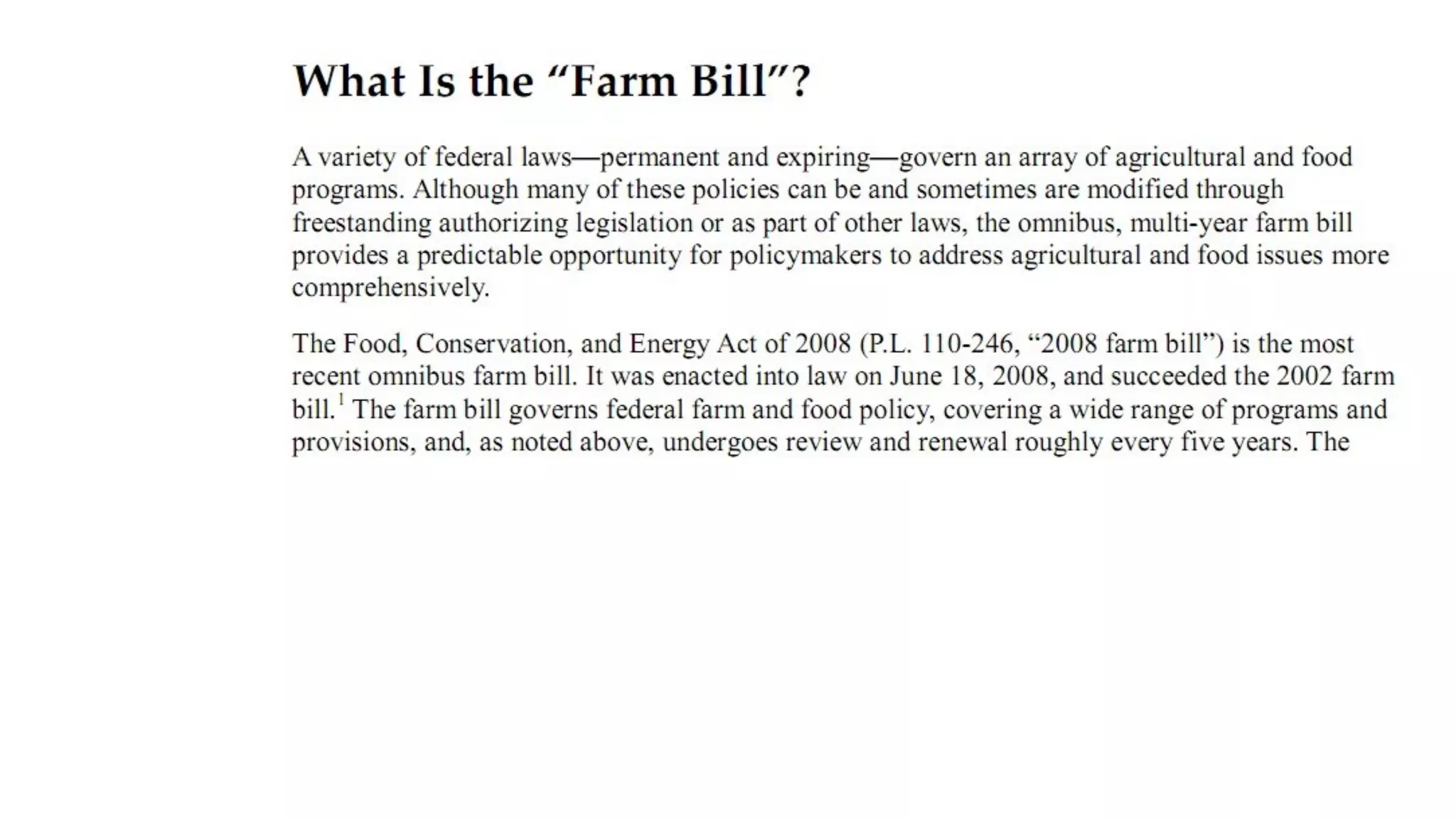
www.nationalaglawcenter.org/assets/crs/RS22131.pdf
www.downsizinggovernment.org/agriculture/food-subsidies
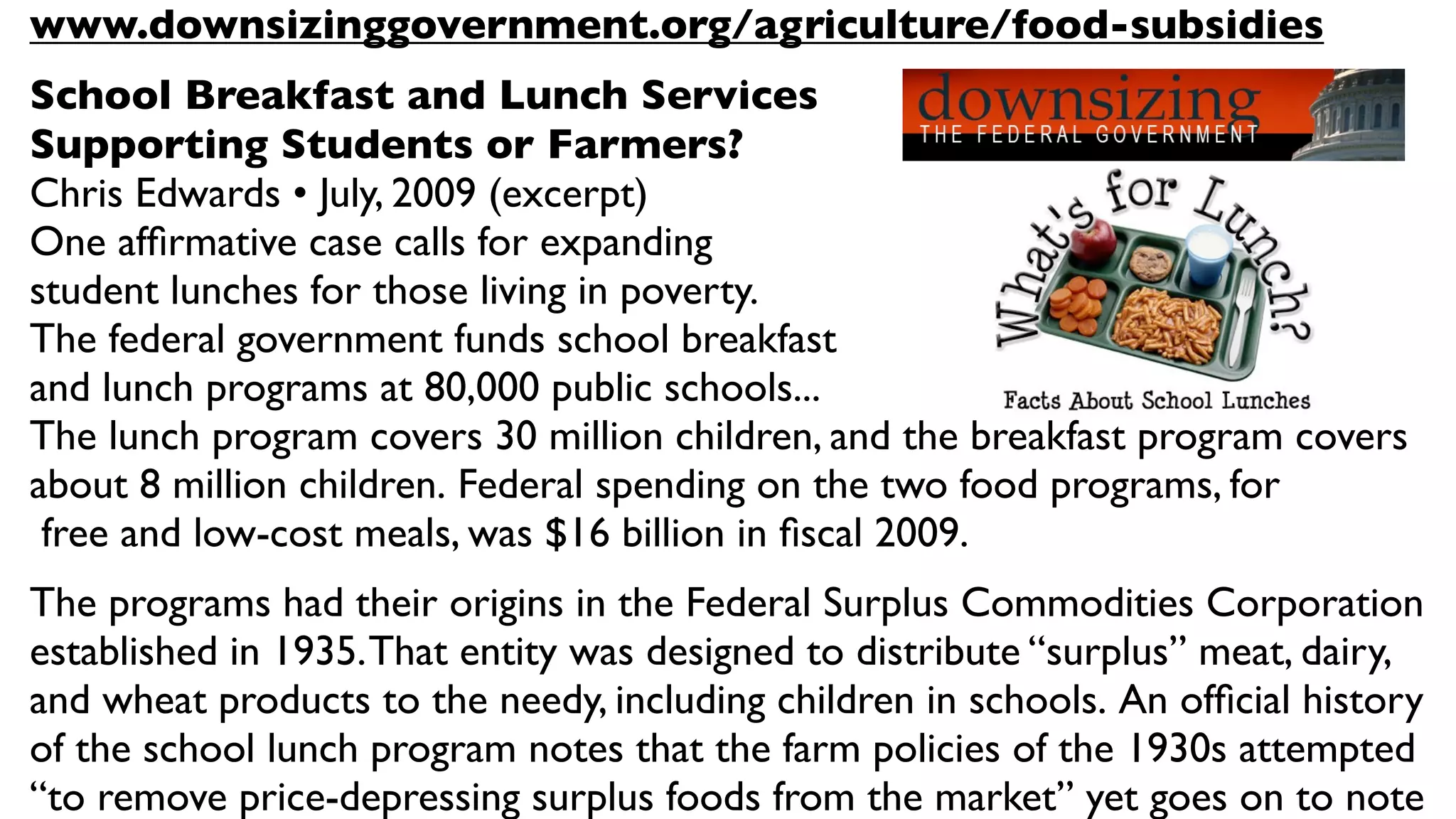
School Breakfast and Lunch Services
Supporting Students or Farmers?
Chris Edwards • July, 2009 (excerpt)
One affirmative case calls for expanding
student lunches for those living in poverty.
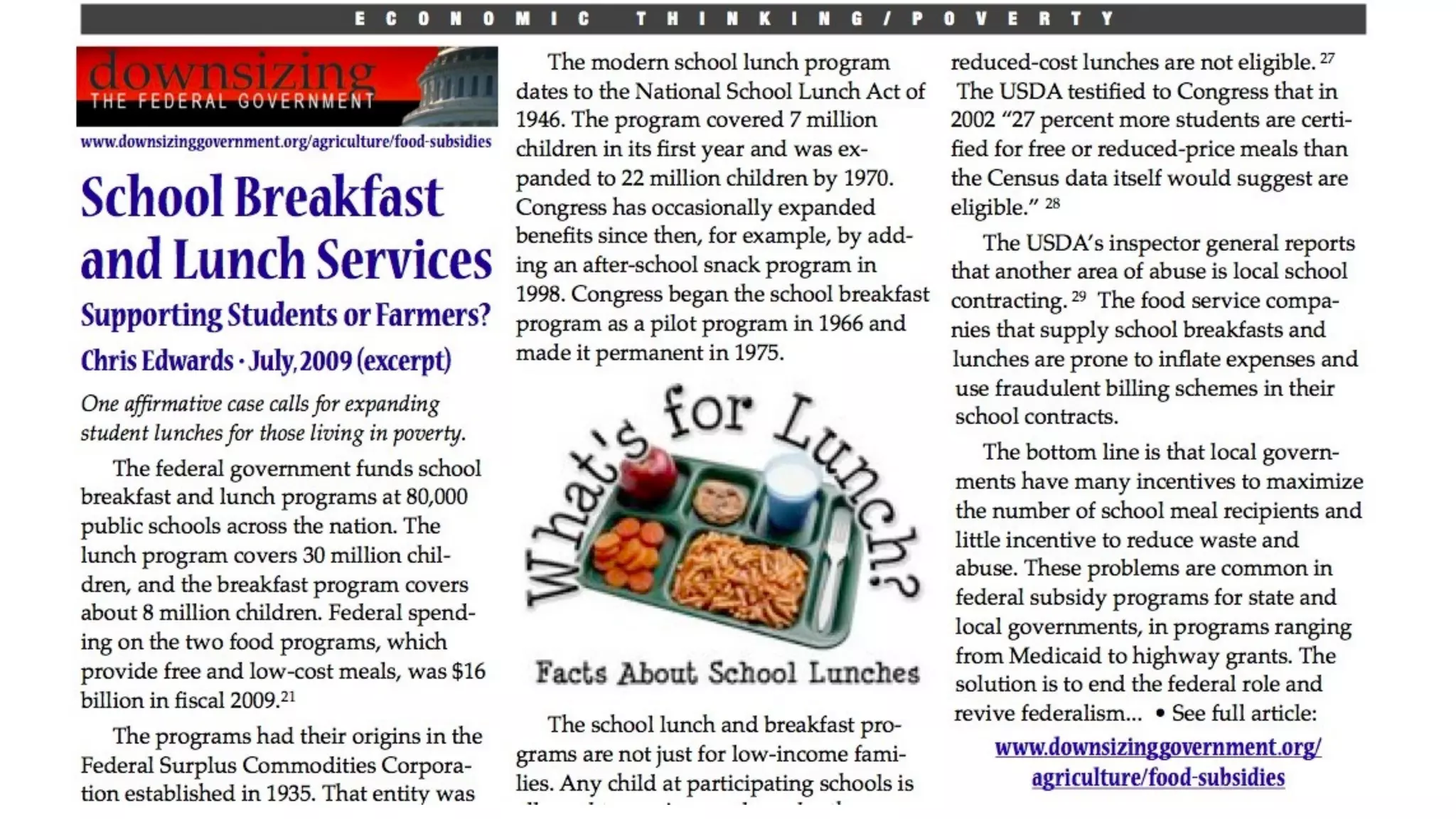
The federal government funds school breakfast
and lunch programs at 80,000 public schools... 
The lunch program covers 30 million children, and the breakfast program covers
about 8 million children. Federal spending on the two food programs, for
 free and low-cost meals, was $16 billion in fiscal 2009.
The programs had their origins in the Federal Surplus Commodities Corporation
established in 1935. That entity was designed to distribute “surplus” meat, dairy,
and wheat products to the needy, including children in schools. An official history
of the school lunch program notes that the farm policies of the 1930s attempted
“to remove price-depressing surplus foods from the market” yet goes on to note
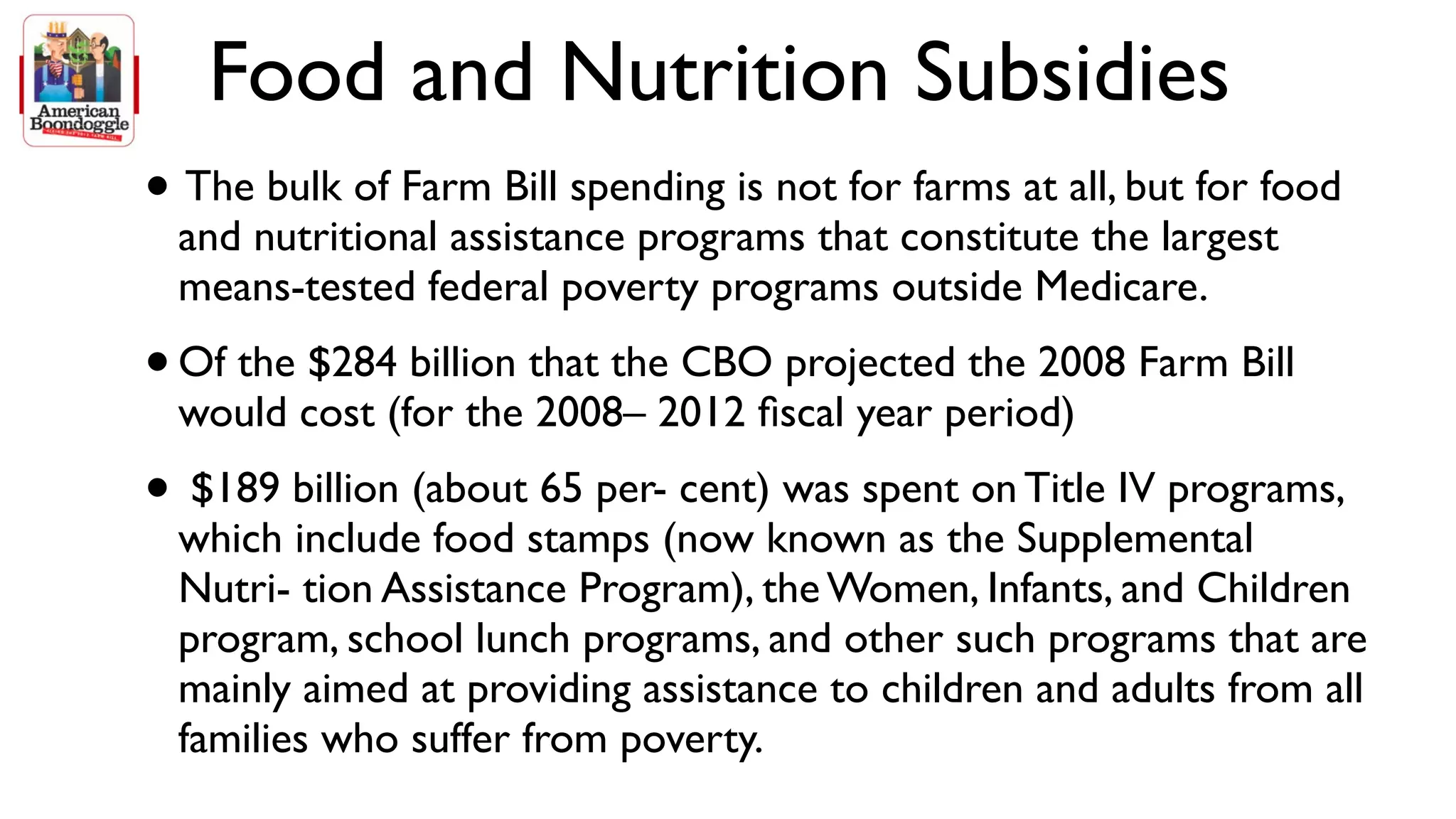
Food and Nutrition Subsidies
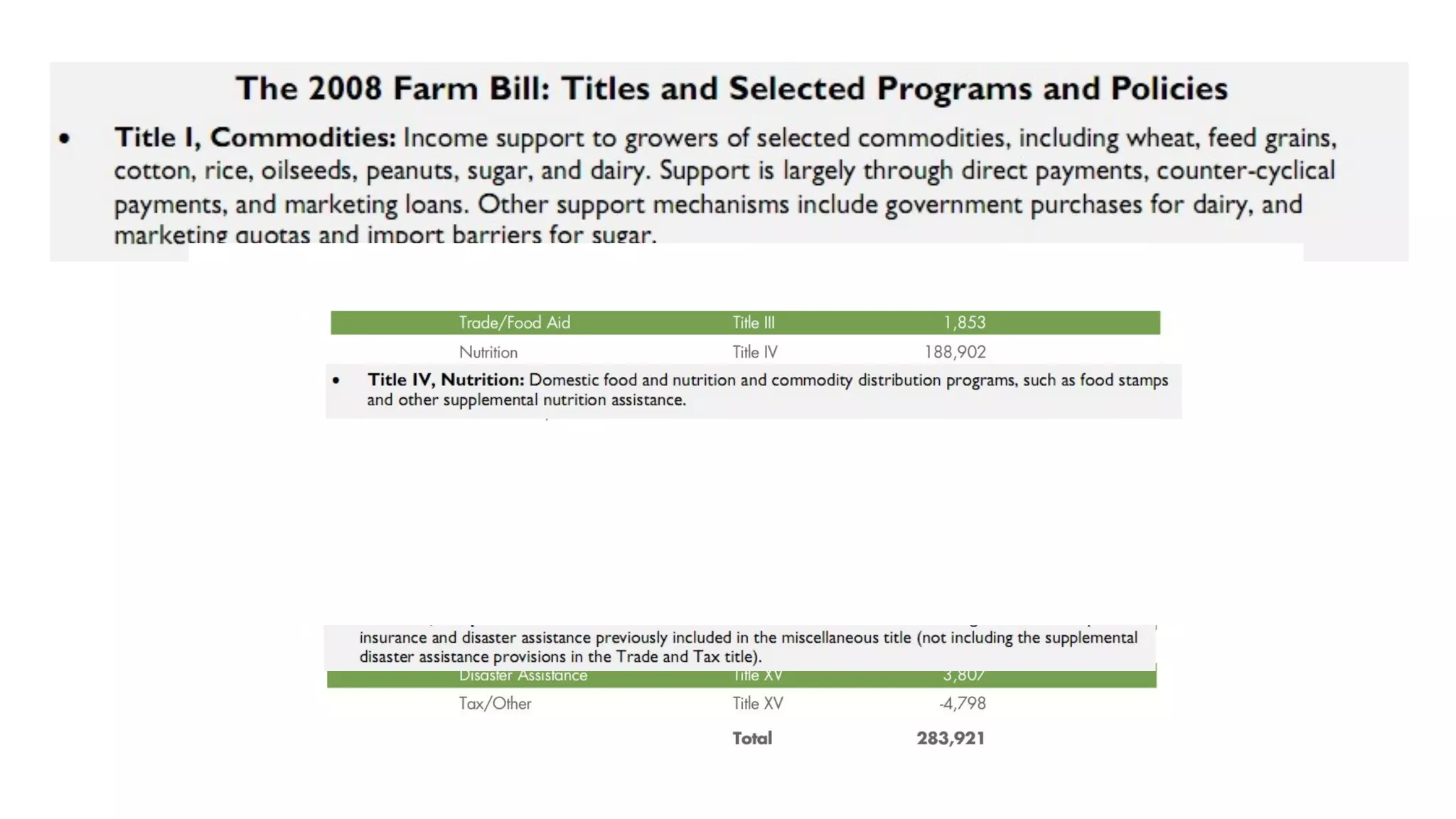
• The bulk of Farm Bill spending is not for farms at all, but for food
    and nutritional assistance programs that constitute the largest
    means-tested federal poverty programs outside Medicare.
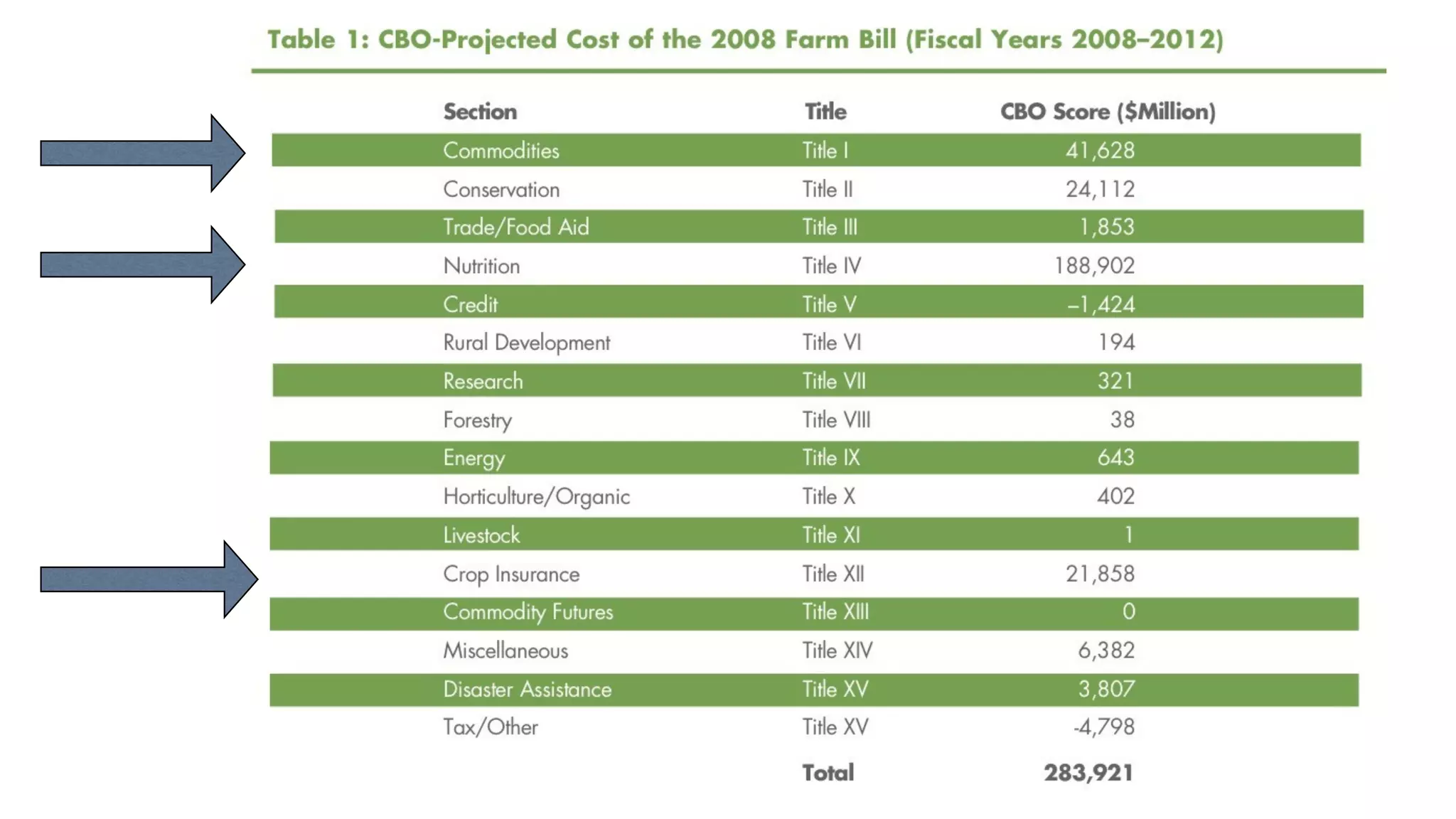
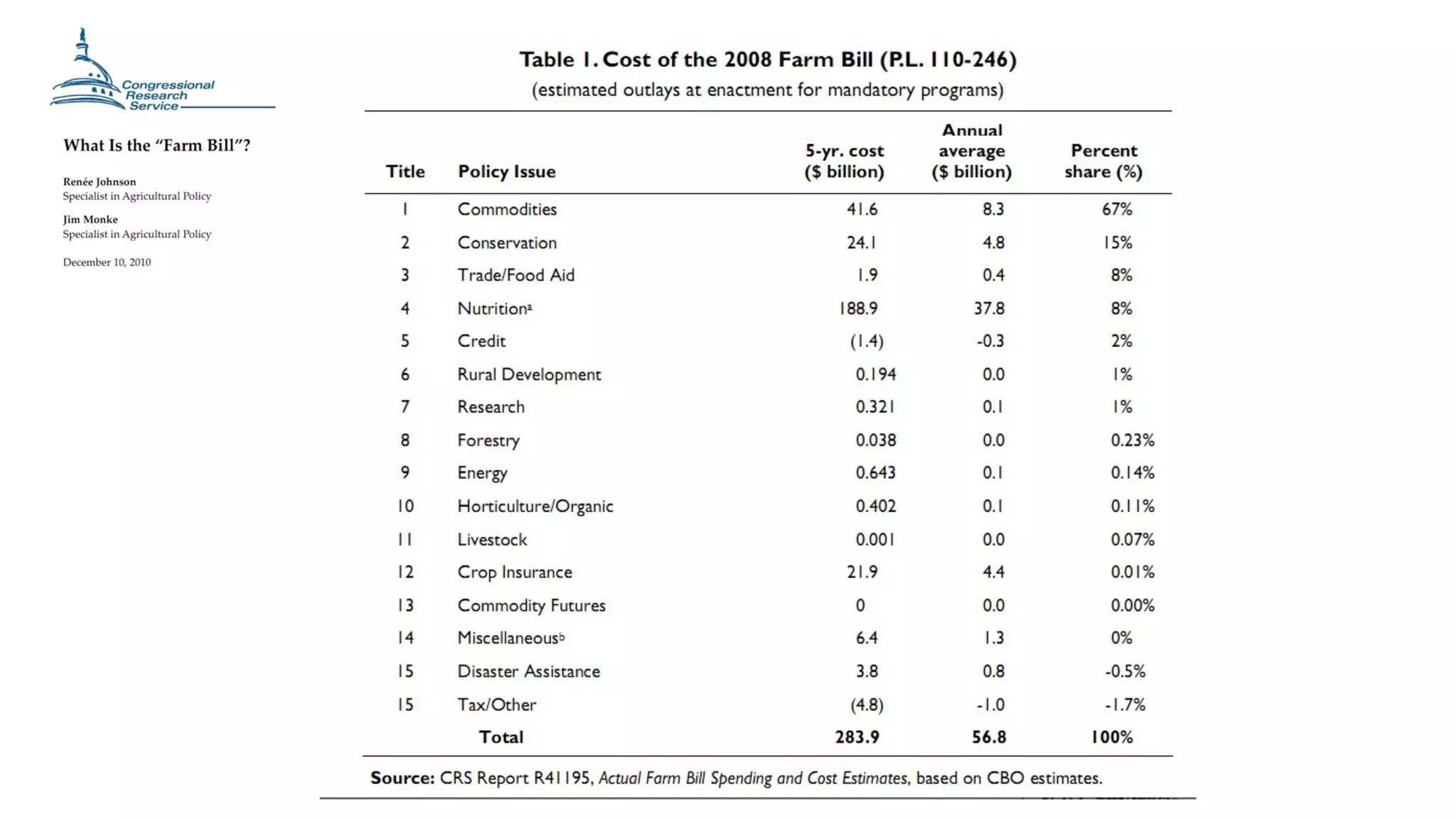
• Of the $284 billion that the CBO projected the 2008 Farm Bill
    would cost (for the 2008– 2012 fiscal year period)
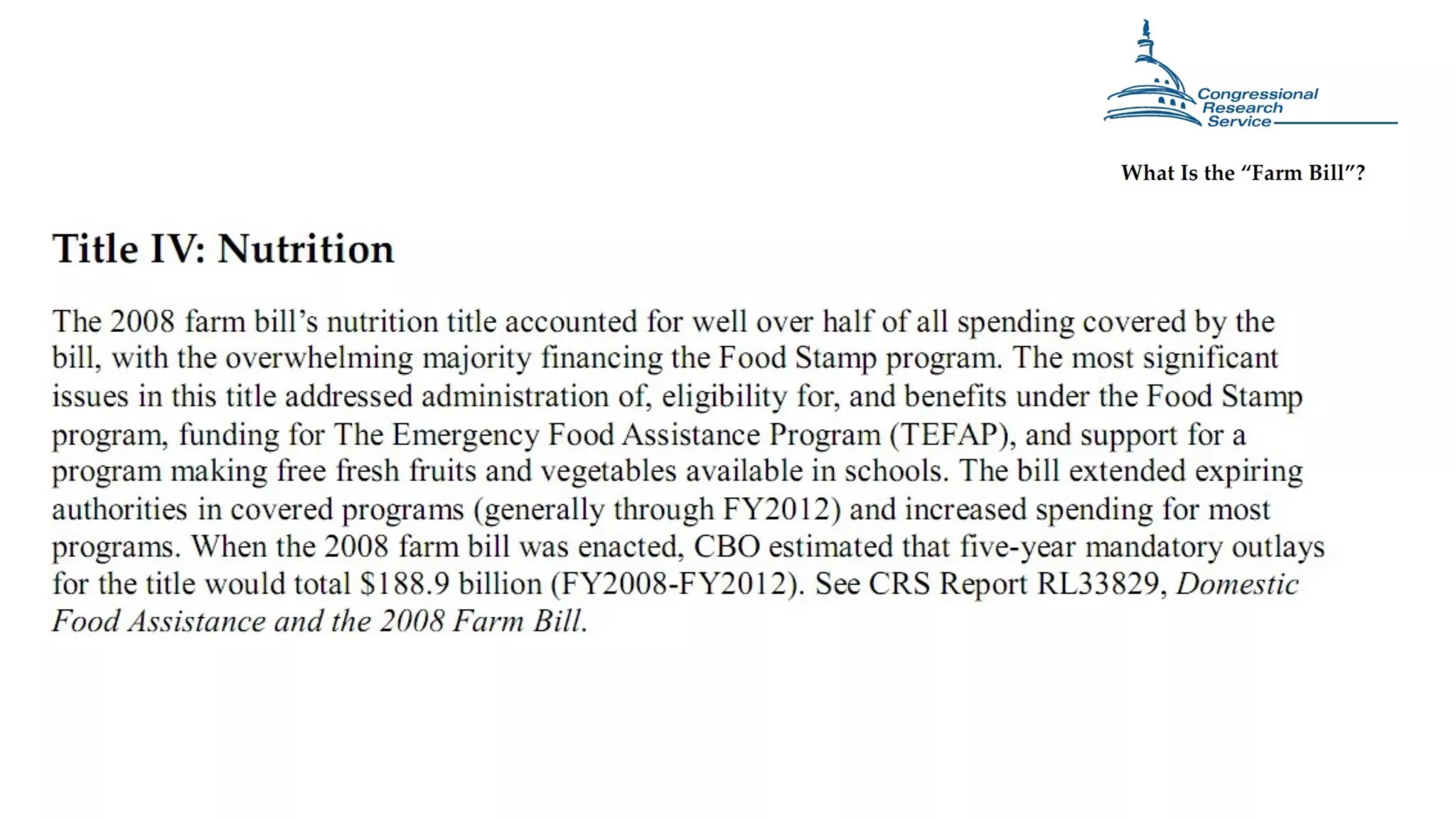
•    $189 billion (about 65 per- cent) was spent on Title IV programs,
    which include food stamps (now known as the Supplemental
    Nutri- tion Assistance Program), the Women, Infants, and Children
    program, school lunch programs, and other such programs that are
    mainly aimed at providing assistance to children and adults from all
    families who suffer from poverty.
Current Policy Debates
• Should the programs should be used to target increased
    consumption of specific categories of food (for example, fruits
    and vegetables), which poor families and individuals should be
    pro- gram eligible, and how much the country can afford to
    spend on these types of targeted income-transfer programs.7
•   The issue of targeting food assistance to particular foods to
    reduce obesity, especially among children, and to more generally
    encourage healthy diets will be among the most hotly contested
    Farm Bill issues.
Separate Nutrition from Ag.
• Separating the nutrition programs from the farm subsidy provisions of
 the Farm Bill would reduce the potential for logrolling, which has
 meant that members from urban districts and states vote in favor of
 farm subsidies to obtain support for nutrition programs.
Separate Nutrition from Ag.
• Separating the nutrition programs from the farm subsidy provisions of
    the Farm Bill would reduce the potential for logrolling, which has
    meant that members from urban districts and states vote in favor of
    farm subsidies to obtain support for nutrition programs.
•   In addition, since members representing farm constituencies dominate
    the agriculture committees in Congress, they do not have a
    background or interest in nutrition programs, which represent the
    bulk of the outlays under their purview. There is no natural connec-
    tion between these parts of the Farm Bill, and to continue the linkage
    reduces the quality of policy on both sides.
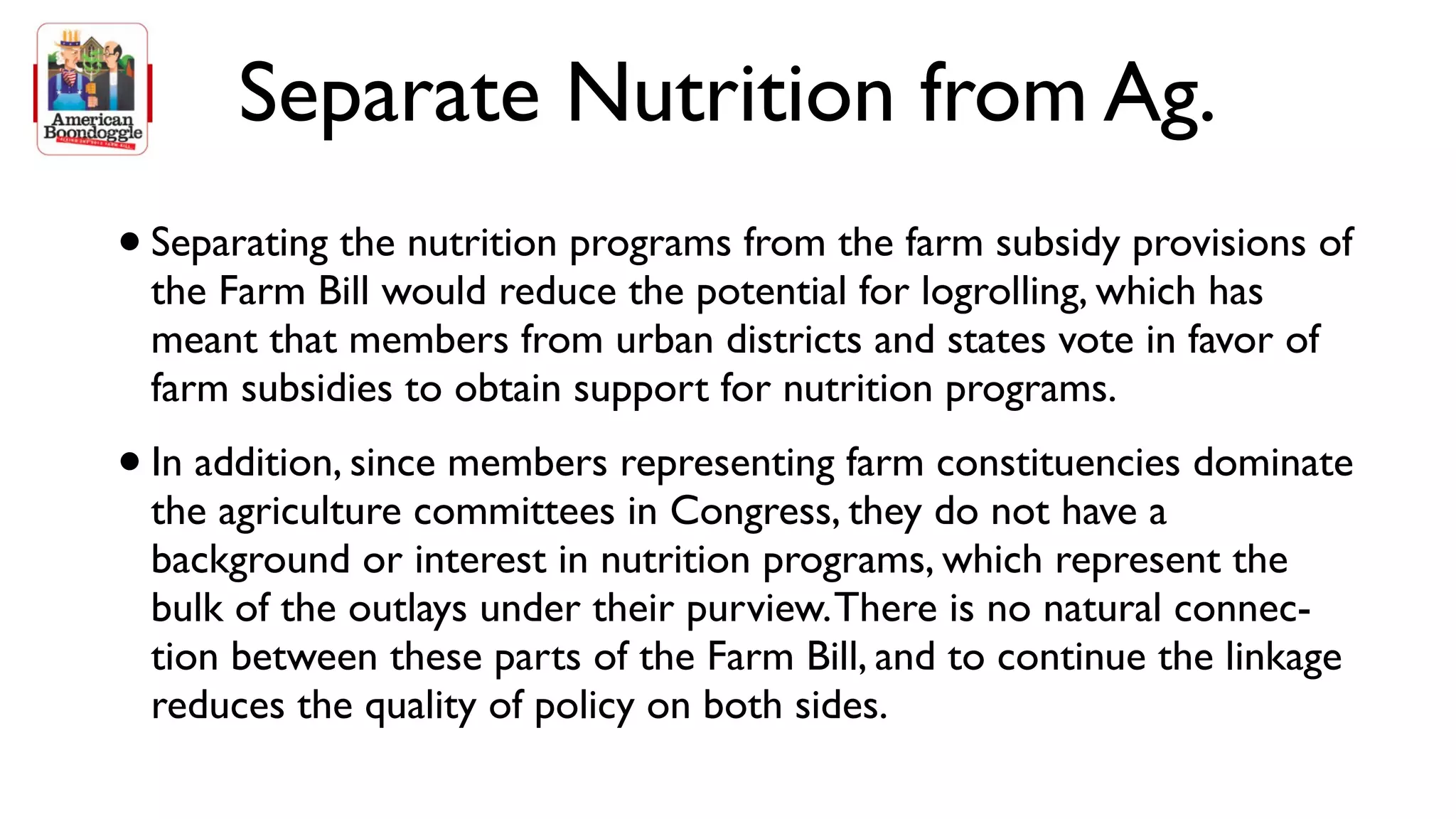
Separate Nutrition from Ag.
• Separating the nutrition programs from the farm subsidy provisions of
    the Farm Bill would reduce the potential for logrolling, which has
    meant that members from urban districts and states vote in favor of
    farm subsidies to obtain support for nutrition programs.
•   In addition, since members representing farm constituencies dominate
    the agriculture committees in Congress, they do not have a
    background or interest in nutrition programs, which represent the
    bulk of the outlays under their purview. There is no natural connec-
    tion between these parts of the Farm Bill, and to continue the linkage
    reduces the quality of policy on both sides.
Commodity-oriented
Farm Bill programs (Title 1)
Commodity-oriented
     Farm Bill programs (Title 1)
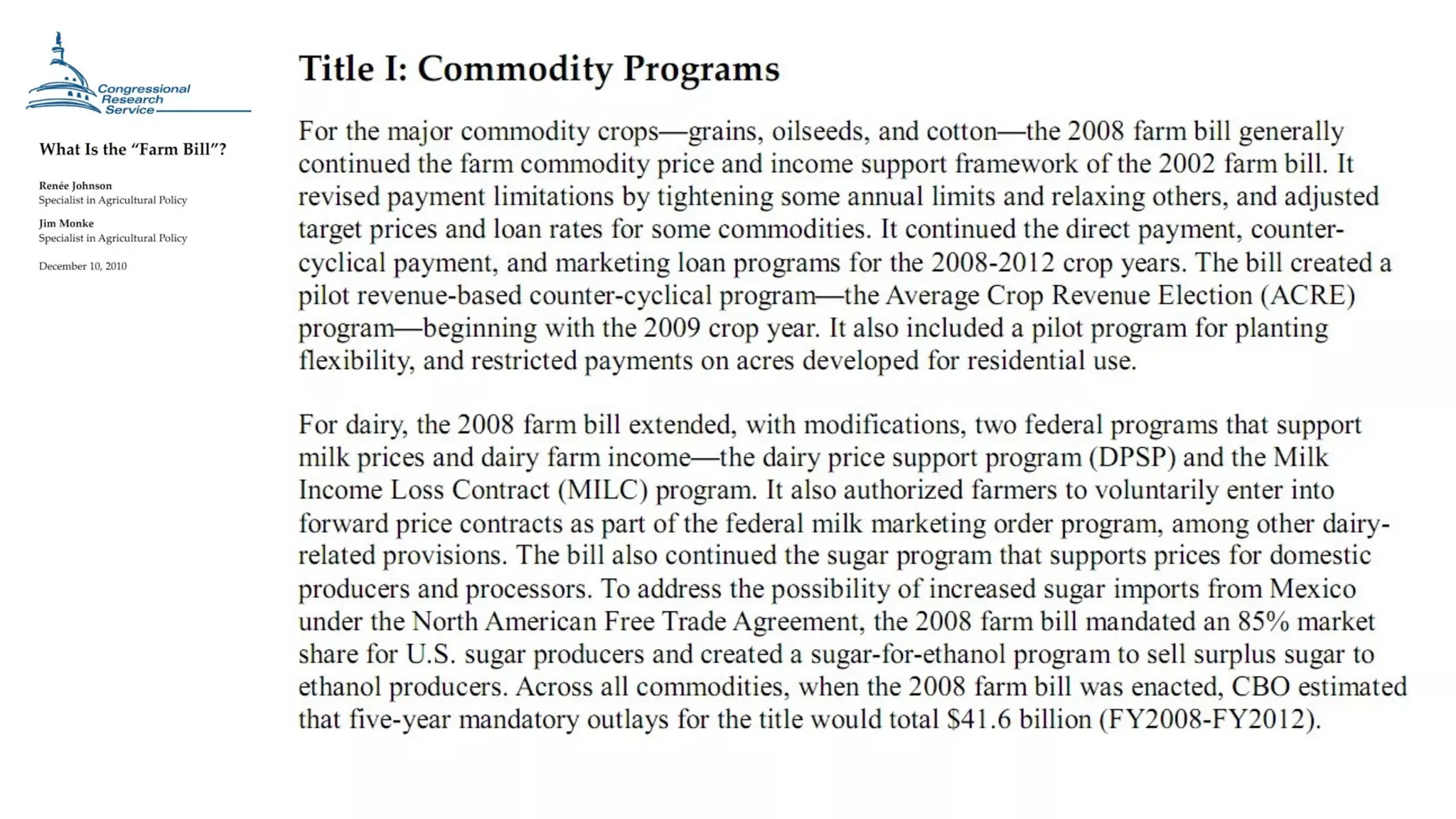
•   Provide income, price support, and other risk-management
    programs for a wide range of agricultural commodities,
    especially major crops like wheat, corn, rice, cotton, and
    soybeans, and other relatively smaller-revenue crops like barley,
    peanuts, and minor oilseeds (for example, safflower, sunflower,
    and canola).
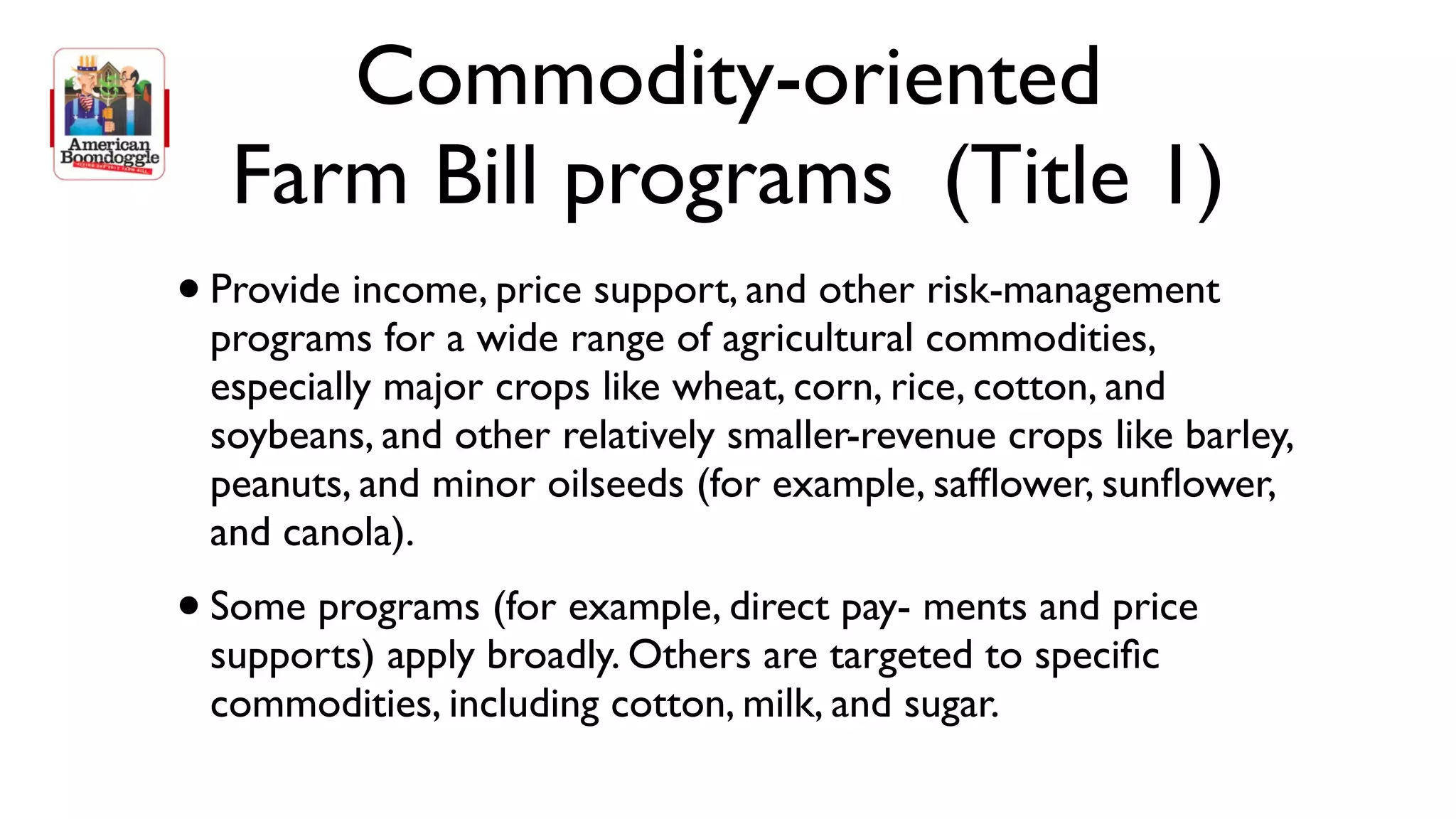
Commodity-oriented
     Farm Bill programs (Title 1)
•   Provide income, price support, and other risk-management
    programs for a wide range of agricultural commodities,
    especially major crops like wheat, corn, rice, cotton, and
    soybeans, and other relatively smaller-revenue crops like barley,
    peanuts, and minor oilseeds (for example, safflower, sunflower,
    and canola).
• Some programs (for example, direct pay- ments and price
    supports) apply broadly. Others are targeted to specific
    commodities, including cotton, milk, and sugar.
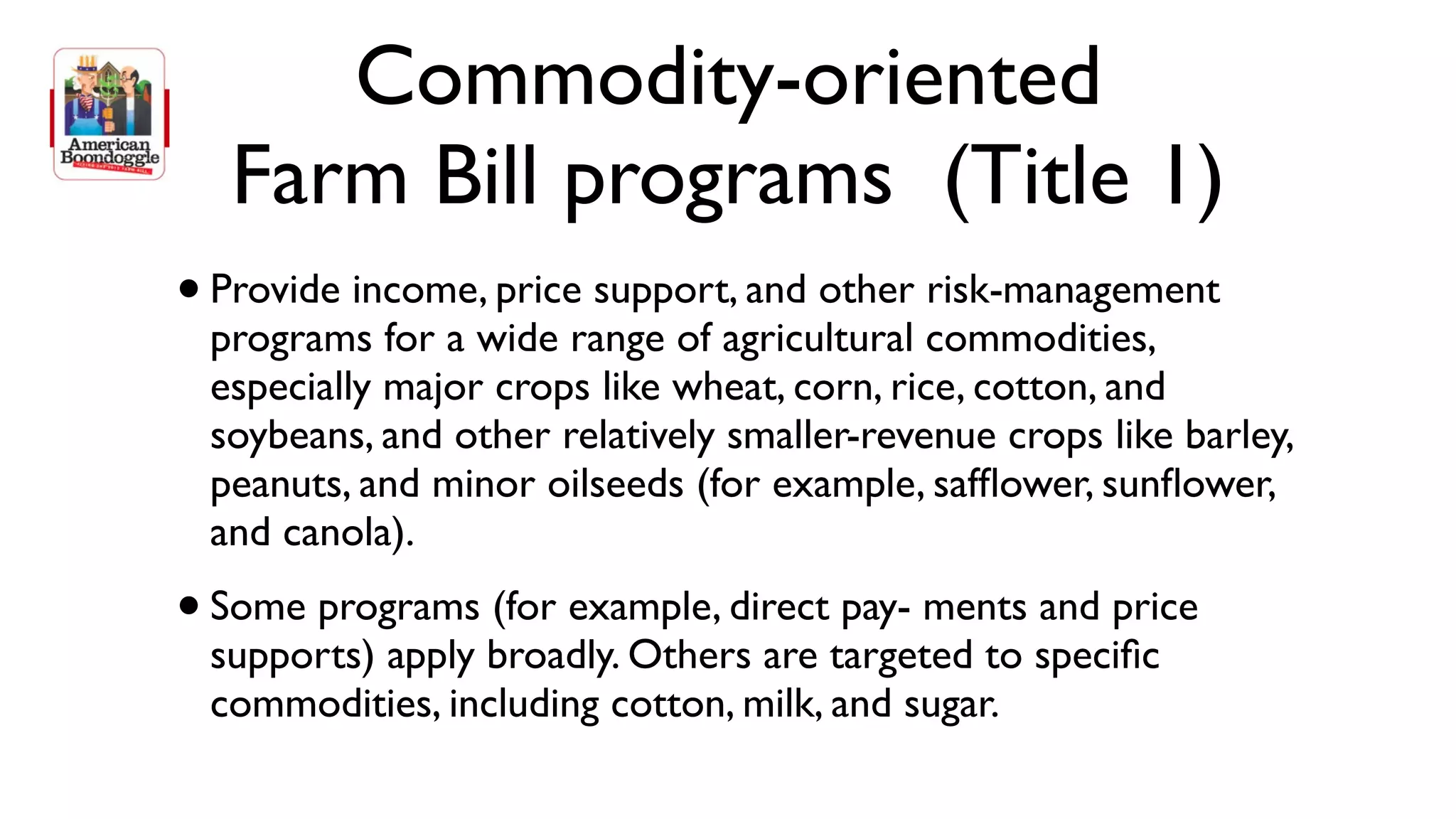
Commodity-oriented
     Farm Bill programs (Title 1)
•   Provide income, price support, and other risk-management
    programs for a wide range of agricultural commodities,
    especially major crops like wheat, corn, rice, cotton, and
    soybeans, and other relatively smaller-revenue crops like barley,
    peanuts, and minor oilseeds (for example, safflower, sunflower,
    and canola).
• Some programs (for example, direct pay- ments and price
    supports) apply broadly. Others are targeted to specific
    commodities, including cotton, milk, and sugar.
Direct Payments
Direct Payments
•   Unless modified by Congress, direct payments will amount to
    about $5 billion in 2012.
Direct Payments
•   Unless modified by Congress, direct payments will amount to
    about $5 billion in 2012.
• These payments are based on acres of program crops planted
    between 1983 and 1985 or from 1998 and 2001, and on estimated
    per-acre average yields for those crops from 1983 & 1985.
Direct Payments
•   Unless modified by Congress, direct payments will amount to
    about $5 billion in 2012.
• These payments are based on acres of program crops planted
    between 1983 and 1985 or from 1998 and 2001, and on estimated
    per-acre average yields for those crops from 1983 & 1985.
•   The payments are essentially gifts to farmers and landowners from
    taxpayers that are generally unrelated to the current use of the
    land (although fruits and vegetables cannot be planted on those
    acres). They are not targeted to low-income farm households, and
    larger farms and wealthier farm families and landowners generally
    receive larger payments.
Dairy Subsidies
Dairy Subsidies
• Dairy Policy. Some Title I programs target specific commodities
 and classes of farm operations, including dairy, sugar, and cotton.
Dairy Subsidies
• Dairy Policy. Some Title I programs target specific commodities
 and classes of farm operations, including dairy, sugar, and cotton.
• Taxpayers have provided milk producers with approximately $1
 billion in annual subsidies, regardless of whether or not the dairy
 sector faced financial difficulties because of high input costs or
 low milk prices.
Dairy Subsidies
• Dairy Policy. Some Title I programs target specific commodities
 and classes of farm operations, including dairy, sugar, and cotton.
• Taxpayers have provided milk producers with approximately $1
 billion in annual subsidies, regardless of whether or not the dairy
 sector faced financial difficulties because of high input costs or
 low milk prices.
• Consumers, many of whom are also taxpayers, have also indirectly
 subsi- dized milk producers through higher prices to the tune of
 more than $1 billion a year as a direct result of Farm Bill–
 sanctioned programs.14
Title IV: Crop Insurance
• The Risk Management Agency runs the USDA’s farm insurance programs.
 Both “yield” and “revenue” insurance are available to farmers to protect
 against adverse weather, pests, and low market prices.
Title IV: Crop Insurance
• The Risk Management Agency runs the USDA’s farm insurance programs.
 Both “yield” and “revenue” insurance are available to farmers to protect
 against adverse weather, pests, and low market prices.
• The RMA describes its mission as helping farmers “manage their business
 risks through effective, market-based risk management solutions.” 11 The
 RMA has annual outlays of about $4 billion, employs about 550 people, and
 its activities are far from “market-based.”
Title IV: Crop Insurance
• The Risk Management Agency runs the USDA’s farm insurance programs.
 Both “yield” and “revenue” insurance are available to farmers to protect
 against adverse weather, pests, and low market prices.
• The RMA describes its mission as helping farmers “manage their business
 risks through effective, market-based risk management solutions.” 11 The
 RMA has annual outlays of about $4 billion, employs about 550 people, and
 its activities are far from “market-based.”
• Federal crop insurance policies are sold and serviced by 16 private
 insurance companies, which receive federal subsidies for their
 administrative costs and insurance risks. The firms operate like a cartel,
 earning excess profits from the high premiums they charge.12 
Title IV: Crop Insurance
• The Risk Management Agency runs the USDA’s farm insurance programs.
 Both “yield” and “revenue” insurance are available to farmers to protect
 against adverse weather, pests, and low market prices.
• The RMA describes its mission as helping farmers “manage their business
 risks through effective, market-based risk management solutions.” 11 The
 RMA has annual outlays of about $4 billion, employs about 550 people, and
 its activities are far from “market-based.”
• Federal crop insurance policies are sold and serviced by 16 private
 insurance companies, which receive federal subsidies for their
 administrative costs and insurance risks. The firms operate like a cartel,
 earning excess profits from the high premiums they charge.12 
• They get away with that because the government provides [subsidies]

Fixing the Farm Bill

  • 1.
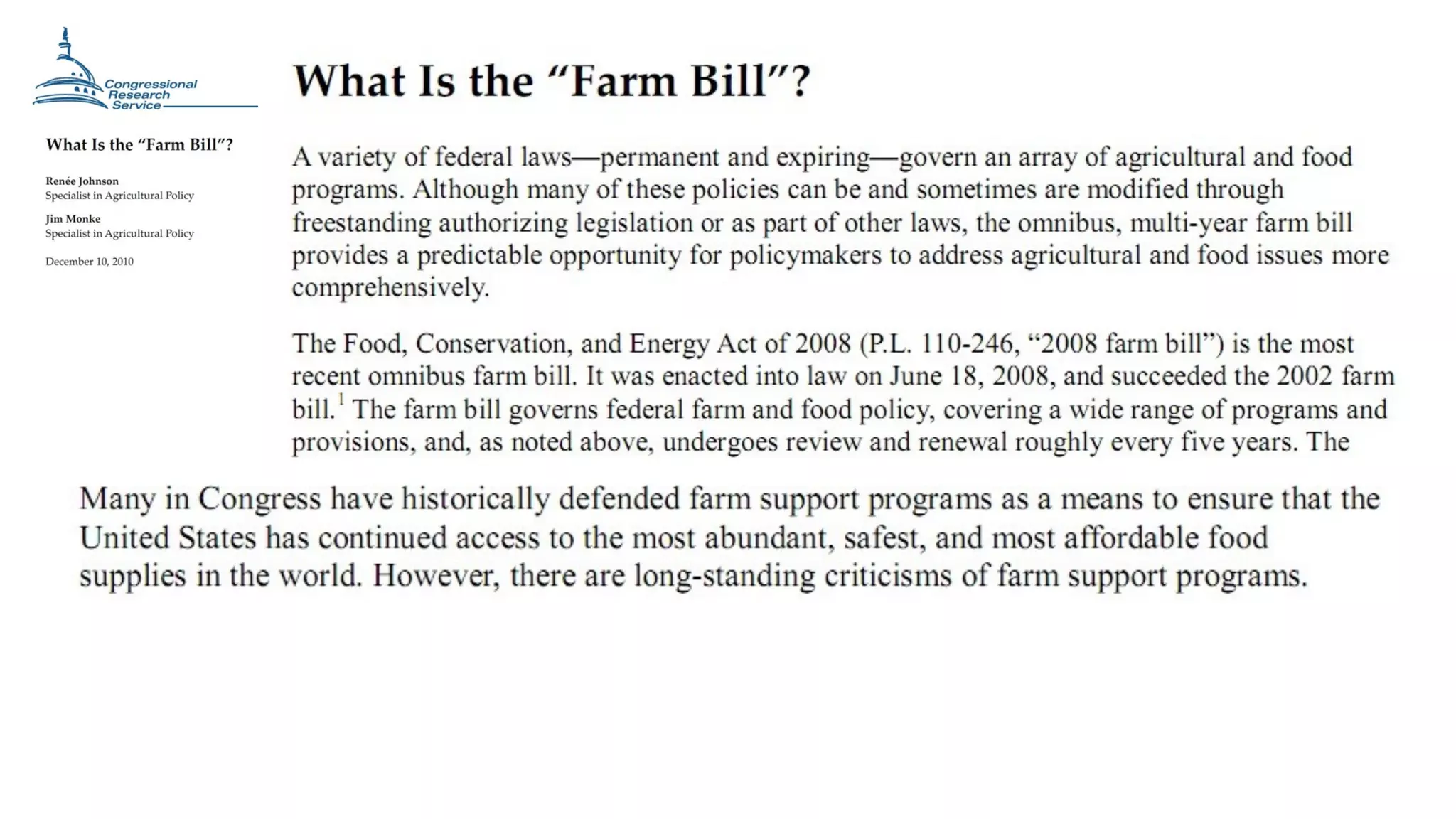
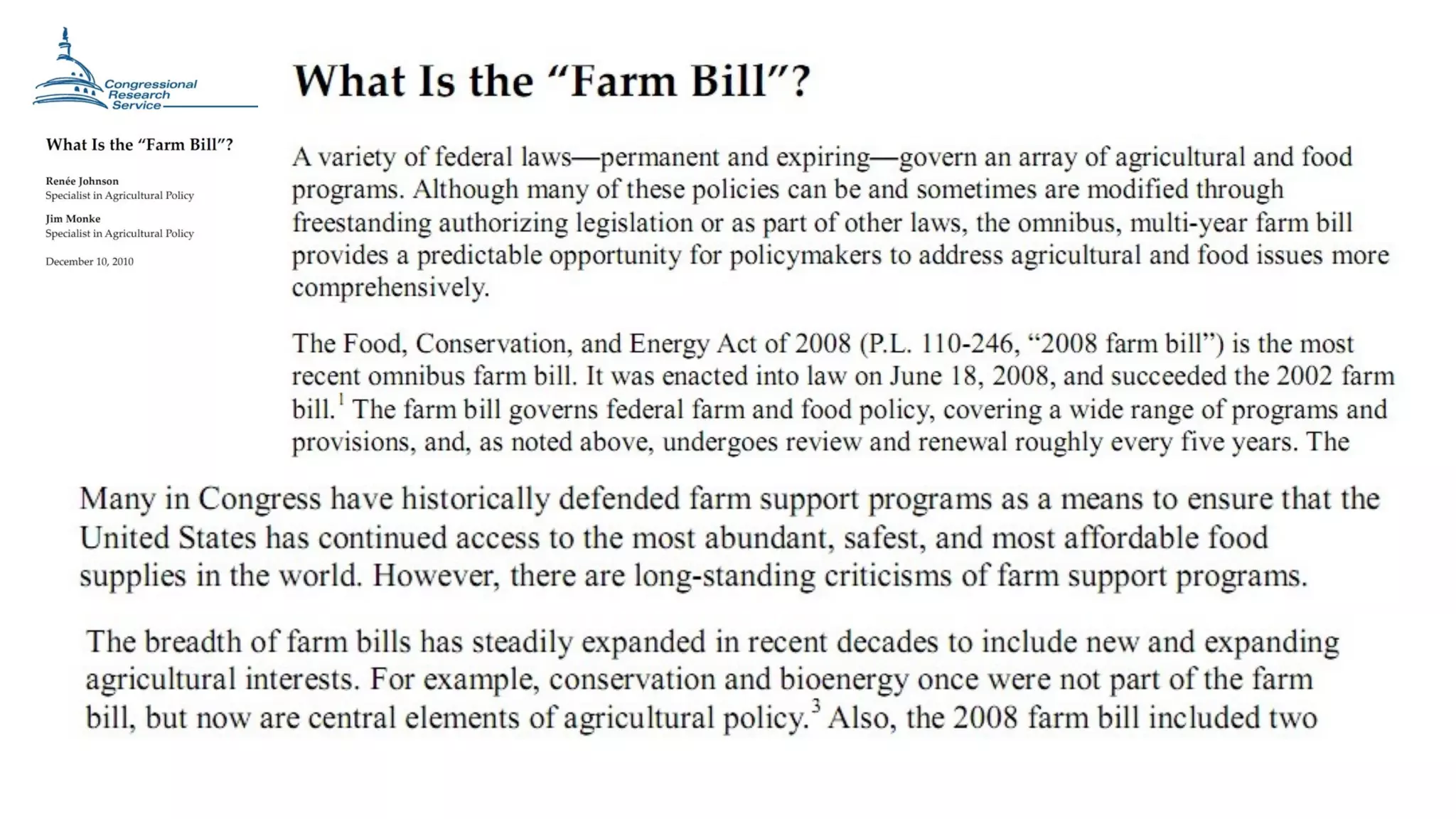
    The 2012 U.S.Farm Bill: History, Problems and Opportunities for Reform
  • 2.
  • 15.
    www.downsizinggovernment.org/agriculture/food-subsidies School Breakfast andLunch Services Supporting Students or Farmers? Chris Edwards • July, 2009 (excerpt) One affirmative case calls for expanding student lunches for those living in poverty. The federal government funds school breakfast and lunch programs at 80,000 public schools...  The lunch program covers 30 million children, and the breakfast program covers about 8 million children. Federal spending on the two food programs, for free and low-cost meals, was $16 billion in fiscal 2009. The programs had their origins in the Federal Surplus Commodities Corporation established in 1935. That entity was designed to distribute “surplus” meat, dairy, and wheat products to the needy, including children in schools. An official history of the school lunch program notes that the farm policies of the 1930s attempted “to remove price-depressing surplus foods from the market” yet goes on to note
  • 18.
    Food and NutritionSubsidies • The bulk of Farm Bill spending is not for farms at all, but for food and nutritional assistance programs that constitute the largest means-tested federal poverty programs outside Medicare. • Of the $284 billion that the CBO projected the 2008 Farm Bill would cost (for the 2008– 2012 fiscal year period) • $189 billion (about 65 per- cent) was spent on Title IV programs, which include food stamps (now known as the Supplemental Nutri- tion Assistance Program), the Women, Infants, and Children program, school lunch programs, and other such programs that are mainly aimed at providing assistance to children and adults from all families who suffer from poverty.
  • 19.
    Current Policy Debates •Should the programs should be used to target increased consumption of specific categories of food (for example, fruits and vegetables), which poor families and individuals should be pro- gram eligible, and how much the country can afford to spend on these types of targeted income-transfer programs.7 • The issue of targeting food assistance to particular foods to reduce obesity, especially among children, and to more generally encourage healthy diets will be among the most hotly contested Farm Bill issues.
  • 20.
  • 21.
    Separate Nutrition fromAg. • Separating the nutrition programs from the farm subsidy provisions of the Farm Bill would reduce the potential for logrolling, which has meant that members from urban districts and states vote in favor of farm subsidies to obtain support for nutrition programs.
  • 22.
    Separate Nutrition fromAg. • Separating the nutrition programs from the farm subsidy provisions of the Farm Bill would reduce the potential for logrolling, which has meant that members from urban districts and states vote in favor of farm subsidies to obtain support for nutrition programs. • In addition, since members representing farm constituencies dominate the agriculture committees in Congress, they do not have a background or interest in nutrition programs, which represent the bulk of the outlays under their purview. There is no natural connec- tion between these parts of the Farm Bill, and to continue the linkage reduces the quality of policy on both sides.
  • 23.
    Separate Nutrition fromAg. • Separating the nutrition programs from the farm subsidy provisions of the Farm Bill would reduce the potential for logrolling, which has meant that members from urban districts and states vote in favor of farm subsidies to obtain support for nutrition programs. • In addition, since members representing farm constituencies dominate the agriculture committees in Congress, they do not have a background or interest in nutrition programs, which represent the bulk of the outlays under their purview. There is no natural connec- tion between these parts of the Farm Bill, and to continue the linkage reduces the quality of policy on both sides.
  • 24.
  • 25.
    Commodity-oriented Farm Bill programs (Title 1) • Provide income, price support, and other risk-management programs for a wide range of agricultural commodities, especially major crops like wheat, corn, rice, cotton, and soybeans, and other relatively smaller-revenue crops like barley, peanuts, and minor oilseeds (for example, safflower, sunflower, and canola).
  • 26.
    Commodity-oriented Farm Bill programs (Title 1) • Provide income, price support, and other risk-management programs for a wide range of agricultural commodities, especially major crops like wheat, corn, rice, cotton, and soybeans, and other relatively smaller-revenue crops like barley, peanuts, and minor oilseeds (for example, safflower, sunflower, and canola). • Some programs (for example, direct pay- ments and price supports) apply broadly. Others are targeted to specific commodities, including cotton, milk, and sugar.
  • 27.
    Commodity-oriented Farm Bill programs (Title 1) • Provide income, price support, and other risk-management programs for a wide range of agricultural commodities, especially major crops like wheat, corn, rice, cotton, and soybeans, and other relatively smaller-revenue crops like barley, peanuts, and minor oilseeds (for example, safflower, sunflower, and canola). • Some programs (for example, direct pay- ments and price supports) apply broadly. Others are targeted to specific commodities, including cotton, milk, and sugar.
  • 28.
  • 29.
    Direct Payments • Unless modified by Congress, direct payments will amount to about $5 billion in 2012.
  • 30.
    Direct Payments • Unless modified by Congress, direct payments will amount to about $5 billion in 2012. • These payments are based on acres of program crops planted between 1983 and 1985 or from 1998 and 2001, and on estimated per-acre average yields for those crops from 1983 & 1985.
  • 31.
    Direct Payments • Unless modified by Congress, direct payments will amount to about $5 billion in 2012. • These payments are based on acres of program crops planted between 1983 and 1985 or from 1998 and 2001, and on estimated per-acre average yields for those crops from 1983 & 1985. • The payments are essentially gifts to farmers and landowners from taxpayers that are generally unrelated to the current use of the land (although fruits and vegetables cannot be planted on those acres). They are not targeted to low-income farm households, and larger farms and wealthier farm families and landowners generally receive larger payments.
  • 32.
  • 33.
    Dairy Subsidies • DairyPolicy. Some Title I programs target specific commodities and classes of farm operations, including dairy, sugar, and cotton.
  • 34.
    Dairy Subsidies • DairyPolicy. Some Title I programs target specific commodities and classes of farm operations, including dairy, sugar, and cotton. • Taxpayers have provided milk producers with approximately $1 billion in annual subsidies, regardless of whether or not the dairy sector faced financial difficulties because of high input costs or low milk prices.
  • 35.
    Dairy Subsidies • DairyPolicy. Some Title I programs target specific commodities and classes of farm operations, including dairy, sugar, and cotton. • Taxpayers have provided milk producers with approximately $1 billion in annual subsidies, regardless of whether or not the dairy sector faced financial difficulties because of high input costs or low milk prices. • Consumers, many of whom are also taxpayers, have also indirectly subsi- dized milk producers through higher prices to the tune of more than $1 billion a year as a direct result of Farm Bill– sanctioned programs.14
  • 36.
    Title IV: CropInsurance
  • 37.
    Title IV: CropInsurance • The Risk Management Agency runs the USDA’s farm insurance programs. Both “yield” and “revenue” insurance are available to farmers to protect against adverse weather, pests, and low market prices.
  • 38.
    Title IV: CropInsurance • The Risk Management Agency runs the USDA’s farm insurance programs. Both “yield” and “revenue” insurance are available to farmers to protect against adverse weather, pests, and low market prices. • The RMA describes its mission as helping farmers “manage their business risks through effective, market-based risk management solutions.” 11 The RMA has annual outlays of about $4 billion, employs about 550 people, and its activities are far from “market-based.”
  • 39.
    Title IV: CropInsurance • The Risk Management Agency runs the USDA’s farm insurance programs. Both “yield” and “revenue” insurance are available to farmers to protect against adverse weather, pests, and low market prices. • The RMA describes its mission as helping farmers “manage their business risks through effective, market-based risk management solutions.” 11 The RMA has annual outlays of about $4 billion, employs about 550 people, and its activities are far from “market-based.” • Federal crop insurance policies are sold and serviced by 16 private insurance companies, which receive federal subsidies for their administrative costs and insurance risks. The firms operate like a cartel, earning excess profits from the high premiums they charge.12 
  • 40.
    Title IV: CropInsurance • The Risk Management Agency runs the USDA’s farm insurance programs. Both “yield” and “revenue” insurance are available to farmers to protect against adverse weather, pests, and low market prices. • The RMA describes its mission as helping farmers “manage their business risks through effective, market-based risk management solutions.” 11 The RMA has annual outlays of about $4 billion, employs about 550 people, and its activities are far from “market-based.” • Federal crop insurance policies are sold and serviced by 16 private insurance companies, which receive federal subsidies for their administrative costs and insurance risks. The firms operate like a cartel, earning excess profits from the high premiums they charge.12  • They get away with that because the government provides [subsidies]