Museum
       Vol XXXIV, n° 2, 1982


  Museums, heritage and
 cultural policies in Latin
America and the Caribbean
Vol. XXXIV, No. 2 , 1982

Museidni, successor to Mauseìoii, is published
by the United Nations Educational,
Scientific and Cultural Organization in Paris.
An international forum (quarterly) of
information and reflection on museums of all
kinds.
Authors are responsible for the choice and the
presentation of the facts contained in their articles
and for the opinions expressed therein, which are
not necessarily those of Unesco or the Editorial
Board of Nueum. Titles, introductory texts and
captions may be written by the Editor.


DIRECTOR
Percy Stulz

EDITORIAL BOARD
Chairman: Syed A. Naqvi
Editor: Yudhishthir Raj Isar
Editorial Assistant : Christine Wilkinson

ADVISORY BOARD
Om Prakash Agrawal, India
Fernanda de Camargo e Almeida-Moro,
   Brazil
Chira Chongkol, Thailand
Joseph-Marie Essomba, President of
   OMMSA
Gad de Guichen, Scientific Training
   Assistant, ICCROM
Jan Jelinek, Czechoslovakia
Grace L. McCann Morley, Adviser, ICOM
   Regional Agency in Asia
Luis Monreal, Secretary-General of ICOM,                Correspondence concerning editorid inatten
   ex-oficia                                            should be addressed to the Editor (Division
Paul Perror, United States of America                   of Cultural Heritage, Unesco, 7 place de
Georges Henri Rivière, Permanent Adviser                Fontenoy, 75700 Paris, France) who is
   of ICOM                                              always pleased to consider manuscripts for
Vitali Souslov, Union of Soviet Socialist               publication but cannot accept liability for
   Republics                                            their custody or return. Authors are advised
                                                        to write to the Editor first.

Cover photo: Restoration of polychrome                  Pziblished texts inay be fieely rgrodaced aiid
wood sculpture at the restoration c h t r e in          trmslated (excqt illustrations and when
Antigua Guatemala.                                      ~~~odztctioti or trattslatioz rights a4e ruewed),
[P/joto: Alejandro Rojas Garcia.]                       provided that m~itiotiis made of the author
                                                        and source. Extracts may be quoted i f due
                                                        acknoudedgenzent is givm
Each issue: 2 8 F. Subscription rates
( 4 issues or corresponding double issues per
year): 100 F (1 year); 160 F (2 years).                 Correspondence concerning subscrjbtìoin
                                                        should be addressed to the Commercial
@Unesco 1982                                            Services Division, Office of the Unesco
Pritited iti swìtzerlaiid                               Press, Unesco, 7 place de Fontenoy,
Imprimeries Populaires de Genève                        7 5 7 O0 Paris, .France.
h e r i e and
                                cnltnridpolicies in Ldtin America
                                and the Caribbean
                                Editorial 71

                                Il.luseum development and cultural policy : aim, prospects aiid challenges   72
       Sergio Dur& Pitarque
     and Belén Rojas Guardia    Museum jnancing: taking up the challenge                    83
  Fernanda de Camargo-Moro New dire~tìol-zs museum organization 86
                                             in
            Felipe Lacouture Aspects o f sa trainiizg 9 O
                                          tf
                Sylvio Muta1 Museology courses organized by UNDP, Unesco and Colcultura 94
Unesco-ICOM Documentation
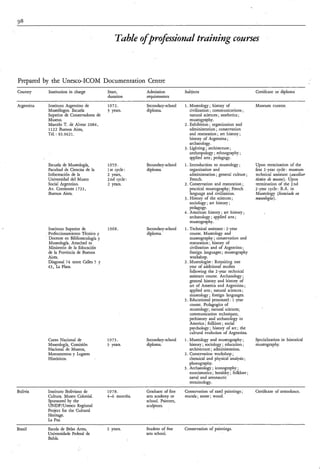
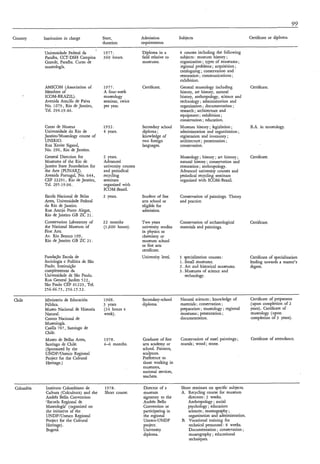
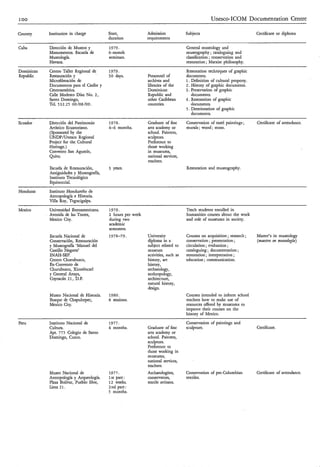
                      Centre TabLe of professional training courses 98

                                OPINION
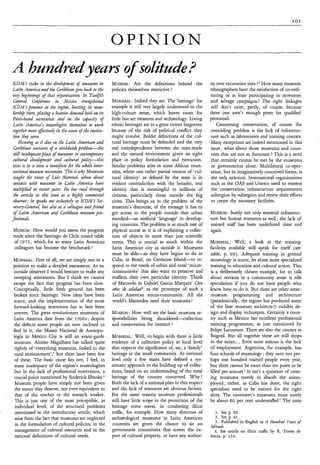
                Luis Monreal    A hundred years of solitude? 101

                                ALBUM
               Niède Guidon     Rock art throughout the contiBent 103
                  José Balza    The Galeria de Arte Nacional, Caracas 105
         Gérard Collomb and
                Yves Renard     On Marie-Galante (Guadeloupe) : a comi?zunity and its ecomuseuin 109
             Rubén Stehberg In Chile the National Museum o f Natural Histoy develops
                            archaeological sites 11 4
       Reina Torres de Araúz    The Site Museum o the El Caño Archaeologìcal Park 117
                                                   f
       Alejandro Rojas Garcia   A local4 created restoration centre in Guatemala 121
         Gloria Zea de Uribe    Recent advances ìn Colombian museoloal 124
        Frances Kay Brinkley    The eastem Caribbean: a museum on wey island 127
        Eusebio Leal Spengler   The Museum of Havana: mirror of a city 130

                                RETURN AND RESTITUTION OF CULTURAL PROPERTY
 Rodrigo Pallares Zaldumbide    Cases for restitution 132
       Reina Torres de Araúz    Museum and the containment of illicìt trafic                   134


                                ISSN 0027-3996 Alueum (Unesco, Paris), Vol. xxXn7,No.   2 , 1982
You have also avoided corztemplating the cultural heritage azd its depositories, such
                                                       as museum, from the sole uieuIpoiizt of inaterialpreservation, but have rather regarded
                                                       thetnjrst a?zdforemost as a means of educating and enrichìng the lìues ofpeople, aizd
                                                       ds the most obuious e$wession of cultural

                                                       The purpose of this issue is twofold. On the one hand, it is intended to
                                                       provide a platform for a group of museum professionals in Latin America and
                                                       the Caribbean to share ideas and information with colleagues both within the
                                                       region and throughout the world. It has another, ‘strategic’, purpose : to bring
                                                       the significance of museum development to the attention of the policy- and
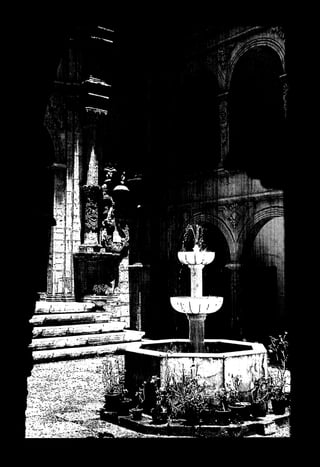
FroiztrJpiece: MUSEO ARTECOLONIAL,
                    DE                                 decision-makers who will be attending the World Conference on Cultural
La Paz, Bolivia.                                       Policies, Mexico City, 26 July-5 August 1982.
[Photo: S. de Vajay.]                                     Our regional focus was chosen to coincide with this international event
                                                       taking place on Latin American soil. But the museum problems explored here
                                                       exist everywhere, particularly in other Third World countries where cultural
                                                       development-and, a fortiori, the role of museums in that process-still
                                                       awaits the place it deserves.
                                                          Volume XXV, No. 3 (1973), of this magazine, entitled ‘The role of
                                                       museums in today’s Latin America’, was an overview (but excluding the
                                                       Caribbean) of the situation ten years ago. It opened up new hopes for the
                                                       future. It is now time to take stock. Furthermore, our Editorial Board has been
                                                       concerned with the meagre representation in the pages of Museum of the
                                                       museum life in the region, with the obvious exception of that of Mexico.2’
                                                       This special issue-together with additional material received but which can-
                                                       not be printed here for lack of space-will    certainly help fill this lacuna.
                                                          Both the thematic articles that open the issue and the monographs in the
                                                       ‘Album’ section were solicited and written with the cultural policy framework
                                                       in mind. What role can and should be given to museums in our societies
                                                       today ? The concrete examples of museums that respond to a deep-rooted need
                                                       or meet it admirably, each on its own scale and specialized terrain, will, we
                                                       hope, speak with conviction to the Mexico City meeting. The notion of
                                                       cultural development launched by Unesco at the first such World Conference,
                                                       held in Venice some twelve years ago, has indeed come a long way. But
                                                       certainly not far enough. Quoting that concept, one already convinced deci-
                                                       sion-maker had this to say about museums :

   1 . Amadou-hlahtar h.I’Bow, Director-General        Their educational role, the opportunity for direct contact between the public and the
of Unesco, in his closing address to the               products of the mind, the juxtaposition they can bring about between works of
Intergovernmental Conference on Cultural Policies
in Latin America and the Carribcan, Bogotá,            different cultures, their function of preserving a fragile past, of study and of research
2 0 January 1978.                                      on the cultural heritage from the beginning of time, their special role of organizing
   2 . In a recent tally of issues published between
1970 and 1980 it was found that out of a total
                                                       the behaviour and the outlock of a society towards its own past and the past of others
of 1 9 1 0 pages printed only 156, or 8 per cent,      at one particular moment, all amount to fundamental, irreplaceable aspects of a living
 concerned Latin America and the Caribbean.            culture. To give this up, to slacken on the effort that this involves, would be to
   3 . Extract from the speech entitled ‘Museums:
Heritage and Living Culture’, given by Jacques         compromise cultural development irreparably. In this sense, museums are not a sur-
Rigaud, Director-General of Radio-Télé                 vival or an anachronism. , . .they m e a drivìtigfot.ce behì?zd cultural dweZopmmt. Govern-
Luxembourg and former Assistant                        ments or societies who do not accept this idea and all it involves in terms of will-
Director-General of Unesco, at ICOM’s Twelfth
General Conference, Mexico City, 25 October-           power and effort, in particular the financial implications, are condemning cultural
4 November 1980. Printed in PtoceeditzgJ of the        development at more or less short term.j
Twelfth Gmeral GxfËmce md Thiytemth GetzeraL
Au&,$ o tbe Itmzatiotzal Cound o hfusezrmns,
           f                          f
Pais, ICOM, 1981, pp. 44-5.                            W e hope this issue of Museum will help support that claim.
72


                                               Musenm dkvelobmentund


With the participation of
Marta Arjona, Frances Kay Brinkley,
Fernanda de Camargo-Moro,
Roderick C. Ebanks,
Manuel Espinoza, Felipe Lacouture,
Luis G. Lumbreras,
Aloisio Magalhaes, Grete Mostny


                                               The article below was prepared  Museum entirely on the basis o contributions
                                                                                                               f
                                               requested from Marta Arjona, Director of the Cultural Heritage, Cuba; Frances
                                               Kay Brinkley, a volunteer museologist in the eGtern Caribbean; Femanda de
                                                Camargo-Moro, Director-General of Museums, State of Rio de Janeiro; Roderick C.
                                                Ebanh, Director of the Museums and Archaeological Division, Institute ofJamaica;
                                                Manuel Erpinoza, Director of the National A r t Gallery, Caracas, Venezuela;Fe@e
                                                Lacouture, Director of the National Museum o f History, Mexico City; Luis G.
                                                Lumbreras, archaeologist and fomzer Director of the National Museum of Anthro-
                                               pologv and Archaeology, Lima, Peru; Aloisìo Magalhaes, Secretary of State for
                                                Culture, Brazil; and Grete Mostny, Director of the National Maseum of Natural
                                                History, Santiago de &ìle. The various contributions were sent to the UNDP/Unesco
                                                Regional Project for the Cultural Heritage at Limu, Peru, where Miss Juana True4
ARAWAK MUSEUM,      Jamaica. A museum that
                                                a linguist and specialist in comparative literature associated with theproject, prepared
respects the oldest indigenous population       an initial synthaìs.
of the Caribbean. Stone nietate and crusher,        The contributing authors have been in the forefront of the museum movement in
used by the Arawaks to crush corn.              Latin America and the Caribbean; many of them are already well known to profes-
A.D. 1000 t O 1500.
[Photo; Arawak Museum.]
                                               sional colleagues. Because of the role they play today-whether localb, regionally or
                                               intemationd&-ìn museum curatorsh@, management and excbmge or in the formu-
                                                lation and execution of national heritage protection policìes, Museum asked each of
                                                these specialìsts to send us a few pages on the ‘state ofthe art’ on the Latin American
                                                and Caribbean museum scene. In view of the forthcoming Vorld Conference on Cul-
                                                tural Policies (Mexico Ci@ 26 July4 August 1982) we asked these authors to
                                                eqblore the problems of mzaeums with particular reference to cultural policies in their
                                                countries. Each replied in his or her own terms. The synthesis that follows is neither
                                               a thorough objective survey of the situation as ir is today nor a blueprint for the
                                               future. We hope, however, that it captures the pulse of museological l f e in the region,
                                                whose museum face challenges that are similar to those foundthroughout the Third
                                               TVorld


                                               Latin America and the Caribbean make up a vast cultural mosaic of autoch-
                                               thonous as well as European, African and, in some cases, Asian contributions.
                                                  This cross-cultural identity is still evolving, and the peoples of the region
                                               are becoming increasingly aware of the specific values and creative potential of
                                               their various heritages. In this process, now that they are at long last perceived
                                               as a vital source of inspiration for development, museums are being called
                                               upon to play a major role.
                                                  The cultural policies of the states of the region are as diverse as the cultures
                                               themselves and the political and socio-economic systems that are found here.
Museum development and cultural policy : aims, prospects and challenges                                                                 73

In spite of these differences, however, the global definition of culture proposed
by the National Institute of Culture of Panama would no doubt be welcomed
by all:
The simplest definition of culture is that it is any intentional action taken by man that
affects the world of nature. In accordance with this anthropological definition, the
concept of culture embraces all sorts of things which reflect material and spiritual
values in the historical dimension. It covers everything done by man: the experience
acquired in his labours, the mechanisms he uses for communicating his experiences so
that they may be reproduced, the methods by which he reveals their importance.
Production, technology and the relations established by people among themselves to
produce; and to distribute what has been produced-in other words, the very organ-
ization of society-are all part of culture.’

This new approach to culture is both the product and the promoter of a new
way of conceiving the role of the museum.

Ten years of euolation
                                                                                               1. Panama, Nation: Institute of Culture,
The round table entitled ‘The Role of Museums in Today’s Latin America’,                    ctLLtural     i,z thr RqtLbiic of      p. 18,
organized by Unesco at Santiago de Chile in 1972, marked a turning-point for                Paris, Unesco, 1978.


                                                                                            MUSEU   PARAENSE   EMILIO  GOELDI, Brazil.
                                                                                            Scientific research that includes both nature
                                                                                            and culture and is based on field-work is
                                                                                            the cornerstone of any global
                                                                                            socio-economic plan to fulfil the museum’s
                                                                                            responsibilities towards the heritage of man.
                                                                                            [Photo: Pedro Oswaldo Cruz.]
74                                                                                           Museum development and cultural policy:


MUSEO  IGNACIO AGWIONTE,Camaguëy,
Cuba. Exhibition hall on the presence of                                         NACIONAL
                                                                             ~~USEO    DE BEUAS
                                                                                              ARTES,
                                                                                                   Havana.
blacks in Cuba and the slave trade.                                          Exhibition Pwniture in Cuba.
[Photo: O Paolo Gasparini.]                                                  [Photo: Grandal, Havana.]
                                     ..   . . ...   .   ..   .


                                                        the museology of the region. Significantly enough, that meeting was an en-
                                                        counter-no doubt one of the first of its kind-between museum people and
                                                        specialists in a variety of natural, social and applied science disciplines. Out of
                                                        this interdisciplinarity, the only adequate approach to contemporary reality,
                                                        emerged the idea of a particular social mission for the museums of the region
                                                        and the definition of the ‘integral museum’. These ideas would surely be valid
                                                        anywhere, and in the Latin American context they required as much
                                                        transformation of the institution’s role as they did entirely new ideas and
                                                        conceptions.*
                                                           Previously, museums had tended to be static institutions primarily con-
                                                        cerned with the custody and scientific classification of a heritage all too often
                                                        detached from the needs of present-day society, or-in          the case of the art
                                                        museums-dedicated        to the values of European art. In the last decade,
                                                        however, museums have taken on the challenge of making this heritage rel-
                                                        evant to contemporary cultural development and creativity.
                                                           The new conception naturally brought with it a new set of principles and
                                                        criteria. Ten years later, what sort of assessment can be made ? Are those ideas
                                                        still valid ? What are the iurrent preoccupations and new directions ? If so how
                                                        can we assess their implementation? What impact have they made on the
                                                        policy-makers and decision-makers ?
                                                           The first answer would be to say that the lesson of Santiago is still of
   2. As neatly expressed by Mario E. Teruggi in
the issue of hlusezm devoted to the round table,        fundamental relevance.
‘the Santiago round table introduced a new way             In Mexico, for example, museological practice has certainly kept up with
of posing problems in connection with museums,
for a little reflection shows us that a subtle
                                                        statements of principle. Yet even Felipe Lacouture, Director of the Museo
difference has crept into the approach to museums       Nacional de Historia (National Museum of History) in Mexico City, warns
as cultural institutions. Up to now a museum has        that ‘museums cannot stand apart from the major national needs and prob-
only been conceived in terms of the ast, which
is its raison d’être. Museologists assemgle,            lems. Because of the place of the continent in the international division of
catalogue, conserve and exhibit the works,              labour, large numbers of people do not have access to the type of life enjoyed
including the throwouts, of previous cultures,
close to or far removed from our own. In the            in the industrialized nations. .. . Likewise, a situation derived from the social
temporal dimension, the museum is a vector              division of labour affects the culture of a large segment of the population,
which starts in the present and whose far end is
in the past. With the round table’s agreement           which has no access to education and lives in the most precarious conditions.
that the museum should take on a role in                We certainly cannot afford the luxury of an unstructured type of museology,
development, it is simply intended to inverse the
direction of the temporal vector which we now
                                                        one that is mere dilettantism. It must be based on a global view, in order to
get with its starting-point at some moment in           integrate man into his total context.’
the past, with its far end, the “arrowhead”,               Roderick C. Ebanks, Head of the Institute of Jamaica’s Museums and Ar-
reaching the present and even beyond it into the
future. In a certain sense the museologist is being     chaeological Division, emphasizes the fact that ‘the implications of the con-
asked to cease merely scavenging the jetsam of          cept of cultural identity are great, especially in a country like Jamaica, charac-
the past and become, in addition, an expert on
the present and forecaster of the future.’              terized by cultural pluralism based on European, African, mulatto and Asiatic
(rWusetma, Vol. XXV, No. 3 , 1973, pp. 131-2.)          heritages. Out of this plurality of forms and concepts, a new nation emerged
aims, prospects and challenges                                                                                                            75

                                                                   MusEu AO AR LIVRE,Orleans, Brazil. The
MUSEU RUA,Rio de Janeiro, Brazil. A
       DA                                                          museum under construction in 1980. Local
group of photographic panels, ready to be                          artisans and masons from the area are
set up in different parts of the city, attract a                   themselves building their museum, using
new type of public and display                                     traditional techniques. The town of Orleans
contemporary social and urban problems.                            can be seen in the background.
[Photo: Gabriel Carvalho.]                                         [Photo: Museu ao Ar Livre.]


in 1762. These different heritages, often antagonistic to each other, have to be
reconciled. Thus, museums in Jamaica have the challenging role of assisting
in the fulfilment of our national motto: “Out of many, one pe~ple”.’~
   Manuel Espinoza, Director of the Galería de Arte Nacional (National Art
Gallery) in Caracas, also believes that museums in developing countries are
essential in determining and strengthening the personality of the nation : ‘If
museums formerly looked to what was being done and appreciated abroad,
today their task is to promote national identity.’
   Cuba, a country with only seven museums in 1959, has more than sixty
museum facilities throughout the country today. A characteristic of the Cuban
cultural policy has been the interest placed on national roots. Marta Arjona,
Director of the Cultural Heritage in Cuba, recalls the words of José Marti,
which, though written in 1891, are very applicable to today’s situation :

The history of America, starting with the Incas and up to the present, must be taught
thoroughly, even though the history of Greece is not taught. Our Greece is preferable
to the Greece which is not ours. It is more necessary to us.. . . The rest of the world
must be grafted on our republics, but our republics must constitute the trunk.

‘When analysing museums and their relation to culture,’ says Marta Arjona,
‘it is essential to bear in mind the reality of America’s history. If we want to
help rescue the cultural values of our nations by means of the museum, we
must start by rescuing historical truth. Can we study the presence of blacks in
our lands without mentioning the savagery of slavery? Can we talk of our                     3 . Jamaican museology began to stir in a more
natural resources without mentioning the exploitation of the Indian, the first            modern spirit during the mid-1970s. For the first
element of our identity? Can we mention our geography, the beauty of our                  eighty years of its existence the collections of the
                                                                                          Institute of Jamaica comprised Arawak and
natural resources, without pointing to the destruction brought about by in-               Amerindian finds and natural history specimens.
satiable foreigners who violate it ?,                                                     The collections have expanded rapidly in the last
                                                                                          twenty years, and today the institute’s
   Another clear example of the affirmation of national values is the Museo del           Archaeological Division operates seven museums :
Hombre Panameño in Panama, which occupies, symbolically enough, what                      the African Museum, based on objects from the
                                                                                          west coast of Africa; the Arawak Museum at
used to be the terminal station of the former Panama Railroad Company. This               Whitemarl, located at the site of Jamaica’s largest
American company, inaugurated in the middle of the nineteenth century,                    Amerindian settlement; the Fort Charles Maritime
represented a long period of economic and cultural domination by the United               Museum at Port Royal ; the Military Museum ;
                                                                                          the National Museum of Historical Archaeology,
States in the Isthmus. Today the museum exhibits an extraordinary collection              which includes an explanation of the
of objects testifying to a national culture synthesized through centuries of              archaeological process ; Old King’s House
                                                                                          Archaeological Museum (which was the
cohabitation among at least a dozen ethnic groups. In its different didactic              governor’s residence up to 1S72) ; the Peoples’
exhibits-Synthesis of Panamanian Culture, Archaeology, Gold, Culture Con-                 Museum of Craft and Technology, based on a
                                                                                          collection of indigenous crafts and industrial
tact and Ethnography-a material summary of the past and present of Pana-                  elements used and created in Jamaica over the
manian man is displayed.                                                                  past 300 years.
76                                                                                             Museum development and cultural policy:

                                                        Commumizting
                                                        Luis G. Lumbreras, archaeologist and former Director of the National
                                                        Museum of Anthropology and Archaeology of Lima, agrees with Felipe Iacou-
                                                        ture when he states: ‘We cannot talk of a culture of “products” without
                                                        mentioning the “producers”. In many of our history museums the people are
                                                        absent.’
                                                           Lumbreras is convinced that museums must help create a social conscience
                                                        which is projected positively to the future ; he warns against the regressive
                                                        connotation which some archaeological museums communicate. ‘Museums
                                                        which enhance the past’, he says, ‘to the detriment of the present and the
                                                        future give a false image of history. Pride in the past is a false pride if the
                                                        permanent character of social change is not put forward as well. Museums
                                                        should show the tasks already carried out by the people, and those still to be
                                                        undertaken.’* This global approach to the historical process will be taken into
                                                        account in the museography and displays of the new National Museum of
                                                        Anthropology and Archaeology of Lima. (An article on the project will appear
                                                        in a future issue.)
                                                           Such intentions as those just described denote clearly that the educational
                                                        role of the museum is at the heart of the ambitions expressed by the region’s
                                                        museologists. It was already implicit in the formulation of a ‘social mission’
                                                        that was put forward at Santiago. A more recent cultural policy statement
                                                        from Costa Rica puts it directly:

                                                        Museums should not be buildings in which historic and artistic objects are accumu-
                                                        lated, but centres for education and diversion, equipped to supplement the education
                                                        and cultural training of the people. They should be one further component in the
                                                        complex machinery of education, which is designed to enable all the members of
                                                        society, without discrimination, whether intentional or not, to live an active cultural
                                                        life.s

                                                        Felipe Lacouture recalls that, having defined the museum as ‘a centre of com-
                                                        munication by means of objects’, the Santiago round table stressed ‘the advan-
                                                        tage of setting up permanent methods of evaluating exhibitions, in order to
                                                        know whether the community was truly profiting by them’.
                                                           ‘The problem of communication’, points out Lacouture, ‘is especially acute
                                                        in Latin America, where museum visitors have traditionally been inhibited and
                                                        uncritical. Communication means dialogue, not imposition. In order to have
                                                        dialogue, we must have feedback. If not, we only transmit a message, but do
                                                        not know how it has been received.
                                                           ‘It is essential to get to know the public in our continent,’ he continues,
                                                        ‘its reaction to exhibits, its ability to understand them. W e must take into
                                                        account visitors’ opinions and suggestions. Unfortunately, this dialogue with
                                                        the public only takes place in a few of the large museums.’
                                                           It is all very well to define museums as ‘mass education centres’. But how
   4. Sylvio Mutal, Chief Technical Adviser and
                                                        can one reach a public that does not visit museums?
Regional Co-ordinator of the UNDP/Unesco                   The population of the region was about 63 million at the beginning of the
Regional Project for the Cultural Heritage, recalls     century. Today it is 5 23 million. At the end of the century it will have reached
that often the collections in archaeological
museums have been established following                 63 O million. Says Felipe Lacouture : ‘Mexico City, at the beginning of the
aesthetic criteria alone and do not reflect the         century, occupied an area of 40 square kilometres ; today this area surpasses
whole history of the period : ‘The art shown, of
which we feel proud, is the product of a                5 O0 square kilometres. Now, traditionally, the problem of museums was
dominant social class, often a theocracy. But a         solved by building large ones. W e may well ask ourselves: “How do these
museum must be the reflection of the whole
historical process : it must show how the               museums function today in such vast metropolitan areas ?” W e cannot con-
common people lived, what they produced. Only           tinue to conceive our museology in terms of these great “banks of objects”,
thus is it possible for the common visitor to           whose action is so limited. Museums must reach the public at large. Some
identify himself with past history.’
   5 . Samuel Rovinski, Cnltural Poli9 in Costa         efforts have been made, but the time has come for each of the large national
Rica, p. 49, Paris, Unesco, 1977.                       museums to establish true “branches” in the different urban areas. These would
   6. Reacting precisely to the urban explosion,
museums in Rio de Janeiro and São Paulo, Brazil,        form a network of small entities not only dedicated to the museum’s tradi-
sought to go beyond their own walls by                  tional functions, but where the active participation of the community could
participating in the ‘Museus da Rua’ (street
museums) experiment. Exhibits and panels were           also be tapped.’6
Set up in the streets in different parts of the city.      In Chile, for example, museums and universities work in close collabor-
aims, prospects and challenges                                                                                                     77

ation ; often the higher-echelon museum staff, apart from doing research, also
teach at a university. Many museums publish their own scientific reviews. Dr
Grete Mostny remarks, however, that ‘we need to establish a pedagogy suited
to the museum-still lacking in Chile-in order to develop a strategy for the
communication of knowledge’. Nevertheless, a number of experiments
launched by museums, such as the ‘Juventudes Científicas de Chile’ (Science
for the Youth of Chile) and their ‘Ferias Científicas Juveniles’ (Young Peoples’
Scientific Fairs) have become an important national movement and receive the
support of the National Committee for Scientific and Technological Research
(CONICYT) and the Academy of Sciences of the Instituto de Chile.
    In Jamaica, museologists planning exhibitions that tie the different heritages
into the others and try to reveal as much as possible of the continental histor-
ies are careful to prepare didactic exhibits that take into account the fact that
60 per cent of the population is illiterate. In order to make this information
accessible, museum attendants have been trained to carry out guided tours. In
addition, a three-dimensional exhibition script format is being developed,
starting at a basic literate level and going up to a high-school fifth-form level.
    At this stage, in the light of such hopes, the critical observer will be justified
in asking how well practice has corresponded to theory or, to put it more
bluntly, to what extent the means available have been adequate to the ambi-
tions expressed. Museums in Latin America and the Caribbean-with the
possible exception of one or two of the most prosperous countries-share the
 scarcity of financial resources and the relatively low priority in the hierarchy of
state-supported services that are the lot of museums throughout the develop-
ing world. At an informal consultation on the ‘state of the art’ with respect
 to the preservation and presentation of the cultural heritage, organized by
Unesco in Paris in June 1981, it was pointed out that many countries lack a
‘clear national policy for the protection of the cultural heritage, defined opera-
 tionally as part of the overall development planning process. The problem is
both one of decision-making and of a society-wide approach. At government
                                              t                                          FORTCHARLES    MARITIME  MUSEUM, Royal,
                                                                                                                           Port
                                                                                         Jamaica. A museum devoted to maritime
                                                                                          history and technology in the region,
                                                                                          created in 1978 and installed in Nelson’s
                                                                                          House.
                                                                                          [Photo; Fort Charles Maritime Museum.]


                                                                                         Latin America’s rich architectural heritage is
                                                                                         given a new life as museums are created in
                                                                                         historic buildings. The courtyard of the
                                                                                         Palacio de la Real Audiencia, a neoclassical
                                                                                         building dating from 1804, the former seat
                                                                                         of the supreme colonial authority, which
                                                                                         is being restored to its original character
                                                                                         and will house the Museo Histórico
                                                                                         Nacional de Chile.
                                                                                         [Photo; Museo Histórico Nacional de Chile.]
78                                                                                              Museum development and cultural policy:               .


                                                                                                          CHILENO ARTE
                                                                                                      MUSEO     DE   PRECOLOMBINO,
                                                                                                      Santiago de Chile. Conservation and
                                                                                                      laboratory infrastructure is still lacking in
                                                                                                      many institutions. This museum,
                                                                                                      inaugurated in December 1981, has a
                                                                                                      well-equipped textile conservation and
                                                                                                      restoration workshop.
                                                                                                      [Photo: Museo Chileno de Arte
                                                                                                      Precolombino.]


                                                        level, as at the level of the general public, preservation and presentation of the
                                                        heritage are viewed as something apart from life and culture today.’
                                                           Among the specific points noted were the following :
   7 . Afo~semzhopes nevertheless that the material
presented here will prove to be sufficiently            Insufficient protective legislation, which is the basic instrument of decision-
thought-provoking to justify some frank                    making.
self-evaluation that might be published in a
future issue.                                           Personnel and human resources-the instrument of implementation-to pro-
   8. Eduardo Martinez, La politira culturd in             tect cultural property are not adequately provided by states, even when the
Mé.-ico, pp. 67-8, Paris, Unesco, 1977.
   9 . Solana explained that ‘in keeping with the          latter adopt legislation that indicates the necessity of such infrastructure.
first of these principles, the government considers     The necessity to clarify the processes of policy-making in relation to the cul-
museums above all as attestations of freedom of            tural heritage. Who are the policy-makers ? What expertise is required for
creativity and cultural expression. Al museums,
                                       l
each according to its character and p-irpose, must         policy-making? How can the policy-makers be influenced ?
testify to the unrestricted development of culture,     Shortcomings in the way the region’s museum professionals themselves have
be it at the international, national, or local level.
They must not hamper spontaneity and genuine            attempted to overcome these obstacles to this situation have been implied in
art, scientific discovery or historical facts with      the observations cited above. Too implicitly perhaps, and some readers may
tempomy official interpretations. Museums are by
nature generous, hospitable and essentially             find the self-assessment, together with the comments formulated in other
anti-doctrinarian institutions.                         articles, somewhat lacking in critical force.’
    ‘The increase and improvement of our                   Be that as it may, and in defence of museum workers themselves, it cannot
museums are evidence of the support and
stimulus that the Mexican Government, by virtue         be denied that many governments of the region have not yet realized the place
of the second principle mentioned, is givirig to        of museums in the success of their cultural policy. There are noteworthy
cultural creativity.
   ‘The state’s intervention in ensuring the            exceptions. In Mexico and Venezuela, for example, museums are an integral
accessibility, dissemination and distribution of        part of a programme clearly stated in national development plans. Thus
cultural properties-the third principle-applies
especially to museums. The government considers         Mexico’s National Plan for 1977-82 states :
them to be an integral part of education and it
intends to convert them into dynamic                    With a view to promoting a better knowledge of the nation’s history and of the
instruments of a truly democratic education. In         archaeological and ethnographical characteristics of the population, the National Plan
particular, it is encouraging teachers to use           foresees, among other things, the establishment of a National Organization of
museums as an educational resource and to
introduce their pupils to the habit of visiting and     Museums. Existing museums in both small and large towns would be linked to it. As
enjoying them.                                          a result, the inhabitants of the country will be able to have a view as complete as
   ‘Finally, museums are an invaluable help in
preserving the national cultural heritage, the
                                                        possible of the historical and cultural heritage of the nation and of the world. This will
fourth of the principles guiding Mexican cultural       be done in a programmed manner. An endeavour will also be made to initiate students
policy. This last point is particularly relevant in     in the study of museography, at different educational levels, by organizing small
view of the title theme of this conference: “The
World’s Heritage-the Museum’s                           museums in each school, where objects of a purely local or even personal significance
Responsibilities”.                                      could be shown?
   ‘Every country must preserve and disseminate
the cultural properties that constitute the             Delivering the inaugural address at ICOM’s Twelfth General Conference in
particular characteristics of its peoples. Artefacts    Mexico City, Fernando Solana, Mexico’s Minister of Public Education, made
produced by man last longer than he does and
have the virtue of evoking the human realities          it clear that the four principles underlying his government’s cultural policy-
that gave rise to present forms of cultural             ‘freedom for creation, encouragement of cultural production, participation in
expression. Governments have a duty to preserve
the cultural heritage of their countries and to         the distribution of cultural properties and services and preservation of the
stimulate the creativity of their peoples.              nation’s cultural heritage’-also applied to the development of museum^.^
This duty goes hand in hand with the obligation
to strengthen sovereignty and national
                                                           ‘Venezuela’, says Manuel Espinoza, ‘constitutes a unique case in the context
independence.’                                          of Latin America. Its democratic experience has generated a level of conscious-
aims, prospects and challenges                                                                                               79


ness in cultural matters which demands of the government . . . the clear for-                DE
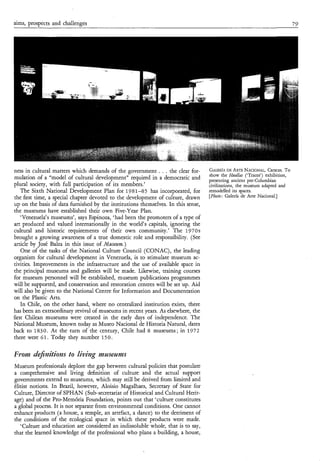
                                                                                   G A L E ~ A *RTE NACIONAL,   Cmcas. To
                                                                                   show the HueLfas (‘Traces’) exhibition,
mulation of a “model of cultural development” required in a democratic and         presenting ancient pre-Columbian
plural society, with full participation of its members.’                           civilizations. the museum adamed and
- The Sixth National Development Plan for 1981-85 has incorporated, for            remodelled its spaces.
the first time, a special chapter devoted to the development of culture, drawn                       de Arte
up on the basis of data furnished by the institutions themselves. In this sense,
the museums have established their own Five-Year Plan.
    ‘Venezuela’s museums’, says Espinoza, ‘had been the promoters of a type of
art produced and valued internationally in the world‘s capitals, ignoring the
cultural and historic requirements of their own community.’ The 1970s
brought a growing awareness of a true domestic role and responsibility. (See
article by José Balza in this issue of Maseam.)
    One of the tasks of the National Culture Council (CONAC), the leading
organism for cultural development in Venezuela, is to stimulate museum ac-
tivities. Improvements in the infrastructure and the use of available space in
the principal museums and galleries will be made. Likewise, training courses
for museum personnel will be established, museum publications programmes
will be supported, and conservation and restoration centres will be set up. Aid
will also be given to the National Centre for Information and Documentation
on the Plastic Arts.
    In Chile, on the other hand, where no centralized institution exists, there
has been an extraordinary revival of museums in recent years. As elsewhere, the
first Chilean museums were created in the early days of independence. The
National Museum, known today as Museo Nacional de Historia Natural, dates
back to 1830. At the turn of the century, Chile had 8 museums; in 1972
there were 61. Today they number 1 5 O .

From defilzz!tions t o livilzg mlzztseums
Museum professionals deplore the gap between cultural policies that postulate
a comprehensive and living definition of culture and the actual support
governments extend to museums, which may still be derived from limited and
elitist notions. In Brazil, however, Aloisio Magalhaes, Secretary of State for
Culture, Director of SPHAN (Sub-secretariat of Historical and Cultural Herit-
age) and of the Pro-MemÓria Foundation, points out that ‘culture constitutes
a global process. It is not separate from environmental conditions. One cannot
enhance products (a house, a temple, an artefact, a dance) to the detriment of
the conditions of the ecological space in which these products were made.
   ‘Culture and education are considered an indissoluble whole, that is to say,
that the learned knowledge of the professional who plans a building, a house,
80                                       Museum development ánd cultural policy :

     a school, a church or a city finds its equivalent in the popular know-how of
     those who, from childhood, have learned from the local craftsmen the skills
     applied in agriculture or fishing, or in the production of ceramics and textiles.
        ‘This orientation of our cultural policy led us to place special attention on
     small, regional museums, called the “everything” museums, linked to the rural
     environment.
        ‘We try to transform these museums into increasingly active community
     centres, which will come nearer to the “integral museum” concept.
        ‘This policy is centrally conceived and administered by the Ministry of
     Education and Culture. Institutional mechanisms have been created to pro-
     mote both artistic creativity-literature, theatre, music, cinema and the visual
     arts-and     the preservation and presentation of cultural property. Taken to-
     gether, both of these areas are of capital importance in regard to the new
     concept of museums and of their role in society.’
        For example, the Museu ao Ar Livre of Orleans (a town in the state of Santa
     Catarina in southern Brazil) was planned with and handed over to the local
     community by SPHAN and the Pro-MemÓria Foundation. The museum
     shows, in a dynamic way, the technological culture of the nineteenth- century
     immigrants and their descendants so as to revitalize the cultural life of the
     region and give support to local schools by sponsoring ‘learning experiences’
     where children come into contact with the culture of the area. It was proposed
      to the federal institutions and educational organizations by the local people
     themselves, who actually carried out the project.
        They used traditional building techniques to construct the museum, em-
     ploying local craftsmen and masons. A special effort was made to preserve
     harmony with the surrounding environment. Endangered species among the
     region’s flora were conserved.
        Another museum organized by the community is the Museu Casa Setecen-
     tista, located in the Casa da Princesa in the city of Pilar de Goiás (State of
      Goiás). This is literally a ‘live’ museum, since the premises are used for com-
     munity meetings and other activities. The museum was inaugurated on 28
     June 1 9 8 1 , the day of the celebration of the popular feast of the Holy Spirit.
     Both this house and the Casa de Câmara e Cadeia, in the same city, were
     restored by SPHAN/Pro-MemÓria. Following suggestions made by the com-
     munity, the Casa de Câmara e Cadeia will become the headquarters for the
     youth clubs of the city.

     Self-he& comes jîrst
     These few examples remind us that in Latin America and the Caribbean, as
     elsewhere, museum development cannot afford to turn its back on private
     initiative, especially when the contribution of the state may be supple-
     mented-or      indeed replaced-by   a commitment that is not necessarily the
     finance provided by the commercial or industrial sector (see article, p. 84
     below) but rather the labour of individual members of a community. Indeed,
     unless personal commitment is actually achieved, how credible are the
     museum’s claims to be serving its community ?
        Frances Kay Brinkley, Curator of the Carriacou Historical Society Museum,
     tells the unusual story of this museum, created by the community on this
     island dependency of Grenada, only 24 km long and 8 km wide. The museum
     was established without any government funding.
        At the time of the creation of the museum, Carriacou had a population of
     about 7,000, mainly small farmers, fishermen, sailors and boatbuilders. Says
     Brinkley : ‘It was not, you would think, very fertile ground in which to start
     an historical society and museum. Ninety-five per cent of the ,population
     didn’t know what a museum 2uas. The idea began floating around in 1974.
     Some of the island‘s inhabitants (the hotel administrator and his wife, a young
     bartender, the wife of the island’s only planter, an artist) had been collecting
     old stoneware jars, and digging for Amerindian artefacts. These were really the
     nucleus when the floating idea was verbalized.’
aims, prospects and challenges                                                                                                 81

   Before starting, the group made a general inventory of the specific heritage
of the material culture of the islanders which needed to be preserved and of
which the latter should be made aware. The group had to decide what the
collections would contain and on what basis the museum would function.
They also considered whether to ask th: government for aid or not.
   Since Carriacou has three cultural heritages-African, Amerindian and
European-the museum was planned with a section for each culture. ‘As to
funding,’ observes Frances Kay Brinkley, ‘considering the political situation at
that time, it was decided not to ask for the government’s help. The main
source of funds would be membership dues. These came from Regular and
Associate Members and Patrons. A Special Associate Membership was estab-
lished, open only to Carriacouans living on the island. W e did not want
anyone saying he was not a member because he could not afford the fee. The
minimum due was set at 1 EC a year (2.70 EC = $1).’
    Another important decision was what to include in the museum’s collec-
tion. The criteria were the amount of space available, achieving a balance of
collections and securing public interest : ‘The first two are obvious restrictions
for all museums. The third took a form that is perhaps something that would
not occur to a European museologist. If you .have succeeded in giving people
an affection for and a pride in their museum, they are going to start bringing
you things they have at home. Naturally, sometimes there will be things you
will have to refuse. But it is better to take them and store them (if they are
not welcome, or are absolute horrors) than damping the enthusiasm for the
museum born in the donor’s heart.’
    But in the final analysis and despite such success stories, museums must
continue to rely heavily on state support. Roderick C. Ebanks reminds us aptly
that ‘the task of museum development in Third World countries passing
 through an economic crisis is a very real challenge. But the lack of financing
is not the major factor in the lack of development. Rather lack of knowledge,
of trained people, of clearly defined objectives, of advanced planning and of
integrated cultural services all play havoc with the best intentions.’
    The solution proposed by this museum expert is, in the first place, to
motivate professionally the museum staff and to educate the public. Among
 the latter are the politicians and administrators of cultural affairs, who ‘are not
informed about museums and their demands: they think about museums as
storehouses for national exotica, or as a way of enticing a few more dollars
from the tourist’s pocket. Consequently, they are not encouraged to invest
funds in a museum. W e must make these senior decision-makers and policy-
makers aware of the museological process.’
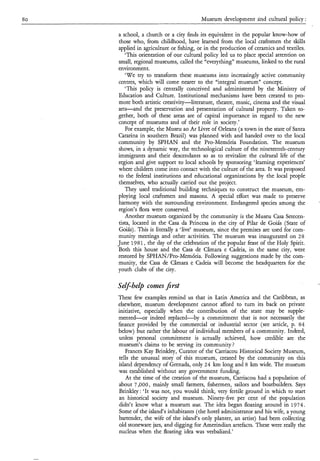
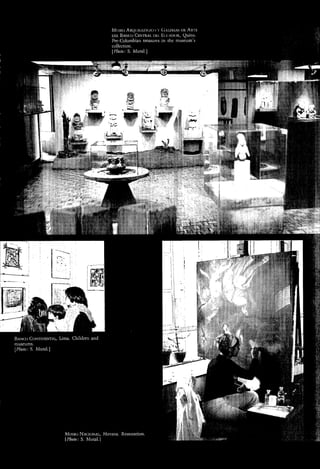
                                                                                       BANCO  CONTINENTAL,Lima. Children and
                                                                                       museums.
                                                                                       [Photo: s. Mutal.]
82


MUSEO HOhlBRE PANAhfEÑO, Panama.
       DEL
Interpreting the history of the region’s
material culture.
[Photo; Sylvio hhtal.]


                                           MUSEO   ARQUEOLOGICO   Y GALERIASARTE
                                                                             DE
                                            DEL BANCO  CENTRAL DEL ECUADOR,   Quito.
                                           Christ being baptized by John the Baptist.
                                           [Photo: S. Mutal.]
*


Sergio Durán Pitarque                                   In Latin Americu und the Curib6emi-a                  curred in recefzt years. IB Bruzil utzd
                                                         throughout the developifig worl&the over-            Venezuelu, for exumple, the government hm
Born in Quito, Ecuador, in 1949. Studied                 riding museum problem is the luck of jmds.          given substuntìul jítzuncial support to
economics at the Universidad Central del
Ecuador. Attended courses at the Churubusco
                                                             Their poverty e.x.luins why inost museum         museums. Im Ecuudor und Colovdia nzuseunz
Centre, Mexico, and the First Course for                 operute us stutic iiistitzitiorzs, incapuble of      uctiuio has been encouraged by contributioizs
Directors and Administrators of Museums of               reaching out to the conzmunity o f which thty       from the stute uizd psiriate bunks dike# The
Latin America at the School of Restoration and          fom u part. The sume compluint froin                 private sector is BOW more uwure of the vulue
Museology, Bogotá. Visiting lccturer, Second             museum directors ui2d stuff cuti be heurd time       of museunis, diid its help ilzjífinun&zg them is
Course for Directors and Administrators, School
of Restoration and Museology, Bogotá. Deputy
                                                         und uguin : We cun’t do u~ything      becuuse we     itzcreusing, ulbeit ìti un ad hoc und sporudic
Director of the Museums of the Central Bank of           buvez ’t the mowy. ’ M u y si?@f cunnoty             wuy.
Ecuador. Professor of Museology and                      ufford to mploj the necesmy quul$ed stuff;               Finuncilzg is also a jíeld in which
Museography at the Instituto Tecnologico                 while others, which do huve stuff skilled in         nzuseologists izeed to receive pec$c truining.
Equinoccial, School of Restoration and
Museography, Quito, Ecuador. Member of the
                                                         ?nodem ?nuseologicul techniques, fiiid thut          Ideulb, economists ui2d managers should ul-
Board of Directors of the Ecuadorian Association         theirprojects ure thurted because they do tzot       wuys be purt of the teum udnzim5terìrig u
of Museums. Has written articles for various            possess the means to set up their exhibitiom          nzuseu?n. As Jucques Riguud pointed out ut
periodicals.                                            properb or store their collections in suituble        ICOM ’s Tweyth Generul Confiremeir2 Mex-
                                                         conditiom. Museunis ure more o j h i thuiz not       ico City, ‘the time has come to proclaim this
Belén Rojas Guardia                                      unuble to ucquire tzew objects or establish          truth :museum have become entetprises in the
                                                         efficient security systems.                         fullest and inost modem sense of the word
Born in Caripito, Venezuela, in 1945.                        Some countries with u rich historical trudi-     Here ugain, their lot is izot vegl dzfferent
Anthropologist. Worked for ten years as a
producer of documentaries, mostly in the area of
                                                         tiorz-eciully         pre-Colunzbim-are more        )om that of other culturul institutions com-
scientific and technological development. Head of        inclined to ullocute u shure of their budgets to     mitted to creutivity, comewutioiz, und dis-
Production of four feature films : Fiebre, Suittutla,    urchueologicul nzuseunzs, sime the authorities      seniitzution, utid faced with the sume nzuiza-
Se solicita hlucbucbu and El T/ividor. Head of the       regard them as tourist uttractions and con-         geriul problem, whether it be in the jíeld of
Research Department at the National Art                  sider thut uny increase ìti tourism meuns eum-       the theatre, of uudio-uisuuls, or o f iizultiple
Gallery ; at present Deputy Technical Director
with responsibilities for planning and                   ings fir the country. This urgunzent is wot          culturul uctivities. In evegi cuse it is dzjicult
co-ordinating the museum’s technical activities.         valid however, for ull couiztries niid, more         to guin uccqtaiice of the idea thut culturul
                                                         iinportunt still, side-stqs the real role of the     institutiom are both originul edties because
                                                         museum: un educutiofzal establishmezt de-            of their objectives und also, in u certain wuy,
                                                         sigtzed for the co?ni?wiity It strengthens our       entetprises, thut is to suy coinmuzities for
                                                         convictioiz thut ?nuseumswill receive adequate       work and exhaizge, with utz uutonomous re-
                                                        fiizunCil2g only when govertments recognize          qotzsibility for co?nbifzingull the meum avuil-
                                                         how i?>portunt are und that the object o f
                                                                            they                              able to uchieve their goals.
                                                         every nzaseum (whether it deuls uith history,            Ecuador und Venezuelu-one tuith u
                                                         science, te ch no log^! or naturul histoiy) is to   strugglitig econonzy uiid the other u nzmnber of
                                                        present ull upects of the country’s culturul          OPEC-both provide interesting exunzples of
                                                         identity und its devefopmetzt. Museum wifl be        how the museum sector curz break the vicious
                                                         allocuted suffikent fuizh-of the sume order          circle ofjnunce. Sergio Durún Pitarque, De-
                                                         as those eumzurked for health, education und        pug Director of the hfuseunzs of the Ceztrul
                                                         social we@re-on.$ when goaemnze?zts con-             Buizk of Ecuudor, afid Belén Rojas Guardiu,
                                                         sider them to be purt of the coutztry Ir integral    Dtpugl Technicul Director of the Natioml
                                                         development.                                         Art Gullery ita Caracus, ra-ponded to
                                                             Unfortunute.$, there is no detuiled com-         Museum’s request for infoolrimtion. Some-
                                                        purutive anabsis bused on concrete jínutzciul         what condensed versions of their two articles
                                                         dutu of how funds are allocuted to museums          fokOUJ.
                                                         in the vurious couiztries. As a general rule,
                                                         the budget for stute museums is taker1 out of
                                                        funds allocuted to the ‘cultural sector’ as u
                                                                                                                1. We should like to record our gratitude
                                                         whole, some of which are eamurked for               to Juana True1 and Sylvio Mutal at the
                                                         tnuseunzs, The amouizts vuiy uccordit7g to the      UNDP/Unesco Regional Project for the Cultural
                                                        prìorities estublished for each countiy ’s cul-      Heritage in Lima, Pem, who prepared this
                                                                                                             introductory section. The summary versions of
                                                         tural sector.                                       the following two articles were also drafted
                                                             Significant changes huve tievertheless oc-      by them.
Sergio Durán Pitarque                                                                           On a practical level additional funds
                                                                                             may also be obtained through initiatives
                                                                                             taken directly by museum directors and
What can be done?                                                                            their staff, e.g. :
                                                                                             Stimulating passage of a law allocatitlg to
                                                                                                museums revenue received through the
                                                                                                main export products from the area in
                                                                                                which they are located.
                                                                                             An administrative decision to allocate to
                                                                                                museums part of the receipts from
Whether they house collections that de-       sion rights, etc ; donations (including           sales of seized contraband goods.
pict a country’s archaeological wealth or     contributions from the ‘Friends of the         A similar measure could provide for a
colonial past, its historical development,    Museum’ in their different categories) ;          small tax to be imposed on admission
its -contemporary visual arts or architec-    sale of reproductions, books and other ar-        fees for different public shows, such as
tural development, museums are econ-          ticles in the museum shops ;rental of pre-        the cinema, sports meetings, etc.
omically and administratively dependent       mises ; cafeteria ; subscription to publica-   Some museums could hire out unimpor-
on two distinct systems: (a) central or       tions, etc. These earnings are not gener-         tant art works in order to raise funds.
regional governments or municipal             ally administered by the museums them-         Encouraging ICOM’s National Commit-
bodies ; (b) private individuals, founda-     selves, however. On the contrary, they are        tees, national museum associations or
tions and organizations.                      deposited in the treasury through the             ministries of education and culture in
   Government authorities at the various      Ministries of Finance or in the bank ac-          all the Latin American countries to
levels generally include museums in their     counts of institutions or foundations.            carry out objective analyses of the state
annual operational budgets. They almost       The result is that not only do museums            of our museums, so that we may iden-
invariably allocate minimal annual            remain short of the resources they need,          tify genuine needs and find possible
amounts that barely suffice for the upkeep    they also are unable to recover the funds         solutions to the problems.
of exhibition rooms with poorly or-           they themselves generate.                      There are certainly many innovative ways
ganized museography, totally lacking in          It is also true that the directors of       of financing museums. For example, in
any didactic function.                        many museums adopt a rather devil-             order to assist a small, well-established
   Because of the museums’ lack of ad-        may-care attitude. They are often elderly      museum of religious art in one of our
ministrative and economic autonomy            people dedicated to writing ‘memoirs’,         small towns-with       a not very religious
such budgets are not made directly avail-     whose frames of reference are élitist ; in     community-it was suggested that the
able to the museum directors. The result      other words, museums are run by ‘refined       inhabitants should be consulted about
of this is that the latter are never quite    people’ who need give no thought to            the possibility of each owner,of an elec-
sure what resources they can definitely       reaching the general public. It is worth       tricity meter donating to the museum the
count on for carrying out their pro-          while to remember the words of Hernán          equivalent of $3 per month over and
grammes. The budgets are quite inad-          Crespo Toral, Director of the Museum of        above his electricity costs. The consulta-
equate to the genuine needs, which are in     the Central Bank of Ecuador: ‘The              tion yielded positive results, and it is ex-
fact declared in the annual museum            museum cannot be restricted to its pre-        pected that the equivalent of $2,900 per
budget pro forma. Government approval         mises, nor its message to a selected few:      month will be collected.
                                         l
is usually given for budgetary allocations    the museum must reach everyone, be                In many countries, institutions such as
for fixed expenditure. But, generally         completely involved in existing problems,      financial concerns, private banks with na-
speaking, there is no allocation of stable,   or else disappear.’                            tional capital, and autonomous state
let alone increasing, budgets that would         What can be done to brighten such a         bodies, especially the central or reserve
allow museums to augment their collec-        gloomy situation ? The main challenge to       banks, have taken cognizance of this
tions. This is probably the most impor-       be taken up is obviously that of creating      problem and have begun to lend decisive
tant reason for the pillaging of the cul-     the necessary awareness among govern-          support to museums. In these cases, the
tural heritage of Latin America and           ment authorities. W e must help them to        government offers tax concessions to pri-
Caribbean countries.                          realize that the preservation and presenta-    vate businesses that donate such a percen-
    In the case of private museums, funds     tion of the cultural heritage constitute an    tage of their profits. These firms
generally depend on the economic sol-         essential basis for harmonious socio-econ-     frequently acquire museum pieces, realiz-
vency of their owners and the interest on     omic development. W e museum people            ing their excellent investment value,
capital invested that is made over to the     must expose the bitter paradox of multi-       since cultural property never depreciates
management. This kind of museum has           million-dollar budgets for the acquisition     as other assets do; rather, the reverse is
greater autonomy and often a larger           of war material that serves only for man’s     true, since the price increases as time goes
budget, enabling it to reach out actively     destruction of man, on the grounds that        by. As for autonomous state institutions,
to the community. It is true, however,        we must be ‘in a position to defend our        their officials have grasped the fact that a
that there are also private museums that      native soil‘, when we are frequently           country’s socio-economic development
do not adequately carry out their museo-      ignorant about our own history.                cannot be separated from its cultural de-
logical functions, even though they are so       W e also need to stimulate the estab-       velopment, and have also realized that
financed.                                     lishment of independent national funds         properly presented the cultural heritage
   Museums do not only incur expenses.        for the support and promotion of artistic      stimulates demand for enjoying it and
They also earn income in the form of en-      and cultural activities. Private firms could   leads to an increase in its economic prof-
trance fees ;photographic, film and televi-   play a very important role in this field.      itability.
Thus the Central Bank of Ecuador has        Belén Rojas Guardia
acquired archaeological, ethnographic and
numismatic collections as well as colonial
and modern art. Thousands of objects are
now made accessible to Ecuador’s people
                                               A fair share in Venezuela
through the bank‘s museums in Quito,
the capital, and in the cities of Guayaquil,
Cuenca and Manta, as well as its galleries
in Esmeraldas, Ambato, Latacunga, Rio-
bamba and Loja.
   In addition to the budget it earmarks       How museums obtain sufficient financial          museums, justifying their claim to be al-
for the running of its museums, the bank       resources; whether from state budgetary          located resources as befits their role.
also donates funds each year exclusively       allocations or through contributions                The success achieved by the gallery in
for carrying out projects of archaeological    from the private sector, will depend on a        its first year, the formation of a team of
and anthropological research and the           series of factors and circumstances. These       professionals whose will and dedication
safeguard of monuments. Funds amount-          include the priorities established for the       were revealed by putting theory into
ing to as much as 3 5 million sucres a year    cultural sector in any particular develop-       effective practice (eighteen itinerant exhi-
(about a million dollars) are also ear-        ment model, as expressed in a country’s          bitions that travelled all over the coun-
marked to set up museums and present           national plans, and the museum                   try ; research, conservation and preserva-
exhibitions throughout the country.            authorities’ skill in implementing a bold        tion) allowed it to obtain the targeted
   This example could usefully be fol-         and innovative fund-raising strategy.            budget that year. This sum was approxi-
lowed by similar establishments in other          The institution’s efficiency, dynamism        mately equivalent to the budget for the
countries. Already the Banco de la Re-         and scope are obviously decisive elements        previous ten years combined. It did no
pública of Colombia is carrying out a          of museum financing. The quality of its          more than meet a need that had long
similar task, with the Museo del Oro and       exhibits, its degree of responsibility and       been ignored.
its archaeological research programmes.        professionalism, its training and educa-             This unprecedented measure gave rise
   If the museums of Latin America and         tional activity, its capacity to attract every   to controversy about the rights of decen-
the Caribbean could rely on the under-         kind of public-in short, any action that         tralized cultural institutions to go directly
standing of those who govern them and          confirms its historical role in shaping an       to the legislature for their budgets. The
therefore on sufficient funds, they could      authentic cultural identity-will         be a    debate was resolved in our favour, and
well become the most efficient vehicles        positive asset. Venezuela has a demo-            the country’s museums were given the
for promoting and disseminating culture,       cratic, pluralist and participatory political    go-ahead to implement projects vital to
by delivering valid messages and render-       system, and an economy now grounded              the country’s cultural personality, enab-
ing real service to our countries, helping     in oil wealth, all the basic industries of       ling them to consolidate their situation.
our people to overcome the bitter reality      which are managed by the state. The              In 1980 2 1 per cent of the total alloca-
of so many political, social, economic and     latter assumes a clear responsibility to         tions of the National Cultural Council
cultural problems. Effective museum ac-        promote and encourage other sectors              was set aside for the museum sector.
tivity will be the key that unlocks the        (non-productive in the strict economic              The museum’s active and dynamic
door to better days for the nations of         sense) that form part of an overall de-          presence in our society has generated a
Juárez, Bolívar and San Martin.                velopment model, the final aim of which          climate of confidence. New avenues of
                                               is to stimulate the capacity for innovation      financing are being opened up. These in-
                  [Transhted from Spanish]     of individuals and communities in a har-         clude the private sector, which is becom-
                                               monious relationship with the environ-           ing increasingly aware of the need to
                                               ment.                                            participate in and contribute to the de-
                                                   The state is the greatest, and almost        velopment of an institution that belongs
                                               exclusive, financial source of a large pro-      and caters to everyone.
                                               portion of the country’s cultural institu-
                                               tions (whether they are governmentally                            [Tradated fi’oflz Spanish]
                                               administered or not). In 1977 the new
                                               National Art Gallery (see the article
                                               p. 105) first took the initiative of directly
                                               and independently presenting its draft
                                               budget separate from the general budget
                                               traditionally submitted to the National
                                               Cultural Council (CONAC) . Logisti-
                                               cally, this move attracted the attention of
                                               organizations concerned with budgetary
                                               decision-making at the highest level to
                                               the problems facing the country’s
                                               museums. It also temporarily separated
                                               the gallery from CONAC by a ‘strategic’
                                               action that was perfectly legal yet imagin-
                                               ative enough to dramatize the state of our
86


                                                                                 de una ciudad
                                                                                     nes la habitan.


MUSEO SANTIAGO,
       DE            Santiago de Chile.
Tracing the history of the urban
community: model of the former residence
of the Count of the Conquest.
[Photo: Museo de Santiago.]
                                                     N w directions
Fernanda de Camargo-Moro                             in mnsenm orgmizutìon
B.A. and postgraduate degree in museology, M.A.      It is certainly an enomous responsibility t o      colonial times, which bequeathed to us
and Ph.D. in archaeology. Assistant Professor and    discuss mzueum Organization in Latin Am-           the essential medium of communication
subsequently holder of the Chair of Archaeology
in the Faculty of Museology of the Museu do
                                                     erica and the Caribbean in oize short article.     of cognate languages, are still powerful
Homen, Rio de Janeiro, 1968-71. Associate            Femanda de Camargo-Moro,who hm consid-             factors of cohesion.
Professor of Anthropology at the Pontificia          erabIeprofessìoolaal experience in her own roun-      Our efforts are greatly inhibited,
Universidade Catolica of Rio de Janeiro, 1974.       try, Brazil, and more than passing acquain-        however, by the difficulties of inter-
Director of Cepi (Iconographic Research Centre),     tance with variousprogrammes in otherparts         national travel within the region. In most
1972-73, and Mouseion (Centre of ,Museological
Studies and Sciences of Man) from 1973.              of the continent, stresses that the views she      cases, we are dependent on the air services
Director of AMICOM-Mouseion seminars, Real           expresses below are high4 personal and still       linking capital to capital, which are usu-
Càbinete Portugues de Leitura, 1973-79.              evolvìng, a is the entire process of museology     ally very costly. Distances are enormous.
Supervisor of Museology at the Museum of             in the region.                                     Rio de Janeiro, for instance, is closer to
Images of the Unconscious from 1973. President
of the Rio de Janeiro Museums Foundation,                                                               Lisbon than to Mexico City. Overland
1979-80. At present Director-General of                                                                 travel is easier on the Atlantic side, but
Museums in the State of Rio de Janeiro               Volume XXV, No. 3 , of Museum, en-                 the problem of distance is compounded
(FUNARJ), President of the Council for the           titled ‘The Role of Museums in Today’s             by the curvature of the Brazilian coast
Protection of the Cultural Heritage of the City of
                                                     Latin America’, appeared too soon after            and the indented coastline of the
Rio de Janeiro, Chief Curator of the
E. Klabin Rappaport Collection, Director of the      the Santiago round table of 1972 to re-            southern. zone. Transcontinental overland
ICOM-Brazil Museological Documentation               flect the radically new approach the               routes from the Atlantic to the Pacific are
Centre, President of the Brazilian Committee of      museums in the region were to adopt in             rare and in all cases time-consuming. And
ICOM and Member of the Executive Council of          response to the ideas developed during             sea travel, even via the Panama Canal,
ICOM 1981-83. Author of books and articles on
museology, archaeology and preservation.
                                                     that meeting.                                      which is still in use, is extremely circu-
Has carried out several museological consultant         The changes have taken time to ma-              itous.
missions for Unesco.                                 terialize. The geographical configuration             These difficulties, combined with the
                                                     of Latin America, with the slender strip           world economic crisis, have tended to
                                                     of Central America joining Mexico to               hold up the spread and implementation
                                                     South America and the long expanse of              of the new museological ideas. But now
                                                     the latter broken up by the barriers of the        that ten years have elapsed, we can begin
   1. Jamaica has embarked on a vigorous *
museum organization programme and is forging
                                                     Andes, the Amazon basin and the Pan-               to take stock of the changes in Latin
strong l i n k with the African museum movement.     tanal, restricts the scope for effective im-       America and consider the extent to which
The Republic of Trinidad and Tobago has already      plementation of joint programmes. On               the new approach has also had an in-
implemented an extensive museum renovation
and expansion programme initiated in 1976 with       the other hand, our common heritage                fluence in the Caribbean and created
Unesco’s support.                                    and the pervasive Iberian influence since          linkages with the continent.’
New directions in museum organization                                                                                                                87

        Most of our museums were established          by the community in their activities. This
     in the nineteenth century in the image of        was the key to survival.
     European museums, generally those of                The redefinition of the museum con-
     the country wielding the greatest in-            cept called for at Santiago implied a con-
     fluence in the region at the time.               comitant redefinition of our heritage and
     Although the collections, generally trans-       hence a change in the mentality of the
’
     ferred and donated by ruling or govern-          cultural élites of our countries, in many
     ing families2 or assembled as a result of        cases still steeped in the Europeanizing
     scientific and artistic missions from            concepts of the nineteenth century. In
     Europe, were of a very high standard, the        order to disseminate the new ideas, it was
     underlying conception of the museums             decided to set up a Latin American Asso-
     was extremely partial. The collection and        ciation of Museology (ALAM). The asso-
     presermtion of local objects were entirely       ciation was established at the beginning
     neglected ; many of these objects were ex-       of 1973 at an intensive and lively meet-
     ported. and the remainder were displayed         ing in Quito, but despite the enthusiasm
     in the light of a foreign interpretation.        of some of its members it never really got
     There was no documentation of either             off the ground. In the meanwhile, the
     imported or exported collections. Local          seeds of the new philosophy of muse-
     material was ordered according to con-           ums had found fertile soil and the first
     ceptions that led inevitably to its identifi-    fruits were beginning to appear.3
     cation as natural history collections : the         The creation of the National Museum
     indigenous peoples and their cultures           of Anthropology in Mexico City in 1964
     were shown side by side with exotic flow-       is considered by some as a turning-point           MUSEU ” m o REINADE, de Janeiro.
                                                                                                               P                   Rio
     ers and animals. A further anomaly was          in the museological movement in Latin              Reaching out to the disabled: a deaf-mute
     the exclusion of the cultures of Asia, Af-      America. In our opinion, however, it was           child being taught rhythm.
                                                                                                        [Photo: O Edson Meirelles.]
     rica and our own continent from the             merely an isolated event whose implica-
     rather insipid fine arts museums or their       tions were more museographical than
     discriminatory classification in terms of       philosophical. Far be it from us to belittle
     ethnography rather than art.                     the extraordinary achievement that the
        Up to the end of the 1960s modern-           Mexican museum represents or to ques-
     ization work on our museums served.             tion its undeniable beauty. It altered
    purely decorative purposes. Changes were         many preconceived ideas in the region.
     made only in items of equipment, for in-        Museums were no longer seen as musty
     stance display cases and coloured panels.       storehouses of crumbling relics rather         ,
     Although the essential link between             than living memories, but became instead
     museums and education was recognized,           political instruments, sources of prestige
    very little was done to turn this fact to        and monuments to our indigenous ances-
     account. Only a limited amount of re-           tors, affording greater objectivity and
     search was conducted, with no attempt at        clarity of definition in the archaeological
    interdisciplinarity. The notion of conser-       rather than the ethnographical field. But
    vation was non-existent, the only work           for a better understanding of contempor-
     carried out under this heading consisting       ary Mexican culture as a whole, we must
     of the restoration of paintings. Between        turn to the magnificent Museo Nacional
     1950 and 1960 the number of mu-                 de Historia in Chapultepec Castle.
     seumsnational, state, municipal, pri-               The National Museum of Anthro-
    vate, encyclopylic and monographic               pology, while attaining a very high stan-             2. For example, the Etruscan collections
    -increased    sybstantially, without basic       dard of display, tends to lay undue em-            brought over by Tereza Cristina, Empress of
    organization /or structural conception.          phasis on the monumental in an aesthetic           Brazil, which are now in a natural history
                                                                                                        museum, the National Museum of Rio de


               i
    They were ‘bsolete from the outset and           context, and it does not enter into a dia-         Janeiro.
     devoid of ny prospect of development.           logue with the population, least of all               3 . As evidence of the impact of the new ideas
    Static in CO cept, designed primarily with       with communities in the most deprived              in various parts of the region, we may note, in
                                                                                                        the first instance, the plans for the Archaeological
    a view to el borate inaugural ceremonies,        areas.4                                            Museum and Art Gallery of the Central Bank of
    they rapidly ‘degenerated into a formless                                                           Ecuador, El Salvador’s Houses of Culture and
                                                                                                        travelling exhibitions (1974), Brazil‘s proposals
    conglomeratio’n of bric-à-brac. At the be-       Towurds ‘museum on u                               for community ecomuseums and the Museum of
    ginning of the 1970s, when all sectors                                                              Images of the Unconscious (1973-74), the
    were faced with financial difficulties, the
                                                     humazz scule’                                      programmes of the Museum of Natural History
                                                                                                        of Santiago de Chile (1973-74), the Casa del
    museums, already struggling to make              The idea of a museum on a more human               Museo in Mexico (1973-74) and the
    ends meet, were particularly hard hit. It        scale that evolved in 1972 did not                 restructuring of museums launched by Trinidad
                                                                                                        and Tobago in 1976.
    was clear that they were not accomplish-         succeed in preventing all the capitals of             4. This aim was to be fulfilled by the Casa del
    ing their crucial mission of preserving the      Latin America and its neighbours from              Museo, a project brought about by the new ideas
    cultural heritage ; something was miss-          slavishly copying the famous Mexican               which have permeated all of its programmes.
                                                                                                        Mexico is also pursuing a successful policy of
    ing-a firmer bond uniting them with              museum without the slightest attempt at            dialogue with the population through smaller
    the population and stronger participation        adaptation to national realities. Even to-         museums.
88                                                    Fernanda de Camargo-Moro

MUSEO   AMANO,Lima. Attaining and
preserving technical standards : a small,
privately owned museum of pre-Columbian
textiles.
[Photo: Museo Amano.]


                                            A sustained concern to preserve both the
                                            cultural and natural environment is
                                            emerging : extramural activity to promote
                                            understanding of agriculture carried out by
                                            museums in the Rio de Janeiro network.
                                            [Photo; SMU-FUNARJ.]
N w directions in museum
 e                               organization                                                                                          89

day it is quite common for the techno-          the foundations of a modern and dynamic       a recent programme and is already yield-
crats of our countries to return from a         museology by inaugurating the Archaeo-        ing favourable results. For technical sup-
visit to Mexico City utterly obsessed with      logical Museum and Art Galleries of the       port, it relies on the ICOM-Brazil
the idea of copying the National Museum         Central Bank at the beginning of the          Museological Documentation Centre.
of Anthropology, forgetting that each           1970s, a project commensurate with the           An activity of major importance in the
country has its own scale of collections,       human realities and aspirations in our re-    region, which exerts a direct influence on
historical background and aspirations,          gion. In addition to the Quito museum         museum organization in Latin America,
and that its museums must take all these        and gallery, the programme also provided      is the UNDP-Unesco Regional Project
elements into account. It is by no means        for decentralization through the estab-       for the Cultural Heritage. This project,
easy to persuade these technocrats, trus-       lishment of new museums in other parts        which has its headquarters in Lima, has
tees and financial authorities to take an       of the country, the organization of ar-       been the motive force behind a series of
interest in simpler activities on a smaller     chaeological missions and the develop-        activities in the region. As well as
scale, just as it is not easy to secure sup-    ment of research.                             promoting the organization of new
port for the preservation of museums and            In Brazil an example of the extensive     museums by offering encouragement and
their collections. It is and always will be     form of organization is the system of         technical support, it also helps to restruc-
easier in many parts of the world to ob-        museums that is gradually being estab-        ture old museums and has initiated in-
tain financing for costly prestige projects     lished in the state of Rio de Janeiro by      valuable training activities. (See article
of colossal dimensions than to meet the         the General Directorate of Museums at-        below, p. 94.)
more modest cost of viable projects con-        tached to the Arts Foundation of the             The seeds of a new museology have
ceived in human proportions.                    state. This Directorate, which is the suc-    been sown and have already begun to
    Nevertheless, the idea of a museum          cessor to the State Museum Foundation,        bear fruit, although a full harvest is yet to
tailored to community needs is gaining          a body formerly responsible for a group of    come. Our museums have shed their
                                                                                                                                              '

ground and is gradually becoming a              museums operating in airtight compart-        gaolhouse image and are gradually assum-
characteristic feature of the region. De-       ments completely divorced from the popu-      ing the aspect of the agoras of ancient
spite all difficulties of communication and     lation, is at present engaged in con-         times.
exchange, the reaction has spread               structing an integrated system, based
 through the collective unconscious of the      on two major criteria: conservation and                     [Tranrlatedfrom Portuguese]
region. A sustained concern to preserve         dynamic development. In the field of
both the cultural and natural environ-          conservation, the Museology Department
ment is also emerging.                          of the General Directorate lays down
    Museum collections are now being            technical standards governing inventory,
 studied from a multidisciplinary point of      conservation and maintenance in respect
view. Objects used in daily life are seen to    of museums and their collections, con-
be worthy of preservation. Small                trols the research and museographical
 museums tracing the origins of urban and       planning activities of the twelve mu-
rural communities have been set up, and         seums or houses of culture and organizes
 the principle of decentralization of collec-   an extensive programme of temporary ex-
 tions has begun to be observed. The prac-      hibitions that travel to all parts of the
 tice of despoiling a community of collec-      state. In the field of dynamic develop-
 tions providing information about its           ment, the educational action programme
 background and origins has been aban-          acts as a stimulus to the programmes of
 doned. Collections are increasingly in          the twelve museological units, draws
 keeping with the specific character of the      their attention to municipalities that are
 museum and the interests of the local           still without museums and promotes in-
 community.                                      tegration of the programme with the
    A crucial development was the elabor-        local community. The programme is
 ation of non-formal educational pro-           headed by the Primeiro Reinade Museum
 grammes, within which museums began             in Rio de Janeiro, which carries out pilot
 to be used as three-dimensionalinforma-        projects and analyses their results for the
 tion systems. A new spirit of creativity is    benefit of the system. The impact of the
 abroad, with inventiveness taking the          programme is gradually being felt at all
place of luxury and grandeur in each new        levels of society, in both urban and rural
 museographical project.                         areas, thus forging links between the
    An excellent case in point is Ecuador's      museum and the various local com-
 recently developed museological project,        munities.
 which is extensive in conception but               Another series of extremely important
 closely linked to the aspirations of the        extensive projects based on community
 population. Systematic studies in the field     integration is being implemented by the
 of anthropology have confirmed that the         interesting Museu do Homem do Nord-
 country's cultural history dates back 'at       este in Recife (Pernambuco), the Dom
 least 12,000 years, a conclusion that is        Diogo de Souza Museum in the southern
 borne out by very rich archaeological ma-       part of the country and the State
 terial. The Central Bank of Ecuador laid        Museums Division in São Paulo. This is
pects o staff training
                                                                 f
Felipe Lacouture
                                                      The Republic of Argentina has played a         als could be classified into five categories
Born in Mexico in 1928. Studied architecture at       pioneering role in the provision of sys-       ranging from Grades A to E, and on the
the ,UniversidadNacional Autónoma of Mexico,
1947-52 ; also read archaeology and art history.      tematic training for museum staff since        assumption that each category after
École du Louvre, 1952-53. Taught architecture         1922, when a course to train experts in        Grade B was capable of passing on to the
at the Universidad Iberoamericana at UNAM             museum work was established in the             next grade. In this way, through constant
1956-59. Lectured in aesthetics at post-secondary     Faculty of Arts of the National Univer-        practical experience and a certain amount
level, 1965-68. Professor in museology at the
Latin American Institute for the Conservation of
                                                      sity of Buenos Aires. This course con-         of necessary additional study, the
Cultural Property, Mexico City, 1971-77.              tinued to be given for thirty-seven years,     museum worker may hope to become
Director of the Museo de Arte e Historia at           and subsequently other institutions were       better qualified and so obtain promotion
Ciudad Juarez, 1964-70. Head of the                   created for the same purpose, so that          on the professional grading scale.
Department of Regional Museums, INAH,                 there are now in all four such institutions
197,0-73. Director of the Museo de San Carlos,
1973-77, and Head of the Department of                in existence, offering seven different         Two approaches to staf
Graphic Arts of the Instituto Nacional de Bellas      courses of museology at various levels.
                                                                                                     traìnìng
Artes, 1974-77. Director of the Museo Nacional            Although efforts have been made in
de Historia, Mexico City, since 1977. Has             many Latin American countries, or are          What results are obtained by the Argen-
practised as an architect-restorer, has carried out   now being made, to provide training on         tinian and Mexican approaches, or sys-
mrious missions for Unesco and the OAS and has
attended numerous international meetings of           a systematic basis, as in Argentina, there     tems, in the context of staff training?
specialists.                                          have also been attempts to set up on-          Each gives rise to its own problems, in-
                                                      the-job training schemes, which are large-     cluding that produced by the liberal ap-
                                                      ly autonomous. This is the case in Mex-        proach of establishing a school and taking
                                                      ico, which took its first steps in the field   on students who have no guarantee of
                                                      of museographical presentation in 1934 ,       work when they have finished their
                                                      establishing many of the features that are     studies.
                                                      still characteristic of museum work in            In Argentina the School of Museology
                                                      Mexico today with the foundation of the        started giving courses for school-leavers
                                                      Museo Nacional de Artes Plásticas, in          in 195 1. There are two courses, the first
                                                      which such outstanding artists as Julio        to train museum auxiliary staff, which
                                                      Castellanos were involved and which, it        lasts two years, and the second for a de-
                                                      might be added in passing, marked the          gree in museology, which lasts an addi-
                                                      beginning of the ‘decorativîst’ bias in        tional two years.
                                                      Mexican artistic activity. I should also          The Higher Institute for Technical
                                                      like to mention the efforts made by the        Training and Education in Museology
                                                      Instituto Nacional de Antropología e           also trains people who have completed
                                                      Historia (INAH) to retain the emphasis         their secondary studies to become
                                                      on the educational function of museum          museum assistants or museologists, and
A photography theory class at the School              exhibitions, which is so necessary for a       offers an interesting one-year course for
of Conservation, Restoration and Museology            public not familiar with the subject-          qualified teachers that enables them to
at the National Centre of the same name,              matter of anthropology.                        qualify as museum educators. In Latin
Bogotá, 1980.
[Photo: Colcultura.]                                      However, these two tendencies within       America, as elsewhere, a problem has al-
                                                      museography, which came to represent           ways been posed by schoolteachers who,
                                                      real extremes, were finally fused in 1964      for all their knowledge, do not know
                                                      as a result of the work of a team of an-       how to make appropriate and worthwhile
                                                      thropologists and architects led by a gen-     use of museums in their teaching. (In
                                                      eral co-ordinator trained in history, art      Mexico attempts have been made to solve
                                                      and architecture as well as anthropology.      this problem by individual museums that
                                                      Many of the features that formed the           have taken the initiative of providing
                                                      basis for the development of Mexican           special courses for teachers so that they
                                                      museography thus evolved not in an aca-        will learn about the museums themselves
                                                      demic context but in a strictly practical      and thus be able to pass on the know-
                                                      way.                                           ledge to their students.)
                                                          Later the need was felt for a hierarchi-      In 1972 the Escuela Superior de Con-
                                                      cal structure and systematic organization,     servación de Museos (Higher School for
                                                      and a grading commission was therefore         Museum Conservation) under the aus-
                                                       set up within INAH so that different          pices of the Argentinian Institute of
                                                      levels could be established for members of     Museology established a three-year course
                                                       staff according to their knowledge and        to provide technical and professional
                                                      experience. A series of definitions was        training for those who have obtained
                                                      drawn up so that all museum profession-        their secondary school-leaving certificate.
Aspects of staff training                                                                                                                     91

                                                                                              Practical work on mural-painting restoration
                                                                                              in the Templo de Santa Clara, Bogotá, as
                                                                                              part of the course on restoration of movable
                                                                                              cultural property.
                                                                                              [Photo; Colcultura.]
                                                                                                             . __
    Mention should also be made of the
National Course of Museology, which
comes under the National Commission
                                                                       z            f
for Museums, Monuments and Historical
Sites, which provides courses lasting three
years at the post-secondary-school level to
train specialists for historical museums.
For a period, a somewhat similar kind of
training was provided by the Universidad
de Luján, but the course was sub-
sequently abolished.
    In Mexico, the training programme
organized since 1968 by INAH’s
National School of Restoration in Chu-
rubusco to train graduates in restoration
work includes a systematic introductory
course of museology, considered essential
in view of the fact that professionals of
this type are mainly required to look after
the collections belonging to the INAH
museums.
    Later on, in 1971, Mexico realized the
need to provide intensive courses, in view
of the increasing importance of museums         students were just as likely to be sent
in the country and the urgent need to           to the school as Argentinian museolo-
train personnel for them. This situation        gists. It therefore became necessary to
coincided with the creation of a course of      provide preparatory courses and at the
museographical training as a result of an       same time to determine an appropriate
agreement with the Organization of              stage or level of instruction, which could
American States (OAS). It was decided           only be decided upon when the students’
that the course would last nine months,         educational background was known.
offer one OAS fellowship for each                  As part of a generally liberal policy,
member country of the organization and          which was not specifically directed
be held in the INAH School of Restor-           towards the personnel of institutions,
ation. It was given for nine consecutive        there was established in Mexico in 1979
years and trained a total of 2 5 5 people, of   a master’s degree in museology within
whom approximately 40 were Mexican.’            the above-mentioned Churubusco school,
    The course was divided into three           which had by that time been renamed the
levels : a theoretical level approaching the    School of Restoration and Museography.
study of museums through the social             On the one hand, it was decided, in gen-
sciences, psychology, cultural anthro-          eral terms, to adopt an integrated ap-
pology and pedagogy ; a second level cov-       proach to the various techniques of
ering the organization of museum work,          museum work, starting with the subjects
ranging from research and documenta-            of collection, research, documentation,
 tion to education and cultural activities,     conservation and restoration, before go-
with emphasis on display techniques ; and       ing on to display techniques, the use of
 a third level where the student was free,      explanatory material, education and the
 on the basis of his own subject interests,     diffusion of information and, finally, mar-
 to choose a particular kind of practical       ket research techniques designed to im-
work, which was then carried out in one         prove communicationwith the museum’s
 of the various national museums.               public. On the other hand, attention was
    However, this plan, which appeared so       also given to the whole range of know-
well organized, encountered serious prob-       ledge that can be presented in a museum,
lems in practice, as Churubusco was never       including cosmology, geology, biology,
 able to intervene directly in the selection    ecology, palaeontology, palaeoanthro-
of students, who were mostly chosen by          pology, archaeology, cultural anthro-
                                                                                                 1. Unfortunately this course has now been
 the OAS member states themselves,              P0logy7 ethnography, history,                 temporarily suspended owing to administrative
with the result that secondary-school           and art. All this clearly demonstrates the    problems.-Ed.
92                                                                                                                   Felipe Lacouture

Working group during an interdisciplinary
retraining seminar carried out by the
SMU-FUNARJ in Rio de Janeiro.
[Photo: 0 Edson Meirelles.]


’Mexican desire to create an integrated ap-
 proach to museology in which culture is
 seen as a structured whole.
    According to this approach, a museum
professional is regarded as a generalist
 who co-ordinates a series of techniques
 and sciences in order to carry out
 museum work successfully. The master’s
 degree was therefore organized so as to
give graduates in various subjects training
 in museum work at the postgraduate
 level. Up to the present time, two com-
plete courses have so far been given and a
 third is about to begin.

Truinìng initiutiues elsewhere
The training courses organized in Bogotá
by the UNDP/Unesco Regional Project
for the Cultural Heritage in co-operation
with Colcultura are described separately
 (see p. 94) ; suffice it to explain here
that the aim of the course for adminis-
 trators was to provide them with the
necessary basic knowledge to develop           in countries where all areas of life and      knowledge of those basic techniques that
 training courses within their own institu-    work are influenced by liberal ideals. The    are so essential in restoration and conser-
tions and thus, as fir as possible, create a   situation in Ecuador is of great interest.    vation work and that moreover provide
multiplier effect. The situation is so         The School of Restoration, Antiquities        basic knowledge about the intrinsic na-
serious that it is not possible to go          and Museography set up by the Instituto       ture of the objects themselves, which in
through the slow and lengthy process of        Technológico Equinoccial has established      the last analysis are the be-all and end-all
training personnel with high academic          a specialized training course lasting three   of the work of a museum.
qualifications, who would have to be re-       years, which may be extended for a               Ecuador has eighty museums, which
cruited on an unconditional basis, with a      further two years in order to reach degree    have, for the most part, been established
high probability that they would never in      level. The particular interest of this        as a result of private initiative in associ-
fact work in the museums in the area. To       course lies in its attempt to provide joint   ation with the recently founded National
succumb to the temptation to organize          training in restoration work and museog-      Institute for the Cultural Heritage and
admissions to schools of museology on a        raphy. Extension of the course up to de-      also with the Banco Central del Ecuador,
liberal basis and allow things to find their   gree level, which has already been men-       a state-controlled body that plays an
own level on the laisser$aire or laisser-      tioned, will give the student the oppor-      extremely active part in the country’s cul-
paser principle would, within the Latin        tunity to choose in which of these fields     tural life (see article by Sergio Durán Pi-
American context, represent an enormous        he wishes to specialize. It must be admit-    tarque, p. 84). The scene is set for the
waste of effort. This has been amply dem-      ted that very often the generalist trend in   further development of museology and
onstrated in other fields of activity,         the training of museum professionals          the recruitment of graduates of the
although it is difficult to understand this    tends to provide them with insufficient       school by existing institutions.
Aspects of staff training                                                                                                                    93

   The Directorate of Museums and              been passed. The first unit deals with the      2. Fernanda de Camargo-Moro has pointed out
Monuments in Cuba has introduced               humanizing function of small museums that ‘these courses are not sufl6cient to meet the
                                                                                            needs of the roughly 500 Brazilian museums
courses of museology, recently establish-      in developing countries and with the spread throughout the country. For a time, Rio
ing for this purpose a School of               techniques of gaining a wider public. It would systematically reserve a certain number of
Museology, where specially selected per-       lasts a total of 375 lecture hours. The grants eachbut this practice was states of the
                                                                                            federation,
                                                                                                         year for the various
                                                                                                                                dropped a few
sonnel are trained for work in museums.        second unit concentrates on the social years ago. The detailed survey of Brazilian
They have been a powerful force in             and humanistic function of fine-arts museums which was formerly conducted by the
                                                                                            Association of Members of ICOM-Brazil (Rio de
spreading awareness of the role of the         museums and history museums in the de- Janeiro) and is now carried out by the
people in social and economic develop-         veloping countries. It lasts 375 lecture ICOM-Brazil Museological Documentation
ment. The School of Museology provides         hours, with additional hours for planned Centre, with its headquarters in Rio de Janeiro,
                                                                                            drew attention long ago to the need for training
training in six-month seminars on the or-      reading. Finally, the third unit deals with facilities of this kind in other Brazilian
ganization of cultural activities, general     science, industrial and technical museums universities in order to meet the growing demand
museology and museography, catalogu-           and lasts 375 lecture hours, together with while training atmuseums. It is alsoquite sufficient
                                                                                            of the country’s
                                                                                                               university level is
                                                                                                                                     noted that

ing and classification, conservation and       additional hours for planned reading.        for the purposes of the small museums,
restoration work and Marxist philosophy.          A possible change in government pol- postgraduate studies in a in neighbouring or in
                                                                                            museology for graduates
                                                                                                                        specialized field
After he has finished his studies, the         icy could bring about changes in the disciplina are becoming more and more necessary
student of museology is guaranteed con-        work of the school if, for example, the for museums with medium- or large-scale
tinued work in museums if his results are      government were to encourage the attached to The Arts Foundation of the Museums
                                                                                            collections.
                                                                                                         the
                                                                                                              General Directorate of
                                                                                                                                         state of
satisfactory, and thus the effort he has put   development of science or industrial Rio de Janeiro is attempting to solve this
into his studies is hlly rewarded.             museums. This would call for academic problem by organizing practical postgraduate
   Finally, mention should be made of          flexibility and an organic and functional in conjunction with periodic retrainingaim in so
                                                                                            training courses and
                                                                                                                   ICOM-Brazil. Its
                                                                                                                                        seminars

the courses that exist in Brazil, including    approach that would take political factors doing is to lay the groundwork for the
those given by the University of Rio de        in the country into account. In addition, introduction as soon as possible of a master’s
                                                                                            degree in museology.’
Janeiro at the Centre of Human Sciences.       it is expected that there will be wide-         3 . As Gretc Mostny has pointed out, ‘Most
These courses, which are undoubtedly the       spread job opportunities for the gradu- important, we require trained personnel, capable
longest established in Brazil, are given in    ates, both in museum work itself and also of applying the techniques. In many museums,
                                                                                            museography is still improvised, and conservation
the city of Rio de Janeiro itself since        in teaching.                                 is non-existent. However, one should be aware of
1932 and also in the city of Bahia. In            Finally, it needs to be repeated that, in the dangers of importing models not suited to
                                                                                            the conditions of the country or the region.
both cases, they are at university level and   the face of so-called liberal attitudes con- It has been the experience of several countries
are also open to those who are not already     cerning admissions of courses, in Latin that sending personnel abroad often has negative
working in museums. The private univer-        America and the Caribbean it is never or inapplicable to situationstendthe Third World,
                                                                                            results. The courses taught
                                                                                                                           in
                                                                                                                                to be inadequate
sity Estacio de Sa also provides courses at    possible to disregard the basic specific and the costly equipment used for conservation,
university level for the training of           needs of the institutions concerned, presentation and inventory is much too expensive
museum professionals.2                         which in many cases are urgent and re- for these Countries to buy. Often, too, homehighly
                                                                                            trained personnel cannot find a job at
                                                                                                                                        the
                                                                                                                                               on
   Courses are also organized in the city      quire imaginative solutions.’ Nor can the coming back. This creates frustration and destroys
of São Paulo by the Foundation School of       problem of guaranteeing work for those creativity. Many of these people look for jobs in
                                                                                            other arcas, and are lost for the museums.’ For
Sociology of São Paulo, which is linked        who have attended such courses be ig- R. C. Ebanks (Jamaica) ‘the best way to achieve
to the university of the same city. This       nored, on account of the human and an integral solution to this problem would be to
master’s course for postgraduate students      economic d o r t that all this work repre- set up regional training and records centres,
                                                                                            where people educated within the cultural milieu
is divided into three interesting ‘units’,     sents for economically weak, developing would organize training courses, wholly applicable
the second two of which can only be em-        nations.                                     to the cultural peculiarities of the region’.
barked upon when the preceding unit has                          [Translatedfrom Spanish]


                                                                                                 Museology diploma students a t the Escuela
                                                                                                 Nacional de Conservación, Restauración y
                                                                                                 Museografia ‘Manuel del Castillo Negrete’ ,
                                                                                                 Mexico City, with a model for an
                                                                                                 exhibition project.
                                                                                                 [Photo; Felipe Lacouture.]
94

Participants in the Second Regional Course
for Museum Assistants engaged in practical
work on museological design at the
National Centre for Conservation,
Restoration and Museology, Santa Clara,
Bogotá, 1980.
[Photo: Sylvio Mutal.]


Sylvio Mutal


Chief Technical Adviser and Regional
Co-ordinator of the UNDP/Unesco Regional
Project for the Cultural Heritage, Lima, Peru.
                                                 Mnseology conrses
                                                 organized by UNDP, Unesco

                                                 One of the principal objectives of the        1977 in collaboration with the Italian-
                                                 UNDP/Unesco Regional Project for the          Latin American Institute.
                                                 Cultural Heritage, which operates in Ar-         At the meeting museologists, ar-
                                                 gentina, Bolivia, Brazil, Ecuador, Colom-     chitects, anthropologists, social scientists
                                                 bia, Chile, Panama, Peru and Venezuela,       and educationists discussed problems of
                                                 is to disseminate information on various      museology from the conceptual, technical
                                                 subjects relating to the conservation and     and economic points of view. The
                                                 contemporary relevance of cultural prop-      museum was defined as a place in which
                                                 erty as a factor in a multidimensional type   the work of man and his relationship
                                                 of development.                               with the environment may be perceived.
                                                    As contributors to this issue have al-     and it was aíKrmed that museums should
                                                 ready pointed out, most of the museums        be part of the social and environmental
                                                 in the region are severely lacking in the     context in which they operate.
Sergio Durán Pitarque (second from right),       infrastructure and trained staff needed to       As the city of Bogotá already had a
Administrative Director of the Museum of
the Central Bank of Ecuador, surrounded by       ensure the proper conservation, restor-       restoration centre, as well as other ap-
other museologists taking part in the First      ation and presentation of their collec-       propriate facilities, it was recommended,
Regional Course in Museology for Directors       tions.                                        in agreement with the Colombian
of Museums in Bogotá, 1979.                         In order to help fill the gap the          Government, that regional training
[Photo: E. Tavera.]                              Colombian Cultural Institute (Colcul-         courses in museology should be organized
                                                 tura) and the UNDP/Unesco Regional            in Bogotá. To this end, the Government
                                                 Project for the Cultural Heritage decided     of Colombia joined with Unesco and
                                                 to organize a series of regional courses.     UNDP in a cultural development project,
                                                 These were inaugurated in Bogotá in           which included a special museology com-
                                                 1979.                                         ponent.
                                                                                                  At the end of 1978 and beginning of
                                                                                               1979, Colcultura organized working
                                                 Background to the courses                     meetings with Unesco and UNDP which
                                                 At the invitation of Colcultura, the          brought together national and interna-
                                                 UNDP/Unesco Regional Project for the          tional experts from different ,continents,
                                                 Cultural Heritage organized at Bogotá an      for the purpose of establishing the pro-
                                                 International Symposium on Museology          gramme and content of the courses for
                                                 and the Cultural Heritage in November         1979-81. For the courses in 1979 and
Museology courses organized by UNDP, Unesco and Colcultura'                                                                    95

1980, Colcultura obtained additional            The lecturers included Marta Arjona
funds from the Andrés Bello Convention.         (Cuba), Luis Lumbreras (Peru), Jorge
The Italian-Latin American Institute            Kliecer Ruiz (Colombia), Claude Pécquet
 (IILA) in Rome also expressed its interest     (France), Alfonso Castrillón (Peru), Fer-
and support by sending lecturers from           nanda de Camargo-Moro (Brazil), Felipe
Europe.                                         Lacouture (Mexico), Eduardo Terrazas
                                                (Mexico), Eduardo Porta (Spain), Sebas-
First regìoizal courses i p z                   tián Romero (Colombia), Omar Cala-
                                                brese (Italy), Angel Kalenberg (Uruguay),
museology-Bogotú, 1979
                                                Danièle Giraudy (France), Lloyd Hezek-
A first regional course for museum direc-       iah (United States), Regina Otero de Sa-
tors and assistants was organized from          bogal (Colombia) and George Schröder
October to December 1979. It was at-            (Netherlands).
tended by twenty-four directors and
twenty-four assistants from museums in          Itzitial techmkd trainì~gcourse for museum
Argentina, Bolivia, Brazil, Colombia,           assistants. The purpose of this eight-week
Chile, Ecuador, Guatemala, Peru and             course (23 October-15 December 1979)
Venezuela. Central American participa-          was to 'train staff for museum work, to                        CoNSERVAT1oN~
tion was arranged through the UNDP/                                                          RESTORATION MUSEOLOGY, Clara,
                                                                                                          AND              Santa
                                                provide general information on museol-       Bogoti. General view of the painting
Unesco Regional Project for that region.        ogy and to encourage the exchange of         restorationworkshop.
    The programme of the courses-in-            experience.                                  [photo: ~o~cu~tura.]^
tended for persons working in museums
of anthropology, archaeology, history and
art-was designed to take into account,
for the different areas and subjects, the
actual stages through which a cultural
object passes when it becomes part of a
museum collection : (a) cataloguing and
archives ; (b) conservation and prepar-
ation of specimens; (c) exhibition and
museography ; (d) communication and
social projection of the museum. These
areas were complemented by themes such
as the museum and culture and the his-
tory and concept of the museum. Special-
ists from museums in Latin America,
Europe and the United States gave the
courses.

Ref fiber  c o m e for museiim directors. The
aims of this course were : (a) to deter-
mine the academic level and experience of
museum directors in Latin America, (b)
to discuss the most important problems
concerning museums in Latin America,
(c) to update knowledge by reporting on
developments throughout the world in
the field of museology, (d) to analyse and
discuss the present situation of museums
in Colombia, (e) to propagate the courses
throughout Latin America and the Carib-
bean and ( f ) to exchange experiences be-
tween different countries.
   The course lasted two weeks, from
19 November to 1 December 1979.
Round tables and lectures were devoted
to topics such as museums and culture,
museum programming, museum plan-
ning and organization, museum admin-
istration, museums of the future, semiot-
ics applied to the museum, visual aids
and communication in the museum, chil-
dren and museums and museum security.
96                                                                                                                            Sylvio Muta1

   Lectures and debates covered topics         (France) ; and museological criteria,       1981 at the Santa Clara Centre. The
such as the concept and history of the         Franca Helg (Italy). The co-ordinator of    theme of the course was ‘Technical
museum, the administration of collec-          the course was Alice Aguiar de Barros       Training in Museum Conservation’. The
tions, the museum and education and            Fontes (Brazil).                            principal aims of the course were : to pro-
museographic presentation. The lecturers          At the suggestion of the participants,   vide instruction on methods and tech-
included: Alfonso Castrillón (Peru),           the course took the form of discussions     niques of conserving museum collections
Grete Mostny (Chile), Jaime Camacho            and round tables. The afternoons were set   and buildings ; to impart basic knowledge
(Colombia), Amada Ojeda (Colombia),            aside for visits to various museums in the  on the composition of museum exhibits
Gaë1 de Guichen (ICCROM), Cecilia Al-          city-the Museo del Oro, the National        and the factors affecting their stability ; to
varez (Colombia), Guillermo Joiko              Museum, the Modern Art Museum and           teach the basic rules for cleaning, hand-
(Chile), Beatriz González (Colombia),          the Archaeological Museum-which en-         ling and storing exhibits ; to impart some
Regina Otero de Saboga1 (Colombia),            abled participants to make a practical as-  notions of didactics to enable participants
Emma de Vallejo (Colombia), Cecilia            sessment of the theoretical criteria.       to pass on the knowledge acquired.
Coronel (Colombia) and Eduardo Serrano                                                        This course was designed for conser-
(Colombia). The theoretical part of the        Workshopfor technical assistants in museum. vators and curators, as well as technicians.
course was complemented by specialized         The workshop for technical assistants was It was attended by twenty-seven fellow-
practical work carried out in various          intended to provide the technical staff of ship-holders from Bolivia, Colombia,
museums in Bogotá.                             the museums in the region with basic Chile, Ecuador, Peru, Panama and
                                               training in the mounting of exhibitions. Venezuela.
Second Regional Course in                      It therefore covered the following sub-        The lecturing staff for this course in-
                                               jects : introduction to museology, pho- cluded : Agustin Espinoza, Felipe Lacou-
M u s e o l o p B o g o t Ú , 1980             tography, design, psychology, semiotics, ture and Rodolfo Vallin from Mexico;
 This course was also held in Bogotá, at the   conservation and aesthetic appreciation. Emma Araujo de Vallejo, Jaime Mon-
 headquarters of the Santa Clara National      Analysis and practical work were geared cada, Germán Téllez, Jaime Salcedo,
 Centre for Conservation, Restoration and      to giving the skills needed to improve Martha de Garay and Mireya Vallin from
 Museology. The seminar for directors and      their own museums as needed.                Colombia and Fernando Jpiko from
 administrators of museums on the plan-           Museological theory was discussed by Chile.
 ning, financing and organization of           Alfonso Castrillón (Peru) and practical        The subjects included : introduction to
 museums was held from 6 to 17 October         design by Jorge Guiterrez (Colombia) ; the cultural heritage ; museology ; super-
 1980; the workshop for museum assist-         Macarena Aguero (Chile) gave a lecture vision and security in museums ; conser-
ants and technicians on museographi-           on defining the typical museum visitor’s vation of objects and monuments ; causes
‘cal presentation and explanation from         profile. The photography course was of deterioration and methods of diag-
 25 August to 17 October. The courses          given by Antonio Castañeda (Colombia) nosis ; prevention and simple conserva-
were also supported by the Secretariat of      and the course on graphic design applied tion ; conservation of buildings ; classifica-
the Andrés Bello Convention (SECAB).           to museums by Claude Dieterich. Conser- tion and recording ; storage and packing ;
The courses, given by lecturers from           vation was dealt with by Cecilia Alvarez, educational aspects.
Colombia and other Latin American              Guillermo Joiko, Darío Rodriguez and
and European countries, were attended          Martha de Garay, from the Santa Clara Activities for 1982 and 1983
by fellowshipholders from Argentina,           National Centre for Conservation, Res-
Bolivia, Brazil, Colombia, Costa Rica,         toration and Museology. A programme of Under the auspices of the UNDP/Unesco
Chile, Ecuador, Guatemala, Nicaragua,          lectures was arranged for the last two Regional Project and with the collabor-
Panama, Peru, Uruguay and Venezuela.           weeks, during which the architect Franca ation of ASEM and SECAB, a course was
                                               Helg presented her projects and those of organized in Quito in January 1982 on
Seminar fir museum directors. This seminar     the architect Franco Albini for the re- museums and educati0n.l Two others
focused on the planing, financing and or-      modelling of ancient buildings ; Danièle will be held, in Caracas on the museum
ganization of museums. It was designed         Giraudy, Head of the Children’s Depart- and the community and in Bogotá on
to cover a range of subjects useful for up-    ment in the Georges Pompidou Centre in museology and conservation. For 1983, a
dating the knowledge of those in charge        Paris, discussed aspects of education and course is planned in Brazil on the mu-
of the museums of the region so that, on       the museum; Claude Pécquet, pro- seum as a centre for cultural communi-
returning to their countries, they might       grammer for several French museums, ex- cation; other specialized events are sched-
put into practice the principles of modern     plained the programming method used at uled in Argentina, Chile and Bolivia.
museology. The various themes and fields       the Pompidou Centre and at other               The UNDP/Unesco Regional Project
dealt with during the course were: legal       museums throughout the world ; Felipe for the Cultural Heritage is also sponsor-
questions concerning the museum, Gus-          Lacouture spoke on travelling exhibi- ing a study on ‘Diagnosis of Museum
tavo Palomino Gómez (Colombia) ;financ-        tions, and Fernanda de Camargo-Moro Problems’ in all countries of the region, a
ing, Manuel Espinoza (Venezuela), and          dealt .with general aspects of museology, similar study having already been carried
Sergio Durán Pitarque (Ecuador) ; fund-        using examples from Brazil.                 out in Colombia, Chile, Ecuador and
raising for museums, Maria Victoria Ro-                                                    Venezuela.
bayo (Colombia) ; programming, Claude          T h i r d Regional Course in                                 [Tramlated from Spanish]
Pécquet (France) ; concepts of museum
organization, Fernanda de Camargo-Moro
                                               M z l s e o l o p B o g o t Ú , 1981
                                                                                              1. An artide on the subject in the Latin
(Brazil) and Felipe Lacouture (Mexico) ;       The Third Regional Course in Museology        American context will appear in a future issue of
children and museums, Danièle Giraudy          was held from 17 August to 2 October          Museum.
98


                                               Table o professsìonal trdiìnìng cozmes
                                                     f


Prepared by the Unesco-ICOM Documentation Centre
Country     Institution in charge          start,          Admission           Subjects                                  Certificate or diploma
                                           duration        requirements

Argentina   Instituto Argentino de         1972.           Secondary-school    1. Museology ; history of                 Museum curator.
            Museólogos. Escuela            3 years.        diploma.               civilization ; communications ;
            Superior de Conservadores de                                           natural sciences ; aesthetics;
            Museos.                                                                museography.
            Marcelo T. de Alvear 2084,                                         2 . Exhibition ; organization and
            1122 Buenos Aires,                                                     administration ; conservation
            Tel. : 83.9621.                                                        and restoration ; art history ;
                                                                                   history of Argentina;
                                                                                   archaeology.
                                                                               3. Lighting; architecture ;
                                                                                   anthropology ; ethnography ;
                                                                                   applied arts ; pedagogy.
            Escuela de hfuseología,        1959.           Secondary-school    1. Introduction to museology ;            Upon termination of the
            Facultad de Ciencias de la     1st cycle :     diploma.               organization and                       first 2 -year cycle : museum
            Información de la              2 years,                               administration ; general culture ;     technical assistant ( a u d i d r
            Universidad del Museo          2 nd cycle :                           French.                                técnico d museos). Upon
                                                                                                                                  e
            Social Argentino.              2 years.                            2. Conservation and restoration ;         termination of the 2nd
            Av. Corrientes 1723,                                                  practical museography; French          2-year cycle: B.A. in
            Buenos Aires.                                                         language and civilization.             Museology (1ice”b en
                                                                               3. History of the sciences ;              museologíd).
                                                                                  sociology ; art history ;
                                                                                  pedagogy.
                                                                               4. American history : art history ;
                                                                                  archaeology ; applied arts ;
                                                                                  museography.
            Instituto Superior de          1968.           Secondary-school    1.Technical assistant : 2 -year
            Perfeccionamiento Técnico y                    diploma.               course. Museology and
            Docente en Bibliotecología y                                          museography ; conservation and
            Museología. Attached to                                               restoration ; history of
            Ministerio de la Educación                                            civilization and of Argentina ;
            de la Provincia de Buenos                                             foreign languages ; museography
            Aires.                                                                workshop.
            Diagonal 74 entre Calles 5 y                                       2. Museologist : Requiring one
            43, La Plata.                                                         year of additional studies
                                                                                  following the 2 -year technical
                                                                                  assistant course. Archaeology ;
                                                                                  general history and history of
                                                                                  art of America and Argentina;
                                                                                  applied arts ; natural sciences ;
                                                                                  museology ; foreign languages.
                                                                               3. Educational personnel : 1-year
                                                                                  course. Pedagogics of
                                                                                  museology; natural sciences;
                                                                                  communication techniques;
                                                                                  prehistory and archaeology in
                                                                                  America ; folklore ; social
                                                                                  psychology ; history of art; the
                                                                                  cultural evolution of Argentina.
            Curso Nacional de              1973.           Secondary-school    1. Museology and museography ;            Specialization in historical
            hluseología, Comisión          3 years         diploma.                history ; sociology ; education ;     museography.
            Nacional de Museos,                                                    architecture ; administration.
            Monumentos y Lugares                                               2 . Conservation workshop ;
            Históricos.                                                            chemical and physical analysis ;
                                                                                   photography.
                                                                               3 . Archaeology ; iconography ;
                                                                                   numismatics ; heraldry ; folklore ;
                                                                                   naval and aeronautic
                                                                                   terminology.

Bolivia     Instituto Boliviano de         1978.           Graduate of fine    Conservation of easel paintings ;         Certificate of attendance.
            Cultura. Museo Colonial.       4 - 6 months.   arts academy or     murals; stone; wood.
            Sponsored by the                               school. Painters,
            UNDP/Unesco Regional                           sculptors.
            Project for the Cultural
            Heritage.
            La Paz.
Brazil      Escola de Belas Artes,         2 years.        Student of fine     Conservation of paintings.
            Universidade Federal de                        arts school.
            Bahia.
99

Country     Institution in charge           Start,               Admission            Subjects                                Certificate or diploma
                                            duration             requirements

            Universidade Federal da         1977.                Diploma in a         4 courses including the following
            Paraíba, CCT-DSH Campina        360 hours.           field relative to    subjects: museum history ;
            Grande, Paraíba. Curso de                            museums.             organization ; types of museums ;
            museología.                                                               regional problems ; acquisition ;
                                                                                      cataloguing ; conservation and
                                                                                      restoration ; communications ;
                                                                                      exhibition.
            AMICOM (Association of          1977.                Certificate.         General museology including             Certificate.
            Members of                      A four-week                               history, art history, natural
            ICOM-BRAZIL).                   museology                                 history, anthropology, science and
            Avenida Ataulfo de Paiva        seminar, twice                            technology ; administration and
            No. 1079, Rio de Janeiro,       per year.                                 organization ; documentation ;
            Tel. 294.19.46.                                                           research ; architecture and
                                                                                      equipment; exhibition ;
                                                                                      conservation ; education.
            Curso de Museus                 1932.                Secondary school     Museum history ; legislation ;          B.A. in museology.
            Universidade do Rio de          4 years.             diploma ;            administration and organization ;
            Janeiro/Museology course of                          knowledge of         registration and inventory ;
            UNIRIO.                                              two foreign          architecture ; presentation ;
            Rua Xavier Sigaud,                                   languages.           conservation.
            No. 290, Rio de Janeiro.
            General Direction for           2 years.                                  Museology ; history ; art history ;     Certificate.
            Museums of the Rio de           Advanced                                  natural history ; conservation and
            Janeiro State Foundation for    university courses                        restoration ; anthropology.
            the Arts (FUNARJ).              and periodical                            Advanced university courses and
            Avenida Portugal, No. 644,      recycling                                 periodical recycling seminars
            CEP 22291, Rio de Janeiro,      seminars                                  organized with ICOM-Brazil.
            Tel. 295.1996.                  organized with
                                            ICOM-Brazil.
            Escola Nacional de Belas        2 years.             Student of fine      Conservation of paintings. Theory
            Artes, Universidade Federal                          arts school or       and practice.
            do Rio de Janeiro.                                   eligible for
            Rua Aranjo Porto Alegre,                             admission.
            Rio de Janeiro GB ZC 2 1 .
            Conservation Laboratory of      2 2 months           Two years            Conservation of archaeological          Certificate.
            die National Museum of          (1,600 hours).       university studies   materials and paintings.
            Fine Arts.                                           in physics or
            Av. Rio Branco 199,                                  chemistry or
            Rio de Janeiro GB ZC 2 1 .                           museum school
                                                                 or fine arts
                                                                 certificate,
            Fundaçã0 Escola de                                   University level.    3 specialization courses :              Certificate of specialization
            Sociologia e Política de São                                              1 . Small museums.                      lading towards a master’s
            Paulo. Instituição                                                        2 . Art and historical museums.         degree.
            complementar da                                                           3. Museums of science and
            Universidade de São Paulo.                                                    technology.
            Rua General Jardim 5 2 2,
            São Paulo CEP 01223, Tel.
            256.46.73, 256.15.5 2.

Chile       Ministerio de Educación         1968.                Secondary-school     Natural sciences ; knowledge of         Certificate of preparator
            Pública.                        3 years              diploma.             materials ; conservation ;              (upon completion of 2
            Museo Nacional de Historia      (24 hours a                               preparation; museology ; regional       years). Certificate of
            Natural.                        week).                                    museums ; presentation ;                museology (upon
            Centro Nacional de                                                        documentation.                          completion of 3 years).
            Museología.
            Casilla 7187, Santiago de
            Chile.
            Museo de Bellas Artes,          1978.                Graduate of fine     Conservation of easel paintings ;       Certificate of attendance.
            Santiago de Chile.              4 - 6 months.        arts academy or      murals ; wood ; stone.
            (Sponsored by the                                    school. Painters,
            UNDP/Unesco Regional                                 sculptors.
            Project for the Cultural                             Preference to
            Heritage.)                                           those working in
                                                                 museums,
                                                                 national services,
                                                                 teachers.

 Colombia    Instituto Colombiano de         1978.                Director of a        Short seminars on specific subjects.
             Cultura (Colcultura) and the    Short course.        museum               A. Recycling course for museum
             And& Bello Convention                                signatory to the        directors : 2 weeks.
             ‘Escuela Regional de                                 Andrés Bello            Anthropology ; social
             hluseología’ (organized on                           Convention or           psychology ; education
             the initiative of the                                participating in        sciences ;museography ;
             UNDP/Unesco Regional                                 the regional            organization and administration.
             Project for the Cultural                             Unesco-UNDP          B. Vocational training for
             Heritage).                                           project.                technical personnel : 8 weeks.
             Bogotá.                                              University              Documentation ; conservation ;
                                                                  diploma.                museography ; educational
                                                                                          techniques.
IO 0                                                                                                              Unesco-ICOM Documentation Centre

Country                     Institution in charge          Start,             Admission             Subjects                              Certificate or diploma
                                                           duration           requirements

Cuba                        Dirección de Museos y          1979.                                    General museology and
                            Monumentos. Escuela de         6-month                                  museography ; cataloguing and
                            Museologia.                    seminars.                                classification : conservation and
                            Havana.                                                                 restoration ; Marxist philosophy.

Dominican                   Centro Taller Regional de      1979.                                    Restoration techniques of graphic
Republic                    Restauración y           ’     30 days.           Personnel of          documents.
                            Microfilmación de                                 archives and          1. Definition of cultural property.
                            Documentos para el Caribe y                       libraries of the      2. History of graphic documents.
                            Centroamérica.                                    Dominican             3 . Preservation of graphic
                            Calle Modesto Díaz No. 2 ,                        Republic and              documents.
                            Santo Domingo,                                    other Caribbean       4 . Restoration of graphic
                            Tel. 532.25 00/08/09.                             countries.                documents.
                                                                                                    5 . Deterioration of graphic
                                                                                                        documents.

Ecuador                     Dirección del Patrimonio       1978.              Graduate of fine      Conservation of easel paintings ;     Certificate of attendance.
                            Artístico Ecuatoriano.         4-6 months.        arts academy or       murals ; wood ; stone.
                            (Sponsored by the                                 school. Painters,
                            UNDP/Unesco Regional                              sculptors.
                            Project foc the Cultural                          Preference to
                            Heritage.)                                        those working
                            Convento San Agustín,                             in museums,
                            Quito.                                            national services,
                                                                              teachers.
                            Escuela de Restauración,       3 yas.                                   Restoration and museography.
                            Antiguidades y Museografia,
                            Instituto Tecnológico
                            Equinocdal.

Honduras                    Instituto Hondureño de
                            Antropología e Historia.
                            Villa Roy, Tegucigalpa.

Mexico                      Universidad Iberoamericana.    1979.                                    Teach students enrolled in
                            Avenida de las Torres,         2 hours per week                         humanities courses about the work
                            Mexico City.                   during two                               and role of museums in society.
                                                           academic
                                                           semesters.
                            Escuela Nacional de            1978-79.           University            Courses on acquisition ; research ;   Master’s in museology
                            Conservación, Restauración                        diploma in a          conservation ; presentation ;         (maestro en mtrseologfa)
                            v Museografia ‘Manuel del                         subject related to    circulation ; evaluation ;
                            castillo Gegrete’                                 museum                cataloguing ; documentation ;
                            INAH-SEP.                                         activities, such as   restoration ; interpretation ;
                            Centro Churubusco,                                history, art          education ; communication.
                            Ex-Convento de                                    history,
                            Churubusco, Xicoténcatl                           archaeology,
                            y General Anaya,                                  anthropology,
                            Coyoacán 21, D.F.                                 architecture,
                                                                              natural history,
                                                                              design.
                            Museo Nacional de Historia.    1980.                                    Courses intended to inform school
                            Bosque de Chapultepec,         8 sessions                               teachers how to make use of
                            Mexico City.                                                            resources offered by museums to
                                                                                                    improve their courses on the
                                                                                                    history of Mexico.
_   _   _   _   _   _   _   _   _   ~
                                    ~   ~   ~   ~

Peru                        Instituto Nacional de          1977.                                    Conservation of paintings and
                            Cultura.                       4 months.          Graduate of fine      sculpture.                            Certificate.
                            Apt. 775 Colegio de Santo                         arts academy or
                            Domingo, Cuzco.                                   school. Painters,
                                                                              sculptors.
                                                                              Preference to
                                                                              those working in
                                                                              museums,
                                                                              national services,
                                                                              teachers.
                            Museo Nacional de              1977.              Archaeologists,       Conservation of pre-Columbian         Certificate of attendance.
                            Antropología y Arqueología.    1st part :         conservators,         textiles.
                            Plaza Bolívar, Pueblo libre,   12 weeks.          textile artisans.
                            Lima 21.                       2 nd part :
                                                           5 months.
IO1


                                                          OPINION
A hundred yeurs o solitade?
                f
ICOM’S stake in the deidopment of niuseumm in             MusEuai: Are the definitions behind the              ity over excavation sites ? How many museum
Latiti Ainerica aiid the Caribbeangoes back to the        policies themselves restrictive ?                    ethnographers have the satisfaction of co-ordi-
wry begimings of that organization. Its Tweyth                                                                 nating or at least participating in inventory
 Gmeral Coizfrmce in hfexico strengthened                 MONREAL:     Indeed they are. The ‘heritage’ for     and salvage campaigns? The right linkages
ICOhl ’s presence in the regioti, boosting its mem-       example is still very largely understood in the       still don’t exist, partly, of course, because
bership there, placing a heavier demand both o?~    its   high-culture sense, which leaves room for            there just aren’t enough posts for qualified
Parir-ba~edsecretariat aiid on the capacig of             little but art treasures and archaeology. Living     personnel.
Latiz America’s museologists themselves to work           ethnic heritages are to a great extent forgotten         Concerning conservation, of course the
 together more effectively in the cause of the institu-   because of the risk of political conflict they        overriding problem is the lack of infrastruc-
tion t h q serve.                                         might involve. Bolder definitions of the cul-        ture such as laboratories and training courses.
    Focusiag as it does on the Latin American and         tural heritage must be defended and the very         Many exceptions are indeed mentioned in this
 Caribbean variaiits of a ugorldwide problem-the          real interdependence between the man-made            issue; what about those museums and coun-
stid itladequateplace 4 niuseunzs in contenporary         and the natural environment given its right           tries that are not so fortunate? This is a need
 cultural development and cultural policy-this            place in policy formulation and execution.            that certainly cannot be met by the museums
issue is i?ia seme a maiiijkto for the whole inter-       Similar problems arise in some African coun-          or governments alone. Multilateral co-oper-
zatiotial museum movement. This is why Museum             tries, where one rather partial version of ‘cul-      ation, but in imaginatively conceived forms, is
sought the views of L i Monreal, whose direct
                         us                               tural identity’ as defined by the state is in         the only solution. International organizations
 contacts with museums hi Latia America have              evident contradiction with the broader, real          such as the OAS and Unesco need to reassess
 nndt$hd in recent years. He has read through             identity that is meaningful to millions of            the conservation infrastructure requirements
 the articles in this issue as a high4 conmitted          citizens, particularly those outside the big          subregion by subregion and renew their efforts
 observer; he speakr not exlusively as ICOM’s Sec-        cities. This brings us to the problem of the          to create the necessary facilities.
 retaty-GeneraJ but also as a colleagie and friend        museum’s discourse, of the message it has to
 of Latin Anlericati aiid Cadbeafi niuseuin PTO-          get across to the people outside that urban          MUSEUM:   Surely not only material infrastruc-
fasionah.                                                 standard-an artificial ‘language’ in develop-        ture but human resources as well ; the lack of
                                                          ing countries. The problem is as much one of         trained staff has been underlined time and
MusEuaf : How would you assess the progress               physical access as it is of explaining a collec-     again.
made since the Santiago de Chile round table              tion of objects in more than just scientific
of 1972, which for so many Latin American                 terms. This is crucial as much within the            MONREAL:      Well, a look at the training
colleagues has become the benchmark ?                     Latin American city as outside it. Museums           facilities available will speak for itself (see
                                                          must be able-as they have begun to do in             table, p. 9 8 ) . Adequate training in general
MONREAL: of all, we are simply not in a
             First                                        Cuba, in Brazil, on Carriacou Island-to re-          museology is scarce, let alone more specialized
position to make a detailed assessment. As an             spond to the needs of urban and rural ‘micro-        training in education and cultural action. This
outside observer I would hesitate to make any              communities’ that also want to preserve and         is a deliberately chosen example, for to talk
sweeping statements. But I think we cannot                reaffirm their own particular identity. Think        about services in a community sense is idle
escape the fact that progress has been slow.              of Macondo in Gabriel Garcia Marquez’ Cierz          speculation if you do not have people who
Conceptually, little fresh ground has been                aíios de soledad3 as the prototype of such a         know how to do it. But there are other areas :
broken since Santiago. New ideas have been                 Latin American micro-community. All the             museum programming and architecture
scarce, and the implementation of the most                world‘s Macondos need their museums !                (paradoxically, the region has produced some
forward-looking intentions has at best been                                                                    of the best museum architects!) exhibit de-
uneven. The great revolutionary museums of                MUSEUM:   How well are the basic museum re-          sign and display techniques. Certainly a coun-
Latin America date from the 1960s ; despite               sponsibilities being shouldered-collection           try such as Mexico has excellent professional
the defects some people are now inclined to               and conservation for instance ?                      training programmes, as just mentioned by
find in it, the Museo Nacional de Antropo-                                                                     Felipe Lacouture. There are also the courses at
logía in Mexico City is still an avant-garde              MONREAL:     Well, to begin with there is little     Bogotá. But all together these are still drops
 museum. Aloisio Magalhaes has talked quite               evidence of a collection policy at local level       in the ocean.... Even more serious is the lack
 rightly of ‘everything museums, linked to the            that respects the significance of, say, a ‘family’   of employment. Argentina, for example, has
 rural environment’,’ but there have been few             heritage in the small community. At national         four schools of museology ; they turn out per-
 of these. The basic cause lies not, I feel, in           level only a few states have defined a sys-          haps one hundred trained people every year,
 some inadequacy of the region’s museologists             tematic approach to the building up of collec-       but there cannot be more than ten posts to be
 but in the lack of professional motivation, a            tions, based on an understanding of the total        N e d per annum! It isn’t a question of creat-
 crucial point mentioned by Roderick Ebanks.l             heritage of the country concerned. Why ?             ing museums merely to absorb the unem-
 Museum people have simply not been given                 Both the lack of a national plan in this respect     ployed; rather, as Cuba has done, the right
 the status they deserve, not even equivalent to          and the lack of resources are obvious factors.       specialists need to be trained for the right
 that of the teacher or the research worker.              For the same reasons museum professionals            slots. The continent’s museums must surely
 This is just one of the most perceptible, at             still have little scope in the protection of the     be about 80 per cent understaffed ! The ratio
 individual level, of the structural problems             heritage extra muros, in combating illicit
 mentioned in the introductory article, which             traffic, for example. How many directors of            1. seep.   so
 arise from the fact that museums are neglected           archaeological museums in Latin American               2.   seep. 81.
                                                                                                                  3. Published in English as A Huzdred Years of
 in the formulation of cultural policies, in the          countries are given the chance to sit on             Solitude.
 management of cultural resources and in the              government committees that screen the ex-              4. See article on illicit tr&c by R. Torres de
 national definitions of cultural needs.                  port of cultural property, or have any author-       h Ú z , p. 134.
I02                                                                                                                            Luis Monreal

                                           of professional posts to collections (number of     modest experiment involving the conversion
                                           objects) or square metres of exhibition space      into museums of several old buildings in
                                           is extremely low indeed.                            Quito. Excellent, but how many gestures or
                                                                                               experiments can you expect? As already ar-
                                           MUSEUM posts because of limited funds,
                                               : Few                                          gued, it is the state that must be made to
                                           no doubt. The examples given in the artikle        realize the need to give more to museums, to
                                           on financing plus other cases of almost ‘entre-    allocate those funds directly or at least in such
                                           preneurial’ initiative in launching museums        a way that gives the institution the power of
                                           would perhaps justify optimism.                     decision and financial autonomy that are es-
                                                                                               sential if it is to innovate and ramify.J This is
                                           MONREAL:    ICOM is now completing a study         far from being an impossible challenge; there
                                           on the financing of museums, prepared for the      is a great potential of goodwill-political, ad-
                                           International Fund for the Promotion of Cul-       ministrative, entrepreneurial-that remains to
                                           ture. W e see that in Latin America, as            be tapped. International organizations must
                                           throughout the developing world, financial         be associated with this effort. Bodies such as
                                           support for museums is and can only be             the OAS are beginning to build museum sup-
                                           mainly governmental. Those budget ceilings         port programmes. The World Bank on the
                                           are almost impossible to budge. Private in-        other hand is proving slow to commit itself.
                                           vestment is still only piecemeal. In Ecuador       Unesco’s resources of pre-financing, stimula-
CARRIACOU  HISTORICAL  SOCIETY   MUSEUM,   the artist Oswaldo Guayasamin is creating a        tion and incitement have not yet been fully
Carriacou, Grenada. A locally made         new museum on the basis of his own personal        mobilized. And there are other avenues that
‘show-case’ for donated objects.           archaeological collection, and the Fundación       the region’s museologists seem largely to ig-
[Photo: Carriacou Historial Society.]      Hallo is conducting a fascinating although         nore-bilateral       funding of fellowships and
                                                                                              other training activities, costly but with an
                                                                                              enormous mhtiplier deCr, ;hat could be
                                                                                              provided by such organizations as SIDA in
                                                                                              Sweden and similar state-supported develop-
                                                                                              ment agencies in Canada, France, the Federal
                                                                                              Republic of Germany, the United States of
                                                                                             America and in many other industrialized
                                                                                              countries. Finally, lest I be taxed with having
                                                                                             a ‘neo-colonialist’ bias, what about the richer
                                                                                             Latin American countries themselves ? Can
                                                                                              they not also be brought to commit them-
                                                                                             selves to creating a museum support structure
                                                                                             or network for the region ?
                                                                                                 A single example is sufficient to prove
                                                                                             that the situation is dramatic and has to be
                                                                                             urgently changed. Peru, for instance, has
                                                                                             over fifty thousand identified archaeological
                                                                                             sites-this is just the tip of the iceberg-and
                                                                                             only thirty-six museums (national, provincial,
                                                                                             local), with a professional staff that can be
                                                                                             evaluated at perhaps no more than 150 per-
                                                                                             sons. Millions of objects in the ground are
                                                                                             exposed to the greed of huaqueros-archaelog-
                                                                                             ical looters-and to uncontrolled land use for
                                                                                             agricultural or other purposes : industrial,
                                                                                             public works and tourism. The living heritage
                                                                                             too is threatehed by imported technologies
                                                                                             and mass-produced products, that quickly-
                                                                                             and irreversibly-alter       traditional life-styles
                                                                                             and environment. The disproportion between
                                                                                             the heritage that has to be urgently saved and
                                                                                             the human, technical and financial means
                                                                                             made available for its preservation is stagger-
                                                                                             ing. Every day, every minute, a significant part
                                                                                             of the zuorld’s heritage disappears forever.

                                                                                               5 . See the article on financing, p. 83.
ALBUM

                                                 Rock urt throughout
Rock paintings or carvings are found
throughout the American continent,                              the continent
                                                 through to 5,000 years ago. A farmers’
                                                 art emerges around 3000-2000 B.P.
from Alaska to Patagonia. The areas in              Some paintings and carvings exist in
which examples of it have not been               Argentina, from the far north to Pata-
found either lack suitable f o r m a t i o n s   gonia. As in Brazil, human and animal
caves, shelters, outcrops-or have not yet        figures are found alongside geometrical
been prospected.                                 figures, called ‘signs’ in the specialized
   Some regions have long been famous            literature. Some authors in recent times
for their outstanding rock-art sites. Re-        have attempted, without any really new
cent archaeological research has proved          scientific grounds, to group the old styles
that such art is much more widespread            in three stagesarchaic, intermediate,
than was first believed. Some of the newly       late. The first stage would be dated about      Niède Guidon
discovered sites are indeed much more            9000 B.P., the others spaced out in time
important than the already well-known            (some paintings represent the Spanish in-       Born at Jau in São Paulo State, Brazil. Degree in
ones.                                            vaders).                                        natiml history, zoology, biology and physics at
                                                                                                 the University of São Paulo. Studied prehistory at
   Owing to the disparity of the means              In Chile the same types of figure are
                                                                                                 the Sorbonne, 1961. Commenced research for the
employed, the differences between re-            found, but geometrical engravings pre-          CNRS under the direction of A. Laming
search teams, the fact that in some re-          dominate. No comprehensive classifica-          Emperaire of the Musée de l’Homme, 1966.
gions research has been conducted solely         tion or certain dating has been proposed           Excavations in Brazil from 1970 onwards,
by amateurs, knowledge of American               by researchers as yet. In Peru, on the          specializing in rock art. Doctorate (thesis on
                                                                                                 Brazilian rock paintings) in 1975. Assistant
rock art is at present not very coherent         other hand, excavations carried out in a        Professor at the École des Hautes Ëtudes en
and, above all, differs greatly from one         painted cave led to the obtaining of a          Sciences Sociales, Paris, from 1976. Chief
country or zone to another.                      date around 9500 B.P., but there is no          archaeologist on the Franco-Brazilian Piaui Project
                                                 obvious link between the strata dated and       since 1976. Research assessor at the Federal
                                                                                                 University of Piaui at Teresina since 1978.
                                                 the paintings, which represent armed
The kmwledge uvailuble                           men and Camelidue. These motifs occur
                                                                                                 Unesco consultant for the Salto Grande
                                                                                                  (Uruguay) archaeological salvage project.
The geology and the geomorphology of             most frequently in paintings ; the engrav-
the vast South American continent are            ings are often geometrical. In the equa-
most varied, for it extends from 1 2 O N.        torial forest of Colombia, painted surfaces
to 57’ S. Very wide in the north and             are to be seen on huge isolated rocks. The
narrow in the south, it has a great many         subjects are zoomorphic, anthropomor-
climates and biotopes owing to its physi-        phic and geometrical. Paintings are to be
cal features, ranging from zones situated        found on the Colombian/Venezuelan
at sea-level to the snowy peaks of the An-       border, and there are many engravings in
dean Cordillera. This variety is reflected in    Venezuela. In Bolivia the paintings rep-
the cultures and hence in the rock art.          resent llamas and felines. They seem to
   Research in Brazil has so far yielded         date back to between 3200 and 1300 B.P.
the earliest dates for American prehistoric      In Uruguay engravings are more numer-
paintings (17000-14000 B.P).’ With the           ous, but there are also a few paintings
setting up of a number of university             with geometrical motifs. In the humid
centres for research in prehistory our           regions of Guyana geometrical engrav-
knowledge of the rock art in this country        ings clearly predominate. Anthropomor-
has evolved rapidly, especially since the        phic or zoomorphic motifs also appear in
end of the 1960s. Several research proj-         paintings.
ects are under way. Their object is to re-
constitute the total cultural contexts of        The rock-urt herituge und
these paintings or engravings. The most
important projects concern the states of
                                                 its importance
Goiás, Minas Gerais and Piaui. In the            Prehistoric rock art is not to be judged or
latter state it was possible to connect the      analysed on the basis of criteria specific to
rock art with hunting populations : pieces       the history of art. Here we use the word
of wall with red ochre lines were dated          ‘art’ in its original sense derived from the
                                                                                                    1. B.P. stands for ‘before present’, the dating
back 17,000 years, and the evolution of          Latin ars, practical skill in malung            reference prehistorians now use in preference to
these hunters and their art was followed         something in accordance with certain            the Chrisiian (or any other) era. .*
1 o4                                                                                                                            Niède Guidon

Toca da Extrema II cave, Brazil-human                                   Toca da Entrada do Pajau cave,
figures and cervidae. The rock is damaged                               Brazil-human figures around a tree with
by termite streaks.                                                     cervidae; the sandstone surface is flaking.
[Photo: Niède Guidon.]                                                  [Photo: NiPde Guidon.]


methods and processes. Rock art is part of      one is a special case with a Werent con-         For instance, the farmers light fires to
the rare evidence of the spiritual life of      figuration. We cannot be content with            clear the land for cultivation and also to
prehistoric man and an invaluable source        studying a few sites and extrapolating           get rid of spiders, scorpions and snakes.
of data in attempting to reconstitute his       from them to the others, a procedure that        This has caused the destruction of a
daily life?                                     would lead to largely erroneous conclu-          number of painted sites in Brazil.
   Take, for example, the Nordeste tradi-       sions.                                              The building of roads is also a major
tion in Brazil. The paintings represent                                                          cause of destruction. The felling of trees
scenes depicting zoomorphic, anthro-            Whut hngers threuten the                         in front of certain shelters leads to an in-
pomorphic and geometrical figures. The                                                           crease in sunlight, which hastens the
subjects of these scenes are fairly clear and
                                                rock-art sites o Sozlth Ainericu?
                                                               f                                 process.
can be connected with ceremonies,               Various kinds of threat exist, some of              Erosion due to water, wind and the
dances, sexual relations, childbearing,         which are purely natural while others are        presence of animals, the chemical action
hunting. So it is possible to direct re-        connected with the deliberate or unwit-          of elements of the rock or salts dissolved
search efforts towards the interpretation       ting destructive action of man. Since the        in the runoff, are also destructive agents.
of the scenes. W e can show that these          nineteenth century, in settled regions           In Brazil a careful study of the rock sur-
hunters did not have the bow, that they         such as Lagoa Santa in the state of Minas        face revealed the formation of crystals a
hunted jaguars with slings and javelins         Gerais in Brazil, nearly all the sites have      few millimetres below the paint. These
and that armadillos were clubbed.               been destroyed, disturbed or partially           crystals cause the flaking of the rock and
   We can doubtless also apply to certain       damaged. The discovery of sites in for-          hence the disappearance of its surface.
prehistoric paintings or engravings in          merly isolated regions, preserved from in-          Studies on increases in the density of
America adjectives implying an appreci-         dustrial expansion and lacking roads, to-        rocks and fragments of rock surface that
ation based on our artistic frames of refer-    day sounds their death knell. In the re-         have fallen off in archaeological sites, to-
ence-outlines     with a care for detail,       gion of São Raimundo Nonato in Brazil,           gether with studies on the evolution of
simplicity, purity of line, exuberance in       for instance, ten years after the discovery      the climate, may enable us to ascertain
the treatment of figures, creativeness,         of painted shelters and three years after        whether there is a correlation between
unusual movement, expressiveness.           '   the building of asphalted roads, no pro-         this factor and the natural destruction of
   Then again, there is an aspect not to        tective measures having been taken be-           the rock surfaces.
be overlooked, the prosperity of the re-        forehand, 50 per cent and more of the               It is also important to' emphasize
gion. Rock art is often present in very         paintings had been destroyed on the read-        another danger. Research, excavations
poor districts. A typical example is the        ily accessible sites visited by sightseers and   and surveys of rock-art sites are often car-
Archaeological Park of the region of São        casual tourists, who broke the rock to ob-       ried out by amateurs or persons who are
Raimundo Nonato in the south-east of            tain fragments of the painted surface as         not properly qualified researchers. At
the state of Piaui in Brazil. This semi-arid    souvenirs. The sandstone of which these          every stage of research errors resulting
zone of the sert20 is one of the most dis-      shelters are made crumbles and disinte-          from inadequate mastery of methods and
advantaged regions in the world. The            grates into sand. The very rare cases of         poor basic training are frequent. Data are
number of painted sites, their beauty and       figures painted on pebbles have also been        not reliable, conclusions are hasty and
diversity together with the charm of the        largely destroyed, for it is possible to de-     without scientific grounds. The paintings
landscapes, are a source of earnings on         tach the pebble from the puddingstone            are damaged by crude procedures: a
which a tourist complex, carefully              and get away with the booty.
planned and controlled by the authorities          Besides this destruction by looters,
                                                                                                    2. As described by Emmanuel Anati in his
and the research bodies, could thrive.          there is the involuntary destruction re-         article 'The Origins of Art', in M m z m , Vol.
   All these sites must be preserved. Each      sulting from local practices or customs.         =III,      NO. 4, 1981, pp. 200-210.
I05


number of so-called researchers wet the          ments and research centres, and univer-        becomes apparent once it is realized that
paintings when making surveys or photo-          sities entrusted with the training of young    rock art cannot be studied on its own. It
graphs. Engravings are soiled with chalk,        researchers.                                   is not just the rock surfaces that should
which eats into the rock. Badly con-                International bodies and governments        be researched and protected but the entire
                                                                                                                                     - _
ducted archaeological excavations mean           might convene specialists to advise them       archaeological context, the environment
data for ever lost. It is important and ur-      with a view to the setting up of the legal     and the interaction between that environ-
gent to consider the destructive action of       and administrative structures for the pro-     ment and man-not in prehistoric times
these researchers and to forestall it by es-     tection of these sites. The establishment      alone but from the time human settle-
tablishing university courses for the train-     of national parks is one museological op-      ment began in the region up to the pres-
ing of local teams of qualified people to        tion available so as to ensure the protec-     ent. This is the only reliable means of
carry out complete studies in these              tion of this heritage and control its          establishing the age of the art, the way in
archaeological zones.                            exploitation for the purposes of tour-         which it has stood up to the action of
                                                 ism. Research centres-including mu-            man, the hastening of the process of de-
                                                 seums-and universities should establish        struction as a result of population in-
Steps to be taker2                               standards to be met by research teams
                                                                                   .    .
                                                                                                crease, economic change and advances in
In view of the importance of this heritage       before being authorized to carry out their     technology. The safeguarding of this
and the dangers that we have just men-           work. Such requirements should be              heritage is a specific and complex task,
tioned, it is necessary to take certain steps    worked out by a group of specialists in        which should be undertaken as quickly as
urgently. This responsibility concerns in-       this field.                                    possible.
ternational organizations, national govern-          The role of the continent’s museums                          [Trandatedf T 0 . z French]


                                                                                                José Balza

                                                                                                Born in the Orinoco Delta, Venezuela. A novelist
                                                                                                and essayist, he calls all his works ‘exercises’, thus

The GuZerh                                                                                      making unexpected connections between fiction
                                                                                                and the essay. He is the author of the following
                                                                                                novels: Afarzo ur2terior (1965) ; Largo (1968) ;

Arte NucionuZ, curucus                                                                          Satecientas palmeras pìuiztaaàs mi eì mismo lugar
                                                                                                (1974) and ‘D’ (1977). He has also published
                                                                                                several volumes of short stories, including
                                                                                                Ejercicios vzarativos (1967) and Ordezes (1970), as
The ending in 1936 of a long period of           Creation o f a new national                    well as a number of essays. His unpublished
dictatorship prompted Venezuela to es-                                                          works include a book of short stories entitled Un
tablish its first museum: the Museo de                                                          rostro ubsolutanzente, the novel Percusihz, and two
Bellas Artes, created by Carlos Raúl Vil-        The admirable pioneering spirit and en-        books of essays : one on the painter Armando
laneuva in Caracas.                              thusiasm of the former Museo de Bellas         Reverón and the other on the musician Antonio
                                                                                                Esttvez.
    It is well known that Venezuelan             Artes accomplished vitally important
visual art is outstanding for its con-           work in the country for many decades.
tinuity, coherence and maturity. The             None the less, various factors-such       as
visual, which among us seems mys-                the emergence of Venezuelan-born inter-
teriously to have acquired a highly orig-        national figures and major innovators, the
inal personality, displays in the plastic arts   appearance of well-defined movements
a remarkable technical and conceptual            and trends in the plastic arts and the need
unity that has not yet crystallized in other     to reconsider the history of Venezuelan
disciplines.                                     art (both since Columbus and long before
   The Museo de Bellas Artes was thus a          the discovery of America) made it necess-
first attempt to provide Venezuelan art          ary and possible to pass a decree in 1974
with its own show-case. The fact remains         establishing the Galería de Arte Nacional,
that, owing partly to the novelty of the         inaugurated in 1976. The prime reason
experiment and partly to the natural reac-       for the founding of this museum was the
tion of uncertainty that new movements           absolute need to put the Venezuelan
in art inspire, it preferred to make its         people in contact with the work of their
space available to recognized Venezuelan         own artists.
masters and to well-established interna-             As the outstanding Venezuelan poet
tional works that happened to come the           José Antonio Ramos Sucre so aptly put
city’s way. Although in time the museum          it, both ‘law and art are means of trans-
succeeded in becoming more flexible and          forming reality’. By interpreting, reflect-
included new generations of artists in its       ing or modifying reality art is able to rep-
collection, its capacity for advertising         resent both the appearance of things and       GALEHA ARTENACIONAL,
                                                                                                         DE                  Caracas. Main
                                                                                                entrance to the building, constructed by the
Venezuelan creativity did not go beyond          their content. The Venezuelan public,          architect Carlos Raúl Villaneuva between
the invariably temporary exhibiting of           however, has lacked the opportunity            1936 and 1938.
the works of individuals or groups.              (apart from the temporary exhibitions ar-      [Photo: GAN]
I 06                                                                                                                            José Balza

The annual evaluation and planrhg seminar                                On the first Sunday of each month the
at Pozo de Rosas, which is attended by all                               Galería organizes concerts, poetry-readings
the gallery staff. Here decisions on planning,                           or plays as a way of integrating different
organization and activities concerning the                               forms of artistic expression. Performing here
community are taken.                                                     is the folk group ‘Con Venezuela’.
[Photo: Humberto Febres.]                                                [Photo: Humberto Febres.]


ranged by the Museo de Bellas Artes and          whereby each activity (mounting an exhi-        out long-term evaluation, analysis and
the occasional exhibition of interest in         bition, for example) is based on team-          planning for the museum. Over a period
private galleries) to evaluate this trans-       work and involves the whole staff. Thus         of three days the staff of the gallery make
formation or reflection. For hundreds of         instead of a possibly excessive degree of       an exhaustive study of their work during
years, private collectors and official insti-    specialization in each stage or movement        the year, amend or reaffirm the policies
tutions, by keeping works of art hidden          of Venezuelan art, its staff members have       being followed and decide on plans for
away, have removed them from the epoch           an overall knowledge of artistic develop-       the following period.
in which they were created and thus              ment in the country. This new approach,            These three devices provide a human
stunted the growth of knowledge of such          which in no way implies superficiality, is      and organizational structure for monitor-
works. If to this we add damage, loss and        perfectly suited to our circumstances, to       ing the continuous development of the
sales to foreign collectors, it is clear that    the lack of specialist personnel in museo-      gallery. It is perhaps this integrated ap-
this essential record of our development         logical work and to the need to establish       proach that is the key to the organization
 as a people has suffered considerable           a solid body of staff who will bring co-        of the institution and, of course, to the
 depredations.                                   hesion to scattered individual actions in       working habits that have given the gal-
    In the five years of its existence, the      these fields.                                   lery a completely original character.
Galería de Arte Nacional has launched it-                                                           The continuous and effective channels
 self with passion, but also with care and                                                       of communication offered by the staff
judgement, into the task of studying the
                                                 A three-cornered ?nethodology                   meetings (at their various levels) have
whole course of Venezuelan art, in an at-        These activities are effectively carried out    made possible great flexibility, in which
tempt to identify its constant features, its     through the operation of three special          both human relations and the objectives
variations, its origins and evolution, its       devices. In the first place, there are          of work are handled with a strong sense
great masters and its general movements.         the interdepartmental meetings, during          of responsibility and in a frank and com-
In this task, meticulously planned year by       which problems are analysed and the             radely atmosphere. Thus, the functioning
year, newspaper reports, autobiographical        initial outlines of future plans emerge.        of the gallery itself constitutes an orig-
writings and critical works have been            These small committee meetings take             inal social experiment, a form of collec-
drawn upon in a search for a global ap-          place as often as circumstances require. In     tive art.
proach to Venezuelan art. To this must           the second place, there are the consulta-          In this museum the task of transform-
be added the attractive presentation of          tive councils, which are held weekly and        ing reality, which the poet Ramos Sucre
the works, the informative guides pro-           attended by a representative from each          conceives to be the aim of beauty, goes
duced, the large-scale publicity ac-             department and from each unit. Here a           beyond the isolated function of the work
tivities-all designed to promote the re-         wide-ranging agenda drawn up in the in-         of art itself or the originality sought;by
velation of the great fresco of art              terdepartmental meetings (and to which          the artist, and has become a sacred mis-
throughout our history.                          immediate problems may be added) draws          sion linking the gallery with the people
    All these promotional activities,            upon the different approaches and views         (and vice versa) and forming a permanent
however, whether they are welcomed or            of the staff as a whole. As a result of these   point of contact between the greatest
viewed with suspicion, are of course but         meetings, the day-to-day’ operations of         possible number of human individuals.
the tip of a huge iceberg, concealing be-        the gallery are infused with new life and
neath the surface the patient work carried       vigour. Finally, mention should be made                           [Trdmhtedfrom Spanish]
from out from day to day by the gallery’s        of the annual seminars held outside Ca-         The interior gardens provide a background
staff. An important feature of its func-         racas in Pozo de Rosas. These have be-          for sculptures by Venezuelan artists.
tioning is its departmental organization,        come the keystone in the task of carrying       [Photo: Humberto Febres.]                 D
The Galería de Arte Nacional, Caracas                                                                                                       107

Galería de Arte Nacional                      its wide range of functions, it is, in effect,
                                              the museum of the history of Venezuelan          The gallery’s Educational Department
facts and figures                                                                              provides guided visits for school parties,
                                              art.                                             foreign visitors or any organization that
Adress:                                          Venezuelan art is understood as in-           requests them.
Plaza Morelos, Los Caobos, Caracas,           cluding all those works of the visual and        [Photo: Humbert0 Febres.]
Venezuela                                     plastic arts created by native and adopted
Apartado Postal 6729 P. O. Box                Venezuelans, both within the country
Caracas 101, Venezuela                        and abroad, and including painting,
                                              drawing, graphic work, designs, photog-
Date o found&n2 :
     f                                        raphy, textiles, ceramics, experimental art
6 April 1 9 7 6                               and popular art, from early indigenous art
                                              up to the present day. It also includes the
Collections:                                  work of foreign artists of any period
T h e visual arts of Venezuela from           which concerns aspects of Venezuelan
the pre-Hispanic period until the             life.
present day.                                     The Galería was established by Resolu-
                                              tion No. 105 of the Instituto Nacional
Number of i e s in the collection:
           tm                                 de Cultura y Bellas Artes (National Insti-
4,700 works (drawings, paintings,             tute for Culture and the Fine Arts) (IN-
sculptures, works of graphic art,             CIBA) on 1 October 1974 and was
metalwork, photographs, etc.).                brought into being on 6 April 1976 by
                                              the Consejo Nacional de la Cultura (Na-
Staf :                                        tional Cultural Council) (CONAC) ,               Generul objectives
Manuel Espinoza, Director                     under whose auspices it operates and
Francisco D’Antonio, General                  whose general cultural policy approach it        Raearch: to establish the foundations for
Assistant-Director                            follows.                                         systematic, methodical and continuous
Belén Rojas, Technical                           The Galería has legal possession of its       research on Venezuelan art of all periods
Assistant- Director                           land and property and is autonomous in           as a constant process, employing the
Adriana de Briceño, Administrative            planning and administration. It works            widest possible varieties of approach,
Assistant- Director                           closely with the Museo de Bellas Artes           analysis and interpretation. To establish
                                              and other institutions in the country in         itself as the centre for the deposit, organi-
                                              order to promote Venezuelan art abroad           zation and dissemination of documentary
Objectives und fields of activity
                                              and it participates in any action at the         information on Venezuelan art, through
The Galería de Arte Nacional is the lead-     international level that is likely to in-        the National Information and Documen-
ing state museum. It is devoted specifi-      crease people’s appreciation of the work         tation Centre on the Plastic Arts in
cally to Venezuelan plastic arts of all       of Venezuelan artists.                           Venezuela.
periods, and its tasks include the acquisi-       On account of its specific role, its ac-
tion and preservation of works of art, car-   tivities and its links with the other            Edtlcatioz: to assist in the overall educa-
rying out research, spreading information     museums in the country, the Galería acts         tion of the individual, as a member of a
about Venezuelan art and making people        as the main advisory centre in the plan-         community which is in the process of
aware of its importance, and also encour-     ning, organization and implementation            achieving real cultural identity. To do
aging activity in this field. On account of   of a national system of museum services.         this by contributing to the development
                                                                                               of his creative potential and providing as-
                                                                                               sistance so as to create awareness of the
                                                                                               importance of common action and dem-
                                                                                               ocratic participation in the work of so-
                                                                                               ciety. To act as an essential educational
                                                                                               tool on behalf of lifelong education and
                                                                                               the active integration of different forms
                                                                                               of cultural expression.

                                                                                               Canservatioii and ratoration : to conserve
                                                                                               the national artistic heritage by means of
                                                                                               programmes to prevent the damage, de-
                                                                                               struction, loss or deterioration of artistic
                                                                                               property and also to help to increase
                                                                                               the understanding, appreciation and safe-
                                                                                               guarding of the national and internation-
                                                                                               al cultural heritage, thereby contributing
                                                                                               to the formation of a feeling of mutual
                                                                                               understanding and universal solidarity.
I08                                                                                                                               Tosé Balza

                                                                                                 The exhibition Doce maestros (Twelve
                                                                                                 Masters), which was part of the
                                                                                                 First Biennial Exhibition of the Visual
                                                                                                 Arts, 1981.
                                                                                                 [Photo: Humbert0 Febres.]


Collection and organization o f works o f art:   ing in this field in developing a system to     Adnzinistratioz : Administration Division,
to increase the nation’s artistic heritage       forecast and maintain staffing levels and       Manpower Unit, Public Relations, Bud-
through the collection and acquisition of        to train managerial, technical, administra-     get Unit, General Services : Supervision
works of art and through the develop-            tive and general staff for museum work.         and Information.
ment of programmes and initiatives to
encourage the donation of such works.            Museam services: to act as the basic nu-        Technical Section :Technical Division, De-
To establish contacts and joint pro-             cleus for the promotion and development         partment of Planning and Display, Ex-
grammes at the national levels with other        of a national system of museum services.        tension Unit, Co-ordination Unit, Dis-
cultural institutions, in order to organize      Number of volumes in the library:               play Unit ; Department of Research :
systematically their holdings with the aim       3,000.                                          Pre-Hispanic Unit, Documentation
of establishing common systems for clas-         Periodical : GAN Bulletin                       Unit ; Centro de Información Nacional
sifying and cataloguing those works of art       (three-monthly).                                de las Artes Plásticas (National Informa-
which constitute our cultural and histori-       Exhibition catalogues : approximately           tion Centre on the Plastic Arts) ;Depart-
cal legacy. To promote the establishment         twelve a year.                                  ment of Educational Services : Educa-
of a National Centre for the Conservation        Exhibition area: 2,700 m2.                      tional Materials Unit, Cultural Activities
and Restoration of Cultural Property.                                                            Unit, Children’s Workshop ; Department
                                                                                                 of Conservation and Restoration : Draw-
Dissemination : to disseminate information       Orgunizationul stracture                        ings and Prints, Oil Paintings, Sculpture,
on the whole history of Venezuelan art           The organizational structure of the Ga-         Archaeological Objects, Conservation
on a permanent basis, both nationally and        lería de Arte Nacional is the result of sys-    Unit ; Cataloguing Unit ; Publications
internationally, with the assistance of the      tematic and continuous practical ex-            Unit : Graphic Design, Reproduction,
anthropological and historical sciences.         perience, which itself is based on a            Press and Communications.
To co-ordinate and organize permanent            theoretical model reflecting its spirit, con-
and temporary exhibitions in accordance          cepts and principles. By virtue of its com-
with a wide-ranging and coherent policy          prehensive approach and its dynamism,
                                                                                                 Types o exhibition
                                                                                                       f
on exhibitions, both within the gallery          its functions include both the technical        Permanent exhibition rooms : Pre-
itself and outside. This involves moving         aspects of the plastic arts in Venezuela        Columbian Art, Colonial Art, Nine-
radically away from the concept of the           and also the purely administrative fields.      teenth-century Art, the Caracas School,
museum as a static institution, by pre-          With regard to its actual operational ac-       ReverÓn, Contemporary Art. Historical
senting the work of art as a dynamic ex-         tivities, the Galería de Arte Nacional          and Documentary Exhibitions : Regional
pression of the human individual, which          contains advisory and consultative bodies,      Exhibitions, Exhibitions on Specific sub-
means avoiding passive scrutiny of works         programme planning units responsible            jects, New Artists, Biennial of the Visual
of art and achieving instead an active           not only for planning and co-ordinating         Arts.
communication with them at a variety of          but also for the implementation of pro-
levels.                                          grammes and, finally, the service units         Services provided for
                                                 which establish the basic structure for
Promotion: to encourage creative work in         implementing the programmes. This or-
                                                                                                 the comnzzcnity
the plastic arts at all levels, and to help to   ganizational structure may be divided           Guided educational visits, Reference
provide Venezuelan artists with the full-        into the following areas :                      Centre and Library of the Information
est possible assistance in publicizing and                                                       and Documentation Centre for the Plas-
promoting their work.                            Directorute: Director, assistant directors,     tic Arts, Children’s Workshop, travelling
                                                 advisory and consultative bodies, Conser-       exhibitions, technical co-operation and
Training o f personnel: to co-operate with       vation and Promotion Board, Consulta-           advice given to other museums, conserva-
the relevant state organizations specializ-      tive Council.                                   tion and restoration workshops.

                                                                                                                  [Translatedfrom .!@wish]
Gérard Collomb and Yves Renard


     O n Marie-Gulunte (Gu&
a community and its ecomuseum     J

The spectacular development of museums        Inventory o Poplar Arts
                                                        f                                 Fashioning a cartwheel hub on a
of ethnography in recent years has led to                                                 hand-driven lathe. Peasants, craftsmen and
                                              und Traditions                              shopkeepers on the island were associated
many experiments whose objectives and                                                     with the inventory operations right from
methods are very diverse. As it did not      For several years .now, the island has had   the start. Most of the people solicited gave
seem appropriate to apply imported           to make choices that affect its economy      unstintingly of their time to provide
methods and as there was an increasing       and social structure, without the popula-    precious information about their occupations,
                                             tions concerned always being able to play    about what they knew concerning
need to make the museum more access-                                                      previous generations and about their own
ible to the general public, the experiment   a real part in the decision-making that      experience of social and economic changes
begun in 1976 in Marie-Galante was in-       determines their future. Faced with the      on the island.
spired from the start by the desire to con-  need to emigrate, so as to escape unem-      [Photo; Gérard Collomb.]
duct a comprehensive cultural project        ployment, and influenced more and more
conceived by and for the public at large,    by systems of values that are not those of
with a view to laying the basis for the      the Negro and Creole societies, the in-
future ecomuseum.                            habitants of Marie-Galante risk losing the
                                             greater part of their own culture and
                                             hence what they claim to be their own
A n ethnoLogiculLy rich terrain              identity.
Centred on the West Indies, ‘Plantation         Like the rest of the Guadeloupe Ar-
America’ stretched from north-west chipelago-but               more acutely here than
Brazil and the Guyanas to the south of elsewhere-Marie-Galante has therefore
the United States. Despite some variation had to try and define new development
in the natural environment, there are models based on the specific needs of the
many striking common features, on ac- island‘s inhabitants, and hence accepted
count of the fact that the whole history by them, while also improving the preser-
of the area reveals a regular pattern from vation of the natural resources, which are
one end of the bow-shaped West Indian all the more fragile in that the country is
archipelago to the other.                     overpopulated and overexploited by
    Although many excellent foreign eth- single-crop farming.
nological works of high quality are avail-      It was mainly as an attempt to provide
able, concerning for example Brazil or basic elements that could help to solve
islands such as Jamaica, Puerto Rico, or those problems that the Inventory of
Haiti, the French West Indies seem to Popular Arts and Traditions was con-
have aroused less interest among ethnol- ceived in 1976. The inventory was to
ogists, particularly French ethnologists.’ have the twofold purpose of highlighting
This lacuna, noted by anthropologists the local cultural heritage and providing
 studying the Caribbean area, is even the population with information on its
more pronounced in connection with own past and its present, which could
 Guadeloupe and the five islands or serve as a basis for this new development
 archipelagos that make up its dependen- model.
 cies.                                          The intention, however, was not to
    The research undertaken between treat the island as a special case, in oppo-
 1978 and 1980 on the culture of the sition to its neighbours. A similar oper-
 island of Marie-Galante fills this gap to ation could have been carried out, with            1. A number of important works must be
 a certain extent. But the real interest of the same chance of success no doubt, on       taken into account-those of M, Leiris and of
                                                                                          historians and geographers such as G. Debien or
 such a study seems to us to lie elsewhere : the leeward coast of Guadeloupe or in the    J. Petitjeanroget on slave society, or G. Lasserre’s
 desired and to a great extent conducted town of Pointe-&Pitre. On the contrary,          thesis on Guadeloupe. The research publications
 by the people of Marie-Galante them- because Marie-Galante by its very size              of the Caribbean Research Centre, directed until
                                                                                          1979 by Jean Benoist, of the University of
 selves, the Iriventoy o Popular Asts and constituted a perfect unit for carrying out
                       f                                                                  Montreal, also constitute outstanding work on
 Tsaditiom o A.larie-Ga¿unte2 is an attempt such an operation, and because a speci-
            f                                                                             the culture of the Creole-speaking West Indies.
 to involve a population in the recogni- fic culture has been maintained in this              2. The term ‘inventory’, which suggests a
                                                                                          fragmentation of social and cultural facts, does
 tion and development of its own culture, island, whereas it has lost some of its         not, perhaps, give a true idea of the work
 through which it may perhaps find its fu- richness elsewhere, it seemed possible to      involved, which is aimed at covering cultural
                                                                                           facts in their totality. But at least this term
 ture identity and help to define a type launch there a project that would serve as        clearly indicates a desire to conduct an overall
 of development corresponding to its an example for the whole Guadeloupe                   ethnological programme in which no field is left
 aspirations.                                 Archipelago.                                 unexplored.
I IO                                                                                                Gérard Collomb and Yves Renard

Gérard Collomb                                         Joint action by those responsible for     the Centre National de la Recherche
                                                     the Guadeloupe Natural Park and for the     Scientifique (CNRS) and Chief Curator
Born in 1948. Doctorate in ethnology.                Guadeloupe History Society enabled this     of the museum, information and advice
Responsible for the regional ethnology section      project to get off the g r ~ u n d . ~       to the Natural Park and the Guadeloupe
at the Musée Savoisien, Chambéry, France,
1970-73. Research assistant at the Musée                Right from the start the population of   History Society in the fields of ethnolog-
National du Gabon, Libreville, 1973-76. Curator     Marie-Galante was associated in the defi-    ical research and museography, and in as-
in charge of the Department of Techniques and       nition of objectives and programmes.         sociation with the park and the History
Agriculture at the Musée des Arts et Traditions     Many meetings were organized on the          Society arranged for additional surveys by
Populaim, Paris, 1976-80. Since then, research
assistant at the Centre National de la Recherche
                                                     spot with teachers, groups of young         specialized researchers, for example in
Scientifique. Has carried out research since 1970   people, various associations, and special-
on Alpine rural communities, on the Banzebi of      ists in anthropological research in the         3. The advice and support of Georges Henri
southern Gabon and on the vernacular                 Caribbean were also con~ulted.~ eth-An      Rivière, who after a mission to the island in
architecture of the French-speaking Lesser                                                       1974 drew up an initial plan for developing the
Antilles.
                                                     nologist familiar with Marie-Galante,       cultural heritage of the island, were essential and
                                                    André Laplante, carried out a one-year       enabled a coherent programme of work to be
                                                                                                 established, which was approved by the Direction
                                                    study mission leading to the drafting in     des Musées de France and the Fonds
                                                    1977 of a final ~rogramme.~                  d'Intervention Culturelle.
                                                                                                    4. The advice and support of Jean Benoist and
                                                       In 1978 and 1979, the National            Serge Iarose, of the Caribbean Research Centre,
                                                    Museum of Popular Arts and Traditions        have been decisive factors in the smooth running
                                                     (Paris) and the Centre d'Ethnologie Fran-   of the operation.
                                                                                                    5 . A. Laplante, T a i i n et arts populaires de
                                                                                                                      rdtos
                                                    çaise provided, under the authority of       Marie-Galante, Parc Naturel de Guadeloupe,
                                                    Jean Cuisenier, Director of Research at      1976.


Coffee, indigo, cotton and sugar-cane
formerly ensured the island's prosperity,
reinforced when the nineteenth-century
sugar crisis led to single-crop farming in
sugar. Today high-yield varieties of
sugar-cane grown on a large scale form the
bulk of the island's agricultural production,
most of which is destined for the Grande
Anse refinery, with only a small share
remaining for the five agricultural
distilleries. Food crops are still significant,
however, ensuring local consumption, and
fishing offers another source of food.
[Photo; Gérard Collomb.].


Sugar-cane supply to the Grande Anse
refinery.
[Photo; Gérard Collomb.]
On Marie-Galante (Guadeloupe) : a community and its ecomuseum                                                                             III


ethno-musicology or on architecture and       niques and work with them on the analy-         Yves Renard
habitat.                                      sis and classification of the data collected.
    Assistance from outside specialists has   A two-monthly newsletter, of which 400          Born in France in 1953. Co-ordinator of cultural
also been sought, in areas in which the       copies were sent out, supplemented the          and educational programmes of the Guadeloupe
                                                                                              Natural Park, 1 9 7 4 4 0 , in which capacity he
field-work teams felt the need for scien-     circulation of information between the          directed the Inventory of Traditions and Popular
tific support. One research worker from       actual or potential collaborators of the in-    Arts of Marie-Galante. Now lives on‘ Sainte-Lucie
the ecomuseum at Creusot-Montceau-            ventory. It announced meetings, public          and is involved in several heritage safeguard
les-Mines was thus requested in 1978 to       events or exhibitions.                          projects in the Lesser Antilles, particularly the
                                                                                              Eastern Caribbean Natural Area Management
make a study of the industrial heritage of       This decision to involve certain popu-       Programme and the Caribbean Conservation
the island.                                   lation groups of the island as broadly as       Association.
    Recently this operation, which was en-    possible in the survey was not without
visaged at the start as a short-term proj-    risk, but in our view it had great advan-
ect, has been taken up by the network         tages. There was an astonishing richness
of departmental museums established           and quality about the data collected, for
through the good offices of the General       example, by one team carrying out a
Council of Guadeloupe and by the Asso-        study on children’s games and toys, and
ciation of the Friends of the Ecomuseum,      by a teacher studying fishing techniques.
created by the islanders themselves. This     In such cases, determination to achieve
will ensure a follow-up to the action in      an exhaustive survey largely made up for
which the population is now involved          the lack of training in ethnological tech-
and the establishment of the basis for        niques. But what is more, when it comes
what will shortly become the Marie-           to describing the rules of games of
Galante Ecomuseum.                            marbles or the making of lobster-pots, if
    The ethnographical surveys are carried    the researcher himself has played such
out on the basis of a general programme       games or fished regularly-and also if he
adapted to the cultural situation in West     is perfectly at home in his informant’s
Indian societies. Several research teams      language, because it is his own-the ad-
were composed of inhabitants of Marie-        vantage is obvious. And so as the surveys
Galante as well as a number of people         develop, a dialogue is established between
residing on the island, who became in-        the young teacher, agricultural extension
volved in the study of specific aspects of    specialist or socio-cultural development
the local culture and regularly carried out   worker and the fisherman, krmer or arti-
surveys during their leisure time. These      san who is questioned, not by some
included a high proportion of teachers,       stranger but by someone known and
which is not surprising inasmuch as the       often close in the small community of the
inventory project mainly covered areas        island. In many cases the discussion of
with which teachers were already con-         cultural property common to informant
cerned. Each year meetings were or-           and researcher alike may strengthen the
ganized between those responsible for the     overstretched links between the various
inventory and the primary- and secon-         age-groups, and may even help to narrow
dary-school teachers in the island, to keep   existing social and economic gulfs.
them informed of current programmes              If the necessary scientific approach is to
and to organize their participation. The      be maintained in gathering information,
inventory also regularly received trainees    this process requires that those respon-
and students, who were able to take ad-       sible for the inventory should themselves
vantage of the established infrastructure     possess a sound knowledge of ethnogra-
to carry out the research work required       phy and be capable of co-ordinating
for their course of study.                    groups of individuals whose training dif-       A now rare type of agricultural labourer’s
    The choice of subjects was left in any    fers as regards type and level of specializa-   hut, with cob walls built from locally
case to the people carrying out the re-       tion.                                           available materials.
search ; those responsible tried, however,       Entirely in contrast to the traditional      [Photo: Gérard Collomb.]
as far as possible, to guide the work         organization pattern of an ethnological
towards themes that appeared to deserve       survey, the operation conducted on
priority, on account of their significance    Marie-Galante attached great importance
for the population or the urgency of col-     to the rapid distribution of research re-
lecting data and above all to co-ordinate     sults and to the highlighting of local cul-
it so that the different research projects    ture. With regard to the achievement of
might complement and support each             the museographical model thus outlined,
other. At regular working meetings, the       the circulation of information has so far
research teams were assisted by those re-     been ensured mainly by temporary exhi-
sponsible for the inventory, who helped       bitions.
them to draw up their programme of               Four exhibitions have been organized
work, introduce them to survey tech-          since the inventory was started. The sub-
II2                                                                                                  Gérard Collomb and Yves Renard

                                                   Towards an ecomuseum                              unit is an invaluable example of the ac-
                                                                                                     tivities and techniques of the sugar indus-
     A smallholder's house surrounded by a         The concept of the ecomuseum," which              try at the end of the nineteenth century.
     carefdy maintained garden-symbol of a         breaks away from traditional museology,           The inventory of the installation and the
     society now undergoing complete               implies choices and requires conservation         photographic and film recordings of its
     transformation.
     [Photo: Gérard Collomb.]                      techniques adapted to an understanding            activities have already been carried out ;
                                                   of much more complex situations than              one of the next tasks will be to study the
                                                   the object traditionally displayed in our         operation of these small production units,
                                                   institutions. But although the problems           which formed a focal point for the rural
                                                   involved are greater, the educational ap-         economy of the island before the estab-
                                                   plications of projects of this type are well      lishment of industrial sugar refineries.
                                                   known to be much more effective. In the               The problem as always is to find ways
                                                   context of Marie-Galante, where there is          of protecting this heritage without para-
                                                   a large rural population, where intense           lysing it and of preserving it without re-
                                                   agricultural activity preserves traditionally     ducing it to atrophy. The transformation
.-   . .                                           established structures, the first essential is    of these operating craft units into 'show-
                                                   to take into account the cultural units           cases' in a fragmented museum would
                                                   scattered throughout the island, the terri-       certainly be satisfactory from the conser-
                                                   tory of the ecomuseum.                            vation point ofview but might cut them
                                                      The importance of sugar-cane cultiva-          off from the rural population. The re-
     jects-food farming and forms of collec-       tion in the present economy and in the            lationship of most of the population to
     tive organization of work, medicinal          history of Marie-Galante, as well as the          these distilleries-to take only this example
     plants, children's games and toys, fishing    high quality of the corresponding prod-           -is essentially a sugar-cane producer-
     and fishermen-rdect the variety of sur-       ucts, required special action to achieve          buyer relationship or a rum-producer-
     vey themes selected by the research teams.    recognition and preservation of the heri-         consumer relationship. It is in no way
     The interest shown by the local popula-       tage linked to that activity. Out of over         a spectator-object relationship, which
     tion in the inventory can be seen by the      eighty windmills working in the sugar             would inevitably be created if the distil-
     attendance figures : although the exhibi-     refineries in the mid-nineteenth century,         leries became museums.
     tion on medicinal plants, held in the         only three or four buildings have sur-                Research and organizational activities
     spring of 1978, after a slowing of the        vived, which could usefully be restored.          will be centred in future around the
     inventory's activities for more than six      The windmill at Murat, of which the in-           structure being established in the former
     months, drew only 4 800 visitors, the ex-     ternal mechanism has already been re-             Murat residence, the focal point of the
     hibition on children's games was at-          stored, should soon have its restoration          ecomuseum. Although it is intended in
     tended by over 5,000 people and that on       completed and find a place in the pro-            the medium term to transfer to Murat all
     fishing by over 9,000, which is significant   gramme of the future ecomuseum.                   the activities concerning the inventory,
     in relation to a total population of about       The artisanal distilleries, five of which      the documentation (sound archives,
     16,000 inhabitants. The catalogues and        are still functioning today, are another          photo library, library) and the administra-
     guides accompanying these exhibitions         part of the island's living agricultural           tive offices are still in the Grand-Bourg
     -material     compiled for the educated       heritage, and the discovery at Grand-              centre. This arrangement has the advan-
     public and a way of presenting to the         Bourg of the Poisson distillery is one of
                                                                                                        6. See George Henri Rivière's 0;f;nitioti
     population of Marie-Galante the results       the highlights of a journey into the in-           éuolutiue de L'écoco"%, Paris, ICOM, 1980.
     of the research undertaken, as well as an     terior of the island. This small steam-run         Mimeographed, French only.
     important motivation for the team carry-                     Ecomuseum project drawn up a t    1    Vehicle entrance        14   Food crops
     ing out the work-are publications in-          ,            the close of the inventory:       2    Parking                 15   Sugar cane
      cluding field material and reviewing the                                                      3    Guardian                16   Meadow
                                                                                                    4    Pedestrians' entrance   17   Main vista
     research done on the subject.                                                                  5    Service entrance        18   Park
         The temporary exhibitions, regarded as                                                      6   Museum                  19   Fruit trees
                                                                                                     7   TemDorarv exhibitions   20   Archives
     one of the ways in which the results of                                                         8   Esplanacje'             21   Sugar refinery
     the ethnographic survey can be turned                                                           9   Parterre                22   Mill
                                                                                                    10   Medicin al plants       23   Animal-driven mill
     back to the population, also provided op-                                                      11   Road to pond            24   Ruins
     portunity for a continuing dialogue. The                                                                                    25   Uncultivated area,
                                                                                                    13 Creole gardens                 shrubs
     permanent attendance of one member of
      the research team during the exhibition
      opening hours makes it possible to pro-
     vide explanations to guide visitors but
      also to collect further information on the
      subject concerned. Often the objects and
      information displayed encourage a poten-
      tial source of information to go further,
      to make an effort to think back, perhaps
      more than he would have done if inter-
      viewed outside the context of the
      exhibition.
O n Marie-Galante (Guadeloupe) : a community and its ecomuseum                                                                             113


West Indian sugar refinery in the eighteenth
century.
[Photo: Musée des Arts et Traditions
Populaires, Paris.]


tage for the moment of encouraging con-
tacts with people from rural areas coming
into town, who may bring in informa-
tion; such visits will be more difficult
when those responsible for the operation
are installed at Murat. The intentionally
limited nature of the transformations
made is at present one of the essential
conditions for the functioning of the in-
ventory, while making it possible to es-
tablish the collections and ensure their
preservation in the medium term, until
other solutions may be found.
   The ground floor of the Murat build-        different forms of craft production and       mechanisms that it would be too easy to
ing now houses the temporary exhibi-           the main characteristics of rural architec-   call acculturation, for in fact what is tak-
tions, about two or three per year. The        ture, of which it is becoming urgent to       ing place is the emergence of a new cul-
forthcoming conversion of an annex will        preserve specimens. This area for discov-     ture. In such a situation it seems impor-
make it possible in future to liberate these   ery and knowledge will also be a space for    tant to find ways of understanding the
rooms in order to set up a permanent ex-       preserving ancient varieties of sugar-cane    phenomena that are at the heart of the
hibition on the social and cultural history    now supplanted by more productive             present changes.
of Marie-Galante, with additional exhibi-      varieties and, in general, the preservation      Placed at the junction of two worlds,
tions based on the permanent exhibition        of plants and animals (such as the frizzle    of two cultures that meet and sometimes
but developing more limited themes.            fowl) which are threatened with extinc-       clash, the institution that has thus been
   In addition to the organization of per-     tion through the transformation of            established provides the administrative
manent or temporary exhibitions, future        agricultural life.                            basis for the achievement of an overall
research in the island should provide ma-                                                    programme. Even today, the ecomuseum
terial for the establishment of a real                                                       of Marie-Galante is in a privileged posi-
ecomuseum in the estate of several hec-
                                               Prospects                                     tion to bring the inhabitants of the island
tares surrounding the Murat building. Set      The recognition of the traditional Negro      information and material that will enable
out around a central pathway, the natural      and Creole cultures of Marie-Galante and      them to decide more clearly on the
environment of the island and its corre-       the preservation of examples of these         choices they alone have to make. This is
sponding human activities will be pre-         rapidly changing cultures constitute one      doubtless the main justification for this
sented, bringing out and showing the           of the aims of the research undertaken in     venture and for the confidence the popu-
complexity of the agriculture systems, the     the island, and the first results reveal a    lation has shown in it from the outset.’
                                               rich potential in this field. Thus the re-
                                               search is an important contribution to                             [Trdmhted from Frer2cb]
                                               the knowledge and presentation of the
                                               original culture, which has been that of         7. This article was originally written two years
                                                                                             ago and the personnel responsible for the project
                                               the French Caribbean islands since the        have changed since then. Some orientations may
                                               seventeenth century and which has sur-        have changed as well and if so I.iuset/m will
                                                                                             report on them in a future issue.-Ed.
                                               vived better here perhaps than on the
                                               Guadaloupe ‘mainland‘ or in Martinique.
                                                  But at the same time Marie-Galante is
                                               confronted with the problems that con-
                                               cern all the Caribbean islands : economic
                                               uncertainty and difficulties, which are
Nineteenth-century master’s house in the       counteracted by social assistance from the
former hfurat property (or habitation’).
The edifice and its dependencies were placed   ‘metropole’; the population drain towards
at the disposal of the inventory in order to   the urban, local or metropolitan centres,
house its collections, the scientific and      where people hope to find jobs (almost a
technical personnel and the temporary          third of the population of Marie-Galante
exhibition.
[photo; Gérard Collomb.]                       has emigrated to Pointe-à-Pitre) and, as a
                                               direct consequence of this, the increasing
                                               upheaval of the social and cultural sys-
                                               tems. This sudden cultural shock reveals
View of a section of the reconstructed
enclosure walls of the upper part of the
Inca fortress of Chena, near San Bernardo,
Santiago de Chile, 1980.
[Photo: Rubén Stehberg.]


 Throughout Ldtin America, the archaeolog-
ical heritage, urgently in need o f safguard
contributes to the d&nition o f that special
composite identity going back two millennia
and more. The two artìcles that follow deal
with but a tiny sample o f the thousands of
sites throughout the continent and in the
islamh. They describe attempts to @pLy the
prin.iples o f modem museoLogy with respect to
site museum.


In Chde the Nutionul Museum
              o Nuturd History deuelops
               f
Rubén StehbergurchueoZogicuZ sites
Born in 1950 in Santiago de Chile. Degree in         Introdaction                                  Andean identity.‘ At the same time it
Archaeology and Prehistory, University of Chile,
1976. Project Engineer in Industrial Chemistry,
                                                                                                   provides the metropolitan area of
State Technical University, 1973. Head of the        In 1975 the National Museum of Na-            Santiag-which        contains 4 million
Anthropological Laboratory of the National            tural History in Santiago began a pro-       people-with at least one site of archae-
Museum of Natural History since 1974 and
Professor of Archaeology in the University of        gramme to carry out research on prehis-       ological interest that can be viewed by
Chile since 1976. His special field is the            toric sites and work on their conservation   the public in its original surroundings at
prehistory of central Chile, the restoration of      and restoration. The objectives of this       each of the four points of the compass.
ancient monuments and the reconstruction of
archaeological sites. Has published four             programme are to safeguard certain ar-           Although there is legislation covering
monographs and twenty-five scientific articles in    chaeological monuments that are ob-           national monuments (Law No. 17.288),
specialized journals.
                                                     viously in danger of disappearing alto-       it does not provide for special funds to be
                                                     gether as the result of increasing urban      allocated so that such remains may be in-
                                                     growth and to make available new infor-       vestigated, conserved and restored. The
                                                     mation on the prehistory of the region        scientific experience and likely future de-
                                                     to a metropolitan area that, on account       velopment of national and/or regional
                                                     of its excessive immersion in the pres-       museums make these best qualified to
                                                     ent, has shown little interest in its pre-    carry out this essential task.
                                                     Hispanic past. In 1975 there were in the
                                                     area around Santiago no pre-Columbian         Criterid upplied in selecting
                                                     monuments that had been restored and
                                                                                                   signiJicunt sites
                                                     could be visited by local people. The
                                                     museum is carrying out this programme         One of the most interesting aspects of the
                                                     in stages and, in addition to using its       programme concerns the selection of sig-
                                                     own funds, is calling upon municipal,         nificant sitesz The main criteria applied
                                                     private and international sources of          here are the following :
                                                     finance, including contributions from         Representativeness. The sites chosen
  1 . See Grete Mostny, Prehistotia de Chile,        Unesco.                                          must be representative of the culture
Santiago, Editorial Universitaria, 1977, and ‘The
Role of Museums in Today’s Latin America’,              The restoration of these monuments            or the society to which they belonged.
Museum, Vol. XXV, No. 3 , 1973.                      helps to bring the city dweller into direct      Unusual or unique archaeological re-
  2 . Carlos Munizaga, ‘Arquelogía : Algunas         contact with his roots and enables him to        mains, for example, do not give gen-
funciones urbanas y de educación. Antecedentes
para el estudio de ‘sitios testigo’ en Santiago de   rediscover his origins, contributing to the      eral evidence of a way of life.
Chile’, Reuisfu CODECI (Santiago), Vol. 1, 1981.     search for his own Latin American and         Significance. The remains must corre-
I n Chile the National Museum of Natural History develops archaeological sites                                                              115


   spond to significant stages of cultural     that are 500 years old and are one of the      shops, stone monuments, etc., will make
  development. The remains as a whole          most southerly examples of remains of          it necessary to broaden the initial project.
   should cover a a considerable period of      the Inca Empire. This site has been           Work carried out to improve the site and
   time and give evidence of continuous        studied, partially restored and developed      make it into a centre of interest for tour-
  occupation over that period.                 as a centre of cultural interest for the       ists was centred on the burial mounds
Variety. In order to avoid repetition and      metropolitan area.3 Because of its pos-        and is now almost completed. The burial
  make more rational and efficient use of      ition on the top of small but steep hill,      mounds have been excavated and re-
  the resources available, sites should be     a path had to be constructed ; it was made     stored.“ One of them will have on display
  selected that each show different            to resemble a natural track, though            a reproduction in fibreglass of a typical
  characteristics.                             marked with explanatory signs. Beside a        burial site. Using the same material, ob-
Geographical situation. Sites closest to       small wood at the foot of the hill, a park-    jects shaped like rocks and bearing
  urban centres should be selected.            ing area and camping site were laid out        explanations in raised lettering on the
Ease of access. On account of their educa-     and a site museum was built, containing
  tional importance and their interest for     an exhibition of models, some objects             3 . Rubén Stehberg, ‘La fortaleza de Chena y
                                                                                              su relación con la ocupación incaica de Chile
   tourists, these sites should possess easy   found on the site and explanatory notes        Central’, Public. Ocas. A4m. Nac. Hisf. Nat.
  means of access.                             on the expansion of the Incas towards          Saxtiago, Vol. 23, 1976, pp. 3 4 7 , and
Preservation. As between two or more           central Chile and also the role played by      ‘Reflexiones acerca de la fortaleza inca de Chena’,
                                                                                               Reuista L educacidn (Santiago), Vol. 62, 1977,
  sites of the same type, preference will      the fortress. It was declared a National        pp. 46-5 1.
  be given to the one that stands in           Historical Monument in 1977 and                  4. Rubén Stehberg, ‘El complejo prehispánico
  greatest danger of destruction.              handed over to the care of the’ munici-        Aconcagua en la Rinconada de HuechÚn’, Public.
                                                                                              Ocas. Mus. Nac. Hisf. Nat. Santiago, Vol. 35,
Monumentality. Ideally the sites chosen        palities of Calera de Tango and San Ber-       1981, pp. 3-87.
  should be of impressive size and ex-         nardo at a formal inaugural ceremony
  tent. However, this is not a feature of      held on 12 December of the same year.
  the cultures that existed in this area.         Clear evidence of the impact this work      NATIONAL   MUSEUM NATURAL
                                                                                                                   OF          HISTORY,
Location on state property. Work to de-        made on the community was the decision         Santiago de Chile. Fibreglass reproduction of
  velop an archaeological site as a focal      by the owners of the site to donate the        a typical burial place in the burial mounds
  point and make it suitable to be visited     land on which the ruins were situated to       of HuechÚn, showing bone, ceramic and
                                                                                              stone remains. The notices point out the
  by tourists is made much more difficult      the local municipalities and the incorpor-     main features observed by anthropologists
  if it is situated on private property. For   ation of this monument into the coat of        with regard to burial practices.
  this reason preference should be given       arms of the municipality of Calera de          Photographed in the museum’s
  to sites located on land owned by the        Tango.                                         Anthropological Laboratory, 1981.
                                                                                              [Photo: Rubén Stehberg.]
  state.                                          Among the main problems that have
Special criteria. In most cases there are      arisen mention should be made of those
  local factors that need to be taken into     relating to the maintenance and upkeep
  account : municipal problems, the sup-       of the site.
  ply of electricity and drinking water,
  support from the local authority, etc.       The buridl mounds at Huechha (33 004‘ S.,
                                               70°49’ W.). These are situated 64 km
                                               north of Santiago between the Northern
Work on the sites selected                     Pan-American Highway and the San
On the basis of the above criteria several     Martin International Highway, vhich
archaeological sites were selected and ex-     leads to Mendoza (Republic of Argen-
cavation work, conservation and restor-        tina). They consist of the remains of a
ation carried out there. The sites give evi-   community belonging to the Acon-
dence of a complete occupational               caguan cultural group, which occupied
sequence in the late pre-Hispanic period       this area around A.D. 1000. Work on the
in the Santiago Basin. They also provide       mounds began early in 1980 and is now
examples of different types of indigenous      nearing completion. Like the above site,
subsistence farming. The people who            it received financial support from Unesco.
lived in them were, in effect, the first ar-       Research carried out on the site has led
chitects of the city of Santiago. It was       to the conclusion that the area was
their buildings, roads, irrigation works,      densely populated during the period
etc., that led Pedro de Valdivia to decide     known locally as the Aconcaguan Culture
that this would be the best place to found     (A.D. 1000-1500), which reached a high
the capital of the kingdom.                    level of cultural development. Activity in
                                               the Rinconada de HuechÚn was centred
The Inca fortress  4
                   Chew (33O36‘ S.,            on the exploitation of a quarry of
70°45’ W.). This monument is situated          silicified rock produced by the action of
to the west of the city of San Bernardo,       hot springs and providing material for
at a distance of 2.5 km from the               making tools, which were exchanged
Southern Pan-American Highway and              with neighbouring communities.
about 2 5 km from Santiago. It consists of         The discovery of the remains of the
the remains of an Inca pucarú (fortress)       village, irrigation channels, stone work-
116                                                                                                                       Rubén Stehberg

View of some of the burial mounds of the
cemetery of Huechún, Colina, 1981. In the
foreground is one of the burial mounds


                                                                                                 Fibreglass reproduction of rocks with notices
                                                                                                 in raised lettering concerning the cultural
                                                                                                 features of the burial mounds of HuechÚn,
                                                                                                 Colina, 1981.They will be placed at
                                                                                                 various points around the site when it is
                                                                                                 inaugurated.
                                                                                                 [Photo; Rubén Stehberg.]


importance and cultural significance of           terest and offered to study the feasibility    museographical work successfully, the
the monument will be placed at various            of providing financial support. When the       museum needs to involve the community
points around the site. They have the ad-         project has been finalized, research and       in the task and communicate its scientific
vantage of fitting in with the landscape          restoration work will begin with the help      knowledge and outlook. It needs the sup-
and it is hoped that they will be more            of the physical anthropologist Silvia Que-     port and understanding of local, national
durable than metal signs (made of                 vedo.                                          and international authorities. In this con-
painted iron) which rust after four or five          The programme under discussion is in        text, we should like to acknowledge that
years (this fs what has happened at               keeping with the basic purposes of any         Unesco’s vision and its financial assistance
Chena).      j                                    museum: to carry out research and con-         have been key factors in initiating and
              I                                   serve and disseminate information about        continuing the programme.
Archaeological centre of Farellones (3 3 O 2 1’   the nation’s natural and cultural heritage        In this way the museum contributes to
S., 70°19‘ W.). This is situated in the           and, by such means, educate and raise the      the work of conserving, restoring, de-
Cordillera about 40 km to the east of             level of cultural awareness of the public.     veloping and improving prehistoric sites
Santiago, in the sporting complex of              The experience gained in carrying out          and making them accessible to visitors, in
Farellones, at a height of 2,800 m above          this task will need to be evaluated and        the search for the cultural roots of the
sea level. The site consists of stone re-         shared with others.                            country and its identity. It thus contri-
mains (the House of Stone, stone                     In this particular case, the museum is      butes to the attempt to define Latin
monuments, stone workshops) left by               undertaking work in the field and carry-       American culture and to the improve-
groups of indigenous mountain-dwellers            ing out the kind of scientific activities in   ment of the quality of life of its inhabi-
working as subsistence farmers. Work on           which it specializes in order to help pre-     tants through the many and varied effects
this site is still at the planning stage. It      serve the country’s heritage on the ori-       which such action has in the fields of
will consist of the establishment of an ar-       ginal site, by transforming the area into a    education, science and culture.
chaeological centre in the sporting com-          focal point that can be visited and which
plex of Farellones, focusing on a collec-         is also an open-air museum.                                     [Translated from Spariìsh]
tion of stone remains, including a stone             Although the archaeological objects
cavern (a natural mountain refüge), stone         excavated go to the laboratories of the
monuments and a stone workshop. The               National Museum, where they are
remains indicate mountain communities             studied and information is published on
that exchanged produce with farming               them, some of them are returned to the
communities in the valley. There are              site and exhibited in the site museum.
plans to build a museum on the site as            Likewise, the remains of buildings are re-
part of the project. This proposal was put        stored and shown off to advantage in
to the civic authorities of the municipal-        their original locations.
ity of Las Condes, who showed great in-              To carry out this archaeological and
The Site M meum
o the El Cugo
f
        ArchueoZogicuZ Purk
                                                                                            MUSEO SITIODEL PARQUE
                                                                                                   DE                   ARQUÉOLOGICO
                                                                                            DE EL CAÑO,Panama. Line of basaltic
                                                                                            columns restored and re-erected in their
                                                                                            original positions.
                                                                                            [Photo: Parque Arquéologico de El Caño.]
Reina Torres de Ara&


Background
The Site Museum of the El Caño Ar-
chaeological Park is located in the Pro-
vince of Coclé, in the Republic of Pa-
nama. Its originality resides, in our opi-
nion, in the fact that initially extremely
adverse circumstances and conditions
have been overcome by dint of seven
years of continuous work to produce a
truly representative, multifaceted cultural
monument.
   This site, which is also known in the       monolithic sculptures from El Caño.          An archaeologìcal area
scientific literature as El Espavé, was mer-   Although we have been given three op-        rechìmed
cilessly plundered in 1926-27. At that         portunities to study the collection of
time, the small new Republic of Panama,        monolithic sculptures kept in the            After 1927 the El Caño area was used for
with a bare twenty years of independence       museum's storerooms and, by special ar-      agricultural purposes by Panamanian land-
behind it, did not have personnel              rangement, the ceramics collection, these    owners who were unaware of its cultural
qualified to supervise archaeological exca-    investigations were limited to a partial     importance. Thus the only records of the
vations. However, for motives that can         study of the catalogue cards and a direct    time are some sporadc notes by travellers
only be ascribed to the political, econ-       study during which we were able to           and a few historic photographs showing
omic and social circumstances of the           handle, measure and photograph the ob-       tall unsculpted basaltic columns still
time, the Government of Panama gave            jects. To date it has not been possible to   standing on the surface. The monolithic
permission for the work to be undertaken       determine the quantity of ceramic ma-        sculptures, according to reports and
under the direction of Hyatt Verrill, from     terial held, both broken and intact, be-     sketches handed over by Verrill to the
the Heye Foundation in New York, to-           cause of the inadequate storage condi-       Museum of the American Indian, were
day the Museum of the American Indian.         tions over the years, and also poor cata-    discovered between three and nine metres
   This situation, bad enough in itself,       loguing. With regard to gold and silver      below the surface. The same archaeologist
was exacerbated by the fact that, despite      objects from Coclé held in the Museum        also left a small plan showing what he
the provisions of the contract, Verrill did    of the American Indian, we were not          considered to be the original layout of the
not hand over to the newly established         even allowed access to the information       excavated monolithic sculptures and the
National Museum of Panama the propor-          thereon in the archives. The only conces-    basaltic columns.
tion of cultural material agreed on.           sion made to us was an offer to supply          In 1973 the National Directorate of
Indeed, only eight monolithic sculptures       plastic reproductions of the monolithic      the Historical Heritage of Panama was es-
from this site found their way into the        sculptures.                                  tablished and immediately set to work to
collections of the old National Museum            It should be noted that the museum        save the site of El Caño just as it was
of Panama (today reorganized into three        used to include just two monolithic
or four archaeological and anthropologi-       statues from El Caño in its permanent           1. It is worth noting that a small collection
cal museums). Moreover, a document ex-         exhibitions, but six months ago even         of similar objects was sent by Verrill to the
                                                                                            American Museum of Natural History, New
ists, drawn up by Panamanian officials of      these were withdrawn because of a            York. Consisting almost entirely of stone objects,
the time, denouncing the irregularity of       change in the museography. Since then,       the collection includes one of the most complete
                                                                                            and aesthetically superb statues of the whole El
the transaction. The Museum of the             this material, which is of such importance   Caño group. The eight monolithic sculptures
American Indian in New York, on the            for Panamanian archaeology, has been         given to the old National Museum of Panama
other hand, received a large number of         stored away and is accessible only to re-    were mostly broken, and although it was possible
                                                                                            to restore them, they are far from being the most
chests containing about a hundred              searchers with the good fortune to obtain    representative or perfect of the statues belonging
specimens, some intact, others broken, of      the necessary special permit.'               to this culture.
118


                                                                    ,   .
                                                                            MUSEUMTHE AMERICANINDIAN, York.
                                                                                    OF                         New
                                                                            One of the most characteristic sculptures of
                                                        t
                                                        .
                                                        -

                                                            Y   .


                                                                            the El Caño style, now located in the
                                                                            museum.
                                                                            [Photo: Parque Arquéologico de El Caño.]
Original photograph of the Hyatt Verrill
excavations at El Caño (1926-27), showing
some of the sculptures subsequently placed
in the Museum of the American Indian,
New York.
[Photo: Parque Arquéologico de El Caño.]


                                                                                                   View of the site museum, between two
                                                                                                   restored basaltic columns.
                                                                                                   [Photo: Parque Arquéologico de El Caño.]


being dug up by bulldozers to convert it        their original position by bulldozers, over       quire many years of work to clear up. In
into a sugar-cane plantation. Indeed, it        eighty simply sculptured basaltic columns         order to generate public interest, it was
was the exposure of one of the burial           were found ; these originate from areas up        decided to set up a small site museum to
mounds comprising the archaeological            to ten kilometres away, having been               display archaeological evidence as it came
area that led to the rediscovery of the site,   transported to the site by the pre-Colum-         to light and to open up to the public one
which had been practically forgotten            bian cultures that flourished there from          of the completely excavated burial
apart from the scanty records available at      A.D. 800 until the time of the Spanish            mounds with the burial objects on dis-
the Museum of the American Indian.              conquest. This fact is borne out by the           play ; also to display the road or platform
   The Directorate of the Historical            Venetian glass beads, Spanish enamelled           and to create an authentic atmosphere by
Heritage was able to reclaim for the Pana-      ceramics and horses’ bones found in one           building a large pre-Columbian house
manian state eight hectares of the archae-      of the burial mounds.                             such as is described and illustrated by one
ological area where the first excavations          The fact that a hill called ‘Cerrezuela’       of the first Spanish conquistadores to
were made at the time when the site was         carrying the original vegetation exists in        enter the region between 15 16 and 15 2 O .
plundered by Verrill in 1926-27. The            the middle of this area, which had been           This venture was successfully accom-
area was heavily eroded, since it had been      used as farmland for centuries (1516-             plished thanks to the ethno-cultural tra-
used for crop growing and cattle grazing        1973), and that the remains of roads and          dition still existing in the highlands of
for close on fifty years and had also been      wall buttresses were discovered there, has        the region. Peasants with knowledge of
the subject of illegal archaeological digs,     led to a move to have this hill declared          pre-Columbian architecture came from
some of them not even recorded in the           part of the natural and cultural heritage         there to build this large house entirely
scientific literature. However, the burial      of the region. At present legislation is be-      from materials like those described in the
mounds, which are perfectly discernible         ing enacted that will make this hill part         historical accounts and still found in the
in the area, were not badly damaged.            of the El Caño Archaeological Park.               region today. These accounts were also
Only the upper cones of two of them had                                                           carefully followed for the layout and dec-
been partially cut away by the bulldozers,      A site museu?n based                              oration of the house, which has a radius
and to date eight such mounds have been                                                           of eight metres. To give a more vivid im-
preserved. A road or foundation made of
                                                on ethno-historical traditions                    pression of the pre-Columbian Indian of
selected stones is another feature that has     W e are aware that the park still holds           the last few centuries before his en-
been saved. Although ripped up from             many surprises and mysteries that will re-        counter with the European, dummy
The Site Museum of the El Caño Archaeological Park

    figures were placed in the house, dressed       of the pre-Columbian cultures of this re-       given, such as the possibility that they
    according to the fashion illustrated on         gion.                                           were part of a complex for a West Indian
    the rich collection of Coclé ceramics,             This large house, which is now 'in-          form of the game of pelota called buteq'n),
t
    down to the last detail, including              habited' by six models and has back-            and the architectural remains of Cer-
    make-up. A few pieces of jewellery recov-       ground music composed by national ar-           rezuela, which rises in the distance like a
    ered in the excavations over the past few       tists and interpreted on ocarinas and           watchtower demanding, as it were, to be
    years were reproduced in less noble metals      ancient whistles from Coclé, is sur-            investigated in the near future.
    and used to adorn the figures. However,        .rounded by a path that allows the visitor          The first series of sixty-six basaltic
    we know that most of the jewellery disap-       to view the house completely from the           columns that have been restored and now
    peared in the tragic plundering and is          outside, since only partial access to the       tower over the site serves to herald what
    now located in the Museum of the                five rooms is permitted, in order to pro-       is likely to be achieved in the next few
    American Indian, the American Museum            tect the valuable archaeological material       years, using a simple and flexible museo-
    of Natural History, the Peabody Museum          exhibited, especially the original ceramics     logical approach. Today we can exhibit
    of Harvard University and the Museum            from Coclé.                                     only 6 monolithic sculptures of the 110
    of the University of Pennsylvania.                 Finally, at the rear of the house there is   known to exist. The various polite re-
        A detailed study of the folkloric re-       an extensive pre-Columbian kitchen gar-         quests for their restitution made through
    mains of the Coclé region enabled us to         den with the local and scientific names of      diplomatic and personal channels, in
    fill in some of the gaps that archaeology       each species duly labelled, so that the visi-   which the possibility of exchanges .or
    could not cover, it having been imposs-         tor can see what crops were grown by the        loans was mooted, or even collaboration
    ible for items such as wickerwork, nets,        Panamanians of that time.                       on scientific research and modern excava-
    farm implements, mats, etc., to survive                                                         tions on the site, have all fallen on stony
    through the ages under Panamanian cli-                                                          ground.
    matic conditions. The reproduction of
                                                    Hopesfor the fntnre
                                                                                                       But the entire venture in the begin-
    the tapestries, beautiful garments and hair    Although this project is still at an early       ning seemed to be an impossible task.
    adornments described by the chroniclers        stage, we believe that it is already fulfil-     Through it we are now succeeding in sav-
    was entrusted to distinguished national        ling a cultural and didactic function and        ing a site eroded by centuries of agricul-
    artists, who were guided in their work by      will be hrther enhanced by archaeolog-           tural use and subjected to archaeological
    the designs found on Codé ceramics and         ical explorations conducted every year           plundering. The site is now being sur-
    jewellery.                                     during the dry season (five months               veyed with a view to restoring the ori-
        One of the most interesting details of     maximum).                                        ginal vegetation, and ultimately we hope
    this site museum is the kitchen-pantry,           There are still some questions to be          to present the archaeological remains of
    which as a result of the taxidermist's art     cleared up, such as the arrangement and          settlements and fortifications in a truly
    contains birds and mammals reared by the       purpose of the basaltic columns (of              authentic environmental setting.
    Coclé Indians, as well as typical foodstuffs   which various interpretations have been                            [Trdnslated from Spaizìsb]
               "-*   1-


    Burial mound on permanent display
    showing bones and funerary offerings.
    [Photo: Parque Arquéologico de El Caño.]

                            External view of the pre-Columbian
                            dwelling, or House of the Caciqua, built
                            according to descriptions left by chroniclers
                            and con uistadores with the aid of skills
                            retained& Indian peasants of the region.
                            [Photo: Parque Arquéologico de El Caño.]
                            Inside of house, with three models dressed
                            in pre-Columbian costumes. The designs
                            on the tapestries, clothes and jewellery
                            were copied from archaeological finds.
                            [Photo: Parque Arquéologico de El Caño.]
I20


                                                                                  The late Reina Torres de Ara&
                                                                                  receiving a pre-Columbian vase from
                                                                                  Panama that was returned to the
                                                                                  country by a representative of the
                                                                                  Government of Costa Rica in 1976.
                                                                                  [Photo: INAC.]


                       REINA TORRES DE A R A Ú Z
      It is with very deep sadness that we announce       well. Director of the reviews Hombre culturu
      the death on 26 February 1972 of Mrs Reina          and Patritnovzio histotiro, her original ar ..,les and
      Torres de Araúz. Despite her long and debilitat-    publications were numerous.
      ing illness Mrs Torres de Ara& was dynamic             Reina Torres de Araúz represented Panama
      and infatigable to the end in her efforts to pre-   on the World Heritage Committee, of which
      serve and present the cultural heritage. So much    she was a former Vice-president. But her ener-
      so that she contributed two major articles to       getic contributions to international co-oper-
      this issue, the one on page 117 and another on      ation and particularly to strengthening infra-
      illicit traffic in cultural property (p. 134).      structures in the Central American region were
          Reina Torres de Ara& would not be deterred      even more fruitful behind the scenes. She was
      from keeping her promise to Museum for this         ever ready to tackle new problems and advise
      special issue. She was as dedicated to regional     colleagues from all countries.
      and international co-operation as to museum            Her dedication to the museums of Panama
      development in her own country.                     was boundless and their present strength is the
          Born in Panama on 30 October 1932, Reina        result of her patient years of work. Under her
      Torres de Ara& studied history and anthro-          guidance collections were built up, conservation
      pology at the University of Buenos Aires, earn-     laboratories established, new museums pro-
      ing her doctorate in anthropology in 195 4. She     grammed or old ones renovated, various train-
      became Professor of Anthropology at the Uni-        ing programmes launched. Bold and imagin-
      versity of Panama in 1955 and in 1961 Hon-          ative links were also established with museums
      orary Director of the university’s Centre for       elsewhere that hold significant Panamanian ob-
      Anthropological Research. In 1962 she was           jects whose return or restitution is sought. A
      Honorary Director of the National Commission        constructive pioneer in this field, she prepared a
      for Archaeology and Historic Monuments.             very thorough document on the subject for
      From 1967 to 1969 she was chief planner in an       Unesco’s Intergovernmental Committee on re-
      interdisciplinary study commission on the de-       turn and restitution, which was warmly com-
      velopment of national consciousness attached to     mended by the committee.
       the office of the President. In 1969/70 she was       In her last letter to Museum dated 28 De-
       Director of the National Heritage in the Na-       cember 1981 she sent us a copy of the country’s
       tional Institute of Culture (INAC), of which       comprehensive new ‘Ley de Control Arqueolo-
       she was also appointed Vice-Director. In 1972      gico’, explaining that it had been approved a
       she was named Vice-president of the commis-        few days earlier, ‘the best Christmas present we
       sion to reform the country’s constitution.         could have wished for after nine years of
          This distinguished public career was matched    struggle’.
       by an impressive amount of research, training         The international museum community will
       and information exchange activity in many cul-     deeply grieve her passing.
       tural heritage fields and in social medicine as
I21


                                                            A ZocuZZy creuted restorution
                                                                                  -

    Alejandro Rojas Garcia                                  centre in GnutmaZu
    Born in 1938 in Champusco, Mexico. Studied              necessity to help solve the problem. W e
    painting and sculpture and painting, sculpture          considered three possible approaches : a
    and textile restoration. Assistant restorer for the     small workshop for restoring paintings,
    murals by Diego Rivera in thc Palacio de Cortés
    in Cuernavaca, Morelos, Mexico, 1962. Restorer
                                                            which could expand over a period and
    of paintings on the Tepotzotlán project and in          cover other fields ;a workshop that would
    the Museo Nacional del Virreinato, 1964-70.             deal at least with paintings and sculpture ;
    Head of the Restoration Workshop of the Museo           or finally a large, multipurpose workshop.
                                                        '
    Nacional del Virreinato (1970-72) and then
    Assistant Technical Director of the museum,
                                                               The shortage of funds forced the coun-
    1972-77. Co-ordinator of the Museums of the             cil to accept the first proposal and to seek
    Instituto Nacional de Antropología e Historia,          ways of covering the costs of at least the
    1977-78. Co-ordinator of training in museology          basic materials needed, such as equipment
                                                                                             I   I
    at the Escuela Nacional de Conservación,                and tools. Trainees and students would
    Restauración y Muscografh, 1978- . Adviser on                                                          Training in cleaning the surface of a
    conservation for the Franz Mayer Collection of
                                                            be asked to Pay a             sum in Order     painting. Antigua Guatemala, November
    the Banco de México, since 1979. Numerous               to help with the cost of some materials ;      1976.
    publications on restoration of works of art.            craftsmen would be granted fellowships         [photo; Alejandro Rojas Garcia.]

    It2 1975 the Ne,&m restorer Alejmdro
Roja Gurciu war usked by the Consejo Nu-
donal! pura h Protección d h Antigua
                                e
Guutetnuh (Nutionul Councilfor the Protec-
tion o f Antigua Guate") to co-ordinate
the estublìshmeiat of a restoration centre. The
council's resources were extremely Limited but
through a combìnution of iiadigenous tulent,
voluntuty work, support in kind from both
public and pbvute sources, this appure?ztly
risky venture soon proved a success. Above ull,
it h a beer2 uble to train u sign$cunt number
of restorers for the countiy und the Central
Amebcan region.


    When I visited Antigua Guatemala in
    1975, in order to examine the possibility
    of setting up a restoration workshop for
    the benefit of small museums, I could
    hardly imagine the proportions the proj-
    ect would take on over the years, es-
    pecially judging from the limited finan-
    cial resources available.
       Among the first problems to be tackled
    was the lack of qualified personnel. Next
'   it was necessary to find a means of long-
    distance supervision, since Guatemala had
    no qualified restorer. To engage a
    foreigner would mean granting a fixed-
    term contract-an       expensive solution,
    beyond our means. The permanent chal-
    lenge, of course, was to find the resources
    for the venture and carry it out as econ-
    omically as possible.
       Such a situation might have caused
    anybody to lose heart, but in view of
    Antigua's position as a 'museum-city' in
    its own right there was obviously a moral
I22                                                                                                            Aleiandro Roias Garcia

                                                                                             sence the students were given the task of
                                                                                             beginning to compile a catalogue of the
                                                                                             works in public buildings, together with
                                                                                             an inventory of damaged works, as this
                                                                                             was a task that could be carried out with-
                                                                                             out direct supervision.
Training in cleaning the back of a painting.                                                    The next step was to choose a suitable
Antigua Guatemala, March 1976.                                                               person to co-ordinate the work of the
Photo :Alejandro Rojas Garcia.]
                                                                                             workshop. The person chosen was Maga-
                                                                                             rita Estrada, who had spent a month in
                                                                                             the Restoration Workshop of the Na-
                                                                                             tional Museum of the Vice-Royalty in
                                                                                             Mexico City, for training in the adminis-
                                                                                             tration of a workshop and, in addition, to
                                                                                             further her knowledge of restoration
                                                                                             techniques.
                                                                                                The following period with the group
                                                                                             was devoted to co-ordinating the work of
                                                                                             two restorers: Rosa Elvira Romero
                                                                                             Langle, with only brief professional ex-
                                                                                             perience, and Rosa Diez, who already had
                                                                                             considerable experience and was respon-
                                                                                             sible for directing the more difficult
                                                                                             work. Miss Romero arrived in Antigua in
                                                                                             the first half of May and Rosa Diez ar-
                                                                                             rived in the second half to meet the
                                                                                             group and to solve any problems that
                                                                                             might have arisen through Miss Ro-
                                                                                             mero’s lack of experience.
                                                                                                The third stage was carried out under
                                                                                             the supervision of two trainees in the dip-
                                               equivalent in value to the money that had     loma course in the Restoration of Mov-
                                               been received.*                               able Property, Rebeca Duarte and Alejan-
                                                  The council also sought the help of        dro Reyes, who were present during the
                                               businessmen, industrialists and hoteliers ;   months of July and August, though Re-
                                               such assistance ranged from discounts on      beca Duarte stayed on until November.
                                               accommodation and food to money or            In that same month we returned to take
                                               plane tickets. The training workshop be-      over the final stage of the training pro-
                                               gan its operations in March 1976 in spite     gramme and to choose the staff that
                                               of the problems caused by the February        would be continuing work on a per-
                                               1976 earthquake, or perhaps precisely be-     manent basis. A second stage of practical
                                               cause of the psychological need to recover    training was planned on the basis of visits
                                               from the disaster. The simple problem of      arranged with the restorer Rosa Diez,
                                               buying materials seemed insoluble, since      who agreed to work for a month with the
                                               because of the post-earthquake situation      group for the sake of greater continuity.
                                               the dealers wished to sell only boards,          By March 1978, when the workshop
                                               hammers, wood and nails and, not un-          had been in operation for two years, it
                                               reasonably, refused to enter their half-      had proved to be a huge success.
                                               destroyed shops where threat of total
                                               collapse was ever present.
                                                                                                1. In addition, the free and spontaneous
                                                                                             assistance offered by Mexico through two
                                                                                             subsidiary bodies of the INAH (Instituto
                                               Progress in stdges                            Nacional de Antropología e Historia). These
                                                                                             were the Escuela Nacional de Conservación.
                                               The first week of work, rather than           Restauración y hluseografia (National School of
                                               providing everyone with the opportunity       Conservation, Restoration and Museography) and
                                               to gain an insight into the job and the       the Taller de Restauración del Museo Nacional
                                                                                             del Virreinato (Restoration Workshop of the
                                               problems ahead, produced the first drop-      National Museum of the Vice-Royalty). The
                                               outs. Out of a group of fifteen students      National School agreed to let trainees studying
                                                                                             for the diploma in the restoration of movable
                                               we were left with only ten (an example of     property help during their holidays (and who in
                                               natural selection !). In the following        this way were able to do their compulsory social
                                               week, however, work began in earnest,         service) and the museum sent members of its
                                                                                             workshop (beginning with the author), who
                                               and by the end of that first period six       agreed to spend their holidays working without
                                               paintings had been remounted. In our ab-      pay in Antigua Guatemala.
A locally created restoration centre in Guatemala                                                                                   123

    Although the staff' never exceeded five re-   who had begun in 1976 on the first            perts, whose help is naturally welcome
    storers, forty paintings of various sizes,    course.                                       and who are still needed to provide train-
    including some which were very large,            The workshop of the CNPAG in An-           ing. But even without such help, Guate-
    had been restored. International organiza-    tigua is now a restoration centre that not    mala is no longer in danger of losing its
    tions, such as Unesco and the Organiza-       only meets the needs of the area of An-       cultural heritage through lack of trained
    tion of American States (OAS) , took an       tigua Guatemala but also often advises on     personnel.
    interest in the restoration workshop and      restoration in other areas. Since 1979,                        [Trmdated from Spaaìsh]
    made sizeable contributions that made it      with Unesco's backing, it has provided
    possible, for example, to restore the         support services for the whole of Central
    cloister, known as El Lazereto, of the        America, at first by means of a prepara-
    ruined monastery.                             tory training programme consisting of a
       Guatemala's substantial and urgent         month's course covering the theoretical
    needs in this field made a deep impression    side together with practical work in re-
    on the political and civil authorities, and   storing paintings, then in 1980 a three-
    as a result other restoration workshops       month course devoted to the restoration
    were set up in Guatemala City, one of         of paintings.
'
    which at first formed part of the recovery       As a result Guatemalan restorers have
    unit set up as a result of the earthquake     been trained in the restoration of paint-
    but which was afterwards transferred to       ings, sculpture, polychrome wood and
    the Instituto de Antropología de Guate-       murals, and it has been possible to help in
    mala (Institute of Anthropology), while       the training of restorers in other coun-
    the other came under the Instituto de         tries, such as Honduras, Costa Rica, Ni-
    Arte Colonial de Guatemala (Institute of      caragua, El Salvador, Panama and the
    Colonial Art). The first, following the       Dominican Republic. With the three            Practice in detaching a mural : the
    example of Antigua, sought to engage          workshops, two in the capital and the         preparatory stage. Antigua Guatemala.
    craftsmen living in Guatemala City and        other in Antigua, we can say, not with-       [Photo: Alejandro Rojas Garcia.]
    took advantage of the periods of training     out pride, that Guatemala is now able to
                                                                                                Restoration of polychrome wood sculptures :
    that coincided with our visits in order to    confront (and even solve) its problems in     the removal of extra layers of paint so as to
    train their own personnel ; the other         the conservation of its cultural heritage     bring to light the original polychrome.
    started its operations with the people        without the need to rely on foreign ex-       [Photo; Alejandro Rojas Garcia.]
Recent uduances
Gloria Zea de Uribe                               ìn Colombìun museoloa
Degrec in philosophy and literature from the      Until the early 1970s, the concept of                    museums in Colombia date back to the
Universidad de Los Andes, Bogotá. Professor in    museology in Colombia was merely a ro-                   Botanic Expedition in 1783 and many
the Department of the Humanities at this                                                                   alert minds promoted the creation of cul-
                                                  mantic idea. Even though there were al-
university. Director of the Museum of Modern
Art, Bogotá, since 1969. Director of the          ready many museums, few of them actu-                    tural centres during the nineteenth cen-
Colombian Institute of Culture since 1974.        ally deserved that name, because of their                tury, most of these institutions were
Director of the Foundation Universidad de Los     limited collections and the passivity of                 founded after 1950. More than 70 per
Andes-Nueva York. Chairman of the                 the role they played in the dissemination                cent of the museums operating in the
Programming Board of the National Radio and
                                                  of culture. This deplorable situation was                country, at least those that now have ties
Television Institute. Former member of the
Directory Board of the Universidad de Los Andes   due mainly to the absence of a clear policy              with the Colombian Institute of Culture
                                                                                                                                                          ‘
and of the International Council of the Museum    on the part of the responsible government                (Colcultura) were established in the se-
of Modern Art, New York. Author of Hacia m a      agencies and a severe lack of qualified                  cond half of this century.‘
iiueuu cultura colombiana, Bogotá, Instituto
                                                  personnel at all levels of institutional                    It was clearly necessary to organize
Colombiano de Cultura, 1978.
                                                  organization and management.                             these museums adequately. The rich cul-
                                                     Furthermore, even though the first                    tural heritage collected in previous dec-
                                                                                                           ades, representing the pre-Hispanic past
                                                                                                           and the colonial and republican periods,
                                                                                                           was gradually being scattered and lost.
                                                                                                           There was a pressing need for a profes-
                                                                                                           sionalization that would make it possible
                                                                                                           to bring together and disseminate this         ~


                                                                                                           legacy according to the most appropriate
                                                                                                           museological standards. The country’s
                                                                                                           narrow definition of the museum concept
                                                                                                           had to be broadened to include historical
                                                                                                           parks and monuments. Likewise, the
                                                                                                           strong interest in the work of contempor-
                                                                                                           ary Colombian artists, as well as their
                                                                                                           outstanding position in Latin American
                                                                                                           and international art, made it even more
                                                                                                           urgent that those in charge of the
                                                                                                           museums holding contemporary art be
                                                                                                           given proper professional training. Policy
                                                                                                           decisions were also necessary so that the
                                                                                                           Colombian people might see and enjoy
                                                                                                           the achievements of the graphic arts to-
                                                                                                           day. Within this diverse field of action
                                                                                                           and given the country’s economic cir-
                                                                                                           cumstances, the Colombian Institute of
                                                                                                           Culture decided to study the situation of
                                                                                                           the museums at that time, in order to
                                                                                                           proceed on the basis of firm data and es-
                                                                                                           tablish working priorities. Consequently,
                                                                                                           the concept of the museum was extended
                                                                                                           to include those institutions that did not
                                                                                                           yet enjoy the corresponding benefits. A
                                                                                                           broad programme was thus developed to
                                                                                                           restore and present archaeological sites,
                                                                                                           colonial churches and civil structures, etc.
Nineteenth-century painting,                                                                               An inventory and catalogue were
Museo Nacional, Bogotá.                                                                                    prepared of the cultural heritage in the
[Photo; Museo Nacional, Bogotá.]                                                                           different regions of the country.

                                                                                                           Points o departure
                                                                                                                  f
                                                    1. Jorge Betancur and Sebastián Romero, Lus
                                                  museus en Glombia, diagnóstico de lu situación actual,   A conference was also held on the theme
                                                  Bogotá, Colcultura, 1979.                                ‘Museology and Cultural Heritage’, with
Recent advances in Colombian museology                                                                                                          125


MUSEO ARTEMODERNO,
       DE                 .Bogotá.
Inaugural exhibition, 1979.
[Photo: 0 Oscar Monsalve.]


the co-operation of the Instituto Italo-
Latinoamericano and within the frame-
work of the UNDPAJnesco Regional
Project for the Cultural Heritage. During
this meeting it was recommended that
the museum be considered ‘a place closely
tied to the socio-environmental context,
where it is possible to acknowledge the
work of man and his relationship to his
environment’.Z   This recommendation was
to become the point of departure for
Colcultura’s programmes. The first ini-
tiative was to found a Regional School of
Museology at Bogotá in 1978, whose
workshops and courses have been de-
scribed in preceding articles by F. Lacou-    from our independence struggle (por-                Following the policy outlined in the
ture and S. Mutal. In the country itself      traits, uniforms, weapons, insignia, and         Unesco meeting mentioned above, the
the school soon obtained significant re-      paintings of the main battles) and valu-         Bogotá Modern Art Museum has concen-
sults. For example, the training of several   able iconography linked to Simon Bolí-           trated mainly on acquiring contemporary
groups of museum personnel has im-            var, the Liberator.                              Colombian art works, although it
proved standards quite noticeably, as            The restructuring of the museum’s             frequently extends its radius of action to
evidenced by the fact that public partici-    building and collection began in 19 7 6 ,        encompass the work of Latin American
pation has grown constantly in recent         with the collaboration and guidance of           artists and, to a lesser extent, art from
years. Given the condition of our             historical, artistic and architectural com-      other regions of the world. The
museums before 1970, museology in             missions. The building was extensively           museum’s collection is divided into four
Colombia has taken large strides. As a re-    remodelled in order to highlight its orig-       departments: painting and sculpture,
sult, national-level importance is now far    inal structure and adapt the large rooms         drawing and prints, design and architec-
more readily accorded to the protection       for display purposes. The collection was         ture, and photography, films and video.
of our cultural values and to the free dis-   reorganized so as to exploit fully its great     Each division organizes exhibitions to il-
semination and circulation of visual ex-      didactic potential. It was divided up            lustrate some trend or characteristic of
pression. Colombian museums are now           chronologically, making it possible to           contemporary art. At the same time, the
working actively in shaping our own           visualize Colombia’s historical develop-         museum supplements its dissemination
cultural profile. The regional emphasis       ment up to the early years of this century.      $forts by presenting to the Colombian
of their programmes is no doubt largely          Since its reinauguration in 1978, the         public exhibitions of the great twentieth
responsible for this rate of progress.        National Museum has also sponsored a             century masters.
   Specific mention deserves to be made       series of exhibitions that bring out the            Furthermore, since 1975 the Bogotá
here of the restructuring of the National     value of certain artistic trends or specific     Modern Art Museum has been concerned
Museum, the activities carried out by the     moments in Colombia’s history: An Edu-           with holding ‘anthological’ exhibitions
Bogotá Modern Art Museum, in al its  l        cation Department has been created so as         that emphasize the different traditions in
departments, and the creation of the          to reach out to children and students,           Colombian art, thus encouraging the
Union of Latin American and Caribbean         aiming to disseminate the valuable ma-           study of our history and the recognition
Museums (UMLAC).                              terial in its collection and present it in an    of those coincidences that shape the artis-
                                              attractive and convincing way that be-           tic tradition of a country. Shows such as
Restrzccturivzg the Nutionur!                 comes meaningful for the community.              Ldndscupa 1 9 O 0-1 9 7 5 , Art und Po1ìtìcs7
Museum                                                                                         and Histo? of Pbotogrupby in Colonzbia
                                              Bogotá Moderfz Art Museum                        have been the excellent results of this
On 28 July 182 3 the Colombian Congress                                                        type of research, and they confirm the
issued a decree creating the National         The Bogotá Modern Art Museum is en-              continuity of interest in visual expression
Museum, but only in August 1946 was           tirely different. It is a private organization   that runs through our history. In addi-
this institution installed in the Panóp-      closely tied to Colcultura, and it is now        tion to this type of exhibition, which
t i c e a spacious building dating from       one of the most prominent institutions of        demonstrates the importance the mu-
the middle of the nineteenth century-         its kind in Latin America. Founded in            seum attaches to the study and analysis
where it is now located. The museum’s         1954 , the museum moved several times            of Colombian society, the institute has
collection is made up mainly of               before the first part of its own building
nineteenth- and early twentieth-century       was inaugurated in 1979. The second                 2 . hfusealagí~ pat&”ìa
                                                                                                                  y           cultural: crÍticar y
Colombian art. It also holds memorabilia      part is now under construction.                  perspectiffus, Lima, Unesco, 1981.
I 26                                                                                                            Gloria Zea de Uribe

The Nariño, Bolívar and Santander Room
in the Museo Nacional.
[Photo: Museo Nacional, Bogotá.]


MUSEO  NACIONAL, Bogotá. Façade.
[Photo: Museo Nacional, Bogotá.]

                                         an Education Department whose didactic           mit the adequate implementation of the
                                         projects support area programmes, which          functions that are inherent in dissemina-
                                         have been well received by both school-          tion, conservation, research and educa-
                                         age children and college students.               tion in the field of the visual arts in the
                                            The success of the Bogotá Modern Art          Latin American and Caribbean region, by
                                         Museum is the result of efforts made in          means of the establishment of a circuit
                                         common by dderent segments of the                for travelling exhibitions. Bogotá was
                                         Colombian community (government,                 chosen as first headquarters of the Union
                                         private enterprise, artists, students, etc.).,   de Museos Latinoamericanos y del Caribe
                                         The country had no earlier tradition with        (UMLAC).
                                         respect to the creation of institutions of           During the three years of its existence,
                                         this type and in this particular way, so the     UMLAC has not only cemented relation-
                                         success of this venture is truly an achieve-     ships among institutions in the area but
                                         ment from the museological standpoint."          has also made it possible to establish an
                                                                                          artistic information centre for Latin Am-
                                                                                          erica, which operates from Venezuela's
                                         UMLAC: regional co-operation                     National Gallery. It is now organizing
                                         The high costs involved in travelling ex-        the first tqavelling exhibition, structured
                                         hibitions isolate not only Colombia but          by common agreement and with the co-
                                         all Latin American countries from the            operation of all member museums : Land-
                                         great developments of international art.         scdpa in Nineteenth-ce?itu?yLatin Americati
                                         They also make it difficult to promote the       Pdidng. This will begin its tour of the
                                         dissemination of cultural values beyond          participating Union museums in 1983 ,
                                         the borders of country or continent. The         and it will include the most prominent
                                         idea of creating an organization that            paintings of this type and period from
                                         would enable the museums in the area to          fifteen countries. For the first time it will
                                         work together emerged from an aware-             be possible to appreciate as a whole a type
                                         ness of these problems. But the main             of artistic expression that was common to
                                         force that led to the execution of this          many Latin American countries.
                                         ambitious project was undeniably the
                                         common desire of the different Latin                                 [Tmnslated fionz Spanish]
                                         American countries to strengthen their
                                         ties and learn more about their cultural
                                         heritage by means of exhibitions originat-
                                         ing in Latin America, with Latin Ameri-
                                         can materials, and conceived and or-
                                         ganized with the public of the continent            3 . Eduardo Serrano, Recuento d zllz esfUerzo
                                                                                                                              e
                                                                                          conjzuito, Bogotá, Museo de Arte Moderno, 1979.
                                         in mind. In November 1978, Argentina,               4. La Tertulia Museum, Cali, and the recently
                                         Brazil, Bolivia, Chile, Mexico, Panama,          inaugurated Medellin Modern Art Museum also
                                         Venezuela, Uruguay and Colombia                  operate in this way.
                                                                                             5 . Union de museos htinonmwicai2os y del Caribe,
                                         signed an agreement to 'carry out actions        fitatutos, Personería Jurídca, p. 3 , Bogotá,
                                         of co-operation and exchange which per-          Colcultura, 1979.
.
Frances Kay Brinkley
Born in the United States of America and has
                                                                                                 w-----
                                                                                                 Puerto Rico
                                                                                                                          5 Anguilla
                                                                                                                St Croix St Kitts %Barbuda
                                                                                                                .c

lived for twenty-four years in the West Indies.                                                                                        œAntigua
Studied French, Spanish, ancient and medieval                                                                                      4   Montserrat
history, history of art and creative writing.
Curator of Carriacou Museum. Now working at
the Barbados Museum as special assistant. Several
                                                                                                                                         e ‘ Guadeloupe
                                                                                                                                             Marie-Galante

                                                                                                                                             Dominica
publications on Grenada and Carriacou.
                                                                                                                                            % Martinique
                                                                                                                                             4 St Lucia


The eastern Curìbbeun                                                     .
                                                                            a,   Curaçao
                                                                                     )Bonaire
                                                                                                  -.a   .        a
                                                                                                                                 St Vincent


                                                                                                                     Isla de Margarita


                                                                                                                                 7
                                                                                                                                            4

                                                                                                                                         I Grenada
                                                                                                                                                /Tobago


                                                                                                                                                Trinidad
                                                                                                                                                           b
                                                                                                                                                    Barbados


   u museum on every ìslund
                                                                                                                     Venezuela
                                                                                                                                                4

 Few people, even in the Lutin Aiilerìcaiz re-      ruins and a luxury hotel. In the upper              part of which a hotel. Very much earlier
gìon, kt2uw much about the islands of the           town, reached by a precipitous road, are            a part of it had been the local gaol. This
 Lesser Antilles iiz the eastesn Caiibbeun, let     Fort Oranje (now housing the post office,           fascinating building was threatened with
 alone of the ?nuseu?ns that have Spruizg ztp       the tLx office, and the administration              being torn down to make way for a park-
 these in recent years. But as shown by this        office), the walls and tower of the Dutch           ing lot when some people interested in
brìtf overview y Frances Kuy Brìnklty,
                  !
                  .                                 Reformed Church, consecrated in 175 5 ,             history stepped in and asked the govern-
people’s interest ìpz preserving und displuying     the skeleton of the mid-eighteenth cen-             ment to make it a museum. They formed
 their herìtuge i us ulìve here us unywhese-
                s                                   tury synagogue Honen Dalin, and a half              a Museum Committee, with a govern-
und ìn as much need of attention dnd support.       dozen or so beautiful eighteenth-century            ment representative sitting on it. Later on
                                                    houses, some still inhabited.                       the Grenada Historical Society was
                                                       The Netherlands Government has
                                                           I                                            formed, one of its responsibilities being
Between 1974 and 1979 there was an                  been good to the foundation in furnish-             the operation of the museum.
explosion of small museums in the Lesser            ing the building for the museum, in                    Because it is a national museum its
Antilles, among them-St       Eustatius,            financing Hartog’s Histoty o St Eustutius,
                                                                                  f                     collections vary a great deal. At the be-
Grenada, Montserrat, Carriacou, Tobago,             and in protecting its monuments. The                ginning Amerindian artefacts, old docu-
St Vincent, Marie-Galante. Their diver-             foundation is also fortunate in being able          ments and maps, sugar machinery, Afri-
sity is enormous, their premises range              to keep the museum open seven days a                can weapons, nutmegs and cocoa, and
from sugar mills to coffin shops, their             week, mornings and afternoons, by a                 English stoneware stood cheek by jowl.
collections from Amerindian artefacts to            volunteer staff of ‘Statians’ and retired ex-       The time came when it became obvious
children’s games.                                   patriates.                                          the museum had to be rearranged, with
                                                       Last November they took pride in a               regard to the limits of space and the
St Eustutius: ureu 30.6 km2,                        visit from the Queen of the Netherlands,            number of exhibits for display. The com-
population 1,600.                                   whom they drove around the cobblestone              mittee, who were mostly foreign residents
                                                    streets of Oranjestad in an antique car-            and amateurs, realized the problem, but
First on the scene was the St Eustatius             riage. Many projects are now being                  could see no solution.
Museum, on 16 November 1974. This                   prepared : documentation of the mu-                    Fortuitously, the answer dropped out
was a very quick operation, as a Historical         seum’s collections, tape recordings of old          of the blue. Last year one of the students
Foundation was formed only in March of              people’s memories, a minimal restoration            at the American Medical School in Gre-
that year. The building is a good example           of the Dutch Reformed Church so it can              nada had a wife who was a product of
of Dutch Windward Islands architecture,             be used for foundation meetings.                    the Smithsonian Institute. The museum
particularly in its simple detail work. It is          Possibly because it is the least popu-           hired her to help them out of their
a one-storey house, constructed mainly in           lated island, with little going on, history         dilemma. Owing to her background, she
wood on the foundations of an eight-                as a fascination and an integral part of            was superbly competent. After a period of
eenth-century building, making for a very           people’s lives has gained a firm foothold.          study and consultation, with a minimum
attractive museum.                                  This is a great advantage to the museum.            of expenditure, she rearranged the
   But the whole town of Oranjestad, the                                                                exhibits to give a logical progression and
only one on the island, could be called a           Grenu& :area 3 1 1 k d ,                            the maximum space for visitors to move
museum. The foundation distributes a                                                                    about in.
                                                    popuzution 100,000
walking-tour map of the upper and lower                                                                    This work was not complete when she
town. In the lower town are the former              The Grenada National Museum opened                  had to return to the United States.
customs office, now the power plant, and            its doors on 9 April 1976, in a building            However, it is now possible, since the
eighteenth-century warehouses, some                 part of which had last been a warehouse,            committee has learned the method, for
128                                                                                                              Frances Kay Brinkley

Artist’s view of the Grenada National         on display and in store was established,      Tobago: area 300 km2,
Museum.                                       and the names of useful journals and off-
[Drawing: Robert P. Cunningham.]                                                            populutìon 40,000
                                              island sources of Montserrat history
                                              provided.                                     The Museum of Tobago History opened.
                                                 The National Trust is a non-govern-        on 11 February 1977. Ir is housed in a
                                              mental organization, depending mainly         small building especially designed for the
                                              on membership dues and private contri-        purpose and leased at a nominal rent?
                                              butions, but the CCA gave assistance in       The Mount Irvine Museum Trust, a
                                              establishing the museum, the various          non-commercial charitable organization,
                                              government departments co-operate             worked four years to prepare the mu-
                                              when their help is requested, and the         seum. Its main purpose is to assist in the
                                              Tourist Board has allotted development        education of the younger generation.
                                              funds.                                           Thus the exhibits range from a geolog-
                                                 In the winter of 1980 a display most       ical section, through relics of the island’s
                                              enchanting to children (and the child in      history, with the various Spanish, French,
                                              every adult) was completed. This is a         Dutch and English occupations, to
                                              working-scale model of a sugar mill. It       examples of shells and marine life.
                                              includes a boiling house and little figures      The trust is carrying out an ambitious
                                              of the workers carrying cane to the mill,     publications programme-a          series of
                                              manning the rollers in the mill, and lad-     mimeographed pamphlets on various
                                              ling sugar in the boiling house. With         events in Tobago’s history. These fulfil a
                                              marvellous ingenuity the sails and rollers    double purpose-education and an addi-
                                              of the windmill are powered by a motor        tion to the museum’s income. They cover
                                              from an electric rotisserie, and some of      such topics as a 1647 land lease, the naval
them to continue the work. This will be       the gears are hand-carved from ice-hockey     battles of Rockly Bay, the earliest reports
di&cult, as some of the foreign residents     pucks. As a member of their council put       about the island, the first colonization by
who worked so hard for the museum             it: ‘Who needs ice-hockey pucks in the        the Dutch. These are of high standard,
have left, and also because the museum        Caribbean ?’                                  and a welcome addition to a regional
has depended a great deal financially on         As this illustration shows, the growth     history.
entrance fees paid by visitors from abroad,   and development of the Montserrat
who are now fewer. However, the com-          Museum are in good hands.                     St Vincent: area 298 km2,
mittee remains determined to cherish                                                        populution ~00,000
Grenada’s mementos of the past and pre-       Curriacou: areu 34 km2,
serve them.                                                                                 The St Vincent Museum came into being
                                              populution 5,000                              on 9 August 1979. The opening cere-
Montserrat: ureu 100 km2,                     The Carriacou Historical Society opened       mony was attended by, besides the local
                                              its first museum in August 1976, in the       and foreign luminaries, a group of
population 13,000                             storage room of a rum shop. It soon           schoolchildren of Carib descent. This was
Less than a month after Grenada, on           moved to larger premises-a       building     the culmination of the seven years of
4 May 1976, the Museum of the Mont-           last used as a coffin shop?                   work begun by the National Trust once
serrat National Trust opened. With great         The museum, although small, is said        the building, a cottage in the Botanical
imagination they converted an eight-          to have the most representative Amerin-       Gardens, was acquired.’
eenth-century windmill on an old sugar        dian collection in the West Indies. The           The original idea may have been to
estate into two rooms of exhibits, plus a     European section contains china and glass     have a national museum, but when the
reading room. Everything displayed was        shards, some partly reconstructed, from       Amerindian collections of the Archae-
found or used in Montserrat.’                 the ruins of the old French and English       ological and Historical Society members
   A Committee of the National Trust,         great houses. The African section pos-        were handed over to the trust it was
which includes a member of the Montser-       sesses two of the ‘big drums’ used in the     found that they alone would more than
rat Government, operates the museum.          famous Carriacou ‘Nation Dances’, a           fill the building. So the St Vincent
Early on they were blessed by learning        unique heritage of almost unchanged Af-       Museum became specifically a museum of
through the Carribean Conservation As-        rican tribal dances.                          Amerindian archaeology. To publicize
sociation (CCA) of an assistance pro-            The museum is supported by mem-            this the government put out an issue of
gramme available to West Indian mu-           bership dues both from local and from         stamps, ‘Carib Artefacts’.
seums through West Indian Museum As-          foreign members. A lone tourist ship,             An intriguing addition to the museum
sociates, located in the Virgin Islands of    which used to call for a morning fort-
                                                                                               1. Most objects were donated or loaned, so
the United States. So, before opening,        nightly during the winter, was a welcome      purchases amounted to less than US$37.
they benefited from a visit by the late Dr    extra source of income, but this no             2 . In its m e n months at the first location the
Marcus Buchanan, president of the above       longer comes. The dwindling of visitors       museum spent $133 in d; its first year at its
                                                                                                                          in
                                                                                            second home only $633.
organization.                                 and the departure of many of the officers       3 . The rent is 40 cents per year. But the
   On his advice a Museum Acquisitions        and members of the Executive Com-             purchase of the artefact collection and fitting out
Committee was formed to receive and           mittee are hurting the museum in both         the museum were ‘expensive’ : $15,437 and
                                                                                            $4,276 respectively!
document items given or loaned to the         its morale and its pocket. (See also de-        4 . The total cost involved in opening this
museum, an index file covering all items      scription on pages 80-81 .)                   museum was $~O,OOO.
The eastern Caribbean: a museum on everv island                                                                                              I29

is an ‘Indian garden’ outside, where are      who created and run these museums, and              institutional networking ; insufficient fund-
grown most of the’plants used by the          an empathy for the effort they put into             ing; insdcient public education and out-
Amerindians.                                  them, could spend two or three months               reach ; inadequate legislation ; shortages of es-
                                              a t each museum-the    Caribbean Conser-            sential human resources and skills ;insufficient
                                                                                                  technical information ; lack of professional
Marie-Galante: area 246 km2,                  vation Association would be an ideal base
                                                                                                  contact with regional counterparts ; lack of
                                              for such a person-teaching     the tech-
population 2 0,000                            niques of cataloguing, documentation,
                                                                                                  national policy guidelines and machinery ; lack
                                                                                                  of active government involvement ; lack of es-
The     Ecomuseum of Marie-Galante,           and display. This would be a giant step             tablished priorities ; lack of orientation to
which opened in 1979, has been de-            towards assuring their continuation.                local peoples and needs.
scribed by Gérard Collomb and Yves Re-
nard (see p. 109). The ideas tried o u t
here as well as the innovations introduced
should contribute much to the cultural         A paper entitled ‘Towards a Plaizning Strategy
                                              for the Nanagement of HistoricallCultural
life of the Caribbean.
                                               Resources Critical to Development in the Lesser
                                               Antilles’, prepared iii 1979 Edward L. Towle,
Szcruival based on minimdl                     Praidmt o the Islaizd Resources Faundath,
                                                            f
requirmzeats                                   azd George F. T s n Director of the Foiozda-
                                                                  yo,
                                               tion’s Histoy and Culture Programnzes, assessa
These varied operations prove that it          these museum activities as follows :
is not necessary to have a large, well-                                                           MONSERUT              TRUST
                                                                                                             NATIONAL MUSEUM.
                                              While it does appear.. . that the level of activ-   The converted windmill.
educated population or a tremendous                                                               [Photo: Monserrat National Trust Museum.]
amount of funds to open a museum.             ity is considerable, and that nearly all of the
Each of them, in its own way, has added       islands have at least one cultural resource
                                              utilization project under way, it should be
to the cultural wealth of the people of its
                                              pointed out that most of these projects are
island, and is preventing further loss of      small in size and scope and not well planned,
traditions and historical objects. All, in    well staffed or well funded. Moreover, it is
one way or another, are seeking to attract     noteworthy that few of them are government
young people, to give them a knowledge         activities, and those that are, most notably the
of their past that will help them to be       archives, continue to remain seriously
self-assured in whatever country they may      neglected in most of the islands. Generally
find themselves.                               speaking, the site-specific cultural resource
   For continued progress, whether they        utilization efforts currently operational in the
are funded privately, publicly, or by a       eastern Caribbean can be said to suffer from
mixture of both, they all need more           several notable deficiencies, which must be
                                              remedied if these small islands are to gain
money. Also, they all suffer from a lack of
                                              maximum benefits from these resources for
space and qualified personnel. The space      local people. These deficiences include : lack of
problem could be solved by more funds.        comprehensive, integrative planning ; lack of
The personnel problem is not necessarily      linkages with tourism, education and com-
complicated. A qualified museologist           munity development programmes ;weakness of
with an understanding of the amateurs          local infrastructures ; information gaps ; poor


                                                                                                  The working model of a sugar-mill in the
                                                                                                  Monserrat National Trust Museum.
                                                                                                  [Photo: Monserrat National Trust Museum.]


                                                                                                  GRENADA   NATIONAL  MUSEUM.
                                                                                                  Amerindian exhibits.
                                                                                                  [Photo: Jim Rudin, Grenada National
                                                                                                  Museum.]
The Museum of Hummu:
                                                                                               Eusebio Leal Spengler


                                                                                               Degree in history. Author of numerous essays,
                                                                                               articles and studies in history and museology;
                                                                                               visiting professor in various European and Latin
                                                The Plaza de Armas, Havana. A particularly     American universities. Has given lectures and
                                                important item in the legacy of the            talks on topics in his special field in museums
                                                eighteenth century is the Governor's           and to foreign scientific associations. Since 1967,
                                                Residence, silhouetted in the background ;     he has been Director of the Museum of Havana
                                                the luminous circle is the face of the clock   and City Historian. At present he holds the post
                                                that has counted the finest hours of the       of Executive Secretary to the National Working
                                                country's history. In the centre, the statue   Group for Old Havana. He is a member of the
                                                of Carlos Manuel de Céspedes y del Castillo,   Governing Board of the Latin American
                                                Founding Father and First President of the     Co-operation Centre in Spain. He has received
                                                Armed Republic.                                numerous decorations and honours.


Gallery on the first floor: patterns of light
and shadow in one of the most attractive
inner galleries in Cuba.
[Photo: Museum of Havana.]


MUSEO HABANA.
       DE            Cloistered courtyard of
the Palacio de los Capitanos Generales
(1776-91), present site of the office of the
City Historian and the Museum of Havana.
In the centre, the statue of Christopher
Columbus.
[Photo; Fernando Lezcano, Granma.]
When restoration began in 1969 and
mirror o u c ì 9
       f                                                                                         subsequently transformed them, the large
                                                                                                 rooms in the palace looked like this.
                                                                                                 Moreover, virtually no works of art from its
                                                                                                 original collections had survived.
                                                                                                 [Photo: hfuseum of Havana.]

Two hundred and six years have elapsed              This wealth of experience, acquired
since, in 1776, the military engineer            through research into documents, ar-
Francisco Fernández de Trevejos y Zaldí-         chaeology and building techniques,
var laid the foundations of the Govern-          enabled us to carry out a successful ex-
ment Headquarters, Meeting House and             periment, on the basis of which we can
Gaol of Havana. Over time the edifice            claim categorically: ‘We did not create
came to be known only as the Palacio de          the museum ; it created us.’
los Capitanes Generales. Within the pre-            To recover the history of our capital
cincts of this 6,5 00 -square-metre build-       and to attempt to express its essence in
ing in the Plaza de Armas the most im-           the museum’s displays were not easy
portant events in the history of Cuba            tasks. They involved finding suitable
took place. It witnessed the rise and fall       forms of museological expression, given
of Spanish colonial rule (179 1-1 89 8 ) ;       the requirements and conditions imposed
foreign rule by the United States of Am-         by an old building, which also has its
erica from 1899 to 1902 and again in             own history. Solving the practical prob-
1906-1908, and the Republic, 1902-               lems took more than fifteen years of
1920. It was then the Town Hall of Ha-           work.
vana without a break until the victory of
the Cuban Revolution on 1 January
                                                 Educational work.
1959.
                                                 The museum has developed an energetic
                                                 educational approach, remaining selective
The buìldìq and its restoration                  in the choice of exhibits so as to fulfil its
This building, especially the cloister set       central function of showing the role of
off by a garden of delicately scented flow-      the city and its inhabitants, over the cen-
ers, epitomized the national identity that       turies, in the history of the nation.
was beginning to change the face of the             At the same time, the museum has be-
economy, social and political attitudes,         come a research and cultural centre, a
creativity and Creole culture at the end of      forum for the concerns and interests of
the Age of Enlightenment. It bears the           our people, which strives to attract young
stamp of the architecture of southern            and old alike, and especially children.
Spain, strongly influenced by Moorish ar-        Every year we organize drama festivals,
chitecture.                                      puppet shows, concerts and literary
   W e have had to work hard over the            circles, and on Saturdays we have a major
past sixteen years on the restoration of         public function that has become famous :
this building. Both time and mankind             craftsmen of all kinds gather in the square
had wrought sometimes irreparable dam-           near the museum and in the old quarters
age to its structure and decorative              of Havana. These are some of the ways in
features. W e inherited only a public            which the museum stays alive and abreast
office, full of air-conditioning equipment,      of the contemporary scene.
cubicles and files.                                 Today we are witnessing another
   The search for the plans took us into         phenomenon whose significance extends
the oldest and most distinguished Span-          beyond its immediate context. Restor-
ish archives. Archaeological excavations         ation work has begun on the historic            In the old stables, coaches and carriages are
methodically uncovered the foundations           centre of Havana. Streets and houses are        now on display, together with a host of
of Spanish buildings dating from before          beginning to recover their original ap-         objects that evoke the atmosphere of the
                                                                                                 city at various times in the past.
the eighteenth century, the main parish          pearance, both movable and immovable            [Photo: Museum of Havana.]
church of the town (1555-1574), the              objects rescued from the danger of de-
tombs of countless people buried in that         struction or export. In a sense it is a         The rich potential and the destiny of the
church and traces of the indigenous com-         process of ‘demuseumizing’: the museum          Cuban nation are clearly apparent in the
munity in the throes of cultural transi-         no longer belongs to the city, but the city     history rooms, the most important of which
                                                                                                 is the flag room, a veritable Pantheon,
tion, together with Spanish and Ameri-           begins to belong to the museum.                 where, protected and carefully preserved, are
can enamelled pottery. These enabled us             The city-alive, inhabited, hard-work-        the battle standards of the Liberation Army.
to determine with precision a number of          ing and beautiful-should       find in the      [Photo: Museum of Havana.]
details of trade and daily life in the capital   museum its mirror image.
of Cuba, even before it was founded near
the port of the same name in 15 19.
RETURN A N D RESTITUTION OF
                     CULTURAL PROPERTY
Rodrigo Pallares Zaldumbide

Casesfor restitatiotz
A priority concern of our cultural institutions   pected of illegal trafficking in cultural pro-   legal problem, which was that before any legal
today must be to prevent objects belonging to     perty, to be present when the luggage was        action could be taken it had to be proved that
the national heritage from leaving the coun-      inspected. The crates were very large, and out   the objects had left Ecuador since the law pro-
try, and to ensure that objects so removed are    of the first came furniture, crockery, craft-    hibiting their export had been passed. This
returned. In the attempt to achieve these         ware, books and other objects which it was by    was impossible in most cases, since ir was not
aims, battles are won, some more easily than      no means illegal to export. The inspection       usually known when or how they had left the
others, or lost overwhelmingly. Alternatively,    took so long that the second crate had to be     country.
there may be bitter legal wrangles lasting for    left until the next day. When on the second
years, during which one never loses one’s         day there was still no incriminating evidence,
fighting spirit and one’s faith in a successful   the ambassador grew more and more indig-
                                                                                                   A battle we must win
outcome. Three examples clearly illustrate        nant, the representative of the Chancery Pro-    At the end of 1974 I received a letter from
cases such as these.                              tocol Department more and more uneasy and        the Director of the Museum of the Central
                                                  the Institute official more and more dismayed.   Bank, enclosing a cutting from the Italian
An example of total success                       Only on the third day, at the bottom of the      magazine qoca, No. 1244, the September
                                                  third crate, did they discover eighty large      issue of that year. It was a copiously illus-
In November 1978 the Head Office of Ecu-          boxes containing 910 objects : archaeological    trated article about a collection made up of
ador’s Instituto de Patrimonio Cultural re-       artefacts, paintings and sculptures from the     some twelve thousand Ecuadorian archaeolog-
ceived a tip off by telephone from a person       colonial period.                                 ical objects belonging to one Giuseppe Salo-
known to be reliable, who said that he lived         The whole collection was confiscated, and     mone. The photographs showed beautiful ce-
opposite a senior official in a European em-      detailed information was given in the press,     ramic vessels and figurines and also a number
bassy. This official was about to return to his   but no names were mentioned, out of con-         of sophisticatedmodels displaying, as in a man-
country and had forwarded to the customs          sideration for the country concerned and its     nequin parade, masks, earrings, bracelets, pec-
ceived a tip off by telephone from a person       ambassador.                                      torals and other gold jewellery used for cere-
known to be reliable, who said that he lived                                                       monial purposes in ancient civilizations that
which, according to the informant, contained                                                       had once existed on what is now Ecuadorian
a large number of Ecuadorian works of art
                                                  Failures                                         territory.
whose export was forbidden.                       On several occasions when it was found that         Explaining how he had come to acquire
   In compliance with the law on diplomatic       Ecuadorian archaeological objects were being     such a fabulous collection, Salomone, who
immunity and with the co-operation of the         sold in art galleries in Europe and the United   was not a rich man but a sometime salesman
Ministries of Foreign Affairs and of the          States of America, efforts were made with the    and sailor, said that he had spent many years
government, we requested the ambassador,          help of our embassies there to have them re-     travelling and prospecting in the Republic of
who was the superior of the diplomat sus-         turned. Unfortunately we came up against a       Ecuador, buying archaeological objects either


                                                                                                   The Minister of Finance of Ecuador,
                                                                                                   accompanied by the author, inspecting some
                                                                                                   of the 910 items of cultural property
                                                                                                   confiscated in 1978 in from the
                                                                                                   unaccompanied luggage of a European
                                                                                                   diplomat.
                                                                                                   [Photo: Instituto Nacional de Patrimonio
                                                                                                   Cultural, Quito.]
Return and restitution of cultural property                                                                                                              I33

from local dealers (huqaems) or from middle-         and won the case after a trial which was
men. He even spoke of personal archaeolog-           promptly and rapidly dispatched, a very
ical excavations. And, so imbued was he with         different matter from the sluggish proceedings
his own celebrity, he began describing his           of the suit filed by the Ecuadorian Govern-
own life with the words: ‘I was born in 1942,        ment. The fact is that in nearly all countries,
in Piedmont, in a family of farmers.’                wen when they have ratified the 1970 Unesco
    On seeing that date, I thought that at last      convention on the means of prohibiting and
we would be able to prove that a priceless           preventing the illicit import, export and
archaeological collection had left Ecuador il-       transfer of ownership of cultural prop-
legally when there were already laws prohibit-       erty, the law treats the illicit import of cul-
ing it. However precocious was this Salo-            tural property in the same way as the illicit
mone, born in Piedmont in 1942, he could             import of any other product. Very often
never have started his predatory traftic before      judges will be more lenient towards people              Rodrigo Pallares Zaldumbide
1945, which was when the law on the artistic         trading illicitly in cultural property than
heritage was passed, since he was not even           towards those smuggling spirits or cigarettes.          Born in 1925 in Quito. Degree in engineering
three years old at the time.                            When, as representative of the Govern-               from the Universidad Central, 1947. Architectural
    This was the background against which a          ment of Ecuador, I attended the first meeting           studies on a French Government scholarship at
 court action was begun in Italy for the pur-        of the Intergovernmental Committee for                  the École Supérieure des Beaux-Arts, 1948-49.
                                                                                                             Director, Dirección Nacional de Pauimonio
pose of recovering thq collection. The Prefect       Promoting the Return of Cultural Property to
                                                                                                             Artístico, 1973-78. Director of the Instituto
and Attorney-General of the Milan Magistra-          its Countries of Origin or its Restitution in           Nacional de Patrimonio Cultural since 1978. Has
 ture were informed of the affáir, and since the     Case of Illicit Appropriation, I presented the          participated in numerous international meetings.
 objects were stored in a small town not far         case, beginning my account as follows :                 Organized the First New World Conference on
 from Turin they handed the case over to an          The unconditional return of cultural property to its    Rescue Archaeology in Quito in May 1981.
 examining magistrate there. The latter or-          countries of origin will be one of the most delicate
 dered the placing under court custody, with         and difficult issues to resolve in the course of this
 Salomone held responsible as ‘guardian’, of         committee’s deliberations. However, there are cases
 the almost ten thousand pieces that were actu-      in which unconditional restitution is the only ac-
 ally found at his home and at the Manzoni           ceptable, genuine and fair solution, as for instance    Reproduction of a photograph from the
 Gallery in Milan, where an exhibition was be-       when the claimant country proves that its cultural      magazine Epoca, No. 1244, September
                                                     property was exported in defiance of customs regu-      1974, showing a mannequin decked out
 ing prepared.
                                                     lations, when laws prohibiting its export were al-      in ceremonial archaeological ornaments
     As a result of these measures, Salomone         ready in force.
 found himself in prison, paradoxically                                                                      belonging to the collection smuggled out
                                                        On behalf of the Government of Ecuador, I wish       of Ecuador.
 enough, not for illegal traffic in cultural prop-   to inform the committee of a case of this kind.         [Photo: Instituto Nacional de Patrimonio
 erty, but for being in possession of firearms       Some of the facts of the case will provide an impor-    Cultural, Quito.]
 which were discovered in his home when the          tant frame of reference that will certainly help the
 police carried out their search !                   committee to adopt more constructive resolutions,
     Since then, the Ecuadorian Government           and other governments to find solutions to similar
 has waged a long and expensive legal battle.        problems.
 The case has been delayed by technicalities         Having examined the case made by our
 and the repeated non-appearance of Salomone,        government and recognizing that it was ob-
 whose real name turned out to be Giuseppe           viously difficult for the Italian Government to
 Danusso and who had adopted his mother’s            intervene in a case that was sub jadice, the
 name after having been declared bankrupt. At        committee welcomed the positive stance on
 one formal interrogation he even admitted : ‘I      the matter taken by the Italian representative.
 know that the export of archaeological objects      Late in 1980 in fact the proceedings, which
 from Ecuador is prohibited.. . I do not intend      had been at a standstill, were speeded up. The
  to give the names of the persons from whom         judges decided to give our consul in Turin
 I bought the archaeological objects so that         ‘legal custody’ of the ten thousand archae-
  they could be brought to justice in their          ological objects. This we regard as a major
  country.. . I am keeping the gold mask in a        victory for the Ecuadorian cause, as it was an
  safe in a New York bank which I do not             art dealer and associate of Danusso’s who had
  intend to name.’ Despite these admissions of       previously had custody. The consul organized
 guilt, however, the case has dragged on for         the inventory of the entire collection by Her-
 years, and during the last two the main culprit     nán Crespo-Toral and Dr Rosa Petrucci of the
  has disappeared, leaving even his lawyers in       Pignorini Museum in Rome, a task which
  the dark as to his whereabouts.                    took fifteen days to complete.
     An interesting point to note is that                At its second session, the Intergovernmen-
 Danusso, alias Salomone, published a sumptu-        tal Committee heard once again about the
  ous book on Ecuadorian archaeology, illus-         case from Ecuador’s Ambassador and Per-
  trated with photographs of the offending col-      manent Delegate to Unesco, who was also
 lection. The Instituto Italo-Latinoamericano        one of its Vice-presidents, and from the Per-
  (IILA) found that the text had been                manent Delegate of Italy to Unesco, who re-
  plagiarized from a well-known book by Her-         ported on the steps taken by the Italian Min-
  nán Crespo-Toral, Director of the Museum of         ister of Foreign Affairs to speed up the judicial
  Ecuador’s Central Bank. This text has also         process. The committee was also informed of
  been used in the catalogue of an archaeolog-       a special resolution passed by the First New
  ical exhibition organized at the IILA’s Head-      World Conference on Rescue Archaeology
  quarters by the Museum of the Central Bank.        held at Quito in May 1981 It subsequently
  The ILLA therefore took Danusso to court            adopted the following recommendation :
Rodrigo Pallares Zaldumbide

The committee takes note of the report by the           from Unesco’s Intergovernmental Committee,                  Minister of Justice, to the Italian court which
representative of Ecuador concerning the case of                                                                    is examining the case and to the Unesco
                                                        we are convinced that justice will be done, if              Intergovernmental Committee for the
12,000 archaeological objects illicitly exported to     belatedly, and that this priceless archaeological           Promotion of the Return of Cultural Property
Italy, which is now before the Italian courts; it       collection will be returned to its country of               to its Countq of Origin or its Restitution in
requests the Chairman to bring its support of the                                                                   Case of Illicit Appropriation.
                                                        origin.
demand of the Government of Ecuador to the at-                                                                      2. The editor actually attended the final
tention of the Minister of Justice of the Italian Re-
                                                                              [Trmdated from Spatiìsh]           hearing as an observer, together with the
public. The committee likewise takes note of the                                                                 Ecuadorian ambassador in Rome and the consuls
statement of the Italian Government on this matter.        1. First N w World Conference on Rescue
                                                                        e                                        in Turin and Milan. The consul in Turin, an
                                                        Archaeology, Special Resolution No. 1:                   Italian industrialist and newspaper editor, has
                                                        Comiduing: That an invaluable part of the                been extremely energetic in pursuing the case and
The final hearing in Turin was held on 19                  cultural property of Ecuador, comprising some         now has the heavy responsibility of the collection,
February 1982 .2                                           12,000 archaeological items, has been illegally       held in safe deposit, which he was kind enough
   In Ecuador, various official bodies have                exported to Italy by means of an international        to show us. The hearing was conducted by the
                                                           dealer, despite the clear directives of Ecuadorian    President of the Turin Magistrature, Professor
been deeply committed to the case: the                                                                           Conti, in person, and the statement of the case
                                                           law concerning cultural property ; that the
Procuraduria General del Estado (Attorney-                 Ecuadorian state and people are pledged to the        by the Examining Magistrate was extremely clear
General’s Office), the Ministry for Foreign                recovery of this property, which is part of their     and comprehensive, showing complete
Affairs, the Casa de la Cultura Ecuatoriana                CULTURAL hiEhlORY, and for which purpose              legislation and of her claim. Delivered a few
(House of Ecuadorian Culture) the Instituto                competent authorities undertook legal                 weeks later, the final judgement declared the
                                                           proceedings in the Italian courts which have          objects to be ‘the full and exclusive property of
Nacional de Patrimonio Cultural (which has                 already continued for several years without            the Republic of Ecuador’. The court ordered that
taken over from what was previously the                    being resolved ; that Ecuador has brought this         the collection be restituted to its country of
Dirección de Patrimonio Artístico), and the                matter to the attention of the relevant                origin through the Ecuadorian consul in
Central Bank of Ecuador, which has in fact                 international organizations and has been               Turin.-Ed.
                                                           supported in its claims ;
met the legal expenses of the trial in Italy.           R ~ o l o e ~ : support and endorse the just request
                                                                    To
   Given the many tokens of solidarity from                of the Ecuadorian state and people; and to
the Italian authorities at the highest level, and          send a copy of this resolution to the Italian


                                                        Mnsenms and the containment
Reina Torres de Araúz                                   o illicit tra@
                                                        f
Anyone who has occasion to travel in Latin              wantonly shattered by the tomb robbers.                  to obtain irreplaceable elements from the fa-
America-although some of these countries                Steles broken by a drill into various fragments          mous ceremonial sites of the great Mayan civi-
are politically disturbed-is struck by their in-        are invariably pieced together but with the              lization. Panama and Costa Rica, which had
terest in safeguarding their cultural heritage.         meaning of the glyphs and the beauty of the              an abundance of pre-Columbian gold- and sil-
   However, in the face of the increasingly             designs for ever eaced.                                  verware constantly in demand on the illicit
keen desire to set up new, specialized mu-                  It is not only in connection with archae-            market, exhibit in their museums pieces
seums, to improve existing ones, to give them           ological finds that illicit traffic is rife. In recent   selected from among the best and most repre-
adequate staff and specialized laboratories-            years colonial art has come into fashion. In             sentative of this technique. But these alas do
aspects of museum life in Latin America that            Central America over the centuries it has                not bear comparison with the magnificent
have been dealt with already-we find a com-             taken the form of beautiful altars and retables          pieces dug up by tomb-robbers paid by the
mon enemy : illicit traffic in cultural property.       with fine polychrome and gilt or ingenuous               intermediaries of dealers in pre-Columbian art
   Curiously, this evil has increased as the            representations of religious scenes ; precious           and taken out of the country with the greatest
media have made more widely known the im-               objects in everyday use, such as caskets, chests,        of ease and frequency.
portance and the value of our cultural prop-            cabinets, lacquered and painted with designs
erty. The market has actually expanded. Un-             peculiar to the region, not to mention the               What cun be done?
til recently the demand came mainly from                traditional Andalusian or Extremaduran sil-
North America and Europe. Today, however,               verware produced in colonial times by remark-            Legislation to protect the cultural heritage is
other d u e n t countries also figure on the list.      ably skilled craftsmen. Painting and sculpture,          becoming more general throughout the re-
At the same time, although countries with               the so-called fine arts, are also affected by this       gion. The precept to the effect that the his-
archaeological sites are making it more                 traffic, less subject to control, harder to detect,      torical heritage belongs to the state has come
difficult to obtain permits for research and ex-        than the other categories of cultural property           into force and is more or less widely recog-
cavation work, or to take art works out of the          mentioned above.                                         nized. However, it is not always possible to
country, the audacity of the hrrqueros, the                 The museums that have been set up in our             apply the corresponding legal provisions, ow-
tomb robbers, the gravestone lifters or other           region over the years as a result of persevering         ing to the limited budgets of the bodies re-
intermediaries, who exist in every one of our           efforts are not in a position to show their con-         sponsible for exercising control over this heri-
countries and who have means such as heli-              temporaries the art works produced by their              tage. Today we also have to cope with forms
copters for reaching archaeological sites and           historic forebears. Thus, in Central America,            of plundering and destruction inconceivable a
sophisticated equipment such as high-speed              El Salvador cannot exhibit the sculptures of             few years ago. What happened in Tikal, Gua-
drills and saws, seems to know no bounds.               the god Xipectotec, which have been re-                  temala, recently is an example. A commando
These looters sometimes arrive at the sites be-         moved-with the help of diplomatic exemp-                 of guerrillas, opposed to the independence of
fore the archaeologists and on occasion even             tions and protections. The collections of               Belize, concluded its political demonstrations
contest the right of the latter to dig, or dis-         sculpture remaining in Nicaragua today are a             with the theft of nine pieces of jade from the
pute their daim to the cultural material.               pale reflection of the beautiful pre-Columbian           valuable collection of the local museum and
There are even private laboratories for restor-         sculpture plundered right from the beginning             spraying with paint the valuable carvings and
ation work, which adapt to the taste of their            of the century by Nicaraguans and foreigners.           reliefs of the temples and steles. A term will
clientele the beautiful polychrome ceramics              Guatemala and Honduras are still negotiating            have to be coined for this type of vandalism,
Museums and the containment of illicit traffic                                                                                                         135


        which establishes a precedent and, it is to be        A stolen ear pendant in gold repousst.. O n
        hoped, will not spread to the rest of the             this fine piece from the Lambayeque period
        world.‘ Poverty makes it extremely difficult at       fishing scenes surround a central motif
        present to control the traffic and to apply the       showing a bird, a fish and a pond. Edge
                                                              decorated with small welded gold beads.
        existing laws. The cases of detection followed
                                                              Length of stem: 10.8 cm; diameter of disc:
        by legal action and recovery of the material do       10.6 cm; weight: 5 8 g. Reg. no. M-2896.
        not represent even 10 per cent of the dramatic        [Photo: Instituto Nacional de Cultura,
        quantity of works that find their way into pri-       Peru.]                                   D
        vate collections or even museums.
           However, there is a type of situation we
        think ought to be transformed. I have in
        mind the permits granted and the sales                Stolen Chimu period vase in silver with
                                                              gold applications. Decorated with neck and
        effected during the first half of this century        tail of a bird. Maximum height : 13 cm ;
        when our countries did not have the protec-           diameter of opening: 9.9 cm ; weight :
        tive legislation they have today-or the staff         237 g. Reg. no. M - 4 3 8 4 .
        and institutions for the safeguarding of the          [Photo: Instituto Nacional de Cultura,
        cultural heritage. Permits for excavation and         Peru.]
        distribution of the finds were granted to a
        scientific institution, which could then con-
        tact at leisure the owners of the land where
        the excavations were carried out, outside the
        general arrangements made with the govern-
        mental authorities. All this had two con-
        sequences : the implementation of a govern-
        ment permit for scientific research, on the one
        hand, and a contract or verbal agreement with
        the owner of the land concerning the usufruct
        or distribution of any finds, on the other.
        Such was the case with the famous archae-
        ological site known as Sitio Conte in Panama.
        Two eminent United States universities par-
        ticipated in the excavations; an extraordinary
    -   wealth of gold, emeralds and cultural treasures
        found on the site went almost entirely into
I       the collections of their museums and the
        coffers of the families who owned the land.           rights and obligations in regard to that heri-     sixty years have been lying in its reserve col-
            It seems to us that the time has come not         tage; by conducting research in the different      lection might, if not as a whole at least in
        only to implement legal measures to check             fields covered by the national heritage and        part, be exhibited and made known to the
        illicit t r f i c in cultural property, but also to   making known the results.2                         public in its country of origin.
        revise those permits or agreements that were              Of course this will take at least a gener-        In the meantime, we shall conclude with
        granted to or concluded with museums or               ation, if not two. Nevertheless, we have al-       the reply received from the curator of a
        universities in the past when o,ur countries          ready begun to see the results of such ac-         United States museum whose authorities
        had neither the human nor the technical re-           tion-albeit    limited-on    the part of the       refused to enter into negotiations with a view
        sources required for evaluating the material          museums, and we no longer have any doubt           to handing over a part of the considerable cul-
        excavated.                                             that with the backing of the educational insti-   tural heritage from our small country kept
                                                              tutions and the mass communication media           there: ‘Your country will doubtless be proud
        Some tusks for musezms                                the ultimate aim will be reached in the near       to know that its pre-Columbian artistic
                                                              future.                                            wealth is exhibited in a large museum in a
        We know that it is not by coercion or repress-           While this public awareness campaign is         large North American city.’ To this we re-
        ive measures that our countries-or           any      under way, the appropriate state institutions      torted: ‘It would be a great honour and only
        others whose cultural heritage continues to           can, and should, undertake programmes or           right for us to be able to exhibit in our small
        be plundered-are going to be able to check            missions, at the highest diplomatic level if       museums this artistic wealth made by our
        illicit traffic. Few of these countries, if any,      need be, to recover that cultural property of a    forebears in which the Panamanians of today
        have the means of exercising effective control        unique character that should rightly be on         can justifiably take pride.’
        or taking legal action in more than a rare            view for the people whose forebears, at some                             [ Tmdated fionz Spanish]
        number of cases. The only answer is educa-            point in history, produced it. Such claims can         1. The senseless destruction of cultural
        tion: both formal and non-formal as dis-              be based on the international conventions           property as a result of armed conflict, including
        pensed by the mass media, which are so                adopted by Unesco and the OAS or the vari-          terrorism, has become a serious problem in
                                                                                                                  many parts of the world. Vandalism and
        powerful today.                                       ous actions launched or recommended by             pillage-without illicit t r a c as a necessary
            The museums themselves undoubtedly                them. In some cases there has already been a        objective-have been added to the dangers that
        have an important part to play in this educa-         response, for example the return by Guate-          threaten museum collections. Unesco is now
        tional programme : through the instructive            mala to Panama of a pre-Columbian gold col-        examining ways in which it might intervene in
                                                                                                                 such cases.-Ed.
        side of their exhibitions, inculcating the idea       lection originating from the Sitio Conte, sent        2. But here too museums are hamstrung by
        of the inviolability of a cultural heritage and       to the University of Pennsylvania in exchange      limited resources. ‘I have the poorest buqueras
        the universality of culture as a heritage to be       for the Piedras Negras stele.                      and even senior military officers offering me
        safeguarded by every country that has pro-               It does not seem to us impossible that a        wonderful pieces but I can’t usually pay what
                                                                                                                 they ask,’ observed one museum director in
        duced some manifestation of it ; by reaching          great museum of the North will one day agree       Ecuador (quoted in an article ‘Latin America
        the community through various cultural ac-            that in the interests of justice and human         Goes T r a u r e Hunting’, by Sarita Kendall,
        tivities so as to make citizens aware of their        rights the sculptures which for more than          Fimzcial Times, London, 2 December 1980).-Ed.
136                                                                                                                                  Reina Torres de AraÚz

PiZhge
In an article entitled ‘Mayan History’ that ap-          the Maya been so plundered, said Dr Clemency             nought were they not backed up by education and
peared in the W;zhizgto~Post on 17 July                  Coggins, research associate at Howard’s Peabody          enforcement, and on both levels the Department of
1981 David Remnick reported on examples                  Museum. Guatemala has become the most seriously          Archaeology has an exemplary record. Public dis-
of illegal excavation in Central America de-             endangered archaeological area in the Western            plays, lectures and articles in local newspapers and
nounced by Dr George Stuart, staff ar-                   Hemisphere.                                              magazines all help to make the average Belizean
                                                            Although trade agreements between the United          aware of the country’s heritage and the need for its
chaeologist of the National Geographic maga-
                                                         States and Mexico have slowed the trafficking of the     protection. Looters and dealers are brought to court
zine, and other colleagues :                             large steles, there are still no US laws barring the     whenever they are caught and convictions are pub-
Recently a band of looters came across an eight-foot     import of smaller objects. Coggins said the best way     licized. While much of the department’s energy is
stele, or column, in Peten, the northern panhandle       to prevent further looting is a bill now before the      expended in following up exports of looting and
of Guatemala and the most fertile ground for             Senate Finance Committee based on Unesco Igisla-         seeing court cases through to conclusion, the
Mayan artifacts. A mine of information disappeared       tion barring commerce in stolen cultural property.       government also provides special protection for
when looters cut the stele vertically, like a piece of      Guatemalan law prohibits the export of archae-        some sites through the establishment of archaeolog-
cheese, destroying glyphs along its side. One half is    ological artifacts, but Polo said his country cannot     ical reserves which are accessible to visitors and
in the Cleveland Museum of Art, the other in the         prevent thefts on its own. ‘We’d need the entire         overseen by guards.
Kimball Art Museum in Fort Worth.                        Guatemalan army to stop the looters,’ he said.
   Last April on a site of Mayan tombs known as
                                                                                                                  Most recently, reports have come from Peru
                                                         The July/August 1981 issue of Archaeohgy,                of thousands of precious archaeological
Rio Azul, dating from AD. 417, Guatemalan in-
spectors surprised ten looters. A shoot-out ensued.      Vol. 34, No. 4, contained an article by David            pieces-Chancay culture ceramics and ancient
‘Luckily they were not good shooters; they were          M. Prendergast and Elizabeth Graham en-                  fishing nets-having been taken out on small
better diggers,’ said D r Francis Polo Sifontes, gen-    titled ‘Fighting a Looting Battle : Xunan-               aeroplanes, then dropped into the sea in plas-
eral director of Guatemala’s Institute of Anthro-        tunich, Belize’. Reporting on the ransacking             tic bags and picked up by waiting boats. (El
pology and History. The looters escaped unhurt           of the Maya centre of Xunantunich by looters             MonajdJid,9 December 198 1.)
with pieces of jade, pottery and an entire tomb. The     in search of art objects, the authors point out
job, said Polo, was the work of experts.. . .            that despite its extremely limited resources
   According to Polo, looters for the past fifteen
                                                         Belize                                                       Of course, museums themselves are robbed
years have been stripping clean ancient Maya Indian                                                               as well. ICOM’s first Stolen Museum Objects
relics from nearly 1,000different sites in Guatemala     has had antiquities legislation of considerable          notice, recently prepared in co-operation with
and shipping the prized objects. He said the             strength since 1924, with antecedents stretching         INTERPOL and sent to all ICOM members,
smugglers often cover the relics with gum resin, as      back into the late nineteenth century. Given addi-
                                                                                                                  gives details of thirty-four gold and silver ob-
though they were exporting the resin itself. Once        tional teeth in 1971,the antiquities laws now rank
they arrive at their destination, the objects are re-    among the strongest in the world. It is clear that
                                                                                                                  jects stolen from the Instituto Nacional de
                                                                                                                  a


assembled for sale. . . .                                every possible effort has been made at the legislative   Cultura, Museo Nacional de Antropología y
   Not since the sixteenth-century conquistadors         level to ensure protection of archaeological sites and   Arqueología, Lima, Peru, on 25 November
ravaged these countries in their search for gold have    materials. Such efforts would, however, go for           1981 (see photos, p. 1 3 5 ) .


Importdnt issDesyon m y h u e missed:
                                                         Vol. XXIV, No. 1 , 1972,                                 Vol. XXVI, No. 1, 1974,
                                                         Problems of the museum o f contemporary                  Museums and the th4t of works of art
                                                         art in the Vest                                          Crime and the cultural heritage.
                                                         The changing face of contemporary art                    The psychology of thieves.
                                                         museums in the West.                                     And suggestions for counteracting
                                                                                                                  cultural property pillage.
                                                         Vol. XXIV, No. 3, 1972,
                                                         Museum and agticulture                                   Vol. XXVI, No. 2 , 1974,
                                                         Traditional agriculture and its place in                 Mweums     4 exact and natural sciemes
                                                         museums.                                                 Problems, perspectives and
                                                         Provocative articles concerning a role                   achievements.
                                                         for museums in improving the world‘s                     Special exhibitions.
                                                         food production.
                                                                                                                  Vol. XXVI, No. 3 / 4 , 1974,
                                                         Vol. XXV, No. 1/2, 1973,                                 Museum architecture (double issue)
                                                         Museums and environment                                  A n issue of vital importance for the
                                                         (double issue)                                           planning and construction of museums.
                                                         T h e possibilities of using museums to                  A well-balanced mixture of theory and
                                                         appraise o u r relationships with our                    practice, with diagrams and sketches
                                                         surroundings. Representative                             which reduce complex problems to bare
                                                         monographs of different museums and                      essentials.
                                                         their corresponding roles.


                                                                                                                                                                         I
Vol. XXX, NO. I , 1 9 7 8 ,                       Vol. XXXI, No. 3, 1 9 7 9 ,                Vol. XXXII, No. 4 , 1980,
Display of works of art i2 Milati aiid
                         r                        Nuseums mzd child~en                       Museums in China
Padua; hìstoiy ?nuseunis aiid exhìbitìons :       The pedagogical approach used in the       All kinds-archaeological, scientific,
United Kìngdom, New Zealmd, Frawe,                preparation of collections and special     revolutionary, technological, provincial,
Norway                                            programmes for youngsters-illustrated      commemorative, and others-in a ‘first
Modern installations in ancient                   by experiments in various countries and    time ever’ coverage of the Chinese
buildings.                                        case-studies showing different             heritage.
Islamic exhibition presentations.                 approaches.                                Plus an assessment of ten years of life
Aspects of the history museum.                                                               of an ecomuseum-Le Creusot,
                                                  Vol. XXXII, No. 1 / 2 , 1980,              Montceau-les-Mines, France.
Vol. XXX, No. 3 / 4 , 1 9 7 8 ,                   hfztseunis and ii~terdisciplir2arit~
Museums am! computers (double issue)              (double issue)                             Vol. XXXIII, No. 1 , 1 9 8 1 ,
Towards an effective policy of museum             Case-studies of ten different museums      Mziseums,      and society
informatics-present situations,                   and related institutions.                   Birth of a museum adapted to local
problems and achievements, with                   Includes the Jura Museum at Eichstatt,      conditions at Bamako, Mali.
proposals for the future.                         Bavaria ; the Camargue Museum, Mas          Educational outreach-an ingenious
                                                  du Pont-de-Rousty, Arles, France, and       exhibition on masks.. . and human
Vol. XXXI, No. 1, 1 9 7 9 ,                       the International Clockmaking Museum        communication.
Retuni and restitution of cultural psoperp        at La Chaux-de-Fonds, Switzerland.          Plus Eskimo culture, an award-winning
A study on the principles, conditions                                                         museum and an alternative to accepted
and means for the restitution or return           Vol. XXXII, NO. 3 , 1 9 8 0 ,              ‘ideas about children and museums.
of cultural property.                             Mexican nzuseuniu;
The exchange of works of art at                   museum and cultural heritage               Vol. XXXIII, No. 3 , 1 9 8 1 ,
government level.                                 Making use of buildings of historical,     Museums azd disabled persons
                                                  aesthetic or cultural value.               The power to act-understanding the
Vol. XXXI, No. 2 , 1 9 7 9 ,                      Presentation of the urban archaeological   problem and what you can do tÓ help.
Programniing f i r museums                        heritage in Bulgaria and Poland.           Special educational programmes,
The participation of the ‘programmer’             Plus a museum island.. . Gorée.            activities and travelling exhibitions.
in the task of building a museum.                                                            And new dimensions for ALL visitors.
Theoretical aspects and case-studies in
programming.

~


                                              -
And coming ones
you wonv want to miss:
Vol. XXXIV, No. 3 , 1 9 8 2 ,                     Vol. XXXV, No. 2 , 1 9 8 3 ,
(mixed issue)                                     Museums aiid the ethnographic heritage
Features a special dossier on Ukrainian           The museum’s responsibility towards
museums-to commemorate the                        the ‘ethnographic heritage’.
1,500 th anniversary of the founding of           Case-studies of recent achievements and
the Ukrainian state.                              challenges.
Articles on open-air museums.
                                                  Vol. XXXV, No. 3 , 1 9 8 3 ,
    Vol. XXXV, No. 1 , 1 9 8 3 ,                  Hungarian mz~seohgy
    Museums and the mderwater heritage            A special issue devoted entirely to
    What is the underwater heritage?              professional practice in Hungarian
    What are the challenges it creates for        museums.
    museums ? Articles and case-studies on
                                                                                             To order: contact the national
    the conservation and display of
                                                                                             distributor for Unesco publications in
    underwater materials.
                                                                                             your country (see list at back of
                                                                                             journal) or write to the Unesco Press,
                                                                                             Unesco, 7 place de Fontenoy,
                                                                                             75700 Paris, France.
                                                                                             For back issues prior to 1 9 7 2 , contact
                                                                                             Kraus Reprint, Nendeln, Liechtenstein.

Development

  • 1.
    Museum Vol XXXIV, n° 2, 1982 Museums, heritage and cultural policies in Latin America and the Caribbean
  • 2.
    Vol. XXXIV, No.2 , 1982 Museidni, successor to Mauseìoii, is published by the United Nations Educational, Scientific and Cultural Organization in Paris. An international forum (quarterly) of information and reflection on museums of all kinds. Authors are responsible for the choice and the presentation of the facts contained in their articles and for the opinions expressed therein, which are not necessarily those of Unesco or the Editorial Board of Nueum. Titles, introductory texts and captions may be written by the Editor. DIRECTOR Percy Stulz EDITORIAL BOARD Chairman: Syed A. Naqvi Editor: Yudhishthir Raj Isar Editorial Assistant : Christine Wilkinson ADVISORY BOARD Om Prakash Agrawal, India Fernanda de Camargo e Almeida-Moro, Brazil Chira Chongkol, Thailand Joseph-Marie Essomba, President of OMMSA Gad de Guichen, Scientific Training Assistant, ICCROM Jan Jelinek, Czechoslovakia Grace L. McCann Morley, Adviser, ICOM Regional Agency in Asia Luis Monreal, Secretary-General of ICOM, Correspondence concerning editorid inatten ex-oficia should be addressed to the Editor (Division Paul Perror, United States of America of Cultural Heritage, Unesco, 7 place de Georges Henri Rivière, Permanent Adviser Fontenoy, 75700 Paris, France) who is of ICOM always pleased to consider manuscripts for Vitali Souslov, Union of Soviet Socialist publication but cannot accept liability for Republics their custody or return. Authors are advised to write to the Editor first. Cover photo: Restoration of polychrome Pziblished texts inay be fieely rgrodaced aiid wood sculpture at the restoration c h t r e in trmslated (excqt illustrations and when Antigua Guatemala. ~~~odztctioti or trattslatioz rights a4e ruewed), [P/joto: Alejandro Rojas Garcia.] provided that m~itiotiis made of the author and source. Extracts may be quoted i f due acknoudedgenzent is givm Each issue: 2 8 F. Subscription rates ( 4 issues or corresponding double issues per year): 100 F (1 year); 160 F (2 years). Correspondence concerning subscrjbtìoin should be addressed to the Commercial @Unesco 1982 Services Division, Office of the Unesco Pritited iti swìtzerlaiid Press, Unesco, 7 place de Fontenoy, Imprimeries Populaires de Genève 7 5 7 O0 Paris, .France.
  • 3.
    h e ri e and cnltnridpolicies in Ldtin America and the Caribbean Editorial 71 Il.luseum development and cultural policy : aim, prospects aiid challenges 72 Sergio Dur& Pitarque and Belén Rojas Guardia Museum jnancing: taking up the challenge 83 Fernanda de Camargo-Moro New dire~tìol-zs museum organization 86 in Felipe Lacouture Aspects o f sa trainiizg 9 O tf Sylvio Muta1 Museology courses organized by UNDP, Unesco and Colcultura 94 Unesco-ICOM Documentation Centre TabLe of professional training courses 98 OPINION Luis Monreal A hundred years of solitude? 101 ALBUM Niède Guidon Rock art throughout the contiBent 103 José Balza The Galeria de Arte Nacional, Caracas 105 Gérard Collomb and Yves Renard On Marie-Galante (Guadeloupe) : a comi?zunity and its ecomuseuin 109 Rubén Stehberg In Chile the National Museum o f Natural Histoy develops archaeological sites 11 4 Reina Torres de Araúz The Site Museum o the El Caño Archaeologìcal Park 117 f Alejandro Rojas Garcia A local4 created restoration centre in Guatemala 121 Gloria Zea de Uribe Recent advances ìn Colombian museoloal 124 Frances Kay Brinkley The eastem Caribbean: a museum on wey island 127 Eusebio Leal Spengler The Museum of Havana: mirror of a city 130 RETURN AND RESTITUTION OF CULTURAL PROPERTY Rodrigo Pallares Zaldumbide Cases for restitution 132 Reina Torres de Araúz Museum and the containment of illicìt trafic 134 ISSN 0027-3996 Alueum (Unesco, Paris), Vol. xxXn7,No. 2 , 1982
  • 5.
    You have alsoavoided corztemplating the cultural heritage azd its depositories, such as museum, from the sole uieuIpoiizt of inaterialpreservation, but have rather regarded thetnjrst a?zdforemost as a means of educating and enrichìng the lìues ofpeople, aizd ds the most obuious e$wession of cultural The purpose of this issue is twofold. On the one hand, it is intended to provide a platform for a group of museum professionals in Latin America and the Caribbean to share ideas and information with colleagues both within the region and throughout the world. It has another, ‘strategic’, purpose : to bring the significance of museum development to the attention of the policy- and FroiztrJpiece: MUSEO ARTECOLONIAL, DE decision-makers who will be attending the World Conference on Cultural La Paz, Bolivia. Policies, Mexico City, 26 July-5 August 1982. [Photo: S. de Vajay.] Our regional focus was chosen to coincide with this international event taking place on Latin American soil. But the museum problems explored here exist everywhere, particularly in other Third World countries where cultural development-and, a fortiori, the role of museums in that process-still awaits the place it deserves. Volume XXV, No. 3 (1973), of this magazine, entitled ‘The role of museums in today’s Latin America’, was an overview (but excluding the Caribbean) of the situation ten years ago. It opened up new hopes for the future. It is now time to take stock. Furthermore, our Editorial Board has been concerned with the meagre representation in the pages of Museum of the museum life in the region, with the obvious exception of that of Mexico.2’ This special issue-together with additional material received but which can- not be printed here for lack of space-will certainly help fill this lacuna. Both the thematic articles that open the issue and the monographs in the ‘Album’ section were solicited and written with the cultural policy framework in mind. What role can and should be given to museums in our societies today ? The concrete examples of museums that respond to a deep-rooted need or meet it admirably, each on its own scale and specialized terrain, will, we hope, speak with conviction to the Mexico City meeting. The notion of cultural development launched by Unesco at the first such World Conference, held in Venice some twelve years ago, has indeed come a long way. But certainly not far enough. Quoting that concept, one already convinced deci- sion-maker had this to say about museums : 1 . Amadou-hlahtar h.I’Bow, Director-General Their educational role, the opportunity for direct contact between the public and the of Unesco, in his closing address to the products of the mind, the juxtaposition they can bring about between works of Intergovernmental Conference on Cultural Policies in Latin America and the Carribcan, Bogotá, different cultures, their function of preserving a fragile past, of study and of research 2 0 January 1978. on the cultural heritage from the beginning of time, their special role of organizing 2 . In a recent tally of issues published between 1970 and 1980 it was found that out of a total the behaviour and the outlock of a society towards its own past and the past of others of 1 9 1 0 pages printed only 156, or 8 per cent, at one particular moment, all amount to fundamental, irreplaceable aspects of a living concerned Latin America and the Caribbean. culture. To give this up, to slacken on the effort that this involves, would be to 3 . Extract from the speech entitled ‘Museums: Heritage and Living Culture’, given by Jacques compromise cultural development irreparably. In this sense, museums are not a sur- Rigaud, Director-General of Radio-Télé vival or an anachronism. , . .they m e a drivìtigfot.ce behì?zd cultural dweZopmmt. Govern- Luxembourg and former Assistant ments or societies who do not accept this idea and all it involves in terms of will- Director-General of Unesco, at ICOM’s Twelfth General Conference, Mexico City, 25 October- power and effort, in particular the financial implications, are condemning cultural 4 November 1980. Printed in PtoceeditzgJ of the development at more or less short term.j Twelfth Gmeral GxfËmce md Thiytemth GetzeraL Au&,$ o tbe Itmzatiotzal Cound o hfusezrmns, f f Pais, ICOM, 1981, pp. 44-5. W e hope this issue of Museum will help support that claim.
  • 6.
    72 Musenm dkvelobmentund With the participation of Marta Arjona, Frances Kay Brinkley, Fernanda de Camargo-Moro, Roderick C. Ebanks, Manuel Espinoza, Felipe Lacouture, Luis G. Lumbreras, Aloisio Magalhaes, Grete Mostny The article below was prepared Museum entirely on the basis o contributions f requested from Marta Arjona, Director of the Cultural Heritage, Cuba; Frances Kay Brinkley, a volunteer museologist in the eGtern Caribbean; Femanda de Camargo-Moro, Director-General of Museums, State of Rio de Janeiro; Roderick C. Ebanh, Director of the Museums and Archaeological Division, Institute ofJamaica; Manuel Erpinoza, Director of the National A r t Gallery, Caracas, Venezuela;Fe@e Lacouture, Director of the National Museum o f History, Mexico City; Luis G. Lumbreras, archaeologist and fomzer Director of the National Museum of Anthro- pologv and Archaeology, Lima, Peru; Aloisìo Magalhaes, Secretary of State for Culture, Brazil; and Grete Mostny, Director of the National Maseum of Natural History, Santiago de &ìle. The various contributions were sent to the UNDP/Unesco Regional Project for the Cultural Heritage at Limu, Peru, where Miss Juana True4 ARAWAK MUSEUM, Jamaica. A museum that a linguist and specialist in comparative literature associated with theproject, prepared respects the oldest indigenous population an initial synthaìs. of the Caribbean. Stone nietate and crusher, The contributing authors have been in the forefront of the museum movement in used by the Arawaks to crush corn. Latin America and the Caribbean; many of them are already well known to profes- A.D. 1000 t O 1500. [Photo; Arawak Museum.] sional colleagues. Because of the role they play today-whether localb, regionally or intemationd&-ìn museum curatorsh@, management and excbmge or in the formu- lation and execution of national heritage protection policìes, Museum asked each of these specialìsts to send us a few pages on the ‘state ofthe art’ on the Latin American and Caribbean museum scene. In view of the forthcoming Vorld Conference on Cul- tural Policies (Mexico Ci@ 26 July4 August 1982) we asked these authors to eqblore the problems of mzaeums with particular reference to cultural policies in their countries. Each replied in his or her own terms. The synthesis that follows is neither a thorough objective survey of the situation as ir is today nor a blueprint for the future. We hope, however, that it captures the pulse of museological l f e in the region, whose museum face challenges that are similar to those foundthroughout the Third TVorld Latin America and the Caribbean make up a vast cultural mosaic of autoch- thonous as well as European, African and, in some cases, Asian contributions. This cross-cultural identity is still evolving, and the peoples of the region are becoming increasingly aware of the specific values and creative potential of their various heritages. In this process, now that they are at long last perceived as a vital source of inspiration for development, museums are being called upon to play a major role. The cultural policies of the states of the region are as diverse as the cultures themselves and the political and socio-economic systems that are found here.
  • 7.
    Museum development andcultural policy : aims, prospects and challenges 73 In spite of these differences, however, the global definition of culture proposed by the National Institute of Culture of Panama would no doubt be welcomed by all: The simplest definition of culture is that it is any intentional action taken by man that affects the world of nature. In accordance with this anthropological definition, the concept of culture embraces all sorts of things which reflect material and spiritual values in the historical dimension. It covers everything done by man: the experience acquired in his labours, the mechanisms he uses for communicating his experiences so that they may be reproduced, the methods by which he reveals their importance. Production, technology and the relations established by people among themselves to produce; and to distribute what has been produced-in other words, the very organ- ization of society-are all part of culture.’ This new approach to culture is both the product and the promoter of a new way of conceiving the role of the museum. Ten years of euolation 1. Panama, Nation: Institute of Culture, The round table entitled ‘The Role of Museums in Today’s Latin America’, ctLLtural i,z thr RqtLbiic of p. 18, organized by Unesco at Santiago de Chile in 1972, marked a turning-point for Paris, Unesco, 1978. MUSEU PARAENSE EMILIO GOELDI, Brazil. Scientific research that includes both nature and culture and is based on field-work is the cornerstone of any global socio-economic plan to fulfil the museum’s responsibilities towards the heritage of man. [Photo: Pedro Oswaldo Cruz.]
  • 8.
    74 Museum development and cultural policy: MUSEO IGNACIO AGWIONTE,Camaguëy, Cuba. Exhibition hall on the presence of NACIONAL ~~USEO DE BEUAS ARTES, Havana. blacks in Cuba and the slave trade. Exhibition Pwniture in Cuba. [Photo: O Paolo Gasparini.] [Photo: Grandal, Havana.] .. . . ... . .. . the museology of the region. Significantly enough, that meeting was an en- counter-no doubt one of the first of its kind-between museum people and specialists in a variety of natural, social and applied science disciplines. Out of this interdisciplinarity, the only adequate approach to contemporary reality, emerged the idea of a particular social mission for the museums of the region and the definition of the ‘integral museum’. These ideas would surely be valid anywhere, and in the Latin American context they required as much transformation of the institution’s role as they did entirely new ideas and conceptions.* Previously, museums had tended to be static institutions primarily con- cerned with the custody and scientific classification of a heritage all too often detached from the needs of present-day society, or-in the case of the art museums-dedicated to the values of European art. In the last decade, however, museums have taken on the challenge of making this heritage rel- evant to contemporary cultural development and creativity. The new conception naturally brought with it a new set of principles and criteria. Ten years later, what sort of assessment can be made ? Are those ideas still valid ? What are the iurrent preoccupations and new directions ? If so how can we assess their implementation? What impact have they made on the policy-makers and decision-makers ? The first answer would be to say that the lesson of Santiago is still of 2. As neatly expressed by Mario E. Teruggi in the issue of hlusezm devoted to the round table, fundamental relevance. ‘the Santiago round table introduced a new way In Mexico, for example, museological practice has certainly kept up with of posing problems in connection with museums, for a little reflection shows us that a subtle statements of principle. Yet even Felipe Lacouture, Director of the Museo difference has crept into the approach to museums Nacional de Historia (National Museum of History) in Mexico City, warns as cultural institutions. Up to now a museum has that ‘museums cannot stand apart from the major national needs and prob- only been conceived in terms of the ast, which is its raison d’être. Museologists assemgle, lems. Because of the place of the continent in the international division of catalogue, conserve and exhibit the works, labour, large numbers of people do not have access to the type of life enjoyed including the throwouts, of previous cultures, close to or far removed from our own. In the in the industrialized nations. .. . Likewise, a situation derived from the social temporal dimension, the museum is a vector division of labour affects the culture of a large segment of the population, which starts in the present and whose far end is in the past. With the round table’s agreement which has no access to education and lives in the most precarious conditions. that the museum should take on a role in We certainly cannot afford the luxury of an unstructured type of museology, development, it is simply intended to inverse the direction of the temporal vector which we now one that is mere dilettantism. It must be based on a global view, in order to get with its starting-point at some moment in integrate man into his total context.’ the past, with its far end, the “arrowhead”, Roderick C. Ebanks, Head of the Institute of Jamaica’s Museums and Ar- reaching the present and even beyond it into the future. In a certain sense the museologist is being chaeological Division, emphasizes the fact that ‘the implications of the con- asked to cease merely scavenging the jetsam of cept of cultural identity are great, especially in a country like Jamaica, charac- the past and become, in addition, an expert on the present and forecaster of the future.’ terized by cultural pluralism based on European, African, mulatto and Asiatic (rWusetma, Vol. XXV, No. 3 , 1973, pp. 131-2.) heritages. Out of this plurality of forms and concepts, a new nation emerged
  • 9.
    aims, prospects andchallenges 75 MusEu AO AR LIVRE,Orleans, Brazil. The MUSEU RUA,Rio de Janeiro, Brazil. A DA museum under construction in 1980. Local group of photographic panels, ready to be artisans and masons from the area are set up in different parts of the city, attract a themselves building their museum, using new type of public and display traditional techniques. The town of Orleans contemporary social and urban problems. can be seen in the background. [Photo: Gabriel Carvalho.] [Photo: Museu ao Ar Livre.] in 1762. These different heritages, often antagonistic to each other, have to be reconciled. Thus, museums in Jamaica have the challenging role of assisting in the fulfilment of our national motto: “Out of many, one pe~ple”.’~ Manuel Espinoza, Director of the Galería de Arte Nacional (National Art Gallery) in Caracas, also believes that museums in developing countries are essential in determining and strengthening the personality of the nation : ‘If museums formerly looked to what was being done and appreciated abroad, today their task is to promote national identity.’ Cuba, a country with only seven museums in 1959, has more than sixty museum facilities throughout the country today. A characteristic of the Cuban cultural policy has been the interest placed on national roots. Marta Arjona, Director of the Cultural Heritage in Cuba, recalls the words of José Marti, which, though written in 1891, are very applicable to today’s situation : The history of America, starting with the Incas and up to the present, must be taught thoroughly, even though the history of Greece is not taught. Our Greece is preferable to the Greece which is not ours. It is more necessary to us.. . . The rest of the world must be grafted on our republics, but our republics must constitute the trunk. ‘When analysing museums and their relation to culture,’ says Marta Arjona, ‘it is essential to bear in mind the reality of America’s history. If we want to help rescue the cultural values of our nations by means of the museum, we must start by rescuing historical truth. Can we study the presence of blacks in our lands without mentioning the savagery of slavery? Can we talk of our 3 . Jamaican museology began to stir in a more natural resources without mentioning the exploitation of the Indian, the first modern spirit during the mid-1970s. For the first element of our identity? Can we mention our geography, the beauty of our eighty years of its existence the collections of the Institute of Jamaica comprised Arawak and natural resources, without pointing to the destruction brought about by in- Amerindian finds and natural history specimens. satiable foreigners who violate it ?, The collections have expanded rapidly in the last twenty years, and today the institute’s Another clear example of the affirmation of national values is the Museo del Archaeological Division operates seven museums : Hombre Panameño in Panama, which occupies, symbolically enough, what the African Museum, based on objects from the west coast of Africa; the Arawak Museum at used to be the terminal station of the former Panama Railroad Company. This Whitemarl, located at the site of Jamaica’s largest American company, inaugurated in the middle of the nineteenth century, Amerindian settlement; the Fort Charles Maritime represented a long period of economic and cultural domination by the United Museum at Port Royal ; the Military Museum ; the National Museum of Historical Archaeology, States in the Isthmus. Today the museum exhibits an extraordinary collection which includes an explanation of the of objects testifying to a national culture synthesized through centuries of archaeological process ; Old King’s House Archaeological Museum (which was the cohabitation among at least a dozen ethnic groups. In its different didactic governor’s residence up to 1S72) ; the Peoples’ exhibits-Synthesis of Panamanian Culture, Archaeology, Gold, Culture Con- Museum of Craft and Technology, based on a collection of indigenous crafts and industrial tact and Ethnography-a material summary of the past and present of Pana- elements used and created in Jamaica over the manian man is displayed. past 300 years.
  • 10.
    76 Museum development and cultural policy: Commumizting Luis G. Lumbreras, archaeologist and former Director of the National Museum of Anthropology and Archaeology of Lima, agrees with Felipe Iacou- ture when he states: ‘We cannot talk of a culture of “products” without mentioning the “producers”. In many of our history museums the people are absent.’ Lumbreras is convinced that museums must help create a social conscience which is projected positively to the future ; he warns against the regressive connotation which some archaeological museums communicate. ‘Museums which enhance the past’, he says, ‘to the detriment of the present and the future give a false image of history. Pride in the past is a false pride if the permanent character of social change is not put forward as well. Museums should show the tasks already carried out by the people, and those still to be undertaken.’* This global approach to the historical process will be taken into account in the museography and displays of the new National Museum of Anthropology and Archaeology of Lima. (An article on the project will appear in a future issue.) Such intentions as those just described denote clearly that the educational role of the museum is at the heart of the ambitions expressed by the region’s museologists. It was already implicit in the formulation of a ‘social mission’ that was put forward at Santiago. A more recent cultural policy statement from Costa Rica puts it directly: Museums should not be buildings in which historic and artistic objects are accumu- lated, but centres for education and diversion, equipped to supplement the education and cultural training of the people. They should be one further component in the complex machinery of education, which is designed to enable all the members of society, without discrimination, whether intentional or not, to live an active cultural life.s Felipe Lacouture recalls that, having defined the museum as ‘a centre of com- munication by means of objects’, the Santiago round table stressed ‘the advan- tage of setting up permanent methods of evaluating exhibitions, in order to know whether the community was truly profiting by them’. ‘The problem of communication’, points out Lacouture, ‘is especially acute in Latin America, where museum visitors have traditionally been inhibited and uncritical. Communication means dialogue, not imposition. In order to have dialogue, we must have feedback. If not, we only transmit a message, but do not know how it has been received. ‘It is essential to get to know the public in our continent,’ he continues, ‘its reaction to exhibits, its ability to understand them. W e must take into account visitors’ opinions and suggestions. Unfortunately, this dialogue with the public only takes place in a few of the large museums.’ It is all very well to define museums as ‘mass education centres’. But how 4. Sylvio Mutal, Chief Technical Adviser and can one reach a public that does not visit museums? Regional Co-ordinator of the UNDP/Unesco The population of the region was about 63 million at the beginning of the Regional Project for the Cultural Heritage, recalls century. Today it is 5 23 million. At the end of the century it will have reached that often the collections in archaeological museums have been established following 63 O million. Says Felipe Lacouture : ‘Mexico City, at the beginning of the aesthetic criteria alone and do not reflect the century, occupied an area of 40 square kilometres ; today this area surpasses whole history of the period : ‘The art shown, of which we feel proud, is the product of a 5 O0 square kilometres. Now, traditionally, the problem of museums was dominant social class, often a theocracy. But a solved by building large ones. W e may well ask ourselves: “How do these museum must be the reflection of the whole historical process : it must show how the museums function today in such vast metropolitan areas ?” W e cannot con- common people lived, what they produced. Only tinue to conceive our museology in terms of these great “banks of objects”, thus is it possible for the common visitor to whose action is so limited. Museums must reach the public at large. Some identify himself with past history.’ 5 . Samuel Rovinski, Cnltural Poli9 in Costa efforts have been made, but the time has come for each of the large national Rica, p. 49, Paris, Unesco, 1977. museums to establish true “branches” in the different urban areas. These would 6. Reacting precisely to the urban explosion, museums in Rio de Janeiro and São Paulo, Brazil, form a network of small entities not only dedicated to the museum’s tradi- sought to go beyond their own walls by tional functions, but where the active participation of the community could participating in the ‘Museus da Rua’ (street museums) experiment. Exhibits and panels were also be tapped.’6 Set up in the streets in different parts of the city. In Chile, for example, museums and universities work in close collabor-
  • 11.
    aims, prospects andchallenges 77 ation ; often the higher-echelon museum staff, apart from doing research, also teach at a university. Many museums publish their own scientific reviews. Dr Grete Mostny remarks, however, that ‘we need to establish a pedagogy suited to the museum-still lacking in Chile-in order to develop a strategy for the communication of knowledge’. Nevertheless, a number of experiments launched by museums, such as the ‘Juventudes Científicas de Chile’ (Science for the Youth of Chile) and their ‘Ferias Científicas Juveniles’ (Young Peoples’ Scientific Fairs) have become an important national movement and receive the support of the National Committee for Scientific and Technological Research (CONICYT) and the Academy of Sciences of the Instituto de Chile. In Jamaica, museologists planning exhibitions that tie the different heritages into the others and try to reveal as much as possible of the continental histor- ies are careful to prepare didactic exhibits that take into account the fact that 60 per cent of the population is illiterate. In order to make this information accessible, museum attendants have been trained to carry out guided tours. In addition, a three-dimensional exhibition script format is being developed, starting at a basic literate level and going up to a high-school fifth-form level. At this stage, in the light of such hopes, the critical observer will be justified in asking how well practice has corresponded to theory or, to put it more bluntly, to what extent the means available have been adequate to the ambi- tions expressed. Museums in Latin America and the Caribbean-with the possible exception of one or two of the most prosperous countries-share the scarcity of financial resources and the relatively low priority in the hierarchy of state-supported services that are the lot of museums throughout the develop- ing world. At an informal consultation on the ‘state of the art’ with respect to the preservation and presentation of the cultural heritage, organized by Unesco in Paris in June 1981, it was pointed out that many countries lack a ‘clear national policy for the protection of the cultural heritage, defined opera- tionally as part of the overall development planning process. The problem is both one of decision-making and of a society-wide approach. At government t FORTCHARLES MARITIME MUSEUM, Royal, Port Jamaica. A museum devoted to maritime history and technology in the region, created in 1978 and installed in Nelson’s House. [Photo; Fort Charles Maritime Museum.] Latin America’s rich architectural heritage is given a new life as museums are created in historic buildings. The courtyard of the Palacio de la Real Audiencia, a neoclassical building dating from 1804, the former seat of the supreme colonial authority, which is being restored to its original character and will house the Museo Histórico Nacional de Chile. [Photo; Museo Histórico Nacional de Chile.]
  • 12.
    78 Museum development and cultural policy: . CHILENO ARTE MUSEO DE PRECOLOMBINO, Santiago de Chile. Conservation and laboratory infrastructure is still lacking in many institutions. This museum, inaugurated in December 1981, has a well-equipped textile conservation and restoration workshop. [Photo: Museo Chileno de Arte Precolombino.] level, as at the level of the general public, preservation and presentation of the heritage are viewed as something apart from life and culture today.’ Among the specific points noted were the following : 7 . Afo~semzhopes nevertheless that the material presented here will prove to be sufficiently Insufficient protective legislation, which is the basic instrument of decision- thought-provoking to justify some frank making. self-evaluation that might be published in a future issue. Personnel and human resources-the instrument of implementation-to pro- 8. Eduardo Martinez, La politira culturd in tect cultural property are not adequately provided by states, even when the Mé.-ico, pp. 67-8, Paris, Unesco, 1977. 9 . Solana explained that ‘in keeping with the latter adopt legislation that indicates the necessity of such infrastructure. first of these principles, the government considers The necessity to clarify the processes of policy-making in relation to the cul- museums above all as attestations of freedom of tural heritage. Who are the policy-makers ? What expertise is required for creativity and cultural expression. Al museums, l each according to its character and p-irpose, must policy-making? How can the policy-makers be influenced ? testify to the unrestricted development of culture, Shortcomings in the way the region’s museum professionals themselves have be it at the international, national, or local level. They must not hamper spontaneity and genuine attempted to overcome these obstacles to this situation have been implied in art, scientific discovery or historical facts with the observations cited above. Too implicitly perhaps, and some readers may tempomy official interpretations. Museums are by nature generous, hospitable and essentially find the self-assessment, together with the comments formulated in other anti-doctrinarian institutions. articles, somewhat lacking in critical force.’ ‘The increase and improvement of our Be that as it may, and in defence of museum workers themselves, it cannot museums are evidence of the support and stimulus that the Mexican Government, by virtue be denied that many governments of the region have not yet realized the place of the second principle mentioned, is givirig to of museums in the success of their cultural policy. There are noteworthy cultural creativity. ‘The state’s intervention in ensuring the exceptions. In Mexico and Venezuela, for example, museums are an integral accessibility, dissemination and distribution of part of a programme clearly stated in national development plans. Thus cultural properties-the third principle-applies especially to museums. The government considers Mexico’s National Plan for 1977-82 states : them to be an integral part of education and it intends to convert them into dynamic With a view to promoting a better knowledge of the nation’s history and of the instruments of a truly democratic education. In archaeological and ethnographical characteristics of the population, the National Plan particular, it is encouraging teachers to use foresees, among other things, the establishment of a National Organization of museums as an educational resource and to introduce their pupils to the habit of visiting and Museums. Existing museums in both small and large towns would be linked to it. As enjoying them. a result, the inhabitants of the country will be able to have a view as complete as ‘Finally, museums are an invaluable help in preserving the national cultural heritage, the possible of the historical and cultural heritage of the nation and of the world. This will fourth of the principles guiding Mexican cultural be done in a programmed manner. An endeavour will also be made to initiate students policy. This last point is particularly relevant in in the study of museography, at different educational levels, by organizing small view of the title theme of this conference: “The World’s Heritage-the Museum’s museums in each school, where objects of a purely local or even personal significance Responsibilities”. could be shown? ‘Every country must preserve and disseminate the cultural properties that constitute the Delivering the inaugural address at ICOM’s Twelfth General Conference in particular characteristics of its peoples. Artefacts Mexico City, Fernando Solana, Mexico’s Minister of Public Education, made produced by man last longer than he does and have the virtue of evoking the human realities it clear that the four principles underlying his government’s cultural policy- that gave rise to present forms of cultural ‘freedom for creation, encouragement of cultural production, participation in expression. Governments have a duty to preserve the cultural heritage of their countries and to the distribution of cultural properties and services and preservation of the stimulate the creativity of their peoples. nation’s cultural heritage’-also applied to the development of museum^.^ This duty goes hand in hand with the obligation to strengthen sovereignty and national ‘Venezuela’, says Manuel Espinoza, ‘constitutes a unique case in the context independence.’ of Latin America. Its democratic experience has generated a level of conscious-
  • 13.
    aims, prospects andchallenges 79 ness in cultural matters which demands of the government . . . the clear for- DE G A L E ~ A *RTE NACIONAL, Cmcas. To show the HueLfas (‘Traces’) exhibition, mulation of a “model of cultural development” required in a democratic and presenting ancient pre-Columbian plural society, with full participation of its members.’ civilizations. the museum adamed and - The Sixth National Development Plan for 1981-85 has incorporated, for remodelled its spaces. the first time, a special chapter devoted to the development of culture, drawn de Arte up on the basis of data furnished by the institutions themselves. In this sense, the museums have established their own Five-Year Plan. ‘Venezuela’s museums’, says Espinoza, ‘had been the promoters of a type of art produced and valued internationally in the world‘s capitals, ignoring the cultural and historic requirements of their own community.’ The 1970s brought a growing awareness of a true domestic role and responsibility. (See article by José Balza in this issue of Maseam.) One of the tasks of the National Culture Council (CONAC), the leading organism for cultural development in Venezuela, is to stimulate museum ac- tivities. Improvements in the infrastructure and the use of available space in the principal museums and galleries will be made. Likewise, training courses for museum personnel will be established, museum publications programmes will be supported, and conservation and restoration centres will be set up. Aid will also be given to the National Centre for Information and Documentation on the Plastic Arts. In Chile, on the other hand, where no centralized institution exists, there has been an extraordinary revival of museums in recent years. As elsewhere, the first Chilean museums were created in the early days of independence. The National Museum, known today as Museo Nacional de Historia Natural, dates back to 1830. At the turn of the century, Chile had 8 museums; in 1972 there were 61. Today they number 1 5 O . From defilzz!tions t o livilzg mlzztseums Museum professionals deplore the gap between cultural policies that postulate a comprehensive and living definition of culture and the actual support governments extend to museums, which may still be derived from limited and elitist notions. In Brazil, however, Aloisio Magalhaes, Secretary of State for Culture, Director of SPHAN (Sub-secretariat of Historical and Cultural Herit- age) and of the Pro-MemÓria Foundation, points out that ‘culture constitutes a global process. It is not separate from environmental conditions. One cannot enhance products (a house, a temple, an artefact, a dance) to the detriment of the conditions of the ecological space in which these products were made. ‘Culture and education are considered an indissoluble whole, that is to say, that the learned knowledge of the professional who plans a building, a house,
  • 14.
    80 Museum development ánd cultural policy : a school, a church or a city finds its equivalent in the popular know-how of those who, from childhood, have learned from the local craftsmen the skills applied in agriculture or fishing, or in the production of ceramics and textiles. ‘This orientation of our cultural policy led us to place special attention on small, regional museums, called the “everything” museums, linked to the rural environment. ‘We try to transform these museums into increasingly active community centres, which will come nearer to the “integral museum” concept. ‘This policy is centrally conceived and administered by the Ministry of Education and Culture. Institutional mechanisms have been created to pro- mote both artistic creativity-literature, theatre, music, cinema and the visual arts-and the preservation and presentation of cultural property. Taken to- gether, both of these areas are of capital importance in regard to the new concept of museums and of their role in society.’ For example, the Museu ao Ar Livre of Orleans (a town in the state of Santa Catarina in southern Brazil) was planned with and handed over to the local community by SPHAN and the Pro-MemÓria Foundation. The museum shows, in a dynamic way, the technological culture of the nineteenth- century immigrants and their descendants so as to revitalize the cultural life of the region and give support to local schools by sponsoring ‘learning experiences’ where children come into contact with the culture of the area. It was proposed to the federal institutions and educational organizations by the local people themselves, who actually carried out the project. They used traditional building techniques to construct the museum, em- ploying local craftsmen and masons. A special effort was made to preserve harmony with the surrounding environment. Endangered species among the region’s flora were conserved. Another museum organized by the community is the Museu Casa Setecen- tista, located in the Casa da Princesa in the city of Pilar de Goiás (State of Goiás). This is literally a ‘live’ museum, since the premises are used for com- munity meetings and other activities. The museum was inaugurated on 28 June 1 9 8 1 , the day of the celebration of the popular feast of the Holy Spirit. Both this house and the Casa de Câmara e Cadeia, in the same city, were restored by SPHAN/Pro-MemÓria. Following suggestions made by the com- munity, the Casa de Câmara e Cadeia will become the headquarters for the youth clubs of the city. Self-he& comes jîrst These few examples remind us that in Latin America and the Caribbean, as elsewhere, museum development cannot afford to turn its back on private initiative, especially when the contribution of the state may be supple- mented-or indeed replaced-by a commitment that is not necessarily the finance provided by the commercial or industrial sector (see article, p. 84 below) but rather the labour of individual members of a community. Indeed, unless personal commitment is actually achieved, how credible are the museum’s claims to be serving its community ? Frances Kay Brinkley, Curator of the Carriacou Historical Society Museum, tells the unusual story of this museum, created by the community on this island dependency of Grenada, only 24 km long and 8 km wide. The museum was established without any government funding. At the time of the creation of the museum, Carriacou had a population of about 7,000, mainly small farmers, fishermen, sailors and boatbuilders. Says Brinkley : ‘It was not, you would think, very fertile ground in which to start an historical society and museum. Ninety-five per cent of the ,population didn’t know what a museum 2uas. The idea began floating around in 1974. Some of the island‘s inhabitants (the hotel administrator and his wife, a young bartender, the wife of the island’s only planter, an artist) had been collecting old stoneware jars, and digging for Amerindian artefacts. These were really the nucleus when the floating idea was verbalized.’
  • 15.
    aims, prospects andchallenges 81 Before starting, the group made a general inventory of the specific heritage of the material culture of the islanders which needed to be preserved and of which the latter should be made aware. The group had to decide what the collections would contain and on what basis the museum would function. They also considered whether to ask th: government for aid or not. Since Carriacou has three cultural heritages-African, Amerindian and European-the museum was planned with a section for each culture. ‘As to funding,’ observes Frances Kay Brinkley, ‘considering the political situation at that time, it was decided not to ask for the government’s help. The main source of funds would be membership dues. These came from Regular and Associate Members and Patrons. A Special Associate Membership was estab- lished, open only to Carriacouans living on the island. W e did not want anyone saying he was not a member because he could not afford the fee. The minimum due was set at 1 EC a year (2.70 EC = $1).’ Another important decision was what to include in the museum’s collec- tion. The criteria were the amount of space available, achieving a balance of collections and securing public interest : ‘The first two are obvious restrictions for all museums. The third took a form that is perhaps something that would not occur to a European museologist. If you .have succeeded in giving people an affection for and a pride in their museum, they are going to start bringing you things they have at home. Naturally, sometimes there will be things you will have to refuse. But it is better to take them and store them (if they are not welcome, or are absolute horrors) than damping the enthusiasm for the museum born in the donor’s heart.’ But in the final analysis and despite such success stories, museums must continue to rely heavily on state support. Roderick C. Ebanks reminds us aptly that ‘the task of museum development in Third World countries passing through an economic crisis is a very real challenge. But the lack of financing is not the major factor in the lack of development. Rather lack of knowledge, of trained people, of clearly defined objectives, of advanced planning and of integrated cultural services all play havoc with the best intentions.’ The solution proposed by this museum expert is, in the first place, to motivate professionally the museum staff and to educate the public. Among the latter are the politicians and administrators of cultural affairs, who ‘are not informed about museums and their demands: they think about museums as storehouses for national exotica, or as a way of enticing a few more dollars from the tourist’s pocket. Consequently, they are not encouraged to invest funds in a museum. W e must make these senior decision-makers and policy- makers aware of the museological process.’ BANCO CONTINENTAL,Lima. Children and museums. [Photo: s. Mutal.]
  • 16.
    82 MUSEO HOhlBRE PANAhfEÑO,Panama. DEL Interpreting the history of the region’s material culture. [Photo; Sylvio hhtal.] MUSEO ARQUEOLOGICO Y GALERIASARTE DE DEL BANCO CENTRAL DEL ECUADOR, Quito. Christ being baptized by John the Baptist. [Photo: S. Mutal.]
  • 17.
    * Sergio Durán Pitarque In Latin Americu und the Curib6emi-a curred in recefzt years. IB Bruzil utzd throughout the developifig worl&the over- Venezuelu, for exumple, the government hm Born in Quito, Ecuador, in 1949. Studied riding museum problem is the luck of jmds. given substuntìul jítzuncial support to economics at the Universidad Central del Ecuador. Attended courses at the Churubusco Their poverty e.x.luins why inost museum museums. Im Ecuudor und Colovdia nzuseunz Centre, Mexico, and the First Course for operute us stutic iiistitzitiorzs, incapuble of uctiuio has been encouraged by contributioizs Directors and Administrators of Museums of reaching out to the conzmunity o f which thty from the stute uizd psiriate bunks dike# The Latin America at the School of Restoration and fom u part. The sume compluint froin private sector is BOW more uwure of the vulue Museology, Bogotá. Visiting lccturer, Second museum directors ui2d stuff cuti be heurd time of museunis, diid its help ilzjífinun&zg them is Course for Directors and Administrators, School of Restoration and Museology, Bogotá. Deputy und uguin : We cun’t do u~ything becuuse we itzcreusing, ulbeit ìti un ad hoc und sporudic Director of the Museums of the Central Bank of buvez ’t the mowy. ’ M u y si?@f cunnoty wuy. Ecuador. Professor of Museology and ufford to mploj the necesmy quul$ed stuff; Finuncilzg is also a jíeld in which Museography at the Instituto Tecnologico while others, which do huve stuff skilled in nzuseologists izeed to receive pec$c truining. Equinoccial, School of Restoration and Museography, Quito, Ecuador. Member of the ?nodem ?nuseologicul techniques, fiiid thut Ideulb, economists ui2d managers should ul- Board of Directors of the Ecuadorian Association theirprojects ure thurted because they do tzot wuys be purt of the teum udnzim5terìrig u of Museums. Has written articles for various possess the means to set up their exhibitiom nzuseu?n. As Jucques Riguud pointed out ut periodicals. properb or store their collections in suituble ICOM ’s Tweyth Generul Confiremeir2 Mex- conditiom. Museunis ure more o j h i thuiz not ico City, ‘the time has come to proclaim this Belén Rojas Guardia unuble to ucquire tzew objects or establish truth :museum have become entetprises in the efficient security systems. fullest and inost modem sense of the word Born in Caripito, Venezuela, in 1945. Some countries with u rich historical trudi- Here ugain, their lot is izot vegl dzfferent Anthropologist. Worked for ten years as a producer of documentaries, mostly in the area of tiorz-eciully pre-Colunzbim-are more )om that of other culturul institutions com- scientific and technological development. Head of inclined to ullocute u shure of their budgets to mitted to creutivity, comewutioiz, und dis- Production of four feature films : Fiebre, Suittutla, urchueologicul nzuseunzs, sime the authorities seniitzution, utid faced with the sume nzuiza- Se solicita hlucbucbu and El T/ividor. Head of the regard them as tourist uttractions and con- geriul problem, whether it be in the jíeld of Research Department at the National Art sider thut uny increase ìti tourism meuns eum- the theatre, of uudio-uisuuls, or o f iizultiple Gallery ; at present Deputy Technical Director with responsibilities for planning and ings fir the country. This urgunzent is wot culturul uctivities. In evegi cuse it is dzjicult co-ordinating the museum’s technical activities. valid however, for ull couiztries niid, more to guin uccqtaiice of the idea thut culturul iinportunt still, side-stqs the real role of the institutiom are both originul edties because museum: un educutiofzal establishmezt de- of their objectives und also, in u certain wuy, sigtzed for the co?ni?wiity It strengthens our entetprises, thut is to suy coinmuzities for convictioiz thut ?nuseumswill receive adequate work and exhaizge, with utz uutonomous re- fiizunCil2g only when govertments recognize qotzsibility for co?nbifzingull the meum avuil- how i?>portunt are und that the object o f they able to uchieve their goals. every nzaseum (whether it deuls uith history, Ecuador und Venezuelu-one tuith u science, te ch no log^! or naturul histoiy) is to strugglitig econonzy uiid the other u nzmnber of present ull upects of the country’s culturul OPEC-both provide interesting exunzples of identity und its devefopmetzt. Museum wifl be how the museum sector curz break the vicious allocuted suffikent fuizh-of the sume order circle ofjnunce. Sergio Durún Pitarque, De- as those eumzurked for health, education und pug Director of the hfuseunzs of the Ceztrul social we@re-on.$ when goaemnze?zts con- Buizk of Ecuudor, afid Belén Rojas Guardiu, sider them to be purt of the coutztry Ir integral Dtpugl Technicul Director of the Natioml development. Art Gullery ita Caracus, ra-ponded to Unfortunute.$, there is no detuiled com- Museum’s request for infoolrimtion. Some- purutive anabsis bused on concrete jínutzciul what condensed versions of their two articles dutu of how funds are allocuted to museums fokOUJ. in the vurious couiztries. As a general rule, the budget for stute museums is taker1 out of funds allocuted to the ‘cultural sector’ as u 1. We should like to record our gratitude whole, some of which are eamurked for to Juana True1 and Sylvio Mutal at the tnuseunzs, The amouizts vuiy uccordit7g to the UNDP/Unesco Regional Project for the Cultural prìorities estublished for each countiy ’s cul- Heritage in Lima, Pem, who prepared this introductory section. The summary versions of tural sector. the following two articles were also drafted Significant changes huve tievertheless oc- by them.
  • 18.
    Sergio Durán Pitarque On a practical level additional funds may also be obtained through initiatives taken directly by museum directors and What can be done? their staff, e.g. : Stimulating passage of a law allocatitlg to museums revenue received through the main export products from the area in which they are located. An administrative decision to allocate to museums part of the receipts from Whether they house collections that de- sion rights, etc ; donations (including sales of seized contraband goods. pict a country’s archaeological wealth or contributions from the ‘Friends of the A similar measure could provide for a colonial past, its historical development, Museum’ in their different categories) ; small tax to be imposed on admission its -contemporary visual arts or architec- sale of reproductions, books and other ar- fees for different public shows, such as tural development, museums are econ- ticles in the museum shops ;rental of pre- the cinema, sports meetings, etc. omically and administratively dependent mises ; cafeteria ; subscription to publica- Some museums could hire out unimpor- on two distinct systems: (a) central or tions, etc. These earnings are not gener- tant art works in order to raise funds. regional governments or municipal ally administered by the museums them- Encouraging ICOM’s National Commit- bodies ; (b) private individuals, founda- selves, however. On the contrary, they are tees, national museum associations or tions and organizations. deposited in the treasury through the ministries of education and culture in Government authorities at the various Ministries of Finance or in the bank ac- all the Latin American countries to levels generally include museums in their counts of institutions or foundations. carry out objective analyses of the state annual operational budgets. They almost The result is that not only do museums of our museums, so that we may iden- invariably allocate minimal annual remain short of the resources they need, tify genuine needs and find possible amounts that barely suffice for the upkeep they also are unable to recover the funds solutions to the problems. of exhibition rooms with poorly or- they themselves generate. There are certainly many innovative ways ganized museography, totally lacking in It is also true that the directors of of financing museums. For example, in any didactic function. many museums adopt a rather devil- order to assist a small, well-established Because of the museums’ lack of ad- may-care attitude. They are often elderly museum of religious art in one of our ministrative and economic autonomy people dedicated to writing ‘memoirs’, small towns-with a not very religious such budgets are not made directly avail- whose frames of reference are élitist ; in community-it was suggested that the able to the museum directors. The result other words, museums are run by ‘refined inhabitants should be consulted about of this is that the latter are never quite people’ who need give no thought to the possibility of each owner,of an elec- sure what resources they can definitely reaching the general public. It is worth tricity meter donating to the museum the count on for carrying out their pro- while to remember the words of Hernán equivalent of $3 per month over and grammes. The budgets are quite inad- Crespo Toral, Director of the Museum of above his electricity costs. The consulta- equate to the genuine needs, which are in the Central Bank of Ecuador: ‘The tion yielded positive results, and it is ex- fact declared in the annual museum museum cannot be restricted to its pre- pected that the equivalent of $2,900 per budget pro forma. Government approval mises, nor its message to a selected few: month will be collected. l is usually given for budgetary allocations the museum must reach everyone, be In many countries, institutions such as for fixed expenditure. But, generally completely involved in existing problems, financial concerns, private banks with na- speaking, there is no allocation of stable, or else disappear.’ tional capital, and autonomous state let alone increasing, budgets that would What can be done to brighten such a bodies, especially the central or reserve allow museums to augment their collec- gloomy situation ? The main challenge to banks, have taken cognizance of this tions. This is probably the most impor- be taken up is obviously that of creating problem and have begun to lend decisive tant reason for the pillaging of the cul- the necessary awareness among govern- support to museums. In these cases, the tural heritage of Latin America and ment authorities. W e must help them to government offers tax concessions to pri- Caribbean countries. realize that the preservation and presenta- vate businesses that donate such a percen- In the case of private museums, funds tion of the cultural heritage constitute an tage of their profits. These firms generally depend on the economic sol- essential basis for harmonious socio-econ- frequently acquire museum pieces, realiz- vency of their owners and the interest on omic development. W e museum people ing their excellent investment value, capital invested that is made over to the must expose the bitter paradox of multi- since cultural property never depreciates management. This kind of museum has million-dollar budgets for the acquisition as other assets do; rather, the reverse is greater autonomy and often a larger of war material that serves only for man’s true, since the price increases as time goes budget, enabling it to reach out actively destruction of man, on the grounds that by. As for autonomous state institutions, to the community. It is true, however, we must be ‘in a position to defend our their officials have grasped the fact that a that there are also private museums that native soil‘, when we are frequently country’s socio-economic development do not adequately carry out their museo- ignorant about our own history. cannot be separated from its cultural de- logical functions, even though they are so W e also need to stimulate the estab- velopment, and have also realized that financed. lishment of independent national funds properly presented the cultural heritage Museums do not only incur expenses. for the support and promotion of artistic stimulates demand for enjoying it and They also earn income in the form of en- and cultural activities. Private firms could leads to an increase in its economic prof- trance fees ;photographic, film and televi- play a very important role in this field. itability.
  • 19.
    Thus the CentralBank of Ecuador has Belén Rojas Guardia acquired archaeological, ethnographic and numismatic collections as well as colonial and modern art. Thousands of objects are now made accessible to Ecuador’s people A fair share in Venezuela through the bank‘s museums in Quito, the capital, and in the cities of Guayaquil, Cuenca and Manta, as well as its galleries in Esmeraldas, Ambato, Latacunga, Rio- bamba and Loja. In addition to the budget it earmarks How museums obtain sufficient financial museums, justifying their claim to be al- for the running of its museums, the bank resources; whether from state budgetary located resources as befits their role. also donates funds each year exclusively allocations or through contributions The success achieved by the gallery in for carrying out projects of archaeological from the private sector, will depend on a its first year, the formation of a team of and anthropological research and the series of factors and circumstances. These professionals whose will and dedication safeguard of monuments. Funds amount- include the priorities established for the were revealed by putting theory into ing to as much as 3 5 million sucres a year cultural sector in any particular develop- effective practice (eighteen itinerant exhi- (about a million dollars) are also ear- ment model, as expressed in a country’s bitions that travelled all over the coun- marked to set up museums and present national plans, and the museum try ; research, conservation and preserva- exhibitions throughout the country. authorities’ skill in implementing a bold tion) allowed it to obtain the targeted This example could usefully be fol- and innovative fund-raising strategy. budget that year. This sum was approxi- lowed by similar establishments in other The institution’s efficiency, dynamism mately equivalent to the budget for the countries. Already the Banco de la Re- and scope are obviously decisive elements previous ten years combined. It did no pública of Colombia is carrying out a of museum financing. The quality of its more than meet a need that had long similar task, with the Museo del Oro and exhibits, its degree of responsibility and been ignored. its archaeological research programmes. professionalism, its training and educa- This unprecedented measure gave rise If the museums of Latin America and tional activity, its capacity to attract every to controversy about the rights of decen- the Caribbean could rely on the under- kind of public-in short, any action that tralized cultural institutions to go directly standing of those who govern them and confirms its historical role in shaping an to the legislature for their budgets. The therefore on sufficient funds, they could authentic cultural identity-will be a debate was resolved in our favour, and well become the most efficient vehicles positive asset. Venezuela has a demo- the country’s museums were given the for promoting and disseminating culture, cratic, pluralist and participatory political go-ahead to implement projects vital to by delivering valid messages and render- system, and an economy now grounded the country’s cultural personality, enab- ing real service to our countries, helping in oil wealth, all the basic industries of ling them to consolidate their situation. our people to overcome the bitter reality which are managed by the state. The In 1980 2 1 per cent of the total alloca- of so many political, social, economic and latter assumes a clear responsibility to tions of the National Cultural Council cultural problems. Effective museum ac- promote and encourage other sectors was set aside for the museum sector. tivity will be the key that unlocks the (non-productive in the strict economic The museum’s active and dynamic door to better days for the nations of sense) that form part of an overall de- presence in our society has generated a Juárez, Bolívar and San Martin. velopment model, the final aim of which climate of confidence. New avenues of is to stimulate the capacity for innovation financing are being opened up. These in- [Transhted from Spanish] of individuals and communities in a har- clude the private sector, which is becom- monious relationship with the environ- ing increasingly aware of the need to ment. participate in and contribute to the de- The state is the greatest, and almost velopment of an institution that belongs exclusive, financial source of a large pro- and caters to everyone. portion of the country’s cultural institu- tions (whether they are governmentally [Tradated fi’oflz Spanish] administered or not). In 1977 the new National Art Gallery (see the article p. 105) first took the initiative of directly and independently presenting its draft budget separate from the general budget traditionally submitted to the National Cultural Council (CONAC) . Logisti- cally, this move attracted the attention of organizations concerned with budgetary decision-making at the highest level to the problems facing the country’s museums. It also temporarily separated the gallery from CONAC by a ‘strategic’ action that was perfectly legal yet imagin- ative enough to dramatize the state of our
  • 20.
    86 de una ciudad nes la habitan. MUSEO SANTIAGO, DE Santiago de Chile. Tracing the history of the urban community: model of the former residence of the Count of the Conquest. [Photo: Museo de Santiago.] N w directions Fernanda de Camargo-Moro in mnsenm orgmizutìon B.A. and postgraduate degree in museology, M.A. It is certainly an enomous responsibility t o colonial times, which bequeathed to us and Ph.D. in archaeology. Assistant Professor and discuss mzueum Organization in Latin Am- the essential medium of communication subsequently holder of the Chair of Archaeology in the Faculty of Museology of the Museu do erica and the Caribbean in oize short article. of cognate languages, are still powerful Homen, Rio de Janeiro, 1968-71. Associate Femanda de Camargo-Moro,who hm consid- factors of cohesion. Professor of Anthropology at the Pontificia erabIeprofessìoolaal experience in her own roun- Our efforts are greatly inhibited, Universidade Catolica of Rio de Janeiro, 1974. try, Brazil, and more than passing acquain- however, by the difficulties of inter- Director of Cepi (Iconographic Research Centre), tance with variousprogrammes in otherparts national travel within the region. In most 1972-73, and Mouseion (Centre of ,Museological Studies and Sciences of Man) from 1973. of the continent, stresses that the views she cases, we are dependent on the air services Director of AMICOM-Mouseion seminars, Real expresses below are high4 personal and still linking capital to capital, which are usu- Càbinete Portugues de Leitura, 1973-79. evolvìng, a is the entire process of museology ally very costly. Distances are enormous. Supervisor of Museology at the Museum of in the region. Rio de Janeiro, for instance, is closer to Images of the Unconscious from 1973. President of the Rio de Janeiro Museums Foundation, Lisbon than to Mexico City. Overland 1979-80. At present Director-General of travel is easier on the Atlantic side, but Museums in the State of Rio de Janeiro Volume XXV, No. 3 , of Museum, en- the problem of distance is compounded (FUNARJ), President of the Council for the titled ‘The Role of Museums in Today’s by the curvature of the Brazilian coast Protection of the Cultural Heritage of the City of Latin America’, appeared too soon after and the indented coastline of the Rio de Janeiro, Chief Curator of the E. Klabin Rappaport Collection, Director of the the Santiago round table of 1972 to re- southern. zone. Transcontinental overland ICOM-Brazil Museological Documentation flect the radically new approach the routes from the Atlantic to the Pacific are Centre, President of the Brazilian Committee of museums in the region were to adopt in rare and in all cases time-consuming. And ICOM and Member of the Executive Council of response to the ideas developed during sea travel, even via the Panama Canal, ICOM 1981-83. Author of books and articles on museology, archaeology and preservation. that meeting. which is still in use, is extremely circu- Has carried out several museological consultant The changes have taken time to ma- itous. missions for Unesco. terialize. The geographical configuration These difficulties, combined with the of Latin America, with the slender strip world economic crisis, have tended to of Central America joining Mexico to hold up the spread and implementation South America and the long expanse of of the new museological ideas. But now the latter broken up by the barriers of the that ten years have elapsed, we can begin 1. Jamaica has embarked on a vigorous * museum organization programme and is forging Andes, the Amazon basin and the Pan- to take stock of the changes in Latin strong l i n k with the African museum movement. tanal, restricts the scope for effective im- America and consider the extent to which The Republic of Trinidad and Tobago has already plementation of joint programmes. On the new approach has also had an in- implemented an extensive museum renovation and expansion programme initiated in 1976 with the other hand, our common heritage fluence in the Caribbean and created Unesco’s support. and the pervasive Iberian influence since linkages with the continent.’
  • 21.
    New directions inmuseum organization 87 Most of our museums were established by the community in their activities. This in the nineteenth century in the image of was the key to survival. European museums, generally those of The redefinition of the museum con- the country wielding the greatest in- cept called for at Santiago implied a con- fluence in the region at the time. comitant redefinition of our heritage and Although the collections, generally trans- hence a change in the mentality of the ’ ferred and donated by ruling or govern- cultural élites of our countries, in many ing families2 or assembled as a result of cases still steeped in the Europeanizing scientific and artistic missions from concepts of the nineteenth century. In Europe, were of a very high standard, the order to disseminate the new ideas, it was underlying conception of the museums decided to set up a Latin American Asso- was extremely partial. The collection and ciation of Museology (ALAM). The asso- presermtion of local objects were entirely ciation was established at the beginning neglected ; many of these objects were ex- of 1973 at an intensive and lively meet- ported. and the remainder were displayed ing in Quito, but despite the enthusiasm in the light of a foreign interpretation. of some of its members it never really got There was no documentation of either off the ground. In the meanwhile, the imported or exported collections. Local seeds of the new philosophy of muse- material was ordered according to con- ums had found fertile soil and the first ceptions that led inevitably to its identifi- fruits were beginning to appear.3 cation as natural history collections : the The creation of the National Museum indigenous peoples and their cultures of Anthropology in Mexico City in 1964 were shown side by side with exotic flow- is considered by some as a turning-point MUSEU ” m o REINADE, de Janeiro. P Rio ers and animals. A further anomaly was in the museological movement in Latin Reaching out to the disabled: a deaf-mute the exclusion of the cultures of Asia, Af- America. In our opinion, however, it was child being taught rhythm. [Photo: O Edson Meirelles.] rica and our own continent from the merely an isolated event whose implica- rather insipid fine arts museums or their tions were more museographical than discriminatory classification in terms of philosophical. Far be it from us to belittle ethnography rather than art. the extraordinary achievement that the Up to the end of the 1960s modern- Mexican museum represents or to ques- ization work on our museums served. tion its undeniable beauty. It altered purely decorative purposes. Changes were many preconceived ideas in the region. made only in items of equipment, for in- Museums were no longer seen as musty stance display cases and coloured panels. storehouses of crumbling relics rather , Although the essential link between than living memories, but became instead museums and education was recognized, political instruments, sources of prestige very little was done to turn this fact to and monuments to our indigenous ances- account. Only a limited amount of re- tors, affording greater objectivity and search was conducted, with no attempt at clarity of definition in the archaeological interdisciplinarity. The notion of conser- rather than the ethnographical field. But vation was non-existent, the only work for a better understanding of contempor- carried out under this heading consisting ary Mexican culture as a whole, we must of the restoration of paintings. Between turn to the magnificent Museo Nacional 1950 and 1960 the number of mu- de Historia in Chapultepec Castle. seumsnational, state, municipal, pri- The National Museum of Anthro- vate, encyclopylic and monographic pology, while attaining a very high stan- 2. For example, the Etruscan collections -increased sybstantially, without basic dard of display, tends to lay undue em- brought over by Tereza Cristina, Empress of organization /or structural conception. phasis on the monumental in an aesthetic Brazil, which are now in a natural history museum, the National Museum of Rio de i They were ‘bsolete from the outset and context, and it does not enter into a dia- Janeiro. devoid of ny prospect of development. logue with the population, least of all 3 . As evidence of the impact of the new ideas Static in CO cept, designed primarily with with communities in the most deprived in various parts of the region, we may note, in the first instance, the plans for the Archaeological a view to el borate inaugural ceremonies, areas.4 Museum and Art Gallery of the Central Bank of they rapidly ‘degenerated into a formless Ecuador, El Salvador’s Houses of Culture and travelling exhibitions (1974), Brazil‘s proposals conglomeratio’n of bric-à-brac. At the be- Towurds ‘museum on u for community ecomuseums and the Museum of ginning of the 1970s, when all sectors Images of the Unconscious (1973-74), the were faced with financial difficulties, the humazz scule’ programmes of the Museum of Natural History of Santiago de Chile (1973-74), the Casa del museums, already struggling to make The idea of a museum on a more human Museo in Mexico (1973-74) and the ends meet, were particularly hard hit. It scale that evolved in 1972 did not restructuring of museums launched by Trinidad and Tobago in 1976. was clear that they were not accomplish- succeed in preventing all the capitals of 4. This aim was to be fulfilled by the Casa del ing their crucial mission of preserving the Latin America and its neighbours from Museo, a project brought about by the new ideas cultural heritage ; something was miss- slavishly copying the famous Mexican which have permeated all of its programmes. Mexico is also pursuing a successful policy of ing-a firmer bond uniting them with museum without the slightest attempt at dialogue with the population through smaller the population and stronger participation adaptation to national realities. Even to- museums.
  • 22.
    88 Fernanda de Camargo-Moro MUSEO AMANO,Lima. Attaining and preserving technical standards : a small, privately owned museum of pre-Columbian textiles. [Photo: Museo Amano.] A sustained concern to preserve both the cultural and natural environment is emerging : extramural activity to promote understanding of agriculture carried out by museums in the Rio de Janeiro network. [Photo; SMU-FUNARJ.]
  • 23.
    N w directionsin museum e organization 89 day it is quite common for the techno- the foundations of a modern and dynamic a recent programme and is already yield- crats of our countries to return from a museology by inaugurating the Archaeo- ing favourable results. For technical sup- visit to Mexico City utterly obsessed with logical Museum and Art Galleries of the port, it relies on the ICOM-Brazil the idea of copying the National Museum Central Bank at the beginning of the Museological Documentation Centre. of Anthropology, forgetting that each 1970s, a project commensurate with the An activity of major importance in the country has its own scale of collections, human realities and aspirations in our re- region, which exerts a direct influence on historical background and aspirations, gion. In addition to the Quito museum museum organization in Latin America, and that its museums must take all these and gallery, the programme also provided is the UNDP-Unesco Regional Project elements into account. It is by no means for decentralization through the estab- for the Cultural Heritage. This project, easy to persuade these technocrats, trus- lishment of new museums in other parts which has its headquarters in Lima, has tees and financial authorities to take an of the country, the organization of ar- been the motive force behind a series of interest in simpler activities on a smaller chaeological missions and the develop- activities in the region. As well as scale, just as it is not easy to secure sup- ment of research. promoting the organization of new port for the preservation of museums and In Brazil an example of the extensive museums by offering encouragement and their collections. It is and always will be form of organization is the system of technical support, it also helps to restruc- easier in many parts of the world to ob- museums that is gradually being estab- ture old museums and has initiated in- tain financing for costly prestige projects lished in the state of Rio de Janeiro by valuable training activities. (See article of colossal dimensions than to meet the the General Directorate of Museums at- below, p. 94.) more modest cost of viable projects con- tached to the Arts Foundation of the The seeds of a new museology have ceived in human proportions. state. This Directorate, which is the suc- been sown and have already begun to Nevertheless, the idea of a museum cessor to the State Museum Foundation, bear fruit, although a full harvest is yet to tailored to community needs is gaining a body formerly responsible for a group of come. Our museums have shed their ' ground and is gradually becoming a museums operating in airtight compart- gaolhouse image and are gradually assum- characteristic feature of the region. De- ments completely divorced from the popu- ing the aspect of the agoras of ancient spite all difficulties of communication and lation, is at present engaged in con- times. exchange, the reaction has spread structing an integrated system, based through the collective unconscious of the on two major criteria: conservation and [Tranrlatedfrom Portuguese] region. A sustained concern to preserve dynamic development. In the field of both the cultural and natural environ- conservation, the Museology Department ment is also emerging. of the General Directorate lays down Museum collections are now being technical standards governing inventory, studied from a multidisciplinary point of conservation and maintenance in respect view. Objects used in daily life are seen to of museums and their collections, con- be worthy of preservation. Small trols the research and museographical museums tracing the origins of urban and planning activities of the twelve mu- rural communities have been set up, and seums or houses of culture and organizes the principle of decentralization of collec- an extensive programme of temporary ex- tions has begun to be observed. The prac- hibitions that travel to all parts of the tice of despoiling a community of collec- state. In the field of dynamic develop- tions providing information about its ment, the educational action programme background and origins has been aban- acts as a stimulus to the programmes of doned. Collections are increasingly in the twelve museological units, draws keeping with the specific character of the their attention to municipalities that are museum and the interests of the local still without museums and promotes in- community. tegration of the programme with the A crucial development was the elabor- local community. The programme is ation of non-formal educational pro- headed by the Primeiro Reinade Museum grammes, within which museums began in Rio de Janeiro, which carries out pilot to be used as three-dimensionalinforma- projects and analyses their results for the tion systems. A new spirit of creativity is benefit of the system. The impact of the abroad, with inventiveness taking the programme is gradually being felt at all place of luxury and grandeur in each new levels of society, in both urban and rural museographical project. areas, thus forging links between the An excellent case in point is Ecuador's museum and the various local com- recently developed museological project, munities. which is extensive in conception but Another series of extremely important closely linked to the aspirations of the extensive projects based on community population. Systematic studies in the field integration is being implemented by the of anthropology have confirmed that the interesting Museu do Homem do Nord- country's cultural history dates back 'at este in Recife (Pernambuco), the Dom least 12,000 years, a conclusion that is Diogo de Souza Museum in the southern borne out by very rich archaeological ma- part of the country and the State terial. The Central Bank of Ecuador laid Museums Division in São Paulo. This is
  • 24.
    pects o stafftraining f Felipe Lacouture The Republic of Argentina has played a als could be classified into five categories Born in Mexico in 1928. Studied architecture at pioneering role in the provision of sys- ranging from Grades A to E, and on the the ,UniversidadNacional Autónoma of Mexico, 1947-52 ; also read archaeology and art history. tematic training for museum staff since assumption that each category after École du Louvre, 1952-53. Taught architecture 1922, when a course to train experts in Grade B was capable of passing on to the at the Universidad Iberoamericana at UNAM museum work was established in the next grade. In this way, through constant 1956-59. Lectured in aesthetics at post-secondary Faculty of Arts of the National Univer- practical experience and a certain amount level, 1965-68. Professor in museology at the Latin American Institute for the Conservation of sity of Buenos Aires. This course con- of necessary additional study, the Cultural Property, Mexico City, 1971-77. tinued to be given for thirty-seven years, museum worker may hope to become Director of the Museo de Arte e Historia at and subsequently other institutions were better qualified and so obtain promotion Ciudad Juarez, 1964-70. Head of the created for the same purpose, so that on the professional grading scale. Department of Regional Museums, INAH, there are now in all four such institutions 197,0-73. Director of the Museo de San Carlos, 1973-77, and Head of the Department of in existence, offering seven different Two approaches to staf Graphic Arts of the Instituto Nacional de Bellas courses of museology at various levels. traìnìng Artes, 1974-77. Director of the Museo Nacional Although efforts have been made in de Historia, Mexico City, since 1977. Has many Latin American countries, or are What results are obtained by the Argen- practised as an architect-restorer, has carried out now being made, to provide training on tinian and Mexican approaches, or sys- mrious missions for Unesco and the OAS and has attended numerous international meetings of a systematic basis, as in Argentina, there tems, in the context of staff training? specialists. have also been attempts to set up on- Each gives rise to its own problems, in- the-job training schemes, which are large- cluding that produced by the liberal ap- ly autonomous. This is the case in Mex- proach of establishing a school and taking ico, which took its first steps in the field on students who have no guarantee of of museographical presentation in 1934 , work when they have finished their establishing many of the features that are studies. still characteristic of museum work in In Argentina the School of Museology Mexico today with the foundation of the started giving courses for school-leavers Museo Nacional de Artes Plásticas, in in 195 1. There are two courses, the first which such outstanding artists as Julio to train museum auxiliary staff, which Castellanos were involved and which, it lasts two years, and the second for a de- might be added in passing, marked the gree in museology, which lasts an addi- beginning of the ‘decorativîst’ bias in tional two years. Mexican artistic activity. I should also The Higher Institute for Technical like to mention the efforts made by the Training and Education in Museology Instituto Nacional de Antropología e also trains people who have completed Historia (INAH) to retain the emphasis their secondary studies to become on the educational function of museum museum assistants or museologists, and A photography theory class at the School exhibitions, which is so necessary for a offers an interesting one-year course for of Conservation, Restoration and Museology public not familiar with the subject- qualified teachers that enables them to at the National Centre of the same name, matter of anthropology. qualify as museum educators. In Latin Bogotá, 1980. [Photo: Colcultura.] However, these two tendencies within America, as elsewhere, a problem has al- museography, which came to represent ways been posed by schoolteachers who, real extremes, were finally fused in 1964 for all their knowledge, do not know as a result of the work of a team of an- how to make appropriate and worthwhile thropologists and architects led by a gen- use of museums in their teaching. (In eral co-ordinator trained in history, art Mexico attempts have been made to solve and architecture as well as anthropology. this problem by individual museums that Many of the features that formed the have taken the initiative of providing basis for the development of Mexican special courses for teachers so that they museography thus evolved not in an aca- will learn about the museums themselves demic context but in a strictly practical and thus be able to pass on the know- way. ledge to their students.) Later the need was felt for a hierarchi- In 1972 the Escuela Superior de Con- cal structure and systematic organization, servación de Museos (Higher School for and a grading commission was therefore Museum Conservation) under the aus- set up within INAH so that different pices of the Argentinian Institute of levels could be established for members of Museology established a three-year course staff according to their knowledge and to provide technical and professional experience. A series of definitions was training for those who have obtained drawn up so that all museum profession- their secondary school-leaving certificate.
  • 25.
    Aspects of stafftraining 91 Practical work on mural-painting restoration in the Templo de Santa Clara, Bogotá, as part of the course on restoration of movable cultural property. [Photo; Colcultura.] . __ Mention should also be made of the National Course of Museology, which comes under the National Commission z f for Museums, Monuments and Historical Sites, which provides courses lasting three years at the post-secondary-school level to train specialists for historical museums. For a period, a somewhat similar kind of training was provided by the Universidad de Luján, but the course was sub- sequently abolished. In Mexico, the training programme organized since 1968 by INAH’s National School of Restoration in Chu- rubusco to train graduates in restoration work includes a systematic introductory course of museology, considered essential in view of the fact that professionals of this type are mainly required to look after the collections belonging to the INAH museums. Later on, in 1971, Mexico realized the need to provide intensive courses, in view of the increasing importance of museums students were just as likely to be sent in the country and the urgent need to to the school as Argentinian museolo- train personnel for them. This situation gists. It therefore became necessary to coincided with the creation of a course of provide preparatory courses and at the museographical training as a result of an same time to determine an appropriate agreement with the Organization of stage or level of instruction, which could American States (OAS). It was decided only be decided upon when the students’ that the course would last nine months, educational background was known. offer one OAS fellowship for each As part of a generally liberal policy, member country of the organization and which was not specifically directed be held in the INAH School of Restor- towards the personnel of institutions, ation. It was given for nine consecutive there was established in Mexico in 1979 years and trained a total of 2 5 5 people, of a master’s degree in museology within whom approximately 40 were Mexican.’ the above-mentioned Churubusco school, The course was divided into three which had by that time been renamed the levels : a theoretical level approaching the School of Restoration and Museography. study of museums through the social On the one hand, it was decided, in gen- sciences, psychology, cultural anthro- eral terms, to adopt an integrated ap- pology and pedagogy ; a second level cov- proach to the various techniques of ering the organization of museum work, museum work, starting with the subjects ranging from research and documenta- of collection, research, documentation, tion to education and cultural activities, conservation and restoration, before go- with emphasis on display techniques ; and ing on to display techniques, the use of a third level where the student was free, explanatory material, education and the on the basis of his own subject interests, diffusion of information and, finally, mar- to choose a particular kind of practical ket research techniques designed to im- work, which was then carried out in one prove communicationwith the museum’s of the various national museums. public. On the other hand, attention was However, this plan, which appeared so also given to the whole range of know- well organized, encountered serious prob- ledge that can be presented in a museum, lems in practice, as Churubusco was never including cosmology, geology, biology, able to intervene directly in the selection ecology, palaeontology, palaeoanthro- of students, who were mostly chosen by pology, archaeology, cultural anthro- 1. Unfortunately this course has now been the OAS member states themselves, P0logy7 ethnography, history, temporarily suspended owing to administrative with the result that secondary-school and art. All this clearly demonstrates the problems.-Ed.
  • 26.
    92 Felipe Lacouture Working group during an interdisciplinary retraining seminar carried out by the SMU-FUNARJ in Rio de Janeiro. [Photo: 0 Edson Meirelles.] ’Mexican desire to create an integrated ap- proach to museology in which culture is seen as a structured whole. According to this approach, a museum professional is regarded as a generalist who co-ordinates a series of techniques and sciences in order to carry out museum work successfully. The master’s degree was therefore organized so as to give graduates in various subjects training in museum work at the postgraduate level. Up to the present time, two com- plete courses have so far been given and a third is about to begin. Truinìng initiutiues elsewhere The training courses organized in Bogotá by the UNDP/Unesco Regional Project for the Cultural Heritage in co-operation with Colcultura are described separately (see p. 94) ; suffice it to explain here that the aim of the course for adminis- trators was to provide them with the necessary basic knowledge to develop in countries where all areas of life and knowledge of those basic techniques that training courses within their own institu- work are influenced by liberal ideals. The are so essential in restoration and conser- tions and thus, as fir as possible, create a situation in Ecuador is of great interest. vation work and that moreover provide multiplier effect. The situation is so The School of Restoration, Antiquities basic knowledge about the intrinsic na- serious that it is not possible to go and Museography set up by the Instituto ture of the objects themselves, which in through the slow and lengthy process of Technológico Equinoccial has established the last analysis are the be-all and end-all training personnel with high academic a specialized training course lasting three of the work of a museum. qualifications, who would have to be re- years, which may be extended for a Ecuador has eighty museums, which cruited on an unconditional basis, with a further two years in order to reach degree have, for the most part, been established high probability that they would never in level. The particular interest of this as a result of private initiative in associ- fact work in the museums in the area. To course lies in its attempt to provide joint ation with the recently founded National succumb to the temptation to organize training in restoration work and museog- Institute for the Cultural Heritage and admissions to schools of museology on a raphy. Extension of the course up to de- also with the Banco Central del Ecuador, liberal basis and allow things to find their gree level, which has already been men- a state-controlled body that plays an own level on the laisser$aire or laisser- tioned, will give the student the oppor- extremely active part in the country’s cul- paser principle would, within the Latin tunity to choose in which of these fields tural life (see article by Sergio Durán Pi- American context, represent an enormous he wishes to specialize. It must be admit- tarque, p. 84). The scene is set for the waste of effort. This has been amply dem- ted that very often the generalist trend in further development of museology and onstrated in other fields of activity, the training of museum professionals the recruitment of graduates of the although it is difficult to understand this tends to provide them with insufficient school by existing institutions.
  • 27.
    Aspects of stafftraining 93 The Directorate of Museums and been passed. The first unit deals with the 2. Fernanda de Camargo-Moro has pointed out Monuments in Cuba has introduced humanizing function of small museums that ‘these courses are not sufl6cient to meet the needs of the roughly 500 Brazilian museums courses of museology, recently establish- in developing countries and with the spread throughout the country. For a time, Rio ing for this purpose a School of techniques of gaining a wider public. It would systematically reserve a certain number of Museology, where specially selected per- lasts a total of 375 lecture hours. The grants eachbut this practice was states of the federation, year for the various dropped a few sonnel are trained for work in museums. second unit concentrates on the social years ago. The detailed survey of Brazilian They have been a powerful force in and humanistic function of fine-arts museums which was formerly conducted by the Association of Members of ICOM-Brazil (Rio de spreading awareness of the role of the museums and history museums in the de- Janeiro) and is now carried out by the people in social and economic develop- veloping countries. It lasts 375 lecture ICOM-Brazil Museological Documentation ment. The School of Museology provides hours, with additional hours for planned Centre, with its headquarters in Rio de Janeiro, drew attention long ago to the need for training training in six-month seminars on the or- reading. Finally, the third unit deals with facilities of this kind in other Brazilian ganization of cultural activities, general science, industrial and technical museums universities in order to meet the growing demand museology and museography, catalogu- and lasts 375 lecture hours, together with while training atmuseums. It is alsoquite sufficient of the country’s university level is noted that ing and classification, conservation and additional hours for planned reading. for the purposes of the small museums, restoration work and Marxist philosophy. A possible change in government pol- postgraduate studies in a in neighbouring or in museology for graduates specialized field After he has finished his studies, the icy could bring about changes in the disciplina are becoming more and more necessary student of museology is guaranteed con- work of the school if, for example, the for museums with medium- or large-scale tinued work in museums if his results are government were to encourage the attached to The Arts Foundation of the Museums collections. the General Directorate of state of satisfactory, and thus the effort he has put development of science or industrial Rio de Janeiro is attempting to solve this into his studies is hlly rewarded. museums. This would call for academic problem by organizing practical postgraduate Finally, mention should be made of flexibility and an organic and functional in conjunction with periodic retrainingaim in so training courses and ICOM-Brazil. Its seminars the courses that exist in Brazil, including approach that would take political factors doing is to lay the groundwork for the those given by the University of Rio de in the country into account. In addition, introduction as soon as possible of a master’s degree in museology.’ Janeiro at the Centre of Human Sciences. it is expected that there will be wide- 3 . As Gretc Mostny has pointed out, ‘Most These courses, which are undoubtedly the spread job opportunities for the gradu- important, we require trained personnel, capable longest established in Brazil, are given in ates, both in museum work itself and also of applying the techniques. In many museums, museography is still improvised, and conservation the city of Rio de Janeiro itself since in teaching. is non-existent. However, one should be aware of 1932 and also in the city of Bahia. In Finally, it needs to be repeated that, in the dangers of importing models not suited to the conditions of the country or the region. both cases, they are at university level and the face of so-called liberal attitudes con- It has been the experience of several countries are also open to those who are not already cerning admissions of courses, in Latin that sending personnel abroad often has negative working in museums. The private univer- America and the Caribbean it is never or inapplicable to situationstendthe Third World, results. The courses taught in to be inadequate sity Estacio de Sa also provides courses at possible to disregard the basic specific and the costly equipment used for conservation, university level for the training of needs of the institutions concerned, presentation and inventory is much too expensive museum professionals.2 which in many cases are urgent and re- for these Countries to buy. Often, too, homehighly trained personnel cannot find a job at the on Courses are also organized in the city quire imaginative solutions.’ Nor can the coming back. This creates frustration and destroys of São Paulo by the Foundation School of problem of guaranteeing work for those creativity. Many of these people look for jobs in other arcas, and are lost for the museums.’ For Sociology of São Paulo, which is linked who have attended such courses be ig- R. C. Ebanks (Jamaica) ‘the best way to achieve to the university of the same city. This nored, on account of the human and an integral solution to this problem would be to master’s course for postgraduate students economic d o r t that all this work repre- set up regional training and records centres, where people educated within the cultural milieu is divided into three interesting ‘units’, sents for economically weak, developing would organize training courses, wholly applicable the second two of which can only be em- nations. to the cultural peculiarities of the region’. barked upon when the preceding unit has [Translatedfrom Spanish] Museology diploma students a t the Escuela Nacional de Conservación, Restauración y Museografia ‘Manuel del Castillo Negrete’ , Mexico City, with a model for an exhibition project. [Photo; Felipe Lacouture.]
  • 28.
    94 Participants in theSecond Regional Course for Museum Assistants engaged in practical work on museological design at the National Centre for Conservation, Restoration and Museology, Santa Clara, Bogotá, 1980. [Photo: Sylvio Mutal.] Sylvio Mutal Chief Technical Adviser and Regional Co-ordinator of the UNDP/Unesco Regional Project for the Cultural Heritage, Lima, Peru. Mnseology conrses organized by UNDP, Unesco One of the principal objectives of the 1977 in collaboration with the Italian- UNDP/Unesco Regional Project for the Latin American Institute. Cultural Heritage, which operates in Ar- At the meeting museologists, ar- gentina, Bolivia, Brazil, Ecuador, Colom- chitects, anthropologists, social scientists bia, Chile, Panama, Peru and Venezuela, and educationists discussed problems of is to disseminate information on various museology from the conceptual, technical subjects relating to the conservation and and economic points of view. The contemporary relevance of cultural prop- museum was defined as a place in which erty as a factor in a multidimensional type the work of man and his relationship of development. with the environment may be perceived. As contributors to this issue have al- and it was aíKrmed that museums should ready pointed out, most of the museums be part of the social and environmental in the region are severely lacking in the context in which they operate. Sergio Durán Pitarque (second from right), infrastructure and trained staff needed to As the city of Bogotá already had a Administrative Director of the Museum of the Central Bank of Ecuador, surrounded by ensure the proper conservation, restor- restoration centre, as well as other ap- other museologists taking part in the First ation and presentation of their collec- propriate facilities, it was recommended, Regional Course in Museology for Directors tions. in agreement with the Colombian of Museums in Bogotá, 1979. In order to help fill the gap the Government, that regional training [Photo: E. Tavera.] Colombian Cultural Institute (Colcul- courses in museology should be organized tura) and the UNDP/Unesco Regional in Bogotá. To this end, the Government Project for the Cultural Heritage decided of Colombia joined with Unesco and to organize a series of regional courses. UNDP in a cultural development project, These were inaugurated in Bogotá in which included a special museology com- 1979. ponent. At the end of 1978 and beginning of 1979, Colcultura organized working Background to the courses meetings with Unesco and UNDP which At the invitation of Colcultura, the brought together national and interna- UNDP/Unesco Regional Project for the tional experts from different ,continents, Cultural Heritage organized at Bogotá an for the purpose of establishing the pro- International Symposium on Museology gramme and content of the courses for and the Cultural Heritage in November 1979-81. For the courses in 1979 and
  • 29.
    Museology courses organizedby UNDP, Unesco and Colcultura' 95 1980, Colcultura obtained additional The lecturers included Marta Arjona funds from the Andrés Bello Convention. (Cuba), Luis Lumbreras (Peru), Jorge The Italian-Latin American Institute Kliecer Ruiz (Colombia), Claude Pécquet (IILA) in Rome also expressed its interest (France), Alfonso Castrillón (Peru), Fer- and support by sending lecturers from nanda de Camargo-Moro (Brazil), Felipe Europe. Lacouture (Mexico), Eduardo Terrazas (Mexico), Eduardo Porta (Spain), Sebas- First regìoizal courses i p z tián Romero (Colombia), Omar Cala- brese (Italy), Angel Kalenberg (Uruguay), museology-Bogotú, 1979 Danièle Giraudy (France), Lloyd Hezek- A first regional course for museum direc- iah (United States), Regina Otero de Sa- tors and assistants was organized from bogal (Colombia) and George Schröder October to December 1979. It was at- (Netherlands). tended by twenty-four directors and twenty-four assistants from museums in Itzitial techmkd trainì~gcourse for museum Argentina, Bolivia, Brazil, Colombia, assistants. The purpose of this eight-week Chile, Ecuador, Guatemala, Peru and course (23 October-15 December 1979) Venezuela. Central American participa- was to 'train staff for museum work, to CoNSERVAT1oN~ tion was arranged through the UNDP/ RESTORATION MUSEOLOGY, Clara, AND Santa provide general information on museol- Bogoti. General view of the painting Unesco Regional Project for that region. ogy and to encourage the exchange of restorationworkshop. The programme of the courses-in- experience. [photo: ~o~cu~tura.]^ tended for persons working in museums of anthropology, archaeology, history and art-was designed to take into account, for the different areas and subjects, the actual stages through which a cultural object passes when it becomes part of a museum collection : (a) cataloguing and archives ; (b) conservation and prepar- ation of specimens; (c) exhibition and museography ; (d) communication and social projection of the museum. These areas were complemented by themes such as the museum and culture and the his- tory and concept of the museum. Special- ists from museums in Latin America, Europe and the United States gave the courses. Ref fiber c o m e for museiim directors. The aims of this course were : (a) to deter- mine the academic level and experience of museum directors in Latin America, (b) to discuss the most important problems concerning museums in Latin America, (c) to update knowledge by reporting on developments throughout the world in the field of museology, (d) to analyse and discuss the present situation of museums in Colombia, (e) to propagate the courses throughout Latin America and the Carib- bean and ( f ) to exchange experiences be- tween different countries. The course lasted two weeks, from 19 November to 1 December 1979. Round tables and lectures were devoted to topics such as museums and culture, museum programming, museum plan- ning and organization, museum admin- istration, museums of the future, semiot- ics applied to the museum, visual aids and communication in the museum, chil- dren and museums and museum security.
  • 30.
    96 Sylvio Muta1 Lectures and debates covered topics (France) ; and museological criteria, 1981 at the Santa Clara Centre. The such as the concept and history of the Franca Helg (Italy). The co-ordinator of theme of the course was ‘Technical museum, the administration of collec- the course was Alice Aguiar de Barros Training in Museum Conservation’. The tions, the museum and education and Fontes (Brazil). principal aims of the course were : to pro- museographic presentation. The lecturers At the suggestion of the participants, vide instruction on methods and tech- included: Alfonso Castrillón (Peru), the course took the form of discussions niques of conserving museum collections Grete Mostny (Chile), Jaime Camacho and round tables. The afternoons were set and buildings ; to impart basic knowledge (Colombia), Amada Ojeda (Colombia), aside for visits to various museums in the on the composition of museum exhibits Gaë1 de Guichen (ICCROM), Cecilia Al- city-the Museo del Oro, the National and the factors affecting their stability ; to varez (Colombia), Guillermo Joiko Museum, the Modern Art Museum and teach the basic rules for cleaning, hand- (Chile), Beatriz González (Colombia), the Archaeological Museum-which en- ling and storing exhibits ; to impart some Regina Otero de Saboga1 (Colombia), abled participants to make a practical as- notions of didactics to enable participants Emma de Vallejo (Colombia), Cecilia sessment of the theoretical criteria. to pass on the knowledge acquired. Coronel (Colombia) and Eduardo Serrano This course was designed for conser- (Colombia). The theoretical part of the Workshopfor technical assistants in museum. vators and curators, as well as technicians. course was complemented by specialized The workshop for technical assistants was It was attended by twenty-seven fellow- practical work carried out in various intended to provide the technical staff of ship-holders from Bolivia, Colombia, museums in Bogotá. the museums in the region with basic Chile, Ecuador, Peru, Panama and training in the mounting of exhibitions. Venezuela. Second Regional Course in It therefore covered the following sub- The lecturing staff for this course in- jects : introduction to museology, pho- cluded : Agustin Espinoza, Felipe Lacou- M u s e o l o p B o g o t Ú , 1980 tography, design, psychology, semiotics, ture and Rodolfo Vallin from Mexico; This course was also held in Bogotá, at the conservation and aesthetic appreciation. Emma Araujo de Vallejo, Jaime Mon- headquarters of the Santa Clara National Analysis and practical work were geared cada, Germán Téllez, Jaime Salcedo, Centre for Conservation, Restoration and to giving the skills needed to improve Martha de Garay and Mireya Vallin from Museology. The seminar for directors and their own museums as needed. Colombia and Fernando Jpiko from administrators of museums on the plan- Museological theory was discussed by Chile. ning, financing and organization of Alfonso Castrillón (Peru) and practical The subjects included : introduction to museums was held from 6 to 17 October design by Jorge Guiterrez (Colombia) ; the cultural heritage ; museology ; super- 1980; the workshop for museum assist- Macarena Aguero (Chile) gave a lecture vision and security in museums ; conser- ants and technicians on museographi- on defining the typical museum visitor’s vation of objects and monuments ; causes ‘cal presentation and explanation from profile. The photography course was of deterioration and methods of diag- 25 August to 17 October. The courses given by Antonio Castañeda (Colombia) nosis ; prevention and simple conserva- were also supported by the Secretariat of and the course on graphic design applied tion ; conservation of buildings ; classifica- the Andrés Bello Convention (SECAB). to museums by Claude Dieterich. Conser- tion and recording ; storage and packing ; The courses, given by lecturers from vation was dealt with by Cecilia Alvarez, educational aspects. Colombia and other Latin American Guillermo Joiko, Darío Rodriguez and and European countries, were attended Martha de Garay, from the Santa Clara Activities for 1982 and 1983 by fellowshipholders from Argentina, National Centre for Conservation, Res- Bolivia, Brazil, Colombia, Costa Rica, toration and Museology. A programme of Under the auspices of the UNDP/Unesco Chile, Ecuador, Guatemala, Nicaragua, lectures was arranged for the last two Regional Project and with the collabor- Panama, Peru, Uruguay and Venezuela. weeks, during which the architect Franca ation of ASEM and SECAB, a course was Helg presented her projects and those of organized in Quito in January 1982 on Seminar fir museum directors. This seminar the architect Franco Albini for the re- museums and educati0n.l Two others focused on the planing, financing and or- modelling of ancient buildings ; Danièle will be held, in Caracas on the museum ganization of museums. It was designed Giraudy, Head of the Children’s Depart- and the community and in Bogotá on to cover a range of subjects useful for up- ment in the Georges Pompidou Centre in museology and conservation. For 1983, a dating the knowledge of those in charge Paris, discussed aspects of education and course is planned in Brazil on the mu- of the museums of the region so that, on the museum; Claude Pécquet, pro- seum as a centre for cultural communi- returning to their countries, they might grammer for several French museums, ex- cation; other specialized events are sched- put into practice the principles of modern plained the programming method used at uled in Argentina, Chile and Bolivia. museology. The various themes and fields the Pompidou Centre and at other The UNDP/Unesco Regional Project dealt with during the course were: legal museums throughout the world ; Felipe for the Cultural Heritage is also sponsor- questions concerning the museum, Gus- Lacouture spoke on travelling exhibi- ing a study on ‘Diagnosis of Museum tavo Palomino Gómez (Colombia) ;financ- tions, and Fernanda de Camargo-Moro Problems’ in all countries of the region, a ing, Manuel Espinoza (Venezuela), and dealt .with general aspects of museology, similar study having already been carried Sergio Durán Pitarque (Ecuador) ; fund- using examples from Brazil. out in Colombia, Chile, Ecuador and raising for museums, Maria Victoria Ro- Venezuela. bayo (Colombia) ; programming, Claude T h i r d Regional Course in [Tramlated from Spanish] Pécquet (France) ; concepts of museum organization, Fernanda de Camargo-Moro M z l s e o l o p B o g o t Ú , 1981 1. An artide on the subject in the Latin (Brazil) and Felipe Lacouture (Mexico) ; The Third Regional Course in Museology American context will appear in a future issue of children and museums, Danièle Giraudy was held from 17 August to 2 October Museum.
  • 32.
    98 Table o professsìonal trdiìnìng cozmes f Prepared by the Unesco-ICOM Documentation Centre Country Institution in charge start, Admission Subjects Certificate or diploma duration requirements Argentina Instituto Argentino de 1972. Secondary-school 1. Museology ; history of Museum curator. Museólogos. Escuela 3 years. diploma. civilization ; communications ; Superior de Conservadores de natural sciences ; aesthetics; Museos. museography. Marcelo T. de Alvear 2084, 2 . Exhibition ; organization and 1122 Buenos Aires, administration ; conservation Tel. : 83.9621. and restoration ; art history ; history of Argentina; archaeology. 3. Lighting; architecture ; anthropology ; ethnography ; applied arts ; pedagogy. Escuela de hfuseología, 1959. Secondary-school 1. Introduction to museology ; Upon termination of the Facultad de Ciencias de la 1st cycle : diploma. organization and first 2 -year cycle : museum Información de la 2 years, administration ; general culture ; technical assistant ( a u d i d r Universidad del Museo 2 nd cycle : French. técnico d museos). Upon e Social Argentino. 2 years. 2. Conservation and restoration ; termination of the 2nd Av. Corrientes 1723, practical museography; French 2-year cycle: B.A. in Buenos Aires. language and civilization. Museology (1ice”b en 3. History of the sciences ; museologíd). sociology ; art history ; pedagogy. 4. American history : art history ; archaeology ; applied arts ; museography. Instituto Superior de 1968. Secondary-school 1.Technical assistant : 2 -year Perfeccionamiento Técnico y diploma. course. Museology and Docente en Bibliotecología y museography ; conservation and Museología. Attached to restoration ; history of Ministerio de la Educación civilization and of Argentina ; de la Provincia de Buenos foreign languages ; museography Aires. workshop. Diagonal 74 entre Calles 5 y 2. Museologist : Requiring one 43, La Plata. year of additional studies following the 2 -year technical assistant course. Archaeology ; general history and history of art of America and Argentina; applied arts ; natural sciences ; museology ; foreign languages. 3. Educational personnel : 1-year course. Pedagogics of museology; natural sciences; communication techniques; prehistory and archaeology in America ; folklore ; social psychology ; history of art; the cultural evolution of Argentina. Curso Nacional de 1973. Secondary-school 1. Museology and museography ; Specialization in historical hluseología, Comisión 3 years diploma. history ; sociology ; education ; museography. Nacional de Museos, architecture ; administration. Monumentos y Lugares 2 . Conservation workshop ; Históricos. chemical and physical analysis ; photography. 3 . Archaeology ; iconography ; numismatics ; heraldry ; folklore ; naval and aeronautic terminology. Bolivia Instituto Boliviano de 1978. Graduate of fine Conservation of easel paintings ; Certificate of attendance. Cultura. Museo Colonial. 4 - 6 months. arts academy or murals; stone; wood. Sponsored by the school. Painters, UNDP/Unesco Regional sculptors. Project for the Cultural Heritage. La Paz. Brazil Escola de Belas Artes, 2 years. Student of fine Conservation of paintings. Universidade Federal de arts school. Bahia.
  • 33.
    99 Country Institution in charge Start, Admission Subjects Certificate or diploma duration requirements Universidade Federal da 1977. Diploma in a 4 courses including the following Paraíba, CCT-DSH Campina 360 hours. field relative to subjects: museum history ; Grande, Paraíba. Curso de museums. organization ; types of museums ; museología. regional problems ; acquisition ; cataloguing ; conservation and restoration ; communications ; exhibition. AMICOM (Association of 1977. Certificate. General museology including Certificate. Members of A four-week history, art history, natural ICOM-BRAZIL). museology history, anthropology, science and Avenida Ataulfo de Paiva seminar, twice technology ; administration and No. 1079, Rio de Janeiro, per year. organization ; documentation ; Tel. 294.19.46. research ; architecture and equipment; exhibition ; conservation ; education. Curso de Museus 1932. Secondary school Museum history ; legislation ; B.A. in museology. Universidade do Rio de 4 years. diploma ; administration and organization ; Janeiro/Museology course of knowledge of registration and inventory ; UNIRIO. two foreign architecture ; presentation ; Rua Xavier Sigaud, languages. conservation. No. 290, Rio de Janeiro. General Direction for 2 years. Museology ; history ; art history ; Certificate. Museums of the Rio de Advanced natural history ; conservation and Janeiro State Foundation for university courses restoration ; anthropology. the Arts (FUNARJ). and periodical Advanced university courses and Avenida Portugal, No. 644, recycling periodical recycling seminars CEP 22291, Rio de Janeiro, seminars organized with ICOM-Brazil. Tel. 295.1996. organized with ICOM-Brazil. Escola Nacional de Belas 2 years. Student of fine Conservation of paintings. Theory Artes, Universidade Federal arts school or and practice. do Rio de Janeiro. eligible for Rua Aranjo Porto Alegre, admission. Rio de Janeiro GB ZC 2 1 . Conservation Laboratory of 2 2 months Two years Conservation of archaeological Certificate. die National Museum of (1,600 hours). university studies materials and paintings. Fine Arts. in physics or Av. Rio Branco 199, chemistry or Rio de Janeiro GB ZC 2 1 . museum school or fine arts certificate, Fundaçã0 Escola de University level. 3 specialization courses : Certificate of specialization Sociologia e Política de São 1 . Small museums. lading towards a master’s Paulo. Instituição 2 . Art and historical museums. degree. complementar da 3. Museums of science and Universidade de São Paulo. technology. Rua General Jardim 5 2 2, São Paulo CEP 01223, Tel. 256.46.73, 256.15.5 2. Chile Ministerio de Educación 1968. Secondary-school Natural sciences ; knowledge of Certificate of preparator Pública. 3 years diploma. materials ; conservation ; (upon completion of 2 Museo Nacional de Historia (24 hours a preparation; museology ; regional years). Certificate of Natural. week). museums ; presentation ; museology (upon Centro Nacional de documentation. completion of 3 years). Museología. Casilla 7187, Santiago de Chile. Museo de Bellas Artes, 1978. Graduate of fine Conservation of easel paintings ; Certificate of attendance. Santiago de Chile. 4 - 6 months. arts academy or murals ; wood ; stone. (Sponsored by the school. Painters, UNDP/Unesco Regional sculptors. Project for the Cultural Preference to Heritage.) those working in museums, national services, teachers. Colombia Instituto Colombiano de 1978. Director of a Short seminars on specific subjects. Cultura (Colcultura) and the Short course. museum A. Recycling course for museum And& Bello Convention signatory to the directors : 2 weeks. ‘Escuela Regional de Andrés Bello Anthropology ; social hluseología’ (organized on Convention or psychology ; education the initiative of the participating in sciences ;museography ; UNDP/Unesco Regional the regional organization and administration. Project for the Cultural Unesco-UNDP B. Vocational training for Heritage). project. technical personnel : 8 weeks. Bogotá. University Documentation ; conservation ; diploma. museography ; educational techniques.
  • 34.
    IO 0 Unesco-ICOM Documentation Centre Country Institution in charge Start, Admission Subjects Certificate or diploma duration requirements Cuba Dirección de Museos y 1979. General museology and Monumentos. Escuela de 6-month museography ; cataloguing and Museologia. seminars. classification : conservation and Havana. restoration ; Marxist philosophy. Dominican Centro Taller Regional de 1979. Restoration techniques of graphic Republic Restauración y ’ 30 days. Personnel of documents. Microfilmación de archives and 1. Definition of cultural property. Documentos para el Caribe y libraries of the 2. History of graphic documents. Centroamérica. Dominican 3 . Preservation of graphic Calle Modesto Díaz No. 2 , Republic and documents. Santo Domingo, other Caribbean 4 . Restoration of graphic Tel. 532.25 00/08/09. countries. documents. 5 . Deterioration of graphic documents. Ecuador Dirección del Patrimonio 1978. Graduate of fine Conservation of easel paintings ; Certificate of attendance. Artístico Ecuatoriano. 4-6 months. arts academy or murals ; wood ; stone. (Sponsored by the school. Painters, UNDP/Unesco Regional sculptors. Project foc the Cultural Preference to Heritage.) those working Convento San Agustín, in museums, Quito. national services, teachers. Escuela de Restauración, 3 yas. Restoration and museography. Antiguidades y Museografia, Instituto Tecnológico Equinocdal. Honduras Instituto Hondureño de Antropología e Historia. Villa Roy, Tegucigalpa. Mexico Universidad Iberoamericana. 1979. Teach students enrolled in Avenida de las Torres, 2 hours per week humanities courses about the work Mexico City. during two and role of museums in society. academic semesters. Escuela Nacional de 1978-79. University Courses on acquisition ; research ; Master’s in museology Conservación, Restauración diploma in a conservation ; presentation ; (maestro en mtrseologfa) v Museografia ‘Manuel del subject related to circulation ; evaluation ; castillo Gegrete’ museum cataloguing ; documentation ; INAH-SEP. activities, such as restoration ; interpretation ; Centro Churubusco, history, art education ; communication. Ex-Convento de history, Churubusco, Xicoténcatl archaeology, y General Anaya, anthropology, Coyoacán 21, D.F. architecture, natural history, design. Museo Nacional de Historia. 1980. Courses intended to inform school Bosque de Chapultepec, 8 sessions teachers how to make use of Mexico City. resources offered by museums to improve their courses on the history of Mexico. _ _ _ _ _ _ _ _ _ ~ ~ ~ ~ ~ Peru Instituto Nacional de 1977. Conservation of paintings and Cultura. 4 months. Graduate of fine sculpture. Certificate. Apt. 775 Colegio de Santo arts academy or Domingo, Cuzco. school. Painters, sculptors. Preference to those working in museums, national services, teachers. Museo Nacional de 1977. Archaeologists, Conservation of pre-Columbian Certificate of attendance. Antropología y Arqueología. 1st part : conservators, textiles. Plaza Bolívar, Pueblo libre, 12 weeks. textile artisans. Lima 21. 2 nd part : 5 months.
  • 35.
    IO1 OPINION A hundred yeurs o solitade? f ICOM’S stake in the deidopment of niuseumm in MusEuai: Are the definitions behind the ity over excavation sites ? How many museum Latiti Ainerica aiid the Caribbeangoes back to the policies themselves restrictive ? ethnographers have the satisfaction of co-ordi- wry begimings of that organization. Its Tweyth nating or at least participating in inventory Gmeral Coizfrmce in hfexico strengthened MONREAL: Indeed they are. The ‘heritage’ for and salvage campaigns? The right linkages ICOhl ’s presence in the regioti, boosting its mem- example is still very largely understood in the still don’t exist, partly, of course, because bership there, placing a heavier demand both o?~ its high-culture sense, which leaves room for there just aren’t enough posts for qualified Parir-ba~edsecretariat aiid on the capacig of little but art treasures and archaeology. Living personnel. Latiz America’s museologists themselves to work ethnic heritages are to a great extent forgotten Concerning conservation, of course the together more effectively in the cause of the institu- because of the risk of political conflict they overriding problem is the lack of infrastruc- tion t h q serve. might involve. Bolder definitions of the cul- ture such as laboratories and training courses. Focusiag as it does on the Latin American and tural heritage must be defended and the very Many exceptions are indeed mentioned in this Caribbean variaiits of a ugorldwide problem-the real interdependence between the man-made issue; what about those museums and coun- stid itladequateplace 4 niuseunzs in contenporary and the natural environment given its right tries that are not so fortunate? This is a need cultural development and cultural policy-this place in policy formulation and execution. that certainly cannot be met by the museums issue is i?ia seme a maiiijkto for the whole inter- Similar problems arise in some African coun- or governments alone. Multilateral co-oper- zatiotial museum movement. This is why Museum tries, where one rather partial version of ‘cul- ation, but in imaginatively conceived forms, is sought the views of L i Monreal, whose direct us tural identity’ as defined by the state is in the only solution. International organizations contacts with museums hi Latia America have evident contradiction with the broader, real such as the OAS and Unesco need to reassess nndt$hd in recent years. He has read through identity that is meaningful to millions of the conservation infrastructure requirements the articles in this issue as a high4 conmitted citizens, particularly those outside the big subregion by subregion and renew their efforts observer; he speakr not exlusively as ICOM’s Sec- cities. This brings us to the problem of the to create the necessary facilities. retaty-GeneraJ but also as a colleagie and friend museum’s discourse, of the message it has to of Latin Anlericati aiid Cadbeafi niuseuin PTO- get across to the people outside that urban MUSEUM: Surely not only material infrastruc- fasionah. standard-an artificial ‘language’ in develop- ture but human resources as well ; the lack of ing countries. The problem is as much one of trained staff has been underlined time and MusEuaf : How would you assess the progress physical access as it is of explaining a collec- again. made since the Santiago de Chile round table tion of objects in more than just scientific of 1972, which for so many Latin American terms. This is crucial as much within the MONREAL: Well, a look at the training colleagues has become the benchmark ? Latin American city as outside it. Museums facilities available will speak for itself (see must be able-as they have begun to do in table, p. 9 8 ) . Adequate training in general MONREAL: of all, we are simply not in a First Cuba, in Brazil, on Carriacou Island-to re- museology is scarce, let alone more specialized position to make a detailed assessment. As an spond to the needs of urban and rural ‘micro- training in education and cultural action. This outside observer I would hesitate to make any communities’ that also want to preserve and is a deliberately chosen example, for to talk sweeping statements. But I think we cannot reaffirm their own particular identity. Think about services in a community sense is idle escape the fact that progress has been slow. of Macondo in Gabriel Garcia Marquez’ Cierz speculation if you do not have people who Conceptually, little fresh ground has been aíios de soledad3 as the prototype of such a know how to do it. But there are other areas : broken since Santiago. New ideas have been Latin American micro-community. All the museum programming and architecture scarce, and the implementation of the most world‘s Macondos need their museums ! (paradoxically, the region has produced some forward-looking intentions has at best been of the best museum architects!) exhibit de- uneven. The great revolutionary museums of MUSEUM: How well are the basic museum re- sign and display techniques. Certainly a coun- Latin America date from the 1960s ; despite sponsibilities being shouldered-collection try such as Mexico has excellent professional the defects some people are now inclined to and conservation for instance ? training programmes, as just mentioned by find in it, the Museo Nacional de Antropo- Felipe Lacouture. There are also the courses at logía in Mexico City is still an avant-garde MONREAL: Well, to begin with there is little Bogotá. But all together these are still drops museum. Aloisio Magalhaes has talked quite evidence of a collection policy at local level in the ocean.... Even more serious is the lack rightly of ‘everything museums, linked to the that respects the significance of, say, a ‘family’ of employment. Argentina, for example, has rural environment’,’ but there have been few heritage in the small community. At national four schools of museology ; they turn out per- of these. The basic cause lies not, I feel, in level only a few states have defined a sys- haps one hundred trained people every year, some inadequacy of the region’s museologists tematic approach to the building up of collec- but there cannot be more than ten posts to be but in the lack of professional motivation, a tions, based on an understanding of the total N e d per annum! It isn’t a question of creat- crucial point mentioned by Roderick Ebanks.l heritage of the country concerned. Why ? ing museums merely to absorb the unem- Museum people have simply not been given Both the lack of a national plan in this respect ployed; rather, as Cuba has done, the right the status they deserve, not even equivalent to and the lack of resources are obvious factors. specialists need to be trained for the right that of the teacher or the research worker. For the same reasons museum professionals slots. The continent’s museums must surely This is just one of the most perceptible, at still have little scope in the protection of the be about 80 per cent understaffed ! The ratio individual level, of the structural problems heritage extra muros, in combating illicit mentioned in the introductory article, which traffic, for example. How many directors of 1. seep. so arise from the fact that museums are neglected archaeological museums in Latin American 2. seep. 81. 3. Published in English as A Huzdred Years of in the formulation of cultural policies, in the countries are given the chance to sit on Solitude. management of cultural resources and in the government committees that screen the ex- 4. See article on illicit tr&c by R. Torres de national definitions of cultural needs. port of cultural property, or have any author- h Ú z , p. 134.
  • 36.
    I02 Luis Monreal of professional posts to collections (number of modest experiment involving the conversion objects) or square metres of exhibition space into museums of several old buildings in is extremely low indeed. Quito. Excellent, but how many gestures or experiments can you expect? As already ar- MUSEUM posts because of limited funds, : Few gued, it is the state that must be made to no doubt. The examples given in the artikle realize the need to give more to museums, to on financing plus other cases of almost ‘entre- allocate those funds directly or at least in such preneurial’ initiative in launching museums a way that gives the institution the power of would perhaps justify optimism. decision and financial autonomy that are es- sential if it is to innovate and ramify.J This is MONREAL: ICOM is now completing a study far from being an impossible challenge; there on the financing of museums, prepared for the is a great potential of goodwill-political, ad- International Fund for the Promotion of Cul- ministrative, entrepreneurial-that remains to ture. W e see that in Latin America, as be tapped. International organizations must throughout the developing world, financial be associated with this effort. Bodies such as support for museums is and can only be the OAS are beginning to build museum sup- mainly governmental. Those budget ceilings port programmes. The World Bank on the are almost impossible to budge. Private in- other hand is proving slow to commit itself. vestment is still only piecemeal. In Ecuador Unesco’s resources of pre-financing, stimula- CARRIACOU HISTORICAL SOCIETY MUSEUM, the artist Oswaldo Guayasamin is creating a tion and incitement have not yet been fully Carriacou, Grenada. A locally made new museum on the basis of his own personal mobilized. And there are other avenues that ‘show-case’ for donated objects. archaeological collection, and the Fundación the region’s museologists seem largely to ig- [Photo: Carriacou Historial Society.] Hallo is conducting a fascinating although nore-bilateral funding of fellowships and other training activities, costly but with an enormous mhtiplier deCr, ;hat could be provided by such organizations as SIDA in Sweden and similar state-supported develop- ment agencies in Canada, France, the Federal Republic of Germany, the United States of America and in many other industrialized countries. Finally, lest I be taxed with having a ‘neo-colonialist’ bias, what about the richer Latin American countries themselves ? Can they not also be brought to commit them- selves to creating a museum support structure or network for the region ? A single example is sufficient to prove that the situation is dramatic and has to be urgently changed. Peru, for instance, has over fifty thousand identified archaeological sites-this is just the tip of the iceberg-and only thirty-six museums (national, provincial, local), with a professional staff that can be evaluated at perhaps no more than 150 per- sons. Millions of objects in the ground are exposed to the greed of huaqueros-archaelog- ical looters-and to uncontrolled land use for agricultural or other purposes : industrial, public works and tourism. The living heritage too is threatehed by imported technologies and mass-produced products, that quickly- and irreversibly-alter traditional life-styles and environment. The disproportion between the heritage that has to be urgently saved and the human, technical and financial means made available for its preservation is stagger- ing. Every day, every minute, a significant part of the zuorld’s heritage disappears forever. 5 . See the article on financing, p. 83.
  • 37.
    ALBUM Rock urt throughout Rock paintings or carvings are found throughout the American continent, the continent through to 5,000 years ago. A farmers’ art emerges around 3000-2000 B.P. from Alaska to Patagonia. The areas in Some paintings and carvings exist in which examples of it have not been Argentina, from the far north to Pata- found either lack suitable f o r m a t i o n s gonia. As in Brazil, human and animal caves, shelters, outcrops-or have not yet figures are found alongside geometrical been prospected. figures, called ‘signs’ in the specialized Some regions have long been famous literature. Some authors in recent times for their outstanding rock-art sites. Re- have attempted, without any really new cent archaeological research has proved scientific grounds, to group the old styles that such art is much more widespread in three stagesarchaic, intermediate, than was first believed. Some of the newly late. The first stage would be dated about Niède Guidon discovered sites are indeed much more 9000 B.P., the others spaced out in time important than the already well-known (some paintings represent the Spanish in- Born at Jau in São Paulo State, Brazil. Degree in ones. vaders). natiml history, zoology, biology and physics at the University of São Paulo. Studied prehistory at Owing to the disparity of the means In Chile the same types of figure are the Sorbonne, 1961. Commenced research for the employed, the differences between re- found, but geometrical engravings pre- CNRS under the direction of A. Laming search teams, the fact that in some re- dominate. No comprehensive classifica- Emperaire of the Musée de l’Homme, 1966. gions research has been conducted solely tion or certain dating has been proposed Excavations in Brazil from 1970 onwards, by amateurs, knowledge of American by researchers as yet. In Peru, on the specializing in rock art. Doctorate (thesis on Brazilian rock paintings) in 1975. Assistant rock art is at present not very coherent other hand, excavations carried out in a Professor at the École des Hautes Ëtudes en and, above all, differs greatly from one painted cave led to the obtaining of a Sciences Sociales, Paris, from 1976. Chief country or zone to another. date around 9500 B.P., but there is no archaeologist on the Franco-Brazilian Piaui Project obvious link between the strata dated and since 1976. Research assessor at the Federal University of Piaui at Teresina since 1978. the paintings, which represent armed The kmwledge uvailuble men and Camelidue. These motifs occur Unesco consultant for the Salto Grande (Uruguay) archaeological salvage project. The geology and the geomorphology of most frequently in paintings ; the engrav- the vast South American continent are ings are often geometrical. In the equa- most varied, for it extends from 1 2 O N. torial forest of Colombia, painted surfaces to 57’ S. Very wide in the north and are to be seen on huge isolated rocks. The narrow in the south, it has a great many subjects are zoomorphic, anthropomor- climates and biotopes owing to its physi- phic and geometrical. Paintings are to be cal features, ranging from zones situated found on the Colombian/Venezuelan at sea-level to the snowy peaks of the An- border, and there are many engravings in dean Cordillera. This variety is reflected in Venezuela. In Bolivia the paintings rep- the cultures and hence in the rock art. resent llamas and felines. They seem to Research in Brazil has so far yielded date back to between 3200 and 1300 B.P. the earliest dates for American prehistoric In Uruguay engravings are more numer- paintings (17000-14000 B.P).’ With the ous, but there are also a few paintings setting up of a number of university with geometrical motifs. In the humid centres for research in prehistory our regions of Guyana geometrical engrav- knowledge of the rock art in this country ings clearly predominate. Anthropomor- has evolved rapidly, especially since the phic or zoomorphic motifs also appear in end of the 1960s. Several research proj- paintings. ects are under way. Their object is to re- constitute the total cultural contexts of The rock-urt herituge und these paintings or engravings. The most important projects concern the states of its importance Goiás, Minas Gerais and Piaui. In the Prehistoric rock art is not to be judged or latter state it was possible to connect the analysed on the basis of criteria specific to rock art with hunting populations : pieces the history of art. Here we use the word of wall with red ochre lines were dated ‘art’ in its original sense derived from the 1. B.P. stands for ‘before present’, the dating back 17,000 years, and the evolution of Latin ars, practical skill in malung reference prehistorians now use in preference to these hunters and their art was followed something in accordance with certain the Chrisiian (or any other) era. .*
  • 38.
    1 o4 Niède Guidon Toca da Extrema II cave, Brazil-human Toca da Entrada do Pajau cave, figures and cervidae. The rock is damaged Brazil-human figures around a tree with by termite streaks. cervidae; the sandstone surface is flaking. [Photo: Niède Guidon.] [Photo: NiPde Guidon.] methods and processes. Rock art is part of one is a special case with a Werent con- For instance, the farmers light fires to the rare evidence of the spiritual life of figuration. We cannot be content with clear the land for cultivation and also to prehistoric man and an invaluable source studying a few sites and extrapolating get rid of spiders, scorpions and snakes. of data in attempting to reconstitute his from them to the others, a procedure that This has caused the destruction of a daily life? would lead to largely erroneous conclu- number of painted sites in Brazil. Take, for example, the Nordeste tradi- sions. The building of roads is also a major tion in Brazil. The paintings represent cause of destruction. The felling of trees scenes depicting zoomorphic, anthro- Whut hngers threuten the in front of certain shelters leads to an in- pomorphic and geometrical figures. The crease in sunlight, which hastens the subjects of these scenes are fairly clear and rock-art sites o Sozlth Ainericu? f process. can be connected with ceremonies, Various kinds of threat exist, some of Erosion due to water, wind and the dances, sexual relations, childbearing, which are purely natural while others are presence of animals, the chemical action hunting. So it is possible to direct re- connected with the deliberate or unwit- of elements of the rock or salts dissolved search efforts towards the interpretation ting destructive action of man. Since the in the runoff, are also destructive agents. of the scenes. W e can show that these nineteenth century, in settled regions In Brazil a careful study of the rock sur- hunters did not have the bow, that they such as Lagoa Santa in the state of Minas face revealed the formation of crystals a hunted jaguars with slings and javelins Gerais in Brazil, nearly all the sites have few millimetres below the paint. These and that armadillos were clubbed. been destroyed, disturbed or partially crystals cause the flaking of the rock and We can doubtless also apply to certain damaged. The discovery of sites in for- hence the disappearance of its surface. prehistoric paintings or engravings in merly isolated regions, preserved from in- Studies on increases in the density of America adjectives implying an appreci- dustrial expansion and lacking roads, to- rocks and fragments of rock surface that ation based on our artistic frames of refer- day sounds their death knell. In the re- have fallen off in archaeological sites, to- ence-outlines with a care for detail, gion of São Raimundo Nonato in Brazil, gether with studies on the evolution of simplicity, purity of line, exuberance in for instance, ten years after the discovery the climate, may enable us to ascertain the treatment of figures, creativeness, of painted shelters and three years after whether there is a correlation between unusual movement, expressiveness. ' the building of asphalted roads, no pro- this factor and the natural destruction of Then again, there is an aspect not to tective measures having been taken be- the rock surfaces. be overlooked, the prosperity of the re- forehand, 50 per cent and more of the It is also important to' emphasize gion. Rock art is often present in very paintings had been destroyed on the read- another danger. Research, excavations poor districts. A typical example is the ily accessible sites visited by sightseers and and surveys of rock-art sites are often car- Archaeological Park of the region of São casual tourists, who broke the rock to ob- ried out by amateurs or persons who are Raimundo Nonato in the south-east of tain fragments of the painted surface as not properly qualified researchers. At the state of Piaui in Brazil. This semi-arid souvenirs. The sandstone of which these every stage of research errors resulting zone of the sert20 is one of the most dis- shelters are made crumbles and disinte- from inadequate mastery of methods and advantaged regions in the world. The grates into sand. The very rare cases of poor basic training are frequent. Data are number of painted sites, their beauty and figures painted on pebbles have also been not reliable, conclusions are hasty and diversity together with the charm of the largely destroyed, for it is possible to de- without scientific grounds. The paintings landscapes, are a source of earnings on tach the pebble from the puddingstone are damaged by crude procedures: a which a tourist complex, carefully and get away with the booty. planned and controlled by the authorities Besides this destruction by looters, 2. As described by Emmanuel Anati in his and the research bodies, could thrive. there is the involuntary destruction re- article 'The Origins of Art', in M m z m , Vol. All these sites must be preserved. Each sulting from local practices or customs. =III, NO. 4, 1981, pp. 200-210.
  • 39.
    I05 number of so-calledresearchers wet the ments and research centres, and univer- becomes apparent once it is realized that paintings when making surveys or photo- sities entrusted with the training of young rock art cannot be studied on its own. It graphs. Engravings are soiled with chalk, researchers. is not just the rock surfaces that should which eats into the rock. Badly con- International bodies and governments be researched and protected but the entire - _ ducted archaeological excavations mean might convene specialists to advise them archaeological context, the environment data for ever lost. It is important and ur- with a view to the setting up of the legal and the interaction between that environ- gent to consider the destructive action of and administrative structures for the pro- ment and man-not in prehistoric times these researchers and to forestall it by es- tection of these sites. The establishment alone but from the time human settle- tablishing university courses for the train- of national parks is one museological op- ment began in the region up to the pres- ing of local teams of qualified people to tion available so as to ensure the protec- ent. This is the only reliable means of carry out complete studies in these tion of this heritage and control its establishing the age of the art, the way in archaeological zones. exploitation for the purposes of tour- which it has stood up to the action of ism. Research centres-including mu- man, the hastening of the process of de- seums-and universities should establish struction as a result of population in- Steps to be taker2 standards to be met by research teams . . crease, economic change and advances in In view of the importance of this heritage before being authorized to carry out their technology. The safeguarding of this and the dangers that we have just men- work. Such requirements should be heritage is a specific and complex task, tioned, it is necessary to take certain steps worked out by a group of specialists in which should be undertaken as quickly as urgently. This responsibility concerns in- this field. possible. ternational organizations, national govern- The role of the continent’s museums [Trandatedf T 0 . z French] José Balza Born in the Orinoco Delta, Venezuela. A novelist and essayist, he calls all his works ‘exercises’, thus The GuZerh making unexpected connections between fiction and the essay. He is the author of the following novels: Afarzo ur2terior (1965) ; Largo (1968) ; Arte NucionuZ, curucus Satecientas palmeras pìuiztaaàs mi eì mismo lugar (1974) and ‘D’ (1977). He has also published several volumes of short stories, including Ejercicios vzarativos (1967) and Ordezes (1970), as The ending in 1936 of a long period of Creation o f a new national well as a number of essays. His unpublished dictatorship prompted Venezuela to es- works include a book of short stories entitled Un tablish its first museum: the Museo de rostro ubsolutanzente, the novel Percusihz, and two Bellas Artes, created by Carlos Raúl Vil- The admirable pioneering spirit and en- books of essays : one on the painter Armando laneuva in Caracas. thusiasm of the former Museo de Bellas Reverón and the other on the musician Antonio Esttvez. It is well known that Venezuelan Artes accomplished vitally important visual art is outstanding for its con- work in the country for many decades. tinuity, coherence and maturity. The None the less, various factors-such as visual, which among us seems mys- the emergence of Venezuelan-born inter- teriously to have acquired a highly orig- national figures and major innovators, the inal personality, displays in the plastic arts appearance of well-defined movements a remarkable technical and conceptual and trends in the plastic arts and the need unity that has not yet crystallized in other to reconsider the history of Venezuelan disciplines. art (both since Columbus and long before The Museo de Bellas Artes was thus a the discovery of America) made it necess- first attempt to provide Venezuelan art ary and possible to pass a decree in 1974 with its own show-case. The fact remains establishing the Galería de Arte Nacional, that, owing partly to the novelty of the inaugurated in 1976. The prime reason experiment and partly to the natural reac- for the founding of this museum was the tion of uncertainty that new movements absolute need to put the Venezuelan in art inspire, it preferred to make its people in contact with the work of their space available to recognized Venezuelan own artists. masters and to well-established interna- As the outstanding Venezuelan poet tional works that happened to come the José Antonio Ramos Sucre so aptly put city’s way. Although in time the museum it, both ‘law and art are means of trans- succeeded in becoming more flexible and forming reality’. By interpreting, reflect- included new generations of artists in its ing or modifying reality art is able to rep- collection, its capacity for advertising resent both the appearance of things and GALEHA ARTENACIONAL, DE Caracas. Main entrance to the building, constructed by the Venezuelan creativity did not go beyond their content. The Venezuelan public, architect Carlos Raúl Villaneuva between the invariably temporary exhibiting of however, has lacked the opportunity 1936 and 1938. the works of individuals or groups. (apart from the temporary exhibitions ar- [Photo: GAN]
  • 40.
    I 06 José Balza The annual evaluation and planrhg seminar On the first Sunday of each month the at Pozo de Rosas, which is attended by all Galería organizes concerts, poetry-readings the gallery staff. Here decisions on planning, or plays as a way of integrating different organization and activities concerning the forms of artistic expression. Performing here community are taken. is the folk group ‘Con Venezuela’. [Photo: Humberto Febres.] [Photo: Humberto Febres.] ranged by the Museo de Bellas Artes and whereby each activity (mounting an exhi- out long-term evaluation, analysis and the occasional exhibition of interest in bition, for example) is based on team- planning for the museum. Over a period private galleries) to evaluate this trans- work and involves the whole staff. Thus of three days the staff of the gallery make formation or reflection. For hundreds of instead of a possibly excessive degree of an exhaustive study of their work during years, private collectors and official insti- specialization in each stage or movement the year, amend or reaffirm the policies tutions, by keeping works of art hidden of Venezuelan art, its staff members have being followed and decide on plans for away, have removed them from the epoch an overall knowledge of artistic develop- the following period. in which they were created and thus ment in the country. This new approach, These three devices provide a human stunted the growth of knowledge of such which in no way implies superficiality, is and organizational structure for monitor- works. If to this we add damage, loss and perfectly suited to our circumstances, to ing the continuous development of the sales to foreign collectors, it is clear that the lack of specialist personnel in museo- gallery. It is perhaps this integrated ap- this essential record of our development logical work and to the need to establish proach that is the key to the organization as a people has suffered considerable a solid body of staff who will bring co- of the institution and, of course, to the depredations. hesion to scattered individual actions in working habits that have given the gal- In the five years of its existence, the these fields. lery a completely original character. Galería de Arte Nacional has launched it- The continuous and effective channels self with passion, but also with care and of communication offered by the staff judgement, into the task of studying the A three-cornered ?nethodology meetings (at their various levels) have whole course of Venezuelan art, in an at- These activities are effectively carried out made possible great flexibility, in which tempt to identify its constant features, its through the operation of three special both human relations and the objectives variations, its origins and evolution, its devices. In the first place, there are of work are handled with a strong sense great masters and its general movements. the interdepartmental meetings, during of responsibility and in a frank and com- In this task, meticulously planned year by which problems are analysed and the radely atmosphere. Thus, the functioning year, newspaper reports, autobiographical initial outlines of future plans emerge. of the gallery itself constitutes an orig- writings and critical works have been These small committee meetings take inal social experiment, a form of collec- drawn upon in a search for a global ap- place as often as circumstances require. In tive art. proach to Venezuelan art. To this must the second place, there are the consulta- In this museum the task of transform- be added the attractive presentation of tive councils, which are held weekly and ing reality, which the poet Ramos Sucre the works, the informative guides pro- attended by a representative from each conceives to be the aim of beauty, goes duced, the large-scale publicity ac- department and from each unit. Here a beyond the isolated function of the work tivities-all designed to promote the re- wide-ranging agenda drawn up in the in- of art itself or the originality sought;by velation of the great fresco of art terdepartmental meetings (and to which the artist, and has become a sacred mis- throughout our history. immediate problems may be added) draws sion linking the gallery with the people All these promotional activities, upon the different approaches and views (and vice versa) and forming a permanent however, whether they are welcomed or of the staff as a whole. As a result of these point of contact between the greatest viewed with suspicion, are of course but meetings, the day-to-day’ operations of possible number of human individuals. the tip of a huge iceberg, concealing be- the gallery are infused with new life and neath the surface the patient work carried vigour. Finally, mention should be made [Trdmhtedfrom Spanish] from out from day to day by the gallery’s of the annual seminars held outside Ca- The interior gardens provide a background staff. An important feature of its func- racas in Pozo de Rosas. These have be- for sculptures by Venezuelan artists. tioning is its departmental organization, come the keystone in the task of carrying [Photo: Humberto Febres.] D
  • 41.
    The Galería deArte Nacional, Caracas 107 Galería de Arte Nacional its wide range of functions, it is, in effect, the museum of the history of Venezuelan The gallery’s Educational Department facts and figures provides guided visits for school parties, art. foreign visitors or any organization that Adress: Venezuelan art is understood as in- requests them. Plaza Morelos, Los Caobos, Caracas, cluding all those works of the visual and [Photo: Humbert0 Febres.] Venezuela plastic arts created by native and adopted Apartado Postal 6729 P. O. Box Venezuelans, both within the country Caracas 101, Venezuela and abroad, and including painting, drawing, graphic work, designs, photog- Date o found&n2 : f raphy, textiles, ceramics, experimental art 6 April 1 9 7 6 and popular art, from early indigenous art up to the present day. It also includes the Collections: work of foreign artists of any period T h e visual arts of Venezuela from which concerns aspects of Venezuelan the pre-Hispanic period until the life. present day. The Galería was established by Resolu- tion No. 105 of the Instituto Nacional Number of i e s in the collection: tm de Cultura y Bellas Artes (National Insti- 4,700 works (drawings, paintings, tute for Culture and the Fine Arts) (IN- sculptures, works of graphic art, CIBA) on 1 October 1974 and was metalwork, photographs, etc.). brought into being on 6 April 1976 by the Consejo Nacional de la Cultura (Na- Staf : tional Cultural Council) (CONAC) , Generul objectives Manuel Espinoza, Director under whose auspices it operates and Francisco D’Antonio, General whose general cultural policy approach it Raearch: to establish the foundations for Assistant-Director follows. systematic, methodical and continuous Belén Rojas, Technical The Galería has legal possession of its research on Venezuelan art of all periods Assistant- Director land and property and is autonomous in as a constant process, employing the Adriana de Briceño, Administrative planning and administration. It works widest possible varieties of approach, Assistant- Director closely with the Museo de Bellas Artes analysis and interpretation. To establish and other institutions in the country in itself as the centre for the deposit, organi- order to promote Venezuelan art abroad zation and dissemination of documentary Objectives und fields of activity and it participates in any action at the information on Venezuelan art, through The Galería de Arte Nacional is the lead- international level that is likely to in- the National Information and Documen- ing state museum. It is devoted specifi- crease people’s appreciation of the work tation Centre on the Plastic Arts in cally to Venezuelan plastic arts of all of Venezuelan artists. Venezuela. periods, and its tasks include the acquisi- On account of its specific role, its ac- tion and preservation of works of art, car- tivities and its links with the other Edtlcatioz: to assist in the overall educa- rying out research, spreading information museums in the country, the Galería acts tion of the individual, as a member of a about Venezuelan art and making people as the main advisory centre in the plan- community which is in the process of aware of its importance, and also encour- ning, organization and implementation achieving real cultural identity. To do aging activity in this field. On account of of a national system of museum services. this by contributing to the development of his creative potential and providing as- sistance so as to create awareness of the importance of common action and dem- ocratic participation in the work of so- ciety. To act as an essential educational tool on behalf of lifelong education and the active integration of different forms of cultural expression. Canservatioii and ratoration : to conserve the national artistic heritage by means of programmes to prevent the damage, de- struction, loss or deterioration of artistic property and also to help to increase the understanding, appreciation and safe- guarding of the national and internation- al cultural heritage, thereby contributing to the formation of a feeling of mutual understanding and universal solidarity.
  • 42.
    I08 Tosé Balza The exhibition Doce maestros (Twelve Masters), which was part of the First Biennial Exhibition of the Visual Arts, 1981. [Photo: Humbert0 Febres.] Collection and organization o f works o f art: ing in this field in developing a system to Adnzinistratioz : Administration Division, to increase the nation’s artistic heritage forecast and maintain staffing levels and Manpower Unit, Public Relations, Bud- through the collection and acquisition of to train managerial, technical, administra- get Unit, General Services : Supervision works of art and through the develop- tive and general staff for museum work. and Information. ment of programmes and initiatives to encourage the donation of such works. Museam services: to act as the basic nu- Technical Section :Technical Division, De- To establish contacts and joint pro- cleus for the promotion and development partment of Planning and Display, Ex- grammes at the national levels with other of a national system of museum services. tension Unit, Co-ordination Unit, Dis- cultural institutions, in order to organize Number of volumes in the library: play Unit ; Department of Research : systematically their holdings with the aim 3,000. Pre-Hispanic Unit, Documentation of establishing common systems for clas- Periodical : GAN Bulletin Unit ; Centro de Información Nacional sifying and cataloguing those works of art (three-monthly). de las Artes Plásticas (National Informa- which constitute our cultural and histori- Exhibition catalogues : approximately tion Centre on the Plastic Arts) ;Depart- cal legacy. To promote the establishment twelve a year. ment of Educational Services : Educa- of a National Centre for the Conservation Exhibition area: 2,700 m2. tional Materials Unit, Cultural Activities and Restoration of Cultural Property. Unit, Children’s Workshop ; Department of Conservation and Restoration : Draw- Dissemination : to disseminate information Orgunizationul stracture ings and Prints, Oil Paintings, Sculpture, on the whole history of Venezuelan art The organizational structure of the Ga- Archaeological Objects, Conservation on a permanent basis, both nationally and lería de Arte Nacional is the result of sys- Unit ; Cataloguing Unit ; Publications internationally, with the assistance of the tematic and continuous practical ex- Unit : Graphic Design, Reproduction, anthropological and historical sciences. perience, which itself is based on a Press and Communications. To co-ordinate and organize permanent theoretical model reflecting its spirit, con- and temporary exhibitions in accordance cepts and principles. By virtue of its com- with a wide-ranging and coherent policy prehensive approach and its dynamism, Types o exhibition f on exhibitions, both within the gallery its functions include both the technical Permanent exhibition rooms : Pre- itself and outside. This involves moving aspects of the plastic arts in Venezuela Columbian Art, Colonial Art, Nine- radically away from the concept of the and also the purely administrative fields. teenth-century Art, the Caracas School, museum as a static institution, by pre- With regard to its actual operational ac- ReverÓn, Contemporary Art. Historical senting the work of art as a dynamic ex- tivities, the Galería de Arte Nacional and Documentary Exhibitions : Regional pression of the human individual, which contains advisory and consultative bodies, Exhibitions, Exhibitions on Specific sub- means avoiding passive scrutiny of works programme planning units responsible jects, New Artists, Biennial of the Visual of art and achieving instead an active not only for planning and co-ordinating Arts. communication with them at a variety of but also for the implementation of pro- levels. grammes and, finally, the service units Services provided for which establish the basic structure for Promotion: to encourage creative work in implementing the programmes. This or- the comnzzcnity the plastic arts at all levels, and to help to ganizational structure may be divided Guided educational visits, Reference provide Venezuelan artists with the full- into the following areas : Centre and Library of the Information est possible assistance in publicizing and and Documentation Centre for the Plas- promoting their work. Directorute: Director, assistant directors, tic Arts, Children’s Workshop, travelling advisory and consultative bodies, Conser- exhibitions, technical co-operation and Training o f personnel: to co-operate with vation and Promotion Board, Consulta- advice given to other museums, conserva- the relevant state organizations specializ- tive Council. tion and restoration workshops. [Translatedfrom .!@wish]
  • 43.
    Gérard Collomb andYves Renard O n Marie-Gulunte (Gu& a community and its ecomuseum J The spectacular development of museums Inventory o Poplar Arts f Fashioning a cartwheel hub on a of ethnography in recent years has led to hand-driven lathe. Peasants, craftsmen and und Traditions shopkeepers on the island were associated many experiments whose objectives and with the inventory operations right from methods are very diverse. As it did not For several years .now, the island has had the start. Most of the people solicited gave seem appropriate to apply imported to make choices that affect its economy unstintingly of their time to provide methods and as there was an increasing and social structure, without the popula- precious information about their occupations, tions concerned always being able to play about what they knew concerning need to make the museum more access- previous generations and about their own ible to the general public, the experiment a real part in the decision-making that experience of social and economic changes begun in 1976 in Marie-Galante was in- determines their future. Faced with the on the island. spired from the start by the desire to con- need to emigrate, so as to escape unem- [Photo; Gérard Collomb.] duct a comprehensive cultural project ployment, and influenced more and more conceived by and for the public at large, by systems of values that are not those of with a view to laying the basis for the the Negro and Creole societies, the in- future ecomuseum. habitants of Marie-Galante risk losing the greater part of their own culture and hence what they claim to be their own A n ethnoLogiculLy rich terrain identity. Centred on the West Indies, ‘Plantation Like the rest of the Guadeloupe Ar- America’ stretched from north-west chipelago-but more acutely here than Brazil and the Guyanas to the south of elsewhere-Marie-Galante has therefore the United States. Despite some variation had to try and define new development in the natural environment, there are models based on the specific needs of the many striking common features, on ac- island‘s inhabitants, and hence accepted count of the fact that the whole history by them, while also improving the preser- of the area reveals a regular pattern from vation of the natural resources, which are one end of the bow-shaped West Indian all the more fragile in that the country is archipelago to the other. overpopulated and overexploited by Although many excellent foreign eth- single-crop farming. nological works of high quality are avail- It was mainly as an attempt to provide able, concerning for example Brazil or basic elements that could help to solve islands such as Jamaica, Puerto Rico, or those problems that the Inventory of Haiti, the French West Indies seem to Popular Arts and Traditions was con- have aroused less interest among ethnol- ceived in 1976. The inventory was to ogists, particularly French ethnologists.’ have the twofold purpose of highlighting This lacuna, noted by anthropologists the local cultural heritage and providing studying the Caribbean area, is even the population with information on its more pronounced in connection with own past and its present, which could Guadeloupe and the five islands or serve as a basis for this new development archipelagos that make up its dependen- model. cies. The intention, however, was not to The research undertaken between treat the island as a special case, in oppo- 1978 and 1980 on the culture of the sition to its neighbours. A similar oper- island of Marie-Galante fills this gap to ation could have been carried out, with 1. A number of important works must be a certain extent. But the real interest of the same chance of success no doubt, on taken into account-those of M, Leiris and of historians and geographers such as G. Debien or such a study seems to us to lie elsewhere : the leeward coast of Guadeloupe or in the J. Petitjeanroget on slave society, or G. Lasserre’s desired and to a great extent conducted town of Pointe-&Pitre. On the contrary, thesis on Guadeloupe. The research publications by the people of Marie-Galante them- because Marie-Galante by its very size of the Caribbean Research Centre, directed until 1979 by Jean Benoist, of the University of selves, the Iriventoy o Popular Asts and constituted a perfect unit for carrying out f Montreal, also constitute outstanding work on Tsaditiom o A.larie-Ga¿unte2 is an attempt such an operation, and because a speci- f the culture of the Creole-speaking West Indies. to involve a population in the recogni- fic culture has been maintained in this 2. The term ‘inventory’, which suggests a fragmentation of social and cultural facts, does tion and development of its own culture, island, whereas it has lost some of its not, perhaps, give a true idea of the work through which it may perhaps find its fu- richness elsewhere, it seemed possible to involved, which is aimed at covering cultural facts in their totality. But at least this term ture identity and help to define a type launch there a project that would serve as clearly indicates a desire to conduct an overall of development corresponding to its an example for the whole Guadeloupe ethnological programme in which no field is left aspirations. Archipelago. unexplored.
  • 44.
    I IO Gérard Collomb and Yves Renard Gérard Collomb Joint action by those responsible for the Centre National de la Recherche the Guadeloupe Natural Park and for the Scientifique (CNRS) and Chief Curator Born in 1948. Doctorate in ethnology. Guadeloupe History Society enabled this of the museum, information and advice Responsible for the regional ethnology section project to get off the g r ~ u n d . ~ to the Natural Park and the Guadeloupe at the Musée Savoisien, Chambéry, France, 1970-73. Research assistant at the Musée Right from the start the population of History Society in the fields of ethnolog- National du Gabon, Libreville, 1973-76. Curator Marie-Galante was associated in the defi- ical research and museography, and in as- in charge of the Department of Techniques and nition of objectives and programmes. sociation with the park and the History Agriculture at the Musée des Arts et Traditions Many meetings were organized on the Society arranged for additional surveys by Populaim, Paris, 1976-80. Since then, research assistant at the Centre National de la Recherche spot with teachers, groups of young specialized researchers, for example in Scientifique. Has carried out research since 1970 people, various associations, and special- on Alpine rural communities, on the Banzebi of ists in anthropological research in the 3. The advice and support of Georges Henri southern Gabon and on the vernacular Caribbean were also con~ulted.~ eth-An Rivière, who after a mission to the island in architecture of the French-speaking Lesser 1974 drew up an initial plan for developing the Antilles. nologist familiar with Marie-Galante, cultural heritage of the island, were essential and André Laplante, carried out a one-year enabled a coherent programme of work to be established, which was approved by the Direction study mission leading to the drafting in des Musées de France and the Fonds 1977 of a final ~rogramme.~ d'Intervention Culturelle. 4. The advice and support of Jean Benoist and In 1978 and 1979, the National Serge Iarose, of the Caribbean Research Centre, Museum of Popular Arts and Traditions have been decisive factors in the smooth running (Paris) and the Centre d'Ethnologie Fran- of the operation. 5 . A. Laplante, T a i i n et arts populaires de rdtos çaise provided, under the authority of Marie-Galante, Parc Naturel de Guadeloupe, Jean Cuisenier, Director of Research at 1976. Coffee, indigo, cotton and sugar-cane formerly ensured the island's prosperity, reinforced when the nineteenth-century sugar crisis led to single-crop farming in sugar. Today high-yield varieties of sugar-cane grown on a large scale form the bulk of the island's agricultural production, most of which is destined for the Grande Anse refinery, with only a small share remaining for the five agricultural distilleries. Food crops are still significant, however, ensuring local consumption, and fishing offers another source of food. [Photo; Gérard Collomb.]. Sugar-cane supply to the Grande Anse refinery. [Photo; Gérard Collomb.]
  • 45.
    On Marie-Galante (Guadeloupe): a community and its ecomuseum III ethno-musicology or on architecture and niques and work with them on the analy- Yves Renard habitat. sis and classification of the data collected. Assistance from outside specialists has A two-monthly newsletter, of which 400 Born in France in 1953. Co-ordinator of cultural also been sought, in areas in which the copies were sent out, supplemented the and educational programmes of the Guadeloupe Natural Park, 1 9 7 4 4 0 , in which capacity he field-work teams felt the need for scien- circulation of information between the directed the Inventory of Traditions and Popular tific support. One research worker from actual or potential collaborators of the in- Arts of Marie-Galante. Now lives on‘ Sainte-Lucie the ecomuseum at Creusot-Montceau- ventory. It announced meetings, public and is involved in several heritage safeguard les-Mines was thus requested in 1978 to events or exhibitions. projects in the Lesser Antilles, particularly the Eastern Caribbean Natural Area Management make a study of the industrial heritage of This decision to involve certain popu- Programme and the Caribbean Conservation the island. lation groups of the island as broadly as Association. Recently this operation, which was en- possible in the survey was not without visaged at the start as a short-term proj- risk, but in our view it had great advan- ect, has been taken up by the network tages. There was an astonishing richness of departmental museums established and quality about the data collected, for through the good offices of the General example, by one team carrying out a Council of Guadeloupe and by the Asso- study on children’s games and toys, and ciation of the Friends of the Ecomuseum, by a teacher studying fishing techniques. created by the islanders themselves. This In such cases, determination to achieve will ensure a follow-up to the action in an exhaustive survey largely made up for which the population is now involved the lack of training in ethnological tech- and the establishment of the basis for niques. But what is more, when it comes what will shortly become the Marie- to describing the rules of games of Galante Ecomuseum. marbles or the making of lobster-pots, if The ethnographical surveys are carried the researcher himself has played such out on the basis of a general programme games or fished regularly-and also if he adapted to the cultural situation in West is perfectly at home in his informant’s Indian societies. Several research teams language, because it is his own-the ad- were composed of inhabitants of Marie- vantage is obvious. And so as the surveys Galante as well as a number of people develop, a dialogue is established between residing on the island, who became in- the young teacher, agricultural extension volved in the study of specific aspects of specialist or socio-cultural development the local culture and regularly carried out worker and the fisherman, krmer or arti- surveys during their leisure time. These san who is questioned, not by some included a high proportion of teachers, stranger but by someone known and which is not surprising inasmuch as the often close in the small community of the inventory project mainly covered areas island. In many cases the discussion of with which teachers were already con- cultural property common to informant cerned. Each year meetings were or- and researcher alike may strengthen the ganized between those responsible for the overstretched links between the various inventory and the primary- and secon- age-groups, and may even help to narrow dary-school teachers in the island, to keep existing social and economic gulfs. them informed of current programmes If the necessary scientific approach is to and to organize their participation. The be maintained in gathering information, inventory also regularly received trainees this process requires that those respon- and students, who were able to take ad- sible for the inventory should themselves vantage of the established infrastructure possess a sound knowledge of ethnogra- to carry out the research work required phy and be capable of co-ordinating for their course of study. groups of individuals whose training dif- A now rare type of agricultural labourer’s The choice of subjects was left in any fers as regards type and level of specializa- hut, with cob walls built from locally case to the people carrying out the re- tion. available materials. search ; those responsible tried, however, Entirely in contrast to the traditional [Photo: Gérard Collomb.] as far as possible, to guide the work organization pattern of an ethnological towards themes that appeared to deserve survey, the operation conducted on priority, on account of their significance Marie-Galante attached great importance for the population or the urgency of col- to the rapid distribution of research re- lecting data and above all to co-ordinate sults and to the highlighting of local cul- it so that the different research projects ture. With regard to the achievement of might complement and support each the museographical model thus outlined, other. At regular working meetings, the the circulation of information has so far research teams were assisted by those re- been ensured mainly by temporary exhi- sponsible for the inventory, who helped bitions. them to draw up their programme of Four exhibitions have been organized work, introduce them to survey tech- since the inventory was started. The sub-
  • 46.
    II2 Gérard Collomb and Yves Renard Towards an ecomuseum unit is an invaluable example of the ac- tivities and techniques of the sugar indus- A smallholder's house surrounded by a The concept of the ecomuseum," which try at the end of the nineteenth century. carefdy maintained garden-symbol of a breaks away from traditional museology, The inventory of the installation and the society now undergoing complete implies choices and requires conservation photographic and film recordings of its transformation. [Photo: Gérard Collomb.] techniques adapted to an understanding activities have already been carried out ; of much more complex situations than one of the next tasks will be to study the the object traditionally displayed in our operation of these small production units, institutions. But although the problems which formed a focal point for the rural involved are greater, the educational ap- economy of the island before the estab- plications of projects of this type are well lishment of industrial sugar refineries. known to be much more effective. In the The problem as always is to find ways context of Marie-Galante, where there is of protecting this heritage without para- a large rural population, where intense lysing it and of preserving it without re- agricultural activity preserves traditionally ducing it to atrophy. The transformation .- . . established structures, the first essential is of these operating craft units into 'show- to take into account the cultural units cases' in a fragmented museum would scattered throughout the island, the terri- certainly be satisfactory from the conser- tory of the ecomuseum. vation point ofview but might cut them The importance of sugar-cane cultiva- off from the rural population. The re- jects-food farming and forms of collec- tion in the present economy and in the lationship of most of the population to tive organization of work, medicinal history of Marie-Galante, as well as the these distilleries-to take only this example plants, children's games and toys, fishing high quality of the corresponding prod- -is essentially a sugar-cane producer- and fishermen-rdect the variety of sur- ucts, required special action to achieve buyer relationship or a rum-producer- vey themes selected by the research teams. recognition and preservation of the heri- consumer relationship. It is in no way The interest shown by the local popula- tage linked to that activity. Out of over a spectator-object relationship, which tion in the inventory can be seen by the eighty windmills working in the sugar would inevitably be created if the distil- attendance figures : although the exhibi- refineries in the mid-nineteenth century, leries became museums. tion on medicinal plants, held in the only three or four buildings have sur- Research and organizational activities spring of 1978, after a slowing of the vived, which could usefully be restored. will be centred in future around the inventory's activities for more than six The windmill at Murat, of which the in- structure being established in the former months, drew only 4 800 visitors, the ex- ternal mechanism has already been re- Murat residence, the focal point of the hibition on children's games was at- stored, should soon have its restoration ecomuseum. Although it is intended in tended by over 5,000 people and that on completed and find a place in the pro- the medium term to transfer to Murat all fishing by over 9,000, which is significant gramme of the future ecomuseum. the activities concerning the inventory, in relation to a total population of about The artisanal distilleries, five of which the documentation (sound archives, 16,000 inhabitants. The catalogues and are still functioning today, are another photo library, library) and the administra- guides accompanying these exhibitions part of the island's living agricultural tive offices are still in the Grand-Bourg -material compiled for the educated heritage, and the discovery at Grand- centre. This arrangement has the advan- public and a way of presenting to the Bourg of the Poisson distillery is one of 6. See George Henri Rivière's 0;f;nitioti population of Marie-Galante the results the highlights of a journey into the in- éuolutiue de L'écoco"%, Paris, ICOM, 1980. of the research undertaken, as well as an terior of the island. This small steam-run Mimeographed, French only. important motivation for the team carry- Ecomuseum project drawn up a t 1 Vehicle entrance 14 Food crops ing out the work-are publications in- , the close of the inventory: 2 Parking 15 Sugar cane cluding field material and reviewing the 3 Guardian 16 Meadow 4 Pedestrians' entrance 17 Main vista research done on the subject. 5 Service entrance 18 Park The temporary exhibitions, regarded as 6 Museum 19 Fruit trees 7 TemDorarv exhibitions 20 Archives one of the ways in which the results of 8 Esplanacje' 21 Sugar refinery the ethnographic survey can be turned 9 Parterre 22 Mill 10 Medicin al plants 23 Animal-driven mill back to the population, also provided op- 11 Road to pond 24 Ruins portunity for a continuing dialogue. The 25 Uncultivated area, 13 Creole gardens shrubs permanent attendance of one member of the research team during the exhibition opening hours makes it possible to pro- vide explanations to guide visitors but also to collect further information on the subject concerned. Often the objects and information displayed encourage a poten- tial source of information to go further, to make an effort to think back, perhaps more than he would have done if inter- viewed outside the context of the exhibition.
  • 47.
    O n Marie-Galante(Guadeloupe) : a community and its ecomuseum 113 West Indian sugar refinery in the eighteenth century. [Photo: Musée des Arts et Traditions Populaires, Paris.] tage for the moment of encouraging con- tacts with people from rural areas coming into town, who may bring in informa- tion; such visits will be more difficult when those responsible for the operation are installed at Murat. The intentionally limited nature of the transformations made is at present one of the essential conditions for the functioning of the in- ventory, while making it possible to es- tablish the collections and ensure their preservation in the medium term, until other solutions may be found. The ground floor of the Murat build- different forms of craft production and mechanisms that it would be too easy to ing now houses the temporary exhibi- the main characteristics of rural architec- call acculturation, for in fact what is tak- tions, about two or three per year. The ture, of which it is becoming urgent to ing place is the emergence of a new cul- forthcoming conversion of an annex will preserve specimens. This area for discov- ture. In such a situation it seems impor- make it possible in future to liberate these ery and knowledge will also be a space for tant to find ways of understanding the rooms in order to set up a permanent ex- preserving ancient varieties of sugar-cane phenomena that are at the heart of the hibition on the social and cultural history now supplanted by more productive present changes. of Marie-Galante, with additional exhibi- varieties and, in general, the preservation Placed at the junction of two worlds, tions based on the permanent exhibition of plants and animals (such as the frizzle of two cultures that meet and sometimes but developing more limited themes. fowl) which are threatened with extinc- clash, the institution that has thus been In addition to the organization of per- tion through the transformation of established provides the administrative manent or temporary exhibitions, future agricultural life. basis for the achievement of an overall research in the island should provide ma- programme. Even today, the ecomuseum terial for the establishment of a real of Marie-Galante is in a privileged posi- ecomuseum in the estate of several hec- Prospects tion to bring the inhabitants of the island tares surrounding the Murat building. Set The recognition of the traditional Negro information and material that will enable out around a central pathway, the natural and Creole cultures of Marie-Galante and them to decide more clearly on the environment of the island and its corre- the preservation of examples of these choices they alone have to make. This is sponding human activities will be pre- rapidly changing cultures constitute one doubtless the main justification for this sented, bringing out and showing the of the aims of the research undertaken in venture and for the confidence the popu- complexity of the agriculture systems, the the island, and the first results reveal a lation has shown in it from the outset.’ rich potential in this field. Thus the re- search is an important contribution to [Trdmhted from Frer2cb] the knowledge and presentation of the original culture, which has been that of 7. This article was originally written two years ago and the personnel responsible for the project the French Caribbean islands since the have changed since then. Some orientations may seventeenth century and which has sur- have changed as well and if so I.iuset/m will report on them in a future issue.-Ed. vived better here perhaps than on the Guadaloupe ‘mainland‘ or in Martinique. But at the same time Marie-Galante is confronted with the problems that con- cern all the Caribbean islands : economic uncertainty and difficulties, which are Nineteenth-century master’s house in the counteracted by social assistance from the former hfurat property (or habitation’). The edifice and its dependencies were placed ‘metropole’; the population drain towards at the disposal of the inventory in order to the urban, local or metropolitan centres, house its collections, the scientific and where people hope to find jobs (almost a technical personnel and the temporary third of the population of Marie-Galante exhibition. [photo; Gérard Collomb.] has emigrated to Pointe-à-Pitre) and, as a direct consequence of this, the increasing upheaval of the social and cultural sys- tems. This sudden cultural shock reveals
  • 48.
    View of asection of the reconstructed enclosure walls of the upper part of the Inca fortress of Chena, near San Bernardo, Santiago de Chile, 1980. [Photo: Rubén Stehberg.] Throughout Ldtin America, the archaeolog- ical heritage, urgently in need o f safguard contributes to the d&nition o f that special composite identity going back two millennia and more. The two artìcles that follow deal with but a tiny sample o f the thousands of sites throughout the continent and in the islamh. They describe attempts to @pLy the prin.iples o f modem museoLogy with respect to site museum. In Chde the Nutionul Museum o Nuturd History deuelops f Rubén StehbergurchueoZogicuZ sites Born in 1950 in Santiago de Chile. Degree in Introdaction Andean identity.‘ At the same time it Archaeology and Prehistory, University of Chile, 1976. Project Engineer in Industrial Chemistry, provides the metropolitan area of State Technical University, 1973. Head of the In 1975 the National Museum of Na- Santiag-which contains 4 million Anthropological Laboratory of the National tural History in Santiago began a pro- people-with at least one site of archae- Museum of Natural History since 1974 and Professor of Archaeology in the University of gramme to carry out research on prehis- ological interest that can be viewed by Chile since 1976. His special field is the toric sites and work on their conservation the public in its original surroundings at prehistory of central Chile, the restoration of and restoration. The objectives of this each of the four points of the compass. ancient monuments and the reconstruction of archaeological sites. Has published four programme are to safeguard certain ar- Although there is legislation covering monographs and twenty-five scientific articles in chaeological monuments that are ob- national monuments (Law No. 17.288), specialized journals. viously in danger of disappearing alto- it does not provide for special funds to be gether as the result of increasing urban allocated so that such remains may be in- growth and to make available new infor- vestigated, conserved and restored. The mation on the prehistory of the region scientific experience and likely future de- to a metropolitan area that, on account velopment of national and/or regional of its excessive immersion in the pres- museums make these best qualified to ent, has shown little interest in its pre- carry out this essential task. Hispanic past. In 1975 there were in the area around Santiago no pre-Columbian Criterid upplied in selecting monuments that had been restored and signiJicunt sites could be visited by local people. The museum is carrying out this programme One of the most interesting aspects of the in stages and, in addition to using its programme concerns the selection of sig- own funds, is calling upon municipal, nificant sitesz The main criteria applied private and international sources of here are the following : finance, including contributions from Representativeness. The sites chosen 1 . See Grete Mostny, Prehistotia de Chile, Unesco. must be representative of the culture Santiago, Editorial Universitaria, 1977, and ‘The Role of Museums in Today’s Latin America’, The restoration of these monuments or the society to which they belonged. Museum, Vol. XXV, No. 3 , 1973. helps to bring the city dweller into direct Unusual or unique archaeological re- 2 . Carlos Munizaga, ‘Arquelogía : Algunas contact with his roots and enables him to mains, for example, do not give gen- funciones urbanas y de educación. Antecedentes para el estudio de ‘sitios testigo’ en Santiago de rediscover his origins, contributing to the eral evidence of a way of life. Chile’, Reuisfu CODECI (Santiago), Vol. 1, 1981. search for his own Latin American and Significance. The remains must corre-
  • 49.
    I n Chilethe National Museum of Natural History develops archaeological sites 115 spond to significant stages of cultural that are 500 years old and are one of the shops, stone monuments, etc., will make development. The remains as a whole most southerly examples of remains of it necessary to broaden the initial project. should cover a a considerable period of the Inca Empire. This site has been Work carried out to improve the site and time and give evidence of continuous studied, partially restored and developed make it into a centre of interest for tour- occupation over that period. as a centre of cultural interest for the ists was centred on the burial mounds Variety. In order to avoid repetition and metropolitan area.3 Because of its pos- and is now almost completed. The burial make more rational and efficient use of ition on the top of small but steep hill, mounds have been excavated and re- the resources available, sites should be a path had to be constructed ; it was made stored.“ One of them will have on display selected that each show different to resemble a natural track, though a reproduction in fibreglass of a typical characteristics. marked with explanatory signs. Beside a burial site. Using the same material, ob- Geographical situation. Sites closest to small wood at the foot of the hill, a park- jects shaped like rocks and bearing urban centres should be selected. ing area and camping site were laid out explanations in raised lettering on the Ease of access. On account of their educa- and a site museum was built, containing tional importance and their interest for an exhibition of models, some objects 3 . Rubén Stehberg, ‘La fortaleza de Chena y su relación con la ocupación incaica de Chile tourists, these sites should possess easy found on the site and explanatory notes Central’, Public. Ocas. A4m. Nac. Hisf. Nat. means of access. on the expansion of the Incas towards Saxtiago, Vol. 23, 1976, pp. 3 4 7 , and Preservation. As between two or more central Chile and also the role played by ‘Reflexiones acerca de la fortaleza inca de Chena’, Reuista L educacidn (Santiago), Vol. 62, 1977, sites of the same type, preference will the fortress. It was declared a National pp. 46-5 1. be given to the one that stands in Historical Monument in 1977 and 4. Rubén Stehberg, ‘El complejo prehispánico greatest danger of destruction. handed over to the care of the’ munici- Aconcagua en la Rinconada de HuechÚn’, Public. Ocas. Mus. Nac. Hisf. Nat. Santiago, Vol. 35, Monumentality. Ideally the sites chosen palities of Calera de Tango and San Ber- 1981, pp. 3-87. should be of impressive size and ex- nardo at a formal inaugural ceremony tent. However, this is not a feature of held on 12 December of the same year. the cultures that existed in this area. Clear evidence of the impact this work NATIONAL MUSEUM NATURAL OF HISTORY, Location on state property. Work to de- made on the community was the decision Santiago de Chile. Fibreglass reproduction of velop an archaeological site as a focal by the owners of the site to donate the a typical burial place in the burial mounds point and make it suitable to be visited land on which the ruins were situated to of HuechÚn, showing bone, ceramic and stone remains. The notices point out the by tourists is made much more difficult the local municipalities and the incorpor- main features observed by anthropologists if it is situated on private property. For ation of this monument into the coat of with regard to burial practices. this reason preference should be given arms of the municipality of Calera de Photographed in the museum’s to sites located on land owned by the Tango. Anthropological Laboratory, 1981. [Photo: Rubén Stehberg.] state. Among the main problems that have Special criteria. In most cases there are arisen mention should be made of those local factors that need to be taken into relating to the maintenance and upkeep account : municipal problems, the sup- of the site. ply of electricity and drinking water, support from the local authority, etc. The buridl mounds at Huechha (33 004‘ S., 70°49’ W.). These are situated 64 km north of Santiago between the Northern Work on the sites selected Pan-American Highway and the San On the basis of the above criteria several Martin International Highway, vhich archaeological sites were selected and ex- leads to Mendoza (Republic of Argen- cavation work, conservation and restor- tina). They consist of the remains of a ation carried out there. The sites give evi- community belonging to the Acon- dence of a complete occupational caguan cultural group, which occupied sequence in the late pre-Hispanic period this area around A.D. 1000. Work on the in the Santiago Basin. They also provide mounds began early in 1980 and is now examples of different types of indigenous nearing completion. Like the above site, subsistence farming. The people who it received financial support from Unesco. lived in them were, in effect, the first ar- Research carried out on the site has led chitects of the city of Santiago. It was to the conclusion that the area was their buildings, roads, irrigation works, densely populated during the period etc., that led Pedro de Valdivia to decide known locally as the Aconcaguan Culture that this would be the best place to found (A.D. 1000-1500), which reached a high the capital of the kingdom. level of cultural development. Activity in the Rinconada de HuechÚn was centred The Inca fortress 4 Chew (33O36‘ S., on the exploitation of a quarry of 70°45’ W.). This monument is situated silicified rock produced by the action of to the west of the city of San Bernardo, hot springs and providing material for at a distance of 2.5 km from the making tools, which were exchanged Southern Pan-American Highway and with neighbouring communities. about 2 5 km from Santiago. It consists of The discovery of the remains of the the remains of an Inca pucarú (fortress) village, irrigation channels, stone work-
  • 50.
    116 Rubén Stehberg View of some of the burial mounds of the cemetery of Huechún, Colina, 1981. In the foreground is one of the burial mounds Fibreglass reproduction of rocks with notices in raised lettering concerning the cultural features of the burial mounds of HuechÚn, Colina, 1981.They will be placed at various points around the site when it is inaugurated. [Photo; Rubén Stehberg.] importance and cultural significance of terest and offered to study the feasibility museographical work successfully, the the monument will be placed at various of providing financial support. When the museum needs to involve the community points around the site. They have the ad- project has been finalized, research and in the task and communicate its scientific vantage of fitting in with the landscape restoration work will begin with the help knowledge and outlook. It needs the sup- and it is hoped that they will be more of the physical anthropologist Silvia Que- port and understanding of local, national durable than metal signs (made of vedo. and international authorities. In this con- painted iron) which rust after four or five The programme under discussion is in text, we should like to acknowledge that years (this fs what has happened at keeping with the basic purposes of any Unesco’s vision and its financial assistance Chena). j museum: to carry out research and con- have been key factors in initiating and I serve and disseminate information about continuing the programme. Archaeological centre of Farellones (3 3 O 2 1’ the nation’s natural and cultural heritage In this way the museum contributes to S., 70°19‘ W.). This is situated in the and, by such means, educate and raise the the work of conserving, restoring, de- Cordillera about 40 km to the east of level of cultural awareness of the public. veloping and improving prehistoric sites Santiago, in the sporting complex of The experience gained in carrying out and making them accessible to visitors, in Farellones, at a height of 2,800 m above this task will need to be evaluated and the search for the cultural roots of the sea level. The site consists of stone re- shared with others. country and its identity. It thus contri- mains (the House of Stone, stone In this particular case, the museum is butes to the attempt to define Latin monuments, stone workshops) left by undertaking work in the field and carry- American culture and to the improve- groups of indigenous mountain-dwellers ing out the kind of scientific activities in ment of the quality of life of its inhabi- working as subsistence farmers. Work on which it specializes in order to help pre- tants through the many and varied effects this site is still at the planning stage. It serve the country’s heritage on the ori- which such action has in the fields of will consist of the establishment of an ar- ginal site, by transforming the area into a education, science and culture. chaeological centre in the sporting com- focal point that can be visited and which plex of Farellones, focusing on a collec- is also an open-air museum. [Translated from Spariìsh] tion of stone remains, including a stone Although the archaeological objects cavern (a natural mountain refüge), stone excavated go to the laboratories of the monuments and a stone workshop. The National Museum, where they are remains indicate mountain communities studied and information is published on that exchanged produce with farming them, some of them are returned to the communities in the valley. There are site and exhibited in the site museum. plans to build a museum on the site as Likewise, the remains of buildings are re- part of the project. This proposal was put stored and shown off to advantage in to the civic authorities of the municipal- their original locations. ity of Las Condes, who showed great in- To carry out this archaeological and
  • 51.
    The Site Mmeum o the El Cugo f ArchueoZogicuZ Purk MUSEO SITIODEL PARQUE DE ARQUÉOLOGICO DE EL CAÑO,Panama. Line of basaltic columns restored and re-erected in their original positions. [Photo: Parque Arquéologico de El Caño.] Reina Torres de Ara& Background The Site Museum of the El Caño Ar- chaeological Park is located in the Pro- vince of Coclé, in the Republic of Pa- nama. Its originality resides, in our opi- nion, in the fact that initially extremely adverse circumstances and conditions have been overcome by dint of seven years of continuous work to produce a truly representative, multifaceted cultural monument. This site, which is also known in the monolithic sculptures from El Caño. An archaeologìcal area scientific literature as El Espavé, was mer- Although we have been given three op- rechìmed cilessly plundered in 1926-27. At that portunities to study the collection of time, the small new Republic of Panama, monolithic sculptures kept in the After 1927 the El Caño area was used for with a bare twenty years of independence museum's storerooms and, by special ar- agricultural purposes by Panamanian land- behind it, did not have personnel rangement, the ceramics collection, these owners who were unaware of its cultural qualified to supervise archaeological exca- investigations were limited to a partial importance. Thus the only records of the vations. However, for motives that can study of the catalogue cards and a direct time are some sporadc notes by travellers only be ascribed to the political, econ- study during which we were able to and a few historic photographs showing omic and social circumstances of the handle, measure and photograph the ob- tall unsculpted basaltic columns still time, the Government of Panama gave jects. To date it has not been possible to standing on the surface. The monolithic permission for the work to be undertaken determine the quantity of ceramic ma- sculptures, according to reports and under the direction of Hyatt Verrill, from terial held, both broken and intact, be- sketches handed over by Verrill to the the Heye Foundation in New York, to- cause of the inadequate storage condi- Museum of the American Indian, were day the Museum of the American Indian. tions over the years, and also poor cata- discovered between three and nine metres This situation, bad enough in itself, loguing. With regard to gold and silver below the surface. The same archaeologist was exacerbated by the fact that, despite objects from Coclé held in the Museum also left a small plan showing what he the provisions of the contract, Verrill did of the American Indian, we were not considered to be the original layout of the not hand over to the newly established even allowed access to the information excavated monolithic sculptures and the National Museum of Panama the propor- thereon in the archives. The only conces- basaltic columns. tion of cultural material agreed on. sion made to us was an offer to supply In 1973 the National Directorate of Indeed, only eight monolithic sculptures plastic reproductions of the monolithic the Historical Heritage of Panama was es- from this site found their way into the sculptures. tablished and immediately set to work to collections of the old National Museum It should be noted that the museum save the site of El Caño just as it was of Panama (today reorganized into three used to include just two monolithic or four archaeological and anthropologi- statues from El Caño in its permanent 1. It is worth noting that a small collection cal museums). Moreover, a document ex- exhibitions, but six months ago even of similar objects was sent by Verrill to the American Museum of Natural History, New ists, drawn up by Panamanian officials of these were withdrawn because of a York. Consisting almost entirely of stone objects, the time, denouncing the irregularity of change in the museography. Since then, the collection includes one of the most complete and aesthetically superb statues of the whole El the transaction. The Museum of the this material, which is of such importance Caño group. The eight monolithic sculptures American Indian in New York, on the for Panamanian archaeology, has been given to the old National Museum of Panama other hand, received a large number of stored away and is accessible only to re- were mostly broken, and although it was possible to restore them, they are far from being the most chests containing about a hundred searchers with the good fortune to obtain representative or perfect of the statues belonging specimens, some intact, others broken, of the necessary special permit.' to this culture.
  • 52.
    118 , . MUSEUMTHE AMERICANINDIAN, York. OF New One of the most characteristic sculptures of t . - Y . the El Caño style, now located in the museum. [Photo: Parque Arquéologico de El Caño.] Original photograph of the Hyatt Verrill excavations at El Caño (1926-27), showing some of the sculptures subsequently placed in the Museum of the American Indian, New York. [Photo: Parque Arquéologico de El Caño.] View of the site museum, between two restored basaltic columns. [Photo: Parque Arquéologico de El Caño.] being dug up by bulldozers to convert it their original position by bulldozers, over quire many years of work to clear up. In into a sugar-cane plantation. Indeed, it eighty simply sculptured basaltic columns order to generate public interest, it was was the exposure of one of the burial were found ; these originate from areas up decided to set up a small site museum to mounds comprising the archaeological to ten kilometres away, having been display archaeological evidence as it came area that led to the rediscovery of the site, transported to the site by the pre-Colum- to light and to open up to the public one which had been practically forgotten bian cultures that flourished there from of the completely excavated burial apart from the scanty records available at A.D. 800 until the time of the Spanish mounds with the burial objects on dis- the Museum of the American Indian. conquest. This fact is borne out by the play ; also to display the road or platform The Directorate of the Historical Venetian glass beads, Spanish enamelled and to create an authentic atmosphere by Heritage was able to reclaim for the Pana- ceramics and horses’ bones found in one building a large pre-Columbian house manian state eight hectares of the archae- of the burial mounds. such as is described and illustrated by one ological area where the first excavations The fact that a hill called ‘Cerrezuela’ of the first Spanish conquistadores to were made at the time when the site was carrying the original vegetation exists in enter the region between 15 16 and 15 2 O . plundered by Verrill in 1926-27. The the middle of this area, which had been This venture was successfully accom- area was heavily eroded, since it had been used as farmland for centuries (1516- plished thanks to the ethno-cultural tra- used for crop growing and cattle grazing 1973), and that the remains of roads and dition still existing in the highlands of for close on fifty years and had also been wall buttresses were discovered there, has the region. Peasants with knowledge of the subject of illegal archaeological digs, led to a move to have this hill declared pre-Columbian architecture came from some of them not even recorded in the part of the natural and cultural heritage there to build this large house entirely scientific literature. However, the burial of the region. At present legislation is be- from materials like those described in the mounds, which are perfectly discernible ing enacted that will make this hill part historical accounts and still found in the in the area, were not badly damaged. of the El Caño Archaeological Park. region today. These accounts were also Only the upper cones of two of them had carefully followed for the layout and dec- been partially cut away by the bulldozers, A site museu?n based oration of the house, which has a radius and to date eight such mounds have been of eight metres. To give a more vivid im- preserved. A road or foundation made of on ethno-historical traditions pression of the pre-Columbian Indian of selected stones is another feature that has W e are aware that the park still holds the last few centuries before his en- been saved. Although ripped up from many surprises and mysteries that will re- counter with the European, dummy
  • 53.
    The Site Museumof the El Caño Archaeological Park figures were placed in the house, dressed of the pre-Columbian cultures of this re- given, such as the possibility that they according to the fashion illustrated on gion. were part of a complex for a West Indian the rich collection of Coclé ceramics, This large house, which is now 'in- form of the game of pelota called buteq'n), t down to the last detail, including habited' by six models and has back- and the architectural remains of Cer- make-up. A few pieces of jewellery recov- ground music composed by national ar- rezuela, which rises in the distance like a ered in the excavations over the past few tists and interpreted on ocarinas and watchtower demanding, as it were, to be years were reproduced in less noble metals ancient whistles from Coclé, is sur- investigated in the near future. and used to adorn the figures. However, .rounded by a path that allows the visitor The first series of sixty-six basaltic we know that most of the jewellery disap- to view the house completely from the columns that have been restored and now peared in the tragic plundering and is outside, since only partial access to the tower over the site serves to herald what now located in the Museum of the five rooms is permitted, in order to pro- is likely to be achieved in the next few American Indian, the American Museum tect the valuable archaeological material years, using a simple and flexible museo- of Natural History, the Peabody Museum exhibited, especially the original ceramics logical approach. Today we can exhibit of Harvard University and the Museum from Coclé. only 6 monolithic sculptures of the 110 of the University of Pennsylvania. Finally, at the rear of the house there is known to exist. The various polite re- A detailed study of the folkloric re- an extensive pre-Columbian kitchen gar- quests for their restitution made through mains of the Coclé region enabled us to den with the local and scientific names of diplomatic and personal channels, in fill in some of the gaps that archaeology each species duly labelled, so that the visi- which the possibility of exchanges .or could not cover, it having been imposs- tor can see what crops were grown by the loans was mooted, or even collaboration ible for items such as wickerwork, nets, Panamanians of that time. on scientific research and modern excava- farm implements, mats, etc., to survive tions on the site, have all fallen on stony through the ages under Panamanian cli- ground. matic conditions. The reproduction of Hopesfor the fntnre But the entire venture in the begin- the tapestries, beautiful garments and hair Although this project is still at an early ning seemed to be an impossible task. adornments described by the chroniclers stage, we believe that it is already fulfil- Through it we are now succeeding in sav- was entrusted to distinguished national ling a cultural and didactic function and ing a site eroded by centuries of agricul- artists, who were guided in their work by will be hrther enhanced by archaeolog- tural use and subjected to archaeological the designs found on Codé ceramics and ical explorations conducted every year plundering. The site is now being sur- jewellery. during the dry season (five months veyed with a view to restoring the ori- One of the most interesting details of maximum). ginal vegetation, and ultimately we hope this site museum is the kitchen-pantry, There are still some questions to be to present the archaeological remains of which as a result of the taxidermist's art cleared up, such as the arrangement and settlements and fortifications in a truly contains birds and mammals reared by the purpose of the basaltic columns (of authentic environmental setting. Coclé Indians, as well as typical foodstuffs which various interpretations have been [Trdnslated from Spaizìsb] "-* 1- Burial mound on permanent display showing bones and funerary offerings. [Photo: Parque Arquéologico de El Caño.] External view of the pre-Columbian dwelling, or House of the Caciqua, built according to descriptions left by chroniclers and con uistadores with the aid of skills retained& Indian peasants of the region. [Photo: Parque Arquéologico de El Caño.] Inside of house, with three models dressed in pre-Columbian costumes. The designs on the tapestries, clothes and jewellery were copied from archaeological finds. [Photo: Parque Arquéologico de El Caño.]
  • 54.
    I20 The late Reina Torres de Ara& receiving a pre-Columbian vase from Panama that was returned to the country by a representative of the Government of Costa Rica in 1976. [Photo: INAC.] REINA TORRES DE A R A Ú Z It is with very deep sadness that we announce well. Director of the reviews Hombre culturu the death on 26 February 1972 of Mrs Reina and Patritnovzio histotiro, her original ar ..,les and Torres de Araúz. Despite her long and debilitat- publications were numerous. ing illness Mrs Torres de Ara& was dynamic Reina Torres de Araúz represented Panama and infatigable to the end in her efforts to pre- on the World Heritage Committee, of which serve and present the cultural heritage. So much she was a former Vice-president. But her ener- so that she contributed two major articles to getic contributions to international co-oper- this issue, the one on page 117 and another on ation and particularly to strengthening infra- illicit traffic in cultural property (p. 134). structures in the Central American region were Reina Torres de Ara& would not be deterred even more fruitful behind the scenes. She was from keeping her promise to Museum for this ever ready to tackle new problems and advise special issue. She was as dedicated to regional colleagues from all countries. and international co-operation as to museum Her dedication to the museums of Panama development in her own country. was boundless and their present strength is the Born in Panama on 30 October 1932, Reina result of her patient years of work. Under her Torres de Ara& studied history and anthro- guidance collections were built up, conservation pology at the University of Buenos Aires, earn- laboratories established, new museums pro- ing her doctorate in anthropology in 195 4. She grammed or old ones renovated, various train- became Professor of Anthropology at the Uni- ing programmes launched. Bold and imagin- versity of Panama in 1955 and in 1961 Hon- ative links were also established with museums orary Director of the university’s Centre for elsewhere that hold significant Panamanian ob- Anthropological Research. In 1962 she was jects whose return or restitution is sought. A Honorary Director of the National Commission constructive pioneer in this field, she prepared a for Archaeology and Historic Monuments. very thorough document on the subject for From 1967 to 1969 she was chief planner in an Unesco’s Intergovernmental Committee on re- interdisciplinary study commission on the de- turn and restitution, which was warmly com- velopment of national consciousness attached to mended by the committee. the office of the President. In 1969/70 she was In her last letter to Museum dated 28 De- Director of the National Heritage in the Na- cember 1981 she sent us a copy of the country’s tional Institute of Culture (INAC), of which comprehensive new ‘Ley de Control Arqueolo- she was also appointed Vice-Director. In 1972 gico’, explaining that it had been approved a she was named Vice-president of the commis- few days earlier, ‘the best Christmas present we sion to reform the country’s constitution. could have wished for after nine years of This distinguished public career was matched struggle’. by an impressive amount of research, training The international museum community will and information exchange activity in many cul- deeply grieve her passing. tural heritage fields and in social medicine as
  • 55.
    I21 A ZocuZZy creuted restorution - Alejandro Rojas Garcia centre in GnutmaZu Born in 1938 in Champusco, Mexico. Studied necessity to help solve the problem. W e painting and sculpture and painting, sculpture considered three possible approaches : a and textile restoration. Assistant restorer for the small workshop for restoring paintings, murals by Diego Rivera in thc Palacio de Cortés in Cuernavaca, Morelos, Mexico, 1962. Restorer which could expand over a period and of paintings on the Tepotzotlán project and in cover other fields ;a workshop that would the Museo Nacional del Virreinato, 1964-70. deal at least with paintings and sculpture ; Head of the Restoration Workshop of the Museo or finally a large, multipurpose workshop. ' Nacional del Virreinato (1970-72) and then Assistant Technical Director of the museum, The shortage of funds forced the coun- 1972-77. Co-ordinator of the Museums of the cil to accept the first proposal and to seek Instituto Nacional de Antropología e Historia, ways of covering the costs of at least the 1977-78. Co-ordinator of training in museology basic materials needed, such as equipment I I at the Escuela Nacional de Conservación, and tools. Trainees and students would Restauración y Muscografh, 1978- . Adviser on Training in cleaning the surface of a conservation for the Franz Mayer Collection of be asked to Pay a sum in Order painting. Antigua Guatemala, November the Banco de México, since 1979. Numerous to help with the cost of some materials ; 1976. publications on restoration of works of art. craftsmen would be granted fellowships [photo; Alejandro Rojas Garcia.] It2 1975 the Ne,&m restorer Alejmdro Roja Gurciu war usked by the Consejo Nu- donal! pura h Protección d h Antigua e Guutetnuh (Nutionul Councilfor the Protec- tion o f Antigua Guate") to co-ordinate the estublìshmeiat of a restoration centre. The council's resources were extremely Limited but through a combìnution of iiadigenous tulent, voluntuty work, support in kind from both public and pbvute sources, this appure?ztly risky venture soon proved a success. Above ull, it h a beer2 uble to train u sign$cunt number of restorers for the countiy und the Central Amebcan region. When I visited Antigua Guatemala in 1975, in order to examine the possibility of setting up a restoration workshop for the benefit of small museums, I could hardly imagine the proportions the proj- ect would take on over the years, es- pecially judging from the limited finan- cial resources available. Among the first problems to be tackled was the lack of qualified personnel. Next ' it was necessary to find a means of long- distance supervision, since Guatemala had no qualified restorer. To engage a foreigner would mean granting a fixed- term contract-an expensive solution, beyond our means. The permanent chal- lenge, of course, was to find the resources for the venture and carry it out as econ- omically as possible. Such a situation might have caused anybody to lose heart, but in view of Antigua's position as a 'museum-city' in its own right there was obviously a moral
  • 56.
    I22 Aleiandro Roias Garcia sence the students were given the task of beginning to compile a catalogue of the works in public buildings, together with an inventory of damaged works, as this was a task that could be carried out with- out direct supervision. Training in cleaning the back of a painting. The next step was to choose a suitable Antigua Guatemala, March 1976. person to co-ordinate the work of the Photo :Alejandro Rojas Garcia.] workshop. The person chosen was Maga- rita Estrada, who had spent a month in the Restoration Workshop of the Na- tional Museum of the Vice-Royalty in Mexico City, for training in the adminis- tration of a workshop and, in addition, to further her knowledge of restoration techniques. The following period with the group was devoted to co-ordinating the work of two restorers: Rosa Elvira Romero Langle, with only brief professional ex- perience, and Rosa Diez, who already had considerable experience and was respon- sible for directing the more difficult work. Miss Romero arrived in Antigua in the first half of May and Rosa Diez ar- rived in the second half to meet the group and to solve any problems that might have arisen through Miss Ro- mero’s lack of experience. The third stage was carried out under the supervision of two trainees in the dip- equivalent in value to the money that had loma course in the Restoration of Mov- been received.* able Property, Rebeca Duarte and Alejan- The council also sought the help of dro Reyes, who were present during the businessmen, industrialists and hoteliers ; months of July and August, though Re- such assistance ranged from discounts on beca Duarte stayed on until November. accommodation and food to money or In that same month we returned to take plane tickets. The training workshop be- over the final stage of the training pro- gan its operations in March 1976 in spite gramme and to choose the staff that of the problems caused by the February would be continuing work on a per- 1976 earthquake, or perhaps precisely be- manent basis. A second stage of practical cause of the psychological need to recover training was planned on the basis of visits from the disaster. The simple problem of arranged with the restorer Rosa Diez, buying materials seemed insoluble, since who agreed to work for a month with the because of the post-earthquake situation group for the sake of greater continuity. the dealers wished to sell only boards, By March 1978, when the workshop hammers, wood and nails and, not un- had been in operation for two years, it reasonably, refused to enter their half- had proved to be a huge success. destroyed shops where threat of total collapse was ever present. 1. In addition, the free and spontaneous assistance offered by Mexico through two subsidiary bodies of the INAH (Instituto Progress in stdges Nacional de Antropología e Historia). These were the Escuela Nacional de Conservación. The first week of work, rather than Restauración y hluseografia (National School of providing everyone with the opportunity Conservation, Restoration and Museography) and to gain an insight into the job and the the Taller de Restauración del Museo Nacional del Virreinato (Restoration Workshop of the problems ahead, produced the first drop- National Museum of the Vice-Royalty). The outs. Out of a group of fifteen students National School agreed to let trainees studying for the diploma in the restoration of movable we were left with only ten (an example of property help during their holidays (and who in natural selection !). In the following this way were able to do their compulsory social week, however, work began in earnest, service) and the museum sent members of its workshop (beginning with the author), who and by the end of that first period six agreed to spend their holidays working without paintings had been remounted. In our ab- pay in Antigua Guatemala.
  • 57.
    A locally createdrestoration centre in Guatemala 123 Although the staff' never exceeded five re- who had begun in 1976 on the first perts, whose help is naturally welcome storers, forty paintings of various sizes, course. and who are still needed to provide train- including some which were very large, The workshop of the CNPAG in An- ing. But even without such help, Guate- had been restored. International organiza- tigua is now a restoration centre that not mala is no longer in danger of losing its tions, such as Unesco and the Organiza- only meets the needs of the area of An- cultural heritage through lack of trained tion of American States (OAS) , took an tigua Guatemala but also often advises on personnel. interest in the restoration workshop and restoration in other areas. Since 1979, [Trmdated from Spaaìsh] made sizeable contributions that made it with Unesco's backing, it has provided possible, for example, to restore the support services for the whole of Central cloister, known as El Lazereto, of the America, at first by means of a prepara- ruined monastery. tory training programme consisting of a Guatemala's substantial and urgent month's course covering the theoretical needs in this field made a deep impression side together with practical work in re- on the political and civil authorities, and storing paintings, then in 1980 a three- as a result other restoration workshops month course devoted to the restoration were set up in Guatemala City, one of of paintings. ' which at first formed part of the recovery As a result Guatemalan restorers have unit set up as a result of the earthquake been trained in the restoration of paint- but which was afterwards transferred to ings, sculpture, polychrome wood and the Instituto de Antropología de Guate- murals, and it has been possible to help in mala (Institute of Anthropology), while the training of restorers in other coun- the other came under the Instituto de tries, such as Honduras, Costa Rica, Ni- Arte Colonial de Guatemala (Institute of caragua, El Salvador, Panama and the Colonial Art). The first, following the Dominican Republic. With the three Practice in detaching a mural : the example of Antigua, sought to engage workshops, two in the capital and the preparatory stage. Antigua Guatemala. craftsmen living in Guatemala City and other in Antigua, we can say, not with- [Photo: Alejandro Rojas Garcia.] took advantage of the periods of training out pride, that Guatemala is now able to Restoration of polychrome wood sculptures : that coincided with our visits in order to confront (and even solve) its problems in the removal of extra layers of paint so as to train their own personnel ; the other the conservation of its cultural heritage bring to light the original polychrome. started its operations with the people without the need to rely on foreign ex- [Photo; Alejandro Rojas Garcia.]
  • 58.
    Recent uduances Gloria Zeade Uribe ìn Colombìun museoloa Degrec in philosophy and literature from the Until the early 1970s, the concept of museums in Colombia date back to the Universidad de Los Andes, Bogotá. Professor in museology in Colombia was merely a ro- Botanic Expedition in 1783 and many the Department of the Humanities at this alert minds promoted the creation of cul- mantic idea. Even though there were al- university. Director of the Museum of Modern Art, Bogotá, since 1969. Director of the ready many museums, few of them actu- tural centres during the nineteenth cen- Colombian Institute of Culture since 1974. ally deserved that name, because of their tury, most of these institutions were Director of the Foundation Universidad de Los limited collections and the passivity of founded after 1950. More than 70 per Andes-Nueva York. Chairman of the the role they played in the dissemination cent of the museums operating in the Programming Board of the National Radio and of culture. This deplorable situation was country, at least those that now have ties Television Institute. Former member of the Directory Board of the Universidad de Los Andes due mainly to the absence of a clear policy with the Colombian Institute of Culture ‘ and of the International Council of the Museum on the part of the responsible government (Colcultura) were established in the se- of Modern Art, New York. Author of Hacia m a agencies and a severe lack of qualified cond half of this century.‘ iiueuu cultura colombiana, Bogotá, Instituto personnel at all levels of institutional It was clearly necessary to organize Colombiano de Cultura, 1978. organization and management. these museums adequately. The rich cul- Furthermore, even though the first tural heritage collected in previous dec- ades, representing the pre-Hispanic past and the colonial and republican periods, was gradually being scattered and lost. There was a pressing need for a profes- sionalization that would make it possible to bring together and disseminate this ~ legacy according to the most appropriate museological standards. The country’s narrow definition of the museum concept had to be broadened to include historical parks and monuments. Likewise, the strong interest in the work of contempor- ary Colombian artists, as well as their outstanding position in Latin American and international art, made it even more urgent that those in charge of the museums holding contemporary art be given proper professional training. Policy decisions were also necessary so that the Colombian people might see and enjoy the achievements of the graphic arts to- day. Within this diverse field of action and given the country’s economic cir- cumstances, the Colombian Institute of Culture decided to study the situation of the museums at that time, in order to proceed on the basis of firm data and es- tablish working priorities. Consequently, the concept of the museum was extended to include those institutions that did not yet enjoy the corresponding benefits. A broad programme was thus developed to restore and present archaeological sites, colonial churches and civil structures, etc. Nineteenth-century painting, An inventory and catalogue were Museo Nacional, Bogotá. prepared of the cultural heritage in the [Photo; Museo Nacional, Bogotá.] different regions of the country. Points o departure f 1. Jorge Betancur and Sebastián Romero, Lus museus en Glombia, diagnóstico de lu situación actual, A conference was also held on the theme Bogotá, Colcultura, 1979. ‘Museology and Cultural Heritage’, with
  • 59.
    Recent advances inColombian museology 125 MUSEO ARTEMODERNO, DE .Bogotá. Inaugural exhibition, 1979. [Photo: 0 Oscar Monsalve.] the co-operation of the Instituto Italo- Latinoamericano and within the frame- work of the UNDPAJnesco Regional Project for the Cultural Heritage. During this meeting it was recommended that the museum be considered ‘a place closely tied to the socio-environmental context, where it is possible to acknowledge the work of man and his relationship to his environment’.Z This recommendation was to become the point of departure for Colcultura’s programmes. The first ini- tiative was to found a Regional School of Museology at Bogotá in 1978, whose workshops and courses have been de- scribed in preceding articles by F. Lacou- from our independence struggle (por- Following the policy outlined in the ture and S. Mutal. In the country itself traits, uniforms, weapons, insignia, and Unesco meeting mentioned above, the the school soon obtained significant re- paintings of the main battles) and valu- Bogotá Modern Art Museum has concen- sults. For example, the training of several able iconography linked to Simon Bolí- trated mainly on acquiring contemporary groups of museum personnel has im- var, the Liberator. Colombian art works, although it proved standards quite noticeably, as The restructuring of the museum’s frequently extends its radius of action to evidenced by the fact that public partici- building and collection began in 19 7 6 , encompass the work of Latin American pation has grown constantly in recent with the collaboration and guidance of artists and, to a lesser extent, art from years. Given the condition of our historical, artistic and architectural com- other regions of the world. The museums before 1970, museology in missions. The building was extensively museum’s collection is divided into four Colombia has taken large strides. As a re- remodelled in order to highlight its orig- departments: painting and sculpture, sult, national-level importance is now far inal structure and adapt the large rooms drawing and prints, design and architec- more readily accorded to the protection for display purposes. The collection was ture, and photography, films and video. of our cultural values and to the free dis- reorganized so as to exploit fully its great Each division organizes exhibitions to il- semination and circulation of visual ex- didactic potential. It was divided up lustrate some trend or characteristic of pression. Colombian museums are now chronologically, making it possible to contemporary art. At the same time, the working actively in shaping our own visualize Colombia’s historical develop- museum supplements its dissemination cultural profile. The regional emphasis ment up to the early years of this century. $forts by presenting to the Colombian of their programmes is no doubt largely Since its reinauguration in 1978, the public exhibitions of the great twentieth responsible for this rate of progress. National Museum has also sponsored a century masters. Specific mention deserves to be made series of exhibitions that bring out the Furthermore, since 1975 the Bogotá here of the restructuring of the National value of certain artistic trends or specific Modern Art Museum has been concerned Museum, the activities carried out by the moments in Colombia’s history: An Edu- with holding ‘anthological’ exhibitions Bogotá Modern Art Museum, in al its l cation Department has been created so as that emphasize the different traditions in departments, and the creation of the to reach out to children and students, Colombian art, thus encouraging the Union of Latin American and Caribbean aiming to disseminate the valuable ma- study of our history and the recognition Museums (UMLAC). terial in its collection and present it in an of those coincidences that shape the artis- attractive and convincing way that be- tic tradition of a country. Shows such as Restrzccturivzg the Nutionur! comes meaningful for the community. Ldndscupa 1 9 O 0-1 9 7 5 , Art und Po1ìtìcs7 Museum and Histo? of Pbotogrupby in Colonzbia Bogotá Moderfz Art Museum have been the excellent results of this On 28 July 182 3 the Colombian Congress type of research, and they confirm the issued a decree creating the National The Bogotá Modern Art Museum is en- continuity of interest in visual expression Museum, but only in August 1946 was tirely different. It is a private organization that runs through our history. In addi- this institution installed in the Panóp- closely tied to Colcultura, and it is now tion to this type of exhibition, which t i c e a spacious building dating from one of the most prominent institutions of demonstrates the importance the mu- the middle of the nineteenth century- its kind in Latin America. Founded in seum attaches to the study and analysis where it is now located. The museum’s 1954 , the museum moved several times of Colombian society, the institute has collection is made up mainly of before the first part of its own building nineteenth- and early twentieth-century was inaugurated in 1979. The second 2 . hfusealagí~ pat&”ìa y cultural: crÍticar y Colombian art. It also holds memorabilia part is now under construction. perspectiffus, Lima, Unesco, 1981.
  • 60.
    I 26 Gloria Zea de Uribe The Nariño, Bolívar and Santander Room in the Museo Nacional. [Photo: Museo Nacional, Bogotá.] MUSEO NACIONAL, Bogotá. Façade. [Photo: Museo Nacional, Bogotá.] an Education Department whose didactic mit the adequate implementation of the projects support area programmes, which functions that are inherent in dissemina- have been well received by both school- tion, conservation, research and educa- age children and college students. tion in the field of the visual arts in the The success of the Bogotá Modern Art Latin American and Caribbean region, by Museum is the result of efforts made in means of the establishment of a circuit common by dderent segments of the for travelling exhibitions. Bogotá was Colombian community (government, chosen as first headquarters of the Union private enterprise, artists, students, etc.)., de Museos Latinoamericanos y del Caribe The country had no earlier tradition with (UMLAC). respect to the creation of institutions of During the three years of its existence, this type and in this particular way, so the UMLAC has not only cemented relation- success of this venture is truly an achieve- ships among institutions in the area but ment from the museological standpoint." has also made it possible to establish an artistic information centre for Latin Am- erica, which operates from Venezuela's UMLAC: regional co-operation National Gallery. It is now organizing The high costs involved in travelling ex- the first tqavelling exhibition, structured hibitions isolate not only Colombia but by common agreement and with the co- all Latin American countries from the operation of all member museums : Land- great developments of international art. scdpa in Nineteenth-ce?itu?yLatin Americati They also make it difficult to promote the Pdidng. This will begin its tour of the dissemination of cultural values beyond participating Union museums in 1983 , the borders of country or continent. The and it will include the most prominent idea of creating an organization that paintings of this type and period from would enable the museums in the area to fifteen countries. For the first time it will work together emerged from an aware- be possible to appreciate as a whole a type ness of these problems. But the main of artistic expression that was common to force that led to the execution of this many Latin American countries. ambitious project was undeniably the common desire of the different Latin [Tmnslated fionz Spanish] American countries to strengthen their ties and learn more about their cultural heritage by means of exhibitions originat- ing in Latin America, with Latin Ameri- can materials, and conceived and or- ganized with the public of the continent 3 . Eduardo Serrano, Recuento d zllz esfUerzo e conjzuito, Bogotá, Museo de Arte Moderno, 1979. in mind. In November 1978, Argentina, 4. La Tertulia Museum, Cali, and the recently Brazil, Bolivia, Chile, Mexico, Panama, inaugurated Medellin Modern Art Museum also Venezuela, Uruguay and Colombia operate in this way. 5 . Union de museos htinonmwicai2os y del Caribe, signed an agreement to 'carry out actions fitatutos, Personería Jurídca, p. 3 , Bogotá, of co-operation and exchange which per- Colcultura, 1979.
  • 61.
    . Frances Kay Brinkley Bornin the United States of America and has w----- Puerto Rico 5 Anguilla St Croix St Kitts %Barbuda .c lived for twenty-four years in the West Indies. œAntigua Studied French, Spanish, ancient and medieval 4 Montserrat history, history of art and creative writing. Curator of Carriacou Museum. Now working at the Barbados Museum as special assistant. Several e ‘ Guadeloupe Marie-Galante Dominica publications on Grenada and Carriacou. % Martinique 4 St Lucia The eastern Curìbbeun . a, Curaçao )Bonaire -.a . a St Vincent Isla de Margarita 7 4 I Grenada /Tobago Trinidad b Barbados u museum on every ìslund Venezuela 4 Few people, even in the Lutin Aiilerìcaiz re- ruins and a luxury hotel. In the upper part of which a hotel. Very much earlier gìon, kt2uw much about the islands of the town, reached by a precipitous road, are a part of it had been the local gaol. This Lesser Antilles iiz the eastesn Caiibbeun, let Fort Oranje (now housing the post office, fascinating building was threatened with alone of the ?nuseu?ns that have Spruizg ztp the tLx office, and the administration being torn down to make way for a park- these in recent years. But as shown by this office), the walls and tower of the Dutch ing lot when some people interested in brìtf overview y Frances Kuy Brìnklty, ! . Reformed Church, consecrated in 175 5 , history stepped in and asked the govern- people’s interest ìpz preserving und displuying the skeleton of the mid-eighteenth cen- ment to make it a museum. They formed their herìtuge i us ulìve here us unywhese- s tury synagogue Honen Dalin, and a half a Museum Committee, with a govern- und ìn as much need of attention dnd support. dozen or so beautiful eighteenth-century ment representative sitting on it. Later on houses, some still inhabited. the Grenada Historical Society was The Netherlands Government has I formed, one of its responsibilities being Between 1974 and 1979 there was an been good to the foundation in furnish- the operation of the museum. explosion of small museums in the Lesser ing the building for the museum, in Because it is a national museum its Antilles, among them-St Eustatius, financing Hartog’s Histoty o St Eustutius, f collections vary a great deal. At the be- Grenada, Montserrat, Carriacou, Tobago, and in protecting its monuments. The ginning Amerindian artefacts, old docu- St Vincent, Marie-Galante. Their diver- foundation is also fortunate in being able ments and maps, sugar machinery, Afri- sity is enormous, their premises range to keep the museum open seven days a can weapons, nutmegs and cocoa, and from sugar mills to coffin shops, their week, mornings and afternoons, by a English stoneware stood cheek by jowl. collections from Amerindian artefacts to volunteer staff of ‘Statians’ and retired ex- The time came when it became obvious children’s games. patriates. the museum had to be rearranged, with Last November they took pride in a regard to the limits of space and the St Eustutius: ureu 30.6 km2, visit from the Queen of the Netherlands, number of exhibits for display. The com- population 1,600. whom they drove around the cobblestone mittee, who were mostly foreign residents streets of Oranjestad in an antique car- and amateurs, realized the problem, but First on the scene was the St Eustatius riage. Many projects are now being could see no solution. Museum, on 16 November 1974. This prepared : documentation of the mu- Fortuitously, the answer dropped out was a very quick operation, as a Historical seum’s collections, tape recordings of old of the blue. Last year one of the students Foundation was formed only in March of people’s memories, a minimal restoration at the American Medical School in Gre- that year. The building is a good example of the Dutch Reformed Church so it can nada had a wife who was a product of of Dutch Windward Islands architecture, be used for foundation meetings. the Smithsonian Institute. The museum particularly in its simple detail work. It is Possibly because it is the least popu- hired her to help them out of their a one-storey house, constructed mainly in lated island, with little going on, history dilemma. Owing to her background, she wood on the foundations of an eight- as a fascination and an integral part of was superbly competent. After a period of eenth-century building, making for a very people’s lives has gained a firm foothold. study and consultation, with a minimum attractive museum. This is a great advantage to the museum. of expenditure, she rearranged the But the whole town of Oranjestad, the exhibits to give a logical progression and only one on the island, could be called a Grenu& :area 3 1 1 k d , the maximum space for visitors to move museum. The foundation distributes a about in. popuzution 100,000 walking-tour map of the upper and lower This work was not complete when she town. In the lower town are the former The Grenada National Museum opened had to return to the United States. customs office, now the power plant, and its doors on 9 April 1976, in a building However, it is now possible, since the eighteenth-century warehouses, some part of which had last been a warehouse, committee has learned the method, for
  • 62.
    128 Frances Kay Brinkley Artist’s view of the Grenada National on display and in store was established, Tobago: area 300 km2, Museum. and the names of useful journals and off- [Drawing: Robert P. Cunningham.] populutìon 40,000 island sources of Montserrat history provided. The Museum of Tobago History opened. The National Trust is a non-govern- on 11 February 1977. Ir is housed in a mental organization, depending mainly small building especially designed for the on membership dues and private contri- purpose and leased at a nominal rent? butions, but the CCA gave assistance in The Mount Irvine Museum Trust, a establishing the museum, the various non-commercial charitable organization, government departments co-operate worked four years to prepare the mu- when their help is requested, and the seum. Its main purpose is to assist in the Tourist Board has allotted development education of the younger generation. funds. Thus the exhibits range from a geolog- In the winter of 1980 a display most ical section, through relics of the island’s enchanting to children (and the child in history, with the various Spanish, French, every adult) was completed. This is a Dutch and English occupations, to working-scale model of a sugar mill. It examples of shells and marine life. includes a boiling house and little figures The trust is carrying out an ambitious of the workers carrying cane to the mill, publications programme-a series of manning the rollers in the mill, and lad- mimeographed pamphlets on various ling sugar in the boiling house. With events in Tobago’s history. These fulfil a marvellous ingenuity the sails and rollers double purpose-education and an addi- of the windmill are powered by a motor tion to the museum’s income. They cover from an electric rotisserie, and some of such topics as a 1647 land lease, the naval them to continue the work. This will be the gears are hand-carved from ice-hockey battles of Rockly Bay, the earliest reports di&cult, as some of the foreign residents pucks. As a member of their council put about the island, the first colonization by who worked so hard for the museum it: ‘Who needs ice-hockey pucks in the the Dutch. These are of high standard, have left, and also because the museum Caribbean ?’ and a welcome addition to a regional has depended a great deal financially on As this illustration shows, the growth history. entrance fees paid by visitors from abroad, and development of the Montserrat who are now fewer. However, the com- Museum are in good hands. St Vincent: area 298 km2, mittee remains determined to cherish populution ~00,000 Grenada’s mementos of the past and pre- Curriacou: areu 34 km2, serve them. The St Vincent Museum came into being populution 5,000 on 9 August 1979. The opening cere- Montserrat: ureu 100 km2, The Carriacou Historical Society opened mony was attended by, besides the local its first museum in August 1976, in the and foreign luminaries, a group of population 13,000 storage room of a rum shop. It soon schoolchildren of Carib descent. This was Less than a month after Grenada, on moved to larger premises-a building the culmination of the seven years of 4 May 1976, the Museum of the Mont- last used as a coffin shop? work begun by the National Trust once serrat National Trust opened. With great The museum, although small, is said the building, a cottage in the Botanical imagination they converted an eight- to have the most representative Amerin- Gardens, was acquired.’ eenth-century windmill on an old sugar dian collection in the West Indies. The The original idea may have been to estate into two rooms of exhibits, plus a European section contains china and glass have a national museum, but when the reading room. Everything displayed was shards, some partly reconstructed, from Amerindian collections of the Archae- found or used in Montserrat.’ the ruins of the old French and English ological and Historical Society members A Committee of the National Trust, great houses. The African section pos- were handed over to the trust it was which includes a member of the Montser- sesses two of the ‘big drums’ used in the found that they alone would more than rat Government, operates the museum. famous Carriacou ‘Nation Dances’, a fill the building. So the St Vincent Early on they were blessed by learning unique heritage of almost unchanged Af- Museum became specifically a museum of through the Carribean Conservation As- rican tribal dances. Amerindian archaeology. To publicize sociation (CCA) of an assistance pro- The museum is supported by mem- this the government put out an issue of gramme available to West Indian mu- bership dues both from local and from stamps, ‘Carib Artefacts’. seums through West Indian Museum As- foreign members. A lone tourist ship, An intriguing addition to the museum sociates, located in the Virgin Islands of which used to call for a morning fort- 1. Most objects were donated or loaned, so the United States. So, before opening, nightly during the winter, was a welcome purchases amounted to less than US$37. they benefited from a visit by the late Dr extra source of income, but this no 2 . In its m e n months at the first location the Marcus Buchanan, president of the above longer comes. The dwindling of visitors museum spent $133 in d; its first year at its in second home only $633. organization. and the departure of many of the officers 3 . The rent is 40 cents per year. But the On his advice a Museum Acquisitions and members of the Executive Com- purchase of the artefact collection and fitting out Committee was formed to receive and mittee are hurting the museum in both the museum were ‘expensive’ : $15,437 and $4,276 respectively! document items given or loaned to the its morale and its pocket. (See also de- 4 . The total cost involved in opening this museum, an index file covering all items scription on pages 80-81 .) museum was $~O,OOO.
  • 63.
    The eastern Caribbean:a museum on everv island I29 is an ‘Indian garden’ outside, where are who created and run these museums, and institutional networking ; insufficient fund- grown most of the’plants used by the an empathy for the effort they put into ing; insdcient public education and out- Amerindians. them, could spend two or three months reach ; inadequate legislation ; shortages of es- a t each museum-the Caribbean Conser- sential human resources and skills ;insufficient technical information ; lack of professional Marie-Galante: area 246 km2, vation Association would be an ideal base contact with regional counterparts ; lack of for such a person-teaching the tech- population 2 0,000 niques of cataloguing, documentation, national policy guidelines and machinery ; lack of active government involvement ; lack of es- The Ecomuseum of Marie-Galante, and display. This would be a giant step tablished priorities ; lack of orientation to which opened in 1979, has been de- towards assuring their continuation. local peoples and needs. scribed by Gérard Collomb and Yves Re- nard (see p. 109). The ideas tried o u t here as well as the innovations introduced should contribute much to the cultural A paper entitled ‘Towards a Plaizning Strategy for the Nanagement of HistoricallCultural life of the Caribbean. Resources Critical to Development in the Lesser Antilles’, prepared iii 1979 Edward L. Towle, Szcruival based on minimdl Praidmt o the Islaizd Resources Faundath, f requirmzeats azd George F. T s n Director of the Foiozda- yo, tion’s Histoy and Culture Programnzes, assessa These varied operations prove that it these museum activities as follows : is not necessary to have a large, well- MONSERUT TRUST NATIONAL MUSEUM. While it does appear.. . that the level of activ- The converted windmill. educated population or a tremendous [Photo: Monserrat National Trust Museum.] amount of funds to open a museum. ity is considerable, and that nearly all of the Each of them, in its own way, has added islands have at least one cultural resource utilization project under way, it should be to the cultural wealth of the people of its pointed out that most of these projects are island, and is preventing further loss of small in size and scope and not well planned, traditions and historical objects. All, in well staffed or well funded. Moreover, it is one way or another, are seeking to attract noteworthy that few of them are government young people, to give them a knowledge activities, and those that are, most notably the of their past that will help them to be archives, continue to remain seriously self-assured in whatever country they may neglected in most of the islands. Generally find themselves. speaking, the site-specific cultural resource For continued progress, whether they utilization efforts currently operational in the are funded privately, publicly, or by a eastern Caribbean can be said to suffer from mixture of both, they all need more several notable deficiencies, which must be remedied if these small islands are to gain money. Also, they all suffer from a lack of maximum benefits from these resources for space and qualified personnel. The space local people. These deficiences include : lack of problem could be solved by more funds. comprehensive, integrative planning ; lack of The personnel problem is not necessarily linkages with tourism, education and com- complicated. A qualified museologist munity development programmes ;weakness of with an understanding of the amateurs local infrastructures ; information gaps ; poor The working model of a sugar-mill in the Monserrat National Trust Museum. [Photo: Monserrat National Trust Museum.] GRENADA NATIONAL MUSEUM. Amerindian exhibits. [Photo: Jim Rudin, Grenada National Museum.]
  • 64.
    The Museum ofHummu: Eusebio Leal Spengler Degree in history. Author of numerous essays, articles and studies in history and museology; visiting professor in various European and Latin The Plaza de Armas, Havana. A particularly American universities. Has given lectures and important item in the legacy of the talks on topics in his special field in museums eighteenth century is the Governor's and to foreign scientific associations. Since 1967, Residence, silhouetted in the background ; he has been Director of the Museum of Havana the luminous circle is the face of the clock and City Historian. At present he holds the post that has counted the finest hours of the of Executive Secretary to the National Working country's history. In the centre, the statue Group for Old Havana. He is a member of the of Carlos Manuel de Céspedes y del Castillo, Governing Board of the Latin American Founding Father and First President of the Co-operation Centre in Spain. He has received Armed Republic. numerous decorations and honours. Gallery on the first floor: patterns of light and shadow in one of the most attractive inner galleries in Cuba. [Photo: Museum of Havana.] MUSEO HABANA. DE Cloistered courtyard of the Palacio de los Capitanos Generales (1776-91), present site of the office of the City Historian and the Museum of Havana. In the centre, the statue of Christopher Columbus. [Photo; Fernando Lezcano, Granma.]
  • 65.
    When restoration beganin 1969 and mirror o u c ì 9 f subsequently transformed them, the large rooms in the palace looked like this. Moreover, virtually no works of art from its original collections had survived. [Photo: hfuseum of Havana.] Two hundred and six years have elapsed This wealth of experience, acquired since, in 1776, the military engineer through research into documents, ar- Francisco Fernández de Trevejos y Zaldí- chaeology and building techniques, var laid the foundations of the Govern- enabled us to carry out a successful ex- ment Headquarters, Meeting House and periment, on the basis of which we can Gaol of Havana. Over time the edifice claim categorically: ‘We did not create came to be known only as the Palacio de the museum ; it created us.’ los Capitanes Generales. Within the pre- To recover the history of our capital cincts of this 6,5 00 -square-metre build- and to attempt to express its essence in ing in the Plaza de Armas the most im- the museum’s displays were not easy portant events in the history of Cuba tasks. They involved finding suitable took place. It witnessed the rise and fall forms of museological expression, given of Spanish colonial rule (179 1-1 89 8 ) ; the requirements and conditions imposed foreign rule by the United States of Am- by an old building, which also has its erica from 1899 to 1902 and again in own history. Solving the practical prob- 1906-1908, and the Republic, 1902- lems took more than fifteen years of 1920. It was then the Town Hall of Ha- work. vana without a break until the victory of the Cuban Revolution on 1 January Educational work. 1959. The museum has developed an energetic educational approach, remaining selective The buìldìq and its restoration in the choice of exhibits so as to fulfil its This building, especially the cloister set central function of showing the role of off by a garden of delicately scented flow- the city and its inhabitants, over the cen- ers, epitomized the national identity that turies, in the history of the nation. was beginning to change the face of the At the same time, the museum has be- economy, social and political attitudes, come a research and cultural centre, a creativity and Creole culture at the end of forum for the concerns and interests of the Age of Enlightenment. It bears the our people, which strives to attract young stamp of the architecture of southern and old alike, and especially children. Spain, strongly influenced by Moorish ar- Every year we organize drama festivals, chitecture. puppet shows, concerts and literary W e have had to work hard over the circles, and on Saturdays we have a major past sixteen years on the restoration of public function that has become famous : this building. Both time and mankind craftsmen of all kinds gather in the square had wrought sometimes irreparable dam- near the museum and in the old quarters age to its structure and decorative of Havana. These are some of the ways in features. W e inherited only a public which the museum stays alive and abreast office, full of air-conditioning equipment, of the contemporary scene. cubicles and files. Today we are witnessing another The search for the plans took us into phenomenon whose significance extends the oldest and most distinguished Span- beyond its immediate context. Restor- ish archives. Archaeological excavations ation work has begun on the historic In the old stables, coaches and carriages are methodically uncovered the foundations centre of Havana. Streets and houses are now on display, together with a host of of Spanish buildings dating from before beginning to recover their original ap- objects that evoke the atmosphere of the city at various times in the past. the eighteenth century, the main parish pearance, both movable and immovable [Photo: Museum of Havana.] church of the town (1555-1574), the objects rescued from the danger of de- tombs of countless people buried in that struction or export. In a sense it is a The rich potential and the destiny of the church and traces of the indigenous com- process of ‘demuseumizing’: the museum Cuban nation are clearly apparent in the munity in the throes of cultural transi- no longer belongs to the city, but the city history rooms, the most important of which is the flag room, a veritable Pantheon, tion, together with Spanish and Ameri- begins to belong to the museum. where, protected and carefully preserved, are can enamelled pottery. These enabled us The city-alive, inhabited, hard-work- the battle standards of the Liberation Army. to determine with precision a number of ing and beautiful-should find in the [Photo: Museum of Havana.] details of trade and daily life in the capital museum its mirror image. of Cuba, even before it was founded near the port of the same name in 15 19.
  • 66.
    RETURN A ND RESTITUTION OF CULTURAL PROPERTY Rodrigo Pallares Zaldumbide Casesfor restitatiotz A priority concern of our cultural institutions pected of illegal trafficking in cultural pro- legal problem, which was that before any legal today must be to prevent objects belonging to perty, to be present when the luggage was action could be taken it had to be proved that the national heritage from leaving the coun- inspected. The crates were very large, and out the objects had left Ecuador since the law pro- try, and to ensure that objects so removed are of the first came furniture, crockery, craft- hibiting their export had been passed. This returned. In the attempt to achieve these ware, books and other objects which it was by was impossible in most cases, since ir was not aims, battles are won, some more easily than no means illegal to export. The inspection usually known when or how they had left the others, or lost overwhelmingly. Alternatively, took so long that the second crate had to be country. there may be bitter legal wrangles lasting for left until the next day. When on the second years, during which one never loses one’s day there was still no incriminating evidence, fighting spirit and one’s faith in a successful the ambassador grew more and more indig- A battle we must win outcome. Three examples clearly illustrate nant, the representative of the Chancery Pro- At the end of 1974 I received a letter from cases such as these. tocol Department more and more uneasy and the Director of the Museum of the Central the Institute official more and more dismayed. Bank, enclosing a cutting from the Italian An example of total success Only on the third day, at the bottom of the magazine qoca, No. 1244, the September third crate, did they discover eighty large issue of that year. It was a copiously illus- In November 1978 the Head Office of Ecu- boxes containing 910 objects : archaeological trated article about a collection made up of ador’s Instituto de Patrimonio Cultural re- artefacts, paintings and sculptures from the some twelve thousand Ecuadorian archaeolog- ceived a tip off by telephone from a person colonial period. ical objects belonging to one Giuseppe Salo- known to be reliable, who said that he lived The whole collection was confiscated, and mone. The photographs showed beautiful ce- opposite a senior official in a European em- detailed information was given in the press, ramic vessels and figurines and also a number bassy. This official was about to return to his but no names were mentioned, out of con- of sophisticatedmodels displaying, as in a man- country and had forwarded to the customs sideration for the country concerned and its nequin parade, masks, earrings, bracelets, pec- ceived a tip off by telephone from a person ambassador. torals and other gold jewellery used for cere- known to be reliable, who said that he lived monial purposes in ancient civilizations that which, according to the informant, contained had once existed on what is now Ecuadorian a large number of Ecuadorian works of art Failures territory. whose export was forbidden. On several occasions when it was found that Explaining how he had come to acquire In compliance with the law on diplomatic Ecuadorian archaeological objects were being such a fabulous collection, Salomone, who immunity and with the co-operation of the sold in art galleries in Europe and the United was not a rich man but a sometime salesman Ministries of Foreign Affairs and of the States of America, efforts were made with the and sailor, said that he had spent many years government, we requested the ambassador, help of our embassies there to have them re- travelling and prospecting in the Republic of who was the superior of the diplomat sus- turned. Unfortunately we came up against a Ecuador, buying archaeological objects either The Minister of Finance of Ecuador, accompanied by the author, inspecting some of the 910 items of cultural property confiscated in 1978 in from the unaccompanied luggage of a European diplomat. [Photo: Instituto Nacional de Patrimonio Cultural, Quito.]
  • 67.
    Return and restitutionof cultural property I33 from local dealers (huqaems) or from middle- and won the case after a trial which was men. He even spoke of personal archaeolog- promptly and rapidly dispatched, a very ical excavations. And, so imbued was he with different matter from the sluggish proceedings his own celebrity, he began describing his of the suit filed by the Ecuadorian Govern- own life with the words: ‘I was born in 1942, ment. The fact is that in nearly all countries, in Piedmont, in a family of farmers.’ wen when they have ratified the 1970 Unesco On seeing that date, I thought that at last convention on the means of prohibiting and we would be able to prove that a priceless preventing the illicit import, export and archaeological collection had left Ecuador il- transfer of ownership of cultural prop- legally when there were already laws prohibit- erty, the law treats the illicit import of cul- ing it. However precocious was this Salo- tural property in the same way as the illicit mone, born in Piedmont in 1942, he could import of any other product. Very often never have started his predatory traftic before judges will be more lenient towards people Rodrigo Pallares Zaldumbide 1945, which was when the law on the artistic trading illicitly in cultural property than heritage was passed, since he was not even towards those smuggling spirits or cigarettes. Born in 1925 in Quito. Degree in engineering three years old at the time. When, as representative of the Govern- from the Universidad Central, 1947. Architectural This was the background against which a ment of Ecuador, I attended the first meeting studies on a French Government scholarship at court action was begun in Italy for the pur- of the Intergovernmental Committee for the École Supérieure des Beaux-Arts, 1948-49. Director, Dirección Nacional de Pauimonio pose of recovering thq collection. The Prefect Promoting the Return of Cultural Property to Artístico, 1973-78. Director of the Instituto and Attorney-General of the Milan Magistra- its Countries of Origin or its Restitution in Nacional de Patrimonio Cultural since 1978. Has ture were informed of the affáir, and since the Case of Illicit Appropriation, I presented the participated in numerous international meetings. objects were stored in a small town not far case, beginning my account as follows : Organized the First New World Conference on from Turin they handed the case over to an The unconditional return of cultural property to its Rescue Archaeology in Quito in May 1981. examining magistrate there. The latter or- countries of origin will be one of the most delicate dered the placing under court custody, with and difficult issues to resolve in the course of this Salomone held responsible as ‘guardian’, of committee’s deliberations. However, there are cases the almost ten thousand pieces that were actu- in which unconditional restitution is the only ac- ally found at his home and at the Manzoni ceptable, genuine and fair solution, as for instance Reproduction of a photograph from the Gallery in Milan, where an exhibition was be- when the claimant country proves that its cultural magazine Epoca, No. 1244, September property was exported in defiance of customs regu- 1974, showing a mannequin decked out ing prepared. lations, when laws prohibiting its export were al- in ceremonial archaeological ornaments As a result of these measures, Salomone ready in force. found himself in prison, paradoxically belonging to the collection smuggled out On behalf of the Government of Ecuador, I wish of Ecuador. enough, not for illegal traffic in cultural prop- to inform the committee of a case of this kind. [Photo: Instituto Nacional de Patrimonio erty, but for being in possession of firearms Some of the facts of the case will provide an impor- Cultural, Quito.] which were discovered in his home when the tant frame of reference that will certainly help the police carried out their search ! committee to adopt more constructive resolutions, Since then, the Ecuadorian Government and other governments to find solutions to similar has waged a long and expensive legal battle. problems. The case has been delayed by technicalities Having examined the case made by our and the repeated non-appearance of Salomone, government and recognizing that it was ob- whose real name turned out to be Giuseppe viously difficult for the Italian Government to Danusso and who had adopted his mother’s intervene in a case that was sub jadice, the name after having been declared bankrupt. At committee welcomed the positive stance on one formal interrogation he even admitted : ‘I the matter taken by the Italian representative. know that the export of archaeological objects Late in 1980 in fact the proceedings, which from Ecuador is prohibited.. . I do not intend had been at a standstill, were speeded up. The to give the names of the persons from whom judges decided to give our consul in Turin I bought the archaeological objects so that ‘legal custody’ of the ten thousand archae- they could be brought to justice in their ological objects. This we regard as a major country.. . I am keeping the gold mask in a victory for the Ecuadorian cause, as it was an safe in a New York bank which I do not art dealer and associate of Danusso’s who had intend to name.’ Despite these admissions of previously had custody. The consul organized guilt, however, the case has dragged on for the inventory of the entire collection by Her- years, and during the last two the main culprit nán Crespo-Toral and Dr Rosa Petrucci of the has disappeared, leaving even his lawyers in Pignorini Museum in Rome, a task which the dark as to his whereabouts. took fifteen days to complete. An interesting point to note is that At its second session, the Intergovernmen- Danusso, alias Salomone, published a sumptu- tal Committee heard once again about the ous book on Ecuadorian archaeology, illus- case from Ecuador’s Ambassador and Per- trated with photographs of the offending col- manent Delegate to Unesco, who was also lection. The Instituto Italo-Latinoamericano one of its Vice-presidents, and from the Per- (IILA) found that the text had been manent Delegate of Italy to Unesco, who re- plagiarized from a well-known book by Her- ported on the steps taken by the Italian Min- nán Crespo-Toral, Director of the Museum of ister of Foreign Affairs to speed up the judicial Ecuador’s Central Bank. This text has also process. The committee was also informed of been used in the catalogue of an archaeolog- a special resolution passed by the First New ical exhibition organized at the IILA’s Head- World Conference on Rescue Archaeology quarters by the Museum of the Central Bank. held at Quito in May 1981 It subsequently The ILLA therefore took Danusso to court adopted the following recommendation :
  • 68.
    Rodrigo Pallares Zaldumbide Thecommittee takes note of the report by the from Unesco’s Intergovernmental Committee, Minister of Justice, to the Italian court which representative of Ecuador concerning the case of is examining the case and to the Unesco we are convinced that justice will be done, if Intergovernmental Committee for the 12,000 archaeological objects illicitly exported to belatedly, and that this priceless archaeological Promotion of the Return of Cultural Property Italy, which is now before the Italian courts; it collection will be returned to its country of to its Countq of Origin or its Restitution in requests the Chairman to bring its support of the Case of Illicit Appropriation. origin. demand of the Government of Ecuador to the at- 2. The editor actually attended the final tention of the Minister of Justice of the Italian Re- [Trmdated from Spatiìsh] hearing as an observer, together with the public. The committee likewise takes note of the Ecuadorian ambassador in Rome and the consuls statement of the Italian Government on this matter. 1. First N w World Conference on Rescue e in Turin and Milan. The consul in Turin, an Archaeology, Special Resolution No. 1: Italian industrialist and newspaper editor, has Comiduing: That an invaluable part of the been extremely energetic in pursuing the case and The final hearing in Turin was held on 19 cultural property of Ecuador, comprising some now has the heavy responsibility of the collection, February 1982 .2 12,000 archaeological items, has been illegally held in safe deposit, which he was kind enough In Ecuador, various official bodies have exported to Italy by means of an international to show us. The hearing was conducted by the dealer, despite the clear directives of Ecuadorian President of the Turin Magistrature, Professor been deeply committed to the case: the Conti, in person, and the statement of the case law concerning cultural property ; that the Procuraduria General del Estado (Attorney- Ecuadorian state and people are pledged to the by the Examining Magistrate was extremely clear General’s Office), the Ministry for Foreign recovery of this property, which is part of their and comprehensive, showing complete Affairs, the Casa de la Cultura Ecuatoriana CULTURAL hiEhlORY, and for which purpose legislation and of her claim. Delivered a few (House of Ecuadorian Culture) the Instituto competent authorities undertook legal weeks later, the final judgement declared the proceedings in the Italian courts which have objects to be ‘the full and exclusive property of Nacional de Patrimonio Cultural (which has already continued for several years without the Republic of Ecuador’. The court ordered that taken over from what was previously the being resolved ; that Ecuador has brought this the collection be restituted to its country of Dirección de Patrimonio Artístico), and the matter to the attention of the relevant origin through the Ecuadorian consul in Central Bank of Ecuador, which has in fact international organizations and has been Turin.-Ed. supported in its claims ; met the legal expenses of the trial in Italy. R ~ o l o e ~ : support and endorse the just request To Given the many tokens of solidarity from of the Ecuadorian state and people; and to the Italian authorities at the highest level, and send a copy of this resolution to the Italian Mnsenms and the containment Reina Torres de Araúz o illicit tra@ f Anyone who has occasion to travel in Latin wantonly shattered by the tomb robbers. to obtain irreplaceable elements from the fa- America-although some of these countries Steles broken by a drill into various fragments mous ceremonial sites of the great Mayan civi- are politically disturbed-is struck by their in- are invariably pieced together but with the lization. Panama and Costa Rica, which had terest in safeguarding their cultural heritage. meaning of the glyphs and the beauty of the an abundance of pre-Columbian gold- and sil- However, in the face of the increasingly designs for ever eaced. verware constantly in demand on the illicit keen desire to set up new, specialized mu- It is not only in connection with archae- market, exhibit in their museums pieces seums, to improve existing ones, to give them ological finds that illicit traffic is rife. In recent selected from among the best and most repre- adequate staff and specialized laboratories- years colonial art has come into fashion. In sentative of this technique. But these alas do aspects of museum life in Latin America that Central America over the centuries it has not bear comparison with the magnificent have been dealt with already-we find a com- taken the form of beautiful altars and retables pieces dug up by tomb-robbers paid by the mon enemy : illicit traffic in cultural property. with fine polychrome and gilt or ingenuous intermediaries of dealers in pre-Columbian art Curiously, this evil has increased as the representations of religious scenes ; precious and taken out of the country with the greatest media have made more widely known the im- objects in everyday use, such as caskets, chests, of ease and frequency. portance and the value of our cultural prop- cabinets, lacquered and painted with designs erty. The market has actually expanded. Un- peculiar to the region, not to mention the What cun be done? til recently the demand came mainly from traditional Andalusian or Extremaduran sil- North America and Europe. Today, however, verware produced in colonial times by remark- Legislation to protect the cultural heritage is other d u e n t countries also figure on the list. ably skilled craftsmen. Painting and sculpture, becoming more general throughout the re- At the same time, although countries with the so-called fine arts, are also affected by this gion. The precept to the effect that the his- archaeological sites are making it more traffic, less subject to control, harder to detect, torical heritage belongs to the state has come difficult to obtain permits for research and ex- than the other categories of cultural property into force and is more or less widely recog- cavation work, or to take art works out of the mentioned above. nized. However, it is not always possible to country, the audacity of the hrrqueros, the The museums that have been set up in our apply the corresponding legal provisions, ow- tomb robbers, the gravestone lifters or other region over the years as a result of persevering ing to the limited budgets of the bodies re- intermediaries, who exist in every one of our efforts are not in a position to show their con- sponsible for exercising control over this heri- countries and who have means such as heli- temporaries the art works produced by their tage. Today we also have to cope with forms copters for reaching archaeological sites and historic forebears. Thus, in Central America, of plundering and destruction inconceivable a sophisticated equipment such as high-speed El Salvador cannot exhibit the sculptures of few years ago. What happened in Tikal, Gua- drills and saws, seems to know no bounds. the god Xipectotec, which have been re- temala, recently is an example. A commando These looters sometimes arrive at the sites be- moved-with the help of diplomatic exemp- of guerrillas, opposed to the independence of fore the archaeologists and on occasion even tions and protections. The collections of Belize, concluded its political demonstrations contest the right of the latter to dig, or dis- sculpture remaining in Nicaragua today are a with the theft of nine pieces of jade from the pute their daim to the cultural material. pale reflection of the beautiful pre-Columbian valuable collection of the local museum and There are even private laboratories for restor- sculpture plundered right from the beginning spraying with paint the valuable carvings and ation work, which adapt to the taste of their of the century by Nicaraguans and foreigners. reliefs of the temples and steles. A term will clientele the beautiful polychrome ceramics Guatemala and Honduras are still negotiating have to be coined for this type of vandalism,
  • 69.
    Museums and thecontainment of illicit traffic 135 which establishes a precedent and, it is to be A stolen ear pendant in gold repousst.. O n hoped, will not spread to the rest of the this fine piece from the Lambayeque period world.‘ Poverty makes it extremely difficult at fishing scenes surround a central motif present to control the traffic and to apply the showing a bird, a fish and a pond. Edge decorated with small welded gold beads. existing laws. The cases of detection followed Length of stem: 10.8 cm; diameter of disc: by legal action and recovery of the material do 10.6 cm; weight: 5 8 g. Reg. no. M-2896. not represent even 10 per cent of the dramatic [Photo: Instituto Nacional de Cultura, quantity of works that find their way into pri- Peru.] D vate collections or even museums. However, there is a type of situation we think ought to be transformed. I have in mind the permits granted and the sales Stolen Chimu period vase in silver with gold applications. Decorated with neck and effected during the first half of this century tail of a bird. Maximum height : 13 cm ; when our countries did not have the protec- diameter of opening: 9.9 cm ; weight : tive legislation they have today-or the staff 237 g. Reg. no. M - 4 3 8 4 . and institutions for the safeguarding of the [Photo: Instituto Nacional de Cultura, cultural heritage. Permits for excavation and Peru.] distribution of the finds were granted to a scientific institution, which could then con- tact at leisure the owners of the land where the excavations were carried out, outside the general arrangements made with the govern- mental authorities. All this had two con- sequences : the implementation of a govern- ment permit for scientific research, on the one hand, and a contract or verbal agreement with the owner of the land concerning the usufruct or distribution of any finds, on the other. Such was the case with the famous archae- ological site known as Sitio Conte in Panama. Two eminent United States universities par- ticipated in the excavations; an extraordinary - wealth of gold, emeralds and cultural treasures found on the site went almost entirely into I the collections of their museums and the coffers of the families who owned the land. rights and obligations in regard to that heri- sixty years have been lying in its reserve col- It seems to us that the time has come not tage; by conducting research in the different lection might, if not as a whole at least in only to implement legal measures to check fields covered by the national heritage and part, be exhibited and made known to the illicit t r f i c in cultural property, but also to making known the results.2 public in its country of origin. revise those permits or agreements that were Of course this will take at least a gener- In the meantime, we shall conclude with granted to or concluded with museums or ation, if not two. Nevertheless, we have al- the reply received from the curator of a universities in the past when o,ur countries ready begun to see the results of such ac- United States museum whose authorities had neither the human nor the technical re- tion-albeit limited-on the part of the refused to enter into negotiations with a view sources required for evaluating the material museums, and we no longer have any doubt to handing over a part of the considerable cul- excavated. that with the backing of the educational insti- tural heritage from our small country kept tutions and the mass communication media there: ‘Your country will doubtless be proud Some tusks for musezms the ultimate aim will be reached in the near to know that its pre-Columbian artistic future. wealth is exhibited in a large museum in a We know that it is not by coercion or repress- While this public awareness campaign is large North American city.’ To this we re- ive measures that our countries-or any under way, the appropriate state institutions torted: ‘It would be a great honour and only others whose cultural heritage continues to can, and should, undertake programmes or right for us to be able to exhibit in our small be plundered-are going to be able to check missions, at the highest diplomatic level if museums this artistic wealth made by our illicit traffic. Few of these countries, if any, need be, to recover that cultural property of a forebears in which the Panamanians of today have the means of exercising effective control unique character that should rightly be on can justifiably take pride.’ or taking legal action in more than a rare view for the people whose forebears, at some [ Tmdated fionz Spanish] number of cases. The only answer is educa- point in history, produced it. Such claims can 1. The senseless destruction of cultural tion: both formal and non-formal as dis- be based on the international conventions property as a result of armed conflict, including pensed by the mass media, which are so adopted by Unesco and the OAS or the vari- terrorism, has become a serious problem in many parts of the world. Vandalism and powerful today. ous actions launched or recommended by pillage-without illicit t r a c as a necessary The museums themselves undoubtedly them. In some cases there has already been a objective-have been added to the dangers that have an important part to play in this educa- response, for example the return by Guate- threaten museum collections. Unesco is now tional programme : through the instructive mala to Panama of a pre-Columbian gold col- examining ways in which it might intervene in such cases.-Ed. side of their exhibitions, inculcating the idea lection originating from the Sitio Conte, sent 2. But here too museums are hamstrung by of the inviolability of a cultural heritage and to the University of Pennsylvania in exchange limited resources. ‘I have the poorest buqueras the universality of culture as a heritage to be for the Piedras Negras stele. and even senior military officers offering me safeguarded by every country that has pro- It does not seem to us impossible that a wonderful pieces but I can’t usually pay what they ask,’ observed one museum director in duced some manifestation of it ; by reaching great museum of the North will one day agree Ecuador (quoted in an article ‘Latin America the community through various cultural ac- that in the interests of justice and human Goes T r a u r e Hunting’, by Sarita Kendall, tivities so as to make citizens aware of their rights the sculptures which for more than Fimzcial Times, London, 2 December 1980).-Ed.
  • 70.
    136 Reina Torres de AraÚz PiZhge In an article entitled ‘Mayan History’ that ap- the Maya been so plundered, said Dr Clemency nought were they not backed up by education and peared in the W;zhizgto~Post on 17 July Coggins, research associate at Howard’s Peabody enforcement, and on both levels the Department of 1981 David Remnick reported on examples Museum. Guatemala has become the most seriously Archaeology has an exemplary record. Public dis- of illegal excavation in Central America de- endangered archaeological area in the Western plays, lectures and articles in local newspapers and nounced by Dr George Stuart, staff ar- Hemisphere. magazines all help to make the average Belizean Although trade agreements between the United aware of the country’s heritage and the need for its chaeologist of the National Geographic maga- States and Mexico have slowed the trafficking of the protection. Looters and dealers are brought to court zine, and other colleagues : large steles, there are still no US laws barring the whenever they are caught and convictions are pub- Recently a band of looters came across an eight-foot import of smaller objects. Coggins said the best way licized. While much of the department’s energy is stele, or column, in Peten, the northern panhandle to prevent further looting is a bill now before the expended in following up exports of looting and of Guatemala and the most fertile ground for Senate Finance Committee based on Unesco Igisla- seeing court cases through to conclusion, the Mayan artifacts. A mine of information disappeared tion barring commerce in stolen cultural property. government also provides special protection for when looters cut the stele vertically, like a piece of Guatemalan law prohibits the export of archae- some sites through the establishment of archaeolog- cheese, destroying glyphs along its side. One half is ological artifacts, but Polo said his country cannot ical reserves which are accessible to visitors and in the Cleveland Museum of Art, the other in the prevent thefts on its own. ‘We’d need the entire overseen by guards. Kimball Art Museum in Fort Worth. Guatemalan army to stop the looters,’ he said. Last April on a site of Mayan tombs known as Most recently, reports have come from Peru The July/August 1981 issue of Archaeohgy, of thousands of precious archaeological Rio Azul, dating from AD. 417, Guatemalan in- spectors surprised ten looters. A shoot-out ensued. Vol. 34, No. 4, contained an article by David pieces-Chancay culture ceramics and ancient ‘Luckily they were not good shooters; they were M. Prendergast and Elizabeth Graham en- fishing nets-having been taken out on small better diggers,’ said D r Francis Polo Sifontes, gen- titled ‘Fighting a Looting Battle : Xunan- aeroplanes, then dropped into the sea in plas- eral director of Guatemala’s Institute of Anthro- tunich, Belize’. Reporting on the ransacking tic bags and picked up by waiting boats. (El pology and History. The looters escaped unhurt of the Maya centre of Xunantunich by looters MonajdJid,9 December 198 1.) with pieces of jade, pottery and an entire tomb. The in search of art objects, the authors point out job, said Polo, was the work of experts.. . . that despite its extremely limited resources According to Polo, looters for the past fifteen Belize Of course, museums themselves are robbed years have been stripping clean ancient Maya Indian as well. ICOM’s first Stolen Museum Objects relics from nearly 1,000different sites in Guatemala has had antiquities legislation of considerable notice, recently prepared in co-operation with and shipping the prized objects. He said the strength since 1924, with antecedents stretching INTERPOL and sent to all ICOM members, smugglers often cover the relics with gum resin, as back into the late nineteenth century. Given addi- gives details of thirty-four gold and silver ob- though they were exporting the resin itself. Once tional teeth in 1971,the antiquities laws now rank they arrive at their destination, the objects are re- among the strongest in the world. It is clear that jects stolen from the Instituto Nacional de a assembled for sale. . . . every possible effort has been made at the legislative Cultura, Museo Nacional de Antropología y Not since the sixteenth-century conquistadors level to ensure protection of archaeological sites and Arqueología, Lima, Peru, on 25 November ravaged these countries in their search for gold have materials. Such efforts would, however, go for 1981 (see photos, p. 1 3 5 ) . Importdnt issDesyon m y h u e missed: Vol. XXIV, No. 1 , 1972, Vol. XXVI, No. 1, 1974, Problems of the museum o f contemporary Museums and the th4t of works of art art in the Vest Crime and the cultural heritage. The changing face of contemporary art The psychology of thieves. museums in the West. And suggestions for counteracting cultural property pillage. Vol. XXIV, No. 3, 1972, Museum and agticulture Vol. XXVI, No. 2 , 1974, Traditional agriculture and its place in Mweums 4 exact and natural sciemes museums. Problems, perspectives and Provocative articles concerning a role achievements. for museums in improving the world‘s Special exhibitions. food production. Vol. XXVI, No. 3 / 4 , 1974, Vol. XXV, No. 1/2, 1973, Museum architecture (double issue) Museums and environment A n issue of vital importance for the (double issue) planning and construction of museums. T h e possibilities of using museums to A well-balanced mixture of theory and appraise o u r relationships with our practice, with diagrams and sketches surroundings. Representative which reduce complex problems to bare monographs of different museums and essentials. their corresponding roles. I
  • 71.
    Vol. XXX, NO.I , 1 9 7 8 , Vol. XXXI, No. 3, 1 9 7 9 , Vol. XXXII, No. 4 , 1980, Display of works of art i2 Milati aiid r Nuseums mzd child~en Museums in China Padua; hìstoiy ?nuseunis aiid exhìbitìons : The pedagogical approach used in the All kinds-archaeological, scientific, United Kìngdom, New Zealmd, Frawe, preparation of collections and special revolutionary, technological, provincial, Norway programmes for youngsters-illustrated commemorative, and others-in a ‘first Modern installations in ancient by experiments in various countries and time ever’ coverage of the Chinese buildings. case-studies showing different heritage. Islamic exhibition presentations. approaches. Plus an assessment of ten years of life Aspects of the history museum. of an ecomuseum-Le Creusot, Vol. XXXII, No. 1 / 2 , 1980, Montceau-les-Mines, France. Vol. XXX, No. 3 / 4 , 1 9 7 8 , hfztseunis and ii~terdisciplir2arit~ Museums am! computers (double issue) (double issue) Vol. XXXIII, No. 1 , 1 9 8 1 , Towards an effective policy of museum Case-studies of ten different museums Mziseums, and society informatics-present situations, and related institutions. Birth of a museum adapted to local problems and achievements, with Includes the Jura Museum at Eichstatt, conditions at Bamako, Mali. proposals for the future. Bavaria ; the Camargue Museum, Mas Educational outreach-an ingenious du Pont-de-Rousty, Arles, France, and exhibition on masks.. . and human Vol. XXXI, No. 1, 1 9 7 9 , the International Clockmaking Museum communication. Retuni and restitution of cultural psoperp at La Chaux-de-Fonds, Switzerland. Plus Eskimo culture, an award-winning A study on the principles, conditions museum and an alternative to accepted and means for the restitution or return Vol. XXXII, NO. 3 , 1 9 8 0 , ‘ideas about children and museums. of cultural property. Mexican nzuseuniu; The exchange of works of art at museum and cultural heritage Vol. XXXIII, No. 3 , 1 9 8 1 , government level. Making use of buildings of historical, Museums azd disabled persons aesthetic or cultural value. The power to act-understanding the Vol. XXXI, No. 2 , 1 9 7 9 , Presentation of the urban archaeological problem and what you can do tÓ help. Programniing f i r museums heritage in Bulgaria and Poland. Special educational programmes, The participation of the ‘programmer’ Plus a museum island.. . Gorée. activities and travelling exhibitions. in the task of building a museum. And new dimensions for ALL visitors. Theoretical aspects and case-studies in programming. ~ - And coming ones you wonv want to miss: Vol. XXXIV, No. 3 , 1 9 8 2 , Vol. XXXV, No. 2 , 1 9 8 3 , (mixed issue) Museums aiid the ethnographic heritage Features a special dossier on Ukrainian The museum’s responsibility towards museums-to commemorate the the ‘ethnographic heritage’. 1,500 th anniversary of the founding of Case-studies of recent achievements and the Ukrainian state. challenges. Articles on open-air museums. Vol. XXXV, No. 3 , 1 9 8 3 , Vol. XXXV, No. 1 , 1 9 8 3 , Hungarian mz~seohgy Museums and the mderwater heritage A special issue devoted entirely to What is the underwater heritage? professional practice in Hungarian What are the challenges it creates for museums. museums ? Articles and case-studies on To order: contact the national the conservation and display of distributor for Unesco publications in underwater materials. your country (see list at back of journal) or write to the Unesco Press, Unesco, 7 place de Fontenoy, 75700 Paris, France. For back issues prior to 1 9 7 2 , contact Kraus Reprint, Nendeln, Liechtenstein.