Using a Reputation Framework to
Identify Community Leaders in
Ontology Engineering
(short paper)
Christophe Debruyne and Niels Nijs
Vrije Universiteit Brussel STARLab
11-09-2013 @ ODBASE 2013
vrijdag 13 september 13
Introduction
‣ Ontology Engineering
‣ ... is a social process
‣ ... is far from trivial → requires appropriate methods & tools
‣ Workflow, roles, and responsibilities
‣ Community Leaders
‣ Members in the stakeholder group that drive the ontology project
‣ Problem: the identification of community leaders in ontology
engineering for the automatic assignment of responsibilities.
2
vrijdag 13 september 13
Introduction
‣ Trust and Reputation Systems
‣ Are used to
‣ ... increase the reliability and trust between agents
‣ ... improve contribution quality
‣ ... build or increase co-operation
‣ ...
‣ Have been applied to grant rights/privileges to certain users
‣ Are reputation frameworks suitable for identifying community
leaders in an ontology-engineering project?
‣ Approach
‣ Identify the characteristics of a community leader
‣ Propose framework and “sensors” assigning scores
‣ Apply the framework in an ontology engineering experiment
‣ Compare the output with results from survey
3
vrijdag 13 september 13
Towards a reputation framework
‣ Characteristics of a community leader:
(C1) Energy, passionate persistence & optimism
(C2) Goal-Driven
(C3) Build Trust
(C4) Willing to take risks
(C5) Pull and communicate with others
(C6) Work systematically
(C7a) Share knowledge, power and credit
(C7b) Work interdependently
(C8) Understand others
‣ Sensors for ...
(A1) Community activity
(A2) “Quality” of interactions
(A3) Engage others
(A4) Quality of results (annotations, for instance)
(A5) Cross-community activity
‣ Objective vs. Subjective Sensors (!)
4
A1 A2 A3 A4 A5
C1 X X X
C2 X X X
C3 X
C4
C5 X X X X
C6 X X
C7a
C7b X
C8 X
“Coverage”
vrijdag 13 september 13
Towards a reputation framework
‣ We define A as the set of all human agents
‣ We define P as the set of all platforms
‣ Reputation results R is defined as [0; 100] ∪ {⊘}
‣ Platform configurations ⟨p,wp,S⟩
‣ p a platform in P
‣ wp the weight of the platform
‣ S a set of sensor configurations ⟨s,ws⟩
‣ s a reputation sensor and ws the weight of the sensor
‣ Compute the reputation scores of a user for a particular platform
5
platform p1platform p1platform p1
s1 s2 s3
a1
a2
a3
...
50 25 75
60 80 ⊘
⊘ ⊘ ⊘
platform p1
result
a1
a2
a3
...
50
70
⊘
vrijdag 13 september 13
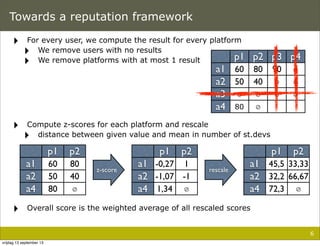
‣ For every user, we compute the result for every platform
‣ We remove users with no results
‣ We remove platforms with at most 1 result
‣ Compute z-scores for each platform and rescale
‣ distance between given value and mean in number of st.devs
‣ Overall score is the weighted average of all rescaled scores
Towards a reputation framework
6
p1 p2 p3 p4
a1
a2
a3
a4
60 80 90 ⊘
50 40 ⊘ ⊘
⊘ ⊘ ⊘ ⊘
80 ⊘
p1 p2
a1
a2
a4
60 80
50 40
80 ⊘
p1 p2
a1
a2
a4
-0,27 1
-1,07 -1
1,34 ⊘
p1 p2
a1
a2
a4
45,5 33,33
32,2 66,67
72,3 ⊘
z-score rescale
vrijdag 13 september 13
Experiment
‣ Experiment: large ontology engineering project
‣ 36 students in the MSc in Computer Science program
‣ Held in the context on a course on ontology engineering
‣ First develop own information system
‣ Then develop ontologies to
‣ ... enable semantic interoperability between the systems
‣ ... annotate an existing system
‣ Survey
‣ On voluntary basis, give at most three names of those considered to
have driven the project
‣ Analyze “overlap” between responses and scores obtained by the
reputation framework
7
vrijdag 13 september 13
Experiment
8
vrijdag 13 september 13
‣ 17 of the 36
participants
participated
in the survey
‣ Considerable
overlap
encourages
further
investigation
Data and Results
9
vrijdag 13 september 13
Limitations and Conclusion
‣ Limitations
‣ Interactions outside of the collaborative platform
‣ Additional experiments (planned for March 2013)
‣ Types of ontology-engineering projects and communities
‣ Conclusions
‣ Proposed a means for identifying community leaders in ontology
engineering using a reputation framework
‣ Objective and subjective reputation sensors
‣ Applied the reputation framework in an ontology-engineering
project and validated the results using a survey
10
vrijdag 13 september 13
Fin. Questions?
vrijdag 13 september 13

Using a Reputation Framework to Identify Community Leaders in Ontology Engineering

  • 1.
    Using a ReputationFramework to Identify Community Leaders in Ontology Engineering (short paper) Christophe Debruyne and Niels Nijs Vrije Universiteit Brussel STARLab 11-09-2013 @ ODBASE 2013 vrijdag 13 september 13
  • 2.
    Introduction ‣ Ontology Engineering ‣... is a social process ‣ ... is far from trivial → requires appropriate methods & tools ‣ Workflow, roles, and responsibilities ‣ Community Leaders ‣ Members in the stakeholder group that drive the ontology project ‣ Problem: the identification of community leaders in ontology engineering for the automatic assignment of responsibilities. 2 vrijdag 13 september 13
  • 3.
    Introduction ‣ Trust andReputation Systems ‣ Are used to ‣ ... increase the reliability and trust between agents ‣ ... improve contribution quality ‣ ... build or increase co-operation ‣ ... ‣ Have been applied to grant rights/privileges to certain users ‣ Are reputation frameworks suitable for identifying community leaders in an ontology-engineering project? ‣ Approach ‣ Identify the characteristics of a community leader ‣ Propose framework and “sensors” assigning scores ‣ Apply the framework in an ontology engineering experiment ‣ Compare the output with results from survey 3 vrijdag 13 september 13
  • 4.
    Towards a reputationframework ‣ Characteristics of a community leader: (C1) Energy, passionate persistence & optimism (C2) Goal-Driven (C3) Build Trust (C4) Willing to take risks (C5) Pull and communicate with others (C6) Work systematically (C7a) Share knowledge, power and credit (C7b) Work interdependently (C8) Understand others ‣ Sensors for ... (A1) Community activity (A2) “Quality” of interactions (A3) Engage others (A4) Quality of results (annotations, for instance) (A5) Cross-community activity ‣ Objective vs. Subjective Sensors (!) 4 A1 A2 A3 A4 A5 C1 X X X C2 X X X C3 X C4 C5 X X X X C6 X X C7a C7b X C8 X “Coverage” vrijdag 13 september 13
  • 5.
    Towards a reputationframework ‣ We define A as the set of all human agents ‣ We define P as the set of all platforms ‣ Reputation results R is defined as [0; 100] ∪ {⊘} ‣ Platform configurations ⟨p,wp,S⟩ ‣ p a platform in P ‣ wp the weight of the platform ‣ S a set of sensor configurations ⟨s,ws⟩ ‣ s a reputation sensor and ws the weight of the sensor ‣ Compute the reputation scores of a user for a particular platform 5 platform p1platform p1platform p1 s1 s2 s3 a1 a2 a3 ... 50 25 75 60 80 ⊘ ⊘ ⊘ ⊘ platform p1 result a1 a2 a3 ... 50 70 ⊘ vrijdag 13 september 13
  • 6.
    ‣ For everyuser, we compute the result for every platform ‣ We remove users with no results ‣ We remove platforms with at most 1 result ‣ Compute z-scores for each platform and rescale ‣ distance between given value and mean in number of st.devs ‣ Overall score is the weighted average of all rescaled scores Towards a reputation framework 6 p1 p2 p3 p4 a1 a2 a3 a4 60 80 90 ⊘ 50 40 ⊘ ⊘ ⊘ ⊘ ⊘ ⊘ 80 ⊘ p1 p2 a1 a2 a4 60 80 50 40 80 ⊘ p1 p2 a1 a2 a4 -0,27 1 -1,07 -1 1,34 ⊘ p1 p2 a1 a2 a4 45,5 33,33 32,2 66,67 72,3 ⊘ z-score rescale vrijdag 13 september 13
  • 7.
    Experiment ‣ Experiment: largeontology engineering project ‣ 36 students in the MSc in Computer Science program ‣ Held in the context on a course on ontology engineering ‣ First develop own information system ‣ Then develop ontologies to ‣ ... enable semantic interoperability between the systems ‣ ... annotate an existing system ‣ Survey ‣ On voluntary basis, give at most three names of those considered to have driven the project ‣ Analyze “overlap” between responses and scores obtained by the reputation framework 7 vrijdag 13 september 13
  • 8.
  • 9.
    ‣ 17 ofthe 36 participants participated in the survey ‣ Considerable overlap encourages further investigation Data and Results 9 vrijdag 13 september 13
  • 10.
    Limitations and Conclusion ‣Limitations ‣ Interactions outside of the collaborative platform ‣ Additional experiments (planned for March 2013) ‣ Types of ontology-engineering projects and communities ‣ Conclusions ‣ Proposed a means for identifying community leaders in ontology engineering using a reputation framework ‣ Objective and subjective reputation sensors ‣ Applied the reputation framework in an ontology-engineering project and validated the results using a survey 10 vrijdag 13 september 13
  • 11.