What is Society ??
Auguste Comte
• “Society is no more decomposable unto individuals than
a geometric surface is into lines, or a line into points
• “Without extolling or condemning political facts, science
regards them as object of observations: it contemplates
each phenomenon in its harmony with coexisting
phenomena.. And each of them is explained when it has
been connected with the whole of the existing situation
and the whole of the preceding movement
• “It is our business to contemplate social order that we
may perfect it.”
– Comte, August, The Positive Philosophy, Harriet Martineau,
Trans. And ed (New York: AMS press [1855] 1974): 235-522.
– Biography of Compte
Jeremy Bentham
• “The community is a fictitious body composed only of its
individual members, and thus the interest of the
community is no more than the sum of the interests of
the individual members who compose it
• The notion of a body politic is a metaphor through which
poetry has invaded the domain of reason”
– Biography of Bentham
– Bentham, Jeremy The Works of Jeremy Bentham John Bowring,
ed. (Edinburgh: W. Tait; London:Simkin, Marshall, 1843): 306
Georg Simmel
• “There is an old conflict over the nature of society. One side mystically
exaggerates its significance, contending that only through society is human
life endowed with reality. The other regards it as a mere abstract concept by
means of which the observer draws the realities, which are individual
human beings, into a whole as one calls trees and brooks, houses and
meadows, a ‘landscape’.
• However one decides this conflict the fact remains that… in order to satisfy
their urges and attain their purposes, individuals associate in the
innumerable forms of social life, all the with-one-another, for-one-another,
in-one-another, against-one-another, and through-one-another, in state
commune, in church and economic associations, in family and clubs.”
– Georg Simmel “The Sociology of Sociability” ( Everett C. Hughes Tr.)
The American Journal of Sociology, Vol. 55, No. 3 (Nov., 1949: 254
– Georg Simmel (March 1, 1858 – September 28, 1918
– Biography of Simmel
© Copyright 2009 The McGraw
Hill Company
5
Society Is….
A society is a group of people who share a culture and live more or less together. They
have a set of institutions which provide what they need to meet their physical, social,
and psychological needs and which maintain order and the values of the culture.
Social structures are the more or less stable patterns of people’s interactions and
relationships.
Institutions are the principal social structures that organize, direct, and execute the
essential tasks of living. Societies represent the most comprehensive and complex type
of social structure in today’s world.
Some institutions are: Family, Medical, educational, economic, religious, legal
and political systems
© Copyright 2009 The McGraw
Hill Company
6
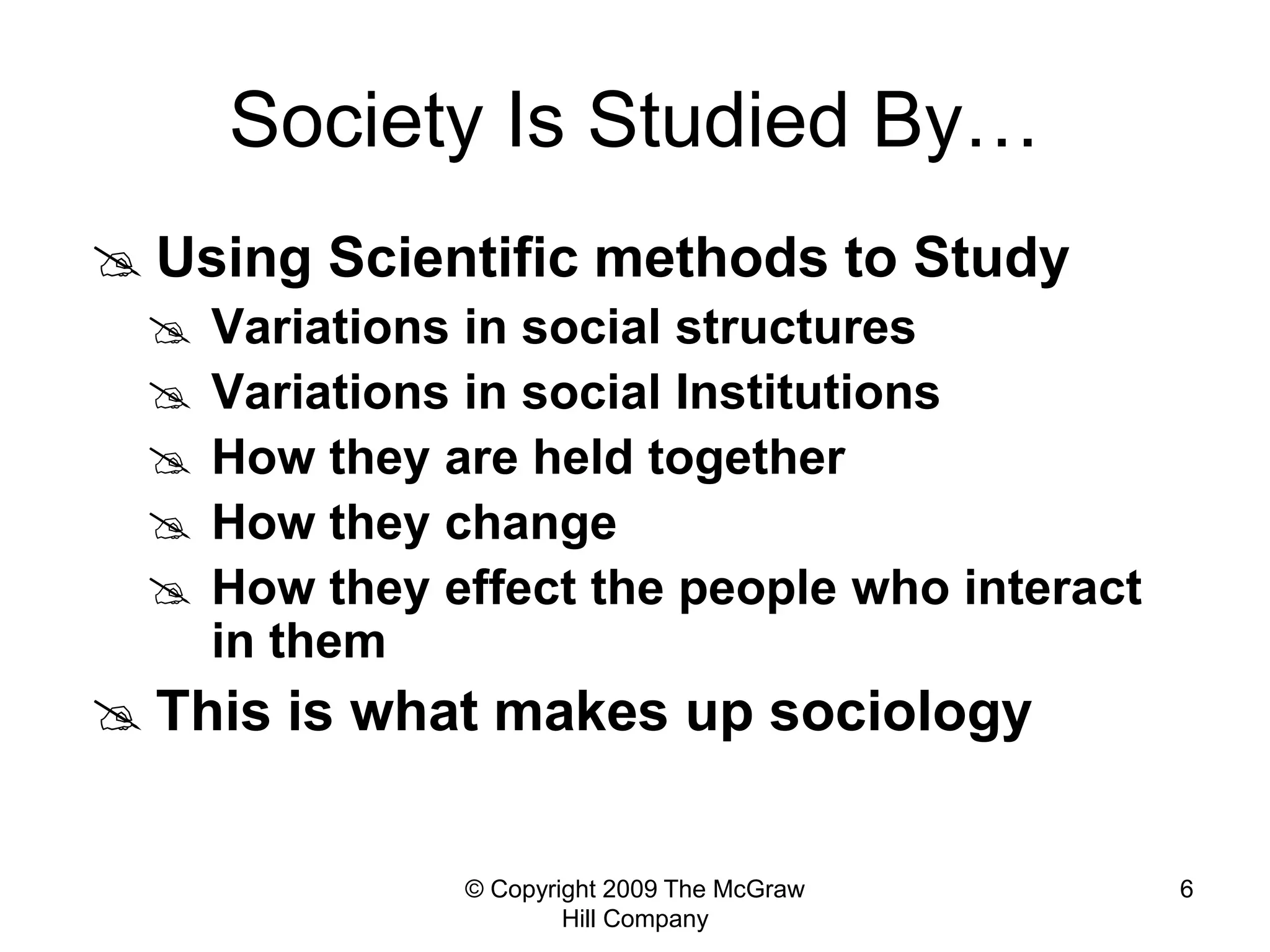
Society Is Studied By…
 Using Scientific methods to Study
 Variations in social structures
 Variations in social Institutions
 How they are held together
 How they change
 How they effect the people who interact
in them
 This is what makes up sociology

201.01 3 Selections on the Nature of Society.ppt

  • 1.
  • 2.
    Auguste Comte • “Societyis no more decomposable unto individuals than a geometric surface is into lines, or a line into points • “Without extolling or condemning political facts, science regards them as object of observations: it contemplates each phenomenon in its harmony with coexisting phenomena.. And each of them is explained when it has been connected with the whole of the existing situation and the whole of the preceding movement • “It is our business to contemplate social order that we may perfect it.” – Comte, August, The Positive Philosophy, Harriet Martineau, Trans. And ed (New York: AMS press [1855] 1974): 235-522. – Biography of Compte
  • 3.
    Jeremy Bentham • “Thecommunity is a fictitious body composed only of its individual members, and thus the interest of the community is no more than the sum of the interests of the individual members who compose it • The notion of a body politic is a metaphor through which poetry has invaded the domain of reason” – Biography of Bentham – Bentham, Jeremy The Works of Jeremy Bentham John Bowring, ed. (Edinburgh: W. Tait; London:Simkin, Marshall, 1843): 306
  • 4.
    Georg Simmel • “Thereis an old conflict over the nature of society. One side mystically exaggerates its significance, contending that only through society is human life endowed with reality. The other regards it as a mere abstract concept by means of which the observer draws the realities, which are individual human beings, into a whole as one calls trees and brooks, houses and meadows, a ‘landscape’. • However one decides this conflict the fact remains that… in order to satisfy their urges and attain their purposes, individuals associate in the innumerable forms of social life, all the with-one-another, for-one-another, in-one-another, against-one-another, and through-one-another, in state commune, in church and economic associations, in family and clubs.” – Georg Simmel “The Sociology of Sociability” ( Everett C. Hughes Tr.) The American Journal of Sociology, Vol. 55, No. 3 (Nov., 1949: 254 – Georg Simmel (March 1, 1858 – September 28, 1918 – Biography of Simmel
  • 5.
    © Copyright 2009The McGraw Hill Company 5 Society Is…. A society is a group of people who share a culture and live more or less together. They have a set of institutions which provide what they need to meet their physical, social, and psychological needs and which maintain order and the values of the culture. Social structures are the more or less stable patterns of people’s interactions and relationships. Institutions are the principal social structures that organize, direct, and execute the essential tasks of living. Societies represent the most comprehensive and complex type of social structure in today’s world. Some institutions are: Family, Medical, educational, economic, religious, legal and political systems
  • 6.
    © Copyright 2009The McGraw Hill Company 6 Society Is Studied By…  Using Scientific methods to Study  Variations in social structures  Variations in social Institutions  How they are held together  How they change  How they effect the people who interact in them  This is what makes up sociology