

























Digital
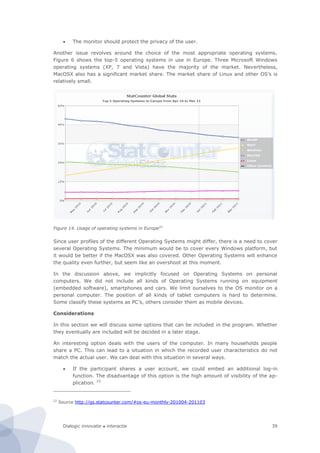
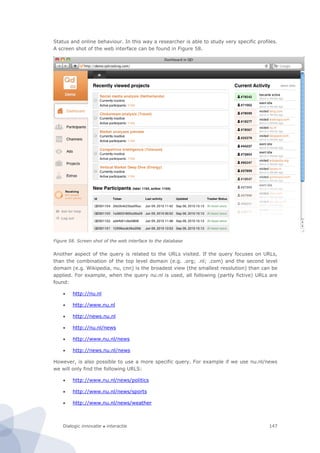
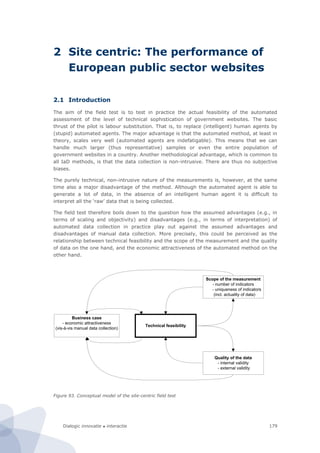
Agenda for
Europe
Internet as data
source
Feasibility Study on Statistical Methods on Internet as a
Source of Data Gathering
FINAL REPORT
A study prepared for the European Commission
DG Communications Networks, Content & Technology
This study was carried out for the European Commission by
Dialogic Innovatie & Interactie
Hooghiemstraplein 33
NL-3514 AX Utrecht
The Netherlands
Reg Brennenraedts brennenraedts@dialogic.nl
Robbin te Velde tevelde@dialogic.nl
www.dialogic.nl
Internal identifications
Contract number: 30-CE-0384390/00-13
SMART 2010/30
LEGAL NOTICE
By the European Commission, Communications Networks, Content & Technology Directorate-General.
Neither the European Commission nor any person acting on its behalf is responsible for the use which
might be made of the information contained in the present publication.
The European Commission is not responsible for the external web sites referred to in the present
publication.
The views expressed in this publication are those of the authors and do not necessarily reflect the official
European Commission’s view on the subject.
The Publications Office of the European Union.
© European Union, 2012
Reproduction is authorized provided te source is acknowledged
Reproduction is authorised provided the source is acknowledged.
European Commission
Internet as data source
Luxembourg, Publications Office of the European Union
2012 – Pages: 243
Cataloguen#
Dialogic innovatie ● interactieIV
Management summary
Information and communication technologies (ICT) are perceived as an essential enabler of
economic growth and a promising basis for applications and services that could increase
the quality of life of European citizens. The European Commission is very actively engaged
in promoting and supporting the deployment of ICT.
The take-up of ICT based applications and services is constantly being monitored. One
major challenge is that the developments go very fast. However, traditional statistics
generally take several years to prepare. By the time they capture the uptake the diffusion
could have reached a critical point. It is here that ICT comes to the rescue since it is not
only a goal in itself but also a mean to measure the latest trends. Citizens and enterprises
increasingly leave behind ‘digital footprints’. By ‘mining’ these footprints it is, at least
theoretically, possible to describe a wide range of socio-economic phenomena in near real-
time. In this research project we thus use the Internet As a Data source (IaD) to
complement or substitute traditional statistical sources.
To conceptualise the automatic collection of data on the internet, we have drafted a model
that literally follows the way bits flow between a particular user and a particular piece of
online content. Based on the actual location of the measurement, three basic types of IaD-
methods can be distinguished:
1. User centric measurements that capture changes in behaviour at the client (PC,
smartphone) of an individual user.
2. Network-centric measurements that focus on measuring properties of the underly-
ing network.
3. Site-centric measurements that obtain data from webservers.
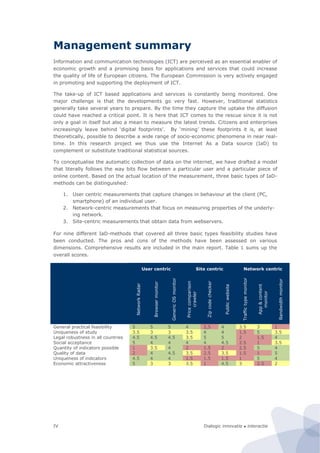
For nine different IaD-methods that covered all three basic types feasibility studies have
been conducted. The pros and cons of the methods have been assessed on various
dimensions. Comprehensive results are included in the main report. Table 1 sums up the
overall scores.
User centric Site centric Network centric
NetworkRadar
Browsermonitor
GenericOSmonitor
Pricecomparison
crawler
Zipcodechecker
Publicwebsite
Traffictypemonitor
App&content
monitor
Bandwidthmonitor
General practical feasibility 5 5 5 4 2,5 4 3.5 3 1
Uniqueness of study 3.5 3 3 3.5 4 4 1.5 5 3.5
Legal robustness in all countries 4.5 4.5 4.5 3.5 5 5 2 1.5 4
Social acceptance 5 4 4 4 4 4.5 2.5 1 3.5
Quantity of indicators possible 1 3.5 4 2 1.5 2 2.5 5 4
Quality of data 2 4 4.5 3.5 2.5 3.5 1.5 1 5
Uniqueness of indicators 4.5 4 4 1.5 1.5 1.5 1 5 4
Economic attractiveness 5 3 3 3.5 1 4.5 3 2.5 2
Dialogic innovatie ● interactie V
Network Radar is a small computer program that is installed on a mobile device that polls
the quality of the mobile internet connection at regular intervals and sends the data and
the location to a central server. Although it is a user centric measurement it does not
involve any users (they are merely the carriers of the measurement devices). The unit of
observation of the mobile data network as a whole, not an individual user.
A browser monitor is a small add-on to an internet browser (such as Chrome, Firefox or
Internet Explorer) that monitors which websites and webpages the user of the browser
visits.
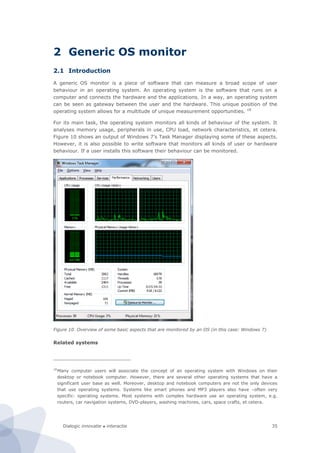
A generic OS browser (a well-known example is the Task Manager in Windows) is a piece
of software that measures a broad scope of user behaviour in an operating system. An
operating system is the software that runs on a computer and connects the hardware and
the applications. an operating system can be seen as gateway between the user and the
hardware. This unique position of the operating system allows for a multitude of unique
measurement opportunities.
A price comparison crawler is a web robot that continuously scans a limited number of
price comparison websites for changes and updated in the products and/or services that
are offered on those sites. This is a widely used method to get near-real time information
about price developments in specific market segments.
A zip code checker is a specific variant on the previous crawler. It is an automated agent
that loops through a list of postal codes and fills these codes in in an online form on one or
more websites from telecom providers. The website then returns whether a specific
telecom service is available at that specific postal code. This is an efficient way to draft
complete coverage maps for a specific technology.
The public sector website scanner is a semi-intelligent web robot that is able to
automatically assess the level of technical sophistication of a great number of (public
sector) websites. The assessment is based on the structure and quality of the programming
code that is used to create the website.
A traffic type monitor is a basic network measurement tool measures the types of
internet traffic that pass through a specific central router at an Internet Service Provider
(ISP) or Internet Exchange Point. The data is based on the header of the data packets
and/or the ports that are being used.
An application and content monitor is a sophisticated variant of a traffic type monitor.
The identification and classification of the data traffic that passed through is not only
based on the header but also on parts of the load (actual content) of the data packet. This
greatly improves the quality of the data since many types of data mask themselves and
cannot be correctly classified on the basis of the header or port information alone.
A bandwidth monitor is comparable to a traffic type monitor but is installed much lower
in the Internet system, namely at the household level. It measures the ingoing and
outgoing traffic of a fixed subscription unit, usually a cable, DSL or fiber router.
Conceptually it is reverse to Network Radar since it is a network centric measurement to
measure behaviour at the user (that is, household) level, whereas the Network Radar is a
(distributed) user centric measurement which measures the behaviour of a network.
Three of the methods have subsequently been subjected to a field test in which statistical
data was actually collected.
Dialogic innovatie ● interactieVI
The user centric field test used a generic OS monitor to measure to online behaviour of
Dutch internet users. The monitor uses an off-the-shelf application that monitors which
URLs are visited and which search terms are used by an individual user. Since all data is
(anonymously) stored, online behaviour of over 20,000 users can be analysed retrospec-
tively, up to one year back. To test to validity of the measurements, 700 of the panellist
have also been questioned via a traditional (online) survey. The instrument proved to be
very flexible and is able to cover a great number of online behaviour patterns. This also
makes is an attractive business case. The validity of the result however varies widely.
Results from the OS monitor and the survey are similar (thus assumed to be accurate) for
the use of social media, wiki’s and newspapers. Significant differences were found for the
use of news sites, E-government, eHealth, E-commerce and E-banking. Factors that
negatively the validity of the results are the need of a broad set of URLs (E-government) or
search terms (eHealth) to be covered, sensitivity of the data – when users temporarily turn
off the monitor (E-banking, E-commerce ), low frequency of the visits (E-government)
and/or the presence of alternative delivery methods that are not covered by the monitor
(E-commerce : credit card and payment on arrival). Promising new indicators have been
tested concerning the frequency and the duration of use of particular types of websites.
User centric measurements in general are an interesting additional data collection
instrument for statistical offices. They will not substitute the traditional survey approach
completely but are especially attractive from an economic point of view. More importantly
however is that the new methods enable the measurements of many new kinds of
indicators. User centric measurements require some attention on privacy issues but are
already a widely used instrument in the private sector. In a similar vein, there are several
commercial applications off the shelf available.
The network-centric field test used sophisticated measurement instruments that are
placed in the core of the network of several German ISPs. The instrument monitors all
incoming and outgoing data traffic on the network on a real-time basis. The data itself
should not be stored. The instrument should merely detect the type of protocol or type of
data traffic. However in order to identify the right type of traffic, the instrument also
should look at the actual content of the data, not just the header (Deep Packet Inspection).
Although no private data should be stored and all data should be aggregated, the
measurement method itself is highly controversial. DPI is already used for many years for
purely technical purposes (traffic management) but the use of the data for other purposes
(such as statistical purposes) is fairly new. During the field test we have received very
strong negative reactions on the use of network centric measurements in general and DPI
in particular. Therefore, in this field test we have not obtained any data but focused on the
legal and social issues. However, in combination with the inherently weak external validity
of the measurement results (due to the non-random nature of internet traffic flows) this
casts doubts on the feasibility of the method. On the other hand, network-centric
measurement is the only basic IaD type that can give a bird eye view of the entire
Internet.
There are currently very strong legal and social objections against the use of network-
centric measurements in general– and especially against the only method with solid
internal validity, deep packet inspection. Furthermore, DPI shares the inherent weakness in
external validity with all network centric measurements.
Dialogic innovatie ● interactie VII
The site-centric field test used a tailor-made web robot to assess the technical
sophistication of government websites. The sample of websites included 770 websites in
four Member States (Estonia, Finland, Spain, the Netherlands). Although the use of web
robots is already well-established in the private sector, the particular application to the
quality assessment of websites is quite new, especially when applied to government
websites. With the increasing pace of technological progress on the web, a benchmark on
the average use of web technology alone in a country might already be very relevant and
effective. The heterogeneous nature of the sample turned out to be a challenge for fully-
automated quality assessment. The robot automatically assessed 6 dimensions (technical
sophistication sec; content; communication; findability; speed; security), each consisting
of several items. Only very weak correlations were found between the individual items,
also within one variable. At this stage it is just too early to conclude whether the case is
feasible or not. It remains an open question whether the unit of observation – the
underlying technology of a website as a whole – is ‘rich’ enough to derive meaningful
conclusions for an EU-wide benchmark. The combination of various raw data streams into
one combined proxy indicator might be very powerful. However, in order to construct such
sophisticated indicators a lot of further empirical research is needed. Nevertheless, there
seems to be ample space to make technological progress on a short notice and the internal
validity of the data can sufficiently be improved (by involving local representatives in the
assessment of the output of the robot). The combination of automated (wide scope) and
human agents (rich interpretation) might in the end be the best workable solution. The
main advantage of the (semi-)automated approach is that much larger samples could be
used than in existing non-automated approaches. Even with the current limited set-up of
the pilot 20,000 websites could have been covered in six months.
Site-centric measurements in general are the most mature IaD method. Crawlers and
web robots are already widely used in the private sector. However the particular
application of robots to the quality assessment of websites is a rather novel approach and
still has a number of teething problems. The major disadvantage of the use of automated
agents to collect data from websites is their inability to interpret and read texts on
webpages the way human agents do. This is offset by the ability to cover large samples of
websites. Hence a combination of human and automated agents seems to be the best of
both worlds.
Stating the obvious yet true, new IaD methods in general require new indicators and a
new mind set. It is important to focus on the possibilities (supply side) of the new methods
and not directly on the need for specific indicators (demand side). Focussing too much in
the demand side would result in indicators of poor quality. To further develop the new
approaches and to gain experience more empirical research is needed. This is not the usual
academic proviso (we are practitioners after all). The development of IaD methods is still in
its early stage. What is especially needed are more practical experiments to gain hands-on
experience.
Looking at future applications of the technology, there are several concrete ways to use
IaD methods for the collection of official statistics that are already available. User centric
measurements can replace most of the traditional ‘audience measurements’. Combining a
user centric client with an online survey is a very powerful panel survey instrument.
Specific online behaviour in the client automatically triggers specific follow-up questions to
the respondent. Applications as Network Radar are a specific category of user centric
measurements (namely distributed user centric measurements a.k.a. IaD crowdsourcing)
that can be applied to a wide area of topics. Network Radar itself is a useful tool to assess
the actual (!) quality and coverage of mobile (data) telecommunication networks, which is
an important regulatory issue.
Dialogic innovatie ● interactieVIII
Data from basic traffic type monitors is readily available from IXP’s all over the world.
Trends in the data traffic volumes give a first indication of the overall growth of the
internet is specific regions (e.g., Europe versus Asia). Deep packet inspection has a bad
press but it is a promising technology that is able to estimate the size and nature of the
activities in the grey areas of the internet. This is currently another important regulatory
issue. Web crawlers are a highly efficient instrument to collect semi-structured data from a
great number of websites. Particularly promising is the (high frequency) harvesting of data
from a smaller set of meta-websites (such as price comparison websites) which are natural
focal points for national data (such as prices on consumer goods which could be used to
measure inflation near real-time). The use of more sophisticated web robots (such as the
one that assesses the technical quality of government websites) still requires some further
development but is probably already more effective and certainly more efficient than the
current semi-manual methods.
Dialogic innovatie ● interactie IX
Index
Part I. How to use IaD Methods................................................................. 1
1 Nature of IaD .............................................................................................. 3
1.1 What is IaD?............................................................................................... 3
1.2 Three basic types of IaD methods ................................................................. 3
1.3 Why use IaD methods? ................................................................................ 8
1.4 Challenges when using IaD........................................................................... 9
2 User centric measurements..........................................................................10
2.1 General concept of user centric measurements ..............................................10
2.2 Major merits and challenges of user centric measurements .............................11
2.3 Conclusions ...............................................................................................13
3 Network centric measurements ....................................................................15
3.1 General concept of network centric measurements .........................................15
3.2 Major merits and challenges of network centric measurements ........................17
3.3 Conclusions ...............................................................................................20
4 Site centric measurements...........................................................................21
4.1 General concept of site centric measurements ...............................................21
4.2 Major merits and challenges of site centric measurements...............................23
4.3 Conclusions ...............................................................................................26
5 Using IaD in practice ...................................................................................27
5.1 Information society indicators and IaD..........................................................27
5.2 General framework on IaD methods .............................................................28
5.3 Future directions of IaD ..............................................................................29
Part II. The ten most interesting IaD measurements ............................... 31
1 Introduction...............................................................................................33
1.1 Background ...............................................................................................33
1.2 Examining the most interesting measurements ..............................................34
2 Generic OS monitor.....................................................................................35
2.1 Introduction ..............................................................................................35
2.2 Functional design .......................................................................................37
2.3 Legal aspects.............................................................................................40
2.4 Desirability from a social perspective ............................................................42
2.5 Methodological and statistical issues .............................................................42
2.6 Economic feasibility: business case...............................................................45
2.7 Assessment ...............................................................................................45
3 Browser monitor.........................................................................................47
3.1 Introduction ..............................................................................................47
3.2 Functional design .......................................................................................49
3.3 Legal aspects.............................................................................................53
3.4 Desirability from a social perspective ............................................................53
3.5 Methodological and statistical issues .............................................................54
3.6 Economic feasibility: business case...............................................................57
3.7 Assessment ...............................................................................................57
4 Bandwidth monitor......................................................................................59
4.1 Introduction ..............................................................................................59
4.2 Functional design .......................................................................................59
4.3 Legal aspects.............................................................................................66
4.4 Desirability from a social perspective ............................................................66
4.5 Methodological and statistical issues .............................................................66
4.6 Economic feasibility: business case...............................................................69
4.7 Assessment ...............................................................................................70
5 Network radar on phone ..............................................................................71
Dialogic innovatie ● interactieX
5.1 Introduction ..............................................................................................71
5.2 Functional design .......................................................................................72
5.3 Legal aspects.............................................................................................74
5.4 Desirability from a social perspective ............................................................75
5.5 Methodological and statistical issues .............................................................76
5.6 Economic feasibility: business case...............................................................79
5.7 Assessment ...............................................................................................79
6 Price comparison site crawler .......................................................................81
6.1 Introduction ..............................................................................................81
6.2 Functional design .......................................................................................82
6.3 Legal aspects.............................................................................................85
6.4 Desirability from a social perspective ............................................................87
6.5 Methodological and statistical issues .............................................................88
6.6 Economic feasibility: business case...............................................................90
6.7 Assessment ...............................................................................................92
7 Broadband zip code checker.........................................................................93
7.1 Introduction ..............................................................................................93
7.2 Legal aspects.............................................................................................98
7.3 Desirability from a social perspective ............................................................99
7.4 Methodological and statistical issues .............................................................99
7.5 Economic feasibility: business case.............................................................102
7.6 Assessment .............................................................................................102
8 Public sector website scanner .....................................................................105
8.1 Introduction ............................................................................................105
8.2 Functional design .....................................................................................106
8.3 Legal aspects...........................................................................................109
8.4 Desirability from a social perspective ..........................................................109
8.5 Methodological and statistical issues ...........................................................110
8.6 Conclusion...............................................................................................115
9 Traffic type monitor ..................................................................................117
9.1 Introduction ............................................................................................117
9.2 Functional design .....................................................................................118
9.3 Legal aspects...........................................................................................122
9.4 Desirability from a social perspective ..........................................................123
9.5 Methodological and statistical issues ...........................................................123
9.6 Economic feasibility: business case.............................................................125
9.7 Assessment .............................................................................................125
10 Application monitor and content monitor .....................................................127
10.1 Introduction ............................................................................................127
10.2 Functional design .....................................................................................127
10.3 Legal aspects...........................................................................................129
10.4 Desirability from a social perspective ..........................................................132
10.5 Methodological and statistical issues ...........................................................133
10.6 Assessment .............................................................................................135
11 Conclusions..............................................................................................137
Part III. Three IaD measurements put in practice.................................. 139
1 User centric: The behaviour of Dutch internet users ......................................141
1.1 Introduction ............................................................................................141
1.2 Method ...................................................................................................141
1.3 Results ...................................................................................................150
1.4 Discussion...............................................................................................172
1.5 Conclusion...............................................................................................176
2 Site centric: The performance of European public sector websites...................179
2.1 Introduction ............................................................................................179
2.2 Method ...................................................................................................180
2.3 Results ...................................................................................................186
Dialogic innovatie ● interactie XI
2.4 Conclusion...............................................................................................203
3 Network centric: Traffic on German broadband networks ...............................207
3.1 Introduction ............................................................................................207
3.2 Method ...................................................................................................209
3.3 Results ...................................................................................................211
3.4 Conclusion and discussion .........................................................................213
Appendices ............................................................................................. 215
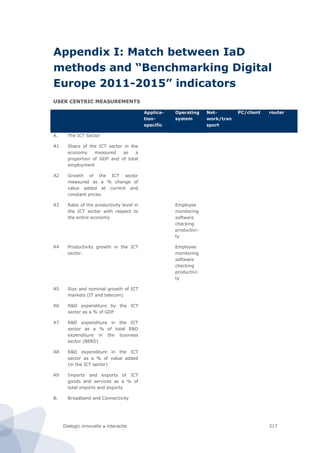
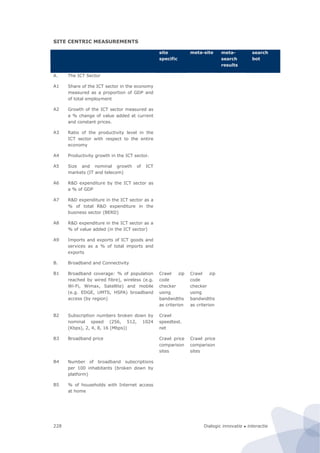
Appendix I: Match between IaD methods and “Benchmarking Digital Europe 2011-2015”
indicators ............................................................................................................217
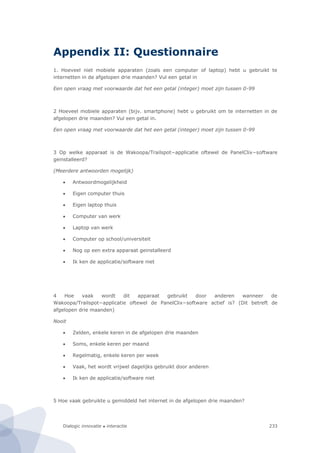
Appendix II: Questionnaire ....................................................................................233
Appendix III: Items of Technical Sophistication Measurement protocol........................239
Appendix IV: Results of pair-wise Fisher Exact's Tests for correlation ..........................241
Dialogic innovatie ● interactie XIII
Preface
Background
Information and communication technologies (hereafter ICT) are perceived as an essential
enabler of economic growth and a promising basis for applications and services that could
increase the quality of life of European citizens. The European Commission is very actively
engaged in promoting and supporting the deployment of ICT. The recently adopted Digital
Agenda emphasises the importance of creating a digital single market and ensures that the
digital era can deliver on its promises of empowerment and emancipation. As a society, we
have surpassed the stage that ICT is merely interesting – it is hugely important.
In order to implement a robust policy on ICT, one needs both solid and actual facts on the
real developments. Policy makers are therefore continuously monitoring and analysing the
take-up of ICT based applications and services by various social actors, and the impact
that such deployments are having on social and economic activities. One major challenge
in this particular policy field is that the developments go very fast, and that effects often
appear suddenly (due to the non-linear diffusion patterns). For instance, it was only four
years ago that the iPhone was introduced and six years that YouTube was launched.
However, traditional statistics generally take quite some time to prepare. Thus, by the time
they capture the uptake of new applications –if they capture them at all–the diffusion has
already reached the critical point and mass adoption has already occurred.
It is here that ICT comes to the rescue since it is not only a goal in itself but also a mean
to measure the latest trends. Citizens and enterprises increasingly leave behind ‘digital
footprints’. This builds up during various economic and social activities mediated in whole
or part over the Internet. We can ‘mine’ these footprints to describe – in near real-time – a
wide range of socio-economic phenomena. In other words, we use the Internet itself as an
information source to complement or substitute traditional statistics.
The research and the team
This document revolves around a study on the (im)possibilities of the use of internet as a
data source for statistics. The study was financed by the European Commission – DG
Information Society and Media – and carried out throughout 2011.
Authors and acknowledgements
The research was mainly conducted by Dialogic innovatie & interactie. The main authors of
this document were Reg Brennenraedts (Dialogic) and Robbin te Velde (Dialogic). However,
there is a vast amount of people and organisations who have contributed heavily to both
the research, the workshop and the report: ipoque (network centric measurements,
workshops), Digital Architects (site-centric measurements, workshops), Wakoopa (user-
cventric measurements), CBS, Dr. Faye Fangfei (legal aspects) and others.
Contributions to the document were made by the following persons: Richard de Boer
(Oberon), ChunYu Cheung (Dialogic), Piet Hein van Dam (Wakoopa), Tijn Hoekstra (Digital
Architects), Pascal Maas (Digital Architects), Klaus Mochalski (ipoque), Don Ritzen
(Wakoopa), Hendrik Schulze (ipoque), Faye Fangfei Wang (Brunel University) and others.
We are grateful to Stefano Abruzzini, Lucilla Sioli, and Albrecht Wirthmann for the care
with which they reviewed the drafts and for conversations that clarified our thinking.
Moreover, we like to thank all the participants to the workshop who provided us important
input during the process.
Dialogic innovatie ● interactieXIV
About privacy
We are fully aware of the privacy issues that are related to the innovative methods.
Therefore, we only used two of the three field test to actually obtain data. We have dealt
very carefully with the data that was obtained. The user centric test used the excellent
framework on privacy of Wakoopa, for more information see http://wakoopa.com/privacy/.
In the site centric field test we obtained data on various technical characteristics of
websites of several public organisations. This data on the properties of websites has be
securely stored and can only be accessed by the two main researchers of this project (Tijn
Hoekstra and Robbin te Velde).
Dialogic innovatie ● interactie 1
Part I.
How to use IaD Methods
Dialogic innovatie ● interactie 3
1 Nature of IaD
1.1 What is IaD?
The internet has an increasingly important role in our society. The digital world no longer
only facilitates our lifestyle; it has become a part of our lifestyle. An increasing amount of
people buy most of their non-consumable goods online, have met their life partner online
or use the internet as the most important source for news. Internet is simply a part of our
society.
National statistics offices have always played an important role in measuring society. They
provide policy makers with data to propose and monitor policies. In the realm of
information society most statistical offices still use traditional methods such as surveys to
collect data. However, the internet itself offers all kinds of opportunities to obtain
information directly, not only about internet phenomena but also about society. This report
describes methods to automatically collect data for official statistical purposes from the
internet. What sets IaD methods apart from traditional internet related methods such as
online surveys and the analysis of logfiles is that they are fully automated and non-
intrusive. That is, they do not require any human intervention. Some of these methods
(especially site-centric measurements, see hereafter) are already widely used in the
private sector. What is new to this project is that IaD methods are used for the collection
of official public statistics.
1.2 Three basic types of IaD methods
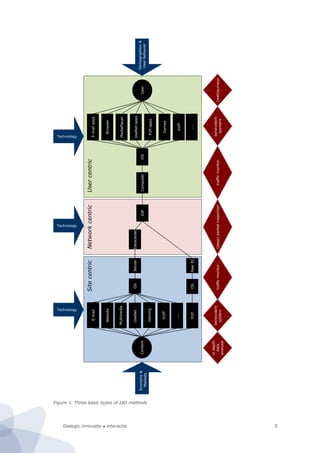
In order to conceptualise the automatic collection of data on the internet, we have drafted
a model that literally follows the way bits flow from a particular user to a particular piece of
content or online service. Demographic and/or social trends cause changes in the online
behaviour of users, that is, changes in the demand for specific types of content or online
services. Shifts in demand lead to shifts in supply (or the way around – this is often an
iterative process). This process generates new economic possibilities and may eventually
result in entirely new market structures. The process in which online demand and online
supply are linked is obviously strongly influenced by technological change. Social, economic
and technological developments interact. The rise of the video culture for instance lies at
the root of the increased demand for video images. The continuous increase of bandwidth
has enabled the online transmission of ever more images. This has generated new
initiatives in the market; most notably the establishment of specialised video websites such
as YouTube. These initiatives in turn have changed general user behaviour (e.g., increased
use of movies, both in personal and professional communications).
While following the bits from the user to the online content or service we can, based on the
actual location of the measurement, distinguish three basic types of IaD-methods,
respectively user centric, network-centric and site-centric measurements. Within each
basic type, specific measurement methods can be defined. Figure 1 gives an overview of
the three methods.
User centric measurements capture changes in behaviour at the client (PC, smartphone) of
an individual user. At the most detailed level, benevolent spyware can be used to track
content generated for each specific user account and each specific application. At a more
general level (network/transport layer) only the use of particular protocols and/or ports
can be measured for the client as a whole (and not for individual users of that client).
Dialogic innovatie ● interactie4
As soon as communication occurs with other computers –which is by definition the case for
internet applications– changes in use patterns can be tracked at the network level as well.
The recent shift from Peer-to-peer (P2P) to HTTP-traffic can, for instance, largely be
attributed to the phenomenal success of YouTube and similar parties. Such shifts can be
detected by network-centric measurements. The most basic types only generate aggregate
data (e.g., total volume of data traffic). However, recently developed, more sophisticated,
methods are able to categorise data streams in a much more detailed manner by using
deep-packet inspection (DPI).
The final destination of a users’ request for a specific piece of content or online service is
always another computer. This is either a server or a computer of another user (peer to
peer - P2P). Site-centric measurements are used for this purpose which are usually
conducted by web bots that automatically collect data from (part of) one or more websites.
Note that the measurement methods on the outer right (‘in depth data analyses’) and
outer left (‘web surveys’) are not directly internet-based, although they both involve the
use of digital data. In these cases we still ask a person for information for instance by
using a web questionnaire or by asking a web master to share its data. The actual use of
online public services could for instance be derived from the log files of government
websites, obtained from web masters. In our opinion, the outer left and outer right
methods of data gathering should be considered as incremental innovations of traditional
methods. Therefore, we do not consider these options as genuine IaD methods. This does
not necessarily mean that these methods are not a viable alternative for internet-based
data collection.
Dialogic innovatie ● interactie 5
Figure 1. Three basic types of IaD methods
NetworkcentricUsercentricSitecentric
Browser
MediaPlayer
UseNet-apps
P2P-apps
Games
VoIP
User
E-mailapps
OSComputerISP
Datacenter
PeerPC
ServerOS
E-mail
Website
Multimedia
UseNet
Gaming
VoIP
OSP2P
Economy&
Markets
Technology
Technology
Technology
Demographics&
Userbehavior
benevolent
spiders
trafficmonitor(deep)packetinspectiontrafficmonitor
benevolent
spyware
(web)surveys
……
……
Content
indepth
data
analysis
Dialogic innovatie ● interactie6
So far, our classification of IaD-methods has been purely technology-based. That is, it only
covers the supply side. In the next chapter we will link the supply side (technology) to the
demand side (statistical indicators used by government organizations). To do so, we first
have to further refine the current classification of IaD-methods. In our preliminary survey,
we already found dozens of readily available examples of (usually commercial) IaD-based
applications or services. Going back and forth between the conceptual model and the ever-
growing list of items on the long list of examples, we have come up with the following
classification of IaD-method subtypes (Table 1).
ID Name Type of measurement Example
U User centric
U1 Application-specific Measuring the behaviour of a
user in a specific application,
like a browser or mediaplayer
Surfing behaviour, e.g.
http://www.webmeter.nl/
U2 Operating system Measuring the behaviour of a
user in an operation system,
like a Windows XP or Mac OS X
Data from system information, e.g.
http://gs.statcounter.com/
Reverse firewalls, e.g.
http://www.zonealarm.com/
U3 Network/transport
layer
(router or client)
Measuring the communication
to and from a router or a
client, like a mobile phone or
PC.
Port measurements, e.g.
http://www.keelog.com
N Network-centric
N1 Aggregate traffic
measurement
Measuring the traffic flow on a
generic level
Traffic monitoring systems at internet
exchange points, e.g. http://www.ams-
ix.net/statistics/
N2 Port-based
throughput
statistics
Measuring the type of traffic
flow
Port-based network traffic
measurements, firewalls, e.g.
http://www.arbornetworks.com/peakflo
wsp
N3 Deep Packet
Inspection
Measuring the content of the
traffic flow
Internet studies, e.g.
http://www.ipoque.com/en/resources/in
ternet-studies
S Site-centric
S1 site specific Measuring the content on a
single site
Tailor-made crawler for one or more
specific websites, e.g.
http://www.google.com/intl/en/press/ze
itgeist2010/
S2 meta-site Measuring the content on a
aggregating site
Crawler for one or more content
aggregation sites, e.g.
http://www.vergleichbar24.de
S3 meta-search
results
Measuring the content on a
specific type of websites
Specialised search engines, e.g.
http://books.google.nl/
S4 Generic search
bots
Measuring every website Web crawler that continuously indexes
with range of websites,
http://www.google.be/
Table 1. Subclasses of IaD methods
Dialogic innovatie ● interactie 7
The subclasses of user centric measurement roughly follow the hierarchical layers of the
OSI-model. Note that measuring at the lower, more basic levels (e.g., at ports in U3) does
not necessarily imply that the data is less detailed than at the higher levels. Hardware key
loggers are for instance able to capture individual key strokes or entire screen shots, which
provides very detailed information.
In a similar vein, network-centric measurement is further divided along the depth of the
inspection of the data packets. The most basic subclass, aggregate traffic measurement,
only counts the number of packets. Port-based throughput statistics – the next level – uses
stateful1
packet inspection to read the IP header of the packet. More detailed deep packet
inspection measurements inspect the first couple of packets of the IP payload (that is, the
actual content of the package) and look for specific patterns (thus not read integral, as is
often wrongly assumed). All network centric measurements are done by filtering since
scanning all packets in a flow is demanding, not really necessary and rather expensive.
The division of site-centric measurements is somewhat different. It is a sliding scale from
web bots targeted to one specific site to web bots that can process an enormous number of
different types of sites. For the latter, such breadth obviously comes with a trade-off in the
‘depth’ of the information collected. In general, these types of search bots are able to scan
many sites, but not at the level of detail that tailor-made crawlers can handle. The two
intermediary levels distinguished are very useful because they nicely balance the breadth
and depth of the information collected. Meta-site bots for instance crawl one or more
content aggregation sites (such as price comparison sites) that in turn crawl dozens of
sites themselves (such as sites of suppliers). Meta-search result bots piggyback on
powerful specialised search engine bots such as Google Books. They filter the enormous
amount of data generated by search engines. Specialised search engine websites are
interesting sites of discovery since they have already pre-filtered the content (e.g., only
include books or products, as in the case of Google Products).
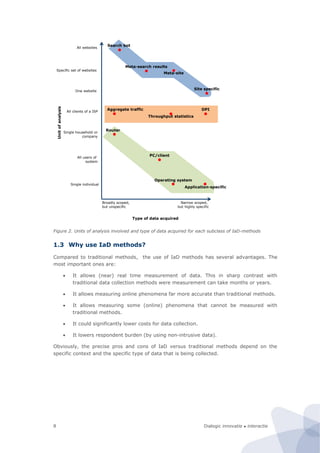
For statistical purposes, the unit of analysis at which the measurement is done is highly
relevant. The unit determines the (target) population on which information is gathered.
Apart from the unit, the level of detail changes for each type of basic IaD-method. Within
each basic type, the specific subclass determines the scope of the measurement.
1
Stateful inspection is the technique to analyse network traffic. However, it is on a more shallow level
than Deep Packet Inspection.
Dialogic innovatie ● interactie8
Figure 2. Units of analysis involved and type of data acquired for each subclass of IaD-methods
1.3 Why use IaD methods?
Compared to traditional methods, the use of IaD methods has several advantages. The
most important ones are:
 It allows (near) real time measurement of data. This in sharp contrast with
traditional data collection methods were measurement can take months or years.
 It allows measuring online phenomena far more accurate than traditional methods.
 It allows measuring some (online) phenomena that cannot be measured with
traditional methods.
 It could significantly lower costs for data collection.
 It lowers respondent burden (by using non-intrusive data).
Obviously, the precise pros and cons of IaD versus traditional methods depend on the
specific context and the specific type of data that is being collected.
Narrow scoped,
but highly specific
Broadly scoped,
but unspecific
Type of data acquired
Unitofanalysis
Single individual
All users of
system
Single household or
company
Operating system
Router
PC/client
Application-specific
All clients of a ISP
All websites
Specific set of websites
One website
Aggregate traffic
Throughput statistics
DPI
Site specific
Meta-site
Meta-search results
Search bot
Dialogic innovatie ● interactie 9
1.4 Challenges when using IaD
Obviously, IaD also has its disadvantages vis-à-vis traditional methods. The most
important challenges are:
 Practical feasibility. Not every IaD method can be realized easily. Some require the
development of very specific high-tech devices, the cooperation of the public, ac-
cess to networks of ISPs or other aspects that seriously reduce the practical
feasibility.
 Legal robustness. The automatic measurement of all kinds of data almost immedi-
ately brings up discussions concerning privacy. Although some methods make it
easy to opt-in, others revolve around opt-out. Moreover, there are also other regu-
latory frameworks, e.g. a national telecommunication law that could result in legal
restrictions.
 Social acceptance. Even if it is legal to use a new method, it is not obvious that the
public will accept it. Growing concerns about privacy in combination with a lack of
understanding of the technologies that are being used are a breeding ground for
disquietness.
 Sampling. For statistical purposes, the unit of analysis at which the measurement
is done is highly relevant. The unit determines the (target) population on which
information is gathered. Traditional methods (such as surveys) often use random
samples to select sets of units that are representative for the entire population.
Due to the non-random nature of internet traffic random selection is not possible
for all IaD-methods (esp. network-centric measurements). This is partly offset by
the high scalability of IaD-methods that makes it possible to cover to entire uni-
verse (rather than a sample). However this requires a precise definition of the
universe and this is not always possible (e.g., ‘health-related internet searches’ has
a very long tail and is too broad).
 Unit of analysis. In traditional research methods that is usually a direct relationship
between the unit of observation and the unit of analysis. With IaD-methods the
relationship is more complicated, less straightforward and hence more difficult to
understand. The unit of observation is always purely technical data (e.g., source
code from a website, headers from a data packet, an address in a browser bar).
The unit of observation usually refers to the concrete behaviour of an individual
who is using the internet. For example, instead of directly asking a respondent
whether she or he is engaged in E-banking, we use a specific sub-URL (e.g.,
https://my.bank.country/ebanking) as a proxy for E-banking. Using the generic
URL (http://www.bank.country) would only indicate that that the person is looking
for information. Even in the case of the specific sub-URL we still cannot know
whether the person is really completing a transaction (he or she is merely visiting a
specific webpage thus we can at least assume that he or she has the intention to
conduct a transaction – the same applies to shopping carts on E-commerce web-
sites). To complicate matters, we usually only know the IP-address which does not
refer to one specific person (or, in the case of dynamic IP-addresses, to a specific
device).
 Culture within National Statistical Offices. Statistical offices are typified by a culture
focused on data quality and tradition. This makes statistical offices somewhat re-
luctant to change their methods of data collection. Even though this is completely
understandable, this could lead to a situation where (new) phenomena are ignored
because they cannot be measured (accurately) by traditional methods. IaD meth-
ods could assist here by allowing a better estimate of the impact of new
phenomena on society.
Dialogic innovatie ● interactie10
2 User centric measurements
2.1 General concept of user centric measurements
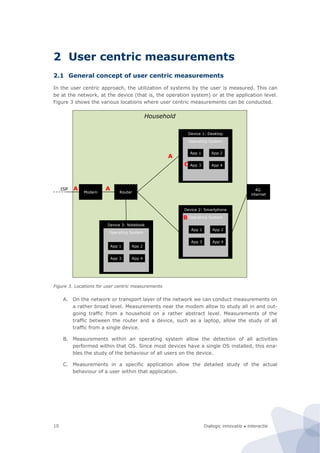
In the user centric approach, the utilization of systems by the user is measured. This can
be at the network, at the device (that is, the operation system) or at the application level.
Figure 3 shows the various locations where user centric measurements can be conducted.
Figure 3. Locations for user centric measurements
A. On the network or transport layer of the network we can conduct measurements on
a rather broad level. Measurements near the modem allow to study all in and out-
going traffic from a household on a rather abstract level. Measurements of the
traffic between the router and a device, such as a laptop, allow the study of all
traffic from a single device.
B. Measurements within an operating system allow the detection of all activities
performed within that OS. Since most devices have a single OS installed, this ena-
bles the study of the behaviour of all users on the device.
C. Measurements in a specific application allow the detailed study of the actual
behaviour of a user within that application.
Household
Modem
ISP
Router
Device 1: Desktop
Device 2: Smartphone
Device 3: Notebook
Operating System
Operating System
Operating System
App 1 App 2
App 3 App 4
App 1 App 2
App 3 App 4
App 1 App 2
App 3 App 4
A
B
C
A 4G
internet
A
Dialogic innovatie ● interactie 11
With regard to user centric measurements we have conducted four feasibility studies:
 Type A: Bandwidth monitor to measure the network traffic of a household. This
requires the placement of an actual physical device in a household near the router.
 Type B: Generic OS Monitor to measure (specific) behaviour on an OS. This
requires the installation of an application on a PC.
 Type C(1): Browser monitor to measure users behaviour in browsers. This requires
that an application is installed within a browser, a so-called browser plug-in.
 Type C(2): Network radar to measure the quality of mobile networks. This can only
be performed on some specific brands of smartphones (such as an iPhone or An-
droid smartphone) and requires that an application is installed on the device.
2.2 Major merits and challenges of user centric measurements
To assess the merits and challenges of the different types of IaD measurements, we apply
eight different dimensions. The same structure will be applied to all feasibility studies.
Legal perspective
From a legal point of view, user centric measurements confront us with a limited number of
challenges if a panel is used. Collecting data from a panel has more or less the same legal
issues as the traditional method. However, since the data is obtained automatically, an
important exception is that users should be proactively made more aware of the type of
data collected from them. This is needed to assure that they make an informed decision on
their involvement in the panel.
Social perspective
From a social point of view, there are no big hurdles. People who do not want to participate
will simply not agree to be included in the panel. On the other hand, we can imagine that
the situation where official statistical organisations place devices with blinking lights or
stealthy software in households might give rise to the aforementioned feelings of
disquietness.
General practical feasibility
The general practical feasibility of user centric measurements differs greatly between the
various methods.
 The generic OS Monitor, the browser monitor and the network radar are commer-
cial off-the-shelf software applications. There are a considerable number of
software packages available to measure user behaviour at all three levels. Howev-
er, the software usually requires some tuning and tweaking. The major challenge
here is the management of the panel (discussed below). It is our expectation that
these three methods are relatively easy to implement.
 The bandwidth monitor is far more challenging. It requires the actual production of
a device with embedded software. This device needs to be distributed to house-
holds, installed in networks and has to be repaired if it is malfunctioning. Moreover,
it should also be able to send data to a central server and to receive data for up-
dates. It is self-explanatory that this is quite a challenging process, also from
logistical point of view.
Dialogic innovatie ● interactie12
For all methods described above, management of the panel is the important issue. There
needs to be a group of people who is willing to participate in the experiment. Churn is also
high and increasing. Incentives could be used to draft and maintain panellists but this
could lead to a bias in the panel. Note however that traditional methods basically face the
same challenges.
Recentness of the data
All user centric measurement allow for (near) real time measurements. There are,
however, some issues that negatively affect the recentness of the data. First, the data
needs to be send to a central server. Second, the data needs to be processed and stored
on the server. Since the amount of data collected could be enormous, this could take time.
Third, it can take some time to derive the right data from very large datasets. Hence near
real time measurements might involve time gaps as big as several hours or even several
days.
Quality of data
The quality of the data depends on several factors. To most important ones are:
 The quality and size of the panel. Obviously, we want a large and representative
panel. However, it appears to be hard to convince people to install a piece of soft-
ware on their computer or include a piece of hardware in their network. Moreover,
people participating in panels tend to have specific characteristics. In the field test
a panel was used that received a financial incentive. This resulted in a panel with a
somewhat lower household income and a focus on online behaviour that stimulated
the earning of money. Another issue is related to shifts in panel composition. If
there is a large turnover in panel composition (panel dynamics) and we cannot
control for this, reliably measuring behaviour over long periods of time becomes
difficult. This problem especially applies to online behaviour with a low frequency
(e.g., visiting government websites).
 The sensitivity of the subject. Some particular areas (e.g., E-banking, adult content
etcetera) might be regarded as sensitive. Hence the accuracy of the measurement
of these particular topics is expected to be lower than average since some re-
spondents will avoid their behaviour being measured. For example, they could turn
off the measuring application, use another device or operating system, use another
network or encrypt their traffic. In the worst case, they could even decide to leave
the panel.
 The indicator should stay close to the data. With user measurements, very specific
-usually rather technical- data is detected. Not all technical data can directly be
translated into (social) indicators. For example, when collecting URLs we can only
measure behaviour that is typified by a limited and specific set of URLs. For exam-
ple, for the use of social networks we use a limited set of portals.2
There are a
limited number of URLs for such websites that can be quite easily checked and
distinguished. However, if we want to measure how many people read news online,
we need to distinguish the URLs of thousands of websites.
2
Facebook, Hyves, Orkut, MySpace, Twitter and LinkedIn.
Dialogic innovatie ● interactie 13
Quantity of indicators
These methods allow us to measure a vast amount of indicators. However, they are almost
exclusively limited to the behaviour of individuals or households who use the internet.3
It is
very difficult (or perhaps even impossible) to derive indicators on motives, beliefs,
attitudes, and preferences of individuals.
Uniqueness of indicators
These methods allow to measure various indicators that cannot be measured by traditional
methods. The new methods have three important merits:
 Measurements can be very specific. With these methods we can, for example,
analyse the exact total time spent online for a specific user for a specific period.
Moreover, we can analyse the average pattern of use during the day. This is nearly
impossible via the traditional approach, which is based on self-reporting.
 There is no respondent bias in the data. It is a well-known fact that quite a number
of people give social desirable answers to questions. Moreover, people tend to un-
derestimate or overestimate specific types of behaviour.
 The methods can be applied to both persons and households. In the latter, case
data can be aggregated. With the traditional approach we need to include all per-
sons in a household, in order to measure accurately on the household level.
Economic attractiveness
The methods are not able to replace the traditional approach completely. However, when
they are used, the remaining questionnaire will be much smaller. There is less need for
additional information which leads to lower costs. Moreover, we are able to provide more
indicators because there is more data. Another interesting feature of the new methods is
that the fixed and variable costs do not depend on the amount of indicators that is being
measured.
However, setting up the new method will require some additional investments. The
software needs to be bought and specified. Moreover, some variable costs are to be
expected for managing the panel, storing data and updating software.
2.3 Conclusions
In general, user centric methods are an interesting additional data collection instrument for
statistical offices. We expect that they will not substitute the traditional questionnaire
approach completely. Yet even in the hybrid cases overall costs could already seriously be
lowered. Most important is that the new methods will enable measuring much more and
many new kind of indicators.
User centric measurements require some attention on the legal and social issues.
Availability is not a serious issue because there are already commercial off-the-shelf
solutions that can be readily applied. The software-based user centric measurements can
also be deployed easily; there are already several commercial suppliers. The user centric
3
In theory it is possible to measure the behaviour of organizations by installing measurement
equipment in their networks, but this will probably result in many practical problems. First, we find it
unlikely that companies will approve that these systems are installed on their networks. Second,
within companies there is usually a vast amount of channels employees can use to access the
internet. Third, sensitivity will be a major issue. Et cetera.
Dialogic innovatie ● interactie14
measurements based on hardware may have some logistic issue, but in this particular
niche that are also already several suppliers active.4
4
For one example, see http://www.samknows.com
Dialogic innovatie ● interactie 15
3 Network centric measurements
3.1 General concept of network centric measurements
The internet is a worldwide public network of computer networks. The essence of the
internet is that it connects two or more autonomous systems. IaD methods cover both
sides of the local systems: the client with user centric measurements and the server with
site-centric measurements. However, the route between the two systems can also be
measured.5
This route is covered with network-centric measurements. Changes in use
patterns – such as the phenomenal success of YouTube – will immediately show up at the
network level and can also be detected by network centric measurements.6
Network-centric measurements differ from the other two types of measurements because
they are not targeted towards specific nodes in the internet. Instead, the measurement is
done somewhere half-way in the massive data communication flow between many nodes.
In practice this involves the installation of a rather sophisticated measurement device near
one of the routers in the internet. The sophistication lays in the fact that the device has to
be able to real-time measure enormous amounts of bits passing by at the router. The
layered structure, complex topology, and highly dynamic nature of the internet possess a
great challenge to network-based measurements. There are routers all over the place and
traffic flows are rerouted almost continuously. It is thus sheer impossible to cover the
entire internet.
5
If the two systems would not be connected via the Internet (that is, the Internet Protocol) technically
speaking the concept of IaD does not apply. Thus two computer systems that are directly connected
via an EDI-connection over a dedicated leased line (thus not the public internet) fall outside the
scope of network-centric measurements. Dedicated channels on the internet (such as VPN-
connections) are still within range of network-centric measurements. Although we obviously cannot
open up the private channels, we could still measure the overall amount of VPN-traffic (cf. for SSL-
or TSL-connections). The two computer systems at each receiving end could also be covered by
user-centric measurements.
6
Global Internet video traffic surpassed global peer-to-peer (P2P) traffic in 2010, and by 2012
Internet video will account for over 50 percent of consumer Internet traffic. As anticipated, as of
2010 P2P traffic is no longer the largest Internet traffic type, for the first time in 10 years. Internet
video was 40 percent of consumer Internet traffic in 2010 and will reach 50 percent by year-end
2012 (source: Cisco Visual Networking Index: Forecast and Methodology, 2010-2015)
Dialogic innovatie ● interactie16
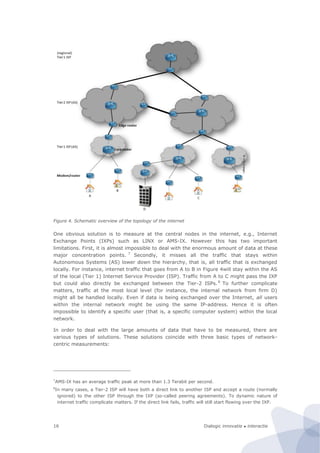
Figure 4. Schematic overview of the topology of the internet
One obvious solution is to measure at the central nodes in the internet, e.g., Internet
Exchange Points (IXPs) such as LINX or AMS-IX. However this has two important
limitations. First, it is almost impossible to deal with the enormous amount of data at these
major concentration points. 7
Secondly, it misses all the traffic that stays within
Autonomous Systems (AS) lower down the hierarchy, that is, all traffic that is exchanged
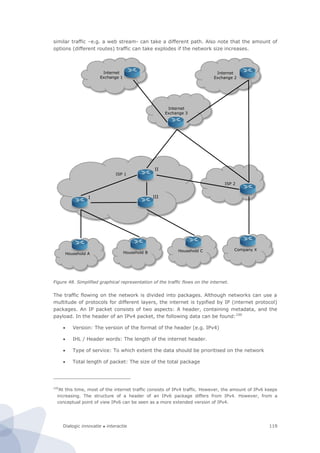
locally. For instance, internet traffic that goes from A to B in Figure 4will stay within the AS
of the local (Tier 1) Internet Service Provider (ISP). Traffic from A to C might pass the IXP
but could also directly be exchanged between the Tier-2 ISPs.8
To further complicate
matters, traffic at the most local level (for instance, the internal network from firm D)
might all be handled locally. Even if data is being exchanged over the Internet, all users
within the internal network might be using the same IP-address. Hence it is often
impossible to identify a specific user (that is, a specific computer system) within the local
network.
In order to deal with the large amounts of data that have to be measured, there are
various types of solutions. These solutions coincide with three basic types of network-
centric measurements:
7
AMS-IX has an average traffic peak at more than 1.3 Terabit per second.
8
In many cases, a Tier-2 ISP will have both a direct link to another ISP and accept a route (normally
ignored) to the other ISP through the IXP (so-called peering agreements). To dynamic nature of
internet traffic complicate matters. If the direct link fails, traffic will still start flowing over the IXP.
Dialogic innovatie ● interactie 17
1. Aggregate traffic measurement. These measurements only measure the total
amount of traffic at a specific point. Within the total amount of data, some subdivi-
sions can be made at the aggregate level, e.g., between IPv4 and IPv6 traffic, and
between multicast and broadcast traffic. Typical examples are traffic statistics at
IXPs.9
2. Port-based throughput statistics. Such measurements use stateful inspection to
read the IP header of the packet. That is, they use the header of the IP packet –
the chunks of bits that make up internet traffic – to determine the type of traffic.
Older versions are stateless: they derive the traffic type directly from the TCP port
number, e.g., regular internet traffic since HTTP always uses TCP port 80. Howev-
er, since many types of traffic are not bound to specific ports, this type of
measurement is not reliable at all. The modern stateful versions keep track of the
ports that are being used by a particular type of traffic at a particular moment in
time. A typical example of a port-based measurement is a firewall that is installed
at a local edge router.
3. Deep packet inspection. This is the most sophisticated type of measurement. It
does not only analyse the header of an IP packet but also the first couple of the
content (payload) of the packet. It does so to identify certain types of protocols
(such as Skype) that are able to mask themselves and cannot be detected by sim-
pler port-based measurements. Deep packet inspection also uses stateful filtering
since scanning all packets of a flow would simply require too much processing ca-
pacity from the device. Hence just like port-based measurements the detection of
specific types of data traffic is always selected and those types have to be defined
beforehand.
Based on this typology, we have conducted two feasibility studies on network-centric
measurement. The first study concerns the monitoring of traffic and uses type 1
measurements. The second study concerns the monitoring of applications and content and
uses deep packet inspection. It is basically a combination of type 2 (applications) and type
3 (content). We also explored the option to put the application and content monitor in
practice.
3.2 Major merits and challenges of network centric measurements
Legal and social perspective
The inherent technical characteristics of network-centric measurements have important
consequences for the legal and social perspective. The measurements involve the
simultaneous scanning of thousands of chunks of data packets originating from a multitude
of users from whom the IP-address is known. Under these circumstances it is virtually
impossible to acquire explicit opt-in from all users. Network-centric measurements are
therefore by default anonymous. The internet users do not know that (bits of) their traffic
is being monitored. Indirect opt-in could be arranged via the ISP where the measurement
device is being placed. The ISP should then however inform its entire user base that their
data traffic could be monitored. No ISP would do so because it would cause many of its
subscribers to leave – much akin a bank run. Ironically, the same complex functioning of
the internet which renders detailed monitoring at a personal level impossible, gives rise to
9
For example, the sFlow statistics at AMS-IX, http://www.ams-ix.net/sflow-stats/
Dialogic innovatie ● interactie18
a general lack of understanding among the public at large, and has created a deep distrust
against any kind of network centric measurements. It might even give a negative image to
the other types of IaD methods as well.
Deep packet inspection in particular is currently shown in a very bad light. This is partly
due to the unfortunate name which seems to suggest that personal messages which are
sent over the Internet are really opened, and partly due to the eerie feeling of being
silently monitored. The public concern has risen to such a height that the very use of the
label ‘deep packet inspection’ has already become contaminated.
Irrespective of the rhetoric, network centric measurements have already been around for
many years for engineering purposes, namely to monitor data traffic and to balance traffic
load. Without this so-called data traffic management, some applications on the internet
would soon come to a grinding halt. Nevertheless, when in May 2011 the Dutch telecom
incumbent KPN revealed that it already uses DPI for years to optimize the data traffic on
its network, it was pilloried and put under a lot of public pressure to cease using the
network centric measurement. Within one month, the Dutch Parliament passed a new law
that forbids the use of DPI altogether.
In many other countries the regulation concerning the use of deep packet inspection for
statistical purposes is not completely clear. For example, when we look at Germany we
expect that privacy regulation allow the use of DPI. However, the German telecommunica-
tion law states that network-centric measurements may only be used for engineering
purposes.10
This might also have direct consequences for the network centric field study in
this study. Pending on the reaction of the German Federal Commissioner for Data
Protection and Freedom of Information (BFDI) the field study has been put on hold.
General practical feasibility & actuality of the data
Throughput statistics and sophisticated data traffic detection – deep packet inspection –
are merely produced as side-effects from traffic management systems. Suppliers of router
software such as Cisco, Ellacoya (now Arbor Networks) or Ipoque use traffic management
data to publish statistical data on the current status of and trends within worldwide and
regional internet traffic. Ipoque for instance has already published its Internet Studies on
the global development of P2P-traffic since 2006.11
Network-centric measurements are by definition flow statistics. Because of the immense
amounts of data involved (Ipoque’s high-end measuring device can handle 10 million
packets per second) it is impossible to temporary store to data. This would very soon fill an
enormous reservoir of data packets and require an enormous amount of storage capacity
and an equivalent processing capacity to sift through all the data. Instead, the passing
data is analysed on the fly at real-time speed. Consequently the results of network-centric
measurements are by definition available at (near) real-time basis. We have already
mentioned the traffic statistics from internet exchange points. Ipoque’s annual Internet
Studies have evolved into the Internet Observatory. This means that the results from their
network-centric measurements are now also real-time available.12
10
This leads to the rather strange situation that network operators are able to manipulate data traffic
on their network (e.g., throttle Skype traffic because it cannibalizes their income from conventional
telephony) but that the German Statistical Office is not allowed to publish data of the (probably
declining) share of Skype traffic in German internet traffic.
11
http://www.ipoque.com/en/resources/internet-studies
12
http://www.internetobservatory.net/
Dialogic innovatie ● interactie 19
Figure 5. The results of network centric measurements performed by ipoque. Source:
http://www.internetobservatory.net/
Quality of data
The internal validity of the results depends strongly on the type of data and on the type
network-centric measurement that is being used. For aggregate traffic measurements
there are several established and unified instruments available. As for more detailed types
of data traffic measurements, stateless port-based measurements are very unreliable. As a
consequence, they are not widely used anymore. Stateful port-based measurements such
as done by Arbor Networks are more sophisticated, although they are still not able to
detect all types of data traffic perfectly. Measurements based on deep packet inspection
are able to detect nearly 100% of all types of data traffic – provided that the profiles of
these types have been programmed in the measurement instrument beforehand. This
requires a constant scanning for new types of data traffic, and a continuous updating of the
underlying profiling database.
The weak external validity is the Achilles heel of network-centric measurements. First, the
measurements would miss all the small branches of the internet, that is, all the traffic flows
that stay locally within other autonomous systems or local private networks. Random
sampling would at least partly solve the problem of the very large number of observation
points involved. Secondly, however, the dynamics of the internet flows are not random. A
change in peering agreements between two big tier 2 ISPs could for instance suddenly
alter the pattern of the traffic flows. If all these structural changes are not followed,
random sampling would still introduce structural measurement errors.
Dialogic innovatie ● interactie20
Quantity & Uniqueness of data
From the three basic types of IaD methods network-centric measurement is the only type
that can give a bird eye view of the entire Internet. The other two basic types are always
limited to a selected set of nodes at the end of a traffic flow (respectively websites at the
server end or devices at the user end). Network-centric measurements are, in fact, the
only method to produce reliable figures about the status and development of internet
traffic. Moreover, the extreme actuality of the flow measurements gives network sets
network measurements apart from traditional methods (e.g., surveys among network
operators). This makes network-centric measurements rather unique. At the same time,
the scope of network-centric measurements is fairly narrow and basically limited to
internet data traffic. From a methodological perspective it is perilous to derive broader
patterns with regard to the (social) use of internet from changes in the internet traffic flow.
Economic feasibility
The economic feasibility largely depends on the number of observation points. Sophisticat-
ed measurement instruments with a capacity to handle to data traffic of small to medium-
sized ISPs typically cost over €50,000 per device. Given the narrow scope of the statistics
(see before) and the large number of measurement points that would be needed, the
investments would not be justified. For the internal demand for (traffic) statistics such
investments are certainly profitable. The challenge would then be to tap the already
installed devices for general statistical purposes. In a similar vein, already existing
network-based reports or monitors could be used such as the reports from Cisco or the
Internet Observatory from Ipoque. However, although this data is free of charge available
this still does not solve the issues with regard to external validity, thus the practical
usefulness of the statistics would be very low as well. The only exceptions are the flow
statistics from internet exchange points because these are natural concentration points in
the regional or even global internet topology. DE-CIX (Frankfurt), AMS-IX (Amsterdam)
and LINX (London) are among the largest internet exchanges in the world. Together they
cover nearly all data traffic for Europe. Trends in the traffic statistics from these IXP’s could
be powerful indicators for worldwide changes in internet traffic patterns. For the first type
of network-centric measurement, aggregate traffic measurement, a business case can
easily be made.
3.3 Conclusions
There are currently very strong legal and social objections against the use of network-
centric measurements (and especially against the only method with solid internal validity,
deep packet inspection). Secondly, due to the highly dynamic non-random patters of traffic
flows on the internet there are inherent limitations with regard to external validity. Thirdly,
the scope of the measurements is rather narrow and limited to data traffic statistics. In
short, the costs of using network-centric measurements are high and the benefits low. The
only exception is the use of IXP traffic statistics for official statistical purposes. However
this is highly aggregate data which does not reveal the dynamics lower down in the
internet hierarchy. Nevertheless, global trends on the internet (e.g., the rise of mobile
data) could still be covered.
Dialogic innovatie ● interactie 21
4 Site centric measurements
4.1 General concept of site centric measurements
From the three basic types of IaD methods, site-centric measurements are the most
mature technology. Broadly speaking there are two historical roots for the development of
site-centric measurements.
The first one is the analysis of log files of web servers to analyse the popularity of a
website. This method, which has already started in the early 1990’s, has further developed
into a more client-oriented approach, called page tagging. This involves retrieving
information about the visitor and her or his behaviour on the website to a server, either by
using JavaScript (embedding a small invisible image on all webpages that are being
tracked) or Ajax (implementing a call back to the server from the page that is being
rendered). In either case of log file analysis or page tagging, the focus of the measurement
is on the user (thus it is effectively a site-based user centric measurement), not on the
website per se.
This is different in the case of the second historical root, electronic data exchange or EDI.
EDI is the direct transfer of electronic data from one computer system to another without
human intervention. The site-centric equivalent is the use of an application programming
interface (API) for software components (such as a web robot and a back end data base) to
directly communicate with each other. One example is the use of Google’s API by web
robots to make direct queries on Google’s database of indexed pages, thereby bypassing
the regular web front-end. In the absence of an API, the web robot would use the web
application (that is, the website) just as a regular human agent.
In fact, from the perspective of the web server there is no difference between a human
agent visiting the website and an automated agent. The obvious benefit of automated
agents is obviously that they can visit a lot of websites much faster than human agents
can. However a drawback is that automated agents lack to great ability of people to
interpret messages, and especially to deal with ‘rich information’ that the people behind
the website try to convey via their website. Automated agents cannot ‘read’ webpages the
way people can. So far the use of automated data collection has therefore been focused at
well-defined basic data (standardized properties of products and services such as prices)
on highly-structured websites (e.g., dynamically generated tables and lists). In the latter
case, the front end access is merely an alternative to a direct query on the database from
which the tables and lists are generated. Web robots excel here because they can tirelessly
repeat a large number of requests to the web server (often with small step-wise
variations). In theory it is possible to extract the entire content of the underlying database.
Obviously, this generates a lot of load on the server. Hence one pragmatic alternative
would be to simply ask the web master directly for a dump of the database (since the
information is being published on the internet anyway).
The rise of dynamically generated web pages actually poses a considerable challenge to
automated agents. Such pages are often less visible than the traditional static HTML pages.
This is because the presence of dynamically generated web content – that is, the content
generated from the underlying database – is usually triggered by a specific event such as
an action initiated by the visitor of the webpage. In order to initiate such actions,
automated agents increasingly have to be able to mimic the ‘complex’ behaviour of human
agents. Hence the problem with the richness of the texts and messages on the webpages
now also applies to the structure and the functioning of the web pages (e.g., navigation).
Dialogic innovatie ● interactie22
Although the increasing uniformization of dynamic behaviour (that is, the W3C language-
independent convention of representing and interacting with objects in [X]XHTML and XML
documents – the so-called Document Object Model or DOM) has facilitated the handling of
such dynamic behaviour by automated agents, it is still unreasonable to expect generic
web robots (such as generalized web search engines) to be able to access the often
complex underlying database structures.13
Figure 6. Basic architecture of site-centric measurements
During this project we have conducted three feasibility studies on site-centric measure-
ments, involving respectively a…
1. Price comparison site crawler
2. Broadband zip code checker
3. Public sector website assessment robot
The first two types of measurements are typical examples of queries on well-defined data
on highly-structured websites. The first robot crawls price lists of a great variety of
products. The second robot uses a web form (zip code checker) as front end access to the
underlying database. It repeatedly fills in another zip code in the crawler until it has
stepwise covered the entire set of (6 digit) postal codes. Both measurements are tailor-
made for one or two targeted websites. The third type of measurement is distinctively
different from the first two types of measurements (that could also be very well combined
in one measurement campaign). First, it is faced with much richer, ill-defined data. This
evokes many issues with regard to the emulation of a human agent. Secondly, it covers a
much larger, rather heterogeneous, set (over 700) of websites. In short, the automated
13
Konia, B.S. Make Your Dynamic Web site Search Engine Friendly.
http://www.hypergurl.com/articles/dynamic.html (accessed November 5 2011). Quoted on
http://en.wikipedia.org/wiki/Dynamic_web_page)
Dialogic innovatie ● interactie 23
agent is simultaneously challenged on two dimensions: it has to ‘read’ more complicated
data on a much larger number of websites.
4.2 Major merits and challenges of site centric measurements
Legal perspective
The most important legal challenges with regard to site centric measurements are
intellectual property right issues, much less so issues concerning the automated data
collection itself. Of particular importance are the sui generic database rights in European
Union Law. An owner has the right to object to the copying of substantial parts of their
database, even if data is extracted and reconstructed piecemeal.14
The crucial phrase is
‘substantial parts’. Extracting an entire database (with the help of a web robot) would be in
violation of the database rights. However in case of smaller incidental queries it is even
technically impossible to distinguish between a human agent and an automated agent.
Nevertheless, some site owners have defined certain restrictions to automated agents who
visit their website (in the robot.txt file) or sometimes forbid the use of automated agents
on their website altogether.
Although the text of the robot.txt file has no legal binding it is good practice to respect as
much as possible the restrictions that have been defined by the website owner, provided
that they are reasonable (e.g., forbidden the crawling of prices on a – public – price
comparison website is not reasonable). The most important issue to take into account is
not to put too much burden on the web server. High frequency repeated queries by an
automated agent would results in a slowing down of the performance of the web server
which would also negatively affect the user experience of the other human visitors and
eventually crowd them out altogether. In the most radical case, the server could do down
altogether (which basically boils down to a denial-of-service [DoS] attack). The automated
agent should therefore be programmed in such a way that the frequency of requests is low
(say at the most once every three seconds). Also, many website owners have explicitly
specified the maximum number of requests that can be done in a certain period (e.g.,
Google allows a maximum of 150 requests in its API).
Social perspective
The major issues with regard to the broader social acceptance of the use of IaD methods
revolve around privacy issues, especially the re-use of personal data by website owners.
This especially refers to the aforementioned site-based user centric measurements (e.g.,
tagging visitors with persistent cookies). Social websites such as Facebook and LinkedIn
have direct access to their databases with user information but are also said to actively
trace the behaviour of visitors to the personal pages of their users. None of the three
feasibility studies involves the collection of any kind of personal data thus the privacy issue
is of no great concern here. At most in the third feasibility study personal data could be
coincidently retrieved due to the sloppy security design of some websites. This ‘bycatch’
(which actually occurs quite often) should immediately be removed from the output of the
robot.
Again, although the site-centric feasibility studies do not involve any personal data the
increasing public concern about the careless handling of personal data (either wilfully by
private firms or unintended by public sector bodies) might also give a negative image to
any IaD method.
14
http://en.wikipedia.org/wiki/Database_right
Dialogic innovatie ● interactie24
General practical feasibility
The use of automated agents to collect basic data from well-structured websites is already
a proven technology. The crawling of price comparison websites or the search results of
Google (meta-search engine) are established practices in the private sector. Nevertheless,
the development of a web robot is still very much a handicraft. For instance, it requires a
lot of iterations between the output of the robot and the fine-tuning of the programming
code. Subsequently this also involves a lot of re-runs of the robot which could result in
quite long run times – given that the web server of the target website is not loaded too
much. Also, even in the case of very basic, low level data, a lot of background and insight
information is needed about the actual website, market, product or service that is being
crawled.
These practical issues are very much magnified in the case of the third type of measure-
ment. Front-end access via the DOM method gives a better coverage of the website – also
including dynamic content – but requires a robot that is able to emulate the behaviour of a
human agent. If we are not able to develop such a sophisticated robot automated data
collection via the DOM method could be impossible altogether and we would have to result
to the RAW method. We do not know yet whether the quality of the data that is being
generated via this method is robust enough or rich enough for our purposes (the
assessment of the technical sophistication of a government website). In any case we need
a lot of background knowledge about the particular context of a website (e.g., peculiarities
of the local government system). This might involve the feedback of local experts to such
an extent that the collection of data could only be partially automated. Furthermore, the
development of the web robot needs even more iterations (and thus take a lot of time and
effort) – not just the development of the robot itself but also the adaptations to the
country-specific circumstances. If the robot has to be tailor-made for most websites it is
not feasible to cover a lot of websites, as has been planned.
Actuality of the data
In general the actuality of automatically generated data is very high. This is in fact one of
the unique selling points of IaD methods. With regard to the first type of measurement it is
indeed possible to track any change in prices on a (competitors) website almost instantly.
When targeted to a few specific websites this type of measurement can be run on an
hourly basis if needed. With regard to the second measurement, the enormous amount of
data in combination with the boundary on the frequency of request to the web server poses
a formidable challenge. At six-digit level and with an interval of 3 seconds it would take the
robot eight months to cover the whole of the Netherlands – provided that it runs flawlessly
during the entire period. Obviously, if we would limit the measurement to a less detailed
level, the overall run time would greatly shortened. For instance, if only 4-digit zip codes
would be used, the overall run time would be eight hours instead of eight months. In
general there is a trade-off between the depth (level of detail) and breadth of the
measurement. In the particular case of the zip code checker, the developments in the
specific domain of broadband coverage are much less dynamic than the evolution of for
instance prices on the internet. Thus the balance might be shifted towards more detail
rather than more actuality of the data. A yearly measurement campaign produces a highly
detailed broadband coverage map of the Netherlands.
Similar considerations apply to the third type of measurement. In this particular case
coverage does not only refer to geography but also to the sizeable number of government
websites that are included in each national sample. Sample size of course has a direct
relation with the quality of the data (in terms of representativeness). Thus there is
probably less flexibility in the trade-off between detail and breadth – we just have to cover
Dialogic innovatie ● interactie 25
a minimum number of websites. Hence, we might have to moderate our demands with
regard to the level of detail.
Quality of data
The quality of the data is highly dependent on the type of measurement that is being used.
If the data is well-defined and does not require much interpretation very robust results can
be obtained. The internal validity of the first two types of site-centric measurements is very
high. However even in these ideal cases the web robot still needs a lot of fine-tuning. It
has to be tailor-made to the website that is being crawled. The biggest challenge is here to
deal with the complex navigation structure, not so much the content of the webpages. If
the web robot does not handle dynamically generated menu structures well, it could miss
large parts of the website which could lead to structural biases. Moreover the robot has to
be constantly updated because the structure and functionality of the targeted websites is
usually often changed. Hence the maintenance costs of a crawler should certainly not be
neglected (see next paragraph).
Automated agents are ill-suited to deal with more complex, richer types of data. The scope
of site-centric measurements – the automated collection of basic data – should not be
stretched too far. Nevertheless, purely technical properties of a website could indirectly be
used (as proxies) to draw conclusions about higher level concepts. Web robots have for
instance already been successfully applied to the assessment of the aesthetics of websites
– hitherto considered to be a human activity par excellence.15
However in order to validate
the results of the web robot, heavy involvement of people is still needed. Without a proper
insight in the particular context of the website (e.g., the way it is actually being used by
human agents) it is very difficult to distinguish between signal and noise in the –massive
amount of – data that is being generated by a web robot. It would than not be possible to
assess and thus improve the internal validity of the data.
With regard to the external validity of the outcomes it should be noted that site-centric
measurements generally scale very well. This is not only attractive from an economic point
of view, but also improves the quality and/or relevance of the data. With regard to the
latter, many traditional measurement methods (e.g., large scale surveys) are simply too
slow to cover dynamic areas (such as the Internet itself). Because of the scaling effects
site-centric measurements could either be repeated at a much higher frequency, or include
much bigger samples – or even cover the entire population of websites and/or items on a
particular website.
Quantity and uniqueness of indicators
The first and second types of site-centric measurements are not related to any specific
topic. They can be applied to a very wide range of statistical themes and topics – as long
as the data is well-defined and available on highly structured websites. When applied to
the realm of Information Society indicators, the coverage is actually rather narrow and the
uniqueness of the indicators rather low. Ironically, then, internet-based measurements
seem to be particularly suitable for non-internet related statistics.16
The key issue is how
the data is being offered on the internet, not the content of the data per se. Regardless of
15
See for instance De Boer, V. and Van Someren, M. (2010) Classifying web pages with visual
features. In Proceedings of WEBIST (1)2010, pp.245-252
http://www.few.vu.nl/~vbr240/publications/Webist10Names.pdf De Boer and Van Someren used
strictly technical properties of websites (e.g., specific colour patterns) and benchmark the outcomes
from the robot against the judgments of a panel of human agents.
16
See again the main conclusions of our earlier 2008 study.
Dialogic innovatie ● interactie26
the specific statistical theme, the scale and speed of site-centric measurements is
unprecedented. As a consequence, the application of site-centric measurements could still
be attractive when the uniqueness of the indicators is low.
Economic attractiveness
Although the variable costs of adjusting robots to a specific website and the maintenance
of the robot should not be underestimated, in general site-centric measurements scale very
well compared to manual data collection. There are few limitations with regard to the
technical infrastructure. Costs of data storage and data traffic are negligible.
The scale effects are in fact really needed to render the business case of site-centric
measurements feasible because the initial development costs of the robot are relatively
high. Although for established applications (e.g., search engines or price crawling) many
scripts are off the shelf available, the – trial and error – adjustment to the specific set of
targeted websites always requires a lot of time and effort. For a large set of heterogeneous
websites, the business case will be less attractive, especially of a sizeable number of these
websites are changed frequently. Maintenance costs will then be prohibitive.
For the more challenging applications to richer types of data, next to the costs of
developing and maintenance there are substantial costs involved in the ex post
interpretation of the output from the crawler. A trade-off also occurs here. Intelligence
could either be built into the robot or provided later on by human agents. In the latter
case, the economic benefits due to the scaling effects of automated data collection largely
disappear. In the first case, the development costs of such a sophisticated robot will
increase exponentially. It might be more expensive to try to mimic a human agent than to
deploy human agents altogether.
4.3 Conclusions
From the three basic types of IaD methods, site-centric measurements are the most
mature. Targeted price crawlers and broad search engines are widely used in the private
sector. Although some statistical agencies have been experimenting with EDI-alike access
to electronic registers for several years now, so far the uptake of site-centric measure-
ments by statistical agencies has been low. This comes somewhat as a surprise as the use
of automated agents in many cases is a direct and highly efficient substitution of the
labour-intensive and expensive data collection by human agents. From a purely technical
point of view there is no difference whatsoever between a visit by a human agent or by an
automated agent.
The major disadvantage of the use of automated agents to collect data from websites is
their inability to interpret and read texts on webpages the way human agents do. This is
not a problem for highly structured basic data (the monotonous nature of such data sets is
in fact conducive to human error). The major challenge is to extend the scope of site-
centric measurements to richer, fuzzier data.
This is not an established practice at all yet and still belongs to the realm of academic
research. Nevertheless recently great strides forward have been made, for instance with
regard to natural language recognition and the assessment of websites. Web robots have
already been successfully applied to the assessment of the aesthetics of websites –
hitherto considered to be a human activity par excellence. This does not mean that human
agents are out of the picture altogether. It is the combination of the intelligence of human
agents and the efficiency of automated agents that seems to be particularly promising.
Dialogic innovatie ● interactie 27
5 Using IaD in practice
5.1 Information society indicators and IaD
Three basic types of IaD-methods have been discussed in the previous chapters. Two
methods (user centric and especially network-centric) measure activities that are directly
linked to indicators of the Information Society. The third basic type (site-centric) measures
the actual content of the site that is being crawled. Consequently, site-centric measure-
ments can cover an enormous range of topics and indicators. For instance, one very
promising indicator that can be covered with site-centric measurements is price inflation.
However this report focuses solely on Information Society, and more precisely on
Information Society indicators. The basic aim is to see whether IaD methods could
complement and/or substitute existing Information Society indicators.
A complete overview of all relevant Information Society indicators is given in the
Benchmarking Digital Europe 2011-2015 framework17
. This is a list of 70 indicators spread
over five broad themes:
A. The ICT sector
B. Broadband & Connectivity
C. ICT usage by households & individuals
D. ICT usage by firms
E. E-public services.
In appendix I, we have linked the ten types of IaD-methods identified to the 70 indicators
from the Benchmarking framework. It appears that IaD methods are not suitable to cover
theme A. The other themes are more suitable; especially theme C dealing with ICT usage
offers plenty of opportunities. Figure 7 gives an overview of the relation between the
themes and the potential successful application of IaD methods.
17
Source: http://ec.europa.eu/information_society/eeurope/i2010/docs/benchmarking/bench-
marking_digital_europe_2011-2015.pdf
Dialogic innovatie ● interactie28
Category # indicators # indicators
potentially
covered
Relative
potential
coverage
A. The ICT sector 9 0 0%
B. Broadband & Connectivity 13 4 31%
C. ICT usage by households & individuals 33 17 52%
D. ICT usage by firms 12 3 25%
E. E-public services. 4 2 50%
Figure 7. Overview of the absolute and relative coverage of IaD methods
5.2 General framework on IaD methods
In general we recommend that statistical offices should preferably not use network centric
measurements due to the major legal and social constraints. Even if these issues are
tackled, fundamental data quality issues remain (esp. with regard to external validity).
Site centric and user centric methods are largely complementary to traditional methods.
The IaD methods cover parts of the existing indicators and are more cost effective. They
probably also produce higher quality data (in terms of recentness, detail and complete-
ness/coverage). The new methods also allow measuring more and new types of indicators
that cannot be (accurately) measured by the traditional methods.
The other way around, the IaD methods do not cover all indicators that are currently in
use. The new methods predominantly focus on quite technical aspects, which limit their
application to indicators covering broader societal aspects.
Figure 8 gives an overview of the three IaD-based methods. Each of these methods
provides data of which the site centric and user centric methods can be immediately used.
The latter data can be used to derive both survey-driven (S2, U2) and IaD-driven (S1, U3)
indicators. However, those methods do not allow measuring all traditional survey-driven
indicators (e.g. S3, U1).
Dialogic innovatie ● interactie 29
Figure 8. Overview of the three methods.
We need a new mind set to construct the IaD-based indicators. It is important to focus on
the possibilities (supply side) of the new methods and not directly on the need for specific
indicators (demand side). Fitting the new technologies into the existing network could
result in suboptimal use of IaD.
In order to develop the new approach and to gain experience, more research is needed on
this topic. We are currently still in an R&D phase. More hands-on experience and practical
experiments are needed, as well as theoretical work on the underlying statistical concepts
and techniques.
5.3 Future directions of IaD
Looking at future applications of the technology, there are several concrete ways to use
IaD methods for the collection of official statistics that are already available. User centric
measurements can replace most of the traditional ‘audience measurements’. Combining a
user centric client with an online survey is a very powerful panel survey instrument.
Specific online behaviour in the client automatically triggers specific follow-up questions to
the respondent. Applications as Network Radar are a specific category of user centric
measurements (namely distributed user centric measurements a.k.a. IaD crowdsourcing)
that can be applied to a wide area of topics. Network Radar itself is a useful tool to assess
the actual (!) quality and coverage of mobile (data) telecommuni-cation networks, which is
an important regulatory issue.
Data from basic traffic type monitors is readily available from IXP’s all over the world.
Trends in the data traffic volumes give a first indication of the overall growth of the
internet is specific regions (e.g., Europe versus Asia). Deep packet inspection has a bad
press but it is a promising technology that is able to estimate the size and nature of the
activities in the grey areas of the internet. This is currently another important regulatory
issue. Web crawlers are a highly efficient instrument to collect semi-structured data from a
great number of websites. Particularly promising is the (high frequency) harvesting of data
Network centric User centricSite centric
Raw data
S1
S3S2
Survey driven
indicators
U1
U3
U2
Broad concepts B1
IaD driven
Indicators
Dialogic innovatie ● interactie30
from a smaller set of meta-websites (such as price comparison websites) which are natural
focal points for national data (such as prices on consumer goods which could be used to
measure inflation near real-time). The use of more sophisticated web robots (such as the
one that assesses the technical quality of government websites) still requires some further
development but is probably already more effective and certainly more efficient than the
current semi-manual methods.
Dialogic innovatie ● interactie 31
Part II.
The ten most interesting
IaD measurements
Dialogic innovatie ● interactie 33
1 Introduction
1.1 Background
In this part ten feasibility studies are discussed. In order to select the ten most interesting
IaD measurements, a workshop with experts was organized. This workshop took place on
April 7 2011 at the premises of the European Commission in Brussels. On December 12
2012 the draft final results of the study were presented to the same audience, also at the
same premises.
The attendants to the workshops were experts with different backgrounds. The box below
shows the (type of) affiliations of the attendants.
Supranational public organisations
 EC|DG Information Society
 EC|DG Justice
 OECD
National government
 Dutch Ministry of Economic Affairs
Statistical offices
 Eurostat
 CBS – Statistics Netherlands
 Jefe de Area de Indicadores*
Regulators
 BEREC benchmarking group
 Comisión del Mercado de las Teleco-
municaciones*
Digital Civil Rights
 FoeBuD e.V.
Universities
 Rheinische Friedrich-Wilhelms
University
 RWTH Aachen University
Firms
 Attorney-at-law firm
 Large product software firm
 Small App producer*
 Search engine provider*
 Large IT services firm*
Research consortium
 Dialogic
 Digital Architects
 ipoque
 Brunel University
 Wakoopa*
*Attended only at the second workshop (December 12 2012)
During the first workshop, the ten subjects were determined. Table 2 gives an overview of
the cases that were eventually selected.
Dialogic innovatie ● interactie34
Name Type
Browser monitor user centric
Generic OS monitor user centric
Network radar on phone user centric
Bandwidth monitor user centric
Traffic type monitor network centric
Application and high level protocol monitor network centric
P2P Content monitor network centric
Price comparison site crawler site centric
Public website scanner site centric
Zip code checker crawler site centric
Table 2. Overview of the ten most interesting IaD measurements
The ten feasibility studies can be plotted in our conceptual model. This is depicted in the
figure below.
Figure 9. The ten most interesting IaD methods and their place in the conceptual model
1.2 Examining the most interesting measurements
In all the feasibility studies, an iterative approach is used. As a first step, the hard
constraints were defined (including legal, social and technical aspects). Next, the soft
constraints (including economic and methodological aspects) are defined. Soft constraints
are dimensions that do not define (im)possibilities, but define a framework that should be
optimized. Finally, within the boundaries of the hard and soft constraints, a field test is
designed that that provides the best fit.
Network centric User centricSite centric
Browser
MediaPlayer
UseNet-apps
P2P-apps
Games
VoIP
User
E-mail apps
OSComputerISP
Datacenter
Peer PC
ServerOS
E-mail
Website
Multimedia
UseNet
Gaming
VoIP
OSP2P
……
App
Content
• Zip-code check
• Price comparison
• Public website
• App and content monitor
• Traffic monitor
• Generic OS
• NetwerkRadar• Bandwidth monitor
• Browser monitor
Dialogic innovatie ● interactie 35
2 Generic OS monitor
2.1 Introduction
A generic OS monitor is a piece of software that can measure a broad scope of user
behaviour in an operating system. An operating system is the software that runs on a
computer and connects the hardware and the applications. In a way, an operating system
can be seen as gateway between the user and the hardware. This unique position of the
operating system allows for a multitude of unique measurement opportunities. 18
For its main task, the operating system monitors all kinds of behaviour of the system. It
analyses memory usage, peripherals in use, CPU load, network characteristics, et cetera.
Figure 10 shows an output of Windows 7’s Task Manager displaying some of these aspects.
However, it is also possible to write software that monitors all kinds of user or hardware
behaviour. If a user installs this software their behaviour can be monitored.
Figure 10. Overview of some basic aspects that are monitored by an OS (in this case: Windows 7)
Related systems
18
Many computer users will associate the concept of an operating system with Windows on their
desktop or notebook computer. However, there are several other operating systems that have a
significant user base as well. Moreover, desktop and notebook computers are not the only devices
that use operating systems. Systems like smart phones and MP3 players also have –often very
specific- operating systems. Most systems with complex hardware use an operating system, e.g.
routers, car navigation systems, DVD-players, washing machines, cars, space crafts, et cetera.
Dialogic innovatie ● interactie36
The concept of user monitoring is probably most known from malevolent software. This is
usually called Spyware. Spyware gets installed on computers –usually without user
consent- and monitors what the users are doing. They can apply this knowledge to show
the user custom made advertisements, like the highly annoying software called Gator used
to do. Some spyware is even more malevolent and searches for all kinds of personal data,
like credit card numbers and passwords.
An interesting form of user monitoring that received some media attention is the fact that
iPhones record location data.19
Although Apple states that they do not log the location of
phones20
, some users have been able to reconstruct their movements using data that was
stored on their iPhone. Figure 11 gives an example.
Figure 11. Example of representation of location data stored on an iPhone21
Another curious form of software that monitors user behaviour is focused on companies
who want to monitor their employees or individuals who want to spy on other people, like
their spouse or child. There are various commercial software packages available with
names as Spouse Spy, Spy Bubble, and Sniper Spy that can be installed on PC’s and/or
mobile phones and monitors user behaviour without the object of observation being aware
of this. Moreover, there are also dozens of pieces of software that allow for the
measurement of employees. This could be relatively superficial, like websites visited, but
can also be highly invasive like a real time duplication of the screens or a key logger.
19
http://petewarden.github.com/iPhoneTracker/
20
http://www.apple.com/pr/library/2011/04/27location_qa.html
21
http://petewarden.github.com/iPhoneTracker/
Dialogic innovatie ● interactie 37
Next to the examples above –which are doubtful at their best or malignant at their worst-
there are also some very useful applications of user monitoring. A well-known example of
monitoring is Windows Error Reporter. Most Windows users will probably recognise Figure
12. This software is part of the most common Windows packages and is turned on by
default. The software only becomes active when an error occurs, after which it asks the
user for permission to send an error report to a central server. Microsoft uses the error
reports to increase the quality of their products.
Figure 12. Windows Error Reporter showing an error that occurred in Internet Explorer
2.2 Functional design
Basic design
In the first phase, the Generic OS Monitor and a database with the elements that are
measured –e.g. type of websites visited- has to be build that can be downloaded and
installed by participants. During the installation, the participants receive detailed
information concerning add-on. They have to agree that the application monitors their
behaviour. Next, the participants have to provide some background information. At this
moment, the following dimensions seem the most appropriate:
 Gender
 Age
 Socio-economic status (e.g. income, education)
 Country of origin
The application can measure basic behaviour in the operating system. To measure this, it
uses a predefined list of actions. For example applications launched, websites visited, URLs
visited, search terms used, et cetera.
Obviously, only users that have stated explicitly that they want to be part of the panel will
use this software. In the OS, the monitor can measure all of the user’s behaviour
(including use of specific applications). Obviously, the monitor has to be programmed to
collected specific data to allow the construction of indicators. Figure 13 shows an overview
of the total cycle that the application goes through. It is downloaded, installed, enabled
and will be removed when users want to stop using it.
Dialogic innovatie ● interactie38
Figure 13. Visualization of the basic design.
Specific demands
There are some specific demands that the new application should meet. We will present
the most clear cut demands bullet wise:
 The monitor should not interfere with other applications;
 The monitor should result in only minor use of resources (memory, CPU, band-
width);
 The monitor should be built in such a way that it cannot be used by another
application to do harm (Trojan horse);
OS
Monitor
User downloads software.
OS
Monitor
User installs OS Monitor
and provides background data.
User uses the computer for regular
browsing. Behavior is monitored
User sends encrypted data to server and
removes installed files and data
Encrypted data on
background
Server uploads OS monitor
OS
Monitor
Encrypted data on
behaviour
Server decrypts data file, removes IP-
address and stores data
Encrypted data
on behaviour
OS
Monitor
X
Dialogic innovatie ● interactie 39
 The monitor should protect the privacy of the user.
Another issue revolves around the choice of the most appropriate operating systems.
Figure 6 shows the top-5 operating systems in use in Europe. Three Microsoft Windows
operating systems (XP, 7 and Vista) have the majority of the market. Nevertheless,
MacOSX also has a significant market share. The market share of Linux and other OS’s is
relatively small.
Figure 14. Usage of operating systems in Europe22
Since user profiles of the different Operating Systems might differ, there is a need to cover
several Operating Systems. The minimum would be to cover every Windows platform, but
it would be better if the MacOSX was also covered. Other Operating Systems will enhance
the quality even further, but seem like an overshoot at this moment.
In the discussion above, we implicitly focused on Operating Systems on personal
computers. We did not include all kinds of Operating Systems running on equipment
(embedded software), smartphones and cars. We limit ourselves to the OS monitor on a
personal computer. The position of all kinds of tablet computers is hard to determine.
Some classify these systems as PC’s, others consider them as mobile devices.
Considerations
In this section we will discuss some options that can be included in the program. Whether
they eventually are included will be decided in a later stage.
An interesting option deals with the users of the computer. In many households people
share a PC. This can lead to a situation in which the recorded user characteristics do not
match the actual user. We can deal with this situation in several ways.
 If the participant shares a user account, we could embed an additional log-in
function. The disadvantage of this option is the high amount of visibility of the ap-
plication. 23
22
Source http://gs.statcounter.com/#os-eu-monthly-201004-201103
Dialogic innovatie ● interactie40
 In a first stage the application will be used in one language, preferably English.
Although this limits the scope, a translation in all the languages used in the Mem-
ber States would be too labour intensive. However, the add-on can be programmed
in such a way that translation would be relatively easy.
 It could be the case that crackers make a malevolent version of this software with
the same appearance. Therefore, in the communication surrounding this add-on it
should be made completely clear that it can be downloaded only from a specific set
of certified websites.
2.3 Legal aspects24
The main legislation concerning data and privacy protection - the EC Data Protection
Directive25
- regulates the lawful processing of personal data in general. The recently
amended EC e-Privacy Directive26
particularises and complements the EC Data Protection
Directive regulating the special category with regard to privacy and electronic communica-
tions. The legal feasibility of using Generic OS Monitor depends on the technological
possibility of compliance with the two directives.
In order to comply with the legal framework, we have to take the following steps.
Major legal issue Measures taken
Do not use pilots without technical measures for
data security
As the data collected concerns age and gender, it
contains sensitive data. If sensitive data are to
be processed for statistical purposes, these data
should be collected in a form in which the data
subjects are not identifiable.
In order to realize a high level of data security;
we focus on collecting anonymous data only. The
data on behaviour only links generic
characteristics of the user, like gender, age and
Socioeconomic status (SES). Moreover, the IP
address of the participant is directly removed and
is not stored. Next, in order to prevent third
parties looking at the data while it is send, the
data is encrypted. Finally, data is stored
anonymously on secure servers.
23
If the participant shares a user account, we could also accept this as a fact and stop measuring a
single participant. In this case we start measuring a household or another set of users who use the
PC. In this case, the characteristics of more than one user have to be known.
24
Some of the text in this section is written by Faye Fangfei Wang, Brunel Law School, Brunel
University
25
Directive 95/46/EC of the European Parliament and of the Council of 24 October 1995 on the
protection of individuals with regard to the processing of personal data and on the free movement of
such data, Official Journal of the European Union, L 281, 23 November 1995, P. 0031–0050.
26
Directive 2009/136/EC of the European Parliament and of the Council of 25 November 2009
amending Directive 2002/22/EC on universal service and users’ rights relating to electronic
communications networks and services, Directive 2002/58/EC concerning the processing of personal
data and the protection of privacy in the electronic communications sector and Regulation (EC) No
2006/2004 on cooperation between national authorities responsible for the enforcement of consumer
protection laws, Official Journal of the European Union, L 337/11, 18 December 2009, P.0011 –
0036.
Dialogic innovatie ● interactie 41
Do not collect personal data directly from
individuals without inform and prior consent
Data collection is not automatic. Participants
have to install the software themselves. They
receive a detailed description about what the
software does. Moreover, they can (temporary)
turn off the software if they want. Finally, users
are given opportunity to withdraw the consent.
Do not store data permanently and do not retain
data revealing the content of the communication
In order to guarantee the quality of results, data
collection will comply with the uniform standards
and of harmonised methods on European
statistics.
Do not build a system without the function of
data breach alert
Data needs to be stored conform the existing
framework of Eurostat. Moreover, the application
is programmed in such a way that no other
applications can see the data that is being
stored.
The data are protected by the highest safety
standards at Amazon web services, strict access
control and firewalls.
Figure 15. Overview of major legal issues and measures that need to be taken concerning a generic
OS monitor
Consent is one of the central legal grounds for monitoring users’ behaviours before users
install add on – the Generic OS Monitor – in their operating system. The conditions of
constituting valid consent for processing personal data under the current EU legal
legislation are “freely given”, “specific”, “informed” and “unambiguous”.27
With regard to
the processing of sensitive personal data, explicit consent (written signature or electronic
signature) is required.28
The Article 29 Data Protection Working Group recently published
the Opinion 15/2011 on the Definition of Consent (WP187)29
and provided member states
further guidelines on what constitutes valid consent. It confirms that there are two steps
for users to give consent. Firstly, users must show indication of wishes and secondly, users
must signify the agreement. Thus, silence or lack of action from users could not be
considered as valid consent. It also confirms that the data controller should “demonstrate
that consent was obtained based on specific and understandable”;30
and “create and retain
evidence showing that the consent was indeed given”.31
The data controller should adopt
relevant measures and procedures, making sure that consent are given and verifiable, i.e.
putting in place “recordable consent mechanism”. 32
Some of the member states, for
example, Greece and Germany require consent to be recorded in a secure manner as
evidentiary reasons, in particular with regard to sensitive personal data. Therefore, “not
clicking box” or “pre-ticked box” in an online context should not be used to a valid form of
obtaining users’ consent in particular regarding sensitive personal data, whilst “online tick
box” or “dialogue boxes” could be feasible provided that information of the purposes of
data collection and ways to signify consent are specific, easily noticeable, seen and
understood by users.
27
Article 2(h) and Article 7(a) of the EC Data Protection Directive 1995.
28
Article 8(2) of the EC Data Protection Directive 1995.
29
WP187 - the Opinion 15/2011 on the Definition of Consent by the Article 29 Data Protection Working
Group, 13 July 2011.
30
WP187, p.20.
31
WP187, p.21.
32
WP187, p.26.
Dialogic innovatie ● interactie42
This opinion seems to be stricter than the earlier opinion of the European Data Protection
Supervisor that consent could be inferred from an action of the individual (“e.g. the action
consisting in using a web site is deemed as consenting to log user’s data for marketing
purposes”) or from silence or inaction (“not un-clicking a ticked box is deemed to be
consent”). 33
The ECJ case Deutsche Telekom AG also confirmed that for same purposes of data
processing, consent only needs to be obtained once. 34
Further processing of data for
historical, statistical or scientific purposes shall not be considered as incompatible with
those purposes provided that appropriate safeguards are in place.35
2.4 Desirability from a social perspective
The major virtue of this application is the fact that it asks users for consent. Citizens who
do not want to participate do not have to participate. However, we can imagine that asking
this question during the process of acquiring the panel could result in a considerable
number of negative reactions. If many people are contacted and they feel that the
government wants to start a program to spy on them –which is obviously not the case- this
could trigger a reaction. This problem could be partially mitigated by applying the
strategies national statistics offices usually apply when obtaining a panel for research
and/or offer incentives for participants.
2.5 Methodological and statistical issues
2.5.1 Data collected
In this section we show the indicators that can possibly be measured using this method.
33
Opinion of the European Data Protection Supervisor on the Communication from the Commission to
the European Parliament, the Council, the Economic and Social Committee and the Committee of the
Regions — ‘A comprehensive approach on personal data protection in the European Union’ (2011/C
181/01), O.J, C181, 22 June 2011, p10-11.
34
Judgement of the Court Case C-543/09, Deutsche Telekom AG Bundesrepublik Deutschland v.
GoYellow GmbH, Telix AG, 5 May 2011.
35
Article 6(b) of the EC Data Protection Directive 1995.
Dialogic innovatie ● interactie 43
ID Indicator Operationalization
C1 % of individuals using the Internet at least
once a week
Check if and when a person uses a browser.
C2 % of individuals using the Internet every
day or almost every day
Check if and when a person uses a browser.
C3 Sending/receiving e-mails Check if person visit specific websites for
webmail or uses a mail client (e.g.
Outlook).
C4 Telephoning, video calls over the Internet Check if person uses software for making
calls on the internet (e.g. Skype)
C5 Other communication uses (chat sites,
messenger, etc.)
Check if person uses Instant Messaging
software or visits chat websites.
C6 Participating in social networking Check for visits on most popular networking
sites
C7 Listening to web radios or watching web TV Check usage of streaming applications
Table 3. Data that could be obtained relatively easily in a later phase
Next to the existing indicators, many other indicators are possible. Almost everything users
do on their OS can be monitored, e.g. time of day people are online or using PC, hours per
day online or using PC, type of applications used, et cetera.
Conclusion: Many existing indicators from category C “ICT usage by Households and
Individuals” can be covered with this method. This method also offers the opportunity to
develop other indicators in this category.
2.5.2 Unit of analysis and unit of observation
In this case the unit of observation is a computer with a specific operating system. When
the individuals using the computer can be identified, e.g. by logging in, the unit of
observation is a person who uses an operating system and whose background characteris-
tics need to be determined. When the individual cannot be uniquely identified, e.g. when
multiple users login via a general (single) account, the unit of observation is the members
of the household that use the computer are known. Since both cases will occur it is
important that the OS-monitor attempts to deal with both cases in the best possible way.
The unit of analysis is the way a subset of people, with similar specific background
characteristics (e.g. with a specific nationality), that use a computer.
2.5.3 Internal validity
In analysing the internal validity the following issues are relevant:
 Do we measure the right person? Some people share their account in an operating
system, like a family account. If this is the case, we are attributing behaviour to
certain user (profile) while this is (or could) not true. In order to mitigate this prob-
lem, we could ask a question concerning the joint use of log-in names in the first
phase, determine the background characteristics of all persons in the household
using the computer, or only ask characteristics of the primary user of the comput-
er.
Dialogic innovatie ● interactie44
 Do we classify the behaviour correctly? It could be that the analyst or the system is
not able to classify certain behaviour in the right way. Two types of errors can oc-
cur:
o False positives (Type I errors) can occur if certain online behaviour is
wrongfully put in a certain class. For example, a user who visits Gmail not
to send or receive mail but to store files. This will be classified a “C3: Send-
ing/receiving e-mails” while this is not the case.
o False negative (Type II errors) can occur if certain online behaviour is not
put in a certain class while this should be the case. For example, a user
who visits a highly unknown webmail website. This will not classified as
“C3: Sending/receiving e-mails” even though this is the case.
 What happens in the dark? Users could have the opportunity to turn the applica-
tions off if they want. Since this behaviour will not occur randomly, we expect to
find a bias in the data.
 How to deal with unintended use? Many browsers track a history that helps users
when typing in an URL, moreover there are many systems for bookmarks that are
applied. These systems, but also other aspects, can facilitate unintended use. For
example, a user wants to visit CNN.com, but types in BNN.com.
 How to deal with multitasking? Many users open Outlook, Word and a browser. If
we want to measure time spend in a certain application, this could have some is-
sues. This problem is mitigated by checking which window is active.
2.5.4 External validity
When analysing external validity, the following issues are relevant:
 Many people have more than one computer they use, for example one at work and
one at home. This method typically measures only one system and generalizes this
to the individual. We could mitigate this problem by asking users to install the
software on every computer they operate.
 Some people have more than one operating system on a computer they use, for
example Windows and Linux. This method typically measures only one OS and
generalizes this to the individual. But what’s worse, it is expected that user behav-
iour will differ between OS.
 An increasing amount of people also use a mobile device to connect to the internet.
Again, this is not measured by this method.
 A limited amount of people use an Operating System that is not supported. It is
plausible that these types of users display other types of behaviour. For example,
they could use a harsh variant of Linux and probably be a very advanced user.
 A structural bias could exist in the panel that uses this software. This is a general
panel problem but it might occur in this particular case as well. Although some of
the effects could be (partially) corrected for by reweighing (using relevant back-
ground variables) some bias might remain.
Dialogic innovatie ● interactie 45
2.6 Economic feasibility: business case
In this section, we present the business case. For the sake of clarity we only address the
elements that will change if this method is applied. Our frame of reference is the current
way to collect this data via questionnaires.
This method has the opportunity to obtain data for many indicators in category C (‘ICT
usage by Households and Individuals’). Moreover, it allows obtaining all sorts of new
indicators in this category. Consequently, existing questionnaires could be shortened or
even be phased out completely. The exact revenues associated with this cannot be
analysed by the authors. This seems more a case for policy makers and statistic offices.
To apply this method, several cost drivers will occur. We have made rough estimates of
these costs:
 Using existing software: (including service, maintenance, updates): €25.000 -
€125.000 per year.
 Translating software: approximately €1000 per language.
 Panel (setting up and management): Costs are approximately €50 per respondent
per year per country.
Other costs, such as data analysis and the development of new indicators are not included
since they are no different from the current situation.
2.7 Assessment
Since there is at least one professional supplier of this software, it will be relatively easy to
implement the measurements. However, for many countries panels have to be
constructed. This can be relatively time consuming, but nevertheless practical feasible.
Applying user-centric measurements to collect statistical data is already a well-established
practice in the private sector. In this respect the case is not really unique. However as far
as we know the method is not yet being used by any public sector organisation.
If this method is applied in the way that is described above, it complies to European
Regulation and to national legislation.
Since this method explicitly asks all users for prior consent, social acceptance is assumed
to be high. We can imagine that some non-panel members could feel like the government
is spying on them. However, we think that the small panel size will result in limited
attention for the application.
As discussed above, this method allows measuring many existing Information Society
indicators. Since user characteristics are known, this method is likely to produce high
quality data. To which extent this method allows to measure unique indicators, depends to
a large extent on how often users will pause their application. If they keep their application
running all the time, we could also detect the grey areas of internet behaviour, like illegal
downloading. One major advantage of this method over het browser monitor is that allows
the measurement of more indicators. It allows the measure of user behaviour in a browser
–although to a lesser extent than the browser monitor- but also user behaviour in many
other applications, like mail, office suits, et cetera.
Dialogic innovatie ● interactie46
The costs of this method could be relatively substantial. However, if it results in a
significant shortening of the questionnaires that are currently in use a robust business case
can be made.
Dimension Score (1=very bad ; 5 = very good)
General practical feasibility 5
Uniqueness of study 3
Legal robustness in all countries 4,5
Social acceptance 4
Quantity of indicators possible 4
Quality of data 4,5
Uniqueness of indicators 4
Economic attractiveness 3
Table 4. General assessment of the generic OS monitor
Conclusion
This method has the potential to determine many of the indicators proposed. It therefore is
proves to be a very interesting method. A potential downfall –as a result of its broad range
of observation- could be that relatively few users will install the application.
Dialogic innovatie ● interactie 47
3 Browser monitor
3.1 Introduction
One of the methods to gather in-depth information is the use of a browser monitor. This
monitor consists of a piece of software that is embedded in an internet browser, like
Chrome, Firefox of Internet Explorer. The monitor only observes users who have given
explicit permission. When using the browser, the monitor can measure a very broad range
of behaviours. However, the monitor has to be programmed to measure specific indicators.
Obviously, many other application specific monitors can be developed. The browser is not
the only application that can be monitored. Examples are mail clients or internet telephony.
However, since users predominantly use their browser to gain access to ICT services, this
seems a very efficient method at this moment. Obviously, the browser monitor is a user
centric type of measurement. Moreover, since it is embedded in an application it is
application-specific.
Related systems
Several systems currently in use bear resemblances with the browser monitor. A well-
known example is error reporting. If an error occurs in a specific application, the operating
systems ask the user if they want to send an error report to a central server. Figure 16. An
example of Error Reporting gives an example of Microsoft Word that has encountered a
problem and asks to send an error report to a central server. By collecting all the error
reports and analysing this data, software developers are able to get valuable feedback.
There is almost an innumerable amount of applications that can be and are monitored.
However a relative small amount of the applications also sends data to a central server.
Figure 16. An example of Error Reporting
If one want to deploy browser monitoring, there is a vast libraries containing additional
pieces of software for browser to explore. For example, Firefox has an add-on library36
and
Chrome a website with extensions37
. Not all the add-ons, as we will call these pieces of
software consistently, focus on monitoring. Popular add-ons block banners, allow the
download of embedded video’s or offer enhanced security. However, there are also add-
36
https://addons.mozilla.org/
37
https://chrome.google.com/extensions/
Dialogic innovatie ● interactie48
ons that offer this functionality. The add-on Click Statistics for example offers a very basis
functionality checking the amount of mouse clicks (Figure 17). 38
Another basic monitoring
add-on is Zen Broadband Usage Viewer39
. This allows the user to monitor their current
broadband usage.
Figure 17. Output of ‘Click Statistics’
A more advanced add-on in Firefox is Spectator40
. This software collects information about
browsing, like the installed add-ons, screen resolution, data of installation, et cetera. The
application does not measure browsing history and they hint that they do this to offer
sufficient privacy to the users. Moreover, users are able to see what the application
gathers.
Another interesting application is Facebook runner41
. This add-on in allows the user to
monitor the time spend on the internet in general and on Facebook in specific. This
application can overcome the problem that people find it hard to estimate the time they
spend online. Figure 18 shows the output of this piece of software.
Figure 18. The output of Facebook runner
Another advanced browser monitor that deserves attention is the Typing speed monitor42
.
This add-on not only provides information concerning the typing speed, it also gives other
statistics such as the time spend typing, the use of specific keys, et cetera (Figure 19).
With these metrics it should be possible to create a proxy for the computer skills of a user.
38
https://addons.mozilla.org/nl/firefox/addon/click-statistics/
39
https://addons.mozilla.org/nl/firefox/addon/zen-usage-viewer/
40
https://addons.mozilla.org/nl/firefox/addon/spectator/
41
https://chrome.google.com/extensions/detail/nmhcemnjmajcmijidnbceceahgfpdalg?hl=en
42
https://chrome.google.com/extensions/detail/plchfdecdelajngfdcgjbffdohhfkfop?hl=en
Dialogic innovatie ● interactie 49
Figure 19. Typing statistics from the Typing Speed Monitor add-on
Finally, a similar application are toolbars in browsers that monitor user behaviour. These
toolbars are most known for their possibility to create data for ‘most visited site rankings’.
However, there are also toolbars that perform more in-depth measurements. Possibly the
most well-known toolbar is Alexa. Figure 20 shows the Alexa toolbar. Alexa uses this
toolbar to collect data on page visits, web searches and other aspects.
Figure 20. The Alexa toolbar that can be installed in a browser
3.2 Functional design
In the first phase of the implementation the functional design has to be made. In this
section, we discuss the most relevant issues of the functional design.
Basic design
An add-on and a database with URLs and their classification have to be build that can be
downloaded and installed by participants. During the installation, the participants receive
detailed information concerning add-on. They have to agree that the application monitors
their behaviour. Next, the participants have to provide some background information. It is
the availability of background information that sets user-centric measurements apart from
site-centric and network-centric measurements. At this moment, the following dimensions
seem most appropriate:
 Gender
 Age
 Socio-economic status
 County of origin
 Household composition (Depending on the unit of analysis)
The add-on can measure basic behaviour in the browser environment. To measure this, the
add-on uses a list of actions that can be considered to be an aspect of basic behaviour. For
example, the add-on checks if the website that the participant visits is marked in the
database as a social network site.
Dialogic innovatie ● interactie50
The data is stored in a small encrypted database or send real time to the database. The
database only contains the background information and the data on user behaviour. No
personal data is stored. After some time, e.g. a week, the add-on sends the encrypted data
to a central server. This server immediately removes the IP-address and possible other
data that can be used to link data to individual. Next, the data is decrypted and stored in a
database. The database is secure and meets the standards that European Statistical Offices
use to store data from questionnaires. Moreover, data that is stored on the computer of
the user is removed directly. The basic design is visualized in Figure 21.
Figure 21. Visualization of the basic design.
File with URLs
and classification
Add-on
User downloads add-on including database
with URL specification.
File with URLs
and classification
Add-on
User installs add-on and provides
background data.
User uses the computer for regular
browsing. Add-on monitors behaviour.
User sends encrypted data to server and
removes installed files
Encrypted data on
behaviour
Server uploads add-on and database
with URL specifications
File with URLs
and classification
Add-on
Encrypted data on
behaviour
Server decrypts data file, removes IP-
address and stores data
Encrypted data
on behaviourFile with URLs
and classification
Add-on
X
Dialogic innovatie ● interactie 51
Specific demands
There are some specific demands that the new application should meet. We will present
the most clear cut demands bullet wise:
 The add-on should not interfere with any other application;
 The add-on should result in only minor use of resources (memory, CPU, band-
width);
 The add-on should be built in such a way that it cannot be used by another
application to do harm;
Another issue revolves around the choice of the most appropriate browsers. Unlike 10
years ago, there is no single browser that dominates the market. Research shows that
there are several browsers with a significant market share.43
Figure 22 gives an overview of
this and also shows that there are some variations over time.
Figure 22. Usage of browsers in Europe44
The fact that there is not one dominant browser does not necessarily have to a big problem
from a methodological point of view. The problem however is that different browsers have
different type of users. For example, users of Safari use Apple hardware above average.
But more important, they will be more often the more advanced, richer, younger users who
also have a preference for design. Users of Internet Explorer, especially the older version
of IE, on the other hand are expected to show below average innovative behaviour. The
different user profiles of the different browser stress the need for add-on in several
browsers. When looking at the data (Figure 22) add-ons for IE, Firefox and Chrome are the
bare minimum. Add-ons for both Opera and Safari are preferable as well
43
There are users with more than 1 browser installed on their system. They could even use these
browser for different purposes.
44
Source: http://gs.statcounter.com/#browser-eu-monthly-201004-201103
Dialogic innovatie ● interactie52
In the discussion above, we implicitly focused on browsers on desktop computers.
Browsers on smartphones usually differ from the traditional browsers: They experience a
larger amount of lock-in from the producer of the phone. Therefore, installing add-ons is
often not even possible. Moreover, many users do not even use a browser to gain access to
an application on a smart phone: They use an app. Many major websites, e.g. LinkedIn,
GoogleMaps, and Facebook have an (iPhone) app. With respect to these large (technical)
differences and given the limited scope of the field study, we propose to focus on desktop
browsers (thus not yet cover smartphones).
Considerations
In this section we will discuss some options that can be included in the program. However,
whether they are really included has to be decided in a later stage.
An option that can be included in the add-on is an additional agreement from users before
data is actually sent. If the add-on is ready to send data, it shows the user which data is
about to be send and asks the user for permission to send it.
Another option deals with the users of the browser. In many households people share a PC.
This can lead to a situation in which the recorded user characteristics do not match the
actual user. We can deal with this situation in several ways.
 If the participant uses a unique user account, the add-on could check if it is really
measuring the right person.
 If the participant shares a user account, we could embed a log-in function in the
browser. The disadvantage of this option is the high amount is visibility of the ap-
plication.
 If the participant shares a user account, we could also accept this as a fact and
stop measuring a single participant. In this case we start measuring a household or
another set of users who use the PC. In this case, the characteristics of more than
one user have to be known. There are tests with user identification by analysing
the way a user uses its keyboard (and mouse). However, these are currently in a
rather preliminary status. Another approach would be to only measure the browser
activity of the primary user of the computer
 In a first stage the application will be built in one language, preferably English.
Although this limits the scope, a translation in all the languages used in the Mem-
ber States would be too labour intensive. However, the add-on can be programmed
in such a way that translation would be relatively easy.
 It could be the case that crackers make a malevolent version of this software with
the same appearance. Therefore, in the communication surrounding this add-on it
should be made completely clear that it can be downloaded only from a specific set
of certified websites.
We prefer to make the add-on accessible via the online platforms of the different browsers
45
However, for some this could lead to additional lead time and/or additional complex
technical specification. At this time, we cannot estimate the impact of not having the add-
on available in the platform. Disadvantage of this approach is that some users will have an
increased change of installing (and thus using) the application. Not having it publicly
45
e.g. https://addons.mozilla.org/nl/firefox
Dialogic innovatie ● interactie 53
available could be an advantage from a methodological point of view though. But the ease
and accessibility of the online platforms were the decisive arguments.
3.3 Legal aspects46
Naturally, this field test should be designed in such a way that fits the legal framework.
The general legal concern of Browser Monitor is similar to that of the Generic OS Monitor,
though the quality of data collection needs more attention as participants may share one
user account, i.e. household. Figure 23 shows the four major legal issues and which
measures are taken with respect to these issues.
Major legal issue Measures taken
Do not use pilots without
technical measures for data
security
In order to realize a high level of data security; we focus on
collecting anonymous data only. The data on behaviour only links
generic characteristics of the user, like gender, age and Socio-
Economic status (SES). Moreover, the IP address of the
participant is directly removed and is not stored. Finally, in order
to prevent third parties looking at the data while this is send, the
data is encrypted.
As the data collected concerns age and gender, it contains
sensitive data. If sensitive data are to be processed for statistical
purposes, these data should be collected in a form in which the
data subjects are not identifiable.
Do not collect personal data
directly from individuals without
inform and prior consent
Data collection is not automatic. Participants have to install the
add-on themselves. During the installation procedure, the user is
informed about the data that is being gathered.
An option that could be considered is that the add-on sends only
data once per week or month. Prior to sending the participant can
view which data is send and he or she has to give permission to
send the data.
Moreover, users are given opportunity to withdraw the consent.
Do not store data permanently
and do not retain data revealing
the content of the communica-
tion
Data is stored conform the existing framework of Eurostat. In
order to guarantee the quality of results, data collection will
comply with the uniform standards and of harmonised methods
on European statistics.
Do not build a system without
the function of data breach alert
Data is stored conform the existing framework of Eurostat.
Moreover, the application is programmed in such a way that no
other applications can see the data that is being stored. The
system will ensure statistical confidentiality.
Figure 23. Major legal issue and measures taken with respect to these issues
3.4 Desirability from a social perspective
In this section, we will discuss this case from a social perspective. The fact that citizens can
choose to install the add-on or not, is an essential element of this case. Only the people,
who choose to be measured, are measured. Moreover, we only gather anonymous data. All
aspects that could hurt this anonymous status, like an IP-address, are removed directly.
46
Some of the text in this section is written by Faye Fangfei Wang, Brunel Law School, Brunel
University
Dialogic innovatie ● interactie54
Encryption is used to prevent third parties from eavesdropping. Finally, data that is stored
is treated conform the existing protocols for data protection.
Many citizens have a (in our opinion often justified) fear of being observed by the state.
However, all the aspects above will probably result in the situation that the informed part
of the public will have few problems with this method. In the worst case, a very limited
part of the population will install the add-on. However, it could be the case that a part of
the public will use arguments that are more irrational.
The difference in the sensitivity of citizens concerning intrusive behaviour by companies
and about intrusive behaviour by public authorities is remarkable. Google gathered data
about wireless networks in households and Apple programmed the iOS4 in such a way that
the movements over time of the owner are recorded. The reaction of the public to these
actions was relatively mild compared to the sepsis about the government collection all
sorts of telecommunication data. Especially since many telecommunication operators
already collect this data. Moreover, a popular Firefox add-on has recently been accused of
spying on their users.47
3.5 Methodological and statistical issues
3.5.1 Data collected
The first type of data that has to be obtained are the background variables. To acquire this
data, the participant has to answer some question before the software is installed. The
following indicators would be most relevant: age, gender and SES. When knowing the
background variable we are able to (i) compensate for selective non-response and (ii)
break down the data on the background dimensions.
In order to create indicators, we need to gather data on user behaviour. In the feasibility
study we focus on a limit set of data that is obtained. In a later phase, the software can be
upgraded and updated easily. Figure 24 gives an overview of the indicators that can be
obtained in this phase.
ID Indicator Operationalization
C6 Participating in social networking Frequency and duration of visits to social network
websites, e.g. Facebook, Hyves, Orkut, et cetera.
C11 Reading / downloading online
newspapers / news magazines
Frequency and duration of visits to websites of
newspapers, e.g. LeMonde, Spiegel, NRC, Guardian,
et cetera.
C22 Using wikis Frequency and duration of visits to wiki’s, like
Wikipedia or wikibooks. Other option is to see every
website with ‘wiki’ in URL as wiki.
C25 e-banking Frequency of visits to log-in portal of banks, e.g.
https://www.abnamro.nl/en/logon/,
https://mijn.ing.nl/internetbankieren, et cetera.
C31 Using professional networking sites Frequency and duration of visits to professional
network websites, e.g. LinkedIn or Plaxo.
E2 % of individuals using the Internet
for interacting with public authorities
Frequency and duration of visits to websites of public
47
http://www.ubergizmo.com/2011/05/ant-video-browsing-history/
Dialogic innovatie ● interactie 55
by level of sophistication authorities, e.g. http://www.berlin.de/,
NEW Time spend online Use of browser (time)
NEW Frequency of being online Use of browser (frequency)
Figure 24. Data that is obtained in the first phase
The figure above shows that often a database with URL is needed. However, this database
is most preferably dynamic. Therefore, a final version could include a system in which this
database is hosted on a server. Another option is for the add-on to send a daily request to
the server to download a new database with URLs.
Future use
If the field test is successful, the application can be upgraded easily. The update can be
done from a distance and the users will be alerted for a new update. Again this upgrade
will ask the user for its permission. Figure 25 gives an overview of the existing indicators
that can be measured using this method.
ID Indicator Operationalization
C7 Listening to web radios or watching
web TV
Specific protocols used in sites with streaming content
for listening to music of watching TV
C8 Uploading games, images, films or
music files to be shared
Check upload
C13 Seeking health information (on
injuries, diseases, nutrition)
Search queries in Google, Bing, et cetera
C14 Looking for information about
education, training, courses
Search queries in Google, Bing, et cetera
C15 Looking for information about goods
or services
Search queries in Google, Bing, et cetera
C16 Downloading software (Other than
games)
Downloading software (specific downloads in download
manager, e.g. .exe)
Figure 25. Data that could be obtained relatively easily in a later phase
Next to the existing indicators, this method can also be used to construct new indicators.
Instead of using this add-on for substitution, we could use for complementary purposes.
Almost every behaviour of users in browsers can be monitored. Probably one of the most
challenging parts is to create a set of websites that can be considered to represent the
same phenomenon.
3.5.2 Unit of analysis and unit of observation
If this method is applied, the unit of observation in this case is a specific browser on a
computer. When the individuals using the computer can be identified, e.g. by logging in,
the unit of observation is a person whose background characteristics need to be
determined. Since more than one browser can be installed on a computer only users that
use the browser for which an add-on is installed are monitored. One could decide to only
monitor the behaviour in the dominant browser used. When the individual user cannot be
uniquely identified, e.g. when multiple users login via a general (single) account, the unit
of observation are the members of the household that use the browser for which the add-
Dialogic innovatie ● interactie56
on is installed. Since both cases will occur it is important to deal with both cases in the best
possible way. The unit of analysis is the ‘surfing behaviour’ of a subset of people, with
similar specific background characteristics.
3.5.3 Internal validity
In analysing the internal validity the following issues are relevant:
 Do we measure the right person? Some people share their account in an operating
system. Since every browsing session is conducted in the OS environment, this can
have an impact. If this is the case, we are attributing behaviour to certain user
(profile) while this is not the case. In order to mitigate this problem, we could ask
a question concerning the joint use of log-in names during the pre-installation
stage.
 Do we measure all browsing activity? There are users that have more the one
browser installed on their computer. One of them could be the preferred browser
but it is even possible that they use these browsers for specific (different) tasks.
Installing add-on’s for all browsers is the optimal situation but it is important that
at least the add-on is installed for the browser that is mostly used by all users of
the computer.
 Do we classify the behaviour correct? It can be the case that the analyst or the
system is not able to classify certain behaviour in the right way. To types of errors
can occur:
o False positives (Type I errors) can occur if certain online behaviour if
wrongfully put in a certain class. For example, a user who visits Gmail not
to send or receive mail but to store files. This will be classified a “C3: Send-
ing/receiving e-mails” while this is not the case.
o False negative (Type II errors) can occur if certain online behaviour is not
put in a certain class while this should be the case. For example, a user
who visits a highly unknown webmail. This will not classified as “C3: Send-
ing/receiving e-mails” while this is the case.
 What happens in the dark? Users have the opportunity to turn the monitoring
application off if they want. Since this behaviour will not occur randomly, we expect
to find a bias in the data.
 How to deal with unintended use? Many browsers track a history that help user
when typing in an URL, moreover there are many systems for bookmarks that are
applied. These systems, but also other aspects, can facilitate unintended use. For
example, a user wants to visit CNN.com, but types in BNN.com. To separate in-
tended use or unintended use, a threshold might be added. This way only after
certain clicks or time the use of the site will be monitored.
 How to deal with multitasking? Many users open a browser session, but do not
close it after they are finished. It is hard to classify this behaviour. An add-on for
tracking activity on the browser might be added in the future to deal with this
problem.
3.5.4 External validity
When analysing external validity, the following issues are relevant:
Dialogic innovatie ● interactie 57
 Many people have more than one computer they use, for example one on the job
and one at home. This method typically measures only one system and generalizes
this to the individual.
 Many computers have more than one browser installed. For a Windows OS this will
typically be Internet Explorer and Firefox and/or Chrome. If the user does install
the application on all browsers and he or she has a structural bias in using brows-
ers, we could end up measuring the wrong data.
 An increasing number of people also uses a mobile device to connect to the
internet. Again, this is outside the scope of this measurement.
 A limited number of people uses browsers that are not supported. It is plausible
that these types of users display other types of behaviour.
 There can be a structural bias in the panel that uses this software. This is a general
problem in panel=based research, but it might occur here as well.
Given these issues, the generalization of the indicators will have certain limitations. The
generalization is perhaps only valid for household users, specific browsers users, and
somewhat more technology adapted users.
3.6 Economic feasibility: business case
The business case of this add-on is typified by economies of scale. We estimate the fixed
costs of the development of a professional, large scale, multi-browser, multi-language add-
on which covers a limited set of indicators at very roughly €400.000. However, these costs
of adding an extra indicator will be relatively limited. Moreover, the variable costs are
expected to be limited, estimated at a maximum €10.000 per annum. Variable costs are:
 Updating the add-ons for new versions of browsers or new browsers;
 Costs to have a central server to receive data.
3.7 Assessment
In this final section we try to score this add-on on several relevant dimensions. Figure 26
gives an overview of the scoring.
Dimension Score (1-5)
General practical feasibility 5
Uniqueness of study 3
Legal robustness in all countries 4,5
Social acceptance 4
Quantity of indicators possible 3,5
Quality of data 4
Uniqueness of indicators 4
Economic attractiveness 3
Figure 26. Assessment of the add-on
Conclusion
Dialogic innovatie ● interactie58
This method has the potential to determine many of the indicators proposed for inspecting
the browser behaviour. It therefore is a very interesting method, but has the downfall that
quite a number of users may find the method invasive or may switch to another browser
(without the add-on installed) resulting in a decreasing response rate.
Dialogic innovatie ● interactie 59
4 Bandwidth monitor
4.1 Introduction
In this section the Bandwidth monitor is analysed. This is a user centric type method. It
focuses on measurements on the subscription level. The subscription level can be a
household or a company. Compared to the OS monitor it has a broader view, since it is
possible to monitor the whole local network instead of a single computer. This also makes
it possible to capture the usage of laptops and mobile devices in a household. However, the
data gathered is less detailed since it cannot measure specific activity of individuals on the
computer. This monitor can both be implemented in software and hardware.
Related systems
By looking at the chain of service to the user, the bandwidth monitor has similarities with
network centric methods. ISP’s use such methods to monitor their own network for the
sake of traffic management (e.g., monitor stability of the network). Closer to the user side,
there are similarities with applications like the firewalls on the routers or the firewalls on
computers (e.g. ZoneAlarm).
The technology also looks somewhat like network centric measurements. Traffic analysis
(or packet inspection) is one of the basic functions of every firewall. The firewall uses
mostly information of the first three layers of the OSI model to determine whether he
drops the packet or blocks it. This information can for instance be the ports destination of a
data packet.
4.2 Functional design
Basic design
The bandwidth monitor should be able to analyse all ingoing and outgoing traffic of a fixed-
line subscription, typically a household. The method should deal with different infrastruc-
tures, like DSL, cable and fibre connections. The best place to measure data is directly
after the modem since the signals on the telephone lines, coax cables or fibre lines are
more difficult to analyse.
The bandwidth monitor can be implemented as software or as hardware (a.k.a. embedded
software). The software-based method requires an existing device to be able to work with.
For example a router or Wi-Fi access point. The hardware-based method involves a
physical device that needs to be developed, produced and distributed.
Software based design
In the software based design a current device in a household will have to be upgraded.
Many routers have the option to log the connections that are being made (see Figure 27).
Sometimes the logs can even be sent out. With an extra software-update the data can be
send out to a central database for data collecting.
Dialogic innovatie ● interactie60
Figure 27. Options for logs
The router can already log different kinds of data, for instance which user in the network
requests what ip-address.
Figure 28. Router logging user requesting IP-data
Dialogic innovatie ● interactie 61
Figure 29. Router logging ports and time
The hardware based design
The bandwidth monitor is an extra device that should be placed between the router and
the modem. This ensures that all traffic can be monitored. The implementation of the
hardware design should look like the figure below.
Figure 30 Implementation of bandwidth monitor
This type of hardware implementation involves installation between the modem and router.
This way the main data flow can be examined and even wireless devices can be logged.
Not every router has a build in wireless access point though. In case a separate wireless
access point is used, there should be no conflicts in the design as stated here, because the
wireless connection will also be tracked by an internal network IP-address.
Dialogic innovatie ● interactie62
This configurations neglects the internal network data flow. These flows are however
probably not relevant for this study.
The bandwidth monitor, whether software or hardware based, can be used for measuring
different types of digital usage (internet, telephone, television). The figures below describe
indicators which can possibly be interesting to monitor.
Indicator Function Unit
Amount of data usage Amount of downloading, uploading [Mb/month]
Time of the day of data usage To indicate peak usage [Mb/hour]
Number of unique IP-addresses
used in network
To indicate how many electronic devices with
an internet connection are present in a
household
[ip-address]
Downtime To determine the total time when the
household is not connected to the internet as a
cause of e.g. technical failure. This may be
unusable since some households have timers
to switch electronics off in the night.
[minute/year]
Average internet speed To indicate the average speed at which people
can use internet (how much lower is it than
ISP say it is?)
[Mb/s]
Maximum internet speed To indicate the maximum speed at which
people use internet
[Mb/s]
Use of P2P downloading and
uploading
To determine the amount of usage of file
sharing programs like Torrent based
applications.
[Mb/month]
Use of newsgroups To determine the amount newsgroup usage for
file sharing
[Mb/month]
Child protection To determine if households use child protection
pre-installed on the modem
[number]
Type of internet connection To determine whether the household is using a
fibre, cable or a broadband connection
[type]
Net neutrality Determine if the ISP use technologies to block
or shape certain kinds of traffic.
[-]
Figure 31. Indicators which can be interesting to monitor considering internet usage
Dialogic innovatie ● interactie 63
Indicator Function Unit
Amount of total calls To determine the total amount of telephone
calls made
[call/month]
Amount of domestic calls To determine the amount of domestic calls [call/month]
Amount of international calls To determine the amount of calls made to
countries abroad
[call/month]
Average duration of a telephone
call
To determine the average duration of a
telephone call
[minute/call]
Downtime To determine the total time when the
household is not able to make or receive a call
due to e.g. a technical failure
[minute/year]
Figure 32. Indicators which can be interesting to monitor considering telephone usage
Indicator Function Unit
Quality of received signal To determine whether the household is
receiving a digital (High-Definition or SD)
signal, or analogue signal.
[kB/s]
Amount of television watched To determine how much time a households
spends on watching television
[min/week]
Downtime To determine the total time when the
household is not able to receive a signal due to
e.g. a technical failure
[minute/year]
Television channel To determine which channels people are using
most frequently
[minute/
(channel*
month)]
Figure 33. Indicators which can be interesting to monitor considering digital television usage
These data can be collected by determining the following properties of the data:
 Packet/byte count
 Start/end time of packet
 Port usage
 The type of protocol used
Gathering data about the traffic of a household can tell a lot about the surfing behaviour of
a household. If background information about the household is known, the results can be
generalized to the population at large. Relevant background variables include:
 Number of people in the household
 Type of household, ex. Family of 4 or 3, or singles
 Ages
 Gender
 Socio-economic status (e.g. income, education)
Dialogic innovatie ● interactie64
 Location / Nationality
 Number of internet subscriptions in the households (including mobile)
Specific demand
Here are things to consider at the start of the actual study/pilot:
 It should cause no noticeable effect to the functionality of the rest of the systems.
For example, no loss of speed or vulnerability to viruses is allowed.
 Once installed, it should behave as an autonomous system
Solutions for a software-based design:
There are two types of software-based solutions. One that uses the existing log functions
of the router and one that implements a new log system into the devices.
Using existing log system:
WallWatcher48
is a program that collects, displays and analyses log information from more
than 130 routers. WallWatcher is not a firmware or add-on for routers; it is only a tool to
deal with the existing logging functionality of existing routers. This because the logs
generated by the routers are mostly text based and has little to no lay-out. To be able to
deal with the data, a software tool is needed49
. Many routers can generate logs and can
send them to the internal network or an email. Tools like WallWatcher uses these log files
and analyse these data. The data gathered are limited to the routers logging functions.
Implementing a new log system:
There are several systems that offer monitoring functionalities on routers. Tomato
firmware and DD-WRT are well-known examples. This approach retrieves data from the
flash memory of the router. A complete new OS is then installed on the router. Developing
a whole new operation system for router is unnecessary, because there are little reasons to
reinvent the wheel.
These third party firmware’s have a lot more functionality than the OEM (Original
equipment manufacturer) firmware. A €60 router can, in terms of functionality, turn into a
router of hundreds of dollars.50
The main issue is to deal with all these different routers, flashing of the routers is like
reinstalling the whole operating system of a computer, but then each time in a different
software and hardware environment. Moreover, when the software update fails the router
is ‘bricked’ and cannot be used anymore.
For the software based design, the biggest challenge is the diversity of the consumer’s
routers. There are a few widely used brands but still usually each year new models will be
released. The operating system of routers might prove to be difficult to edit the logging
service. This means there might not be a universal solution for all the routers.
48
http://www.wallwatcher1.com/
49
http://www.tomsguide.com/us/hardware-router-need-to-know-2006,review-710-14.html
50
http://lifehacker.com/178132/hack-attack-turn-your-60-router-into-a-600-router
Dialogic innovatie ● interactie 65
Hence the advantage of the hardware solution vis-à-vis the software implementation is
that it is more flexible and offers more measurement functionalities but that the
implementation process is more challenges (e.g., with regard to incompatibility).
The hardware based design
The hardware based design involves developing a physical device. The monitor device
should be placed between the modem and router. This device has the appearance of a
modem and should have some processing power and memory to analyse the data flow and
to be able to send the data to an external database.
The device should also have a unique identifier, probably a MAC-address. This should
prevent any unidentified connections to our database by allowing only our own known
devices. By using MAC-addresses, no personal information of the participants will be used
too. IP address is not considered to be a trustworthy identifier because this may change in
time and with IP-addresses there is a possibility to track the particular household.
Considerations
There are two types of bandwidth monitor discussed. The software based option requires
more challenges and skills to set it up. One should be able to deal with the complexity of
many operating systems of different routers and the logging mechanism of routers. In
order for a successful setup, a step-by-step guide could be written. But a more fail-proof
way is to send an engineer. If in our group only a few types of routers are used, then this
approach is adequate.
The hardware based design need to consider the households that have modem and router
in one device, like the Netgear DGN3500. If they have a modem/router combination,
placing the monitor behind it would be impractical: you can only monitor one internet
output line and you cannot monitor the wireless connections. The signal coming in the
modem/router is a totally different signal. The signal over de telephone line still needs to
be converted in to ones and zeros. If the bandwidth monitor can work properly even
though the signal is not converted by a modem yet, then this will be not a problem at all.
The monitor devices should be compatible with different types of signals too from different
lines too, like ADSL-2 lines and fibre cables.
The population of this pilot can be biased too. Participants have a choice to take part or
not. This is already a selection. Some cannot participate even though they want too,
perhaps because of their less known router setup or another reason. There is a specific
focus on the households; we decided not to let companies take part because they are too
heterogeneous: The companies usually operate in different kinds of sectors. Each company
will therefore have specific information flows. This could lead to biased results. The data
gathered are also less relevant for the households, because of the size of the business
networks and the different, limited ways of using it.
Dialogic innovatie ● interactie66
4.3 Legal aspects51
The regulatory compliance for Bandwidth monitor could be more complicated than that of
the other two user centric measurements. Article 5(1) of the EC e-Privacy Directive
requires the consent of “all users concerned” for the confidentiality of communications, in
other words, each individual in a company or household shall give consent before data
collection and processing. Regulatory measures can be taken as following:
Major legal issue Measures taken
Do not use pilots without technical
measures for data security
The data sent from the bandwidth monitor are encrypted
and their IPs are removed at the central database. This
because some of the information is needed to reach the
data centre first.
Do not collect personal data directly
from individuals without inform and
prior consent
Each participant will be informed clearly of the information
(i.e. specific type) and purposes of data collection and freely
given the option to give consent and withdraw consent.
This information will only be used for analyses and will not
be visible nor sold to third parties. The participants can also
disable the monitor, but this is not recommended.
Do not store data permanently and do
not retain data revealing the content
of the communication
The data is not stored permanently.
Do not build a system without the
function of data breach alert
The data needs to be stored in a system that conforms to
high standards concerning the prevention of data breaches.
Figure 34. Overview of major legal issues and measures that need to be taken concerning a bandwidth
monitor
4.4 Desirability from a social perspective
The groups that will be selected can choose whether to participate or not. If the
participants feel uncomfortable with it, they have a choice to leave the panel at any time.
The information gathering cannot be tracked and redirected to a household or even a
person. The information gathered cannot be used for judicial purposes. The press might
however be a major concern. They could misinterpret the research and exaggerate the
privacy issues. Therefore communications between the press and the involved parties is
important. The research process and data-collecting method should be completely
transparent. We do not store personal information, and there are lots of measures to
prevent the personal information from being able to get stored and eventually be seen. So
not only in theory but also in practice only statistical data is being stored. But this message
has to be actively disseminated.
4.5 Methodological and statistical issues
4.5.1 Data collected
The data of the indicators in table X are derived from collecting data of the following
“things”:
 Amount of data transferred
51
Some of the text in this section is written by Faye Fangfei Wang, Brunel Law School, Brunel
University
Dialogic innovatie ● interactie 67
 Time of transfer
 Port used
 Protocol used
The IP-addresses will not be stored. When it arrives at the database the IP-addresses
corresponding to the data will be removed. The IP-addresses will be removed earlier
because this is necessary for sending data from one location to another. The internet is
based on this Internet Protocol (IP).
4.5.2 Unit of analysis and unit of observation
The unit of observation is the traffic in a modem or router stemming from one subscriber.
The unit of analysis is a household (or a company).
4.5.3 Internal validity
The internal validity is high as long as the scope of the analyses focuses on ‘hard’
technology-related variables (e.g., total amount of incoming and outgoing data traffic). A
possible bias (which is increasing in importance) is the fact that we miss all data that is
directly transferred via mobile devices (such as smartphones and tablets) that are directly
connected to the internet (e.g., via 3G) rather than via the local wifi network which uses
the router that we monitor.
In the present situation this is not a major issue. This is due to a practical technical issue:
current mobile connections are usually (much) slower than wifi connections, especially
indoors. Hence direct mobile traffic will probably be limited.
Below are the indicators that are used in the Benchmarking Digital Europe 2011-2015
framework. In the following table the internal validity will be discussed about the
indicators. Please consider that this method only allows to measure on the level of
households and not on the level of individuals.
No. Indicator Internal validity
C1 % of individuals using the
Internet at least once a week
Very high validity: Because only a significant
activity should be measured (like 5Mb
transferred) and this is simple.
C2 % of individuals using the
Internet every day or almost
every day
Some as C1, only a threshold should be
determine to define “using the internet”
C3 Sending/receiving e-mails Emails use specifics ports for sending and
receiving, these ports can be monitored.
C4 Telephoning, video calls over
the Internet
Very High validity: Can be tracked using a
standard port.
C5 Other communication uses
(chat sites, messenger, etc.)
Very High validity: tracked be a port, although
messengers uses different ports, the ports of
most common messengers are known.
C6 Participating in social
networking (Facebook, twitter,
etc.)
Very High validity: connecting to Facebook,
means connecting with a server. The web-/IP-
address of Facebook is known. Usage and
Dialogic innovatie ● interactie68
intensity can be tracked.
Use of entertainment (web TV
and radio, online games, music
and videos):
High validity: this involves again recognizing
the connection made to the website: but there
we need to know every website and there
functionality.
C7 Listening to web radios or
watching web TV
High validity: Audio and video streams can be
detected. Again limited sites are being
observed, since it’s not practical to include all.
C8 Uploading games, images, films
or music files to be shared
Moderate validity: in meta-tags of files,
information about the extension could be
observed. Based on the extensions of files, this
could be done. But some files doesn’t have
extensions, or the extension is wrong or
universal (like or .zip/.part)
C9 Downloading games, images,
films or music
Moderate validity: Same story as C8
“Uploading…”
C10 Playing networked games Very high: this is based on ports
Access to information:
C11 Reading / downloading online
newspapers / news magazines
High: based on internet address, but limited
set of data to compare with
C12 Subscribing to news services or
products to receive them
regularly (including RSS, … )
/biannual/
High: based on internet address, but limited
set of data to compare with
C13 Seeking health information (on
injuries, diseases, nutrition)
Low: this can only be based on some known
“health website”. But this is too limited. The
search terms “injuries, diseases or nutrition
can be measured too, but this might not be
relevant to “Seeking health information”
C14 Looking for information about
education, training, courses
Low: Same issue as C13
C15 Looking for information about
goods or services
Low: This might be lower than C13 and 14,
since it’s not even a sector anymore, but goods
and services.
C16 Downloading software (Other
than games)
Moderate: It is possible to track down
extensions of files being downloaded. But as
mentioned before, some universal extensions
are not necessary software. Excluding like .zip
files will underestimate it, but including them
might be overestimating it.
C17 Accessing or posting opinions
on websites (e.g. blogs, social
networks, etc.) for discussing
Low: There are some well-known forums, but
we can’t simply include them all. The fact that
they are discussing about these issue is
Dialogic innovatie ● interactie 69
civic and political issues difficult to detect too.
C18 Taking part in consultations,
voting and opinion polls on-line
on political issues
Low
Creativity (user generated
content: photos, music, blogs,
Wikipedia):
Low
C19 Creating websites or blogs Low
C20 Uploading self-created content
(including software) to any
website to be shared
Low
C21 Doing an online course Low
C22 Using wikis High validity: This can be done easily by
adding domains of wiki.
C23 Making an appointment with a
practitioner
Low
C24 Consulting a practitioner online Low
Managing of personal
finance/personal administra-
tion:
Low
C25 e-banking Low
Table 5. Indicators used in the Benchmarking Digital Europe 2011-2015 framework
4.5.4 External validity
To reach high external validity, we mainly have to look at the participants behind the data-
samples. By taking a random sample of the population of a Member State, there is a high
validity provided there is no selective non-response.
By analysing the sample test with the previous mentioned issue, a validation at face value
can be made on the characteristics of a participant. The following questions should be all
answered with yes to be able to get a high external validity:
 Are the participants (more or less) spread throughout the country?
 Does it represent all age-groups?
 Does it represent the socio-economic status?
When these background variables are all known possible structural biases in the sample
could be detected and corrected for.
4.6 Economic feasibility: business case
The costs for developing the hardware device will be very high. It will bear large
resemblances with the development, production and logistics of common hardware. For the
development, production, distribution and maintenance of 10.000 devices we estimate
Dialogic innovatie ● interactie70
overall costs at several millions of euros. The costs for the software design can be lower
but will still be significant.
4.7 Assessment
Dimension Score 1-5
General practical feasibility 1
Uniqueness of study 3,5
Legal robustness in all countries 4
Social acceptance 3,5
Quantity of indicators possible 4
Quality of data 5
Uniqueness of indicators 4
Economic attractiveness 2
Figure 35. Assessment of bandwidth monitor
Although an interesting method, this study is very hard to implement in practice. However,
it will result in much interesting high-quality data on the household level. Legal and social
issues will probably also be relatively small.
Dialogic innovatie ● interactie 71
5 Network radar on phone
5.1 Introduction
Mobile internet is becoming increasingly available around Europe. More and more citizens
use mobile internet on a daily base. Obviously, the coverage of mobile networks has
increased sharply over the past years. However, measuring the coverage of mobile internet
is difficult. The coverage is highly dynamic. Operators increase the number of receivers and
transmitters rapidly. If many users in a small area start using mobile internet the (quality
of the) coverage decreases rapidly.
The best way to measure the actual (!) coverage is to use a piece of software on a GPS
equipped mobile phone. This allows determining: the time and date, the extent of the
coverage (e.g. bandwidth available) and the exact geographical location of the phone. If
we combine a large set of such data over an extended period of time, we are able to draw
an accurate map with the actual network coverage.
Related systems
Some interesting, innovative applications have recently been developed that combine
location based data, user uploads and a central server for the analyses of this data. A well-
known example is TomTom Live. TomTom Live gives owners of navigation systems the
opportunity to obtain almost real time traffic jam info. Figure 36 gives an example of this.
The data for this map stems from mobile phone operators who detect the location and the
(absence of) movement of Mobile devices in a certain area.
Dialogic innovatie ● interactie72
Figure 36. Screenshot of the actual traffic situation in Rome on 06-06-2011 at 11.30h. Taken from the
website http://www.tomtom.com/livetraffic/
Besides the application described above, there are many other location-based services.
These services typically focus on sending data from a central server to an individual. The
data send is linked to the current position of the user. Although he or she can also add
information e.g. reviews of restaurants- the focus is on sending instead of receiving.
5.2 Functional design
Basic design
To detect the coverage of the network a ‘network radar’ approach needs, in its basic form,
an application that can be installed on a phone with mobile internet and GPS. If the
application is installed, it has to measure (a) the location, (b) the time, (c) the quality of
the network signal (determined by up- and downloading several webpage’s52
). Depending
on the level of detail required, additionally the cell to which the mobile device is connected
could be stored as well. It also has to send this data –sometime after measurement- to a
central server where the data is processed. Background data of the mobile device is
needed, but no background data on the user of the phone has to be recorded. From a
conceptual point of view, the figure below can be drawn.
52
http://www.networkradar.eu/
Dialogic innovatie ● interactie 73
Figure 37. Visualization of the basic design of the network radar
Specific demands
There are some specific demands that this application should meet. We will present the
most clear cut demands bullet wise:
 The radar should stimulate that a large amount of measurements are conducted.
 The radar should not interfere with any other application, nor should it put an
excessive burden on the network.
 The radar should be built in such a way that it cannot be used by another applica-
tion to do harm
 The radar should protect the privacy of the user.
Network
radar
User downloads software.
Network
radar
User installs software and provides
background information
User uses software to test network on
different places on different times
User de-installs applications
Server uploads Network radar
Network
radar
Server stores data
Data on network
quality
Network
radar
X
Dialogic innovatie ● interactie74
 The application should give some background information on the device and type
of location (outside, building, car, train, et cetera). Background information on the
user is not necessary.
 Another important issue is that the application should be easy to use.
 Sending the information collected should also be as cost efficient as possible. For
instance, sending the information at reduced rate or via a free Wi-Fi-connection
(whenever available).
Considerations
An important consideration is related to the choice of the platforms. If the application is
developed for the Apple platform, it can only be installed on iPhones. However, one could
make a case that the behaviour of iPhone users and the quality of the mobile internet
signal of iPhones deviates from other users and phones. Therefore, it is preferable to port
the application at least to the Android platform, and possibly to the Windows and
Blackberry platforms as well. This is also important because it is very likely that different
types of phones are affected in a different way by changes in the strength of the network
signal.
5.3 Legal aspects53
To comply with the current legal framework, the adoption of Network Radar on phone for
statistical research is feasible only when users have been clearly informed the data that is
being gathered and the purposes of processing, and users must be given clear guidance to
give his consent prior to the collection of data. It can be done when users activate the GPS
service on mobile phone. It is not necessary to renew consent for further processing of the
data for same purposes in particular statistical research. The regulatory measures are as
following:
53
Some of the text in this section is written by Faye Fangfei Wang, Brunel Law School, Brunel
University
Dialogic innovatie ● interactie 75
Major legal issue Measures taken
Do not use pilots without technical measures for
data security
Traffic data and location data will be stored on a
secure server. Data will be made anonymous and
retained in a form in which identification of the
data subject is no longer possible.
If personal data (e.g. phone number or unique
id-number of a phone) is collected, this should be
treated carefully. If sensitive data are to be
processed for statistical purposes, these data
should be collected in a form in which the data
subjects are not identifiable.
Do not collect personal data directly from
individuals without inform and prior consent
Data collection is not automatic. Participants
have to install the add-on themselves. During the
installation procedure, the user is informed about
the data that is being gathered. Moreover, they
are able to withdraw their consent during
installation.
Do not store data permanently and do not retain
data revealing the content of the communication
In order to guarantee the quality of the results,
data collection will comply with the uniform
standards and of harmonised methods on
European statistics.
Do not build a system without the function of
data breach alert
Data is stored conform the existing framework of
Eurostat. Moreover, the application is
programmed in such a way that no other
applications can see the data that is being
stored. The system will ensure statistical
confidentiality. Storing data in an encrypted form
is preferred.
Figure 38. Overview of major legal issues and measures that need to be taken concerning a network
radar on phone
5.4 Desirability from a social perspective
There are very few issues with this method. This is due to the fact that the data does not
involve any personal data (the individual merely functions as a bearer of the mobile
device). It focuses purely on the quality of the network. However, when applying this
method we should remain vigilant that no one can trace the whereabouts of individuals.
This can be guaranteed by removing any unique identifiers (i.e. the unique id of the phone)
prior to storage in the central server.
The usage of the application seems relative high among iPhone users. One of the reasons
is the ease of the functionality and because of the characteristic of the users; they are
more familiar to technology. Also one of the drive force that cannot be ignored is that the
fact that some user see it as way to complain. The Dutch mobile provider T-Mobile has
close connection with the developer of this app. They use the information provided by
Network Radar to adjust their coverage policy: Where are the biggest problems regarding
mobile coverage? It is in the interest of both the operator and the subscribers to
participate so that the quality of the network can be improved.
Dialogic innovatie ● interactie76
5.5 Methodological and statistical issues
From a methodological point of view, this type of data gathering is very interesting. It
differs considerably from data that is currently being gathered by statistical offices. In this
section the methodological and statistical issues are discussed in detail.
5.5.1 Data collected
This method collects data related to the quality of a network transmission on a certain
place on a certain time. Therefore the application should collect the following variables:
 Time and date
 Location (latitude, longitude)
 Technical measurement of the quality of the transmission.
o Access time (ping)
o Download speed
o Upload speed
 Network provider of the network of which the quality is measured
Next to these variables, the application could also try to acquire some technical –thus not
personal- background data from the mobile device used. The most relevant indicators are:
 Type of phone
 Type and version of OS used
 Type of connection (GPRS or 3G)
 Location (inside, outside, car or train; indicated by the user )
 Battery charge
With this data it is possible to measure the following existing indicator: B1 Broadband
coverage (mobile).
Furthermore, we can imagine that new indicators can also be constructed using this
method. An example could be the location of phones (as a proxy for users) over time. This
could provide useful data for all kinds of logistical processes provided that many users
frequently use the application. If user characteristics are measured, a large set of
opportunity windows open up. However, note that the storage of location data has stirred
up public unrest in for instance the Netherlands where the government planned to
introduce smart metering in cars to charge fees based on traffic load. Because of the
sensitivity of this subject we consider this one bridge too far at this moment.
If we define this indicator as ‘mobile coverage as a part of the population’, we could end up
with more methodological issues. For: i) not every person has a mobile phone, ii) not all
mobile phone users ‘surf the web’ on their phone and iii) specific type of smart phone users
will more frequently surf the web (e.g. iPhone vs. Android), iv) surfing behaviour is very
likely location biased, and v) use of the application to determine network quality is very
likely affected by the ‘user-perceived’ quality. These issues make it difficult to correctly
assess the overall findings. For instance, network quality is good at night, but is hardly
measured by users. In theory, provided that essential characteristics of the mobile phone
users are known and a considerable number of measurements are collected for each area
Dialogic innovatie ● interactie 77
and are –more or less- evenly spread during the day, correction based on the variation of
the measurements is possible.
5.5.2 Unit of analysis and unit of observation
In this case, the unit of observation is network transmission between a smartphone and a
network transmitter on a certain place at a certain time. The unit of analysis is the network
coverage in a certain area (e.g. a square kilometre).
5.5.3 Internal validity
When analysing the internal validity, the following issues have to be taken into account:
 The measurement of the quality of the transmission is influenced by a considerable
number of effects. Therefore if we do not know the following issues, they will affect
internal validity.
o The type of smartphone and version of the OS used could have an influ-
ence.
o The type of connection. Results for a 3G and a GPRS connection will differ
considerably.
o The number of smartphones used per provider per network per type of
connection (GPRS, 3G).
o The surroundings of an individual (car, house, open air) will have an influ-
ence (should be provided by the user).
o The amount of smartphones in a certain area at a certain time will have an
influence. A typical example is using a smartphone in a football stadium
during half time. While this location could have excellent coverage 99.9%
of the time, most smartphones will be very slow during half time. Network
quality at such moments (e.g. peak capacity) is an important characteris-
tic.
o The number of times, the time of day, and the triggers needed for a user to
start-up the application.
 It is hard to classify measurements. We identify several possible outcomes in a
certain areas:
o No measurements at all. This will lead to a situation where we cannot as-
sess the quality of the network in that area. Nevertheless, we could argue
that this is not that important at that place since nobody came in this cell
and measured it.
o Only measurements telling that there is no connection. This will probably
mean that there is no signal.
o Some measurements telling that there is no connection, some measure-
ments telling there is an acceptable connection. This will probably mean
that the signal depends on several external variables (such as the time of
day, see above).
Dialogic innovatie ● interactie78
o Only measurements telling that there is very good connection. This will
probably mean that there is a good signal. However, we have to define
what a ‘very good’ connection is. If known, we could use the maximum
speed of that location given by the provider.
When there are enough measurements or data for a particular area, the internal validity
will increase. For example, the dataset can then be divided in two sets, by the type of
smartphone, to test whether there is a significant difference between these two types. This
will result in better external validity.
This is the same for the surroundings or the time of that measurement. Another possibility
to increase the validity of the measurements is by looking at a higher level, e.g., by
grouping them in 1 km2
or 10 km2
instead of 100m2
.
The result is for example a map with pixels of 1 km2
and in a one hour timestamp of the
day. With help from data from months ago, a “day-coverage” map can be established.
5.5.4 External validity
Some of the points mentioned under internal validity could be an issue related to external
validity. However, this is only the case if we know these variables. These are:
 The type of smartphone could have an influence.
 The surroundings of an individual (car, house, open air) will have an influence.
 The amount of smartphones in a certain cell will have an influence. A typical
example is using a smartphone in a football stadium during half time. While this
location could have excellent coverage 99.9% of the time, most smartphones will
be very slow during half time.
 In the meanwhile the network coverage of a provider might have been expanded
or the density of the access points is changed.
If we know the aspects above, we have to assess these dimensions. In other words: How
much weight should we give to these aspects?
We try to solve the issues as stated in the last paragraph:
 There are only two types of phones that are supported now. By categorizing them
in these two types the external validity will increase. A trade-off has to be made,
because this will result in less data/measurements for a given location or time.
 The surroundings, whether you are in a house, car, train outside, may be catego-
rized into two groups. The indicator is the coverage of a provider, the percentage
of the population reached. One could argue that it should work in public transport
and on roadways. The majority of the people use their mobile connection when
they are on the move. In optimal situations (like outside) the coverage should
cause no significant problems. But in places like a train track or train station the
connection should be sufficient too. The coverage should not only be bound by
geographic means, but also by the surroundings.
 The amount of smartphones in a certain cell will defiantly influence the coverage.
In densely populated areas cities like Amsterdam or Rotterdam, there will be more
coverage issues. Again the coverage of the mobile provider should not only be
bound to geographic means.
Dialogic innovatie ● interactie 79
 The coverage problems that occur in incidental events like in a packed football
stadium are hard to avoid. In this situation a lot more “bad connection” data is
likely. There are two ways to address this: make the data valid for only a longer
period of time. Another way is to cross-reference the data with big events, so these
data points could be excluded.
 In the meanwhile the physical infrastructure will inevitably be changed. To ensure
that the dataset won’t be reduced but to address this problem, “exponential
smoothing” will be used. Exponential smoothing is a technique to give data that is
more recent in a dataset more weight. It is usually used for forecasting. This can
be categorized as forecasting too, because actually we want to know if the cover-
age is enough in the future.
Another issue could be related to a bias in the panel. There could be a bias in the panel
towards certain smartphones or surroundings. The amount and timing of the measure-
ments in a certain area is also an important issue. At this time, it is hard to assess the
amount of data points per square km needed.
5.6 Economic feasibility: business case
This method allows for a very accurate measurement of the coverage of mobile data. This
data is currently not available. The EC can best assess the value of this data.
The following costs are associated with making this application available in all 27 Member
states. For the basis we take the current application “NetwerkRadar” which is available in
the US, Netherlands and Belgium and the iPhone and Android Platform. Below rough
estimations of the costs is provided:
 Making the application available in all countries: €50.000 - €100.000 (translation,
distribution to platforms)
 Setting up the back office for all countries: €25.000 (servers, reports)
 Cost for data traffic: €25.000 per year.
Next to these technical issues, there has to be a panel willing to cooperate. The costs for
this will differ greatly by country. And external factors, such as stimulation by network
operators, will influence adoption. A rough estimate would be that obtaining a panel would
cost approximately €10.000 - €100.000 per country, with economies of scale if an EU
broad rolls out is conducted.
5.7 Assessment
Dimension Score (1-5)
General practical feasibility 5
Uniqueness of study 3
Legal robustness in all countries 4,5
Social acceptance 5
Quantity of indicators possible 1
Dialogic innovatie ● interactie80
Quality of data 2
Uniqueness of indicators 4,5
Economic attractiveness 5
Table 6. Assessment of network radar on phone
The Netherlands is a country where regulations are very strict and the privacy standard is
set very high. Since it is accepted here, we expect no issues in other European countries as
well.
The social acceptance of this method is generally high. The app seems to act as a pretty
effective channel to voice complaints about the lack of network coverage. This app collects
distributed data about the connection of the individuals on a large scale, aggregates it and
reports it to a provider. It is a true example of crowd sourcing.
To increase the quality of data different aggregation levels can be chosen. The downside is
that we may not have every square kilometre of a country covered in detailed, but we can
at least draw robust conclusions on a higher scale (say, 5 km2
)
Conclusion
This method allows us to obtain one rather unique indicator with high quality in a quick and
relatively cost effective manner.
Dialogic innovatie ● interactie 81
6 Price comparison site crawler
6.1 Introduction
Many consumers use the internet to compare prices and find the retailer that sells the
product or service at the lowest price. For many products and services, price comparison
sites have sprung up. Well-known examples of such sites are Kelkoo (which has many local
national versions), Shopping.com and Google Products (still in beta). Next to these generic
sites many specialised sites can be found. These sites target specific types of products or
services. Examples are sostariffe (IT), bellen.com (NL/BE), ciao (ESP), and billig flieger
(DE).
Price comparison sites are part of the overall category of aggregator sites. Such sites are
especially suitable for the deployment of crawlers as they are natural nexuses (concentra-
tion point) for the automated measurement of structured data such as prices. Generic
comparison sites could for instance be used to follow price trends from a great number of
products. Such a basket could be used to measure inflation near-real time. Targeted
comparison sites obviously offer the opportunity to focus on particular products or services.
CBS for instance has daily tracked airline ticket prices for four European destinations.
Figure 39. Daily tracked airline ticket prices to four destinations for a 116 day period before departure
day. Prices are compared to the average price for each destination. 54
During the site-centric measurement break-out session of the April 7 workshop in Brussels,
the experts strongly indicated the potential of using price comparison sites as the basis for
54
Source: Hoekstra et al. (2010)
Dialogic innovatie ● interactie82
site-centric measurements. Such ‘meta-sites’ (S2/S3) are the ideal intermediate between
the highly specific site-specific measurements (S1) and the very broad search bots (S4).
From DG InfoSo, one particular interesting product to cover is broadband subscriptions.
Examples include breedbandwinkel (NL), geizhals ISP vergleich (AT), ariase.com (FR) and
dsl-magazin (DE).
Related systems
The price of a particular product or service is inextricably linked to the quality. There is
often a trade-off between the two dimensions. Broadband subscriptions are no exception to
this rule. Thus the price comparison should preferably include a quality assessment – in
this case the actual realized speed of the connection (vis-à-vis the speed that is offered at
the price comparison site). Such speed tests involve another, rather specific, site-centric
measurement which is somewhat different in nature (namely active rather than passive)
than the other site-centric measurements that are on the long list. Furthermore, especially
in the case of broadband there is another important element, namely availability. Often,
broadband networks do not cover the entire country – there is usually a bias towards
urban areas. The (reported!) availability could be automatically measured with so-called
zip-code checkers. These could be crawled in a similar vein as price comparison sites.
Breedbandwinkel for instance already has a very detailed zip code checker (6-digit + home
address) on its portal. In Germany, the Ministry of Science has recently launched a similar
‘broadband atlas’.
6.2 Functional design
Basic design
In general, the process of automated data gathering from websites involves three steps.
These are similar to any type of site-centric measurement {S1…S4}.
1. Identify the data (websites)
All data that can be read by a human user can – in theory – also be read by a robot (web
bot). Thus every webpage that is publicly available online can also be accessed by a robot.
The major advantage of a bot over a human is that is can cover an enormous amount of
data (webpages) in a short period of time. This means that much bigger samples – or even
the entire population – of websites can be covered. For the identification basically two
methods can be used. A dynamic approach in which the robot follows every link it detects
on the visited website (crawling). Or a static approach in which a list of URL’s is a priori
compiled. In the latter case, also a multistage approach can be used. A crawler constantly
updated the list of URL’s (which is thus a semi-static list) and this list is then loaded into
the robot.
2. Build the bot
A robot is a piece of software that is specifically programmed to extract exact data. Each
data collection process needs a specific robot to be programmed, that is, robots are always
tailor-made. This is why the use of robots for site-specific searches (S1) is often not the
most-efficient solution – one should rather ask the data directly from the site owner. Since
a robot is tailored to specific websites (or specific parts of a website, as in the case of S4,
Dialogic innovatie ● interactie 83
search bots) each (major) change on the website involves a change in the programming
code of the robot as well. However the initial building of the robot takes most of the time.
Once it is programmed, adaptations to changes on websites can be done fairly easily. A
generic script of a bot consists of two parts:
A. Navigation. This is the part where the bot is programmed to follow the navigation
of the website. This is the most complicated part of the script. The (technical) un-
derstanding of website communication structures is the key to successful robot
design. Every website has its own structure and navigation tools. Thus this part of
the script has always has to be tailor-made. The final result is a list of specific URLs
that has to be analysed.
B. Data collection. This is the part where the data is actually collected. The bot follows
the URLs given by (a) and extracts the required data (e.g., prices for a specific
product). Compared to the marvellous ability of people to make sense of ‘fuzzy’
data, bots have a limited capability to interpret rich texts. They are however per-
forming well on structured information such as tables and lists.
3. Run the bot
A robot is scheduled to run at a desired interval. The Google search bot for in-stance visits
billions of websites at least once a day. Popular dynamic websites (such as national news
portals) are visited every five minutes. Since the load on the server has to remain limited,
there is a trade-off between the frequency of visits and the depth/breadth of the search.
Once a robot is running, it automatically gathers the desired data. During the data
gathering, data is validated and errors are recorded. (Technical measures should be in
place to erase or rectify inaccurate or incomplete data.) Again, there is a trade-off here.
Intelligence can be placed either in the robot itself or in the subsequent phase in which the
output data is analysed. In the latter case, there is little data validation during the
gathering stage. The robot basically collects all data it encounters – the filtering is only
done afterwards. The better the robot is tailored to the particular syntax (or even
semantics) of a webpage, the less noise. However, if the data validation is programmed
too restrictive, type I errors (false positives) might occur which cannot be detected in the
later analysis phase any-more.
Specific demand
Although bots can and are being used for natural language processing, they are particularly
suitable for handling semi-structured data such as price lists.55
This pilot uses bots to
crawl price comparison websites. Such sites are inherently relatively well-structured (they
basically consist of pages with enumerations) and are thus quite suitable for the
deployment of robots. In the private sector, scraping of price comparison sites is therefore
already common practice. For the specific purpose of gathering official statistical data the
55
Natural language recognition is always based on stochastic or probabilistic methods. That is, there is
inherently a certain chance (say, 10%) that the wrong data is being extracted (type I error), or the
right data is overlooked (type II error). In the case of structured data, deterministic methods can be
used. That is, in there there is a 100% match (thus neither type I nor type II errors should occur).
Dialogic innovatie ● interactie84
technical feasibility of using bots on price comparison websites the technical feasibility has
recently been confirmed in six field tests by CBS. 56
One obvious drawback of using price comparison sites as a basis is that the statistical
bureau has to rely on information provided by external parties having other goals than
producing – official – statistics. (This raises concern on the accuracy of data provided by
third parties and the legitimate use of database.) For this reason, CBS has developed
checklists for third party data sources and for the quality of their (meta) data57
.
The aggregator sites that have been used in the CBS pilot studies all complied with privacy
and delivery – relevance obviously depends on the topic at hand. Most weaknesses were
found with Supplier and Procedures. The latter is linked to Supplier and especially refers to
the lack of communication (e.g., in case of changes on the website) between the owner of
the aggregator site and the statistical bureau. This is however a direct result of the
automated way data is gathered. Consequently changes in websites have to be detected by
the statistical agency itself. In practice, this did not turn out to be a major issue because
major changes were automatically detected from the log files of the crawler.
With regard to the quality of the data, the only major weakness found (among all websites
involved) was the lack of clarity of definition. This includes the definition of the population
unit, of (count) variables, time dimensions, and of changes. In the case of (mobile)
broadband subscriptions, the most relevant dimensions of the product are {price, data
speed, subscription type}. Price (euros) and data speed (megabit per second or Mbps) are
expressed in standard and comparable units.
The difficulty lies with the subscription type. There are many different types of subscrip-
tions. For instance, there can be different proportions between download and upload
speed, modems or mobile devices are included in the subscription or need, length of the
contract differs etcetera. Differences between the legal fine print of the contacts could also
have major consequences. This also raises concern on the accuracy of data automatically
collected.
However, the presumed lack of clarity of definitions is much less an issue with price
comparison websites. The raison d’être of these sites is to compare products across various
dimensions. Thus the comparison has already (usually manually) been done by the people
behind the site. We are merely re-using the results of the prior work (which is the
legitimate use of a database). The only drawback of this method is that the scope of the
comparison is limited to the dimensions that are actually covered by the web master, and
that we also take over eventual flaws and/or biases in the original data. This means that
we should only include the bigger, professional price comparison sites in our sample.
To sum up, due to the fact that automatic collection lacks human checks CBS found that
there are severe problems associated with automatic data collection. However, in the
particular case of price comparison websites these problems are much less prominent. The
scraping of price comparison sites is a proven technology and is already widely used in the
private sector.
56
Rutger Hoekstra, Olav ten Bosch and Frank Harteveld (2010). Automated Data Collection from Web
Sources for Official Statistics: First Experiences. The Hague: CBS.
57
Saskia J.L. Ossen, Piet J.H. Daas, and Marco Put (2010). Quality checklist for registers applied to
online price information and offline route information. Heerlen: CBS. Main dimensions for the Source
checklists are {Supplier, Relevance, Privacy & security, Delivery, Procedures} and for the Metadata
Checklist {Clarity, Comparability, Unique keys, Data treatment}.
Dialogic innovatie ● interactie 85
Considerations
For this pilot mainly broadband price comparison sites are being used. But price
comparison websites can be found for almost each product. Examples are Kelkoo, funda.nl
(NL) and de.evendi.com (DE) and many others. Here the bots can find prices for houses,
household products and many other products. However bots have to be tailored for each
type of site. The lay-out structure is similar compare to broadband price comparison sites
though, but the coding of the data might be of a different kind.
Taking this into account there are many possibilities next to collect prices of broadband.
For this pilot we only focus on the prices of broadband, in this case the fixed broadband
subscriptions. The mobile subscriptions will not take part in the pilot. The underlying
argument is that mobile subscriptions are much more difficult to compare than fixed
subscriptions. The costs of mobile subscriptions are currently often hidden in the
subscription. Prices are charged on a flat fee base but the subscription is linked to the
purchase of a mobile device. Only very recently we see a (guarded) move towards variable
(traffic based) models in the most advanced European markets.
In short, we do think that the mobile market is very relevant in the near future but that it
is yet too soon to cover that market. Suitable data is simply not available on a sufficiently
large scale yet.
Another thing to consider is the market condition. Sometimes not only the quality of the
product is different, like the down/up speed, but also the subscriptions package is different.
The providers often sell it with a gift. A wireless router is the most common example. To
compare the prices fairly, these aspect should be addressed.
6.3 Legal aspects58
Privacy issues are only of minor importance in this particular case, especially when the web
robots only collect and compare prices from web pages rather than gather the actual
transaction tariffs that link with particular customers. Since we do not collect any personal
information from web pages, none of the legal issues that are mentioned in the user
centric and network-centric measurement pilots applies. If price comparison concerns
actual transactions, users (customers/clients) shall be informed and free to give their
consent that data may be used by the service provider to conduct statistical market
research and such data may also be transferred as aggregated data to authorised third
parties for statistical purposes without disclosing personal details or taking deci-
sions/measures concerning a particular individual. On 22 June 2011, the Opinion of The
European Data Protection Supervisor on “A Comprehensive approach on personal data
protection in the European Union” pointed out that when users have limited control in
relation to their data, particularly in technological environments, implied consent should be
valid.
Such consent could be inferred from an action of the individual (“e.g. the action consisting
in using a web site is deemed as consenting to log user’s data for marketing purposes”) or
from silence or inaction (“not un-clicking a ticked box is deemed to be consent”)59
, though
58
Some of the text in this section is written by Faye Fangfei Wang, Brunel Law School, Brunel
University
59
Opinion of the European Data Protection Supervisor on the Communication from the Commission to
the European Parliament, the Council, the Economic and Social Committee and the Committee of the
Dialogic innovatie ● interactie86
the latest Opinion from the Article 29 Data Protection Working Group explicitly suggested
that consent based on an individual's inaction or silence (i.e. “pre-ticked box”) would
normally not constitute valid consent, especially in an on-line context.60
Instead, much more relevant in this particular case are the sui generis rights of the owner
of the website, or better, of the database on which the price comparison site is built.
According to the EC Database Directive, the holder of database rights may not place
restrictions of the purpose to which the insubstantial parts are used (Article 8(1)). Since
we are extracting large amounts of data from the price comparison websites, Article 8.1
does not apply.
Although statistical research from database for non-commercial use is allowed according to
the EC Database Directive, member states may have exceptional rule or specific legal
measures to this provision. This applies especially to the substantial use of data. Dutch law
for instance recommenced for the company to sign a release form to have permission to
data collection. In practise, there are very little restrictions towards the substantial
automatic collection of data, not even for commercial, non-statistical purposes. One of the
few cases is Funda v.Jaap, the competing house pricing comparison sites.61
Jaap copied
the entire database of his competitor Funda. Jaap did lose the case, but the extraction of
data was not forbidden, only restricted to certain technical limitations. In practise, these
limitations were so minor that Jaap could continue running its bots.
What matters much more – also in Funda v Jaap – is not the extraction of the data but the
subsequent re-use of the data for commercial reasons. That is, even in the case of
insubstantial use, the repeated and systematic extraction of data should not conflict with
the normal exploitation of that database or unreasonably prejudice legitimate interests of
the producer of the database (Art.2.1.b of Dutch Database Law) or violate the copyright or
other rights to the database or works, data or other materials included in the database
(Art.2.2 of the Dutch Database Law). Clearly, Jaap infringed the rights of Funda.
Furthermore, the publicity and substantial investment of Internet database should be taken
into account for the determination of the level of protection. Internet database could be
public or private. More strict protection applies to a systematic or methodical design that
requires “substantial investments” and is not public available (often it is a hidden system
that collects and analyses data). With regard to database that is publicly available, the
substantiality of investments is crucial for the database rights examination. In the case of
Funda v. Jaap, “[…] websites of real estate agents do not constitute a database, because
no substantial investments were made in such a database”.62
In the ECJ case of the British
Horseracing Board Ltd and Others v. William Hill Organization Ltd, the ECJ diminished the
factor of publicity that “[the] fact that the contents of a database were made accessible to
the public by its maker or with his consent does not affect the right of the maker to
prevent acts of extraction and/or re-utilisation of the whole or a substantial part of the
contents of a database”.63
Therefore, only the collection of information from the Internet
Regions — ‘A comprehensive approach on personal data protection in the European Union’ (2011/C
181/01), O.J, C181, 22 June 2011, p10-11.
60
WP187, p.24, 32 and 35.
61
Real Estate Search Engine Jaap.nl Looses Preliminary Relief Proceedings. Discussion of the Judgment
of the Court of Alkmaar in Preliminary Relief Proceedings dated 7 August 2007, LJN BB1207.
http://www.kvdl.nl/PdfCreator.aspx?guid={2B2AF038-DBEC-4A17-BA30-2DA5A38D8DCA
62
Ibid. Funda vs. Jaap, Amsterdam Court, 2007.
63
Case C-203/02, The British Horseracing Board Ltd and Others v. William Hill Organization Ltd, ECJ 9
November 2004.
Dialogic innovatie ● interactie 87
database that is resulted from a substantial investment may be more likely to challenge
the “sui generis” rights. In other words, economic value is the focal point to the
assessment.
The collection/consultation of information gathered from public web pages (a list of price
rather than specific data that is used to create databases) should not be prohibited, taking
into account that it is not concerning a substantial part of the content, though the use of
substantial part of the content shall be allowed for scientific research (Recital (44) and
Article 9 of the EC Database Directive).
Coming back to the earlier phase of data extraction, the ECJ ruled that “[the] transfer of
material from a protected database to another database following an on-screen
consultation of the first database and an individual assessment of the material contained in
that first database is capable of constituting an ‘extraction’, to the extent that – which it is
for the referring court to ascertain – that operation amounts to the transfer of a substantial
part, evaluated qualitatively or quantitatively, of the contents of the protected database, or
to transfers of insubstantial parts which, by their repeated or systematic nature, would
have resulted in the reconstruction of a substantial part of those contents”.64
In theory, the
robot search for data from billions of websites at least once a day for a substantial part of
content (price lists) should constitute an ‘extraction’. However, in practice, robots have
been commonly used for commercial purposes taking three necessary precautions to avoid
significant negative impacts:
 The robot should not have any significant negative impact on the functioning of the
website. This means that the server load should remain limited (e.g., remain below
3,000 requests per minute). Maximum allowed load is often also explicitly stated
by the website owner in ROBOT.TXT. As a rule of thumb, Digital Architects does
<20 requests per minute.
 One should take the claims in ROBOT.TXT into account but the claims should be
reasonable. A website owner of a price comparison site cannot forbid the extraction
of prices (:DISALLOW PRICES). In practice, courts will look at the common practice
in which the legal status of ROBOT.TXT is void. It is merely a matter of courtesy
and good business practice to follow the recommendations in ROBOT.TXT.
 Websites should not be hacked. This may state the obvious but sensitive content
(such as passwords and personal data) is sometimes directly readable from the
source code. Rule of practice (at least among most European bot builders) is not to
extract data that is not public, even if it is out there in cyberspace.
Given the non-commercial (and non-competitive) nature of our pilot, the restrictions with
regard to extraction and/or re-utilisation of data for statistical purposes do not seem to be
relevant.
6.4 Desirability from a social perspective
In contrast to user centric and especially network-centric measurement, we do not foresee
any problems with regard to social acceptance. Rather the opposite, the public at large is
generally in favour of price comparison (strengthens the bargaining power of demand vis-
à-vis supply). Furthermore, the use of price comparison sites is already widely accepted
and it still growing rapidly.
64
Case C-304/07, Directmedia Publishing GmbH v Albert-Ludwigs-Universität Freiburg, ECJ 9 October
2008.
Dialogic innovatie ● interactie88
The companies, whether it is the company of the price comparison website or the provider
whose price is being checked, won’t have major social issues with this method. They may
not like it in the first place, but we do it with respect of the legal aspects and with respect
to the companies’ customers. An option is to inform them before beginning measurements,
this way they see we have thought about them and have paid attention to their company.
6.5 Methodological and statistical issues
6.5.1 Data collected
This pilot is focused on one particular indicator: B3 - prices of fixed broadband subscrip-
tions.
We will however collect a lot of raw data (see below) and we could make reproduce several
of the broadband indicators that are currently (manually) produced by OECD :
 Price ranges, monthly subscriptions, without line charge
 Average monthly subscription price for a connection with a given download speed
 Average (maximum, minimum, median) advertised download speed, per country
 Average (maximum, minimum, median) advertised download speed, per technolo-
gy (DSL, cable, fibre)
All data is automatically collected with the help of robots. These robots are based on a
generic script for online identification of fixed broadband subscription prices but they are
tailored to each individual aggregator website that is included in the sample.
6.5.2 Unit of observation and unit of analysis
 The unit of observations are (text chunks on) selected sets of aggregator websites.
 The unit of analysis are prices of specific goods or services, in this particular case
fixed broadband subscriptions.
6.5.3 Internal validity
The most important issue with regard to internal validity is whether the information that is
automatically retrieved is indeed – and exactly – the information that is being sought. As a
general rule, the initial results of web queries should always be cross-checked at face value
by human agents.
The major challenge is the consistent definition of the product or service that is being
sought across the various websites involved. The identification of prices is not a problem.
Prices are usually preceded by a currency sign or defined as numbers in the computer
code. The issue is that prices alone do not tell the whole story. First, the technical
specifications of the subscription can vary (in terms of download and upload speed).
Usually the download speed is taken as a reference. OECD uses both a static and a
dynamic scale to classify download speed.
The static version is a five point scale ranging from 0 to 45+ Mbps.65
The dynamic scale
measures maximum, average, and median advertised download speed. We will use similar
65
The five classes from the static scale are (in Mbps): <2.5 / 2.5 to 15 / 15 to 30 / 30 to 45 / >45.
Dialogic innovatie ● interactie 89
scales so that the results of the pilot measurement can be compared against the results
from OECD.
Secondly, a subscription can include various other items that are not included in the price
(e.g., a free modem or not). Thirdly, the legal fine print (contract period etc.) can differ
greatly between two subscription types that have the same prices. The definition should
ideally take account of all relevant idiosyncratic characteristics of the aggregator sites that
are included in the sample, that is, the definition should cover all possible variations. Also,
all variables in the definition should have a scale that makes it possible to rank the same
variable on different websites in a reliable way relative to each other.
In the specific case of price comparison sites, at the level of individual comparison sites we
just take over the dimensions and scales of the website (see before, §5.2). At the level of
multiple comparison sites, we have to define the dimensions and scales that are used in a
uniform manner across the various sites. Note that from a policy point of view only the
structural price development is relevant. This means that we do not have to include all
kinds of incidental special offers. This is similar to the approach taken by OECD.66
As a first test, we have tried to code the various broadband subscription models on three
different large Dutch comparison websites. Note that this is the most basic variant – the
weakest link (that is, the website with the least details) determines the strength. Since
getting to the right page is the most difficult part (not extracting information from that
page), it is most efficient to gather as much information as possible and only clean up the
data afterwards during the subsequent analysis. This means that if we can get more details
from a specific page from a specific website, we will retrieve it.67
Criterion Unit breedband.nl breedbandwinkel.nl breedbandshop.nl
Costs
price per month euro √ √ √
price first year* euro √ √ √
Table 7. Example of coding table for broadband subscriptions comparison sites
As has been mentioned before, navigation is the most difficult part of the robot script. This
is also were most major changes in websites occur, not in the content itself. After two
weeks of pilot operations there were no more missing values. The robot functioned
flawlessly for over 6 months before a major change on the site made it stop working.
A last issue concerns the frequency of data collection. Any market that has price
comparison sites is by definition dynamic and thus prices and/or supply of goods changes
frequently. Increased competition (usually one of the policy aims of the EC) only further
raises the need for frequent updates. Under such condition, the internal validity of a
measurement can be high at a certain moment in time but could quickly deteriorate. Due
to the relatively high costs manual collection of data is often not feasible.68
The great
66
See www.oecd.org/sti/ict/broadband/prices
67
This also means that it is very well possible to generate several cross sections through the same raw
data. For instance, we could tailor the cross section to a specific existing data format (such as the
one from the OECD Broadband Portal)
68
In one of the pilot projects for instance CBS manually collected information on airline tickets (as part
of an inflation basket) once every three year. The prices of airline tickets are however seasonable
Dialogic innovatie ● interactie90
scalability of automatic collection then comes to the rescue. The only limit for increasing
the frequency is the server load. With the (very) orthodox rule of thumb of 20 requests per
minute a price comparison site with on average 50 products could be revisited every 3
minutes. However such a high frequency would only be relevant for extremely volatile
products such as stock market shares. In practice in the case of non-seasonable products
such as telecom subscriptions even weekly updates will be sufficient.
6.5.4 External validity
External validity refers to the selection of the right websites, and within websites, of the
right products.
Markets for price comparison sites are generally highly skewed. A country typically has no
more than 1-3 big price comparison sites which cover 80% or more of the entire market.
We should have to make sure that we cover the leading comparison websites.69
These are
easy to identify (desk research). Thus we do not need to draw a sample but basically cover
the entire market. Ceteribus paribus for products (in case broadband subscriptions) at the
level of individual websites. Automatic collection of data has much bigger returns to scale
than manual collection of data, thus we simply cover all relevant products.
Because the number of relevant websites is very limited there is no need to use a
multistage approach. The risk of missing a relevant website (type II error) is fairly limited
since the rise and fall of price comparison sites does not occur at a fast pace. It usually
takes months for a new site to rise to the occasion, and the market has only room for 2-3
big comparison sites. The latter implies that we could detect upcoming new sites from the
decline of sites that are included in the current selection.
6.6 Economic feasibility: business case
In the airline ticket pilot, CBS found that automated collection is on average 8 times faster
than manual collection. For complex sites, the factor increases to 16. The obvious trade-off
of the low operational costs of robots is the higher initial costs of ‘training’ the agent, that
is, programming the robot. Furthermore, the robot needs to be reprogrammed with every
change of the website. The latter appears to a critical factor in the business case. Since
Digital Architects uses a meta-language for the programming of robots (called Djuggler)
they are able to develop (and adapt) scripts relatively fast. Yet the initial development of a
robot for one website still takes 81 hours plus an additional 80 hours for the testing. Since
the core of the script can be reused for similar websites, the development of every
additional robot would takes about 64 hours (including testing). Reprogramming a robot to
deal with changes in the website took on average 24 hours for every change. In the pilot,
major changes in websites occurred every 6 month (thus 4 hours per month). Additionally,
another 0.3 hours per website per month were needed to run the Djugger-based robots.
As a benchmark, we used the costs for manual data collection from the CBS pilots. CBS
assumed that the initial (fixed) costs were zero. We believe this is not a realistic
assumption. The training of human agents (a.k.a. staff) also requires investments, both in
terms of drafting a protocol and in training the people. We have used an (optimistic)
estimate of 1 day for the fixed cost. Variable costs in the pilots ranged from 2,9 to 4,7
and highly volatile. Manual collection missed most of the shocks. The outdated data rendered the
price estimates unreliable.
69
An obvious criterion to judge the position/status of a price comparison site in a particular product
segment is to compare the number of product that is being covered.
Dialogic innovatie ● interactie 91
hours per month, depending on the complexity of the site from where the data was
manually collected. One important restriction in the CBS case was that the number of
products covered was limited to 12.
Table 8 gives an overview of the default settings based on the CBS case, with a more
realistic total number of products per site of 40 (rather than 12).
Fixed costs Variable costs
Method First site Additional site Production Maintenance
Manual data collection 8 2 11,75 0
Automated data collection 161 64,4 0,3 4,0
Table 8. Default settings for the price comparison crawler business case
Given the higher initial costs and lower variable costs a feasible business case for
automatic data collection can be made at higher numbers of observations. The number of
observations depends on the total number of aggregator sites covered and the average
total number of products per website. For the small scale of the CBS pilot (1 site x 12
products) it took 41 months to reach break-even.
If we assume a total coverage of the EU instead, a weekly measurement and an average of
1.5 aggregator sites per country (thus 40 sites in total), with 40 products on average per
site we reach break-even in 13 months. In fact, with only 1 website per member state we
would also have reached break-even in 13 months.
Table 9. Cost/benefit of automated versus manual data collection, 40 products per aggregator site
When the average total number of products per site rises to 50, break-even for 30
websites is reached in 9 months.
Table 10. Cost/benefit of automated versus manual data collection, 50 products per aggregator site
# products = 40 Measurement period (month)
# Sites 1 2 3 4 5 6 7 8 9 10 11 12 13 14
1 -148 -143 -138 -133 -128 -123 -118 -113 -108 -103 -98 -93 -88 -83
2 -205 -195 -185 -175 -165 -155 -145 -135 -125 -115 -105 -95 -85 -74
3 -263 -248 -233 -217 -202 -187 -172 -157 -142 -127 -112 -97 -82 -66
5 -377 -352 -327 -302 -277 -252 -226 -201 -176 -151 -126 -101 -75 -50
10 -664 -614 -564 -513 -463 -413 -362 -312 -262 -211 -161 -111 -60 -10
20 -1.238 -1.137 -1.037 -936 -835 -735 -634 -533 -433 -332 -231 -131 -30 71
30 -1.812 -1.661 -1.510 -1.359 -1.208 -1.057 -906 -755 -604 -453 -302 -151 0 151
40 -2.385 -2.184 -1.983 -1.781 -1.580 -1.379 -1.177 -976 -775 -573 -372 -171 31 232
50 -2.959 -2.707 -2.456 -2.204 -1.952 -1.701 -1.449 -1.197 -946 -694 -442 -191 61 313
# products = 50 Measurement period (month)
# Sites 1 2 3 4 5 6 7 8 9 10 11 12 13 14
1 -146 -138 -131 -124 -116 -109 -101 -94 -87 -79 -72 -65 -57 -50
2 -201 -186 -171 -156 -142 -127 -112 -98 -83 -68 -53 -39 -24 -9
3 -256 -234 -212 -189 -167 -145 -123 -101 -79 -57 -35 -13 10 32
5 -366 -329 -292 -255 -218 -182 -145 -108 -71 -34 3 39 76 113
10 -641 -567 -494 -420 -346 -273 -199 -125 -52 22 96 169 243 317
20 -1.191 -1.044 -897 -749 -602 -455 -307 -160 -13 135 282 429 577 724
30 -1.742 -1.521 -1.300 -1.079 -858 -637 -416 -195 26 247 468 689 910 1.131
40 -2.292 -1.997 -1.703 -1.408 -1.113 -819 -524 -229 65 360 655 949 1.244 1.539
50 -2.842 -2.474 -2.106 -1.737 -1.369 -1.001 -632 -264 104 473 841 1.209 1.578 1.946
Dialogic innovatie ● interactie92
6.7 Assessment
Dimension Score (1-5)
General practical feasibility 4
Uniqueness of study 3,5
Legal robustness in all countries 3,5
Social acceptance 4
Quantity of indicators possible 2
Quality of data 3,5
Uniqueness of indicators 1,5
Economic attractiveness 3,5
Table 11. Assessment of the price comparison site crawler
Conclusion
The automatic collection of price information from aggregator sites is already common
practice in the private sector. The statistical quality of the data is relatively high and the
automatic collection of data is also cheaper than manual data collection at a medium
European scale. The only disadvantage of this specific measurement is that it is targeted to
one specific indicator. Hence the scope of the measurement is limited.
We would however point at the possibility to develop a generic price comparison crawler.
Such a crawler should be targeted towards a general price comparison site (such as
Kelkoo). We have already argued that most costs are in the unravelling of the navigation of
a particular aggregator site. Consequently it is most cost-efficient to scrap as much as
possible data from a website. General Price comparison sites cover numerous products.
The crawler could therefore gather data about many products at the same time.
Measurements could be done on a daily basis, and thus cover a great number of products.
Break-even time would be very short and would certainly compensate the higher initial
costs for developing a generic (rather than a specific) price comparison crawler.
Dialogic innovatie ● interactie 93
7 Broadband zip code checker
7.1 Introduction
The coverage of telecom networks is an established policy issue. Universal access was a
hotly debated concept in the era of the plain old telephone system. With the rise of the
broadband internet, the issue becomes highly relevant again. One of the great challenges
of broadband is to provide service to potential customers in areas of low population
density. The European Commission aims to achieve 100 % high-speed internet coverage
for all citizens by 2010 as part of the European Economic Recovery Plan. In January 2009 €
1 billion has been earmarked to help rural areas get online (IP/08/1771, MEMO/08/735).
Figure 40. Share of households with internet connection and broadband access by NUTS 2 region,
2008. 70
One of the great challenges of broadband is to provide service to potential customers in
areas of low population density, such as to farmers, ranchers, and small towns (see, for
70
Source: Eurostat
Dialogic innovatie ● interactie94
instance, the distribution in England, Italy and Spain). In cities where the population
density is high, it is easier for a service provider to recover equipment costs, but each rural
customer may require expensive equipment to get connected. Thus, while 63% of
Americans had an internet connection in 2009, that figure was only 46% in rural areas,
according to the Pew Internet & American Life Project. Moreover, internet access per se
does not tell the whole story. The quality (read: speed) of a connection is not everywhere
the same. All access is equal but some access is faster than others.
The quality of broadband internet access in a specific location (where the absence of
internet access equals a quality level = 0) can be measured with the help of IaD methods
in two manners: top-down and bottom-up.71
The latter method measures at the level of
individual users. This case (at least for wireless internet access) is already covered in
chapter 4 (network radar on phone). This chapter refers to the top-down method. In this
particular case, we use the statements of the operators or of third parties such as
regulators or government bodies. The data is derived from databases that are accessible
via public websites and either show the data list-wise (so-called zip code checkers) or on
geographic maps. A nice example of such a map – by various internet speeds – is the
Broadband Atlas from the German federal Ministry of Science & Technology.
Figure 41. Broadband map of Germany, 2010. Left: >=2Mpbs, right: >=50Mbps.72
Related systems
The IaD-method used for zip code checker– site centric measurement – is similar to the
method used in the price comparison site crawler. Data is gathered on public websites with
the help of web robots. The two cases are closely related anyway. Most price comparison
sites for broadband subscriptions also run a zip code checker. Breedbandwinkel for
71
Note that the existence of broadband internet access is a crude dichotomous variable and is already
covered by the ordinal quality variable. In the case of non-existence (0) of access, the quality level =
0. In any other case (thus quality level >0) access does exist (1). For the particular case of
broadband, a certain threshold applies. Although this is very much a moving target, in the broadest
definition thus would boil down to anything faster than dial-up access (>56kpbs). OECD uses a
minimum download speed of 256kpbs. A more realistic current lower limit would be 2 Mpbs.
72
Source: BMWi
Dialogic innovatie ● interactie 95
instance already has a very detailed zip code checker (6-digit + home address) on its
portal. It might be interesting from a policy point of view to combine both measurements,
that is, price and quality. One obvious hypothesis is that the prices of broadband access
are higher in regions where less technological alternatives (DSL, cable, fibre) exist.
As mentioned before, the top-down zip code checker covers basically the same indicator as
the bottom-up network radar, namely geographic broadband coverage. The underlying
methods and techniques are however entirely different. First of all, the network radar is
based on user centric measurements while the zip-code checker uses site centric
measurements. Secondly, the network radar uses actively measures the actual speed
whereas the zip code checker uses self-declared speeds of the operator or third party.
Thirdly, the network radar only covers mobile access whereas the zip code checker covers
both fixed and mobile access. However in practice the focus will be on fixed internet
access. Given these differences in underlying measurement techniques, there are also
marked differences in the statistical quality of the data that is been gathered.
Basic design
In general, the general functional design is similar to the price comparison site crawler.
The process of automated data gathering from websites involves three steps.
1. Identify the data (websites)
All data that can be read by a human user can – in theory – also be read by a robot (web
bot). Thus every webpage that is publicly available online can also be ac-cessed by a robot.
The major advantage of a bot over a human is that is can cover an enormous amount of
data (webpages) in a short period of time. This means that much bigger samples – or even
the entire population – of websites can be covered. In the particular case of zip code
checkers this is however not a relevant issue. Rather the opposite: the number of websites
with zip code checkers is rather limited (see hereafter under external validity).
2. Build the bot
A robot is a piece of software that is specifically programmed to extract exact data. Each
data collection process needs a specific robot to be programmed, that is, robots are always
tailor-made. This is why the use of robots for site-specific searches (S1) is often not the
most-efficient solution – one should rather ask the data directly from the site owner. Since
a robot is tailored to specific websites (or specific parts of a website, as in the case of S4,
search bots) each (major) change on the website involves a change in the programming
code of the robot as well. However the initial building of the robot takes most of the time.
Once it is programmed, adaptations to changes on websites can be done fairly easily. A
generic script of a bot consists of two parts:
A. Navigation. This is the part where the bot is programmed to follow the navigation
of the website. This is the most complicated part of the script. The (technical) un-
derstanding of website communication structures is the key to successful robot
design.73
Every website has its own structure and navigation tools. Thus this part
of the script has always has to be tailor-made. The final result is a list of specific
URLs that has to be analysed.
73
A non-exhaustive list of knowledge areas covered included cookies and server variables, document
object models, Javascript and Ajax. Especially the use of Ajax has complicated the programming of a
robust navigation script.
Dialogic innovatie ● interactie96
B. Data collection. This is the part where the data is actually collected. The bot follows
the URLs given by (a) and extracts the required data (e.g., prices for a specific
product). Compared to the marvellous ability of people to make sense of ‘fuzzy’
data, bots have a limited capability to interpret rich texts. They are however per-
forming well on structured information such as tables and lists.
3. Run the bot
A robot is scheduled to run at a desired interval. The Google search bot for in-stance visits
billions of websites at least once a day. Popular dynamic websites (such as national news
portals) are visited every five minutes. Since the load on the server has to remain limited,
there is a trade-off between the frequency of visits and the depth/breadth of the search.
Once a robot is running, it automatically gathers the desired data. During the data
gathering, data is validated and errors are recorded. Again, there is a trade-off here.
Intelligence can be placed either in the robot itself or in the subsequent phase in which the
output data is analysed. In the latter case, there is little data validation during the
gathering stage. The robot basically collected all data it encounters – the filtering is only
done afterwards. The better is robot is tailored to the particular syntax (or even semantics)
of a webpage, the less noise. However, it the data validation is programmed too restrictive,
type I errors (false positives) might occur which cannot be detected in the later analysis
phase anymore.
Specific demand
The technical feasibility of crawling comparison sites has already been dealt with at length
in the previous price comparison site crawler case study. Data from zip code checkers is
highly structured – even more so than from product and price lists. Thus web robots are in
principle very suitable to automatically gather data from zip code checkers – and they have
in fact already been successfully applied in the private sector. The challenge lays in the
great number of data points. Whereas in the case of price comparison sites the unit of
analysis are individual products – which might run into several hundred – here the unit of
analysis are zip codes. Depending on the level of detail, the total number of observations
ranges from 10,000 (4-digit numeric) to 6,8 million (6-digit alphanumeric).74
Using the
same (orthodox) rule of thumb as in the price comparison site case – maximum 20
requests per minute – the throughput time involved in collecting the data amounts to
respectively 1/3 day (4-digit zip code) and 234 days (6-digit code). Hence from a practical
point of view we propose to use the more aggregated 4-digit level. This has the additional
advantage that results are comparable over countries. For policy purposes, we think the 4-
digit level is detailed enough.
Another specific demand is that that the geographic coverage in terms of the number of
member states is sufficiently high. Zip code checkers are typically used in more matured
broadband markets. Hence in countries with relatively low broadband penetration (see
Figure 40), zip code checkers might not exist at all. In a preliminary desk research we
found one or more suitable zip code checker in 10 countries with an additional 2 likely
suitable ones in two other countries, hence 12 countries in total. This is less than half of all
member states. It remains to be seen whether this number is high enough.
74
Based on a 4 (numbers) + 2 (symbols) 6-digit zip code.
Dialogic innovatie ● interactie 97
Suitable cases Probably suitable
cases
Probably unsuitable
cases
Not suitable cases
Austria Denmark Bulgaria Cyprus
Belgium France Italy Estonia
Finland Spain Greece
Germany Hungary
Ireland Latvia
Luxembourg Lithuania
Netherlands Malta
Slovakia Poland
Sweden Portugal
United Kingdom Romania
Slovenia
Czech Republic
Table 12. Classification of different member states regarding the suitability of this method
Considerations
The zip code checker is not suitable as a stand-alone field test. It could however – for a
limited number of countries – be integrated as a separate module in the price comparison
site crawler test. That is, if we choose to focus on fixed instead of mobile broadband
access.
In the particular case of zip code checkers we do not face the same challenge with hidden
prices as in the case of the broadband subscription price comparison crawler. Given the
recent phenomenal uptake of smart phones in Europe and abroad, from a policy
perspective the rapidly developing markets for broadband mobile access might be of
particular interest. Although it is has already been argued in the price comparison case that
it is yet too soon to cover the (still immature) mobile markets it is a blessing in disguise
that the markets are less bound to national boundaries than fixed mobile. Consequently in
many member states the market is dominated by the more or less the same set of big
international providers such as Vodafone, Orange, T-Mobile or 3 Mobile. This situation is
not only highly relevant for EC telecom and competition policy but also explains why in
some countries there seems to be more information online about mobile broadband than
about fixed broadband. Furthermore, the small number of big players makes it relatively
easy to trace suitable websites for zip code checkers and/or geographic coverage maps.75
All in all, then, there might actually be more data available online on mobile broadband
than on fixed broadband access. The primary reason to collect data that is already
presented in comprehensible geographic maps is aggregation. All maps are currently
presented per individual county or individual operator in a specific county. It the data
75
For instance, Vodafone – one of the international mobile broadband providers – not only has put
UMTS and GPRS coverage maps from its home country the UK online, but also from Germany and
(via its local partner SFR), France.
Dialogic innovatie ● interactie98
would be automatically collected, it is always up to data and it could be presented in one
uniform and coherent map which covers the entire EU.
7.2 Legal aspects76
The unit of analysis of this case are rather atypical, namely locations. There is no personal
information involved whatsoever hence privacy issues are of no concern here. From a
competition point of view, coverage maps could however be regarded as highly critical
strategic information. Nonetheless, most zip code checkers or coverage maps are published
online by operators themselves. In other words, these are self-declared values and the
operators can be held responsible for the correctness of the data. It is for this reason that
most operators add in a disclaimer to their coverage maps that the bandwidth speeds
represent the maximum connection speed under ideal conditions.77
Thus we can only take
over the self-declared maximum values of the operators.
The sui generis rights of the owner of the website might be relevant given the fact that the
crawler of zip code checkers or geographic maps always involves substantial use. The
entire set of zip codes and/or geographical coordinates is being crawled and copied. Once
again, although statistical research from database for non-commercial use is allowed
according to the EC Database Directive, member states may have exceptional rule or
specific legal measures to this provision. This applies especially to the substantial use of
data. The legal feasibility of substantial extraction and reutilisation of data is identical to
that of the previous case.
In the particular case of private third parties who publish coverage maps online, public
versions of the coverage maps might compete head-on with their existing products and
online services.78
However in all cases these third parties are just intermediaries who do
not own the access data themselves. Hence we can (and should) always go back to the
original source, that is, the mobile broadband telecom provider. Providers do not derive
income from their coverage maps thus market distortion or unfair competition arguments
are not at stake. Nevertheless, providers could put forward the (somewhat artificial)
argument that the purpose for the publication of the coverage map was strictly to inform
their own customers regarding the standard of services, not to be compared against other
operators. However it seems that the countervailing public welfare argument (enabling the
comparison of providers increases market transparency hence improves the functioning of
the markets) carries much more weight, so as to the boost to users’ confidence of choice.
A last hurdle which might be more relevant in this particular case is that the web robot
might have a significant negative impact on the functioning of the website. As mentioned
before, a lot of data has to be automatically collected. At 6-digit levels, this either leads to
very long throughput times or to an increase in the server load (above the aforementioned
20 requests per minute). In the latter case, the owner of the website (in case a telecom
provider) could argue that the systematic extraction of data conflicts with the normal
exploitation of its database. This could be easily circumvented by only collecting data at
76
Some of the text in this section is written by Faye Fangfei Wang, Brunel Law School, Brunel
University
77
In practice, these conditions (e.g., not having to share a broadcast cell with other users) are rarely
met. The only way to measure to actual effective speed is by using – many – top-down user centric
measurements.
78
This is just a theoretical argument. In practice we are not aware of any private third party who sells
coverage maps. The few cases of commercial third parties that we know all use a business model
that is based on advertisement income.
Dialogic innovatie ● interactie 99
higher aggregation levels (e.g., 4-digit). According to Article 8(2) of the EC Database
Directive, web robots should not perform acts that conflict with normal exploitation of the
database or unreasonably prejudice the legitimate interests of the maker of the database.
7.3 Desirability from a social perspective
Grosso modo the same arguments apply as in the case of price comparison sites. Since
there are no privacy issues involved we do not expect any problems with social acceptance.
There might in face be a genuine interest of the public at large in coherent cross-country
coverage maps from a reliable public sector source.
However one could rightfully question the use of rather cumbersome site-centric
measurements when the same data could probably also be asked for directly from the
owner of the website/the data.79
This is a much more efficient method which probably also
results in more reliable data (since all intermediary steps that are needed in the site-
centric measurements to arrive at the data are omitted). Only when operators refuse to
hand over their data site-centric measurements could still be regarded as a viable
alternative to collect data. On the other hand, providers already publish the data online
hence it would make little sense to refuse the hand over the data directly.
7.4 Methodological and statistical issues
7.4.1 Data collected
This pilot is focused on one particular indicator: B1: Broadband coverage: “% of
population reached by wired, wireless and mobile broadband access (by region)”.
Note that we sometimes have no direct information about the (maximum) bandwidth
speed. However we always have information about the underlying technology and we are
thus able to link a specific technology to a certain bandwidth range (see hereafter).
Coverage data is available for fixed (cable, xDSL, fibre) and mobile (GPRS, EDGE, HSPA)
broadband technologies, not for wireless technologies (e.g. Wi-Fi, Wimax, Satellite). For
these six technologies both the maximum download and upload speed (according to the
latest state of technology) are known. An important additional indicator is the number of
competing technologies (or better: next generation networks or NGNs) available in a
specific region. To sum up, the following indicators can be obtained:
 Type of NGNs in a region
 Number of NGNs in a region (derived from first indicator)
 Maximum download speed (can eventually be derived from first indicator)
 Maximum upload speed (idem)
Thus it is clear that the first indicator is the most crucial one to obtain. In principle all other
indicators can be derived from this single indicator. Together these indicators give a good
79
Note this method still involves electronic data the data collection itself is done in a traditional, non-
automated way and thus cannot be regarded as an IaD-method.
Although the method uses digital data it is not internet-based. Since we ask data owners directly the
method should still be considered as a traditional method, not as an IaD method (see our first
position paper from March 2011).
Dialogic innovatie ● interactie100
overview of geographic broadband coverage. These indicators tell something of the
broadband coverage. If there are 8 out of the maximum of 10 providers active in your
region then your coverage is better than someone who has only 2. The technology behind
the internet connection is also important. Fiber optics is for example more advance than
others but it is less covered. While ISDN might cover 80%, people might still feel left out
because of the lack of better connection. A map of provider coverage, technology
coverage, maximum down- and up-stream can be created too this way.
7.4.2 Unit of observation and unit of analysis
The unit of observation are strings of text on a selected set of websites. These strings are
always a combination of a zip code or a geographic region with a specific broadband
technology or bandwidth speed.
The unit of analysis is a certain geographic region and a certain bandwidth speed. Regions
can directly be derived from zip codes, maximum bandwidth speeds from the broadband
technology that is being used.
7.4.3 Internal validity
In contrast to the network radar (where external validity poses the biggest challenges) the
zip code checkers face most severe issues with regard to internal validity.
The first and obvious drawback vis-à-vis the direct observation from the network radar is
that the data is based on self-declared values from telecom operators. These operators
obviously have an interest in exaggerating the speed of their own networks. In practice
this bias will be limited. This be because the market (read: users on blogs and so on) will
correct overly optimistic quotes. Thus although the self-declared bandwidth speeds will
always be at the high end (hence the aforementioned disclaimers on ideal theoretical
conditions) they will still be realistic. Note that in the case of price comparison sites
statistical bureaus also had to rely on information provided by external parties having other
goals than producing – official – statistics. We refer again to the checklist that CBS has
developed for third party data sources and for the quality of their (meta)data.80
A second general issue concerns the question whether the information that is automatically
retrieved, is indeed – and exactly – the information that is being sought. Although again,
as a general rule, the initial results of web queries should always be cross-checked at face
value by human agents, we do not foresee major problems in this particular case due to
the highly structured nature of the data (zip codes and types of broadband technologies).
The most difficult issue lays in the conversion of the units of observation (respectively zip
code and broadband technology) to the units of analysis (respectively geographic region
and bandwidth speed). Although zip codes can be directly translated into a specific region
(that is, a shape-file in a GIS), the problem lays in the aggregation of the data. Even data
on a 6-digit zip code level might not be detailed enough to capture the often significant
differences in download speeds that exist in a specific cell. This is due to the particular
setup of the next generation network. For instance, the effective (sic!) bandwidth speed of
both fixed and mobile internet connections is highly influenced by the distance to the
nearest local network access point. Thus in the case of wireless band, one end of the street
80
Saskia J.L. Ossen, Piet J.H. Daas, and Marco Put (2010). Quality checklist for registers applied to
online price information and offline route information. Heerlen: CBS. Main dimensions for the Source
checklists are {Supplier, Relevance, Privacy & security, Delivery, Procedures} and for the Metadata
Checklist {Clarity, Comparability, Unique keys, Data treatment}.
Dialogic innovatie ● interactie 101
might enjoy relatively high bandwidth speeds while the other end of the street might not.
It is therefore rather doubtful to aggregate to larger geographical units (such as a NUTS2
or NUTS3 level) when in practice large differences exist within a unit. These differences
cannot be averaged out.
This issue is directly related to the second conversion problem, namely from broadband
technology to bandwidth speed. Although most broadband technologies are still rapidly
evolving (esp. the wireless ones) it is still possible to link a specific technology to a specific
bandwidth range. However the range between the theoretical maximum speed and the
average effective speed is generally big and the differences are only growing due to fast
technological developments.
This issue is further complicated by the fact that the effective speed of a next generation
network not only depends on the basic technology per se (e.g., xDSL or cable) but also
very much on the particular design of the underlying telecom infrastructure. To arrive at
realistic estimates about the effective average speed a lot of detailed technical information
about the network has to be collected. It is too costly to collect this information or it is
simply not available. One way out is to stick to the original data (the self-declared
theoretical maximum speed) but for customers the only indicator that matters is the
average effective speed.
The automatic data collection should at least have detailed information about the particular
broadband technology that is being used. Consequently the basic types of broadband
technologies (e.g., xDSL or HSDA+) have to be further divided into subtypes. More realistic
bandwidth speeds can then be assigned to a particular subtype. The other way around, if
only a certain bandwidth speed is given (for instance, in the case of BMWi’s Broadband
Atlas) we should always be able to retrieve the underlying technologies that are being
used. Without information about the technologies it is not possible to properly assess the
quality of the data.
Given the high investments involved telecom infrastructures are rather static and thus do
not require a high frequency of data collection. Having said this, collecting data at a
detailed geographic level will greatly boost the internal validity of the coverage data (the
aforementioned aggregation issue) but this will result in a great number of data points to
be collected. This severely limits the frequency of data collection anyway to, say, annual or
biannual updates. The validity of the data (in terms of timeliness) can be assessed by
randomly selecting some locations and check whether there have been any changes in the
supply of broadband technologies (in terms of subtypes and/or number of providers). If the
situation has significantly changed the frequency of data collection for that particular
country should be increased. However, due consideration should be given to the server
load of the website.
7.4.4 External validity
In this particular case external validity refers to the selection of all relevant providers of
fixed and/or mobile broadband access. Given the enormous investments involved in
telecom networks, in every market there are just a couple of providers active. In the
particular case of mobile broadband we even see the same operators appear across
countries. Thus the total number of websites that has to be covered in a country is limited.
Furthermore, it is in the interest of the providers to show their coverage to their
prospective customers. Thus we can safely assume that every provider will publish
coverage maps online. The other way around, if we do not find any map or zip code
checker in a particular country we can be quite sure that there is no broadband available
yet. In practise we thus cover the entire theoretical range of websites. We therefore expect
Dialogic innovatie ● interactie102
the external validity of the zip code checker to be generally high, especially at the level of
individual countries.
7.5 Economic feasibility: business case
In the price comparison case we could make a clear positive business case because the
costs of automatic collection could be directly compared to the (relatively high) costs of the
existing practice, namely manual data collection.
In the case of zip code checkers the existing practice is already based on data that is
directly being by providers. Hence there are no opportunity costs to be saved by a shift
towards automated data collection. On the contrary, as has already been argued before, it
is much more efficient to ask to owners directly for the data than to use the rather long
and complicated roundabout of site-centric measurements. In the most ideal case, the
statistical agency would get direct access to the geographic database of the provider.
Obviously, if for whatever reason the data owner is not able to supply the data, crawling
his website would still be a viable option. However from an economic point of view the
business case is still negative. Furthermore given the perceived low quality of the data due
to the low internal validity the benefits (results) of the investments (site-centric
measurements) might still be low. The only clear benefits are rather at the indirect effects:
a uniform, consistent and complete coverage map of Europe would increase market
transparency and enable better informed regulation of the telecom markets. These are
social welfare effects that could be monetized. However similar effects occur if the data is
collected in the existing traditional manner, that is, by directly asking operators for data.
7.6 Assessment
Dimension Score (1-5)
General practical feasibility 2,5
Uniqueness of study 4
Legal robustness in all countries 5
Social acceptance 4
Quantity of indicators possible 1,5
Quality of data 2 - 3
Uniqueness of indicators 1,5
Economic attractiveness 1
Table 13. Assessment of broadband zip code checker
Dialogic innovatie ● interactie 103
Conclusion
Compared to the other two site-centric pilots, the outlook for this pilot is not particularly
favourable. This is because the business case is negative and the benefits of the
measurement are low, both in terms of data quality and uniqueness of indicators. The
uniqueness of the measurement would particularly lay in the possibility to compare
broadband coverage across all EU member states. Thus the pilot should either be
conducted at a large scale or not conducted at all. However the practical feasibility at a
large scale remains to be seen. To improve data quality data should be collected at a very
detailed level (6-digit zip code + technology subtype). This would involve enormous
amounts of data and potentially high server loads. Note that DA has already successfully
applied zip code checkers on a very detailed level (and with high data quality) but this was
on a much smaller scale (one particular operator in parts of one particular country). Thus
the concept is technically and practically feasible but not on the large scale that is required
for the business case. Finally, the network radar is probably a viable alternative for
gathering coverage data. It has the major advantage that the unit of observation is actual
effective bandwidth speed and not self-declared theoretical maximum bandwidth speed.
Dialogic innovatie ● interactie 105
8 Public sector website scanner
8.1 Introduction
Egovernment development has figured on the political agenda of OECD countries since the
1990’s. Expectations ran high. The quality of service provision would increase, transparen-
cy would improve, and there would be fewer front offices. The transformation would
eventually lead to the rise of an entirely new kind of government, which would be in a
better position to carry out public tasks to the satisfaction of all relevant target groups
(Holland et al., 2002).
During the last decade the public demand for more responsive, efficient, effective and
participatory government has gradually increased (OECD, 2005). This has put much more
weight to E-government as many governments saw the use of IT as the ‘silver bullet’ that
could simultaneously improve the quality and the effectiveness and efficiency of public
service delivery (OECD, 2008). Especially in the EU, this had led to a strong – and
successful – push towards putting public services online.
EGovernment has been one of the central pillars in the Lisbon i2010 policy initiative. The
progress in the field has been systematically tracked by the European Commission since
2001, most notably with the yearly Cap Gemini benchmark measurement. According to
that measurement, the policy goals of the i2010 seem to have been reached. In 2010,
crucial services for enterprises like VAT, corporate tax, customs declarations and social
contributions are fully available online in almost every EU country (EC, 2011).
The ending of the i2010 scheme is a proper moment to evaluate the functioning of the
current benchmarking instrument, and to bring forward possible improvements. So far,
data collection has been done mainly manual. Given the great number of websites involved
this is a rather labour-intensive method and thus relatively expensive. Consequently, the
benchmarking instrument has used relatively small, stratified samples per Member State,
and the measurements have been concentrated on the national level (which has the lowest
number of websites).
In this feasibility study, we explore the possibilities to fully automate the assessment of the
current status of E-government in a country. The automated assessment of government
websites is much more mundane than the judgment by humans. It takes the computer
code of the website as a starting point and it remains to be seen to what extend
conclusions on a more sophisticated, public service oriented level can be drawn. However
the automated method can deal with a lot of websites and should thus, at least in theory,
scale much better than the existing labour-intensive benchmarking instrument.
Related systems
The automated assessment of websites is obviously related to other site-centric
measurements such as price comparison site crawlers and zip code checkers. Both types of
site-centric measurements have already been successfully employed in the private sector.
There is however one important and fundamental difference. The use of site-centric
measurements has so far been focused on a limited number of websites with well-
structured information. The crawler basically harvests information from tables that are
published online, either directly or via a repetition of queries. In our particular case, the
number of websites involved is much higher and the information on the websites is much
less structured. Thus we have to deal with a rather heterogeneous set of websites, in
Dialogic innovatie ● interactie106
multiple languages and usually covering multiple public services. This is a challenging
setting for putting robots into use, and the automated assessment of websites is therefore
a relatively new phenomenon.81
The only established application of automated assessment
refers to the accessibility of websites.82
The European Internet Accessibility Observatory
(EIAO) was founded in 2004. In the UK, the Cabinet Office has published a first study on
eAccessibility in 2005.83
In the Netherlands, the Overheid.nl Monitor has automatically
tested government websites on W3C accessibility guidelines since 2007. In the latest
CapGemini benchmark, the EIAO crawler has been used again to automatically test
accessibility. All these measurements do however solely focus on the technical accessibility
of websites and do not cover public services. One notable exception is the on-going
Norwegian project eGovMon (a successor to the EIAO project) that also tries to look at
transparency, efficiency and impact of E-government services84
.
8.2 Functional design
Basic design
The basic design of web bots has already been covered in the feasibility study on price
comparison crawlers. Site-centric measurements consist of three generic steps: (1)
identifying the websites, (2) building the bot, and (3) running the bot. The third step is
similar to the price comparison crawler pilot and will not be further discussed.
1. Identify the data
With regard to the first step, we propose to use a multistage approach. That is, we use a
static list of URL’s of government websites that is constantly being updated by a web
crawler. This is similar to the price comparison pilot. However, the number of websites
involved is much bigger. The great number of websites than can be covered is in fact is
one of the main advantages over the current measurement framework, where the list of
URL’s is composed by hand.
There are various types of portals that can be used as a starting point for the automatic
composition of the URL list:
 The national factsheets of ePractice.eu85
 List of municipalities per country (e.g. Germany) on Wikipedia86
 National government portals (e.g., Direct.gov in the UK87
, Overheid.nl88
in the
Netherlands, Eesti.ee89
in Estonia and so on).
81
A very recent publication (September 2011) is the Ph.D thesis from Morten Goodwin which deals
specifically with the automated monitoring of government websites. M. Goodwin (2011). Towards
Automated eGovernment Monitoring. Doctoral thesis, Aalborg University, Denmark.
82
W3C maintains an extensive list on software tools for testing accessibility, see
http://www.w3.org/WAI/ER/tools/
83
Cabinet Office (2005). eAccessibility of public sector services in the European Union.
84
See http://www.egovmon.no/en/ Note that the earlier mentioned PhD-thesis (Goodwin, 2011) is one
of the first deliverables of this project that was started in 2010.
85
http://www.epractice.eu/en/factsheets/
86
http://en.wikipedia.org/wiki/List_of_municipalities_in_Germany
Dialogic innovatie ● interactie 107
2. Building the bot
The data retrieval is much more complex than in the case of price comparison crawlers.
Hence we also need a more sophisticated bot.
A. Navigation. Different than in the case of the price comparison crawler we are not
looking for specific tables on specific pages but in principle crawl the entire web-
site. A more sophisticated approach would be to use an algorithm which continues
to analyses pages (either sequential or randomly drawn) until the level of technical
sophistication of the code in which the website is written is determined.90
Next to
this, the navigation structure of the website is also a useful indicator in itself. For
instance, the presence (or absence) of a site map could be used as one of the di-
chotomous items in the measurement instrument. The length of the site map
(which defines the breadth and depth of the website) is a proxy for the site size on
a more sophisticated ratio scale.
B. Data collection. This is the heart of the matter. Contrary to the price comparison
crawler, where the navigation is the most difficult part, the challenge here is to
automatically analysis the source code. The basic idea of this particular pilot is to
integrally crawl the code of the public sector websites and then automatically as-
sess the degree of technical sophistication of the code. The final score of the
assessment is based on the occurrence of specific tags (e.g., language tags), key-
words (e.g., labels that describe a specific public service), programming techniques
(e.g., AJAX) or related items (e.g., the aforementioned breadth/depth of the site
map).
Specific demand
The basic design is built on the assumption that we can judge the quality of the
functionality of the website on the basis of the underlying computer code. This is a rather
precarious assumption. Technical sophistication as such does not matter very much to a
user. The citizen does not care how the public electronic service works, but if it works (for
her or him). More generally speaking, it is rather dangerous to extent the range of IaD
methods too much outside the realm of purely technical indicators (such as bandwidth,
download speed etcetera).
Although this remains a fundamental limitation of IaD methods (Dialogic, 2008) we can
partly circumvent the problem by using a multidimensional scale (albeit consisting of items
that are still predominantly focused on technology). Each individual item has particular
disadvantages but taken together they give a much more balanced view.
In this perspective, our robot is an extended version of the aforementioned accessibility
crawlers a.k.a. site checkers albeit not nearly as elaborate as the eGovMon scripts. We do
not only cover accessibility but also a number of other dimensions (such as technical
87
http://www.direct.gov.uk/en/Governmentcitizensandrights/UKgovernment/Localgovernment/index.ht
m
88
http://almanak.overheid.nl/categorie/2/Gemeenten_A-Z/
89
http://www.eesti.ee/eng/citizen
90
An interesting example is the ‘lost sheep’ algorithm that is the basis for the automated assessment
method of Goodwin (op.cit.).
Dialogic innovatie ● interactie108
sophistication and languages used). Next to this we run a number of parallel tests (e.g.,
speed of the website). For most of the items, we have to develop a tailor-made module.
Thus there are substantial initial investments involved. However the expectation is that the
modules are generic and work across all websites (hence do not have to be tailor-made to
each site – besides some language-specific tuning). The variable costs are therefore low.
The development costs can be minimized by using as much as possible third party modules
such as the ones from Google or guess.scritch.org that are already available on the
internet.
Figure 42. Example of output from a third party module I (guess.scritch.org)
For the identification of the access speed of a website there are plenty of scripts available.
One useful website is webwait.com which has the possibility to measure the speed of
several websites at the same time over a number of repeated measurements (say 10 in
every 5 seconds). Since access speed tends to vary greatly over time it is important to use
multiple measurements. Also, always including one particular site in the set of tested site
gives on absolute benchmark, regardless of the particular speed of the internet at that
time.
Figure 43. Heading: Example of output from a third party module II (webwait.com)
To sum up, although the automated assessment of websites is a relatively new
phenomenon we use mostly existing, proven technologies for this pilot. Hence we consider
the technical feasibility of this pilot to be high. What is new is the combination of several of
Dialogic innovatie ● interactie 109
these technologies, and the broad scope of the measurement. This includes hundreds of
public websites in several Member States. We are less certain about the statistical quality
of the data that is generated by the automated assessment tool.
8.3 Legal aspects91
Privacy issues should be less concerned when the web robots only collect aggregated data
and source codes from web pages rather than analyse personal usage regarding
individuals. However, regulatory and technological measures must be in place to avoid
accidental disclosure of personal information. If data collection concerns statistical analysis
of personal usage of E-government services, users (customers/clients) shall be informed
and free to give their consent that data may be used by the service provider to conduct
statistical research and such data may also be transferred as aggregated data to
authorised third parties for statistical purposes without disclosing personal details or taking
decisions/measures concerning a particular individual. In this case, the legal compliance of
obtaining users’ consent will be similar to the previous cases, which should comply with the
EC Data Protection Directive and EC e-Privacy Directive.
As the assessment robot crawls the code of the public sector websites and then
automatically assesses the degree of technical sophistication of the code, this may involve
massive data collection. Adequate safeguards must be provided to secure the lawful
processing and storage of data and ensure that the code that is collected is not possible to
reveal personal information or identity.
Much more relevant in this particular case are the sui generis rights of the owner of the
website, or better, of the database on which the government website is built. According to
the EC Database Directive, the holder of database rights may not place restrictions of the
purpose to which the insubstantial parts are used (Article 8(1)). Since we are extracting
large amounts of data from the government websites and navigating the deep code of the
site, Article 8(1) does not apply.
Although statistical research from database for non-commercial use is allowed according to
the EC Database Directive, member states may have exceptional rule or specific legal
measures to this provision. This applies especially to the substantial use of data. The
regulatory measures regarding substantial extraction and re-utilisation of the Government
website are the same as those of the Price Comparison Site Crawler as discussed before.
Given the non-commercial (and non-competitive) nature of our pilot, the restrictions with
regard to extraction and/or re-utilisation of data for statistical purposes do not seem to be
relevant.
8.4 Desirability from a social perspective
Although E-government has been high on the political agenda in the early 2000’s, and has
recently seen a resurge due to the rise of web 2.0 applications, the public at large seems
to be only mildly interested in the topic. This is mainly due to the low frequency of online
contacts of citizens with government, which basically boils down to the yearly tax
declaration and 2-3 visits to the website of the local government.92
The frequency of visits
91
Some of the text in this section is written by Faye Fangfei Wang, Brunel Law School, Brunel
University
92
The percentage of citizens who have used the Internet for interaction with public authorities has
slowly risen from 25% in 2005 to 32% in 2010 (source; Eurostat). However this percentage does not
reveal the actual (low) frequency of online interaction.
Dialogic innovatie ● interactie110
to (some) private sector websites is much higher than to public sector websites.
Consequently these leading websites set the standards for citizens in terms of technical
sophistication and usability.93
Many public sector websites do not meet the expectations of
citizens. It is therefore expected that there they would in general be in favour of a critical
assessment of the technical sophistication of public sector websites. One word of caution
concerns the growing number of privacy leakages on the Internet – many originating from
government organisations (‘privacy by disaster’ rather than ‘privacy by design’). This might
cause people to be wary about the use of automated data gathering methods. On the other
hand, the specific measurement in this pilot does not involve any personal data (only
technical characteristics of the website) and the quality of the privacy and security
protection of public sector websites might actually be one of the items that is being
measured by the automated assessment tool.
8.5 Methodological and statistical issues
8.5.1 Data collected
This pilot measures the level of technical sophistication of government websites. This is a
notably different concept from online availability of public services, which is the basis for
the CapGemini E-government benchmark framework. Nevertheless, CapGemini also uses
another index, ‘sophistication’, which seemingly looks more or less the same. However, it
appears that this index correlates very strongly with the ‘full online availability index’,
assuming that it is markedly different from our concept of ‘technical sophistication’.
Figure 44. CapGemini’s Sophistication versus Full Online Availability
Our measurement protocol distinguishes six dimensions of technical sophistication. Each of
these dimensions consists of 1 to 15 items. For every individual item we either have to
develop a separate module or use a third party module.
Type Specification
93
R.A. te Velde, G. Ongena, B. van den Berg, J. Verweijen (2008). Begrijpelijke websites. Vuistregels
en beleidsaanbevelingen voor het verhogen van de gebruiksvriendelijkheid van overheidswebsites
[Understandable websites. Rules of thumb and policy recommendations to improve the usability of
government websites]. Utrecht: Dialogic. Commissioned by the Dutch Ministry of Interior Affairs.
http://www.dialogic.nl/documents/2008.073-0914.pdf
R² = ,924
40
50
60
70
80
90
100
20 30 40 50 60 70 80 90 100
Sophistication
Full online availability
Dialogic innovatie ● interactie 111
Technical sophistication
HTML or XHTML version
JavaScript used
XML used
XML+JavaScript = AJAX used
Framework-driven website
Type & version of webserver
Type & version of CMS
Type & version of programming language
HTTPS used
sitemap present
authentication used
external link to payment processing firm
UTF-8
favicon.icon
Contact form
Content
coverage of CapGemini 20 public services|breadth
coverage of CapGemini 20 public services|depth
Number of hierarchical levels in sitemap
Total number of URLs in sitemap
Last time site updated
number of broken links
Content aggregation
Technical accessibility
compliance with WGAC 1.0 / WCAC 2.0
cross-browser compatibility
compatible with mobile devices
search function
Cultural accessibility
languages used on website
automatic language detection used?
Social media present?
Findability
Dialogic innovatie ● interactie112
position in national version of Google
meta-desciption present
document title
Speed
speed of web server
Table 14. Proposed measurement protocol for the automated assessment of the technical
sophistication of government websites
8.5.2 Unit of observation and unit of analysis
 The unit of observations is the source code of a government website
 The unit of analysis are government websites.
A crucial difference with the (web-survey) measurement from Cap Gemini is that we do not
rank the quality of individual electronic services but the quality of the website as a whole.94
Presumably, the overall quality of the website (e.g., the speed of the website) determines
the maximum quality level for the electronic services that are being offered via the
website. The basic thought is that web services are implemented in a modular way. Thus
there are general modules (e.g., a transaction module) that are used by all services that
are offered on the website. Thus although we cannot know for sure that a service makes
use of a generic module that is present on a website, we feel that we can safely attribute
the overall characteristics of a website to a particular service that runs on the website.
8.5.3 Internal validity
In order to test the feasibility of the measurement protocol, we have tested each
dimension individually. To assess the quality of the outcomes, we have compared the
result of our test with the latest scores (June 22 2011) from the earlier mentioned
Overheid.nl Monitor.95
A small stratified sample of ten websites was drawn from the Monitor population (which
covers all 450 Dutch municipalities).96
Next, for these ten websites all items from the
measurement protocol were scored by hand.97
Based on these results, we conclude that there seems to be a weak (non-linear) correlation
between the overall score of Monitor and the technical sophistication score of our test.98
Obviously, the number of observations is far too low to draw any final conclusions, but for
94
The user experience module from Cap Gemini is in fact already structured along similar lines.
Accessibility (and usability) can only be described to the website as a whole. A poor score on
accessibility automatically affects the individual electronic services.
95
Although the Overheid.nl Monitor also measures technical sophistication, an important difference
with our method is that its data is based on self-reported values.
96
These were the two high ranking websites (Capelle, Hengelo), two lowest ranking websites
(Mookenmiddelaar, Simpelveld) and six websites who appeared somewhere in the middle of the
Monitor ranking.
97
Note that it is outside the (limited) scope of the feasibility study to already develop a crawler. Hence
the measurement has been done by hand. This means that we have tested the validity of the
measurement protocol, but not yet tested the robustness of the technology.
98
Without the outlier Capelle R2 jumps to 0,60. The correlation seems to be stronger at the low end of
the WebMonitor scores. For the eight lowest ranking municipalities, R2 = 0,63
Dialogic innovatie ● interactie 113
the time being the provisional results seem to indicate that an automatic assessment of
government websites is feasible.99
Scores Monitor Our scores
Overall Accessibility Technical
sophistication
Accessibility
Capelle 91,1% 100% 67 61
Rheden 57.3% 58% 67 50
Giessenlanden 48,9% 57% 58 57
Noordwijk 43,1% 32% 75 43
Mookenmiddelaar 28,8% 31% 42 61
Simpelveld 28,1% 39% 33 65
Table 15. Overall score of Overheid.nl Monitor versus scores on our measurement protocol, selected
set of local government websites
8.5.4 External validity
The multi-staged automation process that we use to collect data is highly scalable. The
sample list of URL´s is based on the automated collection of all relevant public sector
websites in a country. Thus it is very well possible to cover the entire population of
government websites. For most Member States, structured lists of national, regional and
local governments are online available. This could relatively easy by scraped by
conventional crawlers such as the ones used in the price comparison site crawler. The only
(albeit considerable) challenge is to cover the very heterogeneous and sometimes sizeable
set of so-called ‘independent governing bodies’, which are often important providers of
specific E-government services. Furthermore, a potential technical bottleneck is the long
run time of the crawler. Because government websites are often quite big (>10,000
webpages is no exception), the entire content of the website is being analysed, and we
cannot do too many requests on the server per minute (to minimize the load on the
server), it can take several hours to cover just one individual website. However the long
run time is only an issue when the frequency of measurements is high, which is not the
case.
The external validity is precisely the Achilles heel of the CapGemini measurement. It has
already been argued that assessing the quality of websites by hand is a labour-intensive
process. Furthermore, there are hardly any returns to scale. As a result, given realistic
economic constraints the scope of the measurement is limited. CapGemini has therefore
chosen to focus on the national level (80% of the websites) and to supplement that sample
with very limited random samples from the regional and local level. On average about 25
local websites per country are included in the sample. However, in general a citizen has
most contact with his local government, and in some cases with specific independent
governing bodies. The latter category is relatively well represented in the CapGemini
99
Goodwin reports similar results in his doctoral thesis. He finds that automatic testing is in 73% of the
cases sufficient, provided that the aim is only to calculate a score for a web site based on the
complete set of accessibility tests (p.30). However the N used for this benchmark measurement was
really low (30 pages from two websites). At the web site level, Goodwin concludes that automatic
testing alone can strongly suggest which web sites are in-accessible, but cannot detect the most
accessible sites (ibid.).
Dialogic innovatie ● interactie114
sample but the remaining government websites have a strong bias towards national
government websites. Moreover, the websites in the sample are suggested beforehand
and/or validated afterwards by national governments. This runs a real risk of self-selection
and a bias towards best practices.
8.5.5 Economic feasibility: business case
Since the initial development costs of the automated assessment tool are relatively high
and the variable costs (that is, the costs per country covered) relatively low, the feasibility
of the business case very much depends on the number of countries that will be covered.
The development costs collapse into technical development cost and methodological
development. With regard to the first category of costs, we assume that the core generic
measurement instrument consists of 20-30 items and thus 20-30 individual modules.
Furthermore we assume that 10-15 of these items can be covered by third party modules
of which half are paid services. In this case we estimate that the development of the
software will take six person months. Using a standard hour rate of €80, this amounts to
€77,000 in the base scenario. We estimate the costs for use of third party modules on
€25,000. Time required for further methodological development is estimated as two person
month. Using a (higher) standard hour rate of €125, this amounts to €40,000 in the base
scenario. Thus in the base scenario the overall initial costs will be €142,000. In a more
pessimistic scenario (assuming substantially higher R&D-efforts because the automated
assessment of websites is a relatively new phenomenon) the initial development costs are
respectively €140,000 and €60,000, and the third party license costs €50,000, summing to
€250,000.
The country specific costs consist of costs to adjust specific modules to country-specific
characteristics, and variable infrastructure costs (data traffic and data storage). The latter
are negligible, even at large traffic volumes. The country-specific adaptations are difficult
to estimate. They involve more than the merely superficial translation of the thesaurus for
keywords and probably also require substantial prior desk research to the specific structure
and functioning of the government system. However, an approach similar to CapGemini
could be used, which puts most of the research to the countries themselves. All in all we
estimate that the country specific adaptations range from €10,000 (base scenario) to
€30,000 (pessimistic scenario).
initial costs base pessimistic
technical development € 76.800 140000
statistical development € 40.000 60000
third party licences € 25.000 50000
€ 141.800 € 250.000
per country
country-specific adaptation € 10.000 € 30.000
data traffic & storage (average) € 1.500 € 2.500
€ 11.500 € 32.500
Total costs per country
Dialogic innovatie ● interactie 115
1 country € 153.300 € 282.500
5 countries € 39.860 € 82.500
10 countries € 25.680 € 57.500
20 countries € 18.590 € 45.000
30 countries € 16.227 € 40.833
Total costs per country range from €153,300 (1 country) to €16,227 (30 countries) in the
base scenario, and from €282,500 to €40,833 in the pessimistic scenario, with tangents at
respectively 3 and 4 countries.
Figure 45. Total development costs per country, on a range from one to 30 countries
8.6 Conclusion
Although this implementation of the automated assessment tool requires the use of state-
of-the-art web technology (which also makes it a rather unique study – next to the
eGovMon project) and the collection of data is still fraud with difficulties (and thus requires
a lot of R&D), we consider the general practical feasibility as moderately high. We do not
foresee any problems with regard to legal aspects and social acceptance. The measure-
ment also has large economies of scale and is thus economically attractive when
implemented at EU level. The weak spots of the project is the limited scope of the
measurements (basically limited to the technical dimensions of a website) and the
perceived low quality of the data, which is based on the precarious assumption that
technical sophistication can be used as a proxy for the overall quality of E-government.
€ 0
€ 50.000
€ 100.000
€ 150.000
€ 200.000
€ 250.000
€ 300.000
1 2 3 4 5 6 7 8 9 1011121314151617181920212223242526272829303132
Totalcostspercountry
Number of countries covered
base scenario pessimistic scenario
Dialogic innovatie ● interactie116
Dimension Score (1-5)
General practical feasibility 3,5
Uniqueness of study 4
Legal robustness in all countries 5
Social acceptance 4,5
Quantity of indicators possible 2
Quality of data 2,5
Uniqueness of indicators 1,5
Economic attractiveness 4,5
Table 16. Assessment of public sector website scanner
Dialogic innovatie ● interactie 117
9 Traffic type monitor
9.1 Introduction
In this chapter, we present the traffic type monitor. This method focuses on analysing the
types of traffic on a certain point in a network of an ISP. If somebody wants to know which
types of traffic are used by a large set of internet subscribers, an analysis of the traffic on
a point in the public network can be conducted. However, in essence the internet does this
already. The whole concept of the internet is based on subnets that are connected which
each other. The connection points direct traffic over the networks. However, in order to
direct traffic, a connection point has to perform a superficial analysis of the type of traffic.
Related systems
The internet consists of many small networks that are ‘inter’-connected. The smallest and
most well-known networks are the (wireless) home networks that are connected to the
internet via an Internet Service Provider (ISP). The ISPs also have to be connected with
each other and with the major providers of services over the internet like Google, YouTube,
Twitter, et cetera. Many of these connections take place at internet Exchange Points
(IXPs). Here, many ISPs and service providers connect with each other. Many of the
internet exchanges also make an analysis of the traffic. Figure 46 gives an overview of the
size of the yearly traffic in the Amsterdam Internet Exchange, one of the largest exchanges
in the world. Next to the generic data shown, they also analyse other generic aspects of
the traffic, e.g. frame size, IPv6 traffic, multicasting and broadcasting.
Figure 46. Analysis of the traffic flowing over the AMS-IX (Source: http://www.ams-ix.net/)
A somewhat related system is the measurements performed by routers. Many manufactur-
ers include the option that these devices collect traffic statistics. One of the most well-
known sources in this domain is Cisco’s Visual Networking Index. They collect this data and
make forecasts on how the traffic (types) will develop. Figure 47 provides an example of
this.
Dialogic innovatie ● interactie118
Figure 47. Measurement and forecast of the global development of different types of traffic on the
internet http://ciscovni.com/vni_forecast/wizard.html
9.2 Functional design
Before we can make a basic design, we need to analyse the current fundamental design of
the traffic flows on the internet. Figure 48 gives an overview of this system. It shows that
households and companies are connected to an ISP. On the basis on the destination of the
package and available capacity in a network at a certain time, the ISP routes traffic in a
certain direction. The same holds for the internet exchange.
Suppose that household A and household B communicate. A typical example would be the
use of peer-to-peer software. To communicate, the traffic from household A has to go via
router I of ISP 1 to household B. There is only route possible. Now suppose that household
A communicates with company X. For example a home worker logs in on the servers of
company X. In Figure 48it can be observed that the traffic can take the following routes:
 ISP 1, router I ISP 1, router III ISP 1, router II ISP2
 ISP 1, router I ISP 1, router II ISP2
 ISP 1, router I ISP 1, router III ISP 1, router II IE3 ISP2
 ISP 1, router I ISP 1, router II IE3 ISP2
 ISP 1, router I ISP 1, router III ISP 1, router II IE3 IE2 ISP2
 ISP 1, router I ISP 1, router II IE2 ISP2
Obviously, the ISP’s will have a preference for the shortest route. However, if there are
‘traffic jams’ on the network, the internet traffic will take a detour. Therefore, which way
the traffic will flow is unknown in advance. To put it even stronger, different parts of
Dialogic innovatie ● interactie 119
similar traffic –e.g. a web stream- can take a different path. Also note that the amount of
options (different routes) traffic can take explodes if the network size increases.
Figure 48. Simplified graphical representation of the traffic flows on the internet.
The traffic flowing on the network is divided into packages. Although networks can use a
multitude of protocols for different layers, the internet is typified by IP (internet protocol)
packages. An IP packet consists of two aspects: A header, containing metadata, and the
payload. In the header of an IPv4 packet, the following data can be found:100
 Version: The version of the format of the header (e.g. IPv4)
 IHL / Header words: The length of the internet header.
 Type of service: To which extent the data should be prioritised on the network
 Total length of packet: The size of the total package
100
At this time, most of the internet traffic consists of IPv4 traffic. However, the amount of IPv6 keeps
increasing. The structure of a header of an IPv6 package differs from IPv4. However, from a
conceptual point of view IPv6 can be seen as a more extended version of IPv4.
Household A Household B Household C Company X
ISP 1
ISP 2
Internet
Exchange 3
Internet
Exchange 1
Internet
Exchange 2
I
II
III
Dialogic innovatie ● interactie120
 Packet identification: Data aiding the reconstruction of the data
 Flags: Data related to the fragmentation of the packages.
 Fragment offset: Data related to the fragmentation of the packages.
 Time to Live: The maximum time a package should exist in a network
 Protocol: The type of protocol in use, e.g. TCP or UDP.
 Header Checksum: Related to data reconstruction.
 Source IP address: Address of the originating node.
 Destination IP address: Address of the destination node
 Options: Optional data
The list above shows that by looking at the IP packages, a large number of dimensions can
be identified. However, we can also look one level deeper and look in the payload of the IP
packages. In the OSI layer, this is level 4 or higher. In practice, most of the IPv4 traffic is
TCP or UDP. Therefore, we can perform a more in-depth analysis by looking at a part of the
payload of these packages. Although TCP and UDP differ in structure, they both make a
clear separation between a header, containing metadata, and the data itself as well.
Moreover, they both use the concept of ports. These constructs force both sender and
receiver to ‘open’ a specific port if they want to communicate. For different services there
are different ports. Ports are identified by a number. There are many port numbers, but
the most common are:
 21 for FTP
 25 for SMTP
 53 for DNS
 80 for HTTP
 110 for POP
 143 for IMAP
 443 for HHTPs
In general, the analysis of metadata should be handled with due care since it sometimes
contains elements of personal data.
Basic design
To measure the traffic types flowing over the network, we need a device that is able to
detect these types. This device should have no impact on the existing traffic flows. There
are two ways to realise this. First, the device can be put in a serial connection with all the
traffic flowing through it. Second, the device can be put in a parallel connection. This
brings the need for a function that duplicates the traffic and analyses only the duplication.
Another important aspect of the measurement is the way it is conducted. If the amount of
traffic is limited and the device is rather fast, all the traffic can be measured. However, if
the streams are large and analysis takes considerable time a sample of the traffic should
be used. Here, random sampling is strongly preferred.
Dialogic innovatie ● interactie 121
Another important aspect is related to the kind of data that the device collects. In its basic
form, we think that the device should at least collect the following data:
 Size of traffic stream [bit/s]
 Version of IP traffic [IPv4 vs. IPv6]
 Protocol [TCP, UDP, et cetera]
Next to this data, no other data should be collected.
The data can be collected in two ways. The data can be transferred real time to a central
server. At the central server a time stamp is added to enable differences over time to be
detected. Another option is to have a device that temporarily stores the data after adding
time stamps. A certain intervals the device sends data to a central server.
The location of measurements is also essential from a methodological point of view. In the
best case a location is chosen that enables measurement of all ingoing and outgoing traffic
in a network. Ideally we would measure a network that is used by a truly random sample
of the total population (of internet users). If this is not the case, we would prefer to have
insight in the background characteristics of the users of many different networks in order
to weigh back the data. However, in practice both these aspects are not easy to realize.
Specific demand
When this study is conducted, attention should be paid to the unnecessary collection of
personal data. With the IP-address of the sender and receiver known one can easily
determine which subscriber (person, company or household) makes use of what services
(for example which IP-addresses visit specific website on a daily basis). Therefore, we
should prevent storing IP-addresses of data packages.
To keep the validity in mind, a panel that represents a population should be used. Ideally
we should do measurements at one main gateway at a big ISP. This way most the traffic of
the subscribers of the ISP can be measured. Another big challenge is to find an ISP or
Internet Exchange to operate with. This is difficult because of the recent negative media
attention for a more intrusive way of data gathering: Deep Packet Inspection.
Considerations
There are several ways in which this application could be enhanced:
• Analysing which ports is used. This allows identifying the different services.
• Studying the IP-addresses visited. With a table containing all the IP-addresses of
specific internet services (e.g. www.google.com or www.europa.eu) one is able to see
which services are used.
• Combining the IP-address data of services and port could lead to an even more
accurate and detailed analysis of actual serviced being used.
An even more radical approach would allow for even more in-depth measurements on the
behaviour of subscribers. This could be realized by analysing the traffic sent and received
per IP-address and thus per subscriber. To some extent we could mitigate privacy issues of
this approach by using a (unique) hash code instead of an IP-address while recording the
Dialogic innovatie ● interactie122
data. In this way we could differentiate user profiles in the data, but protect the privacy of
subscribers.
However, even in the option discussed above there could be cases in which someone is
able to retrieve personal data by looking at the IP-addresses visited. For example, suppose
there is one subscriber (hash code) that daily visits the website
http://www.familyname.com/mail. It seems logical that this user visits his email server. By
looking at the family name or by looking up who has registered this domain the identity of
the user can –very likely- be found. Once we know the identity behind a hash code, we can
track their online behaviour to a large extent. To put it even stronger, one could even use
the information in the subscriber database of an ISP. Since such a database links IP-
addresses to subscriber names, it is clear that this is unacceptable.
9.3 Legal aspects101
In this pilot of network measurement, we focus on a system that analyses a large set of IP-
packages. Every IP-package contains the IP-address of both the sender and the receiver of
the data. In many cases, a subscriber will have one of these IP-addresses. However, in this
pilot IP addresses are not analysed.
Whether IP addresses could be considered as personal data is debatable within member
states. For example, the Local Court of Berlin-Mitte102
and the Regional Court of Berlin103
considered claimant’s dynamic IP address as personal data, whereas the Local Court of
Munich had an opposite opinion.104
In principle, IP addresses should be considered as
traffic data that could link to personal information. 105
Though IP addresses are not
analysed in this pilot, network measurements that utilise IP addresses, in particular
permanent or static IP addresses, would be at risk of revealing personal data accidentally if
technical measures are not in place. Therefore, using a hash code instead of an IP address
to record the data could be a way to mitigate privacy issues as in this way we can see
different user profiles in the data, but not which IP-address is used.
101
Some of the text in this section is written by Faye Fangfei Wang, Brunel Law School, Brunel
University
102
Case no. 5 C 314/06, Decision of 27.03.2007, Berlin-Mitte.
103
Case no. 23 S 3/07, Decision of 6.09.2007, Berlin.
104
Case no. 133 C 5677/08, Decision of 30.09.2008, Munich.
105
Case C-275/06 Productores de Música de España (Promusicae) v Telefónica de España SAU (2008)
OJ C 64/9; Case C-557/07 LSG-Gesellschaft zur Wahrnehmung von Leistungsschutzrechten GmbH v
Tele2 Telecommunication GmbH (2009) OJ C 113/14.
Dialogic innovatie ● interactie 123
Major legal issue Measures taken
Do not use pilots without technical
measures for data security
The data that is acquired should be stored in a secured server
for no longer than is necessary for statistical research. No data
revealing the content of communication will be retained.
Technical measures will prevent collecting or disclosing personal
data.
Do not collect personal data
directly from individuals without
inform and prior consent
No personal data is intended to be gathered through networks,
though technical measures will be in place to prevent any
accidental discovery and inclusion. Therefore, IP-Addresses will
be removed directly.
Do not store data permanently and
do not retain data revealing the
content of the communication
Data should not be stored permanent. If the determination of
the type of traffic is resulted from the analysis of aggregated
data, it should not be considered as revealing the content of
communication. If the analysis is given to one specific
source/item (deep packet inspection), such determination of the
type may be at risk of revealing the content and infringing
privacy.
Do not build a system without the
function of data breach alert
We will notify any accidental personal data breach to the
competent authority and take appropriate measures to mitigate
the possible adverse effects.
Figure 49. Overview of major legal issues and measures that need to be taken concerning a traffic
type monitor
9.4 Desirability from a social perspective
In this system no data is obtained that could hurt the privacy of individuals. It will only
lead to aggregated data (traffic type) on an aggregated level (e.g. point in a network).
Since these kinds of measurements have been conducted for a long time and are available
on the internet, see the example of Cisco and AMS-ix, we find it unlikely that this will lead
to much public attention. Nevertheless, we could also imagine that a clumsy way of
communication on this subject could draw much public attention. Moreover, since the
media is often sloppy with facts, we could end up with an unwanted situation of much
media attention. Certified methods could be used and policy should be setup to prevent
this from happening, like EU certified encrypting or perhaps an authority regulating this.
9.5 Methodological and statistical issues
9.5.1 Data collected
If this method is applied, we can construct several kinds of new indicators. No existing
indicators can be substituted. The following indicators can be constructed:
 Growth in amount of traffic over time
 Part of traffic that is IPv6
 Part of traffic that is multicast
 Part of traffic that is broadcast
 Part of traffic that takes place during non-work time (or other part of day)
 Part of traffic that takes place during weekends (or other part of week)
 Part of traffic that is TCP (or another protocol)
Dialogic innovatie ● interactie124
 Part of traffic that uses a certain port (and thus is a specific type of traffic)
 Part of traffic going to a specific website
 Part of traffic that is a specific traffic type (a combination of port and IP-address).
Examples are:
o E-mail  focus on certain websites and ports
o Regular browsing focus on port 80
o Secured browsing focus on port 443
o P2P focus on a specific range of ports
o Online video focus on specific websites, e.g. YouTube.
In the last indicator there is a need to make a certain classification of traffic types. For
example, if we want to measure the amount of traffic that is mail. We could combine all
the traffic that used port 110 (POP) and 143 (IMAP) plus the traffic that goes from and to
the IP-address of major webmail services (Hotmail, Gmail, et cetera).
9.5.2 Unit of analysis and unit of observation
In this case the unit of observation are the data packages travelling passing a certain node
on a certain network at a certain time. The unit of analysis varies per indicator. They can
be very general, such as the overall traffic over the network node, and very specific, such
as the e-mail traffic over the network node.
9.5.3 Internal validity
The internal validity of this method depends fundamentally on the extent to which the
device is able to identify the traffic passing over the network at a certain time. In general,
the device should be able to measure streams up to several Gbit/s’. If the traffic streams
are too large, the device should take random samples. However, in general internal validity
is not major issue in this case.
9.5.4 External validity
The external validity of the data is the major concern using this method. Basically, we have
to tackle several issues:
 We often do not know the background variables of the population active on the
network. Background variables are almost certainly needed since there are no ISPs
that have a truly random sample of users.
 Even if we know the background variable, it is hard to relate this to the total
population. For example, suppose we know the traffic of a group consisting of
8.000 students and 2.000 university employees. How can we generalize this to the
population of a country?
 We can only measure a limited number of points in the network. Since traffic is
dynamically routed through a multitude of routes in the network, we do not know
what a measurement actually represents. It is impossible to find a place in the
network that represents a random sample of the total traffic in the network. A
driver for this is the fact that some traffic (e.g. P2P) could be more present around
the subscriber site of the network, while other traffic (e.g. visiting a website hosted
Dialogic innovatie ● interactie 125
on another continent) is more likely to use an Internet Exchange. We could over-
come this problem by measuring on all the places where traffic goes in and out of
the network. However, this would result in measuring all the subscribers and all the
interconnections. This is obviously not feasible.
 Even if we could find a place where we can take a random sample of the traffic, we
do not know the size of this sample. Therefore, we can only give relative data. For
example, we can say that X% of the traffic is type Y, but we cannot estimate the
total size of the traffic.
9.6 Economic feasibility: business case
The measurement can be conducted with relatively standard hardware. A rough estimation
of costs shows that the costs for hardware will be approximately €10.000 per ISP. There
will be relatively limited costs for storing and analysing the data. However, to have an
accurate measurement for a member state, we will probably have to use different ISPs
multiplying the costs.
9.7 Assessment
Dimension Score (1-5)
General practical feasibility 3,5
Uniqueness of study 1,5
Legal robustness in all countries 2
Social acceptance 2,5
Quantity of indicators possible 2,5
Quality of data 1,5
Uniqueness of indicators 1
Economic attractiveness 3
Table 17. Assessment of a traffic type monitor
The traffic type monitor seems to be one the least attractive methods. It tries to mitigate
the risks associated with DPI (especially concerning social acceptance) but these results in
far less interesting data. However, the risks are only mitigated to a limited extend.
Moreover, from a statistical point of view the quality of the data, particularly the
completeness of it, can be disputed.
Dialogic innovatie ● interactie 127
10 Application monitor and content
monitor
10.1 Introduction
In this chapter we present and analyse two closely related cases: The application monitor
and the content monitor. We chose to combine these two cases in one chapter since there
are many parallels between them. They are both network centric measurements aiming at
gaining more insight in the behaviour of users. The main difference is the deepness and
intrusiveness of the study. The application monitor focuses on a deeper analysis than the
traffic type monitor, which is discussed in another chapter. However, the analysis is still
shallower than the content monitor.
When using the application or content monitor, the internet traffic on a particular node is
measured in depth. This node can be an internet exchange, but also a gateway of an ISP
or even any random point in a network. The application monitor focuses on analysing and
identifying the applications in use; the content monitor actually looks at the content and
the application-specific interaction of users.
Related systems
The application and content monitor bear resemblances with the traffic type monitor which
is introduced in another chapter. In its turn the traffic type monitor is related to generic
routers and firewalls. However, the two subjects of the chapter are far more advanced than
these systems. The application and content monitor are systems more like the devices
telecommunication operators use in their networks. They use these devices to gain insight
in the traffic over their network and to shape the traffic during peak times. A typical
example of the last case could be slowing down certain P2P applications in order to keep
applications requiring high-quality transmissions (e.g. gaming and telephone) working.
However, network operators also use devices to block certain types of traffic. The recent
Dutch case of KPN admitting that they would block Internet VoIP services and instant
messaging applications on their mobile network in order to restore profitability is an
excellent example of this.106
10.2 Functional design
In general, the functional design of these two studies looks a lot like the traffic type
monitor. There will be several measurements systems in a network. However, these
measurements begin were the traffic type monitor stops. The traffic type monitor analyses
the header of the IP-package and ports of the TCP and UDP packages. This is a rather
shallow analysis. The methods presented in this chapter use deep packet inspection (DPI)
to go even deeper in the traffic.
The application monitor uses DPI to identify the applications and protocols that are used.
For example it can identify P2P traffic of different types, e.g. BitTorrent, Gnutella and
106
http://arstechnica.com/tech-policy/news/2011/06/dutch-parliament-passes-europes-first-net-
neutrality-law.ars
Dialogic innovatie ● interactie128
eDonkey. But it can also find web, streaming, VoIP, Instant Messaging, Tunneling and
gaming protocols and applications. To which extent specific applications can be identified
depends on technical characteristics of the traffic flow.
The content monitor uses DPI to actually take a look at the content that is send and
received by users. For example, within the P2P traffic streams it can identify the type of
content: movies, TV-series, games, music, et cetera. Within these types it can identify file
names of the files that are being exchanged. For other applications the content can also be
analysed. Although we make a clear separation between application and content, in reality
the separation is more blurry. However, for practical reasons we will make a rather hard
separation between these aspects.
Basic design
The technical realisation of this method will consist of placing a rather complex device in a
network. Producing and using this device can be costly, but it offers the possibility to
gather unique data. Moreover, there are parties that have this equipment available. A main
practical concern will be to find ISPs willing to co-operate. A rather far reaching policy
would be that member states consider imposing such duty for the purposes of non-
commercial and governmental statistical and scientific research. To measure the traffic
types flowing over the network, we need a device that is able to detect these types. This
device should have no impact on the existing traffic flows. There are two ways to realise
this. First, the device can be put in a serial connection with all the traffic flowing through it.
Second, the device can be put in a parallel connection. This brings the need for a function
that duplicates the traffic and analyses only the duplication.
Another important aspect of the measurement is the way it is conducted. If the amount of
traffic is limited and the device is rather fast, all the traffic can be measured. However, if
the streams are large and analysis takes considerable time a sample of the traffic should
be used. Here, random sampling is strongly preferred (The method of random sampling
inspection could be designed to meet the requirement of data privacy protection for
statistical research where data subjects would be made anonymous.)
Another important aspect is related to the kind of data that the device collects. Both
monitors collect the data per subscriber (IP-address). In this way usage metrics can be
made. However, the monitors need to remove the IP-addresses directly and send the
anonymous data to a central server were it is stored. In general, precaution should be
given to the analysis of metadata as metadata could contain personal data that is hidden
on first sight.
The data can be collected in two ways. The data can be transferred real time to a central
server. At the central server a time stamp is added to enable differences over time to be
detected. Another option is to have a device that temporarily stores the data after adding
time stamps. A certain intervals the device sends data to a central server.
The location of measurements is also essential from a methodological point of view. In the
best case a location is chosen that enables measurement of all ingoing and outgoing traffic
in a network. Ideally we would measure a network that is used by a truly random sample
of the total population (of internet users). If this is not the case, we would prefer to have
insight in the background characteristics of the users of many different networks in order
to weigh back the data. If the background characteristics are known, the sample that is not
truly random can be selected and divided into the characteristics that are known. In this
Dialogic innovatie ● interactie 129
way the sample would be more similar thus valid to the total population. However, in
practice both these aspects are not easy to realize.
Specific demand
When this study is conducted, attention should be paid to the unnecessary collection of
personal data. With the IP-address of the sender and receiver known one can easily
determine which subscriber (person, company or household) makes use of what services.
For example which subscribers (IP-addresses) visit specific website on a daily basis.
Therefore, we should prevent storing IP-addresses of data packages.
Considerations
There are several ways in which this application could be enhanced:
 The application could use the real subscriber database of the internet service
provider in order to obtain background variables of the user. Although this would
be desirable from a methodological point of view, it is totally unacceptable from
both an ethical and legal point of view. In terms of database and privacy rights
protection, it is also very difficult.
 However, even in the configuration discussed in the previous section there could be
cases in which someone is able to retrieve personal data by looking at rather su-
perficial data, for example the IP-addresses visited. Once we know a particular
user from the IP address and replace that IP address/user name with a specific
code to avoid revealing personal details, we could then track his/her online behav-
iour to some extent. It is obviously that this could also lead to privacy risks.
 The data collection system placement could be placed closer to the edge to get a
more complete picture as more intra-network user-to-to-user traffic can be ob-
served. However, many lower-end devices would be required versus fewer high-
end systems for a core placement. Although this would increase the accuracy of the
measurements, it will increase costs and complexity.
10.3 Legal aspects107
In this pilot of network measurement, we focus on a system that analyses a large set of IP-
packages. Every IP-package contains the IP-address of both the sender and the receiver of
the data. In many cases, a subscriber will have one of these IP-addresses. However, in this
pilot IP addresses are not analysed. Different from traffic type monitor measurement, the
application and content monitors employ deep packet inspection (DPI) to go even deeper in
the traffic. That is, we will analyse which applications are being used by the user (in the
application monitor) and which content they send or receive (in the content monitor). Such
measurements may involve collection and analysis of highly sensitive and confidential
personal information that the legal feasibility of such measurements is most challenging.
107
Some of the text in this section is written by Faye Fangfei Wang, Brunel Law School, Brunel
University
Dialogic innovatie ● interactie130
Whether IP addresses could be considered as personal data is debatable within member
states. For example, the Local Court of Berlin-Mitte108
and the Regional Court of Berlin109
considered claimant’s dynamic IP address as personal data, whereas the Local Court of
Munich had an opposite opinion.110
In principle, IP addresses should be considered as
traffic data that could link to personal information. 111
Though IP addresses are not
analysed in this pilot, network measurements that utilise IP addresses, in particular
permanent or static IP addresses, would be at risk of revealing personal data accidentally if
technical measures are not in place. Therefore, using a hash code instead of an IP address
to record the data could be a way to mitigate privacy issues as in this way we can see
different user profiles in the data, but not which IP-address is used. Nevertheless, we
suspect that using this technology will not be allowed in every Member State.
Using Deep Package Inspection (DPI) to analyse the use of applications and the content of
communications would seriously infringe individuals’ data privacy rights if service providers
did not inform users and obtain their prior consent. For statistical and scientific research,
measurements using DPI must adopt appropriate security safeguards and technological
measures to strictly avoid revealing personal information regarding any particular
individual. In other words, such measurements must be designed to collect aggregated
data with no risk of breaching the privacy of the data subject. The conditions of valid
consent and the suitable ways of obtaining informed consent should refer to the previous
discussion with regard to the Generic OS Monitor, taking into account the latest opinion
from the Article 29 Data Protection Working Group on the Definition of Consent (WP187).
Major legal issue Measures taken
Do not use pilots without
technical measures for data
security
The data that is acquired should be stored in a secured server for
no longer than is necessary for statistical research. No data
revealing the content of communication will be retained.
Appropriate/suitable security safeguards and technological
measures will be in place to prevent revealing personal
information regarding any particular individual.
Do not collect personal data
directly from individuals without
inform and prior consent
It is not necessary to inform the data subject when the data are
disclosed to a third party for historical, statistical or scientific
research (information where the data have not been obtained
from the data subject directly) provided that the provision of the
information to the data subject proves impossible or would
involve disproportionate efforts, or the recording or disclosure are
expressly provided for by law (Recital 39 & 40 and Article 11(2)
of the EC Data Protection Directive).
Do not store data permanently
and do not retain data revealing
the content of the communica-
tion
Data can be processed solely for the purpose of scientific
research or kept in personal form for a period which does not
exceed the period necessary for the sole purpose of creating
statistics (Article 13 of the EC Data Protection Directive).
Do not build a system without
the function of data breach alert
We will notify any accidental personal data breach to the
competent authority and take appropriate measures to mitigate
108
Case no. 5 C 314/06, Decision of 27.03.2007, Berlin-Mitte.
109
Case no. 23 S 3/07, Decision of 6.09.2007, Berlin.
110
Case no. 133 C 5677/08, Decision of 30.09.2008, Munich.
111
Case C-275/06 Productores de Música de España (Promusicae) v Telefónica de España SAU (2008)
OJ C 64/9; Case C-557/07 LSG-Gesellschaft zur Wahrnehmung von Leistungsschutzrechten GmbH v
Tele2 Telecommunication GmbH (2009) OJ C 113/14.
Dialogic innovatie ● interactie 131
the possible adverse effects.
Table 18. Overview of major legal issues and measures that need to be taken concerning an
application monitor and a content monitor
Among the above 10 selected pilots, in principle, service providers should comply with the
underlying general steps on data privacy protection for automated data collection under
the EU framework. Strict compliance with the regulations of data security, users’ prior
consent, data breach notification duties are required in particular when service providers
collect primary personal data directly from users for commercial purposes. Service
providers shall also comply with those rules to data collection that is for statistical
purposes, although there is an exemption rule of “prior consent” for statistical purposes
either by domestic law or provided that informing collection and getting consent is
manifestly unreasonable or impracticable.112
There are four different layers of data collected that could possibly be used for statistical
purposes: firstly, general personal data directly collected from the end users; secondly,
further processing of personal data previously collected; thirdly, data that are not obtained
from the end users directly; and fourthly, sensitive personal data. The first and fourth
layers of personal data, collected and processed for statistical purposes, must be allowed
only when the users’ have given their prior consent. With regard to the second and third
layers of personal data that are so called secondary collection, users shall be made aware
that data may be used by the service provider to conduct statistical market research and
such data may also be transferred as aggregated data to authorised third parties for
statistical purposes without disclosing personal details or taking decisions/measures
concerning a particular individual.
The exemption clause of prior consent for data collection for statistical purposes remains
unchanged in the new EC e-Privacy Directive although the general rule of users’ prior
consent that has changed would directly affect the process of automated data collection for
statistical purposes. In general, data can be processed solely for the purpose of scientific
research or kept in personal form for a period which does not exceed the period necessary
for the sole purpose of creating statistics113
subject to the implementation of conditions:
1. adequate legal safeguards – the data are not used for taking measures or decisions
regarding any particular individual;
2. clearly no risk of breaching the privacy of the data subject;
3. Data kept only for necessary period and employ other appropriate safeguards
provided by member states.
That is, automated data collection from the Internet for statistical purposes could be
legitimately processed, provided that they fulfil the above three basic conditions except for
the category of processing sensitive personal data that needs to meet the additional
condition of public interest.114
Service providers must ensure that “personal data collected
and processed for statistical purposes shall be made anonymous as soon as they are no
longer necessary in an identifiable form”115
and comply with the underlying general rules
on data privacy protection under the EU legal framework.
112
Article 5.2 of Recommendation No. R(97)18.
113
Recital 29, 39 & 40 and Article 11(2) & Article 13 of the EC Data Protection Directive.
114
Recital 34 and Article 8 of the EC Data Protection Directive.
115
Article 3.3 of the Recommendation No. R(97)18.
Dialogic innovatie ● interactie132
10.4 Desirability from a social perspective
In order to illustrate the sensitivity of the public, we present a small case study of DPI in
the Netherlands.
At the end of April 2011, the value of the shares of KPN, the Dutch telecommunication
incumbent, decreased sharply. The extreme speed of adoption of applications like
WhatsApp was to a large extent to blame for this. On May 10th 2011, KPN presented its
strategy towards 2015. Although this company is based in the Netherlands and focuses on
the Dutch market, this meeting took place in the financial district of London. For an
audience of bright financial analysts and financial journalists they elaborated on how they
will remain profitable in a highly dynamic and challenging market. In the Q&A round after
the presentation a senior manager of KPN, gave the following reaction on a question
regarding the pressure on their sharply declining revenues in the mobile telephony sector.
“Within the capabilities of the network that is being developed as well, we are able to
identify [with] deep packet inspection what is the destination of specific data packages
that go along. [...] We are the first operator in the world who has actually built that
capability to actually identify where [WhatsApp] streams are going to.”116
Although this unplanned fifteen second statement in a four hour meeting seemed
insignificant, it resulted in an avalanche of reactions of many parties. This was mainly
triggered by the word DPI. It resulted in:
 The issue in a major item in the national TV news.
 The major Dutch papers bring the news with headings like: “KPN stalks its
customers online”
 A Dutch digital civil right organization places a manual online for KPN customers
on how-to-report-KPN-to-the-police.
This led to questions from the parliament that forced the minister to react. Before the end
of June 2011 (!) the Dutch Parliament adopted a law stating that telecommunication
providers were not allowed to treat types of traffic in different ways. Although the
discussion started with DPI, it ended revolving around net neutrality.
The case of KPN is probably the best example of a vigorous public reaction on DPI.
Although many (some even say: almost all) commercial internet providers use DPI, KPN
was the first one to be so open about this issue. This has had a severe impact on them.
Even after Vodafone admitted that they also used DPI, the focus stayed on KPN.
It is rather curious that public is so focussed on DPI. They think that DPI will hurt their
privacy to a very large extent. However, in reality many more basic technology applied by
an operator could hurt their privacy even more. Having insights in which websites a person
visits is probably a more severe violation of privacy. Especially if someone has a table
linking IP-addresses with subscriber data; and this is something that almost every ISP will
have. This data is very easy to acquire by every ISP without applying DPI. DPI only allows
that an ISP will also have insight in some of the content of some applications. Therefore,
for an ISP it is very easy to hurt the privacy of a subscriber to a very large extent. By
applying relatively complex DPI technology they can hurt the privacy even more.
116
https://www.bof.nl/2011/05/12/zo-doen-kpn-abonnees-aangifte-tegen-afluisteren-mobiel-internet/
Dialogic innovatie ● interactie 133
Both of the case studies can be designed so that no data is obtained that could hurt the
privacy of individuals. It will only lead to aggregated data (traffic type) on an aggregated
level (e.g. point in a network). Nevertheless, we could also imagine that the EC could draw
a lot of negative media attention if they indicate they use DPI. Especially since many
people fear the government more than they fear companies. However, the extent of the
negative attention is highly unpredictable.
10.5 Methodological and statistical issues
10.5.1 Data collected
With both the methods we are able to measure the indicators below. However, with the
protocol monitor we are only able to analyse the amount of traffic. With the content
monitor we are actually able to have a more in-depth insight. For example, to measure the
amount of e-mails, phone calls, et cetera.
 C3 Sending/receiving e-mails
 C4 Telephoning, video calls over the Internet
 C5 Other communication uses
 C6 Participating in social networking
 C7 Listening to web radios or watching web TV
 C8 Uploading games, images, films or music files to be shared
 C9 Downloading games, images, films or music
 C10 Playing networked games
 C16 Downloading software (Other than games)
Next to the existing indicators, all kinds of new indicators can be constructed with the
content monitor. Examples are:
 number and duration of voice and video calls
 geographical distribution of voice call recipients
 names and content type of downloaded files
 title and content type of streamed audio and video
 type of visited web sites
 number of e-mails sent and received
 number of Facebook posts
 mean opinion score for voice calls
 streaming audio and video download time-to-duration ratio to indicate waiting
times and interruptions
 percentage of p2p traffic that is video
 percentage of p2p traffic that is TV-series
Dialogic innovatie ● interactie134
 percentage of p2p traffic that is TV-series: 'Friends'
10.5.2 Unit of analysis and unit of observation
In this case the unit of observation are the data packages travelling passing a certain node
on a certain network at a certain time. The unit of analysis varies per indicator. They can
be very general, such as the overall traffic over the network node, and very specific, such
as the e-mail traffic over the network node.
10.5.3 Internal validity
The internal validity of this method depends fundamentally on the extent to which the
device is able to identify the traffic passing over the network at a certain time. In general,
the device should be able to measure streams up to 10 Gbit/s. If the traffic streams are too
large, the device should take random samples.
Since the number of protocols and applications is rather limited, they can be measured
quite accurately. Analysing the content is harder. Since applications tend to develop over
time, the device needs to be updated quite often. Moreover, an additional layer of
encryption could result in a future situation that some traffic cannot be measured anymore.
It still allows application monitoring but the encryption will prevent content monitoring.
Some applications (like Facebook) will use both, encrypted and unencrypted, based on the
user settings.
The following is a hardware limit that may cause a degradation of the measurement
quality: Asymmetric traffic. The monitor sees only one direction of the traffic. This will
result in a weaker classification rate for encrypted applications, like Skype. The Content
monitoring will be more affected. The amount of asymmetric traffic is higher, the deeper
the monitor is installed in the core. The actual amount of asymmetric traffic is normally
between 5-25%, but can go up to 100% in satellite networks.
Nevertheless, with respect to the limitations we do not consider the internal validity to be a
major issue in this case.
10.5.4 External validity
The external validity of the data is the major concern using this method. Basically, we have
to tackle several issues:
 We often do not know the background variables of the population active on the
network. Background variables are almost certainly needed since there are no ISPs
that have a truly random sample of users. We could obtain these data using sub-
scriber database, but that would be unacceptable from an ethical and legal point of
view.
 Even if we know the background variables, it is hard to relate this to the total
population. For example, suppose we know the traffic of a group consisting of
8.000 students and 2.000 university employees. How can we generalize this to the
population of a country?
 We can only measure a limited number of points in the network. Since traffic is
dynamically routed through a multitude of routes in the network, we do not know
what a measurement actually represents. The fundamental design of the internet
makes it impossible to find a place in the network that represents a random sample
Dialogic innovatie ● interactie 135
of the total traffic in the network. A driver for this is the fact that some traffic (e.g.
P2P) could be more present around the subscriber site of the network, while other
traffic (e.g. visiting a website hosted on another continent) is more likely to use an
Internet Exchange. We could overcome this problem by measuring on all the places
where traffic goes in and out of the network. However, this would result in measur-
ing all the subscribers and all the interconnections. This is obviously not feasible.
 Even if we could find a place where we can take a random sample of the traffic, we
do not know the size of this sample. Therefore, we can only give relative data. For
example, we can say that X% of the traffic is type Y, but we cannot estimate the
total size of the traffic.
10.5.5 Economic feasibility: business case
In this section we provide estimations for the costs for using this technology. First, we see
that the price depends on the size of the data flow and thus the number of subscribers.
The higher the amount of subscribers, the higher the costs are. Second, we see that there
are costs for the hardware and costs for running the system. The table below gives an
impression of the costs.
Throughput Active subscribers PRX+ Reporting Center Hardware Price
200 MBit/s 25.000 €25.000 €7.000
2 GBit/s 100.000 €50.000 €15.000
20 GBit/s 6.000.000 unknown €120.000
Table 19. Impression of the costs when using an application monitor and content monitor
10.6 Assessment
The study is quite unique because of the context it is used for. These data inspection
methods are already used by many companies, ISPs and Internet Exchanges for traffic
management purposes but they have never been used to gather information for statistical,
public or common purposes. If the method is used in the way it is suggested it respects
both EU legal framework and the German law. This leads us to suspect that it will be legal
in many other member states as well. However, the social acceptance is the lowest among
all the feasibility studies. This IaD method covers approximately 10 existing indicators.
However, many other new indicators can be found too. Internal validity is quite high, but
there are major issues when it comes to generalization.
Dialogic innovatie ● interactie136
Dimension Score (1-5)
General practical feasibility 3
Uniqueness of study 5
Legal robustness in all countries 1,5
Social acceptance 1
Quantity of indicators possible 5
Quality of data 1
Uniqueness of indicators 5
Economic attractiveness 2,5
Table 20. Assessment of an application monitor and content monitor
Conclusion
These unique methods provide us interesting data that is obtained in an innovative way.
Moreover, these methods allow for the construction of many new indicators. However, from
a statistical point of view the quality of the data, particularly the completeness of it, can be
disputed. Although this method will probably be legal in most member states it will induce
a strong negative reaction from the public.
Dialogic innovatie ● interactie 137
11 Conclusions
In the feasibility studies, scores on several dimensions are allocated to each IaD method.
There are nine dimensions, covering social, technical, methodological and legal aspects of a
method. We use a five-point scale to score the different methods. The higher the score, the
better it scores on the dimension. Based on these criteria, three methods will be selected.
The scores are depicted in Table 21.
NetworkRadar
Browsermonitor
GenericOS
Pricecomparisoncrawler
Zipcodechecker
Publicwebsite
Traffictypemonitor
App&contentmonitor
Bandwidthmonitor
General practical feasibility 5 5 5 4 2,5 4 3.5 3 1
Uniqueness of study 3.5 3 3 3.5 4 4 1.5 5 3.5
Legal robustness in all countries 4.5 4.5 4.5 3.5 5 5 2 1.5 4
Social acceptance 5 4 4 4 4 4.5 2.5 1 3.5
Quantity of indicators possible 1 3.5 4 2 1.5 2 2.5 5 4
Quality of data 2 4 4.5 3.5 2 – 3 3.5 1.5 1 5
Uniqueness of indicators 4.5 4 4 1.5 1.5 1.5 1 5 4
Economic attractiveness 5 3 3 3.5 1 4.5 3 2.5 2
Table 21. Scores of IaD methods on several dimensions
We have used several ways to look at the methods. We will summarize the steps that were
made to come to the final selection.
Average scores
Another way for selecting the studies is by looking at the average scores of the methods.
The ‘Traffic type monitor’ then scores the lowest. When looking at the scores of each of the
dimensions, it mostly has average to low scores. Although this method does not have
problems with the knock-out criteria, we see few advantages in this study as well. The
study with the highest average score is the Generic OS monitor. It is closely followed by
the ‘Network Radar’ and the ‘Browser monitor’. These are all user centric studies.
Knock-out dimensions
Not all the dimensions have the same weight or importance. We consider the following
dimensions as highly important:
 General practical feasibility
Dialogic innovatie ● interactie138
 Legal robustness in all countries
 Social acceptance
The reason why we find these criteria the most important is the following. If a pilot is
practically not feasible, illegal of socially unacceptable then there are no reasons to start
this study. Therefore, we could argue that we need a certain minimum value on these
dimensions to be accepted. There are three IaD methods which could possibly have
problems with these knock-out criteria.
 Both the application and the content monitor have been marked with two “knock-
out criteria”. This method has low social acceptance because of the use of the in-
famous DPI technique. The legal robustness is the lowest among all the methods,
because it requires going through the most rules and legislations.
 The ‘Bandwidth monitor’ scores very low on the practical feasibility. This method
involves developing a new tangible product, which requires designing, prototyping
and physical implementation. Taking in account the time limitations, it is therefore
not feasible to conduct this study.
A threshold scan
In the dimension that were constructed many different aspects were covered. However, we
all found these aspects important. Therefore, one can argue that a study must score above
a certain threshold on every dimension. In other words: We do not want a study that is
very expensive or completely not unique or only able to acquire data of a very low quality,
et cetera.
A threshold scan will quickly show which method scores low on the criteria by marking all
the scores red which are for example 1.5 or less. We can see that Generic OS and browser
monitors are the only ones without low scores. Both the network radar and the zip code
checker are flawed by the fact that they can only a very limited amount of indicators. On
the other hand, we could argue that this is a very important indicator.
Dialogic innovatie ● interactie 139
Part III.
Three IaD measurements
put in practice
Dialogic innovatie ● interactie 141
1 User centric: The behaviour of
Dutch internet users
1.1 Introduction
In this chapter we discuss the user centric field test that was carried out. This test focussed
on measuring the behaviour of Dutch internet user by applying user centric measurements.
The general objective of this field test is to have a deeper insight in the merits and
challenges of user centric measurements. While purely focussing on this specific case, we
try to answer the following research questions:
 Is this case feasible in practice?
 What is the recentness of the data of this case?
 How many indicators can be produced?
 What is the quality of the indicators?
 What is the uniqueness of the indicators?
 What is the economic attractiveness of this case?
1.2 Method
1.2.1 Research design
In order to answer the research questions, we have applied the basis research design
shown in Figure 50. For statistical purposes we want to collect information on the
behaviour of the Dutch internet users (A) by studying information provided by the panel
(B). The members of the panel have an application installed on their computer that
monitors their online behaviour; more specifically their browsing behaviour. These data are
stored in a centralized database. A part of the panel has also answered an online
questionnaire. The questions in this survey are related to their behaviour online.
Dialogic innovatie ● interactie142
Figure 50. Research design
Most of the research questions can be answered relatively easily by analysing the URLs
collected by the installed application. The question concerning the quality of the data,
however, deserves more attention. To test if user centric measurements are able to derive
high quality data, we compared the results with the questionnaire findings. Figure 51shows
the research model for this. This model only allows a comparison between the outcome of
the user centric research (the new method) and the questionnaire findings (the traditional
method). If a difference is observed, we need to address this to either the poor quality of
the new or traditional research method or a combination of both. We tried to anticipate this
by including a number of very specific questions in the questionnaire. This will be
elaborated in more detail below.
A. Dutch Internet Users
B. Panel
C. Respondents
Have installed application
on computer
Have answered online
questionnaire
Dialogic innovatie ● interactie 143
Figure 51. Research model to test the quality of the data obtained via user centric measurements
1.2.2 Technical design
The technical design of this research consists of five basis elements: The panel, the
application, the database, the respondents to the questionnaire and the questionnaire
itself. These elements are described in detail below.
I. The panel
The basic panel consists of almost 20.000 members. The panel members receive a financial
incentive to have the application installed on their PC (‘s). Moreover, they also receive an
incentive when they fill out the questionnaire. Let it be clear that the members of the panel
have voluntary chosen to become part of the panel. The panel used in the case study
consisted of Dutch internet users and was managed by PanelClix.117
Due to changes in the composition of the panel, the actual number of participants depends
on the time frame applied. Only the members who have used the application in a specific
time frame are considered to be part of the panel in that time frame. By applying this filter,
we prevent that a substantial part of the panel consists of members who have stopped
using the application. However, applying this filter also introduces a potential measurement
117
Additional information on the way Panelclix manages their panels can be found on
http://www.panelclix.nl/expertise-in-online-veldwerk/panelbook.html.
User centric
measurement
Actual
behaviour
Questionnaire
D
Dialogic innovatie ● interactie144
problem: users who have stopped being part of the panel or joined the panel during the
timeframe studied are seen as part of the panel but were actually only active during a part
of the timeframe. For example: if the panel covering last year is used (18.653), a vast
amount of users is included who joined the panel in the last three months (11041). Notice
that all of them are interpreted as being part of the population for the whole period.
Obviously, the longer the time frame applied, the larger the negative effect of changes in
panel composition. Figure 52 shows the panel size for different time frames.
1 week 1 month 3 month 1 year
Panel size 7243 8604 11041 18653
Figure 52. The panel size – depending on the time frame.
The panel consist of a selection of the Dutch population older than 15 years. The figures
below give an overview of the one-year panel composition regarding age, gender, income
and region. It can be seen that the panel consists of a bit too few very young and very old
internet users.
Age cohort Panel118
Netherlands
15-19 5,0% 7,3%
20-24 8,6% 7,5%
25-29 8,2% 7,3%
30-34 8,4% 7,3%
35-39 9,4% 8,2%
40-44 11,8% 9,4%
45-49 11,5% 9,4%
50-54 11,1% 8,7%
55-59 9,5% 7,9%
60-64 7,9% 8,0%
65-99 8,3% 18,9%
Total 99,8%119
100,%
Figure 53. Age of the panellist and the Netherlands in general
The gender composition of the panel reveals that, compared to the Dutch population,
slightly more males and -consequently- slightly fewer females are included in the panel.
Gender Panel120 Netherlands
female 47,7% 50,5%
male 52,3% 49,5%
Figure 54. Gender of the panellist and the Netherlands in general
118
Panel in the period 30/06/11 - 30/09/11.
119
Approximately 0,2% of the panel consists of users outside the reach of these cohorts.
120
Panel in the period 30/06/11 - 30/09/11.
Dialogic innovatie ● interactie 145
The household income of the panel is shown below. For both the panel and the Dutch
population we use the ‘gross household income’. This comparison reveals that the lower
incomes are overrepresented in the panel. The use of a financial incentive could be an
explanation for this; even though this incentive is small.
Gross household income Panel Netherlands121
0 - 20,000 euro 24.6% 16.7%
20,000 - 30,000 euro 25.7% 15.8%
30,000 - 40,000 euro 20.3% 12.4%
40,000 - 50,000 euro 12.6% 10.6%
50,000 euro or more 16.7% 44.4%
Figure 55. The household income of the panel and the Netherlands.
Another characteristic of the panel is the place of residence of the members. We use Dutch
‘Nielsen districts’ to divide the country in five regions. Below the distributions over these
regions are shown for the panel and the Netherlands. This figure reveals a slight
overrepresentation of Northern people in the panel.
Regions Panel Netherlands122
Three biggest city region 12% 14%
Rest West region 30% 32%
North region 13% 10%
East region 21% 21%
South region 24% 23%
Figure 56. The place of residence of the panel and the Netherlands
II. The application
We use a software application that is designed and managed by a Dutch company called
Wakoopa, http://wakoopa.com. The application is installed by panel members on one or
more computers. Figure 57 shows the application running on an Apple computer.
121
Source: CBS
122
Source: CBS
Dialogic innovatie ● interactie146
Figure 57. Wakoopa’s software installed on an (Apple) computer
The application collects the web addresses (URLs) of the websites visited including the
search queries created by typing in search words in an internet search engine. Any URL
displayed in the address bar of a browser, caused by clicking a link on a website, manually
typing in the URL or clicking on a bookmark, is stored. Whenever such an event occurs, a
record in which the URL and a time stamp are stored is added to the database. Moreover,
the application is also able to determine if the browser is the current active window;
meaning that the browser is the window on which the user is focussed.
Wakoopa has developed a monitor for Windows environments and for the Mac OS
environment. Currently, there are no applications for mobile devices and Linux OS
available. The application monitors the behaviour of the user in Internet Explorer,
Firefox123
, Safari, Opera and Google Chrome.
Users can install the ‘browser monitor’ software on a single or more computers. In the
latter case, multiple use is recognized enabling monitoring of the users behaviour over
more than one system (and OS). Users also are able to (temporarily) turn of the
application. In this way, they can prevent that all their behaviour is analysed.
III. The database
The database contains data related to the browsing (internet) behaviour of panel members.
There is no data on the other applications used by members. For every webpage visited by
a member of the panel, the application sends the URL, the unique user ID and the time
stamp to a central server. The data stored in the database on the server is analysed in this
study.
The central database can be accessed via a web interface. Researchers are able to make
their own queries. A query usually contains a specified time period and a set of URLs. A
central theme in the web interface is the channel concept. A channel consists of a specific
set of URLs. For example, if we want to analyse E-banking by the panel, we create a
channel that contains all URLs of the log-in pages of Dutch banks. Apart from this, it is also
possible to filter the panel on specific characteristics, such as age, gender, Social Economic
123
All versions of the following browsers are supported in Windows: IE, Chrome, Firefox, Opera,
Maxthon and Flock. In Mac OS, all versions of Safari, Opera and Camino are supported, Firefox is
supported until version 3.6. Wakoopa plans to cover all versions of Firefox for the Mac OS in
December 2011.
Dialogic innovatie ● interactie 147
Status and online behaviour. In this way a researcher is able to study very specific profiles.
A screen shot of the web interface can be found in Figure 58.
Figure 58. Screen shot of the web interface to the database
Another aspect of the query is related to the URLs visited. If the query focuses on URLs,
than the combination of the top level domain (e.g. .org; .nl; .com) and the second level
domain (e.g. Wikipedia, nu, cnn) is the broadest view (the smallest resolution) than can be
applied. For example, when the query nu.nl is used, all following (partly fictive) URLs are
found:
 http://nu.nl
 http://www.nu.nl
 http://news.nu.nl
 http://nu.nl/news
 http://www.nu.nl/news
 http://news.nu.nl/news
However, is also possible to use a more specific query. For example if we use nu.nl/news
we will only find the following URLS:
 http://www.nu.nl/news/politics
 http://www.nu.nl/news/sports
 http://www.nu.nl/news/weather
Dialogic innovatie ● interactie148
And we do not find a URL like http://www.nu.nl/contact
The query could also focus on search terms and not on URLs. The query is able to look up
words that users have filled in in search engines. If a user has typed in more than one
word, different entries in the database are made. So, when using search engines, not only
the URL is stored, the individual search terms are also stored.
IV. The respondents
The respondents of the questionnaire are all part of the panel. They were approached via
email with a request to participate in the survey. Since they are part of panel, their mail
addresses were known. For participation they received a (small) financial compensation.
This resulted in a total of 1151 filled in questionnaires after approximately one week. After
that period, the questionnaire was closed. This means that only the panellists who were
able to act quickly after they received their email are respondents. Of the 1151
respondents, there were almost 700 respondents who used the application in the past
three months.
The background characteristics of the respondents are shown in Figure 59. This figure
shows that all age groups are represented but that, compared to the Netherlands, people
in the ages of 15-19, 30-34 (!) and 65-99 are underrepresented. The respondents are
overrepresented in the 20-24, 40-59 and 60-64 age groups. The respondents appear to
much more resemble the age distribution in the Netherland and less that of the panel.
Respondents Panel124
Netherlands125
15-19 6,2% 5,0% 7,3%
20-24 9,3% 8,6% 7,5%
25-29 7,0% 8,2% 7,3%
30-34 4,0% 8,4% 7,3%
35-39 8,2% 9,4% 8,2%
40-44 10,4% 11,8% 9,4%
45-49 9,2% 11,5% 9,4%
50-54 9,0% 11,1% 8,7%
55-59 8,7% 9,5% 7,9%
60-64 10,2% 7,9% 8,0%
65-99 17,7% 8,3% 18,9%
Figure 59. Age of the respondents and the panellists.
The gender composition of the respondents, the panel and the Netherlands also differs
somewhat. Figure 60 reveals that males have clearly responded better to the questionnaire
then females.
124
Panel in the period 30/06/11 - 30/09/11.
125
Source: CBS
Dialogic innovatie ● interactie 149
Gender Respondents Panel126
Netherlands127
female 45,6% 47,7% 50,5%
male 54,4% 52,3 % 49,5%
Figure 60. Gender of the respondents and the panellists.
V. The questionnaire
A link to the questionnaire was send to the panel on the 23rd
of September 2011. The last
questionnaire was filled in on the 30th
of September. The final version of the questionnaire
can be found in Appendix II. Since the questionnaire was in Dutch, we give a very short
overview of the type of issues that were addressed in the questionnaire:
 Background information
o Number of fixed devices used to get access to the internet
o Number of mobile devices used to get access to the internet
o Type of devices that contains the application
o Amount of time other users use the device that contains the application
o Frequency of temporary turning of the application
o Reasons for temporary turning of the application
 Behaviour
o Time spend online
o Social network sited visited
o Wiki’s visited
o E-banking used
o Online newspaper used
o Online news websites used
o Bought something online
o Looking for health information online
o Looking for government information online
During the survey period, four minor changes were implemented in the questionnaire. The
change log can be found in Figure 61. This has no impact for the vast majority of the
questions, but where asked to obtain additional information.
126
Panel in the period 30/06/11 - 30/09/11.
127
Source: CBS
Dialogic innovatie ● interactie150
Version Changes Start End Response
1 n/a 23-09-2011 26-06-2011 305
2 Added different names for application
(several questions)
Added if user turn application off (Q14)
26-06-2011 26-06-2011 50
3 Added why users turn off application (Q15) 27-06-2011 27-06-2011 51
4 Added additional reasons why users turn off
application (Q15)
28-06-2011 30-09-2011 708
Figure 61. Change log for the questionnaire
VI. Existing data sources
The results obtained by the new (user centric) method and the results provided by the
questionnaire were also compared to other, already existing, results. The latter data
usually stemmed from CBS, but a specific reference is given for each figure.
1.3 Results
In this section the results of the research are discussed. We start with descriptive statistics
of existing indicators. Here, we compare how the user centric method performs vis-à-vis
the traditional questionnaire. Next, descriptive statistics for new indicators derived from
the user centric measurements are presented. This section ends with an analysis of the
data.
1.3.1 Descriptive statistics of existing indicators
Using questionnaire data
The can be used to derive an infinite number of descriptive statistics. Therefore, we chose
to compare the outcomes of the database to the results provided by the questionnaire. In
this way we are able to address specific issues, such as the use of social media, e-health,
e-banking, et cetera. This section is structured according to these topics.
Before we use the data stemming from the questionnaires, we apply several filters. All
cases that suited one or more of the following conditions were removed:
 Questionnaires stemming from respondents who filled in the questionnaire more
than once;
 Questionnaires that were not completed;
 Questionnaires that were filled in a short time span than 1 minute;
 Questionnaires stemming from respondents who indicated that they turned off the
application ‘every day’.
This led to a net response of 1079 which is used throughout this analysis. This is 97% of
the total response.
Using user centric measurement data
Dialogic innovatie ● interactie 151
When studying the database we used specific queries. A very important dimension of the
query is the period over which certain behaviour is measured. We used four standardized
time frames:
 30/09/2010 – 30/09/2011: One Year
 30/06/2011 – 30/09/2011: Three months
 31/08/2011 – 30/09/2011: One months
 23/09/2011 – 30/09/2011: One week
Obviously, the most preferable data set compares the same exact same group of people
that are measured in the questionnaire and via the user centric measurement. However,
this proved to be a too big challenge in the limited time frame we had.
Social media
In the questionnaire, the following question (in Dutch) was asked:
Which social network sites have you visited in the past month?
(more than one answer possible)
 Facebook
 Twitter
 Hyves
 LinkedIn
 MySpace
 Other social network sites
 No social network sites
 Don’t know
First, we apply a rather narrow definition of social media and we base our query on one
month and the following URLs:
facebook.com ; twitter.com ; hyves.nl ; linkedin.com ; myspace.com
Finally, we optionally add a filter that selects only the panellists who have filled in the
questionnaire. This leads to the following results (Figure 62).
Dialogic innovatie ● interactie152
Type score n
Questionnaire (Answer is “Facebook” or “Twitter” or “Hyves” or
“LinkedIn” or “MySpace”)
80,8% 1079
User centric measurement: respondents to questionnaire only 80,8% 522
User centric measurement: all participants 81,3% 8604
CBS128
53%129
Figure 62. Social media – narrow definition
Second, we apply a broader scope by expanding the list of social media URLs. We use the
following list:
hyves.nl; facebook.com; twitter.com; linkedin.com; myspace.com; spaces.live.com;
renren.com; vkontakte.ru; orkut.com; friendster.com; hi5.com; bebo.com; meinvz.net;
plus.google.com/stream; plus.google.com/photos; qq.com
This results in the following data (Figure 63).
Type score n
Questionnaire (Answer is “Facebook” or “Twitter” or “Hyves” or
“LinkedIn” or “MySpace” or “Other social network sites “)
82,9% 1079
User centric measurement: respondents to questionnaire only 80,8% 522
User centric measurement: all participants 81,3% 8604
Figure 63. Social media – broad definition
What we can conclude from the figures above is that expanding the lists only increases the
answers to the questionnaire.
Wiki’s
The use of wiki’s by the Dutch internet users is also a subject in our research. We asked
the following question in our questionnaire.
Did you use one of the following wiki’s in the past month?
(more than one answer possible)
 Wikipedia (regardless the language)
 Other wiki's. (e.g. WikiHow, WikiTravel of Wikia)
 I have not used wiki’s the past month
128
Source: CBS (2011). Persbericht: Mobiel internetten flink toegenomen.
http://www.cbs.nl/NR/rdonlyres/C80FA519-21C2-4421-A52B-BE47E543CC80/0/pb11n067.pdf
129
For people 12-75 year who used the internet the past three months. Note that CBS asked if people
placed messages on chat sites of online discussion forum, including Hyves, Facebook.
Dialogic innovatie ● interactie 153
We based the first query on one month and “wikipedia.org”. Since Wikipedia applies a
structure with the language on the third level (e.g. en.wikipedia.org) all the languages are
included in this query. The results can be found in Figure 64.
Type score n
Questionnaire (answer is “Wikipedia”) 53,6% 1079
User centric measurement: respondents to questionnaire only 49,2% 522
User centric measurement: all participants 46,7% 8604
Figure 64. Wiki’s – use of Wikipedia
We based the second query on a broader set of URLs. In this way we can also include the
‘other wiki’s’. The following URLs are included:
commons.wikimedia.org ; wikibooks.org ; wikiquote.org ; wikisource.org ; wiktionary.org
; wikinews.org ; wikiversity.org ; www.mediawiki.org ; wikitravel.org ; wikihow.com ;
wikia.com ; wikimedia.org
The data can be found in Figure 65.
Type score n
Questionnaire (answer is “Wikipedia” or “Other wiki's”) 54,1% 1079
User centric measurement: respondents to questionnaire only 50,6% 522
User centric measurement: all participants 47,5% 8604
Figure 65. Wiki’s – the use of different types of wiki’s
Expanding the query only slightly increases the percentage of users for all measurements.
E-banking
E-banking becomes increasingly important in our current society. Therefore, we asked our
respondents the following question:
Which bank did you use for online banking in the past month?
 ING
 Rabobank
 ABN Amro
 SNS bank
 Other bank
 Did not use online banking in the past month
Dialogic innovatie ● interactie154
First, we narrowed down the query to one month and to the 4 biggest banks. In this case:
ING, Rabobank, ABN Amro and SNS. To make sure that user has been active in E-banking
this use was specified as follows: Visiting the log-in page of the bank secured website.
Therefore the following query was applied:
 bankieren.rabobank.nl/klanten
 mijn.ing.nl/internetbankieren
 abnamro.nl/nl/logon
 snsbank.nl/mijnsns
This lead to the following results.
Type score n
Questionnaire (Answer is “ING” or “Rabobank” or “ABN Amro”
or “SNS bank”)
93,3% 1079
User centric measurement: respondents to questionnaire only 74,1% 522
User centric measurement: all participants 71,7% 8604
Figure 66. E-banking the use of four biggest Dutch sites
Second, we take E-banking from a broader perspective. The goal of this is to cover this
phenomenon as a whole. Therefore all the banks offering E-banking in the Netherlands
should be taken account to. Obviously, there is no such list. Therefore, we simply added
more well-known banks to the list. Below the list we have used.
bankieren.rabobank.nl/klanten ; mijn.ing.nl/internetbankieren ; abnamro.nl/nl/logon ;
snsbank.nl/mijnsns ; bankieren.triodos.nl/ib-seam ; vanlanschot.com/ebanking ;
secure.deutschebank.be/login ; asnbank.nl/secure/bankieren ; internetbank-
ieren.frieslandbank.nl/ebank ; sparen.nibcdirect.nl/ebank ; bankofscotland.nl/nl/Starten-
Inloggen
This led to the following results (Figure 67)
Type score n
Questionnaire (Answer is “ING” or “Rabobank” or “ABN Amro” or
“SNS bank” or “Other bank”)
95,3% 1079
User centric measurement: respondents to questionnaire only 74,7% 522
User centric measurement: all participants 72,4% 8604
CBS130
81%131
Figure 67. E-banking
Expanding the list resulted in a slight increase. Remarkably both the official CBS
percentage and the answers to the questionnaire are considerably higher than the URL-
130
Source: CBS (2011) ICT, kennis en economie 2011. http://www.cbs.nl/NR/rdonlyres/C31A3A4F-
D5C6-442D-ACD4-E0C3FA797B2F/0/2011i78pub.pdf
131
Persons 12-74 years who have used the internet in the past three months. Data refers to 2010.
Dialogic innovatie ● interactie 155
findings. The latter is, however, much higher than the official percentage. The low score of
the user centric measurement could be explained by members pausing the application
during E-banking and/or using another device for E-banking.
Newspapers online
When researching the visits to online newspapers, we used the following question:
Which websites of newspaper did you visit in the past week?
(more than one answer possible)
 National newspapers (e.g. De Telegraaf or Metro)
 Regional newspapers (e.g. Dagblad de Limburger or Friesch Dagblad)
 International newspapers (e.g. The Guardion or Die Welt)
 I have not visited any website of a newspaper
First, we combine the URLs of Dutch (national and regional) newspapers to analyse the
visits to websites of Dutch newspapers. We used the following terms based on information
stemming from Wikipedia132
and Hoi&Nom133
.
telegraaf.nl ; metronieuws.nl ; ad.nl ; spitsnieuws.nl ; volkskrant.nl ; nrc.nl ; trouw.nl ;
depers.nl ; refdag.nl ; fd.nl ; nd.nl ; nrcnext.nl ; parool.nl ; gelderlander.nl ; dvhn.nl ;
noordhollandsdagblad.nl ; tctubantia.nl ; bndestem.nl ; brabantsdagblad.nl ; ed.nl ;
limburger.nl ; lc.nl ; destentor.nl ;pzc.nl ; haarlemsdagblad.nl ; gooieneemlander.nl ;
leidschdagblad.nl ; barneveldsekrant.nl ;ijmuidercourant.nl ;frieschdagblad.nl
This resulted in the following data (Figure 68).
132
http://nl.wikipedia.org/wiki/Lijst_van_dagbladen
133
Source: Cebuco, Oplage dagbladen 2010, 10 May 2011, retrieved at
www.cebuco.nl/uploads/fckfiles/Oplage%20dagbladen%202010.doc
Dialogic innovatie ● interactie156
Type score N
Questionnaire (answer is “national newspapers” or “regional
newspapers”)
57,7% 1079
User centric measurement: respondents to questionnaire only 54,1% 445
User centric measurement: all participants 46,4% 7243
CBS134
53%135
Figure 68. The use of websites of Dutch newspapers.
Since there are a vast amount of URLs from international and ‘other’ newspapers, it was
not feasible to analyse the visits to websites of newspapers from a broader perspective.
The results obtained were only slightly higher than the official percentage.
News sites– specific
Next to websites of newspapers, we also focused on news websites. Therefore, we asked
the following question:
Did you, next to or instead of sites of newspapers, visited the following news sites in the
past week?
 Nu.nl
 Nieuws.nl
 NOS.nl (including teletekst.nl)
 Other news websites
 I have not visited any news websites the past week
In the query, we applied the following search terms: Nu.nl ; Nieuws.nl ; NOS.nl ;
teletekst.nl. This resulted in the following findings (Figure 69).
Type score n
Questionnaire (answer is “nu.nl” or ” nieuws.nl” or “nos.nl”) 58,9% 1079
User centric measurement: respondents to questionnaire only 33,3% 445
User centric measurement: all participants 30,3% 7243
Figure 69. The use of a specific set of news websites
We also analysed the use of news sites from a broader scope. We found two
sources136
,137
that provided an overview of the biggest Dutch news sites. This resulted in
the following query:
134
Source: CBS (2011) ICT, kennis en economie 2011. http://www.cbs.nl/NR/rdonlyres/C31A3A4F-
D5C6-442D-ACD4-E0C3FA797B2F/0/2011i78pub.pdf
135
Persons 12-74 years who have used the internet in the past three months. Data refers to 2010.
136
http://www.stir.nl/resultaten/
Dialogic innovatie ● interactie 157
nu.nl ; nos.nl ; nieuws.nl ; teletekst.nl ; cnn.com ; news.yahoo.com ; bbc.co.uk/news ;
frontpage.fok.nl/nieuws ; tweakers.net/archieven/cat/1/nieuws ; news.google.nl ;
news.google.com
The results are displayed below.
Type score n
Questionnaire (answer is “nu.nl” or ” nieuws.nl” or “nos.nl” or “Other
news websites”)
66,8% 1079
User centric measurement: respondents to questionnaire only 33,7% 445
User centric measurement: all participants 31,2% 7243
Traditional source138
82%
Figure 70. The use of news websites
The results obtained are considerably lower than those found by a traditional source.
Remarkably, the new and traditionally collected panel data differ greatly. It is difficult to
explain this unmistakable mode-effect.
E-commerce 139
In the definition we apply in this research, E-commerce differs from E-banking. While E-
commerce online payments actually take place on or via the website of a specific vendor.
E-banking only takes place on the website of a bank. Therefore, we asked the following
question:
Did you bought something online in the past three months? If so, how did you make the
payment?
(more than one answer possible)
 Yes, with iDEAL
 Yes, with PayPal
 Yes, with credit cards
 Yes, with another system
 No, I have not bought anything online in the past three months.
137
http://www.adformatie.nl/nieuws/bericht/nunl-grootste-nieuwssite1
138
Since CBS does not publish data on this issue, we use the following source: Van-
Deursen,A.J.A.M.&VanDijk,J.A.G.M.(2011).TrendrapportComputer en Internetgebruik 2011. Een
Nederlands en Europees perspectief. Enschede:UniversiteitTwente.
139
Please note that we apply another definition of eCommerce than Eurostat uses. This revolves more
around the activity of ordering goods or services online and not on the payment procedure.
Dialogic innovatie ● interactie158
Again, we first analyse a limit set of answers. We apply the following terms for iDEAL140
and PayPal. The terms for iDEAL were obtained by going to several web shops and
analysing the URLS of the iDEAL system. Terms for PayPal were obtained by the logging in
to a PayPalaccount and analysing the URLs. This is necessary because we want to know
whether people are buying online or not. So visiting the homepage of iDEAL should not
count. It should be the URL of a personalized page.
abnamro.nl/nl/ideal ; ideal.ing.nl/internetbankieren ; betalen.rabobank.nl/ideal ;
ideal.snsreaal.nl/secure/sns ; internetbankieren.frieslandbank.nl/frb_idealfrontend ;
ideal.snsreaal.nl/secure/asn ; ideal.snsreaal.nl/secure/srb ; ideal.triodos-
onlinebanking.nl/ideal-online ; ideal.vanlanschot.com/ideal/idealfrontendweb
paypal.com/us/cgi-bin ; paypal.com/nl/cgi-bin/ ; paypal.com/en/cgi-bin
This led to the following results.
Type score n
Questionnaire (answer is “iDEAL” or “PayPal”) 72,8% 1079
User centric measurement: respondents to questionnaire only 60,6% 667
User centric measurement: all participants 62,2% 11041
CBS141
79%142
Figure 71. The use of iDEAL and PayPal
The results obtained are lower than the official figure. The somewhat lower percentage
obtained by the new method could be caused by members pausing the application.
E-government services
When analysing E-government services, we asked the following question:
Which of the following services from the government did you use the past year?
(more than one answer possible)
 Fiscal issues
 Online applications for social services or generic grants
 Online applications for students grants or other education services
 Online applications driver’s licences, passport, birth registration, marriage
certificate
 Online applications for planning permission or environmental permit
 Online giving information about an address change
140
iDEAL is Dutch Internet payment method in the Netherlands, for more information see e.g.
en.wikipedia.org/wiki/IDEAL
141
Source: CBS (2011). Persbericht: Mobiel internetten flink toegenomen.
http://www.cbs.nl/NR/rdonlyres/C80FA519-21C2-4421-A52B-BE47E543CC80/0/pb11n067.pdf
142
Persons 12-75 years who have used the internet the past three months.
Dialogic innovatie ● interactie 159
 Other online public services
 No online services used in the past year
First, we looked at the activities specified. The first six answers correspond to the following
query terms:
The online service website of the ten biggest municipalities
loket.amsterdam.nl ; rotterdam.nl/mijnloket ; loket.denhaag.nl ; utrecht.nl/smartsite ;
eloket.groningen.nl ; eindhoven.nl/mijn-eindhoven ; nijmegen.nl/digitalebalie ;
loket.tilburg.nl ; breda.nl/digitale-balie ; digitaalloket.almere.nl
Other services
download.belastingdienst.nl/belastingdienst/apps ; down-
load.belastingdienst.nl/belastingdienst/docs; login.werk.nl/CustomLogout/ ;
toeslagen.nl/reken/toeslagen ; ib-groep.nl/particulieren/inloggen ;
app.studielink.nl/vchfos/login/digid/loginStudentAction.do ;
This led to the following results.
Type score n
Questionnaire (answer is all the specific services) 64,0% 1079
User centric measurement: respondents to questionnaire only 22,8% 1048
User centric measurement: all participants 24,3% 18653
Figure 72. The use of specific E-government services
If we want to look an E-government services in general, we add the results for ‘other’
category from the questionnaire. However, we also have to change the query. For the
query we add the URL that is used by the Dutch public identity management platform
called DigiD. This gives us insight in all the E-government services that require public
identity management.
The online service website of the ten biggest municipalities
loket.amsterdam.nl ; rotterdam.nl/mijnloket ; loket.denhaag.nl ; utrecht.nl/smartsite ;
eloket.groningen.nl ; eindhoven.nl/mijn-eindhoven ; nijmegen.nl/digitalebalie ;
loket.tilburg.nl ; breda.nl/digitale-balie ; digitaalloket.almere.nl
Other services
download.belastingdienst.nl/belastingdienst/apps ; down-
load.belastingdienst.nl/belastingdienst/docs; login.werk.nl/CustomLogout/ ;
toeslagen.nl/reken/toeslagen ; ib-groep.nl/particulieren/inloggen ;
app.studielink.nl/vchfos/login/digid/loginStudentAction.do ;
Dutch public identity management platform DigiD
/as.digid.nl/aselectserver
Dialogic innovatie ● interactie160
The operation led to the following results.
Type score n
Questionnaire (answer is all the services, including ‘other’) 67,0% 1079
User centric measurement: respondents to questionnaire only 37,2% 1048
User centric measurement: all participants 36,5% 18653
CBS143
58%144
Figure 73. The use of E-government services
The extended query clearly increased the URL-findings. However, the percentage reported
is still considerably lower compared to the official and questionnaire results. This could
have been caused by pausing the application by the users. The official percentage is lower
than the questionnaire results. This could be explained by the fact that members of the
panel are considerably more experienced users of the internet.
eHealth
When analysing eHealth, a challenging situation occurs: How do we measure eHealth
activities? In this context we decided to focus on looking for health information online.
Therefore, we asked the following question in the questionnaire.
Did you use the internet to find information about diseases and disorders in the past
month?
 Yes
 No
The database is queried for the words users typed in into internet search engines. The
difficulty here is which words to include. We used Google Insights145
to find the top Dutch
search terms related to health. After removing terms that are irrelevant for our purpose
(e.g. “Hospital”) we ended up with the following list.
Acne ; acupunctuur ; aids ; allergie ; allergisch ; allergy ; alzheimer ; angina ; anorexia ;
apotheek ; artritis ; artrose ; astma ; bechterew ; blaasontsteking ; bloeddruk ;
borstkanker ; boulimia ; cancer ; chlamydia ; copd ; dementie ; diabetes ; diabetes ;
dokter ; ecg ; eczeem ; ehec ; fysiotherapie ; galbulten ; glucosamine ; gordelroos ; griep
; hartfalen ; herpes ; hiv ; hodgkin ; homeopathie ; hoofdpijn ; hooikoorts ; huidkanker ;
huisarts ; hyperventilatie ; kanker ; lactose ; legionella ; lymfeklieren ; melanoom ;
mellitus ; migraine ; netelroos ; obesitas ; osteoporose ; overgang ; pectoris ; puistjes ;
reflux ; reuma ; reumatoide ; RSI ; Soa ; suikerziekte ; symptomen ; tandarts ;
tennisarm ; tenniselleboog ; thuiszorg ; tumor ; ziekte
143
Source: CBS (2011). Persbericht: Mobiel internetten flink toegenomen.
http://www.cbs.nl/NR/rdonlyres/C80FA519-21C2-4421-A52B-BE47E543CC80/0/pb11n067.pdf
144
Persons 12-75 years who have used the internet the past three months. Note that this data refers
to looking for information on websites from public authorities. Note that other indicators related to
eGovernment (downloading documents and sending documents) also have a score of 55-60%.
145
http://www.google.com/insights/search/#cat=0-45&geo=NL&date=today%203-m&cmpt=q
Dialogic innovatie ● interactie 161
This resulted in the following data.
Type score n
Questionnaire (answer is “yes”) 39,6% 1079
User centric measurement: respondents to questionnaire only 10,7% 522
User centric measurement: all participants 10,4% 8604
Traditional source146
31%
Figure 74. The use of eHealth
Clearly the URL-based approach is much lower than those obtained by more traditional
methods. It is very likely that this difference is caused by the absence of a considerable
number of relevant terms in the search query; despite our efforts to be as complete as
possible. Again the traditional source percentage is lower than the questionnaire results.
This could be explained by the fact that members of the panel are considerably more
experienced users of the internet.
Background variables
Next to the variables related to their online behaviour, we have also have asked the
respondents to the questionnaire some background information. This gives the following
results.
146
Since CBS does not publish data on this issue, we use the following source: Van-
Deursen,A.J.A.M.&VanDijk,J.A.G.M.(2011).TrendrapportComputer en Internetgebruik 2011. Een
Nederlands en Europees perspectief. Enschede:UniversiteitTwente.
Dialogic innovatie ● interactie162
Aspect Stats n
Number of fixed devices (i.e. desktops and
laptops) used to get access to the internet in the
past three months
Mean: 1,83
Max: 25
Min: 0
1079
Number of mobile devices used to get access to
the internet in the past three months
Mean 0,79
Max:10
Min: 0
1079
Type of devices that contains the application Percentage of usage per type 1079
A. Own computer
B. Own laptop
C. Work’s computer
D. Work’s laptop
E. Computer at school/college
F. Another device
G. Don’t know it
A. 40,1
B. 31,5
C. 2,1
D. 2,6
E. 0,6
F. 1,0
G. 36,9147
Amount of time other users use the device that
contains the application
Percentage of total responses 1079
A. Never
B. Rarely
C. Sometimes
D. Regularly
E. Often
F. Don’t know it
G. 30.5%
H. 16.0%
I. 6.1%
J. 6.8%
K. 5.7%
L. 35.0%
Frequency of temporary turning off the
application
Percentage of total responses 776148
A. Never
B. Rarely
C. Sometimes
D. Regularly
E. Often
G. 60.3%
H. 5.4%
I. 4.3%
J. 1.4%
K. 0.0%
147
This relatively high score is due the first batch of the questionnaire. This question was not
formulated correctly.
148
We decided that the users who regularly turned off the application, were excluded from further
analysis: 28 have been excluded this way.
Dialogic innovatie ● interactie 163
F. Don’t know L. 28.6%149
Reasons for temporary turning off application
A. When using email
B. When doing e-banking
C. When visiting erotic websites
D. When visiting dating websites
E. When visiting web shops
F. When searching for health information
G. When I am working
H. When someone else use it
I. Other reasons…
J. Private reasons
Percentage of reasons for turning off
A. 26%
B. 22%
C. 6%
D. 2%
E. 7%
F. 1%
G. 13%
H. 11%
I. 12%
J. 34%
100150
Figure 75. Background variables
1.3.2 Descriptive statistics of new indicators
In this section we present descriptive statistics of new indicators obtained by using this
user centric measurement approach. The database and the web interface are able to give
the following output per channel within a specific time frame:
149
This relatively high score is due the first batch of the questionnaire. This question was not
formulated correctly.
150
Only 100 respondents answered that they have turned off the application at least once. A total
amount of 776 respondents were asked if they turned off the application. Ergo: To generalize these
scores to the total sample, we need to divide the scores by 7.76.
Dialogic innovatie ● interactie164
Concept Definition
Total visitors per channel Number of unique users that have record in the
database referring to a URL defined in the channel
within the selected time frame.
Total pageviews Number of records151
in the database referring to a
URL defined in the channel within the selected time
frame.
Total visits Total number of visits referring to a domain defined in
the channel within the selected time frame. A visit is
defined as: “a visit is a series of pageviews from one
user within one domain152
with a maximum length of
30 minutes between pageviews”
Total time on site Combined time of all visits.
Figure 76. Concepts that are needed to define new indicators and their definition
These concepts allow us to create new indicators. Although there are many indicators
possible, in this stage we focus on the most interesting indicators.
Indicator Concept Definition
Duration per user The time an average active user of a certain
type of sites (e.g. social networking) spends
using these types of sites.
[Total time on site] / [Total
visitors of channel]
User action intensity The number of page views an average user of
a certain type of sites (e.g. social networking)
has using these types of sites.
[Total pageviews] / [Total
visitors of channel]
User visit intensity The number of visits an average active user of
a certain type of sites (e.g. social networking)
has using these type of sites.
[Total visits] / [Total visitors
of channel]
Channel intensity The average number of pageviews a channel
has, per time spent on this site.
[Total pageviews] / [Total
time on site]
Duration per session The average length of a visit. [Total time on site] / [Total
visits]
Activity per session The average number of pageviews per visit [Total pageviews] / [Total
visits]
Figure 77. New indicators that can be constructed using the new concepts
Social media
In this context we limit ourselves to the narrow definition of social media (see above). The
data used covers a time frame of one month.
151
Note that, as discussed earlier in this document, each time a URL in a browser changes, a new
record in the database is created.
152
A domain equals a top level domain (e.g. .com or. nl) plus a second level domain (e.g. facebook or
hyves. Therefore a domain can be facebook.com or hyves.nl.
Dialogic innovatie ● interactie 165
Indicator Score unit
Total visitors of channel 6993 [visitors]
Total visits 260716 [visits]
Total pageviews 6615227 [pageviews]
Time on site 2962,75 [days]
Duration per user 10,17 [hours] / [visitor]
User action intensity 945,98 [pageviews] / [visitor]
User visit intensity 37,28 [visits] / [visitor]
Channel intensity 93,03 [pageviews] / [hour]
Duration per session 16,4 [minutes] / [visit]
Activity per session 25,4 [pageviews] / [visit]
Figure 78. User centric indicators for social media
Wiki’s
In this context we limit ourselves to the narrow definition of wiki’s (see above). The data
used covers a time frame of one month.
Indicator Score unit
Total visitors of channel 4021 [visitors]
Total visits 18346 [visits]
Total pageviews 93757 [pageviews]
Time on site 34,88 [days]
Duration per user 0,21 [hours] / [visitor]
User action intensity 23,32 [pageviews] / [visitor]
User visit intensity 4,56 [visits] / [visitor]
Channel intensity 112,02 [pageviews] / [hour]
Duration per session 2,7 [minutes] / [visit]
Activity per session 5,1 [pageviews] / [visit]
Figure 79. User centric indicators for wiki’s
E-banking
In this context we limit ourselves to the narrow definition of E-banking (see above). The
data used covers a time frame of one month.
Dialogic innovatie ● interactie166
Indicator Score unit
Total visitors of channel 6172 [visitors]
Total visits 82530 [visits]
Total pageviews 262559 [pageviews]
Time on site 100,92 [days]
Duration per user 0,39 [hours] / [visitor]
User action intensity 42,54 [pageviews] / [visitor]
User visit intensity 13,37 [visits] / [visitor]
Channel intensity 108,41 [pageviews] / [hour]
Duration per session 1,8 [minutes] / [visit]
Activity per session 3,2 [pageviews] / [visit]
Figure 80. User centric indicators for E-banking
Newspapers
In this context we limit ourselves to the narrow definition of Newspapers (see above). The
data used covers a time frame of one week.
Indicator Score unit
Total visitors of channel 3046 [visitors]
Total visits 21355 [visits]
Total pageviews 129020 [pageviews]
Time on site 66,88 [days]
Duration per user 0,53 [hours] / [visitor]
User action intensity 42,36 [pageviews] / [visitor]
User visit intensity 7,01 [visits] / [visitor]
Channel intensity 80,39 [pageviews] / [hour]
Duration per session 4,5 [minutes] / [visit]
Activity per session 6,0 [pageviews] / [visit]
Figure 81. User centric indicators for Newspapers
News sites
In this context we limit ourselves to the narrow definition of News sites (see above). The
data used covers a time frame of one week.
Dialogic innovatie ● interactie 167
Indicator Score unit
Total visitors of channel 2059 [visitors]
Total visits 14762 [visits]
Total pageviews 62656 [pageviews]
Time on site 26,75 [days]
Duration per user 0,31 [hours] / [visitor]
User action intensity 30,43 [pageviews] / [visitor]
User visit intensity 7,17 [visits] / [visitor]
Channel intensity 97,60 [pageviews] / [hour]
Duration per session 2,6 [minutes] / [visit]
Activity per session 4,2 [pageviews] / [visit]
Figure 82. User centric indicators for News sites
E-commerce
In this context we limit ourselves to the narrow definition of E-commerce (see above). The
data used covers a time frame of three months.
Indicator Score unit
Total visitors of channel 6449 [visitors]
Total visits 28335 [visits]
Total pageviews 77120 [pageviews]
Time on site 19,04 [days]
Duration per user 0,07 [hours] / [visitor]
User action intensity 11,96 [pageviews] / [visitor]
User visit intensity 4,39 [visits] / [visitor]
Channel intensity 168,75 [pageviews] / [hour]
Duration per session 1,0 [minutes] / [visit]
Activity per session 2,7 [pageviews] / [visit]
Figure 83. User centric indicators for E-commerce
E-government
In this context we limit ourselves to the narrow definition of E-government (see above).
The data used covers a time frame of three months.
Dialogic innovatie ● interactie168
Indicator Score unit
Total visitors of channel 569 [visitors]
Total visits 827 [visits]
Total pageviews 2613 [pageviews]
Time on site 1,67 [days]
Duration per user 0,07 [hours] / [visitor]
User action intensity 4,59 [pageviews] / [visitor]
User visit intensity 1,45 [visits] / [visitor]
Channel intensity 65,33 [pageviews] / [hour]
Duration per session 2,9 [minutes] / [visit]
Activity per session 3,2 [pageviews] / [visit]
Figure 84. User centric indicators for E-government
eHealth
In this context we limit ourselves to the definition of eHealth that is described above. The
data used covers a time frame of one year.
Indicator Score unit
Total visitors of channel 896 [visitors]
Total visits 2127 [visits]
Total pageviews 4980 [pageviews]
Time on site 0,96 [days]
Duration per user 0,03 [hours] / [visitor]
User action intensity 5,56 [pageviews] / [visitor]
User visit intensity 2,37 [visits] / [visitor]
Channel intensity 216,52 [pageviews] / [hour]
Duration per session 0,6 [minutes] / [visit]
Activity per session 2,3 [pageviews] / [visit]
Figure 85. User centric indicators for eHealth
1.3.3 Analysis
All the data collected via the questionnaire was linked with information obtained by the
user centric measurements. This allowed us to compare the quality of the results obtained
in both modes. Figure 86 gives an overview of the results.
Dialogic innovatie ● interactie 169
Figure 86. Aggregation of the outcomes of the comparison of the traditional and the new research
method. The bars represent average scores, the error bars plus or minus one standard error.
Assuming that the answers to the questionnaire decently reflect reality, we come to the
following conclusions for the data collected by the application:
 The use of search terms (blue) seems rather unsuccessful.
 The results obtained by the other approaches (green) strongly depends on the
research subject:
0% 10% 20% 30% 40% 50% 60% 70% 80% 90% 100%
Social media questionnaire (narrow)
Social media user centric (narrow)
Social media questionnaire (broad)
Social media user centric (broad)
Wiki's questionnaire (narrow)
Wiki's user centric (narrow)
Wiki's questionnaire (broad)
Wiki's user centric (broad)
eBanking questionnaire (narrow)
eBanking user centric (narrow)
eBanking questionnaire (broad)
eBanking user centric (broad)
News papers questionnaire (narrow)
News papers user centric (narrow)
News papers questionnaire (broad)
News papers user centric (broad)
News sites questionnaire (narrow)
News sites user centric (narrow)
News sites questionnaire (broad)
News sites user centric (broad)
eGovernment questionnaire (narrow)
eGovernment user centric (narrow)
eGovernment questionnaire (broad)
eGovernment user centric (broad)
eCommerce questionnaire (narrow)
eCommerce user centric (narrow)
eHealth questionnaire
eHealth user centric
Aggregated results
Dialogic innovatie ● interactie170
o For the use of social media, wiki’s and newspapers this user centric ap-
proach provides very similar results.
o For the use of news sites, E-government, E-commerce and E-banking the
results obtained by this user centric approach are dissimilar. Some of these
uses are, very likely, negatively affected by the pause-option of the appli-
cation
 The width of the definition of a concept (broad, light green or narrow, dark green)
does not seem to have any impact.
Next to comparing the traditional and new method, we also analysed the results provided
by the new indicators. We particularly looked at how the scores on the subjects differ from
each other. It is important that we first standardize the time frame covered for the
indicators. The following indicators are recalculated with a time frame of a week:
 Duration per user [minutes per week]
 User action intensity [pageviews per visitor per week]
 User visit intensity [visits per visitor per week]
After this recalculation, we obtain scores for every subject over the same time period.
Figure 87 shows the average scores for the subjects on the indicators.
Social
media
Wiki E-
banking
eHealth News
papers
News
sites
E-
com-
merce
eGov
Duration per user
[minutes per week]
140,8 2,9 5,4 0,4 31,6 18,7 0,3 0,1
User action intensity
[pageviews per
visitor per week]
218,3 5,4 9,8 1,3 42,4 30,4 0,9 0,1
User visit intensity
[visits per visitor per
week]
8,6 1,1 3,1 0,6 7,0 7,2 0,3 0,0
Channel intensity
[pageviews per hour
spend online]
93,0 112,0 108,4 216,5 80,4 97,6 168,8 65,3
Duration per session
[minutes per visit]
16,4 2,7 1,8 0,6 4,5 2,6 1,0 2,9
Activity per session
[pageviews per visit]
25,4 5,1 3,2 2,3 6,0 4,2 2,7 3,2
Figure 87. Scores of all the subjects on all the indicators. For practical purposes are some indicators
for some subjects recalculated towards a time frame of one week.
Based on the micro data other statistics, such as histograms, standard deviations, et
cetera, can be generated. The web interface of Wakoopa also offers very specific indicators
used for E-commerce , such as the bounce rate.153
The data can also be used to analyse the
usage of certain channels over time. Figure 88 shows the amount of unique visitors per day
153
The bounce rate is the percentage of the visits with an activity onepageview.
Dialogic innovatie ● interactie 171
for the social media (narrow) channel. This shows a rather stable image. In Figure 89the
number of unique visitors per 15 minute time frames in September 2011 over a single day
is displayed. This reveals a distinct day-and-night pattern. Obviously, this kind of
information can also be provided for other indicators and channels.
Figure 88. The amount of unique visitors per day for September 2011 for social media – narrow
Figure 89. The amount of unique visitors per 15 minute timeframe averaged all the days in the month
September 2011 for social media - narrow154
The data can also be used to construct taxonomies of activities. An example of this is can
be the relationship between duration of visits and the intensity of visits. Figure 90 shows
that there are three types of websites.
 Newspaper websites and especially those of social media both have a long duration
and a high intensity of use. In other words: Users often visit these websites and
stay there for quite some time.
 Websites of news sites both have a short duration and a high intensity of use. In
other words: Users visit these websites often, but stay there for a short period.
 Websites related to eHealth, E-commerce , E-government and wiki’s have a low
intensity of use and short duration: They are not visited often and users stay only
for a short time.
 Website of E-banking has a somewhat higher intensity of use and a low duration.
These websites are regularly visited for a short period of time.
154
For example: On 01.09.2011 between 5.00h and 5.15h there were 300 unique visitors; On
02.09.2011 between 5.00h and 5.15h there were 305 unique visitors; On 03.09.2011 between 5.00h
and 5.15h there were 295 unique visitors; et cetera. For the period 01.09.2011 - 30.09.2011 there
were on average 300 unique visitors between 5.00h and 5.15h.
Dialogic innovatie ● interactie172
Figure 90. Relation between duration and intensity
1.4 Discussion
In this section we hypothesise on the reasons behind the usability of the user centric
method in specific situations.
1.4.1 Search terms tracking
Using the query with search terms seemed rather unsuccessful. The main issue will be
that:
 It is very difficult to completely cover the concept by defining search terms.
 The subject for whom this approach was used (eHealth) is very broad.
There are thousands of terms needed to search for. On other words: There is a
very long tail.
 Even if such a list was created, it is hard to assess if a user is actually
looking for health information or not. Some medical terms are very
ous.155
In contrast, people can quite easily provide information on their surfing
activities in this area and what they were looking for.
Nevertheless, we can imagine that this method could be successful if one wants to search
for a very narrow concept that is not ambiguous. For example, how many people searched
for “European Commission” in November 2012?
155
For example, in German “Krebs” means lobster, cancer and a specific constellation.
Social media
Wiki
eBanking
eHealth
News papersNewssites
eCommerce
eGov
0
1
2
3
4
5
6
7
8
9
10
0 1 2 3 4 5 6 7 8 9 10 11 12 13 14 15 16 17 18
Intensity:Visitspervisitorperweek
Duration: Minutes per visit
Relation between duration and intensity
Dialogic innovatie ● interactie 173
However, there are also issues related to this method. We can imagine that users turn the
application of when the search for information of specific subjects.
1.4.2 Unsuccessful cases using URL tracking
E-government
With the subject E-government this user centric measurement performed very weak. This
could be the result of several aspects.
 Some users will perceive E-government services as sensitive and turn off the
monitoring application. It could also be the case that they use another, possibly
cleaner, system for these kinds of services.
 There are substantial movements in the panel and the frequency of use is low.
Panellists who have joined the panel recently but use the E-government service
only once per year are incorrectly classified as panellists who do not use E-
government services.
 Not every E-government service requires a download via a browser. For example,
the application the Dutch fiscal authorities distribute upload the data of a citizen
not via a browser. As a consequence, the URL is not stored.
 There is a very long list of URLs that offer E-government services. It is hard to
make such a list. Moreover, the list needs to be dynamic since websites and ser-
vices chance.
 There are websites that do not offer E-government service exclusively. Therefore,
there can also be some ambiguity on the concept of E-government.
News sites
Measuring the use of news sites with this user centric measurement performed very
weakly. We do not know for sure why this is the case. However, we do have a strong
feeling that the way the question in the questionnaire was asked resulted in misinterpreta-
tion of this specific question. Moreover, there is the possibility of technical errors in the
user centric measurement.
We checked whether it is the aspect of the time span of one week that is the cause of it.
We therefore computed few other tests (below).
Dialogic innovatie ● interactie174
Figure 91. Variation over time of the use of news sites
We can see that the “week” measurements in blue are rather constant over the time of the
year. When we increased the timespan to one month the percentage of visits also
increases, but this would not clear it up. This is logical; not only more panel members are
in the measurement, but also it is more likely that someone has visited the sites in a one
month period. Above this, it is likely that the percentage of the questionnaire also
increases. When we expand the measurement to the quarter of a year, we can see the
same effects again.
E-commerce
With the subject E-commerce the user centric measurement performed weak. This could
be the result of:
 Some users could have perceived E-commerce services as sensitive and turn off
the monitoring application. It could also be the case that they use another, possibly
cleaner, system for these kinds of sensitive services.
 In order to measure E-commerce , we focused on online transactions. However,
panellists can make E-commerce transactions without being detected by the appli-
cation.
o The panellist can make the payment via E-banking.
o The panellist can make the payment via credit card. We have found no ge-
neric check-out or log-in URL for credit cards.
o The panellist can make the payment ‘at arrival’ by paying the mail man.
 We do not have a complete set of all the URLs that are associated with E-
commerce .
Measurements in different time of the year
0%
10%
20%
30%
40%
50%
60%
70%
80%
90%
100%
3 4 5 6 7 8 9 10 11 12
Month
%thatvisitednu.nl,nos.nlandnieuws.nl
Week
Month
Quarter
Dialogic innovatie ● interactie 175
 Part of the difference could be caused by differences in the composition of
respondents and the URL-panel.
E-banking
With the subject E-banking this user centric measurement performed weak. This could be
caused by:
 Users who perceive E-banking services as sensitive and turn off the monitoring
application.156
It could also be the case that they use another, possibly cleaner,
system for these kinds of sensitive services.
Percentage of users online
Before this field test was carried out we aimed at finding out which percentage of the users
was online daily, weekly or monthly. Unfortunately, the way the panel is composed makes
it impossible to determine this. In this field test we do know when a user is online.
However we are not able to discriminate users that are offline, have simply stopped using
the application, have turned the software temporarily off or are online with another device
(on which the application is not installed). In the database of Wakoopa these omissions are
dealt with by defining the panel as all people that were online during a specific period.
However, this obviously results in 100% of the panel being online for the whole period.
This is not entirely correct and prevents us from calculating some desired information.
The figure below gives a summary of the possible reasons why we find differences.
156
This effect will attribute approximately 4% since 22 out of 554 indicated they turn the application of
the eBanking.
Dialogic innovatie ● interactie176
Socialmedia(narrow)
Socialmedia(broad)
Wiki's(narrow)
Wiki's(broad)
E-banking(narrow)
E-banking(broad)
Newspapers(narrow)
Newssites(narrow)
Newssites(broad)
E-government(narrow)
E-government(broad)
E-commerce(narrow)
eHealth
Difference in score between
panel and questionnaire (%)
1 2 4 4 19 20 4 26 33 41 30 12 29
URL list incomplete √ √ √ √ √
Application is turned off or
user prefers other devices
√ √ √ √ √ √
Ambiguity over definition of
concept
√ √ √
Respondents contain more
older males than
questionnaire
√ √ √ √
Unknown factors √ √
Figure 92. Overview of the difference between the measurements and the explanation for this
1.4.3 Successful cases using URL tracking
Successful cases with URL tracking are social media, wiki’s and online newspapers. All
these aspects are typified by:
 A limited number of websites that define the concept.
 A concept that stems from the online world.
 A topic that is not (perceived as) sensitive.157
1.5 Conclusion
In this final section, we will answer the research questions introduced in the first paragraph
of this chapter.
Is this case feasible in practice?
Applying this method in practice is clearly feasible. We have used a commercial off-the-
shelf application, database and data provided by a commercial panel. If this method is
used in other environments, the panel, application and database could be designed to meet
even higher standards.
157
This does not directly leads to the conclusion that this method is unable to track sensitive
behaviour. The authors and researchers of this paper were sometimes astonished by (i) what type of
websites were visited by users en (ii) by the fact that these users did not turn off the application.
Dialogic innovatie ● interactie 177
What is the quality of the indicators?
The quality of the indicators depends on the topic. In the best case an indicator should
meet the following criteria:
 An indicator should be easily defined by a limited set of URLs or search terms.
 The topic should be not too sensitive
 The frequency of occurrence should be relatively high, e.g. once per month.
Although the new method has the potential to obtain data of higher quality compared to
that collected by the questionnaire it is, at this stage, impossible to truly assess if this is
the case.
We also think that paying more attention to two specific elements would enhance the
quality of the method and the data obtained substantially:
 More attention should be paid to the composition of the panel, both in respect to
the background variables of the users and its user dynamics.
o The panel used has some deviations from the population on some
key variables, such as gender and age. Also, some deviations are to be ex-
pected, for example, because the members are users of the internet and
are incentivized. A possible solution for this could be to better screen the
inclusion of persons in the panel.
o The dynamics in panel composition will affect the outcome, espe-
cially for studies covering longer periods of time. This will certainly affect
the accurate detection of phenomena with a low frequency of occurrence.
In the management of the panel more attention should be paid to detecting
inactive panel members. Another option is to stimulate members not to
quit by offering a strong incentive.
 The application should be even more focused on measuring the individual.
At this moment the application and the queries revolve around (sets of) websites.
From a statistical point of view it would be more interesting to offer the option to
query the URLs of specific users. Especially if the panel quality is high, this could
provide very interesting data, for example regarding the time spend online. Moreo-
ver, it would also allow for longitudinal measurements and detailed analyses how
specific users and their behaviour develop over time. Downside of this feature is an
additional attention to privacy issues.
How many indicators can be produced?
This method results in a large database filled with URLs and time stamps. From the
information included in the database a user can extract a huge amount of indicators.
However, these indicators should meet the standards addressed above. Moreover, the
application used has the potential to measure behaviour outside the browser (e.g. using
Word, Excel, Mail et cetera) as well.
What is the uniqueness of the indicators?
Dialogic innovatie ● interactie178
Initially the research focused primarily on indicators that could also be measured by a
questionnaire. Additional work showed that the new method has a huge potential for all
kinds of new and unique indicators that cannot be created by questionnaires. Some
examples are:
 Frequency of website visit of specific sites;
 Duration of website visits of specific sites;
 Time stamp of website visits of specific sites and the development over time;
 Number of pages visited per user
 Accidental websites visited of specific sites;
 All kinds of technical data on usage.
What is recentness of the data of this case?
In the current technical design data is measured in real time. However, the centralized
database is only updated once per day. Since some of the queries took a considerable
amount of time (e.g. a couple of hours) this negatively affects the recentness of results
obtained. Any delays resulting from the chosen ICT-infrastructure (bandwidth, processing
capacity, et cetera) can be improved. Results obtained by fast queries (those with a limited
number of URLs) could easily provide very recent data if the centralized database was
more frequently updated.
Ergo, although this method does not offer real time measuring, the recentness of the data
could be improved to daily with the current infrastructure. This is faster than data usually
collected by questionnaires.
What is the economic attractiveness of this case?
Since we are not aware of the exact costs of a questionnaire, we cannot assess the
economic attractiveness in high detail. However, we can address the following points:
 Since this method cannot measure all indicators on online behaviour, a question-
naire will probably still be needed. However, such a questionnaire can be much
smaller which will cut cost substantially.
 The method requires substantial one time investments and has limited monthly
costs. However, an essential difference is that the costs of this method do not
change when more indicators need to be derived in comparison to data collected by
questionnaires.
Dialogic innovatie ● interactie 179
2 Site centric: The performance of
European public sector websites
2.1 Introduction
The aim of the field test is to test in practice the actual feasibility of the automated
assessment of the level of technical sophistication of government websites. The basic
thrust of the pilot is labour substitution. That is, to replace (intelligent) human agents by
(stupid) automated agents. The major advantage is that the automated method, at least in
theory, scales very well (automated agents are indefatigable). This means that we can
handle much larger (thus representative) samples or even the entire population of
government websites in a country. Another methodological advantage, which is common to
all IaD methods, is that the data collection is non-intrusive. There are thus no subjective
biases.
The purely technical, non-intrusive nature of the measurements is, however, at the same
time also a major disadvantage of the method. Although the automated agent is able to
generate a lot of data, in the absence of an intelligent human agent it is difficult to
interpret all the ‘raw’ data that is being collected.
The field test therefore boils down to the question how the assumed advantages (e.g., in
terms of scaling and objectivity) and disadvantages (e.g., in terms of interpretation) of
automated data collection in practice play out against the assumed advantages and
disadvantages of manual data collection. More precisely, this could be perceived as the
relationship between technical feasibility and the scope of the measurement and the quality
of data on the one hand, and the economic attractiveness of the automated method on the
other hand.
Figure 93. Conceptual model of the site-centric field test
Technical feasibility
Scope of the measurement
- number of indicators
- uniqueness of indicators
(incl. actuality of data)
Quality of the data
- internal validity
- external validity
Business case
- economic attractiveness
(vis-à-vis manual data collection)
Dialogic innovatie ● interactie180
A technically more sophisticated instrument could boost the quality of the data and/or
extend the scope of the measurement. In either case the perceived benefits of the
measurement increase, but so do the costs for the implementation of the instrument.
Depending on the balance between the costs and the benefits, a technically less
sophisticated instrument might be more economically attractive than a more sophisticated
version. An important disclaimer in this respect is the very limited scope of the field test,
both in terms of duration and budget. Contrary to the other two field tests that used off-
the-shelf technology, the technology that was used in this field test had to be developed
from a scratch. We have therefore only been able to test the technical feasibility at rather
modest levels of investments. This has greatly limited the scope of the measurements and
might also have affected the quality of the data. Nevertheless, there are also inherent
restrictions to the scope of the measurement of the quality of the data. Since these
bottlenecks occur regardless of the level of investment in the technology we have at least
been able to identify and describe them.
We will get back to these issues in the final part of this chapter. First, we will describe the
research design of the field test and the technical design of the automated agent. Next we
describe and analyse the results of the measurements.
2.2 Method
2.2.1 Research design
The starting point of the field test is to use only automated agents (web bots) to assess the
quality of government websites. Hence in this particular case the method (the technology
being used) drives the research design, not the other way around. In essence this means
that the programming code that lies behind the website is our sole unit of observation. The
challenge is to (literally) scrape as much as possible relevant information from this code
and to use this information to draw robust conclusions about the technical sophistication of
the website.
The research design of the field test is structured along two parallel tracks: one on
technology and one on methodology. The tracks feed into each other but also have internal
feedback loops. For instance, already in an early stage of the technology development it
appeared that the run time of the web queries was much longer than expected. As a result,
the scope of the measurement has been limited in various rounds. First, a number of items
on the initial protocol have been dropped (e.g., external link to payment processing firm).
Secondly, the number of public services covered has been limited to just one particular
service (building permit). An example of an internal feedback is the switch from the RAW
to the DOM data collection method and eventually back to RAW (see next paragraph).
Eventually, in the measurement protocol we have included the RAW method and a third
alternative method (front-end access to Google) and combined both items to improve the
quality of the data (in this case: the detection of the public service). Further analysis of the
data sometimes also revealed inconsistencies in the technology, for instance in the case of
double counting by Google of updated webpages.
Dialogic innovatie ● interactie 181
Figure 94. Research design of the site-centric field test
In our design the unit of observation is (the underlying code of) an individual website of a
public sector body. This is also our primary unit of analysis. The basic idea is that the
website is the infrastructure on which various services run. This is based on the
information architecture principle to design services as much as possible in a modular way.
This means that they share a common functionality (e.g., an authentication module) from
the underlying website. Thus although there can be marked differences between various
services (if only because they are geared towards different groups of users) they are
strongly affected by the overall design and performance of the website. In any case, from a
technological point a service and underlying website cannot be considered as separate
entities. For instance, a breach in the authentication module (as recently occurred in
several national and local government websites in the Netherlands) would affect all
services that run on the website. Hence given the fact that one website could have multiple
services, if one takes the individual service as a unit of observation that is a real threat of
double counting. This is the main methodological argument to choose the individual
website as a unit of analysis instead.
Furthermore, the same website will not be put under different categories. This ensures that
the classification is strictly exclusive. Instead of a classification along the lines of services –
where the same website can appear under several different categories – we use a
classification along the traditional administrative hierarchy (local, regional, and
national/federal government websites).158
To ensure that the results from the field test can eventually still be compared with the
results from the CapGemini benchmark we have still included the level of services but as a
derivative of the website. We merely assess whether a service is mentioned on a website,
and if so, and then attribute the characteristics of the website as a whole to the individual
service. In the field test, we have tested the feasibility of this approach on one of the
services that is covered by the ’20 service method’ from the CapGemini framework, namely
building permission. The reason to choose this particular service is that it is relevant in all
countries, and that it is concentrated at the local level.
158
Note that ‘independent governing bodies’ (which are usually at the national level) are not covered in
the field test. Examples of this type of bodies are Ambetsverk in Sweden, Bundesbehörden in
Germany, Executive Agencies in the UK, and Zelfstandige bestuursorganen (ZBO’s) in the
Netherlands. For a further classification see for instance: Manning, N. and Shepherd, G. (2009) GET
Brief: Arms Length Bodies. Washington DC: WorldBank (Global Expert Team on Public Sector
Performance).
Adjust Technology
Adjust Measument protocol
Analyse raw data
(face value & sanity check)
Further analyse data
(internal [in]consistency)
TECHNOLOGY
METHODOLOGY
Dialogic innovatie ● interactie182
To test the feasibility of the automated approach across multiple countries we have run the
web robot in four Member States: Estonia (EE), Finland (FI), Spain (ES) and the
Netherlands (NL). Although this is a limited set of countries it has a fair variation in terms
of size, geographic location and, to a lesser degree, E-government maturity.159
2.2.2 Technical design – the website assessment robot
In order to automatically assess the technical sophistication of a website a sophisticated
robot (hereafter called DASAR) has been designed, built, tested and deployed in the very
short period of two months.160
The figure below shows the outline from DASAR.
159
Due to the short duration of the field test and the continuous interaction between the development
of the technology and the methodology we were not able to already get feedback from country
representatives during the implementation of the field test. Hence the data that is used in the
analysis is the ‘raw’ data that is directly coming from the output from the web robot. The absence of
background knowledge on the country specific context made it quite challenging to the interpret
specific patterns in the data.
160
DASAR, which stands for Digital Architects Site Assessment Robot, is a script built in Djuggler, a
programming environment that has been specifically developed for the creation of web robots
(http://www.djuggler.com/). The use of Djuggler is the main reason why we could develop DASAR
in such a short period of time. However, the development of crawlers remains a highly iterative
process with very frequent test runs. The long run time of the test runs turned out to be a major
bottleneck for the timely delivery of a stable version of the script. One test run could last over one
week.
Dialogic innovatie ● interactie 183
Figure 95. Basic architecture of DASAR
DASAR is modularly built. New functionalities can relatively easy be added. The first and
last modules are generic modules that respectively prepare the robot for querying the
internet and store the results in a format than can be easily exports. Starting with the
latter, the Export module translates the results of the query into a standard format. We
have initially used comma-separated values (CSV) because it can be read by many
applications (such as SPSS and Excel). However because CSV can only store two
dimensional data and we have various items that have more dimensions we have
eventually decided to store all data also in XML, which is able to deal with extra
information.161
161
An example is the item <SOCIAL MEDIA>. The scores on the item itself {0, 1, 2, 3, 4} can be
stored into the CVS format. We cannot store the names of the specific social media applications that
were found. This limitation can partly be circumvented by coding (1=Facebook, 2=Linkedin,
Automatically
collect url’s
Navigation
Data
collection
Module 1
Navigation
Data
collection
Module 2
Navigation
Data
collection
Module n
Output
Country-specific repository
of key words
List of urls
Results in
CSV format
Results in
XML format
Preparation
Third party
module
Dialogic innovatie ● interactie184
In order to run, DASAR needs to be fed with a list of URL’s. Ideally, this list is also
automatically generated by another web bot. This ensures that the list of URL’s from public
sector bodies in a country is complete and always up to date. These URL generating bots
need to be tailor-made for each country. Given the limited scope of the field test we have
developed such an assistant robot (nicknamed Anak DASAR) only for one country and one
particular administrative level: local government (municipalities) in the Netherlands. In this
way we were able to test the feasibility of the automated compilation of the starting set of
URL’s. This is basically a mini-field test within the field test.162
All other lists of URL’s have
been composed by hand. At the federal, national and region level we have included all
entities. At the local level, with the exception of the Netherlands, we have only included
the biggest cities. Due to the deployment of Anak DASAR we were able to include all (417)
Dutch municipalities in the sample.
The next generic module, Preparation, takes a list of URL’s as input that could either be
manually added or derived from another bot (such as the simple bot in the case of the
Dutch municipalities. The input lists of URLs have to be structured in a specific way, and
should be in CSV Unicode-format. Unicode (UTF-8) is necessary because of the use of
specific character sets in several European languages. Next, the original input lists of URL’s
have to be cleaned up, that is, invalid URL’s have to be removed from the list. This is
needed because such invalid URL’s would stop the query process of the robot. 163
The core of DASAR is the middle part, which has separate modules for every individual
item that is being measured. Each item module in turn consists of a navigation part and a
data collection part. Both have to be tailor-made for the item. Some modules receive input
from a separate module. Examples are the already mentioned Preparation module (list of
URL’s) and the public service detection module (list of country specific translations for each
keyword). The advantage of this design is that improvements and/or additions only have to
be carried through in the input module whereas the generic core module does not have to
be changed.
With regard to the data collection part there are two options. The first and most obvious
one is to directly retrieve data from the website itself (that is, from the underlying
programming code). The second option is to use already existing modules (algorithms)
from third parties to process the data from the original website. In the latter case, DASAR
feeds the original URL into the third party website and then collects the results from that
website. We have for instance used Google to determine the recentness and page, and
3=Twitter). However the actual name of the social media application in the last open category
(4=other) cannot be stored in CSV. In XML an additional dimension can be created which contains
the actual names of the social media application, next to the coded score.
162
The query from Anak DASAR is based on the static input of a specific landing page in a website that
has a structured list of the URL’s concerned. In the case of the Dutch municipalities we took the
subpage http://almanak.overheid.nl/categorie/2/Gemeenten_A-Z/ of the Dutch national government
portal www.overheid.nl. The robot takes the entire list and follows all hyperlinks on the list until it
has traced the original website. In the case of www.overheid.nl there are only two levels thus the
URL of the website can always be found on the next page.
163
There can be various reasons why an url is invalid. A website could for instance have a flawed
certificate which blocks it from opening in browsers (an example is
http://www.sanfernando.es/ayto/) or just don’t open in a browser at all (an example is
https://cmati.xunta.es). Sites can also be temporary inaccessible, such as
http://www.benalmadena.com/ Note that a website which return the well-known error 404 is not
excluded from the input list. The first item in DASAR, <SITE VALID>, does in fact keep track of all
websites that return a status code above 400.
Dialogic innovatie ● interactie 185
http://guess.scritch.org/ to determine the type of web server, framework and program-
ming language that a website uses.
With regard to the first option, most of the items that are directly retrieved from the
programming code refer to technical definitions. This includes meta tags such as the
language and robots attribute.164
These definitions refer to the entire web site. Hence they
are typically placed at the very beginning of the code. Consequently they can be found
quickly and the robot does not need to dig deeper into the hierarchy of the website.
However there are also some items (such as the ones related to the identification of the
presence of specific public services) that require a full search across all pages at a website.
Given the great number of pages this poses a formidable challenge to the web robot.165
We have tested three alternative methods to deal with full page searches.
1. The RAW method uses the original HTML before it is being rendered by the browser
(hence ‘raw’). This is the text that is directly visible as the source code in the
browser. This basically means that the website code is treated as plain text. As a
consequence, the RAW method is not able to detect code that is indirectly generat-
ed via scripts (such as Java and JavaScript).
2. The DOM method used the standardized Document Object Model from W3C to deal
with all the code that is indirectly generated. It uses the HTML after it is being ren-
dered by the browser. It can therefore handle redirects, complex menu structures
and frames – events the RAW method cannot deal with. However the fact that all
events are actually executed by the browser makes it nearly impossible to fully
automate the data collection. For instance, any ‘Save As’ or ‘Print’ dialogue window
that is being opened – and there are many different types of such instances – will
stop the web robot from running and requires manual intervention to continue.
3. The third option is to again use third parties, most notable the formidable indexing
capacity of Google. Obviously this method only works if the entire website has al-
ready been indexed by Google. Similar to the use of other third party modules,
DASAR feeds the URL to Google and then retrieves the data from the search results
from Google. There are two ways to access the Google module: front end access
via the web site (using Google Advanced Search) and backend access via the
Google search API. 166
The front-end access has more functionalities than the
Google API. The disadvantage of using this option is that we are very much at the
mercy of the third party. Google has for instance put limits to both the use of front-
end and back-end access.
For the public service detection module, we have initially used the RAW method, due to the
script limitations switched to the DOM method but eventually reverted to the RAW method
because of the dialogue windows issue. In parallel we have used the front-access option
from Google. The functionality of the API is too limited (at least at the moment) to be used
164
In the final version of the measurement protocol, these are the items <HTML LANG DEF> and
<ROBOT.TXT>).
165
We found an average of over 70,000 web pages for the public sector websites in our sample. Some
websites had more than one million pages. One of them even had more than 7 million web pages.
166
However even in Google Advanced Search the functionality is sometimes limited. For instance, the
extremely useful NEAR operator has recently been removed by Google and it no longer accessible.
The search API is still very much under development and has not been documented very well.
Dialogic innovatie ● interactie186
for our specific purposes.167
In the final version of the measurement protocol, results from
the RAW method are stored in the item <SERVICES_RAW> and from the third party front-
end access in <SERVICES_GOOGLE>. In the first instance, we have tried to detect the
keywords of the particular service (building permission) at two levels: at the level of page
titles or within the text of a page.168
In <SERVICES_GOOGLE> we can only use the lower
level, thus the integral search within the page text.
To speed up the processing time of the web robot we have limited the RAW and DOM full
page searches to two levels down in the hierarchy of the website. The underlying
assumption is that one could reasonable assume that the public services that are offered
on a public sector website are present within the first two levels of the hierarchy. The other
way around, if they are buried even deeper down in the website they are basically hidden
for (novice) human agents.
2.3 Results
2.3.1 Descriptive statistics
Description of sample
We have crawled a total of 771 websites. Local Dutch government is overrepresented.169
This is a direct result of the fact that we automated the composition of this particular list of
URL’s. The number of URL’s at the local level is much bigger in all countries anyway, but
this is a mere reflection of the actual distribution. The actual number of websites at the
local level is even much bigger thus the sample is still biased towards the regional and
national level, where all websites were included. Note that the ‘state’ level is only valid for
Spain.170
167
For instance, we cannot use the SITE operator from the front-end access to search for keywords
within a specific website, like <site:www.cbs.nl "internet as a data source">
168
The underlying assumption is that dedicated pages for a specific public service, and that these
pages are marked with the name of the public service in the page title. If the public service is not
used in the title but can still be found in the text on the page it could be that the public service is
just mentioned ‘in passing’. That is, the main topic of the page is not really the public service.
169
For the other three countries at the local level we only included the biggest cities. In case of Estonia
and Finland, we used the 50 biggest cities. In case of Spain, we have included all cities with more
than 100,000 inhabitants (108 in total).
170
Note that the labels are somewhat confusing. ‘State’ refers to autonomous communities or
‘nationalities’ such as Aragon or Navarra in Spain. This is the supra regional level, between a
province (such as Gelderland in the Netherlands, Oulun lääni in Finland, or Lääne-Viru in Estonia)
and the national level.
Dialogic innovatie ● interactie 187
national state region local Total
Estonia N 12 0 15 46 73
% 16% 0% 21% 63% 100%
Spain N 18 15 31 108 172
% 10% 9% 18% 63% 100%
Finland N 17 0 19 50 86
% 20% 0% 22% 58% 100%
Netherlands N 11 0 11 417 439
% 3% 0% 3% 95% 100%
Total N 58 15 76 621 770
% 8% 2% 10% 81% 100%
Figure 96. Summary of cases covered by the site-centric field test
Description of items – the measurement protocol
The final version of the measurement protocol for Technical Sophistication (in the broader
sense) consist of 31 items: 5 background variables and 26 measurement items. These
items are conceptually grouped into six dimensions: Technical sophistication (in the narrow
sense), Content, Communication, Findability, Speed, and Security. A comprehensive
description of all items is included in Appendix III
Label Description Scale_type Scales
Background variables
SOURCE_NAME background variable nominal text
SOURCE_URL background variable nominal text
SOURCE_COUNTRY background variable nominal text
SOURCE_GOVCAT background variable ordinal local, region,
state, federal
SOURCE_DATETIME background variable ratio number
Technical sophistication
SITEVALID* no errors when site accessed ordinal
(dichotomous)
0,1
TLD* website defined on top level
domain
ordinal
(dichotomous)
0,1
XHTML Is the website xhtml compliant? ordinal
(dichotomous)
0,1
FAVICON favicon present ordinal 0,1,2
JQUERY jquery used ordinal
(dichotomous)
0,1
METAGENERATOR Is a generator being used for
page creation?
ordinal
(dichotomous)
0,1
Dialogic innovatie ● interactie188
TYPEWEBSERVER type of webserver being used
(e.g., Apache or IIS)
nominal ex post coded
TYPEPROGLANG programming language(s) used
(e.g., PHP+Ubuntu)
nominal ex post coded
TYPEFRAMEWORK type of framework being used
(e.g., ASP.NET or Type3)
nominal ex post coded
Content
SITEDEPTH_GOOGLE number of pages that have been
indexed by Google
ratio number
SITEDEPTH_RAW number of indexed pages by the
RAW method
ratio number
SITEUPDATE_GOOGLE number of pages that have been
updated in the last week,
according to Google
ratio number
SERVICES_GOOGLE Does service tag exist in title by
Google.com?
ordinal
(dichotomous)
0,1
SERVICES_RAW Does service tag exist in RAW
data?
ordinal
(dichotomous)
0,1
Communication
HTMLLANG Is there a language definition in
the html tag?
ordinal
(dichotomous)
0,1
MOBILEREADY compliant for mobile devices ordinal
(dichotomous)
0,1
SOCIALMEDIA number of social media providers
used (Facebook, LinkedIn,
Twitter)
ordinal 0,1,2
RSS rss feeds being used ordinal
(dichotomous)
0,1
Findability
METADESCRIP meta description present ordinal
(dichotomous)
0,1
PAGETITLE meta title present ordinal
(dichotomous)
0,1
METAKEYWORD meta keywords present ordinal
(dichotomous)
0,1
ROBOTSTXT Is there a robot.txt on tld? ordinal
(dichotomous)
0,1
Speed
PAGESPEED check page speed, according to
Goole pagespeedonline
ratio number
Security
HTTPS https on tld ordinal 0,1,2
Dialogic innovatie ● interactie 189
AUTHENTICATION Is there a link to the
authentication provider for that
country?
ordinal
(dichotomous)
0,1
PASSWORDFIELD password field present on website ordinal
(dichotomous)
0,1
Figure 97. Definitions of the items that make up the measurement protocol for Technical
Sophistication
The measurement results for all items are being described in the remaining of the
paragraph, grouped by variable and presented by country and by administrative level.
Percentages show the presence of a specific item.171
The overall percentage for a country is
based on the simple average score from the National, Regional and Local level.172
Technical sophistication
The variable ‘Technical sophistication’ covers the narrow concept of technical sophistica-
tion. The variable consists of two groups of items. The first group are technical definitions
that are usually defined at the beginning of the programming code and that refer to the
website as a whole. The second group are items that refer to the way the website is being
built and maintained.
The first two items in first group, <SITEVALID> and <TLD> are control variables and are
not shown in the table. Of all websites, 5 (0,6%) returned a non-valid status.
<SITEVALID> tells whether the website was working correctly at the time of the visit of
DASAR. The error could be a temporary issue. <TLD> tells whether the website is defined
at the top level domain or not. If it is not (5% of the cases) it might cause measurement
problems for the other items. This issue will be further discussed below. The scores for the
remaining items are shown in the following tables.
Estonia national state region local overall
N 11 15 47 73
XHTML 45,5% n/a 26,7% 44,7% 38,9%
FAVICON 72,7% n/a 30,0% 42,6% 48,4%
JQUERY 54,5% n/a 6,7% 27,7% 29,6%
METAGENERATOR 18,2% n/a 20,0% 19,1% 19,1%
Figure 98. Results for Technical sophistication (narrow, group 1) in Estonia
Spain national state region local overall
171
The percentage is the number the item score =1 divided by the total number of valid scores. For
non-dichotomous items, a weighted score is used where the weight of score =1 is 1 and the weight
of score=2 is 2. For example, <FAVICON> 18% =1 and 64%=2 would result in a weighted score of
(1x18%+2x64%)/2 = 73%.
172
The State level is excluded from the average because it is only relevant to Spain. We used the
simple straight average from the three levels (and not the weighted average) because of the uneven
distribution over administrative levels between countries (esp. the overrepresentation of the local
level would cause a large bias for the Netherlands).
Dialogic innovatie ● interactie190
N 15 15 31 108 154
XHTML 86,7% 83% 58,1% 74,1% 72,9%
FAVICON 70,0% 64% 66,5% 69,9% 68,8%
JQUERY 60,0% 61% 45,2% 57,4% 54,2%
METAGENERATOR 6,7% 0% 6,5% 28,7% 13,9%
Figure 99. Results for Technical sophistication (narrow, group 1) in Spain
Finland national state region local overall
N 17 19 47 83
XHTML 41,2% n/a 42,1% 64,0% 49,1%
FAVICON 52,9% n/a 28,9% 42,0% 41,3%
JQUERY 35,3% n/a 42,1% 46,0% 41,1%
METAGENERATOR 5,9% n/a 26,3% 22,0% 18,1%
Figure 100. Results for Technical sophistication (narrow, group 1) in Finland
Netherlands national state region local overall
N 11 11 417 439
XHTML 100,0% n/a 90,9% 45,8% 78,9%
FAVICON 50,0% n/a 86,4% 45,3% 60,6%
JQUERY 100,0% n/a 63,6% 59,5% 74,4%
METAGENERATOR 0,0% n/a 54,5% 21,3% 25,3%
Figure 101. Results for Technical sophistication (narrow, group 1) in the Netherlands
The second group of data originated from a third party module, scratch.org. The items
record respectively the type of webserver (used to host websites), type of programming
language (used to build website), and type of framework (used to maintain websites). The
scratch module has a layered structure. It first tries to identify the precise version of the
webserver/framework/programming language (e.g., Apache 2.2), if that does not work the
generic type (e.g., Apache – version unknown) and ultimately a residual type (e.g., “any
kind of webserver”). A comparison with the distribution in the private sector (say top 100
corporate websites), and especially with the growth trends, gives a nice indication of the
presumed technology lag from the public sector.173
EE ES FI NL
Apache 95,9% 54,8% 54,7% 76,5%
of which latest version 0,0% 0,6% 2,3% 0,0%
173
The current distribution seems to be in line with the current trends in the private sector where
Microsoft (IIS) has lost a lot of terrain to Apache in 2011 (down from 25% to 15%). However there
are significant differences between countries. In Estonia, 96% of all government websites in the
sample uses Apache, and only 1.5% IIS (all the latest version, IIS version 7.*). In Finland, IIS still
has a market share of over 38%, of which 14% version 7.*.
Dialogic innovatie ● interactie 191
IIS 1,4% 27,4% 38,5% 17,2%
of which latest version 1,4% 5,4% 14,0% 3,7%
other/unknown174
2,7% 16,1% 7,0% 5,5%
non-valid 0,0% 1,8% 0,0% 0,9%
Figure 102. Frequency of type of webservers used to host government websites
The programming language that is being used is strongly correlated to the type of
webserver. The most obvious difference is between Estonia, where the open source
environment (Apache + PHP) is very much used, and Finland, which is geared towards the
Microsoft environment (IIS + .NET).
EE ES FI NL
HTML/JavaScript 26,0% 25,6% 31,4% 15,3%
PHP 73,9% 23,8% 24,4% 52,5%
Java 0,0% 26,8% 11,6% 16,0%
.NET 0,0% 19,0% 32,6% 14,4%
other 0,0% 3,0% 0,0% 1,0%
non-valid 0,0% 1,8% 0,0% 0,9%
Figure 103. Frequency of type of programming used to build government websites
The item <TYPEFRAMEWORK> is not directly suitable for further analysis. This is due to the
presence of a very large residual category (over 63%). The fact that the framework is
unknown is, however, useful information in its own right. It tells that the creators of the
website did not explicitly define a framework. We can thus recode the variable into a
dichotomous item. It appears that there are significant differences across the countries,
with a particularly high percentage of not-defined frameworks in Estonia.
ee es fi nl
defined (known) 21,9% 45,9% 44,2% 34,4%
not defined (unknown) 78,1% 54,1% 55,8% 65,6%
Total 100,0% 100,0% 100,0% 100,0%
Figure 104. Percentage of framework types defined
Content
The variable Content also consists of two types of items. The first group refers to the
presence of a specific public service. The second group has two ratio variables which cover
respectively the size and the recentness of the website. For both groups we have used two
alternative methods to measure the same item: indexing all pages by ourselves on the
most basic level (the RAW method, which is limited to the second level of the hierarchy of
the website, <PAGEDEPTH_RAW>) and using the pages that are indexed by Google
<PAGEDEPTH_GOOGLE>. The use of two alternative methods enables us to improve the
quality of the measurement (see hereafter)
174
Other programming languages include ColdFusion (CFMC), Ruby and Python.
Dialogic innovatie ● interactie192
Regardless of the method that we use, it appears that the distribution of page depth and of
site update is highly skewed and has a very large spread. The mean for
<PAGEDEPTH_GOOGLE> for instance is 65,200 whereas the maximum value is no less
than 7,010,000 pages. At the same there, there are 53 websites with less than 10 indexed
pages. In the case of <PAGEDEPTH_RAW> this number even increases to 188 websites.
This is a clear indication of the limitations of the RAW method. First, we have only indexed
the first two levels of a website. This explains why the maximum and mean are much lower
than <PAGEDEPTH_GOOGLE>. Secondly, as explained earlier, the RAW method cannot
handle redirects and complex menu structures. It could just miss out large parts of a
website. <SITEUPDATE>, the number of webpages that has been updated during the last
week, is evidently linked to the total number of webpages on the website
<SITEDEPTH_GOOGLE>. To correct for the number of pages, we have used the ratio (% of
webpages updated) rather than the absolute number of updates pages.175
N Mean Median Skewedness Range # websites <10
pages
SITEDEPTH 770 64.900 13.900 14,6 7.010.000 53
INDEXEDPAGES_RAW 770 83 48 14,2 4.510 188
SITEUPDATE (all
websites)
770 2,06% 0,14% 8,4 142%
Figure 105. Descriptive statistics for page depth (Google and RAW method) and site update (Google
method)
Because of the skewedness of the distributions we have used the median rather than the
mean for the aggregated scores at the country level in the following tables. For the
percentage of updates webpages, to enable a fair comparison across countries, we have
only included websites with 10 or more webpages.
Estonia national state region local
N 12 15 46
SERVICE_GOOGLE 9,1% n/a 13,3% 23,4%
SERVICES_RAW 9,1% n/a 6,7% 27,7%
SITEDEPTH_GOOGLE 25.750 n/a 7.070 8.330
SITEDEPTH_RAW 48 n/a 13 35
SITEUPDATE_GOOGLE 0,10% n/a 0,03% 0,08%
Figure 106. Content items by administrative level for Estonia
Spain national state region local
N 18 15 31 108
SERVICE_GOOGLE 0,0% 28% 9,7% 46,3%
175
The ratio is <SITEUPDATE>/<SITEDEPTH_GOOGLE>. Much to our surprise we found some values
which were >100%. This is due to the fact that Google is double counting pages. If a webpage is
updated three times during the last week, it is counted as three separate pages.
Dialogic innovatie ● interactie 193
SERVICES_RAW 0,0% 0% 3,2% 23,1%
SITEDEPTH_GOOGLE 63.900 1 32.400 7.095
SITEDEPTH_RAW 49 66 47 53
SITEUPDATE_GOOGLE 0,12% 0,14% 0,06% 0,35%
Figure 107. Content items by administrative level for Spain
Finland national state region local
N 17 19 50
SERVICE_GOOGLE 29,4% n/a 26,3% 66,0%
SERVICES_RAW 0,0% n/a 15,8% 38,0%
SITEDEPTH_GOOGLE 55.600 n/a 3.490 10.650
SITEDEPTH_RAW 2 n/a 18 43
SITEUPDATE_GOOGLE 0,09% n/a 0,11% 0,41%
Figure 108, Content items by administrative level for Finland
Netherlands national state region local
N 12 11 417
SERVICE_GOOGLE 100,0% n/a 72,7% 96,6%
SERVICES_RAW 90,9% n/a 90,9% 75,5%
SITEDEPTH_GOOGLE 255 n/a 11.200 15.800
SITEDEPTH_RAW 679 n/a 501 49
SITEUPDATE_GOOGLE 3,05% n/a 0,44% 0,11%
Figure 109. Content items by administrative level for The Netherlands
It is clear that the specific public service that we studied, the building permit, is indeed
concentrated at the local level. The Netherlands seems to be an exception but that is due
to the fact that all Ministries are placed at the same TLD. DASAR correctly detected the
building permit at two Ministries (Housing and Interior Affairs) but then assigned the same
scores to all Ministries.
Communication
In Spain and especially the Netherlands, at nearly all government websites one or more
languages are explicitly defined. In Finland, the percentage is much lower. The percentage
of websites that have special dedicated versions for mobile devices is still very low across
the board. With regard to the use of social media, there are big differences between
countries and between administrative levels. Use of social media is lowest at the regional
level, with the notable exception of the Dutch provinces. Rss is not widely used (anymore),
with the exception of the Spanish Ministries and, again, the Dutch provinces. We had
expected a negative relation between rss (=push = web 1.0) and social media (=push &
pull = web 2.0) but we did not find such a correlation.
Estonia national state region local overall
N 11 15 47 73
Dialogic innovatie ● interactie194
HTMLLANG 45,0% n/a 13,0% 36,0% 31,3%
MOBILEREADY 0,0% n/a 0,0% 4,0% 1,3%
SOCIALMEDIA 12,0% n/a 7,0% 17,0% 12,0%
RSS 0,0% n/a 7,0% 6,0% 4,3%
Figure 110. Communication items by administrative level for Estonia
Spain national state Region local overall
N 15 15 31 108 154
HTMLLANG 93,0% 94,0% 65,0% 81,0% 79,7%
MOBILEREADY 0,0% 17,0% 3,0% 11,0% 4,7%
SOCIALMEDIA 44,3% 42,3% 17,3% 29,3% 30,3%
RSS 47,0% 0,0% 6,0% 5,0% 19,3%
Figure 111. Communication items by administrative level for Spain
Finland national state Region local overall
N 17 19 47 83
HTMLLANG 24,0% n/a 16,0% 50,0% 30,0%
MOBILEREADY 6,0% n/a 5,0% 6,0% 5,7%
SOCIALMEDIA 13,7% n/a 8,7% 25,3% 15,9%
RSS 0,0% n/a 5,0% 2,0% 2,3%
Figure 112. Communication items by administrative level for Finland
Netherlands national state Region local overall
N 12 11 417 440
HTMLLANG 100,0% n/a 100,0% 91,0% 97,0%
MOBILEREADY 9,0% n/a 9,0% 3,0% 7,0%
SOCIALMEDIA 97,0% n/a 54,0% 21,7% 57,6%
RSS 0,0% n/a 64,0% 3,0% 22,3%
Figure 113. Communication items by administrative level for The Netherlands
Findability
The use of meta description and meta keywords are strongly correlated, as was assumed.
The explicit definition of page titles is become a widely excepted good programming
practice and has reached near full saturation. The only exception is the regional level in
Estonia (73%). The presence or lack thereof of a robot.txt is hard to interpret. A robot.txt
could also be deliberately omitted to not put any restrictions on web crawlers.
Estonia national state region local overall
N 11 15 47 73
METADESCRIP 36% n/a 40% 28% 34,7%
Dialogic innovatie ● interactie 195
METAKEYWORD 45% n/a 53% 34% 44,0%
PAGETITLE 100% n/a 73% 100% 91,0%
ROBOTSTXT 91% n/a 33% 38% 54,0%
Figure 114. Findability items by administrative level for Finland
Spain national state region local overall
N 15 15 31 108 154
METADESCRIP 80% 56% 52% 56% 62,7%
METAKEYWORD 80% 61% 42% 54% 58,7%
PAGETITLE 100% 100% 97% 99% 98,7%
ROBOTSTXT 40% 72% 52% 58% 50,0%
Figure 115. Findability items by administrative level for Spain
Finland national state region local overall
N 17 19 47 83
METADESCRIP 18% n/a 42% 36% 32,0%
METAKEYWORD 6% n/a 37% 44% 29,0%
PAGETITLE 94% n/a 100% 98% 97,3%
ROBOTSTXT 53% n/a 37% 44% 44,7%
Figure 116. Findability items by administrative level for Finland
Netherlands national state region local overall
N 12 11 417 440
METADESCRIP 0% n/a 45% 59% 34,7%
METAKEYWORD 0% n/a 36% 60% 32,0%
PAGETITLE 100% n/a 100% 99% 99,7%
ROBOTSTXT 100% n/a 64% 28% 64,0%
Figure 117. Findability items by administrative level for The Netherlands
Speed
The variable Speed consists of only one item. <PAGESPEED> is an index made by Google
on a 0-100 scale where 0=missing value. The scores on the item are not absolute numbers
but rather a proxy for the room that is still available for improvement. 100 is a perfect
score and assume that there is no further room for improvement – the pages load at
maximum speed. The index score refers to the website as a whole and it based on a
random sample of a fixed number of pages from the website. <PAGESPEED> is neatly
normally distributed across all observations. There is, however, a remarkable difference in
the distribution between very small websites (with less than 10 webpages) and the other
websites. Although both subgroups have very similar means and standard deviations on
<PAGESPEED>, the group with small websites follows a bimodal distribution. This is a
pattern that consistently occurs in all four countries.
Dialogic innovatie ● interactie196
Figure 118. histogram for <PAGESPEED>, very small websites (left) versus other websites (right)
In general, there are only minor differences within and between the countries. Pages at the
local level seem to be somewhat slower across the board, and Estonia seems to be faster
on all administrative levels.
nation-
al
stat
e
re-
gion
lo-
cal
N μ σ N μ σ N μ σ N μ σ
Estonia 11 45,
8
20,
7
n/a n/a n/a 15 36,
3
44,
3
47 43,
5
49,
5
Spain 15 57,
3
22,
9
18 52,
8
22,
4
30 47,
2
20,
9
105 52,
5
20
Finland 17 51,
7
20,
2
n/a n/a n/a 19 57,
7
15,
1
50 58,
1
15,
9
Nether-
lands
11 58,
1
2,4 n/a n/a n/a 11 57,
1
16,
8
416 53,
3
17,
9
Overall 765 53,
5
18,
5
Figure 119. Descriptive statistics for <PAGESPEED>, by country
Security
HTTPS is widely used on government websites in Spain and the Netherlands, much less so
in Finland and Estonia. The presence of password fields was expected to be correlated with
the use of HTTPS – since the password has to be send safely (encrypted) from the client to
the server – but this was not the case. Authentication, which is after all required for most
online public services – to ensure that the right citizen is being serves – scores surprisingly
low. Especially the extremely low score in Finland seems to suggest that there are other
methods of authentication being used that are not (yet) detected by DASAR.
Estonia national state region local overall
Dialogic innovatie ● interactie 197
N 11 15 47 73
HTTPS 36% n/a 0% 3% 13,0%
AUTHENTICATION 55% n/a 13% 23% 30,3%
PASSWORDFIELD 27% n/a 20% 23% 23,3%
Figure 120. Security items by administrative level for Estonia
Spain national state region local overall
N 15 15 31 108 154
HTTPS 51% 70% 39% 32% 40,3%
AUTHENTICATION 40% 40% 6% 10% 18,7%
PASSWORDFIELD 40% 40% 45% 31% 38,7%
Figure 121. Security items by administrative level for Spain
Finland national state region local overall
N 17 19 47 83
HTTPS 12% n/a 8% 14% 11,2%
AUTHENTICATION 6% n/a 0% 0% 2,0%
PASSWORDFIELD 0% n/a 21% 6% 9,0%
Figure 122. Security items by administrative level for Finland
Netherlands national state region local overall
N 12 11 417 440
HTTPS 100% n/a 23% 38% 53,5%
AUTHENTICATION 0% n/a 9% 47% 18,7%
PASSWORDFIELD 0% n/a 27% 6% 11,0%
Figure 123. Security items by administrative level for the Netherlands
2.3.2 Evaluation of the method
The evaluation of the automated assessment of government websites is done in three
subsequent steps. First, we consider the practical feasibility of the technology. Second, we
assess the quality of the data that is being generated. Third, we discuss the challenges
with regard to the interpretation of the data.
Practical feasibility
The first major challenge that we encountered was the long run time of the queries of the
web robot. This was entirely due to the use of the RAW method to detect the public
service. The problem does not apply to most other items that only use the information in
the header of the underlying code of the website and thus do not have to descend into the
unfathomable depths of government websites. The RAW method, however, diligently
indexes all webpages from a website. Initially the robot could also not differentiate
documents on the webpage (e.g., pdf files) from the webpage itself. Consequently it also
scanned these files integrally. This resulted in runs from several hours for some large
Dialogic innovatie ● interactie198
websites. In later versions only webpages were indexed but to shorten the overall run time
we still had to limit the full text queries to the second level of the web hierarchy. As a
consequence, the RAW method misses all pages below this level. For this detection of a
public service this is not a critical issue – references to the service will appear in the first
levels if they appear at all. However the calculation of page depth based on the RAW
method <PAGEDEPTH_RAW> is unreliable. The issue of missing pages is further
exaggerated by the inherent inability of the method to deal with all code that is being
generated via scripts. It is thus missing redirects and complex menu structures in the
website hierarchy and frames on pages. This explains the huge differences with
<PAGEDEPTH_GOOGLE>. The DOM method at least includes all the pages that are
generated by the browser but this does not solve the problem of the long run times.
Furthermore the method requires frequent human intervention to kill the many events that
are being generated by the browser which basically renders the benefit of automation void.
The long run time is especially a bottleneck during the development stage of the robot,
when many test runs have to be made. In later regular measurement campaigns long run
times are less of a problem because of the assumed low frequency of the measurements
(say once every half a year, maximum one every quarter). The run time during
development could have been reduced by omitting items and/or websites in subsequent
queries that already run flawlessly during earlier queries. However in order to do so
additional intelligence has to be built in the robot (namely the ability to remember earlier
results and to adapt its search behaviour). This would have required more sophisticated
algorithms and a much more elaborate database structure than the minimalistic database
that was used during this limited pilot.
The ‘lost sheep’ method used by Morten Goodwin is another technical solution to deal with
the problem of indexing huge numbers of webpages.176
The algorithm also remembers its
previous path but then takes random walks through the website. Thus it only has to visit a
percentage of the webpages.
In our pilot, we used a pragmatic solution, namely to rely on the indexing power of a third
party, Google. Obviously, this has the strategic disadvantage that it puts one very much to
the mercy of the third party. Access to the module could be subject to restrictions (in the
case of Google’s front-end), be not available at all (API for scritch.org is missing), involve
substantial costs or only have limited functionality (Google’s back-end a.k.a. API). One
important legal restriction for the use of Google’s API for instance is that the maximum
number of queries is limited to 150 per day. The obligation to spread out the queries
obviously extents the overall run time.
Another important limitation to the use of Google’s API is that it is not possibly to only
search in the titles of pages. With the RAW method we can use a two-tiered approach and
search both in the page titles and in the page text. We had foreseen the use of the page
title as a crucial element in the detection of specific public services. The assumption is that
separate pages would be used for each public service that is offered on a government
website. If the public service is only mentioned on the page text it could merely be a
reference in the passing, without actually offering the service. However from the initial
measurement results it soon appeared that the assumption does not hold. DASAR only
detected 4 instances of the public service (building permit) in the page title – less than
0.4% of all websites. Although this might be partly due to the fact that the detection of
public services is highly sensible to the proper translation of the key words (see hereafter)
176
See the feasibility study in part II for more information on the work of Goodwin and the eGovMon
project.
Dialogic innovatie ● interactie 199
the percentage is still far too low to render the page title approach feasible. We will get
back to the important issue of public service detection in the next paragraph.
The second major challenge is how to deal with websites that are not defined at the top
level domain. This especially applies to the items that refer to the website as a whole, that
is, most items that refer to technical definitions at the beginning of the programming code.
The problem lies with websites that are placed at subdomains rather than subdomains. The
technical definitions are only defined at the top domain hence the robot will always have to
start at that level. Consequently it will assign the same scores on these technical indicators
to all individual websites that are placed at a subdomain. Thus an URL such as
www.hostingservice.countrycode/municipality_X will inherit the scores from the main
domain www.hostingservice.countrycode although the scores do not refer to the particular
subdomain munipality_X at all. The subdomain issue also complicates the detection of
public services. First, the RAW and DOM method always have to take the top level domain
as a starting point because they can only find their way deeper on the website once they
know the entire structure of the website. In the particular case of the Dutch ministries,
which are all placed under the umbrella domain www.rijksoverheid.nl, this means that
public services that are detected on one particular subdomain (e.g.,
http://www.rijksoverheid.nl/ministeries/ienm, the Ministry of Infrastructure & Environment
that is in charge of building permits) are assigned to all other ministries as well. DASAR
simply cannot distinguish between the various Ministries. In a similar vein, DASAR will not
be able to detect keywords in a foreign language if the country code at the top domain
refers to the national language.177
The multistage approach for the generation of the list of input URL’s – that is, to use
another robot (Anak DASAR) to produce the input list for the main robot, has only been
tested on a very modest scale (Dutch municipalities) but seemed to work just fine. The
online presence of structured lists of URL’s is however a precondition. Using robots to crawl
structured lists is a well-established and proven technology. Fortunately there is ample
availability of such lists. Wikipedia is a particularly useful source since it has a standardized
structure for descriptions of government bodies. The lists at Wikipedia have a similar two-
level structure as the Dutch portal and can thus be crawled in a similar way.178
Quality of the data
The quality of the data has two dimensions which refer to respectively the internal and
external quality of the measurement results.
Internal validity
The internal validity could first tested by internally comparing items of data sets that are
assumed to cover the same phenomenon. If the measurement instrument is robust, the
two alternative items should have more or less the same. To analyse the eventual
correlations between all items we have conducted pair-wise chi-square tests across all
177
For example, if we would use the English version of the website from the Spanish Ministry of Justice
as the input URL (www.mjusticia.gob.es/cs/Satellite/en/) DASAR would still look for keywords in
Spanish and not find any public service.
178
http://en.wikipedia.org/wiki/List_of_Italian_communes_%282009%29 for instance has a list of all
8,100 Italian municipalities ('comuni’). The url of the local government website can be crawled from
the next page in the site hierarchy (at the bottom in the text box to the right, under the label ‘official
website’) – assuming the municipality has a website of course.
Dialogic innovatie ● interactie200
ordinal items. We found a lot of significant correlations (at P<0.01) but the strength of all
relations found was very weak (phi or V <0.4).179
The only obvious strong relationship (+0.80) was between <METASCRIP> and <ME-
TAKEYWORD>. The other obvious relatively strong correlation (+0.63) was between
<METAGENERATOR> and the identification of a specific framework by scritch.org,
<FRAMEWORK>. This means that is a meta generator has been explicitly defined at the
beginning of the programming code, scratch.org also finds a name of a specific framework.
However at closer inspection it appears that <METAGENERATOR> is able to detect many
exotic frameworks (e.g., Castmanage, eBusinessDesigner, Episerver) but misses most of
the widely used frameworks (such as Drupal and Joomla). This casts serious doubts about
the reliability of this item.
The presumed correlation between <SERVICES_GOOGLE> and <SERVICES_RAW> was not
as strong as expected (V = 0.474). Still, in 75% of all cases the two methods agree on the
presence or absence of the public service ‘building permission’. This is despite the inherent
limitation of the RAW method (the inability to follow links that are dynamically generated
by the browser), and the differences in the range of the two methods in this pilot (Google
in principle covers all web pages, the RAW method only two top levels). In the particular
case of the Netherlands we could definitely test the validity of the measurement results
because we have the full set of municipalities and the background information that all
municipalities are obliged by law to offer a building permit service. The RAW method found
detected the building permit service on 76% of all Dutch municipal websites. The Google
method performed very well and found 97% of all cases. From the 14 cases that were not
found, two did not have a domain at the top level domain.180
From most of the remaining
cases, aberrant labels were used to describe the public service.
The public service module is very sensitive to language. In theory, all possible spellings for
the key word (‘building permit’) should be fed into DASAR. This also probably explains the
poor results for the page title method. One should get the one keyword exactly right. The
lack of background information on the other countries posed a serious problem to us.
Proper translations not only require a native speaker but also an expert with a good
overview and insight into the structure and functioning of the specific public service in her
or his country. This probably explains the relatively low coverage rates of the Google
method in the three other countries. Ideally, a uniform taxonomy of public services should
be used within the EU, with standardized translations.
Internal validity could also be tested by comparing the results to another study. The
obvious candidate here is the latest CapGemini benchmark. There are however two severe
limitations that greatly diminish the possibilities for comparison. First, there is little overlap
between the set of government websites that are covered by the two studies (see
hereafter). We can thus not compare directly at the micro level of individual websites.
Assuming that both studies use random samples we could still compare at the aggregate
level of countries. CapGemini has several aggregate scores at the country level.
179
See appendix IV for the detailed results of the chi-square tests.
180
These two websites are www.stad.enschede.nl and www.publieksbalie.oostzaan.nl (were
enschede.nl and oostzaan.nl are the respective subdomains).
Dialogic innovatie ● interactie 201
Overall scores
(all 20 services)
Service:
Building
permission
Full online
availability
Sophistication
of Services
Pro-active 5th
sophistication
level
Sophistication
Estonia 90 95 67 58
Spain 80 88 62 34
Finland 88 94 87 48
Netherlands 79 87 75 50
Figure 124. overall scores for the four reference countries (CapGemini, 2009)
The second limitation is that we cannot aggregate the scores on individual items to one or
more general indices.181
In order to compose such composite indices, one precondition is a
sufficiently strong correlation between the items of which the index consists. However, the
correlation between the items is very weak (see appendix IV). We are thus condemned to
a purely qualitative comparison. Well then, across the board government websites in Spain
and the Netherlands perform relatively well compared to Finland and especially Estonia.
This is almost the complete opposite pattern as shown in the table. Furthermore, whereas
the CapGemini results show a consistently lower score for the specific public service
‘building permit’ vis-à-vis the average score for all 20 public services, in our result that are
no significant differences between the websites with or without the building permit service.
All in all, the results from the two studies are not in line.
A final important issue with regard to internal validity (which is also closely related to the
external validity) concerns the cleaning up of the data afterwards. As mentioned before,
the distribution of page depth and site update is highly skewed. The removal of the
extremely high maximum values would cause the mean to shift considerably. However
these maximum values cannot be considered as outliers – this is the actual number of
webpages that is measured – and can thus not be dropped. It is for this reason that we
have used the median rather than the mean. One other particular set of websites could
however be considered as outliers and might be removed from the dataset. This concerns
websites that have very few (<10) webpages. It could be that these websites merely
function as a referral site and redirect to a domain that is not being indexed. Including
these referral sites would distort the overall results. It would obviously be advisable to
include the destination site instead. Another more serious possible structural measurement
error is that there are large parts of the website that have not been indexed, not even by
Google. This would mean that the page depth of these websites is actually not small at all,
and that the scores for the website are only based on a very small subset of the website.
The bipolar distribution of page speed for websites under 10 pages might be used as a
marker to differentiate between the first (referral) and second (partly covered) type of
websites.
External validity
181
Even if we lump all variables together and try to compose one grand index Cronbach’s alpha (or KR-
20) is never higher than 0.6 (whereas 0.8 would be the threshold level).
Dialogic innovatie ● interactie202
The external validity of the measurement results is directly related to the size and nature
of the sample of websites that is being used. We can again compare with the latest
CapGemini study here.
The sample from CapGemini for the same four countries has almost the same size (N=764)
but the distribution of cases over the various administrative levels is quite different. This is
largely due to the presence of a large residual category, which mainly consists of the
earlier mentioned ‘independent governing bodies’ at the national level. As a consequence,
the local level is relatively underrepresented. Note also that within this category; most of
the municipalities are small (under 100,000 inhabitants) whereas in the Dialogic sample
only big municipalities (with 100,000 or more inhabitants) are included. If we focus at the
level of a particular public services (‘building permission’, which is covered by both
studies), the bias in the CapGemini sample against the local level disappears. The
Netherlands is a very peculiar case. The CapGemini sample includes only 2 cases, both at
the national level. The Dialogic sample includes all 417 Dutch municipalities, of which 403
(97%) refer to the ‘building permission’ service on their website. In the other three
countries, at the local level the Dialogic sample covers between 54% and 75% of the cases
that are included in the CapGemini level. However all cases that are not covered fall into
the category of smaller municipalities, which are just not included in the Dialogic sample. If
the automated generated of URL’s (Anak DASAR) would be extended to all countries, the
smaller municipalities could also be included in the data set.
The absence of the important ‘residual category’ of ‘independent governing bodies’ remains
a weak point of the current study. The primary reason is that this is a very heterogeneous
set and that it is rather difficult to trace the URL’s from these government organisations.
There are usually no structured lists available that can be used crawled or used for manual
input to the assessment robot. The only alternative is to develop a separate sophisticated
robot that is able to autonomously track down these URL’s. It is outside the scope of the
field test to develop such a robot but similar tracking robots have already been developed
for private sector purposes. Thus from a technical point of view it is feasible to include all
relevant government websites in a country in the dataset. The entire population would then
basically be covered.
(Which are usually at the national level) are not covered in the field test. The primary
reason is that this is a very heterogeneous set and that it is rather difficult to trace the
URL’s from these government organisations. There are usually no structured lists available
that can be crawled or used for manual input to the assessment robot. The only alternative
is to develop a separate sophisticated robot that is able to autonomously track down these
URL’s. It is outside the scope of the field test to develop such a robot.
Interpretation of the results
The interpretation of the large amounts of data that can be generated by the automated
assessment bot is no sinecure. The current set protocol has a priori been defined to
maximize the scope of the measurement – to measure as much as possible different
dimensions of technical sophistication – without stretching the plain raw data too much.
Ideally, the conceptual variables in the protocol are also statistically related.182
In practice,
the items only correlate very weakly and do not lump together in conceptually meaningful
aggregate concepts. This means that we end up with a long list of separate items that are
all still very close to the raw basic data. This makes it difficult to connect the data with
182
Meaning that the variables coincide with the unobserved latent variables in the data – thus the 26
items also collapse into six factors that consist of the same items as the original variables.
Dialogic innovatie ● interactie 203
higher level concepts such as quality of public services. At face value, the outcomes are in
line with our background knowledge on E-government in Europe. For instance, stylized
facts are that the regional level scores lower than the national and local level (a pattern
that indeed occurs in all countries), that the type of programming language correlated with
the use of a specific type of web server (.NET + IIS, PHP + Apache), and that Estonia is
strongly towards the latter open source combination. The low overall score of Estonia is
also in line with our own expectations. The country ranks high on the CapGemini indices
but this is because their framework seems to be biased towards maximum values, that is,
best practices.
In the absence of an objective benchmark it is difficult to distinguish between signal and
noise. Are deviating values real outliers or merely measurement constructs? Although we
have serious doubt about the internal validity of some of the current items we do think that
the fully automated assessment of the technical sophistication of a website is a viable
option. There is already a substantial body of scientific literature published on this topic,
and the on-going eGovMon project seems a useful starting point for the particular domain
of E-government. One particular promising research direction is not to use the raw basic
data directly as indicators but merely indirectly, as a proxy.183
One example that has
already been mentioned is the use of page speed to detect aberrant types of websites
(e.g., referral sites). The combination of various raw data streams into one combined proxy
indicator might be especially powerful. However in order to construct such sophisticated
indicators a lot of further empirical research is needed, especially the benchmarking of the
indicators on known reliable rankings. However, proxies should be used with due care.
Since we do not measure the variable of interest directly, the use of proxies is potentially
fraud with type I and type II errors. One particular important example in this regard is the
way we currently measure the presence of a specific public service on a website. We
actually measure the reference to the service, not the service itself. Mentioning the key
words in the main text of a website might just be a reference in the passing (hence a type
II error). Using only key words in page titles on the other hand proved to be far too
restrictive (hence a type I error). Again, the combination of several different items (e.g.,
text strings that are related to the public service concept, or related functionalities such as
the presence of identification and/or transaction modules) might be one way out. 184
However without empirical testing we are still not sure whether the service is really actively
offered on the website.
2.4 Conclusion
Feasibility of the case
In all earnestly the project turned out to be more difficult than we had initially expected.
This is because our point of reference are very limited sets of well-structured websites (see
the feasibility study on price comparison sites). We have managed to return nearly perfect
results from these websites. However in this particular case we had to deal with a large
and very heterogeneous set of websites. It appears that government websites are
sometimes completely different from each other in terms of the use of web technology,
lay-out and design. This makes the (knowledge labour-intensive) testing and checking the
183
A proxy variable is something that is probably not in itself of any great interest, but from which a
variable of interest can be obtained. Upton, G., Cook,I. (2002) Oxford Dictionary of Statistics.
Quoted at http://en.wikipedia.org/wiki/Proxy_(statistics)
184
See, for instance, Kwon, O.-W and Lee, J-H. (2003). Text categorization based on k-nearest
neighbor approach for web site classification. Information Processing & Management, 39(1):25-44
Dialogic innovatie ● interactie204
output of the web robot even more critical. Most indicators had to be constantly refined to
arrive at adequate results.
The automated assessment of the technical sophistication of websites is still a relatively
immature technology, particularly applied to the specific context of E-government. The
stereotype cliff-hanger “much further research is needed” is certainly no empty phrase
here, both with regard to the technology (automated data collection) and subsequent
statistical analysis (construction of indicators). We should at least keep a clear eye on on-
going R&D such as eGovMon. At this stage it is just too early to conclude whether the case
is feasible or not. However we might already conclude that the automated method is
probably not suitable to derive conclusions at the level of individual public services. But it
might be very well feasible to draw robust conclusions about the level of technical
sophistication of a government website as a whole, and technical sophistication could serve
as a proxy for the overall quality of the website. The current technological consolidation in
the more advanced countries greatly increases the feasibility of using automated
assessment of web sites. For example, in the Netherlands at local government websites
there are currently only two systems of transaction modules left, which makes it relatively
easy to tailor the transaction identification module to these specific systems.
It remains an open question whether the unit of observation – the underlying technology of
a website as a whole – is ‘rich’ enough to derive meaningful conclusions for an EU-wide
benchmark. However the great diversity found might be a blessing in disguise. It simply
means that there is still a lot of variation between the various government websites, and
thus a long way to go for the websites at the bottom end. We wholeheartedly agree with
Goodwin (2011) that the combination of automated and human agents might in the end be
the best workable solution. The automated part could substitute the labour-intensive tasks,
which makes it possible to analyse much bigger, representative samples of website. The
human part provides the intelligence to the web robot (e.g., background knowledge on the
particular functioning of a government system).
Recentness of the data
The recentness of data generated by IaD methods is generally very high. When tailored to
a few specific websites near-real time results have been reached. Given the experienced
long run times of DASAR, with larger sets of websites the timeliness of the data obviously
deteriorates. However the long run times especially occurred during the development stage
of the web robot. Once stable we were able to crawl over 750 government websites within
one week. Even with the current limited set-up of the pilot we would be able to cover
20,000 websites in six months – which is exactly enough to cover all 27 Member States. A
biannual frequency seems to be high enough for this particular domain, where the changes
are generally not that fast. If the frequency would go down to the current yearly one, the
average sample size per Member State could be doubles to 1,500 websites.
Variety and uniqueness of the indicators
Although we can in theory derive a great number of items from the programming code of
the website, they all basically add up to one single indicator: technical sophistication.
Furthermore this indicator should not be stretched too far from the original highly technical
starting point. Thus eventually the variety of the indicators that can be produced is rather
limited.
Technical sophistication is not a very unique indicator either. In a sense it brings us back to
the strong technology push from the initial phase of E-government (early 2000s). On the
other hand, while the CapGemini benchmark seems to have reached saturation – nearly all
countries have 100% of their public services only – there are still wide disparities in terms
Dialogic innovatie ● interactie 205
of use of web technology between various Member States and/or administrative levels.
With the increasing pace of technological progress on the web – in recent years web
technologies have become much more complex – a policy benchmark on the average use
of web technology alone might already be very relevant and effective.
Quality of the data
This issue has already been discussed at length in the previous paragraph. A main
conclusion is that the current (fairly limited) setup of the case has not been able to
produce data that has sufficient quality to be used for policy purposes. Nevertheless we
think that there is ample space to make technological progress on a short notice, and that
the internal validity of the data can sufficiently be improved. With regard to the statistical
dimension we do however need enough robust empirical cases (esp. established rankings)
as a basis for comparison. Such cases are in short supply. Given the limited overlap in
samples and the different units of observation and analysis, the results of the CapGemini
measurements are not suitable for benchmarking.185
A closely related remedy is to get
local representatives involved in the assessment of the output of the robot. Note that the
involvement should preferably be limited to either the very early stage (e.g., development
of the country specific modules) or the last stages (e.g., validation of the results) of the
project.
With regard to external validity, great strides forward can be made by including the
important category of independent governing bodies in the samples. Although it requires
substantial investments in Anak DASAR to be able to identify this highly heterogeneous set
of government websites automatically, the number of independent governing bodies is
eventually small enough in most countries to be added by hand.186
When comparing across
countries it should be noted that the aforementioned differences between the structure and
functioning of the national governmental systems come especially to the fore in the
number, role, and position of these independent governing bodies.
Economic attractiveness of the case
In the feasibility study the initial costs for the development of the robot have been
estimated in a range from €150,000 to €250,000, and the costs per country in a range
from €10,000 to €30,000 (see part II). The outcomes of the field test suggest that these
are realistic values. Although an initial investment of €150,000 is already an order of
magnitude higher than the budget of the current limited field test, there is still a lot of
development needed. The same goes for the adaptations at country level. Getting the
specific administrative conditions of a country truthfully reflected in the programming code
of the robot requires a lot of labour-intensive steps with country experts. Ceteris paribus
for the validation of the outcomes of the robot. Now if we assume that the involvement of
the country representatives is free of charge, the median estimate of €20,000 per country
for the adjustments seems to be realistic for the first year. As for the initial development
costs, the upper value of €250,000 seems to be more appropriate for the first year. For the
subsequent year, the development costs will however drop sharply, probably close to
€100,000. Adaptations costs per country costs will also drop in the second year albeit not
185
The results of the CapGemini benchmark could however indirectly be used as a global base for
comparison. The idea is to turn the bias towards best practices into an advantage. Assuming that the
bias is real, the selected set of websites should perform above country average with regard to
technical sophistication. This hypothesis could actually be tested by DASAR.
186
We estimate the number of independent governing bodies at about 250 in Sweden (Ambetsverk),
about 100 in the UK (Executive Agencies) and in Germany (Bundesbehörden), and about 110 in the
Netherlands (registered ZBO’s).
Dialogic innovatie ● interactie206
as fast and will probably stick at €15,000 on average. Current provisioning of E-
government benchmarking to the EU is estimated at €500,000 on a yearly basis.187
This
means that the (partial) automated assessment of government websites would be break-
even in the second year.
The main advantage of the (semi-)automated approach is that much larger samples could
be used, and that the average condition of E-government in a country – albeit in a narrow,
technological sense – could be much better described.
187
Schellong, A. (2009). EU eGovernment Benchmarking 2010+. General remarks on the future of
benchmarking Digital Government in the EU.
http://www.iq.harvard.edu/blog/netgov/papers/schellong_2009_wp_eu_egovernment_benchmarkin
g_future_methodology.pdf
Dialogic innovatie ● interactie 207
3 Network centric: Traffic on Ger-
man broadband networks
3.1 Introduction
In this chapter we present and analyse field research aimed at studying the traffic on
German broadband networks. We try to measure this traffic by applying network centric
measurements. By using existing DPI188
devices in networks of a selected number of ISPs,
we aim at measuring both the type of applications used and the type of content travelling
over the networks.
The DPI devices installed in the networks of ISPs, are used by ISP-engineers for all kinds of
traffic management. Moreover, it allows them to gain insight into the traffic over their
network and to adjust the traffic during peak periods. A typical example of the last case is
slowing down certain P2P-applications in order to keep applications requiring high-quality
transmissions (e.g. gaming and telephone) working. However, network operators could
also use these devices to block certain types of traffic. The recent Dutch case of KPN
admitting that they had serious plans to block Internet VoIP services and instant
messaging applications on their mobile network in order to restore profitability is an
illustrative example of this.
DPI is highly related to network neutrality. Wikipedia defines this concept as: “[…] a
principle that advocates no restrictions by Internet service providers or governments on
consumers' access to networks that participate in the Internet”.189
Many violations of net
neutrality spark hardly or no public unrest, for example blocking websites that display
content that is illegal, unethical and/or hindering. Other examples are malware, spam and
websites containing child pornography. Most of this content can be blocked without using
DPI. However, IPSs could use DPI to protect their vertically integrated business model. For
example, they could block or hinder Skype in order to force customers to use their own,
more expensive traditional telephony service. Other examples are WhatsApp and Ping
versus SMS or all kinds of new versus old TV services.
Even though few ISPs admit they use DPI, research shows that a vast majority of the ISPs
in the Netherlands, Germany and the USA (temporarily) slow down BitTorrent traffic. 190
In
order to slow down this traffic, BitTorrent traffic has to be identified which is almost
certainly done using DPI equipment. Moreover, some market research firms estimate that
global sales of DPI equipment is currently well over $100 million and could rise to $1.6
billion in 2015.191
KPN –the Dutch incumbent telecommunication operator- was (one of) the first major ISPs
in the Western world that openly admitted they used DPI. For an audience of financial
analysts and financial journalists they elaborated on how they will remain profitable in a
market were the most profitable services (sms, phone calls) were quickly replaced by new
technologies (WhatsApp, Skype): “Within the capabilities of the network that is being
188
Deep packet inspection
189
http://en.wikipedia.org/wiki/Network_neutrality
190
http://dpi.ischool.syr.edu/MLab-Data.html
191
http://www.infonetics.com/pr/2011/1H11-DPI-Deep-Packet-Inspection-Market-Highlights.asp
Dialogic innovatie ● interactie208
developed as well, we are able to identify [with] deep packet inspection what is the
destination of specific data packages that go along. [...] We are the first operator in the
world who has actually built that capability to actually identify where [WhatsApp] streams
are going to.” 192
Although this unplanned fifteen second statement in a four hour meeting
seemed insignificant, it resulted in an avalanche of reactions of many parties. This was
mainly triggered by the word DPI. Some of the reactions were:
 KPNs DPI became a major item in the national TV news.
 The most important Dutch newspapers listed the item with headings like: “KPN
stalks its customers online”
 A Dutch digital civil rights organization (Bits of Freedom) placed a manual online
for KPN customers on how-to-report-KPN-to-the-police.
The case of KPN shows the sensitive nature of DPI. It certainly shows that there are major
doubts if applying DPI is socially acceptable.
Next to the desirability from a social perspective, there are very likely all kinds of legal
issues. At the time of writing, however, there is few to no jurisprudence concerning this
issue. Moreover, according to the different regulatory frameworks that could be used it is
arguable if applying DPI is legal or illegal. After the KPN case occurred, several
organisations researched this issue:
 OPTA (The Dutch telecommunications regulatory authority) found that all four
Dutch mobile telecommunication operators used DPI but –when looking at the tele-
communication law- there are no ground for actions from their organisation.193
 The Public Prosecution Service concluded that there were no reasons to prosecute
KPN. As they did not violate Article 139c of the Penal Code – focused on the inter-
ception of data. 194
Moreover, there is an exemption to this law if the activities are
conducted in order to enhance the quality of the network.195
 Bits of Freedom had another interpretation of Article 139c and stated that KPN did
violate the law.196
 The Dutch Data Protection Authority (CPB) is currently researching this topic.197
To make the legal issue even more complex, we must recognize that fact that regulatory
frameworks are not static. When looking back to the case of KPN we saw the following
pattern: Within approximately two months after this incident were KPN stated they used
DPI, the Dutch Parliament adopted a law stating that telecommunication providers were
not allowed to treat types of traffic in different ways. Although the discussion started with
DPI, it ended revolving around net neutrality.
With respect to this issues addressed above, research questions are:
192
See the following webstream after approximately three and a half hours:
http://pulse.companywebcast.nl/playerv1_0/default.aspx?id=12193&bb=true&swf=true
193
http://www.opta.nl/nl/actueel/alle-publicaties/publicatie/?id=3439
194
https://www.bof.nl/live/wp-content/uploads/briefOMoverDPI.pdf
195
Ibid.
196
https://www.bof.nl/2011/08/11/kpn-tapt-af-voor-marketing-ongewenst-maar-toegelaten-met-de-
brief/
197
http://www.telecompaper.com/news/opta-passes-dpi-investigation-onto-cbp
Dialogic innovatie ● interactie 209
1. Is this proposed research legal?
2. Is this proposed research acceptable from a social point of view?
3. Is this proposed research feasible in practice?
4. What is recentness of the data of this case?
5. How many indicators can be produced?
6. What is the quality of the indicators?
7. What is the uniqueness of the indicators?
8. What is the economic attractiveness of this case?
3.2 Method
3.2.1 Research design
The research questions listed above have a peculiar relation to one another. Since we do
not want to be involved in illegal activities, we will answer the second question only after a
positive answer is given to the first one. If this is not the case, we will stop the research on
this topic immediately. Roughly the same holds for the second and third question. Figure
125gives an overview of the structure of our research.
Figure 125. Relationship between the research questions
Is the proposed
research legal?
Yes
Is this proposed research
acceptable from a social point
of view?
Is this proposed research
feasible in practice?
What is actuality of
the data of this case?
How many indicators
can be produced?
What is the quality
of the indicators?
What is the uniqueness
of the indicators?
What is the economic
attractiveness of this case?
Quit research
No
No
No
Yes
Yes
Dialogic innovatie ● interactie210
In order to determine if the research is legal, we used several methods:
 We did our own analysis of the legal framework in Germany
 We asked the German Commissioner for Data Protection and Freedom of Infor-
mation (BFDI) if the research proposal would fit the regulatory framework.
Since we have to answer this question first, no research design to answer the other
question is presented. However, an accurate description of the proposed design is needed.
This is presented in the next section.
3.2.2 Background to the technical design
The technical realisation of the method very likely consists of placing a rather complex
device in a network. Producing and using this device can be costly, but it offers the
possibility to gather unique data. Moreover, there are parties that have this equipment
available, such as the German firm ipoque. By using DPI, their equipment is able to
monitor the aspects mentioned above. Grouped according to the two levels of detail listed
earlier, their equipment can measure the following indicators:
 Application Monitoring:
o Internet Traffic Mix (Relative Distribution of Applications) by Number of
Packets and Number of Bytes
o Average Packet Size per Application Type
o Relative number of users using a protocol
 Content Monitoring:
o Number of users using e-mail
o Number of users using telephony
o Number and average length of SIP198
calls
o Number of users downloading games, films and music
o Geographical distribution of voice calls
o Names and content types of downloaded files over P2P networks
o Relative distribution of different content types in P2P networks
In the German network of some ISPs, network administrators have already installed
Ipoque’s traffic managers. These devices are the systems that actually perform the DPI. All
traffic managers are connected to a Net Reporter. The network administrators are able to
log in to the Net Reporter after which they can (i) configure the traffic managers and (ii)
obtain results for the indicators for the network. The systems are under full control of the
network operator. No external entity is able to access them.
198
SIP is a protocol that is used for transporting voice over the internet and thus for VoIP.
Dialogic innovatie ● interactie 211
Figure 126. Configuration of the equipment of Ipoque in the network of an ISP
For this research we could combine the results for several Net Reporters installed in
Germany to derive statistics. After combining and weighing these results it would be
possible to obtain an overview of the German internet traffic. Data send from the Net
Reporter to a central server will have a very high level of aggregation and with it many of
the indicators can be calculated for the German network within specific time frames.
At this moment, ipoque is already measuring some indicators for some ISPs in Germany
and in some other countries. Which statistical techniques they use to weigh the data is
unknown. However, the results obtained are publicized on their website at:
http://www.ipoque.com/en/resources/internet-studies.
Particularities for the content monitor
When content monitoring is applied, there needs to be decoder support for each
application. Decoding has to be done in real-time at the data collection points. This to
assure that no detailed user data is send to the central statistics database. Decoding on the
server will, however, also increase the computational burden on the data collection system
significantly and will increase data gathering costs by a factor of about 2-4; depending on
the depth of application analysis. Moreover, maintenance can be significant for frequently
changing non-standard applications, such as Web applications.
Content measurement could also be used to gather application specific quality of service
metrics (e.g. voice call quality, streaming video waiting time). Monitoring changes in these
metrics are a way to assess how network operators balance network provisioning and user
demand, but also if and how operators interfere specific applications with potential effects
on net neutrality (e.g. prioritizing their own voice or content distribution service over that
of competitors).
3.3 Results
The research was started by analysing the legal issue. Next to our own desk research we
contacted the BFDI.
Dialogic innovatie ● interactie212
Outcome of research by BFDI
On October 12th
2011 the research team had a conference call with BFDI on this topic. BFDI
requested more information to do a thorough analysis. On October 21th
2011 a formal
document elaborating on the research proposal was sent to BFDI. We did not receive a
reaction before the deadline of this research.
Outcome of own desk research
In this pilot of network measurement, we focus on the DPI device that analyses a large set
of IP-packages. Every IP-package contains the IP-address of both the sender and the
receiver of the data. In many cases, a subscriber will have one of these IP-addresses.
However, in this pilot IP addresses are not analysed. Different from traffic type monitor
measurement, the application and content monitors employ deep packet inspection (DPI)
to go even deeper in the traffic. That is, we will analyse which applications are being used
by the user (in the application monitor) and which content they send or receive (in the
content monitor). Such measurements may involve collection and analysis of highly
sensitive and confidential personal information that the legal feasibility of such
measurements is most challenging.
Whether IP addresses could be considered as personal data is debatable within member
states. For example, the Local Court of Berlin-Mitte199
and the Regional Court of Berlin200
considered claimant’s dynamic IP address as personal data, whereas the Local Court of
Munich had an opposite opinion.201
In principle, IP addresses should be considered as
traffic data that could link to personal information. 202
Though IP addresses are not
analysed in this pilot, network measurements that utilise IP addresses, in particular
permanent or static IP addresses, would be at risk of revealing personal data accidentally if
technical measures are not in place. Therefore, using a hash code instead of an IP address
to record the data could be a way to mitigate privacy issues as in this way we can see
different user profiles in the data, but not which IP-address is used. Nevertheless, we
suspect that using this technology will not be allowed in every Member State.
Using Deep Package Inspection (DPI) to analyse the use of applications and the content of
communications would seriously infringe individuals’ data privacy rights if service providers
did not inform users and obtain their prior consent. For statistical and scientific research,
measurements using DPI must adopt appropriate security safeguards and technological
measures to strictly avoid revealing personal information regarding any particular
individual. In other words, such measurements must be designed to collect aggregated
data with no risk of breaching the privacy of the data subject. The conditions of valid
consent and the suitable ways of obtaining informed consent should refer to the previous
discussion with regard to the Generic OS Monitor, taking into account the latest opinion
from the Article 29 Data Protection Working Group on the Definition of Consent (WP187).
Service providers should comply with the underlying general steps on data privacy
protection for automated data collection under the EU framework. Strict compliance with
199
Case no. 5 C 314/06, Decision of 27.03.2007, Berlin-Mitte.
200
Case no. 23 S 3/07, Decision of 6.09.2007, Berlin.
201
Case no. 133 C 5677/08, Decision of 30.09.2008, Munich.
202
Case C-275/06 Productores de Música de España (Promusicae) v Telefónica de España SAU (2008)
OJ C 64/9; Case C-557/07 LSG-Gesellschaft zur Wahrnehmung von Leistungsschutzrechten GmbH v
Tele2 Telecommunication GmbH (2009) OJ C 113/14.
Dialogic innovatie ● interactie 213
the regulations of data security, users’ prior consent, data breach notification duties are
required in particular when service providers collect primary personal data directly from
users for commercial purposes. Service providers shall also comply with those rules to data
collection that is for statistical purposes, although there is an exemption rule of “prior
consent” for statistical purposes either by domestic law or provided that informing
collection and getting consent is manifestly unreasonable or impracticable.203
There are four different layers of data collected that could possibly be used for statistical
purposes: firstly, general personal data directly collected from the end users; secondly,
further processing of personal data previously collected; thirdly, data that are not obtained
from the end users directly; and fourthly, sensitive personal data. The first and fourth
layers of personal data collected and processed for statistical purposes must be allowed
only when the users’ have given their prior consent. With regard to the second and third
layers of personal data that are so called secondary collection, users shall be made aware
that data may be used by the service provider to conduct statistical market research and
such data may also be transferred as aggregated data to authorised third parties for
statistical purposes without disclosing personal details or taking decisions/measures
concerning a particular individual.
The exemption clause of prior consent for data collection for statistical purposes remains
unchanged in the new EC e-Privacy Directive although the general rule of users’ prior
consent that has changed would directly affect the process of automated data collection for
statistical purposes. In general, data can be processed solely for the purpose of scientific
research or kept in personal form for a period which does not exceed the period necessary
for the sole purpose of creating statistics204
subject to the implementation of conditions:
1. adequate legal safeguards – the data are not used for taking measures or decisions
regarding any particular individual;
2. clearly no risk of breaching the privacy of the data subject;
3. Data kept only for necessary period and employ other appropriate safeguards
provided by member states.
That is, automated data collection from the Internet for statistical purposes could be
legitimately processed, provided that they fulfil the above three basic conditions except for
the category of processing sensitive personal data that needs to meet the additional
condition of public interest.205
Service providers must ensure that “personal data collected
and processed for statistical purposes shall be made anonymous as soon as they are no
longer necessary in an identifiable form”206
and comply with the underlying general rules
on data privacy protection under the EU legal framework.
3.4 Conclusion and discussion
At this moment we not have a definitive answer to our first research question. Therefore,
this research is on hold.
203
Article 5.2 of Recommendation No. R(97)18.
204
Recital 29, 39 & 40 and Article 11(2) & Article 13 of the EC Data Protection Directive.
205
Recital 34 and Article 8 of the EC Data Protection Directive.
206
Article 3.3 of the Recommendation No. R(97)18.
Dialogic innovatie ● interactie214
Dialogic innovatie ● interactie 215
Appendices
Dialogic innovatie ● interactie 217
Appendix I: Match between IaD
methods and “Benchmarking Digital
Europe 2011-2015” indicators
USER CENTRIC MEASUREMENTS
Applica-
tion-
specific
Operating
system
Net-
work/tran
sport
PC/client router
A. The ICT Sector
A1 Share of the ICT sector in the
economy measured as a
proportion of GDP and of total
employment
A2 Growth of the ICT sector
measured as a % change of
value added at current and
constant prices.
A3 Ratio of the productivity level in
the ICT sector with respect to
the entire economy
Employee
monitoring
software
checking
productivi-
ty
A4 Productivity growth in the ICT
sector.
Employee
monitoring
software
checking
productivi-
ty
A5 Size and nominal growth of ICT
markets (IT and telecom)
A6 R&D expenditure by the ICT
sector as a % of GDP
A7 R&D expenditure in the ICT
sector as a % of total R&D
expenditure in the business
sector (BERD)
A8 R&D expenditure in the ICT
sector as a % of value added
(in the ICT sector)
A9 Imports and exports of ICT
goods and services as a % of
total imports and exports
B. Broadband and Connectivity
Dialogic innovatie ● interactie218
Applica-
tion-
specific
Operating
system
Net-
work/tran
sport
PC/client router
B1 Broadband coverage: % of
population reached by wired
fibre), wireless (e.g. Wi-Fi,
Wimax, Satellite) and mobile
(e.g. EDGE, UMTS, HSPA)
broadband access (by region)
App on
phone
testing the
network
(Wi-Fi,
mobile
networks)
per location
B2 Subscription numbers broken
down by nominal speed (256,
512, 1024 (Kbps), 2, 4, 8, 16
(Mbps))
Check of
bandwidth
Check of
bandwidth
B3 Broadband price
B4 Number of broadband
subscriptions per 100
inhabitants (broken down by
platform)
Check
infrastruc-
ture
(platform)
in use
B5 % of households with Internet
access at home
B6 % of households with Internet
access via broadband
Check of
bandwidth
B7 Places for accessing the
Internet in the last three
months
B8 % of individuals accessing the
Internet through mobile
connections
B9 Reasons for not having Internet
access at home.
B10 % of persons employed using
computers connected to the
Internet in their normal work
routine
B11 % of enterprises with
broadband access (fixed or
mobile)
B12 % of enterprises giving devices
for a mobile connection to the
Internet to their employees
B13 % of persons employed
provided by the enterprises with
devices for a mobile
connections to the Internet
C. ICT usage by Households and
Dialogic innovatie ● interactie 219
Applica-
tion-
specific
Operating
system
Net-
work/tran
sport
PC/client router
Individuals
C1 % of individuals using the
Internet at least once a week
Check if
user logs in
C2 % of individuals using the
Internet every day or almost
every day
Check if
user logs in
Personal communication:
C3 Sending/receiving e-mails Check in
specific
App
Check in
OS
C4 Telephoning, video calls over
the Internet
Check in
specific
App
Check in
OS
C5 Other communication uses
(chat sites, messenger, etc.)
Check in
specific
App
Check in
OS
C6 Participating in social
networking (Facebook, twitter,
etc.)
Check in
specific
App
Check in
OS
Use of entertainment (web TV
and radio, online games, music
and videos):
C7 Listening to web radios or
watching web TV
Check in
specific
App
Check in
OS
C8 Uploading games, images, films
or music files to be shared
Check in
specific
App
Check in
OS
C9 Downloading games, images,
films or music
Check in
specific
App
Check in
OS
C10 Playing networked games Check in
specific
App
Check in
OS
Access to information:
C11 Reading / downloading online
newspapers / news magazines
Check in
specific
App
Check in
OS
C12 Subscribing to news services or
products to receive them
regularly (including RSS, … )
/biannual/
Check in
specific
App
Check in
OS
C13 Seeking health information (on Check in
specific
Check in
Dialogic innovatie ● interactie220
Applica-
tion-
specific
Operating
system
Net-
work/tran
sport
PC/client router
injuries, diseases, nutrition) App OS
C14 Looking for information about
education, training, courses
Check in
specific
App
Check in
OS
C15 Looking for information about
goods or services
Check in
specific
App
Check in
OS
C16 Downloading software (Other
than games)
Check in
specific
App
Check in
OS
Civic and political participation:
C17 Accessing or posting opinions
on websites (e.g. blogs, social
networks, etc.) for discussing
civic and political issues
Check in
specific
App
Check in
OS
C18 Taking part in consultations,
voting and opinion polls on-line
on political issues
Check in
specific
App
Check in
OS
Creativity (user generated
content: photos, music, blogs,
Wikipedia):
C19 Creating websites or blogs
C20 Uploading self-created content
(including software) to any
website to be shared
Check in
specific
App
Check in
OS
Learning:
C21 Doing an online course Check in
specific
App
Check in
OS
C22 Using wikis Check in
specific
App
Check in
OS
e-Health:
C23 Making an appointment with a
practitioner
C24 Consulting a practitioner online
Managing of personal
finance/personal administra-
tion:
C25 e-banking Check in
specific
App
Check in
OS
Dialogic innovatie ● interactie 221
Applica-
tion-
specific
Operating
system
Net-
work/tran
sport
PC/client router
e-Commerce:
C26 Selling of goods or services
C27 Purchasing goods or services
C28 Cross-border purchases
C29 Purchasing services related to
travel and accommodation
Check in
specific
App
Check in
OS
Professional life:
C30 Looking for a job or sending a
job application
Check in
specific
App
Check in
OS
C31 Using professional networking
sites
Check in
specific
App
Check in
OS
e-Skills
C32 % of individuals with computer
skills (none, low, medium, high)
Check in
OS
C33 % of individuals with Internet
skills (none, low, medium, high)
Check in
OS
e-Inclusion
D. ICT usage by Enterprises
Internal processes
D1 Integration of internal business
processes: % of enterprises
whose internal business
processes are automatically
linked
D2 % of enterprises using
dedicated application for
employees to access human
resources services
Integration with custom-
ers/suppliers and SCM
D3 % of enterprises electronically
exchanging business documents
with suppliers and/or customers
broken down by type of
document
D4 % of enterprises sharing
electronically information on
supply chain management
broken down by business
Dialogic innovatie ● interactie222
Applica-
tion-
specific
Operating
system
Net-
work/tran
sport
PC/client router
function
D5 % of enterprises sending and/or
receiving e-invoices Key
technologies for the Internet of
things
D6 % of enterprises using key
technologies for the Internet of
things, by purpose e-
Commerce, Customer Relation
management (CRM) and secure
transactions
D7 % of enterprises having a
website with e-commerce
functions
D8 % of enterprises using software
applications for managing
information about clients, like
CRM
D9 enterprises' turnover from e-
commerce as % of total
turnover
D1
0
% of enterprises selling by e-
Commerce
D1
1
% of enterprises purchasing by
e-Commerce
D1
2
% of enterprises doing e-
commerce transactions broken
down by destination (National,
EU, World)
E. E. e-Public Services
E1 Online availability and
interactivity of the 20 basic
public services for citizens and
enterprises
E2 % of individuals using the
Internet for interacting with
public authorities by level of
sophistication
Check in
specific
App
Check in
OS
E3 % of enterprises using the
Internet for interacting with
public authorities level of
sophistication
Dialogic innovatie ● interactie 223
NETWORK CENTRIC MEASUREMENTS
Aggregate
traffic
measure-
ment
port-based
per-
application
throughput
statistics
Deep Packet
Inspection
A. The ICT Sector
A1 Share of the ICT sector in the economy
measured as a proportion of GDP and of
total employment
A2 Growth of the ICT sector measured as a
% change of value added at current and
constant prices.
A3 Ratio of the productivity level in the ICT
sector with respect to the entire economy
A4 Productivity growth in the ICT sector.
A5 Size and nominal growth of ICT markets
(IT and telecom)
A6 R&D expenditure by the ICT sector as a
% of GDP
A7 R&D expenditure in the ICT sector as a %
of total R&D expenditure in the business
sector (BERD)
A8 R&D expenditure in the ICT sector as a %
of value added (in the ICT sector)
A9 Imports and exports of ICT goods and
services as a % of total imports and
exports
B. Broadband and Connectivity
B1 Broadband coverage: % of population
reached by wired fibre), wireless (e.g. Wi-
Fi, Wimax, Satellite) and mobile (e.g.
EDGE, UMTS, HSPA) broadband access
(by region)
Count number
of IP
addresses per
ISP
Check nation
(language) of
traffic of
satellite based
IP traffic
B2 Subscription numbers broken down by
nominal speed (256, 512, 1024 (Kbps), 2,
4, 8, 16 (Mbps))
B3 Broadband price
B4 Number of broadband subscriptions per
100 inhabitants (broken down by
platform)
B5 % of households with Internet access at
home
B6 % of households with Internet access via
broadband
Dialogic innovatie ● interactie224
Aggregate
traffic
measure-
ment
port-based
per-
application
throughput
statistics
Deep Packet
Inspection
B7 Places for accessing the Internet in the
last three months
B8 % of individuals accessing the Internet
through mobile connections
Check number
of Mobile IP
addresses
B9 Reasons for not having Internet access at
home.
B10 % of persons employed using computers
connected to the Internet in their normal
work routine
B11 % of enterprises with broadband access
(fixed or mobile)
Check number
of professional
(Mobile) IP
addresses
B12 % of enterprises giving devices for a
mobile connection to the Internet to their
employees
B13 % of persons employed provided by the
enterprises with devices for a mobile
connections to the Internet
C. ICT usage by Households and Individuals
C1 % of individuals using the Internet at
least once a week
C2 % of individuals using the Internet every
day or almost every day
Personal communication:
C3 Sending/receiving e-mails Check traffic
type
Check traffic
type
C4 Telephoning, video calls over the Internet Check traffic
type
Check traffic
type
C5 Other communication uses (chat sites,
messenger, etc.)
Check traffic
type
Check traffic
type
C6 Participating in social networking
(Facebook, twitter, etc.)
Check traffic
type
Check traffic
type
Use of entertainment (web TV and radio,
online games, music and videos):
C7 Listening to web radios or watching web
TV
Check traffic
type
Check traffic
type
C8 Uploading games, images, films or music
files to be shared
Check traffic
type
Check traffic
type
Dialogic innovatie ● interactie 225
Aggregate
traffic
measure-
ment
port-based
per-
application
throughput
statistics
Deep Packet
Inspection
C9 Downloading games, images, films or
music
Check traffic
type
Check traffic
type
C10 Playing networked games Check traffic
type
Check traffic
type
Access to information:
C11 Reading / downloading online newspapers
/ news magazines
C12 Subscribing to news services or products
to receive them regularly (including RSS,
… ) /biannual/
C13 Seeking health information (on injuries,
diseases, nutrition)
C14 Looking for information about education,
training, courses
C15 Looking for information about goods or
services
C16 Downloading software (Other than
games)
Yes, especially
illegal
Civic and political participation:
C17 Accessing or posting opinions on websites
(e.g. blogs, social networks, etc.) for
discussing civic and political issues
C18 Taking part in consultations, voting and
opinion polls on-line on political issues
Creativity (user generated content:
photos, music, blogs, Wikipedia):
C19 Creating websites or blogs
C20 Uploading self-created content (including
software) to any website to be shared
Learning:
C21 Doing an online course
C22 Using wikis
e-Health:
C23 Making an appointment with a
practitioner
C24 Consulting a practitioner online
Managing of personal finance/personal
administration:
Dialogic innovatie ● interactie226
Aggregate
traffic
measure-
ment
port-based
per-
application
throughput
statistics
Deep Packet
Inspection
C25 e-banking
e-Commerce:
C26 Selling of goods or services
C27 Purchasing goods or services
C28 Cross-border purchases
C29 Purchasing services related to travel and
accommodation
Professional life:
C30 Looking for a job or sending a job
application
C31 Using professional networking sites
e-Skills
C32 % of individuals with computer skills
(none, low, medium, high)
C33 % of individuals with Internet skills
(none, low, medium, high)
e-Inclusion
D. ICT usage by Enterprises
Internal processes
D1 Integration of internal business
processes: % of enterprises whose
internal business processes are
automatically linked
D2 % of enterprises using dedicated
application for employees to access
human resources services
Integration with customers/suppliers and
SCM
D3 % of enterprises electronically exchanging
business documents with suppliers and/or
customers broken down by type of
document
D4 % of enterprises sharing electronically
information on supply chain management
broken down by business function
D5 % of enterprises sending and/or receiving
e-invoices Key technologies for the
Internet of things
Dialogic innovatie ● interactie 227
Aggregate
traffic
measure-
ment
port-based
per-
application
throughput
statistics
Deep Packet
Inspection
D6 % of enterprises using key technologies
for the Internet of things, by purpose e-
Commerce, Customer Relation
management (CRM) and secure
transactions
D7 % of enterprises having a website with e-
commerce functions
D8 % of enterprises using software
applications for managing information
about clients, like CRM
D9 enterprises' turnover from e-commerce as
% of total turnover
D10 % of enterprises selling by e-Commerce
D11 % of enterprises purchasing by e-
Commerce
D12 % of enterprises doing e-commerce
transactions broken down by destination
(National, EU, World)
E. E. e-Public Services
E1 Online availability and interactivity of the
20 basic public services for citizens and
enterprises
E2 % of individuals using the Internet for
interacting with public authorities by level
of sophistication
E3 % of enterprises using the Internet for
interacting with public authorities level of
sophistication
Dialogic innovatie ● interactie228
SITE CENTRIC MEASUREMENTS
site
specific
meta-site meta-
search
results
search
bot
A. The ICT Sector
A1 Share of the ICT sector in the economy
measured as a proportion of GDP and
of total employment
A2 Growth of the ICT sector measured as
a % change of value added at current
and constant prices.
A3 Ratio of the productivity level in the
ICT sector with respect to the entire
economy
A4 Productivity growth in the ICT sector.
A5 Size and nominal growth of ICT
markets (IT and telecom)
A6 R&D expenditure by the ICT sector as
a % of GDP
A7 R&D expenditure in the ICT sector as a
% of total R&D expenditure in the
business sector (BERD)
A8 R&D expenditure in the ICT sector as a
% of value added (in the ICT sector)
A9 Imports and exports of ICT goods and
services as a % of total imports and
exports
B. Broadband and Connectivity
B1 Broadband coverage: % of population
reached by wired fibre), wireless (e.g.
Wi-Fi, Wimax, Satellite) and mobile
(e.g. EDGE, UMTS, HSPA) broadband
access (by region)
Crawl zip
code
checker
using
bandwidths
as criterion
Crawl zip
code
checker
using
bandwidths
as criterion
B2 Subscription numbers broken down by
nominal speed (256, 512, 1024
(Kbps), 2, 4, 8, 16 (Mbps))
Crawl
speedtest.
net
B3 Broadband price Crawl price
comparison
sites
Crawl price
comparison
sites
B4 Number of broadband subscriptions
per 100 inhabitants (broken down by
platform)
B5 % of households with Internet access
at home
Dialogic innovatie ● interactie 229
site
specific
meta-site meta-
search
results
search
bot
B6 % of households with Internet access
via broadband
B7 Places for accessing the Internet in the
last three months
B8 % of individuals accessing the Internet
through mobile connections
B9 Reasons for not having Internet access
at home.
B10 % of persons employed using
computers connected to the Internet in
their normal work routine
B11 % of enterprises with broadband
access (fixed or mobile)
B12 % of enterprises giving devices for a
mobile connection to the Internet to
their employees
B13 % of persons employed provided by
the enterprises with devices for a
mobile connections to the Internet
C. ICT usage by Households and
Individuals
C1 % of individuals using the Internet at
least once a week
C2 % of individuals using the Internet
every day or almost every day
Personal communication:
C3 Sending/receiving e-mails
C4 Telephoning, video calls over the
Internet
C5 Other communication uses (chat sites,
messenger, etc.)
C6 Participating in social networking
(Facebook, twitter, etc.)
Use of entertainment (web TV and
radio, online games, music and
videos):
C7 Listening to web radios or watching
web TV
C8 Uploading games, images, films or
music files to be shared
C9 Downloading games, images, films or
Dialogic innovatie ● interactie230
site
specific
meta-site meta-
search
results
search
bot
music
C10 Playing networked games
Access to information:
C11 Reading / downloading online
newspapers / news magazines
C12 Subscribing to news services or
products to receive them regularly
(including RSS, … ) /biannual/
C13 Seeking health information (on
injuries, diseases, nutrition)
C14 Looking for information about
education, training, courses
C15 Looking for information about goods or
services
C16 Downloading software (Other than
games)
Civic and political participation:
C17 Accessing or posting opinions on
websites (e.g. blogs, social networks,
etc.) for discussing civic and political
issues
C18 Taking part in consultations, voting
and opinion polls on-line on political
issues
Creativity (user generated content:
photos, music, blogs, Wikipedia):
C19 Creating websites or blogs Check
number of
blogs
created
C20 Uploading self-created content
(including software) to any website to
be shared
Learning:
C21 Doing an online course
C22 Using wikis
e-Health:
C23 Making an appointment with a
practitioner
C24 Consulting a practitioner online
Dialogic innovatie ● interactie 231
site
specific
meta-site meta-
search
results
search
bot
Managing of personal finance/personal
administration:
C25 e-banking
e-Commerce:
C26 Selling of goods or services Check offer
on (second
hand)
platforms
C27 Purchasing goods or services Check offer
on (second
hand)
platforms
C28 Cross-border purchases
C29 Purchasing services related to travel
and accommodation
Professional life:
C30 Looking for a job or sending a job
application
C31 Using professional networking sites Check
number of
profiles
e-Skills
C32 % of individuals with computer skills
(none, low, medium, high)
C33 % of individuals with Internet skills
(none, low, medium, high)
e-Inclusion
D. ICT usage by Enterprises
Internal processes
D1 Integration of internal business
processes: % of enterprises whose
internal business processes are
automatically linked
D2 % of enterprises using dedicated
application for employees to access
human resources services
Integration with customers/suppliers
and SCM
D3 % of enterprises electronically
exchanging business documents with
suppliers and/or customers broken
Dialogic innovatie ● interactie232
site
specific
meta-site meta-
search
results
search
bot
down by type of document
D4 % of enterprises sharing electronically
information on supply chain
management broken down by business
function
D5 % of enterprises sending and/or
receiving e-invoices Key technologies
for the Internet of things
D6 % of enterprises using key
technologies for the Internet of things,
by purpose e-Commerce, Customer
Relation management (CRM) and
secure transactions
Searching
for specific
words
D7 % of enterprises having a website with
e-commerce functions
Searching
for specific
words
D8 % of enterprises using software
applications for managing information
about clients, like CRM
D9 enterprises' turnover from e-
commerce as % of total turnover
D10 % of enterprises selling by e-
Commerce
Searching
for specific
words
D11 % of enterprises purchasing by e-
Commerce
D12 % of enterprises doing e-commerce
transactions broken down by
destination (National, EU, World)
E. E. e-Public Services
E1 Online availability and interactivity of
the 20 basic public services for citizens
and enterprises
Crawl
every
known site
E2 % of individuals using the Internet for
interacting with public authorities by
level of sophistication
E3 % of enterprises using the Internet for
interacting with public authorities level
of sophistication
Dialogic innovatie ● interactie 233
Appendix II: Questionnaire
1. Hoeveel niet mobiele apparaten (zoals een computer of laptop) hebt u gebruikt te
internetten in de afgelopen drie maanden? Vul een getal in
Een open vraag met voorwaarde dat het een getal (integer) moet zijn tussen 0-99
2 Hoeveel mobiele apparaten (bijv. smartphone) hebt u gebruikt om te internetten in de
afgelopen drie maanden? Vul een getal in.
Een open vraag met voorwaarde dat het een getal (integer) moet zijn tussen 0-99
3 Op welke apparaat is de Wakoopa/Trailspot−applicatie oftewel de PanelClix−software
geinstalleerd?
(Meerdere antwoorden mogelijk)
 Antwoordmogelijkheid
 Eigen computer thuis
 Eigen laptop thuis
 Computer van werk
 Laptop van werk
 Computer op school/universiteit
 Nog op een extra apparaat geinstalleerd
 Ik ken de applicatie/software niet
4 Hoe vaak wordt dit apparaat gebruikt door anderen wanneer de
Wakoopa/Trailspot−applicatie oftewel de PanelClix−software actief is? (Dit betreft de
afgelopen drie maanden)
Nooit
 Zelden, enkele keren in de afgelopen drie maanden
 Soms, enkele keren per maand
 Regelmatig, enkele keren per week
 Vaak, het wordt vrijwel dagelijks gebruikt door anderen
 Ik ken de applicatie/software niet
5 Hoe vaak gebruikte u gemiddeld het internet in de afgelopen drie maanden?
Dialogic innovatie ● interactie234
(1 keuze mogelijk)
 Minder dan 1 keer per week
 1 dag in de week
 2−4 dagen in de week
 5−6 dagen per week
 Dagelijks
 Meerdere keren per dag
6 Welke sociale netwerk sites hebt u bezocht in de afgelopen maand?
(Meerdere antwoorden mogelijk)
 Facebook
 Twitter
 Hyves
 Linkedin
 MySpace
 Overige sociale netwerk sites
 Geen enkele sociale netwerk sites in de afgelopen
 maand
 Weet ik niet
7 Hebt u gebruik gemaakt van de volgende wiki's in de afgelopen maand?
(Meerdere antwoorden mogelijk)
 Wikipedia (Maakt niet uit welke taal)
 Andere wiki's. (Zoals WikiHow, WikiTravel of Wikia)
 Geen gebruik van gemaakt de afgelopen maand
8 Bij welke bank hebt u gebruik gemaakt van internetbankieren in de afgelopen maand?
(Meerdere antwoorden mogelijk)
 ING
 Rabobank
Dialogic innovatie ● interactie 235
 ABN−AMRO
 SNS Bank
 Andere banken
 Geen gebruik van gemaakt de afgelopen maand
9 Van welke soort dagbladen hebt u de websites bezocht in de afgelopen week?
(Meerdere antwoorden mogelijk)
 Landelijk dagbladen (zoals de Telegraaf of Metro nieuws)
 Regionaal dagbladen (zoals Dagblad Limburger of Friesch Dagblad)
 Internationaal dagbladen (zoals The Guardian of Die Welt)
 Niet bezocht in de afgelopen week
10 Hebt u, naast of in plaats van sites van dagbladen, de volgende nieuwssites bezocht in
de afgelopen week?
(Meerdere antwoorden mogelijk)
 Nu.nl
 Nieuws.nl
 NOS.nl (inclusief teletekst.nl)
 Andere nieuwssites
 Niet bezocht in de afgelopen week
11 Hebt u op het internet iets gekocht in de afgelopen drie maanden? Zo ja, op welke
manieren hebt u toen betaald?
(Meerdere antwoorden mogelijk)
 Ja, met iDEAL
 Ja, met Paypal
 Ja, met creditcards
 Ja, maar met iets anders
 Nee, niets gekocht op internet in de afgelopen drie maanden
Dialogic innovatie ● interactie236
12 Hebt u op het internet informatie gezocht over aandoeningen of ziektes in de afgelopen
maand?
 Ja
 Nee, niet gezocht in de afgelopen maand
13 Welke van de volgende online diensten van de overheid hebt u afgenomen in het
afgelopen jaar?
(Meerdere antwoorden mogelijk)
 Online aangifte doen bij de belastingdienst
 Online aanvragen van een uitkering of subsidie
 Online doorgeven van gegevens aan de DUO (IB−groep) of inschrijven met
Studielink
 Online aanvragen van een rijbewijs, paspoort, geboorteaangifte, huwelijkse akte
 Online aanvragen van een bouwvergunning, milieuvergunning of omgevingsver-
gunning
 Online doorgeven verhuizing of adreswijziging
 Andere online overheidsdienst
 Geen online diensten afgenomen in het afgelopen jaar
14 Hebt u de Wakoopa/Trailspot−applicatie oftewel de PanelClix software, uit of op pauze
gezet in de afgelopen drie maanden?
 Nee, niet gedaan in de afgelopen drie maanden
 Ja, zelden (enkele keren in de afgelopen drie maanden)
 Ja, soms (enkele keren in de afgelopen maand)
 Ja, regelmatig (enkele keren in de afgelopen week)
 Ja, vaak (vrijwel dagelijks)
 Ik ken de applicatie/software niet
Dialogic innovatie ● interactie 237
15 U hebt aangegeven dat u wel eens de applicatie/software uitzet of pauzeert. Onder
welke omstandigheden hebt u dat gedaan in de afgelopen drie maanden? We vragen dit
om de vragen beter te interpreteren.
(Meerdere antwoorden mogelijk, niet verplicht)
 Als ik gebruik maak van e−mail
 Als ik gebruik maak van e−banking
 Als ik erotische websites bezoek
 Als ik dating websites bezoek
 Als ik webwinkels bezoek
 Als ik medische informatie opzoek
 Als ik met werken bezig ben
 Als ik een andere gebruiker (bv een familielid) het
 systeem laat gebruiken
 Iets anders, namelijk
 Dit is privé
16 Bedankt voor uw tijd! Heeft u nog opmerking of suggesties? Wij horen dit graag.
[OPEN VRAAG]
Dialogic innovatie ● interactie 239
Appendix III: Items of Technical
Sophistication Measurement proto-
col
SITEVALID {0 or 1}: If a website returns a status code above 400 (such as the infamous
404) the input URL of the website is not valid.
XHTML (0 or 1}: the header of the website indicates that the website is coded in xhtml.
This does not necessarily mean that the website is fully xhtml compliant, only that the
builders of the website suppose the website is xhtml compliant.
HTMLLANG (0 or 1}: in the HTML tag a language has been defined. This tells browsers and
search engines automatically in which language the text on the website has been written.
SITEDEPTH_GOOGLE {absolute number}: the (estimated) number of pages Google has
indexed for this website.
SITEUPDATE_GOOGLE {absolute number}: the number of pages that according to Google
has been adapted during the last week.
PAGESPEED {indexed number, 0-100} Speed index that Google assigned to a website
based on a random sample of about 30 pages from that website.
FAVICON {0, 1, 2} Tells whether the modern method for a favicon has been used {2}, the
outdated method {1}, or whether no favicon has been used at all {0}.
HTTPS {0, 1} The website has a certificate. This could either by at the root domain or at a
sub domain. In the latter case it should be noted that the website has only be scanned up
until the second level in the hierarchy (RAW method).
METADESCRIP {0, 1} A meta tag exists on the input URL that gives a description of the
website.
PAGETITLE {0, 1} The input URL has a title definition that is being depicted in the browser.
METAKEYWORD {0, 1} The input URL has keywords defined that help a search engine to
index the website.
MOBILEREADY {0, 1} Mobile devices such as iPhone automatically served with a website
that is tailor-made for mobile devices (different layout)
JQUERY {0, 1} Somewhere in the indexed pages (RAW method) a reference is being made
to one or more jquery JavaScript libraries. Jquery is a standard library of JavaScript
functions for advanced interface elements on a webpage.
ROBOTS.TXT {0, 1} At the root domain a robot.txt file has been found in which search
robots are instructed how to index the website.
METAGENERATOR {0, 1} In the input URL a meta generator has been defined. This means
that the website has been built with this particular framework. The specific name of the
framework is stored in the XML export file.
Dialogic innovatie ● interactie240
PAGEDEPTH_RAW {absolute number} The number of pages that has been indexed for this
website using the RAW method. Website that use frames or redirect visitors to other
domains cannot be indexed via the RAW method. Their score on this item is probably <10.
SERVICES_GOOGLE {0, 1} The key words (text strings) that are being defined in the
module service.xml have been identified via the Google front-end. If one or more of the
key words is being detected in the indexed pages, the score =1, else 0.
AUTHENTICATION {0, 1} The key words that are being defined in the module authentica-
tion.xml (and that refer to the national authentication module, e.g., DigiD in the
Netherlands) have been identified via the RAW method. If one of the key words is being
detected in the indexed pages, the score =1.
SOCIALMEDIA {0, 1, 2, 3, n} The key words that are being defined in the module
socialmedia.xml (and that refer to the leading social media, e.g., facebook, linkedin,
twitter) have been identified via the RAW method. The score reflects the total number of
key words being found. The specific name of the social media are stored in the XML export
file.
TLD {0, 1} The input URL for the robot is a root domain URL.
RSS {0, 1} somewhere in the indexed pages (RAW method) a reference is being made to a
‘rss version’ (an thus to a RSS XML file).
TYPEWEBSERVER {text} The name of the webserver software that is most likely being
used on the website, as defined by guess.scritch.org.
TYPEFRAMEWORK {text} The name of the framework that is most likely being used on the
website, as defined by guess.scritch.org.
TYPEPROGLANG {text} The name of the programming language that is most likely being
used to develop the website, as defined by guess.scritch.org.
PASSWORDFIELD {0, 1} somewhere in the indexed pages (RAW method) a reference is
being made to an input field for a password (and thus for a login). No distinction can be
made between logins for a CMS (front-end access for the administrator) or logins for
visitors. However the first type of login is pretty rare.
SERVICES_RAW {0, 1, 2} The key words (text strings) that are being defined in the
module service.xml have been identified via the RAW method. If one or more of the key
words is being detected in the main text on a webpage, the score =1. If one or more of the
keywords is being detected in the title of a webpage, the score =2, else 0.
Dialogic innovatie ● interactie 241
Appendix IV: Results of pair-wise
Fisher Exact's Tests for correlation
Q3
1
Q3
2
Q3
6
Q3
7
Q3
8
Q3
9
Q4
0
Q4
1
Q4
2
Q4
3
Q4
4
Q4
6
Q4
7
Q4
8
Q4
9
Q5
0
Q5
4
Q3
2
.22
9
Q3
6
.44
0
.12
4
Q3
7
.29
8
.21
9
.17
4
Q3
8
-
.28
7
.19
7
.18
5
.19
8
Q3
9
.08
6
.19
7
x x x
Q4
0
-
.34
2
.10
8
.18
2
.18
6
.79
7
x
Q4
1
x x .10
8
.12
1
x x .11
7
Q4
2
x .26
6
x .33
7
.19
2
x -
.12
8
x
Q4
3
.36
6
x .42
0
x -
.14
8
x x .17
8
x
Q4
4
.21
7
x .16
9
x x x x x x .25
6
Q4
6
-
.07
6
.32
7
x x x x .09
4
x .12
4
-
.16
4
x
Q4
7
-
.09
2
.17
7
x .30
8
.09
6
x x x .21
3
-
.13
2
x .21
3
Q4
8
.19
1
.16
4
.16
9
.16
1
x x x x .33
5
.19
1
x .20
4
.13
2
Q4
9
-
.17
5
x .17
0
.12
3
x x x x x -
.15
2
x .17
5
.15
1
.31
3
Q5
0
.16
1
x .12
9
x x x x x x .10
5
x x x .17
9
x
Q5
4
.08
0
x .11
5
.17
9
x x x x .09
8
.13
5
x -
.20
8
x .22
2
-
.10
3
.10
2
Q5
5
x .37
8
.09
6
.15
3
x x x x .32
5
.15
8
x .47
0
.42
9
.30
3
.15
9
x .14
6
Dialogic innovatie ● interactie242
Q31 XHTML
Q32 HTMLLANG
Q36 FAVICON
Q37 HTTPS
Q38 METADESCRIP
Q39 PAGETITLE
Q40 METAKEYWORD
Q41 MOBILEREADY
Q42 JQUERY
Q43 ROBOTSTXT
Q44 METAGENERATOR
Q46 SERVICES_GOOGLE
Q47 AUTHENTICATION
Q48 SOCIALMEDIA
Q49 TLD
Q50 RSS
Q54 PASSWORDFIELD
Q55 SERVICES_RAW
2010.080 1226
2010.080 1226

2010.080 1226

  • 1.
    Digital Agenda for Europe Internet asdata source Feasibility Study on Statistical Methods on Internet as a Source of Data Gathering FINAL REPORT A study prepared for the European Commission DG Communications Networks, Content & Technology
  • 2.
    This study wascarried out for the European Commission by Dialogic Innovatie & Interactie Hooghiemstraplein 33 NL-3514 AX Utrecht The Netherlands Reg Brennenraedts brennenraedts@dialogic.nl Robbin te Velde tevelde@dialogic.nl www.dialogic.nl Internal identifications Contract number: 30-CE-0384390/00-13 SMART 2010/30 LEGAL NOTICE By the European Commission, Communications Networks, Content & Technology Directorate-General. Neither the European Commission nor any person acting on its behalf is responsible for the use which might be made of the information contained in the present publication. The European Commission is not responsible for the external web sites referred to in the present publication. The views expressed in this publication are those of the authors and do not necessarily reflect the official European Commission’s view on the subject. The Publications Office of the European Union. © European Union, 2012 Reproduction is authorized provided te source is acknowledged Reproduction is authorised provided the source is acknowledged.
  • 3.
    European Commission Internet asdata source Luxembourg, Publications Office of the European Union 2012 – Pages: 243 Cataloguen#
  • 4.
    Dialogic innovatie ●interactieIV Management summary Information and communication technologies (ICT) are perceived as an essential enabler of economic growth and a promising basis for applications and services that could increase the quality of life of European citizens. The European Commission is very actively engaged in promoting and supporting the deployment of ICT. The take-up of ICT based applications and services is constantly being monitored. One major challenge is that the developments go very fast. However, traditional statistics generally take several years to prepare. By the time they capture the uptake the diffusion could have reached a critical point. It is here that ICT comes to the rescue since it is not only a goal in itself but also a mean to measure the latest trends. Citizens and enterprises increasingly leave behind ‘digital footprints’. By ‘mining’ these footprints it is, at least theoretically, possible to describe a wide range of socio-economic phenomena in near real- time. In this research project we thus use the Internet As a Data source (IaD) to complement or substitute traditional statistical sources. To conceptualise the automatic collection of data on the internet, we have drafted a model that literally follows the way bits flow between a particular user and a particular piece of online content. Based on the actual location of the measurement, three basic types of IaD- methods can be distinguished: 1. User centric measurements that capture changes in behaviour at the client (PC, smartphone) of an individual user. 2. Network-centric measurements that focus on measuring properties of the underly- ing network. 3. Site-centric measurements that obtain data from webservers. For nine different IaD-methods that covered all three basic types feasibility studies have been conducted. The pros and cons of the methods have been assessed on various dimensions. Comprehensive results are included in the main report. Table 1 sums up the overall scores. User centric Site centric Network centric NetworkRadar Browsermonitor GenericOSmonitor Pricecomparison crawler Zipcodechecker Publicwebsite Traffictypemonitor App&content monitor Bandwidthmonitor General practical feasibility 5 5 5 4 2,5 4 3.5 3 1 Uniqueness of study 3.5 3 3 3.5 4 4 1.5 5 3.5 Legal robustness in all countries 4.5 4.5 4.5 3.5 5 5 2 1.5 4 Social acceptance 5 4 4 4 4 4.5 2.5 1 3.5 Quantity of indicators possible 1 3.5 4 2 1.5 2 2.5 5 4 Quality of data 2 4 4.5 3.5 2.5 3.5 1.5 1 5 Uniqueness of indicators 4.5 4 4 1.5 1.5 1.5 1 5 4 Economic attractiveness 5 3 3 3.5 1 4.5 3 2.5 2
  • 5.
    Dialogic innovatie ●interactie V Network Radar is a small computer program that is installed on a mobile device that polls the quality of the mobile internet connection at regular intervals and sends the data and the location to a central server. Although it is a user centric measurement it does not involve any users (they are merely the carriers of the measurement devices). The unit of observation of the mobile data network as a whole, not an individual user. A browser monitor is a small add-on to an internet browser (such as Chrome, Firefox or Internet Explorer) that monitors which websites and webpages the user of the browser visits. A generic OS browser (a well-known example is the Task Manager in Windows) is a piece of software that measures a broad scope of user behaviour in an operating system. An operating system is the software that runs on a computer and connects the hardware and the applications. an operating system can be seen as gateway between the user and the hardware. This unique position of the operating system allows for a multitude of unique measurement opportunities. A price comparison crawler is a web robot that continuously scans a limited number of price comparison websites for changes and updated in the products and/or services that are offered on those sites. This is a widely used method to get near-real time information about price developments in specific market segments. A zip code checker is a specific variant on the previous crawler. It is an automated agent that loops through a list of postal codes and fills these codes in in an online form on one or more websites from telecom providers. The website then returns whether a specific telecom service is available at that specific postal code. This is an efficient way to draft complete coverage maps for a specific technology. The public sector website scanner is a semi-intelligent web robot that is able to automatically assess the level of technical sophistication of a great number of (public sector) websites. The assessment is based on the structure and quality of the programming code that is used to create the website. A traffic type monitor is a basic network measurement tool measures the types of internet traffic that pass through a specific central router at an Internet Service Provider (ISP) or Internet Exchange Point. The data is based on the header of the data packets and/or the ports that are being used. An application and content monitor is a sophisticated variant of a traffic type monitor. The identification and classification of the data traffic that passed through is not only based on the header but also on parts of the load (actual content) of the data packet. This greatly improves the quality of the data since many types of data mask themselves and cannot be correctly classified on the basis of the header or port information alone. A bandwidth monitor is comparable to a traffic type monitor but is installed much lower in the Internet system, namely at the household level. It measures the ingoing and outgoing traffic of a fixed subscription unit, usually a cable, DSL or fiber router. Conceptually it is reverse to Network Radar since it is a network centric measurement to measure behaviour at the user (that is, household) level, whereas the Network Radar is a (distributed) user centric measurement which measures the behaviour of a network. Three of the methods have subsequently been subjected to a field test in which statistical data was actually collected.
  • 6.
    Dialogic innovatie ●interactieVI The user centric field test used a generic OS monitor to measure to online behaviour of Dutch internet users. The monitor uses an off-the-shelf application that monitors which URLs are visited and which search terms are used by an individual user. Since all data is (anonymously) stored, online behaviour of over 20,000 users can be analysed retrospec- tively, up to one year back. To test to validity of the measurements, 700 of the panellist have also been questioned via a traditional (online) survey. The instrument proved to be very flexible and is able to cover a great number of online behaviour patterns. This also makes is an attractive business case. The validity of the result however varies widely. Results from the OS monitor and the survey are similar (thus assumed to be accurate) for the use of social media, wiki’s and newspapers. Significant differences were found for the use of news sites, E-government, eHealth, E-commerce and E-banking. Factors that negatively the validity of the results are the need of a broad set of URLs (E-government) or search terms (eHealth) to be covered, sensitivity of the data – when users temporarily turn off the monitor (E-banking, E-commerce ), low frequency of the visits (E-government) and/or the presence of alternative delivery methods that are not covered by the monitor (E-commerce : credit card and payment on arrival). Promising new indicators have been tested concerning the frequency and the duration of use of particular types of websites. User centric measurements in general are an interesting additional data collection instrument for statistical offices. They will not substitute the traditional survey approach completely but are especially attractive from an economic point of view. More importantly however is that the new methods enable the measurements of many new kinds of indicators. User centric measurements require some attention on privacy issues but are already a widely used instrument in the private sector. In a similar vein, there are several commercial applications off the shelf available. The network-centric field test used sophisticated measurement instruments that are placed in the core of the network of several German ISPs. The instrument monitors all incoming and outgoing data traffic on the network on a real-time basis. The data itself should not be stored. The instrument should merely detect the type of protocol or type of data traffic. However in order to identify the right type of traffic, the instrument also should look at the actual content of the data, not just the header (Deep Packet Inspection). Although no private data should be stored and all data should be aggregated, the measurement method itself is highly controversial. DPI is already used for many years for purely technical purposes (traffic management) but the use of the data for other purposes (such as statistical purposes) is fairly new. During the field test we have received very strong negative reactions on the use of network centric measurements in general and DPI in particular. Therefore, in this field test we have not obtained any data but focused on the legal and social issues. However, in combination with the inherently weak external validity of the measurement results (due to the non-random nature of internet traffic flows) this casts doubts on the feasibility of the method. On the other hand, network-centric measurement is the only basic IaD type that can give a bird eye view of the entire Internet. There are currently very strong legal and social objections against the use of network- centric measurements in general– and especially against the only method with solid internal validity, deep packet inspection. Furthermore, DPI shares the inherent weakness in external validity with all network centric measurements.
  • 7.
    Dialogic innovatie ●interactie VII The site-centric field test used a tailor-made web robot to assess the technical sophistication of government websites. The sample of websites included 770 websites in four Member States (Estonia, Finland, Spain, the Netherlands). Although the use of web robots is already well-established in the private sector, the particular application to the quality assessment of websites is quite new, especially when applied to government websites. With the increasing pace of technological progress on the web, a benchmark on the average use of web technology alone in a country might already be very relevant and effective. The heterogeneous nature of the sample turned out to be a challenge for fully- automated quality assessment. The robot automatically assessed 6 dimensions (technical sophistication sec; content; communication; findability; speed; security), each consisting of several items. Only very weak correlations were found between the individual items, also within one variable. At this stage it is just too early to conclude whether the case is feasible or not. It remains an open question whether the unit of observation – the underlying technology of a website as a whole – is ‘rich’ enough to derive meaningful conclusions for an EU-wide benchmark. The combination of various raw data streams into one combined proxy indicator might be very powerful. However, in order to construct such sophisticated indicators a lot of further empirical research is needed. Nevertheless, there seems to be ample space to make technological progress on a short notice and the internal validity of the data can sufficiently be improved (by involving local representatives in the assessment of the output of the robot). The combination of automated (wide scope) and human agents (rich interpretation) might in the end be the best workable solution. The main advantage of the (semi-)automated approach is that much larger samples could be used than in existing non-automated approaches. Even with the current limited set-up of the pilot 20,000 websites could have been covered in six months. Site-centric measurements in general are the most mature IaD method. Crawlers and web robots are already widely used in the private sector. However the particular application of robots to the quality assessment of websites is a rather novel approach and still has a number of teething problems. The major disadvantage of the use of automated agents to collect data from websites is their inability to interpret and read texts on webpages the way human agents do. This is offset by the ability to cover large samples of websites. Hence a combination of human and automated agents seems to be the best of both worlds. Stating the obvious yet true, new IaD methods in general require new indicators and a new mind set. It is important to focus on the possibilities (supply side) of the new methods and not directly on the need for specific indicators (demand side). Focussing too much in the demand side would result in indicators of poor quality. To further develop the new approaches and to gain experience more empirical research is needed. This is not the usual academic proviso (we are practitioners after all). The development of IaD methods is still in its early stage. What is especially needed are more practical experiments to gain hands-on experience. Looking at future applications of the technology, there are several concrete ways to use IaD methods for the collection of official statistics that are already available. User centric measurements can replace most of the traditional ‘audience measurements’. Combining a user centric client with an online survey is a very powerful panel survey instrument. Specific online behaviour in the client automatically triggers specific follow-up questions to the respondent. Applications as Network Radar are a specific category of user centric measurements (namely distributed user centric measurements a.k.a. IaD crowdsourcing) that can be applied to a wide area of topics. Network Radar itself is a useful tool to assess the actual (!) quality and coverage of mobile (data) telecommunication networks, which is an important regulatory issue.
  • 8.
    Dialogic innovatie ●interactieVIII Data from basic traffic type monitors is readily available from IXP’s all over the world. Trends in the data traffic volumes give a first indication of the overall growth of the internet is specific regions (e.g., Europe versus Asia). Deep packet inspection has a bad press but it is a promising technology that is able to estimate the size and nature of the activities in the grey areas of the internet. This is currently another important regulatory issue. Web crawlers are a highly efficient instrument to collect semi-structured data from a great number of websites. Particularly promising is the (high frequency) harvesting of data from a smaller set of meta-websites (such as price comparison websites) which are natural focal points for national data (such as prices on consumer goods which could be used to measure inflation near real-time). The use of more sophisticated web robots (such as the one that assesses the technical quality of government websites) still requires some further development but is probably already more effective and certainly more efficient than the current semi-manual methods.
  • 9.
    Dialogic innovatie ●interactie IX Index Part I. How to use IaD Methods................................................................. 1 1 Nature of IaD .............................................................................................. 3 1.1 What is IaD?............................................................................................... 3 1.2 Three basic types of IaD methods ................................................................. 3 1.3 Why use IaD methods? ................................................................................ 8 1.4 Challenges when using IaD........................................................................... 9 2 User centric measurements..........................................................................10 2.1 General concept of user centric measurements ..............................................10 2.2 Major merits and challenges of user centric measurements .............................11 2.3 Conclusions ...............................................................................................13 3 Network centric measurements ....................................................................15 3.1 General concept of network centric measurements .........................................15 3.2 Major merits and challenges of network centric measurements ........................17 3.3 Conclusions ...............................................................................................20 4 Site centric measurements...........................................................................21 4.1 General concept of site centric measurements ...............................................21 4.2 Major merits and challenges of site centric measurements...............................23 4.3 Conclusions ...............................................................................................26 5 Using IaD in practice ...................................................................................27 5.1 Information society indicators and IaD..........................................................27 5.2 General framework on IaD methods .............................................................28 5.3 Future directions of IaD ..............................................................................29 Part II. The ten most interesting IaD measurements ............................... 31 1 Introduction...............................................................................................33 1.1 Background ...............................................................................................33 1.2 Examining the most interesting measurements ..............................................34 2 Generic OS monitor.....................................................................................35 2.1 Introduction ..............................................................................................35 2.2 Functional design .......................................................................................37 2.3 Legal aspects.............................................................................................40 2.4 Desirability from a social perspective ............................................................42 2.5 Methodological and statistical issues .............................................................42 2.6 Economic feasibility: business case...............................................................45 2.7 Assessment ...............................................................................................45 3 Browser monitor.........................................................................................47 3.1 Introduction ..............................................................................................47 3.2 Functional design .......................................................................................49 3.3 Legal aspects.............................................................................................53 3.4 Desirability from a social perspective ............................................................53 3.5 Methodological and statistical issues .............................................................54 3.6 Economic feasibility: business case...............................................................57 3.7 Assessment ...............................................................................................57 4 Bandwidth monitor......................................................................................59 4.1 Introduction ..............................................................................................59 4.2 Functional design .......................................................................................59 4.3 Legal aspects.............................................................................................66 4.4 Desirability from a social perspective ............................................................66 4.5 Methodological and statistical issues .............................................................66 4.6 Economic feasibility: business case...............................................................69 4.7 Assessment ...............................................................................................70 5 Network radar on phone ..............................................................................71
  • 10.
    Dialogic innovatie ●interactieX 5.1 Introduction ..............................................................................................71 5.2 Functional design .......................................................................................72 5.3 Legal aspects.............................................................................................74 5.4 Desirability from a social perspective ............................................................75 5.5 Methodological and statistical issues .............................................................76 5.6 Economic feasibility: business case...............................................................79 5.7 Assessment ...............................................................................................79 6 Price comparison site crawler .......................................................................81 6.1 Introduction ..............................................................................................81 6.2 Functional design .......................................................................................82 6.3 Legal aspects.............................................................................................85 6.4 Desirability from a social perspective ............................................................87 6.5 Methodological and statistical issues .............................................................88 6.6 Economic feasibility: business case...............................................................90 6.7 Assessment ...............................................................................................92 7 Broadband zip code checker.........................................................................93 7.1 Introduction ..............................................................................................93 7.2 Legal aspects.............................................................................................98 7.3 Desirability from a social perspective ............................................................99 7.4 Methodological and statistical issues .............................................................99 7.5 Economic feasibility: business case.............................................................102 7.6 Assessment .............................................................................................102 8 Public sector website scanner .....................................................................105 8.1 Introduction ............................................................................................105 8.2 Functional design .....................................................................................106 8.3 Legal aspects...........................................................................................109 8.4 Desirability from a social perspective ..........................................................109 8.5 Methodological and statistical issues ...........................................................110 8.6 Conclusion...............................................................................................115 9 Traffic type monitor ..................................................................................117 9.1 Introduction ............................................................................................117 9.2 Functional design .....................................................................................118 9.3 Legal aspects...........................................................................................122 9.4 Desirability from a social perspective ..........................................................123 9.5 Methodological and statistical issues ...........................................................123 9.6 Economic feasibility: business case.............................................................125 9.7 Assessment .............................................................................................125 10 Application monitor and content monitor .....................................................127 10.1 Introduction ............................................................................................127 10.2 Functional design .....................................................................................127 10.3 Legal aspects...........................................................................................129 10.4 Desirability from a social perspective ..........................................................132 10.5 Methodological and statistical issues ...........................................................133 10.6 Assessment .............................................................................................135 11 Conclusions..............................................................................................137 Part III. Three IaD measurements put in practice.................................. 139 1 User centric: The behaviour of Dutch internet users ......................................141 1.1 Introduction ............................................................................................141 1.2 Method ...................................................................................................141 1.3 Results ...................................................................................................150 1.4 Discussion...............................................................................................172 1.5 Conclusion...............................................................................................176 2 Site centric: The performance of European public sector websites...................179 2.1 Introduction ............................................................................................179 2.2 Method ...................................................................................................180 2.3 Results ...................................................................................................186
  • 11.
    Dialogic innovatie ●interactie XI 2.4 Conclusion...............................................................................................203 3 Network centric: Traffic on German broadband networks ...............................207 3.1 Introduction ............................................................................................207 3.2 Method ...................................................................................................209 3.3 Results ...................................................................................................211 3.4 Conclusion and discussion .........................................................................213 Appendices ............................................................................................. 215 Appendix I: Match between IaD methods and “Benchmarking Digital Europe 2011-2015” indicators ............................................................................................................217 Appendix II: Questionnaire ....................................................................................233 Appendix III: Items of Technical Sophistication Measurement protocol........................239 Appendix IV: Results of pair-wise Fisher Exact's Tests for correlation ..........................241
  • 13.
    Dialogic innovatie ●interactie XIII Preface Background Information and communication technologies (hereafter ICT) are perceived as an essential enabler of economic growth and a promising basis for applications and services that could increase the quality of life of European citizens. The European Commission is very actively engaged in promoting and supporting the deployment of ICT. The recently adopted Digital Agenda emphasises the importance of creating a digital single market and ensures that the digital era can deliver on its promises of empowerment and emancipation. As a society, we have surpassed the stage that ICT is merely interesting – it is hugely important. In order to implement a robust policy on ICT, one needs both solid and actual facts on the real developments. Policy makers are therefore continuously monitoring and analysing the take-up of ICT based applications and services by various social actors, and the impact that such deployments are having on social and economic activities. One major challenge in this particular policy field is that the developments go very fast, and that effects often appear suddenly (due to the non-linear diffusion patterns). For instance, it was only four years ago that the iPhone was introduced and six years that YouTube was launched. However, traditional statistics generally take quite some time to prepare. Thus, by the time they capture the uptake of new applications –if they capture them at all–the diffusion has already reached the critical point and mass adoption has already occurred. It is here that ICT comes to the rescue since it is not only a goal in itself but also a mean to measure the latest trends. Citizens and enterprises increasingly leave behind ‘digital footprints’. This builds up during various economic and social activities mediated in whole or part over the Internet. We can ‘mine’ these footprints to describe – in near real-time – a wide range of socio-economic phenomena. In other words, we use the Internet itself as an information source to complement or substitute traditional statistics. The research and the team This document revolves around a study on the (im)possibilities of the use of internet as a data source for statistics. The study was financed by the European Commission – DG Information Society and Media – and carried out throughout 2011. Authors and acknowledgements The research was mainly conducted by Dialogic innovatie & interactie. The main authors of this document were Reg Brennenraedts (Dialogic) and Robbin te Velde (Dialogic). However, there is a vast amount of people and organisations who have contributed heavily to both the research, the workshop and the report: ipoque (network centric measurements, workshops), Digital Architects (site-centric measurements, workshops), Wakoopa (user- cventric measurements), CBS, Dr. Faye Fangfei (legal aspects) and others. Contributions to the document were made by the following persons: Richard de Boer (Oberon), ChunYu Cheung (Dialogic), Piet Hein van Dam (Wakoopa), Tijn Hoekstra (Digital Architects), Pascal Maas (Digital Architects), Klaus Mochalski (ipoque), Don Ritzen (Wakoopa), Hendrik Schulze (ipoque), Faye Fangfei Wang (Brunel University) and others. We are grateful to Stefano Abruzzini, Lucilla Sioli, and Albrecht Wirthmann for the care with which they reviewed the drafts and for conversations that clarified our thinking. Moreover, we like to thank all the participants to the workshop who provided us important input during the process.
  • 14.
    Dialogic innovatie ●interactieXIV About privacy We are fully aware of the privacy issues that are related to the innovative methods. Therefore, we only used two of the three field test to actually obtain data. We have dealt very carefully with the data that was obtained. The user centric test used the excellent framework on privacy of Wakoopa, for more information see http://wakoopa.com/privacy/. In the site centric field test we obtained data on various technical characteristics of websites of several public organisations. This data on the properties of websites has be securely stored and can only be accessed by the two main researchers of this project (Tijn Hoekstra and Robbin te Velde).
  • 15.
    Dialogic innovatie ●interactie 1 Part I. How to use IaD Methods
  • 17.
    Dialogic innovatie ●interactie 3 1 Nature of IaD 1.1 What is IaD? The internet has an increasingly important role in our society. The digital world no longer only facilitates our lifestyle; it has become a part of our lifestyle. An increasing amount of people buy most of their non-consumable goods online, have met their life partner online or use the internet as the most important source for news. Internet is simply a part of our society. National statistics offices have always played an important role in measuring society. They provide policy makers with data to propose and monitor policies. In the realm of information society most statistical offices still use traditional methods such as surveys to collect data. However, the internet itself offers all kinds of opportunities to obtain information directly, not only about internet phenomena but also about society. This report describes methods to automatically collect data for official statistical purposes from the internet. What sets IaD methods apart from traditional internet related methods such as online surveys and the analysis of logfiles is that they are fully automated and non- intrusive. That is, they do not require any human intervention. Some of these methods (especially site-centric measurements, see hereafter) are already widely used in the private sector. What is new to this project is that IaD methods are used for the collection of official public statistics. 1.2 Three basic types of IaD methods In order to conceptualise the automatic collection of data on the internet, we have drafted a model that literally follows the way bits flow from a particular user to a particular piece of content or online service. Demographic and/or social trends cause changes in the online behaviour of users, that is, changes in the demand for specific types of content or online services. Shifts in demand lead to shifts in supply (or the way around – this is often an iterative process). This process generates new economic possibilities and may eventually result in entirely new market structures. The process in which online demand and online supply are linked is obviously strongly influenced by technological change. Social, economic and technological developments interact. The rise of the video culture for instance lies at the root of the increased demand for video images. The continuous increase of bandwidth has enabled the online transmission of ever more images. This has generated new initiatives in the market; most notably the establishment of specialised video websites such as YouTube. These initiatives in turn have changed general user behaviour (e.g., increased use of movies, both in personal and professional communications). While following the bits from the user to the online content or service we can, based on the actual location of the measurement, distinguish three basic types of IaD-methods, respectively user centric, network-centric and site-centric measurements. Within each basic type, specific measurement methods can be defined. Figure 1 gives an overview of the three methods. User centric measurements capture changes in behaviour at the client (PC, smartphone) of an individual user. At the most detailed level, benevolent spyware can be used to track content generated for each specific user account and each specific application. At a more general level (network/transport layer) only the use of particular protocols and/or ports can be measured for the client as a whole (and not for individual users of that client).
  • 18.
    Dialogic innovatie ●interactie4 As soon as communication occurs with other computers –which is by definition the case for internet applications– changes in use patterns can be tracked at the network level as well. The recent shift from Peer-to-peer (P2P) to HTTP-traffic can, for instance, largely be attributed to the phenomenal success of YouTube and similar parties. Such shifts can be detected by network-centric measurements. The most basic types only generate aggregate data (e.g., total volume of data traffic). However, recently developed, more sophisticated, methods are able to categorise data streams in a much more detailed manner by using deep-packet inspection (DPI). The final destination of a users’ request for a specific piece of content or online service is always another computer. This is either a server or a computer of another user (peer to peer - P2P). Site-centric measurements are used for this purpose which are usually conducted by web bots that automatically collect data from (part of) one or more websites. Note that the measurement methods on the outer right (‘in depth data analyses’) and outer left (‘web surveys’) are not directly internet-based, although they both involve the use of digital data. In these cases we still ask a person for information for instance by using a web questionnaire or by asking a web master to share its data. The actual use of online public services could for instance be derived from the log files of government websites, obtained from web masters. In our opinion, the outer left and outer right methods of data gathering should be considered as incremental innovations of traditional methods. Therefore, we do not consider these options as genuine IaD methods. This does not necessarily mean that these methods are not a viable alternative for internet-based data collection.
  • 19.
    Dialogic innovatie ●interactie 5 Figure 1. Three basic types of IaD methods NetworkcentricUsercentricSitecentric Browser MediaPlayer UseNet-apps P2P-apps Games VoIP User E-mailapps OSComputerISP Datacenter PeerPC ServerOS E-mail Website Multimedia UseNet Gaming VoIP OSP2P Economy& Markets Technology Technology Technology Demographics& Userbehavior benevolent spiders trafficmonitor(deep)packetinspectiontrafficmonitor benevolent spyware (web)surveys …… …… Content indepth data analysis
  • 20.
    Dialogic innovatie ●interactie6 So far, our classification of IaD-methods has been purely technology-based. That is, it only covers the supply side. In the next chapter we will link the supply side (technology) to the demand side (statistical indicators used by government organizations). To do so, we first have to further refine the current classification of IaD-methods. In our preliminary survey, we already found dozens of readily available examples of (usually commercial) IaD-based applications or services. Going back and forth between the conceptual model and the ever- growing list of items on the long list of examples, we have come up with the following classification of IaD-method subtypes (Table 1). ID Name Type of measurement Example U User centric U1 Application-specific Measuring the behaviour of a user in a specific application, like a browser or mediaplayer Surfing behaviour, e.g. http://www.webmeter.nl/ U2 Operating system Measuring the behaviour of a user in an operation system, like a Windows XP or Mac OS X Data from system information, e.g. http://gs.statcounter.com/ Reverse firewalls, e.g. http://www.zonealarm.com/ U3 Network/transport layer (router or client) Measuring the communication to and from a router or a client, like a mobile phone or PC. Port measurements, e.g. http://www.keelog.com N Network-centric N1 Aggregate traffic measurement Measuring the traffic flow on a generic level Traffic monitoring systems at internet exchange points, e.g. http://www.ams- ix.net/statistics/ N2 Port-based throughput statistics Measuring the type of traffic flow Port-based network traffic measurements, firewalls, e.g. http://www.arbornetworks.com/peakflo wsp N3 Deep Packet Inspection Measuring the content of the traffic flow Internet studies, e.g. http://www.ipoque.com/en/resources/in ternet-studies S Site-centric S1 site specific Measuring the content on a single site Tailor-made crawler for one or more specific websites, e.g. http://www.google.com/intl/en/press/ze itgeist2010/ S2 meta-site Measuring the content on a aggregating site Crawler for one or more content aggregation sites, e.g. http://www.vergleichbar24.de S3 meta-search results Measuring the content on a specific type of websites Specialised search engines, e.g. http://books.google.nl/ S4 Generic search bots Measuring every website Web crawler that continuously indexes with range of websites, http://www.google.be/ Table 1. Subclasses of IaD methods
  • 21.
    Dialogic innovatie ●interactie 7 The subclasses of user centric measurement roughly follow the hierarchical layers of the OSI-model. Note that measuring at the lower, more basic levels (e.g., at ports in U3) does not necessarily imply that the data is less detailed than at the higher levels. Hardware key loggers are for instance able to capture individual key strokes or entire screen shots, which provides very detailed information. In a similar vein, network-centric measurement is further divided along the depth of the inspection of the data packets. The most basic subclass, aggregate traffic measurement, only counts the number of packets. Port-based throughput statistics – the next level – uses stateful1 packet inspection to read the IP header of the packet. More detailed deep packet inspection measurements inspect the first couple of packets of the IP payload (that is, the actual content of the package) and look for specific patterns (thus not read integral, as is often wrongly assumed). All network centric measurements are done by filtering since scanning all packets in a flow is demanding, not really necessary and rather expensive. The division of site-centric measurements is somewhat different. It is a sliding scale from web bots targeted to one specific site to web bots that can process an enormous number of different types of sites. For the latter, such breadth obviously comes with a trade-off in the ‘depth’ of the information collected. In general, these types of search bots are able to scan many sites, but not at the level of detail that tailor-made crawlers can handle. The two intermediary levels distinguished are very useful because they nicely balance the breadth and depth of the information collected. Meta-site bots for instance crawl one or more content aggregation sites (such as price comparison sites) that in turn crawl dozens of sites themselves (such as sites of suppliers). Meta-search result bots piggyback on powerful specialised search engine bots such as Google Books. They filter the enormous amount of data generated by search engines. Specialised search engine websites are interesting sites of discovery since they have already pre-filtered the content (e.g., only include books or products, as in the case of Google Products). For statistical purposes, the unit of analysis at which the measurement is done is highly relevant. The unit determines the (target) population on which information is gathered. Apart from the unit, the level of detail changes for each type of basic IaD-method. Within each basic type, the specific subclass determines the scope of the measurement. 1 Stateful inspection is the technique to analyse network traffic. However, it is on a more shallow level than Deep Packet Inspection.
  • 22.
    Dialogic innovatie ●interactie8 Figure 2. Units of analysis involved and type of data acquired for each subclass of IaD-methods 1.3 Why use IaD methods? Compared to traditional methods, the use of IaD methods has several advantages. The most important ones are:  It allows (near) real time measurement of data. This in sharp contrast with traditional data collection methods were measurement can take months or years.  It allows measuring online phenomena far more accurate than traditional methods.  It allows measuring some (online) phenomena that cannot be measured with traditional methods.  It could significantly lower costs for data collection.  It lowers respondent burden (by using non-intrusive data). Obviously, the precise pros and cons of IaD versus traditional methods depend on the specific context and the specific type of data that is being collected. Narrow scoped, but highly specific Broadly scoped, but unspecific Type of data acquired Unitofanalysis Single individual All users of system Single household or company Operating system Router PC/client Application-specific All clients of a ISP All websites Specific set of websites One website Aggregate traffic Throughput statistics DPI Site specific Meta-site Meta-search results Search bot
  • 23.
    Dialogic innovatie ●interactie 9 1.4 Challenges when using IaD Obviously, IaD also has its disadvantages vis-à-vis traditional methods. The most important challenges are:  Practical feasibility. Not every IaD method can be realized easily. Some require the development of very specific high-tech devices, the cooperation of the public, ac- cess to networks of ISPs or other aspects that seriously reduce the practical feasibility.  Legal robustness. The automatic measurement of all kinds of data almost immedi- ately brings up discussions concerning privacy. Although some methods make it easy to opt-in, others revolve around opt-out. Moreover, there are also other regu- latory frameworks, e.g. a national telecommunication law that could result in legal restrictions.  Social acceptance. Even if it is legal to use a new method, it is not obvious that the public will accept it. Growing concerns about privacy in combination with a lack of understanding of the technologies that are being used are a breeding ground for disquietness.  Sampling. For statistical purposes, the unit of analysis at which the measurement is done is highly relevant. The unit determines the (target) population on which information is gathered. Traditional methods (such as surveys) often use random samples to select sets of units that are representative for the entire population. Due to the non-random nature of internet traffic random selection is not possible for all IaD-methods (esp. network-centric measurements). This is partly offset by the high scalability of IaD-methods that makes it possible to cover to entire uni- verse (rather than a sample). However this requires a precise definition of the universe and this is not always possible (e.g., ‘health-related internet searches’ has a very long tail and is too broad).  Unit of analysis. In traditional research methods that is usually a direct relationship between the unit of observation and the unit of analysis. With IaD-methods the relationship is more complicated, less straightforward and hence more difficult to understand. The unit of observation is always purely technical data (e.g., source code from a website, headers from a data packet, an address in a browser bar). The unit of observation usually refers to the concrete behaviour of an individual who is using the internet. For example, instead of directly asking a respondent whether she or he is engaged in E-banking, we use a specific sub-URL (e.g., https://my.bank.country/ebanking) as a proxy for E-banking. Using the generic URL (http://www.bank.country) would only indicate that that the person is looking for information. Even in the case of the specific sub-URL we still cannot know whether the person is really completing a transaction (he or she is merely visiting a specific webpage thus we can at least assume that he or she has the intention to conduct a transaction – the same applies to shopping carts on E-commerce web- sites). To complicate matters, we usually only know the IP-address which does not refer to one specific person (or, in the case of dynamic IP-addresses, to a specific device).  Culture within National Statistical Offices. Statistical offices are typified by a culture focused on data quality and tradition. This makes statistical offices somewhat re- luctant to change their methods of data collection. Even though this is completely understandable, this could lead to a situation where (new) phenomena are ignored because they cannot be measured (accurately) by traditional methods. IaD meth- ods could assist here by allowing a better estimate of the impact of new phenomena on society.
  • 24.
    Dialogic innovatie ●interactie10 2 User centric measurements 2.1 General concept of user centric measurements In the user centric approach, the utilization of systems by the user is measured. This can be at the network, at the device (that is, the operation system) or at the application level. Figure 3 shows the various locations where user centric measurements can be conducted. Figure 3. Locations for user centric measurements A. On the network or transport layer of the network we can conduct measurements on a rather broad level. Measurements near the modem allow to study all in and out- going traffic from a household on a rather abstract level. Measurements of the traffic between the router and a device, such as a laptop, allow the study of all traffic from a single device. B. Measurements within an operating system allow the detection of all activities performed within that OS. Since most devices have a single OS installed, this ena- bles the study of the behaviour of all users on the device. C. Measurements in a specific application allow the detailed study of the actual behaviour of a user within that application. Household Modem ISP Router Device 1: Desktop Device 2: Smartphone Device 3: Notebook Operating System Operating System Operating System App 1 App 2 App 3 App 4 App 1 App 2 App 3 App 4 App 1 App 2 App 3 App 4 A B C A 4G internet A
  • 25.
    Dialogic innovatie ●interactie 11 With regard to user centric measurements we have conducted four feasibility studies:  Type A: Bandwidth monitor to measure the network traffic of a household. This requires the placement of an actual physical device in a household near the router.  Type B: Generic OS Monitor to measure (specific) behaviour on an OS. This requires the installation of an application on a PC.  Type C(1): Browser monitor to measure users behaviour in browsers. This requires that an application is installed within a browser, a so-called browser plug-in.  Type C(2): Network radar to measure the quality of mobile networks. This can only be performed on some specific brands of smartphones (such as an iPhone or An- droid smartphone) and requires that an application is installed on the device. 2.2 Major merits and challenges of user centric measurements To assess the merits and challenges of the different types of IaD measurements, we apply eight different dimensions. The same structure will be applied to all feasibility studies. Legal perspective From a legal point of view, user centric measurements confront us with a limited number of challenges if a panel is used. Collecting data from a panel has more or less the same legal issues as the traditional method. However, since the data is obtained automatically, an important exception is that users should be proactively made more aware of the type of data collected from them. This is needed to assure that they make an informed decision on their involvement in the panel. Social perspective From a social point of view, there are no big hurdles. People who do not want to participate will simply not agree to be included in the panel. On the other hand, we can imagine that the situation where official statistical organisations place devices with blinking lights or stealthy software in households might give rise to the aforementioned feelings of disquietness. General practical feasibility The general practical feasibility of user centric measurements differs greatly between the various methods.  The generic OS Monitor, the browser monitor and the network radar are commer- cial off-the-shelf software applications. There are a considerable number of software packages available to measure user behaviour at all three levels. Howev- er, the software usually requires some tuning and tweaking. The major challenge here is the management of the panel (discussed below). It is our expectation that these three methods are relatively easy to implement.  The bandwidth monitor is far more challenging. It requires the actual production of a device with embedded software. This device needs to be distributed to house- holds, installed in networks and has to be repaired if it is malfunctioning. Moreover, it should also be able to send data to a central server and to receive data for up- dates. It is self-explanatory that this is quite a challenging process, also from logistical point of view.
  • 26.
    Dialogic innovatie ●interactie12 For all methods described above, management of the panel is the important issue. There needs to be a group of people who is willing to participate in the experiment. Churn is also high and increasing. Incentives could be used to draft and maintain panellists but this could lead to a bias in the panel. Note however that traditional methods basically face the same challenges. Recentness of the data All user centric measurement allow for (near) real time measurements. There are, however, some issues that negatively affect the recentness of the data. First, the data needs to be send to a central server. Second, the data needs to be processed and stored on the server. Since the amount of data collected could be enormous, this could take time. Third, it can take some time to derive the right data from very large datasets. Hence near real time measurements might involve time gaps as big as several hours or even several days. Quality of data The quality of the data depends on several factors. To most important ones are:  The quality and size of the panel. Obviously, we want a large and representative panel. However, it appears to be hard to convince people to install a piece of soft- ware on their computer or include a piece of hardware in their network. Moreover, people participating in panels tend to have specific characteristics. In the field test a panel was used that received a financial incentive. This resulted in a panel with a somewhat lower household income and a focus on online behaviour that stimulated the earning of money. Another issue is related to shifts in panel composition. If there is a large turnover in panel composition (panel dynamics) and we cannot control for this, reliably measuring behaviour over long periods of time becomes difficult. This problem especially applies to online behaviour with a low frequency (e.g., visiting government websites).  The sensitivity of the subject. Some particular areas (e.g., E-banking, adult content etcetera) might be regarded as sensitive. Hence the accuracy of the measurement of these particular topics is expected to be lower than average since some re- spondents will avoid their behaviour being measured. For example, they could turn off the measuring application, use another device or operating system, use another network or encrypt their traffic. In the worst case, they could even decide to leave the panel.  The indicator should stay close to the data. With user measurements, very specific -usually rather technical- data is detected. Not all technical data can directly be translated into (social) indicators. For example, when collecting URLs we can only measure behaviour that is typified by a limited and specific set of URLs. For exam- ple, for the use of social networks we use a limited set of portals.2 There are a limited number of URLs for such websites that can be quite easily checked and distinguished. However, if we want to measure how many people read news online, we need to distinguish the URLs of thousands of websites. 2 Facebook, Hyves, Orkut, MySpace, Twitter and LinkedIn.
  • 27.
    Dialogic innovatie ●interactie 13 Quantity of indicators These methods allow us to measure a vast amount of indicators. However, they are almost exclusively limited to the behaviour of individuals or households who use the internet.3 It is very difficult (or perhaps even impossible) to derive indicators on motives, beliefs, attitudes, and preferences of individuals. Uniqueness of indicators These methods allow to measure various indicators that cannot be measured by traditional methods. The new methods have three important merits:  Measurements can be very specific. With these methods we can, for example, analyse the exact total time spent online for a specific user for a specific period. Moreover, we can analyse the average pattern of use during the day. This is nearly impossible via the traditional approach, which is based on self-reporting.  There is no respondent bias in the data. It is a well-known fact that quite a number of people give social desirable answers to questions. Moreover, people tend to un- derestimate or overestimate specific types of behaviour.  The methods can be applied to both persons and households. In the latter, case data can be aggregated. With the traditional approach we need to include all per- sons in a household, in order to measure accurately on the household level. Economic attractiveness The methods are not able to replace the traditional approach completely. However, when they are used, the remaining questionnaire will be much smaller. There is less need for additional information which leads to lower costs. Moreover, we are able to provide more indicators because there is more data. Another interesting feature of the new methods is that the fixed and variable costs do not depend on the amount of indicators that is being measured. However, setting up the new method will require some additional investments. The software needs to be bought and specified. Moreover, some variable costs are to be expected for managing the panel, storing data and updating software. 2.3 Conclusions In general, user centric methods are an interesting additional data collection instrument for statistical offices. We expect that they will not substitute the traditional questionnaire approach completely. Yet even in the hybrid cases overall costs could already seriously be lowered. Most important is that the new methods will enable measuring much more and many new kind of indicators. User centric measurements require some attention on the legal and social issues. Availability is not a serious issue because there are already commercial off-the-shelf solutions that can be readily applied. The software-based user centric measurements can also be deployed easily; there are already several commercial suppliers. The user centric 3 In theory it is possible to measure the behaviour of organizations by installing measurement equipment in their networks, but this will probably result in many practical problems. First, we find it unlikely that companies will approve that these systems are installed on their networks. Second, within companies there is usually a vast amount of channels employees can use to access the internet. Third, sensitivity will be a major issue. Et cetera.
  • 28.
    Dialogic innovatie ●interactie14 measurements based on hardware may have some logistic issue, but in this particular niche that are also already several suppliers active.4 4 For one example, see http://www.samknows.com
  • 29.
    Dialogic innovatie ●interactie 15 3 Network centric measurements 3.1 General concept of network centric measurements The internet is a worldwide public network of computer networks. The essence of the internet is that it connects two or more autonomous systems. IaD methods cover both sides of the local systems: the client with user centric measurements and the server with site-centric measurements. However, the route between the two systems can also be measured.5 This route is covered with network-centric measurements. Changes in use patterns – such as the phenomenal success of YouTube – will immediately show up at the network level and can also be detected by network centric measurements.6 Network-centric measurements differ from the other two types of measurements because they are not targeted towards specific nodes in the internet. Instead, the measurement is done somewhere half-way in the massive data communication flow between many nodes. In practice this involves the installation of a rather sophisticated measurement device near one of the routers in the internet. The sophistication lays in the fact that the device has to be able to real-time measure enormous amounts of bits passing by at the router. The layered structure, complex topology, and highly dynamic nature of the internet possess a great challenge to network-based measurements. There are routers all over the place and traffic flows are rerouted almost continuously. It is thus sheer impossible to cover the entire internet. 5 If the two systems would not be connected via the Internet (that is, the Internet Protocol) technically speaking the concept of IaD does not apply. Thus two computer systems that are directly connected via an EDI-connection over a dedicated leased line (thus not the public internet) fall outside the scope of network-centric measurements. Dedicated channels on the internet (such as VPN- connections) are still within range of network-centric measurements. Although we obviously cannot open up the private channels, we could still measure the overall amount of VPN-traffic (cf. for SSL- or TSL-connections). The two computer systems at each receiving end could also be covered by user-centric measurements. 6 Global Internet video traffic surpassed global peer-to-peer (P2P) traffic in 2010, and by 2012 Internet video will account for over 50 percent of consumer Internet traffic. As anticipated, as of 2010 P2P traffic is no longer the largest Internet traffic type, for the first time in 10 years. Internet video was 40 percent of consumer Internet traffic in 2010 and will reach 50 percent by year-end 2012 (source: Cisco Visual Networking Index: Forecast and Methodology, 2010-2015)
  • 30.
    Dialogic innovatie ●interactie16 Figure 4. Schematic overview of the topology of the internet One obvious solution is to measure at the central nodes in the internet, e.g., Internet Exchange Points (IXPs) such as LINX or AMS-IX. However this has two important limitations. First, it is almost impossible to deal with the enormous amount of data at these major concentration points. 7 Secondly, it misses all the traffic that stays within Autonomous Systems (AS) lower down the hierarchy, that is, all traffic that is exchanged locally. For instance, internet traffic that goes from A to B in Figure 4will stay within the AS of the local (Tier 1) Internet Service Provider (ISP). Traffic from A to C might pass the IXP but could also directly be exchanged between the Tier-2 ISPs.8 To further complicate matters, traffic at the most local level (for instance, the internal network from firm D) might all be handled locally. Even if data is being exchanged over the Internet, all users within the internal network might be using the same IP-address. Hence it is often impossible to identify a specific user (that is, a specific computer system) within the local network. In order to deal with the large amounts of data that have to be measured, there are various types of solutions. These solutions coincide with three basic types of network- centric measurements: 7 AMS-IX has an average traffic peak at more than 1.3 Terabit per second. 8 In many cases, a Tier-2 ISP will have both a direct link to another ISP and accept a route (normally ignored) to the other ISP through the IXP (so-called peering agreements). To dynamic nature of internet traffic complicate matters. If the direct link fails, traffic will still start flowing over the IXP.
  • 31.
    Dialogic innovatie ●interactie 17 1. Aggregate traffic measurement. These measurements only measure the total amount of traffic at a specific point. Within the total amount of data, some subdivi- sions can be made at the aggregate level, e.g., between IPv4 and IPv6 traffic, and between multicast and broadcast traffic. Typical examples are traffic statistics at IXPs.9 2. Port-based throughput statistics. Such measurements use stateful inspection to read the IP header of the packet. That is, they use the header of the IP packet – the chunks of bits that make up internet traffic – to determine the type of traffic. Older versions are stateless: they derive the traffic type directly from the TCP port number, e.g., regular internet traffic since HTTP always uses TCP port 80. Howev- er, since many types of traffic are not bound to specific ports, this type of measurement is not reliable at all. The modern stateful versions keep track of the ports that are being used by a particular type of traffic at a particular moment in time. A typical example of a port-based measurement is a firewall that is installed at a local edge router. 3. Deep packet inspection. This is the most sophisticated type of measurement. It does not only analyse the header of an IP packet but also the first couple of the content (payload) of the packet. It does so to identify certain types of protocols (such as Skype) that are able to mask themselves and cannot be detected by sim- pler port-based measurements. Deep packet inspection also uses stateful filtering since scanning all packets of a flow would simply require too much processing ca- pacity from the device. Hence just like port-based measurements the detection of specific types of data traffic is always selected and those types have to be defined beforehand. Based on this typology, we have conducted two feasibility studies on network-centric measurement. The first study concerns the monitoring of traffic and uses type 1 measurements. The second study concerns the monitoring of applications and content and uses deep packet inspection. It is basically a combination of type 2 (applications) and type 3 (content). We also explored the option to put the application and content monitor in practice. 3.2 Major merits and challenges of network centric measurements Legal and social perspective The inherent technical characteristics of network-centric measurements have important consequences for the legal and social perspective. The measurements involve the simultaneous scanning of thousands of chunks of data packets originating from a multitude of users from whom the IP-address is known. Under these circumstances it is virtually impossible to acquire explicit opt-in from all users. Network-centric measurements are therefore by default anonymous. The internet users do not know that (bits of) their traffic is being monitored. Indirect opt-in could be arranged via the ISP where the measurement device is being placed. The ISP should then however inform its entire user base that their data traffic could be monitored. No ISP would do so because it would cause many of its subscribers to leave – much akin a bank run. Ironically, the same complex functioning of the internet which renders detailed monitoring at a personal level impossible, gives rise to 9 For example, the sFlow statistics at AMS-IX, http://www.ams-ix.net/sflow-stats/
  • 32.
    Dialogic innovatie ●interactie18 a general lack of understanding among the public at large, and has created a deep distrust against any kind of network centric measurements. It might even give a negative image to the other types of IaD methods as well. Deep packet inspection in particular is currently shown in a very bad light. This is partly due to the unfortunate name which seems to suggest that personal messages which are sent over the Internet are really opened, and partly due to the eerie feeling of being silently monitored. The public concern has risen to such a height that the very use of the label ‘deep packet inspection’ has already become contaminated. Irrespective of the rhetoric, network centric measurements have already been around for many years for engineering purposes, namely to monitor data traffic and to balance traffic load. Without this so-called data traffic management, some applications on the internet would soon come to a grinding halt. Nevertheless, when in May 2011 the Dutch telecom incumbent KPN revealed that it already uses DPI for years to optimize the data traffic on its network, it was pilloried and put under a lot of public pressure to cease using the network centric measurement. Within one month, the Dutch Parliament passed a new law that forbids the use of DPI altogether. In many other countries the regulation concerning the use of deep packet inspection for statistical purposes is not completely clear. For example, when we look at Germany we expect that privacy regulation allow the use of DPI. However, the German telecommunica- tion law states that network-centric measurements may only be used for engineering purposes.10 This might also have direct consequences for the network centric field study in this study. Pending on the reaction of the German Federal Commissioner for Data Protection and Freedom of Information (BFDI) the field study has been put on hold. General practical feasibility & actuality of the data Throughput statistics and sophisticated data traffic detection – deep packet inspection – are merely produced as side-effects from traffic management systems. Suppliers of router software such as Cisco, Ellacoya (now Arbor Networks) or Ipoque use traffic management data to publish statistical data on the current status of and trends within worldwide and regional internet traffic. Ipoque for instance has already published its Internet Studies on the global development of P2P-traffic since 2006.11 Network-centric measurements are by definition flow statistics. Because of the immense amounts of data involved (Ipoque’s high-end measuring device can handle 10 million packets per second) it is impossible to temporary store to data. This would very soon fill an enormous reservoir of data packets and require an enormous amount of storage capacity and an equivalent processing capacity to sift through all the data. Instead, the passing data is analysed on the fly at real-time speed. Consequently the results of network-centric measurements are by definition available at (near) real-time basis. We have already mentioned the traffic statistics from internet exchange points. Ipoque’s annual Internet Studies have evolved into the Internet Observatory. This means that the results from their network-centric measurements are now also real-time available.12 10 This leads to the rather strange situation that network operators are able to manipulate data traffic on their network (e.g., throttle Skype traffic because it cannibalizes their income from conventional telephony) but that the German Statistical Office is not allowed to publish data of the (probably declining) share of Skype traffic in German internet traffic. 11 http://www.ipoque.com/en/resources/internet-studies 12 http://www.internetobservatory.net/
  • 33.
    Dialogic innovatie ●interactie 19 Figure 5. The results of network centric measurements performed by ipoque. Source: http://www.internetobservatory.net/ Quality of data The internal validity of the results depends strongly on the type of data and on the type network-centric measurement that is being used. For aggregate traffic measurements there are several established and unified instruments available. As for more detailed types of data traffic measurements, stateless port-based measurements are very unreliable. As a consequence, they are not widely used anymore. Stateful port-based measurements such as done by Arbor Networks are more sophisticated, although they are still not able to detect all types of data traffic perfectly. Measurements based on deep packet inspection are able to detect nearly 100% of all types of data traffic – provided that the profiles of these types have been programmed in the measurement instrument beforehand. This requires a constant scanning for new types of data traffic, and a continuous updating of the underlying profiling database. The weak external validity is the Achilles heel of network-centric measurements. First, the measurements would miss all the small branches of the internet, that is, all the traffic flows that stay locally within other autonomous systems or local private networks. Random sampling would at least partly solve the problem of the very large number of observation points involved. Secondly, however, the dynamics of the internet flows are not random. A change in peering agreements between two big tier 2 ISPs could for instance suddenly alter the pattern of the traffic flows. If all these structural changes are not followed, random sampling would still introduce structural measurement errors.
  • 34.
    Dialogic innovatie ●interactie20 Quantity & Uniqueness of data From the three basic types of IaD methods network-centric measurement is the only type that can give a bird eye view of the entire Internet. The other two basic types are always limited to a selected set of nodes at the end of a traffic flow (respectively websites at the server end or devices at the user end). Network-centric measurements are, in fact, the only method to produce reliable figures about the status and development of internet traffic. Moreover, the extreme actuality of the flow measurements gives network sets network measurements apart from traditional methods (e.g., surveys among network operators). This makes network-centric measurements rather unique. At the same time, the scope of network-centric measurements is fairly narrow and basically limited to internet data traffic. From a methodological perspective it is perilous to derive broader patterns with regard to the (social) use of internet from changes in the internet traffic flow. Economic feasibility The economic feasibility largely depends on the number of observation points. Sophisticat- ed measurement instruments with a capacity to handle to data traffic of small to medium- sized ISPs typically cost over €50,000 per device. Given the narrow scope of the statistics (see before) and the large number of measurement points that would be needed, the investments would not be justified. For the internal demand for (traffic) statistics such investments are certainly profitable. The challenge would then be to tap the already installed devices for general statistical purposes. In a similar vein, already existing network-based reports or monitors could be used such as the reports from Cisco or the Internet Observatory from Ipoque. However, although this data is free of charge available this still does not solve the issues with regard to external validity, thus the practical usefulness of the statistics would be very low as well. The only exceptions are the flow statistics from internet exchange points because these are natural concentration points in the regional or even global internet topology. DE-CIX (Frankfurt), AMS-IX (Amsterdam) and LINX (London) are among the largest internet exchanges in the world. Together they cover nearly all data traffic for Europe. Trends in the traffic statistics from these IXP’s could be powerful indicators for worldwide changes in internet traffic patterns. For the first type of network-centric measurement, aggregate traffic measurement, a business case can easily be made. 3.3 Conclusions There are currently very strong legal and social objections against the use of network- centric measurements (and especially against the only method with solid internal validity, deep packet inspection). Secondly, due to the highly dynamic non-random patters of traffic flows on the internet there are inherent limitations with regard to external validity. Thirdly, the scope of the measurements is rather narrow and limited to data traffic statistics. In short, the costs of using network-centric measurements are high and the benefits low. The only exception is the use of IXP traffic statistics for official statistical purposes. However this is highly aggregate data which does not reveal the dynamics lower down in the internet hierarchy. Nevertheless, global trends on the internet (e.g., the rise of mobile data) could still be covered.
  • 35.
    Dialogic innovatie ●interactie 21 4 Site centric measurements 4.1 General concept of site centric measurements From the three basic types of IaD methods, site-centric measurements are the most mature technology. Broadly speaking there are two historical roots for the development of site-centric measurements. The first one is the analysis of log files of web servers to analyse the popularity of a website. This method, which has already started in the early 1990’s, has further developed into a more client-oriented approach, called page tagging. This involves retrieving information about the visitor and her or his behaviour on the website to a server, either by using JavaScript (embedding a small invisible image on all webpages that are being tracked) or Ajax (implementing a call back to the server from the page that is being rendered). In either case of log file analysis or page tagging, the focus of the measurement is on the user (thus it is effectively a site-based user centric measurement), not on the website per se. This is different in the case of the second historical root, electronic data exchange or EDI. EDI is the direct transfer of electronic data from one computer system to another without human intervention. The site-centric equivalent is the use of an application programming interface (API) for software components (such as a web robot and a back end data base) to directly communicate with each other. One example is the use of Google’s API by web robots to make direct queries on Google’s database of indexed pages, thereby bypassing the regular web front-end. In the absence of an API, the web robot would use the web application (that is, the website) just as a regular human agent. In fact, from the perspective of the web server there is no difference between a human agent visiting the website and an automated agent. The obvious benefit of automated agents is obviously that they can visit a lot of websites much faster than human agents can. However a drawback is that automated agents lack to great ability of people to interpret messages, and especially to deal with ‘rich information’ that the people behind the website try to convey via their website. Automated agents cannot ‘read’ webpages the way people can. So far the use of automated data collection has therefore been focused at well-defined basic data (standardized properties of products and services such as prices) on highly-structured websites (e.g., dynamically generated tables and lists). In the latter case, the front end access is merely an alternative to a direct query on the database from which the tables and lists are generated. Web robots excel here because they can tirelessly repeat a large number of requests to the web server (often with small step-wise variations). In theory it is possible to extract the entire content of the underlying database. Obviously, this generates a lot of load on the server. Hence one pragmatic alternative would be to simply ask the web master directly for a dump of the database (since the information is being published on the internet anyway). The rise of dynamically generated web pages actually poses a considerable challenge to automated agents. Such pages are often less visible than the traditional static HTML pages. This is because the presence of dynamically generated web content – that is, the content generated from the underlying database – is usually triggered by a specific event such as an action initiated by the visitor of the webpage. In order to initiate such actions, automated agents increasingly have to be able to mimic the ‘complex’ behaviour of human agents. Hence the problem with the richness of the texts and messages on the webpages now also applies to the structure and the functioning of the web pages (e.g., navigation).
  • 36.
    Dialogic innovatie ●interactie22 Although the increasing uniformization of dynamic behaviour (that is, the W3C language- independent convention of representing and interacting with objects in [X]XHTML and XML documents – the so-called Document Object Model or DOM) has facilitated the handling of such dynamic behaviour by automated agents, it is still unreasonable to expect generic web robots (such as generalized web search engines) to be able to access the often complex underlying database structures.13 Figure 6. Basic architecture of site-centric measurements During this project we have conducted three feasibility studies on site-centric measure- ments, involving respectively a… 1. Price comparison site crawler 2. Broadband zip code checker 3. Public sector website assessment robot The first two types of measurements are typical examples of queries on well-defined data on highly-structured websites. The first robot crawls price lists of a great variety of products. The second robot uses a web form (zip code checker) as front end access to the underlying database. It repeatedly fills in another zip code in the crawler until it has stepwise covered the entire set of (6 digit) postal codes. Both measurements are tailor- made for one or two targeted websites. The third type of measurement is distinctively different from the first two types of measurements (that could also be very well combined in one measurement campaign). First, it is faced with much richer, ill-defined data. This evokes many issues with regard to the emulation of a human agent. Secondly, it covers a much larger, rather heterogeneous, set (over 700) of websites. In short, the automated 13 Konia, B.S. Make Your Dynamic Web site Search Engine Friendly. http://www.hypergurl.com/articles/dynamic.html (accessed November 5 2011). Quoted on http://en.wikipedia.org/wiki/Dynamic_web_page)
  • 37.
    Dialogic innovatie ●interactie 23 agent is simultaneously challenged on two dimensions: it has to ‘read’ more complicated data on a much larger number of websites. 4.2 Major merits and challenges of site centric measurements Legal perspective The most important legal challenges with regard to site centric measurements are intellectual property right issues, much less so issues concerning the automated data collection itself. Of particular importance are the sui generic database rights in European Union Law. An owner has the right to object to the copying of substantial parts of their database, even if data is extracted and reconstructed piecemeal.14 The crucial phrase is ‘substantial parts’. Extracting an entire database (with the help of a web robot) would be in violation of the database rights. However in case of smaller incidental queries it is even technically impossible to distinguish between a human agent and an automated agent. Nevertheless, some site owners have defined certain restrictions to automated agents who visit their website (in the robot.txt file) or sometimes forbid the use of automated agents on their website altogether. Although the text of the robot.txt file has no legal binding it is good practice to respect as much as possible the restrictions that have been defined by the website owner, provided that they are reasonable (e.g., forbidden the crawling of prices on a – public – price comparison website is not reasonable). The most important issue to take into account is not to put too much burden on the web server. High frequency repeated queries by an automated agent would results in a slowing down of the performance of the web server which would also negatively affect the user experience of the other human visitors and eventually crowd them out altogether. In the most radical case, the server could do down altogether (which basically boils down to a denial-of-service [DoS] attack). The automated agent should therefore be programmed in such a way that the frequency of requests is low (say at the most once every three seconds). Also, many website owners have explicitly specified the maximum number of requests that can be done in a certain period (e.g., Google allows a maximum of 150 requests in its API). Social perspective The major issues with regard to the broader social acceptance of the use of IaD methods revolve around privacy issues, especially the re-use of personal data by website owners. This especially refers to the aforementioned site-based user centric measurements (e.g., tagging visitors with persistent cookies). Social websites such as Facebook and LinkedIn have direct access to their databases with user information but are also said to actively trace the behaviour of visitors to the personal pages of their users. None of the three feasibility studies involves the collection of any kind of personal data thus the privacy issue is of no great concern here. At most in the third feasibility study personal data could be coincidently retrieved due to the sloppy security design of some websites. This ‘bycatch’ (which actually occurs quite often) should immediately be removed from the output of the robot. Again, although the site-centric feasibility studies do not involve any personal data the increasing public concern about the careless handling of personal data (either wilfully by private firms or unintended by public sector bodies) might also give a negative image to any IaD method. 14 http://en.wikipedia.org/wiki/Database_right
  • 38.
    Dialogic innovatie ●interactie24 General practical feasibility The use of automated agents to collect basic data from well-structured websites is already a proven technology. The crawling of price comparison websites or the search results of Google (meta-search engine) are established practices in the private sector. Nevertheless, the development of a web robot is still very much a handicraft. For instance, it requires a lot of iterations between the output of the robot and the fine-tuning of the programming code. Subsequently this also involves a lot of re-runs of the robot which could result in quite long run times – given that the web server of the target website is not loaded too much. Also, even in the case of very basic, low level data, a lot of background and insight information is needed about the actual website, market, product or service that is being crawled. These practical issues are very much magnified in the case of the third type of measure- ment. Front-end access via the DOM method gives a better coverage of the website – also including dynamic content – but requires a robot that is able to emulate the behaviour of a human agent. If we are not able to develop such a sophisticated robot automated data collection via the DOM method could be impossible altogether and we would have to result to the RAW method. We do not know yet whether the quality of the data that is being generated via this method is robust enough or rich enough for our purposes (the assessment of the technical sophistication of a government website). In any case we need a lot of background knowledge about the particular context of a website (e.g., peculiarities of the local government system). This might involve the feedback of local experts to such an extent that the collection of data could only be partially automated. Furthermore, the development of the web robot needs even more iterations (and thus take a lot of time and effort) – not just the development of the robot itself but also the adaptations to the country-specific circumstances. If the robot has to be tailor-made for most websites it is not feasible to cover a lot of websites, as has been planned. Actuality of the data In general the actuality of automatically generated data is very high. This is in fact one of the unique selling points of IaD methods. With regard to the first type of measurement it is indeed possible to track any change in prices on a (competitors) website almost instantly. When targeted to a few specific websites this type of measurement can be run on an hourly basis if needed. With regard to the second measurement, the enormous amount of data in combination with the boundary on the frequency of request to the web server poses a formidable challenge. At six-digit level and with an interval of 3 seconds it would take the robot eight months to cover the whole of the Netherlands – provided that it runs flawlessly during the entire period. Obviously, if we would limit the measurement to a less detailed level, the overall run time would greatly shortened. For instance, if only 4-digit zip codes would be used, the overall run time would be eight hours instead of eight months. In general there is a trade-off between the depth (level of detail) and breadth of the measurement. In the particular case of the zip code checker, the developments in the specific domain of broadband coverage are much less dynamic than the evolution of for instance prices on the internet. Thus the balance might be shifted towards more detail rather than more actuality of the data. A yearly measurement campaign produces a highly detailed broadband coverage map of the Netherlands. Similar considerations apply to the third type of measurement. In this particular case coverage does not only refer to geography but also to the sizeable number of government websites that are included in each national sample. Sample size of course has a direct relation with the quality of the data (in terms of representativeness). Thus there is probably less flexibility in the trade-off between detail and breadth – we just have to cover
  • 39.
    Dialogic innovatie ●interactie 25 a minimum number of websites. Hence, we might have to moderate our demands with regard to the level of detail. Quality of data The quality of the data is highly dependent on the type of measurement that is being used. If the data is well-defined and does not require much interpretation very robust results can be obtained. The internal validity of the first two types of site-centric measurements is very high. However even in these ideal cases the web robot still needs a lot of fine-tuning. It has to be tailor-made to the website that is being crawled. The biggest challenge is here to deal with the complex navigation structure, not so much the content of the webpages. If the web robot does not handle dynamically generated menu structures well, it could miss large parts of the website which could lead to structural biases. Moreover the robot has to be constantly updated because the structure and functionality of the targeted websites is usually often changed. Hence the maintenance costs of a crawler should certainly not be neglected (see next paragraph). Automated agents are ill-suited to deal with more complex, richer types of data. The scope of site-centric measurements – the automated collection of basic data – should not be stretched too far. Nevertheless, purely technical properties of a website could indirectly be used (as proxies) to draw conclusions about higher level concepts. Web robots have for instance already been successfully applied to the assessment of the aesthetics of websites – hitherto considered to be a human activity par excellence.15 However in order to validate the results of the web robot, heavy involvement of people is still needed. Without a proper insight in the particular context of the website (e.g., the way it is actually being used by human agents) it is very difficult to distinguish between signal and noise in the –massive amount of – data that is being generated by a web robot. It would than not be possible to assess and thus improve the internal validity of the data. With regard to the external validity of the outcomes it should be noted that site-centric measurements generally scale very well. This is not only attractive from an economic point of view, but also improves the quality and/or relevance of the data. With regard to the latter, many traditional measurement methods (e.g., large scale surveys) are simply too slow to cover dynamic areas (such as the Internet itself). Because of the scaling effects site-centric measurements could either be repeated at a much higher frequency, or include much bigger samples – or even cover the entire population of websites and/or items on a particular website. Quantity and uniqueness of indicators The first and second types of site-centric measurements are not related to any specific topic. They can be applied to a very wide range of statistical themes and topics – as long as the data is well-defined and available on highly structured websites. When applied to the realm of Information Society indicators, the coverage is actually rather narrow and the uniqueness of the indicators rather low. Ironically, then, internet-based measurements seem to be particularly suitable for non-internet related statistics.16 The key issue is how the data is being offered on the internet, not the content of the data per se. Regardless of 15 See for instance De Boer, V. and Van Someren, M. (2010) Classifying web pages with visual features. In Proceedings of WEBIST (1)2010, pp.245-252 http://www.few.vu.nl/~vbr240/publications/Webist10Names.pdf De Boer and Van Someren used strictly technical properties of websites (e.g., specific colour patterns) and benchmark the outcomes from the robot against the judgments of a panel of human agents. 16 See again the main conclusions of our earlier 2008 study.
  • 40.
    Dialogic innovatie ●interactie26 the specific statistical theme, the scale and speed of site-centric measurements is unprecedented. As a consequence, the application of site-centric measurements could still be attractive when the uniqueness of the indicators is low. Economic attractiveness Although the variable costs of adjusting robots to a specific website and the maintenance of the robot should not be underestimated, in general site-centric measurements scale very well compared to manual data collection. There are few limitations with regard to the technical infrastructure. Costs of data storage and data traffic are negligible. The scale effects are in fact really needed to render the business case of site-centric measurements feasible because the initial development costs of the robot are relatively high. Although for established applications (e.g., search engines or price crawling) many scripts are off the shelf available, the – trial and error – adjustment to the specific set of targeted websites always requires a lot of time and effort. For a large set of heterogeneous websites, the business case will be less attractive, especially of a sizeable number of these websites are changed frequently. Maintenance costs will then be prohibitive. For the more challenging applications to richer types of data, next to the costs of developing and maintenance there are substantial costs involved in the ex post interpretation of the output from the crawler. A trade-off also occurs here. Intelligence could either be built into the robot or provided later on by human agents. In the latter case, the economic benefits due to the scaling effects of automated data collection largely disappear. In the first case, the development costs of such a sophisticated robot will increase exponentially. It might be more expensive to try to mimic a human agent than to deploy human agents altogether. 4.3 Conclusions From the three basic types of IaD methods, site-centric measurements are the most mature. Targeted price crawlers and broad search engines are widely used in the private sector. Although some statistical agencies have been experimenting with EDI-alike access to electronic registers for several years now, so far the uptake of site-centric measure- ments by statistical agencies has been low. This comes somewhat as a surprise as the use of automated agents in many cases is a direct and highly efficient substitution of the labour-intensive and expensive data collection by human agents. From a purely technical point of view there is no difference whatsoever between a visit by a human agent or by an automated agent. The major disadvantage of the use of automated agents to collect data from websites is their inability to interpret and read texts on webpages the way human agents do. This is not a problem for highly structured basic data (the monotonous nature of such data sets is in fact conducive to human error). The major challenge is to extend the scope of site- centric measurements to richer, fuzzier data. This is not an established practice at all yet and still belongs to the realm of academic research. Nevertheless recently great strides forward have been made, for instance with regard to natural language recognition and the assessment of websites. Web robots have already been successfully applied to the assessment of the aesthetics of websites – hitherto considered to be a human activity par excellence. This does not mean that human agents are out of the picture altogether. It is the combination of the intelligence of human agents and the efficiency of automated agents that seems to be particularly promising.
  • 41.
    Dialogic innovatie ●interactie 27 5 Using IaD in practice 5.1 Information society indicators and IaD Three basic types of IaD-methods have been discussed in the previous chapters. Two methods (user centric and especially network-centric) measure activities that are directly linked to indicators of the Information Society. The third basic type (site-centric) measures the actual content of the site that is being crawled. Consequently, site-centric measure- ments can cover an enormous range of topics and indicators. For instance, one very promising indicator that can be covered with site-centric measurements is price inflation. However this report focuses solely on Information Society, and more precisely on Information Society indicators. The basic aim is to see whether IaD methods could complement and/or substitute existing Information Society indicators. A complete overview of all relevant Information Society indicators is given in the Benchmarking Digital Europe 2011-2015 framework17 . This is a list of 70 indicators spread over five broad themes: A. The ICT sector B. Broadband & Connectivity C. ICT usage by households & individuals D. ICT usage by firms E. E-public services. In appendix I, we have linked the ten types of IaD-methods identified to the 70 indicators from the Benchmarking framework. It appears that IaD methods are not suitable to cover theme A. The other themes are more suitable; especially theme C dealing with ICT usage offers plenty of opportunities. Figure 7 gives an overview of the relation between the themes and the potential successful application of IaD methods. 17 Source: http://ec.europa.eu/information_society/eeurope/i2010/docs/benchmarking/bench- marking_digital_europe_2011-2015.pdf
  • 42.
    Dialogic innovatie ●interactie28 Category # indicators # indicators potentially covered Relative potential coverage A. The ICT sector 9 0 0% B. Broadband & Connectivity 13 4 31% C. ICT usage by households & individuals 33 17 52% D. ICT usage by firms 12 3 25% E. E-public services. 4 2 50% Figure 7. Overview of the absolute and relative coverage of IaD methods 5.2 General framework on IaD methods In general we recommend that statistical offices should preferably not use network centric measurements due to the major legal and social constraints. Even if these issues are tackled, fundamental data quality issues remain (esp. with regard to external validity). Site centric and user centric methods are largely complementary to traditional methods. The IaD methods cover parts of the existing indicators and are more cost effective. They probably also produce higher quality data (in terms of recentness, detail and complete- ness/coverage). The new methods also allow measuring more and new types of indicators that cannot be (accurately) measured by the traditional methods. The other way around, the IaD methods do not cover all indicators that are currently in use. The new methods predominantly focus on quite technical aspects, which limit their application to indicators covering broader societal aspects. Figure 8 gives an overview of the three IaD-based methods. Each of these methods provides data of which the site centric and user centric methods can be immediately used. The latter data can be used to derive both survey-driven (S2, U2) and IaD-driven (S1, U3) indicators. However, those methods do not allow measuring all traditional survey-driven indicators (e.g. S3, U1).
  • 43.
    Dialogic innovatie ●interactie 29 Figure 8. Overview of the three methods. We need a new mind set to construct the IaD-based indicators. It is important to focus on the possibilities (supply side) of the new methods and not directly on the need for specific indicators (demand side). Fitting the new technologies into the existing network could result in suboptimal use of IaD. In order to develop the new approach and to gain experience, more research is needed on this topic. We are currently still in an R&D phase. More hands-on experience and practical experiments are needed, as well as theoretical work on the underlying statistical concepts and techniques. 5.3 Future directions of IaD Looking at future applications of the technology, there are several concrete ways to use IaD methods for the collection of official statistics that are already available. User centric measurements can replace most of the traditional ‘audience measurements’. Combining a user centric client with an online survey is a very powerful panel survey instrument. Specific online behaviour in the client automatically triggers specific follow-up questions to the respondent. Applications as Network Radar are a specific category of user centric measurements (namely distributed user centric measurements a.k.a. IaD crowdsourcing) that can be applied to a wide area of topics. Network Radar itself is a useful tool to assess the actual (!) quality and coverage of mobile (data) telecommuni-cation networks, which is an important regulatory issue. Data from basic traffic type monitors is readily available from IXP’s all over the world. Trends in the data traffic volumes give a first indication of the overall growth of the internet is specific regions (e.g., Europe versus Asia). Deep packet inspection has a bad press but it is a promising technology that is able to estimate the size and nature of the activities in the grey areas of the internet. This is currently another important regulatory issue. Web crawlers are a highly efficient instrument to collect semi-structured data from a great number of websites. Particularly promising is the (high frequency) harvesting of data Network centric User centricSite centric Raw data S1 S3S2 Survey driven indicators U1 U3 U2 Broad concepts B1 IaD driven Indicators
  • 44.
    Dialogic innovatie ●interactie30 from a smaller set of meta-websites (such as price comparison websites) which are natural focal points for national data (such as prices on consumer goods which could be used to measure inflation near real-time). The use of more sophisticated web robots (such as the one that assesses the technical quality of government websites) still requires some further development but is probably already more effective and certainly more efficient than the current semi-manual methods.
  • 45.
    Dialogic innovatie ●interactie 31 Part II. The ten most interesting IaD measurements
  • 47.
    Dialogic innovatie ●interactie 33 1 Introduction 1.1 Background In this part ten feasibility studies are discussed. In order to select the ten most interesting IaD measurements, a workshop with experts was organized. This workshop took place on April 7 2011 at the premises of the European Commission in Brussels. On December 12 2012 the draft final results of the study were presented to the same audience, also at the same premises. The attendants to the workshops were experts with different backgrounds. The box below shows the (type of) affiliations of the attendants. Supranational public organisations  EC|DG Information Society  EC|DG Justice  OECD National government  Dutch Ministry of Economic Affairs Statistical offices  Eurostat  CBS – Statistics Netherlands  Jefe de Area de Indicadores* Regulators  BEREC benchmarking group  Comisión del Mercado de las Teleco- municaciones* Digital Civil Rights  FoeBuD e.V. Universities  Rheinische Friedrich-Wilhelms University  RWTH Aachen University Firms  Attorney-at-law firm  Large product software firm  Small App producer*  Search engine provider*  Large IT services firm* Research consortium  Dialogic  Digital Architects  ipoque  Brunel University  Wakoopa* *Attended only at the second workshop (December 12 2012) During the first workshop, the ten subjects were determined. Table 2 gives an overview of the cases that were eventually selected.
  • 48.
    Dialogic innovatie ●interactie34 Name Type Browser monitor user centric Generic OS monitor user centric Network radar on phone user centric Bandwidth monitor user centric Traffic type monitor network centric Application and high level protocol monitor network centric P2P Content monitor network centric Price comparison site crawler site centric Public website scanner site centric Zip code checker crawler site centric Table 2. Overview of the ten most interesting IaD measurements The ten feasibility studies can be plotted in our conceptual model. This is depicted in the figure below. Figure 9. The ten most interesting IaD methods and their place in the conceptual model 1.2 Examining the most interesting measurements In all the feasibility studies, an iterative approach is used. As a first step, the hard constraints were defined (including legal, social and technical aspects). Next, the soft constraints (including economic and methodological aspects) are defined. Soft constraints are dimensions that do not define (im)possibilities, but define a framework that should be optimized. Finally, within the boundaries of the hard and soft constraints, a field test is designed that that provides the best fit. Network centric User centricSite centric Browser MediaPlayer UseNet-apps P2P-apps Games VoIP User E-mail apps OSComputerISP Datacenter Peer PC ServerOS E-mail Website Multimedia UseNet Gaming VoIP OSP2P …… App Content • Zip-code check • Price comparison • Public website • App and content monitor • Traffic monitor • Generic OS • NetwerkRadar• Bandwidth monitor • Browser monitor
  • 49.
    Dialogic innovatie ●interactie 35 2 Generic OS monitor 2.1 Introduction A generic OS monitor is a piece of software that can measure a broad scope of user behaviour in an operating system. An operating system is the software that runs on a computer and connects the hardware and the applications. In a way, an operating system can be seen as gateway between the user and the hardware. This unique position of the operating system allows for a multitude of unique measurement opportunities. 18 For its main task, the operating system monitors all kinds of behaviour of the system. It analyses memory usage, peripherals in use, CPU load, network characteristics, et cetera. Figure 10 shows an output of Windows 7’s Task Manager displaying some of these aspects. However, it is also possible to write software that monitors all kinds of user or hardware behaviour. If a user installs this software their behaviour can be monitored. Figure 10. Overview of some basic aspects that are monitored by an OS (in this case: Windows 7) Related systems 18 Many computer users will associate the concept of an operating system with Windows on their desktop or notebook computer. However, there are several other operating systems that have a significant user base as well. Moreover, desktop and notebook computers are not the only devices that use operating systems. Systems like smart phones and MP3 players also have –often very specific- operating systems. Most systems with complex hardware use an operating system, e.g. routers, car navigation systems, DVD-players, washing machines, cars, space crafts, et cetera.
  • 50.
    Dialogic innovatie ●interactie36 The concept of user monitoring is probably most known from malevolent software. This is usually called Spyware. Spyware gets installed on computers –usually without user consent- and monitors what the users are doing. They can apply this knowledge to show the user custom made advertisements, like the highly annoying software called Gator used to do. Some spyware is even more malevolent and searches for all kinds of personal data, like credit card numbers and passwords. An interesting form of user monitoring that received some media attention is the fact that iPhones record location data.19 Although Apple states that they do not log the location of phones20 , some users have been able to reconstruct their movements using data that was stored on their iPhone. Figure 11 gives an example. Figure 11. Example of representation of location data stored on an iPhone21 Another curious form of software that monitors user behaviour is focused on companies who want to monitor their employees or individuals who want to spy on other people, like their spouse or child. There are various commercial software packages available with names as Spouse Spy, Spy Bubble, and Sniper Spy that can be installed on PC’s and/or mobile phones and monitors user behaviour without the object of observation being aware of this. Moreover, there are also dozens of pieces of software that allow for the measurement of employees. This could be relatively superficial, like websites visited, but can also be highly invasive like a real time duplication of the screens or a key logger. 19 http://petewarden.github.com/iPhoneTracker/ 20 http://www.apple.com/pr/library/2011/04/27location_qa.html 21 http://petewarden.github.com/iPhoneTracker/
  • 51.
    Dialogic innovatie ●interactie 37 Next to the examples above –which are doubtful at their best or malignant at their worst- there are also some very useful applications of user monitoring. A well-known example of monitoring is Windows Error Reporter. Most Windows users will probably recognise Figure 12. This software is part of the most common Windows packages and is turned on by default. The software only becomes active when an error occurs, after which it asks the user for permission to send an error report to a central server. Microsoft uses the error reports to increase the quality of their products. Figure 12. Windows Error Reporter showing an error that occurred in Internet Explorer 2.2 Functional design Basic design In the first phase, the Generic OS Monitor and a database with the elements that are measured –e.g. type of websites visited- has to be build that can be downloaded and installed by participants. During the installation, the participants receive detailed information concerning add-on. They have to agree that the application monitors their behaviour. Next, the participants have to provide some background information. At this moment, the following dimensions seem the most appropriate:  Gender  Age  Socio-economic status (e.g. income, education)  Country of origin The application can measure basic behaviour in the operating system. To measure this, it uses a predefined list of actions. For example applications launched, websites visited, URLs visited, search terms used, et cetera. Obviously, only users that have stated explicitly that they want to be part of the panel will use this software. In the OS, the monitor can measure all of the user’s behaviour (including use of specific applications). Obviously, the monitor has to be programmed to collected specific data to allow the construction of indicators. Figure 13 shows an overview of the total cycle that the application goes through. It is downloaded, installed, enabled and will be removed when users want to stop using it.
  • 52.
    Dialogic innovatie ●interactie38 Figure 13. Visualization of the basic design. Specific demands There are some specific demands that the new application should meet. We will present the most clear cut demands bullet wise:  The monitor should not interfere with other applications;  The monitor should result in only minor use of resources (memory, CPU, band- width);  The monitor should be built in such a way that it cannot be used by another application to do harm (Trojan horse); OS Monitor User downloads software. OS Monitor User installs OS Monitor and provides background data. User uses the computer for regular browsing. Behavior is monitored User sends encrypted data to server and removes installed files and data Encrypted data on background Server uploads OS monitor OS Monitor Encrypted data on behaviour Server decrypts data file, removes IP- address and stores data Encrypted data on behaviour OS Monitor X
  • 53.
    Dialogic innovatie ●interactie 39  The monitor should protect the privacy of the user. Another issue revolves around the choice of the most appropriate operating systems. Figure 6 shows the top-5 operating systems in use in Europe. Three Microsoft Windows operating systems (XP, 7 and Vista) have the majority of the market. Nevertheless, MacOSX also has a significant market share. The market share of Linux and other OS’s is relatively small. Figure 14. Usage of operating systems in Europe22 Since user profiles of the different Operating Systems might differ, there is a need to cover several Operating Systems. The minimum would be to cover every Windows platform, but it would be better if the MacOSX was also covered. Other Operating Systems will enhance the quality even further, but seem like an overshoot at this moment. In the discussion above, we implicitly focused on Operating Systems on personal computers. We did not include all kinds of Operating Systems running on equipment (embedded software), smartphones and cars. We limit ourselves to the OS monitor on a personal computer. The position of all kinds of tablet computers is hard to determine. Some classify these systems as PC’s, others consider them as mobile devices. Considerations In this section we will discuss some options that can be included in the program. Whether they eventually are included will be decided in a later stage. An interesting option deals with the users of the computer. In many households people share a PC. This can lead to a situation in which the recorded user characteristics do not match the actual user. We can deal with this situation in several ways.  If the participant shares a user account, we could embed an additional log-in function. The disadvantage of this option is the high amount of visibility of the ap- plication. 23 22 Source http://gs.statcounter.com/#os-eu-monthly-201004-201103
  • 54.
    Dialogic innovatie ●interactie40  In a first stage the application will be used in one language, preferably English. Although this limits the scope, a translation in all the languages used in the Mem- ber States would be too labour intensive. However, the add-on can be programmed in such a way that translation would be relatively easy.  It could be the case that crackers make a malevolent version of this software with the same appearance. Therefore, in the communication surrounding this add-on it should be made completely clear that it can be downloaded only from a specific set of certified websites. 2.3 Legal aspects24 The main legislation concerning data and privacy protection - the EC Data Protection Directive25 - regulates the lawful processing of personal data in general. The recently amended EC e-Privacy Directive26 particularises and complements the EC Data Protection Directive regulating the special category with regard to privacy and electronic communica- tions. The legal feasibility of using Generic OS Monitor depends on the technological possibility of compliance with the two directives. In order to comply with the legal framework, we have to take the following steps. Major legal issue Measures taken Do not use pilots without technical measures for data security As the data collected concerns age and gender, it contains sensitive data. If sensitive data are to be processed for statistical purposes, these data should be collected in a form in which the data subjects are not identifiable. In order to realize a high level of data security; we focus on collecting anonymous data only. The data on behaviour only links generic characteristics of the user, like gender, age and Socioeconomic status (SES). Moreover, the IP address of the participant is directly removed and is not stored. Next, in order to prevent third parties looking at the data while it is send, the data is encrypted. Finally, data is stored anonymously on secure servers. 23 If the participant shares a user account, we could also accept this as a fact and stop measuring a single participant. In this case we start measuring a household or another set of users who use the PC. In this case, the characteristics of more than one user have to be known. 24 Some of the text in this section is written by Faye Fangfei Wang, Brunel Law School, Brunel University 25 Directive 95/46/EC of the European Parliament and of the Council of 24 October 1995 on the protection of individuals with regard to the processing of personal data and on the free movement of such data, Official Journal of the European Union, L 281, 23 November 1995, P. 0031–0050. 26 Directive 2009/136/EC of the European Parliament and of the Council of 25 November 2009 amending Directive 2002/22/EC on universal service and users’ rights relating to electronic communications networks and services, Directive 2002/58/EC concerning the processing of personal data and the protection of privacy in the electronic communications sector and Regulation (EC) No 2006/2004 on cooperation between national authorities responsible for the enforcement of consumer protection laws, Official Journal of the European Union, L 337/11, 18 December 2009, P.0011 – 0036.
  • 55.
    Dialogic innovatie ●interactie 41 Do not collect personal data directly from individuals without inform and prior consent Data collection is not automatic. Participants have to install the software themselves. They receive a detailed description about what the software does. Moreover, they can (temporary) turn off the software if they want. Finally, users are given opportunity to withdraw the consent. Do not store data permanently and do not retain data revealing the content of the communication In order to guarantee the quality of results, data collection will comply with the uniform standards and of harmonised methods on European statistics. Do not build a system without the function of data breach alert Data needs to be stored conform the existing framework of Eurostat. Moreover, the application is programmed in such a way that no other applications can see the data that is being stored. The data are protected by the highest safety standards at Amazon web services, strict access control and firewalls. Figure 15. Overview of major legal issues and measures that need to be taken concerning a generic OS monitor Consent is one of the central legal grounds for monitoring users’ behaviours before users install add on – the Generic OS Monitor – in their operating system. The conditions of constituting valid consent for processing personal data under the current EU legal legislation are “freely given”, “specific”, “informed” and “unambiguous”.27 With regard to the processing of sensitive personal data, explicit consent (written signature or electronic signature) is required.28 The Article 29 Data Protection Working Group recently published the Opinion 15/2011 on the Definition of Consent (WP187)29 and provided member states further guidelines on what constitutes valid consent. It confirms that there are two steps for users to give consent. Firstly, users must show indication of wishes and secondly, users must signify the agreement. Thus, silence or lack of action from users could not be considered as valid consent. It also confirms that the data controller should “demonstrate that consent was obtained based on specific and understandable”;30 and “create and retain evidence showing that the consent was indeed given”.31 The data controller should adopt relevant measures and procedures, making sure that consent are given and verifiable, i.e. putting in place “recordable consent mechanism”. 32 Some of the member states, for example, Greece and Germany require consent to be recorded in a secure manner as evidentiary reasons, in particular with regard to sensitive personal data. Therefore, “not clicking box” or “pre-ticked box” in an online context should not be used to a valid form of obtaining users’ consent in particular regarding sensitive personal data, whilst “online tick box” or “dialogue boxes” could be feasible provided that information of the purposes of data collection and ways to signify consent are specific, easily noticeable, seen and understood by users. 27 Article 2(h) and Article 7(a) of the EC Data Protection Directive 1995. 28 Article 8(2) of the EC Data Protection Directive 1995. 29 WP187 - the Opinion 15/2011 on the Definition of Consent by the Article 29 Data Protection Working Group, 13 July 2011. 30 WP187, p.20. 31 WP187, p.21. 32 WP187, p.26.
  • 56.
    Dialogic innovatie ●interactie42 This opinion seems to be stricter than the earlier opinion of the European Data Protection Supervisor that consent could be inferred from an action of the individual (“e.g. the action consisting in using a web site is deemed as consenting to log user’s data for marketing purposes”) or from silence or inaction (“not un-clicking a ticked box is deemed to be consent”). 33 The ECJ case Deutsche Telekom AG also confirmed that for same purposes of data processing, consent only needs to be obtained once. 34 Further processing of data for historical, statistical or scientific purposes shall not be considered as incompatible with those purposes provided that appropriate safeguards are in place.35 2.4 Desirability from a social perspective The major virtue of this application is the fact that it asks users for consent. Citizens who do not want to participate do not have to participate. However, we can imagine that asking this question during the process of acquiring the panel could result in a considerable number of negative reactions. If many people are contacted and they feel that the government wants to start a program to spy on them –which is obviously not the case- this could trigger a reaction. This problem could be partially mitigated by applying the strategies national statistics offices usually apply when obtaining a panel for research and/or offer incentives for participants. 2.5 Methodological and statistical issues 2.5.1 Data collected In this section we show the indicators that can possibly be measured using this method. 33 Opinion of the European Data Protection Supervisor on the Communication from the Commission to the European Parliament, the Council, the Economic and Social Committee and the Committee of the Regions — ‘A comprehensive approach on personal data protection in the European Union’ (2011/C 181/01), O.J, C181, 22 June 2011, p10-11. 34 Judgement of the Court Case C-543/09, Deutsche Telekom AG Bundesrepublik Deutschland v. GoYellow GmbH, Telix AG, 5 May 2011. 35 Article 6(b) of the EC Data Protection Directive 1995.
  • 57.
    Dialogic innovatie ●interactie 43 ID Indicator Operationalization C1 % of individuals using the Internet at least once a week Check if and when a person uses a browser. C2 % of individuals using the Internet every day or almost every day Check if and when a person uses a browser. C3 Sending/receiving e-mails Check if person visit specific websites for webmail or uses a mail client (e.g. Outlook). C4 Telephoning, video calls over the Internet Check if person uses software for making calls on the internet (e.g. Skype) C5 Other communication uses (chat sites, messenger, etc.) Check if person uses Instant Messaging software or visits chat websites. C6 Participating in social networking Check for visits on most popular networking sites C7 Listening to web radios or watching web TV Check usage of streaming applications Table 3. Data that could be obtained relatively easily in a later phase Next to the existing indicators, many other indicators are possible. Almost everything users do on their OS can be monitored, e.g. time of day people are online or using PC, hours per day online or using PC, type of applications used, et cetera. Conclusion: Many existing indicators from category C “ICT usage by Households and Individuals” can be covered with this method. This method also offers the opportunity to develop other indicators in this category. 2.5.2 Unit of analysis and unit of observation In this case the unit of observation is a computer with a specific operating system. When the individuals using the computer can be identified, e.g. by logging in, the unit of observation is a person who uses an operating system and whose background characteris- tics need to be determined. When the individual cannot be uniquely identified, e.g. when multiple users login via a general (single) account, the unit of observation is the members of the household that use the computer are known. Since both cases will occur it is important that the OS-monitor attempts to deal with both cases in the best possible way. The unit of analysis is the way a subset of people, with similar specific background characteristics (e.g. with a specific nationality), that use a computer. 2.5.3 Internal validity In analysing the internal validity the following issues are relevant:  Do we measure the right person? Some people share their account in an operating system, like a family account. If this is the case, we are attributing behaviour to certain user (profile) while this is (or could) not true. In order to mitigate this prob- lem, we could ask a question concerning the joint use of log-in names in the first phase, determine the background characteristics of all persons in the household using the computer, or only ask characteristics of the primary user of the comput- er.
  • 58.
    Dialogic innovatie ●interactie44  Do we classify the behaviour correctly? It could be that the analyst or the system is not able to classify certain behaviour in the right way. Two types of errors can oc- cur: o False positives (Type I errors) can occur if certain online behaviour is wrongfully put in a certain class. For example, a user who visits Gmail not to send or receive mail but to store files. This will be classified a “C3: Send- ing/receiving e-mails” while this is not the case. o False negative (Type II errors) can occur if certain online behaviour is not put in a certain class while this should be the case. For example, a user who visits a highly unknown webmail website. This will not classified as “C3: Sending/receiving e-mails” even though this is the case.  What happens in the dark? Users could have the opportunity to turn the applica- tions off if they want. Since this behaviour will not occur randomly, we expect to find a bias in the data.  How to deal with unintended use? Many browsers track a history that helps users when typing in an URL, moreover there are many systems for bookmarks that are applied. These systems, but also other aspects, can facilitate unintended use. For example, a user wants to visit CNN.com, but types in BNN.com.  How to deal with multitasking? Many users open Outlook, Word and a browser. If we want to measure time spend in a certain application, this could have some is- sues. This problem is mitigated by checking which window is active. 2.5.4 External validity When analysing external validity, the following issues are relevant:  Many people have more than one computer they use, for example one at work and one at home. This method typically measures only one system and generalizes this to the individual. We could mitigate this problem by asking users to install the software on every computer they operate.  Some people have more than one operating system on a computer they use, for example Windows and Linux. This method typically measures only one OS and generalizes this to the individual. But what’s worse, it is expected that user behav- iour will differ between OS.  An increasing amount of people also use a mobile device to connect to the internet. Again, this is not measured by this method.  A limited amount of people use an Operating System that is not supported. It is plausible that these types of users display other types of behaviour. For example, they could use a harsh variant of Linux and probably be a very advanced user.  A structural bias could exist in the panel that uses this software. This is a general panel problem but it might occur in this particular case as well. Although some of the effects could be (partially) corrected for by reweighing (using relevant back- ground variables) some bias might remain.
  • 59.
    Dialogic innovatie ●interactie 45 2.6 Economic feasibility: business case In this section, we present the business case. For the sake of clarity we only address the elements that will change if this method is applied. Our frame of reference is the current way to collect this data via questionnaires. This method has the opportunity to obtain data for many indicators in category C (‘ICT usage by Households and Individuals’). Moreover, it allows obtaining all sorts of new indicators in this category. Consequently, existing questionnaires could be shortened or even be phased out completely. The exact revenues associated with this cannot be analysed by the authors. This seems more a case for policy makers and statistic offices. To apply this method, several cost drivers will occur. We have made rough estimates of these costs:  Using existing software: (including service, maintenance, updates): €25.000 - €125.000 per year.  Translating software: approximately €1000 per language.  Panel (setting up and management): Costs are approximately €50 per respondent per year per country. Other costs, such as data analysis and the development of new indicators are not included since they are no different from the current situation. 2.7 Assessment Since there is at least one professional supplier of this software, it will be relatively easy to implement the measurements. However, for many countries panels have to be constructed. This can be relatively time consuming, but nevertheless practical feasible. Applying user-centric measurements to collect statistical data is already a well-established practice in the private sector. In this respect the case is not really unique. However as far as we know the method is not yet being used by any public sector organisation. If this method is applied in the way that is described above, it complies to European Regulation and to national legislation. Since this method explicitly asks all users for prior consent, social acceptance is assumed to be high. We can imagine that some non-panel members could feel like the government is spying on them. However, we think that the small panel size will result in limited attention for the application. As discussed above, this method allows measuring many existing Information Society indicators. Since user characteristics are known, this method is likely to produce high quality data. To which extent this method allows to measure unique indicators, depends to a large extent on how often users will pause their application. If they keep their application running all the time, we could also detect the grey areas of internet behaviour, like illegal downloading. One major advantage of this method over het browser monitor is that allows the measurement of more indicators. It allows the measure of user behaviour in a browser –although to a lesser extent than the browser monitor- but also user behaviour in many other applications, like mail, office suits, et cetera.
  • 60.
    Dialogic innovatie ●interactie46 The costs of this method could be relatively substantial. However, if it results in a significant shortening of the questionnaires that are currently in use a robust business case can be made. Dimension Score (1=very bad ; 5 = very good) General practical feasibility 5 Uniqueness of study 3 Legal robustness in all countries 4,5 Social acceptance 4 Quantity of indicators possible 4 Quality of data 4,5 Uniqueness of indicators 4 Economic attractiveness 3 Table 4. General assessment of the generic OS monitor Conclusion This method has the potential to determine many of the indicators proposed. It therefore is proves to be a very interesting method. A potential downfall –as a result of its broad range of observation- could be that relatively few users will install the application.
  • 61.
    Dialogic innovatie ●interactie 47 3 Browser monitor 3.1 Introduction One of the methods to gather in-depth information is the use of a browser monitor. This monitor consists of a piece of software that is embedded in an internet browser, like Chrome, Firefox of Internet Explorer. The monitor only observes users who have given explicit permission. When using the browser, the monitor can measure a very broad range of behaviours. However, the monitor has to be programmed to measure specific indicators. Obviously, many other application specific monitors can be developed. The browser is not the only application that can be monitored. Examples are mail clients or internet telephony. However, since users predominantly use their browser to gain access to ICT services, this seems a very efficient method at this moment. Obviously, the browser monitor is a user centric type of measurement. Moreover, since it is embedded in an application it is application-specific. Related systems Several systems currently in use bear resemblances with the browser monitor. A well- known example is error reporting. If an error occurs in a specific application, the operating systems ask the user if they want to send an error report to a central server. Figure 16. An example of Error Reporting gives an example of Microsoft Word that has encountered a problem and asks to send an error report to a central server. By collecting all the error reports and analysing this data, software developers are able to get valuable feedback. There is almost an innumerable amount of applications that can be and are monitored. However a relative small amount of the applications also sends data to a central server. Figure 16. An example of Error Reporting If one want to deploy browser monitoring, there is a vast libraries containing additional pieces of software for browser to explore. For example, Firefox has an add-on library36 and Chrome a website with extensions37 . Not all the add-ons, as we will call these pieces of software consistently, focus on monitoring. Popular add-ons block banners, allow the download of embedded video’s or offer enhanced security. However, there are also add- 36 https://addons.mozilla.org/ 37 https://chrome.google.com/extensions/
  • 62.
    Dialogic innovatie ●interactie48 ons that offer this functionality. The add-on Click Statistics for example offers a very basis functionality checking the amount of mouse clicks (Figure 17). 38 Another basic monitoring add-on is Zen Broadband Usage Viewer39 . This allows the user to monitor their current broadband usage. Figure 17. Output of ‘Click Statistics’ A more advanced add-on in Firefox is Spectator40 . This software collects information about browsing, like the installed add-ons, screen resolution, data of installation, et cetera. The application does not measure browsing history and they hint that they do this to offer sufficient privacy to the users. Moreover, users are able to see what the application gathers. Another interesting application is Facebook runner41 . This add-on in allows the user to monitor the time spend on the internet in general and on Facebook in specific. This application can overcome the problem that people find it hard to estimate the time they spend online. Figure 18 shows the output of this piece of software. Figure 18. The output of Facebook runner Another advanced browser monitor that deserves attention is the Typing speed monitor42 . This add-on not only provides information concerning the typing speed, it also gives other statistics such as the time spend typing, the use of specific keys, et cetera (Figure 19). With these metrics it should be possible to create a proxy for the computer skills of a user. 38 https://addons.mozilla.org/nl/firefox/addon/click-statistics/ 39 https://addons.mozilla.org/nl/firefox/addon/zen-usage-viewer/ 40 https://addons.mozilla.org/nl/firefox/addon/spectator/ 41 https://chrome.google.com/extensions/detail/nmhcemnjmajcmijidnbceceahgfpdalg?hl=en 42 https://chrome.google.com/extensions/detail/plchfdecdelajngfdcgjbffdohhfkfop?hl=en
  • 63.
    Dialogic innovatie ●interactie 49 Figure 19. Typing statistics from the Typing Speed Monitor add-on Finally, a similar application are toolbars in browsers that monitor user behaviour. These toolbars are most known for their possibility to create data for ‘most visited site rankings’. However, there are also toolbars that perform more in-depth measurements. Possibly the most well-known toolbar is Alexa. Figure 20 shows the Alexa toolbar. Alexa uses this toolbar to collect data on page visits, web searches and other aspects. Figure 20. The Alexa toolbar that can be installed in a browser 3.2 Functional design In the first phase of the implementation the functional design has to be made. In this section, we discuss the most relevant issues of the functional design. Basic design An add-on and a database with URLs and their classification have to be build that can be downloaded and installed by participants. During the installation, the participants receive detailed information concerning add-on. They have to agree that the application monitors their behaviour. Next, the participants have to provide some background information. It is the availability of background information that sets user-centric measurements apart from site-centric and network-centric measurements. At this moment, the following dimensions seem most appropriate:  Gender  Age  Socio-economic status  County of origin  Household composition (Depending on the unit of analysis) The add-on can measure basic behaviour in the browser environment. To measure this, the add-on uses a list of actions that can be considered to be an aspect of basic behaviour. For example, the add-on checks if the website that the participant visits is marked in the database as a social network site.
  • 64.
    Dialogic innovatie ●interactie50 The data is stored in a small encrypted database or send real time to the database. The database only contains the background information and the data on user behaviour. No personal data is stored. After some time, e.g. a week, the add-on sends the encrypted data to a central server. This server immediately removes the IP-address and possible other data that can be used to link data to individual. Next, the data is decrypted and stored in a database. The database is secure and meets the standards that European Statistical Offices use to store data from questionnaires. Moreover, data that is stored on the computer of the user is removed directly. The basic design is visualized in Figure 21. Figure 21. Visualization of the basic design. File with URLs and classification Add-on User downloads add-on including database with URL specification. File with URLs and classification Add-on User installs add-on and provides background data. User uses the computer for regular browsing. Add-on monitors behaviour. User sends encrypted data to server and removes installed files Encrypted data on behaviour Server uploads add-on and database with URL specifications File with URLs and classification Add-on Encrypted data on behaviour Server decrypts data file, removes IP- address and stores data Encrypted data on behaviourFile with URLs and classification Add-on X
  • 65.
    Dialogic innovatie ●interactie 51 Specific demands There are some specific demands that the new application should meet. We will present the most clear cut demands bullet wise:  The add-on should not interfere with any other application;  The add-on should result in only minor use of resources (memory, CPU, band- width);  The add-on should be built in such a way that it cannot be used by another application to do harm; Another issue revolves around the choice of the most appropriate browsers. Unlike 10 years ago, there is no single browser that dominates the market. Research shows that there are several browsers with a significant market share.43 Figure 22 gives an overview of this and also shows that there are some variations over time. Figure 22. Usage of browsers in Europe44 The fact that there is not one dominant browser does not necessarily have to a big problem from a methodological point of view. The problem however is that different browsers have different type of users. For example, users of Safari use Apple hardware above average. But more important, they will be more often the more advanced, richer, younger users who also have a preference for design. Users of Internet Explorer, especially the older version of IE, on the other hand are expected to show below average innovative behaviour. The different user profiles of the different browser stress the need for add-on in several browsers. When looking at the data (Figure 22) add-ons for IE, Firefox and Chrome are the bare minimum. Add-ons for both Opera and Safari are preferable as well 43 There are users with more than 1 browser installed on their system. They could even use these browser for different purposes. 44 Source: http://gs.statcounter.com/#browser-eu-monthly-201004-201103
  • 66.
    Dialogic innovatie ●interactie52 In the discussion above, we implicitly focused on browsers on desktop computers. Browsers on smartphones usually differ from the traditional browsers: They experience a larger amount of lock-in from the producer of the phone. Therefore, installing add-ons is often not even possible. Moreover, many users do not even use a browser to gain access to an application on a smart phone: They use an app. Many major websites, e.g. LinkedIn, GoogleMaps, and Facebook have an (iPhone) app. With respect to these large (technical) differences and given the limited scope of the field study, we propose to focus on desktop browsers (thus not yet cover smartphones). Considerations In this section we will discuss some options that can be included in the program. However, whether they are really included has to be decided in a later stage. An option that can be included in the add-on is an additional agreement from users before data is actually sent. If the add-on is ready to send data, it shows the user which data is about to be send and asks the user for permission to send it. Another option deals with the users of the browser. In many households people share a PC. This can lead to a situation in which the recorded user characteristics do not match the actual user. We can deal with this situation in several ways.  If the participant uses a unique user account, the add-on could check if it is really measuring the right person.  If the participant shares a user account, we could embed a log-in function in the browser. The disadvantage of this option is the high amount is visibility of the ap- plication.  If the participant shares a user account, we could also accept this as a fact and stop measuring a single participant. In this case we start measuring a household or another set of users who use the PC. In this case, the characteristics of more than one user have to be known. There are tests with user identification by analysing the way a user uses its keyboard (and mouse). However, these are currently in a rather preliminary status. Another approach would be to only measure the browser activity of the primary user of the computer  In a first stage the application will be built in one language, preferably English. Although this limits the scope, a translation in all the languages used in the Mem- ber States would be too labour intensive. However, the add-on can be programmed in such a way that translation would be relatively easy.  It could be the case that crackers make a malevolent version of this software with the same appearance. Therefore, in the communication surrounding this add-on it should be made completely clear that it can be downloaded only from a specific set of certified websites. We prefer to make the add-on accessible via the online platforms of the different browsers 45 However, for some this could lead to additional lead time and/or additional complex technical specification. At this time, we cannot estimate the impact of not having the add- on available in the platform. Disadvantage of this approach is that some users will have an increased change of installing (and thus using) the application. Not having it publicly 45 e.g. https://addons.mozilla.org/nl/firefox
  • 67.
    Dialogic innovatie ●interactie 53 available could be an advantage from a methodological point of view though. But the ease and accessibility of the online platforms were the decisive arguments. 3.3 Legal aspects46 Naturally, this field test should be designed in such a way that fits the legal framework. The general legal concern of Browser Monitor is similar to that of the Generic OS Monitor, though the quality of data collection needs more attention as participants may share one user account, i.e. household. Figure 23 shows the four major legal issues and which measures are taken with respect to these issues. Major legal issue Measures taken Do not use pilots without technical measures for data security In order to realize a high level of data security; we focus on collecting anonymous data only. The data on behaviour only links generic characteristics of the user, like gender, age and Socio- Economic status (SES). Moreover, the IP address of the participant is directly removed and is not stored. Finally, in order to prevent third parties looking at the data while this is send, the data is encrypted. As the data collected concerns age and gender, it contains sensitive data. If sensitive data are to be processed for statistical purposes, these data should be collected in a form in which the data subjects are not identifiable. Do not collect personal data directly from individuals without inform and prior consent Data collection is not automatic. Participants have to install the add-on themselves. During the installation procedure, the user is informed about the data that is being gathered. An option that could be considered is that the add-on sends only data once per week or month. Prior to sending the participant can view which data is send and he or she has to give permission to send the data. Moreover, users are given opportunity to withdraw the consent. Do not store data permanently and do not retain data revealing the content of the communica- tion Data is stored conform the existing framework of Eurostat. In order to guarantee the quality of results, data collection will comply with the uniform standards and of harmonised methods on European statistics. Do not build a system without the function of data breach alert Data is stored conform the existing framework of Eurostat. Moreover, the application is programmed in such a way that no other applications can see the data that is being stored. The system will ensure statistical confidentiality. Figure 23. Major legal issue and measures taken with respect to these issues 3.4 Desirability from a social perspective In this section, we will discuss this case from a social perspective. The fact that citizens can choose to install the add-on or not, is an essential element of this case. Only the people, who choose to be measured, are measured. Moreover, we only gather anonymous data. All aspects that could hurt this anonymous status, like an IP-address, are removed directly. 46 Some of the text in this section is written by Faye Fangfei Wang, Brunel Law School, Brunel University
  • 68.
    Dialogic innovatie ●interactie54 Encryption is used to prevent third parties from eavesdropping. Finally, data that is stored is treated conform the existing protocols for data protection. Many citizens have a (in our opinion often justified) fear of being observed by the state. However, all the aspects above will probably result in the situation that the informed part of the public will have few problems with this method. In the worst case, a very limited part of the population will install the add-on. However, it could be the case that a part of the public will use arguments that are more irrational. The difference in the sensitivity of citizens concerning intrusive behaviour by companies and about intrusive behaviour by public authorities is remarkable. Google gathered data about wireless networks in households and Apple programmed the iOS4 in such a way that the movements over time of the owner are recorded. The reaction of the public to these actions was relatively mild compared to the sepsis about the government collection all sorts of telecommunication data. Especially since many telecommunication operators already collect this data. Moreover, a popular Firefox add-on has recently been accused of spying on their users.47 3.5 Methodological and statistical issues 3.5.1 Data collected The first type of data that has to be obtained are the background variables. To acquire this data, the participant has to answer some question before the software is installed. The following indicators would be most relevant: age, gender and SES. When knowing the background variable we are able to (i) compensate for selective non-response and (ii) break down the data on the background dimensions. In order to create indicators, we need to gather data on user behaviour. In the feasibility study we focus on a limit set of data that is obtained. In a later phase, the software can be upgraded and updated easily. Figure 24 gives an overview of the indicators that can be obtained in this phase. ID Indicator Operationalization C6 Participating in social networking Frequency and duration of visits to social network websites, e.g. Facebook, Hyves, Orkut, et cetera. C11 Reading / downloading online newspapers / news magazines Frequency and duration of visits to websites of newspapers, e.g. LeMonde, Spiegel, NRC, Guardian, et cetera. C22 Using wikis Frequency and duration of visits to wiki’s, like Wikipedia or wikibooks. Other option is to see every website with ‘wiki’ in URL as wiki. C25 e-banking Frequency of visits to log-in portal of banks, e.g. https://www.abnamro.nl/en/logon/, https://mijn.ing.nl/internetbankieren, et cetera. C31 Using professional networking sites Frequency and duration of visits to professional network websites, e.g. LinkedIn or Plaxo. E2 % of individuals using the Internet for interacting with public authorities Frequency and duration of visits to websites of public 47 http://www.ubergizmo.com/2011/05/ant-video-browsing-history/
  • 69.
    Dialogic innovatie ●interactie 55 by level of sophistication authorities, e.g. http://www.berlin.de/, NEW Time spend online Use of browser (time) NEW Frequency of being online Use of browser (frequency) Figure 24. Data that is obtained in the first phase The figure above shows that often a database with URL is needed. However, this database is most preferably dynamic. Therefore, a final version could include a system in which this database is hosted on a server. Another option is for the add-on to send a daily request to the server to download a new database with URLs. Future use If the field test is successful, the application can be upgraded easily. The update can be done from a distance and the users will be alerted for a new update. Again this upgrade will ask the user for its permission. Figure 25 gives an overview of the existing indicators that can be measured using this method. ID Indicator Operationalization C7 Listening to web radios or watching web TV Specific protocols used in sites with streaming content for listening to music of watching TV C8 Uploading games, images, films or music files to be shared Check upload C13 Seeking health information (on injuries, diseases, nutrition) Search queries in Google, Bing, et cetera C14 Looking for information about education, training, courses Search queries in Google, Bing, et cetera C15 Looking for information about goods or services Search queries in Google, Bing, et cetera C16 Downloading software (Other than games) Downloading software (specific downloads in download manager, e.g. .exe) Figure 25. Data that could be obtained relatively easily in a later phase Next to the existing indicators, this method can also be used to construct new indicators. Instead of using this add-on for substitution, we could use for complementary purposes. Almost every behaviour of users in browsers can be monitored. Probably one of the most challenging parts is to create a set of websites that can be considered to represent the same phenomenon. 3.5.2 Unit of analysis and unit of observation If this method is applied, the unit of observation in this case is a specific browser on a computer. When the individuals using the computer can be identified, e.g. by logging in, the unit of observation is a person whose background characteristics need to be determined. Since more than one browser can be installed on a computer only users that use the browser for which an add-on is installed are monitored. One could decide to only monitor the behaviour in the dominant browser used. When the individual user cannot be uniquely identified, e.g. when multiple users login via a general (single) account, the unit of observation are the members of the household that use the browser for which the add-
  • 70.
    Dialogic innovatie ●interactie56 on is installed. Since both cases will occur it is important to deal with both cases in the best possible way. The unit of analysis is the ‘surfing behaviour’ of a subset of people, with similar specific background characteristics. 3.5.3 Internal validity In analysing the internal validity the following issues are relevant:  Do we measure the right person? Some people share their account in an operating system. Since every browsing session is conducted in the OS environment, this can have an impact. If this is the case, we are attributing behaviour to certain user (profile) while this is not the case. In order to mitigate this problem, we could ask a question concerning the joint use of log-in names during the pre-installation stage.  Do we measure all browsing activity? There are users that have more the one browser installed on their computer. One of them could be the preferred browser but it is even possible that they use these browsers for specific (different) tasks. Installing add-on’s for all browsers is the optimal situation but it is important that at least the add-on is installed for the browser that is mostly used by all users of the computer.  Do we classify the behaviour correct? It can be the case that the analyst or the system is not able to classify certain behaviour in the right way. To types of errors can occur: o False positives (Type I errors) can occur if certain online behaviour if wrongfully put in a certain class. For example, a user who visits Gmail not to send or receive mail but to store files. This will be classified a “C3: Send- ing/receiving e-mails” while this is not the case. o False negative (Type II errors) can occur if certain online behaviour is not put in a certain class while this should be the case. For example, a user who visits a highly unknown webmail. This will not classified as “C3: Send- ing/receiving e-mails” while this is the case.  What happens in the dark? Users have the opportunity to turn the monitoring application off if they want. Since this behaviour will not occur randomly, we expect to find a bias in the data.  How to deal with unintended use? Many browsers track a history that help user when typing in an URL, moreover there are many systems for bookmarks that are applied. These systems, but also other aspects, can facilitate unintended use. For example, a user wants to visit CNN.com, but types in BNN.com. To separate in- tended use or unintended use, a threshold might be added. This way only after certain clicks or time the use of the site will be monitored.  How to deal with multitasking? Many users open a browser session, but do not close it after they are finished. It is hard to classify this behaviour. An add-on for tracking activity on the browser might be added in the future to deal with this problem. 3.5.4 External validity When analysing external validity, the following issues are relevant:
  • 71.
    Dialogic innovatie ●interactie 57  Many people have more than one computer they use, for example one on the job and one at home. This method typically measures only one system and generalizes this to the individual.  Many computers have more than one browser installed. For a Windows OS this will typically be Internet Explorer and Firefox and/or Chrome. If the user does install the application on all browsers and he or she has a structural bias in using brows- ers, we could end up measuring the wrong data.  An increasing number of people also uses a mobile device to connect to the internet. Again, this is outside the scope of this measurement.  A limited number of people uses browsers that are not supported. It is plausible that these types of users display other types of behaviour.  There can be a structural bias in the panel that uses this software. This is a general problem in panel=based research, but it might occur here as well. Given these issues, the generalization of the indicators will have certain limitations. The generalization is perhaps only valid for household users, specific browsers users, and somewhat more technology adapted users. 3.6 Economic feasibility: business case The business case of this add-on is typified by economies of scale. We estimate the fixed costs of the development of a professional, large scale, multi-browser, multi-language add- on which covers a limited set of indicators at very roughly €400.000. However, these costs of adding an extra indicator will be relatively limited. Moreover, the variable costs are expected to be limited, estimated at a maximum €10.000 per annum. Variable costs are:  Updating the add-ons for new versions of browsers or new browsers;  Costs to have a central server to receive data. 3.7 Assessment In this final section we try to score this add-on on several relevant dimensions. Figure 26 gives an overview of the scoring. Dimension Score (1-5) General practical feasibility 5 Uniqueness of study 3 Legal robustness in all countries 4,5 Social acceptance 4 Quantity of indicators possible 3,5 Quality of data 4 Uniqueness of indicators 4 Economic attractiveness 3 Figure 26. Assessment of the add-on Conclusion
  • 72.
    Dialogic innovatie ●interactie58 This method has the potential to determine many of the indicators proposed for inspecting the browser behaviour. It therefore is a very interesting method, but has the downfall that quite a number of users may find the method invasive or may switch to another browser (without the add-on installed) resulting in a decreasing response rate.
  • 73.
    Dialogic innovatie ●interactie 59 4 Bandwidth monitor 4.1 Introduction In this section the Bandwidth monitor is analysed. This is a user centric type method. It focuses on measurements on the subscription level. The subscription level can be a household or a company. Compared to the OS monitor it has a broader view, since it is possible to monitor the whole local network instead of a single computer. This also makes it possible to capture the usage of laptops and mobile devices in a household. However, the data gathered is less detailed since it cannot measure specific activity of individuals on the computer. This monitor can both be implemented in software and hardware. Related systems By looking at the chain of service to the user, the bandwidth monitor has similarities with network centric methods. ISP’s use such methods to monitor their own network for the sake of traffic management (e.g., monitor stability of the network). Closer to the user side, there are similarities with applications like the firewalls on the routers or the firewalls on computers (e.g. ZoneAlarm). The technology also looks somewhat like network centric measurements. Traffic analysis (or packet inspection) is one of the basic functions of every firewall. The firewall uses mostly information of the first three layers of the OSI model to determine whether he drops the packet or blocks it. This information can for instance be the ports destination of a data packet. 4.2 Functional design Basic design The bandwidth monitor should be able to analyse all ingoing and outgoing traffic of a fixed- line subscription, typically a household. The method should deal with different infrastruc- tures, like DSL, cable and fibre connections. The best place to measure data is directly after the modem since the signals on the telephone lines, coax cables or fibre lines are more difficult to analyse. The bandwidth monitor can be implemented as software or as hardware (a.k.a. embedded software). The software-based method requires an existing device to be able to work with. For example a router or Wi-Fi access point. The hardware-based method involves a physical device that needs to be developed, produced and distributed. Software based design In the software based design a current device in a household will have to be upgraded. Many routers have the option to log the connections that are being made (see Figure 27). Sometimes the logs can even be sent out. With an extra software-update the data can be send out to a central database for data collecting.
  • 74.
    Dialogic innovatie ●interactie60 Figure 27. Options for logs The router can already log different kinds of data, for instance which user in the network requests what ip-address. Figure 28. Router logging user requesting IP-data
  • 75.
    Dialogic innovatie ●interactie 61 Figure 29. Router logging ports and time The hardware based design The bandwidth monitor is an extra device that should be placed between the router and the modem. This ensures that all traffic can be monitored. The implementation of the hardware design should look like the figure below. Figure 30 Implementation of bandwidth monitor This type of hardware implementation involves installation between the modem and router. This way the main data flow can be examined and even wireless devices can be logged. Not every router has a build in wireless access point though. In case a separate wireless access point is used, there should be no conflicts in the design as stated here, because the wireless connection will also be tracked by an internal network IP-address.
  • 76.
    Dialogic innovatie ●interactie62 This configurations neglects the internal network data flow. These flows are however probably not relevant for this study. The bandwidth monitor, whether software or hardware based, can be used for measuring different types of digital usage (internet, telephone, television). The figures below describe indicators which can possibly be interesting to monitor. Indicator Function Unit Amount of data usage Amount of downloading, uploading [Mb/month] Time of the day of data usage To indicate peak usage [Mb/hour] Number of unique IP-addresses used in network To indicate how many electronic devices with an internet connection are present in a household [ip-address] Downtime To determine the total time when the household is not connected to the internet as a cause of e.g. technical failure. This may be unusable since some households have timers to switch electronics off in the night. [minute/year] Average internet speed To indicate the average speed at which people can use internet (how much lower is it than ISP say it is?) [Mb/s] Maximum internet speed To indicate the maximum speed at which people use internet [Mb/s] Use of P2P downloading and uploading To determine the amount of usage of file sharing programs like Torrent based applications. [Mb/month] Use of newsgroups To determine the amount newsgroup usage for file sharing [Mb/month] Child protection To determine if households use child protection pre-installed on the modem [number] Type of internet connection To determine whether the household is using a fibre, cable or a broadband connection [type] Net neutrality Determine if the ISP use technologies to block or shape certain kinds of traffic. [-] Figure 31. Indicators which can be interesting to monitor considering internet usage
  • 77.
    Dialogic innovatie ●interactie 63 Indicator Function Unit Amount of total calls To determine the total amount of telephone calls made [call/month] Amount of domestic calls To determine the amount of domestic calls [call/month] Amount of international calls To determine the amount of calls made to countries abroad [call/month] Average duration of a telephone call To determine the average duration of a telephone call [minute/call] Downtime To determine the total time when the household is not able to make or receive a call due to e.g. a technical failure [minute/year] Figure 32. Indicators which can be interesting to monitor considering telephone usage Indicator Function Unit Quality of received signal To determine whether the household is receiving a digital (High-Definition or SD) signal, or analogue signal. [kB/s] Amount of television watched To determine how much time a households spends on watching television [min/week] Downtime To determine the total time when the household is not able to receive a signal due to e.g. a technical failure [minute/year] Television channel To determine which channels people are using most frequently [minute/ (channel* month)] Figure 33. Indicators which can be interesting to monitor considering digital television usage These data can be collected by determining the following properties of the data:  Packet/byte count  Start/end time of packet  Port usage  The type of protocol used Gathering data about the traffic of a household can tell a lot about the surfing behaviour of a household. If background information about the household is known, the results can be generalized to the population at large. Relevant background variables include:  Number of people in the household  Type of household, ex. Family of 4 or 3, or singles  Ages  Gender  Socio-economic status (e.g. income, education)
  • 78.
    Dialogic innovatie ●interactie64  Location / Nationality  Number of internet subscriptions in the households (including mobile) Specific demand Here are things to consider at the start of the actual study/pilot:  It should cause no noticeable effect to the functionality of the rest of the systems. For example, no loss of speed or vulnerability to viruses is allowed.  Once installed, it should behave as an autonomous system Solutions for a software-based design: There are two types of software-based solutions. One that uses the existing log functions of the router and one that implements a new log system into the devices. Using existing log system: WallWatcher48 is a program that collects, displays and analyses log information from more than 130 routers. WallWatcher is not a firmware or add-on for routers; it is only a tool to deal with the existing logging functionality of existing routers. This because the logs generated by the routers are mostly text based and has little to no lay-out. To be able to deal with the data, a software tool is needed49 . Many routers can generate logs and can send them to the internal network or an email. Tools like WallWatcher uses these log files and analyse these data. The data gathered are limited to the routers logging functions. Implementing a new log system: There are several systems that offer monitoring functionalities on routers. Tomato firmware and DD-WRT are well-known examples. This approach retrieves data from the flash memory of the router. A complete new OS is then installed on the router. Developing a whole new operation system for router is unnecessary, because there are little reasons to reinvent the wheel. These third party firmware’s have a lot more functionality than the OEM (Original equipment manufacturer) firmware. A €60 router can, in terms of functionality, turn into a router of hundreds of dollars.50 The main issue is to deal with all these different routers, flashing of the routers is like reinstalling the whole operating system of a computer, but then each time in a different software and hardware environment. Moreover, when the software update fails the router is ‘bricked’ and cannot be used anymore. For the software based design, the biggest challenge is the diversity of the consumer’s routers. There are a few widely used brands but still usually each year new models will be released. The operating system of routers might prove to be difficult to edit the logging service. This means there might not be a universal solution for all the routers. 48 http://www.wallwatcher1.com/ 49 http://www.tomsguide.com/us/hardware-router-need-to-know-2006,review-710-14.html 50 http://lifehacker.com/178132/hack-attack-turn-your-60-router-into-a-600-router
  • 79.
    Dialogic innovatie ●interactie 65 Hence the advantage of the hardware solution vis-à-vis the software implementation is that it is more flexible and offers more measurement functionalities but that the implementation process is more challenges (e.g., with regard to incompatibility). The hardware based design The hardware based design involves developing a physical device. The monitor device should be placed between the modem and router. This device has the appearance of a modem and should have some processing power and memory to analyse the data flow and to be able to send the data to an external database. The device should also have a unique identifier, probably a MAC-address. This should prevent any unidentified connections to our database by allowing only our own known devices. By using MAC-addresses, no personal information of the participants will be used too. IP address is not considered to be a trustworthy identifier because this may change in time and with IP-addresses there is a possibility to track the particular household. Considerations There are two types of bandwidth monitor discussed. The software based option requires more challenges and skills to set it up. One should be able to deal with the complexity of many operating systems of different routers and the logging mechanism of routers. In order for a successful setup, a step-by-step guide could be written. But a more fail-proof way is to send an engineer. If in our group only a few types of routers are used, then this approach is adequate. The hardware based design need to consider the households that have modem and router in one device, like the Netgear DGN3500. If they have a modem/router combination, placing the monitor behind it would be impractical: you can only monitor one internet output line and you cannot monitor the wireless connections. The signal coming in the modem/router is a totally different signal. The signal over de telephone line still needs to be converted in to ones and zeros. If the bandwidth monitor can work properly even though the signal is not converted by a modem yet, then this will be not a problem at all. The monitor devices should be compatible with different types of signals too from different lines too, like ADSL-2 lines and fibre cables. The population of this pilot can be biased too. Participants have a choice to take part or not. This is already a selection. Some cannot participate even though they want too, perhaps because of their less known router setup or another reason. There is a specific focus on the households; we decided not to let companies take part because they are too heterogeneous: The companies usually operate in different kinds of sectors. Each company will therefore have specific information flows. This could lead to biased results. The data gathered are also less relevant for the households, because of the size of the business networks and the different, limited ways of using it.
  • 80.
    Dialogic innovatie ●interactie66 4.3 Legal aspects51 The regulatory compliance for Bandwidth monitor could be more complicated than that of the other two user centric measurements. Article 5(1) of the EC e-Privacy Directive requires the consent of “all users concerned” for the confidentiality of communications, in other words, each individual in a company or household shall give consent before data collection and processing. Regulatory measures can be taken as following: Major legal issue Measures taken Do not use pilots without technical measures for data security The data sent from the bandwidth monitor are encrypted and their IPs are removed at the central database. This because some of the information is needed to reach the data centre first. Do not collect personal data directly from individuals without inform and prior consent Each participant will be informed clearly of the information (i.e. specific type) and purposes of data collection and freely given the option to give consent and withdraw consent. This information will only be used for analyses and will not be visible nor sold to third parties. The participants can also disable the monitor, but this is not recommended. Do not store data permanently and do not retain data revealing the content of the communication The data is not stored permanently. Do not build a system without the function of data breach alert The data needs to be stored in a system that conforms to high standards concerning the prevention of data breaches. Figure 34. Overview of major legal issues and measures that need to be taken concerning a bandwidth monitor 4.4 Desirability from a social perspective The groups that will be selected can choose whether to participate or not. If the participants feel uncomfortable with it, they have a choice to leave the panel at any time. The information gathering cannot be tracked and redirected to a household or even a person. The information gathered cannot be used for judicial purposes. The press might however be a major concern. They could misinterpret the research and exaggerate the privacy issues. Therefore communications between the press and the involved parties is important. The research process and data-collecting method should be completely transparent. We do not store personal information, and there are lots of measures to prevent the personal information from being able to get stored and eventually be seen. So not only in theory but also in practice only statistical data is being stored. But this message has to be actively disseminated. 4.5 Methodological and statistical issues 4.5.1 Data collected The data of the indicators in table X are derived from collecting data of the following “things”:  Amount of data transferred 51 Some of the text in this section is written by Faye Fangfei Wang, Brunel Law School, Brunel University
  • 81.
    Dialogic innovatie ●interactie 67  Time of transfer  Port used  Protocol used The IP-addresses will not be stored. When it arrives at the database the IP-addresses corresponding to the data will be removed. The IP-addresses will be removed earlier because this is necessary for sending data from one location to another. The internet is based on this Internet Protocol (IP). 4.5.2 Unit of analysis and unit of observation The unit of observation is the traffic in a modem or router stemming from one subscriber. The unit of analysis is a household (or a company). 4.5.3 Internal validity The internal validity is high as long as the scope of the analyses focuses on ‘hard’ technology-related variables (e.g., total amount of incoming and outgoing data traffic). A possible bias (which is increasing in importance) is the fact that we miss all data that is directly transferred via mobile devices (such as smartphones and tablets) that are directly connected to the internet (e.g., via 3G) rather than via the local wifi network which uses the router that we monitor. In the present situation this is not a major issue. This is due to a practical technical issue: current mobile connections are usually (much) slower than wifi connections, especially indoors. Hence direct mobile traffic will probably be limited. Below are the indicators that are used in the Benchmarking Digital Europe 2011-2015 framework. In the following table the internal validity will be discussed about the indicators. Please consider that this method only allows to measure on the level of households and not on the level of individuals. No. Indicator Internal validity C1 % of individuals using the Internet at least once a week Very high validity: Because only a significant activity should be measured (like 5Mb transferred) and this is simple. C2 % of individuals using the Internet every day or almost every day Some as C1, only a threshold should be determine to define “using the internet” C3 Sending/receiving e-mails Emails use specifics ports for sending and receiving, these ports can be monitored. C4 Telephoning, video calls over the Internet Very High validity: Can be tracked using a standard port. C5 Other communication uses (chat sites, messenger, etc.) Very High validity: tracked be a port, although messengers uses different ports, the ports of most common messengers are known. C6 Participating in social networking (Facebook, twitter, etc.) Very High validity: connecting to Facebook, means connecting with a server. The web-/IP- address of Facebook is known. Usage and
  • 82.
    Dialogic innovatie ●interactie68 intensity can be tracked. Use of entertainment (web TV and radio, online games, music and videos): High validity: this involves again recognizing the connection made to the website: but there we need to know every website and there functionality. C7 Listening to web radios or watching web TV High validity: Audio and video streams can be detected. Again limited sites are being observed, since it’s not practical to include all. C8 Uploading games, images, films or music files to be shared Moderate validity: in meta-tags of files, information about the extension could be observed. Based on the extensions of files, this could be done. But some files doesn’t have extensions, or the extension is wrong or universal (like or .zip/.part) C9 Downloading games, images, films or music Moderate validity: Same story as C8 “Uploading…” C10 Playing networked games Very high: this is based on ports Access to information: C11 Reading / downloading online newspapers / news magazines High: based on internet address, but limited set of data to compare with C12 Subscribing to news services or products to receive them regularly (including RSS, … ) /biannual/ High: based on internet address, but limited set of data to compare with C13 Seeking health information (on injuries, diseases, nutrition) Low: this can only be based on some known “health website”. But this is too limited. The search terms “injuries, diseases or nutrition can be measured too, but this might not be relevant to “Seeking health information” C14 Looking for information about education, training, courses Low: Same issue as C13 C15 Looking for information about goods or services Low: This might be lower than C13 and 14, since it’s not even a sector anymore, but goods and services. C16 Downloading software (Other than games) Moderate: It is possible to track down extensions of files being downloaded. But as mentioned before, some universal extensions are not necessary software. Excluding like .zip files will underestimate it, but including them might be overestimating it. C17 Accessing or posting opinions on websites (e.g. blogs, social networks, etc.) for discussing Low: There are some well-known forums, but we can’t simply include them all. The fact that they are discussing about these issue is
  • 83.
    Dialogic innovatie ●interactie 69 civic and political issues difficult to detect too. C18 Taking part in consultations, voting and opinion polls on-line on political issues Low Creativity (user generated content: photos, music, blogs, Wikipedia): Low C19 Creating websites or blogs Low C20 Uploading self-created content (including software) to any website to be shared Low C21 Doing an online course Low C22 Using wikis High validity: This can be done easily by adding domains of wiki. C23 Making an appointment with a practitioner Low C24 Consulting a practitioner online Low Managing of personal finance/personal administra- tion: Low C25 e-banking Low Table 5. Indicators used in the Benchmarking Digital Europe 2011-2015 framework 4.5.4 External validity To reach high external validity, we mainly have to look at the participants behind the data- samples. By taking a random sample of the population of a Member State, there is a high validity provided there is no selective non-response. By analysing the sample test with the previous mentioned issue, a validation at face value can be made on the characteristics of a participant. The following questions should be all answered with yes to be able to get a high external validity:  Are the participants (more or less) spread throughout the country?  Does it represent all age-groups?  Does it represent the socio-economic status? When these background variables are all known possible structural biases in the sample could be detected and corrected for. 4.6 Economic feasibility: business case The costs for developing the hardware device will be very high. It will bear large resemblances with the development, production and logistics of common hardware. For the development, production, distribution and maintenance of 10.000 devices we estimate
  • 84.
    Dialogic innovatie ●interactie70 overall costs at several millions of euros. The costs for the software design can be lower but will still be significant. 4.7 Assessment Dimension Score 1-5 General practical feasibility 1 Uniqueness of study 3,5 Legal robustness in all countries 4 Social acceptance 3,5 Quantity of indicators possible 4 Quality of data 5 Uniqueness of indicators 4 Economic attractiveness 2 Figure 35. Assessment of bandwidth monitor Although an interesting method, this study is very hard to implement in practice. However, it will result in much interesting high-quality data on the household level. Legal and social issues will probably also be relatively small.
  • 85.
    Dialogic innovatie ●interactie 71 5 Network radar on phone 5.1 Introduction Mobile internet is becoming increasingly available around Europe. More and more citizens use mobile internet on a daily base. Obviously, the coverage of mobile networks has increased sharply over the past years. However, measuring the coverage of mobile internet is difficult. The coverage is highly dynamic. Operators increase the number of receivers and transmitters rapidly. If many users in a small area start using mobile internet the (quality of the) coverage decreases rapidly. The best way to measure the actual (!) coverage is to use a piece of software on a GPS equipped mobile phone. This allows determining: the time and date, the extent of the coverage (e.g. bandwidth available) and the exact geographical location of the phone. If we combine a large set of such data over an extended period of time, we are able to draw an accurate map with the actual network coverage. Related systems Some interesting, innovative applications have recently been developed that combine location based data, user uploads and a central server for the analyses of this data. A well- known example is TomTom Live. TomTom Live gives owners of navigation systems the opportunity to obtain almost real time traffic jam info. Figure 36 gives an example of this. The data for this map stems from mobile phone operators who detect the location and the (absence of) movement of Mobile devices in a certain area.
  • 86.
    Dialogic innovatie ●interactie72 Figure 36. Screenshot of the actual traffic situation in Rome on 06-06-2011 at 11.30h. Taken from the website http://www.tomtom.com/livetraffic/ Besides the application described above, there are many other location-based services. These services typically focus on sending data from a central server to an individual. The data send is linked to the current position of the user. Although he or she can also add information e.g. reviews of restaurants- the focus is on sending instead of receiving. 5.2 Functional design Basic design To detect the coverage of the network a ‘network radar’ approach needs, in its basic form, an application that can be installed on a phone with mobile internet and GPS. If the application is installed, it has to measure (a) the location, (b) the time, (c) the quality of the network signal (determined by up- and downloading several webpage’s52 ). Depending on the level of detail required, additionally the cell to which the mobile device is connected could be stored as well. It also has to send this data –sometime after measurement- to a central server where the data is processed. Background data of the mobile device is needed, but no background data on the user of the phone has to be recorded. From a conceptual point of view, the figure below can be drawn. 52 http://www.networkradar.eu/
  • 87.
    Dialogic innovatie ●interactie 73 Figure 37. Visualization of the basic design of the network radar Specific demands There are some specific demands that this application should meet. We will present the most clear cut demands bullet wise:  The radar should stimulate that a large amount of measurements are conducted.  The radar should not interfere with any other application, nor should it put an excessive burden on the network.  The radar should be built in such a way that it cannot be used by another applica- tion to do harm  The radar should protect the privacy of the user. Network radar User downloads software. Network radar User installs software and provides background information User uses software to test network on different places on different times User de-installs applications Server uploads Network radar Network radar Server stores data Data on network quality Network radar X
  • 88.
    Dialogic innovatie ●interactie74  The application should give some background information on the device and type of location (outside, building, car, train, et cetera). Background information on the user is not necessary.  Another important issue is that the application should be easy to use.  Sending the information collected should also be as cost efficient as possible. For instance, sending the information at reduced rate or via a free Wi-Fi-connection (whenever available). Considerations An important consideration is related to the choice of the platforms. If the application is developed for the Apple platform, it can only be installed on iPhones. However, one could make a case that the behaviour of iPhone users and the quality of the mobile internet signal of iPhones deviates from other users and phones. Therefore, it is preferable to port the application at least to the Android platform, and possibly to the Windows and Blackberry platforms as well. This is also important because it is very likely that different types of phones are affected in a different way by changes in the strength of the network signal. 5.3 Legal aspects53 To comply with the current legal framework, the adoption of Network Radar on phone for statistical research is feasible only when users have been clearly informed the data that is being gathered and the purposes of processing, and users must be given clear guidance to give his consent prior to the collection of data. It can be done when users activate the GPS service on mobile phone. It is not necessary to renew consent for further processing of the data for same purposes in particular statistical research. The regulatory measures are as following: 53 Some of the text in this section is written by Faye Fangfei Wang, Brunel Law School, Brunel University
  • 89.
    Dialogic innovatie ●interactie 75 Major legal issue Measures taken Do not use pilots without technical measures for data security Traffic data and location data will be stored on a secure server. Data will be made anonymous and retained in a form in which identification of the data subject is no longer possible. If personal data (e.g. phone number or unique id-number of a phone) is collected, this should be treated carefully. If sensitive data are to be processed for statistical purposes, these data should be collected in a form in which the data subjects are not identifiable. Do not collect personal data directly from individuals without inform and prior consent Data collection is not automatic. Participants have to install the add-on themselves. During the installation procedure, the user is informed about the data that is being gathered. Moreover, they are able to withdraw their consent during installation. Do not store data permanently and do not retain data revealing the content of the communication In order to guarantee the quality of the results, data collection will comply with the uniform standards and of harmonised methods on European statistics. Do not build a system without the function of data breach alert Data is stored conform the existing framework of Eurostat. Moreover, the application is programmed in such a way that no other applications can see the data that is being stored. The system will ensure statistical confidentiality. Storing data in an encrypted form is preferred. Figure 38. Overview of major legal issues and measures that need to be taken concerning a network radar on phone 5.4 Desirability from a social perspective There are very few issues with this method. This is due to the fact that the data does not involve any personal data (the individual merely functions as a bearer of the mobile device). It focuses purely on the quality of the network. However, when applying this method we should remain vigilant that no one can trace the whereabouts of individuals. This can be guaranteed by removing any unique identifiers (i.e. the unique id of the phone) prior to storage in the central server. The usage of the application seems relative high among iPhone users. One of the reasons is the ease of the functionality and because of the characteristic of the users; they are more familiar to technology. Also one of the drive force that cannot be ignored is that the fact that some user see it as way to complain. The Dutch mobile provider T-Mobile has close connection with the developer of this app. They use the information provided by Network Radar to adjust their coverage policy: Where are the biggest problems regarding mobile coverage? It is in the interest of both the operator and the subscribers to participate so that the quality of the network can be improved.
  • 90.
    Dialogic innovatie ●interactie76 5.5 Methodological and statistical issues From a methodological point of view, this type of data gathering is very interesting. It differs considerably from data that is currently being gathered by statistical offices. In this section the methodological and statistical issues are discussed in detail. 5.5.1 Data collected This method collects data related to the quality of a network transmission on a certain place on a certain time. Therefore the application should collect the following variables:  Time and date  Location (latitude, longitude)  Technical measurement of the quality of the transmission. o Access time (ping) o Download speed o Upload speed  Network provider of the network of which the quality is measured Next to these variables, the application could also try to acquire some technical –thus not personal- background data from the mobile device used. The most relevant indicators are:  Type of phone  Type and version of OS used  Type of connection (GPRS or 3G)  Location (inside, outside, car or train; indicated by the user )  Battery charge With this data it is possible to measure the following existing indicator: B1 Broadband coverage (mobile). Furthermore, we can imagine that new indicators can also be constructed using this method. An example could be the location of phones (as a proxy for users) over time. This could provide useful data for all kinds of logistical processes provided that many users frequently use the application. If user characteristics are measured, a large set of opportunity windows open up. However, note that the storage of location data has stirred up public unrest in for instance the Netherlands where the government planned to introduce smart metering in cars to charge fees based on traffic load. Because of the sensitivity of this subject we consider this one bridge too far at this moment. If we define this indicator as ‘mobile coverage as a part of the population’, we could end up with more methodological issues. For: i) not every person has a mobile phone, ii) not all mobile phone users ‘surf the web’ on their phone and iii) specific type of smart phone users will more frequently surf the web (e.g. iPhone vs. Android), iv) surfing behaviour is very likely location biased, and v) use of the application to determine network quality is very likely affected by the ‘user-perceived’ quality. These issues make it difficult to correctly assess the overall findings. For instance, network quality is good at night, but is hardly measured by users. In theory, provided that essential characteristics of the mobile phone users are known and a considerable number of measurements are collected for each area
  • 91.
    Dialogic innovatie ●interactie 77 and are –more or less- evenly spread during the day, correction based on the variation of the measurements is possible. 5.5.2 Unit of analysis and unit of observation In this case, the unit of observation is network transmission between a smartphone and a network transmitter on a certain place at a certain time. The unit of analysis is the network coverage in a certain area (e.g. a square kilometre). 5.5.3 Internal validity When analysing the internal validity, the following issues have to be taken into account:  The measurement of the quality of the transmission is influenced by a considerable number of effects. Therefore if we do not know the following issues, they will affect internal validity. o The type of smartphone and version of the OS used could have an influ- ence. o The type of connection. Results for a 3G and a GPRS connection will differ considerably. o The number of smartphones used per provider per network per type of connection (GPRS, 3G). o The surroundings of an individual (car, house, open air) will have an influ- ence (should be provided by the user). o The amount of smartphones in a certain area at a certain time will have an influence. A typical example is using a smartphone in a football stadium during half time. While this location could have excellent coverage 99.9% of the time, most smartphones will be very slow during half time. Network quality at such moments (e.g. peak capacity) is an important characteris- tic. o The number of times, the time of day, and the triggers needed for a user to start-up the application.  It is hard to classify measurements. We identify several possible outcomes in a certain areas: o No measurements at all. This will lead to a situation where we cannot as- sess the quality of the network in that area. Nevertheless, we could argue that this is not that important at that place since nobody came in this cell and measured it. o Only measurements telling that there is no connection. This will probably mean that there is no signal. o Some measurements telling that there is no connection, some measure- ments telling there is an acceptable connection. This will probably mean that the signal depends on several external variables (such as the time of day, see above).
  • 92.
    Dialogic innovatie ●interactie78 o Only measurements telling that there is very good connection. This will probably mean that there is a good signal. However, we have to define what a ‘very good’ connection is. If known, we could use the maximum speed of that location given by the provider. When there are enough measurements or data for a particular area, the internal validity will increase. For example, the dataset can then be divided in two sets, by the type of smartphone, to test whether there is a significant difference between these two types. This will result in better external validity. This is the same for the surroundings or the time of that measurement. Another possibility to increase the validity of the measurements is by looking at a higher level, e.g., by grouping them in 1 km2 or 10 km2 instead of 100m2 . The result is for example a map with pixels of 1 km2 and in a one hour timestamp of the day. With help from data from months ago, a “day-coverage” map can be established. 5.5.4 External validity Some of the points mentioned under internal validity could be an issue related to external validity. However, this is only the case if we know these variables. These are:  The type of smartphone could have an influence.  The surroundings of an individual (car, house, open air) will have an influence.  The amount of smartphones in a certain cell will have an influence. A typical example is using a smartphone in a football stadium during half time. While this location could have excellent coverage 99.9% of the time, most smartphones will be very slow during half time.  In the meanwhile the network coverage of a provider might have been expanded or the density of the access points is changed. If we know the aspects above, we have to assess these dimensions. In other words: How much weight should we give to these aspects? We try to solve the issues as stated in the last paragraph:  There are only two types of phones that are supported now. By categorizing them in these two types the external validity will increase. A trade-off has to be made, because this will result in less data/measurements for a given location or time.  The surroundings, whether you are in a house, car, train outside, may be catego- rized into two groups. The indicator is the coverage of a provider, the percentage of the population reached. One could argue that it should work in public transport and on roadways. The majority of the people use their mobile connection when they are on the move. In optimal situations (like outside) the coverage should cause no significant problems. But in places like a train track or train station the connection should be sufficient too. The coverage should not only be bound by geographic means, but also by the surroundings.  The amount of smartphones in a certain cell will defiantly influence the coverage. In densely populated areas cities like Amsterdam or Rotterdam, there will be more coverage issues. Again the coverage of the mobile provider should not only be bound to geographic means.
  • 93.
    Dialogic innovatie ●interactie 79  The coverage problems that occur in incidental events like in a packed football stadium are hard to avoid. In this situation a lot more “bad connection” data is likely. There are two ways to address this: make the data valid for only a longer period of time. Another way is to cross-reference the data with big events, so these data points could be excluded.  In the meanwhile the physical infrastructure will inevitably be changed. To ensure that the dataset won’t be reduced but to address this problem, “exponential smoothing” will be used. Exponential smoothing is a technique to give data that is more recent in a dataset more weight. It is usually used for forecasting. This can be categorized as forecasting too, because actually we want to know if the cover- age is enough in the future. Another issue could be related to a bias in the panel. There could be a bias in the panel towards certain smartphones or surroundings. The amount and timing of the measure- ments in a certain area is also an important issue. At this time, it is hard to assess the amount of data points per square km needed. 5.6 Economic feasibility: business case This method allows for a very accurate measurement of the coverage of mobile data. This data is currently not available. The EC can best assess the value of this data. The following costs are associated with making this application available in all 27 Member states. For the basis we take the current application “NetwerkRadar” which is available in the US, Netherlands and Belgium and the iPhone and Android Platform. Below rough estimations of the costs is provided:  Making the application available in all countries: €50.000 - €100.000 (translation, distribution to platforms)  Setting up the back office for all countries: €25.000 (servers, reports)  Cost for data traffic: €25.000 per year. Next to these technical issues, there has to be a panel willing to cooperate. The costs for this will differ greatly by country. And external factors, such as stimulation by network operators, will influence adoption. A rough estimate would be that obtaining a panel would cost approximately €10.000 - €100.000 per country, with economies of scale if an EU broad rolls out is conducted. 5.7 Assessment Dimension Score (1-5) General practical feasibility 5 Uniqueness of study 3 Legal robustness in all countries 4,5 Social acceptance 5 Quantity of indicators possible 1
  • 94.
    Dialogic innovatie ●interactie80 Quality of data 2 Uniqueness of indicators 4,5 Economic attractiveness 5 Table 6. Assessment of network radar on phone The Netherlands is a country where regulations are very strict and the privacy standard is set very high. Since it is accepted here, we expect no issues in other European countries as well. The social acceptance of this method is generally high. The app seems to act as a pretty effective channel to voice complaints about the lack of network coverage. This app collects distributed data about the connection of the individuals on a large scale, aggregates it and reports it to a provider. It is a true example of crowd sourcing. To increase the quality of data different aggregation levels can be chosen. The downside is that we may not have every square kilometre of a country covered in detailed, but we can at least draw robust conclusions on a higher scale (say, 5 km2 ) Conclusion This method allows us to obtain one rather unique indicator with high quality in a quick and relatively cost effective manner.
  • 95.
    Dialogic innovatie ●interactie 81 6 Price comparison site crawler 6.1 Introduction Many consumers use the internet to compare prices and find the retailer that sells the product or service at the lowest price. For many products and services, price comparison sites have sprung up. Well-known examples of such sites are Kelkoo (which has many local national versions), Shopping.com and Google Products (still in beta). Next to these generic sites many specialised sites can be found. These sites target specific types of products or services. Examples are sostariffe (IT), bellen.com (NL/BE), ciao (ESP), and billig flieger (DE). Price comparison sites are part of the overall category of aggregator sites. Such sites are especially suitable for the deployment of crawlers as they are natural nexuses (concentra- tion point) for the automated measurement of structured data such as prices. Generic comparison sites could for instance be used to follow price trends from a great number of products. Such a basket could be used to measure inflation near-real time. Targeted comparison sites obviously offer the opportunity to focus on particular products or services. CBS for instance has daily tracked airline ticket prices for four European destinations. Figure 39. Daily tracked airline ticket prices to four destinations for a 116 day period before departure day. Prices are compared to the average price for each destination. 54 During the site-centric measurement break-out session of the April 7 workshop in Brussels, the experts strongly indicated the potential of using price comparison sites as the basis for 54 Source: Hoekstra et al. (2010)
  • 96.
    Dialogic innovatie ●interactie82 site-centric measurements. Such ‘meta-sites’ (S2/S3) are the ideal intermediate between the highly specific site-specific measurements (S1) and the very broad search bots (S4). From DG InfoSo, one particular interesting product to cover is broadband subscriptions. Examples include breedbandwinkel (NL), geizhals ISP vergleich (AT), ariase.com (FR) and dsl-magazin (DE). Related systems The price of a particular product or service is inextricably linked to the quality. There is often a trade-off between the two dimensions. Broadband subscriptions are no exception to this rule. Thus the price comparison should preferably include a quality assessment – in this case the actual realized speed of the connection (vis-à-vis the speed that is offered at the price comparison site). Such speed tests involve another, rather specific, site-centric measurement which is somewhat different in nature (namely active rather than passive) than the other site-centric measurements that are on the long list. Furthermore, especially in the case of broadband there is another important element, namely availability. Often, broadband networks do not cover the entire country – there is usually a bias towards urban areas. The (reported!) availability could be automatically measured with so-called zip-code checkers. These could be crawled in a similar vein as price comparison sites. Breedbandwinkel for instance already has a very detailed zip code checker (6-digit + home address) on its portal. In Germany, the Ministry of Science has recently launched a similar ‘broadband atlas’. 6.2 Functional design Basic design In general, the process of automated data gathering from websites involves three steps. These are similar to any type of site-centric measurement {S1…S4}. 1. Identify the data (websites) All data that can be read by a human user can – in theory – also be read by a robot (web bot). Thus every webpage that is publicly available online can also be accessed by a robot. The major advantage of a bot over a human is that is can cover an enormous amount of data (webpages) in a short period of time. This means that much bigger samples – or even the entire population – of websites can be covered. For the identification basically two methods can be used. A dynamic approach in which the robot follows every link it detects on the visited website (crawling). Or a static approach in which a list of URL’s is a priori compiled. In the latter case, also a multistage approach can be used. A crawler constantly updated the list of URL’s (which is thus a semi-static list) and this list is then loaded into the robot. 2. Build the bot A robot is a piece of software that is specifically programmed to extract exact data. Each data collection process needs a specific robot to be programmed, that is, robots are always tailor-made. This is why the use of robots for site-specific searches (S1) is often not the most-efficient solution – one should rather ask the data directly from the site owner. Since a robot is tailored to specific websites (or specific parts of a website, as in the case of S4,
  • 97.
    Dialogic innovatie ●interactie 83 search bots) each (major) change on the website involves a change in the programming code of the robot as well. However the initial building of the robot takes most of the time. Once it is programmed, adaptations to changes on websites can be done fairly easily. A generic script of a bot consists of two parts: A. Navigation. This is the part where the bot is programmed to follow the navigation of the website. This is the most complicated part of the script. The (technical) un- derstanding of website communication structures is the key to successful robot design. Every website has its own structure and navigation tools. Thus this part of the script has always has to be tailor-made. The final result is a list of specific URLs that has to be analysed. B. Data collection. This is the part where the data is actually collected. The bot follows the URLs given by (a) and extracts the required data (e.g., prices for a specific product). Compared to the marvellous ability of people to make sense of ‘fuzzy’ data, bots have a limited capability to interpret rich texts. They are however per- forming well on structured information such as tables and lists. 3. Run the bot A robot is scheduled to run at a desired interval. The Google search bot for in-stance visits billions of websites at least once a day. Popular dynamic websites (such as national news portals) are visited every five minutes. Since the load on the server has to remain limited, there is a trade-off between the frequency of visits and the depth/breadth of the search. Once a robot is running, it automatically gathers the desired data. During the data gathering, data is validated and errors are recorded. (Technical measures should be in place to erase or rectify inaccurate or incomplete data.) Again, there is a trade-off here. Intelligence can be placed either in the robot itself or in the subsequent phase in which the output data is analysed. In the latter case, there is little data validation during the gathering stage. The robot basically collects all data it encounters – the filtering is only done afterwards. The better the robot is tailored to the particular syntax (or even semantics) of a webpage, the less noise. However, if the data validation is programmed too restrictive, type I errors (false positives) might occur which cannot be detected in the later analysis phase any-more. Specific demand Although bots can and are being used for natural language processing, they are particularly suitable for handling semi-structured data such as price lists.55 This pilot uses bots to crawl price comparison websites. Such sites are inherently relatively well-structured (they basically consist of pages with enumerations) and are thus quite suitable for the deployment of robots. In the private sector, scraping of price comparison sites is therefore already common practice. For the specific purpose of gathering official statistical data the 55 Natural language recognition is always based on stochastic or probabilistic methods. That is, there is inherently a certain chance (say, 10%) that the wrong data is being extracted (type I error), or the right data is overlooked (type II error). In the case of structured data, deterministic methods can be used. That is, in there there is a 100% match (thus neither type I nor type II errors should occur).
  • 98.
    Dialogic innovatie ●interactie84 technical feasibility of using bots on price comparison websites the technical feasibility has recently been confirmed in six field tests by CBS. 56 One obvious drawback of using price comparison sites as a basis is that the statistical bureau has to rely on information provided by external parties having other goals than producing – official – statistics. (This raises concern on the accuracy of data provided by third parties and the legitimate use of database.) For this reason, CBS has developed checklists for third party data sources and for the quality of their (meta) data57 . The aggregator sites that have been used in the CBS pilot studies all complied with privacy and delivery – relevance obviously depends on the topic at hand. Most weaknesses were found with Supplier and Procedures. The latter is linked to Supplier and especially refers to the lack of communication (e.g., in case of changes on the website) between the owner of the aggregator site and the statistical bureau. This is however a direct result of the automated way data is gathered. Consequently changes in websites have to be detected by the statistical agency itself. In practice, this did not turn out to be a major issue because major changes were automatically detected from the log files of the crawler. With regard to the quality of the data, the only major weakness found (among all websites involved) was the lack of clarity of definition. This includes the definition of the population unit, of (count) variables, time dimensions, and of changes. In the case of (mobile) broadband subscriptions, the most relevant dimensions of the product are {price, data speed, subscription type}. Price (euros) and data speed (megabit per second or Mbps) are expressed in standard and comparable units. The difficulty lies with the subscription type. There are many different types of subscrip- tions. For instance, there can be different proportions between download and upload speed, modems or mobile devices are included in the subscription or need, length of the contract differs etcetera. Differences between the legal fine print of the contacts could also have major consequences. This also raises concern on the accuracy of data automatically collected. However, the presumed lack of clarity of definitions is much less an issue with price comparison websites. The raison d’être of these sites is to compare products across various dimensions. Thus the comparison has already (usually manually) been done by the people behind the site. We are merely re-using the results of the prior work (which is the legitimate use of a database). The only drawback of this method is that the scope of the comparison is limited to the dimensions that are actually covered by the web master, and that we also take over eventual flaws and/or biases in the original data. This means that we should only include the bigger, professional price comparison sites in our sample. To sum up, due to the fact that automatic collection lacks human checks CBS found that there are severe problems associated with automatic data collection. However, in the particular case of price comparison websites these problems are much less prominent. The scraping of price comparison sites is a proven technology and is already widely used in the private sector. 56 Rutger Hoekstra, Olav ten Bosch and Frank Harteveld (2010). Automated Data Collection from Web Sources for Official Statistics: First Experiences. The Hague: CBS. 57 Saskia J.L. Ossen, Piet J.H. Daas, and Marco Put (2010). Quality checklist for registers applied to online price information and offline route information. Heerlen: CBS. Main dimensions for the Source checklists are {Supplier, Relevance, Privacy & security, Delivery, Procedures} and for the Metadata Checklist {Clarity, Comparability, Unique keys, Data treatment}.
  • 99.
    Dialogic innovatie ●interactie 85 Considerations For this pilot mainly broadband price comparison sites are being used. But price comparison websites can be found for almost each product. Examples are Kelkoo, funda.nl (NL) and de.evendi.com (DE) and many others. Here the bots can find prices for houses, household products and many other products. However bots have to be tailored for each type of site. The lay-out structure is similar compare to broadband price comparison sites though, but the coding of the data might be of a different kind. Taking this into account there are many possibilities next to collect prices of broadband. For this pilot we only focus on the prices of broadband, in this case the fixed broadband subscriptions. The mobile subscriptions will not take part in the pilot. The underlying argument is that mobile subscriptions are much more difficult to compare than fixed subscriptions. The costs of mobile subscriptions are currently often hidden in the subscription. Prices are charged on a flat fee base but the subscription is linked to the purchase of a mobile device. Only very recently we see a (guarded) move towards variable (traffic based) models in the most advanced European markets. In short, we do think that the mobile market is very relevant in the near future but that it is yet too soon to cover that market. Suitable data is simply not available on a sufficiently large scale yet. Another thing to consider is the market condition. Sometimes not only the quality of the product is different, like the down/up speed, but also the subscriptions package is different. The providers often sell it with a gift. A wireless router is the most common example. To compare the prices fairly, these aspect should be addressed. 6.3 Legal aspects58 Privacy issues are only of minor importance in this particular case, especially when the web robots only collect and compare prices from web pages rather than gather the actual transaction tariffs that link with particular customers. Since we do not collect any personal information from web pages, none of the legal issues that are mentioned in the user centric and network-centric measurement pilots applies. If price comparison concerns actual transactions, users (customers/clients) shall be informed and free to give their consent that data may be used by the service provider to conduct statistical market research and such data may also be transferred as aggregated data to authorised third parties for statistical purposes without disclosing personal details or taking deci- sions/measures concerning a particular individual. On 22 June 2011, the Opinion of The European Data Protection Supervisor on “A Comprehensive approach on personal data protection in the European Union” pointed out that when users have limited control in relation to their data, particularly in technological environments, implied consent should be valid. Such consent could be inferred from an action of the individual (“e.g. the action consisting in using a web site is deemed as consenting to log user’s data for marketing purposes”) or from silence or inaction (“not un-clicking a ticked box is deemed to be consent”)59 , though 58 Some of the text in this section is written by Faye Fangfei Wang, Brunel Law School, Brunel University 59 Opinion of the European Data Protection Supervisor on the Communication from the Commission to the European Parliament, the Council, the Economic and Social Committee and the Committee of the
  • 100.
    Dialogic innovatie ●interactie86 the latest Opinion from the Article 29 Data Protection Working Group explicitly suggested that consent based on an individual's inaction or silence (i.e. “pre-ticked box”) would normally not constitute valid consent, especially in an on-line context.60 Instead, much more relevant in this particular case are the sui generis rights of the owner of the website, or better, of the database on which the price comparison site is built. According to the EC Database Directive, the holder of database rights may not place restrictions of the purpose to which the insubstantial parts are used (Article 8(1)). Since we are extracting large amounts of data from the price comparison websites, Article 8.1 does not apply. Although statistical research from database for non-commercial use is allowed according to the EC Database Directive, member states may have exceptional rule or specific legal measures to this provision. This applies especially to the substantial use of data. Dutch law for instance recommenced for the company to sign a release form to have permission to data collection. In practise, there are very little restrictions towards the substantial automatic collection of data, not even for commercial, non-statistical purposes. One of the few cases is Funda v.Jaap, the competing house pricing comparison sites.61 Jaap copied the entire database of his competitor Funda. Jaap did lose the case, but the extraction of data was not forbidden, only restricted to certain technical limitations. In practise, these limitations were so minor that Jaap could continue running its bots. What matters much more – also in Funda v Jaap – is not the extraction of the data but the subsequent re-use of the data for commercial reasons. That is, even in the case of insubstantial use, the repeated and systematic extraction of data should not conflict with the normal exploitation of that database or unreasonably prejudice legitimate interests of the producer of the database (Art.2.1.b of Dutch Database Law) or violate the copyright or other rights to the database or works, data or other materials included in the database (Art.2.2 of the Dutch Database Law). Clearly, Jaap infringed the rights of Funda. Furthermore, the publicity and substantial investment of Internet database should be taken into account for the determination of the level of protection. Internet database could be public or private. More strict protection applies to a systematic or methodical design that requires “substantial investments” and is not public available (often it is a hidden system that collects and analyses data). With regard to database that is publicly available, the substantiality of investments is crucial for the database rights examination. In the case of Funda v. Jaap, “[…] websites of real estate agents do not constitute a database, because no substantial investments were made in such a database”.62 In the ECJ case of the British Horseracing Board Ltd and Others v. William Hill Organization Ltd, the ECJ diminished the factor of publicity that “[the] fact that the contents of a database were made accessible to the public by its maker or with his consent does not affect the right of the maker to prevent acts of extraction and/or re-utilisation of the whole or a substantial part of the contents of a database”.63 Therefore, only the collection of information from the Internet Regions — ‘A comprehensive approach on personal data protection in the European Union’ (2011/C 181/01), O.J, C181, 22 June 2011, p10-11. 60 WP187, p.24, 32 and 35. 61 Real Estate Search Engine Jaap.nl Looses Preliminary Relief Proceedings. Discussion of the Judgment of the Court of Alkmaar in Preliminary Relief Proceedings dated 7 August 2007, LJN BB1207. http://www.kvdl.nl/PdfCreator.aspx?guid={2B2AF038-DBEC-4A17-BA30-2DA5A38D8DCA 62 Ibid. Funda vs. Jaap, Amsterdam Court, 2007. 63 Case C-203/02, The British Horseracing Board Ltd and Others v. William Hill Organization Ltd, ECJ 9 November 2004.
  • 101.
    Dialogic innovatie ●interactie 87 database that is resulted from a substantial investment may be more likely to challenge the “sui generis” rights. In other words, economic value is the focal point to the assessment. The collection/consultation of information gathered from public web pages (a list of price rather than specific data that is used to create databases) should not be prohibited, taking into account that it is not concerning a substantial part of the content, though the use of substantial part of the content shall be allowed for scientific research (Recital (44) and Article 9 of the EC Database Directive). Coming back to the earlier phase of data extraction, the ECJ ruled that “[the] transfer of material from a protected database to another database following an on-screen consultation of the first database and an individual assessment of the material contained in that first database is capable of constituting an ‘extraction’, to the extent that – which it is for the referring court to ascertain – that operation amounts to the transfer of a substantial part, evaluated qualitatively or quantitatively, of the contents of the protected database, or to transfers of insubstantial parts which, by their repeated or systematic nature, would have resulted in the reconstruction of a substantial part of those contents”.64 In theory, the robot search for data from billions of websites at least once a day for a substantial part of content (price lists) should constitute an ‘extraction’. However, in practice, robots have been commonly used for commercial purposes taking three necessary precautions to avoid significant negative impacts:  The robot should not have any significant negative impact on the functioning of the website. This means that the server load should remain limited (e.g., remain below 3,000 requests per minute). Maximum allowed load is often also explicitly stated by the website owner in ROBOT.TXT. As a rule of thumb, Digital Architects does <20 requests per minute.  One should take the claims in ROBOT.TXT into account but the claims should be reasonable. A website owner of a price comparison site cannot forbid the extraction of prices (:DISALLOW PRICES). In practice, courts will look at the common practice in which the legal status of ROBOT.TXT is void. It is merely a matter of courtesy and good business practice to follow the recommendations in ROBOT.TXT.  Websites should not be hacked. This may state the obvious but sensitive content (such as passwords and personal data) is sometimes directly readable from the source code. Rule of practice (at least among most European bot builders) is not to extract data that is not public, even if it is out there in cyberspace. Given the non-commercial (and non-competitive) nature of our pilot, the restrictions with regard to extraction and/or re-utilisation of data for statistical purposes do not seem to be relevant. 6.4 Desirability from a social perspective In contrast to user centric and especially network-centric measurement, we do not foresee any problems with regard to social acceptance. Rather the opposite, the public at large is generally in favour of price comparison (strengthens the bargaining power of demand vis- à-vis supply). Furthermore, the use of price comparison sites is already widely accepted and it still growing rapidly. 64 Case C-304/07, Directmedia Publishing GmbH v Albert-Ludwigs-Universität Freiburg, ECJ 9 October 2008.
  • 102.
    Dialogic innovatie ●interactie88 The companies, whether it is the company of the price comparison website or the provider whose price is being checked, won’t have major social issues with this method. They may not like it in the first place, but we do it with respect of the legal aspects and with respect to the companies’ customers. An option is to inform them before beginning measurements, this way they see we have thought about them and have paid attention to their company. 6.5 Methodological and statistical issues 6.5.1 Data collected This pilot is focused on one particular indicator: B3 - prices of fixed broadband subscrip- tions. We will however collect a lot of raw data (see below) and we could make reproduce several of the broadband indicators that are currently (manually) produced by OECD :  Price ranges, monthly subscriptions, without line charge  Average monthly subscription price for a connection with a given download speed  Average (maximum, minimum, median) advertised download speed, per country  Average (maximum, minimum, median) advertised download speed, per technolo- gy (DSL, cable, fibre) All data is automatically collected with the help of robots. These robots are based on a generic script for online identification of fixed broadband subscription prices but they are tailored to each individual aggregator website that is included in the sample. 6.5.2 Unit of observation and unit of analysis  The unit of observations are (text chunks on) selected sets of aggregator websites.  The unit of analysis are prices of specific goods or services, in this particular case fixed broadband subscriptions. 6.5.3 Internal validity The most important issue with regard to internal validity is whether the information that is automatically retrieved is indeed – and exactly – the information that is being sought. As a general rule, the initial results of web queries should always be cross-checked at face value by human agents. The major challenge is the consistent definition of the product or service that is being sought across the various websites involved. The identification of prices is not a problem. Prices are usually preceded by a currency sign or defined as numbers in the computer code. The issue is that prices alone do not tell the whole story. First, the technical specifications of the subscription can vary (in terms of download and upload speed). Usually the download speed is taken as a reference. OECD uses both a static and a dynamic scale to classify download speed. The static version is a five point scale ranging from 0 to 45+ Mbps.65 The dynamic scale measures maximum, average, and median advertised download speed. We will use similar 65 The five classes from the static scale are (in Mbps): <2.5 / 2.5 to 15 / 15 to 30 / 30 to 45 / >45.
  • 103.
    Dialogic innovatie ●interactie 89 scales so that the results of the pilot measurement can be compared against the results from OECD. Secondly, a subscription can include various other items that are not included in the price (e.g., a free modem or not). Thirdly, the legal fine print (contract period etc.) can differ greatly between two subscription types that have the same prices. The definition should ideally take account of all relevant idiosyncratic characteristics of the aggregator sites that are included in the sample, that is, the definition should cover all possible variations. Also, all variables in the definition should have a scale that makes it possible to rank the same variable on different websites in a reliable way relative to each other. In the specific case of price comparison sites, at the level of individual comparison sites we just take over the dimensions and scales of the website (see before, §5.2). At the level of multiple comparison sites, we have to define the dimensions and scales that are used in a uniform manner across the various sites. Note that from a policy point of view only the structural price development is relevant. This means that we do not have to include all kinds of incidental special offers. This is similar to the approach taken by OECD.66 As a first test, we have tried to code the various broadband subscription models on three different large Dutch comparison websites. Note that this is the most basic variant – the weakest link (that is, the website with the least details) determines the strength. Since getting to the right page is the most difficult part (not extracting information from that page), it is most efficient to gather as much information as possible and only clean up the data afterwards during the subsequent analysis. This means that if we can get more details from a specific page from a specific website, we will retrieve it.67 Criterion Unit breedband.nl breedbandwinkel.nl breedbandshop.nl Costs price per month euro √ √ √ price first year* euro √ √ √ Table 7. Example of coding table for broadband subscriptions comparison sites As has been mentioned before, navigation is the most difficult part of the robot script. This is also were most major changes in websites occur, not in the content itself. After two weeks of pilot operations there were no more missing values. The robot functioned flawlessly for over 6 months before a major change on the site made it stop working. A last issue concerns the frequency of data collection. Any market that has price comparison sites is by definition dynamic and thus prices and/or supply of goods changes frequently. Increased competition (usually one of the policy aims of the EC) only further raises the need for frequent updates. Under such condition, the internal validity of a measurement can be high at a certain moment in time but could quickly deteriorate. Due to the relatively high costs manual collection of data is often not feasible.68 The great 66 See www.oecd.org/sti/ict/broadband/prices 67 This also means that it is very well possible to generate several cross sections through the same raw data. For instance, we could tailor the cross section to a specific existing data format (such as the one from the OECD Broadband Portal) 68 In one of the pilot projects for instance CBS manually collected information on airline tickets (as part of an inflation basket) once every three year. The prices of airline tickets are however seasonable
  • 104.
    Dialogic innovatie ●interactie90 scalability of automatic collection then comes to the rescue. The only limit for increasing the frequency is the server load. With the (very) orthodox rule of thumb of 20 requests per minute a price comparison site with on average 50 products could be revisited every 3 minutes. However such a high frequency would only be relevant for extremely volatile products such as stock market shares. In practice in the case of non-seasonable products such as telecom subscriptions even weekly updates will be sufficient. 6.5.4 External validity External validity refers to the selection of the right websites, and within websites, of the right products. Markets for price comparison sites are generally highly skewed. A country typically has no more than 1-3 big price comparison sites which cover 80% or more of the entire market. We should have to make sure that we cover the leading comparison websites.69 These are easy to identify (desk research). Thus we do not need to draw a sample but basically cover the entire market. Ceteribus paribus for products (in case broadband subscriptions) at the level of individual websites. Automatic collection of data has much bigger returns to scale than manual collection of data, thus we simply cover all relevant products. Because the number of relevant websites is very limited there is no need to use a multistage approach. The risk of missing a relevant website (type II error) is fairly limited since the rise and fall of price comparison sites does not occur at a fast pace. It usually takes months for a new site to rise to the occasion, and the market has only room for 2-3 big comparison sites. The latter implies that we could detect upcoming new sites from the decline of sites that are included in the current selection. 6.6 Economic feasibility: business case In the airline ticket pilot, CBS found that automated collection is on average 8 times faster than manual collection. For complex sites, the factor increases to 16. The obvious trade-off of the low operational costs of robots is the higher initial costs of ‘training’ the agent, that is, programming the robot. Furthermore, the robot needs to be reprogrammed with every change of the website. The latter appears to a critical factor in the business case. Since Digital Architects uses a meta-language for the programming of robots (called Djuggler) they are able to develop (and adapt) scripts relatively fast. Yet the initial development of a robot for one website still takes 81 hours plus an additional 80 hours for the testing. Since the core of the script can be reused for similar websites, the development of every additional robot would takes about 64 hours (including testing). Reprogramming a robot to deal with changes in the website took on average 24 hours for every change. In the pilot, major changes in websites occurred every 6 month (thus 4 hours per month). Additionally, another 0.3 hours per website per month were needed to run the Djugger-based robots. As a benchmark, we used the costs for manual data collection from the CBS pilots. CBS assumed that the initial (fixed) costs were zero. We believe this is not a realistic assumption. The training of human agents (a.k.a. staff) also requires investments, both in terms of drafting a protocol and in training the people. We have used an (optimistic) estimate of 1 day for the fixed cost. Variable costs in the pilots ranged from 2,9 to 4,7 and highly volatile. Manual collection missed most of the shocks. The outdated data rendered the price estimates unreliable. 69 An obvious criterion to judge the position/status of a price comparison site in a particular product segment is to compare the number of product that is being covered.
  • 105.
    Dialogic innovatie ●interactie 91 hours per month, depending on the complexity of the site from where the data was manually collected. One important restriction in the CBS case was that the number of products covered was limited to 12. Table 8 gives an overview of the default settings based on the CBS case, with a more realistic total number of products per site of 40 (rather than 12). Fixed costs Variable costs Method First site Additional site Production Maintenance Manual data collection 8 2 11,75 0 Automated data collection 161 64,4 0,3 4,0 Table 8. Default settings for the price comparison crawler business case Given the higher initial costs and lower variable costs a feasible business case for automatic data collection can be made at higher numbers of observations. The number of observations depends on the total number of aggregator sites covered and the average total number of products per website. For the small scale of the CBS pilot (1 site x 12 products) it took 41 months to reach break-even. If we assume a total coverage of the EU instead, a weekly measurement and an average of 1.5 aggregator sites per country (thus 40 sites in total), with 40 products on average per site we reach break-even in 13 months. In fact, with only 1 website per member state we would also have reached break-even in 13 months. Table 9. Cost/benefit of automated versus manual data collection, 40 products per aggregator site When the average total number of products per site rises to 50, break-even for 30 websites is reached in 9 months. Table 10. Cost/benefit of automated versus manual data collection, 50 products per aggregator site # products = 40 Measurement period (month) # Sites 1 2 3 4 5 6 7 8 9 10 11 12 13 14 1 -148 -143 -138 -133 -128 -123 -118 -113 -108 -103 -98 -93 -88 -83 2 -205 -195 -185 -175 -165 -155 -145 -135 -125 -115 -105 -95 -85 -74 3 -263 -248 -233 -217 -202 -187 -172 -157 -142 -127 -112 -97 -82 -66 5 -377 -352 -327 -302 -277 -252 -226 -201 -176 -151 -126 -101 -75 -50 10 -664 -614 -564 -513 -463 -413 -362 -312 -262 -211 -161 -111 -60 -10 20 -1.238 -1.137 -1.037 -936 -835 -735 -634 -533 -433 -332 -231 -131 -30 71 30 -1.812 -1.661 -1.510 -1.359 -1.208 -1.057 -906 -755 -604 -453 -302 -151 0 151 40 -2.385 -2.184 -1.983 -1.781 -1.580 -1.379 -1.177 -976 -775 -573 -372 -171 31 232 50 -2.959 -2.707 -2.456 -2.204 -1.952 -1.701 -1.449 -1.197 -946 -694 -442 -191 61 313 # products = 50 Measurement period (month) # Sites 1 2 3 4 5 6 7 8 9 10 11 12 13 14 1 -146 -138 -131 -124 -116 -109 -101 -94 -87 -79 -72 -65 -57 -50 2 -201 -186 -171 -156 -142 -127 -112 -98 -83 -68 -53 -39 -24 -9 3 -256 -234 -212 -189 -167 -145 -123 -101 -79 -57 -35 -13 10 32 5 -366 -329 -292 -255 -218 -182 -145 -108 -71 -34 3 39 76 113 10 -641 -567 -494 -420 -346 -273 -199 -125 -52 22 96 169 243 317 20 -1.191 -1.044 -897 -749 -602 -455 -307 -160 -13 135 282 429 577 724 30 -1.742 -1.521 -1.300 -1.079 -858 -637 -416 -195 26 247 468 689 910 1.131 40 -2.292 -1.997 -1.703 -1.408 -1.113 -819 -524 -229 65 360 655 949 1.244 1.539 50 -2.842 -2.474 -2.106 -1.737 -1.369 -1.001 -632 -264 104 473 841 1.209 1.578 1.946
  • 106.
    Dialogic innovatie ●interactie92 6.7 Assessment Dimension Score (1-5) General practical feasibility 4 Uniqueness of study 3,5 Legal robustness in all countries 3,5 Social acceptance 4 Quantity of indicators possible 2 Quality of data 3,5 Uniqueness of indicators 1,5 Economic attractiveness 3,5 Table 11. Assessment of the price comparison site crawler Conclusion The automatic collection of price information from aggregator sites is already common practice in the private sector. The statistical quality of the data is relatively high and the automatic collection of data is also cheaper than manual data collection at a medium European scale. The only disadvantage of this specific measurement is that it is targeted to one specific indicator. Hence the scope of the measurement is limited. We would however point at the possibility to develop a generic price comparison crawler. Such a crawler should be targeted towards a general price comparison site (such as Kelkoo). We have already argued that most costs are in the unravelling of the navigation of a particular aggregator site. Consequently it is most cost-efficient to scrap as much as possible data from a website. General Price comparison sites cover numerous products. The crawler could therefore gather data about many products at the same time. Measurements could be done on a daily basis, and thus cover a great number of products. Break-even time would be very short and would certainly compensate the higher initial costs for developing a generic (rather than a specific) price comparison crawler.
  • 107.
    Dialogic innovatie ●interactie 93 7 Broadband zip code checker 7.1 Introduction The coverage of telecom networks is an established policy issue. Universal access was a hotly debated concept in the era of the plain old telephone system. With the rise of the broadband internet, the issue becomes highly relevant again. One of the great challenges of broadband is to provide service to potential customers in areas of low population density. The European Commission aims to achieve 100 % high-speed internet coverage for all citizens by 2010 as part of the European Economic Recovery Plan. In January 2009 € 1 billion has been earmarked to help rural areas get online (IP/08/1771, MEMO/08/735). Figure 40. Share of households with internet connection and broadband access by NUTS 2 region, 2008. 70 One of the great challenges of broadband is to provide service to potential customers in areas of low population density, such as to farmers, ranchers, and small towns (see, for 70 Source: Eurostat
  • 108.
    Dialogic innovatie ●interactie94 instance, the distribution in England, Italy and Spain). In cities where the population density is high, it is easier for a service provider to recover equipment costs, but each rural customer may require expensive equipment to get connected. Thus, while 63% of Americans had an internet connection in 2009, that figure was only 46% in rural areas, according to the Pew Internet & American Life Project. Moreover, internet access per se does not tell the whole story. The quality (read: speed) of a connection is not everywhere the same. All access is equal but some access is faster than others. The quality of broadband internet access in a specific location (where the absence of internet access equals a quality level = 0) can be measured with the help of IaD methods in two manners: top-down and bottom-up.71 The latter method measures at the level of individual users. This case (at least for wireless internet access) is already covered in chapter 4 (network radar on phone). This chapter refers to the top-down method. In this particular case, we use the statements of the operators or of third parties such as regulators or government bodies. The data is derived from databases that are accessible via public websites and either show the data list-wise (so-called zip code checkers) or on geographic maps. A nice example of such a map – by various internet speeds – is the Broadband Atlas from the German federal Ministry of Science & Technology. Figure 41. Broadband map of Germany, 2010. Left: >=2Mpbs, right: >=50Mbps.72 Related systems The IaD-method used for zip code checker– site centric measurement – is similar to the method used in the price comparison site crawler. Data is gathered on public websites with the help of web robots. The two cases are closely related anyway. Most price comparison sites for broadband subscriptions also run a zip code checker. Breedbandwinkel for 71 Note that the existence of broadband internet access is a crude dichotomous variable and is already covered by the ordinal quality variable. In the case of non-existence (0) of access, the quality level = 0. In any other case (thus quality level >0) access does exist (1). For the particular case of broadband, a certain threshold applies. Although this is very much a moving target, in the broadest definition thus would boil down to anything faster than dial-up access (>56kpbs). OECD uses a minimum download speed of 256kpbs. A more realistic current lower limit would be 2 Mpbs. 72 Source: BMWi
  • 109.
    Dialogic innovatie ●interactie 95 instance already has a very detailed zip code checker (6-digit + home address) on its portal. It might be interesting from a policy point of view to combine both measurements, that is, price and quality. One obvious hypothesis is that the prices of broadband access are higher in regions where less technological alternatives (DSL, cable, fibre) exist. As mentioned before, the top-down zip code checker covers basically the same indicator as the bottom-up network radar, namely geographic broadband coverage. The underlying methods and techniques are however entirely different. First of all, the network radar is based on user centric measurements while the zip-code checker uses site centric measurements. Secondly, the network radar uses actively measures the actual speed whereas the zip code checker uses self-declared speeds of the operator or third party. Thirdly, the network radar only covers mobile access whereas the zip code checker covers both fixed and mobile access. However in practice the focus will be on fixed internet access. Given these differences in underlying measurement techniques, there are also marked differences in the statistical quality of the data that is been gathered. Basic design In general, the general functional design is similar to the price comparison site crawler. The process of automated data gathering from websites involves three steps. 1. Identify the data (websites) All data that can be read by a human user can – in theory – also be read by a robot (web bot). Thus every webpage that is publicly available online can also be ac-cessed by a robot. The major advantage of a bot over a human is that is can cover an enormous amount of data (webpages) in a short period of time. This means that much bigger samples – or even the entire population – of websites can be covered. In the particular case of zip code checkers this is however not a relevant issue. Rather the opposite: the number of websites with zip code checkers is rather limited (see hereafter under external validity). 2. Build the bot A robot is a piece of software that is specifically programmed to extract exact data. Each data collection process needs a specific robot to be programmed, that is, robots are always tailor-made. This is why the use of robots for site-specific searches (S1) is often not the most-efficient solution – one should rather ask the data directly from the site owner. Since a robot is tailored to specific websites (or specific parts of a website, as in the case of S4, search bots) each (major) change on the website involves a change in the programming code of the robot as well. However the initial building of the robot takes most of the time. Once it is programmed, adaptations to changes on websites can be done fairly easily. A generic script of a bot consists of two parts: A. Navigation. This is the part where the bot is programmed to follow the navigation of the website. This is the most complicated part of the script. The (technical) un- derstanding of website communication structures is the key to successful robot design.73 Every website has its own structure and navigation tools. Thus this part of the script has always has to be tailor-made. The final result is a list of specific URLs that has to be analysed. 73 A non-exhaustive list of knowledge areas covered included cookies and server variables, document object models, Javascript and Ajax. Especially the use of Ajax has complicated the programming of a robust navigation script.
  • 110.
    Dialogic innovatie ●interactie96 B. Data collection. This is the part where the data is actually collected. The bot follows the URLs given by (a) and extracts the required data (e.g., prices for a specific product). Compared to the marvellous ability of people to make sense of ‘fuzzy’ data, bots have a limited capability to interpret rich texts. They are however per- forming well on structured information such as tables and lists. 3. Run the bot A robot is scheduled to run at a desired interval. The Google search bot for in-stance visits billions of websites at least once a day. Popular dynamic websites (such as national news portals) are visited every five minutes. Since the load on the server has to remain limited, there is a trade-off between the frequency of visits and the depth/breadth of the search. Once a robot is running, it automatically gathers the desired data. During the data gathering, data is validated and errors are recorded. Again, there is a trade-off here. Intelligence can be placed either in the robot itself or in the subsequent phase in which the output data is analysed. In the latter case, there is little data validation during the gathering stage. The robot basically collected all data it encounters – the filtering is only done afterwards. The better is robot is tailored to the particular syntax (or even semantics) of a webpage, the less noise. However, it the data validation is programmed too restrictive, type I errors (false positives) might occur which cannot be detected in the later analysis phase anymore. Specific demand The technical feasibility of crawling comparison sites has already been dealt with at length in the previous price comparison site crawler case study. Data from zip code checkers is highly structured – even more so than from product and price lists. Thus web robots are in principle very suitable to automatically gather data from zip code checkers – and they have in fact already been successfully applied in the private sector. The challenge lays in the great number of data points. Whereas in the case of price comparison sites the unit of analysis are individual products – which might run into several hundred – here the unit of analysis are zip codes. Depending on the level of detail, the total number of observations ranges from 10,000 (4-digit numeric) to 6,8 million (6-digit alphanumeric).74 Using the same (orthodox) rule of thumb as in the price comparison site case – maximum 20 requests per minute – the throughput time involved in collecting the data amounts to respectively 1/3 day (4-digit zip code) and 234 days (6-digit code). Hence from a practical point of view we propose to use the more aggregated 4-digit level. This has the additional advantage that results are comparable over countries. For policy purposes, we think the 4- digit level is detailed enough. Another specific demand is that that the geographic coverage in terms of the number of member states is sufficiently high. Zip code checkers are typically used in more matured broadband markets. Hence in countries with relatively low broadband penetration (see Figure 40), zip code checkers might not exist at all. In a preliminary desk research we found one or more suitable zip code checker in 10 countries with an additional 2 likely suitable ones in two other countries, hence 12 countries in total. This is less than half of all member states. It remains to be seen whether this number is high enough. 74 Based on a 4 (numbers) + 2 (symbols) 6-digit zip code.
  • 111.
    Dialogic innovatie ●interactie 97 Suitable cases Probably suitable cases Probably unsuitable cases Not suitable cases Austria Denmark Bulgaria Cyprus Belgium France Italy Estonia Finland Spain Greece Germany Hungary Ireland Latvia Luxembourg Lithuania Netherlands Malta Slovakia Poland Sweden Portugal United Kingdom Romania Slovenia Czech Republic Table 12. Classification of different member states regarding the suitability of this method Considerations The zip code checker is not suitable as a stand-alone field test. It could however – for a limited number of countries – be integrated as a separate module in the price comparison site crawler test. That is, if we choose to focus on fixed instead of mobile broadband access. In the particular case of zip code checkers we do not face the same challenge with hidden prices as in the case of the broadband subscription price comparison crawler. Given the recent phenomenal uptake of smart phones in Europe and abroad, from a policy perspective the rapidly developing markets for broadband mobile access might be of particular interest. Although it is has already been argued in the price comparison case that it is yet too soon to cover the (still immature) mobile markets it is a blessing in disguise that the markets are less bound to national boundaries than fixed mobile. Consequently in many member states the market is dominated by the more or less the same set of big international providers such as Vodafone, Orange, T-Mobile or 3 Mobile. This situation is not only highly relevant for EC telecom and competition policy but also explains why in some countries there seems to be more information online about mobile broadband than about fixed broadband. Furthermore, the small number of big players makes it relatively easy to trace suitable websites for zip code checkers and/or geographic coverage maps.75 All in all, then, there might actually be more data available online on mobile broadband than on fixed broadband access. The primary reason to collect data that is already presented in comprehensible geographic maps is aggregation. All maps are currently presented per individual county or individual operator in a specific county. It the data 75 For instance, Vodafone – one of the international mobile broadband providers – not only has put UMTS and GPRS coverage maps from its home country the UK online, but also from Germany and (via its local partner SFR), France.
  • 112.
    Dialogic innovatie ●interactie98 would be automatically collected, it is always up to data and it could be presented in one uniform and coherent map which covers the entire EU. 7.2 Legal aspects76 The unit of analysis of this case are rather atypical, namely locations. There is no personal information involved whatsoever hence privacy issues are of no concern here. From a competition point of view, coverage maps could however be regarded as highly critical strategic information. Nonetheless, most zip code checkers or coverage maps are published online by operators themselves. In other words, these are self-declared values and the operators can be held responsible for the correctness of the data. It is for this reason that most operators add in a disclaimer to their coverage maps that the bandwidth speeds represent the maximum connection speed under ideal conditions.77 Thus we can only take over the self-declared maximum values of the operators. The sui generis rights of the owner of the website might be relevant given the fact that the crawler of zip code checkers or geographic maps always involves substantial use. The entire set of zip codes and/or geographical coordinates is being crawled and copied. Once again, although statistical research from database for non-commercial use is allowed according to the EC Database Directive, member states may have exceptional rule or specific legal measures to this provision. This applies especially to the substantial use of data. The legal feasibility of substantial extraction and reutilisation of data is identical to that of the previous case. In the particular case of private third parties who publish coverage maps online, public versions of the coverage maps might compete head-on with their existing products and online services.78 However in all cases these third parties are just intermediaries who do not own the access data themselves. Hence we can (and should) always go back to the original source, that is, the mobile broadband telecom provider. Providers do not derive income from their coverage maps thus market distortion or unfair competition arguments are not at stake. Nevertheless, providers could put forward the (somewhat artificial) argument that the purpose for the publication of the coverage map was strictly to inform their own customers regarding the standard of services, not to be compared against other operators. However it seems that the countervailing public welfare argument (enabling the comparison of providers increases market transparency hence improves the functioning of the markets) carries much more weight, so as to the boost to users’ confidence of choice. A last hurdle which might be more relevant in this particular case is that the web robot might have a significant negative impact on the functioning of the website. As mentioned before, a lot of data has to be automatically collected. At 6-digit levels, this either leads to very long throughput times or to an increase in the server load (above the aforementioned 20 requests per minute). In the latter case, the owner of the website (in case a telecom provider) could argue that the systematic extraction of data conflicts with the normal exploitation of its database. This could be easily circumvented by only collecting data at 76 Some of the text in this section is written by Faye Fangfei Wang, Brunel Law School, Brunel University 77 In practice, these conditions (e.g., not having to share a broadcast cell with other users) are rarely met. The only way to measure to actual effective speed is by using – many – top-down user centric measurements. 78 This is just a theoretical argument. In practice we are not aware of any private third party who sells coverage maps. The few cases of commercial third parties that we know all use a business model that is based on advertisement income.
  • 113.
    Dialogic innovatie ●interactie 99 higher aggregation levels (e.g., 4-digit). According to Article 8(2) of the EC Database Directive, web robots should not perform acts that conflict with normal exploitation of the database or unreasonably prejudice the legitimate interests of the maker of the database. 7.3 Desirability from a social perspective Grosso modo the same arguments apply as in the case of price comparison sites. Since there are no privacy issues involved we do not expect any problems with social acceptance. There might in face be a genuine interest of the public at large in coherent cross-country coverage maps from a reliable public sector source. However one could rightfully question the use of rather cumbersome site-centric measurements when the same data could probably also be asked for directly from the owner of the website/the data.79 This is a much more efficient method which probably also results in more reliable data (since all intermediary steps that are needed in the site- centric measurements to arrive at the data are omitted). Only when operators refuse to hand over their data site-centric measurements could still be regarded as a viable alternative to collect data. On the other hand, providers already publish the data online hence it would make little sense to refuse the hand over the data directly. 7.4 Methodological and statistical issues 7.4.1 Data collected This pilot is focused on one particular indicator: B1: Broadband coverage: “% of population reached by wired, wireless and mobile broadband access (by region)”. Note that we sometimes have no direct information about the (maximum) bandwidth speed. However we always have information about the underlying technology and we are thus able to link a specific technology to a certain bandwidth range (see hereafter). Coverage data is available for fixed (cable, xDSL, fibre) and mobile (GPRS, EDGE, HSPA) broadband technologies, not for wireless technologies (e.g. Wi-Fi, Wimax, Satellite). For these six technologies both the maximum download and upload speed (according to the latest state of technology) are known. An important additional indicator is the number of competing technologies (or better: next generation networks or NGNs) available in a specific region. To sum up, the following indicators can be obtained:  Type of NGNs in a region  Number of NGNs in a region (derived from first indicator)  Maximum download speed (can eventually be derived from first indicator)  Maximum upload speed (idem) Thus it is clear that the first indicator is the most crucial one to obtain. In principle all other indicators can be derived from this single indicator. Together these indicators give a good 79 Note this method still involves electronic data the data collection itself is done in a traditional, non- automated way and thus cannot be regarded as an IaD-method. Although the method uses digital data it is not internet-based. Since we ask data owners directly the method should still be considered as a traditional method, not as an IaD method (see our first position paper from March 2011).
  • 114.
    Dialogic innovatie ●interactie100 overview of geographic broadband coverage. These indicators tell something of the broadband coverage. If there are 8 out of the maximum of 10 providers active in your region then your coverage is better than someone who has only 2. The technology behind the internet connection is also important. Fiber optics is for example more advance than others but it is less covered. While ISDN might cover 80%, people might still feel left out because of the lack of better connection. A map of provider coverage, technology coverage, maximum down- and up-stream can be created too this way. 7.4.2 Unit of observation and unit of analysis The unit of observation are strings of text on a selected set of websites. These strings are always a combination of a zip code or a geographic region with a specific broadband technology or bandwidth speed. The unit of analysis is a certain geographic region and a certain bandwidth speed. Regions can directly be derived from zip codes, maximum bandwidth speeds from the broadband technology that is being used. 7.4.3 Internal validity In contrast to the network radar (where external validity poses the biggest challenges) the zip code checkers face most severe issues with regard to internal validity. The first and obvious drawback vis-à-vis the direct observation from the network radar is that the data is based on self-declared values from telecom operators. These operators obviously have an interest in exaggerating the speed of their own networks. In practice this bias will be limited. This be because the market (read: users on blogs and so on) will correct overly optimistic quotes. Thus although the self-declared bandwidth speeds will always be at the high end (hence the aforementioned disclaimers on ideal theoretical conditions) they will still be realistic. Note that in the case of price comparison sites statistical bureaus also had to rely on information provided by external parties having other goals than producing – official – statistics. We refer again to the checklist that CBS has developed for third party data sources and for the quality of their (meta)data.80 A second general issue concerns the question whether the information that is automatically retrieved, is indeed – and exactly – the information that is being sought. Although again, as a general rule, the initial results of web queries should always be cross-checked at face value by human agents, we do not foresee major problems in this particular case due to the highly structured nature of the data (zip codes and types of broadband technologies). The most difficult issue lays in the conversion of the units of observation (respectively zip code and broadband technology) to the units of analysis (respectively geographic region and bandwidth speed). Although zip codes can be directly translated into a specific region (that is, a shape-file in a GIS), the problem lays in the aggregation of the data. Even data on a 6-digit zip code level might not be detailed enough to capture the often significant differences in download speeds that exist in a specific cell. This is due to the particular setup of the next generation network. For instance, the effective (sic!) bandwidth speed of both fixed and mobile internet connections is highly influenced by the distance to the nearest local network access point. Thus in the case of wireless band, one end of the street 80 Saskia J.L. Ossen, Piet J.H. Daas, and Marco Put (2010). Quality checklist for registers applied to online price information and offline route information. Heerlen: CBS. Main dimensions for the Source checklists are {Supplier, Relevance, Privacy & security, Delivery, Procedures} and for the Metadata Checklist {Clarity, Comparability, Unique keys, Data treatment}.
  • 115.
    Dialogic innovatie ●interactie 101 might enjoy relatively high bandwidth speeds while the other end of the street might not. It is therefore rather doubtful to aggregate to larger geographical units (such as a NUTS2 or NUTS3 level) when in practice large differences exist within a unit. These differences cannot be averaged out. This issue is directly related to the second conversion problem, namely from broadband technology to bandwidth speed. Although most broadband technologies are still rapidly evolving (esp. the wireless ones) it is still possible to link a specific technology to a specific bandwidth range. However the range between the theoretical maximum speed and the average effective speed is generally big and the differences are only growing due to fast technological developments. This issue is further complicated by the fact that the effective speed of a next generation network not only depends on the basic technology per se (e.g., xDSL or cable) but also very much on the particular design of the underlying telecom infrastructure. To arrive at realistic estimates about the effective average speed a lot of detailed technical information about the network has to be collected. It is too costly to collect this information or it is simply not available. One way out is to stick to the original data (the self-declared theoretical maximum speed) but for customers the only indicator that matters is the average effective speed. The automatic data collection should at least have detailed information about the particular broadband technology that is being used. Consequently the basic types of broadband technologies (e.g., xDSL or HSDA+) have to be further divided into subtypes. More realistic bandwidth speeds can then be assigned to a particular subtype. The other way around, if only a certain bandwidth speed is given (for instance, in the case of BMWi’s Broadband Atlas) we should always be able to retrieve the underlying technologies that are being used. Without information about the technologies it is not possible to properly assess the quality of the data. Given the high investments involved telecom infrastructures are rather static and thus do not require a high frequency of data collection. Having said this, collecting data at a detailed geographic level will greatly boost the internal validity of the coverage data (the aforementioned aggregation issue) but this will result in a great number of data points to be collected. This severely limits the frequency of data collection anyway to, say, annual or biannual updates. The validity of the data (in terms of timeliness) can be assessed by randomly selecting some locations and check whether there have been any changes in the supply of broadband technologies (in terms of subtypes and/or number of providers). If the situation has significantly changed the frequency of data collection for that particular country should be increased. However, due consideration should be given to the server load of the website. 7.4.4 External validity In this particular case external validity refers to the selection of all relevant providers of fixed and/or mobile broadband access. Given the enormous investments involved in telecom networks, in every market there are just a couple of providers active. In the particular case of mobile broadband we even see the same operators appear across countries. Thus the total number of websites that has to be covered in a country is limited. Furthermore, it is in the interest of the providers to show their coverage to their prospective customers. Thus we can safely assume that every provider will publish coverage maps online. The other way around, if we do not find any map or zip code checker in a particular country we can be quite sure that there is no broadband available yet. In practise we thus cover the entire theoretical range of websites. We therefore expect
  • 116.
    Dialogic innovatie ●interactie102 the external validity of the zip code checker to be generally high, especially at the level of individual countries. 7.5 Economic feasibility: business case In the price comparison case we could make a clear positive business case because the costs of automatic collection could be directly compared to the (relatively high) costs of the existing practice, namely manual data collection. In the case of zip code checkers the existing practice is already based on data that is directly being by providers. Hence there are no opportunity costs to be saved by a shift towards automated data collection. On the contrary, as has already been argued before, it is much more efficient to ask to owners directly for the data than to use the rather long and complicated roundabout of site-centric measurements. In the most ideal case, the statistical agency would get direct access to the geographic database of the provider. Obviously, if for whatever reason the data owner is not able to supply the data, crawling his website would still be a viable option. However from an economic point of view the business case is still negative. Furthermore given the perceived low quality of the data due to the low internal validity the benefits (results) of the investments (site-centric measurements) might still be low. The only clear benefits are rather at the indirect effects: a uniform, consistent and complete coverage map of Europe would increase market transparency and enable better informed regulation of the telecom markets. These are social welfare effects that could be monetized. However similar effects occur if the data is collected in the existing traditional manner, that is, by directly asking operators for data. 7.6 Assessment Dimension Score (1-5) General practical feasibility 2,5 Uniqueness of study 4 Legal robustness in all countries 5 Social acceptance 4 Quantity of indicators possible 1,5 Quality of data 2 - 3 Uniqueness of indicators 1,5 Economic attractiveness 1 Table 13. Assessment of broadband zip code checker
  • 117.
    Dialogic innovatie ●interactie 103 Conclusion Compared to the other two site-centric pilots, the outlook for this pilot is not particularly favourable. This is because the business case is negative and the benefits of the measurement are low, both in terms of data quality and uniqueness of indicators. The uniqueness of the measurement would particularly lay in the possibility to compare broadband coverage across all EU member states. Thus the pilot should either be conducted at a large scale or not conducted at all. However the practical feasibility at a large scale remains to be seen. To improve data quality data should be collected at a very detailed level (6-digit zip code + technology subtype). This would involve enormous amounts of data and potentially high server loads. Note that DA has already successfully applied zip code checkers on a very detailed level (and with high data quality) but this was on a much smaller scale (one particular operator in parts of one particular country). Thus the concept is technically and practically feasible but not on the large scale that is required for the business case. Finally, the network radar is probably a viable alternative for gathering coverage data. It has the major advantage that the unit of observation is actual effective bandwidth speed and not self-declared theoretical maximum bandwidth speed.
  • 119.
    Dialogic innovatie ●interactie 105 8 Public sector website scanner 8.1 Introduction Egovernment development has figured on the political agenda of OECD countries since the 1990’s. Expectations ran high. The quality of service provision would increase, transparen- cy would improve, and there would be fewer front offices. The transformation would eventually lead to the rise of an entirely new kind of government, which would be in a better position to carry out public tasks to the satisfaction of all relevant target groups (Holland et al., 2002). During the last decade the public demand for more responsive, efficient, effective and participatory government has gradually increased (OECD, 2005). This has put much more weight to E-government as many governments saw the use of IT as the ‘silver bullet’ that could simultaneously improve the quality and the effectiveness and efficiency of public service delivery (OECD, 2008). Especially in the EU, this had led to a strong – and successful – push towards putting public services online. EGovernment has been one of the central pillars in the Lisbon i2010 policy initiative. The progress in the field has been systematically tracked by the European Commission since 2001, most notably with the yearly Cap Gemini benchmark measurement. According to that measurement, the policy goals of the i2010 seem to have been reached. In 2010, crucial services for enterprises like VAT, corporate tax, customs declarations and social contributions are fully available online in almost every EU country (EC, 2011). The ending of the i2010 scheme is a proper moment to evaluate the functioning of the current benchmarking instrument, and to bring forward possible improvements. So far, data collection has been done mainly manual. Given the great number of websites involved this is a rather labour-intensive method and thus relatively expensive. Consequently, the benchmarking instrument has used relatively small, stratified samples per Member State, and the measurements have been concentrated on the national level (which has the lowest number of websites). In this feasibility study, we explore the possibilities to fully automate the assessment of the current status of E-government in a country. The automated assessment of government websites is much more mundane than the judgment by humans. It takes the computer code of the website as a starting point and it remains to be seen to what extend conclusions on a more sophisticated, public service oriented level can be drawn. However the automated method can deal with a lot of websites and should thus, at least in theory, scale much better than the existing labour-intensive benchmarking instrument. Related systems The automated assessment of websites is obviously related to other site-centric measurements such as price comparison site crawlers and zip code checkers. Both types of site-centric measurements have already been successfully employed in the private sector. There is however one important and fundamental difference. The use of site-centric measurements has so far been focused on a limited number of websites with well- structured information. The crawler basically harvests information from tables that are published online, either directly or via a repetition of queries. In our particular case, the number of websites involved is much higher and the information on the websites is much less structured. Thus we have to deal with a rather heterogeneous set of websites, in
  • 120.
    Dialogic innovatie ●interactie106 multiple languages and usually covering multiple public services. This is a challenging setting for putting robots into use, and the automated assessment of websites is therefore a relatively new phenomenon.81 The only established application of automated assessment refers to the accessibility of websites.82 The European Internet Accessibility Observatory (EIAO) was founded in 2004. In the UK, the Cabinet Office has published a first study on eAccessibility in 2005.83 In the Netherlands, the Overheid.nl Monitor has automatically tested government websites on W3C accessibility guidelines since 2007. In the latest CapGemini benchmark, the EIAO crawler has been used again to automatically test accessibility. All these measurements do however solely focus on the technical accessibility of websites and do not cover public services. One notable exception is the on-going Norwegian project eGovMon (a successor to the EIAO project) that also tries to look at transparency, efficiency and impact of E-government services84 . 8.2 Functional design Basic design The basic design of web bots has already been covered in the feasibility study on price comparison crawlers. Site-centric measurements consist of three generic steps: (1) identifying the websites, (2) building the bot, and (3) running the bot. The third step is similar to the price comparison crawler pilot and will not be further discussed. 1. Identify the data With regard to the first step, we propose to use a multistage approach. That is, we use a static list of URL’s of government websites that is constantly being updated by a web crawler. This is similar to the price comparison pilot. However, the number of websites involved is much bigger. The great number of websites than can be covered is in fact is one of the main advantages over the current measurement framework, where the list of URL’s is composed by hand. There are various types of portals that can be used as a starting point for the automatic composition of the URL list:  The national factsheets of ePractice.eu85  List of municipalities per country (e.g. Germany) on Wikipedia86  National government portals (e.g., Direct.gov in the UK87 , Overheid.nl88 in the Netherlands, Eesti.ee89 in Estonia and so on). 81 A very recent publication (September 2011) is the Ph.D thesis from Morten Goodwin which deals specifically with the automated monitoring of government websites. M. Goodwin (2011). Towards Automated eGovernment Monitoring. Doctoral thesis, Aalborg University, Denmark. 82 W3C maintains an extensive list on software tools for testing accessibility, see http://www.w3.org/WAI/ER/tools/ 83 Cabinet Office (2005). eAccessibility of public sector services in the European Union. 84 See http://www.egovmon.no/en/ Note that the earlier mentioned PhD-thesis (Goodwin, 2011) is one of the first deliverables of this project that was started in 2010. 85 http://www.epractice.eu/en/factsheets/ 86 http://en.wikipedia.org/wiki/List_of_municipalities_in_Germany
  • 121.
    Dialogic innovatie ●interactie 107 2. Building the bot The data retrieval is much more complex than in the case of price comparison crawlers. Hence we also need a more sophisticated bot. A. Navigation. Different than in the case of the price comparison crawler we are not looking for specific tables on specific pages but in principle crawl the entire web- site. A more sophisticated approach would be to use an algorithm which continues to analyses pages (either sequential or randomly drawn) until the level of technical sophistication of the code in which the website is written is determined.90 Next to this, the navigation structure of the website is also a useful indicator in itself. For instance, the presence (or absence) of a site map could be used as one of the di- chotomous items in the measurement instrument. The length of the site map (which defines the breadth and depth of the website) is a proxy for the site size on a more sophisticated ratio scale. B. Data collection. This is the heart of the matter. Contrary to the price comparison crawler, where the navigation is the most difficult part, the challenge here is to automatically analysis the source code. The basic idea of this particular pilot is to integrally crawl the code of the public sector websites and then automatically as- sess the degree of technical sophistication of the code. The final score of the assessment is based on the occurrence of specific tags (e.g., language tags), key- words (e.g., labels that describe a specific public service), programming techniques (e.g., AJAX) or related items (e.g., the aforementioned breadth/depth of the site map). Specific demand The basic design is built on the assumption that we can judge the quality of the functionality of the website on the basis of the underlying computer code. This is a rather precarious assumption. Technical sophistication as such does not matter very much to a user. The citizen does not care how the public electronic service works, but if it works (for her or him). More generally speaking, it is rather dangerous to extent the range of IaD methods too much outside the realm of purely technical indicators (such as bandwidth, download speed etcetera). Although this remains a fundamental limitation of IaD methods (Dialogic, 2008) we can partly circumvent the problem by using a multidimensional scale (albeit consisting of items that are still predominantly focused on technology). Each individual item has particular disadvantages but taken together they give a much more balanced view. In this perspective, our robot is an extended version of the aforementioned accessibility crawlers a.k.a. site checkers albeit not nearly as elaborate as the eGovMon scripts. We do not only cover accessibility but also a number of other dimensions (such as technical 87 http://www.direct.gov.uk/en/Governmentcitizensandrights/UKgovernment/Localgovernment/index.ht m 88 http://almanak.overheid.nl/categorie/2/Gemeenten_A-Z/ 89 http://www.eesti.ee/eng/citizen 90 An interesting example is the ‘lost sheep’ algorithm that is the basis for the automated assessment method of Goodwin (op.cit.).
  • 122.
    Dialogic innovatie ●interactie108 sophistication and languages used). Next to this we run a number of parallel tests (e.g., speed of the website). For most of the items, we have to develop a tailor-made module. Thus there are substantial initial investments involved. However the expectation is that the modules are generic and work across all websites (hence do not have to be tailor-made to each site – besides some language-specific tuning). The variable costs are therefore low. The development costs can be minimized by using as much as possible third party modules such as the ones from Google or guess.scritch.org that are already available on the internet. Figure 42. Example of output from a third party module I (guess.scritch.org) For the identification of the access speed of a website there are plenty of scripts available. One useful website is webwait.com which has the possibility to measure the speed of several websites at the same time over a number of repeated measurements (say 10 in every 5 seconds). Since access speed tends to vary greatly over time it is important to use multiple measurements. Also, always including one particular site in the set of tested site gives on absolute benchmark, regardless of the particular speed of the internet at that time. Figure 43. Heading: Example of output from a third party module II (webwait.com) To sum up, although the automated assessment of websites is a relatively new phenomenon we use mostly existing, proven technologies for this pilot. Hence we consider the technical feasibility of this pilot to be high. What is new is the combination of several of
  • 123.
    Dialogic innovatie ●interactie 109 these technologies, and the broad scope of the measurement. This includes hundreds of public websites in several Member States. We are less certain about the statistical quality of the data that is generated by the automated assessment tool. 8.3 Legal aspects91 Privacy issues should be less concerned when the web robots only collect aggregated data and source codes from web pages rather than analyse personal usage regarding individuals. However, regulatory and technological measures must be in place to avoid accidental disclosure of personal information. If data collection concerns statistical analysis of personal usage of E-government services, users (customers/clients) shall be informed and free to give their consent that data may be used by the service provider to conduct statistical research and such data may also be transferred as aggregated data to authorised third parties for statistical purposes without disclosing personal details or taking decisions/measures concerning a particular individual. In this case, the legal compliance of obtaining users’ consent will be similar to the previous cases, which should comply with the EC Data Protection Directive and EC e-Privacy Directive. As the assessment robot crawls the code of the public sector websites and then automatically assesses the degree of technical sophistication of the code, this may involve massive data collection. Adequate safeguards must be provided to secure the lawful processing and storage of data and ensure that the code that is collected is not possible to reveal personal information or identity. Much more relevant in this particular case are the sui generis rights of the owner of the website, or better, of the database on which the government website is built. According to the EC Database Directive, the holder of database rights may not place restrictions of the purpose to which the insubstantial parts are used (Article 8(1)). Since we are extracting large amounts of data from the government websites and navigating the deep code of the site, Article 8(1) does not apply. Although statistical research from database for non-commercial use is allowed according to the EC Database Directive, member states may have exceptional rule or specific legal measures to this provision. This applies especially to the substantial use of data. The regulatory measures regarding substantial extraction and re-utilisation of the Government website are the same as those of the Price Comparison Site Crawler as discussed before. Given the non-commercial (and non-competitive) nature of our pilot, the restrictions with regard to extraction and/or re-utilisation of data for statistical purposes do not seem to be relevant. 8.4 Desirability from a social perspective Although E-government has been high on the political agenda in the early 2000’s, and has recently seen a resurge due to the rise of web 2.0 applications, the public at large seems to be only mildly interested in the topic. This is mainly due to the low frequency of online contacts of citizens with government, which basically boils down to the yearly tax declaration and 2-3 visits to the website of the local government.92 The frequency of visits 91 Some of the text in this section is written by Faye Fangfei Wang, Brunel Law School, Brunel University 92 The percentage of citizens who have used the Internet for interaction with public authorities has slowly risen from 25% in 2005 to 32% in 2010 (source; Eurostat). However this percentage does not reveal the actual (low) frequency of online interaction.
  • 124.
    Dialogic innovatie ●interactie110 to (some) private sector websites is much higher than to public sector websites. Consequently these leading websites set the standards for citizens in terms of technical sophistication and usability.93 Many public sector websites do not meet the expectations of citizens. It is therefore expected that there they would in general be in favour of a critical assessment of the technical sophistication of public sector websites. One word of caution concerns the growing number of privacy leakages on the Internet – many originating from government organisations (‘privacy by disaster’ rather than ‘privacy by design’). This might cause people to be wary about the use of automated data gathering methods. On the other hand, the specific measurement in this pilot does not involve any personal data (only technical characteristics of the website) and the quality of the privacy and security protection of public sector websites might actually be one of the items that is being measured by the automated assessment tool. 8.5 Methodological and statistical issues 8.5.1 Data collected This pilot measures the level of technical sophistication of government websites. This is a notably different concept from online availability of public services, which is the basis for the CapGemini E-government benchmark framework. Nevertheless, CapGemini also uses another index, ‘sophistication’, which seemingly looks more or less the same. However, it appears that this index correlates very strongly with the ‘full online availability index’, assuming that it is markedly different from our concept of ‘technical sophistication’. Figure 44. CapGemini’s Sophistication versus Full Online Availability Our measurement protocol distinguishes six dimensions of technical sophistication. Each of these dimensions consists of 1 to 15 items. For every individual item we either have to develop a separate module or use a third party module. Type Specification 93 R.A. te Velde, G. Ongena, B. van den Berg, J. Verweijen (2008). Begrijpelijke websites. Vuistregels en beleidsaanbevelingen voor het verhogen van de gebruiksvriendelijkheid van overheidswebsites [Understandable websites. Rules of thumb and policy recommendations to improve the usability of government websites]. Utrecht: Dialogic. Commissioned by the Dutch Ministry of Interior Affairs. http://www.dialogic.nl/documents/2008.073-0914.pdf R² = ,924 40 50 60 70 80 90 100 20 30 40 50 60 70 80 90 100 Sophistication Full online availability
  • 125.
    Dialogic innovatie ●interactie 111 Technical sophistication HTML or XHTML version JavaScript used XML used XML+JavaScript = AJAX used Framework-driven website Type & version of webserver Type & version of CMS Type & version of programming language HTTPS used sitemap present authentication used external link to payment processing firm UTF-8 favicon.icon Contact form Content coverage of CapGemini 20 public services|breadth coverage of CapGemini 20 public services|depth Number of hierarchical levels in sitemap Total number of URLs in sitemap Last time site updated number of broken links Content aggregation Technical accessibility compliance with WGAC 1.0 / WCAC 2.0 cross-browser compatibility compatible with mobile devices search function Cultural accessibility languages used on website automatic language detection used? Social media present? Findability
  • 126.
    Dialogic innovatie ●interactie112 position in national version of Google meta-desciption present document title Speed speed of web server Table 14. Proposed measurement protocol for the automated assessment of the technical sophistication of government websites 8.5.2 Unit of observation and unit of analysis  The unit of observations is the source code of a government website  The unit of analysis are government websites. A crucial difference with the (web-survey) measurement from Cap Gemini is that we do not rank the quality of individual electronic services but the quality of the website as a whole.94 Presumably, the overall quality of the website (e.g., the speed of the website) determines the maximum quality level for the electronic services that are being offered via the website. The basic thought is that web services are implemented in a modular way. Thus there are general modules (e.g., a transaction module) that are used by all services that are offered on the website. Thus although we cannot know for sure that a service makes use of a generic module that is present on a website, we feel that we can safely attribute the overall characteristics of a website to a particular service that runs on the website. 8.5.3 Internal validity In order to test the feasibility of the measurement protocol, we have tested each dimension individually. To assess the quality of the outcomes, we have compared the result of our test with the latest scores (June 22 2011) from the earlier mentioned Overheid.nl Monitor.95 A small stratified sample of ten websites was drawn from the Monitor population (which covers all 450 Dutch municipalities).96 Next, for these ten websites all items from the measurement protocol were scored by hand.97 Based on these results, we conclude that there seems to be a weak (non-linear) correlation between the overall score of Monitor and the technical sophistication score of our test.98 Obviously, the number of observations is far too low to draw any final conclusions, but for 94 The user experience module from Cap Gemini is in fact already structured along similar lines. Accessibility (and usability) can only be described to the website as a whole. A poor score on accessibility automatically affects the individual electronic services. 95 Although the Overheid.nl Monitor also measures technical sophistication, an important difference with our method is that its data is based on self-reported values. 96 These were the two high ranking websites (Capelle, Hengelo), two lowest ranking websites (Mookenmiddelaar, Simpelveld) and six websites who appeared somewhere in the middle of the Monitor ranking. 97 Note that it is outside the (limited) scope of the feasibility study to already develop a crawler. Hence the measurement has been done by hand. This means that we have tested the validity of the measurement protocol, but not yet tested the robustness of the technology. 98 Without the outlier Capelle R2 jumps to 0,60. The correlation seems to be stronger at the low end of the WebMonitor scores. For the eight lowest ranking municipalities, R2 = 0,63
  • 127.
    Dialogic innovatie ●interactie 113 the time being the provisional results seem to indicate that an automatic assessment of government websites is feasible.99 Scores Monitor Our scores Overall Accessibility Technical sophistication Accessibility Capelle 91,1% 100% 67 61 Rheden 57.3% 58% 67 50 Giessenlanden 48,9% 57% 58 57 Noordwijk 43,1% 32% 75 43 Mookenmiddelaar 28,8% 31% 42 61 Simpelveld 28,1% 39% 33 65 Table 15. Overall score of Overheid.nl Monitor versus scores on our measurement protocol, selected set of local government websites 8.5.4 External validity The multi-staged automation process that we use to collect data is highly scalable. The sample list of URL´s is based on the automated collection of all relevant public sector websites in a country. Thus it is very well possible to cover the entire population of government websites. For most Member States, structured lists of national, regional and local governments are online available. This could relatively easy by scraped by conventional crawlers such as the ones used in the price comparison site crawler. The only (albeit considerable) challenge is to cover the very heterogeneous and sometimes sizeable set of so-called ‘independent governing bodies’, which are often important providers of specific E-government services. Furthermore, a potential technical bottleneck is the long run time of the crawler. Because government websites are often quite big (>10,000 webpages is no exception), the entire content of the website is being analysed, and we cannot do too many requests on the server per minute (to minimize the load on the server), it can take several hours to cover just one individual website. However the long run time is only an issue when the frequency of measurements is high, which is not the case. The external validity is precisely the Achilles heel of the CapGemini measurement. It has already been argued that assessing the quality of websites by hand is a labour-intensive process. Furthermore, there are hardly any returns to scale. As a result, given realistic economic constraints the scope of the measurement is limited. CapGemini has therefore chosen to focus on the national level (80% of the websites) and to supplement that sample with very limited random samples from the regional and local level. On average about 25 local websites per country are included in the sample. However, in general a citizen has most contact with his local government, and in some cases with specific independent governing bodies. The latter category is relatively well represented in the CapGemini 99 Goodwin reports similar results in his doctoral thesis. He finds that automatic testing is in 73% of the cases sufficient, provided that the aim is only to calculate a score for a web site based on the complete set of accessibility tests (p.30). However the N used for this benchmark measurement was really low (30 pages from two websites). At the web site level, Goodwin concludes that automatic testing alone can strongly suggest which web sites are in-accessible, but cannot detect the most accessible sites (ibid.).
  • 128.
    Dialogic innovatie ●interactie114 sample but the remaining government websites have a strong bias towards national government websites. Moreover, the websites in the sample are suggested beforehand and/or validated afterwards by national governments. This runs a real risk of self-selection and a bias towards best practices. 8.5.5 Economic feasibility: business case Since the initial development costs of the automated assessment tool are relatively high and the variable costs (that is, the costs per country covered) relatively low, the feasibility of the business case very much depends on the number of countries that will be covered. The development costs collapse into technical development cost and methodological development. With regard to the first category of costs, we assume that the core generic measurement instrument consists of 20-30 items and thus 20-30 individual modules. Furthermore we assume that 10-15 of these items can be covered by third party modules of which half are paid services. In this case we estimate that the development of the software will take six person months. Using a standard hour rate of €80, this amounts to €77,000 in the base scenario. We estimate the costs for use of third party modules on €25,000. Time required for further methodological development is estimated as two person month. Using a (higher) standard hour rate of €125, this amounts to €40,000 in the base scenario. Thus in the base scenario the overall initial costs will be €142,000. In a more pessimistic scenario (assuming substantially higher R&D-efforts because the automated assessment of websites is a relatively new phenomenon) the initial development costs are respectively €140,000 and €60,000, and the third party license costs €50,000, summing to €250,000. The country specific costs consist of costs to adjust specific modules to country-specific characteristics, and variable infrastructure costs (data traffic and data storage). The latter are negligible, even at large traffic volumes. The country-specific adaptations are difficult to estimate. They involve more than the merely superficial translation of the thesaurus for keywords and probably also require substantial prior desk research to the specific structure and functioning of the government system. However, an approach similar to CapGemini could be used, which puts most of the research to the countries themselves. All in all we estimate that the country specific adaptations range from €10,000 (base scenario) to €30,000 (pessimistic scenario). initial costs base pessimistic technical development € 76.800 140000 statistical development € 40.000 60000 third party licences € 25.000 50000 € 141.800 € 250.000 per country country-specific adaptation € 10.000 € 30.000 data traffic & storage (average) € 1.500 € 2.500 € 11.500 € 32.500 Total costs per country
  • 129.
    Dialogic innovatie ●interactie 115 1 country € 153.300 € 282.500 5 countries € 39.860 € 82.500 10 countries € 25.680 € 57.500 20 countries € 18.590 € 45.000 30 countries € 16.227 € 40.833 Total costs per country range from €153,300 (1 country) to €16,227 (30 countries) in the base scenario, and from €282,500 to €40,833 in the pessimistic scenario, with tangents at respectively 3 and 4 countries. Figure 45. Total development costs per country, on a range from one to 30 countries 8.6 Conclusion Although this implementation of the automated assessment tool requires the use of state- of-the-art web technology (which also makes it a rather unique study – next to the eGovMon project) and the collection of data is still fraud with difficulties (and thus requires a lot of R&D), we consider the general practical feasibility as moderately high. We do not foresee any problems with regard to legal aspects and social acceptance. The measure- ment also has large economies of scale and is thus economically attractive when implemented at EU level. The weak spots of the project is the limited scope of the measurements (basically limited to the technical dimensions of a website) and the perceived low quality of the data, which is based on the precarious assumption that technical sophistication can be used as a proxy for the overall quality of E-government. € 0 € 50.000 € 100.000 € 150.000 € 200.000 € 250.000 € 300.000 1 2 3 4 5 6 7 8 9 1011121314151617181920212223242526272829303132 Totalcostspercountry Number of countries covered base scenario pessimistic scenario
  • 130.
    Dialogic innovatie ●interactie116 Dimension Score (1-5) General practical feasibility 3,5 Uniqueness of study 4 Legal robustness in all countries 5 Social acceptance 4,5 Quantity of indicators possible 2 Quality of data 2,5 Uniqueness of indicators 1,5 Economic attractiveness 4,5 Table 16. Assessment of public sector website scanner
  • 131.
    Dialogic innovatie ●interactie 117 9 Traffic type monitor 9.1 Introduction In this chapter, we present the traffic type monitor. This method focuses on analysing the types of traffic on a certain point in a network of an ISP. If somebody wants to know which types of traffic are used by a large set of internet subscribers, an analysis of the traffic on a point in the public network can be conducted. However, in essence the internet does this already. The whole concept of the internet is based on subnets that are connected which each other. The connection points direct traffic over the networks. However, in order to direct traffic, a connection point has to perform a superficial analysis of the type of traffic. Related systems The internet consists of many small networks that are ‘inter’-connected. The smallest and most well-known networks are the (wireless) home networks that are connected to the internet via an Internet Service Provider (ISP). The ISPs also have to be connected with each other and with the major providers of services over the internet like Google, YouTube, Twitter, et cetera. Many of these connections take place at internet Exchange Points (IXPs). Here, many ISPs and service providers connect with each other. Many of the internet exchanges also make an analysis of the traffic. Figure 46 gives an overview of the size of the yearly traffic in the Amsterdam Internet Exchange, one of the largest exchanges in the world. Next to the generic data shown, they also analyse other generic aspects of the traffic, e.g. frame size, IPv6 traffic, multicasting and broadcasting. Figure 46. Analysis of the traffic flowing over the AMS-IX (Source: http://www.ams-ix.net/) A somewhat related system is the measurements performed by routers. Many manufactur- ers include the option that these devices collect traffic statistics. One of the most well- known sources in this domain is Cisco’s Visual Networking Index. They collect this data and make forecasts on how the traffic (types) will develop. Figure 47 provides an example of this.
  • 132.
    Dialogic innovatie ●interactie118 Figure 47. Measurement and forecast of the global development of different types of traffic on the internet http://ciscovni.com/vni_forecast/wizard.html 9.2 Functional design Before we can make a basic design, we need to analyse the current fundamental design of the traffic flows on the internet. Figure 48 gives an overview of this system. It shows that households and companies are connected to an ISP. On the basis on the destination of the package and available capacity in a network at a certain time, the ISP routes traffic in a certain direction. The same holds for the internet exchange. Suppose that household A and household B communicate. A typical example would be the use of peer-to-peer software. To communicate, the traffic from household A has to go via router I of ISP 1 to household B. There is only route possible. Now suppose that household A communicates with company X. For example a home worker logs in on the servers of company X. In Figure 48it can be observed that the traffic can take the following routes:  ISP 1, router I ISP 1, router III ISP 1, router II ISP2  ISP 1, router I ISP 1, router II ISP2  ISP 1, router I ISP 1, router III ISP 1, router II IE3 ISP2  ISP 1, router I ISP 1, router II IE3 ISP2  ISP 1, router I ISP 1, router III ISP 1, router II IE3 IE2 ISP2  ISP 1, router I ISP 1, router II IE2 ISP2 Obviously, the ISP’s will have a preference for the shortest route. However, if there are ‘traffic jams’ on the network, the internet traffic will take a detour. Therefore, which way the traffic will flow is unknown in advance. To put it even stronger, different parts of
  • 133.
    Dialogic innovatie ●interactie 119 similar traffic –e.g. a web stream- can take a different path. Also note that the amount of options (different routes) traffic can take explodes if the network size increases. Figure 48. Simplified graphical representation of the traffic flows on the internet. The traffic flowing on the network is divided into packages. Although networks can use a multitude of protocols for different layers, the internet is typified by IP (internet protocol) packages. An IP packet consists of two aspects: A header, containing metadata, and the payload. In the header of an IPv4 packet, the following data can be found:100  Version: The version of the format of the header (e.g. IPv4)  IHL / Header words: The length of the internet header.  Type of service: To which extent the data should be prioritised on the network  Total length of packet: The size of the total package 100 At this time, most of the internet traffic consists of IPv4 traffic. However, the amount of IPv6 keeps increasing. The structure of a header of an IPv6 package differs from IPv4. However, from a conceptual point of view IPv6 can be seen as a more extended version of IPv4. Household A Household B Household C Company X ISP 1 ISP 2 Internet Exchange 3 Internet Exchange 1 Internet Exchange 2 I II III
  • 134.
    Dialogic innovatie ●interactie120  Packet identification: Data aiding the reconstruction of the data  Flags: Data related to the fragmentation of the packages.  Fragment offset: Data related to the fragmentation of the packages.  Time to Live: The maximum time a package should exist in a network  Protocol: The type of protocol in use, e.g. TCP or UDP.  Header Checksum: Related to data reconstruction.  Source IP address: Address of the originating node.  Destination IP address: Address of the destination node  Options: Optional data The list above shows that by looking at the IP packages, a large number of dimensions can be identified. However, we can also look one level deeper and look in the payload of the IP packages. In the OSI layer, this is level 4 or higher. In practice, most of the IPv4 traffic is TCP or UDP. Therefore, we can perform a more in-depth analysis by looking at a part of the payload of these packages. Although TCP and UDP differ in structure, they both make a clear separation between a header, containing metadata, and the data itself as well. Moreover, they both use the concept of ports. These constructs force both sender and receiver to ‘open’ a specific port if they want to communicate. For different services there are different ports. Ports are identified by a number. There are many port numbers, but the most common are:  21 for FTP  25 for SMTP  53 for DNS  80 for HTTP  110 for POP  143 for IMAP  443 for HHTPs In general, the analysis of metadata should be handled with due care since it sometimes contains elements of personal data. Basic design To measure the traffic types flowing over the network, we need a device that is able to detect these types. This device should have no impact on the existing traffic flows. There are two ways to realise this. First, the device can be put in a serial connection with all the traffic flowing through it. Second, the device can be put in a parallel connection. This brings the need for a function that duplicates the traffic and analyses only the duplication. Another important aspect of the measurement is the way it is conducted. If the amount of traffic is limited and the device is rather fast, all the traffic can be measured. However, if the streams are large and analysis takes considerable time a sample of the traffic should be used. Here, random sampling is strongly preferred.
  • 135.
    Dialogic innovatie ●interactie 121 Another important aspect is related to the kind of data that the device collects. In its basic form, we think that the device should at least collect the following data:  Size of traffic stream [bit/s]  Version of IP traffic [IPv4 vs. IPv6]  Protocol [TCP, UDP, et cetera] Next to this data, no other data should be collected. The data can be collected in two ways. The data can be transferred real time to a central server. At the central server a time stamp is added to enable differences over time to be detected. Another option is to have a device that temporarily stores the data after adding time stamps. A certain intervals the device sends data to a central server. The location of measurements is also essential from a methodological point of view. In the best case a location is chosen that enables measurement of all ingoing and outgoing traffic in a network. Ideally we would measure a network that is used by a truly random sample of the total population (of internet users). If this is not the case, we would prefer to have insight in the background characteristics of the users of many different networks in order to weigh back the data. However, in practice both these aspects are not easy to realize. Specific demand When this study is conducted, attention should be paid to the unnecessary collection of personal data. With the IP-address of the sender and receiver known one can easily determine which subscriber (person, company or household) makes use of what services (for example which IP-addresses visit specific website on a daily basis). Therefore, we should prevent storing IP-addresses of data packages. To keep the validity in mind, a panel that represents a population should be used. Ideally we should do measurements at one main gateway at a big ISP. This way most the traffic of the subscribers of the ISP can be measured. Another big challenge is to find an ISP or Internet Exchange to operate with. This is difficult because of the recent negative media attention for a more intrusive way of data gathering: Deep Packet Inspection. Considerations There are several ways in which this application could be enhanced: • Analysing which ports is used. This allows identifying the different services. • Studying the IP-addresses visited. With a table containing all the IP-addresses of specific internet services (e.g. www.google.com or www.europa.eu) one is able to see which services are used. • Combining the IP-address data of services and port could lead to an even more accurate and detailed analysis of actual serviced being used. An even more radical approach would allow for even more in-depth measurements on the behaviour of subscribers. This could be realized by analysing the traffic sent and received per IP-address and thus per subscriber. To some extent we could mitigate privacy issues of this approach by using a (unique) hash code instead of an IP-address while recording the
  • 136.
    Dialogic innovatie ●interactie122 data. In this way we could differentiate user profiles in the data, but protect the privacy of subscribers. However, even in the option discussed above there could be cases in which someone is able to retrieve personal data by looking at the IP-addresses visited. For example, suppose there is one subscriber (hash code) that daily visits the website http://www.familyname.com/mail. It seems logical that this user visits his email server. By looking at the family name or by looking up who has registered this domain the identity of the user can –very likely- be found. Once we know the identity behind a hash code, we can track their online behaviour to a large extent. To put it even stronger, one could even use the information in the subscriber database of an ISP. Since such a database links IP- addresses to subscriber names, it is clear that this is unacceptable. 9.3 Legal aspects101 In this pilot of network measurement, we focus on a system that analyses a large set of IP- packages. Every IP-package contains the IP-address of both the sender and the receiver of the data. In many cases, a subscriber will have one of these IP-addresses. However, in this pilot IP addresses are not analysed. Whether IP addresses could be considered as personal data is debatable within member states. For example, the Local Court of Berlin-Mitte102 and the Regional Court of Berlin103 considered claimant’s dynamic IP address as personal data, whereas the Local Court of Munich had an opposite opinion.104 In principle, IP addresses should be considered as traffic data that could link to personal information. 105 Though IP addresses are not analysed in this pilot, network measurements that utilise IP addresses, in particular permanent or static IP addresses, would be at risk of revealing personal data accidentally if technical measures are not in place. Therefore, using a hash code instead of an IP address to record the data could be a way to mitigate privacy issues as in this way we can see different user profiles in the data, but not which IP-address is used. 101 Some of the text in this section is written by Faye Fangfei Wang, Brunel Law School, Brunel University 102 Case no. 5 C 314/06, Decision of 27.03.2007, Berlin-Mitte. 103 Case no. 23 S 3/07, Decision of 6.09.2007, Berlin. 104 Case no. 133 C 5677/08, Decision of 30.09.2008, Munich. 105 Case C-275/06 Productores de Música de España (Promusicae) v Telefónica de España SAU (2008) OJ C 64/9; Case C-557/07 LSG-Gesellschaft zur Wahrnehmung von Leistungsschutzrechten GmbH v Tele2 Telecommunication GmbH (2009) OJ C 113/14.
  • 137.
    Dialogic innovatie ●interactie 123 Major legal issue Measures taken Do not use pilots without technical measures for data security The data that is acquired should be stored in a secured server for no longer than is necessary for statistical research. No data revealing the content of communication will be retained. Technical measures will prevent collecting or disclosing personal data. Do not collect personal data directly from individuals without inform and prior consent No personal data is intended to be gathered through networks, though technical measures will be in place to prevent any accidental discovery and inclusion. Therefore, IP-Addresses will be removed directly. Do not store data permanently and do not retain data revealing the content of the communication Data should not be stored permanent. If the determination of the type of traffic is resulted from the analysis of aggregated data, it should not be considered as revealing the content of communication. If the analysis is given to one specific source/item (deep packet inspection), such determination of the type may be at risk of revealing the content and infringing privacy. Do not build a system without the function of data breach alert We will notify any accidental personal data breach to the competent authority and take appropriate measures to mitigate the possible adverse effects. Figure 49. Overview of major legal issues and measures that need to be taken concerning a traffic type monitor 9.4 Desirability from a social perspective In this system no data is obtained that could hurt the privacy of individuals. It will only lead to aggregated data (traffic type) on an aggregated level (e.g. point in a network). Since these kinds of measurements have been conducted for a long time and are available on the internet, see the example of Cisco and AMS-ix, we find it unlikely that this will lead to much public attention. Nevertheless, we could also imagine that a clumsy way of communication on this subject could draw much public attention. Moreover, since the media is often sloppy with facts, we could end up with an unwanted situation of much media attention. Certified methods could be used and policy should be setup to prevent this from happening, like EU certified encrypting or perhaps an authority regulating this. 9.5 Methodological and statistical issues 9.5.1 Data collected If this method is applied, we can construct several kinds of new indicators. No existing indicators can be substituted. The following indicators can be constructed:  Growth in amount of traffic over time  Part of traffic that is IPv6  Part of traffic that is multicast  Part of traffic that is broadcast  Part of traffic that takes place during non-work time (or other part of day)  Part of traffic that takes place during weekends (or other part of week)  Part of traffic that is TCP (or another protocol)
  • 138.
    Dialogic innovatie ●interactie124  Part of traffic that uses a certain port (and thus is a specific type of traffic)  Part of traffic going to a specific website  Part of traffic that is a specific traffic type (a combination of port and IP-address). Examples are: o E-mail  focus on certain websites and ports o Regular browsing focus on port 80 o Secured browsing focus on port 443 o P2P focus on a specific range of ports o Online video focus on specific websites, e.g. YouTube. In the last indicator there is a need to make a certain classification of traffic types. For example, if we want to measure the amount of traffic that is mail. We could combine all the traffic that used port 110 (POP) and 143 (IMAP) plus the traffic that goes from and to the IP-address of major webmail services (Hotmail, Gmail, et cetera). 9.5.2 Unit of analysis and unit of observation In this case the unit of observation are the data packages travelling passing a certain node on a certain network at a certain time. The unit of analysis varies per indicator. They can be very general, such as the overall traffic over the network node, and very specific, such as the e-mail traffic over the network node. 9.5.3 Internal validity The internal validity of this method depends fundamentally on the extent to which the device is able to identify the traffic passing over the network at a certain time. In general, the device should be able to measure streams up to several Gbit/s’. If the traffic streams are too large, the device should take random samples. However, in general internal validity is not major issue in this case. 9.5.4 External validity The external validity of the data is the major concern using this method. Basically, we have to tackle several issues:  We often do not know the background variables of the population active on the network. Background variables are almost certainly needed since there are no ISPs that have a truly random sample of users.  Even if we know the background variable, it is hard to relate this to the total population. For example, suppose we know the traffic of a group consisting of 8.000 students and 2.000 university employees. How can we generalize this to the population of a country?  We can only measure a limited number of points in the network. Since traffic is dynamically routed through a multitude of routes in the network, we do not know what a measurement actually represents. It is impossible to find a place in the network that represents a random sample of the total traffic in the network. A driver for this is the fact that some traffic (e.g. P2P) could be more present around the subscriber site of the network, while other traffic (e.g. visiting a website hosted
  • 139.
    Dialogic innovatie ●interactie 125 on another continent) is more likely to use an Internet Exchange. We could over- come this problem by measuring on all the places where traffic goes in and out of the network. However, this would result in measuring all the subscribers and all the interconnections. This is obviously not feasible.  Even if we could find a place where we can take a random sample of the traffic, we do not know the size of this sample. Therefore, we can only give relative data. For example, we can say that X% of the traffic is type Y, but we cannot estimate the total size of the traffic. 9.6 Economic feasibility: business case The measurement can be conducted with relatively standard hardware. A rough estimation of costs shows that the costs for hardware will be approximately €10.000 per ISP. There will be relatively limited costs for storing and analysing the data. However, to have an accurate measurement for a member state, we will probably have to use different ISPs multiplying the costs. 9.7 Assessment Dimension Score (1-5) General practical feasibility 3,5 Uniqueness of study 1,5 Legal robustness in all countries 2 Social acceptance 2,5 Quantity of indicators possible 2,5 Quality of data 1,5 Uniqueness of indicators 1 Economic attractiveness 3 Table 17. Assessment of a traffic type monitor The traffic type monitor seems to be one the least attractive methods. It tries to mitigate the risks associated with DPI (especially concerning social acceptance) but these results in far less interesting data. However, the risks are only mitigated to a limited extend. Moreover, from a statistical point of view the quality of the data, particularly the completeness of it, can be disputed.
  • 141.
    Dialogic innovatie ●interactie 127 10 Application monitor and content monitor 10.1 Introduction In this chapter we present and analyse two closely related cases: The application monitor and the content monitor. We chose to combine these two cases in one chapter since there are many parallels between them. They are both network centric measurements aiming at gaining more insight in the behaviour of users. The main difference is the deepness and intrusiveness of the study. The application monitor focuses on a deeper analysis than the traffic type monitor, which is discussed in another chapter. However, the analysis is still shallower than the content monitor. When using the application or content monitor, the internet traffic on a particular node is measured in depth. This node can be an internet exchange, but also a gateway of an ISP or even any random point in a network. The application monitor focuses on analysing and identifying the applications in use; the content monitor actually looks at the content and the application-specific interaction of users. Related systems The application and content monitor bear resemblances with the traffic type monitor which is introduced in another chapter. In its turn the traffic type monitor is related to generic routers and firewalls. However, the two subjects of the chapter are far more advanced than these systems. The application and content monitor are systems more like the devices telecommunication operators use in their networks. They use these devices to gain insight in the traffic over their network and to shape the traffic during peak times. A typical example of the last case could be slowing down certain P2P applications in order to keep applications requiring high-quality transmissions (e.g. gaming and telephone) working. However, network operators also use devices to block certain types of traffic. The recent Dutch case of KPN admitting that they would block Internet VoIP services and instant messaging applications on their mobile network in order to restore profitability is an excellent example of this.106 10.2 Functional design In general, the functional design of these two studies looks a lot like the traffic type monitor. There will be several measurements systems in a network. However, these measurements begin were the traffic type monitor stops. The traffic type monitor analyses the header of the IP-package and ports of the TCP and UDP packages. This is a rather shallow analysis. The methods presented in this chapter use deep packet inspection (DPI) to go even deeper in the traffic. The application monitor uses DPI to identify the applications and protocols that are used. For example it can identify P2P traffic of different types, e.g. BitTorrent, Gnutella and 106 http://arstechnica.com/tech-policy/news/2011/06/dutch-parliament-passes-europes-first-net- neutrality-law.ars
  • 142.
    Dialogic innovatie ●interactie128 eDonkey. But it can also find web, streaming, VoIP, Instant Messaging, Tunneling and gaming protocols and applications. To which extent specific applications can be identified depends on technical characteristics of the traffic flow. The content monitor uses DPI to actually take a look at the content that is send and received by users. For example, within the P2P traffic streams it can identify the type of content: movies, TV-series, games, music, et cetera. Within these types it can identify file names of the files that are being exchanged. For other applications the content can also be analysed. Although we make a clear separation between application and content, in reality the separation is more blurry. However, for practical reasons we will make a rather hard separation between these aspects. Basic design The technical realisation of this method will consist of placing a rather complex device in a network. Producing and using this device can be costly, but it offers the possibility to gather unique data. Moreover, there are parties that have this equipment available. A main practical concern will be to find ISPs willing to co-operate. A rather far reaching policy would be that member states consider imposing such duty for the purposes of non- commercial and governmental statistical and scientific research. To measure the traffic types flowing over the network, we need a device that is able to detect these types. This device should have no impact on the existing traffic flows. There are two ways to realise this. First, the device can be put in a serial connection with all the traffic flowing through it. Second, the device can be put in a parallel connection. This brings the need for a function that duplicates the traffic and analyses only the duplication. Another important aspect of the measurement is the way it is conducted. If the amount of traffic is limited and the device is rather fast, all the traffic can be measured. However, if the streams are large and analysis takes considerable time a sample of the traffic should be used. Here, random sampling is strongly preferred (The method of random sampling inspection could be designed to meet the requirement of data privacy protection for statistical research where data subjects would be made anonymous.) Another important aspect is related to the kind of data that the device collects. Both monitors collect the data per subscriber (IP-address). In this way usage metrics can be made. However, the monitors need to remove the IP-addresses directly and send the anonymous data to a central server were it is stored. In general, precaution should be given to the analysis of metadata as metadata could contain personal data that is hidden on first sight. The data can be collected in two ways. The data can be transferred real time to a central server. At the central server a time stamp is added to enable differences over time to be detected. Another option is to have a device that temporarily stores the data after adding time stamps. A certain intervals the device sends data to a central server. The location of measurements is also essential from a methodological point of view. In the best case a location is chosen that enables measurement of all ingoing and outgoing traffic in a network. Ideally we would measure a network that is used by a truly random sample of the total population (of internet users). If this is not the case, we would prefer to have insight in the background characteristics of the users of many different networks in order to weigh back the data. If the background characteristics are known, the sample that is not truly random can be selected and divided into the characteristics that are known. In this
  • 143.
    Dialogic innovatie ●interactie 129 way the sample would be more similar thus valid to the total population. However, in practice both these aspects are not easy to realize. Specific demand When this study is conducted, attention should be paid to the unnecessary collection of personal data. With the IP-address of the sender and receiver known one can easily determine which subscriber (person, company or household) makes use of what services. For example which subscribers (IP-addresses) visit specific website on a daily basis. Therefore, we should prevent storing IP-addresses of data packages. Considerations There are several ways in which this application could be enhanced:  The application could use the real subscriber database of the internet service provider in order to obtain background variables of the user. Although this would be desirable from a methodological point of view, it is totally unacceptable from both an ethical and legal point of view. In terms of database and privacy rights protection, it is also very difficult.  However, even in the configuration discussed in the previous section there could be cases in which someone is able to retrieve personal data by looking at rather su- perficial data, for example the IP-addresses visited. Once we know a particular user from the IP address and replace that IP address/user name with a specific code to avoid revealing personal details, we could then track his/her online behav- iour to some extent. It is obviously that this could also lead to privacy risks.  The data collection system placement could be placed closer to the edge to get a more complete picture as more intra-network user-to-to-user traffic can be ob- served. However, many lower-end devices would be required versus fewer high- end systems for a core placement. Although this would increase the accuracy of the measurements, it will increase costs and complexity. 10.3 Legal aspects107 In this pilot of network measurement, we focus on a system that analyses a large set of IP- packages. Every IP-package contains the IP-address of both the sender and the receiver of the data. In many cases, a subscriber will have one of these IP-addresses. However, in this pilot IP addresses are not analysed. Different from traffic type monitor measurement, the application and content monitors employ deep packet inspection (DPI) to go even deeper in the traffic. That is, we will analyse which applications are being used by the user (in the application monitor) and which content they send or receive (in the content monitor). Such measurements may involve collection and analysis of highly sensitive and confidential personal information that the legal feasibility of such measurements is most challenging. 107 Some of the text in this section is written by Faye Fangfei Wang, Brunel Law School, Brunel University
  • 144.
    Dialogic innovatie ●interactie130 Whether IP addresses could be considered as personal data is debatable within member states. For example, the Local Court of Berlin-Mitte108 and the Regional Court of Berlin109 considered claimant’s dynamic IP address as personal data, whereas the Local Court of Munich had an opposite opinion.110 In principle, IP addresses should be considered as traffic data that could link to personal information. 111 Though IP addresses are not analysed in this pilot, network measurements that utilise IP addresses, in particular permanent or static IP addresses, would be at risk of revealing personal data accidentally if technical measures are not in place. Therefore, using a hash code instead of an IP address to record the data could be a way to mitigate privacy issues as in this way we can see different user profiles in the data, but not which IP-address is used. Nevertheless, we suspect that using this technology will not be allowed in every Member State. Using Deep Package Inspection (DPI) to analyse the use of applications and the content of communications would seriously infringe individuals’ data privacy rights if service providers did not inform users and obtain their prior consent. For statistical and scientific research, measurements using DPI must adopt appropriate security safeguards and technological measures to strictly avoid revealing personal information regarding any particular individual. In other words, such measurements must be designed to collect aggregated data with no risk of breaching the privacy of the data subject. The conditions of valid consent and the suitable ways of obtaining informed consent should refer to the previous discussion with regard to the Generic OS Monitor, taking into account the latest opinion from the Article 29 Data Protection Working Group on the Definition of Consent (WP187). Major legal issue Measures taken Do not use pilots without technical measures for data security The data that is acquired should be stored in a secured server for no longer than is necessary for statistical research. No data revealing the content of communication will be retained. Appropriate/suitable security safeguards and technological measures will be in place to prevent revealing personal information regarding any particular individual. Do not collect personal data directly from individuals without inform and prior consent It is not necessary to inform the data subject when the data are disclosed to a third party for historical, statistical or scientific research (information where the data have not been obtained from the data subject directly) provided that the provision of the information to the data subject proves impossible or would involve disproportionate efforts, or the recording or disclosure are expressly provided for by law (Recital 39 & 40 and Article 11(2) of the EC Data Protection Directive). Do not store data permanently and do not retain data revealing the content of the communica- tion Data can be processed solely for the purpose of scientific research or kept in personal form for a period which does not exceed the period necessary for the sole purpose of creating statistics (Article 13 of the EC Data Protection Directive). Do not build a system without the function of data breach alert We will notify any accidental personal data breach to the competent authority and take appropriate measures to mitigate 108 Case no. 5 C 314/06, Decision of 27.03.2007, Berlin-Mitte. 109 Case no. 23 S 3/07, Decision of 6.09.2007, Berlin. 110 Case no. 133 C 5677/08, Decision of 30.09.2008, Munich. 111 Case C-275/06 Productores de Música de España (Promusicae) v Telefónica de España SAU (2008) OJ C 64/9; Case C-557/07 LSG-Gesellschaft zur Wahrnehmung von Leistungsschutzrechten GmbH v Tele2 Telecommunication GmbH (2009) OJ C 113/14.
  • 145.
    Dialogic innovatie ●interactie 131 the possible adverse effects. Table 18. Overview of major legal issues and measures that need to be taken concerning an application monitor and a content monitor Among the above 10 selected pilots, in principle, service providers should comply with the underlying general steps on data privacy protection for automated data collection under the EU framework. Strict compliance with the regulations of data security, users’ prior consent, data breach notification duties are required in particular when service providers collect primary personal data directly from users for commercial purposes. Service providers shall also comply with those rules to data collection that is for statistical purposes, although there is an exemption rule of “prior consent” for statistical purposes either by domestic law or provided that informing collection and getting consent is manifestly unreasonable or impracticable.112 There are four different layers of data collected that could possibly be used for statistical purposes: firstly, general personal data directly collected from the end users; secondly, further processing of personal data previously collected; thirdly, data that are not obtained from the end users directly; and fourthly, sensitive personal data. The first and fourth layers of personal data, collected and processed for statistical purposes, must be allowed only when the users’ have given their prior consent. With regard to the second and third layers of personal data that are so called secondary collection, users shall be made aware that data may be used by the service provider to conduct statistical market research and such data may also be transferred as aggregated data to authorised third parties for statistical purposes without disclosing personal details or taking decisions/measures concerning a particular individual. The exemption clause of prior consent for data collection for statistical purposes remains unchanged in the new EC e-Privacy Directive although the general rule of users’ prior consent that has changed would directly affect the process of automated data collection for statistical purposes. In general, data can be processed solely for the purpose of scientific research or kept in personal form for a period which does not exceed the period necessary for the sole purpose of creating statistics113 subject to the implementation of conditions: 1. adequate legal safeguards – the data are not used for taking measures or decisions regarding any particular individual; 2. clearly no risk of breaching the privacy of the data subject; 3. Data kept only for necessary period and employ other appropriate safeguards provided by member states. That is, automated data collection from the Internet for statistical purposes could be legitimately processed, provided that they fulfil the above three basic conditions except for the category of processing sensitive personal data that needs to meet the additional condition of public interest.114 Service providers must ensure that “personal data collected and processed for statistical purposes shall be made anonymous as soon as they are no longer necessary in an identifiable form”115 and comply with the underlying general rules on data privacy protection under the EU legal framework. 112 Article 5.2 of Recommendation No. R(97)18. 113 Recital 29, 39 & 40 and Article 11(2) & Article 13 of the EC Data Protection Directive. 114 Recital 34 and Article 8 of the EC Data Protection Directive. 115 Article 3.3 of the Recommendation No. R(97)18.
  • 146.
    Dialogic innovatie ●interactie132 10.4 Desirability from a social perspective In order to illustrate the sensitivity of the public, we present a small case study of DPI in the Netherlands. At the end of April 2011, the value of the shares of KPN, the Dutch telecommunication incumbent, decreased sharply. The extreme speed of adoption of applications like WhatsApp was to a large extent to blame for this. On May 10th 2011, KPN presented its strategy towards 2015. Although this company is based in the Netherlands and focuses on the Dutch market, this meeting took place in the financial district of London. For an audience of bright financial analysts and financial journalists they elaborated on how they will remain profitable in a highly dynamic and challenging market. In the Q&A round after the presentation a senior manager of KPN, gave the following reaction on a question regarding the pressure on their sharply declining revenues in the mobile telephony sector. “Within the capabilities of the network that is being developed as well, we are able to identify [with] deep packet inspection what is the destination of specific data packages that go along. [...] We are the first operator in the world who has actually built that capability to actually identify where [WhatsApp] streams are going to.”116 Although this unplanned fifteen second statement in a four hour meeting seemed insignificant, it resulted in an avalanche of reactions of many parties. This was mainly triggered by the word DPI. It resulted in:  The issue in a major item in the national TV news.  The major Dutch papers bring the news with headings like: “KPN stalks its customers online”  A Dutch digital civil right organization places a manual online for KPN customers on how-to-report-KPN-to-the-police. This led to questions from the parliament that forced the minister to react. Before the end of June 2011 (!) the Dutch Parliament adopted a law stating that telecommunication providers were not allowed to treat types of traffic in different ways. Although the discussion started with DPI, it ended revolving around net neutrality. The case of KPN is probably the best example of a vigorous public reaction on DPI. Although many (some even say: almost all) commercial internet providers use DPI, KPN was the first one to be so open about this issue. This has had a severe impact on them. Even after Vodafone admitted that they also used DPI, the focus stayed on KPN. It is rather curious that public is so focussed on DPI. They think that DPI will hurt their privacy to a very large extent. However, in reality many more basic technology applied by an operator could hurt their privacy even more. Having insights in which websites a person visits is probably a more severe violation of privacy. Especially if someone has a table linking IP-addresses with subscriber data; and this is something that almost every ISP will have. This data is very easy to acquire by every ISP without applying DPI. DPI only allows that an ISP will also have insight in some of the content of some applications. Therefore, for an ISP it is very easy to hurt the privacy of a subscriber to a very large extent. By applying relatively complex DPI technology they can hurt the privacy even more. 116 https://www.bof.nl/2011/05/12/zo-doen-kpn-abonnees-aangifte-tegen-afluisteren-mobiel-internet/
  • 147.
    Dialogic innovatie ●interactie 133 Both of the case studies can be designed so that no data is obtained that could hurt the privacy of individuals. It will only lead to aggregated data (traffic type) on an aggregated level (e.g. point in a network). Nevertheless, we could also imagine that the EC could draw a lot of negative media attention if they indicate they use DPI. Especially since many people fear the government more than they fear companies. However, the extent of the negative attention is highly unpredictable. 10.5 Methodological and statistical issues 10.5.1 Data collected With both the methods we are able to measure the indicators below. However, with the protocol monitor we are only able to analyse the amount of traffic. With the content monitor we are actually able to have a more in-depth insight. For example, to measure the amount of e-mails, phone calls, et cetera.  C3 Sending/receiving e-mails  C4 Telephoning, video calls over the Internet  C5 Other communication uses  C6 Participating in social networking  C7 Listening to web radios or watching web TV  C8 Uploading games, images, films or music files to be shared  C9 Downloading games, images, films or music  C10 Playing networked games  C16 Downloading software (Other than games) Next to the existing indicators, all kinds of new indicators can be constructed with the content monitor. Examples are:  number and duration of voice and video calls  geographical distribution of voice call recipients  names and content type of downloaded files  title and content type of streamed audio and video  type of visited web sites  number of e-mails sent and received  number of Facebook posts  mean opinion score for voice calls  streaming audio and video download time-to-duration ratio to indicate waiting times and interruptions  percentage of p2p traffic that is video  percentage of p2p traffic that is TV-series
  • 148.
    Dialogic innovatie ●interactie134  percentage of p2p traffic that is TV-series: 'Friends' 10.5.2 Unit of analysis and unit of observation In this case the unit of observation are the data packages travelling passing a certain node on a certain network at a certain time. The unit of analysis varies per indicator. They can be very general, such as the overall traffic over the network node, and very specific, such as the e-mail traffic over the network node. 10.5.3 Internal validity The internal validity of this method depends fundamentally on the extent to which the device is able to identify the traffic passing over the network at a certain time. In general, the device should be able to measure streams up to 10 Gbit/s. If the traffic streams are too large, the device should take random samples. Since the number of protocols and applications is rather limited, they can be measured quite accurately. Analysing the content is harder. Since applications tend to develop over time, the device needs to be updated quite often. Moreover, an additional layer of encryption could result in a future situation that some traffic cannot be measured anymore. It still allows application monitoring but the encryption will prevent content monitoring. Some applications (like Facebook) will use both, encrypted and unencrypted, based on the user settings. The following is a hardware limit that may cause a degradation of the measurement quality: Asymmetric traffic. The monitor sees only one direction of the traffic. This will result in a weaker classification rate for encrypted applications, like Skype. The Content monitoring will be more affected. The amount of asymmetric traffic is higher, the deeper the monitor is installed in the core. The actual amount of asymmetric traffic is normally between 5-25%, but can go up to 100% in satellite networks. Nevertheless, with respect to the limitations we do not consider the internal validity to be a major issue in this case. 10.5.4 External validity The external validity of the data is the major concern using this method. Basically, we have to tackle several issues:  We often do not know the background variables of the population active on the network. Background variables are almost certainly needed since there are no ISPs that have a truly random sample of users. We could obtain these data using sub- scriber database, but that would be unacceptable from an ethical and legal point of view.  Even if we know the background variables, it is hard to relate this to the total population. For example, suppose we know the traffic of a group consisting of 8.000 students and 2.000 university employees. How can we generalize this to the population of a country?  We can only measure a limited number of points in the network. Since traffic is dynamically routed through a multitude of routes in the network, we do not know what a measurement actually represents. The fundamental design of the internet makes it impossible to find a place in the network that represents a random sample
  • 149.
    Dialogic innovatie ●interactie 135 of the total traffic in the network. A driver for this is the fact that some traffic (e.g. P2P) could be more present around the subscriber site of the network, while other traffic (e.g. visiting a website hosted on another continent) is more likely to use an Internet Exchange. We could overcome this problem by measuring on all the places where traffic goes in and out of the network. However, this would result in measur- ing all the subscribers and all the interconnections. This is obviously not feasible.  Even if we could find a place where we can take a random sample of the traffic, we do not know the size of this sample. Therefore, we can only give relative data. For example, we can say that X% of the traffic is type Y, but we cannot estimate the total size of the traffic. 10.5.5 Economic feasibility: business case In this section we provide estimations for the costs for using this technology. First, we see that the price depends on the size of the data flow and thus the number of subscribers. The higher the amount of subscribers, the higher the costs are. Second, we see that there are costs for the hardware and costs for running the system. The table below gives an impression of the costs. Throughput Active subscribers PRX+ Reporting Center Hardware Price 200 MBit/s 25.000 €25.000 €7.000 2 GBit/s 100.000 €50.000 €15.000 20 GBit/s 6.000.000 unknown €120.000 Table 19. Impression of the costs when using an application monitor and content monitor 10.6 Assessment The study is quite unique because of the context it is used for. These data inspection methods are already used by many companies, ISPs and Internet Exchanges for traffic management purposes but they have never been used to gather information for statistical, public or common purposes. If the method is used in the way it is suggested it respects both EU legal framework and the German law. This leads us to suspect that it will be legal in many other member states as well. However, the social acceptance is the lowest among all the feasibility studies. This IaD method covers approximately 10 existing indicators. However, many other new indicators can be found too. Internal validity is quite high, but there are major issues when it comes to generalization.
  • 150.
    Dialogic innovatie ●interactie136 Dimension Score (1-5) General practical feasibility 3 Uniqueness of study 5 Legal robustness in all countries 1,5 Social acceptance 1 Quantity of indicators possible 5 Quality of data 1 Uniqueness of indicators 5 Economic attractiveness 2,5 Table 20. Assessment of an application monitor and content monitor Conclusion These unique methods provide us interesting data that is obtained in an innovative way. Moreover, these methods allow for the construction of many new indicators. However, from a statistical point of view the quality of the data, particularly the completeness of it, can be disputed. Although this method will probably be legal in most member states it will induce a strong negative reaction from the public.
  • 151.
    Dialogic innovatie ●interactie 137 11 Conclusions In the feasibility studies, scores on several dimensions are allocated to each IaD method. There are nine dimensions, covering social, technical, methodological and legal aspects of a method. We use a five-point scale to score the different methods. The higher the score, the better it scores on the dimension. Based on these criteria, three methods will be selected. The scores are depicted in Table 21. NetworkRadar Browsermonitor GenericOS Pricecomparisoncrawler Zipcodechecker Publicwebsite Traffictypemonitor App&contentmonitor Bandwidthmonitor General practical feasibility 5 5 5 4 2,5 4 3.5 3 1 Uniqueness of study 3.5 3 3 3.5 4 4 1.5 5 3.5 Legal robustness in all countries 4.5 4.5 4.5 3.5 5 5 2 1.5 4 Social acceptance 5 4 4 4 4 4.5 2.5 1 3.5 Quantity of indicators possible 1 3.5 4 2 1.5 2 2.5 5 4 Quality of data 2 4 4.5 3.5 2 – 3 3.5 1.5 1 5 Uniqueness of indicators 4.5 4 4 1.5 1.5 1.5 1 5 4 Economic attractiveness 5 3 3 3.5 1 4.5 3 2.5 2 Table 21. Scores of IaD methods on several dimensions We have used several ways to look at the methods. We will summarize the steps that were made to come to the final selection. Average scores Another way for selecting the studies is by looking at the average scores of the methods. The ‘Traffic type monitor’ then scores the lowest. When looking at the scores of each of the dimensions, it mostly has average to low scores. Although this method does not have problems with the knock-out criteria, we see few advantages in this study as well. The study with the highest average score is the Generic OS monitor. It is closely followed by the ‘Network Radar’ and the ‘Browser monitor’. These are all user centric studies. Knock-out dimensions Not all the dimensions have the same weight or importance. We consider the following dimensions as highly important:  General practical feasibility
  • 152.
    Dialogic innovatie ●interactie138  Legal robustness in all countries  Social acceptance The reason why we find these criteria the most important is the following. If a pilot is practically not feasible, illegal of socially unacceptable then there are no reasons to start this study. Therefore, we could argue that we need a certain minimum value on these dimensions to be accepted. There are three IaD methods which could possibly have problems with these knock-out criteria.  Both the application and the content monitor have been marked with two “knock- out criteria”. This method has low social acceptance because of the use of the in- famous DPI technique. The legal robustness is the lowest among all the methods, because it requires going through the most rules and legislations.  The ‘Bandwidth monitor’ scores very low on the practical feasibility. This method involves developing a new tangible product, which requires designing, prototyping and physical implementation. Taking in account the time limitations, it is therefore not feasible to conduct this study. A threshold scan In the dimension that were constructed many different aspects were covered. However, we all found these aspects important. Therefore, one can argue that a study must score above a certain threshold on every dimension. In other words: We do not want a study that is very expensive or completely not unique or only able to acquire data of a very low quality, et cetera. A threshold scan will quickly show which method scores low on the criteria by marking all the scores red which are for example 1.5 or less. We can see that Generic OS and browser monitors are the only ones without low scores. Both the network radar and the zip code checker are flawed by the fact that they can only a very limited amount of indicators. On the other hand, we could argue that this is a very important indicator.
  • 153.
    Dialogic innovatie ●interactie 139 Part III. Three IaD measurements put in practice
  • 155.
    Dialogic innovatie ●interactie 141 1 User centric: The behaviour of Dutch internet users 1.1 Introduction In this chapter we discuss the user centric field test that was carried out. This test focussed on measuring the behaviour of Dutch internet user by applying user centric measurements. The general objective of this field test is to have a deeper insight in the merits and challenges of user centric measurements. While purely focussing on this specific case, we try to answer the following research questions:  Is this case feasible in practice?  What is the recentness of the data of this case?  How many indicators can be produced?  What is the quality of the indicators?  What is the uniqueness of the indicators?  What is the economic attractiveness of this case? 1.2 Method 1.2.1 Research design In order to answer the research questions, we have applied the basis research design shown in Figure 50. For statistical purposes we want to collect information on the behaviour of the Dutch internet users (A) by studying information provided by the panel (B). The members of the panel have an application installed on their computer that monitors their online behaviour; more specifically their browsing behaviour. These data are stored in a centralized database. A part of the panel has also answered an online questionnaire. The questions in this survey are related to their behaviour online.
  • 156.
    Dialogic innovatie ●interactie142 Figure 50. Research design Most of the research questions can be answered relatively easily by analysing the URLs collected by the installed application. The question concerning the quality of the data, however, deserves more attention. To test if user centric measurements are able to derive high quality data, we compared the results with the questionnaire findings. Figure 51shows the research model for this. This model only allows a comparison between the outcome of the user centric research (the new method) and the questionnaire findings (the traditional method). If a difference is observed, we need to address this to either the poor quality of the new or traditional research method or a combination of both. We tried to anticipate this by including a number of very specific questions in the questionnaire. This will be elaborated in more detail below. A. Dutch Internet Users B. Panel C. Respondents Have installed application on computer Have answered online questionnaire
  • 157.
    Dialogic innovatie ●interactie 143 Figure 51. Research model to test the quality of the data obtained via user centric measurements 1.2.2 Technical design The technical design of this research consists of five basis elements: The panel, the application, the database, the respondents to the questionnaire and the questionnaire itself. These elements are described in detail below. I. The panel The basic panel consists of almost 20.000 members. The panel members receive a financial incentive to have the application installed on their PC (‘s). Moreover, they also receive an incentive when they fill out the questionnaire. Let it be clear that the members of the panel have voluntary chosen to become part of the panel. The panel used in the case study consisted of Dutch internet users and was managed by PanelClix.117 Due to changes in the composition of the panel, the actual number of participants depends on the time frame applied. Only the members who have used the application in a specific time frame are considered to be part of the panel in that time frame. By applying this filter, we prevent that a substantial part of the panel consists of members who have stopped using the application. However, applying this filter also introduces a potential measurement 117 Additional information on the way Panelclix manages their panels can be found on http://www.panelclix.nl/expertise-in-online-veldwerk/panelbook.html. User centric measurement Actual behaviour Questionnaire D
  • 158.
    Dialogic innovatie ●interactie144 problem: users who have stopped being part of the panel or joined the panel during the timeframe studied are seen as part of the panel but were actually only active during a part of the timeframe. For example: if the panel covering last year is used (18.653), a vast amount of users is included who joined the panel in the last three months (11041). Notice that all of them are interpreted as being part of the population for the whole period. Obviously, the longer the time frame applied, the larger the negative effect of changes in panel composition. Figure 52 shows the panel size for different time frames. 1 week 1 month 3 month 1 year Panel size 7243 8604 11041 18653 Figure 52. The panel size – depending on the time frame. The panel consist of a selection of the Dutch population older than 15 years. The figures below give an overview of the one-year panel composition regarding age, gender, income and region. It can be seen that the panel consists of a bit too few very young and very old internet users. Age cohort Panel118 Netherlands 15-19 5,0% 7,3% 20-24 8,6% 7,5% 25-29 8,2% 7,3% 30-34 8,4% 7,3% 35-39 9,4% 8,2% 40-44 11,8% 9,4% 45-49 11,5% 9,4% 50-54 11,1% 8,7% 55-59 9,5% 7,9% 60-64 7,9% 8,0% 65-99 8,3% 18,9% Total 99,8%119 100,% Figure 53. Age of the panellist and the Netherlands in general The gender composition of the panel reveals that, compared to the Dutch population, slightly more males and -consequently- slightly fewer females are included in the panel. Gender Panel120 Netherlands female 47,7% 50,5% male 52,3% 49,5% Figure 54. Gender of the panellist and the Netherlands in general 118 Panel in the period 30/06/11 - 30/09/11. 119 Approximately 0,2% of the panel consists of users outside the reach of these cohorts. 120 Panel in the period 30/06/11 - 30/09/11.
  • 159.
    Dialogic innovatie ●interactie 145 The household income of the panel is shown below. For both the panel and the Dutch population we use the ‘gross household income’. This comparison reveals that the lower incomes are overrepresented in the panel. The use of a financial incentive could be an explanation for this; even though this incentive is small. Gross household income Panel Netherlands121 0 - 20,000 euro 24.6% 16.7% 20,000 - 30,000 euro 25.7% 15.8% 30,000 - 40,000 euro 20.3% 12.4% 40,000 - 50,000 euro 12.6% 10.6% 50,000 euro or more 16.7% 44.4% Figure 55. The household income of the panel and the Netherlands. Another characteristic of the panel is the place of residence of the members. We use Dutch ‘Nielsen districts’ to divide the country in five regions. Below the distributions over these regions are shown for the panel and the Netherlands. This figure reveals a slight overrepresentation of Northern people in the panel. Regions Panel Netherlands122 Three biggest city region 12% 14% Rest West region 30% 32% North region 13% 10% East region 21% 21% South region 24% 23% Figure 56. The place of residence of the panel and the Netherlands II. The application We use a software application that is designed and managed by a Dutch company called Wakoopa, http://wakoopa.com. The application is installed by panel members on one or more computers. Figure 57 shows the application running on an Apple computer. 121 Source: CBS 122 Source: CBS
  • 160.
    Dialogic innovatie ●interactie146 Figure 57. Wakoopa’s software installed on an (Apple) computer The application collects the web addresses (URLs) of the websites visited including the search queries created by typing in search words in an internet search engine. Any URL displayed in the address bar of a browser, caused by clicking a link on a website, manually typing in the URL or clicking on a bookmark, is stored. Whenever such an event occurs, a record in which the URL and a time stamp are stored is added to the database. Moreover, the application is also able to determine if the browser is the current active window; meaning that the browser is the window on which the user is focussed. Wakoopa has developed a monitor for Windows environments and for the Mac OS environment. Currently, there are no applications for mobile devices and Linux OS available. The application monitors the behaviour of the user in Internet Explorer, Firefox123 , Safari, Opera and Google Chrome. Users can install the ‘browser monitor’ software on a single or more computers. In the latter case, multiple use is recognized enabling monitoring of the users behaviour over more than one system (and OS). Users also are able to (temporarily) turn of the application. In this way, they can prevent that all their behaviour is analysed. III. The database The database contains data related to the browsing (internet) behaviour of panel members. There is no data on the other applications used by members. For every webpage visited by a member of the panel, the application sends the URL, the unique user ID and the time stamp to a central server. The data stored in the database on the server is analysed in this study. The central database can be accessed via a web interface. Researchers are able to make their own queries. A query usually contains a specified time period and a set of URLs. A central theme in the web interface is the channel concept. A channel consists of a specific set of URLs. For example, if we want to analyse E-banking by the panel, we create a channel that contains all URLs of the log-in pages of Dutch banks. Apart from this, it is also possible to filter the panel on specific characteristics, such as age, gender, Social Economic 123 All versions of the following browsers are supported in Windows: IE, Chrome, Firefox, Opera, Maxthon and Flock. In Mac OS, all versions of Safari, Opera and Camino are supported, Firefox is supported until version 3.6. Wakoopa plans to cover all versions of Firefox for the Mac OS in December 2011.
  • 161.
    Dialogic innovatie ●interactie 147 Status and online behaviour. In this way a researcher is able to study very specific profiles. A screen shot of the web interface can be found in Figure 58. Figure 58. Screen shot of the web interface to the database Another aspect of the query is related to the URLs visited. If the query focuses on URLs, than the combination of the top level domain (e.g. .org; .nl; .com) and the second level domain (e.g. Wikipedia, nu, cnn) is the broadest view (the smallest resolution) than can be applied. For example, when the query nu.nl is used, all following (partly fictive) URLs are found:  http://nu.nl  http://www.nu.nl  http://news.nu.nl  http://nu.nl/news  http://www.nu.nl/news  http://news.nu.nl/news However, is also possible to use a more specific query. For example if we use nu.nl/news we will only find the following URLS:  http://www.nu.nl/news/politics  http://www.nu.nl/news/sports  http://www.nu.nl/news/weather
  • 162.
    Dialogic innovatie ●interactie148 And we do not find a URL like http://www.nu.nl/contact The query could also focus on search terms and not on URLs. The query is able to look up words that users have filled in in search engines. If a user has typed in more than one word, different entries in the database are made. So, when using search engines, not only the URL is stored, the individual search terms are also stored. IV. The respondents The respondents of the questionnaire are all part of the panel. They were approached via email with a request to participate in the survey. Since they are part of panel, their mail addresses were known. For participation they received a (small) financial compensation. This resulted in a total of 1151 filled in questionnaires after approximately one week. After that period, the questionnaire was closed. This means that only the panellists who were able to act quickly after they received their email are respondents. Of the 1151 respondents, there were almost 700 respondents who used the application in the past three months. The background characteristics of the respondents are shown in Figure 59. This figure shows that all age groups are represented but that, compared to the Netherlands, people in the ages of 15-19, 30-34 (!) and 65-99 are underrepresented. The respondents are overrepresented in the 20-24, 40-59 and 60-64 age groups. The respondents appear to much more resemble the age distribution in the Netherland and less that of the panel. Respondents Panel124 Netherlands125 15-19 6,2% 5,0% 7,3% 20-24 9,3% 8,6% 7,5% 25-29 7,0% 8,2% 7,3% 30-34 4,0% 8,4% 7,3% 35-39 8,2% 9,4% 8,2% 40-44 10,4% 11,8% 9,4% 45-49 9,2% 11,5% 9,4% 50-54 9,0% 11,1% 8,7% 55-59 8,7% 9,5% 7,9% 60-64 10,2% 7,9% 8,0% 65-99 17,7% 8,3% 18,9% Figure 59. Age of the respondents and the panellists. The gender composition of the respondents, the panel and the Netherlands also differs somewhat. Figure 60 reveals that males have clearly responded better to the questionnaire then females. 124 Panel in the period 30/06/11 - 30/09/11. 125 Source: CBS
  • 163.
    Dialogic innovatie ●interactie 149 Gender Respondents Panel126 Netherlands127 female 45,6% 47,7% 50,5% male 54,4% 52,3 % 49,5% Figure 60. Gender of the respondents and the panellists. V. The questionnaire A link to the questionnaire was send to the panel on the 23rd of September 2011. The last questionnaire was filled in on the 30th of September. The final version of the questionnaire can be found in Appendix II. Since the questionnaire was in Dutch, we give a very short overview of the type of issues that were addressed in the questionnaire:  Background information o Number of fixed devices used to get access to the internet o Number of mobile devices used to get access to the internet o Type of devices that contains the application o Amount of time other users use the device that contains the application o Frequency of temporary turning of the application o Reasons for temporary turning of the application  Behaviour o Time spend online o Social network sited visited o Wiki’s visited o E-banking used o Online newspaper used o Online news websites used o Bought something online o Looking for health information online o Looking for government information online During the survey period, four minor changes were implemented in the questionnaire. The change log can be found in Figure 61. This has no impact for the vast majority of the questions, but where asked to obtain additional information. 126 Panel in the period 30/06/11 - 30/09/11. 127 Source: CBS
  • 164.
    Dialogic innovatie ●interactie150 Version Changes Start End Response 1 n/a 23-09-2011 26-06-2011 305 2 Added different names for application (several questions) Added if user turn application off (Q14) 26-06-2011 26-06-2011 50 3 Added why users turn off application (Q15) 27-06-2011 27-06-2011 51 4 Added additional reasons why users turn off application (Q15) 28-06-2011 30-09-2011 708 Figure 61. Change log for the questionnaire VI. Existing data sources The results obtained by the new (user centric) method and the results provided by the questionnaire were also compared to other, already existing, results. The latter data usually stemmed from CBS, but a specific reference is given for each figure. 1.3 Results In this section the results of the research are discussed. We start with descriptive statistics of existing indicators. Here, we compare how the user centric method performs vis-à-vis the traditional questionnaire. Next, descriptive statistics for new indicators derived from the user centric measurements are presented. This section ends with an analysis of the data. 1.3.1 Descriptive statistics of existing indicators Using questionnaire data The can be used to derive an infinite number of descriptive statistics. Therefore, we chose to compare the outcomes of the database to the results provided by the questionnaire. In this way we are able to address specific issues, such as the use of social media, e-health, e-banking, et cetera. This section is structured according to these topics. Before we use the data stemming from the questionnaires, we apply several filters. All cases that suited one or more of the following conditions were removed:  Questionnaires stemming from respondents who filled in the questionnaire more than once;  Questionnaires that were not completed;  Questionnaires that were filled in a short time span than 1 minute;  Questionnaires stemming from respondents who indicated that they turned off the application ‘every day’. This led to a net response of 1079 which is used throughout this analysis. This is 97% of the total response. Using user centric measurement data
  • 165.
    Dialogic innovatie ●interactie 151 When studying the database we used specific queries. A very important dimension of the query is the period over which certain behaviour is measured. We used four standardized time frames:  30/09/2010 – 30/09/2011: One Year  30/06/2011 – 30/09/2011: Three months  31/08/2011 – 30/09/2011: One months  23/09/2011 – 30/09/2011: One week Obviously, the most preferable data set compares the same exact same group of people that are measured in the questionnaire and via the user centric measurement. However, this proved to be a too big challenge in the limited time frame we had. Social media In the questionnaire, the following question (in Dutch) was asked: Which social network sites have you visited in the past month? (more than one answer possible)  Facebook  Twitter  Hyves  LinkedIn  MySpace  Other social network sites  No social network sites  Don’t know First, we apply a rather narrow definition of social media and we base our query on one month and the following URLs: facebook.com ; twitter.com ; hyves.nl ; linkedin.com ; myspace.com Finally, we optionally add a filter that selects only the panellists who have filled in the questionnaire. This leads to the following results (Figure 62).
  • 166.
    Dialogic innovatie ●interactie152 Type score n Questionnaire (Answer is “Facebook” or “Twitter” or “Hyves” or “LinkedIn” or “MySpace”) 80,8% 1079 User centric measurement: respondents to questionnaire only 80,8% 522 User centric measurement: all participants 81,3% 8604 CBS128 53%129 Figure 62. Social media – narrow definition Second, we apply a broader scope by expanding the list of social media URLs. We use the following list: hyves.nl; facebook.com; twitter.com; linkedin.com; myspace.com; spaces.live.com; renren.com; vkontakte.ru; orkut.com; friendster.com; hi5.com; bebo.com; meinvz.net; plus.google.com/stream; plus.google.com/photos; qq.com This results in the following data (Figure 63). Type score n Questionnaire (Answer is “Facebook” or “Twitter” or “Hyves” or “LinkedIn” or “MySpace” or “Other social network sites “) 82,9% 1079 User centric measurement: respondents to questionnaire only 80,8% 522 User centric measurement: all participants 81,3% 8604 Figure 63. Social media – broad definition What we can conclude from the figures above is that expanding the lists only increases the answers to the questionnaire. Wiki’s The use of wiki’s by the Dutch internet users is also a subject in our research. We asked the following question in our questionnaire. Did you use one of the following wiki’s in the past month? (more than one answer possible)  Wikipedia (regardless the language)  Other wiki's. (e.g. WikiHow, WikiTravel of Wikia)  I have not used wiki’s the past month 128 Source: CBS (2011). Persbericht: Mobiel internetten flink toegenomen. http://www.cbs.nl/NR/rdonlyres/C80FA519-21C2-4421-A52B-BE47E543CC80/0/pb11n067.pdf 129 For people 12-75 year who used the internet the past three months. Note that CBS asked if people placed messages on chat sites of online discussion forum, including Hyves, Facebook.
  • 167.
    Dialogic innovatie ●interactie 153 We based the first query on one month and “wikipedia.org”. Since Wikipedia applies a structure with the language on the third level (e.g. en.wikipedia.org) all the languages are included in this query. The results can be found in Figure 64. Type score n Questionnaire (answer is “Wikipedia”) 53,6% 1079 User centric measurement: respondents to questionnaire only 49,2% 522 User centric measurement: all participants 46,7% 8604 Figure 64. Wiki’s – use of Wikipedia We based the second query on a broader set of URLs. In this way we can also include the ‘other wiki’s’. The following URLs are included: commons.wikimedia.org ; wikibooks.org ; wikiquote.org ; wikisource.org ; wiktionary.org ; wikinews.org ; wikiversity.org ; www.mediawiki.org ; wikitravel.org ; wikihow.com ; wikia.com ; wikimedia.org The data can be found in Figure 65. Type score n Questionnaire (answer is “Wikipedia” or “Other wiki's”) 54,1% 1079 User centric measurement: respondents to questionnaire only 50,6% 522 User centric measurement: all participants 47,5% 8604 Figure 65. Wiki’s – the use of different types of wiki’s Expanding the query only slightly increases the percentage of users for all measurements. E-banking E-banking becomes increasingly important in our current society. Therefore, we asked our respondents the following question: Which bank did you use for online banking in the past month?  ING  Rabobank  ABN Amro  SNS bank  Other bank  Did not use online banking in the past month
  • 168.
    Dialogic innovatie ●interactie154 First, we narrowed down the query to one month and to the 4 biggest banks. In this case: ING, Rabobank, ABN Amro and SNS. To make sure that user has been active in E-banking this use was specified as follows: Visiting the log-in page of the bank secured website. Therefore the following query was applied:  bankieren.rabobank.nl/klanten  mijn.ing.nl/internetbankieren  abnamro.nl/nl/logon  snsbank.nl/mijnsns This lead to the following results. Type score n Questionnaire (Answer is “ING” or “Rabobank” or “ABN Amro” or “SNS bank”) 93,3% 1079 User centric measurement: respondents to questionnaire only 74,1% 522 User centric measurement: all participants 71,7% 8604 Figure 66. E-banking the use of four biggest Dutch sites Second, we take E-banking from a broader perspective. The goal of this is to cover this phenomenon as a whole. Therefore all the banks offering E-banking in the Netherlands should be taken account to. Obviously, there is no such list. Therefore, we simply added more well-known banks to the list. Below the list we have used. bankieren.rabobank.nl/klanten ; mijn.ing.nl/internetbankieren ; abnamro.nl/nl/logon ; snsbank.nl/mijnsns ; bankieren.triodos.nl/ib-seam ; vanlanschot.com/ebanking ; secure.deutschebank.be/login ; asnbank.nl/secure/bankieren ; internetbank- ieren.frieslandbank.nl/ebank ; sparen.nibcdirect.nl/ebank ; bankofscotland.nl/nl/Starten- Inloggen This led to the following results (Figure 67) Type score n Questionnaire (Answer is “ING” or “Rabobank” or “ABN Amro” or “SNS bank” or “Other bank”) 95,3% 1079 User centric measurement: respondents to questionnaire only 74,7% 522 User centric measurement: all participants 72,4% 8604 CBS130 81%131 Figure 67. E-banking Expanding the list resulted in a slight increase. Remarkably both the official CBS percentage and the answers to the questionnaire are considerably higher than the URL- 130 Source: CBS (2011) ICT, kennis en economie 2011. http://www.cbs.nl/NR/rdonlyres/C31A3A4F- D5C6-442D-ACD4-E0C3FA797B2F/0/2011i78pub.pdf 131 Persons 12-74 years who have used the internet in the past three months. Data refers to 2010.
  • 169.
    Dialogic innovatie ●interactie 155 findings. The latter is, however, much higher than the official percentage. The low score of the user centric measurement could be explained by members pausing the application during E-banking and/or using another device for E-banking. Newspapers online When researching the visits to online newspapers, we used the following question: Which websites of newspaper did you visit in the past week? (more than one answer possible)  National newspapers (e.g. De Telegraaf or Metro)  Regional newspapers (e.g. Dagblad de Limburger or Friesch Dagblad)  International newspapers (e.g. The Guardion or Die Welt)  I have not visited any website of a newspaper First, we combine the URLs of Dutch (national and regional) newspapers to analyse the visits to websites of Dutch newspapers. We used the following terms based on information stemming from Wikipedia132 and Hoi&Nom133 . telegraaf.nl ; metronieuws.nl ; ad.nl ; spitsnieuws.nl ; volkskrant.nl ; nrc.nl ; trouw.nl ; depers.nl ; refdag.nl ; fd.nl ; nd.nl ; nrcnext.nl ; parool.nl ; gelderlander.nl ; dvhn.nl ; noordhollandsdagblad.nl ; tctubantia.nl ; bndestem.nl ; brabantsdagblad.nl ; ed.nl ; limburger.nl ; lc.nl ; destentor.nl ;pzc.nl ; haarlemsdagblad.nl ; gooieneemlander.nl ; leidschdagblad.nl ; barneveldsekrant.nl ;ijmuidercourant.nl ;frieschdagblad.nl This resulted in the following data (Figure 68). 132 http://nl.wikipedia.org/wiki/Lijst_van_dagbladen 133 Source: Cebuco, Oplage dagbladen 2010, 10 May 2011, retrieved at www.cebuco.nl/uploads/fckfiles/Oplage%20dagbladen%202010.doc
  • 170.
    Dialogic innovatie ●interactie156 Type score N Questionnaire (answer is “national newspapers” or “regional newspapers”) 57,7% 1079 User centric measurement: respondents to questionnaire only 54,1% 445 User centric measurement: all participants 46,4% 7243 CBS134 53%135 Figure 68. The use of websites of Dutch newspapers. Since there are a vast amount of URLs from international and ‘other’ newspapers, it was not feasible to analyse the visits to websites of newspapers from a broader perspective. The results obtained were only slightly higher than the official percentage. News sites– specific Next to websites of newspapers, we also focused on news websites. Therefore, we asked the following question: Did you, next to or instead of sites of newspapers, visited the following news sites in the past week?  Nu.nl  Nieuws.nl  NOS.nl (including teletekst.nl)  Other news websites  I have not visited any news websites the past week In the query, we applied the following search terms: Nu.nl ; Nieuws.nl ; NOS.nl ; teletekst.nl. This resulted in the following findings (Figure 69). Type score n Questionnaire (answer is “nu.nl” or ” nieuws.nl” or “nos.nl”) 58,9% 1079 User centric measurement: respondents to questionnaire only 33,3% 445 User centric measurement: all participants 30,3% 7243 Figure 69. The use of a specific set of news websites We also analysed the use of news sites from a broader scope. We found two sources136 ,137 that provided an overview of the biggest Dutch news sites. This resulted in the following query: 134 Source: CBS (2011) ICT, kennis en economie 2011. http://www.cbs.nl/NR/rdonlyres/C31A3A4F- D5C6-442D-ACD4-E0C3FA797B2F/0/2011i78pub.pdf 135 Persons 12-74 years who have used the internet in the past three months. Data refers to 2010. 136 http://www.stir.nl/resultaten/
  • 171.
    Dialogic innovatie ●interactie 157 nu.nl ; nos.nl ; nieuws.nl ; teletekst.nl ; cnn.com ; news.yahoo.com ; bbc.co.uk/news ; frontpage.fok.nl/nieuws ; tweakers.net/archieven/cat/1/nieuws ; news.google.nl ; news.google.com The results are displayed below. Type score n Questionnaire (answer is “nu.nl” or ” nieuws.nl” or “nos.nl” or “Other news websites”) 66,8% 1079 User centric measurement: respondents to questionnaire only 33,7% 445 User centric measurement: all participants 31,2% 7243 Traditional source138 82% Figure 70. The use of news websites The results obtained are considerably lower than those found by a traditional source. Remarkably, the new and traditionally collected panel data differ greatly. It is difficult to explain this unmistakable mode-effect. E-commerce 139 In the definition we apply in this research, E-commerce differs from E-banking. While E- commerce online payments actually take place on or via the website of a specific vendor. E-banking only takes place on the website of a bank. Therefore, we asked the following question: Did you bought something online in the past three months? If so, how did you make the payment? (more than one answer possible)  Yes, with iDEAL  Yes, with PayPal  Yes, with credit cards  Yes, with another system  No, I have not bought anything online in the past three months. 137 http://www.adformatie.nl/nieuws/bericht/nunl-grootste-nieuwssite1 138 Since CBS does not publish data on this issue, we use the following source: Van- Deursen,A.J.A.M.&VanDijk,J.A.G.M.(2011).TrendrapportComputer en Internetgebruik 2011. Een Nederlands en Europees perspectief. Enschede:UniversiteitTwente. 139 Please note that we apply another definition of eCommerce than Eurostat uses. This revolves more around the activity of ordering goods or services online and not on the payment procedure.
  • 172.
    Dialogic innovatie ●interactie158 Again, we first analyse a limit set of answers. We apply the following terms for iDEAL140 and PayPal. The terms for iDEAL were obtained by going to several web shops and analysing the URLS of the iDEAL system. Terms for PayPal were obtained by the logging in to a PayPalaccount and analysing the URLs. This is necessary because we want to know whether people are buying online or not. So visiting the homepage of iDEAL should not count. It should be the URL of a personalized page. abnamro.nl/nl/ideal ; ideal.ing.nl/internetbankieren ; betalen.rabobank.nl/ideal ; ideal.snsreaal.nl/secure/sns ; internetbankieren.frieslandbank.nl/frb_idealfrontend ; ideal.snsreaal.nl/secure/asn ; ideal.snsreaal.nl/secure/srb ; ideal.triodos- onlinebanking.nl/ideal-online ; ideal.vanlanschot.com/ideal/idealfrontendweb paypal.com/us/cgi-bin ; paypal.com/nl/cgi-bin/ ; paypal.com/en/cgi-bin This led to the following results. Type score n Questionnaire (answer is “iDEAL” or “PayPal”) 72,8% 1079 User centric measurement: respondents to questionnaire only 60,6% 667 User centric measurement: all participants 62,2% 11041 CBS141 79%142 Figure 71. The use of iDEAL and PayPal The results obtained are lower than the official figure. The somewhat lower percentage obtained by the new method could be caused by members pausing the application. E-government services When analysing E-government services, we asked the following question: Which of the following services from the government did you use the past year? (more than one answer possible)  Fiscal issues  Online applications for social services or generic grants  Online applications for students grants or other education services  Online applications driver’s licences, passport, birth registration, marriage certificate  Online applications for planning permission or environmental permit  Online giving information about an address change 140 iDEAL is Dutch Internet payment method in the Netherlands, for more information see e.g. en.wikipedia.org/wiki/IDEAL 141 Source: CBS (2011). Persbericht: Mobiel internetten flink toegenomen. http://www.cbs.nl/NR/rdonlyres/C80FA519-21C2-4421-A52B-BE47E543CC80/0/pb11n067.pdf 142 Persons 12-75 years who have used the internet the past three months.
  • 173.
    Dialogic innovatie ●interactie 159  Other online public services  No online services used in the past year First, we looked at the activities specified. The first six answers correspond to the following query terms: The online service website of the ten biggest municipalities loket.amsterdam.nl ; rotterdam.nl/mijnloket ; loket.denhaag.nl ; utrecht.nl/smartsite ; eloket.groningen.nl ; eindhoven.nl/mijn-eindhoven ; nijmegen.nl/digitalebalie ; loket.tilburg.nl ; breda.nl/digitale-balie ; digitaalloket.almere.nl Other services download.belastingdienst.nl/belastingdienst/apps ; down- load.belastingdienst.nl/belastingdienst/docs; login.werk.nl/CustomLogout/ ; toeslagen.nl/reken/toeslagen ; ib-groep.nl/particulieren/inloggen ; app.studielink.nl/vchfos/login/digid/loginStudentAction.do ; This led to the following results. Type score n Questionnaire (answer is all the specific services) 64,0% 1079 User centric measurement: respondents to questionnaire only 22,8% 1048 User centric measurement: all participants 24,3% 18653 Figure 72. The use of specific E-government services If we want to look an E-government services in general, we add the results for ‘other’ category from the questionnaire. However, we also have to change the query. For the query we add the URL that is used by the Dutch public identity management platform called DigiD. This gives us insight in all the E-government services that require public identity management. The online service website of the ten biggest municipalities loket.amsterdam.nl ; rotterdam.nl/mijnloket ; loket.denhaag.nl ; utrecht.nl/smartsite ; eloket.groningen.nl ; eindhoven.nl/mijn-eindhoven ; nijmegen.nl/digitalebalie ; loket.tilburg.nl ; breda.nl/digitale-balie ; digitaalloket.almere.nl Other services download.belastingdienst.nl/belastingdienst/apps ; down- load.belastingdienst.nl/belastingdienst/docs; login.werk.nl/CustomLogout/ ; toeslagen.nl/reken/toeslagen ; ib-groep.nl/particulieren/inloggen ; app.studielink.nl/vchfos/login/digid/loginStudentAction.do ; Dutch public identity management platform DigiD /as.digid.nl/aselectserver
  • 174.
    Dialogic innovatie ●interactie160 The operation led to the following results. Type score n Questionnaire (answer is all the services, including ‘other’) 67,0% 1079 User centric measurement: respondents to questionnaire only 37,2% 1048 User centric measurement: all participants 36,5% 18653 CBS143 58%144 Figure 73. The use of E-government services The extended query clearly increased the URL-findings. However, the percentage reported is still considerably lower compared to the official and questionnaire results. This could have been caused by pausing the application by the users. The official percentage is lower than the questionnaire results. This could be explained by the fact that members of the panel are considerably more experienced users of the internet. eHealth When analysing eHealth, a challenging situation occurs: How do we measure eHealth activities? In this context we decided to focus on looking for health information online. Therefore, we asked the following question in the questionnaire. Did you use the internet to find information about diseases and disorders in the past month?  Yes  No The database is queried for the words users typed in into internet search engines. The difficulty here is which words to include. We used Google Insights145 to find the top Dutch search terms related to health. After removing terms that are irrelevant for our purpose (e.g. “Hospital”) we ended up with the following list. Acne ; acupunctuur ; aids ; allergie ; allergisch ; allergy ; alzheimer ; angina ; anorexia ; apotheek ; artritis ; artrose ; astma ; bechterew ; blaasontsteking ; bloeddruk ; borstkanker ; boulimia ; cancer ; chlamydia ; copd ; dementie ; diabetes ; diabetes ; dokter ; ecg ; eczeem ; ehec ; fysiotherapie ; galbulten ; glucosamine ; gordelroos ; griep ; hartfalen ; herpes ; hiv ; hodgkin ; homeopathie ; hoofdpijn ; hooikoorts ; huidkanker ; huisarts ; hyperventilatie ; kanker ; lactose ; legionella ; lymfeklieren ; melanoom ; mellitus ; migraine ; netelroos ; obesitas ; osteoporose ; overgang ; pectoris ; puistjes ; reflux ; reuma ; reumatoide ; RSI ; Soa ; suikerziekte ; symptomen ; tandarts ; tennisarm ; tenniselleboog ; thuiszorg ; tumor ; ziekte 143 Source: CBS (2011). Persbericht: Mobiel internetten flink toegenomen. http://www.cbs.nl/NR/rdonlyres/C80FA519-21C2-4421-A52B-BE47E543CC80/0/pb11n067.pdf 144 Persons 12-75 years who have used the internet the past three months. Note that this data refers to looking for information on websites from public authorities. Note that other indicators related to eGovernment (downloading documents and sending documents) also have a score of 55-60%. 145 http://www.google.com/insights/search/#cat=0-45&geo=NL&date=today%203-m&cmpt=q
  • 175.
    Dialogic innovatie ●interactie 161 This resulted in the following data. Type score n Questionnaire (answer is “yes”) 39,6% 1079 User centric measurement: respondents to questionnaire only 10,7% 522 User centric measurement: all participants 10,4% 8604 Traditional source146 31% Figure 74. The use of eHealth Clearly the URL-based approach is much lower than those obtained by more traditional methods. It is very likely that this difference is caused by the absence of a considerable number of relevant terms in the search query; despite our efforts to be as complete as possible. Again the traditional source percentage is lower than the questionnaire results. This could be explained by the fact that members of the panel are considerably more experienced users of the internet. Background variables Next to the variables related to their online behaviour, we have also have asked the respondents to the questionnaire some background information. This gives the following results. 146 Since CBS does not publish data on this issue, we use the following source: Van- Deursen,A.J.A.M.&VanDijk,J.A.G.M.(2011).TrendrapportComputer en Internetgebruik 2011. Een Nederlands en Europees perspectief. Enschede:UniversiteitTwente.
  • 176.
    Dialogic innovatie ●interactie162 Aspect Stats n Number of fixed devices (i.e. desktops and laptops) used to get access to the internet in the past three months Mean: 1,83 Max: 25 Min: 0 1079 Number of mobile devices used to get access to the internet in the past three months Mean 0,79 Max:10 Min: 0 1079 Type of devices that contains the application Percentage of usage per type 1079 A. Own computer B. Own laptop C. Work’s computer D. Work’s laptop E. Computer at school/college F. Another device G. Don’t know it A. 40,1 B. 31,5 C. 2,1 D. 2,6 E. 0,6 F. 1,0 G. 36,9147 Amount of time other users use the device that contains the application Percentage of total responses 1079 A. Never B. Rarely C. Sometimes D. Regularly E. Often F. Don’t know it G. 30.5% H. 16.0% I. 6.1% J. 6.8% K. 5.7% L. 35.0% Frequency of temporary turning off the application Percentage of total responses 776148 A. Never B. Rarely C. Sometimes D. Regularly E. Often G. 60.3% H. 5.4% I. 4.3% J. 1.4% K. 0.0% 147 This relatively high score is due the first batch of the questionnaire. This question was not formulated correctly. 148 We decided that the users who regularly turned off the application, were excluded from further analysis: 28 have been excluded this way.
  • 177.
    Dialogic innovatie ●interactie 163 F. Don’t know L. 28.6%149 Reasons for temporary turning off application A. When using email B. When doing e-banking C. When visiting erotic websites D. When visiting dating websites E. When visiting web shops F. When searching for health information G. When I am working H. When someone else use it I. Other reasons… J. Private reasons Percentage of reasons for turning off A. 26% B. 22% C. 6% D. 2% E. 7% F. 1% G. 13% H. 11% I. 12% J. 34% 100150 Figure 75. Background variables 1.3.2 Descriptive statistics of new indicators In this section we present descriptive statistics of new indicators obtained by using this user centric measurement approach. The database and the web interface are able to give the following output per channel within a specific time frame: 149 This relatively high score is due the first batch of the questionnaire. This question was not formulated correctly. 150 Only 100 respondents answered that they have turned off the application at least once. A total amount of 776 respondents were asked if they turned off the application. Ergo: To generalize these scores to the total sample, we need to divide the scores by 7.76.
  • 178.
    Dialogic innovatie ●interactie164 Concept Definition Total visitors per channel Number of unique users that have record in the database referring to a URL defined in the channel within the selected time frame. Total pageviews Number of records151 in the database referring to a URL defined in the channel within the selected time frame. Total visits Total number of visits referring to a domain defined in the channel within the selected time frame. A visit is defined as: “a visit is a series of pageviews from one user within one domain152 with a maximum length of 30 minutes between pageviews” Total time on site Combined time of all visits. Figure 76. Concepts that are needed to define new indicators and their definition These concepts allow us to create new indicators. Although there are many indicators possible, in this stage we focus on the most interesting indicators. Indicator Concept Definition Duration per user The time an average active user of a certain type of sites (e.g. social networking) spends using these types of sites. [Total time on site] / [Total visitors of channel] User action intensity The number of page views an average user of a certain type of sites (e.g. social networking) has using these types of sites. [Total pageviews] / [Total visitors of channel] User visit intensity The number of visits an average active user of a certain type of sites (e.g. social networking) has using these type of sites. [Total visits] / [Total visitors of channel] Channel intensity The average number of pageviews a channel has, per time spent on this site. [Total pageviews] / [Total time on site] Duration per session The average length of a visit. [Total time on site] / [Total visits] Activity per session The average number of pageviews per visit [Total pageviews] / [Total visits] Figure 77. New indicators that can be constructed using the new concepts Social media In this context we limit ourselves to the narrow definition of social media (see above). The data used covers a time frame of one month. 151 Note that, as discussed earlier in this document, each time a URL in a browser changes, a new record in the database is created. 152 A domain equals a top level domain (e.g. .com or. nl) plus a second level domain (e.g. facebook or hyves. Therefore a domain can be facebook.com or hyves.nl.
  • 179.
    Dialogic innovatie ●interactie 165 Indicator Score unit Total visitors of channel 6993 [visitors] Total visits 260716 [visits] Total pageviews 6615227 [pageviews] Time on site 2962,75 [days] Duration per user 10,17 [hours] / [visitor] User action intensity 945,98 [pageviews] / [visitor] User visit intensity 37,28 [visits] / [visitor] Channel intensity 93,03 [pageviews] / [hour] Duration per session 16,4 [minutes] / [visit] Activity per session 25,4 [pageviews] / [visit] Figure 78. User centric indicators for social media Wiki’s In this context we limit ourselves to the narrow definition of wiki’s (see above). The data used covers a time frame of one month. Indicator Score unit Total visitors of channel 4021 [visitors] Total visits 18346 [visits] Total pageviews 93757 [pageviews] Time on site 34,88 [days] Duration per user 0,21 [hours] / [visitor] User action intensity 23,32 [pageviews] / [visitor] User visit intensity 4,56 [visits] / [visitor] Channel intensity 112,02 [pageviews] / [hour] Duration per session 2,7 [minutes] / [visit] Activity per session 5,1 [pageviews] / [visit] Figure 79. User centric indicators for wiki’s E-banking In this context we limit ourselves to the narrow definition of E-banking (see above). The data used covers a time frame of one month.
  • 180.
    Dialogic innovatie ●interactie166 Indicator Score unit Total visitors of channel 6172 [visitors] Total visits 82530 [visits] Total pageviews 262559 [pageviews] Time on site 100,92 [days] Duration per user 0,39 [hours] / [visitor] User action intensity 42,54 [pageviews] / [visitor] User visit intensity 13,37 [visits] / [visitor] Channel intensity 108,41 [pageviews] / [hour] Duration per session 1,8 [minutes] / [visit] Activity per session 3,2 [pageviews] / [visit] Figure 80. User centric indicators for E-banking Newspapers In this context we limit ourselves to the narrow definition of Newspapers (see above). The data used covers a time frame of one week. Indicator Score unit Total visitors of channel 3046 [visitors] Total visits 21355 [visits] Total pageviews 129020 [pageviews] Time on site 66,88 [days] Duration per user 0,53 [hours] / [visitor] User action intensity 42,36 [pageviews] / [visitor] User visit intensity 7,01 [visits] / [visitor] Channel intensity 80,39 [pageviews] / [hour] Duration per session 4,5 [minutes] / [visit] Activity per session 6,0 [pageviews] / [visit] Figure 81. User centric indicators for Newspapers News sites In this context we limit ourselves to the narrow definition of News sites (see above). The data used covers a time frame of one week.
  • 181.
    Dialogic innovatie ●interactie 167 Indicator Score unit Total visitors of channel 2059 [visitors] Total visits 14762 [visits] Total pageviews 62656 [pageviews] Time on site 26,75 [days] Duration per user 0,31 [hours] / [visitor] User action intensity 30,43 [pageviews] / [visitor] User visit intensity 7,17 [visits] / [visitor] Channel intensity 97,60 [pageviews] / [hour] Duration per session 2,6 [minutes] / [visit] Activity per session 4,2 [pageviews] / [visit] Figure 82. User centric indicators for News sites E-commerce In this context we limit ourselves to the narrow definition of E-commerce (see above). The data used covers a time frame of three months. Indicator Score unit Total visitors of channel 6449 [visitors] Total visits 28335 [visits] Total pageviews 77120 [pageviews] Time on site 19,04 [days] Duration per user 0,07 [hours] / [visitor] User action intensity 11,96 [pageviews] / [visitor] User visit intensity 4,39 [visits] / [visitor] Channel intensity 168,75 [pageviews] / [hour] Duration per session 1,0 [minutes] / [visit] Activity per session 2,7 [pageviews] / [visit] Figure 83. User centric indicators for E-commerce E-government In this context we limit ourselves to the narrow definition of E-government (see above). The data used covers a time frame of three months.
  • 182.
    Dialogic innovatie ●interactie168 Indicator Score unit Total visitors of channel 569 [visitors] Total visits 827 [visits] Total pageviews 2613 [pageviews] Time on site 1,67 [days] Duration per user 0,07 [hours] / [visitor] User action intensity 4,59 [pageviews] / [visitor] User visit intensity 1,45 [visits] / [visitor] Channel intensity 65,33 [pageviews] / [hour] Duration per session 2,9 [minutes] / [visit] Activity per session 3,2 [pageviews] / [visit] Figure 84. User centric indicators for E-government eHealth In this context we limit ourselves to the definition of eHealth that is described above. The data used covers a time frame of one year. Indicator Score unit Total visitors of channel 896 [visitors] Total visits 2127 [visits] Total pageviews 4980 [pageviews] Time on site 0,96 [days] Duration per user 0,03 [hours] / [visitor] User action intensity 5,56 [pageviews] / [visitor] User visit intensity 2,37 [visits] / [visitor] Channel intensity 216,52 [pageviews] / [hour] Duration per session 0,6 [minutes] / [visit] Activity per session 2,3 [pageviews] / [visit] Figure 85. User centric indicators for eHealth 1.3.3 Analysis All the data collected via the questionnaire was linked with information obtained by the user centric measurements. This allowed us to compare the quality of the results obtained in both modes. Figure 86 gives an overview of the results.
  • 183.
    Dialogic innovatie ●interactie 169 Figure 86. Aggregation of the outcomes of the comparison of the traditional and the new research method. The bars represent average scores, the error bars plus or minus one standard error. Assuming that the answers to the questionnaire decently reflect reality, we come to the following conclusions for the data collected by the application:  The use of search terms (blue) seems rather unsuccessful.  The results obtained by the other approaches (green) strongly depends on the research subject: 0% 10% 20% 30% 40% 50% 60% 70% 80% 90% 100% Social media questionnaire (narrow) Social media user centric (narrow) Social media questionnaire (broad) Social media user centric (broad) Wiki's questionnaire (narrow) Wiki's user centric (narrow) Wiki's questionnaire (broad) Wiki's user centric (broad) eBanking questionnaire (narrow) eBanking user centric (narrow) eBanking questionnaire (broad) eBanking user centric (broad) News papers questionnaire (narrow) News papers user centric (narrow) News papers questionnaire (broad) News papers user centric (broad) News sites questionnaire (narrow) News sites user centric (narrow) News sites questionnaire (broad) News sites user centric (broad) eGovernment questionnaire (narrow) eGovernment user centric (narrow) eGovernment questionnaire (broad) eGovernment user centric (broad) eCommerce questionnaire (narrow) eCommerce user centric (narrow) eHealth questionnaire eHealth user centric Aggregated results
  • 184.
    Dialogic innovatie ●interactie170 o For the use of social media, wiki’s and newspapers this user centric ap- proach provides very similar results. o For the use of news sites, E-government, E-commerce and E-banking the results obtained by this user centric approach are dissimilar. Some of these uses are, very likely, negatively affected by the pause-option of the appli- cation  The width of the definition of a concept (broad, light green or narrow, dark green) does not seem to have any impact. Next to comparing the traditional and new method, we also analysed the results provided by the new indicators. We particularly looked at how the scores on the subjects differ from each other. It is important that we first standardize the time frame covered for the indicators. The following indicators are recalculated with a time frame of a week:  Duration per user [minutes per week]  User action intensity [pageviews per visitor per week]  User visit intensity [visits per visitor per week] After this recalculation, we obtain scores for every subject over the same time period. Figure 87 shows the average scores for the subjects on the indicators. Social media Wiki E- banking eHealth News papers News sites E- com- merce eGov Duration per user [minutes per week] 140,8 2,9 5,4 0,4 31,6 18,7 0,3 0,1 User action intensity [pageviews per visitor per week] 218,3 5,4 9,8 1,3 42,4 30,4 0,9 0,1 User visit intensity [visits per visitor per week] 8,6 1,1 3,1 0,6 7,0 7,2 0,3 0,0 Channel intensity [pageviews per hour spend online] 93,0 112,0 108,4 216,5 80,4 97,6 168,8 65,3 Duration per session [minutes per visit] 16,4 2,7 1,8 0,6 4,5 2,6 1,0 2,9 Activity per session [pageviews per visit] 25,4 5,1 3,2 2,3 6,0 4,2 2,7 3,2 Figure 87. Scores of all the subjects on all the indicators. For practical purposes are some indicators for some subjects recalculated towards a time frame of one week. Based on the micro data other statistics, such as histograms, standard deviations, et cetera, can be generated. The web interface of Wakoopa also offers very specific indicators used for E-commerce , such as the bounce rate.153 The data can also be used to analyse the usage of certain channels over time. Figure 88 shows the amount of unique visitors per day 153 The bounce rate is the percentage of the visits with an activity onepageview.
  • 185.
    Dialogic innovatie ●interactie 171 for the social media (narrow) channel. This shows a rather stable image. In Figure 89the number of unique visitors per 15 minute time frames in September 2011 over a single day is displayed. This reveals a distinct day-and-night pattern. Obviously, this kind of information can also be provided for other indicators and channels. Figure 88. The amount of unique visitors per day for September 2011 for social media – narrow Figure 89. The amount of unique visitors per 15 minute timeframe averaged all the days in the month September 2011 for social media - narrow154 The data can also be used to construct taxonomies of activities. An example of this is can be the relationship between duration of visits and the intensity of visits. Figure 90 shows that there are three types of websites.  Newspaper websites and especially those of social media both have a long duration and a high intensity of use. In other words: Users often visit these websites and stay there for quite some time.  Websites of news sites both have a short duration and a high intensity of use. In other words: Users visit these websites often, but stay there for a short period.  Websites related to eHealth, E-commerce , E-government and wiki’s have a low intensity of use and short duration: They are not visited often and users stay only for a short time.  Website of E-banking has a somewhat higher intensity of use and a low duration. These websites are regularly visited for a short period of time. 154 For example: On 01.09.2011 between 5.00h and 5.15h there were 300 unique visitors; On 02.09.2011 between 5.00h and 5.15h there were 305 unique visitors; On 03.09.2011 between 5.00h and 5.15h there were 295 unique visitors; et cetera. For the period 01.09.2011 - 30.09.2011 there were on average 300 unique visitors between 5.00h and 5.15h.
  • 186.
    Dialogic innovatie ●interactie172 Figure 90. Relation between duration and intensity 1.4 Discussion In this section we hypothesise on the reasons behind the usability of the user centric method in specific situations. 1.4.1 Search terms tracking Using the query with search terms seemed rather unsuccessful. The main issue will be that:  It is very difficult to completely cover the concept by defining search terms.  The subject for whom this approach was used (eHealth) is very broad. There are thousands of terms needed to search for. On other words: There is a very long tail.  Even if such a list was created, it is hard to assess if a user is actually looking for health information or not. Some medical terms are very ous.155 In contrast, people can quite easily provide information on their surfing activities in this area and what they were looking for. Nevertheless, we can imagine that this method could be successful if one wants to search for a very narrow concept that is not ambiguous. For example, how many people searched for “European Commission” in November 2012? 155 For example, in German “Krebs” means lobster, cancer and a specific constellation. Social media Wiki eBanking eHealth News papersNewssites eCommerce eGov 0 1 2 3 4 5 6 7 8 9 10 0 1 2 3 4 5 6 7 8 9 10 11 12 13 14 15 16 17 18 Intensity:Visitspervisitorperweek Duration: Minutes per visit Relation between duration and intensity
  • 187.
    Dialogic innovatie ●interactie 173 However, there are also issues related to this method. We can imagine that users turn the application of when the search for information of specific subjects. 1.4.2 Unsuccessful cases using URL tracking E-government With the subject E-government this user centric measurement performed very weak. This could be the result of several aspects.  Some users will perceive E-government services as sensitive and turn off the monitoring application. It could also be the case that they use another, possibly cleaner, system for these kinds of services.  There are substantial movements in the panel and the frequency of use is low. Panellists who have joined the panel recently but use the E-government service only once per year are incorrectly classified as panellists who do not use E- government services.  Not every E-government service requires a download via a browser. For example, the application the Dutch fiscal authorities distribute upload the data of a citizen not via a browser. As a consequence, the URL is not stored.  There is a very long list of URLs that offer E-government services. It is hard to make such a list. Moreover, the list needs to be dynamic since websites and ser- vices chance.  There are websites that do not offer E-government service exclusively. Therefore, there can also be some ambiguity on the concept of E-government. News sites Measuring the use of news sites with this user centric measurement performed very weakly. We do not know for sure why this is the case. However, we do have a strong feeling that the way the question in the questionnaire was asked resulted in misinterpreta- tion of this specific question. Moreover, there is the possibility of technical errors in the user centric measurement. We checked whether it is the aspect of the time span of one week that is the cause of it. We therefore computed few other tests (below).
  • 188.
    Dialogic innovatie ●interactie174 Figure 91. Variation over time of the use of news sites We can see that the “week” measurements in blue are rather constant over the time of the year. When we increased the timespan to one month the percentage of visits also increases, but this would not clear it up. This is logical; not only more panel members are in the measurement, but also it is more likely that someone has visited the sites in a one month period. Above this, it is likely that the percentage of the questionnaire also increases. When we expand the measurement to the quarter of a year, we can see the same effects again. E-commerce With the subject E-commerce the user centric measurement performed weak. This could be the result of:  Some users could have perceived E-commerce services as sensitive and turn off the monitoring application. It could also be the case that they use another, possibly cleaner, system for these kinds of sensitive services.  In order to measure E-commerce , we focused on online transactions. However, panellists can make E-commerce transactions without being detected by the appli- cation. o The panellist can make the payment via E-banking. o The panellist can make the payment via credit card. We have found no ge- neric check-out or log-in URL for credit cards. o The panellist can make the payment ‘at arrival’ by paying the mail man.  We do not have a complete set of all the URLs that are associated with E- commerce . Measurements in different time of the year 0% 10% 20% 30% 40% 50% 60% 70% 80% 90% 100% 3 4 5 6 7 8 9 10 11 12 Month %thatvisitednu.nl,nos.nlandnieuws.nl Week Month Quarter
  • 189.
    Dialogic innovatie ●interactie 175  Part of the difference could be caused by differences in the composition of respondents and the URL-panel. E-banking With the subject E-banking this user centric measurement performed weak. This could be caused by:  Users who perceive E-banking services as sensitive and turn off the monitoring application.156 It could also be the case that they use another, possibly cleaner, system for these kinds of sensitive services. Percentage of users online Before this field test was carried out we aimed at finding out which percentage of the users was online daily, weekly or monthly. Unfortunately, the way the panel is composed makes it impossible to determine this. In this field test we do know when a user is online. However we are not able to discriminate users that are offline, have simply stopped using the application, have turned the software temporarily off or are online with another device (on which the application is not installed). In the database of Wakoopa these omissions are dealt with by defining the panel as all people that were online during a specific period. However, this obviously results in 100% of the panel being online for the whole period. This is not entirely correct and prevents us from calculating some desired information. The figure below gives a summary of the possible reasons why we find differences. 156 This effect will attribute approximately 4% since 22 out of 554 indicated they turn the application of the eBanking.
  • 190.
    Dialogic innovatie ●interactie176 Socialmedia(narrow) Socialmedia(broad) Wiki's(narrow) Wiki's(broad) E-banking(narrow) E-banking(broad) Newspapers(narrow) Newssites(narrow) Newssites(broad) E-government(narrow) E-government(broad) E-commerce(narrow) eHealth Difference in score between panel and questionnaire (%) 1 2 4 4 19 20 4 26 33 41 30 12 29 URL list incomplete √ √ √ √ √ Application is turned off or user prefers other devices √ √ √ √ √ √ Ambiguity over definition of concept √ √ √ Respondents contain more older males than questionnaire √ √ √ √ Unknown factors √ √ Figure 92. Overview of the difference between the measurements and the explanation for this 1.4.3 Successful cases using URL tracking Successful cases with URL tracking are social media, wiki’s and online newspapers. All these aspects are typified by:  A limited number of websites that define the concept.  A concept that stems from the online world.  A topic that is not (perceived as) sensitive.157 1.5 Conclusion In this final section, we will answer the research questions introduced in the first paragraph of this chapter. Is this case feasible in practice? Applying this method in practice is clearly feasible. We have used a commercial off-the- shelf application, database and data provided by a commercial panel. If this method is used in other environments, the panel, application and database could be designed to meet even higher standards. 157 This does not directly leads to the conclusion that this method is unable to track sensitive behaviour. The authors and researchers of this paper were sometimes astonished by (i) what type of websites were visited by users en (ii) by the fact that these users did not turn off the application.
  • 191.
    Dialogic innovatie ●interactie 177 What is the quality of the indicators? The quality of the indicators depends on the topic. In the best case an indicator should meet the following criteria:  An indicator should be easily defined by a limited set of URLs or search terms.  The topic should be not too sensitive  The frequency of occurrence should be relatively high, e.g. once per month. Although the new method has the potential to obtain data of higher quality compared to that collected by the questionnaire it is, at this stage, impossible to truly assess if this is the case. We also think that paying more attention to two specific elements would enhance the quality of the method and the data obtained substantially:  More attention should be paid to the composition of the panel, both in respect to the background variables of the users and its user dynamics. o The panel used has some deviations from the population on some key variables, such as gender and age. Also, some deviations are to be ex- pected, for example, because the members are users of the internet and are incentivized. A possible solution for this could be to better screen the inclusion of persons in the panel. o The dynamics in panel composition will affect the outcome, espe- cially for studies covering longer periods of time. This will certainly affect the accurate detection of phenomena with a low frequency of occurrence. In the management of the panel more attention should be paid to detecting inactive panel members. Another option is to stimulate members not to quit by offering a strong incentive.  The application should be even more focused on measuring the individual. At this moment the application and the queries revolve around (sets of) websites. From a statistical point of view it would be more interesting to offer the option to query the URLs of specific users. Especially if the panel quality is high, this could provide very interesting data, for example regarding the time spend online. Moreo- ver, it would also allow for longitudinal measurements and detailed analyses how specific users and their behaviour develop over time. Downside of this feature is an additional attention to privacy issues. How many indicators can be produced? This method results in a large database filled with URLs and time stamps. From the information included in the database a user can extract a huge amount of indicators. However, these indicators should meet the standards addressed above. Moreover, the application used has the potential to measure behaviour outside the browser (e.g. using Word, Excel, Mail et cetera) as well. What is the uniqueness of the indicators?
  • 192.
    Dialogic innovatie ●interactie178 Initially the research focused primarily on indicators that could also be measured by a questionnaire. Additional work showed that the new method has a huge potential for all kinds of new and unique indicators that cannot be created by questionnaires. Some examples are:  Frequency of website visit of specific sites;  Duration of website visits of specific sites;  Time stamp of website visits of specific sites and the development over time;  Number of pages visited per user  Accidental websites visited of specific sites;  All kinds of technical data on usage. What is recentness of the data of this case? In the current technical design data is measured in real time. However, the centralized database is only updated once per day. Since some of the queries took a considerable amount of time (e.g. a couple of hours) this negatively affects the recentness of results obtained. Any delays resulting from the chosen ICT-infrastructure (bandwidth, processing capacity, et cetera) can be improved. Results obtained by fast queries (those with a limited number of URLs) could easily provide very recent data if the centralized database was more frequently updated. Ergo, although this method does not offer real time measuring, the recentness of the data could be improved to daily with the current infrastructure. This is faster than data usually collected by questionnaires. What is the economic attractiveness of this case? Since we are not aware of the exact costs of a questionnaire, we cannot assess the economic attractiveness in high detail. However, we can address the following points:  Since this method cannot measure all indicators on online behaviour, a question- naire will probably still be needed. However, such a questionnaire can be much smaller which will cut cost substantially.  The method requires substantial one time investments and has limited monthly costs. However, an essential difference is that the costs of this method do not change when more indicators need to be derived in comparison to data collected by questionnaires.
  • 193.
    Dialogic innovatie ●interactie 179 2 Site centric: The performance of European public sector websites 2.1 Introduction The aim of the field test is to test in practice the actual feasibility of the automated assessment of the level of technical sophistication of government websites. The basic thrust of the pilot is labour substitution. That is, to replace (intelligent) human agents by (stupid) automated agents. The major advantage is that the automated method, at least in theory, scales very well (automated agents are indefatigable). This means that we can handle much larger (thus representative) samples or even the entire population of government websites in a country. Another methodological advantage, which is common to all IaD methods, is that the data collection is non-intrusive. There are thus no subjective biases. The purely technical, non-intrusive nature of the measurements is, however, at the same time also a major disadvantage of the method. Although the automated agent is able to generate a lot of data, in the absence of an intelligent human agent it is difficult to interpret all the ‘raw’ data that is being collected. The field test therefore boils down to the question how the assumed advantages (e.g., in terms of scaling and objectivity) and disadvantages (e.g., in terms of interpretation) of automated data collection in practice play out against the assumed advantages and disadvantages of manual data collection. More precisely, this could be perceived as the relationship between technical feasibility and the scope of the measurement and the quality of data on the one hand, and the economic attractiveness of the automated method on the other hand. Figure 93. Conceptual model of the site-centric field test Technical feasibility Scope of the measurement - number of indicators - uniqueness of indicators (incl. actuality of data) Quality of the data - internal validity - external validity Business case - economic attractiveness (vis-à-vis manual data collection)
  • 194.
    Dialogic innovatie ●interactie180 A technically more sophisticated instrument could boost the quality of the data and/or extend the scope of the measurement. In either case the perceived benefits of the measurement increase, but so do the costs for the implementation of the instrument. Depending on the balance between the costs and the benefits, a technically less sophisticated instrument might be more economically attractive than a more sophisticated version. An important disclaimer in this respect is the very limited scope of the field test, both in terms of duration and budget. Contrary to the other two field tests that used off- the-shelf technology, the technology that was used in this field test had to be developed from a scratch. We have therefore only been able to test the technical feasibility at rather modest levels of investments. This has greatly limited the scope of the measurements and might also have affected the quality of the data. Nevertheless, there are also inherent restrictions to the scope of the measurement of the quality of the data. Since these bottlenecks occur regardless of the level of investment in the technology we have at least been able to identify and describe them. We will get back to these issues in the final part of this chapter. First, we will describe the research design of the field test and the technical design of the automated agent. Next we describe and analyse the results of the measurements. 2.2 Method 2.2.1 Research design The starting point of the field test is to use only automated agents (web bots) to assess the quality of government websites. Hence in this particular case the method (the technology being used) drives the research design, not the other way around. In essence this means that the programming code that lies behind the website is our sole unit of observation. The challenge is to (literally) scrape as much as possible relevant information from this code and to use this information to draw robust conclusions about the technical sophistication of the website. The research design of the field test is structured along two parallel tracks: one on technology and one on methodology. The tracks feed into each other but also have internal feedback loops. For instance, already in an early stage of the technology development it appeared that the run time of the web queries was much longer than expected. As a result, the scope of the measurement has been limited in various rounds. First, a number of items on the initial protocol have been dropped (e.g., external link to payment processing firm). Secondly, the number of public services covered has been limited to just one particular service (building permit). An example of an internal feedback is the switch from the RAW to the DOM data collection method and eventually back to RAW (see next paragraph). Eventually, in the measurement protocol we have included the RAW method and a third alternative method (front-end access to Google) and combined both items to improve the quality of the data (in this case: the detection of the public service). Further analysis of the data sometimes also revealed inconsistencies in the technology, for instance in the case of double counting by Google of updated webpages.
  • 195.
    Dialogic innovatie ●interactie 181 Figure 94. Research design of the site-centric field test In our design the unit of observation is (the underlying code of) an individual website of a public sector body. This is also our primary unit of analysis. The basic idea is that the website is the infrastructure on which various services run. This is based on the information architecture principle to design services as much as possible in a modular way. This means that they share a common functionality (e.g., an authentication module) from the underlying website. Thus although there can be marked differences between various services (if only because they are geared towards different groups of users) they are strongly affected by the overall design and performance of the website. In any case, from a technological point a service and underlying website cannot be considered as separate entities. For instance, a breach in the authentication module (as recently occurred in several national and local government websites in the Netherlands) would affect all services that run on the website. Hence given the fact that one website could have multiple services, if one takes the individual service as a unit of observation that is a real threat of double counting. This is the main methodological argument to choose the individual website as a unit of analysis instead. Furthermore, the same website will not be put under different categories. This ensures that the classification is strictly exclusive. Instead of a classification along the lines of services – where the same website can appear under several different categories – we use a classification along the traditional administrative hierarchy (local, regional, and national/federal government websites).158 To ensure that the results from the field test can eventually still be compared with the results from the CapGemini benchmark we have still included the level of services but as a derivative of the website. We merely assess whether a service is mentioned on a website, and if so, and then attribute the characteristics of the website as a whole to the individual service. In the field test, we have tested the feasibility of this approach on one of the services that is covered by the ’20 service method’ from the CapGemini framework, namely building permission. The reason to choose this particular service is that it is relevant in all countries, and that it is concentrated at the local level. 158 Note that ‘independent governing bodies’ (which are usually at the national level) are not covered in the field test. Examples of this type of bodies are Ambetsverk in Sweden, Bundesbehörden in Germany, Executive Agencies in the UK, and Zelfstandige bestuursorganen (ZBO’s) in the Netherlands. For a further classification see for instance: Manning, N. and Shepherd, G. (2009) GET Brief: Arms Length Bodies. Washington DC: WorldBank (Global Expert Team on Public Sector Performance). Adjust Technology Adjust Measument protocol Analyse raw data (face value & sanity check) Further analyse data (internal [in]consistency) TECHNOLOGY METHODOLOGY
  • 196.
    Dialogic innovatie ●interactie182 To test the feasibility of the automated approach across multiple countries we have run the web robot in four Member States: Estonia (EE), Finland (FI), Spain (ES) and the Netherlands (NL). Although this is a limited set of countries it has a fair variation in terms of size, geographic location and, to a lesser degree, E-government maturity.159 2.2.2 Technical design – the website assessment robot In order to automatically assess the technical sophistication of a website a sophisticated robot (hereafter called DASAR) has been designed, built, tested and deployed in the very short period of two months.160 The figure below shows the outline from DASAR. 159 Due to the short duration of the field test and the continuous interaction between the development of the technology and the methodology we were not able to already get feedback from country representatives during the implementation of the field test. Hence the data that is used in the analysis is the ‘raw’ data that is directly coming from the output from the web robot. The absence of background knowledge on the country specific context made it quite challenging to the interpret specific patterns in the data. 160 DASAR, which stands for Digital Architects Site Assessment Robot, is a script built in Djuggler, a programming environment that has been specifically developed for the creation of web robots (http://www.djuggler.com/). The use of Djuggler is the main reason why we could develop DASAR in such a short period of time. However, the development of crawlers remains a highly iterative process with very frequent test runs. The long run time of the test runs turned out to be a major bottleneck for the timely delivery of a stable version of the script. One test run could last over one week.
  • 197.
    Dialogic innovatie ●interactie 183 Figure 95. Basic architecture of DASAR DASAR is modularly built. New functionalities can relatively easy be added. The first and last modules are generic modules that respectively prepare the robot for querying the internet and store the results in a format than can be easily exports. Starting with the latter, the Export module translates the results of the query into a standard format. We have initially used comma-separated values (CSV) because it can be read by many applications (such as SPSS and Excel). However because CSV can only store two dimensional data and we have various items that have more dimensions we have eventually decided to store all data also in XML, which is able to deal with extra information.161 161 An example is the item <SOCIAL MEDIA>. The scores on the item itself {0, 1, 2, 3, 4} can be stored into the CVS format. We cannot store the names of the specific social media applications that were found. This limitation can partly be circumvented by coding (1=Facebook, 2=Linkedin, Automatically collect url’s Navigation Data collection Module 1 Navigation Data collection Module 2 Navigation Data collection Module n Output Country-specific repository of key words List of urls Results in CSV format Results in XML format Preparation Third party module
  • 198.
    Dialogic innovatie ●interactie184 In order to run, DASAR needs to be fed with a list of URL’s. Ideally, this list is also automatically generated by another web bot. This ensures that the list of URL’s from public sector bodies in a country is complete and always up to date. These URL generating bots need to be tailor-made for each country. Given the limited scope of the field test we have developed such an assistant robot (nicknamed Anak DASAR) only for one country and one particular administrative level: local government (municipalities) in the Netherlands. In this way we were able to test the feasibility of the automated compilation of the starting set of URL’s. This is basically a mini-field test within the field test.162 All other lists of URL’s have been composed by hand. At the federal, national and region level we have included all entities. At the local level, with the exception of the Netherlands, we have only included the biggest cities. Due to the deployment of Anak DASAR we were able to include all (417) Dutch municipalities in the sample. The next generic module, Preparation, takes a list of URL’s as input that could either be manually added or derived from another bot (such as the simple bot in the case of the Dutch municipalities. The input lists of URLs have to be structured in a specific way, and should be in CSV Unicode-format. Unicode (UTF-8) is necessary because of the use of specific character sets in several European languages. Next, the original input lists of URL’s have to be cleaned up, that is, invalid URL’s have to be removed from the list. This is needed because such invalid URL’s would stop the query process of the robot. 163 The core of DASAR is the middle part, which has separate modules for every individual item that is being measured. Each item module in turn consists of a navigation part and a data collection part. Both have to be tailor-made for the item. Some modules receive input from a separate module. Examples are the already mentioned Preparation module (list of URL’s) and the public service detection module (list of country specific translations for each keyword). The advantage of this design is that improvements and/or additions only have to be carried through in the input module whereas the generic core module does not have to be changed. With regard to the data collection part there are two options. The first and most obvious one is to directly retrieve data from the website itself (that is, from the underlying programming code). The second option is to use already existing modules (algorithms) from third parties to process the data from the original website. In the latter case, DASAR feeds the original URL into the third party website and then collects the results from that website. We have for instance used Google to determine the recentness and page, and 3=Twitter). However the actual name of the social media application in the last open category (4=other) cannot be stored in CSV. In XML an additional dimension can be created which contains the actual names of the social media application, next to the coded score. 162 The query from Anak DASAR is based on the static input of a specific landing page in a website that has a structured list of the URL’s concerned. In the case of the Dutch municipalities we took the subpage http://almanak.overheid.nl/categorie/2/Gemeenten_A-Z/ of the Dutch national government portal www.overheid.nl. The robot takes the entire list and follows all hyperlinks on the list until it has traced the original website. In the case of www.overheid.nl there are only two levels thus the URL of the website can always be found on the next page. 163 There can be various reasons why an url is invalid. A website could for instance have a flawed certificate which blocks it from opening in browsers (an example is http://www.sanfernando.es/ayto/) or just don’t open in a browser at all (an example is https://cmati.xunta.es). Sites can also be temporary inaccessible, such as http://www.benalmadena.com/ Note that a website which return the well-known error 404 is not excluded from the input list. The first item in DASAR, <SITE VALID>, does in fact keep track of all websites that return a status code above 400.
  • 199.
    Dialogic innovatie ●interactie 185 http://guess.scritch.org/ to determine the type of web server, framework and program- ming language that a website uses. With regard to the first option, most of the items that are directly retrieved from the programming code refer to technical definitions. This includes meta tags such as the language and robots attribute.164 These definitions refer to the entire web site. Hence they are typically placed at the very beginning of the code. Consequently they can be found quickly and the robot does not need to dig deeper into the hierarchy of the website. However there are also some items (such as the ones related to the identification of the presence of specific public services) that require a full search across all pages at a website. Given the great number of pages this poses a formidable challenge to the web robot.165 We have tested three alternative methods to deal with full page searches. 1. The RAW method uses the original HTML before it is being rendered by the browser (hence ‘raw’). This is the text that is directly visible as the source code in the browser. This basically means that the website code is treated as plain text. As a consequence, the RAW method is not able to detect code that is indirectly generat- ed via scripts (such as Java and JavaScript). 2. The DOM method used the standardized Document Object Model from W3C to deal with all the code that is indirectly generated. It uses the HTML after it is being ren- dered by the browser. It can therefore handle redirects, complex menu structures and frames – events the RAW method cannot deal with. However the fact that all events are actually executed by the browser makes it nearly impossible to fully automate the data collection. For instance, any ‘Save As’ or ‘Print’ dialogue window that is being opened – and there are many different types of such instances – will stop the web robot from running and requires manual intervention to continue. 3. The third option is to again use third parties, most notable the formidable indexing capacity of Google. Obviously this method only works if the entire website has al- ready been indexed by Google. Similar to the use of other third party modules, DASAR feeds the URL to Google and then retrieves the data from the search results from Google. There are two ways to access the Google module: front end access via the web site (using Google Advanced Search) and backend access via the Google search API. 166 The front-end access has more functionalities than the Google API. The disadvantage of using this option is that we are very much at the mercy of the third party. Google has for instance put limits to both the use of front- end and back-end access. For the public service detection module, we have initially used the RAW method, due to the script limitations switched to the DOM method but eventually reverted to the RAW method because of the dialogue windows issue. In parallel we have used the front-access option from Google. The functionality of the API is too limited (at least at the moment) to be used 164 In the final version of the measurement protocol, these are the items <HTML LANG DEF> and <ROBOT.TXT>). 165 We found an average of over 70,000 web pages for the public sector websites in our sample. Some websites had more than one million pages. One of them even had more than 7 million web pages. 166 However even in Google Advanced Search the functionality is sometimes limited. For instance, the extremely useful NEAR operator has recently been removed by Google and it no longer accessible. The search API is still very much under development and has not been documented very well.
  • 200.
    Dialogic innovatie ●interactie186 for our specific purposes.167 In the final version of the measurement protocol, results from the RAW method are stored in the item <SERVICES_RAW> and from the third party front- end access in <SERVICES_GOOGLE>. In the first instance, we have tried to detect the keywords of the particular service (building permission) at two levels: at the level of page titles or within the text of a page.168 In <SERVICES_GOOGLE> we can only use the lower level, thus the integral search within the page text. To speed up the processing time of the web robot we have limited the RAW and DOM full page searches to two levels down in the hierarchy of the website. The underlying assumption is that one could reasonable assume that the public services that are offered on a public sector website are present within the first two levels of the hierarchy. The other way around, if they are buried even deeper down in the website they are basically hidden for (novice) human agents. 2.3 Results 2.3.1 Descriptive statistics Description of sample We have crawled a total of 771 websites. Local Dutch government is overrepresented.169 This is a direct result of the fact that we automated the composition of this particular list of URL’s. The number of URL’s at the local level is much bigger in all countries anyway, but this is a mere reflection of the actual distribution. The actual number of websites at the local level is even much bigger thus the sample is still biased towards the regional and national level, where all websites were included. Note that the ‘state’ level is only valid for Spain.170 167 For instance, we cannot use the SITE operator from the front-end access to search for keywords within a specific website, like <site:www.cbs.nl "internet as a data source"> 168 The underlying assumption is that dedicated pages for a specific public service, and that these pages are marked with the name of the public service in the page title. If the public service is not used in the title but can still be found in the text on the page it could be that the public service is just mentioned ‘in passing’. That is, the main topic of the page is not really the public service. 169 For the other three countries at the local level we only included the biggest cities. In case of Estonia and Finland, we used the 50 biggest cities. In case of Spain, we have included all cities with more than 100,000 inhabitants (108 in total). 170 Note that the labels are somewhat confusing. ‘State’ refers to autonomous communities or ‘nationalities’ such as Aragon or Navarra in Spain. This is the supra regional level, between a province (such as Gelderland in the Netherlands, Oulun lääni in Finland, or Lääne-Viru in Estonia) and the national level.
  • 201.
    Dialogic innovatie ●interactie 187 national state region local Total Estonia N 12 0 15 46 73 % 16% 0% 21% 63% 100% Spain N 18 15 31 108 172 % 10% 9% 18% 63% 100% Finland N 17 0 19 50 86 % 20% 0% 22% 58% 100% Netherlands N 11 0 11 417 439 % 3% 0% 3% 95% 100% Total N 58 15 76 621 770 % 8% 2% 10% 81% 100% Figure 96. Summary of cases covered by the site-centric field test Description of items – the measurement protocol The final version of the measurement protocol for Technical Sophistication (in the broader sense) consist of 31 items: 5 background variables and 26 measurement items. These items are conceptually grouped into six dimensions: Technical sophistication (in the narrow sense), Content, Communication, Findability, Speed, and Security. A comprehensive description of all items is included in Appendix III Label Description Scale_type Scales Background variables SOURCE_NAME background variable nominal text SOURCE_URL background variable nominal text SOURCE_COUNTRY background variable nominal text SOURCE_GOVCAT background variable ordinal local, region, state, federal SOURCE_DATETIME background variable ratio number Technical sophistication SITEVALID* no errors when site accessed ordinal (dichotomous) 0,1 TLD* website defined on top level domain ordinal (dichotomous) 0,1 XHTML Is the website xhtml compliant? ordinal (dichotomous) 0,1 FAVICON favicon present ordinal 0,1,2 JQUERY jquery used ordinal (dichotomous) 0,1 METAGENERATOR Is a generator being used for page creation? ordinal (dichotomous) 0,1
  • 202.
    Dialogic innovatie ●interactie188 TYPEWEBSERVER type of webserver being used (e.g., Apache or IIS) nominal ex post coded TYPEPROGLANG programming language(s) used (e.g., PHP+Ubuntu) nominal ex post coded TYPEFRAMEWORK type of framework being used (e.g., ASP.NET or Type3) nominal ex post coded Content SITEDEPTH_GOOGLE number of pages that have been indexed by Google ratio number SITEDEPTH_RAW number of indexed pages by the RAW method ratio number SITEUPDATE_GOOGLE number of pages that have been updated in the last week, according to Google ratio number SERVICES_GOOGLE Does service tag exist in title by Google.com? ordinal (dichotomous) 0,1 SERVICES_RAW Does service tag exist in RAW data? ordinal (dichotomous) 0,1 Communication HTMLLANG Is there a language definition in the html tag? ordinal (dichotomous) 0,1 MOBILEREADY compliant for mobile devices ordinal (dichotomous) 0,1 SOCIALMEDIA number of social media providers used (Facebook, LinkedIn, Twitter) ordinal 0,1,2 RSS rss feeds being used ordinal (dichotomous) 0,1 Findability METADESCRIP meta description present ordinal (dichotomous) 0,1 PAGETITLE meta title present ordinal (dichotomous) 0,1 METAKEYWORD meta keywords present ordinal (dichotomous) 0,1 ROBOTSTXT Is there a robot.txt on tld? ordinal (dichotomous) 0,1 Speed PAGESPEED check page speed, according to Goole pagespeedonline ratio number Security HTTPS https on tld ordinal 0,1,2
  • 203.
    Dialogic innovatie ●interactie 189 AUTHENTICATION Is there a link to the authentication provider for that country? ordinal (dichotomous) 0,1 PASSWORDFIELD password field present on website ordinal (dichotomous) 0,1 Figure 97. Definitions of the items that make up the measurement protocol for Technical Sophistication The measurement results for all items are being described in the remaining of the paragraph, grouped by variable and presented by country and by administrative level. Percentages show the presence of a specific item.171 The overall percentage for a country is based on the simple average score from the National, Regional and Local level.172 Technical sophistication The variable ‘Technical sophistication’ covers the narrow concept of technical sophistica- tion. The variable consists of two groups of items. The first group are technical definitions that are usually defined at the beginning of the programming code and that refer to the website as a whole. The second group are items that refer to the way the website is being built and maintained. The first two items in first group, <SITEVALID> and <TLD> are control variables and are not shown in the table. Of all websites, 5 (0,6%) returned a non-valid status. <SITEVALID> tells whether the website was working correctly at the time of the visit of DASAR. The error could be a temporary issue. <TLD> tells whether the website is defined at the top level domain or not. If it is not (5% of the cases) it might cause measurement problems for the other items. This issue will be further discussed below. The scores for the remaining items are shown in the following tables. Estonia national state region local overall N 11 15 47 73 XHTML 45,5% n/a 26,7% 44,7% 38,9% FAVICON 72,7% n/a 30,0% 42,6% 48,4% JQUERY 54,5% n/a 6,7% 27,7% 29,6% METAGENERATOR 18,2% n/a 20,0% 19,1% 19,1% Figure 98. Results for Technical sophistication (narrow, group 1) in Estonia Spain national state region local overall 171 The percentage is the number the item score =1 divided by the total number of valid scores. For non-dichotomous items, a weighted score is used where the weight of score =1 is 1 and the weight of score=2 is 2. For example, <FAVICON> 18% =1 and 64%=2 would result in a weighted score of (1x18%+2x64%)/2 = 73%. 172 The State level is excluded from the average because it is only relevant to Spain. We used the simple straight average from the three levels (and not the weighted average) because of the uneven distribution over administrative levels between countries (esp. the overrepresentation of the local level would cause a large bias for the Netherlands).
  • 204.
    Dialogic innovatie ●interactie190 N 15 15 31 108 154 XHTML 86,7% 83% 58,1% 74,1% 72,9% FAVICON 70,0% 64% 66,5% 69,9% 68,8% JQUERY 60,0% 61% 45,2% 57,4% 54,2% METAGENERATOR 6,7% 0% 6,5% 28,7% 13,9% Figure 99. Results for Technical sophistication (narrow, group 1) in Spain Finland national state region local overall N 17 19 47 83 XHTML 41,2% n/a 42,1% 64,0% 49,1% FAVICON 52,9% n/a 28,9% 42,0% 41,3% JQUERY 35,3% n/a 42,1% 46,0% 41,1% METAGENERATOR 5,9% n/a 26,3% 22,0% 18,1% Figure 100. Results for Technical sophistication (narrow, group 1) in Finland Netherlands national state region local overall N 11 11 417 439 XHTML 100,0% n/a 90,9% 45,8% 78,9% FAVICON 50,0% n/a 86,4% 45,3% 60,6% JQUERY 100,0% n/a 63,6% 59,5% 74,4% METAGENERATOR 0,0% n/a 54,5% 21,3% 25,3% Figure 101. Results for Technical sophistication (narrow, group 1) in the Netherlands The second group of data originated from a third party module, scratch.org. The items record respectively the type of webserver (used to host websites), type of programming language (used to build website), and type of framework (used to maintain websites). The scratch module has a layered structure. It first tries to identify the precise version of the webserver/framework/programming language (e.g., Apache 2.2), if that does not work the generic type (e.g., Apache – version unknown) and ultimately a residual type (e.g., “any kind of webserver”). A comparison with the distribution in the private sector (say top 100 corporate websites), and especially with the growth trends, gives a nice indication of the presumed technology lag from the public sector.173 EE ES FI NL Apache 95,9% 54,8% 54,7% 76,5% of which latest version 0,0% 0,6% 2,3% 0,0% 173 The current distribution seems to be in line with the current trends in the private sector where Microsoft (IIS) has lost a lot of terrain to Apache in 2011 (down from 25% to 15%). However there are significant differences between countries. In Estonia, 96% of all government websites in the sample uses Apache, and only 1.5% IIS (all the latest version, IIS version 7.*). In Finland, IIS still has a market share of over 38%, of which 14% version 7.*.
  • 205.
    Dialogic innovatie ●interactie 191 IIS 1,4% 27,4% 38,5% 17,2% of which latest version 1,4% 5,4% 14,0% 3,7% other/unknown174 2,7% 16,1% 7,0% 5,5% non-valid 0,0% 1,8% 0,0% 0,9% Figure 102. Frequency of type of webservers used to host government websites The programming language that is being used is strongly correlated to the type of webserver. The most obvious difference is between Estonia, where the open source environment (Apache + PHP) is very much used, and Finland, which is geared towards the Microsoft environment (IIS + .NET). EE ES FI NL HTML/JavaScript 26,0% 25,6% 31,4% 15,3% PHP 73,9% 23,8% 24,4% 52,5% Java 0,0% 26,8% 11,6% 16,0% .NET 0,0% 19,0% 32,6% 14,4% other 0,0% 3,0% 0,0% 1,0% non-valid 0,0% 1,8% 0,0% 0,9% Figure 103. Frequency of type of programming used to build government websites The item <TYPEFRAMEWORK> is not directly suitable for further analysis. This is due to the presence of a very large residual category (over 63%). The fact that the framework is unknown is, however, useful information in its own right. It tells that the creators of the website did not explicitly define a framework. We can thus recode the variable into a dichotomous item. It appears that there are significant differences across the countries, with a particularly high percentage of not-defined frameworks in Estonia. ee es fi nl defined (known) 21,9% 45,9% 44,2% 34,4% not defined (unknown) 78,1% 54,1% 55,8% 65,6% Total 100,0% 100,0% 100,0% 100,0% Figure 104. Percentage of framework types defined Content The variable Content also consists of two types of items. The first group refers to the presence of a specific public service. The second group has two ratio variables which cover respectively the size and the recentness of the website. For both groups we have used two alternative methods to measure the same item: indexing all pages by ourselves on the most basic level (the RAW method, which is limited to the second level of the hierarchy of the website, <PAGEDEPTH_RAW>) and using the pages that are indexed by Google <PAGEDEPTH_GOOGLE>. The use of two alternative methods enables us to improve the quality of the measurement (see hereafter) 174 Other programming languages include ColdFusion (CFMC), Ruby and Python.
  • 206.
    Dialogic innovatie ●interactie192 Regardless of the method that we use, it appears that the distribution of page depth and of site update is highly skewed and has a very large spread. The mean for <PAGEDEPTH_GOOGLE> for instance is 65,200 whereas the maximum value is no less than 7,010,000 pages. At the same there, there are 53 websites with less than 10 indexed pages. In the case of <PAGEDEPTH_RAW> this number even increases to 188 websites. This is a clear indication of the limitations of the RAW method. First, we have only indexed the first two levels of a website. This explains why the maximum and mean are much lower than <PAGEDEPTH_GOOGLE>. Secondly, as explained earlier, the RAW method cannot handle redirects and complex menu structures. It could just miss out large parts of a website. <SITEUPDATE>, the number of webpages that has been updated during the last week, is evidently linked to the total number of webpages on the website <SITEDEPTH_GOOGLE>. To correct for the number of pages, we have used the ratio (% of webpages updated) rather than the absolute number of updates pages.175 N Mean Median Skewedness Range # websites <10 pages SITEDEPTH 770 64.900 13.900 14,6 7.010.000 53 INDEXEDPAGES_RAW 770 83 48 14,2 4.510 188 SITEUPDATE (all websites) 770 2,06% 0,14% 8,4 142% Figure 105. Descriptive statistics for page depth (Google and RAW method) and site update (Google method) Because of the skewedness of the distributions we have used the median rather than the mean for the aggregated scores at the country level in the following tables. For the percentage of updates webpages, to enable a fair comparison across countries, we have only included websites with 10 or more webpages. Estonia national state region local N 12 15 46 SERVICE_GOOGLE 9,1% n/a 13,3% 23,4% SERVICES_RAW 9,1% n/a 6,7% 27,7% SITEDEPTH_GOOGLE 25.750 n/a 7.070 8.330 SITEDEPTH_RAW 48 n/a 13 35 SITEUPDATE_GOOGLE 0,10% n/a 0,03% 0,08% Figure 106. Content items by administrative level for Estonia Spain national state region local N 18 15 31 108 SERVICE_GOOGLE 0,0% 28% 9,7% 46,3% 175 The ratio is <SITEUPDATE>/<SITEDEPTH_GOOGLE>. Much to our surprise we found some values which were >100%. This is due to the fact that Google is double counting pages. If a webpage is updated three times during the last week, it is counted as three separate pages.
  • 207.
    Dialogic innovatie ●interactie 193 SERVICES_RAW 0,0% 0% 3,2% 23,1% SITEDEPTH_GOOGLE 63.900 1 32.400 7.095 SITEDEPTH_RAW 49 66 47 53 SITEUPDATE_GOOGLE 0,12% 0,14% 0,06% 0,35% Figure 107. Content items by administrative level for Spain Finland national state region local N 17 19 50 SERVICE_GOOGLE 29,4% n/a 26,3% 66,0% SERVICES_RAW 0,0% n/a 15,8% 38,0% SITEDEPTH_GOOGLE 55.600 n/a 3.490 10.650 SITEDEPTH_RAW 2 n/a 18 43 SITEUPDATE_GOOGLE 0,09% n/a 0,11% 0,41% Figure 108, Content items by administrative level for Finland Netherlands national state region local N 12 11 417 SERVICE_GOOGLE 100,0% n/a 72,7% 96,6% SERVICES_RAW 90,9% n/a 90,9% 75,5% SITEDEPTH_GOOGLE 255 n/a 11.200 15.800 SITEDEPTH_RAW 679 n/a 501 49 SITEUPDATE_GOOGLE 3,05% n/a 0,44% 0,11% Figure 109. Content items by administrative level for The Netherlands It is clear that the specific public service that we studied, the building permit, is indeed concentrated at the local level. The Netherlands seems to be an exception but that is due to the fact that all Ministries are placed at the same TLD. DASAR correctly detected the building permit at two Ministries (Housing and Interior Affairs) but then assigned the same scores to all Ministries. Communication In Spain and especially the Netherlands, at nearly all government websites one or more languages are explicitly defined. In Finland, the percentage is much lower. The percentage of websites that have special dedicated versions for mobile devices is still very low across the board. With regard to the use of social media, there are big differences between countries and between administrative levels. Use of social media is lowest at the regional level, with the notable exception of the Dutch provinces. Rss is not widely used (anymore), with the exception of the Spanish Ministries and, again, the Dutch provinces. We had expected a negative relation between rss (=push = web 1.0) and social media (=push & pull = web 2.0) but we did not find such a correlation. Estonia national state region local overall N 11 15 47 73
  • 208.
    Dialogic innovatie ●interactie194 HTMLLANG 45,0% n/a 13,0% 36,0% 31,3% MOBILEREADY 0,0% n/a 0,0% 4,0% 1,3% SOCIALMEDIA 12,0% n/a 7,0% 17,0% 12,0% RSS 0,0% n/a 7,0% 6,0% 4,3% Figure 110. Communication items by administrative level for Estonia Spain national state Region local overall N 15 15 31 108 154 HTMLLANG 93,0% 94,0% 65,0% 81,0% 79,7% MOBILEREADY 0,0% 17,0% 3,0% 11,0% 4,7% SOCIALMEDIA 44,3% 42,3% 17,3% 29,3% 30,3% RSS 47,0% 0,0% 6,0% 5,0% 19,3% Figure 111. Communication items by administrative level for Spain Finland national state Region local overall N 17 19 47 83 HTMLLANG 24,0% n/a 16,0% 50,0% 30,0% MOBILEREADY 6,0% n/a 5,0% 6,0% 5,7% SOCIALMEDIA 13,7% n/a 8,7% 25,3% 15,9% RSS 0,0% n/a 5,0% 2,0% 2,3% Figure 112. Communication items by administrative level for Finland Netherlands national state Region local overall N 12 11 417 440 HTMLLANG 100,0% n/a 100,0% 91,0% 97,0% MOBILEREADY 9,0% n/a 9,0% 3,0% 7,0% SOCIALMEDIA 97,0% n/a 54,0% 21,7% 57,6% RSS 0,0% n/a 64,0% 3,0% 22,3% Figure 113. Communication items by administrative level for The Netherlands Findability The use of meta description and meta keywords are strongly correlated, as was assumed. The explicit definition of page titles is become a widely excepted good programming practice and has reached near full saturation. The only exception is the regional level in Estonia (73%). The presence or lack thereof of a robot.txt is hard to interpret. A robot.txt could also be deliberately omitted to not put any restrictions on web crawlers. Estonia national state region local overall N 11 15 47 73 METADESCRIP 36% n/a 40% 28% 34,7%
  • 209.
    Dialogic innovatie ●interactie 195 METAKEYWORD 45% n/a 53% 34% 44,0% PAGETITLE 100% n/a 73% 100% 91,0% ROBOTSTXT 91% n/a 33% 38% 54,0% Figure 114. Findability items by administrative level for Finland Spain national state region local overall N 15 15 31 108 154 METADESCRIP 80% 56% 52% 56% 62,7% METAKEYWORD 80% 61% 42% 54% 58,7% PAGETITLE 100% 100% 97% 99% 98,7% ROBOTSTXT 40% 72% 52% 58% 50,0% Figure 115. Findability items by administrative level for Spain Finland national state region local overall N 17 19 47 83 METADESCRIP 18% n/a 42% 36% 32,0% METAKEYWORD 6% n/a 37% 44% 29,0% PAGETITLE 94% n/a 100% 98% 97,3% ROBOTSTXT 53% n/a 37% 44% 44,7% Figure 116. Findability items by administrative level for Finland Netherlands national state region local overall N 12 11 417 440 METADESCRIP 0% n/a 45% 59% 34,7% METAKEYWORD 0% n/a 36% 60% 32,0% PAGETITLE 100% n/a 100% 99% 99,7% ROBOTSTXT 100% n/a 64% 28% 64,0% Figure 117. Findability items by administrative level for The Netherlands Speed The variable Speed consists of only one item. <PAGESPEED> is an index made by Google on a 0-100 scale where 0=missing value. The scores on the item are not absolute numbers but rather a proxy for the room that is still available for improvement. 100 is a perfect score and assume that there is no further room for improvement – the pages load at maximum speed. The index score refers to the website as a whole and it based on a random sample of a fixed number of pages from the website. <PAGESPEED> is neatly normally distributed across all observations. There is, however, a remarkable difference in the distribution between very small websites (with less than 10 webpages) and the other websites. Although both subgroups have very similar means and standard deviations on <PAGESPEED>, the group with small websites follows a bimodal distribution. This is a pattern that consistently occurs in all four countries.
  • 210.
    Dialogic innovatie ●interactie196 Figure 118. histogram for <PAGESPEED>, very small websites (left) versus other websites (right) In general, there are only minor differences within and between the countries. Pages at the local level seem to be somewhat slower across the board, and Estonia seems to be faster on all administrative levels. nation- al stat e re- gion lo- cal N μ σ N μ σ N μ σ N μ σ Estonia 11 45, 8 20, 7 n/a n/a n/a 15 36, 3 44, 3 47 43, 5 49, 5 Spain 15 57, 3 22, 9 18 52, 8 22, 4 30 47, 2 20, 9 105 52, 5 20 Finland 17 51, 7 20, 2 n/a n/a n/a 19 57, 7 15, 1 50 58, 1 15, 9 Nether- lands 11 58, 1 2,4 n/a n/a n/a 11 57, 1 16, 8 416 53, 3 17, 9 Overall 765 53, 5 18, 5 Figure 119. Descriptive statistics for <PAGESPEED>, by country Security HTTPS is widely used on government websites in Spain and the Netherlands, much less so in Finland and Estonia. The presence of password fields was expected to be correlated with the use of HTTPS – since the password has to be send safely (encrypted) from the client to the server – but this was not the case. Authentication, which is after all required for most online public services – to ensure that the right citizen is being serves – scores surprisingly low. Especially the extremely low score in Finland seems to suggest that there are other methods of authentication being used that are not (yet) detected by DASAR. Estonia national state region local overall
  • 211.
    Dialogic innovatie ●interactie 197 N 11 15 47 73 HTTPS 36% n/a 0% 3% 13,0% AUTHENTICATION 55% n/a 13% 23% 30,3% PASSWORDFIELD 27% n/a 20% 23% 23,3% Figure 120. Security items by administrative level for Estonia Spain national state region local overall N 15 15 31 108 154 HTTPS 51% 70% 39% 32% 40,3% AUTHENTICATION 40% 40% 6% 10% 18,7% PASSWORDFIELD 40% 40% 45% 31% 38,7% Figure 121. Security items by administrative level for Spain Finland national state region local overall N 17 19 47 83 HTTPS 12% n/a 8% 14% 11,2% AUTHENTICATION 6% n/a 0% 0% 2,0% PASSWORDFIELD 0% n/a 21% 6% 9,0% Figure 122. Security items by administrative level for Finland Netherlands national state region local overall N 12 11 417 440 HTTPS 100% n/a 23% 38% 53,5% AUTHENTICATION 0% n/a 9% 47% 18,7% PASSWORDFIELD 0% n/a 27% 6% 11,0% Figure 123. Security items by administrative level for the Netherlands 2.3.2 Evaluation of the method The evaluation of the automated assessment of government websites is done in three subsequent steps. First, we consider the practical feasibility of the technology. Second, we assess the quality of the data that is being generated. Third, we discuss the challenges with regard to the interpretation of the data. Practical feasibility The first major challenge that we encountered was the long run time of the queries of the web robot. This was entirely due to the use of the RAW method to detect the public service. The problem does not apply to most other items that only use the information in the header of the underlying code of the website and thus do not have to descend into the unfathomable depths of government websites. The RAW method, however, diligently indexes all webpages from a website. Initially the robot could also not differentiate documents on the webpage (e.g., pdf files) from the webpage itself. Consequently it also scanned these files integrally. This resulted in runs from several hours for some large
  • 212.
    Dialogic innovatie ●interactie198 websites. In later versions only webpages were indexed but to shorten the overall run time we still had to limit the full text queries to the second level of the web hierarchy. As a consequence, the RAW method misses all pages below this level. For this detection of a public service this is not a critical issue – references to the service will appear in the first levels if they appear at all. However the calculation of page depth based on the RAW method <PAGEDEPTH_RAW> is unreliable. The issue of missing pages is further exaggerated by the inherent inability of the method to deal with all code that is being generated via scripts. It is thus missing redirects and complex menu structures in the website hierarchy and frames on pages. This explains the huge differences with <PAGEDEPTH_GOOGLE>. The DOM method at least includes all the pages that are generated by the browser but this does not solve the problem of the long run times. Furthermore the method requires frequent human intervention to kill the many events that are being generated by the browser which basically renders the benefit of automation void. The long run time is especially a bottleneck during the development stage of the robot, when many test runs have to be made. In later regular measurement campaigns long run times are less of a problem because of the assumed low frequency of the measurements (say once every half a year, maximum one every quarter). The run time during development could have been reduced by omitting items and/or websites in subsequent queries that already run flawlessly during earlier queries. However in order to do so additional intelligence has to be built in the robot (namely the ability to remember earlier results and to adapt its search behaviour). This would have required more sophisticated algorithms and a much more elaborate database structure than the minimalistic database that was used during this limited pilot. The ‘lost sheep’ method used by Morten Goodwin is another technical solution to deal with the problem of indexing huge numbers of webpages.176 The algorithm also remembers its previous path but then takes random walks through the website. Thus it only has to visit a percentage of the webpages. In our pilot, we used a pragmatic solution, namely to rely on the indexing power of a third party, Google. Obviously, this has the strategic disadvantage that it puts one very much to the mercy of the third party. Access to the module could be subject to restrictions (in the case of Google’s front-end), be not available at all (API for scritch.org is missing), involve substantial costs or only have limited functionality (Google’s back-end a.k.a. API). One important legal restriction for the use of Google’s API for instance is that the maximum number of queries is limited to 150 per day. The obligation to spread out the queries obviously extents the overall run time. Another important limitation to the use of Google’s API is that it is not possibly to only search in the titles of pages. With the RAW method we can use a two-tiered approach and search both in the page titles and in the page text. We had foreseen the use of the page title as a crucial element in the detection of specific public services. The assumption is that separate pages would be used for each public service that is offered on a government website. If the public service is only mentioned on the page text it could merely be a reference in the passing, without actually offering the service. However from the initial measurement results it soon appeared that the assumption does not hold. DASAR only detected 4 instances of the public service (building permit) in the page title – less than 0.4% of all websites. Although this might be partly due to the fact that the detection of public services is highly sensible to the proper translation of the key words (see hereafter) 176 See the feasibility study in part II for more information on the work of Goodwin and the eGovMon project.
  • 213.
    Dialogic innovatie ●interactie 199 the percentage is still far too low to render the page title approach feasible. We will get back to the important issue of public service detection in the next paragraph. The second major challenge is how to deal with websites that are not defined at the top level domain. This especially applies to the items that refer to the website as a whole, that is, most items that refer to technical definitions at the beginning of the programming code. The problem lies with websites that are placed at subdomains rather than subdomains. The technical definitions are only defined at the top domain hence the robot will always have to start at that level. Consequently it will assign the same scores on these technical indicators to all individual websites that are placed at a subdomain. Thus an URL such as www.hostingservice.countrycode/municipality_X will inherit the scores from the main domain www.hostingservice.countrycode although the scores do not refer to the particular subdomain munipality_X at all. The subdomain issue also complicates the detection of public services. First, the RAW and DOM method always have to take the top level domain as a starting point because they can only find their way deeper on the website once they know the entire structure of the website. In the particular case of the Dutch ministries, which are all placed under the umbrella domain www.rijksoverheid.nl, this means that public services that are detected on one particular subdomain (e.g., http://www.rijksoverheid.nl/ministeries/ienm, the Ministry of Infrastructure & Environment that is in charge of building permits) are assigned to all other ministries as well. DASAR simply cannot distinguish between the various Ministries. In a similar vein, DASAR will not be able to detect keywords in a foreign language if the country code at the top domain refers to the national language.177 The multistage approach for the generation of the list of input URL’s – that is, to use another robot (Anak DASAR) to produce the input list for the main robot, has only been tested on a very modest scale (Dutch municipalities) but seemed to work just fine. The online presence of structured lists of URL’s is however a precondition. Using robots to crawl structured lists is a well-established and proven technology. Fortunately there is ample availability of such lists. Wikipedia is a particularly useful source since it has a standardized structure for descriptions of government bodies. The lists at Wikipedia have a similar two- level structure as the Dutch portal and can thus be crawled in a similar way.178 Quality of the data The quality of the data has two dimensions which refer to respectively the internal and external quality of the measurement results. Internal validity The internal validity could first tested by internally comparing items of data sets that are assumed to cover the same phenomenon. If the measurement instrument is robust, the two alternative items should have more or less the same. To analyse the eventual correlations between all items we have conducted pair-wise chi-square tests across all 177 For example, if we would use the English version of the website from the Spanish Ministry of Justice as the input URL (www.mjusticia.gob.es/cs/Satellite/en/) DASAR would still look for keywords in Spanish and not find any public service. 178 http://en.wikipedia.org/wiki/List_of_Italian_communes_%282009%29 for instance has a list of all 8,100 Italian municipalities ('comuni’). The url of the local government website can be crawled from the next page in the site hierarchy (at the bottom in the text box to the right, under the label ‘official website’) – assuming the municipality has a website of course.
  • 214.
    Dialogic innovatie ●interactie200 ordinal items. We found a lot of significant correlations (at P<0.01) but the strength of all relations found was very weak (phi or V <0.4).179 The only obvious strong relationship (+0.80) was between <METASCRIP> and <ME- TAKEYWORD>. The other obvious relatively strong correlation (+0.63) was between <METAGENERATOR> and the identification of a specific framework by scritch.org, <FRAMEWORK>. This means that is a meta generator has been explicitly defined at the beginning of the programming code, scratch.org also finds a name of a specific framework. However at closer inspection it appears that <METAGENERATOR> is able to detect many exotic frameworks (e.g., Castmanage, eBusinessDesigner, Episerver) but misses most of the widely used frameworks (such as Drupal and Joomla). This casts serious doubts about the reliability of this item. The presumed correlation between <SERVICES_GOOGLE> and <SERVICES_RAW> was not as strong as expected (V = 0.474). Still, in 75% of all cases the two methods agree on the presence or absence of the public service ‘building permission’. This is despite the inherent limitation of the RAW method (the inability to follow links that are dynamically generated by the browser), and the differences in the range of the two methods in this pilot (Google in principle covers all web pages, the RAW method only two top levels). In the particular case of the Netherlands we could definitely test the validity of the measurement results because we have the full set of municipalities and the background information that all municipalities are obliged by law to offer a building permit service. The RAW method found detected the building permit service on 76% of all Dutch municipal websites. The Google method performed very well and found 97% of all cases. From the 14 cases that were not found, two did not have a domain at the top level domain.180 From most of the remaining cases, aberrant labels were used to describe the public service. The public service module is very sensitive to language. In theory, all possible spellings for the key word (‘building permit’) should be fed into DASAR. This also probably explains the poor results for the page title method. One should get the one keyword exactly right. The lack of background information on the other countries posed a serious problem to us. Proper translations not only require a native speaker but also an expert with a good overview and insight into the structure and functioning of the specific public service in her or his country. This probably explains the relatively low coverage rates of the Google method in the three other countries. Ideally, a uniform taxonomy of public services should be used within the EU, with standardized translations. Internal validity could also be tested by comparing the results to another study. The obvious candidate here is the latest CapGemini benchmark. There are however two severe limitations that greatly diminish the possibilities for comparison. First, there is little overlap between the set of government websites that are covered by the two studies (see hereafter). We can thus not compare directly at the micro level of individual websites. Assuming that both studies use random samples we could still compare at the aggregate level of countries. CapGemini has several aggregate scores at the country level. 179 See appendix IV for the detailed results of the chi-square tests. 180 These two websites are www.stad.enschede.nl and www.publieksbalie.oostzaan.nl (were enschede.nl and oostzaan.nl are the respective subdomains).
  • 215.
    Dialogic innovatie ●interactie 201 Overall scores (all 20 services) Service: Building permission Full online availability Sophistication of Services Pro-active 5th sophistication level Sophistication Estonia 90 95 67 58 Spain 80 88 62 34 Finland 88 94 87 48 Netherlands 79 87 75 50 Figure 124. overall scores for the four reference countries (CapGemini, 2009) The second limitation is that we cannot aggregate the scores on individual items to one or more general indices.181 In order to compose such composite indices, one precondition is a sufficiently strong correlation between the items of which the index consists. However, the correlation between the items is very weak (see appendix IV). We are thus condemned to a purely qualitative comparison. Well then, across the board government websites in Spain and the Netherlands perform relatively well compared to Finland and especially Estonia. This is almost the complete opposite pattern as shown in the table. Furthermore, whereas the CapGemini results show a consistently lower score for the specific public service ‘building permit’ vis-à-vis the average score for all 20 public services, in our result that are no significant differences between the websites with or without the building permit service. All in all, the results from the two studies are not in line. A final important issue with regard to internal validity (which is also closely related to the external validity) concerns the cleaning up of the data afterwards. As mentioned before, the distribution of page depth and site update is highly skewed. The removal of the extremely high maximum values would cause the mean to shift considerably. However these maximum values cannot be considered as outliers – this is the actual number of webpages that is measured – and can thus not be dropped. It is for this reason that we have used the median rather than the mean. One other particular set of websites could however be considered as outliers and might be removed from the dataset. This concerns websites that have very few (<10) webpages. It could be that these websites merely function as a referral site and redirect to a domain that is not being indexed. Including these referral sites would distort the overall results. It would obviously be advisable to include the destination site instead. Another more serious possible structural measurement error is that there are large parts of the website that have not been indexed, not even by Google. This would mean that the page depth of these websites is actually not small at all, and that the scores for the website are only based on a very small subset of the website. The bipolar distribution of page speed for websites under 10 pages might be used as a marker to differentiate between the first (referral) and second (partly covered) type of websites. External validity 181 Even if we lump all variables together and try to compose one grand index Cronbach’s alpha (or KR- 20) is never higher than 0.6 (whereas 0.8 would be the threshold level).
  • 216.
    Dialogic innovatie ●interactie202 The external validity of the measurement results is directly related to the size and nature of the sample of websites that is being used. We can again compare with the latest CapGemini study here. The sample from CapGemini for the same four countries has almost the same size (N=764) but the distribution of cases over the various administrative levels is quite different. This is largely due to the presence of a large residual category, which mainly consists of the earlier mentioned ‘independent governing bodies’ at the national level. As a consequence, the local level is relatively underrepresented. Note also that within this category; most of the municipalities are small (under 100,000 inhabitants) whereas in the Dialogic sample only big municipalities (with 100,000 or more inhabitants) are included. If we focus at the level of a particular public services (‘building permission’, which is covered by both studies), the bias in the CapGemini sample against the local level disappears. The Netherlands is a very peculiar case. The CapGemini sample includes only 2 cases, both at the national level. The Dialogic sample includes all 417 Dutch municipalities, of which 403 (97%) refer to the ‘building permission’ service on their website. In the other three countries, at the local level the Dialogic sample covers between 54% and 75% of the cases that are included in the CapGemini level. However all cases that are not covered fall into the category of smaller municipalities, which are just not included in the Dialogic sample. If the automated generated of URL’s (Anak DASAR) would be extended to all countries, the smaller municipalities could also be included in the data set. The absence of the important ‘residual category’ of ‘independent governing bodies’ remains a weak point of the current study. The primary reason is that this is a very heterogeneous set and that it is rather difficult to trace the URL’s from these government organisations. There are usually no structured lists available that can be used crawled or used for manual input to the assessment robot. The only alternative is to develop a separate sophisticated robot that is able to autonomously track down these URL’s. It is outside the scope of the field test to develop such a robot but similar tracking robots have already been developed for private sector purposes. Thus from a technical point of view it is feasible to include all relevant government websites in a country in the dataset. The entire population would then basically be covered. (Which are usually at the national level) are not covered in the field test. The primary reason is that this is a very heterogeneous set and that it is rather difficult to trace the URL’s from these government organisations. There are usually no structured lists available that can be crawled or used for manual input to the assessment robot. The only alternative is to develop a separate sophisticated robot that is able to autonomously track down these URL’s. It is outside the scope of the field test to develop such a robot. Interpretation of the results The interpretation of the large amounts of data that can be generated by the automated assessment bot is no sinecure. The current set protocol has a priori been defined to maximize the scope of the measurement – to measure as much as possible different dimensions of technical sophistication – without stretching the plain raw data too much. Ideally, the conceptual variables in the protocol are also statistically related.182 In practice, the items only correlate very weakly and do not lump together in conceptually meaningful aggregate concepts. This means that we end up with a long list of separate items that are all still very close to the raw basic data. This makes it difficult to connect the data with 182 Meaning that the variables coincide with the unobserved latent variables in the data – thus the 26 items also collapse into six factors that consist of the same items as the original variables.
  • 217.
    Dialogic innovatie ●interactie 203 higher level concepts such as quality of public services. At face value, the outcomes are in line with our background knowledge on E-government in Europe. For instance, stylized facts are that the regional level scores lower than the national and local level (a pattern that indeed occurs in all countries), that the type of programming language correlated with the use of a specific type of web server (.NET + IIS, PHP + Apache), and that Estonia is strongly towards the latter open source combination. The low overall score of Estonia is also in line with our own expectations. The country ranks high on the CapGemini indices but this is because their framework seems to be biased towards maximum values, that is, best practices. In the absence of an objective benchmark it is difficult to distinguish between signal and noise. Are deviating values real outliers or merely measurement constructs? Although we have serious doubt about the internal validity of some of the current items we do think that the fully automated assessment of the technical sophistication of a website is a viable option. There is already a substantial body of scientific literature published on this topic, and the on-going eGovMon project seems a useful starting point for the particular domain of E-government. One particular promising research direction is not to use the raw basic data directly as indicators but merely indirectly, as a proxy.183 One example that has already been mentioned is the use of page speed to detect aberrant types of websites (e.g., referral sites). The combination of various raw data streams into one combined proxy indicator might be especially powerful. However in order to construct such sophisticated indicators a lot of further empirical research is needed, especially the benchmarking of the indicators on known reliable rankings. However, proxies should be used with due care. Since we do not measure the variable of interest directly, the use of proxies is potentially fraud with type I and type II errors. One particular important example in this regard is the way we currently measure the presence of a specific public service on a website. We actually measure the reference to the service, not the service itself. Mentioning the key words in the main text of a website might just be a reference in the passing (hence a type II error). Using only key words in page titles on the other hand proved to be far too restrictive (hence a type I error). Again, the combination of several different items (e.g., text strings that are related to the public service concept, or related functionalities such as the presence of identification and/or transaction modules) might be one way out. 184 However without empirical testing we are still not sure whether the service is really actively offered on the website. 2.4 Conclusion Feasibility of the case In all earnestly the project turned out to be more difficult than we had initially expected. This is because our point of reference are very limited sets of well-structured websites (see the feasibility study on price comparison sites). We have managed to return nearly perfect results from these websites. However in this particular case we had to deal with a large and very heterogeneous set of websites. It appears that government websites are sometimes completely different from each other in terms of the use of web technology, lay-out and design. This makes the (knowledge labour-intensive) testing and checking the 183 A proxy variable is something that is probably not in itself of any great interest, but from which a variable of interest can be obtained. Upton, G., Cook,I. (2002) Oxford Dictionary of Statistics. Quoted at http://en.wikipedia.org/wiki/Proxy_(statistics) 184 See, for instance, Kwon, O.-W and Lee, J-H. (2003). Text categorization based on k-nearest neighbor approach for web site classification. Information Processing & Management, 39(1):25-44
  • 218.
    Dialogic innovatie ●interactie204 output of the web robot even more critical. Most indicators had to be constantly refined to arrive at adequate results. The automated assessment of the technical sophistication of websites is still a relatively immature technology, particularly applied to the specific context of E-government. The stereotype cliff-hanger “much further research is needed” is certainly no empty phrase here, both with regard to the technology (automated data collection) and subsequent statistical analysis (construction of indicators). We should at least keep a clear eye on on- going R&D such as eGovMon. At this stage it is just too early to conclude whether the case is feasible or not. However we might already conclude that the automated method is probably not suitable to derive conclusions at the level of individual public services. But it might be very well feasible to draw robust conclusions about the level of technical sophistication of a government website as a whole, and technical sophistication could serve as a proxy for the overall quality of the website. The current technological consolidation in the more advanced countries greatly increases the feasibility of using automated assessment of web sites. For example, in the Netherlands at local government websites there are currently only two systems of transaction modules left, which makes it relatively easy to tailor the transaction identification module to these specific systems. It remains an open question whether the unit of observation – the underlying technology of a website as a whole – is ‘rich’ enough to derive meaningful conclusions for an EU-wide benchmark. However the great diversity found might be a blessing in disguise. It simply means that there is still a lot of variation between the various government websites, and thus a long way to go for the websites at the bottom end. We wholeheartedly agree with Goodwin (2011) that the combination of automated and human agents might in the end be the best workable solution. The automated part could substitute the labour-intensive tasks, which makes it possible to analyse much bigger, representative samples of website. The human part provides the intelligence to the web robot (e.g., background knowledge on the particular functioning of a government system). Recentness of the data The recentness of data generated by IaD methods is generally very high. When tailored to a few specific websites near-real time results have been reached. Given the experienced long run times of DASAR, with larger sets of websites the timeliness of the data obviously deteriorates. However the long run times especially occurred during the development stage of the web robot. Once stable we were able to crawl over 750 government websites within one week. Even with the current limited set-up of the pilot we would be able to cover 20,000 websites in six months – which is exactly enough to cover all 27 Member States. A biannual frequency seems to be high enough for this particular domain, where the changes are generally not that fast. If the frequency would go down to the current yearly one, the average sample size per Member State could be doubles to 1,500 websites. Variety and uniqueness of the indicators Although we can in theory derive a great number of items from the programming code of the website, they all basically add up to one single indicator: technical sophistication. Furthermore this indicator should not be stretched too far from the original highly technical starting point. Thus eventually the variety of the indicators that can be produced is rather limited. Technical sophistication is not a very unique indicator either. In a sense it brings us back to the strong technology push from the initial phase of E-government (early 2000s). On the other hand, while the CapGemini benchmark seems to have reached saturation – nearly all countries have 100% of their public services only – there are still wide disparities in terms
  • 219.
    Dialogic innovatie ●interactie 205 of use of web technology between various Member States and/or administrative levels. With the increasing pace of technological progress on the web – in recent years web technologies have become much more complex – a policy benchmark on the average use of web technology alone might already be very relevant and effective. Quality of the data This issue has already been discussed at length in the previous paragraph. A main conclusion is that the current (fairly limited) setup of the case has not been able to produce data that has sufficient quality to be used for policy purposes. Nevertheless we think that there is ample space to make technological progress on a short notice, and that the internal validity of the data can sufficiently be improved. With regard to the statistical dimension we do however need enough robust empirical cases (esp. established rankings) as a basis for comparison. Such cases are in short supply. Given the limited overlap in samples and the different units of observation and analysis, the results of the CapGemini measurements are not suitable for benchmarking.185 A closely related remedy is to get local representatives involved in the assessment of the output of the robot. Note that the involvement should preferably be limited to either the very early stage (e.g., development of the country specific modules) or the last stages (e.g., validation of the results) of the project. With regard to external validity, great strides forward can be made by including the important category of independent governing bodies in the samples. Although it requires substantial investments in Anak DASAR to be able to identify this highly heterogeneous set of government websites automatically, the number of independent governing bodies is eventually small enough in most countries to be added by hand.186 When comparing across countries it should be noted that the aforementioned differences between the structure and functioning of the national governmental systems come especially to the fore in the number, role, and position of these independent governing bodies. Economic attractiveness of the case In the feasibility study the initial costs for the development of the robot have been estimated in a range from €150,000 to €250,000, and the costs per country in a range from €10,000 to €30,000 (see part II). The outcomes of the field test suggest that these are realistic values. Although an initial investment of €150,000 is already an order of magnitude higher than the budget of the current limited field test, there is still a lot of development needed. The same goes for the adaptations at country level. Getting the specific administrative conditions of a country truthfully reflected in the programming code of the robot requires a lot of labour-intensive steps with country experts. Ceteris paribus for the validation of the outcomes of the robot. Now if we assume that the involvement of the country representatives is free of charge, the median estimate of €20,000 per country for the adjustments seems to be realistic for the first year. As for the initial development costs, the upper value of €250,000 seems to be more appropriate for the first year. For the subsequent year, the development costs will however drop sharply, probably close to €100,000. Adaptations costs per country costs will also drop in the second year albeit not 185 The results of the CapGemini benchmark could however indirectly be used as a global base for comparison. The idea is to turn the bias towards best practices into an advantage. Assuming that the bias is real, the selected set of websites should perform above country average with regard to technical sophistication. This hypothesis could actually be tested by DASAR. 186 We estimate the number of independent governing bodies at about 250 in Sweden (Ambetsverk), about 100 in the UK (Executive Agencies) and in Germany (Bundesbehörden), and about 110 in the Netherlands (registered ZBO’s).
  • 220.
    Dialogic innovatie ●interactie206 as fast and will probably stick at €15,000 on average. Current provisioning of E- government benchmarking to the EU is estimated at €500,000 on a yearly basis.187 This means that the (partial) automated assessment of government websites would be break- even in the second year. The main advantage of the (semi-)automated approach is that much larger samples could be used, and that the average condition of E-government in a country – albeit in a narrow, technological sense – could be much better described. 187 Schellong, A. (2009). EU eGovernment Benchmarking 2010+. General remarks on the future of benchmarking Digital Government in the EU. http://www.iq.harvard.edu/blog/netgov/papers/schellong_2009_wp_eu_egovernment_benchmarkin g_future_methodology.pdf
  • 221.
    Dialogic innovatie ●interactie 207 3 Network centric: Traffic on Ger- man broadband networks 3.1 Introduction In this chapter we present and analyse field research aimed at studying the traffic on German broadband networks. We try to measure this traffic by applying network centric measurements. By using existing DPI188 devices in networks of a selected number of ISPs, we aim at measuring both the type of applications used and the type of content travelling over the networks. The DPI devices installed in the networks of ISPs, are used by ISP-engineers for all kinds of traffic management. Moreover, it allows them to gain insight into the traffic over their network and to adjust the traffic during peak periods. A typical example of the last case is slowing down certain P2P-applications in order to keep applications requiring high-quality transmissions (e.g. gaming and telephone) working. However, network operators could also use these devices to block certain types of traffic. The recent Dutch case of KPN admitting that they had serious plans to block Internet VoIP services and instant messaging applications on their mobile network in order to restore profitability is an illustrative example of this. DPI is highly related to network neutrality. Wikipedia defines this concept as: “[…] a principle that advocates no restrictions by Internet service providers or governments on consumers' access to networks that participate in the Internet”.189 Many violations of net neutrality spark hardly or no public unrest, for example blocking websites that display content that is illegal, unethical and/or hindering. Other examples are malware, spam and websites containing child pornography. Most of this content can be blocked without using DPI. However, IPSs could use DPI to protect their vertically integrated business model. For example, they could block or hinder Skype in order to force customers to use their own, more expensive traditional telephony service. Other examples are WhatsApp and Ping versus SMS or all kinds of new versus old TV services. Even though few ISPs admit they use DPI, research shows that a vast majority of the ISPs in the Netherlands, Germany and the USA (temporarily) slow down BitTorrent traffic. 190 In order to slow down this traffic, BitTorrent traffic has to be identified which is almost certainly done using DPI equipment. Moreover, some market research firms estimate that global sales of DPI equipment is currently well over $100 million and could rise to $1.6 billion in 2015.191 KPN –the Dutch incumbent telecommunication operator- was (one of) the first major ISPs in the Western world that openly admitted they used DPI. For an audience of financial analysts and financial journalists they elaborated on how they will remain profitable in a market were the most profitable services (sms, phone calls) were quickly replaced by new technologies (WhatsApp, Skype): “Within the capabilities of the network that is being 188 Deep packet inspection 189 http://en.wikipedia.org/wiki/Network_neutrality 190 http://dpi.ischool.syr.edu/MLab-Data.html 191 http://www.infonetics.com/pr/2011/1H11-DPI-Deep-Packet-Inspection-Market-Highlights.asp
  • 222.
    Dialogic innovatie ●interactie208 developed as well, we are able to identify [with] deep packet inspection what is the destination of specific data packages that go along. [...] We are the first operator in the world who has actually built that capability to actually identify where [WhatsApp] streams are going to.” 192 Although this unplanned fifteen second statement in a four hour meeting seemed insignificant, it resulted in an avalanche of reactions of many parties. This was mainly triggered by the word DPI. Some of the reactions were:  KPNs DPI became a major item in the national TV news.  The most important Dutch newspapers listed the item with headings like: “KPN stalks its customers online”  A Dutch digital civil rights organization (Bits of Freedom) placed a manual online for KPN customers on how-to-report-KPN-to-the-police. The case of KPN shows the sensitive nature of DPI. It certainly shows that there are major doubts if applying DPI is socially acceptable. Next to the desirability from a social perspective, there are very likely all kinds of legal issues. At the time of writing, however, there is few to no jurisprudence concerning this issue. Moreover, according to the different regulatory frameworks that could be used it is arguable if applying DPI is legal or illegal. After the KPN case occurred, several organisations researched this issue:  OPTA (The Dutch telecommunications regulatory authority) found that all four Dutch mobile telecommunication operators used DPI but –when looking at the tele- communication law- there are no ground for actions from their organisation.193  The Public Prosecution Service concluded that there were no reasons to prosecute KPN. As they did not violate Article 139c of the Penal Code – focused on the inter- ception of data. 194 Moreover, there is an exemption to this law if the activities are conducted in order to enhance the quality of the network.195  Bits of Freedom had another interpretation of Article 139c and stated that KPN did violate the law.196  The Dutch Data Protection Authority (CPB) is currently researching this topic.197 To make the legal issue even more complex, we must recognize that fact that regulatory frameworks are not static. When looking back to the case of KPN we saw the following pattern: Within approximately two months after this incident were KPN stated they used DPI, the Dutch Parliament adopted a law stating that telecommunication providers were not allowed to treat types of traffic in different ways. Although the discussion started with DPI, it ended revolving around net neutrality. With respect to this issues addressed above, research questions are: 192 See the following webstream after approximately three and a half hours: http://pulse.companywebcast.nl/playerv1_0/default.aspx?id=12193&bb=true&swf=true 193 http://www.opta.nl/nl/actueel/alle-publicaties/publicatie/?id=3439 194 https://www.bof.nl/live/wp-content/uploads/briefOMoverDPI.pdf 195 Ibid. 196 https://www.bof.nl/2011/08/11/kpn-tapt-af-voor-marketing-ongewenst-maar-toegelaten-met-de- brief/ 197 http://www.telecompaper.com/news/opta-passes-dpi-investigation-onto-cbp
  • 223.
    Dialogic innovatie ●interactie 209 1. Is this proposed research legal? 2. Is this proposed research acceptable from a social point of view? 3. Is this proposed research feasible in practice? 4. What is recentness of the data of this case? 5. How many indicators can be produced? 6. What is the quality of the indicators? 7. What is the uniqueness of the indicators? 8. What is the economic attractiveness of this case? 3.2 Method 3.2.1 Research design The research questions listed above have a peculiar relation to one another. Since we do not want to be involved in illegal activities, we will answer the second question only after a positive answer is given to the first one. If this is not the case, we will stop the research on this topic immediately. Roughly the same holds for the second and third question. Figure 125gives an overview of the structure of our research. Figure 125. Relationship between the research questions Is the proposed research legal? Yes Is this proposed research acceptable from a social point of view? Is this proposed research feasible in practice? What is actuality of the data of this case? How many indicators can be produced? What is the quality of the indicators? What is the uniqueness of the indicators? What is the economic attractiveness of this case? Quit research No No No Yes Yes
  • 224.
    Dialogic innovatie ●interactie210 In order to determine if the research is legal, we used several methods:  We did our own analysis of the legal framework in Germany  We asked the German Commissioner for Data Protection and Freedom of Infor- mation (BFDI) if the research proposal would fit the regulatory framework. Since we have to answer this question first, no research design to answer the other question is presented. However, an accurate description of the proposed design is needed. This is presented in the next section. 3.2.2 Background to the technical design The technical realisation of the method very likely consists of placing a rather complex device in a network. Producing and using this device can be costly, but it offers the possibility to gather unique data. Moreover, there are parties that have this equipment available, such as the German firm ipoque. By using DPI, their equipment is able to monitor the aspects mentioned above. Grouped according to the two levels of detail listed earlier, their equipment can measure the following indicators:  Application Monitoring: o Internet Traffic Mix (Relative Distribution of Applications) by Number of Packets and Number of Bytes o Average Packet Size per Application Type o Relative number of users using a protocol  Content Monitoring: o Number of users using e-mail o Number of users using telephony o Number and average length of SIP198 calls o Number of users downloading games, films and music o Geographical distribution of voice calls o Names and content types of downloaded files over P2P networks o Relative distribution of different content types in P2P networks In the German network of some ISPs, network administrators have already installed Ipoque’s traffic managers. These devices are the systems that actually perform the DPI. All traffic managers are connected to a Net Reporter. The network administrators are able to log in to the Net Reporter after which they can (i) configure the traffic managers and (ii) obtain results for the indicators for the network. The systems are under full control of the network operator. No external entity is able to access them. 198 SIP is a protocol that is used for transporting voice over the internet and thus for VoIP.
  • 225.
    Dialogic innovatie ●interactie 211 Figure 126. Configuration of the equipment of Ipoque in the network of an ISP For this research we could combine the results for several Net Reporters installed in Germany to derive statistics. After combining and weighing these results it would be possible to obtain an overview of the German internet traffic. Data send from the Net Reporter to a central server will have a very high level of aggregation and with it many of the indicators can be calculated for the German network within specific time frames. At this moment, ipoque is already measuring some indicators for some ISPs in Germany and in some other countries. Which statistical techniques they use to weigh the data is unknown. However, the results obtained are publicized on their website at: http://www.ipoque.com/en/resources/internet-studies. Particularities for the content monitor When content monitoring is applied, there needs to be decoder support for each application. Decoding has to be done in real-time at the data collection points. This to assure that no detailed user data is send to the central statistics database. Decoding on the server will, however, also increase the computational burden on the data collection system significantly and will increase data gathering costs by a factor of about 2-4; depending on the depth of application analysis. Moreover, maintenance can be significant for frequently changing non-standard applications, such as Web applications. Content measurement could also be used to gather application specific quality of service metrics (e.g. voice call quality, streaming video waiting time). Monitoring changes in these metrics are a way to assess how network operators balance network provisioning and user demand, but also if and how operators interfere specific applications with potential effects on net neutrality (e.g. prioritizing their own voice or content distribution service over that of competitors). 3.3 Results The research was started by analysing the legal issue. Next to our own desk research we contacted the BFDI.
  • 226.
    Dialogic innovatie ●interactie212 Outcome of research by BFDI On October 12th 2011 the research team had a conference call with BFDI on this topic. BFDI requested more information to do a thorough analysis. On October 21th 2011 a formal document elaborating on the research proposal was sent to BFDI. We did not receive a reaction before the deadline of this research. Outcome of own desk research In this pilot of network measurement, we focus on the DPI device that analyses a large set of IP-packages. Every IP-package contains the IP-address of both the sender and the receiver of the data. In many cases, a subscriber will have one of these IP-addresses. However, in this pilot IP addresses are not analysed. Different from traffic type monitor measurement, the application and content monitors employ deep packet inspection (DPI) to go even deeper in the traffic. That is, we will analyse which applications are being used by the user (in the application monitor) and which content they send or receive (in the content monitor). Such measurements may involve collection and analysis of highly sensitive and confidential personal information that the legal feasibility of such measurements is most challenging. Whether IP addresses could be considered as personal data is debatable within member states. For example, the Local Court of Berlin-Mitte199 and the Regional Court of Berlin200 considered claimant’s dynamic IP address as personal data, whereas the Local Court of Munich had an opposite opinion.201 In principle, IP addresses should be considered as traffic data that could link to personal information. 202 Though IP addresses are not analysed in this pilot, network measurements that utilise IP addresses, in particular permanent or static IP addresses, would be at risk of revealing personal data accidentally if technical measures are not in place. Therefore, using a hash code instead of an IP address to record the data could be a way to mitigate privacy issues as in this way we can see different user profiles in the data, but not which IP-address is used. Nevertheless, we suspect that using this technology will not be allowed in every Member State. Using Deep Package Inspection (DPI) to analyse the use of applications and the content of communications would seriously infringe individuals’ data privacy rights if service providers did not inform users and obtain their prior consent. For statistical and scientific research, measurements using DPI must adopt appropriate security safeguards and technological measures to strictly avoid revealing personal information regarding any particular individual. In other words, such measurements must be designed to collect aggregated data with no risk of breaching the privacy of the data subject. The conditions of valid consent and the suitable ways of obtaining informed consent should refer to the previous discussion with regard to the Generic OS Monitor, taking into account the latest opinion from the Article 29 Data Protection Working Group on the Definition of Consent (WP187). Service providers should comply with the underlying general steps on data privacy protection for automated data collection under the EU framework. Strict compliance with 199 Case no. 5 C 314/06, Decision of 27.03.2007, Berlin-Mitte. 200 Case no. 23 S 3/07, Decision of 6.09.2007, Berlin. 201 Case no. 133 C 5677/08, Decision of 30.09.2008, Munich. 202 Case C-275/06 Productores de Música de España (Promusicae) v Telefónica de España SAU (2008) OJ C 64/9; Case C-557/07 LSG-Gesellschaft zur Wahrnehmung von Leistungsschutzrechten GmbH v Tele2 Telecommunication GmbH (2009) OJ C 113/14.
  • 227.
    Dialogic innovatie ●interactie 213 the regulations of data security, users’ prior consent, data breach notification duties are required in particular when service providers collect primary personal data directly from users for commercial purposes. Service providers shall also comply with those rules to data collection that is for statistical purposes, although there is an exemption rule of “prior consent” for statistical purposes either by domestic law or provided that informing collection and getting consent is manifestly unreasonable or impracticable.203 There are four different layers of data collected that could possibly be used for statistical purposes: firstly, general personal data directly collected from the end users; secondly, further processing of personal data previously collected; thirdly, data that are not obtained from the end users directly; and fourthly, sensitive personal data. The first and fourth layers of personal data collected and processed for statistical purposes must be allowed only when the users’ have given their prior consent. With regard to the second and third layers of personal data that are so called secondary collection, users shall be made aware that data may be used by the service provider to conduct statistical market research and such data may also be transferred as aggregated data to authorised third parties for statistical purposes without disclosing personal details or taking decisions/measures concerning a particular individual. The exemption clause of prior consent for data collection for statistical purposes remains unchanged in the new EC e-Privacy Directive although the general rule of users’ prior consent that has changed would directly affect the process of automated data collection for statistical purposes. In general, data can be processed solely for the purpose of scientific research or kept in personal form for a period which does not exceed the period necessary for the sole purpose of creating statistics204 subject to the implementation of conditions: 1. adequate legal safeguards – the data are not used for taking measures or decisions regarding any particular individual; 2. clearly no risk of breaching the privacy of the data subject; 3. Data kept only for necessary period and employ other appropriate safeguards provided by member states. That is, automated data collection from the Internet for statistical purposes could be legitimately processed, provided that they fulfil the above three basic conditions except for the category of processing sensitive personal data that needs to meet the additional condition of public interest.205 Service providers must ensure that “personal data collected and processed for statistical purposes shall be made anonymous as soon as they are no longer necessary in an identifiable form”206 and comply with the underlying general rules on data privacy protection under the EU legal framework. 3.4 Conclusion and discussion At this moment we not have a definitive answer to our first research question. Therefore, this research is on hold. 203 Article 5.2 of Recommendation No. R(97)18. 204 Recital 29, 39 & 40 and Article 11(2) & Article 13 of the EC Data Protection Directive. 205 Recital 34 and Article 8 of the EC Data Protection Directive. 206 Article 3.3 of the Recommendation No. R(97)18.
  • 228.
  • 229.
    Dialogic innovatie ●interactie 215 Appendices
  • 231.
    Dialogic innovatie ●interactie 217 Appendix I: Match between IaD methods and “Benchmarking Digital Europe 2011-2015” indicators USER CENTRIC MEASUREMENTS Applica- tion- specific Operating system Net- work/tran sport PC/client router A. The ICT Sector A1 Share of the ICT sector in the economy measured as a proportion of GDP and of total employment A2 Growth of the ICT sector measured as a % change of value added at current and constant prices. A3 Ratio of the productivity level in the ICT sector with respect to the entire economy Employee monitoring software checking productivi- ty A4 Productivity growth in the ICT sector. Employee monitoring software checking productivi- ty A5 Size and nominal growth of ICT markets (IT and telecom) A6 R&D expenditure by the ICT sector as a % of GDP A7 R&D expenditure in the ICT sector as a % of total R&D expenditure in the business sector (BERD) A8 R&D expenditure in the ICT sector as a % of value added (in the ICT sector) A9 Imports and exports of ICT goods and services as a % of total imports and exports B. Broadband and Connectivity
  • 232.
    Dialogic innovatie ●interactie218 Applica- tion- specific Operating system Net- work/tran sport PC/client router B1 Broadband coverage: % of population reached by wired fibre), wireless (e.g. Wi-Fi, Wimax, Satellite) and mobile (e.g. EDGE, UMTS, HSPA) broadband access (by region) App on phone testing the network (Wi-Fi, mobile networks) per location B2 Subscription numbers broken down by nominal speed (256, 512, 1024 (Kbps), 2, 4, 8, 16 (Mbps)) Check of bandwidth Check of bandwidth B3 Broadband price B4 Number of broadband subscriptions per 100 inhabitants (broken down by platform) Check infrastruc- ture (platform) in use B5 % of households with Internet access at home B6 % of households with Internet access via broadband Check of bandwidth B7 Places for accessing the Internet in the last three months B8 % of individuals accessing the Internet through mobile connections B9 Reasons for not having Internet access at home. B10 % of persons employed using computers connected to the Internet in their normal work routine B11 % of enterprises with broadband access (fixed or mobile) B12 % of enterprises giving devices for a mobile connection to the Internet to their employees B13 % of persons employed provided by the enterprises with devices for a mobile connections to the Internet C. ICT usage by Households and
  • 233.
    Dialogic innovatie ●interactie 219 Applica- tion- specific Operating system Net- work/tran sport PC/client router Individuals C1 % of individuals using the Internet at least once a week Check if user logs in C2 % of individuals using the Internet every day or almost every day Check if user logs in Personal communication: C3 Sending/receiving e-mails Check in specific App Check in OS C4 Telephoning, video calls over the Internet Check in specific App Check in OS C5 Other communication uses (chat sites, messenger, etc.) Check in specific App Check in OS C6 Participating in social networking (Facebook, twitter, etc.) Check in specific App Check in OS Use of entertainment (web TV and radio, online games, music and videos): C7 Listening to web radios or watching web TV Check in specific App Check in OS C8 Uploading games, images, films or music files to be shared Check in specific App Check in OS C9 Downloading games, images, films or music Check in specific App Check in OS C10 Playing networked games Check in specific App Check in OS Access to information: C11 Reading / downloading online newspapers / news magazines Check in specific App Check in OS C12 Subscribing to news services or products to receive them regularly (including RSS, … ) /biannual/ Check in specific App Check in OS C13 Seeking health information (on Check in specific Check in
  • 234.
    Dialogic innovatie ●interactie220 Applica- tion- specific Operating system Net- work/tran sport PC/client router injuries, diseases, nutrition) App OS C14 Looking for information about education, training, courses Check in specific App Check in OS C15 Looking for information about goods or services Check in specific App Check in OS C16 Downloading software (Other than games) Check in specific App Check in OS Civic and political participation: C17 Accessing or posting opinions on websites (e.g. blogs, social networks, etc.) for discussing civic and political issues Check in specific App Check in OS C18 Taking part in consultations, voting and opinion polls on-line on political issues Check in specific App Check in OS Creativity (user generated content: photos, music, blogs, Wikipedia): C19 Creating websites or blogs C20 Uploading self-created content (including software) to any website to be shared Check in specific App Check in OS Learning: C21 Doing an online course Check in specific App Check in OS C22 Using wikis Check in specific App Check in OS e-Health: C23 Making an appointment with a practitioner C24 Consulting a practitioner online Managing of personal finance/personal administra- tion: C25 e-banking Check in specific App Check in OS
  • 235.
    Dialogic innovatie ●interactie 221 Applica- tion- specific Operating system Net- work/tran sport PC/client router e-Commerce: C26 Selling of goods or services C27 Purchasing goods or services C28 Cross-border purchases C29 Purchasing services related to travel and accommodation Check in specific App Check in OS Professional life: C30 Looking for a job or sending a job application Check in specific App Check in OS C31 Using professional networking sites Check in specific App Check in OS e-Skills C32 % of individuals with computer skills (none, low, medium, high) Check in OS C33 % of individuals with Internet skills (none, low, medium, high) Check in OS e-Inclusion D. ICT usage by Enterprises Internal processes D1 Integration of internal business processes: % of enterprises whose internal business processes are automatically linked D2 % of enterprises using dedicated application for employees to access human resources services Integration with custom- ers/suppliers and SCM D3 % of enterprises electronically exchanging business documents with suppliers and/or customers broken down by type of document D4 % of enterprises sharing electronically information on supply chain management broken down by business
  • 236.
    Dialogic innovatie ●interactie222 Applica- tion- specific Operating system Net- work/tran sport PC/client router function D5 % of enterprises sending and/or receiving e-invoices Key technologies for the Internet of things D6 % of enterprises using key technologies for the Internet of things, by purpose e- Commerce, Customer Relation management (CRM) and secure transactions D7 % of enterprises having a website with e-commerce functions D8 % of enterprises using software applications for managing information about clients, like CRM D9 enterprises' turnover from e- commerce as % of total turnover D1 0 % of enterprises selling by e- Commerce D1 1 % of enterprises purchasing by e-Commerce D1 2 % of enterprises doing e- commerce transactions broken down by destination (National, EU, World) E. E. e-Public Services E1 Online availability and interactivity of the 20 basic public services for citizens and enterprises E2 % of individuals using the Internet for interacting with public authorities by level of sophistication Check in specific App Check in OS E3 % of enterprises using the Internet for interacting with public authorities level of sophistication
  • 237.
    Dialogic innovatie ●interactie 223 NETWORK CENTRIC MEASUREMENTS Aggregate traffic measure- ment port-based per- application throughput statistics Deep Packet Inspection A. The ICT Sector A1 Share of the ICT sector in the economy measured as a proportion of GDP and of total employment A2 Growth of the ICT sector measured as a % change of value added at current and constant prices. A3 Ratio of the productivity level in the ICT sector with respect to the entire economy A4 Productivity growth in the ICT sector. A5 Size and nominal growth of ICT markets (IT and telecom) A6 R&D expenditure by the ICT sector as a % of GDP A7 R&D expenditure in the ICT sector as a % of total R&D expenditure in the business sector (BERD) A8 R&D expenditure in the ICT sector as a % of value added (in the ICT sector) A9 Imports and exports of ICT goods and services as a % of total imports and exports B. Broadband and Connectivity B1 Broadband coverage: % of population reached by wired fibre), wireless (e.g. Wi- Fi, Wimax, Satellite) and mobile (e.g. EDGE, UMTS, HSPA) broadband access (by region) Count number of IP addresses per ISP Check nation (language) of traffic of satellite based IP traffic B2 Subscription numbers broken down by nominal speed (256, 512, 1024 (Kbps), 2, 4, 8, 16 (Mbps)) B3 Broadband price B4 Number of broadband subscriptions per 100 inhabitants (broken down by platform) B5 % of households with Internet access at home B6 % of households with Internet access via broadband
  • 238.
    Dialogic innovatie ●interactie224 Aggregate traffic measure- ment port-based per- application throughput statistics Deep Packet Inspection B7 Places for accessing the Internet in the last three months B8 % of individuals accessing the Internet through mobile connections Check number of Mobile IP addresses B9 Reasons for not having Internet access at home. B10 % of persons employed using computers connected to the Internet in their normal work routine B11 % of enterprises with broadband access (fixed or mobile) Check number of professional (Mobile) IP addresses B12 % of enterprises giving devices for a mobile connection to the Internet to their employees B13 % of persons employed provided by the enterprises with devices for a mobile connections to the Internet C. ICT usage by Households and Individuals C1 % of individuals using the Internet at least once a week C2 % of individuals using the Internet every day or almost every day Personal communication: C3 Sending/receiving e-mails Check traffic type Check traffic type C4 Telephoning, video calls over the Internet Check traffic type Check traffic type C5 Other communication uses (chat sites, messenger, etc.) Check traffic type Check traffic type C6 Participating in social networking (Facebook, twitter, etc.) Check traffic type Check traffic type Use of entertainment (web TV and radio, online games, music and videos): C7 Listening to web radios or watching web TV Check traffic type Check traffic type C8 Uploading games, images, films or music files to be shared Check traffic type Check traffic type
  • 239.
    Dialogic innovatie ●interactie 225 Aggregate traffic measure- ment port-based per- application throughput statistics Deep Packet Inspection C9 Downloading games, images, films or music Check traffic type Check traffic type C10 Playing networked games Check traffic type Check traffic type Access to information: C11 Reading / downloading online newspapers / news magazines C12 Subscribing to news services or products to receive them regularly (including RSS, … ) /biannual/ C13 Seeking health information (on injuries, diseases, nutrition) C14 Looking for information about education, training, courses C15 Looking for information about goods or services C16 Downloading software (Other than games) Yes, especially illegal Civic and political participation: C17 Accessing or posting opinions on websites (e.g. blogs, social networks, etc.) for discussing civic and political issues C18 Taking part in consultations, voting and opinion polls on-line on political issues Creativity (user generated content: photos, music, blogs, Wikipedia): C19 Creating websites or blogs C20 Uploading self-created content (including software) to any website to be shared Learning: C21 Doing an online course C22 Using wikis e-Health: C23 Making an appointment with a practitioner C24 Consulting a practitioner online Managing of personal finance/personal administration:
  • 240.
    Dialogic innovatie ●interactie226 Aggregate traffic measure- ment port-based per- application throughput statistics Deep Packet Inspection C25 e-banking e-Commerce: C26 Selling of goods or services C27 Purchasing goods or services C28 Cross-border purchases C29 Purchasing services related to travel and accommodation Professional life: C30 Looking for a job or sending a job application C31 Using professional networking sites e-Skills C32 % of individuals with computer skills (none, low, medium, high) C33 % of individuals with Internet skills (none, low, medium, high) e-Inclusion D. ICT usage by Enterprises Internal processes D1 Integration of internal business processes: % of enterprises whose internal business processes are automatically linked D2 % of enterprises using dedicated application for employees to access human resources services Integration with customers/suppliers and SCM D3 % of enterprises electronically exchanging business documents with suppliers and/or customers broken down by type of document D4 % of enterprises sharing electronically information on supply chain management broken down by business function D5 % of enterprises sending and/or receiving e-invoices Key technologies for the Internet of things
  • 241.
    Dialogic innovatie ●interactie 227 Aggregate traffic measure- ment port-based per- application throughput statistics Deep Packet Inspection D6 % of enterprises using key technologies for the Internet of things, by purpose e- Commerce, Customer Relation management (CRM) and secure transactions D7 % of enterprises having a website with e- commerce functions D8 % of enterprises using software applications for managing information about clients, like CRM D9 enterprises' turnover from e-commerce as % of total turnover D10 % of enterprises selling by e-Commerce D11 % of enterprises purchasing by e- Commerce D12 % of enterprises doing e-commerce transactions broken down by destination (National, EU, World) E. E. e-Public Services E1 Online availability and interactivity of the 20 basic public services for citizens and enterprises E2 % of individuals using the Internet for interacting with public authorities by level of sophistication E3 % of enterprises using the Internet for interacting with public authorities level of sophistication
  • 242.
    Dialogic innovatie ●interactie228 SITE CENTRIC MEASUREMENTS site specific meta-site meta- search results search bot A. The ICT Sector A1 Share of the ICT sector in the economy measured as a proportion of GDP and of total employment A2 Growth of the ICT sector measured as a % change of value added at current and constant prices. A3 Ratio of the productivity level in the ICT sector with respect to the entire economy A4 Productivity growth in the ICT sector. A5 Size and nominal growth of ICT markets (IT and telecom) A6 R&D expenditure by the ICT sector as a % of GDP A7 R&D expenditure in the ICT sector as a % of total R&D expenditure in the business sector (BERD) A8 R&D expenditure in the ICT sector as a % of value added (in the ICT sector) A9 Imports and exports of ICT goods and services as a % of total imports and exports B. Broadband and Connectivity B1 Broadband coverage: % of population reached by wired fibre), wireless (e.g. Wi-Fi, Wimax, Satellite) and mobile (e.g. EDGE, UMTS, HSPA) broadband access (by region) Crawl zip code checker using bandwidths as criterion Crawl zip code checker using bandwidths as criterion B2 Subscription numbers broken down by nominal speed (256, 512, 1024 (Kbps), 2, 4, 8, 16 (Mbps)) Crawl speedtest. net B3 Broadband price Crawl price comparison sites Crawl price comparison sites B4 Number of broadband subscriptions per 100 inhabitants (broken down by platform) B5 % of households with Internet access at home
  • 243.
    Dialogic innovatie ●interactie 229 site specific meta-site meta- search results search bot B6 % of households with Internet access via broadband B7 Places for accessing the Internet in the last three months B8 % of individuals accessing the Internet through mobile connections B9 Reasons for not having Internet access at home. B10 % of persons employed using computers connected to the Internet in their normal work routine B11 % of enterprises with broadband access (fixed or mobile) B12 % of enterprises giving devices for a mobile connection to the Internet to their employees B13 % of persons employed provided by the enterprises with devices for a mobile connections to the Internet C. ICT usage by Households and Individuals C1 % of individuals using the Internet at least once a week C2 % of individuals using the Internet every day or almost every day Personal communication: C3 Sending/receiving e-mails C4 Telephoning, video calls over the Internet C5 Other communication uses (chat sites, messenger, etc.) C6 Participating in social networking (Facebook, twitter, etc.) Use of entertainment (web TV and radio, online games, music and videos): C7 Listening to web radios or watching web TV C8 Uploading games, images, films or music files to be shared C9 Downloading games, images, films or
  • 244.
    Dialogic innovatie ●interactie230 site specific meta-site meta- search results search bot music C10 Playing networked games Access to information: C11 Reading / downloading online newspapers / news magazines C12 Subscribing to news services or products to receive them regularly (including RSS, … ) /biannual/ C13 Seeking health information (on injuries, diseases, nutrition) C14 Looking for information about education, training, courses C15 Looking for information about goods or services C16 Downloading software (Other than games) Civic and political participation: C17 Accessing or posting opinions on websites (e.g. blogs, social networks, etc.) for discussing civic and political issues C18 Taking part in consultations, voting and opinion polls on-line on political issues Creativity (user generated content: photos, music, blogs, Wikipedia): C19 Creating websites or blogs Check number of blogs created C20 Uploading self-created content (including software) to any website to be shared Learning: C21 Doing an online course C22 Using wikis e-Health: C23 Making an appointment with a practitioner C24 Consulting a practitioner online
  • 245.
    Dialogic innovatie ●interactie 231 site specific meta-site meta- search results search bot Managing of personal finance/personal administration: C25 e-banking e-Commerce: C26 Selling of goods or services Check offer on (second hand) platforms C27 Purchasing goods or services Check offer on (second hand) platforms C28 Cross-border purchases C29 Purchasing services related to travel and accommodation Professional life: C30 Looking for a job or sending a job application C31 Using professional networking sites Check number of profiles e-Skills C32 % of individuals with computer skills (none, low, medium, high) C33 % of individuals with Internet skills (none, low, medium, high) e-Inclusion D. ICT usage by Enterprises Internal processes D1 Integration of internal business processes: % of enterprises whose internal business processes are automatically linked D2 % of enterprises using dedicated application for employees to access human resources services Integration with customers/suppliers and SCM D3 % of enterprises electronically exchanging business documents with suppliers and/or customers broken
  • 246.
    Dialogic innovatie ●interactie232 site specific meta-site meta- search results search bot down by type of document D4 % of enterprises sharing electronically information on supply chain management broken down by business function D5 % of enterprises sending and/or receiving e-invoices Key technologies for the Internet of things D6 % of enterprises using key technologies for the Internet of things, by purpose e-Commerce, Customer Relation management (CRM) and secure transactions Searching for specific words D7 % of enterprises having a website with e-commerce functions Searching for specific words D8 % of enterprises using software applications for managing information about clients, like CRM D9 enterprises' turnover from e- commerce as % of total turnover D10 % of enterprises selling by e- Commerce Searching for specific words D11 % of enterprises purchasing by e- Commerce D12 % of enterprises doing e-commerce transactions broken down by destination (National, EU, World) E. E. e-Public Services E1 Online availability and interactivity of the 20 basic public services for citizens and enterprises Crawl every known site E2 % of individuals using the Internet for interacting with public authorities by level of sophistication E3 % of enterprises using the Internet for interacting with public authorities level of sophistication
  • 247.
    Dialogic innovatie ●interactie 233 Appendix II: Questionnaire 1. Hoeveel niet mobiele apparaten (zoals een computer of laptop) hebt u gebruikt te internetten in de afgelopen drie maanden? Vul een getal in Een open vraag met voorwaarde dat het een getal (integer) moet zijn tussen 0-99 2 Hoeveel mobiele apparaten (bijv. smartphone) hebt u gebruikt om te internetten in de afgelopen drie maanden? Vul een getal in. Een open vraag met voorwaarde dat het een getal (integer) moet zijn tussen 0-99 3 Op welke apparaat is de Wakoopa/Trailspot−applicatie oftewel de PanelClix−software geinstalleerd? (Meerdere antwoorden mogelijk)  Antwoordmogelijkheid  Eigen computer thuis  Eigen laptop thuis  Computer van werk  Laptop van werk  Computer op school/universiteit  Nog op een extra apparaat geinstalleerd  Ik ken de applicatie/software niet 4 Hoe vaak wordt dit apparaat gebruikt door anderen wanneer de Wakoopa/Trailspot−applicatie oftewel de PanelClix−software actief is? (Dit betreft de afgelopen drie maanden) Nooit  Zelden, enkele keren in de afgelopen drie maanden  Soms, enkele keren per maand  Regelmatig, enkele keren per week  Vaak, het wordt vrijwel dagelijks gebruikt door anderen  Ik ken de applicatie/software niet 5 Hoe vaak gebruikte u gemiddeld het internet in de afgelopen drie maanden?
  • 248.
    Dialogic innovatie ●interactie234 (1 keuze mogelijk)  Minder dan 1 keer per week  1 dag in de week  2−4 dagen in de week  5−6 dagen per week  Dagelijks  Meerdere keren per dag 6 Welke sociale netwerk sites hebt u bezocht in de afgelopen maand? (Meerdere antwoorden mogelijk)  Facebook  Twitter  Hyves  Linkedin  MySpace  Overige sociale netwerk sites  Geen enkele sociale netwerk sites in de afgelopen  maand  Weet ik niet 7 Hebt u gebruik gemaakt van de volgende wiki's in de afgelopen maand? (Meerdere antwoorden mogelijk)  Wikipedia (Maakt niet uit welke taal)  Andere wiki's. (Zoals WikiHow, WikiTravel of Wikia)  Geen gebruik van gemaakt de afgelopen maand 8 Bij welke bank hebt u gebruik gemaakt van internetbankieren in de afgelopen maand? (Meerdere antwoorden mogelijk)  ING  Rabobank
  • 249.
    Dialogic innovatie ●interactie 235  ABN−AMRO  SNS Bank  Andere banken  Geen gebruik van gemaakt de afgelopen maand 9 Van welke soort dagbladen hebt u de websites bezocht in de afgelopen week? (Meerdere antwoorden mogelijk)  Landelijk dagbladen (zoals de Telegraaf of Metro nieuws)  Regionaal dagbladen (zoals Dagblad Limburger of Friesch Dagblad)  Internationaal dagbladen (zoals The Guardian of Die Welt)  Niet bezocht in de afgelopen week 10 Hebt u, naast of in plaats van sites van dagbladen, de volgende nieuwssites bezocht in de afgelopen week? (Meerdere antwoorden mogelijk)  Nu.nl  Nieuws.nl  NOS.nl (inclusief teletekst.nl)  Andere nieuwssites  Niet bezocht in de afgelopen week 11 Hebt u op het internet iets gekocht in de afgelopen drie maanden? Zo ja, op welke manieren hebt u toen betaald? (Meerdere antwoorden mogelijk)  Ja, met iDEAL  Ja, met Paypal  Ja, met creditcards  Ja, maar met iets anders  Nee, niets gekocht op internet in de afgelopen drie maanden
  • 250.
    Dialogic innovatie ●interactie236 12 Hebt u op het internet informatie gezocht over aandoeningen of ziektes in de afgelopen maand?  Ja  Nee, niet gezocht in de afgelopen maand 13 Welke van de volgende online diensten van de overheid hebt u afgenomen in het afgelopen jaar? (Meerdere antwoorden mogelijk)  Online aangifte doen bij de belastingdienst  Online aanvragen van een uitkering of subsidie  Online doorgeven van gegevens aan de DUO (IB−groep) of inschrijven met Studielink  Online aanvragen van een rijbewijs, paspoort, geboorteaangifte, huwelijkse akte  Online aanvragen van een bouwvergunning, milieuvergunning of omgevingsver- gunning  Online doorgeven verhuizing of adreswijziging  Andere online overheidsdienst  Geen online diensten afgenomen in het afgelopen jaar 14 Hebt u de Wakoopa/Trailspot−applicatie oftewel de PanelClix software, uit of op pauze gezet in de afgelopen drie maanden?  Nee, niet gedaan in de afgelopen drie maanden  Ja, zelden (enkele keren in de afgelopen drie maanden)  Ja, soms (enkele keren in de afgelopen maand)  Ja, regelmatig (enkele keren in de afgelopen week)  Ja, vaak (vrijwel dagelijks)  Ik ken de applicatie/software niet
  • 251.
    Dialogic innovatie ●interactie 237 15 U hebt aangegeven dat u wel eens de applicatie/software uitzet of pauzeert. Onder welke omstandigheden hebt u dat gedaan in de afgelopen drie maanden? We vragen dit om de vragen beter te interpreteren. (Meerdere antwoorden mogelijk, niet verplicht)  Als ik gebruik maak van e−mail  Als ik gebruik maak van e−banking  Als ik erotische websites bezoek  Als ik dating websites bezoek  Als ik webwinkels bezoek  Als ik medische informatie opzoek  Als ik met werken bezig ben  Als ik een andere gebruiker (bv een familielid) het  systeem laat gebruiken  Iets anders, namelijk  Dit is privé 16 Bedankt voor uw tijd! Heeft u nog opmerking of suggesties? Wij horen dit graag. [OPEN VRAAG]
  • 253.
    Dialogic innovatie ●interactie 239 Appendix III: Items of Technical Sophistication Measurement proto- col SITEVALID {0 or 1}: If a website returns a status code above 400 (such as the infamous 404) the input URL of the website is not valid. XHTML (0 or 1}: the header of the website indicates that the website is coded in xhtml. This does not necessarily mean that the website is fully xhtml compliant, only that the builders of the website suppose the website is xhtml compliant. HTMLLANG (0 or 1}: in the HTML tag a language has been defined. This tells browsers and search engines automatically in which language the text on the website has been written. SITEDEPTH_GOOGLE {absolute number}: the (estimated) number of pages Google has indexed for this website. SITEUPDATE_GOOGLE {absolute number}: the number of pages that according to Google has been adapted during the last week. PAGESPEED {indexed number, 0-100} Speed index that Google assigned to a website based on a random sample of about 30 pages from that website. FAVICON {0, 1, 2} Tells whether the modern method for a favicon has been used {2}, the outdated method {1}, or whether no favicon has been used at all {0}. HTTPS {0, 1} The website has a certificate. This could either by at the root domain or at a sub domain. In the latter case it should be noted that the website has only be scanned up until the second level in the hierarchy (RAW method). METADESCRIP {0, 1} A meta tag exists on the input URL that gives a description of the website. PAGETITLE {0, 1} The input URL has a title definition that is being depicted in the browser. METAKEYWORD {0, 1} The input URL has keywords defined that help a search engine to index the website. MOBILEREADY {0, 1} Mobile devices such as iPhone automatically served with a website that is tailor-made for mobile devices (different layout) JQUERY {0, 1} Somewhere in the indexed pages (RAW method) a reference is being made to one or more jquery JavaScript libraries. Jquery is a standard library of JavaScript functions for advanced interface elements on a webpage. ROBOTS.TXT {0, 1} At the root domain a robot.txt file has been found in which search robots are instructed how to index the website. METAGENERATOR {0, 1} In the input URL a meta generator has been defined. This means that the website has been built with this particular framework. The specific name of the framework is stored in the XML export file.
  • 254.
    Dialogic innovatie ●interactie240 PAGEDEPTH_RAW {absolute number} The number of pages that has been indexed for this website using the RAW method. Website that use frames or redirect visitors to other domains cannot be indexed via the RAW method. Their score on this item is probably <10. SERVICES_GOOGLE {0, 1} The key words (text strings) that are being defined in the module service.xml have been identified via the Google front-end. If one or more of the key words is being detected in the indexed pages, the score =1, else 0. AUTHENTICATION {0, 1} The key words that are being defined in the module authentica- tion.xml (and that refer to the national authentication module, e.g., DigiD in the Netherlands) have been identified via the RAW method. If one of the key words is being detected in the indexed pages, the score =1. SOCIALMEDIA {0, 1, 2, 3, n} The key words that are being defined in the module socialmedia.xml (and that refer to the leading social media, e.g., facebook, linkedin, twitter) have been identified via the RAW method. The score reflects the total number of key words being found. The specific name of the social media are stored in the XML export file. TLD {0, 1} The input URL for the robot is a root domain URL. RSS {0, 1} somewhere in the indexed pages (RAW method) a reference is being made to a ‘rss version’ (an thus to a RSS XML file). TYPEWEBSERVER {text} The name of the webserver software that is most likely being used on the website, as defined by guess.scritch.org. TYPEFRAMEWORK {text} The name of the framework that is most likely being used on the website, as defined by guess.scritch.org. TYPEPROGLANG {text} The name of the programming language that is most likely being used to develop the website, as defined by guess.scritch.org. PASSWORDFIELD {0, 1} somewhere in the indexed pages (RAW method) a reference is being made to an input field for a password (and thus for a login). No distinction can be made between logins for a CMS (front-end access for the administrator) or logins for visitors. However the first type of login is pretty rare. SERVICES_RAW {0, 1, 2} The key words (text strings) that are being defined in the module service.xml have been identified via the RAW method. If one or more of the key words is being detected in the main text on a webpage, the score =1. If one or more of the keywords is being detected in the title of a webpage, the score =2, else 0.
  • 255.
    Dialogic innovatie ●interactie 241 Appendix IV: Results of pair-wise Fisher Exact's Tests for correlation Q3 1 Q3 2 Q3 6 Q3 7 Q3 8 Q3 9 Q4 0 Q4 1 Q4 2 Q4 3 Q4 4 Q4 6 Q4 7 Q4 8 Q4 9 Q5 0 Q5 4 Q3 2 .22 9 Q3 6 .44 0 .12 4 Q3 7 .29 8 .21 9 .17 4 Q3 8 - .28 7 .19 7 .18 5 .19 8 Q3 9 .08 6 .19 7 x x x Q4 0 - .34 2 .10 8 .18 2 .18 6 .79 7 x Q4 1 x x .10 8 .12 1 x x .11 7 Q4 2 x .26 6 x .33 7 .19 2 x - .12 8 x Q4 3 .36 6 x .42 0 x - .14 8 x x .17 8 x Q4 4 .21 7 x .16 9 x x x x x x .25 6 Q4 6 - .07 6 .32 7 x x x x .09 4 x .12 4 - .16 4 x Q4 7 - .09 2 .17 7 x .30 8 .09 6 x x x .21 3 - .13 2 x .21 3 Q4 8 .19 1 .16 4 .16 9 .16 1 x x x x .33 5 .19 1 x .20 4 .13 2 Q4 9 - .17 5 x .17 0 .12 3 x x x x x - .15 2 x .17 5 .15 1 .31 3 Q5 0 .16 1 x .12 9 x x x x x x .10 5 x x x .17 9 x Q5 4 .08 0 x .11 5 .17 9 x x x x .09 8 .13 5 x - .20 8 x .22 2 - .10 3 .10 2 Q5 5 x .37 8 .09 6 .15 3 x x x x .32 5 .15 8 x .47 0 .42 9 .30 3 .15 9 x .14 6
  • 256.
    Dialogic innovatie ●interactie242 Q31 XHTML Q32 HTMLLANG Q36 FAVICON Q37 HTTPS Q38 METADESCRIP Q39 PAGETITLE Q40 METAKEYWORD Q41 MOBILEREADY Q42 JQUERY Q43 ROBOTSTXT Q44 METAGENERATOR Q46 SERVICES_GOOGLE Q47 AUTHENTICATION Q48 SOCIALMEDIA Q49 TLD Q50 RSS Q54 PASSWORDFIELD Q55 SERVICES_RAW