International Journal of Trend in Scientific Research and Development (IJTSRD)
Volume 6 Issue 1, November-December 2021 Available Online: www.ijtsrd.com e-ISSN: 2456 – 6470
@ IJTSRD | Unique Paper ID – IJTSRD47871 | Volume – 6 | Issue – 1 | Nov-Dec 2021 Page 622
Scalable Tracking System
Ifra Nazir1
, Naurina Hamid1
, Inab Riaz1
, Khalid Makhdoomi2
1
B Tech Scholar, Department of Computer Science,
2
Assistant Professor, Department of Computer Science,
1,2
SSM College of Engineering, Jammu and Kashmir, India
ABSTRACT
Because of its numerous uses, the bus tracking system is critical in
today's technology. Today, the dependability of public transportation
is critical. People who utilise public transportation may squander a
significant amount of time waiting for a certain bus at a specific bus
stop. The movement of buses in the bus system is impacted by
unforeseen variables such as arrival of buses at irregular times of
transportation or deployment from the bus depot on a daily basis.
People commuting by bus will have more faith in public
transportation if they know the actual bus location, the estimated
arrival time based on normal traffic circumstances, and the number of
passengers aboard a specific bus. The public may track the
whereabouts of buses using this online application. The online
application will also provide information about all of the buses, such
as bus number, routes, stops, timings, and frequency. There is a need
for an effective public transit system due to overcrowding. Then there
is an increasing pressure on public transportation, such as buses, due
to population growth. As a result, the distant users need a smart
system that gives real-time bus information. As a result, we
developed a new system that addresses the shortcomings of the
current public transit system. As a result, our system handles all data
such as the current position of buses and bus management. It shows
the remote user the current location of the bus on Google Maps.
How to cite this paper: Ifra Nazir |
Naurina Hamid | Inab Riaz | Khalid
Makhdoomi "Scalable Tracking System"
Published in International Journal of
Trend in Scientific
Research and
Development
(ijtsrd), ISSN:
2456-6470,
Volume-6 | Issue-1,
December 2021,
pp.622-626, URL:
www.ijtsrd.com/papers/ijtsrd47871.pdf
Copyright © 2021 by author(s) and
International Journal of Trend in
Scientific Research and Development
Journal. This is an
Open Access article
distributed under the
terms of the Creative Commons
Attribution License (CC BY 4.0)
(http://creativecommons.org/licenses/by/4.0)
INTRODUCTION
Vehicle tracking systems are becoming increasingly
popular and widely employed in a variety of nations
throughout the world. It provides several benefits to
users, particularly car owners, by making it easier for
them to track their vehicles. Nowadays, no one can
live without their smartphone. Time magazine
conducted a study in which thousands of people from
the United States, the United Kingdom, South Korea,
India, China, South Africa, Indonesia, and Brazil
participated. The results showed that the majority of
them are inseparable from their cellphones, with 84%
claiming that they could not survive without them.
According to another report, smartphones account for
75% of the market and a total of 106 million
smartphones were shipped in the second half of 2012.
Smartphones have risen to the top of the
telecommunications industry in the current era, and
they have become the most widely used
telecommunications medium known to man. As a
result of the aforementioned poll, it is apparent that
smartphones have become an important and
fundamental part of our modern day lives, which is
why this vehicle monitoring system is text message
oriented so that we may take care of our own vehicle
with a single touch of our Hand. With the aid of an
Internet connection, we may track the real-time
location of our vehicle using a smart phone. This
tracking system is created in such a way that
consumers may have a simple and user-friendly
interface to retrieve their car.
PROBLEM STATEMENT
Vehicle monitoring is becoming increasingly
important in today's world for the aim of enhancing
our quality of life. Home vehicle monitoring provides
convenience and ease of use for vehicles. Car
tracking provides a futuristic way of living in which a
person may operate his vehicle using a smart phone,
from tracking a vehicle to detecting an unexpected
location of a vehicle; it also provides an effective use
of technology. However, getting or acquiring such a
IJTSRD47871
International Journal of Trend in Scientific Research and Development @ www.ijtsrd.com eISSN: 2456-6470
@ IJTSRD | Unique Paper ID – IJTSRD47871 | Volume – 6 | Issue – 1 | Nov-Dec 2021 Page 623
system installed would cost a lot of money, which is
one of the main reasons why vehicle monitoring has
not garnered much demand and attention, not to
mention the complexity of installing and configuring
it.
OBJECTIVE OF THE STUDY
People wanted to know where each truck was at any
given moment, therefore vehicle tracking systems
were originally deployed for the shipping business.
However, as technology advances, automated vehicle
monitoring systems are being employed in a number
of ways to track and show vehicle positions in real-
time. However, today's bus transit service has a very
weak transportation information system. Bus
passengers do not know the precise arrival time of a
bus, just its planned estimated arrival time. The bus
transportation service lacks a proper mechanism for
tracking all buses' whereabouts and precise arrival
times at each bus stop. These issues arise because the
present bus service system does not employ real-time
tracking technology to follow each bus on the road,
and there is also a lack of a platform to provide bus
users with the most up-to-date bus traffic information.
To address these issues and improve the present bus
service system, a real-time bus tracking system must
be developed and implemented. With a real-time bus
tracking system, bus position data is transferred in
real time to a central server for processing and
extraction of transit information. API is the primary
technology employed in the development of this
system.
SYSTEM ANALYSIS AND DESIGN
The design phase begins with the requirements
specification for the software to be developed. Design
is the first step to moving from the problem domain
towards the solution domain. Design is essentiallythe
bridge between requirement specification and the
final solution for satisfying the requirements. It is the
most critical factor effecting the quality of the
software. The design process for software system has
two levels.
 System Design or Top level design
 Detailed Design or Logical Design
SYSTEM DESIGN:
In the system design the focus on the deciding which
modules are needed for the system, the specification
of these modules and how these modules should be
interconnected.
DETAILED DESIGN:
In detailed design the interconnection of the modules
or how the specifications of the modules can be
satisfied is decided. Some properties for a software
system design are:
 Verifiability
 Completeness
 Consistency
 Traceability
SDLC Activities:
SDLC provides a series of steps to be followed to
design and develop a software product efficiently.
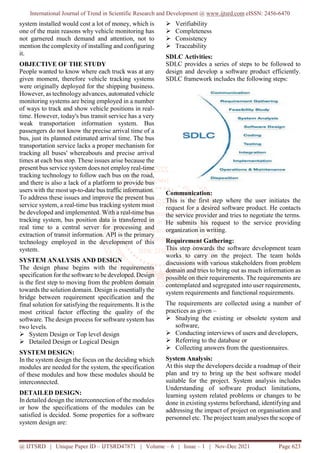
SDLC framework includes the following steps:
Communication:
This is the first step where the user initiates the
request for a desired software product. He contacts
the service provider and tries to negotiate the terms.
He submits his request to the service providing
organization in writing.
Requirement Gathering:
This step onwards the software development team
works to carry on the project. The team holds
discussions with various stakeholders from problem
domain and tries to bring out as much information as
possible on their requirements. The requirements are
contemplated and segregated into user requirements,
system requirements and functional requirements.
The requirements are collected using a number of
practices as given –
 Studying the existing or obsolete system and
software,
 Conducting interviews of users and developers,
 Referring to the database or
 Collecting answers from the questionnaires.
System Analysis:
At this step the developers decide a roadmap of their
plan and try to bring up the best software model
suitable for the project. System analysis includes
Understanding of software product limitations,
learning system related problems or changes to be
done in existing systems beforehand, identifying and
addressing the impact of project on organisation and
personnel etc. The project team analyses the scope of
International Journal of Trend in Scientific Research and Development @ www.ijtsrd.com eISSN: 2456-6470
@ IJTSRD | Unique Paper ID – IJTSRD47871 | Volume – 6 | Issue – 1 | Nov-Dec 2021 Page 624
the project and plans the schedule and resources
accordingly.
Software Analysis:
Next step is to bring down whole knowledge of
requirements and analysis on the desk and design the
software product. The inputs from users and
information gathered in requirement gathering phase
are the inputs of this step. The output of this step
comes in the form of two designs; logical design and
physical design.
Coding:
This step is also known as programming phase. The
implementation of software design starts in terms of
writing program code in the suitable programming
language and developing error-free executable
programs efficiently.
Testing:
An estimate says that 50% of whole software
development process should be tested. Errors may
ruin the software from critical level to its own
removal. Software testing is done while coding bythe
developers and thorough testing is conducted by
testing experts at various levels of code such as
module testing, program testing, product testing, in-
house testing and testing the product at user’s end.
Early discovery of errors and their remedy is the key
to reliable software.
Integration:
Software may need to be integrated with the libraries,
databases and other program(s). This stage of SDLC
is involved in the integration of software with outer
world entities.
Implementation:
This means installing the software on user machines.
At times, software needs post installation
configurations at user end. Software is tested for
portability and adaptability and integration related
issues are solved during implementation.
Operation and Maintenance:
This phase confirms the software operation in terms
of more efficiency and less errors. If required, the
users are trained on, or aided with the documentation
on how to operate the software and how to keep the
software operational. The software is maintained
timely by updating the code according to the changes
taking place in user end environment or technology.
This phase may face challenges from hidden bugs and
real- world unidentified problems.
Testing
Testing is a process to show the correctness of the
program. Testing is needed to show completeness, it
improve the quality of the software and to provide the
maintenance aid. Some testing standards are therefore
necessary reduce the testing costs and operation time.
Testing software extends throughout the coding phase
and it represents the ultimate review of
configurations, design and coding. Based on the way
the software reacts to these testing, we can decide
whether the configuration that has been built is study
or not. All components of an application are tested, as
the failure to do so many results in a series of bugs
after the software is put to use.
Black Box Testing: Black box testing, also called
behavioral testing, focuses on the functional
requirements of software. This testing approach
enables the software engineer to derive the input
conditions that will fully exercise all requirements for
a program. Black box testing attempts to find the
errors like
 Incorrect or missing functions
 Interface errors
 Errors in data structures or external database
access
 Behavior or performance errors
 Initialization and termination errors
White Box Testing: White box testing is also called
Glass box testing is a test case design control;
structure of the procedural design to derive test cases
using White box testing method, the software
engineer can derive the test cases that guarantee that
all independent paths within the module have been
exercised at least once. Exercise all logic decisions on
their true or false sides. Execute all loops at their
boundaries and within their operational bounds.
Exercise internal data structure to ensure their
validity.
International Journal of Trend in Scientific Research and Development @ www.ijtsrd.com eISSN: 2456-6470
@ IJTSRD | Unique Paper ID – IJTSRD47871 | Volume – 6 | Issue – 1 | Nov-Dec 2021 Page 625
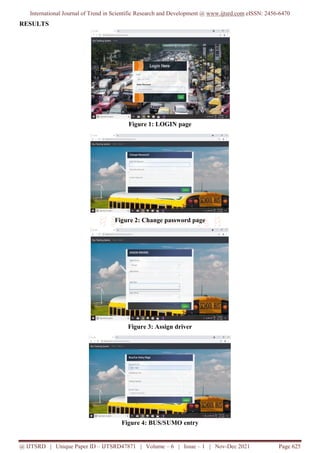
RESULTS
Figure 1: LOGIN page
Figure 2: Change password page
Figure 3: Assign driver
Figure 4: BUS/SUMO entry
International Journal of Trend in Scientific Research and Development @ www.ijtsrd.com eISSN: 2456-6470
@ IJTSRD | Unique Paper ID – IJTSRD47871 | Volume – 6 | Issue – 1 | Nov-Dec 2021 Page 626
Figure 5: Define route
Figure 6: Bus/Driver details
CONCLUSION
With the implementation of the project, a complete
track can be kept of buses. The display at the
passenger’s end acts as a time saver. By
implementing our system, a passenger can plan their
journey more efficiently before time as the waiting
time at the bus stops is reduced. This system also
throws a light on the frequency of the buses on the
same route. The main features of this systems are the
efficient usage of time, real time information on the
availability of buses, traffic acknowledgment, and
commuter satisfaction. Thus in this system, we have
shown that transit information collected in real time
can be shown on the server for tracking and
monitoring. Internet enabled mobile phones can
receive real-time transit information and will help the
passenger to monitor their time more effectively and
precisely.
REFERENCES
[1] Eddie Chi-Wah Lau, ‘‘Simple Bus Tracking
System’’, Journal of Advanced Computer
Science and Technology Research, vol.3, no.1,
2013
[2] KhondkerShajadulHasan, Mashiur Rahman,
Abul L. Haque, M Abdur Rahman, Tanzil
Rahman, and M Mahbubur Rasheed, “Cost
Effective GPS-GPRS Based Object Tracking
System,” Proceedings of the International Multi
Conference of Engineers and Computer
Scientists 2009 (IMECS 2009), March 2009,
Hong Kong, vol. 1.
[3] MZ Parvez, KZ Ahmed, QR Mahfuz, MS
Rahman,” A theoretical model Of GSM
network based vehicle tracking system,” 2010
International Conference on Electrical and
Computer Engineering (ICECE), Dec. 2010,
pp. 594-597.
[4] https://en.wikipedia.org/wiki/Arduino
http://www.sbstransit.com.sg/iris/overview.asp
x [15 March 2013] SBS Transit,
n.d..irisNextBus. Available from:
http://www.sbstransit.com.sg/iris3/validation_p
age.aspx [15 March 2013] SBS Transit, n.d..
Mobile Version. Available from:
http://mobileiris.sbstransit.com.sg/ [15 March
2013] Simon Hill, 2013. 10 reasons why
Android is still better then iOS. 17 Jan 2013.
Available From:
http://www.androidauthority.com/10-reasons-
why-android-is-still-better-than-ios-

Scalable Tracking System

  • 1.
    International Journal ofTrend in Scientific Research and Development (IJTSRD) Volume 6 Issue 1, November-December 2021 Available Online: www.ijtsrd.com e-ISSN: 2456 – 6470 @ IJTSRD | Unique Paper ID – IJTSRD47871 | Volume – 6 | Issue – 1 | Nov-Dec 2021 Page 622 Scalable Tracking System Ifra Nazir1 , Naurina Hamid1 , Inab Riaz1 , Khalid Makhdoomi2 1 B Tech Scholar, Department of Computer Science, 2 Assistant Professor, Department of Computer Science, 1,2 SSM College of Engineering, Jammu and Kashmir, India ABSTRACT Because of its numerous uses, the bus tracking system is critical in today's technology. Today, the dependability of public transportation is critical. People who utilise public transportation may squander a significant amount of time waiting for a certain bus at a specific bus stop. The movement of buses in the bus system is impacted by unforeseen variables such as arrival of buses at irregular times of transportation or deployment from the bus depot on a daily basis. People commuting by bus will have more faith in public transportation if they know the actual bus location, the estimated arrival time based on normal traffic circumstances, and the number of passengers aboard a specific bus. The public may track the whereabouts of buses using this online application. The online application will also provide information about all of the buses, such as bus number, routes, stops, timings, and frequency. There is a need for an effective public transit system due to overcrowding. Then there is an increasing pressure on public transportation, such as buses, due to population growth. As a result, the distant users need a smart system that gives real-time bus information. As a result, we developed a new system that addresses the shortcomings of the current public transit system. As a result, our system handles all data such as the current position of buses and bus management. It shows the remote user the current location of the bus on Google Maps. How to cite this paper: Ifra Nazir | Naurina Hamid | Inab Riaz | Khalid Makhdoomi "Scalable Tracking System" Published in International Journal of Trend in Scientific Research and Development (ijtsrd), ISSN: 2456-6470, Volume-6 | Issue-1, December 2021, pp.622-626, URL: www.ijtsrd.com/papers/ijtsrd47871.pdf Copyright © 2021 by author(s) and International Journal of Trend in Scientific Research and Development Journal. This is an Open Access article distributed under the terms of the Creative Commons Attribution License (CC BY 4.0) (http://creativecommons.org/licenses/by/4.0) INTRODUCTION Vehicle tracking systems are becoming increasingly popular and widely employed in a variety of nations throughout the world. It provides several benefits to users, particularly car owners, by making it easier for them to track their vehicles. Nowadays, no one can live without their smartphone. Time magazine conducted a study in which thousands of people from the United States, the United Kingdom, South Korea, India, China, South Africa, Indonesia, and Brazil participated. The results showed that the majority of them are inseparable from their cellphones, with 84% claiming that they could not survive without them. According to another report, smartphones account for 75% of the market and a total of 106 million smartphones were shipped in the second half of 2012. Smartphones have risen to the top of the telecommunications industry in the current era, and they have become the most widely used telecommunications medium known to man. As a result of the aforementioned poll, it is apparent that smartphones have become an important and fundamental part of our modern day lives, which is why this vehicle monitoring system is text message oriented so that we may take care of our own vehicle with a single touch of our Hand. With the aid of an Internet connection, we may track the real-time location of our vehicle using a smart phone. This tracking system is created in such a way that consumers may have a simple and user-friendly interface to retrieve their car. PROBLEM STATEMENT Vehicle monitoring is becoming increasingly important in today's world for the aim of enhancing our quality of life. Home vehicle monitoring provides convenience and ease of use for vehicles. Car tracking provides a futuristic way of living in which a person may operate his vehicle using a smart phone, from tracking a vehicle to detecting an unexpected location of a vehicle; it also provides an effective use of technology. However, getting or acquiring such a IJTSRD47871
  • 2.
    International Journal ofTrend in Scientific Research and Development @ www.ijtsrd.com eISSN: 2456-6470 @ IJTSRD | Unique Paper ID – IJTSRD47871 | Volume – 6 | Issue – 1 | Nov-Dec 2021 Page 623 system installed would cost a lot of money, which is one of the main reasons why vehicle monitoring has not garnered much demand and attention, not to mention the complexity of installing and configuring it. OBJECTIVE OF THE STUDY People wanted to know where each truck was at any given moment, therefore vehicle tracking systems were originally deployed for the shipping business. However, as technology advances, automated vehicle monitoring systems are being employed in a number of ways to track and show vehicle positions in real- time. However, today's bus transit service has a very weak transportation information system. Bus passengers do not know the precise arrival time of a bus, just its planned estimated arrival time. The bus transportation service lacks a proper mechanism for tracking all buses' whereabouts and precise arrival times at each bus stop. These issues arise because the present bus service system does not employ real-time tracking technology to follow each bus on the road, and there is also a lack of a platform to provide bus users with the most up-to-date bus traffic information. To address these issues and improve the present bus service system, a real-time bus tracking system must be developed and implemented. With a real-time bus tracking system, bus position data is transferred in real time to a central server for processing and extraction of transit information. API is the primary technology employed in the development of this system. SYSTEM ANALYSIS AND DESIGN The design phase begins with the requirements specification for the software to be developed. Design is the first step to moving from the problem domain towards the solution domain. Design is essentiallythe bridge between requirement specification and the final solution for satisfying the requirements. It is the most critical factor effecting the quality of the software. The design process for software system has two levels.  System Design or Top level design  Detailed Design or Logical Design SYSTEM DESIGN: In the system design the focus on the deciding which modules are needed for the system, the specification of these modules and how these modules should be interconnected. DETAILED DESIGN: In detailed design the interconnection of the modules or how the specifications of the modules can be satisfied is decided. Some properties for a software system design are:  Verifiability  Completeness  Consistency  Traceability SDLC Activities: SDLC provides a series of steps to be followed to design and develop a software product efficiently. SDLC framework includes the following steps: Communication: This is the first step where the user initiates the request for a desired software product. He contacts the service provider and tries to negotiate the terms. He submits his request to the service providing organization in writing. Requirement Gathering: This step onwards the software development team works to carry on the project. The team holds discussions with various stakeholders from problem domain and tries to bring out as much information as possible on their requirements. The requirements are contemplated and segregated into user requirements, system requirements and functional requirements. The requirements are collected using a number of practices as given –  Studying the existing or obsolete system and software,  Conducting interviews of users and developers,  Referring to the database or  Collecting answers from the questionnaires. System Analysis: At this step the developers decide a roadmap of their plan and try to bring up the best software model suitable for the project. System analysis includes Understanding of software product limitations, learning system related problems or changes to be done in existing systems beforehand, identifying and addressing the impact of project on organisation and personnel etc. The project team analyses the scope of
  • 3.
    International Journal ofTrend in Scientific Research and Development @ www.ijtsrd.com eISSN: 2456-6470 @ IJTSRD | Unique Paper ID – IJTSRD47871 | Volume – 6 | Issue – 1 | Nov-Dec 2021 Page 624 the project and plans the schedule and resources accordingly. Software Analysis: Next step is to bring down whole knowledge of requirements and analysis on the desk and design the software product. The inputs from users and information gathered in requirement gathering phase are the inputs of this step. The output of this step comes in the form of two designs; logical design and physical design. Coding: This step is also known as programming phase. The implementation of software design starts in terms of writing program code in the suitable programming language and developing error-free executable programs efficiently. Testing: An estimate says that 50% of whole software development process should be tested. Errors may ruin the software from critical level to its own removal. Software testing is done while coding bythe developers and thorough testing is conducted by testing experts at various levels of code such as module testing, program testing, product testing, in- house testing and testing the product at user’s end. Early discovery of errors and their remedy is the key to reliable software. Integration: Software may need to be integrated with the libraries, databases and other program(s). This stage of SDLC is involved in the integration of software with outer world entities. Implementation: This means installing the software on user machines. At times, software needs post installation configurations at user end. Software is tested for portability and adaptability and integration related issues are solved during implementation. Operation and Maintenance: This phase confirms the software operation in terms of more efficiency and less errors. If required, the users are trained on, or aided with the documentation on how to operate the software and how to keep the software operational. The software is maintained timely by updating the code according to the changes taking place in user end environment or technology. This phase may face challenges from hidden bugs and real- world unidentified problems. Testing Testing is a process to show the correctness of the program. Testing is needed to show completeness, it improve the quality of the software and to provide the maintenance aid. Some testing standards are therefore necessary reduce the testing costs and operation time. Testing software extends throughout the coding phase and it represents the ultimate review of configurations, design and coding. Based on the way the software reacts to these testing, we can decide whether the configuration that has been built is study or not. All components of an application are tested, as the failure to do so many results in a series of bugs after the software is put to use. Black Box Testing: Black box testing, also called behavioral testing, focuses on the functional requirements of software. This testing approach enables the software engineer to derive the input conditions that will fully exercise all requirements for a program. Black box testing attempts to find the errors like  Incorrect or missing functions  Interface errors  Errors in data structures or external database access  Behavior or performance errors  Initialization and termination errors White Box Testing: White box testing is also called Glass box testing is a test case design control; structure of the procedural design to derive test cases using White box testing method, the software engineer can derive the test cases that guarantee that all independent paths within the module have been exercised at least once. Exercise all logic decisions on their true or false sides. Execute all loops at their boundaries and within their operational bounds. Exercise internal data structure to ensure their validity.
  • 4.
    International Journal ofTrend in Scientific Research and Development @ www.ijtsrd.com eISSN: 2456-6470 @ IJTSRD | Unique Paper ID – IJTSRD47871 | Volume – 6 | Issue – 1 | Nov-Dec 2021 Page 625 RESULTS Figure 1: LOGIN page Figure 2: Change password page Figure 3: Assign driver Figure 4: BUS/SUMO entry
  • 5.
    International Journal ofTrend in Scientific Research and Development @ www.ijtsrd.com eISSN: 2456-6470 @ IJTSRD | Unique Paper ID – IJTSRD47871 | Volume – 6 | Issue – 1 | Nov-Dec 2021 Page 626 Figure 5: Define route Figure 6: Bus/Driver details CONCLUSION With the implementation of the project, a complete track can be kept of buses. The display at the passenger’s end acts as a time saver. By implementing our system, a passenger can plan their journey more efficiently before time as the waiting time at the bus stops is reduced. This system also throws a light on the frequency of the buses on the same route. The main features of this systems are the efficient usage of time, real time information on the availability of buses, traffic acknowledgment, and commuter satisfaction. Thus in this system, we have shown that transit information collected in real time can be shown on the server for tracking and monitoring. Internet enabled mobile phones can receive real-time transit information and will help the passenger to monitor their time more effectively and precisely. REFERENCES [1] Eddie Chi-Wah Lau, ‘‘Simple Bus Tracking System’’, Journal of Advanced Computer Science and Technology Research, vol.3, no.1, 2013 [2] KhondkerShajadulHasan, Mashiur Rahman, Abul L. Haque, M Abdur Rahman, Tanzil Rahman, and M Mahbubur Rasheed, “Cost Effective GPS-GPRS Based Object Tracking System,” Proceedings of the International Multi Conference of Engineers and Computer Scientists 2009 (IMECS 2009), March 2009, Hong Kong, vol. 1. [3] MZ Parvez, KZ Ahmed, QR Mahfuz, MS Rahman,” A theoretical model Of GSM network based vehicle tracking system,” 2010 International Conference on Electrical and Computer Engineering (ICECE), Dec. 2010, pp. 594-597. [4] https://en.wikipedia.org/wiki/Arduino http://www.sbstransit.com.sg/iris/overview.asp x [15 March 2013] SBS Transit, n.d..irisNextBus. Available from: http://www.sbstransit.com.sg/iris3/validation_p age.aspx [15 March 2013] SBS Transit, n.d.. Mobile Version. Available from: http://mobileiris.sbstransit.com.sg/ [15 March 2013] Simon Hill, 2013. 10 reasons why Android is still better then iOS. 17 Jan 2013. Available From: http://www.androidauthority.com/10-reasons- why-android-is-still-better-than-ios-