Software testing, reengineering,
quality assusrance
State of the art
Le Club Qualimetrie
The Cyclomatic complexity metric
• theoretical foundation
• the theoretical boundaries
• what it means
• how it's used
• unit testing
• integration testing
• Static and dynamic cyclomatic complexity
Desired Metric Properties
• Universal – all algorithms
• Mathematically rigorous
• Objective – two people get same metric
• Operational – what do you do with it
• Visualization -- could see it, intuitive
A complexity measure
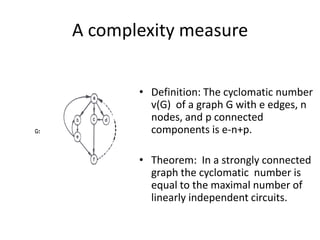
• Definition: The cyclomatic number
v(G) of a graph G with e edges, n
nodes, and p connected
components is e-n+p.
• Theorem: In a strongly connected
graph the cyclomatic number is
equal to the maximal number of
linearly independent circuits.
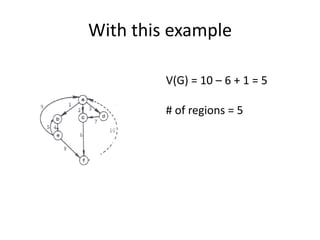
With this example
V(G) = 10 – 6 + 1 = 5
# of regions = 5
Pick paths for the 5 circuits
• Using theorem 1 we choose a set of
circuits that are paths. The following set
B is a basis set of paths.
• B: (abef) , (abebef) , (abeabef) , (acf) ,
(adcf)
• Linear combinations of paths in B will
generate any path. For example,
• (abea(be)3f) = 2(abebef) – (abef)
• (a(be)2abef) = (a(be)2f)+(abeabef)-(abef)
18 times
n It is IMPOSSIBLE to test All Statistical Paths
n So, from structural coverage view,
When Should We Stop Testing?
n Not care? (planes do, missiles do)
n All lines?
n All branches?
n All boolean outcomes (MC/DC)?
n All cyclomatic paths?
18
0 10Optimum
Number of Tests?
All Statistical Paths = 10
18
If allow 1 Nanosecond per test, time is :
T =
10 x 3600 x 24 x 365
9
10 18
= 31.7 Years
IV. Testing Software for Reliability - Structured Testing
Impossibility of Testing Everything
Methods of computing v(G)
• E-n+2
• # decisions + 1
• # of regions in a planar flow graph
9
If .. then If .. then .. else If .. and .. then If .. or .. then
Do .. While While .. Do Switch
Structured
ProgrammingComponents
Definition of essential complexity
ev(G)
• Remove all structured components from G to
produce a reduced graph R
• Definition: ev(G) = v(R)
• 1<=ev(G)<=v(G)
11
Function A
Complexity = 20
5.17s
Unstructuredness (evg) = 1
Function B
Complexity = 18
Unstructuredness (evg) = 17
So B is MUCH harder to maintain!
Complexity (decisions) & # lines here are similar, but ...
What it means
• In theory --- v, ev,
• In practice --- unconscious, v,ev
– How it works when ignored
– v=20, 45 tests, 12 independent paths tested
• In practice ---- conscious, v, ev
– With just limiting complexity
– With limiting and testing to complexity
• Used just statically, e, ev
• Used dynamically, e,ev
Boundaries
• When structured testing is ‘proof of correctness’
– seldom
– When the path functions are ‘linear’
– Eg, the run time of a redundant path equals it’s linear combination of basis path
runtimes
• When structured testing misses errors
• Often, the assumption is that a path is validly tested
• When data singularities exist along a path
• When an interrupt suspension can cause an error
• When power of observation fails
– High v(G)
– High ev(G)
• Want to test to v independent paths
– Or can reduce v, dead decisions
• High ev is insanity, ev can go high with one bad change
Google book search – McCabe Complexity – 826 books
Encyclopedia of Microcomputers
Introduction to the Team Software Process
]
Network Analysis, Architecture and Design
Separating Data from Instructions: Investigating a New Programming
Cyclomatic Complexity
• Static
– Unit paths v(G)
– Integration paths
– Data complexity
• Dynamic
– Untested paths v(G)-ac
– Untested integration
– Untested data complexity
Applications
Testing
Essential complexity --- reverse
engineering
Design Complexity ---- system
integration
Data complexity --- security testing
Pareto Distribution of errors ---
reverse engineering
Code Breaker ---- Reuse
Security threats
Data Slicing ----- Reuse
Code walkthroughs ---- validation
Design validation
Requirements Validation
Software testing
• cyclomatic complexity
• Cost of errors
• Black box, grey box, white box testing
• unit pretesting, the baseline method
• unit testing, static and dynamic
• integration pretesting, testing
• Code attribute by complexity
• testing life cycle
• Regression testing
Costs of errors
• 80% of your project will be re-work
• Coding error cost is X
• Integration error cost is 30X
• Acceptance error is 300x
• Operational error can be 3000X
• Bottom line: catch errors early and prevent
them!!!
18
19
What module coverage level will you attempt? Minimum # tests would be:
Line Cov. = 2, Branch Cov. = 3, Cyclomatic Path Cov. = 4
Levels of Code Coverage - Module
IV. Testing Software for Reliability - Structured Testing
20
 Cyclomatic Complexity = v(g) = 10
Means that 10 Minimum Tests will:
 Cover All the Code
 Test Decision Logic Multiple Ways From
Baseline
Structured Testing --- The baseline method
Run a robust functional path as ‘the baseline’; flip
successive decisions and come back to the baseline
Structured Testing --- dynamic
• Actual complexity(ac) is the # of linearly
independent paths in the test set
• May have 100 tests with v=10 and ac=5
• 1<=ac<=v
• Many organizations run functional tests first,
then add v-ac additional independent paths
22
• Design Complexity, S0 =  iv(g)
– measure of decision structure which controls the invocation
of modules within the design; quantifies testing effort for
paths within modules relative to calls in the design
• Integration Complexity, S1 = S0 - n + 1
– measure of the integration tests that qualify the design tree;
it is the # of paths needed to test all calls to all modules at
least once, a quantification of a basis set of integration tests;
it measures the minimum integration testing effort of a
design; each S1 test validates the integration of several
modules and is known as a subtree of the whole design tree
• Sum/Maximum/Average of v(g), ev(g), gdv(g), branches, etc.
III. Development of Reliable Software - Code Structure
Complexity Metrics Impacting Reliability - Component
23
• Module Design Complexity, iv(g)
[integration]
– measure of logical paths containing
calls/invocation of immediate subordinate
modules, i.e., Integration
– calculated by reduction of graph after
removing decisions/nodes with no calls
– value should be higher for modules higher in
hierarchies, that is, in management modules
• Paths Containing Global Data, gdv(g)
– global data also impacts reliability, because it
creates relationships between modules
• Branches, which is related to v(g)
• Maximum Nesting Level
• Others
v(g) = 10
ev(g) = 3
iv(g) = 3
III. Development of Reliable Software - Code Structure
Complexity Metrics Impacting Reliability -
Module
24
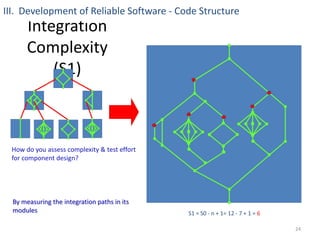
Integration
Complexity
(S1)
How do you assess complexity & test effort
for component design?
S1 = S0 - n + 1= 12 - 7 + 1 = 6
By measuring the integration paths in its
modules
III. Development of Reliable Software - Code Structure
25
What coverage level will you attempt
during Integration Test?
• Module entry? - the 5 red boxes
need tested
• Module integration calls? - the 9
black lines need tested (they include
the red boxes)
• Module integration paths? - the 9
black lines plus all paths in the
calling modules that contain calls;
Structured Testing recommends this
level as minimum
• Other?
IV. Testing Software for Reliability - Structured Testing
Levels of Code Coverage - Component
Black lines mean not yet tested
26
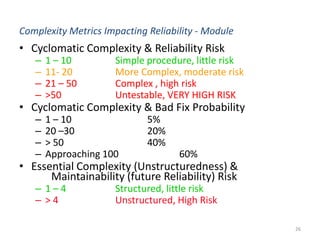
• Cyclomatic Complexity & Reliability Risk
– 1 – 10 Simple procedure, little risk
– 11- 20 More Complex, moderate risk
– 21 – 50 Complex , high risk
– >50 Untestable, VERY HIGH RISK
• Cyclomatic Complexity & Bad Fix Probability
– 1 – 10 5%
– 20 –30 20%
– > 50 40%
– Approaching 100 60%
• Essential Complexity (Unstructuredness) &
Maintainability (future Reliability) Risk
– 1 – 4 Structured, little risk
– > 4 Unstructured, High Risk
Complexity Metrics Impacting Reliability - Module
27
Inspection self test ---- error prevention – test before building
Error prevention is the most powerful tool
Regression Testing
• You test once, retest a million times
• Test data, results, and traceability are very valuable
• Data base system holds tests
• Comparator used to verify results
• Synced with configuration management
• Is pruned
• Is added to
• 20% of tests will show 80% of errors --- percolated up
• Tests have history --- those that show no errors are
pruned out
28
Review teams ---- Here’s the leverage
• Egoless --- no blame no shame
• Find errors don’t fix them
• Team works as a whole --- succeeds or fails as one
team
• If # of errors is high then rework the product and
inspect again
• Need a scribe
• Need a checklist of issues to look for
• Product gets certified as ‘Inspected by Team Us’
• Is preceded by test team producing acceptance tests
• Use McCabe methodology for code and design reviews
29

20100309 02 - Software testing (McCabe)

  • 1.
    Software testing, reengineering, qualityassusrance State of the art Le Club Qualimetrie
  • 2.
    The Cyclomatic complexitymetric • theoretical foundation • the theoretical boundaries • what it means • how it's used • unit testing • integration testing • Static and dynamic cyclomatic complexity
  • 3.
    Desired Metric Properties •Universal – all algorithms • Mathematically rigorous • Objective – two people get same metric • Operational – what do you do with it • Visualization -- could see it, intuitive
  • 4.
    A complexity measure •Definition: The cyclomatic number v(G) of a graph G with e edges, n nodes, and p connected components is e-n+p. • Theorem: In a strongly connected graph the cyclomatic number is equal to the maximal number of linearly independent circuits.
  • 5.
    With this example V(G)= 10 – 6 + 1 = 5 # of regions = 5
  • 6.
    Pick paths forthe 5 circuits • Using theorem 1 we choose a set of circuits that are paths. The following set B is a basis set of paths. • B: (abef) , (abebef) , (abeabef) , (acf) , (adcf) • Linear combinations of paths in B will generate any path. For example, • (abea(be)3f) = 2(abebef) – (abef) • (a(be)2abef) = (a(be)2f)+(abeabef)-(abef)
  • 7.
    18 times n Itis IMPOSSIBLE to test All Statistical Paths n So, from structural coverage view, When Should We Stop Testing? n Not care? (planes do, missiles do) n All lines? n All branches? n All boolean outcomes (MC/DC)? n All cyclomatic paths? 18 0 10Optimum Number of Tests? All Statistical Paths = 10 18 If allow 1 Nanosecond per test, time is : T = 10 x 3600 x 24 x 365 9 10 18 = 31.7 Years IV. Testing Software for Reliability - Structured Testing Impossibility of Testing Everything
  • 8.
    Methods of computingv(G) • E-n+2 • # decisions + 1 • # of regions in a planar flow graph
  • 9.
    9 If .. thenIf .. then .. else If .. and .. then If .. or .. then Do .. While While .. Do Switch Structured ProgrammingComponents
  • 10.
    Definition of essentialcomplexity ev(G) • Remove all structured components from G to produce a reduced graph R • Definition: ev(G) = v(R) • 1<=ev(G)<=v(G)
  • 11.
    11 Function A Complexity =20 5.17s Unstructuredness (evg) = 1 Function B Complexity = 18 Unstructuredness (evg) = 17 So B is MUCH harder to maintain! Complexity (decisions) & # lines here are similar, but ...
  • 12.
    What it means •In theory --- v, ev, • In practice --- unconscious, v,ev – How it works when ignored – v=20, 45 tests, 12 independent paths tested • In practice ---- conscious, v, ev – With just limiting complexity – With limiting and testing to complexity • Used just statically, e, ev • Used dynamically, e,ev
  • 13.
    Boundaries • When structuredtesting is ‘proof of correctness’ – seldom – When the path functions are ‘linear’ – Eg, the run time of a redundant path equals it’s linear combination of basis path runtimes • When structured testing misses errors • Often, the assumption is that a path is validly tested • When data singularities exist along a path • When an interrupt suspension can cause an error • When power of observation fails – High v(G) – High ev(G) • Want to test to v independent paths – Or can reduce v, dead decisions • High ev is insanity, ev can go high with one bad change
  • 14.
    Google book search– McCabe Complexity – 826 books Encyclopedia of Microcomputers Introduction to the Team Software Process ] Network Analysis, Architecture and Design Separating Data from Instructions: Investigating a New Programming
  • 15.
    Cyclomatic Complexity • Static –Unit paths v(G) – Integration paths – Data complexity • Dynamic – Untested paths v(G)-ac – Untested integration – Untested data complexity
  • 16.
    Applications Testing Essential complexity ---reverse engineering Design Complexity ---- system integration Data complexity --- security testing Pareto Distribution of errors --- reverse engineering Code Breaker ---- Reuse Security threats Data Slicing ----- Reuse Code walkthroughs ---- validation Design validation Requirements Validation
  • 17.
    Software testing • cyclomaticcomplexity • Cost of errors • Black box, grey box, white box testing • unit pretesting, the baseline method • unit testing, static and dynamic • integration pretesting, testing • Code attribute by complexity • testing life cycle • Regression testing
  • 18.
    Costs of errors •80% of your project will be re-work • Coding error cost is X • Integration error cost is 30X • Acceptance error is 300x • Operational error can be 3000X • Bottom line: catch errors early and prevent them!!! 18
  • 19.
    19 What module coveragelevel will you attempt? Minimum # tests would be: Line Cov. = 2, Branch Cov. = 3, Cyclomatic Path Cov. = 4 Levels of Code Coverage - Module IV. Testing Software for Reliability - Structured Testing
  • 20.
    20  Cyclomatic Complexity= v(g) = 10 Means that 10 Minimum Tests will:  Cover All the Code  Test Decision Logic Multiple Ways From Baseline Structured Testing --- The baseline method Run a robust functional path as ‘the baseline’; flip successive decisions and come back to the baseline
  • 21.
    Structured Testing ---dynamic • Actual complexity(ac) is the # of linearly independent paths in the test set • May have 100 tests with v=10 and ac=5 • 1<=ac<=v • Many organizations run functional tests first, then add v-ac additional independent paths
  • 22.
    22 • Design Complexity,S0 =  iv(g) – measure of decision structure which controls the invocation of modules within the design; quantifies testing effort for paths within modules relative to calls in the design • Integration Complexity, S1 = S0 - n + 1 – measure of the integration tests that qualify the design tree; it is the # of paths needed to test all calls to all modules at least once, a quantification of a basis set of integration tests; it measures the minimum integration testing effort of a design; each S1 test validates the integration of several modules and is known as a subtree of the whole design tree • Sum/Maximum/Average of v(g), ev(g), gdv(g), branches, etc. III. Development of Reliable Software - Code Structure Complexity Metrics Impacting Reliability - Component
  • 23.
    23 • Module DesignComplexity, iv(g) [integration] – measure of logical paths containing calls/invocation of immediate subordinate modules, i.e., Integration – calculated by reduction of graph after removing decisions/nodes with no calls – value should be higher for modules higher in hierarchies, that is, in management modules • Paths Containing Global Data, gdv(g) – global data also impacts reliability, because it creates relationships between modules • Branches, which is related to v(g) • Maximum Nesting Level • Others v(g) = 10 ev(g) = 3 iv(g) = 3 III. Development of Reliable Software - Code Structure Complexity Metrics Impacting Reliability - Module
  • 24.
    24 Integration Complexity (S1) How do youassess complexity & test effort for component design? S1 = S0 - n + 1= 12 - 7 + 1 = 6 By measuring the integration paths in its modules III. Development of Reliable Software - Code Structure
  • 25.
    25 What coverage levelwill you attempt during Integration Test? • Module entry? - the 5 red boxes need tested • Module integration calls? - the 9 black lines need tested (they include the red boxes) • Module integration paths? - the 9 black lines plus all paths in the calling modules that contain calls; Structured Testing recommends this level as minimum • Other? IV. Testing Software for Reliability - Structured Testing Levels of Code Coverage - Component Black lines mean not yet tested
  • 26.
    26 • Cyclomatic Complexity& Reliability Risk – 1 – 10 Simple procedure, little risk – 11- 20 More Complex, moderate risk – 21 – 50 Complex , high risk – >50 Untestable, VERY HIGH RISK • Cyclomatic Complexity & Bad Fix Probability – 1 – 10 5% – 20 –30 20% – > 50 40% – Approaching 100 60% • Essential Complexity (Unstructuredness) & Maintainability (future Reliability) Risk – 1 – 4 Structured, little risk – > 4 Unstructured, High Risk Complexity Metrics Impacting Reliability - Module
  • 27.
    27 Inspection self test---- error prevention – test before building Error prevention is the most powerful tool
  • 28.
    Regression Testing • Youtest once, retest a million times • Test data, results, and traceability are very valuable • Data base system holds tests • Comparator used to verify results • Synced with configuration management • Is pruned • Is added to • 20% of tests will show 80% of errors --- percolated up • Tests have history --- those that show no errors are pruned out 28
  • 29.
    Review teams ----Here’s the leverage • Egoless --- no blame no shame • Find errors don’t fix them • Team works as a whole --- succeeds or fails as one team • If # of errors is high then rework the product and inspect again • Need a scribe • Need a checklist of issues to look for • Product gets certified as ‘Inspected by Team Us’ • Is preceded by test team producing acceptance tests • Use McCabe methodology for code and design reviews 29