Cyclomatic complexity
The complexity of algorithms
Code Coverage Where Does It Fit? -
Tom McCabe (tmccabe@mccabe.com)
2
Test Focus: Requirements
Validation Audience: User
Code Coverage: Supplemental
Positive Test: Testing things in your specs that
you already know about
Test Focus: Implementation
Validation Audience: Code
Code Coverage: Primary
Negative Test: Testing things that may not
be in your specs but in the
implementation
White Box vs. Black Box Testing
Black Box Testing
White Box Testing
•
*or Breadth of Testing vs. Depth of Testing as detailed in Department of Army Pamphlet 73-1
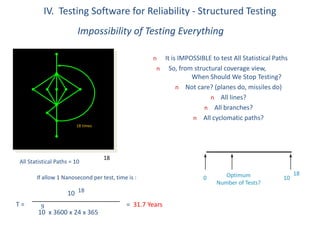
18 times
n It is IMPOSSIBLE to test All Statistical Paths
n So, from structural coverage view,
When Should We Stop Testing?
n Not care? (planes do, missiles do)
n All lines?
n All branches?
n All cyclomatic paths?
18
0 10Optimum
Number of Tests?
All Statistical Paths = 10
18
If allow 1 Nanosecond per test, time is :
T =
10 x 3600 x 24 x 365
9
10 18
= 31.7 Years
IV. Testing Software for Reliability - Structured Testing
Impossibility of Testing Everything
A complexity measure
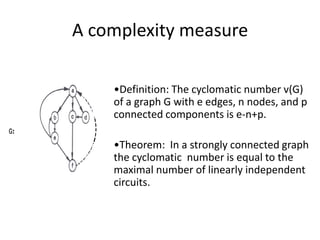
•Definition: The cyclomatic number v(G)
of a graph G with e edges, n nodes, and p
connected components is e-n+p.
•Theorem: In a strongly connected graph
the cyclomatic number is equal to the
maximal number of linearly independent
circuits.
With this example
• V(G) = 10 – 6 + 1 = 5
• # of regions = 5
Pick paths for the 5 circuits
• Using theorem 1 we choose a set of
circuits that are paths. The following set
B is a basis set of paths.
• B: (abef) , (a(be)2f) , ((abe)2f) , (acf) ,
(adcf)
• Linear combinations of paths in B will
generate any path. For example,
• (abea(be)3f) = 2(a(be)2f) – (abef)
• (a(be)2abef) = (a(be)2f)+((abe)2f)-(abef)
Methods of computing v(G)
• E-n+2
• # decisions + 1
• # of regions in a planar flow graph
8
Function A
Complexity = 20
5.17s
Unstructuredness (evg) = 1
Function B
Complexity = 18
Unstructuredness (evg) = 17
So B is MUCH harder to maintain!
Complexity (decisions) & # lines here are similar, but ...
Applications
Testing
Essential complexity --- reverse
engineering
Design Complexity ---- system
integration
Data complexity --- Y2K testing
Pareto Distribution of errors ---
reverse engineering
Code Breaker ---- Reuse
Security threats
Data Slicing ----- Reuse
Code walkthroughs ---- validation
Design validation
Requirements Validation
Google book search – McCabe Complexity – 22,000 books
Google web search (McCabe
complexity): 456,000
references
In 2009 Tom McCabe’s
publication on Software
Complexity was chosen as one
of the retrospective 23 highest
impact papers in computer
science by the ACM-SIGSOFT

20130523 05 - Cyclomatic complexity

  • 1.
  • 2.
    Code Coverage WhereDoes It Fit? - Tom McCabe (tmccabe@mccabe.com) 2 Test Focus: Requirements Validation Audience: User Code Coverage: Supplemental Positive Test: Testing things in your specs that you already know about Test Focus: Implementation Validation Audience: Code Code Coverage: Primary Negative Test: Testing things that may not be in your specs but in the implementation White Box vs. Black Box Testing Black Box Testing White Box Testing • *or Breadth of Testing vs. Depth of Testing as detailed in Department of Army Pamphlet 73-1
  • 3.
    18 times n Itis IMPOSSIBLE to test All Statistical Paths n So, from structural coverage view, When Should We Stop Testing? n Not care? (planes do, missiles do) n All lines? n All branches? n All cyclomatic paths? 18 0 10Optimum Number of Tests? All Statistical Paths = 10 18 If allow 1 Nanosecond per test, time is : T = 10 x 3600 x 24 x 365 9 10 18 = 31.7 Years IV. Testing Software for Reliability - Structured Testing Impossibility of Testing Everything
  • 4.
    A complexity measure •Definition:The cyclomatic number v(G) of a graph G with e edges, n nodes, and p connected components is e-n+p. •Theorem: In a strongly connected graph the cyclomatic number is equal to the maximal number of linearly independent circuits.
  • 5.
    With this example •V(G) = 10 – 6 + 1 = 5 • # of regions = 5
  • 6.
    Pick paths forthe 5 circuits • Using theorem 1 we choose a set of circuits that are paths. The following set B is a basis set of paths. • B: (abef) , (a(be)2f) , ((abe)2f) , (acf) , (adcf) • Linear combinations of paths in B will generate any path. For example, • (abea(be)3f) = 2(a(be)2f) – (abef) • (a(be)2abef) = (a(be)2f)+((abe)2f)-(abef)
  • 7.
    Methods of computingv(G) • E-n+2 • # decisions + 1 • # of regions in a planar flow graph
  • 8.
    8 Function A Complexity =20 5.17s Unstructuredness (evg) = 1 Function B Complexity = 18 Unstructuredness (evg) = 17 So B is MUCH harder to maintain! Complexity (decisions) & # lines here are similar, but ...
  • 9.
    Applications Testing Essential complexity ---reverse engineering Design Complexity ---- system integration Data complexity --- Y2K testing Pareto Distribution of errors --- reverse engineering Code Breaker ---- Reuse Security threats Data Slicing ----- Reuse Code walkthroughs ---- validation Design validation Requirements Validation
  • 10.
    Google book search– McCabe Complexity – 22,000 books
  • 11.
    Google web search(McCabe complexity): 456,000 references In 2009 Tom McCabe’s publication on Software Complexity was chosen as one of the retrospective 23 highest impact papers in computer science by the ACM-SIGSOFT