Spoliation Wars
            and other ESI highlights

Antigone Peyton & Steve Morrissett
A Presentation by the Electronic Litigation Group
                       August 9, 2010
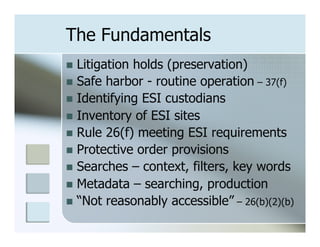
The Fundamentals
n  Litigationholds (preservation)
n  Safe harbor - routine operation – 37(f)
n  Identifying ESI custodians
n  Inventory of ESI sites
n  Rule 26(f) meeting ESI requirements
n  Protective order provisions
n  Searches – context, filters, key words
n  Metadata – searching, production
n  “Not reasonably accessible” – 26(b)(2)(b)
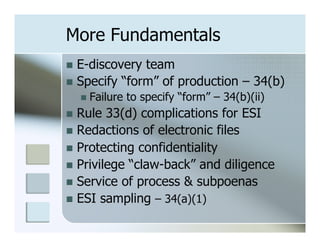
More Fundamentals
n  E-discovery team
n  Specify “form” of production – 34(b)
   n  Failure   to specify “form” – 34(b)(ii)
n  Rule  33(d) complications for ESI
n  Redactions of electronic files
n  Protecting confidentiality
n  Privilege “claw-back” and diligence
n  Service of process & subpoenas
n  ESI sampling – 34(a)(1)
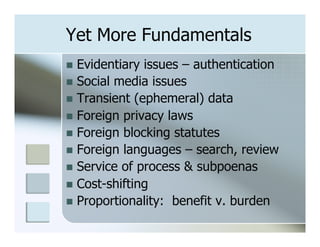
Yet More Fundamentals
n  Evidentiary issues – authentication
n  Social media issues
n  Transient (ephemeral) data
n  Foreign privacy laws
n  Foreign blocking statutes
n  Foreign languages – search, review
n  Service of process & subpoenas
n  Cost-shifting
n  Proportionality: benefit v. burden
The Wrong Attitude
The Right Attitude
Themes in 2010 decisions
n  Sanctions   and cooperation duties
n  Motions to compel and privilege
    disputes
n  Fewer decisions regarding
    preservation, form of production, and
    accessibility of data
n  Privacy of information
n  Social media discovery
Preservation
n  Synventive   Molding Solns. v. Hysky
      Injection Molding Sys. (patent case)
n    Though not formally part of the FRCP’s, legal holds
      are mandatory
n    Court can implement holds, including directions for
      implementation, if existing hold is deemed
      inadequate
n    Ordered P to file sworn decl. describing hold and
      provide a list of affected custodians
Preservation
n  Not just e-mail
n  Ephermeral data (e.g., instant
    messages, data logs)
n  Skype messages
n  USB flash drive
Pension Committee
n  Issue     written litigation holds early
n    Future plaintiffs-no later than retention of outside
      counsel
n    Should instruct custodians not to destroy records
n    Stop auto-destruction programs, especially for unique
      data

n  Search      broadly
n    Preservation/collection from key custodians is required
n    Failures relating to minor custodians, or redundant
      docs can be negligent
n    Follow up on former employees or those who may have
      changed jobs within company
Pension Committee
n  Provide   adequate discovery
      supervision
n    Need to be experienced and well-versed in duties
n    Do not delegate to an unsupervised/inexperienced
      person
n    Do not allow employees to determine what is relevant
      without guidance
n  Memorialize        discovery efforts during
      process
n    Describe rationale behind decisions and information
      relied on
Pension Committee
n  Monitorand manage discovery and
    compliance (even if case is stayed)
n  Sweep all forms of ESI
n    Include PDAs, home computers
n    All known media the business uses

n  Assume       that oversights will be
    noticed
n  Don’t oversell reliability of process
    (“all documents”)
n    Defensive affidavits should come from people with
      personal knowledge of the efforts
Pension Committee
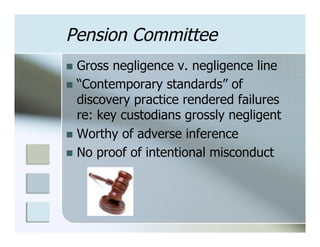
n  Gross negligence v. negligence line
n  “Contemporary standards” of
    discovery practice rendered failures
    re: key custodians grossly negligent
n  Worthy of adverse inference
n  No proof of intentional misconduct
Rimkus
n  Judge    Lee Rosenthal, Chair of Judicial
      Conference Committee on Rules and
      Practice and Proceedure
n    5th, 7th, 8th, 10th, 11th, and D.C. Circuits
      require bad faith to impose adverse
      inference
n    Gross negligence not enough
n    2nd-negligence sufficient, each party bears
      the risk of its actions
n    3rd-balancing test (degree of fault vs.
      prejudice)
Rimkus
n  5th-Adverse  inference when there is
    bad faith, mere negligence not
    enough
n  Dismissal appropriate when “conduct
    was so egregious as to amount to a
    forfeiture of his claim”
n  Uses Sedona concept of
    proportionality-burdens and costs
    weighed against potential value and
    uniqueness of data
Sanctions
n  Failure to adequately supervise
    preservation/collection/production
n  Cherrington Asia Ltd. v. A&L
    Underground Inc.-inadequate
    preparation of 30(b)(6) witness on
    party’s e-discovery collection efforts
n  Bray & Gillespie Mgmt. LLC v.
    Lexington Ins. Co.-failure to produce
    native files and misinformation
Sanctions
n  In   re A&M Florida Properties
n    Client and outside counsel sanctioned
      because outside counsel “simply did not
      understand the technical depths to which
      [e-discovery] can sometimes go”
n    No bad faith finding
n    Court required facts relating to appropriate
      allocation of sanctions
Redacted E-Filings
n  Increasing   use of electronic filing
    systems
n  Doc Type: searchable PDFs
n  Issue: improper redactions of PDF
n  Conversion of redacted word doc to
    PDF doesn’t properly redact the text
Redacted E-Filings
n    Tribune Co. bankruptcy
n    Issue: Failure to properly redact complaint filed by
      trustee for creditors
n    Redacted in Microsoft Word and converted to PDF
      for e-filing
n    Firm had redaction issue in another creditor case
n    Sanction request: limit firm’s access to confidential
      docs
n    Examiner finding: no intentional or reckless
      violation of confidentiality order (report published
      Aug. 3, 2010)
Social Media
n  Stats: Facebook
n  Over 500 million active facebook
    users (50% daily users)
n  Over 100 million w/public information
n  Complete facebook profile contains
    over 40 pieces of information (+wall
    posts & status updates)
n  2/3 of comScore’s Top U.S. websites
    integrated
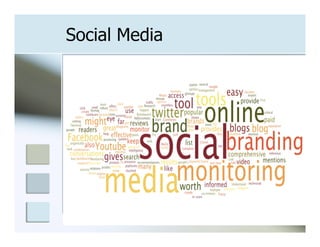
Social Media
Social Media
n    Internet forums
n    Weblogs
n    Social blogs
n    Microblogging
n    Wikis
n    Podcasts
n    Pictures
n    Video
n    Ratings
n    Social Bookmarking
Social Media in Court
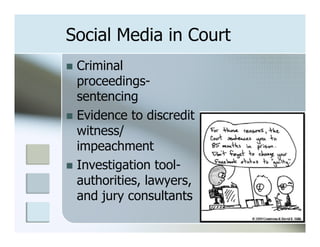
n  Criminal
    proceedings-
    sentencing
n  Evidence to discredit
    witness/
    impeachment
n  Investigation tool-
    authorities, lawyers,
    and jury consultants
Social Media
n  Privacy  preferences give way to
    liberal discovery rules in litigation
n  Many rights are waived upon joining,
    or by default settings
n  Information may be subject to
    subpoena
n  Little to no expectation of privacy
n  Leduc v. Roman (Quebec)-private
    Facebook page still discoverable
Social Media
n  Phila.   Bar Op. 2009-02 (3/2009)
n    Lawyer had 3rd party send friend request to
      adverse witness
n    Lawyer cannot do that for purposes of
      searching for otherwise private information
      on Facebook page
n    Rules regarding non-lawyer assistants
      apply to third-party actions
n    Concerns re: dishonesty, fraud, deceipt or
      misrepresentation
Social Media
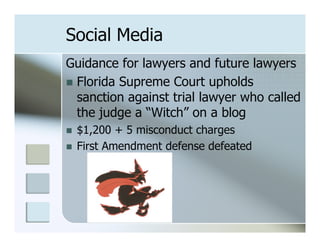
Guidance for lawyers and future lawyers
n  Florida Supreme Court upholds
    sanction against trial lawyer who called
    the judge a “Witch” on a blog
n    $1,200 + 5 misconduct charges
n    First Amendment defense defeated
Social Media
Guidance for lawyers and future lawyers
n    Illinois public defender looses job over blog
n    posted confidential information relating to representation
n    When is the LinkedIn profile an advertisement for
      business?
n    Bar groups considering formal searches and
      requesting access to social media sites
n    Florida ethics opinion-unethical for judge to friend
      lawyers who practice before him
n    Careerbuilder.com 2009 survey-45% of employers
      used social media sites to investigate job candidates
Social Media
n  ThePresident’s Advice:
  “Well, let me give you some very
  practical tips. First of all, I want
  everybody here to be careful about
  what you post on Facebook, because
  in the YouTube age, whatever you
  do, it will be pulled up again later
  somewhere in your life.”
  “Obama warns U.S. teens of perils of Facebook,” Sept. 8,
  2009 (Reuters).
Service of Process
n  London   High Court allowed service of
    a court order to an anonymous
    blogger over Twitter
n  Australian court allowed service of a
    default judgment through Facebook
n  9th Circuit-e-mail service ordered
Searching Metadata
n  Data   about data (D.C. Opinion 341)
n    Avoid disclosure of confidential or
      privileged information
n    Employ reasonable means to remove
      metadata that might disclose this type of
      information
n    Lawyers have a duty to acquire sufficient
      understanding of technologies to know how
      to protect information
Searching Metadata
n  What   do you do if you uncover
    confidential or protected metadata?
n  If actual knowledge that it was sent
    inadvertently, should not review
    before checking with other side
n  If not clear, always safer to check
    with other side
n  Comply with instructions of sender if
    told to delete or return
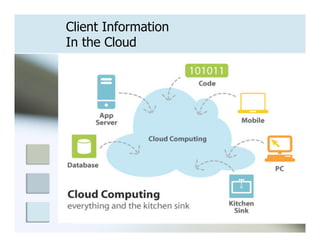
Client Information
In the Cloud
Protecting Client Information
n    NY Bar Ethics Op. 820-2/8/2008 (Gmail/Yahoo, etc.)
n    Lawyer may use e-mail service that conducts a computer
      scan of e-mails to generate targeted ads (no human review)
n    Provider stores e-mails
n    Privacy policy-no one outside of sender or recipients read
      messages or receive targeted ads
n    Does not violate prohibition on lawyer or third party using
      client confidences for their advantage
n    Must stay abreast of evolving technologies to assess risk of
      interception and potential alternative technologies that may
      reduce risks at reasonable costs
Protecting Client Information
n    NC Proposed Ethics Op. NC-FEO-2010-7 (Clio-
      cloud computing practice-management program)
n    Attorney can use third-party SaaS in law practice
n    Duty does not compel a particular method of
      handling data
n    Firm not required to guarantee invulnerable
      security procedures
n    Ethical obligation is the same: ensure provider
      employs security measures that effectively
      minimize the risk confidential information will be
      lost or disclosed
Protecting Client Information
n    NJ, Arizona, Vermont, Mass., and Nevada ethics
      opinions
n    Third-party storage and processing of data/outside
      IT support
n    Same confidentiality standards apply to physical
      client files and e-files/stored client data
n    Attorneys must exercise reasonable care when
      choosing storage provider
n    Must be must be knowledgeable about how it will
      handle data entrusted to it
n    Ensure agreements with provider include terms
      requiring the preservation of the confidentiality
      and security of data
Evidentiary Issues
n  St. Clair v. Johnny’s Oyster & Shrimp,
    Inc.
n  Any evidence procured of the internet
    is good for almost nothing
n  Lorraine v. Markel American
    Insurance Co.
n  counsel must be prepared to deal
    with the evidentiary issues associated
    with admissibility
Evidentiary Issues
n  Authentication-FRE   901(a)
n  Must have evidence that doc is what
    the proponent claims it is
n  Internet Specialties West, Inc. v.
    ISPWest-3rd party websites not
    authenticated by testimony of site
    visitor
n  Need witness with some access or
    first-hand knowledge
Evidentiary Issues
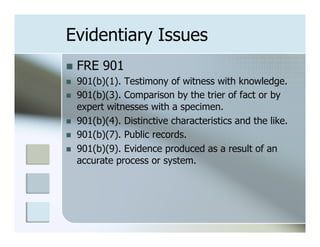
n  FRE 901
n  901(b)(1). Testimony of witness with knowledge.
n  901(b)(3). Comparison by the trier of fact or by
    expert witnesses with a specimen.
n  901(b)(4). Distinctive characteristics and the like.
n  901(b)(7). Public records.
n  901(b)(9). Evidence produced as a result of an
    accurate process or system.
Evidentiary Issues
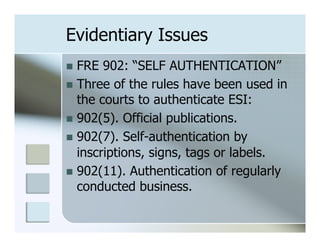
n  FRE  902: “SELF AUTHENTICATION”
n  Three of the rules have been used in
    the courts to authenticate ESI:
n  902(5). Official publications.
n  902(7). Self-authentication by
    inscriptions, signs, tags or labels.
n  902(11). Authentication of regularly
    conducted business.
Evidentiary Issues
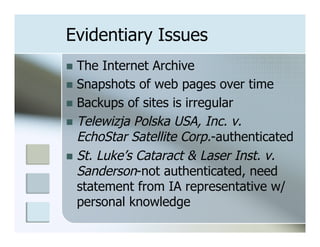
n  The  Internet Archive
n  Snapshots of web pages over time
n  Backups of sites is irregular
n  Telewizja Polska USA, Inc. v.
    EchoStar Satellite Corp.-authenticated
n  St. Luke’s Cataract & Laser Inst. v.
    Sanderson-not authenticated, need
    statement from IA representative w/
    personal knowledge
Questions?
“Three things in life are certain: death, taxes,
and computer failures.”

-Erik Heels

Spoliation Wars & Other ESI Highlights (2010)

  • 1.
    Spoliation Wars and other ESI highlights Antigone Peyton & Steve Morrissett A Presentation by the Electronic Litigation Group August 9, 2010
  • 2.
    The Fundamentals n  Litigationholds(preservation) n  Safe harbor - routine operation – 37(f) n  Identifying ESI custodians n  Inventory of ESI sites n  Rule 26(f) meeting ESI requirements n  Protective order provisions n  Searches – context, filters, key words n  Metadata – searching, production n  “Not reasonably accessible” – 26(b)(2)(b)
  • 3.
    More Fundamentals n  E-discoveryteam n  Specify “form” of production – 34(b) n  Failure to specify “form” – 34(b)(ii) n  Rule 33(d) complications for ESI n  Redactions of electronic files n  Protecting confidentiality n  Privilege “claw-back” and diligence n  Service of process & subpoenas n  ESI sampling – 34(a)(1)
  • 4.
    Yet More Fundamentals n Evidentiary issues – authentication n  Social media issues n  Transient (ephemeral) data n  Foreign privacy laws n  Foreign blocking statutes n  Foreign languages – search, review n  Service of process & subpoenas n  Cost-shifting n  Proportionality: benefit v. burden
  • 5.
  • 6.
  • 7.
    Themes in 2010decisions n  Sanctions and cooperation duties n  Motions to compel and privilege disputes n  Fewer decisions regarding preservation, form of production, and accessibility of data n  Privacy of information n  Social media discovery
  • 8.
    Preservation n  Synventive Molding Solns. v. Hysky Injection Molding Sys. (patent case) n  Though not formally part of the FRCP’s, legal holds are mandatory n  Court can implement holds, including directions for implementation, if existing hold is deemed inadequate n  Ordered P to file sworn decl. describing hold and provide a list of affected custodians
  • 9.
    Preservation n  Not juste-mail n  Ephermeral data (e.g., instant messages, data logs) n  Skype messages n  USB flash drive
  • 10.
    Pension Committee n  Issue written litigation holds early n  Future plaintiffs-no later than retention of outside counsel n  Should instruct custodians not to destroy records n  Stop auto-destruction programs, especially for unique data n  Search broadly n  Preservation/collection from key custodians is required n  Failures relating to minor custodians, or redundant docs can be negligent n  Follow up on former employees or those who may have changed jobs within company
  • 11.
    Pension Committee n  Provide adequate discovery supervision n  Need to be experienced and well-versed in duties n  Do not delegate to an unsupervised/inexperienced person n  Do not allow employees to determine what is relevant without guidance n  Memorialize discovery efforts during process n  Describe rationale behind decisions and information relied on
  • 12.
    Pension Committee n  Monitorandmanage discovery and compliance (even if case is stayed) n  Sweep all forms of ESI n  Include PDAs, home computers n  All known media the business uses n  Assume that oversights will be noticed n  Don’t oversell reliability of process (“all documents”) n  Defensive affidavits should come from people with personal knowledge of the efforts
  • 13.
    Pension Committee n  Grossnegligence v. negligence line n  “Contemporary standards” of discovery practice rendered failures re: key custodians grossly negligent n  Worthy of adverse inference n  No proof of intentional misconduct
  • 14.
    Rimkus n  Judge Lee Rosenthal, Chair of Judicial Conference Committee on Rules and Practice and Proceedure n  5th, 7th, 8th, 10th, 11th, and D.C. Circuits require bad faith to impose adverse inference n  Gross negligence not enough n  2nd-negligence sufficient, each party bears the risk of its actions n  3rd-balancing test (degree of fault vs. prejudice)
  • 15.
    Rimkus n  5th-Adverse inference when there is bad faith, mere negligence not enough n  Dismissal appropriate when “conduct was so egregious as to amount to a forfeiture of his claim” n  Uses Sedona concept of proportionality-burdens and costs weighed against potential value and uniqueness of data
  • 16.
    Sanctions n  Failure toadequately supervise preservation/collection/production n  Cherrington Asia Ltd. v. A&L Underground Inc.-inadequate preparation of 30(b)(6) witness on party’s e-discovery collection efforts n  Bray & Gillespie Mgmt. LLC v. Lexington Ins. Co.-failure to produce native files and misinformation
  • 17.
    Sanctions n  In re A&M Florida Properties n  Client and outside counsel sanctioned because outside counsel “simply did not understand the technical depths to which [e-discovery] can sometimes go” n  No bad faith finding n  Court required facts relating to appropriate allocation of sanctions
  • 18.
    Redacted E-Filings n  Increasing use of electronic filing systems n  Doc Type: searchable PDFs n  Issue: improper redactions of PDF n  Conversion of redacted word doc to PDF doesn’t properly redact the text
  • 19.
    Redacted E-Filings n  Tribune Co. bankruptcy n  Issue: Failure to properly redact complaint filed by trustee for creditors n  Redacted in Microsoft Word and converted to PDF for e-filing n  Firm had redaction issue in another creditor case n  Sanction request: limit firm’s access to confidential docs n  Examiner finding: no intentional or reckless violation of confidentiality order (report published Aug. 3, 2010)
  • 20.
    Social Media n  Stats:Facebook n  Over 500 million active facebook users (50% daily users) n  Over 100 million w/public information n  Complete facebook profile contains over 40 pieces of information (+wall posts & status updates) n  2/3 of comScore’s Top U.S. websites integrated
  • 21.
  • 22.
    Social Media n  Internet forums n  Weblogs n  Social blogs n  Microblogging n  Wikis n  Podcasts n  Pictures n  Video n  Ratings n  Social Bookmarking
  • 23.
    Social Media inCourt n  Criminal proceedings- sentencing n  Evidence to discredit witness/ impeachment n  Investigation tool- authorities, lawyers, and jury consultants
  • 24.
    Social Media n  Privacy preferences give way to liberal discovery rules in litigation n  Many rights are waived upon joining, or by default settings n  Information may be subject to subpoena n  Little to no expectation of privacy n  Leduc v. Roman (Quebec)-private Facebook page still discoverable
  • 25.
    Social Media n  Phila. Bar Op. 2009-02 (3/2009) n  Lawyer had 3rd party send friend request to adverse witness n  Lawyer cannot do that for purposes of searching for otherwise private information on Facebook page n  Rules regarding non-lawyer assistants apply to third-party actions n  Concerns re: dishonesty, fraud, deceipt or misrepresentation
  • 26.
    Social Media Guidance forlawyers and future lawyers n  Florida Supreme Court upholds sanction against trial lawyer who called the judge a “Witch” on a blog n  $1,200 + 5 misconduct charges n  First Amendment defense defeated
  • 27.
    Social Media Guidance forlawyers and future lawyers n  Illinois public defender looses job over blog n  posted confidential information relating to representation n  When is the LinkedIn profile an advertisement for business? n  Bar groups considering formal searches and requesting access to social media sites n  Florida ethics opinion-unethical for judge to friend lawyers who practice before him n  Careerbuilder.com 2009 survey-45% of employers used social media sites to investigate job candidates
  • 28.
    Social Media n  ThePresident’sAdvice: “Well, let me give you some very practical tips. First of all, I want everybody here to be careful about what you post on Facebook, because in the YouTube age, whatever you do, it will be pulled up again later somewhere in your life.” “Obama warns U.S. teens of perils of Facebook,” Sept. 8, 2009 (Reuters).
  • 29.
    Service of Process n London High Court allowed service of a court order to an anonymous blogger over Twitter n  Australian court allowed service of a default judgment through Facebook n  9th Circuit-e-mail service ordered
  • 30.
    Searching Metadata n  Data about data (D.C. Opinion 341) n  Avoid disclosure of confidential or privileged information n  Employ reasonable means to remove metadata that might disclose this type of information n  Lawyers have a duty to acquire sufficient understanding of technologies to know how to protect information
  • 31.
    Searching Metadata n  What do you do if you uncover confidential or protected metadata? n  If actual knowledge that it was sent inadvertently, should not review before checking with other side n  If not clear, always safer to check with other side n  Comply with instructions of sender if told to delete or return
  • 32.
  • 33.
    Protecting Client Information n  NY Bar Ethics Op. 820-2/8/2008 (Gmail/Yahoo, etc.) n  Lawyer may use e-mail service that conducts a computer scan of e-mails to generate targeted ads (no human review) n  Provider stores e-mails n  Privacy policy-no one outside of sender or recipients read messages or receive targeted ads n  Does not violate prohibition on lawyer or third party using client confidences for their advantage n  Must stay abreast of evolving technologies to assess risk of interception and potential alternative technologies that may reduce risks at reasonable costs
  • 34.
    Protecting Client Information n  NC Proposed Ethics Op. NC-FEO-2010-7 (Clio- cloud computing practice-management program) n  Attorney can use third-party SaaS in law practice n  Duty does not compel a particular method of handling data n  Firm not required to guarantee invulnerable security procedures n  Ethical obligation is the same: ensure provider employs security measures that effectively minimize the risk confidential information will be lost or disclosed
  • 35.
    Protecting Client Information n  NJ, Arizona, Vermont, Mass., and Nevada ethics opinions n  Third-party storage and processing of data/outside IT support n  Same confidentiality standards apply to physical client files and e-files/stored client data n  Attorneys must exercise reasonable care when choosing storage provider n  Must be must be knowledgeable about how it will handle data entrusted to it n  Ensure agreements with provider include terms requiring the preservation of the confidentiality and security of data
  • 36.
    Evidentiary Issues n  St.Clair v. Johnny’s Oyster & Shrimp, Inc. n  Any evidence procured of the internet is good for almost nothing n  Lorraine v. Markel American Insurance Co. n  counsel must be prepared to deal with the evidentiary issues associated with admissibility
  • 37.
    Evidentiary Issues n  Authentication-FRE 901(a) n  Must have evidence that doc is what the proponent claims it is n  Internet Specialties West, Inc. v. ISPWest-3rd party websites not authenticated by testimony of site visitor n  Need witness with some access or first-hand knowledge
  • 38.
    Evidentiary Issues n  FRE901 n  901(b)(1). Testimony of witness with knowledge. n  901(b)(3). Comparison by the trier of fact or by expert witnesses with a specimen. n  901(b)(4). Distinctive characteristics and the like. n  901(b)(7). Public records. n  901(b)(9). Evidence produced as a result of an accurate process or system.
  • 39.
    Evidentiary Issues n  FRE 902: “SELF AUTHENTICATION” n  Three of the rules have been used in the courts to authenticate ESI: n  902(5). Official publications. n  902(7). Self-authentication by inscriptions, signs, tags or labels. n  902(11). Authentication of regularly conducted business.
  • 40.
    Evidentiary Issues n  The Internet Archive n  Snapshots of web pages over time n  Backups of sites is irregular n  Telewizja Polska USA, Inc. v. EchoStar Satellite Corp.-authenticated n  St. Luke’s Cataract & Laser Inst. v. Sanderson-not authenticated, need statement from IA representative w/ personal knowledge
  • 41.
    Questions? “Three things inlife are certain: death, taxes, and computer failures.” -Erik Heels