1
Look Before You Leap:
Unauthorized Practice of the Law, Supervision
of Non-Lawyer Assistants and Ethical Issues in
the Electronic Age
Peter F. Imse, Esq. and
Kevin M. O’Shea, Esq.
First American Title Insurance Company
Agent’s Seminar
June 8, 2011
2
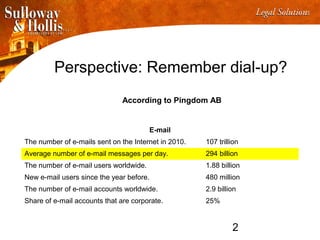
Perspective: Remember dial-up?
According to Pingdom AB
E-mail
The number of e-mails sent on the Internet in 2010. 107 trillion
Average number of e-mail messages per day. 294 billion
The number of e-mail users worldwide. 1.88 billion
New e-mail users since the year before. 480 million
The number of e-mail accounts worldwide. 2.9 billion
Share of e-mail accounts that are corporate. 25%
3
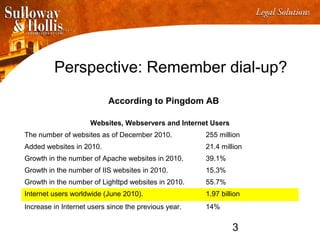
Perspective: Remember dial-up?
According to Pingdom AB
Websites, Webservers and Internet Users
The number of websites as of December 2010. 255 million
Added websites in 2010. 21.4 million
Growth in the number of Apache websites in 2010. 39.1%
Growth in the number of IIS websites in 2010. 15.3%
Growth in the number of Lighttpd websites in 2010. 55.7%
Internet users worldwide (June 2010). 1.97 billion
Increase in Internet users since the previous year. 14%
4
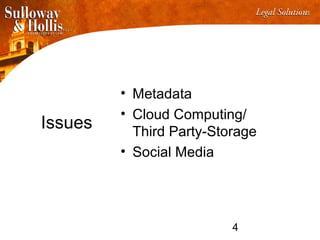
Issues
• Metadata
• Cloud Computing/
Third Party-Storage
• Social Media
5
Metadata
Disclosure, Review and Use of Metadata in
Electronic Materials, New Hampshire Ethics
Committee Opinion 2008-2009/4
6
Metadata: Defined
• E-mails and other electronic documents
inevitably contain “embedded” information
commonly referred to as “metadata.”
• Metadata is “information about information.”
7
Metadata: Can Include
•Creation date and time,
•Revision times and dates,
•Creator,
•Users who accessed, revised, printed document,
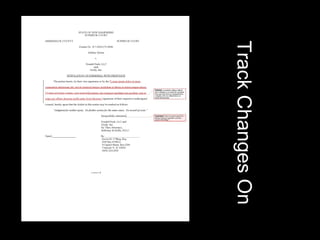
•Track Changes.
8
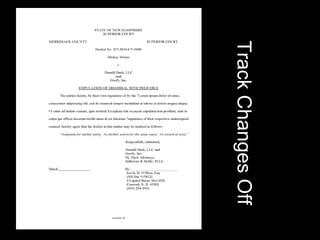
Me
TrackChangesOff
9
TrackChangesOn
10
Metadata: The Problem
•In modern legal practice, lawyers routinely send and receive e-mails
and other materials in electronic form from opposing counsel and
other parties.
•Electronic documents are sent and received during the course of
negotiations, due diligence reviews, litigation, investigations and
other dealings.
•E-mails and other electronic documents contain metadata.”
11
Metadata: The Problem
•Metadata may, therefore, reveal
– client confidences,
– litigation and negotiation strategy,
– legal theories,
– attorney work product and
– other legally privileged and confidential information
– that was never intended to be communicated by
the sender.
12
Metadata: The Problem
Is this really a new problem?
• inadvertent copies,
• faxes, or
• discovery productions.
13
Metadata: The Issues
(Sending Attorney)
•Rule 1.1
– (Competence)
– A lawyer shall provide competent representation to a client
•Rules 5.1
– (Responsibilities of Partners, Managers, and Supervisory Lawyer)
•Rule 5.3
– (Responsibilities Regarding Nonlawyer Assistants)
– lawyers make reasonable efforts to ensure that their firms,
including lawyers and non-lawyers, conform to the Rules
14
Metadata: The Issues
(Sending Attorney)
• Summary:
– Understand the technology being used.
– Take reasonable steps to protect
confidences
15
Metadata: The Issues
(Receiving Attorney)
•Rule 1.6
– (Confidentiality of Information)
– A lawyer shall not reveal information relating to the representation of a client
unless the client gives informed consent, the disclosure is impliedly authorized in
order to carry out the representation, or the disclosure is permitted
•Rule 4.4
– (Respect for Rights of Third Persons)
– A lawyer who receives materials relating to the representation of the lawyer’s
client and knows that the material was inadvertently sent shall promptly notify the
sender and shall not examine the materials. The receiving lawyer shall abide by
the sender’s instructions or seek determination by a tribunal.
16
Metadata: Warnings
•Contrary Authority (in the Ethics Context)
– Vermont Professional Responsibility Ethics Opinion 2009-1
• But note NH’s version of Rule 4.4 (Respect for the Rights of Third
Persons) contains a specific provision, not found in Vermont’s
version of Rule 4.4 rule that explains the difference in opinions
17
Metadata: Warnings
•Other Authority
– (in the Litigation Context)
– See Fed. R. Civ. P. 26(b)(5)(B)
• when a party inadvertently discloses materials that it believes are privileged
or work product and provides notices to opposing counsel, the recipient has
the duty, among other things, to promptly to return, destroy, or sequester the
information, and not to use or disclose the information until the privilege or
work product claim has been resolved
– See also Fed. R. Civ. P. 26(f)(3)
• (“Claw-back” agreements for inadvertent production of privileged or trial-
preparation materials )
18
Metadata: Warnings
– See also NH Superior Court PAD Pilot Rule 5
• (Carroll and Strafford County Superior Courts)
• (Discovery of Electronically Stored Information)
– Inadvertently disclosed privileged ESI is subject to “claw-back”
at the request of the responding party. If agreement is not
reached by opposing counsel or the litigants concerning any
“claw-back” requests, the Court may decide any disputes.
19
Sidebar: Ineffective Redaction Techniques
• Changing the font to white
– (This only appears to make the words disappear)
• Use of Adobe Acrobat graphic and commenting tools that can black-out, cover
over or remove sections of text
– (These edits can be removed by anyone to reveal the text underneath)
• Ink-marking or use of semi-translucent tape or paper to cover areas of a
document to be scanned
– (Your covered data may still show through, check your PDF document before it is filed)
– See District Court of Massachusetts, Updated Notice Regarding Metadata
and Redacted Information in PDF Documents, January 11, 2010
• This document also has tips for removing Metadata in Microsoft Word, Corel Word Perfct.
20
Cloud Computing/
Third Party Storage
21
Cloud Computing:
A brave new ethical frontier?
– On September 20, 2010, the Working Group on the
Implications of New Technologies of the ABA's
Commission on Ethics 20/20 (the “Commission”)
• Released two “issues papers” soliciting comments on
1. Cloud Computing
2. Social media
• The comment period closed December 15, 2010.
22
Cloud Computing:
A brave new ethical frontier?
– Examples include online data storage
• (e.g., Mozy.com, Carbonite.com),
– Internet-based e-mail
• (e.g., AOL, Yahoo, or Gmail), and
– Software as a Service (“SaaS”) including
• a variety of services that lawyers now use, such as law practice
management applications
• that can help lawyers with conflicts checking, document
management and storage, trust
• account management, timekeeping, and billing.
23
Cloud Computing:
A brave new ethical frontier?
– As an initial matter, the Commission recognizes that there may
be a gap between technology-related security measures that are
ethically required and security measures that are merely
consistent with “best practices.”
• For example, it may be consistent with best practices to install
sophisticated firewalls and various protections against malware
(such as viruses and spyware), but lawyers who fail to do so or who
install a more basic level of protection are not necessarily engaged
in unethical conduct.
• Similarly, it might be inadvisable to use a cloud computing provider
that does not comply with industry standards regarding encryption,
but it is not necessarily unethical if a lawyer decides to do so.
24
Cloud Computing:
A brave new ethical frontier?
– Concerns may include:
• unauthorized access to confidential client information by a
vendor’s employees or by hackers,
• the storage of information on servers in countries with fewer
legal protections for electronically stored information,
• a vendor’s failure to back up data adequately,
• unclear policies regarding ownership of stored data
25
Cloud Computing:
A brave new ethical frontier?
– Concerns may include:
• Policies and procedures for vendor’s response to
government requests for access to information
• Policies for notifying customers of security
breaches,
• Policies for data destruction when a lawyer no
longer wants the relevant data available or
transferring the data if a client switches law firms
• Policies for data if the company goes out of
business.
26
Cloud Computing:
A brave new ethical frontier?
– Concerns may include:
• insufficient data encryption,
• the extent to which lawyers need to obtain client
consent before using cloud computing services to
store or transmit the client’s confidential
information.
27
Cloud Computing:
A brave new ethical frontier
–Concerns may include:
•Outsourcing implications:
–(i.e., does ABA Formal Ethics Opinion 08-451 (describing a
lawyer’s obligations when outsourcing work to lawyers and non-
lawyers) apply in the cloud computing context.
•Potential Amendment to Model Rule of Professional
Conduct 5.3
–Because the Commission is considering possible amendments
that would clarify the extent to which lawyers have a duty to
supervise non-lawyer assistants who perform their work outside
of the law firm.
28
Sidebar: Beyond Ethics
– State and federal privacy laws may require encryption of
documents/transmission containing confidential information.
• For example, see:
– Health Insurance Portability and Accountability Act (HIPAA) of 1996
Administrative Simplification Rules
» 45 CFR Parts 160, 162, and 164.
– M.G.L. c. 93H (Massachusetts’ rigorous law on data privacy which
applies to many lawyers and law firms (including those outside of
Massachusetts) that have confidential information about Massachusetts
residents).
» http://www.mass.gov/Eoca/docs/idtheft/201CMR1700reg.pdf
29
Social Media
30
Social Media: Types
1. Social and professional networking services
(such as Facebook, LinkedIn, and Twitter), or
2. Blogging
31
Social Media: Blurry Lines and Sliding Scales
As the Working Group on the Implications of New Technologies
of the ABA's Commission on Ethics 20/20 noted:
Because lawyers frequently use these websites and services for both personal and
professional reasons, the legal ethics issues in this context are more complicated than they
have been for more traditional client development tools.
For example, a lawyer might create a Facebook profile that is accessible to family and
prospective clients at the same time.
The lawyer might then post professional announcements that are shared with all of those
people, raising the question of whether such announcements are subject to the usual
ethical restrictions on lawyer advertising and solicitation.
32
Social Media: The Rules
Rule 7.1 (Communications Concerning a Lawyer's Services)
• No false or misleading communications about the lawyer or the lawyer’s services
• No misrepresentation of fact or law
• Cannot create an unjustified expectation about results the lawyer can achieve
• Cannot compare the lawyer’s services with other lawyers’ services, unless the
comparison can be factually substantiated
Rule 7.2 (Advertising)
• Any communication made pursuant to this rule shall include the name and office
address of at least one lawyer or law firm responsible for its content.
33
Social Media: The Rules
Rule 7.3 (Direct Contact With Prospective Clients)
• (a) A lawyer shall not initiate, by in-person, live voice, recorded or other
real-time means, contact with a prospective client for the purpose of
obtaining professional employment, unless the person contacted… has a
family, close personal, or prior professional relationship with the lawyer
• (c) Every written, recorded or electronic communication from a lawyer
soliciting professional employment from a prospective client known to be
in need of legal services in a particular matter shall include the word
"Advertising" ... at the beginning and ending of any recorded or electronic
communication, unless the recipient of the communication is a person
specified in subsection (a).
34
Social Media: The Rules
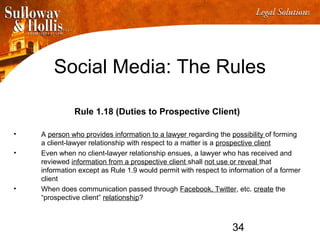
Rule 1.18 (Duties to Prospective Client)
• A person who provides information to a lawyer regarding the possibility of forming
a client-lawyer relationship with respect to a matter is a prospective client
• Even when no client-lawyer relationship ensues, a lawyer who has received and
reviewed information from a prospective client shall not use or reveal that
information except as Rule 1.9 would permit with respect to information of a former
client
• When does communication passed through Facebook, Twitter, etc. create the
“prospective client” relationship?
35
Social Media: The Rules
Rule 7.4 (Communications of Fields of Practice)
• A lawyer may communicate the fact that the lawyer does or does
not practice in particular fields of law.
• A lawyer shall not state or imply that the lawyer is a specialist
except as follows:
– ["patent attorney" "proctor in admiralty“] or
– a lawyer who is certified as a specialist in a particular field of law
by an organization that has been accredited by the American
Bar Association may hold himself or herself out as a specialist
certified by such organization.
• Can state concentration or limitation of practice
36
Social Media: The Rules
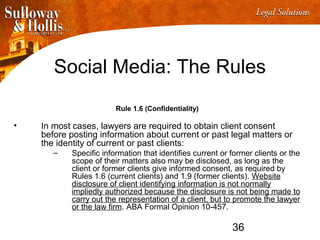
Rule 1.6 (Confidentiality)
• In most cases, lawyers are required to obtain client consent
before posting information about current or past legal matters or
the identity of current or past clients:
– Specific information that identifies current or former clients or the
scope of their matters also may be disclosed, as long as the
client or former clients give informed consent, as required by
Rules 1.6 (current clients) and 1.9 (former clients). Website
disclosure of client identifying information is not normally
impliedly authorized because the disclosure is not being made to
carry out the representation of a client, but to promote the lawyer
or the law firm. ABA Formal Opinion 10-457.
37
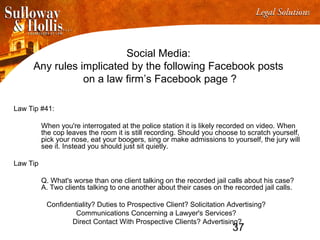
Social Media:
Any rules implicated by the following Facebook posts
on a law firm’s Facebook page ?
Law Tip #41:
When you're interrogated at the police station it is likely recorded on video. When
the cop leaves the room it is still recording. Should you choose to scratch yourself,
pick your nose, eat your boogers, sing or make admissions to yourself, the jury will
see it. Instead you should just sit quietly.
Law Tip
Q. What's worse than one client talking on the recorded jail calls about his case?
A. Two clients talking to one another about their cases on the recorded jail calls.
Confidentiality? Duties to Prospective Client? Solicitation Advertising?
Communications Concerning a Lawyer's Services?
Direct Contact With Prospective Clients? Advertising?
38
Social Media:
Any rules implicated by the following (real) Facebook posts
on a law firm’s Facebook page ?
Law Tip #38: "Jail blows and the food sucks." [Redacted law firm name’s] client
Law Tip #31:
When your bond conditions include "no possession of weapons" that includes a
handgun
Law Tip #29:
Try not to make your drug ring too successful or it will be charged as organized
crime which is just as bad as it sounds.
Law Tip #25:
Offering your prescription (even though they may very well need it) is Attempted
Distribution. Giving your prescription drug (even without payment) is Distribution.
Forcing them to take it with a gun to their head is a whole other ballpark. Don't do
any of the above
Law Tip #22: Don't talk to police. They are not your friend
39
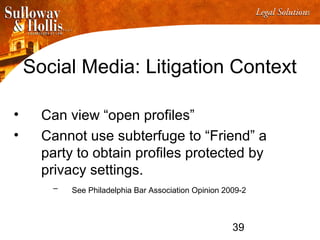
Social Media: Litigation Context
• Can view “open profiles”
• Cannot use subterfuge to “Friend” a
party to obtain profiles protected by
privacy settings.
– See Philadelphia Bar Association Opinion 2009-2
40
Social Media: Litigation Context
• But a defendant may have the right to access to a
plaintiff's current and historical Facebook and
MySpace pages, notwithstanding the plaintiff's privacy
settings, on the grounds that the plaintiff may have
placed certain information on these social networking
sites inconsistent with plaintiff's claims concerning the
extent and nature of plaintiff's injuries, especially
claims for loss of enjoyment of life.
– Romano v. Steelcase Inc., 2010 WL 3703242 (N.Y.Sup.
September 21, 2010).
41
Social Media: Listserves
• The Rules and Etiquette for NHBA E-mail
Discussion Groups remind us that:
– “e-mail is not private, even when you think you
know who all of the subscribers are. Messages
can be forwarded easily, or shared with others.
Be circumspect in your comments.”
• There are also ethical considerations.
42
Social Media: Listserves
• Oregon State Bar Formal Opinion No. 2011-184 (March 2011)
– Framing a question as a hypothetical is not a perfect solution,
however. Lawyers faces a significant risk of violating [Rule] 1.6
when posing hypothetical questions if the facts provided permit
persons outside the lawyer’s firm to determine the client’s
identity.
– Where the facts are so unique or where other circumstances
might reveal the identity of the consulting lawyer’s client even
without the client being named, the lawyer must first obtain the
client’s informed consent for the disclosures.
– Obvious advice? Sure, but regular readers of the NHBA Real
Property Law Section listserv see how some of these messages
come to the line.
43
Questions? Comments?
Peter Imse (pimse@sullway.com)
Kevin O’Shea (koshea@sulloway.com)
Sulloway & Hollis, PLLC
603-224-2341

Look Before You Leap: Unauthorized Practice of the Law, Supervision of Non-Lawyer Assistants and Ethical Issues in the Electronic Age

  • 1.
    1 Look Before YouLeap: Unauthorized Practice of the Law, Supervision of Non-Lawyer Assistants and Ethical Issues in the Electronic Age Peter F. Imse, Esq. and Kevin M. O’Shea, Esq. First American Title Insurance Company Agent’s Seminar June 8, 2011
  • 2.
    2 Perspective: Remember dial-up? Accordingto Pingdom AB E-mail The number of e-mails sent on the Internet in 2010. 107 trillion Average number of e-mail messages per day. 294 billion The number of e-mail users worldwide. 1.88 billion New e-mail users since the year before. 480 million The number of e-mail accounts worldwide. 2.9 billion Share of e-mail accounts that are corporate. 25%
  • 3.
    3 Perspective: Remember dial-up? Accordingto Pingdom AB Websites, Webservers and Internet Users The number of websites as of December 2010. 255 million Added websites in 2010. 21.4 million Growth in the number of Apache websites in 2010. 39.1% Growth in the number of IIS websites in 2010. 15.3% Growth in the number of Lighttpd websites in 2010. 55.7% Internet users worldwide (June 2010). 1.97 billion Increase in Internet users since the previous year. 14%
  • 4.
    4 Issues • Metadata • CloudComputing/ Third Party-Storage • Social Media
  • 5.
    5 Metadata Disclosure, Review andUse of Metadata in Electronic Materials, New Hampshire Ethics Committee Opinion 2008-2009/4
  • 6.
    6 Metadata: Defined • E-mailsand other electronic documents inevitably contain “embedded” information commonly referred to as “metadata.” • Metadata is “information about information.”
  • 7.
    7 Metadata: Can Include •Creationdate and time, •Revision times and dates, •Creator, •Users who accessed, revised, printed document, •Track Changes.
  • 8.
  • 9.
  • 10.
    10 Metadata: The Problem •Inmodern legal practice, lawyers routinely send and receive e-mails and other materials in electronic form from opposing counsel and other parties. •Electronic documents are sent and received during the course of negotiations, due diligence reviews, litigation, investigations and other dealings. •E-mails and other electronic documents contain metadata.”
  • 11.
    11 Metadata: The Problem •Metadatamay, therefore, reveal – client confidences, – litigation and negotiation strategy, – legal theories, – attorney work product and – other legally privileged and confidential information – that was never intended to be communicated by the sender.
  • 12.
    12 Metadata: The Problem Isthis really a new problem? • inadvertent copies, • faxes, or • discovery productions.
  • 13.
    13 Metadata: The Issues (SendingAttorney) •Rule 1.1 – (Competence) – A lawyer shall provide competent representation to a client •Rules 5.1 – (Responsibilities of Partners, Managers, and Supervisory Lawyer) •Rule 5.3 – (Responsibilities Regarding Nonlawyer Assistants) – lawyers make reasonable efforts to ensure that their firms, including lawyers and non-lawyers, conform to the Rules
  • 14.
    14 Metadata: The Issues (SendingAttorney) • Summary: – Understand the technology being used. – Take reasonable steps to protect confidences
  • 15.
    15 Metadata: The Issues (ReceivingAttorney) •Rule 1.6 – (Confidentiality of Information) – A lawyer shall not reveal information relating to the representation of a client unless the client gives informed consent, the disclosure is impliedly authorized in order to carry out the representation, or the disclosure is permitted •Rule 4.4 – (Respect for Rights of Third Persons) – A lawyer who receives materials relating to the representation of the lawyer’s client and knows that the material was inadvertently sent shall promptly notify the sender and shall not examine the materials. The receiving lawyer shall abide by the sender’s instructions or seek determination by a tribunal.
  • 16.
    16 Metadata: Warnings •Contrary Authority(in the Ethics Context) – Vermont Professional Responsibility Ethics Opinion 2009-1 • But note NH’s version of Rule 4.4 (Respect for the Rights of Third Persons) contains a specific provision, not found in Vermont’s version of Rule 4.4 rule that explains the difference in opinions
  • 17.
    17 Metadata: Warnings •Other Authority –(in the Litigation Context) – See Fed. R. Civ. P. 26(b)(5)(B) • when a party inadvertently discloses materials that it believes are privileged or work product and provides notices to opposing counsel, the recipient has the duty, among other things, to promptly to return, destroy, or sequester the information, and not to use or disclose the information until the privilege or work product claim has been resolved – See also Fed. R. Civ. P. 26(f)(3) • (“Claw-back” agreements for inadvertent production of privileged or trial- preparation materials )
  • 18.
    18 Metadata: Warnings – Seealso NH Superior Court PAD Pilot Rule 5 • (Carroll and Strafford County Superior Courts) • (Discovery of Electronically Stored Information) – Inadvertently disclosed privileged ESI is subject to “claw-back” at the request of the responding party. If agreement is not reached by opposing counsel or the litigants concerning any “claw-back” requests, the Court may decide any disputes.
  • 19.
    19 Sidebar: Ineffective RedactionTechniques • Changing the font to white – (This only appears to make the words disappear) • Use of Adobe Acrobat graphic and commenting tools that can black-out, cover over or remove sections of text – (These edits can be removed by anyone to reveal the text underneath) • Ink-marking or use of semi-translucent tape or paper to cover areas of a document to be scanned – (Your covered data may still show through, check your PDF document before it is filed) – See District Court of Massachusetts, Updated Notice Regarding Metadata and Redacted Information in PDF Documents, January 11, 2010 • This document also has tips for removing Metadata in Microsoft Word, Corel Word Perfct.
  • 20.
  • 21.
    21 Cloud Computing: A bravenew ethical frontier? – On September 20, 2010, the Working Group on the Implications of New Technologies of the ABA's Commission on Ethics 20/20 (the “Commission”) • Released two “issues papers” soliciting comments on 1. Cloud Computing 2. Social media • The comment period closed December 15, 2010.
  • 22.
    22 Cloud Computing: A bravenew ethical frontier? – Examples include online data storage • (e.g., Mozy.com, Carbonite.com), – Internet-based e-mail • (e.g., AOL, Yahoo, or Gmail), and – Software as a Service (“SaaS”) including • a variety of services that lawyers now use, such as law practice management applications • that can help lawyers with conflicts checking, document management and storage, trust • account management, timekeeping, and billing.
  • 23.
    23 Cloud Computing: A bravenew ethical frontier? – As an initial matter, the Commission recognizes that there may be a gap between technology-related security measures that are ethically required and security measures that are merely consistent with “best practices.” • For example, it may be consistent with best practices to install sophisticated firewalls and various protections against malware (such as viruses and spyware), but lawyers who fail to do so or who install a more basic level of protection are not necessarily engaged in unethical conduct. • Similarly, it might be inadvisable to use a cloud computing provider that does not comply with industry standards regarding encryption, but it is not necessarily unethical if a lawyer decides to do so.
  • 24.
    24 Cloud Computing: A bravenew ethical frontier? – Concerns may include: • unauthorized access to confidential client information by a vendor’s employees or by hackers, • the storage of information on servers in countries with fewer legal protections for electronically stored information, • a vendor’s failure to back up data adequately, • unclear policies regarding ownership of stored data
  • 25.
    25 Cloud Computing: A bravenew ethical frontier? – Concerns may include: • Policies and procedures for vendor’s response to government requests for access to information • Policies for notifying customers of security breaches, • Policies for data destruction when a lawyer no longer wants the relevant data available or transferring the data if a client switches law firms • Policies for data if the company goes out of business.
  • 26.
    26 Cloud Computing: A bravenew ethical frontier? – Concerns may include: • insufficient data encryption, • the extent to which lawyers need to obtain client consent before using cloud computing services to store or transmit the client’s confidential information.
  • 27.
    27 Cloud Computing: A bravenew ethical frontier –Concerns may include: •Outsourcing implications: –(i.e., does ABA Formal Ethics Opinion 08-451 (describing a lawyer’s obligations when outsourcing work to lawyers and non- lawyers) apply in the cloud computing context. •Potential Amendment to Model Rule of Professional Conduct 5.3 –Because the Commission is considering possible amendments that would clarify the extent to which lawyers have a duty to supervise non-lawyer assistants who perform their work outside of the law firm.
  • 28.
    28 Sidebar: Beyond Ethics –State and federal privacy laws may require encryption of documents/transmission containing confidential information. • For example, see: – Health Insurance Portability and Accountability Act (HIPAA) of 1996 Administrative Simplification Rules » 45 CFR Parts 160, 162, and 164. – M.G.L. c. 93H (Massachusetts’ rigorous law on data privacy which applies to many lawyers and law firms (including those outside of Massachusetts) that have confidential information about Massachusetts residents). » http://www.mass.gov/Eoca/docs/idtheft/201CMR1700reg.pdf
  • 29.
  • 30.
    30 Social Media: Types 1.Social and professional networking services (such as Facebook, LinkedIn, and Twitter), or 2. Blogging
  • 31.
    31 Social Media: BlurryLines and Sliding Scales As the Working Group on the Implications of New Technologies of the ABA's Commission on Ethics 20/20 noted: Because lawyers frequently use these websites and services for both personal and professional reasons, the legal ethics issues in this context are more complicated than they have been for more traditional client development tools. For example, a lawyer might create a Facebook profile that is accessible to family and prospective clients at the same time. The lawyer might then post professional announcements that are shared with all of those people, raising the question of whether such announcements are subject to the usual ethical restrictions on lawyer advertising and solicitation.
  • 32.
    32 Social Media: TheRules Rule 7.1 (Communications Concerning a Lawyer's Services) • No false or misleading communications about the lawyer or the lawyer’s services • No misrepresentation of fact or law • Cannot create an unjustified expectation about results the lawyer can achieve • Cannot compare the lawyer’s services with other lawyers’ services, unless the comparison can be factually substantiated Rule 7.2 (Advertising) • Any communication made pursuant to this rule shall include the name and office address of at least one lawyer or law firm responsible for its content.
  • 33.
    33 Social Media: TheRules Rule 7.3 (Direct Contact With Prospective Clients) • (a) A lawyer shall not initiate, by in-person, live voice, recorded or other real-time means, contact with a prospective client for the purpose of obtaining professional employment, unless the person contacted… has a family, close personal, or prior professional relationship with the lawyer • (c) Every written, recorded or electronic communication from a lawyer soliciting professional employment from a prospective client known to be in need of legal services in a particular matter shall include the word "Advertising" ... at the beginning and ending of any recorded or electronic communication, unless the recipient of the communication is a person specified in subsection (a).
  • 34.
    34 Social Media: TheRules Rule 1.18 (Duties to Prospective Client) • A person who provides information to a lawyer regarding the possibility of forming a client-lawyer relationship with respect to a matter is a prospective client • Even when no client-lawyer relationship ensues, a lawyer who has received and reviewed information from a prospective client shall not use or reveal that information except as Rule 1.9 would permit with respect to information of a former client • When does communication passed through Facebook, Twitter, etc. create the “prospective client” relationship?
  • 35.
    35 Social Media: TheRules Rule 7.4 (Communications of Fields of Practice) • A lawyer may communicate the fact that the lawyer does or does not practice in particular fields of law. • A lawyer shall not state or imply that the lawyer is a specialist except as follows: – ["patent attorney" "proctor in admiralty“] or – a lawyer who is certified as a specialist in a particular field of law by an organization that has been accredited by the American Bar Association may hold himself or herself out as a specialist certified by such organization. • Can state concentration or limitation of practice
  • 36.
    36 Social Media: TheRules Rule 1.6 (Confidentiality) • In most cases, lawyers are required to obtain client consent before posting information about current or past legal matters or the identity of current or past clients: – Specific information that identifies current or former clients or the scope of their matters also may be disclosed, as long as the client or former clients give informed consent, as required by Rules 1.6 (current clients) and 1.9 (former clients). Website disclosure of client identifying information is not normally impliedly authorized because the disclosure is not being made to carry out the representation of a client, but to promote the lawyer or the law firm. ABA Formal Opinion 10-457.
  • 37.
    37 Social Media: Any rulesimplicated by the following Facebook posts on a law firm’s Facebook page ? Law Tip #41: When you're interrogated at the police station it is likely recorded on video. When the cop leaves the room it is still recording. Should you choose to scratch yourself, pick your nose, eat your boogers, sing or make admissions to yourself, the jury will see it. Instead you should just sit quietly. Law Tip Q. What's worse than one client talking on the recorded jail calls about his case? A. Two clients talking to one another about their cases on the recorded jail calls. Confidentiality? Duties to Prospective Client? Solicitation Advertising? Communications Concerning a Lawyer's Services? Direct Contact With Prospective Clients? Advertising?
  • 38.
    38 Social Media: Any rulesimplicated by the following (real) Facebook posts on a law firm’s Facebook page ? Law Tip #38: "Jail blows and the food sucks." [Redacted law firm name’s] client Law Tip #31: When your bond conditions include "no possession of weapons" that includes a handgun Law Tip #29: Try not to make your drug ring too successful or it will be charged as organized crime which is just as bad as it sounds. Law Tip #25: Offering your prescription (even though they may very well need it) is Attempted Distribution. Giving your prescription drug (even without payment) is Distribution. Forcing them to take it with a gun to their head is a whole other ballpark. Don't do any of the above Law Tip #22: Don't talk to police. They are not your friend
  • 39.
    39 Social Media: LitigationContext • Can view “open profiles” • Cannot use subterfuge to “Friend” a party to obtain profiles protected by privacy settings. – See Philadelphia Bar Association Opinion 2009-2
  • 40.
    40 Social Media: LitigationContext • But a defendant may have the right to access to a plaintiff's current and historical Facebook and MySpace pages, notwithstanding the plaintiff's privacy settings, on the grounds that the plaintiff may have placed certain information on these social networking sites inconsistent with plaintiff's claims concerning the extent and nature of plaintiff's injuries, especially claims for loss of enjoyment of life. – Romano v. Steelcase Inc., 2010 WL 3703242 (N.Y.Sup. September 21, 2010).
  • 41.
    41 Social Media: Listserves •The Rules and Etiquette for NHBA E-mail Discussion Groups remind us that: – “e-mail is not private, even when you think you know who all of the subscribers are. Messages can be forwarded easily, or shared with others. Be circumspect in your comments.” • There are also ethical considerations.
  • 42.
    42 Social Media: Listserves •Oregon State Bar Formal Opinion No. 2011-184 (March 2011) – Framing a question as a hypothetical is not a perfect solution, however. Lawyers faces a significant risk of violating [Rule] 1.6 when posing hypothetical questions if the facts provided permit persons outside the lawyer’s firm to determine the client’s identity. – Where the facts are so unique or where other circumstances might reveal the identity of the consulting lawyer’s client even without the client being named, the lawyer must first obtain the client’s informed consent for the disclosures. – Obvious advice? Sure, but regular readers of the NHBA Real Property Law Section listserv see how some of these messages come to the line.
  • 43.
    43 Questions? Comments? Peter Imse(pimse@sullway.com) Kevin O’Shea (koshea@sulloway.com) Sulloway & Hollis, PLLC 603-224-2341