1
Masterclass:
Right Touching
10 practical CXM
Techniques
For Webforum, Oslo.
Torsdag 13. mars
Dr Dave Chaffey
CEO: SmartInsights.com
2
About Dave Chaffey
About Dave Chaffey
• Author of 5 bestselling
marketing books now
working on 5th editions
• Responsive for CXM at
SmartInsights.com a
marketing advice site
with Expert members in
over 50 countries
• Insights Director at
agency ClickThrough
Marketing
3
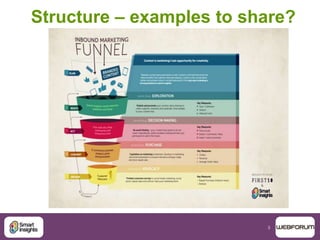
Structure – examples to share?
4
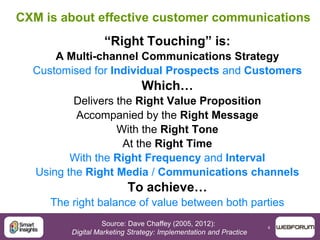
CXM is about effective customer communications
“Right Touching” is:
A Multi-channel Communications Strategy
Customised for Individual Prospects and Customers
Which…
Delivers the Right Value Proposition
Accompanied by the Right Message
With the Right Tone
At the Right Time
With the Right Frequency and Interval
Using the Right Media / Communications channels
To achieve…
The right balance of value between both parties
Source: Dave Chaffey (2005, 2012):
Digital Marketing Strategy: Implementation and Practice
5
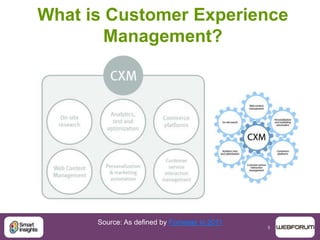
What is Customer Experience
Management?
Source: As defined by Forrester in 2011
6
Do you have a person
or team RESPONSIBLE
FOR CXM?
 Vote!
7
Which is most useful for
you to learn more about
best practices?
 1. Content marketing
 2. Conversion rate optimisation (website)
 3. Email marketing
 4. Mobile marketing
 5. Search marketing (SEO and PPC)
 6. Social media marketing
8
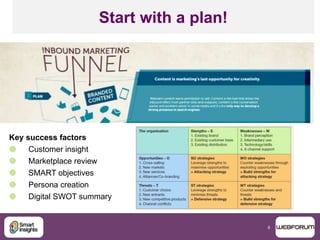
Start with a plan!
Key success factors
 Customer insight
 Marketplace review
 SMART objectives
 Persona creation
 Digital SWOT summary
9
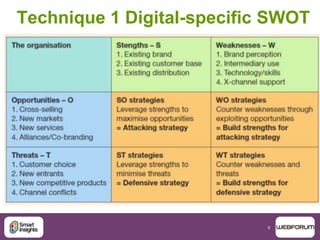
Technique 1 Digital-specific SWOT
10
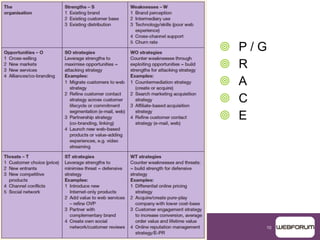
 P / G
 R
 A
 C
 E
11
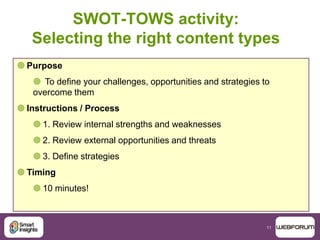
SWOT-TOWS activity:
Selecting the right content types
 Purpose
 To define your challenges, opportunities and strategies to
overcome them
 Instructions / Process
 1. Review internal strengths and weaknesses
 2. Review external opportunities and threats
 3. Define strategies
 Timing
 10 minutes!
12
13
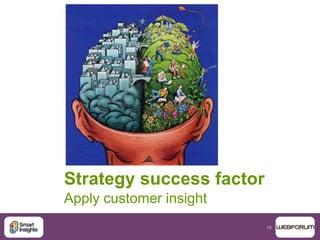
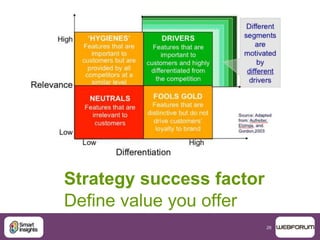
Strategy success factor
Apply customer insight
14
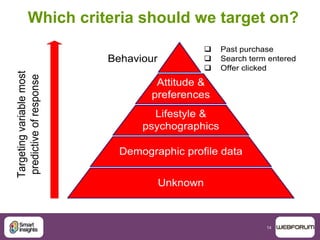
Which criteria should we target on?
Unknown
Demographic profile data
Lifestyle &
psychographics
Attitude &
preferences
Behaviour
q Past purchase
q Search term entered
q Offer clicked
Targetingvariablemost
predictiveofresponse
15
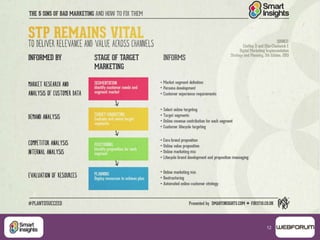
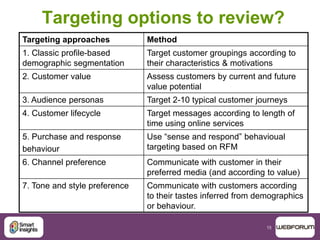
Targeting options to review?
Targeting approaches Method
1. Classic profile-based
demographic segmentation
Target customer groupings according to
their characteristics & motivations
2. Customer value Assess customers by current and future
value potential
3. Audience personas Target 2-10 typical customer journeys
4. Customer lifecycle Target messages according to length of
time using online services
5. Purchase and response
behaviour
Use “sense and respond” behavioual
targeting based on RFM
6. Channel preference Communicate with customer in their
preferred media (and according to value)
7. Tone and style preference Communicate with customers according
to their tastes inferred from demographics
or behaviour.
16
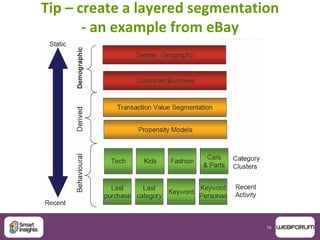
Tip – create a layered segmentation
- an example from eBay
17
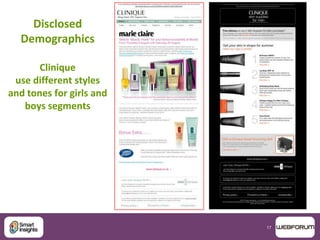
Disclosed
Demographics
Clinique
use different styles
and tones for girls and
boys segments
18
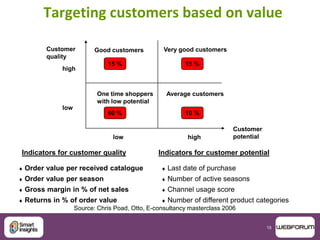
Targeting customers based on value
Customer
potential
Customer
quality
high
low
low high
One time shoppers
with low potential
Average customers
Good customers Very good customers
15 % 15 %
60 % 10 %
Indicators for customer quality Indicators for customer potential
Order value per received catalogue
Order value per season
Gross margin in % of net sales
Returns in % of order value
Last date of purchase
Number of active seasons
Channel usage score
Number of different product categories
Source: Chris Poad, Otto, E-consultancy masterclass 2006
19
20
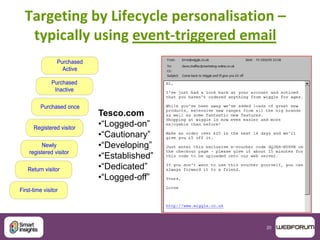
Targeting by Lifecycle personalisation –
typically using event-triggered email
First-time visitor
Return visitor
Registered visitor
Purchased once
Newly
registered visitor
Purchased
Active
Purchased
Inactive
Tesco.com
•“Logged-on”
•“Cautionary”
•“Developing”
•“Established”
•“Dedicated”
•“Logged-off”
21
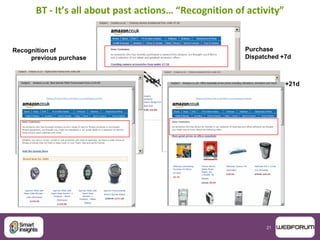
BT - It’s all about past actions… “Recognition of activity”
Purchase
Dispatched +7d
+14d +21d
Recognition of
previous purchase
22
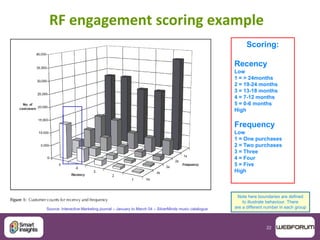
RF engagement scoring example
Source: Interactive Marketing journal – January to March 04 – SilverMinds music catalogue
Scoring:
Recency
Low
1 = > 24months
2 = 19-24 months
3 = 13-18 months
4 = 7-12 months
5 = 0-6 months
High
Frequency
Low
1 = One purchases
2 = Two purchases
3 = Three
4 = Four
5 = Five
High
Note here boundaries are defined
to illustrate behaviour. There
are a different number in each group
23
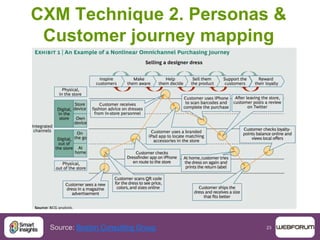
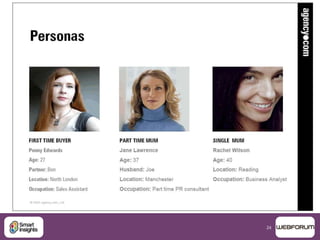
CXM Technique 2. Personas &
Customer journey mapping
Source: Boston Consulting Group
24
25
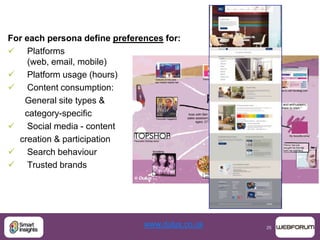
For each persona define preferences for:
 Platforms
(web, email, mobile)
 Platform usage (hours)
 Content consumption:
General site types &
category-specific
 Social media - content
creation & participation
 Search behaviour
 Trusted brands
www.dulux.co.uk
26
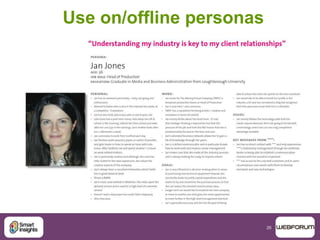
Use on/offline personas
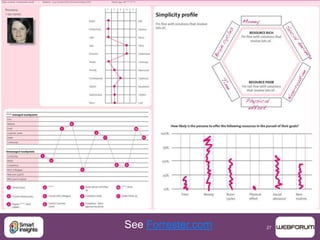
27See Forrester.com
28
Strategy success factor
Define value you offer
29
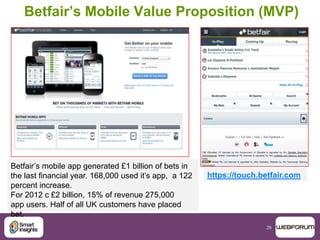
Betfair’s Mobile Value Proposition (MVP)
https://touch.betfair.com
Betfair‟s mobile app generated £1 billion of bets in
the last financial year. 168,000 used it‟s app, a 122
percent increase.
For 2012 c £2 billion, 15% of revenue 275,000
app users. Half of all UK customers have placed
bet.
30
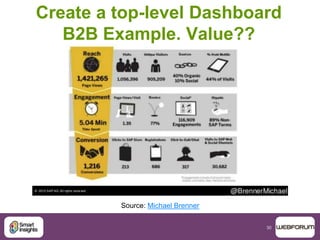
Create a top-level Dashboard
B2B Example. Value??
Source: Michael Brenner
31
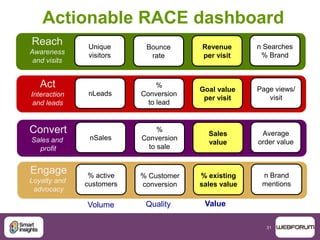
n Searches
% Brand
Reach
Awareness
and visits
Unique
visitors
Bounce
rate
Revenue
per visit
Page views/
visit
Act
Interaction
and leads
nLeads
%
Conversion
to lead
Goal value
per visit
Average
order value
Convert
Sales and
profit
nSales
%
Conversion
to sale
Sales
value
n Brand
mentions
Engage
Loyalty and
advocacy
% active
customers
% Customer
conversion
% existing
sales value
Volume Quality Value
Actionable RACE dashboard
32
What
are the
GOALS
for our
site?
| 32
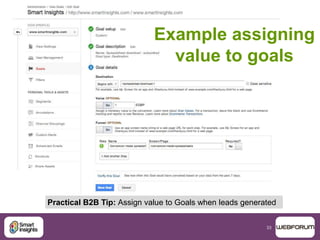
• Brochure
thank you
• Value
assigned:
• E.G £3
• Call back
page
• E.G. £4
• Taster page
• E.G. £9
Call tracking with GA
33
Example assigning
value to goals
Practical B2B Tip: Assign value to Goals when leads generated
34
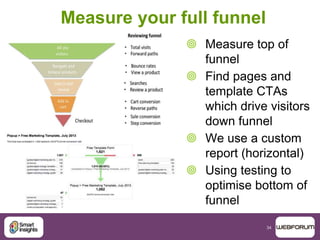
Measure your full funnel
 Measure top of
funnel
 Find pages and
template CTAs
which drive visitors
down funnel
 We use a custom
report (horizontal)
 Using testing to
optimise bottom of
funnel
35
36
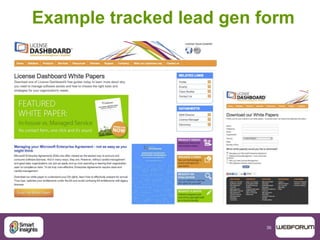
Example tracked lead gen form
37
Improving Reach
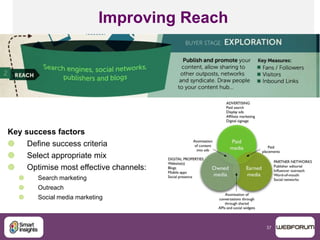
Key success factors
 Define success criteria
 Select appropriate mix
 Optimise most effective channels:
 Search marketing
 Outreach
 Social media marketing
38
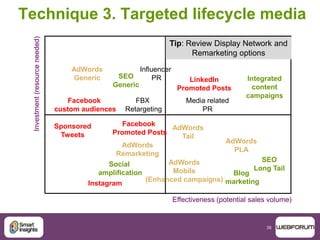
Technique 3. Targeted lifecycle media
Effectiveness (potential sales volume)
Investment(resourceneeded)
SEO
Long Tail
AdWords
Remarketing
Facebook
custom audiences
AdWords
Generic
Social
amplification
Media related
PR
Influencer
PR Integrated
content
campaigns
Blog
marketing
Sponsored
Tweets
Instagram
FBX
Retargeting
Facebook
Promoted Posts
LinkedIn
Promoted Posts
Tip: Review Display Network and
Remarketing options
AdWords
Tail
AdWords
PLA
AdWords
Mobile
(Enhanced campaigns)
SEO
Generic
39
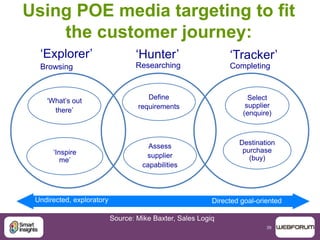
Using POE media targeting to fit
the customer journey:
Select
supplier
(enquire)
„Tracker‟
Completing
„Hunter‟
Researching
„Explorer‟
Browsing
Directed goal-orientedUndirected, exploratory
Destination
purchase
(buy)
Define
requirements
Assess
supplier
capabilities
„Inspire
me‟
„What‟s out
there‟
Source: Mike Baxter, Sales Logiq
40
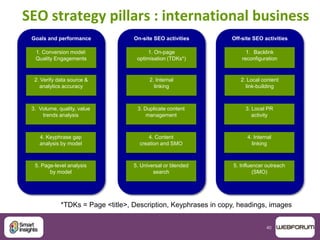
SEO strategy pillars : international business
Goals and performance
1. Conversion model:
Quality Engagements
2. Verify data source &
analytics accuracy
3. Volume, quality, value
trends analysis
4. Keyphrase gap
analysis by model
5. Page-level analysis
by model
On-site SEO activities
1. On-page
optimisation (TDKs*)
2. Internal
linking
3. Duplicate content
management
4. Content
creation and SMO
5. Universal or blended
search
Off-site SEO activities
1. Backlink
reconfiguration
2. Local content
link-building
3. Local PR
activity
4. Internal
linking
5. Influencer outreach
(SMO)
*TDKs = Page <title>, Description, Keyphrases in copy, headings, images
41
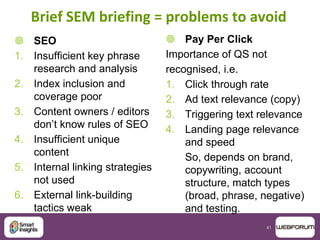
Brief SEM briefing = problems to avoid
 SEO
1. Insufficient key phrase
research and analysis
2. Index inclusion and
coverage poor
3. Content owners / editors
don‟t know rules of SEO
4. Insufficient unique
content
5. Internal linking strategies
not used
6. External link-building
tactics weak
 Pay Per Click
Importance of QS not
recognised, i.e.
1. Click through rate
2. Ad text relevance (copy)
3. Triggering text relevance
4. Landing page relevance
and speed
So, depends on brand,
copywriting, account
structure, match types
(broad, phrase, negative)
and testing.
42
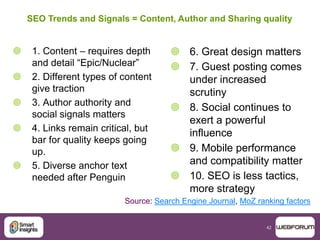
 1. Content – requires depth
and detail “Epic/Nuclear”
 2. Different types of content
give traction
 3. Author authority and
social signals matters
 4. Links remain critical, but
bar for quality keeps going
up.
 5. Diverse anchor text
needed after Penguin
 6. Great design matters
 7. Guest posting comes
under increased
scrutiny
 8. Social continues to
exert a powerful
influence
 9. Mobile performance
and compatibility matter
 10. SEO is less tactics,
more strategy
Source: Search Engine Journal, MoZ ranking factors
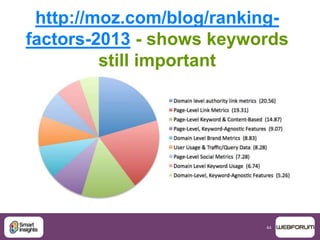
SEO Trends and Signals = Content, Author and Sharing quality
43
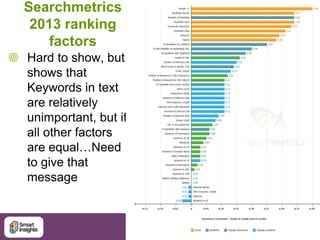
Searchmetrics
2013 ranking
factors
 Hard to show, but
shows that
Keywords in text
are relatively
unimportant, but if
all other factors
are equal…Need
to give that
message
44
http://moz.com/blog/ranking-
factors-2013 - shows keywords
still important
45
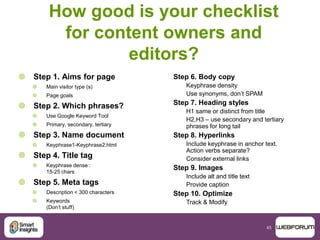
How good is your checklist
for content owners and
editors?
 Step 1. Aims for page
 Main visitor type (s)
 Page goals
 Step 2. Which phrases?
 Use Google Keyword Tool
 Primary, secondary, tertiary
 Step 3. Name document
 Keyphrase1-Keyphrase2.html
 Step 4. Title tag
 Keyphrase dense :
15-25 chars
 Step 5. Meta tags
 Description < 300 characters
 Keywords
(Don‟t stuff)
Step 6. Body copy
Keyphrase density
Use synonyms, don‟t SPAM
Step 7. Heading styles
H1 same or distinct from title
H2,H3 – use secondary and tertiary
phrases for long tail
Step 8. Hyperlinks
Include keyphrase in anchor text.
Action verbs separate?
Consider external links
Step 9. Images
Include alt and title text
Provide caption
Step 10. Optimize
Track & Modify
46
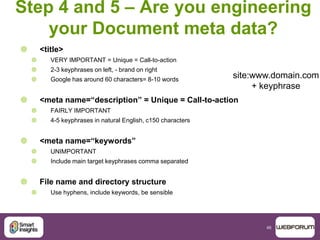
Step 4 and 5 – Are you engineering
your Document meta data?
 <title>
 VERY IMPORTANT = Unique = Call-to-action
 2-3 keyphrases on left, - brand on right
 Google has around 60 characters= 8-10 words
 <meta name=“description” = Unique = Call-to-action
 FAIRLY IMPORTANT
 4-5 keyphrases in natural English, c150 characters
 <meta name=“keywords”
 UNIMPORTANT
 Include main target keyphrases comma separated
 File name and directory structure
 Use hyphens, include keywords, be sensible
site:www.domain.com
+ keyphrase
47
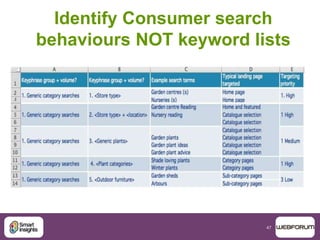
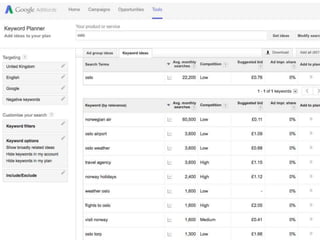
Identify Consumer search
behaviours NOT keyword lists
48
49
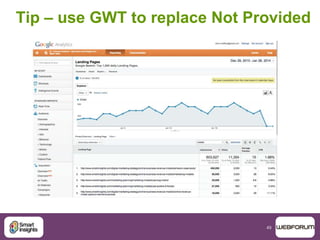
Tip – use GWT to replace Not Provided
50
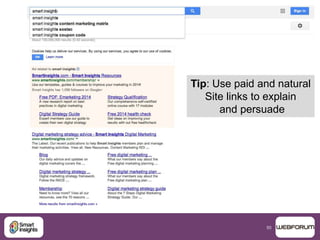
Tip: Use paid and natural
Site links to explain
and persuade
51
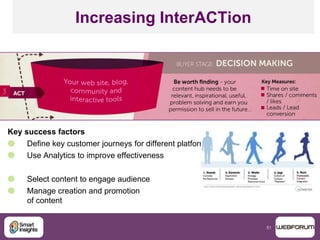
Increasing InterACTion
Key success factors
 Define key customer journeys for different platforms
 Use Analytics to improve effectiveness
 Select content to engage audience
 Manage creation and promotion
of content
52
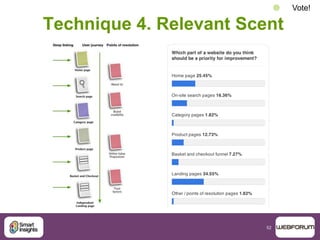
Technique 4. Relevant Scent
 Vote!
53
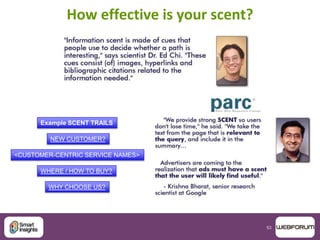
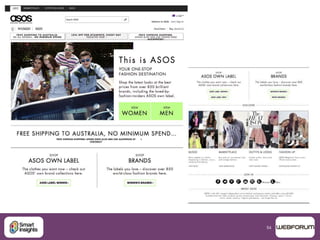
How effective is your scent?
WHY CHOOSE US?
WHERE / HOW TO BUY?
NEW CUSTOMER?
<CUSTOMER-CENTRIC SERVICE NAMES>
Example SCENT TRAILS
54
55
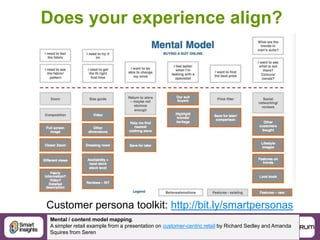
Does your experience align?
Mental / content model mapping.
A simpler retail example from a presentation on customer-centric retail by Richard Sedley and Amanda
Squires from Seren
Customer persona toolkit: http://bit.ly/smartpersonas
56
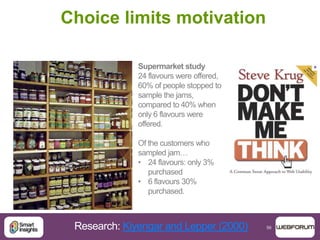
Choice limits motivation
Research: Kiyengar and Lepper (2000)
57
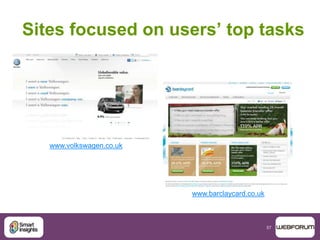
Sites focused on users’ top tasks
www.volkswagen.co.uk
www.barclaycard.co.uk
58
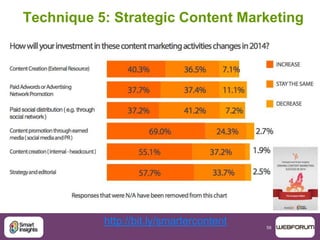
Technique 5: Strategic Content Marketing
http://bit.ly/smartercontent
59
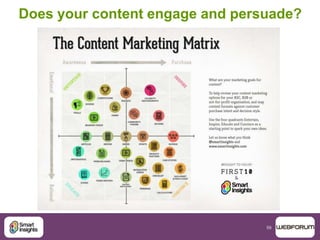
Does your content engage and persuade?
60
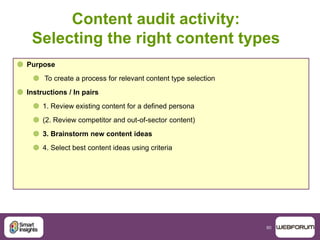
Content audit activity:
Selecting the right content types
 Purpose
 To create a process for relevant content type selection
 Instructions / In pairs
 1. Review existing content for a defined persona
 (2. Review competitor and out-of-sector content)
 3. Brainstorm new content ideas
 4. Select best content ideas using criteria
61
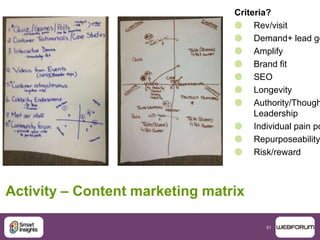
Activity – Content marketing matrix
Criteria?
 Rev/visit
 Demand+ lead ge
 Amplify
 Brand fit
 SEO
 Longevity
 Authority/Though
Leadership
 Individual pain po
 Repurposeability
 Risk/reward
62
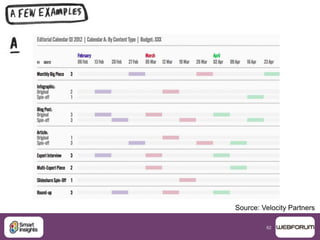
Source: Velocity Partners
63
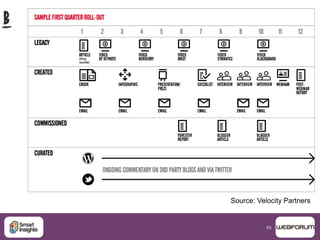
Source: Velocity Partners
64
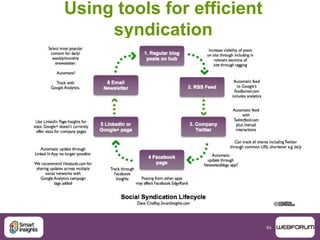
Using tools for efficient
syndication
65
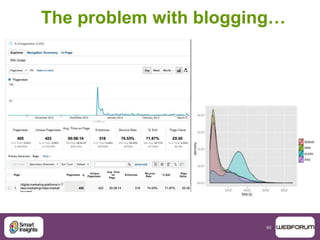
The problem with blogging…
66
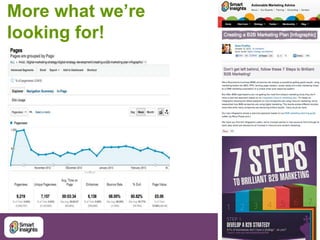
More what we’re
looking for!
67
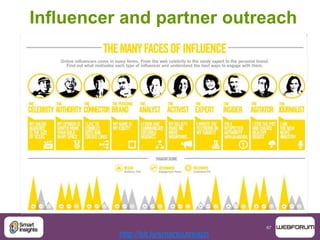
Influencer and partner outreach
http://bit.ly/smartoutreach
68
Influencer outreach – key
questions…
 Do we invest enough time in this?
 Who is responsible for this?
 What is our process for influencer marketing?
 How do we segment influencers?
 How do contact priority influencers?
 How do we measure success
 How do we scale this?
69
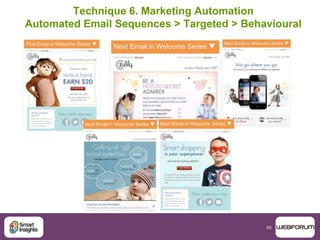
Technique 6. Marketing Automation
Automated Email Sequences > Targeted > Behavioural
70
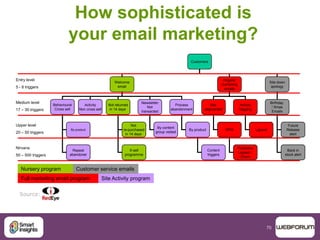
How sophisticated is
your email marketing?
Customers
Welcome
email
Behavioural
Cross sell
Regular
marketing
emails
Site
segmented
Activity
flagging
RFM
Predictive
Lapsed /
Churn
By product
Site down
apology
Birthday
/ Xmas
Emails
Repeat
abandoner
Future
Release
alert
Back in
stock alert
Lapsed
Activity
Non cross sell
Not returned
in 14 days
Not
re-purchased
in 14 days
Process
abandonment
X-sell
programme
By product
Newsletter
Not
transacted
By content
group visited
Content
triggers
Entry level
5 - 8 triggers
Medium level
17 – 30 triggers
Upper level
20 – 50 triggers
Nirvana
50 – 500 triggers
Nursery program
Site Activity programFull marketing email program
Customer service emails
Source:
71
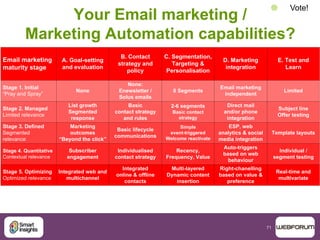
Your Email marketing /
Marketing Automation capabilities?
 Vote!
Stage 1. Initial
“Pray and Spray”
None
Email marketing
maturity stage
A. Goal-setting
and evaluation
B. Contact
strategy and
policy
C. Segmentation,
Targeting &
Personalisation
D. Marketing
integration
E. Test and
Learn
None:
Enewsletter /
Solus emails
0 Segments
Email marketing
independent
Limited
Stage 2. Managed
Limited relevance
List growth
Segmented
response
Basic
contact strategy
and rules
2-6 segments
Basic contact
strategy
Direct mail
and/or phone
integration
Subject line
Offer testing
Stage 3. Defined
Segmented
relevance
Marketing
outcomes
“Beyond the click”
Basic lifecycle
communications
Simple
event-triggered
Welcome reactivate
ESP, web
analytics & social
media integration
Template layouts
Stage 4. Quantitative
Contextual relevance
Subscriber
engagement
Individualised
contact strategy
Recency,
Frequency, Value
Auto-triggers
based on web
behaviour
Individual /
segment testing
Stage 5. Optimizing
Optimized relevance
Integrated web and
multichannel
Integrated
online & offline
contacts
Multi-layered
Dynamic content
insertion
Right-chanelling
based on value &
preference
Real-time and
multivariate
72
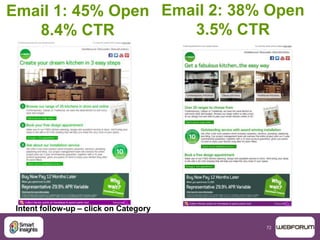
Email 1: 45% Open
8.4% CTR
Email 2: 38% Open
3.5% CTR
Intent follow-up – click on Category
73
Increasing Conversion
Key success factors
 Create a CRO / optimisation process
 Understand multi-channel conversion
74
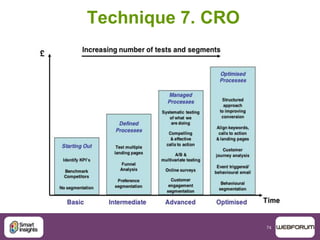
Technique 7. CRO
75
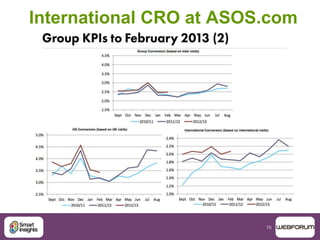
International CRO at ASOS.com
76
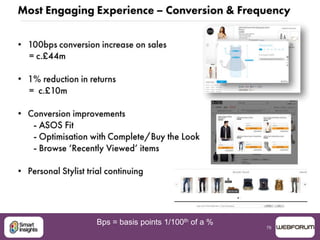
Bps = basis points 1/100th of a %
77
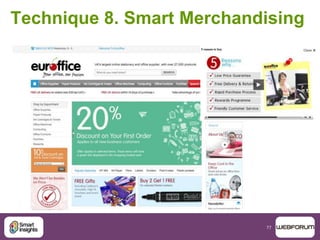
Technique 8. Smart Merchandising
78
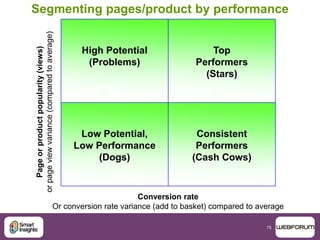
Segmenting pages/product by performance
High Potential
(Problems)
Top
Performers
(Stars)
Low Potential,
Low Performance
(Dogs)
Consistent
Performers
(Cash Cows)
Conversion rate
Or conversion rate variance (add to basket) compared to average
Pageorproductpopularity(views)
orpageviewvariance(comparedtoaverage)
79
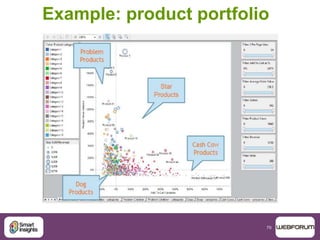
Example: product portfolio
80
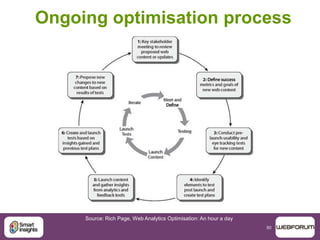
Ongoing optimisation process
Source: Rich Page, Web Analytics Optimisation: An hour a day
81
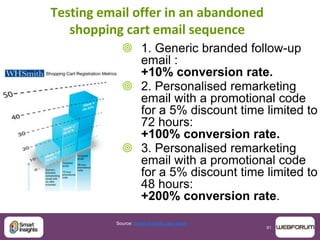
Testing email offer in an abandoned
shopping cart email sequence
 1. Generic branded follow-up
email :
+10% conversion rate.
 2. Personalised remarketing
email with a promotional code
for a 5% discount time limited to
72 hours:
+100% conversion rate.
 3. Personalised remarketing
email with a promotional code
for a 5% discount time limited to
48 hours:
+200% conversion rate.
Source: Smart Insights case study
82
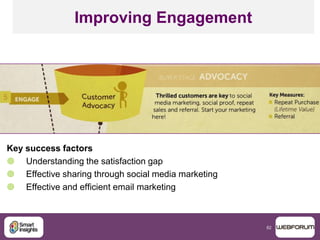
Improving Engagement
Key success factors
 Understanding the satisfaction gap
 Effective sharing through social media marketing
 Effective and efficient email marketing
83
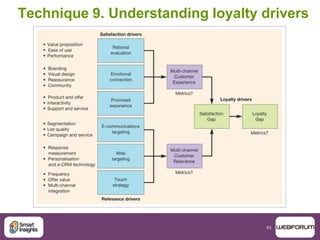
Technique 9. Understanding loyalty drivers
84
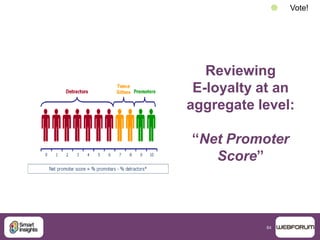
Reviewing
E-loyalty at an
aggregate level:
“Net Promoter
Score”
 Vote!
85
Customer feedback tools
http://bit.ly/smartfeedback
86
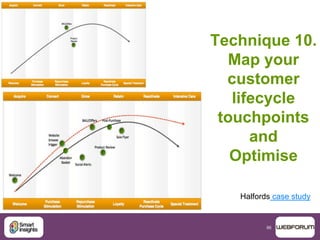
Technique 10.
Map your
customer
lifecycle
touchpoints
and
Optimise
:Halfords case study
87
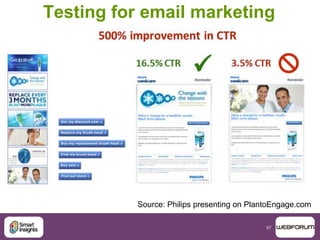
Source: Philips presenting on PlantoEngage.com
Testing for email marketing
88
Let’s Connect!
Questions & discussion welcome
SmartInsights.com:: Plan | Manage | Optimize
Free-level, Basic member tools
 Sample planning templates
 Planning infographics
www.smartinsights.com/membership
Pro-level, Expert member learning
 7 Step Guides covering all digital marketing
 Online courses
 DIY Planning and optimisation templates in
Word, Excel and Powerpoint
 www.smartinsights.com/membership/expert-
member-reasons
uk.linkedin.com/in/davechaffey
www.facebook.com/davechaffey
www.twitter.com/DaveChaffey
https://plus.google.com/+DaveChaffeyUK/

Internet marketing workshop - Webforum 2014

  • 1.
    1 Masterclass: Right Touching 10 practicalCXM Techniques For Webforum, Oslo. Torsdag 13. mars Dr Dave Chaffey CEO: SmartInsights.com
  • 2.
    2 About Dave Chaffey AboutDave Chaffey • Author of 5 bestselling marketing books now working on 5th editions • Responsive for CXM at SmartInsights.com a marketing advice site with Expert members in over 50 countries • Insights Director at agency ClickThrough Marketing
  • 3.
  • 4.
    4 CXM is abouteffective customer communications “Right Touching” is: A Multi-channel Communications Strategy Customised for Individual Prospects and Customers Which… Delivers the Right Value Proposition Accompanied by the Right Message With the Right Tone At the Right Time With the Right Frequency and Interval Using the Right Media / Communications channels To achieve… The right balance of value between both parties Source: Dave Chaffey (2005, 2012): Digital Marketing Strategy: Implementation and Practice
  • 5.
    5 What is CustomerExperience Management? Source: As defined by Forrester in 2011
  • 6.
    6 Do you havea person or team RESPONSIBLE FOR CXM?  Vote!
  • 7.
    7 Which is mostuseful for you to learn more about best practices?  1. Content marketing  2. Conversion rate optimisation (website)  3. Email marketing  4. Mobile marketing  5. Search marketing (SEO and PPC)  6. Social media marketing
  • 8.
    8 Start with aplan! Key success factors  Customer insight  Marketplace review  SMART objectives  Persona creation  Digital SWOT summary
  • 9.
  • 10.
    10  P /G  R  A  C  E
  • 11.
    11 SWOT-TOWS activity: Selecting theright content types  Purpose  To define your challenges, opportunities and strategies to overcome them  Instructions / Process  1. Review internal strengths and weaknesses  2. Review external opportunities and threats  3. Define strategies  Timing  10 minutes!
  • 12.
  • 13.
  • 14.
    14 Which criteria shouldwe target on? Unknown Demographic profile data Lifestyle & psychographics Attitude & preferences Behaviour q Past purchase q Search term entered q Offer clicked Targetingvariablemost predictiveofresponse
  • 15.
    15 Targeting options toreview? Targeting approaches Method 1. Classic profile-based demographic segmentation Target customer groupings according to their characteristics & motivations 2. Customer value Assess customers by current and future value potential 3. Audience personas Target 2-10 typical customer journeys 4. Customer lifecycle Target messages according to length of time using online services 5. Purchase and response behaviour Use “sense and respond” behavioual targeting based on RFM 6. Channel preference Communicate with customer in their preferred media (and according to value) 7. Tone and style preference Communicate with customers according to their tastes inferred from demographics or behaviour.
  • 16.
    16 Tip – createa layered segmentation - an example from eBay
  • 17.
  • 18.
    18 Targeting customers basedon value Customer potential Customer quality high low low high One time shoppers with low potential Average customers Good customers Very good customers 15 % 15 % 60 % 10 % Indicators for customer quality Indicators for customer potential Order value per received catalogue Order value per season Gross margin in % of net sales Returns in % of order value Last date of purchase Number of active seasons Channel usage score Number of different product categories Source: Chris Poad, Otto, E-consultancy masterclass 2006
  • 19.
  • 20.
    20 Targeting by Lifecyclepersonalisation – typically using event-triggered email First-time visitor Return visitor Registered visitor Purchased once Newly registered visitor Purchased Active Purchased Inactive Tesco.com •“Logged-on” •“Cautionary” •“Developing” •“Established” •“Dedicated” •“Logged-off”
  • 21.
    21 BT - It’sall about past actions… “Recognition of activity” Purchase Dispatched +7d +14d +21d Recognition of previous purchase
  • 22.
    22 RF engagement scoringexample Source: Interactive Marketing journal – January to March 04 – SilverMinds music catalogue Scoring: Recency Low 1 = > 24months 2 = 19-24 months 3 = 13-18 months 4 = 7-12 months 5 = 0-6 months High Frequency Low 1 = One purchases 2 = Two purchases 3 = Three 4 = Four 5 = Five High Note here boundaries are defined to illustrate behaviour. There are a different number in each group
  • 23.
    23 CXM Technique 2.Personas & Customer journey mapping Source: Boston Consulting Group
  • 24.
  • 25.
    25 For each personadefine preferences for:  Platforms (web, email, mobile)  Platform usage (hours)  Content consumption: General site types & category-specific  Social media - content creation & participation  Search behaviour  Trusted brands www.dulux.co.uk
  • 26.
  • 27.
  • 28.
  • 29.
    29 Betfair’s Mobile ValueProposition (MVP) https://touch.betfair.com Betfair‟s mobile app generated £1 billion of bets in the last financial year. 168,000 used it‟s app, a 122 percent increase. For 2012 c £2 billion, 15% of revenue 275,000 app users. Half of all UK customers have placed bet.
  • 30.
    30 Create a top-levelDashboard B2B Example. Value?? Source: Michael Brenner
  • 31.
    31 n Searches % Brand Reach Awareness andvisits Unique visitors Bounce rate Revenue per visit Page views/ visit Act Interaction and leads nLeads % Conversion to lead Goal value per visit Average order value Convert Sales and profit nSales % Conversion to sale Sales value n Brand mentions Engage Loyalty and advocacy % active customers % Customer conversion % existing sales value Volume Quality Value Actionable RACE dashboard
  • 32.
    32 What are the GOALS for our site? |32 • Brochure thank you • Value assigned: • E.G £3 • Call back page • E.G. £4 • Taster page • E.G. £9 Call tracking with GA
  • 33.
    33 Example assigning value togoals Practical B2B Tip: Assign value to Goals when leads generated
  • 34.
    34 Measure your fullfunnel  Measure top of funnel  Find pages and template CTAs which drive visitors down funnel  We use a custom report (horizontal)  Using testing to optimise bottom of funnel
  • 35.
  • 36.
  • 37.
    37 Improving Reach Key successfactors  Define success criteria  Select appropriate mix  Optimise most effective channels:  Search marketing  Outreach  Social media marketing
  • 38.
    38 Technique 3. Targetedlifecycle media Effectiveness (potential sales volume) Investment(resourceneeded) SEO Long Tail AdWords Remarketing Facebook custom audiences AdWords Generic Social amplification Media related PR Influencer PR Integrated content campaigns Blog marketing Sponsored Tweets Instagram FBX Retargeting Facebook Promoted Posts LinkedIn Promoted Posts Tip: Review Display Network and Remarketing options AdWords Tail AdWords PLA AdWords Mobile (Enhanced campaigns) SEO Generic
  • 39.
    39 Using POE mediatargeting to fit the customer journey: Select supplier (enquire) „Tracker‟ Completing „Hunter‟ Researching „Explorer‟ Browsing Directed goal-orientedUndirected, exploratory Destination purchase (buy) Define requirements Assess supplier capabilities „Inspire me‟ „What‟s out there‟ Source: Mike Baxter, Sales Logiq
  • 40.
    40 SEO strategy pillars: international business Goals and performance 1. Conversion model: Quality Engagements 2. Verify data source & analytics accuracy 3. Volume, quality, value trends analysis 4. Keyphrase gap analysis by model 5. Page-level analysis by model On-site SEO activities 1. On-page optimisation (TDKs*) 2. Internal linking 3. Duplicate content management 4. Content creation and SMO 5. Universal or blended search Off-site SEO activities 1. Backlink reconfiguration 2. Local content link-building 3. Local PR activity 4. Internal linking 5. Influencer outreach (SMO) *TDKs = Page <title>, Description, Keyphrases in copy, headings, images
  • 41.
    41 Brief SEM briefing= problems to avoid  SEO 1. Insufficient key phrase research and analysis 2. Index inclusion and coverage poor 3. Content owners / editors don‟t know rules of SEO 4. Insufficient unique content 5. Internal linking strategies not used 6. External link-building tactics weak  Pay Per Click Importance of QS not recognised, i.e. 1. Click through rate 2. Ad text relevance (copy) 3. Triggering text relevance 4. Landing page relevance and speed So, depends on brand, copywriting, account structure, match types (broad, phrase, negative) and testing.
  • 42.
    42  1. Content– requires depth and detail “Epic/Nuclear”  2. Different types of content give traction  3. Author authority and social signals matters  4. Links remain critical, but bar for quality keeps going up.  5. Diverse anchor text needed after Penguin  6. Great design matters  7. Guest posting comes under increased scrutiny  8. Social continues to exert a powerful influence  9. Mobile performance and compatibility matter  10. SEO is less tactics, more strategy Source: Search Engine Journal, MoZ ranking factors SEO Trends and Signals = Content, Author and Sharing quality
  • 43.
    43 Searchmetrics 2013 ranking factors  Hardto show, but shows that Keywords in text are relatively unimportant, but if all other factors are equal…Need to give that message
  • 44.
  • 45.
    45 How good isyour checklist for content owners and editors?  Step 1. Aims for page  Main visitor type (s)  Page goals  Step 2. Which phrases?  Use Google Keyword Tool  Primary, secondary, tertiary  Step 3. Name document  Keyphrase1-Keyphrase2.html  Step 4. Title tag  Keyphrase dense : 15-25 chars  Step 5. Meta tags  Description < 300 characters  Keywords (Don‟t stuff) Step 6. Body copy Keyphrase density Use synonyms, don‟t SPAM Step 7. Heading styles H1 same or distinct from title H2,H3 – use secondary and tertiary phrases for long tail Step 8. Hyperlinks Include keyphrase in anchor text. Action verbs separate? Consider external links Step 9. Images Include alt and title text Provide caption Step 10. Optimize Track & Modify
  • 46.
    46 Step 4 and5 – Are you engineering your Document meta data?  <title>  VERY IMPORTANT = Unique = Call-to-action  2-3 keyphrases on left, - brand on right  Google has around 60 characters= 8-10 words  <meta name=“description” = Unique = Call-to-action  FAIRLY IMPORTANT  4-5 keyphrases in natural English, c150 characters  <meta name=“keywords”  UNIMPORTANT  Include main target keyphrases comma separated  File name and directory structure  Use hyphens, include keywords, be sensible site:www.domain.com + keyphrase
  • 47.
  • 48.
  • 49.
    49 Tip – useGWT to replace Not Provided
  • 50.
    50 Tip: Use paidand natural Site links to explain and persuade
  • 51.
    51 Increasing InterACTion Key successfactors  Define key customer journeys for different platforms  Use Analytics to improve effectiveness  Select content to engage audience  Manage creation and promotion of content
  • 52.
    52 Technique 4. RelevantScent  Vote!
  • 53.
    53 How effective isyour scent? WHY CHOOSE US? WHERE / HOW TO BUY? NEW CUSTOMER? <CUSTOMER-CENTRIC SERVICE NAMES> Example SCENT TRAILS
  • 54.
  • 55.
    55 Does your experiencealign? Mental / content model mapping. A simpler retail example from a presentation on customer-centric retail by Richard Sedley and Amanda Squires from Seren Customer persona toolkit: http://bit.ly/smartpersonas
  • 56.
    56 Choice limits motivation Research:Kiyengar and Lepper (2000)
  • 57.
    57 Sites focused onusers’ top tasks www.volkswagen.co.uk www.barclaycard.co.uk
  • 58.
    58 Technique 5: StrategicContent Marketing http://bit.ly/smartercontent
  • 59.
    59 Does your contentengage and persuade?
  • 60.
    60 Content audit activity: Selectingthe right content types  Purpose  To create a process for relevant content type selection  Instructions / In pairs  1. Review existing content for a defined persona  (2. Review competitor and out-of-sector content)  3. Brainstorm new content ideas  4. Select best content ideas using criteria
  • 61.
    61 Activity – Contentmarketing matrix Criteria?  Rev/visit  Demand+ lead ge  Amplify  Brand fit  SEO  Longevity  Authority/Though Leadership  Individual pain po  Repurposeability  Risk/reward
  • 62.
  • 63.
  • 64.
    64 Using tools forefficient syndication
  • 65.
  • 66.
  • 67.
    67 Influencer and partneroutreach http://bit.ly/smartoutreach
  • 68.
    68 Influencer outreach –key questions…  Do we invest enough time in this?  Who is responsible for this?  What is our process for influencer marketing?  How do we segment influencers?  How do contact priority influencers?  How do we measure success  How do we scale this?
  • 69.
    69 Technique 6. MarketingAutomation Automated Email Sequences > Targeted > Behavioural
  • 70.
    70 How sophisticated is youremail marketing? Customers Welcome email Behavioural Cross sell Regular marketing emails Site segmented Activity flagging RFM Predictive Lapsed / Churn By product Site down apology Birthday / Xmas Emails Repeat abandoner Future Release alert Back in stock alert Lapsed Activity Non cross sell Not returned in 14 days Not re-purchased in 14 days Process abandonment X-sell programme By product Newsletter Not transacted By content group visited Content triggers Entry level 5 - 8 triggers Medium level 17 – 30 triggers Upper level 20 – 50 triggers Nirvana 50 – 500 triggers Nursery program Site Activity programFull marketing email program Customer service emails Source:
  • 71.
    71 Your Email marketing/ Marketing Automation capabilities?  Vote! Stage 1. Initial “Pray and Spray” None Email marketing maturity stage A. Goal-setting and evaluation B. Contact strategy and policy C. Segmentation, Targeting & Personalisation D. Marketing integration E. Test and Learn None: Enewsletter / Solus emails 0 Segments Email marketing independent Limited Stage 2. Managed Limited relevance List growth Segmented response Basic contact strategy and rules 2-6 segments Basic contact strategy Direct mail and/or phone integration Subject line Offer testing Stage 3. Defined Segmented relevance Marketing outcomes “Beyond the click” Basic lifecycle communications Simple event-triggered Welcome reactivate ESP, web analytics & social media integration Template layouts Stage 4. Quantitative Contextual relevance Subscriber engagement Individualised contact strategy Recency, Frequency, Value Auto-triggers based on web behaviour Individual / segment testing Stage 5. Optimizing Optimized relevance Integrated web and multichannel Integrated online & offline contacts Multi-layered Dynamic content insertion Right-chanelling based on value & preference Real-time and multivariate
  • 72.
    72 Email 1: 45%Open 8.4% CTR Email 2: 38% Open 3.5% CTR Intent follow-up – click on Category
  • 73.
    73 Increasing Conversion Key successfactors  Create a CRO / optimisation process  Understand multi-channel conversion
  • 74.
  • 75.
  • 76.
    76 Bps = basispoints 1/100th of a %
  • 77.
    77 Technique 8. SmartMerchandising
  • 78.
    78 Segmenting pages/product byperformance High Potential (Problems) Top Performers (Stars) Low Potential, Low Performance (Dogs) Consistent Performers (Cash Cows) Conversion rate Or conversion rate variance (add to basket) compared to average Pageorproductpopularity(views) orpageviewvariance(comparedtoaverage)
  • 79.
  • 80.
    80 Ongoing optimisation process Source:Rich Page, Web Analytics Optimisation: An hour a day
  • 81.
    81 Testing email offerin an abandoned shopping cart email sequence  1. Generic branded follow-up email : +10% conversion rate.  2. Personalised remarketing email with a promotional code for a 5% discount time limited to 72 hours: +100% conversion rate.  3. Personalised remarketing email with a promotional code for a 5% discount time limited to 48 hours: +200% conversion rate. Source: Smart Insights case study
  • 82.
    82 Improving Engagement Key successfactors  Understanding the satisfaction gap  Effective sharing through social media marketing  Effective and efficient email marketing
  • 83.
  • 84.
    84 Reviewing E-loyalty at an aggregatelevel: “Net Promoter Score”  Vote!
  • 85.
  • 86.
  • 87.
    87 Source: Philips presentingon PlantoEngage.com Testing for email marketing
  • 88.
    88 Let’s Connect! Questions &discussion welcome SmartInsights.com:: Plan | Manage | Optimize Free-level, Basic member tools  Sample planning templates  Planning infographics www.smartinsights.com/membership Pro-level, Expert member learning  7 Step Guides covering all digital marketing  Online courses  DIY Planning and optimisation templates in Word, Excel and Powerpoint  www.smartinsights.com/membership/expert- member-reasons uk.linkedin.com/in/davechaffey www.facebook.com/davechaffey www.twitter.com/DaveChaffey https://plus.google.com/+DaveChaffeyUK/

Editor's Notes

  • #2 A toolkit
  • #9 Learning objectives are in two areas – first related to the experience on different platforms and then the content to engage the audiencePlatforms include desktop, but also mobile and social
  • #30 Ben Carter
  • #38 Learning objectives are in two areas – first related to the experience on different platforms and then the content to engage the audiencePlatforms include desktop, but also mobile and social
  • #39 Customer Experience often starts here
  • #43 Search continues to be a major driver of visits, leads and sales for many businesses, so it’s important that companies, or their agencies are on top of the latest changes in the Google algorithm. I recommend the 10 factors in the Search Engine Journal summary for the best practical guidance in 10 areas, you can look at the SEOmoz factors, but this is more technical, less practical.
  • #52 Learning objectives are in two areas – first related to the experience on different platforms and then the content to engage the audiencePlatforms include desktop, but also mobile and social
  • #60 Superlative: Epic, awesome, nuclear content
  • #66 200 in initial period, but 200 doubled
  • #74 Learning objectives are in two areas – first related to the experience on different platforms and then the content to engage the audiencePlatforms include desktop, but also mobile and social
  • #83 Learning objectives are in two areas – first related to the experience on different platforms and then the content to engage the audiencePlatforms include desktop, but also mobile and social