The migration from second-generation to third-generation mobile systems
is one of the core issues facing the industry as it enters into the new tele-
coms world. Ericsson is committed to making this migration as seamless
as possible for the operator. One of Ericsson’s cornerstone products is a
new, indoor macro-base station—the RBS 2206.
The RBS 2206—A flexible ticket to third-
generation wireless systems
Per Wilén
Ericsson Review No. 2, 2000 93
Twice the capacity, same
footprint
The RBS 2206 is a successor to the
RBS 2202, which is the world’s most de-
ployed GSM base station. A new double
transceiver unit (dTRU) in the RBS 2206
gives it unsurpassed capacity: with room for
six dTRUs, it can serve as a 12-transceiver
base station, which is twice the capacity of
the RBS 2202. Nonetheless, the footprint
of the two models is exactly the same, which
is an important point—today, many base
station sites host two RBS 2202 units. If
these units were replaced with the RBS
2206,theextraspacegainedatthesitecould
be used for a second unit, say, one that sup-
ports third-generation standards (Figure 2).
Thus,operatorscanbuildathird-generation
network using existing sites. This is good
news, since site space is a valuable operator
asset.
True bridge from 2G to 3G
When an operator decides to implement
third-generation technology, the RBS 2206
can provide coverage quickly. Indeed, the
RBS 2206 is a true bridge from second- to
third-generation systems. Full support for
enhanced data rates for global evolution
(EDGE) is achieved by adding one or more
plug-in transceiver units in the cabinet’s
transceiver slots; support for wideband
code-division multiple access (WCDMA) is
achieved by adding a plug-in WCDMA
transceiverunit(WTRU)andaremoteradio
unit (RRU). The RBS 2206, which repre-
sents a flexible, low-cost ticket to third-
generation capabilities, is especially suited
to sites where space is a premium (urban
areas) or where coverage is the main priori-
ty (rural areas).
Plug-in WTRU and remote radio unit
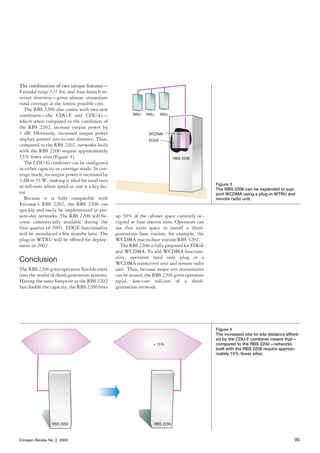
As mentioned above, the RBS 2206 can be
expanded to support WCDMA using a
plug-in WTRU, which contains baseband
functionality (Figure 3). A remote radio
unit,whichcanbeplacedanywherebetween
the cabinet and the antenna, contains radio
functionality and power amplification. The
connection between the base station and the
remoteunitismadebymeansofafiberoptic
cable, making installation flexible and easy.
Up to three RRUs can be deployed, de-
pending on the number of sector configura-
tions (one, two or three).
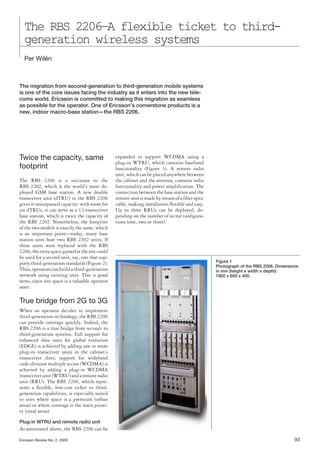
Figure 1
Photograph of the RBS 2206. Dimensions
in mm (height x width x depth):
1900 x 600 x 400.
Generation 2.5
In the interim before third-generation sys-
temsareintroduced,theRBS2206canaptly
fulfillseveralroles,sinceitprovidesfullsup-
port for the technologies that pave the way
forthird-generationsystems.TheRBS2206
is
• fully prepared for GSM data services, in-
cluding14.4kbit/stimeslots,high-speed
circuit-switched data (HSCSD), and gen-
eral packet radio service (GPRS); and
• equipped with a powerful distribution
switch unit (DXU) and fast internal
buses, which guarantee full EDGE sup-
port on all time slots. Moreover, the DXU
is prepared for Internet protocol-based
(IP) A-bis transmission.
Immediate benefits
The RBS 2206 also offers several immedi-
ate benefits to present-day GSM networks.
Apart from having twice the capacity of its
predecessor, the RBS 2206 also gives im-
proved radio performance. For example, in
addition to standard, two-branch diversity,
it supports four-branch receiver diversity,
which improves the uplink with up to 4 dB.
94 Ericsson Review No. 2, 2000
WCDMA
RBS 3202
RBS 2206RBS 2202 RBS 2202
Figure 2
The footprint of the RBS 2206 is one-half
that of the RBS 2202. Thus, by upgrading
to the RBS 2206, operators have space
over for, say, a second unit that supports
third-generation standards.
2G Second-generation mobile/wireless
system
3G Third-generation mobile/wireless
system
CDU-F Combiner and distribution unit (F)
CDU-G Combiner and distribution unit (G)
dTRU Double transceiver unit
DXU Distribution switch unit
EDGE Enhanced data rates for global evo-
lution
GPRS General packet radio service
GSM Global system for mobile communi-
cation
HSCSD High-speed circuit-switched data
RBS Radio base station
RRU Remote radio unit
TRU Transceiver unit
WCDMA Wideband code-division multiple
access
WTRU WCDMA TRU
BOX A, ABBREVIATIONS
Key features
• Six double transceiver units (dTRU) for a total
of 12 transceivers
• Hybrid combining one, two or three sectors in
one cabinet
• Filter combining one, two or three sectors in
one cabinet
• 35/16 W output power from cabinet (CDU-G)
• 20 W output power from cabinet (CDU-F)
• Synthesized and baseband frequency hop-
ping
• Prepared for data: 14.4 kbit/s, HSCSD, GPRS
• Prepared for two-slot WTDUs
• Supports 12 EDGE transceivers on all time
slots
• All speech codes: HR, FR, EFR
• Dual-band (GSM 900/GSM 1800)
• Extended range 121 km
• Supports software power boost
• Prepared for IP-based transmission
• Prepared for four-branch receiver diversity
• Prepared for GPS-assisted positioning ser-
vices
BOX B, THE RBS 2206
Technical specifications
• Frequency band E-GSM 900, GSM 1800
• Transmission (Tx) 925-960,1805-1880MHz
• Reception (Rx) 880-915,1710-1785MHz
• Dimensions 1900x600x400 mm
• Weight (equipped) 230 kg
• Power into
antenna feeder 35 W (GSM 900)
28 W (GSM 1800)
• Receiver sensitivity -110 dBm
• Power supply 120 to 250 VAC, 50/60 Hz
-48 to –72 VDC
+20 to +29 VDC
Ericsson Review No. 2, 2000 95
The combination of two unique features—
Extended range 121 km, and four-branch re-
ceiver diversity—gives almost immediate
rural coverage at the lowest possible cost.
The RBS 2206 also comes with two new
combiners—the CDU-F and CDU-G—
which when compared to the combiners of
the RBS 2202, increase output power by
1 dB. Obviously, increased output power
implies greater site-to-site distance. Thus,
compared to the RBS 2202, networks built
with the RBS 2206 require approximately
15% fewer sites (Figure 4).
The CDU-G combiner can be configured
in either capacity or coverage mode. In cov-
erage mode, its output power is increased by
3 dB to 35 W, making it ideal for rural sites
or roll-outs where speed or cost is a key fac-
tor.
Because it is fully compatible with
Ericsson’s RBS 2202, the RBS 2206 can
quickly and easily be implemented in pre-
sent-day networks. The RBS 2206 will be-
come commercially available during the
first quarter of 2001. EDGE functionality
will be introduced a few months later. The
plug-in WTRU will be offered for deploy-
ment in 2002.
Conclusion
The RBS 2206 gives operators flexible entry
into the world of third-generation systems.
Having the same footprint as the RBS 2202
but double the capacity, the RBS 2206 frees
up 50% of the cabinet space currently oc-
cupied at base station sites. Operators can
use this extra space to install a third-
generation base station; for example, the
WCDMA macro-base station/RBS 3202.
TheRBS2206isfullypreparedforEDGE
and WCDMA. To add WCDMA function-
ality, operators need only plug in a
WCDMA transceiver unit and remote radio
unit. Thus, because major site investments
can be reused, the RBS 2206 gives operators
rapid, low-cost roll-out of a third-
generation network.
RRU RRU RRU
RBS 2206
WCDMA
EDGE
Figure 3
The RBS 2206 can be expanded to sup-
port WCDMA using a plug-in WTRU and
remote radio unit.
RBS 2206
+ 15%
RBS 2202
Figure 4
The increased site-to-site distance afford-
ed by the CDU-F combiner means that—
compared to the RBS 2202—networks
built with the RBS 2206 require approxi-
mately 15% fewer sites.

2000024

  • 1.
    The migration fromsecond-generation to third-generation mobile systems is one of the core issues facing the industry as it enters into the new tele- coms world. Ericsson is committed to making this migration as seamless as possible for the operator. One of Ericsson’s cornerstone products is a new, indoor macro-base station—the RBS 2206. The RBS 2206—A flexible ticket to third- generation wireless systems Per Wilén Ericsson Review No. 2, 2000 93 Twice the capacity, same footprint The RBS 2206 is a successor to the RBS 2202, which is the world’s most de- ployed GSM base station. A new double transceiver unit (dTRU) in the RBS 2206 gives it unsurpassed capacity: with room for six dTRUs, it can serve as a 12-transceiver base station, which is twice the capacity of the RBS 2202. Nonetheless, the footprint of the two models is exactly the same, which is an important point—today, many base station sites host two RBS 2202 units. If these units were replaced with the RBS 2206,theextraspacegainedatthesitecould be used for a second unit, say, one that sup- ports third-generation standards (Figure 2). Thus,operatorscanbuildathird-generation network using existing sites. This is good news, since site space is a valuable operator asset. True bridge from 2G to 3G When an operator decides to implement third-generation technology, the RBS 2206 can provide coverage quickly. Indeed, the RBS 2206 is a true bridge from second- to third-generation systems. Full support for enhanced data rates for global evolution (EDGE) is achieved by adding one or more plug-in transceiver units in the cabinet’s transceiver slots; support for wideband code-division multiple access (WCDMA) is achieved by adding a plug-in WCDMA transceiverunit(WTRU)andaremoteradio unit (RRU). The RBS 2206, which repre- sents a flexible, low-cost ticket to third- generation capabilities, is especially suited to sites where space is a premium (urban areas) or where coverage is the main priori- ty (rural areas). Plug-in WTRU and remote radio unit As mentioned above, the RBS 2206 can be expanded to support WCDMA using a plug-in WTRU, which contains baseband functionality (Figure 3). A remote radio unit,whichcanbeplacedanywherebetween the cabinet and the antenna, contains radio functionality and power amplification. The connection between the base station and the remoteunitismadebymeansofafiberoptic cable, making installation flexible and easy. Up to three RRUs can be deployed, de- pending on the number of sector configura- tions (one, two or three). Figure 1 Photograph of the RBS 2206. Dimensions in mm (height x width x depth): 1900 x 600 x 400.
  • 2.
    Generation 2.5 In theinterim before third-generation sys- temsareintroduced,theRBS2206canaptly fulfillseveralroles,sinceitprovidesfullsup- port for the technologies that pave the way forthird-generationsystems.TheRBS2206 is • fully prepared for GSM data services, in- cluding14.4kbit/stimeslots,high-speed circuit-switched data (HSCSD), and gen- eral packet radio service (GPRS); and • equipped with a powerful distribution switch unit (DXU) and fast internal buses, which guarantee full EDGE sup- port on all time slots. Moreover, the DXU is prepared for Internet protocol-based (IP) A-bis transmission. Immediate benefits The RBS 2206 also offers several immedi- ate benefits to present-day GSM networks. Apart from having twice the capacity of its predecessor, the RBS 2206 also gives im- proved radio performance. For example, in addition to standard, two-branch diversity, it supports four-branch receiver diversity, which improves the uplink with up to 4 dB. 94 Ericsson Review No. 2, 2000 WCDMA RBS 3202 RBS 2206RBS 2202 RBS 2202 Figure 2 The footprint of the RBS 2206 is one-half that of the RBS 2202. Thus, by upgrading to the RBS 2206, operators have space over for, say, a second unit that supports third-generation standards. 2G Second-generation mobile/wireless system 3G Third-generation mobile/wireless system CDU-F Combiner and distribution unit (F) CDU-G Combiner and distribution unit (G) dTRU Double transceiver unit DXU Distribution switch unit EDGE Enhanced data rates for global evo- lution GPRS General packet radio service GSM Global system for mobile communi- cation HSCSD High-speed circuit-switched data RBS Radio base station RRU Remote radio unit TRU Transceiver unit WCDMA Wideband code-division multiple access WTRU WCDMA TRU BOX A, ABBREVIATIONS Key features • Six double transceiver units (dTRU) for a total of 12 transceivers • Hybrid combining one, two or three sectors in one cabinet • Filter combining one, two or three sectors in one cabinet • 35/16 W output power from cabinet (CDU-G) • 20 W output power from cabinet (CDU-F) • Synthesized and baseband frequency hop- ping • Prepared for data: 14.4 kbit/s, HSCSD, GPRS • Prepared for two-slot WTDUs • Supports 12 EDGE transceivers on all time slots • All speech codes: HR, FR, EFR • Dual-band (GSM 900/GSM 1800) • Extended range 121 km • Supports software power boost • Prepared for IP-based transmission • Prepared for four-branch receiver diversity • Prepared for GPS-assisted positioning ser- vices BOX B, THE RBS 2206 Technical specifications • Frequency band E-GSM 900, GSM 1800 • Transmission (Tx) 925-960,1805-1880MHz • Reception (Rx) 880-915,1710-1785MHz • Dimensions 1900x600x400 mm • Weight (equipped) 230 kg • Power into antenna feeder 35 W (GSM 900) 28 W (GSM 1800) • Receiver sensitivity -110 dBm • Power supply 120 to 250 VAC, 50/60 Hz -48 to –72 VDC +20 to +29 VDC
  • 3.
    Ericsson Review No.2, 2000 95 The combination of two unique features— Extended range 121 km, and four-branch re- ceiver diversity—gives almost immediate rural coverage at the lowest possible cost. The RBS 2206 also comes with two new combiners—the CDU-F and CDU-G— which when compared to the combiners of the RBS 2202, increase output power by 1 dB. Obviously, increased output power implies greater site-to-site distance. Thus, compared to the RBS 2202, networks built with the RBS 2206 require approximately 15% fewer sites (Figure 4). The CDU-G combiner can be configured in either capacity or coverage mode. In cov- erage mode, its output power is increased by 3 dB to 35 W, making it ideal for rural sites or roll-outs where speed or cost is a key fac- tor. Because it is fully compatible with Ericsson’s RBS 2202, the RBS 2206 can quickly and easily be implemented in pre- sent-day networks. The RBS 2206 will be- come commercially available during the first quarter of 2001. EDGE functionality will be introduced a few months later. The plug-in WTRU will be offered for deploy- ment in 2002. Conclusion The RBS 2206 gives operators flexible entry into the world of third-generation systems. Having the same footprint as the RBS 2202 but double the capacity, the RBS 2206 frees up 50% of the cabinet space currently oc- cupied at base station sites. Operators can use this extra space to install a third- generation base station; for example, the WCDMA macro-base station/RBS 3202. TheRBS2206isfullypreparedforEDGE and WCDMA. To add WCDMA function- ality, operators need only plug in a WCDMA transceiver unit and remote radio unit. Thus, because major site investments can be reused, the RBS 2206 gives operators rapid, low-cost roll-out of a third- generation network. RRU RRU RRU RBS 2206 WCDMA EDGE Figure 3 The RBS 2206 can be expanded to sup- port WCDMA using a plug-in WTRU and remote radio unit. RBS 2206 + 15% RBS 2202 Figure 4 The increased site-to-site distance afford- ed by the CDU-F combiner means that— compared to the RBS 2202—networks built with the RBS 2206 require approxi- mately 15% fewer sites.