Building a Modern Security
Engineering Organization
!
!
zane@signalsciences.com
@zanelackey
Who	
  is	
  this	
  guy	
  anyway?
!
• Built and led the Etsy Security Team
– Spoiler alert: what this presentation is about
!
• Recently co-founded Signal Sciences to
productize effective AppSec approaches 
!
!
!
This talk is a collection of lessons learned
from building and adapting a security
team
For security teams, the world has
changed in fundamental ways:
!
– Code deployment is now near-
instantaneous
For security teams, the world has
changed in fundamental ways:
!
– Code deployment is now near-
instantaneous 
!
– Merging of development and operations
means more people with production access
For security teams, the world has
changed in fundamental ways:
!
– Code deployment is now near-
instantaneous
!
– Merging of development and operations
means more people with production access
!
– Cost of attack has significantly dropped
!
!
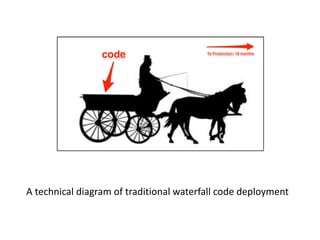
Near-instantaneous
deployment?
A	
  technical	
  diagram	
  of	
  traditional	
  waterfall	
  code	
  deployment	
  
!
!
What is this shifting to?
!
!
Etsy pushes to production 30 times a
day on average
!
!
Constant iteration in production via
feature flags, ramp ups, A/B testing
!
!
But doesn’t the
rapid rate of
change mean
things are less
secure?!
Actually,	
  the	
  opposite	
  is	
  
true
!
!
!
!
They key to realize is vulnerabilities
occur in all development methodologies 
!
…But there’s no such thing as an out-of-
band patch in continuous deployment
!
!
!
!
!
They key to realize is vulnerabilities
occur in all development methodologies 
!
…But there’s no such thing as an out-of-
band patch in continuous deployment
!
Compared to:
!
“We’ll rush that security fix. It will go out
… in about 6 weeks.”
!
- Former vendor at Etsy
!
!
!
!
What makes continuous deployment
safe?
Source:	
  http://www.slideshare.net/mikebrittain/advanced-­‐topics-­‐in-­‐continuous-­‐deployment
!
!
!
!
The same culture of graphing and
monitoring inherent to continuous
deployment can be used for security too
!
!
!
!
Surface security info for everyone, not
just the security team
!
!
!
!
“Don’t treat security as a binary event”
- @ngalbreath
Building	
  a	
  (k-­‐)rad	
  culture
*Mullets	
  sold	
  separately	
  
!
!
!
!
In the shift to continuous deployment,
speed increases by removing
organizational blockers
!
!
!
!
Trying to make security a blocker means
you get routed around
!
!
!
!
Instead, the focus becomes on
incentivizing teams to reach out to
security
Keys to incentivizing conversation:
!
– Don’t be a jerk. This should be obvious,
but empathy needs to be explicitly set as a
core part of your teams culture. 
!
!
!
!
Keys to incentivizing conversation:
!
– Don’t be a jerk. This should be obvious,
but empathy needs to be explicitly set as a
core part of your teams culture. 
!
– Make realistic tradeoffs. Don’t fall in to
the trap of thinking every issue is critical. 
• Ex: Letting low risk issues ship with a
reasonable remediation window buys you
credibility for when things actually do need to
be addressed immediately.
Keys to incentivizing conversation:
!
– Coherently explain impact. “This would
allow all our user data to be compromised
if the attacker did X & Y” paints a clear
picture, where “The input validation in this
function is weak” does not.
!
!
!
Keys to incentivizing conversation:
!
– Coherently explain impact. “This would
allow all our user data to be compromised
if the attacker did X & Y” paints a clear
picture, where “The input validation in this
function is weak” does not.
!
– Reward communication with security
team. T-Shirts, gift cards, and high fives
all work (shockingly) well.
Keys to incentivizing conversation:
!
– Take the false positive hit yourself.
Don’t send unverified issues to dev and
ops teams. When issues come in, have the
secteam verify and make first attempt at
patch.
!
– Scale via team leads. Build relationships
with technical leads from other teams so
they make security part of their teams
culture.
Keys to incentivizing conversation:
!
– Take the false positive hit yourself.
Don’t send unverified issues to dev and
ops teams. When issues come in, have the
secteam verify and make first attempt at
patch.
!
– Scale via team leads. Build relationships
with technical leads from other teams so
they make security part of their teams
culture.
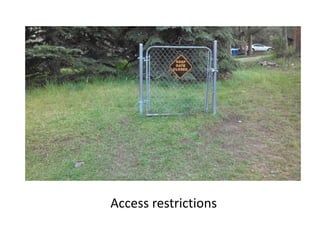
Access	
  restrictions
!
!
!
!
Startups begin with a simple access
control policy: Everyone can access
everything
!
!
!
!
As organization grow there will be more
pressure to institute access policies
!
!
!
!
The key to remember is don’t take away
capabilities
Methodology:
!
1. Figure out what capability is needed
!
2. Build an alternate way to perform the
needed function in a safe way
!
3. Transition the organization over to the
safe way
!
4. Alert on any usage of the old unsafe way
Methodology:
!
1. Figure out what capability is needed
!
2. Build an alternate way to perform the
needed function in a safe way
!
3. Transition the organization over to the
safe way
!
4. Alert on any usage of the old unsafe way
Methodology:
!
1. Figure out what capability is needed
!
2. Build an alternate way to perform the
needed function in a safe way
!
3. Transition the organization over to the
safe way
!
4. Alert on any usage of the old unsafe way
Methodology:
!
1. Figure out what capability is needed
!
2. Build an alternate way to perform the
needed function in a safe way
!
3. Transition the organization over to the
safe way
!
4. Alert on any usage of the old unsafe way
!
!
!
!
EX: SSH access to production systems
Security policy goal: Eliminate unneeded
access to production systems
!
– Why do developers do it? Ex: To view error logs 
!
– Build alternate approach: Send the logs to
central logging service (ex: elasticsearch,
splunk, etc)
!
– Publicize the new tooling to the organization
!
– After majority of transition, alert on any logins
to production systems by non-sysops
Security policy goal: Eliminate unneeded
access to production systems
!
– Why do developers do it? Ex: To view error logs 
!
– Build alternate approach: Send the logs to
central logging service (ex: elasticsearch,
splunk, etc)
!
– Publicize the new tooling to the organization
!
– After majority of transition, alert on any logins
to production systems by non-sysops
Security policy goal: Eliminate unneeded
access to production systems
!
– Why do developers do it? Ex: To view error logs 
!
– Build alternate approach: Send the logs to
central logging service (ex: elasticsearch,
splunk, etc)
!
– Publicize the new tooling to the organization
!
– After majority of transition, alert on any logins
to production systems by non-sysops
Security policy goal: Eliminate unneeded
access to production systems
!
– Why do developers do it? Ex: To view error logs 
!
– Build alternate approach: Send the logs to
central logging service (ex: elasticsearch,
splunk, etc)
!
– Publicize the new tooling to the organization
!
– After majority of transition, alert on any logins
to production systems by non-sysops
Increasing	
  attacker	
  cost
!
Specifically, some thoughts on:
!
– 
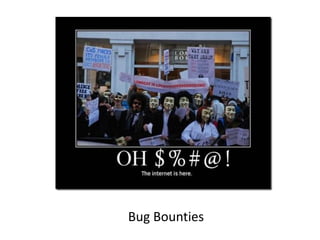
 Bug Bounties
!
– 
 Attack simulations/pentesting
Bug	
  Bounties
!
!
!
!
Bug bounties are tremendously useful. If
you’re not working towards launching
one, strongly consider it.
Common concerns about launching a
bounty: 
!
1. Budgetary concerns. Money is almost
never the main motivation for
researchers, you can launch a bounty
with just a hall of fame and still get great
submissions. 
!
1. Risk of inviting attacks. You’re already
getting attacked continuously, you’re just
not getting the results.
Common concerns about launching a
bounty: 
!
1. Budgetary concerns. Money is rarely the
main motivation for participants, you can
launch a bounty with just a hall of fame
and still get great submissions. 
!
1. Risk of inviting attacks. You’re already
getting attacked continuously, you’re just
not getting the results.
Common concerns about launching a
bounty: 
!
1. Budgetary concerns. Money is rarely the
main motivation for participants, you can
launch a bounty with just a hall of fame
and still get great submissions. 
!
1. Risk of inviting attacks. It’s the
Internet. You’re already getting pentested
continuously, you’re just not receiving
the report.
The ultimate goals of a bug bounty are
threefold: 
!
1. Incentivize people to report issues to you
in the first place
!
2. Drive up cost of vulnerability discovery
and exploitation for attackers 
!
3. Provide an external validation of if your
security program is working (or not)
The ultimate goals of a bug bounty are
threefold: 
!
1. Incentivize people to report issues to you
in the first place
!
2. Drive up cost of vulnerability discovery
and exploitation for attackers 
!
3. Provide an external validation of if your
security program is working (or not)
The ultimate goals of a bug bounty are
threefold: 
!
1. Incentivize people to report issues to you
in the first place
!
2. Drive up cost of vulnerability discovery
and exploitation for attackers 
!
3. Provide an external validation of where
your security program is working (and
where it’s not)
!
!
!
!
Before you launch, record what vulnerability
classes you expect to see and what you don’t. 
!
Compare this against the issues actually
reported. 
!
!
!
!
!
Before you launch, record what vulnerability
classes you expect to see and what you don’t. 
!
Compare this against the issues actually
reported. 
!
Keep metrics on: 
!
– Number of bugs reported and severities
!
– Time to remediation of reported issues
!
!
You want both of these metrics to trend
down over time
Practical considerations: 
!
– Inform all teams before bounty launch,
especially non-engineering teams
• Ex: Customer Support
!
– Attacks will start almost immediately
!
For Etsy bug bounty launch, time from
announcement to first attack: 13min
Practical considerations: 
!
– Inform all teams before bounty launch,
especially non-engineering teams
• Ex: Customer Support
!
– Attacks will start almost immediately
!
For Etsy bug bounty launch, time from
announcement to first attack: 13min
Practical considerations: 
!
– Your first 2-3 weeks will be intense. Have
as many people as you can dedicated to
triage and response
Practical considerations: 
!
– Operationally review any helper systems
for scaling problems beforehand
• When 10-100x traffic hits helper systems your
security team uses, what falls over?
!
– Money almost never the overriding factor,
hall of fame is 
!
– Researchers are generally great to interact
with
Practical considerations: 
!
– Operationally review any helper systems for
scaling problems beforehand
• When 10-100x traffic hits helper systems your
security team uses, what falls over?
!
– Money is almost never the main motivation
for bounty participants, hall of fame credit is 
!
– Researchers are generally great to interact
with
Practical considerations: 
!
– Operationally review any helper systems for
scaling problems beforehand. 
• When 10-100x traffic hits helper systems your
security team uses, what falls over?
!
– Money is almost never the main motivation
for bounty participants, hall of fame credit is 
!
– Key to great researcher interaction is
frequent and transparent communication
!
!
!
TL;DR
(The section formerly known as “Conclusions”)
• Adapt security team culture to DevOps
and continuous deployment by:
– Surfacing security monitoring and metrics
– Incentivize discussions with the security
team
– When creating policy, don’t take away
capabilities 
!
!
• Drive up attacker cost through bug
bounty programs, countering phishing,
and running realistic attack simulations
Thanks!
!
!
!
!
!
!
!
zane@signalsciences.com @zanelackey

Building a Modern Security Engineering Organization. Zane Lackey

  • 1.
    Building a ModernSecurity Engineering Organization ! ! zane@signalsciences.com @zanelackey
  • 2.
    Who  is  this  guy  anyway? ! • Built and led the Etsy Security Team – Spoiler alert: what this presentation is about ! • Recently co-founded Signal Sciences to productize effective AppSec approaches !
  • 3.
    ! ! This talk isa collection of lessons learned from building and adapting a security team
  • 4.
    For security teams,the world has changed in fundamental ways: ! – Code deployment is now near- instantaneous
  • 5.
    For security teams,the world has changed in fundamental ways: ! – Code deployment is now near- instantaneous ! – Merging of development and operations means more people with production access
  • 6.
    For security teams,the world has changed in fundamental ways: ! – Code deployment is now near- instantaneous ! – Merging of development and operations means more people with production access ! – Cost of attack has significantly dropped
  • 7.
  • 8.
    A  technical  diagram  of  traditional  waterfall  code  deployment  
  • 9.
    ! ! What is thisshifting to?
  • 10.
    ! ! Etsy pushes toproduction 30 times a day on average
  • 11.
    ! ! Constant iteration inproduction via feature flags, ramp ups, A/B testing
  • 12.
    ! ! But doesn’t the rapidrate of change mean things are less secure?!
  • 13.
  • 14.
    ! ! ! ! They key torealize is vulnerabilities occur in all development methodologies ! …But there’s no such thing as an out-of- band patch in continuous deployment !
  • 15.
    ! ! ! ! They key torealize is vulnerabilities occur in all development methodologies ! …But there’s no such thing as an out-of- band patch in continuous deployment !
  • 16.
    Compared to: ! “We’ll rushthat security fix. It will go out … in about 6 weeks.” ! - Former vendor at Etsy
  • 17.
  • 19.
  • 20.
    ! ! ! ! The same cultureof graphing and monitoring inherent to continuous deployment can be used for security too
  • 21.
    ! ! ! ! Surface security infofor everyone, not just the security team
  • 23.
    ! ! ! ! “Don’t treat securityas a binary event” - @ngalbreath
  • 24.
    Building  a  (k-­‐)rad  culture *Mullets  sold  separately  
  • 25.
    ! ! ! ! In the shiftto continuous deployment, speed increases by removing organizational blockers
  • 26.
    ! ! ! ! Trying to makesecurity a blocker means you get routed around
  • 27.
    ! ! ! ! Instead, the focusbecomes on incentivizing teams to reach out to security
  • 28.
    Keys to incentivizingconversation: ! – Don’t be a jerk. This should be obvious, but empathy needs to be explicitly set as a core part of your teams culture. ! ! ! !
  • 29.
    Keys to incentivizingconversation: ! – Don’t be a jerk. This should be obvious, but empathy needs to be explicitly set as a core part of your teams culture. ! – Make realistic tradeoffs. Don’t fall in to the trap of thinking every issue is critical. • Ex: Letting low risk issues ship with a reasonable remediation window buys you credibility for when things actually do need to be addressed immediately.
  • 30.
    Keys to incentivizingconversation: ! – Coherently explain impact. “This would allow all our user data to be compromised if the attacker did X & Y” paints a clear picture, where “The input validation in this function is weak” does not. ! ! !
  • 31.
    Keys to incentivizingconversation: ! – Coherently explain impact. “This would allow all our user data to be compromised if the attacker did X & Y” paints a clear picture, where “The input validation in this function is weak” does not. ! – Reward communication with security team. T-Shirts, gift cards, and high fives all work (shockingly) well.
  • 32.
    Keys to incentivizingconversation: ! – Take the false positive hit yourself. Don’t send unverified issues to dev and ops teams. When issues come in, have the secteam verify and make first attempt at patch. ! – Scale via team leads. Build relationships with technical leads from other teams so they make security part of their teams culture.
  • 33.
    Keys to incentivizingconversation: ! – Take the false positive hit yourself. Don’t send unverified issues to dev and ops teams. When issues come in, have the secteam verify and make first attempt at patch. ! – Scale via team leads. Build relationships with technical leads from other teams so they make security part of their teams culture.
  • 34.
  • 35.
    ! ! ! ! Startups begin witha simple access control policy: Everyone can access everything
  • 36.
    ! ! ! ! As organization growthere will be more pressure to institute access policies
  • 37.
    ! ! ! ! The key toremember is don’t take away capabilities
  • 38.
    Methodology: ! 1. Figure outwhat capability is needed ! 2. Build an alternate way to perform the needed function in a safe way ! 3. Transition the organization over to the safe way ! 4. Alert on any usage of the old unsafe way
  • 39.
    Methodology: ! 1. Figure outwhat capability is needed ! 2. Build an alternate way to perform the needed function in a safe way ! 3. Transition the organization over to the safe way ! 4. Alert on any usage of the old unsafe way
  • 40.
    Methodology: ! 1. Figure outwhat capability is needed ! 2. Build an alternate way to perform the needed function in a safe way ! 3. Transition the organization over to the safe way ! 4. Alert on any usage of the old unsafe way
  • 41.
    Methodology: ! 1. Figure outwhat capability is needed ! 2. Build an alternate way to perform the needed function in a safe way ! 3. Transition the organization over to the safe way ! 4. Alert on any usage of the old unsafe way
  • 42.
    ! ! ! ! EX: SSH accessto production systems
  • 43.
    Security policy goal:Eliminate unneeded access to production systems ! – Why do developers do it? Ex: To view error logs ! – Build alternate approach: Send the logs to central logging service (ex: elasticsearch, splunk, etc) ! – Publicize the new tooling to the organization ! – After majority of transition, alert on any logins to production systems by non-sysops
  • 44.
    Security policy goal:Eliminate unneeded access to production systems ! – Why do developers do it? Ex: To view error logs ! – Build alternate approach: Send the logs to central logging service (ex: elasticsearch, splunk, etc) ! – Publicize the new tooling to the organization ! – After majority of transition, alert on any logins to production systems by non-sysops
  • 45.
    Security policy goal:Eliminate unneeded access to production systems ! – Why do developers do it? Ex: To view error logs ! – Build alternate approach: Send the logs to central logging service (ex: elasticsearch, splunk, etc) ! – Publicize the new tooling to the organization ! – After majority of transition, alert on any logins to production systems by non-sysops
  • 46.
    Security policy goal:Eliminate unneeded access to production systems ! – Why do developers do it? Ex: To view error logs ! – Build alternate approach: Send the logs to central logging service (ex: elasticsearch, splunk, etc) ! – Publicize the new tooling to the organization ! – After majority of transition, alert on any logins to production systems by non-sysops
  • 47.
  • 48.
    ! Specifically, some thoughtson: ! – Bug Bounties ! – Attack simulations/pentesting
  • 49.
  • 50.
    ! ! ! ! Bug bounties aretremendously useful. If you’re not working towards launching one, strongly consider it.
  • 51.
    Common concerns aboutlaunching a bounty: ! 1. Budgetary concerns. Money is almost never the main motivation for researchers, you can launch a bounty with just a hall of fame and still get great submissions. ! 1. Risk of inviting attacks. You’re already getting attacked continuously, you’re just not getting the results.
  • 52.
    Common concerns aboutlaunching a bounty: ! 1. Budgetary concerns. Money is rarely the main motivation for participants, you can launch a bounty with just a hall of fame and still get great submissions. ! 1. Risk of inviting attacks. You’re already getting attacked continuously, you’re just not getting the results.
  • 53.
    Common concerns aboutlaunching a bounty: ! 1. Budgetary concerns. Money is rarely the main motivation for participants, you can launch a bounty with just a hall of fame and still get great submissions. ! 1. Risk of inviting attacks. It’s the Internet. You’re already getting pentested continuously, you’re just not receiving the report.
  • 54.
    The ultimate goalsof a bug bounty are threefold: ! 1. Incentivize people to report issues to you in the first place ! 2. Drive up cost of vulnerability discovery and exploitation for attackers ! 3. Provide an external validation of if your security program is working (or not)
  • 55.
    The ultimate goalsof a bug bounty are threefold: ! 1. Incentivize people to report issues to you in the first place ! 2. Drive up cost of vulnerability discovery and exploitation for attackers ! 3. Provide an external validation of if your security program is working (or not)
  • 56.
    The ultimate goalsof a bug bounty are threefold: ! 1. Incentivize people to report issues to you in the first place ! 2. Drive up cost of vulnerability discovery and exploitation for attackers ! 3. Provide an external validation of where your security program is working (and where it’s not)
  • 57.
    ! ! ! ! Before you launch,record what vulnerability classes you expect to see and what you don’t. ! Compare this against the issues actually reported. !
  • 58.
    ! ! ! ! Before you launch,record what vulnerability classes you expect to see and what you don’t. ! Compare this against the issues actually reported. !
  • 59.
    Keep metrics on: ! – Number of bugs reported and severities ! – Time to remediation of reported issues ! ! You want both of these metrics to trend down over time
  • 60.
    Practical considerations: ! –Inform all teams before bounty launch, especially non-engineering teams • Ex: Customer Support ! – Attacks will start almost immediately ! For Etsy bug bounty launch, time from announcement to first attack: 13min
  • 61.
    Practical considerations: ! –Inform all teams before bounty launch, especially non-engineering teams • Ex: Customer Support ! – Attacks will start almost immediately ! For Etsy bug bounty launch, time from announcement to first attack: 13min
  • 62.
    Practical considerations: ! –Your first 2-3 weeks will be intense. Have as many people as you can dedicated to triage and response
  • 63.
    Practical considerations: ! –Operationally review any helper systems for scaling problems beforehand • When 10-100x traffic hits helper systems your security team uses, what falls over? ! – Money almost never the overriding factor, hall of fame is ! – Researchers are generally great to interact with
  • 64.
    Practical considerations: ! –Operationally review any helper systems for scaling problems beforehand • When 10-100x traffic hits helper systems your security team uses, what falls over? ! – Money is almost never the main motivation for bounty participants, hall of fame credit is ! – Researchers are generally great to interact with
  • 65.
    Practical considerations: ! –Operationally review any helper systems for scaling problems beforehand. • When 10-100x traffic hits helper systems your security team uses, what falls over? ! – Money is almost never the main motivation for bounty participants, hall of fame credit is ! – Key to great researcher interaction is frequent and transparent communication
  • 66.
    ! ! ! TL;DR (The section formerlyknown as “Conclusions”)
  • 67.
    • Adapt securityteam culture to DevOps and continuous deployment by: – Surfacing security monitoring and metrics – Incentivize discussions with the security team – When creating policy, don’t take away capabilities ! ! • Drive up attacker cost through bug bounty programs, countering phishing, and running realistic attack simulations
  • 68.