Tendon and Ligament
Roles of Ligaments and
Joint Capsules
• Assist in Stabilization of Joint
• Restrict Movement
• Prevent Excessive Motion
Roles of Tendons
• Attach muscle to bone
• Transmit tensile loads
• Position of muscle relative to joint
Mechanical Behavior of Tendons and
Ligaments
• Both are viscoelastic tissues
• Visco - a small amount of load results in quite
a bit of deformation (relative)
• Elastic - refers to Elastic Region
• Importance of viscoelastic qualities?
Properties of Tendon
• can sustain high tensile loads
• flexible to allow changes in direction of muscle
pull
Properties of Ligament
• guides movement
• resists applied force
Mechanical Properties
of Tendon and Ligament
• Strength
• Stiffness
Damage to Tendon and Ligament
• When load is great enough to cause injury,
damage is dependent on:
– rate and
– amount of load
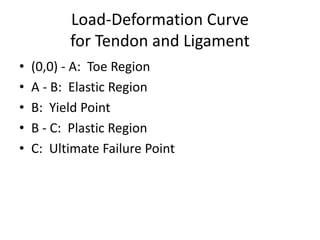
Load-Deformation Curve
for Tendon and Ligament
• (0,0) - A: Toe Region
• A - B: Elastic Region
• B: Yield Point
• B - C: Plastic Region
• C: Ultimate Failure Point
Comparison of Bone to
Tendon and Ligament
• Identify similarities and differences between
these tissue types.
Mechanical Properties of
Tendon and Ligament
• Strength
• Stiffness
Injury Mechanisms
• Injury occurs when tissue is loaded beyond its
physiological range.
• Microfailure occurs before the yield point is
reached.
Injury Mechanisms cont.
• When yield point is exceeded, the ligament
begins to undergo gross failure.
• Results in abnormal joint displacement
• Displacement results in...
3 Clinical Categories of
Ligament Injury
• Negligible Clinical Symptoms (Grade 1)
– no joint instability can be detected clinically
• Severe Pain (Grade 2)
– joint instability can be detected clinically
– strength and stiffness decreases by 50%
– instability can be masked by muscle involvement
3 Clinical Categories of
Ligament Injury cont.
• Severe Pain (Grade 3)
– severe pain experienced during the injury with
less pain after the injury
– joint is completely unstable
– most collagen fibers have ruptured
Noyes Study (1977)
• Rhesus monkeys
• 8 wks immobilization
• returned to mobilization
• at 12 mo. mechanical properties were
comparable to non-immobilized ligaments.
• Drumroll?
Additional Factors Important
in Tendon Injury
• Amount of force produced by muscle
• Stress comparison between tendon and
muscle
• Loading Rates
Factors Affecting Biomechanical Properties of
Tendon and Ligament
• Aging
• Pregnancy
• Mobilization vs. Immobilization
• NSAIDs
Osteoarthritis
• Researchers suggest that a deficiency in
mechanisms that minimize peak forces may
cause osteoarthritis.

2. tendons and ligaments.ppt

  • 1.
  • 2.
    Roles of Ligamentsand Joint Capsules • Assist in Stabilization of Joint • Restrict Movement • Prevent Excessive Motion
  • 3.
    Roles of Tendons •Attach muscle to bone • Transmit tensile loads • Position of muscle relative to joint
  • 4.
    Mechanical Behavior ofTendons and Ligaments • Both are viscoelastic tissues • Visco - a small amount of load results in quite a bit of deformation (relative) • Elastic - refers to Elastic Region • Importance of viscoelastic qualities?
  • 5.
    Properties of Tendon •can sustain high tensile loads • flexible to allow changes in direction of muscle pull
  • 6.
    Properties of Ligament •guides movement • resists applied force
  • 7.
    Mechanical Properties of Tendonand Ligament • Strength • Stiffness
  • 8.
    Damage to Tendonand Ligament • When load is great enough to cause injury, damage is dependent on: – rate and – amount of load
  • 9.
    Load-Deformation Curve for Tendonand Ligament • (0,0) - A: Toe Region • A - B: Elastic Region • B: Yield Point • B - C: Plastic Region • C: Ultimate Failure Point
  • 10.
    Comparison of Boneto Tendon and Ligament • Identify similarities and differences between these tissue types.
  • 11.
    Mechanical Properties of Tendonand Ligament • Strength • Stiffness
  • 12.
    Injury Mechanisms • Injuryoccurs when tissue is loaded beyond its physiological range. • Microfailure occurs before the yield point is reached.
  • 13.
    Injury Mechanisms cont. •When yield point is exceeded, the ligament begins to undergo gross failure. • Results in abnormal joint displacement • Displacement results in...
  • 14.
    3 Clinical Categoriesof Ligament Injury • Negligible Clinical Symptoms (Grade 1) – no joint instability can be detected clinically • Severe Pain (Grade 2) – joint instability can be detected clinically – strength and stiffness decreases by 50% – instability can be masked by muscle involvement
  • 15.
    3 Clinical Categoriesof Ligament Injury cont. • Severe Pain (Grade 3) – severe pain experienced during the injury with less pain after the injury – joint is completely unstable – most collagen fibers have ruptured
  • 16.
    Noyes Study (1977) •Rhesus monkeys • 8 wks immobilization • returned to mobilization • at 12 mo. mechanical properties were comparable to non-immobilized ligaments. • Drumroll?
  • 17.
    Additional Factors Important inTendon Injury • Amount of force produced by muscle • Stress comparison between tendon and muscle • Loading Rates
  • 18.
    Factors Affecting BiomechanicalProperties of Tendon and Ligament • Aging • Pregnancy • Mobilization vs. Immobilization • NSAIDs
  • 19.
    Osteoarthritis • Researchers suggestthat a deficiency in mechanisms that minimize peak forces may cause osteoarthritis.