PROXIMATE
AND
ULTIMATE CAUSE
BY
MUHAMMAD IRFAN
M.PHIL ZOOLOGY
UNIVERSITY OF THE PUNJAB, LAHORE
PROXIMATE
PERSPECTIVE
 It deals with immediate causation
(Mechanism+Development)
 How it is? What is it?
Method of Analysis (Example: Male Aggression)
 Must know natural selection pressure that acted on male
aggression > aids in analysis
 Keen observing: Suspect > Male use aggression to gain
access to food by studying foraging behavior
 Some hormones are involved in male aggression
 It helps us to understand the raw material that natural
selection may operate on in the future
 Conclusion
It sheds light on the variation available for natural selection
to act on in the future
ULTIMATE
PERSPECTIVE
It delas with forces that
have shaped a trait over
evolutionary time?
Why it is that?
How evolutionary forces
operate > past, present,
future?
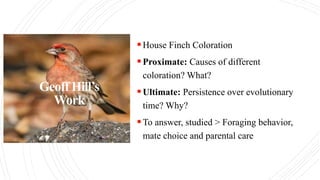
Geoff Hill’s
Work
House Finch Coloration
Proximate: Causes of different
coloration? What?
Ultimate: Persistence over evolutionary
time? Why?
To answer, studied > Foraging behavior,
mate choice and parental care
Study
of
Proximate
Causation
 Study intra and inter population comparison
 Controlled feeding comparison
 Prior Knowledge: carotenoid pigments (red)
 Males synthesize their own, females not
 Difference of Plumage in Males
Hill’s prior work > male plumage brightness. Differences in
intra and inter population were correlated with the diet
during the development phase
 Difference of Plumage in Females
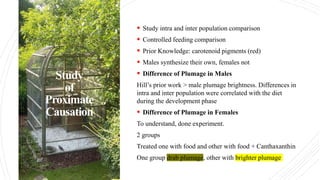
To understand, done experiment.
2 groups
Treated one with food and other with food + Canthaxanthin
One group drab plumage, other with brighter plumage
ANSWERS
 What causes differences between
population differences in female coloration?
 What causes differences in plumage
coloration between males and females?
INTER-POPULATION DIFFERENCES
 Did comparison with Michigan’s population
 Differences occurred due to carotenoid-
based food sources in those localities
 More such food > More the bright colour
 It explains the difference in plumage
coloration among females across
populations
Difference
Between
Male VS Female
It depends upon the foraging
ways
Not on the availability of
carotenoid-based foods
available in the same locality
Males actively search for
carotenoid-based foods, while
females not.
STUDY
OF
ULTIMATE
CAUSATION
 Question 1: Why do males, but not
females, actively search for carotenoid-
based foods?
 Answer: Hill hypothesized that males
receive significant benefits. What are these
benefits?
 Experiment: Hair dyes were used to
brighten/lighten male colour
 Those males attracted more mates i.e. the
reason to search actively more carotenoid-
rich food
STUDY
OF
ULTIMATE
CAUSATION
 Question 2: Why females prefer males
with brighter colour? The ultimate
question regarding the mate choice.
 Answer: 3 reasons to do it.
 A) Better fight-off with pathogens (He
inoculated Mycoplasma gallicepticum)
 B) Better parental care (Brighter male fed
twice their babies than the drabber males)
 C) Better foragers, hence more fitness,
healthy offsprings

2 Proximate and Ultimate Caustaion.pptx

  • 1.
    PROXIMATE AND ULTIMATE CAUSE BY MUHAMMAD IRFAN M.PHILZOOLOGY UNIVERSITY OF THE PUNJAB, LAHORE
  • 2.
    PROXIMATE PERSPECTIVE  It dealswith immediate causation (Mechanism+Development)  How it is? What is it? Method of Analysis (Example: Male Aggression)  Must know natural selection pressure that acted on male aggression > aids in analysis  Keen observing: Suspect > Male use aggression to gain access to food by studying foraging behavior  Some hormones are involved in male aggression  It helps us to understand the raw material that natural selection may operate on in the future  Conclusion It sheds light on the variation available for natural selection to act on in the future
  • 3.
    ULTIMATE PERSPECTIVE It delas withforces that have shaped a trait over evolutionary time? Why it is that? How evolutionary forces operate > past, present, future?
  • 4.
    Geoff Hill’s Work House FinchColoration Proximate: Causes of different coloration? What? Ultimate: Persistence over evolutionary time? Why? To answer, studied > Foraging behavior, mate choice and parental care
  • 5.
    Study of Proximate Causation  Study intraand inter population comparison  Controlled feeding comparison  Prior Knowledge: carotenoid pigments (red)  Males synthesize their own, females not  Difference of Plumage in Males Hill’s prior work > male plumage brightness. Differences in intra and inter population were correlated with the diet during the development phase  Difference of Plumage in Females To understand, done experiment. 2 groups Treated one with food and other with food + Canthaxanthin One group drab plumage, other with brighter plumage
  • 6.
    ANSWERS  What causesdifferences between population differences in female coloration?  What causes differences in plumage coloration between males and females? INTER-POPULATION DIFFERENCES  Did comparison with Michigan’s population  Differences occurred due to carotenoid- based food sources in those localities  More such food > More the bright colour  It explains the difference in plumage coloration among females across populations
  • 7.
    Difference Between Male VS Female Itdepends upon the foraging ways Not on the availability of carotenoid-based foods available in the same locality Males actively search for carotenoid-based foods, while females not.
  • 8.
    STUDY OF ULTIMATE CAUSATION  Question 1:Why do males, but not females, actively search for carotenoid- based foods?  Answer: Hill hypothesized that males receive significant benefits. What are these benefits?  Experiment: Hair dyes were used to brighten/lighten male colour  Those males attracted more mates i.e. the reason to search actively more carotenoid- rich food
  • 9.
    STUDY OF ULTIMATE CAUSATION  Question 2:Why females prefer males with brighter colour? The ultimate question regarding the mate choice.  Answer: 3 reasons to do it.  A) Better fight-off with pathogens (He inoculated Mycoplasma gallicepticum)  B) Better parental care (Brighter male fed twice their babies than the drabber males)  C) Better foragers, hence more fitness, healthy offsprings