Licensed under Creative Commons
Attribution – ShareAlike 4.0 International
Personal Branding
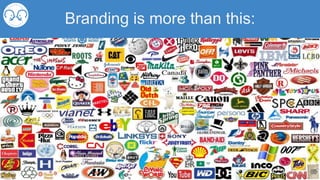
Branding is more than this:
Branding is…
…a promise to deliver value.
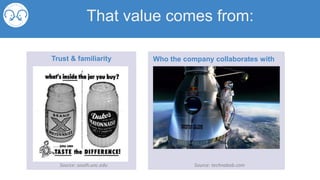
That value comes from:
Trust & familiarity
Source: south.unc.edu
Who the company collaborates with
Source: technabob.com
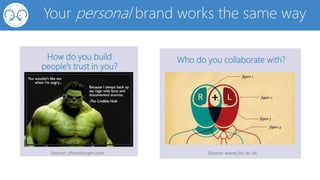
Source: cheezburger.com
How do you build
people’s trust in you?
Who do you collaborate with?
Source: www.jisc.ac.uk
Your personal brand works the same way
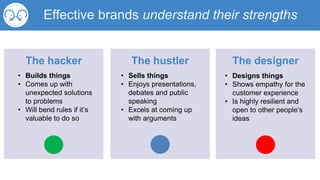
Effective brands understand their strengths
The hacker
• Builds things
• Comes up with
unexpected solutions
to problems
• Will bend rules if it’s
valuable to do so
The designer
• Designs things
• Shows empathy for the
customer experience
• Is highly resilient and
open to other people’s
ideas
The hustler
• Sells things
• Enjoys presentations,
debates and public
speaking
• Excels at coming up
with arguments
Effective brands are concise
One sentence:
What value can you
offer a startup team?
One sentence:
What do you need from
your teammates?
Let’s network!
Over the next six minutes, talk with three
potential collaborators.
1. Only talk with people who have a different personal brand
than you (as identified by your stickers).
2. You have 60 seconds to pitch your brand and 60 seconds
to listen to your potential collaborator’s pitch.
1. Record notes on the sheet provided.
Let’s
pivot!
Let’s network!
Over the next ten minutes, talk with five other
potential collaborators.
1. Only talk with people who have a different personal brand
than you (as identified by your stickers).
2. You have 60 seconds to pitch your brand and 60 seconds
to listen to your potential collaborator’s pitch.
3. Record notes on the sheet provided.
Time to form your startup!
Two to four people with COMPLEMENTARY brands

2. personal-branding-ppt nb

  • 1.
    Licensed under CreativeCommons Attribution – ShareAlike 4.0 International Personal Branding
  • 2.
    Branding is morethan this:
  • 3.
    Branding is… …a promiseto deliver value.
  • 4.
    That value comesfrom: Trust & familiarity Source: south.unc.edu Who the company collaborates with Source: technabob.com
  • 5.
    Source: cheezburger.com How doyou build people’s trust in you? Who do you collaborate with? Source: www.jisc.ac.uk Your personal brand works the same way
  • 6.
    Effective brands understandtheir strengths The hacker • Builds things • Comes up with unexpected solutions to problems • Will bend rules if it’s valuable to do so The designer • Designs things • Shows empathy for the customer experience • Is highly resilient and open to other people’s ideas The hustler • Sells things • Enjoys presentations, debates and public speaking • Excels at coming up with arguments
  • 7.
    Effective brands areconcise One sentence: What value can you offer a startup team? One sentence: What do you need from your teammates?
  • 8.
    Let’s network! Over thenext six minutes, talk with three potential collaborators. 1. Only talk with people who have a different personal brand than you (as identified by your stickers). 2. You have 60 seconds to pitch your brand and 60 seconds to listen to your potential collaborator’s pitch. 1. Record notes on the sheet provided.
  • 9.
  • 10.
    Let’s network! Over thenext ten minutes, talk with five other potential collaborators. 1. Only talk with people who have a different personal brand than you (as identified by your stickers). 2. You have 60 seconds to pitch your brand and 60 seconds to listen to your potential collaborator’s pitch. 3. Record notes on the sheet provided.
  • 11.
    Time to formyour startup! Two to four people with COMPLEMENTARY brands

Editor's Notes

  • #7 Context: These three “personal brands” were identified by Steve Blank as the essential, complementary roles needed in an innovative startup team. Task: Each student spends 60 seconds considering which of these “brands” best describes them. On the Personal Branding handout, have students note the brand they identify with the most (the handout can be found in the Entrepreneurial Thinking Toolkit) Give each student either a green, blue or red sticker, depending on which brand they identify with the most Hint: After students have made their decision, survey the room to see which personal brands were most and least common. If there is a significant lack of one of the brands. point out that, because it is scarce, this brand is highly valuable. Then point out that we often adopt different brands depending on needs of the context we work in. Some students may therefore wish to change their stated brand based on what the market is telling them is valuable.
  • #8 Have students record both sentences on the “Personal Branding” handout.
  • #9 Handout: “Using Your Personal Brand to Form Groups”—which can be found in the same area of the Entrepreneurial Thinking Toolkit as this PowerPoint deck.
  • #10 A pivot is a “change in strategy without a change in vision.” Entrepreneurial people are constantly pivoting the language they use to describe themselves in order to better communicate their value to potential collaborators. Based on your experiences with the activity so far, what could you do to improve how you present your personal brand? For example: Perhaps you’re a hacker rather than a hustler? Maybe you need to change some of the words you use to describe yourself? Perhaps you need more or different evidence to support and explain your brand?
  • #12 Led Zeppelin rose to dominate 1970s rock music because each member of the band brought something unique to the whole. Students need to approach collaboration with that same mindset.