Magazine Techniques
Lesson Objective: To identify different
techniques magazines use to appeal to their
target audience
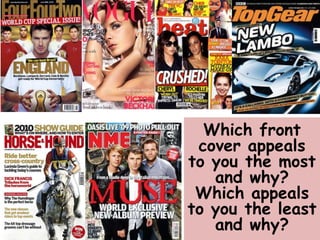
Which front
cover appeals
to you the most
and why?
Which appeals
to you the least
and why?
Techniques
What effect do the following
techniques have on an audience?
• Emotive words
• Personal pronouns
• Slang/colloquial language
• Puns
• Alliteration
• Exaggeration
• Statistics
• Broad generalisations and sweeping statements
• Imperatives e.g. ‘must’ or ‘have to’
• Words like ‘exclusive’, ‘unique’, secret’
• Emotive words form the basis of persuasive
language. Words that appeal to emotions can sway
opinions and influence decisions. Emotive words
are easy to detect because they give the reader
an immediate emotional response. Consider the
following list of words: ‘warm’, ‘gentle’, fragrant’,
‘whisper’, ‘kiss’, ‘love’. These words are emotive
because they make us feel something, in this case
something good. They have certain connotations,
the things readers associate with these words are
all favourable.
• However, there are other emotive words that
have the opposite effect. Consider this list: ‘old’,
‘stale’, penniless’, ‘ache’, ‘cold’, ‘winter’, ‘stench’.
These words all produce feelings that are
distasteful.
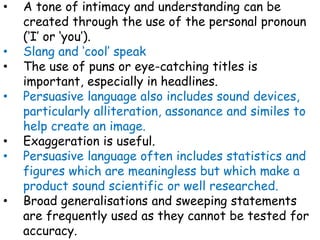
• A tone of intimacy and understanding can be
created through the use of the personal pronoun
(‘I’ or ‘you’).
• Slang and ‘cool’ speak
• The use of puns or eye-catching titles is
important, especially in headlines.
• Persuasive language also includes sound devices,
particularly alliteration, assonance and similes to
help create an image.
• Exaggeration is useful.
• Persuasive language often includes statistics and
figures which are meaningless but which make a
product sound scientific or well researched.
• Broad generalisations and sweeping statements
are frequently used as they cannot be tested for
accuracy.
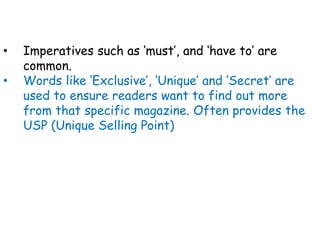
• Imperatives such as ‘must’, and ‘have to’ are
common.
• Words like ‘Exclusive’, ‘Unique’ and ‘Secret’ are
used to ensure readers want to find out more
from that specific magazine. Often provides the
USP (Unique Selling Point)
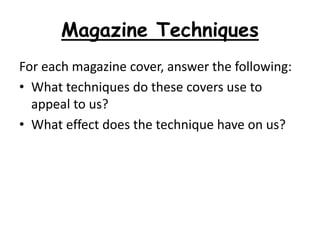
Magazine Techniques
For each magazine cover, answer the following:
• What techniques do these covers use to
appeal to us?
• What effect does the technique have on us?

2 magazine techniques

  • 1.
    Magazine Techniques Lesson Objective:To identify different techniques magazines use to appeal to their target audience
  • 2.
    Which front cover appeals toyou the most and why? Which appeals to you the least and why?
  • 3.
  • 4.
    What effect dothe following techniques have on an audience? • Emotive words • Personal pronouns • Slang/colloquial language • Puns • Alliteration • Exaggeration • Statistics • Broad generalisations and sweeping statements • Imperatives e.g. ‘must’ or ‘have to’ • Words like ‘exclusive’, ‘unique’, secret’
  • 5.
    • Emotive wordsform the basis of persuasive language. Words that appeal to emotions can sway opinions and influence decisions. Emotive words are easy to detect because they give the reader an immediate emotional response. Consider the following list of words: ‘warm’, ‘gentle’, fragrant’, ‘whisper’, ‘kiss’, ‘love’. These words are emotive because they make us feel something, in this case something good. They have certain connotations, the things readers associate with these words are all favourable. • However, there are other emotive words that have the opposite effect. Consider this list: ‘old’, ‘stale’, penniless’, ‘ache’, ‘cold’, ‘winter’, ‘stench’. These words all produce feelings that are distasteful.
  • 6.
    • A toneof intimacy and understanding can be created through the use of the personal pronoun (‘I’ or ‘you’). • Slang and ‘cool’ speak • The use of puns or eye-catching titles is important, especially in headlines. • Persuasive language also includes sound devices, particularly alliteration, assonance and similes to help create an image. • Exaggeration is useful. • Persuasive language often includes statistics and figures which are meaningless but which make a product sound scientific or well researched. • Broad generalisations and sweeping statements are frequently used as they cannot be tested for accuracy.
  • 7.
    • Imperatives suchas ‘must’, and ‘have to’ are common. • Words like ‘Exclusive’, ‘Unique’ and ‘Secret’ are used to ensure readers want to find out more from that specific magazine. Often provides the USP (Unique Selling Point)
  • 8.
    Magazine Techniques For eachmagazine cover, answer the following: • What techniques do these covers use to appeal to us? • What effect does the technique have on us?