LINNAEAN ERA
    By: Sara Ferrer &
  Mikayla van den Brenk
STARTING POINT OF MODERN
         TAXONOMY


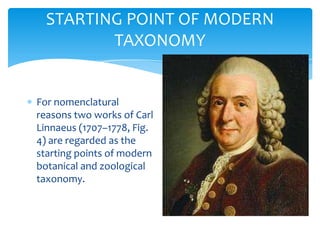
For nomenclatural
reasons two works of Carl
Linnaeus (1707–1778, Fig.
4) are regarded as the
starting points of modern
botanical and zoological
taxonomy.
The global flora Species
Plantarum, published in
1753 and the tenth edition
of Systema Naturae in
1758 including global
fauna.
The reason for this is that
Linnaeus introduced in
these books a binary form
of species names called
"trivial names" for both
plants and animals
For each species he
created an epithet that
could be used together
with the genus name. The
trivial names were
intended for fieldwork
and education, and not to
replace the earlier phrase
names.
The phrase names
included a description of
the species that
distinguished it from
other known species in
the genus.
With an expanded
knowledge of the global
fauna and flora through
17th and 18th century
scientific expeditions, a
large number of new
species were found and
named, and more terms
had to be added to each
phrase name.
By the time of Linnaeus
the situation was really
bad. Linnaeus counted
8530 species of flowering
plants in 1753.

2. linnaean era

  • 1.
    LINNAEAN ERA By: Sara Ferrer & Mikayla van den Brenk
  • 2.
    STARTING POINT OFMODERN TAXONOMY For nomenclatural reasons two works of Carl Linnaeus (1707–1778, Fig. 4) are regarded as the starting points of modern botanical and zoological taxonomy.
  • 3.
    The global floraSpecies Plantarum, published in 1753 and the tenth edition of Systema Naturae in 1758 including global fauna.
  • 4.
    The reason forthis is that Linnaeus introduced in these books a binary form of species names called "trivial names" for both plants and animals
  • 5.
    For each specieshe created an epithet that could be used together with the genus name. The trivial names were intended for fieldwork and education, and not to replace the earlier phrase names.
  • 6.
    The phrase names includeda description of the species that distinguished it from other known species in the genus.
  • 7.
    With an expanded knowledgeof the global fauna and flora through 17th and 18th century scientific expeditions, a large number of new species were found and named, and more terms had to be added to each phrase name.
  • 8.
    By the timeof Linnaeus the situation was really bad. Linnaeus counted 8530 species of flowering plants in 1753.