Brussels Briefing n. 30
Agricultural Resilience in the Face of Crises and Shocks
                      4th March 2013
               http://brusselsbriefings.net


         Promoting Resilient Livelihoods
Thierry Kesteloot, Policy Advisor, Oxfam-Solidarité
Promoting resilient livelihoods


Radical change needed by addressing inequality


Thierry Kesteloot        CTA Policy Briefing, March 2013
RESILIENCE IN TIMES OF FAILING
FOOD SYSTEMS
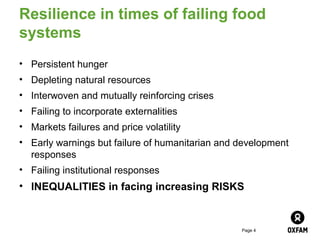
Resilience in times of failing food
systems
• Persistent hunger
• Depleting natural resources
• Interwoven and mutually reinforcing crises
• Failing to incorporate externalities
• Markets failures and price volatility
• Early warnings but failure of humanitarian and development
  responses
• Failing institutional responses
• INEQUALITIES in facing increasing RISKS


                                                 Page 4
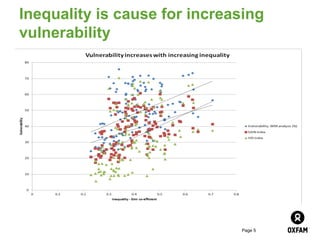
Inequality is cause for increasing
vulnerability


                              Page 5
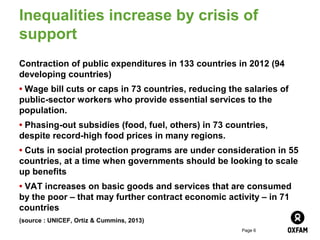
Inequalities increase by crisis of
support
Contraction of public expenditures in 133 countries in 2012 (94
developing countries)
• Wage bill cuts or caps in 73 countries, reducing the salaries of
public-sector workers who provide essential services to the
population.
• Phasing-out subsidies (food, fuel, others) in 73 countries,
despite record-high food prices in many regions.
• Cuts in social protection programs are under consideration in 55
countries, at a time when governments should be looking to scale
up benefits
• VAT increases on basic goods and services that are consumed
by the poor – that may further contract economic activity – in 71
countries
(source : UNICEF, Ortiz & Cummins, 2013)
                                                      Page 6
PEOPLE CENTERED RESILIENCE
Resilience-building based on equity
and rights
Poorer hurt subsequently :
- rights denied and left behind in the run-up to the crises
- most severely affected by crises
- more vulnerable towards increasing risks
- a few use power to reduce their own risks at the expense of more vulnerable
- suffer most from reduction in government expenditures

=> equity and rights based resilience-building should focus on the
structural causes of inequality that underlie the vulnerability and
disproportionate risk and uncertainty faced by poor and marginalised
people (especially vulnerable groups and women) rather than merely
addressing the symptoms caused by the impacts of stresses and shocks.


                                                              Page 8
Resilience-building based on equity
and rights
Resilience as the ability of women, men and children to realise their
rights and improve their wellbeing despite shocks, stresses and
uncertainty.

    •   aspirational nature of ‘being resilient’
    •   enable the poor and marginalised to not only ‘cope’ and survive, but also
        empower to transform
    •   challenges entrenched power and gender inequalities that perpetuate risks
        and vulnerabilities for certain people
    •   support the right to resources and capacities that people need to cope and
        even thrive within contexts of long-term change, volatility and unexpected
        shocks
    •   responsibility for governments and institutions to account for addressing
        both impacts and root causes


=> Return to “normal” (pre-crisis) is not a the solution


                                                                 Page 9
INSTRUMENTS AND POLICIES FOR
RESILIENCE
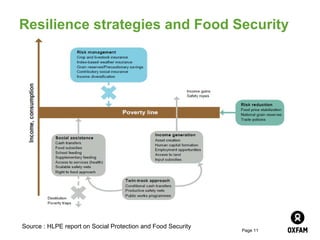
Resilience strategies and Food Security


Source : HLPE report on Social Protection and Food Security
                                                              Page 11
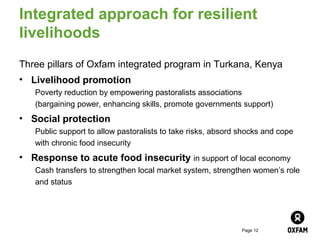
Integrated approach for resilient
livelihoods
Three pillars of Oxfam integrated program in Turkana, Kenya
• Livelihood promotion
   Poverty reduction by empowering pastoralists associations
   (bargaining power, enhancing skills, promote governments support)
• Social protection
   Public support to allow pastoralists to take risks, absord shocks and cope
   with chronic food insecurity
• Response to acute food insecurity in support of local economy
   Cash transfers to strengthen local market system, strengthen women’s role
   and status


                                                              Page 12
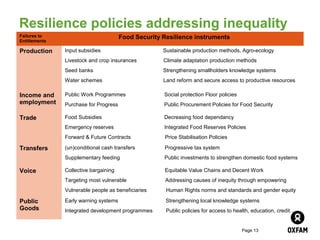
Resilience policies addressing inequality
Failures to                            Food Security Resilience instruments
Entitlements

Production     Input subsidies                       Sustainable production methods, Agro-ecology
               Livestock and crop insurances         Climate adaptation production methods
               Seed banks                            Strengthening smallholders knowledge systems
               Water schemes                         Land reform and secure access to productive resources

Income and     Public Work Programmes                Social protection Floor policies
employment     Purchase for Progress                 Public Procurement Policies for Food Security

Trade          Food Subsidies                        Decreasing food dependancy
               Emergency reserves                    Integrated Food Reserves Policies
               Forward & Future Contracts            Price Stabilisation Policies

Transfers      (un)conditional cash transfers        Progressive tax system
               Supplementary feeding                 Public investments to strengthen domestic food systems

Voice          Collective bargaining                 Equitable Value Chains and Decent Work
               Targeting most vulnerable              Addressing causes of inequity through empowering
               Vulnerable people as beneficiaries     Human Rights norms and standards and gender equity

Public         Early warning systems                  Strengthening local knowledge systems
Goods          Integrated development programmes      Public policies for access to health, education, credit…


                                                                                        Page 13
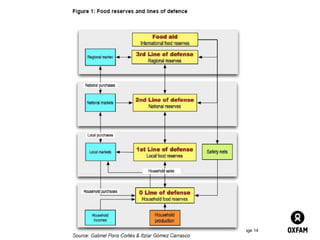
Page 14
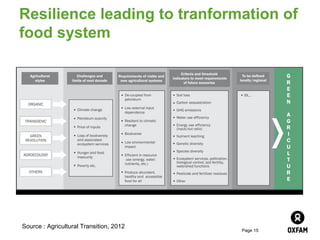
Resilience leading to tranformation of
food system


Source : Agricultural Transition, 2012
                                         Page 15
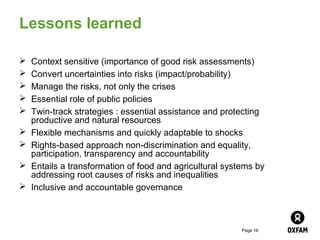
Lessons learned

   Context sensitive (importance of good risk assessments)
   Convert uncertainties into risks (impact/probability)
   Manage the risks, not only the crises
   Essential role of public policies
   Twin-track strategies : essential assistance and protecting
    productive and natural resources
   Flexible mechanisms and quickly adaptable to shocks
   Rights-based approach non-discrimination and equality,
    participation, transparency and accountability
   Entails a transformation of food and agricultural systems by
    addressing root causes of risks and inequalities
   Inclusive and accountable governance


                                                          Page 16
Policy Recommendations for Resilience
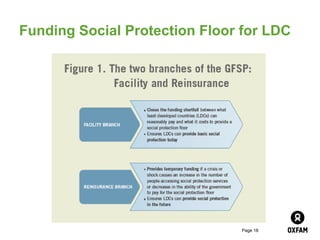
Funding Social Protection Floor for LDC


                               Page 18
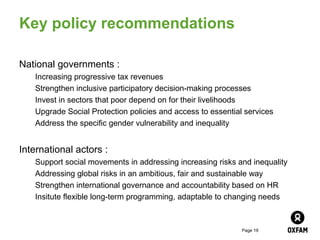
Key policy recommendations

National governments :
   Increasing progressive tax revenues
   Strengthen inclusive participatory decision-making processes
   Invest in sectors that poor depend on for their livelihoods
   Upgrade Social Protection policies and access to essential services
   Address the specific gender vulnerability and inequality


International actors :
   Support social movements in addressing increasing risks and inequality
   Addressing global risks in an ambitious, fair and sustainable way
   Strengthen international governance and accountability based on HR
   Insitute flexible long-term programming, adaptable to changing needs


                                                             Page 19
Thank you


            Page 20

30thBrussels Briefing on Agricultural Resilience- 2.Thierry Kesteloot: Promoting resilient livelihoods cta briefing

  • 1.
    Brussels Briefing n.30 Agricultural Resilience in the Face of Crises and Shocks 4th March 2013 http://brusselsbriefings.net Promoting Resilient Livelihoods Thierry Kesteloot, Policy Advisor, Oxfam-Solidarité
  • 2.
    Promoting resilient livelihoods Radicalchange needed by addressing inequality Thierry Kesteloot CTA Policy Briefing, March 2013
  • 3.
    RESILIENCE IN TIMESOF FAILING FOOD SYSTEMS
  • 4.
    Resilience in timesof failing food systems • Persistent hunger • Depleting natural resources • Interwoven and mutually reinforcing crises • Failing to incorporate externalities • Markets failures and price volatility • Early warnings but failure of humanitarian and development responses • Failing institutional responses • INEQUALITIES in facing increasing RISKS Page 4
  • 5.
    Inequality is causefor increasing vulnerability Page 5
  • 6.
    Inequalities increase bycrisis of support Contraction of public expenditures in 133 countries in 2012 (94 developing countries) • Wage bill cuts or caps in 73 countries, reducing the salaries of public-sector workers who provide essential services to the population. • Phasing-out subsidies (food, fuel, others) in 73 countries, despite record-high food prices in many regions. • Cuts in social protection programs are under consideration in 55 countries, at a time when governments should be looking to scale up benefits • VAT increases on basic goods and services that are consumed by the poor – that may further contract economic activity – in 71 countries (source : UNICEF, Ortiz & Cummins, 2013) Page 6
  • 7.
  • 8.
    Resilience-building based onequity and rights Poorer hurt subsequently : - rights denied and left behind in the run-up to the crises - most severely affected by crises - more vulnerable towards increasing risks - a few use power to reduce their own risks at the expense of more vulnerable - suffer most from reduction in government expenditures => equity and rights based resilience-building should focus on the structural causes of inequality that underlie the vulnerability and disproportionate risk and uncertainty faced by poor and marginalised people (especially vulnerable groups and women) rather than merely addressing the symptoms caused by the impacts of stresses and shocks. Page 8
  • 9.
    Resilience-building based onequity and rights Resilience as the ability of women, men and children to realise their rights and improve their wellbeing despite shocks, stresses and uncertainty. • aspirational nature of ‘being resilient’ • enable the poor and marginalised to not only ‘cope’ and survive, but also empower to transform • challenges entrenched power and gender inequalities that perpetuate risks and vulnerabilities for certain people • support the right to resources and capacities that people need to cope and even thrive within contexts of long-term change, volatility and unexpected shocks • responsibility for governments and institutions to account for addressing both impacts and root causes => Return to “normal” (pre-crisis) is not a the solution Page 9
  • 10.
  • 11.
    Resilience strategies andFood Security Source : HLPE report on Social Protection and Food Security Page 11
  • 12.
    Integrated approach forresilient livelihoods Three pillars of Oxfam integrated program in Turkana, Kenya • Livelihood promotion Poverty reduction by empowering pastoralists associations (bargaining power, enhancing skills, promote governments support) • Social protection Public support to allow pastoralists to take risks, absord shocks and cope with chronic food insecurity • Response to acute food insecurity in support of local economy Cash transfers to strengthen local market system, strengthen women’s role and status Page 12
  • 13.
    Resilience policies addressinginequality Failures to Food Security Resilience instruments Entitlements Production Input subsidies Sustainable production methods, Agro-ecology Livestock and crop insurances Climate adaptation production methods Seed banks Strengthening smallholders knowledge systems Water schemes Land reform and secure access to productive resources Income and Public Work Programmes Social protection Floor policies employment Purchase for Progress Public Procurement Policies for Food Security Trade Food Subsidies Decreasing food dependancy Emergency reserves Integrated Food Reserves Policies Forward & Future Contracts Price Stabilisation Policies Transfers (un)conditional cash transfers Progressive tax system Supplementary feeding Public investments to strengthen domestic food systems Voice Collective bargaining Equitable Value Chains and Decent Work Targeting most vulnerable Addressing causes of inequity through empowering Vulnerable people as beneficiaries Human Rights norms and standards and gender equity Public Early warning systems Strengthening local knowledge systems Goods Integrated development programmes Public policies for access to health, education, credit… Page 13
  • 14.
  • 15.
    Resilience leading totranformation of food system Source : Agricultural Transition, 2012 Page 15
  • 16.
    Lessons learned  Context sensitive (importance of good risk assessments)  Convert uncertainties into risks (impact/probability)  Manage the risks, not only the crises  Essential role of public policies  Twin-track strategies : essential assistance and protecting productive and natural resources  Flexible mechanisms and quickly adaptable to shocks  Rights-based approach non-discrimination and equality, participation, transparency and accountability  Entails a transformation of food and agricultural systems by addressing root causes of risks and inequalities  Inclusive and accountable governance Page 16
  • 17.
  • 18.
    Funding Social ProtectionFloor for LDC Page 18
  • 19.
    Key policy recommendations Nationalgovernments : Increasing progressive tax revenues Strengthen inclusive participatory decision-making processes Invest in sectors that poor depend on for their livelihoods Upgrade Social Protection policies and access to essential services Address the specific gender vulnerability and inequality International actors : Support social movements in addressing increasing risks and inequality Addressing global risks in an ambitious, fair and sustainable way Strengthen international governance and accountability based on HR Insitute flexible long-term programming, adaptable to changing needs Page 19
  • 20.
    Thank you Page 20