Evaluating Participatory Communication Programs 
Tom Jacobson 
prepared by Sheeva Dubey, for classroom discussion, 2014
Similar but different 
•Participatory Monitoring and Evaluation (PM&E) 
•Participatory Rural Appraisal (PRA) 
•Participatory Action Research (PAR) 
Then what is Participatory Communication for social change? 
prepared by Sheeva Dubey, for classroom discussion, 2014
Challenges with Participatory methods 
•Power of decision-making in the hands of communities concerned 
•Agreed-on measures of participation unavailable 
•Qualitative techniques are highly varied and not widely agreed on 
•No ‘hard’ data available to evaluate 
prepared by Sheeva Dubey, for classroom discussion, 2014
Conventional measures 
•Number of community members attending program meetings 
•Assessing the nature of leadership processes 
•Analyzing the structure of decision-making processes 
•Ease with which both genders are able to contribute to discussion 
Are we measuring communication or participation? 
prepared by Sheeva Dubey, for classroom discussion, 2014
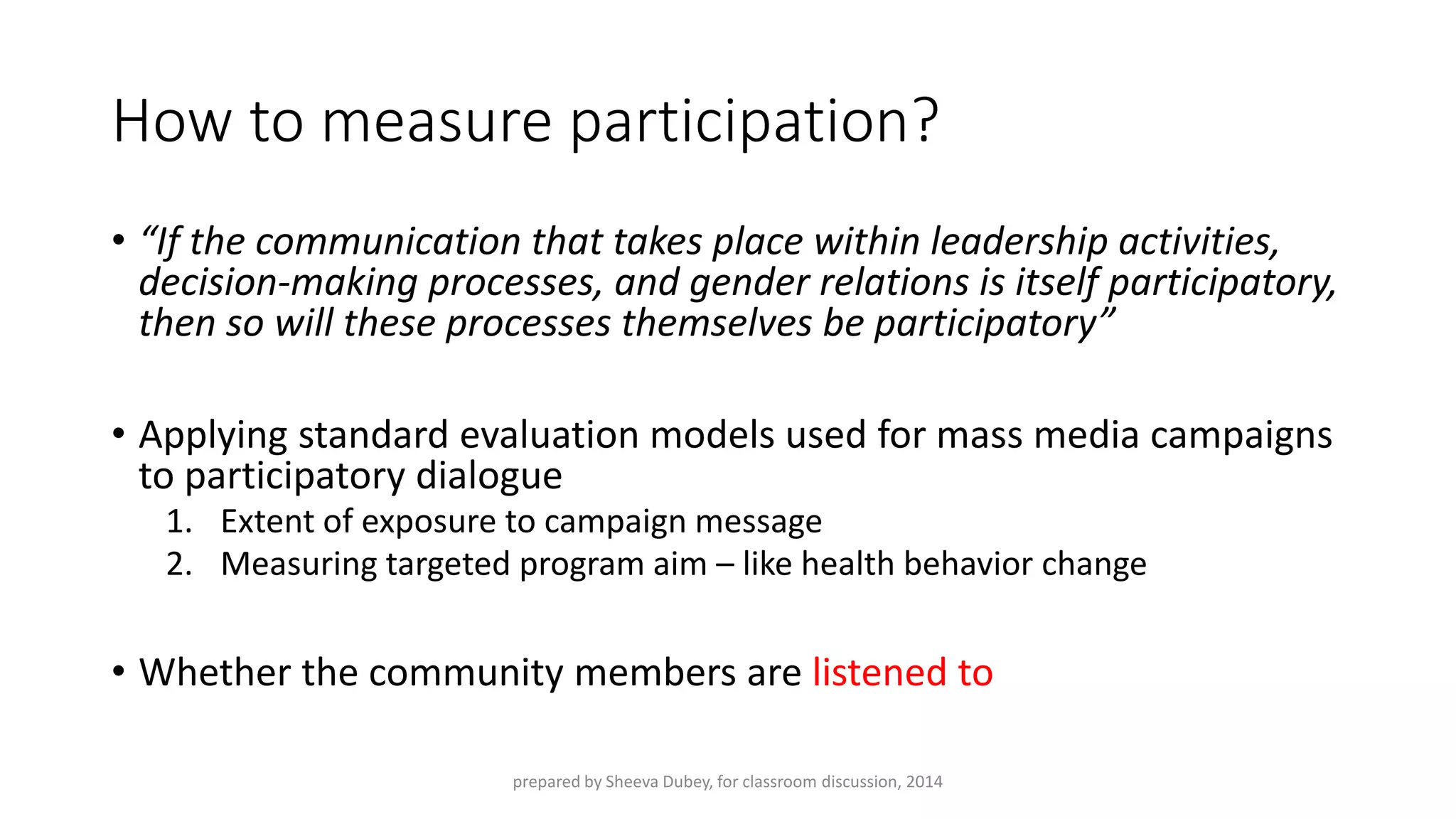
How to measure participation? 
•“If the communication that takes place within leadership activities, decision-making processes, and gender relations is itself participatory, then so will these processes themselves be participatory” 
•Applying standard evaluation models used for mass media campaigns to participatory dialogue 
1.Extent of exposure to campaign message 
2.Measuring targeted program aim –like health behavior change 
•Whether the community members are listened to 
prepared by Sheeva Dubey, for classroom discussion, 2014
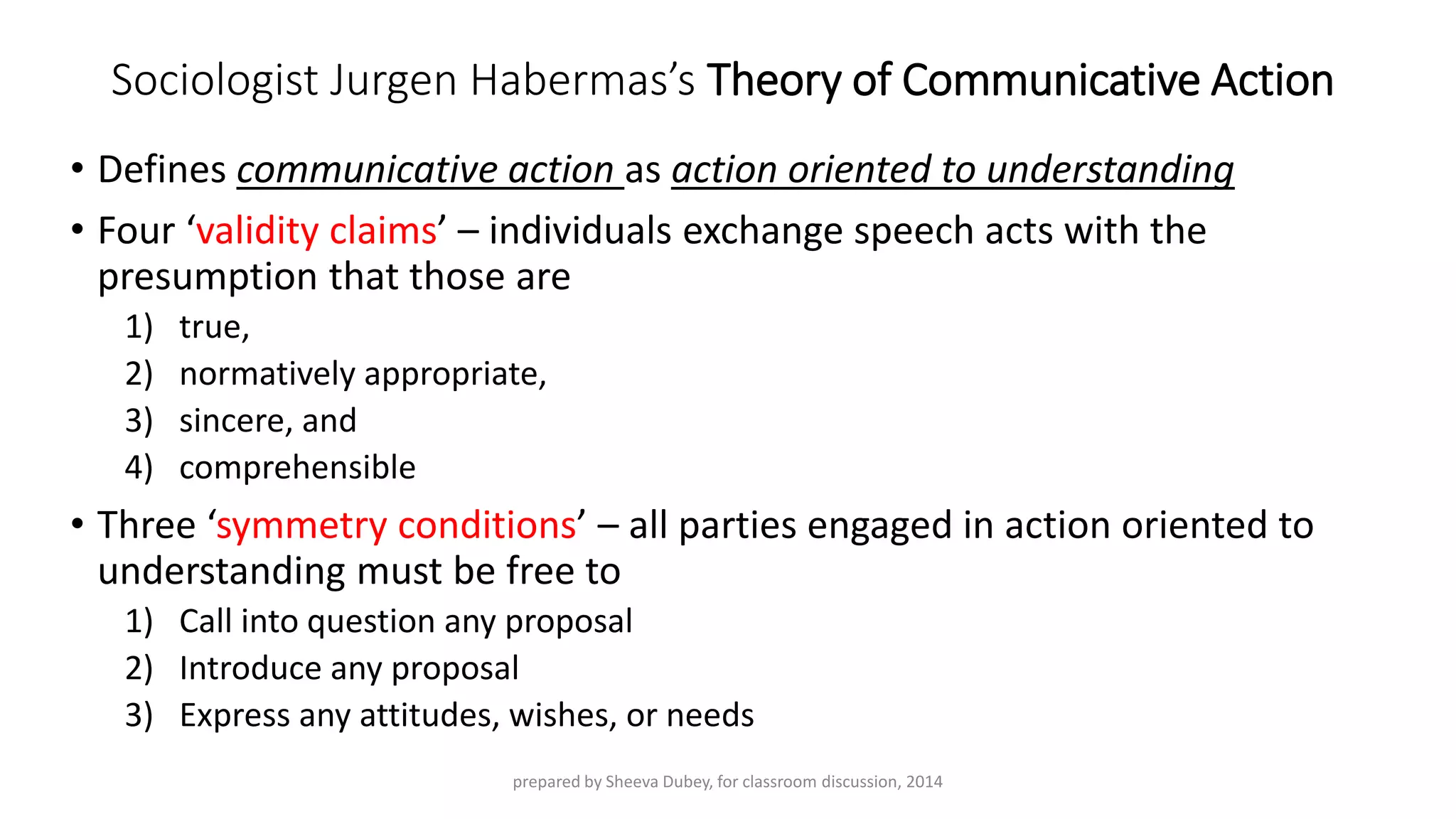
Sociologist JurgenHabermas’sTheory of Communicative Action 
•Defines communicative action as action oriented to understanding 
•Four ‘validity claims’ –individuals exchange speech acts with the presumption that those are 
1)true, 
2)normatively appropriate, 
3)sincere, and 
4)comprehensible 
•Three ‘symmetry conditions’ –all parties engaged in action oriented to understanding must be free to 
1)Call into question any proposal 
2)Introduce any proposal 
3)Express any attitudes, wishes, or needs 
prepared by Sheeva Dubey, for classroom discussion, 2014
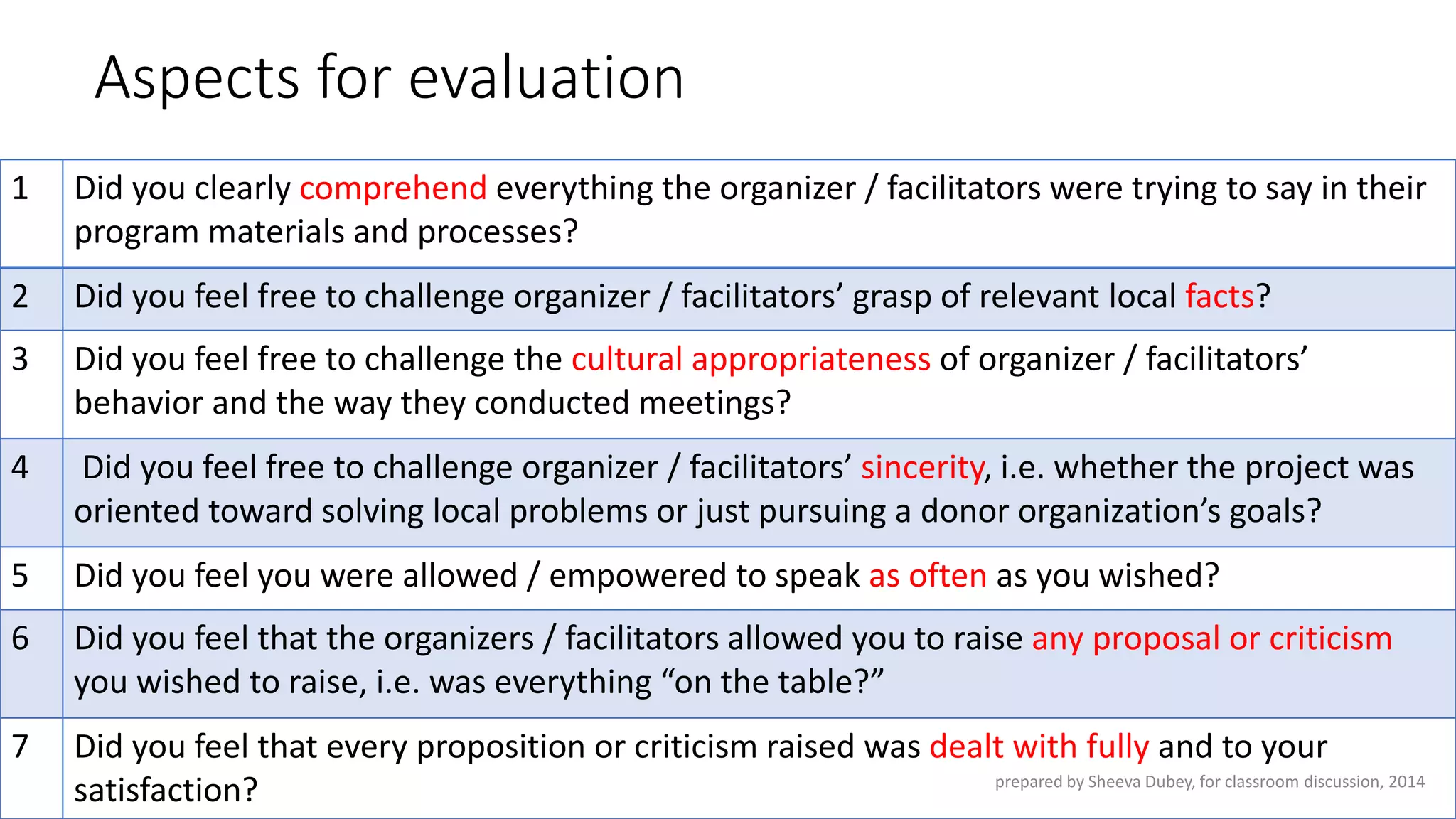
Aspects for evaluation 
1 
Did you clearly comprehendeverything the organizer / facilitators were tryingto say in their program materials and processes? 
2 
Did you feel free to challenge organizer / facilitators’ grasp of relevantlocal facts? 
3 
Did you feel free to challenge the cultural appropriateness of organizer/ facilitators’ behavior and the way they conducted meetings? 
4 
Did you feel free to challengeorganizer / facilitators’ sincerity, i.e. whether the project was oriented toward solving local problems or just pursuing a donor organization’s goals? 
5 
Did you feel you were allowed / empowered to speak as oftenas you wished? 
6 
Did you feel that the organizers/ facilitators allowed you to raise any proposal or criticism you wished to raise, i.e. was everything “on the table?” 
7 
Did you feel that every proposition or criticismraised was dealt with fully and to your satisfaction? prepared by Sheeva Dubey, for classroom discussion, 2014

2 evaluating participatory communication

  • 1.
    Evaluating Participatory CommunicationPrograms Tom Jacobson prepared by Sheeva Dubey, for classroom discussion, 2014
  • 2.
    Similar but different •Participatory Monitoring and Evaluation (PM&E) •Participatory Rural Appraisal (PRA) •Participatory Action Research (PAR) Then what is Participatory Communication for social change? prepared by Sheeva Dubey, for classroom discussion, 2014
  • 3.
    Challenges with Participatorymethods •Power of decision-making in the hands of communities concerned •Agreed-on measures of participation unavailable •Qualitative techniques are highly varied and not widely agreed on •No ‘hard’ data available to evaluate prepared by Sheeva Dubey, for classroom discussion, 2014
  • 4.
    Conventional measures •Numberof community members attending program meetings •Assessing the nature of leadership processes •Analyzing the structure of decision-making processes •Ease with which both genders are able to contribute to discussion Are we measuring communication or participation? prepared by Sheeva Dubey, for classroom discussion, 2014
  • 5.
    How to measureparticipation? •“If the communication that takes place within leadership activities, decision-making processes, and gender relations is itself participatory, then so will these processes themselves be participatory” •Applying standard evaluation models used for mass media campaigns to participatory dialogue 1.Extent of exposure to campaign message 2.Measuring targeted program aim –like health behavior change •Whether the community members are listened to prepared by Sheeva Dubey, for classroom discussion, 2014
  • 6.
    Sociologist JurgenHabermas’sTheory ofCommunicative Action •Defines communicative action as action oriented to understanding •Four ‘validity claims’ –individuals exchange speech acts with the presumption that those are 1)true, 2)normatively appropriate, 3)sincere, and 4)comprehensible •Three ‘symmetry conditions’ –all parties engaged in action oriented to understanding must be free to 1)Call into question any proposal 2)Introduce any proposal 3)Express any attitudes, wishes, or needs prepared by Sheeva Dubey, for classroom discussion, 2014
  • 7.
    Aspects for evaluation 1 Did you clearly comprehendeverything the organizer / facilitators were tryingto say in their program materials and processes? 2 Did you feel free to challenge organizer / facilitators’ grasp of relevantlocal facts? 3 Did you feel free to challenge the cultural appropriateness of organizer/ facilitators’ behavior and the way they conducted meetings? 4 Did you feel free to challengeorganizer / facilitators’ sincerity, i.e. whether the project was oriented toward solving local problems or just pursuing a donor organization’s goals? 5 Did you feel you were allowed / empowered to speak as oftenas you wished? 6 Did you feel that the organizers/ facilitators allowed you to raise any proposal or criticism you wished to raise, i.e. was everything “on the table?” 7 Did you feel that every proposition or criticismraised was dealt with fully and to your satisfaction? prepared by Sheeva Dubey, for classroom discussion, 2014