Partnering with Ease-Agr to Extend and Expand 
Cooperative Agribusiness in Africa: 
organizational diagnostics, international networking and big data 
Nicola Francesconi, CIAT-CGIAR 
g.n.francesconi@cigar.org 
IFPRI/IITA office, Naguru Hill 
CIAT office, Kawanda 
Tel. 0794756336 
EDC 
Enhancing 
Development 
through Cooperatives
Did you know? 
• the UN declared 2012 as the International Year of Cooperatives 
• cooperatives play a major role in rural financial and extension services worldwide 
• 50% of global agricultural output is marketed through cooperatives 
• cooperatives were instrumental for the success of family farms in the US and EU 
Coops prevalence 
in Africa 
% of rural villages 
with at least one coop 
Senegal 47 
Burkina Faso 56 
Ethiopia 35 
Uganda 31 
Recent data from CIAT shows that 80% 
of Ugandan bean producers are 
members of at least one coop
What is a cooperative? 
Not an NGO or a parastatal because it is a for profit organization 
Not an Investor-Owned Firm (IOF) because it is: 
an organization owned/controlled by individuals benefiting from its services 
or 
a user-owned, user-controlled and user-benefitted organization
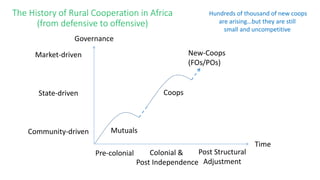
The History of Rural Cooperation in Africa 
(from defensive to offensive) 
Time 
Market-driven 
State-driven 
Community-driven Mutuals 
Coops 
New-Coops 
(FOs/POs) 
Pre-colonial Colonial & 
Post Independence 
Post Structural 
Adjustment 
Governance 
Hundreds of thousand of new coops 
are arising…but they are still 
small and uncompetitive
Our previous research shows that: 
• Cooperatives are widespread and resilient organizations in Africa 
• Participation in cooperatives improves farmers’ technical efficiency 
(i.e. adoption of improved technology, to produce with less..) 
• Cooperatives tend to be affected by allocative inefficiency: 
elite-capture and side-selling (no inclusive business) 
How to help cooperatives optimize their sustainability?
The Cooperative Life Cycle Framework
How Do you Measure Coop Health? 
• Is it just financial performance (i.e. investments and profit)? 
• What about membership size, social inclusion and members’ patronage 
(i.e. participation)? 
Minimizing governance problems that hinders participation 
is as important as maximizing profit and investments…
Health of Cooperative 
P1 
Phase 1 = Economic Justification 
Time 
Phase 1
Phase 1: Economic Justification 
• Better Access to Markets? 
• Economies of scale? 
• Social capital? 
• Bargaining/Countervailing power? 
• Multiple rent extraction?
Phase 2 
Health of Cooperative 
P2 
Phase 2 = Organizational Design 
Time
Phase 2: Organizational Design 
(the rules of the game) 
• Who can be a member? 
• Who/how is risk capital acquired? 
• Who has residual claim rights? 
• Who has residual control rights? 
• Sanctions - Enforcement
Phase 3 
P3 
Health of Cooperative 
Phase 3 = Growth–Glory–Heterogeneity 
Time
Phase 3: Glory and Growth 
Glory = external incentives, i.e. better price, tax exemptions, subsidized inputs/credit 
This competitive advantage triggers: 
Growth = expansion in membership and increasing members’ patronage 
However, growth tends to add managerial and leadership complexity, due to the rise of: 
1. the free-rider problem = when many new members enter a group and claim the same 
benefits of existing members 
2. horizon or portfolio problems = when members’ patronage is used to pursue investment 
strategies that are either too risky (i.e. one big and long term investment) or too cautious 
(i.e. multiple small and short term investments) 
3. agency cost problems = when growth is associated with high internal monitoring, influence 
and decision making costs
Phase 3: Heterogeneity 
• These governance problems create increasing disincentives for members’ participation (side-selling 
and membership expansion) affecting coop health 
• To minimize these problems coop leaders and managers need to “tinker”, or adjust the rules of 
the game, in such a way to design and enforce solutions 
• When coop leaders and managers are able to “tinker” they extend the length of the life cycle 
• “Tinkering” occurs only when there is consensus among coop managers and leaders, i.e. when 
their preferences are homogenous enough to quickly craft and enforce solutions 
• Yet, the preferences of coop leaders and managers tend to diverge over time (Heterogeneity) 
• “Tinkering” is a temporary strategy, which can extend a life cycle, but not indefinitely…
Phase 4 
P4 
Health of Cooperative 
Phase 4 = Recognition and Introspection 
Time
Phase 4: Recognition and Introspection 
• Factions? 
• Apathy? 
• Crisis? 
• Members’ drift? 
• Side-selling? 
Sooner or later a cooperative will no longer be able 
to “tinker”, due to increasing heterogeneity in the 
preferences of its leaders/managers… 
…and will have to do introspection and recognize its 
governance problems 
• Elite Capture? (the coop becomes a separate firm)
Reinvent 
Spawn 
Exit 
P5 
Health of Cooperative 
Phase 5 = Choice 
Time 
Phase 5
Phase 5: Choices 
• Reinvent? 
• Spawn? 
• Exit? 
a cooperative that can no longer “tinker” can 
decide to either dismantle itself or re-invent its 
governance structure and enter a new life cycle…
In which phase are you in?
What exactly am I proposing? 
1- to help you extend and optimize your business cycle 
• To use this framework to perform organizational diagnostics of your 
coops, to build leadership and management consensus (or reduce 
heterogeneity) on how to “tinker” 
• We are not offering solutions…but we can help you find your own, 
through training and coaching sessions like this one
An International Network for Cooperative Research & Development 
Donors: 
USAID, Ford Foundation 
CIAT/EURICSE 
EASE-AGR/KDA 
African 
Coops 
GICL/ISPRI 
US, NZ, EU, Brazil, 
China, etc. Coops 
Projects: 
(OCDC, CGIAR, OXFAM, 
FAO, SNV, GIF, etc.) 
Public funds (grants) 
Private funds 
strategy 
(revenues), strategy 
Research & Outreach 
BDS, Network, 
Diagnostics 
MU
What exactly am I proposing? 
2- to help you expand and globalize your business 
Promoting and facilitating networking between your coops 
and other ones at the local, national, regional and global level 
to nurture (inter)national strategic alliances, joint ventures and mergers… 
Large 
mature and 
offensive coops 
Networking 
Small, young and defensive coops
What do I need from you? 
Time, Engagement, Trust and…Data, Data and more Data! 
With your help we can build an ICT platform 
that will not only help you sell your coffee, maize, etc., 
but also your data… 
No more time-consuming surveys 
but an automated ICT system for data collection

Ease final by Gian Nicola Francesconi

  • 1.
    Partnering with Ease-Agrto Extend and Expand Cooperative Agribusiness in Africa: organizational diagnostics, international networking and big data Nicola Francesconi, CIAT-CGIAR g.n.francesconi@cigar.org IFPRI/IITA office, Naguru Hill CIAT office, Kawanda Tel. 0794756336 EDC Enhancing Development through Cooperatives
  • 2.
    Did you know? • the UN declared 2012 as the International Year of Cooperatives • cooperatives play a major role in rural financial and extension services worldwide • 50% of global agricultural output is marketed through cooperatives • cooperatives were instrumental for the success of family farms in the US and EU Coops prevalence in Africa % of rural villages with at least one coop Senegal 47 Burkina Faso 56 Ethiopia 35 Uganda 31 Recent data from CIAT shows that 80% of Ugandan bean producers are members of at least one coop
  • 3.
    What is acooperative? Not an NGO or a parastatal because it is a for profit organization Not an Investor-Owned Firm (IOF) because it is: an organization owned/controlled by individuals benefiting from its services or a user-owned, user-controlled and user-benefitted organization
  • 4.
    The History ofRural Cooperation in Africa (from defensive to offensive) Time Market-driven State-driven Community-driven Mutuals Coops New-Coops (FOs/POs) Pre-colonial Colonial & Post Independence Post Structural Adjustment Governance Hundreds of thousand of new coops are arising…but they are still small and uncompetitive
  • 5.
    Our previous researchshows that: • Cooperatives are widespread and resilient organizations in Africa • Participation in cooperatives improves farmers’ technical efficiency (i.e. adoption of improved technology, to produce with less..) • Cooperatives tend to be affected by allocative inefficiency: elite-capture and side-selling (no inclusive business) How to help cooperatives optimize their sustainability?
  • 6.
    The Cooperative LifeCycle Framework
  • 7.
    How Do youMeasure Coop Health? • Is it just financial performance (i.e. investments and profit)? • What about membership size, social inclusion and members’ patronage (i.e. participation)? Minimizing governance problems that hinders participation is as important as maximizing profit and investments…
  • 8.
    Health of Cooperative P1 Phase 1 = Economic Justification Time Phase 1
  • 9.
    Phase 1: EconomicJustification • Better Access to Markets? • Economies of scale? • Social capital? • Bargaining/Countervailing power? • Multiple rent extraction?
  • 10.
    Phase 2 Healthof Cooperative P2 Phase 2 = Organizational Design Time
  • 11.
    Phase 2: OrganizationalDesign (the rules of the game) • Who can be a member? • Who/how is risk capital acquired? • Who has residual claim rights? • Who has residual control rights? • Sanctions - Enforcement
  • 12.
    Phase 3 P3 Health of Cooperative Phase 3 = Growth–Glory–Heterogeneity Time
  • 13.
    Phase 3: Gloryand Growth Glory = external incentives, i.e. better price, tax exemptions, subsidized inputs/credit This competitive advantage triggers: Growth = expansion in membership and increasing members’ patronage However, growth tends to add managerial and leadership complexity, due to the rise of: 1. the free-rider problem = when many new members enter a group and claim the same benefits of existing members 2. horizon or portfolio problems = when members’ patronage is used to pursue investment strategies that are either too risky (i.e. one big and long term investment) or too cautious (i.e. multiple small and short term investments) 3. agency cost problems = when growth is associated with high internal monitoring, influence and decision making costs
  • 14.
    Phase 3: Heterogeneity • These governance problems create increasing disincentives for members’ participation (side-selling and membership expansion) affecting coop health • To minimize these problems coop leaders and managers need to “tinker”, or adjust the rules of the game, in such a way to design and enforce solutions • When coop leaders and managers are able to “tinker” they extend the length of the life cycle • “Tinkering” occurs only when there is consensus among coop managers and leaders, i.e. when their preferences are homogenous enough to quickly craft and enforce solutions • Yet, the preferences of coop leaders and managers tend to diverge over time (Heterogeneity) • “Tinkering” is a temporary strategy, which can extend a life cycle, but not indefinitely…
  • 15.
    Phase 4 P4 Health of Cooperative Phase 4 = Recognition and Introspection Time
  • 16.
    Phase 4: Recognitionand Introspection • Factions? • Apathy? • Crisis? • Members’ drift? • Side-selling? Sooner or later a cooperative will no longer be able to “tinker”, due to increasing heterogeneity in the preferences of its leaders/managers… …and will have to do introspection and recognize its governance problems • Elite Capture? (the coop becomes a separate firm)
  • 17.
    Reinvent Spawn Exit P5 Health of Cooperative Phase 5 = Choice Time Phase 5
  • 18.
    Phase 5: Choices • Reinvent? • Spawn? • Exit? a cooperative that can no longer “tinker” can decide to either dismantle itself or re-invent its governance structure and enter a new life cycle…
  • 19.
    In which phaseare you in?
  • 20.
    What exactly amI proposing? 1- to help you extend and optimize your business cycle • To use this framework to perform organizational diagnostics of your coops, to build leadership and management consensus (or reduce heterogeneity) on how to “tinker” • We are not offering solutions…but we can help you find your own, through training and coaching sessions like this one
  • 21.
    An International Networkfor Cooperative Research & Development Donors: USAID, Ford Foundation CIAT/EURICSE EASE-AGR/KDA African Coops GICL/ISPRI US, NZ, EU, Brazil, China, etc. Coops Projects: (OCDC, CGIAR, OXFAM, FAO, SNV, GIF, etc.) Public funds (grants) Private funds strategy (revenues), strategy Research & Outreach BDS, Network, Diagnostics MU
  • 22.
    What exactly amI proposing? 2- to help you expand and globalize your business Promoting and facilitating networking between your coops and other ones at the local, national, regional and global level to nurture (inter)national strategic alliances, joint ventures and mergers… Large mature and offensive coops Networking Small, young and defensive coops
  • 23.
    What do Ineed from you? Time, Engagement, Trust and…Data, Data and more Data! With your help we can build an ICT platform that will not only help you sell your coffee, maize, etc., but also your data… No more time-consuming surveys but an automated ICT system for data collection