Insert date here
Biosimilars in the world of bio-products: war and peace,
missed expectations and future hopes
Nickolai Demidov
Conference on bio-products, IMS Health, Moscow, May 16th 2013
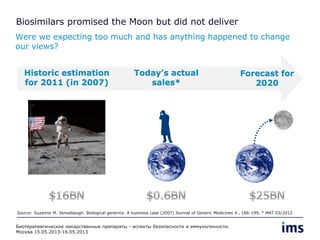
Biosimilars promised the Moon but did not deliver
Were we expecting too much and has anything happened to change
our views?
Forecast for
2020
Historic estimation
for 2011 (in 2007)
Today’s actual
sales*
Source: Suzanne M. Sensabaugh. Biological generics: A business case (2007) Journal of Generic Medicines 4 , 186-199, * MAT 03/2012
Биотерапевтические лекарственные препараты - аспекты безопасности и иммуногенности.
Москва 15.05.2013-16.05.2013
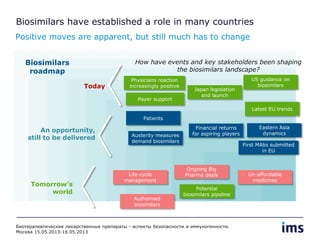
Biosimilars have established a role in many countries
Positive moves are apparent, but still much has to change
US guidance on
biosimilars
Biosimilars
roadmap
Latest EU trends
Japan legislation
and launch
Eastern Asia
dynamics
First MAbs submitted
in EU
Ongoing Big
Pharma deals
Austerity measures
demand biosimilars
Physicians reaction
increasingly positive
Tomorrow’s
world
An opportunity,
still to be delivered
Today
Patients
Financial returns
for aspiring players
How have events and key stakeholders been shaping
the biosimilars landscape?
Authorised
biosimilars
Payer support
Un-affordable
medicines
Potential
biosimilars pipeline
Life-cycle
management
Биотерапевтические лекарственные препараты - аспекты безопасности и иммуногенности.
Москва 15.05.2013-16.05.2013
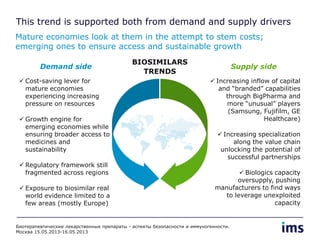
This trend is supported both from demand and supply drivers
Mature economies look at them in the attempt to stem costs;
emerging ones to ensure access and sustainable growth
BIOSIMILARS
TRENDS
Demand side Supply side
 Cost-saving lever for
mature economies
experiencing increasing
pressure on resources
 Growth engine for
emerging economies while
ensuring broader access to
medicines and
sustainability
 Regulatory framework still
fragmented across regions
 Exposure to biosimilar real
world evidence limited to a
few areas (mostly Europe)
 Increasing inflow of capital
and “branded” capabilities
through BigPharma and
more “unusual” players
(Samsung, Fujifilm, GE
Healthcare)
 Increasing specialization
along the value chain
unlocking the potential of
successful partnerships
 Biologics capacity
oversupply, pushing
manufacturers to find ways
to leverage unexploited
capacity
Биотерапевтические лекарственные препараты - аспекты безопасности и иммуногенности.
Москва 15.05.2013-16.05.2013
Biologics growth is nearly double that of total pharma
Putting additional financial pressure on healthcare budgets
Source: IMS Health, MIDAS, MAT 09/2012
0%
2%
4%
6%
8%
10%
12%
14%
16%
0
20
40
60
80
100
120
140
160
180
2006 2007 2008 2009 2010 2011 2012
Sales,US$billions
Biologics Sales Biologics Growth
Total Pharma growth
2,6%
5,4%
21,9%
9,2%
12,5%
48,5%
Canada E7 EU5
JAPAN Others US
4,3%
11,6%
13,3%
9,2%
12,2%
49,5%
Biologics – Share of sales
Biologics – Share of growth
Global market trends
MAT 09/2012, US$
Биотерапевтические лекарственные препараты - аспекты безопасности и иммуногенности.
Москва 15.05.2013-16.05.2013
Three geographical clusters exist
Emerging economies anticipated to be a potential growth driver due to
local policies and lower regulatory hurdles
7% 10% 10% 14% 14% 14% 23% 11% 27% 19% 59% 45%
Biologics,
2006-11
CAGR
73
1. US
Potential
leading
market for
biosimilars
2. Advanced economies
Established framework for
biosimilars, but slow
uptake
3. Emerging economies
Follow-on biologics* already established
(looser regulatory pathway) and fast-
growing biologics market
Source: IMS MIDAS, 2006-11
Биотерапевтические лекарственные препараты - аспекты безопасности и иммуногенности.
Москва 15.05.2013-16.05.2013
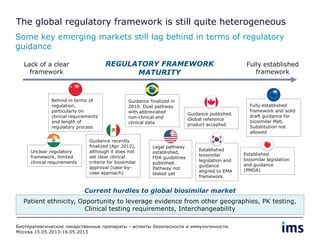
The global regulatory framework is still quite heterogeneous
Some key emerging markets still lag behind in terms of regulatory
guidance
Lack of a clear
framework
Fully established
framework
REGULATORY FRAMEWORK
MATURITY
Established
biosimilar
legislation and
guidance
aligned to EMA
framework.
Fully established
framework and solid
draft guidance for
biosimilar Mab.
Substitution not
allowed
Guidance published.
Global reference
product accepted
Behind in terms of
regulation,
particularly on
clinical requirements
and length of
regulatory process
Guidance finalized in
2010. Dual pathway
with abbreviated
non-clinical and
clinical data
Guidance recently
finalized (Apr 2012),
although it does not
set clear clinical
criteria for biosimilar
approval (case-by-
case approach)
Established
biosimilar legislation
and guidance
(PMDA)
Unclear regulatory
framework, limited
clinical requirements
Legal pathway
established,
FDA guidelines
published.
Pathway not
tested yet
Patient ethnicity, Opportunity to leverage evidence from other geographies, PK testing,
Clinical testing requirements, Interchangeability
Current hurdles to global biosimilar market
Биотерапевтические лекарственные препараты - аспекты безопасности и иммуногенности.
Москва 15.05.2013-16.05.2013
Three documents to address
the biosimilar approval
pathway
1. Scientific considerations in
demonstrating
biosimilarity to a reference
product
2. Quality considerations in
demonstrating
biosimilarity to a reference
product
3. Biosimilars: Questions
and Answers regarding
implementation of
the BPCI Act of 2009
Will the latest US guidance unlock potential upside scenarios?
The totality of evidence principle could favour approval of biosimilars
marketed in other geographies
US guidance: the facts Outcomes
Totality of evidence principle
Clear framework to identify criteria to
design clinical studies to prove
biosimilarity
Allowance of slight differences with RP,
especially on delivery technologies
More interactive process with FDA than the
normal biologics pathway
Interchangeability still a theoretical
concept for the time being
Биотерапевтические лекарственные препараты - аспекты безопасности и иммуногенности.
Москва 15.05.2013-16.05.2013
0%
10%
20%
30%
40%
50%
60%
70%
80%
90%
100%
Jun-07 Dec-07 Jun-08 Dec-08 Jun-09 Dec-09 Jun-10 Dec-10 Jun-11 Dec-11 Jun-12
%Uptake,SU
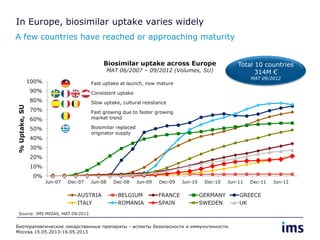
Biosimilar uptake across Europe
MAT 06/2007 – 09/2012 (Volumes, SU)
AUSTRIA BELGIUM FRANCE GERMANY GREECE
ITALY ROMANIA SPAIN SWEDEN UK
Total 10 countries
314M €
MAT 09/2012
Fast uptake at launch, now mature
Consistent uptake
Slow uptake, cultural resistance
Fast growing due to faster growing
market trend
Biosimilar replaced
originator supply
In Europe, biosimilar uptake varies widely
A few countries have reached or approaching maturity
Source: IMS MIDAS, MAT 09/2012
Биотерапевтические лекарственные препараты - аспекты безопасности и иммуногенности.
Москва 15.05.2013-16.05.2013
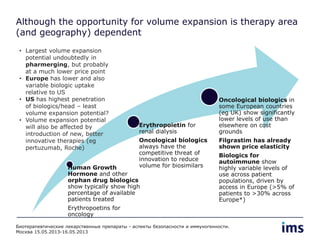
Although the opportunity for volume expansion is therapy area
(and geography) dependent
Human Growth
Hormone and other
orphan drug biologics
show typically show high
percentage of available
patients treated
Erythropoetins for
oncology
Erythropoietin for
renal dialysis
Oncological biologics
always have the
competitive threat of
innovation to reduce
volume for biosimilars
Oncological biologics in
some European countries
(eg UK) show significantly
lower levels of use than
elsewhere on cost
grounds
Filgrastim has already
shown price elasticity
Biologics for
autoimmune show
highly variable levels of
use across patient
populations, driven by
access in Europe (>5% of
patients to >30% across
Europe*)
• Largest volume expansion
potential undoubtedly in
pharmerging, but probably
at a much lower price point
• Europe has lower and also
variable biologic uptake
relative to US
• US has highest penetration
of biologics/head – least
volume expansion potential?
• Volume expansion potential
will also be affected by
introduction of new, better
innovative therapies (eg
pertuzumab, Roche)
Биотерапевтические лекарственные препараты - аспекты безопасности и иммуногенности.
Москва 15.05.2013-16.05.2013
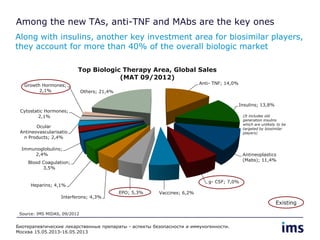
Among the new TAs, anti-TNF and MAbs are the key ones
Along with insulins, another key investment area for biosimilar players,
they account for more than 40% of the overall biologic market
Existing
Anti- TNF; 14,0%
Insulins; 13,8%
Antineoplastics
(Mabs); 11,4%
g- CSF; 7,0%
Vaccines; 6,2%EPO; 5,3%
Interferons; 4,3%
Heparins; 4,1%
Blood Coagulation;
3,5%
Immunoglobulins;
2,4%
Ocular
Antineovascularisatio
n Products; 2,4%
Cytostatic Hormones;
2,1%
Growth Hormones;
2,1% Others; 21,4%
Top Biologic Therapy Area, Global Sales
(MAT 09/2012)
(It includes old
generation insulins
which are unlikely to be
targeted by biosimilar
players)
Source: IMS MIDAS, 09/2012
Биотерапевтические лекарственные препараты - аспекты безопасности и иммуногенности.
Москва 15.05.2013-16.05.2013
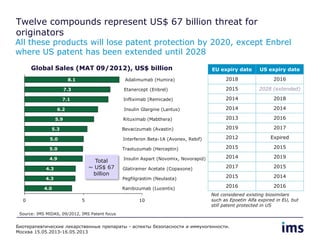
Twelve compounds represent US$ 67 billion threat for
originators
All these products will lose patent protection by 2020, except Enbrel
where US patent has been extended until 2028
EU expiry date US expiry date
2018 2016
2015 2028 (extended)
2014 2018
2014 2014
2013 2016
2019 2017
2012 Expired
2015 2015
2014 2019
2017 2015
2015 2014
2016 2016
Not considered existing biosimilars
such as Epoetin Alfa expired in EU, but
still patent protected in US
Source: IMS MIDAS, 09/2012, IMS Patent focus
1050
4.9
Trastuzumab (Herceptin)5.0
Interferon Beta-1A (Avonex, Rebif)5.0
Bevacizumab (Avastin)5.3
Rituximab (Mabthera)5.9
Insulin Glargine (Lantus)6.2
Infliximab (Remicade)
Ranibizumab (Lucentis)4.0
Pegfilgrastim (Neulasta)4.3
Glatiramer Acetate (Copaxone)4.3
Insulin Aspart (Novomix, Novorapid)
7.1
Etanercept (Enbrel)7.3
Adalimumab (Humira)8.1
Global Sales (MAT 09/2012), US$ billion
Total
~ US$ 67
billion
Биотерапевтические лекарственные препараты - аспекты безопасности и иммуногенности.
Москва 15.05.2013-16.05.2013
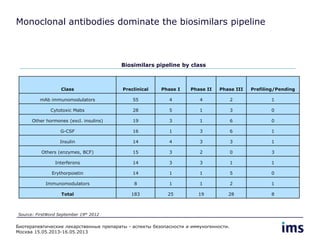
Monoclonal antibodies dominate the biosimilars pipeline
Class Preclinical Phase I Phase II Phase III Prefiling/Pending
mAb immunomodulators 55 4 4 2 1
Cytotoxic Mabs 28 5 1 3 0
Other hormones (excl. insulins) 19 3 1 6 0
G-CSF 16 1 3 6 1
Insulin 14 4 3 3 1
Others (enzymes, BCF) 15 3 2 0 3
Interferons 14 3 3 1 1
Erythorpoietin 14 1 1 5 0
Immunomodulators 8 1 1 2 1
Total 183 25 19 28 8
Biosimilars pipeline by class
Source: FirstWord September 19th 2012
Биотерапевтические лекарственные препараты - аспекты безопасности и иммуногенности.
Москва 15.05.2013-16.05.2013
Biosimilars have been a hot topic in the last 3 years
The landscape is becoming over-populated. Is there a market for
everybody?
Innovator companies Generics companies Other players
CRAMS* providers / Emerging market domestic players
*CRAMS, Contract Research and Manufacturing Services ** Based on press release news
Potential
entrants**
(Fujifilm Kyowa Kirin Biologics)
Биотерапевтические лекарственные препараты - аспекты безопасности и иммуногенности.
Москва 15.05.2013-16.05.2013
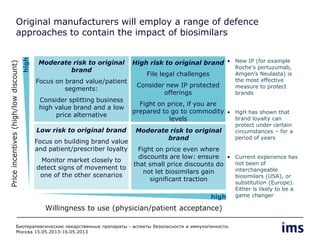
Original manufacturers will employ a range of defence
approaches to contain the impact of biosimilars
Moderate risk to original
brand
Focus on brand value/patient
segments:
Consider splitting business
high value brand and a low
price alternative
high
high
High risk to original brand
File legal challenges
Consider new IP protected
offerings
Fight on price, if you are
prepared to go to commodity
levels
Moderate risk to original
brand
Fight on price even where
discounts are low: ensure
that small price discounts do
not let biosimilars gain
significant traction
Low risk to original brand
Focus on building brand value
and patient/prescriber loyalty
Monitor market closely to
detect signs of movement to
one of the other scenarios
• New IP (for example
Roche’s pertuzumab,
Amgen’s Neulasta) is
the most effective
measure to protect
brands
• HgH has shown that
brand loyalty can
protect under certain
circumstances – for a
period of years
• Current experience has
not been of
interchangeable
biosimilars (USA), or
substitution (Europe).
Either is likely to be a
game changer
Priceincentives(high/lowdiscount)
Willingness to use (physician/patient acceptance)
Биотерапевтические лекарственные препараты - аспекты безопасности и иммуногенности.
Москва 15.05.2013-16.05.2013
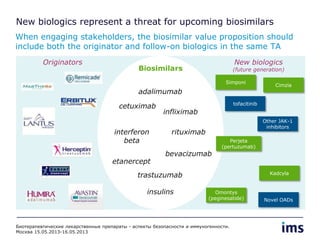
New biologics represent a threat for upcoming biosimilars
When engaging stakeholders, the biosimilar value proposition should
include both the originator and follow-on biologics in the same TA
Biosimilars
Originators New biologics
(future generation)
adalimumab
rituximab
trastuzumab
etanercept
infliximab
interferon
beta
cetuximab
insulins
bevacizumab
Simponi
Cimzia
Other JAK-1
inhibitors
Novel OADs
tofacitinib
Omontys
(peginesatide)
Perjeta
(pertuzumab)
Kadcyla
Биотерапевтические лекарственные препараты - аспекты безопасности и иммуногенности.
Москва 15.05.2013-16.05.2013
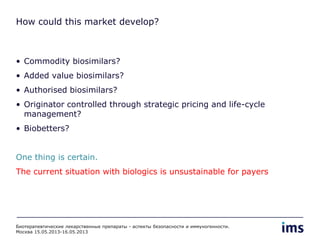
How could this market develop?
• Commodity biosimilars?
• Added value biosimilars?
• Authorised biosimilars?
• Originator controlled through strategic pricing and life-cycle
management?
• Biobetters?
One thing is certain.
The current situation with biologics is unsustainable for payers
Биотерапевтические лекарственные препараты - аспекты безопасности и иммуногенности.
Москва 15.05.2013-16.05.2013
-
100
200
300
400
500
600
2005 2006 2007 2008 2009 2010 2011 2012
Russianmarketsize,RubBln
BIOLOGIC PRODUCTS OTHERS
CAGR
2005-2012
+17%
+15%
+27%
Russian Biologic market evolution
Biologics significantly outpace total pharma market growth
Source: IMS Health. Retail and hospital market – pharmacy purchasing prices; DLO – contract prices
Биотерапевтические лекарственные препараты - аспекты
безопасности и иммуногенности. Москва 15.05.2013-
0
10
20
30
40
50
60
70
80
2005 2006 2007 2008 2009 2010 2011 2012
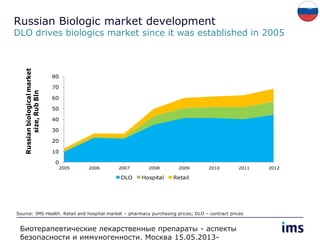
Russianbiologicalmarket
size,RubBln
DLO Hospital Retail
Russian Biologic market development
DLO drives biologics market since it was established in 2005
Source: IMS Health. Retail and hospital market – pharmacy purchasing prices; DLO – contract prices
Биотерапевтические лекарственные препараты - аспекты
безопасности и иммуногенности. Москва 15.05.2013-
25
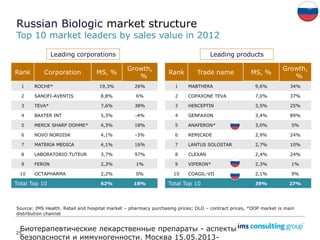
Rank Corporation MS, %
Growth,
%
1 ROCHE* 19,3% 26%
2 SANOFI-AVENTIS 8,8% 6%
3 TEVA* 7,6% 38%
4 BAXTER INT 5,3% -4%
5 MERCK SHARP DOHME* 4,3% 18%
6 NOVO NORDISK 4,1% -3%
7 MATERIA MEDICA 4,1% 16%
8 LABORATORIO TUTEUR 3,7% 97%
9 FERON 2,3% 1%
10 OCTAPHARMA 2,2% 0%
Total Top 10 62% 18%
Russian Biologic market structure
Top 10 market leaders by sales value in 2012
Source: IMS Health. Retail and hospital market – pharmacy purchasing prices; DLO – contract prices, *OOP market is main
distribution channel
Rank Trade name MS, %
Growth,
%
1 MABTHERA 9,6% 34%
2 COPAXONE TEVA 7,0% 37%
3 HERCEPTIN 3,5% 25%
4 GENFAXON 3,4% 89%
5 ANAFERON* 3,0% 5%
6 REMICADE 2,9% 24%
7 LANTUS SOLOSTAR 2,7% 10%
8 CLEXAN 2,4% 24%
9 VIFERON* 2,3% 1%
10 COAGIL-VII 2,1% 9%
Total Top 10 39% 27%
Leading corporations Leading products
Биотерапевтические лекарственные препараты - аспекты
безопасности и иммуногенности. Москва 15.05.2013-
26
7,1 7,5
9,9
12,4
13,3
14,8
16,2
17,6
19,4
21,1
23,5
26,3
2007 2008 2009 2010 2014E2013E20122011
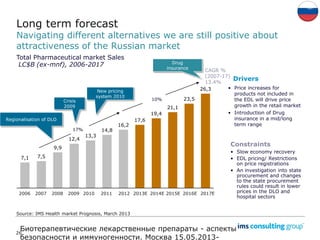
Total Pharmaceutical market Sales
LC$B (ex-mnf), 2006-2017
Regionalisation of DLO
Crisis
2009
New pricing
system 2010
CAGR %
(2007-17)
13.4%
10%
17%
Drug
insurance
2015E
Source: IMS Health market Prognosis, March 2013
Drivers
Constraints
Long term forecast
Navigating different alternatives we are still positive about
attractiveness of the Russian market
2016E
• Slow economy recovery
• EDL pricing/ Restrictions
on price registrations
• An investigation into state
procurement and changes
to the state procurement
rules could result in lower
prices in the DLO and
hospital sectors
• Price increases for
products not included in
the EDL will drive price
growth in the retail market
• Introduction of Drug
insurance in a mid/long
term range
2017E2006
Биотерапевтические лекарственные препараты - аспекты
безопасности и иммуногенности. Москва 15.05.2013-

26. Dr. Nikolai Demidov - IMS Health

  • 1.
    Insert date here Biosimilarsin the world of bio-products: war and peace, missed expectations and future hopes Nickolai Demidov Conference on bio-products, IMS Health, Moscow, May 16th 2013
  • 2.
    Biosimilars promised theMoon but did not deliver Were we expecting too much and has anything happened to change our views? Forecast for 2020 Historic estimation for 2011 (in 2007) Today’s actual sales* Source: Suzanne M. Sensabaugh. Biological generics: A business case (2007) Journal of Generic Medicines 4 , 186-199, * MAT 03/2012 Биотерапевтические лекарственные препараты - аспекты безопасности и иммуногенности. Москва 15.05.2013-16.05.2013
  • 3.
    Biosimilars have establisheda role in many countries Positive moves are apparent, but still much has to change US guidance on biosimilars Biosimilars roadmap Latest EU trends Japan legislation and launch Eastern Asia dynamics First MAbs submitted in EU Ongoing Big Pharma deals Austerity measures demand biosimilars Physicians reaction increasingly positive Tomorrow’s world An opportunity, still to be delivered Today Patients Financial returns for aspiring players How have events and key stakeholders been shaping the biosimilars landscape? Authorised biosimilars Payer support Un-affordable medicines Potential biosimilars pipeline Life-cycle management Биотерапевтические лекарственные препараты - аспекты безопасности и иммуногенности. Москва 15.05.2013-16.05.2013
  • 4.
    This trend issupported both from demand and supply drivers Mature economies look at them in the attempt to stem costs; emerging ones to ensure access and sustainable growth BIOSIMILARS TRENDS Demand side Supply side  Cost-saving lever for mature economies experiencing increasing pressure on resources  Growth engine for emerging economies while ensuring broader access to medicines and sustainability  Regulatory framework still fragmented across regions  Exposure to biosimilar real world evidence limited to a few areas (mostly Europe)  Increasing inflow of capital and “branded” capabilities through BigPharma and more “unusual” players (Samsung, Fujifilm, GE Healthcare)  Increasing specialization along the value chain unlocking the potential of successful partnerships  Biologics capacity oversupply, pushing manufacturers to find ways to leverage unexploited capacity Биотерапевтические лекарственные препараты - аспекты безопасности и иммуногенности. Москва 15.05.2013-16.05.2013
  • 5.
    Biologics growth isnearly double that of total pharma Putting additional financial pressure on healthcare budgets Source: IMS Health, MIDAS, MAT 09/2012 0% 2% 4% 6% 8% 10% 12% 14% 16% 0 20 40 60 80 100 120 140 160 180 2006 2007 2008 2009 2010 2011 2012 Sales,US$billions Biologics Sales Biologics Growth Total Pharma growth 2,6% 5,4% 21,9% 9,2% 12,5% 48,5% Canada E7 EU5 JAPAN Others US 4,3% 11,6% 13,3% 9,2% 12,2% 49,5% Biologics – Share of sales Biologics – Share of growth Global market trends MAT 09/2012, US$ Биотерапевтические лекарственные препараты - аспекты безопасности и иммуногенности. Москва 15.05.2013-16.05.2013
  • 6.
    Three geographical clustersexist Emerging economies anticipated to be a potential growth driver due to local policies and lower regulatory hurdles 7% 10% 10% 14% 14% 14% 23% 11% 27% 19% 59% 45% Biologics, 2006-11 CAGR 73 1. US Potential leading market for biosimilars 2. Advanced economies Established framework for biosimilars, but slow uptake 3. Emerging economies Follow-on biologics* already established (looser regulatory pathway) and fast- growing biologics market Source: IMS MIDAS, 2006-11 Биотерапевтические лекарственные препараты - аспекты безопасности и иммуногенности. Москва 15.05.2013-16.05.2013
  • 7.
    The global regulatoryframework is still quite heterogeneous Some key emerging markets still lag behind in terms of regulatory guidance Lack of a clear framework Fully established framework REGULATORY FRAMEWORK MATURITY Established biosimilar legislation and guidance aligned to EMA framework. Fully established framework and solid draft guidance for biosimilar Mab. Substitution not allowed Guidance published. Global reference product accepted Behind in terms of regulation, particularly on clinical requirements and length of regulatory process Guidance finalized in 2010. Dual pathway with abbreviated non-clinical and clinical data Guidance recently finalized (Apr 2012), although it does not set clear clinical criteria for biosimilar approval (case-by- case approach) Established biosimilar legislation and guidance (PMDA) Unclear regulatory framework, limited clinical requirements Legal pathway established, FDA guidelines published. Pathway not tested yet Patient ethnicity, Opportunity to leverage evidence from other geographies, PK testing, Clinical testing requirements, Interchangeability Current hurdles to global biosimilar market Биотерапевтические лекарственные препараты - аспекты безопасности и иммуногенности. Москва 15.05.2013-16.05.2013
  • 8.
    Three documents toaddress the biosimilar approval pathway 1. Scientific considerations in demonstrating biosimilarity to a reference product 2. Quality considerations in demonstrating biosimilarity to a reference product 3. Biosimilars: Questions and Answers regarding implementation of the BPCI Act of 2009 Will the latest US guidance unlock potential upside scenarios? The totality of evidence principle could favour approval of biosimilars marketed in other geographies US guidance: the facts Outcomes Totality of evidence principle Clear framework to identify criteria to design clinical studies to prove biosimilarity Allowance of slight differences with RP, especially on delivery technologies More interactive process with FDA than the normal biologics pathway Interchangeability still a theoretical concept for the time being Биотерапевтические лекарственные препараты - аспекты безопасности и иммуногенности. Москва 15.05.2013-16.05.2013
  • 9.
    0% 10% 20% 30% 40% 50% 60% 70% 80% 90% 100% Jun-07 Dec-07 Jun-08Dec-08 Jun-09 Dec-09 Jun-10 Dec-10 Jun-11 Dec-11 Jun-12 %Uptake,SU Biosimilar uptake across Europe MAT 06/2007 – 09/2012 (Volumes, SU) AUSTRIA BELGIUM FRANCE GERMANY GREECE ITALY ROMANIA SPAIN SWEDEN UK Total 10 countries 314M € MAT 09/2012 Fast uptake at launch, now mature Consistent uptake Slow uptake, cultural resistance Fast growing due to faster growing market trend Biosimilar replaced originator supply In Europe, biosimilar uptake varies widely A few countries have reached or approaching maturity Source: IMS MIDAS, MAT 09/2012 Биотерапевтические лекарственные препараты - аспекты безопасности и иммуногенности. Москва 15.05.2013-16.05.2013
  • 10.
    Although the opportunityfor volume expansion is therapy area (and geography) dependent Human Growth Hormone and other orphan drug biologics show typically show high percentage of available patients treated Erythropoetins for oncology Erythropoietin for renal dialysis Oncological biologics always have the competitive threat of innovation to reduce volume for biosimilars Oncological biologics in some European countries (eg UK) show significantly lower levels of use than elsewhere on cost grounds Filgrastim has already shown price elasticity Biologics for autoimmune show highly variable levels of use across patient populations, driven by access in Europe (>5% of patients to >30% across Europe*) • Largest volume expansion potential undoubtedly in pharmerging, but probably at a much lower price point • Europe has lower and also variable biologic uptake relative to US • US has highest penetration of biologics/head – least volume expansion potential? • Volume expansion potential will also be affected by introduction of new, better innovative therapies (eg pertuzumab, Roche) Биотерапевтические лекарственные препараты - аспекты безопасности и иммуногенности. Москва 15.05.2013-16.05.2013
  • 11.
    Among the newTAs, anti-TNF and MAbs are the key ones Along with insulins, another key investment area for biosimilar players, they account for more than 40% of the overall biologic market Existing Anti- TNF; 14,0% Insulins; 13,8% Antineoplastics (Mabs); 11,4% g- CSF; 7,0% Vaccines; 6,2%EPO; 5,3% Interferons; 4,3% Heparins; 4,1% Blood Coagulation; 3,5% Immunoglobulins; 2,4% Ocular Antineovascularisatio n Products; 2,4% Cytostatic Hormones; 2,1% Growth Hormones; 2,1% Others; 21,4% Top Biologic Therapy Area, Global Sales (MAT 09/2012) (It includes old generation insulins which are unlikely to be targeted by biosimilar players) Source: IMS MIDAS, 09/2012 Биотерапевтические лекарственные препараты - аспекты безопасности и иммуногенности. Москва 15.05.2013-16.05.2013
  • 12.
    Twelve compounds representUS$ 67 billion threat for originators All these products will lose patent protection by 2020, except Enbrel where US patent has been extended until 2028 EU expiry date US expiry date 2018 2016 2015 2028 (extended) 2014 2018 2014 2014 2013 2016 2019 2017 2012 Expired 2015 2015 2014 2019 2017 2015 2015 2014 2016 2016 Not considered existing biosimilars such as Epoetin Alfa expired in EU, but still patent protected in US Source: IMS MIDAS, 09/2012, IMS Patent focus 1050 4.9 Trastuzumab (Herceptin)5.0 Interferon Beta-1A (Avonex, Rebif)5.0 Bevacizumab (Avastin)5.3 Rituximab (Mabthera)5.9 Insulin Glargine (Lantus)6.2 Infliximab (Remicade) Ranibizumab (Lucentis)4.0 Pegfilgrastim (Neulasta)4.3 Glatiramer Acetate (Copaxone)4.3 Insulin Aspart (Novomix, Novorapid) 7.1 Etanercept (Enbrel)7.3 Adalimumab (Humira)8.1 Global Sales (MAT 09/2012), US$ billion Total ~ US$ 67 billion Биотерапевтические лекарственные препараты - аспекты безопасности и иммуногенности. Москва 15.05.2013-16.05.2013
  • 13.
    Monoclonal antibodies dominatethe biosimilars pipeline Class Preclinical Phase I Phase II Phase III Prefiling/Pending mAb immunomodulators 55 4 4 2 1 Cytotoxic Mabs 28 5 1 3 0 Other hormones (excl. insulins) 19 3 1 6 0 G-CSF 16 1 3 6 1 Insulin 14 4 3 3 1 Others (enzymes, BCF) 15 3 2 0 3 Interferons 14 3 3 1 1 Erythorpoietin 14 1 1 5 0 Immunomodulators 8 1 1 2 1 Total 183 25 19 28 8 Biosimilars pipeline by class Source: FirstWord September 19th 2012 Биотерапевтические лекарственные препараты - аспекты безопасности и иммуногенности. Москва 15.05.2013-16.05.2013
  • 14.
    Biosimilars have beena hot topic in the last 3 years The landscape is becoming over-populated. Is there a market for everybody? Innovator companies Generics companies Other players CRAMS* providers / Emerging market domestic players *CRAMS, Contract Research and Manufacturing Services ** Based on press release news Potential entrants** (Fujifilm Kyowa Kirin Biologics) Биотерапевтические лекарственные препараты - аспекты безопасности и иммуногенности. Москва 15.05.2013-16.05.2013
  • 15.
    Original manufacturers willemploy a range of defence approaches to contain the impact of biosimilars Moderate risk to original brand Focus on brand value/patient segments: Consider splitting business high value brand and a low price alternative high high High risk to original brand File legal challenges Consider new IP protected offerings Fight on price, if you are prepared to go to commodity levels Moderate risk to original brand Fight on price even where discounts are low: ensure that small price discounts do not let biosimilars gain significant traction Low risk to original brand Focus on building brand value and patient/prescriber loyalty Monitor market closely to detect signs of movement to one of the other scenarios • New IP (for example Roche’s pertuzumab, Amgen’s Neulasta) is the most effective measure to protect brands • HgH has shown that brand loyalty can protect under certain circumstances – for a period of years • Current experience has not been of interchangeable biosimilars (USA), or substitution (Europe). Either is likely to be a game changer Priceincentives(high/lowdiscount) Willingness to use (physician/patient acceptance) Биотерапевтические лекарственные препараты - аспекты безопасности и иммуногенности. Москва 15.05.2013-16.05.2013
  • 16.
    New biologics representa threat for upcoming biosimilars When engaging stakeholders, the biosimilar value proposition should include both the originator and follow-on biologics in the same TA Biosimilars Originators New biologics (future generation) adalimumab rituximab trastuzumab etanercept infliximab interferon beta cetuximab insulins bevacizumab Simponi Cimzia Other JAK-1 inhibitors Novel OADs tofacitinib Omontys (peginesatide) Perjeta (pertuzumab) Kadcyla Биотерапевтические лекарственные препараты - аспекты безопасности и иммуногенности. Москва 15.05.2013-16.05.2013
  • 17.
    How could thismarket develop? • Commodity biosimilars? • Added value biosimilars? • Authorised biosimilars? • Originator controlled through strategic pricing and life-cycle management? • Biobetters? One thing is certain. The current situation with biologics is unsustainable for payers Биотерапевтические лекарственные препараты - аспекты безопасности и иммуногенности. Москва 15.05.2013-16.05.2013
  • 18.
    - 100 200 300 400 500 600 2005 2006 20072008 2009 2010 2011 2012 Russianmarketsize,RubBln BIOLOGIC PRODUCTS OTHERS CAGR 2005-2012 +17% +15% +27% Russian Biologic market evolution Biologics significantly outpace total pharma market growth Source: IMS Health. Retail and hospital market – pharmacy purchasing prices; DLO – contract prices Биотерапевтические лекарственные препараты - аспекты безопасности и иммуногенности. Москва 15.05.2013-
  • 19.
    0 10 20 30 40 50 60 70 80 2005 2006 20072008 2009 2010 2011 2012 Russianbiologicalmarket size,RubBln DLO Hospital Retail Russian Biologic market development DLO drives biologics market since it was established in 2005 Source: IMS Health. Retail and hospital market – pharmacy purchasing prices; DLO – contract prices Биотерапевтические лекарственные препараты - аспекты безопасности и иммуногенности. Москва 15.05.2013-
  • 20.
    25 Rank Corporation MS,% Growth, % 1 ROCHE* 19,3% 26% 2 SANOFI-AVENTIS 8,8% 6% 3 TEVA* 7,6% 38% 4 BAXTER INT 5,3% -4% 5 MERCK SHARP DOHME* 4,3% 18% 6 NOVO NORDISK 4,1% -3% 7 MATERIA MEDICA 4,1% 16% 8 LABORATORIO TUTEUR 3,7% 97% 9 FERON 2,3% 1% 10 OCTAPHARMA 2,2% 0% Total Top 10 62% 18% Russian Biologic market structure Top 10 market leaders by sales value in 2012 Source: IMS Health. Retail and hospital market – pharmacy purchasing prices; DLO – contract prices, *OOP market is main distribution channel Rank Trade name MS, % Growth, % 1 MABTHERA 9,6% 34% 2 COPAXONE TEVA 7,0% 37% 3 HERCEPTIN 3,5% 25% 4 GENFAXON 3,4% 89% 5 ANAFERON* 3,0% 5% 6 REMICADE 2,9% 24% 7 LANTUS SOLOSTAR 2,7% 10% 8 CLEXAN 2,4% 24% 9 VIFERON* 2,3% 1% 10 COAGIL-VII 2,1% 9% Total Top 10 39% 27% Leading corporations Leading products Биотерапевтические лекарственные препараты - аспекты безопасности и иммуногенности. Москва 15.05.2013-
  • 21.
    26 7,1 7,5 9,9 12,4 13,3 14,8 16,2 17,6 19,4 21,1 23,5 26,3 2007 20082009 2010 2014E2013E20122011 Total Pharmaceutical market Sales LC$B (ex-mnf), 2006-2017 Regionalisation of DLO Crisis 2009 New pricing system 2010 CAGR % (2007-17) 13.4% 10% 17% Drug insurance 2015E Source: IMS Health market Prognosis, March 2013 Drivers Constraints Long term forecast Navigating different alternatives we are still positive about attractiveness of the Russian market 2016E • Slow economy recovery • EDL pricing/ Restrictions on price registrations • An investigation into state procurement and changes to the state procurement rules could result in lower prices in the DLO and hospital sectors • Price increases for products not included in the EDL will drive price growth in the retail market • Introduction of Drug insurance in a mid/long term range 2017E2006 Биотерапевтические лекарственные препараты - аспекты безопасности и иммуногенности. Москва 15.05.2013-