Committed to making the world’s
     scientific and medical literature
               a public resource


PLoS ONE and the rise of the
 Open Access Mega Journal

  Peter Binfield, Publisher PLoS, pbinfield@plos.org
                                           www.plos.org
Who are the Public Library of
Science?
• Eight years old and the largest not-for-
  profit Open Access publisher
• The publisher of 7 Open Access journals
  including PLoS ONE
• Staffed by professional publishers from
  the likes of Nature, BMJ, Springer etc
• Based in San Francisco, and Cambridge
  UK
• Self Sustaining since late 2010

                              www.plos.org
The Public Library of Science
 – our publishing strategy
• Establish high quality journals
  – put PLoS and open access on the map
• Build a more extensive OA publishing
  operation
  – an open access home for every paper
• Make the literature more useful
  – to scientists and the public
  – accelerate science


                                   www.plos.org
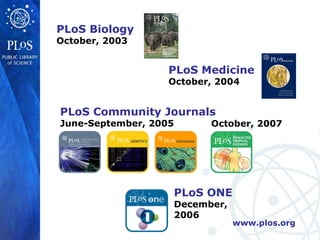
PLoS Biology
October, 2003


                   PLoS Medicine
                   October, 2004


PLoS Community Journals
June-September, 2005      October, 2007


                   PLoS ONE
                   December,
                   2006
                               www.plos.org
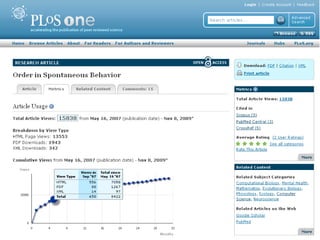
PLoS ONE’s Key Innovation –
The editorial process
• Objective Editorial criteria
   –   Scientifically rigorous
   –   Ethical
   –   Properly reported
   –   Conclusions supported by the data
• Editors and reviewers do not ask subjective
  questions such as:
   – How important is the work?
   – Which is the relevant audience?
• Everything that deserves to be published, will
  be published
   – Therefore the journal is not artificially limited in size
• Online tools are then used to evaluate, sort &
  filter the content after publication, not before
                                             www.plos.org
www.plos.org
What else is different?

• Scalability
   – each submission ‘pays for itself’
   – the journal itself benefits from ‘economies of scale’
      (e.g. it only peer reviews papers once; it presents
     all content in a single online environment)
• Inclusive scope
   – all of science and medicine
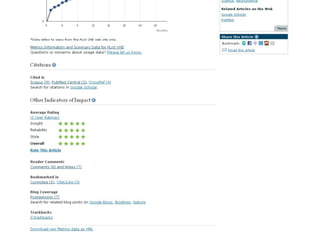
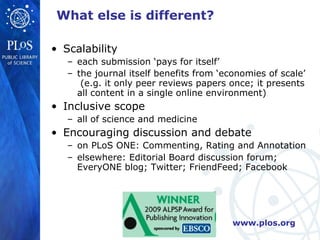
• Encouraging discussion and debate
   – on PLoS ONE: Commenting, Rating and Annotation
   – elsewhere: Editorial Board discussion forum;
     EveryONE blog; Twitter; FriendFeed; Facebook


                                         www.plos.org
The ‘Open Access Mega Journal'

First, some statistics. There are:

   • Approx 10,000 publishers
   • Publishing approx 25,000 journals
   • Which publish approx 1.5 million
   articles per year (almost 1 million of
   which appear in PubMed)
   • In an industry which historically
   changes very slowly


                                     www.plos.org
The ‘Open Access Mega Journal'
 can be defined as:

1. Very very large
  – Publishing thousands of articles per year
  – and benefiting from economies of scale
1. Open Access
  – Because no one will pay a subscription fee for a
    journal that large (and growing that fast)
  – and using an OA Business Model where each
    article pays for its own costs
1. (Preferably) without any ‘artificial’
   constraints on its ability to grow
  – For example, a desire to only publish ‘high impact;
                                      www.plos.org
    papers
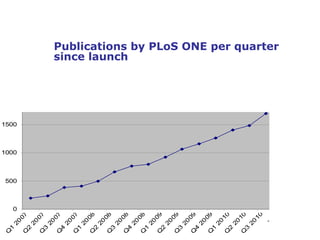
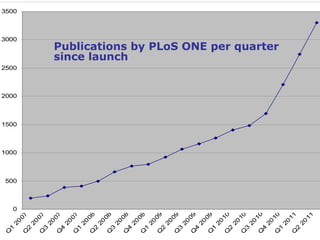
Publications by PLoS ONE per quarter
since launch
3500

                   Publications by PLoS ONE per
3000               quarter since launch
                   Publications by PLoS ONE per quarter
                   since launch
2500


2000


1500


1000


500


  0


                                                                                           10


                                                                                                       11
       07

             07

                   07

                         07

                               08

                                     08

                                           08

                                                 08

                                                       09

                                                             09

                                                                   09

                                                                         09

                                                                               10

                                                                                     10


                                                                                                 10


                                                                                                             11
                                                                                    www.plos.org
  20

            20

                  20

                        20

                              20

                                    20

                                          20

                                                20

                                                      20

                                                            20

                                                                  20

                                                                        20

                                                                              20

                                                                                    20

                                                                                          20


                                                                                                      20
                                                                                                20


                                                                                                            20
                                                                                      3


                                                                                                  1
 1

        2

              3

                    4

                          1

                                2

                                      3

                                            4

                                                  1

                                                        2

                                                              3

                                                                    4

                                                                          1

                                                                                2


                                                                                            4


                                                                                                        2
Q

       Q

             Q

                   Q

                         Q

                               Q

                                     Q

                                           Q

                                                 Q

                                                       Q

                                                             Q

                                                                   Q

                                                                         Q

                                                                               Q

                                                                                     Q

                                                                                           Q

                                                                                                 Q

                                                                                                       Q
3500

                   Publications by PLoS ONE per
3000               quarter since launch
                   Publications by PLoS ONE per quarter
                   since launch
2500


2000


1500


1000


500


  0


                                                                                           10


                                                                                                       11
       07

             07

                   07

                         07

                               08

                                     08

                                           08

                                                 08

                                                       09

                                                             09

                                                                   09

                                                                         09

                                                                               10

                                                                                     10


                                                                                                 10


                                                                                                             11
  20

            20

                  20

                        20

                              20

                                    20

                                          20

                                                20

                                                      20

                                                            20

                                                                  20

                                                                        20

                                                                              20

                                                                                    20

                                                                                          20


                                                                                                      20
                                                                                                20


                                                                                                            20
                                                                                      3


                                                                                                  1
 1

        2

              3

                    4

                          1

                                2

                                      3

                                            4

                                                  1

                                                        2

                                                              3

                                                                    4

                                                                          1

                                                                                2


                                                                                            4


                                                                                                        2
Q

       Q

             Q

                   Q

                         Q

                               Q

                                     Q

                                           Q

                                                 Q

                                                       Q

                                                             Q

                                                                   Q

                                                                         Q

                                                                               Q

                                                                                     Q

                                                                                           Q

                                                                                                 Q

                                                                                                       Q
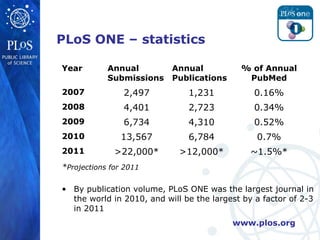
PLoS ONE – statistics

Year        Annual         Annual           % of Annual
            Submissions    Publications      PubMed
2007            2,497          1,231            0.16%
2008            4,401          2,723            0.34%
2009            6,734          4,310            0.52%
2010            13,567         6,784            0.7%
2011          >22,000*       >12,000*          ~1.5%*
*Projections for 2011

• By publication volume, PLoS ONE was the largest journal in
  the world in 2010, and will be the largest by a factor of 2-3
  in 2011
                                          www.plos.org
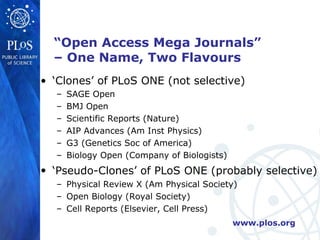
“Open Access Mega Journals”
  – One Name, Two Flavours
• ‘Clones’ of PLoS ONE (not selective)
  –   SAGE Open
  –   BMJ Open
  –   Scientific Reports (Nature)
  –   AIP Advances (Am Inst Physics)
  –   G3 (Genetics Soc of America)
  –   Biology Open (Company of Biologists)
• ‘Pseudo-Clones’ of PLoS ONE (probably selective)
  – Physical Review X (Am Physical Society)
  – Open Biology (Royal Society)
  – Cell Reports (Elsevier, Cell Press)
                                             www.plos.org
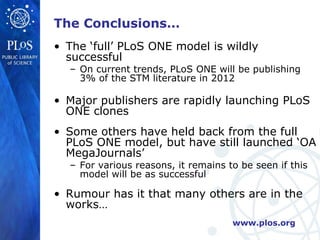
The Conclusions…
• The ‘full’ PLoS ONE model is wildly
  successful
  – On current trends, PLoS ONE will be publishing
    3% of the STM literature in 2012

• Major publishers are rapidly launching PLoS
  ONE clones
• Some others have held back from the full
  PLoS ONE model, but have still launched ‘OA
  MegaJournals’
  – For various reasons, it remains to be seen if this
    model will be as successful

• Rumour has it that many others are in the
  works…
                                     www.plos.org
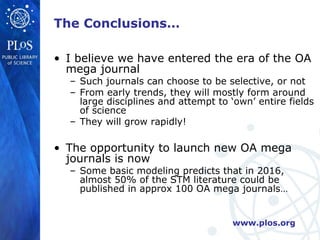
The Conclusions…

• I believe we have entered the era of the OA
  mega journal
  – Such journals can choose to be selective, or not
  – From early trends, they will mostly form around
    large disciplines and attempt to ‘own’ entire fields
    of science
  – They will grow rapidly!

• The opportunity to launch new OA mega
  journals is now
  – Some basic modeling predicts that in 2016,
    almost 50% of the STM literature could be
    published in approx 100 OA mega journals…


                                      www.plos.org
The Consequences…


• Content will rapidly concentrate into a small
  number of very large titles
• Filtering based solely on Journal name will
  disappear and will be replaced with new
  metrics
• The content currently being published in the
  universe of 25,000 journals will presumably
  start to dry up

• There are many open questions…

                                www.plos.org
Peter Binfield


Publisher, PLoS ONE and the
Community Journals


http://www.plos.org
email: pbinfield@plos.org
twitter: @p_binfield


                              www.plos.org

367 peter binfield

  • 1.
    Committed to makingthe world’s scientific and medical literature a public resource PLoS ONE and the rise of the Open Access Mega Journal Peter Binfield, Publisher PLoS, pbinfield@plos.org www.plos.org
  • 2.
    Who are thePublic Library of Science? • Eight years old and the largest not-for- profit Open Access publisher • The publisher of 7 Open Access journals including PLoS ONE • Staffed by professional publishers from the likes of Nature, BMJ, Springer etc • Based in San Francisco, and Cambridge UK • Self Sustaining since late 2010 www.plos.org
  • 3.
    The Public Libraryof Science – our publishing strategy • Establish high quality journals – put PLoS and open access on the map • Build a more extensive OA publishing operation – an open access home for every paper • Make the literature more useful – to scientists and the public – accelerate science www.plos.org
  • 4.
    PLoS Biology October, 2003 PLoS Medicine October, 2004 PLoS Community Journals June-September, 2005 October, 2007 PLoS ONE December, 2006 www.plos.org
  • 5.
    PLoS ONE’s KeyInnovation – The editorial process • Objective Editorial criteria – Scientifically rigorous – Ethical – Properly reported – Conclusions supported by the data • Editors and reviewers do not ask subjective questions such as: – How important is the work? – Which is the relevant audience? • Everything that deserves to be published, will be published – Therefore the journal is not artificially limited in size • Online tools are then used to evaluate, sort & filter the content after publication, not before www.plos.org
  • 7.
  • 8.
    What else isdifferent? • Scalability – each submission ‘pays for itself’ – the journal itself benefits from ‘economies of scale’ (e.g. it only peer reviews papers once; it presents all content in a single online environment) • Inclusive scope – all of science and medicine • Encouraging discussion and debate – on PLoS ONE: Commenting, Rating and Annotation – elsewhere: Editorial Board discussion forum; EveryONE blog; Twitter; FriendFeed; Facebook www.plos.org
  • 9.
    The ‘Open AccessMega Journal' First, some statistics. There are: • Approx 10,000 publishers • Publishing approx 25,000 journals • Which publish approx 1.5 million articles per year (almost 1 million of which appear in PubMed) • In an industry which historically changes very slowly www.plos.org
  • 10.
    The ‘Open AccessMega Journal' can be defined as: 1. Very very large – Publishing thousands of articles per year – and benefiting from economies of scale 1. Open Access – Because no one will pay a subscription fee for a journal that large (and growing that fast) – and using an OA Business Model where each article pays for its own costs 1. (Preferably) without any ‘artificial’ constraints on its ability to grow – For example, a desire to only publish ‘high impact; www.plos.org papers
  • 11.
    Publications by PLoSONE per quarter since launch
  • 12.
    3500 Publications by PLoS ONE per 3000 quarter since launch Publications by PLoS ONE per quarter since launch 2500 2000 1500 1000 500 0 10 11 07 07 07 07 08 08 08 08 09 09 09 09 10 10 10 11 www.plos.org 20 20 20 20 20 20 20 20 20 20 20 20 20 20 20 20 20 20 3 1 1 2 3 4 1 2 3 4 1 2 3 4 1 2 4 2 Q Q Q Q Q Q Q Q Q Q Q Q Q Q Q Q Q Q
  • 13.
    3500 Publications by PLoS ONE per 3000 quarter since launch Publications by PLoS ONE per quarter since launch 2500 2000 1500 1000 500 0 10 11 07 07 07 07 08 08 08 08 09 09 09 09 10 10 10 11 20 20 20 20 20 20 20 20 20 20 20 20 20 20 20 20 20 20 3 1 1 2 3 4 1 2 3 4 1 2 3 4 1 2 4 2 Q Q Q Q Q Q Q Q Q Q Q Q Q Q Q Q Q Q
  • 14.
    PLoS ONE –statistics Year Annual Annual % of Annual Submissions Publications PubMed 2007 2,497 1,231 0.16% 2008 4,401 2,723 0.34% 2009 6,734 4,310 0.52% 2010 13,567 6,784 0.7% 2011 >22,000* >12,000* ~1.5%* *Projections for 2011 • By publication volume, PLoS ONE was the largest journal in the world in 2010, and will be the largest by a factor of 2-3 in 2011 www.plos.org
  • 15.
    “Open Access MegaJournals” – One Name, Two Flavours • ‘Clones’ of PLoS ONE (not selective) – SAGE Open – BMJ Open – Scientific Reports (Nature) – AIP Advances (Am Inst Physics) – G3 (Genetics Soc of America) – Biology Open (Company of Biologists) • ‘Pseudo-Clones’ of PLoS ONE (probably selective) – Physical Review X (Am Physical Society) – Open Biology (Royal Society) – Cell Reports (Elsevier, Cell Press) www.plos.org
  • 16.
    The Conclusions… • The‘full’ PLoS ONE model is wildly successful – On current trends, PLoS ONE will be publishing 3% of the STM literature in 2012 • Major publishers are rapidly launching PLoS ONE clones • Some others have held back from the full PLoS ONE model, but have still launched ‘OA MegaJournals’ – For various reasons, it remains to be seen if this model will be as successful • Rumour has it that many others are in the works… www.plos.org
  • 17.
    The Conclusions… • Ibelieve we have entered the era of the OA mega journal – Such journals can choose to be selective, or not – From early trends, they will mostly form around large disciplines and attempt to ‘own’ entire fields of science – They will grow rapidly! • The opportunity to launch new OA mega journals is now – Some basic modeling predicts that in 2016, almost 50% of the STM literature could be published in approx 100 OA mega journals… www.plos.org
  • 18.
    The Consequences… • Contentwill rapidly concentrate into a small number of very large titles • Filtering based solely on Journal name will disappear and will be replaced with new metrics • The content currently being published in the universe of 25,000 journals will presumably start to dry up • There are many open questions… www.plos.org
  • 19.
    Peter Binfield Publisher, PLoSONE and the Community Journals http://www.plos.org email: pbinfield@plos.org twitter: @p_binfield www.plos.org

Editor's Notes

  • #4 This summarizes the broad aims that we have for our publishing operation.