
11/7/2014 
Professor Freih Abuhassan - 
University of Jordan 1
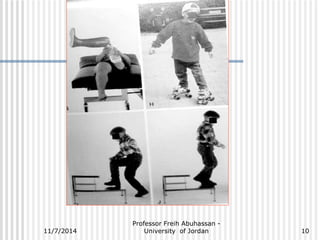
1- Trauma. 60% 
= MVA 
= Gunshot wounds 
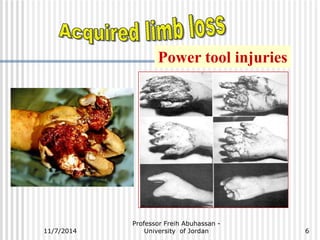
= Power tool injuries e.g lawnmowers 
2-Malignant tumors. 
3-Vascular,limb hypertrophy. 
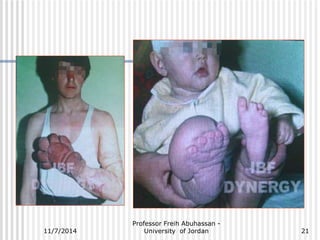
5-Vascular Amputation 
e.g Meningococcemia , Frostbite 
Professor Freih Abuhassan - 
11/7/2014 University of Jordan 
2
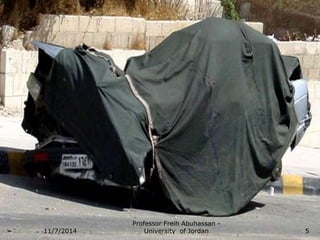
MVA 
Professor Freih Abuhassan - 
11/7/2014 University of Jordan 
3
MVA 
Professor Freih Abuhassan - 
11/7/2014 University of Jordan 
4
Professor Freih Abuhassan - 
11/7/2014 University of Jordan 
5
Power tool injuries 
Professor Freih Abuhassan - 
11/7/2014 University of Jordan 
6
Professor Freih Abuhassan - 
11/7/2014 University of Jordan 
7
Professor Freih Abuhassan - 
11/7/2014 University of Jordan 
8
Professor Freih Abuhassan - 
11/7/2014 University of Jordan 
9
Professor Freih Abuhassan - 
11/7/2014 University of Jordan 
10
Professor Freih Abuhassan - 
11/7/2014 University of Jordan 
11
Professor Freih Abuhassan - 
11/7/2014 University of Jordan 
12
Professor Freih Abuhassan - 
11/7/2014 University of Jordan 
13
Professor Freih Abuhassan - 
11/7/2014 University of Jordan 
14
Professor Freih Abuhassan - 
11/7/2014 University of Jordan 
15
Professor Freih Abuhassan - 
11/7/2014 University of Jordan 
16
Professor Freih Abuhassan - 
11/7/2014 University of Jordan 
17
Professor Freih Abuhassan - 
11/7/2014 University of Jordan 
18
Professor Freih Abuhassan - 
11/7/2014 University of Jordan 
19
Professor Freih Abuhassan - 
11/7/2014 University of Jordan 
20
Professor Freih Abuhassan - 
11/7/2014 University of Jordan 
21
1-Maternal D.M 
2- Arterial thrombosis and 
embolism in NICU .B.V 
puncture, angiography and 
indwelling catheter. 
3-Birth trauma 
Professor Freih Abuhassan - 
11/7/2014 University of Jordan 
22
4-Thrombocytopenia and 
polycythemia producing 
hypercoagulability, sepsis, DIC 
5-Inadvertent intravascular 
injections 
6-Necrotizing facsciitis, and 
purpura fulminans 
Professor Freih Abuhassan - 
11/7/2014 University of Jordan 
23
Vascular Amputation 
Meningococcemia Frostbite 
Professor Freih Abuhassan - 
11/7/2014 University of Jordan 
24
Iatrogenic Brachial A injury, due 
to faulty insertion of infusion 
catheter 
Professor Freih Abuhassan - 
11/7/2014 University of Jordan 
25
External iliac A thrombosis due 
to birth trauma 
Professor Freih Abuhassan - 
11/7/2014 University of Jordan 
26
Birth trauma 
Professor Freih Abuhassan - 
11/7/2014 University of Jordan 
27
Professor Freih Abuhassan - 
11/7/2014 University of Jordan 
28
1-Preserve all length possible. 
2-Preserve growth plates. 
3-Use disarticulations when 
possible. 
4-Preserve the knee J when 
possible . 
5-Stablilize the proximal limb. 
Professor Freih Abuhassan - 
11/7/2014 University of Jordan 
29
1- Preserves the physis distally  
growth of the stump continues 
at a normal rate. 
2- Prevents terminal overgrowth 
of the bone. 
Professor Freih Abuhassan - 
11/7/2014 University of Jordan 
30
Professor Freih Abuhassan - 
11/7/2014 University of Jordan 
31
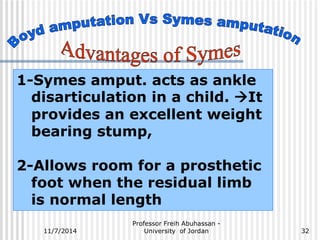
1-Symes amput. acts as ankle 
disarticulation in a child. It 
provides an excellent weight 
bearing stump, 
2-Allows room for a prosthetic 
foot when the residual limb 
is normal length 
Professor Freih Abuhassan - 
11/7/2014 University of Jordan 
32
Migration of the heel pad, 
which is not firmly fixed to 
the tibia 
Professor Freih Abuhassan - 
11/7/2014 University of Jordan 
33
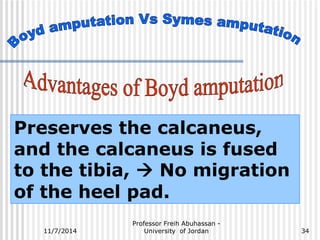
Preserves the calcaneus, 
and the calcaneus is fused 
to the tibia,  No migration 
of the heel pad. 
Professor Freih Abuhassan - 
11/7/2014 University of Jordan 
34
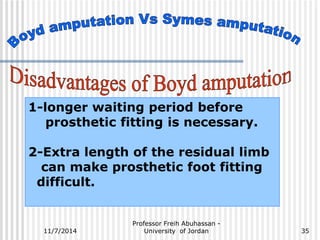
1-longer waiting period before 
prosthetic fitting is necessary. 
2-Extra length of the residual limb 
can make prosthetic foot fitting 
difficult. 
Professor Freih Abuhassan - 
11/7/2014 University of Jordan 
35
Professor Freih Abuhassan - 
11/7/2014 University of Jordan 
36
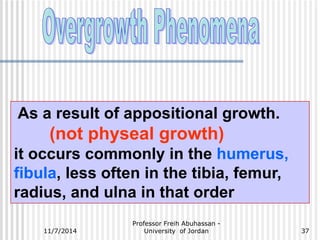
As a result of appositional growth. 
(not physeal growth) 
it occurs commonly in the humerus, 
fibula, less often in the tibia, femur, 
radius, and ulna in that order 
Professor Freih Abuhassan - 
11/7/2014 University of Jordan 
37
1-Ant. bowing associated with 
post. tilting of physis. 
2-Varus type of bowing with 
distal element pointing med. 
3-Fibula will usually outgrow 
tibia,which may result in  
Professor Freih Abuhassan - 
11/7/2014 University of Jordan 
38
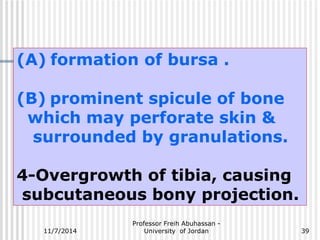
(A) formation of bursa . 
(B) prominent spicule of bone 
which may perforate skin & 
surrounded by granulations. 
4-Overgrowth of tibia, causing 
subcutaneous bony projection. 
Professor Freih Abuhassan - 
11/7/2014 University of Jordan 
39
Professor Freih Abuhassan - 
11/7/2014 University of Jordan 
40
1-Hemiatrophy of pelvis assoc. 
with C. valga and elongation 
of lesser trochanter. 
2- Femur and ilium usually 
smaller than on normal side 
Professor Freih Abuhassan - 
11/7/2014 University of Jordan 
41
- Pincer-like contour from 
overgrowth of radius in relation 
to ulna. 
-Tilting of prox. Radial epiphysis. 
Professor Freih Abuhassan - 
11/7/2014 University of Jordan 
42
- Humeral Varus 
- Overgrowth of humerus in relation 
to skinsubcutaneous projection. 
Professor Freih Abuhassan - 
11/7/2014 University of Jordan 
43
Resection of the excess bone. 
Capping the resected bone end 
with a tricortical iliac crest bone G 
Professor Freih Abuhassan - 
11/7/2014 University of Jordan 
44
Professor Freih Abuhassan - 
11/7/2014 University of Jordan 
45
1-The limb continues to grow. 
2-Appositional bone growth, esp., 
of through-bone amputations. 
3-The functional demands on the 
residual limb and prosthesis are 
very different for the playful, 
active child than those for the 
more sedentary adult.frequent 
changes in the socket, and for 
fitting with new prostheses. 
Professor Freih Abuhassan - 
11/7/2014 University of Jordan 
46
4- Psychological problems after 
amputation are rare in children. 
5-The incidence of multiple limb 
amput. more frequent, 
complexity of decision-making. 
Professor Freih Abuhassan - 
11/7/2014 University of Jordan 
47
6-The juvenile amputee rarely 
experiences phantom limb pain. 
7-Complications after surgery 
tend to be less severe in children. 
Professor Freih Abuhassan - 
11/7/2014 University of Jordan 
48
Professor Freih Abuhassan - 
11/7/2014 University of Jordan 
49
1-In the very short below elbow 
or BK amputee,providing 
better leverage for prosthetic 
fitting, and improved function. 
2-Lengthening a short humerus 
may allow the child to cradle 
objects against the trunk. 
Professor Freih Abuhassan - 
11/7/2014 University of Jordan 
50
Professor Freih Abuhassan - 
11/7/2014 University of Jordan 
51
Professor Freih Abuhassan - 
11/7/2014 University of Jordan 
52
Professor Freih Abuhassan - 
11/7/2014 University of Jordan 
53

البتر عند الاطفال -الجزء 2 - Amputation in children - 2 - البروفيسور فريح ابوحسان - استشاري جراحة العظام والمفاصل في الاردن

  • 1.
    11/7/2014 Professor FreihAbuhassan - University of Jordan 1
  • 2.
    1- Trauma. 60% = MVA = Gunshot wounds = Power tool injuries e.g lawnmowers 2-Malignant tumors. 3-Vascular,limb hypertrophy. 5-Vascular Amputation e.g Meningococcemia , Frostbite Professor Freih Abuhassan - 11/7/2014 University of Jordan 2
  • 3.
    MVA Professor FreihAbuhassan - 11/7/2014 University of Jordan 3
  • 4.
    MVA Professor FreihAbuhassan - 11/7/2014 University of Jordan 4
  • 5.
    Professor Freih Abuhassan- 11/7/2014 University of Jordan 5
  • 6.
    Power tool injuries Professor Freih Abuhassan - 11/7/2014 University of Jordan 6
  • 7.
    Professor Freih Abuhassan- 11/7/2014 University of Jordan 7
  • 8.
    Professor Freih Abuhassan- 11/7/2014 University of Jordan 8
  • 9.
    Professor Freih Abuhassan- 11/7/2014 University of Jordan 9
  • 10.
    Professor Freih Abuhassan- 11/7/2014 University of Jordan 10
  • 11.
    Professor Freih Abuhassan- 11/7/2014 University of Jordan 11
  • 12.
    Professor Freih Abuhassan- 11/7/2014 University of Jordan 12
  • 13.
    Professor Freih Abuhassan- 11/7/2014 University of Jordan 13
  • 14.
    Professor Freih Abuhassan- 11/7/2014 University of Jordan 14
  • 15.
    Professor Freih Abuhassan- 11/7/2014 University of Jordan 15
  • 16.
    Professor Freih Abuhassan- 11/7/2014 University of Jordan 16
  • 17.
    Professor Freih Abuhassan- 11/7/2014 University of Jordan 17
  • 18.
    Professor Freih Abuhassan- 11/7/2014 University of Jordan 18
  • 19.
    Professor Freih Abuhassan- 11/7/2014 University of Jordan 19
  • 20.
    Professor Freih Abuhassan- 11/7/2014 University of Jordan 20
  • 21.
    Professor Freih Abuhassan- 11/7/2014 University of Jordan 21
  • 22.
    1-Maternal D.M 2-Arterial thrombosis and embolism in NICU .B.V puncture, angiography and indwelling catheter. 3-Birth trauma Professor Freih Abuhassan - 11/7/2014 University of Jordan 22
  • 23.
    4-Thrombocytopenia and polycythemiaproducing hypercoagulability, sepsis, DIC 5-Inadvertent intravascular injections 6-Necrotizing facsciitis, and purpura fulminans Professor Freih Abuhassan - 11/7/2014 University of Jordan 23
  • 24.
    Vascular Amputation MeningococcemiaFrostbite Professor Freih Abuhassan - 11/7/2014 University of Jordan 24
  • 25.
    Iatrogenic Brachial Ainjury, due to faulty insertion of infusion catheter Professor Freih Abuhassan - 11/7/2014 University of Jordan 25
  • 26.
    External iliac Athrombosis due to birth trauma Professor Freih Abuhassan - 11/7/2014 University of Jordan 26
  • 27.
    Birth trauma ProfessorFreih Abuhassan - 11/7/2014 University of Jordan 27
  • 28.
    Professor Freih Abuhassan- 11/7/2014 University of Jordan 28
  • 29.
    1-Preserve all lengthpossible. 2-Preserve growth plates. 3-Use disarticulations when possible. 4-Preserve the knee J when possible . 5-Stablilize the proximal limb. Professor Freih Abuhassan - 11/7/2014 University of Jordan 29
  • 30.
    1- Preserves thephysis distally  growth of the stump continues at a normal rate. 2- Prevents terminal overgrowth of the bone. Professor Freih Abuhassan - 11/7/2014 University of Jordan 30
  • 31.
    Professor Freih Abuhassan- 11/7/2014 University of Jordan 31
  • 32.
    1-Symes amput. actsas ankle disarticulation in a child. It provides an excellent weight bearing stump, 2-Allows room for a prosthetic foot when the residual limb is normal length Professor Freih Abuhassan - 11/7/2014 University of Jordan 32
  • 33.
    Migration of theheel pad, which is not firmly fixed to the tibia Professor Freih Abuhassan - 11/7/2014 University of Jordan 33
  • 34.
    Preserves the calcaneus, and the calcaneus is fused to the tibia,  No migration of the heel pad. Professor Freih Abuhassan - 11/7/2014 University of Jordan 34
  • 35.
    1-longer waiting periodbefore prosthetic fitting is necessary. 2-Extra length of the residual limb can make prosthetic foot fitting difficult. Professor Freih Abuhassan - 11/7/2014 University of Jordan 35
  • 36.
    Professor Freih Abuhassan- 11/7/2014 University of Jordan 36
  • 37.
    As a resultof appositional growth. (not physeal growth) it occurs commonly in the humerus, fibula, less often in the tibia, femur, radius, and ulna in that order Professor Freih Abuhassan - 11/7/2014 University of Jordan 37
  • 38.
    1-Ant. bowing associatedwith post. tilting of physis. 2-Varus type of bowing with distal element pointing med. 3-Fibula will usually outgrow tibia,which may result in  Professor Freih Abuhassan - 11/7/2014 University of Jordan 38
  • 39.
    (A) formation ofbursa . (B) prominent spicule of bone which may perforate skin & surrounded by granulations. 4-Overgrowth of tibia, causing subcutaneous bony projection. Professor Freih Abuhassan - 11/7/2014 University of Jordan 39
  • 40.
    Professor Freih Abuhassan- 11/7/2014 University of Jordan 40
  • 41.
    1-Hemiatrophy of pelvisassoc. with C. valga and elongation of lesser trochanter. 2- Femur and ilium usually smaller than on normal side Professor Freih Abuhassan - 11/7/2014 University of Jordan 41
  • 42.
    - Pincer-like contourfrom overgrowth of radius in relation to ulna. -Tilting of prox. Radial epiphysis. Professor Freih Abuhassan - 11/7/2014 University of Jordan 42
  • 43.
    - Humeral Varus - Overgrowth of humerus in relation to skinsubcutaneous projection. Professor Freih Abuhassan - 11/7/2014 University of Jordan 43
  • 44.
    Resection of theexcess bone. Capping the resected bone end with a tricortical iliac crest bone G Professor Freih Abuhassan - 11/7/2014 University of Jordan 44
  • 45.
    Professor Freih Abuhassan- 11/7/2014 University of Jordan 45
  • 46.
    1-The limb continuesto grow. 2-Appositional bone growth, esp., of through-bone amputations. 3-The functional demands on the residual limb and prosthesis are very different for the playful, active child than those for the more sedentary adult.frequent changes in the socket, and for fitting with new prostheses. Professor Freih Abuhassan - 11/7/2014 University of Jordan 46
  • 47.
    4- Psychological problemsafter amputation are rare in children. 5-The incidence of multiple limb amput. more frequent, complexity of decision-making. Professor Freih Abuhassan - 11/7/2014 University of Jordan 47
  • 48.
    6-The juvenile amputeerarely experiences phantom limb pain. 7-Complications after surgery tend to be less severe in children. Professor Freih Abuhassan - 11/7/2014 University of Jordan 48
  • 49.
    Professor Freih Abuhassan- 11/7/2014 University of Jordan 49
  • 50.
    1-In the veryshort below elbow or BK amputee,providing better leverage for prosthetic fitting, and improved function. 2-Lengthening a short humerus may allow the child to cradle objects against the trunk. Professor Freih Abuhassan - 11/7/2014 University of Jordan 50
  • 51.
    Professor Freih Abuhassan- 11/7/2014 University of Jordan 51
  • 52.
    Professor Freih Abuhassan- 11/7/2014 University of Jordan 52
  • 53.
    Professor Freih Abuhassan- 11/7/2014 University of Jordan 53