Migration &
Empire,
1830-1939
Emigration Push Factors:
The Lowlands
In today’s class I am learning to:
• Identify various problems faced by
lowland Scots during the 1800s-1900s
• Explain why each reason caused
Scottish emigration
Scottish emigration – Lowland Push Factors
In the 1800s and 1900s, thousands of Scots left their
Lowland homes to escape different problems they
faced in their everyday lives.
Scottish emigration – Lowland Push Factors
The Lowlands relates to
areas of Scotland outwith
the Highlands, mostly in
the east, south and central
regions.
Push factors are when
people are forced to move
elsewhere due to escape
problems they face in their
home country.
Scottish emigration – Lowland Push Factors
Large numbers of lowland
Scots left towns and cities
to build new lives
elsewhere.
This was due to various
poverty factors including
unemployment, terrible
working conditions, poor
housing and also ill-
health.
Scottish emigration – Lowland Push Factors
The Industrial Revolution
had transformed Scotland,
creating new jobs and
bringing more people into
urban areas.
Various new types of large
industrial workplaces were
created, including
factories (such as textiles),
shipyards and mines.
Scottish emigration – Lowland Push Factors
Working conditions in
these places were often
damaging to health.
Factories often had poor
lighting and ventilation,
causing problems for
workers. Miners had to be
underground for long
hours, leading to similar
problems.
Scottish emigration – Lowland Push Factors
Poor safety also made
working very dangerous.
Injuries and deaths were a
regular hazard. In factories
accidents included people
being trapped in
machinery. Mining
accidents included cave-
ins or even explosions
caused by different gases.
Scottish emigration – Lowland Push Factors
Most workers received
low wages, with limited
opportunities to change
this, for fear of complaints
leading to unemployment.
In the 1830s there were
limited or no trade unions
that could unite all
workers and help them
improve conditions.
Scottish emigration – Lowland Push Factors
Unemployment was also a
problem faced by Lowland
Scots, leading to their
desire to emigrate.
Some Scots worked in
seasonal jobs (such as
shipyards) which did not
always have work all year
round, leading to financial
strife during quiet times.
Scottish emigration – Lowland Push Factors
Unemployment was an
especially big problem in
the 1800s because there
was no government
benefits for people who
were out of work.
This meant that people
who lost their job faced
the prospect of poverty
and losing their homes.
Scottish emigration – Lowland Push Factors
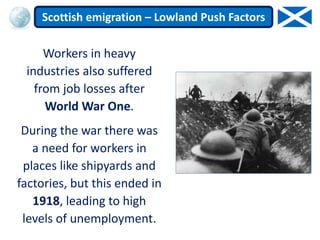
Workers in heavy
industries also suffered
from job losses after
World War One.
During the war there was
a need for workers in
places like shipyards and
factories, but this ended in
1918, leading to high
levels of unemployment.
Scottish emigration – Lowland Push Factors
Poor housing was also an
everyday reality faced by
many Lowland Scots.
Problems faced included
major overcrowding
(caused by increases in
population), poor quality
buildings and also terrible
sanitation, which caused
the spreading of diseases.
Scottish emigration – Lowland Push Factors
In the 1800s many Scots
lived in single ends. These
were one-roomed houses
where people were
expected to eat, cook,
sleep and socialise.
The average number of
people living in a single
end was five, but there
cases of up to 15.
Scottish emigration – Lowland Push Factors
The overwhelming
majority of homes did not
have indoor toilets.
This meant that people
had to share outdoor
toilets with numerous
other families. Often these
were not very clean, which
led to poor hygiene and
disease.
Scottish emigration – Lowland Push Factors
Overcrowding meant that
if one family member got
an illness – such as
tuberculosis – it would
often spread.
Other diseases – like
cholera – were caused by
drinking dirty water and
living in unclean
conditions.
Scottish emigration – Lowland Push Factors
Disease and ill health were
major problems because
of the lack of support.
The NHS was not
introduced until 1948, so
anyone who was ill either
had to pay for treatment
(which they could often
not afford) or rely on
scarce charitable help.
Scottish emigration – Lowland Push Factors
Make a colour spider
diagram titled
‘Reasons why Scots
left the Lowlands’
 Include 8 key reasons
 Each one needs a
heading and
description
Scottish emigration – Lowland Push Factors

2

  • 1.
  • 2.
    In today’s classI am learning to: • Identify various problems faced by lowland Scots during the 1800s-1900s • Explain why each reason caused Scottish emigration Scottish emigration – Lowland Push Factors
  • 3.
    In the 1800sand 1900s, thousands of Scots left their Lowland homes to escape different problems they faced in their everyday lives. Scottish emigration – Lowland Push Factors
  • 4.
    The Lowlands relatesto areas of Scotland outwith the Highlands, mostly in the east, south and central regions. Push factors are when people are forced to move elsewhere due to escape problems they face in their home country. Scottish emigration – Lowland Push Factors
  • 5.
    Large numbers oflowland Scots left towns and cities to build new lives elsewhere. This was due to various poverty factors including unemployment, terrible working conditions, poor housing and also ill- health. Scottish emigration – Lowland Push Factors
  • 6.
    The Industrial Revolution hadtransformed Scotland, creating new jobs and bringing more people into urban areas. Various new types of large industrial workplaces were created, including factories (such as textiles), shipyards and mines. Scottish emigration – Lowland Push Factors
  • 7.
    Working conditions in theseplaces were often damaging to health. Factories often had poor lighting and ventilation, causing problems for workers. Miners had to be underground for long hours, leading to similar problems. Scottish emigration – Lowland Push Factors
  • 8.
    Poor safety alsomade working very dangerous. Injuries and deaths were a regular hazard. In factories accidents included people being trapped in machinery. Mining accidents included cave- ins or even explosions caused by different gases. Scottish emigration – Lowland Push Factors
  • 9.
    Most workers received lowwages, with limited opportunities to change this, for fear of complaints leading to unemployment. In the 1830s there were limited or no trade unions that could unite all workers and help them improve conditions. Scottish emigration – Lowland Push Factors
  • 10.
    Unemployment was alsoa problem faced by Lowland Scots, leading to their desire to emigrate. Some Scots worked in seasonal jobs (such as shipyards) which did not always have work all year round, leading to financial strife during quiet times. Scottish emigration – Lowland Push Factors
  • 11.
    Unemployment was an especiallybig problem in the 1800s because there was no government benefits for people who were out of work. This meant that people who lost their job faced the prospect of poverty and losing their homes. Scottish emigration – Lowland Push Factors
  • 12.
    Workers in heavy industriesalso suffered from job losses after World War One. During the war there was a need for workers in places like shipyards and factories, but this ended in 1918, leading to high levels of unemployment. Scottish emigration – Lowland Push Factors
  • 13.
    Poor housing wasalso an everyday reality faced by many Lowland Scots. Problems faced included major overcrowding (caused by increases in population), poor quality buildings and also terrible sanitation, which caused the spreading of diseases. Scottish emigration – Lowland Push Factors
  • 14.
    In the 1800smany Scots lived in single ends. These were one-roomed houses where people were expected to eat, cook, sleep and socialise. The average number of people living in a single end was five, but there cases of up to 15. Scottish emigration – Lowland Push Factors
  • 15.
    The overwhelming majority ofhomes did not have indoor toilets. This meant that people had to share outdoor toilets with numerous other families. Often these were not very clean, which led to poor hygiene and disease. Scottish emigration – Lowland Push Factors
  • 16.
    Overcrowding meant that ifone family member got an illness – such as tuberculosis – it would often spread. Other diseases – like cholera – were caused by drinking dirty water and living in unclean conditions. Scottish emigration – Lowland Push Factors
  • 17.
    Disease and illhealth were major problems because of the lack of support. The NHS was not introduced until 1948, so anyone who was ill either had to pay for treatment (which they could often not afford) or rely on scarce charitable help. Scottish emigration – Lowland Push Factors
  • 18.
    Make a colourspider diagram titled ‘Reasons why Scots left the Lowlands’  Include 8 key reasons  Each one needs a heading and description Scottish emigration – Lowland Push Factors