INTERNATIONAL
PATIENT SUMMARY
STANDARDS
Stephen Kay
VC CEN/ TC251
OVERVIEW
 Introduction to the International Patient Summary (PS) Standard
 Surprise and confusion
 Organisational Perspective
 Pain and Gain (possible costs)
 Healthcare Perspective
 Pain and Gain (possible benefits)
 Standardisation Perspective
 International?
 Interest
 Initiatives
 Personal Summary (PS, sic) “A View from a Mountain”
INTERNATIONAL PATIENT
SUMMARY STANDARDS
 There are none… so, a very short presentation!
 A little surprising?
 There are so many variants and different types of
‘summary’ (e.g. discharge summaries, handovers)
 Patient Summaries are part of the healthcare fabric,
commonplace and even mundane
 There are many local implementations, some
national, and even regional in operation
 Some of these have been well established for years
 Standardisation is arguably more efficient if the thing
to be elevated to a standard already exists and is
proven to work in practice, so an ideal target?
 A little confusing, and the confusion explains why!
ORGANISATIONAL & VENDOR
COSTS
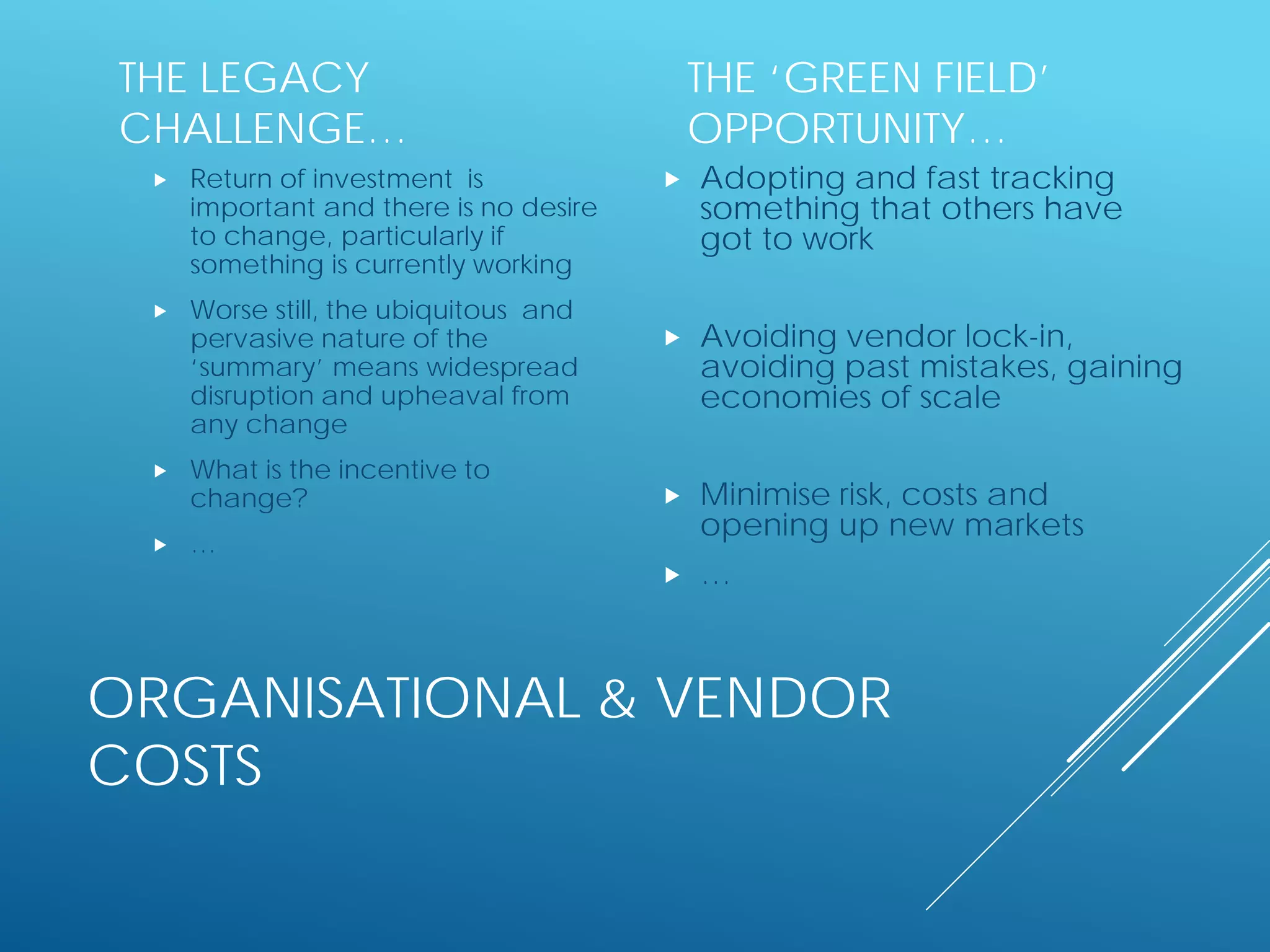
THE LEGACY
CHALLENGE…
 Return of investment is
important and there is no desire
to change, particularly if
something is currently working
 Worse still, the ubiquitous and
pervasive nature of the
‘summary’ means widespread
disruption and upheaval from
any change
 What is the incentive to
change?
 …
THE ‘GREEN FIELD’
OPPORTUNITY…
 Adopting and fast tracking
something that others have
got to work
 Avoiding vendor lock-in,
avoiding past mistakes, gaining
economies of scale
 Minimise risk, costs and
opening up new markets
 …
HEALTHCARE BENEFITS*
PATIENT PERSPECTIVE
 Improving Patient Safety -
supporting more informed
prescribing by providing timely
access to accurate information
 Improving the Efficiency of Patient
Care - reducing the time, effort
and resources required to obtain
this information
 Improving the Effectiveness of
Patient Care - supporting the
delivery of appropriate care to
patients
 Improving Patient Experience -
reducing repetition whilst
supporting patient recall and
those with difficulties
CLINICIAN PERSPECTIVE
 Improving Decision Support – removing
uncertainty by giving the clinician
instant access to additional and reliable
information to better inform their
decision
 Improving prescribing/medicating
practise- identifying medication
discrepancies and reducing errors
 Improving clinician productivity-
reducing the time taken to treat the
patient without duplication of
effort/tests
 Improving overall management -
Patients are less likely to need to be
referred to another service
*adapted from Summary Care Record, HSCIC website, 2016
THE STANDARDISATION
PERSPECTIVE
 The cross-border value/ International debate
 The interest of the SDO community
 The Initiatives (particularly JIC) will be discussed
AN INTERNATIONAL STANDARD
FOR PATIENT SUMMARY?
 International:
 Making the PS Structure & Content available for global use
(independent of whether the demand is for cross-border or within a
national state, or locally across organisations)
 Interest:
 There are powerful stakeholder requirements for SDOs to get this
done NOW, e.g. eHN, EU, EU-US, US Meaningful Use …
 It is not rocket science, and implementations exist, albeit not in an
‘idealised form’, therefore it should not too difficult…
 It is not ‘Big Data’; it has all the advantages of being ‘Little Data’!
Even so,
 “The value of data lies in their use.”
 “Data have no value or meaning in isolation”
 “They can be assets or liabilities or both.”
 “The information necessary to interpret data is specific to the problem”
PS: ‘LITTLE DATA’ BUT NOT EASY!
 “Data exist within a knowledge infrastructure- an ecosystem
comprising stakeholders, technologies, organisations, objects and
relationships between them.”
 “Data and their uses are proliferating far faster than privacy law or
information policy can catch up…”
 “Moving data over networks involves a delicate balance of security,
rights, protections, interoperability, and policy.”
 ”Documenting data in ways to make them useful for others to
discover, retrieve, interpret and reuse is … difficult”
 Extracts from “Big Data, Little Data, No Data” by Christine L. Borgman
SRO INITIATIVES
 Assume the audience has more knowledge about
the European initiatives, so
 eHN Patient Summary Guidelines v2
 EU projects (e.g. epSOS, Trillium Bridge, eStandards)
 More explanation here on the following:
 Meaningful Use… Clinical Summaries
 HL7 INTERPAS project
 ISO TC215 Reference Standards Portfolios (Bundles)
 Clinical Imaging
 JIC Standards Sets
 Patient Summary for unplanned/emergency Care
INPUT/SUPPORT TO SDO
INITIATIVES
 eHN Patient Summary Guidelines v2
 EU projects (e.g. epSOS, Trillium Bridge,
eStandards)
 Meaningful Use… Clinical Summaries
 (a little more detail follows on the nuances and
differences between the EU and US initiatives)
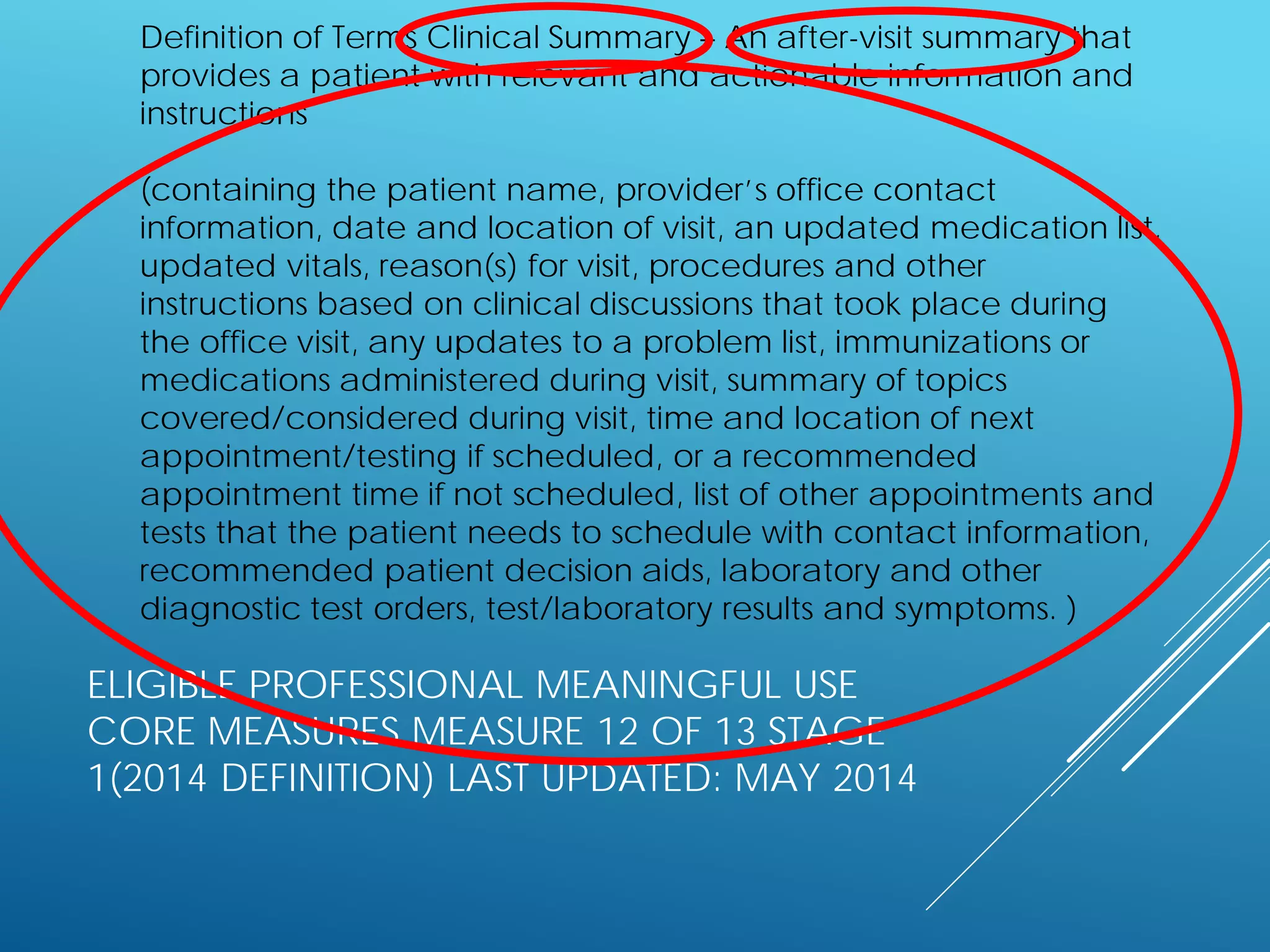
ELIGIBLE PROFESSIONAL MEANINGFUL USE
CORE MEASURES MEASURE 12 OF 13 STAGE
1(2014 DEFINITION) LAST UPDATED: MAY 2014
Definition of Terms Clinical Summary – An after-visit summary that
provides a patient with relevant and actionable information and
instructions
(containing the patient name, provider’s office contact
information, date and location of visit, an updated medication list,
updated vitals, reason(s) for visit, procedures and other
instructions based on clinical discussions that took place during
the office visit, any updates to a problem list, immunizations or
medications administered during visit, summary of topics
covered/considered during visit, time and location of next
appointment/testing if scheduled, or a recommended
appointment time if not scheduled, list of other appointments and
tests that the patient needs to schedule with contact information,
recommended patient decision aids, laboratory and other
diagnostic test orders, test/laboratory results and symptoms. )
NOTES…
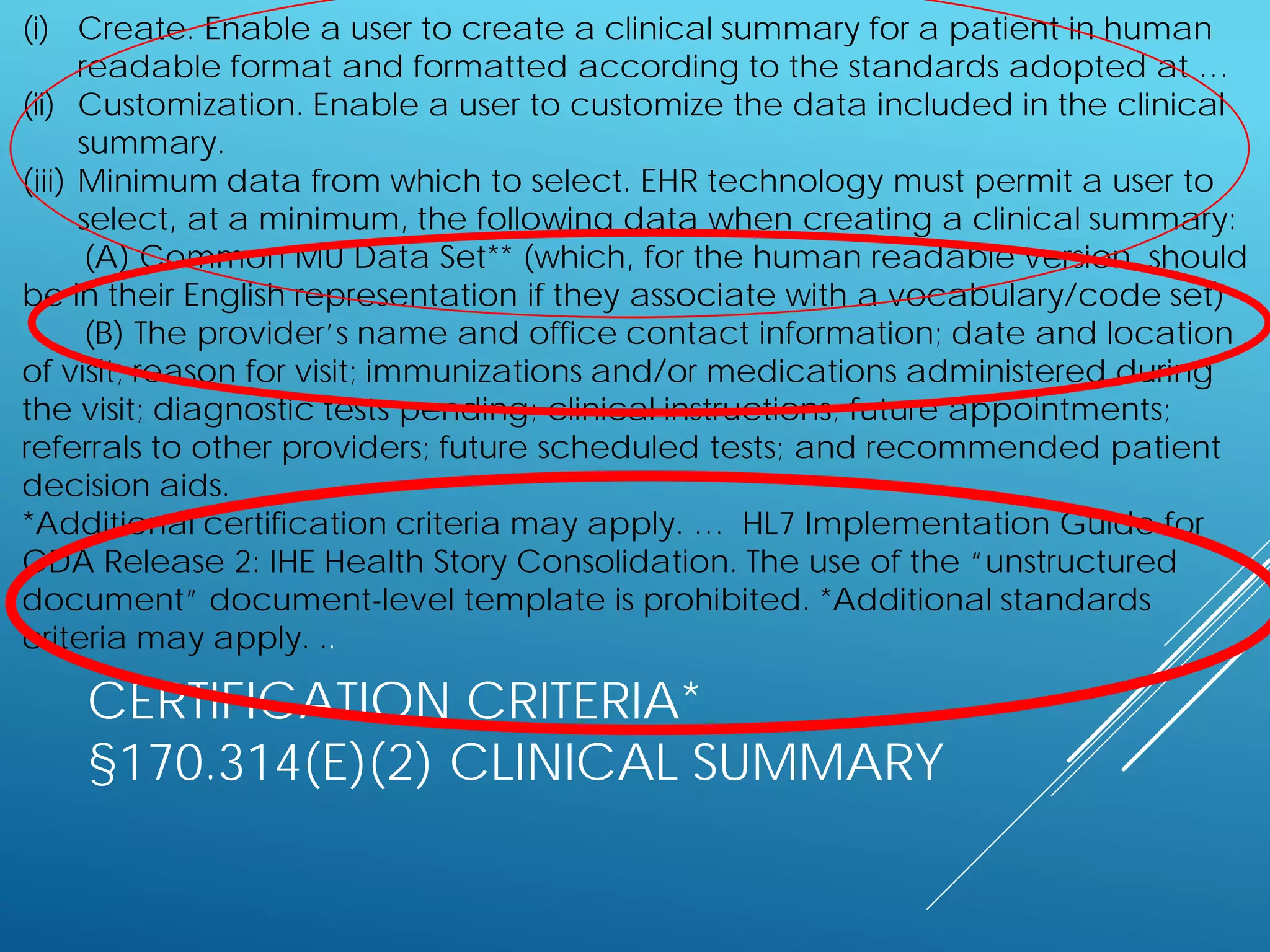
 The ellipses on the previous slide, flag the
differences
 The ellipses on the next slide show that the idea
of packaging/bundling tools and rules are fairly
commonplace…
CERTIFICATION CRITERIA*
§170.314(E)(2) CLINICAL SUMMARY
(i) Create. Enable a user to create a clinical summary for a patient in human
readable format and formatted according to the standards adopted at …
(ii) Customization. Enable a user to customize the data included in the clinical
summary.
(iii) Minimum data from which to select. EHR technology must permit a user to
select, at a minimum, the following data when creating a clinical summary:
(A) Common MU Data Set** (which, for the human readable version, should
be in their English representation if they associate with a vocabulary/code set)
(B) The provider’s name and office contact information; date and location
of visit; reason for visit; immunizations and/or medications administered during
the visit; diagnostic tests pending; clinical instructions; future appointments;
referrals to other providers; future scheduled tests; and recommended patient
decision aids.
*Additional certification criteria may apply. … HL7 Implementation Guide for
CDA Release 2: IHE Health Story Consolidation. The use of the “unstructured
document” document-level template is prohibited. *Additional standards
criteria may apply. ..
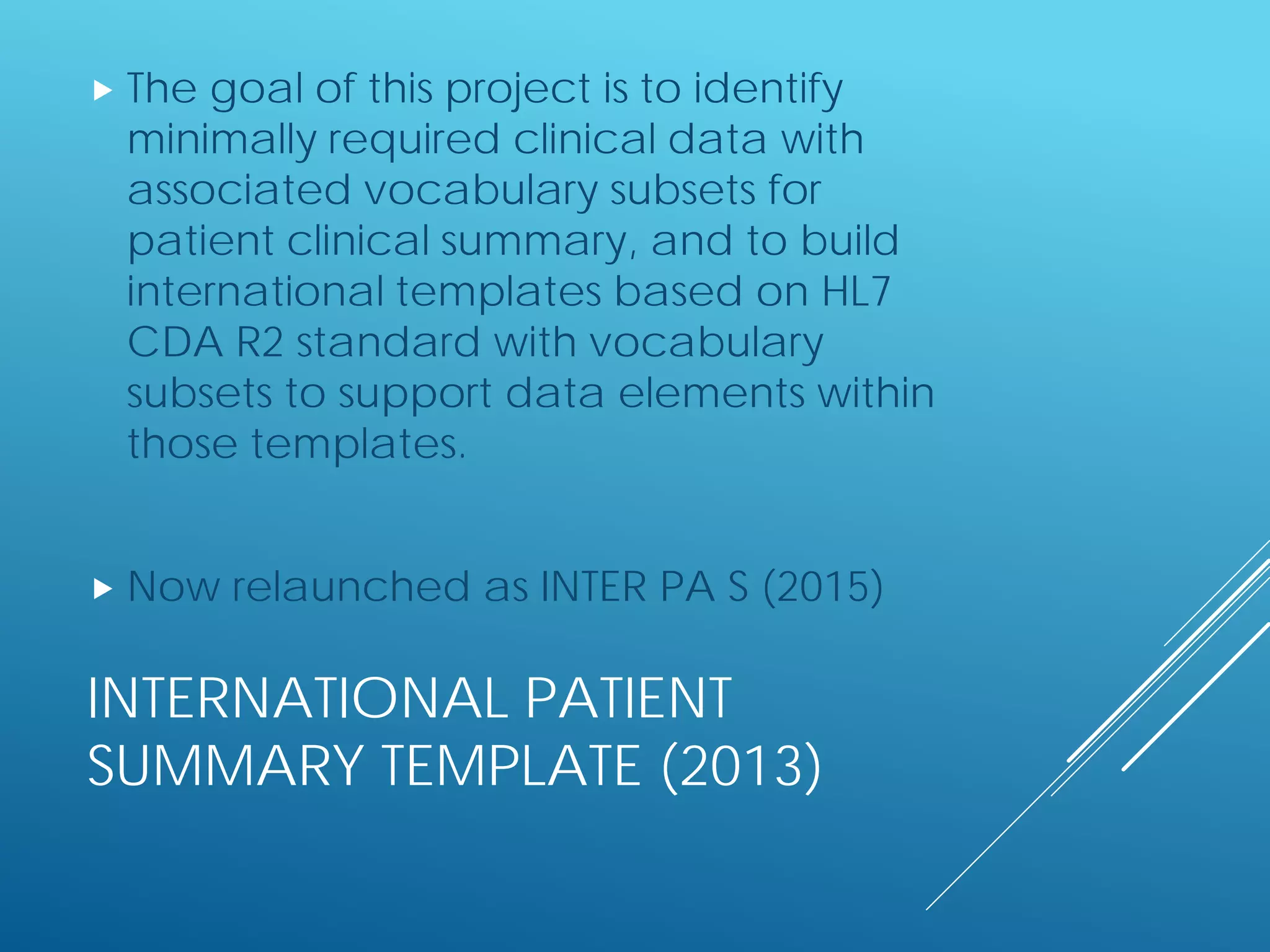
INTERNATIONAL PATIENT
SUMMARY TEMPLATE (2013)
 The goal of this project is to identify
minimally required clinical data with
associated vocabulary subsets for
patient clinical summary, and to build
international templates based on HL7
CDA R2 standard with vocabulary
subsets to support data elements within
those templates.
 Now relaunched as INTER PA S (2015)
THE ISO AND JIC INITIATIVES
 INTERPAS wishes to be done with the target of it
becoming an HL7/ISO standard.
 Either INTERPAS will be an input to the JIC work, or
more probably due to its expected completion
date of 2017, JIC might provide a way to provide
a guidance framework for when it is
implemented.
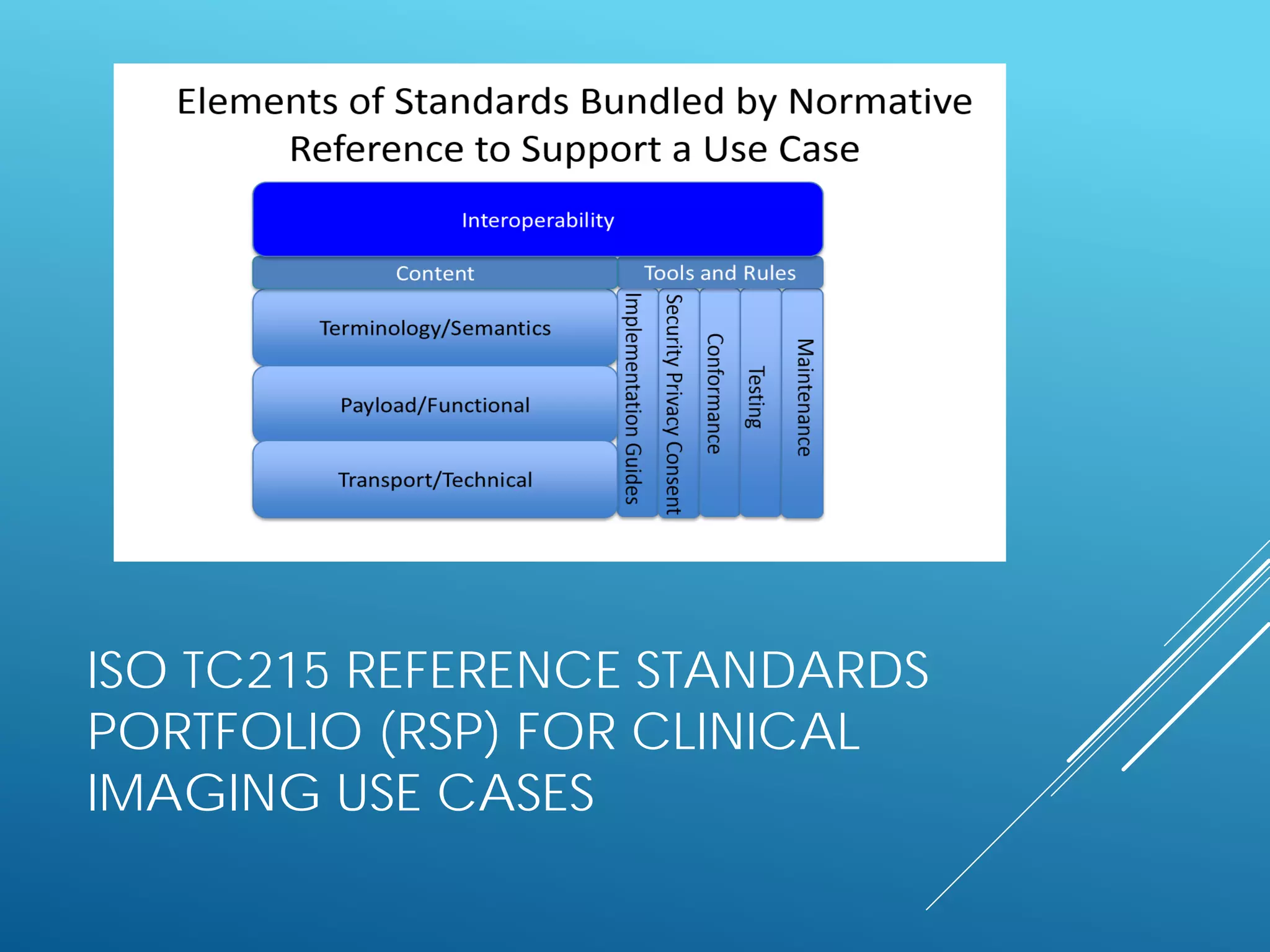
ISO TC215 REFERENCE STANDARDS
PORTFOLIO (RSP) FOR CLINICAL
IMAGING USE CASES
ISO TC215 RSP
 It is on Clinical Imaging, and therefore content-
wise it is not relevant;
 However, the value for considering it, is because
the structure of the ISO bundle and the
development process is expected to be
complementary to the JIC work.
 Both initiatives are prototypical.
 The ISO RSP will be published and normative,
whereas the JIC Standards Sets will be an
informative, authoritative recommendation.
JIC STANDARDS SET:
PATIENT SUMMARY
April 2016
JIC SAN FRAN DECLARATION,
2015
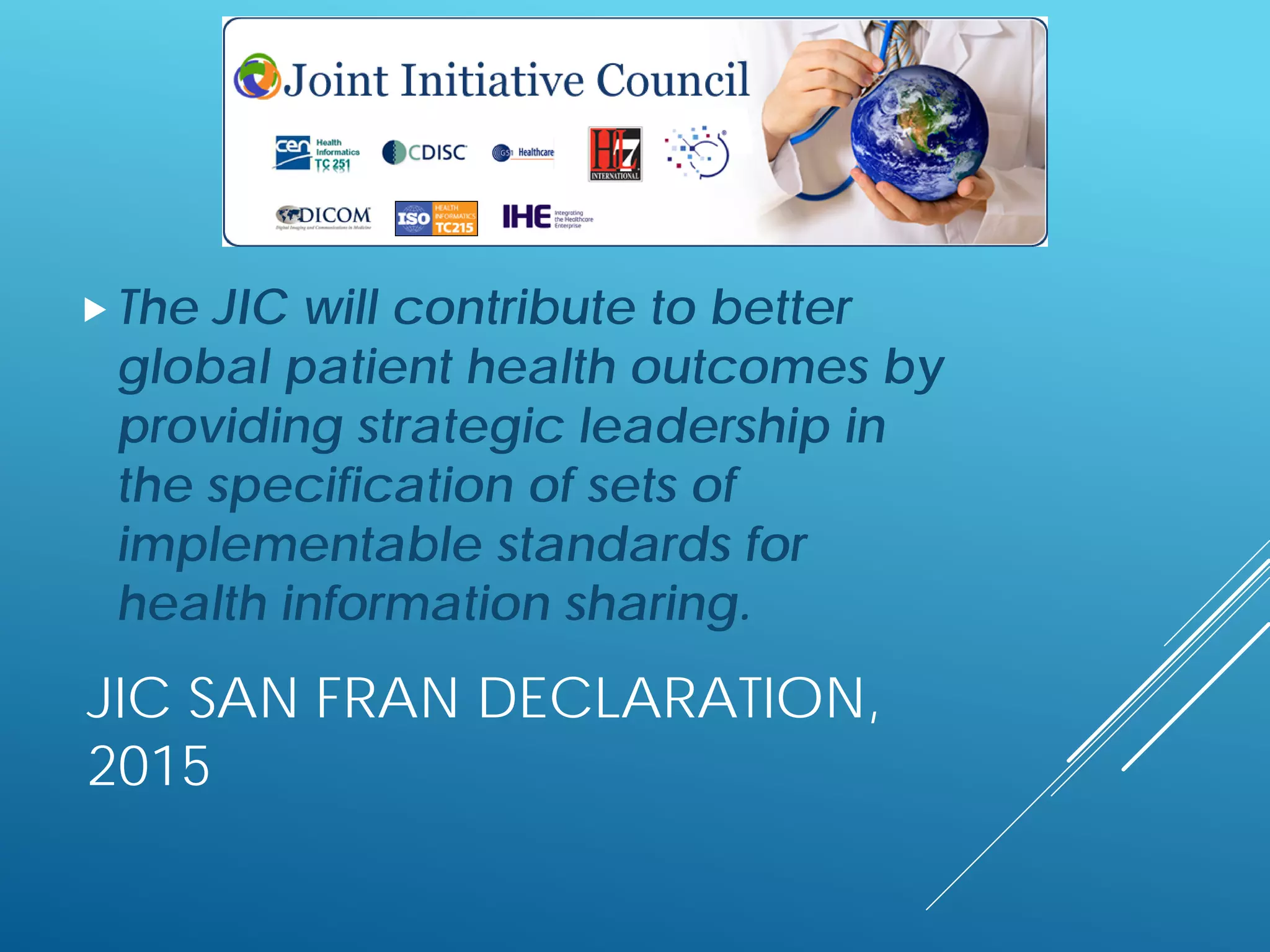
The JIC will contribute to better
global patient health outcomes by
providing strategic leadership in
the specification of sets of
implementable standards for
health information sharing.
JIC STANDARDS SET – PATIENT
SUMMARY
 The first Use Case was agreed to be the Patient Summary
since many nations are undertaking this work and SDOs are
involved at different levels but not always coordinated
Use Case (initial high level description)
 A physician (i.e. Healthcare actor) wants relevant patient
data to address the healthcare matter of the patient
(subject of care) with legitimate access and use of relevant
summary patient data at the point and time of care,
irrespective of where and how it is held
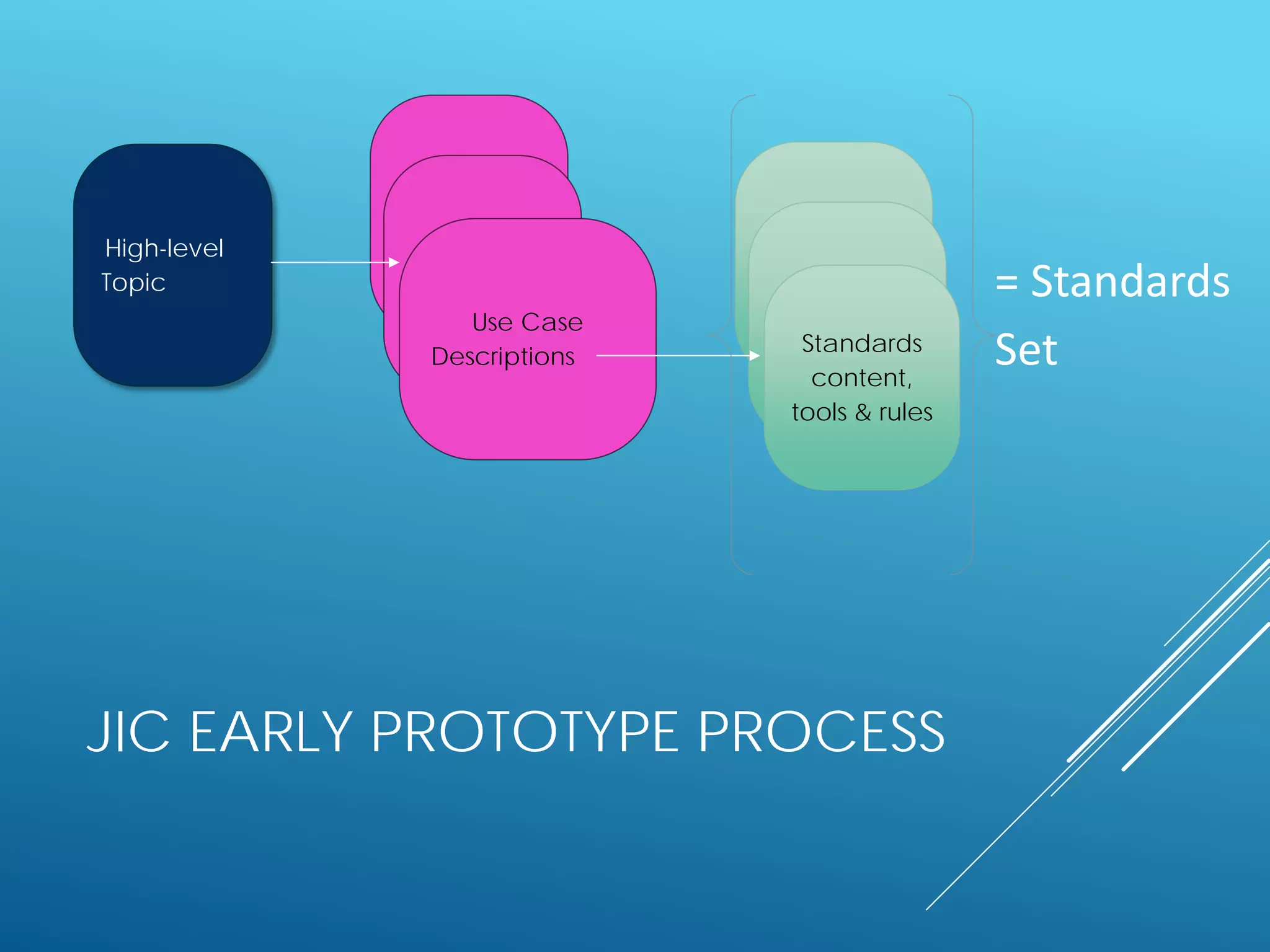
JIC EARLY PROTOTYPE PROCESS
High-level
Topic
Use Case
Descriptions
Standards
content,
tools & rules
= Standards
Set
ADAPTED DEFINITION OF A JIC
STANDARDS SET (SS)
A coherent collection of
[referenced] standards and
standards artefacts that
support a specific use case
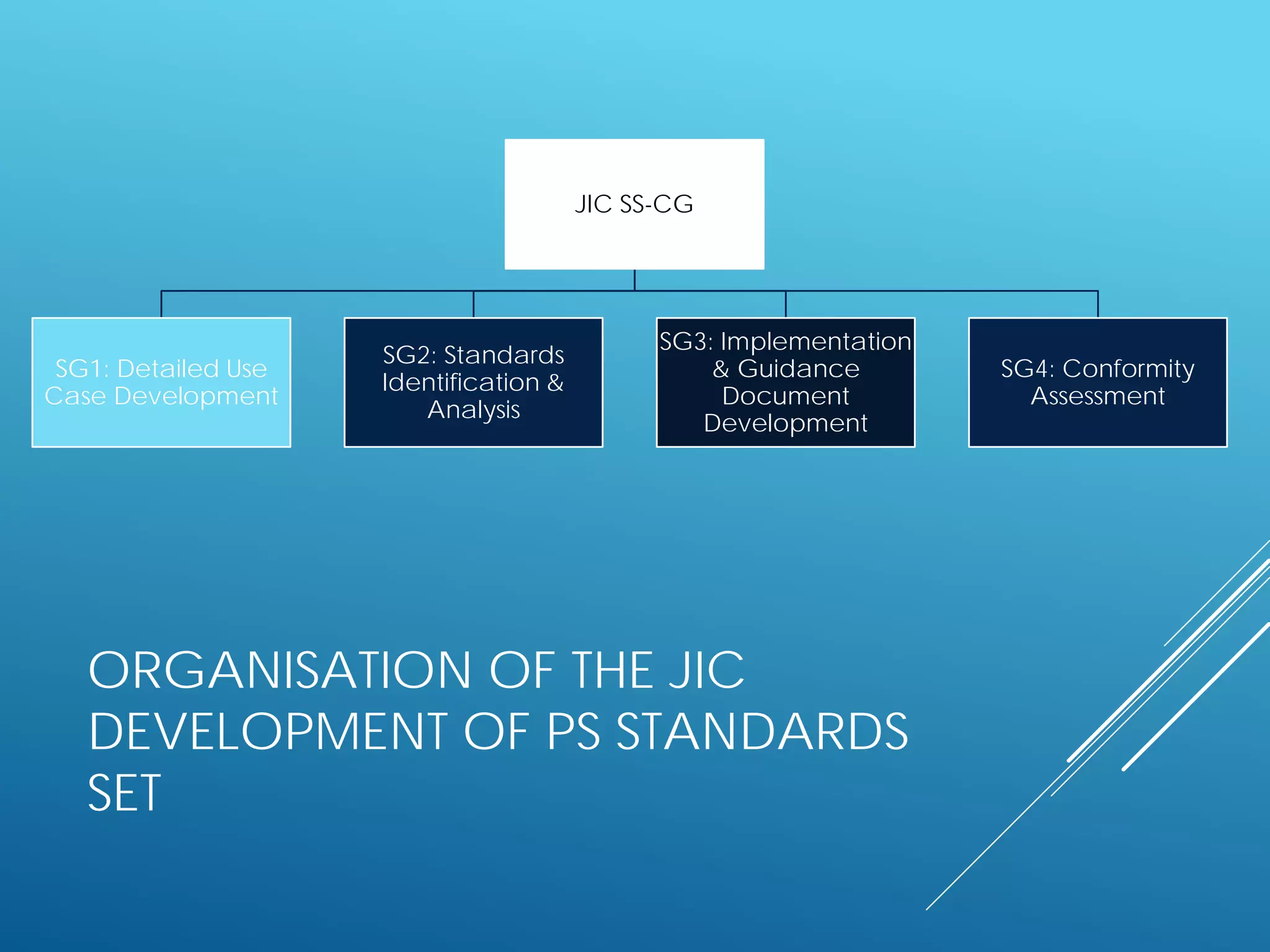
ORGANISATION OF THE JIC
DEVELOPMENT OF PS STANDARDS
SET
JIC SS-CG
SG1: Detailed Use
Case Development
SG2: Standards
Identification &
Analysis
SG3: Implementation
& Guidance
Document
Development
SG4: Conformity
Assessment
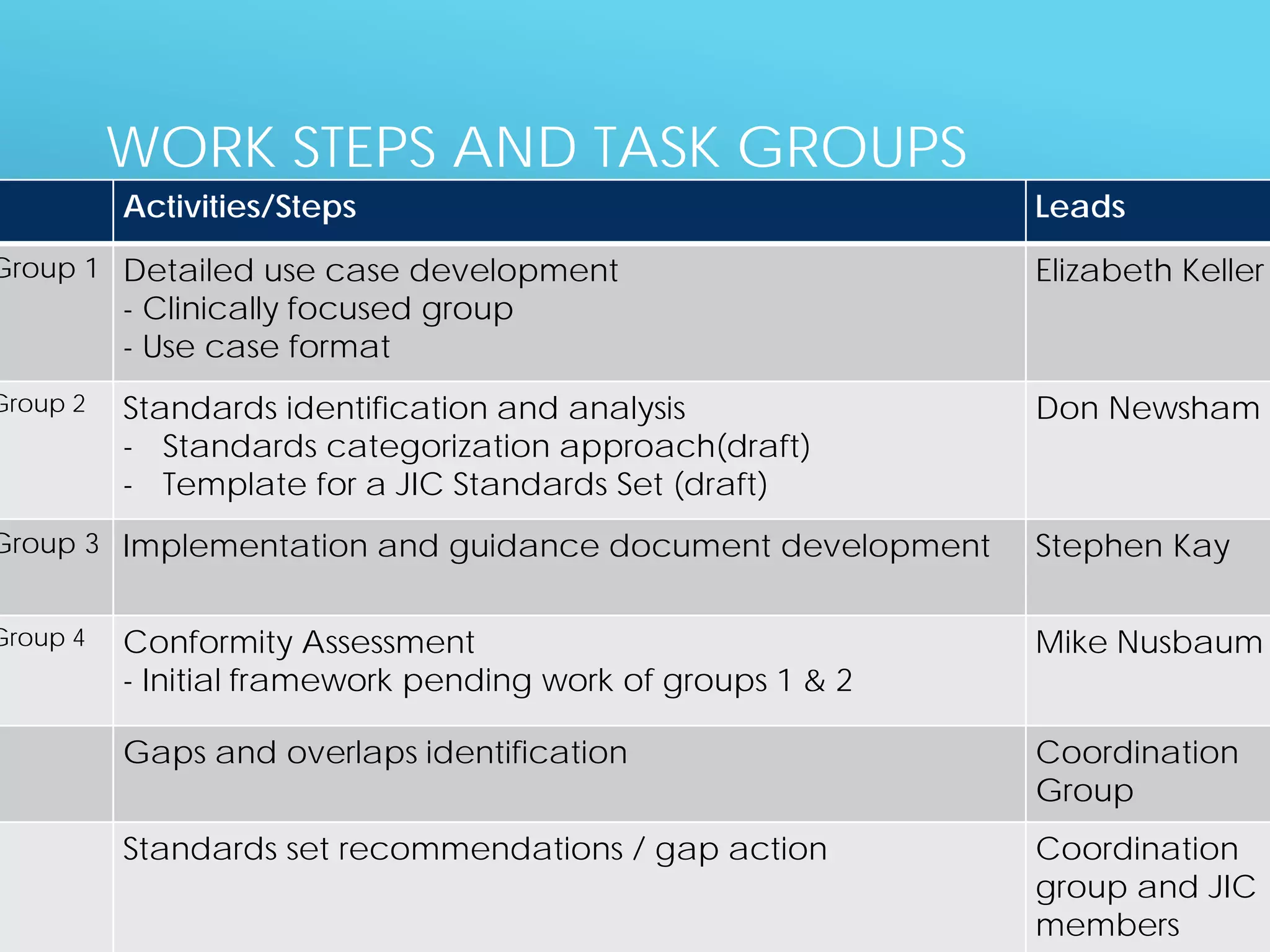
WORK STEPS AND TASK GROUPS
Activities/Steps Leads
Group 1 Detailed use case development
- Clinically focused group
- Use case format
Elizabeth Keller
Group 2 Standards identification and analysis
- Standards categorization approach(draft)
- Template for a JIC Standards Set (draft)
Don Newsham
Group 3 Implementation and guidance document development Stephen Kay
Group 4 Conformity Assessment
- Initial framework pending work of groups 1 & 2
Mike Nusbaum
Gaps and overlaps identification Coordination
Group
Standards set recommendations / gap action Coordination
group and JIC
members
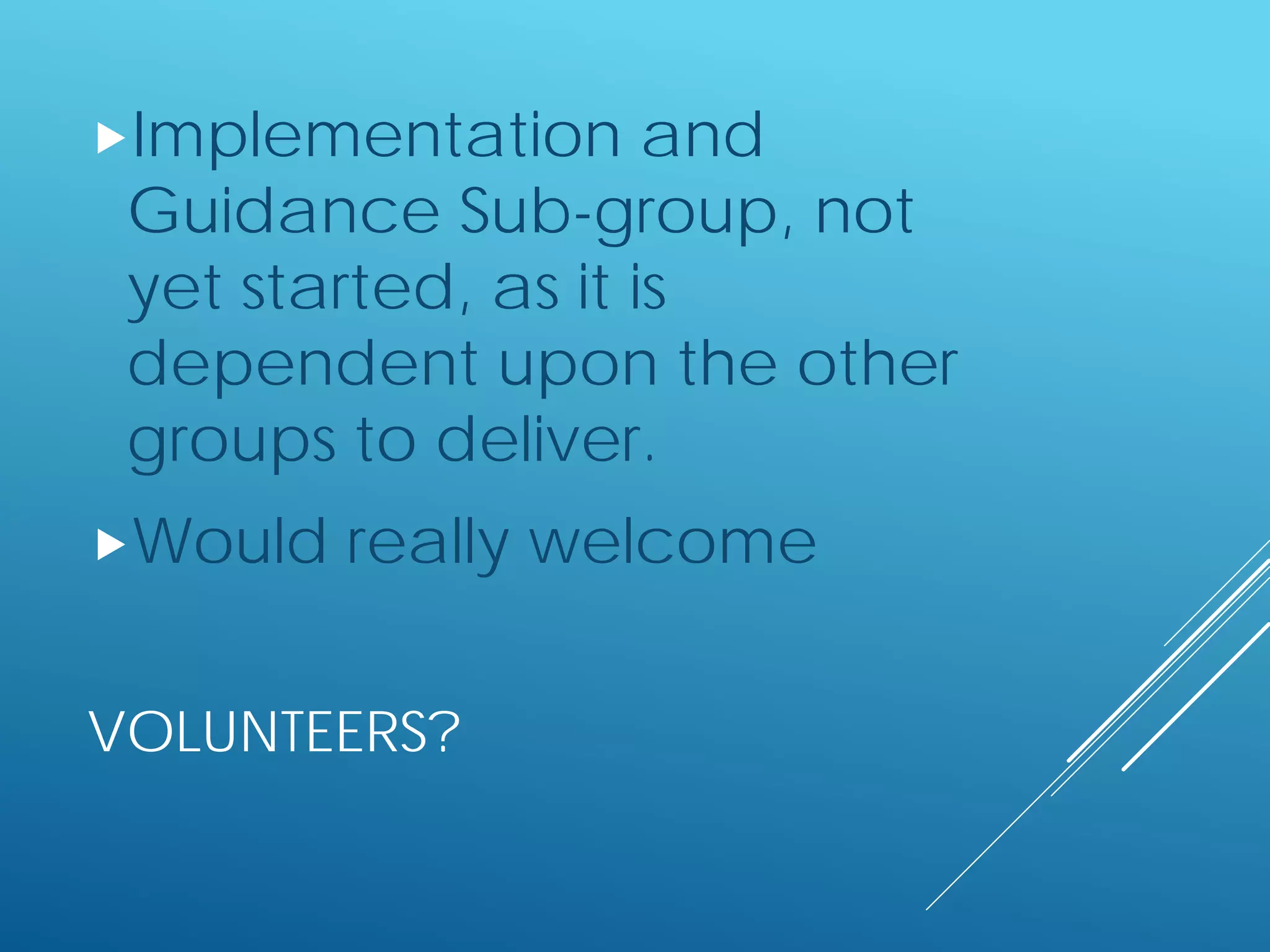
VOLUNTEERS?
Implementation and
Guidance Sub-group, not
yet started, as it is
dependent upon the other
groups to deliver.
Would really welcome
KEY POINTS ABOUT THE WORK
 JIC is well placed for this work since JIC can draw
directly on resources from SDOs and ensure
coordination and collaboration
 JIC is developing 2 key products
 recommendations for the Patient Summary Standard Set
 a methodology for developing further JIC Standards Sets
 JIC are not developing products but leveraging
existing work which is already either developed or
in development – e.g. Trillium Bridge, epSoS and
INTERPAS (HL7)
 JIC is targeting one year for completion of the
Patient Summary Standards Set – end of 2016
PARTICIPATION FROM THE
COMMUNITY
 A JIC Foundation and Scope report for Patient Summary
Standards Set – 1 October 2015, sets out initial approach being
taken and is identified as work in progress - JIC website. Updated
version after JIC meeting, May 2016
 FAQs on JIC website which will be regularly updated
 Set of slides summarising the work which will be updated – JIC
website
 Draft plan and resource requirements will be maintained and
updated as the work progresses
Contact the Standards Set coordination group through the JIC
website or Jane Millar jmi@ihtsdo.org
http://www.jointinitiativecouncil.org
AND FINALLY…
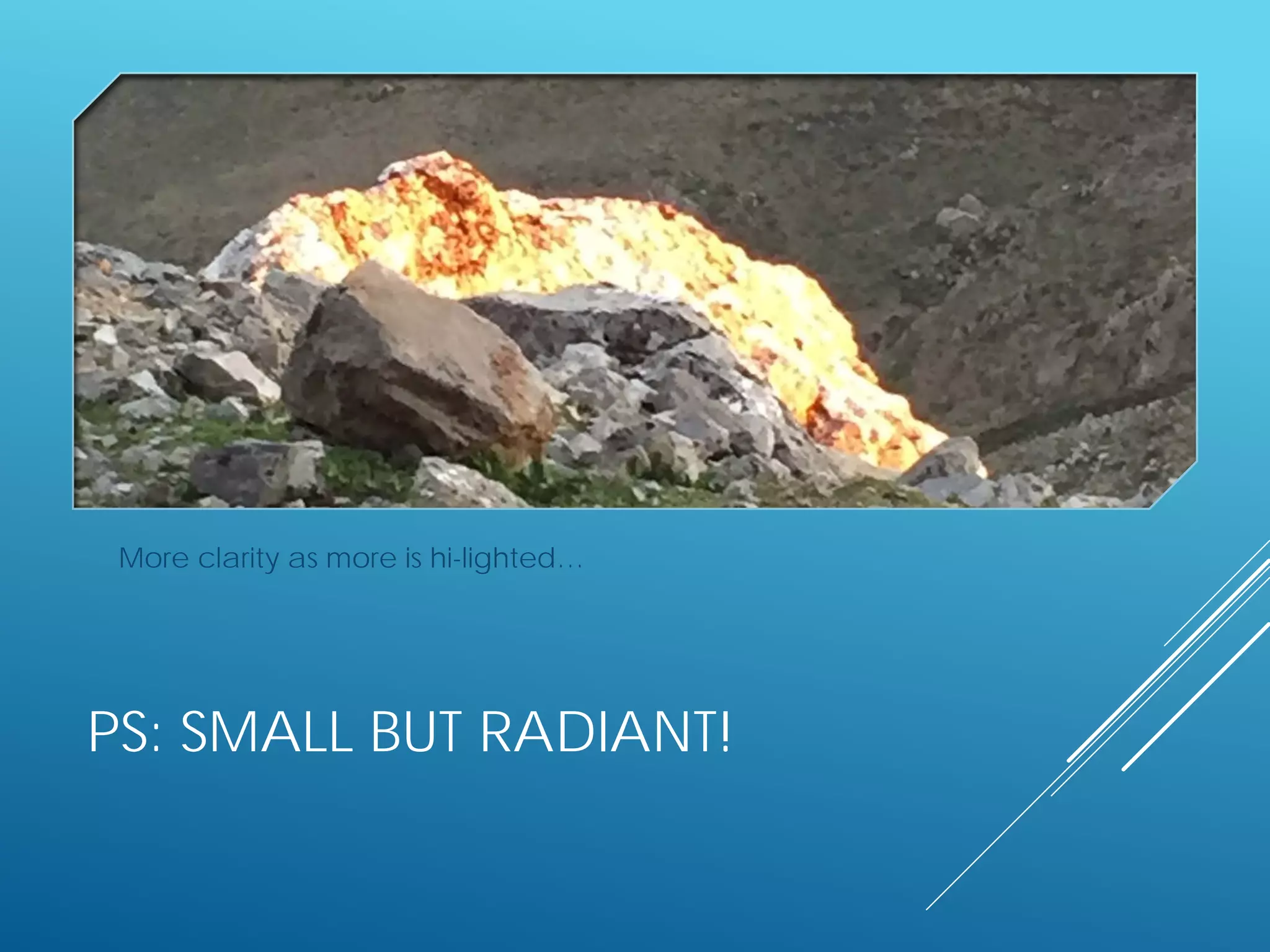
 A view from the mountain…
CRETE’S 2ND HIGHEST MOUNTAIN
 A small party from the eStandards’ consortium
decided to reach the top to witness a sunrise.
 The party included the author who had assumed
that the land rovers provided at the beginning
would continue by road to the summit or near
by…Wrong!
 I went so far, but did not reach the summit; I had
time to reflect on the differences between the
all-singing, all-dancing EHR in all of its glory, as
opposed to a much more discrete, but
nevertheless a mundane and commonplace
object, made beautiful.
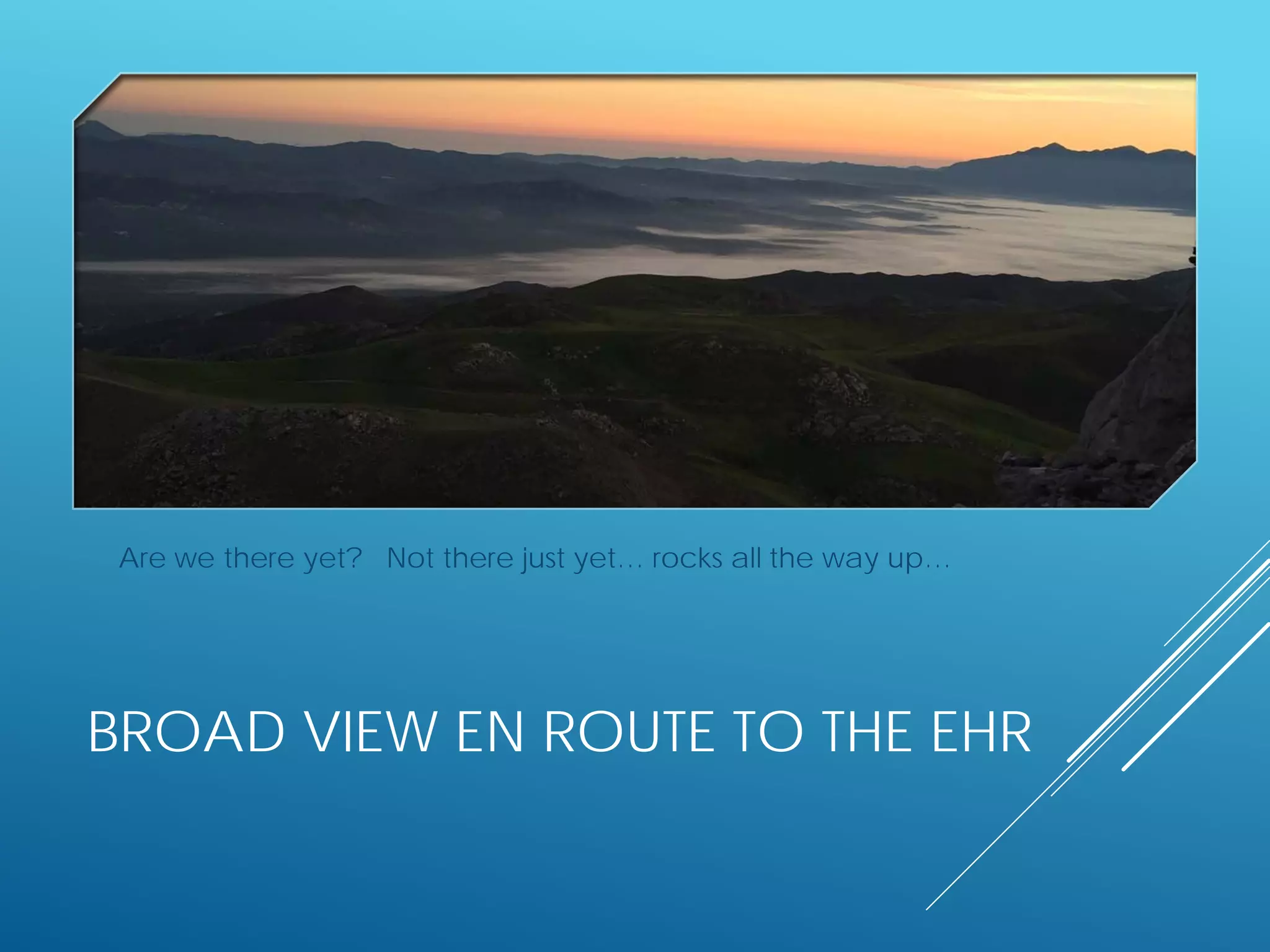
BROAD VIEW EN ROUTE TO THE EHR
Are we there yet? Not there just yet… rocks all the way up…
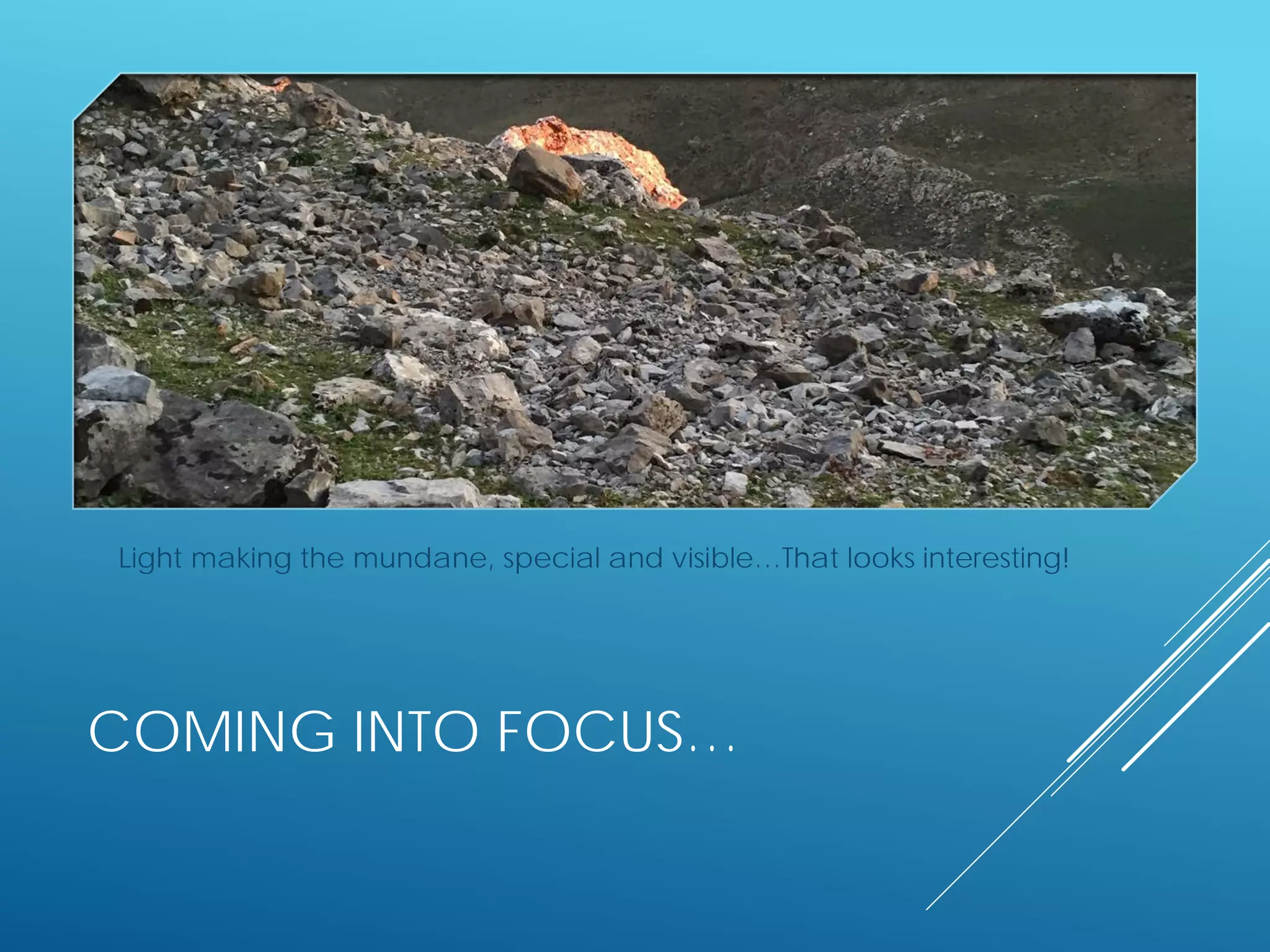
COMING INTO FOCUS…
Light making the mundane, special and visible…That looks interesting!
PS: SMALL BUT RADIANT!
More clarity as more is hi-lighted…
THANK YOU; ANY QUESTIONS?
“Having the right data is usually better
than having more data”
ACKNOWLEDGEMENT
 Slides 20, 24, 26, 27 were provided by Jane Millar
and the JIC Coordinating group

1st eStandards conference: next steps for standardization in large scale eHealth deployment: Patient Summaries

  • 1.
  • 2.
    OVERVIEW  Introduction tothe International Patient Summary (PS) Standard  Surprise and confusion  Organisational Perspective  Pain and Gain (possible costs)  Healthcare Perspective  Pain and Gain (possible benefits)  Standardisation Perspective  International?  Interest  Initiatives  Personal Summary (PS, sic) “A View from a Mountain”
  • 3.
    INTERNATIONAL PATIENT SUMMARY STANDARDS There are none… so, a very short presentation!  A little surprising?  There are so many variants and different types of ‘summary’ (e.g. discharge summaries, handovers)  Patient Summaries are part of the healthcare fabric, commonplace and even mundane  There are many local implementations, some national, and even regional in operation  Some of these have been well established for years  Standardisation is arguably more efficient if the thing to be elevated to a standard already exists and is proven to work in practice, so an ideal target?  A little confusing, and the confusion explains why!
  • 4.
    ORGANISATIONAL & VENDOR COSTS THELEGACY CHALLENGE…  Return of investment is important and there is no desire to change, particularly if something is currently working  Worse still, the ubiquitous and pervasive nature of the ‘summary’ means widespread disruption and upheaval from any change  What is the incentive to change?  … THE ‘GREEN FIELD’ OPPORTUNITY…  Adopting and fast tracking something that others have got to work  Avoiding vendor lock-in, avoiding past mistakes, gaining economies of scale  Minimise risk, costs and opening up new markets  …
  • 5.
    HEALTHCARE BENEFITS* PATIENT PERSPECTIVE Improving Patient Safety - supporting more informed prescribing by providing timely access to accurate information  Improving the Efficiency of Patient Care - reducing the time, effort and resources required to obtain this information  Improving the Effectiveness of Patient Care - supporting the delivery of appropriate care to patients  Improving Patient Experience - reducing repetition whilst supporting patient recall and those with difficulties CLINICIAN PERSPECTIVE  Improving Decision Support – removing uncertainty by giving the clinician instant access to additional and reliable information to better inform their decision  Improving prescribing/medicating practise- identifying medication discrepancies and reducing errors  Improving clinician productivity- reducing the time taken to treat the patient without duplication of effort/tests  Improving overall management - Patients are less likely to need to be referred to another service *adapted from Summary Care Record, HSCIC website, 2016
  • 6.
    THE STANDARDISATION PERSPECTIVE  Thecross-border value/ International debate  The interest of the SDO community  The Initiatives (particularly JIC) will be discussed
  • 7.
    AN INTERNATIONAL STANDARD FORPATIENT SUMMARY?  International:  Making the PS Structure & Content available for global use (independent of whether the demand is for cross-border or within a national state, or locally across organisations)  Interest:  There are powerful stakeholder requirements for SDOs to get this done NOW, e.g. eHN, EU, EU-US, US Meaningful Use …  It is not rocket science, and implementations exist, albeit not in an ‘idealised form’, therefore it should not too difficult…  It is not ‘Big Data’; it has all the advantages of being ‘Little Data’! Even so,  “The value of data lies in their use.”  “Data have no value or meaning in isolation”  “They can be assets or liabilities or both.”  “The information necessary to interpret data is specific to the problem”
  • 8.
    PS: ‘LITTLE DATA’BUT NOT EASY!  “Data exist within a knowledge infrastructure- an ecosystem comprising stakeholders, technologies, organisations, objects and relationships between them.”  “Data and their uses are proliferating far faster than privacy law or information policy can catch up…”  “Moving data over networks involves a delicate balance of security, rights, protections, interoperability, and policy.”  ”Documenting data in ways to make them useful for others to discover, retrieve, interpret and reuse is … difficult”  Extracts from “Big Data, Little Data, No Data” by Christine L. Borgman
  • 9.
    SRO INITIATIVES  Assumethe audience has more knowledge about the European initiatives, so  eHN Patient Summary Guidelines v2  EU projects (e.g. epSOS, Trillium Bridge, eStandards)  More explanation here on the following:  Meaningful Use… Clinical Summaries  HL7 INTERPAS project  ISO TC215 Reference Standards Portfolios (Bundles)  Clinical Imaging  JIC Standards Sets  Patient Summary for unplanned/emergency Care
  • 10.
    INPUT/SUPPORT TO SDO INITIATIVES eHN Patient Summary Guidelines v2  EU projects (e.g. epSOS, Trillium Bridge, eStandards)  Meaningful Use… Clinical Summaries  (a little more detail follows on the nuances and differences between the EU and US initiatives)
  • 11.
    ELIGIBLE PROFESSIONAL MEANINGFULUSE CORE MEASURES MEASURE 12 OF 13 STAGE 1(2014 DEFINITION) LAST UPDATED: MAY 2014 Definition of Terms Clinical Summary – An after-visit summary that provides a patient with relevant and actionable information and instructions (containing the patient name, provider’s office contact information, date and location of visit, an updated medication list, updated vitals, reason(s) for visit, procedures and other instructions based on clinical discussions that took place during the office visit, any updates to a problem list, immunizations or medications administered during visit, summary of topics covered/considered during visit, time and location of next appointment/testing if scheduled, or a recommended appointment time if not scheduled, list of other appointments and tests that the patient needs to schedule with contact information, recommended patient decision aids, laboratory and other diagnostic test orders, test/laboratory results and symptoms. )
  • 12.
    NOTES…  The ellipseson the previous slide, flag the differences  The ellipses on the next slide show that the idea of packaging/bundling tools and rules are fairly commonplace…
  • 13.
    CERTIFICATION CRITERIA* §170.314(E)(2) CLINICALSUMMARY (i) Create. Enable a user to create a clinical summary for a patient in human readable format and formatted according to the standards adopted at … (ii) Customization. Enable a user to customize the data included in the clinical summary. (iii) Minimum data from which to select. EHR technology must permit a user to select, at a minimum, the following data when creating a clinical summary: (A) Common MU Data Set** (which, for the human readable version, should be in their English representation if they associate with a vocabulary/code set) (B) The provider’s name and office contact information; date and location of visit; reason for visit; immunizations and/or medications administered during the visit; diagnostic tests pending; clinical instructions; future appointments; referrals to other providers; future scheduled tests; and recommended patient decision aids. *Additional certification criteria may apply. … HL7 Implementation Guide for CDA Release 2: IHE Health Story Consolidation. The use of the “unstructured document” document-level template is prohibited. *Additional standards criteria may apply. ..
  • 14.
    INTERNATIONAL PATIENT SUMMARY TEMPLATE(2013)  The goal of this project is to identify minimally required clinical data with associated vocabulary subsets for patient clinical summary, and to build international templates based on HL7 CDA R2 standard with vocabulary subsets to support data elements within those templates.  Now relaunched as INTER PA S (2015)
  • 15.
    THE ISO ANDJIC INITIATIVES  INTERPAS wishes to be done with the target of it becoming an HL7/ISO standard.  Either INTERPAS will be an input to the JIC work, or more probably due to its expected completion date of 2017, JIC might provide a way to provide a guidance framework for when it is implemented.
  • 16.
    ISO TC215 REFERENCESTANDARDS PORTFOLIO (RSP) FOR CLINICAL IMAGING USE CASES
  • 17.
    ISO TC215 RSP It is on Clinical Imaging, and therefore content- wise it is not relevant;  However, the value for considering it, is because the structure of the ISO bundle and the development process is expected to be complementary to the JIC work.  Both initiatives are prototypical.  The ISO RSP will be published and normative, whereas the JIC Standards Sets will be an informative, authoritative recommendation.
  • 18.
    JIC STANDARDS SET: PATIENTSUMMARY April 2016
  • 19.
    JIC SAN FRANDECLARATION, 2015 The JIC will contribute to better global patient health outcomes by providing strategic leadership in the specification of sets of implementable standards for health information sharing.
  • 20.
    JIC STANDARDS SET– PATIENT SUMMARY  The first Use Case was agreed to be the Patient Summary since many nations are undertaking this work and SDOs are involved at different levels but not always coordinated Use Case (initial high level description)  A physician (i.e. Healthcare actor) wants relevant patient data to address the healthcare matter of the patient (subject of care) with legitimate access and use of relevant summary patient data at the point and time of care, irrespective of where and how it is held
  • 21.
    JIC EARLY PROTOTYPEPROCESS High-level Topic Use Case Descriptions Standards content, tools & rules = Standards Set
  • 22.
    ADAPTED DEFINITION OFA JIC STANDARDS SET (SS) A coherent collection of [referenced] standards and standards artefacts that support a specific use case
  • 23.
    ORGANISATION OF THEJIC DEVELOPMENT OF PS STANDARDS SET JIC SS-CG SG1: Detailed Use Case Development SG2: Standards Identification & Analysis SG3: Implementation & Guidance Document Development SG4: Conformity Assessment
  • 24.
    WORK STEPS ANDTASK GROUPS Activities/Steps Leads Group 1 Detailed use case development - Clinically focused group - Use case format Elizabeth Keller Group 2 Standards identification and analysis - Standards categorization approach(draft) - Template for a JIC Standards Set (draft) Don Newsham Group 3 Implementation and guidance document development Stephen Kay Group 4 Conformity Assessment - Initial framework pending work of groups 1 & 2 Mike Nusbaum Gaps and overlaps identification Coordination Group Standards set recommendations / gap action Coordination group and JIC members
  • 25.
    VOLUNTEERS? Implementation and Guidance Sub-group,not yet started, as it is dependent upon the other groups to deliver. Would really welcome
  • 26.
    KEY POINTS ABOUTTHE WORK  JIC is well placed for this work since JIC can draw directly on resources from SDOs and ensure coordination and collaboration  JIC is developing 2 key products  recommendations for the Patient Summary Standard Set  a methodology for developing further JIC Standards Sets  JIC are not developing products but leveraging existing work which is already either developed or in development – e.g. Trillium Bridge, epSoS and INTERPAS (HL7)  JIC is targeting one year for completion of the Patient Summary Standards Set – end of 2016
  • 27.
    PARTICIPATION FROM THE COMMUNITY A JIC Foundation and Scope report for Patient Summary Standards Set – 1 October 2015, sets out initial approach being taken and is identified as work in progress - JIC website. Updated version after JIC meeting, May 2016  FAQs on JIC website which will be regularly updated  Set of slides summarising the work which will be updated – JIC website  Draft plan and resource requirements will be maintained and updated as the work progresses Contact the Standards Set coordination group through the JIC website or Jane Millar jmi@ihtsdo.org http://www.jointinitiativecouncil.org
  • 28.
    AND FINALLY…  Aview from the mountain…
  • 29.
    CRETE’S 2ND HIGHESTMOUNTAIN  A small party from the eStandards’ consortium decided to reach the top to witness a sunrise.  The party included the author who had assumed that the land rovers provided at the beginning would continue by road to the summit or near by…Wrong!  I went so far, but did not reach the summit; I had time to reflect on the differences between the all-singing, all-dancing EHR in all of its glory, as opposed to a much more discrete, but nevertheless a mundane and commonplace object, made beautiful.
  • 30.
    BROAD VIEW ENROUTE TO THE EHR Are we there yet? Not there just yet… rocks all the way up…
  • 31.
    COMING INTO FOCUS… Lightmaking the mundane, special and visible…That looks interesting!
  • 32.
    PS: SMALL BUTRADIANT! More clarity as more is hi-lighted…
  • 33.
    THANK YOU; ANYQUESTIONS? “Having the right data is usually better than having more data”
  • 34.
    ACKNOWLEDGEMENT  Slides 20,24, 26, 27 were provided by Jane Millar and the JIC Coordinating group