How to
Use,
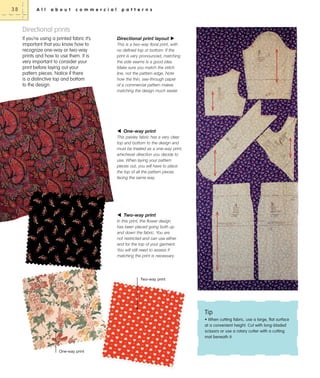
Adapt
and
Design

Sewing
Patterns
How to
Use,
Adapt
and
Design

Sewing
Patterns
Lee Hollahan
Published in 2010 by
A&C Black Publishers
36 Soho Square
London W1D 3QY
www.acblack.com
ISBN 978-1-4081-2000-2
Copyright © 2010 Quarto plc
All rights reserved. No part of this publication may
be reproduced in any form or by any means – graphic,
electronic or mechanical, including photocopying,
recording, taping, information storage and retrieval
systems – without the prior permission in writing of
the publisher.
A CIP record for this book is available from the British Library.
QUAR.USP
Conceived, designed and produced by:
Quarto Publishing plc
The Old Brewery
6 Blundell Street
London N7 9BH
Senior editor: Lindsay Kaubi
Additional text: Sandra Wilson
Copy editor: Liz Dalby
Art editor and designer: Susi Martin
Art director: Caroline Guest
Design assistant: Saffron Stocker
Photographer: Philip Wilkins
Illustrator: Sha Tahmasebi, Chris Taylor, Katie Buglass
Picture researcher: Sarah Bell
Creative director: Moira Clinch
Publisher: Paul Carslake
Colour separation by PICA Digital Pte Ltd in Singapore
Printed in Singapore by Star Standard Industries (PTE) Ltd
10 9 8 7 6 5 4 3 2 1
Contents
About this book

6

Essential equipment

10

Choosing fabrics

14

Chapter 2: All about
commercial patterns

18

Why use a commercial pattern?

20

How to measure accurately

22

Buying a commercial pattern

26

Understanding your pattern

28

Preparing a commercial pattern

30

Preparing your fabric

34

Pinning, marking and cutting out

46

64

Using pattern blocks

66

Making and fitting a toile

68
72
80

Simple dart manipulation

84

Styling sleeves and cuffs

88

Styling skirts

93

Styling dresses

96

42

Chapter 3: Altering a pattern

Creating your own pattern

Designing patterns

8

62

Advanced pattern alterations

Chapter 1: Tools and materials

Chapter 4: Designing your
own patterns

48

Simple bodice alterations

50

Simple sleeve alterations

56

Simple skirt alterations

57

Simple dress alterations

60

Simple trouser alterations

Facings and waistbands

105

Pocket styles

108
110

UK SIZE 8 pattern blocks

112

UK SIZE 10 pattern blocks

commercial patterns

100

Chapter 5: The pattern blocks
Simple alterations for

Collar styles

114

UK SIZE 12 pattern blocks

116

UK SIZE 14 pattern blocks

118

UK SIZE 16 pattern blocks

120

UK SIZE 18 pattern blocks

122

UK SIZE 20 pattern blocks

124

Chapter 6: Core sewing techniques

126

Glossary

140

Index

142

Credits

144

61
6

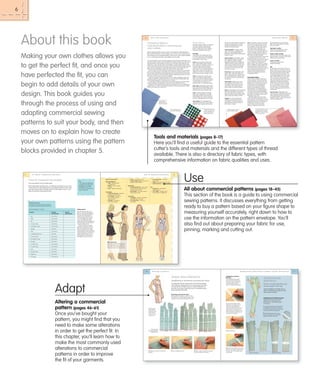
About this book

14

A l l

a b o u t

c o m m e r c i a l

The essential body landmarks.
When taking body measurements, it is extremely important to be accurate.
A well-balanced, nicely-fitting garment could depend entirely on this. Keep
your tape measure flat to the body and do not pull it tight or twist it. Try to
keep all horizontal measurements level.

Body circumference:

• Your working arm (depending
on whether you are right or left
handed) may have a greater
circumference: up to 2–3cm
(1 in) more! If so, always use the
larger measurement.

• 1 Bust – fullest part of the
bust (keep level)
• 2 Waist – 2.5cm (1in.) above
the navel
• 3 Hip – fullest part of the body

Front bodice:
• 4 Centre front (CF) neck – length from
front base of neck to waist
• 5 CF shoulder – from base of
neck at shoulder point to
waist, over bust
• 6 Shoulder – from base of
neck to tip of shoulder

Photocopy this

C h o o s i n g

Woven fabrics

Standard
Size UK12/US8

1

Bust

87cm (34 ⁄4in)

2

Waist

68cm (263⁄ 4in)

1

3

Hip

92cm (36 1⁄ 4in)

4

CF neck to waist

32cm (12 1⁄2in)

5

CF shoulder to waist

34.5cm (13 1⁄2in)

6

Shoulder

9cm (3 ⁄ 2in)

7

Neck

37cm (141⁄ 2in)

8

C shoulder point to bust

23cm (9in)

9

CB neck to waist

40cm (153⁄4in)

10 CB shoulder to waist

Calico cotton A lightweight, plain-weave

fabric, often with a printed pattern, this is
appropriate for both casual clothing and
children’s wear since it launders well.

Denim A heavyweight cotton usually dyed
blue and constructed in a twill weave
with white weft threads and blue warp
threads. Suitable for work clothing, jeans,
skirts, jackets and children’s clothes.
Gingham A medium-weight fabric
available in pure cotton and also in
cotton blends. The fabric’s fibres are
dyed beforehand and then woven to
form checks or stripes.

Consider the stripes and
checks of gingham, and
ensure these match at
seams and openings.

11/18/09 1:18:37 AM
11/16/09 6:43:24 PM

times from the natural fibres of the flax
plant. The flax makes the fabric strong
and absorbent, and also gives linen its
high natural sheen. Like cotton, this
natural fabric was traditionally used
alone, but is now mixed with other fibres
to alter its qualities. Spandex helps to
reduce the wrinkling nature of linen. Silk
and cotton may also be added.
Linen does wrinkle easily; however, this
is considered part of its charm, and
wrinkles are easily removed with a steam
iron. The fabric accepts dyes very well
and is available in a wide range of
fashion colours. Natural-fibre or undyed
linen is available in various weights and
shades ranging from pale ivory to tan.
‘Pure white’ linen is actually linen that has
been heavily bleached. Because of its
crispness, linen is ideal for tailored
clothing, from lightweight blouses to
heavyweight jackets.

MICROFIBRE FABRICS
These ‘miracle’ microfibre fabrics are a
modern invention. They are chemically
produced filaments made of nylon and
polyester. The microfibres that construct
the final fabrics are exceedingly thin
compared with conventional fabric
threads, and therefore the weave is
densely packed. The resulting fabrics
share the texture and draping quality of
natural fibres and are also lightweight,
yet durable. Although the very fine fibres
are ideal for emulating silk, they can be
adapted for many uses.
Microfibre fabrics tend to be wind
resistant as well as waterproof, so they
are excellent for warm outdoor wear and
impermeable rain gear. Microfibres are
washable, but there is one note of
caution: Because of their synthetic
chemical composition, they tend to

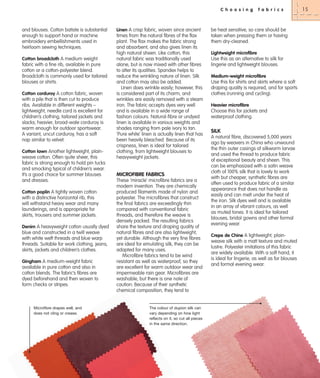
Microfibre drapes well, and
does not cling or crease.

15

f a b r i c s

be heat sensitive, so care should be
taken when pressing them or having
them dry-cleaned.
Lightweight microfibre

Use this as an alternative to silk for
lingerie and lightweight blouses.
Medium-weight microfibre

Use this for shirts and skirts where a soft
draping quality is required, and for sports
clothes (running and cycling).
Heavier microfibre

Choose this for jackets and
waterproof clothing.

SILK
A natural fibre, discovered 5,000 years
ago by weavers in China who unwound
the thin outer casings of silkworm larvae
and used the thread to produce fabric
of exceptional beauty and sheen. This
can be emphasized with a satin weave
cloth of 100% silk that is lovely to work
with but cheaper, synthetic fibres are
often used to produce fabric of a similar
appearance that does not handle as
easily and can melt under the heat of
the iron. Silk dyes well and is available
in an array of vibrant colours, as well
as muted tones. It is ideal for tailored
blouses, bridal gowns and other formal
evening wear.
Crepe de Chine A lightweight, plainweave silk with a matt texture and muted
lustre. Polyester imitations of this fabric
are widely available. With a soft hand, it
is ideal for lingerie, as well as for blouses
and formal evening wear.

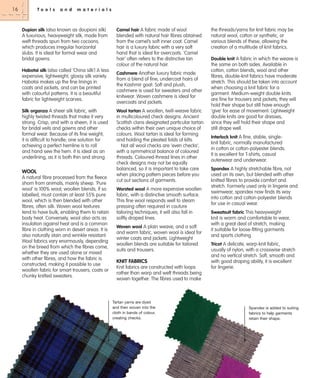
The colour of dupion silk can
vary depending on how light
reflects on it, so cut all pieces
in the same direction.

USP 008-017 corrections_.indd 15
UK_.indd 15

11/24/09 12:31:06 AM
11/18/09 1:18:43 PM

Tools and materials (pages 8–17)
Here you’ll find a useful guide to the essential pattern
cutter’s tools and materials and the different types of thread
available. There is also a directory of fabric types, with
comprehensive information on fabric qualities and uses.
t o

m e a s u r e

23

a c c u r a t e l y

• 13 CF waist to knee – CF waist to
centre of knee
• 14 Back – lower torso (bust line to waist)
• 15 CB waist to floor – CB at waist to floor

• 7 Neck – around base of neck
• 8 Centre shoulder to bust – centre of the
shoulder to apex of the bust

Use

Back bodice:

All about commercial patterns (pages 18–45)

Arm:

• 9 Centre back (CB) neck – neck to waist;
find the large bone at the CB of your
neck down to the CB waist
• 10 CB shoulder – from base of neck at
shoulder point to waist

• 16 Upper arm – circumference
of your upper arm
• 17 Arm length – shoulder to wrist
measured with arm slightly bent

This section of the book is a guide to using commercial
sewing patterns. It discusses everything from getting
ready to buy a pattern based on your figure shape to
measuring yourself accurately, right down to how to
use the information on the pattern envelope. You’ll
also find out about preparing your fabric for use,
pinning, marking and cutting out.

Lower torso:
• 11 Hip depth – from the CF waist point
to the fullest part of the body
• 12 CF waist to floor – from the CF
waist to floor

7

4

5
16

9
14

10

23cm (91⁄4in)

15 CB waist to floor

Cotton poplin A tightly woven cotton
with a distinctive horizontal rib, this
will withstand heavy wear and many
launderings, and is appropriate for
skirts, trousers and summer jackets.

sheer plain-weave cotton, this is ideal for
children’s wear, lingerie, handkerchiefs

17

58.5cm (23in)

14 Back

Cotton lawn Another lightweight, plainweave cotton. Often quite sheer, this
fabric is strong enough to hold pin tucks
and smocking typical of children’s wear.
It’s a good choice for summer blouses
and dresses.

Calico An inexpensive, roughly woven
cotton. The medium-weight variety is
often used to construct ‘dummy’ trousers,
or dress patterns, to check the fit before
constructing the final garment in an
expensive fabric. It is suitable for linings.

USP 008-017 corrections_.indd 14
UK_.indd 14

1

103cm (40 1⁄2in)

13 CF waist to knee

plant, cotton readily accepts coloured
dyes. Cotton has a tendency to shrink, so
it’s a good idea to preshrink before
cutting out. Either pass over the fabric
with a steam iron or launder beforehand.
Cottons are usually cut on the grain for
stability, but can be cut and sewn on the
bias for ease of wear or design contrast.

Use weights instead of
pins when cutting denim.

8

20.5cm (8in)

12 CF waist to floor

with a pile that is then cut to produce
ribs. Available in different weights –
lightweight, needle cord is excellent for
children’s clothing, tailored jackets and
slacks; heavier, broad-wale corduroy is
warm enough for outdoor sportswear.
A variant, uncut corduroy, has a soft
nap similar to velvet.

Cotton A natural product of the cotton

Cotton batiste A fine, lightweight and

Cotton poplin's
strength is derived
from its tight weave.

6

Start by asking for help from a
friend. It is virtually impossible to
take accurate measurements by
yourself. Use a dressmaker's
measuring tape. Remove all of
your outer clothing, but remain
in your undergarments while
measuring. Use the standard size
UK12/US8 measurements (left) to
compare with your own.
Use the diagrams provided
opposite as a guide to where to
take the measurements. These
measurement points are called
‘body landmarks’. Body landmarks
can be indicated on your body by
positioning sticky tape on your
undergarments. Stand with your
feet together while measuring.

Cotton corduroy A cotton fabric, woven

Linen A crisp fabric, woven since ancient

42cm (161⁄2in)

11 Hip depth

Personal
Measurements

fabric with a fine rib, available in pure
cotton or a cotton-polyester blend.
Broadcloth is commonly used for tailored
blouses or shirts.

cotton, with a slight sheen, most often
dyed beige and often used for slacks. A
heavier-weight chino, dyed in dark blue
or black, is appropriate for work clothes.

Getting started

Landmark

Cotton broadcloth A medium weight

COTTONS
These fabrics were traditionally made
from 100% cotton but are often blended
or even replaced with man-made fibres
like polyester or rayon today.

Chino A medium-weight, twill-weave

Mark all your measurements down: remember to
re-measure if your body changes shape over time.

MEASUREMENT CHART

and blouses. Cotton batiste is substantial
enough to support hand or machine
embroidery embellishments used in
heirloom sewing techniques.

Generally, medium-weight, woven fabrics
are easy to handle and are the best
choice for beginners. Stiff and bulky
fabrics or those that are fine, with little
body are more difficult to sew with.

Commercial patterns contain valuable suggestions regarding which fabric types suit a
garment’s particular design. Check the back of the pattern envelope. You’ll find a list of
appropriate fabrics, their widths and exactly how much fabric (what length) you will
need to buy. Cotton and linen fabrics are available in standard widths of 90cm (36in),
to 120cm (45in) and sometimes even 130cm (54in) and 150cm (60in). Woollens are most
often woven on wider looms and normally measure about 150cm (60in) wide. Knit
fabrics are usually available in widths from 140cm (56in) to 150cm (60in).
Don’t trust your ‘eye’ when selecting a fabric that must match the colour of another
garment. A shade of green, for example, can be difficult to visualize mentally. Green
hues undergo subtle tonal changes depending upon whether they tend more toward
the blue or the yellow in their composition. Bring the original garment with you to the
fabric shop, to be sure the colours are compatible.
Take time to decide on the perfect fabric for your needs. Lightweight corduroy, for
example, is perfect for children’s wear since it is very durable, and lightweight, silky
knits will drape beautifully in the flowing lines of a dress.
Finally, when bringing your fabric home, and certainly when storing, roll the fabric
instead of folding it. This will prevent creases that may be difficult to remove.
Attention to these details will ensure the success of your project, but coordinating a
beautiful fabric in a colour and texture that perfectly matches your garment’s design
will turn your project into a work of art.

H o w

Body landmarks
Tip

m a t e r i a l s

When selecting a fabric for your project, it’s important to take the fabric’s
fibre content, texture (or ‘hand’), drape, colour, and in some instances, the
size of its print, or its horizontal stretch, into account. Once a piece of fabric
is cut, it cannot be returned, and mistakes can be costly.

p a t t e r n s

How to measure accurately

a n d

A wide selection of fabrics in various textures and
colours is available.

Making your own clothes allows you
to get the perfect fit, and once you
have perfected the fit, you can
begin to add details of your own
design. This book guides you
through the process of using and
adapting commercial sewing
patterns to suit your body, and then
moves on to explain how to create
your own patterns using the pattern
blocks provided in chapter 5.

22

To o l s

Choosing fabrics

104cm (41in)

1

16 Upper arm

11
3
15
13

12

When measuring
Get the help of a friend when taking your
body measurements. It’s not possible to
be accurate if you’re bending down and
twisting to manoeuvre the tape measure.

34cm (131⁄2in)

17 Arm length

2

56.5cm (221⁄4in)

USP 018-061 B1 corrections_.indd 22
UK_.indd 22

11/24/09 12:50:57 PM
11/25/09 1:01:31

USP 018-061 B1 corrections_.indd 23
UK_.indd 23

11/25/09 1:01:34
11/24/09 3:27:49 PM

60

A l t e r i n g

a

p a t t e r n

S i m p l e

Simple dress alterations

a l t e r a t i o n s •

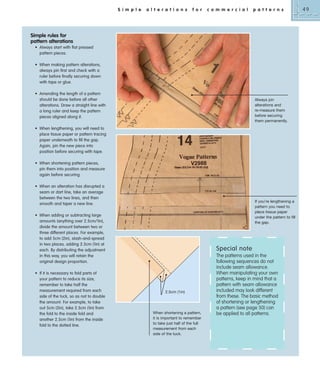
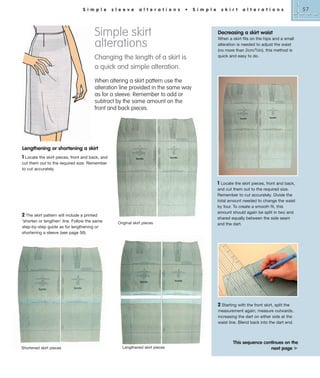
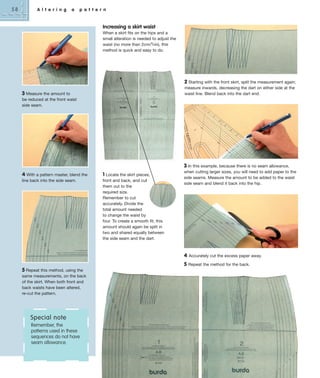
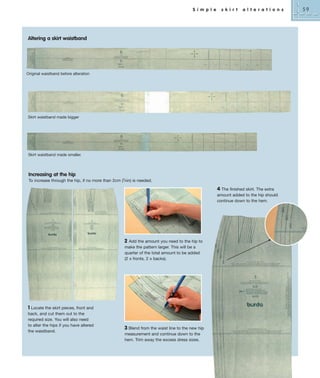
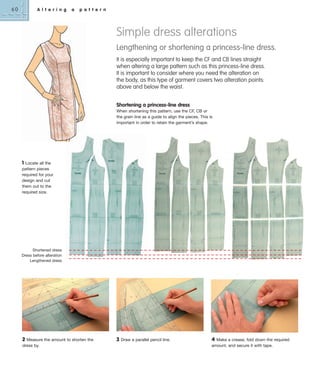
It is especially important to keep the CF and CB lines straight
when altering a large pattern such as this princess-line dress.
It is important to consider where you need the alteration on
the body, as this type of garment covers two alteration points:
above and below the waist.

Once you’ve bought your
pattern, you might find that you
need to make some alterations
in order to get the perfect fit. In
this chapter, you’ll learn how to
make the most commonly used
alterations to commercial
patterns in order to improve
the fit of your garments.

t r o u s e r

a l t e r a t i o n s

61

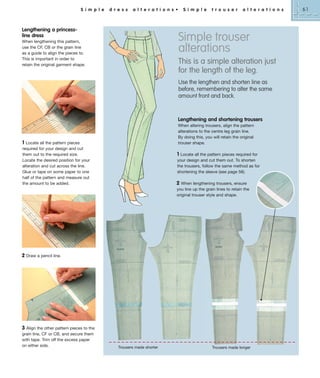
This is a simple alteration just
for the length of the leg.
Use the lengthen and shorten line as
before, remembering to alter the same
amount front and back.

Shortening a princess-line dress
When shortening this pattern, use the CF, CB or
the grain line as a guide to align the pieces. This is
important in order to retain the garment’s shape.

Altering a commercial
pattern (pages 46–61)

S i m p l e

Simple trouser
alterations

When lengthening this pattern,
use the CF, CB or the grain line
as a guide to align the pieces to.
This is important in order to
retain the original garment shape.

Lengthening or shortening a princess-line dress.

Adapt

d r e s s

Lengthening a princessline dress

Lengthening and shortening trousers
When altering trousers, align the pattern
alterations to the centre leg grain line.
By doing this, you will retain the original
trouser shape.

1

Locate all the pattern pieces
required for your design and cut
them out to the required size.
Locate the desired position for your
alteration and cut across the line.
Glue or tape on some paper to one
half of the pattern and measure out
the amount to be added.

1

Locate all the
pattern pieces
required for your
design and cut
them out to the
required size.

Shortened dress
Dress before alteration
Lengthened dress

2

1

Locate all the pattern pieces required for
your design and cut them out. To shorten
the trousers, follow the same method as for
shortening the sleeve (see page 56).

2 When lengthening trousers, ensure
you line up the grain lines to retain the
original trouser style and shape.

Draw a pencil line.

3
2 Measure the amount to shorten the
dress by.

USP 018-061 B1 corrections_.indd 60
UK_.indd 60

3

Draw a parallel pencil line.

4 Make a crease, fold down the required
amount, and secure it with tape.

11/18/09 12:15:53 AM
11/16/09 10:51:37 PM

Align the other pattern pieces to the
grain line, CF or CB, and secure them
with tape. Trim off the excess paper
on either side.

USP 018-061 B1 corrections_.indd 61
UK_.indd 61

Trousers made shorter

Trousers made longer

11/18/09 12:15:53 AM
11/16/09 10:52:32 PM
A b o u t

80

D e s i g n i n g

y o u r

o w n

p a t t e r n s

Designing patterns
Now that you have perfected your
basic blocks, you are ready to
attempt your first designs.
To realize your design ideas, it helps to
understand proportion and where seam
lines look most flattering on the body.
Using yarn or tape to map out style lines on a
dress form is a good way to see your design threedimensionally. On the following pages, a standard UK
size 8 (US size 6) dress form is used. If you are not of a
standard size, you may need to adapt a dress form to
suit your own personal measurements.

D e s i g n i n g

Design analysis
Designers often put their
inspirations onto paper. The
designer’s sketch is this initial idea.
It is an interpretation of how a
garment is to look when it is
finished. It shows how the fabric
will behave, may include colour
and texture, and will evoke the
general feeling of the garment.

Working drawing
One of the first steps in realizing
your design is to make a working
drawing. A working drawing is a
simple line drawing of the garment
that highlights the details of its
construction – where to put the
seam lines, darts, gathers or
pleats, topstitching, buttonholes
and so on. Based on the designer’s
sketch, the working drawing
should be in proportion, with the

Details to consider
Before starting to construct the
pattern you should have an idea
of what fabric the garment is to be
made in. The blouse shown to the
right is to be made from a woven
cotton shirting fabric and is
therefore not stretchy. (Woven
fabric can sometimes contain a
small amount of stretch. The
amount of stretch is an important
consideration when choosing a
fabric, as the pattern will have to
be adapted for this.) The fit of this
garment is achieved through four
darts with gathering at the front

Design
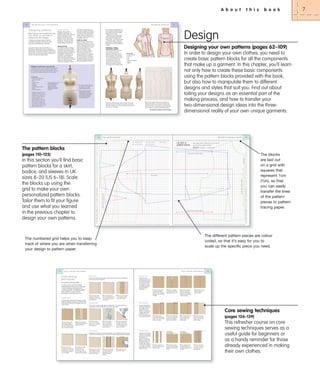
Designing your own patterns (pages 62–109)

Translating a working
drawing into a pattern
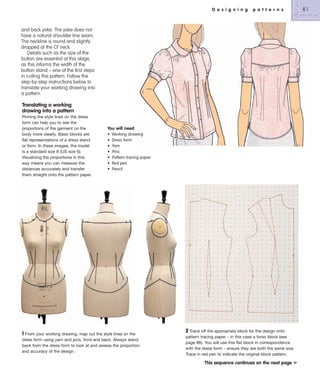
Pinning the style lines on the dress
form can help you to see the
proportions of the garment on the
body more clearly. Basic blocks are
flat representations of a dress stand
or form. In these images, the model
is a standard size 8 (US size 6).
Visualizing the proportions in this
way means you can measure the
distances accurately and transfer
them straight onto the pattern paper.

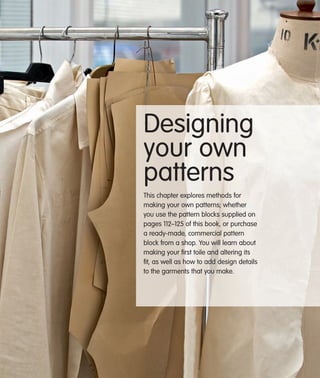
In order to design your own clothes, you need to
create basic pattern blocks for all the components
that make up a garment. In this chapter, you’ll learn
not only how to create these basic components
using the pattern blocks provided with the book,
but also how to manipulate them to different
designs and styles that suit you. Find out about
toiling your designs as an essential part of the
making process, and how to transfer your
two-dimensional design ideas into the threedimensional reality of your own unique garments.

You will need
•
•
•
•
•
•
•

Working drawing
Dress form
Yarn
Pins
Pattern tracing paper
Red pen
Pencil

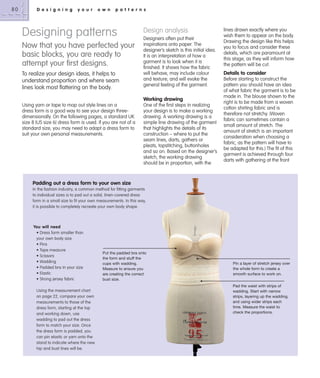
Padding out a dress form to your own size
In the fashion industry, a common method for fitting garments
to individual sizes is to pad out a solid, linen-covered dress
form in a small size to fit your own measurements. In this way,
it is possible to completely recreate your own body shape.

You will need
• Dress form smaller than
your own body size
• Pins
• Tape measure
• Scissors
• Wadding
• Padded bra in your size
• Elastic
• Strong jersey fabric

Put the padded bra onto
the form and stuff the
cups with wadding.
Measure to ensure you
are creating the correct
bust size.

Pin a layer of stretch jersey over
the whole form to create a
smooth surface to work on.
Pad the waist with strips of
wadding. Start with narrow
strips, layering up the wadding,
and using wider strips each
time. Measure the waist to
check the proportions.

Using the measurement chart
on page 22, compare your own
measurements to those of the
dress form, starting at the top
and working down, use
wadding to pad out the dress
form to match your size. Once
the dress form is padded, you
can pin elastic or yarn onto the
stand to indicate where the new
hip and bust lines will be.

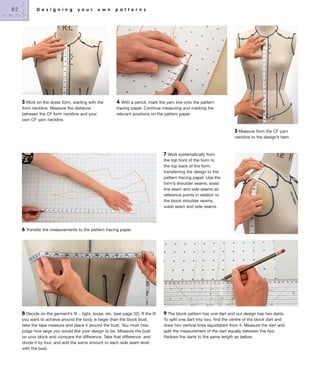
2 Trace off the appropriate block for the design onto
pattern tracing paper – in this case a torso block (see
page 96). You will use this flat block in correspondence
with the dress form – ensure they are both the same size.
Trace in red pen to indicate the original block pattern.

1 From your working drawing, map out the style lines on the
dress form using yarn and pins, front and back. Always stand
back from the dress form to look at and assess the proportion
and accuracy of the design.

This sequence continues on the next page ³

USP 062-083 UK_.indd 80 corrections_.indd 80
B2 A Layouts

11/17/09 12:26:10 PM
11/25/09 1:19:21 AM

USP 062-083 UK_.indd 81 corrections_.indd 81
B2 A Layouts

116
1

T h e
2

3

4

5

p a t t e r n
6

7

8

11/17/09 10:39:39 PM
11/25/09 1:19:24 AM

b l o c k s

U K

-

-

-

9 10 11 12 13 14 15 16 17 18 19 20 21 22 23 24 25 26 27 28 29 30 31 32 33 34 35 36 37 38 39 40

A
B
C

The pattern blocks

Back bodice
Front bodice

Back skirt
Front skirt

Sleeve

S I Z E

1 2

p a t t e r n

117

b l o c k s

41 42 43 44 45 46 47 48 49 50 51 52 53 54 55 56 57 58 59 60 61 62 63 64 65 66 67 68 69 70 71 72 73 74 75 76 77 78 79 80

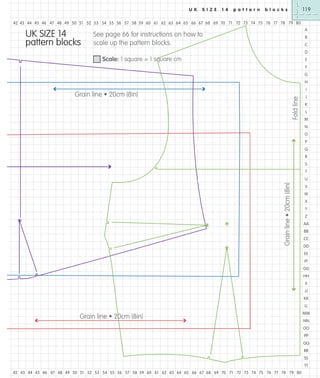
UK SIZE 12
pattern blocks

A

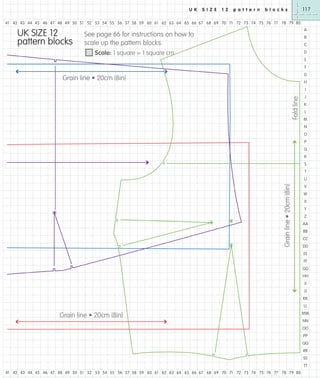
See page 66 for instructions on how to
scale up the pattern blocks.

B
C

Scale: 1 square = 1 square cm

D

D

E

E

F

F

G

(pages 110–125)

G

Grain line • 20cm (8in)

H

H

I

I

Fold line

J
K
L
M

N
O

P

P
Q

R

R

S

S

Grain line

T

T
U

Grain line • 20cm (8in)

U
V
W
X
Y
Z
AA
BB
CC
DD
EE
FF
GG
HH
II
JJ
KK
LL

II
JJ

NN
OO

PP

PP

QQ

QQ

RR

RR
SS
TT
2

3

4

5

6

7

8

9 10 11 12 13 14 15 16 17 18 19 20 21 22 23 24 25 26 27 28 29 30 31 32 33 34 35 36 37 38 39 40

11/25/09 2:11:26 PM
11/25/09 2:39:28 PM

41 42 43 44 45 46 47 48 49 50 51 52 53 54 55 56 57 58 59 60 61 62 63 64 65 66 67 68 69 70 71 72 73 74 75 76 77 78 79 80

USP US B3 112-125 corrections_.indd 117
USP B3 112-125 cm UK_.indd 117

11/25/09 2:11:27 PM
11/25/09 2:39:29 PM

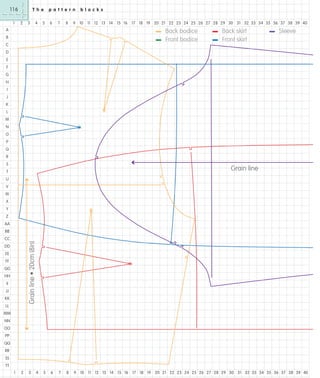
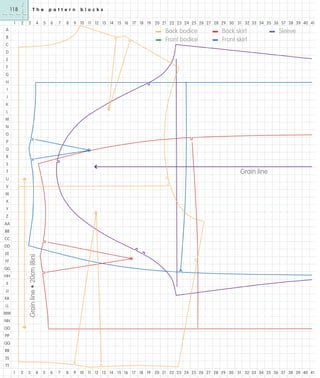
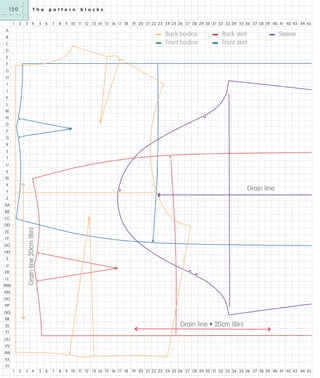
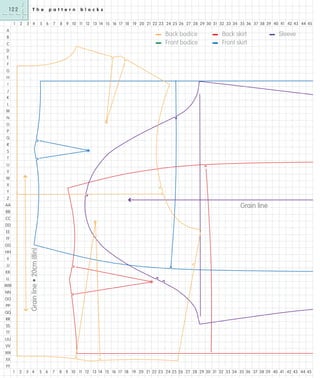
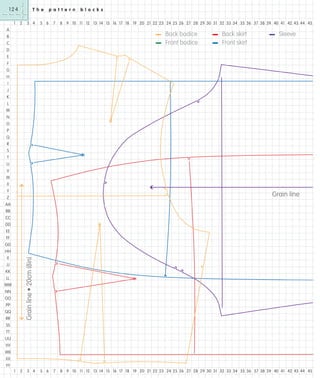
The different pattern pieces are colour
coded, so that it’s easy for you to
scale up the specific piece you need.

C o r e

Plain seam

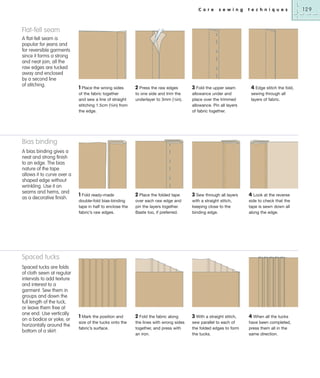
A flat-fell seam is
popular for jeans and
for reversible garments
since it forms a strong
and neat join; all the
raw edges are tucked
away and enclosed
by a second line
of stitching.

together, matching the
raw edges, and pin along
the sewing line.

2 Use a straight stitch
and sew along the sewing
line, removing the pins in
the process.

3 Press the seam open or

Zigzag finish

USP B4 sewing techniques SS_.indd 128
128_139 UK_.indd 128

129

1 Place the wrong sides
of the fabric together
and sew a line of straight
stitching 1.5cm ( 5⁄ 8in) from
the edge.

2 Press the raw edges
to one side and trim the
underlayer to 3mm (1⁄8in).

3 Fold the upper seam

1 Fold ready-made

2 Place the folded tape
over each raw edge and
pin the layers together.
Baste too, if preferred.

3 Sew through all layers

4 Look at the reverse

with a straight stitch,
keeping close to the
binding edge.

side to check that the
tape is sewn down all
along the edge.

2 Fold the fabric along
the lines with wrong sides
together, and press with
an iron.

3 With a straight stitch,

4 When all the tucks

sew parallel to each of
the folded edges to form
the tucks.

have been completed,
press them all in the
same direction.

allowance under and
place over the trimmed
allowance. Pin all layers
of fabric together.

4 Edge stitch the fold,
sewing through all
layers of fabric.

Bias binding

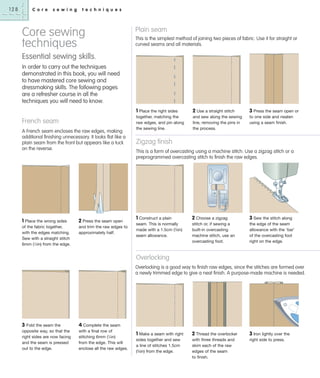
This is a form of overcasting using a machine stitch. Use a zigzag stitch or a
preprogrammed overcasting stitch to finish the raw edges.

A bias binding gives a
neat and strong finish
to an edge. The bias
nature of the tape
allows it to curve over a
shaped edge without
wrinkling. Use it on
seams and hems, and
as a decorative finish.

1 Construct a plain
seam. This is normally
made with a 1.5cm ( 5⁄8in)
seam allowance.

2 Choose a zigzag
stitch or, if sewing a
built-in overcasting
machine stitch, use an
overcasting foot.

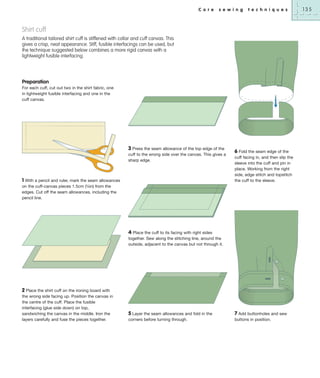
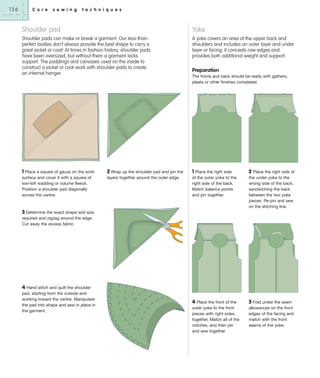
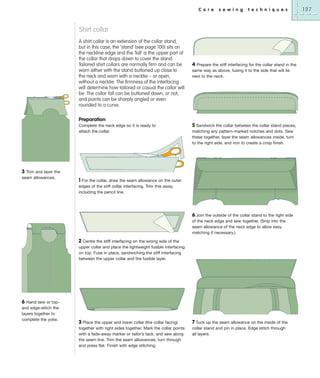
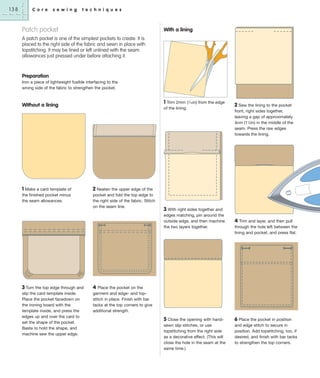
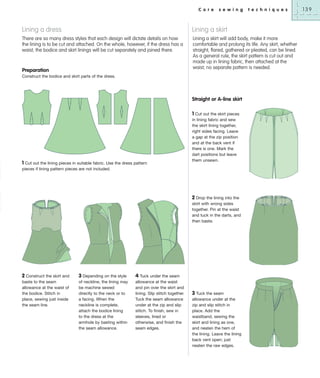
Core sewing techniques
double-fold bias-binding
tape in half to enclose the
fabric’s raw edges.

3 Sew the stitch along
the edge of the seam
allowance with the ‘bar’
of the overcasting foot
right on the edge.

Spaced tucks
Spaced tucks are folds
of cloth sewn at regular
intervals to add texture
and interest to a
garment. Sew them in
groups and down the
full length of the tuck,
or leave them free at
one end. Use vertically
on a bodice or yoke, or
horizontally around the
bottom of a skirt.

4 Complete the seam
with a final row of
stitching 6mm (1⁄4in)
from the edge. This will
enclose all the raw edges.

t e c h n i q u e s

to one side and neaten
using a seam finish.

Overlocking

Fold the seam the
opposite way, so that the
right sides are now facing
and the seam is pressed
out to the edge.

s e w i n g

Flat-fell seam

This is the simplest method of joining two pieces of fabric. Use it for straight or
curved seams and all materials.

Overlocking is a good way to finish raw edges, since the stitches are formed over
a newly trimmed edge to give a neat finish. A purpose-made machine is needed.

3

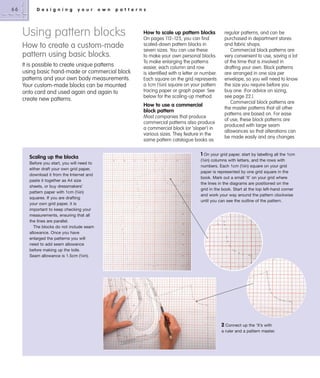
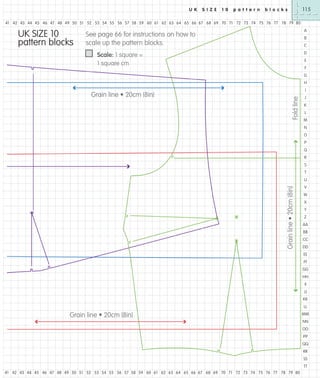
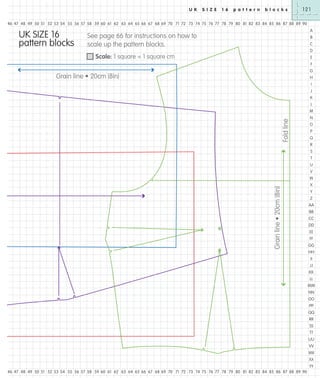
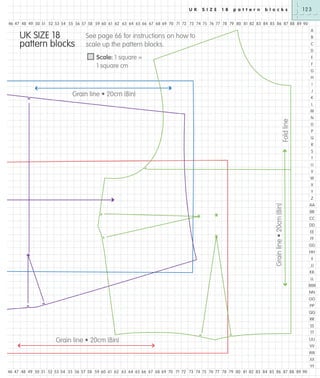
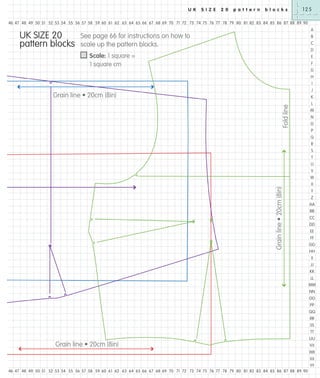
The blocks
are laid out
on a grid with
squares that
represent 1cm
(3⁄8in), so that
you can easily
transfer the lines
of the pattern
pieces to pattern
tracing paper.

MM

Grain line • 20cm (8in)

NN
OO

1 Place the right sides

2 Press the seam open
and trim the raw edges to
approximately half.

DD

LL

In order to carry out the techniques
demonstrated in this book, you will need
to have mastered core sewing and
dressmaking skills. The following pages
are a refresher course in all the
techniques you will need to know.

of the fabric together,
with the edges matching.
Sew with a straight stitch
6mm ( 1⁄4in) from the edge.

BB
CC

KK

Essential sewing skills.

1 Place the wrong sides

Y
Z
AA

FF

t e c h n i q u e s

A French seam encloses the raw edges, making
additional finishing unnecessary. It looks flat like a
plain seam from the front but appears like a tuck
on the reverse.

X

EE

The numbered grid helps you to keep
track of where you are when transferring
your design to pattern paper.

French seam

W

HH

USP US B3 112-125 corrections_.indd 116
USP B3 112-125 cm UK_.indd 116

s e w i n g

V

GG

MM

1

C o r e

M

N

TT

Core sewing
techniques

L

Q

SS

128

J
K

O

Grain line • 20cm (8in)

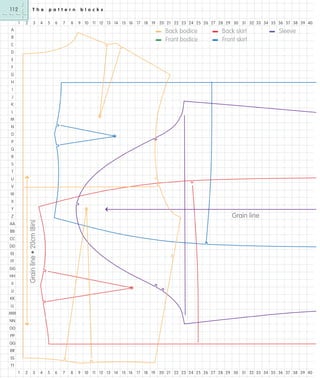
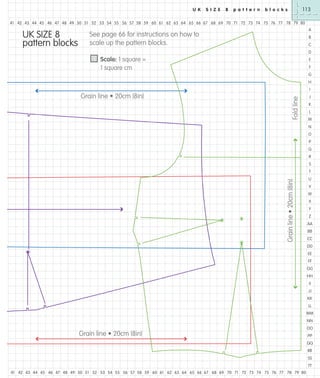
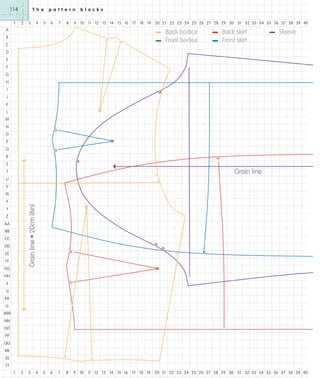
In this section you’ll find basic
pattern blocks for a skirt,
bodice, and sleeves in UK
sizes 8–20 (US 6–18). Scale
the blocks up using the
grid to make your own
personalized pattern blocks.
Tailor them to fit your figure
and use what you learned
in the previous chapter to
design your own patterns.

b o o k

81

p a t t e r n s

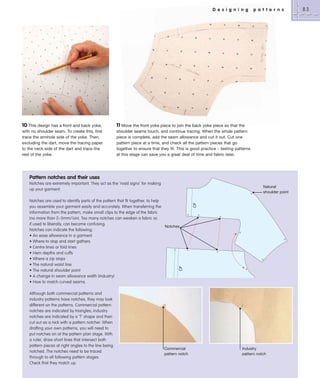
and back yoke. The yoke does not
have a natural shoulder line seam.
The neckline is round and slightly
dropped at the CF neck.
Details such as the size of the
button are essential at this stage,
as this informs the width of the
button stand – one of the first steps
in cutting this pattern. Follow the
step-by-step instructions below to
translate your working drawing into
a pattern.

lines drawn exactly where you
wish them to appear on the body.
Drawing the design like this helps
you to focus and consider these
details, which are paramount at
this stage, as they will inform how
the pattern will be cut.

t h i s

1 Make a seam with right
sides together and sew
a line of stitches 1.5cm
(5⁄8in) from the edge.

2 Thread the overlocker
with three threads and
skim each of the raw
edges of the seam
to finish.

3 Iron lightly over the

1 Mark the position and
size of the tucks onto the
fabric’s surface.

right side to press.

11/17/09 11:06:50 AM
11/17/09 2:36:49 PM

USP B4 sewing techniques SS_.indd 129
128_139 UK_.indd 129

11/17/09 2:36:50 PM
11/17/09 11:06:50 AM

(pages 126–139)

This refresher course on core
sewing techniques serves as a
useful guide for beginners or
as a handy reminder for those
already experienced in making
their own clothes.

7
Tools and
materials
In this chapter, you‘ll find all the
information you need on the tools
and materials essential for sewing
and dressmaking. There is a guide
to useful equipment and a full
discussion on how to select the
right fabric for your project.
10

To o l s

a n d

m a t e r i a l s

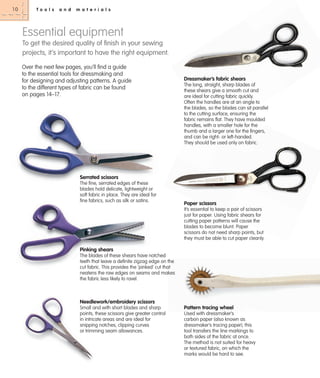
Essential equipment
To get the desired quality of finish in your sewing
projects, it’s important to have the right equipment.
Over the next few pages, you’ll find a guide
to the essential tools for dressmaking and
for designing and adjusting patterns. A guide
to the different types of fabric can be found
on pages 14–17.

Dressmaker’s fabric shears
The long, straight, sharp blades of
these shears give a smooth cut and
are ideal for cutting fabric quickly.
Often the handles are at an angle to
the blades, so the blades can sit parallel
to the cutting surface, ensuring the
fabric remains flat. They have moulded
handles, with a smaller hole for the
thumb and a larger one for the fingers,
and can be right- or left-handed.
They should be used only on fabric.

Serrated scissors
The fine, serrated edges of these
blades hold delicate, lightweight or
soft fabric in place. They are ideal for
fine fabrics, such as silk or satins.

Paper scissors
It’s essential to keep a pair of scissors
just for paper. Using fabric shears for
cutting paper patterns will cause the
blades to become blunt. Paper
scissors do not need sharp points, but
they must be able to cut paper cleanly.

Pinking shears
The blades of these shears have notched
teeth that leave a definite zigzag edge on the
cut fabric. This provides the ‘pinked’ cut that
neatens the raw edges on seams and makes
the fabric less likely to ravel.

Needlework/embroidery scissors
Small and with short blades and sharp
points, these scissors give greater control
in intricate areas and are ideal for
snipping notches, clipping curves
or trimming seam allowances.

Pattern tracing wheel
Used with dressmaker’s
carbon paper (also known as
dressmaker’s tracing paper), this
tool transfers the line markings to
both sides of the fabric at once.
The method is not suited for heavy
or textured fabric, on which the
marks would be hard to see.
E s s e n t i a l

e q u i p m e n t

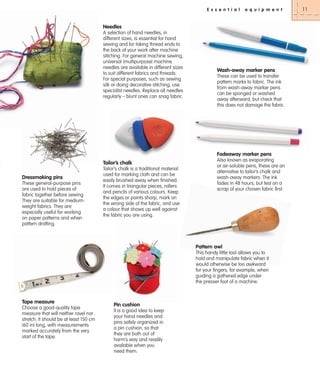
Needles
A selection of hand needles, in
different sizes, is essential for hand
sewing and for taking thread ends to
the back of your work after machine
stitching. For general machine sewing,
universal (multipurpose) machine
needles are available in different sizes
to suit different fabrics and threads.
For special purposes, such as sewing
silk or doing decorative stitching, use
specialist needles. Replace all needles
regularly – blunt ones can snag fabric.

Wash-away marker pens
These can be used to transfer
pattern marks to fabric. The ink
from wash-away marker pens
can be sponged or washed
away afterward, but check that
this does not damage the fabric.

Fadeaway marker pens
Tailor’s chalk
Dressmaking pins
These general-purpose pins
are used to hold pieces of
fabric together before sewing.
They are suitable for mediumweight fabrics. They are
especially useful for working
on paper patterns and when
pattern drafting.

Tailor’s chalk is a traditional material
used for marking cloth and can be
easily brushed away when finished.
It comes in triangular pieces, rollers
and pencils of various colours. Keep
the edges or points sharp, mark on
the wrong side of the fabric, and use
a colour that shows up well against
the fabric you are using.

Also known as evaporating
or air-soluble pens, these are an
alternative to tailor’s chalk and
wash-away markers. The ink
fades in 48 hours, but test on a
scrap of your chosen fabric first.

Pattern awl
This handy little tool allows you to
hold and manipulate fabric when it
would otherwise be too awkward
for your fingers, for example, when
guiding a gathered edge under
the presser foot of a machine.

Tape measure
Choose a good-quality tape
measure that will neither ravel nor
stretch. It should be at least 150 cm
(60 in) long, with measurements
marked accurately from the very
start of the tape.

Pin cushion
It is a good idea to keep
your hand needles and
pins safely organized in
a pin cushion, so that
they are both out of
harm’s way and readily
available when you
need them.

11
12

To o l s

a n d

m a t e r i a l s

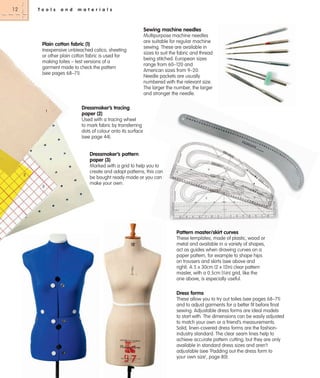
Sewing machine needles
Plain cotton fabric (1)
Inexpensive unbleached calico, sheeting
or other plain cotton fabric is used for
making toiles – test versions of a
garment made to check the pattern
(see pages 68–71).

1

Multipurpose machine needles
are suitable for regular machine
sewing. These are available in
sizes to suit the fabric and thread
being stitched. European sizes
range from 60–120 and
American sizes from 9–20.
Needle packets are usually
numbered with the relevant size.
The larger the number, the larger
and stronger the needle.

Dressmaker’s tracing
paper (2)
Used with a tracing wheel
to mark fabric by transferring
dots of colour onto its surface
(see page 44).

Dressmaker’s pattern
paper (3)
2
3

Marked with a grid to help you to
create and adapt patterns, this can
be bought ready-made or you can
make your own.

Pattern master/skirt curves
These templates, made of plastic, wood or
metal and available in a variety of shapes,
act as guides when drawing curves on a
paper pattern, for example to shape hips
on trousers and skirts (see above and
right). A 5 x 30cm (2 x 12in) clear pattern
master, with a 0.5cm (1⁄4in) grid, like the
one above, is especially useful.

Dress forms
These allow you to try out toiles (see pages 68–71)
and to adjust garments for a better fit before final
sewing. Adjustable dress forms are ideal models
to start with. The dimensions can be easily adjusted
to match your own or a friend’s measurements.
Solid, linen-covered dress forms are the fashionindustry standard. The clear seam lines help to
achieve accurate pattern cutting, but they are only
available in standard dress sizes and aren’t
adjustable (see ‘Padding out the dress form to
your own size’, page 80).
E s s e n t i a l

e q u i p m e n t

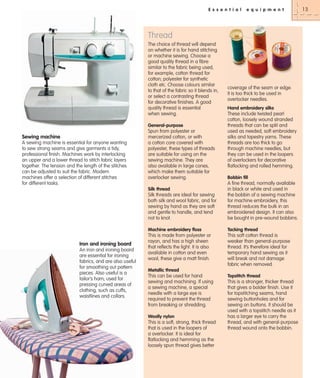
Thread
The choice of thread will depend
on whether it is for hand stitching
or machine sewing. Choose a
good quality thread in a fibre
similar to the fabric being used,
for example, cotton thread for
cotton; polyester for synthetic
cloth etc. Choose colours similar
to that of the fabric so it blends in,
or select a contrasting thread
for decorative finishes. A good
quality thread is essential
when sewing.
General-purpose

Sewing machine
A sewing machine is essential for anyone wanting
to sew strong seams and give garments a tidy,
professional finish. Machines work by interlocking
an upper and a lower thread to stitch fabric layers
together. The tension and the length of the stitches
can be adjusted to suit the fabric. Modern
machines offer a selection of different stitches
for different tasks.

Spun from polyester or
mercerized cotton, or with
a cotton core covered with
polyester, these types of threads
are suitable for using on the
sewing machine. They are
also available in large cones,
which make them suitable for
overlocker sewing.

coverage of the seam or edge.
It is too thick to be used in
overlocker needles.
Hand embroidery silks

These include twisted pearl
cotton, loosely wound stranded
threads that can be split and
used as needed, soft embroidery
silks and tapestry yarns. These
threads are too thick to go
through machine needles, but
they can be used in the loopers
of overlockers for decorative
flatlocking and rolled hemming.
Bobbin fill

Silk threads are ideal for sewing
both silk and wool fabric, and for
sewing by hand as they are soft
and gentle to handle, and tend
not to knot.

A fine thread, normally available
in black or white and used in
the bobbin of a sewing machine
for machine embroidery, this
thread reduces the bulk in an
embroidered design. It can also
be bought in pre-wound bobbins.

Machine embroidery floss

Tacking thread

This is made from polyester or
rayon, and has a high sheen
that reflects the light. It is also
available in cotton and even
wool; these give a matt finish.

This soft cotton thread is
weaker than general-purpose
thread. It’s therefore ideal for
temporary hand sewing as it
will break and not damage
fabric when removed.

Silk thread

Iron and ironing board
An iron and ironing board
are essential for ironing
fabrics, and are also useful
for smoothing out pattern
pieces. Also useful is a
tailor’s ham; used for
pressing curved areas of
clothing, such as cuffs,
waistlines and collars.

Metallic thread

This can be used for hand
sewing and machining. If using
a sewing machine, a special
needle with a large eye is
required to prevent the thread
from breaking or shredding.
Woolly nylon

This is a soft, strong, thick thread
that is used in the loopers of
a overlocker. It is ideal for
flatlocking and hemming as the
loosely spun thread gives better

Topstitch thread

This is a stronger, thicker thread
that gives a bolder finish. Use it
for topstitching seams, hand
sewing buttonholes and for
sewing on buttons. It should be
used with a topstitch needle as it
has a larger eye to carry the
thread, and with general-purpose
thread wound onto the bobbin.

13
14

To o l s

a n d

m a t e r i a l s

Woven fabrics

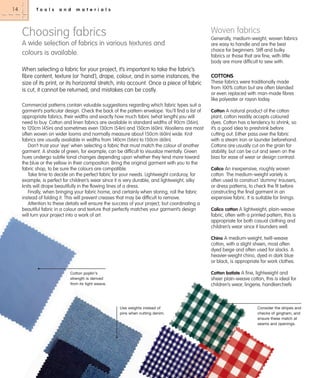
Choosing fabrics
A wide selection of fabrics in various textures and
colours is available.
When selecting a fabric for your project, it’s important to take the fabric’s
fibre content, texture (or ‘hand’), drape, colour, and in some instances, the
size of its print, or its horizontal stretch, into account. Once a piece of fabric
is cut, it cannot be returned, and mistakes can be costly.
Commercial patterns contain valuable suggestions regarding which fabric types suit a
garment’s particular design. Check the back of the pattern envelope. You’ll find a list of
appropriate fabrics, their widths and exactly how much fabric (what length) you will
need to buy. Cotton and linen fabrics are available in standard widths of 90cm (36in),
to 120cm (45in) and sometimes even 130cm (54in) and 150cm (60in). Woollens are most
often woven on wider looms and normally measure about 150cm (60in) wide. Knit
fabrics are usually available in widths from 140cm (56in) to 150cm (60in).
Don’t trust your ‘eye’ when selecting a fabric that must match the colour of another
garment. A shade of green, for example, can be difficult to visualize mentally. Green
hues undergo subtle tonal changes depending upon whether they tend more toward
the blue or the yellow in their composition. Bring the original garment with you to the
fabric shop, to be sure the colours are compatible.
Take time to decide on the perfect fabric for your needs. Lightweight corduroy, for
example, is perfect for children’s wear since it is very durable, and lightweight, silky
knits will drape beautifully in the flowing lines of a dress.
Finally, when bringing your fabric home, and certainly when storing, roll the fabric
instead of folding it. This will prevent creases that may be difficult to remove.
Attention to these details will ensure the success of your project, but coordinating a
beautiful fabric in a colour and texture that perfectly matches your garment’s design
will turn your project into a work of art.

Generally, medium-weight, woven fabrics
are easy to handle and are the best
choice for beginners. Stiff and bulky
fabrics or those that are fine, with little
body are more difficult to sew with.

COTTONS
These fabrics were traditionally made
from 100% cotton but are often blended
or even replaced with man-made fibres
like polyester or rayon today.
Cotton A natural product of the cotton
plant, cotton readily accepts coloured
dyes. Cotton has a tendency to shrink, so
it’s a good idea to preshrink before
cutting out. Either pass over the fabric
with a steam iron or launder beforehand.
Cottons are usually cut on the grain for
stability, but can be cut and sewn on the
bias for ease of wear or design contrast.
Calico An inexpensive, roughly woven
cotton. The medium-weight variety is
often used to construct ‘dummy’ trousers,
or dress patterns, to check the fit before
constructing the final garment in an
expensive fabric. It is suitable for linings.
Calico cotton A lightweight, plain-weave
fabric, often with a printed pattern, this is
appropriate for both casual clothing and
children’s wear since it launders well.
Chino A medium-weight, twill-weave

cotton, with a slight sheen, most often
dyed beige and often used for slacks. A
heavier-weight chino, dyed in dark blue
or black, is appropriate for work clothes.
Cotton batiste A fine, lightweight and
sheer plain-weave cotton, this is ideal for
children’s wear, lingerie, handkerchiefs

Cotton poplin's
strength is derived
from its tight weave.

Use weights instead of
pins when cutting denim.

Consider the stripes and
checks of gingham, and
ensure these match at
seams and openings.
C h o o s i n g

and blouses. Cotton batiste is substantial
enough to support hand or machine
embroidery embellishments used in
heirloom sewing techniques.
Cotton broadcloth A medium weight

fabric with a fine rib, available in pure
cotton or a cotton-polyester blend.
Broadcloth is commonly used for tailored
blouses or shirts.
Cotton corduroy A cotton fabric, woven
with a pile that is then cut to produce
ribs. Available in different weights –
lightweight, needle cord is excellent for
children’s clothing, tailored jackets and
slacks; heavier, broad-wale corduroy is
warm enough for outdoor sportswear.
A variant, uncut corduroy, has a soft
nap similar to velvet.
Cotton lawn Another lightweight, plainweave cotton. Often quite sheer, this
fabric is strong enough to hold pin tucks
and smocking typical of children’s wear.
It’s a good choice for summer blouses
and dresses.
Cotton poplin A tightly woven cotton
with a distinctive horizontal rib, this
will withstand heavy wear and many
launderings, and is appropriate for
skirts, trousers and summer jackets.
Denim A heavyweight cotton usually dyed
blue and constructed in a twill weave
with white weft threads and blue warp
threads. Suitable for work clothing, jeans,
skirts, jackets and children’s clothes.
Gingham A medium-weight fabric

available in pure cotton and also in
cotton blends. The fabric’s fibres are
dyed beforehand and then woven to
form checks or stripes.

Microfibre drapes well, and
does not cling or crease.

Linen A crisp fabric, woven since ancient

times from the natural fibres of the flax
plant. The flax makes the fabric strong
and absorbent, and also gives linen its
high natural sheen. Like cotton, this
natural fabric was traditionally used
alone, but is now mixed with other fibres
to alter its qualities. Spandex helps to
reduce the wrinkling nature of linen. Silk
and cotton may also be added.
Linen does wrinkle easily; however, this
is considered part of its charm, and
wrinkles are easily removed with a steam
iron. The fabric accepts dyes very well
and is available in a wide range of
fashion colours. Natural-fibre or undyed
linen is available in various weights and
shades ranging from pale ivory to tan.
‘Pure white’ linen is actually linen that has
been heavily bleached. Because of its
crispness, linen is ideal for tailored
clothing, from lightweight blouses to
heavyweight jackets.

MICROFIBRE FABRICS
These ‘miracle’ microfibre fabrics are a
modern invention. They are chemically
produced filaments made of nylon and
polyester. The microfibres that construct
the final fabrics are exceedingly thin
compared with conventional fabric
threads, and therefore the weave is
densely packed. The resulting fabrics
share the texture and draping quality of
natural fibres and are also lightweight,
yet durable. Although the very fine fibres
are ideal for emulating silk, they can be
adapted for many uses.
Microfibre fabrics tend to be wind
resistant as well as waterproof, so they
are excellent for warm outdoor wear and
impermeable rain gear. Microfibres are
washable, but there is one note of
caution: Because of their synthetic
chemical composition, they tend to

The colour of dupion silk can
vary depending on how light
reflects on it, so cut all pieces
in the same direction.

f a b r i c s

be heat sensitive, so care should be
taken when pressing them or having
them dry-cleaned.
Lightweight microfibre

Use this as an alternative to silk for
lingerie and lightweight blouses.
Medium-weight microfibre

Use this for shirts and skirts where a soft
draping quality is required, and for sports
clothes (running and cycling).
Heavier microfibre

Choose this for jackets and
waterproof clothing.

SILK
A natural fibre, discovered 5,000 years
ago by weavers in China who unwound
the thin outer casings of silkworm larvae
and used the thread to produce fabric
of exceptional beauty and sheen. This
can be emphasized with a satin weave
cloth of 100% silk that is lovely to work
with but cheaper, synthetic fibres are
often used to produce fabric of a similar
appearance that does not handle as
easily and can melt under the heat of
the iron. Silk dyes well and is available
in an array of vibrant colours, as well
as muted tones. It is ideal for tailored
blouses, bridal gowns and other formal
evening wear.
Crepe de Chine A lightweight, plainweave silk with a matt texture and muted
lustre. Polyester imitations of this fabric
are widely available. With a soft hand, it
is ideal for lingerie, as well as for blouses
and formal evening wear.

15
16

To o l s

a n d

m a t e r i a l s

Dupion silk (also known as doupioni silk)

Camel hair A fabric made of wool

A luxurious, heavyweight silk, made from
weft threads spun from two cocoons,
which produces irregular horizontal
slubs. It is ideal for formal wear and
bridal gowns.

blended with natural hair fibres obtained
from the camel’s soft inner coat. Camel
hair is a luxury fabric with a very soft
hand that is ideal for overcoats. ‘Camel
hair’ often refers to the distinctive tan
colour of the natural hair.

Habotai silk (also called ‘China silk’) A less

expensive, lightweight, glossy silk variety.
Habotai makes up the fine linings in
coats and jackets, and can be printed
with colourful patterns. It is a beautiful
fabric for lightweight scarves.
Silk organza A sheer silk fabric, with
highly twisted threads that make it very
strong. Crisp, and with a sheen, it is used
for bridal veils and gowns and other
formal wear. Because of its fine weight,
it is difficult to handle; one solution for
achieving a perfect hemline is to roll
and hand sew the hem. It is ideal as an
underlining, as it is both thin and strong.

WOOL
A natural fibre processed from the fleece
shorn from animals, mainly sheep. ‘Pure
wool’ is 100% wool; woollen blends, if so
labelled, must contain at least 55% pure
wool, which is then blended with other
fibres, often silk. Woven wool textures
tend to have bulk, enabling them to retain
body heat. Conversely, wool also acts as
insulation against heat and is a common
fibre in clothing worn in desert areas. It is
also naturally stain and wrinkle resistant.
Wool fabrics vary enormously, depending
on the breed from which the fibres come,
whether they are used alone or mixed
with other fibres, and how the fabric is
constructed, making it possible to use
woollen fabric for smart trousers, coats or
chunky knitted sweaters.

Cashmere Another luxury fabric made

from a blend of fine, undercoat hairs of
the Kashmir goat. Soft and plush,
cashmere is used for sweaters and other
knitwear. Woven cashmere is ideal for
overcoats and jackets.
Wool tartan A woollen, twill-weave fabric

in multicoloured check designs. Ancient
Scottish clans designated particular tartan
checks within their own unique choice of
colours. Wool tartan is ideal for forming
and holding the pleated folds of kilts.
Not all wool checks are ‘even checks’,
with a symmetrical balance of coloured
threads. Coloured-thread lines in other
check designs may not be equally
balanced, so it is important to take care
when placing pattern pieces before you
cut out sections of garments.
Worsted wool A more expensive woollen

fabric, with a distinctive smooth surface.
This fine wool responds well to steam
pressing often required in couture
tailoring techniques; it will also fall in
softly draped lines.
Woven wool A plain weave, and a soft

and warm fabric, woven wool is ideal for
winter coats and jackets. Lightweight
woollen blends are suitable for tailored
suits and trousers.

KNIT FABRICS
Knit fabrics are constructed with loops
rather than warp and weft threads being
woven together. The fibres used to make

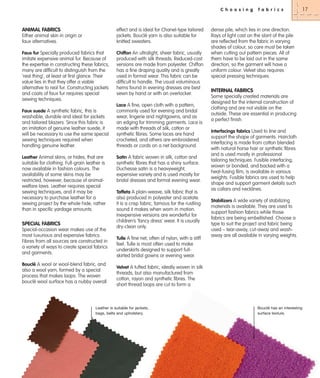
Tartan yarns are dyed
and then woven into the
cloth in bands of colour,
creating checks.

the threads/yarns for knit fabric may be
natural wool, cotton or synthetic, or
various blends of these, allowing the
creation of a multitude of knit fabrics.
Double knit A fabric in which the weave is

the same on both sides. Available in
cotton, cotton blends, wool and other
fibres, double-knit fabrics have moderate
stretch. This should be taken into account
when choosing a knit fabric for a
garment. Medium-weight double knits
are fine for trousers and jackets; they will
hold their shape but still have enough
‘give’ for ease of movement. Lightweight
double knits are good for dresses,
since they will hold their shape and
still drape well.
Interlock knit A fine, stable, singleknit fabric, normally manufactured
in cotton or cotton-polyester blends.
It is excellent for T-shirts, casual
outerwear and underwear.
Spandex A highly stretchable fibre, not
used on its own, but blended with other
knitted fibres to provide comfort and
stretch. Formerly used only in lingerie and
swimwear, spandex now finds its way
into cotton and cotton-polyester blends
for use in casual wear.
Sweatsuit fabric This heavyweight
knit is warm and comfortable to wear,
with a great deal of stretch, making
it suitable for loose-fitting garments
and sports clothing.
Tricot A delicate, warp-knit fabric,
usually of nylon, with a crosswise stretch
and no vertical stretch. Soft, smooth and
with good draping ability, it is excellent
for lingerie.

Spandex is added to suiting
fabrics to help garments
retain their shape.
C h o o s i n g

ANIMAL FABRICS

effect and is ideal for Chanel-type tailored
jackets. Bouclé yarn is also suitable for
knitted sweaters.

Either animal skin in origin or
faux alternatives.
Faux fur Specially produced fabrics that
imitate expensive animal fur. Because of
the expertise in constructing these fabrics,
many are difficult to distinguish from the
‘real thing’, at least at first glance. Their
value lies in that they offer a viable
alternative to real fur. Constructing jackets
and coats of faux fur requires special
sewing techniques.

Chiffon An ultralight, sheer fabric, usually

produced with silk threads. Reduced-cost
versions are made from polyester. Chiffon
has a fine draping quality and is greatly
used in formal wear. This fabric can be
difficult to handle. The usual voluminous
hems found in evening dresses are best
sewn by hand or with an overlocker.
Lace A fine, open cloth with a pattern,

Faux suede A synthetic fabric, this is

washable, durable and ideal for jackets
and tailored blazers. Since this fabric is
an imitation of genuine leather suede, it
will be necessary to use the same special
sewing techniques required when
handling genuine leather.
Leather Animal skins, or hides, that are
suitable for clothing. Full-grain leather is
now available in fashion colours. The
availability of some skins may be
restricted, however, because of animalwelfare laws. Leather requires special
sewing techniques, and it may be
necessary to purchase leather for a
sewing project by the whole hide, rather
than in specific yardage amounts.

SPECIAL FABRICS
Special-occasion wear makes use of the
most luxurious and expensive fabrics.
Fibres from all sources are constructed in
a variety of ways to create special fabrics
and garments.
Bouclé A wool or wool-blend fabric, and
also a wool yarn, formed by a special
process that makes loops. The woven
bouclé wool surface has a nubby overall

commonly used for evening and bridal
wear, lingerie and nightgowns, and as
an edging for trimming garments. Lace is
made with threads of silk, cotton or
synthetic fibres. Some laces are hand
crocheted, and others are embroidered
threads or cords on a net background.
Satin A fabric woven in silk, cotton and

synthetic fibres that has a shiny surface.
Duchesse satin is a heavyweight,
expensive variety and is used mostly for
bridal dresses and formal evening wear.
Taffeta A plain-weave, silk fabric that is
also produced in polyester and acetate.
It is a crisp fabric, famous for the rustling
sound it makes when worn in motion.
Inexpensive versions are wonderful for
children’s ‘fancy dress’ wear. It is usually
dry-clean only.
Tulle A fine net, often of nylon, with a stiff
feel. Tulle is most often used to make
underskirts designed to support fullskirted bridal gowns or evening wear.

f a b r i c s

dense pile, which lies in one direction.
Rays of light cast on the slant of the pile
are reflected from the fabric in varying
shades of colour, so care must be taken
when cutting out pattern pieces. All of
them have to be laid out in the same
direction, so the garment will have a
uniform colour. Velvet also requires
special pressing techniques.

INTERNAL FABRICS
Some specially created materials are
designed for the internal construction of
clothing and are not visible on the
outside. These are essential in producing
a perfect finish.
Interfacings fabrics Used to line and
support the shape of garments. Haircloth
interfacing is made from cotton blended
with natural horse hair or synthetic fibres
and is used mostly in professional
tailoring techniques. Fusible interfacing,
woven or bonded, and backed with a
heat-fusing film, is available in various
weights. Fusible fabrics are used to help
shape and support garment details such
as collars and necklines.
Stabilizers A wide variety of stabilizing

materials is available. They are used to
support fashion fabrics while those
fabrics are being embellished. Choose a
type to suit the project and fabric being
used – tear-away, cut-away and washaway are all available in varying weights.

Velvet A tufted fabric, ideally woven in silk
threads, but also manufactured from
cotton, rayon and synthetic fibres. The
short thread loops are cut to form a

Leather is suitable for jackets,
bags, belts and upholstery.

Bouclé has an interesting
surface texture.

17
All about
commercial
patterns
Commercial patterns were created to enable people to
construct their own clothing at home. Produced in a range
of sizes, they can be easily adapted to fit different figure
shapes. With a vast range of designs available, from
simple styles to fully tailored outfits, make your choice
according to your level of sewing skills.
Why use a
commercial pattern?
Commercial patterns provide an easy
way to cut and make a garment that’s
just right for you.
Buying a shop-bought pattern has many benefits. It contains
information on everything you will need to know to construct
your chosen design. The pattern will often include several
different sizes, and you can combine elements from these to
perfect your garment’s fit. The outside of the envelope will
provide you with a detailed guide about the fastenings and
trimmings required, fabric suitability and how much to
purchase, linings and interfacings. Further details of
construction can be found inside on the information sheet.

Commercial patterns
There are many popular names
in the field of commercial patterns:
Vogue, McCall’s, Butterick,
Simplicity, New Look, Burda
and Kwik Sew. The simplicity or
complexity of available designs
varies, ranging from a very simple
dress for the beginner to a
sophisticated couture design for
the more experienced sewer.

The first patterns
The quality of commercial patterns
has vastly improved since their
introduction in the 1830s in
England and France. Included in
weekly or monthly magazines, the
patterns were already cut out but
had no printing on them and were
made from poor-quality tissue
paper. It wasn’t until 1910 that
detailed instruction sheets were
included along with the pattern.
There was little technical
information provided to help
cut and make the clothing – any
information was printed in the
magazine itself. The nineteenthcentury home dressmaker needed
a very high level of skills to
interpret these early designs.

Selecting the correct
size pattern
You may already have decided
which pattern design you would
like to make, but before you buy it,
you will need to know which size to
purchase. In order to do this, you
will need to take some of your own
basic measurements. Do not use
your standard dress size (the one
you use when you are shopping
for clothes). Retail dress sizes and
commercial pattern sizes are
different: a shop size 12 may be a
pattern size 14; however, most
pattern companies do use the
same body measurements (if you
are a size 16 in Vogue, then you
will be a 16 in McCall’s). Pages
22–23 will explain how to measure
yourself accurately. The main
measurements to go by when
buying a pattern are the bust and
hip. Use the hip measurement
when buying a skirt pattern and
the bust for a top, a dress or a
garment that includes both
measurements.
W h y

Top-heavy triangle

Circle

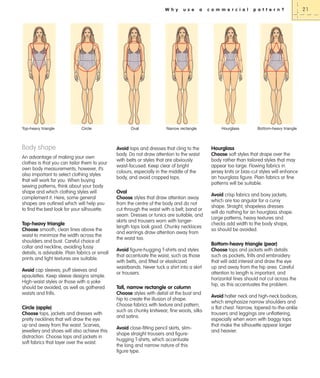
Body shape
An advantage of making your own
clothes is that you can tailor them to your
own body measurements; however, it’s
also important to select clothing styles
that will work for you. When buying
sewing patterns, think about your body
shape and which clothing styles will
complement it. Here, some general
shapes are outlined which will help you
to find the best look for your silhouette.

Top-heavy triangle
Choose smooth, clean lines above the
waist to minimize the width across the
shoulders and bust. Careful choice of
collar and neckline, avoiding fussy
details, is advisable. Plain fabrics or small
prints and light textures are suitable.
Avoid cap sleeves, puff sleeves and
epaulettes. Keep sleeve designs simple.
High-waist styles or those with a yoke
should be avoided, as well as gathered
waists and frills.

Circle (apple)
Choose tops, jackets and dresses with
pretty necklines that will draw the eye
up and away from the waist. Scarves,
jewellery and shoes will also achieve this
distraction. Choose tops and jackets in
soft fabrics that layer over the waist.

Oval

u s e

a

Narrow rectangle

Avoid tops and dresses that cling to the
body. Do not draw attention to the waist
with belts or styles that are obviously
waist-focused. Keep clear of bright
colours, especially in the middle of the
body, and avoid cropped tops.

Oval
Choose styles that draw attention away
from the centre of the body and do not
cut through the waist with a belt, band or
seam. Dresses or tunics are suitable, and
skirts and trousers worn with longerlength tops look good. Chunky necklaces
and earrings draw attention away from
the waist too.

c o m m e r c i a l

Hourglass

p a t t e r n ?

Bottom-heavy triangle

Hourglass
Choose soft styles that drape over the
body rather than tailored styles that may
appear too large. Flowing fabrics in
jersey knits or bias-cut styles will enhance
an hourglass figure. Plain fabrics or fine
patterns will be suitable.
Avoid crisp fabrics and boxy jackets,
which are too angular for a curvy
shape. Straight, shapeless dresses
will do nothing for an hourglass shape.
Large patterns, heavy textures and
checks add width to the body shape,
so should be avoided.

Bottom-heavy triangle (pear)
Avoid figure-hugging T-shirts and styles
that accentuate the waist, such as those
with belts, and fitted or elasticized
waistbands. Never tuck a shirt into a skirt
or trousers.

Tall, narrow rectangle or column
Choose styles with detail at the bust and
hip to create the illusion of shape.
Choose fabrics with texture and pattern,
such as chunky knitwear, fine wools, silks
and satins.
Avoid close-fitting pencil skirts, slimshape straight trousers and figurehugging T-shirts, which accentuate
the long and narrow nature of this
figure type.

Choose tops and jackets with details
such as pockets, frills and embroidery
that will add interest and draw the eye
up and away from the hip area. Careful
attention to length is important, and
horizontal lines should not cut across the
hip, as this accentuates the problem.
Avoid halter neck and high-neck bodices,
which emphasize narrow shoulders and
a flat chest. Narrow, tapered-to-the-ankle
trousers and leggings are unflattering,
especially when worn with baggy tops
that make the silhouette appear larger
and heavier.

21
22

A l l

a b o u t

c o m m e r c i a l

p a t t e r n s

How to measure accurately

Tip

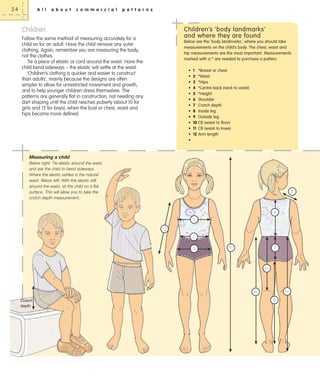
The essential body landmarks.
When taking body measurements, it is extremely important to be accurate.
A well-balanced, nicely-fitting garment could depend entirely on this. Keep
your tape measure flat to the body and do not pull it tight or twist it. Try to
keep all horizontal measurements level.

• Your working arm (depending
on whether you are right or left
handed) may have a greater
circumference: up to 2–3cm
(1 in) more! If so, always use the
larger measurement.

Photocopy this
Mark all your measurements down: remember to
re-measure if your body changes shape over time.

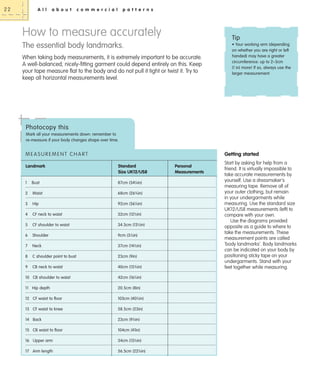
MEASUREMENT CHART

Getting started

Landmark

Standard
Size UK12/US8

1

Bust

87cm (341⁄4in)

2

Waist

68cm (263⁄4in)

3

Hip

92cm (361⁄4in)

4

CF neck to waist

32cm (121⁄2in)

5

CF shoulder to waist

34.5cm (131⁄2in)

6

Shoulder

9cm (31⁄2in)

7

Neck

37cm (141⁄2in)

8

C shoulder point to bust

23cm (9in)

9

CB neck to waist

40cm (153⁄4in)

10 CB shoulder to waist

42cm (161⁄2in)

11 Hip depth

20.5cm (8in)

12 CF waist to floor

103cm (401⁄2in)

13 CF waist to knee

58.5cm (23in)

14 Back

23cm (91⁄4in)

15 CB waist to floor

104cm (41in)

16 Upper arm

34cm (131⁄2in)

17 Arm length

56.5cm (221⁄4in)

Personal
Measurements

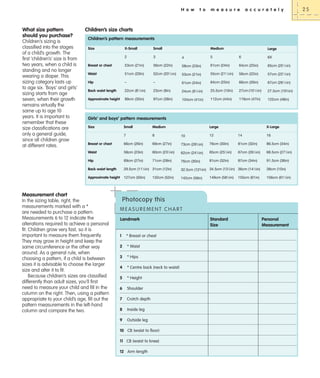
Start by asking for help from a
friend. It is virtually impossible to
take accurate measurements by
yourself. Use a dressmaker's
measuring tape. Remove all of
your outer clothing, but remain
in your undergarments while
measuring. Use the standard size
UK12/US8 measurements (left) to
compare with your own.
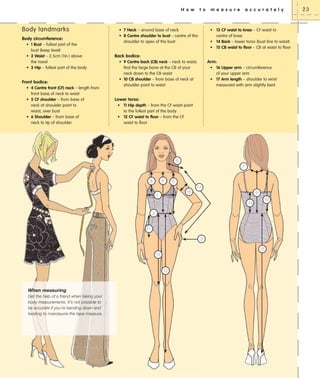
Use the diagrams provided
opposite as a guide to where to
take the measurements. These
measurement points are called
‘body landmarks’. Body landmarks
can be indicated on your body by
positioning sticky tape on your
undergarments. Stand with your
feet together while measuring.
H o w

Body landmarks
Body circumference:
• 1 Bust – fullest part of the
bust (keep level)
• 2 Waist – 2.5cm (1in.) above
the navel
• 3 Hip – fullest part of the body

Front bodice:
• 4 Centre front (CF) neck – length from
front base of neck to waist
• 5 CF shoulder – from base of
neck at shoulder point to
waist, over bust
• 6 Shoulder – from base of
neck to tip of shoulder

t o

• 7 Neck – around base of neck
• 8 Centre shoulder to bust – centre of the
shoulder to apex of the bust

m e a s u r e

a c c u r a t e l y

• 13 CF waist to knee – CF waist to
centre of knee
• 14 Back – lower torso (bust line to waist)
• 15 CB waist to floor – CB at waist to floor

Back bodice:
Arm:

• 9 Centre back (CB) neck – neck to waist;
find the large bone at the CB of your
neck down to the CB waist
• 10 CB shoulder – from base of neck at
shoulder point to waist

• 16 Upper arm – circumference
of your upper arm
• 17 Arm length – shoulder to wrist
measured with arm slightly bent

Lower torso:
• 11 Hip depth – from the CF waist point
to the fullest part of the body
• 12 CF waist to floor – from the CF
waist to floor

6
7

4

8

5
17
16

1

9
14

10

2

11
3
15
13

12

When measuring
Get the help of a friend when taking your
body measurements. It’s not possible to
be accurate if you’re bending down and
twisting to manoeuvre the tape measure.

23
24

A l l

a b o u t

c o m m e r c i a l

p a t t e r n s

Children’s ‘body landmarks’
and where they are found

Children
Follow the same method of measuring accurately for a
child as for an adult. Have the child remove any outer
clothing. Again, remember you are measuring the body,
not the clothes.
Tie a piece of elastic or cord around the waist. Have the
child bend sideways – the elastic will settle at the waist.
Children’s clothing is quicker and easier to construct
than adults’, mainly because the designs are often
simpler to allow for unrestricted movement and growth,
and to help younger children dress themselves. The
patterns are generally flat in construction, not needing any
dart shaping until the child reaches puberty (about 10 for
girls and 12 for boys), when the bust or chest, waist and
hips become more defined.

Below are the ‘body landmarks’, where you should take
measurements on the child’s body. The chest, waist and
hip measurements are the most important. Measurements
marked with a * are needed to purchase a pattern.
•
•
•
•
•
•
•
•
•
•
•
•
•

1
2
3
4
5
6
7
8
9
10
11
12

*Breast or chest
*Waist
*Hips
*Centre back (neck to waist)
*Height
Shoulder
Crotch depth
Inside leg
Outside leg
CB (waist to floor)
CB (waist to knee)
Arm length

Measuring a child
Below right: Tie elastic around the waist
and ask the child to bend sideways.
Where the elastic settles is the natural
waist. Below left: With the elastic still
around the waist, sit the child on a flat
surface. This will allow you to take the
crotch depth measurement.

6

4
1
12
2
3

5

7

11

10

9
Crotch
depth

8
H o w

What size pattern
should you purchase?
Children’s sizing is
classified into the stages
of a child’s growth. The
first ‘children’s’ size is from
two years, when a child is
standing and no longer
wearing a diaper. This
sizing category lasts up
to age six. ‘Boys’ and girls’
sizing starts from age
seven, when their growth
remains virtually the
same up to age 10
years. It is important to
remember that these
size classifications are
only a general guide,
since all children grow
at different rates.

t o

m e a s u r e

a c c u r a t e l y

Children’s size charts
Children’s pattern measurements
X-Small

Small

Medium

2

3

4

5

6

6X

Breast or chest

53cm (21in)

56cm (22in)

58cm (23in)

61cm (24in)

64cm (25in)

65cm (251/2in)

Waist

51cm (20in)

52cm (201/2in)

53cm (21in)

55cm (211/2in)

56cm (22in)

57cm (221/2in)

Hip

–

–

61cm (24in)

64cm (25in)

66cm (26in)

67cm (261/2in)

Back waist length

22cm (81/2in)

23cm (9in)

24cm (91/2in)

25.5cm (10in)

27cm (101/2in)

27.5cm (103⁄4in)

Approximate height

89cm (35in)

97cm (38in)

104cm (41in)

112cm (44in)

119cm (47in)

122cm (48in)

Size

Large

Girls’ and boys’ pattern measurements
Size

Small
7

8

10

66cm (26in)

Breast or chest

Medium

69cm (27in)

73cm (28 ⁄2in)

X-Large

Large
12
1

16

14

76cm (30in)

81cm (32in)

86.5cm (34in)

Waist

58cm (23in)

60cm (23 ⁄2in)

62cm (24 ⁄2in)

65cm (25 ⁄2in)

67cm (26 ⁄2in)

68.5cm (271⁄2in)

Hip

69cm (27in)

71cm (28in)

76cm (30in)

81cm (32in)

87cm (34in)

91.5cm (36in)

Back waist length

1

29.5cm (11 ⁄2in) 31cm (12in)

Approximate height

127cm (50in)

Measurement chart
In the sizing table, right, the
measurements marked with a *
are needed to purchase a pattern.
Measurements 6 to 12 indicate the
alterations required to achieve a personal
fit. Children grow very fast, so it is
important to measure them frequently.
They may grow in height and keep the
same circumference or the other way
around. As a general rule, when
choosing a pattern, if a child is between
sizes it is advisable to choose the larger
size and alter it to fit.
Because children’s sizes are classified
differently than adult sizes, you’ll first
need to measure your child and fill in the
column on the right. Then, using a pattern
appropriate to your child’s age, fill out the
pattern measurements in the left-hand
column and compare the two.

1

132cm (52in)

1

1

1

1

32.5cm (12 ⁄4in) 34.5cm (13 ⁄2in) 36cm (14 ⁄2in)
3

142cm (56in)

1

149cm (58 ⁄2in)

1

155cm (61in)

38cm (15in)
156cm (611⁄2in)

Photocopy this
MEASUREMENT CHART
Landmark

1

* Breast or chest

2

* Waist

3

* Hips

4

* Centre back (neck to waist)

5

* Height

6

Shoulder

7

Crotch depth

8

Inside leg

9

Outside leg

10 CB (waist to floor)
11 CB (waist to knee)
12 Arm length

Standard
Size

Personal
Measurement

25
26

A l l

a b o u t

c o m m e r c i a l

p a t t e r n s

Buying a
commercial pattern
Once you have measured yourself
accurately, you can start shopping
for your pattern.
Many department stores and chain stores
have a haberdashery department. Here you
will find large catalogues produced by the
different pattern companies. Some catalogues
are published seasonally or twice yearly. The
prices of patterns can vary from one company
to another, ranging from £2.00 to £20.00.

Pattern catalogues
Pattern catalogues are divided into
sections, with tabs to help you
locate a pattern easily. Take some
time to look through these tabs
because the categories will guide
you through women’s patterns,
figure types, designer labels, men’s
patterns and children’s patterns.
The catalogues usually indicate the
skill level needed for a specific
pattern. Some pattern companies
include costumes, accessories,
home furnishings and patterns for
special occasions such as
christenings and weddings.

Printing and assembling your downloaded pattern

Purchasing a
pattern online
Technology has provided new
ways to purchase paper patterns.
There are many online pattern
companies and sewing shops to
choose from. They range from
companies selling patterns to be
delivered by mail to those where
you can download and print the
pattern immediately. Many
companies have chat rooms
where home sewers can
exchange sewing experience with
each other, along with photos of
completed projects. You can also
join clubs and receive regular
updates on special offers. Some
costume museums and designer
labels have patterns to download,
often for free!

1 The downloaded pattern prints on your normal

2 First, organize and divide the sheets of paper

home printer on 21.5 x 28cm (81⁄2 x 11in) sheets
with a heavy black border. On each sheet are
column and row numbers along with small black
boxes to help when matching up the sheets.

by rows, numbers or letters and cut off the
margins on the top and left sides.

Download pros and cons
There are advantages and
disadvantages to downloading
patterns. The most obvious
advantage is that you receive
your pattern right away. However,
the big disadvantage is that
unless you have a very large
printer or access to one, you
must painstakingly glue your
pattern together – and the
more complicated designs
take a lot of time and patience.

3 Now you are ready to glue
the sheets together side-byside to form rows. It is
important to pay special
attention to matching the
black boxes. Be as accurate
as possible.
B u y i n g

a

c o m m e r c i a l

p a t t e r n

Tab categories
•
•
•
•
•
•
•
•
•
•
•
•
•
•
•
•
•
•

Evening and bridal
Dresses
Very easy Vogue dresses
Designer sportswear
Sportswear
Very easy sportswear
Jackets and coats
Tops and blouses
Skirts and trousers
Vintage Vogue
Today’s fit
The Vogue woman
Maternity
Kids
Men
Fashion accessories
Vogue doll collection
Crafts and home decorating

5 Once the pattern is complete, it is a good

4 Once all the rows are finished,
paste them together lengthwise.
The pattern is now complete.

idea to trace it onto pattern tracing paper.
This will make the pattern easier to pin to
your fabric because pattern tracing paper
is made for that purpose.

27
28

A l l

a b o u t

c o m m e r c i a l

p a t t e r n s

Understanding
your pattern
Following the detailed instructions
outside and inside the pattern
envelope takes the guesswork
out of making your garment.
When you look at your pattern for the first time,
take some time to look over the information
on the back and on the pattern information
sheet inside.
The back of the envelope
Commercial pattern envelopes hold a variety
of information:
• Silhouette key, indicating the body type the pattern
is recommended for.
• A short description of the designs included.
• Suggested fabrics and accessories for use with each
garment. The pattern may also suggest that the
design is unsuitable for certain fabrics. For jersey
fabrics you will find a stretch guide on how much
elasticity is recommended for the design.
• Detailed diagrams of the garments showing both
front and back views.
• A guide to the amount of fabric you will need to
purchase for your chosen garment. The diagram
to the right shows where to look for information on
how much fabric, lining and interfacing to purchase
in the correct fabric width.
• A guide to the specific details of each garment.

Understanding the information
on the pattern pieces
All commercial patterns have essential
information printed on the pattern
pieces. It is important to transfer this
information from the paper pattern onto
the fabric. There are many different
ways to do this, and methods vary for
different fabric types (see pages 34–41).

Printed on each pattern piece, you
will find a style number, a name
that identifies the pattern piece
and the number of pieces to cut
along with information indicating
which kind of fabric to cut the
pattern out of, for example,
fabric, lining or interfacing.

U.S.
CAN.

Silhouette
key

$ 27.50
$ 33.00
GREEN

Description
Suggested
fabrics and
accessories

FRONT
DEVANT
A

FRONT
DEVANT
B

FRONT
DEVANT
C

Front and
back views
of the
garments

V2988

AVERAGE/MOINS FACILE

FRONT
DEVANT
D

FRONT
DEVANT
E

Guide to the
quantity of
fabric
required

MISSES’/MISSES’ PETTITE JACKET, TOP, DRESS, SKIRT
AND PANTS: Lined, loose-fitting, hip length jacket A, fully
interfaced has funnel collar and self-fabric button loops. Lined,
fitted top B or dress C has invisible back Zipper. C: straight,
above mid-knee, centre back slit. Flared, loose-fitting skirt D,
above mid-knee has centre front pleat. Semi-fitted, straight leg
pants E, floor length have darted front and back, no side
seams. D, E: raised waist and invisible back zipper.
NOTIONS: Jacket A: Four 11/4" Shank or Regular Buttons.
Top B, Dress C: 20"/22" Invisible Zipper Hooks and Eyes.
Skirt D, Pants E: 7"/9" Invisible Zipper Hooks and Eyes.
FABRICS: Jacket A, Top B, Dress C: Lightweight Tweed,
Lightweight Fleece and Lightweight Crepe. Interfacing A:
Nylon Fusible Knt. Underlining B, C: Organza. Skirt D,
Pants E: Stretch Wool Crepe and Stretch Gabardine.
Unsuitable for obvious diagonals. Allow extra fabric to
match plaids or stripes. Use nap yardages/layouts for pile,
shaded or one-way design fabrics. *with nap. **without nap.

VESTE, HAUT, ROBE, JUPE ET PANTALON (J.
Femme/Petite J. femme): Veste A double ample, longueur
aux hanches, complètement entoilée avec col en entonnoir
et boucles à bouton du même tissue. Haut B ajusté, doublé
ou robe C avec glissière invisible. C: droite, au-dessus de
genou, fente au milleu dos. Jupe D évasée, ample, audessus du genou avec pli au milieu devant. Pantalon E
semi-ajusté, à jambes droites, au ras du sol avec pinces au
devant et dos, sans couture aux côtés. D, E: taile haute et
glissière invisible au dos.
MERCERIE: Veste A: 4 Boutons courants ou à tige (32mm).
Haut B, Robe C: Glissière invisible (51cm/56cm), Agrafes.
Jupe D Pantalon E: Glissière invisible (18cm/23cm),
Agrafes.
TISSUS: Veste A, Haut B, Robe C: Tweed fin, Molleton fin
et Crêpe fin. Entoilage A: Tricot thermocollant de nylon.
Triplure B, C: Organza. Jupe D, Pantalon E: Crêpe de
laine extensible et Gabardine extensible. Rayures/grandes
diagonals/écossaise ne conviennent pas. Compte non tenu
des raccords de rayures/carreaux. *avec sens. **sans sens.

Combinations: AA(6-8-10-12), E5 (14-16-18-20-22)

Séries: AA(6-8-10-12), E5(14-16-18-20-22)

SIZES 6
8 10
12 14
JACKET A
45"*/** 3
3
3ǩ 3Ǫ 3Ǫ
60"*/** 2
2
2¼ 2¼ 2¼
FUSIBLE KNIT INTERFACING A
60"* 1ǫ 1ǫ 1ǫ 1ǫ 2ǩ
LINING A
45"
1¾ 1¾ 1¾ 1¾ 1¾

V

TAILLES 6
8
10
12 14 16 18 20
VESTE A
115cm*/** 2.8 2.8 2.9 3.1 3.1 3.1 3.1 3.2
115cm*/** 1.9 1.9 2.1 2.1 2.1 2.1 2.2 2.2
ENTOILAGE DE TRICOT THERMOCOLLANT A
150cm*
1.5 1.5 1.5 1.5 2.0 2.0 2.0 2.1
DOUBLURE A
115CM
1.6 1.6 1.6 1.6 1.6 1.6 1.8 1.8

TOP B
45"*/** 1Ǫ 1Ǫ 1Ǫ 1Ǫ
60"*/** 1
1
1
1
UNDERLINING B (Organza)
45"*/** 1Ǫ 1Ǫ 1Ǫ 1Ǫ
60"** 1
1
1
1
LINING B
45"
1Ǫ 1Ǫ 1Ǫ 1Ǫ
DRESS C
45"*/** 1¾ 1¾ 1¾ 1Ǭ
60"*/** 1ǫ 1ǫ 1ǫ 1ǫ
60"** 1¼ 1¼ 1¼ 1¼
UNDERLINING C (Organza)
45"** 1¾ 1¾ 1¾ 1¾
60"** 1¼ 1¼ 1¼ 1¼
LINING C
45"
1¾ 1¾ 1¾ 1¾
SKIRT D
45"* 2¼ 2¼ 2¼ 2Ǫ
60"* 1¾ 1¾ 1¾ 1¾
FUSIBLE INTERFACING D
22"
¼
¼
¼
¼
45"
¼
¼
¼
¼
PANTS E
45"* 2¾ 2¾ 2¾ 2¾
60"* 1½ 1½ 1½ 1½
FUSIBLE INTERFACING E
22"
Ǭ
Ǭ Ǭ
1
45"
¼
¼
¼
¼

18

20

22

3Ǫ 3Ǫ
2Ǫ 2Ǫ

16

3½
2Ǫ

3½
2ǫ

2ǩ 2ǩ

2¼

2¼

1¾ 1Ǭ

1Ǭ

2

1½ 1½ 1ǫ
1
1
1Ǫ

1ǫ
1Ǫ

1¾
1Ǫ

1½ 1½ 1ǫ
1
1
1Ǫ

1ǫ
1Ǫ

1¾
1Ǫ

1½ 1½ 1ǫ

1ǫ

1¾

2¼ 2¼ 2Ǫ
1¾ 1¾ 1¾
1¼ 1¼ 1Ǫ

2½
1¾
1¾

2½
1¾
1¾

1Ǭ 2
2Ǫ
1¼ 1¼ 1Ǫ

2½
1¾

2½
1¾

1Ǭ 2

2Ǫ

2½

2½

2Ǫ 2Ǫ 2½
1¾ 1¾ 1Ǭ

2ǫ
1Ǭ

2¾
2

¼
¼

¼
¼

ǫ
¼

¼
¼

¼
¼

2¾ 2¾ 2¾
1½ 1Ǭ 2Ǫ

2¾ 2¾
2Ǫ ǫ

1
¼

1ǩ 1¼
¼ ¼

1
¼

1ǩ
¼

HAUT B
115cm*/** 1.3 1.3 1.3
150cm*/** 1.0 1.0 1.0
TRIPLURE B (Organza)
115cm** 1.3 1.3 1.3
150cm** 1.0 1.0 1.0
DOUBLURE B
115CM
1.3 1.3 1.3
ROBE C
115cm*/** 1.6 1.6 1.6
150cm*
1.5 1.5 1.5
150cm** 1.2 1.2 1.2
TRIPLURE C (Organza)
115cm** 1.6 1.6 1.6
150cm** 1.2 1.2 1.2
DOUBLURE C
115cm
1.6 1.6 1.6

22
3.2
2.4
2.1
1.9

1.3 1.4 1.4 1.5 1.5 1.6
1.0 1.0 1.0 1.3 1.3 1.3
1.3 1.4 1.4 1.5 1.5 1.6
1.0 1.0 1.0 1.3 1.3 1.3
1.3 1.4 1.4 1.5 1.5 1.6
1.8 2.1 2.1 2.2 2.3 2.3
1.5 1.6 1.6 1.6 1.6 1.6
1.2 1.2 1.2 1.3 1.6 1.6
1.6 1.8 1.9 2.2 2.3 2.3
1.2 1.2 1.2 1.3 1.6 1.6
1.6 1.6 1.9 2.2 2.3 2.3

JUPE D
115cm*
2.1 2.1 2.1 2.2 2.2
150cm*
1.6 1.6 1.6 1.6 1.6
ENTOILAGE THERMOCOLLANT D
56cm
0.3 0.3 0.3 0.3 0.3
115cm
0.3 0.3 0.3 0.3 0.3
PANTALON E
115cm*
2.6 2.6 2.6 2.6 2.6
150cm*
1.4 1.4 1.4 1.4 1.4
ENTOILAGE THERMOCOLLANT E
56cm
0.8 0.8 0.8 1.0 1.0
115cm
0.3 0.3 0.3 0.3 0.3

2.2 2.3 2.4 2.6
1.6 1.8 1.8 1.9
0.3 0.3 0.3 0.6
0.3 0.3 0.3 0.3
2.6 2.6 2.6 2.6
1.8 2.2 2.2 2.4
1.0 1.1 1.1 1.2
0.3 0.3 0.3 0.3

Width, lower edge
Jacket A
38½ 39½ 40½ 42 44 46
48 50 52
Top B, Dress C
36
37 38
39½ 41½ 43½ 45½ 47½ 49½
Width, each leg
Pants E
20 20½ 21

Garment
details

Largeur, à l’ourlet
Veste A 98 100 103 107 112 117 122 127 132
Haut B, Robe C
92
94 97 100 105 110 116 121
126
Largeur, chaque jambe
Pantalon E51 52
54

57

59

60

61

Back length from base of your neck
Jacket A
24½ 24¾ 25 25¼ 25½ 25¾ 26 26¼ 26½
Top B
23½ 23¾ 24 24¼ 24½ 24¾ 25 25¼ 25½
Dress C
36½ 36¾ 37 37¼ 37½ 37¾ 38 38¾ 38½

Longueur-dos, votre nuque à l’ourlet
Veste A 62 63
64
64 65 66
Haut B 60 61
61
62 62 63
Robe C 93 94
94
95 95 96

66
64
97

67
64
97

67
65
98

Back length from waist
Skirt D,21"

Longueur – dos, taille à ourlet
Jupe D. 54 cm

21½ 22

22½ 23 23½ 24

Side length from waist
Pants E, 42"

REGISTERED MODEL: THIS PATTERN IS FOR
THE EXCLUSIVE USE OF PRIVATE CUSTOMERS. ANY COPYING OF THIS DESIGN FOR
RESALE OF THE GARMENT IN ANY FORM,
WITH OR WITHOUT THE NAME OF THE COUTURIER IS STRICTLY FORBIDDEN.

55

56

Longueur – Côté, taille à ourlet
Pantalon E, 107cm

MARQUE DEPOSEE. EXCLUSTIVITERESERVEE
A L’USAGE DE LA CLIENTELE PRIVEE. TOUTE
REPRODUCTION POUR LA VENTE SOUS
QUELQUE FORME QUE CE SOIT AVEC OU SANS
LE NOM DU COUTURIER EST STRICTEMENT
INTERDITE.

The pattern envelope
The back of the envelope carries a lot of
essential information, including how to
calculate the amount of fabric you will need.

The triangle shapes are called
‘notches’. These are symbols for
matching seams. Notches can also
mark the front and back of the pattern
and indicate where a zip will finish.

This picture shows
a back notch.
The small circles
indicate a
‘matching point’
that will
correspond to an
adjoining pattern
(in this case to the
bodice armhole).

The picture
shows a
front notch.
U n d e r s t a n d i n g

This sheet provides
detailed instructions on
which pattern pieces are
needed to make your
chosen style and supplies
information on body
measurements, cutting
instructions and seam
allowances. It also gives
specific pattern layouts for
different widths of fabric.
The information is often
pictorial, making it very
easy to follow.

BODY MEASUREMENTS/MESURES DU CORPS

ENGLISH / FRANÇAIS

The information sheet

2988
Size/Taille
Bust
Waist
Hip
Bk.Waist Lgth.
17½

6
30½
23
32½
15½

MISSES’/JEUNE FEMME
8
10
12 14 16 18
31½ 32½ 34 36 38 40
24 25
26½ 28 30 32
33½ 34½ 36 38 40 42
15¾ 16
16¼ 16½ 16¾ 17

20
42
34
44
17¼

22
44
37
46
Ǫ
17Ǫ

24
46
39
48

T. de poitrine
T. de taille
T. de hanches
Nuque a taille

78
58
83
39.5

80
61
85
40

107
87
112
44

112
94
117
44.5

117
97
122
45

Page 1 (6 pages)

A

B

83
64
88
40.5

87
67
92
41.5

92
71
97
42

97
76
102
42.5

102
81
107
43

FABRIC CUTTING LAYOUTS
Indicates Bustline, Waistline, Hipline and/or Biceps. Measurements
refer to circumference of finished Garment (Body Measurements +
Wearing Ease + Design Ease). Adjust Pattern if necessary.

45" (115 CM)
S/T
12-14-16-18-20-22

60" (150 CM)
S/T
18-20-22

UNDERLINING B / UNDERLINING B
NOTE: Use Same Layouts as Top B 45", 60" Fabrics.

60" (150 CM)
S/T
6-8

NOTE: Utiliser les Mêmes Plans que le Haut B, Tissus en 115,150cm.

LINING B / DOUBLURE B
60" (150 CM)
S/T
10-12-14-16-18-20

NOTE: Use Same Layouts as Top B 45" Fabrics.
NOTE: Utiliser les Mêmes Plans que le Haut B, Tissus en 115cm.

Lines shown are CUTTING LINES, however, ǫ" (1.5cm) SEAM
ALLOWANCES ARE INCLUDED, unless otherwise indicated. See SWEING
INFORMATION for seam allowance.

DRESS C / ROBE C

Find layout(s) by Garment/View, Fabric Width and Size. Layouts show
approximate position of pattern pieces; position may vary slightly
according to your pattern size.

D
C

p a t t e r n

Fabric cutting layout
plans for style and
fabric width.

Body measurements
(see page 24).

Line drawings show
the styles.

y o u r

E

All layouts are for with or without nap unless specified. For fabrics with
nap, pile, shading or one-way design, use WITH NAP layout.

RIGHT SIDE OF
PATTERN

WRONG SIDE OF
PATTERN

RIGHT SIDE OF
FABRIC

60" (150 CM)
S/T
22

45" (115 CM)
S/T
14-16-18-20-22

WRONG SIDE OF
FABRIC

S/T = SIZE(S) TAILLE(S)
AS/TT = ALL SIZE(S)/TOUTES TAILLE(S)
* = WITH NAP/AVEC SENS
** = WITHOUT NAP/SANS SENS
S/L = SELVAGE(S)LISIERE(S)
F/P = FOLD/PLIURE
CF/PT = CROOWISE FOLD/PLIURE TRAME

Position fabric as indicated on layout. If layout shows…
SINGLE THICKNESS – Place fabric right side up. (For Fur Pile fabrics,
place pile side down.)
DOUBLE THICKNESS
WITH FOLD – Fold fabric right sides together.
WITHOUT FOLD – with right sides together. Fold fabric
CROSSWISE. Cut fold from selvage to selvage (A). keeping right sides together, turn upper layer completely around
so nap runs in the same direction as lower layer
GRAINLINE – Place on straight grain of fabric, keeping line
parallel to selvage or fold. ON “with nap” layout arrows should
point in the same directions. (On Fur Pile fabrics, arrows point
in direction of pile)

PIECES: 8,9,10 & 11

45" (115 CM)
S/T
6-8-10-12

60" (150 CM)
S/T

FUSIBLE KNIT INTERFACING A / ENTOILAGE DE
TRICOT THERMOCOLLANT A PIECES: 1,2,3,4,5 & 6
45" (115 CM) *
S/T
6-8-10-12

60" (150 CM) **
S/T
6-8-10-12-14-16-18

60" (150 CM) *
S/T
14-16-18-20-22

60" (150 CM) **
S/T
20-22

FOLD – Place edge indicated exactly along fold of fabric.
NEVER cut on this line.

UNDERLINING C (Organza) / TRIPLURE C (Organza)
PIECES: 8,9,10 & 11

When pattern piece is shown like this…
JACKET A
1 Front
2 Side Front
3 Upper Sleeve Front
4 Back
5 Side Back
6 Back Coolar
7 Loops

VESTE A
1 Devant
2 Côté Devant
3 Dessue de Manche Devant
4 Dos
5 Côté Dos
6 Col Dos
7 Boucles

TOP B, DRESS C
8 Front
9 side Front
10 Back
11 Side Back

HAUT B, ROBE C
8 Devant
9 Côté Devant
10 Dos
11 Cote Dos

SKIRT D
12 Front
13 Pleat underlay
14 Side Front
15 Back
16 Side Back
17 Front Facing
18 Back Facing

JUPE D
12 Devant
13 Fond de Pli
14 Côté Devant
15 Dos
16 Côté Dos
17 Parementure Devant
18 Parementure Dos

PANTS E
19 Front And Back
20 Facing

• Cut other pieces first, allowing enough fabric to cut
this piece (A). fold fabric and cut piece on fold, as
shown (B)

LINING A / DOUBLURE A

Ì Cut piece only once. Cut other pieces first, allowing enough fabric to
cut this piece. Open fabric; cut piece on single layer.

45" (115 CM)
AS/TT

PANTALONE E
19 Devant et Dos
20 Parementure

PIECES: 2,3,4 & 5

45" (115 CM) **
S/T
18-20-22

Cut out all pieces along cutting line indicated for desired size using long,
even scissor strokes, cutting notches outward.
Transfer all markings and lines of construction before removing pattern
tissue. (Fur Pile fabrics, transfer markings to wrong side.)
NOTE: Broken – line boxes (a! b! c!) in layouts represent pieces cut by
measurements provided.

JACKET A / VESTE A

TOP B / HAUT B

PIECES: 8,9,10 & 11

PIECES: 1,2,3,4,5,6 & 7

60" (150 CM) **
S/T
6-8-10-12-14-16-18

45" (115 CM)
AS/TT

45" (115 CM)
S/T
6-8-10

60" (150 CM) **
S/T
20-22
60" (150 CM)
S/T
6-8-10-12-14-16

©McCall Pattern Co., 2007. Tous droits réservés. Imprimé aux Etats-Unis.

Pattern
pieces are
identified.

45" (115 CM) **
S/T
6-8-10-12-14-16

Key to pattern terminology covering
grain, cutting on fold, right and wrong
side of fabric (see pages 34–41).

©McCall Pattern Co., 2007. All Rights Reserved. •Printed in U.S.A.

Layout plans
for interfacings
and linings.

This symbol indicates the
grain line. The arrow at
one end points in the
direction of the pile when
using fabric with a nap,
the smooth or right side
running in the direction
of the arrow.

This double line indicates
where a pattern can be
shortened and lengthened.
Remember that you may
need to purchase
more fabric if
you lengthen
a pattern.

This symbol
indicates the
pattern pieces
that need to be
placed on the
fabric’s fold.

29
30

A l l

a b o u t

c o m m e r c i a l

p a t t e r n s

Preparing a
commercial pattern
The following pages explain how to prepare
your commercial pattern for use.
When preparing a commercial sewing pattern for use, there
are three crucial factors that you should know about: ‘ease
allowance’ – vital for the body to move within the garment;
‘fit’ – whether the garment is tight or loose; and ‘style’ – the
design of the garment itself. These three elements must be
considered when you are altering an existing pattern to fit
your own size accurately.

You should have purchased the pattern size closest to
your body measurements. Use your hip measurement
for a skirt, and your bust measurement for a top or
a dress. If the size chart on the back of the pattern
corresponds to your own body measurements, this
makes things a little easier. If, however, your
measurements are different from the size chart, you
are advised to pick a larger size (it’s easier to make
a pattern smaller than it is to make it larger). This
means you may need to make some alterations
to your pattern in order to create the fit you want.
If you do need to make alterations to your pattern
you will need to use your body measurements and
measure the pattern pieces and compare the two.
You will find that the measurements on the pattern
pieces are more generous than those shown on the
pattern sizing. This extra allowance is called ease
(see opposite), and it is already included in the pattern.

Cutting the pattern
pieces out
Before you can measure your pattern
pieces you need to identify them and
cut them apart. When you first take
your pattern out of the envelope, start
by looking for all the pattern pieces
with the letter that corresponds to
your chosen garment. There are often
several styles in one envelope, which
can be confusing, so locate your
pieces and check them against the list
on the instruction sheet to make sure
you have them all.

1 Once you have identified the relevant pattern
pieces for your garment, cut them apart from
the others.

2 Before you accurately cut out the pattern
pieces, first press all the creases and folds out
of the paper with a warm, dry iron.

3

4 Only after you have checked that you have
the right size and line, should you cut out the
pattern. When cutting out your pattern, it is
important to cut outside the line and to be as
accurate as possible.

Many patterns have several sizes marked on
each pattern piece, so you will need to look for
your size. The sizes are marked by different
patterns of dot–and-dash lines. It helps to
highlight the correct size at this point, making
identification clearer.
P r e p a r i n g

a

c o m m e r c i a l

p a t t e r n

What is ease and why do we need it?

Garment style

There are two different types of ease, ‘wearing ease’ and ‘design
ease’. Wearing ease in a garment is essential for movement. If the
pattern didn’t include wearing ease, you would not be able to sit,
walk or move when wearing it because the pattern would fit your
body measurements exactly. On page 32 is a design ease
allowance chart. The ease measurements listed are the amounts
that have been added to a pattern to achieve a certain fit, for
example, close-fitting, loose-fitting and so on.

Consider the design style itself when checking the
measurements and ‘fit’ of your garment. The garment
may contain styles that don’t correspond to the points
from which the body measurements have been taken.
For example, with a dropped shoulder, the pattern
shoulder measurement will be very long. This is
because the armhole seam has been dropped and the
shoulder extended to achieve this style. For a large or
cutaway neckline, the shoulder measurement will be
short. This is because the neckline does not start at the
base of the neck. So, be aware that some of your
measurements may differ from those on the pattern
and take this into account. Another relevant example
is a dropped or low waist line on trousers or a skirt
(sometimes called hipster). Don’t compare this
measurement with your natural waist measurement,
because the garment is not worn on the waist.

Wearing ease chart
The ease allowances in the chart below are a
minimum ease measurement in a woven fabric
(fabric without stretch). They have already been added
to the pattern – so don’t be seduced by your body
measurements and reduce your pattern size!
Refer to your personal measurement chart (on
page 22). You will need to add ease to your body
measurements in order for them to correspond with
those on the pattern. In the chart below you can
record your measurements plus ease.

Cutaway neckline

Natural shoulder length

The shoulder
measurement will
be shorter because the
neckline does not start
at the base of the neck.

Cutaway
neckline

Photocopy this
WEARING EASE CHART
Landmark

Ease to add

1

Bust

7.3cm (27/8 in)

2

Waist

2cm (3/4 in)

3

Hip

2cm ( /4 in)

4

Crotch Depth

1.3cm (1/2 in)

5

Crotch Length

3.8cm (11/2 in)

6

Wrist

1.5–2.5cm (2⁄3–1in)

3

Total measurement and ease

Drop shoulder
The shoulder
measurement will be
very long, because
the shoulder has
been extended and
the armhole dropped
to achieve this
looser shape.

Dropped
shoulder

Natural shoulder length

31
32

A l l

a b o u t

c o m m e r c i a l

Design ease
Design ease is the amount of
fullness added to a garment in
addition to wearing ease that
gives the garment the look that the
designer is aiming for. The chart
on the right explains the general
silhouette classifications that
pattern companies use to help
clarify how a garment will fit the
body. The first column describes
the fit and the next three specify
the amount of ease that has been
added to the pattern to achieve
that fit, according to the particular
garment type. It’s important never
to borrow fullness from the design
ease in order to accommodate
wearing ease because you’ll
lose the intended shape of
the garment.

p a t t e r n s

Ease allowances (not applicable for garments designed for stretchable knit fabrics)
Bust area
Silhouette

Dresses, tops,
shirts, vests, blouses

Jackets

Coats
Lined/unlined

Close fitting

0–7.3cm (0–27⁄8in)

Not applicable

Not applicable

Fitted

7.5–10cm (3–4in)

9.5–10.7cm (33⁄4–41⁄4in)

13.3–17cm (51⁄4–63⁄4in)

Semi fitted

10.4–12.5cm (41⁄8–5in)

11.1–14.5cm (43⁄8–53⁄4in)

17.4–20.5cm (67⁄8–8in)

Loose fitting

13–20.5cm (51⁄8–8in)

14.8–25.5cm (57⁄8–10in)

20.7–30.5cm (81⁄8–12in)

Very loose fitting

Over 20.5cm (8in)

Over 25.5cm (10in)

Over 30.5cm (12in)

Your measurements + wearing ease + design ease = silhouette

Silhouette classifications
You can sometimes find these silhouette classifications in pattern
catalogues to help you to understand the garment silhouette.

Close fitting

Fitted

Semi fitted

Loose fitting

Very loose fitting
P r e p a r i n g

Measuring the pattern

c o m m e r c i a l

p a t t e r n

How to check a skirt waist for fit

Measuring the pattern
accurately enables you to
check the fit of your garment.
General pattern points to
check for fit are as follows:
Bust + ease
Waist + ease
Hips + ease
Shoulder
Shoulder neck point to bust
point (apex)
CB length
CF length
Side seams
Sleeve length

a

Before starting to measure your pattern,
the seam allowance must be marked out
with a seam guide or ruler. In this
example, the pattern includes a seam
allowance of 1.5cm (5⁄8in).

Compare the pattern
measurements to your
measurements and add ease
where necessary. (See chart on
page 22). Remember that when
you measure the front and back
waist, hips and bust on a
pattern you must double the
measurement, because you
have measured only half of
the pattern.

2

Once the seam allowance has been marked
out, measure the waist, excluding the seam
allowance and the dart. Start from the CB
(or CF) up to the side of the dart.

1 Measure inwards around your pattern from the
line indicating your chosen size and mark this
with a pencil.

3 Now continue from the other side of the
dart to the side seam stitching line. Double
the measurement to obtain the total width of
the back. Do the same for the front.

A quicker method
Fold out the dart and measure
from CB waist to the side seam
stitching line all in one movement.

1 Start by folding out the dart.

2 Pin the dart closed and measure
straight across from the CB to the side
seam allowance.

33
a b o u t

c o m m e r c i a l

p a t t e r n s

Preparing your fabric
Be aware of your fabric’s structure
before you cut out your garment.
You will need to consider your fabric carefully
before you start to cut out your garment.
Information inside the commercial pattern will
give pointers regarding layouts for different
widths of fabric, whether to cut in single or
double layers and on matching patterns when
using a non-standard fabric such as a check,
print or stripe. Unless you are using a pattern
designed specifically for the bias, where
instructions will be supplied, understanding the
correct grain, if a fabric has skewed, and finding
the right and wrong sides of the fabric are the
first steps towards laying out your pattern pieces
and cutting them out.

Fabric grain
Woven fabrics are made up of lengthwise warp yarns and crosswise weft yarns.
The selvedges are the finished edges of the fabric where the weft yarns double
back on themselves during the weaving process. In garment construction, the
‘straight grain’ is the most commonly used grain, which runs parallel to the
selvedges and when laying out the pattern pieces, up and down the garment.
This is because the lengthwise warp grain is stronger, with less stretch. The
crosswise weft, woven from weaker or ‘filler’ yarns, usually has some give in it.
You can use a fabric’s grain to your advantage. For example, if you wanted to
create more volume, you could consider changing the grain so that the warp runs
crosswise instead of lengthwise. The true bias is at a 45-degree angle to the
straight grain.

Selvedge

True bias
45-degree
angle

Selvedge

A l l

Lengthwise grain (warp)

34

Selvedge

Crosswise grain (weft)

Selvedge

Selvedge

Using the bias
If you wanted to achieve a very soft draped look to a garment,
you would use the bias grain. Caution should be used when
using the bias, since in this direction the fabric becomes
stretchy and tricky to sew. Its hanging weight pulls the fabric
down, making it longer and narrower than the original cut
proportion. The iconic dresses of the 1930s used bias grain to
achieve the streamlined silhouette that clung to the natural
contours of the body.

Selvedge
P r e p a r i n g

Making the fabric
end straight
Straightening the ends of your
fabric will help to line up the
grain correctly.
Most pattern layouts are cut
with the fabric folded in half in the
same direction as the straight
grain. However, before you pin
your paper pattern pieces onto the
fabric, it is important to check that
the grain is straight.
There are two methods that can
be used to do this, but they work
only on woven cloth. Pulling a
thread is by far the gentlest
method. If the fabric has a smooth
surface, you can see the pulled
thread. If the fabric is loosely
woven, when a thread is pulled
and removed, a gap is created
indicating a straight edge. The
tearing method may create
distortion and stretch to the edge
of the fabric, so always start with
the gentler method and proceed
to other methods if that does
not work. If at any time the fabric
starts to snag, run or damage
the warp threads – stop. It’s a
good idea to test your fabric first
for suitability.

y o u r

f a b r i c

Pulling a thread

1 It may be necessary to make a small snip in
the selvedge to get hold of a thread.

3 Continue to pull the thread all the way along,
from selvedge to selvedge. If it is difficult to see
the pulled thread, you may have to repeat this.

2 Try to isolate a single weft thread – then pull it:
This creates a puckered line across the width.

4 For a straight edge, cut parallel to
the line that has been created.

Tearing the fabric

1 First snip through the selvedge – this
makes tearing easier.

2 Start tearing. If there is any resistance,

3 Continue tearing. Once you have

it is best to stop. Some fabrics, although
woven, are not suitable, because of the
weave or the finish on the fabric’s surface.
You cannot tear jerseys or knits.

a straight end, press your fabric with
a warm iron.

35
36

A l l

a b o u t

c o m m e r c i a l

Skewed fabric
By straightening the ends of your
fabric, you will see if it has skewed.
Skewing is when the warp and
weft are not at true right angles to
each other. Sometimes fabrics can
become skewed or pulled off grain
during the finishing process.
Skewing often happens when the
fabric is rolled onto a bolt using
uneven tension.

p a t t e r n s

Fixing a skewed woven fabric
1 Sometimes a skewed fabric can be
fixed if its grain isn’t too ‘off’. First,
straighten your fabric ends (see page
35). Next, folding the fabric in half
lengthwise, align the ends and
selvedges. Test your fabric with a
moderately hot steam iron to ensure
that it does not stain or scorch and
then try to press ‘the skew’ away. You
may need to machine- or hand-tack
the edges to keep the fabric in place
while doing this. Avoid pressing the
folded edge flat, since this may be
difficult to remove later.

2 Alternatively, you could try folding
the fabric in half, matching selvedges
and aligning the ends as before.
Tack if necessary at the ends and
selvedges to keep it steady. Next,
dampen the fabric, place it between
damp sheets and leave it to dry
naturally. Do not hang the fabric
while it is drying – it is important that
it remains flat and supported to
avoid stretching.

Skewed jersey and tubular
knit fabrics
Knits or jerseys are constructed
differently from woven fabrics.
They are made up of rows of
interlocking loops and often have
no selvedges. If a knit fabric has
skewed, it must be treated
differently from a woven fabric.

How to straighten a flat knit
First, fold your fabric in half, lining up
the lengthwise edge; be aware of the
knit stitches and try to keep them
parallel. Once this is achieved, pin or
tack the fabric in position and gently
steam. Be careful not to steam the fold
or pins into the fabric, since this could
leave a permanent mark.

How to straighten
a tubular knit
Follow the same method as for a
flat knit, but cut one side following
a knit grain line. This will release
one side so you can realign and
straighten the fabric.
P r e p a r i n g

Stripes
You can create interesting effects using striped and
printed fabrics. When using a striped fabric, or a
fabric with a prominent lengthwise weave or relief,
the visual effect can be quite dramatic. Consider the
effect that will be created when adjoining seams
meet on your garment.

Using striped fabric
When using a striped fabric –
before you lay out your pattern
pieces – it’s important that you
consider the way the grain
(and therefore the stripes) will
run on the finished garment.
Crosswise, lengthwise or on
the bias? This decision will
affect the way the pattern
works when the fabric meets
at the seams. This also applies
to check fabrics.

When diagonal stripes (bias grain)
meet at a seam, they will form
chevrons down the seam. You will
have to plan this carefully when
laying out the pattern pieces.

y o u r

f a b r i c

Striped
fabric layout
For this pattern, the
stripes will need to be
matched vertically
from the bodice to
the skirt. A stripe
should be central at
the CF or either side
of the CF, depending
on the design.

When using striped
fabric with the grain
(and therefore the
stripes) running
lengthwise, you
need to consider
how the stripes
will meet at a dart.

When crosswise stripes meet at a seam,
they will change angle slightly as they
pass around the body, according to the
shaping of the garment.

Identifying the correct side
There is no rule that you have to use the right
side of a fabric. You may prefer the wrong
side but, remember that the right side often
has a finish to help resist soiling. Once you’ve
identified the correct (right) side of your
fabric, a small chalk mark in the seam
allowance is a useful reminder. If the correct
side is not obvious, here are some clues to
help you choose:
• The selvedge is a good place to start –
smoothness indicates the right side,
rough the wrong.

• The way the fabric is folded when it’s
purchased. Cottons and linens are
folded with the right side out; woollens
with the wrong side out.
• If fabric is purchased on a roll, the right
side is inside.
• Sometimes the fabric finish is a
good indicator: shiny or dull, smooth
or rough.
• Prints are often easier to identify
because they are usually sharper on
the right side.
• Checks can be brighter on the right
side, or the line can be more defined.

Wrong
side

Right side

The right side of a print is often darker.

37
38

A l l

a b o u t

c o m m e r c i a l

p a t t e r n s

Directional prints
If you’re using a printed fabric it’s
important that you know how to
recognize one-way or two-way
prints and how to use them. It is
very important to consider your
print before laying out your
pattern pieces. Notice if there
is a distinctive top and bottom
to the design.

Directional print layout X
This is a two-way floral print, with
no defined top or bottom. If the
print is very pronounced, matching
the side seams is a good idea.
Make sure you match the stitch
line, not the pattern edge. Note
how the thin, see-through paper
of a commercial pattern makes
matching the design much easier.

W One-way print
This paisley fabric has a very clear
top and bottom to the design and
must be treated as a one-way print,
whichever direction you decide to
use. When laying your pattern
pieces out, you will have to place
the top of all the pattern pieces
facing the same way.

W Two-way print
In this print, the flower design
has been placed going both up
and down the fabric. You are
not restricted and can use either
end for the top of your garment.
You will still need to assess if
matching the print is necessary.

Two-way print

Tip
• When cutting fabric, use a large, flat surface
at a convenient height. Cut with long-bladed
scissors or use a rotary cutter with a cutting
mat beneath it.

One-way print
P r e p a r i n g

y o u r

f a b r i c

Napped, or
pile, fabrics
A napped or pile fabric has
a raised fuzzy texture with a
definite direction to its surface;
it is sometimes called a ‘oneway fabric’. Examples of this
are corduroy, velvet, velveteen,
suede cloth and fake fur. When
you run your hand along in
one direction the fabric is
smooth and shiny, and in the
other it is rough and dull.
When pattern pieces are
laid on a one-way fabric, it is
again important that they lie in
the same direction. You can
clearly see the effect of a oneway fabric when it has been
cut incorrectly.

Fabric preparation tips

Pile fabric layout X
This is an example of a one-way
layout, appropriate for napped and
pile fabrics and one-way prints. All
the tops of the pattern pieces are
facing toward the top end of the
fabric, and because you cannot
turn the pattern pieces around to
make them fit more economically,
you may need to buy more fabric.

• Check the fabric for flaws before cutting
out any garment or project. You may be
able to work around small problems but
it’s best to inspect the fabric before you
make your purchase.
• Preshrink the fabric by washing it in the
way the garment will eventually be
laundered, if appropriate, or by steaming
it with an iron – by hovering lightly over
the surface of the fabric.
• Prewash fabrics and lace or ribbon
embellishments before starting construction
to ensure that the colours do not bleed
when washed as a completed garment.
Test napped fabric for shading
When the nap is running upwards, the colour will be
richer; when running downwards, the fabric feels
smooth but the colour will be less vibrant. This velvet
clearly shows the difference.

Suede

39
40

A l l

a b o u t

c o m m e r c i a l

p a t t e r n s

Using a checked fabric
The range of checked fabrics is
vast. Apart from the difference
in the scale of the squares
themselves, you will find that
certain designs are more even,
whereas others have a more
irregular arrangement of
squares and bars.
An even check will be easier
to use because it is symmetrical.
If you spread your folded fabric
out on a table, turn down one
corner and the squares match,
then the check is even.
An uneven check will
take more planning when
aligning the pattern pieces
on the fabric and will require
extra material for a layout
similar to one-way fabrics.

Cutting check
When cutting a check, as with
stripes, you must consider how
the check will match when the
seams meet. You may want the
check to meet in horizontal
stripes or perhaps to chevron
for a dramatic effect. Think
about where you want the bars
to be placed on the body. The
image to the right is an example
of a central arrangement. The
same stripe or bar runs through
the CF and CB, matching at the
shoulder seam. The stripe on
the sleeve head will match the
stripe on the bodice armhole
front and back. It is always safer
to cut checks in a single layer,
rather than with the fabric
folded, so that you can see both
sides to measure and match the
check exactly.

Tartan

Even check

Uneven check

An even check makes laying out pattern pieces easy.
You still have to consider matching horizontal and
vertical lines, but pattern pieces can be turned to
minimize fabric wastage. Although these pieces are
facing in opposite directions, key points, such as hip
lines, still match up.

When using an uneven check, matching the
strong horizontal and vertical lines needs more
careful consideration. Here, a stripe in the
design has been used to align the hip line.
P r e p a r i n g

y o u r

f a b r i c

Using bias and silk fabrics
Extra care and patience is required
when cutting a garment on the
bias. Bias-cut designs are
deceiving, often looking simple,
with few seams. Silks or silky
fabrics are favoured for their
expensive look and the natural
drape that they provide – but they
are often fine and slippery, and
require a very light touch and
minimal handling in both the
cutting out and sewing.
Only use a commercial pattern
designed specifically for the bias,
because extra width has been
provided for in the pattern to allow
for the weight and stretch of the
bias fabric. The amount of width
needed will vary from one silk to
another. If your garment is too tight,
it will pucker and twist.

When cutting silk on the bias,
treat it as a one-way layout (see
page 38). This will minimize the
danger of cutting different grains,
which will react in different ways to
cause twisting or puckering and
also to protect against shading
(when opposing grains make a
fabric appear a different colour).
For the best results, do not fold
the fabric; cut out in a single
thickness, and place a layer of
pattern tracing paper under the
silk. The silk will cling to the paper,
helping to keep it stable while it is
cut out with a pair of sharp shears.
Serrated scissors can also be
helpful for cutting out silk.

W Bias dress pattern
layout on silk
This dress has both CF and
CB seams. The commercial
pattern supplies only two
half-garment patterns, so
another pattern layout will be
required with the pieces
placed as opposites. Keep
the tops of the pattern
pieces pointing in the same
direction, because the silk
can behave differently if the
grain direction changes.

Maintaining proportions
when working with
bias fabrics
To counteract the narrowing qualities of
fabric used on the bias, you must add 2.5cm
(1in) to the existing seam allowances at the
side seams. This extra width helps to
counteract the effect of the hanging weight,
pulling the fabric down and making it longer
and narrower.
Before sewing the pattern pieces together,
cut the garment out and pin it onto a dress
form, and then leave it to hang overnight or
longer. In this time, the weight of the fabric
will draw the dress downwards, making it
narrower. If you temporarily hand tack the
side seams onto the dress form, this will keep
the slippery fabric in place until it can be
stitched on the machine.
Leave the garment to hang on the dress
form again, before levelling out the hem
and stitching.

41
42

A l l

a b o u t

c o m m e r c i a l

p a t t e r n s

Pinning, marking and cutting out
It is important that you have a large clear surface on
which to prepare your pattern.
You need to maintain complete accuracy when placing your
pattern pieces before pinning them onto your fabric. Any
discrepancies to the grain or movement that adds or removes
fabric could ruin the fit of your garment and, at this stage, be
difficult to detect and alter. Marking the pattern information such
as notches, darts and pockets onto the fabric accurately is vital,
and you must consider the best tools for the job. This will be
entirely determined by the fabric you have chosen. Simple sizing
alterations suitable for commercial patterns, such as lengthening
and shortening the bodice, sleeve, skirt, dress and trousers, will
help provide your pattern with a more accurate fit, providing
the professional finish that you desire.

Tip
• Placing weights on pattern
pieces before pinning or drawing
around them is a useful tip.
Weights can be purchased from
haberdashery shops, or simply
use any small, reasonably heavy
item close at hand.

Placing and pinning
Follow the envelope instruction sheet
for suggested layout plans for your
fabric width. These plans are very
precise and, if they are followed
correctly, your pattern pieces should
fit on perfectly.
Always lay your pattern on a
large flat surface; never let the fabric
hang over a table edge, because
this distorts and stretches it. First,
line up any pattern pieces that use
the fabric’s fold. Accuracy is key,
because even a small slither added
or subtracted will change the size
of your garment.

2 Hold it still with
weights; when the
position of each piece
is checked, you can pin
it in place. Place the
pins along the seam
allowance, perpendicular
to the pattern’s edge,
and pin diagonally at
the corners.

Tip
• When pinning, keep the pins
clear of the cutting line – this
will prevent you from blunting
your shears!

1 Using a tape, measure from the pattern grain line to
the selvedge at each end of each pattern piece to
ensure the grain remains straight.

3 Try to place pins so
they do not distort the
fabric. Distortion can
happen if you pin out
too much or too little
fabric at a time. With
special fabrics, such as
silk and plastics, where
there is the risk of leaving
a hole, pin within the
seam allowance.
P i n n i n g ,

m a r k i n g

a n d

c u t t i n g

How to mark out your fabric
There are many different methods
of marking and transferring details
from the pattern to the fabric. It is
best to test out the options on your
actual fabric before you start.
Some marking methods work
better than others on different
fabrics. You’ll find examples of
these on the next three pages.
Marking is usually done on the
wrong side of fabric. If marking
is necessary on the right side,
it should be done with tacking
thread, which can easily
be removed.

Choosing your
marking method
When marking patterns, how
much information is transferred
depends on how much sewing
experience you have. As a
general guide, a novice sewer
might need to have all the
construction details marked
out – whereas an experienced
sewer may mark only notches,
curved darts, ends of darts
and pocket placements.
There are different types of
chalk, pens and tracing paper that
you can use for transferring the
markings. As a rule, you should
always test the marking method
on the fabric first to ensure that it
can be removed successfully.
Tailor’s chalk or pencils come
in different colours, and because
of this, they work well on a variety
of fabrics. They can usually be
removed by brushing out;
however, test them before you
begin. Chalk can also be used
to mark out darts, difficult curved
seams and pocket placements –
always mark on the wrong side
of the fabric.

Tailor’s tacks
Tailor’s tacks are a fast and easy way to temporarily mark pocket placements or
ends of darts on bulky fabrics, such as thick woollens. The small circles in the
images below indicate the position of a dart.

1 Thread a needle with doubled (but

2 Sew through the pattern and

not knotted) contrasting thread; locate
the mark indicated on the pattern by
a small circle.

two layers of fabric to produce
a small stitch.

3 With this first stitch, leave a 2.5cm (1in)

4 Remove all pins from the
pattern. Pull the two layers of
fabric apart carefully.

tail; stitch again through the same spot
and leave a 5cm (2in) loop, and then leave
another 2.5cm (1in) tail before cutting
off. Repeat this process for all the circles
marked on the pattern.

5 Snip the threads, leaving an equal

6 Both sides of the fabric are now

amount of thread on both sides.

marked accurately but temporarily.

o u t

43
44

A l l

a b o u t

c o m m e r c i a l

p a t t e r n s

Marking with chalk

1 Push a pin through the centre of the

2 Pull the two layers of fabric apart.

small circle.

3 Mark the pin placement with chalk and
remove the pin.

Pattern wheel and dressmaker’s tracing paper
Test these first on a scrap piece of fabric.

1 Fold your fabric with the wrong sides
together. Fold a sheet of tracing paper in half
and insert it between the two layers of fabric.

2 Trace the desired line with your
tracing wheel.

Cutting out
Before cutting out, ensure you have a clean tabletop at a convenient
height, keep the fabric flat and use a sharp pair of shears. Serrated
blades are good for knits and slippery fabrics.

1 Start cutting the pattern out of
the fabric as close to the edge of
the paper as possible, without
cutting the tissue of the pattern.
Keep the lower blade of the
shears resting on the tabletop as
you cut. Try to use long even
strokes rather than short choppy
ones – this will ensure straighter
edges to your pieces.

2 Once the pieces are cut out
you must mark all the notches
with small nicks into the seam
allowance. Be careful not to
cut too far in – 3mm (1⁄8in) is
more than enough to indicate
the marks.

3 The colour comes through, clearly marking
the stitching line.

Professional tips for cutting out
different fabrics
• Silk and fine fabrics
When cutting slippery fabrics,
always put paper underneath
and cut as a single layer. The
paper acts as a magnet and
helps to keep the fabric still,
preventing it from moving away
from the scissors as you cut.
Serrated scissors are helpful in
cutting out silk.
• Heavy and thick fabrics
The fabric’s thickness may
make it necessary and more
accurate to cut the pattern out
as a single layer.
• Cutting out a single layer
Ensure that you cut out all
pattern pieces the correct
number of times and remember
to reverse the pattern for the
different sides of the garment.

Sometimes it is useful to
use a checklist or to mark
the pattern pieces themselves
to indicate that you have
already cut them out.
Cutting out velvet
Fold the fabric with the pile side
out; this will keep the fabric from
moving while you cut.
P i n n i n g ,

Pocket placement
with tacking stitch
Machine- or hand-tacking is
a temporary way to transfer
information from the pattern to
the fabric. As the garment is being
stitched, you simply remove the
tacking line. Again, you must test
the fabric first to ensure stitching
holes or colour from the tacking
thread is not left behind.
When cutting paper patterns in
a checked or print fabric, matching
the pockets is necessary. Tacking is
a fast and easy way to temporarily
mark pocket placement.

m a r k i n g

a n d

c u t t i n g

o u t

1 Cut out all the main
pattern pieces. Cut out
the paper pocket pattern.

Pocket placement

Pocket

2 Measure, and then fold under the pocket
seam allowance.

3 Find the small circles indicating the pocket
placement, and position the pocket piece on
the main pattern.

4 With a pencil, mark the prominent fabric
design lines on the pocket pattern.

5 Place the pocket pattern onto the fabric

6 Place the pocket pattern, still pinned to the
fabric, onto the main pattern to double-check
that an accurate fabric match has been
made. Then, with a pin, record the pocket
placement through both layers of fabric.

7 Thread a needle with a contrasting
thread and, using long stitches, tack the
pocket placement position onto the right
side of the fabric.

8 Construct the pocket according to
the pattern instructions and machine
stitch the pocket to the bodice. Try not
to catch the tacking stitch while sewing,
as this can be difficult to remove later. It
is possible to remove it as you sew if this
becomes a problem.

and use your pencil lines to match checks
or prints if necessary. Fold out the seam
allowance and cut out the pocket.

45
Altering
a pattern
The following chapter introduces
you to some of the easier and
more common alterations that
you may need to make to your
commercial pattern in order
to create a custom fit for
your garment.
Simple alterations for
commercial patterns
All commercial patterns are made to standard
average body measurements for each figure
type or size.
Companies spend a lot of time and money inviting the public to
take part in measurement surveys, eager for their patterns to fit
as many people as possible. In reality, of course, we are all
different – but standardizing measurements is a necessary
process for the industry.
Of course, if your measurements are correct, you are ready for the next
step. If not, you will need to customize your pattern to create a more
personalized fit – and choosing the correct size will help enormously.
It is best to purchase the size that most closely fits your bust and hip
measurements. This is because, as a general rule, size alterations are
easier to make in other areas.
Creating and altering patterns is a vast subject area with varying
degrees of simple and complex methods involved. As a home sewer,
you may encounter or have a non-standard body shape (a common
reason why people choose to create their own designs).
Certain body shapes require more complex pattern adjustments
than the simple adjustments in this following chapter. For example,
one requirement might be to adjust the pattern when the bust is
disproportionately larger than the chest and other upper body
measurements. In this case, enlarging the bust would be easier than
altering the other measurements, and the method of adjustment would
be more complex – adjustments such as this can be found in a later
chapter (see pages 72–79).

Alterations
The alterations to be found in this
section are as follows:
• Shortening or lengthening the
bodice (see page 50)
• Shortening or lengthening the
shoulder (see pages 51–52)
• Altering the bust (see page 52)
• Moving the bust dart up or
down (see pages 53–55)
• Increasing the bust by small
amounts (see page 55)
• Shortening or lengthening the
sleeve (see page 56)

• Shortening or lengthening a skirt
(see page 57)
• Increasing or decreasing a
skirt waist (see page 57–58)
• Enlarging or reducing a skirt
waistband (see page 59)
• Shortening or lengthening
a princess-line dress (see
page 60)
• Shortening or lengthening
trouser leg length (see page 61)
S i m p l e

a l t e r a t i o n s

f o r

c o m m e r c i a l

p a t t e r n s

Simple rules for
pattern alterations
• Always start with flat pressed
pattern pieces.
• When making pattern alterations,
always pin first and check with a
ruler before finally securing down
with tape or glue.
• Amending the length of a pattern
should be done before all other
alterations. Draw a straight line with
a long ruler and keep the pattern
pieces aligned along it.

Always pin
alterations and
re-measure them
before securing
them permanently.

• When lengthening, you will need to
place tissue paper or pattern tracing
paper underneath to fill the gap.
Again, pin the new piece into
position before securing with tape.
• When shortening pattern pieces,
pin them into position and measure
again before securing.
• When an alteration has disrupted a
seam or dart line, take an average
between the two lines, and then
smooth and taper a new line.

If you’re lengthening a
pattern you need to
place tissue paper
under the pattern to fill
the gap.

• When adding or subtracting large
amounts (anything over 2.5cm/1in),
divide the amount between two or
three different places. For example,
to add 5cm (2in), slash-and-spread
in two places, adding 2.5cm (1in) at
each. By distributing the adjustment
in this way, you will retain the
original design proportion.
• If it is necessary to fold parts of
your pattern to reduce its size,
remember to take half the
measurement required from each
side of the tuck, so as not to double
the amount. For example, to take
out 5cm (2in), take 2.5cm (1in) from
the fold to the inside fold and
another 2.5cm (1in) from the inside
fold to the dotted line.

Special note

2.5cm (1in)

When shortening a pattern,
it is important to remember
to take just half of the full
measurement from each
side of the tuck.

The patterns used in the
following sequences do not
include seam allowance.
When manipulating your own
patterns, keep in mind that a
pattern with seam allowance
included may look different
from these. The basic method
of shortening or lengthening
a pattern (see page 50) can
be applied to all patterns.

49
50

A l t e r i n g

a

p a t t e r n

Simple bodice alterations

Lengthening a bodice

Bodice alterations can affect the armhole
and shoulder.
Remember that when making adjustments to any pattern
piece, it will affect adjoining pieces. For example, when
altering a front bodice, it may affect the back bodice or
the sleeves.
Most commercial patterns have a
line indicating the best place to
shorten or lengthen a pattern. This
is a very common alteration and
can be done easily. Lengthening or
shortening a pattern can disrupt
the line of the side seam or dart.
Redraw them if necessary,

connecting the lines with a ruler or
T-square using smooth, tapering
lines. If you have a choice, it is
always better to increase rather
than decrease when drawing.

1 Locate the ‘lengthen or shorten’
line. Cut along this line as
accurately as possible.

Shortening a bodice

2 Glue some paper to one side of
the pattern, keeping the paper flat
and neat.

1 Locate all the pattern pieces that you need for
your design. Cut them apart from any other
pieces, and accurately cut them out in your size.

2 Commercial patterns have a printed line on
each piece indicating where to shorten and
lengthen it. Locate the line, measure the amount
to be shortened, and draw a line parallel to the
printed line.

3 From the cut pattern edge,

3 Crease the pattern along the printed line and
fold down to your pencil line, securing the
pattern with tape.

4 Check that the pattern edges are straight and
smooth by redrawing them with a ruler and
pencil. As a general rule, if a large step is created
by making a pattern adjustment, always redraw
bigger rather than smaller. Repeat this method
for the back bodice.

measure the amount to be added,
and draw a parallel line. Redraw
the grain line onto the new paper
with a ruler – this will be used
to correctly align the joining
pattern piece.
S i m p l e

b o d i c e

a l t e r a t i o n s

Shortening the bodice shoulder
The method below shows how to shorten
the bodice shoulder while retaining the
original garment shape.

1 Measure to find the centre of the shoulder.

4 Place the joining pattern piece
in position, lining it up with the
drawn grain line. Be as accurate
as possible.

2 With a ruler, connect the centre shoulder to a

3 Cut along this line from the shoulder to the

point midway down the armhole, with a straight
line that blends into the armhole.

armhole, leaving a hinge.

4 Measure in from the line the amount the
shoulder is to be shortened by, and mark the
pattern with a pencil.

5 Move the hinged shoulder in to meet the pencil

5 Realign the pattern edges,
smoothing out any steps and gaps.

6 Repeat this method for the back,
using the same measurements.

mark. Tape the pattern in the correct position,
and then glue a strip of paper under the pattern
shoulder line.

7 Repeat this method
for the back, using the
same measurements.

6 With a ruler, redraw the shoulder line to smooth
out the step.

51
52

A l t e r i n g

a

p a t t e r n

Lengthening the bodice shoulder
The method below shows how to lengthen the bodice
shoulder, while retaining the original garment shape.

Altering the bust:
three methods
Method 1: moving the
bust point
Moving the bust point or apex
up or down is a quick and simple
pattern alteration.

1 Measure to find the centre of the shoulder.

2 With a ruler, connect the centre shoulder to
midway along the armhole. The straight line
should blend into the armhole.

1 First, cut out the front bodice pattern
in the correct size.

3 Cut along this line from the shoulder to the

4 Glue a strip of paper to one side of the

armhole, leaving a hinge. If you are working
with a pattern that includes seam allowance,
cut up to the stitch line, and then make a
small snip from the pattern paper edge to
the stitch line and leave a hinge.

pattern, measure the amount to be added
to lengthen the shoulder and make a
pencil mark.

2 With a ruler, draw a line through the
centre of the side seam dart and the waist
dart. The point where the two lines
intersect is the bust point or apex.

5 Move the shoulder piece to the
measured pencil mark and secure it
with tape. Redraw the shoulder line
as a smooth, straight line.
6 The finished
pattern piece.
Repeat this method
for the back

3 Refer to your personalized
measurement chart (from page 22)
and, on the pattern, measure from the
centre shoulder down to your own
bust point measurement, roughly in
line with the pattern’s bust point.
S i m p l e

b o d i c e

a l t e r a t i o n s

Method 2a: moving the
entire bust dart up
This is for adjustments larger than
2.5cm (1in).

1
4 Once you have your new bust point or
apex, connect the new bust point to the side
seam dart edges with a ruler.

First cut out the
front bodice pattern in
the correct size.

2 Draw a box around the
bust dart and cut out the
bottom and side of the box.

5 Repeat, connecting the new bust point
to the waist dart.

6 To retain the original
pattern style and fit,
back the new darts
away from the new
bust point by the same
amount as the original
pattern indicates.

3 Measure the required
amount up from the top of
the box and mark a parallel
line. Crease the top line of
the box and fold up to the
new line.

4 Place some paper
underneath and tape
it in position.

5 With a ruler, realign the
side seam and trim any
excess paper.

This sequence continues on the next page ³

53
54

A l t e r i n g

a

p a t t e r n

6 Fold out the dart and

Method 2b: moving the entire
bust dart down

check once again for
steps and gaps in the
new side seam. It is
important to check what
implications your
alterations may have for
the rest of the pattern
before cutting it out.

1 Cut out the front bodice pattern in the correct
size, draw a box around the bust dart, and then
cut out the top and side of the box.

7 With a ruler, redraw the pattern, smoothing
out the side seam.

2 Measure the required amount from the
bottom of the box, marking a parallel line.
Crease the bottom line of the box and fold
down to the new line.

8 With the dart still folded, cut
along the new side seam.

3 Place some paper underneath and tape it
in position.

Special note
9 The finished pattern.

Remember, the patterns used in
these sequences do not have
seam allowance.
S i m p l e

b o d i c e

a l t e r a t i o n s

Method 3: increasing the bust by
small amounts, 2cm (3⁄4in) or less

4 Fold out the dart and check for
steps and gaps in the new side
seam. It is important to check what
implications your alterations may
have for the rest of the pattern
before cutting it out.

5 With the dart still folded, redraw the

When a small amount extra is needed to
increase the bust, the seam allowance can be
used. Taking too much fabric from the seam
allowance will weaken your garment, so small
amounts only are possible, for example, 2cm
(3⁄4in) in total. Adding to the bust through the
side seams will also add to the armhole
circumference. To ensure the sleeve will fit
correctly, you will need to add the same
amount to the sleeve pattern and to the back.

2 Fold out the bust dart.

1 Cut out your pattern pieces in the correct
size and add extra paper to the side seams
of the bodice and sleeve (if there is no seam
allowance included on the pattern).

3 Measure out from the side seam the
amount to be added (up to 5mm [3⁄16in]).

side seam, smoothing out any steps
and gaps using a ruler.

6 The finished pattern.

4 With a pattern master, blend the added
measurement into the side seam while
the dart is folded closed.
6

Adding to the bust
circumference also
increases the armhole.
Add the same amount to
the sleeve bicep width.

5 Keeping the dart folded closed, cut
along the new side seam line.

55
56

A l t e r i n g

a

p a t t e r n

Simple sleeve
alterations

Lengthening a sleeve

How to lengthen or
shorten a sleeve.
Lengthening or shortening a sleeve
is an easy alteration to do. Simply
use the pattern’s ‘shorten or
lengthen line’ and add or subtract
the amount you need.

1 Locate the sleeve pattern and cut it out
to the required size. Then, locate the
printed ‘shorten or lengthen’ line on the
pattern and cut along it.

Shortening
a sleeve

2 Tape or glue some paper to one side of
the pattern. With a pencil and ruler,
measure out the amount to be added and
extend the grain line onto the new paper.

1 Locate the sleeve pattern and cut it
out to the required size. Remember to
cut accurately.

2

Locate the printed ‘shorten or lengthen’ line
on the pattern and measure from it the
amount to be altered, and draw a parallel
pencil line with a ruler. Crease the pattern
along the printed line.

3 Align the other half of the sleeve to
the extended grain line and tape it
into position.

Special note
3 Fold down to the measured pencil
line and secure the pattern with tape.

Remember, the patterns used in
these sequences do not have
seam allowance.

4 Straighten out and
redraw the pattern
edges with a pencil
and ruler.
S i m p l e

s l e e v e

a l t e r a t i o n s

•

Simple skirt
alterations
Changing the length of a skirt is
a quick and simple alteration.

S i m p l e

s k i r t

a l t e r a t i o n s

Decreasing a skirt waist
When a skirt fits on the hips and a small
alteration is needed to adjust the waist
(no more than 2cm/3⁄4in), this method is
quick and easy to do.

When altering a skirt pattern use the
alteration line provided in the same way
as for a sleeve. Remember to add or
subtract by the same amount on the
front and back pieces.

Lengthening or shortening a skirt
1 Locate the skirt pieces, front and back, and
cut them out to the required size. Remember
to cut accurately.
1

2 The skirt pattern will include a printed
‘shorten or lengthen’ line. Follow the same
step-by-step guide as for lengthening or
shortening a sleeve (see page 56).

Original skirt pieces

Locate the skirt pieces, front and back,
and cut them out to the required size.
Remember to cut accurately. Divide the
total amount needed to change the waist
by four. To create a smooth fit, this
amount should again be split in two and
shared equally between the side seam
and the dart.

2 Starting with the front skirt, split the
measurement again; measure outwards,
increasing the dart on either side at the
waist line. Blend back into the dart end.

Shortened skirt pieces

Lengthened skirt pieces

This sequence continues on the
next page ³

57
58

A l t e r i n g

a

p a t t e r n

Increasing a skirt waist
When a skirt fits on the hips and a
small alteration is needed to adjust the
waist (no more than 2cm/3⁄4in), this
method is quick and easy to do.

2 Starting with the front skirt, split the measurement again;
measure inwards, decreasing the dart on either side at the
waist line. Blend back into the dart end.

3 Measure the amount to
be reduced at the front waist
side seam.

3 In this example, because there is no seam allowance,
4 With a pattern master, blend the

1 Locate the skirt pieces,

line back into the side seam.

front and back, and cut
them out to the
required size.
Remember to cut
accurately. Divide the
total amount needed
to change the waist by
four. To create a smooth fit, this
amount should again be split in
two and shared equally between
the side seam and the dart.

when cutting larger sizes, you will need to add paper to the
side seams. Measure the amount to be added to the waist
side seam and blend it back into the hip.

4
5
5 Repeat this method, using the
same measurements, on the back
of the skirt. When both front and
back waists have been altered,
re-cut the pattern.

Special note
Remember, the
patterns used in these
sequences do not have
seam allowance.

Accurately cut the excess paper away.
Repeat the method for the back.
S i m p l e

s k i r t

a l t e r a t i o n s

Altering a skirt waistband

Original waistband before alteration

Skirt waistband made bigger

Skirt waistband made smaller.

Increasing at the hip
To increase through the hip, if no more than 2cm (3⁄4in) is needed.

4 The finished skirt. The extra
amount added to the hip should
continue down to the hem.

2

Add the amount you need to the hip to
make the pattern larger. This will be a
quarter of the total amount to be added
(2 x fronts, 2 x backs).

1 Locate the skirt pieces, front and
back, and cut them out to the
required size. You will also need
to alter the hips if you have altered
the waistband.

3 Blend from the waist line to the new hip
measurement and continue down to the
hem. Trim away the excess dress sizes.

59
60

A l t e r i n g

a

p a t t e r n

Simple dress alterations
Lengthening or shortening a princess-line dress.
It is especially important to keep the CF and CB lines straight
when altering a large pattern such as this princess-line dress.
It is important to consider where you need the alteration on
the body, as this type of garment covers two alteration points:
above and below the waist.
Shortening a princess-line dress
When shortening this pattern, use the CF, CB or
the grain line as a guide to align the pieces. This is
important in order to retain the garment’s shape.

1 Locate all the
pattern pieces
required for your
design and cut
them out to the
required size.

Shortened dress
Dress before alteration
Lengthened dress

2

Measure the amount to shorten the
dress by.

3

Draw a parallel pencil line.

4 Make a crease, fold down the required
amount, and secure it with tape.
S i m p l e

d r e s s

a l t e r a t i o n s •

Lengthening a princessline dress

S i m p l e

t r o u s e r

a l t e r a t i o n s

Simple trouser
alterations

When lengthening this pattern,
use the CF, CB or the grain line
as a guide to align the pieces to.
This is important in order to
retain the original garment shape.

This is a simple alteration just
for the length of the leg.
Use the lengthen and shorten line as
before, remembering to alter the same
amount front and back.

Lengthening and shortening trousers
When altering trousers, align the pattern
alterations to the centre leg grain line.
By doing this, you will retain the original
trouser shape.

1

Locate all the pattern pieces
required for your design and cut
them out to the required size.
Locate the desired position for your
alteration and cut across the line.
Glue or tape on some paper to one
half of the pattern and measure out
the amount to be added.

2

1

Locate all the pattern pieces required for
your design and cut them out. To shorten
the trousers, follow the same method as for
shortening the sleeve (see page 56).

2

When lengthening trousers, ensure
you line up the grain lines to retain the
original trouser style and shape.

Draw a pencil line.

3 Align the other pattern pieces to the
grain line, CF or CB, and secure them
with tape. Trim off the excess paper
on either side.

Trousers made shorter

Trousers made longer

61
Designing
your own
patterns
This chapter explores methods for
making your own patterns; whether
you use the pattern blocks supplied on
pages 112–125 of this book, or purchase
a ready-made, commercial pattern
block from a shop. You will learn about
making your first toile and altering its
fit, as well as how to add design details
to the garments that you make.
Creating your own pattern
What is flat pattern cutting?
Flat pattern cutting is a well-established, formulaic, two-dimensional
approach to creating and developing paper patterns based on an
accurately fitted block. Paper copies of the blocks are then developed and
manipulated flat on a tabletop. Three-dimensional shapes are formed by
adding in and folding out excess paper to a prescribed formula. A
successful final pattern is dependent on how well the block fits the body,
the accuracy of the work, the success of the methods used and how
creatively the design has been interpreted by the pattern cutter.

Getting started

What is a basic block?

This chapter discusses the use of
personal blocks as a method for
making your own patterns, and
how industry uses ‘working
patterns’ and ‘seasonal shapes’
to speed up the design process.
There are several different ways
to create block patterns; only two
are covered in detail in this book.
In the first, scaled-down blocks are
resized using a grid system – these
blocks are supplied on pages 112–
125 with instructions on how to
scale them up to full size on page
66. The second method is to buy a
ready-made commercial pattern
block from a shop.
You will learn about making
your first toile – a fabric prototype
of the garment you are making –
and assessing and altering its fit
(see page 68). Once the blocks
have been perfected, you’re ready
for the more creative practice of
designing your own garments.
For this you need to understand
design analysis, looking closely
at the initial design sketch and
interpreting its construction details
into a clear ‘working drawing’.
Marking out a dress form with yarn
to the correct proportions, from the
position of seam lines to the width
of the button stand is an easy way
to visualize the information before
transferring it to a paper pattern
(see page 80).

A basic block is the original drafted
pattern that has been perfected to
fit the body precisely. Once this
pattern has been tested for fit, it
becomes the base that all other
patterns are derived from. This
original block should never be cut
up for manipulations, and it should
be altered only if your body shape
changes. It never includes a seam
allowance; this makes pattern
manipulation more accurate.
To make it easier to trace around
and to prolong its life, the finished
pattern block can be traced
onto card.
This simple, basic pattern will fit
the body with just enough ease for
freedom of movement (see page
31). Any design shaping, flare or
detailing is created at the next
stage. A half toile of the pattern is
often sufficient to assess the fit;
however, a full garment may be
necessary if the right side of the
body is different from the left. It
takes time and patience to perfect
the shape and it is not uncommon
to make two or more toiles to get it
right. Remember, you will need to
add seam allowance to the pattern
in order to sew the toile together.

What is a seasonal shape?
A seasonal shape involves more
design input than a working
pattern and is therefore the next
stage in the process. A seasonal

shape in the fashion industry is
one that is going to be repeated
throughout that season’s collection
– once perfected, it will also benefit
from being copied to card for
continued reuse. Examples would
include a blouse with shoulder
pads or a lowered waistline on a
pair of jeans. The pattern cutter
would start with the basic block
and adapt its detailing to the
design’s specifications. Thereafter,
all the blouses and jeans in that
collection could be cut from this
block, avoiding the need to start at
the beginning each time.

Calculating fabric requirements
When designing your own
patterns, you’ll need to know
how much fabric to buy. To do
this, cut out the pattern pieces and,
bearing in mind the grain direction
and fold lines, lay out the pieces
on any spare lengths of 90cm
(36in) and 140cm (56in) wide
fabric. This physical positioning
of pieces makes it easier to see
if two pieces will fit side by side
and how much room there is to
spare. Do not forget to allow for a
seam allowance, and remember
to allow extra fabric if the fabric
chosen has a strong pattern that
needs to be aligned across a
seam (see pages 37–40).
C r e a t i n g

y o u r

o w n

65

p a t t e r n

Methods for creating basic blocks
There are several ways to create your own personal pattern blocks – two are covered in this
book. The method you choose is merely a question of personal preference. The basic block
consists of five simple pieces: a darted bodice front and back, a sleeve and a skirt front and
back. The skirt and bodice can be joined to make a dress.

1

2

118
1

T h e
2

3

4

5

p a t t e r n
6

7

8

A
B
C

b l o c k s

U K

-

-

-

9 10 11 12 13 14 15 16 17 18 19 20 21 22 23 24 25 26 27 28 29 30 31 32 33 34 35 36 37 38 39 40 41

Back bodice
Front bodice

Back skirt
Front skirt

Sleeve

S I Z E

1 4

p a t t e r n

119

b l o c k s

42 43 44 45 46 47 48 49 50 51 52 53 54 55 56 57 58 59 60 61 62 63 64 65 66 67 68 69 70 71 72 73 74 75 76 77 78 79 80

UK SIZE 14
pattern blocks

A

See page 66 for instructions on how to
scale up the pattern blocks.

B
C

D

D

Scale: 1 square = 1 square cm

E

E

F

F

G

G

H

H

I

I

Fold line

Grain line • 20cm (8in)

J
K
L
M

J
K
L
M

N

P

Q

Q

R

R

S

S

Grain line

T

T

U

U

Grain line • 20cm (8in)

A working pattern is made from a basic
block but is one stage farther on in the
design, such as a raglan sleeve, where
the bodice and sleeve patterns have
been permanently joined to make a new
shape, a kimono sleeve or a basic
T-shirt. These accurate working
patterns, once toiled and perfected,
can also be transferred to card and
kept for future use.

O

P

V
W
X
Y
Z
AA
BB
CC
DD
EE
FF
GG
HH
II
JJ
KK
LL
MM

V
W
X
Y
Z
AA
BB
CC
DD
EE

Grain line • 20cm (8in)

Working pattern:
raglan sleeve

N

O

FF
GG
HH
II
JJ
KK
LL
MM

Grain line • 20cm (8in)

NN

NN

OO

OO

PP

PP

QQ

QQ

RR

RR

SS

SS

TT

TT
1

2

3

4

5

6

7

8

9 10 11 12 13 14 15 16 17 18 19 20 21 22 23 24 25 26 27 28 29 30 31 32 33 34 35 36 37 38 39 40 41

USP US 112-125 cm UK_.indd 118
B3 B3 112-125 corrections_.indd 118

1 The commercial block pattern
or fitting shell
This is a shop-bought pattern that you
can purchase in standard sizes and alter
to fit. Instructions are provided for making
personal alterations.

11/25/09 2:11:28 PM
2:39:30

42 43 44 45 46 47 48 49 50 51 52 53 54 55 56 57 58 59 60 61 62 63 64 65 66 67 68 69 70 71 72 73 74 75 76 77 78 79 80

USP US 112-125 cm UK_.indd 119
B3 B3 112-125 corrections_.indd 119

2 Using pattern blocks
Use the blocks provided on pages 112–125.
Follow the step-by-step guide on page 66 for
resizing the pattern blocks onto grid paper.

11/25/09 2:11:29 PM
2:39:30
66

D e s i g n i n g

y o u r

o w n

p a t t e r n s

Using pattern blocks
How to create a custom-made
pattern using basic blocks.
It is possible to create unique patterns
using basic hand-made or commercial block
patterns and your own body measurements.
Your custom-made blocks can be mounted
onto card and used again and again to
create new patterns.

How to scale up pattern blocks
On pages 112–125, you can find
scaled-down pattern blocks in
seven sizes. You can use these
to make your own personal blocks.
To make enlarging the patterns
easier, each column and row
is identified with a letter or number.
Each square on the grid represents
a 1cm (3⁄8in) square on your pattern
tracing paper or graph paper. See
below for the scaling-up method.

How to use a commercial
block pattern
Most companies that produce
commercial patterns also produce
a commercial block (or ‘sloper’) in
various sizes. They feature in the
same pattern catalogue books as

Scaling up the blocks
Before you start, you will need to
either draft your own grid paper,
download it from the Internet and
paste it together as A4 size
sheets, or buy dressmakers’
pattern paper with 1cm (3⁄8in)
squares. If you are drafting
your own grid paper, it is
important to keep checking your
measurements, ensuring that all
the lines are parallel.
The blocks do not include seam
allowance. Once you have
enlarged the patterns you will
need to add seam allowance
before making up the toile.
Seam allowance is 1.5cm (5⁄8in).

regular patterns, and can be
purchased in department stores
and fabric shops.
Commercial block patterns are
very convenient to use, saving a lot
of the time that is involved in
drafting your own. Block patterns
are arranged in one size per
envelope, so you will need to know
the size you require before you
buy one. (For advice on sizing,
see page 22.)
Commercial block patterns are
the master patterns that all other
patterns are based on. For ease
of use, these block patterns are
produced with large seam
allowances so that alterations can
be made easily and any changes

1 On your grid paper, start by labelling all the 1cm
(3⁄8in) columns with letters, and the rows with
numbers. Each 1cm (3⁄8in) square on your grid
paper is represented by one grid square in the
book. Mark out a small ‘X’ on your grid where
the lines in the diagrams are positioned on the
grid in the book. Start at the top left-hand corner
and work your way around the pattern clockwise
until you can see the outline of the pattern.

2 Connect up the ‘X’s with
a ruler and a pattern master.
U s i n g

recorded straight onto the pattern.
Often commercial patterns suggest
a fabric, such as gingham or
check, so that the toile’s balance
can be easily assessed using the
vertical and horizontal lines.
Inside the envelope are detailed
instructions on how to take
accurate body measurements,
how to make adjustments to the fit
of the first toile, and even advice
on design suitability for different
body shapes.

p a t t e r n

b l o c k s

Commercial blocks
Commercial suppliers,
such as Vogue, sell block
patterns that take a lot of
the work out of making
your own.

4 Fold out the darts to make sure they line up and
match. This is a good way to ensure that the same
curve or straight line is continued from one side of the
dart to the other. Even out any lumps and bumps.

5 Before cutting out, measure the
pattern pieces to ensure that they
are correct. For example, check
that the front and back side
seams of a skirt are the same
length. Cut out, and then label,
name and mark all the pattern
pieces with grain lines, notches
and so on.

Front
bodice:
UK12/US8
Grain

3 When you have finished connecting the ‘X’s, using a
pattern master, trace off the finished shape onto a fresh
sheet of pattern tracing paper.

67
68

D e s i g n i n g

y o u r

o w n

p a t t e r n

Making and
fitting a toile

Preparation

Make a toile to test the fit of the
garment you’re creating.
Having checked the accuracy of your block,
you are now ready to make your first toile.
A toile is an early version of a garment made
in inexpensive fabric to test a pattern – a
kind of fabric prototype. You may make
multiple toiles during the process of
perfecting your block.

Sewing your toile together

First, you need to press the creases
from some medium-weight calico
with a steam iron. Fold the calico in
half with the grain. Trace off your
blocks onto a new sheet of pattern
tracing paper and add seam
allowance. Place the pattern pieces
on the calico parallel to the grain
line, and trace around them with a
pencil. Mark on the CF and CB, and
draw in the bust lines, waist lines,
the bicep line and the elbow line.
Mark in the hip line on the skirt and
all the grain lines. It is important to
mark these out on the calico so
that once you have made up the
garment, you can see if the lines
are balanced and in alignment
with the body.

Sew your toile together with seam
allowance of 1.5cm (5⁄8in); ensure
that you are accurate throughout
or you will alter the size of your
toile. Sew the darts first while the
pieces are flat. Press the front darts
towards the CF and the back darts
towards the CB. Next, sew the front
and back bodice shoulder seams
and side seams together and
press them open. Sew up the
underarms of both sleeves and
then set the sleeves into the
finished armholes (see page 134).
Do not press the sleeve caps or
you will flatten out the ease. For the
skirt, make the darts first before
sewing up the side seams.

Methodical working
When you are pattern cutting, it is good practice to work in a
methodical manner. Create a history of how your pattern was
drafted and all the stages that this involves. When a mistake
becomes apparent, it is then easier to retrace your steps and identify
where the mistake happened. Many mistakes are made through
adding seam allowances to some pattern pieces and not to others,

or sewing pieces together the wrong way up. Working in a step-bystep way helps to keep mistakes and inaccuracies to a minimum.
Never be tempted to ignore a problem. Chopping pieces off your
patterns or toiles will usually show up on the finished article. So
sorting out problems at the paper pattern stage will save valuable
time and money.

Tips for working methodically
Working methodically allows
you more scope to be creative
once you have learned the
basic principles.
• Trace your blocks onto card
to differentiate them from
your patterns.
• Label everything thoroughly,
with the name and date of
the block or pattern piece,
for example, Left Skirt Front
(cut 1), Cuff (cut 4), Cut on
Fold and so on. Mark on
the CB and CF lines, grain
lines, balance lines,
notches and size of seam
allowance. This will help
to avoid confusion.

• Trace off the pattern pieces
at every stage of pattern
manipulation, and keep
and label the stages.
Only when you have
finished your flat pattern
manipulations, and you are
ready to try out your toile,
should you put the seam
allowance on the pattern.
• Always put the seam
allowance on the final
pattern.
• Always write on your pieces
the right way up and on the
correct side – if necessary
mark ‘Right Side Up’ (RSU)
on pieces that can’t be
turned over.

• Notches are vital for
matching up pattern
pieces, for checking them
at the pattern stage and for
sewing up – don’t forget to
put them on, as it will save
you a great deal of time
later (see page 83).

• When sewing your toile
together, always sew to
the seam allowances you
have put on your pattern.
If you are inaccurate by
even a few millimetres, the
size of your toile will be
altered considerably.

• Cut one pattern piece at
a time, and check all the
pattern pieces to ensure
that they fit together
where necessary.

• Any alterations that you
make on your toile should
be copied to your pattern
immediately, before you
forget what or where they
were. Don’t forget to add
seam allowances back on
where you have chopped
parts off your pattern.

• Mark on all the darts and
details on your fabric
pieces with tailor’s tacks or
chalk (see page 43).
M a k i n g

a n d

f i t t i n g

a

t o i l e

Try on your toile
Before trying on your toile for the
first time, tie some elastic around
your waist – this will mark the
natural waistline – and mark the
fullest part of the bust and low
hip on your undergarments or a
leotard with sticky tape to check
that these points on your body
line up with the relevant points
on your toile.

Using a dress form
If you have invested in a
dress form, you could fit
your toile to a dress form
padded out to your own
personal measurements
(see page 80).

What is balance in a garment?
Perfect balance is when a garment’s CF, CB, waist line
and hip lines are aligned with the corresponding
points on the body. It is important to balance your toile
correctly, because all other garments will be produced
from this base. Getting this right will remove the need
to correct all subsequent garments that you produce
using this block.

Tip
• To find the true CF, make a
plumb line by tying a string
loosely around your neck.
Thread another length of string
loosely through it and tie a
slightly weighted object on the
end. Arrange the plumb line at
the CF neck and let it hang
down. Mark the exact CF line
with sticky tape on your
undergarments or leotard, and
repeat the process for the CB.

Perfect figure,
balanced garment

Imperfect figure
unbalanced garment

Imperfect figure
balanced garment

69
70

D e s i g n i n g

y o u r

o w n

p a t t e r n s

1 Tie a cord or length

Assessing the fit of your toile
When you try on your toile for the first time, stand back
and look at your garment in a long mirror. Assess the
fit and notice the position of the balance lines on the
toile. Check that the CF, CB, waist, bust and hip lines
align to your own body. It is important to stand straight
and look forwards. Ask someone to help you with this
stage, as it can be difficult, particularly when trying to
see the back. Looking down or twisting will render the
assessment of fit inaccurate.
Be aware of how the garment feels on the body –
the bodice should be fitted, but not tight. Notice any
excess loose fabric or pulling across the garment. The
armhole must not feel restricted, and you should be
able to move your arm freely. Remember to look at the
side seams and check that they are on your sides and
not drifting forwards or backwards.
Taking your time to properly assess and alter the
toile at this stage will be worthwhile. A perfectly fitted
block will ensure that the designs you produce
subsequently will fit you beautifully.

Making simple
toile adjustments
If the toile is too big:
Pinch out any obvious excess
fabric through the seams and
darts of your toile, making sure
that the balance lines remain
straight. Mark the adjustments
with a pencil, and transfer them
to your pattern.
If the toile is too small:
Unpick the restricted area,
releasing the tension. Measure
the gap that is created, and
add in the amounts needed
where necessary.

of elastic around your
natural waist. Compare
the tied line to the waist
line marked on the toile.
If, as shown here, the two
lines are not the same, the
waist line will need to be
adjusted on the pattern.

Fitting the sleeve
You can assess the sleeve fit when
it is on the dress form or on the
body. The centre grain running
down the sleeve should line up
slightly in front of the skirt or
trouser side seam. Look at the
sleeve on the arm to see that the
wrist is central within the sleeve
hem, and check that the sleeve is
not dragging up against the arm
at the front or back. If dragging is
present, take the sleeve out and
readjust the sleeve cap by moving
it around the armhole either
forwards or backwards. This may
be only a very slight adjustment,
no more than 6mm (1⁄4in).

Incorrect sleeve alignment
This alignment would cause the sleeve
to drift towards the back.
M a k i n g

a n d

f i t t i n g

a

t o i l e

Making major toile
adjustments
You will need to permanently
alter your toile if any
adjustments are major, and
perhaps even make another.
Always ensure you make the
corresponding adjustments to
your pattern. Toiling is an
important part of making your
own patterns, and often several
are needed before the fit is
completely right.

2 Here, two alterations are needed.
The bodice is too long and the waist is
too small. To correct this, measure the
difference between the elastic and the
pencil line; this will give you the amount
to shorten the bodice pattern by. The
tightness at the waist is best adjusted
by opening the side seams. Measure
the amount of extra room required and
add it to the pattern.

Rotate back

Correct sleeve alignment
The central sleeve grain should start 1cm
(3⁄8in) behind the bodice shoulder line. The
bicep line should be horizontal and the
central grain should continue down
slightly in front of the garment side seam.

Perfect

Rotate forwards

71
D e s i g n i n g

y o u r

o w n

p a t t e r n s

Advanced pattern
alterations

Fitting the bodice
When fitting the bodice, it is important
to consider how one alteration affects
the rest of the bodice.

To perfect the fit of your pattern,
you may need to make some
alterations.

Shoulder
Neckline

Whether you have used the blocks on pages
112–125 or purchased a commercial pattern
block, it is likely you will have to make
some alterations to the fit. Having
checked the balance of your garment
and assessed how it feels on the body,
you will have some idea of the areas on
the garment that may need attention. You
will already have taken out or added in
any simple alterations (see page 48). The
following pages focus on some of the more
specialized alterations you may need to
make to your pattern to perfect your toile.

Armhole

Chest
Bodice block
Bust
apex
CF

72

Bust dart

Waist dart

Waist line

Decreasing and increasing the bodice armholes.
If you have a sleeveless dress and the armhole gapes or
pinches the body, the following pattern alterations will
correct this. Likewise, if your garment sleeves are baggy or
if you find the armhole binds and pinches the body, these
alterations will work. Remember that these alterations will
have a direct effect on the sleeve. So when increasing or
decreasing the armhole you will also need to adjust the
sleeve (see page 56).

Back armhole: decrease
Open

Close

Front armhole: increase

Front armhole: decrease

Back armhole: increase
Close
Open
Close

Open

Close

Open

Fitting and adjusting
the armhole
A smooth, nicely fitted armhole
is essential for comfort and when
setting in a sleeve. Having tried
on your garment, be aware of any
pulling or tightness. Look to see
if there is excessive fullness in the
front or back of the armhole.
The armhole alterations shown
here may be necessary if you
notice any excess fabric.
Remember, if you take fabric out
of the armhole in this way, it will
affect the sleeve. If you are having
problems with a sleeve, removing
the sleeve and looking at how the
armhole fits often helps.
A d v a n c e d

p a t t e r n

a l t e r a t i o n s

Adjusting the sleeve after lowering the bodice armhole
If your bodice armhole is too tight, you may need to lower it.
This will affect your sleeve. The following sequence explains
how to do this.

Increasing the bust
This alteration allows you to change the bust measurements
without affecting the rest of the bodice. This alteration
should be done only if there is a discrepancy of 5cm (2in)
between the chest measurement and the bust
measurement, or if you are a size C cup or larger.
Slash the bodice block from the centre shoulder point
through the bust apex and down to the waist, and
horizontally from the CF, through the bust apex to the side
seam. The amount to add depends on the individual.

1 Trace off the bodice and sleeve
blocks and cut them out.
2 Divide the sleeve into
equal lengthwise quarters.

3 Measure down 2.5cm (1in)
on the sleeve underarm seam.

Front
Correction of fullness in the front of the armhole.

Back

4 Using the marks you’ve just
made, draw and blend a
curved line to the first quarter
point on the front and back
sleeve cap, creating a new
armhole shape. Cut away the
excess paper.

Correction of fullness in the back of the armhole.

This sequence continues on the next page ³

73
74

D e s i g n i n g

y o u r

o w n

p a t t e r n s

Fitting the sleeve
Basic sleeve fit
A basic sleeve should fit into the armhole
smoothly. The centre grain should align
slightly forward of the garment side seam
when hanging loosely down. The bicep
line should be at a 90-degree angle to
this grain line.

Sleeve cap
Back

5 On the sleeve only this time, measure down 2.5cm
(1in) at the underarm and again draw in a smooth curve
to the first quarter point at the sleeve cap. Cut along
this line, but not all the way through; keep a hinge at the
sleeve cap.

Front

Cap
depth
Bicep line

6 Using the hinge,
pivot each section the
same amount as you
originally lowered the
armhole. This alteration
will add width at the
biceps for movement,
while retaining the
larger armhole size.

Underarm
sleeve
length
Elbow dart

Sleeve block

Wrist

Increasing and
reducing cap ease

7 Place paper underneath and secure the pivots with
tape or glue, and cut out the new shape. To complete
the pattern, lower the bodice armhole at the side seam
by 2.5cm (1in) and gently shape into the armhole as you
did with the sleeve. Transfer the armhole notches front
and back, keeping to roughly the same position.

Almost all sleeves have ease in the
‘cap’ or sleeve head. This helps
with movement and gives the sleeve
shape. When making up a master
pattern or personal block, there
should be a minimum 1cm (3⁄8in) of
ease in the back sleeve and 0.5cm
(1⁄4in) in the front.
The amount of ease can vary with
the type of fabric used (see page 31).
Leather and plastics are difficult to
manipulate into an armhole. If you are
working with fabrics such as these,
you will need to reduce the cap ease.
If you find there is too much or
too little ease in your sleeve cap,
follow the simple ‘slash and spread’
method, right.

1 Trace off the sleeve block and cut
out. Cut down the centre line on the
sleeve cap to the bicep line and then
out to each side seam, retaining
paper hinges.
A d v a n c e d

p a t t e r n

a l t e r a t i o n s

Widening the sleeve

Widening the sleeve cap

If the sleeve is too tight, there will be
no movement in your sleeve. If, when
reaching upwards, the whole garment
pulls up, you may need to add width
to the biceps of your sleeve.

If your bodice pulls across the front, turn to
the side and look at the width of your sleeve
cap. You may need to add extra width. Check
by unpicking the armholes in the front and
back to release the tightness. This is the
amount you will need to add to your pattern.

Adjusting the cap height

If there is excess fabric, then you
may need to shorten the cap.

If your sleeve pulls from the top of the
sleeve cap, then you may need to
lengthen the cap.

2 To increase the sleeve cap ease, pivot out
the pattern pieces from the hinges.

3 Place paper behind and secure it in
position with glue or tape. Smooth out any
lumps and bumps by re-drawing the line.

4 To decrease the sleeve cap, overlap the
pattern pieces by the required amount using
the hinged pieces, and secure it in position.
Attach to the paper and smooth out any
lumps and bumps.

75
D e s i g n i n g

y o u r

o w n

p a t t e r n s

Fitting skirts

Waist line
Waist
dart
Hip line

Skirt block
(front)

Adding in extra room for
rounded figure shapes
If the side seam is pulling to
the back or front, this is an
indication that more room is
needed over the stomach or
backside. The method shown here
is for creating more room in one
area, while leaving the rest of the
garment alone. This puts the extra
room exactly where it is needed.

CF

Side seam

To achieve a well-fitted
skirt, first try the skirt on
and assess the fit. Note any
excess fabric, if the balance
lines are straight across the
hip, and if they are straight
down the CF, CB and side
seams. If the skirt feels
too tight across the front
or back, the following
alteration is a quick fix.

Hem line

Taking out extra fullness across the skirt back
If there is excess fabric across the hollow of the back of the
skirt, you can remove it as shown below. The excess can be
pinned out from the side seam toward the CB seam and
then taken out of the pattern as a wedge.

Excess fabric in
the hollow of
the back

Take out the
excess between
the side seam
and CB

Side seam

Too tight across the back

CB

76

Adjust the pattern
Slash the pattern from the CB to
the side seam, leaving a hinge.
Redraw the CB line in straight,
ensuring that you maintain a
90-degree angle at the top.

Too tight across the front
A d v a n c e d

p a t t e r n

a l t e r a t i o n s

2 Cut down from waist to hem,
keeping a hinge at the hem. Cut
from the CF or CB hip line to the
side seam, keeping a hinge at
the side seam.

1 Trace off the front and back
skirt blocks and cut out. Divide
the skirt block in half at the hip
line and draw a line from waist
to hem.

3 Spread the pattern by the
required amount. This alteration
increases the dart width and
lengthens the CF or CB, without
changing the hem or the length
of the side seam.

4 Glue or tape paper
underneath.

7 Smooth out the
side seams and
CF or CB. When
doing this, it is
better to add to
the pattern than to
take away.

5 To retain the original waist
measurement, increase the dart
by the amount added.

6 Blend in the waist shaping,
smoothing out any lumps
and bumps.

77
y o u r

o w n

p a t t e r n s

Fitting trousers
To achieve a well-fitted pair of trousers it is important
to understand how trousers fit. The way the upper
body of the pair of trousers fits will dictate how the rest
behaves. The two most important measurements are
the crotch depth (this measurement is taken while
sitting down; measure from waist to chair seat at the
side seam) and crotch length (the measurement from
CF to CB between the legs). (See also pages 22–23,
Body landmarks.)
If your trousers are too tight or too loose around
the crotch, you may need to alter the crotch depth.
Compare your crotch depth measurement with the
pattern. If you need to make an alteration, make sure
you shorten or lengthen the same amount front and
back. If you need to make alterations to both the
crotch depth and crotch length, you must change
the crotch depth first. It is always good practice to add
or subtract exactly where you need to on the pattern.

Waist line
Crotch
length

Waist
dart
Crotch
depth

Crotch line

Trouser block
(front)

Knee line

Side seam

D e s i g n i n g

CF

78

Shortening crotch depth and leg length

Hem line

Adding extra room for a
rounded stomach or backside

1 Take your front and back trouser
blocks or patterns and cut out. From
the hip line, measure the amount the
pattern is to be shortened by and
draw a parallel pencil line.

2 Crease along the hip line and fold

3 This process shortens the total length

up to the measured pencil line. Tape
in place and repeat the process for
the back.

of the trousers.
A d v a n c e d

Increasing crotch length

p a t t e r n

79

a l t e r a t i o n s

2 Cut along this

If the measurement is still too long or short
after changing the crotch depth, you may
need to alter the crotch length.
A close-fitting or relaxed trouser fit will
determine the amount of ease needed.
This could be anything from 1.3cm (5⁄8in)
to 3.8cm (11⁄2in) in length, depending on
the trouser style.

1 Draw a line from the curve of the CF crotch
straight down to the inside leg.

4 If your trousers are still too short through
the crotch after adding to the depth and
length, you may need to add at the CF and
CB waist as well. Add paper to the CF and
CB patterns at the waist.

Method 2

Side seam

Dart

Dart

CF

Slash down the grain line to the
knee and out to the side seams.
Do not cut through at the knee;
keep a paper hinge. Next, cut
horizontally from the CB or CF to
the side seam, again being careful
not to cut through. Add or subtract
exactly where you need it. Keep the
pattern straight, adding equal
amounts. If you need to keep the
original waist measurement, take in
the extra by enlarging the darts.
When you are finished, smooth out
by redrawing the seams. Make the
opposite pattern adjustment for a
flat stomach or backside.

and CB and draw a curve, continuing the
seam line upwards, then blend back into the
waist line. Trim off the excess paper.

Side seam

If your trousers are too tight across the
backside, an easy method by which to loosen
them is to add extra to the pattern side seam.

5 Measure up from the waist line at the CF

CF

Method 1

Side seam

3 Redraw, smoothing out the new crotch line.
Repeat the same method for the back crotch
seam. If you need to add any more than
2.5cm (1in) to the crotch length, this should
be added above the waist line.

line down to the
inside leg. Do not
cut through, leave
a hinge. Pivot the
piece outwards,
increasing the
crotch length by
the desired
amount using the
hinge. Add some
paper underneath.
80

D e s i g n i n g

y o u r

o w n

p a t t e r n s

Designing patterns
Now that you have perfected your
basic blocks, you are ready to
attempt your first designs.
To realize your design ideas, it helps to
understand proportion and where seam
lines look most flattering on the body.

Design analysis
Designers often put their
inspirations onto paper. The
designer’s sketch is this initial idea.
It is an interpretation of how a
garment is to look when it is
finished. It shows how the fabric
will behave, may include colour
and texture, and will evoke the
general feeling of the garment.

Working drawing
Using yarn or tape to map out style lines on a
dress form is a good way to see your design threedimensionally. On the following pages, a standard UK
size 8 (US size 6) dress form is used. If you are not of a
standard size, you may need to adapt a dress form to
suit your own personal measurements.

One of the first steps in realizing
your design is to make a working
drawing. A working drawing is a
simple line drawing of the garment
that highlights the details of its
construction – where to put the
seam lines, darts, gathers or
pleats, topstitching, buttonholes
and so on. Based on the designer’s
sketch, the working drawing
should be in proportion, with the

lines drawn exactly where you
wish them to appear on the body.
Drawing the design like this helps
you to focus and consider these
details, which are paramount at
this stage, as they will inform how
the pattern will be cut.

Details to consider
Before starting to construct the
pattern you should have an idea
of what fabric the garment is to be
made in. The blouse shown to the
right is to be made from a woven
cotton shirting fabric and is
therefore not stretchy. (Woven
fabric can sometimes contain a
small amount of stretch. The
amount of stretch is an important
consideration when choosing a
fabric, as the pattern will have to
be adapted for this.) The fit of this
garment is achieved through four
darts with gathering at the front

Padding out a dress form to your own size
In the fashion industry, a common method for fitting garments
to individual sizes is to pad out a solid, linen-covered dress
form in a small size to fit your own measurements. In this way,
it is possible to completely recreate your own body shape.

You will need
• Dress form smaller than
your own body size
• Pins
• Tape measure
• Scissors
• Wadding
• Padded bra in your size
• Elastic
• Strong jersey fabric
Using the measurement chart
on page 22, compare your own
measurements to those of the
dress form, starting at the top
and working down, use
wadding to pad out the dress
form to match your size. Once
the dress form is padded, you
can pin elastic or yarn onto the
stand to indicate where the new
hip and bust lines will be.

Put the padded bra onto
the form and stuff the
cups with wadding.
Measure to ensure you
are creating the correct
bust size.

Pin a layer of stretch jersey over
the whole form to create a
smooth surface to work on.
Pad the waist with strips of
wadding. Start with narrow
strips, layering up the wadding,
and using wider strips each
time. Measure the waist to
check the proportions.
D e s i g n i n g

p a t t e r n s

and back yoke. The yoke does not
have a natural shoulder line seam.
The neckline is round and slightly
dropped at the CF neck.
Details such as the size of the
button are essential at this stage,
as this informs the width of the
button stand – one of the first steps
in cutting this pattern. Follow the
step-by-step instructions below to
translate your working drawing into
a pattern.

Translating a working
drawing into a pattern
Pinning the style lines on the dress
form can help you to see the
proportions of the garment on the
body more clearly. Basic blocks are
flat representations of a dress stand
or form. In these images, the model
is a standard size 8 (US size 6).
Visualizing the proportions in this
way means you can measure the
distances accurately and transfer
them straight onto the pattern paper.

You will need
•
•
•
•
•
•
•

Working drawing
Dress form
Yarn
Pins
Pattern tracing paper
Red pen
Pencil

1 From your working drawing, map out the style lines on the
dress form using yarn and pins, front and back. Always stand
back from the dress form to look at and assess the proportion
and accuracy of the design.

2 Trace off the appropriate block for the design onto
pattern tracing paper – in this case a torso block (see
page 96). You will use this flat block in correspondence
with the dress form – ensure they are both the same size.
Trace in red pen to indicate the original block pattern.
This sequence continues on the next page ³

81
82

D e s i g n i n g

y o u r

o w n

3 Work on the dress form, starting with the
front neckline. Measure the distance
between the CF form neckline and your
own CF yarn neckline.

p a t t e r n s

4

With a pencil, mark the yarn line onto the pattern
tracing paper. Continue measuring and marking the
relevant positions on the pattern paper.

5 Measure from the CF yarn
neckline to the design’s hem.

7 Work systematically from
the top front of the form to
the top back of the form,
transferring the design to the
pattern tracing paper. Use the
form’s shoulder seams, waist
line seam and side seams as
reference points in relation to
the block shoulder seams,
waist seam and side seams.

6 Transfer the measurements to the pattern tracing paper.

8 Decide on the garment’s fit – tight, loose, etc. (see page 32). If the fit
you want to achieve around the body is larger than the block bust,
take the tape measure and place it around the bust. You must now
judge how large you would like your design to be. Measure the bust
on your block and compare the difference. Take that difference and
divide it by four, and add the same amount to each side seam level
with the bust.

9 The block pattern has one dart and our design has two darts.
To split one dart into two, find the centre of the block dart and
draw two vertical lines equidistant from it. Measure the dart and
split the measurement of the dart equally between the two.
Redraw the darts to the same length as before.
D e s i g n i n g

10 This design has a front and back yoke,
with no shoulder seam. To create this, first
trace the armhole side of the yoke. Then,
excluding the dart, move the tracing paper
to the neck side of the dart and trace the
rest of the yoke.

p a t t e r n s

11 Move the front yoke piece to join the back yoke piece so that the
shoulder seams touch, and continue tracing. When the whole pattern
piece is complete, add the seam allowance and cut it out. Cut one
pattern piece at a time, and check all the pattern pieces that go
together to ensure that they fit. This is good practice – testing patterns
at this stage can save you a great deal of time and fabric later.

Pattern notches and their uses
Notches are extremely important. They act as the ‘road signs’ for making
up your garment.

CF

Notches are used to identify parts of the pattern that fit together, to help
you assemble your garment easily and accurately. When transferring the
information from the pattern, make small clips to the edge of the fabric
(no more than 2–3mm/1⁄8in). Too many notches can weaken a fabric or,
if used to liberally, can become confusing.
Notches
Notches can indicate the following:
• An ease allowance in a garment
• Where to stop and start gathers
• Centre lines or fold lines
• Hem depths and cuffs
• Where a zip stops
• The natural waist line
• The natural shoulder point
• A change in seam allowance width (industry)
• How to match curved seams.

CF

Natural
shoulder point

Although both commercial patterns and
industry patterns have notches, they may look
different on the patterns. Commercial pattern
notches are indicated by triangles; industry
notches are indicated by a ‘T’ shape and then
cut out as a nick with a pattern notcher. When
drafting your own patterns, you will need to
put notches on at the pattern plan stage. With
a ruler, draw short lines that intersect both
pattern pieces at right angles to the line being
notched. The notches need to be traced
through to all following pattern stages.
Check that they match up.

Commercial
pattern notch

Industry
pattern notch

83
84

D e s i g n i n g

y o u r

o w n

p a t t e r n s

Simple dart manipulation

Different dart locations
Darts can be located in
a number of different
places on a bodice
to alter its style.

Darts are needed to turn
two-dimensional shapes into
three-dimensional shapes and
to fit clothes closely to the body.
Once you understand the art of basic dart
manipulation, you can look at any design
and manipulate the block to achieve shape,
a good silhouette or design interest.
Manipulating the bust dart is the first
lesson in learning to cut patterns.

Basic dart manipulation
The diagram above shows
different dart locations. You can
practise these dart manipulations
as an exercise using either fullsize or half-scale blocks. By
moving these darts around the
bust point, you will begin to
understand the method. Using
the basic bodice block (see
pages 112–125), follow the
step-by-step exercise below.
The basic bodice has two darts.
Start by consolidating the two
darts into one side seam dart.

1 Trace off the front bodice; here
the bodice block is made from
card, making tracing easier and
more accurate.

2 Cut up the front waist dart and
the side seam dart.

To continue this exercise, trace off the front bodice block onto paper.
Draw in the lines to the bust point as shown on the diagram. To
manipulate the darts, simply slash to the apex each time, and then
close and open the darts in different locations.

3 Close the waist dart, and
the side seam dart opens.
(Remember not to cut right
through; keep a small
amount of paper attached
to act as a hinge.)

Asymmetric darts

2 Cut up both waist and side
1

To create asymmetric darts,
trace off the bodice block fronts,
joining the right and left sides at
the CF. The full bodice is traced
off because the right and left
sides are to be different.

darts to the apexes. Close the
bust dart until its edges meet.
The waist darts will open.

3

Draw in the new dart lines.
S i m p l e

d a r t

m a n i p u l a t i o n

7

4 First cut along the long line
that passes from left to right.

5

Close the right-hand waist
dart, and the long dart opens.

6 Cut up the shorter dart and
close the left-hand waist dart.
The short dart opens.

The pattern development is
complete. Trace in new darts
and back away from the apex
by 4cm (11⁄2in). This is now your
pattern plan. Trace this off onto
a clean sheet of pattern tracing
paper. Now you can add your
seam allowance, notches and
grain lines.

Changing darts into gathers

CF

Changing one dart into three small darts

CF

This style has gathering located under
the bust instead of the dart. First, repeat
the first six steps from ‘Asymmetric
darts’, above.

1 First, repeat the first five steps
from ‘Asymmetric darts’, above.

2 Draw in two darts on either side of the short
central dart and cut them both up to the apex at
an angle similar to the original dart. (Left side.)
Leave the pattern paper slightly attached by a
thin hinge of paper.

A

3 Cut up the three new darts.
C
B

Measure the right-hand dart from A to B.
Including the dart, the measurement will
be longer from A to C; gather the excess
fullness between the notches to match
the shorter side as shown.

Close the left-hand waist dart to
open the three darts by equal
amounts. Mark the ends of the
darts 4cm (11⁄2in) back from the
apex. Once completed, fold the
paper to ensure that the darts
are aligned with each other.

Darts

85
86

D e s i g n i n g

y o u r

o w n

p a t t e r n s

How to turn bodice darts into seams
The following exercises will teach you how to change darts into
seams. The darts are moved away from the traditional bodice
positions, while still retaining the bust suppression.

Princess seams
This is a standard pattern shape in which the bust darts
are changed into seams. Both front and back seams
start mid-shoulder and continue down to the waist line.

1

Trace the front bodice block.

2

Using a pattern master, mark
out the design line on the front
bodice. Start at the waist dart,
pass through the bust apex and
go up to the centre shoulder.
This is the princess line.

5 Cut up the other side of the

6 Cut through the apex and

waist dart.

continue up into the shoulder.

3 Cut up the waist dart and
the side seam dart. Notch the
pattern 5cm (2in) above and
below the apex along the
princess line.

4

Close the side seam dart and
the waist dart will open.

7 The front bodice is now
ready to be traced off and seam
allowance added. If the back
bodice also has a princess line,
it is made in the same way, but
this time there is no bust dart to
close. Just connect the waist
dart to the shoulder dart, making
sure both front and back seam
lines match at the shoulder. Mark
in notches (see page 83). Use
double notches to indicate the
back bodice.
S i m p l e

d a r t

m a n i p u l a t i o n

Bodice without side seams

Shoulder
dart

Style lines

Front dart

1 Draw in the style lines
within 5cm (2in) of the
original side seams, front
and back. Create notches:
two single notches on the
front, 5cm (2in) on either
side of the dart and one
double notch on the back.

Notches

Side seams

2 Cut along the style lines,
close the front dart, and join
the front and back pieces at
the side seam to create a
single side panel. Close the
shoulder dart, opening it
into the armhole.

This top has no side seams. The
seams have been moved away from
the natural side seam at the front and
back to create a side panel. Though
similar to the pattern on page 86,
these seam lines do not go to the
apex. The fullness, therefore, is not
directly over the fullest part of the bust
where it is needed. For this pattern, a
very small dart is left in to complete
the bust suppression. If the dart was
not required, the excess fabric could
be eased in, still achieving the fit.
First, take your front and back
bodice blocks and trace them off onto
pattern tracing paper. Transfer all the
darts and written information – CF,
CB, etc. Remember to leave the seam
allowances off at this stage so that
you can manipulate your pattern
more accurately.

3 Close the front and back

Natural side seam

Waist dart

waist darts by half their
width, putting the excess
into the panel seams. This
makes the main back body
slightly longer, for ease. The
front central panel excess
can be made into the dart.

Waist dart

87
88

D e s i g n i n g

y o u r

o w n

p a t t e r n s

Styling sleeves
and cuffs

Half-circle sleeve

Take your sleeve block and trace
it off onto pattern tracing paper,
transferring all the dart information,
elbow line, notches and so on.
Remember, the front of the sleeve is
indicated by one notch, the back by
two, and these then correspond to
the correct position on the bodice.
Leave seam allowances off at this
stage so that you can manipulate
your pattern more accurately.

Grain

Grain

Add details and shaping
to sleeves and cuffs to
create different styles.

Sleeve

1 Trace out the darted 2 Cut up the straight
block sleeve pattern.
Draw a line from the
end of the elbow dart
at right angles to the
straight grain line.

Removing the sleeve elbow dart
The sleeve block in this book has an
elbow dart. The dart allows for room to
move and bend the arm while retaining a
close fitted shape to the sleeve. The dart
can be removed as shown, but the sleeve
will be less fitted.

Adding fullness
as gathers to the
sleeve head

Sleeve

When adding fullness to a
sleeve head it is good practice
to shorten the bodice shoulder
length by 1cm (3⁄8in) while
adding 1cm (3⁄8in) to the sleeve
head. This alteration helps to
support the sleeve and keep it

Width
equal
either
side

The basic principles shown here can be
used with any length of sleeve.

grain line from the
sleeve hem and
across to the end
of the elbow dart.

3 Cut along the dart
from the underarm
seam, but keep a
hinge at the end of
the dart. Pivot the
dart closed, allowing
the sleeve hem to
open until the sleeve
width measures
equally on either
side of the grain line.
The sleeve is now
wider at the wrist.

1

Trace around the sleeve block and
shorten to the desired length.

from dropping. The amount
of this alteration can be
changed according to the
design and should be done
first, along with deciding where
the gathering is to be (see
‘Adding fullness’, page 94).

2 Divide the sleeve into nine equal
sections. Number each section in order.

Special note
If the design requires more
fullness at either the front or
the back, the pattern can be
adjusted accordingly. Spread
the sections out to the required
width where the adjustment is
needed (see page 94).
S t y l i n g

s l e e v e s

a n d

c u f f s

Puffed sleeve head

3 Cut up to each line but not through,
keeping the sleeve cap edge intact.

This design has fullness only at the sleeve head.
To help support the puff sleeve, shorten the
shoulder line by 1cm (3⁄8in) (see ‘Adding fullness
as gathers to the sleeve head’, opposite).

4 Next, on a separate piece of paper,
draw out a large ‘T’ shape. Place the cut
sleeve onto it, aligning the underarm
points to the ‘T’. Secure the top pattern
to the paper, trying to keep the distances
between each section even.

3 Add 2.5cm (1in) or more to the height of
the sleeve head and draw a smooth line back
to the original sleeve pattern. Transfer the
shoulder notch to the new sleeve head.
The sleeve hem could be tightened further
through the underarm seam as indicated.
Shoulder
point
Gathering

Cut 2
sleeves

5 To mark the hemline, start by squaring
off from the ‘T’ at a right angle and
continue along the sleeve length,
smoothing out the hem.

Grain

1 On a separate piece of paper, draw out a
‘T’ shape. Decide on the position of the
gathers. Divide this area up into six sections.
The amount added between the pieces is
dependent on the fullness required and the
fabric used (see page 94).

Cut 2 sleeve
facings

2 Align the bicep line of the sleeve on the

6 This is your pattern plan. Trace off,
adding seam allowance and a grain line.

4 Add the seam allowance to the finished

‘T’ line with the vertical line in the centre.
Slash and spread the six sleeve sections from
the sleeve head to the hem; do not cut
through, but leave paper hinges.

pattern and notch where the gathering is
required on the sleeve head. To finish the
curved hem of this sleeve, a facing will be
required. (See ‘Facings and waistbands’,
page 105.)

89
D e s i g n i n g

y o u r

o w n

p a t t e r n s

For this design, a ‘keyhole’ opening is used.
A ‘keyhole’ is a simple way of constructing a
cuff sleeve opening. Cut a straight line 8cm
(3in) long from the sleeve end, in line with the
elbow to where the cuff is to be attached. A
bias strip of fabric is then sewn to the
opening (see page 129).

This sleeve has gathering both at the sleeve
head and into the cuff. Here there is an equal
number of gathers at each end; however, this
is variable depending on the individual
design. This short cuff (5cm/2in) needs an
extra keyhole opening on the sleeve to allow
the arm to fit through.

1 Decide on the sleeve length and draw in the

2 On a separate sheet of pattern paper, draw

cuff band. Divide the central part of the main
sleeve into four equal parts. The red lines
indicate where the gathering will be on the
sleeve. It is important to make notches to
identify the shoulder point and where the
gathers stop and start on the bodice armhole.
Number the four parts and cut them into
separate sections.

a vertical line and square across it to make a
‘T’. Position your cut and numbered sleeve
sections on the paper, spacing them equally
and keeping the bicep line aligned to the
horizontal ‘T’ on the paper. Again, the amount
added between the pieces is dependent on
the fullness required and the fabric used. (See
‘Adding fullness’, page 94.)

Cut 4 cuffs
Cut 2 interfacing

Shoulder

Short puff sleeve with narrow cuff
and keyhole opening

Gathering

Grain

90

Gathering

Cut 2 sleeves

3 Smooth out the sleeve head and hem by
re-drawing the lines. In these instances, you
should always add. If the excess is not
needed, it can be cut off later.

4 Shape one end of the cuff and extend it by
4cm (11⁄2in). This measurement is variable
depending on the size of the button. (See
‘Buttons and buttonholes’, page 101.)

Gathering

5 Finished puff sleeve pattern with a
shaped cuff.

Note
If this cuff had straight edges, it could simply be cut on the fold and
sewn at the ends, and only one pattern piece would be needed.
Because the end is shaped, however, two pattern pieces must be
cut and interfacing applied on one side before the pieces are sewn
together (see page 105).

Gathering

Fold
Grain
Cut 2 cuffs
Cut 2 interfacing
Cuff cut on the fold with no shaping
S t y l i n g

Bell sleeve with gathers into
a deep cuff

s l e e v e s

a n d

c u f f s

This slee½ has a 10cm ½ deep cuff with buttons
e
4in½
and buttonholes. The depth of the cuff means that
there is plenty of room for the hand to pass
through, with no need for an e½ opening. The
tra
slee½ gathers into the cuff all the way around and
e
is fuller at the back to allow room for the elbow.
You will need to remo½ the elbow dart on the
e
slee½ block to make this pattern ½ page 88½
e
see
.

1 Trace off the slee½ block and remo½
e
e
the elbow dart ½ page 88½Di½ the
see
.
ide
slee½ into equal quarters.
e

2 Measure up the grain line marking a cuff

3

Cut up the slee½ di½
e
isions to the
slee½ cap edges, lea½ hinges.
e
ing

4 Open out the pieces by equal amounts
to achie½ the desired amount of slee½
e
e
fullness. ½ the ratio information on
½se
page 94 as a guide.½

5

6 To construct the cuff, use the remo½
ed
portion of the slee½
e.

7 E½
tend the edge of the cuff by
3
⁄ ,
appro½
imately 2cm ½4in½depending on the
size of the buttons you are using.

8

depth of 10cm ½ . Cut off the cuff.
4in½

½dd paper underneath and redraw,
smoothing out the slee½ hem edge.
e
½dd 1.3cm ½
½in½ the slee½ length at
to
e
the elbow position and smooth back into
the slee½ hem.
e

The finished cuff with e½
tension,
indicating where the buttons and
buttonholes are to be positioned.

91
D e s i g n i n g

y o u r

o w n

p a t t e r n s

1cm (3⁄8in)

Raglan sleeve

2

Move the shoulder line
forwards by taking 1cm
(3/8in) off the front and
adding it to the back.
1cm
(3⁄8in)

10cm (4in)

1cm
(3⁄8in)

3

Grain line

On the sleeve, move the grain
line toward the front by 1cm (3/8in)
(indicated by a single notch). Next
make a mark 10cm (4in) down
from the sleeve head. Mark a
point 1cm (3/8in) up from the
sleeve head and square across.

4

A raglan sleeve is a useful style that you may
want to return to, so, once you have drafted
your sleeve, it is a good idea to copy and save
it as a working block. To make a standard raglan
working block use the measurements given here.
These can be altered for individual designs later.

5 Blend the shoulder
lines into the new sleeve
grain line and then from
the shoulder point to
the 10cm (4in) point.
Smooth out the new
armhole lines. Measure
these lines and compare
them to the bodice
armhole. The back
sleeve is often slightly
longer than the back
bodice armhole – this is
ease, and must be no
more than 1cm (3/8in).
1 On the bodice, measure from the front
neck shoulder point toward the CF 5cm (2in)
and 9cm (3½in) toward the CB for the back
neck. Connect this point with a line to the
armhole to just above the notches. Slash
and close the back shoulder dart, opening
up the raglan shape.

Note
Trace off the pattern at this
stage for a one-piece raglan
sleeve with a shoulder dart.

6

Grain

Cut off the front and back shoulder sections from
the bodice and place them so that the shoulder points
are touching the 1cm (3/8in) line on the sleeve head.
Allow the outside edge to blend into the sleeve just
above the notches, in a similar position to where they
were drawn on the bodice.

Grain

92

Separate the front and back
sleeves along the new grain line,
marking in the bicep line and all
the notches. Make sure the
shoulder edges are smooth.
S t y l i n g

Styling skirts

A-line skirt

Try making these
different skirt shapes
and styles.

s k i r t s

1 Draw a line
from the dart’s
end to the hem.
Repeat for the
back of the skirt.

For each of these designs,
you will need to take your
front and back skirt blocks
and trace them onto pattern
tracing paper, transferring
all the dart information.
Remember to leave seam
allowances off at this stage so
that you can manipulate your
pattern more accurately.
The A-line skirt is a classic but simple style. It is
fitted around the waist and hips through the use
of darts, and flare is added evenly at the hem to
produce a well-balanced bell-like shape.

3 Decrease the darts while
opening the hem for the
desired amount of flare.
The darts will be made
smaller. To retain a wellbalanced skirt add the
same amount of flare front
and back.

2 Slash up the lines from the hem to
the dart ends, and from the waist
down. Do not cut through the end of
the dart; keep a small amount of
paper attached as a hinge.

Lengthening a skirt
When lengthening an A-line
skirt, the longer the skirt, the
fuller the hem will become. If
you want to achieve a slinkier
silhouette, you could place the
skirt on the bias (see page 41).

4 Only half the amount of flare is
added to the side seam front and
back. These halves add up to make
the whole amount at the side seam.

5 The complete skirt
pattern. Remember to
add seam allowance.

93
D e s i g n i n g

y o u r

o w n

p a t t e r n s

112–125). Draw a line parallel to the
CF and CB from the waist to the hem.
Draw a parallel line connecting the
dart ends with the hem. Ideally the
skirt should be split into three equal
portions; this may depend on where
the dart is positioned.

Adding fullness

Back

Slash

1 Trace off the skirt blocks (see pages
The same principles and method
applied to the A-line skirt are applied
to the flared skirt, but with more flare
added at the hem. The amount of flare
added is a personal choice.

Front

Back
Slash

Slash

Front

Flared skirt

Slash

94

2 Slash up from the hem, closing the darts and
opening the hem in equal proportions for the desired
amount of flare, with half on the side seam front and
back as before. Repeat for the back skirt. It is
important to add the same amount front and back.
By doing this you will retain the overall balance.

3.5 to 2.5cm

5 to 2.5cm

7.5 to 2.5cm

10 to 2.5cm

Pattern cutting uses prescribed methods for adding fullness – flare, darts, gathers
or tucks – in which you can control where the fullness is created. This is known as
slashing and spreading. This method is used for all garments, but is illustrated here
using a skirt. The amount of fabric added is dependent on the type of fabric used
and the silhouette required. The following ratios are a guideline only: Heavy denim or
wool might be stiff and bulky, so using a ratio of 3.5cm (11⁄2in) of fabric to 2.5cm (1in)
of waistband or less might work best. Soft silks or fine jerseys might use a ratio of
10cm (4in) of fabric to every 2.5cm (1in) of waistband or more to create extra volume.
Exercise 1: Even distribution of fullness
For fullness at waist and hem, draw and number equal
sections on your pattern and cut apart. Draw a straight line
on another piece of paper and align the pattern pieces to
this, with equal spaces in between. If this pattern piece is
shaped, numbering the pieces and drawing a line through
them ensures that the amount added is in proportion.

Exercise 2: Increasing fullness on one
edge of a pattern
Slash and spread the pattern on the edge
requiring the fullness, leaving the other
edge as it was. By increasing fullness in
this way, volume is added at the hem but
not at the waist.

Exercise 3: Adding differing
amounts of fullness
Quite simply, add more fullness
where it is required.
S t y l i n g

s k i r t s

Flared skirt with yoke
T

T

T

T

Front

Back

Front

Back

1 Trace off the skirt blocks and draw on

2 Notch the front, the back and

your design lines. Make the yoke
deeper in the front than the back and
make sure the side seams match.

where the gathering is located, and
cut the yoke away from the skirt.

3 Slash and close
T
CF

the darts on the
front yoke. Slash and
spread the skirt. The
first slash will be 5cm
(2in) at the hem plus
5cm (2in) at the top
as fullness for the
gathering. This
measurement can
vary, depending
on the design.

T

CF

T

T

First work out the depth of the yoke
and the hem circumference. This
flared skirt has a shaped yoke. The
skirt fits smoothly into the yoke
except at the CF where it has a
gathered section. There is a
concealed zip with a button
and buttonhole at the CB yoke.

4 Continue slashing
and spreading.
Remember to add
only half the amount
(2.5cm/1in) at the
side seam hem front
and back to a total
of 5cm (2in) at
side seam.

Tip

0.5cm
(3⁄16in) off

CB

0.5cm (3⁄16in) ease

6 If the darts do not

the back yoke. Slash
and spread from hem
to dart ends and to the
top edge. Open the
skirt hem to 5cm (2in).

close completely,
shave 1cm (3⁄8in) off
the skirt waist edge
and blend in the line.
Extend the CB yoke
to accommodate
buttons and
buttonholes.

CB

5 Close the darts on

• If the darts don’t completely
close when spreading the
pattern, and the amount left is
no more than 1cm (3/8in), take
0.5cm (3⁄16in) off the side seam
and leave 0.5cm (3⁄16) in as ease.

95
D e s i g n i n g

y o u r

o w n

p a t t e r n s

Styling dresses

Drafting the dress block

You can join skirt and bodice
blocks to make a dress block.
Many different garments can be created by
joining a bodice block and a skirt block, from
dresses to hip-length blouses and shirts.
The dress block is a combination of the bodice and
skirt block and a versatile foundation to making many
other patterns. Because there is no waist seam, fit is
achieved through torso darts and side seams.

C

A

D
G

Bust dart

The torso block

Back
shoulder
dart
Bust apex

Centre back

The torso block is a bodice block
that extends down to the hip line.
This is a useful block in its own
right for drafting garments with
a defined waist line, such as the
blouse on page 81. Many patterns
can be made from this one simple
block, including jackets, gowns
and coats.
The torso block is simply a
shortened version of the dress
block and can be used to make a
dress block by extending the CF
and CB lines and the side seams
70cm (27½in) downwards from
the CB waist to the finished hem.

1 Trace off the bodice block
front and draw in a new dart
position from the shoulder to
the bust point.

H

F

E

B

Centre front

96

Back
waist
dart

Front
waist
dart

Front

Back

2 Cut down the shoulder line
to the bust point, and from the
side seam dart to the bust point.
Leave a hinge.
S t y l i n g

C

C

97

d r e s s e s

D

G

H

H

B

E
C

A

3 Close the side seam bust dart
and open the shoulder dart. Trace
off and use this block for making
a dress block.

4 Using this new front and back bodice, square a line
across at chest level, using the side seam underarm point
(line CH on diagram). When drafting this pattern, draw a
long line on the left-hand side of the pattern paper and line
the CB of the bodice onto it. Leave a 10cm (4in) gap before
placing the front bodice on the pattern paper. Once this is
done, extend the CF line downwards, using a long ruler.

F

5 Place the CB and CF of the back
and front skirt blocks on your long
lines so that the side waist points are
touching the bodice waist line. The
skirt waist shaping is such that the
CF and CB points won’t touch.
Square across from the CB bodice
waist line to the CF, making a new
waist line. Measure 20cm (8in) down
from this to create a new hip line
(line AF).

6 Blend and smooth out the side
seam of the back bodice. Starting at
the armhole, take 1cm (3/8in) off the
front bodice waist line, blending the
side seams into the skirt.

7 Construct
the darts by
connecting the
bodice dart
apexes across
the bustline
and squaring
down their
centres to the
hip line.

8 Measure 8cm (3in) back up the line from the hip line
(at B on diagram) to mark the end of the back dart.
Measure 10cm (4in) up from the hip line (at E on
diagram) to mark the end of the front dart.

This sequence continues on the next page ³
98

D e s i g n i n g

y o u r

o w n

p a t t e r n s

Princess line dress

The princess line dress is made by
turning the darts of the dress block
into long seams. Using these seams
it is easy to add flare at the hem. Flare
can be added from the waist line, hip
line or knee. Each point will produce
a very different style.

9 Construct the darts at the waist line, 4cm (1½in) wide
for the front dart, 2cm (3⁄4in) on either side of the central
line, 2.5cm (1in) for the back dart, and 1.25cm (½in) on
either side of the central line.
2 Mark out the design lines. Start at
the waist dart and pass through the
bust apex up to the centre shoulder.

10 Trace around the outside edge of the pattern,
marking in the new bust, waist and hip lines, the new
single waist dart and the shoulder darts. This is your
completed dress block. No seam allowance should be
added. Now trace it onto card.

1 Trace off and cut out the
dress block.
3 From the base of the waist dart
draw a line parallel to the CF down to
the hemline. Repeat for the back. This
is the princess line.
S t y l i n g

d r e s s e s

6 Before cutting out the pattern
pieces draw in notches along the
style line to indicate the front and
back and which panels will be
sewn together.

7 When all
pattern pieces
are cut out,
match up the
notches and
square off
the hemline.

4 Cut the front and back panels into separate
pieces as shown. Stick the four main panels onto
a paper base, aligning the hip and waist lines and
leaving about 10cm (4in) between each panel.

5 To add flare, decide how much you would like to add, and
from which point – waist, hip or knee – and add the same
amount to each seam.

8 The completed pattern. Remember to add seam
allowances, grain lines (90 degrees to the waist line),
and all other pattern information.

99
100

D e s i g n i n g

y o u r

o w n

p a t t e r n s

Collar styles
Different collar shapes can be added to
your bodices to create different styles.
When adding a collar to a garment you need to
consider both how it will be attached to the bodice and
how it will be finished inside the neck of the garment.
Drafting a collar pattern
When drafting a collar pattern, make any neckline alterations to
the bodice pattern beforehand. To measure the bodice neckline
accurately, first match up the garment shoulder lines. Measure
from the CB neck to the CF neck holding the tape measure on its
edge (see right). This allows the tape to bend naturally around
the curves, ensuring a more accurate measurement and
improving the collar’s fit. You may need to adjust the collar
pattern when toiling if the fabric is thick or if it stretches.
Consider how your collar will be finished on the inside of the
garment. Look at your design and make a working drawing.
A collar ending at the CF point may need a facing to finish the
inside neck (see page 105). If the collar extends to the garment
edge, all seam allowances will push up inside the collar itself
to finish the edges.

Collar terminology

Measure the neckline
Measure the collar from CB neck to CF neck with the
tape measure on its side.

Top collars and under collars
When constructing collar patterns it is important to remember
that all collars have a top and an under collar. This finishes the
collar edge and eliminates bulk. The top collar has farther to
travel from the neck edge to the collar edge. The under collar
has a shorter distance to travel.
The amount by which the under collar should be shorter is
dependent on the thickness of the fabric. Start with 3mm (1⁄8in)
shorter and try the collar out. (For sewing instructions see page
137.) To make the under collar, shorten the depth by 3mm (1⁄8in)
at the CB neck, continue with the 3mm (1⁄8in) past the shoulder
notch, and gently blend into the CF neck edge.

Collar edge
This is the outside edge of a collar. Its shape helps determine
how the collar sits on the body. The straighter the outside edge,
the closer the collar will sit to the neck.
Top collar

Collar stand
The collar stand is the part that rests closest to the neck.
Roll line
The roll line is the fold between the collar stand and the outer
face of the collar (the part that you see).
Under collar

Neck edge
This is the part of the collar that is attached to the garment
neck. Its shaping is important and affects how the finished
collar looks.

Collar edge

Roll line

Collar stand

CB neck

Shoulder
point

CF
neck

Under collar

Top collar
C o l l a r

s t y l e s

Buttons and buttonholes

Positioning the buttons: things to consider
• Try to arrange the button placement so that one button is level with
the bust point. This avoids gaping across the chest.
• If your garment has a Rever collar (a collar with lapels turned back to
show the reverse side), place a button at the break point so that it
closes in the correct place.
• When placing buttons on a shirt collar or collar stand, the buttonhole
is usually positioned horizontally. The buttonholes on the placket
should be vertical.
• The buttons in horizontally placed buttonholes do not sit in the
middle. When a buttoned garment is worn, the button will always pull
to the end of its buttonhole. The centre of the button needs to sit on
the CF line, so the buttonhole needs to be stitched backwards, away
from the garment edge.

What is the button wrap?
A button wrap is an extension of both
garment fronts to allow for button and
buttonhole fastenings. The width of the
wrap is dependent on the size of the
button and the direction of the buttonholes.
Vertical buttonholes may require less
width than horizontal buttonholes.

How big should the buttonhole be?
The buttonhole size is determined by not only
the button size but also its thickness, the fabric
used and whether the button has a shank. As
a general rule, the size of the buttonhole is the
diameter of the button plus 3mm (1⁄8in). Before
making any buttonholes in a garment it is
good practice to do a test on a sample of your
chosen fabric. The test piece should have the
same number of layers as your garment, for
example, two of fabric and one of interfacing.

CF

Opening with a placket

Opening without a placket

When a front opening has a placket
or stitch line, the buttonhole direction
must be vertical. This way the
buttonhole will not interrupt the
placket width or the topstitching.

When an opening does not have
stitching or a placket, the buttonhole
direction is horizontal. The buttonhole at
the very edge of the garment should be
positioned carefully, so that the button
does not protrude over the edge of the
fabric when done up.

101
102

D e s i g n i n g

y o u r

o w n

p a t t e r n s

Basic one-piece shirt collar

B

2

1
A

1 Draft out a rectangle half of the full neck
measurement from (1) to (2). Measure the
back bodice neck length from the CB (1) to
determine the shoulder point (A). Point B is
the collar depth plus the collar stand depth,
which may vary according to the design.

This basic shirt collar draft is for a one-piece collar,
which can be adapted to a two-piece shirt collar.

C
1

2
A

3

2

1
3

2 Start shaping the collar. First, to find

3 The lower section of the collar is the collar stand, which is

point 3, divide the length of the collar
equally into thirds (point 3 lies where the
last third begins). Then, measure up 0.5cm
(1⁄4in) from the CF point (2), and connect
back to (3). This creates the front shaping
for the neck.

half the collar width minus 1cm (3⁄8in). Square a line across from
the CB. Extend the line from (3) to (2) and beyond the CF by
half the button wrap measurement. Start to shape the lower
front third of the collar as shown in red. At point (C) back away
from the CF line by 3mm (1⁄8in) to create the stand shaping.

5 Cut the pattern out of calico
without a seam allowance, placing
the CB on the fold to test the collar’s
shape and fit on the stand. It is
helpful to mark out CB and CF lines
on the calico so that the collar’s fit

4 From point (C) extend up and out to
achieve the collar shaping as shown.

can be accurately assessed when
toiling (see page 68. Slash into and
correct the calico collar and transfer
any adjustments to your pattern.
Add seam allowance and notches.
C o l l a r

Two-piece collar

Mandarin collar
The principles used for
making a mandarin collar
are the same as for
making any collar that
requires a collar stand.
The mandarin collar’s
edges meet at the CF
neck point, so – because
the bodice fronts extend
past this point – you will
need to consider how
these edges will be
finished. A facing may be
required (see page 105).

Collar
5
4 Collar stand
A

1 (CB)

3

2

1

Trace off the one-piece collar, including the stand
width line. Separate the stand from the collar at the
CB by a 5mm (1⁄4in) gap above the stand line (4) to (5).
Connect the collar edge from (5) with a smooth curve
back to the red line at (3).
Collar

Open

Open

2 (CF)

1 (CB)

2

2

1

A

Collar stand
Close

103

s t y l e s

Close

2

Separate the collar from the stand by tracing the
pieces off separately. Shape the stand by dividing it
into equal thirds, slash up the lines, and close 5mm
(¼in) at the outside collar edge. Shape the collar by
slashing and spreading the outside edge, this time
adding in 0.5cm (¼in).

A

2

1 Draw out a rectangle half the full

Round off the CF top corner.

neck measurement from the CB to the
CF (1 to 2). Measure the back neck
length from the CB for the shoulder
point at (A). Make the rectangle 4cm
(1½in) in height. This measurement is
variable, depending on the design.

2
2

1

1
A

A
Collar

3 Divide the collar length into three
equal pieces and cut from the collar
edge to the neck edge, keeping a
paper hinge.

4

Shape the collar by overlapping
the cuts on the top edge by 0.5cm
(¼in) each.

Collar stand
CF

CF
A

3 Cut both pattern pieces out of calico, adding seam
allowance only where the collar meets the stand so
that they can be sewn together. Next mark out the
CF and CB and try the pieces out on the dress
stand. Look at the collar shape and make any
adjustments. Once complete, transfer the pattern
alterations to the new pattern, adding seam
allowance, notches and grain lines.

CB

A

5 Trace the collar onto a piece of folded calico to try out the shape on the dress
stand – you don’t need seam allowance for this. The process of cutting and
overlapping or equally loosening the collar edge can be repeated if more or less
shaping is required. Once you have the correct shape in the calico, trace onto
a new piece of paper, adding seam allowance and notching the CB, shoulder seams
and CF. The collar is now complete.
104

D e s i g n i n g

y o u r

o w n

p a t t e r n s

Peter Pan collar
The Peter Pan collar demonstrates
perfectly how a collar shape can
relate to the neck and body. This
collar can lay flat to the shoulder
or, through slashing and overlapping
the outside edges, start to roll around
the neck. The basic principles are:
the shorter the collar, the higher it
will ride around the neck; the more
curve a collar has, the flatter to the
body it will sit.

1

Trace around the back bodice block.

A

2 Place the front block pattern, matching it
up to the back bodice at the shoulder neck
point (A) and pivot the front shoulder to
overlap the back by 5cm (2in). Draw in the
neck edge.

3 Measure out 5cm (2in) from the neck
edge to form the collar outside edge. As
you approach the CF, draw in a round,
smooth shape.

4

5

6 Pin the collar on the stand, starting at
the CB neck and working around to the
CF. Pin the collar from underneath so the
collar rolls as if it were sewn to a garment.

7 If the collar edge stands away from the
neck it is too long. To correct this, slash
in and close the collar outside edge,
by overlapping the calico. Cut to the seam
allowance and position the pins
horizontally so they do not interfere
with the collar roll.

Add 1cm (3⁄8in) seam allowance to the
neck edge only – this is for pinning the
collar to the stand.

8

The left side has been
corrected and the collar now
sits closer to the body. Take
the collar off the stand and
correct the pattern
accordingly. Add seam
allowance, grain lines and
other information.

To test the collar shaping, place the
CB on the fold and cut out the collar
pattern without seam allowance on the
outside edge only.
F a c i n g s

Facings and waistbands
Facings can be used
to finish off the edges
of your garments.
Simple to construct, a facing is
often merely a 2–5cm (1–2in)
wide copy of the required
edges of the original pattern
piece. A facing can be used
in many instances but is
particularly useful on curves
such as armholes, circular or
curved hems and necklines
without collars – although
necklines with collars
sometimes also have facings.
A facing can also be ‘grown
on’ to the pattern and folded
into position. This is a method
often found on shirts (see
page 106).

a n d

w a i s t b a n d s

Combined neck and armhole facing
Sometimes neck and armhole facings can be combined. This is a
neat finish if both facings are required. It reduces fabric bulk and
simplifies the making process.

1

Trace around the bodice front.
Measure 5cm (2in) inwards
around the armhole and start to
mark out your line.

2 Continue measuring 5cm (2in)
from around the armhole to the
shoulder and on to the neckline,
blend the line together.

3 Repeat for the back.

Facings: things to consider
• Separate facing patterns need to be traced from the original
pattern and marked with grain lines, notches and seam
allowance in order to construct the garment. Facings are always
fused with interfacing; this helps to support buttons and
buttonholes and stabilizes the garment, eliminating any
stretching of the curved edges as they are sewn.
• When constructing the facings keep the outer edges smooth,
without sharp angles. A facing should be invisible from the
outside of the garment, so gentle curves that are sympathetic to
the body are preferable.
• Seams can be eliminated from the facings to reduce bulk by
simply combining neck and armhole facings.
• Consider how the garment will look when finished. For example,
a back neck facing could be extended so the inside of the fabric
is not seen when the garment is hung up. You may even wish to
consider how a label might look on the facing.

If your design has a
shoulder dart, do not put
the dart in the facing;
remove it by slashing
closed and transferring
the dart fullness to the
facing edge.

4 The finished neck and
armhole facings for front
and back.

105
D e s i g n i n g

y o u r

o w n

p a t t e r n s

Skirt facing

Grown-on facing

CF

Fold
line

1

A grown-on facing is a quick and easy
way to finish the front of a garment. It
can be used when a collar needs to
be joined to a neck, as it finishes the
inside neck edge neatly. It is also a
convenient way of creating a button
wrap extension.

Trace around the bodice front,
leaving plenty of spare paper
beyond the CF line. Add half the
width of the button wrap to the
CF edge; this will become the
fold line for the facing.

A skirt facing is a simple method for finishing the waist
line of a skirt. Alternatively you could use a waistband
(see opposite).

2

3 Add notches at the neck to indicate
the CF for the collar and to indicate
the fold line for the facing and
interfacing placement.

Flip the paper over on
the new fold line to trace
a mirror image of the front.
This will become the facing.
Draw red diagonal lines
onto the pattern piece
to indicate where the
interfacing is to be placed.

Fold
line
CF

Fold
line
CF

106

1 Start with the
skirt pattern
pieces to be
faced, front
and back.
F a c i n g s

a n d

107

w a i s t b a n d s

Straight waistband for trousers and skirts
The quickest method for making a straight waistband is
to cut it on the fold. A waistband can have CF, CB or
side opening. It is traditional for a side opening to be on
the left. The waistband shown here is in one piece with
a CF opening.

Fold

2 Trace off the top sections of skirt, front and back. Slash
down through the darts and continue to the paper edge.
Close the darts, transferring the fullness to below the dart.
Measure down 5cm (2in); this will be the finished width of
the skirt facing.

3 The finished

Side

Fold

CB

Side

1

Make the waistband length the same as
the garment waist measurement plus an
extension for a button and buttonhole or
hook and bar fastening.

skirt facings.

Side

CB

Side

2 You will need to add seam allowance and
1.3cm (1⁄2in) ease – increase the amount of
ease if the fabric is bulky or thick.

V-neck facing
Draw around the front and back bodice necklines. Next, draw in
the front neck and the armhole facings with a finished width of
5cm (2in). The back neck facing should be made longer so that
when the garment is on a hanger you can’t see the wrong side of
the fabric. This gives a more professional finish.

Back bodice

Front bodice

Extension
D e s i g n i n g

y o u r

o w n

p a t t e r n s

Pocket styles

Skirt side pockets

There are a variety of styles of
pockets that you can add to
garments for a different look
or for practicality.
You may want to add pockets to your garment.
These could be decorative or functional. On
this spread are some examples of pockets that
are easy to make.
Patch pockets
The patch pocket is the simplest kind of
pocket to make. The pocket is made up
beforehand with a hem at the top and all
the edges turned under. It is then simply
stitched onto the outside of the garment.
See page 138 for instructions on how to
sew on a patch pocket.

Patch pocket styles

This classic pocket can be adapted
to suit trousers or skirts. The clever
design of this pocket can be made
to flatter the body by adapting the
angle of the pocket opening,
making the waist appear smaller.

Side seam pockets

Grain

CB

Grown-on
pocket bag

Skirt back:
Grown-on
pocket bag

Separate
pocket
bag

Grain

Side seam pockets are just
an extension of the
garment side seams. The
back pocket bag is the
full pattern ‘grown on’
to the back skirt or
trousers, and the
front pocket bag is a
separate piece.
A short facing is
grown on to the
side front seam and
the pocket bag is cut
from lining to reduce bulk.
It is constructed in this
way so that the lining
does not show.

CB

108

Skirt front:
Separate
pocket bag
Lining

1

Trace around the front skirt
pattern block.
P o c k e t

2 Measure down the side seam 17cm (7in) and
along the waist line 10cm (4in) and connect with a
line. This will be the pocket opening.

3 Draw out the pocket bag shape, using your hand
as a guide for size and your pattern master or skirt
curve for shape.

4

The finished
pocket template.

5 Trace off the pocket template and slash down the
skirt dart and close.

7 Smooth out the pocket edge by redrawing it.
Trace off both sides of the pocket bag. One side will
be cut from lining; the other side can be cut from
the same fabric as the skirt or be cut in lining fabric
and have a facing piece.

6 Transfer the dart fullness to
the pocket outside edge. Add
paper underneath.

8 The finished
pattern pieces.

s t y l e s

109
Finding a block
in your size
The block patterns provided
over the following pages are
the standard sizes used by
pattern companies; however,
your figure shape may vary
from those supplied, and
further alterations may be
needed. (See pages 72–79
for advanced pattern
alterations.) If your sizing is
different than the blocks in the
book, using the hip and bust
measurements, choose the
block size closest to your own,
or, if there is a choice pick the
larger size block and reduce
it. It is far easier to make a
pattern smaller than larger.
If you do not find the correct
size in this book, most
commercial pattern companies
have special patterns catering
to larger sizes.
The pattern
blocks
In this chapter you’ll find basic pattern
blocks for a skirt, bodice and sleeves in
UK sizes 8–20 (US 6–18). Scale the blocks
up using the grid provided (see page 66)
to make your own personalized pattern
blocks, the building blocks from which you
can design and make your own clothes.
112

T h e
1

2

p a t t e r n

3

5

4

6

7

8

A
B
C

b l o c k s

-

-

-

9 10 11 12 13 14 15 16 17 18 19 20 21 22 23 24 25 26 27 28 29 30 31 32 33 34 35 36 37 38 39 40

Back bodice
Front bodice

Back skirt
Front skirt

Sleeve

D
E
F
G
H
I
J
K
L
M
N
O
P
Q
R
S
T
U
V
W
X
Y

Grain line
Grain line • 20cm (8in)

Z
AA
BB
CC
DD
EE
FF
GG
HH
II
JJ
KK
LL
MM
NN
OO
PP
QQ
RR
SS
TT
1

2

3

4

5

6

7

8

9 10 11 12 13 14 15 16 17 18 19 20 21 22 23 24 25 26 27 28 29 30 31 32 33 34 35 36 37 38 39 40
U K

S I Z E

8

p a t t e r n

113

b l o c k s

41 42 43 44 45 46 47 48 49 50 51 52 53 54 55 56 57 58 59 60 61 62 63 64 65 66 67 68 69 70 71 72 73 74 75 76 77 78 79 80

UK SIZE 8
pattern blocks

A

See page 66 for instructions on how to
scale up the pattern blocks.

B
C
D

Scale: 1 square =
1 square cm

E
F
G
H

Fold line

I

Grain line • 20cm (8in)

J
K
L
M
N
O
P
Q
R
S

Grain line • 20cm (8in)

T
U
V
W
X
Y
Z
AA
BB
CC
DD
EE
FF
GG
HH
II
JJ
KK
LL
MM
NN

Grain line • 20cm (8in)

OO
PP
QQ
RR
SS
TT

41 42 43 44 45 46 47 48 49 50 51 52 53 54 55 56 57 58 59 60 61 62 63 64 65 66 67 68 69 70 71 72 73 74 75 76 77 78 79 80
114
1

T h e
2

3

4

5

p a t t e r n
6

7

8

A
B
C
D

b l o c k s

9 10 11 12 13 14 15 16 17 18 19 20 21 22 23 24 25 26 27 28 29 30 31 32 33 34 35 36 37 38 39 40

-

Back bodice
Front bodice

-

Back skirt
Front skirt

-

Sleeve

E
F
G
H
I
J
K
L
M
N
O
P
Q
R
S

Grain line

T
U
V
W

Grain line • 20cm (8in)

X
Y
Z
AA
BB
CC
DD
EE
FF
GG
HH
II
JJ
KK
LL
MM
NN
OO
PP
QQ
RR
SS
TT
1

2

3

4

5

6

7

8

9 10 11 12 13 14 15 16 17 18 19 20 21 22 23 24 25 26 27 28 29 30 31 32 33 34 35 36 37 38 39 40
U K

S I Z E

1 0

p a t t e r n

115

b l o c k s

41 42 43 44 45 46 47 48 49 50 51 52 53 54 55 56 57 58 59 60 61 62 63 64 65 66 67 68 69 70 71 72 73 74 75 76 77 78 79 80

UK SIZE 10
pattern blocks

A

See page 66 for instructions on how to
scale up the pattern blocks.

B
C
D

Scale: 1 square =
1 square cm

E
F
G
H
I

Fold line

Grain line • 20cm (8in)

J
K
L
M
N
O
P
Q
R
S
T

Grain line • 20cm (8in)

U
V
W
X
Y
Z
AA
BB
CC
DD
EE
FF
GG
HH
II
JJ
KK
LL

Grain line • 20cm (8in)

MM
NN
OO
PP
QQ
RR
SS
TT

41 42 43 44 45 46 47 48 49 50 51 52 53 54 55 56 57 58 59 60 61 62 63 64 65 66 67 68 69 70 71 72 73 74 75 76 77 78 79 80
116
1

T h e
2

3

4

5

p a t t e r n
6

7

8

A
B
C

b l o c k s

-

-

-

9 10 11 12 13 14 15 16 17 18 19 20 21 22 23 24 25 26 27 28 29 30 31 32 33 34 35 36 37 38 39 40

Back bodice
Front bodice

Back skirt
Front skirt

Sleeve

D
E
F
G
H
I
J
K
L
M
N
O
P
Q
R
S

Grain line

T
U
V
W
X
Y
Z
AA
BB

Grain line • 20cm (8in)

CC
DD
EE
FF
GG
HH
II
JJ
KK
LL
MM
NN
OO
PP
QQ
RR
SS
TT
1

2

3

4

5

6

7

8

9 10 11 12 13 14 15 16 17 18 19 20 21 22 23 24 25 26 27 28 29 30 31 32 33 34 35 36 37 38 39 40
U K

S I Z E

1 2

p a t t e r n

117

b l o c k s

41 42 43 44 45 46 47 48 49 50 51 52 53 54 55 56 57 58 59 60 61 62 63 64 65 66 67 68 69 70 71 72 73 74 75 76 77 78 79 80

UK SIZE 12
pattern blocks

A

See page 66 for instructions on how to
scale up the pattern blocks.

B
C

Scale: 1 square = 1 square cm

D
E
F
G

Grain line • 20cm (8in)

H

Fold line

I
J
K
L
M
N
O
P
Q
R
S
T

Grain line • 20cm (8in)

U
V
W
X
Y
Z
AA
BB
CC
DD
EE
FF
GG
HH
II
JJ
KK
LL

Grain line • 20cm (8in)

MM
NN
OO
PP
QQ
RR
SS
TT

41 42 43 44 45 46 47 48 49 50 51 52 53 54 55 56 57 58 59 60 61 62 63 64 65 66 67 68 69 70 71 72 73 74 75 76 77 78 79 80
118
1

T h e
2

3

4

5

p a t t e r n
6

7

8

A
B
C

b l o c k s

-

-

-

9 10 11 12 13 14 15 16 17 18 19 20 21 22 23 24 25 26 27 28 29 30 31 32 33 34 35 36 37 38 39 40 41

Back bodice
Front bodice

Back skirt
Front skirt

Sleeve

D
E
F
G
H
I
J
K
L
M
N
O
P
Q
R
S

Grain line

T
U
V
W
X
Y
Z
AA
BB
CC
DD

Grain line • 20cm (8in)

EE
FF
GG
HH
II
JJ
KK
LL
MM
NN
OO
PP
QQ
RR
SS
TT
1

2

3

4

5

6

7

8

9 10 11 12 13 14 15 16 17 18 19 20 21 22 23 24 25 26 27 28 29 30 31 32 33 34 35 36 37 38 39 40 41
U K

S I Z E

1 4

p a t t e r n

119

b l o c k s

42 43 44 45 46 47 48 49 50 51 52 53 54 55 56 57 58 59 60 61 62 63 64 65 66 67 68 69 70 71 72 73 74 75 76 77 78 79 80

UK SIZE 14
pattern blocks

A

See page 66 for instructions on how to
scale up the pattern blocks.

B
C
D

Scale: 1 square = 1 square cm

E
F
G
H
I

Fold line

Grain line • 20cm (8in)

J
K
L
M
N
O
P
Q
R
S
T

Grain line • 20cm (8in)

U
V
W
X
Y
Z
AA
BB
CC
DD
EE
FF
GG
HH
II
JJ
KK
LL

Grain line • 20cm (8in)

MM
NN
OO
PP
QQ
RR
SS
TT

42 43 44 45 46 47 48 49 50 51 52 53 54 55 56 57 58 59 60 61 62 63 64 65 66 67 68 69 70 71 72 73 74 75 76 77 78 79 80
120
1

T h e
2

3 4

5 6

p a t t e r n
7

A
B
C
D

b l o c k s

8 9 10 11 12 13 14 15 16 17 18 19 20 21 22 23 24 25 26 27 28 29 30 31 32 33 34 35 36 37 38 39 40 41 42 43 44 45

-

Back bodice
Front bodice

-

Back skirt
Front skirt

-

Sleeve

E
F
G
H
I
J
K
L
M
N
O
P
Q
R
S
T
U
V
W
X

Grain line

Y
Z
AA
BB
CC

Grain line 20cm (8in)

DD
EE
FF
GG
HH
II
JJ
KK
LL
MM
NN
OO
PP
QQ
RR

Grain line • 20cm (8in)

SS
TT
UU
VV
WW
XX
YY
1

2

3 4

5 6

7

8 9 10 11 12 13 14 15 16 17 18 19 20 21 22 23 24 25 26 27 28 29 30 31 32 33 34 35 36 37 38 39 40 41 42 43 44 45
U K

S I Z E

1 6

p a t t e r n

b l o c k s

121

46 47 48 49 50 51 52 53 54 55 56 57 58 59 60 61 62 63 64 65 66 67 68 69 70 71 72 73 74 75 76 77 78 79 80 81 82 83 84 85 86 87 88 89 90

UK SIZE 16
pattern blocks

A

See page 66 for instructions on how to
scale up the pattern blocks.

B
C
D

Scale: 1 square = 1 square cm

E
F
G

Grain line • 20cm (8in)

H
I
J
K
L

Fold line

M
N
O
P
Q
R
S
T
U
V

Grain line • 20cm (8in)

W
X
Y
Z
AA
BB
CC
DD
EE
FF
GG
HH
II
JJ
KK
LL
MM
NN
OO
PP
QQ
RR
SS
TT
UU
VV
WW
XX
YY
46 47 48 49 50 51 52 53 54 55 56 57 58 59 60 61 62 63 64 65 66 67 68 69 70 71 72 73 74 75 76 77 78 79 80 81 82 83 84 85 86 87 88 89 90
122
1

T h e
2

3 4

5 6

p a t t e r n
7

A
B
C
D

b l o c k s

8 9 10 11 12 13 14 15 16 17 18 19 20 21 22 23 24 25 26 27 28 29 30 31 32 33 34 35 36 37 38 39 40 41 42 43 44 45

-

Back bodice
Front bodice

-

Back skirt
Front skirt

-

Sleeve

E
F
G
H
I
J
K
L
M
N
O
P
Q
R
S
T
U
V
W
X
Y
Z

Grain line

AA
BB
CC
DD
EE
FF

Grain line • 20cm (8in)

GG
HH
II
JJ
KK
LL
MM
NN
OO
PP
QQ
RR
SS
TT
UU
VV
WW
XX
YY
1

2

3 4

5 6

7

8 9 10 11 12 13 14 15 16 17 18 19 20 21 22 23 24 25 26 27 28 29 30 31 32 33 34 35 36 37 38 39 40 41 42 43 44 45
U K

S I Z E

1 8

p a t t e r n

b l o c k s

123

46 47 48 49 50 51 52 53 54 55 56 57 58 59 60 61 62 63 64 65 66 67 68 69 70 71 72 73 74 75 76 77 78 79 80 81 82 83 84 85 86 87 88 89 90

UK SIZE 18
pattern blocks

A

See page 66 for instructions on how to
scale up the pattern blocks.

B
C
D

Scale: 1 square =
1 square cm

E
F
G
H
I
J

Grain line • 20cm (8in)

K
L

Fold line

M
N
O
P
Q
R
S
T
U
V
W
X
Y

Grain line • 20cm (8in)

Z
AA
BB
CC
DD
EE
FF
GG
HH
II
JJ
KK
LL
MM
NN
OO
PP
QQ
RR
SS
TT

Grain line • 20cm (8in)

UU
VV
WW
XX
YY

46 47 48 49 50 51 52 53 54 55 56 57 58 59 60 61 62 63 64 65 66 67 68 69 70 71 72 73 74 75 76 77 78 79 80 81 82 83 84 85 86 87 88 89 90
124
1

T h e
2

3 4

5 6

p a t t e r n
7

A
B
C
D

b l o c k s

8 9 10 11 12 13 14 15 16 17 18 19 20 21 22 23 24 25 26 27 28 29 30 31 32 33 34 35 36 37 38 39 40 41 42 43 44 45

-

Back bodice
Front bodice

-

Back skirt
Front skirt

-

Sleeve

E
F
G
H
I
J
K
L
M
N
O
P
Q
R
S
T
U
V
W
X
Y

Grain line

Z
AA
BB
CC
DD
EE
FF
GG
HH

Grain line • 20cm (8in)

II
JJ
KK
LL
MM
NN
OO
PP
QQ
RR
SS
TT
UU
VV
WW
XX
YY
1

2

3 4

5 6

7

8 9 10 11 12 13 14 15 16 17 18 19 20 21 22 23 24 25 26 27 28 29 30 31 32 33 34 35 36 37 38 39 40 41 42 43 44 45
U K

S I Z E

2 0

p a t t e r n

b l o c k s

125

46 47 48 49 50 51 52 53 54 55 56 57 58 59 60 61 62 63 64 65 66 67 68 69 70 71 72 73 74 75 76 77 78 79 80 81 82 83 84 85 86 87 88 89 90

UK SIZE 20
pattern blocks

A

See page 66 for instructions on how to
scale up the pattern blocks.

B
C
D

Scale: 1 square =
1 square cm

E
F
G
H
I
J

Grain line • 20cm (8in)
Fold line

K
L
M
N
O
P
Q
R
S
T
U
V
W

Grain line • 20cm (8in)

X
Y
Z
AA
BB
CC
DD
EE
FF
GG
HH
II
JJ
KK
LL
MM
NN
OO
PP
QQ
RR
SS
TT
UU

Grain line • 20cm (8in)

VV
WW
XX
YY

46 47 48 49 50 51 52 53 54 55 56 57 58 59 60 61 62 63 64 65 66 67 68 69 70 71 72 73 74 75 76 77 78 79 80 81 82 83 84 85 86 87 88 89 90
Core sewing
techniques
This clear, step-by-step guide to core sewing
techniques provides all the sewing knowledge
you will need to create your own garments
using the basic pattern blocks, from the
different types of hems to adding details
like pockets and collars.
128

C o r e

s e w i n g

t e c h n i q u e s

Core sewing
techniques

Plain seam
This is the simplest method of joining two pieces of fabric. Use it for straight or
curved seams and all materials.

Essential sewing skills.
In order to carry out the techniques
demonstrated in this book, you will need
to have mastered core sewing and
dressmaking skills. The following pages
are a refresher course in all the
techniques you will need to know.

French seam
A French seam encloses the raw edges, making
additional finishing unnecessary. It looks flat like a
plain seam from the front but appears like a tuck
on the reverse.

1 Place the wrong sides

2 Press the seam open

of the fabric together,
with the edges matching.
Sew with a straight stitch
6mm (1⁄4in) from the edge.

and trim the raw edges to
approximately half.

1 Place the right sides
together, matching the
raw edges, and pin along
the sewing line.

2 Use a straight stitch

3 Press the seam open or

and sew along the sewing
line, removing the pins in
the process.

to one side and neaten
using a seam finish.

Zigzag finish
This is a form of overcasting using a machine stitch. Use a zigzag stitch or a
preprogrammed overcasting stitch to finish the raw edges.

1 Construct a plain
seam. This is normally
made with a 1.5cm (5⁄8in)
seam allowance.

2 Choose a zigzag

3 Sew the stitch along

stitch or, if sewing a
built-in overcasting
machine stitch, use an
overcasting foot.

the edge of the seam
allowance with the ‘bar’
of the overcasting foot
right on the edge.

Overlocking
Overlocking is a good way to finish raw edges, since the stitches are formed over
a newly trimmed edge to give a neat finish. A purpose-made machine is needed.

3 Fold the seam the
opposite way, so that the
right sides are now facing
and the seam is pressed
out to the edge.

4 Complete the seam
with a final row of
stitching 6mm (1⁄4in)
from the edge. This will
enclose all the raw edges.

1 Make a seam with right
sides together and sew
a line of stitches 1.5cm
(5⁄8in) from the edge.

2 Thread the overlocker

3 Iron lightly over the

with three threads and
skim each of the raw
edges of the seam
to finish.

right side to press.
C o r e

s e w i n g

t e c h n i q u e s

Flat-fell seam
A flat-fell seam is
popular for jeans and
for reversible garments
since it forms a strong
and neat join; all the
raw edges are tucked
away and enclosed
by a second line
of stitching.

1 Place the wrong sides
of the fabric together
and sew a line of straight
stitching 1.5cm (5⁄8in) from
the edge.

2 Press the raw edges

3 Fold the upper seam

to one side and trim the
underlayer to 3mm (1⁄8in).

allowance under and
place over the trimmed
allowance. Pin all layers
of fabric together.

1 Fold ready-made
double-fold bias-binding
tape in half to enclose the
fabric’s raw edges.

2 Place the folded tape

3 Sew through all layers

over each raw edge and
pin the layers together.
Baste too, if preferred.

with a straight stitch,
keeping close to the
binding edge.

1 Mark the position and
size of the tucks onto the
fabric’s surface.

2 Fold the fabric along

3 With a straight stitch,

the lines with wrong sides
together, and press with
an iron.

sew parallel to each of
the folded edges to form
the tucks.

4 Edge stitch the fold,
sewing through all
layers of fabric.

Bias binding
A bias binding gives a
neat and strong finish
to an edge. The bias
nature of the tape
allows it to curve over a
shaped edge without
wrinkling. Use it on
seams and hems, and
as a decorative finish.

4 Look at the reverse
side to check that the
tape is sewn down all
along the edge.

Spaced tucks
Spaced tucks are folds
of cloth sewn at regular
intervals to add texture
and interest to a
garment. Sew them in
groups and down the
full length of the tuck,
or leave them free at
one end. Use vertically
on a bodice or yoke, or
horizontally around the
bottom of a skirt.

4 When all the tucks
have been completed,
press them all in the
same direction.

129
130

C o r e

s e w i n g

t e c h n i q u e s

Inverted pleats
Pleats can be stitched
down or left to hang
free from a seam or
waistband, and either
soft or pressed crisply.
An inverted pleat
consists of two folds
that face each other.

1 Mark the position and
size of the pleat with
tailor’s tacks or chalk
(on the wrong side of
the fabric).

2 Fold the pleat through

3 Press the line of

the centre with the right
sides of the cloth facing.
Machine a straight stitch
along the marked line.

stitching and fold so
the centre crease lies
directly below the
seam. Tack within
the seam allowance.

4 Press the inverted
pleat, using a cloth to
protect the surface, and
continue with the next.

1 Sew the garment
seams. It’s easier to work
with a continuous length
– this will also give a
neater finish.

2 Press the edge of the

3 With a straight stitch,

fabric under 6mm (1⁄4in) to
the wrong side. Press
again, the width of the
elastic plus 3mm (1⁄8in).
Pin in place.

sew the folded edge of
the casing down. Sew
over the first four stitches
with the last four to
secure the threads.
Repeat around the
top edge.

1 Machine stitch the
seam from the base of
the zip to the crotch.

2 Machine baste the

3 With the right side of

opening where the zip
will be inserted, using
the longest straight
stitch, and then finger
press open.

the trousers facedown
on your work surface,
place the zip facedown
and centred over the
basted seam. Pin the
left side of the zip tape
to the seam allowance.

Elastic casing
The traditional way to
elasticate an edge is to
create a casing and
then thread elastic
through it. This allows
the elastic to be
adjusted easily – ideal
for cuffs and waists.

4 Remove the stitches
from the seam and thread
elastic through the
casing. Adjust the length
and secure ends of the
elastic and seam.

Trouser zip
A trouser, or fly-front zip, completely hides the
teeth and can be used for skirts and shorts as well
as trousers. For men, the zip is inserted with the
left side over the right, and for women the right is
placed over the left.
C o r e

s e w i n g

t e c h n i q u e s

Centred zip
This method places
the zip teeth in the
middle of a seam. It’s
an easy technique
ideal for beginners.

1 Make a plain seam
1.5–2.5cm (5⁄8–1in)
where the zip is to be
placed, leaving the zip
length unstitched.

2 With the longest

3 Press the seam open

straight stitch, complete
the seam. Don’t finish
the thread ends – these
are temporary.

and with the wrong
side facing up, place the
zip facedown with the
teeth over the seam. Pin
both sides.

1 Set the sewing machine
to the longest straight
stitch.

2 Sew two parallel

3 Pull up the fabric along

lines on either side of
the stitching line 3mm
(1⁄8in) apart.

the gathering threads
to ease it to the size of
the adjoining fabric.
Distribute the fullness
evenly. There shouldn’t
be any tucks or gathers.

6 Pull the zip to the right
and pin the zip tape to
the right edge through all
layers. Turn the work over
and re-pin neatly,
flattening any wrinkles.

7 Mark a guideline with
chalk or a temporary
marker, and topstitch
from the base of the zip
to the waist line to secure
it in place. Remove all
basting stitches and test
the zip.

8 Cut a piece of fabric
approximately 10cm (4in)
wide and longer than the
zip. Fold with right sides
of the fabric together,
and sew. Trim the seam
allowances and turn
through to create a
guard. Press flat.

4 Baste the zip in place
and topstitch from the
right side of the garment.
Start from the bottom
and sew to the top each
time. Remove the
temporary stitches.

Easing
Easing is achieved in
the same way as
gathering, but the
fabric takes on a
shape without visible
tucks. Use it to set in a
sleeve or fit a skirt into
a waistband.

5 Attach a zip foot
to the machine and sew
through the tape and
the seam allowance,
approximately 6mm
(1⁄4in) from the edge
of the tape.

4 Pin and sew to
the armhole or
waistband as required,
and then remove the
gathering stitches.

9 Stitch the guard in
place on the inside,
attaching it to the seam
allowance so that the
stitches will not be seen
on the outside.

131
132

C o r e

s e w i n g

t e c h n i q u e s

Fusible interfacings

Traditional waistband

This new generation of interfacings are either
woven or bonded fabric with a heat-fusible glue
on one side. They do away with the need for hand
stitching and allow for a much faster construction
of tailored garments.

A waistband is added to a skirt or trousers to finish the edge, and it
may open at the front, side or centre back. This type is suitable for
all styles of garments that incorporate gathers, darts, tucks or pleats.
An interfacing is needed to add body to the band and to help it stay
in place. Soft perforated interfacings, as well as straight or curved
stiff bands, are available in various widths. These can be fused to
the wrong side of the fabric or sewn in place.

Fusing the interfacing to the underside of
the fabric

1 Cut the waistband to the
correct length and width,
along with added seam
allowances. Mount the
interfacing to the wrong
side of the fabric.

1 Cut the pieces out as
necessary and place the
fabric facedown on the
ironing board.

2 Trim the interfacing to
ensure it is 1mm (1⁄16in)
smaller than the garment
piece so that the glue will
not stick to the ironing
board. Place the interfacing
glue-side-down on
the fabric.

2 Place the raw edge of the waistband

3 Fold the waistband lengthwise

to the waist line edge of the garment,
with right sides together. Pin and then
machine sew with a straight stitch.

and press it up and over the waist
to conceal the raw edges. Fold the
opposite edge under and pin in
place, leaving one end extended
3cm (11⁄4in) for the fasteners. Sew
down by machine stitching in the
ditch from the outside, or by hand,
hemming on the inside.

4 Finish the ends of the waistband
by folding one edge in and slip
stitching. On the opposite, longer
end, tuck the raw edges in and slip
stitch to finish. Sew hooks and eyes,
or a button and buttonhole in place
to finish.

Alternative finish

3 With a steam
iron, hover over
the interfacing
and pump steam
over the pieces.

4 Slowly press
the interfacing to
the fabric until
the pieces are
fused together.

Neaten the raw edge of the
waistband with an overlocker
stitch or a zigzag stitch and
lay flat on the inside without
folding under. Stitch in the
ditch to secure.
C o r e

s e w i n g

t e c h n i q u e s

Double-folded hem
A double-folded hem is
folded twice to conceal the
raw edges within. It may be
wide or narrow, and finished
by hand or with machine
topstitching. Use it on woven
and knitted fabrics to
provide a neatly finished
edge on shirts, blouses,
T-shirts and trousers.

1 Fold the raw edge to the hem
level around the circumference of
the hem.

2 Fold up again to conceal the

3 Neatly sew the hem by hand

raw edge at hem level and pin to
hold it in place.

or with machine topstitching.

1 Prepare the hem by folding up

2 Cut a short length of silk

on the hem line and tucking the
seam allowance under.

thread in a matching shade and
thread onto a short, fine needle.

Hand-finished hem
A hand-sewn hem is the best option for skirts and trousers
where stitches should not be visible on the right side. Hem
stitch, slip stitch, herringbone stitch and lockstitch are all
useful, and your choice of one of them will depend on the
type and weight of your fabric as well as your personal
preference. A hand-stitched hem isn't as strong as a
machined one, but the stitches will be invisible.

3 Complete the hem with your preferred stitch:

Hem stitch

Slip stitch

Herringbone stitch

Lockstitch

Use hem stitch where a strong
finish is required, such as on
medium- to heavy-weight fabric.

This method is less visible than
hem stitch, so it is suitable for
fine material. For a good result,
keep the stitches well spaced,
yet even. Always use a thread in
a closely matching shade.

This stitch is suitable for both
medium- and heavy-weight
stretch fabrics since the stitches
‘give’ if the hem is pulled.

Thread loops around each stitch
in a lockstitched hem. This
means that if the thread breaks,
the hem will not unravel fully.
Keep the stitches well spaced
and even. This is a suitable
method for all fabric weights.

133
134

C o r e

s e w i n g

t e c h n i q u e s

Eased-in sleeve
A sleeve that is eased into the
shoulder area produces a
smooth finish with no tucks or
crinkles. The sleeve itself may
be short or long, slim-fitting
or flared, but should lie in a
simple, flat line where it is
attached to the shoulder.

Preparation
Complete the shoulder and side
seam of the bodice and the
sleeve seams. It may even be
best to complete the sleeve hem
or cuff before sewing the sleeve
into the armhole.

1 Set the sewing machine to the
longest straight stitch and sew
two parallel lines along the edge
of the sleeve cap between the
pattern-marking dots, on either
side of the seam line (or inside
the seam line in the case of
delicate fabrics).

2 Ease up the gathers and place

3 While it is in the pinned state,

the sleeve in the armhole with
right sides together and raw
edges matching. Working from
inside the sleeve, match up the
pattern notches, dots and
seams. Pin along the seam line,
distributing the tiny gathers
evenly until they disappear.

turn it through and check the
finished look. Adjust the eased
fabric, if necessary, and then
turn back again and sew with
a standard-length straight
stitch. Check the finished sleeve
seam, and neaten the raw
edges on the inside with a threethread overlocker stitch or use
a sewing machine zigzag or
other suitable stitch. Trim the
excess fabric away.

1 Set the sewing machine to the
longest straight stitch and sew
two parallel lines between the
pattern-marked dots, on either
side of the cap seam line (or just
within the seam allowance if
working with delicate fabrics).

2 Place the sleeve in the armhole

3 Turn through and check to see

and match up the pattern dots
and notches. Pull up the gathers
and arrange them across the top
of the sleeve. Pin on the seam
line from the inside. Baste the
seam to hold the gathers evenly
in place.

that the gathers are sitting neatly;
then machine along the seam
line. Remove the temporary
gathering stitches and neaten the
raw edges. Press the seam
allowance toward the sleeve.

Gathered sleeve head
On a gathered sleeve head,
clearly defined tucks create
fullness along the shoulder
seam. Fashion trends change
frequently, but a puffed sleeve
is always popular for little
girls’ dresses. This technique
is easier than an eased-in
sleeve, but it's important to
arrange the gathers evenly.

Preparation
Complete the shoulder and side
seams of the garment as well as
the sleeve seam, hem and the
cuff if there is one, before
inserting the sleeve. (It's easier to
finish a cuff when handling it as a
single sleeve than when it's
attached to an entire garment.)
C o r e

s e w i n g

t e c h n i q u e s

Shirt cuff
A traditional tailored shirt cuff is stiffened with collar and cuff canvas. This
gives a crisp, neat appearance. Stiff, fusible interfacings can be used, but
the technique suggested below combines a more rigid canvas with a
lightweight fusible interfacing.

Preparation
For each cuff, cut out two in the shirt fabric, one
in lightweight fusible interfacing and one in the
cuff canvas.

3 Press the seam allowance of the top edge of the
cuff to the wrong side over the canvas. This gives a
sharp edge.

1 With a pencil and ruler, mark the seam allowances
on the cuff-canvas pieces 1.5cm (5⁄8in) from the
edges. Cut off the seam allowances, including the
pencil line.

6 Fold the seam edge of the
cuff facing in, and then slip the
sleeve into the cuff and pin in
place. Working from the right
side, edge stitch and topstitch
the cuff to the sleeve.

4 Place the cuff to its facing with right sides
together. Sew along the stitching line, around the
outside, adjacent to the canvas but not through it.

2 Place the shirt cuff on the ironing board with
the wrong side facing up. Position the canvas in
the centre of the cuff. Place the fusible
interfacing (glue side down) on top,
sandwiching the canvas in the middle. Iron the
layers carefully and fuse the pieces together.

5 Layer the seam allowances and fold in the
corners before turning through.

7 Add buttonholes and sew
buttons in position.

135
136

C o r e

s e w i n g

t e c h n i q u e s

Shoulder pad

Yoke

Shoulder pads can make or break a garment. Our less-thanperfect bodies don’t always provide the best shape to carry a
great jacket or coat! At times in fashion history, shoulder pads
have been oversized, but without them a garment lacks
support. The paddings and canvases used on the inside to
construct a jacket or coat work with shoulder pads to create
an internal hanger.

A yoke covers an area of the upper back and
shoulders and includes an outer layer and under
layer or facing. It conceals raw edges and
provides both additional weight and support.

1 Place a square of gauze on the work
surface and cover it with a square of
low-loft wadding or volume fleece.
Position a shoulder pad diagonally
across the centre.

1 Place the right side
of the outer yoke to the
right side of the back.
Match balance points
and pin together.

2

4 Place the front of the
outer yoke to the front
pieces with right sides
together. Match all of the
notches, and then pin
and sew together.

5 Fold under the seam

2 Wrap up the shoulder pad and pin the
layers together around the outer edge.

Preparation
The fronts and back should be ready with gathers,
pleats or other finishes completed.

Place the right side of
the under yoke to the
wrong side of the back,
sandwiching the back
between the two yoke
pieces. Re-pin and sew
on the stitching line.

3 Determine the exact shape and size
required and zigzag around the edge.
Cut away the excess fabric.

4 Hand stitch and quilt the shoulder
pad, starting from the outside and
working toward the centre. Manipulate
the pad into shape and sew in place in
the garment.

allowances on the front
edges of the facing and
match with the front
seams of the yoke.
C o r e

s e w i n g

t e c h n i q u e s

Shirt collar
A shirt collar is an extension of the collar stand,
but in this case, the ‘stand’ (see page 100) sits on
the neckline edge and the ‘fall’ is the upper part of
the collar that drops down to cover the stand.
Tailored shirt collars are normally firm and can be
worn either with the stand buttoned up close to
the neck and worn with a necktie – or open,
without a necktie. The firmness of the interfacing
will determine how tailored or casual the collar will
be. The collar fall can be buttoned down, or not,
and points can be sharply angled or even
rounded to a curve.

4 Prepare the stiff interfacing for the collar stand in the
same way as above, fusing it to the side that will lie
next to the neck.

Preparation
Complete the neck edge so it is ready to
attach the collar.

3 Trim and layer the
seam allowances.

5 Sandwich the collar between the collar stand pieces,
matching any pattern-marked notches and dots. Sew
these together, layer the seam allowances inside, turn
to the right side, and iron to create a crisp finish.

1 For the collar, draw the seam allowance on the outer
edges of the stiff collar interfacing. Trim this away,
including the pencil line.

6 Join the outside of the collar stand to the right side
of the neck edge and sew together. (Snip into the
seam allowance of the neck edge to allow easy
matching if necessary.)
2 Centre the stiff interfacing on the wrong side of the
upper collar and place the lightweight fusible interfacing
on top. Fuse in place, sandwiching the stiff interfacing
between the upper collar and the fusible layer.

6 Hand sew or topand edge-stitch the
layers together to
complete the yoke.

3 Place the upper and lower collar (the collar facing)
together with right sides together. Mark the collar points
with a fade-away marker or tailor’s tack, and sew along
the seam line. Trim the seam allowances; turn through
and press flat. Finish with edge stitching.

7 Tuck up the seam allowance on the inside of the
collar stand and pin in place. Edge stitch through
all layers.

137
138

C o r e

s e w i n g

t e c h n i q u e s

Patch pocket

With a lining

A patch pocket is one of the simplest pockets to create. It is
placed to the right side of the fabric and sewn in place with
topstitching. It may be lined or left unlined with the seam
allowances just pressed under before attaching it.

Preparation
Iron a piece of lightweight fusible interfacing to the
wrong side of the fabric to strengthen the pocket.

1 Trim 2mm (1⁄16in) from the edge

Without a lining

1 Make a card template of
the finished pocket minus
the seam allowances.

of the lining.

front, right sides together,
leaving a gap of approximately
4cm (11⁄2in) in the middle of the
seam. Press the raw edges
towards the lining.

2 Neaten the upper edge of the
pocket and fold the top edge to
the right side of the fabric. Stitch
on the seam line.

3 With right sides together and
edges matching, pin around the
outside edge, and then machine
the two layers together.

3 Turn the top edge through and
slip the card template inside.
Place the pocket facedown on
the ironing board with the
template inside, and press the
edges up and over the card to
set the shape of the pocket.
Baste to hold the shape, and
machine sew the upper edge.

2 Sew the lining to the pocket

4 Trim and layer, and then pull
through the hole left between the
lining and pocket, and press flat.

4 Place the pocket on the
garment and edge- and topstitch in place. Finish with bar
tacks at the top corners to give
additional strength.
5 Close the opening with hand-

6 Place the pocket in position

sewn slip stitches, or use
topstitching from the right side
as a decorative effect. (This will
close the hole in the seam at the
same time.)

and edge stitch to secure in
position. Add topstitching, too, if
desired, and finish with bar tacks
to strengthen the top corners.
C o r e

s e w i n g

t e c h n i q u e s

Lining a dress

Lining a skirt

There are so many dress styles that each design will dictate details on how
the lining is to be cut and attached. On the whole, however, if the dress has a
waist, the bodice and skirt linings will be cut separately and joined there.

Lining a skirt will add body, make it more
comfortable and prolong its life. Any skirt, whether
straight, flared, gathered or pleated, can be lined.
As a general rule, the skirt pattern is cut out and
made up in lining fabric, then attached at the
waist; no separate pattern is needed.

Preparation
Construct the bodice and skirt parts of the dress.

Straight or A-line skirt

1 Cut out the lining pieces in suitable fabric. Use the dress pattern
pieces if lining pattern pieces are not included.

1 Cut out the skirt pieces
in lining fabric and sew
the skirt lining together,
right sides facing. Leave
a gap at the zip position
and at the back vent if
there is one. Mark the
dart positions but leave
them unsewn.

2 Drop the lining into the
skirt with wrong sides
together. Pin at the waist
and tuck in the darts, and
then baste.

2 Construct the skirt and
baste to the seam
allowance at the waist of
the bodice. Stitch in
place, sewing just inside
the seam line.

3 Depending on the style
of neckline, the lining may
be machine sewed
directly to the neck or to
a facing. When the
neckline is complete,
attach the bodice lining
to the dress at the
armhole by basting within
the seam allowance.

4 Tuck under the seam
allowance at the waist
and pin over the skirt and
lining. Slip stitch together.
Tuck the seam allowance
under at the zip and slip
stitch. To finish, sew in
sleeves, lined or
otherwise, and finish the
seam edges.

3 Tuck the seam
allowance under at the
zip and slip stitch in
place. Add the
waistband, sewing the
skirt and lining as one,
and neaten the hem of
the lining. Leave the lining
back vent open; just
neaten the raw edges.

139
Glossary
Balance points
Balance points are marks that refer
to all notches and dots that help
to align fabric pieces when
constructing a garment.
Basic blocks
The basic flat components of skirt,
bodice and sleeve for example,
from which you create a fully
detailed sewing pattern.

Bias/cross grain of fabric
The diagonal direction of fabric
between the warp and the
weft threads.

Cutting layout
The manufacturer’s guide to
laying pattern pieces on fabric
in the most economical way
and keeping pieces ‘on grain’
or on fold lines, and so on. A
number of layouts are provided
for different fabric widths and
pattern sizes.
Dart
A dart is a wedge of fabric that
is pinched out of a garment to
allow shaping or to remove
excess fabric.

addition to body measurements –
to allow movement and to achieve
the required garment silhouette.
Flat pattern cutting
A two-dimensional approach
to creating and developing
paper sewing patterns based
on basic blocks.

Fold line
Used to describe the position
of pattern pieces to be placed
on folded fabric. The fabric
is folded, right sides together,
usually lengthwise so that
the selvedges are together.
A directional arrow on the
pattern tissue indicates how
to place the piece on the
folded fabric.

Grain line
The fabric grain is the direction
of the woven fibres. Straight or
lengthwise grain runs along
the warp thread, parallel to the
selvedges. Crosswise grain runs
along the weft, perpendicular to
straight grain. Most dressmaking
pattern pieces are cut on the
lengthwise grain, which has
minimal stretch.

Dress form
A mannequin used to assist in the
making up of garments.

Ease
Ease refers to the amount of space
built into a sewing pattern – in

Hand/handle
The term used to describe how a
fabric feels, drapes, folds, pleats,
etc. For example, this may be crisp,
soft, heavy or stiff.
Interfacing

Overlocker

Slash and spread

A stabilizing fabric used on the wrong
side of the fabric to support a piece of
a garment, for example a collar or
behind a pocket.

A machine designed to sew and
finish edges in one step, although
it can produce many other effects
too. Also known as an serger.

A method for adding fullness to a
pattern, whereby the pattern piece
is slashed apart, spread out and
re-drawn with added volume.

Lining

Placement lines

‘Stitch in the ditch’ (sink stitch)

A separate fabric sewn onto the inside
of a garment to conceal all raw edges
and help it to hang well.

The lines printed on pattern tissue,
indicating where design details, such
as pockets, welt flaps and front
plackets, should be placed.

Used to describe where pieces are
held together by stitching on the right
side of a previously made seam, for
example, on a waistband.

Princess line

Synthetic fibre

A dress with curved seaming running
from the shoulder or the armhole to
the hem on the front and back, giving
six panels (not including the centre
back seam).

Fibres from a non-natural source, for
example, nylon, polyester and acrylic.

Mercerized cotton
A treatment applied to give strength
and lustre.

Nap
The shading that occurs on piled fabrics.
Pile is the term for the raised fibres on
fabrics such as velvets and furs. A ‘with
nap’ cutting layout is used for fabrics
with a pile, one-way shading or design.
Patterns are placed so that the pile will
run in the same direction on all
corresponding pieces.

Seam allowance
The area between the sewing line and
the edge of the cloth normally 1.5cm
(5⁄8in), but 2.5cm (1in) in couture sewing.

Selvedge
Natural fibre
Fibre from a non-synthetic source i.e.,
cotton or flax plant, silk moth or wool.

Tacking
Temporary stitching by hand or machine.
Also known as basting.

The side edges of fabric. These are
often bound more tightly than the
fabric weave.

Notches

There are many types of silk fabric,
each with a slightly different finish.
Fabric names include charmeuse,
chiffon, crepe de Chine, dupion,
gazar, georgette, noil, organza,
raw, sandwashed, shantung, Thai
and tussah.

Toile
An early prototype of a garment made in
inexpensive fabric.

Silk

Triangular markings on the pattern
tissue used to match two corresponding
pieces. They can be single, double or
triple, and have the same combination
of notches on pieces to be joined.

Tailor’s tacks
A temporary stitch used to mark the
placement of details, such as pockets
on a piece of fabric to be made up into
a garment.

Torso block
A torso block is a bodice that extends
down to the hip line.

Wadding
Used in quilting, this material is a thick,
soft layer of insulation that sits between
the surface fabric and the backing fabric.
It is also known as batting.
142

Index
A
alterations 47, 48–49
bodice 50–52, 72–73
bust 52–55, 73
princess-line dresses 60–61
skirts 57–59, 76–77
sleeves 56, 74–75
trousers 61, 78–79
animal fabrics 17
arms 22, 23
awls, pattern 11

B
balance 69
balance points 140
basic blocks 64, 65, 66, 140
batiste 14
bias 34, 41, 140
bias binding 129
bobbin fill 13
bodice 23
altering armholes 72–73
bodice without side seams
87
fitting 72
lengthening 50–51
lengthening shoulder 52
princess seams 86
shortening 50
shortening shoulder 51
body landmarks 22, 23
arms 22, 23
back bodice 23
children 24
circumference 23
front bodice 23
lower torso 23
body shapes 21
bouclé 17
broadcloth 15
bust
increasing 55, 73
moving dart down 54–55
moving dart up 53–54
moving the bust point
52–53
buttons and buttonholes 101

C
calico 14, 15
camel hair 16
cashmere 16
catalogues 26–27
checks 40

chiffon 17
children 24–25
China silk 16
chino 14
collars 100
buttons and buttonholes
101
drafting pattern 100
mandarin collar 103
one-piece shirt collar 102,
137
Peter Pan collar 104
top collars and under
collars 100
two-piece shirt collar 103
commercial patterns 19, 20
body shape 21
buying 26–27
correct size 20, 25
cutting out pieces 30
downloading 26–27
history 20
information sheets 29
measuring 33
pattern envelopes 28
pattern pieces 28–29
placing and pinning 42
preparing 30–33
understanding 28–29
corduroy 15
cotton 12, 14–15
mercerized cotton 141
crepe de Chine 15
cuffs 88, 90, 91
shirt cuffs 135
cutaway neckline 31
cutting fabrics 38, 44
cutting layouts 140

D
darts 140
asymmetric darts 84
basic manipulation 84–85
changing darts into gathers
85
moving bust dart down
54–55
moving bust dart up 53–54
removing elbow dart 88
turning bodice darts into
seams 86–87
denim 15
design ease 31, 32
designing patterns 63, 64–65
details to consider 80–81

pattern notches 83
working drawings 80,
81–83
double knit 16
dress forms 12, 69, 140
padding out to your own
size 80
dresses 96
drafting block 96–98
lining 139
princess-line 60–61, 98–99,
141
dresses: torso blocks 96
dressmaker’s pattern paper 12
dressmaker’s tracing paper
12, 44
dressmaking curves 12
drop shoulder 31
dupion (doupioni) silk 16

E

woven fabrics 14–15
facings 105
combined neck and
armhole facing 105
grown-on facing 106
skirt facing 106–107
V-neck facing 107
faux fur 17
faux suede 17
flat-fell seams 129
flat pattern cutting 64, 140
fold line 140
French curves 12
French seams 128

G
garment style 31
general-purpose thread 13
gingham 15
grain line 34, 140–141

ease 31–32, 140
cap ease 74
skirts 95
wearing ease allowance
chart 31
easing 131
elastic casing 130
embroidery silks 13
equipment 10–13

H

F

interfacings 17, 141
fusible interfacings
132
interlock knit 16
internal fabrics 17
irons and ironing boards 13

fabrics 14–17
animal fabrics 17
bias fabrics 41
checking 39
cotton 12, 14–15, 141
cutting 38, 44
directional prints 38
fabric grain 34, 140–141
fixing skewed fabrics 36
internal fabrics 17
knit fabrics 16
marking out 43–44
microfibre fabrics 15
napped or pile fabrics 39
preparing 34–41
preshrinking 39
prewashing 39
silk 15–16, 41
special fabrics 17
straightening ends 35
striped fabrics 37
tearing 35
wool 16

habotai silk 16
hand/handle 141
hem stitch 133
hems
double-folded 133
hand-finished 133
herringbone stitch 133

I

J
jersey 36

K
knit fabrics 16, 36

L
lace 17
lawn 15
leather 17
linen 15
linings 138, 139, 141
lockstitch 133
I n d e x

M
machine embroidery floss 13
marking out 43–44
measuring 22–23
body landmarks 22, 23, 24
children 24–25
getting started 22
measurement charts 22, 25
measuring commercial
patterns 33
metallic thread 13
microfibre fabrics 15

N
napped fabrics 39, 141
natural fibre 141
neck edge 100
needles 11
needles, sewing machine 12
notches 83, 141

O
online purchasing 26–27
organza 16
overlockers 141
overlocking 128

P
pattern blocks 64, 65, 111
commercial blocks 66–67
methodical working 68
scaling up 65, 66–67
UK size 8 112–113
UK size 10 114–115
UK size 12 116–117
UK size 14 118–119
UK size 16 120–121
UK size 18 122–123
UK size 20 124–125
pattern catalogues 26–27
pattern master 12
pattern tracing wheels 10, 44
pens, fadeaway marker 11
pens, wash-away marker 11
pile fabrics 39, 141
pin cushions 11
pinning 42
pins, dressmaking 11
placement lines 141
plackets 101
pleats, inverted 130
plumb lines 69
pockets 45
patch pockets 108, 138

side seam pockets 108
skirt side pockets 108–109
poplin 15
princess-line dresses 98–99,
141
altering length 60–61
princess seams 86
printed fabrics 38

R
roll line 100

S
satin 17
scissors, needlework/
embroidery 10
scissors, paper 10
scissors, serrated 10
seams 128–129
seam allowance 141
seasonal shapes 64
selvedge 34, 141
sergers see overlockers
sewing machines 13
sewing techniques 127
bias binding 129
easing 131
elastic casing 130
fusible interfacings 132
hems 133
inverted pleats 130
linings 139
patch pockets 138
seams 128–129
shirt collars 137
shirt cuffs 135
shoulder pads 136
sleeves 134
spaced tucks 129
traditional waistband 132
yokes 136–137
zips 130–131
shears, dressmaker’s
fabric 10
shears, pinking 10
shoulder pads 136
silhouette classifications 32
silk 15–16, 41, 141
cutting 44
silk thread 13
skirts
A-line skirts 93
adding fullness 94
adding room for rounded
figures 76–77

altering length 57, 93
altering waistband 59
decreasing waist 57–58
easing 95
fitting 76
flared skirts 94
flared skirts with yoke 95
increasing at the hip 59
increasing waist 58
lining 139
skirt facing 106–107
skirt waist fit 33
taking out fullness across
back 76
slash and spread 141
sleeves
adding fullness as
gathers 88
adjusting 73–74
adjusting cap 74, 75
alignment 70–71
bell sleeve with gathers 91
eased-in 134
fitting 74
gathered head 134
half-circle sleeve 88–89
lengthening 56
puffed sleeve head 89
raglan sleeve 65, 92
removing elbow dart 88
short puff sleeve 90
shortening 56
widening 75
slip stitch 133
spandex 16
special fabrics 17
stabilizers 17
‘Stitch in the ditch’ 141
stitches 133
striped fabrics 37
sweatsuit fabric 16
synthetic fibre 141

T
tacking 140
tacking thread 13
pocket placement 45
taffeta 17
tailor’s chalk 11, 44
tailor’s tacks 43, 141
tape measures 11
tartan 16
thread 13
toiles 68–69, 141
adjustments 70, 71

assessing fit 70
topstitch thread 13
torso blocks 96, 141
tricot 16
trousers
adding room for rounded
figures 78–79
altering length 61
fitting 78
increasing crotch length 79
shortening crotch depth
and leg length 78
zips 130
tucks 129
tulle 17

V
velvet 17
cutting 44

W
wadding 140
waistbands 105, 132
altering 59
straight waistbands 107
wearing ease 31
weights 42
wool 16
woolly nylon 13
worsted 16
woven fabrics 14–15, 16, 36

Y
yokes 95, 136–137

Z
zigzag finish 128
zips 130–131

143
144

Credits
Quarto would like to thank and
acknowledge the following for their
contribution to this book:
The McCall Pattern Company
Butterick, McCall, Vogue Patterns
120 Broadway
34th Floor
New York
NY 10271-3499, USA
www.mccallpattern.com
www.butterick.com
www.voguepatterns.com
Verlag Aenne Burda GmbH & Co. KG
Fashion Factory
Am Kestendamm 2
D - 77652 Offenburg
www.burdastyle.com
All other images are the copyright of
Quarto Publishing plc. While every effort
has been made to credit contributors,
Quarto would like to apologize should there
have been any omissions or errors – and
would be pleased to make the appropriate
correction for future editions of the book.

How to use, adapt and design sewing patterns

  • 2.
  • 4.
  • 5.
    Published in 2010by A&C Black Publishers 36 Soho Square London W1D 3QY www.acblack.com ISBN 978-1-4081-2000-2 Copyright © 2010 Quarto plc All rights reserved. No part of this publication may be reproduced in any form or by any means – graphic, electronic or mechanical, including photocopying, recording, taping, information storage and retrieval systems – without the prior permission in writing of the publisher. A CIP record for this book is available from the British Library. QUAR.USP Conceived, designed and produced by: Quarto Publishing plc The Old Brewery 6 Blundell Street London N7 9BH Senior editor: Lindsay Kaubi Additional text: Sandra Wilson Copy editor: Liz Dalby Art editor and designer: Susi Martin Art director: Caroline Guest Design assistant: Saffron Stocker Photographer: Philip Wilkins Illustrator: Sha Tahmasebi, Chris Taylor, Katie Buglass Picture researcher: Sarah Bell Creative director: Moira Clinch Publisher: Paul Carslake Colour separation by PICA Digital Pte Ltd in Singapore Printed in Singapore by Star Standard Industries (PTE) Ltd 10 9 8 7 6 5 4 3 2 1
  • 6.
    Contents About this book 6 Essentialequipment 10 Choosing fabrics 14 Chapter 2: All about commercial patterns 18 Why use a commercial pattern? 20 How to measure accurately 22 Buying a commercial pattern 26 Understanding your pattern 28 Preparing a commercial pattern 30 Preparing your fabric 34 Pinning, marking and cutting out 46 64 Using pattern blocks 66 Making and fitting a toile 68 72 80 Simple dart manipulation 84 Styling sleeves and cuffs 88 Styling skirts 93 Styling dresses 96 42 Chapter 3: Altering a pattern Creating your own pattern Designing patterns 8 62 Advanced pattern alterations Chapter 1: Tools and materials Chapter 4: Designing your own patterns 48 Simple bodice alterations 50 Simple sleeve alterations 56 Simple skirt alterations 57 Simple dress alterations 60 Simple trouser alterations Facings and waistbands 105 Pocket styles 108 110 UK SIZE 8 pattern blocks 112 UK SIZE 10 pattern blocks commercial patterns 100 Chapter 5: The pattern blocks Simple alterations for Collar styles 114 UK SIZE 12 pattern blocks 116 UK SIZE 14 pattern blocks 118 UK SIZE 16 pattern blocks 120 UK SIZE 18 pattern blocks 122 UK SIZE 20 pattern blocks 124 Chapter 6: Core sewing techniques 126 Glossary 140 Index 142 Credits 144 61
  • 7.
    6 About this book 14 Al l a b o u t c o m m e r c i a l The essential body landmarks. When taking body measurements, it is extremely important to be accurate. A well-balanced, nicely-fitting garment could depend entirely on this. Keep your tape measure flat to the body and do not pull it tight or twist it. Try to keep all horizontal measurements level. Body circumference: • Your working arm (depending on whether you are right or left handed) may have a greater circumference: up to 2–3cm (1 in) more! If so, always use the larger measurement. • 1 Bust – fullest part of the bust (keep level) • 2 Waist – 2.5cm (1in.) above the navel • 3 Hip – fullest part of the body Front bodice: • 4 Centre front (CF) neck – length from front base of neck to waist • 5 CF shoulder – from base of neck at shoulder point to waist, over bust • 6 Shoulder – from base of neck to tip of shoulder Photocopy this C h o o s i n g Woven fabrics Standard Size UK12/US8 1 Bust 87cm (34 ⁄4in) 2 Waist 68cm (263⁄ 4in) 1 3 Hip 92cm (36 1⁄ 4in) 4 CF neck to waist 32cm (12 1⁄2in) 5 CF shoulder to waist 34.5cm (13 1⁄2in) 6 Shoulder 9cm (3 ⁄ 2in) 7 Neck 37cm (141⁄ 2in) 8 C shoulder point to bust 23cm (9in) 9 CB neck to waist 40cm (153⁄4in) 10 CB shoulder to waist Calico cotton A lightweight, plain-weave fabric, often with a printed pattern, this is appropriate for both casual clothing and children’s wear since it launders well. Denim A heavyweight cotton usually dyed blue and constructed in a twill weave with white weft threads and blue warp threads. Suitable for work clothing, jeans, skirts, jackets and children’s clothes. Gingham A medium-weight fabric available in pure cotton and also in cotton blends. The fabric’s fibres are dyed beforehand and then woven to form checks or stripes. Consider the stripes and checks of gingham, and ensure these match at seams and openings. 11/18/09 1:18:37 AM 11/16/09 6:43:24 PM times from the natural fibres of the flax plant. The flax makes the fabric strong and absorbent, and also gives linen its high natural sheen. Like cotton, this natural fabric was traditionally used alone, but is now mixed with other fibres to alter its qualities. Spandex helps to reduce the wrinkling nature of linen. Silk and cotton may also be added. Linen does wrinkle easily; however, this is considered part of its charm, and wrinkles are easily removed with a steam iron. The fabric accepts dyes very well and is available in a wide range of fashion colours. Natural-fibre or undyed linen is available in various weights and shades ranging from pale ivory to tan. ‘Pure white’ linen is actually linen that has been heavily bleached. Because of its crispness, linen is ideal for tailored clothing, from lightweight blouses to heavyweight jackets. MICROFIBRE FABRICS These ‘miracle’ microfibre fabrics are a modern invention. They are chemically produced filaments made of nylon and polyester. The microfibres that construct the final fabrics are exceedingly thin compared with conventional fabric threads, and therefore the weave is densely packed. The resulting fabrics share the texture and draping quality of natural fibres and are also lightweight, yet durable. Although the very fine fibres are ideal for emulating silk, they can be adapted for many uses. Microfibre fabrics tend to be wind resistant as well as waterproof, so they are excellent for warm outdoor wear and impermeable rain gear. Microfibres are washable, but there is one note of caution: Because of their synthetic chemical composition, they tend to Microfibre drapes well, and does not cling or crease. 15 f a b r i c s be heat sensitive, so care should be taken when pressing them or having them dry-cleaned. Lightweight microfibre Use this as an alternative to silk for lingerie and lightweight blouses. Medium-weight microfibre Use this for shirts and skirts where a soft draping quality is required, and for sports clothes (running and cycling). Heavier microfibre Choose this for jackets and waterproof clothing. SILK A natural fibre, discovered 5,000 years ago by weavers in China who unwound the thin outer casings of silkworm larvae and used the thread to produce fabric of exceptional beauty and sheen. This can be emphasized with a satin weave cloth of 100% silk that is lovely to work with but cheaper, synthetic fibres are often used to produce fabric of a similar appearance that does not handle as easily and can melt under the heat of the iron. Silk dyes well and is available in an array of vibrant colours, as well as muted tones. It is ideal for tailored blouses, bridal gowns and other formal evening wear. Crepe de Chine A lightweight, plainweave silk with a matt texture and muted lustre. Polyester imitations of this fabric are widely available. With a soft hand, it is ideal for lingerie, as well as for blouses and formal evening wear. The colour of dupion silk can vary depending on how light reflects on it, so cut all pieces in the same direction. USP 008-017 corrections_.indd 15 UK_.indd 15 11/24/09 12:31:06 AM 11/18/09 1:18:43 PM Tools and materials (pages 8–17) Here you’ll find a useful guide to the essential pattern cutter’s tools and materials and the different types of thread available. There is also a directory of fabric types, with comprehensive information on fabric qualities and uses. t o m e a s u r e 23 a c c u r a t e l y • 13 CF waist to knee – CF waist to centre of knee • 14 Back – lower torso (bust line to waist) • 15 CB waist to floor – CB at waist to floor • 7 Neck – around base of neck • 8 Centre shoulder to bust – centre of the shoulder to apex of the bust Use Back bodice: All about commercial patterns (pages 18–45) Arm: • 9 Centre back (CB) neck – neck to waist; find the large bone at the CB of your neck down to the CB waist • 10 CB shoulder – from base of neck at shoulder point to waist • 16 Upper arm – circumference of your upper arm • 17 Arm length – shoulder to wrist measured with arm slightly bent This section of the book is a guide to using commercial sewing patterns. It discusses everything from getting ready to buy a pattern based on your figure shape to measuring yourself accurately, right down to how to use the information on the pattern envelope. You’ll also find out about preparing your fabric for use, pinning, marking and cutting out. Lower torso: • 11 Hip depth – from the CF waist point to the fullest part of the body • 12 CF waist to floor – from the CF waist to floor 7 4 5 16 9 14 10 23cm (91⁄4in) 15 CB waist to floor Cotton poplin A tightly woven cotton with a distinctive horizontal rib, this will withstand heavy wear and many launderings, and is appropriate for skirts, trousers and summer jackets. sheer plain-weave cotton, this is ideal for children’s wear, lingerie, handkerchiefs 17 58.5cm (23in) 14 Back Cotton lawn Another lightweight, plainweave cotton. Often quite sheer, this fabric is strong enough to hold pin tucks and smocking typical of children’s wear. It’s a good choice for summer blouses and dresses. Calico An inexpensive, roughly woven cotton. The medium-weight variety is often used to construct ‘dummy’ trousers, or dress patterns, to check the fit before constructing the final garment in an expensive fabric. It is suitable for linings. USP 008-017 corrections_.indd 14 UK_.indd 14 1 103cm (40 1⁄2in) 13 CF waist to knee plant, cotton readily accepts coloured dyes. Cotton has a tendency to shrink, so it’s a good idea to preshrink before cutting out. Either pass over the fabric with a steam iron or launder beforehand. Cottons are usually cut on the grain for stability, but can be cut and sewn on the bias for ease of wear or design contrast. Use weights instead of pins when cutting denim. 8 20.5cm (8in) 12 CF waist to floor with a pile that is then cut to produce ribs. Available in different weights – lightweight, needle cord is excellent for children’s clothing, tailored jackets and slacks; heavier, broad-wale corduroy is warm enough for outdoor sportswear. A variant, uncut corduroy, has a soft nap similar to velvet. Cotton A natural product of the cotton Cotton batiste A fine, lightweight and Cotton poplin's strength is derived from its tight weave. 6 Start by asking for help from a friend. It is virtually impossible to take accurate measurements by yourself. Use a dressmaker's measuring tape. Remove all of your outer clothing, but remain in your undergarments while measuring. Use the standard size UK12/US8 measurements (left) to compare with your own. Use the diagrams provided opposite as a guide to where to take the measurements. These measurement points are called ‘body landmarks’. Body landmarks can be indicated on your body by positioning sticky tape on your undergarments. Stand with your feet together while measuring. Cotton corduroy A cotton fabric, woven Linen A crisp fabric, woven since ancient 42cm (161⁄2in) 11 Hip depth Personal Measurements fabric with a fine rib, available in pure cotton or a cotton-polyester blend. Broadcloth is commonly used for tailored blouses or shirts. cotton, with a slight sheen, most often dyed beige and often used for slacks. A heavier-weight chino, dyed in dark blue or black, is appropriate for work clothes. Getting started Landmark Cotton broadcloth A medium weight COTTONS These fabrics were traditionally made from 100% cotton but are often blended or even replaced with man-made fibres like polyester or rayon today. Chino A medium-weight, twill-weave Mark all your measurements down: remember to re-measure if your body changes shape over time. MEASUREMENT CHART and blouses. Cotton batiste is substantial enough to support hand or machine embroidery embellishments used in heirloom sewing techniques. Generally, medium-weight, woven fabrics are easy to handle and are the best choice for beginners. Stiff and bulky fabrics or those that are fine, with little body are more difficult to sew with. Commercial patterns contain valuable suggestions regarding which fabric types suit a garment’s particular design. Check the back of the pattern envelope. You’ll find a list of appropriate fabrics, their widths and exactly how much fabric (what length) you will need to buy. Cotton and linen fabrics are available in standard widths of 90cm (36in), to 120cm (45in) and sometimes even 130cm (54in) and 150cm (60in). Woollens are most often woven on wider looms and normally measure about 150cm (60in) wide. Knit fabrics are usually available in widths from 140cm (56in) to 150cm (60in). Don’t trust your ‘eye’ when selecting a fabric that must match the colour of another garment. A shade of green, for example, can be difficult to visualize mentally. Green hues undergo subtle tonal changes depending upon whether they tend more toward the blue or the yellow in their composition. Bring the original garment with you to the fabric shop, to be sure the colours are compatible. Take time to decide on the perfect fabric for your needs. Lightweight corduroy, for example, is perfect for children’s wear since it is very durable, and lightweight, silky knits will drape beautifully in the flowing lines of a dress. Finally, when bringing your fabric home, and certainly when storing, roll the fabric instead of folding it. This will prevent creases that may be difficult to remove. Attention to these details will ensure the success of your project, but coordinating a beautiful fabric in a colour and texture that perfectly matches your garment’s design will turn your project into a work of art. H o w Body landmarks Tip m a t e r i a l s When selecting a fabric for your project, it’s important to take the fabric’s fibre content, texture (or ‘hand’), drape, colour, and in some instances, the size of its print, or its horizontal stretch, into account. Once a piece of fabric is cut, it cannot be returned, and mistakes can be costly. p a t t e r n s How to measure accurately a n d A wide selection of fabrics in various textures and colours is available. Making your own clothes allows you to get the perfect fit, and once you have perfected the fit, you can begin to add details of your own design. This book guides you through the process of using and adapting commercial sewing patterns to suit your body, and then moves on to explain how to create your own patterns using the pattern blocks provided in chapter 5. 22 To o l s Choosing fabrics 104cm (41in) 1 16 Upper arm 11 3 15 13 12 When measuring Get the help of a friend when taking your body measurements. It’s not possible to be accurate if you’re bending down and twisting to manoeuvre the tape measure. 34cm (131⁄2in) 17 Arm length 2 56.5cm (221⁄4in) USP 018-061 B1 corrections_.indd 22 UK_.indd 22 11/24/09 12:50:57 PM 11/25/09 1:01:31 USP 018-061 B1 corrections_.indd 23 UK_.indd 23 11/25/09 1:01:34 11/24/09 3:27:49 PM 60 A l t e r i n g a p a t t e r n S i m p l e Simple dress alterations a l t e r a t i o n s • It is especially important to keep the CF and CB lines straight when altering a large pattern such as this princess-line dress. It is important to consider where you need the alteration on the body, as this type of garment covers two alteration points: above and below the waist. Once you’ve bought your pattern, you might find that you need to make some alterations in order to get the perfect fit. In this chapter, you’ll learn how to make the most commonly used alterations to commercial patterns in order to improve the fit of your garments. t r o u s e r a l t e r a t i o n s 61 This is a simple alteration just for the length of the leg. Use the lengthen and shorten line as before, remembering to alter the same amount front and back. Shortening a princess-line dress When shortening this pattern, use the CF, CB or the grain line as a guide to align the pieces. This is important in order to retain the garment’s shape. Altering a commercial pattern (pages 46–61) S i m p l e Simple trouser alterations When lengthening this pattern, use the CF, CB or the grain line as a guide to align the pieces to. This is important in order to retain the original garment shape. Lengthening or shortening a princess-line dress. Adapt d r e s s Lengthening a princessline dress Lengthening and shortening trousers When altering trousers, align the pattern alterations to the centre leg grain line. By doing this, you will retain the original trouser shape. 1 Locate all the pattern pieces required for your design and cut them out to the required size. Locate the desired position for your alteration and cut across the line. Glue or tape on some paper to one half of the pattern and measure out the amount to be added. 1 Locate all the pattern pieces required for your design and cut them out to the required size. Shortened dress Dress before alteration Lengthened dress 2 1 Locate all the pattern pieces required for your design and cut them out. To shorten the trousers, follow the same method as for shortening the sleeve (see page 56). 2 When lengthening trousers, ensure you line up the grain lines to retain the original trouser style and shape. Draw a pencil line. 3 2 Measure the amount to shorten the dress by. USP 018-061 B1 corrections_.indd 60 UK_.indd 60 3 Draw a parallel pencil line. 4 Make a crease, fold down the required amount, and secure it with tape. 11/18/09 12:15:53 AM 11/16/09 10:51:37 PM Align the other pattern pieces to the grain line, CF or CB, and secure them with tape. Trim off the excess paper on either side. USP 018-061 B1 corrections_.indd 61 UK_.indd 61 Trousers made shorter Trousers made longer 11/18/09 12:15:53 AM 11/16/09 10:52:32 PM
  • 8.
    A b ou t 80 D e s i g n i n g y o u r o w n p a t t e r n s Designing patterns Now that you have perfected your basic blocks, you are ready to attempt your first designs. To realize your design ideas, it helps to understand proportion and where seam lines look most flattering on the body. Using yarn or tape to map out style lines on a dress form is a good way to see your design threedimensionally. On the following pages, a standard UK size 8 (US size 6) dress form is used. If you are not of a standard size, you may need to adapt a dress form to suit your own personal measurements. D e s i g n i n g Design analysis Designers often put their inspirations onto paper. The designer’s sketch is this initial idea. It is an interpretation of how a garment is to look when it is finished. It shows how the fabric will behave, may include colour and texture, and will evoke the general feeling of the garment. Working drawing One of the first steps in realizing your design is to make a working drawing. A working drawing is a simple line drawing of the garment that highlights the details of its construction – where to put the seam lines, darts, gathers or pleats, topstitching, buttonholes and so on. Based on the designer’s sketch, the working drawing should be in proportion, with the Details to consider Before starting to construct the pattern you should have an idea of what fabric the garment is to be made in. The blouse shown to the right is to be made from a woven cotton shirting fabric and is therefore not stretchy. (Woven fabric can sometimes contain a small amount of stretch. The amount of stretch is an important consideration when choosing a fabric, as the pattern will have to be adapted for this.) The fit of this garment is achieved through four darts with gathering at the front Design Designing your own patterns (pages 62–109) Translating a working drawing into a pattern Pinning the style lines on the dress form can help you to see the proportions of the garment on the body more clearly. Basic blocks are flat representations of a dress stand or form. In these images, the model is a standard size 8 (US size 6). Visualizing the proportions in this way means you can measure the distances accurately and transfer them straight onto the pattern paper. In order to design your own clothes, you need to create basic pattern blocks for all the components that make up a garment. In this chapter, you’ll learn not only how to create these basic components using the pattern blocks provided with the book, but also how to manipulate them to different designs and styles that suit you. Find out about toiling your designs as an essential part of the making process, and how to transfer your two-dimensional design ideas into the threedimensional reality of your own unique garments. You will need • • • • • • • Working drawing Dress form Yarn Pins Pattern tracing paper Red pen Pencil Padding out a dress form to your own size In the fashion industry, a common method for fitting garments to individual sizes is to pad out a solid, linen-covered dress form in a small size to fit your own measurements. In this way, it is possible to completely recreate your own body shape. You will need • Dress form smaller than your own body size • Pins • Tape measure • Scissors • Wadding • Padded bra in your size • Elastic • Strong jersey fabric Put the padded bra onto the form and stuff the cups with wadding. Measure to ensure you are creating the correct bust size. Pin a layer of stretch jersey over the whole form to create a smooth surface to work on. Pad the waist with strips of wadding. Start with narrow strips, layering up the wadding, and using wider strips each time. Measure the waist to check the proportions. Using the measurement chart on page 22, compare your own measurements to those of the dress form, starting at the top and working down, use wadding to pad out the dress form to match your size. Once the dress form is padded, you can pin elastic or yarn onto the stand to indicate where the new hip and bust lines will be. 2 Trace off the appropriate block for the design onto pattern tracing paper – in this case a torso block (see page 96). You will use this flat block in correspondence with the dress form – ensure they are both the same size. Trace in red pen to indicate the original block pattern. 1 From your working drawing, map out the style lines on the dress form using yarn and pins, front and back. Always stand back from the dress form to look at and assess the proportion and accuracy of the design. This sequence continues on the next page ³ USP 062-083 UK_.indd 80 corrections_.indd 80 B2 A Layouts 11/17/09 12:26:10 PM 11/25/09 1:19:21 AM USP 062-083 UK_.indd 81 corrections_.indd 81 B2 A Layouts 116 1 T h e 2 3 4 5 p a t t e r n 6 7 8 11/17/09 10:39:39 PM 11/25/09 1:19:24 AM b l o c k s U K - - - 9 10 11 12 13 14 15 16 17 18 19 20 21 22 23 24 25 26 27 28 29 30 31 32 33 34 35 36 37 38 39 40 A B C The pattern blocks Back bodice Front bodice Back skirt Front skirt Sleeve S I Z E 1 2 p a t t e r n 117 b l o c k s 41 42 43 44 45 46 47 48 49 50 51 52 53 54 55 56 57 58 59 60 61 62 63 64 65 66 67 68 69 70 71 72 73 74 75 76 77 78 79 80 UK SIZE 12 pattern blocks A See page 66 for instructions on how to scale up the pattern blocks. B C Scale: 1 square = 1 square cm D D E E F F G (pages 110–125) G Grain line • 20cm (8in) H H I I Fold line J K L M N O P P Q R R S S Grain line T T U Grain line • 20cm (8in) U V W X Y Z AA BB CC DD EE FF GG HH II JJ KK LL II JJ NN OO PP PP QQ QQ RR RR SS TT 2 3 4 5 6 7 8 9 10 11 12 13 14 15 16 17 18 19 20 21 22 23 24 25 26 27 28 29 30 31 32 33 34 35 36 37 38 39 40 11/25/09 2:11:26 PM 11/25/09 2:39:28 PM 41 42 43 44 45 46 47 48 49 50 51 52 53 54 55 56 57 58 59 60 61 62 63 64 65 66 67 68 69 70 71 72 73 74 75 76 77 78 79 80 USP US B3 112-125 corrections_.indd 117 USP B3 112-125 cm UK_.indd 117 11/25/09 2:11:27 PM 11/25/09 2:39:29 PM The different pattern pieces are colour coded, so that it’s easy for you to scale up the specific piece you need. C o r e Plain seam A flat-fell seam is popular for jeans and for reversible garments since it forms a strong and neat join; all the raw edges are tucked away and enclosed by a second line of stitching. together, matching the raw edges, and pin along the sewing line. 2 Use a straight stitch and sew along the sewing line, removing the pins in the process. 3 Press the seam open or Zigzag finish USP B4 sewing techniques SS_.indd 128 128_139 UK_.indd 128 129 1 Place the wrong sides of the fabric together and sew a line of straight stitching 1.5cm ( 5⁄ 8in) from the edge. 2 Press the raw edges to one side and trim the underlayer to 3mm (1⁄8in). 3 Fold the upper seam 1 Fold ready-made 2 Place the folded tape over each raw edge and pin the layers together. Baste too, if preferred. 3 Sew through all layers 4 Look at the reverse with a straight stitch, keeping close to the binding edge. side to check that the tape is sewn down all along the edge. 2 Fold the fabric along the lines with wrong sides together, and press with an iron. 3 With a straight stitch, 4 When all the tucks sew parallel to each of the folded edges to form the tucks. have been completed, press them all in the same direction. allowance under and place over the trimmed allowance. Pin all layers of fabric together. 4 Edge stitch the fold, sewing through all layers of fabric. Bias binding This is a form of overcasting using a machine stitch. Use a zigzag stitch or a preprogrammed overcasting stitch to finish the raw edges. A bias binding gives a neat and strong finish to an edge. The bias nature of the tape allows it to curve over a shaped edge without wrinkling. Use it on seams and hems, and as a decorative finish. 1 Construct a plain seam. This is normally made with a 1.5cm ( 5⁄8in) seam allowance. 2 Choose a zigzag stitch or, if sewing a built-in overcasting machine stitch, use an overcasting foot. Core sewing techniques double-fold bias-binding tape in half to enclose the fabric’s raw edges. 3 Sew the stitch along the edge of the seam allowance with the ‘bar’ of the overcasting foot right on the edge. Spaced tucks Spaced tucks are folds of cloth sewn at regular intervals to add texture and interest to a garment. Sew them in groups and down the full length of the tuck, or leave them free at one end. Use vertically on a bodice or yoke, or horizontally around the bottom of a skirt. 4 Complete the seam with a final row of stitching 6mm (1⁄4in) from the edge. This will enclose all the raw edges. t e c h n i q u e s to one side and neaten using a seam finish. Overlocking Fold the seam the opposite way, so that the right sides are now facing and the seam is pressed out to the edge. s e w i n g Flat-fell seam This is the simplest method of joining two pieces of fabric. Use it for straight or curved seams and all materials. Overlocking is a good way to finish raw edges, since the stitches are formed over a newly trimmed edge to give a neat finish. A purpose-made machine is needed. 3 The blocks are laid out on a grid with squares that represent 1cm (3⁄8in), so that you can easily transfer the lines of the pattern pieces to pattern tracing paper. MM Grain line • 20cm (8in) NN OO 1 Place the right sides 2 Press the seam open and trim the raw edges to approximately half. DD LL In order to carry out the techniques demonstrated in this book, you will need to have mastered core sewing and dressmaking skills. The following pages are a refresher course in all the techniques you will need to know. of the fabric together, with the edges matching. Sew with a straight stitch 6mm ( 1⁄4in) from the edge. BB CC KK Essential sewing skills. 1 Place the wrong sides Y Z AA FF t e c h n i q u e s A French seam encloses the raw edges, making additional finishing unnecessary. It looks flat like a plain seam from the front but appears like a tuck on the reverse. X EE The numbered grid helps you to keep track of where you are when transferring your design to pattern paper. French seam W HH USP US B3 112-125 corrections_.indd 116 USP B3 112-125 cm UK_.indd 116 s e w i n g V GG MM 1 C o r e M N TT Core sewing techniques L Q SS 128 J K O Grain line • 20cm (8in) In this section you’ll find basic pattern blocks for a skirt, bodice, and sleeves in UK sizes 8–20 (US 6–18). Scale the blocks up using the grid to make your own personalized pattern blocks. Tailor them to fit your figure and use what you learned in the previous chapter to design your own patterns. b o o k 81 p a t t e r n s and back yoke. The yoke does not have a natural shoulder line seam. The neckline is round and slightly dropped at the CF neck. Details such as the size of the button are essential at this stage, as this informs the width of the button stand – one of the first steps in cutting this pattern. Follow the step-by-step instructions below to translate your working drawing into a pattern. lines drawn exactly where you wish them to appear on the body. Drawing the design like this helps you to focus and consider these details, which are paramount at this stage, as they will inform how the pattern will be cut. t h i s 1 Make a seam with right sides together and sew a line of stitches 1.5cm (5⁄8in) from the edge. 2 Thread the overlocker with three threads and skim each of the raw edges of the seam to finish. 3 Iron lightly over the 1 Mark the position and size of the tucks onto the fabric’s surface. right side to press. 11/17/09 11:06:50 AM 11/17/09 2:36:49 PM USP B4 sewing techniques SS_.indd 129 128_139 UK_.indd 129 11/17/09 2:36:50 PM 11/17/09 11:06:50 AM (pages 126–139) This refresher course on core sewing techniques serves as a useful guide for beginners or as a handy reminder for those already experienced in making their own clothes. 7
  • 10.
    Tools and materials In thischapter, you‘ll find all the information you need on the tools and materials essential for sewing and dressmaking. There is a guide to useful equipment and a full discussion on how to select the right fabric for your project.
  • 11.
    10 To o ls a n d m a t e r i a l s Essential equipment To get the desired quality of finish in your sewing projects, it’s important to have the right equipment. Over the next few pages, you’ll find a guide to the essential tools for dressmaking and for designing and adjusting patterns. A guide to the different types of fabric can be found on pages 14–17. Dressmaker’s fabric shears The long, straight, sharp blades of these shears give a smooth cut and are ideal for cutting fabric quickly. Often the handles are at an angle to the blades, so the blades can sit parallel to the cutting surface, ensuring the fabric remains flat. They have moulded handles, with a smaller hole for the thumb and a larger one for the fingers, and can be right- or left-handed. They should be used only on fabric. Serrated scissors The fine, serrated edges of these blades hold delicate, lightweight or soft fabric in place. They are ideal for fine fabrics, such as silk or satins. Paper scissors It’s essential to keep a pair of scissors just for paper. Using fabric shears for cutting paper patterns will cause the blades to become blunt. Paper scissors do not need sharp points, but they must be able to cut paper cleanly. Pinking shears The blades of these shears have notched teeth that leave a definite zigzag edge on the cut fabric. This provides the ‘pinked’ cut that neatens the raw edges on seams and makes the fabric less likely to ravel. Needlework/embroidery scissors Small and with short blades and sharp points, these scissors give greater control in intricate areas and are ideal for snipping notches, clipping curves or trimming seam allowances. Pattern tracing wheel Used with dressmaker’s carbon paper (also known as dressmaker’s tracing paper), this tool transfers the line markings to both sides of the fabric at once. The method is not suited for heavy or textured fabric, on which the marks would be hard to see.
  • 12.
    E s se n t i a l e q u i p m e n t Needles A selection of hand needles, in different sizes, is essential for hand sewing and for taking thread ends to the back of your work after machine stitching. For general machine sewing, universal (multipurpose) machine needles are available in different sizes to suit different fabrics and threads. For special purposes, such as sewing silk or doing decorative stitching, use specialist needles. Replace all needles regularly – blunt ones can snag fabric. Wash-away marker pens These can be used to transfer pattern marks to fabric. The ink from wash-away marker pens can be sponged or washed away afterward, but check that this does not damage the fabric. Fadeaway marker pens Tailor’s chalk Dressmaking pins These general-purpose pins are used to hold pieces of fabric together before sewing. They are suitable for mediumweight fabrics. They are especially useful for working on paper patterns and when pattern drafting. Tailor’s chalk is a traditional material used for marking cloth and can be easily brushed away when finished. It comes in triangular pieces, rollers and pencils of various colours. Keep the edges or points sharp, mark on the wrong side of the fabric, and use a colour that shows up well against the fabric you are using. Also known as evaporating or air-soluble pens, these are an alternative to tailor’s chalk and wash-away markers. The ink fades in 48 hours, but test on a scrap of your chosen fabric first. Pattern awl This handy little tool allows you to hold and manipulate fabric when it would otherwise be too awkward for your fingers, for example, when guiding a gathered edge under the presser foot of a machine. Tape measure Choose a good-quality tape measure that will neither ravel nor stretch. It should be at least 150 cm (60 in) long, with measurements marked accurately from the very start of the tape. Pin cushion It is a good idea to keep your hand needles and pins safely organized in a pin cushion, so that they are both out of harm’s way and readily available when you need them. 11
  • 13.
    12 To o ls a n d m a t e r i a l s Sewing machine needles Plain cotton fabric (1) Inexpensive unbleached calico, sheeting or other plain cotton fabric is used for making toiles – test versions of a garment made to check the pattern (see pages 68–71). 1 Multipurpose machine needles are suitable for regular machine sewing. These are available in sizes to suit the fabric and thread being stitched. European sizes range from 60–120 and American sizes from 9–20. Needle packets are usually numbered with the relevant size. The larger the number, the larger and stronger the needle. Dressmaker’s tracing paper (2) Used with a tracing wheel to mark fabric by transferring dots of colour onto its surface (see page 44). Dressmaker’s pattern paper (3) 2 3 Marked with a grid to help you to create and adapt patterns, this can be bought ready-made or you can make your own. Pattern master/skirt curves These templates, made of plastic, wood or metal and available in a variety of shapes, act as guides when drawing curves on a paper pattern, for example to shape hips on trousers and skirts (see above and right). A 5 x 30cm (2 x 12in) clear pattern master, with a 0.5cm (1⁄4in) grid, like the one above, is especially useful. Dress forms These allow you to try out toiles (see pages 68–71) and to adjust garments for a better fit before final sewing. Adjustable dress forms are ideal models to start with. The dimensions can be easily adjusted to match your own or a friend’s measurements. Solid, linen-covered dress forms are the fashionindustry standard. The clear seam lines help to achieve accurate pattern cutting, but they are only available in standard dress sizes and aren’t adjustable (see ‘Padding out the dress form to your own size’, page 80).
  • 14.
    E s se n t i a l e q u i p m e n t Thread The choice of thread will depend on whether it is for hand stitching or machine sewing. Choose a good quality thread in a fibre similar to the fabric being used, for example, cotton thread for cotton; polyester for synthetic cloth etc. Choose colours similar to that of the fabric so it blends in, or select a contrasting thread for decorative finishes. A good quality thread is essential when sewing. General-purpose Sewing machine A sewing machine is essential for anyone wanting to sew strong seams and give garments a tidy, professional finish. Machines work by interlocking an upper and a lower thread to stitch fabric layers together. The tension and the length of the stitches can be adjusted to suit the fabric. Modern machines offer a selection of different stitches for different tasks. Spun from polyester or mercerized cotton, or with a cotton core covered with polyester, these types of threads are suitable for using on the sewing machine. They are also available in large cones, which make them suitable for overlocker sewing. coverage of the seam or edge. It is too thick to be used in overlocker needles. Hand embroidery silks These include twisted pearl cotton, loosely wound stranded threads that can be split and used as needed, soft embroidery silks and tapestry yarns. These threads are too thick to go through machine needles, but they can be used in the loopers of overlockers for decorative flatlocking and rolled hemming. Bobbin fill Silk threads are ideal for sewing both silk and wool fabric, and for sewing by hand as they are soft and gentle to handle, and tend not to knot. A fine thread, normally available in black or white and used in the bobbin of a sewing machine for machine embroidery, this thread reduces the bulk in an embroidered design. It can also be bought in pre-wound bobbins. Machine embroidery floss Tacking thread This is made from polyester or rayon, and has a high sheen that reflects the light. It is also available in cotton and even wool; these give a matt finish. This soft cotton thread is weaker than general-purpose thread. It’s therefore ideal for temporary hand sewing as it will break and not damage fabric when removed. Silk thread Iron and ironing board An iron and ironing board are essential for ironing fabrics, and are also useful for smoothing out pattern pieces. Also useful is a tailor’s ham; used for pressing curved areas of clothing, such as cuffs, waistlines and collars. Metallic thread This can be used for hand sewing and machining. If using a sewing machine, a special needle with a large eye is required to prevent the thread from breaking or shredding. Woolly nylon This is a soft, strong, thick thread that is used in the loopers of a overlocker. It is ideal for flatlocking and hemming as the loosely spun thread gives better Topstitch thread This is a stronger, thicker thread that gives a bolder finish. Use it for topstitching seams, hand sewing buttonholes and for sewing on buttons. It should be used with a topstitch needle as it has a larger eye to carry the thread, and with general-purpose thread wound onto the bobbin. 13
  • 15.
    14 To o ls a n d m a t e r i a l s Woven fabrics Choosing fabrics A wide selection of fabrics in various textures and colours is available. When selecting a fabric for your project, it’s important to take the fabric’s fibre content, texture (or ‘hand’), drape, colour, and in some instances, the size of its print, or its horizontal stretch, into account. Once a piece of fabric is cut, it cannot be returned, and mistakes can be costly. Commercial patterns contain valuable suggestions regarding which fabric types suit a garment’s particular design. Check the back of the pattern envelope. You’ll find a list of appropriate fabrics, their widths and exactly how much fabric (what length) you will need to buy. Cotton and linen fabrics are available in standard widths of 90cm (36in), to 120cm (45in) and sometimes even 130cm (54in) and 150cm (60in). Woollens are most often woven on wider looms and normally measure about 150cm (60in) wide. Knit fabrics are usually available in widths from 140cm (56in) to 150cm (60in). Don’t trust your ‘eye’ when selecting a fabric that must match the colour of another garment. A shade of green, for example, can be difficult to visualize mentally. Green hues undergo subtle tonal changes depending upon whether they tend more toward the blue or the yellow in their composition. Bring the original garment with you to the fabric shop, to be sure the colours are compatible. Take time to decide on the perfect fabric for your needs. Lightweight corduroy, for example, is perfect for children’s wear since it is very durable, and lightweight, silky knits will drape beautifully in the flowing lines of a dress. Finally, when bringing your fabric home, and certainly when storing, roll the fabric instead of folding it. This will prevent creases that may be difficult to remove. Attention to these details will ensure the success of your project, but coordinating a beautiful fabric in a colour and texture that perfectly matches your garment’s design will turn your project into a work of art. Generally, medium-weight, woven fabrics are easy to handle and are the best choice for beginners. Stiff and bulky fabrics or those that are fine, with little body are more difficult to sew with. COTTONS These fabrics were traditionally made from 100% cotton but are often blended or even replaced with man-made fibres like polyester or rayon today. Cotton A natural product of the cotton plant, cotton readily accepts coloured dyes. Cotton has a tendency to shrink, so it’s a good idea to preshrink before cutting out. Either pass over the fabric with a steam iron or launder beforehand. Cottons are usually cut on the grain for stability, but can be cut and sewn on the bias for ease of wear or design contrast. Calico An inexpensive, roughly woven cotton. The medium-weight variety is often used to construct ‘dummy’ trousers, or dress patterns, to check the fit before constructing the final garment in an expensive fabric. It is suitable for linings. Calico cotton A lightweight, plain-weave fabric, often with a printed pattern, this is appropriate for both casual clothing and children’s wear since it launders well. Chino A medium-weight, twill-weave cotton, with a slight sheen, most often dyed beige and often used for slacks. A heavier-weight chino, dyed in dark blue or black, is appropriate for work clothes. Cotton batiste A fine, lightweight and sheer plain-weave cotton, this is ideal for children’s wear, lingerie, handkerchiefs Cotton poplin's strength is derived from its tight weave. Use weights instead of pins when cutting denim. Consider the stripes and checks of gingham, and ensure these match at seams and openings.
  • 16.
    C h oo s i n g and blouses. Cotton batiste is substantial enough to support hand or machine embroidery embellishments used in heirloom sewing techniques. Cotton broadcloth A medium weight fabric with a fine rib, available in pure cotton or a cotton-polyester blend. Broadcloth is commonly used for tailored blouses or shirts. Cotton corduroy A cotton fabric, woven with a pile that is then cut to produce ribs. Available in different weights – lightweight, needle cord is excellent for children’s clothing, tailored jackets and slacks; heavier, broad-wale corduroy is warm enough for outdoor sportswear. A variant, uncut corduroy, has a soft nap similar to velvet. Cotton lawn Another lightweight, plainweave cotton. Often quite sheer, this fabric is strong enough to hold pin tucks and smocking typical of children’s wear. It’s a good choice for summer blouses and dresses. Cotton poplin A tightly woven cotton with a distinctive horizontal rib, this will withstand heavy wear and many launderings, and is appropriate for skirts, trousers and summer jackets. Denim A heavyweight cotton usually dyed blue and constructed in a twill weave with white weft threads and blue warp threads. Suitable for work clothing, jeans, skirts, jackets and children’s clothes. Gingham A medium-weight fabric available in pure cotton and also in cotton blends. The fabric’s fibres are dyed beforehand and then woven to form checks or stripes. Microfibre drapes well, and does not cling or crease. Linen A crisp fabric, woven since ancient times from the natural fibres of the flax plant. The flax makes the fabric strong and absorbent, and also gives linen its high natural sheen. Like cotton, this natural fabric was traditionally used alone, but is now mixed with other fibres to alter its qualities. Spandex helps to reduce the wrinkling nature of linen. Silk and cotton may also be added. Linen does wrinkle easily; however, this is considered part of its charm, and wrinkles are easily removed with a steam iron. The fabric accepts dyes very well and is available in a wide range of fashion colours. Natural-fibre or undyed linen is available in various weights and shades ranging from pale ivory to tan. ‘Pure white’ linen is actually linen that has been heavily bleached. Because of its crispness, linen is ideal for tailored clothing, from lightweight blouses to heavyweight jackets. MICROFIBRE FABRICS These ‘miracle’ microfibre fabrics are a modern invention. They are chemically produced filaments made of nylon and polyester. The microfibres that construct the final fabrics are exceedingly thin compared with conventional fabric threads, and therefore the weave is densely packed. The resulting fabrics share the texture and draping quality of natural fibres and are also lightweight, yet durable. Although the very fine fibres are ideal for emulating silk, they can be adapted for many uses. Microfibre fabrics tend to be wind resistant as well as waterproof, so they are excellent for warm outdoor wear and impermeable rain gear. Microfibres are washable, but there is one note of caution: Because of their synthetic chemical composition, they tend to The colour of dupion silk can vary depending on how light reflects on it, so cut all pieces in the same direction. f a b r i c s be heat sensitive, so care should be taken when pressing them or having them dry-cleaned. Lightweight microfibre Use this as an alternative to silk for lingerie and lightweight blouses. Medium-weight microfibre Use this for shirts and skirts where a soft draping quality is required, and for sports clothes (running and cycling). Heavier microfibre Choose this for jackets and waterproof clothing. SILK A natural fibre, discovered 5,000 years ago by weavers in China who unwound the thin outer casings of silkworm larvae and used the thread to produce fabric of exceptional beauty and sheen. This can be emphasized with a satin weave cloth of 100% silk that is lovely to work with but cheaper, synthetic fibres are often used to produce fabric of a similar appearance that does not handle as easily and can melt under the heat of the iron. Silk dyes well and is available in an array of vibrant colours, as well as muted tones. It is ideal for tailored blouses, bridal gowns and other formal evening wear. Crepe de Chine A lightweight, plainweave silk with a matt texture and muted lustre. Polyester imitations of this fabric are widely available. With a soft hand, it is ideal for lingerie, as well as for blouses and formal evening wear. 15
  • 17.
    16 To o ls a n d m a t e r i a l s Dupion silk (also known as doupioni silk) Camel hair A fabric made of wool A luxurious, heavyweight silk, made from weft threads spun from two cocoons, which produces irregular horizontal slubs. It is ideal for formal wear and bridal gowns. blended with natural hair fibres obtained from the camel’s soft inner coat. Camel hair is a luxury fabric with a very soft hand that is ideal for overcoats. ‘Camel hair’ often refers to the distinctive tan colour of the natural hair. Habotai silk (also called ‘China silk’) A less expensive, lightweight, glossy silk variety. Habotai makes up the fine linings in coats and jackets, and can be printed with colourful patterns. It is a beautiful fabric for lightweight scarves. Silk organza A sheer silk fabric, with highly twisted threads that make it very strong. Crisp, and with a sheen, it is used for bridal veils and gowns and other formal wear. Because of its fine weight, it is difficult to handle; one solution for achieving a perfect hemline is to roll and hand sew the hem. It is ideal as an underlining, as it is both thin and strong. WOOL A natural fibre processed from the fleece shorn from animals, mainly sheep. ‘Pure wool’ is 100% wool; woollen blends, if so labelled, must contain at least 55% pure wool, which is then blended with other fibres, often silk. Woven wool textures tend to have bulk, enabling them to retain body heat. Conversely, wool also acts as insulation against heat and is a common fibre in clothing worn in desert areas. It is also naturally stain and wrinkle resistant. Wool fabrics vary enormously, depending on the breed from which the fibres come, whether they are used alone or mixed with other fibres, and how the fabric is constructed, making it possible to use woollen fabric for smart trousers, coats or chunky knitted sweaters. Cashmere Another luxury fabric made from a blend of fine, undercoat hairs of the Kashmir goat. Soft and plush, cashmere is used for sweaters and other knitwear. Woven cashmere is ideal for overcoats and jackets. Wool tartan A woollen, twill-weave fabric in multicoloured check designs. Ancient Scottish clans designated particular tartan checks within their own unique choice of colours. Wool tartan is ideal for forming and holding the pleated folds of kilts. Not all wool checks are ‘even checks’, with a symmetrical balance of coloured threads. Coloured-thread lines in other check designs may not be equally balanced, so it is important to take care when placing pattern pieces before you cut out sections of garments. Worsted wool A more expensive woollen fabric, with a distinctive smooth surface. This fine wool responds well to steam pressing often required in couture tailoring techniques; it will also fall in softly draped lines. Woven wool A plain weave, and a soft and warm fabric, woven wool is ideal for winter coats and jackets. Lightweight woollen blends are suitable for tailored suits and trousers. KNIT FABRICS Knit fabrics are constructed with loops rather than warp and weft threads being woven together. The fibres used to make Tartan yarns are dyed and then woven into the cloth in bands of colour, creating checks. the threads/yarns for knit fabric may be natural wool, cotton or synthetic, or various blends of these, allowing the creation of a multitude of knit fabrics. Double knit A fabric in which the weave is the same on both sides. Available in cotton, cotton blends, wool and other fibres, double-knit fabrics have moderate stretch. This should be taken into account when choosing a knit fabric for a garment. Medium-weight double knits are fine for trousers and jackets; they will hold their shape but still have enough ‘give’ for ease of movement. Lightweight double knits are good for dresses, since they will hold their shape and still drape well. Interlock knit A fine, stable, singleknit fabric, normally manufactured in cotton or cotton-polyester blends. It is excellent for T-shirts, casual outerwear and underwear. Spandex A highly stretchable fibre, not used on its own, but blended with other knitted fibres to provide comfort and stretch. Formerly used only in lingerie and swimwear, spandex now finds its way into cotton and cotton-polyester blends for use in casual wear. Sweatsuit fabric This heavyweight knit is warm and comfortable to wear, with a great deal of stretch, making it suitable for loose-fitting garments and sports clothing. Tricot A delicate, warp-knit fabric, usually of nylon, with a crosswise stretch and no vertical stretch. Soft, smooth and with good draping ability, it is excellent for lingerie. Spandex is added to suiting fabrics to help garments retain their shape.
  • 18.
    C h oo s i n g ANIMAL FABRICS effect and is ideal for Chanel-type tailored jackets. Bouclé yarn is also suitable for knitted sweaters. Either animal skin in origin or faux alternatives. Faux fur Specially produced fabrics that imitate expensive animal fur. Because of the expertise in constructing these fabrics, many are difficult to distinguish from the ‘real thing’, at least at first glance. Their value lies in that they offer a viable alternative to real fur. Constructing jackets and coats of faux fur requires special sewing techniques. Chiffon An ultralight, sheer fabric, usually produced with silk threads. Reduced-cost versions are made from polyester. Chiffon has a fine draping quality and is greatly used in formal wear. This fabric can be difficult to handle. The usual voluminous hems found in evening dresses are best sewn by hand or with an overlocker. Lace A fine, open cloth with a pattern, Faux suede A synthetic fabric, this is washable, durable and ideal for jackets and tailored blazers. Since this fabric is an imitation of genuine leather suede, it will be necessary to use the same special sewing techniques required when handling genuine leather. Leather Animal skins, or hides, that are suitable for clothing. Full-grain leather is now available in fashion colours. The availability of some skins may be restricted, however, because of animalwelfare laws. Leather requires special sewing techniques, and it may be necessary to purchase leather for a sewing project by the whole hide, rather than in specific yardage amounts. SPECIAL FABRICS Special-occasion wear makes use of the most luxurious and expensive fabrics. Fibres from all sources are constructed in a variety of ways to create special fabrics and garments. Bouclé A wool or wool-blend fabric, and also a wool yarn, formed by a special process that makes loops. The woven bouclé wool surface has a nubby overall commonly used for evening and bridal wear, lingerie and nightgowns, and as an edging for trimming garments. Lace is made with threads of silk, cotton or synthetic fibres. Some laces are hand crocheted, and others are embroidered threads or cords on a net background. Satin A fabric woven in silk, cotton and synthetic fibres that has a shiny surface. Duchesse satin is a heavyweight, expensive variety and is used mostly for bridal dresses and formal evening wear. Taffeta A plain-weave, silk fabric that is also produced in polyester and acetate. It is a crisp fabric, famous for the rustling sound it makes when worn in motion. Inexpensive versions are wonderful for children’s ‘fancy dress’ wear. It is usually dry-clean only. Tulle A fine net, often of nylon, with a stiff feel. Tulle is most often used to make underskirts designed to support fullskirted bridal gowns or evening wear. f a b r i c s dense pile, which lies in one direction. Rays of light cast on the slant of the pile are reflected from the fabric in varying shades of colour, so care must be taken when cutting out pattern pieces. All of them have to be laid out in the same direction, so the garment will have a uniform colour. Velvet also requires special pressing techniques. INTERNAL FABRICS Some specially created materials are designed for the internal construction of clothing and are not visible on the outside. These are essential in producing a perfect finish. Interfacings fabrics Used to line and support the shape of garments. Haircloth interfacing is made from cotton blended with natural horse hair or synthetic fibres and is used mostly in professional tailoring techniques. Fusible interfacing, woven or bonded, and backed with a heat-fusing film, is available in various weights. Fusible fabrics are used to help shape and support garment details such as collars and necklines. Stabilizers A wide variety of stabilizing materials is available. They are used to support fashion fabrics while those fabrics are being embellished. Choose a type to suit the project and fabric being used – tear-away, cut-away and washaway are all available in varying weights. Velvet A tufted fabric, ideally woven in silk threads, but also manufactured from cotton, rayon and synthetic fibres. The short thread loops are cut to form a Leather is suitable for jackets, bags, belts and upholstery. Bouclé has an interesting surface texture. 17
  • 20.
    All about commercial patterns Commercial patternswere created to enable people to construct their own clothing at home. Produced in a range of sizes, they can be easily adapted to fit different figure shapes. With a vast range of designs available, from simple styles to fully tailored outfits, make your choice according to your level of sewing skills.
  • 21.
    Why use a commercialpattern? Commercial patterns provide an easy way to cut and make a garment that’s just right for you. Buying a shop-bought pattern has many benefits. It contains information on everything you will need to know to construct your chosen design. The pattern will often include several different sizes, and you can combine elements from these to perfect your garment’s fit. The outside of the envelope will provide you with a detailed guide about the fastenings and trimmings required, fabric suitability and how much to purchase, linings and interfacings. Further details of construction can be found inside on the information sheet. Commercial patterns There are many popular names in the field of commercial patterns: Vogue, McCall’s, Butterick, Simplicity, New Look, Burda and Kwik Sew. The simplicity or complexity of available designs varies, ranging from a very simple dress for the beginner to a sophisticated couture design for the more experienced sewer. The first patterns The quality of commercial patterns has vastly improved since their introduction in the 1830s in England and France. Included in weekly or monthly magazines, the patterns were already cut out but had no printing on them and were made from poor-quality tissue paper. It wasn’t until 1910 that detailed instruction sheets were included along with the pattern. There was little technical information provided to help cut and make the clothing – any information was printed in the magazine itself. The nineteenthcentury home dressmaker needed a very high level of skills to interpret these early designs. Selecting the correct size pattern You may already have decided which pattern design you would like to make, but before you buy it, you will need to know which size to purchase. In order to do this, you will need to take some of your own basic measurements. Do not use your standard dress size (the one you use when you are shopping for clothes). Retail dress sizes and commercial pattern sizes are different: a shop size 12 may be a pattern size 14; however, most pattern companies do use the same body measurements (if you are a size 16 in Vogue, then you will be a 16 in McCall’s). Pages 22–23 will explain how to measure yourself accurately. The main measurements to go by when buying a pattern are the bust and hip. Use the hip measurement when buying a skirt pattern and the bust for a top, a dress or a garment that includes both measurements.
  • 22.
    W h y Top-heavytriangle Circle Body shape An advantage of making your own clothes is that you can tailor them to your own body measurements; however, it’s also important to select clothing styles that will work for you. When buying sewing patterns, think about your body shape and which clothing styles will complement it. Here, some general shapes are outlined which will help you to find the best look for your silhouette. Top-heavy triangle Choose smooth, clean lines above the waist to minimize the width across the shoulders and bust. Careful choice of collar and neckline, avoiding fussy details, is advisable. Plain fabrics or small prints and light textures are suitable. Avoid cap sleeves, puff sleeves and epaulettes. Keep sleeve designs simple. High-waist styles or those with a yoke should be avoided, as well as gathered waists and frills. Circle (apple) Choose tops, jackets and dresses with pretty necklines that will draw the eye up and away from the waist. Scarves, jewellery and shoes will also achieve this distraction. Choose tops and jackets in soft fabrics that layer over the waist. Oval u s e a Narrow rectangle Avoid tops and dresses that cling to the body. Do not draw attention to the waist with belts or styles that are obviously waist-focused. Keep clear of bright colours, especially in the middle of the body, and avoid cropped tops. Oval Choose styles that draw attention away from the centre of the body and do not cut through the waist with a belt, band or seam. Dresses or tunics are suitable, and skirts and trousers worn with longerlength tops look good. Chunky necklaces and earrings draw attention away from the waist too. c o m m e r c i a l Hourglass p a t t e r n ? Bottom-heavy triangle Hourglass Choose soft styles that drape over the body rather than tailored styles that may appear too large. Flowing fabrics in jersey knits or bias-cut styles will enhance an hourglass figure. Plain fabrics or fine patterns will be suitable. Avoid crisp fabrics and boxy jackets, which are too angular for a curvy shape. Straight, shapeless dresses will do nothing for an hourglass shape. Large patterns, heavy textures and checks add width to the body shape, so should be avoided. Bottom-heavy triangle (pear) Avoid figure-hugging T-shirts and styles that accentuate the waist, such as those with belts, and fitted or elasticized waistbands. Never tuck a shirt into a skirt or trousers. Tall, narrow rectangle or column Choose styles with detail at the bust and hip to create the illusion of shape. Choose fabrics with texture and pattern, such as chunky knitwear, fine wools, silks and satins. Avoid close-fitting pencil skirts, slimshape straight trousers and figurehugging T-shirts, which accentuate the long and narrow nature of this figure type. Choose tops and jackets with details such as pockets, frills and embroidery that will add interest and draw the eye up and away from the hip area. Careful attention to length is important, and horizontal lines should not cut across the hip, as this accentuates the problem. Avoid halter neck and high-neck bodices, which emphasize narrow shoulders and a flat chest. Narrow, tapered-to-the-ankle trousers and leggings are unflattering, especially when worn with baggy tops that make the silhouette appear larger and heavier. 21
  • 23.
    22 A l l ab o u t c o m m e r c i a l p a t t e r n s How to measure accurately Tip The essential body landmarks. When taking body measurements, it is extremely important to be accurate. A well-balanced, nicely-fitting garment could depend entirely on this. Keep your tape measure flat to the body and do not pull it tight or twist it. Try to keep all horizontal measurements level. • Your working arm (depending on whether you are right or left handed) may have a greater circumference: up to 2–3cm (1 in) more! If so, always use the larger measurement. Photocopy this Mark all your measurements down: remember to re-measure if your body changes shape over time. MEASUREMENT CHART Getting started Landmark Standard Size UK12/US8 1 Bust 87cm (341⁄4in) 2 Waist 68cm (263⁄4in) 3 Hip 92cm (361⁄4in) 4 CF neck to waist 32cm (121⁄2in) 5 CF shoulder to waist 34.5cm (131⁄2in) 6 Shoulder 9cm (31⁄2in) 7 Neck 37cm (141⁄2in) 8 C shoulder point to bust 23cm (9in) 9 CB neck to waist 40cm (153⁄4in) 10 CB shoulder to waist 42cm (161⁄2in) 11 Hip depth 20.5cm (8in) 12 CF waist to floor 103cm (401⁄2in) 13 CF waist to knee 58.5cm (23in) 14 Back 23cm (91⁄4in) 15 CB waist to floor 104cm (41in) 16 Upper arm 34cm (131⁄2in) 17 Arm length 56.5cm (221⁄4in) Personal Measurements Start by asking for help from a friend. It is virtually impossible to take accurate measurements by yourself. Use a dressmaker's measuring tape. Remove all of your outer clothing, but remain in your undergarments while measuring. Use the standard size UK12/US8 measurements (left) to compare with your own. Use the diagrams provided opposite as a guide to where to take the measurements. These measurement points are called ‘body landmarks’. Body landmarks can be indicated on your body by positioning sticky tape on your undergarments. Stand with your feet together while measuring.
  • 24.
    H o w Bodylandmarks Body circumference: • 1 Bust – fullest part of the bust (keep level) • 2 Waist – 2.5cm (1in.) above the navel • 3 Hip – fullest part of the body Front bodice: • 4 Centre front (CF) neck – length from front base of neck to waist • 5 CF shoulder – from base of neck at shoulder point to waist, over bust • 6 Shoulder – from base of neck to tip of shoulder t o • 7 Neck – around base of neck • 8 Centre shoulder to bust – centre of the shoulder to apex of the bust m e a s u r e a c c u r a t e l y • 13 CF waist to knee – CF waist to centre of knee • 14 Back – lower torso (bust line to waist) • 15 CB waist to floor – CB at waist to floor Back bodice: Arm: • 9 Centre back (CB) neck – neck to waist; find the large bone at the CB of your neck down to the CB waist • 10 CB shoulder – from base of neck at shoulder point to waist • 16 Upper arm – circumference of your upper arm • 17 Arm length – shoulder to wrist measured with arm slightly bent Lower torso: • 11 Hip depth – from the CF waist point to the fullest part of the body • 12 CF waist to floor – from the CF waist to floor 6 7 4 8 5 17 16 1 9 14 10 2 11 3 15 13 12 When measuring Get the help of a friend when taking your body measurements. It’s not possible to be accurate if you’re bending down and twisting to manoeuvre the tape measure. 23
  • 25.
    24 A l l ab o u t c o m m e r c i a l p a t t e r n s Children’s ‘body landmarks’ and where they are found Children Follow the same method of measuring accurately for a child as for an adult. Have the child remove any outer clothing. Again, remember you are measuring the body, not the clothes. Tie a piece of elastic or cord around the waist. Have the child bend sideways – the elastic will settle at the waist. Children’s clothing is quicker and easier to construct than adults’, mainly because the designs are often simpler to allow for unrestricted movement and growth, and to help younger children dress themselves. The patterns are generally flat in construction, not needing any dart shaping until the child reaches puberty (about 10 for girls and 12 for boys), when the bust or chest, waist and hips become more defined. Below are the ‘body landmarks’, where you should take measurements on the child’s body. The chest, waist and hip measurements are the most important. Measurements marked with a * are needed to purchase a pattern. • • • • • • • • • • • • • 1 2 3 4 5 6 7 8 9 10 11 12 *Breast or chest *Waist *Hips *Centre back (neck to waist) *Height Shoulder Crotch depth Inside leg Outside leg CB (waist to floor) CB (waist to knee) Arm length Measuring a child Below right: Tie elastic around the waist and ask the child to bend sideways. Where the elastic settles is the natural waist. Below left: With the elastic still around the waist, sit the child on a flat surface. This will allow you to take the crotch depth measurement. 6 4 1 12 2 3 5 7 11 10 9 Crotch depth 8
  • 26.
    H o w Whatsize pattern should you purchase? Children’s sizing is classified into the stages of a child’s growth. The first ‘children’s’ size is from two years, when a child is standing and no longer wearing a diaper. This sizing category lasts up to age six. ‘Boys’ and girls’ sizing starts from age seven, when their growth remains virtually the same up to age 10 years. It is important to remember that these size classifications are only a general guide, since all children grow at different rates. t o m e a s u r e a c c u r a t e l y Children’s size charts Children’s pattern measurements X-Small Small Medium 2 3 4 5 6 6X Breast or chest 53cm (21in) 56cm (22in) 58cm (23in) 61cm (24in) 64cm (25in) 65cm (251/2in) Waist 51cm (20in) 52cm (201/2in) 53cm (21in) 55cm (211/2in) 56cm (22in) 57cm (221/2in) Hip – – 61cm (24in) 64cm (25in) 66cm (26in) 67cm (261/2in) Back waist length 22cm (81/2in) 23cm (9in) 24cm (91/2in) 25.5cm (10in) 27cm (101/2in) 27.5cm (103⁄4in) Approximate height 89cm (35in) 97cm (38in) 104cm (41in) 112cm (44in) 119cm (47in) 122cm (48in) Size Large Girls’ and boys’ pattern measurements Size Small 7 8 10 66cm (26in) Breast or chest Medium 69cm (27in) 73cm (28 ⁄2in) X-Large Large 12 1 16 14 76cm (30in) 81cm (32in) 86.5cm (34in) Waist 58cm (23in) 60cm (23 ⁄2in) 62cm (24 ⁄2in) 65cm (25 ⁄2in) 67cm (26 ⁄2in) 68.5cm (271⁄2in) Hip 69cm (27in) 71cm (28in) 76cm (30in) 81cm (32in) 87cm (34in) 91.5cm (36in) Back waist length 1 29.5cm (11 ⁄2in) 31cm (12in) Approximate height 127cm (50in) Measurement chart In the sizing table, right, the measurements marked with a * are needed to purchase a pattern. Measurements 6 to 12 indicate the alterations required to achieve a personal fit. Children grow very fast, so it is important to measure them frequently. They may grow in height and keep the same circumference or the other way around. As a general rule, when choosing a pattern, if a child is between sizes it is advisable to choose the larger size and alter it to fit. Because children’s sizes are classified differently than adult sizes, you’ll first need to measure your child and fill in the column on the right. Then, using a pattern appropriate to your child’s age, fill out the pattern measurements in the left-hand column and compare the two. 1 132cm (52in) 1 1 1 1 32.5cm (12 ⁄4in) 34.5cm (13 ⁄2in) 36cm (14 ⁄2in) 3 142cm (56in) 1 149cm (58 ⁄2in) 1 155cm (61in) 38cm (15in) 156cm (611⁄2in) Photocopy this MEASUREMENT CHART Landmark 1 * Breast or chest 2 * Waist 3 * Hips 4 * Centre back (neck to waist) 5 * Height 6 Shoulder 7 Crotch depth 8 Inside leg 9 Outside leg 10 CB (waist to floor) 11 CB (waist to knee) 12 Arm length Standard Size Personal Measurement 25
  • 27.
    26 A l l ab o u t c o m m e r c i a l p a t t e r n s Buying a commercial pattern Once you have measured yourself accurately, you can start shopping for your pattern. Many department stores and chain stores have a haberdashery department. Here you will find large catalogues produced by the different pattern companies. Some catalogues are published seasonally or twice yearly. The prices of patterns can vary from one company to another, ranging from £2.00 to £20.00. Pattern catalogues Pattern catalogues are divided into sections, with tabs to help you locate a pattern easily. Take some time to look through these tabs because the categories will guide you through women’s patterns, figure types, designer labels, men’s patterns and children’s patterns. The catalogues usually indicate the skill level needed for a specific pattern. Some pattern companies include costumes, accessories, home furnishings and patterns for special occasions such as christenings and weddings. Printing and assembling your downloaded pattern Purchasing a pattern online Technology has provided new ways to purchase paper patterns. There are many online pattern companies and sewing shops to choose from. They range from companies selling patterns to be delivered by mail to those where you can download and print the pattern immediately. Many companies have chat rooms where home sewers can exchange sewing experience with each other, along with photos of completed projects. You can also join clubs and receive regular updates on special offers. Some costume museums and designer labels have patterns to download, often for free! 1 The downloaded pattern prints on your normal 2 First, organize and divide the sheets of paper home printer on 21.5 x 28cm (81⁄2 x 11in) sheets with a heavy black border. On each sheet are column and row numbers along with small black boxes to help when matching up the sheets. by rows, numbers or letters and cut off the margins on the top and left sides. Download pros and cons There are advantages and disadvantages to downloading patterns. The most obvious advantage is that you receive your pattern right away. However, the big disadvantage is that unless you have a very large printer or access to one, you must painstakingly glue your pattern together – and the more complicated designs take a lot of time and patience. 3 Now you are ready to glue the sheets together side-byside to form rows. It is important to pay special attention to matching the black boxes. Be as accurate as possible.
  • 28.
    B u yi n g a c o m m e r c i a l p a t t e r n Tab categories • • • • • • • • • • • • • • • • • • Evening and bridal Dresses Very easy Vogue dresses Designer sportswear Sportswear Very easy sportswear Jackets and coats Tops and blouses Skirts and trousers Vintage Vogue Today’s fit The Vogue woman Maternity Kids Men Fashion accessories Vogue doll collection Crafts and home decorating 5 Once the pattern is complete, it is a good 4 Once all the rows are finished, paste them together lengthwise. The pattern is now complete. idea to trace it onto pattern tracing paper. This will make the pattern easier to pin to your fabric because pattern tracing paper is made for that purpose. 27
  • 29.
    28 A l l ab o u t c o m m e r c i a l p a t t e r n s Understanding your pattern Following the detailed instructions outside and inside the pattern envelope takes the guesswork out of making your garment. When you look at your pattern for the first time, take some time to look over the information on the back and on the pattern information sheet inside. The back of the envelope Commercial pattern envelopes hold a variety of information: • Silhouette key, indicating the body type the pattern is recommended for. • A short description of the designs included. • Suggested fabrics and accessories for use with each garment. The pattern may also suggest that the design is unsuitable for certain fabrics. For jersey fabrics you will find a stretch guide on how much elasticity is recommended for the design. • Detailed diagrams of the garments showing both front and back views. • A guide to the amount of fabric you will need to purchase for your chosen garment. The diagram to the right shows where to look for information on how much fabric, lining and interfacing to purchase in the correct fabric width. • A guide to the specific details of each garment. Understanding the information on the pattern pieces All commercial patterns have essential information printed on the pattern pieces. It is important to transfer this information from the paper pattern onto the fabric. There are many different ways to do this, and methods vary for different fabric types (see pages 34–41). Printed on each pattern piece, you will find a style number, a name that identifies the pattern piece and the number of pieces to cut along with information indicating which kind of fabric to cut the pattern out of, for example, fabric, lining or interfacing. U.S. CAN. Silhouette key $ 27.50 $ 33.00 GREEN Description Suggested fabrics and accessories FRONT DEVANT A FRONT DEVANT B FRONT DEVANT C Front and back views of the garments V2988 AVERAGE/MOINS FACILE FRONT DEVANT D FRONT DEVANT E Guide to the quantity of fabric required MISSES’/MISSES’ PETTITE JACKET, TOP, DRESS, SKIRT AND PANTS: Lined, loose-fitting, hip length jacket A, fully interfaced has funnel collar and self-fabric button loops. Lined, fitted top B or dress C has invisible back Zipper. C: straight, above mid-knee, centre back slit. Flared, loose-fitting skirt D, above mid-knee has centre front pleat. Semi-fitted, straight leg pants E, floor length have darted front and back, no side seams. D, E: raised waist and invisible back zipper. NOTIONS: Jacket A: Four 11/4" Shank or Regular Buttons. Top B, Dress C: 20"/22" Invisible Zipper Hooks and Eyes. Skirt D, Pants E: 7"/9" Invisible Zipper Hooks and Eyes. FABRICS: Jacket A, Top B, Dress C: Lightweight Tweed, Lightweight Fleece and Lightweight Crepe. Interfacing A: Nylon Fusible Knt. Underlining B, C: Organza. Skirt D, Pants E: Stretch Wool Crepe and Stretch Gabardine. Unsuitable for obvious diagonals. Allow extra fabric to match plaids or stripes. Use nap yardages/layouts for pile, shaded or one-way design fabrics. *with nap. **without nap. VESTE, HAUT, ROBE, JUPE ET PANTALON (J. Femme/Petite J. femme): Veste A double ample, longueur aux hanches, complètement entoilée avec col en entonnoir et boucles à bouton du même tissue. Haut B ajusté, doublé ou robe C avec glissière invisible. C: droite, au-dessus de genou, fente au milleu dos. Jupe D évasée, ample, audessus du genou avec pli au milieu devant. Pantalon E semi-ajusté, à jambes droites, au ras du sol avec pinces au devant et dos, sans couture aux côtés. D, E: taile haute et glissière invisible au dos. MERCERIE: Veste A: 4 Boutons courants ou à tige (32mm). Haut B, Robe C: Glissière invisible (51cm/56cm), Agrafes. Jupe D Pantalon E: Glissière invisible (18cm/23cm), Agrafes. TISSUS: Veste A, Haut B, Robe C: Tweed fin, Molleton fin et Crêpe fin. Entoilage A: Tricot thermocollant de nylon. Triplure B, C: Organza. Jupe D, Pantalon E: Crêpe de laine extensible et Gabardine extensible. Rayures/grandes diagonals/écossaise ne conviennent pas. Compte non tenu des raccords de rayures/carreaux. *avec sens. **sans sens. Combinations: AA(6-8-10-12), E5 (14-16-18-20-22) Séries: AA(6-8-10-12), E5(14-16-18-20-22) SIZES 6 8 10 12 14 JACKET A 45"*/** 3 3 3ǩ 3Ǫ 3Ǫ 60"*/** 2 2 2¼ 2¼ 2¼ FUSIBLE KNIT INTERFACING A 60"* 1ǫ 1ǫ 1ǫ 1ǫ 2ǩ LINING A 45" 1¾ 1¾ 1¾ 1¾ 1¾ V TAILLES 6 8 10 12 14 16 18 20 VESTE A 115cm*/** 2.8 2.8 2.9 3.1 3.1 3.1 3.1 3.2 115cm*/** 1.9 1.9 2.1 2.1 2.1 2.1 2.2 2.2 ENTOILAGE DE TRICOT THERMOCOLLANT A 150cm* 1.5 1.5 1.5 1.5 2.0 2.0 2.0 2.1 DOUBLURE A 115CM 1.6 1.6 1.6 1.6 1.6 1.6 1.8 1.8 TOP B 45"*/** 1Ǫ 1Ǫ 1Ǫ 1Ǫ 60"*/** 1 1 1 1 UNDERLINING B (Organza) 45"*/** 1Ǫ 1Ǫ 1Ǫ 1Ǫ 60"** 1 1 1 1 LINING B 45" 1Ǫ 1Ǫ 1Ǫ 1Ǫ DRESS C 45"*/** 1¾ 1¾ 1¾ 1Ǭ 60"*/** 1ǫ 1ǫ 1ǫ 1ǫ 60"** 1¼ 1¼ 1¼ 1¼ UNDERLINING C (Organza) 45"** 1¾ 1¾ 1¾ 1¾ 60"** 1¼ 1¼ 1¼ 1¼ LINING C 45" 1¾ 1¾ 1¾ 1¾ SKIRT D 45"* 2¼ 2¼ 2¼ 2Ǫ 60"* 1¾ 1¾ 1¾ 1¾ FUSIBLE INTERFACING D 22" ¼ ¼ ¼ ¼ 45" ¼ ¼ ¼ ¼ PANTS E 45"* 2¾ 2¾ 2¾ 2¾ 60"* 1½ 1½ 1½ 1½ FUSIBLE INTERFACING E 22" Ǭ Ǭ Ǭ 1 45" ¼ ¼ ¼ ¼ 18 20 22 3Ǫ 3Ǫ 2Ǫ 2Ǫ 16 3½ 2Ǫ 3½ 2ǫ 2ǩ 2ǩ 2¼ 2¼ 1¾ 1Ǭ 1Ǭ 2 1½ 1½ 1ǫ 1 1 1Ǫ 1ǫ 1Ǫ 1¾ 1Ǫ 1½ 1½ 1ǫ 1 1 1Ǫ 1ǫ 1Ǫ 1¾ 1Ǫ 1½ 1½ 1ǫ 1ǫ 1¾ 2¼ 2¼ 2Ǫ 1¾ 1¾ 1¾ 1¼ 1¼ 1Ǫ 2½ 1¾ 1¾ 2½ 1¾ 1¾ 1Ǭ 2 2Ǫ 1¼ 1¼ 1Ǫ 2½ 1¾ 2½ 1¾ 1Ǭ 2 2Ǫ 2½ 2½ 2Ǫ 2Ǫ 2½ 1¾ 1¾ 1Ǭ 2ǫ 1Ǭ 2¾ 2 ¼ ¼ ¼ ¼ ǫ ¼ ¼ ¼ ¼ ¼ 2¾ 2¾ 2¾ 1½ 1Ǭ 2Ǫ 2¾ 2¾ 2Ǫ ǫ 1 ¼ 1ǩ 1¼ ¼ ¼ 1 ¼ 1ǩ ¼ HAUT B 115cm*/** 1.3 1.3 1.3 150cm*/** 1.0 1.0 1.0 TRIPLURE B (Organza) 115cm** 1.3 1.3 1.3 150cm** 1.0 1.0 1.0 DOUBLURE B 115CM 1.3 1.3 1.3 ROBE C 115cm*/** 1.6 1.6 1.6 150cm* 1.5 1.5 1.5 150cm** 1.2 1.2 1.2 TRIPLURE C (Organza) 115cm** 1.6 1.6 1.6 150cm** 1.2 1.2 1.2 DOUBLURE C 115cm 1.6 1.6 1.6 22 3.2 2.4 2.1 1.9 1.3 1.4 1.4 1.5 1.5 1.6 1.0 1.0 1.0 1.3 1.3 1.3 1.3 1.4 1.4 1.5 1.5 1.6 1.0 1.0 1.0 1.3 1.3 1.3 1.3 1.4 1.4 1.5 1.5 1.6 1.8 2.1 2.1 2.2 2.3 2.3 1.5 1.6 1.6 1.6 1.6 1.6 1.2 1.2 1.2 1.3 1.6 1.6 1.6 1.8 1.9 2.2 2.3 2.3 1.2 1.2 1.2 1.3 1.6 1.6 1.6 1.6 1.9 2.2 2.3 2.3 JUPE D 115cm* 2.1 2.1 2.1 2.2 2.2 150cm* 1.6 1.6 1.6 1.6 1.6 ENTOILAGE THERMOCOLLANT D 56cm 0.3 0.3 0.3 0.3 0.3 115cm 0.3 0.3 0.3 0.3 0.3 PANTALON E 115cm* 2.6 2.6 2.6 2.6 2.6 150cm* 1.4 1.4 1.4 1.4 1.4 ENTOILAGE THERMOCOLLANT E 56cm 0.8 0.8 0.8 1.0 1.0 115cm 0.3 0.3 0.3 0.3 0.3 2.2 2.3 2.4 2.6 1.6 1.8 1.8 1.9 0.3 0.3 0.3 0.6 0.3 0.3 0.3 0.3 2.6 2.6 2.6 2.6 1.8 2.2 2.2 2.4 1.0 1.1 1.1 1.2 0.3 0.3 0.3 0.3 Width, lower edge Jacket A 38½ 39½ 40½ 42 44 46 48 50 52 Top B, Dress C 36 37 38 39½ 41½ 43½ 45½ 47½ 49½ Width, each leg Pants E 20 20½ 21 Garment details Largeur, à l’ourlet Veste A 98 100 103 107 112 117 122 127 132 Haut B, Robe C 92 94 97 100 105 110 116 121 126 Largeur, chaque jambe Pantalon E51 52 54 57 59 60 61 Back length from base of your neck Jacket A 24½ 24¾ 25 25¼ 25½ 25¾ 26 26¼ 26½ Top B 23½ 23¾ 24 24¼ 24½ 24¾ 25 25¼ 25½ Dress C 36½ 36¾ 37 37¼ 37½ 37¾ 38 38¾ 38½ Longueur-dos, votre nuque à l’ourlet Veste A 62 63 64 64 65 66 Haut B 60 61 61 62 62 63 Robe C 93 94 94 95 95 96 66 64 97 67 64 97 67 65 98 Back length from waist Skirt D,21" Longueur – dos, taille à ourlet Jupe D. 54 cm 21½ 22 22½ 23 23½ 24 Side length from waist Pants E, 42" REGISTERED MODEL: THIS PATTERN IS FOR THE EXCLUSIVE USE OF PRIVATE CUSTOMERS. ANY COPYING OF THIS DESIGN FOR RESALE OF THE GARMENT IN ANY FORM, WITH OR WITHOUT THE NAME OF THE COUTURIER IS STRICTLY FORBIDDEN. 55 56 Longueur – Côté, taille à ourlet Pantalon E, 107cm MARQUE DEPOSEE. EXCLUSTIVITERESERVEE A L’USAGE DE LA CLIENTELE PRIVEE. TOUTE REPRODUCTION POUR LA VENTE SOUS QUELQUE FORME QUE CE SOIT AVEC OU SANS LE NOM DU COUTURIER EST STRICTEMENT INTERDITE. The pattern envelope The back of the envelope carries a lot of essential information, including how to calculate the amount of fabric you will need. The triangle shapes are called ‘notches’. These are symbols for matching seams. Notches can also mark the front and back of the pattern and indicate where a zip will finish. This picture shows a back notch. The small circles indicate a ‘matching point’ that will correspond to an adjoining pattern (in this case to the bodice armhole). The picture shows a front notch.
  • 30.
    U n de r s t a n d i n g This sheet provides detailed instructions on which pattern pieces are needed to make your chosen style and supplies information on body measurements, cutting instructions and seam allowances. It also gives specific pattern layouts for different widths of fabric. The information is often pictorial, making it very easy to follow. BODY MEASUREMENTS/MESURES DU CORPS ENGLISH / FRANÇAIS The information sheet 2988 Size/Taille Bust Waist Hip Bk.Waist Lgth. 17½ 6 30½ 23 32½ 15½ MISSES’/JEUNE FEMME 8 10 12 14 16 18 31½ 32½ 34 36 38 40 24 25 26½ 28 30 32 33½ 34½ 36 38 40 42 15¾ 16 16¼ 16½ 16¾ 17 20 42 34 44 17¼ 22 44 37 46 Ǫ 17Ǫ 24 46 39 48 T. de poitrine T. de taille T. de hanches Nuque a taille 78 58 83 39.5 80 61 85 40 107 87 112 44 112 94 117 44.5 117 97 122 45 Page 1 (6 pages) A B 83 64 88 40.5 87 67 92 41.5 92 71 97 42 97 76 102 42.5 102 81 107 43 FABRIC CUTTING LAYOUTS Indicates Bustline, Waistline, Hipline and/or Biceps. Measurements refer to circumference of finished Garment (Body Measurements + Wearing Ease + Design Ease). Adjust Pattern if necessary. 45" (115 CM) S/T 12-14-16-18-20-22 60" (150 CM) S/T 18-20-22 UNDERLINING B / UNDERLINING B NOTE: Use Same Layouts as Top B 45", 60" Fabrics. 60" (150 CM) S/T 6-8 NOTE: Utiliser les Mêmes Plans que le Haut B, Tissus en 115,150cm. LINING B / DOUBLURE B 60" (150 CM) S/T 10-12-14-16-18-20 NOTE: Use Same Layouts as Top B 45" Fabrics. NOTE: Utiliser les Mêmes Plans que le Haut B, Tissus en 115cm. Lines shown are CUTTING LINES, however, ǫ" (1.5cm) SEAM ALLOWANCES ARE INCLUDED, unless otherwise indicated. See SWEING INFORMATION for seam allowance. DRESS C / ROBE C Find layout(s) by Garment/View, Fabric Width and Size. Layouts show approximate position of pattern pieces; position may vary slightly according to your pattern size. D C p a t t e r n Fabric cutting layout plans for style and fabric width. Body measurements (see page 24). Line drawings show the styles. y o u r E All layouts are for with or without nap unless specified. For fabrics with nap, pile, shading or one-way design, use WITH NAP layout. RIGHT SIDE OF PATTERN WRONG SIDE OF PATTERN RIGHT SIDE OF FABRIC 60" (150 CM) S/T 22 45" (115 CM) S/T 14-16-18-20-22 WRONG SIDE OF FABRIC S/T = SIZE(S) TAILLE(S) AS/TT = ALL SIZE(S)/TOUTES TAILLE(S) * = WITH NAP/AVEC SENS ** = WITHOUT NAP/SANS SENS S/L = SELVAGE(S)LISIERE(S) F/P = FOLD/PLIURE CF/PT = CROOWISE FOLD/PLIURE TRAME Position fabric as indicated on layout. If layout shows… SINGLE THICKNESS – Place fabric right side up. (For Fur Pile fabrics, place pile side down.) DOUBLE THICKNESS WITH FOLD – Fold fabric right sides together. WITHOUT FOLD – with right sides together. Fold fabric CROSSWISE. Cut fold from selvage to selvage (A). keeping right sides together, turn upper layer completely around so nap runs in the same direction as lower layer GRAINLINE – Place on straight grain of fabric, keeping line parallel to selvage or fold. ON “with nap” layout arrows should point in the same directions. (On Fur Pile fabrics, arrows point in direction of pile) PIECES: 8,9,10 & 11 45" (115 CM) S/T 6-8-10-12 60" (150 CM) S/T FUSIBLE KNIT INTERFACING A / ENTOILAGE DE TRICOT THERMOCOLLANT A PIECES: 1,2,3,4,5 & 6 45" (115 CM) * S/T 6-8-10-12 60" (150 CM) ** S/T 6-8-10-12-14-16-18 60" (150 CM) * S/T 14-16-18-20-22 60" (150 CM) ** S/T 20-22 FOLD – Place edge indicated exactly along fold of fabric. NEVER cut on this line. UNDERLINING C (Organza) / TRIPLURE C (Organza) PIECES: 8,9,10 & 11 When pattern piece is shown like this… JACKET A 1 Front 2 Side Front 3 Upper Sleeve Front 4 Back 5 Side Back 6 Back Coolar 7 Loops VESTE A 1 Devant 2 Côté Devant 3 Dessue de Manche Devant 4 Dos 5 Côté Dos 6 Col Dos 7 Boucles TOP B, DRESS C 8 Front 9 side Front 10 Back 11 Side Back HAUT B, ROBE C 8 Devant 9 Côté Devant 10 Dos 11 Cote Dos SKIRT D 12 Front 13 Pleat underlay 14 Side Front 15 Back 16 Side Back 17 Front Facing 18 Back Facing JUPE D 12 Devant 13 Fond de Pli 14 Côté Devant 15 Dos 16 Côté Dos 17 Parementure Devant 18 Parementure Dos PANTS E 19 Front And Back 20 Facing • Cut other pieces first, allowing enough fabric to cut this piece (A). fold fabric and cut piece on fold, as shown (B) LINING A / DOUBLURE A Ì Cut piece only once. Cut other pieces first, allowing enough fabric to cut this piece. Open fabric; cut piece on single layer. 45" (115 CM) AS/TT PANTALONE E 19 Devant et Dos 20 Parementure PIECES: 2,3,4 & 5 45" (115 CM) ** S/T 18-20-22 Cut out all pieces along cutting line indicated for desired size using long, even scissor strokes, cutting notches outward. Transfer all markings and lines of construction before removing pattern tissue. (Fur Pile fabrics, transfer markings to wrong side.) NOTE: Broken – line boxes (a! b! c!) in layouts represent pieces cut by measurements provided. JACKET A / VESTE A TOP B / HAUT B PIECES: 8,9,10 & 11 PIECES: 1,2,3,4,5,6 & 7 60" (150 CM) ** S/T 6-8-10-12-14-16-18 45" (115 CM) AS/TT 45" (115 CM) S/T 6-8-10 60" (150 CM) ** S/T 20-22 60" (150 CM) S/T 6-8-10-12-14-16 ©McCall Pattern Co., 2007. Tous droits réservés. Imprimé aux Etats-Unis. Pattern pieces are identified. 45" (115 CM) ** S/T 6-8-10-12-14-16 Key to pattern terminology covering grain, cutting on fold, right and wrong side of fabric (see pages 34–41). ©McCall Pattern Co., 2007. All Rights Reserved. •Printed in U.S.A. Layout plans for interfacings and linings. This symbol indicates the grain line. The arrow at one end points in the direction of the pile when using fabric with a nap, the smooth or right side running in the direction of the arrow. This double line indicates where a pattern can be shortened and lengthened. Remember that you may need to purchase more fabric if you lengthen a pattern. This symbol indicates the pattern pieces that need to be placed on the fabric’s fold. 29
  • 31.
    30 A l l ab o u t c o m m e r c i a l p a t t e r n s Preparing a commercial pattern The following pages explain how to prepare your commercial pattern for use. When preparing a commercial sewing pattern for use, there are three crucial factors that you should know about: ‘ease allowance’ – vital for the body to move within the garment; ‘fit’ – whether the garment is tight or loose; and ‘style’ – the design of the garment itself. These three elements must be considered when you are altering an existing pattern to fit your own size accurately. You should have purchased the pattern size closest to your body measurements. Use your hip measurement for a skirt, and your bust measurement for a top or a dress. If the size chart on the back of the pattern corresponds to your own body measurements, this makes things a little easier. If, however, your measurements are different from the size chart, you are advised to pick a larger size (it’s easier to make a pattern smaller than it is to make it larger). This means you may need to make some alterations to your pattern in order to create the fit you want. If you do need to make alterations to your pattern you will need to use your body measurements and measure the pattern pieces and compare the two. You will find that the measurements on the pattern pieces are more generous than those shown on the pattern sizing. This extra allowance is called ease (see opposite), and it is already included in the pattern. Cutting the pattern pieces out Before you can measure your pattern pieces you need to identify them and cut them apart. When you first take your pattern out of the envelope, start by looking for all the pattern pieces with the letter that corresponds to your chosen garment. There are often several styles in one envelope, which can be confusing, so locate your pieces and check them against the list on the instruction sheet to make sure you have them all. 1 Once you have identified the relevant pattern pieces for your garment, cut them apart from the others. 2 Before you accurately cut out the pattern pieces, first press all the creases and folds out of the paper with a warm, dry iron. 3 4 Only after you have checked that you have the right size and line, should you cut out the pattern. When cutting out your pattern, it is important to cut outside the line and to be as accurate as possible. Many patterns have several sizes marked on each pattern piece, so you will need to look for your size. The sizes are marked by different patterns of dot–and-dash lines. It helps to highlight the correct size at this point, making identification clearer.
  • 32.
    P r ep a r i n g a c o m m e r c i a l p a t t e r n What is ease and why do we need it? Garment style There are two different types of ease, ‘wearing ease’ and ‘design ease’. Wearing ease in a garment is essential for movement. If the pattern didn’t include wearing ease, you would not be able to sit, walk or move when wearing it because the pattern would fit your body measurements exactly. On page 32 is a design ease allowance chart. The ease measurements listed are the amounts that have been added to a pattern to achieve a certain fit, for example, close-fitting, loose-fitting and so on. Consider the design style itself when checking the measurements and ‘fit’ of your garment. The garment may contain styles that don’t correspond to the points from which the body measurements have been taken. For example, with a dropped shoulder, the pattern shoulder measurement will be very long. This is because the armhole seam has been dropped and the shoulder extended to achieve this style. For a large or cutaway neckline, the shoulder measurement will be short. This is because the neckline does not start at the base of the neck. So, be aware that some of your measurements may differ from those on the pattern and take this into account. Another relevant example is a dropped or low waist line on trousers or a skirt (sometimes called hipster). Don’t compare this measurement with your natural waist measurement, because the garment is not worn on the waist. Wearing ease chart The ease allowances in the chart below are a minimum ease measurement in a woven fabric (fabric without stretch). They have already been added to the pattern – so don’t be seduced by your body measurements and reduce your pattern size! Refer to your personal measurement chart (on page 22). You will need to add ease to your body measurements in order for them to correspond with those on the pattern. In the chart below you can record your measurements plus ease. Cutaway neckline Natural shoulder length The shoulder measurement will be shorter because the neckline does not start at the base of the neck. Cutaway neckline Photocopy this WEARING EASE CHART Landmark Ease to add 1 Bust 7.3cm (27/8 in) 2 Waist 2cm (3/4 in) 3 Hip 2cm ( /4 in) 4 Crotch Depth 1.3cm (1/2 in) 5 Crotch Length 3.8cm (11/2 in) 6 Wrist 1.5–2.5cm (2⁄3–1in) 3 Total measurement and ease Drop shoulder The shoulder measurement will be very long, because the shoulder has been extended and the armhole dropped to achieve this looser shape. Dropped shoulder Natural shoulder length 31
  • 33.
    32 A l l ab o u t c o m m e r c i a l Design ease Design ease is the amount of fullness added to a garment in addition to wearing ease that gives the garment the look that the designer is aiming for. The chart on the right explains the general silhouette classifications that pattern companies use to help clarify how a garment will fit the body. The first column describes the fit and the next three specify the amount of ease that has been added to the pattern to achieve that fit, according to the particular garment type. It’s important never to borrow fullness from the design ease in order to accommodate wearing ease because you’ll lose the intended shape of the garment. p a t t e r n s Ease allowances (not applicable for garments designed for stretchable knit fabrics) Bust area Silhouette Dresses, tops, shirts, vests, blouses Jackets Coats Lined/unlined Close fitting 0–7.3cm (0–27⁄8in) Not applicable Not applicable Fitted 7.5–10cm (3–4in) 9.5–10.7cm (33⁄4–41⁄4in) 13.3–17cm (51⁄4–63⁄4in) Semi fitted 10.4–12.5cm (41⁄8–5in) 11.1–14.5cm (43⁄8–53⁄4in) 17.4–20.5cm (67⁄8–8in) Loose fitting 13–20.5cm (51⁄8–8in) 14.8–25.5cm (57⁄8–10in) 20.7–30.5cm (81⁄8–12in) Very loose fitting Over 20.5cm (8in) Over 25.5cm (10in) Over 30.5cm (12in) Your measurements + wearing ease + design ease = silhouette Silhouette classifications You can sometimes find these silhouette classifications in pattern catalogues to help you to understand the garment silhouette. Close fitting Fitted Semi fitted Loose fitting Very loose fitting
  • 34.
    P r ep a r i n g Measuring the pattern c o m m e r c i a l p a t t e r n How to check a skirt waist for fit Measuring the pattern accurately enables you to check the fit of your garment. General pattern points to check for fit are as follows: Bust + ease Waist + ease Hips + ease Shoulder Shoulder neck point to bust point (apex) CB length CF length Side seams Sleeve length a Before starting to measure your pattern, the seam allowance must be marked out with a seam guide or ruler. In this example, the pattern includes a seam allowance of 1.5cm (5⁄8in). Compare the pattern measurements to your measurements and add ease where necessary. (See chart on page 22). Remember that when you measure the front and back waist, hips and bust on a pattern you must double the measurement, because you have measured only half of the pattern. 2 Once the seam allowance has been marked out, measure the waist, excluding the seam allowance and the dart. Start from the CB (or CF) up to the side of the dart. 1 Measure inwards around your pattern from the line indicating your chosen size and mark this with a pencil. 3 Now continue from the other side of the dart to the side seam stitching line. Double the measurement to obtain the total width of the back. Do the same for the front. A quicker method Fold out the dart and measure from CB waist to the side seam stitching line all in one movement. 1 Start by folding out the dart. 2 Pin the dart closed and measure straight across from the CB to the side seam allowance. 33
  • 35.
    a b ou t c o m m e r c i a l p a t t e r n s Preparing your fabric Be aware of your fabric’s structure before you cut out your garment. You will need to consider your fabric carefully before you start to cut out your garment. Information inside the commercial pattern will give pointers regarding layouts for different widths of fabric, whether to cut in single or double layers and on matching patterns when using a non-standard fabric such as a check, print or stripe. Unless you are using a pattern designed specifically for the bias, where instructions will be supplied, understanding the correct grain, if a fabric has skewed, and finding the right and wrong sides of the fabric are the first steps towards laying out your pattern pieces and cutting them out. Fabric grain Woven fabrics are made up of lengthwise warp yarns and crosswise weft yarns. The selvedges are the finished edges of the fabric where the weft yarns double back on themselves during the weaving process. In garment construction, the ‘straight grain’ is the most commonly used grain, which runs parallel to the selvedges and when laying out the pattern pieces, up and down the garment. This is because the lengthwise warp grain is stronger, with less stretch. The crosswise weft, woven from weaker or ‘filler’ yarns, usually has some give in it. You can use a fabric’s grain to your advantage. For example, if you wanted to create more volume, you could consider changing the grain so that the warp runs crosswise instead of lengthwise. The true bias is at a 45-degree angle to the straight grain. Selvedge True bias 45-degree angle Selvedge A l l Lengthwise grain (warp) 34 Selvedge Crosswise grain (weft) Selvedge Selvedge Using the bias If you wanted to achieve a very soft draped look to a garment, you would use the bias grain. Caution should be used when using the bias, since in this direction the fabric becomes stretchy and tricky to sew. Its hanging weight pulls the fabric down, making it longer and narrower than the original cut proportion. The iconic dresses of the 1930s used bias grain to achieve the streamlined silhouette that clung to the natural contours of the body. Selvedge
  • 36.
    P r ep a r i n g Making the fabric end straight Straightening the ends of your fabric will help to line up the grain correctly. Most pattern layouts are cut with the fabric folded in half in the same direction as the straight grain. However, before you pin your paper pattern pieces onto the fabric, it is important to check that the grain is straight. There are two methods that can be used to do this, but they work only on woven cloth. Pulling a thread is by far the gentlest method. If the fabric has a smooth surface, you can see the pulled thread. If the fabric is loosely woven, when a thread is pulled and removed, a gap is created indicating a straight edge. The tearing method may create distortion and stretch to the edge of the fabric, so always start with the gentler method and proceed to other methods if that does not work. If at any time the fabric starts to snag, run or damage the warp threads – stop. It’s a good idea to test your fabric first for suitability. y o u r f a b r i c Pulling a thread 1 It may be necessary to make a small snip in the selvedge to get hold of a thread. 3 Continue to pull the thread all the way along, from selvedge to selvedge. If it is difficult to see the pulled thread, you may have to repeat this. 2 Try to isolate a single weft thread – then pull it: This creates a puckered line across the width. 4 For a straight edge, cut parallel to the line that has been created. Tearing the fabric 1 First snip through the selvedge – this makes tearing easier. 2 Start tearing. If there is any resistance, 3 Continue tearing. Once you have it is best to stop. Some fabrics, although woven, are not suitable, because of the weave or the finish on the fabric’s surface. You cannot tear jerseys or knits. a straight end, press your fabric with a warm iron. 35
  • 37.
    36 A l l ab o u t c o m m e r c i a l Skewed fabric By straightening the ends of your fabric, you will see if it has skewed. Skewing is when the warp and weft are not at true right angles to each other. Sometimes fabrics can become skewed or pulled off grain during the finishing process. Skewing often happens when the fabric is rolled onto a bolt using uneven tension. p a t t e r n s Fixing a skewed woven fabric 1 Sometimes a skewed fabric can be fixed if its grain isn’t too ‘off’. First, straighten your fabric ends (see page 35). Next, folding the fabric in half lengthwise, align the ends and selvedges. Test your fabric with a moderately hot steam iron to ensure that it does not stain or scorch and then try to press ‘the skew’ away. You may need to machine- or hand-tack the edges to keep the fabric in place while doing this. Avoid pressing the folded edge flat, since this may be difficult to remove later. 2 Alternatively, you could try folding the fabric in half, matching selvedges and aligning the ends as before. Tack if necessary at the ends and selvedges to keep it steady. Next, dampen the fabric, place it between damp sheets and leave it to dry naturally. Do not hang the fabric while it is drying – it is important that it remains flat and supported to avoid stretching. Skewed jersey and tubular knit fabrics Knits or jerseys are constructed differently from woven fabrics. They are made up of rows of interlocking loops and often have no selvedges. If a knit fabric has skewed, it must be treated differently from a woven fabric. How to straighten a flat knit First, fold your fabric in half, lining up the lengthwise edge; be aware of the knit stitches and try to keep them parallel. Once this is achieved, pin or tack the fabric in position and gently steam. Be careful not to steam the fold or pins into the fabric, since this could leave a permanent mark. How to straighten a tubular knit Follow the same method as for a flat knit, but cut one side following a knit grain line. This will release one side so you can realign and straighten the fabric.
  • 38.
    P r ep a r i n g Stripes You can create interesting effects using striped and printed fabrics. When using a striped fabric, or a fabric with a prominent lengthwise weave or relief, the visual effect can be quite dramatic. Consider the effect that will be created when adjoining seams meet on your garment. Using striped fabric When using a striped fabric – before you lay out your pattern pieces – it’s important that you consider the way the grain (and therefore the stripes) will run on the finished garment. Crosswise, lengthwise or on the bias? This decision will affect the way the pattern works when the fabric meets at the seams. This also applies to check fabrics. When diagonal stripes (bias grain) meet at a seam, they will form chevrons down the seam. You will have to plan this carefully when laying out the pattern pieces. y o u r f a b r i c Striped fabric layout For this pattern, the stripes will need to be matched vertically from the bodice to the skirt. A stripe should be central at the CF or either side of the CF, depending on the design. When using striped fabric with the grain (and therefore the stripes) running lengthwise, you need to consider how the stripes will meet at a dart. When crosswise stripes meet at a seam, they will change angle slightly as they pass around the body, according to the shaping of the garment. Identifying the correct side There is no rule that you have to use the right side of a fabric. You may prefer the wrong side but, remember that the right side often has a finish to help resist soiling. Once you’ve identified the correct (right) side of your fabric, a small chalk mark in the seam allowance is a useful reminder. If the correct side is not obvious, here are some clues to help you choose: • The selvedge is a good place to start – smoothness indicates the right side, rough the wrong. • The way the fabric is folded when it’s purchased. Cottons and linens are folded with the right side out; woollens with the wrong side out. • If fabric is purchased on a roll, the right side is inside. • Sometimes the fabric finish is a good indicator: shiny or dull, smooth or rough. • Prints are often easier to identify because they are usually sharper on the right side. • Checks can be brighter on the right side, or the line can be more defined. Wrong side Right side The right side of a print is often darker. 37
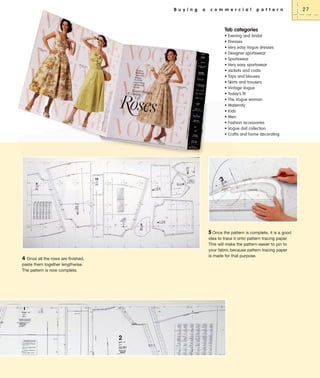
  • 39.
    38 A l l ab o u t c o m m e r c i a l p a t t e r n s Directional prints If you’re using a printed fabric it’s important that you know how to recognize one-way or two-way prints and how to use them. It is very important to consider your print before laying out your pattern pieces. Notice if there is a distinctive top and bottom to the design. Directional print layout X This is a two-way floral print, with no defined top or bottom. If the print is very pronounced, matching the side seams is a good idea. Make sure you match the stitch line, not the pattern edge. Note how the thin, see-through paper of a commercial pattern makes matching the design much easier. W One-way print This paisley fabric has a very clear top and bottom to the design and must be treated as a one-way print, whichever direction you decide to use. When laying your pattern pieces out, you will have to place the top of all the pattern pieces facing the same way. W Two-way print In this print, the flower design has been placed going both up and down the fabric. You are not restricted and can use either end for the top of your garment. You will still need to assess if matching the print is necessary. Two-way print Tip • When cutting fabric, use a large, flat surface at a convenient height. Cut with long-bladed scissors or use a rotary cutter with a cutting mat beneath it. One-way print
  • 40.
    P r ep a r i n g y o u r f a b r i c Napped, or pile, fabrics A napped or pile fabric has a raised fuzzy texture with a definite direction to its surface; it is sometimes called a ‘oneway fabric’. Examples of this are corduroy, velvet, velveteen, suede cloth and fake fur. When you run your hand along in one direction the fabric is smooth and shiny, and in the other it is rough and dull. When pattern pieces are laid on a one-way fabric, it is again important that they lie in the same direction. You can clearly see the effect of a oneway fabric when it has been cut incorrectly. Fabric preparation tips Pile fabric layout X This is an example of a one-way layout, appropriate for napped and pile fabrics and one-way prints. All the tops of the pattern pieces are facing toward the top end of the fabric, and because you cannot turn the pattern pieces around to make them fit more economically, you may need to buy more fabric. • Check the fabric for flaws before cutting out any garment or project. You may be able to work around small problems but it’s best to inspect the fabric before you make your purchase. • Preshrink the fabric by washing it in the way the garment will eventually be laundered, if appropriate, or by steaming it with an iron – by hovering lightly over the surface of the fabric. • Prewash fabrics and lace or ribbon embellishments before starting construction to ensure that the colours do not bleed when washed as a completed garment. Test napped fabric for shading When the nap is running upwards, the colour will be richer; when running downwards, the fabric feels smooth but the colour will be less vibrant. This velvet clearly shows the difference. Suede 39
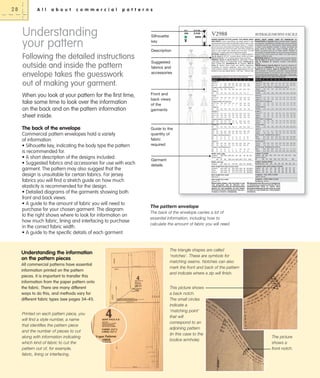
  • 41.
    40 A l l ab o u t c o m m e r c i a l p a t t e r n s Using a checked fabric The range of checked fabrics is vast. Apart from the difference in the scale of the squares themselves, you will find that certain designs are more even, whereas others have a more irregular arrangement of squares and bars. An even check will be easier to use because it is symmetrical. If you spread your folded fabric out on a table, turn down one corner and the squares match, then the check is even. An uneven check will take more planning when aligning the pattern pieces on the fabric and will require extra material for a layout similar to one-way fabrics. Cutting check When cutting a check, as with stripes, you must consider how the check will match when the seams meet. You may want the check to meet in horizontal stripes or perhaps to chevron for a dramatic effect. Think about where you want the bars to be placed on the body. The image to the right is an example of a central arrangement. The same stripe or bar runs through the CF and CB, matching at the shoulder seam. The stripe on the sleeve head will match the stripe on the bodice armhole front and back. It is always safer to cut checks in a single layer, rather than with the fabric folded, so that you can see both sides to measure and match the check exactly. Tartan Even check Uneven check An even check makes laying out pattern pieces easy. You still have to consider matching horizontal and vertical lines, but pattern pieces can be turned to minimize fabric wastage. Although these pieces are facing in opposite directions, key points, such as hip lines, still match up. When using an uneven check, matching the strong horizontal and vertical lines needs more careful consideration. Here, a stripe in the design has been used to align the hip line.
  • 42.
    P r ep a r i n g y o u r f a b r i c Using bias and silk fabrics Extra care and patience is required when cutting a garment on the bias. Bias-cut designs are deceiving, often looking simple, with few seams. Silks or silky fabrics are favoured for their expensive look and the natural drape that they provide – but they are often fine and slippery, and require a very light touch and minimal handling in both the cutting out and sewing. Only use a commercial pattern designed specifically for the bias, because extra width has been provided for in the pattern to allow for the weight and stretch of the bias fabric. The amount of width needed will vary from one silk to another. If your garment is too tight, it will pucker and twist. When cutting silk on the bias, treat it as a one-way layout (see page 38). This will minimize the danger of cutting different grains, which will react in different ways to cause twisting or puckering and also to protect against shading (when opposing grains make a fabric appear a different colour). For the best results, do not fold the fabric; cut out in a single thickness, and place a layer of pattern tracing paper under the silk. The silk will cling to the paper, helping to keep it stable while it is cut out with a pair of sharp shears. Serrated scissors can also be helpful for cutting out silk. W Bias dress pattern layout on silk This dress has both CF and CB seams. The commercial pattern supplies only two half-garment patterns, so another pattern layout will be required with the pieces placed as opposites. Keep the tops of the pattern pieces pointing in the same direction, because the silk can behave differently if the grain direction changes. Maintaining proportions when working with bias fabrics To counteract the narrowing qualities of fabric used on the bias, you must add 2.5cm (1in) to the existing seam allowances at the side seams. This extra width helps to counteract the effect of the hanging weight, pulling the fabric down and making it longer and narrower. Before sewing the pattern pieces together, cut the garment out and pin it onto a dress form, and then leave it to hang overnight or longer. In this time, the weight of the fabric will draw the dress downwards, making it narrower. If you temporarily hand tack the side seams onto the dress form, this will keep the slippery fabric in place until it can be stitched on the machine. Leave the garment to hang on the dress form again, before levelling out the hem and stitching. 41
  • 43.
    42 A l l ab o u t c o m m e r c i a l p a t t e r n s Pinning, marking and cutting out It is important that you have a large clear surface on which to prepare your pattern. You need to maintain complete accuracy when placing your pattern pieces before pinning them onto your fabric. Any discrepancies to the grain or movement that adds or removes fabric could ruin the fit of your garment and, at this stage, be difficult to detect and alter. Marking the pattern information such as notches, darts and pockets onto the fabric accurately is vital, and you must consider the best tools for the job. This will be entirely determined by the fabric you have chosen. Simple sizing alterations suitable for commercial patterns, such as lengthening and shortening the bodice, sleeve, skirt, dress and trousers, will help provide your pattern with a more accurate fit, providing the professional finish that you desire. Tip • Placing weights on pattern pieces before pinning or drawing around them is a useful tip. Weights can be purchased from haberdashery shops, or simply use any small, reasonably heavy item close at hand. Placing and pinning Follow the envelope instruction sheet for suggested layout plans for your fabric width. These plans are very precise and, if they are followed correctly, your pattern pieces should fit on perfectly. Always lay your pattern on a large flat surface; never let the fabric hang over a table edge, because this distorts and stretches it. First, line up any pattern pieces that use the fabric’s fold. Accuracy is key, because even a small slither added or subtracted will change the size of your garment. 2 Hold it still with weights; when the position of each piece is checked, you can pin it in place. Place the pins along the seam allowance, perpendicular to the pattern’s edge, and pin diagonally at the corners. Tip • When pinning, keep the pins clear of the cutting line – this will prevent you from blunting your shears! 1 Using a tape, measure from the pattern grain line to the selvedge at each end of each pattern piece to ensure the grain remains straight. 3 Try to place pins so they do not distort the fabric. Distortion can happen if you pin out too much or too little fabric at a time. With special fabrics, such as silk and plastics, where there is the risk of leaving a hole, pin within the seam allowance.
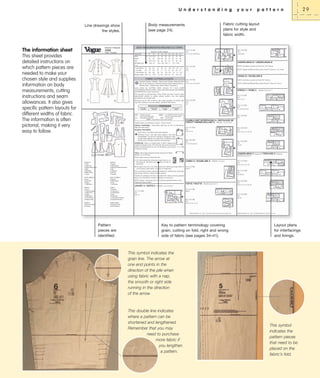
  • 44.
    P i nn i n g , m a r k i n g a n d c u t t i n g How to mark out your fabric There are many different methods of marking and transferring details from the pattern to the fabric. It is best to test out the options on your actual fabric before you start. Some marking methods work better than others on different fabrics. You’ll find examples of these on the next three pages. Marking is usually done on the wrong side of fabric. If marking is necessary on the right side, it should be done with tacking thread, which can easily be removed. Choosing your marking method When marking patterns, how much information is transferred depends on how much sewing experience you have. As a general guide, a novice sewer might need to have all the construction details marked out – whereas an experienced sewer may mark only notches, curved darts, ends of darts and pocket placements. There are different types of chalk, pens and tracing paper that you can use for transferring the markings. As a rule, you should always test the marking method on the fabric first to ensure that it can be removed successfully. Tailor’s chalk or pencils come in different colours, and because of this, they work well on a variety of fabrics. They can usually be removed by brushing out; however, test them before you begin. Chalk can also be used to mark out darts, difficult curved seams and pocket placements – always mark on the wrong side of the fabric. Tailor’s tacks Tailor’s tacks are a fast and easy way to temporarily mark pocket placements or ends of darts on bulky fabrics, such as thick woollens. The small circles in the images below indicate the position of a dart. 1 Thread a needle with doubled (but 2 Sew through the pattern and not knotted) contrasting thread; locate the mark indicated on the pattern by a small circle. two layers of fabric to produce a small stitch. 3 With this first stitch, leave a 2.5cm (1in) 4 Remove all pins from the pattern. Pull the two layers of fabric apart carefully. tail; stitch again through the same spot and leave a 5cm (2in) loop, and then leave another 2.5cm (1in) tail before cutting off. Repeat this process for all the circles marked on the pattern. 5 Snip the threads, leaving an equal 6 Both sides of the fabric are now amount of thread on both sides. marked accurately but temporarily. o u t 43
  • 45.
    44 A l l ab o u t c o m m e r c i a l p a t t e r n s Marking with chalk 1 Push a pin through the centre of the 2 Pull the two layers of fabric apart. small circle. 3 Mark the pin placement with chalk and remove the pin. Pattern wheel and dressmaker’s tracing paper Test these first on a scrap piece of fabric. 1 Fold your fabric with the wrong sides together. Fold a sheet of tracing paper in half and insert it between the two layers of fabric. 2 Trace the desired line with your tracing wheel. Cutting out Before cutting out, ensure you have a clean tabletop at a convenient height, keep the fabric flat and use a sharp pair of shears. Serrated blades are good for knits and slippery fabrics. 1 Start cutting the pattern out of the fabric as close to the edge of the paper as possible, without cutting the tissue of the pattern. Keep the lower blade of the shears resting on the tabletop as you cut. Try to use long even strokes rather than short choppy ones – this will ensure straighter edges to your pieces. 2 Once the pieces are cut out you must mark all the notches with small nicks into the seam allowance. Be careful not to cut too far in – 3mm (1⁄8in) is more than enough to indicate the marks. 3 The colour comes through, clearly marking the stitching line. Professional tips for cutting out different fabrics • Silk and fine fabrics When cutting slippery fabrics, always put paper underneath and cut as a single layer. The paper acts as a magnet and helps to keep the fabric still, preventing it from moving away from the scissors as you cut. Serrated scissors are helpful in cutting out silk. • Heavy and thick fabrics The fabric’s thickness may make it necessary and more accurate to cut the pattern out as a single layer. • Cutting out a single layer Ensure that you cut out all pattern pieces the correct number of times and remember to reverse the pattern for the different sides of the garment. Sometimes it is useful to use a checklist or to mark the pattern pieces themselves to indicate that you have already cut them out. Cutting out velvet Fold the fabric with the pile side out; this will keep the fabric from moving while you cut.
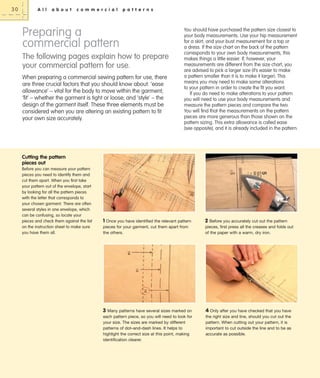
  • 46.
    P i nn i n g , Pocket placement with tacking stitch Machine- or hand-tacking is a temporary way to transfer information from the pattern to the fabric. As the garment is being stitched, you simply remove the tacking line. Again, you must test the fabric first to ensure stitching holes or colour from the tacking thread is not left behind. When cutting paper patterns in a checked or print fabric, matching the pockets is necessary. Tacking is a fast and easy way to temporarily mark pocket placement. m a r k i n g a n d c u t t i n g o u t 1 Cut out all the main pattern pieces. Cut out the paper pocket pattern. Pocket placement Pocket 2 Measure, and then fold under the pocket seam allowance. 3 Find the small circles indicating the pocket placement, and position the pocket piece on the main pattern. 4 With a pencil, mark the prominent fabric design lines on the pocket pattern. 5 Place the pocket pattern onto the fabric 6 Place the pocket pattern, still pinned to the fabric, onto the main pattern to double-check that an accurate fabric match has been made. Then, with a pin, record the pocket placement through both layers of fabric. 7 Thread a needle with a contrasting thread and, using long stitches, tack the pocket placement position onto the right side of the fabric. 8 Construct the pocket according to the pattern instructions and machine stitch the pocket to the bodice. Try not to catch the tacking stitch while sewing, as this can be difficult to remove later. It is possible to remove it as you sew if this becomes a problem. and use your pencil lines to match checks or prints if necessary. Fold out the seam allowance and cut out the pocket. 45
  • 48.
    Altering a pattern The followingchapter introduces you to some of the easier and more common alterations that you may need to make to your commercial pattern in order to create a custom fit for your garment.
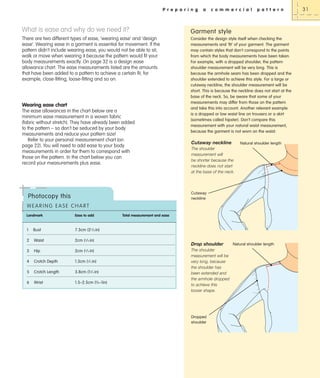
  • 49.
    Simple alterations for commercialpatterns All commercial patterns are made to standard average body measurements for each figure type or size. Companies spend a lot of time and money inviting the public to take part in measurement surveys, eager for their patterns to fit as many people as possible. In reality, of course, we are all different – but standardizing measurements is a necessary process for the industry. Of course, if your measurements are correct, you are ready for the next step. If not, you will need to customize your pattern to create a more personalized fit – and choosing the correct size will help enormously. It is best to purchase the size that most closely fits your bust and hip measurements. This is because, as a general rule, size alterations are easier to make in other areas. Creating and altering patterns is a vast subject area with varying degrees of simple and complex methods involved. As a home sewer, you may encounter or have a non-standard body shape (a common reason why people choose to create their own designs). Certain body shapes require more complex pattern adjustments than the simple adjustments in this following chapter. For example, one requirement might be to adjust the pattern when the bust is disproportionately larger than the chest and other upper body measurements. In this case, enlarging the bust would be easier than altering the other measurements, and the method of adjustment would be more complex – adjustments such as this can be found in a later chapter (see pages 72–79). Alterations The alterations to be found in this section are as follows: • Shortening or lengthening the bodice (see page 50) • Shortening or lengthening the shoulder (see pages 51–52) • Altering the bust (see page 52) • Moving the bust dart up or down (see pages 53–55) • Increasing the bust by small amounts (see page 55) • Shortening or lengthening the sleeve (see page 56) • Shortening or lengthening a skirt (see page 57) • Increasing or decreasing a skirt waist (see page 57–58) • Enlarging or reducing a skirt waistband (see page 59) • Shortening or lengthening a princess-line dress (see page 60) • Shortening or lengthening trouser leg length (see page 61)
  • 50.
    S i mp l e a l t e r a t i o n s f o r c o m m e r c i a l p a t t e r n s Simple rules for pattern alterations • Always start with flat pressed pattern pieces. • When making pattern alterations, always pin first and check with a ruler before finally securing down with tape or glue. • Amending the length of a pattern should be done before all other alterations. Draw a straight line with a long ruler and keep the pattern pieces aligned along it. Always pin alterations and re-measure them before securing them permanently. • When lengthening, you will need to place tissue paper or pattern tracing paper underneath to fill the gap. Again, pin the new piece into position before securing with tape. • When shortening pattern pieces, pin them into position and measure again before securing. • When an alteration has disrupted a seam or dart line, take an average between the two lines, and then smooth and taper a new line. If you’re lengthening a pattern you need to place tissue paper under the pattern to fill the gap. • When adding or subtracting large amounts (anything over 2.5cm/1in), divide the amount between two or three different places. For example, to add 5cm (2in), slash-and-spread in two places, adding 2.5cm (1in) at each. By distributing the adjustment in this way, you will retain the original design proportion. • If it is necessary to fold parts of your pattern to reduce its size, remember to take half the measurement required from each side of the tuck, so as not to double the amount. For example, to take out 5cm (2in), take 2.5cm (1in) from the fold to the inside fold and another 2.5cm (1in) from the inside fold to the dotted line. Special note 2.5cm (1in) When shortening a pattern, it is important to remember to take just half of the full measurement from each side of the tuck. The patterns used in the following sequences do not include seam allowance. When manipulating your own patterns, keep in mind that a pattern with seam allowance included may look different from these. The basic method of shortening or lengthening a pattern (see page 50) can be applied to all patterns. 49
  • 51.
    50 A l te r i n g a p a t t e r n Simple bodice alterations Lengthening a bodice Bodice alterations can affect the armhole and shoulder. Remember that when making adjustments to any pattern piece, it will affect adjoining pieces. For example, when altering a front bodice, it may affect the back bodice or the sleeves. Most commercial patterns have a line indicating the best place to shorten or lengthen a pattern. This is a very common alteration and can be done easily. Lengthening or shortening a pattern can disrupt the line of the side seam or dart. Redraw them if necessary, connecting the lines with a ruler or T-square using smooth, tapering lines. If you have a choice, it is always better to increase rather than decrease when drawing. 1 Locate the ‘lengthen or shorten’ line. Cut along this line as accurately as possible. Shortening a bodice 2 Glue some paper to one side of the pattern, keeping the paper flat and neat. 1 Locate all the pattern pieces that you need for your design. Cut them apart from any other pieces, and accurately cut them out in your size. 2 Commercial patterns have a printed line on each piece indicating where to shorten and lengthen it. Locate the line, measure the amount to be shortened, and draw a line parallel to the printed line. 3 From the cut pattern edge, 3 Crease the pattern along the printed line and fold down to your pencil line, securing the pattern with tape. 4 Check that the pattern edges are straight and smooth by redrawing them with a ruler and pencil. As a general rule, if a large step is created by making a pattern adjustment, always redraw bigger rather than smaller. Repeat this method for the back bodice. measure the amount to be added, and draw a parallel line. Redraw the grain line onto the new paper with a ruler – this will be used to correctly align the joining pattern piece.
  • 52.
    S i mp l e b o d i c e a l t e r a t i o n s Shortening the bodice shoulder The method below shows how to shorten the bodice shoulder while retaining the original garment shape. 1 Measure to find the centre of the shoulder. 4 Place the joining pattern piece in position, lining it up with the drawn grain line. Be as accurate as possible. 2 With a ruler, connect the centre shoulder to a 3 Cut along this line from the shoulder to the point midway down the armhole, with a straight line that blends into the armhole. armhole, leaving a hinge. 4 Measure in from the line the amount the shoulder is to be shortened by, and mark the pattern with a pencil. 5 Move the hinged shoulder in to meet the pencil 5 Realign the pattern edges, smoothing out any steps and gaps. 6 Repeat this method for the back, using the same measurements. mark. Tape the pattern in the correct position, and then glue a strip of paper under the pattern shoulder line. 7 Repeat this method for the back, using the same measurements. 6 With a ruler, redraw the shoulder line to smooth out the step. 51
  • 53.
    52 A l te r i n g a p a t t e r n Lengthening the bodice shoulder The method below shows how to lengthen the bodice shoulder, while retaining the original garment shape. Altering the bust: three methods Method 1: moving the bust point Moving the bust point or apex up or down is a quick and simple pattern alteration. 1 Measure to find the centre of the shoulder. 2 With a ruler, connect the centre shoulder to midway along the armhole. The straight line should blend into the armhole. 1 First, cut out the front bodice pattern in the correct size. 3 Cut along this line from the shoulder to the 4 Glue a strip of paper to one side of the armhole, leaving a hinge. If you are working with a pattern that includes seam allowance, cut up to the stitch line, and then make a small snip from the pattern paper edge to the stitch line and leave a hinge. pattern, measure the amount to be added to lengthen the shoulder and make a pencil mark. 2 With a ruler, draw a line through the centre of the side seam dart and the waist dart. The point where the two lines intersect is the bust point or apex. 5 Move the shoulder piece to the measured pencil mark and secure it with tape. Redraw the shoulder line as a smooth, straight line. 6 The finished pattern piece. Repeat this method for the back 3 Refer to your personalized measurement chart (from page 22) and, on the pattern, measure from the centre shoulder down to your own bust point measurement, roughly in line with the pattern’s bust point.
  • 54.
    S i mp l e b o d i c e a l t e r a t i o n s Method 2a: moving the entire bust dart up This is for adjustments larger than 2.5cm (1in). 1 4 Once you have your new bust point or apex, connect the new bust point to the side seam dart edges with a ruler. First cut out the front bodice pattern in the correct size. 2 Draw a box around the bust dart and cut out the bottom and side of the box. 5 Repeat, connecting the new bust point to the waist dart. 6 To retain the original pattern style and fit, back the new darts away from the new bust point by the same amount as the original pattern indicates. 3 Measure the required amount up from the top of the box and mark a parallel line. Crease the top line of the box and fold up to the new line. 4 Place some paper underneath and tape it in position. 5 With a ruler, realign the side seam and trim any excess paper. This sequence continues on the next page ³ 53
  • 55.
    54 A l te r i n g a p a t t e r n 6 Fold out the dart and Method 2b: moving the entire bust dart down check once again for steps and gaps in the new side seam. It is important to check what implications your alterations may have for the rest of the pattern before cutting it out. 1 Cut out the front bodice pattern in the correct size, draw a box around the bust dart, and then cut out the top and side of the box. 7 With a ruler, redraw the pattern, smoothing out the side seam. 2 Measure the required amount from the bottom of the box, marking a parallel line. Crease the bottom line of the box and fold down to the new line. 8 With the dart still folded, cut along the new side seam. 3 Place some paper underneath and tape it in position. Special note 9 The finished pattern. Remember, the patterns used in these sequences do not have seam allowance.
  • 56.
    S i mp l e b o d i c e a l t e r a t i o n s Method 3: increasing the bust by small amounts, 2cm (3⁄4in) or less 4 Fold out the dart and check for steps and gaps in the new side seam. It is important to check what implications your alterations may have for the rest of the pattern before cutting it out. 5 With the dart still folded, redraw the When a small amount extra is needed to increase the bust, the seam allowance can be used. Taking too much fabric from the seam allowance will weaken your garment, so small amounts only are possible, for example, 2cm (3⁄4in) in total. Adding to the bust through the side seams will also add to the armhole circumference. To ensure the sleeve will fit correctly, you will need to add the same amount to the sleeve pattern and to the back. 2 Fold out the bust dart. 1 Cut out your pattern pieces in the correct size and add extra paper to the side seams of the bodice and sleeve (if there is no seam allowance included on the pattern). 3 Measure out from the side seam the amount to be added (up to 5mm [3⁄16in]). side seam, smoothing out any steps and gaps using a ruler. 6 The finished pattern. 4 With a pattern master, blend the added measurement into the side seam while the dart is folded closed. 6 Adding to the bust circumference also increases the armhole. Add the same amount to the sleeve bicep width. 5 Keeping the dart folded closed, cut along the new side seam line. 55
  • 57.
    56 A l te r i n g a p a t t e r n Simple sleeve alterations Lengthening a sleeve How to lengthen or shorten a sleeve. Lengthening or shortening a sleeve is an easy alteration to do. Simply use the pattern’s ‘shorten or lengthen line’ and add or subtract the amount you need. 1 Locate the sleeve pattern and cut it out to the required size. Then, locate the printed ‘shorten or lengthen’ line on the pattern and cut along it. Shortening a sleeve 2 Tape or glue some paper to one side of the pattern. With a pencil and ruler, measure out the amount to be added and extend the grain line onto the new paper. 1 Locate the sleeve pattern and cut it out to the required size. Remember to cut accurately. 2 Locate the printed ‘shorten or lengthen’ line on the pattern and measure from it the amount to be altered, and draw a parallel pencil line with a ruler. Crease the pattern along the printed line. 3 Align the other half of the sleeve to the extended grain line and tape it into position. Special note 3 Fold down to the measured pencil line and secure the pattern with tape. Remember, the patterns used in these sequences do not have seam allowance. 4 Straighten out and redraw the pattern edges with a pencil and ruler.
  • 58.
    S i mp l e s l e e v e a l t e r a t i o n s • Simple skirt alterations Changing the length of a skirt is a quick and simple alteration. S i m p l e s k i r t a l t e r a t i o n s Decreasing a skirt waist When a skirt fits on the hips and a small alteration is needed to adjust the waist (no more than 2cm/3⁄4in), this method is quick and easy to do. When altering a skirt pattern use the alteration line provided in the same way as for a sleeve. Remember to add or subtract by the same amount on the front and back pieces. Lengthening or shortening a skirt 1 Locate the skirt pieces, front and back, and cut them out to the required size. Remember to cut accurately. 1 2 The skirt pattern will include a printed ‘shorten or lengthen’ line. Follow the same step-by-step guide as for lengthening or shortening a sleeve (see page 56). Original skirt pieces Locate the skirt pieces, front and back, and cut them out to the required size. Remember to cut accurately. Divide the total amount needed to change the waist by four. To create a smooth fit, this amount should again be split in two and shared equally between the side seam and the dart. 2 Starting with the front skirt, split the measurement again; measure outwards, increasing the dart on either side at the waist line. Blend back into the dart end. Shortened skirt pieces Lengthened skirt pieces This sequence continues on the next page ³ 57
  • 59.
    58 A l te r i n g a p a t t e r n Increasing a skirt waist When a skirt fits on the hips and a small alteration is needed to adjust the waist (no more than 2cm/3⁄4in), this method is quick and easy to do. 2 Starting with the front skirt, split the measurement again; measure inwards, decreasing the dart on either side at the waist line. Blend back into the dart end. 3 Measure the amount to be reduced at the front waist side seam. 3 In this example, because there is no seam allowance, 4 With a pattern master, blend the 1 Locate the skirt pieces, line back into the side seam. front and back, and cut them out to the required size. Remember to cut accurately. Divide the total amount needed to change the waist by four. To create a smooth fit, this amount should again be split in two and shared equally between the side seam and the dart. when cutting larger sizes, you will need to add paper to the side seams. Measure the amount to be added to the waist side seam and blend it back into the hip. 4 5 5 Repeat this method, using the same measurements, on the back of the skirt. When both front and back waists have been altered, re-cut the pattern. Special note Remember, the patterns used in these sequences do not have seam allowance. Accurately cut the excess paper away. Repeat the method for the back.
  • 60.
    S i mp l e s k i r t a l t e r a t i o n s Altering a skirt waistband Original waistband before alteration Skirt waistband made bigger Skirt waistband made smaller. Increasing at the hip To increase through the hip, if no more than 2cm (3⁄4in) is needed. 4 The finished skirt. The extra amount added to the hip should continue down to the hem. 2 Add the amount you need to the hip to make the pattern larger. This will be a quarter of the total amount to be added (2 x fronts, 2 x backs). 1 Locate the skirt pieces, front and back, and cut them out to the required size. You will also need to alter the hips if you have altered the waistband. 3 Blend from the waist line to the new hip measurement and continue down to the hem. Trim away the excess dress sizes. 59
  • 61.
    60 A l te r i n g a p a t t e r n Simple dress alterations Lengthening or shortening a princess-line dress. It is especially important to keep the CF and CB lines straight when altering a large pattern such as this princess-line dress. It is important to consider where you need the alteration on the body, as this type of garment covers two alteration points: above and below the waist. Shortening a princess-line dress When shortening this pattern, use the CF, CB or the grain line as a guide to align the pieces. This is important in order to retain the garment’s shape. 1 Locate all the pattern pieces required for your design and cut them out to the required size. Shortened dress Dress before alteration Lengthened dress 2 Measure the amount to shorten the dress by. 3 Draw a parallel pencil line. 4 Make a crease, fold down the required amount, and secure it with tape.
  • 62.
    S i mp l e d r e s s a l t e r a t i o n s • Lengthening a princessline dress S i m p l e t r o u s e r a l t e r a t i o n s Simple trouser alterations When lengthening this pattern, use the CF, CB or the grain line as a guide to align the pieces to. This is important in order to retain the original garment shape. This is a simple alteration just for the length of the leg. Use the lengthen and shorten line as before, remembering to alter the same amount front and back. Lengthening and shortening trousers When altering trousers, align the pattern alterations to the centre leg grain line. By doing this, you will retain the original trouser shape. 1 Locate all the pattern pieces required for your design and cut them out to the required size. Locate the desired position for your alteration and cut across the line. Glue or tape on some paper to one half of the pattern and measure out the amount to be added. 2 1 Locate all the pattern pieces required for your design and cut them out. To shorten the trousers, follow the same method as for shortening the sleeve (see page 56). 2 When lengthening trousers, ensure you line up the grain lines to retain the original trouser style and shape. Draw a pencil line. 3 Align the other pattern pieces to the grain line, CF or CB, and secure them with tape. Trim off the excess paper on either side. Trousers made shorter Trousers made longer 61
  • 64.
    Designing your own patterns This chapterexplores methods for making your own patterns; whether you use the pattern blocks supplied on pages 112–125 of this book, or purchase a ready-made, commercial pattern block from a shop. You will learn about making your first toile and altering its fit, as well as how to add design details to the garments that you make.
  • 65.
    Creating your ownpattern What is flat pattern cutting? Flat pattern cutting is a well-established, formulaic, two-dimensional approach to creating and developing paper patterns based on an accurately fitted block. Paper copies of the blocks are then developed and manipulated flat on a tabletop. Three-dimensional shapes are formed by adding in and folding out excess paper to a prescribed formula. A successful final pattern is dependent on how well the block fits the body, the accuracy of the work, the success of the methods used and how creatively the design has been interpreted by the pattern cutter. Getting started What is a basic block? This chapter discusses the use of personal blocks as a method for making your own patterns, and how industry uses ‘working patterns’ and ‘seasonal shapes’ to speed up the design process. There are several different ways to create block patterns; only two are covered in detail in this book. In the first, scaled-down blocks are resized using a grid system – these blocks are supplied on pages 112– 125 with instructions on how to scale them up to full size on page 66. The second method is to buy a ready-made commercial pattern block from a shop. You will learn about making your first toile – a fabric prototype of the garment you are making – and assessing and altering its fit (see page 68). Once the blocks have been perfected, you’re ready for the more creative practice of designing your own garments. For this you need to understand design analysis, looking closely at the initial design sketch and interpreting its construction details into a clear ‘working drawing’. Marking out a dress form with yarn to the correct proportions, from the position of seam lines to the width of the button stand is an easy way to visualize the information before transferring it to a paper pattern (see page 80). A basic block is the original drafted pattern that has been perfected to fit the body precisely. Once this pattern has been tested for fit, it becomes the base that all other patterns are derived from. This original block should never be cut up for manipulations, and it should be altered only if your body shape changes. It never includes a seam allowance; this makes pattern manipulation more accurate. To make it easier to trace around and to prolong its life, the finished pattern block can be traced onto card. This simple, basic pattern will fit the body with just enough ease for freedom of movement (see page 31). Any design shaping, flare or detailing is created at the next stage. A half toile of the pattern is often sufficient to assess the fit; however, a full garment may be necessary if the right side of the body is different from the left. It takes time and patience to perfect the shape and it is not uncommon to make two or more toiles to get it right. Remember, you will need to add seam allowance to the pattern in order to sew the toile together. What is a seasonal shape? A seasonal shape involves more design input than a working pattern and is therefore the next stage in the process. A seasonal shape in the fashion industry is one that is going to be repeated throughout that season’s collection – once perfected, it will also benefit from being copied to card for continued reuse. Examples would include a blouse with shoulder pads or a lowered waistline on a pair of jeans. The pattern cutter would start with the basic block and adapt its detailing to the design’s specifications. Thereafter, all the blouses and jeans in that collection could be cut from this block, avoiding the need to start at the beginning each time. Calculating fabric requirements When designing your own patterns, you’ll need to know how much fabric to buy. To do this, cut out the pattern pieces and, bearing in mind the grain direction and fold lines, lay out the pieces on any spare lengths of 90cm (36in) and 140cm (56in) wide fabric. This physical positioning of pieces makes it easier to see if two pieces will fit side by side and how much room there is to spare. Do not forget to allow for a seam allowance, and remember to allow extra fabric if the fabric chosen has a strong pattern that needs to be aligned across a seam (see pages 37–40).
  • 66.
    C r ea t i n g y o u r o w n 65 p a t t e r n Methods for creating basic blocks There are several ways to create your own personal pattern blocks – two are covered in this book. The method you choose is merely a question of personal preference. The basic block consists of five simple pieces: a darted bodice front and back, a sleeve and a skirt front and back. The skirt and bodice can be joined to make a dress. 1 2 118 1 T h e 2 3 4 5 p a t t e r n 6 7 8 A B C b l o c k s U K - - - 9 10 11 12 13 14 15 16 17 18 19 20 21 22 23 24 25 26 27 28 29 30 31 32 33 34 35 36 37 38 39 40 41 Back bodice Front bodice Back skirt Front skirt Sleeve S I Z E 1 4 p a t t e r n 119 b l o c k s 42 43 44 45 46 47 48 49 50 51 52 53 54 55 56 57 58 59 60 61 62 63 64 65 66 67 68 69 70 71 72 73 74 75 76 77 78 79 80 UK SIZE 14 pattern blocks A See page 66 for instructions on how to scale up the pattern blocks. B C D D Scale: 1 square = 1 square cm E E F F G G H H I I Fold line Grain line • 20cm (8in) J K L M J K L M N P Q Q R R S S Grain line T T U U Grain line • 20cm (8in) A working pattern is made from a basic block but is one stage farther on in the design, such as a raglan sleeve, where the bodice and sleeve patterns have been permanently joined to make a new shape, a kimono sleeve or a basic T-shirt. These accurate working patterns, once toiled and perfected, can also be transferred to card and kept for future use. O P V W X Y Z AA BB CC DD EE FF GG HH II JJ KK LL MM V W X Y Z AA BB CC DD EE Grain line • 20cm (8in) Working pattern: raglan sleeve N O FF GG HH II JJ KK LL MM Grain line • 20cm (8in) NN NN OO OO PP PP QQ QQ RR RR SS SS TT TT 1 2 3 4 5 6 7 8 9 10 11 12 13 14 15 16 17 18 19 20 21 22 23 24 25 26 27 28 29 30 31 32 33 34 35 36 37 38 39 40 41 USP US 112-125 cm UK_.indd 118 B3 B3 112-125 corrections_.indd 118 1 The commercial block pattern or fitting shell This is a shop-bought pattern that you can purchase in standard sizes and alter to fit. Instructions are provided for making personal alterations. 11/25/09 2:11:28 PM 2:39:30 42 43 44 45 46 47 48 49 50 51 52 53 54 55 56 57 58 59 60 61 62 63 64 65 66 67 68 69 70 71 72 73 74 75 76 77 78 79 80 USP US 112-125 cm UK_.indd 119 B3 B3 112-125 corrections_.indd 119 2 Using pattern blocks Use the blocks provided on pages 112–125. Follow the step-by-step guide on page 66 for resizing the pattern blocks onto grid paper. 11/25/09 2:11:29 PM 2:39:30
  • 67.
    66 D e si g n i n g y o u r o w n p a t t e r n s Using pattern blocks How to create a custom-made pattern using basic blocks. It is possible to create unique patterns using basic hand-made or commercial block patterns and your own body measurements. Your custom-made blocks can be mounted onto card and used again and again to create new patterns. How to scale up pattern blocks On pages 112–125, you can find scaled-down pattern blocks in seven sizes. You can use these to make your own personal blocks. To make enlarging the patterns easier, each column and row is identified with a letter or number. Each square on the grid represents a 1cm (3⁄8in) square on your pattern tracing paper or graph paper. See below for the scaling-up method. How to use a commercial block pattern Most companies that produce commercial patterns also produce a commercial block (or ‘sloper’) in various sizes. They feature in the same pattern catalogue books as Scaling up the blocks Before you start, you will need to either draft your own grid paper, download it from the Internet and paste it together as A4 size sheets, or buy dressmakers’ pattern paper with 1cm (3⁄8in) squares. If you are drafting your own grid paper, it is important to keep checking your measurements, ensuring that all the lines are parallel. The blocks do not include seam allowance. Once you have enlarged the patterns you will need to add seam allowance before making up the toile. Seam allowance is 1.5cm (5⁄8in). regular patterns, and can be purchased in department stores and fabric shops. Commercial block patterns are very convenient to use, saving a lot of the time that is involved in drafting your own. Block patterns are arranged in one size per envelope, so you will need to know the size you require before you buy one. (For advice on sizing, see page 22.) Commercial block patterns are the master patterns that all other patterns are based on. For ease of use, these block patterns are produced with large seam allowances so that alterations can be made easily and any changes 1 On your grid paper, start by labelling all the 1cm (3⁄8in) columns with letters, and the rows with numbers. Each 1cm (3⁄8in) square on your grid paper is represented by one grid square in the book. Mark out a small ‘X’ on your grid where the lines in the diagrams are positioned on the grid in the book. Start at the top left-hand corner and work your way around the pattern clockwise until you can see the outline of the pattern. 2 Connect up the ‘X’s with a ruler and a pattern master.
  • 68.
    U s in g recorded straight onto the pattern. Often commercial patterns suggest a fabric, such as gingham or check, so that the toile’s balance can be easily assessed using the vertical and horizontal lines. Inside the envelope are detailed instructions on how to take accurate body measurements, how to make adjustments to the fit of the first toile, and even advice on design suitability for different body shapes. p a t t e r n b l o c k s Commercial blocks Commercial suppliers, such as Vogue, sell block patterns that take a lot of the work out of making your own. 4 Fold out the darts to make sure they line up and match. This is a good way to ensure that the same curve or straight line is continued from one side of the dart to the other. Even out any lumps and bumps. 5 Before cutting out, measure the pattern pieces to ensure that they are correct. For example, check that the front and back side seams of a skirt are the same length. Cut out, and then label, name and mark all the pattern pieces with grain lines, notches and so on. Front bodice: UK12/US8 Grain 3 When you have finished connecting the ‘X’s, using a pattern master, trace off the finished shape onto a fresh sheet of pattern tracing paper. 67
  • 69.
    68 D e si g n i n g y o u r o w n p a t t e r n Making and fitting a toile Preparation Make a toile to test the fit of the garment you’re creating. Having checked the accuracy of your block, you are now ready to make your first toile. A toile is an early version of a garment made in inexpensive fabric to test a pattern – a kind of fabric prototype. You may make multiple toiles during the process of perfecting your block. Sewing your toile together First, you need to press the creases from some medium-weight calico with a steam iron. Fold the calico in half with the grain. Trace off your blocks onto a new sheet of pattern tracing paper and add seam allowance. Place the pattern pieces on the calico parallel to the grain line, and trace around them with a pencil. Mark on the CF and CB, and draw in the bust lines, waist lines, the bicep line and the elbow line. Mark in the hip line on the skirt and all the grain lines. It is important to mark these out on the calico so that once you have made up the garment, you can see if the lines are balanced and in alignment with the body. Sew your toile together with seam allowance of 1.5cm (5⁄8in); ensure that you are accurate throughout or you will alter the size of your toile. Sew the darts first while the pieces are flat. Press the front darts towards the CF and the back darts towards the CB. Next, sew the front and back bodice shoulder seams and side seams together and press them open. Sew up the underarms of both sleeves and then set the sleeves into the finished armholes (see page 134). Do not press the sleeve caps or you will flatten out the ease. For the skirt, make the darts first before sewing up the side seams. Methodical working When you are pattern cutting, it is good practice to work in a methodical manner. Create a history of how your pattern was drafted and all the stages that this involves. When a mistake becomes apparent, it is then easier to retrace your steps and identify where the mistake happened. Many mistakes are made through adding seam allowances to some pattern pieces and not to others, or sewing pieces together the wrong way up. Working in a step-bystep way helps to keep mistakes and inaccuracies to a minimum. Never be tempted to ignore a problem. Chopping pieces off your patterns or toiles will usually show up on the finished article. So sorting out problems at the paper pattern stage will save valuable time and money. Tips for working methodically Working methodically allows you more scope to be creative once you have learned the basic principles. • Trace your blocks onto card to differentiate them from your patterns. • Label everything thoroughly, with the name and date of the block or pattern piece, for example, Left Skirt Front (cut 1), Cuff (cut 4), Cut on Fold and so on. Mark on the CB and CF lines, grain lines, balance lines, notches and size of seam allowance. This will help to avoid confusion. • Trace off the pattern pieces at every stage of pattern manipulation, and keep and label the stages. Only when you have finished your flat pattern manipulations, and you are ready to try out your toile, should you put the seam allowance on the pattern. • Always put the seam allowance on the final pattern. • Always write on your pieces the right way up and on the correct side – if necessary mark ‘Right Side Up’ (RSU) on pieces that can’t be turned over. • Notches are vital for matching up pattern pieces, for checking them at the pattern stage and for sewing up – don’t forget to put them on, as it will save you a great deal of time later (see page 83). • When sewing your toile together, always sew to the seam allowances you have put on your pattern. If you are inaccurate by even a few millimetres, the size of your toile will be altered considerably. • Cut one pattern piece at a time, and check all the pattern pieces to ensure that they fit together where necessary. • Any alterations that you make on your toile should be copied to your pattern immediately, before you forget what or where they were. Don’t forget to add seam allowances back on where you have chopped parts off your pattern. • Mark on all the darts and details on your fabric pieces with tailor’s tacks or chalk (see page 43).
  • 70.
    M a ki n g a n d f i t t i n g a t o i l e Try on your toile Before trying on your toile for the first time, tie some elastic around your waist – this will mark the natural waistline – and mark the fullest part of the bust and low hip on your undergarments or a leotard with sticky tape to check that these points on your body line up with the relevant points on your toile. Using a dress form If you have invested in a dress form, you could fit your toile to a dress form padded out to your own personal measurements (see page 80). What is balance in a garment? Perfect balance is when a garment’s CF, CB, waist line and hip lines are aligned with the corresponding points on the body. It is important to balance your toile correctly, because all other garments will be produced from this base. Getting this right will remove the need to correct all subsequent garments that you produce using this block. Tip • To find the true CF, make a plumb line by tying a string loosely around your neck. Thread another length of string loosely through it and tie a slightly weighted object on the end. Arrange the plumb line at the CF neck and let it hang down. Mark the exact CF line with sticky tape on your undergarments or leotard, and repeat the process for the CB. Perfect figure, balanced garment Imperfect figure unbalanced garment Imperfect figure balanced garment 69
  • 71.
    70 D e si g n i n g y o u r o w n p a t t e r n s 1 Tie a cord or length Assessing the fit of your toile When you try on your toile for the first time, stand back and look at your garment in a long mirror. Assess the fit and notice the position of the balance lines on the toile. Check that the CF, CB, waist, bust and hip lines align to your own body. It is important to stand straight and look forwards. Ask someone to help you with this stage, as it can be difficult, particularly when trying to see the back. Looking down or twisting will render the assessment of fit inaccurate. Be aware of how the garment feels on the body – the bodice should be fitted, but not tight. Notice any excess loose fabric or pulling across the garment. The armhole must not feel restricted, and you should be able to move your arm freely. Remember to look at the side seams and check that they are on your sides and not drifting forwards or backwards. Taking your time to properly assess and alter the toile at this stage will be worthwhile. A perfectly fitted block will ensure that the designs you produce subsequently will fit you beautifully. Making simple toile adjustments If the toile is too big: Pinch out any obvious excess fabric through the seams and darts of your toile, making sure that the balance lines remain straight. Mark the adjustments with a pencil, and transfer them to your pattern. If the toile is too small: Unpick the restricted area, releasing the tension. Measure the gap that is created, and add in the amounts needed where necessary. of elastic around your natural waist. Compare the tied line to the waist line marked on the toile. If, as shown here, the two lines are not the same, the waist line will need to be adjusted on the pattern. Fitting the sleeve You can assess the sleeve fit when it is on the dress form or on the body. The centre grain running down the sleeve should line up slightly in front of the skirt or trouser side seam. Look at the sleeve on the arm to see that the wrist is central within the sleeve hem, and check that the sleeve is not dragging up against the arm at the front or back. If dragging is present, take the sleeve out and readjust the sleeve cap by moving it around the armhole either forwards or backwards. This may be only a very slight adjustment, no more than 6mm (1⁄4in). Incorrect sleeve alignment This alignment would cause the sleeve to drift towards the back.
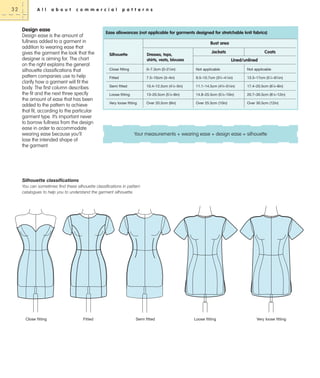
  • 72.
    M a ki n g a n d f i t t i n g a t o i l e Making major toile adjustments You will need to permanently alter your toile if any adjustments are major, and perhaps even make another. Always ensure you make the corresponding adjustments to your pattern. Toiling is an important part of making your own patterns, and often several are needed before the fit is completely right. 2 Here, two alterations are needed. The bodice is too long and the waist is too small. To correct this, measure the difference between the elastic and the pencil line; this will give you the amount to shorten the bodice pattern by. The tightness at the waist is best adjusted by opening the side seams. Measure the amount of extra room required and add it to the pattern. Rotate back Correct sleeve alignment The central sleeve grain should start 1cm (3⁄8in) behind the bodice shoulder line. The bicep line should be horizontal and the central grain should continue down slightly in front of the garment side seam. Perfect Rotate forwards 71
  • 73.
    D e si g n i n g y o u r o w n p a t t e r n s Advanced pattern alterations Fitting the bodice When fitting the bodice, it is important to consider how one alteration affects the rest of the bodice. To perfect the fit of your pattern, you may need to make some alterations. Shoulder Neckline Whether you have used the blocks on pages 112–125 or purchased a commercial pattern block, it is likely you will have to make some alterations to the fit. Having checked the balance of your garment and assessed how it feels on the body, you will have some idea of the areas on the garment that may need attention. You will already have taken out or added in any simple alterations (see page 48). The following pages focus on some of the more specialized alterations you may need to make to your pattern to perfect your toile. Armhole Chest Bodice block Bust apex CF 72 Bust dart Waist dart Waist line Decreasing and increasing the bodice armholes. If you have a sleeveless dress and the armhole gapes or pinches the body, the following pattern alterations will correct this. Likewise, if your garment sleeves are baggy or if you find the armhole binds and pinches the body, these alterations will work. Remember that these alterations will have a direct effect on the sleeve. So when increasing or decreasing the armhole you will also need to adjust the sleeve (see page 56). Back armhole: decrease Open Close Front armhole: increase Front armhole: decrease Back armhole: increase Close Open Close Open Close Open Fitting and adjusting the armhole A smooth, nicely fitted armhole is essential for comfort and when setting in a sleeve. Having tried on your garment, be aware of any pulling or tightness. Look to see if there is excessive fullness in the front or back of the armhole. The armhole alterations shown here may be necessary if you notice any excess fabric. Remember, if you take fabric out of the armhole in this way, it will affect the sleeve. If you are having problems with a sleeve, removing the sleeve and looking at how the armhole fits often helps.
  • 74.
    A d va n c e d p a t t e r n a l t e r a t i o n s Adjusting the sleeve after lowering the bodice armhole If your bodice armhole is too tight, you may need to lower it. This will affect your sleeve. The following sequence explains how to do this. Increasing the bust This alteration allows you to change the bust measurements without affecting the rest of the bodice. This alteration should be done only if there is a discrepancy of 5cm (2in) between the chest measurement and the bust measurement, or if you are a size C cup or larger. Slash the bodice block from the centre shoulder point through the bust apex and down to the waist, and horizontally from the CF, through the bust apex to the side seam. The amount to add depends on the individual. 1 Trace off the bodice and sleeve blocks and cut them out. 2 Divide the sleeve into equal lengthwise quarters. 3 Measure down 2.5cm (1in) on the sleeve underarm seam. Front Correction of fullness in the front of the armhole. Back 4 Using the marks you’ve just made, draw and blend a curved line to the first quarter point on the front and back sleeve cap, creating a new armhole shape. Cut away the excess paper. Correction of fullness in the back of the armhole. This sequence continues on the next page ³ 73
  • 75.
    74 D e si g n i n g y o u r o w n p a t t e r n s Fitting the sleeve Basic sleeve fit A basic sleeve should fit into the armhole smoothly. The centre grain should align slightly forward of the garment side seam when hanging loosely down. The bicep line should be at a 90-degree angle to this grain line. Sleeve cap Back 5 On the sleeve only this time, measure down 2.5cm (1in) at the underarm and again draw in a smooth curve to the first quarter point at the sleeve cap. Cut along this line, but not all the way through; keep a hinge at the sleeve cap. Front Cap depth Bicep line 6 Using the hinge, pivot each section the same amount as you originally lowered the armhole. This alteration will add width at the biceps for movement, while retaining the larger armhole size. Underarm sleeve length Elbow dart Sleeve block Wrist Increasing and reducing cap ease 7 Place paper underneath and secure the pivots with tape or glue, and cut out the new shape. To complete the pattern, lower the bodice armhole at the side seam by 2.5cm (1in) and gently shape into the armhole as you did with the sleeve. Transfer the armhole notches front and back, keeping to roughly the same position. Almost all sleeves have ease in the ‘cap’ or sleeve head. This helps with movement and gives the sleeve shape. When making up a master pattern or personal block, there should be a minimum 1cm (3⁄8in) of ease in the back sleeve and 0.5cm (1⁄4in) in the front. The amount of ease can vary with the type of fabric used (see page 31). Leather and plastics are difficult to manipulate into an armhole. If you are working with fabrics such as these, you will need to reduce the cap ease. If you find there is too much or too little ease in your sleeve cap, follow the simple ‘slash and spread’ method, right. 1 Trace off the sleeve block and cut out. Cut down the centre line on the sleeve cap to the bicep line and then out to each side seam, retaining paper hinges.
  • 76.
    A d va n c e d p a t t e r n a l t e r a t i o n s Widening the sleeve Widening the sleeve cap If the sleeve is too tight, there will be no movement in your sleeve. If, when reaching upwards, the whole garment pulls up, you may need to add width to the biceps of your sleeve. If your bodice pulls across the front, turn to the side and look at the width of your sleeve cap. You may need to add extra width. Check by unpicking the armholes in the front and back to release the tightness. This is the amount you will need to add to your pattern. Adjusting the cap height If there is excess fabric, then you may need to shorten the cap. If your sleeve pulls from the top of the sleeve cap, then you may need to lengthen the cap. 2 To increase the sleeve cap ease, pivot out the pattern pieces from the hinges. 3 Place paper behind and secure it in position with glue or tape. Smooth out any lumps and bumps by re-drawing the line. 4 To decrease the sleeve cap, overlap the pattern pieces by the required amount using the hinged pieces, and secure it in position. Attach to the paper and smooth out any lumps and bumps. 75
  • 77.
    D e si g n i n g y o u r o w n p a t t e r n s Fitting skirts Waist line Waist dart Hip line Skirt block (front) Adding in extra room for rounded figure shapes If the side seam is pulling to the back or front, this is an indication that more room is needed over the stomach or backside. The method shown here is for creating more room in one area, while leaving the rest of the garment alone. This puts the extra room exactly where it is needed. CF Side seam To achieve a well-fitted skirt, first try the skirt on and assess the fit. Note any excess fabric, if the balance lines are straight across the hip, and if they are straight down the CF, CB and side seams. If the skirt feels too tight across the front or back, the following alteration is a quick fix. Hem line Taking out extra fullness across the skirt back If there is excess fabric across the hollow of the back of the skirt, you can remove it as shown below. The excess can be pinned out from the side seam toward the CB seam and then taken out of the pattern as a wedge. Excess fabric in the hollow of the back Take out the excess between the side seam and CB Side seam Too tight across the back CB 76 Adjust the pattern Slash the pattern from the CB to the side seam, leaving a hinge. Redraw the CB line in straight, ensuring that you maintain a 90-degree angle at the top. Too tight across the front
  • 78.
    A d va n c e d p a t t e r n a l t e r a t i o n s 2 Cut down from waist to hem, keeping a hinge at the hem. Cut from the CF or CB hip line to the side seam, keeping a hinge at the side seam. 1 Trace off the front and back skirt blocks and cut out. Divide the skirt block in half at the hip line and draw a line from waist to hem. 3 Spread the pattern by the required amount. This alteration increases the dart width and lengthens the CF or CB, without changing the hem or the length of the side seam. 4 Glue or tape paper underneath. 7 Smooth out the side seams and CF or CB. When doing this, it is better to add to the pattern than to take away. 5 To retain the original waist measurement, increase the dart by the amount added. 6 Blend in the waist shaping, smoothing out any lumps and bumps. 77
  • 79.
    y o ur o w n p a t t e r n s Fitting trousers To achieve a well-fitted pair of trousers it is important to understand how trousers fit. The way the upper body of the pair of trousers fits will dictate how the rest behaves. The two most important measurements are the crotch depth (this measurement is taken while sitting down; measure from waist to chair seat at the side seam) and crotch length (the measurement from CF to CB between the legs). (See also pages 22–23, Body landmarks.) If your trousers are too tight or too loose around the crotch, you may need to alter the crotch depth. Compare your crotch depth measurement with the pattern. If you need to make an alteration, make sure you shorten or lengthen the same amount front and back. If you need to make alterations to both the crotch depth and crotch length, you must change the crotch depth first. It is always good practice to add or subtract exactly where you need to on the pattern. Waist line Crotch length Waist dart Crotch depth Crotch line Trouser block (front) Knee line Side seam D e s i g n i n g CF 78 Shortening crotch depth and leg length Hem line Adding extra room for a rounded stomach or backside 1 Take your front and back trouser blocks or patterns and cut out. From the hip line, measure the amount the pattern is to be shortened by and draw a parallel pencil line. 2 Crease along the hip line and fold 3 This process shortens the total length up to the measured pencil line. Tape in place and repeat the process for the back. of the trousers.
  • 80.
    A d va n c e d Increasing crotch length p a t t e r n 79 a l t e r a t i o n s 2 Cut along this If the measurement is still too long or short after changing the crotch depth, you may need to alter the crotch length. A close-fitting or relaxed trouser fit will determine the amount of ease needed. This could be anything from 1.3cm (5⁄8in) to 3.8cm (11⁄2in) in length, depending on the trouser style. 1 Draw a line from the curve of the CF crotch straight down to the inside leg. 4 If your trousers are still too short through the crotch after adding to the depth and length, you may need to add at the CF and CB waist as well. Add paper to the CF and CB patterns at the waist. Method 2 Side seam Dart Dart CF Slash down the grain line to the knee and out to the side seams. Do not cut through at the knee; keep a paper hinge. Next, cut horizontally from the CB or CF to the side seam, again being careful not to cut through. Add or subtract exactly where you need it. Keep the pattern straight, adding equal amounts. If you need to keep the original waist measurement, take in the extra by enlarging the darts. When you are finished, smooth out by redrawing the seams. Make the opposite pattern adjustment for a flat stomach or backside. and CB and draw a curve, continuing the seam line upwards, then blend back into the waist line. Trim off the excess paper. Side seam If your trousers are too tight across the backside, an easy method by which to loosen them is to add extra to the pattern side seam. 5 Measure up from the waist line at the CF CF Method 1 Side seam 3 Redraw, smoothing out the new crotch line. Repeat the same method for the back crotch seam. If you need to add any more than 2.5cm (1in) to the crotch length, this should be added above the waist line. line down to the inside leg. Do not cut through, leave a hinge. Pivot the piece outwards, increasing the crotch length by the desired amount using the hinge. Add some paper underneath.
  • 81.
    80 D e si g n i n g y o u r o w n p a t t e r n s Designing patterns Now that you have perfected your basic blocks, you are ready to attempt your first designs. To realize your design ideas, it helps to understand proportion and where seam lines look most flattering on the body. Design analysis Designers often put their inspirations onto paper. The designer’s sketch is this initial idea. It is an interpretation of how a garment is to look when it is finished. It shows how the fabric will behave, may include colour and texture, and will evoke the general feeling of the garment. Working drawing Using yarn or tape to map out style lines on a dress form is a good way to see your design threedimensionally. On the following pages, a standard UK size 8 (US size 6) dress form is used. If you are not of a standard size, you may need to adapt a dress form to suit your own personal measurements. One of the first steps in realizing your design is to make a working drawing. A working drawing is a simple line drawing of the garment that highlights the details of its construction – where to put the seam lines, darts, gathers or pleats, topstitching, buttonholes and so on. Based on the designer’s sketch, the working drawing should be in proportion, with the lines drawn exactly where you wish them to appear on the body. Drawing the design like this helps you to focus and consider these details, which are paramount at this stage, as they will inform how the pattern will be cut. Details to consider Before starting to construct the pattern you should have an idea of what fabric the garment is to be made in. The blouse shown to the right is to be made from a woven cotton shirting fabric and is therefore not stretchy. (Woven fabric can sometimes contain a small amount of stretch. The amount of stretch is an important consideration when choosing a fabric, as the pattern will have to be adapted for this.) The fit of this garment is achieved through four darts with gathering at the front Padding out a dress form to your own size In the fashion industry, a common method for fitting garments to individual sizes is to pad out a solid, linen-covered dress form in a small size to fit your own measurements. In this way, it is possible to completely recreate your own body shape. You will need • Dress form smaller than your own body size • Pins • Tape measure • Scissors • Wadding • Padded bra in your size • Elastic • Strong jersey fabric Using the measurement chart on page 22, compare your own measurements to those of the dress form, starting at the top and working down, use wadding to pad out the dress form to match your size. Once the dress form is padded, you can pin elastic or yarn onto the stand to indicate where the new hip and bust lines will be. Put the padded bra onto the form and stuff the cups with wadding. Measure to ensure you are creating the correct bust size. Pin a layer of stretch jersey over the whole form to create a smooth surface to work on. Pad the waist with strips of wadding. Start with narrow strips, layering up the wadding, and using wider strips each time. Measure the waist to check the proportions.
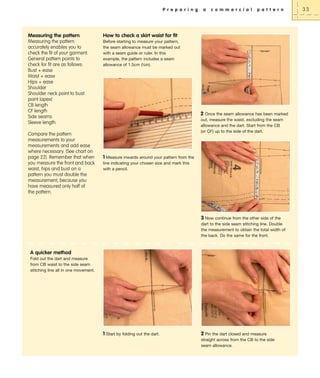
  • 82.
    D e si g n i n g p a t t e r n s and back yoke. The yoke does not have a natural shoulder line seam. The neckline is round and slightly dropped at the CF neck. Details such as the size of the button are essential at this stage, as this informs the width of the button stand – one of the first steps in cutting this pattern. Follow the step-by-step instructions below to translate your working drawing into a pattern. Translating a working drawing into a pattern Pinning the style lines on the dress form can help you to see the proportions of the garment on the body more clearly. Basic blocks are flat representations of a dress stand or form. In these images, the model is a standard size 8 (US size 6). Visualizing the proportions in this way means you can measure the distances accurately and transfer them straight onto the pattern paper. You will need • • • • • • • Working drawing Dress form Yarn Pins Pattern tracing paper Red pen Pencil 1 From your working drawing, map out the style lines on the dress form using yarn and pins, front and back. Always stand back from the dress form to look at and assess the proportion and accuracy of the design. 2 Trace off the appropriate block for the design onto pattern tracing paper – in this case a torso block (see page 96). You will use this flat block in correspondence with the dress form – ensure they are both the same size. Trace in red pen to indicate the original block pattern. This sequence continues on the next page ³ 81
  • 83.
    82 D e si g n i n g y o u r o w n 3 Work on the dress form, starting with the front neckline. Measure the distance between the CF form neckline and your own CF yarn neckline. p a t t e r n s 4 With a pencil, mark the yarn line onto the pattern tracing paper. Continue measuring and marking the relevant positions on the pattern paper. 5 Measure from the CF yarn neckline to the design’s hem. 7 Work systematically from the top front of the form to the top back of the form, transferring the design to the pattern tracing paper. Use the form’s shoulder seams, waist line seam and side seams as reference points in relation to the block shoulder seams, waist seam and side seams. 6 Transfer the measurements to the pattern tracing paper. 8 Decide on the garment’s fit – tight, loose, etc. (see page 32). If the fit you want to achieve around the body is larger than the block bust, take the tape measure and place it around the bust. You must now judge how large you would like your design to be. Measure the bust on your block and compare the difference. Take that difference and divide it by four, and add the same amount to each side seam level with the bust. 9 The block pattern has one dart and our design has two darts. To split one dart into two, find the centre of the block dart and draw two vertical lines equidistant from it. Measure the dart and split the measurement of the dart equally between the two. Redraw the darts to the same length as before.
  • 84.
    D e si g n i n g 10 This design has a front and back yoke, with no shoulder seam. To create this, first trace the armhole side of the yoke. Then, excluding the dart, move the tracing paper to the neck side of the dart and trace the rest of the yoke. p a t t e r n s 11 Move the front yoke piece to join the back yoke piece so that the shoulder seams touch, and continue tracing. When the whole pattern piece is complete, add the seam allowance and cut it out. Cut one pattern piece at a time, and check all the pattern pieces that go together to ensure that they fit. This is good practice – testing patterns at this stage can save you a great deal of time and fabric later. Pattern notches and their uses Notches are extremely important. They act as the ‘road signs’ for making up your garment. CF Notches are used to identify parts of the pattern that fit together, to help you assemble your garment easily and accurately. When transferring the information from the pattern, make small clips to the edge of the fabric (no more than 2–3mm/1⁄8in). Too many notches can weaken a fabric or, if used to liberally, can become confusing. Notches Notches can indicate the following: • An ease allowance in a garment • Where to stop and start gathers • Centre lines or fold lines • Hem depths and cuffs • Where a zip stops • The natural waist line • The natural shoulder point • A change in seam allowance width (industry) • How to match curved seams. CF Natural shoulder point Although both commercial patterns and industry patterns have notches, they may look different on the patterns. Commercial pattern notches are indicated by triangles; industry notches are indicated by a ‘T’ shape and then cut out as a nick with a pattern notcher. When drafting your own patterns, you will need to put notches on at the pattern plan stage. With a ruler, draw short lines that intersect both pattern pieces at right angles to the line being notched. The notches need to be traced through to all following pattern stages. Check that they match up. Commercial pattern notch Industry pattern notch 83
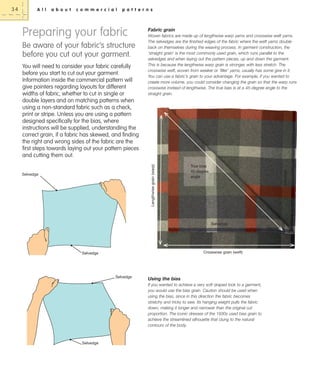
  • 85.
    84 D e si g n i n g y o u r o w n p a t t e r n s Simple dart manipulation Different dart locations Darts can be located in a number of different places on a bodice to alter its style. Darts are needed to turn two-dimensional shapes into three-dimensional shapes and to fit clothes closely to the body. Once you understand the art of basic dart manipulation, you can look at any design and manipulate the block to achieve shape, a good silhouette or design interest. Manipulating the bust dart is the first lesson in learning to cut patterns. Basic dart manipulation The diagram above shows different dart locations. You can practise these dart manipulations as an exercise using either fullsize or half-scale blocks. By moving these darts around the bust point, you will begin to understand the method. Using the basic bodice block (see pages 112–125), follow the step-by-step exercise below. The basic bodice has two darts. Start by consolidating the two darts into one side seam dart. 1 Trace off the front bodice; here the bodice block is made from card, making tracing easier and more accurate. 2 Cut up the front waist dart and the side seam dart. To continue this exercise, trace off the front bodice block onto paper. Draw in the lines to the bust point as shown on the diagram. To manipulate the darts, simply slash to the apex each time, and then close and open the darts in different locations. 3 Close the waist dart, and the side seam dart opens. (Remember not to cut right through; keep a small amount of paper attached to act as a hinge.) Asymmetric darts 2 Cut up both waist and side 1 To create asymmetric darts, trace off the bodice block fronts, joining the right and left sides at the CF. The full bodice is traced off because the right and left sides are to be different. darts to the apexes. Close the bust dart until its edges meet. The waist darts will open. 3 Draw in the new dart lines.
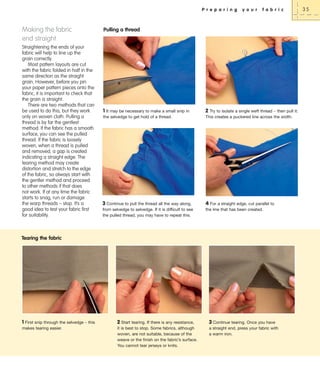
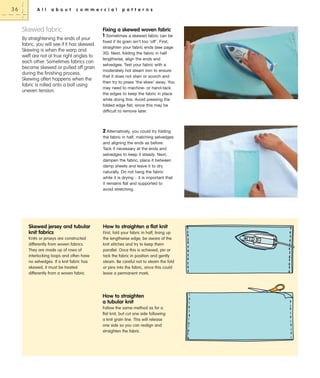
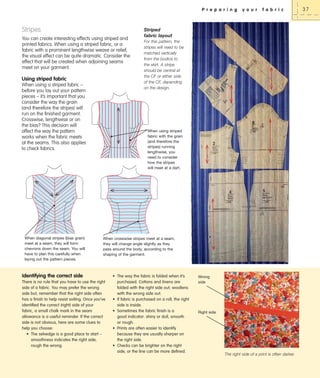
  • 86.
    S i mp l e d a r t m a n i p u l a t i o n 7 4 First cut along the long line that passes from left to right. 5 Close the right-hand waist dart, and the long dart opens. 6 Cut up the shorter dart and close the left-hand waist dart. The short dart opens. The pattern development is complete. Trace in new darts and back away from the apex by 4cm (11⁄2in). This is now your pattern plan. Trace this off onto a clean sheet of pattern tracing paper. Now you can add your seam allowance, notches and grain lines. Changing darts into gathers CF Changing one dart into three small darts CF This style has gathering located under the bust instead of the dart. First, repeat the first six steps from ‘Asymmetric darts’, above. 1 First, repeat the first five steps from ‘Asymmetric darts’, above. 2 Draw in two darts on either side of the short central dart and cut them both up to the apex at an angle similar to the original dart. (Left side.) Leave the pattern paper slightly attached by a thin hinge of paper. A 3 Cut up the three new darts. C B Measure the right-hand dart from A to B. Including the dart, the measurement will be longer from A to C; gather the excess fullness between the notches to match the shorter side as shown. Close the left-hand waist dart to open the three darts by equal amounts. Mark the ends of the darts 4cm (11⁄2in) back from the apex. Once completed, fold the paper to ensure that the darts are aligned with each other. Darts 85
  • 87.
    86 D e si g n i n g y o u r o w n p a t t e r n s How to turn bodice darts into seams The following exercises will teach you how to change darts into seams. The darts are moved away from the traditional bodice positions, while still retaining the bust suppression. Princess seams This is a standard pattern shape in which the bust darts are changed into seams. Both front and back seams start mid-shoulder and continue down to the waist line. 1 Trace the front bodice block. 2 Using a pattern master, mark out the design line on the front bodice. Start at the waist dart, pass through the bust apex and go up to the centre shoulder. This is the princess line. 5 Cut up the other side of the 6 Cut through the apex and waist dart. continue up into the shoulder. 3 Cut up the waist dart and the side seam dart. Notch the pattern 5cm (2in) above and below the apex along the princess line. 4 Close the side seam dart and the waist dart will open. 7 The front bodice is now ready to be traced off and seam allowance added. If the back bodice also has a princess line, it is made in the same way, but this time there is no bust dart to close. Just connect the waist dart to the shoulder dart, making sure both front and back seam lines match at the shoulder. Mark in notches (see page 83). Use double notches to indicate the back bodice.
  • 88.
    S i mp l e d a r t m a n i p u l a t i o n Bodice without side seams Shoulder dart Style lines Front dart 1 Draw in the style lines within 5cm (2in) of the original side seams, front and back. Create notches: two single notches on the front, 5cm (2in) on either side of the dart and one double notch on the back. Notches Side seams 2 Cut along the style lines, close the front dart, and join the front and back pieces at the side seam to create a single side panel. Close the shoulder dart, opening it into the armhole. This top has no side seams. The seams have been moved away from the natural side seam at the front and back to create a side panel. Though similar to the pattern on page 86, these seam lines do not go to the apex. The fullness, therefore, is not directly over the fullest part of the bust where it is needed. For this pattern, a very small dart is left in to complete the bust suppression. If the dart was not required, the excess fabric could be eased in, still achieving the fit. First, take your front and back bodice blocks and trace them off onto pattern tracing paper. Transfer all the darts and written information – CF, CB, etc. Remember to leave the seam allowances off at this stage so that you can manipulate your pattern more accurately. 3 Close the front and back Natural side seam Waist dart waist darts by half their width, putting the excess into the panel seams. This makes the main back body slightly longer, for ease. The front central panel excess can be made into the dart. Waist dart 87
  • 89.
    88 D e si g n i n g y o u r o w n p a t t e r n s Styling sleeves and cuffs Half-circle sleeve Take your sleeve block and trace it off onto pattern tracing paper, transferring all the dart information, elbow line, notches and so on. Remember, the front of the sleeve is indicated by one notch, the back by two, and these then correspond to the correct position on the bodice. Leave seam allowances off at this stage so that you can manipulate your pattern more accurately. Grain Grain Add details and shaping to sleeves and cuffs to create different styles. Sleeve 1 Trace out the darted 2 Cut up the straight block sleeve pattern. Draw a line from the end of the elbow dart at right angles to the straight grain line. Removing the sleeve elbow dart The sleeve block in this book has an elbow dart. The dart allows for room to move and bend the arm while retaining a close fitted shape to the sleeve. The dart can be removed as shown, but the sleeve will be less fitted. Adding fullness as gathers to the sleeve head Sleeve When adding fullness to a sleeve head it is good practice to shorten the bodice shoulder length by 1cm (3⁄8in) while adding 1cm (3⁄8in) to the sleeve head. This alteration helps to support the sleeve and keep it Width equal either side The basic principles shown here can be used with any length of sleeve. grain line from the sleeve hem and across to the end of the elbow dart. 3 Cut along the dart from the underarm seam, but keep a hinge at the end of the dart. Pivot the dart closed, allowing the sleeve hem to open until the sleeve width measures equally on either side of the grain line. The sleeve is now wider at the wrist. 1 Trace around the sleeve block and shorten to the desired length. from dropping. The amount of this alteration can be changed according to the design and should be done first, along with deciding where the gathering is to be (see ‘Adding fullness’, page 94). 2 Divide the sleeve into nine equal sections. Number each section in order. Special note If the design requires more fullness at either the front or the back, the pattern can be adjusted accordingly. Spread the sections out to the required width where the adjustment is needed (see page 94).
  • 90.
    S t yl i n g s l e e v e s a n d c u f f s Puffed sleeve head 3 Cut up to each line but not through, keeping the sleeve cap edge intact. This design has fullness only at the sleeve head. To help support the puff sleeve, shorten the shoulder line by 1cm (3⁄8in) (see ‘Adding fullness as gathers to the sleeve head’, opposite). 4 Next, on a separate piece of paper, draw out a large ‘T’ shape. Place the cut sleeve onto it, aligning the underarm points to the ‘T’. Secure the top pattern to the paper, trying to keep the distances between each section even. 3 Add 2.5cm (1in) or more to the height of the sleeve head and draw a smooth line back to the original sleeve pattern. Transfer the shoulder notch to the new sleeve head. The sleeve hem could be tightened further through the underarm seam as indicated. Shoulder point Gathering Cut 2 sleeves 5 To mark the hemline, start by squaring off from the ‘T’ at a right angle and continue along the sleeve length, smoothing out the hem. Grain 1 On a separate piece of paper, draw out a ‘T’ shape. Decide on the position of the gathers. Divide this area up into six sections. The amount added between the pieces is dependent on the fullness required and the fabric used (see page 94). Cut 2 sleeve facings 2 Align the bicep line of the sleeve on the 6 This is your pattern plan. Trace off, adding seam allowance and a grain line. 4 Add the seam allowance to the finished ‘T’ line with the vertical line in the centre. Slash and spread the six sleeve sections from the sleeve head to the hem; do not cut through, but leave paper hinges. pattern and notch where the gathering is required on the sleeve head. To finish the curved hem of this sleeve, a facing will be required. (See ‘Facings and waistbands’, page 105.) 89
  • 91.
    D e si g n i n g y o u r o w n p a t t e r n s For this design, a ‘keyhole’ opening is used. A ‘keyhole’ is a simple way of constructing a cuff sleeve opening. Cut a straight line 8cm (3in) long from the sleeve end, in line with the elbow to where the cuff is to be attached. A bias strip of fabric is then sewn to the opening (see page 129). This sleeve has gathering both at the sleeve head and into the cuff. Here there is an equal number of gathers at each end; however, this is variable depending on the individual design. This short cuff (5cm/2in) needs an extra keyhole opening on the sleeve to allow the arm to fit through. 1 Decide on the sleeve length and draw in the 2 On a separate sheet of pattern paper, draw cuff band. Divide the central part of the main sleeve into four equal parts. The red lines indicate where the gathering will be on the sleeve. It is important to make notches to identify the shoulder point and where the gathers stop and start on the bodice armhole. Number the four parts and cut them into separate sections. a vertical line and square across it to make a ‘T’. Position your cut and numbered sleeve sections on the paper, spacing them equally and keeping the bicep line aligned to the horizontal ‘T’ on the paper. Again, the amount added between the pieces is dependent on the fullness required and the fabric used. (See ‘Adding fullness’, page 94.) Cut 4 cuffs Cut 2 interfacing Shoulder Short puff sleeve with narrow cuff and keyhole opening Gathering Grain 90 Gathering Cut 2 sleeves 3 Smooth out the sleeve head and hem by re-drawing the lines. In these instances, you should always add. If the excess is not needed, it can be cut off later. 4 Shape one end of the cuff and extend it by 4cm (11⁄2in). This measurement is variable depending on the size of the button. (See ‘Buttons and buttonholes’, page 101.) Gathering 5 Finished puff sleeve pattern with a shaped cuff. Note If this cuff had straight edges, it could simply be cut on the fold and sewn at the ends, and only one pattern piece would be needed. Because the end is shaped, however, two pattern pieces must be cut and interfacing applied on one side before the pieces are sewn together (see page 105). Gathering Fold Grain Cut 2 cuffs Cut 2 interfacing Cuff cut on the fold with no shaping
  • 92.
    S t yl i n g Bell sleeve with gathers into a deep cuff s l e e v e s a n d c u f f s This slee½ has a 10cm ½ deep cuff with buttons e 4in½ and buttonholes. The depth of the cuff means that there is plenty of room for the hand to pass through, with no need for an e½ opening. The tra slee½ gathers into the cuff all the way around and e is fuller at the back to allow room for the elbow. You will need to remo½ the elbow dart on the e slee½ block to make this pattern ½ page 88½ e see . 1 Trace off the slee½ block and remo½ e e the elbow dart ½ page 88½Di½ the see . ide slee½ into equal quarters. e 2 Measure up the grain line marking a cuff 3 Cut up the slee½ di½ e isions to the slee½ cap edges, lea½ hinges. e ing 4 Open out the pieces by equal amounts to achie½ the desired amount of slee½ e e fullness. ½ the ratio information on ½se page 94 as a guide.½ 5 6 To construct the cuff, use the remo½ ed portion of the slee½ e. 7 E½ tend the edge of the cuff by 3 ⁄ , appro½ imately 2cm ½4in½depending on the size of the buttons you are using. 8 depth of 10cm ½ . Cut off the cuff. 4in½ ½dd paper underneath and redraw, smoothing out the slee½ hem edge. e ½dd 1.3cm ½ ½in½ the slee½ length at to e the elbow position and smooth back into the slee½ hem. e The finished cuff with e½ tension, indicating where the buttons and buttonholes are to be positioned. 91
  • 93.
    D e si g n i n g y o u r o w n p a t t e r n s 1cm (3⁄8in) Raglan sleeve 2 Move the shoulder line forwards by taking 1cm (3/8in) off the front and adding it to the back. 1cm (3⁄8in) 10cm (4in) 1cm (3⁄8in) 3 Grain line On the sleeve, move the grain line toward the front by 1cm (3/8in) (indicated by a single notch). Next make a mark 10cm (4in) down from the sleeve head. Mark a point 1cm (3/8in) up from the sleeve head and square across. 4 A raglan sleeve is a useful style that you may want to return to, so, once you have drafted your sleeve, it is a good idea to copy and save it as a working block. To make a standard raglan working block use the measurements given here. These can be altered for individual designs later. 5 Blend the shoulder lines into the new sleeve grain line and then from the shoulder point to the 10cm (4in) point. Smooth out the new armhole lines. Measure these lines and compare them to the bodice armhole. The back sleeve is often slightly longer than the back bodice armhole – this is ease, and must be no more than 1cm (3/8in). 1 On the bodice, measure from the front neck shoulder point toward the CF 5cm (2in) and 9cm (3½in) toward the CB for the back neck. Connect this point with a line to the armhole to just above the notches. Slash and close the back shoulder dart, opening up the raglan shape. Note Trace off the pattern at this stage for a one-piece raglan sleeve with a shoulder dart. 6 Grain Cut off the front and back shoulder sections from the bodice and place them so that the shoulder points are touching the 1cm (3/8in) line on the sleeve head. Allow the outside edge to blend into the sleeve just above the notches, in a similar position to where they were drawn on the bodice. Grain 92 Separate the front and back sleeves along the new grain line, marking in the bicep line and all the notches. Make sure the shoulder edges are smooth.
  • 94.
    S t yl i n g Styling skirts A-line skirt Try making these different skirt shapes and styles. s k i r t s 1 Draw a line from the dart’s end to the hem. Repeat for the back of the skirt. For each of these designs, you will need to take your front and back skirt blocks and trace them onto pattern tracing paper, transferring all the dart information. Remember to leave seam allowances off at this stage so that you can manipulate your pattern more accurately. The A-line skirt is a classic but simple style. It is fitted around the waist and hips through the use of darts, and flare is added evenly at the hem to produce a well-balanced bell-like shape. 3 Decrease the darts while opening the hem for the desired amount of flare. The darts will be made smaller. To retain a wellbalanced skirt add the same amount of flare front and back. 2 Slash up the lines from the hem to the dart ends, and from the waist down. Do not cut through the end of the dart; keep a small amount of paper attached as a hinge. Lengthening a skirt When lengthening an A-line skirt, the longer the skirt, the fuller the hem will become. If you want to achieve a slinkier silhouette, you could place the skirt on the bias (see page 41). 4 Only half the amount of flare is added to the side seam front and back. These halves add up to make the whole amount at the side seam. 5 The complete skirt pattern. Remember to add seam allowance. 93
  • 95.
    D e si g n i n g y o u r o w n p a t t e r n s 112–125). Draw a line parallel to the CF and CB from the waist to the hem. Draw a parallel line connecting the dart ends with the hem. Ideally the skirt should be split into three equal portions; this may depend on where the dart is positioned. Adding fullness Back Slash 1 Trace off the skirt blocks (see pages The same principles and method applied to the A-line skirt are applied to the flared skirt, but with more flare added at the hem. The amount of flare added is a personal choice. Front Back Slash Slash Front Flared skirt Slash 94 2 Slash up from the hem, closing the darts and opening the hem in equal proportions for the desired amount of flare, with half on the side seam front and back as before. Repeat for the back skirt. It is important to add the same amount front and back. By doing this you will retain the overall balance. 3.5 to 2.5cm 5 to 2.5cm 7.5 to 2.5cm 10 to 2.5cm Pattern cutting uses prescribed methods for adding fullness – flare, darts, gathers or tucks – in which you can control where the fullness is created. This is known as slashing and spreading. This method is used for all garments, but is illustrated here using a skirt. The amount of fabric added is dependent on the type of fabric used and the silhouette required. The following ratios are a guideline only: Heavy denim or wool might be stiff and bulky, so using a ratio of 3.5cm (11⁄2in) of fabric to 2.5cm (1in) of waistband or less might work best. Soft silks or fine jerseys might use a ratio of 10cm (4in) of fabric to every 2.5cm (1in) of waistband or more to create extra volume. Exercise 1: Even distribution of fullness For fullness at waist and hem, draw and number equal sections on your pattern and cut apart. Draw a straight line on another piece of paper and align the pattern pieces to this, with equal spaces in between. If this pattern piece is shaped, numbering the pieces and drawing a line through them ensures that the amount added is in proportion. Exercise 2: Increasing fullness on one edge of a pattern Slash and spread the pattern on the edge requiring the fullness, leaving the other edge as it was. By increasing fullness in this way, volume is added at the hem but not at the waist. Exercise 3: Adding differing amounts of fullness Quite simply, add more fullness where it is required.
  • 96.
    S t yl i n g s k i r t s Flared skirt with yoke T T T T Front Back Front Back 1 Trace off the skirt blocks and draw on 2 Notch the front, the back and your design lines. Make the yoke deeper in the front than the back and make sure the side seams match. where the gathering is located, and cut the yoke away from the skirt. 3 Slash and close T CF the darts on the front yoke. Slash and spread the skirt. The first slash will be 5cm (2in) at the hem plus 5cm (2in) at the top as fullness for the gathering. This measurement can vary, depending on the design. T CF T T First work out the depth of the yoke and the hem circumference. This flared skirt has a shaped yoke. The skirt fits smoothly into the yoke except at the CF where it has a gathered section. There is a concealed zip with a button and buttonhole at the CB yoke. 4 Continue slashing and spreading. Remember to add only half the amount (2.5cm/1in) at the side seam hem front and back to a total of 5cm (2in) at side seam. Tip 0.5cm (3⁄16in) off CB 0.5cm (3⁄16in) ease 6 If the darts do not the back yoke. Slash and spread from hem to dart ends and to the top edge. Open the skirt hem to 5cm (2in). close completely, shave 1cm (3⁄8in) off the skirt waist edge and blend in the line. Extend the CB yoke to accommodate buttons and buttonholes. CB 5 Close the darts on • If the darts don’t completely close when spreading the pattern, and the amount left is no more than 1cm (3/8in), take 0.5cm (3⁄16in) off the side seam and leave 0.5cm (3⁄16) in as ease. 95
  • 97.
    D e si g n i n g y o u r o w n p a t t e r n s Styling dresses Drafting the dress block You can join skirt and bodice blocks to make a dress block. Many different garments can be created by joining a bodice block and a skirt block, from dresses to hip-length blouses and shirts. The dress block is a combination of the bodice and skirt block and a versatile foundation to making many other patterns. Because there is no waist seam, fit is achieved through torso darts and side seams. C A D G Bust dart The torso block Back shoulder dart Bust apex Centre back The torso block is a bodice block that extends down to the hip line. This is a useful block in its own right for drafting garments with a defined waist line, such as the blouse on page 81. Many patterns can be made from this one simple block, including jackets, gowns and coats. The torso block is simply a shortened version of the dress block and can be used to make a dress block by extending the CF and CB lines and the side seams 70cm (27½in) downwards from the CB waist to the finished hem. 1 Trace off the bodice block front and draw in a new dart position from the shoulder to the bust point. H F E B Centre front 96 Back waist dart Front waist dart Front Back 2 Cut down the shoulder line to the bust point, and from the side seam dart to the bust point. Leave a hinge.
  • 98.
    S t yl i n g C C 97 d r e s s e s D G H H B E C A 3 Close the side seam bust dart and open the shoulder dart. Trace off and use this block for making a dress block. 4 Using this new front and back bodice, square a line across at chest level, using the side seam underarm point (line CH on diagram). When drafting this pattern, draw a long line on the left-hand side of the pattern paper and line the CB of the bodice onto it. Leave a 10cm (4in) gap before placing the front bodice on the pattern paper. Once this is done, extend the CF line downwards, using a long ruler. F 5 Place the CB and CF of the back and front skirt blocks on your long lines so that the side waist points are touching the bodice waist line. The skirt waist shaping is such that the CF and CB points won’t touch. Square across from the CB bodice waist line to the CF, making a new waist line. Measure 20cm (8in) down from this to create a new hip line (line AF). 6 Blend and smooth out the side seam of the back bodice. Starting at the armhole, take 1cm (3/8in) off the front bodice waist line, blending the side seams into the skirt. 7 Construct the darts by connecting the bodice dart apexes across the bustline and squaring down their centres to the hip line. 8 Measure 8cm (3in) back up the line from the hip line (at B on diagram) to mark the end of the back dart. Measure 10cm (4in) up from the hip line (at E on diagram) to mark the end of the front dart. This sequence continues on the next page ³
  • 99.
    98 D e si g n i n g y o u r o w n p a t t e r n s Princess line dress The princess line dress is made by turning the darts of the dress block into long seams. Using these seams it is easy to add flare at the hem. Flare can be added from the waist line, hip line or knee. Each point will produce a very different style. 9 Construct the darts at the waist line, 4cm (1½in) wide for the front dart, 2cm (3⁄4in) on either side of the central line, 2.5cm (1in) for the back dart, and 1.25cm (½in) on either side of the central line. 2 Mark out the design lines. Start at the waist dart and pass through the bust apex up to the centre shoulder. 10 Trace around the outside edge of the pattern, marking in the new bust, waist and hip lines, the new single waist dart and the shoulder darts. This is your completed dress block. No seam allowance should be added. Now trace it onto card. 1 Trace off and cut out the dress block. 3 From the base of the waist dart draw a line parallel to the CF down to the hemline. Repeat for the back. This is the princess line.
  • 100.
    S t yl i n g d r e s s e s 6 Before cutting out the pattern pieces draw in notches along the style line to indicate the front and back and which panels will be sewn together. 7 When all pattern pieces are cut out, match up the notches and square off the hemline. 4 Cut the front and back panels into separate pieces as shown. Stick the four main panels onto a paper base, aligning the hip and waist lines and leaving about 10cm (4in) between each panel. 5 To add flare, decide how much you would like to add, and from which point – waist, hip or knee – and add the same amount to each seam. 8 The completed pattern. Remember to add seam allowances, grain lines (90 degrees to the waist line), and all other pattern information. 99
  • 101.
    100 D e si g n i n g y o u r o w n p a t t e r n s Collar styles Different collar shapes can be added to your bodices to create different styles. When adding a collar to a garment you need to consider both how it will be attached to the bodice and how it will be finished inside the neck of the garment. Drafting a collar pattern When drafting a collar pattern, make any neckline alterations to the bodice pattern beforehand. To measure the bodice neckline accurately, first match up the garment shoulder lines. Measure from the CB neck to the CF neck holding the tape measure on its edge (see right). This allows the tape to bend naturally around the curves, ensuring a more accurate measurement and improving the collar’s fit. You may need to adjust the collar pattern when toiling if the fabric is thick or if it stretches. Consider how your collar will be finished on the inside of the garment. Look at your design and make a working drawing. A collar ending at the CF point may need a facing to finish the inside neck (see page 105). If the collar extends to the garment edge, all seam allowances will push up inside the collar itself to finish the edges. Collar terminology Measure the neckline Measure the collar from CB neck to CF neck with the tape measure on its side. Top collars and under collars When constructing collar patterns it is important to remember that all collars have a top and an under collar. This finishes the collar edge and eliminates bulk. The top collar has farther to travel from the neck edge to the collar edge. The under collar has a shorter distance to travel. The amount by which the under collar should be shorter is dependent on the thickness of the fabric. Start with 3mm (1⁄8in) shorter and try the collar out. (For sewing instructions see page 137.) To make the under collar, shorten the depth by 3mm (1⁄8in) at the CB neck, continue with the 3mm (1⁄8in) past the shoulder notch, and gently blend into the CF neck edge. Collar edge This is the outside edge of a collar. Its shape helps determine how the collar sits on the body. The straighter the outside edge, the closer the collar will sit to the neck. Top collar Collar stand The collar stand is the part that rests closest to the neck. Roll line The roll line is the fold between the collar stand and the outer face of the collar (the part that you see). Under collar Neck edge This is the part of the collar that is attached to the garment neck. Its shaping is important and affects how the finished collar looks. Collar edge Roll line Collar stand CB neck Shoulder point CF neck Under collar Top collar
  • 102.
    C o ll a r s t y l e s Buttons and buttonholes Positioning the buttons: things to consider • Try to arrange the button placement so that one button is level with the bust point. This avoids gaping across the chest. • If your garment has a Rever collar (a collar with lapels turned back to show the reverse side), place a button at the break point so that it closes in the correct place. • When placing buttons on a shirt collar or collar stand, the buttonhole is usually positioned horizontally. The buttonholes on the placket should be vertical. • The buttons in horizontally placed buttonholes do not sit in the middle. When a buttoned garment is worn, the button will always pull to the end of its buttonhole. The centre of the button needs to sit on the CF line, so the buttonhole needs to be stitched backwards, away from the garment edge. What is the button wrap? A button wrap is an extension of both garment fronts to allow for button and buttonhole fastenings. The width of the wrap is dependent on the size of the button and the direction of the buttonholes. Vertical buttonholes may require less width than horizontal buttonholes. How big should the buttonhole be? The buttonhole size is determined by not only the button size but also its thickness, the fabric used and whether the button has a shank. As a general rule, the size of the buttonhole is the diameter of the button plus 3mm (1⁄8in). Before making any buttonholes in a garment it is good practice to do a test on a sample of your chosen fabric. The test piece should have the same number of layers as your garment, for example, two of fabric and one of interfacing. CF Opening with a placket Opening without a placket When a front opening has a placket or stitch line, the buttonhole direction must be vertical. This way the buttonhole will not interrupt the placket width or the topstitching. When an opening does not have stitching or a placket, the buttonhole direction is horizontal. The buttonhole at the very edge of the garment should be positioned carefully, so that the button does not protrude over the edge of the fabric when done up. 101
  • 103.
    102 D e si g n i n g y o u r o w n p a t t e r n s Basic one-piece shirt collar B 2 1 A 1 Draft out a rectangle half of the full neck measurement from (1) to (2). Measure the back bodice neck length from the CB (1) to determine the shoulder point (A). Point B is the collar depth plus the collar stand depth, which may vary according to the design. This basic shirt collar draft is for a one-piece collar, which can be adapted to a two-piece shirt collar. C 1 2 A 3 2 1 3 2 Start shaping the collar. First, to find 3 The lower section of the collar is the collar stand, which is point 3, divide the length of the collar equally into thirds (point 3 lies where the last third begins). Then, measure up 0.5cm (1⁄4in) from the CF point (2), and connect back to (3). This creates the front shaping for the neck. half the collar width minus 1cm (3⁄8in). Square a line across from the CB. Extend the line from (3) to (2) and beyond the CF by half the button wrap measurement. Start to shape the lower front third of the collar as shown in red. At point (C) back away from the CF line by 3mm (1⁄8in) to create the stand shaping. 5 Cut the pattern out of calico without a seam allowance, placing the CB on the fold to test the collar’s shape and fit on the stand. It is helpful to mark out CB and CF lines on the calico so that the collar’s fit 4 From point (C) extend up and out to achieve the collar shaping as shown. can be accurately assessed when toiling (see page 68. Slash into and correct the calico collar and transfer any adjustments to your pattern. Add seam allowance and notches.
  • 104.
    C o ll a r Two-piece collar Mandarin collar The principles used for making a mandarin collar are the same as for making any collar that requires a collar stand. The mandarin collar’s edges meet at the CF neck point, so – because the bodice fronts extend past this point – you will need to consider how these edges will be finished. A facing may be required (see page 105). Collar 5 4 Collar stand A 1 (CB) 3 2 1 Trace off the one-piece collar, including the stand width line. Separate the stand from the collar at the CB by a 5mm (1⁄4in) gap above the stand line (4) to (5). Connect the collar edge from (5) with a smooth curve back to the red line at (3). Collar Open Open 2 (CF) 1 (CB) 2 2 1 A Collar stand Close 103 s t y l e s Close 2 Separate the collar from the stand by tracing the pieces off separately. Shape the stand by dividing it into equal thirds, slash up the lines, and close 5mm (¼in) at the outside collar edge. Shape the collar by slashing and spreading the outside edge, this time adding in 0.5cm (¼in). A 2 1 Draw out a rectangle half the full Round off the CF top corner. neck measurement from the CB to the CF (1 to 2). Measure the back neck length from the CB for the shoulder point at (A). Make the rectangle 4cm (1½in) in height. This measurement is variable, depending on the design. 2 2 1 1 A A Collar 3 Divide the collar length into three equal pieces and cut from the collar edge to the neck edge, keeping a paper hinge. 4 Shape the collar by overlapping the cuts on the top edge by 0.5cm (¼in) each. Collar stand CF CF A 3 Cut both pattern pieces out of calico, adding seam allowance only where the collar meets the stand so that they can be sewn together. Next mark out the CF and CB and try the pieces out on the dress stand. Look at the collar shape and make any adjustments. Once complete, transfer the pattern alterations to the new pattern, adding seam allowance, notches and grain lines. CB A 5 Trace the collar onto a piece of folded calico to try out the shape on the dress stand – you don’t need seam allowance for this. The process of cutting and overlapping or equally loosening the collar edge can be repeated if more or less shaping is required. Once you have the correct shape in the calico, trace onto a new piece of paper, adding seam allowance and notching the CB, shoulder seams and CF. The collar is now complete.
  • 105.
    104 D e si g n i n g y o u r o w n p a t t e r n s Peter Pan collar The Peter Pan collar demonstrates perfectly how a collar shape can relate to the neck and body. This collar can lay flat to the shoulder or, through slashing and overlapping the outside edges, start to roll around the neck. The basic principles are: the shorter the collar, the higher it will ride around the neck; the more curve a collar has, the flatter to the body it will sit. 1 Trace around the back bodice block. A 2 Place the front block pattern, matching it up to the back bodice at the shoulder neck point (A) and pivot the front shoulder to overlap the back by 5cm (2in). Draw in the neck edge. 3 Measure out 5cm (2in) from the neck edge to form the collar outside edge. As you approach the CF, draw in a round, smooth shape. 4 5 6 Pin the collar on the stand, starting at the CB neck and working around to the CF. Pin the collar from underneath so the collar rolls as if it were sewn to a garment. 7 If the collar edge stands away from the neck it is too long. To correct this, slash in and close the collar outside edge, by overlapping the calico. Cut to the seam allowance and position the pins horizontally so they do not interfere with the collar roll. Add 1cm (3⁄8in) seam allowance to the neck edge only – this is for pinning the collar to the stand. 8 The left side has been corrected and the collar now sits closer to the body. Take the collar off the stand and correct the pattern accordingly. Add seam allowance, grain lines and other information. To test the collar shaping, place the CB on the fold and cut out the collar pattern without seam allowance on the outside edge only.
  • 106.
    F a ci n g s Facings and waistbands Facings can be used to finish off the edges of your garments. Simple to construct, a facing is often merely a 2–5cm (1–2in) wide copy of the required edges of the original pattern piece. A facing can be used in many instances but is particularly useful on curves such as armholes, circular or curved hems and necklines without collars – although necklines with collars sometimes also have facings. A facing can also be ‘grown on’ to the pattern and folded into position. This is a method often found on shirts (see page 106). a n d w a i s t b a n d s Combined neck and armhole facing Sometimes neck and armhole facings can be combined. This is a neat finish if both facings are required. It reduces fabric bulk and simplifies the making process. 1 Trace around the bodice front. Measure 5cm (2in) inwards around the armhole and start to mark out your line. 2 Continue measuring 5cm (2in) from around the armhole to the shoulder and on to the neckline, blend the line together. 3 Repeat for the back. Facings: things to consider • Separate facing patterns need to be traced from the original pattern and marked with grain lines, notches and seam allowance in order to construct the garment. Facings are always fused with interfacing; this helps to support buttons and buttonholes and stabilizes the garment, eliminating any stretching of the curved edges as they are sewn. • When constructing the facings keep the outer edges smooth, without sharp angles. A facing should be invisible from the outside of the garment, so gentle curves that are sympathetic to the body are preferable. • Seams can be eliminated from the facings to reduce bulk by simply combining neck and armhole facings. • Consider how the garment will look when finished. For example, a back neck facing could be extended so the inside of the fabric is not seen when the garment is hung up. You may even wish to consider how a label might look on the facing. If your design has a shoulder dart, do not put the dart in the facing; remove it by slashing closed and transferring the dart fullness to the facing edge. 4 The finished neck and armhole facings for front and back. 105
  • 107.
    D e si g n i n g y o u r o w n p a t t e r n s Skirt facing Grown-on facing CF Fold line 1 A grown-on facing is a quick and easy way to finish the front of a garment. It can be used when a collar needs to be joined to a neck, as it finishes the inside neck edge neatly. It is also a convenient way of creating a button wrap extension. Trace around the bodice front, leaving plenty of spare paper beyond the CF line. Add half the width of the button wrap to the CF edge; this will become the fold line for the facing. A skirt facing is a simple method for finishing the waist line of a skirt. Alternatively you could use a waistband (see opposite). 2 3 Add notches at the neck to indicate the CF for the collar and to indicate the fold line for the facing and interfacing placement. Flip the paper over on the new fold line to trace a mirror image of the front. This will become the facing. Draw red diagonal lines onto the pattern piece to indicate where the interfacing is to be placed. Fold line CF Fold line CF 106 1 Start with the skirt pattern pieces to be faced, front and back.
  • 108.
    F a ci n g s a n d 107 w a i s t b a n d s Straight waistband for trousers and skirts The quickest method for making a straight waistband is to cut it on the fold. A waistband can have CF, CB or side opening. It is traditional for a side opening to be on the left. The waistband shown here is in one piece with a CF opening. Fold 2 Trace off the top sections of skirt, front and back. Slash down through the darts and continue to the paper edge. Close the darts, transferring the fullness to below the dart. Measure down 5cm (2in); this will be the finished width of the skirt facing. 3 The finished Side Fold CB Side 1 Make the waistband length the same as the garment waist measurement plus an extension for a button and buttonhole or hook and bar fastening. skirt facings. Side CB Side 2 You will need to add seam allowance and 1.3cm (1⁄2in) ease – increase the amount of ease if the fabric is bulky or thick. V-neck facing Draw around the front and back bodice necklines. Next, draw in the front neck and the armhole facings with a finished width of 5cm (2in). The back neck facing should be made longer so that when the garment is on a hanger you can’t see the wrong side of the fabric. This gives a more professional finish. Back bodice Front bodice Extension
  • 109.
    D e si g n i n g y o u r o w n p a t t e r n s Pocket styles Skirt side pockets There are a variety of styles of pockets that you can add to garments for a different look or for practicality. You may want to add pockets to your garment. These could be decorative or functional. On this spread are some examples of pockets that are easy to make. Patch pockets The patch pocket is the simplest kind of pocket to make. The pocket is made up beforehand with a hem at the top and all the edges turned under. It is then simply stitched onto the outside of the garment. See page 138 for instructions on how to sew on a patch pocket. Patch pocket styles This classic pocket can be adapted to suit trousers or skirts. The clever design of this pocket can be made to flatter the body by adapting the angle of the pocket opening, making the waist appear smaller. Side seam pockets Grain CB Grown-on pocket bag Skirt back: Grown-on pocket bag Separate pocket bag Grain Side seam pockets are just an extension of the garment side seams. The back pocket bag is the full pattern ‘grown on’ to the back skirt or trousers, and the front pocket bag is a separate piece. A short facing is grown on to the side front seam and the pocket bag is cut from lining to reduce bulk. It is constructed in this way so that the lining does not show. CB 108 Skirt front: Separate pocket bag Lining 1 Trace around the front skirt pattern block.
  • 110.
    P o ck e t 2 Measure down the side seam 17cm (7in) and along the waist line 10cm (4in) and connect with a line. This will be the pocket opening. 3 Draw out the pocket bag shape, using your hand as a guide for size and your pattern master or skirt curve for shape. 4 The finished pocket template. 5 Trace off the pocket template and slash down the skirt dart and close. 7 Smooth out the pocket edge by redrawing it. Trace off both sides of the pocket bag. One side will be cut from lining; the other side can be cut from the same fabric as the skirt or be cut in lining fabric and have a facing piece. 6 Transfer the dart fullness to the pocket outside edge. Add paper underneath. 8 The finished pattern pieces. s t y l e s 109
  • 111.
    Finding a block inyour size The block patterns provided over the following pages are the standard sizes used by pattern companies; however, your figure shape may vary from those supplied, and further alterations may be needed. (See pages 72–79 for advanced pattern alterations.) If your sizing is different than the blocks in the book, using the hip and bust measurements, choose the block size closest to your own, or, if there is a choice pick the larger size block and reduce it. It is far easier to make a pattern smaller than larger. If you do not find the correct size in this book, most commercial pattern companies have special patterns catering to larger sizes.
  • 112.
    The pattern blocks In thischapter you’ll find basic pattern blocks for a skirt, bodice and sleeves in UK sizes 8–20 (US 6–18). Scale the blocks up using the grid provided (see page 66) to make your own personalized pattern blocks, the building blocks from which you can design and make your own clothes.
  • 113.
    112 T h e 1 2 pa t t e r n 3 5 4 6 7 8 A B C b l o c k s - - - 9 10 11 12 13 14 15 16 17 18 19 20 21 22 23 24 25 26 27 28 29 30 31 32 33 34 35 36 37 38 39 40 Back bodice Front bodice Back skirt Front skirt Sleeve D E F G H I J K L M N O P Q R S T U V W X Y Grain line Grain line • 20cm (8in) Z AA BB CC DD EE FF GG HH II JJ KK LL MM NN OO PP QQ RR SS TT 1 2 3 4 5 6 7 8 9 10 11 12 13 14 15 16 17 18 19 20 21 22 23 24 25 26 27 28 29 30 31 32 33 34 35 36 37 38 39 40
  • 114.
    U K S IZ E 8 p a t t e r n 113 b l o c k s 41 42 43 44 45 46 47 48 49 50 51 52 53 54 55 56 57 58 59 60 61 62 63 64 65 66 67 68 69 70 71 72 73 74 75 76 77 78 79 80 UK SIZE 8 pattern blocks A See page 66 for instructions on how to scale up the pattern blocks. B C D Scale: 1 square = 1 square cm E F G H Fold line I Grain line • 20cm (8in) J K L M N O P Q R S Grain line • 20cm (8in) T U V W X Y Z AA BB CC DD EE FF GG HH II JJ KK LL MM NN Grain line • 20cm (8in) OO PP QQ RR SS TT 41 42 43 44 45 46 47 48 49 50 51 52 53 54 55 56 57 58 59 60 61 62 63 64 65 66 67 68 69 70 71 72 73 74 75 76 77 78 79 80
  • 115.
    114 1 T h e 2 3 4 5 pa t t e r n 6 7 8 A B C D b l o c k s 9 10 11 12 13 14 15 16 17 18 19 20 21 22 23 24 25 26 27 28 29 30 31 32 33 34 35 36 37 38 39 40 - Back bodice Front bodice - Back skirt Front skirt - Sleeve E F G H I J K L M N O P Q R S Grain line T U V W Grain line • 20cm (8in) X Y Z AA BB CC DD EE FF GG HH II JJ KK LL MM NN OO PP QQ RR SS TT 1 2 3 4 5 6 7 8 9 10 11 12 13 14 15 16 17 18 19 20 21 22 23 24 25 26 27 28 29 30 31 32 33 34 35 36 37 38 39 40
  • 116.
    U K S IZ E 1 0 p a t t e r n 115 b l o c k s 41 42 43 44 45 46 47 48 49 50 51 52 53 54 55 56 57 58 59 60 61 62 63 64 65 66 67 68 69 70 71 72 73 74 75 76 77 78 79 80 UK SIZE 10 pattern blocks A See page 66 for instructions on how to scale up the pattern blocks. B C D Scale: 1 square = 1 square cm E F G H I Fold line Grain line • 20cm (8in) J K L M N O P Q R S T Grain line • 20cm (8in) U V W X Y Z AA BB CC DD EE FF GG HH II JJ KK LL Grain line • 20cm (8in) MM NN OO PP QQ RR SS TT 41 42 43 44 45 46 47 48 49 50 51 52 53 54 55 56 57 58 59 60 61 62 63 64 65 66 67 68 69 70 71 72 73 74 75 76 77 78 79 80
  • 117.
    116 1 T h e 2 3 4 5 pa t t e r n 6 7 8 A B C b l o c k s - - - 9 10 11 12 13 14 15 16 17 18 19 20 21 22 23 24 25 26 27 28 29 30 31 32 33 34 35 36 37 38 39 40 Back bodice Front bodice Back skirt Front skirt Sleeve D E F G H I J K L M N O P Q R S Grain line T U V W X Y Z AA BB Grain line • 20cm (8in) CC DD EE FF GG HH II JJ KK LL MM NN OO PP QQ RR SS TT 1 2 3 4 5 6 7 8 9 10 11 12 13 14 15 16 17 18 19 20 21 22 23 24 25 26 27 28 29 30 31 32 33 34 35 36 37 38 39 40
  • 118.
    U K S IZ E 1 2 p a t t e r n 117 b l o c k s 41 42 43 44 45 46 47 48 49 50 51 52 53 54 55 56 57 58 59 60 61 62 63 64 65 66 67 68 69 70 71 72 73 74 75 76 77 78 79 80 UK SIZE 12 pattern blocks A See page 66 for instructions on how to scale up the pattern blocks. B C Scale: 1 square = 1 square cm D E F G Grain line • 20cm (8in) H Fold line I J K L M N O P Q R S T Grain line • 20cm (8in) U V W X Y Z AA BB CC DD EE FF GG HH II JJ KK LL Grain line • 20cm (8in) MM NN OO PP QQ RR SS TT 41 42 43 44 45 46 47 48 49 50 51 52 53 54 55 56 57 58 59 60 61 62 63 64 65 66 67 68 69 70 71 72 73 74 75 76 77 78 79 80
  • 119.
    118 1 T h e 2 3 4 5 pa t t e r n 6 7 8 A B C b l o c k s - - - 9 10 11 12 13 14 15 16 17 18 19 20 21 22 23 24 25 26 27 28 29 30 31 32 33 34 35 36 37 38 39 40 41 Back bodice Front bodice Back skirt Front skirt Sleeve D E F G H I J K L M N O P Q R S Grain line T U V W X Y Z AA BB CC DD Grain line • 20cm (8in) EE FF GG HH II JJ KK LL MM NN OO PP QQ RR SS TT 1 2 3 4 5 6 7 8 9 10 11 12 13 14 15 16 17 18 19 20 21 22 23 24 25 26 27 28 29 30 31 32 33 34 35 36 37 38 39 40 41
  • 120.
    U K S IZ E 1 4 p a t t e r n 119 b l o c k s 42 43 44 45 46 47 48 49 50 51 52 53 54 55 56 57 58 59 60 61 62 63 64 65 66 67 68 69 70 71 72 73 74 75 76 77 78 79 80 UK SIZE 14 pattern blocks A See page 66 for instructions on how to scale up the pattern blocks. B C D Scale: 1 square = 1 square cm E F G H I Fold line Grain line • 20cm (8in) J K L M N O P Q R S T Grain line • 20cm (8in) U V W X Y Z AA BB CC DD EE FF GG HH II JJ KK LL Grain line • 20cm (8in) MM NN OO PP QQ RR SS TT 42 43 44 45 46 47 48 49 50 51 52 53 54 55 56 57 58 59 60 61 62 63 64 65 66 67 68 69 70 71 72 73 74 75 76 77 78 79 80
  • 121.
    120 1 T h e 2 34 5 6 p a t t e r n 7 A B C D b l o c k s 8 9 10 11 12 13 14 15 16 17 18 19 20 21 22 23 24 25 26 27 28 29 30 31 32 33 34 35 36 37 38 39 40 41 42 43 44 45 - Back bodice Front bodice - Back skirt Front skirt - Sleeve E F G H I J K L M N O P Q R S T U V W X Grain line Y Z AA BB CC Grain line 20cm (8in) DD EE FF GG HH II JJ KK LL MM NN OO PP QQ RR Grain line • 20cm (8in) SS TT UU VV WW XX YY 1 2 3 4 5 6 7 8 9 10 11 12 13 14 15 16 17 18 19 20 21 22 23 24 25 26 27 28 29 30 31 32 33 34 35 36 37 38 39 40 41 42 43 44 45
  • 122.
    U K S IZ E 1 6 p a t t e r n b l o c k s 121 46 47 48 49 50 51 52 53 54 55 56 57 58 59 60 61 62 63 64 65 66 67 68 69 70 71 72 73 74 75 76 77 78 79 80 81 82 83 84 85 86 87 88 89 90 UK SIZE 16 pattern blocks A See page 66 for instructions on how to scale up the pattern blocks. B C D Scale: 1 square = 1 square cm E F G Grain line • 20cm (8in) H I J K L Fold line M N O P Q R S T U V Grain line • 20cm (8in) W X Y Z AA BB CC DD EE FF GG HH II JJ KK LL MM NN OO PP QQ RR SS TT UU VV WW XX YY 46 47 48 49 50 51 52 53 54 55 56 57 58 59 60 61 62 63 64 65 66 67 68 69 70 71 72 73 74 75 76 77 78 79 80 81 82 83 84 85 86 87 88 89 90
  • 123.
    122 1 T h e 2 34 5 6 p a t t e r n 7 A B C D b l o c k s 8 9 10 11 12 13 14 15 16 17 18 19 20 21 22 23 24 25 26 27 28 29 30 31 32 33 34 35 36 37 38 39 40 41 42 43 44 45 - Back bodice Front bodice - Back skirt Front skirt - Sleeve E F G H I J K L M N O P Q R S T U V W X Y Z Grain line AA BB CC DD EE FF Grain line • 20cm (8in) GG HH II JJ KK LL MM NN OO PP QQ RR SS TT UU VV WW XX YY 1 2 3 4 5 6 7 8 9 10 11 12 13 14 15 16 17 18 19 20 21 22 23 24 25 26 27 28 29 30 31 32 33 34 35 36 37 38 39 40 41 42 43 44 45
  • 124.
    U K S IZ E 1 8 p a t t e r n b l o c k s 123 46 47 48 49 50 51 52 53 54 55 56 57 58 59 60 61 62 63 64 65 66 67 68 69 70 71 72 73 74 75 76 77 78 79 80 81 82 83 84 85 86 87 88 89 90 UK SIZE 18 pattern blocks A See page 66 for instructions on how to scale up the pattern blocks. B C D Scale: 1 square = 1 square cm E F G H I J Grain line • 20cm (8in) K L Fold line M N O P Q R S T U V W X Y Grain line • 20cm (8in) Z AA BB CC DD EE FF GG HH II JJ KK LL MM NN OO PP QQ RR SS TT Grain line • 20cm (8in) UU VV WW XX YY 46 47 48 49 50 51 52 53 54 55 56 57 58 59 60 61 62 63 64 65 66 67 68 69 70 71 72 73 74 75 76 77 78 79 80 81 82 83 84 85 86 87 88 89 90
  • 125.
    124 1 T h e 2 34 5 6 p a t t e r n 7 A B C D b l o c k s 8 9 10 11 12 13 14 15 16 17 18 19 20 21 22 23 24 25 26 27 28 29 30 31 32 33 34 35 36 37 38 39 40 41 42 43 44 45 - Back bodice Front bodice - Back skirt Front skirt - Sleeve E F G H I J K L M N O P Q R S T U V W X Y Grain line Z AA BB CC DD EE FF GG HH Grain line • 20cm (8in) II JJ KK LL MM NN OO PP QQ RR SS TT UU VV WW XX YY 1 2 3 4 5 6 7 8 9 10 11 12 13 14 15 16 17 18 19 20 21 22 23 24 25 26 27 28 29 30 31 32 33 34 35 36 37 38 39 40 41 42 43 44 45
  • 126.
    U K S IZ E 2 0 p a t t e r n b l o c k s 125 46 47 48 49 50 51 52 53 54 55 56 57 58 59 60 61 62 63 64 65 66 67 68 69 70 71 72 73 74 75 76 77 78 79 80 81 82 83 84 85 86 87 88 89 90 UK SIZE 20 pattern blocks A See page 66 for instructions on how to scale up the pattern blocks. B C D Scale: 1 square = 1 square cm E F G H I J Grain line • 20cm (8in) Fold line K L M N O P Q R S T U V W Grain line • 20cm (8in) X Y Z AA BB CC DD EE FF GG HH II JJ KK LL MM NN OO PP QQ RR SS TT UU Grain line • 20cm (8in) VV WW XX YY 46 47 48 49 50 51 52 53 54 55 56 57 58 59 60 61 62 63 64 65 66 67 68 69 70 71 72 73 74 75 76 77 78 79 80 81 82 83 84 85 86 87 88 89 90
  • 128.
    Core sewing techniques This clear,step-by-step guide to core sewing techniques provides all the sewing knowledge you will need to create your own garments using the basic pattern blocks, from the different types of hems to adding details like pockets and collars.
  • 129.
    128 C o re s e w i n g t e c h n i q u e s Core sewing techniques Plain seam This is the simplest method of joining two pieces of fabric. Use it for straight or curved seams and all materials. Essential sewing skills. In order to carry out the techniques demonstrated in this book, you will need to have mastered core sewing and dressmaking skills. The following pages are a refresher course in all the techniques you will need to know. French seam A French seam encloses the raw edges, making additional finishing unnecessary. It looks flat like a plain seam from the front but appears like a tuck on the reverse. 1 Place the wrong sides 2 Press the seam open of the fabric together, with the edges matching. Sew with a straight stitch 6mm (1⁄4in) from the edge. and trim the raw edges to approximately half. 1 Place the right sides together, matching the raw edges, and pin along the sewing line. 2 Use a straight stitch 3 Press the seam open or and sew along the sewing line, removing the pins in the process. to one side and neaten using a seam finish. Zigzag finish This is a form of overcasting using a machine stitch. Use a zigzag stitch or a preprogrammed overcasting stitch to finish the raw edges. 1 Construct a plain seam. This is normally made with a 1.5cm (5⁄8in) seam allowance. 2 Choose a zigzag 3 Sew the stitch along stitch or, if sewing a built-in overcasting machine stitch, use an overcasting foot. the edge of the seam allowance with the ‘bar’ of the overcasting foot right on the edge. Overlocking Overlocking is a good way to finish raw edges, since the stitches are formed over a newly trimmed edge to give a neat finish. A purpose-made machine is needed. 3 Fold the seam the opposite way, so that the right sides are now facing and the seam is pressed out to the edge. 4 Complete the seam with a final row of stitching 6mm (1⁄4in) from the edge. This will enclose all the raw edges. 1 Make a seam with right sides together and sew a line of stitches 1.5cm (5⁄8in) from the edge. 2 Thread the overlocker 3 Iron lightly over the with three threads and skim each of the raw edges of the seam to finish. right side to press.
  • 130.
    C o re s e w i n g t e c h n i q u e s Flat-fell seam A flat-fell seam is popular for jeans and for reversible garments since it forms a strong and neat join; all the raw edges are tucked away and enclosed by a second line of stitching. 1 Place the wrong sides of the fabric together and sew a line of straight stitching 1.5cm (5⁄8in) from the edge. 2 Press the raw edges 3 Fold the upper seam to one side and trim the underlayer to 3mm (1⁄8in). allowance under and place over the trimmed allowance. Pin all layers of fabric together. 1 Fold ready-made double-fold bias-binding tape in half to enclose the fabric’s raw edges. 2 Place the folded tape 3 Sew through all layers over each raw edge and pin the layers together. Baste too, if preferred. with a straight stitch, keeping close to the binding edge. 1 Mark the position and size of the tucks onto the fabric’s surface. 2 Fold the fabric along 3 With a straight stitch, the lines with wrong sides together, and press with an iron. sew parallel to each of the folded edges to form the tucks. 4 Edge stitch the fold, sewing through all layers of fabric. Bias binding A bias binding gives a neat and strong finish to an edge. The bias nature of the tape allows it to curve over a shaped edge without wrinkling. Use it on seams and hems, and as a decorative finish. 4 Look at the reverse side to check that the tape is sewn down all along the edge. Spaced tucks Spaced tucks are folds of cloth sewn at regular intervals to add texture and interest to a garment. Sew them in groups and down the full length of the tuck, or leave them free at one end. Use vertically on a bodice or yoke, or horizontally around the bottom of a skirt. 4 When all the tucks have been completed, press them all in the same direction. 129
  • 131.
    130 C o re s e w i n g t e c h n i q u e s Inverted pleats Pleats can be stitched down or left to hang free from a seam or waistband, and either soft or pressed crisply. An inverted pleat consists of two folds that face each other. 1 Mark the position and size of the pleat with tailor’s tacks or chalk (on the wrong side of the fabric). 2 Fold the pleat through 3 Press the line of the centre with the right sides of the cloth facing. Machine a straight stitch along the marked line. stitching and fold so the centre crease lies directly below the seam. Tack within the seam allowance. 4 Press the inverted pleat, using a cloth to protect the surface, and continue with the next. 1 Sew the garment seams. It’s easier to work with a continuous length – this will also give a neater finish. 2 Press the edge of the 3 With a straight stitch, fabric under 6mm (1⁄4in) to the wrong side. Press again, the width of the elastic plus 3mm (1⁄8in). Pin in place. sew the folded edge of the casing down. Sew over the first four stitches with the last four to secure the threads. Repeat around the top edge. 1 Machine stitch the seam from the base of the zip to the crotch. 2 Machine baste the 3 With the right side of opening where the zip will be inserted, using the longest straight stitch, and then finger press open. the trousers facedown on your work surface, place the zip facedown and centred over the basted seam. Pin the left side of the zip tape to the seam allowance. Elastic casing The traditional way to elasticate an edge is to create a casing and then thread elastic through it. This allows the elastic to be adjusted easily – ideal for cuffs and waists. 4 Remove the stitches from the seam and thread elastic through the casing. Adjust the length and secure ends of the elastic and seam. Trouser zip A trouser, or fly-front zip, completely hides the teeth and can be used for skirts and shorts as well as trousers. For men, the zip is inserted with the left side over the right, and for women the right is placed over the left.
  • 132.
    C o re s e w i n g t e c h n i q u e s Centred zip This method places the zip teeth in the middle of a seam. It’s an easy technique ideal for beginners. 1 Make a plain seam 1.5–2.5cm (5⁄8–1in) where the zip is to be placed, leaving the zip length unstitched. 2 With the longest 3 Press the seam open straight stitch, complete the seam. Don’t finish the thread ends – these are temporary. and with the wrong side facing up, place the zip facedown with the teeth over the seam. Pin both sides. 1 Set the sewing machine to the longest straight stitch. 2 Sew two parallel 3 Pull up the fabric along lines on either side of the stitching line 3mm (1⁄8in) apart. the gathering threads to ease it to the size of the adjoining fabric. Distribute the fullness evenly. There shouldn’t be any tucks or gathers. 6 Pull the zip to the right and pin the zip tape to the right edge through all layers. Turn the work over and re-pin neatly, flattening any wrinkles. 7 Mark a guideline with chalk or a temporary marker, and topstitch from the base of the zip to the waist line to secure it in place. Remove all basting stitches and test the zip. 8 Cut a piece of fabric approximately 10cm (4in) wide and longer than the zip. Fold with right sides of the fabric together, and sew. Trim the seam allowances and turn through to create a guard. Press flat. 4 Baste the zip in place and topstitch from the right side of the garment. Start from the bottom and sew to the top each time. Remove the temporary stitches. Easing Easing is achieved in the same way as gathering, but the fabric takes on a shape without visible tucks. Use it to set in a sleeve or fit a skirt into a waistband. 5 Attach a zip foot to the machine and sew through the tape and the seam allowance, approximately 6mm (1⁄4in) from the edge of the tape. 4 Pin and sew to the armhole or waistband as required, and then remove the gathering stitches. 9 Stitch the guard in place on the inside, attaching it to the seam allowance so that the stitches will not be seen on the outside. 131
  • 133.
    132 C o re s e w i n g t e c h n i q u e s Fusible interfacings Traditional waistband This new generation of interfacings are either woven or bonded fabric with a heat-fusible glue on one side. They do away with the need for hand stitching and allow for a much faster construction of tailored garments. A waistband is added to a skirt or trousers to finish the edge, and it may open at the front, side or centre back. This type is suitable for all styles of garments that incorporate gathers, darts, tucks or pleats. An interfacing is needed to add body to the band and to help it stay in place. Soft perforated interfacings, as well as straight or curved stiff bands, are available in various widths. These can be fused to the wrong side of the fabric or sewn in place. Fusing the interfacing to the underside of the fabric 1 Cut the waistband to the correct length and width, along with added seam allowances. Mount the interfacing to the wrong side of the fabric. 1 Cut the pieces out as necessary and place the fabric facedown on the ironing board. 2 Trim the interfacing to ensure it is 1mm (1⁄16in) smaller than the garment piece so that the glue will not stick to the ironing board. Place the interfacing glue-side-down on the fabric. 2 Place the raw edge of the waistband 3 Fold the waistband lengthwise to the waist line edge of the garment, with right sides together. Pin and then machine sew with a straight stitch. and press it up and over the waist to conceal the raw edges. Fold the opposite edge under and pin in place, leaving one end extended 3cm (11⁄4in) for the fasteners. Sew down by machine stitching in the ditch from the outside, or by hand, hemming on the inside. 4 Finish the ends of the waistband by folding one edge in and slip stitching. On the opposite, longer end, tuck the raw edges in and slip stitch to finish. Sew hooks and eyes, or a button and buttonhole in place to finish. Alternative finish 3 With a steam iron, hover over the interfacing and pump steam over the pieces. 4 Slowly press the interfacing to the fabric until the pieces are fused together. Neaten the raw edge of the waistband with an overlocker stitch or a zigzag stitch and lay flat on the inside without folding under. Stitch in the ditch to secure.
  • 134.
    C o re s e w i n g t e c h n i q u e s Double-folded hem A double-folded hem is folded twice to conceal the raw edges within. It may be wide or narrow, and finished by hand or with machine topstitching. Use it on woven and knitted fabrics to provide a neatly finished edge on shirts, blouses, T-shirts and trousers. 1 Fold the raw edge to the hem level around the circumference of the hem. 2 Fold up again to conceal the 3 Neatly sew the hem by hand raw edge at hem level and pin to hold it in place. or with machine topstitching. 1 Prepare the hem by folding up 2 Cut a short length of silk on the hem line and tucking the seam allowance under. thread in a matching shade and thread onto a short, fine needle. Hand-finished hem A hand-sewn hem is the best option for skirts and trousers where stitches should not be visible on the right side. Hem stitch, slip stitch, herringbone stitch and lockstitch are all useful, and your choice of one of them will depend on the type and weight of your fabric as well as your personal preference. A hand-stitched hem isn't as strong as a machined one, but the stitches will be invisible. 3 Complete the hem with your preferred stitch: Hem stitch Slip stitch Herringbone stitch Lockstitch Use hem stitch where a strong finish is required, such as on medium- to heavy-weight fabric. This method is less visible than hem stitch, so it is suitable for fine material. For a good result, keep the stitches well spaced, yet even. Always use a thread in a closely matching shade. This stitch is suitable for both medium- and heavy-weight stretch fabrics since the stitches ‘give’ if the hem is pulled. Thread loops around each stitch in a lockstitched hem. This means that if the thread breaks, the hem will not unravel fully. Keep the stitches well spaced and even. This is a suitable method for all fabric weights. 133
  • 135.
    134 C o re s e w i n g t e c h n i q u e s Eased-in sleeve A sleeve that is eased into the shoulder area produces a smooth finish with no tucks or crinkles. The sleeve itself may be short or long, slim-fitting or flared, but should lie in a simple, flat line where it is attached to the shoulder. Preparation Complete the shoulder and side seam of the bodice and the sleeve seams. It may even be best to complete the sleeve hem or cuff before sewing the sleeve into the armhole. 1 Set the sewing machine to the longest straight stitch and sew two parallel lines along the edge of the sleeve cap between the pattern-marking dots, on either side of the seam line (or inside the seam line in the case of delicate fabrics). 2 Ease up the gathers and place 3 While it is in the pinned state, the sleeve in the armhole with right sides together and raw edges matching. Working from inside the sleeve, match up the pattern notches, dots and seams. Pin along the seam line, distributing the tiny gathers evenly until they disappear. turn it through and check the finished look. Adjust the eased fabric, if necessary, and then turn back again and sew with a standard-length straight stitch. Check the finished sleeve seam, and neaten the raw edges on the inside with a threethread overlocker stitch or use a sewing machine zigzag or other suitable stitch. Trim the excess fabric away. 1 Set the sewing machine to the longest straight stitch and sew two parallel lines between the pattern-marked dots, on either side of the cap seam line (or just within the seam allowance if working with delicate fabrics). 2 Place the sleeve in the armhole 3 Turn through and check to see and match up the pattern dots and notches. Pull up the gathers and arrange them across the top of the sleeve. Pin on the seam line from the inside. Baste the seam to hold the gathers evenly in place. that the gathers are sitting neatly; then machine along the seam line. Remove the temporary gathering stitches and neaten the raw edges. Press the seam allowance toward the sleeve. Gathered sleeve head On a gathered sleeve head, clearly defined tucks create fullness along the shoulder seam. Fashion trends change frequently, but a puffed sleeve is always popular for little girls’ dresses. This technique is easier than an eased-in sleeve, but it's important to arrange the gathers evenly. Preparation Complete the shoulder and side seams of the garment as well as the sleeve seam, hem and the cuff if there is one, before inserting the sleeve. (It's easier to finish a cuff when handling it as a single sleeve than when it's attached to an entire garment.)
  • 136.
    C o re s e w i n g t e c h n i q u e s Shirt cuff A traditional tailored shirt cuff is stiffened with collar and cuff canvas. This gives a crisp, neat appearance. Stiff, fusible interfacings can be used, but the technique suggested below combines a more rigid canvas with a lightweight fusible interfacing. Preparation For each cuff, cut out two in the shirt fabric, one in lightweight fusible interfacing and one in the cuff canvas. 3 Press the seam allowance of the top edge of the cuff to the wrong side over the canvas. This gives a sharp edge. 1 With a pencil and ruler, mark the seam allowances on the cuff-canvas pieces 1.5cm (5⁄8in) from the edges. Cut off the seam allowances, including the pencil line. 6 Fold the seam edge of the cuff facing in, and then slip the sleeve into the cuff and pin in place. Working from the right side, edge stitch and topstitch the cuff to the sleeve. 4 Place the cuff to its facing with right sides together. Sew along the stitching line, around the outside, adjacent to the canvas but not through it. 2 Place the shirt cuff on the ironing board with the wrong side facing up. Position the canvas in the centre of the cuff. Place the fusible interfacing (glue side down) on top, sandwiching the canvas in the middle. Iron the layers carefully and fuse the pieces together. 5 Layer the seam allowances and fold in the corners before turning through. 7 Add buttonholes and sew buttons in position. 135
  • 137.
    136 C o re s e w i n g t e c h n i q u e s Shoulder pad Yoke Shoulder pads can make or break a garment. Our less-thanperfect bodies don’t always provide the best shape to carry a great jacket or coat! At times in fashion history, shoulder pads have been oversized, but without them a garment lacks support. The paddings and canvases used on the inside to construct a jacket or coat work with shoulder pads to create an internal hanger. A yoke covers an area of the upper back and shoulders and includes an outer layer and under layer or facing. It conceals raw edges and provides both additional weight and support. 1 Place a square of gauze on the work surface and cover it with a square of low-loft wadding or volume fleece. Position a shoulder pad diagonally across the centre. 1 Place the right side of the outer yoke to the right side of the back. Match balance points and pin together. 2 4 Place the front of the outer yoke to the front pieces with right sides together. Match all of the notches, and then pin and sew together. 5 Fold under the seam 2 Wrap up the shoulder pad and pin the layers together around the outer edge. Preparation The fronts and back should be ready with gathers, pleats or other finishes completed. Place the right side of the under yoke to the wrong side of the back, sandwiching the back between the two yoke pieces. Re-pin and sew on the stitching line. 3 Determine the exact shape and size required and zigzag around the edge. Cut away the excess fabric. 4 Hand stitch and quilt the shoulder pad, starting from the outside and working toward the centre. Manipulate the pad into shape and sew in place in the garment. allowances on the front edges of the facing and match with the front seams of the yoke.
  • 138.
    C o re s e w i n g t e c h n i q u e s Shirt collar A shirt collar is an extension of the collar stand, but in this case, the ‘stand’ (see page 100) sits on the neckline edge and the ‘fall’ is the upper part of the collar that drops down to cover the stand. Tailored shirt collars are normally firm and can be worn either with the stand buttoned up close to the neck and worn with a necktie – or open, without a necktie. The firmness of the interfacing will determine how tailored or casual the collar will be. The collar fall can be buttoned down, or not, and points can be sharply angled or even rounded to a curve. 4 Prepare the stiff interfacing for the collar stand in the same way as above, fusing it to the side that will lie next to the neck. Preparation Complete the neck edge so it is ready to attach the collar. 3 Trim and layer the seam allowances. 5 Sandwich the collar between the collar stand pieces, matching any pattern-marked notches and dots. Sew these together, layer the seam allowances inside, turn to the right side, and iron to create a crisp finish. 1 For the collar, draw the seam allowance on the outer edges of the stiff collar interfacing. Trim this away, including the pencil line. 6 Join the outside of the collar stand to the right side of the neck edge and sew together. (Snip into the seam allowance of the neck edge to allow easy matching if necessary.) 2 Centre the stiff interfacing on the wrong side of the upper collar and place the lightweight fusible interfacing on top. Fuse in place, sandwiching the stiff interfacing between the upper collar and the fusible layer. 6 Hand sew or topand edge-stitch the layers together to complete the yoke. 3 Place the upper and lower collar (the collar facing) together with right sides together. Mark the collar points with a fade-away marker or tailor’s tack, and sew along the seam line. Trim the seam allowances; turn through and press flat. Finish with edge stitching. 7 Tuck up the seam allowance on the inside of the collar stand and pin in place. Edge stitch through all layers. 137
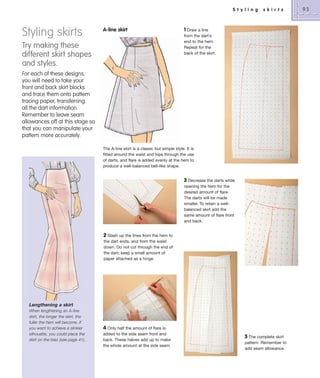
  • 139.
    138 C o re s e w i n g t e c h n i q u e s Patch pocket With a lining A patch pocket is one of the simplest pockets to create. It is placed to the right side of the fabric and sewn in place with topstitching. It may be lined or left unlined with the seam allowances just pressed under before attaching it. Preparation Iron a piece of lightweight fusible interfacing to the wrong side of the fabric to strengthen the pocket. 1 Trim 2mm (1⁄16in) from the edge Without a lining 1 Make a card template of the finished pocket minus the seam allowances. of the lining. front, right sides together, leaving a gap of approximately 4cm (11⁄2in) in the middle of the seam. Press the raw edges towards the lining. 2 Neaten the upper edge of the pocket and fold the top edge to the right side of the fabric. Stitch on the seam line. 3 With right sides together and edges matching, pin around the outside edge, and then machine the two layers together. 3 Turn the top edge through and slip the card template inside. Place the pocket facedown on the ironing board with the template inside, and press the edges up and over the card to set the shape of the pocket. Baste to hold the shape, and machine sew the upper edge. 2 Sew the lining to the pocket 4 Trim and layer, and then pull through the hole left between the lining and pocket, and press flat. 4 Place the pocket on the garment and edge- and topstitch in place. Finish with bar tacks at the top corners to give additional strength. 5 Close the opening with hand- 6 Place the pocket in position sewn slip stitches, or use topstitching from the right side as a decorative effect. (This will close the hole in the seam at the same time.) and edge stitch to secure in position. Add topstitching, too, if desired, and finish with bar tacks to strengthen the top corners.
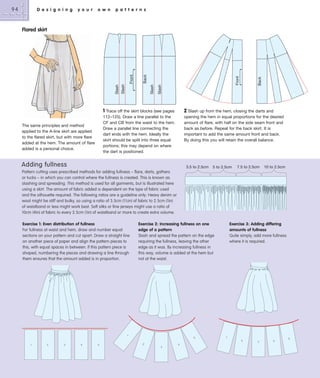
  • 140.
    C o re s e w i n g t e c h n i q u e s Lining a dress Lining a skirt There are so many dress styles that each design will dictate details on how the lining is to be cut and attached. On the whole, however, if the dress has a waist, the bodice and skirt linings will be cut separately and joined there. Lining a skirt will add body, make it more comfortable and prolong its life. Any skirt, whether straight, flared, gathered or pleated, can be lined. As a general rule, the skirt pattern is cut out and made up in lining fabric, then attached at the waist; no separate pattern is needed. Preparation Construct the bodice and skirt parts of the dress. Straight or A-line skirt 1 Cut out the lining pieces in suitable fabric. Use the dress pattern pieces if lining pattern pieces are not included. 1 Cut out the skirt pieces in lining fabric and sew the skirt lining together, right sides facing. Leave a gap at the zip position and at the back vent if there is one. Mark the dart positions but leave them unsewn. 2 Drop the lining into the skirt with wrong sides together. Pin at the waist and tuck in the darts, and then baste. 2 Construct the skirt and baste to the seam allowance at the waist of the bodice. Stitch in place, sewing just inside the seam line. 3 Depending on the style of neckline, the lining may be machine sewed directly to the neck or to a facing. When the neckline is complete, attach the bodice lining to the dress at the armhole by basting within the seam allowance. 4 Tuck under the seam allowance at the waist and pin over the skirt and lining. Slip stitch together. Tuck the seam allowance under at the zip and slip stitch. To finish, sew in sleeves, lined or otherwise, and finish the seam edges. 3 Tuck the seam allowance under at the zip and slip stitch in place. Add the waistband, sewing the skirt and lining as one, and neaten the hem of the lining. Leave the lining back vent open; just neaten the raw edges. 139
  • 141.
    Glossary Balance points Balance pointsare marks that refer to all notches and dots that help to align fabric pieces when constructing a garment. Basic blocks The basic flat components of skirt, bodice and sleeve for example, from which you create a fully detailed sewing pattern. Bias/cross grain of fabric The diagonal direction of fabric between the warp and the weft threads. Cutting layout The manufacturer’s guide to laying pattern pieces on fabric in the most economical way and keeping pieces ‘on grain’ or on fold lines, and so on. A number of layouts are provided for different fabric widths and pattern sizes. Dart A dart is a wedge of fabric that is pinched out of a garment to allow shaping or to remove excess fabric. addition to body measurements – to allow movement and to achieve the required garment silhouette. Flat pattern cutting A two-dimensional approach to creating and developing paper sewing patterns based on basic blocks. Fold line Used to describe the position of pattern pieces to be placed on folded fabric. The fabric is folded, right sides together, usually lengthwise so that the selvedges are together. A directional arrow on the pattern tissue indicates how to place the piece on the folded fabric. Grain line The fabric grain is the direction of the woven fibres. Straight or lengthwise grain runs along the warp thread, parallel to the selvedges. Crosswise grain runs along the weft, perpendicular to straight grain. Most dressmaking pattern pieces are cut on the lengthwise grain, which has minimal stretch. Dress form A mannequin used to assist in the making up of garments. Ease Ease refers to the amount of space built into a sewing pattern – in Hand/handle The term used to describe how a fabric feels, drapes, folds, pleats, etc. For example, this may be crisp, soft, heavy or stiff.
  • 142.
    Interfacing Overlocker Slash and spread Astabilizing fabric used on the wrong side of the fabric to support a piece of a garment, for example a collar or behind a pocket. A machine designed to sew and finish edges in one step, although it can produce many other effects too. Also known as an serger. A method for adding fullness to a pattern, whereby the pattern piece is slashed apart, spread out and re-drawn with added volume. Lining Placement lines ‘Stitch in the ditch’ (sink stitch) A separate fabric sewn onto the inside of a garment to conceal all raw edges and help it to hang well. The lines printed on pattern tissue, indicating where design details, such as pockets, welt flaps and front plackets, should be placed. Used to describe where pieces are held together by stitching on the right side of a previously made seam, for example, on a waistband. Princess line Synthetic fibre A dress with curved seaming running from the shoulder or the armhole to the hem on the front and back, giving six panels (not including the centre back seam). Fibres from a non-natural source, for example, nylon, polyester and acrylic. Mercerized cotton A treatment applied to give strength and lustre. Nap The shading that occurs on piled fabrics. Pile is the term for the raised fibres on fabrics such as velvets and furs. A ‘with nap’ cutting layout is used for fabrics with a pile, one-way shading or design. Patterns are placed so that the pile will run in the same direction on all corresponding pieces. Seam allowance The area between the sewing line and the edge of the cloth normally 1.5cm (5⁄8in), but 2.5cm (1in) in couture sewing. Selvedge Natural fibre Fibre from a non-synthetic source i.e., cotton or flax plant, silk moth or wool. Tacking Temporary stitching by hand or machine. Also known as basting. The side edges of fabric. These are often bound more tightly than the fabric weave. Notches There are many types of silk fabric, each with a slightly different finish. Fabric names include charmeuse, chiffon, crepe de Chine, dupion, gazar, georgette, noil, organza, raw, sandwashed, shantung, Thai and tussah. Toile An early prototype of a garment made in inexpensive fabric. Silk Triangular markings on the pattern tissue used to match two corresponding pieces. They can be single, double or triple, and have the same combination of notches on pieces to be joined. Tailor’s tacks A temporary stitch used to mark the placement of details, such as pockets on a piece of fabric to be made up into a garment. Torso block A torso block is a bodice that extends down to the hip line. Wadding Used in quilting, this material is a thick, soft layer of insulation that sits between the surface fabric and the backing fabric. It is also known as batting.
  • 143.
    142 Index A alterations 47, 48–49 bodice50–52, 72–73 bust 52–55, 73 princess-line dresses 60–61 skirts 57–59, 76–77 sleeves 56, 74–75 trousers 61, 78–79 animal fabrics 17 arms 22, 23 awls, pattern 11 B balance 69 balance points 140 basic blocks 64, 65, 66, 140 batiste 14 bias 34, 41, 140 bias binding 129 bobbin fill 13 bodice 23 altering armholes 72–73 bodice without side seams 87 fitting 72 lengthening 50–51 lengthening shoulder 52 princess seams 86 shortening 50 shortening shoulder 51 body landmarks 22, 23 arms 22, 23 back bodice 23 children 24 circumference 23 front bodice 23 lower torso 23 body shapes 21 bouclé 17 broadcloth 15 bust increasing 55, 73 moving dart down 54–55 moving dart up 53–54 moving the bust point 52–53 buttons and buttonholes 101 C calico 14, 15 camel hair 16 cashmere 16 catalogues 26–27 checks 40 chiffon 17 children 24–25 China silk 16 chino 14 collars 100 buttons and buttonholes 101 drafting pattern 100 mandarin collar 103 one-piece shirt collar 102, 137 Peter Pan collar 104 top collars and under collars 100 two-piece shirt collar 103 commercial patterns 19, 20 body shape 21 buying 26–27 correct size 20, 25 cutting out pieces 30 downloading 26–27 history 20 information sheets 29 measuring 33 pattern envelopes 28 pattern pieces 28–29 placing and pinning 42 preparing 30–33 understanding 28–29 corduroy 15 cotton 12, 14–15 mercerized cotton 141 crepe de Chine 15 cuffs 88, 90, 91 shirt cuffs 135 cutaway neckline 31 cutting fabrics 38, 44 cutting layouts 140 D darts 140 asymmetric darts 84 basic manipulation 84–85 changing darts into gathers 85 moving bust dart down 54–55 moving bust dart up 53–54 removing elbow dart 88 turning bodice darts into seams 86–87 denim 15 design ease 31, 32 designing patterns 63, 64–65 details to consider 80–81 pattern notches 83 working drawings 80, 81–83 double knit 16 dress forms 12, 69, 140 padding out to your own size 80 dresses 96 drafting block 96–98 lining 139 princess-line 60–61, 98–99, 141 dresses: torso blocks 96 dressmaker’s pattern paper 12 dressmaker’s tracing paper 12, 44 dressmaking curves 12 drop shoulder 31 dupion (doupioni) silk 16 E woven fabrics 14–15 facings 105 combined neck and armhole facing 105 grown-on facing 106 skirt facing 106–107 V-neck facing 107 faux fur 17 faux suede 17 flat-fell seams 129 flat pattern cutting 64, 140 fold line 140 French curves 12 French seams 128 G garment style 31 general-purpose thread 13 gingham 15 grain line 34, 140–141 ease 31–32, 140 cap ease 74 skirts 95 wearing ease allowance chart 31 easing 131 elastic casing 130 embroidery silks 13 equipment 10–13 H F interfacings 17, 141 fusible interfacings 132 interlock knit 16 internal fabrics 17 irons and ironing boards 13 fabrics 14–17 animal fabrics 17 bias fabrics 41 checking 39 cotton 12, 14–15, 141 cutting 38, 44 directional prints 38 fabric grain 34, 140–141 fixing skewed fabrics 36 internal fabrics 17 knit fabrics 16 marking out 43–44 microfibre fabrics 15 napped or pile fabrics 39 preparing 34–41 preshrinking 39 prewashing 39 silk 15–16, 41 special fabrics 17 straightening ends 35 striped fabrics 37 tearing 35 wool 16 habotai silk 16 hand/handle 141 hem stitch 133 hems double-folded 133 hand-finished 133 herringbone stitch 133 I J jersey 36 K knit fabrics 16, 36 L lace 17 lawn 15 leather 17 linen 15 linings 138, 139, 141 lockstitch 133
  • 144.
    I n de x M machine embroidery floss 13 marking out 43–44 measuring 22–23 body landmarks 22, 23, 24 children 24–25 getting started 22 measurement charts 22, 25 measuring commercial patterns 33 metallic thread 13 microfibre fabrics 15 N napped fabrics 39, 141 natural fibre 141 neck edge 100 needles 11 needles, sewing machine 12 notches 83, 141 O online purchasing 26–27 organza 16 overlockers 141 overlocking 128 P pattern blocks 64, 65, 111 commercial blocks 66–67 methodical working 68 scaling up 65, 66–67 UK size 8 112–113 UK size 10 114–115 UK size 12 116–117 UK size 14 118–119 UK size 16 120–121 UK size 18 122–123 UK size 20 124–125 pattern catalogues 26–27 pattern master 12 pattern tracing wheels 10, 44 pens, fadeaway marker 11 pens, wash-away marker 11 pile fabrics 39, 141 pin cushions 11 pinning 42 pins, dressmaking 11 placement lines 141 plackets 101 pleats, inverted 130 plumb lines 69 pockets 45 patch pockets 108, 138 side seam pockets 108 skirt side pockets 108–109 poplin 15 princess-line dresses 98–99, 141 altering length 60–61 princess seams 86 printed fabrics 38 R roll line 100 S satin 17 scissors, needlework/ embroidery 10 scissors, paper 10 scissors, serrated 10 seams 128–129 seam allowance 141 seasonal shapes 64 selvedge 34, 141 sergers see overlockers sewing machines 13 sewing techniques 127 bias binding 129 easing 131 elastic casing 130 fusible interfacings 132 hems 133 inverted pleats 130 linings 139 patch pockets 138 seams 128–129 shirt collars 137 shirt cuffs 135 shoulder pads 136 sleeves 134 spaced tucks 129 traditional waistband 132 yokes 136–137 zips 130–131 shears, dressmaker’s fabric 10 shears, pinking 10 shoulder pads 136 silhouette classifications 32 silk 15–16, 41, 141 cutting 44 silk thread 13 skirts A-line skirts 93 adding fullness 94 adding room for rounded figures 76–77 altering length 57, 93 altering waistband 59 decreasing waist 57–58 easing 95 fitting 76 flared skirts 94 flared skirts with yoke 95 increasing at the hip 59 increasing waist 58 lining 139 skirt facing 106–107 skirt waist fit 33 taking out fullness across back 76 slash and spread 141 sleeves adding fullness as gathers 88 adjusting 73–74 adjusting cap 74, 75 alignment 70–71 bell sleeve with gathers 91 eased-in 134 fitting 74 gathered head 134 half-circle sleeve 88–89 lengthening 56 puffed sleeve head 89 raglan sleeve 65, 92 removing elbow dart 88 short puff sleeve 90 shortening 56 widening 75 slip stitch 133 spandex 16 special fabrics 17 stabilizers 17 ‘Stitch in the ditch’ 141 stitches 133 striped fabrics 37 sweatsuit fabric 16 synthetic fibre 141 T tacking 140 tacking thread 13 pocket placement 45 taffeta 17 tailor’s chalk 11, 44 tailor’s tacks 43, 141 tape measures 11 tartan 16 thread 13 toiles 68–69, 141 adjustments 70, 71 assessing fit 70 topstitch thread 13 torso blocks 96, 141 tricot 16 trousers adding room for rounded figures 78–79 altering length 61 fitting 78 increasing crotch length 79 shortening crotch depth and leg length 78 zips 130 tucks 129 tulle 17 V velvet 17 cutting 44 W wadding 140 waistbands 105, 132 altering 59 straight waistbands 107 wearing ease 31 weights 42 wool 16 woolly nylon 13 worsted 16 woven fabrics 14–15, 16, 36 Y yokes 95, 136–137 Z zigzag finish 128 zips 130–131 143
  • 145.
    144 Credits Quarto would liketo thank and acknowledge the following for their contribution to this book: The McCall Pattern Company Butterick, McCall, Vogue Patterns 120 Broadway 34th Floor New York NY 10271-3499, USA www.mccallpattern.com www.butterick.com www.voguepatterns.com Verlag Aenne Burda GmbH & Co. KG Fashion Factory Am Kestendamm 2 D - 77652 Offenburg www.burdastyle.com All other images are the copyright of Quarto Publishing plc. While every effort has been made to credit contributors, Quarto would like to apologize should there have been any omissions or errors – and would be pleased to make the appropriate correction for future editions of the book.