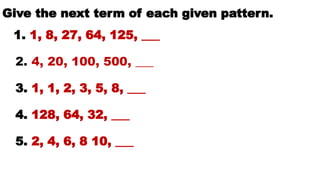
Give the next term of each given pattern.
1. 1, 8, 27, 64, 125, ___
2. 4, 20, 100, 500, ___
3. 1, 1, 2, 3, 5, 8, ___
4. 128, 64, 32, ___
5. 2, 4, 6, 8 10, ___
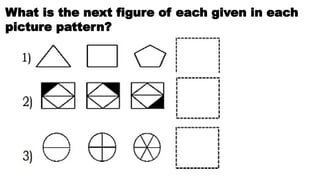
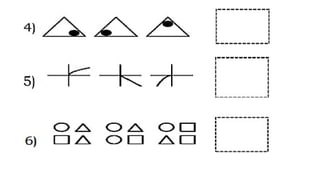
What is the next figure of each given in each
picture pattern?
A sequence is a set of objects which is
listed in a specific order, one after another.
Each member or element in the sequence is
called term. The terms in a sequence can be
written as , , , , . . . , , . .. which means is the
first term, is the second term, is the third
term, …, is the nth term, and so on.
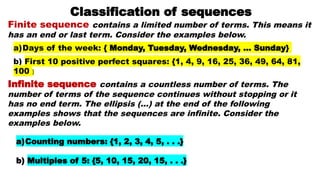
Classification of sequences
Finite sequence contains a limited number of terms. This means it
has an end or last term. Consider the examples below.
a)Days of the week: { Monday, Tuesday, Wednesday, … Sunday}
b) First 10 positive perfect squares: {1, 4, 9, 16, 25, 36, 49, 64, 81,
100 }
Infinite sequence contains a countless number of terms. The
number of terms of the sequence continues without stopping or it
has no end term. The ellipsis (…) at the end of the following
examples shows that the sequences are infinite. Consider the
examples below.
a)Counting numbers: {1, 2, 3, 4, 5, . . .}
b) Multiples of 5: {5, 10, 15, 20, 15, . . .}
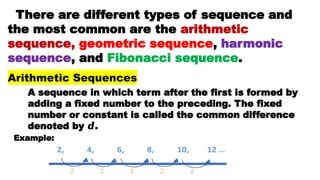
There are different types of sequence and
the most common are the arithmetic
sequence, geometric sequence, harmonic
sequence, and Fibonacci sequence.
Arithmetic Sequences
A sequence in which term after the first is formed by
adding a fixed number to the preceding. The fixed
number or constant is called the common difference
denoted by .
𝒅
Example:
mathematics in modern PATTERN and sequences.pptx

mathematics in modern PATTERN and sequences.pptx

  • 1.
    Give the nextterm of each given pattern. 1. 1, 8, 27, 64, 125, ___ 2. 4, 20, 100, 500, ___ 3. 1, 1, 2, 3, 5, 8, ___ 4. 128, 64, 32, ___ 5. 2, 4, 6, 8 10, ___
  • 2.
    What is thenext figure of each given in each picture pattern?
  • 4.
    A sequence isa set of objects which is listed in a specific order, one after another. Each member or element in the sequence is called term. The terms in a sequence can be written as , , , , . . . , , . .. which means is the first term, is the second term, is the third term, …, is the nth term, and so on.
  • 5.
    Classification of sequences Finitesequence contains a limited number of terms. This means it has an end or last term. Consider the examples below. a)Days of the week: { Monday, Tuesday, Wednesday, … Sunday} b) First 10 positive perfect squares: {1, 4, 9, 16, 25, 36, 49, 64, 81, 100 } Infinite sequence contains a countless number of terms. The number of terms of the sequence continues without stopping or it has no end term. The ellipsis (…) at the end of the following examples shows that the sequences are infinite. Consider the examples below. a)Counting numbers: {1, 2, 3, 4, 5, . . .} b) Multiples of 5: {5, 10, 15, 20, 15, . . .}
  • 6.
    There are differenttypes of sequence and the most common are the arithmetic sequence, geometric sequence, harmonic sequence, and Fibonacci sequence. Arithmetic Sequences A sequence in which term after the first is formed by adding a fixed number to the preceding. The fixed number or constant is called the common difference denoted by . 𝒅 Example: