Knowing what research organizations actually do, with whom, where,
how and for what purpose: Monitoring research portfolios and
collaborations
Javier Ekboir, Genowefa Blundo Canto*, Cristina Sette
Impact Assessment specialist, International Center for Tropical Agriculture (CIAT), Peru
A R T I C L E I N F O
Article history:
Received 12 April 2016
Received in revised form 1 August 2016
Accepted 4 December 2016
Available online 5 December 2016
1. Introduction
Managers and policy makers have struggled to develop effective
monitoring systems to track the evolution of research organiza-
tions. This paper presents the first components of a novel
monitoring system for monitoring such organizations. These
components can be used to generate detailed static pictures of
the actual activities and partnerships of a large research program
or organization, in other words, what the organization is actually
doing, with whom, where, how and for what purpose. It can also
identify whether new incentives or organizational structures have
an immediate effect on the researchers’ activities. Once developed,
the full system will be able to monitor the evolution of the
organization’s activities and assess mid- and long-term effects of
specific incentives. Essentially, the system asks individual
researchers to list all the important collaborations they engaged
in during the preceding 12 months and to provide some
information about these collaborations. The data are then
aggregated to describe the organization’s portfolio of activities
and engagement with other actors in the innovation system.
The system presented here can show how an organization
actually allocates its efforts which can be different from budgetary
allocations. This information is important for planning and
management of research. As Argyris and Schön (1974) have
shown, often there is a gap between what an organization plans
and what it actually does. The divergence is particularly acute in
not-for-profit research organizations because researchers are
expected to raise an important share of their funds, meaning that
managers have limited control over the researchers’ activities.
Also, the system maps research activities as they are being
conducted, which is important for resource allocation. Research
organizations have struggled to generate information for this
purpose, reverting often to ex-ante and ex-post impact assess-
ments. While ex-ante assessments can provide some guidance for
decision making, they have to be revised as the research progresses
because the reality is usually different from what was predicted.
The methodology presented in this paper can help in these
revisions. On the other hand, ex-post impact assessments cannot
be used for resource allocation because they can only be conducted
after enough time has passed for the impacts to be measurable, in
other words, many years after the decisions have been made. Since
our system can be used at relatively short intervals (ideally every
two or three years) and is based on current activities, its results can
be used while the projects are still being implemented.
Three reasons justify analyzing the links established by
researchers. Firstly, research is increasingly implemented by
inter-disciplinary, multi-institutional teams that network formally
and informally both locally and globally (vom Brocke & Lippe,
2015; Adams 2012; Lieff Benderly 2014; Stephan 2012; Bennett,
Gadlin, & Levine-Finley, 2010). Secondly, programs to foster
interdisciplinary, inter-institutional collaborations between
researchers and other actors in innovation systems have been
implemented in several countries and policy-makers are asking
about their impacts (Trochim et al., 2011). Thirdly, collaborations
with researchers and non-researchers are important influences
that help researchers to better contribute to innovation processes
* Corresponding author at: Centro Internacional de Agricultura Tropical –
International Center for Tropical Agriculture (CIAT), Lima Office (Perú).
E-mail addresses: javierekboir@gmail.com (J. Ekboir), g.blundo@cgiar.org
(G. Blundo Canto), cris.sette@gmail.com (C. Sette).
http://dx.doi.org/10.1016/j.evalprogplan.2016.12.002
0149-7189/© 2016 The Authors. Published by Elsevier Ltd. This is an open access article under the CC BY-NC-ND license (http://creativecommons.org/licenses/by-nc-nd/4.0/).
Evaluation and Program Planning 61 (2017) 64–75
Contents lists available at ScienceDirect
Evaluation and Program Planning
journal homepage: www.elsevier.com/locate/evalprogplan
and to become more productive and creative (Li, Liao, & Yen, 2013;
Klenk, Hickey, & MacLellan, 2010; Wagner, 2008).
Finally, there is a strong pressure on research organizations to
demonstrate the social and economic impacts of their activities
(Kraemer 2006; Rusike et al., 2014). Traditionally, these impacts
have been measured through rates of return estimated with
econometric models (see, for instance, Alston, Norton, & Pardey,
1995). However, in recent years these methods have been criticized
because they depend on very strong assumptions that impose
simple, constant causalities on the data and do not take into
account the complexity of research, where many causes interact in
ways that change over time (Patton 2010). Thus, the focus has
progressively shifted to the analysis of the roles research plays in
innovation and social processes, which requires both the definition
of the organization’s theories of change and how its actual
activities agree with or deviate from the theories of change (Mayne
& Stern 2013). While there are many publications on how to build
theories of change for research activities (Davies, 2004; ISPC,
2012), few works have been published on how to map the actual
research activities of large programs or organizations. This paper
contributes to fill this gap.
The system was developed in a pilot project that involved the
Roots, Tubers and Bananas CGIAR Research Program (RTB), a large
agricultural “research for development” program (RTB is described
in Section 4).1
The information for this project was collected only
nine months after RTB started operating; therefore, its networks
reflect mostly pre-existing activities. However, in its short life RTB
induced important changes in the way research activities were
conducted, fostering greater interaction among CGIAR centers, and
refocusing partnerships according to the partners’ capabilities and
RTB’s research priorities. The fact that the system could identify
these changes despite their incipient nature attests to its
effectiveness.
Section 2 presents the conceptual framework on which the
system is based. Section 3 reviews recent publications that use
Social Network Analysis techniques (SNA) to analyze research
networks. Section 4 presents RTB, while Section 5 discusses the
methodology used in the study. Section 6 discusses the type of
information that the system generates and Section 7 concludes.
2. Conceptual framework
The system is strongly anchored to complexity theories
(Axelrod & Cohen 1999) and evaluation frameworks based on
them (Mayne & Stern 2013; Patton 2010), the innovation systems
framework (Edquist 2005) and the recent literature on research
systems (Stephan 2012; Wagner 2008). While several methods
have been developed for monitoring programs (see, for example,
Brandon et al., 2013), there is a dearth of research on monitoring
complex programs and organizations such as large research
institutions.
The system presented in this paper is based on the observation
that interactions among researchers and non-research actors in an
innovation system can be represented as networks (Kratzer,
Gemuneden, & Lettl, 2008) that form a complex system. These
systems are characterized by the interactions among different
types of actors constrained by the socioeconomic and physical
environment in which they operate (Axelrod & Cohen, 1999). Due
to the large number of interacting forces, complex systems are
essentially unpredictable. Planning can reduce the uncertainty but
cannot eliminate it. Therefore, rigid strategic planning driven by
ex-ante impact assessment is of little use and actors need to adapt
their strategies as they collect new information about the evolving
state of the system (Patton, 2010). However, this is no easy task.
Due to their limited resources, decision makers need guidance on
what information should be collected and how it should be
interpreted (Mayne & Stern, 2013). This guidance is provided by
what the decision makers know about the process and how they
expect their interventions to influence it, in other words, by their
theories of change. Also, in order to be adaptive, actors need
process indicators that inform them about the current state of the
system.
In the case of not-for-profit research organizations the theory of
change and the process indicators can be built from the innovation
systems framework, recent studies of the organization of research
and a thorough knowledge of the organization that is being
analyzed. In these organizations, the theory of change plays a
critical role because they lack a clear indicator of success such as
profit.
According to the innovation systems framework, research has
positive social and economic impacts when researchers interact
with different types of research and non-research partners in
knowledge processes that feature several feedback loops (Edquist,
2005). Therefore, the theory of change posits that an agricultural
research organization that interacts only with advanced research
institutions and a few extension agents is likely to have a smaller
impact than an organization that also interacts with private firms,
farmer organizations and innovative farmers. The literature on
research has also found that the quality of research depends
critically on the researchers having active international connec-
tions (Wagner, 2008), which indicates that a researcher in a
developing country that interacts only with colleagues in her
organization should be less productive and creative than a
researcher that has many international links. Therefore, the
process indicators can be constructed from the links the
organization establishes with other actors in the innovation
system, and can be analyzed with simple tables and statistical
methods, and SNA techniques as is explained below. It should be
noted, though, that there are very few detailed studies that link
research activities, the structure of networks and innovations. For
example, it is not known how biotechnology networks should
differ from animal health networks. Therefore, the information
generated with this system can also be used to answer important
theoretical and empirical questions about the relationship
between research collaborations and innovation processes.
Other process indicators can be constructed by analyzing the
organization’s portfolio of activities. For example, the CGIAR has
defined that it needs to strengthen its research on nutrition and
health, with special focus on Africa and the least developed Asian
and Latin American countries. With the system presented in this
paper it is possible to calculate the share of collaborations
established for research on a particular topic, the geographical
focus, the type of research that is being conducted and other
features. These results can then be compared with the organiza-
tional priorities and studied over time to understand the evolution
of the networks. The information can be used as an input in
management decisions.
Finally, since the researchers can identify whether a particular
collaboration was established as a result of a specific incentive,
such as a new line of financing, it is possible to identify the
immediate impact of the incentive on the patterns of research
activities and collaborations. The mid- and long-term effects can be
identified by repeating the exercise periodically.
1
Research for development is defined as scientific activities that are expected to
have positive impacts on economic and social wellbeing and the sustainable
management of natural resources.
J. Ekboir et al. / Evaluation and Program Planning 61 (2017) 64–75 65
3. Previous use of SNA in the analysis of research networks
A network is a set of nodes (in our case, researchers) who are
connected among them; the connections are also called links
(Newman, 2003). In most social networks, the links are not random
and form well defined patterns of interaction; SNA uses
mathematical tools and visualization techniques to analyze these
patterns, for instance, who are the most connected researchers, or
whether they collaborate with non-researchers. Important dimen-
sions of the structure of research networks can be studied with
networks centered on individual nodes; such networks are known
in the literature as “ego networks”. Ego networks can identify, for
instance, women centered networks and their evolution can help
to assess programs that aim to increase the diversity of the
research pool. Additionally, the analysis of the networks that were
created as a result of RTB can provide evidence on the convergence
of individual research projects towards an integrated program.
Several methodologies have been used to analyze research
networks; here we only review publications that use SNA methods.
Three main methods were identified in the literature review:
analysis of joint publications (co-authorship relationships),
analysis of project documents (project partnerships) and direct
surveys of researchers.
Studies based on co-authorship relationships identify patterns
of interaction exploring databases of scientific articles. In general,
two authors are considered to have a direct link if they co-authored
at least one paper. When a large number of co-authorships are
identified, a map of interactions emerges. Due to the availability of
large datasets, this has been the most common approach to study
research networks; recent papers include Li, Liao and Yen (2013),
Gonzalez-Brambila, Veloso and Krackhardt (2013), Klenk et al.
(2010). This approach documents collaborations that resulted in
scientific publications but ignores connections for capacity
building and advocacy; it also does not include informal
collaborations, which have been recognized as important compo-
nents of scientific work even if they do not result in scientific
publications (Varga & Parag, 2009; Kratzer, Gemuenden, & Lettl,
2008). Other problems with this approach are that researchers
may be included as co-authors for social reasons (La Follette,1992)
or because they provide data or equipment (Stokes & Hartley,
1989). Finally, scientific papers often take several months to be
published, by which time the collaboration may no longer be
active.
Studies of project partnerships analyze project documents,
mainly joint proposals and publications, to identify research
collaborations. The main difference with co-authorship relation-
ships is that project partnerships are more likely to include non-
scientific collaborations. Several countries have implemented
projects promoting research and innovation networks, including
the European Framework Programs and the Canadian Network of
Centers of Excellence. Analyses of project partnerships include
Biggiero and Angelini (2014), Klenk and Hickey (2013), Protogerou,
Caloghirou and Siokas (2010) and Cassi et al. (2008). Two
drawbacks of this approach are that it overlooks informal
interactions and only captures interactions that are relevant for
documentation of the project, which may have not resulted in
effective collaborations.
Approaches based on co-authorship relationships and project
partnerships cannot be used in research areas with low propensity
to publish (such as engineering or development of agricultural
equipment) or where informal interactions are common. Addi-
tionally, they may lead to the inclusion of collaborations that exist
only on paper. One way to overcome these problems is to elicit
information directly from the researchers. Dozier et al. (2014) and
Bozeman and Corley (2004) used a strategy based on self-reported
information about the researchers’ networks to capture active
formal and informal collaborations as well as non-research
interactions. Klenk and Hickey (2013) used an internet-based
questionnaire to elicit respondents’ collaborations within two
Canadian research programs. Kratzer, Gemuneden, & Lettl, (2008)
asked researchers to report about their perception of the strength
of informal collaborations among institutions named in a roster.
4. What is the CGIAR root, tubers and bananas research
program?2
The CGIAR is a mission oriented global organization that
conducts research that contributes to solve problems affecting
poor rural households in developing countries, enhance health and
nutrition and improve the management of natural resources.3
CGIAR’s activities are mostly conducted by 15 international
research centers organized in research programs, RTB being one
of them.4
In 2008 CGIAR embarked in a major reorganization that
involved the creation of the CGIAR Research Programs as umbrella
organizations for pre-existing projects with the expectation that
over time they would reshape the CGIAR’s research portfolio and
interactions with other actors in the agricultural innovation
system.
RTB was launched in 2012 to bring together research on banana,
plantain, cassava, potato, sweet potato, yam, and other root and
tuber crops to improve food security, nutrition and livelihoods. The
program focuses on cutting-edge genomic research, international
collaborations to address priority pests and diseases, and research
to increase harvests and improve postharvest options. RTB is based
on a partnership of five research centers: the International Potato
Center (CIP), which leads the program, Bioversity International
(Bioversity), the International Center for Tropical Agriculture
(CIAT), the International Institute of Tropical Agriculture (IITA) and
the Centre de Coopération Internationale en Recherche Agrono-
mique pour le Développement (CIRAD). Currently, the program
collaborates with 366 partners, including national agricultural
research organizations, academic and advanced research institu-
tions, non-governmental organizations, and private sector com-
panies. Partnerships, communication and knowledge sharing are
key strategies that the program relies on achieve impacts.
5. Methods
The system has three distinct components. The first one is the
collection of information directly from the researchers on the
activities and collaborations they engage in. This information
captures actual activities and collaborations instead of activities
and collaborations identified fromwritten documents that may not
be active. The second component is the analysis of the data with
tables and statistical tools. Through this component it is possible to
(a) compose a comprehensive picture of the organization’s actual
portfolio of activities and partnerships, (b) identify the allocation
of the organization’s efforts across activities and partnerships, and
(c) explore several dimensions of those activities and collabo-
rations, such as their relative importance, gender dimensions and
geographic or disciplinary focus. Finally, SNA techniques are used
to discover configurations in the collaborations (e.g., the collective
structure of collaborations, reciprocity, or the transdisciplinarity of
the organization’s activities). The three components make it
possible to identify aggregate patterns in the organization of
research and partnerships, areas of strong integration or isolated
2
www.rtb.cgiar.org.
3
www.cgiar.org.
4
A complete list of all CGIAR Research Programs can be found at http://www.
cgiar.org/our-research/cgiar-research-programs/
66 J. Ekboir et al. / Evaluation and Program Planning 61 (2017) 64–75
collaborations, and the influence new programs have on these
indicators.
The information used in this project was collected with a user-
friendly, web-based survey for researchers fully or partially funded
by RTB. The questionnaire was designed so that completion would
not exceed 30 min for researchers reporting up to 10 collabo-
rations. The survey was conducted between September 25 and
November 23, 2012. To induce managers to support the analysis
and researchers to provide accurate information, they were
informed that the information was to be kept confidential, that
the reports were not meant to be used for accountability (of
programs or individuals) and that the results could not be used to
compare different research programs.
All researchers were asked to list the names of the collaborators
they engaged with while conducting their research. Collaborations
were defined as a formal or informal sustained relationship in
which a researcher effectively cooperated with other actors in the
innovation system (including researchers, extension agents,
research managers, input suppliers, output buyers and policy-
makers); this definition is similar to the one proposed by
Sonnenwald (2007). Following published research (Bozeman
and Corley, 2004; Dozier et al., 2014), the interpretation of this
statement was left to the respondents.
The researchers were asked to consider all types of collabo-
rations important for their work in the RTB network, including
research projects, innovation platforms, advocacy networks and/or
capacity building activities. It was specified that these collabo-
rators may work in the same research center, in another CGIAR
center or in non-CGIAR organizations and that the collaborations
may be formal or informal (e.g., a community of practice) and not
necessarily be financed by RTB. They were also asked to provide
several attributes of each collaboration, including type and topic of
research, gender of the collaborator, geographic focus and location
of activities (e.g., desk, experimental station or farmer’s field). Of
particular importance was the question if the collaboration had
been induced by RTB. To avoid the problem of memory lapses with
regard to past collaborations and to capture active relationships,
researchers were asked to report only collaborations that had been
active in the twelve months prior to the survey.
The information from the individual researchers was aggregat-
ed into categories defined for each of the variables of interest and
tabulated. In some cases, the categories were defined in cardinal
numbers, in others, in intervals and the analysis was conducted for
proportions. In all cases, the results were calculated for the
collaborations that were induced by RTB and those that were not.
By comparing both results, it was possible to identify the
immediate influence of the research program. In the case of the
proportions, a Chi square test was used to test whether the
difference between the distributions of collaborations induced by
RTB and those not induced by it was significantly different from 0.
The SNA analysis was conducted with UCINET 6 and NETDRAW
(Borgatti et al., 2002). The information was collected only from
researchers funded by RTB but not from their collaborators.
Collecting information from the latter would have required a
massive amount of resources. Since the collaborators are also likely
to collaborate among themselves, the full network should be more
connected than the one mapped. To take into account that most
named collaborators did not respond to the survey, two separate
SNA analyses were conducted, one with the full dataset (i.e.,
respondents and collaborators mentioned by the respondents) and
the other using information only about the respondents. The larger
dataset was used to study the structure of RTB’s portfolio of
activities including the range of contacts, geographic reach, main
research areas, and some patterns of interaction. The smaller
dataset was used to explore the network’s structure and
connectivity. Additionally, the questionnaire did not explicitly
state that non-research partners should be included. Thus, it is
possible that non-research collaborations are underrepresented,
especially if the respondents’ main activity is research and they are
not fully aware of the other dimensions of their work, such as
capacity building or advocacy. Anecdotal evidence indicates that
this is a common problem.
The methodology has three limitations. Firstly, the self-
reporting approach lacks operational precision as each researcher
decides which collaborations he or she will report, and there is
great variation among researchers’ willingness to provide infor-
mation but also different understanding of what important
collaborations are. Secondly, respondents could have forgotten
some collaborators. Thirdly, a significant rate of response is
necessary to achieve representativeness of the organization’s
research portfolio and actual collaborations. Researchers’ motiva-
tions for reporting or not reporting certain partnerships and the
incentives to achieve a significant rate of response is beyond the
scope of this study, but should be taken into account when using
this system. A very strong support from the top authorities is
critical for the project’s success. Taken together, these limitations
mean that the estimates of some parameters (e.g., density) are
probably biased downwards due to the exclusion of some links
from the calculations. Solutions for correcting these biases have
been proposed in the literature (Marschall, 2012), but they require
the imposition of strong assumptions about the true (unknown)
distribution of links. Thus, the correction of the bias would come at
the cost of using more prior information, which could cause
additional biases. Due to the lack of clear indications about how to
deal with these problems, the estimates of the network parameters
were not corrected.
Despite these limitations, the system could successfully elicit
from the researchers information about the activities they engaged
in and their collaborators. The information was accurate enough to
provide a clear picture of the organization’s portfolio of activities
and of the researchers’ immediate networks.
6. Results
The questionnaire was sent to 126 researchers and the number
of valid responses was 92, giving an effective response rate of 75%.
The survey identified 702 links, of which 134 (19%) were enabled
by RTB. RTB’s research network was found to be quite diverse,
including 624 individual collaborators from 302 distinct organiza-
tions. Some collaborators were mentioned by more than one
survey respondent. The highest number of collaborations reported
was 21 and the lowest 1. All respondents but 7 worked for CGIAR
centers. The respondents included researchers and senior research
support staff.
As was explained in Section 2, the tables and SNA results only
have meaning when interpreted through (a) the theory of change,
(b) the literature on innovation systems and organization of
science, and (c) a thorough knowledge of the organization that is
being analyzed. This section presents some examples of how these
three elements can be combined with the quantitative information
generated by the system to understand the current structure of
research activities and collaborations and what this means for a
research organization. It should be remembered that for the time
being the system is static; therefore, the results are a baseline
against which it will be possible to assess organizational change.
The analysis was conducted for the RTB case.
The results are presented in three subsections. The first one
analyses RTB’s portfolio and the influence that the creation of the
research program had on the whole set of activities included under
its umbrella. The second subsection discusses particular param-
eters of the full network of RTB’s researchers, including geographic
and gender based networks and interactions with non-research
J. Ekboir et al. / Evaluation and Program Planning 61 (2017) 64–75 67
partners. Finally, the third subsection studies the network formed
only by those researchers who filled the questionnaire; this study
sheds light on particular features such as reciprocity, clustering
and connectivity.
6.1. Organization of RTB’s activities
The system provided a clear picture of the portfolio of RTB’s
activities and how they changed as a result of the creation of RTB.
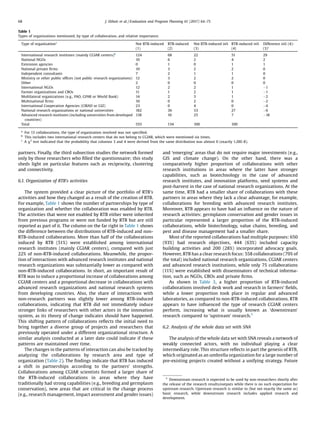
For example, Table 1 shows the number of partnerships by type of
organization and whether the collaboration was enabled by RTB.
The activities that were not enabled by RTB either were inherited
from previous programs or were not funded by RTB but are still
reported as part of it. The column on the far right in Table 1 shows
the difference between the distributions of RTB-induced and non-
RTB-induced collaborations. More than half of the collaborations
induced by RTB (51%) were established among international
research institutes (mainly CGIAR centers), compared with just
22% of non-RTB-induced collaborations. Meanwhile, the propor-
tion of interactions with advanced research institutes and national
research organizations was substantially lower as compared with
non-RTB-induced collaborations. In short, an important result of
RTB was to induce a proportional increase of collaborations among
CGIAR centers and a proportional decrease in collaborations with
advanced research organizations and national research systems
from developing countries. Also, the share of interactions with
non-research partners was slightly lower among RTB-induced
collaborations, indicating that RTB did not immediately induce
stronger links of researchers with other actors in the innovation
system, as its theory of change indicates should have happened.
This shifting pattern of collaborations reflects the initial need to
bring together a diverse group of projects and researchers that
previously operated under a different organizational structure. A
similar analysis conducted at a later date could indicate if these
patterns are maintained over time.
The changes in the patterns of interaction can also be tracked by
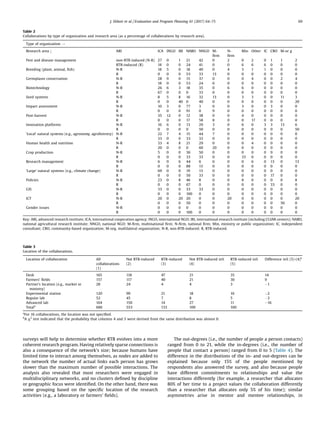
analyzing the collaborations by research area and type of
organization (Table 2). The findings indicate that RTB has induced
a shift in partnerships according to the partners’ strengths.
Collaborations among CGIAR scientists formed a larger share of
the RTB-induced collaborations in areas where they have
traditionally had strong capabilities (e.g., breeding and germplasm
conservation), new areas that are critical in the change process
(e.g., research management, impact assessment and gender issues)
and ‘emerging’ areas that do not require major investments (e.g.,
GIS and climate change). On the other hand, there was a
comparatively higher proportion of collaborations with other
research institutions in areas where the latter have stronger
capabilities, such as biotechnology in the case of advanced
research institutes, and innovation platforms, seed systems and
post-harvest in the case of national research organizations. At the
same time, RTB had a smaller share of collaborations with these
partners in areas where they lack a clear advantage, for example,
collaborations for breeding with advanced research institutes.
Moreover, RTB appears to have had an influence on the nature of
research activities: germplasm conservation and gender issues in
particular represented a larger proportion of the RTB-induced
collaborations, while biotechnology, value chains, breeding, and
pest and disease management had a smaller share.
Most of the reported collaborations had multiple purposes: 650
(93%) had research objectives, 444 (63%) included capacity
building activities and 200 (28%) incorporated advocacy goals.
However, RTB has a clear research focus: 558 collaborations (79% of
the total) included national research organizations, CGIAR centers
and advanced research institutions, while only 75 collaborations
(11%) were established with disseminators of technical informa-
tion, such as NGOs, CBOs and private firms.
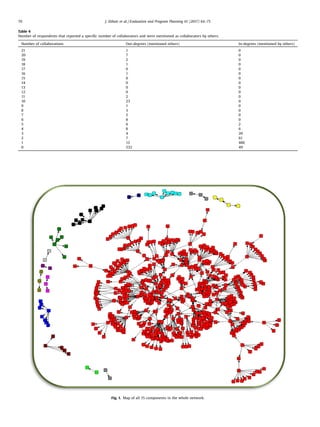
As shown in Table 3, a higher proportion of RTB-induced
collaborations involved desk work and research in farmers’ fields,
while a lower proportion took place in regular and advanced
laboratories, as compared to non-RTB-induced collaborations. RTB
appears to have influenced the type of research CGIAR centers
perform, increasing what is usually known as ‘downstream’
research compared to ‘upstream’ research.5
6.2. Analysis of the whole data set with SNA
The analysis of the whole data set with SNA reveals a network of
weakly connected actors, with no individual playing a clear
intermediary role. This structure reflects in part the genesis of RTB,
which originated as an umbrella organization for a large number of
pre-existing projects created without a unifying strategy. Future
Table 1
Types of organizations mentioned, by type of collaboration, and relative importance.
Type of organizationa
Not RTB-induced
(1)
RTB-induced
(2)
Not RTB-induced in%
(3)
RTB-induced in%
(4)
Difference in% (4)-
(3)c
International research institutes (mainly CGIAR centers)b
124 68 22 51 29
National NGOs 10 6 2 4 2
Extension agencies 0 1 0 1 1
National private firms 10 3 2 2 0
Independent consultants 7 2 1 1 0
Ministry or other public offices (not public research organizations) 12 3 2 2 0
Other 2 0 0 0 0
International NGOs 12 2 2 1 À1
Farmer organizations and CBOs 11 1 2 1 À1
Multilateral organizations (e.g., FAO, GFAR or World Bank) 14 2 3 1 À2
Multinational firms 10 0 2 0 À2
International Cooperation Agencies (CIRAD or GIZ) 23 0 4 0 À4
National research organizations or national universities 182 36 33 27 À6
Advanced research institutes (including universities from developed
countries)
138 10 25 7 À18
Total 555 134 100 100
a
For 13 collaborations, the type of organization involved was not specified.
b
This includes two international research centers that do not belong to CGIAR, which were mentioned six times.
c
A x2
test indicated that the probability that columns 3 and 4 were derived from the same distribution was almost 0 (exactly 1.28E-8).
5
Downstream research is expected to be used by non-researchers shortly after
the release of the research results/outputs while there is no such expectation for
upstream research. Upstream research is similar to (but not exactly the same as)
basic research, while downstream research includes applied research and
development.
68 J. Ekboir et al. / Evaluation and Program Planning 61 (2017) 64–75
surveys will help to determine whether RTB evolves into a more
coherent research program. Having relatively sparse connections is
also a consequence of the network’s size; because humans have
limited time to interact among themselves, as nodes are added to
the network the number of actual links each person has grows
slower than the maximum number of possible interactions. The
analysis also revealed that most researchers were engaged in
multidisciplinary networks, and no clusters defined by discipline
or geographic focus were identified. On the other hand, there was
some grouping based on the specific location of the research
activities (e.g., a laboratory or farmers’ fields).
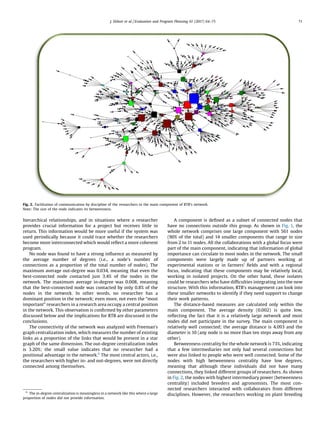
The out-degrees (i.e., the number of people a person contacts)
ranged from 0 to 21, while the in-degrees (i.e., the number of
people that contact a person) ranged from 0 to 5 (Table 4). The
difference in the distributions of the in- and out-degrees can be
explained because only 15% of the people mentioned by
respondents also answered the survey, and also because people
have different commitments to relationships and value the
interactions differently (for example, a researcher that allocates
80% of her time to a project values the collaboration differently
than a researcher that allocates only 5% of his time); similar
asymmetries arise in mentor and mentee relationships, in
Table 2
Collaborations by type of organization and research area (as a percentage of collaborations by research area).
Type of organization !
Research area # ARI ICA INGO IRI NARO NNGO M-
firm
N-
firm
Min Other IC CBO M-or g
Pest and disease management non-RTB induced (N-R) 27 0 1 21 42 0 2 0 2 0 1 1 2
RTB-induced (R) 18 0 0 24 41 0 0 6 6 6 0 0 0
Breeding (plant, animal, fish) N-R 18 5 0 18 49 0 4 3 1 1 0 0 0
R 0 0 0 53 33 13 0 0 0 0 0 0 0
Germplasm conservation N-R 28 9 0 15 37 0 0 0 4 0 0 2 4
R 18 0 0 53 24 6 0 0 0 0 0 0 0
Biotechnology N-R 26 6 3 18 35 0 6 6 0 0 0 0 0
R 67 0 0 0 33 0 0 0 0 0 0 0 0
Seed systems N-R 8 5 8 16 32 13 0 3 3 0 0 11 3
R 0 0 40 0 40 0 0 0 0 0 0 0 20
Impact assessment N-R 10 3 0 77 3 0 0 3 0 0 3 0 0
R 0 0 0 91 0 9 0 0 0 0 0 0 0
Post-harvest N-R 35 12 0 12 38 0 0 4 0 0 0 0 0
R 0 0 0 17 58 8 0 0 17 0 0 0 0
Innovation platforms N-R 16 6 0 13 29 3 0 6 0 3 3 13 6
R 0 0 0 0 50 0 0 0 0 0 0 0 50
‘Local’ natural systems (e.g., agronomy, agroforestry) N-R 22 7 4 15 44 7 0 0 0 0 0 0 0
R 33 0 0 33 33 0 0 0 0 0 0 0 0
Human health and nutrition N-R 33 4 8 21 29 0 0 0 4 0 0 0 0
R 20 0 0 0 60 20 0 0 0 0 0 0 0
Crop production N-R 5 0 0 36 50 0 0 0 0 0 9 0 0
R 0 0 0 33 33 0 0 33 0 0 0 0 0
Research management N-R 6 0 6 44 6 6 0 0 6 0 13 0 13
R 0 0 0 88 13 0 0 0 0 0 0 0 0
‘Large’ natural systems (e.g., climate change) N-R 69 0 0 19 13 0 0 0 0 0 0 0 0
R 0 0 0 50 33 0 0 0 0 0 17 0 0
Policies N-R 23 0 8 46 8 0 0 8 0 0 0 0 8
R 0 0 0 67 0 0 0 0 0 0 33 0 0
GIS N-R 33 0 0 33 33 0 0 0 0 0 0 0 0
R 0 0 0 100 0 0 0 0 0 0 0 0 0
ICT N-R 20 0 20 20 0 0 20 0 0 0 0 0 20
R 0 0 0 50 0 0 0 0 0 0 0 50 0
Gender issues N-R 0 0 0 0 0 0 0 0 0 0 0 0 0
R 0 0 0 100 0 0 0 0 0 0 0 0 0
Key: ARI, advanced research institute; ICA, international cooperation agency; INGO, international NGO; IRI, international research institute (including CGIAR centers); NARO,
national agricultural research institute; NNGO, national NGO; M-firm, multinational firm; N-firm, national firm; Min, ministry or public organization; IC, independent
consultant; CBO, community-based organization; M-org, multilateral organization; N-R, non-RTB-induced; R, RTB-induced.
Table 3
Location of the collaborations.
Location of collaboration All
collaborations
(1)
Not RTB-induced
(2)
RTB-induced
(3)
Not RTB-induced in%
(4)
RTB-induced in%
(5)
Difference in% (5)-(4)a
Desk 165 118 47 21 35 14
Farmers’ fields 157 117 40 21 30 9
Partner’s location (e.g., market or
ministry)
28 24 4 4 3 À1
Experimental station 120 99 21 18 16 À2
Regular lab 52 45 7 8 5 À3
Advanced lab 164 150 14 27 11 À16
Totala
686 553 133 100 100
a
For 16 collaborations, the location was not specified.
b
A x2
test indicated that the probability that columns 4 and 5 were derived from the same distribution was almost 0.
J. Ekboir et al. / Evaluation and Program Planning 61 (2017) 64–75 69
Table 4
Number of respondents that reported a specific number of collaborators and were mentioned as collaborators by others.
Number of collaborations Out-degrees (mentioned others) In-degrees (mentioned by others)
21 1 0
20 7 0
19 2 0
18 1 0
17 0 0
16 1 0
15 0 0
14 0 0
13 0 0
12 0 0
11 2 0
10 23 0
9 1 0
8 3 0
7 5 0
6 8 0
5 6 2
4 8 6
3 4 20
2 7 61
1 13 486
0 532 49
Fig. 1. Map of all 15 components in the whole network.
70 J. Ekboir et al. / Evaluation and Program Planning 61 (2017) 64–75
hierarchical relationships, and in situations where a researcher
provides crucial information for a project but receives little in
return. This information would be more useful if the system was
used periodically because it could trace whether the researchers
become more interconnected which would reflect a more coherent
program.
No node was found to have a strong influence as measured by
the average number of degrees (i.e., a node’s number of
connections as a proportion of the total number of nodes). The
maximum average out-degree was 0.034, meaning that even the
best-connected node contacted just 3.4% of the nodes in the
network. The maximum average in-degree was 0.008, meaning
that the best-connected node was contacted by only 0.8% of the
nodes in the network. In other words, no researcher has a
dominant position in the network; even more, not even the “most
important” researchers in a research area occupy a central position
in the network. This observation is confirmed by other parameters
discussed below and the implications for RTB are discussed in the
conclusions.
The connectivity of the network was analyzed with Freeman’s
graph centralization index, which measures the number of existing
links as a proportion of the links that would be present in a star
graph of the same dimension. The out-degree centralization index
is 3.20%; the small value indicates that no researcher had a
positional advantage in the network.6
The most central actors, i.e.,
the researchers with higher in- and out-degrees, were not directly
connected among themselves.
A component is defined as a subset of connected nodes that
have no connections outside this group. As shown in Fig. 1, the
whole network comprises one large component with 561 nodes
(90% of the total) and 14 smaller components that range in size
from 2 to 11 nodes. All the collaborations with a global focus were
part of the main component, indicating that information of global
importance can circulate to most nodes in the network. The small
components were largely made up of partners working at
experimental stations or in farmers’ fields and with a regional
focus, indicating that these components may be relatively local,
working in isolated projects. On the other hand, these isolates
could be researchers who have difficulties integrating into the new
structure. With this information, RTB’s management can look into
these smaller networks to identify if they need support to change
their work patterns.
The distance-based measures are calculated only within the
main component. The average density (0.002) is quite low,
reflecting the fact that it is a relatively large network and most
nodes did not participate in the survey. The main component is
relatively well connected; the average distance is 4.093 and the
diameter is 10 (any node is no more than ten steps away from any
other).
Betweenness centrality for the whole network is 73%, indicating
that a few intermediaries not only had several connections but
were also linked to people who were well connected. Some of the
nodes with high betweenness centrality have low degrees,
meaning that although these individuals did not have many
connections, they linked different groups of researchers. As shown
in Fig. 2, the nodes with highest intermediary power (betweenness
centrality) included breeders and agronomists. The most con-
nected researchers interacted with collaborators from different
disciplines. However, the researchers working on plant breeding
Fig. 2. Facilitation of communication by discipline of the researchers in the main component of RTB’s network.
Note: The size of the node indicates its betweenness.
6
The in-degree centralization is meaningless in a network like this where a large
proportion of nodes did not provide information.
J. Ekboir et al. / Evaluation and Program Planning 61 (2017) 64–75 71
and plant genetics had less diverse networks. Few of the
collaborations of the central nodes resulted from RTB – a result
that was anticipated since the well-connected researchers have
been in the system for several years and RTB was only nine months
old at the time of the survey.
The main component is quite robust. When a network has low
density it can be fragile in the sense that the removal of a node may
break the network into separate parts. Such nodes are known as
‘cut-points’ and the nodes that would become separated are the
‘blocks’. The main component in this study has six blocks and four
cut-points. The removal of the cut-points has little effect on the
network structure because only the collaborators of the removed
nodes would be lost. The small effect that the removal of a cut-
point would have on the structure of the network implies that the
departure of particular researchers, even the most connected,
would not have major consequences in terms of network
connectivity, even though it may significantly affect the efficiency
of information transmittal (lower betweenness centrality) and
research capacity (i.e., if highly specialized researchers were lost).
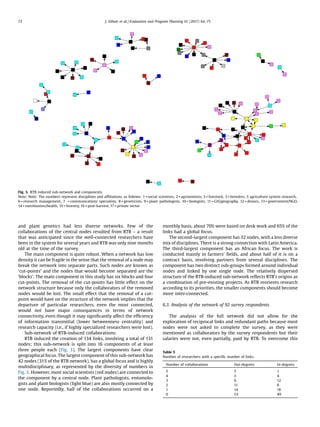
Sub-network of RTB-induced collaborations:
RTB induced the creation of 134 links, involving a total of 131
nodes; this sub-network is split into 16 components of at least
three people each (Fig. 3). The largest components have clear
geographical focus. The largest component of this sub-network has
42 nodes (31% of the RTB network), has a global focus and is highly
multidisciplinary, as represented by the diversity of numbers in
Fig. 3. However, most social scientists (red nodes) are connected to
the component by a central node. Plant pathologists, entomolo-
gists and plant biologists (light blue) are also mostly connected by
one node. Reportedly, half of the collaborations occurred on a
monthly basis, about 70% were based on desk work and 65% of the
links had a global focus.
The second-largest component has 32 nodes, with a less diverse
mix of disciplines. There is a strong connection with Latin America.
The third-largest component has an African focus. The work is
conducted mainly in farmers’ fields, and about half of it is on a
contract basis, involving partners from several disciplines. The
component has two distinct sub-groups formed around individual
nodes and linked by one single node. The relatively dispersed
structure of the RTB-induced sub-network reflects RTB’s origins as
a combination of pre-existing projects. As RTB reorients research
according to its priorities, the smaller components should become
more inter-connected.
6.3. Analysis of the network of 92 survey respondents
The analysis of the full network did not allow for the
exploration of reciprocal links and redundant paths because most
nodes were not asked to complete the survey, as they were
mentioned as collaborators by the survey respondents but their
salaries were not, even partially, paid by RTB. To overcome this
Fig. 3. RTB induced sub-network and components.
Note: Note: The numbers represent disciplines and affiliations, as follows: 1 = social scientists, 2 = agronomists, 3 = livestock, 3 = breeders, 5 agriculture system research,
6 = research management, 7 = communications specialists, 8 = geneticists, 9 = plant pathologists, 10 = biologists, 11 = GIS/geography, 12 = donors, 13 = government/NGO,
14 = nutritionists/health, 15 = forestry, 16 = post-harvest, 17 = private sector
Table 5
Number of researchers with a specific number of links.
Number of collaborations Out-degrees In-degrees
5 5 1
4 3 4
3 6 12
2 11 8
1 14 18
0 53 49
72 J. Ekboir et al. / Evaluation and Program Planning 61 (2017) 64–75
problem, a sub-network that only included the researchers who
provided information (92 nodes) was analyzed.
Collaborations in the reduced network are quite sparse. The in-
and out-degrees range from 0 to 5 and their distributions are quite
similar. As shown in Table 5, five researchers had five out-links and
only one researcher had five in-links. Meanwhile, the 53
respondents who did not mention any collaborations with other
survey respondents had 0
(Table 5).
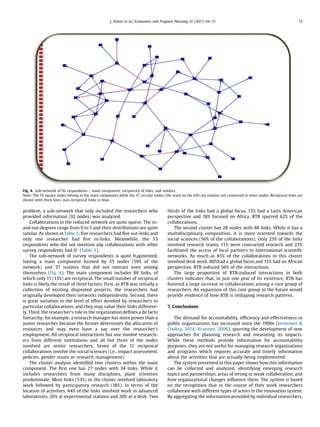
The sub-network of survey respondents is quite fragmented,
having a main component formed by 55 nodes (59% of the
network) and 37 isolates that did not interact even among
themselves (Fig. 4). The main component includes 88 links, of
which only 11 (13%) are reciprocal. The small number of reciprocal
links is likely the result of three factors. First, as RTB was initially a
collection of existing disjointed projects, the researchers had
originally developed their networks independently. Second, there
is great variation in the level of effort devoted by researchers to
particular collaborations, and they may value their links different-
ly. Third, the researcher’s role in the organization defines a de facto
hierarchy; for example, a research manager has more power than a
junior researcher because the former determines the allocation of
resources and may even have a say over the researcher’s
employment. All reciprocal interactions but one involve research-
ers from different institutions and all but three of the nodes
involved are senior researchers. Seven of the 11 reciprocal
collaborations involve the social sciences (i.e., impact assessment,
policies, gender issues or research management).
The cluster analysis identified two clusters within the main
component. The first one has 27 nodes with 34 links. While it
includes researchers from many disciplines, plant scientists
predominate. Most links (53%) in the cluster involved laboratory
work followed by participatory research (18%). In terms of the
location of activities, 44% of the links involved work in advanced
laboratories, 26% at experimental stations and 20% at a desk. Two
thirds of the links had a global focus, 15% had a Latin American
perspective and 18% focused on Africa. RTB spurred 62% of the
collaborations.
The second cluster has 28 nodes with 48 links. While it has a
multidisciplinary composition, it is more oriented towards the
social sciences (56% of the collaborations). Only 23% of the links
involved research teams, 11% were contracted research and 23%
facilitated the access of local partners to international scientific
networks. As much as 85% of the collaborations in this cluster
involved desk work, 80%had a global focus and 15% had an African
perspective. RTB induced 56% of the interactions.
The large proportion of RTB-induced interactions in both
clusters indicates that, in just one year of its existence, RTB has
fostered a large increase in collaborations among a core group of
researchers. An expansion of this core group in the future would
provide evidence of how RTB is reshaping research patterns.
7. Conclusions
The demand for accountability, efficiency and effectiveness in
public organizations has increased since the 1990s (Immonen 
Cooksy, 2014; Kraemer, 2006), spurring the development of new
approaches for planning research and measuring its impacts.
While these methods provide information for accountability
purposes, they are not useful for managing research organizations
and programs which requires accurate and timely information
about the activities that are actually being implemented.
The system presented in this paper shows how this information
can be collected and analyzed, identifying emerging research
topics and partnerships, areas of strong or weak collaboration, and
how organizational changes influence them. The system is based
on the recognition that in the course of their work researchers
collaborate with different types of actors in the innovation system.
By aggregating the information provided by individual researchers,
Fig. 4. Sub-network of 92 respondents – main component, reciprocity of links, and isolates.
Note: The 55 square nodes belong to the main component while the 37 circular nodes (the stack on the left) are isolates not connected to other nodes. Reciprocal links are
shown with thick lines, non-reciprocal links in blue.
J. Ekboir et al. / Evaluation and Program Planning 61 (2017) 64–75 73
it is possible to identify emerging patterns in the organization’s
allocation of efforts (for example, by geography, discipline, type of
partner and gender), configuration of its research activities (e.g.,
whether researchers engage in interdisciplinary research) and
participation in innovation processes (especially, engagement with
non-research actors). The timely and accurate availability of this
information provides an important input for adaptive management
and organizational learning.
The system is descriptive, in other words, based on the
conceptual framework described in Section 2, it generates
information about the researchers’ activities. As such, it does
not say whether a particular structure is good or bad; this is a
judgement that can only be made by the managers after comparing
this information with the organization’s theory of change, values
and management needs. Also, the system is not meant for
evaluation of individual researchers as this might suffer from
self-reporting bias in the case they knew that it was going to be
used to assess their performance.
The monitoring system was designed as an organizational
learning and adaptive management tool to enable the rapid
identification of emerging research activities and collaborations,
but also of areas of low or isolated collaboration. In the case
presented, as a condition for approval, the CGIAR’s Research
Programs, must make explicit their theories of change, i.e.,
narratives that explain how the proposed research activities and
partnerships are expected to contribute to CGIAR’s development
objectives. The theories of change are an example of what Argyris
and Schön (1974) called the espoused theory, i.e., what the
organization believes it is doing and how its actions contribute to
its goals. On the other hand, in their terminology, the mapped
networks and activities are the theory in use because they
represent what the organization is actually doing. By comparing
the espoused theories and the theories in use, an organization can
identify differences in what it planned to do and what it is actually
doing. These differences signal emerging problems or opportu-
nities that the organization can address as the programs evolve.
Even more, by identifying whether (i) new partnerships are
created, (ii) existing collaborations are closed, (iii) interactions
with external partners are strengthened and (iv) research activities
are changed, the organization can monitor whether its response to
emerging issues is having the expected results.
At this stage of development of the methodology, it is not
possible to definitively identify the most effective set of
parameters to monitor the evolution of research programs and
networks. However, the specialized literature indicates that the set
should include size of the network, distribution of different types
of collaborations (especially disciplines and types of non-research
partners and geographic focus), gender dimensions, degree
distribution, connectivity (density, betweenness), analysis of
components, cut-points and blocks, reciprocity, composition per
discipline, and the shape of the distribution of links.
Currently, the system is being expanded in three directions: (a)
studying changes in resource allocations and engagement with
partners in the innovation system; (b) developing approaches to
analyze organizational learning, and (c) analyzing how different
types of research influence organizational structures, in other
words, how different is a network of biotechnologists from a
network of social scientists?.
In addition to contributing to organizational learning, the
information generated by the system can be used to answer
important research questions related to the organization of
research. For example, do the networks for specific research areas
differ among themselves? For instance, each CGIAR Research
Program (CRP) conducts specific types of research, such as focused
on a crop (for instance, breeding, agronomic practices and pest and
disease management), natural resources management (e.g.,
management of reservoirs), climate change or policies; addition-
ally, the CRPs are expected to collaborate among themselves and
with external partners. Comparing across CRPs it will be possible to
understand, for example, how the activities and networks of crop
specific CRPs differ from those of natural resource management
CRPs. Of particular interest will be the analysis of the interactions
between the different CRPs with non-research collaborators
because this information will help to understand the actual impact
pathways for different types of research. For instance, in the
analysis of RTB’s activities it was found that more than 80% of its
collaborations involved research organizations. However, from this
information it is not possible to assert that RTB does not have
effective channels to diffuse its outputs. It is possible that the
outputs are diffused by other CRPs that have more non-research
collaborators (an indirect pathway) or that the current non-
research interactions are sufficient to diffuse the outputs.
Research programs and the networks they create change as the
research process matures (Kratzer, Gemuenden and Lettl, 2008;
Gay  Dousset, 2005). Therefore, changes in the research networks
can inform how the research portfolio evolves in response to
management interventions or autonomous dynamics. By collect-
ing the information periodically (ideally every two to three years) it
will be possible to follow changes in the diversity and stability of
collaborations and teams, whether the different subnetworks
become more integrated over time, and changes in the research
portfolios and the research frameworks. However, development of
the methodology to assess changes over time in the activities and
networks is not trivial; in particular, the networks should be
modeled as stochastic dynamic processes where the probability of
two nodes interacting is influenced by a set of variables, including
management decisions.
Acknowledgements
This project was jointly undertaken by the Institutional
Learning and Change (ILAC) Initiative of the CGIAR, and the CGIAR
Research Program on Roots, Tubers and Bananas (RTB). ILAC
received specific funds from the International Fund for Agricultural
Development (IFAD), grant number 1165. RTB is supported by
CGIAR Fund Donors (complete list at http://www.cgiar.org/about-
us/governing-2010-june-2016/cgiar-fund/fund-donors-2/).
References
Adams, J. (2012). The rise of research networks. Nature, 490(18/12/2012), 335–336.
Alston, J. M., Norton, G. W.,  Pardey, P. G. (1995). Science under scarcity: Principles
and practice of agricultural research evaluation and priority setting. Ithaca: Cornell
University Press.
Argyris, M.,  Schön, D. (1974). Theory in practice: Increasing professional
effectiveness. San Francisco, CA, USA: Jossey-Bass.
Axelrod, R.,  Cohen, M. D. (1999). Harnessing complexity. organizational implications
of a scientific frontier. NY: The Free Press.
Bennett, L. M., Gadlin, H.,  Levine-Finley, S. (2010). Collaboration and team science: A
field guide. Bethesda, MD, USA: National Institutes of Health [Available at:
https://ccrod.cancer.gov/confluence/download/attachments/47284665/
TeamScience_FieldGuide.pdf.].
Biggiero, L.,  Angelini, P. P. (2014). Hunting scale-free properties in RD
collaboration networks: Self-organization, power-law and policy issues in the
European aerospace research area. Technological Forecasting and Social Change.
Borgatti, S. P., Everett, M. G.,  Freeman, L. C. (2002). UCINET 6 for windows. Harvard:
Analytic technologies. 185.
Bozeman, B.,  Corley, E. (2004). Scientists’ collaboration strategies: Implications for
scientific and technical human capital. Research Policy, 33, 599–616.
Brandon, P. R., Smith, N. L., Ofir, Z.,  Noordeloos, M. (2013). Monitoring and
evaluation of african women in agricultural research and development
(AWARD) an exemplar of managing for impact in development evaluation.
American Journal of Evaluation [1098214013509876].
Cassi, L., Corrocher, N., Malerba, F.,  Vonortas, N. (2008). Research networks as
infrastructure for knowledge diffusion in European regions. Economics of
Innovation and New Technologies, 17(78), 663–676.
Davies, R. (2004). Scale, complexity and the representation of theories of change.
Evaluation, 10(1), 101–121.
74 J. Ekboir et al. / Evaluation and Program Planning 61 (2017) 64–75
Dozier, A. M., Martina, C. A., O’Dell, N. L., Fogg, T. T., Lurie, S. J., Rubinstein, E. P., et al.
(2014). Identifying emerging research collaborations and networks: Method
development. Evaluation  the Health Professions, 37(1), 19–32.
Edquist, C. (2005). Systems of innovation: Perspectives and challenges. In J.
Fagerberg, D. C. Mowery,  R. R. Nelson (Eds.), The oxford handbook of
innovationGreat Britain: Oxford University Press.
Gay, B.,  Dousset, B. (2005). Innovation and network structural dynamics: Study of
the alliance network of a major sector of the biotechnology industry. Research
Policy, 34, 1457–1475.
Gonzalez-Brambila, C. N., Veloso, F. M.,  Krackhardt, D. (2013). The impact of
network embeddedness on research output. Research Policy, 42, 1555–1567.
ISPC (Independent Science and Partnership Council) (2012). Strategic overview of
CGIAR research programs part I. Theories of change and impact pathways. Rome:
ISPC.
Immonen, S.,  Cooksy, L. L. (2014). Using performance measurement to assess
research: Lessons learned from the international agricultural research centres.
Evaluation, 20(1), 96–114.
Klenk, N. L.,  Hickey, G. M. (2013). How can formal research networks produce
more socially robust forest science? Forest Policy and Economics, 37, 44–56.
Klenk, N. L., Hickey, G. M.,  MacLellan, J. I. (2010). Evaluating the social capital
accrued in large research networks: The case of the Sustainable Forest
Management Network (1995–2009). Social Studies of Science, 40(6), 931–960.
Kraemer, S. (2006). Science and technology policy in the United States. New
Brunswick, NJ, USA: Rutgers University Press.
Kratzer, J., Gemuneden, H. G.,  Lettl, C. (2008). Revealing dynamics and
consequences of fit and misfit between formal and informal networks in multi-
institutional product development collaborations. Research Policy, 37, 1356–
1370.
La Follette, M. C. (1992). Stealing into print. Berkeley, CA, USA: University of
California Press.
Li, E. Y., Liao, C. H.,  Yen, H. R. (2013). Co-authorship networks and research impact:
A social capital perspective. Research Policy, 42, 1515–1530.
Lieff Benderly, B. (2014). The arc of the academic research career: Issues and
implications for U.S. science and engineering leadership: Summary of a workshop.
Washington, D.C: National Academy Press.
Marschall, M. (2012). Methodological pitfalls in social network analysis: Why current
methods produce questionable results. Germany: AV Akademikerverlag.
Mayne J. and Stern E., (2013) Impact evaluation of natural resource management
research programs: a broader view. ACIAR Impact Assessment Series Report No.
84. Australian Centre for International Agricultural Research: Canberra. http://
aciar.gov.au/files/ias84.pdf. Last Accessed on 4/4/2015.
Newman, M. E. J. (2003). The structure and function of complex networks. arXiv:cond-
mat/0303516 [cond-mat.stat-mech].
Patton, M. Q. (2010). Developmental evaluation: Applying complexity concepts to
enhance innovation and use. New York, NY, USA: Guilford Press.
Protogerou, A., Caloghirou, Y.,  Siokas, E. (2010). The impact of EU policy-driven
research networks on the diffusion and deployment of innovation at the
national level: The case of Greece. Science and Public Policy, 37(4), 283–296.
Rusike, J., Mahungu, N. M., Lukombo, S. S., Kendenga, T., Bidiaka, S. M., Alene, A., et al.
(2014). Does a cassava research-for-development program have impact at the
farm level? Evidence from the Democratic Republic of Congo. Food Policy, 46,
193–204.
Sonnenwald, D. H. (2007). Scientific collaboration. Annual Review of Information
Science and Technology, 4, 643–681.
Stephan, P. (2012). How economics shape science. Cambridge, MA: Harvard University
Press.
Stokes, T. D.,  Hartley, J. A. (1989). Coauthorship, social structure and influence
within specialties. Social Studies of Science, 19, 101–125.
Trochim, W., Kane, C., Graham, M.,  Pincus, H. A. (2011). Evaluating translational
research: A process marker model. Clin. Transl. Sci, 4(3), 153–162.
Varga, A.,  Parag, A. (2009). Academic knowledge transfers and the structure of
international research networks. Working paper intangible assets and regional
economic growth (IAREG) 1.3d. [Available at: http://www.iareg.org/fileadmin/
iareg/media/papers/WP1_03d.pdf].
Wagner, C. S. (2008). The new invisible college: Science for development. Washington,
DC, USA: Brookings Institution Press.
vom Brocke, J.,  Lippe, S. (2015). Managing collaborative research projects: A
synthesis of project management literature and directives for future research.
International Journal of Project Management, 33(5), 1022–1039.
J. Ekboir et al. / Evaluation and Program Planning 61 (2017) 64–75 75

1-s2.0-S0149718916300787-main

  • 1.
    Knowing what researchorganizations actually do, with whom, where, how and for what purpose: Monitoring research portfolios and collaborations Javier Ekboir, Genowefa Blundo Canto*, Cristina Sette Impact Assessment specialist, International Center for Tropical Agriculture (CIAT), Peru A R T I C L E I N F O Article history: Received 12 April 2016 Received in revised form 1 August 2016 Accepted 4 December 2016 Available online 5 December 2016 1. Introduction Managers and policy makers have struggled to develop effective monitoring systems to track the evolution of research organiza- tions. This paper presents the first components of a novel monitoring system for monitoring such organizations. These components can be used to generate detailed static pictures of the actual activities and partnerships of a large research program or organization, in other words, what the organization is actually doing, with whom, where, how and for what purpose. It can also identify whether new incentives or organizational structures have an immediate effect on the researchers’ activities. Once developed, the full system will be able to monitor the evolution of the organization’s activities and assess mid- and long-term effects of specific incentives. Essentially, the system asks individual researchers to list all the important collaborations they engaged in during the preceding 12 months and to provide some information about these collaborations. The data are then aggregated to describe the organization’s portfolio of activities and engagement with other actors in the innovation system. The system presented here can show how an organization actually allocates its efforts which can be different from budgetary allocations. This information is important for planning and management of research. As Argyris and Schön (1974) have shown, often there is a gap between what an organization plans and what it actually does. The divergence is particularly acute in not-for-profit research organizations because researchers are expected to raise an important share of their funds, meaning that managers have limited control over the researchers’ activities. Also, the system maps research activities as they are being conducted, which is important for resource allocation. Research organizations have struggled to generate information for this purpose, reverting often to ex-ante and ex-post impact assess- ments. While ex-ante assessments can provide some guidance for decision making, they have to be revised as the research progresses because the reality is usually different from what was predicted. The methodology presented in this paper can help in these revisions. On the other hand, ex-post impact assessments cannot be used for resource allocation because they can only be conducted after enough time has passed for the impacts to be measurable, in other words, many years after the decisions have been made. Since our system can be used at relatively short intervals (ideally every two or three years) and is based on current activities, its results can be used while the projects are still being implemented. Three reasons justify analyzing the links established by researchers. Firstly, research is increasingly implemented by inter-disciplinary, multi-institutional teams that network formally and informally both locally and globally (vom Brocke & Lippe, 2015; Adams 2012; Lieff Benderly 2014; Stephan 2012; Bennett, Gadlin, & Levine-Finley, 2010). Secondly, programs to foster interdisciplinary, inter-institutional collaborations between researchers and other actors in innovation systems have been implemented in several countries and policy-makers are asking about their impacts (Trochim et al., 2011). Thirdly, collaborations with researchers and non-researchers are important influences that help researchers to better contribute to innovation processes * Corresponding author at: Centro Internacional de Agricultura Tropical – International Center for Tropical Agriculture (CIAT), Lima Office (Perú). E-mail addresses: javierekboir@gmail.com (J. Ekboir), g.blundo@cgiar.org (G. Blundo Canto), cris.sette@gmail.com (C. Sette). http://dx.doi.org/10.1016/j.evalprogplan.2016.12.002 0149-7189/© 2016 The Authors. Published by Elsevier Ltd. This is an open access article under the CC BY-NC-ND license (http://creativecommons.org/licenses/by-nc-nd/4.0/). Evaluation and Program Planning 61 (2017) 64–75 Contents lists available at ScienceDirect Evaluation and Program Planning journal homepage: www.elsevier.com/locate/evalprogplan
  • 2.
    and to becomemore productive and creative (Li, Liao, & Yen, 2013; Klenk, Hickey, & MacLellan, 2010; Wagner, 2008). Finally, there is a strong pressure on research organizations to demonstrate the social and economic impacts of their activities (Kraemer 2006; Rusike et al., 2014). Traditionally, these impacts have been measured through rates of return estimated with econometric models (see, for instance, Alston, Norton, & Pardey, 1995). However, in recent years these methods have been criticized because they depend on very strong assumptions that impose simple, constant causalities on the data and do not take into account the complexity of research, where many causes interact in ways that change over time (Patton 2010). Thus, the focus has progressively shifted to the analysis of the roles research plays in innovation and social processes, which requires both the definition of the organization’s theories of change and how its actual activities agree with or deviate from the theories of change (Mayne & Stern 2013). While there are many publications on how to build theories of change for research activities (Davies, 2004; ISPC, 2012), few works have been published on how to map the actual research activities of large programs or organizations. This paper contributes to fill this gap. The system was developed in a pilot project that involved the Roots, Tubers and Bananas CGIAR Research Program (RTB), a large agricultural “research for development” program (RTB is described in Section 4).1 The information for this project was collected only nine months after RTB started operating; therefore, its networks reflect mostly pre-existing activities. However, in its short life RTB induced important changes in the way research activities were conducted, fostering greater interaction among CGIAR centers, and refocusing partnerships according to the partners’ capabilities and RTB’s research priorities. The fact that the system could identify these changes despite their incipient nature attests to its effectiveness. Section 2 presents the conceptual framework on which the system is based. Section 3 reviews recent publications that use Social Network Analysis techniques (SNA) to analyze research networks. Section 4 presents RTB, while Section 5 discusses the methodology used in the study. Section 6 discusses the type of information that the system generates and Section 7 concludes. 2. Conceptual framework The system is strongly anchored to complexity theories (Axelrod & Cohen 1999) and evaluation frameworks based on them (Mayne & Stern 2013; Patton 2010), the innovation systems framework (Edquist 2005) and the recent literature on research systems (Stephan 2012; Wagner 2008). While several methods have been developed for monitoring programs (see, for example, Brandon et al., 2013), there is a dearth of research on monitoring complex programs and organizations such as large research institutions. The system presented in this paper is based on the observation that interactions among researchers and non-research actors in an innovation system can be represented as networks (Kratzer, Gemuneden, & Lettl, 2008) that form a complex system. These systems are characterized by the interactions among different types of actors constrained by the socioeconomic and physical environment in which they operate (Axelrod & Cohen, 1999). Due to the large number of interacting forces, complex systems are essentially unpredictable. Planning can reduce the uncertainty but cannot eliminate it. Therefore, rigid strategic planning driven by ex-ante impact assessment is of little use and actors need to adapt their strategies as they collect new information about the evolving state of the system (Patton, 2010). However, this is no easy task. Due to their limited resources, decision makers need guidance on what information should be collected and how it should be interpreted (Mayne & Stern, 2013). This guidance is provided by what the decision makers know about the process and how they expect their interventions to influence it, in other words, by their theories of change. Also, in order to be adaptive, actors need process indicators that inform them about the current state of the system. In the case of not-for-profit research organizations the theory of change and the process indicators can be built from the innovation systems framework, recent studies of the organization of research and a thorough knowledge of the organization that is being analyzed. In these organizations, the theory of change plays a critical role because they lack a clear indicator of success such as profit. According to the innovation systems framework, research has positive social and economic impacts when researchers interact with different types of research and non-research partners in knowledge processes that feature several feedback loops (Edquist, 2005). Therefore, the theory of change posits that an agricultural research organization that interacts only with advanced research institutions and a few extension agents is likely to have a smaller impact than an organization that also interacts with private firms, farmer organizations and innovative farmers. The literature on research has also found that the quality of research depends critically on the researchers having active international connec- tions (Wagner, 2008), which indicates that a researcher in a developing country that interacts only with colleagues in her organization should be less productive and creative than a researcher that has many international links. Therefore, the process indicators can be constructed from the links the organization establishes with other actors in the innovation system, and can be analyzed with simple tables and statistical methods, and SNA techniques as is explained below. It should be noted, though, that there are very few detailed studies that link research activities, the structure of networks and innovations. For example, it is not known how biotechnology networks should differ from animal health networks. Therefore, the information generated with this system can also be used to answer important theoretical and empirical questions about the relationship between research collaborations and innovation processes. Other process indicators can be constructed by analyzing the organization’s portfolio of activities. For example, the CGIAR has defined that it needs to strengthen its research on nutrition and health, with special focus on Africa and the least developed Asian and Latin American countries. With the system presented in this paper it is possible to calculate the share of collaborations established for research on a particular topic, the geographical focus, the type of research that is being conducted and other features. These results can then be compared with the organiza- tional priorities and studied over time to understand the evolution of the networks. The information can be used as an input in management decisions. Finally, since the researchers can identify whether a particular collaboration was established as a result of a specific incentive, such as a new line of financing, it is possible to identify the immediate impact of the incentive on the patterns of research activities and collaborations. The mid- and long-term effects can be identified by repeating the exercise periodically. 1 Research for development is defined as scientific activities that are expected to have positive impacts on economic and social wellbeing and the sustainable management of natural resources. J. Ekboir et al. / Evaluation and Program Planning 61 (2017) 64–75 65
  • 3.
    3. Previous useof SNA in the analysis of research networks A network is a set of nodes (in our case, researchers) who are connected among them; the connections are also called links (Newman, 2003). In most social networks, the links are not random and form well defined patterns of interaction; SNA uses mathematical tools and visualization techniques to analyze these patterns, for instance, who are the most connected researchers, or whether they collaborate with non-researchers. Important dimen- sions of the structure of research networks can be studied with networks centered on individual nodes; such networks are known in the literature as “ego networks”. Ego networks can identify, for instance, women centered networks and their evolution can help to assess programs that aim to increase the diversity of the research pool. Additionally, the analysis of the networks that were created as a result of RTB can provide evidence on the convergence of individual research projects towards an integrated program. Several methodologies have been used to analyze research networks; here we only review publications that use SNA methods. Three main methods were identified in the literature review: analysis of joint publications (co-authorship relationships), analysis of project documents (project partnerships) and direct surveys of researchers. Studies based on co-authorship relationships identify patterns of interaction exploring databases of scientific articles. In general, two authors are considered to have a direct link if they co-authored at least one paper. When a large number of co-authorships are identified, a map of interactions emerges. Due to the availability of large datasets, this has been the most common approach to study research networks; recent papers include Li, Liao and Yen (2013), Gonzalez-Brambila, Veloso and Krackhardt (2013), Klenk et al. (2010). This approach documents collaborations that resulted in scientific publications but ignores connections for capacity building and advocacy; it also does not include informal collaborations, which have been recognized as important compo- nents of scientific work even if they do not result in scientific publications (Varga & Parag, 2009; Kratzer, Gemuenden, & Lettl, 2008). Other problems with this approach are that researchers may be included as co-authors for social reasons (La Follette,1992) or because they provide data or equipment (Stokes & Hartley, 1989). Finally, scientific papers often take several months to be published, by which time the collaboration may no longer be active. Studies of project partnerships analyze project documents, mainly joint proposals and publications, to identify research collaborations. The main difference with co-authorship relation- ships is that project partnerships are more likely to include non- scientific collaborations. Several countries have implemented projects promoting research and innovation networks, including the European Framework Programs and the Canadian Network of Centers of Excellence. Analyses of project partnerships include Biggiero and Angelini (2014), Klenk and Hickey (2013), Protogerou, Caloghirou and Siokas (2010) and Cassi et al. (2008). Two drawbacks of this approach are that it overlooks informal interactions and only captures interactions that are relevant for documentation of the project, which may have not resulted in effective collaborations. Approaches based on co-authorship relationships and project partnerships cannot be used in research areas with low propensity to publish (such as engineering or development of agricultural equipment) or where informal interactions are common. Addi- tionally, they may lead to the inclusion of collaborations that exist only on paper. One way to overcome these problems is to elicit information directly from the researchers. Dozier et al. (2014) and Bozeman and Corley (2004) used a strategy based on self-reported information about the researchers’ networks to capture active formal and informal collaborations as well as non-research interactions. Klenk and Hickey (2013) used an internet-based questionnaire to elicit respondents’ collaborations within two Canadian research programs. Kratzer, Gemuneden, & Lettl, (2008) asked researchers to report about their perception of the strength of informal collaborations among institutions named in a roster. 4. What is the CGIAR root, tubers and bananas research program?2 The CGIAR is a mission oriented global organization that conducts research that contributes to solve problems affecting poor rural households in developing countries, enhance health and nutrition and improve the management of natural resources.3 CGIAR’s activities are mostly conducted by 15 international research centers organized in research programs, RTB being one of them.4 In 2008 CGIAR embarked in a major reorganization that involved the creation of the CGIAR Research Programs as umbrella organizations for pre-existing projects with the expectation that over time they would reshape the CGIAR’s research portfolio and interactions with other actors in the agricultural innovation system. RTB was launched in 2012 to bring together research on banana, plantain, cassava, potato, sweet potato, yam, and other root and tuber crops to improve food security, nutrition and livelihoods. The program focuses on cutting-edge genomic research, international collaborations to address priority pests and diseases, and research to increase harvests and improve postharvest options. RTB is based on a partnership of five research centers: the International Potato Center (CIP), which leads the program, Bioversity International (Bioversity), the International Center for Tropical Agriculture (CIAT), the International Institute of Tropical Agriculture (IITA) and the Centre de Coopération Internationale en Recherche Agrono- mique pour le Développement (CIRAD). Currently, the program collaborates with 366 partners, including national agricultural research organizations, academic and advanced research institu- tions, non-governmental organizations, and private sector com- panies. Partnerships, communication and knowledge sharing are key strategies that the program relies on achieve impacts. 5. Methods The system has three distinct components. The first one is the collection of information directly from the researchers on the activities and collaborations they engage in. This information captures actual activities and collaborations instead of activities and collaborations identified fromwritten documents that may not be active. The second component is the analysis of the data with tables and statistical tools. Through this component it is possible to (a) compose a comprehensive picture of the organization’s actual portfolio of activities and partnerships, (b) identify the allocation of the organization’s efforts across activities and partnerships, and (c) explore several dimensions of those activities and collabo- rations, such as their relative importance, gender dimensions and geographic or disciplinary focus. Finally, SNA techniques are used to discover configurations in the collaborations (e.g., the collective structure of collaborations, reciprocity, or the transdisciplinarity of the organization’s activities). The three components make it possible to identify aggregate patterns in the organization of research and partnerships, areas of strong integration or isolated 2 www.rtb.cgiar.org. 3 www.cgiar.org. 4 A complete list of all CGIAR Research Programs can be found at http://www. cgiar.org/our-research/cgiar-research-programs/ 66 J. Ekboir et al. / Evaluation and Program Planning 61 (2017) 64–75
  • 4.
    collaborations, and theinfluence new programs have on these indicators. The information used in this project was collected with a user- friendly, web-based survey for researchers fully or partially funded by RTB. The questionnaire was designed so that completion would not exceed 30 min for researchers reporting up to 10 collabo- rations. The survey was conducted between September 25 and November 23, 2012. To induce managers to support the analysis and researchers to provide accurate information, they were informed that the information was to be kept confidential, that the reports were not meant to be used for accountability (of programs or individuals) and that the results could not be used to compare different research programs. All researchers were asked to list the names of the collaborators they engaged with while conducting their research. Collaborations were defined as a formal or informal sustained relationship in which a researcher effectively cooperated with other actors in the innovation system (including researchers, extension agents, research managers, input suppliers, output buyers and policy- makers); this definition is similar to the one proposed by Sonnenwald (2007). Following published research (Bozeman and Corley, 2004; Dozier et al., 2014), the interpretation of this statement was left to the respondents. The researchers were asked to consider all types of collabo- rations important for their work in the RTB network, including research projects, innovation platforms, advocacy networks and/or capacity building activities. It was specified that these collabo- rators may work in the same research center, in another CGIAR center or in non-CGIAR organizations and that the collaborations may be formal or informal (e.g., a community of practice) and not necessarily be financed by RTB. They were also asked to provide several attributes of each collaboration, including type and topic of research, gender of the collaborator, geographic focus and location of activities (e.g., desk, experimental station or farmer’s field). Of particular importance was the question if the collaboration had been induced by RTB. To avoid the problem of memory lapses with regard to past collaborations and to capture active relationships, researchers were asked to report only collaborations that had been active in the twelve months prior to the survey. The information from the individual researchers was aggregat- ed into categories defined for each of the variables of interest and tabulated. In some cases, the categories were defined in cardinal numbers, in others, in intervals and the analysis was conducted for proportions. In all cases, the results were calculated for the collaborations that were induced by RTB and those that were not. By comparing both results, it was possible to identify the immediate influence of the research program. In the case of the proportions, a Chi square test was used to test whether the difference between the distributions of collaborations induced by RTB and those not induced by it was significantly different from 0. The SNA analysis was conducted with UCINET 6 and NETDRAW (Borgatti et al., 2002). The information was collected only from researchers funded by RTB but not from their collaborators. Collecting information from the latter would have required a massive amount of resources. Since the collaborators are also likely to collaborate among themselves, the full network should be more connected than the one mapped. To take into account that most named collaborators did not respond to the survey, two separate SNA analyses were conducted, one with the full dataset (i.e., respondents and collaborators mentioned by the respondents) and the other using information only about the respondents. The larger dataset was used to study the structure of RTB’s portfolio of activities including the range of contacts, geographic reach, main research areas, and some patterns of interaction. The smaller dataset was used to explore the network’s structure and connectivity. Additionally, the questionnaire did not explicitly state that non-research partners should be included. Thus, it is possible that non-research collaborations are underrepresented, especially if the respondents’ main activity is research and they are not fully aware of the other dimensions of their work, such as capacity building or advocacy. Anecdotal evidence indicates that this is a common problem. The methodology has three limitations. Firstly, the self- reporting approach lacks operational precision as each researcher decides which collaborations he or she will report, and there is great variation among researchers’ willingness to provide infor- mation but also different understanding of what important collaborations are. Secondly, respondents could have forgotten some collaborators. Thirdly, a significant rate of response is necessary to achieve representativeness of the organization’s research portfolio and actual collaborations. Researchers’ motiva- tions for reporting or not reporting certain partnerships and the incentives to achieve a significant rate of response is beyond the scope of this study, but should be taken into account when using this system. A very strong support from the top authorities is critical for the project’s success. Taken together, these limitations mean that the estimates of some parameters (e.g., density) are probably biased downwards due to the exclusion of some links from the calculations. Solutions for correcting these biases have been proposed in the literature (Marschall, 2012), but they require the imposition of strong assumptions about the true (unknown) distribution of links. Thus, the correction of the bias would come at the cost of using more prior information, which could cause additional biases. Due to the lack of clear indications about how to deal with these problems, the estimates of the network parameters were not corrected. Despite these limitations, the system could successfully elicit from the researchers information about the activities they engaged in and their collaborators. The information was accurate enough to provide a clear picture of the organization’s portfolio of activities and of the researchers’ immediate networks. 6. Results The questionnaire was sent to 126 researchers and the number of valid responses was 92, giving an effective response rate of 75%. The survey identified 702 links, of which 134 (19%) were enabled by RTB. RTB’s research network was found to be quite diverse, including 624 individual collaborators from 302 distinct organiza- tions. Some collaborators were mentioned by more than one survey respondent. The highest number of collaborations reported was 21 and the lowest 1. All respondents but 7 worked for CGIAR centers. The respondents included researchers and senior research support staff. As was explained in Section 2, the tables and SNA results only have meaning when interpreted through (a) the theory of change, (b) the literature on innovation systems and organization of science, and (c) a thorough knowledge of the organization that is being analyzed. This section presents some examples of how these three elements can be combined with the quantitative information generated by the system to understand the current structure of research activities and collaborations and what this means for a research organization. It should be remembered that for the time being the system is static; therefore, the results are a baseline against which it will be possible to assess organizational change. The analysis was conducted for the RTB case. The results are presented in three subsections. The first one analyses RTB’s portfolio and the influence that the creation of the research program had on the whole set of activities included under its umbrella. The second subsection discusses particular param- eters of the full network of RTB’s researchers, including geographic and gender based networks and interactions with non-research J. Ekboir et al. / Evaluation and Program Planning 61 (2017) 64–75 67
  • 5.
    partners. Finally, thethird subsection studies the network formed only by those researchers who filled the questionnaire; this study sheds light on particular features such as reciprocity, clustering and connectivity. 6.1. Organization of RTB’s activities The system provided a clear picture of the portfolio of RTB’s activities and how they changed as a result of the creation of RTB. For example, Table 1 shows the number of partnerships by type of organization and whether the collaboration was enabled by RTB. The activities that were not enabled by RTB either were inherited from previous programs or were not funded by RTB but are still reported as part of it. The column on the far right in Table 1 shows the difference between the distributions of RTB-induced and non- RTB-induced collaborations. More than half of the collaborations induced by RTB (51%) were established among international research institutes (mainly CGIAR centers), compared with just 22% of non-RTB-induced collaborations. Meanwhile, the propor- tion of interactions with advanced research institutes and national research organizations was substantially lower as compared with non-RTB-induced collaborations. In short, an important result of RTB was to induce a proportional increase of collaborations among CGIAR centers and a proportional decrease in collaborations with advanced research organizations and national research systems from developing countries. Also, the share of interactions with non-research partners was slightly lower among RTB-induced collaborations, indicating that RTB did not immediately induce stronger links of researchers with other actors in the innovation system, as its theory of change indicates should have happened. This shifting pattern of collaborations reflects the initial need to bring together a diverse group of projects and researchers that previously operated under a different organizational structure. A similar analysis conducted at a later date could indicate if these patterns are maintained over time. The changes in the patterns of interaction can also be tracked by analyzing the collaborations by research area and type of organization (Table 2). The findings indicate that RTB has induced a shift in partnerships according to the partners’ strengths. Collaborations among CGIAR scientists formed a larger share of the RTB-induced collaborations in areas where they have traditionally had strong capabilities (e.g., breeding and germplasm conservation), new areas that are critical in the change process (e.g., research management, impact assessment and gender issues) and ‘emerging’ areas that do not require major investments (e.g., GIS and climate change). On the other hand, there was a comparatively higher proportion of collaborations with other research institutions in areas where the latter have stronger capabilities, such as biotechnology in the case of advanced research institutes, and innovation platforms, seed systems and post-harvest in the case of national research organizations. At the same time, RTB had a smaller share of collaborations with these partners in areas where they lack a clear advantage, for example, collaborations for breeding with advanced research institutes. Moreover, RTB appears to have had an influence on the nature of research activities: germplasm conservation and gender issues in particular represented a larger proportion of the RTB-induced collaborations, while biotechnology, value chains, breeding, and pest and disease management had a smaller share. Most of the reported collaborations had multiple purposes: 650 (93%) had research objectives, 444 (63%) included capacity building activities and 200 (28%) incorporated advocacy goals. However, RTB has a clear research focus: 558 collaborations (79% of the total) included national research organizations, CGIAR centers and advanced research institutions, while only 75 collaborations (11%) were established with disseminators of technical informa- tion, such as NGOs, CBOs and private firms. As shown in Table 3, a higher proportion of RTB-induced collaborations involved desk work and research in farmers’ fields, while a lower proportion took place in regular and advanced laboratories, as compared to non-RTB-induced collaborations. RTB appears to have influenced the type of research CGIAR centers perform, increasing what is usually known as ‘downstream’ research compared to ‘upstream’ research.5 6.2. Analysis of the whole data set with SNA The analysis of the whole data set with SNA reveals a network of weakly connected actors, with no individual playing a clear intermediary role. This structure reflects in part the genesis of RTB, which originated as an umbrella organization for a large number of pre-existing projects created without a unifying strategy. Future Table 1 Types of organizations mentioned, by type of collaboration, and relative importance. Type of organizationa Not RTB-induced (1) RTB-induced (2) Not RTB-induced in% (3) RTB-induced in% (4) Difference in% (4)- (3)c International research institutes (mainly CGIAR centers)b 124 68 22 51 29 National NGOs 10 6 2 4 2 Extension agencies 0 1 0 1 1 National private firms 10 3 2 2 0 Independent consultants 7 2 1 1 0 Ministry or other public offices (not public research organizations) 12 3 2 2 0 Other 2 0 0 0 0 International NGOs 12 2 2 1 À1 Farmer organizations and CBOs 11 1 2 1 À1 Multilateral organizations (e.g., FAO, GFAR or World Bank) 14 2 3 1 À2 Multinational firms 10 0 2 0 À2 International Cooperation Agencies (CIRAD or GIZ) 23 0 4 0 À4 National research organizations or national universities 182 36 33 27 À6 Advanced research institutes (including universities from developed countries) 138 10 25 7 À18 Total 555 134 100 100 a For 13 collaborations, the type of organization involved was not specified. b This includes two international research centers that do not belong to CGIAR, which were mentioned six times. c A x2 test indicated that the probability that columns 3 and 4 were derived from the same distribution was almost 0 (exactly 1.28E-8). 5 Downstream research is expected to be used by non-researchers shortly after the release of the research results/outputs while there is no such expectation for upstream research. Upstream research is similar to (but not exactly the same as) basic research, while downstream research includes applied research and development. 68 J. Ekboir et al. / Evaluation and Program Planning 61 (2017) 64–75
  • 6.
    surveys will helpto determine whether RTB evolves into a more coherent research program. Having relatively sparse connections is also a consequence of the network’s size; because humans have limited time to interact among themselves, as nodes are added to the network the number of actual links each person has grows slower than the maximum number of possible interactions. The analysis also revealed that most researchers were engaged in multidisciplinary networks, and no clusters defined by discipline or geographic focus were identified. On the other hand, there was some grouping based on the specific location of the research activities (e.g., a laboratory or farmers’ fields). The out-degrees (i.e., the number of people a person contacts) ranged from 0 to 21, while the in-degrees (i.e., the number of people that contact a person) ranged from 0 to 5 (Table 4). The difference in the distributions of the in- and out-degrees can be explained because only 15% of the people mentioned by respondents also answered the survey, and also because people have different commitments to relationships and value the interactions differently (for example, a researcher that allocates 80% of her time to a project values the collaboration differently than a researcher that allocates only 5% of his time); similar asymmetries arise in mentor and mentee relationships, in Table 2 Collaborations by type of organization and research area (as a percentage of collaborations by research area). Type of organization ! Research area # ARI ICA INGO IRI NARO NNGO M- firm N- firm Min Other IC CBO M-or g Pest and disease management non-RTB induced (N-R) 27 0 1 21 42 0 2 0 2 0 1 1 2 RTB-induced (R) 18 0 0 24 41 0 0 6 6 6 0 0 0 Breeding (plant, animal, fish) N-R 18 5 0 18 49 0 4 3 1 1 0 0 0 R 0 0 0 53 33 13 0 0 0 0 0 0 0 Germplasm conservation N-R 28 9 0 15 37 0 0 0 4 0 0 2 4 R 18 0 0 53 24 6 0 0 0 0 0 0 0 Biotechnology N-R 26 6 3 18 35 0 6 6 0 0 0 0 0 R 67 0 0 0 33 0 0 0 0 0 0 0 0 Seed systems N-R 8 5 8 16 32 13 0 3 3 0 0 11 3 R 0 0 40 0 40 0 0 0 0 0 0 0 20 Impact assessment N-R 10 3 0 77 3 0 0 3 0 0 3 0 0 R 0 0 0 91 0 9 0 0 0 0 0 0 0 Post-harvest N-R 35 12 0 12 38 0 0 4 0 0 0 0 0 R 0 0 0 17 58 8 0 0 17 0 0 0 0 Innovation platforms N-R 16 6 0 13 29 3 0 6 0 3 3 13 6 R 0 0 0 0 50 0 0 0 0 0 0 0 50 ‘Local’ natural systems (e.g., agronomy, agroforestry) N-R 22 7 4 15 44 7 0 0 0 0 0 0 0 R 33 0 0 33 33 0 0 0 0 0 0 0 0 Human health and nutrition N-R 33 4 8 21 29 0 0 0 4 0 0 0 0 R 20 0 0 0 60 20 0 0 0 0 0 0 0 Crop production N-R 5 0 0 36 50 0 0 0 0 0 9 0 0 R 0 0 0 33 33 0 0 33 0 0 0 0 0 Research management N-R 6 0 6 44 6 6 0 0 6 0 13 0 13 R 0 0 0 88 13 0 0 0 0 0 0 0 0 ‘Large’ natural systems (e.g., climate change) N-R 69 0 0 19 13 0 0 0 0 0 0 0 0 R 0 0 0 50 33 0 0 0 0 0 17 0 0 Policies N-R 23 0 8 46 8 0 0 8 0 0 0 0 8 R 0 0 0 67 0 0 0 0 0 0 33 0 0 GIS N-R 33 0 0 33 33 0 0 0 0 0 0 0 0 R 0 0 0 100 0 0 0 0 0 0 0 0 0 ICT N-R 20 0 20 20 0 0 20 0 0 0 0 0 20 R 0 0 0 50 0 0 0 0 0 0 0 50 0 Gender issues N-R 0 0 0 0 0 0 0 0 0 0 0 0 0 R 0 0 0 100 0 0 0 0 0 0 0 0 0 Key: ARI, advanced research institute; ICA, international cooperation agency; INGO, international NGO; IRI, international research institute (including CGIAR centers); NARO, national agricultural research institute; NNGO, national NGO; M-firm, multinational firm; N-firm, national firm; Min, ministry or public organization; IC, independent consultant; CBO, community-based organization; M-org, multilateral organization; N-R, non-RTB-induced; R, RTB-induced. Table 3 Location of the collaborations. Location of collaboration All collaborations (1) Not RTB-induced (2) RTB-induced (3) Not RTB-induced in% (4) RTB-induced in% (5) Difference in% (5)-(4)a Desk 165 118 47 21 35 14 Farmers’ fields 157 117 40 21 30 9 Partner’s location (e.g., market or ministry) 28 24 4 4 3 À1 Experimental station 120 99 21 18 16 À2 Regular lab 52 45 7 8 5 À3 Advanced lab 164 150 14 27 11 À16 Totala 686 553 133 100 100 a For 16 collaborations, the location was not specified. b A x2 test indicated that the probability that columns 4 and 5 were derived from the same distribution was almost 0. J. Ekboir et al. / Evaluation and Program Planning 61 (2017) 64–75 69
  • 7.
    Table 4 Number ofrespondents that reported a specific number of collaborators and were mentioned as collaborators by others. Number of collaborations Out-degrees (mentioned others) In-degrees (mentioned by others) 21 1 0 20 7 0 19 2 0 18 1 0 17 0 0 16 1 0 15 0 0 14 0 0 13 0 0 12 0 0 11 2 0 10 23 0 9 1 0 8 3 0 7 5 0 6 8 0 5 6 2 4 8 6 3 4 20 2 7 61 1 13 486 0 532 49 Fig. 1. Map of all 15 components in the whole network. 70 J. Ekboir et al. / Evaluation and Program Planning 61 (2017) 64–75
  • 8.
    hierarchical relationships, andin situations where a researcher provides crucial information for a project but receives little in return. This information would be more useful if the system was used periodically because it could trace whether the researchers become more interconnected which would reflect a more coherent program. No node was found to have a strong influence as measured by the average number of degrees (i.e., a node’s number of connections as a proportion of the total number of nodes). The maximum average out-degree was 0.034, meaning that even the best-connected node contacted just 3.4% of the nodes in the network. The maximum average in-degree was 0.008, meaning that the best-connected node was contacted by only 0.8% of the nodes in the network. In other words, no researcher has a dominant position in the network; even more, not even the “most important” researchers in a research area occupy a central position in the network. This observation is confirmed by other parameters discussed below and the implications for RTB are discussed in the conclusions. The connectivity of the network was analyzed with Freeman’s graph centralization index, which measures the number of existing links as a proportion of the links that would be present in a star graph of the same dimension. The out-degree centralization index is 3.20%; the small value indicates that no researcher had a positional advantage in the network.6 The most central actors, i.e., the researchers with higher in- and out-degrees, were not directly connected among themselves. A component is defined as a subset of connected nodes that have no connections outside this group. As shown in Fig. 1, the whole network comprises one large component with 561 nodes (90% of the total) and 14 smaller components that range in size from 2 to 11 nodes. All the collaborations with a global focus were part of the main component, indicating that information of global importance can circulate to most nodes in the network. The small components were largely made up of partners working at experimental stations or in farmers’ fields and with a regional focus, indicating that these components may be relatively local, working in isolated projects. On the other hand, these isolates could be researchers who have difficulties integrating into the new structure. With this information, RTB’s management can look into these smaller networks to identify if they need support to change their work patterns. The distance-based measures are calculated only within the main component. The average density (0.002) is quite low, reflecting the fact that it is a relatively large network and most nodes did not participate in the survey. The main component is relatively well connected; the average distance is 4.093 and the diameter is 10 (any node is no more than ten steps away from any other). Betweenness centrality for the whole network is 73%, indicating that a few intermediaries not only had several connections but were also linked to people who were well connected. Some of the nodes with high betweenness centrality have low degrees, meaning that although these individuals did not have many connections, they linked different groups of researchers. As shown in Fig. 2, the nodes with highest intermediary power (betweenness centrality) included breeders and agronomists. The most con- nected researchers interacted with collaborators from different disciplines. However, the researchers working on plant breeding Fig. 2. Facilitation of communication by discipline of the researchers in the main component of RTB’s network. Note: The size of the node indicates its betweenness. 6 The in-degree centralization is meaningless in a network like this where a large proportion of nodes did not provide information. J. Ekboir et al. / Evaluation and Program Planning 61 (2017) 64–75 71
  • 9.
    and plant geneticshad less diverse networks. Few of the collaborations of the central nodes resulted from RTB – a result that was anticipated since the well-connected researchers have been in the system for several years and RTB was only nine months old at the time of the survey. The main component is quite robust. When a network has low density it can be fragile in the sense that the removal of a node may break the network into separate parts. Such nodes are known as ‘cut-points’ and the nodes that would become separated are the ‘blocks’. The main component in this study has six blocks and four cut-points. The removal of the cut-points has little effect on the network structure because only the collaborators of the removed nodes would be lost. The small effect that the removal of a cut- point would have on the structure of the network implies that the departure of particular researchers, even the most connected, would not have major consequences in terms of network connectivity, even though it may significantly affect the efficiency of information transmittal (lower betweenness centrality) and research capacity (i.e., if highly specialized researchers were lost). Sub-network of RTB-induced collaborations: RTB induced the creation of 134 links, involving a total of 131 nodes; this sub-network is split into 16 components of at least three people each (Fig. 3). The largest components have clear geographical focus. The largest component of this sub-network has 42 nodes (31% of the RTB network), has a global focus and is highly multidisciplinary, as represented by the diversity of numbers in Fig. 3. However, most social scientists (red nodes) are connected to the component by a central node. Plant pathologists, entomolo- gists and plant biologists (light blue) are also mostly connected by one node. Reportedly, half of the collaborations occurred on a monthly basis, about 70% were based on desk work and 65% of the links had a global focus. The second-largest component has 32 nodes, with a less diverse mix of disciplines. There is a strong connection with Latin America. The third-largest component has an African focus. The work is conducted mainly in farmers’ fields, and about half of it is on a contract basis, involving partners from several disciplines. The component has two distinct sub-groups formed around individual nodes and linked by one single node. The relatively dispersed structure of the RTB-induced sub-network reflects RTB’s origins as a combination of pre-existing projects. As RTB reorients research according to its priorities, the smaller components should become more inter-connected. 6.3. Analysis of the network of 92 survey respondents The analysis of the full network did not allow for the exploration of reciprocal links and redundant paths because most nodes were not asked to complete the survey, as they were mentioned as collaborators by the survey respondents but their salaries were not, even partially, paid by RTB. To overcome this Fig. 3. RTB induced sub-network and components. Note: Note: The numbers represent disciplines and affiliations, as follows: 1 = social scientists, 2 = agronomists, 3 = livestock, 3 = breeders, 5 agriculture system research, 6 = research management, 7 = communications specialists, 8 = geneticists, 9 = plant pathologists, 10 = biologists, 11 = GIS/geography, 12 = donors, 13 = government/NGO, 14 = nutritionists/health, 15 = forestry, 16 = post-harvest, 17 = private sector Table 5 Number of researchers with a specific number of links. Number of collaborations Out-degrees In-degrees 5 5 1 4 3 4 3 6 12 2 11 8 1 14 18 0 53 49 72 J. Ekboir et al. / Evaluation and Program Planning 61 (2017) 64–75
  • 10.
    problem, a sub-networkthat only included the researchers who provided information (92 nodes) was analyzed. Collaborations in the reduced network are quite sparse. The in- and out-degrees range from 0 to 5 and their distributions are quite similar. As shown in Table 5, five researchers had five out-links and only one researcher had five in-links. Meanwhile, the 53 respondents who did not mention any collaborations with other survey respondents had 0 (Table 5). The sub-network of survey respondents is quite fragmented, having a main component formed by 55 nodes (59% of the network) and 37 isolates that did not interact even among themselves (Fig. 4). The main component includes 88 links, of which only 11 (13%) are reciprocal. The small number of reciprocal links is likely the result of three factors. First, as RTB was initially a collection of existing disjointed projects, the researchers had originally developed their networks independently. Second, there is great variation in the level of effort devoted by researchers to particular collaborations, and they may value their links different- ly. Third, the researcher’s role in the organization defines a de facto hierarchy; for example, a research manager has more power than a junior researcher because the former determines the allocation of resources and may even have a say over the researcher’s employment. All reciprocal interactions but one involve research- ers from different institutions and all but three of the nodes involved are senior researchers. Seven of the 11 reciprocal collaborations involve the social sciences (i.e., impact assessment, policies, gender issues or research management). The cluster analysis identified two clusters within the main component. The first one has 27 nodes with 34 links. While it includes researchers from many disciplines, plant scientists predominate. Most links (53%) in the cluster involved laboratory work followed by participatory research (18%). In terms of the location of activities, 44% of the links involved work in advanced laboratories, 26% at experimental stations and 20% at a desk. Two thirds of the links had a global focus, 15% had a Latin American perspective and 18% focused on Africa. RTB spurred 62% of the collaborations. The second cluster has 28 nodes with 48 links. While it has a multidisciplinary composition, it is more oriented towards the social sciences (56% of the collaborations). Only 23% of the links involved research teams, 11% were contracted research and 23% facilitated the access of local partners to international scientific networks. As much as 85% of the collaborations in this cluster involved desk work, 80%had a global focus and 15% had an African perspective. RTB induced 56% of the interactions. The large proportion of RTB-induced interactions in both clusters indicates that, in just one year of its existence, RTB has fostered a large increase in collaborations among a core group of researchers. An expansion of this core group in the future would provide evidence of how RTB is reshaping research patterns. 7. Conclusions The demand for accountability, efficiency and effectiveness in public organizations has increased since the 1990s (Immonen Cooksy, 2014; Kraemer, 2006), spurring the development of new approaches for planning research and measuring its impacts. While these methods provide information for accountability purposes, they are not useful for managing research organizations and programs which requires accurate and timely information about the activities that are actually being implemented. The system presented in this paper shows how this information can be collected and analyzed, identifying emerging research topics and partnerships, areas of strong or weak collaboration, and how organizational changes influence them. The system is based on the recognition that in the course of their work researchers collaborate with different types of actors in the innovation system. By aggregating the information provided by individual researchers, Fig. 4. Sub-network of 92 respondents – main component, reciprocity of links, and isolates. Note: The 55 square nodes belong to the main component while the 37 circular nodes (the stack on the left) are isolates not connected to other nodes. Reciprocal links are shown with thick lines, non-reciprocal links in blue. J. Ekboir et al. / Evaluation and Program Planning 61 (2017) 64–75 73
  • 11.
    it is possibleto identify emerging patterns in the organization’s allocation of efforts (for example, by geography, discipline, type of partner and gender), configuration of its research activities (e.g., whether researchers engage in interdisciplinary research) and participation in innovation processes (especially, engagement with non-research actors). The timely and accurate availability of this information provides an important input for adaptive management and organizational learning. The system is descriptive, in other words, based on the conceptual framework described in Section 2, it generates information about the researchers’ activities. As such, it does not say whether a particular structure is good or bad; this is a judgement that can only be made by the managers after comparing this information with the organization’s theory of change, values and management needs. Also, the system is not meant for evaluation of individual researchers as this might suffer from self-reporting bias in the case they knew that it was going to be used to assess their performance. The monitoring system was designed as an organizational learning and adaptive management tool to enable the rapid identification of emerging research activities and collaborations, but also of areas of low or isolated collaboration. In the case presented, as a condition for approval, the CGIAR’s Research Programs, must make explicit their theories of change, i.e., narratives that explain how the proposed research activities and partnerships are expected to contribute to CGIAR’s development objectives. The theories of change are an example of what Argyris and Schön (1974) called the espoused theory, i.e., what the organization believes it is doing and how its actions contribute to its goals. On the other hand, in their terminology, the mapped networks and activities are the theory in use because they represent what the organization is actually doing. By comparing the espoused theories and the theories in use, an organization can identify differences in what it planned to do and what it is actually doing. These differences signal emerging problems or opportu- nities that the organization can address as the programs evolve. Even more, by identifying whether (i) new partnerships are created, (ii) existing collaborations are closed, (iii) interactions with external partners are strengthened and (iv) research activities are changed, the organization can monitor whether its response to emerging issues is having the expected results. At this stage of development of the methodology, it is not possible to definitively identify the most effective set of parameters to monitor the evolution of research programs and networks. However, the specialized literature indicates that the set should include size of the network, distribution of different types of collaborations (especially disciplines and types of non-research partners and geographic focus), gender dimensions, degree distribution, connectivity (density, betweenness), analysis of components, cut-points and blocks, reciprocity, composition per discipline, and the shape of the distribution of links. Currently, the system is being expanded in three directions: (a) studying changes in resource allocations and engagement with partners in the innovation system; (b) developing approaches to analyze organizational learning, and (c) analyzing how different types of research influence organizational structures, in other words, how different is a network of biotechnologists from a network of social scientists?. In addition to contributing to organizational learning, the information generated by the system can be used to answer important research questions related to the organization of research. For example, do the networks for specific research areas differ among themselves? For instance, each CGIAR Research Program (CRP) conducts specific types of research, such as focused on a crop (for instance, breeding, agronomic practices and pest and disease management), natural resources management (e.g., management of reservoirs), climate change or policies; addition- ally, the CRPs are expected to collaborate among themselves and with external partners. Comparing across CRPs it will be possible to understand, for example, how the activities and networks of crop specific CRPs differ from those of natural resource management CRPs. Of particular interest will be the analysis of the interactions between the different CRPs with non-research collaborators because this information will help to understand the actual impact pathways for different types of research. For instance, in the analysis of RTB’s activities it was found that more than 80% of its collaborations involved research organizations. However, from this information it is not possible to assert that RTB does not have effective channels to diffuse its outputs. It is possible that the outputs are diffused by other CRPs that have more non-research collaborators (an indirect pathway) or that the current non- research interactions are sufficient to diffuse the outputs. Research programs and the networks they create change as the research process matures (Kratzer, Gemuenden and Lettl, 2008; Gay Dousset, 2005). Therefore, changes in the research networks can inform how the research portfolio evolves in response to management interventions or autonomous dynamics. By collect- ing the information periodically (ideally every two to three years) it will be possible to follow changes in the diversity and stability of collaborations and teams, whether the different subnetworks become more integrated over time, and changes in the research portfolios and the research frameworks. However, development of the methodology to assess changes over time in the activities and networks is not trivial; in particular, the networks should be modeled as stochastic dynamic processes where the probability of two nodes interacting is influenced by a set of variables, including management decisions. Acknowledgements This project was jointly undertaken by the Institutional Learning and Change (ILAC) Initiative of the CGIAR, and the CGIAR Research Program on Roots, Tubers and Bananas (RTB). ILAC received specific funds from the International Fund for Agricultural Development (IFAD), grant number 1165. RTB is supported by CGIAR Fund Donors (complete list at http://www.cgiar.org/about- us/governing-2010-june-2016/cgiar-fund/fund-donors-2/). References Adams, J. (2012). The rise of research networks. Nature, 490(18/12/2012), 335–336. Alston, J. M., Norton, G. W., Pardey, P. G. (1995). Science under scarcity: Principles and practice of agricultural research evaluation and priority setting. Ithaca: Cornell University Press. Argyris, M., Schön, D. (1974). Theory in practice: Increasing professional effectiveness. San Francisco, CA, USA: Jossey-Bass. Axelrod, R., Cohen, M. D. (1999). Harnessing complexity. organizational implications of a scientific frontier. NY: The Free Press. Bennett, L. M., Gadlin, H., Levine-Finley, S. (2010). Collaboration and team science: A field guide. Bethesda, MD, USA: National Institutes of Health [Available at: https://ccrod.cancer.gov/confluence/download/attachments/47284665/ TeamScience_FieldGuide.pdf.]. Biggiero, L., Angelini, P. P. (2014). Hunting scale-free properties in RD collaboration networks: Self-organization, power-law and policy issues in the European aerospace research area. Technological Forecasting and Social Change. Borgatti, S. P., Everett, M. G., Freeman, L. C. (2002). UCINET 6 for windows. Harvard: Analytic technologies. 185. Bozeman, B., Corley, E. (2004). Scientists’ collaboration strategies: Implications for scientific and technical human capital. Research Policy, 33, 599–616. Brandon, P. R., Smith, N. L., Ofir, Z., Noordeloos, M. (2013). Monitoring and evaluation of african women in agricultural research and development (AWARD) an exemplar of managing for impact in development evaluation. American Journal of Evaluation [1098214013509876]. Cassi, L., Corrocher, N., Malerba, F., Vonortas, N. (2008). Research networks as infrastructure for knowledge diffusion in European regions. Economics of Innovation and New Technologies, 17(78), 663–676. Davies, R. (2004). Scale, complexity and the representation of theories of change. Evaluation, 10(1), 101–121. 74 J. Ekboir et al. / Evaluation and Program Planning 61 (2017) 64–75
  • 12.
    Dozier, A. M.,Martina, C. A., O’Dell, N. L., Fogg, T. T., Lurie, S. J., Rubinstein, E. P., et al. (2014). Identifying emerging research collaborations and networks: Method development. Evaluation the Health Professions, 37(1), 19–32. Edquist, C. (2005). Systems of innovation: Perspectives and challenges. In J. Fagerberg, D. C. Mowery, R. R. Nelson (Eds.), The oxford handbook of innovationGreat Britain: Oxford University Press. Gay, B., Dousset, B. (2005). Innovation and network structural dynamics: Study of the alliance network of a major sector of the biotechnology industry. Research Policy, 34, 1457–1475. Gonzalez-Brambila, C. N., Veloso, F. M., Krackhardt, D. (2013). The impact of network embeddedness on research output. Research Policy, 42, 1555–1567. ISPC (Independent Science and Partnership Council) (2012). Strategic overview of CGIAR research programs part I. Theories of change and impact pathways. Rome: ISPC. Immonen, S., Cooksy, L. L. (2014). Using performance measurement to assess research: Lessons learned from the international agricultural research centres. Evaluation, 20(1), 96–114. Klenk, N. L., Hickey, G. M. (2013). How can formal research networks produce more socially robust forest science? Forest Policy and Economics, 37, 44–56. Klenk, N. L., Hickey, G. M., MacLellan, J. I. (2010). Evaluating the social capital accrued in large research networks: The case of the Sustainable Forest Management Network (1995–2009). Social Studies of Science, 40(6), 931–960. Kraemer, S. (2006). Science and technology policy in the United States. New Brunswick, NJ, USA: Rutgers University Press. Kratzer, J., Gemuneden, H. G., Lettl, C. (2008). Revealing dynamics and consequences of fit and misfit between formal and informal networks in multi- institutional product development collaborations. Research Policy, 37, 1356– 1370. La Follette, M. C. (1992). Stealing into print. Berkeley, CA, USA: University of California Press. Li, E. Y., Liao, C. H., Yen, H. R. (2013). Co-authorship networks and research impact: A social capital perspective. Research Policy, 42, 1515–1530. Lieff Benderly, B. (2014). The arc of the academic research career: Issues and implications for U.S. science and engineering leadership: Summary of a workshop. Washington, D.C: National Academy Press. Marschall, M. (2012). Methodological pitfalls in social network analysis: Why current methods produce questionable results. Germany: AV Akademikerverlag. Mayne J. and Stern E., (2013) Impact evaluation of natural resource management research programs: a broader view. ACIAR Impact Assessment Series Report No. 84. Australian Centre for International Agricultural Research: Canberra. http:// aciar.gov.au/files/ias84.pdf. Last Accessed on 4/4/2015. Newman, M. E. J. (2003). The structure and function of complex networks. arXiv:cond- mat/0303516 [cond-mat.stat-mech]. Patton, M. Q. (2010). Developmental evaluation: Applying complexity concepts to enhance innovation and use. New York, NY, USA: Guilford Press. Protogerou, A., Caloghirou, Y., Siokas, E. (2010). The impact of EU policy-driven research networks on the diffusion and deployment of innovation at the national level: The case of Greece. Science and Public Policy, 37(4), 283–296. Rusike, J., Mahungu, N. M., Lukombo, S. S., Kendenga, T., Bidiaka, S. M., Alene, A., et al. (2014). Does a cassava research-for-development program have impact at the farm level? Evidence from the Democratic Republic of Congo. Food Policy, 46, 193–204. Sonnenwald, D. H. (2007). Scientific collaboration. Annual Review of Information Science and Technology, 4, 643–681. Stephan, P. (2012). How economics shape science. Cambridge, MA: Harvard University Press. Stokes, T. D., Hartley, J. A. (1989). Coauthorship, social structure and influence within specialties. Social Studies of Science, 19, 101–125. Trochim, W., Kane, C., Graham, M., Pincus, H. A. (2011). Evaluating translational research: A process marker model. Clin. Transl. Sci, 4(3), 153–162. Varga, A., Parag, A. (2009). Academic knowledge transfers and the structure of international research networks. Working paper intangible assets and regional economic growth (IAREG) 1.3d. [Available at: http://www.iareg.org/fileadmin/ iareg/media/papers/WP1_03d.pdf]. Wagner, C. S. (2008). The new invisible college: Science for development. Washington, DC, USA: Brookings Institution Press. vom Brocke, J., Lippe, S. (2015). Managing collaborative research projects: A synthesis of project management literature and directives for future research. International Journal of Project Management, 33(5), 1022–1039. J. Ekboir et al. / Evaluation and Program Planning 61 (2017) 64–75 75