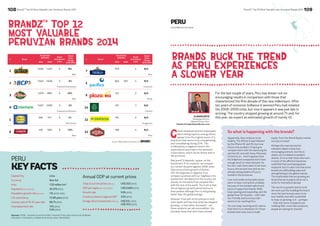
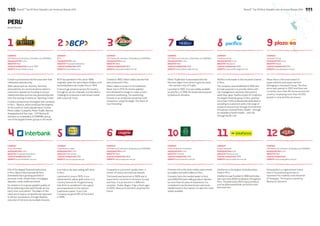
Methodology and valuation by
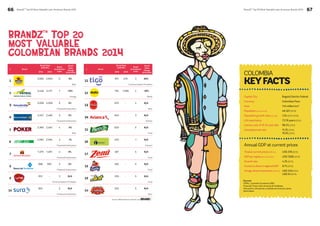
BrandZ™ Top 50 Most Valuable Latin American Brands 2014 BrandZ™ Top 50 Most Valuable L 4 atin American Brands 2014 5 
Growing Brand 
Value – A Global 
Perspective 
Since the first global brand valuations, 
the number of studies has increased. 
The BrandZTM brand valuation suite 
now includes: The BrandZTM Top 100 Most 
Valuable Chinese Brands; The BrandZTM Top 
50 Most Valuable Latin American Brands 
and The BrandZTM Top 50 Most Valuable 
Indian Brands. 
What makes the BrandZTM valuation 
methodology so definitive and uniquely 
distinguished from its competitors is the 
BrandZ™ valuation methodology. This is the 
only brand ranking that uses consumer data 
to establish every single brand contribution. 
Brand Contribution is a vital component of a 
brand valuation as it measures the influence 
of brand alone on earnings. 
We do this using the world’s largest 
brand analytics big data: the unique 
and proprietary WPP BrandZTM study. 
Conducted worldwide, it is on-going, 
in-depth quantitative consumer research 
that builds a global picture of brands on 
a category-by-category and country-by- 
country basis. Globally, our research 
covers 2.2 million consumers and more 
than 10,000 different brands in over 30 
countries. 
The uniquely consumer-facing BrandZ™ 
methodology combines this extensive 
consumer research with rigorous financial 
analysis to create the BrandZTM valuation 
methodology by Millward Brown. 
The BrandZTM big data also gives us the 
unrivalled ability to look across the world 
and see the trends and influences that 
shape brands and consumers’ relationships 
with them. Fusing this with the data and 
observations from the brand valuation 
studies generates some fascinating and 
actionable insights. 
Whilst there are undoubtedly differences 
between regions and individual countries… 
perhaps the most obvious difference with 
the valuation data in LatAm, compared to 
all the other studies across the world, is 
the strength of the LatAm beer and retail 
categories in the valuations. We do not see 
this anywhere else. (And I am deeply envious, 
both as a beer drinker and someone who also 
runs the WPP Global Retail practice). 
Deliver 
sensational value 
Brands that deliver sensational value are 
brands that are increasingly winning in 
the world. Consumers want a strong value 
proposition and brands that over-deliver in 
this are being rewarded. 
Help the consumer 
feel smart 
Brands that are passionately on the side of 
their consumers and work with them to make 
them feel and act smart are disproportionally 
valued. 
Study the young; 
view the future 
Young people desire the newest and shiniest 
products and they’re more likely to purchase 
them. They’re also less risk adverse and more 
open to trial, yet more difficult to satisfy and 
less brand loyal. 
Millennials represent 50% of the global 
workforce now, but 75% in around 10 years. 
They increasingly have a different mindset in 
their relationship with brands, one that is less 
transactional and more involving. “If I spend 
my money on a brand, I’m voting for that 
company, and I want to be treated the same 
way as if I bought stock in that company.” 
Get social and mobile 
Brands that don’t embrace the 
social world and engage in a dialogue 
with their customers are missing a 
significant route to grow relevance. 
We are living in a mobile world. Think 
brand building – Think mobile. 
Be meaningful, 
differentiate and 
build trust 
Well technically that’s three insights, 
so I am really practicing what I preach 
in trying to deliver sensational value… 
Being different, meaningful and 
relevant is imperative to becoming a 
brand that is personally significant. 
An affinity well beyond the 
transactional relationship drives the 
highest brand value across the globe 
without exception. 
Trust and recommendation are the 
most critical attributes for a brand to 
possess. Any gaps between the brand 
promise and the delivery of that 
promise erode trust and in a socially 
connected, digital, mobile world will 
be exposed in a nanosecond. 
To find out more go to 
www.brandz.com and download 
the comprehensive reports from 
the Global, China and Indian brand 
valuations. And of course there’s the 
BrandZTM mobile app to keep you up 
to date with brand news, insights and 
valuations www.brandz/mobile. 
In 2015, it will be 10 years since the first BrandZTM Top 100 Most 
Valuable Global Brands study was conducted. A lot has happened 
in the world since then, with change being the only constant. 
DAVID ROTH 
CEO 
The Store WPP 
EMEA and Asia 
droth@wpp.com 
blog: www.davidroth.com 
Twitter: @davidrothlondon 
But… there are many more similarities than differences in the 
direction of travel of consumers and brands right across the globe. 
So here, as a taster, are five insights: 
1 
4 
2 5 
3
BrandZ™ Top 50 Most Valuable Latin American Brands 2014 BrandZ™ Top 50 Most Valuable L 6 atin American Brands 2014 7 
LATIN AMERICA 
BUILDING TRUE 
LATIN AMERICAN 
BRANDS 
We Latino´s love talking about what makes us unique. 
Every country in the region feels “different” and 
special and most of the time for very good reasons! 
However often we forget that of all continents, we are 
probably the one with most things in common: only two 
languages, a culture that is more emotional than rational, 
more social than individualistic and highly creative. Our 
love for music, food, family and entertainment are very 
common realities in our region. Best proof of our unique 
identity is that while in the China BrandZTM ranking, banks 
and insurance are the biggest contributors to brand value, 
in Latin America, beer, food and personal care brands is the 
most valuable category, followed by retail. 
Many of the most salient Latin American brands have 
been successful precisely because they have managed to 
represent and engage with those motivations at a local 
level. The connection is so strong that in many cases 
after an acquisition, global companies like SABMiller and 
AmBev kept local brands like Aguila, Crystal, Quilmes and 
others as their main brand strategy in the country. And 
this has worked nicely. According to a study from Kantar 
Worldpanel (Brand Footprint 2014), Global Brands grew 0.7% 
and Local Brands grew 1.3% - nearly double the growth rate. 
And brands are a very hot topic in LatAm right now. 
According to Group M, forecasted adspend growth in 
Latin America is going to be highest in the world for 
both 2014 and 2015. 
Now the question is: how can local brands continue to 
GROW in the near future? How can they expand their 
market and their influence beyond their category or 
country? 
We believe there is a massive opportunity for growth of 
many of the LatAm Brands when they start looking at 
the whole region as their playground. 
A smaller group of brands such as Falabella, Lan, Claro, 
Itaú, Bancolombia, Natura and Avianca have been 
working for years now to become true regional LatAm 
Brands. Many others have the aspiration to do so. What 
is the opportunity if we look at LatAm as a whole?: 
• We would be the fourth largest economy in the world, 
only behind USA, China and Japan 
• We would be the 3rd most populated market with 
close to 600 million people 
So the key challenge for some LatAm Brands, including 
many of those listed in the BrandZTM Top 50 Most 
Valuable Latin American Brands 2014, is how to 
transcend their local success and build propositions 
that connect with the wider Latin America region. 
This is not an easy task, with many questions that 
are related both to strategy (how are these brands 
meaningful and different?) as well as execution (the 
efficiency of the advertising to generate saliency for the 
brand?). 
As Nigel Hollis mentions in his book “The Global 
Brand”, there are 3 layers of building meaning for a 
brand: cultural meaning, social meaning and individual 
meaning. When looking at cultural meaning “the 
interaction between a brand and a culture is most 
obvious when the brand taps into local culture directly”. 
This is no different to what most global brands are 
facing. The advantage for many Latin American brands 
is that they understand better what brings us together 
and deal more tactfully with the differences, or do 
they? The challenge is on. 
GONZALO FUENTES 
CEO 
Millward Brown Latin America 
Gonzalo.Fuentes@millwardbrown.com
BrandZ™ Top 50 Most Valuable Latin American Brands 2014 BrandZ™ Top 50 Most Valuable L 8 atin American Brands 2014 9 
LATIN AMERICA 
Winning the 
Brand Building 
Battle in Fast- 
Growing Markets 
There are two important factors that have 
influenced the rapid brand surge in fast-growing 
markets: technology innovations 
and consumer confidence. Consumers are willing to 
spend more money on high-ticket items like cars and 
luxury goods but empowered by rapidly changing 
technology – particularly mobile – these consumers 
have changed how they shop. They wait for the best 
prices and purchase more mindfully. Therefore, a 
fresh approach is needed to activate brands, to find 
new ways to engage with consumers and gain a 
greater share of life and “share of self”. 
Fast-growing brands 
aim to gain share of life 
Many forward-thinking brands are now looking to 
gain greater share of wallet by increasing their share 
of consumers’ lives, being present in more ways 
to make a customer’s life better or simpler. The 
major ecosystems – Apple, Google and Amazon – 
serve as models for surrounding consumers with 
product, services and content. But brands in diverse 
categories are engaged with customers, in useful and 
relevant ways, across many aspects of their lives. For 
example, the Chinese internet brand leaders; Tencent, 
Baidu and Alibaba are building online banking centers 
and mobile payment systems. Tesco and the Latin 
American retailer Falabella are MVNOs (Mobile Virtual 
Network Operators), are renting capacity from telecoms 
and branding a mobile service to gain a greater share of 
customer life. 
In a separate innovation aimed at reviving the soft drinks 
category and remaining relevant, Coke has launched 
‘Coca-Cola Life’ in Latin America, with cans that look like 
Coke but are green, to emphasize both sustainability and 
health to gain a “share of self”. 
Now is a critical time for local 
brands to build their meaningful 
differentiator 
Local enterprises in fast-growing markets are working 
hard to match competitors’ offerings with similar 
products, prices, and packaging. Some brand owners say: 
“Building a meaningful differentiator for a brand is a long-term 
endeavor, but we face more urgent sales pressure, 
and moreover, a good meaningful differentiator, however 
good it is, cannot translate into sales success.” Is this view 
right? The answer is an emphatic no! 
Over 10 years of the BrandZ™ database, the valuations 
of more than 10,000 brands shows that those with 
a meaningful differentiator highly connected with 
consumer needs, achieve average sales growth of more 
than four times those of their competitors. Meaningful 
differentiator is obviously a very important driver of sales. 
The establishment of meaningful differentiator is better 
sooner than later, ideally in the early stage development of 
an industry. Brands must have a purpose and be intent on 
making some difference in people’s lives, and they must 
provide something consumers want or need. In the early 
stage of the brand building journey, local brand owners 
need to ask themselves some tough questions: “Why 
does my brand exist? How can I set my brand apart from 
others?” A prominent example of this thought process is 
COFCO. The largest food and beverage company in China, 
it is committed to improving the quality of life of the 1.3 
billion people of China by building a complete brand chain 
from the field to the dinner table. 
Ensure an effective brand delivery 
and encourage experience sharing 
Good delivery is critical to a brand’s long-term success, 
because meaning originates from the brand experience. 
Ensuring that the brand’s meaningful difference is 
inherent across all touch points is the key to good delivery. 
Among the BrandZ™ Global Top 10 Most Valuable beer 
brands, four are from Latin America – Corona, Skol, 
Aguila and Brahma, while Europe and the US have three 
each. In addition to their aggressive marketing tactics, 
these successful Latin American beer brands offer 
consumers a completely different and meaningful brand 
experience. These distinctions are also evident in the 
contrasting brand personalities. Latin American beer 
brands are “sexy”, “playful” and “fun”. Those from Europe 
are more “desirable” and “brave”, while the US brands have 
less distinctive personalities. 
Smart brands not only deliver a distinctive experience 
but also invite consumers to share their experience, 
rather than share their product. In Latin America, 
Huggies moved the hearts and minds of parents when, to 
celebrate Friendship Day, it delivered a special crib for two 
newborn babies to a maternity ward. Bringing two boys 
together meant each had their first friend. And Huggies 
created a moment parents would never forget. 
When fast growing-market consumers perceive a brand 
being meaningful and differentiating across all the major 
touch points, including the in-store and e-commerce 
experience, they are far more likely to consider adding 
that brand to their repertoire. This once-in-a-lifetime 
brand building opportunity is now up for grabs in fast-growing 
markets; let’s go for it. 
versus Emerging Markets 
DOREEN WANG 
Global Head of BrandZ™ 
Millward Brown 
Doreen.Wang@millwardbrown.com 
Millions of consumers in fast-growing 
markets have significantly 
increased their spending power in the 
past decade. These consumers are 
encountering a market environment 
as complex and swiftly evolving as its 
counterparts in developed countries. 
Product choices and communication 
channels are exploding; so too is the 
potential of digital platforms.
BrandZ™ Top 50 Most Valuable Latin American Brands 2014 BrandZ™ Top 50 Most Valuable L 10 atin American Brands 2014 11 
LATIN AMERICA 
LATIN AMERICA 
OVERVIEW 
However, the growth rates differed considerably by 
country: Brazil and Mexico, the two biggest economies 
in the region (around 60% of the region’s GDP), grew 
only 2.5% and 1.1% respectively, pulling down the region 
GDP’s growth. Conversely, the other countries evaluated in 
the ranking had better performances: Argentina grew 3%, 
Chile and Colombia around 4% and Peru, 5.8%. 
The region’s modest growth of 2.6% in 2013 continued to be 
driven by domestic demand, which added 2.8 percentage 
points to GDP growth, followed by investment, which 
contributed 0.9 percentage points. Net exports continued 
contributing negatively to GDP growth (-0.8 percentage 
points), a reflection of the slowing growth of China, which 
impacted negatively in most countries of Latin America 
with commodity export profile1. Unemployment, another 
important issue in the region, fell slightly from 6.4% in 2012 
to 6.3% in 2013, which also contributed to pressure on 
domestic demand. 
The average inflation rate increased throughout 
2013 in the region: in the 12 months to October 
2013 the simple average inflation rate was 7.2%, 
compared with a cumulative 5.5% in the 12 
months to December 2012. 
In social terms, one important aspect in 2013 
was the social mobilization in Brazil against 
the precariousness of public services, such 
as transport, health and education, and also 
other issues such as the high corruption in the 
government. 
An important threat to the region is that if the 
Federal Reserve (Central Bank of the United 
Sates) starts raising interest rates, due to a 
faster recovery of the American economy, it will 
change the capital flows from the Latin America 
region to safer countries with higher interest 
rates. This situation destabilizes the financing 
of current account balances and would cause 
substantial fluctuations in interest rates and 
possibly raise inflation, due to the increase of 
imported products. As a result, the introduction 
of more restrictive monetary policies may shrink 
growth prospects in the region. 
The challenge for the Latin American region in 
the coming years is to strengthen its importance 
on the world economic stage. For that, its 
countries should raise their competitiveness 
through diversification, greater logistical 
performance and positioning within the value 
chain towards higher value-added activities. 
They must try to reduce social inequality – 
which will require investment to modernize 
infrastructure and social welfare policies – whilst 
ensuring the income distribution still meets the 
increasing demand of an emerging middle class. 
The notable slowdown in global trade, the most difficult financial 
conditions and less favorable markets for raw materials in 2013, left many 
countries in Latin America dealing with a relatively fragile growth: the 
region recorded GDP growth of 2.6% in 2013, down from 3.1% in 2012, a 
continuation of the economic slowdown that has been observed since 2011. 
EDUARDO TOMIYA 
Managing Director 
Millward Brown Vermeer 
Eduardo.Tomiya@millwardbrown.com 
1 Source: United Nations / ECLAC – Economic Commission for 
Latin America and Caribbean / CEPALSTAT – Database and 
Statistical Publication
BrandZ™ Top 50 Most Valuable Latin American Brands 2014 BrandZ™ Top 50 Most Valuable L 12 atin American Brands 2014 13 
LATIN AMERICA 
The Headline News Key Findings And 
Future Trends 
Even though the BrandZ™ Top 50 Most Valuable Latin American Brands 2014 decreased 4.5%, 
certain categories showed a very good performance, including Beer (+13%), Food (+21%) and Retail 
(+14%). One of the reasons for this growth is that some brands have implemented successful 
strategies to address the growing middle class need. A good example is Brahma, which created 
Brahma Fresh for the market in northeast Brazil, to compete against low price beers. 
The bad news came from the Financial institutions (-3%), B2B (-19%) and Services (-4%) categories – 
each for different reasons, which are explored here. 
At The Top Of The Table 
In 2014, Beer, Retail, Communication Providers and 
Financial Institutions categories dominate the top 
five positions, a repetition of what we saw in the 
2013 ranking. 
First and foremost – and once again – Corona, 
the Mexican beer brand, heads the BrandZ™ Top 
50 Most Valuable Latin American Brands 2014. 
This achievement demonstrates the strength of 
the brand’s solid positioning and its high regard 
amongst consumers in both Latin America and 
overseas. 
A Good Year For Beer All Round 
2014 sees a real predominance of the beer category 
overall, owning five of the top ten positions. 
Corona had a 21% growth, to US$ 8 billion. This was 
followed by Skol, Brazil’s most valuable brand, with 
a value of US$ 7 billion, an 8% growth in comparison 
to 2013. All these brands helped to hold the fall in 
value of the BrandZ™ Top 50 LatAm 2014. 
The other three beer category brands that made it 
into the overall top ten were Brahma (Brazil), Águila 
(Colombia) and Modelo (Mexico). 
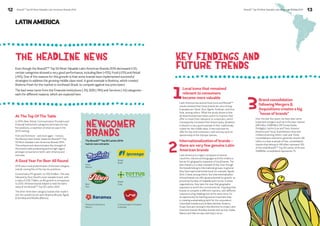
Newcomer 
Brands 
The BrandZ™ Top 50 LatAm 2014 
had six new entrants: 
Food 
Mexico 
Beer 
Peru 
Financial Institutions 
Mexico 
Retail 
Brazil 
Retail 
Chile 
Communication Providers 
Colombia 
Local icons that remained 
relevant to consumers 
became more valuable 
Latin America has several local icons and BrandZTM 
results showed that these brands are very strong. 
Examples are Telcel, Skol, Águila, Sodimac, and Inca 
Kola, among others. What the study shows is that 
all these brands have taken action to improve their 
offer to retain their relevance to consumers, which 
consequently increased their brand equity. Bradesco 
in Brazil is a very good example of this; traditionally 
a bank for the middle class, it has improved its 
offer for low-end consumers, with activity such as 
sponsorship of the Olympic Games.. 
Internationalization of brands – 
there are very few genuine Latin 
American brands 
Latin America is a region composed of several 
countries, cultures and languages and this creates a 
barrier for geographic expansion of local brands. The 
beer industry is a clear example of this. Even though 
the brands belong to international groups, in general 
they have kept local brands local, for example, Águila, 
Skol, Cristal, among others. But internationalization 
of local brands can offer great potential for growth, as 
proved by the likes of Falabella and Corona. In these 
organizations, they take the view that geographic 
expansion is worth the commercial risk. Exposing their 
brands to compete in different markets, with different 
cultures is a big challenge but at the same time, it’s 
an opportunity for learning and an important step 
in creating sustainable growth for the corporation. 
Colombian brands such as Bancolombia, Avianca, 
Grupo Sura are moving in this direction to create Latin 
American brands; Brazilian brands such as Itaú, Sadia, 
Natura and Vale are also starting to do so. 
Brand consolidation 
following Mergers & 
Acquisitions creates a big 
“house of brands” 
Over the last few years, we have seen some 
important mergers such as in the beer market 
(AB InBev, SABMiller), BR Foods (Sadia, 
Perdigão), LatAm (Lan and Tam), Avianca 
(Avianca and Taca), ItaúUnibanco (Itaú and 
Unibanco) among others. Last year these 
consolidations started to generate results. AB 
InBev is a clear example of this; consolidated, 
brands that belong to AB InBev represent 19% 
of the total BrandZ™ Top 50 LatAm 2014 and 
SABMiller consolidated represents 7%. 
1 
3 
2
BrandZ™ Top 50 Most Valuable Latin American Brands 2014 BrandZ™ Top 50 Most Valuable L 14 atin American Brands 2014 
LATIN AMERICA 
Brand Value % 
Distribution 
By Country 
Country 
Contribution 
change 
2013-2014 
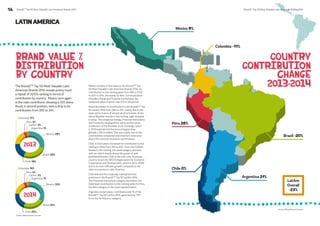
The BrandZ™ Top 50 Most Valuable Latin 
American Brands 2014 reveals pretty much 
a repeat of 2013’s ranking in terms of 
contribution by country. Mexico once again 
is the main contributor, showing a 33% share. 
Brazil, in second position, sees a drop in its 
contribution from 28% to 24%. 
Mexico remains in first place in the BrandZ™ Top 
50 Most Valuable Latin American Brands 2014. Its 
contribution to the ranking grew from 28% in 2013 
to 33% in 2014, led mainly by Beer, Communication 
Providers, Retail and Financial Institutions, the 
combined value of which rose 27% in the period. 
Brazil decreased its contribution to the BrandZ™ Top 
50 LatAm 2014 from 28% to 24%, mainly due to the 
weak performance of almost all of its brands: of the 
eleven Brazilian brands in the ranking, eight dropped 
in value. The categories Energy, Financial Institutions 
and Cosmetics displayed the worst performance, 
a reflection of the Brazilian stock exchange, which 
in 2013 experienced the second largest drop 
globally (-34% in dollar). This was mainly due to the 
commodities companies’ and investors’ insecurity 
about the country’s economic performance. 
Chile, in third place, increased its contribution to the 
ranking in 2014 from 19% to 20%. From nine Chilean 
brands in the ranking, the retail category domains 
with six, which clearly shows the power of well-positioned 
brands. Chile is the only Latin American 
country to join the OECD (Organization for Economic 
Cooperation and Development), which it did in 2009, 
due to its more efficient growth compared to the 
other economies in Latin America. 
Colombia and Peru basically maintained their 
positions in the BrandZ™ Top 50 LatAm 2014. 
The Financial Institutions category dominates the 
Colombian contribution to the ranking while for Peru, 
the Beer category is the most representative. 
Argentina, in last place, contributed only 1% of the 
BrandZ™ Top 50 LatAm 2014, generated by YPF, 
from the Oil Industry category. 
Argentina 1% 
Mexico 29% 
Brazil 28% 
Argentina 1% 
Mexico 33% 
Brazil 24% 
Colombia 17% 
Peru 3% 
LatAm 3% 
2013 
Chile 19% 
Colombia 16% 
Peru 4% 
LatAm 3% 
2014 
Chile 20% 
Brazil -20% 
Colombia -11% 
Argentina 21% 
LatAm 
Overall 
-23% 
Mexico 9% 
Peru 28% 
Chile 0% 
Source: Millward Brown Vermeer 
Source: Millward Brown Vermeer
BrandZ™ Top 50 Most Valuable Latin American Brands 2014 BrandZ™ Top 50 Most Valuable L 16 atin American Brands 2014 
LATIN AMERICA 
Performance By 
Industry Sector 
Brand valuation by industry sector 
Services 15% 
B2B 13% 
2013 
Retail 20% 
Beer, Food & 
Personal Care 28% 
Financial 
Institutions 23% 
Services 15% 
Beer, Food & 
Personal Care 33% 
Financial 
Institutions 22% 
B2B 11% 
2014 
Retail 19% 
Industry Sector 
Brand Value % Change 
+9% 
-3% 
+14% 
Industry Sector 
Total Brand Value 
-19% 
Beer, Food & Personal Care US $ 42,514 Mil. 
Retail US $ 24,620 Mil. 
Financial Institutions US $ 28,440 Mil. 
B2B US $ 14,172 Mil. 
Services US $ 19.446 Mil. 
Comparison With Other BrandZ™ Brand Valuation Rankings 
Beer, Food & Personal Care 
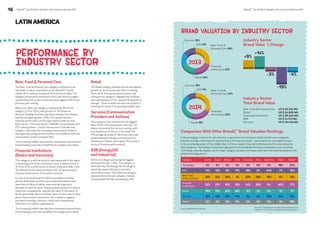
The Beer, Food & Personal Care category continues to be 
the leader in value contribution to the BrandZ™ Top 50 
LatAm 2014, with an increase of 9% in terms of value. The 
category enhanced its presence in the Latin America region, 
contributing 33% of the total brand value, against 29% of the 
previous year ranking. 
Beer is the main sub-category, representing 78% of the 
category (73% in 2013), with growth of 13% driven by 
Mexican, Brazilian and Peruvian beers: Modelo from Mexico 
had the strongest growth, (51%). The capital markets’ 
financial performance of the organizations that own the 
beer brands – Anheuser Busch, SABMiller, Grupo Modelo and 
CCU, among others – justify the success of the beer sub-category, 
reflecting the increasing consumption of beer in 
the region (according to Euromonitor, from 2008 to 2013 the 
consumption of beer increased 76%). 
The increasing middle class and the consequent improvement 
in purchasing power have benefited the category as a whole. 
Financial Institutions 
(Banks and Insurance) 
This category is still the second most important in the region, 
contributing 22% of the total brand value, in spite of a fall of 
3% from 2013 to 2014 driven by Brazil (-20%) and Chile (-13%). 
The Mexican brand value increased 43%, compensating for 
the poor performance of the other countries. 
In Latin America (except for Banorte and Bancolombia), 
almost all Brazilian and Peruvian brands decreased brand 
value due to failure to deliver expected earnings and a 
decrease in interest rates. This generated pressure to reduce 
costs and, consequently, reduced the value of the brand. In 
Brazil, specifically Banco do Brasil, there is a decrease in value 
due to Government intervention, this created a negative 
perception amongst investors, which was consequently 
reflected in its market capitalization. 
The increasing middle class and the consequent improvement 
in purchasing power have benefited the category as a whole. 
-4% 
In the emerging countries of Latin America, in general terms Consumer Goods and Services categories 
lead the rankings, reflecting the characteristics of those economies – particularly the noticeable increase 
in the purchasing power of the middle class. In China, despite Financial Institutions and Services being the 
lead categories, Technology is starting to gain ground. As the global ranking encompasses more countries, 
Technology naturally appears as the major category because it includes important international players in the 
global technology sector. 
Retail 
The Retail category showed the second highest 
growth on the previous year (5%), increasing 
14% in 2014. Among the eleven brands that 
compose the category, Falabella and Sodimac – 
with participation of 41%, showed 11% growth on 
average. These brands have been successful in 
meeting the needs of the growing middle class. 
Services (Communication 
Providers and Airlines) 
This category, that represented the biggest 
fall in 2013 (-31%), decreased in 2014 by -4%. 
Mexico dominated the Service ranking, with 
four brands out of the six in the total. The 
21% average decrease of Telcel and Claro was 
compensated by the good performance of 
Televisa and Telmex, which grew 11% (mainly in 
terms of financial performance). 
B2B (Energy/Oil 
and Industrial) 
B2B is the category showing the biggest 
decrease this year (-19%). The category is 
dominated by the Energy/Oil subcategory, 
which decreased 26% due to the fall in 
commodity’s price. The industrial category, 
represented by the sub-category Cement, 
compensated this fall, increasing by 35%. 
Category LatAm Brazil Mexico Chile Colombia Peru Argentina China* Global** 
Technology 0% 0% 0% 0% 0% 0% 0% 16% 27% 
B2B 11% 12% 6% 11% 15% 2% 43% 7% 10% 
Beer, Food 
& Personal Care 33% 41% 38% 2% 33% 56% 18% 8% 12% 
Financial 
Institutions 22% 21% 10% 15% 41% 39% 6% 40% 17% 
Retail 19% 12% 21% 61% 3% 2% 0% 1% 7% 
Services 15% 13% 24% 11% 9% 2% 33% 24% 13% 
Others 0% 0% 0% 0% 0% 0% 0% 3% 15% 
*BrandZTM Top 50 Most Valuable Chinese Brands 2014 
Source: Millward Brown Vermeer **BrandZTM Top 100 Most Valuable Global Brands 2014
18 BrandZ™ Top 50 Most Valuable Latin American Brands 2014 BrandZ™ Top 50 Most Valuable Latin American Brands 2014 19 
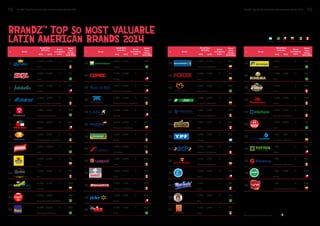
# Brand 
Brand Value 
(US$ Mil.) Brand 
Contribution 
Index 
Brand 
Value 
Change 
2014 2013 2013-2014 
1 
8,025 6,620 4 21% 
Beer 
2 
7,055 6,520 4 8% 
Beer 
3 
6,084 5,611 4 8% 
Retail 
4 
5,308 6,577 2 -19% 
Communication Providers 
5 
4,177 5,492 2 -24% 
Financial Institutions 
6 
4,107 3,537 5 16% 
Retail 
7 
3,625 3,281 2 11% 
Communication Providers 
8 
3,585 3,803 3 -6% 
Beer 
9 
3,565 3,903 5 -9% 
Beer 
10 
3,477 2,301 4 51% 
Beer 
11 
3,446 5,137 1 -33% 
Energy 
12 
3,426 4,454 1 -23% 
Communication Providers 
13 
3,376 4,006 2 -16% 
Financial Institutions 
# Brand 
Brand Value 
(US$ Mil.) Brand 
Contribution 
Index 
Brand 
Value 
Change 
2014 2013 2013-2014 
27 
2,457 2,466 3 0% 
Financial Institutions 
28 
2,365 2,487 4 -5% 
Beer 
29 
2,236 3,707 4 -40% 
Cosmetics 
30 
2,084 2,094 3 -1% 
Financial Institutions 
31 
1,759 2,091 1 -16% 
Financial Institutions 
32 
1,630 1,401 5 16% 
Beer 
33 
1,545 1,272 2 21% 
Energy 
34 
1,540 1,636 3 -6% 
Financial Institutions 
35 
1,379 1,281 4 8% 
Financial Institutions 
36 
1,262 1,558 4 -19% 
Retail 
37 
1,182 - 2 N/A 
Food 
38 
1,145 1,284 3 -11% 
Beer 
39 
1,109 1,187 2 -7% 
Retail 
# Brand 
Brand Value 
(US$ Mil.) Brand 
Contribution 
Index 
Brand 
Value 
Change 
2014 2013 2013-2014 
14 
3,252 5,762 1 -44% 
Energy 
15 
3,181 3,204 4 -1% 
Energy 
16 
3,175 3,632 3 -13% 
Financial Institution 
17 
3,097 2,768 2 12% 
Communication Providers 
18 
3,058 3,274 4 -7% 
Airlines 
19 
3,006 3,009 4 0% 
Financial Institutions 
20 
2,804 2,992 2 -6% 
Retail 
21 
2,748 2,034 1 35% 
Industrial 
22 
2,687 2,066 3 30% 
Retail 
23 
2,608 2,976 3 -12% 
Food 
24 
2,494 1,567 2 59% 
Financial Institutions 
25 
2,486 1,932 4 29% 
Retail 
26 
2,466 1,933 2 24% 
Food 
# Brand 
Argentina Brazil Chile Colombia Mexico Peru 
Brand Value 
(US$ Mil.) Brand 
Contribution 
Index 
Brand 
Value 
Change 
2014 2013 2013-2014 
40 
1,103 - 3 N/A 
Retail 
41 
1,094 1,010 4 8% 
Beer 
42 
1,076 - 5 N/A 
Beer 
43 
1,058 1,465 2 -28% 
Retail 
44 
1,037 1,095 3 -5% 
Financial Institutions 
45 
1,005 1,036 2 -3% 
Food 
46 
988 992 3 0% 
Financial Institutions 
47 
987 - 4 N/A 
Retail 
48 
969 - 2 N/A 
Financial Institutions 
49 
932 1,248 4 -25% 
Retail 
50 
931 - 3 N/A 
Communication Providers 
BrandZ™ Top 50 Most Valuable 
Latin American Brands 2014 
Source: Millward Brown Vermeer and
22 BrandZ™ Top 50 Most Valuable Latin American Brands 2014 23 
ARGENTINA 
An economic trajectory 
undermined by inflation 
and devaluation 
Following Argentina’s economic crisis in 2001, the country had – for 
nearly a decade – been steadily growing in terms of activity, consumption 
and employment levels. It is noteworthy that these positive movements 
began to slow down this year, partly due to the peso devaluation of 
nearly 20% in January, and to inflation, which was close to 10% in the 
first quarter of this year. In the face of this scenario, the Government 
took action to continue stimulating consumption and launched the 
“ProgresAR” and the “Procreauto” plans, keeping the existing “ProCreAr” 
plan (launched in 2012 to address the housing deficit). 
MARTÍN SCHIJVARG WEBSITE www.ypf.com 
Confronted by the devaluation, 
many multinational companies 
reflected it in their prices, and 
improved their profitability. However, 
the Government has sought to reduce 
inflation rates for January-July (around 
16% - 25% depending on whether 
the source of information is public 
or private) by launching the “Precios 
Cuidados” program and by trying to 
make wage agreements that do not 
differ much from the official inflation 
figures. 
One year ahead of the elections, we 
are starting to notice the electoral bid, 
either among the opposition parties 
or within the Justicialist Party, which 
governs today. The President, Cristina 
Fernández de Kirchner, re-elected in 
2011, cannot be elected for a third term. 
Brazil is Argentina’s main strategic 
partner, and the place where most 
cars are exported to, an activity 
that has been record-breaking levels 
of production and sales in recent 
years. This year however, the growth 
has declined due to a price increase 
triggered by the devaluation of the 
peso, coupled with increased tax on 
high-end vehicles. 
Argentina remains mainly a 
commodity-exporting country, with soy 
still being a key product in the market, 
and the Chinese market is the world’s 
largest consumer. Cereals, such as 
wheat and corn, are also important. 
Many goods are imported, including 
many of the brands that Argentine 
people consume. As a result, Argentina 
has had fewer local brands historically, 
compared to countries like Brazil, 
Mexico and Colombia. Consequently, 
it’s worth highlighting the work done 
by Quilmes as a benchmark for the 
beer category; YPF, with its history 
and identification with the national 
stake in the Argentine oil industry; 
and companies such as La Serenisima, 
Arcor and Molinos, which have a wide 
range of brands and categories within 
the food industry. All of these brands 
have a strong distribution and presence 
at the point of sale, with significant 
investment in communication focused 
on television, although online media 
is increasingly gaining share. In fact, 
Argentina has one of the greatest 
internet penetration rates in Latin 
America (more than 60% broadband), 
significant growth rates in use of social 
networks and even smartphones’ 
(more than 200% in 2013). This is also 
reflected in the use of internet and 
social networks, with a penetration of 
more than 55% active users. 
BrandZ™ Top 50 Most Valuable Latin American Brands 2014 
Local Market Overview 
BrandZ™ 
Top 5 Most 
Valuable 
argentinian 
Brands 2014 
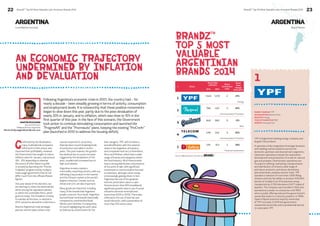
# Brand 
Source: Millward Brown Vermeer and 
Brand Value 
(US$ Mil.) Brand 
Contribution 
Index 
Brand 
Value 
Change 
2014 2013 2013-2014 
1 
1,545 1,272 2 21% 
Energy 
2 
766 423 3 81% 
Communication Providers 
3 
649 583 5 11% 
Beer 
4 
439 242 3 81% 
Communication Providers 
5 
210 143 2 46% 
Financial Institutions 
1 
ARGENTINA 
Brand Stories 
PARENT COMPANY YPF 
HEADQUARTERS Buenos Aires 
INDUSTRY Energy 
YEAR OF FOUNDATION 1922 
YPF is Argentina’s leading energy company and 
largest fuel producer. 
It operates a fully integrated oil and gas business 
with leading market positions across the 
domestic upstream and downstream segments. 
Upstream operations include the exploration, 
development and production of crude oil, natural 
gas and propane. Downstream operations are 
focused on refining, marketing, transportation 
and distribution of oil and a wide range of 
petroleum products, petroleum derivatives, 
petrochemicals, propane and bio-fuels. YPF 
operates a network of more than 1,600 filling 
stations and has the ability to produce 530,000 
barrels of oil daily from 91 production areas, 
transported by 2,700 kilometers (1,677 miles) of 
pipeline. The company was founded in 1922 and 
operated as a state run enterprise until 1993 
when a public offering reduced the government’s 
ownership stake to a minority position. In 1999, 
Spain’s Repsol acquired majority ownership 
of YPF, but early in 2012 the government 
reasserted ownership with a presidential decree 
to nationalize YPF. 
Account Director 
Millward Brown Argentina 
Martin.Schijvarg@millwardbrown.com
24 BrandZ™ Top 50 Most Valuable Latin American Brands 2014 25 
ARGENTINA 
Brand consistency 
and closeness: 
a strategy to relate to 
Argentina’s consumers 
In this new ranking of Argentina’s 
most valuable brands, YPF takes 
first place once again, followed 
by Personal, which has climbed up in the 
ranking, and then Quilmes. 
Evidently, YPF is an exemplar for the 
other fuel brands, not least for the way it 
has forged a strong emotional bond with 
consumers. This is because it is a brand with 
a long track record. Founded in 1922, it has 
created a significant number of jobs (46,000 
today) from its exploration and exploitation 
to distribution, sales and products made 
from oil. YPF’s activity has boosted the 
development of cities in the south of the 
country, such as Comodoro Rivadavia, 
Las Heras, Caleta Olivia and Plaza Huincul, 
making the enterprise highly important to 
the local economy development. 
During the 90’s, like many other state 
companies, YPF was privatized, and most 
of its share belonged to Repsol, a Spanish 
company. In April 2012, the president 
Cristina Fernández de Kirchner introduced 
a bill that saw the State take over the 
company; the main reason stated was 
the strong reduction in oil reserves as a 
consequence of reduced exploration activity. 
Currently, the Argentine State owns 51% of 
the patrimony and an oilfield, Vaca Muerta. 
This has generated high expectations 
thanks to its potential for obtaining gas 
and oil resources, which may ultimately see 
Argentina’s current reserves multiply by 10. 
YPF has also had heavy ad investment and 
was the Official Sponsor of Argentina’s 
football team during the 2014 FIFA World 
Cup, focusing on Argentine patriotism and 
the pride in the National team. 
Following YPF in the BrandZTM ranking, 
we find Personal (within the mobile phone 
market), plus Telecom Argentina (telephone 
service) in fourth place, both brands 
belonging to the Telecom Argentina group. 
Personal has an important share in a very 
competitive scenario, with devices, plans 
and strong promotional activity that bring 
the brand closer to young people – the 
Personal Fest, for example, is an event it has 
been organizing for ten years. 
BrandZ™ Top 50 Most Valuable Latin American Brands 2014 
The Secrets of Local Brand Value 
ARGENTINA 
KEY FACTS 
Capital City Buenos Aires 
Currency Argentine New Peso 
Area 2.78 million km2 
Population (thousands) 41,446 (2013) 
Population growth rate (annual) 0.8% (2010-2015) 
Life expectancy 76.01 years (2012) 
Literacy rate of 15-24 year olds 99.2% (2012) 
Unemployment rate 7.3% (2012) 
7.1% (2013) 
Annual GDP at current prices 
Total at current prices (billions) US$ 612 (2013) 
GDP per capita (annual dollars) US$ 14,760 (2013) 
Growth rate 3.0% (2013) 
Country’s share in regional GDP 10.8% (2013) 
Foreign direct investment (billions) US$ 6.4 (2012) 
US$ 7.9 (2013) 
Sources, 
CEPAL, Comisión Económica ONU 
Financial Times Latin America & Caribbean 
InfoLatAm, Infomación y Análisis de América Latina 
World Bank 
Quilmes is a leading beer brand in a market 
developing alternatives flavours, thus creating 
a very competitive category. The brand has a 
strong presence in the consumer’s repertoire, 
and is often the first choice. It also creates a 
clear differentiation by setting trends in which 
its successful ads play a leading role – Quilmes 
owns the concept of “meeting”, of “enjoying 
fun moments with friends”. This is one of the 
brand’s biggest achievements, with consistency 
over time and a differentiated message within a 
market where other important players are also 
heavily investing in advertising. 
In the banking category, Banco Galicia is one of 
the biggest advertising presences, along with 
Santander Río and Banco Francés. The “couple 
of Banco Galicia” has gone beyond the usual ad 
campaign reach, being an activity format which 
catches the consumer’s attention and conveys 
clearly its “quiero” benefits program, which 
allows clients to use the accumulated points 
when, where and how they want. 
MARTÍN SCHIJVARG 
Account Director 
Millward Brown Argentina 
Martin.Schijvarg@millwardbrown.com
26 BrandZ™ Top 50 Most Valuable Latin American Brands 2014 
BrandZ™ Top 50 Most Valuable Latin American Brands 2014 27 
ARGENTINA 
Brand Stories 
2 3 4 5 
Personal is the mobile brand of The Telecom Group. 
Personal has 18.2 million customers in Argentina 
and nearly 70 percent of those rely on the 
company’s prepaid service. Personal relaunched 
its brand last year and introduced a distinctive 
new logo that features its name spelled out in 
letters that resemble handwriting. Personal drives 
brand awareness through sponsorship of signature 
events, such as the seventh annual Personal 
Fest musical festival that draws roughly 70,000 
attendees over two days. The company offers 
products for different segments of the market, 
such as the high end Personal Black handset, to 
the more value priced Personal Touch smartphone 
offering. The brand also seeks to drive loyalty 
through its Club Personal program. Personal’s 
parent company The Telecom Group was created 
in 1990 when the government allowed public 
ownership of the previously state run enterprise. Its 
shares are traded on the New York Stock Exchange. 
Telecom Argentina is one of the main national 
telecommunication companies in Argentina. 
Telecom Argentina offers local and long distance 
fixed-line telephony, cellular, data transmission 
and internet services. The company offers 
mobile service through its Personal brand 
and Internet broadband services through its 
Arnet brand. Last year, Arnet launched a video 
streaming service called ‘Arnet Play’, which 
allows customers to watch a wide range of 
content on their televisions and computers. 
The increased bundling of services, coupled 
with new products and service introductions in 
2011, helped the company achieve a record low 
level of customer turnover. Telecom Argentina 
is one of the largest employers in the country 
with over 15,600 employees nationwide. It 
began operations in 1990 after the government 
completed a transaction allowing for public 
ownership of the company, which now trades on 
New York Stock Exchange. 
Quilmes is Argentina’s best-known beer brand. 
Cervecería y Maltería Quilmes is the top brewer 
in Argentina and part of the Anheuser-Busch 
InBev group’s extensive portfolio of more than 
200 brands. Within the Anheuser-Busch InBev 
brand hierarchy, Quilmes is regarded as a “local 
champion” due to its leadership position within 
Argentina. The company has 4,850 employees 
and operates five plants and eight distribution 
centers. The brand is active in promoting social 
initiatives such as “Vivamos Responsablemente,” 
focused on promoting responsible drinking, and 
the “Futuro Posible” campaign which provides 
student scholarships and donations to hospitals 
and educational institutions. 
Banco Galicia is a major financial institution 
with 2.2 million account holders and an 
expanding branch network. 
Banco Galicia serves its 2.2 million deposit 
account holders and 8.5 million credit card 
customers with nearly 500 branch locations. 
The company was founded in 1905 and 
ended its most recent fiscal year with 12,500 
employees. The bank accounted for nearly 9 
percent of loans to the private sector last year 
and remains a financial stalwart with year-end 
assets that totaled 50.6 billion pesos ($3.6 
billion approximately). The company’s shares 
are traded on the Buenos Aires Stock Exchange. 
PARENT COMPANY The Telecom Group 
HEADQUARTERS Buenos Aires 
INDUSTRY Communication Providers 
YEAR OF FOUNDATION 1990 
WEBSITE www.telecom.com.ar 
PARENT COMPANY The Telecom Group 
HEADQUARTERS Buenos Aires 
INDUSTRY Communication Providers 
YEAR OF FOUNDATION 1990 
WEBSITE www.telecom.com.ar 
PARENT COMPANY Cervecería y Maltería Quilmes 
HEADQUARTERS Buenos Aires 
INDUSTRY Beer 
YEAR OF FOUNDATION 1890 
WEBSITE www.cerveceriaymalteriaquilmes.com 
PARENT COMPANY Banco de Galicia y Buenos Aires SA 
HEADQUARTERS Buenos Aires 
INDUSTRY Financial Institutions 
YEAR OF FOUNDATION 1905 
WEBSITE www.bancogalicia.com
28 BrandZ™ Top 50 Most Valuable Latin American Brands 2014 29 
ARGENTINA 
FIFA WORLD CUP 2014 
What did we do? 
What did we learn? 
BrandZ™ Top 50 Most Valuable Latin American Brands 2014 
World Cup 2014 
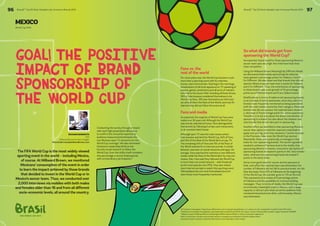
The interest around the tournament was even higher this 
time, due to our traditional rivalry with Brazil and the 
geographical proximity that made it easier and cheaper to 
attend the matches. Consequently, the event became the 
focus of the marketing efforts for a lot of companies. 
Many campaigns and promotions 
started well before the beginning 
of the tournament, and the peak 
of advertising investment came 
just before the first kick-off. The 
outstanding performance of 
the Argentinian national team 
expanded the communications 
and the popular excitement to 
the final match. During June 
and July, Argentina had serious 
World Cup fever: football was the main topic of conversation, 
newspapers, magazines and TV shows were bombarding the 
audience with game images, tactical analysis and even gossip 
about the lives of the footballers. 
All types of brands from several categories tried to take 
advantage of the event, putting different strategies into 
practice. In June, one out of five TV ads were directly related 
to the World Cup and many more featured more implicit links 
to the event, according to Mindshare. The TV screen was a 
sea of white and light blue (the team colors), and the battle for 
standout was fierce. 
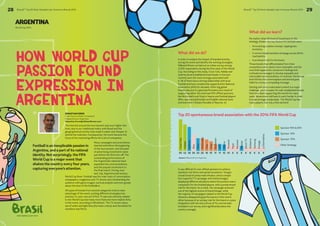
In order to analyze the impact of branded activity 
during the event and identify the winning strategies, 
Millward Brown carried out an online survey among 
2,000 respondents during the first week of the World 
Cup. According to this study, Coca-Cola, Adidas and 
Quilmes (local established brand leader in the beer 
market) were the most strongly associated with 
it. All of them have a strong relationship with local 
football and have consistently supported the National 
Association (AFA) for decades. Other big global 
brands also put in a good performance as a result of 
supporting either the event (as FIFA official sponsors, 
like McDonald’s and Visa) or teams and football players 
(Nike, sponsoring Brazilian and English national team 
and stars like Cristiano Ronaldo or Neymar Jr). 
50 42 38 26 20 20 16 15 11 11 10 10 9 8 8 6 6 6 6 5 
It was difficult for non-official sponsors to achieve 
standout, but there were great exceptions: Taraguí, 
a local brand of yerba mate infusion, aired a simple 
but impactful TV campaign with limited budget, 
displaying different situations where the product was a 
companion for the football players, with a predominant 
role for the brand. As a result, the campaign achieved 
one of the highest scores of brand linkage, while 
the majority of campaigns related to the World Cup 
showed a disappointing performance in this metric 
either because of an unclear role for the brand or a poor 
integration with the story (9 out of 14 commercials 
included in our survey were significantly below the 
country average). 
No matter what the level of investment or the 
strategy chosen, the key factors for success were: 
• An involving creative concept, tapping into 
emotions. 
• A correct implementation strategy across all the 
touchpoints. 
• A prominent role for the brand. 
Those brands that differentiated from their 
competitors were clearly more noticeable, and the 
ones that tapped into consumer’s feelings and 
motivations managed to develop enjoyable and 
memorable communications. In contrast, the brands 
that fell into the commonplace and stereotyped, 
failed to convey a compelling message. 
Getting noticed in a saturated context is a major 
challenge, but it is easier for well-established brands 
that have been supporting the events for many 
years. Newcomers will have to work harder in order 
to build stronger credentials: The World Cup has 
many players, but only a few winners! 
How World Cup 
passion found 
expression in 
Argentina 
SEBASTIAN CORZO 
Client Service Senior Consultant 
Millward Brown Argentina 
Sebastian.Corzo@millwardbrown.com 
Top 20 spontaneous brand association with the 2014 FIFA World Cup 
Coca-Cola 
Adidias 
Quilmes 
Claro 
McDonalds 
Visa 
Sony 
Budweiser 
YPF 
Gillette 
Personal 
Pepsi 
Movistar 
Naranja 
Direct TV 
Garbarino 
Samsung 
Fravega 
La Serenisima 
Nike 
Sponsor FIFA & AFA 
Sponsor AFA 
Sponsor FIFA 
Other Strategy 
Source: Millward Brown Argentina
brazil
32 BrandZ™ Top 50 Most Valuable Latin American Brands 2014 BrandZ™ Top 50 Most Valuable Latin American Brands 2014 33 
# Brand 
Brand Value 
(US$ Mil.) Brand 
Contribution 
Index 
Brand 
Value 
Change 
2014 2013 2013-2014 
1 
7,055 6,520 4 8% 
Beer 
2 
4,177 5,492 3 -24% 
Financial Institutions 
3 
3,585 3,803 4 -6% 
Beer 
4 
3,376 4,006 2 -16% 
Financial Institutions 
5 
3,252 5,762 1 -44% 
Energy 
6 
2,466 1,933 2 24% 
Food 
7 
2,236 3,707 4 -40% 
Cosmetics 
8 
1,145 1,284 3 -11% 
Beer 
9 
1,103 972 4 13% 
Retail 
10 
1,094 1,010 4 8% 
Beer 
11 
1,005 1,036 2 -3% 
Food 
12 
915 916 3 0% 
Retail 
13 
896 810 1 11% 
Financial Institutions 
# Brand 
Brand Value 
(US$ Mil.) Brand 
Contribution 
Index 
Brand 
Value 
Change 
2014 2013 2013-2014 
27 
345 680 2 -49% 
Loyalty Programs 
28 
343 422 4 -19% 
Fashion 
29 
329 382 3 -14% 
Retail 
30 
328 241 1 36% 
Airlines 
31 
326 306 2 7% 
Education 
32 
320 390 1 -18% 
Healthcare 
33 
287 196 2 47% 
Food 
34 
278 361 1 -23% 
Stock Exchange 
35 
278 - 2 N/A 
Loyalty Programs 
36 
275 287 2 -4% 
Retail 
37 
269 345 2 -22% 
Fashion 
38 
260 195 2 33% 
Education 
39 
245 208 3 18% 
Food 
# Brand 
Brand Value 
(US$ Mil.) Brand 
Contribution 
Index 
Brand 
Value 
Change 
2014 2013 2013-2014 
14 
862 1,009 1 -15% 
Mining 
15 
845 1,046 2 -19% 
Retail 
16 
791 656 1 21% 
Credit Card 
17 
702 513 3 37% 
Retail 
18 
665 748 3 -11% 
Insurance 
19 
609 634 2 -4% 
Retail 
20 
555 641 1 -13% 
Communication Providers 
21 
509 474 1 7% 
Healthcare 
22 
449 473 3 -5% 
Retail 
23 
434 444 1 -2% 
Communication Providers 
24 
434 569 3 -24% 
Information Technology 
25 
422 1,427 2 -70% 
Financial Institutions 
26 
360 458 2 -22% 
Car Rental 
# Brand 
Brand Value 
(US$ Mil.) Brand 
Contribution 
Index 
Brand 
Value 
Change 
2014 2013 2013-2014 
40 
235 295 3 -20% 
Fashion 
41 
231 - 2 N/A 
Travel Agency 
42 
227 396 1 -43% 
Airlines 
43 
205 207 1 -1% 
Utilities 
44 
199 250 3 -20% 
Airlines 
45 
184 455 1 -59% 
Communication Providers 
46 
182 260 1 -30% 
Communication Providers 
47 
153 232 1 -34% 
Retail 
48 
151 161 3 -7% 
Healthcare 
49 
140 178 2 -21% 
Retail 
50 
134 280 2 -52% 
Drugstores 
BrandZ™ Top 50 Most Valuable 
Brazilian Brands 2014 
Source: Millward Brown Vermeer and
34 BrandZ™ Top 50 Most Valuable Latin American Brands 2014 35 
BRAZIL BRAZIL 
1 
COMPANY 
Companhia de Bebidas das Américas – AmBev 
HEADQUARTERS São Paulo 
INDUSTRY Beer 
YEAR OF FOUNDATION 1967 
WEBSITE www.skol.com.br 
COMPANY 
Bradesco SA 
HEADQUARTERS Osasco 
INDUSTRY Financial Institutions 
YEAR OF FOUNDATION 1943 
WEBSITE www.bradesco.com.br 
3 4 
BrandZ™ Top 50 Most Valuable Latin American Brands 2014 
Local Market Overview Brand Stories 
Skol is Brazil’s most popular beer. Its 
marketing emphasizes enjoyment of life and 
appeals especially to young people. 
Created by a consortium of UK, Canadian, 
Swedish and Belgian brewers as a global 
beer brand, it is one of the world’s most 
widely consumed beers. The Skol trademark 
belongs to the Danish brewery Carlsberg and 
is marketed under license in Brazil AmBev. 
Itaú is the largest financial conglomerate in the 
southern hemisphere and the tenth-largest bank in 
the world by market value 
Established more than 65 years ago, Itaú evolved 
to its current size as a result of the 2008 merger 
of Banco Itaú and Unibanco. Itaú accounts for 
about 11 percent of the Brazilian market for retail 
banking services and operates in South America, 
Europe, Asia and the United States. The bank has 
over 5,000 branches and more than 32,700 ATMs 
worldwide. Following the merger, Itaú is building 
on a reputation for innovation and efficiency, 
emphasizing personal service with the tagline 
“Feito para Você” (Made for You). It also intends to 
attract new customers from Brazil’s rising middle 
class, by offering credit cards to individuals who, 
until now, lacked access to bank credit. 
Brahma is well known for its 
innovative and witty advertising that 
relies heavily on sex appeal 
Brazil’s second-largest beer in market 
share (after Skol), Brahma is marketed 
in a total of 30 countries. Founded 
in 1888, by Companhia Cervejaria 
Brahma, the brand is now owned by 
AB InBev, the world’s largest brewer. 
COMPANY 
Itaú Unibanco Holding 
HEADQUARTERS São Paulo 
INDUSTRY Financial Institutions 
YEAR OF FOUNDATION 1945 
WEBSITE www.itau.com.br 
COMPANY 
Companhia de Bebidas das Américas – AmBev 
HEADQUARTERS São Paulo 
INDUSTRY Beer 
YEAR OF FOUNDATION 1888 
WEBSITE www.brahma.com.br 
2 
One of the largest private banks in Brazil, 
Bradesco offers online banking, insurance, 
pension plans, and annuities. 
Bradesco also provides credit card services, 
savings bonds, and personal and commercial 
loans. With an aggressive expansion program, 
Bradesco intends to become Brazil’s most 
accessible bank. It ended 2011 with 4,634 
branches. By acquiring a greater presence 
throughout Brazil the brand intends to reach 
potential new customers among the country’s 
rising middle class. Bradesco also pioneered 
the sale of insurance and pension plans 
through a subsidiary, Bradesco Seguros. 
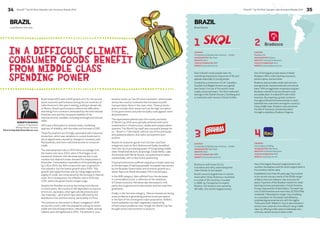
In A Difficult Climate, 
Consumer Goods Benefit 
From Middle Class 
Spending Power 
Brazil ended 2013 with a GDP growth of 2.3%, the second 
worst economic performance among the six countries of 
Latin America in this year’s ranking, putting it ahead only 
of Mexico. Brazil’s performance reflects the difficulties 
stemming from a scenario dominated by the international 
financial crisis and the increased volatility of the 
macroeconomic variables, including exchange and interest 
rates. 
2013 saw a fluctuation in activity levels, combining 
quarters of stability, with decrease and increase in GDP. 
These fluctuations are strongly associated with industrial 
production, which saw variations in output levels due to 
stock adjustments caused by changes in monetary and 
fiscal policies, and more restricted access to consumer 
credit. 
The unemployment rate in 2013 fell to an average 5.4%, 
the lowest rate since 2003, when it first began to be 
measured. However, this decrease was not due to job 
creation but related to lower demand for employment in 
December. Consumption expenditure of households grew 
by 2.3% in 2013, the 10th consecutive year of growth in 
this indicator, but the lowest growth since 2003. This 
growth was supported last year by rising wages and the 
supply of credit, but constrained by the increase in interest 
rates. As a consequence, the inflation rate in 2013 was 
5.91%, below the government’s target range. 
Despite the Brazilian economy becoming more diverse 
in recent years, the country is still dependent on exports 
of iron ore, soy beans, other agricultural products and 
raw materials – all of which have been affected by the 
slowdown in the world economy, particularly in China. 
The protests on the streets in Brazil, instigated in 2012 
across the country with the population asking for better 
public services (transportation, education, health, among 
others), were strengthened in 2013. The protest in June 
became known as “the 20 cents revolution”, when people 
across the country contested the increases in public 
transportation fares in the main cities. These protests 
grew to include other issues such as the high corruption 
in the government and police brutality used against some 
demonstrators. 
The expectations placed upon the country as hosts 
of World Cup 2014 were partially achieved with some 
investments in infrastructure, stadia and transportation 
systems. The World Cup itself was successful (except for 
us – Brazil 1 x 7 Germany!), without any of the previously 
anticipated problems, and visitor perceptions were 
positive. 
Brands of consumer goods from the beer and food 
categories, such as Skol, Brahma and Sadia, benefited 
from the rise in purchasing power of the growing middle 
class. Retail brands such as Ipiranga, Casas Bahia, Lojas 
Americanas and Pão de Açúcar, increased brand values 
substantially, with a clear brand positioning. 
Financial Institutions suffered a big drop in brand value due 
to the decrease of banking spreads, increased intervention 
by the Brazilian Government and economic growth as a 
whole. Banco do Brasil decreased 70% in brand value. 
In the B2B category, Vale suffered from the decrease 
in commodities prices, a reflection of the slowdown 
of China’s economy. Petrobras also decreased in 44%, 
partly due to government intervention and low cash flow 
generation. 
Finally, in the Services category, Telecom brands are facing 
some problems in generating positive brand perception 
in the face of the convergence value proposition. Airlines’ 
brand evaluation has been negatively impacted by 
infrastructure problems, even though the World Cup has 
brought some improvements to airports. 
ROBERTO DE NAPOLI 
Director of Operations 
Millward Brown Vermeer 
Roberto.Napoli@millwardbrown.com
36 BrandZ™ Top 50 Most Valuable Latin American Brands 2014 
BrandZ™ Top 50 Most Valuable Latin American Brands 2014 37 
BRAZIL 
Brand Stories 
9 10 
12 
COMPANY 
Grupo Pão de Açúcar 
HEADQUARTERS São Paulo 
INDUSTRY Retail 
YEAR OF FOUNDATION 1957 
WEBSITE www.casasbahias.com.br 
A retail chain specializing in furniture and 
home appliances, Casas Bahia was acquired 
in December 2009, by Grupo Pão de Açúcar. 
The acquisition positions the company to 
benefit from spending by Brazil’s rising 
middle class. Since its establishment, in 
1957, Casas Bahia has appealed to low-income 
customers with store credit and 
a reputation for quality and affordability. 
By 2010, Casas Bahia reached customers 
throughout Brazil, with more than 500 
stores and a web presence 
11 
COMPANY 
BRF – Brasil Foods SA 
HEADQUARTERS Itajaí 
INDUSTRY Food 
YEAR OF FOUNDATION 1934 
WEBSITE www.perdigao.com.br 
The 2009 merger of Perdigão and Sadia 
into BRF, created the world’s largest 
poultry company. 
Perdigão is one of Brazil’s largest food 
producers, specializing in frozen and chilled 
products. Its range of about 3,000 items is 
distributed throughout Brazil and to more 
than 100 countries. The company’s scale 
enables it to pursue a low-cost producer 
strategy. Established in 1934, as Brandalise, 
Ponzonie & Cie, the company changed its 
name to Perdigão SA in 1958. It began 
exporting in 1975 and went public in 1980. 
Established in 1853, Bohemia enjoys the distinction 
of being the oldest beer brand in Brazil as well as 
the leader in the premium segment thanks to a 
strategy of limiting distribution to select locations 
and introducing limited edition offers. The Bohemia 
brand is available in four variations, including wheat 
and dark beers, which were introduced last year. 
Bohemia was acquired by fellow Brazilian brewer 
Antarctica Paulista in 1961. The brand became part 
of an even larger brewer in 1999 when Antarctica 
Paulista and Brahma brewery merged to created 
AmBev. Then in 2004, Belgium-based InterBrew 
acquired a majority interest in AmBev to form 
a new global brewing giant known as InBev. 
Another major merger in 2008 between InBev and 
Anheuser Busch resulted in Bohemia becoming 
part of a still larger company known as Anheuser- 
Busch InBev whose shares are traded on the New 
York Stock Exchange under the symbol BUD. 
Ipiranga is Brazil’s largest private fuel distribution 
company, with a network of approximately 6,700 
service stations. 
Ipiranga is a brand well known among Brazilians 
with the slogan “Passionate about car like every 
Brazilian” (in Portuguese” Apaixonados por carro, 
como todo brasileiro”). 
After expanding in rural Brazil during the 1960s 
and 70s, Ipiranga became a national brand 
through its acquisition of Atlantic in 1993. In 
2008, Grupo Ultra bought both Ipiranga (in 
most regions), and Texaco, as Chevron was 
known in Brazil, and began to consolidate the 
gas stations under the Ipiranga banner. Because 
the brand name enjoys strong equity, it plays a 
role in swaying consumer decisions in a highly 
commoditized category where convenience is 
often the key driver. 
COMPANY 
Companhia de Bebidas das Américas – AmBev 
HEADQUARTERS São Paulo 
INDUSTRY Beer 
YEAR OF FOUNDATION 1853 
WEBSITE www.bohemia.com.br 
COMPANY 
Ultra Group 
HEADQUARTERS São Paulo 
INDUSTRY Retail 
YEAR OF FOUNDATION 1937 
WEBSITE www.ipiranga.com.br 
7 
6 
Natura is Brazil’s leading manufacturer and 
marketer of cosmetics. 
Formed in 1969 and first publicly traded 
in 2004, Natura has used a direct sales 
approach for more than 30 years, and now 
has more than 800,000 sales representatives 
(“consultants”) in Argentina, Brazil, Chile, 
Colombia, France, Mexico, and Peru. One of 
the first cosmetics companies to market 
natural and environmentally friendly 
products, Natura has a reputation for social 
responsibility. The company is also known for 
its emphasis on research and development 
and its use of ordinary people rather than 
supermodels in its advertisements. 
Sadia is a leading producer of processed and 
frozen foods such as hamburger patties and 
pizza. It exports to more than 65 countries. 
Founded in 1944 and listed on the stock 
market in 1971 as Sadia Concórdia SA 
Indústria e Comércio, Sadia also produces 
dairy products and serves both consumers 
and commercial customers, including fast-food 
chains. Sadia is part of BRF - Brasil 
Foods SA, a public company formed in 
2009 by the merger of Sadia with another 
food giant, Perdigão (see no. 11). Exporting 
activities began in the 1970s with the sale 
of frozen halal-certified chicken to the 
Middle East. 
COMPANY 
Natura Cosméticos SA 
HEADQUARTERS Itapecerica da Serra 
INDUSTRY Cosmetics 
YEAR OF FOUNDATION 1969 
WEBSITE www.natura.com.br 
COMPANY 
BRF – Brasil Foods SA 
HEADQUARTERS Itajaí 
INDUSTRY Food 
YEAR OF FOUNDATION 1944 
WEBSITE www.sadia.com.br 
8 
5 
Antarctica is a leading Brazilian beer and 
soft drink. 
Launched in 1885 in São Paulo, Antarctica 
adopted the image of two penguins as its logo 
in 1935. It continues to symbolize the brand. 
Antarctica beer is positioned as “the beer for 
the good moments of life.” Antarctica’s most 
popular soft drink is a soda called Guaraná 
made from the tropical Guaraná berry. In 
1999, Antarctica combined with Brazil’s other 
large beer brand, Brahma, to form AmBev, 
which subsequently joined with Belgium’s 
Interbrew, becoming the world’s largest beer 
marketer, now called AB InBev 
Petrobras is Latin America’s largest company 
and the third-largest energy company in the 
world. 
Controlled by the Brazilian government, 
Petrobras is publicly traded and operates in 
28 countries. The brand is highly regarded 
for its deep-sea exploration and is credited 
with enabling Brazil to achieve energy self-sufficiency. 
The company also operates oil 
refineries and a network of gas stations. This 
national presence contributes to the brand’s 
stature in Brazil, which is also enhanced by 
its reputation for social responsibility and 
high-profile sponsorships of sporting and 
cultural events. 
COMPANY 
Companhia de Bebidas das Américas – AmBev 
HEADQUARTERS São Paulo 
INDUSTRY Beer 
YEAR OF FOUNDATION 1885 
WEBSITE www.antarctica.com.br 
COMPANY 
Petróleo Brasileiro SA 
HEADQUARTERS Rio de Janeiro 
INDUSTRY Energy 
YEAR OF FOUNDATION 1953 
WEBSITE www.petrobras.com
38 BrandZ™ Top 50 Most Valuable Latin American Brands 2014 
BrandZ™ Top 50 Most Valuable Latin American Brands 2014 39 
BRAZIL 
Brand Stories 
19 
20 
COMPANY 
Vivo Participações SA 
HEADQUARTERS São Paulo 
INDUSTRY Communication Providers 
YEAR OF FOUNDATION 2003 
WEBSITE www.vivo.com.br 
With over 60 million users, Vivo is the largest 
mobile phone service provider in Brazil and 
South America. 
The result of a joint venture between 
Telefónica, the Spanish telecommunications 
provider, and Portugal Telecom (PT), Vivo 
invests heavily in advertising to deliver its 
message, “Best coverage in Brazil.” In 2010, 
Telefónica bought PT’s shares, and Vivo has 
advanced Telefónica’s strategy by building 
brands around the convergence of phone, TV, 
and Internet communication. 
22 
Extra is a multi-sector banner of Brazil’s largest 
retail conglomerate, Grupo Pão de Açúcar. 
Extra operates about 115 hypermarkets called 
Extra Hiper. The convenience store banner 
Extra Fácil offers a limited selection of about 
3,000 items. In addition, the company operates 
about 83 full-line supermarkets called Extra 
Supermercado as well as pharmacies called 
Drogarias Extra, which are located within 
existing Extra outlets. Similarly, the brand 
operates Extra gas stations at some retail 
locations. It runs home appliance stores as well, 
and is present online as Extra.com.br 
Iguatemi is one of the largest shopping mall 
operators in Brazil. 
The company designs, develops and operates 
regional centers throughout the country. 
Formed in 1979, the company initiated its 
shopping center activity with the acquisition of 
Construtora Alfredo Matias SA. The transaction 
included an ownership interest in Iguatemi São 
Paulo, which was constructed in 1966 as the 
first shopping center in Brazil. The company 
also developed the first shopping center in the 
Brazilian countryside – Iguatemi Campinas – and 
the first shopping center in the southern region 
of Brazil – Iguatemi Porto Alegre. Iguatemi is 
among the 500 largest companies operating in 
Latin America. 
COMPANY 
Grupo Pão de Açúcar 
HEADQUARTERS São Paulo 
INDUSTRY Retail 
YEAR OF FOUNDATION 1989 
WEBSITE www.extra.com.br 
COMPANY 
Iguatemi Empresas de Shopping Centers 
HEADQUARTERS São Paulo 
INDUSTRY Retail 
YEAR OF FOUNDATION 1979 
WEBSITE www.iguatemi.com.br 
21 
COMPANY 
Amil Participações 
HEADQUARTERS Rio de Janeiro 
INDUSTRY Healthcare 
YEAR OF FOUNDATION 1972 
WEBSITE www.amil.com.br 
Amil is Brazil’s largest provider of managed 
healthcare. 
From its beginnings in 1972 with the 
acquisition of Casa de Saúde São José (a 
small maternity clinic in the city of Duque de 
Caxias), Amil has expanded both organically 
and through strategic acquisitions and now 
has about five million members. The company 
provides medical plans for both individuals 
and businesses, and its network of providers 
includes more than 3,000 hospitals and tens 
of thousands of clinics, private practices, and 
laboratories. 
13 
16 
15 
18 
BTG Pactual was established in 1983 as 
a brokerage in Rio de Janeiro City. In May 
2006, UBS AG purchased Pactual, creating 
“UBS Pactual”, the division of UBS in Latin 
American countries. André Esteves became 
CEO of all of UBS’ Latin American operations. 
In October 2008 André Esteves and a group 
of partners that left UBS Pactual joined 
with Persio Arida to create BTG, a global 
investment company with offices in São 
Paulo, Rio de Janeiro, London, New York and 
Hong Kong. On April 19 2009, BTG acquired 
UBS Pactual. The transaction was finalized 
in September 2009, resulting in the creation 
of BTG Pactual. BTG Pactual specializes in 
investment banking, wealth management 
and asset management. 
Cielo is the leader in persuading merchants to 
join a credit card network, and in handling the 
payment process. 
Formed in 1995 by several financial 
organizations, including Visa International, 
Bradesco, Banco do Brasil, Banco Real and 
the now obsolete Banco Nacional, Cielo was 
initially known as Visanet. The company was 
renamed in advance of its initial public offering 
(IPO), which was the largest in Brazil’s history. 
In an industry challenged by deregulation, 
Cielo surpasses its competition in profitability 
thanks to its competitive pricing and its 
reputation for a high level of customer service. 
Lojas Americanas operates a national chain 
of discount department stores. 
One of Brazil’s largest non-food retailers, 
Lojas Americanas sells over 60,000 items 
in categories including apparel, health 
and beauty, home furnishings, and toys. 
With distribution centers in São Paulo, Rio 
de Janeiro, and Recife, the company has 
approximately 550 stores in Brazil as well 
as an online presence. The brand has a long 
heritage in Brazil – it was established in 
1929 – and is popular with both low and 
high income groups. 
One of Brazil’s leading insurance companies, 
Porto Seguro offers a comprehensive 
portfolio of insurance products. 
With products spanning vehicle, health, 
casualty, life and personal injury insurance, 
Porto Seguro offers policies to individuals, 
families, companies, and governmental 
agencies in Brazil and Uruguay through 
direct and indirect subsidiaries. Since the 
company established an alliance with Itaú 
in August 2009, Porto Seguro products are 
now available at the bank’s branches. One 
of Brazil’s leading insurance companies, 
Porto Seguro offers a comprehensive 
portfolio of insurance products. 
COMPANY 
BTG Pactual SA 
HEADQUARTERS São Paulo 
INDUSTRY Financial Institutions 
YEAR OF FOUNDATION 1981 
WEBSITE www.btgpactual.com 
COMPANY 
Cielo SA 
HEADQUARTERS Barueri 
INDUSTRY Financial Institutions 
YEAR OF FOUNDATION 2009 
WEBSITE www.cielo.com.br 
COMPANY 
Lojas Americanas SA 
HEADQUARTERS Rio de Janeiro 
INDUSTRY Retail 
YEAR OF FOUNDATION 1929 
WEBSITE www.lojasamericanas.com.br 
COMPANY 
Porto Seguro SA 
HEADQUARTERS São Paulo 
INDUSTRY Insurance 
YEAR OF FOUNDATION 1945 
WEBSITE www.portoseguro.com.br 
14 
COMPANY 
Vale SA 
HEADQUARTERS Rio de Janeiro 
INDUSTRY Mining 
YEAR OF FOUNDATION 1942 
WEBSITE www.vale.com 
Vale is the second-largest mining company in 
the world, and the largest producer of iron ore. 
The company gains more than 50 percent 
of its revenue from iron ore. Diverse mining 
operations, including copper, bauxite, potash 
and aluminum generate the balance of 
revenues. One of Brazil’s largest logistics 
companies, with railroads, ports and fleets of 
ships, Vale also operates in the electric energy 
sector, participating in several consortia and 
running nine hydroelectric plants. Originally 
government-owned, Vale became a private 
company in 1997. 
17 
COMPANY 
Grupo Pão de Açúcar 
HEADQUARTERS São Paulo 
INDUSTRY Retail 
YEAR OF FOUNDATION 1948 
WEBSITE www.paodeacucar.com.br 
Pão de Açúcar operates around 200 
supermarkets throughout Brazil. 
A part of the giant retail conglomerate Group 
Pão de Açúcar, which began as a pastry shop 
in 1948 and now includes more than 1,800 
stores, Pão de Açúcar is known for quality, 
innovation, and strong customer service. The 
chain enjoys high levels of shopper loyalty, 
and was among the first supermarkets to 
offer imported products during the 1990s.
40 BrandZ™ Top 50 Most Valuable Latin American Brands 2014 41 
27 28 
COMPANY 
São Paulo Alpargatas SA 
HEADQUARTERS São Paulo 
INDUSTRY Fashion 
YEAR OF FOUNDATION 1907 
WEBSITE www.havaianas.com 
30 
BrandZ™ Top 50 Most Valuable Latin American Brands 2014 
BRAZIL 
Brand Stories 
Havaianas produces the world’s most 
recognizable flip-flop sandals. 
It sells roughly 200 million pairs annually in 
about 80 countries. The company introduced 
the sandals in the early 1960s, adopting a 
Japanese design made from rice straw and 
producing it in rubber. With an emphasis 
on color and design, starting in early 1990, 
Havaianas transformed the shoes from 
inexpensive and utilitarian to fashion 
statements. 
Multiplus provides a network of loyalty 
programs across diverse business sectors. 
The sectors include airlines, hotels, rental 
cars, retail, banking and gas stations. 
Multiplus members enjoy the flexibility 
of earning and redeeming points without 
restriction within the network. TAM Airlines 
formed the company in 2009 to expand 
and strengthen its own frequent flyer 
program. Today, besides TAM, participating 
brands include Oi, the telecommunications 
giant, Livraria Cultura, Brazil’s largest 
bookstore and the hotel management firm, 
Accor. Multiplus also provides services for 
managing, administering, interconnecting 
and operating customer loyalty programs. 
Embraer was created in 1969 as an 
initiative of the Brazilian government 
in a strategic project to implement the 
aviation industry in the country. Privatized 
in 1994, the company designs, develops, 
manufactures and markets systems and 
aircrafts. Its core business is the business 
segment of Commercial Aviation, Executive 
Aviation, and Defense & Security Systems. 
With factories and offices in various parts 
of the world and more than five thousand 
aircrafts delivered on all continents, it is 
one of the leading exporting aerospace 
companies in the world. 
COMPANY 
Multiplus SA 
HEADQUARTERS São Paulo 
INDUSTRY Loyalty Programs 
YEAR OF FOUNDATION 2010 
WEBSITE www.multiplusfidelidade.com.br 
COMPANY 
Embraer SA 
HEADQUARTERS São Paulo 
INDUSTRY Aviation 
YEAR OF FOUNDATION 1969 
WEBSITE www.embraer.com.br 
29 
COMPANY 
Magazine Luiza SA 
HEADQUARTERS São Paulo 
INDUSTRY Retail 
YEAR OF FOUNDATION 1957 
WEBSITE www.magazineluiza.com.br 
Magazine Luiza is one of Brazil’s largest appliance 
retailers. The chain focuses on serving the nation’s 
low-to-middle income consumers. It employs 
more than 21,000 people and operates a network 
of 728 stores, including 103 small format virtual 
stores where sales associates help customers 
order merchandise online. The company’s stores 
are located in 16 Brazilian states and supported 
by a network of eight distribution centers. 
Magazine Luiza opened 124 stores in 2011, 
including 24 new units and 100 stores acquired 
from Lojas do Báu. The company also completed 
an initial public offering with shares traded on 
the Brazilian exchange. An early adopter of the 
multichannel approach to retail, Magazine Luiza 
is Brazil’s second largest online retailer and an 
innovator in the use of social media to drive online 
sales, which grew 40 percent last year and now 
account for 11 percent of total company sales. 
COMPANY 
Embratel SA 
HEADQUARTERS Rio de Janeiro 
INDUSTRY Communication Providers 
YEAR OF FOUNDATION 1998 
WEBSITE www.embratel.com.br 
25 
COMPANY 
Banco do Brasil SA 
HEADQUARTERS Brasília 
INDUSTRY Financial Institutions 
YEAR OF FOUNDATION 1908 
WEBSITE www.bb.com.br 
Banco do Brasil is the oldest active bank 
in Brazil and one of the oldest financial 
institutions in the world. 
The largest Latin American bank in terms of 
assets, Banco do Brasil played an important 
role during the recent global financial crisis. By 
providing credit at affordable rates to small 
and medium-sized companies, Banco do Brasil 
strengthened financial results and customer 
loyalty, which resulted in a substantial 
increase in brand value. Founded in 1808 by 
Prince Regent João VI to fund the debt of a 
kingdom that included Portugal, Brazil, and 
the Portuguese colonies in Africa, Banco do 
Brasil is now a publicly traded company that is 
controlled by the Brazilian government. 
24 
COMPANY 
Totvs SA 
HEADQUARTERS São Paulo 
INDUSTRY Information Technology 
YEAR OF FOUNDATION 1969 
WEBSITE www.totvs.com 
Totvs is Brazil’s largest provider of 
integrated information technology solutions 
and the second-largest in Latin America. 
Known for its innovation and high level of 
customer service, TOTVS has been raising 
its brand profile with extensive advertising 
featuring a Brazilian media personality. 
The company, which traces its origins to 
a service bureau called SIGA (Sistemas 
Integrados de Gerência Automática Ltda, 
formed in 1969), has been growing rapidly 
and delivering strong financial results. In 
March 2006, in advance of an IPO, the 
company changed its name from Microsiga 
Software SA to TOTVS SA. 
26 
COMPANY 
Localiza SA 
HEADQUARTERS Belo Horizonte 
INDUSTRY Car Rental 
YEAR OF FOUNDATION 1973 
WEBSITE www.localiza.com 
Localiza operates the largest car rental 
network in Brazil. 
It has 422 branches in 246 cities throughout 
Brazil and eight other countries in Latin 
America. The franchising of Localiza’s 
branches, which started in 1983, enabled the 
company to expand its operations beyond 
Brazil. The fleet totals over 72,000 cars. 
Along with car rentals, Localiza is present in 
two related businesses: commercial leasing 
and used car sales. Localiza established its 
rental operations in 1973, with six used and 
financed Volkswagen Beetles in the city of 
Belo Horizonte. 
23 
Embratel is Brazil’s second-largest 
telecommunication company, offering voice 
and data service, internet and pay TV. 
Present throughout Brazil, with about five 
million broadband lines and six million voice 
lines in more than 4,000 cities, Embratel 
was formed in 1998 as one of the holding 
companies resulting from the spin-off of 
the Telebras System. In 2004, Teléfonos 
de México S.A. de C.V. (Telmex) acquired 
Embratel because it fit with Telmex’s 
strategy of communication convergence.
42 BrandZ™ Top 50 Most Valuable Latin American Brands 2014 43 
37 
40 
39 
42 
BrandZ™ Top 50 Most Valuable Latin American Brands 2014 
BRAZIL 
Brand Stories 
Hering is Brazil’s largest manufacturer and 
marketer of clothing for men, women, and 
children. 
Its merchandise is sold throughout South 
America in both company-owned and 
franchise stores as well as online. The brand 
is represented in 347 stores in Brazil alone. 
Sales grew dramatically during the past 
several years, suggesting that customers 
value the brand’s combination of quality 
casual apparel and enjoyable shopping 
experience. Two German immigrants formed 
the company, then called HeringTextil, at the 
end of the nineteenth century. 
Two brothers, Anderson and Jefferson 
Birman, created the Arezzo brand in 1972. 
Today Arezzo is Brazil’s leading retail brand of 
women’s fashion footwear and accessories. 
The brand focuses on high quality and 
contemporary designs and introduces 
about eight new collections annually. Arezzo 
operated 288 Arezzo brand franchise stores 
and 14 company stores along with five outlets 
at the end of 2011. The brand was present in 
almost 1,000 other locations in Brazil. The 
Arezzo Company also markets under three 
other brands: Schutz, Anacapri and Alexandre 
Birman. Including these brands, the company 
is present in about 2,500 points of sale. An 
initial public stock offering last year on the 
Brazilian stock exchange raised capital to 
fund further store expansion. 
Adria produces and distributes crackers, 
cookies, biscuits, and pasta products. 
A family of Italian immigrants established 
the brand in 1951 in Porto Alegre, southern 
Brazil. In 2001 four companies within 
the same industry segment of pasta and 
biscuits integrated: Adria, Basilar, Isabela 
and Zabet to centralize strategic planning, 
streamline operational processes and 
maximize market opportunities. In 2003, 
Adria was acquired by Group M. Dias, a 
national leader in the manufacture and 
sale of biscuits and food. 
GOL is a budget airline serving Latin 
America. 
A subsidiary of Gol Linhas Aéreas 
Inteligentes, GOL enjoys two key 
competitive advantages: its strong 
presence in Brazilian airports and its 
low-cost strategy. The only low-fare 
airline providing frequent connections 
to Brazil’s major cities, GOL also flies 
to key destinations in South America 
and the Caribbean. Like the rest of 
the industry, the company should 
benefit from improvements in airport 
infrastructure made in advance of the 
World Cup and Olympic games in Brazil. 
COMPANY 
Cia Hering SA 
HEADQUARTERS Blumenau 
INDUSTRY Fashion 
YEAR OF FOUNDATION 1880 
WEBSITE www.hering.com.br 
COMPANY 
Arezzo Indústria e Comércio SA 
HEADQUARTERS Campo Bom 
INDUSTRY Retail 
YEAR OF FOUNDATION 1972 
WEBSITE www.arezzo.com.br 
COMPANY 
M Dias Branco 
HEADQUARTERS Porto Alegre 
INDUSTRY Food 
YEAR OF FOUNDATION 1951 
WEBSITE www.adria.com.br 
COMPANY 
Gol SA 
HEADQUARTERS São Paulo 
INDUSTRY Aviation 
YEAR OF FOUNDATION 2001 
WEBSITE www.gol.com.br 
38 
COMPANY 
Estácio Participações S.A. 
HEADQUARTERS Rio de Janeiro 
INDUSTRY Education 
YEAR OF FOUNDATION 1970 
WEBSITE www.portal.estacio.br 
Estácio is a Brazilian private educational 
institution founded in 1970 with 
headquarters in Rio de Janeiro. 
It is controlled by its managing partners – 
Estácio Participacoes and by GP Investments 
group. With a strong presence in almost all 
the states of Brazil, Estacio has more than 
330,000 students distributed in university 
centers and colleges, more than five thousand 
teachers offering post-graduate courses, 
undergraduate and other educational 
programs. It is also known for offering 
Summer Courses open to the community in 
the months of July and January. 
41 
COMPANY 
CVC Turismo 
HEADQUARTERS Santo André 
INDUSTRY Travel Agency 
YEAR OF FOUNDATION 1972 
WEBSITE www.cvc.com.br 
CVC is the largest travel operator not only in 
Brazil, but throughout Latin America. 
The company was founded in 1972 by two 
entrepreneurs in the tourism category, 
Guilherme Paulus and Carlos Vicente 
Cerchiari and it is based in the city of Santo 
André. Since 1976, CVC has expanded its 
business into different areas such as selling 
tourism packages with flights, and exclusive 
chartering of aircraft and vessels. CVC 
has stores in malls, virtual stores. In 2009, 
American investors of the private equity fund 
The Carlyle Group bought a 63.6% stake. 
31 
COMPANY 
Anhanguera Educacional Participações 
HEADQUARTERS Valinhos 
INDUSTRY Education 
YEAR OF FOUNDATION 1994 
WEBSITE www.anhanguera.com 
Anhanguera Educacional is one of Brazil’s 
largest private education companies. 
Founded in 1994 by a group of professors, 
Anhanguera Educacional Participações 
provides post-secondary education to prepare 
individuals for productive roles in Brazil’s 
fast-developing economy. With more than 
50 campuses and hundreds of long-distance 
learning centers, the organization serves more 
than 300,000 students, many of whom come 
from lower income and rural backgrounds. 
34 
COMPANY 
BM&F BOVESPA SA 
HEADQUARTERS São Paulo 
INDUSTRY Stock Exchange 
YEAR OF FOUNDATION 2008 
WEBSITE www.bmfbovespa.com.br 
BM&F BOVESPA is the leading stock 
exchange in Latin America and the second 
largest in the Americas. 
One of the largest stock exchanges in the 
world in terms of market value, BM&F 
BOVESPA was created in 2008 through 
the integration of the Brazilian Mercantile & 
Futures Exchange (BM&F) with the São Paulo 
Stock Exchange. BM&F BOVESPA introduced 
stock investment to a wider popular audience 
while at the same time gaining credibility 
in the corporate segment with its record of 
successful IPOs. 
32 
COMPANY 
Odontoprev SA 
HEADQUARTERS Barueri 
INDUSTRY Healthcare 
YEAR OF FOUNDATION 1987 
WEBSITE www.odontoprev.com.br 
OdontoPrev is the largest dental benefits 
company in Brazil, with over 5 million members. 
The organization develops dental plans for 
corporate, institutional and not-for-profit 
clients. The OdontoPrev network includes 
approximately 25,000 certified dentists of 
whom roughly 16,000 are specialists and post-graduates, 
located in more than 2,000 cities 
throughout Brazil. To reach people in the under-served 
rising middle class, OdontoPrev recently 
launched an initiative to sell dental plans 
directly to consumers. Since its Initial Public 
Offering in 2006, the company’s success has 
been rewarded with strong stock appreciation. 
33 
COMPANY 
JBS Group 
HEADQUARTERS São Paulo 
INDUSTRY Food 
YEAR OF FOUNDATION 1956 
WEBSITE www.seara.com.br 
The story began in 1956 in the city of Seara 
City, in Santa Catarina, with the inauguration 
of the first large fridge in the region. The 
expansion of business and investments in 
quality processes and products made the 
Seara brand synonymous with quality in 
poultry and pigs “in natura” and processed 
meat. Seara is controlled by JBS Group, 
world leader in processing of bovine, ovine 
meat and poultry, and exports to over 27 
countries around the world. 
36 
COMPANY 
Lojas Renner SA 
HEADQUARTERS Porto Alegre 
INDUSTRY Retail 
YEAR OF FOUNDATION 1912 
WEBSITE www.lojasrenner.com.br 
Lojas Renner is Brazil’s second-largest 
department store chain. 
It expanded rapidly during the past few 
years following a public offering in 2005, 
when the US department store JC Penney 
divested its interest. Lojas Renner now 
operates around 130 stores in 21 of Brazil’s 
26 states and in the Capital District. The 
organization began in 1912 as AJ Renner, 
a retailer specializing in outdoor gear for 
gauchos in rural areas. The style became 
popular with city customers. The company 
transformed into a department store 
retailer, with an expanded range, during 
the 1940s. It was renamed Lojas Renner in 
1965 and became publicly traded in 1967. 
35 
COMPANY 
Smiles SA 
HEADQUARTERS Barueri 
INDUSTRY Loyalty Programs 
YEAR OF FOUNDATION 1994 
WEBSITE www.smiles.com.br 
Smiles is a company engaged in loyalty 
rewards and was initially developed 
in 1994, as a part of Varig (a Brazilian 
airline company that went bankrupt in 
2010). Today Smiles is an independent 
business unit that administers, 
manages and operates exclusively The 
Smiles Program’s GOL Linhas Aéreas. 
The company has partnerships with 
companies and various branches of the 
market providing benefits, products 
and services institutions, in addition 
to awards for air services. The Smiles 
Program has over 9 million members 
and 150 air and non-air partners.
44 BrandZ™ Top 50 Most Valuable Latin American Brands 2014 45 
47 
COMPANY 
Marisa SA 
HEADQUARTERS São Paulo 
INDUSTRY Retail 
YEAR OF FOUNDATION 1948 
WEBSITE www.marisa.com.br 
49 
BrandZ™ Top 50 Most Valuable Latin American Brands 2014 
BRAZIL 
Brand Stories 
Marisa is Brazil’s largest department store 
chain specializing in women’s clothing. 
Marisa has 280 stores located throughout 
Brazil and is known for designing and selling 
fashionable merchandise at competitive 
prices. The company recently extended 
the brand to lingerie (Marisa Lingerie) and 
menswear. The company tag line “From 
Woman to Woman” reflects the composition 
of Marisa’s staff, which is 70 percent female. 
The company opened its first store, Marisa 
Bolsas (Marisa Handbags), in 1948 under the 
leadership of its founder, Bernardo Goldfarb. 
COMPANY 
Guararapes SA 
HEADQUARTERS Natal 
INDUSTRY Retail 
YEAR OF FOUNDATION 1947 
WEBSITE www.riachuelo.com.br 
Riachuelo is Brazil’s largest fast fashion 
retailer, with 128 stores located throughout 
the country. 
Established in 1947 as a chain of small shops 
selling fabric, Riachuelo shifted its focus in 
1979 when Guararapes acquired the business. 
The company has gained a reputation for 
making affordable fashion available to men, 
women and children, and since 2007 has 
attempted to sustain its competitive edge by 
manufacturing its own clothing. 
48 
COMPANY 
Fleury Group 
HEADQUARTERS São Paulo 
INDUSTRY Healthcare 
YEAR OF FOUNDATION 1926 
WEBSITE www.fleury.com.br 
Fleury is one of the most respected medical 
and health organizations in Brazil. 
Gaston Fleury Silveira founded the company 
in 1926 , initially as a clinical laboratory. 
From there, the company began providing 
medical services in the area of diagnostics, 
treatments and medical tests. In 2010, the 
company made 27 acquisitions in order to 
enter new regions, create a complementary 
mix of services and increase its knowledge 
base. Today Fleury is a part of Fleury Group, 
which has many laboratories within the 
Brazilian healthcare category. 
50 
COMPANY 
Drogasil SA 
HEADQUARTERS São Paulo 
INDUSTRY Retail 
YEAR OF FOUNDATION 1935 
WEBSITE www.drogasil.com.br 
Drogasil is Brazil’s second-largest retail 
drugstore chain by sales revenue. 
It operates more than 280 stores in 
five Brazilian states and more than 75 
cities. The company has been a retailer of 
pharmaceutical healthcare, skin care and 
personal care products for the past 75 
years. Since its IPO in 2007, the financial 
results have earned the company a positive 
reputation in the investment community. 
43 
COMPANY 
Centrais Elétricas Brasileiras S.A. 
HEADQUARTERS Rio de Janeiro 
INDUSTRY Utilities 
YEAR OF FOUNDATION 1962 
WEBSITE www.eletrobras.com 
Eletrobras is an electric power holding 
company known as “Brazil Energy Central” 
(Centrais Elétricas Brasileiras in Portuguese). 
The company was established in 1962 and is 
headquartered in Brasilia. The government 
has the majority control with 52% of the 
shares, the remaining shares are traded on 
the stock exchange of Brazil BMF&Bovespa. 
The company provides about 40% of the 
nation’s energy generation and supplies 69%, 
making it the biggest provider of electric 
power in Latin America. 
45 
COMPANY 
NET Serviços de Comunicação SA 
HEADQUARTERS Rio de Janeiro 
INDUSTRY Communication Providers 
YEAR OF FOUNDATION 1996 
WEBSITE www.net.com.br 
NET is Latin America’s largest multi-service 
cable company, offering pay TV, broadband 
internet access, and voice services. 
Merged with Embratel, Brazil’s second largest 
telecommunications company, after being 
acquired by communications entrepreneur 
Carlos Slim in 2010, NET Serviço serves 
more than 11.3 million homes in 93 cities. 
The combination of NET’s cable business 
with Embratel’s phone service created an 
integrated telecommunications giant. 
44 
COMPANY 
Tam SA 
HEADQUARTERS São Paulo 
INDUSTRY Airlines 
YEAR OF FOUNDATION 1961 
WEBSITE www.tam.com.br 
TAM is the largest airline of Brazil and 
Latin America. 
Although TAM is now known for its 
domestic and international passenger 
service, the airline began in 1961 as an air 
freight company, operating small one-engine 
planes from its base in Marília in 
the state of São Paulo. As the company 
grew, it acquired regional carriers and 
developed a reputation for good customer 
service. In 2010, the company signed an 
agreement with LAN, the Chilean airline, 
to form the LatAm Airline Group. 
46 
COMPANY 
Telemar Norte Leste SA 
HEADQUARTERS Rio de Janeiro 
INDUSTRY Communication Providers 
YEAR OF FOUNDATION 1998 
WEBSITE www.oi.com.br 
Oi is Brazil’s leading telecommunication 
provider, offering landline, mobile phone, 
and internet services. 
Following the acquisition of Brasil 
Telecom in early 2009, Oi became one 
of South America’s largest providers 
of fixed-line services. The company 
operates in three Brazilian regions that 
together represent 190.5 million people 
and 99.8 percent of the country’s GDP. Oi 
was the first telecommunication services 
provider to use GSM technology in Brazil.
46 BrandZ™ Top 50 Most Valuable Latin American Brands 2014 47 
BRAZIL 
Brand value supports 
revitalization and 
acquisition strategies 
Consumer brands add significant value, 
dodging fluctuations in the economic 
and financial setting, enforcing the 
power of brands as intangible assets, and 
taking on more significant positions. 
In 2014, Skol is the most valuable brand in 
Brazil and the second in Latin America. It 
has the largest share in the beer market in 
Brazil, with a performance that has benefited 
greatly from the increase in the middle 
class purchasing power in recent years. One 
of the pillars of the brand’s success is its 
longstanding communication consistency, 
delivering a Meaningful and Different brand to 
consumers, which is essential to brand value. 
Skol’s communication efficiently combines 
the functional and emotional aspects that are 
vital to cement brand loyalty in this category. 
Brand revitalization and differentiation come 
from ever-present innovation. Sponsoring 
music festivals to keep close to the young 
target – vital for the brand, is a constant in 
Skol’s activities. This year, the brand broke 
Heineken’s traditional partnership with 
Lollapalooza, and sponsored the event in 
Brazil. 
This year, it launched Skol 360 to shield the 
brand against the action of cheaper brands 
that are competing for the large group of 
consumers from the emerging middle class. 
Vying for space in the consumer relationship, 
Skol has created the Barbecue Customer 
Service with tips to prepare barbecue, a 
traditional form of Brazilian get-togethers 
with friends and family. 
BrandZ™ Top 50 Most Valuable Latin American Brands 2014 
The Secrets of Local Brand Value 
BRAZIL 
KEY FACTS 
Capital City Brasília 
Currency Real 
Area 8.51 million km2 
Population (thousands) 200,361 (2013) 
Population growth rate (annual) 0.8% (2010-2015) 
Life expectancy 73.2 years (2012) 
Literacy rate of 15-24 year olds 98.6% (2012) 
Unemployment rate 5.5% (2012) 
5.4% (2013) 
Annual GDP at current prices 
Total at current prices (billions) US$ 2,246 (2013) 
GDP per capita (annual dollars) US$ 11,208 (2013) 
Growth rate 2.5% (2013) 
Country’s share in regional GDP 39.7% (2013) 
Foreign direct investment (billions) US$ 66.1 (2012) 
US$ 67.5 (2013) 
Sources, 
CEPAL, Comisión Económica ONU 
Financial Times Latin America & Caribbean 
InfoLatAm, Infomación y Análisis de América Latina 
World Bank 
Sadia is a Brazilian brand that has seen 24% growth in 
brand value in 2014, ranking sixth in the BrandZ™ ranking 
in Brazil and 26th in Latin America. An example of a 
successful post-acquisition strategy (Perdigão and Sadia, 
the two main Brazilian food companies, underwent a 
merger) the portfolio rationalization process considered 
the value of the Sadia brand among consumers. Perdigão 
showed good financial health but did not have the same 
performance as Sadia in consumers’ perception of brand 
value. The Sadia brand was built upon its “Brazilianness,” 
a family brand from the south (where regionalism is 
extremely ingrained), emphasizing a stronger bond with 
the Brazilian family. 
In this category with low distinction among brands, Sadia 
has rescued and continued to spearhead innovation in 
the market, focusing its efforts on products with higher 
added value, living up to its brand history. “Frango Fácil” 
(Easy Chicken) is the latest big brand launch that brings 
convenience to consumers combined with quality, which 
is always associated with Sadia (in Portuguese Sadia 
means Healthy). Sadia’s consistent communication 
uses ‘S as in Sadia’ as a tagline to their masterbrand 
advertising. 
Sadia has faced, with great authority, the very strong 
competition in this category - notably Seara Food’s 
marketing investment, which brought Fátima Bernardes 
(a TV news anchor and talk show hostess) to add quality 
to Seara’s brand image. 
Another player, the newest in the category, is Friboi, a 
JBS brand that has been making strong investment in its 
communications, with the goal of building a quality brand 
of meat. 
Even in this competitive scenario, in categories with low 
differentiation, the strategy of Meaningful and Different 
brands offers potential for success. In the acquisition 
process, it’s crucial to also consider the value of each 
brand. Acquisitions that consider strategies primarily 
based on financial and business indicators could be a 
recipe for poor performance. 
The trend observed in recent years in Brazil is the growing 
value of consumer brands, which are now more predominant 
in the BrandZTM Top 50 Most Valuable Latin American 
Brands, displacing the traditional winners from the financial 
market, and Petrobras from the oil and gas industry. 
AURORA YASUDA 
Knowledge Management 
Millward Brown Brazil 
Aurora.Yasuda@millwardbrown.com
48 BrandZ™ Top 50 Most Valuable Latin American Brands 2014 49 
BRAZIL 
Sharing the emotion 
BrandZ™ Top 50 Most Valuable Latin American Brands 2014 
World Cup 2014 
The 2014 World Cup held 
in Brazil represented an 
even higher expectation for 
sponsors, given the possibility of local 
activities that could bring consumers 
closer to the brands. 
A qualitative workshop conducted 
in late 2012 by Millward Brown 
Brazil showed that ‘passion’ is the 
essence and the basic cultural 
value associated with soccer. This 
‘passion’ permeates and explains the 
unexplainable in a world where fans 
irrationally fight for their teams and 
thousands of beliefs and superstitions 
surround coaches, players and fans. 
The setting before the World Cup 
brought a rather dubious mood of 
extreme optimism; on the one hand 
– we are the hosts, and the usual big 
party could be even bigger – on the 
other hand, a mood of pessimism 
and doubt – demonstrations 
on the streets, negative news 
about the preparation and urban 
infrastructures. 
The excitement started to heat 
up when the National team began 
to win their games. “Brazil as a 
team replaces Brazil as a country” 
summarized the mood, according to 
a participant in a qualitative research 
conducted after the event. Then joy, 
optimism and celebration took over 
the streets and the population. 
However, not for long, when Brazil was 
eliminated from the championship, 
hopes were shattered and all those 
negative feelings that may have been 
concealed re-surfaced. It is part of 
the process of handling overwhelming 
passion and emotions: one can always 
find a scapegoat but not necessarily 
find an objective reason. 
Historically, the FIFA World Cup is a 
great arena in which brands expose 
themselves in order to win the battle 
for consumers’ minds and hearts. 
Unlike previous World Cup events, social networks 
played an extremely significant role in spreading 
the predominant mood, enhancing both the positive 
as well as the negative feelings. Consumers’ 
multiscreen reality was present in the bi-directional 
communication of brands and sponsors: brands 
songs/ jingles took over the streets, stadiums and 
fans as if they were their own war cries, rubbing off 
on the population. 
Fanfests organized by the government created in 
every city a place for large crowds to gather, and an 
explosion of both joy and sadness. This mood was 
translated into these words from a participant of 
the qualitative research: “My friend invited me to 
the Fanfest, I started to get excited about the World 
Cup and the thrill of having the Cup in my home, 
and I realized how much I was privileged. I was so 
excited, sending pictures, videos and calling 
other friends. I saw a lot of people singing on the 
streets and posting on Facebook a part of the 
song from the ad.” 
Criticism and negative feelings also spread very 
quickly. And following this trend, all elements 
that participated either directly or indirectly in 
the event were included. 
In this up and down of emotions, the question 
that remains is about the effects on the 
brands’ perceptions. The study “Does World 
Cup Sponsorship Pay?” was conducted by 
Millward Brown’s Neuroscience department, 
with Brazilian and English people, to check 
the actual feelings about the World Cup and 
the association with the sponsoring brands 
using neuroscience tools. The results, different 
from usual, showed that Coca-Cola, Adidas, 
McDonald’s and Visa were quickly recalled as 
sponsors of the event for their tradition and 
consistency in supporting sporting events. 
Moreover, there is effectively an implicit 
association between the attitude towards the 
event and the perception of the sponsoring 
brand, thus the negative emotion may represent 
a potential risk to the sponsoring brands, 
especially those maintaining a stronger, more 
frequent association with the event. 
The research also showed that the population 
does not identify the various levels of 
sponsorship correctly; they cannot distinguish 
the brand sponsoring the event, the shirt, 
the team, the broadcast, etc. Also, the most 
successful sponsoring brands are those that 
provide consumers with a meaningful and 
different experience. 
The search for a meaningful difference is the 
great challenge for the ‘official’ sponsors since 
their direct competitors, such as Mastercard 
and Nike, are also present in sporting events, 
acting concurrently and being indirectly favored. 
Brands that carried out activities at the 
stadiums showed very positive results since 
they embodied the communication by offering 
the possibility of an experience that added to 
the intended value of the brand positioning. 
Brazil’s World 
Cup sees brands 
reflected in a 
‘rollercoaster’ 
of emotions 
FIFA WORLD CUP 2014 
AURORA YASUDA 
Knowledge Management 
Millward Brown Brazil 
Aurora.Yasuda@millwardbrown.com
Chile
52 BrandZ™ Top 50 Most Valuable Latin American Brands 2014 BrandZ™ Top 50 Most Valuable Latin American Brands 2014 53 
BrandZ™ Top 15 Most 
Valuable chilean Brands 2014 
# Brand 
Brand Value 
(US$ Mil.) Brand 
Contribution 
Index 
Brand 
Value 
Change 
2014 2013 2013-2014 
1 
6,084 5,611 5 8% 
Retail 
2 
4,107 3,537 5 16% 
Retail 
3 
3,181 3,204 5 -1% 
Energy 
4 
3,175 3,632 3 -13% 
Financial Institutions 
5 
3,058 3,274 5 -7% 
Airlines 
6 
2,486 1,932 5 29% 
Retail 
7 
1,262 1,558 5 -19% 
Retail 
8 
987 - 4 N/A 
Retail 
9 
932 1,248 5 -25% 
Retail 
10 
763 987 4 -23% 
Retail 
11 
557 748 4 -25% 
Beer 
12 
550 600 3 -8% 
Financial Institutions 
# Brand 
Brand Value 
(US$ Mil.) Brand 
Contribution 
Index 
Brand 
Value 
Change 
2014 2013 2013-2014 
13 
414 - 4 N/A 
Shopping Center 
14 
406 607 2 -33% 
Financial Institutions 
15 
348 - 5 N/A 
Retail 
Source: Millward Brown Vermeer and 
CHILE 
KEY FACTS 
Capital City Santiago 
Currency Chilean Peso 
Area 756 thousand km2 
Population (thousands) 17,620 (2013) 
Population growth rate (annual) 0.8% (2010-2015) 
Life expectancy 79 years (2012) 
Literacy rate of 15-24 year olds 98.9% (2012) 
Unemployment rate 6.4% (2012) 
5.9% (2013) 
Annual GDP at current prices 
Total at current prices (billions) US$ 277 (2013) 
GDP per capita (annual dollars) US$ 15,732 (2013) 
Growth rate 4.1% (2013) 
Country’s share in regional GDP 4.9% (2013) 
Foreign direct investment (billions) US$ 4.9 (2012) 
US$ 9.3 (2013) 
Sources: CEPAL, Comisión Económica ONU 
Financial Times Latin America & Caribbean 
InfoLatAm, Infomación y Análisis de América Latina, World Bank 
CHILE 
Brand Stories 
1 3 
Falabella is the leading department store 
retailer in Chile. 
Falabella operates 44 large department 
stores throughout Chile and is the leading 
brand in the retail channel. The brand 
appeals to Chile’s more affluent shoppers 
with a consistently executed fashion-forward 
merchandising strategy that 
enables it to remain the industry leader. 
The brand’s first store opened in 1958. 
Following several decades of expansion 
throughout Chile, its presence was 
extended regionally in the 1990s. 
There are now a combined 50 Falabella 
stores in Peru, Argentina and Colombia. 
The origins of the brand date back to 
1889 when Italian immigrant Salvatore 
Falabella opened a tailor shop. Today, 
the brand he created is synonymous 
with department store retailing and also 
serves as the corporate identity of parent 
company SACI Falabella. This major 
conglomerate has extensive interests 
across the retail industry including the 
Mall Plaza shopping center brand, the 
Sodimac home improvement brand, the 
Tottus supermarket brand as well as 
financial services offered under the Banco 
de Falabella brand created in 1998. 
Copec is Chile’s Leading Fuel Brand. 
Copec has been in existence for 78 
years and is Chile’s best-known brand 
of fuel, with an estimated market 
share of 62 percent. The company 
leveraged its petrochemical expertise 
to enter the market for lubricants 
in 1996, where its market share 
is estimated to be 40 percent. To 
enhance the Copec network of 619 
fuel stations, the company created a 
complementary brand called Pronto. 
Pronto describes three convenience 
store formats where expanded 
assortments of general merchandise 
and food are offered at Copec 
branded service stations. Copec 
also operates a chain of 220 small 
format non-fuel convenience stores 
under the Punto Copec brand. It was 
introduced in 2000 and in 2011 saw 
the most aggressive expansion ever 
with 38 units added. 
PARENT COMPANY 
SACI Falabella 
HEADQUARTERS Santiago 
INDUSTRY Retail 
YEAR OF FOUNDATION 1889 
WEBSITE www.falabella.com 
PARENT COMPANY 
Compañía de Petróleos de Chile Copec SA 
HEADQUARTERS Santiago 
INDUSTRY Energy 
YEAR OF FOUNDATION 1934 
WEBSITE www.copec.cl 
2 
PARENT COMPANY 
Sodimac SA 
HEADQUARTERS Santiago 
INDUSTRY Retail 
YEAR OF FOUNDATION 1988 
WEBSITE www.sodimac.cl 
Homecenter Sodimac is Chile’s Leading Home 
Improvement Brand. 
The Homecenter brand appears in 83 
stores throughout Chile that are focused 
on serving consumer needs for home 
improvement products. The Homecenter 
brand is the most prevalent of the three 
formats its parent company Sodimac uses 
to serve the home improvement, building and 
construction materials market – a market it 
has segmented by homeowners, contractors 
and medium-to-large construction 
companies. The origins of the Homecenter 
brand date back to the 1940s, when a small 
company known as Sogeco began providing 
construction companies in Valparaíso with 
building materials. In 1952, the company 
became known as Sodimac. It entered the 
home improvement retail space in 1988, 
with the introduction of the Homecenter 
brand. In 2003, Sodimac became part of 
the Falabella retail conglomerate, which 
just two years earlier had bought out Home 
Depot’s ownership interest in a joint venture 
established in 1997. The Homecenter brand 
now enjoys a regional presence beyond Chile, 
with 65 stores located in Argentina, Colombia 
and Peru.
54 BrandZ™ Top 50 Most Valuable Latin American Brands 2014 
BrandZ™ Top 50 Most Valuable Latin American Brands 2014 55 
CHILE 
Brand Stories 
4 6 7 8 9 
Banco de Chile is one of the nation’s 
largest full service financial institutions. 
Banco de Chile is a commercial bank 
focused on serving individuals and 
corporations with traditional banking 
products and services, it ranks among 
Chile’s leading consumer lenders and 
originators of mortgage loans. The bank 
operates a branch network consisting of 
441 locations following the 2011 addition 
of 25 locations under the banners of 
Banco de Chile, Banco Edwards-Citi 
and Banco CrediChile. As part of a 
plan adopted in 2010, Banco deChile is 
focused on expanding its branch network 
in areas outside of Santiago. 
Founded in 1893, with the merger of 
Banco Nacional de Chile, Banco Agricola 
and Banco de Valparaiso, Banco de Chile 
became the nation’s largest privately 
held bank. The bank remained privately 
controlled through the 1970s when the 
Chilean government asserted ownership 
of other Chilean financial institutions. 
The bank’s long history and record of 
independence have enabled the brand 
to associate itself with stability and 
reliability, attributes that were reinforced 
in 2002 with the merger of Banco de 
A. Edwards and again in 2008 with the 
Banco de Chile and Citibank Chile merger. 
Paris is the second largest 
department store brand in Chile. 
Paris operates 40 stores in leading 
shopping centers. It appeals to 
shoppers with a differentiated 
product assortment that includes 
brands from well known designers 
complemented by a range of well-established 
proprietary brands 
available in key categories such as 
apparel, home and electronics. To 
enhance its competitive positioning 
in recent years, Paris has sought to 
project a more modern and stylish 
image that appeals to younger 
shoppers. Spanish entrepreneur 
José María Couso established the 
Paris brand in 1900 with the opening 
of the Paris Furniture store. In 1950, 
the name changed to Almacenes 
Paris and in 2005 the company’s 
name was shortened to Paris 
following an acquisition by retail 
conglomerate Cencosud. The brand 
will expand its presence to Peru later 
this year with the opening of its first 
store outside of Chile. 
Tottus, a network of supermarkets 
and hypermarkets, was established in 
Peru in 2002, as part of the Falabella 
group. In 2004, Falabella acquired 
in Chile a local supermarket chain 
and renamed it as Tottus, bringing 
the brand to Chile. With 49 outlets 
in Chile and 43 in Peru, the Tottus 
chain includes different formats – 
supermarkets, that sell traditional 
categories of food and personal care 
product and hypermarkets, that 
incorporate lines of durable goods, 
white line, electronics and home ware. 
The Lider supermarket brand is 
owned by Walmart. 
Lider operates 76 supermarkets 
that average 71,000 square feet, as 
well as 67 smaller format Express 
Lider stores, which average 17,000 
square feet. In early 2009, Wal-Mart 
Stores, Inc. acquired a controlling 
interest in the Lider brand’s parent 
company, Distribución y Servicios 
D&S SA. The following year D&S 
changed its name to Walmart Chile 
SA. Under Walmart’s ownership the 
Lider brand has placed an increased 
emphasis on everyday low prices 
in keeping with the longstanding 
strategy of its parent company. In 
addition, growth of the Lider brand 
has taken a backseat to Walmart 
Chile’s other food formats, Ekono and 
SuperBodega a Cuenta, which serve 
the market in a no frills and limited 
assortment fashion. 
Jumbo was Chile’s first hypermarket 
chain. 
Jumbo opened its first hypermarket 
in Santiago in 1976 and three years 
later opened its second location. 
The chain was founded by German 
Horst Paulmann for whom Jumbo 
would serve as a steppingstone to 
build parent company Cencosud 
into what today is one of Latin 
America’s dominant retail holding 
companies. Following the addition of 
new stores, there are now 44 stores 
operating under the Jumbo brand 
in Chile, including 16 in the Santiago 
area. The company operates large 
format stores that average nearly 
89,000 square feet. Cencosud 
uses the Jumbo brand for some of 
its hypermarkets outside of Chile, 
particularly in Argentina. The brand 
appeals to shoppers through a 
broad assortment of merchandise 
offered at low prices with a particular 
emphasis on private brands that 
are backed by a double guarantee, 
which allows dissatisfied customers 
a choice of a refund or double the 
quantity of a comparable item. 
PARENT COMPANY 
Banco de Chile SA 
HEADQUARTERS Santiago 
INDUSTRY Financial Institutions 
YEAR OF FOUNDATION 1893 
WEBSITE www.bancochile.cl 
PARENT COMPANY 
Cencosud SA 
HEADQUARTERS Santiago 
INDUSTRY Retail 
YEAR OF FOUNDATION 1900 
WEBSITE www.paris.cl 
PARENT COMPANY 
Falabella 
HEADQUARTERS Santiago 
INDUSTRY Retail 
YEAR OF FOUNDATION 2002 
WEBSITE www.tottus.cl 
PARENT COMPANY 
Walmart Chile SA 
HEADQUARTERS Santiago 
INDUSTRY Retail 
YEAR OF FOUNDATION 1976 
WEBSITE www.lider.cl 
PARENT COMPANY 
Cencosud SA 
HEADQUARTERS Santiago 
INDUSTRY Retail 
YEAR OF FOUNDATION 1976 
WEBSITE www.jumbo.cl 
5 
PARENT COMPANY 
LatAm Airlines Group SA 
HEADQUARTERS Santiago 
INDUSTRY Airlines 
YEAR OF FOUNDATION 1929 
WEBSITE www.lan.com 
LAN is Chile’s top airline. 
The LAN brand is instantly 
recognizable throughout Latin 
America due to the company’s 
extensive aircraft fleet, which features 
a distinctive blue and white color 
scheme and the signature LAN logo in 
large letters. The current LAN brand 
identity was adopted in 2004 and 
today the company operates a fleet of 
150 aircraft that is one of the youngest 
in Latin America. LAN provides 
passenger service to 15 cities in Chile 
as well as to hundreds of destinations 
throughout the Americas and overseas 
with direct service and through code 
share agreements with other carriers 
and participation in the oneworld 
alliance since 2000. LAN also operates 
a cargo business that generates nearly 
30 percent of its revenue. The Chilean 
government established the airline in 
1929 as Lan Chile SA. In 1989, LAN 
began a privatization process that 
was concluded in 1994. In 2012, LAN 
finalized a merger with top Brazilian 
airline TAM SA to create a combined 
company known as LatAm Airlines 
Group SA.
56 BrandZ™ Top 50 Most Valuable Latin American Brands 2014 
BrandZ™ Top 50 Most Valuable Latin American Brands 2014 57 
CHILE 
Brand Stories 
10 12 13 14 15 
Ripley operates 42 department 
stores in Chile, selling apparel and 
household products. 
Ripley is one of the major companies 
within the retail sector in Chile, of 
its 42 department stores, 17 are in 
the Santiago area. The company 
also operates a financial services 
arm that offers credit cards and 
other financial services. Brothers 
Lazaro and Marcelo Calderón 
founded Ripley, opening their first 
department store in Santiago in 
1956. The brand began expanding 
outside of Santiago in 1986. 
Originally focused on serving low-to- 
middle income customers, Ripley 
has broadened its appeal to more 
affluent shoppers during the past 
15 years. In 1997, Ripley expanded 
to Peru where it now operates 22 
stores. In 2005, Ripley completed an 
initial public stock offering and next 
year it plans to enter Colombia. 
Parque Arauco is the third largest 
shopping mall company in Chile. 
Founded 32 years ago, in the 
last four years the company’s 
revenues have achieved a huge 
growth of 73%. Parque Arauco 
has an ambitious program for 
internationalization and currently 
has a portfolio of 30 shopping 
centers that operate in Chile, Peru 
and Colombia. 
Bci specializes in savings & deposits, 
securities brokerage, asset 
management and insurance. 
The bank enjoys the distinction 
of being one of the few financial 
institutions that remained private 
during Chile’s period of nationalization. 
Since 1984, Bci has relied on the 
positioning statement, “We are 
different.” The bank was founded 
in 1937 in Santiago and in 1956, 
opened its first branch in Valparaíso. 
In 1987 the bank created its first 
subsidiary, Bancrédito Securities SA 
Agent; 1999 saw the opening of its 
first international branch in Miami. 
Bci’s range of service offerings, and 
presence throughout Chile with 
more than 300 offices, has allowed 
it to remain one of the nation’s most 
important banks. 
The Pension Fund Administrator 
Provida (Provida AFP) is the leading 
manager of pension funds in Chile. 
Founded in 1981, the company now 
operates 71 branches nationwide. 
The main business of Provida AFP 
is the management of individual 
capitalization accounts and the 
provision of life and disability 
benefits, such as retirement pensions. 
In October 2013, the company was 
acquired by MetLife Inc., from Banco 
Bilbao Vizcaya Argentaria S.A. (BBVA). 
Easy is Chile’s second largest home 
improvement retailer. 
The Easy brand was founded in 
Argentina in 1993 with the opening 
of its first home improvement store. 
The following year saw the brand 
enter Chile where it now operates 32 
stores, compared with 39 Easy stores 
in Argentina. Easy stores offer roughly 
35,000 items. A core aspect of the 
brand’s value proposition is low prices 
and Easy offers a “never pay more,” 
guarantee that gives shoppers a 10 
percent discount on comparable items 
if they find a lower price elsewhere. 
The Easy brand extended its regional 
presence beyond Chile and Argentina 
in 2008 when the first store opened 
in Colombia. There are now four Easy 
home improvement stores in Colombia. 
Easy is among the leading retail brands 
owned by Cencosud, Chile’s largest 
retail conglomerate. 
PARENT COMPANY 
Ripley Corp SA Y Subsidiarias 
HEADQUARTERS Santiago 
INDUSTRY Retail 
YEAR OF FOUNDATION 1956 
WEBSITE www.ripley.cl 
PARENT COMPANY 
Parque Arauco 
HEADQUARTERS Santiago 
INDUSTRY Shopping Centers 
YEAR OF FOUNDATION 1982 
WEBSITE www.parquearauco.cl 
PARENT COMPANY 
Banco de Crédito e Inversiones 
HEADQUARTERS Santiago 
INDUSTRY Financial Institutions 
YEAR OF FOUNDATION 1937 
WEBSITE www.bci.cl 
PARENT COMPANY 
BBVA Group 
HEADQUARTERS Santiago 
INDUSTRY Financial Institutions 
YEAR OF FOUNDATION 1981 
WEBSITE www.provida.cl 
PARENT COMPANY 
Cencosud SA 
HEADQUARTERS Santiago 
INDUSTRY Retail 
YEAR OF FOUNDATION 1993 
WEBSITE www.easy.cl 
11 
PARENT COMPANY 
Compañía de Cervecerías Unidas 
HEADQUARTERS Santiago 
INDUSTRY Beer 
YEAR OF FOUNDATION 1902 
WEBSITE www.ccu.cl 
Cristal is the leading brand from Chile’s 
largest brewer. 
The Cristal brand has been a market 
share leader in Chile for the past 
20 years thanks to heavy and 
consistent advertising support that 
positions Cristal as a Chilean brand. 
It is regarded as the flagship brand 
of Compañía de Cervecerías Unidas 
(CCU). The origins of the Cristal brand 
date back to 1850 when Chile’s first 
brewery was opened in Valparaíso 
by don Joaquín Plagemann. It later 
merged with other brewers and in 1902 
became Compañía Cervecerías Unidas 
SA. In 1992, the company’s shares 
began trading on the New York Stock 
Exchange under the acronym CCU.
58 BrandZ™ Top 50 Most Valuable Latin American Brands 2014 
BrandZ™ Top 50 Most Valuable Latin American Brands 2014 59 
CHILE 
Chile stalked by 
Changes, Deceleration 
and Uncertainty 
Three years ago, Chile underwent another major change. For the 
first time since the return of democracy, there were massive 
marches protesting against the country’s economic system and 
demanding structural changes. Students were the most visible 
participants, but there were also important provincial regionalist 
movements and mobilization on the part of ecologists and 
copper workers. It was called the ‘social movement’; civic 
participation motivated by specific issues beyond the traditional 
political parties. Leadership structures were non-hierarchical as 
protesters took to the streets and social media. 
The movement had extremely high levels of support amongst citizens, and 
opposing political parties seized the opportunity to take up their demands and 
propose a platform for a new government, which then won the elections and 
was inaugurated in March of 2014. The new government’s program focuses on three 
main structural reforms: tax, educational and constitutional, as a response to social 
demands for greater equality. 
In 2011, Chile was growing by 5.8%, thanks to an increase in the price of copper driven 
by growth in China. It was this scenario that saw the growth in social movements and 
citizen support of changes. But today the scene is entirely different. China stopped 
growing by 10% annually and the price of copper dropped to its lowest in seven years. 
Banco Central de Chile has decreased growth estimates for 2014 from 4% to 2.5%, and 
parliament is discussing the largest tax reform in 50 years. 
Local Market Overview 
Three years ago, front pages and broadcast news 
covered the different social movements. Today 
it’s economic deceleration that is in the headlines. 
Almost all analysts agree that this is mostly a result 
of slowed growth in China, but they also 
argue that uncertainty about tax reforms 
is responsible for significant reductions 
in investment by corporations and 
consumption of durable goods by consumers. 
Chile is fundamentally an importer of consumer 
goods and an exporter of commodities, so the low 
price of copper has raised the dollar, making imports 
more expensive. 
So, what is the scenario for consumers and brands? 
A slower economy and uncertainty about the future. 
While corporations decrease investments, and 
brands advertise less, consumers feel less confident 
about their economic future and buy fewer durable 
goods. Apparently, consumers also become more 
critical of the system and reduce their support of 
educational and tax reforms. 
What have marketers done in response to this context? 
Besides adjustments in advertising spend, with a focus 
on digital media, communication with consumers does 
not yet show adaptive changes except in the traditional 
savings campaigns by financial services companies. It 
appears that Chileans continue to be very conservative in 
brand communication, especially when issues are deemed 
“political.” So far no brand has seized the chance to 
empathize with consumers in its communication. 
CLAUDIO APABLAZA 
Business Development Director 
Millward Brown Chile 
Claudio.Apablaza@millwardbrown.com 
2009 2010 2011 2012 2013 2014* 
PIB Growth China 9.2% 10.4% 9.3% 7.7% 7.7% 7.5% 
PIB Growth World -2.1% 4.1% 2.8% 2.4% 2.2% - 
PIB Growth Chile -1% 5.8% 5.8% 5.4% 4.1% 2.5% 
Price of copper 
(US$/per lb) 2.72 3.74 4.03 3.61 3.3 3.07 
Sources: World Bank, Banco Central de Chile, Corporación Chilena del Cobre 
Sources: Banco Central de Chile, Asociación de Agencias de Publicidad, 
Megatime, GFK Adimark. 
*Estimated 
2013 2014 
Mar Jun Sep Dec Jan Feb Mar Apr May Jun Jul 
Anticipated PIB % 5 4.7 4.5 4 4 3.8 3.7 3.4 3.2 3 2.9 
Monthly IMACEC % 4.9 4.5 4.4 2.2 1 2.9 1.8 2.7 2.9 0.8 
Quarterly PIB % 4.9 3.8 5 2.7 2.4 1.9 
Advertising Spend % 11.4 0.3 8.2 3.3 -0.4 -3.5 2.9 -1.6 6.7 -3.8 -10.5 
Consumer Perception 
of Economy Index 56.8 53 54.6 56.6 54.6 54.3 53.4 52.6 50.3 49.2 47.5
60 BrandZ™ Top 50 Most Valuable Latin American Brands 2014 61 
The Value of 
Being Chilean 
in Chile 
CHILE 
What does this mean for us today? Who is 
managing to respond to these consumers? 
Many multi-national brands rely on their globally 
flexed muscles, which make it easy to work their 
way into consumers’ minds, but a large number of 
local brands also compete successfully and lead their 
categories. What’s their secret? 
Part of the answer lies in their familiarity with 
consumers in a context where buying power among 
the middle and low segments has increased over the 
years. As a result, certain product categories have 
become more competitive, with success awarded to 
those companies who develop a deeper understanding 
of local consumers. In Chile, some local brands have 
such strong leadership that no foreign competitor 
has been able to beat them. Some have become the 
generic name for their category, or have become icons, 
which reinforces their positioning even more. 
A classic example is that of department stores, where 
non-Chilean brands have never been able to achieve 
even second or third place. The whole category is 
made up of local brands, and development is such 
that for the last ten years they have been exploring 
entrance into other countries in Latin America. A 
key element for understanding this phenomenon is 
the enormous internal competition between existing 
brands, which has obliged them to continue improving 
on their formulas (including consumer profiling, mix of 
products and services, price, location, etc.) in order to 
connect better with their target audience. 
BrandZ™ Top 50 Most Valuable Latin American Brands 2014 
The Secrets of Local Brand Value 
If we compare Chilean department stores to those 
of other nations (51 brands evaluated worldwide) 
the three dimensions that explain brand strength 
(Meaningful, Different, Salient) are better balanced in 
Chile than in other countries: 
Department Stores 
M D S 
In practical terms, this means that Chileans perceive 
their department stores as more differentiated from 
each other than do consumers of other countries 
with respect to their country’s brands. But the other 
two dimensions are also important, and this balance 
appears to contribute to the category’s power in Chile. 
MARCELA PEREZ DE ARCE 
Client Service Director 
Millward Brown Chile 
Marcela.PerezdeArce@millwardbrown.com 
During the economic crisis of 
2009, Chile experienced a marked 
change among consumers. 
Buyers became empowered, more 
discerning, and with the mass 
adoption of social networking, over 
time began to demand a more 
horizontal relationship with brands. 
Visiting the mall is now 
a national pastime 
The success of Chilean department stores extends 
to retail in general, including malls, supermarkets and 
pharmacies and has a great impact on Chileans’ lives 
and behavior as consumers. Different studies show 
that visiting malls has become the main weekend 
activity for many middle class families. This, and the 
fact that many of these companies issue credit cards 
for their consumers, has meant a major increase in 
consumption among middle and lower segments. 
Going to the mall and shopping have become a 
lifestyle. Consumers may have credit in several stores 
of which there are two or three in each mall, as well 
as smaller specialty shops, food courts, cinemas and 
other services that add variety to the mall experience. 
However, it’s not only in retail that local brands stand 
out. The world of beers is another place where Chilean 
brands show strong leadership. Chile isn’t a high-consumption 
country, but the market has grown by 
54% in the last 5 years with an increased variety of 
imported and artisanal beers. Of 15 brands evaluated 
in Chile, only six show outstanding power (over 100 
points on an indexed scale) and of these, four are 
Chilean, including the first place brand. 
What does this tell us? In terms of the MDS model, in 
a market that is only recently expanding, one wouldn’t 
expect to see such balanced construction as we see 
among department stores. In fact, it never happens. 
However, there is something similar in the retail world 
and other categories. They rest on their history, 
tradition, local elements (partying, young people’s 
humor, the landscape) and the national identity (“our 
thing,” football sponsorship, origins). 
In these and other similar cases, many Chilean brands 
(and others that behave as local brands) respond to 
these new consumers with an intimate, informal 
dialogue to connect with their story. Some become 
“the brand of Chileans” or “of Chile.” Others become 
icons in their categories, or they ensure their presence 
at every critical moment of the national experience. In 
other words, the speak “from one Chilean to another.” 
Chile 32 24 44 
France 42 18 40 
USA 47 10 43 
Canada 42 11 46 
Mexico 34 11 55 
Germany 25 8 66
62 BrandZ™ Top 50 Most Valuable Latin American Brands 2014 63 
CHILE 
What did the brands do 
around the World Cup? 
Telecoms comes out on top 
And what happened 
with our team? 
BrandZ™ Top 50 Most Valuable Latin American Brands 2014 
World Cup 2014 
This new charisma in Chilean football made us 
ambitious and confident. Five months before 
the World Cup, 75% of Chileans believed 
our team would at least make it through the first 
round, and 10% even thought they’d make it to the 
final round. The majority felt Chile would do well or 
very well1. 
We all prepared for the World Cup. Unlike 2010, 
this time it would happen in Brazil so we’d get to 
see the matches at reasonable hours and celebrate 
afterwards. Most of all, the possibility of being 
there in person was greater. Tens of thousands 
of Chileans traveled to Brazil; many by land. As 
matches were scheduled during the working 
day, factories, offices, parliament and even jails 
organized giant screens, food, drink, t-shirts, hats, 
balloons and horns. Watching the match at work 
was a party event in Chile. 
Brands momentarily forgot about economic 
deceleration, and the month of May registered an 
increase in investment of 6.7%, in the middle of a 
significant decline. 
We were so excited. Chilean football has 
changed radically over the last few years. 
International matches have gone from being 
a source of anticipated disappointment 
to generating enormous expectations. 
According to us, Chilean football had 
become much more competitive, and most 
of all, our footballers (like us) no longer 
cowered before the Brazilians, Argentineans 
or any other team. We were out to win our 
games against any rival, and we were no 
longer looking for the “least dismal” result. 
They almost all did what they always do: 
• bought sponsorships 
• hired footballers, coaches, announcers 
and former footballers as faces for their 
communications 
• offered promotional prizes such as trips to the 
World Cup, TVs, t-shirts and footballs 
• ran public relations campaigns to show the 
press how their employees celebrated the 
World Cup. 
The big objective for everyone was to be the brand 
associated with the festivities which trusted that 
our team (we) would do well, or very well. 
So, which brands achieved this objective and 
what did they do differently? With data from 
two of the highest spending categories in 
Chile, telecommunications and banks, we can 
hypothesize that the most successful brands all 
did nearly the same thing as the others, but better. 
Only telecommunications came out as a clear 
winner – bank brands showed a mediocre 
performance in their World Cup communications. 
Interestingly, the telecommunications brand that 
wasn’t official sponsor of the Chilean team (which 
is the equivalent of being the World Cup sponsor 
on a local level) was top of its game. What did it do? 
Besides hiring the best known and loved Chilean 
footballer, we think it did two things well: 
• It offered free service to cell phone subscribers 
whereby they could see the games live and get 
all the World Cup news. That is, it associated 
experience of the brand directly with the event. 
• It anchored its communication on an important 
insight about consumers and packaged it in an 
attractive term: “World Cup mode”. During the 
tournament, people are in a different mood: 
more sociable, expressive, and less stressed, 
engaging in World Cup conversation and 
moments watching and celebrating matches. 
We set aside our daily concerns to see, talk 
about and experience the World Cup and go into 
“World Cup mode.” 
What were the achievements? 
Communication was visible and branded, generated 
appeal, and the term “World Cup mode” became 
part of consumers’ language. 
What happened with brands that didn’t do well? 
The same thing as always: high spend in media, 
little differentiation, forgettable advertising and 
most of all, weak branding. 
So what did we learn? Buying sponsorships, hiring 
faces, and running related promotions isn’t enough 
to achieve good communication around an event. 
We also need to try to do it right – that is, find a 
powerful insight, reflect it in a creative idea, and 
execute the communication well. 
We lost in the second round to Brazil, during 
penalties. But it was the best performance 
by a Chilean team since 1962 when we were 
in third place at the World Cup played in 
Chile. And there’s always next time. 
World Cup Fever 
Helps Chileans 
Forget Economic 
Deceleration 
FIFA WORLD CUP 2014 
CLAUDIO APABLAZA 
Business Development Director 
Millward Brown Chile 
Claudio.Apablaza@millwardbrown.com 
Variation in advertising spend in 
2014 vs. same month previous year 
January -0.4 
February -3.5 
March 2.9 
April -1.6 
May 6.7 
June -3.8 
July 1 Source: GFK Adimark -10.5 Source: Megatime
Colombia
66 BrandZ™ Top 50 Most Valuable Latin American Brands 2014 BrandZ™ Top 50 Most Valuable Latin American Brands 2014 67 
# Brand 
Brand Value 
(US$ Mil.) Brand 
Contribution 
Index 
Brand 
Value 
Change 
2014 2013 2013-2014 
1 
3,565 3,903 5 -9% 
Beer 
2 
3,446 5,137 1 -33% 
Energy 
3 
3,006 3,009 5 0% 
Financial Institutions 
4 
2,457 2,466 3 0% 
Financial Institutions 
5 
2,365 2,487 4 -5% 
Beer 
6 
2,084 2,094 3 -1% 
Financial Institutions 
7 
1,379 1,281 4 8% 
Financial Institutions 
8 
988 992 3 0% 
Financial Institutions 
9 
931 - 3 N/A 
Communication Providers 
10 
824 - 2 N/A 
Financial Institutions 
# Brand 
Brand Value 
(US$ Mil.) Brand 
Contribution 
Index 
Brand 
Value 
Change 
2014 2013 2013-2014 
11 
811 479 3 69% 
Communication Providers 
12 
794 1,286 4 -38% 
Retail 
13 
675 - 4 N/A 
Beer 
14 
640 - 3 N/A 
Airlines 
15 
620 - 5 N/A 
Food 
16 
400 - 1 N/A 
Cement 
17 
387 - 5 N/A 
Food 
18 
362 - 5 N/A 
Food 
19 
330 - 5 N/A 
Food 
20 
303 - 5 N/A 
Beer 
BrandZ™ Top 20 
Most Valuable 
colombian Brands 2014 
Source: Millward Brown Vermeer and 
COLOMBIA 
KEY FACTS 
Capital City Bogotá Distrito Federal 
Currency Colombian Peso 
Area 1.14 million km2 
Population (thousands) 48,321 (2013) 
Population growth rate (annual) 1.3% (2010-2015) 
Life expectancy 73.76 years (2012) 
Literacy rate of 15-24 year olds 98.2% (2012) 
Unemployment rate 11.3% (2012) 
10.6% (2013) 
Annual GDP at current prices 
Total at current prices (billions) US$ 378 (2013) 
GDP per capita (annual dollars) US$ 7,826 (2013) 
Growth rate 4.3% (2013) 
Country’s share in regional GDP 6.7% (2013) 
Foreign direct investment (billions) US$ 13.8 (2012) 
US$ 9.1 (2013) 
Sources: 
CEPAL, Comisión Económica ONU 
Financial Times Latin America & Caribbean 
InfoLatAm, Infomación y Análisis de América Latina 
World Bank
68 BrandZ™ Top 50 Most Valuable Latin American Brands 2014 
BrandZ™ Top 50 Most Valuable Latin American Brands 2014 69 
COLOMBIA 
Brand Stories 
3 
COMPANY Bancolombia SA 
HEADQUARTERS Medellín 
INDUSTRY Financial Institutions 
YEAR OF FOUNDATION 1945 
WEBSITE www.grupobancocolombia.com 
Bancolombia is the largest commercial bank 
in Colombia and one of the largest in Latin 
America. 
The bank is headquartered in Medellín and 
was founded in 1945. It has more than 7 
million customers with a branch network 
that consists of 779 Bancolombia branded 
locations and 2,876 ATM’s in Colombia. Nearly 
24,000 people work directly for Bancolombia. 
Shares in Bancolombia have traded on the 
New York Stock Exchange under the symbol 
CIB since 1995. Also in 1995, Bancolombia 
became the first Colombian company to enter 
the US market. The bank is a Multi-LatAm 
company with presence in El Salvador, Peru, 
Puerto Rico, Panama and the Cayman Islands. 
4 
COMPANY Banco de Bogotá 
HEADQUARTERS Medellín 
INDUSTRY Financial Institutions 
YEAR OF FOUNDATION 1870 
WEBSITE www.bancodebogota.com 
Banco de Bogotá is the oldest bank in Colombia, its 
history dates back to 1870 when it opened its doors 
with COP $500,000. 
Since then, the bank has achieved steady growth 
through mergers and acquisitions. In December 2013, 
the bank expanded its operations abroad by acquiring 
Grupo Financiero Reformador, Guatemala, through its 
subsidiary Credomatic International Corporation, and 
BBVA Panamá through its subsidiary Leasing Bogotá 
S.A. Panamá. The bank’s operations abroad take place 
through subsidiaries and agencies in Panama, the 
Bahamas, Miami and New York. In Colombia, it has 
more than 263 branches. During 2013, the bank was 
recognized by the Colombian Stock Exchange (CST) for 
the quality of its practices and relationships with its 
investors, as well as the dissemination of information. 
5 
COMPANY Grupo Bavaria (SABMiller) 
HEADQUARTERS Bogotá 
INDUSTRY Beer 
YEAR OF FOUNDATION 1929 
WEBSITE www.cervezapoker.com 
Póker is the largest selling beer brand in Colombia. 
It was first brewed in Manizales in 1929 and soon spread 
to the Coffee Zone and the Valle del Cauca, becoming the 
lead brand in Western Colombia. In 2004, Póker began 
a program of national expansion, entering Bogotá and 
the center of the country and achieving rapid growth. In 
2008, the brand began a process of repositioning, with 
a change of image and new advertising campaign. A line 
extension in 2011 saw the launch of Póker Ligera, a beer 
with less alcohol. 
In recent years, Póker has been known for its messages 
of confidence and positive attitude towards friends, even 
creating the ‘Póker friend’s day’. 
7 
COMPANY Banco Davivienda SA 
HEADQUARTERS Bogotá 
INDUSTRY Financial Institutions 
YEAR OF FOUNDATION 1972 
WEBSITE www.davivienda.com 
An iconic logo makes Davivienda one of Colombia’s most 
recognizable brands. 
The Davivienda brand’s presence in the market consists 
of a network of 743 bank branch locations in 176 cities, 
2,000 ATMs and nearly 15,000 employees serving 6.6 
million customers. The brand was founded in 1972 as 
the Corporación Colombiana de Ahorro y Vivienda. 
The brand identity changed to Davivienda in 1973 and 
it adopted a distinctive and colorful logo known as La 
Casita Roja (little red house). In 1997, the Corporación 
Colombiana de Ahorro y Vivienda became a commercial 
bank and changed its name to Banco Davivienda SA. In 
2005, Davivienda acquired Banco Superior SA and in 
2007, Granbanco SA-Bancafé. Davivienda has operations 
in Panamá, Costa Rica, Honduras, El Salvador and Miami. 
1 2 
One of Colombia’s best-known products, 
Águila has one hundred years of heritage 
and is a cultural icon. 
Águila stems from the city of Barranquilla in 
1913 and its origins can be traced to eternal 
rivalry between the cities of Cartagena and 
Barranquilla. Initially Águila was brewed 
by Bavaria S.A., a Colombian company 
acquired in 2005 by SABMiller. Known as 
‘the celebration beer’, Águila has sponsored 
the Colombia national soccer team in every 
category for over 15 years. 
Ecopetrol was ranked during 2013 as Colombia’s most 
profitable company. 
Ecopetrol is Colombia´s largest petroleum company; 
it is ranked 39 worldwide and in the top five in Latin 
America. The company´s operations include exploration, 
production, transport, supply and marketing of its own 
oil surplus and by-products. The company´s stocks 
are traded at the BVC (Bolsa de Valores de Colombia), 
the New York Stock Exchange, and the Toronto Stock 
Exchange. During 2013, Ecopetrol placed the most 
successful bond placement achieved by a Colombian 
company in international markets for US$2,500 
million; the company was also ratified by the Dow Jones 
Sustainability Index for the third consecutive year. 
COMPANY Grupo Bavaria (SABMiller) 
HEADQUARTERS Bogotá 
INDUSTRY Beer 
YEAR OF FOUNDATION 1913 
WEBSITE www.cervezaaguila.com 
COMPANY Ecopetrol SA 
HEADQUARTERS Bogotá 
INDUSTRY Energy 
YEAR OF FOUNDATION 1951 
WEBSITE www.ecopetrol.com.co 
6 
COMPANY Banco de Bogotá 
HEADQUARTERS Bogotá 
INDUSTRY Financial Institutions 
YEAR OF FOUNDATION 1950 
WEBSITE www.bancopopular.com.co 
Banco Popular is a market leader in 
consumer loans. 
The bank was established in 1950 as a 
government owned institution and began the 
process of privatization in 1996 when entities 
controlled by Colombian finance magnate 
Luis Carlos Sarmiento Angulo acquired the 
bank. Today, the bank is the seventh largest 
in Colombia with a network of 184 branches 
and 925 ATM’s. In 2008, Grupo Aval acquired 
additional Banco Popular shares from the 
Colombian government to end 2011 with a 
93.7 percent ownership stake. 
8 
COMPANY Banco de Occidente SA 
HEADQUARTERS Santiago de Cali 
INDUSTRY Financial Institutions 
YEAR OF FOUNDATION 1965 
WEBSITE www.bancodeoccidente.com.co 
Banco de Occidente focuses on businesses 
and affluent individuals. 
Founded in 1965 in Cali, Banco de 
Occidente was acquired by one of 
Colombia’s wealthiest individuals and 
major bankers, Luis Carlos Sarmiento 
Angulo, in 1971. The fifth largest bank in 
Colombia, it offers comprehensive banking 
services with a special focus on large 
and medium sized businesses along with 
medium and high-income clients. Today, 
Grupo Aval and other entities controlled by 
Sarmiento Angulo own 85.5% of Banco de 
Occidente.
70 BrandZ™ Top 50 Most Valuable Latin American Brands 2014 
BrandZ™ Top 50 Most Valuable Latin American Brands 2014 71 
9 
11 12 
14 
COLOMBIA 
Brand Stories 
UNE provides telecommunication services such as fixed, local 
and long distance calls, wireless and digital television services. 
UNE is a Colombian public company headquartered in 
Medellín; it was founded in 2006. EPM (Unidad de Negocios 
Estrategicos) controls the company with 51%, the other 49% 
is held by Millicom International Cellular (Swedish company 
leading solutions for the digital lifestyle in Latin America and 
Africa). In 2013, a merger process began with Millicom (TIGO), 
which is to be consolidated by the end of 2015. UNE aims 
to identify consumer consumption practices and designs 
products and services tailored to their needs, offering the 
ultimate in diverse technological solutions for large, medium, 
individual plans, and family and small businesses. 
Founded in Medellìn in 1949, Éxito is Colombia´s 
leading retail brand. 
The company operates 470 stores in Colombia 
and 54 in Uruguay; within the stores are brand 
names like Surtimax, Home Mart, Disco, Devoto, 
and Geant. Besides its core products, the 
Éxito brand is leveraged across a portfolio of 
businesses that include consumer credit, travel 
agency, insurance, textile and food, e-commerce, 
gas stations, and shopping center developments. 
In 1998, Éxito began online sales and the 
following year France’s Groupe Casíno acquired 
a 25 percent ownership interest in Éxito. Further 
investment gave Casíno majority control in 2007. 
Tigo is Colombia’s third largest mobile brand, with 
nearly 4.9 mobile customers. 
Tigo’s origins date back to 2004 when UNE 
Telecomunicaciones SA ESP (owned by the city of 
Medellín), and Empresa de Telecomunicaciones de 
Bogotá ETB SA ESP (owned by the municipality of 
Bogotá), created Colombia Móvil to offer services 
under the Ola brand. The brand name changed 
from Ola to Tigo following acquisition of a majority 
position by Luxembourg-based Millicom International 
Cellular SA, in 2006. The company recently merged 
with UNE EPM Telecomunicaciones S.A., Millicom 
Spain Cable S.L., EPM and Millicom to offer an 
integrated package including fixed and mobile 
communication, as well as pay TV and internet. 
Avianca is a subsidiary of Synergy Group in Brazil and is the 
third largest flight company in South America. 
Formerly known as AviancaTaca AirHoldings Inc., Avianca 
Holdings’ origins date back to 1910, originally serving the 
freight market by transporting cargo and mail nationwide 
and abroad. In 1940, the company merged with SCADTA 
and the Servicio Aéreo Colombiano – SACO. The first 
international flights covered routes to Quito, Lima, Panama, 
Miami, New York and Europe. In 2009, the company 
merged with Central American carrier TACA Airlines, and in 
2010 formalized a strategic union, which includes Avianca, 
Tampa Cargo and AeroGal. In 2013, Avianca opened its VIP 
lounge at Bogota´s international airport “El Dorado.” 
COMPANY UNE Telecomunicaciones 
HEADQUARTERS Medellín 
INDUSTRY Communication Providers 
YEAR OF FOUNDATION 2006 
WEBSITE www.une.com.co 
COMPANY Almacenes Éxito SA 
HEADQUARTERS Envigado 
INDUSTRY Retail 
YEAR OF FOUNDATION 1949 
WEBSITE www.exito.com 
COMPANY Colombia Móvil SA ESP 
HEADQUARTERS Bogotá 
INDUSTRY Communication Providers 
YEAR OF FOUNDATION 2006 
WEBSITE www.tigo.com.co 
COMPANY Avianca-TACA Group 
HEADQUARTERS Colombia 
INDUSTRY Airlines 
YEAR OF FOUNDATION 2010 
WEBSITE www.avianca.com 
10 13 
The Sura brand operates under two 
companies, Suramericana and Sura Asset 
Management. 
The brand belongs to Grupo Sura, which 
was founded in 1944 and had its IPO in 
1945. Suramericana S.A. offers solutions 
in insurance and social security. It has a 
number of sub-brands: Seguros SURA, ARL 
SURA and EPS SURA. It has support from 
GRUPO SURA, its parent company with a 
shareholding of 81.1%; the remaining 18.9% 
belongs to the reinsurance international 
company Munich Re. 
Brewed since 1904, Pilsen is the 
leading brand in the Antioquia region. 
Pilsen is the official sponsor of the 
Festival of Flowers in Medellìn and 
aligned to the culture and traditions 
of the region. The brand is promoted 
as being ideal for sharing with friends. 
COMPANY Grupo Suramericana 
HEADQUARTERS Colombia 
INDUSTRY Financial Institutions 
YEAR OF FOUNDATION 1944 
WEBSITE www.gruposuramericana.com 
COMPANY Grupo Bavaria (SABMiller) 
HEADQUARTERS Colombia 
INDUSTRY Beer 
YEAR OF FOUNDATION 1904 
WEBSITE www.pilsen.com.co 
15 
COMPANY Nutresa Group 
HEADQUARTERS Colombia 
INDUSTRY Food 
YEAR OF FOUNDATION 2001 
WEBSITE www.pietran.com.co 
Pietrán was launched in 2001 and is owned 
by Zenú. 
Pietrán specializes in the premium 
segment of the category of lean meats 
including pork shank, beef, turkey and 
chicken. A highly recognized brand within 
the category, it is known for its low fat, 
low sodium products. Since its launch, 
the brand has established an innovative 
approach to product development, such 
as the creation of the turkey sausage. 
In keeping with its healthier eating 
proposition, Pietrán is one of the main 
sponsors of the Bogota Half Marathon. 
16 
COMPANY Argos Group 
HEADQUARTERS Colombia 
INDUSTRY Cement 
YEAR OF FOUNDATION 1934 
WEBSITE www.argos.com.co 
Argos is a Colombian leader in the cement 
industry and the fourth largest cement 
producer in Latin America. 
The only producer of white cement in Colombia, 
and the second largest in the south east of 
the United States, the company belongs to 
Argos Group, founded in Medellìn in 1934. Its 
operations include nine plants in Colombia, 
three in the United States, and one in Honduras. 
It has a total of 388 plants located in Colombia, 
the United States, Panama, Haiti, Dominican 
Republic and Surinam. Recently the company 
entered the Dow Jones Sustainability Index.
72 BrandZ™ Top 50 Most Valuable Latin American Brands 2014 
BrandZ™ Top 50 Most Valuable Latin American Brands 2014 73 
COLOMBIA 
Brand Stories 
18 
COMPANY Nutresa Group 
HEADQUARTERS Colombia 
INDUSTRY Food 
YEAR OF FOUNDATION 1951 
WEBSITE www.pastasdoria.com 
Doria is the country’s largest pasta producer, 
with three product lines: Pasta Comarrico, 
Pastas Doria and Pasta Monticello. 
The company was founded in 1952 
and installed its pulp mill in the former 
headquarters of Sweets and Pastries 
Papagayo Company in Bogota. The Pastas 
Doria brand has long been associated with a 
chef with a big mustache who always greets 
you with a euphoric “Ciao bambino”, a phrase 
that has become the brand’s slogan. 
17 
COMPANY Nutresa Group 
HEADQUARTERS Colombia 
INDUSTRY Food 
YEAR OF FOUNDATION around 1950 
WEBSITE www.industriadealimentoszenu.com.co 
Zenú is a long established name in meat 
production and distribution. 
Zenú began in Medellìn in the 1950s, and 
today is recognized for its high technological 
standards, quality control, unique flavor, 
and for innovating several brands in canned 
meats, sausage products and frozen fast 
foods, among others. Today the company has 
more than 2,500 employees. 
20 
COMPANY Grupo Bavaria (SABMiller) 
HEADQUARTERS Colombia 
INDUSTRY Beer 
YEAR OF FOUNDATION 1934 
WEBSITE www.cervezacostena.com 
Costeña is the beer of choice for university 
students, who identify with its association 
with a youthful way of being and thinking. 
Its presentation is unusual, being 
produced in 350ml volume bottles. 
19 
COMPANY Nutresa Group 
HEADQUARTERS Colombia 
INDUSTRY Food 
YEAR OF FOUNDATION 1960 
WEBSITE www.chocolates.com.co 
Chocolates Jet is a chocolate bar manufactured 
by The National Chocolates Company, part of 
Grupo Nutresa, headquartered in Medellìn. The 
company started operations in 1920 as the 
Red Cross Chocolate Company. The National 
Chocolates Company is known for being the first 
industrial producer of chocolate confectionery 
and for offering the first chocolate drink that 
has been part of Colombian life since the 1960s. 
The company produces 27 brands across 
chocolate snack treats, hot beverages, milk 
modifiers, nuts, cereals and baked-goods. It was 
the first company to be certified as a Healthy 
Organization by the Colombian Heart Foundation. 
COLOMBIA 
Colombia: 
Land of 
opportunitY 
Thanks to a strong GDP growth, 
Colombia is one of the fastest 
growing economies in Latin 
America. With a population of over 
47.6 million, it has the third largest 
Latin American GDP after Brazil and 
Mexico. Colombia is the fourth largest 
exporter of coal in the world and also 
the fourth largest oil producer in Latin 
America. During 2013, the sectors 
that grew the most were construction, 
social, common and personal services, 
agricultural, and mining. 
Due to its stable economic policy, 
sustained domestic demand, increased 
levels of foreign direct investment (FDI) 
(especially in the oil and mining sectors), 
and a current peace process, the local 
economy is experiencing unprecedented 
growth levels, with a projected growth 
of 4.5% for 2014. Indeed, Colombia’s 
bond rating has been upgraded by all 
three rating agencies. For the past five 
years, real GDP has grown an average 
of 4.1% per year, continuing a decade of 
strong economic performance due to 
steady economic policies, solid fiscal 
management, and the promotion of 
several free trade agreements. 
Colombia has 13 existing free trade 
agreements, and several others already 
signed or under negotiation, which will 
result in new business opportunities. 
In turn, the agreements will lead to 
a demand for better infrastructure, 
especially in the transportation and 
agricultural sectors. Nevertheless, 
Colombia’s sustained economic 
expansion can be stymied by the 
country’s exposure to external 
risks associated with its reliance on 
energy and mining exports, and the 
externalities associated with the 
commodities and financial markets. 
Current challenges the country 
faces include high poverty levels, 
inequality (one of the highest in Latin 
America), and extending educational 
opportunities to rural and urban areas. 
According to the World Bank, Colombia 
spent around 6.8% of its GDP on health 
services. Although this is high for 
middle-income countries, only 35% of 
the population has access to the local 
public health system. 
One of the most stable sectors is the 
industrial sector, with weak growth, 
even though it has a significant weight 
in Colombia’s GDP. Here, we find that 
the most valuable brands in Colombia 
have been characterized by their long 
tradition, constant renovation, and 
their clear response to the functional 
and emotional needs of a changing 
market. These brands have recognized 
when to generate a relevant differential 
for their target markets, and last 
but not least, they have maintained 
a significant presence in terms of 
communication, not only through high 
levels of advertising investment, but 
also through the increase of their share 
of voice, the positive news about the 
performance of their products and the 
successful work on corporate social 
responsibility campaigns that many 
brands have implemented. 
This growth has been so impressive 
among Colombian consumers that 
even the luxury category grew by 12.3% 
in 2013-2014. The reasons for this 
mainly focuses on the arrival of new 
international brands, the country’s legal 
and political stability, the size of the 
market with a growing middle class, 
and an economy with sustained growth. 
Good performance of brands in 
Colombia is based on a strong 
advertising spend. This grew more than 
10% in absolute terms in 2013, with 
national TV as the primary medium, 
enjoying over 34% of the investment. 
It is worth mentioning radio, with 24% 
share, and print, with 16.4%. Digital 
investment grew over 31% in the same 
period, although digital does not exceed 
3% of the investment for most brands. 
For some brands, such as spirits, digital 
is beginning to be the most important 
medium and is therefore playing a 
decisive role in their media plans. 
After more than five decades of armed 
conflict between the government 
and insurgents, Colombia is finally 
approaching a period of peace. In 
November 2012, the Colombian 
government and the FARC began 
formal peace talks in Cuba. Even with 
the obvious setbacks, if the talks 
make progress, there will be a greater 
development opportunity for the 
country and, of course, for its economy 
and for brands. 
Local Market Overview 
GABRIEL ENRIQUE CASTELLANOS 
CEO 
Millward Brown Andean Region 
Gabriel.Castellanos@millwardbrown.com 
OSCAR LADINO 
Marketing Sciences Director 
Millward Brown Andean Region 
Oscar.Ladino@millwardbrown.com
74 BrandZ™ Top 50 Most Valuable Latin American Brands 2014 75 
COLOMBIA 
The Colombian 
brands achieving 
stand out 
T he most successful brands in 
Colombia are found across different 
industries including oil, mining, 
alcoholic beverages, financial services, 
grocery stores, and communication 
providers. Their contribution to the 
unprecedented economic growth of 
Colombia accounted for 23% of total GDP 
in 2013. These brands shape the local 
economy by offering goods or services that 
consider culture, traditions, and social, 
physical, and economic characteristics 
unique to Colombians, in contrast to their 
European and American counterparts. 
Advertising spending in Colombia totals 
8 billion Colombian pesos. The industries 
that invested the most in advertising 
during the timespan of this report 
were retail and tourism, personal care 
and beauty, food and confectionery, 
telecommunications, beverages and 
tobacco, and financial services, totaling 
57.5% of total advertising expenditure. 
This comes as no surprise since these 
industries are the same ones that fall in 
the top ten of this year’s BrandZTM ranking. 
Consumers are 
increasingly mobile 
Considering that Colombia has one of the 
highest internet penetration rates in Latin 
America, it comes as no surprise that 
consumers are using their internet-enabled 
cell phones when shopping. During the 
third quarter of 2013, internet penetration 
reached 9.51 million subscribers, while 
mobile communications reached 50.25 
million, surpassing the country’s population. 
In the coming years, according to FENALCO, 
Colombians will be more aware of the impact 
of their purchase choices, with the potential 
impact of this being seen in ecological, 
health, satisfaction, and loyalty aspects. 
TIGO, a cellphone provider, is penetrating 
the Colombian market by reaching new 
segments including small businesses, as 
well as increasing its investment levels. 
They aim to become the second largest 
operator in Colombia. TIGO stand out in the 
local market for giving their customers the 
opportunity to have pre-paid cell phones, 
to access the web when needed, and by 
offering flexible plan options. This makes 
TIGO a brand that is very different from its 
competitors, since the variety of options 
for customers has a broader appeal to 
a younger segment of users looking for 
flexibility from a cell phone provider. 
Shared characteristics 
of leading brands 
The most valuable brands in Colombia are 
characterized by being financially strong, delivering 
good customer service, and prompting positive 
feelings among Colombians. For example, given the 
quality of their practices and the transparency of its 
management, Ecopetrol is recognized by BrandZTM as 
one of Colombia’s most valuable brands. It is also the 
most preferred place to work for Colombians and a 
front-runner given its technological developments. 
Bancolombia, the largest bank in Colombia, has 
remarkable brand equity indicators, mainly because 
of its fundamental pillars: to be available in every 
Colombian region, which provides a higher Meaningful* 
level, a communication platform that emphasizes 
Colombian cultural assets, and a patriotic message 
that works well within the consumer banking category. 
A few months ago, Bancolombia was highlighted as 
the most trusted local bank, a brand with a portfolio of 
high integral value, and efficient management of their 
resources. 
Aguila is the beer of choice for Colombians and stirs 
emotions connected with Colombian icons such as the 
national soccer team. It is a brand with a historically 
consistent communication platform, similar to 
Bancolombia’s, tapping into Colombian patriotism with 
messages about the greatness and importance of the 
Colombian people’s cultural roots and their ability to 
smile despite the difficulties. 
BrandZ™ Top 50 Most Valuable Latin American Brands 2014 
The Secrets of Local Brand Value 
Critical to the success of any brand is the 
ability to empower people by making a 
difference in their lives; a difference that 
stems not only from how meaningful they are 
for their customers, but also from how these 
customers spread the name of the brand to 
other people. Successful brands, like the ones 
in the BrandZTM Colombia valuation rankings, 
are characterized by meeting their customers’ 
needs and being more appealing than their 
competitors. They are also characterized 
by being different, and come quickly to the 
customer’s mind when they think about what 
they need from a product or service. 
*Meaningful: patriotism and its positive emotions 
GABRIEL ENRIQUE CASTELLANOS 
CEO 
Millward Brown Andean Region 
Gabriel.Castellanos@millwardbrown.com 
OSCAR LADINO 
Marketing Sciences Director 
Millward Brown Andean Region 
Oscar.Ladino@millwardbrown.com
76 BrandZ™ Top 50 Most Valuable Latin American Brands 2014 77 
COLOMBIA 
Some memorable 
performances 
Digital helps keep 
the ball in play 
BrandZ™ Top 50 Most Valuable Latin American Brands 2014 
World Cup 2014 
Colombia had to wait for 16 long years to obtain a ticket to the most 
important soccer event in the world. In Colombia, soccer is the most popular 
sport, so for nearly a month Colombia’s strong political confrontations and 
bitter divisions (with presidential elections in May) had a respite, and the 
country got together to become a 45-million-strong soccer team. 
A completely different landscape was seen 
during that month. Streets were full of 
flags, vuvuzelas, Colombian T-shirts and 
all types of merchandise related to the event. 
Local trade was invaded with World Cup fever; 
menus included Brazilian words, and newborns 
were baptized with local player’s names, like 
James (James Rodriguez), Radamel (Radamel 
Falcao) and many others. Some organizations 
like Millward Brown Colombia were also touched 
by the fever; the building´s terrace became the 
meeting point to watch the matches and share 
with colleagues a moment of relaxation, where 
food and beverages were served. 
Soccer was the common vocabulary, with 
World Cup-related advertisements all over the 
place. TV, outdoors, shopping malls, internet 
and social media spoke the same language, and 
provided space for brands to take advantage 
of the event. However, not all brands made this 
connection with consumers. 
Millward Brown Colombia carried out a 350-interview 
CAWI study on mobiles, asking people about some 
key facts of the World Cup. For example, which was 
the brand that best linked with the World Cup or 
with the local team, and where did they interact with 
those brands? The results pointed to Adidas as the 
winner in this competition, which enjoyed spontaneous 
recognition by 69% of respondents, climbing up to 78% 
after the World Cup’s finale. That ranking was closely 
followed by Coca-Cola with 66%, and Sony in third 
place with 40%. What do these brands have in common 
that prompts such awareness levels? 
All of them are Official Partners of FIFA; Adidas and 
Coca-Cola have partnered with FIFA since the 70s, 
when they started building a strong affinity with 
soccer. Consistency and affinity determine meaningful 
differentiation from others. Both products played a 
role during the event; the Adidas T-shirts can be found 
everywhere in Colombia, and what better than a Coke 
to share with the family? Nike also made good use of 
this affinity, even though it does not have any direct 
relation with FIFA, but with soccer. At 31%, Nike’s level 
of awareness was higher than other FIFA sponsors. 
Adidas also led in terms of linkage with the Colombian 
team, with 56%. It was the Colombian team’s brand, 
and the local beer brand Aguila (main partner of the 
team for more than 20 years) that was also highly 
linked, with 50%. Affinity with the event determines 
the bond with brands, as opposed to newcomers with 
newcomers to the soccer landscape, which cannot be 
linked easily with the sport. 
In this group, we find McDonald’s and Hyundai, 
with 26%; Kia with 18%, and Fly Emirates with 13%, 
brands that are not well linked to the World Cup. 
Locally, we can find in this group some sponsors 
like Homecenter, with 31%, Procter & Gamble, 
with 26% and Movistar with 22%. But how do 
people notice these brands? Well, TV is the 
main channel with 92%, closely followed 
by Internet and Social Media, with 53%. 
According to the Argentinean magazine 
“Marca”, Adidas was the most commented upon 
brand, with an increase of 5.8M followers among all 
main social media* outlets. 
Interactions with brands via Social Media, 
where people can give their opinions on 
a range of topics, makes a difference for 
these types of media. Millward Brown’s 
AdReaction 2014 study also restates this 
point. While people usually spend 123 
minutes daily watching TV, they spend 165 
and 114 minutes daily on computers and 
smartphones respectively. 
According to Spanish daily ABC, Brazil 
2014 was the most digital and connected 
World Cup. More than 2,000 million Google 
searches done were about the tournament, 
and there were 300 million tweets 
compared to 7 million in 2010**. 
Digital should be an important focus for 
advertisers in the near future, as people 
not only want to watch on TV, but also 
interact; that, along with portability, 
makes a difference in the usage of Internet 
and Social Media. Mobile devices where 
people can have access to any kind of 
information and interact at the right time 
are part of this trend, which will determine 
the new course for advertising. 
Brands Reap The 
Benefits Of The 
Beautiful Game 
FIFA WORLD CUP 2014 
*Source: http://www.mercado.com.ar/notas/marketing/8016028/las-bebi-das- 
coparon-la-paradamundialista. August 21st, 2014 
**Source: http://www.abc.es/tecnologia/redes/20140715/abci-mundial-brasil-conecta-do- 
digital-201407151115.html. August 21st, 2014 
GABRIEL ENRIQUE CASTELLANOS 
CEO 
Millward Brown Andean Region 
Gabriel.Castellanos@millwardbrown.com 
FELIPE REYES 
Research Executive 
Millward Brown Andean Region 
Felipe.Reyes@millwardbrown.com
BrandZ™ Top 50 Most Valuable Latin American Brands 2014 BrandZ™ Top 50 Most Valuable L 80 atin American Brands 2014 81 
MEXICO 
BrandZ™ Top 30 
Most Valuable 
mexican Brands 2014 
# Brand 
Brand Value 
(US$ Mil.) Brand 
Contribution 
Index 
Brand 
Value 
Change 
2014 2013 2013-2014 
1 
8,025 6,620 5 21% 
Beer 
2 
5,308 6,577 3 -19% 
Communication Providers 
3 
3,625 3,281 3 11% 
Communication Providers 
4 
3,477 2,301 5 51% 
Beer 
5 
3,097 2,768 2 12% 
Communication Providers 
6 
2,804 2,992 2 -6% 
Retail 
7 
2,748 2,034 2 35% 
Industrial 
8 
2,687 2,066 4 30% 
Retail 
9 
2,608 2,976 5 -12% 
Food 
10 
2,494 1,567 3 59% 
Financial Institutions 
# Brand 
Brand Value 
(US$ Mil.) Brand 
Contribution 
Index 
Brand 
Value 
Change 
2014 2013 2013-2014 
21 
612 - 2 N/A 
Food 
22 
555 - 1 N/A 
Industrial 
23 
549 - 5 N/A 
Beer 
24 
504 - 5 N/A 
Beer 
25 
501 - 5 N/A 
Beer 
26 
485 - 2 N/A 
Food 
27 
463 - 4 N/A 
Personal Hygiene 
28 
443 - 3 N/A 
Retail 
29 
436 - 3 N/A 
Communication Providers 
30 
427 - 4 N/A 
Beer 
# Brand 
Brand Value 
(US$ Mil.) Brand 
Contribution 
Index 
Brand 
Value 
Change 
2014 2013 2013-2014 
11 
1,759 2,091 2 -16% 
Financial Institutions 
12 
1,182 - 2 N/A 
Food 
13 
1,109 1,187 3 -7% 
Retail 
14 
1,058 1,465 3 -28% 
Retail 
15 
969 - 2 N/A 
Financial Institutions 
16 
891 - 2 N/A 
Retail 
17 
819 - 5 N/A 
Beer 
18 
797 - 4 N/A 
Retail 
19 
668 1,578 3 -58% 
Retail 
20 
637 743 4 -14% 
Retail 
MEXICO 
KEY FACTS 
Capital City México, D.F. 
Currency Mexican Peso 
Area 1.96 million km2 
Population (thousands) 122,332 (2013) 
Population growth rate (annual) 1.1% (2010-2015) 
Life expectancy 76.58 years (2012) 
Literacy rate of 15-24 year olds 98.9% (2012) 
Unemployment rate 5.8% (2012) 
5.7% (2013) 
Annual GDP at current prices 
Total at current prices (billions) US$ 1,261 (2013) 
GDP per capita (annual dollars) US$ 10,307 (2013) 
Growth rate 1.1% (2013) 
Country’s share in regional GDP 22.3% (2013) 
Foreign direct investment (billions) -US$ 4.7 (2012) 
US$ 25.2 (2013) 
Sources, 
CEPAL, Comisión Económica ONU 
Financial Times Latin America & Caribbean 
InfoLatAm, Infomación y Análisis de América Latina 
World Bank 
Source: Millward Brown Vermeer and
82 BrandZ™ Top 50 Most Valuable Latin American Brands 2014 
BrandZ™ Top 50 Most Valuable Latin American Brands 2014 83 
MEXICO 
Brand Stories 
1 3 4 5 6 
Corona was first launched in 1925. 
That same year its parent company 
Grupo Modelo began operations and 
eventually became the group’s staple 
brand across the globe. The brand 
has a rich history of innovation, 
having been able to unite itself to 
Mexican culture through simple, 
yet iconic communication efforts. 
It has created strong brand cues 
that relate it to relaxation, music 
and a strong Mexican heritage 
which has allowed Corona to 
surpass geographic frontiers. It 
has currently been sold in over 180 
countries and has enabled it to 
hold titles such as the best-selling 
Mexican beer in the world and the 
best-selling import beer in markets 
such as the US. 
Grupo Modelo’s three Modelos 
include Premium Pilsner Modelo 
Especial, Dark Munich Negra 
Modelo and Light Lager Modelo 
Light. Both Especial and Negra were 
first launched in 1925, when Grupo 
Modelo was founded, and have 
grown to be leaders in each of their 
subcategories. Modelo has focused 
on developing a strong portfolio 
which is able to span different beer 
types and to catch consumers 
with premium offerings with 
strong positioning cues, especially 
with innovative and differentiated 
packaging and emotionally charged 
campaigns that portray the 
premium qualities and uniqueness 
of the products they promote. 
Telmex is the leader in landline 
phone services, providing services 
nationwide. It is owned by 
‘Teléfonos de México’, a company 
created in 1947, nationalized in 
1972 and reprivatized in 1990. 
From that moment, over 32 
billion pesos were invested to set 
up a wide fiber optic network, 
connecting people nationwide 
and to 39 other countries 
through submarine cable. In 2010 
América Móvil purchased 59.5% 
of Telmex shares. 
The brand was founded in 1950, but 
its origins can be traced to 1930 when 
Emilio Azcárraga Vidaurreta founded 
the first radio station in LatAm. 
Televisa is the largest 
communications company in the 
Spanish speaking world and one of 
the most important players in the 
entertainment business around the 
globe. It operates four broadcasters 
in Mexico, produces, distributes and 
exports contents to the American 
market through Univision – the 
leading Spanish speaking media 
company in the US – and to more 
than 50 countries through other 
media partners. Besides television, 
Televisa also publishes and distributes 
magazines, films and owns radio 
broadcasters around the country. 
Bodega Aurrerá is a chain of 
supermarkets in Mexico, created 
for the lower-income sector of the 
population. Its offer includes low 
prices, embodied in its brand cue 
‘Mamá Lucha’, a masked luchadora 
who fights high prices and is 
constantly ‘struggling’ to make it to 
the end of the month. Bodega Aurrerá 
is one of the fastest growing business 
units of Walmart de México, partly 
because of their ability to create more 
flexible store formats such as ‘Mi 
Bodega’ in small cities and ‘Bodega 
Aurrerá Express,’ an interesting 
price-convenience offer that brings 
high turnover lines to urban locations 
which competitors using bigger 
formats find more difficult to access. 
PARENT COMPANY 
Grupo Modelo, SAB de CV 
HEADQUARTERS Mexico City 
INDUSTRY Beer 
YEAR OF FOUNDATION 1925 
WEBSITE www.corona.com 
PARENT COMPANY 
Grupo Modelo, SAB de CV 
HEADQUARTERS Mexico City 
INDUSTRY Beer 
YEAR OF FOUNDATION 1925 
WEBSITE www.gmodelo.com 
PARENT COMPANY 
América Móvil, SAB de CV 
HEADQUARTERS Mexico City 
INDUSTRY Communication Providers 
YEAR OF FOUNDATION 1947 
WEBSITE www.telmex.com 
PARENT COMPANY 
Grupo Televisa, SAB 
HEADQUARTERS Mexico City 
INDUSTRY Communication Providers 
YEAR OF FOUNDATION 1950 
WEBSITE www.televisa.com 
PARENT COMPANY 
Wal-mart de México, SAB de CV 
HEADQUARTERS Mexico City 
INDUSTRY Retail 
YEAR OF FOUNDATION 1958 
WEBSITE www.bodegaaurrera.com.mx 
2 
PARENT COMPANY 
América Móvil, SAB de CV 
HEADQUARTERS Mexico City 
INDUSTRY Communication Providers 
YEAR OF FOUNDATION 1989 
WEBSITE www.telcel.com 
Telcel is the leader in mobile phone 
services in Mexico. Its share in the 
market is around 70% of mobiles 
nationwide. Even after transferring 
their old number became an option 
for users, Telcel was a net winner 
of clients, making it evident to 
some extent that people value its 
wide user network, and certainly 
reflecting the message of its 
slogan: “Telcel is the Network”. This 
makes it one of the most important 
brands for América Móvil, the 
leader in telecommunications 
in Latin America, owned by the 
business tycoon Carlos Slim Helú.
84 BrandZ™ Top 50 Most Valuable Latin American Brands 2014 
BrandZ™ Top 50 Most Valuable Latin American Brands 2014 85 
MEXICO 
Brand Stories 
7 8 9 10 11 12 
Cemex is a leader in the production 
and marketing of concrete, cement 
and other building materials, not only 
in Mexico where it has over 100 years 
of history, but worldwide. Cemex was 
a local brand that became global, and 
has been involved in projects around 
the world: tunnels in America, 
highways in Asia, or social housing 
in South America. As a company, it 
is making efforts to become a more 
agile competitor, able to meet the 
growing demand for housing and 
infrastructure all over the world 
during the next four decades, given 
the expected development of urban 
population. 
Banorte is a brand that has become 
stronger in recent years, matching 
their slogan ‘The strong bank 
of Mexico’. It is a part of Grupo 
Financiero Banorte, a Group which 
successfully completed merges 
and purchases to become the 
third largest bank in the Mexican 
financial system based on the size 
of deposits and credits granted. 
Beyond such strategic movements, 
this bank which started operations 
in 1947 but was created in 1899 
with the organization of ‘Banco 
Mercantil del Norte’, has received 
various accolades, among which 
the 2013 Best Commercial Bank 
awarded by World Finance and The 
Banker stands out. 
Liverpool is a brand of department 
stores offering products for the home 
and clothing. As a brand, its aim is to 
have people perceive it as a “part of 
their lives” and offers an outstanding 
service to consumers. In order to get 
closer to consumers, it has expanded 
to cover a huge area of the Mexican 
territory, innovating with store 
formats that coexist with shopping 
centers and malls. This is because 
Liverpool not only operates its stores, 
but also controls their construction so 
that it can create appealing formats. 
Its income also comes from the lease 
of premises and financial leases from 
loans granted to consumers. 
Banco Inbursa was formally 
created in September 1992, 
previously known as Inversora 
Bursátil. This was as a result of 
the government authorizing the 
creation of new banks in order 
to promote competition in the 
financial sector. It is a company 
of Grupo Financiero Inbursa, 
which was created in 1985. Other 
subsidiaries of the Group include 
Seguros Inbursa, purchased in 
1984 when they were known as 
Seguros México. Services offered 
by the Group include: investment 
services, insurance, credit, 
transportation and pensions. 
Bimbo is a brand of huge tradition and 
heritage. Its presence in the Mexican 
market dates back to 1943 with 
bakery products, which are important 
in the diet of many families in Mexico. 
The image of the Bimbo bear and 
the slogan ‘with love as always’ are 
widely known by consumers, and 
their products reach virtually each 
and every store in Mexico through an 
excellent distribution network. Bimbo 
has also a significant presence abroad 
as a result of the expansion of Grupo 
Bimbo to over 19 countries worldwide, 
where its portfolio of over 8,000 
different food products are available. 
Marinela was created in 1954, and 
was first a bakery known as Keik 
whose aim was to innovate in the 
world of cakes by incorporating 
them into the daily diet. With this 
mission in mind, ‘Gansito’ was 
created as the first industrially 
manufactured cake in Mexico. This 
product was so successful that 
when Bimbo purchased Marinela, 
the latter maintained an exclusive 
distribution means for its star 
product: motor bikes. But Gansito 
is far from being the only star in 
Marinela’s portfolio, a portfolio they 
have been able to extend by creating 
appealing options for the market. 
In 1980 the brand expanded to the 
United States, and in 1992 entered 
the South American market. 
PARENT COMPANY 
Cemex, SAB de CV 
HEADQUARTERS Monterrey 
INDUSTRY Industrial 
YEAR OF FOUNDATION 1906 
WEBSITE www.cemex.com 
PARENT COMPANY 
Grupo Financiero Banorte, SAB de CV 
HEADQUARTERS Mexico City 
INDUSTRY Financial Institutions 
YEAR OF FOUNDATION 1947 
WEBSITE www.banorte.com 
PARENT COMPANY 
El Puerto de Liverpool, SAB de CV 
HEADQUARTERS Mexico City 
INDUSTRY Retail 
YEAR OF FOUNDATION 1847 
WEBSITE www.liverpool.com.mx 
PARENT COMPANY 
Grupo Financiero Inbursa, SAB de CV 
HEADQUARTERS Mexico City 
INDUSTRY Financial Institutions 
YEAR OF FOUNDATION 1992 
WEBSITE www.inbursa.com 
PARENT COMPANY 
Grupo Bimbo, SAB de CV 
HEADQUARTERS Mexico City 
INDUSTRY Food 
YEAR OF FOUNDATION 1943 
WEBSITE www.grupobimbo.com 
PARENT COMPANY 
Grupo Bimbo, SAB de CV 
HEADQUARTERS Mexico City 
INDUSTRY Food 
YEAR OF FOUNDATION 1954 
WEBSITE www.marinela.com.mx
86 BrandZ™ Top 50 Most Valuable Latin American Brands 2014 
BrandZ™ Top 50 Most Valuable Latin American Brands 2014 87 
MEXICO 
Brand Stories 
13 14 15 16 17 18 
Soriana started in 1905 as a 
business that sold fabric, and in 
1958 incorporated a selfservice 
store, thus marking the opening of 
its first shopping center in 1968. 
The brand continued to grow in the 
Northern area of Mexico only until 
the 90’s, when the decision was 
made to start operations in the 
central area of the country. Following 
this expansion trend, by 2000 they 
already had 100 stores nationwide, 
and during that decade new formats 
were created for the brand: the 
City Club price club and Super City 
convenience stores. In 2007, leasing 
rights were purchased from Gigante, 
with over 200 stores. They currently 
have over 650 stores in 258 cities 
in Mexico, which add up 3.2 million 
square meters of sales floor. 
Oxxo is a company of FEMSA, the 
largest Coca-Cola bottling company 
worldwide. It was founded in 
Monterrey in 1978 with the purpose 
of promoting the marketing of 
products manufactured by Cervecería 
Cuauhtémoc Moctezuma. In 1994, it 
was consolidated as a separate unit 
independent of the beer company. In 
2009 the brand was established in 
Colombia. It is currently the largest 
chain of stores in Latin America, with 
over 11,000 stores in Mexico and 34 in 
Colombia. Oxxo as a brand has aimed 
at building the country’s convenience 
store par excellence: not only does it 
sell common, everyday products but 
has also focused on extending their 
portfolio to offering services such as 
bus tickets, cellphones and the like. 
Sanborns is a well-known store 
format in Mexico because of 
its uniqueness: it is not only a 
restaurant and bar, but its selling 
space also includes a wide variety of 
departments such as jewelry, bakery, 
bookstore, electronics, and pharmacy. 
Founded in 1903 as a small pharmacy, 
the format first expanded by adding 
a soda fountain in 1918. It opened its 
first branch (La Casa de los Azulejos – 
a building that even became a tourist 
attraction in Mexico City because 
of its architecture) in 1919. It was 
purchased in 1985 by Grupo Carso, 
and in 1999, Grupo Sanborns was 
created, joining Sanborns to brands 
such as Sears, iShop and Mix Up, 
among others. In 2007 the Group was 
removed from listings in the Mexican 
Stock Exchange, but joined again in 
February 2013. 
Tecate was born in 1944 in the City 
of Tecate, in the Mexican state of 
Baja California. In 1954 Cervecería 
Cuauhtémoc Moctezuma, a 
subsidiary of FEMSA (the largest 
Coca-Cola bottling company 
worldwide), purchased it. This brand 
is characterized by innovation in 
product presentation, as until 1983 
its beer was only sold in a can, 
and it was the first company to 
use that packaging in Mexico. Its 
communication strategy is focused 
exclusively on male audiences, which 
completely differentiates it in the 
beer category in Mexico, and uses 
the well-known slogan “For you”. 
Tecate has focused its efforts on 
increasing its presence in sports, 
including main boxing events and 
becoming a sponsor for FC Barcelona. 
Cuauhtémoc Moctezuma was sold to 
Heineken in 2010 for a 20% share in 
this brand worldwide. 
Banamex is the Mexican bank of 
tradition. Created in 1884 when 
Banco Nacional Mexicano and Banco 
Mercantil Mexicano merged, it was 
the first bank to issue banknotes in 
Mexico. In 1926, it became a financing 
entity, and established the first 
branch of a Latin American bank in 
New York. In 1982 it was nationalized 
by presidential order, and remained in 
that situation for nine years. In 2002 
it became a subsidiary of Citigroup, 
and in that same year the products 
and services of Citibank and Banca 
Confía were merged. In recent years, it 
launched products that revolutionized 
the market, such as Superservicio 
Banamex, Tarjetahabiente Cumplido, 
Cuenta Básica Banamex and Mi 
Cuenta Banamex; it is worth noting 
that they were pioneers in online 
banking in Mexico. 
Palacio de Hierro has been in Mexico 
for 125 years, and in that time it has 
provided the country with world-class 
department stores. From its 
early days it has been known for its 
exclusive products, and is responsible 
for putting an end to the practice of 
bargaining which was common in the late 
nineteenth century in Mexico. In 1995, 
the decisive phrase for the brand “Soy 
Totalmente Palacio” was created, and to 
this day it is synonymous with belonging 
within pop culture in our country. It is 
considered the best department store 
in Mexico, because it offers some of 
the most valuable luxury brands in the 
world such as Louis Vuitton, Gucci and 
Prada. They describe themselves as 
more than a department store, a lifestyle 
trend-setter for people willing to lead a 
sophisticated and refined style of life. 
They currently have a commercial, credit 
and real estate division, with a multi-channel 
approach through electronic 
purchases in their e-commerce portal. 
PARENT COMPANY 
Organización Soriana, SAB de CV 
HEADQUARTERS Monterrey, Nuevo León 
INDUSTRY Retail 
YEAR OF FOUNDATION 1905 
WEBSITE www.soriana.com 
PARENT COMPANY 
Fomento Económico Mexicano, SAB de CV 
HEADQUARTERS Monterrey, Nuevo León. 
INDUSTRY Retail 
YEAR OF FOUNDATION 1978 
WEBSITE www.oxxo.com 
PARENT COMPANY 
Grupo Sanborns, SAB de CV 
HEADQUARTERS Mexico City 
INDUSTRY Retail 
YEAR OF FOUNDATION 1903 
WEBSITE www.sanborns.com.mx 
PARENT COMPANY 
Cervecería Cuauhtémoc Moctezuma, 
SA de CV (subsidiary of Heinkenen 
International NV) 
HEADQUARTERS Monterrey, Nuevo León 
INDUSTRY Beer 
YEAR OF FOUNDATION 1944 
WEBSITE www.tecate.com.mx 
PARENT COMPANY 
Banco Nacional de México, SA de CV 
(subsidiary of Citigroup Inc.) 
HEADQUARTERS Mexico City 
INDUSTRY Financial Institutions 
YEAR OF FOUNDATION 1884 
WEBSITE www.banamex.com 
PARENT COMPANY 
Grupo Palacio de Hierro, SAB de CV 
HEADQUARTERS Mexico City 
INDUSTRY Retail 
YEAR OF FOUNDATION 1891 
WEBSITE www.palaciodehierro.com.mx
88 BrandZ™ Top 50 Most Valuable Latin American Brands 2014 
BrandZ™ Top 50 Most Valuable Latin American Brands 2014 89 
MEXICO 
Brand Stories 
19 20 21 22 23 24 
The brand Elektra is a part of Grupo 
Elektra, founded in 1950 as a company 
devoted to the manufacture of radio 
transmitters. In 1957 it started 
operations as a marketing business, 
opening its first Elektra store, one 
of the current business units in the 
group, together with its sister brand 
Salinas y Rocha. This brand has 977 
stores in Mexico and 250 in Central 
and South America. Since Elektra 
targets low-to-middle class segments 
in LatAm, each one of its 977 branches 
also include a Banco Azteca, aiming 
to offer their clients a financial 
institution that meets their specific 
needs. Elektra offers products such 
as electronics, white goods, domestic 
appliances, furniture, motorcycles, 
tires, mobile phones, computers, 
money wire transfers and extended 
guarantees. In late 2013, Grupo 
Elektra completed its latest purchase, 
Blockbuster de Mexico SA de CV, with 
Elektra becoming the affiliate in charge 
of handling all 320 Blockbuster stores. 
IDEAL was born in 2005 when it 
was divided from Grupo Financiero 
Inbursa, and in that same year it 
was listed on the Mexican Stock 
Exchange to promote the creation 
and fast development of physical 
infrastructure and human capital in 
Latin America. From the beginning, 
this company has been formed of a 
team of experts, which has made it 
grow in various sectors, achieving an 
important value today. Their main 
activities include the identification, 
assessment, financial structuring, 
implementation and operation of 
longterm infrastructure projects. 
Until today, IDEAL has worked on 
various infrastructure projects for 
highways, the generation of electric 
power, water treatment, multimodal 
terminals, etc. IDEAL has huge 
goals for the long term, and they 
are committed to the development 
and maintenance of world-class 
infrastructure in Latin America. 
Superama is the premium store 
format of Wal-Mart de México 
and its purpose is to offer quality, 
convenience and service to 
consumers. Superama takes 
advantage of the medium size of 
their premises to be located close 
to urban consumers, offering 
carefully selected products, with 
the aim of offering the best options 
only. As a response to changes in 
trends, Superama showed itself as 
a cutting-edge supermarket brand 
when it developed its phone and 
internet sales. Changes at Superama 
happened because of their awareness 
of the lifestyle of consumers, where 
time and resources are important. 
The Superama mobile app managed 
to top the number of internet clients, 
and the brand’s shopping walls may 
represent interesting options to 
increase their presence significantly. 
Victoria beer was first produced in 
1865 by Compañía Cervecera Toluca 
y México, which was purchased 
in 1935 by Grupo Modelo. This is 
a Vienna-style beer, which after 
almost 150 years is the longest-standing 
beer in the portfolio of 
Grupo Modelo. It seeks to please 
consumers with its taste, especially 
in the regions of central and southern 
Mexico. It has been exported to the 
United States since 2010, and is 
widely accepted there. Victoria was 
previously considered a beer for 
the lower-middle class, but now its 
communication efforts are focused 
on young adults and middle-upper 
class adults. 
Born from a small group of milk 
producers, Grupo Lala is a company 
devoted to the production and 
marketing of milk and other dairy 
products such as cheese, cream, 
yogurt, butter and desserts. It 
has 16 plants nationwide, over 
150 distribution centers, and over 
3,500 vans that deliver products 
to more than 500,000 points of 
sale. It also has production plants 
abroad, in Guatemala and the United 
States. The main communication 
of this Group is based on its huge 
portfolio of healthy products with 
over 600 presentations, focused 
on taking care of those you love 
with slogans such as “It is so nice 
to watch them grow”. Their image 
is that of a traditional and healthy 
brand, making Lala the leader in the 
Mexican market. Grupo Lala joined 
the Mexican Stock Exchange in 2013. 
Yet another beer brand from Grupo 
Modelo, León intends to position itself 
as a young alternative to more ‘adult’ 
and established brands. Born in Yucatan 
– a Mexican Southern State – it has 
been able to win important market 
share elsewhere in the country. León 
has been leveraging its positioning by 
heavily relating itself to young and urban 
cultures, especially through music and 
music festivals; an important trend in 
the market that has pushed brands to 
participate each time in more and more 
complex branded environments and 
experience-led marketing efforts. 
PARENT COMPANY 
Grupo Elektra, SAB de CV 
HEADQUARTERS Mexico City 
INDUSTRY Retail 
YEAR OF FOUNDATION 1950 
WEBSITE www.grupoelektra.com.mx 
PARENT COMPANY 
Impulsora del Desarrollo y Empleo Industrial, 
SAB de CV 
HEADQUARTERS Mexico City 
INDUSTRY Industrial 
YEAR OF FOUNDATION 2005 
WEBSITE www.ideal.com.mx 
PARENT COMPANY 
Wal-Mart de México, SAB de CV 
HEADQUARTERS Mexico City 
INDUSTRY Retail 
YEAR OF FOUNDATION 1960 
WEBSITE www.superama.com.mx 
PARENT COMPANY 
Grupo Modelo, SAB de CV 
HEADQUARTERS Mexico City 
INDUSTRY Beer 
YEAR OF FOUNDATION 1865 
WEBSITE www.gmodelo.com.mx 
PARENT COMPANY 
Grupo Lala, SAB de CV 
HEADQUARTERS Durango 
INDUSTRY Food 
YEAR OF FOUNDATION 1949 
WEBSITE www.lala.com.mx 
PARENT COMPANY 
Grupo Modelo, SAB de CV 
HEADQUARTERS Mexico City 
INDUSTRY Beer 
YEAR OF FOUNDATION 1900 
WEBSITE www.gmodelo.com.mx
90 BrandZ™ Top 50 Most Valuable Latin American Brands 2014 
BrandZ™ Top 50 Most Valuable Latin American Brands 2014 91 
MEXICO 
Brand Stories 
25 26 27 28 29 30 
Produced since 1900 in Mazatlán, 
an important port on the Mexican 
northwestern coast, Pacifico is 
another brand from Grupo Modelo’s 
portfolio. Pacífico has a particularly 
strong following in the Mexican 
northern states where it has aimed 
at building a more friendoriented 
and relaxed brand image through 
campaigns that focus heavily on its 
particular taste and its freshness. 
The hyper-market format of 
Comercial Mexicana – Mega – was 
launched in 1993, with the aim of 
offering users a wide selection of 
products over a large sales floor. 
Although it is relatively new as a 
brand, this format has leveraged 
its success, not only because of 
the assortment of products and 
locations, but also because of the 
strong heritage shared with its parent 
brand – once the second largest 
retailer nationwide and which has 
created strong links with users based 
on the seasons which have become 
key in the marketing of the Mexican 
modern channel. Comercial Mexicana 
has strived to create more and more 
complex and enjoyable in-store 
experiences for users in each one of 
its formats; in the case of the Mega 
store, this meant that the whole 
store design was modified in 2011 to 
create a more modern and appealing 
style which will be gradually adopted 
in already established stores. 
Founded in 1971, Tía Rosa is one 
of the key brands of Grupo Bimbo. 
Specialist in sweet bread and 
products which are already icons in 
the market, such as Tortillinas Tía 
Rosa, this brand has managed to 
generate relevance through a clear 
promise built around the taste of 
home-made products. Tía Rosa was 
a milestone in the food industry in 
Mexico, when in 1976 it installed 
the first wheat flour tortilla-making 
machine – a strike before the boom 
of industrial tortilla that allowed 
it to become a basic product in 
the diet of Mexican consumers. 
Reinterpreting recipes from the rich 
baking tradition of the country, such 
as Banderillas, Doraditas and Orejas, 
and giving them their own particular 
stamp, together with a strong 
distribution network, Tía Rosa is 
without doubt one of the key players 
in the landscape of Mexican food. 
TV Azteca is the second largest 
broadcaster in Mexico with two 
nationwide TV channels – Azteca 
7 and Azteca 13 – and a significant 
number of local stations, as well 
as a sister station in the United 
States – Azteca América – to serve 
the Latin market of that country. 
TV Azteca is focused not only on 
the dissemination but also on the 
production of content, and has 
already in its portfolio a number of 
important soap operas and reality 
shows that have become a part of 
pop culture in Mexico. TV Azteca 
was created in 1993 by Ricardo 
Salinas Pliego, the owner of Grupo 
Salinas and Grupo Elektra, and one 
of the wealthiest men in the country. 
Launched in 1959, Pétalo is one of 
the key brands of Kimberly-Clark 
México – one of the main hygiene 
products in Mexico. The portfolio 
of products under the brand Pétalo 
includes toilet paper, napkins, 
kitchen towels, cleaning towels 
and wrappers; all these products 
belong to dynamic and competitive 
categories because they are used 
every day. Pétalo has managed to 
stand out in all such categories 
because of its strong equity, 
given that it is an outstanding, 
significant and differentiated 
brand – dimensions developed from 
tradition, trust generated among 
users, the creation of powerful 
brand cues and a wide and dynamic 
portfolio seeking to answer in the 
best possible way to the needs of its 
consumers. 
Dos Equis was born in Veracruz in 1900 
as a brand seeking to commemorate 
the arrival of the new century. Originally 
called Siglo XX, Dos Equis is a brand 
included in the portfolio of Cervecería 
Cuauhtémoc Moctezuma Heineken and 
represents a milestone in the history 
of beer in Mexico. Dos Equis leveraged 
its position in the market based on a 
strong presence in the country – where 
its Lager became the beer with the 
highest growth – and in the United 
States – where its Ambar version 
became the best-selling imported dark 
beer. Following Heineken’s purchase of 
Cuauhtémoc Moctezuma in 2010, Dos 
Equis was launched in many markets 
worldwide, where it became popular 
because of its taste and freshness, 
as well as its spirit as a brand that 
combines a traditional and modern feel. 
PARENT COMPANY 
Grupo Modelo, SAB de CV 
HEADQUARTERS Mexico City 
INDUSTRY Beer 
YEAR OF FOUNDATION 1925 
WEBSITE www.gmodelo.com.mx 
PARENT COMPANY 
Controladora Comercial Mexicana, SAB de CV 
HEADQUARTERS Mexico City 
INDUSTRY Retail 
YEAR OF FOUNDATION 1993 
WEBSITE www.comercialmexicana.com 
PARENT COMPANY 
Grupo Bimbo, SAB de CV 
HEADQUARTERS Mexico City 
INDUSTRY Food 
YEAR OF FOUNDATION 1971 
WEBSITE www.tiarosa.com.mx 
PARENT COMPANY 
TV Azteca, SAB de CV 
HEADQUARTERS Mexico City 
INDUSTRY Communication Providers 
YEAR OF FOUNDATION 1993 
WEBSITE www.tvazteca.com.mx 
PARENT COMPANY 
Kimberly-Clark de México, SAB de CV 
HEADQUARTERS Mexico City 
INDUSTRY Personal Hygiene 
YEAR OF FOUNDATION 1959 
WEBSITE www.petalo.com.mx 
PARENT COMPANY 
Cervecería Cuauhtémoc Moctezuma, 
SA de CV (subsidiary of Heinkenen 
International NV) 
HEADQUARTERS Monterrey, Nuevo León 
INDUSTRY Beer 
YEAR OF FOUNDATION 1900 
WEBSITE www.dosequis.com
92 BrandZ™ Top 50 Most Valuable Latin American Brands 2014 93 
MEXICO 
Mexico: Dynamism 
in the Making 
Mexico is the second 
The times of the “Mexican Miracle” in the late last century are 
somewhat behind us, but conditions prevailing in our country reveal 
a certain dynamism heading towards significant improvements that 
will allow Mexico to achieve a better position in the international 
arena. Mexico develops in a region that is increasingly seeking to 
reinforce public finances and speed up structural reforms based 
upon recommendations from international organisations to confront 
the uncertainty that has been affecting their markets and increase 
their overall competitiveness: in this context, Mexico is considered a 
cutting-edge nation in fulfilling these recommendations. 
largest nation in its region 
with almost 120 million 
inhabitants and is considered a 
country with good macroeconomic 
management: controlled inflation, 
low unemployment, stable exchange 
rate, high reserves and a strong 
financial system. This is a country 
slightly focused on international trade 
where it actively participates through 
several organizations, free trade and 
economic cooperation agreements 
with nations beyond its region and 
including key partners such as the 
United States, the European Union, 
Israel and Japan. 
Mexico’s opening to international 
markets – a process that started in 
the late 80’s – has meant that its 
inhabitants are open to more and 
more brands from all over the world, 
making them more able to choose 
between complex value offers. This 
openness also represents a huge 
challenge to local supply, as some 
of the world’s most important 
international competitors have their 
eyes on Mexico because of the size of 
its market and its highly aspirational 
middle class. 
The two previous administrations 
– which marked the first time that 
the PRI party was not in power – 
made efforts to implement new 
economic policies in our country 
based on recommendations for 
competitiveness from organizations 
such as the International Monetary 
Fund and the OECD, among 
others. Mexico has tried to invest 
in industries such as electronics, 
manufacturing, the aerospace and car 
industries, and other strategic sectors 
with high international demand. The 
current administration, headed by 
President Enrique Peña Nieto from 
the PRI, has tried to give continuity to 
such policies, but some adjustments 
are needed in key industries if our 
country is to play a leading role in the 
international arena. 
GDP growth in Mexico has fallen 
short of expectations. This behavior 
may be the result of stagnation in 
productivity levels due to the lack of 
competitors, the lack of mechanisms 
to ensure the fulfillment of contracts 
and excessive bureaucracy deriving 
from generalized informal trade. 
In order to fight this, Peña Nieto’s 
administration has backed important 
reforms to the constitution in tax, 
labor, energy and telecommunications 
matters. The approval of these recent 
structural reforms, particularly in 
the energy and telecommunications 
sectors, generated a positive attitude 
in the markets. According to the 
World Bank, they are expected to lead 
to an increase in the potential growth 
of our country of between 3% and 
4%, producing substantial benefits 
in the short term that will favor a 
more dynamic 2015 and trigger 
public and private investment. Private 
investment, particularly in the energy 
sector, could boost economic growth 
BrandZ™ Top 50 Most Valuable Latin American Brands 2014 
Local Market Overview 
in the short run, although an increase 
in productivity will probably take 
some years to be noticeable. 
The Mexican government is backing, 
together with constitutional reforms, 
education and health initiatives, 
specific actions to fight obesity. These 
include steps such as regulations 
regarding the times in which brands 
are allowed to advertise products 
with “high calorific content” on TV 
– the communication channel par 
excellence in our country – and laws 
to control the naming and labeling 
of food products. Such adjustments 
have lead to significant changes for 
the brands, as they are forced to 
explore communication channels 
other than TV to reach their target 
audiences. For TV broadcasters, 
which include some of the most 
valuable brands in the country, these 
significant adjustments pose a 
challenge because they dramatically 
impact their potential cash flows 
from huge advertisers. 
In this evolving media context, digital 
and mobile may become increasingly 
handy for marketers. According to 
data from a Kantar sister agency, 
Lightspeed Research, total internet 
users in the country account for 42% 
of the population (roughly surpassing 
the 50 million mark), and there is 
a strong social media base (45% of 
consumers are active social media 
users). With less time to spend on 
everyday activities and the desire to 
have more free time for themselves, 
consumers in Mexico have been 
increasingly adopting mobile as a 
way of life. While its main use still 
remains heavily linked to social and 
entertainment, more and more, 
brand and consumers are looking for 
other uses for it (10% of people use 
it for banking and 39% have actually 
purchased through their mobile 
phones). Brands should aim to take 
advantage of this trend, making 
mobile and digital channels that 
create meaningful impact for their 
customers. 
President Peña Nieto’s administration 
will focus on secondary laws and 
will strive to show progress in their 
implementation prior to midterm 
elections in July 2015. An important 
focus, both for the government and 
the civil society, will be on efforts 
to restrain the spiraling drug-related 
violence – a huge challenge 
that has even affected the ability 
of local governments to operate 
normally in certain states where 
the federal government is currently 
concentrating efforts. 
Consumers are a completely 
different race in Mexico. Influenced 
by a rich supply as a result of the 
market being open to the exterior, 
but being somewhat restrained by 
internal factors, Mexican citizens are 
looking for affordable options with 
straightforward brand promises which 
allow them to “maintain appearances” 
among the people around them. 
Mexico is a “hinge” country: trapped 
between two cultural continuum, 
America and Latin America, and this 
situation creates a consumer who 
struggles between innovation and 
tradition, where the brands that 
have been “always around” are their 
favorite, and where increasing – but 
not exactly radical – innovation is the 
rule of thumb. 
The most valuable brands in 
the country are those with an 
incomparable heritage: those brands 
in many cases have divided time 
into ‘before and after’ their creation. 
These brands concentrate significant 
market shares in the country and 
have tried to build associations 
related to “belonging”, aiming at 
being portrayed as a part of the 
consumer’s closest tribe. The brands 
in our ranking are real titans which 
have survived through economic 
turmoil and managed to adapt to the 
contrasting conditions in our country: 
our bureaucratic system, a significant 
informal sector, a little sophisticated 
but demanding and social consumer, 
and a changing legal environment. 
We foresee 2015 as a dynamic 
year for the country, a year when 
important structural adjustments 
that international markets required 
from Mexico will be reflected on the 
market. Progress? Perhaps, but it will 
depend on political determination and 
its application by the main brands. 
In a competitive environment where 
rules are about to change and there 
is legal determination to create a 
consumer with better awareness, 
brands will require renewed efforts 
and strategic adjustments if they 
want to profit from the dynamics 
of the market: an important pool 
of consumers increasingly eager to 
purchase. 
FERNANDO ÁLVAREZ KURI 
Vice President 
Millward Brown Vermeer 
Fernando.Alvarez@millwardbrown.com
94 BrandZ™ Top 50 Most Valuable Latin American Brands 2014 95 
MEXICO 
The mix and value 
of tradition and 
modernity 
If you google images of Mexico’s 
results, I bet you will see photos of 
beaches, pyramids...countryside, 
just as you would have expected. This is, 
of course, because Mexico is one of the 
most portrayed countries (sometimes even 
made into a cartoon) in the global mindset. 
A country of culture, contrasts, fiesta and 
even violence; these are only a few of the 
associations generated by our country 
abroad. But what really is Mexico and the 
people who live there? 
From Alexander von Humboldt’s ‘horn of 
plenty’ to Octavio Paz and his Labyrinth of 
Solitude, more than a few people have tried 
to describe or share their insight into the 
largest Hispanic country. Mexico has almost 
120 million inhabitants, and combines 
thousands of contrasts: wealth and poverty, 
present and past, countryside and city, 
tradition and modernity, all in a mosaic that 
is hard to decipher and encompass. Mexican 
culture is complex, and this is a reflection 
of such contrasts: we are tribal, masculine 
– though not necessarily chauvinist – with 
rules and hierarchies, where people seek 
modernity but cautiously, where every 
“ought” depends on the occasion and may 
be adjusted so that the parties involved 
have the best time. We are a country of 
individuals (and consumers) who seek to 
minimize uncertainty, are hugely influenced 
by what people may say and look for 
offers with clear benefits and very few 
disadvantages. 
For this consumer, brands are more than 
key elements in the purchase decision-making 
process. Mexican people need 
powerful references to avoid uncertainty, 
want every spent peso to be a well-spent 
peso (not necessarily an investment, 
because we do not think that far forward 
and a momentary luxury is as valuable as 
a long-lasting item). Strong brands provide 
that certainty. But not only that; brands 
in our country are an important social 
currency: they provide an easy step up the 
ladder of a stratified society, an impressive 
symbol of power that allows consumers to 
establish clear differences between them 
and other people, as well as giving a strong 
sense of belonging to a tribe of their choice. 
The portfolios of most valuable brands in 
our country reflect a supply focused on this 
complex consumer. They comprise mostly 
brands of tradition, powerful brands that 
with the passage of time have managed to 
adapt their offer to a changing market and a 
consumer who, although unsophisticated, is 
increasingly demanding. It can be said that 
each of these brands are great examples of 
meaningful, different and salient brands. 
At the top of this ranking, Corona is 
the most valuable brand in the country 
and the region for the second year in 
a row. This Mexican brand of beer was 
innovative from its creation: a brand 
that built straightforward associations 
about what it represents, establishing 
links with clear moments of complete 
relaxation and making its origin a 
central point in its positioning strategy. 
Corona seeks to be significant, not 
only by offering a quality product but 
by being where it has to be and being 
linked to strong consumer experiences 
such as music festivals and top sports 
events; such strategies are now almost 
basic to this category and are forcing 
competitors to create more and more 
complex branded environments and 
event marketing efforts. 
Tradition in the market is an 
essential factor in our ranking and is 
a key aspect to the salience of each 
contender. Our ranking for Mexico 
includes nineteenth century brands 
(Liverpool, Victoria, Banamex and 
Palacio de Hierro are the oldest), 
but these are far from the only ones 
launched more than 50 years ago. 
Permanence in the market builds 
in the Mexican people a feeling of 
continuity and confidence that enables 
brands to remain as favorites in the 
market. In Mexico we live in a constant 
state of nostalgia, because we all know 
that “better the devil you know than 
the devil you don’t”: Mexico is a market 
where tradition and brand heritage 
are fundamental for decision-making, 
and this poses a significant challenge 
to any new launch that fails to have 
the support of a feeling of continuity 
or a clear positioning that may allow 
consumers to fight the uncertainty 
they so fear. Some younger, more 
challenging brands have managed 
to turn things around through 
discourse: brands such as Tía Rosa 
have managed to be linked to tradition 
by creating a positioning that points 
to known territories. The slogans 
“With love as always”, “For their great 
home-made taste”, reflect their intent 
to build on familiarity and closeness: a 
desire to belong to the closest tribe to 
the user. 
Although they are more classic 
brands, the Top 30 in Mexico include 
competitors who know how to stand 
out in their set, perhaps not through 
radical innovation, but by a process 
of constant gradual innovation that 
keeps them at the head of their 
categories. Elektra, for example, has 
managed to combine on the same 
sales floor other companies of Grupo 
Salinas, creating a powerful supply 
that builds on microcredit, and 
therefore affordability. 
Another example is Oxxo, the 
convenience store par excellence 
in our country which combines 
characteristics of modern and 
traditional channels creating a unique 
and differentiated format rooted in 
‘total convenience’. 
Each and every brand in our ranking 
has been transformed throughout 
time based on really strong standards 
that go beyond the boundaries of 
their categories. Some examples are 
Palacio de Hierro, which has set the 
standards of style in our country, 
Tecate and its construction of the 
modern Mexican macho and Oxxo 
with the standards of convenience. 
But the titanic power of these brands 
has also brought about significant 
adjustments nationwide: in the case 
of telecommunications, Telcel, Telmex, 
Televisa and TV Azteca concentrate 
very important shares in their 
categories, giving an eternal sense of 
monopolistic practices to their actions. 
This characteristic eventually forced 
the Mexican government to reform the 
Constitution and create specific laws 
applicable to the telecommunications 
sector (one of them even received the 
nickname “Televisa Law”). 
Yes, the recipe for success in our 
country seems to be based, to a great 
extent, on size and time in the market, 
and although it cannot be denied 
that these are important, they are 
far from being determining factors. 
A powerful brand in Mexico is known 
as a Mexican brand which seeks to 
become culturally relevant. It offers 
clear benefits to consumers, allowing 
them to project and establish their 
place in society. It is able to change 
with a dynamic environment and a 
picky consumer, highly influenced 
by other people’s opinion. Brands in 
Mexico must be not only providers but 
also allies, seeking to be a part of the 
consumer’s tribe. The Mexican market 
demands more and more brands that 
acknowledge its individuality, to make 
life easier and have a conversation. 
Like the country itself, Mexican people 
can be contradictory consumers: 
consumers who strive for tradition but 
are more than open to diversity. 
BrandZ™ Top 50 Most Valuable Latin American Brands 2014 
The Secrets of Local Brand Value 
FERNANDO ÁLVAREZ KURI 
Vice President 
Millward Brown Vermeer 
Fernando.Alvarez@millwardbrown.com
96 BrandZ™ Top 50 Most Valuable Latin American Brands 2014 
BrandZ™ Top 50 Most Valuable Latin American Brands 2014 97 
MEXICO 
World Cup 2014 
Goal! The Positive 
Impact Of Brand 
Sponsorship Of 
The World Cup 
The FIFA World Cup is the most widely viewed 
sporting event in the world – including Mexico, 
of course. At Millward Brown, we monitored 
Mexicans’ consumption of the event in order 
to learn the impact achieved by those brands 
that decided to invest in the World Cup or in 
Mexico’s soccer team. Thus, we conducted over 
2,000 interviews via mobiles with both males 
and females older than 16 and from all different 
socio-economic levels, all around the country. 
FIFA WORLD CUP 2014 
Conducting the survey through a means 
with such high penetration allowed us 
to confirm the virtual tie reported by 
audience measurements between the 
two Mexican open TV networks for the 
World Cup coverage.1 We also witnessed 
Facebook’s leadership (64%) as the 
favorite social network to follow the 
World Cup. Even the utility itself considers 
this percentage a record chatting level, 
with extraordinary participation.2 
Fans vs. the 
rest of the world 
For some years now, the World Cup has been much 
more than a sporting event with its matches, 
moves, and controversies. Starting in the mornings, 
broadcasters of all kinds appeared on TV speaking of 
players, games, predictions and all sorts of matters 
external to the soccer field. Including all these shows, 
56% of interviewees considered themselves to be 
World Cup Fans, 39% saw themselves as Informed – 
we will call them the Rest of the World, and only 5% 
claimed they did not follow the event at all. 
Fans and media 
As expected, the majority of World Cup Fans were 
males over 30 years old. Although the World Cup 
was mostly watched at home, Fans distinguished 
themselves by following it at bars and restaurants, 
or at someone else’s house. 
Although open TV was the main means where 
interviewees watched the World Cup, 60% of Fans 
and 34% of the Rest of the World did it on pay TV. 
The remaining 40% of Fans and 15% of the Rest of 
the World watched it on Internet portals. A similar 
behavior was seen on social networks and apps. On 
average, Fans watched the matches in two different 
media, while the Rest of the World did it by only one 
means. Also, Fans said they followed the World Cup 
in more than one social network – with Facebook 
as the most popular one (70%). They also visited 
more internet portals to watch this sporting event: 
Televisadeportes.com and Aztecadeportes.com 
were those most frequently mentioned. 
So what did brands get from 
sponsoring the World Cup? 
As expected, brand recall for those sponsoring Mexico’s 
soccer team was very high: five-fold more than their 
main competitor. 
Using the Millward Brown Meaningfully Different Model 
we discovered that brands sponsoring the national 
team gained 4 percentage points for Salience 3 and 9 
for Different. We also observed that brands that did not 
sponsor Mexico’s soccer team lost 4 points for Salience 
and 2 for Different. Thus, the contribution of sponsoring 
to these brands was a net growth of 10 percentage 
points as a Different brand and 9 as a Salient brand. 
Modifications in terms of salience led sponsoring brands 
to an increase of active awareness, since they were the 
brands most frequently mentioned as being associated 
with the main needs covered by their category. Moreover, 
brands that did not sponsor the national team showed 
a decrease of 9 percentage points for active awareness. 
Therefore, it is not only about the direct contribution of 
sponsoring to a brand, but also about the shadow cast 
over brands that do not take part in sponsoring. 
Another effect we identified is that sponsoring Mexico’s 
soccer team gives a brand the required credentials to 
apply over pricing, since they showed a 7 points increase 
in the Premium Index once the World Cup started. 
Meanwhile, there were practically no changes in this 
index for non-sponsoring brands. The secret ingredient 
needed to achieve a Premium level is the vitality that 
sponsoring delivers to brands: consumers’ perception of 
sponsoring brands increased 4 points in the “sets trends” 
index, whereas non-sponsoring brands decreased 5 
points in the same index. 
Some more good news for soccer and its sponsors is 
that, even after the national team was eliminated, the 
number of followers did not fall to previous levels, nor did 
fans decrease: from 67% of followers at the beginning 
of the World Cup, the number grew to 73% at the end. 
This represents an increase of 6 percentage points 
of followers and the possibility to continue building 
messages. Thus, in terms of media, the World Cup was 
an extremely meaningful event in Mexico, with a large 
capacity to attract and retain an active audience that 
remained interested even after, unfortunately, Mexico 
was eliminated. 
1 El Financiero newspaper. http://www.elfinanciero.com.mx/empresas/televisa-y-tv-azteca-el-otro-empatedel-mundial-brasil-2014.html 
2 Gestión en el mundial. http://gestion.pe/tendencias/mundial-brasil-2014-fue-mayor-evento-historiaredes-sociales-segun-facebook-2102881 
3 Salience is part of Millward Brown’s Meaningful Differentiation Model. It refers to a brand’s capacity to 
stick in consumers’ minds once purchase needs in a category are activated. A brand is salient when 
consumers seek to satisfy a need and that brand comes naturally to their minds. 
RICARDO BARRUETA 
CEO 
Millward Brown Northern Region 
Ricardo.Barrueta@millwardbrown.com
BrandZ™ Top 50 Most Valuable L 98 atin American Brands 2014 BrandZ™ Top 50 Most Valuable Latin American Brands 2014 99 
MEXICO 
Creating Markets 
through Brand Ideals 
Business leadership and brand leadership have 
become inextricably linked, and a study by Millward 
Brown Vermeer highlights the shift that has taken 
place. The analysis found that in 1980, virtually the entire 
value of an average S&P 500 company consisted of 
tangible assets (factories, inventory, etc). Now, in 2014, 
tangible assets account for less than 30 percent of a 
company’s value. The rest is intangible value, and about 
half of that intangible portion, close to 35 percent of total 
business value – is attributed to brand. Therefore, it is not 
a stretch to say that for many companies, brand is their 
single biggest asset. What has led to this change in what 
matters to business success? 
The technological advances of the 20th century generated 
more prosperity than ever existed before. Consumers in 
developed markets had now almost limitless choice in 
nearly every category, including many new categories that 
were created as companies innovated in new spaces. 
Abundance and prosperity have allowed companies 
to redefine what consumers “need.” Yet wealth hasn’t 
necessarily made us much happier. As Daniel Pink writes 
in A Whole New Mind, “The paradox of prosperity is that 
while living standards have risen steadily decade after 
decade, personal, family and life satisfaction haven’t 
budged. That’s why more people – liberated by prosperity 
but not fulfilled by it – are resolving the paradox by 
searching for meaning.” This quest for meaning has huge 
implications for brands. 
As people find their basic consumption needs satisfied, 
brands are uniquely positioned to help add a higher order 
of meaning and fulfillment, not only to purchase decisions 
but also to the lives of consumers. 
What used to be sufficient for a company’s success – an 
excellent product and superior execution of service delivery 
– are now merely table stakes. As consumers focus on 
higher meaning in their brand choices, companies have a 
unique opportunity to reinvent themselves through their 
brands. Unlike products, brands are impossible to imitate. 
A brand is the unique place occupied in the customer’s 
mind by a product or service. Therefore, when a brand has 
carved out a unique position in people’s minds and enjoys 
a strong connection with its customer base, it has created 
the ultimate source of differentiation and therefore 
competitive advantage. 
Visionary business leaders have anticipated this and 
carefully invested in their brands, making them the 
cornerstones of their business strategies. It is not 
necessarily the amount of investment behind the brand 
that has made the difference, but the fundamental 
principles these leaders have followed. This gives rise to 
the question: how have brands driven business success? 
Meeting the demand for meaning 
The answer is that brands have the unique ability to tap into 
the pursuit for meaning in commercial life, because both 
brand and meaning are intangible. They operate on the same 
plane of human existence and consciousness. So which 
brands will be most successful at connecting with their 
customers? A simple look at the brands that have created 
the most value over time can provide clues to the answer. 
From a global perspective, the three 
largest brands today according to 
BrandZTM Top 100 are Google, Apple 
and IBM. What do they have in 
common? Although all three can be 
generally described as technology 
companies, they are wildly different 
in terms of their business models, 
their products and their customers. 
Yet all three are at the top of the list. 
What sets these brands apart from 
their competitors is an orientation 
toward a larger brand purpose, 
which transcends the product they 
sell. Since its inception, Google has 
single-mindedly focused on the ideal of 
liberating people through the universal 
availability of information. IBM has 
taken on the task of helping create a 
smarter planet, and Apple has invited 
people to create their world through 
self-expression, to “think different.” 
Therefore, the brands that have 
created the largest connection with 
their audiences – and the largest value 
for their companies – are those that 
stand for true ideals, because ideals 
directly tap into people’s quest for 
meaning. 
Jim Stengel, formerly the global 
marketing officer of Procter & 
Gamble, and arguably today’s most 
influential marketer, is propagating the 
movement of “Brand Ideal” as the way 
to explain the role of brands in driving 
business leadership. He identifies the 
conceptual elements of the brand 
ideal, quoting: “a brand ideal is a higher-order 
benefit that a brand gives to 
the world that actively improves the 
quality of people’s lives and creates 
a meaningful goal for the brand that 
aligns employees and the organization 
to better serve customers.” 
To create a brand ideal, a company 
must identify a higher calling than 
simply selling its product. This ideal 
drives innovation and inspiration, 
enhances recognition, and unifies the 
organization in delivering against it. It 
not only informs business strategy, it 
essentially is the business strategy. 
Brand ideals are not proprietary to 
large brands. An amazing example of 
a smaller brand that has successfully 
applied an authentic brand ideal is 
Method. Method surprised consumers 
by bringing design and emotion into 
the mundane category of home 
cleaning products. Its brand ideal, to 
inspire a healthy, happy home, created 
the aspirational lifestyle of a “Method 
home.” Method built a culture that 
reflects its values, as suggested by 
the slogan “People against dirty,” and 
engaged its advocates in exciting and 
inclusive ways. The result has been 
Method’s astonishing growth into an 
over $100 million company in only 
seven years. 
Brand ideals drive 
business success 
A shocking 87 percent of consumers 
say they are likely to switch to a 
brand that is associated with a higher 
purpose. While many companies 
have focused on cause marketing 
or corporate social responsibility 
(CSR), humanitarian goals are 
neither a prerequisite nor a sufficient 
condition for a brand to have an ideal. 
The ideal needs to serve and make 
reference to universal human truth, 
but that truth does not always have 
to be connected to a social value. 
For example, Amazon has developed 
to become a business worth $1.5 
trillion based on a brand ideal that 
does not have a humanitarian bent. 
CEO Jeff Bezos’s original vision of 
online book retail has manifested 
into the infinite space of delivery. The 
company has demonstrated that it 
will go to great lengths – the most 
recent development being drones – to 
get customers their purchases with 
unprecedented speed and reliability. 
Despite lacking a philanthropic ideal, 
their ambitious and creative efforts 
have been wildly successful. Their 
services now play in the same spaces 
as shipping providers, e-readers, 
clouds and cell phones, all with 
the ideal of creating unparalleled 
consumer retail experiences. 
The ultimate test of the authenticity 
of a brand ideal lies in the degree to 
which it permeates the business and 
provides a compass for everything 
the company does. As Stengel 
says, the brand ideal serves as an 
internal organizing principle. This 
has a tremendous impact on an 
organization’s alignment as well as the 
behavior, satisfaction and retention 
of its employees. When a company is 
organized around its purpose, it allows 
the brand to show up in the world 
with an intentionality that is instantly 
apparent. 
In Mexico, our 6th most valuable 
brand, Bodega Aurrerá has exemplified 
the impact of a brand ideal. Through 
its long history of offering affordable 
products to the Mexican consumer, 
the brand has built a powerful 
connection around nostalgia and 
authentic, traditional Mexican 
retail experiences. While many 
stores ignored the low SEL target, 
Bodega Aurrerá connected with 
the consumer through accessibility, 
even in urban areas, capitalizing on 
a large and untapped market. The 
brand has since inspired imitators 
and stimulated renewed interest 
and market competition through its 
ideal of bettering the lives and retail 
experiences of millions of Mexicans. 
So is the importance of brand and 
brand ideal a permanent structural 
shift in the way we conduct our 
economic lives, or is it a transitory 
phenomenon? The answer to this 
question can be found in the very 
roots of this shift from product to 
purpose. As long as global output 
expands through technological 
advances and prosperity reaches a 
larger number of consumers, brand 
ideals will not only drive business 
success, but their importance will 
continue to increase. Therefore, the 
businesses that make it their priority 
to organize around a higher purpose 
will continue to be the leaders of the 
21st century. 
The world today is very different from what it was only a couple 
of decades ago, and these structural changes have placed brands 
at the forefront of business success. A review of stocks in the 
S&P index shows that businesses that own the strongest brands 
perform significantly better than other businesses. 
MARIO SIMON 
CEO 
Millward Brown Vermeer 
Mario.Simon@millwardbrown.com
BrandZ™ Top 50 Most Valuable L 100 atin American Brands 2014 BrandZ™ Top 50 Most Valuable Latin American Brands 2014 101 
MEXICO 
New challenges in a changing 
environment: the potential 
for mobile in Mexico. 
Mexico’s recent telecommunications reform has 
created a setting full of important challenges for 
the competing brands. These will have to adapt 
their strategies to the new rules of the game, 
including the incorporation of new players. 
In this changing environment, it’s important 
to keep sight of the brand evaluation made by 
consumers and users of this category. Analyzing 
their perception of competing brands is useful for 
the consideration of possible routes the market 
might follow once the reforms become established. 
Building a work 
agenda for 
telecom brands 
Learning how consumers value telecom brands 
is essential for establishing a starting point 
and developing strategies aimed at consumers’ 
satisfaction and business profitability. 
Based on consumers’ valuation, we have analyzed 
the category using 4 essential brand valuation 
aspects or cornerstones: Differentiation, Relevance, 
Appreciation, and Familiarity. 
The evolution of each of these aspects has been 
followed from 2010 to 2013. The study was developed 
based on data from surveys conducted with users of 
the mobile phone services category using the Y&R 
Group Brand Asset Valuator (BAV) from 2010 to 2013. 
Necessary differentiation 
Differentiation, or the distinctive, unique and original 
added value that a brand can offer is an essential 
aspect of appeal within a market. Differentiation leads 
to an increased competitive dynamism, while enabling 
businesses to achieve a higher average profitability 
since consumers agree to pay an “extra price” for those 
differential aspects. Differentiation is closely linked to 
innovation in terms of communication, marketing, and 
products. 
As for mobile phone services in Mexico, consumers 
perceive that differentiation levels have decreased by 
8% from 2010 to 2013. This constitutes a significant 
challenge for both the category and its current 
players, since a category with low differentiation levels 
represents a remarkable opportunity for new players to 
arrive with new value proposals. Additionally, low levels 
of differentiation perceived among brands in a category 
might undermine the likelihood of increasing their 
profitability. 
Comparatively, users of the category feel they receive 
less value. The performance of the attribute “Good 
Value for My Money” in this category has shown a 41% 
decrease from 2010 to 2013. It is essential to take these 
aspects into account for the analysis and outlining of 
strategies for the industry in the post-reform context. 
Strengthening appreciation 
Appreciation is a key element in brand value, since it 
indicates its capacity to generate emotional bonds with 
users – and therefore loyalty. This aspect is important for 
making a business profitable, since it makes consumers’ 
life cycle longer, allowing the optimization of investments 
throughout the business cycle. 
Users’ Appreciation of the mobile phone service category 
has not changed in the analyzed period, but continues 
showing medium levels: 60 points at the most out of 100 
points. 
This means that the development of the emotional bond 
and the capacity of brands to trigger loyalty have been 
relatively stable. However, the future work agenda for the 
new context requires this aspect to be enhanced so as to 
make clients’ portfolios both stable and profitable. 
The challenge of relevance 
The Relevance perceived by consumers is fundamental 
to increasing brand value and also category value. 
Relevance refers to consumers’ perception of the 
extent to which the brand value proposal fits their likes 
and needs. This index encompasses the aspects related 
to the business proposal brands offer to their users 
(offering, distribution, benefits, availability and so on). 
Relevance Index levels for this category have decreased 
15% from 2010 to 2013. Consumers feel that the 
existing value proposal is less useful to their interests 
and benefit in terms of suitability. Furthermore, there 
has been a decrease of 4% on average for the category 
in the “Reliability” perceived by consumers concerning 
their brands. 
In a new competition scenario, it is important to 
address Relevance. Creating new services and products 
that meet consumers’ needs will determine this 
industry’s health and prosperity. 
The importance of familiarity 
This factor indicates the degree of closeness and 
intimate knowledge users have of their favorite brands. 
The importance of this index lies in users’ disposition 
to receive new offers that are consistent and coherent 
with their view of the category. An individual’s openness 
to consider and accept, for instance, innovations in 
different fields, will depend on previous familiarity. 
This aspect has grown 1% from 2010 to 2013, which 
suggests stability and an increase of associated 
expectations. It is important that brands encourage 
more closeness, in order to exploit the potential of their 
existing relations with users. 
The challenge of competing 
in a new market 
The telecommunications reform brings new rules to the 
game, changing the prevailing conditions in the industry. 
The mobile phone service category, an important part of 
the telecom market, has shown no significant advances 
in the value perceived by consumers. Addressing this is 
important to ensure that brands gain value, making the 
market healthier and stronger in case new challenges 
have to be confronted. The reform may create new 
competitive conditions favoring the development of 
brand value and enhancing businesses. More importantly, 
it might even lead to the establishment of more valuable 
relations with users, so that both parties win. 
Y&R global agency is the first agency 
worldwide to be managed by a creative 
director, Raymond Rubicam, who claims 
that their mission or task is “To Resist the 
Usual”. With a staff of 6,500 individuals, 
it has 187 offices in 91 countries. 
www.yr.com 
JUAN BONILLA 
Chairman 
Y&R and Wunderman México 
Juan.Bonilla@yr.com
102 BrandZ™ Top 50 Most Valuable Latin American Brands 2014 103 
TOP BRANDS 
STAND OUT IN 
THE AUDIENCE 
REVOLUTION 
MEXICO 
Technological change, the new Mexican telecom laws, and 
the incredibly fast adoption by consumers of new digital 
gadgets are producing an audience revolution, challenging 
advertisers, media and communication agencies as to 
how they communicate with consumers. 
Although television as we know 
it is still the most used medium 
by advertisers/agencies, digital 
media is already in second place, 
outpacing media such as radio, 
OOH, printed materials, and cinema. 
Advertising investment in digital media 
in 2013 showed a 31% growth, while in 
television it had only a 4% increase. 
Today, 5 out of every 10 inhabitants 
of Mexico can access a whole world 
of digital entertainment, where they 
spend more hours a day than they 
do in front of a TV. However, they are 
currently consuming more video – 25% 
of users follow a TV channel on the 
Internet. At the same time, we are 
witnessing the emergence of new 
content creators and/or distributors, 
such as Netflix, Veo, and Claro 
Video, among others, offering new 
entertainment formats. Printed media 
are also developing content and video 
to distribute on the internet. New 
audio media, such as Spotify, have also 
grown and are gaining large audiences. 
In Mexico, social networks are a 
remarkable phenomenon: 9 out of 
every 10 internet users access them 
on a regular basis and every Mexican 
has an account on 3 different social 
networks, where they chat, upload 
pictures and exchange videos or 
content. 
As for the most popular channels for 
consumers, in the US, tablet sales 
have surpassed those of desktop 
computers, while smartphone sales 
outnumber both of them. In addition, 
mobile phone penetration is as high 
as that of open TV. Mobiles are the 
closest and most interactive medium 
to consumers, and they represent 
huge communication opportunities for 
advertisers 
BrandZ™ Top 50 Most Valuable Latin American Brands 2014 
The Revolution of Audiences 
Finally, the analogue shut off that 
will occur in 2015 will expand Digital 
TV across Mexico, broadening 
the bandwidth. This will enhance 
the likelihood of transmissions 
by an increased number of TV 
channels, leading to an ever-greater 
fragmentation of audiences. 
Thus, technology is modifying mass 
media and their sales effectiveness. 
Media are looking for increased 
profitability and engagement with 
consumers. Consequently, the 
brand promotion model is changing 
dramatically as well: today, consumers 
look for content how, when and where 
they want to, so brands must be ready 
to communicate their messages 
whenever and wherever consumers 
are present. 
In the midst of this social and 
technological revolution, there 
is no doubt that top brands that 
have done the right thing in terms 
of communication are remarkably 
present in consumers’ minds: 
Most recalled brands are not only 
those investing significantly in mass 
media, but also those connected with 
relevant contents for consumers. 
Such is the case with sports brands 
like Nike, which invests little in 
“classical” advertising, but is naturally 
incorporated into every second of 
multi-platform sports transmissions. 
The same happens with brands that 
consumers see as an essential part 
of their lives like Google, an extremely 
relevant brand that does not invest in 
“traditional” media at all. 
This is why top brands are facing 
an extraordinary challenge to retain 
consumers’ loyalty: they are expected 
not only to offer quality, but also 
innovation, constant dialogue and, 
equally important, an active role in 
the solutions for great global social, 
financial, and health issues. 
So, how can top brands overcome 
these challenges? There are 3 key 
elements to success: 
More and better 
research and analysis 
It is essential that top brands 
understand, based on the outcomes 
of research and analysis of data on 
how different media are used, the 
changes undergone by audiences 
and the way they move through all 
the different platforms and channels 
available. This will help brands identify 
opportunities and develop improved 
media and communication strategies, 
as well as finding the appropriate 
media mix for each market segment. 
Following this path, brands will be 
able to hold their top position in 
consumers’ minds, as profitably and 
effectively as possible. 
Rapid adaptability 
New technologies and formats, as 
well as resources to interconnect 
them and tools to measure their 
effectiveness as communication 
channels will continue emerging. 
The more brands understand them 
and incorporate them into their 
communication strategies, the 
more likely it is that they will still 
be perceived as cutting-edge and 
valuable by their audiences. It is not 
only about being trendy but also 
about how quickly brands understand 
when and where emerging 
technologies will make their message 
more visible, creating an improved 
consumer experience. 
Affinity and 
innovation 
The days when messages were sent 
from only one direction are long 
gone. Today, we consumers have 
adopted a leading attitude and shared 
responsibility vis-à-vis brands. Not 
only that, we also expect that brands, 
especially top brands, will interact 
with us distinctively, empathically, 
personally and constantly, besides 
playing a proactive role in the most 
relevant global issues by undertaking 
actions to help us live in a better world. 
Bearing this in mind, media should 
act as facilitators of this brand / 
consumer dialogue, enhancing and 
promoting action for the benefit of 
all the people and species living on 
planet Earth. Only those brands that 
succeed in leading, incorporating 
and preserving these qualities in 
their culture and vision will continue 
setting the trends and being rationally 
and emotionally preferred by this new 
kind of consumer. 
LILIA BARROSO 
CEO 
GroupM México 
Lilia.Barroso@groupm.com 
GroupM, the world’s leading 
full-service media investment 
management operation, was 
created by WPP to oversee its 
assets in this sector. These assets 
include MediaCom Worldwide, 
MEC Global, Mindshare Worldwide 
and MAXUS. The focus of GroupM 
is the intelligent application of 
volume and scale in trading, 
innovation and quality of services, 
in order to bring benefit to clients 
and the companies it operates. 
www.groupm.com
104 BrandZ™ Top 50 Most Valuable Latin American Brands 2014 
BrandZ™ Top 50 Most Valuable Latin American Brands 2014 105 
MEXICO 
Perspectives on Retail 
Changing Retail 
Perspectives 
Give Rise to 
Opportunities 
1Supermarkets, still with 
opportunities for growth: 
Mexico’s territory is huge, with a complex geography, so there 
are still many areas where there is room for improvement in 
supermarket presence. An interesting option, particularly in 
smaller cities, is the smaller or “express” store format, which 
has emerged in recent years. It’s not only supermarkets but 
also a great variety of other modern channels (convenience 
stores, drugstores, etc) that are taking advantage of 
this opportunity. The market is not yet saturated with 
supermarkets, so those retailers who are able to open more 
points of sale will certainly see the most growth. This scenario 
could also be appealing to new international competitors who 
may come to our market. 
2 An increasingly 
fragmented market: 
The market is becoming more and more fragmented, and this is 
reflected in the number of channels that each household visits, 
which has increased since the financial crisis of 2009. Some 
examples of mass consumer channels that have become the 
top options for shoppers are drugstores, which have diversified 
their offer of products in order to compete more directly with 
supermarkets. This is an interesting initiative because some 
products, such as toiletries, are sold more and more to end 
users, and having such products on offer in channels more 
readily available to shoppers makes complete sense. 
Because they are close to every household, convenience stores 
have also shown significant development, increasing their 
share in the market as a result of the opening of more points 
of sale. The express store format is following the same trend. 
Have we seen it all? No. We will certainly continue to see this 
phenomenon develop in the future, with new formats or ways 
of interacting with shoppers, but definitely with the aim of 
offering Mexican people a wider range of places in which to 
shop. On this same path, we could see in years to come a 
greater development in mass online purchases through the 
internet, or perhaps other “Category Killers” channels will 
become stronger in Mexico. This type of channel focuses on 
a set of categories in particular (frozen food, for example), 
resulting in those categories losing ground in supermarkets. 
4D 
evelopment of own brands: 
Supermarkets in Europe have followed another path 
to boost their growth or increase shopper loyalty: 
they have developed own brands with the aim of 
generating brand loyalty. Own brands range from 
Basic to Premium. Their development in Mexico 
is poor: 5% of purchases in supermarkets are own 
brands, while in England their share is 47%. Of course, 
own brand development is closely related to the 
supermarket channel development, while in Mexico 
35% of spending occurs in this modern channel, 
88% of English households spend in this channel. 
The other reason for selling own brands is their 
profitability; with no need to spend on advertising, 
their prices can be lower than that of other brands. 
This is not currently a concern to brands, but as 
more and more supermarkets open, more and more 
households will try own brands. These brands grow 
during financially tough times, and there is no going 
“back to normal”, because if households like them, 
they incorporate them into their portfolios. 
There is no doubt that channels in general have many 
opportunities for growth, and supermarkets have 
taken advantage of that in recent years by adapting 
to household needs and coming closer through 
smaller formats. However, there is still a long way to 
go, so there remains ample opportunity for growth. 
3G 
reater focus on the 
purchase experience: 
One option that retailers should explore to create loyalty 
in chain shoppers is to pay more attention to the purchase 
experience. 70% of households report that they have not seen any 
improvement in the channels where they shop in the past 5 years. 
Supermarkets tick many boxes, but there are also aspects of 
traditional channels that Mexican people enjoy and which the 
modern channel could adopt. 53% of people like to buy from a 
place where they are familiar to the seller and the seller knows 
what they prefer. We enjoy tailored services, and this can 
certainly be achieved in supermarkets. For example, we like to 
receive help to make better choices regarding our products, but 
only 17% think that this need is met in supermarkets. When it 
comes to food, we try to get some tips on how to cook what we 
have purchased, and this need is also met in markets and small 
stores, but not in supermarkets. 
Nowadays people complain of other aspects of channels, 
such as the long queues and the time spent shopping there. 
Improving the purchase experience will contribute to retaining 
shoppers and in the coming years this topic will certainly gain 
importance in our country. 
During the past years, we have seen many interesting changes in channels 
in Mexico, some of them as a result of the severe crises experienced by our 
country (such as contraction of the economy in 2009). But some other 
influences or trends that originate in other parts of the world also have an 
impact on their development. 
In terms of the future for retailers in Mexico, there are 4 relevant phenomena: 
Kantar Worldpanel is the world leader in 
consumer knowledge and insights based 
on continuous consumer panels. Its “High 
Definition Inspiration” combines market 
monitoring, advanced analytics and tailored 
market research solutions to deliver both 
the big picture and the fine detail that 
inspire successful actions by clients. 
www.kantarworldpanel.com 
THIERRY HEUDE 
General Manager 
Kantar Worldpanel México-CAM 
Thierry.Heude@kantarworldpanel.com
PERU
BrandZ™ Top 50 Most Valuable Latin American Brands 2014 BrandZ™ Top 50 Most Valuable L 108 atin American Brands 2014109 
BrandZ™ Top 12 
Most Valuable 
peruvian Brands 2014 
# Brand 
Brand Value 
(US$ Mil.) Brand 
Contribution 
Index 
Brand 
Value 
Change 
2014 2013 2013-2014 
1 
1,630 1,401 5 16% 
Beer 
2 
1,540 1,636 3 -6% 
Financial Institutions 
3 
1,076 899 5 20% 
Beer 
4 
1,037 1,095 3 -5% 
Financial Institutions 
5 
594 571 5 4% 
Soft Drinks 
6 
410 528 5 -22% 
Beer 
# Brand 
Brand Value 
(US$ Mil.) Brand 
Contribution 
Index 
Brand 
Value 
Change 
2014 2013 2013-2014 
7 
279 - 4 N/A 
Beer 
8 
263 301 4 N/A 
Insurance 
9 
141 - 2 N/A 
Retail 
10 
137 - 1 N/A 
Cement 
11 
110 - 2 N/A 
Drugstores 
12 
108 - 4 N/A 
Beer 
® 
Source: Millward Brown Vermeer and 
PERU 
Brands Buck The Trend 
As Peru Experiences 
A Slower Year 
For the last couple of years, Peru has shown not-so-encouraging 
characterized the first decade of this new millennium. After 
ten years of economic brilliance it seemed Peru had resisted 
the 2008–2009 crisis, but now it appears it was just late in 
arriving. The country stopped growing at around 7% and, for 
this year, we expect an estimated growth of merely 4%. 
China’s slowdown and the subsequent 
fall in mining exports, among others, 
appear to be the original source of a 
downturn that seems to be strengthening 
and consolidating during 2014. This 
is followed by a negative trend in the 
expectations and a halt in the domestic 
consumption, which can be clearly seen in 
the provinces. 
Bad years? It depends, I guess, on the 
benchmark. If, for instance, we compare 
our current situation against 2008, when 
this country had a growth of almost 
10%, the diagnosis is negative; if we 
compare ourselves with our neighbors, the 
assessment will depend on the country we 
choose. It’s the same if we compare Peru 
with the rest of the world. The truth is that 
the vertiginous growth period seems to 
have passed, although Peru is still growing 
faster than the global average. 
However, if we look at the process in a bit 
more depth we’ll see that what has stopped 
growing –or has rather decreased – are 
those products we call commodities. Yes, 
precisely those that don’t have a brand. 
results in comparison with those that 
So what is happening with the brands? 
Apparently, they continue to be 
healthy. The iPhone 5 was followed 
by the iPhone 5C and 5S, but now 
there is the problem of having to 
compare them with the Samsung S4 
and the S5, and with Sony, Motorola, 
LG and so on... And it appears that 
the telephone companies don’t have 
enough stock to meet demand. As 
for cars, well, there seem to be more 
luxury cars around now and we are 
already seeing dealers of luxury 
brands in the provinces. 
Low-cost sodas and powder juices 
seem to have contracted, probably 
because of the bottled waters and 
juices of supported brands. Malls 
keep opening and expanding, and the 
global fever for bicycles – with their 
eco-friendly and luxurious side – 
seems to be reaching Peru. 
You can keep counting and it seems 
that there is no slowdown for those 
brands that knew how to build 
equity. Even the Brand Equity market 
surveys increase! 
Perhaps the macroeconomic 
indicators depict a less than 
encouraging scenario, but this is 
clearly not correlated to people’s 
desires. It’s true that those who work 
in some of the affected industries 
could find their purchasing power 
impacted, but it is also true that some 
brands are still building value and 
strengthening in the global market. 
The local brands that are growing are 
those that are trying to carve out a 
niche for themselves abroad. 
The secret to growth seems to be 
the work put into building the brand 
since the best brands seem to be 
ever healthy and with a potential 
to keep on growing. Is it – perhaps 
– that only some companies are 
realizing that, more than products, 
people are asking for brands? 
Local Market Overview 
CLAUDIO ORTIZ 
Managing Director 
Millward Brown Perú 
Claudio.Ortiz@millwardbrown.com 
mexi 
PERU 
KEY FACTS 
Annual GDP at current prices 
Total at current prices (billions) US$ 202 (2013) 
GDP per capita (annual dollars) US$ 6,660 (2013) 
Growth rate 5.8% (2013) 
Country’s share in regional GDP 3.6% (2013) 
Foreign direct investment (billions) US$ 9.6 (2012) 
US$ 10.0 (2013) 
Capital City Lima 
Currency New Sol 
Area 1.29 million km2 
Population (thousands) 30,375 (2013) 
Population growth rate (annual) 1.1% (2010-2015) 
Life expectancy 73.98 years (2012) 
Literacy rate of 15-24 year olds 98.7% (2012) 
Unemployment rate 7.0% (2012) 
5.9% (2013) 
Sources: CEPAL, Comisión Económica ONU, Financial Times Latin America & Caribbean 
InfoLatAm, Infomación y Análisis de América Latina, World Bank
110 BrandZ™ Top 50 Most Valuable Latin American Brands 2014 111 
7 
10 
9 
12 
BrandZ™ Top 50 Most Valuable Latin American Brands 2014 
PERU 
Brand Stories 
Pilsen Trujillo beer is associated with the 
Peruvian region from where it gets its name 
– the northern city of Trujillo. 
Launched in 1920, it is now widely available 
across Peru. In 1994 the brand was acquired 
by Backus & Johnston. 
Cemento Sol is the most widely used cement 
by builders and self-builders in Peru. 
Cemento Sol is the market leader in Perú 
and UNACEM’s best-selling product. Backed 
by more than 40 years of experience, it is 
considered to be the best known and most 
reliable brand in the market, it is also the most 
widely available. 
Plaza Vea is a Peruvian brand of 
hypermarkets and supermarkets 
belonging to Interbank Group. The first 
store was opened in 2001 and there are 
currently more than 80 stores across the 
country, employing more than 10,000 
people in Lima and the provinces. 
Arequipeña is a regional beer brand 
that in its positioning strives to 
represent the tradition and character 
of Arequipa. The brand is owned by 
Backus & Johnston. 
COMPANY 
UCP Backus & Johnston (Subsidiary by SABMiller) 
HEADQUARTERS Lima 
INDUSTRY Beer 
YEAR OF FOUNDATION 1920 
WEBSITE www.pilsentrujillo.com.pe 
COMPANY 
Unión Andina de Cementos 
HEADQUARTERS Lima 
INDUSTRY Cement 
YEAR OF FOUNDATION 1916 
WEBSITE www.unacem.com.pe 
COMPANY 
Interbank Group 
HEADQUARTERS Lima 
INDUSTRY Retail 
YEAR OF FOUNDATION 2001 
WEBSITE www.plazavea.com.pe 
COMPANY 
UCP Backus & Johnston (Subsidiary by SABMiller) 
HEADQUARTERS Lima 
INDUSTRY Beer 
YEAR OF FOUNDATION - 
WEBSITE www.arequipena.com.pe 
8 
COMPANY 
Credicorp Group 
HEADQUARTERS Lima 
INDUSTRY Insurance 
YEAR OF FOUNDATION 1992 
WEBSITE www.pacificoseguros.com 
Pacifico is the leader in the insurance market 
in Peru. 
The company was established in 1992 and 
its main purpose is to provide clients with 
risk management solutions that protect 
what they value. Pacifico is part of Credicorp, 
the largest financial group in Peru, and has 
more than 5,000 professionals dedicated to 
providing its customers with a full range of 
products and services through its three lines 
of business: General Risks, Health – through 
its subsidiary Pacific Health – and Life 
through Pacific Life. 
11 
COMPANY 
Grupo Interbank 
HEADQUARTERS Lima 
INDUSTRY Personal care 
YEAR OF FOUNDATION 1996 
WEBSITE www.inkafarma.com.pe 
InkaFarma is the largest retail pharmacy 
chain in Peru. 
InkaFarma was founded in 1996 and today 
has more than 8000 employees throughout 
Peru. The pharmacy offers many products 
such as pharmaceuticals, perfumery and 
personal care. 
1 
COMPANY 
UCP Backus & Johnston (Subsidiary by SABMiller) 
HEADQUARTERS Lima 
INDUSTRY Beer 
YEAR OF FOUNDATION Around 1920 
WEBSITE www.cristal.com.pe 
Cristal is promoted as the Peruvian beer that 
celebrates national unity. 
With values such as diversity, harmony 
and positivity, its communications relate to 
consumers’ passion by focusing on soccer-related 
4 
activities such as club sponsorship and 
even the naming of teams as “Sporting Cristal.” 
Cristal is produced by the largest beer company 
in Peru – Backus, which produces the majority 
of the country’s most popular beers: Cristal, 
Pilsen Callao, Cusqueña, Pilsen Trujillo, Barena, 
Arequipeña and San Juan. UCP Backus & 
Johnston is a subsidiary of SABMiller group, 
one of the largest brewer groups in the world. 
COMPANY 
Grupo Interbank 
HEADQUARTERS Lima 
INDUSTRY Financial Institutions 
YEAR OF FOUNDATION 1897 
WEBSITE www.interbank.com.pe 
One of the largest financial institutions 
in Peru, Banco Internacional del Peru 
(Interbank) has a growing portfolio in 
personal credit, vehicle loans, mortgages, 
deposits, trade credits and retail. 
Its mission is to improve people’s quality of 
life by delivering a fast and friendly service 
every time, everywhere. The pillars of this 
vision are to have a comprehensive approach 
to clients’ convenience, through flawless 
execution of services via multiple channels. 
2 
COMPANY 
BCP 
HEADQUARTERS Lima 
INDUSTRY Financial Institutions 
YEAR OF FOUNDATION 1889 
WEBSITE www.viabcp.com 
BCP has operated in Peru since 1889, 
originally under the name Banco Italiano until 
becoming Banco de Credito Peru in 1942. 
It has a huge presence across the country 
through its service channels, but the bank’s 
challenge is to become a well-known brand 
with customer focus. 
3 
COMPANY 
UCP Backus & Johnston (Subsidiary by SABMiller) 
HEADQUARTERS Lima 
INDUSTRY Beer 
YEAR OF FOUNDATION 1863 
WEBSITE www.pilsencallao.com.pe 
Created in 1863, Pilsen Callao was the first 
beer produced in Peru. 
Pilsen Callao is known for its traditional 
flavor, but in 2012 the brand updated 
and refreshed its image to create a more 
premium positioning. The positioning 
focuses on an emotional connection with 
consumers, using the slogan “the flavor of 
true friendship”. 
6 
COMPANY 
UCP Backus & Johnston (Subsidiary by SABMiller) 
HEADQUARTERS Lima 
INDUSTRY Beer 
YEAR OF FOUNDATION 1909 
WEBSITE www.cusquena.com.pe 
Cusqueña is a premium quality beer, a 
winner of many international awards. 
The brand was launched in 1909 and is 
exported to countries in America, Europe 
and Asia. It is produced in 4 different 
varieties: Rubia, Negra, Trigo y Red Lager. 
In 2000, Backus & Johnston acquired the 
brand. 
5 
® 
COMPANY 
Corporación LIndley 
HEADQUARTERS Lima 
INDUSTRY Soft Drinks 
YEAR OF FOUNDATION 1935 
WEBSITE www.incakola.com.pe 
Inca Kola is the best selling soft drink 
in Peru. 
Launched in Lima in 1935, it is a 
characteristic yellow-gold colour. In a 
country famous for its gastronomy, 
this drink is considered to be a good 
accompaniment to the nation’s 
traditional cuisine. Coca-Cola 
Company acquired 49% of the brand 
in 1996.
112 BrandZ™ Top 50 Most Valuable Latin American Brands 2014 113 
PERU 
Tradition As A 
Potential Pillar 
For Building 
Great Local Brands 
It’s not strange, then, that a brand 
of dairy products , the same brand 
our moms used to give us, or a local 
beer, the one we drink with our ‘pals’, are 
among the most valuable Peruvian brands. 
Whether unusual or not, whether conscious 
or not, if there is something Peruvians seem 
to agree on it is the preference for local 
brands in many of the categories of food 
or drink products. These brands, many of 
which existed before the turbulence of the 
eighties, have survived until now, they still 
know how to beat their foreign competitors, 
and are still bound to Peruvian hearts. 
However, let’s remember what makes a brand 
valuable and how Millward Brown measures it. 
A brand is valuable as long as it is able to explain 
the future financial flows of the company. A 
brand’s worth depends, then, on the combination 
of those values it will attract in each transaction 
and on the level of intensity of the relationship 
established with these people (which acts as an 
indicator of the number of future transactions). 
This component is called Brand Contribution 
and can be calculated based on key questions in 
a structured survey. And what does this tell us? 
It helps us understand the willingness of each 
consumer to choose a specific brand within the 
category they buy into 
A good analogy is that of the soccer team we 
love. Surely, if we questioned our behavior we 
would not have a “very important” reason that 
explains why we yell and cheer for a team, yet 
we can’t doubt the particular feeling. Well, 
something similar happens with our favorite 
beer. Are you sure you would recognize its taste 
in a “blind” test? Maybe not, but you know which 
one you’ll choose when asked. Moreover, there 
is no doubt that, if we ask, a lot of tenuous 
arguments will surface to defend the other 
option; these arguments might not be very 
rational, but they are deeply felt. 
This is what’s unusual but also powerful about 
brands. They organize the world, they predispose 
us and they help us orient our decisions. Building 
a solid brand will increase the financial stability 
of the companies much more than if this 
stability came from an eventual technological or 
sensory advantage. 
While some brands have learned to rely on 
tradition and help consumers – through the 
perpetuation of habits – to reaffirm certain 
personal and identity values, other brands 
still have to find a strong and reverberating 
attraction point for the customers they intend 
to recruit. 
A recipe for success? “Don’t try to fill in the space 
others earned before. Look for other spaces for 
your brand.” 
BrandZ™ Top 50 Most Valuable Latin American Brands 2014 
The Secrets of Local Brand Value 
CLAUDIO ORTIZ 
Managing Director 
Millward Brown Perú 
Claudio.Ortiz@millwardbrown.com 
While the global scenario is led 
by brands related to technology 
and information, Peruvian brand 
ranking seems to be led by its 
traditions. As true as it is that on 
this side of the world there are 
still no strong IT brands, it is also 
true that, in Peru, national pride 
has increasingly developed around, 
among other things, its culinary 
tradition. So, one of the secrets the 
local brands have learned to exploit 
is to associate themselves with an 
element of shared pride. A pride in 
which all participate equally. 
1For those brands that do not trade in the stock exchange or that do not 
publish their results it is not possible to estimate the dollar value of the 
brand but just a Brand Contribution Index.
114 BrandZ™ Top 50 Most Valuable Latin American Brands 2014 
BrandZ™ Top 50 Most Valuable Latin American Brands 2014 115 
PERU 
World Cup 2014 
Brand Building 
Is Easier When 
The Nation Has A 
Stake In The Game 
There is no doubt that a Football World Cup 
year is not a typical year. Even at the office, 
we purchased a paid TV plan to watch it! Of 
course. How could we possibly concentrate 
on work without knowing if Cristiano or Lio 
shone as the best? Or which team would 
get to play in the final against the local and 
five-time champion, Brazil? Well, this time 
the reality was not what we expected... 
FIFA WORLD CUP 2014 
Obviously, if everybody changed their 
agenda to allocate a significant amount of 
time to watch soccer matches, comment 
upon them and, maybe, buy a Brazuca or a 
new TV set, then brands would get ready 
to adapt to the consumers’ interests, 
to be present in the matches and to be 
part, one way or another, of the World 
Cup dynamic. So, they would change their 
media plan, their advertising creativity, 
the contents of their promotions and 
anything else that could be appropriate 
to the circumstances. (Without specific 
data, I’m guessing that those brands that 
appeared in the T-shirts worn by Memo 
Ochoa or Keylor Navas benefited from the 
exposure and the positive feelings these 
two goalkeepers created in those 
who watched them). 
But what happened in Peru? 
Undoubtedly, there were many local and 
transnational companies that planned activities 
for this event. Some of them reduced their 
advertising campaign in the previous months and 
saved their budget for that glorious June. Others 
even launched new brands. There were some that 
included among their messages ideas related to 
the World Cup or promotions related to trips to be 
there. 
But I wonder if they obtained the expected returns; 
I wonder if the Peruvian consumer, whose team 
didn’t take part in the World Cup, responded in the 
way brands expected them to. 
The general impression (which could have also 
been influenced by a certain economic slowdown 
during this period) is that the consumer responded 
only tepidly to the huge number of promotions and 
World Cup messages of the period. Although prizes 
were delivered and some had the joy of attending a 
match courtesy of a brand, it seems that no brand 
managed to build equity during this period. 
Could it be the promotional emphasis and the 
short-term focus? Maybe the lack of relevant 
content? Perhaps it’s the local disappointment 
of not being in the final stage of a World Cup for 
so many years? Or perhaps it’s that a World Cup 
doesn’t represent a true business opportunity for a 
country that has not qualified. 
Maybe, we should look for a different reason. 
Could it be that this is a society in which, although 
many are influenced by price promotions and 
disbursement levels, people have developed a 
strong connection to some brands and not even 
a World Cup would modify their habits? 
However, the question about the 
opportunities created by a sports event of 
such magnitude is still open, and it seems that 
they require a different brand involvement. Of 
course, at a global level, there are apparently 
no doubts about the financial return provided 
by the companies that take part in sports 
events such as this. Therefore, the problem 
appears to be reduced to those countries that 
don’t go to the finals, or to the brands that 
don’t get deeply involved in the process. 
It’s been said before, but it bears repeating: 
Consumers nowadays choose brands that 
declare their values and act accordingly. Thus, 
let’s hope the next World Cup has Peru among 
the 32 and that we have brands that are 
perceived to be contributors to 
such an achievement. 
CLAUDIO ORTIZ 
Managing Director 
Millward Brown Perú 
Claudio.Ortiz@millwardbrown.com
Resources
BrandZ™ Top 50 Most Valuable L 118 atin American Brands 2014 BrandZ™ Top 50 Most Valuable Latin American Brands 2014 119 
BrandZ™ Brand 
Valuation Methodology 
The brands that appear in this report 
are the most valuable in Latin America. 
They were selected for inclusion in the 
BrandZ™ Top 50 Most Valuable Latin 
American Brands based on the unique 
and objective BrandZ™ brand valuation 
methodology that combines extensive 
and on-going consumer research with 
rigorous financial analysis. 
The BrandZ™ valuation methodology 
can be uniquely distinguished from 
its competitors by the way we obtain 
consumer viewpoints. We conduct 
worldwide, on-going, in-depth 
quantitative consumer research, and 
build up a global picture of brands on a 
category-by-category and country-by-country 
basis. 
Globally, our research covers two 
million consumers and more than 
10,000 different brands in over 30 
countries. In Latin America we have 
studied 1,000 different brands in 
34 categories, totalling 54,000 
interviews. This intensive, in-market 
consumer research differentiates 
the BrandZ™ methodology from 
competitors that rely only on a panel 
of “experts” or purely financial and 
market desk research. 
Before reviewing the details of this 
methodology, consider these three 
fundamental questions: why is brand 
important; why is brand valuation 
important; and what makes BrandZ™ 
the definitive brand valuation tool? 
Importance 
of brand 
Brands embody a core promise of 
values and benefits consistently 
delivered. Brands provide clarity 
and guidance for choices made by 
companies, consumers, investors and 
other stakeholders. Brands provide 
the signposts we need to navigate the 
consumer and B2B landscapes. 
At the heart of a brand’s value is its 
ability to appeal to relevant customers 
and potential customers. BrandZ™ 
uniquely measures this appeal and 
validates it against actual sales 
performance. Brands that succeed in 
creating the greatest attraction power 
are those that are: 
MEANINGFUL 
In any category, these brands appeal 
more, generate greater “love” and 
meet the individual’s expectations and 
needs. 
DIFFERENT 
These brands are unique in a positive 
way and “set the trends,” staying 
ahead of the curve for the benefit of 
the consumer. 
SALIENT 
They come spontaneously to mind as 
the brand of choice for key needs. 
Importance of 
brand valuation 
Brand valuation is a metric that 
quantifies the worth of these powerful 
but intangible corporate assets. It 
enables brand owners, the investment 
community and others to evaluate and 
compare brands and make faster and 
better-informed decisions. 
Distinction 
of BrandZ™ 
BrandZ™ is the only brand valuation 
tool that peels away all of the financial 
and other components of brand value 
and gets to the core—how much 
brand alone contributes to corporate 
value. This core, what we call Brand 
Contribution, differentiates BrandZ™. 
Part A 
We start with the corporation. In some 
cases, a corporation owns only one 
brand. All Corporate Earnings come 
from that brand. In other cases, a 
corporation owns many brands. And we 
need to apportion the earnings of the 
corporation across a portfolio of brands. 
To make sure we attribute the correct 
portion of Corporate Earnings to each 
brand, we analyze financial information 
from annual reports and other sources, 
such as Kantar Worldpanel and Kantar 
Retail. This analysis yields a metric we 
call the Attribution Rate. 
We multiply Corporate Earnings by the 
Attribution Rate to arrive at Branded 
Earnings, the amount of Corporate 
Earnings attributed to a particular 
brand. If the Attribution Rate of a brand 
is 50 percent, for example, then half 
the Corporate Earnings are identified as 
coming from that brand. 
Part B 
What happened in the past or even 
what’s happening today is less important 
than the prospects for future earnings. 
Predicting future earnings requires 
adding another component to 
our BrandZ™ formula. This component 
assesses future earnings prospects as 
a multiple of current earnings. We call 
this component the Brand Multiple. 
It’s similar to the calculation used by 
financial analysts to determine the 
market value of stocks (Example: 6X 
earnings or 12X earnings). Information 
supplied by Bloomberg data helps us 
calculate a Brand Multiple. We take the 
Branded Earnings and multiply that 
number by the Brand Multiple to arrive 
at what we call Financial Value. 
We now have the value of the branded 
business as a proportion of the total 
value of the corporation. But this 
branded business value is still not quite 
the core that we are after. To arrive at 
Brand Value, we need to peel away a 
few more layers, such as the rational 
factors that influence the value of 
the branded business, for example: 
price, convenience, availability and 
distribution. 
Because a brand exists in the mind of 
the consumer, we have to assess the 
brand’s uniqueness and its ability to 
stand out from the crowd, generate 
desire and cultivate loyalty. We call this 
unique role played by brand, 
Brand Contribution. 
Here’s what makes BrandZ™ so unique 
and important. BrandZ™ is the only 
brand valuation methodology that 
obtains this customer viewpoint by 
conducting worldwide on-going, in-depth 
quantitative consumer research, 
online and face-to-face, building up a 
global picture of brands on a category-by- 
category and country-by-country 
basis. Our research now covers over 
two million consumers and more than 
10,000 different brands in over 
30 countries. 
Now we take the Financial Value and 
multiply it by Brand Contribution, which 
is expressed as a percentage of Financial 
Value. The result is Brand Value. Brand 
Value is the dollar amount a brand 
contributes to the overall value of a 
corporation. Isolating and measuring this 
intangible asset reveals an additional 
source of shareholder value that 
otherwise would not exist. 
Introduction 
The Valuation Process 
Step 1: Calculating Financial Value 
Step 2: Calculating Brand Contribution 
Step 3: Calculating 
Brand Value 
RESOURCES
BrandZ™ Top 50 Most Valuable L 120 atin American Brands 2014 BrandZ™ Top 50 Most Valuable Latin American Brands 2014 121 
Why BrandZ™ is the 
definitive Brand 
valuation methodology 
All brand valuation methodologies are similar - 
up to a point. 
All methodologies use financial research and 
sophisticated mathematical formulas to 
calculate current and future earnings that can 
be attributed directly to a brand rather than 
to the corporation. This exercise produces an 
important but incomplete picture. 
What’s missing? The picture of the brand at 
this point lacks input from the people whose 
opinions are most important - the consumer. 
This is where the BrandZ™ methodology and 
the methodologies of our competitors part 
company. 
How does the competition 
determine the consumer 
view? 
Interbrand derives the consumer point of view 
from panels of experts who contribute their 
opinions. The Brand Finance methodology 
employs a complicated accounting method 
called Royalty Relief Valuation. 
Why is the BrandZ™ 
methodology superior? 
BrandZ™ goes much further. Once we have the 
important, but incomplete, financial picture of 
the brand, we communicate with consumers 
- constantly. Our on-going, in-depth 
quantitative research includes two million 
consumers and more than 10,000 brands in 
over 30 countries. 
What’s the 
BrandZ™ benefit? 
The BrandZ™ methodology produces 
important benefits for two broad audiences. 
- Members of the financial community 
-including analysts, shareholders, investors 
and CEOs - depend on BrandZ™ for the 
most reliable and accurate brand value 
information available. 
- Brand owners turn to BrandZ™ to more 
deeply understand the causal links 
between brand strength, sales and profits 
and to translate those insights into 
strategies for building brand equity. 
RESOURCES
BrandZ™ Top 50 Most Valuable L 122 atin American Brands 2014 BrandZ™ Top 50 Most Valuable Latin American Brands 2014 123 
BrandZ™ is the definitive 
resource for brand equity 
knowledge and insight 
BrandZ™ Top 100 
Most Valuable Global 
Brands 2014 
The report includes brand 
valuations and profiles of 
key categories along with 
analysis and insights about 
building and sustaining 
strong brands worldwide. 
BrandZ™ Top 50 
Most Valuable Indian 
Brands 2014 
Our first BrandZTM India 
report reveals a new 
period of widely shared 
optimism in India. It 
explores Indian brands 
increasing their worldwide 
influence and the 
changing Indian consumer. 
The Chinese Golden Weeks 
in Fast Growth Cities 
With research and case 
studies the report examines 
the shopping attitudes 
and habits of China’s rising 
middle class and explores 
opportunities for brands in 
many categories. 
BrandZ™ on the move 
The Chinese New Year in 
Next Growth Cities 
The report explores how 
Chinese families celebrate 
this ancient festival and 
describes how the holiday 
unlocks year-round 
opportunities for brands 
and retailers, especially in 
China’s Lower Tier cities. 
The Power and Potential of 
the Chinese Dream 
The Power and Potential of 
the Chinese Dream is rich 
with knowledge and insight 
and forms part of a growing 
library of WPP reports 
about China. It explores the 
meaning and significance 
of the Chinese Dream for 
Chinese consumers and its 
potential impact on brands. 
Beyond Trust: Engaging 
Consumers in the Post- 
Recession World 
An Index based on BrandZ™, 
TrustR measures the 
extent to which consumers 
trust and are willing to 
recommend individual 
brands. High TrustR 
correlates with bonding, 
sales and brand value. 
Complete information 
is available from WPP 
companies. 
BrandZ™ Top 100 Most 
Valuable Chinese Brands 
2014 
The report profiles Chinese 
brands, outlines major trends 
driving brand growth and 
includes commentary on the 
growing influence of Chinese 
brands at home and abroad. 
ValueD: Balancing Desire 
and Price for Brand Success 
An index based on BrandZ™, 
ValueD measures the gap 
between the consumer’s 
desire for a brand and 
perception of the brand’s 
price. It helps brands 
optimize sales, profit and 
positioning. Complete 
information is available from 
WPP companies 
Reports, apps and iPad magazines powered by BrandZ™ 
www.brandz.com 
Get the BrandZ™ Top 100 Most Valuable 
Global Brands, the Latin America Top 
50, the China Top 100 and many more 
insightful reports on your smartphone or 
tablet. 
To download the apps for the BrandZ™ 
rankings go to 
www.brandz.com/mobile (for iPhone and 
Android). The iPad interactive magazine 
BrandZ™ Top 100 is packed with exclusive 
content and available from the Apple App 
store (search for BrandZ™ 100). 
BrandZ™ is the world’s largest and most 
reliable customer-focussed source of 
brand equity knowledge and insight. 
To learn more about BrandZ™ data or 
studies, please visit www.brandz.com, or 
contact any WPP company. 
For the iPad magazine search 
BrandZTM 100 on iTunes. 
For the iPad magazine search 
Golden Weeks on iTunes. 
For the iPad magazine search 
for Chinese New Year on iTunes. 
RESOURCES
126 BrandZ™ Top 50 Most Valuable Latin American Brands 2014 
BrandZ™ Top 50 Most Valuable Latin American Brands 2014 127 
CREDITS 
The Secrets of Local Brand Value 
CONTRIBUTORS 
RICARDO BARRUETA 
CEO Millward Brown 
Millward Brown Northern Region 
Ricardo.Barrueta@millwardbrown.com 
Ricardo has over 20 years of 
experience on the market 
intelligence industry, 
experience he gained after having 
studied a degree in actuarial 
sciences and applied statistics 
at Mexico’s ITAM. He is currently 
General Manager for the North 
LatAm Region in Millward Brown, 
in which he has worked for the last 
16 years. 
Ricardo’s latest passions include 
understanding the impact 
of digital proliferation on the 
consumer’s mindset. 
FERNANDO ÁLVAREZ KURI 
Vice President 
Millward Brown Vermeer 
Fernando.Alvarez@millwardbrown.com 
F ernando currently leads 
Millward Brown Vermeer in 
Mexico, Millward Brown’s 
consultancy branch specializing in 
subjects such as branding, media 
and communication strategies. 
He holds a Master in Consumer 
Psychology from Guelph University 
and has accumulated over 20 years 
of experience both on agency and 
client side, being responsible for 
the design and implementation 
of brand strategies in FMCG and 
service companies. Fernando’s 
areas of expertise include consumer 
psychology, strategy and brand 
communication. 
GABRIEL ENRIQUE CASTELLANOS 
CEO 
Millward Brown Andean Region 
Gabriel.Castellanos@millwardbrown.com 
Gabriel has more than 17 years 
of extensive experience 
of the challenges facing 
both global and local brands. 
Throughout his career, he has worked 
extensively both in qualitative and 
quantitative research specializing 
in brand building, trade research 
and communications strategy. 
Prior to joining Millward Brown 
Gabriel held different positions 
over time in different areas such as 
research, brand management, trade 
management and corporate affairs. 
Gabriel has two degrees one in 
Economics and the other in Finance, 
his current position within Millward 
Brown is CEO for the Andean Region. 
LILIA BARROSO 
CEO 
GroupM Mexico 
Lilia.Barroso@groupm.com 
L ilia Barroso has extensive 
experience in the media industry, 
having worked in this field for more 
than 20 years. Currently, she holds 
the position of CEO GroupM Mexico, a 
holding company integrated by Koan, 
Maxus, Mediacom, MEC, Mindshare 
Mexico and Xaxis. 
Lilia joined J. Walter Thompson Mexico 
as Media Director in June 1987 and in 
1998, she founded Total Media, the 
first independent media unit created by 
an advertising agency in Mexico, along 
with David Byles, JWT Latin America´s 
Regional Media Director. In 1999, Lilia 
founded Mindshare Mexico, JWT and 
Ogilvy WorldWide´s media partner. 
She returned to the WPP Group as 
General Manager of Mindshare Mexico 
to help lead the company through the 
new challenges facing the media scene. 
In 2004 Mindshare was awarded “Global 
Agency of the Year” for the second 
consecutive year. 
Lilia has also participated as a juror in 
important events such :“El Sol el Festival 
Iberoamericano, San Sebastían Spain, 
2008, Cannes 2007(Media Jury), The 
Effie’s Awards, Círculo Creativo and 
“Premios Creer”. She has been recognized 
as “Executive of the Year” by Mujer 
Ejecutiva, “Eagle Awards” by Creativa, 
“National Awards” by Ocho Columnas. 
JUAN BONILLA 
Chairman 
Y&R and Wunderman Mexico 
Juan.Bonilla@yr.com 
Juan Sebastian was born in 
Colombia and has worked for 
over 10 years in marketing 
and digital marketing strategies. 
He studied Multimedia and Internet 
Development in the United States. 
In Colombia, he was the director 
of firms such as JWT Digital and 
Wunderman Colombia, where he 
worked with brands including Nokia, 
Citibank, Red Bull, Chevrolet, Wyeth, 
Diageo, and Bancolombia. 
He played a formative role in the 
consolidation of digital companies 
that he had started working with 
from the very beginning, such as WT 
Digital, Wunderman Colombia, and 
Tribal (DDB digital marketing agency). 
In May 2011, he arrived in Mexico 
to serve as Wunderman Director 
General. He is now Chairman for Y&R 
and Wunderman Mexico. 
CLAUDIO APABLAZA 
Business Development Director 
Millward Brown Chile 
Claudio.Apablaza@millwardbrown.com 
Claudio has a degree in 
Sociology from the 
Universidad de Chile. He has 
been a university lecture for more 
than a decade, teaching research 
methodology and market research 
in different universities in Santiago. 
With 20 years of experience in 
different market research agencies 
(TNS, Ipsos, Synovate, Time 
Research, Millward Brown, Mori, GfK 
Adimark), as a project manager, area 
manager and business manager, 
Claudio has extensive expertise 
in brand and communications 
research. He joined Millward Brown 
(for the second time) in April 2014 
as Business Development Director, 
responsible for developing new 
accounts and customers.
128 BrandZ™ Top 50 Most Valuable Latin American Brands 2014 
BrandZ™ Top 50 Most Valuable Latin American Brands 2014 129 
CREDITS 
The Secrets of Local Brand Value 
CONTRIBUTORS 
Thierry started his career in 
sales and marketing 23 years 
ago, focusing on market 
research since 1994 after joining the 
French Nielsen branch. He became 
Managing Director at Kantar 
Worldpanel Mexico in 2010 and in 
2011 for Central America. Thierry 
graduated in Marketing from the 
Institut Supérieur de Gestion 
at Paris and possesses a strong 
ability to analyze and synthesize 
information in complex international 
environments. 
Sebastián has a degree in 
business management from 
the University of Buenos Aires 
and a postgraduate specialization 
in Marketing from University of 
San Andrés. He started his career 
in 2002 at Millward Brown as a 
Research Executive, becoming 
Account Director in 2006. He has 
experience in managing clients 
from different industries (FMCG, 
Financial services, Automobiles 
and Technology) both at a local and 
regional level. Between 2010 and 
2012, Sebastián developed and led 
the Innovations area, introducing 
new research methodologies related 
to Neuroscience, Digital and Social 
Media. 
After two years in Consumer 
Insights at Mondelez International 
(Buenos Aires), Sebastián returned 
to Millward Brown to support and 
enhance the analytical skills of the 
account directors. 
THIERRY HEUDE 
General Manager 
Kantar Worldpanel Mexico-CAM 
Thierry.Heude@kantarworldpanel.com 
SEBASTIAN CORZO 
Client Service Senior Consultant 
Millward Brown Argentina 
Sebastian.Corzo@millwardbrown.com 
GONZALO FUENTES 
CEO 
Millward Brown Latin America 
Gonzalo.Fuentes@millwardbrown.com 
Gonzalo Fuentes is the Chief 
Executive Officer for Millward 
Brown Latin America since 
1st April 2014, based in México City. 
A Sociologist, he is a 20-year 
research veteran and has led the 
rapid growth in Southeast Asia since 
2005, increasing Millward Brown´s 
footprint launching businesses in 
Indonesia, Malaysia, Vietnam, and, 
most recently, Myanmar. Previously, 
he was Managing Director of 
Millward Brown Singapore. Before 
joining us, Gonzalo held senior roles 
at ERGO (acquired by Millward 
Brown in 2000) in Spain and 
Research International in London. 
His experience in emerging markets 
and his proven leadership skills, 
supported by a strong focus on 
clients and talent, allow him to make 
a significant impact on the LatAm 
and global businesses. 
OSCAR LADINO 
Marketing Sciences Director 
Millward Brown Andean Region 
Oscar.Ladino@millwardbrown.com 
Statistician from Universidad 
Nacional de Colombia, with 
20 years’ experience in 
market research. 
His professional career began in 
1994 at Ipsos Colombia, after having 
worked in phone book and Health 
companies and simultaneously 
acting as permanent market 
research consultant. In 2006, he 
joined Millward Brown, gaining 
extensive experience mainly in 
quantitative research, product 
tests, communication, tracking, 
brand value and pricing studies. He 
has led Marketing Sciences and 
Account Management teams at 
MB. Throughout his career, he has 
worked with different categories, 
such a beer, media, energy drinks, 
rice, toilet paper, CPG, banks and 
automobiles among others. 
Oscar champions the brand health 
and product test methodologies, and 
he is involved in training programs, 
particularly regarding statistics and 
market research topics. 
ROBERTO DE NAPOLI 
Director of Operations 
Millward Brown Vermeer 
Roberto.Napoli@millwardbrown.com 
Roberto studied Economics 
at Mackenzie, and has a 
post-graduate in Financial 
Administration from FAAP. He has 
more than 28 years of professional 
experience in controlling and 
planning for companies such 
as Inbrac, Ibrame, Trevisan 
Consultants and Interbrand. 
With BrandAnalytics since the 
beginning, Roberto is responsible 
for the brand valuation projects 
and for the ranking of Brazilian 
Most Valuable Brands: 2006-2014. 
CLAUDIO ORTIZ C. 
Managing Director 
Millward Brown Perú 
Claudio.Ortiz@millwardbrown.com 
Claudio is a psychologist with 
20 years experience in Market 
Research as a consultant 
and client. He has worked with 
Millward Brown for nearly a decade 
and during the last 4 years has 
been devoted to developing the 
company’s operation in Peru.
130 BrandZ™ Top 50 Most Valuable Latin American Brands 2014 
BrandZ™ Top 50 Most Valuable Latin American Brands 2014 131 
CREDITS 
The Secrets of Local Brand Value 
CONTRIBUTORS 
David Roth is the CEO of 
the Store WPP for Europe, 
the Middle East and Africa 
(EMEA) and Asia and leads the 
BrandZ™ worldwide project. He 
has been doing business in China 
for almost 20 years and advises 
many companies and retailers 
on their China entry strategy 
and the changing Chinese 
consumer. Prior to joining WPP 
David was main board director 
of the international retailer B&Q. 
A Bachelor of Business 
Administration and Post-graduate 
course in Marketing, 
University of Buenos Aires, Martín 
has 11 years’ experience in market 
research in Millward Brown. 
Martín’s area of expertise is the 
analysis of the influence marketing 
actions can have on the brands’ 
health, providing analyses for 
several markets, such as Argentina, 
Uruguay, Paraguay, Peru, Chile, 
Brazil, Bolivia, Colombia and Mexico. 
In Millward Brown, Martín has 
worked on different sectors such 
as: mass market, Services and TV 
channels. He was in charge of the 
last BrandZ Top 50 Latin America 
Brands event in 2012 and presented 
the ranking in Esomar Latam 2014. 
Marcela is a Sociologist by 
training, a graduate of 
Universidad de Chile with 
a rich and diverse experience that 
spans social and market research. 
Marcela joined Millward Brown in 
2001 as a quantitative research 
executive. In 2009 she became the 
quantitative Client Service Director 
and, in 2014 the quantitative and 
Firefly CS Director. 
Her body of work includes industries 
and clients alike, key brands she has 
worked with are the Falabella group, 
Nestlé, Entel, CMPC, Unilever, Coca- 
Cola and Telefónica. 
Earlier in her career, Marcela spent 5 
years at FLACSO, a Latin American 
organization for social research. 
After that, she became a market 
researcher for different companies 
including Gallup and TNS, before 
joining Millward Brown. 
DAVID ROTH 
CEO 
The Store WPP EMEA and Asia 
DRoth@wpp.com 
MARTÍN SCHIJVARG 
Account Director 
Millward Brown Argentina 
Martin.Schijvarg@millwardbrown.com 
MARCELA PEREZ DE ARCE 
Client Service Director 
Millward Brown Chile 
Marcela.PerezdeArce@millwardbrown.com 
MARIO SIMON 
CEO 
Millward Brown Vermeer 
Mario.Simon@millwardbrown.com 
Mario Simon is the Chief Executive 
Officer and Executive Board 
Member of Millward Brown Vermeer 
and has led the global expansion of the 
practice now operating in the US, UK, the 
Netherlands, China, Mexico, Brazil and 
Japan. 
Mario has published numerous articles 
and editorials in scientific, academic and 
marketing journals. His industry experience 
spans consumer goods, consumer 
technology, higher education, financial 
services, professional services, hospitality, 
telecommunications, media, digital, 
healthcare, technology equipment, luxury, 
transportation and home construction. 
Prior to joining Millward Brown, Mario 
served as Engagement Manager at 
McKinsey & Company in New York, and 
later as co-founder and principal of BBDO 
Consulting London. 
Mario holds a Ph.D. with highest honors and 
two Masters degrees from Yale University, 
where he specialized in Economics, Game 
Theory and Behavioral Economics. He 
graduated with a Bachelor’s degree with 
highest distinction in Economics and 
Politics at the American College of Greece 
and the Pantion University of Social 
Sciences in Athens. 
FELIPE REYES 
Research Executive 
Millward Brown Andean Region 
Felipe.Reyes@millwardbrown.com 
Statistician from Universidad 
Nacional de Colombia, with 20 
years’ experience in market 
research. 
Felipe has more than 5 years of work 
experience in different companies 
and sectors dealing with local 
and regional projects. His working 
experience at Millward Brown began 
in project management operations 
for the Andean Region, conducting 
more than 100 quantitative and 
qualitative research studies. 
In 2013, he joined the CS department 
with a pan-regional study spanning 
more than 10 countries, and he 
has carried out several other brand 
equity studies locally. 
Felipe has a Business Administration 
degree and is currently completing 
his Marketing Management 
specialization. His current position is 
Research Executive for the Andean 
Region.
132 BrandZ™ Top 50 Most Valuable Latin American Brands 2014 
BrandZ™ Top 50 Most Valuable Latin American Brands 2014 133 
CREDITS 
The Secrets of Local Brand Value 
CONTRIBUTORS 
With special thanks and appreciation to: 
Hill+Knowlton // Antonio Tamayo and Iliana Pérez 
Millward Brown // Lisa Parente, Michael Almon, Baljit Thandi and Raam Tarat 
Millward Brown Latin America // Jorge Alagón, Felipe Ramirez, Maura Coracini and Eduardo Gomes 
Millward Brown Argentina // Julio Fresno 
Millward Brown Brazil // Valkiria Garre 
Millward Brown Mexico // Monica Garcia and Roberto Rojas 
WPP // Amanda Harrison and Margarita Ylla 
Wordscout // Tamsin Grant 
EDUARDO TOMIYA 
Managing Director 
Millward Brown Vermeer 
Eduardo.Tomiya@millwardbrown.com 
Eduardo holds a Production 
Engineer, MA and PHD 
(ABD) from Poli/USP. The 
Founder and Managing Director of 
BrandAnalytics, he runs projects of 
brand valuation and brand strategy 
for companies such as Bradesco, 
Petrobras, Vale, Santander, Fiat, 
Serasa Experian, O Boticário, and 
Cosan. Earlier in his career, he 
was Director of Brand Valuation 
at Interbrand (2000-2006, Iberia 
and Latin America) and Managing 
Partner of Corporate Finance at 
Trevisan (1995-2000). Eduardo also 
teaches branding on postgraduate 
Courses. 
DOREEN WANG 
Global Head of BrandZTM 
Millward Brown 
Doreen.Wang@millwardbrown.com 
Doreen Wang, a seasoned 
executive with extensive 
experience in providing 
outstanding branding research and 
strategic consultancy services for 
senior executives in Fortune 500 
companies in both the US and China. 
Doreen currently leads the BrandZ 
global and regional research and 
valuation engagements, and all the 
marketing initiatives of the BrandZ 
Global Top 100 Most Valuable Brands, 
China Top 100, Latin America Top 50, 
and Indian Top 50. 
At Millward Brown, Doreen plays a 
leading role in providing branding 
consultancy services for a diverse 
client portfolio of top global and local 
companies. She is often invited as the 
plenary lecture speaker on prestigious 
forums including UK House of 
Commons, Bloomberg News, CNN, 
Wall Street Journal and Cambridge 
Judge Business School. Doreen 
translated the book Grow by ex-P&G 
Global CMO Jim Stengel into Chinese 
and wrote the chapter of “Brand Ideal 
in China”. 
Doreen received her M.P.A. degree 
in Marketing from University of 
Delaware and her M.S. degree in 
Econometrics from Tianjin University. 
AURORA YASUDA 
Knowledge Management 
Millward Brown Brazil 
Aurora.Yasuda@millwardbrown.com 
Aurora Yasuda is a graduate in 
Social Science, Universidade de 
São Paulo – USP, and has worked 
in market research for more than 40 
years. 
In 1991, she began discussions with 
Millward Brown to bring the business to 
Brazil as a licensee. In 2000, she led the 
process to establish the Millward Brown 
division as an independent company 
from IBOPE, and acted as VP of client 
service from the beginning until 2010. 
Aurora is also a Coordinator and teacher 
of Marketing Intelligence Management 
post graduation from ESPM and IBOPE, 
and President and member of Market 
Research Self-Regulatory Committee. 
She has also published a book “Pesquisa 
de Mercado- um guia para a prática 
da pesquisa de Mercado” and a guide 
“Market research for Branding” edited 
by ABA. 
She is an active presence at congress 
and seminars from ESOMAR, ABEP and 
ABA as a speaker, and sits on program 
committees and award panels.
Methodology and valuation by 
Powered by 
www.brandz.com

2014 bz lat_am report_final[1]

  • 1.
  • 2.
    BrandZ™ Top 50Most Valuable Latin American Brands 2014 BrandZ™ Top 50 Most Valuable L 4 atin American Brands 2014 5 Growing Brand Value – A Global Perspective Since the first global brand valuations, the number of studies has increased. The BrandZTM brand valuation suite now includes: The BrandZTM Top 100 Most Valuable Chinese Brands; The BrandZTM Top 50 Most Valuable Latin American Brands and The BrandZTM Top 50 Most Valuable Indian Brands. What makes the BrandZTM valuation methodology so definitive and uniquely distinguished from its competitors is the BrandZ™ valuation methodology. This is the only brand ranking that uses consumer data to establish every single brand contribution. Brand Contribution is a vital component of a brand valuation as it measures the influence of brand alone on earnings. We do this using the world’s largest brand analytics big data: the unique and proprietary WPP BrandZTM study. Conducted worldwide, it is on-going, in-depth quantitative consumer research that builds a global picture of brands on a category-by-category and country-by- country basis. Globally, our research covers 2.2 million consumers and more than 10,000 different brands in over 30 countries. The uniquely consumer-facing BrandZ™ methodology combines this extensive consumer research with rigorous financial analysis to create the BrandZTM valuation methodology by Millward Brown. The BrandZTM big data also gives us the unrivalled ability to look across the world and see the trends and influences that shape brands and consumers’ relationships with them. Fusing this with the data and observations from the brand valuation studies generates some fascinating and actionable insights. Whilst there are undoubtedly differences between regions and individual countries… perhaps the most obvious difference with the valuation data in LatAm, compared to all the other studies across the world, is the strength of the LatAm beer and retail categories in the valuations. We do not see this anywhere else. (And I am deeply envious, both as a beer drinker and someone who also runs the WPP Global Retail practice). Deliver sensational value Brands that deliver sensational value are brands that are increasingly winning in the world. Consumers want a strong value proposition and brands that over-deliver in this are being rewarded. Help the consumer feel smart Brands that are passionately on the side of their consumers and work with them to make them feel and act smart are disproportionally valued. Study the young; view the future Young people desire the newest and shiniest products and they’re more likely to purchase them. They’re also less risk adverse and more open to trial, yet more difficult to satisfy and less brand loyal. Millennials represent 50% of the global workforce now, but 75% in around 10 years. They increasingly have a different mindset in their relationship with brands, one that is less transactional and more involving. “If I spend my money on a brand, I’m voting for that company, and I want to be treated the same way as if I bought stock in that company.” Get social and mobile Brands that don’t embrace the social world and engage in a dialogue with their customers are missing a significant route to grow relevance. We are living in a mobile world. Think brand building – Think mobile. Be meaningful, differentiate and build trust Well technically that’s three insights, so I am really practicing what I preach in trying to deliver sensational value… Being different, meaningful and relevant is imperative to becoming a brand that is personally significant. An affinity well beyond the transactional relationship drives the highest brand value across the globe without exception. Trust and recommendation are the most critical attributes for a brand to possess. Any gaps between the brand promise and the delivery of that promise erode trust and in a socially connected, digital, mobile world will be exposed in a nanosecond. To find out more go to www.brandz.com and download the comprehensive reports from the Global, China and Indian brand valuations. And of course there’s the BrandZTM mobile app to keep you up to date with brand news, insights and valuations www.brandz/mobile. In 2015, it will be 10 years since the first BrandZTM Top 100 Most Valuable Global Brands study was conducted. A lot has happened in the world since then, with change being the only constant. DAVID ROTH CEO The Store WPP EMEA and Asia droth@wpp.com blog: www.davidroth.com Twitter: @davidrothlondon But… there are many more similarities than differences in the direction of travel of consumers and brands right across the globe. So here, as a taster, are five insights: 1 4 2 5 3
  • 3.
    BrandZ™ Top 50Most Valuable Latin American Brands 2014 BrandZ™ Top 50 Most Valuable L 6 atin American Brands 2014 7 LATIN AMERICA BUILDING TRUE LATIN AMERICAN BRANDS We Latino´s love talking about what makes us unique. Every country in the region feels “different” and special and most of the time for very good reasons! However often we forget that of all continents, we are probably the one with most things in common: only two languages, a culture that is more emotional than rational, more social than individualistic and highly creative. Our love for music, food, family and entertainment are very common realities in our region. Best proof of our unique identity is that while in the China BrandZTM ranking, banks and insurance are the biggest contributors to brand value, in Latin America, beer, food and personal care brands is the most valuable category, followed by retail. Many of the most salient Latin American brands have been successful precisely because they have managed to represent and engage with those motivations at a local level. The connection is so strong that in many cases after an acquisition, global companies like SABMiller and AmBev kept local brands like Aguila, Crystal, Quilmes and others as their main brand strategy in the country. And this has worked nicely. According to a study from Kantar Worldpanel (Brand Footprint 2014), Global Brands grew 0.7% and Local Brands grew 1.3% - nearly double the growth rate. And brands are a very hot topic in LatAm right now. According to Group M, forecasted adspend growth in Latin America is going to be highest in the world for both 2014 and 2015. Now the question is: how can local brands continue to GROW in the near future? How can they expand their market and their influence beyond their category or country? We believe there is a massive opportunity for growth of many of the LatAm Brands when they start looking at the whole region as their playground. A smaller group of brands such as Falabella, Lan, Claro, Itaú, Bancolombia, Natura and Avianca have been working for years now to become true regional LatAm Brands. Many others have the aspiration to do so. What is the opportunity if we look at LatAm as a whole?: • We would be the fourth largest economy in the world, only behind USA, China and Japan • We would be the 3rd most populated market with close to 600 million people So the key challenge for some LatAm Brands, including many of those listed in the BrandZTM Top 50 Most Valuable Latin American Brands 2014, is how to transcend their local success and build propositions that connect with the wider Latin America region. This is not an easy task, with many questions that are related both to strategy (how are these brands meaningful and different?) as well as execution (the efficiency of the advertising to generate saliency for the brand?). As Nigel Hollis mentions in his book “The Global Brand”, there are 3 layers of building meaning for a brand: cultural meaning, social meaning and individual meaning. When looking at cultural meaning “the interaction between a brand and a culture is most obvious when the brand taps into local culture directly”. This is no different to what most global brands are facing. The advantage for many Latin American brands is that they understand better what brings us together and deal more tactfully with the differences, or do they? The challenge is on. GONZALO FUENTES CEO Millward Brown Latin America Gonzalo.Fuentes@millwardbrown.com
  • 4.
    BrandZ™ Top 50Most Valuable Latin American Brands 2014 BrandZ™ Top 50 Most Valuable L 8 atin American Brands 2014 9 LATIN AMERICA Winning the Brand Building Battle in Fast- Growing Markets There are two important factors that have influenced the rapid brand surge in fast-growing markets: technology innovations and consumer confidence. Consumers are willing to spend more money on high-ticket items like cars and luxury goods but empowered by rapidly changing technology – particularly mobile – these consumers have changed how they shop. They wait for the best prices and purchase more mindfully. Therefore, a fresh approach is needed to activate brands, to find new ways to engage with consumers and gain a greater share of life and “share of self”. Fast-growing brands aim to gain share of life Many forward-thinking brands are now looking to gain greater share of wallet by increasing their share of consumers’ lives, being present in more ways to make a customer’s life better or simpler. The major ecosystems – Apple, Google and Amazon – serve as models for surrounding consumers with product, services and content. But brands in diverse categories are engaged with customers, in useful and relevant ways, across many aspects of their lives. For example, the Chinese internet brand leaders; Tencent, Baidu and Alibaba are building online banking centers and mobile payment systems. Tesco and the Latin American retailer Falabella are MVNOs (Mobile Virtual Network Operators), are renting capacity from telecoms and branding a mobile service to gain a greater share of customer life. In a separate innovation aimed at reviving the soft drinks category and remaining relevant, Coke has launched ‘Coca-Cola Life’ in Latin America, with cans that look like Coke but are green, to emphasize both sustainability and health to gain a “share of self”. Now is a critical time for local brands to build their meaningful differentiator Local enterprises in fast-growing markets are working hard to match competitors’ offerings with similar products, prices, and packaging. Some brand owners say: “Building a meaningful differentiator for a brand is a long-term endeavor, but we face more urgent sales pressure, and moreover, a good meaningful differentiator, however good it is, cannot translate into sales success.” Is this view right? The answer is an emphatic no! Over 10 years of the BrandZ™ database, the valuations of more than 10,000 brands shows that those with a meaningful differentiator highly connected with consumer needs, achieve average sales growth of more than four times those of their competitors. Meaningful differentiator is obviously a very important driver of sales. The establishment of meaningful differentiator is better sooner than later, ideally in the early stage development of an industry. Brands must have a purpose and be intent on making some difference in people’s lives, and they must provide something consumers want or need. In the early stage of the brand building journey, local brand owners need to ask themselves some tough questions: “Why does my brand exist? How can I set my brand apart from others?” A prominent example of this thought process is COFCO. The largest food and beverage company in China, it is committed to improving the quality of life of the 1.3 billion people of China by building a complete brand chain from the field to the dinner table. Ensure an effective brand delivery and encourage experience sharing Good delivery is critical to a brand’s long-term success, because meaning originates from the brand experience. Ensuring that the brand’s meaningful difference is inherent across all touch points is the key to good delivery. Among the BrandZ™ Global Top 10 Most Valuable beer brands, four are from Latin America – Corona, Skol, Aguila and Brahma, while Europe and the US have three each. In addition to their aggressive marketing tactics, these successful Latin American beer brands offer consumers a completely different and meaningful brand experience. These distinctions are also evident in the contrasting brand personalities. Latin American beer brands are “sexy”, “playful” and “fun”. Those from Europe are more “desirable” and “brave”, while the US brands have less distinctive personalities. Smart brands not only deliver a distinctive experience but also invite consumers to share their experience, rather than share their product. In Latin America, Huggies moved the hearts and minds of parents when, to celebrate Friendship Day, it delivered a special crib for two newborn babies to a maternity ward. Bringing two boys together meant each had their first friend. And Huggies created a moment parents would never forget. When fast growing-market consumers perceive a brand being meaningful and differentiating across all the major touch points, including the in-store and e-commerce experience, they are far more likely to consider adding that brand to their repertoire. This once-in-a-lifetime brand building opportunity is now up for grabs in fast-growing markets; let’s go for it. versus Emerging Markets DOREEN WANG Global Head of BrandZ™ Millward Brown Doreen.Wang@millwardbrown.com Millions of consumers in fast-growing markets have significantly increased their spending power in the past decade. These consumers are encountering a market environment as complex and swiftly evolving as its counterparts in developed countries. Product choices and communication channels are exploding; so too is the potential of digital platforms.
  • 5.
    BrandZ™ Top 50Most Valuable Latin American Brands 2014 BrandZ™ Top 50 Most Valuable L 10 atin American Brands 2014 11 LATIN AMERICA LATIN AMERICA OVERVIEW However, the growth rates differed considerably by country: Brazil and Mexico, the two biggest economies in the region (around 60% of the region’s GDP), grew only 2.5% and 1.1% respectively, pulling down the region GDP’s growth. Conversely, the other countries evaluated in the ranking had better performances: Argentina grew 3%, Chile and Colombia around 4% and Peru, 5.8%. The region’s modest growth of 2.6% in 2013 continued to be driven by domestic demand, which added 2.8 percentage points to GDP growth, followed by investment, which contributed 0.9 percentage points. Net exports continued contributing negatively to GDP growth (-0.8 percentage points), a reflection of the slowing growth of China, which impacted negatively in most countries of Latin America with commodity export profile1. Unemployment, another important issue in the region, fell slightly from 6.4% in 2012 to 6.3% in 2013, which also contributed to pressure on domestic demand. The average inflation rate increased throughout 2013 in the region: in the 12 months to October 2013 the simple average inflation rate was 7.2%, compared with a cumulative 5.5% in the 12 months to December 2012. In social terms, one important aspect in 2013 was the social mobilization in Brazil against the precariousness of public services, such as transport, health and education, and also other issues such as the high corruption in the government. An important threat to the region is that if the Federal Reserve (Central Bank of the United Sates) starts raising interest rates, due to a faster recovery of the American economy, it will change the capital flows from the Latin America region to safer countries with higher interest rates. This situation destabilizes the financing of current account balances and would cause substantial fluctuations in interest rates and possibly raise inflation, due to the increase of imported products. As a result, the introduction of more restrictive monetary policies may shrink growth prospects in the region. The challenge for the Latin American region in the coming years is to strengthen its importance on the world economic stage. For that, its countries should raise their competitiveness through diversification, greater logistical performance and positioning within the value chain towards higher value-added activities. They must try to reduce social inequality – which will require investment to modernize infrastructure and social welfare policies – whilst ensuring the income distribution still meets the increasing demand of an emerging middle class. The notable slowdown in global trade, the most difficult financial conditions and less favorable markets for raw materials in 2013, left many countries in Latin America dealing with a relatively fragile growth: the region recorded GDP growth of 2.6% in 2013, down from 3.1% in 2012, a continuation of the economic slowdown that has been observed since 2011. EDUARDO TOMIYA Managing Director Millward Brown Vermeer Eduardo.Tomiya@millwardbrown.com 1 Source: United Nations / ECLAC – Economic Commission for Latin America and Caribbean / CEPALSTAT – Database and Statistical Publication
  • 6.
    BrandZ™ Top 50Most Valuable Latin American Brands 2014 BrandZ™ Top 50 Most Valuable L 12 atin American Brands 2014 13 LATIN AMERICA The Headline News Key Findings And Future Trends Even though the BrandZ™ Top 50 Most Valuable Latin American Brands 2014 decreased 4.5%, certain categories showed a very good performance, including Beer (+13%), Food (+21%) and Retail (+14%). One of the reasons for this growth is that some brands have implemented successful strategies to address the growing middle class need. A good example is Brahma, which created Brahma Fresh for the market in northeast Brazil, to compete against low price beers. The bad news came from the Financial institutions (-3%), B2B (-19%) and Services (-4%) categories – each for different reasons, which are explored here. At The Top Of The Table In 2014, Beer, Retail, Communication Providers and Financial Institutions categories dominate the top five positions, a repetition of what we saw in the 2013 ranking. First and foremost – and once again – Corona, the Mexican beer brand, heads the BrandZ™ Top 50 Most Valuable Latin American Brands 2014. This achievement demonstrates the strength of the brand’s solid positioning and its high regard amongst consumers in both Latin America and overseas. A Good Year For Beer All Round 2014 sees a real predominance of the beer category overall, owning five of the top ten positions. Corona had a 21% growth, to US$ 8 billion. This was followed by Skol, Brazil’s most valuable brand, with a value of US$ 7 billion, an 8% growth in comparison to 2013. All these brands helped to hold the fall in value of the BrandZ™ Top 50 LatAm 2014. The other three beer category brands that made it into the overall top ten were Brahma (Brazil), Águila (Colombia) and Modelo (Mexico). Newcomer Brands The BrandZ™ Top 50 LatAm 2014 had six new entrants: Food Mexico Beer Peru Financial Institutions Mexico Retail Brazil Retail Chile Communication Providers Colombia Local icons that remained relevant to consumers became more valuable Latin America has several local icons and BrandZTM results showed that these brands are very strong. Examples are Telcel, Skol, Águila, Sodimac, and Inca Kola, among others. What the study shows is that all these brands have taken action to improve their offer to retain their relevance to consumers, which consequently increased their brand equity. Bradesco in Brazil is a very good example of this; traditionally a bank for the middle class, it has improved its offer for low-end consumers, with activity such as sponsorship of the Olympic Games.. Internationalization of brands – there are very few genuine Latin American brands Latin America is a region composed of several countries, cultures and languages and this creates a barrier for geographic expansion of local brands. The beer industry is a clear example of this. Even though the brands belong to international groups, in general they have kept local brands local, for example, Águila, Skol, Cristal, among others. But internationalization of local brands can offer great potential for growth, as proved by the likes of Falabella and Corona. In these organizations, they take the view that geographic expansion is worth the commercial risk. Exposing their brands to compete in different markets, with different cultures is a big challenge but at the same time, it’s an opportunity for learning and an important step in creating sustainable growth for the corporation. Colombian brands such as Bancolombia, Avianca, Grupo Sura are moving in this direction to create Latin American brands; Brazilian brands such as Itaú, Sadia, Natura and Vale are also starting to do so. Brand consolidation following Mergers & Acquisitions creates a big “house of brands” Over the last few years, we have seen some important mergers such as in the beer market (AB InBev, SABMiller), BR Foods (Sadia, Perdigão), LatAm (Lan and Tam), Avianca (Avianca and Taca), ItaúUnibanco (Itaú and Unibanco) among others. Last year these consolidations started to generate results. AB InBev is a clear example of this; consolidated, brands that belong to AB InBev represent 19% of the total BrandZ™ Top 50 LatAm 2014 and SABMiller consolidated represents 7%. 1 3 2
  • 7.
    BrandZ™ Top 50Most Valuable Latin American Brands 2014 BrandZ™ Top 50 Most Valuable L 14 atin American Brands 2014 LATIN AMERICA Brand Value % Distribution By Country Country Contribution change 2013-2014 The BrandZ™ Top 50 Most Valuable Latin American Brands 2014 reveals pretty much a repeat of 2013’s ranking in terms of contribution by country. Mexico once again is the main contributor, showing a 33% share. Brazil, in second position, sees a drop in its contribution from 28% to 24%. Mexico remains in first place in the BrandZ™ Top 50 Most Valuable Latin American Brands 2014. Its contribution to the ranking grew from 28% in 2013 to 33% in 2014, led mainly by Beer, Communication Providers, Retail and Financial Institutions, the combined value of which rose 27% in the period. Brazil decreased its contribution to the BrandZ™ Top 50 LatAm 2014 from 28% to 24%, mainly due to the weak performance of almost all of its brands: of the eleven Brazilian brands in the ranking, eight dropped in value. The categories Energy, Financial Institutions and Cosmetics displayed the worst performance, a reflection of the Brazilian stock exchange, which in 2013 experienced the second largest drop globally (-34% in dollar). This was mainly due to the commodities companies’ and investors’ insecurity about the country’s economic performance. Chile, in third place, increased its contribution to the ranking in 2014 from 19% to 20%. From nine Chilean brands in the ranking, the retail category domains with six, which clearly shows the power of well-positioned brands. Chile is the only Latin American country to join the OECD (Organization for Economic Cooperation and Development), which it did in 2009, due to its more efficient growth compared to the other economies in Latin America. Colombia and Peru basically maintained their positions in the BrandZ™ Top 50 LatAm 2014. The Financial Institutions category dominates the Colombian contribution to the ranking while for Peru, the Beer category is the most representative. Argentina, in last place, contributed only 1% of the BrandZ™ Top 50 LatAm 2014, generated by YPF, from the Oil Industry category. Argentina 1% Mexico 29% Brazil 28% Argentina 1% Mexico 33% Brazil 24% Colombia 17% Peru 3% LatAm 3% 2013 Chile 19% Colombia 16% Peru 4% LatAm 3% 2014 Chile 20% Brazil -20% Colombia -11% Argentina 21% LatAm Overall -23% Mexico 9% Peru 28% Chile 0% Source: Millward Brown Vermeer Source: Millward Brown Vermeer
  • 8.
    BrandZ™ Top 50Most Valuable Latin American Brands 2014 BrandZ™ Top 50 Most Valuable L 16 atin American Brands 2014 LATIN AMERICA Performance By Industry Sector Brand valuation by industry sector Services 15% B2B 13% 2013 Retail 20% Beer, Food & Personal Care 28% Financial Institutions 23% Services 15% Beer, Food & Personal Care 33% Financial Institutions 22% B2B 11% 2014 Retail 19% Industry Sector Brand Value % Change +9% -3% +14% Industry Sector Total Brand Value -19% Beer, Food & Personal Care US $ 42,514 Mil. Retail US $ 24,620 Mil. Financial Institutions US $ 28,440 Mil. B2B US $ 14,172 Mil. Services US $ 19.446 Mil. Comparison With Other BrandZ™ Brand Valuation Rankings Beer, Food & Personal Care The Beer, Food & Personal Care category continues to be the leader in value contribution to the BrandZ™ Top 50 LatAm 2014, with an increase of 9% in terms of value. The category enhanced its presence in the Latin America region, contributing 33% of the total brand value, against 29% of the previous year ranking. Beer is the main sub-category, representing 78% of the category (73% in 2013), with growth of 13% driven by Mexican, Brazilian and Peruvian beers: Modelo from Mexico had the strongest growth, (51%). The capital markets’ financial performance of the organizations that own the beer brands – Anheuser Busch, SABMiller, Grupo Modelo and CCU, among others – justify the success of the beer sub-category, reflecting the increasing consumption of beer in the region (according to Euromonitor, from 2008 to 2013 the consumption of beer increased 76%). The increasing middle class and the consequent improvement in purchasing power have benefited the category as a whole. Financial Institutions (Banks and Insurance) This category is still the second most important in the region, contributing 22% of the total brand value, in spite of a fall of 3% from 2013 to 2014 driven by Brazil (-20%) and Chile (-13%). The Mexican brand value increased 43%, compensating for the poor performance of the other countries. In Latin America (except for Banorte and Bancolombia), almost all Brazilian and Peruvian brands decreased brand value due to failure to deliver expected earnings and a decrease in interest rates. This generated pressure to reduce costs and, consequently, reduced the value of the brand. In Brazil, specifically Banco do Brasil, there is a decrease in value due to Government intervention, this created a negative perception amongst investors, which was consequently reflected in its market capitalization. The increasing middle class and the consequent improvement in purchasing power have benefited the category as a whole. -4% In the emerging countries of Latin America, in general terms Consumer Goods and Services categories lead the rankings, reflecting the characteristics of those economies – particularly the noticeable increase in the purchasing power of the middle class. In China, despite Financial Institutions and Services being the lead categories, Technology is starting to gain ground. As the global ranking encompasses more countries, Technology naturally appears as the major category because it includes important international players in the global technology sector. Retail The Retail category showed the second highest growth on the previous year (5%), increasing 14% in 2014. Among the eleven brands that compose the category, Falabella and Sodimac – with participation of 41%, showed 11% growth on average. These brands have been successful in meeting the needs of the growing middle class. Services (Communication Providers and Airlines) This category, that represented the biggest fall in 2013 (-31%), decreased in 2014 by -4%. Mexico dominated the Service ranking, with four brands out of the six in the total. The 21% average decrease of Telcel and Claro was compensated by the good performance of Televisa and Telmex, which grew 11% (mainly in terms of financial performance). B2B (Energy/Oil and Industrial) B2B is the category showing the biggest decrease this year (-19%). The category is dominated by the Energy/Oil subcategory, which decreased 26% due to the fall in commodity’s price. The industrial category, represented by the sub-category Cement, compensated this fall, increasing by 35%. Category LatAm Brazil Mexico Chile Colombia Peru Argentina China* Global** Technology 0% 0% 0% 0% 0% 0% 0% 16% 27% B2B 11% 12% 6% 11% 15% 2% 43% 7% 10% Beer, Food & Personal Care 33% 41% 38% 2% 33% 56% 18% 8% 12% Financial Institutions 22% 21% 10% 15% 41% 39% 6% 40% 17% Retail 19% 12% 21% 61% 3% 2% 0% 1% 7% Services 15% 13% 24% 11% 9% 2% 33% 24% 13% Others 0% 0% 0% 0% 0% 0% 0% 3% 15% *BrandZTM Top 50 Most Valuable Chinese Brands 2014 Source: Millward Brown Vermeer **BrandZTM Top 100 Most Valuable Global Brands 2014
  • 9.
    18 BrandZ™ Top50 Most Valuable Latin American Brands 2014 BrandZ™ Top 50 Most Valuable Latin American Brands 2014 19 # Brand Brand Value (US$ Mil.) Brand Contribution Index Brand Value Change 2014 2013 2013-2014 1 8,025 6,620 4 21% Beer 2 7,055 6,520 4 8% Beer 3 6,084 5,611 4 8% Retail 4 5,308 6,577 2 -19% Communication Providers 5 4,177 5,492 2 -24% Financial Institutions 6 4,107 3,537 5 16% Retail 7 3,625 3,281 2 11% Communication Providers 8 3,585 3,803 3 -6% Beer 9 3,565 3,903 5 -9% Beer 10 3,477 2,301 4 51% Beer 11 3,446 5,137 1 -33% Energy 12 3,426 4,454 1 -23% Communication Providers 13 3,376 4,006 2 -16% Financial Institutions # Brand Brand Value (US$ Mil.) Brand Contribution Index Brand Value Change 2014 2013 2013-2014 27 2,457 2,466 3 0% Financial Institutions 28 2,365 2,487 4 -5% Beer 29 2,236 3,707 4 -40% Cosmetics 30 2,084 2,094 3 -1% Financial Institutions 31 1,759 2,091 1 -16% Financial Institutions 32 1,630 1,401 5 16% Beer 33 1,545 1,272 2 21% Energy 34 1,540 1,636 3 -6% Financial Institutions 35 1,379 1,281 4 8% Financial Institutions 36 1,262 1,558 4 -19% Retail 37 1,182 - 2 N/A Food 38 1,145 1,284 3 -11% Beer 39 1,109 1,187 2 -7% Retail # Brand Brand Value (US$ Mil.) Brand Contribution Index Brand Value Change 2014 2013 2013-2014 14 3,252 5,762 1 -44% Energy 15 3,181 3,204 4 -1% Energy 16 3,175 3,632 3 -13% Financial Institution 17 3,097 2,768 2 12% Communication Providers 18 3,058 3,274 4 -7% Airlines 19 3,006 3,009 4 0% Financial Institutions 20 2,804 2,992 2 -6% Retail 21 2,748 2,034 1 35% Industrial 22 2,687 2,066 3 30% Retail 23 2,608 2,976 3 -12% Food 24 2,494 1,567 2 59% Financial Institutions 25 2,486 1,932 4 29% Retail 26 2,466 1,933 2 24% Food # Brand Argentina Brazil Chile Colombia Mexico Peru Brand Value (US$ Mil.) Brand Contribution Index Brand Value Change 2014 2013 2013-2014 40 1,103 - 3 N/A Retail 41 1,094 1,010 4 8% Beer 42 1,076 - 5 N/A Beer 43 1,058 1,465 2 -28% Retail 44 1,037 1,095 3 -5% Financial Institutions 45 1,005 1,036 2 -3% Food 46 988 992 3 0% Financial Institutions 47 987 - 4 N/A Retail 48 969 - 2 N/A Financial Institutions 49 932 1,248 4 -25% Retail 50 931 - 3 N/A Communication Providers BrandZ™ Top 50 Most Valuable Latin American Brands 2014 Source: Millward Brown Vermeer and
  • 11.
    22 BrandZ™ Top50 Most Valuable Latin American Brands 2014 23 ARGENTINA An economic trajectory undermined by inflation and devaluation Following Argentina’s economic crisis in 2001, the country had – for nearly a decade – been steadily growing in terms of activity, consumption and employment levels. It is noteworthy that these positive movements began to slow down this year, partly due to the peso devaluation of nearly 20% in January, and to inflation, which was close to 10% in the first quarter of this year. In the face of this scenario, the Government took action to continue stimulating consumption and launched the “ProgresAR” and the “Procreauto” plans, keeping the existing “ProCreAr” plan (launched in 2012 to address the housing deficit). MARTÍN SCHIJVARG WEBSITE www.ypf.com Confronted by the devaluation, many multinational companies reflected it in their prices, and improved their profitability. However, the Government has sought to reduce inflation rates for January-July (around 16% - 25% depending on whether the source of information is public or private) by launching the “Precios Cuidados” program and by trying to make wage agreements that do not differ much from the official inflation figures. One year ahead of the elections, we are starting to notice the electoral bid, either among the opposition parties or within the Justicialist Party, which governs today. The President, Cristina Fernández de Kirchner, re-elected in 2011, cannot be elected for a third term. Brazil is Argentina’s main strategic partner, and the place where most cars are exported to, an activity that has been record-breaking levels of production and sales in recent years. This year however, the growth has declined due to a price increase triggered by the devaluation of the peso, coupled with increased tax on high-end vehicles. Argentina remains mainly a commodity-exporting country, with soy still being a key product in the market, and the Chinese market is the world’s largest consumer. Cereals, such as wheat and corn, are also important. Many goods are imported, including many of the brands that Argentine people consume. As a result, Argentina has had fewer local brands historically, compared to countries like Brazil, Mexico and Colombia. Consequently, it’s worth highlighting the work done by Quilmes as a benchmark for the beer category; YPF, with its history and identification with the national stake in the Argentine oil industry; and companies such as La Serenisima, Arcor and Molinos, which have a wide range of brands and categories within the food industry. All of these brands have a strong distribution and presence at the point of sale, with significant investment in communication focused on television, although online media is increasingly gaining share. In fact, Argentina has one of the greatest internet penetration rates in Latin America (more than 60% broadband), significant growth rates in use of social networks and even smartphones’ (more than 200% in 2013). This is also reflected in the use of internet and social networks, with a penetration of more than 55% active users. BrandZ™ Top 50 Most Valuable Latin American Brands 2014 Local Market Overview BrandZ™ Top 5 Most Valuable argentinian Brands 2014 # Brand Source: Millward Brown Vermeer and Brand Value (US$ Mil.) Brand Contribution Index Brand Value Change 2014 2013 2013-2014 1 1,545 1,272 2 21% Energy 2 766 423 3 81% Communication Providers 3 649 583 5 11% Beer 4 439 242 3 81% Communication Providers 5 210 143 2 46% Financial Institutions 1 ARGENTINA Brand Stories PARENT COMPANY YPF HEADQUARTERS Buenos Aires INDUSTRY Energy YEAR OF FOUNDATION 1922 YPF is Argentina’s leading energy company and largest fuel producer. It operates a fully integrated oil and gas business with leading market positions across the domestic upstream and downstream segments. Upstream operations include the exploration, development and production of crude oil, natural gas and propane. Downstream operations are focused on refining, marketing, transportation and distribution of oil and a wide range of petroleum products, petroleum derivatives, petrochemicals, propane and bio-fuels. YPF operates a network of more than 1,600 filling stations and has the ability to produce 530,000 barrels of oil daily from 91 production areas, transported by 2,700 kilometers (1,677 miles) of pipeline. The company was founded in 1922 and operated as a state run enterprise until 1993 when a public offering reduced the government’s ownership stake to a minority position. In 1999, Spain’s Repsol acquired majority ownership of YPF, but early in 2012 the government reasserted ownership with a presidential decree to nationalize YPF. Account Director Millward Brown Argentina Martin.Schijvarg@millwardbrown.com
  • 12.
    24 BrandZ™ Top50 Most Valuable Latin American Brands 2014 25 ARGENTINA Brand consistency and closeness: a strategy to relate to Argentina’s consumers In this new ranking of Argentina’s most valuable brands, YPF takes first place once again, followed by Personal, which has climbed up in the ranking, and then Quilmes. Evidently, YPF is an exemplar for the other fuel brands, not least for the way it has forged a strong emotional bond with consumers. This is because it is a brand with a long track record. Founded in 1922, it has created a significant number of jobs (46,000 today) from its exploration and exploitation to distribution, sales and products made from oil. YPF’s activity has boosted the development of cities in the south of the country, such as Comodoro Rivadavia, Las Heras, Caleta Olivia and Plaza Huincul, making the enterprise highly important to the local economy development. During the 90’s, like many other state companies, YPF was privatized, and most of its share belonged to Repsol, a Spanish company. In April 2012, the president Cristina Fernández de Kirchner introduced a bill that saw the State take over the company; the main reason stated was the strong reduction in oil reserves as a consequence of reduced exploration activity. Currently, the Argentine State owns 51% of the patrimony and an oilfield, Vaca Muerta. This has generated high expectations thanks to its potential for obtaining gas and oil resources, which may ultimately see Argentina’s current reserves multiply by 10. YPF has also had heavy ad investment and was the Official Sponsor of Argentina’s football team during the 2014 FIFA World Cup, focusing on Argentine patriotism and the pride in the National team. Following YPF in the BrandZTM ranking, we find Personal (within the mobile phone market), plus Telecom Argentina (telephone service) in fourth place, both brands belonging to the Telecom Argentina group. Personal has an important share in a very competitive scenario, with devices, plans and strong promotional activity that bring the brand closer to young people – the Personal Fest, for example, is an event it has been organizing for ten years. BrandZ™ Top 50 Most Valuable Latin American Brands 2014 The Secrets of Local Brand Value ARGENTINA KEY FACTS Capital City Buenos Aires Currency Argentine New Peso Area 2.78 million km2 Population (thousands) 41,446 (2013) Population growth rate (annual) 0.8% (2010-2015) Life expectancy 76.01 years (2012) Literacy rate of 15-24 year olds 99.2% (2012) Unemployment rate 7.3% (2012) 7.1% (2013) Annual GDP at current prices Total at current prices (billions) US$ 612 (2013) GDP per capita (annual dollars) US$ 14,760 (2013) Growth rate 3.0% (2013) Country’s share in regional GDP 10.8% (2013) Foreign direct investment (billions) US$ 6.4 (2012) US$ 7.9 (2013) Sources, CEPAL, Comisión Económica ONU Financial Times Latin America & Caribbean InfoLatAm, Infomación y Análisis de América Latina World Bank Quilmes is a leading beer brand in a market developing alternatives flavours, thus creating a very competitive category. The brand has a strong presence in the consumer’s repertoire, and is often the first choice. It also creates a clear differentiation by setting trends in which its successful ads play a leading role – Quilmes owns the concept of “meeting”, of “enjoying fun moments with friends”. This is one of the brand’s biggest achievements, with consistency over time and a differentiated message within a market where other important players are also heavily investing in advertising. In the banking category, Banco Galicia is one of the biggest advertising presences, along with Santander Río and Banco Francés. The “couple of Banco Galicia” has gone beyond the usual ad campaign reach, being an activity format which catches the consumer’s attention and conveys clearly its “quiero” benefits program, which allows clients to use the accumulated points when, where and how they want. MARTÍN SCHIJVARG Account Director Millward Brown Argentina Martin.Schijvarg@millwardbrown.com
  • 13.
    26 BrandZ™ Top50 Most Valuable Latin American Brands 2014 BrandZ™ Top 50 Most Valuable Latin American Brands 2014 27 ARGENTINA Brand Stories 2 3 4 5 Personal is the mobile brand of The Telecom Group. Personal has 18.2 million customers in Argentina and nearly 70 percent of those rely on the company’s prepaid service. Personal relaunched its brand last year and introduced a distinctive new logo that features its name spelled out in letters that resemble handwriting. Personal drives brand awareness through sponsorship of signature events, such as the seventh annual Personal Fest musical festival that draws roughly 70,000 attendees over two days. The company offers products for different segments of the market, such as the high end Personal Black handset, to the more value priced Personal Touch smartphone offering. The brand also seeks to drive loyalty through its Club Personal program. Personal’s parent company The Telecom Group was created in 1990 when the government allowed public ownership of the previously state run enterprise. Its shares are traded on the New York Stock Exchange. Telecom Argentina is one of the main national telecommunication companies in Argentina. Telecom Argentina offers local and long distance fixed-line telephony, cellular, data transmission and internet services. The company offers mobile service through its Personal brand and Internet broadband services through its Arnet brand. Last year, Arnet launched a video streaming service called ‘Arnet Play’, which allows customers to watch a wide range of content on their televisions and computers. The increased bundling of services, coupled with new products and service introductions in 2011, helped the company achieve a record low level of customer turnover. Telecom Argentina is one of the largest employers in the country with over 15,600 employees nationwide. It began operations in 1990 after the government completed a transaction allowing for public ownership of the company, which now trades on New York Stock Exchange. Quilmes is Argentina’s best-known beer brand. Cervecería y Maltería Quilmes is the top brewer in Argentina and part of the Anheuser-Busch InBev group’s extensive portfolio of more than 200 brands. Within the Anheuser-Busch InBev brand hierarchy, Quilmes is regarded as a “local champion” due to its leadership position within Argentina. The company has 4,850 employees and operates five plants and eight distribution centers. The brand is active in promoting social initiatives such as “Vivamos Responsablemente,” focused on promoting responsible drinking, and the “Futuro Posible” campaign which provides student scholarships and donations to hospitals and educational institutions. Banco Galicia is a major financial institution with 2.2 million account holders and an expanding branch network. Banco Galicia serves its 2.2 million deposit account holders and 8.5 million credit card customers with nearly 500 branch locations. The company was founded in 1905 and ended its most recent fiscal year with 12,500 employees. The bank accounted for nearly 9 percent of loans to the private sector last year and remains a financial stalwart with year-end assets that totaled 50.6 billion pesos ($3.6 billion approximately). The company’s shares are traded on the Buenos Aires Stock Exchange. PARENT COMPANY The Telecom Group HEADQUARTERS Buenos Aires INDUSTRY Communication Providers YEAR OF FOUNDATION 1990 WEBSITE www.telecom.com.ar PARENT COMPANY The Telecom Group HEADQUARTERS Buenos Aires INDUSTRY Communication Providers YEAR OF FOUNDATION 1990 WEBSITE www.telecom.com.ar PARENT COMPANY Cervecería y Maltería Quilmes HEADQUARTERS Buenos Aires INDUSTRY Beer YEAR OF FOUNDATION 1890 WEBSITE www.cerveceriaymalteriaquilmes.com PARENT COMPANY Banco de Galicia y Buenos Aires SA HEADQUARTERS Buenos Aires INDUSTRY Financial Institutions YEAR OF FOUNDATION 1905 WEBSITE www.bancogalicia.com
  • 14.
    28 BrandZ™ Top50 Most Valuable Latin American Brands 2014 29 ARGENTINA FIFA WORLD CUP 2014 What did we do? What did we learn? BrandZ™ Top 50 Most Valuable Latin American Brands 2014 World Cup 2014 The interest around the tournament was even higher this time, due to our traditional rivalry with Brazil and the geographical proximity that made it easier and cheaper to attend the matches. Consequently, the event became the focus of the marketing efforts for a lot of companies. Many campaigns and promotions started well before the beginning of the tournament, and the peak of advertising investment came just before the first kick-off. The outstanding performance of the Argentinian national team expanded the communications and the popular excitement to the final match. During June and July, Argentina had serious World Cup fever: football was the main topic of conversation, newspapers, magazines and TV shows were bombarding the audience with game images, tactical analysis and even gossip about the lives of the footballers. All types of brands from several categories tried to take advantage of the event, putting different strategies into practice. In June, one out of five TV ads were directly related to the World Cup and many more featured more implicit links to the event, according to Mindshare. The TV screen was a sea of white and light blue (the team colors), and the battle for standout was fierce. In order to analyze the impact of branded activity during the event and identify the winning strategies, Millward Brown carried out an online survey among 2,000 respondents during the first week of the World Cup. According to this study, Coca-Cola, Adidas and Quilmes (local established brand leader in the beer market) were the most strongly associated with it. All of them have a strong relationship with local football and have consistently supported the National Association (AFA) for decades. Other big global brands also put in a good performance as a result of supporting either the event (as FIFA official sponsors, like McDonald’s and Visa) or teams and football players (Nike, sponsoring Brazilian and English national team and stars like Cristiano Ronaldo or Neymar Jr). 50 42 38 26 20 20 16 15 11 11 10 10 9 8 8 6 6 6 6 5 It was difficult for non-official sponsors to achieve standout, but there were great exceptions: Taraguí, a local brand of yerba mate infusion, aired a simple but impactful TV campaign with limited budget, displaying different situations where the product was a companion for the football players, with a predominant role for the brand. As a result, the campaign achieved one of the highest scores of brand linkage, while the majority of campaigns related to the World Cup showed a disappointing performance in this metric either because of an unclear role for the brand or a poor integration with the story (9 out of 14 commercials included in our survey were significantly below the country average). No matter what the level of investment or the strategy chosen, the key factors for success were: • An involving creative concept, tapping into emotions. • A correct implementation strategy across all the touchpoints. • A prominent role for the brand. Those brands that differentiated from their competitors were clearly more noticeable, and the ones that tapped into consumer’s feelings and motivations managed to develop enjoyable and memorable communications. In contrast, the brands that fell into the commonplace and stereotyped, failed to convey a compelling message. Getting noticed in a saturated context is a major challenge, but it is easier for well-established brands that have been supporting the events for many years. Newcomers will have to work harder in order to build stronger credentials: The World Cup has many players, but only a few winners! How World Cup passion found expression in Argentina SEBASTIAN CORZO Client Service Senior Consultant Millward Brown Argentina Sebastian.Corzo@millwardbrown.com Top 20 spontaneous brand association with the 2014 FIFA World Cup Coca-Cola Adidias Quilmes Claro McDonalds Visa Sony Budweiser YPF Gillette Personal Pepsi Movistar Naranja Direct TV Garbarino Samsung Fravega La Serenisima Nike Sponsor FIFA & AFA Sponsor AFA Sponsor FIFA Other Strategy Source: Millward Brown Argentina
  • 15.
  • 16.
    32 BrandZ™ Top50 Most Valuable Latin American Brands 2014 BrandZ™ Top 50 Most Valuable Latin American Brands 2014 33 # Brand Brand Value (US$ Mil.) Brand Contribution Index Brand Value Change 2014 2013 2013-2014 1 7,055 6,520 4 8% Beer 2 4,177 5,492 3 -24% Financial Institutions 3 3,585 3,803 4 -6% Beer 4 3,376 4,006 2 -16% Financial Institutions 5 3,252 5,762 1 -44% Energy 6 2,466 1,933 2 24% Food 7 2,236 3,707 4 -40% Cosmetics 8 1,145 1,284 3 -11% Beer 9 1,103 972 4 13% Retail 10 1,094 1,010 4 8% Beer 11 1,005 1,036 2 -3% Food 12 915 916 3 0% Retail 13 896 810 1 11% Financial Institutions # Brand Brand Value (US$ Mil.) Brand Contribution Index Brand Value Change 2014 2013 2013-2014 27 345 680 2 -49% Loyalty Programs 28 343 422 4 -19% Fashion 29 329 382 3 -14% Retail 30 328 241 1 36% Airlines 31 326 306 2 7% Education 32 320 390 1 -18% Healthcare 33 287 196 2 47% Food 34 278 361 1 -23% Stock Exchange 35 278 - 2 N/A Loyalty Programs 36 275 287 2 -4% Retail 37 269 345 2 -22% Fashion 38 260 195 2 33% Education 39 245 208 3 18% Food # Brand Brand Value (US$ Mil.) Brand Contribution Index Brand Value Change 2014 2013 2013-2014 14 862 1,009 1 -15% Mining 15 845 1,046 2 -19% Retail 16 791 656 1 21% Credit Card 17 702 513 3 37% Retail 18 665 748 3 -11% Insurance 19 609 634 2 -4% Retail 20 555 641 1 -13% Communication Providers 21 509 474 1 7% Healthcare 22 449 473 3 -5% Retail 23 434 444 1 -2% Communication Providers 24 434 569 3 -24% Information Technology 25 422 1,427 2 -70% Financial Institutions 26 360 458 2 -22% Car Rental # Brand Brand Value (US$ Mil.) Brand Contribution Index Brand Value Change 2014 2013 2013-2014 40 235 295 3 -20% Fashion 41 231 - 2 N/A Travel Agency 42 227 396 1 -43% Airlines 43 205 207 1 -1% Utilities 44 199 250 3 -20% Airlines 45 184 455 1 -59% Communication Providers 46 182 260 1 -30% Communication Providers 47 153 232 1 -34% Retail 48 151 161 3 -7% Healthcare 49 140 178 2 -21% Retail 50 134 280 2 -52% Drugstores BrandZ™ Top 50 Most Valuable Brazilian Brands 2014 Source: Millward Brown Vermeer and
  • 17.
    34 BrandZ™ Top50 Most Valuable Latin American Brands 2014 35 BRAZIL BRAZIL 1 COMPANY Companhia de Bebidas das Américas – AmBev HEADQUARTERS São Paulo INDUSTRY Beer YEAR OF FOUNDATION 1967 WEBSITE www.skol.com.br COMPANY Bradesco SA HEADQUARTERS Osasco INDUSTRY Financial Institutions YEAR OF FOUNDATION 1943 WEBSITE www.bradesco.com.br 3 4 BrandZ™ Top 50 Most Valuable Latin American Brands 2014 Local Market Overview Brand Stories Skol is Brazil’s most popular beer. Its marketing emphasizes enjoyment of life and appeals especially to young people. Created by a consortium of UK, Canadian, Swedish and Belgian brewers as a global beer brand, it is one of the world’s most widely consumed beers. The Skol trademark belongs to the Danish brewery Carlsberg and is marketed under license in Brazil AmBev. Itaú is the largest financial conglomerate in the southern hemisphere and the tenth-largest bank in the world by market value Established more than 65 years ago, Itaú evolved to its current size as a result of the 2008 merger of Banco Itaú and Unibanco. Itaú accounts for about 11 percent of the Brazilian market for retail banking services and operates in South America, Europe, Asia and the United States. The bank has over 5,000 branches and more than 32,700 ATMs worldwide. Following the merger, Itaú is building on a reputation for innovation and efficiency, emphasizing personal service with the tagline “Feito para Você” (Made for You). It also intends to attract new customers from Brazil’s rising middle class, by offering credit cards to individuals who, until now, lacked access to bank credit. Brahma is well known for its innovative and witty advertising that relies heavily on sex appeal Brazil’s second-largest beer in market share (after Skol), Brahma is marketed in a total of 30 countries. Founded in 1888, by Companhia Cervejaria Brahma, the brand is now owned by AB InBev, the world’s largest brewer. COMPANY Itaú Unibanco Holding HEADQUARTERS São Paulo INDUSTRY Financial Institutions YEAR OF FOUNDATION 1945 WEBSITE www.itau.com.br COMPANY Companhia de Bebidas das Américas – AmBev HEADQUARTERS São Paulo INDUSTRY Beer YEAR OF FOUNDATION 1888 WEBSITE www.brahma.com.br 2 One of the largest private banks in Brazil, Bradesco offers online banking, insurance, pension plans, and annuities. Bradesco also provides credit card services, savings bonds, and personal and commercial loans. With an aggressive expansion program, Bradesco intends to become Brazil’s most accessible bank. It ended 2011 with 4,634 branches. By acquiring a greater presence throughout Brazil the brand intends to reach potential new customers among the country’s rising middle class. Bradesco also pioneered the sale of insurance and pension plans through a subsidiary, Bradesco Seguros. In A Difficult Climate, Consumer Goods Benefit From Middle Class Spending Power Brazil ended 2013 with a GDP growth of 2.3%, the second worst economic performance among the six countries of Latin America in this year’s ranking, putting it ahead only of Mexico. Brazil’s performance reflects the difficulties stemming from a scenario dominated by the international financial crisis and the increased volatility of the macroeconomic variables, including exchange and interest rates. 2013 saw a fluctuation in activity levels, combining quarters of stability, with decrease and increase in GDP. These fluctuations are strongly associated with industrial production, which saw variations in output levels due to stock adjustments caused by changes in monetary and fiscal policies, and more restricted access to consumer credit. The unemployment rate in 2013 fell to an average 5.4%, the lowest rate since 2003, when it first began to be measured. However, this decrease was not due to job creation but related to lower demand for employment in December. Consumption expenditure of households grew by 2.3% in 2013, the 10th consecutive year of growth in this indicator, but the lowest growth since 2003. This growth was supported last year by rising wages and the supply of credit, but constrained by the increase in interest rates. As a consequence, the inflation rate in 2013 was 5.91%, below the government’s target range. Despite the Brazilian economy becoming more diverse in recent years, the country is still dependent on exports of iron ore, soy beans, other agricultural products and raw materials – all of which have been affected by the slowdown in the world economy, particularly in China. The protests on the streets in Brazil, instigated in 2012 across the country with the population asking for better public services (transportation, education, health, among others), were strengthened in 2013. The protest in June became known as “the 20 cents revolution”, when people across the country contested the increases in public transportation fares in the main cities. These protests grew to include other issues such as the high corruption in the government and police brutality used against some demonstrators. The expectations placed upon the country as hosts of World Cup 2014 were partially achieved with some investments in infrastructure, stadia and transportation systems. The World Cup itself was successful (except for us – Brazil 1 x 7 Germany!), without any of the previously anticipated problems, and visitor perceptions were positive. Brands of consumer goods from the beer and food categories, such as Skol, Brahma and Sadia, benefited from the rise in purchasing power of the growing middle class. Retail brands such as Ipiranga, Casas Bahia, Lojas Americanas and Pão de Açúcar, increased brand values substantially, with a clear brand positioning. Financial Institutions suffered a big drop in brand value due to the decrease of banking spreads, increased intervention by the Brazilian Government and economic growth as a whole. Banco do Brasil decreased 70% in brand value. In the B2B category, Vale suffered from the decrease in commodities prices, a reflection of the slowdown of China’s economy. Petrobras also decreased in 44%, partly due to government intervention and low cash flow generation. Finally, in the Services category, Telecom brands are facing some problems in generating positive brand perception in the face of the convergence value proposition. Airlines’ brand evaluation has been negatively impacted by infrastructure problems, even though the World Cup has brought some improvements to airports. ROBERTO DE NAPOLI Director of Operations Millward Brown Vermeer Roberto.Napoli@millwardbrown.com
  • 18.
    36 BrandZ™ Top50 Most Valuable Latin American Brands 2014 BrandZ™ Top 50 Most Valuable Latin American Brands 2014 37 BRAZIL Brand Stories 9 10 12 COMPANY Grupo Pão de Açúcar HEADQUARTERS São Paulo INDUSTRY Retail YEAR OF FOUNDATION 1957 WEBSITE www.casasbahias.com.br A retail chain specializing in furniture and home appliances, Casas Bahia was acquired in December 2009, by Grupo Pão de Açúcar. The acquisition positions the company to benefit from spending by Brazil’s rising middle class. Since its establishment, in 1957, Casas Bahia has appealed to low-income customers with store credit and a reputation for quality and affordability. By 2010, Casas Bahia reached customers throughout Brazil, with more than 500 stores and a web presence 11 COMPANY BRF – Brasil Foods SA HEADQUARTERS Itajaí INDUSTRY Food YEAR OF FOUNDATION 1934 WEBSITE www.perdigao.com.br The 2009 merger of Perdigão and Sadia into BRF, created the world’s largest poultry company. Perdigão is one of Brazil’s largest food producers, specializing in frozen and chilled products. Its range of about 3,000 items is distributed throughout Brazil and to more than 100 countries. The company’s scale enables it to pursue a low-cost producer strategy. Established in 1934, as Brandalise, Ponzonie & Cie, the company changed its name to Perdigão SA in 1958. It began exporting in 1975 and went public in 1980. Established in 1853, Bohemia enjoys the distinction of being the oldest beer brand in Brazil as well as the leader in the premium segment thanks to a strategy of limiting distribution to select locations and introducing limited edition offers. The Bohemia brand is available in four variations, including wheat and dark beers, which were introduced last year. Bohemia was acquired by fellow Brazilian brewer Antarctica Paulista in 1961. The brand became part of an even larger brewer in 1999 when Antarctica Paulista and Brahma brewery merged to created AmBev. Then in 2004, Belgium-based InterBrew acquired a majority interest in AmBev to form a new global brewing giant known as InBev. Another major merger in 2008 between InBev and Anheuser Busch resulted in Bohemia becoming part of a still larger company known as Anheuser- Busch InBev whose shares are traded on the New York Stock Exchange under the symbol BUD. Ipiranga is Brazil’s largest private fuel distribution company, with a network of approximately 6,700 service stations. Ipiranga is a brand well known among Brazilians with the slogan “Passionate about car like every Brazilian” (in Portuguese” Apaixonados por carro, como todo brasileiro”). After expanding in rural Brazil during the 1960s and 70s, Ipiranga became a national brand through its acquisition of Atlantic in 1993. In 2008, Grupo Ultra bought both Ipiranga (in most regions), and Texaco, as Chevron was known in Brazil, and began to consolidate the gas stations under the Ipiranga banner. Because the brand name enjoys strong equity, it plays a role in swaying consumer decisions in a highly commoditized category where convenience is often the key driver. COMPANY Companhia de Bebidas das Américas – AmBev HEADQUARTERS São Paulo INDUSTRY Beer YEAR OF FOUNDATION 1853 WEBSITE www.bohemia.com.br COMPANY Ultra Group HEADQUARTERS São Paulo INDUSTRY Retail YEAR OF FOUNDATION 1937 WEBSITE www.ipiranga.com.br 7 6 Natura is Brazil’s leading manufacturer and marketer of cosmetics. Formed in 1969 and first publicly traded in 2004, Natura has used a direct sales approach for more than 30 years, and now has more than 800,000 sales representatives (“consultants”) in Argentina, Brazil, Chile, Colombia, France, Mexico, and Peru. One of the first cosmetics companies to market natural and environmentally friendly products, Natura has a reputation for social responsibility. The company is also known for its emphasis on research and development and its use of ordinary people rather than supermodels in its advertisements. Sadia is a leading producer of processed and frozen foods such as hamburger patties and pizza. It exports to more than 65 countries. Founded in 1944 and listed on the stock market in 1971 as Sadia Concórdia SA Indústria e Comércio, Sadia also produces dairy products and serves both consumers and commercial customers, including fast-food chains. Sadia is part of BRF - Brasil Foods SA, a public company formed in 2009 by the merger of Sadia with another food giant, Perdigão (see no. 11). Exporting activities began in the 1970s with the sale of frozen halal-certified chicken to the Middle East. COMPANY Natura Cosméticos SA HEADQUARTERS Itapecerica da Serra INDUSTRY Cosmetics YEAR OF FOUNDATION 1969 WEBSITE www.natura.com.br COMPANY BRF – Brasil Foods SA HEADQUARTERS Itajaí INDUSTRY Food YEAR OF FOUNDATION 1944 WEBSITE www.sadia.com.br 8 5 Antarctica is a leading Brazilian beer and soft drink. Launched in 1885 in São Paulo, Antarctica adopted the image of two penguins as its logo in 1935. It continues to symbolize the brand. Antarctica beer is positioned as “the beer for the good moments of life.” Antarctica’s most popular soft drink is a soda called Guaraná made from the tropical Guaraná berry. In 1999, Antarctica combined with Brazil’s other large beer brand, Brahma, to form AmBev, which subsequently joined with Belgium’s Interbrew, becoming the world’s largest beer marketer, now called AB InBev Petrobras is Latin America’s largest company and the third-largest energy company in the world. Controlled by the Brazilian government, Petrobras is publicly traded and operates in 28 countries. The brand is highly regarded for its deep-sea exploration and is credited with enabling Brazil to achieve energy self-sufficiency. The company also operates oil refineries and a network of gas stations. This national presence contributes to the brand’s stature in Brazil, which is also enhanced by its reputation for social responsibility and high-profile sponsorships of sporting and cultural events. COMPANY Companhia de Bebidas das Américas – AmBev HEADQUARTERS São Paulo INDUSTRY Beer YEAR OF FOUNDATION 1885 WEBSITE www.antarctica.com.br COMPANY Petróleo Brasileiro SA HEADQUARTERS Rio de Janeiro INDUSTRY Energy YEAR OF FOUNDATION 1953 WEBSITE www.petrobras.com
  • 19.
    38 BrandZ™ Top50 Most Valuable Latin American Brands 2014 BrandZ™ Top 50 Most Valuable Latin American Brands 2014 39 BRAZIL Brand Stories 19 20 COMPANY Vivo Participações SA HEADQUARTERS São Paulo INDUSTRY Communication Providers YEAR OF FOUNDATION 2003 WEBSITE www.vivo.com.br With over 60 million users, Vivo is the largest mobile phone service provider in Brazil and South America. The result of a joint venture between Telefónica, the Spanish telecommunications provider, and Portugal Telecom (PT), Vivo invests heavily in advertising to deliver its message, “Best coverage in Brazil.” In 2010, Telefónica bought PT’s shares, and Vivo has advanced Telefónica’s strategy by building brands around the convergence of phone, TV, and Internet communication. 22 Extra is a multi-sector banner of Brazil’s largest retail conglomerate, Grupo Pão de Açúcar. Extra operates about 115 hypermarkets called Extra Hiper. The convenience store banner Extra Fácil offers a limited selection of about 3,000 items. In addition, the company operates about 83 full-line supermarkets called Extra Supermercado as well as pharmacies called Drogarias Extra, which are located within existing Extra outlets. Similarly, the brand operates Extra gas stations at some retail locations. It runs home appliance stores as well, and is present online as Extra.com.br Iguatemi is one of the largest shopping mall operators in Brazil. The company designs, develops and operates regional centers throughout the country. Formed in 1979, the company initiated its shopping center activity with the acquisition of Construtora Alfredo Matias SA. The transaction included an ownership interest in Iguatemi São Paulo, which was constructed in 1966 as the first shopping center in Brazil. The company also developed the first shopping center in the Brazilian countryside – Iguatemi Campinas – and the first shopping center in the southern region of Brazil – Iguatemi Porto Alegre. Iguatemi is among the 500 largest companies operating in Latin America. COMPANY Grupo Pão de Açúcar HEADQUARTERS São Paulo INDUSTRY Retail YEAR OF FOUNDATION 1989 WEBSITE www.extra.com.br COMPANY Iguatemi Empresas de Shopping Centers HEADQUARTERS São Paulo INDUSTRY Retail YEAR OF FOUNDATION 1979 WEBSITE www.iguatemi.com.br 21 COMPANY Amil Participações HEADQUARTERS Rio de Janeiro INDUSTRY Healthcare YEAR OF FOUNDATION 1972 WEBSITE www.amil.com.br Amil is Brazil’s largest provider of managed healthcare. From its beginnings in 1972 with the acquisition of Casa de Saúde São José (a small maternity clinic in the city of Duque de Caxias), Amil has expanded both organically and through strategic acquisitions and now has about five million members. The company provides medical plans for both individuals and businesses, and its network of providers includes more than 3,000 hospitals and tens of thousands of clinics, private practices, and laboratories. 13 16 15 18 BTG Pactual was established in 1983 as a brokerage in Rio de Janeiro City. In May 2006, UBS AG purchased Pactual, creating “UBS Pactual”, the division of UBS in Latin American countries. André Esteves became CEO of all of UBS’ Latin American operations. In October 2008 André Esteves and a group of partners that left UBS Pactual joined with Persio Arida to create BTG, a global investment company with offices in São Paulo, Rio de Janeiro, London, New York and Hong Kong. On April 19 2009, BTG acquired UBS Pactual. The transaction was finalized in September 2009, resulting in the creation of BTG Pactual. BTG Pactual specializes in investment banking, wealth management and asset management. Cielo is the leader in persuading merchants to join a credit card network, and in handling the payment process. Formed in 1995 by several financial organizations, including Visa International, Bradesco, Banco do Brasil, Banco Real and the now obsolete Banco Nacional, Cielo was initially known as Visanet. The company was renamed in advance of its initial public offering (IPO), which was the largest in Brazil’s history. In an industry challenged by deregulation, Cielo surpasses its competition in profitability thanks to its competitive pricing and its reputation for a high level of customer service. Lojas Americanas operates a national chain of discount department stores. One of Brazil’s largest non-food retailers, Lojas Americanas sells over 60,000 items in categories including apparel, health and beauty, home furnishings, and toys. With distribution centers in São Paulo, Rio de Janeiro, and Recife, the company has approximately 550 stores in Brazil as well as an online presence. The brand has a long heritage in Brazil – it was established in 1929 – and is popular with both low and high income groups. One of Brazil’s leading insurance companies, Porto Seguro offers a comprehensive portfolio of insurance products. With products spanning vehicle, health, casualty, life and personal injury insurance, Porto Seguro offers policies to individuals, families, companies, and governmental agencies in Brazil and Uruguay through direct and indirect subsidiaries. Since the company established an alliance with Itaú in August 2009, Porto Seguro products are now available at the bank’s branches. One of Brazil’s leading insurance companies, Porto Seguro offers a comprehensive portfolio of insurance products. COMPANY BTG Pactual SA HEADQUARTERS São Paulo INDUSTRY Financial Institutions YEAR OF FOUNDATION 1981 WEBSITE www.btgpactual.com COMPANY Cielo SA HEADQUARTERS Barueri INDUSTRY Financial Institutions YEAR OF FOUNDATION 2009 WEBSITE www.cielo.com.br COMPANY Lojas Americanas SA HEADQUARTERS Rio de Janeiro INDUSTRY Retail YEAR OF FOUNDATION 1929 WEBSITE www.lojasamericanas.com.br COMPANY Porto Seguro SA HEADQUARTERS São Paulo INDUSTRY Insurance YEAR OF FOUNDATION 1945 WEBSITE www.portoseguro.com.br 14 COMPANY Vale SA HEADQUARTERS Rio de Janeiro INDUSTRY Mining YEAR OF FOUNDATION 1942 WEBSITE www.vale.com Vale is the second-largest mining company in the world, and the largest producer of iron ore. The company gains more than 50 percent of its revenue from iron ore. Diverse mining operations, including copper, bauxite, potash and aluminum generate the balance of revenues. One of Brazil’s largest logistics companies, with railroads, ports and fleets of ships, Vale also operates in the electric energy sector, participating in several consortia and running nine hydroelectric plants. Originally government-owned, Vale became a private company in 1997. 17 COMPANY Grupo Pão de Açúcar HEADQUARTERS São Paulo INDUSTRY Retail YEAR OF FOUNDATION 1948 WEBSITE www.paodeacucar.com.br Pão de Açúcar operates around 200 supermarkets throughout Brazil. A part of the giant retail conglomerate Group Pão de Açúcar, which began as a pastry shop in 1948 and now includes more than 1,800 stores, Pão de Açúcar is known for quality, innovation, and strong customer service. The chain enjoys high levels of shopper loyalty, and was among the first supermarkets to offer imported products during the 1990s.
  • 20.
    40 BrandZ™ Top50 Most Valuable Latin American Brands 2014 41 27 28 COMPANY São Paulo Alpargatas SA HEADQUARTERS São Paulo INDUSTRY Fashion YEAR OF FOUNDATION 1907 WEBSITE www.havaianas.com 30 BrandZ™ Top 50 Most Valuable Latin American Brands 2014 BRAZIL Brand Stories Havaianas produces the world’s most recognizable flip-flop sandals. It sells roughly 200 million pairs annually in about 80 countries. The company introduced the sandals in the early 1960s, adopting a Japanese design made from rice straw and producing it in rubber. With an emphasis on color and design, starting in early 1990, Havaianas transformed the shoes from inexpensive and utilitarian to fashion statements. Multiplus provides a network of loyalty programs across diverse business sectors. The sectors include airlines, hotels, rental cars, retail, banking and gas stations. Multiplus members enjoy the flexibility of earning and redeeming points without restriction within the network. TAM Airlines formed the company in 2009 to expand and strengthen its own frequent flyer program. Today, besides TAM, participating brands include Oi, the telecommunications giant, Livraria Cultura, Brazil’s largest bookstore and the hotel management firm, Accor. Multiplus also provides services for managing, administering, interconnecting and operating customer loyalty programs. Embraer was created in 1969 as an initiative of the Brazilian government in a strategic project to implement the aviation industry in the country. Privatized in 1994, the company designs, develops, manufactures and markets systems and aircrafts. Its core business is the business segment of Commercial Aviation, Executive Aviation, and Defense & Security Systems. With factories and offices in various parts of the world and more than five thousand aircrafts delivered on all continents, it is one of the leading exporting aerospace companies in the world. COMPANY Multiplus SA HEADQUARTERS São Paulo INDUSTRY Loyalty Programs YEAR OF FOUNDATION 2010 WEBSITE www.multiplusfidelidade.com.br COMPANY Embraer SA HEADQUARTERS São Paulo INDUSTRY Aviation YEAR OF FOUNDATION 1969 WEBSITE www.embraer.com.br 29 COMPANY Magazine Luiza SA HEADQUARTERS São Paulo INDUSTRY Retail YEAR OF FOUNDATION 1957 WEBSITE www.magazineluiza.com.br Magazine Luiza is one of Brazil’s largest appliance retailers. The chain focuses on serving the nation’s low-to-middle income consumers. It employs more than 21,000 people and operates a network of 728 stores, including 103 small format virtual stores where sales associates help customers order merchandise online. The company’s stores are located in 16 Brazilian states and supported by a network of eight distribution centers. Magazine Luiza opened 124 stores in 2011, including 24 new units and 100 stores acquired from Lojas do Báu. The company also completed an initial public offering with shares traded on the Brazilian exchange. An early adopter of the multichannel approach to retail, Magazine Luiza is Brazil’s second largest online retailer and an innovator in the use of social media to drive online sales, which grew 40 percent last year and now account for 11 percent of total company sales. COMPANY Embratel SA HEADQUARTERS Rio de Janeiro INDUSTRY Communication Providers YEAR OF FOUNDATION 1998 WEBSITE www.embratel.com.br 25 COMPANY Banco do Brasil SA HEADQUARTERS Brasília INDUSTRY Financial Institutions YEAR OF FOUNDATION 1908 WEBSITE www.bb.com.br Banco do Brasil is the oldest active bank in Brazil and one of the oldest financial institutions in the world. The largest Latin American bank in terms of assets, Banco do Brasil played an important role during the recent global financial crisis. By providing credit at affordable rates to small and medium-sized companies, Banco do Brasil strengthened financial results and customer loyalty, which resulted in a substantial increase in brand value. Founded in 1808 by Prince Regent João VI to fund the debt of a kingdom that included Portugal, Brazil, and the Portuguese colonies in Africa, Banco do Brasil is now a publicly traded company that is controlled by the Brazilian government. 24 COMPANY Totvs SA HEADQUARTERS São Paulo INDUSTRY Information Technology YEAR OF FOUNDATION 1969 WEBSITE www.totvs.com Totvs is Brazil’s largest provider of integrated information technology solutions and the second-largest in Latin America. Known for its innovation and high level of customer service, TOTVS has been raising its brand profile with extensive advertising featuring a Brazilian media personality. The company, which traces its origins to a service bureau called SIGA (Sistemas Integrados de Gerência Automática Ltda, formed in 1969), has been growing rapidly and delivering strong financial results. In March 2006, in advance of an IPO, the company changed its name from Microsiga Software SA to TOTVS SA. 26 COMPANY Localiza SA HEADQUARTERS Belo Horizonte INDUSTRY Car Rental YEAR OF FOUNDATION 1973 WEBSITE www.localiza.com Localiza operates the largest car rental network in Brazil. It has 422 branches in 246 cities throughout Brazil and eight other countries in Latin America. The franchising of Localiza’s branches, which started in 1983, enabled the company to expand its operations beyond Brazil. The fleet totals over 72,000 cars. Along with car rentals, Localiza is present in two related businesses: commercial leasing and used car sales. Localiza established its rental operations in 1973, with six used and financed Volkswagen Beetles in the city of Belo Horizonte. 23 Embratel is Brazil’s second-largest telecommunication company, offering voice and data service, internet and pay TV. Present throughout Brazil, with about five million broadband lines and six million voice lines in more than 4,000 cities, Embratel was formed in 1998 as one of the holding companies resulting from the spin-off of the Telebras System. In 2004, Teléfonos de México S.A. de C.V. (Telmex) acquired Embratel because it fit with Telmex’s strategy of communication convergence.
  • 21.
    42 BrandZ™ Top50 Most Valuable Latin American Brands 2014 43 37 40 39 42 BrandZ™ Top 50 Most Valuable Latin American Brands 2014 BRAZIL Brand Stories Hering is Brazil’s largest manufacturer and marketer of clothing for men, women, and children. Its merchandise is sold throughout South America in both company-owned and franchise stores as well as online. The brand is represented in 347 stores in Brazil alone. Sales grew dramatically during the past several years, suggesting that customers value the brand’s combination of quality casual apparel and enjoyable shopping experience. Two German immigrants formed the company, then called HeringTextil, at the end of the nineteenth century. Two brothers, Anderson and Jefferson Birman, created the Arezzo brand in 1972. Today Arezzo is Brazil’s leading retail brand of women’s fashion footwear and accessories. The brand focuses on high quality and contemporary designs and introduces about eight new collections annually. Arezzo operated 288 Arezzo brand franchise stores and 14 company stores along with five outlets at the end of 2011. The brand was present in almost 1,000 other locations in Brazil. The Arezzo Company also markets under three other brands: Schutz, Anacapri and Alexandre Birman. Including these brands, the company is present in about 2,500 points of sale. An initial public stock offering last year on the Brazilian stock exchange raised capital to fund further store expansion. Adria produces and distributes crackers, cookies, biscuits, and pasta products. A family of Italian immigrants established the brand in 1951 in Porto Alegre, southern Brazil. In 2001 four companies within the same industry segment of pasta and biscuits integrated: Adria, Basilar, Isabela and Zabet to centralize strategic planning, streamline operational processes and maximize market opportunities. In 2003, Adria was acquired by Group M. Dias, a national leader in the manufacture and sale of biscuits and food. GOL is a budget airline serving Latin America. A subsidiary of Gol Linhas Aéreas Inteligentes, GOL enjoys two key competitive advantages: its strong presence in Brazilian airports and its low-cost strategy. The only low-fare airline providing frequent connections to Brazil’s major cities, GOL also flies to key destinations in South America and the Caribbean. Like the rest of the industry, the company should benefit from improvements in airport infrastructure made in advance of the World Cup and Olympic games in Brazil. COMPANY Cia Hering SA HEADQUARTERS Blumenau INDUSTRY Fashion YEAR OF FOUNDATION 1880 WEBSITE www.hering.com.br COMPANY Arezzo Indústria e Comércio SA HEADQUARTERS Campo Bom INDUSTRY Retail YEAR OF FOUNDATION 1972 WEBSITE www.arezzo.com.br COMPANY M Dias Branco HEADQUARTERS Porto Alegre INDUSTRY Food YEAR OF FOUNDATION 1951 WEBSITE www.adria.com.br COMPANY Gol SA HEADQUARTERS São Paulo INDUSTRY Aviation YEAR OF FOUNDATION 2001 WEBSITE www.gol.com.br 38 COMPANY Estácio Participações S.A. HEADQUARTERS Rio de Janeiro INDUSTRY Education YEAR OF FOUNDATION 1970 WEBSITE www.portal.estacio.br Estácio is a Brazilian private educational institution founded in 1970 with headquarters in Rio de Janeiro. It is controlled by its managing partners – Estácio Participacoes and by GP Investments group. With a strong presence in almost all the states of Brazil, Estacio has more than 330,000 students distributed in university centers and colleges, more than five thousand teachers offering post-graduate courses, undergraduate and other educational programs. It is also known for offering Summer Courses open to the community in the months of July and January. 41 COMPANY CVC Turismo HEADQUARTERS Santo André INDUSTRY Travel Agency YEAR OF FOUNDATION 1972 WEBSITE www.cvc.com.br CVC is the largest travel operator not only in Brazil, but throughout Latin America. The company was founded in 1972 by two entrepreneurs in the tourism category, Guilherme Paulus and Carlos Vicente Cerchiari and it is based in the city of Santo André. Since 1976, CVC has expanded its business into different areas such as selling tourism packages with flights, and exclusive chartering of aircraft and vessels. CVC has stores in malls, virtual stores. In 2009, American investors of the private equity fund The Carlyle Group bought a 63.6% stake. 31 COMPANY Anhanguera Educacional Participações HEADQUARTERS Valinhos INDUSTRY Education YEAR OF FOUNDATION 1994 WEBSITE www.anhanguera.com Anhanguera Educacional is one of Brazil’s largest private education companies. Founded in 1994 by a group of professors, Anhanguera Educacional Participações provides post-secondary education to prepare individuals for productive roles in Brazil’s fast-developing economy. With more than 50 campuses and hundreds of long-distance learning centers, the organization serves more than 300,000 students, many of whom come from lower income and rural backgrounds. 34 COMPANY BM&F BOVESPA SA HEADQUARTERS São Paulo INDUSTRY Stock Exchange YEAR OF FOUNDATION 2008 WEBSITE www.bmfbovespa.com.br BM&F BOVESPA is the leading stock exchange in Latin America and the second largest in the Americas. One of the largest stock exchanges in the world in terms of market value, BM&F BOVESPA was created in 2008 through the integration of the Brazilian Mercantile & Futures Exchange (BM&F) with the São Paulo Stock Exchange. BM&F BOVESPA introduced stock investment to a wider popular audience while at the same time gaining credibility in the corporate segment with its record of successful IPOs. 32 COMPANY Odontoprev SA HEADQUARTERS Barueri INDUSTRY Healthcare YEAR OF FOUNDATION 1987 WEBSITE www.odontoprev.com.br OdontoPrev is the largest dental benefits company in Brazil, with over 5 million members. The organization develops dental plans for corporate, institutional and not-for-profit clients. The OdontoPrev network includes approximately 25,000 certified dentists of whom roughly 16,000 are specialists and post-graduates, located in more than 2,000 cities throughout Brazil. To reach people in the under-served rising middle class, OdontoPrev recently launched an initiative to sell dental plans directly to consumers. Since its Initial Public Offering in 2006, the company’s success has been rewarded with strong stock appreciation. 33 COMPANY JBS Group HEADQUARTERS São Paulo INDUSTRY Food YEAR OF FOUNDATION 1956 WEBSITE www.seara.com.br The story began in 1956 in the city of Seara City, in Santa Catarina, with the inauguration of the first large fridge in the region. The expansion of business and investments in quality processes and products made the Seara brand synonymous with quality in poultry and pigs “in natura” and processed meat. Seara is controlled by JBS Group, world leader in processing of bovine, ovine meat and poultry, and exports to over 27 countries around the world. 36 COMPANY Lojas Renner SA HEADQUARTERS Porto Alegre INDUSTRY Retail YEAR OF FOUNDATION 1912 WEBSITE www.lojasrenner.com.br Lojas Renner is Brazil’s second-largest department store chain. It expanded rapidly during the past few years following a public offering in 2005, when the US department store JC Penney divested its interest. Lojas Renner now operates around 130 stores in 21 of Brazil’s 26 states and in the Capital District. The organization began in 1912 as AJ Renner, a retailer specializing in outdoor gear for gauchos in rural areas. The style became popular with city customers. The company transformed into a department store retailer, with an expanded range, during the 1940s. It was renamed Lojas Renner in 1965 and became publicly traded in 1967. 35 COMPANY Smiles SA HEADQUARTERS Barueri INDUSTRY Loyalty Programs YEAR OF FOUNDATION 1994 WEBSITE www.smiles.com.br Smiles is a company engaged in loyalty rewards and was initially developed in 1994, as a part of Varig (a Brazilian airline company that went bankrupt in 2010). Today Smiles is an independent business unit that administers, manages and operates exclusively The Smiles Program’s GOL Linhas Aéreas. The company has partnerships with companies and various branches of the market providing benefits, products and services institutions, in addition to awards for air services. The Smiles Program has over 9 million members and 150 air and non-air partners.
  • 22.
    44 BrandZ™ Top50 Most Valuable Latin American Brands 2014 45 47 COMPANY Marisa SA HEADQUARTERS São Paulo INDUSTRY Retail YEAR OF FOUNDATION 1948 WEBSITE www.marisa.com.br 49 BrandZ™ Top 50 Most Valuable Latin American Brands 2014 BRAZIL Brand Stories Marisa is Brazil’s largest department store chain specializing in women’s clothing. Marisa has 280 stores located throughout Brazil and is known for designing and selling fashionable merchandise at competitive prices. The company recently extended the brand to lingerie (Marisa Lingerie) and menswear. The company tag line “From Woman to Woman” reflects the composition of Marisa’s staff, which is 70 percent female. The company opened its first store, Marisa Bolsas (Marisa Handbags), in 1948 under the leadership of its founder, Bernardo Goldfarb. COMPANY Guararapes SA HEADQUARTERS Natal INDUSTRY Retail YEAR OF FOUNDATION 1947 WEBSITE www.riachuelo.com.br Riachuelo is Brazil’s largest fast fashion retailer, with 128 stores located throughout the country. Established in 1947 as a chain of small shops selling fabric, Riachuelo shifted its focus in 1979 when Guararapes acquired the business. The company has gained a reputation for making affordable fashion available to men, women and children, and since 2007 has attempted to sustain its competitive edge by manufacturing its own clothing. 48 COMPANY Fleury Group HEADQUARTERS São Paulo INDUSTRY Healthcare YEAR OF FOUNDATION 1926 WEBSITE www.fleury.com.br Fleury is one of the most respected medical and health organizations in Brazil. Gaston Fleury Silveira founded the company in 1926 , initially as a clinical laboratory. From there, the company began providing medical services in the area of diagnostics, treatments and medical tests. In 2010, the company made 27 acquisitions in order to enter new regions, create a complementary mix of services and increase its knowledge base. Today Fleury is a part of Fleury Group, which has many laboratories within the Brazilian healthcare category. 50 COMPANY Drogasil SA HEADQUARTERS São Paulo INDUSTRY Retail YEAR OF FOUNDATION 1935 WEBSITE www.drogasil.com.br Drogasil is Brazil’s second-largest retail drugstore chain by sales revenue. It operates more than 280 stores in five Brazilian states and more than 75 cities. The company has been a retailer of pharmaceutical healthcare, skin care and personal care products for the past 75 years. Since its IPO in 2007, the financial results have earned the company a positive reputation in the investment community. 43 COMPANY Centrais Elétricas Brasileiras S.A. HEADQUARTERS Rio de Janeiro INDUSTRY Utilities YEAR OF FOUNDATION 1962 WEBSITE www.eletrobras.com Eletrobras is an electric power holding company known as “Brazil Energy Central” (Centrais Elétricas Brasileiras in Portuguese). The company was established in 1962 and is headquartered in Brasilia. The government has the majority control with 52% of the shares, the remaining shares are traded on the stock exchange of Brazil BMF&Bovespa. The company provides about 40% of the nation’s energy generation and supplies 69%, making it the biggest provider of electric power in Latin America. 45 COMPANY NET Serviços de Comunicação SA HEADQUARTERS Rio de Janeiro INDUSTRY Communication Providers YEAR OF FOUNDATION 1996 WEBSITE www.net.com.br NET is Latin America’s largest multi-service cable company, offering pay TV, broadband internet access, and voice services. Merged with Embratel, Brazil’s second largest telecommunications company, after being acquired by communications entrepreneur Carlos Slim in 2010, NET Serviço serves more than 11.3 million homes in 93 cities. The combination of NET’s cable business with Embratel’s phone service created an integrated telecommunications giant. 44 COMPANY Tam SA HEADQUARTERS São Paulo INDUSTRY Airlines YEAR OF FOUNDATION 1961 WEBSITE www.tam.com.br TAM is the largest airline of Brazil and Latin America. Although TAM is now known for its domestic and international passenger service, the airline began in 1961 as an air freight company, operating small one-engine planes from its base in Marília in the state of São Paulo. As the company grew, it acquired regional carriers and developed a reputation for good customer service. In 2010, the company signed an agreement with LAN, the Chilean airline, to form the LatAm Airline Group. 46 COMPANY Telemar Norte Leste SA HEADQUARTERS Rio de Janeiro INDUSTRY Communication Providers YEAR OF FOUNDATION 1998 WEBSITE www.oi.com.br Oi is Brazil’s leading telecommunication provider, offering landline, mobile phone, and internet services. Following the acquisition of Brasil Telecom in early 2009, Oi became one of South America’s largest providers of fixed-line services. The company operates in three Brazilian regions that together represent 190.5 million people and 99.8 percent of the country’s GDP. Oi was the first telecommunication services provider to use GSM technology in Brazil.
  • 23.
    46 BrandZ™ Top50 Most Valuable Latin American Brands 2014 47 BRAZIL Brand value supports revitalization and acquisition strategies Consumer brands add significant value, dodging fluctuations in the economic and financial setting, enforcing the power of brands as intangible assets, and taking on more significant positions. In 2014, Skol is the most valuable brand in Brazil and the second in Latin America. It has the largest share in the beer market in Brazil, with a performance that has benefited greatly from the increase in the middle class purchasing power in recent years. One of the pillars of the brand’s success is its longstanding communication consistency, delivering a Meaningful and Different brand to consumers, which is essential to brand value. Skol’s communication efficiently combines the functional and emotional aspects that are vital to cement brand loyalty in this category. Brand revitalization and differentiation come from ever-present innovation. Sponsoring music festivals to keep close to the young target – vital for the brand, is a constant in Skol’s activities. This year, the brand broke Heineken’s traditional partnership with Lollapalooza, and sponsored the event in Brazil. This year, it launched Skol 360 to shield the brand against the action of cheaper brands that are competing for the large group of consumers from the emerging middle class. Vying for space in the consumer relationship, Skol has created the Barbecue Customer Service with tips to prepare barbecue, a traditional form of Brazilian get-togethers with friends and family. BrandZ™ Top 50 Most Valuable Latin American Brands 2014 The Secrets of Local Brand Value BRAZIL KEY FACTS Capital City Brasília Currency Real Area 8.51 million km2 Population (thousands) 200,361 (2013) Population growth rate (annual) 0.8% (2010-2015) Life expectancy 73.2 years (2012) Literacy rate of 15-24 year olds 98.6% (2012) Unemployment rate 5.5% (2012) 5.4% (2013) Annual GDP at current prices Total at current prices (billions) US$ 2,246 (2013) GDP per capita (annual dollars) US$ 11,208 (2013) Growth rate 2.5% (2013) Country’s share in regional GDP 39.7% (2013) Foreign direct investment (billions) US$ 66.1 (2012) US$ 67.5 (2013) Sources, CEPAL, Comisión Económica ONU Financial Times Latin America & Caribbean InfoLatAm, Infomación y Análisis de América Latina World Bank Sadia is a Brazilian brand that has seen 24% growth in brand value in 2014, ranking sixth in the BrandZ™ ranking in Brazil and 26th in Latin America. An example of a successful post-acquisition strategy (Perdigão and Sadia, the two main Brazilian food companies, underwent a merger) the portfolio rationalization process considered the value of the Sadia brand among consumers. Perdigão showed good financial health but did not have the same performance as Sadia in consumers’ perception of brand value. The Sadia brand was built upon its “Brazilianness,” a family brand from the south (where regionalism is extremely ingrained), emphasizing a stronger bond with the Brazilian family. In this category with low distinction among brands, Sadia has rescued and continued to spearhead innovation in the market, focusing its efforts on products with higher added value, living up to its brand history. “Frango Fácil” (Easy Chicken) is the latest big brand launch that brings convenience to consumers combined with quality, which is always associated with Sadia (in Portuguese Sadia means Healthy). Sadia’s consistent communication uses ‘S as in Sadia’ as a tagline to their masterbrand advertising. Sadia has faced, with great authority, the very strong competition in this category - notably Seara Food’s marketing investment, which brought Fátima Bernardes (a TV news anchor and talk show hostess) to add quality to Seara’s brand image. Another player, the newest in the category, is Friboi, a JBS brand that has been making strong investment in its communications, with the goal of building a quality brand of meat. Even in this competitive scenario, in categories with low differentiation, the strategy of Meaningful and Different brands offers potential for success. In the acquisition process, it’s crucial to also consider the value of each brand. Acquisitions that consider strategies primarily based on financial and business indicators could be a recipe for poor performance. The trend observed in recent years in Brazil is the growing value of consumer brands, which are now more predominant in the BrandZTM Top 50 Most Valuable Latin American Brands, displacing the traditional winners from the financial market, and Petrobras from the oil and gas industry. AURORA YASUDA Knowledge Management Millward Brown Brazil Aurora.Yasuda@millwardbrown.com
  • 24.
    48 BrandZ™ Top50 Most Valuable Latin American Brands 2014 49 BRAZIL Sharing the emotion BrandZ™ Top 50 Most Valuable Latin American Brands 2014 World Cup 2014 The 2014 World Cup held in Brazil represented an even higher expectation for sponsors, given the possibility of local activities that could bring consumers closer to the brands. A qualitative workshop conducted in late 2012 by Millward Brown Brazil showed that ‘passion’ is the essence and the basic cultural value associated with soccer. This ‘passion’ permeates and explains the unexplainable in a world where fans irrationally fight for their teams and thousands of beliefs and superstitions surround coaches, players and fans. The setting before the World Cup brought a rather dubious mood of extreme optimism; on the one hand – we are the hosts, and the usual big party could be even bigger – on the other hand, a mood of pessimism and doubt – demonstrations on the streets, negative news about the preparation and urban infrastructures. The excitement started to heat up when the National team began to win their games. “Brazil as a team replaces Brazil as a country” summarized the mood, according to a participant in a qualitative research conducted after the event. Then joy, optimism and celebration took over the streets and the population. However, not for long, when Brazil was eliminated from the championship, hopes were shattered and all those negative feelings that may have been concealed re-surfaced. It is part of the process of handling overwhelming passion and emotions: one can always find a scapegoat but not necessarily find an objective reason. Historically, the FIFA World Cup is a great arena in which brands expose themselves in order to win the battle for consumers’ minds and hearts. Unlike previous World Cup events, social networks played an extremely significant role in spreading the predominant mood, enhancing both the positive as well as the negative feelings. Consumers’ multiscreen reality was present in the bi-directional communication of brands and sponsors: brands songs/ jingles took over the streets, stadiums and fans as if they were their own war cries, rubbing off on the population. Fanfests organized by the government created in every city a place for large crowds to gather, and an explosion of both joy and sadness. This mood was translated into these words from a participant of the qualitative research: “My friend invited me to the Fanfest, I started to get excited about the World Cup and the thrill of having the Cup in my home, and I realized how much I was privileged. I was so excited, sending pictures, videos and calling other friends. I saw a lot of people singing on the streets and posting on Facebook a part of the song from the ad.” Criticism and negative feelings also spread very quickly. And following this trend, all elements that participated either directly or indirectly in the event were included. In this up and down of emotions, the question that remains is about the effects on the brands’ perceptions. The study “Does World Cup Sponsorship Pay?” was conducted by Millward Brown’s Neuroscience department, with Brazilian and English people, to check the actual feelings about the World Cup and the association with the sponsoring brands using neuroscience tools. The results, different from usual, showed that Coca-Cola, Adidas, McDonald’s and Visa were quickly recalled as sponsors of the event for their tradition and consistency in supporting sporting events. Moreover, there is effectively an implicit association between the attitude towards the event and the perception of the sponsoring brand, thus the negative emotion may represent a potential risk to the sponsoring brands, especially those maintaining a stronger, more frequent association with the event. The research also showed that the population does not identify the various levels of sponsorship correctly; they cannot distinguish the brand sponsoring the event, the shirt, the team, the broadcast, etc. Also, the most successful sponsoring brands are those that provide consumers with a meaningful and different experience. The search for a meaningful difference is the great challenge for the ‘official’ sponsors since their direct competitors, such as Mastercard and Nike, are also present in sporting events, acting concurrently and being indirectly favored. Brands that carried out activities at the stadiums showed very positive results since they embodied the communication by offering the possibility of an experience that added to the intended value of the brand positioning. Brazil’s World Cup sees brands reflected in a ‘rollercoaster’ of emotions FIFA WORLD CUP 2014 AURORA YASUDA Knowledge Management Millward Brown Brazil Aurora.Yasuda@millwardbrown.com
  • 25.
  • 26.
    52 BrandZ™ Top50 Most Valuable Latin American Brands 2014 BrandZ™ Top 50 Most Valuable Latin American Brands 2014 53 BrandZ™ Top 15 Most Valuable chilean Brands 2014 # Brand Brand Value (US$ Mil.) Brand Contribution Index Brand Value Change 2014 2013 2013-2014 1 6,084 5,611 5 8% Retail 2 4,107 3,537 5 16% Retail 3 3,181 3,204 5 -1% Energy 4 3,175 3,632 3 -13% Financial Institutions 5 3,058 3,274 5 -7% Airlines 6 2,486 1,932 5 29% Retail 7 1,262 1,558 5 -19% Retail 8 987 - 4 N/A Retail 9 932 1,248 5 -25% Retail 10 763 987 4 -23% Retail 11 557 748 4 -25% Beer 12 550 600 3 -8% Financial Institutions # Brand Brand Value (US$ Mil.) Brand Contribution Index Brand Value Change 2014 2013 2013-2014 13 414 - 4 N/A Shopping Center 14 406 607 2 -33% Financial Institutions 15 348 - 5 N/A Retail Source: Millward Brown Vermeer and CHILE KEY FACTS Capital City Santiago Currency Chilean Peso Area 756 thousand km2 Population (thousands) 17,620 (2013) Population growth rate (annual) 0.8% (2010-2015) Life expectancy 79 years (2012) Literacy rate of 15-24 year olds 98.9% (2012) Unemployment rate 6.4% (2012) 5.9% (2013) Annual GDP at current prices Total at current prices (billions) US$ 277 (2013) GDP per capita (annual dollars) US$ 15,732 (2013) Growth rate 4.1% (2013) Country’s share in regional GDP 4.9% (2013) Foreign direct investment (billions) US$ 4.9 (2012) US$ 9.3 (2013) Sources: CEPAL, Comisión Económica ONU Financial Times Latin America & Caribbean InfoLatAm, Infomación y Análisis de América Latina, World Bank CHILE Brand Stories 1 3 Falabella is the leading department store retailer in Chile. Falabella operates 44 large department stores throughout Chile and is the leading brand in the retail channel. The brand appeals to Chile’s more affluent shoppers with a consistently executed fashion-forward merchandising strategy that enables it to remain the industry leader. The brand’s first store opened in 1958. Following several decades of expansion throughout Chile, its presence was extended regionally in the 1990s. There are now a combined 50 Falabella stores in Peru, Argentina and Colombia. The origins of the brand date back to 1889 when Italian immigrant Salvatore Falabella opened a tailor shop. Today, the brand he created is synonymous with department store retailing and also serves as the corporate identity of parent company SACI Falabella. This major conglomerate has extensive interests across the retail industry including the Mall Plaza shopping center brand, the Sodimac home improvement brand, the Tottus supermarket brand as well as financial services offered under the Banco de Falabella brand created in 1998. Copec is Chile’s Leading Fuel Brand. Copec has been in existence for 78 years and is Chile’s best-known brand of fuel, with an estimated market share of 62 percent. The company leveraged its petrochemical expertise to enter the market for lubricants in 1996, where its market share is estimated to be 40 percent. To enhance the Copec network of 619 fuel stations, the company created a complementary brand called Pronto. Pronto describes three convenience store formats where expanded assortments of general merchandise and food are offered at Copec branded service stations. Copec also operates a chain of 220 small format non-fuel convenience stores under the Punto Copec brand. It was introduced in 2000 and in 2011 saw the most aggressive expansion ever with 38 units added. PARENT COMPANY SACI Falabella HEADQUARTERS Santiago INDUSTRY Retail YEAR OF FOUNDATION 1889 WEBSITE www.falabella.com PARENT COMPANY Compañía de Petróleos de Chile Copec SA HEADQUARTERS Santiago INDUSTRY Energy YEAR OF FOUNDATION 1934 WEBSITE www.copec.cl 2 PARENT COMPANY Sodimac SA HEADQUARTERS Santiago INDUSTRY Retail YEAR OF FOUNDATION 1988 WEBSITE www.sodimac.cl Homecenter Sodimac is Chile’s Leading Home Improvement Brand. The Homecenter brand appears in 83 stores throughout Chile that are focused on serving consumer needs for home improvement products. The Homecenter brand is the most prevalent of the three formats its parent company Sodimac uses to serve the home improvement, building and construction materials market – a market it has segmented by homeowners, contractors and medium-to-large construction companies. The origins of the Homecenter brand date back to the 1940s, when a small company known as Sogeco began providing construction companies in Valparaíso with building materials. In 1952, the company became known as Sodimac. It entered the home improvement retail space in 1988, with the introduction of the Homecenter brand. In 2003, Sodimac became part of the Falabella retail conglomerate, which just two years earlier had bought out Home Depot’s ownership interest in a joint venture established in 1997. The Homecenter brand now enjoys a regional presence beyond Chile, with 65 stores located in Argentina, Colombia and Peru.
  • 27.
    54 BrandZ™ Top50 Most Valuable Latin American Brands 2014 BrandZ™ Top 50 Most Valuable Latin American Brands 2014 55 CHILE Brand Stories 4 6 7 8 9 Banco de Chile is one of the nation’s largest full service financial institutions. Banco de Chile is a commercial bank focused on serving individuals and corporations with traditional banking products and services, it ranks among Chile’s leading consumer lenders and originators of mortgage loans. The bank operates a branch network consisting of 441 locations following the 2011 addition of 25 locations under the banners of Banco de Chile, Banco Edwards-Citi and Banco CrediChile. As part of a plan adopted in 2010, Banco deChile is focused on expanding its branch network in areas outside of Santiago. Founded in 1893, with the merger of Banco Nacional de Chile, Banco Agricola and Banco de Valparaiso, Banco de Chile became the nation’s largest privately held bank. The bank remained privately controlled through the 1970s when the Chilean government asserted ownership of other Chilean financial institutions. The bank’s long history and record of independence have enabled the brand to associate itself with stability and reliability, attributes that were reinforced in 2002 with the merger of Banco de A. Edwards and again in 2008 with the Banco de Chile and Citibank Chile merger. Paris is the second largest department store brand in Chile. Paris operates 40 stores in leading shopping centers. It appeals to shoppers with a differentiated product assortment that includes brands from well known designers complemented by a range of well-established proprietary brands available in key categories such as apparel, home and electronics. To enhance its competitive positioning in recent years, Paris has sought to project a more modern and stylish image that appeals to younger shoppers. Spanish entrepreneur José María Couso established the Paris brand in 1900 with the opening of the Paris Furniture store. In 1950, the name changed to Almacenes Paris and in 2005 the company’s name was shortened to Paris following an acquisition by retail conglomerate Cencosud. The brand will expand its presence to Peru later this year with the opening of its first store outside of Chile. Tottus, a network of supermarkets and hypermarkets, was established in Peru in 2002, as part of the Falabella group. In 2004, Falabella acquired in Chile a local supermarket chain and renamed it as Tottus, bringing the brand to Chile. With 49 outlets in Chile and 43 in Peru, the Tottus chain includes different formats – supermarkets, that sell traditional categories of food and personal care product and hypermarkets, that incorporate lines of durable goods, white line, electronics and home ware. The Lider supermarket brand is owned by Walmart. Lider operates 76 supermarkets that average 71,000 square feet, as well as 67 smaller format Express Lider stores, which average 17,000 square feet. In early 2009, Wal-Mart Stores, Inc. acquired a controlling interest in the Lider brand’s parent company, Distribución y Servicios D&S SA. The following year D&S changed its name to Walmart Chile SA. Under Walmart’s ownership the Lider brand has placed an increased emphasis on everyday low prices in keeping with the longstanding strategy of its parent company. In addition, growth of the Lider brand has taken a backseat to Walmart Chile’s other food formats, Ekono and SuperBodega a Cuenta, which serve the market in a no frills and limited assortment fashion. Jumbo was Chile’s first hypermarket chain. Jumbo opened its first hypermarket in Santiago in 1976 and three years later opened its second location. The chain was founded by German Horst Paulmann for whom Jumbo would serve as a steppingstone to build parent company Cencosud into what today is one of Latin America’s dominant retail holding companies. Following the addition of new stores, there are now 44 stores operating under the Jumbo brand in Chile, including 16 in the Santiago area. The company operates large format stores that average nearly 89,000 square feet. Cencosud uses the Jumbo brand for some of its hypermarkets outside of Chile, particularly in Argentina. The brand appeals to shoppers through a broad assortment of merchandise offered at low prices with a particular emphasis on private brands that are backed by a double guarantee, which allows dissatisfied customers a choice of a refund or double the quantity of a comparable item. PARENT COMPANY Banco de Chile SA HEADQUARTERS Santiago INDUSTRY Financial Institutions YEAR OF FOUNDATION 1893 WEBSITE www.bancochile.cl PARENT COMPANY Cencosud SA HEADQUARTERS Santiago INDUSTRY Retail YEAR OF FOUNDATION 1900 WEBSITE www.paris.cl PARENT COMPANY Falabella HEADQUARTERS Santiago INDUSTRY Retail YEAR OF FOUNDATION 2002 WEBSITE www.tottus.cl PARENT COMPANY Walmart Chile SA HEADQUARTERS Santiago INDUSTRY Retail YEAR OF FOUNDATION 1976 WEBSITE www.lider.cl PARENT COMPANY Cencosud SA HEADQUARTERS Santiago INDUSTRY Retail YEAR OF FOUNDATION 1976 WEBSITE www.jumbo.cl 5 PARENT COMPANY LatAm Airlines Group SA HEADQUARTERS Santiago INDUSTRY Airlines YEAR OF FOUNDATION 1929 WEBSITE www.lan.com LAN is Chile’s top airline. The LAN brand is instantly recognizable throughout Latin America due to the company’s extensive aircraft fleet, which features a distinctive blue and white color scheme and the signature LAN logo in large letters. The current LAN brand identity was adopted in 2004 and today the company operates a fleet of 150 aircraft that is one of the youngest in Latin America. LAN provides passenger service to 15 cities in Chile as well as to hundreds of destinations throughout the Americas and overseas with direct service and through code share agreements with other carriers and participation in the oneworld alliance since 2000. LAN also operates a cargo business that generates nearly 30 percent of its revenue. The Chilean government established the airline in 1929 as Lan Chile SA. In 1989, LAN began a privatization process that was concluded in 1994. In 2012, LAN finalized a merger with top Brazilian airline TAM SA to create a combined company known as LatAm Airlines Group SA.
  • 28.
    56 BrandZ™ Top50 Most Valuable Latin American Brands 2014 BrandZ™ Top 50 Most Valuable Latin American Brands 2014 57 CHILE Brand Stories 10 12 13 14 15 Ripley operates 42 department stores in Chile, selling apparel and household products. Ripley is one of the major companies within the retail sector in Chile, of its 42 department stores, 17 are in the Santiago area. The company also operates a financial services arm that offers credit cards and other financial services. Brothers Lazaro and Marcelo Calderón founded Ripley, opening their first department store in Santiago in 1956. The brand began expanding outside of Santiago in 1986. Originally focused on serving low-to- middle income customers, Ripley has broadened its appeal to more affluent shoppers during the past 15 years. In 1997, Ripley expanded to Peru where it now operates 22 stores. In 2005, Ripley completed an initial public stock offering and next year it plans to enter Colombia. Parque Arauco is the third largest shopping mall company in Chile. Founded 32 years ago, in the last four years the company’s revenues have achieved a huge growth of 73%. Parque Arauco has an ambitious program for internationalization and currently has a portfolio of 30 shopping centers that operate in Chile, Peru and Colombia. Bci specializes in savings & deposits, securities brokerage, asset management and insurance. The bank enjoys the distinction of being one of the few financial institutions that remained private during Chile’s period of nationalization. Since 1984, Bci has relied on the positioning statement, “We are different.” The bank was founded in 1937 in Santiago and in 1956, opened its first branch in Valparaíso. In 1987 the bank created its first subsidiary, Bancrédito Securities SA Agent; 1999 saw the opening of its first international branch in Miami. Bci’s range of service offerings, and presence throughout Chile with more than 300 offices, has allowed it to remain one of the nation’s most important banks. The Pension Fund Administrator Provida (Provida AFP) is the leading manager of pension funds in Chile. Founded in 1981, the company now operates 71 branches nationwide. The main business of Provida AFP is the management of individual capitalization accounts and the provision of life and disability benefits, such as retirement pensions. In October 2013, the company was acquired by MetLife Inc., from Banco Bilbao Vizcaya Argentaria S.A. (BBVA). Easy is Chile’s second largest home improvement retailer. The Easy brand was founded in Argentina in 1993 with the opening of its first home improvement store. The following year saw the brand enter Chile where it now operates 32 stores, compared with 39 Easy stores in Argentina. Easy stores offer roughly 35,000 items. A core aspect of the brand’s value proposition is low prices and Easy offers a “never pay more,” guarantee that gives shoppers a 10 percent discount on comparable items if they find a lower price elsewhere. The Easy brand extended its regional presence beyond Chile and Argentina in 2008 when the first store opened in Colombia. There are now four Easy home improvement stores in Colombia. Easy is among the leading retail brands owned by Cencosud, Chile’s largest retail conglomerate. PARENT COMPANY Ripley Corp SA Y Subsidiarias HEADQUARTERS Santiago INDUSTRY Retail YEAR OF FOUNDATION 1956 WEBSITE www.ripley.cl PARENT COMPANY Parque Arauco HEADQUARTERS Santiago INDUSTRY Shopping Centers YEAR OF FOUNDATION 1982 WEBSITE www.parquearauco.cl PARENT COMPANY Banco de Crédito e Inversiones HEADQUARTERS Santiago INDUSTRY Financial Institutions YEAR OF FOUNDATION 1937 WEBSITE www.bci.cl PARENT COMPANY BBVA Group HEADQUARTERS Santiago INDUSTRY Financial Institutions YEAR OF FOUNDATION 1981 WEBSITE www.provida.cl PARENT COMPANY Cencosud SA HEADQUARTERS Santiago INDUSTRY Retail YEAR OF FOUNDATION 1993 WEBSITE www.easy.cl 11 PARENT COMPANY Compañía de Cervecerías Unidas HEADQUARTERS Santiago INDUSTRY Beer YEAR OF FOUNDATION 1902 WEBSITE www.ccu.cl Cristal is the leading brand from Chile’s largest brewer. The Cristal brand has been a market share leader in Chile for the past 20 years thanks to heavy and consistent advertising support that positions Cristal as a Chilean brand. It is regarded as the flagship brand of Compañía de Cervecerías Unidas (CCU). The origins of the Cristal brand date back to 1850 when Chile’s first brewery was opened in Valparaíso by don Joaquín Plagemann. It later merged with other brewers and in 1902 became Compañía Cervecerías Unidas SA. In 1992, the company’s shares began trading on the New York Stock Exchange under the acronym CCU.
  • 29.
    58 BrandZ™ Top50 Most Valuable Latin American Brands 2014 BrandZ™ Top 50 Most Valuable Latin American Brands 2014 59 CHILE Chile stalked by Changes, Deceleration and Uncertainty Three years ago, Chile underwent another major change. For the first time since the return of democracy, there were massive marches protesting against the country’s economic system and demanding structural changes. Students were the most visible participants, but there were also important provincial regionalist movements and mobilization on the part of ecologists and copper workers. It was called the ‘social movement’; civic participation motivated by specific issues beyond the traditional political parties. Leadership structures were non-hierarchical as protesters took to the streets and social media. The movement had extremely high levels of support amongst citizens, and opposing political parties seized the opportunity to take up their demands and propose a platform for a new government, which then won the elections and was inaugurated in March of 2014. The new government’s program focuses on three main structural reforms: tax, educational and constitutional, as a response to social demands for greater equality. In 2011, Chile was growing by 5.8%, thanks to an increase in the price of copper driven by growth in China. It was this scenario that saw the growth in social movements and citizen support of changes. But today the scene is entirely different. China stopped growing by 10% annually and the price of copper dropped to its lowest in seven years. Banco Central de Chile has decreased growth estimates for 2014 from 4% to 2.5%, and parliament is discussing the largest tax reform in 50 years. Local Market Overview Three years ago, front pages and broadcast news covered the different social movements. Today it’s economic deceleration that is in the headlines. Almost all analysts agree that this is mostly a result of slowed growth in China, but they also argue that uncertainty about tax reforms is responsible for significant reductions in investment by corporations and consumption of durable goods by consumers. Chile is fundamentally an importer of consumer goods and an exporter of commodities, so the low price of copper has raised the dollar, making imports more expensive. So, what is the scenario for consumers and brands? A slower economy and uncertainty about the future. While corporations decrease investments, and brands advertise less, consumers feel less confident about their economic future and buy fewer durable goods. Apparently, consumers also become more critical of the system and reduce their support of educational and tax reforms. What have marketers done in response to this context? Besides adjustments in advertising spend, with a focus on digital media, communication with consumers does not yet show adaptive changes except in the traditional savings campaigns by financial services companies. It appears that Chileans continue to be very conservative in brand communication, especially when issues are deemed “political.” So far no brand has seized the chance to empathize with consumers in its communication. CLAUDIO APABLAZA Business Development Director Millward Brown Chile Claudio.Apablaza@millwardbrown.com 2009 2010 2011 2012 2013 2014* PIB Growth China 9.2% 10.4% 9.3% 7.7% 7.7% 7.5% PIB Growth World -2.1% 4.1% 2.8% 2.4% 2.2% - PIB Growth Chile -1% 5.8% 5.8% 5.4% 4.1% 2.5% Price of copper (US$/per lb) 2.72 3.74 4.03 3.61 3.3 3.07 Sources: World Bank, Banco Central de Chile, Corporación Chilena del Cobre Sources: Banco Central de Chile, Asociación de Agencias de Publicidad, Megatime, GFK Adimark. *Estimated 2013 2014 Mar Jun Sep Dec Jan Feb Mar Apr May Jun Jul Anticipated PIB % 5 4.7 4.5 4 4 3.8 3.7 3.4 3.2 3 2.9 Monthly IMACEC % 4.9 4.5 4.4 2.2 1 2.9 1.8 2.7 2.9 0.8 Quarterly PIB % 4.9 3.8 5 2.7 2.4 1.9 Advertising Spend % 11.4 0.3 8.2 3.3 -0.4 -3.5 2.9 -1.6 6.7 -3.8 -10.5 Consumer Perception of Economy Index 56.8 53 54.6 56.6 54.6 54.3 53.4 52.6 50.3 49.2 47.5
  • 30.
    60 BrandZ™ Top50 Most Valuable Latin American Brands 2014 61 The Value of Being Chilean in Chile CHILE What does this mean for us today? Who is managing to respond to these consumers? Many multi-national brands rely on their globally flexed muscles, which make it easy to work their way into consumers’ minds, but a large number of local brands also compete successfully and lead their categories. What’s their secret? Part of the answer lies in their familiarity with consumers in a context where buying power among the middle and low segments has increased over the years. As a result, certain product categories have become more competitive, with success awarded to those companies who develop a deeper understanding of local consumers. In Chile, some local brands have such strong leadership that no foreign competitor has been able to beat them. Some have become the generic name for their category, or have become icons, which reinforces their positioning even more. A classic example is that of department stores, where non-Chilean brands have never been able to achieve even second or third place. The whole category is made up of local brands, and development is such that for the last ten years they have been exploring entrance into other countries in Latin America. A key element for understanding this phenomenon is the enormous internal competition between existing brands, which has obliged them to continue improving on their formulas (including consumer profiling, mix of products and services, price, location, etc.) in order to connect better with their target audience. BrandZ™ Top 50 Most Valuable Latin American Brands 2014 The Secrets of Local Brand Value If we compare Chilean department stores to those of other nations (51 brands evaluated worldwide) the three dimensions that explain brand strength (Meaningful, Different, Salient) are better balanced in Chile than in other countries: Department Stores M D S In practical terms, this means that Chileans perceive their department stores as more differentiated from each other than do consumers of other countries with respect to their country’s brands. But the other two dimensions are also important, and this balance appears to contribute to the category’s power in Chile. MARCELA PEREZ DE ARCE Client Service Director Millward Brown Chile Marcela.PerezdeArce@millwardbrown.com During the economic crisis of 2009, Chile experienced a marked change among consumers. Buyers became empowered, more discerning, and with the mass adoption of social networking, over time began to demand a more horizontal relationship with brands. Visiting the mall is now a national pastime The success of Chilean department stores extends to retail in general, including malls, supermarkets and pharmacies and has a great impact on Chileans’ lives and behavior as consumers. Different studies show that visiting malls has become the main weekend activity for many middle class families. This, and the fact that many of these companies issue credit cards for their consumers, has meant a major increase in consumption among middle and lower segments. Going to the mall and shopping have become a lifestyle. Consumers may have credit in several stores of which there are two or three in each mall, as well as smaller specialty shops, food courts, cinemas and other services that add variety to the mall experience. However, it’s not only in retail that local brands stand out. The world of beers is another place where Chilean brands show strong leadership. Chile isn’t a high-consumption country, but the market has grown by 54% in the last 5 years with an increased variety of imported and artisanal beers. Of 15 brands evaluated in Chile, only six show outstanding power (over 100 points on an indexed scale) and of these, four are Chilean, including the first place brand. What does this tell us? In terms of the MDS model, in a market that is only recently expanding, one wouldn’t expect to see such balanced construction as we see among department stores. In fact, it never happens. However, there is something similar in the retail world and other categories. They rest on their history, tradition, local elements (partying, young people’s humor, the landscape) and the national identity (“our thing,” football sponsorship, origins). In these and other similar cases, many Chilean brands (and others that behave as local brands) respond to these new consumers with an intimate, informal dialogue to connect with their story. Some become “the brand of Chileans” or “of Chile.” Others become icons in their categories, or they ensure their presence at every critical moment of the national experience. In other words, the speak “from one Chilean to another.” Chile 32 24 44 France 42 18 40 USA 47 10 43 Canada 42 11 46 Mexico 34 11 55 Germany 25 8 66
  • 31.
    62 BrandZ™ Top50 Most Valuable Latin American Brands 2014 63 CHILE What did the brands do around the World Cup? Telecoms comes out on top And what happened with our team? BrandZ™ Top 50 Most Valuable Latin American Brands 2014 World Cup 2014 This new charisma in Chilean football made us ambitious and confident. Five months before the World Cup, 75% of Chileans believed our team would at least make it through the first round, and 10% even thought they’d make it to the final round. The majority felt Chile would do well or very well1. We all prepared for the World Cup. Unlike 2010, this time it would happen in Brazil so we’d get to see the matches at reasonable hours and celebrate afterwards. Most of all, the possibility of being there in person was greater. Tens of thousands of Chileans traveled to Brazil; many by land. As matches were scheduled during the working day, factories, offices, parliament and even jails organized giant screens, food, drink, t-shirts, hats, balloons and horns. Watching the match at work was a party event in Chile. Brands momentarily forgot about economic deceleration, and the month of May registered an increase in investment of 6.7%, in the middle of a significant decline. We were so excited. Chilean football has changed radically over the last few years. International matches have gone from being a source of anticipated disappointment to generating enormous expectations. According to us, Chilean football had become much more competitive, and most of all, our footballers (like us) no longer cowered before the Brazilians, Argentineans or any other team. We were out to win our games against any rival, and we were no longer looking for the “least dismal” result. They almost all did what they always do: • bought sponsorships • hired footballers, coaches, announcers and former footballers as faces for their communications • offered promotional prizes such as trips to the World Cup, TVs, t-shirts and footballs • ran public relations campaigns to show the press how their employees celebrated the World Cup. The big objective for everyone was to be the brand associated with the festivities which trusted that our team (we) would do well, or very well. So, which brands achieved this objective and what did they do differently? With data from two of the highest spending categories in Chile, telecommunications and banks, we can hypothesize that the most successful brands all did nearly the same thing as the others, but better. Only telecommunications came out as a clear winner – bank brands showed a mediocre performance in their World Cup communications. Interestingly, the telecommunications brand that wasn’t official sponsor of the Chilean team (which is the equivalent of being the World Cup sponsor on a local level) was top of its game. What did it do? Besides hiring the best known and loved Chilean footballer, we think it did two things well: • It offered free service to cell phone subscribers whereby they could see the games live and get all the World Cup news. That is, it associated experience of the brand directly with the event. • It anchored its communication on an important insight about consumers and packaged it in an attractive term: “World Cup mode”. During the tournament, people are in a different mood: more sociable, expressive, and less stressed, engaging in World Cup conversation and moments watching and celebrating matches. We set aside our daily concerns to see, talk about and experience the World Cup and go into “World Cup mode.” What were the achievements? Communication was visible and branded, generated appeal, and the term “World Cup mode” became part of consumers’ language. What happened with brands that didn’t do well? The same thing as always: high spend in media, little differentiation, forgettable advertising and most of all, weak branding. So what did we learn? Buying sponsorships, hiring faces, and running related promotions isn’t enough to achieve good communication around an event. We also need to try to do it right – that is, find a powerful insight, reflect it in a creative idea, and execute the communication well. We lost in the second round to Brazil, during penalties. But it was the best performance by a Chilean team since 1962 when we were in third place at the World Cup played in Chile. And there’s always next time. World Cup Fever Helps Chileans Forget Economic Deceleration FIFA WORLD CUP 2014 CLAUDIO APABLAZA Business Development Director Millward Brown Chile Claudio.Apablaza@millwardbrown.com Variation in advertising spend in 2014 vs. same month previous year January -0.4 February -3.5 March 2.9 April -1.6 May 6.7 June -3.8 July 1 Source: GFK Adimark -10.5 Source: Megatime
  • 32.
  • 33.
    66 BrandZ™ Top50 Most Valuable Latin American Brands 2014 BrandZ™ Top 50 Most Valuable Latin American Brands 2014 67 # Brand Brand Value (US$ Mil.) Brand Contribution Index Brand Value Change 2014 2013 2013-2014 1 3,565 3,903 5 -9% Beer 2 3,446 5,137 1 -33% Energy 3 3,006 3,009 5 0% Financial Institutions 4 2,457 2,466 3 0% Financial Institutions 5 2,365 2,487 4 -5% Beer 6 2,084 2,094 3 -1% Financial Institutions 7 1,379 1,281 4 8% Financial Institutions 8 988 992 3 0% Financial Institutions 9 931 - 3 N/A Communication Providers 10 824 - 2 N/A Financial Institutions # Brand Brand Value (US$ Mil.) Brand Contribution Index Brand Value Change 2014 2013 2013-2014 11 811 479 3 69% Communication Providers 12 794 1,286 4 -38% Retail 13 675 - 4 N/A Beer 14 640 - 3 N/A Airlines 15 620 - 5 N/A Food 16 400 - 1 N/A Cement 17 387 - 5 N/A Food 18 362 - 5 N/A Food 19 330 - 5 N/A Food 20 303 - 5 N/A Beer BrandZ™ Top 20 Most Valuable colombian Brands 2014 Source: Millward Brown Vermeer and COLOMBIA KEY FACTS Capital City Bogotá Distrito Federal Currency Colombian Peso Area 1.14 million km2 Population (thousands) 48,321 (2013) Population growth rate (annual) 1.3% (2010-2015) Life expectancy 73.76 years (2012) Literacy rate of 15-24 year olds 98.2% (2012) Unemployment rate 11.3% (2012) 10.6% (2013) Annual GDP at current prices Total at current prices (billions) US$ 378 (2013) GDP per capita (annual dollars) US$ 7,826 (2013) Growth rate 4.3% (2013) Country’s share in regional GDP 6.7% (2013) Foreign direct investment (billions) US$ 13.8 (2012) US$ 9.1 (2013) Sources: CEPAL, Comisión Económica ONU Financial Times Latin America & Caribbean InfoLatAm, Infomación y Análisis de América Latina World Bank
  • 34.
    68 BrandZ™ Top50 Most Valuable Latin American Brands 2014 BrandZ™ Top 50 Most Valuable Latin American Brands 2014 69 COLOMBIA Brand Stories 3 COMPANY Bancolombia SA HEADQUARTERS Medellín INDUSTRY Financial Institutions YEAR OF FOUNDATION 1945 WEBSITE www.grupobancocolombia.com Bancolombia is the largest commercial bank in Colombia and one of the largest in Latin America. The bank is headquartered in Medellín and was founded in 1945. It has more than 7 million customers with a branch network that consists of 779 Bancolombia branded locations and 2,876 ATM’s in Colombia. Nearly 24,000 people work directly for Bancolombia. Shares in Bancolombia have traded on the New York Stock Exchange under the symbol CIB since 1995. Also in 1995, Bancolombia became the first Colombian company to enter the US market. The bank is a Multi-LatAm company with presence in El Salvador, Peru, Puerto Rico, Panama and the Cayman Islands. 4 COMPANY Banco de Bogotá HEADQUARTERS Medellín INDUSTRY Financial Institutions YEAR OF FOUNDATION 1870 WEBSITE www.bancodebogota.com Banco de Bogotá is the oldest bank in Colombia, its history dates back to 1870 when it opened its doors with COP $500,000. Since then, the bank has achieved steady growth through mergers and acquisitions. In December 2013, the bank expanded its operations abroad by acquiring Grupo Financiero Reformador, Guatemala, through its subsidiary Credomatic International Corporation, and BBVA Panamá through its subsidiary Leasing Bogotá S.A. Panamá. The bank’s operations abroad take place through subsidiaries and agencies in Panama, the Bahamas, Miami and New York. In Colombia, it has more than 263 branches. During 2013, the bank was recognized by the Colombian Stock Exchange (CST) for the quality of its practices and relationships with its investors, as well as the dissemination of information. 5 COMPANY Grupo Bavaria (SABMiller) HEADQUARTERS Bogotá INDUSTRY Beer YEAR OF FOUNDATION 1929 WEBSITE www.cervezapoker.com Póker is the largest selling beer brand in Colombia. It was first brewed in Manizales in 1929 and soon spread to the Coffee Zone and the Valle del Cauca, becoming the lead brand in Western Colombia. In 2004, Póker began a program of national expansion, entering Bogotá and the center of the country and achieving rapid growth. In 2008, the brand began a process of repositioning, with a change of image and new advertising campaign. A line extension in 2011 saw the launch of Póker Ligera, a beer with less alcohol. In recent years, Póker has been known for its messages of confidence and positive attitude towards friends, even creating the ‘Póker friend’s day’. 7 COMPANY Banco Davivienda SA HEADQUARTERS Bogotá INDUSTRY Financial Institutions YEAR OF FOUNDATION 1972 WEBSITE www.davivienda.com An iconic logo makes Davivienda one of Colombia’s most recognizable brands. The Davivienda brand’s presence in the market consists of a network of 743 bank branch locations in 176 cities, 2,000 ATMs and nearly 15,000 employees serving 6.6 million customers. The brand was founded in 1972 as the Corporación Colombiana de Ahorro y Vivienda. The brand identity changed to Davivienda in 1973 and it adopted a distinctive and colorful logo known as La Casita Roja (little red house). In 1997, the Corporación Colombiana de Ahorro y Vivienda became a commercial bank and changed its name to Banco Davivienda SA. In 2005, Davivienda acquired Banco Superior SA and in 2007, Granbanco SA-Bancafé. Davivienda has operations in Panamá, Costa Rica, Honduras, El Salvador and Miami. 1 2 One of Colombia’s best-known products, Águila has one hundred years of heritage and is a cultural icon. Águila stems from the city of Barranquilla in 1913 and its origins can be traced to eternal rivalry between the cities of Cartagena and Barranquilla. Initially Águila was brewed by Bavaria S.A., a Colombian company acquired in 2005 by SABMiller. Known as ‘the celebration beer’, Águila has sponsored the Colombia national soccer team in every category for over 15 years. Ecopetrol was ranked during 2013 as Colombia’s most profitable company. Ecopetrol is Colombia´s largest petroleum company; it is ranked 39 worldwide and in the top five in Latin America. The company´s operations include exploration, production, transport, supply and marketing of its own oil surplus and by-products. The company´s stocks are traded at the BVC (Bolsa de Valores de Colombia), the New York Stock Exchange, and the Toronto Stock Exchange. During 2013, Ecopetrol placed the most successful bond placement achieved by a Colombian company in international markets for US$2,500 million; the company was also ratified by the Dow Jones Sustainability Index for the third consecutive year. COMPANY Grupo Bavaria (SABMiller) HEADQUARTERS Bogotá INDUSTRY Beer YEAR OF FOUNDATION 1913 WEBSITE www.cervezaaguila.com COMPANY Ecopetrol SA HEADQUARTERS Bogotá INDUSTRY Energy YEAR OF FOUNDATION 1951 WEBSITE www.ecopetrol.com.co 6 COMPANY Banco de Bogotá HEADQUARTERS Bogotá INDUSTRY Financial Institutions YEAR OF FOUNDATION 1950 WEBSITE www.bancopopular.com.co Banco Popular is a market leader in consumer loans. The bank was established in 1950 as a government owned institution and began the process of privatization in 1996 when entities controlled by Colombian finance magnate Luis Carlos Sarmiento Angulo acquired the bank. Today, the bank is the seventh largest in Colombia with a network of 184 branches and 925 ATM’s. In 2008, Grupo Aval acquired additional Banco Popular shares from the Colombian government to end 2011 with a 93.7 percent ownership stake. 8 COMPANY Banco de Occidente SA HEADQUARTERS Santiago de Cali INDUSTRY Financial Institutions YEAR OF FOUNDATION 1965 WEBSITE www.bancodeoccidente.com.co Banco de Occidente focuses on businesses and affluent individuals. Founded in 1965 in Cali, Banco de Occidente was acquired by one of Colombia’s wealthiest individuals and major bankers, Luis Carlos Sarmiento Angulo, in 1971. The fifth largest bank in Colombia, it offers comprehensive banking services with a special focus on large and medium sized businesses along with medium and high-income clients. Today, Grupo Aval and other entities controlled by Sarmiento Angulo own 85.5% of Banco de Occidente.
  • 35.
    70 BrandZ™ Top50 Most Valuable Latin American Brands 2014 BrandZ™ Top 50 Most Valuable Latin American Brands 2014 71 9 11 12 14 COLOMBIA Brand Stories UNE provides telecommunication services such as fixed, local and long distance calls, wireless and digital television services. UNE is a Colombian public company headquartered in Medellín; it was founded in 2006. EPM (Unidad de Negocios Estrategicos) controls the company with 51%, the other 49% is held by Millicom International Cellular (Swedish company leading solutions for the digital lifestyle in Latin America and Africa). In 2013, a merger process began with Millicom (TIGO), which is to be consolidated by the end of 2015. UNE aims to identify consumer consumption practices and designs products and services tailored to their needs, offering the ultimate in diverse technological solutions for large, medium, individual plans, and family and small businesses. Founded in Medellìn in 1949, Éxito is Colombia´s leading retail brand. The company operates 470 stores in Colombia and 54 in Uruguay; within the stores are brand names like Surtimax, Home Mart, Disco, Devoto, and Geant. Besides its core products, the Éxito brand is leveraged across a portfolio of businesses that include consumer credit, travel agency, insurance, textile and food, e-commerce, gas stations, and shopping center developments. In 1998, Éxito began online sales and the following year France’s Groupe Casíno acquired a 25 percent ownership interest in Éxito. Further investment gave Casíno majority control in 2007. Tigo is Colombia’s third largest mobile brand, with nearly 4.9 mobile customers. Tigo’s origins date back to 2004 when UNE Telecomunicaciones SA ESP (owned by the city of Medellín), and Empresa de Telecomunicaciones de Bogotá ETB SA ESP (owned by the municipality of Bogotá), created Colombia Móvil to offer services under the Ola brand. The brand name changed from Ola to Tigo following acquisition of a majority position by Luxembourg-based Millicom International Cellular SA, in 2006. The company recently merged with UNE EPM Telecomunicaciones S.A., Millicom Spain Cable S.L., EPM and Millicom to offer an integrated package including fixed and mobile communication, as well as pay TV and internet. Avianca is a subsidiary of Synergy Group in Brazil and is the third largest flight company in South America. Formerly known as AviancaTaca AirHoldings Inc., Avianca Holdings’ origins date back to 1910, originally serving the freight market by transporting cargo and mail nationwide and abroad. In 1940, the company merged with SCADTA and the Servicio Aéreo Colombiano – SACO. The first international flights covered routes to Quito, Lima, Panama, Miami, New York and Europe. In 2009, the company merged with Central American carrier TACA Airlines, and in 2010 formalized a strategic union, which includes Avianca, Tampa Cargo and AeroGal. In 2013, Avianca opened its VIP lounge at Bogota´s international airport “El Dorado.” COMPANY UNE Telecomunicaciones HEADQUARTERS Medellín INDUSTRY Communication Providers YEAR OF FOUNDATION 2006 WEBSITE www.une.com.co COMPANY Almacenes Éxito SA HEADQUARTERS Envigado INDUSTRY Retail YEAR OF FOUNDATION 1949 WEBSITE www.exito.com COMPANY Colombia Móvil SA ESP HEADQUARTERS Bogotá INDUSTRY Communication Providers YEAR OF FOUNDATION 2006 WEBSITE www.tigo.com.co COMPANY Avianca-TACA Group HEADQUARTERS Colombia INDUSTRY Airlines YEAR OF FOUNDATION 2010 WEBSITE www.avianca.com 10 13 The Sura brand operates under two companies, Suramericana and Sura Asset Management. The brand belongs to Grupo Sura, which was founded in 1944 and had its IPO in 1945. Suramericana S.A. offers solutions in insurance and social security. It has a number of sub-brands: Seguros SURA, ARL SURA and EPS SURA. It has support from GRUPO SURA, its parent company with a shareholding of 81.1%; the remaining 18.9% belongs to the reinsurance international company Munich Re. Brewed since 1904, Pilsen is the leading brand in the Antioquia region. Pilsen is the official sponsor of the Festival of Flowers in Medellìn and aligned to the culture and traditions of the region. The brand is promoted as being ideal for sharing with friends. COMPANY Grupo Suramericana HEADQUARTERS Colombia INDUSTRY Financial Institutions YEAR OF FOUNDATION 1944 WEBSITE www.gruposuramericana.com COMPANY Grupo Bavaria (SABMiller) HEADQUARTERS Colombia INDUSTRY Beer YEAR OF FOUNDATION 1904 WEBSITE www.pilsen.com.co 15 COMPANY Nutresa Group HEADQUARTERS Colombia INDUSTRY Food YEAR OF FOUNDATION 2001 WEBSITE www.pietran.com.co Pietrán was launched in 2001 and is owned by Zenú. Pietrán specializes in the premium segment of the category of lean meats including pork shank, beef, turkey and chicken. A highly recognized brand within the category, it is known for its low fat, low sodium products. Since its launch, the brand has established an innovative approach to product development, such as the creation of the turkey sausage. In keeping with its healthier eating proposition, Pietrán is one of the main sponsors of the Bogota Half Marathon. 16 COMPANY Argos Group HEADQUARTERS Colombia INDUSTRY Cement YEAR OF FOUNDATION 1934 WEBSITE www.argos.com.co Argos is a Colombian leader in the cement industry and the fourth largest cement producer in Latin America. The only producer of white cement in Colombia, and the second largest in the south east of the United States, the company belongs to Argos Group, founded in Medellìn in 1934. Its operations include nine plants in Colombia, three in the United States, and one in Honduras. It has a total of 388 plants located in Colombia, the United States, Panama, Haiti, Dominican Republic and Surinam. Recently the company entered the Dow Jones Sustainability Index.
  • 36.
    72 BrandZ™ Top50 Most Valuable Latin American Brands 2014 BrandZ™ Top 50 Most Valuable Latin American Brands 2014 73 COLOMBIA Brand Stories 18 COMPANY Nutresa Group HEADQUARTERS Colombia INDUSTRY Food YEAR OF FOUNDATION 1951 WEBSITE www.pastasdoria.com Doria is the country’s largest pasta producer, with three product lines: Pasta Comarrico, Pastas Doria and Pasta Monticello. The company was founded in 1952 and installed its pulp mill in the former headquarters of Sweets and Pastries Papagayo Company in Bogota. The Pastas Doria brand has long been associated with a chef with a big mustache who always greets you with a euphoric “Ciao bambino”, a phrase that has become the brand’s slogan. 17 COMPANY Nutresa Group HEADQUARTERS Colombia INDUSTRY Food YEAR OF FOUNDATION around 1950 WEBSITE www.industriadealimentoszenu.com.co Zenú is a long established name in meat production and distribution. Zenú began in Medellìn in the 1950s, and today is recognized for its high technological standards, quality control, unique flavor, and for innovating several brands in canned meats, sausage products and frozen fast foods, among others. Today the company has more than 2,500 employees. 20 COMPANY Grupo Bavaria (SABMiller) HEADQUARTERS Colombia INDUSTRY Beer YEAR OF FOUNDATION 1934 WEBSITE www.cervezacostena.com Costeña is the beer of choice for university students, who identify with its association with a youthful way of being and thinking. Its presentation is unusual, being produced in 350ml volume bottles. 19 COMPANY Nutresa Group HEADQUARTERS Colombia INDUSTRY Food YEAR OF FOUNDATION 1960 WEBSITE www.chocolates.com.co Chocolates Jet is a chocolate bar manufactured by The National Chocolates Company, part of Grupo Nutresa, headquartered in Medellìn. The company started operations in 1920 as the Red Cross Chocolate Company. The National Chocolates Company is known for being the first industrial producer of chocolate confectionery and for offering the first chocolate drink that has been part of Colombian life since the 1960s. The company produces 27 brands across chocolate snack treats, hot beverages, milk modifiers, nuts, cereals and baked-goods. It was the first company to be certified as a Healthy Organization by the Colombian Heart Foundation. COLOMBIA Colombia: Land of opportunitY Thanks to a strong GDP growth, Colombia is one of the fastest growing economies in Latin America. With a population of over 47.6 million, it has the third largest Latin American GDP after Brazil and Mexico. Colombia is the fourth largest exporter of coal in the world and also the fourth largest oil producer in Latin America. During 2013, the sectors that grew the most were construction, social, common and personal services, agricultural, and mining. Due to its stable economic policy, sustained domestic demand, increased levels of foreign direct investment (FDI) (especially in the oil and mining sectors), and a current peace process, the local economy is experiencing unprecedented growth levels, with a projected growth of 4.5% for 2014. Indeed, Colombia’s bond rating has been upgraded by all three rating agencies. For the past five years, real GDP has grown an average of 4.1% per year, continuing a decade of strong economic performance due to steady economic policies, solid fiscal management, and the promotion of several free trade agreements. Colombia has 13 existing free trade agreements, and several others already signed or under negotiation, which will result in new business opportunities. In turn, the agreements will lead to a demand for better infrastructure, especially in the transportation and agricultural sectors. Nevertheless, Colombia’s sustained economic expansion can be stymied by the country’s exposure to external risks associated with its reliance on energy and mining exports, and the externalities associated with the commodities and financial markets. Current challenges the country faces include high poverty levels, inequality (one of the highest in Latin America), and extending educational opportunities to rural and urban areas. According to the World Bank, Colombia spent around 6.8% of its GDP on health services. Although this is high for middle-income countries, only 35% of the population has access to the local public health system. One of the most stable sectors is the industrial sector, with weak growth, even though it has a significant weight in Colombia’s GDP. Here, we find that the most valuable brands in Colombia have been characterized by their long tradition, constant renovation, and their clear response to the functional and emotional needs of a changing market. These brands have recognized when to generate a relevant differential for their target markets, and last but not least, they have maintained a significant presence in terms of communication, not only through high levels of advertising investment, but also through the increase of their share of voice, the positive news about the performance of their products and the successful work on corporate social responsibility campaigns that many brands have implemented. This growth has been so impressive among Colombian consumers that even the luxury category grew by 12.3% in 2013-2014. The reasons for this mainly focuses on the arrival of new international brands, the country’s legal and political stability, the size of the market with a growing middle class, and an economy with sustained growth. Good performance of brands in Colombia is based on a strong advertising spend. This grew more than 10% in absolute terms in 2013, with national TV as the primary medium, enjoying over 34% of the investment. It is worth mentioning radio, with 24% share, and print, with 16.4%. Digital investment grew over 31% in the same period, although digital does not exceed 3% of the investment for most brands. For some brands, such as spirits, digital is beginning to be the most important medium and is therefore playing a decisive role in their media plans. After more than five decades of armed conflict between the government and insurgents, Colombia is finally approaching a period of peace. In November 2012, the Colombian government and the FARC began formal peace talks in Cuba. Even with the obvious setbacks, if the talks make progress, there will be a greater development opportunity for the country and, of course, for its economy and for brands. Local Market Overview GABRIEL ENRIQUE CASTELLANOS CEO Millward Brown Andean Region Gabriel.Castellanos@millwardbrown.com OSCAR LADINO Marketing Sciences Director Millward Brown Andean Region Oscar.Ladino@millwardbrown.com
  • 37.
    74 BrandZ™ Top50 Most Valuable Latin American Brands 2014 75 COLOMBIA The Colombian brands achieving stand out T he most successful brands in Colombia are found across different industries including oil, mining, alcoholic beverages, financial services, grocery stores, and communication providers. Their contribution to the unprecedented economic growth of Colombia accounted for 23% of total GDP in 2013. These brands shape the local economy by offering goods or services that consider culture, traditions, and social, physical, and economic characteristics unique to Colombians, in contrast to their European and American counterparts. Advertising spending in Colombia totals 8 billion Colombian pesos. The industries that invested the most in advertising during the timespan of this report were retail and tourism, personal care and beauty, food and confectionery, telecommunications, beverages and tobacco, and financial services, totaling 57.5% of total advertising expenditure. This comes as no surprise since these industries are the same ones that fall in the top ten of this year’s BrandZTM ranking. Consumers are increasingly mobile Considering that Colombia has one of the highest internet penetration rates in Latin America, it comes as no surprise that consumers are using their internet-enabled cell phones when shopping. During the third quarter of 2013, internet penetration reached 9.51 million subscribers, while mobile communications reached 50.25 million, surpassing the country’s population. In the coming years, according to FENALCO, Colombians will be more aware of the impact of their purchase choices, with the potential impact of this being seen in ecological, health, satisfaction, and loyalty aspects. TIGO, a cellphone provider, is penetrating the Colombian market by reaching new segments including small businesses, as well as increasing its investment levels. They aim to become the second largest operator in Colombia. TIGO stand out in the local market for giving their customers the opportunity to have pre-paid cell phones, to access the web when needed, and by offering flexible plan options. This makes TIGO a brand that is very different from its competitors, since the variety of options for customers has a broader appeal to a younger segment of users looking for flexibility from a cell phone provider. Shared characteristics of leading brands The most valuable brands in Colombia are characterized by being financially strong, delivering good customer service, and prompting positive feelings among Colombians. For example, given the quality of their practices and the transparency of its management, Ecopetrol is recognized by BrandZTM as one of Colombia’s most valuable brands. It is also the most preferred place to work for Colombians and a front-runner given its technological developments. Bancolombia, the largest bank in Colombia, has remarkable brand equity indicators, mainly because of its fundamental pillars: to be available in every Colombian region, which provides a higher Meaningful* level, a communication platform that emphasizes Colombian cultural assets, and a patriotic message that works well within the consumer banking category. A few months ago, Bancolombia was highlighted as the most trusted local bank, a brand with a portfolio of high integral value, and efficient management of their resources. Aguila is the beer of choice for Colombians and stirs emotions connected with Colombian icons such as the national soccer team. It is a brand with a historically consistent communication platform, similar to Bancolombia’s, tapping into Colombian patriotism with messages about the greatness and importance of the Colombian people’s cultural roots and their ability to smile despite the difficulties. BrandZ™ Top 50 Most Valuable Latin American Brands 2014 The Secrets of Local Brand Value Critical to the success of any brand is the ability to empower people by making a difference in their lives; a difference that stems not only from how meaningful they are for their customers, but also from how these customers spread the name of the brand to other people. Successful brands, like the ones in the BrandZTM Colombia valuation rankings, are characterized by meeting their customers’ needs and being more appealing than their competitors. They are also characterized by being different, and come quickly to the customer’s mind when they think about what they need from a product or service. *Meaningful: patriotism and its positive emotions GABRIEL ENRIQUE CASTELLANOS CEO Millward Brown Andean Region Gabriel.Castellanos@millwardbrown.com OSCAR LADINO Marketing Sciences Director Millward Brown Andean Region Oscar.Ladino@millwardbrown.com
  • 38.
    76 BrandZ™ Top50 Most Valuable Latin American Brands 2014 77 COLOMBIA Some memorable performances Digital helps keep the ball in play BrandZ™ Top 50 Most Valuable Latin American Brands 2014 World Cup 2014 Colombia had to wait for 16 long years to obtain a ticket to the most important soccer event in the world. In Colombia, soccer is the most popular sport, so for nearly a month Colombia’s strong political confrontations and bitter divisions (with presidential elections in May) had a respite, and the country got together to become a 45-million-strong soccer team. A completely different landscape was seen during that month. Streets were full of flags, vuvuzelas, Colombian T-shirts and all types of merchandise related to the event. Local trade was invaded with World Cup fever; menus included Brazilian words, and newborns were baptized with local player’s names, like James (James Rodriguez), Radamel (Radamel Falcao) and many others. Some organizations like Millward Brown Colombia were also touched by the fever; the building´s terrace became the meeting point to watch the matches and share with colleagues a moment of relaxation, where food and beverages were served. Soccer was the common vocabulary, with World Cup-related advertisements all over the place. TV, outdoors, shopping malls, internet and social media spoke the same language, and provided space for brands to take advantage of the event. However, not all brands made this connection with consumers. Millward Brown Colombia carried out a 350-interview CAWI study on mobiles, asking people about some key facts of the World Cup. For example, which was the brand that best linked with the World Cup or with the local team, and where did they interact with those brands? The results pointed to Adidas as the winner in this competition, which enjoyed spontaneous recognition by 69% of respondents, climbing up to 78% after the World Cup’s finale. That ranking was closely followed by Coca-Cola with 66%, and Sony in third place with 40%. What do these brands have in common that prompts such awareness levels? All of them are Official Partners of FIFA; Adidas and Coca-Cola have partnered with FIFA since the 70s, when they started building a strong affinity with soccer. Consistency and affinity determine meaningful differentiation from others. Both products played a role during the event; the Adidas T-shirts can be found everywhere in Colombia, and what better than a Coke to share with the family? Nike also made good use of this affinity, even though it does not have any direct relation with FIFA, but with soccer. At 31%, Nike’s level of awareness was higher than other FIFA sponsors. Adidas also led in terms of linkage with the Colombian team, with 56%. It was the Colombian team’s brand, and the local beer brand Aguila (main partner of the team for more than 20 years) that was also highly linked, with 50%. Affinity with the event determines the bond with brands, as opposed to newcomers with newcomers to the soccer landscape, which cannot be linked easily with the sport. In this group, we find McDonald’s and Hyundai, with 26%; Kia with 18%, and Fly Emirates with 13%, brands that are not well linked to the World Cup. Locally, we can find in this group some sponsors like Homecenter, with 31%, Procter & Gamble, with 26% and Movistar with 22%. But how do people notice these brands? Well, TV is the main channel with 92%, closely followed by Internet and Social Media, with 53%. According to the Argentinean magazine “Marca”, Adidas was the most commented upon brand, with an increase of 5.8M followers among all main social media* outlets. Interactions with brands via Social Media, where people can give their opinions on a range of topics, makes a difference for these types of media. Millward Brown’s AdReaction 2014 study also restates this point. While people usually spend 123 minutes daily watching TV, they spend 165 and 114 minutes daily on computers and smartphones respectively. According to Spanish daily ABC, Brazil 2014 was the most digital and connected World Cup. More than 2,000 million Google searches done were about the tournament, and there were 300 million tweets compared to 7 million in 2010**. Digital should be an important focus for advertisers in the near future, as people not only want to watch on TV, but also interact; that, along with portability, makes a difference in the usage of Internet and Social Media. Mobile devices where people can have access to any kind of information and interact at the right time are part of this trend, which will determine the new course for advertising. Brands Reap The Benefits Of The Beautiful Game FIFA WORLD CUP 2014 *Source: http://www.mercado.com.ar/notas/marketing/8016028/las-bebi-das- coparon-la-paradamundialista. August 21st, 2014 **Source: http://www.abc.es/tecnologia/redes/20140715/abci-mundial-brasil-conecta-do- digital-201407151115.html. August 21st, 2014 GABRIEL ENRIQUE CASTELLANOS CEO Millward Brown Andean Region Gabriel.Castellanos@millwardbrown.com FELIPE REYES Research Executive Millward Brown Andean Region Felipe.Reyes@millwardbrown.com
  • 40.
    BrandZ™ Top 50Most Valuable Latin American Brands 2014 BrandZ™ Top 50 Most Valuable L 80 atin American Brands 2014 81 MEXICO BrandZ™ Top 30 Most Valuable mexican Brands 2014 # Brand Brand Value (US$ Mil.) Brand Contribution Index Brand Value Change 2014 2013 2013-2014 1 8,025 6,620 5 21% Beer 2 5,308 6,577 3 -19% Communication Providers 3 3,625 3,281 3 11% Communication Providers 4 3,477 2,301 5 51% Beer 5 3,097 2,768 2 12% Communication Providers 6 2,804 2,992 2 -6% Retail 7 2,748 2,034 2 35% Industrial 8 2,687 2,066 4 30% Retail 9 2,608 2,976 5 -12% Food 10 2,494 1,567 3 59% Financial Institutions # Brand Brand Value (US$ Mil.) Brand Contribution Index Brand Value Change 2014 2013 2013-2014 21 612 - 2 N/A Food 22 555 - 1 N/A Industrial 23 549 - 5 N/A Beer 24 504 - 5 N/A Beer 25 501 - 5 N/A Beer 26 485 - 2 N/A Food 27 463 - 4 N/A Personal Hygiene 28 443 - 3 N/A Retail 29 436 - 3 N/A Communication Providers 30 427 - 4 N/A Beer # Brand Brand Value (US$ Mil.) Brand Contribution Index Brand Value Change 2014 2013 2013-2014 11 1,759 2,091 2 -16% Financial Institutions 12 1,182 - 2 N/A Food 13 1,109 1,187 3 -7% Retail 14 1,058 1,465 3 -28% Retail 15 969 - 2 N/A Financial Institutions 16 891 - 2 N/A Retail 17 819 - 5 N/A Beer 18 797 - 4 N/A Retail 19 668 1,578 3 -58% Retail 20 637 743 4 -14% Retail MEXICO KEY FACTS Capital City México, D.F. Currency Mexican Peso Area 1.96 million km2 Population (thousands) 122,332 (2013) Population growth rate (annual) 1.1% (2010-2015) Life expectancy 76.58 years (2012) Literacy rate of 15-24 year olds 98.9% (2012) Unemployment rate 5.8% (2012) 5.7% (2013) Annual GDP at current prices Total at current prices (billions) US$ 1,261 (2013) GDP per capita (annual dollars) US$ 10,307 (2013) Growth rate 1.1% (2013) Country’s share in regional GDP 22.3% (2013) Foreign direct investment (billions) -US$ 4.7 (2012) US$ 25.2 (2013) Sources, CEPAL, Comisión Económica ONU Financial Times Latin America & Caribbean InfoLatAm, Infomación y Análisis de América Latina World Bank Source: Millward Brown Vermeer and
  • 41.
    82 BrandZ™ Top50 Most Valuable Latin American Brands 2014 BrandZ™ Top 50 Most Valuable Latin American Brands 2014 83 MEXICO Brand Stories 1 3 4 5 6 Corona was first launched in 1925. That same year its parent company Grupo Modelo began operations and eventually became the group’s staple brand across the globe. The brand has a rich history of innovation, having been able to unite itself to Mexican culture through simple, yet iconic communication efforts. It has created strong brand cues that relate it to relaxation, music and a strong Mexican heritage which has allowed Corona to surpass geographic frontiers. It has currently been sold in over 180 countries and has enabled it to hold titles such as the best-selling Mexican beer in the world and the best-selling import beer in markets such as the US. Grupo Modelo’s three Modelos include Premium Pilsner Modelo Especial, Dark Munich Negra Modelo and Light Lager Modelo Light. Both Especial and Negra were first launched in 1925, when Grupo Modelo was founded, and have grown to be leaders in each of their subcategories. Modelo has focused on developing a strong portfolio which is able to span different beer types and to catch consumers with premium offerings with strong positioning cues, especially with innovative and differentiated packaging and emotionally charged campaigns that portray the premium qualities and uniqueness of the products they promote. Telmex is the leader in landline phone services, providing services nationwide. It is owned by ‘Teléfonos de México’, a company created in 1947, nationalized in 1972 and reprivatized in 1990. From that moment, over 32 billion pesos were invested to set up a wide fiber optic network, connecting people nationwide and to 39 other countries through submarine cable. In 2010 América Móvil purchased 59.5% of Telmex shares. The brand was founded in 1950, but its origins can be traced to 1930 when Emilio Azcárraga Vidaurreta founded the first radio station in LatAm. Televisa is the largest communications company in the Spanish speaking world and one of the most important players in the entertainment business around the globe. It operates four broadcasters in Mexico, produces, distributes and exports contents to the American market through Univision – the leading Spanish speaking media company in the US – and to more than 50 countries through other media partners. Besides television, Televisa also publishes and distributes magazines, films and owns radio broadcasters around the country. Bodega Aurrerá is a chain of supermarkets in Mexico, created for the lower-income sector of the population. Its offer includes low prices, embodied in its brand cue ‘Mamá Lucha’, a masked luchadora who fights high prices and is constantly ‘struggling’ to make it to the end of the month. Bodega Aurrerá is one of the fastest growing business units of Walmart de México, partly because of their ability to create more flexible store formats such as ‘Mi Bodega’ in small cities and ‘Bodega Aurrerá Express,’ an interesting price-convenience offer that brings high turnover lines to urban locations which competitors using bigger formats find more difficult to access. PARENT COMPANY Grupo Modelo, SAB de CV HEADQUARTERS Mexico City INDUSTRY Beer YEAR OF FOUNDATION 1925 WEBSITE www.corona.com PARENT COMPANY Grupo Modelo, SAB de CV HEADQUARTERS Mexico City INDUSTRY Beer YEAR OF FOUNDATION 1925 WEBSITE www.gmodelo.com PARENT COMPANY América Móvil, SAB de CV HEADQUARTERS Mexico City INDUSTRY Communication Providers YEAR OF FOUNDATION 1947 WEBSITE www.telmex.com PARENT COMPANY Grupo Televisa, SAB HEADQUARTERS Mexico City INDUSTRY Communication Providers YEAR OF FOUNDATION 1950 WEBSITE www.televisa.com PARENT COMPANY Wal-mart de México, SAB de CV HEADQUARTERS Mexico City INDUSTRY Retail YEAR OF FOUNDATION 1958 WEBSITE www.bodegaaurrera.com.mx 2 PARENT COMPANY América Móvil, SAB de CV HEADQUARTERS Mexico City INDUSTRY Communication Providers YEAR OF FOUNDATION 1989 WEBSITE www.telcel.com Telcel is the leader in mobile phone services in Mexico. Its share in the market is around 70% of mobiles nationwide. Even after transferring their old number became an option for users, Telcel was a net winner of clients, making it evident to some extent that people value its wide user network, and certainly reflecting the message of its slogan: “Telcel is the Network”. This makes it one of the most important brands for América Móvil, the leader in telecommunications in Latin America, owned by the business tycoon Carlos Slim Helú.
  • 42.
    84 BrandZ™ Top50 Most Valuable Latin American Brands 2014 BrandZ™ Top 50 Most Valuable Latin American Brands 2014 85 MEXICO Brand Stories 7 8 9 10 11 12 Cemex is a leader in the production and marketing of concrete, cement and other building materials, not only in Mexico where it has over 100 years of history, but worldwide. Cemex was a local brand that became global, and has been involved in projects around the world: tunnels in America, highways in Asia, or social housing in South America. As a company, it is making efforts to become a more agile competitor, able to meet the growing demand for housing and infrastructure all over the world during the next four decades, given the expected development of urban population. Banorte is a brand that has become stronger in recent years, matching their slogan ‘The strong bank of Mexico’. It is a part of Grupo Financiero Banorte, a Group which successfully completed merges and purchases to become the third largest bank in the Mexican financial system based on the size of deposits and credits granted. Beyond such strategic movements, this bank which started operations in 1947 but was created in 1899 with the organization of ‘Banco Mercantil del Norte’, has received various accolades, among which the 2013 Best Commercial Bank awarded by World Finance and The Banker stands out. Liverpool is a brand of department stores offering products for the home and clothing. As a brand, its aim is to have people perceive it as a “part of their lives” and offers an outstanding service to consumers. In order to get closer to consumers, it has expanded to cover a huge area of the Mexican territory, innovating with store formats that coexist with shopping centers and malls. This is because Liverpool not only operates its stores, but also controls their construction so that it can create appealing formats. Its income also comes from the lease of premises and financial leases from loans granted to consumers. Banco Inbursa was formally created in September 1992, previously known as Inversora Bursátil. This was as a result of the government authorizing the creation of new banks in order to promote competition in the financial sector. It is a company of Grupo Financiero Inbursa, which was created in 1985. Other subsidiaries of the Group include Seguros Inbursa, purchased in 1984 when they were known as Seguros México. Services offered by the Group include: investment services, insurance, credit, transportation and pensions. Bimbo is a brand of huge tradition and heritage. Its presence in the Mexican market dates back to 1943 with bakery products, which are important in the diet of many families in Mexico. The image of the Bimbo bear and the slogan ‘with love as always’ are widely known by consumers, and their products reach virtually each and every store in Mexico through an excellent distribution network. Bimbo has also a significant presence abroad as a result of the expansion of Grupo Bimbo to over 19 countries worldwide, where its portfolio of over 8,000 different food products are available. Marinela was created in 1954, and was first a bakery known as Keik whose aim was to innovate in the world of cakes by incorporating them into the daily diet. With this mission in mind, ‘Gansito’ was created as the first industrially manufactured cake in Mexico. This product was so successful that when Bimbo purchased Marinela, the latter maintained an exclusive distribution means for its star product: motor bikes. But Gansito is far from being the only star in Marinela’s portfolio, a portfolio they have been able to extend by creating appealing options for the market. In 1980 the brand expanded to the United States, and in 1992 entered the South American market. PARENT COMPANY Cemex, SAB de CV HEADQUARTERS Monterrey INDUSTRY Industrial YEAR OF FOUNDATION 1906 WEBSITE www.cemex.com PARENT COMPANY Grupo Financiero Banorte, SAB de CV HEADQUARTERS Mexico City INDUSTRY Financial Institutions YEAR OF FOUNDATION 1947 WEBSITE www.banorte.com PARENT COMPANY El Puerto de Liverpool, SAB de CV HEADQUARTERS Mexico City INDUSTRY Retail YEAR OF FOUNDATION 1847 WEBSITE www.liverpool.com.mx PARENT COMPANY Grupo Financiero Inbursa, SAB de CV HEADQUARTERS Mexico City INDUSTRY Financial Institutions YEAR OF FOUNDATION 1992 WEBSITE www.inbursa.com PARENT COMPANY Grupo Bimbo, SAB de CV HEADQUARTERS Mexico City INDUSTRY Food YEAR OF FOUNDATION 1943 WEBSITE www.grupobimbo.com PARENT COMPANY Grupo Bimbo, SAB de CV HEADQUARTERS Mexico City INDUSTRY Food YEAR OF FOUNDATION 1954 WEBSITE www.marinela.com.mx
  • 43.
    86 BrandZ™ Top50 Most Valuable Latin American Brands 2014 BrandZ™ Top 50 Most Valuable Latin American Brands 2014 87 MEXICO Brand Stories 13 14 15 16 17 18 Soriana started in 1905 as a business that sold fabric, and in 1958 incorporated a selfservice store, thus marking the opening of its first shopping center in 1968. The brand continued to grow in the Northern area of Mexico only until the 90’s, when the decision was made to start operations in the central area of the country. Following this expansion trend, by 2000 they already had 100 stores nationwide, and during that decade new formats were created for the brand: the City Club price club and Super City convenience stores. In 2007, leasing rights were purchased from Gigante, with over 200 stores. They currently have over 650 stores in 258 cities in Mexico, which add up 3.2 million square meters of sales floor. Oxxo is a company of FEMSA, the largest Coca-Cola bottling company worldwide. It was founded in Monterrey in 1978 with the purpose of promoting the marketing of products manufactured by Cervecería Cuauhtémoc Moctezuma. In 1994, it was consolidated as a separate unit independent of the beer company. In 2009 the brand was established in Colombia. It is currently the largest chain of stores in Latin America, with over 11,000 stores in Mexico and 34 in Colombia. Oxxo as a brand has aimed at building the country’s convenience store par excellence: not only does it sell common, everyday products but has also focused on extending their portfolio to offering services such as bus tickets, cellphones and the like. Sanborns is a well-known store format in Mexico because of its uniqueness: it is not only a restaurant and bar, but its selling space also includes a wide variety of departments such as jewelry, bakery, bookstore, electronics, and pharmacy. Founded in 1903 as a small pharmacy, the format first expanded by adding a soda fountain in 1918. It opened its first branch (La Casa de los Azulejos – a building that even became a tourist attraction in Mexico City because of its architecture) in 1919. It was purchased in 1985 by Grupo Carso, and in 1999, Grupo Sanborns was created, joining Sanborns to brands such as Sears, iShop and Mix Up, among others. In 2007 the Group was removed from listings in the Mexican Stock Exchange, but joined again in February 2013. Tecate was born in 1944 in the City of Tecate, in the Mexican state of Baja California. In 1954 Cervecería Cuauhtémoc Moctezuma, a subsidiary of FEMSA (the largest Coca-Cola bottling company worldwide), purchased it. This brand is characterized by innovation in product presentation, as until 1983 its beer was only sold in a can, and it was the first company to use that packaging in Mexico. Its communication strategy is focused exclusively on male audiences, which completely differentiates it in the beer category in Mexico, and uses the well-known slogan “For you”. Tecate has focused its efforts on increasing its presence in sports, including main boxing events and becoming a sponsor for FC Barcelona. Cuauhtémoc Moctezuma was sold to Heineken in 2010 for a 20% share in this brand worldwide. Banamex is the Mexican bank of tradition. Created in 1884 when Banco Nacional Mexicano and Banco Mercantil Mexicano merged, it was the first bank to issue banknotes in Mexico. In 1926, it became a financing entity, and established the first branch of a Latin American bank in New York. In 1982 it was nationalized by presidential order, and remained in that situation for nine years. In 2002 it became a subsidiary of Citigroup, and in that same year the products and services of Citibank and Banca Confía were merged. In recent years, it launched products that revolutionized the market, such as Superservicio Banamex, Tarjetahabiente Cumplido, Cuenta Básica Banamex and Mi Cuenta Banamex; it is worth noting that they were pioneers in online banking in Mexico. Palacio de Hierro has been in Mexico for 125 years, and in that time it has provided the country with world-class department stores. From its early days it has been known for its exclusive products, and is responsible for putting an end to the practice of bargaining which was common in the late nineteenth century in Mexico. In 1995, the decisive phrase for the brand “Soy Totalmente Palacio” was created, and to this day it is synonymous with belonging within pop culture in our country. It is considered the best department store in Mexico, because it offers some of the most valuable luxury brands in the world such as Louis Vuitton, Gucci and Prada. They describe themselves as more than a department store, a lifestyle trend-setter for people willing to lead a sophisticated and refined style of life. They currently have a commercial, credit and real estate division, with a multi-channel approach through electronic purchases in their e-commerce portal. PARENT COMPANY Organización Soriana, SAB de CV HEADQUARTERS Monterrey, Nuevo León INDUSTRY Retail YEAR OF FOUNDATION 1905 WEBSITE www.soriana.com PARENT COMPANY Fomento Económico Mexicano, SAB de CV HEADQUARTERS Monterrey, Nuevo León. INDUSTRY Retail YEAR OF FOUNDATION 1978 WEBSITE www.oxxo.com PARENT COMPANY Grupo Sanborns, SAB de CV HEADQUARTERS Mexico City INDUSTRY Retail YEAR OF FOUNDATION 1903 WEBSITE www.sanborns.com.mx PARENT COMPANY Cervecería Cuauhtémoc Moctezuma, SA de CV (subsidiary of Heinkenen International NV) HEADQUARTERS Monterrey, Nuevo León INDUSTRY Beer YEAR OF FOUNDATION 1944 WEBSITE www.tecate.com.mx PARENT COMPANY Banco Nacional de México, SA de CV (subsidiary of Citigroup Inc.) HEADQUARTERS Mexico City INDUSTRY Financial Institutions YEAR OF FOUNDATION 1884 WEBSITE www.banamex.com PARENT COMPANY Grupo Palacio de Hierro, SAB de CV HEADQUARTERS Mexico City INDUSTRY Retail YEAR OF FOUNDATION 1891 WEBSITE www.palaciodehierro.com.mx
  • 44.
    88 BrandZ™ Top50 Most Valuable Latin American Brands 2014 BrandZ™ Top 50 Most Valuable Latin American Brands 2014 89 MEXICO Brand Stories 19 20 21 22 23 24 The brand Elektra is a part of Grupo Elektra, founded in 1950 as a company devoted to the manufacture of radio transmitters. In 1957 it started operations as a marketing business, opening its first Elektra store, one of the current business units in the group, together with its sister brand Salinas y Rocha. This brand has 977 stores in Mexico and 250 in Central and South America. Since Elektra targets low-to-middle class segments in LatAm, each one of its 977 branches also include a Banco Azteca, aiming to offer their clients a financial institution that meets their specific needs. Elektra offers products such as electronics, white goods, domestic appliances, furniture, motorcycles, tires, mobile phones, computers, money wire transfers and extended guarantees. In late 2013, Grupo Elektra completed its latest purchase, Blockbuster de Mexico SA de CV, with Elektra becoming the affiliate in charge of handling all 320 Blockbuster stores. IDEAL was born in 2005 when it was divided from Grupo Financiero Inbursa, and in that same year it was listed on the Mexican Stock Exchange to promote the creation and fast development of physical infrastructure and human capital in Latin America. From the beginning, this company has been formed of a team of experts, which has made it grow in various sectors, achieving an important value today. Their main activities include the identification, assessment, financial structuring, implementation and operation of longterm infrastructure projects. Until today, IDEAL has worked on various infrastructure projects for highways, the generation of electric power, water treatment, multimodal terminals, etc. IDEAL has huge goals for the long term, and they are committed to the development and maintenance of world-class infrastructure in Latin America. Superama is the premium store format of Wal-Mart de México and its purpose is to offer quality, convenience and service to consumers. Superama takes advantage of the medium size of their premises to be located close to urban consumers, offering carefully selected products, with the aim of offering the best options only. As a response to changes in trends, Superama showed itself as a cutting-edge supermarket brand when it developed its phone and internet sales. Changes at Superama happened because of their awareness of the lifestyle of consumers, where time and resources are important. The Superama mobile app managed to top the number of internet clients, and the brand’s shopping walls may represent interesting options to increase their presence significantly. Victoria beer was first produced in 1865 by Compañía Cervecera Toluca y México, which was purchased in 1935 by Grupo Modelo. This is a Vienna-style beer, which after almost 150 years is the longest-standing beer in the portfolio of Grupo Modelo. It seeks to please consumers with its taste, especially in the regions of central and southern Mexico. It has been exported to the United States since 2010, and is widely accepted there. Victoria was previously considered a beer for the lower-middle class, but now its communication efforts are focused on young adults and middle-upper class adults. Born from a small group of milk producers, Grupo Lala is a company devoted to the production and marketing of milk and other dairy products such as cheese, cream, yogurt, butter and desserts. It has 16 plants nationwide, over 150 distribution centers, and over 3,500 vans that deliver products to more than 500,000 points of sale. It also has production plants abroad, in Guatemala and the United States. The main communication of this Group is based on its huge portfolio of healthy products with over 600 presentations, focused on taking care of those you love with slogans such as “It is so nice to watch them grow”. Their image is that of a traditional and healthy brand, making Lala the leader in the Mexican market. Grupo Lala joined the Mexican Stock Exchange in 2013. Yet another beer brand from Grupo Modelo, León intends to position itself as a young alternative to more ‘adult’ and established brands. Born in Yucatan – a Mexican Southern State – it has been able to win important market share elsewhere in the country. León has been leveraging its positioning by heavily relating itself to young and urban cultures, especially through music and music festivals; an important trend in the market that has pushed brands to participate each time in more and more complex branded environments and experience-led marketing efforts. PARENT COMPANY Grupo Elektra, SAB de CV HEADQUARTERS Mexico City INDUSTRY Retail YEAR OF FOUNDATION 1950 WEBSITE www.grupoelektra.com.mx PARENT COMPANY Impulsora del Desarrollo y Empleo Industrial, SAB de CV HEADQUARTERS Mexico City INDUSTRY Industrial YEAR OF FOUNDATION 2005 WEBSITE www.ideal.com.mx PARENT COMPANY Wal-Mart de México, SAB de CV HEADQUARTERS Mexico City INDUSTRY Retail YEAR OF FOUNDATION 1960 WEBSITE www.superama.com.mx PARENT COMPANY Grupo Modelo, SAB de CV HEADQUARTERS Mexico City INDUSTRY Beer YEAR OF FOUNDATION 1865 WEBSITE www.gmodelo.com.mx PARENT COMPANY Grupo Lala, SAB de CV HEADQUARTERS Durango INDUSTRY Food YEAR OF FOUNDATION 1949 WEBSITE www.lala.com.mx PARENT COMPANY Grupo Modelo, SAB de CV HEADQUARTERS Mexico City INDUSTRY Beer YEAR OF FOUNDATION 1900 WEBSITE www.gmodelo.com.mx
  • 45.
    90 BrandZ™ Top50 Most Valuable Latin American Brands 2014 BrandZ™ Top 50 Most Valuable Latin American Brands 2014 91 MEXICO Brand Stories 25 26 27 28 29 30 Produced since 1900 in Mazatlán, an important port on the Mexican northwestern coast, Pacifico is another brand from Grupo Modelo’s portfolio. Pacífico has a particularly strong following in the Mexican northern states where it has aimed at building a more friendoriented and relaxed brand image through campaigns that focus heavily on its particular taste and its freshness. The hyper-market format of Comercial Mexicana – Mega – was launched in 1993, with the aim of offering users a wide selection of products over a large sales floor. Although it is relatively new as a brand, this format has leveraged its success, not only because of the assortment of products and locations, but also because of the strong heritage shared with its parent brand – once the second largest retailer nationwide and which has created strong links with users based on the seasons which have become key in the marketing of the Mexican modern channel. Comercial Mexicana has strived to create more and more complex and enjoyable in-store experiences for users in each one of its formats; in the case of the Mega store, this meant that the whole store design was modified in 2011 to create a more modern and appealing style which will be gradually adopted in already established stores. Founded in 1971, Tía Rosa is one of the key brands of Grupo Bimbo. Specialist in sweet bread and products which are already icons in the market, such as Tortillinas Tía Rosa, this brand has managed to generate relevance through a clear promise built around the taste of home-made products. Tía Rosa was a milestone in the food industry in Mexico, when in 1976 it installed the first wheat flour tortilla-making machine – a strike before the boom of industrial tortilla that allowed it to become a basic product in the diet of Mexican consumers. Reinterpreting recipes from the rich baking tradition of the country, such as Banderillas, Doraditas and Orejas, and giving them their own particular stamp, together with a strong distribution network, Tía Rosa is without doubt one of the key players in the landscape of Mexican food. TV Azteca is the second largest broadcaster in Mexico with two nationwide TV channels – Azteca 7 and Azteca 13 – and a significant number of local stations, as well as a sister station in the United States – Azteca América – to serve the Latin market of that country. TV Azteca is focused not only on the dissemination but also on the production of content, and has already in its portfolio a number of important soap operas and reality shows that have become a part of pop culture in Mexico. TV Azteca was created in 1993 by Ricardo Salinas Pliego, the owner of Grupo Salinas and Grupo Elektra, and one of the wealthiest men in the country. Launched in 1959, Pétalo is one of the key brands of Kimberly-Clark México – one of the main hygiene products in Mexico. The portfolio of products under the brand Pétalo includes toilet paper, napkins, kitchen towels, cleaning towels and wrappers; all these products belong to dynamic and competitive categories because they are used every day. Pétalo has managed to stand out in all such categories because of its strong equity, given that it is an outstanding, significant and differentiated brand – dimensions developed from tradition, trust generated among users, the creation of powerful brand cues and a wide and dynamic portfolio seeking to answer in the best possible way to the needs of its consumers. Dos Equis was born in Veracruz in 1900 as a brand seeking to commemorate the arrival of the new century. Originally called Siglo XX, Dos Equis is a brand included in the portfolio of Cervecería Cuauhtémoc Moctezuma Heineken and represents a milestone in the history of beer in Mexico. Dos Equis leveraged its position in the market based on a strong presence in the country – where its Lager became the beer with the highest growth – and in the United States – where its Ambar version became the best-selling imported dark beer. Following Heineken’s purchase of Cuauhtémoc Moctezuma in 2010, Dos Equis was launched in many markets worldwide, where it became popular because of its taste and freshness, as well as its spirit as a brand that combines a traditional and modern feel. PARENT COMPANY Grupo Modelo, SAB de CV HEADQUARTERS Mexico City INDUSTRY Beer YEAR OF FOUNDATION 1925 WEBSITE www.gmodelo.com.mx PARENT COMPANY Controladora Comercial Mexicana, SAB de CV HEADQUARTERS Mexico City INDUSTRY Retail YEAR OF FOUNDATION 1993 WEBSITE www.comercialmexicana.com PARENT COMPANY Grupo Bimbo, SAB de CV HEADQUARTERS Mexico City INDUSTRY Food YEAR OF FOUNDATION 1971 WEBSITE www.tiarosa.com.mx PARENT COMPANY TV Azteca, SAB de CV HEADQUARTERS Mexico City INDUSTRY Communication Providers YEAR OF FOUNDATION 1993 WEBSITE www.tvazteca.com.mx PARENT COMPANY Kimberly-Clark de México, SAB de CV HEADQUARTERS Mexico City INDUSTRY Personal Hygiene YEAR OF FOUNDATION 1959 WEBSITE www.petalo.com.mx PARENT COMPANY Cervecería Cuauhtémoc Moctezuma, SA de CV (subsidiary of Heinkenen International NV) HEADQUARTERS Monterrey, Nuevo León INDUSTRY Beer YEAR OF FOUNDATION 1900 WEBSITE www.dosequis.com
  • 46.
    92 BrandZ™ Top50 Most Valuable Latin American Brands 2014 93 MEXICO Mexico: Dynamism in the Making Mexico is the second The times of the “Mexican Miracle” in the late last century are somewhat behind us, but conditions prevailing in our country reveal a certain dynamism heading towards significant improvements that will allow Mexico to achieve a better position in the international arena. Mexico develops in a region that is increasingly seeking to reinforce public finances and speed up structural reforms based upon recommendations from international organisations to confront the uncertainty that has been affecting their markets and increase their overall competitiveness: in this context, Mexico is considered a cutting-edge nation in fulfilling these recommendations. largest nation in its region with almost 120 million inhabitants and is considered a country with good macroeconomic management: controlled inflation, low unemployment, stable exchange rate, high reserves and a strong financial system. This is a country slightly focused on international trade where it actively participates through several organizations, free trade and economic cooperation agreements with nations beyond its region and including key partners such as the United States, the European Union, Israel and Japan. Mexico’s opening to international markets – a process that started in the late 80’s – has meant that its inhabitants are open to more and more brands from all over the world, making them more able to choose between complex value offers. This openness also represents a huge challenge to local supply, as some of the world’s most important international competitors have their eyes on Mexico because of the size of its market and its highly aspirational middle class. The two previous administrations – which marked the first time that the PRI party was not in power – made efforts to implement new economic policies in our country based on recommendations for competitiveness from organizations such as the International Monetary Fund and the OECD, among others. Mexico has tried to invest in industries such as electronics, manufacturing, the aerospace and car industries, and other strategic sectors with high international demand. The current administration, headed by President Enrique Peña Nieto from the PRI, has tried to give continuity to such policies, but some adjustments are needed in key industries if our country is to play a leading role in the international arena. GDP growth in Mexico has fallen short of expectations. This behavior may be the result of stagnation in productivity levels due to the lack of competitors, the lack of mechanisms to ensure the fulfillment of contracts and excessive bureaucracy deriving from generalized informal trade. In order to fight this, Peña Nieto’s administration has backed important reforms to the constitution in tax, labor, energy and telecommunications matters. The approval of these recent structural reforms, particularly in the energy and telecommunications sectors, generated a positive attitude in the markets. According to the World Bank, they are expected to lead to an increase in the potential growth of our country of between 3% and 4%, producing substantial benefits in the short term that will favor a more dynamic 2015 and trigger public and private investment. Private investment, particularly in the energy sector, could boost economic growth BrandZ™ Top 50 Most Valuable Latin American Brands 2014 Local Market Overview in the short run, although an increase in productivity will probably take some years to be noticeable. The Mexican government is backing, together with constitutional reforms, education and health initiatives, specific actions to fight obesity. These include steps such as regulations regarding the times in which brands are allowed to advertise products with “high calorific content” on TV – the communication channel par excellence in our country – and laws to control the naming and labeling of food products. Such adjustments have lead to significant changes for the brands, as they are forced to explore communication channels other than TV to reach their target audiences. For TV broadcasters, which include some of the most valuable brands in the country, these significant adjustments pose a challenge because they dramatically impact their potential cash flows from huge advertisers. In this evolving media context, digital and mobile may become increasingly handy for marketers. According to data from a Kantar sister agency, Lightspeed Research, total internet users in the country account for 42% of the population (roughly surpassing the 50 million mark), and there is a strong social media base (45% of consumers are active social media users). With less time to spend on everyday activities and the desire to have more free time for themselves, consumers in Mexico have been increasingly adopting mobile as a way of life. While its main use still remains heavily linked to social and entertainment, more and more, brand and consumers are looking for other uses for it (10% of people use it for banking and 39% have actually purchased through their mobile phones). Brands should aim to take advantage of this trend, making mobile and digital channels that create meaningful impact for their customers. President Peña Nieto’s administration will focus on secondary laws and will strive to show progress in their implementation prior to midterm elections in July 2015. An important focus, both for the government and the civil society, will be on efforts to restrain the spiraling drug-related violence – a huge challenge that has even affected the ability of local governments to operate normally in certain states where the federal government is currently concentrating efforts. Consumers are a completely different race in Mexico. Influenced by a rich supply as a result of the market being open to the exterior, but being somewhat restrained by internal factors, Mexican citizens are looking for affordable options with straightforward brand promises which allow them to “maintain appearances” among the people around them. Mexico is a “hinge” country: trapped between two cultural continuum, America and Latin America, and this situation creates a consumer who struggles between innovation and tradition, where the brands that have been “always around” are their favorite, and where increasing – but not exactly radical – innovation is the rule of thumb. The most valuable brands in the country are those with an incomparable heritage: those brands in many cases have divided time into ‘before and after’ their creation. These brands concentrate significant market shares in the country and have tried to build associations related to “belonging”, aiming at being portrayed as a part of the consumer’s closest tribe. The brands in our ranking are real titans which have survived through economic turmoil and managed to adapt to the contrasting conditions in our country: our bureaucratic system, a significant informal sector, a little sophisticated but demanding and social consumer, and a changing legal environment. We foresee 2015 as a dynamic year for the country, a year when important structural adjustments that international markets required from Mexico will be reflected on the market. Progress? Perhaps, but it will depend on political determination and its application by the main brands. In a competitive environment where rules are about to change and there is legal determination to create a consumer with better awareness, brands will require renewed efforts and strategic adjustments if they want to profit from the dynamics of the market: an important pool of consumers increasingly eager to purchase. FERNANDO ÁLVAREZ KURI Vice President Millward Brown Vermeer Fernando.Alvarez@millwardbrown.com
  • 47.
    94 BrandZ™ Top50 Most Valuable Latin American Brands 2014 95 MEXICO The mix and value of tradition and modernity If you google images of Mexico’s results, I bet you will see photos of beaches, pyramids...countryside, just as you would have expected. This is, of course, because Mexico is one of the most portrayed countries (sometimes even made into a cartoon) in the global mindset. A country of culture, contrasts, fiesta and even violence; these are only a few of the associations generated by our country abroad. But what really is Mexico and the people who live there? From Alexander von Humboldt’s ‘horn of plenty’ to Octavio Paz and his Labyrinth of Solitude, more than a few people have tried to describe or share their insight into the largest Hispanic country. Mexico has almost 120 million inhabitants, and combines thousands of contrasts: wealth and poverty, present and past, countryside and city, tradition and modernity, all in a mosaic that is hard to decipher and encompass. Mexican culture is complex, and this is a reflection of such contrasts: we are tribal, masculine – though not necessarily chauvinist – with rules and hierarchies, where people seek modernity but cautiously, where every “ought” depends on the occasion and may be adjusted so that the parties involved have the best time. We are a country of individuals (and consumers) who seek to minimize uncertainty, are hugely influenced by what people may say and look for offers with clear benefits and very few disadvantages. For this consumer, brands are more than key elements in the purchase decision-making process. Mexican people need powerful references to avoid uncertainty, want every spent peso to be a well-spent peso (not necessarily an investment, because we do not think that far forward and a momentary luxury is as valuable as a long-lasting item). Strong brands provide that certainty. But not only that; brands in our country are an important social currency: they provide an easy step up the ladder of a stratified society, an impressive symbol of power that allows consumers to establish clear differences between them and other people, as well as giving a strong sense of belonging to a tribe of their choice. The portfolios of most valuable brands in our country reflect a supply focused on this complex consumer. They comprise mostly brands of tradition, powerful brands that with the passage of time have managed to adapt their offer to a changing market and a consumer who, although unsophisticated, is increasingly demanding. It can be said that each of these brands are great examples of meaningful, different and salient brands. At the top of this ranking, Corona is the most valuable brand in the country and the region for the second year in a row. This Mexican brand of beer was innovative from its creation: a brand that built straightforward associations about what it represents, establishing links with clear moments of complete relaxation and making its origin a central point in its positioning strategy. Corona seeks to be significant, not only by offering a quality product but by being where it has to be and being linked to strong consumer experiences such as music festivals and top sports events; such strategies are now almost basic to this category and are forcing competitors to create more and more complex branded environments and event marketing efforts. Tradition in the market is an essential factor in our ranking and is a key aspect to the salience of each contender. Our ranking for Mexico includes nineteenth century brands (Liverpool, Victoria, Banamex and Palacio de Hierro are the oldest), but these are far from the only ones launched more than 50 years ago. Permanence in the market builds in the Mexican people a feeling of continuity and confidence that enables brands to remain as favorites in the market. In Mexico we live in a constant state of nostalgia, because we all know that “better the devil you know than the devil you don’t”: Mexico is a market where tradition and brand heritage are fundamental for decision-making, and this poses a significant challenge to any new launch that fails to have the support of a feeling of continuity or a clear positioning that may allow consumers to fight the uncertainty they so fear. Some younger, more challenging brands have managed to turn things around through discourse: brands such as Tía Rosa have managed to be linked to tradition by creating a positioning that points to known territories. The slogans “With love as always”, “For their great home-made taste”, reflect their intent to build on familiarity and closeness: a desire to belong to the closest tribe to the user. Although they are more classic brands, the Top 30 in Mexico include competitors who know how to stand out in their set, perhaps not through radical innovation, but by a process of constant gradual innovation that keeps them at the head of their categories. Elektra, for example, has managed to combine on the same sales floor other companies of Grupo Salinas, creating a powerful supply that builds on microcredit, and therefore affordability. Another example is Oxxo, the convenience store par excellence in our country which combines characteristics of modern and traditional channels creating a unique and differentiated format rooted in ‘total convenience’. Each and every brand in our ranking has been transformed throughout time based on really strong standards that go beyond the boundaries of their categories. Some examples are Palacio de Hierro, which has set the standards of style in our country, Tecate and its construction of the modern Mexican macho and Oxxo with the standards of convenience. But the titanic power of these brands has also brought about significant adjustments nationwide: in the case of telecommunications, Telcel, Telmex, Televisa and TV Azteca concentrate very important shares in their categories, giving an eternal sense of monopolistic practices to their actions. This characteristic eventually forced the Mexican government to reform the Constitution and create specific laws applicable to the telecommunications sector (one of them even received the nickname “Televisa Law”). Yes, the recipe for success in our country seems to be based, to a great extent, on size and time in the market, and although it cannot be denied that these are important, they are far from being determining factors. A powerful brand in Mexico is known as a Mexican brand which seeks to become culturally relevant. It offers clear benefits to consumers, allowing them to project and establish their place in society. It is able to change with a dynamic environment and a picky consumer, highly influenced by other people’s opinion. Brands in Mexico must be not only providers but also allies, seeking to be a part of the consumer’s tribe. The Mexican market demands more and more brands that acknowledge its individuality, to make life easier and have a conversation. Like the country itself, Mexican people can be contradictory consumers: consumers who strive for tradition but are more than open to diversity. BrandZ™ Top 50 Most Valuable Latin American Brands 2014 The Secrets of Local Brand Value FERNANDO ÁLVAREZ KURI Vice President Millward Brown Vermeer Fernando.Alvarez@millwardbrown.com
  • 48.
    96 BrandZ™ Top50 Most Valuable Latin American Brands 2014 BrandZ™ Top 50 Most Valuable Latin American Brands 2014 97 MEXICO World Cup 2014 Goal! The Positive Impact Of Brand Sponsorship Of The World Cup The FIFA World Cup is the most widely viewed sporting event in the world – including Mexico, of course. At Millward Brown, we monitored Mexicans’ consumption of the event in order to learn the impact achieved by those brands that decided to invest in the World Cup or in Mexico’s soccer team. Thus, we conducted over 2,000 interviews via mobiles with both males and females older than 16 and from all different socio-economic levels, all around the country. FIFA WORLD CUP 2014 Conducting the survey through a means with such high penetration allowed us to confirm the virtual tie reported by audience measurements between the two Mexican open TV networks for the World Cup coverage.1 We also witnessed Facebook’s leadership (64%) as the favorite social network to follow the World Cup. Even the utility itself considers this percentage a record chatting level, with extraordinary participation.2 Fans vs. the rest of the world For some years now, the World Cup has been much more than a sporting event with its matches, moves, and controversies. Starting in the mornings, broadcasters of all kinds appeared on TV speaking of players, games, predictions and all sorts of matters external to the soccer field. Including all these shows, 56% of interviewees considered themselves to be World Cup Fans, 39% saw themselves as Informed – we will call them the Rest of the World, and only 5% claimed they did not follow the event at all. Fans and media As expected, the majority of World Cup Fans were males over 30 years old. Although the World Cup was mostly watched at home, Fans distinguished themselves by following it at bars and restaurants, or at someone else’s house. Although open TV was the main means where interviewees watched the World Cup, 60% of Fans and 34% of the Rest of the World did it on pay TV. The remaining 40% of Fans and 15% of the Rest of the World watched it on Internet portals. A similar behavior was seen on social networks and apps. On average, Fans watched the matches in two different media, while the Rest of the World did it by only one means. Also, Fans said they followed the World Cup in more than one social network – with Facebook as the most popular one (70%). They also visited more internet portals to watch this sporting event: Televisadeportes.com and Aztecadeportes.com were those most frequently mentioned. So what did brands get from sponsoring the World Cup? As expected, brand recall for those sponsoring Mexico’s soccer team was very high: five-fold more than their main competitor. Using the Millward Brown Meaningfully Different Model we discovered that brands sponsoring the national team gained 4 percentage points for Salience 3 and 9 for Different. We also observed that brands that did not sponsor Mexico’s soccer team lost 4 points for Salience and 2 for Different. Thus, the contribution of sponsoring to these brands was a net growth of 10 percentage points as a Different brand and 9 as a Salient brand. Modifications in terms of salience led sponsoring brands to an increase of active awareness, since they were the brands most frequently mentioned as being associated with the main needs covered by their category. Moreover, brands that did not sponsor the national team showed a decrease of 9 percentage points for active awareness. Therefore, it is not only about the direct contribution of sponsoring to a brand, but also about the shadow cast over brands that do not take part in sponsoring. Another effect we identified is that sponsoring Mexico’s soccer team gives a brand the required credentials to apply over pricing, since they showed a 7 points increase in the Premium Index once the World Cup started. Meanwhile, there were practically no changes in this index for non-sponsoring brands. The secret ingredient needed to achieve a Premium level is the vitality that sponsoring delivers to brands: consumers’ perception of sponsoring brands increased 4 points in the “sets trends” index, whereas non-sponsoring brands decreased 5 points in the same index. Some more good news for soccer and its sponsors is that, even after the national team was eliminated, the number of followers did not fall to previous levels, nor did fans decrease: from 67% of followers at the beginning of the World Cup, the number grew to 73% at the end. This represents an increase of 6 percentage points of followers and the possibility to continue building messages. Thus, in terms of media, the World Cup was an extremely meaningful event in Mexico, with a large capacity to attract and retain an active audience that remained interested even after, unfortunately, Mexico was eliminated. 1 El Financiero newspaper. http://www.elfinanciero.com.mx/empresas/televisa-y-tv-azteca-el-otro-empatedel-mundial-brasil-2014.html 2 Gestión en el mundial. http://gestion.pe/tendencias/mundial-brasil-2014-fue-mayor-evento-historiaredes-sociales-segun-facebook-2102881 3 Salience is part of Millward Brown’s Meaningful Differentiation Model. It refers to a brand’s capacity to stick in consumers’ minds once purchase needs in a category are activated. A brand is salient when consumers seek to satisfy a need and that brand comes naturally to their minds. RICARDO BARRUETA CEO Millward Brown Northern Region Ricardo.Barrueta@millwardbrown.com
  • 49.
    BrandZ™ Top 50Most Valuable L 98 atin American Brands 2014 BrandZ™ Top 50 Most Valuable Latin American Brands 2014 99 MEXICO Creating Markets through Brand Ideals Business leadership and brand leadership have become inextricably linked, and a study by Millward Brown Vermeer highlights the shift that has taken place. The analysis found that in 1980, virtually the entire value of an average S&P 500 company consisted of tangible assets (factories, inventory, etc). Now, in 2014, tangible assets account for less than 30 percent of a company’s value. The rest is intangible value, and about half of that intangible portion, close to 35 percent of total business value – is attributed to brand. Therefore, it is not a stretch to say that for many companies, brand is their single biggest asset. What has led to this change in what matters to business success? The technological advances of the 20th century generated more prosperity than ever existed before. Consumers in developed markets had now almost limitless choice in nearly every category, including many new categories that were created as companies innovated in new spaces. Abundance and prosperity have allowed companies to redefine what consumers “need.” Yet wealth hasn’t necessarily made us much happier. As Daniel Pink writes in A Whole New Mind, “The paradox of prosperity is that while living standards have risen steadily decade after decade, personal, family and life satisfaction haven’t budged. That’s why more people – liberated by prosperity but not fulfilled by it – are resolving the paradox by searching for meaning.” This quest for meaning has huge implications for brands. As people find their basic consumption needs satisfied, brands are uniquely positioned to help add a higher order of meaning and fulfillment, not only to purchase decisions but also to the lives of consumers. What used to be sufficient for a company’s success – an excellent product and superior execution of service delivery – are now merely table stakes. As consumers focus on higher meaning in their brand choices, companies have a unique opportunity to reinvent themselves through their brands. Unlike products, brands are impossible to imitate. A brand is the unique place occupied in the customer’s mind by a product or service. Therefore, when a brand has carved out a unique position in people’s minds and enjoys a strong connection with its customer base, it has created the ultimate source of differentiation and therefore competitive advantage. Visionary business leaders have anticipated this and carefully invested in their brands, making them the cornerstones of their business strategies. It is not necessarily the amount of investment behind the brand that has made the difference, but the fundamental principles these leaders have followed. This gives rise to the question: how have brands driven business success? Meeting the demand for meaning The answer is that brands have the unique ability to tap into the pursuit for meaning in commercial life, because both brand and meaning are intangible. They operate on the same plane of human existence and consciousness. So which brands will be most successful at connecting with their customers? A simple look at the brands that have created the most value over time can provide clues to the answer. From a global perspective, the three largest brands today according to BrandZTM Top 100 are Google, Apple and IBM. What do they have in common? Although all three can be generally described as technology companies, they are wildly different in terms of their business models, their products and their customers. Yet all three are at the top of the list. What sets these brands apart from their competitors is an orientation toward a larger brand purpose, which transcends the product they sell. Since its inception, Google has single-mindedly focused on the ideal of liberating people through the universal availability of information. IBM has taken on the task of helping create a smarter planet, and Apple has invited people to create their world through self-expression, to “think different.” Therefore, the brands that have created the largest connection with their audiences – and the largest value for their companies – are those that stand for true ideals, because ideals directly tap into people’s quest for meaning. Jim Stengel, formerly the global marketing officer of Procter & Gamble, and arguably today’s most influential marketer, is propagating the movement of “Brand Ideal” as the way to explain the role of brands in driving business leadership. He identifies the conceptual elements of the brand ideal, quoting: “a brand ideal is a higher-order benefit that a brand gives to the world that actively improves the quality of people’s lives and creates a meaningful goal for the brand that aligns employees and the organization to better serve customers.” To create a brand ideal, a company must identify a higher calling than simply selling its product. This ideal drives innovation and inspiration, enhances recognition, and unifies the organization in delivering against it. It not only informs business strategy, it essentially is the business strategy. Brand ideals are not proprietary to large brands. An amazing example of a smaller brand that has successfully applied an authentic brand ideal is Method. Method surprised consumers by bringing design and emotion into the mundane category of home cleaning products. Its brand ideal, to inspire a healthy, happy home, created the aspirational lifestyle of a “Method home.” Method built a culture that reflects its values, as suggested by the slogan “People against dirty,” and engaged its advocates in exciting and inclusive ways. The result has been Method’s astonishing growth into an over $100 million company in only seven years. Brand ideals drive business success A shocking 87 percent of consumers say they are likely to switch to a brand that is associated with a higher purpose. While many companies have focused on cause marketing or corporate social responsibility (CSR), humanitarian goals are neither a prerequisite nor a sufficient condition for a brand to have an ideal. The ideal needs to serve and make reference to universal human truth, but that truth does not always have to be connected to a social value. For example, Amazon has developed to become a business worth $1.5 trillion based on a brand ideal that does not have a humanitarian bent. CEO Jeff Bezos’s original vision of online book retail has manifested into the infinite space of delivery. The company has demonstrated that it will go to great lengths – the most recent development being drones – to get customers their purchases with unprecedented speed and reliability. Despite lacking a philanthropic ideal, their ambitious and creative efforts have been wildly successful. Their services now play in the same spaces as shipping providers, e-readers, clouds and cell phones, all with the ideal of creating unparalleled consumer retail experiences. The ultimate test of the authenticity of a brand ideal lies in the degree to which it permeates the business and provides a compass for everything the company does. As Stengel says, the brand ideal serves as an internal organizing principle. This has a tremendous impact on an organization’s alignment as well as the behavior, satisfaction and retention of its employees. When a company is organized around its purpose, it allows the brand to show up in the world with an intentionality that is instantly apparent. In Mexico, our 6th most valuable brand, Bodega Aurrerá has exemplified the impact of a brand ideal. Through its long history of offering affordable products to the Mexican consumer, the brand has built a powerful connection around nostalgia and authentic, traditional Mexican retail experiences. While many stores ignored the low SEL target, Bodega Aurrerá connected with the consumer through accessibility, even in urban areas, capitalizing on a large and untapped market. The brand has since inspired imitators and stimulated renewed interest and market competition through its ideal of bettering the lives and retail experiences of millions of Mexicans. So is the importance of brand and brand ideal a permanent structural shift in the way we conduct our economic lives, or is it a transitory phenomenon? The answer to this question can be found in the very roots of this shift from product to purpose. As long as global output expands through technological advances and prosperity reaches a larger number of consumers, brand ideals will not only drive business success, but their importance will continue to increase. Therefore, the businesses that make it their priority to organize around a higher purpose will continue to be the leaders of the 21st century. The world today is very different from what it was only a couple of decades ago, and these structural changes have placed brands at the forefront of business success. A review of stocks in the S&P index shows that businesses that own the strongest brands perform significantly better than other businesses. MARIO SIMON CEO Millward Brown Vermeer Mario.Simon@millwardbrown.com
  • 50.
    BrandZ™ Top 50Most Valuable L 100 atin American Brands 2014 BrandZ™ Top 50 Most Valuable Latin American Brands 2014 101 MEXICO New challenges in a changing environment: the potential for mobile in Mexico. Mexico’s recent telecommunications reform has created a setting full of important challenges for the competing brands. These will have to adapt their strategies to the new rules of the game, including the incorporation of new players. In this changing environment, it’s important to keep sight of the brand evaluation made by consumers and users of this category. Analyzing their perception of competing brands is useful for the consideration of possible routes the market might follow once the reforms become established. Building a work agenda for telecom brands Learning how consumers value telecom brands is essential for establishing a starting point and developing strategies aimed at consumers’ satisfaction and business profitability. Based on consumers’ valuation, we have analyzed the category using 4 essential brand valuation aspects or cornerstones: Differentiation, Relevance, Appreciation, and Familiarity. The evolution of each of these aspects has been followed from 2010 to 2013. The study was developed based on data from surveys conducted with users of the mobile phone services category using the Y&R Group Brand Asset Valuator (BAV) from 2010 to 2013. Necessary differentiation Differentiation, or the distinctive, unique and original added value that a brand can offer is an essential aspect of appeal within a market. Differentiation leads to an increased competitive dynamism, while enabling businesses to achieve a higher average profitability since consumers agree to pay an “extra price” for those differential aspects. Differentiation is closely linked to innovation in terms of communication, marketing, and products. As for mobile phone services in Mexico, consumers perceive that differentiation levels have decreased by 8% from 2010 to 2013. This constitutes a significant challenge for both the category and its current players, since a category with low differentiation levels represents a remarkable opportunity for new players to arrive with new value proposals. Additionally, low levels of differentiation perceived among brands in a category might undermine the likelihood of increasing their profitability. Comparatively, users of the category feel they receive less value. The performance of the attribute “Good Value for My Money” in this category has shown a 41% decrease from 2010 to 2013. It is essential to take these aspects into account for the analysis and outlining of strategies for the industry in the post-reform context. Strengthening appreciation Appreciation is a key element in brand value, since it indicates its capacity to generate emotional bonds with users – and therefore loyalty. This aspect is important for making a business profitable, since it makes consumers’ life cycle longer, allowing the optimization of investments throughout the business cycle. Users’ Appreciation of the mobile phone service category has not changed in the analyzed period, but continues showing medium levels: 60 points at the most out of 100 points. This means that the development of the emotional bond and the capacity of brands to trigger loyalty have been relatively stable. However, the future work agenda for the new context requires this aspect to be enhanced so as to make clients’ portfolios both stable and profitable. The challenge of relevance The Relevance perceived by consumers is fundamental to increasing brand value and also category value. Relevance refers to consumers’ perception of the extent to which the brand value proposal fits their likes and needs. This index encompasses the aspects related to the business proposal brands offer to their users (offering, distribution, benefits, availability and so on). Relevance Index levels for this category have decreased 15% from 2010 to 2013. Consumers feel that the existing value proposal is less useful to their interests and benefit in terms of suitability. Furthermore, there has been a decrease of 4% on average for the category in the “Reliability” perceived by consumers concerning their brands. In a new competition scenario, it is important to address Relevance. Creating new services and products that meet consumers’ needs will determine this industry’s health and prosperity. The importance of familiarity This factor indicates the degree of closeness and intimate knowledge users have of their favorite brands. The importance of this index lies in users’ disposition to receive new offers that are consistent and coherent with their view of the category. An individual’s openness to consider and accept, for instance, innovations in different fields, will depend on previous familiarity. This aspect has grown 1% from 2010 to 2013, which suggests stability and an increase of associated expectations. It is important that brands encourage more closeness, in order to exploit the potential of their existing relations with users. The challenge of competing in a new market The telecommunications reform brings new rules to the game, changing the prevailing conditions in the industry. The mobile phone service category, an important part of the telecom market, has shown no significant advances in the value perceived by consumers. Addressing this is important to ensure that brands gain value, making the market healthier and stronger in case new challenges have to be confronted. The reform may create new competitive conditions favoring the development of brand value and enhancing businesses. More importantly, it might even lead to the establishment of more valuable relations with users, so that both parties win. Y&R global agency is the first agency worldwide to be managed by a creative director, Raymond Rubicam, who claims that their mission or task is “To Resist the Usual”. With a staff of 6,500 individuals, it has 187 offices in 91 countries. www.yr.com JUAN BONILLA Chairman Y&R and Wunderman México Juan.Bonilla@yr.com
  • 51.
    102 BrandZ™ Top50 Most Valuable Latin American Brands 2014 103 TOP BRANDS STAND OUT IN THE AUDIENCE REVOLUTION MEXICO Technological change, the new Mexican telecom laws, and the incredibly fast adoption by consumers of new digital gadgets are producing an audience revolution, challenging advertisers, media and communication agencies as to how they communicate with consumers. Although television as we know it is still the most used medium by advertisers/agencies, digital media is already in second place, outpacing media such as radio, OOH, printed materials, and cinema. Advertising investment in digital media in 2013 showed a 31% growth, while in television it had only a 4% increase. Today, 5 out of every 10 inhabitants of Mexico can access a whole world of digital entertainment, where they spend more hours a day than they do in front of a TV. However, they are currently consuming more video – 25% of users follow a TV channel on the Internet. At the same time, we are witnessing the emergence of new content creators and/or distributors, such as Netflix, Veo, and Claro Video, among others, offering new entertainment formats. Printed media are also developing content and video to distribute on the internet. New audio media, such as Spotify, have also grown and are gaining large audiences. In Mexico, social networks are a remarkable phenomenon: 9 out of every 10 internet users access them on a regular basis and every Mexican has an account on 3 different social networks, where they chat, upload pictures and exchange videos or content. As for the most popular channels for consumers, in the US, tablet sales have surpassed those of desktop computers, while smartphone sales outnumber both of them. In addition, mobile phone penetration is as high as that of open TV. Mobiles are the closest and most interactive medium to consumers, and they represent huge communication opportunities for advertisers BrandZ™ Top 50 Most Valuable Latin American Brands 2014 The Revolution of Audiences Finally, the analogue shut off that will occur in 2015 will expand Digital TV across Mexico, broadening the bandwidth. This will enhance the likelihood of transmissions by an increased number of TV channels, leading to an ever-greater fragmentation of audiences. Thus, technology is modifying mass media and their sales effectiveness. Media are looking for increased profitability and engagement with consumers. Consequently, the brand promotion model is changing dramatically as well: today, consumers look for content how, when and where they want to, so brands must be ready to communicate their messages whenever and wherever consumers are present. In the midst of this social and technological revolution, there is no doubt that top brands that have done the right thing in terms of communication are remarkably present in consumers’ minds: Most recalled brands are not only those investing significantly in mass media, but also those connected with relevant contents for consumers. Such is the case with sports brands like Nike, which invests little in “classical” advertising, but is naturally incorporated into every second of multi-platform sports transmissions. The same happens with brands that consumers see as an essential part of their lives like Google, an extremely relevant brand that does not invest in “traditional” media at all. This is why top brands are facing an extraordinary challenge to retain consumers’ loyalty: they are expected not only to offer quality, but also innovation, constant dialogue and, equally important, an active role in the solutions for great global social, financial, and health issues. So, how can top brands overcome these challenges? There are 3 key elements to success: More and better research and analysis It is essential that top brands understand, based on the outcomes of research and analysis of data on how different media are used, the changes undergone by audiences and the way they move through all the different platforms and channels available. This will help brands identify opportunities and develop improved media and communication strategies, as well as finding the appropriate media mix for each market segment. Following this path, brands will be able to hold their top position in consumers’ minds, as profitably and effectively as possible. Rapid adaptability New technologies and formats, as well as resources to interconnect them and tools to measure their effectiveness as communication channels will continue emerging. The more brands understand them and incorporate them into their communication strategies, the more likely it is that they will still be perceived as cutting-edge and valuable by their audiences. It is not only about being trendy but also about how quickly brands understand when and where emerging technologies will make their message more visible, creating an improved consumer experience. Affinity and innovation The days when messages were sent from only one direction are long gone. Today, we consumers have adopted a leading attitude and shared responsibility vis-à-vis brands. Not only that, we also expect that brands, especially top brands, will interact with us distinctively, empathically, personally and constantly, besides playing a proactive role in the most relevant global issues by undertaking actions to help us live in a better world. Bearing this in mind, media should act as facilitators of this brand / consumer dialogue, enhancing and promoting action for the benefit of all the people and species living on planet Earth. Only those brands that succeed in leading, incorporating and preserving these qualities in their culture and vision will continue setting the trends and being rationally and emotionally preferred by this new kind of consumer. LILIA BARROSO CEO GroupM México Lilia.Barroso@groupm.com GroupM, the world’s leading full-service media investment management operation, was created by WPP to oversee its assets in this sector. These assets include MediaCom Worldwide, MEC Global, Mindshare Worldwide and MAXUS. The focus of GroupM is the intelligent application of volume and scale in trading, innovation and quality of services, in order to bring benefit to clients and the companies it operates. www.groupm.com
  • 52.
    104 BrandZ™ Top50 Most Valuable Latin American Brands 2014 BrandZ™ Top 50 Most Valuable Latin American Brands 2014 105 MEXICO Perspectives on Retail Changing Retail Perspectives Give Rise to Opportunities 1Supermarkets, still with opportunities for growth: Mexico’s territory is huge, with a complex geography, so there are still many areas where there is room for improvement in supermarket presence. An interesting option, particularly in smaller cities, is the smaller or “express” store format, which has emerged in recent years. It’s not only supermarkets but also a great variety of other modern channels (convenience stores, drugstores, etc) that are taking advantage of this opportunity. The market is not yet saturated with supermarkets, so those retailers who are able to open more points of sale will certainly see the most growth. This scenario could also be appealing to new international competitors who may come to our market. 2 An increasingly fragmented market: The market is becoming more and more fragmented, and this is reflected in the number of channels that each household visits, which has increased since the financial crisis of 2009. Some examples of mass consumer channels that have become the top options for shoppers are drugstores, which have diversified their offer of products in order to compete more directly with supermarkets. This is an interesting initiative because some products, such as toiletries, are sold more and more to end users, and having such products on offer in channels more readily available to shoppers makes complete sense. Because they are close to every household, convenience stores have also shown significant development, increasing their share in the market as a result of the opening of more points of sale. The express store format is following the same trend. Have we seen it all? No. We will certainly continue to see this phenomenon develop in the future, with new formats or ways of interacting with shoppers, but definitely with the aim of offering Mexican people a wider range of places in which to shop. On this same path, we could see in years to come a greater development in mass online purchases through the internet, or perhaps other “Category Killers” channels will become stronger in Mexico. This type of channel focuses on a set of categories in particular (frozen food, for example), resulting in those categories losing ground in supermarkets. 4D evelopment of own brands: Supermarkets in Europe have followed another path to boost their growth or increase shopper loyalty: they have developed own brands with the aim of generating brand loyalty. Own brands range from Basic to Premium. Their development in Mexico is poor: 5% of purchases in supermarkets are own brands, while in England their share is 47%. Of course, own brand development is closely related to the supermarket channel development, while in Mexico 35% of spending occurs in this modern channel, 88% of English households spend in this channel. The other reason for selling own brands is their profitability; with no need to spend on advertising, their prices can be lower than that of other brands. This is not currently a concern to brands, but as more and more supermarkets open, more and more households will try own brands. These brands grow during financially tough times, and there is no going “back to normal”, because if households like them, they incorporate them into their portfolios. There is no doubt that channels in general have many opportunities for growth, and supermarkets have taken advantage of that in recent years by adapting to household needs and coming closer through smaller formats. However, there is still a long way to go, so there remains ample opportunity for growth. 3G reater focus on the purchase experience: One option that retailers should explore to create loyalty in chain shoppers is to pay more attention to the purchase experience. 70% of households report that they have not seen any improvement in the channels where they shop in the past 5 years. Supermarkets tick many boxes, but there are also aspects of traditional channels that Mexican people enjoy and which the modern channel could adopt. 53% of people like to buy from a place where they are familiar to the seller and the seller knows what they prefer. We enjoy tailored services, and this can certainly be achieved in supermarkets. For example, we like to receive help to make better choices regarding our products, but only 17% think that this need is met in supermarkets. When it comes to food, we try to get some tips on how to cook what we have purchased, and this need is also met in markets and small stores, but not in supermarkets. Nowadays people complain of other aspects of channels, such as the long queues and the time spent shopping there. Improving the purchase experience will contribute to retaining shoppers and in the coming years this topic will certainly gain importance in our country. During the past years, we have seen many interesting changes in channels in Mexico, some of them as a result of the severe crises experienced by our country (such as contraction of the economy in 2009). But some other influences or trends that originate in other parts of the world also have an impact on their development. In terms of the future for retailers in Mexico, there are 4 relevant phenomena: Kantar Worldpanel is the world leader in consumer knowledge and insights based on continuous consumer panels. Its “High Definition Inspiration” combines market monitoring, advanced analytics and tailored market research solutions to deliver both the big picture and the fine detail that inspire successful actions by clients. www.kantarworldpanel.com THIERRY HEUDE General Manager Kantar Worldpanel México-CAM Thierry.Heude@kantarworldpanel.com
  • 53.
  • 54.
    BrandZ™ Top 50Most Valuable Latin American Brands 2014 BrandZ™ Top 50 Most Valuable L 108 atin American Brands 2014109 BrandZ™ Top 12 Most Valuable peruvian Brands 2014 # Brand Brand Value (US$ Mil.) Brand Contribution Index Brand Value Change 2014 2013 2013-2014 1 1,630 1,401 5 16% Beer 2 1,540 1,636 3 -6% Financial Institutions 3 1,076 899 5 20% Beer 4 1,037 1,095 3 -5% Financial Institutions 5 594 571 5 4% Soft Drinks 6 410 528 5 -22% Beer # Brand Brand Value (US$ Mil.) Brand Contribution Index Brand Value Change 2014 2013 2013-2014 7 279 - 4 N/A Beer 8 263 301 4 N/A Insurance 9 141 - 2 N/A Retail 10 137 - 1 N/A Cement 11 110 - 2 N/A Drugstores 12 108 - 4 N/A Beer ® Source: Millward Brown Vermeer and PERU Brands Buck The Trend As Peru Experiences A Slower Year For the last couple of years, Peru has shown not-so-encouraging characterized the first decade of this new millennium. After ten years of economic brilliance it seemed Peru had resisted the 2008–2009 crisis, but now it appears it was just late in arriving. The country stopped growing at around 7% and, for this year, we expect an estimated growth of merely 4%. China’s slowdown and the subsequent fall in mining exports, among others, appear to be the original source of a downturn that seems to be strengthening and consolidating during 2014. This is followed by a negative trend in the expectations and a halt in the domestic consumption, which can be clearly seen in the provinces. Bad years? It depends, I guess, on the benchmark. If, for instance, we compare our current situation against 2008, when this country had a growth of almost 10%, the diagnosis is negative; if we compare ourselves with our neighbors, the assessment will depend on the country we choose. It’s the same if we compare Peru with the rest of the world. The truth is that the vertiginous growth period seems to have passed, although Peru is still growing faster than the global average. However, if we look at the process in a bit more depth we’ll see that what has stopped growing –or has rather decreased – are those products we call commodities. Yes, precisely those that don’t have a brand. results in comparison with those that So what is happening with the brands? Apparently, they continue to be healthy. The iPhone 5 was followed by the iPhone 5C and 5S, but now there is the problem of having to compare them with the Samsung S4 and the S5, and with Sony, Motorola, LG and so on... And it appears that the telephone companies don’t have enough stock to meet demand. As for cars, well, there seem to be more luxury cars around now and we are already seeing dealers of luxury brands in the provinces. Low-cost sodas and powder juices seem to have contracted, probably because of the bottled waters and juices of supported brands. Malls keep opening and expanding, and the global fever for bicycles – with their eco-friendly and luxurious side – seems to be reaching Peru. You can keep counting and it seems that there is no slowdown for those brands that knew how to build equity. Even the Brand Equity market surveys increase! Perhaps the macroeconomic indicators depict a less than encouraging scenario, but this is clearly not correlated to people’s desires. It’s true that those who work in some of the affected industries could find their purchasing power impacted, but it is also true that some brands are still building value and strengthening in the global market. The local brands that are growing are those that are trying to carve out a niche for themselves abroad. The secret to growth seems to be the work put into building the brand since the best brands seem to be ever healthy and with a potential to keep on growing. Is it – perhaps – that only some companies are realizing that, more than products, people are asking for brands? Local Market Overview CLAUDIO ORTIZ Managing Director Millward Brown Perú Claudio.Ortiz@millwardbrown.com mexi PERU KEY FACTS Annual GDP at current prices Total at current prices (billions) US$ 202 (2013) GDP per capita (annual dollars) US$ 6,660 (2013) Growth rate 5.8% (2013) Country’s share in regional GDP 3.6% (2013) Foreign direct investment (billions) US$ 9.6 (2012) US$ 10.0 (2013) Capital City Lima Currency New Sol Area 1.29 million km2 Population (thousands) 30,375 (2013) Population growth rate (annual) 1.1% (2010-2015) Life expectancy 73.98 years (2012) Literacy rate of 15-24 year olds 98.7% (2012) Unemployment rate 7.0% (2012) 5.9% (2013) Sources: CEPAL, Comisión Económica ONU, Financial Times Latin America & Caribbean InfoLatAm, Infomación y Análisis de América Latina, World Bank
  • 55.
    110 BrandZ™ Top50 Most Valuable Latin American Brands 2014 111 7 10 9 12 BrandZ™ Top 50 Most Valuable Latin American Brands 2014 PERU Brand Stories Pilsen Trujillo beer is associated with the Peruvian region from where it gets its name – the northern city of Trujillo. Launched in 1920, it is now widely available across Peru. In 1994 the brand was acquired by Backus & Johnston. Cemento Sol is the most widely used cement by builders and self-builders in Peru. Cemento Sol is the market leader in Perú and UNACEM’s best-selling product. Backed by more than 40 years of experience, it is considered to be the best known and most reliable brand in the market, it is also the most widely available. Plaza Vea is a Peruvian brand of hypermarkets and supermarkets belonging to Interbank Group. The first store was opened in 2001 and there are currently more than 80 stores across the country, employing more than 10,000 people in Lima and the provinces. Arequipeña is a regional beer brand that in its positioning strives to represent the tradition and character of Arequipa. The brand is owned by Backus & Johnston. COMPANY UCP Backus & Johnston (Subsidiary by SABMiller) HEADQUARTERS Lima INDUSTRY Beer YEAR OF FOUNDATION 1920 WEBSITE www.pilsentrujillo.com.pe COMPANY Unión Andina de Cementos HEADQUARTERS Lima INDUSTRY Cement YEAR OF FOUNDATION 1916 WEBSITE www.unacem.com.pe COMPANY Interbank Group HEADQUARTERS Lima INDUSTRY Retail YEAR OF FOUNDATION 2001 WEBSITE www.plazavea.com.pe COMPANY UCP Backus & Johnston (Subsidiary by SABMiller) HEADQUARTERS Lima INDUSTRY Beer YEAR OF FOUNDATION - WEBSITE www.arequipena.com.pe 8 COMPANY Credicorp Group HEADQUARTERS Lima INDUSTRY Insurance YEAR OF FOUNDATION 1992 WEBSITE www.pacificoseguros.com Pacifico is the leader in the insurance market in Peru. The company was established in 1992 and its main purpose is to provide clients with risk management solutions that protect what they value. Pacifico is part of Credicorp, the largest financial group in Peru, and has more than 5,000 professionals dedicated to providing its customers with a full range of products and services through its three lines of business: General Risks, Health – through its subsidiary Pacific Health – and Life through Pacific Life. 11 COMPANY Grupo Interbank HEADQUARTERS Lima INDUSTRY Personal care YEAR OF FOUNDATION 1996 WEBSITE www.inkafarma.com.pe InkaFarma is the largest retail pharmacy chain in Peru. InkaFarma was founded in 1996 and today has more than 8000 employees throughout Peru. The pharmacy offers many products such as pharmaceuticals, perfumery and personal care. 1 COMPANY UCP Backus & Johnston (Subsidiary by SABMiller) HEADQUARTERS Lima INDUSTRY Beer YEAR OF FOUNDATION Around 1920 WEBSITE www.cristal.com.pe Cristal is promoted as the Peruvian beer that celebrates national unity. With values such as diversity, harmony and positivity, its communications relate to consumers’ passion by focusing on soccer-related 4 activities such as club sponsorship and even the naming of teams as “Sporting Cristal.” Cristal is produced by the largest beer company in Peru – Backus, which produces the majority of the country’s most popular beers: Cristal, Pilsen Callao, Cusqueña, Pilsen Trujillo, Barena, Arequipeña and San Juan. UCP Backus & Johnston is a subsidiary of SABMiller group, one of the largest brewer groups in the world. COMPANY Grupo Interbank HEADQUARTERS Lima INDUSTRY Financial Institutions YEAR OF FOUNDATION 1897 WEBSITE www.interbank.com.pe One of the largest financial institutions in Peru, Banco Internacional del Peru (Interbank) has a growing portfolio in personal credit, vehicle loans, mortgages, deposits, trade credits and retail. Its mission is to improve people’s quality of life by delivering a fast and friendly service every time, everywhere. The pillars of this vision are to have a comprehensive approach to clients’ convenience, through flawless execution of services via multiple channels. 2 COMPANY BCP HEADQUARTERS Lima INDUSTRY Financial Institutions YEAR OF FOUNDATION 1889 WEBSITE www.viabcp.com BCP has operated in Peru since 1889, originally under the name Banco Italiano until becoming Banco de Credito Peru in 1942. It has a huge presence across the country through its service channels, but the bank’s challenge is to become a well-known brand with customer focus. 3 COMPANY UCP Backus & Johnston (Subsidiary by SABMiller) HEADQUARTERS Lima INDUSTRY Beer YEAR OF FOUNDATION 1863 WEBSITE www.pilsencallao.com.pe Created in 1863, Pilsen Callao was the first beer produced in Peru. Pilsen Callao is known for its traditional flavor, but in 2012 the brand updated and refreshed its image to create a more premium positioning. The positioning focuses on an emotional connection with consumers, using the slogan “the flavor of true friendship”. 6 COMPANY UCP Backus & Johnston (Subsidiary by SABMiller) HEADQUARTERS Lima INDUSTRY Beer YEAR OF FOUNDATION 1909 WEBSITE www.cusquena.com.pe Cusqueña is a premium quality beer, a winner of many international awards. The brand was launched in 1909 and is exported to countries in America, Europe and Asia. It is produced in 4 different varieties: Rubia, Negra, Trigo y Red Lager. In 2000, Backus & Johnston acquired the brand. 5 ® COMPANY Corporación LIndley HEADQUARTERS Lima INDUSTRY Soft Drinks YEAR OF FOUNDATION 1935 WEBSITE www.incakola.com.pe Inca Kola is the best selling soft drink in Peru. Launched in Lima in 1935, it is a characteristic yellow-gold colour. In a country famous for its gastronomy, this drink is considered to be a good accompaniment to the nation’s traditional cuisine. Coca-Cola Company acquired 49% of the brand in 1996.
  • 56.
    112 BrandZ™ Top50 Most Valuable Latin American Brands 2014 113 PERU Tradition As A Potential Pillar For Building Great Local Brands It’s not strange, then, that a brand of dairy products , the same brand our moms used to give us, or a local beer, the one we drink with our ‘pals’, are among the most valuable Peruvian brands. Whether unusual or not, whether conscious or not, if there is something Peruvians seem to agree on it is the preference for local brands in many of the categories of food or drink products. These brands, many of which existed before the turbulence of the eighties, have survived until now, they still know how to beat their foreign competitors, and are still bound to Peruvian hearts. However, let’s remember what makes a brand valuable and how Millward Brown measures it. A brand is valuable as long as it is able to explain the future financial flows of the company. A brand’s worth depends, then, on the combination of those values it will attract in each transaction and on the level of intensity of the relationship established with these people (which acts as an indicator of the number of future transactions). This component is called Brand Contribution and can be calculated based on key questions in a structured survey. And what does this tell us? It helps us understand the willingness of each consumer to choose a specific brand within the category they buy into A good analogy is that of the soccer team we love. Surely, if we questioned our behavior we would not have a “very important” reason that explains why we yell and cheer for a team, yet we can’t doubt the particular feeling. Well, something similar happens with our favorite beer. Are you sure you would recognize its taste in a “blind” test? Maybe not, but you know which one you’ll choose when asked. Moreover, there is no doubt that, if we ask, a lot of tenuous arguments will surface to defend the other option; these arguments might not be very rational, but they are deeply felt. This is what’s unusual but also powerful about brands. They organize the world, they predispose us and they help us orient our decisions. Building a solid brand will increase the financial stability of the companies much more than if this stability came from an eventual technological or sensory advantage. While some brands have learned to rely on tradition and help consumers – through the perpetuation of habits – to reaffirm certain personal and identity values, other brands still have to find a strong and reverberating attraction point for the customers they intend to recruit. A recipe for success? “Don’t try to fill in the space others earned before. Look for other spaces for your brand.” BrandZ™ Top 50 Most Valuable Latin American Brands 2014 The Secrets of Local Brand Value CLAUDIO ORTIZ Managing Director Millward Brown Perú Claudio.Ortiz@millwardbrown.com While the global scenario is led by brands related to technology and information, Peruvian brand ranking seems to be led by its traditions. As true as it is that on this side of the world there are still no strong IT brands, it is also true that, in Peru, national pride has increasingly developed around, among other things, its culinary tradition. So, one of the secrets the local brands have learned to exploit is to associate themselves with an element of shared pride. A pride in which all participate equally. 1For those brands that do not trade in the stock exchange or that do not publish their results it is not possible to estimate the dollar value of the brand but just a Brand Contribution Index.
  • 57.
    114 BrandZ™ Top50 Most Valuable Latin American Brands 2014 BrandZ™ Top 50 Most Valuable Latin American Brands 2014 115 PERU World Cup 2014 Brand Building Is Easier When The Nation Has A Stake In The Game There is no doubt that a Football World Cup year is not a typical year. Even at the office, we purchased a paid TV plan to watch it! Of course. How could we possibly concentrate on work without knowing if Cristiano or Lio shone as the best? Or which team would get to play in the final against the local and five-time champion, Brazil? Well, this time the reality was not what we expected... FIFA WORLD CUP 2014 Obviously, if everybody changed their agenda to allocate a significant amount of time to watch soccer matches, comment upon them and, maybe, buy a Brazuca or a new TV set, then brands would get ready to adapt to the consumers’ interests, to be present in the matches and to be part, one way or another, of the World Cup dynamic. So, they would change their media plan, their advertising creativity, the contents of their promotions and anything else that could be appropriate to the circumstances. (Without specific data, I’m guessing that those brands that appeared in the T-shirts worn by Memo Ochoa or Keylor Navas benefited from the exposure and the positive feelings these two goalkeepers created in those who watched them). But what happened in Peru? Undoubtedly, there were many local and transnational companies that planned activities for this event. Some of them reduced their advertising campaign in the previous months and saved their budget for that glorious June. Others even launched new brands. There were some that included among their messages ideas related to the World Cup or promotions related to trips to be there. But I wonder if they obtained the expected returns; I wonder if the Peruvian consumer, whose team didn’t take part in the World Cup, responded in the way brands expected them to. The general impression (which could have also been influenced by a certain economic slowdown during this period) is that the consumer responded only tepidly to the huge number of promotions and World Cup messages of the period. Although prizes were delivered and some had the joy of attending a match courtesy of a brand, it seems that no brand managed to build equity during this period. Could it be the promotional emphasis and the short-term focus? Maybe the lack of relevant content? Perhaps it’s the local disappointment of not being in the final stage of a World Cup for so many years? Or perhaps it’s that a World Cup doesn’t represent a true business opportunity for a country that has not qualified. Maybe, we should look for a different reason. Could it be that this is a society in which, although many are influenced by price promotions and disbursement levels, people have developed a strong connection to some brands and not even a World Cup would modify their habits? However, the question about the opportunities created by a sports event of such magnitude is still open, and it seems that they require a different brand involvement. Of course, at a global level, there are apparently no doubts about the financial return provided by the companies that take part in sports events such as this. Therefore, the problem appears to be reduced to those countries that don’t go to the finals, or to the brands that don’t get deeply involved in the process. It’s been said before, but it bears repeating: Consumers nowadays choose brands that declare their values and act accordingly. Thus, let’s hope the next World Cup has Peru among the 32 and that we have brands that are perceived to be contributors to such an achievement. CLAUDIO ORTIZ Managing Director Millward Brown Perú Claudio.Ortiz@millwardbrown.com
  • 58.
  • 59.
    BrandZ™ Top 50Most Valuable L 118 atin American Brands 2014 BrandZ™ Top 50 Most Valuable Latin American Brands 2014 119 BrandZ™ Brand Valuation Methodology The brands that appear in this report are the most valuable in Latin America. They were selected for inclusion in the BrandZ™ Top 50 Most Valuable Latin American Brands based on the unique and objective BrandZ™ brand valuation methodology that combines extensive and on-going consumer research with rigorous financial analysis. The BrandZ™ valuation methodology can be uniquely distinguished from its competitors by the way we obtain consumer viewpoints. We conduct worldwide, on-going, in-depth quantitative consumer research, and build up a global picture of brands on a category-by-category and country-by-country basis. Globally, our research covers two million consumers and more than 10,000 different brands in over 30 countries. In Latin America we have studied 1,000 different brands in 34 categories, totalling 54,000 interviews. This intensive, in-market consumer research differentiates the BrandZ™ methodology from competitors that rely only on a panel of “experts” or purely financial and market desk research. Before reviewing the details of this methodology, consider these three fundamental questions: why is brand important; why is brand valuation important; and what makes BrandZ™ the definitive brand valuation tool? Importance of brand Brands embody a core promise of values and benefits consistently delivered. Brands provide clarity and guidance for choices made by companies, consumers, investors and other stakeholders. Brands provide the signposts we need to navigate the consumer and B2B landscapes. At the heart of a brand’s value is its ability to appeal to relevant customers and potential customers. BrandZ™ uniquely measures this appeal and validates it against actual sales performance. Brands that succeed in creating the greatest attraction power are those that are: MEANINGFUL In any category, these brands appeal more, generate greater “love” and meet the individual’s expectations and needs. DIFFERENT These brands are unique in a positive way and “set the trends,” staying ahead of the curve for the benefit of the consumer. SALIENT They come spontaneously to mind as the brand of choice for key needs. Importance of brand valuation Brand valuation is a metric that quantifies the worth of these powerful but intangible corporate assets. It enables brand owners, the investment community and others to evaluate and compare brands and make faster and better-informed decisions. Distinction of BrandZ™ BrandZ™ is the only brand valuation tool that peels away all of the financial and other components of brand value and gets to the core—how much brand alone contributes to corporate value. This core, what we call Brand Contribution, differentiates BrandZ™. Part A We start with the corporation. In some cases, a corporation owns only one brand. All Corporate Earnings come from that brand. In other cases, a corporation owns many brands. And we need to apportion the earnings of the corporation across a portfolio of brands. To make sure we attribute the correct portion of Corporate Earnings to each brand, we analyze financial information from annual reports and other sources, such as Kantar Worldpanel and Kantar Retail. This analysis yields a metric we call the Attribution Rate. We multiply Corporate Earnings by the Attribution Rate to arrive at Branded Earnings, the amount of Corporate Earnings attributed to a particular brand. If the Attribution Rate of a brand is 50 percent, for example, then half the Corporate Earnings are identified as coming from that brand. Part B What happened in the past or even what’s happening today is less important than the prospects for future earnings. Predicting future earnings requires adding another component to our BrandZ™ formula. This component assesses future earnings prospects as a multiple of current earnings. We call this component the Brand Multiple. It’s similar to the calculation used by financial analysts to determine the market value of stocks (Example: 6X earnings or 12X earnings). Information supplied by Bloomberg data helps us calculate a Brand Multiple. We take the Branded Earnings and multiply that number by the Brand Multiple to arrive at what we call Financial Value. We now have the value of the branded business as a proportion of the total value of the corporation. But this branded business value is still not quite the core that we are after. To arrive at Brand Value, we need to peel away a few more layers, such as the rational factors that influence the value of the branded business, for example: price, convenience, availability and distribution. Because a brand exists in the mind of the consumer, we have to assess the brand’s uniqueness and its ability to stand out from the crowd, generate desire and cultivate loyalty. We call this unique role played by brand, Brand Contribution. Here’s what makes BrandZ™ so unique and important. BrandZ™ is the only brand valuation methodology that obtains this customer viewpoint by conducting worldwide on-going, in-depth quantitative consumer research, online and face-to-face, building up a global picture of brands on a category-by- category and country-by-country basis. Our research now covers over two million consumers and more than 10,000 different brands in over 30 countries. Now we take the Financial Value and multiply it by Brand Contribution, which is expressed as a percentage of Financial Value. The result is Brand Value. Brand Value is the dollar amount a brand contributes to the overall value of a corporation. Isolating and measuring this intangible asset reveals an additional source of shareholder value that otherwise would not exist. Introduction The Valuation Process Step 1: Calculating Financial Value Step 2: Calculating Brand Contribution Step 3: Calculating Brand Value RESOURCES
  • 60.
    BrandZ™ Top 50Most Valuable L 120 atin American Brands 2014 BrandZ™ Top 50 Most Valuable Latin American Brands 2014 121 Why BrandZ™ is the definitive Brand valuation methodology All brand valuation methodologies are similar - up to a point. All methodologies use financial research and sophisticated mathematical formulas to calculate current and future earnings that can be attributed directly to a brand rather than to the corporation. This exercise produces an important but incomplete picture. What’s missing? The picture of the brand at this point lacks input from the people whose opinions are most important - the consumer. This is where the BrandZ™ methodology and the methodologies of our competitors part company. How does the competition determine the consumer view? Interbrand derives the consumer point of view from panels of experts who contribute their opinions. The Brand Finance methodology employs a complicated accounting method called Royalty Relief Valuation. Why is the BrandZ™ methodology superior? BrandZ™ goes much further. Once we have the important, but incomplete, financial picture of the brand, we communicate with consumers - constantly. Our on-going, in-depth quantitative research includes two million consumers and more than 10,000 brands in over 30 countries. What’s the BrandZ™ benefit? The BrandZ™ methodology produces important benefits for two broad audiences. - Members of the financial community -including analysts, shareholders, investors and CEOs - depend on BrandZ™ for the most reliable and accurate brand value information available. - Brand owners turn to BrandZ™ to more deeply understand the causal links between brand strength, sales and profits and to translate those insights into strategies for building brand equity. RESOURCES
  • 61.
    BrandZ™ Top 50Most Valuable L 122 atin American Brands 2014 BrandZ™ Top 50 Most Valuable Latin American Brands 2014 123 BrandZ™ is the definitive resource for brand equity knowledge and insight BrandZ™ Top 100 Most Valuable Global Brands 2014 The report includes brand valuations and profiles of key categories along with analysis and insights about building and sustaining strong brands worldwide. BrandZ™ Top 50 Most Valuable Indian Brands 2014 Our first BrandZTM India report reveals a new period of widely shared optimism in India. It explores Indian brands increasing their worldwide influence and the changing Indian consumer. The Chinese Golden Weeks in Fast Growth Cities With research and case studies the report examines the shopping attitudes and habits of China’s rising middle class and explores opportunities for brands in many categories. BrandZ™ on the move The Chinese New Year in Next Growth Cities The report explores how Chinese families celebrate this ancient festival and describes how the holiday unlocks year-round opportunities for brands and retailers, especially in China’s Lower Tier cities. The Power and Potential of the Chinese Dream The Power and Potential of the Chinese Dream is rich with knowledge and insight and forms part of a growing library of WPP reports about China. It explores the meaning and significance of the Chinese Dream for Chinese consumers and its potential impact on brands. Beyond Trust: Engaging Consumers in the Post- Recession World An Index based on BrandZ™, TrustR measures the extent to which consumers trust and are willing to recommend individual brands. High TrustR correlates with bonding, sales and brand value. Complete information is available from WPP companies. BrandZ™ Top 100 Most Valuable Chinese Brands 2014 The report profiles Chinese brands, outlines major trends driving brand growth and includes commentary on the growing influence of Chinese brands at home and abroad. ValueD: Balancing Desire and Price for Brand Success An index based on BrandZ™, ValueD measures the gap between the consumer’s desire for a brand and perception of the brand’s price. It helps brands optimize sales, profit and positioning. Complete information is available from WPP companies Reports, apps and iPad magazines powered by BrandZ™ www.brandz.com Get the BrandZ™ Top 100 Most Valuable Global Brands, the Latin America Top 50, the China Top 100 and many more insightful reports on your smartphone or tablet. To download the apps for the BrandZ™ rankings go to www.brandz.com/mobile (for iPhone and Android). The iPad interactive magazine BrandZ™ Top 100 is packed with exclusive content and available from the Apple App store (search for BrandZ™ 100). BrandZ™ is the world’s largest and most reliable customer-focussed source of brand equity knowledge and insight. To learn more about BrandZ™ data or studies, please visit www.brandz.com, or contact any WPP company. For the iPad magazine search BrandZTM 100 on iTunes. For the iPad magazine search Golden Weeks on iTunes. For the iPad magazine search for Chinese New Year on iTunes. RESOURCES
  • 63.
    126 BrandZ™ Top50 Most Valuable Latin American Brands 2014 BrandZ™ Top 50 Most Valuable Latin American Brands 2014 127 CREDITS The Secrets of Local Brand Value CONTRIBUTORS RICARDO BARRUETA CEO Millward Brown Millward Brown Northern Region Ricardo.Barrueta@millwardbrown.com Ricardo has over 20 years of experience on the market intelligence industry, experience he gained after having studied a degree in actuarial sciences and applied statistics at Mexico’s ITAM. He is currently General Manager for the North LatAm Region in Millward Brown, in which he has worked for the last 16 years. Ricardo’s latest passions include understanding the impact of digital proliferation on the consumer’s mindset. FERNANDO ÁLVAREZ KURI Vice President Millward Brown Vermeer Fernando.Alvarez@millwardbrown.com F ernando currently leads Millward Brown Vermeer in Mexico, Millward Brown’s consultancy branch specializing in subjects such as branding, media and communication strategies. He holds a Master in Consumer Psychology from Guelph University and has accumulated over 20 years of experience both on agency and client side, being responsible for the design and implementation of brand strategies in FMCG and service companies. Fernando’s areas of expertise include consumer psychology, strategy and brand communication. GABRIEL ENRIQUE CASTELLANOS CEO Millward Brown Andean Region Gabriel.Castellanos@millwardbrown.com Gabriel has more than 17 years of extensive experience of the challenges facing both global and local brands. Throughout his career, he has worked extensively both in qualitative and quantitative research specializing in brand building, trade research and communications strategy. Prior to joining Millward Brown Gabriel held different positions over time in different areas such as research, brand management, trade management and corporate affairs. Gabriel has two degrees one in Economics and the other in Finance, his current position within Millward Brown is CEO for the Andean Region. LILIA BARROSO CEO GroupM Mexico Lilia.Barroso@groupm.com L ilia Barroso has extensive experience in the media industry, having worked in this field for more than 20 years. Currently, she holds the position of CEO GroupM Mexico, a holding company integrated by Koan, Maxus, Mediacom, MEC, Mindshare Mexico and Xaxis. Lilia joined J. Walter Thompson Mexico as Media Director in June 1987 and in 1998, she founded Total Media, the first independent media unit created by an advertising agency in Mexico, along with David Byles, JWT Latin America´s Regional Media Director. In 1999, Lilia founded Mindshare Mexico, JWT and Ogilvy WorldWide´s media partner. She returned to the WPP Group as General Manager of Mindshare Mexico to help lead the company through the new challenges facing the media scene. In 2004 Mindshare was awarded “Global Agency of the Year” for the second consecutive year. Lilia has also participated as a juror in important events such :“El Sol el Festival Iberoamericano, San Sebastían Spain, 2008, Cannes 2007(Media Jury), The Effie’s Awards, Círculo Creativo and “Premios Creer”. She has been recognized as “Executive of the Year” by Mujer Ejecutiva, “Eagle Awards” by Creativa, “National Awards” by Ocho Columnas. JUAN BONILLA Chairman Y&R and Wunderman Mexico Juan.Bonilla@yr.com Juan Sebastian was born in Colombia and has worked for over 10 years in marketing and digital marketing strategies. He studied Multimedia and Internet Development in the United States. In Colombia, he was the director of firms such as JWT Digital and Wunderman Colombia, where he worked with brands including Nokia, Citibank, Red Bull, Chevrolet, Wyeth, Diageo, and Bancolombia. He played a formative role in the consolidation of digital companies that he had started working with from the very beginning, such as WT Digital, Wunderman Colombia, and Tribal (DDB digital marketing agency). In May 2011, he arrived in Mexico to serve as Wunderman Director General. He is now Chairman for Y&R and Wunderman Mexico. CLAUDIO APABLAZA Business Development Director Millward Brown Chile Claudio.Apablaza@millwardbrown.com Claudio has a degree in Sociology from the Universidad de Chile. He has been a university lecture for more than a decade, teaching research methodology and market research in different universities in Santiago. With 20 years of experience in different market research agencies (TNS, Ipsos, Synovate, Time Research, Millward Brown, Mori, GfK Adimark), as a project manager, area manager and business manager, Claudio has extensive expertise in brand and communications research. He joined Millward Brown (for the second time) in April 2014 as Business Development Director, responsible for developing new accounts and customers.
  • 64.
    128 BrandZ™ Top50 Most Valuable Latin American Brands 2014 BrandZ™ Top 50 Most Valuable Latin American Brands 2014 129 CREDITS The Secrets of Local Brand Value CONTRIBUTORS Thierry started his career in sales and marketing 23 years ago, focusing on market research since 1994 after joining the French Nielsen branch. He became Managing Director at Kantar Worldpanel Mexico in 2010 and in 2011 for Central America. Thierry graduated in Marketing from the Institut Supérieur de Gestion at Paris and possesses a strong ability to analyze and synthesize information in complex international environments. Sebastián has a degree in business management from the University of Buenos Aires and a postgraduate specialization in Marketing from University of San Andrés. He started his career in 2002 at Millward Brown as a Research Executive, becoming Account Director in 2006. He has experience in managing clients from different industries (FMCG, Financial services, Automobiles and Technology) both at a local and regional level. Between 2010 and 2012, Sebastián developed and led the Innovations area, introducing new research methodologies related to Neuroscience, Digital and Social Media. After two years in Consumer Insights at Mondelez International (Buenos Aires), Sebastián returned to Millward Brown to support and enhance the analytical skills of the account directors. THIERRY HEUDE General Manager Kantar Worldpanel Mexico-CAM Thierry.Heude@kantarworldpanel.com SEBASTIAN CORZO Client Service Senior Consultant Millward Brown Argentina Sebastian.Corzo@millwardbrown.com GONZALO FUENTES CEO Millward Brown Latin America Gonzalo.Fuentes@millwardbrown.com Gonzalo Fuentes is the Chief Executive Officer for Millward Brown Latin America since 1st April 2014, based in México City. A Sociologist, he is a 20-year research veteran and has led the rapid growth in Southeast Asia since 2005, increasing Millward Brown´s footprint launching businesses in Indonesia, Malaysia, Vietnam, and, most recently, Myanmar. Previously, he was Managing Director of Millward Brown Singapore. Before joining us, Gonzalo held senior roles at ERGO (acquired by Millward Brown in 2000) in Spain and Research International in London. His experience in emerging markets and his proven leadership skills, supported by a strong focus on clients and talent, allow him to make a significant impact on the LatAm and global businesses. OSCAR LADINO Marketing Sciences Director Millward Brown Andean Region Oscar.Ladino@millwardbrown.com Statistician from Universidad Nacional de Colombia, with 20 years’ experience in market research. His professional career began in 1994 at Ipsos Colombia, after having worked in phone book and Health companies and simultaneously acting as permanent market research consultant. In 2006, he joined Millward Brown, gaining extensive experience mainly in quantitative research, product tests, communication, tracking, brand value and pricing studies. He has led Marketing Sciences and Account Management teams at MB. Throughout his career, he has worked with different categories, such a beer, media, energy drinks, rice, toilet paper, CPG, banks and automobiles among others. Oscar champions the brand health and product test methodologies, and he is involved in training programs, particularly regarding statistics and market research topics. ROBERTO DE NAPOLI Director of Operations Millward Brown Vermeer Roberto.Napoli@millwardbrown.com Roberto studied Economics at Mackenzie, and has a post-graduate in Financial Administration from FAAP. He has more than 28 years of professional experience in controlling and planning for companies such as Inbrac, Ibrame, Trevisan Consultants and Interbrand. With BrandAnalytics since the beginning, Roberto is responsible for the brand valuation projects and for the ranking of Brazilian Most Valuable Brands: 2006-2014. CLAUDIO ORTIZ C. Managing Director Millward Brown Perú Claudio.Ortiz@millwardbrown.com Claudio is a psychologist with 20 years experience in Market Research as a consultant and client. He has worked with Millward Brown for nearly a decade and during the last 4 years has been devoted to developing the company’s operation in Peru.
  • 65.
    130 BrandZ™ Top50 Most Valuable Latin American Brands 2014 BrandZ™ Top 50 Most Valuable Latin American Brands 2014 131 CREDITS The Secrets of Local Brand Value CONTRIBUTORS David Roth is the CEO of the Store WPP for Europe, the Middle East and Africa (EMEA) and Asia and leads the BrandZ™ worldwide project. He has been doing business in China for almost 20 years and advises many companies and retailers on their China entry strategy and the changing Chinese consumer. Prior to joining WPP David was main board director of the international retailer B&Q. A Bachelor of Business Administration and Post-graduate course in Marketing, University of Buenos Aires, Martín has 11 years’ experience in market research in Millward Brown. Martín’s area of expertise is the analysis of the influence marketing actions can have on the brands’ health, providing analyses for several markets, such as Argentina, Uruguay, Paraguay, Peru, Chile, Brazil, Bolivia, Colombia and Mexico. In Millward Brown, Martín has worked on different sectors such as: mass market, Services and TV channels. He was in charge of the last BrandZ Top 50 Latin America Brands event in 2012 and presented the ranking in Esomar Latam 2014. Marcela is a Sociologist by training, a graduate of Universidad de Chile with a rich and diverse experience that spans social and market research. Marcela joined Millward Brown in 2001 as a quantitative research executive. In 2009 she became the quantitative Client Service Director and, in 2014 the quantitative and Firefly CS Director. Her body of work includes industries and clients alike, key brands she has worked with are the Falabella group, Nestlé, Entel, CMPC, Unilever, Coca- Cola and Telefónica. Earlier in her career, Marcela spent 5 years at FLACSO, a Latin American organization for social research. After that, she became a market researcher for different companies including Gallup and TNS, before joining Millward Brown. DAVID ROTH CEO The Store WPP EMEA and Asia DRoth@wpp.com MARTÍN SCHIJVARG Account Director Millward Brown Argentina Martin.Schijvarg@millwardbrown.com MARCELA PEREZ DE ARCE Client Service Director Millward Brown Chile Marcela.PerezdeArce@millwardbrown.com MARIO SIMON CEO Millward Brown Vermeer Mario.Simon@millwardbrown.com Mario Simon is the Chief Executive Officer and Executive Board Member of Millward Brown Vermeer and has led the global expansion of the practice now operating in the US, UK, the Netherlands, China, Mexico, Brazil and Japan. Mario has published numerous articles and editorials in scientific, academic and marketing journals. His industry experience spans consumer goods, consumer technology, higher education, financial services, professional services, hospitality, telecommunications, media, digital, healthcare, technology equipment, luxury, transportation and home construction. Prior to joining Millward Brown, Mario served as Engagement Manager at McKinsey & Company in New York, and later as co-founder and principal of BBDO Consulting London. Mario holds a Ph.D. with highest honors and two Masters degrees from Yale University, where he specialized in Economics, Game Theory and Behavioral Economics. He graduated with a Bachelor’s degree with highest distinction in Economics and Politics at the American College of Greece and the Pantion University of Social Sciences in Athens. FELIPE REYES Research Executive Millward Brown Andean Region Felipe.Reyes@millwardbrown.com Statistician from Universidad Nacional de Colombia, with 20 years’ experience in market research. Felipe has more than 5 years of work experience in different companies and sectors dealing with local and regional projects. His working experience at Millward Brown began in project management operations for the Andean Region, conducting more than 100 quantitative and qualitative research studies. In 2013, he joined the CS department with a pan-regional study spanning more than 10 countries, and he has carried out several other brand equity studies locally. Felipe has a Business Administration degree and is currently completing his Marketing Management specialization. His current position is Research Executive for the Andean Region.
  • 66.
    132 BrandZ™ Top50 Most Valuable Latin American Brands 2014 BrandZ™ Top 50 Most Valuable Latin American Brands 2014 133 CREDITS The Secrets of Local Brand Value CONTRIBUTORS With special thanks and appreciation to: Hill+Knowlton // Antonio Tamayo and Iliana Pérez Millward Brown // Lisa Parente, Michael Almon, Baljit Thandi and Raam Tarat Millward Brown Latin America // Jorge Alagón, Felipe Ramirez, Maura Coracini and Eduardo Gomes Millward Brown Argentina // Julio Fresno Millward Brown Brazil // Valkiria Garre Millward Brown Mexico // Monica Garcia and Roberto Rojas WPP // Amanda Harrison and Margarita Ylla Wordscout // Tamsin Grant EDUARDO TOMIYA Managing Director Millward Brown Vermeer Eduardo.Tomiya@millwardbrown.com Eduardo holds a Production Engineer, MA and PHD (ABD) from Poli/USP. The Founder and Managing Director of BrandAnalytics, he runs projects of brand valuation and brand strategy for companies such as Bradesco, Petrobras, Vale, Santander, Fiat, Serasa Experian, O Boticário, and Cosan. Earlier in his career, he was Director of Brand Valuation at Interbrand (2000-2006, Iberia and Latin America) and Managing Partner of Corporate Finance at Trevisan (1995-2000). Eduardo also teaches branding on postgraduate Courses. DOREEN WANG Global Head of BrandZTM Millward Brown Doreen.Wang@millwardbrown.com Doreen Wang, a seasoned executive with extensive experience in providing outstanding branding research and strategic consultancy services for senior executives in Fortune 500 companies in both the US and China. Doreen currently leads the BrandZ global and regional research and valuation engagements, and all the marketing initiatives of the BrandZ Global Top 100 Most Valuable Brands, China Top 100, Latin America Top 50, and Indian Top 50. At Millward Brown, Doreen plays a leading role in providing branding consultancy services for a diverse client portfolio of top global and local companies. She is often invited as the plenary lecture speaker on prestigious forums including UK House of Commons, Bloomberg News, CNN, Wall Street Journal and Cambridge Judge Business School. Doreen translated the book Grow by ex-P&G Global CMO Jim Stengel into Chinese and wrote the chapter of “Brand Ideal in China”. Doreen received her M.P.A. degree in Marketing from University of Delaware and her M.S. degree in Econometrics from Tianjin University. AURORA YASUDA Knowledge Management Millward Brown Brazil Aurora.Yasuda@millwardbrown.com Aurora Yasuda is a graduate in Social Science, Universidade de São Paulo – USP, and has worked in market research for more than 40 years. In 1991, she began discussions with Millward Brown to bring the business to Brazil as a licensee. In 2000, she led the process to establish the Millward Brown division as an independent company from IBOPE, and acted as VP of client service from the beginning until 2010. Aurora is also a Coordinator and teacher of Marketing Intelligence Management post graduation from ESPM and IBOPE, and President and member of Market Research Self-Regulatory Committee. She has also published a book “Pesquisa de Mercado- um guia para a prática da pesquisa de Mercado” and a guide “Market research for Branding” edited by ABA. She is an active presence at congress and seminars from ESOMAR, ABEP and ABA as a speaker, and sits on program committees and award panels.
  • 67.
    Methodology and valuationby Powered by www.brandz.com