Climate change and food security in
EAC region: a panel data analysis
Walaa Mahrous
Department of Political Science and Economics,
Cairo University Institute of African Researches and Studies, Giza, Egypt
Abstract
Purpose – This study aims to analyze the impact of global climate change on food security in the East
African Community (EAC) region, using panel data analysis for five countries, over 2000-2014.
Design/methodology/approach – The determinants of food security are expressed as a function of
rainfall, temperature, land area under cereal production, and population size. The paper used pooled fixed
effects to estimate the relationship among these variables.
Findings – Findings show that food security in EAC is adversely affected by temperature. However,
precipitation and increasing areas cultivated with cereal crops will be beneficial to ensure everyone’s food
security.
Originality/value – Actions for mitigating global warming are important for EAC to consolidate the
region’s economic, political and social development/stability.
Keywords Climate change, Panel data analysis, Food security, EAC
Paper type Research paper
1. Introduction
Putting an end to hunger and malnutrition is considered to be a serious challenge for
achieving sustainable development in developing countries. For instance, about 500 million
people who are food insecure are still in Africa and Southern Asia. In addition, a high
percentage of those people are directly or indirectly dependent on agriculture [Food and
Agriculture Organization of the United Nations (FAO), 2015].
The Intergovernmental Panel on Climate Change (IPCC), in its fifth assessment report,
remarks that climate change is negatively affecting crops, livestock, and fisheries. Also,
climatic variability is threatening the agriculture sector and food security through the loss of
rural livelihoods, the loss of marine ecosystems, inland water ecosystems, and the
breakdown of food systems (IPCC, 2014). For example, disasters that hit tropical areas
destroy the stability and food security of communities living there. Therefore, these tropical
zones often witness food insecurity crises; especially that agriculture sector in these regions
employs from 30 to over 80 per cent of the population (FAO, 2015).
In the IPCC’s fourth assessment report, the agriculture sector in Africa was expected to
experience periods of prolonged droughts and floods. Consequently, there would be
reduction in the fertile agricultural land, expansion of arid/semi-arid land, and vast decrease
© Walaa Mahrous. Published in Review of Economics and Political Science. Published by Emerald
Publishing Limited. This article is published under the Creative Commons Attribution (CC BY 4.0)
licence. Anyone may reproduce, distribute, translate and create derivative works of this article (for
both commercial and non-commercial purposes), subject to full attribution to the original publication
and authors. The full terms of this licence may be seen at http://creativecommons.org/licences/by/4.0/
legalcode
REPS
4,4
270
Received 20 December 2018
Revised 27 April 2019
3 June 2019
Accepted 4 August 2019
Review of Economics and Political
Science
Vol. 4 No. 4, 2019
pp. 270-284
EmeraldPublishingLimited
2631-3561
DOI 10.1108/REPS-12-2018-0039
The current issue and full text archive of this journal is available on Emerald Insight at:
www.emeraldinsight.com/2631-3561.htm
in the productivity of fisheries (IPCC, 2007). In recent years, drought and elevated
temperatures, as evidence of climate change, have adversely affected all the agricultural
sub-sectors in the Horn of Africa and other African regions. As a result, estimates of the
prevalence of severe food insecurity in the whole African Region is increasing, particularly
for middle and eastern Africa (FAO, 2017).
With respect to FAO (1996), food security is attained when:
[. . .] all people, at all times, have physical and economic access to sufficient, safe and nutritious
food that meets their dietary needs and food preferences for an active and healthy life.
Thus, food security concept encompasses four main dimensions: food availability,
economical and physical accessibility, utilization and stability. Accordingly, not only
enough food being produced worldwide is needed but also everyone should have the ability
to timely get this food, in the proper quantity and quality.
The East African Community (EAC) is a regional intergovernmental organization of six
Partner States: Burundi, Kenya, Rwanda, South Sudan, Uganda and Tanzania. Through this
community, these members cooperate together in political, economic, and social fields. They
established a Customs Union in 2005, then a Common Market in 2010. In 2013, The East
African Monetary Union (EAMU) Protocol was signed and set the ground for a monetary
union within 10 years. Finally, in 2017, the EAC Heads of State agreed on reaching Political
Federation by carrying out the Political Confederation as a transitional phase (EAC, 2017).
In spite of having a big capacity to produce enough food for its population, the EAC
region frequently suffers from food shortages and hunger. There are a lot of factors that
stand behind such a critical state, such as:
 prevalence of rain-fed farming systems;
 inadequate food access among the vulnerable and poor population;
 frequency and severity of global warming impacts on food production;
 modest prices paid to food producers;
 social unrest and political instability; and
 poor technologies applied by farmers (EAC, 2011).
Still, empirical studies that assess impacts of global climate change on food security in
African regions like EAC are limited. Such research is needed by policy makers to design
agricultural policies that can adapt to climate change and ensure food security
simultaneously (Mendelsohn, 2009). Thus, this paper tries to estimate the relationship
between food production and different climate-change factors (namely precipitation and
temperature) in EAC States. It also tries to explore ways that enable the adaptation of
agriculture sector in these countries to climate change and mitigate the effect of this change
on food.
The rest of this study is organized as follows. Section 2 presents a literature review on the
various impacts of global warming on food security in both developed and developing
countries. Section 3 illustrates facts on relationship between climate change and food
security in EAC. Sections 4 and 5 show the methodology, data sources, and the diagnostic
tests used. Section 6 provides the empirical results. Finally, Section 7 concludes the paper.
2. Literature review
Recently, the impacts of climatic variability on food security have become debatable. Many
researchers have analyzed this relationship empirically and consequently mixed findings
Climate
change and
food security
271
have been reached. Some studies have indicated that climate change has a negative impact
on agricultural production, food availability, and could result in food insecurity. While
others have reported that positive and negative impacts of climate change may occur on
different crops. Therefore, according to the latter group, the adverse effect of climate
variability on food security is inconclusive (FAO, 2008). Thereby, this section reviews
empirical studies carried out in this field, in both developed and developing countries, by
giving details on the main variables and findings.
In Africa, some studies investigated empirically the relationship between climate change
and food security in North and East Africa. For example, in Kenya, Kabubo-Mariara and
Kabara (2015) estimated the effects of climate change on food insecurity for the period (1975-
2012). The paper focused on the food availability, as one of the main dimensions for food
security, of four major food crops; maize, beans, sorghum and millet. Results showed that
food insecurity would get increased by climate change. In addition, climate variables had a
non-linear relationship with food insecurity. For example, increased seasonal precipitation
was associated with reduced food insecurity, but excessive precipitation would increase
insecurity as this might damage the crops. In Tunisia, Ben Zaied and Zouabi (2015)
estimated the long run impact of climate variability on olive crop in Tunisia, using data for
24 regions from 1980 till 2012. Empirical results showed that temperature increase and
rainfall shortages had negative long-run effects on olive production, across regions, over the
last three decades.
In Ethiopia, Geffersa (2014) investigated the impact of climate change on households’
food security in 15 Ethiopian villages in rural areas, over the period (1994-2009). The
empirical results indicated that climate change negatively and significantly affected food
security through time. Findings also assured that other elements, such as land and livestock,
could play an essential role in guaranteeing the households’ food security. Also, Hagos et al.
(2014) analyzed the impact of weather variables on the children under nutrition in Ethiopia,
through the period (1996-2004). The study collected data on rainfall, temperature, children
stunting, wasting, and underweight for three different zones. Results showed that for a
given area, child stunting and underweight were positively affected by rainfall and
temperature. However, wasting was found to be insignificantly affected by the climatic
factors. Furthermore, Demeke et al. (2011) analyzed the effect of rainwater variation on food
insecurity for rural households in Ethiopia, over the period (1994-2004). Results showed that
food security and vulnerability were significantly affected by the level and variability of
rainfall. In addition, there was a range of other factors (e.g. household size and livestock
ownership) that could positively affect food security in Ethiopia.
With respect to the continent of Asia, some papers measured the impacts of climate
change variables on food security there. For instance, Tokunaga et al. (2015) studied
empirically the impact of global warming (measured by temperature, solar radiation, and
precipitation) on Japan’s agricultural production (rice, vegetable, and potato) using data for 8
regions in Japan throughout the period (1995-2006). By applying both static and dynamic
panel data analyses, the study found that the rice production in Japan was reduced by the
falling solar radiation while the vegetable and potato production were reduced by rising
temperatures and precipitation. In addition, Wang (2010) measured the impact of climate
change on food security, by using a sample of 27 provinces in China, for the period (1985-
2007). The empirical findings indicated that the rural per capita food consumption was
adversely affected by the agricultural disaster area, as a proxy for climate change.
Therefore, climate change would lead to a shortage in food supply and consequently could
have a negative impact on the food security in China.
REPS
4,4
272
Also, Arshed and Abduqayumov (2016) measured long-run impact of climate change on
the productivity of both wheat and cotton in 12 major districts of Punjab, for the period
(1970-2010). The study used annual temperature and average rainfall as proxies for climate
change. The results showed that cotton productivity was positively affected by increasing
temperature while wheat productivity was positively impacted by increasing precipitation.
While in Iran, Kordi et al. (2015) measured the effects of average annual temperature and
total annual rainfall, as proxies for climate change, along with other variables (fertilizers,
seeds, machinery and labor) on wheat production. The study used data for 11 provinces
from 1991 till 2011 to estimate its model. The results showed that there was a non-linear
relationship between climate change variables and wheat production in Iran. For example,
temperature had a positive effect on wheat yield before the maximum annual temperature
and then had a negative effect. Moreover, in India, Kumar and Sharma (2013) studied the
impact of climate change on both agricultural production and food security in India. The
paper collected data for 13 states through the period (1980-2009). Regression model showed
that both agricultural production and state-wise food security index composed in this study
were negatively affected by climatic fluctuations Finally, for a sample of 71 developing
countries all over the world, Badolo and Kinda (2014) investigated the nexus between
climatic variability and food security. This model has traced the influence of climatic
variability on food security and succeeded in analyzing the causal relationship between
these variables for 71 developing countries. Due to the limited availability of data that are
needed to compose food security index in developing countries, the model has chosen the
ratio of undernourished people and food supply alternatively as proxies for food security
index. Rainfall, arable land, land under cereal production and food prices were the main
explanatory variables included in their model. This study was carried out over the period
(1960-2008). Empirical findings showed that global warming reduced the food supply and
increased the percentage of undernourished people in these countries. However, this
negative impact was higher in Sub-Saharan economies than for other developing ones. Also,
the negative effects of climate change were intensified by the outbreaks of civil wars and
vulnerability to food price shocks.
3. Food security and climate change in East African Community
In EAC region, the water sector has been adversely affected by global warming. For
instance, scientists have observed a rise in EAC lakes’ deepwater temperature, besides lake-
level fluctuations and volatility, since the 1960s. Also, the region witnessed periods of severe
drought and rainfalls in late 1997. Moreover, flow of some rivers in the area has started to
decline due to shortages in regional rainfall. For example, the Pangani Basin, which is
inhabited by approximately 3.7 million people, is considered to be one of Tanzania’s most
prominent regions in agricultural and hydropower production. Because of raising
temperatures and lessening rainfalls during dry months, the annual flow of River Pangani
may be reduced by 6-9 per cent (IPCC, 2007).
Also, the region has gone through temperature increase and precipitation decrease
recently. This has adversely affected long-cycle crops (such as sorghum and maize) and
consequently led to significant shortage in food supply (WWF-Worldwide Fund for Nature,
2006). Additionally, EAC countries have been threatened by the devastating impacts of
climate change on their agriculture; as they have been frequently hit by weather-related food
emergencies (FAO, 2005).
Furthermore, climate change has negative effects on livestock and fisheries in EAC area.
For instance, the “cattle corridor” in Uganda was hit by prolonged and severe drought in
1999/2000. This has led consequently to a big loss in animals, drop in milk production,
Climate
change and
food security
273
increase in food prices, food insecurity, and sharp decline in economic growth [United
Nations Framework Convention on Climate Change (UNFCC), 2007]. Besides, scientists have
observed that the productivity of fisheries in the region has decreased over the past
200 years. This is due to climatic impact on lakes’ ecosystems that has caused a decline in
fish abundance in East African lakes (Roessig et al., 2004).
As climate change is threatening the quality and availability of the region’s resources, in
2010, EAC countries developed the EAC Climate Change Policy to guide their governments
and other concerned groups on adaptation and mitigation actions to address climate change.
This policy assured that goals of food security and economic development could not be
attained without considering mitigation and adaptation measures to climate change in the
area. Thus, with respect to adaptation, the policy focused on consolidating meteorological
services, developing early warning systems, improving irrigation and protecting vulnerable
ecosystems (such as wetlands, coastal, marine and forestry ecosystems). Concerning
mitigation measures included in this policy, they were as follows: increasing pro-
environmental energy resources, applying efficient crop and livestock production system,
capturing opportunities in emission reductions, and engaging in reforestation in the region
(EAC, 2010).
Moreover, the EAC countries tried in 2011 to achieve food security and rational
agricultural production across the region, by applying the EAC Agriculture and Rural
Development Policy. By focusing on increasing agricultural production, processing, storage
and marketing, this policy aims at eradicating poverty and ensuring food security within the
region (EAC, 2011).
In 2015-2016, Eastern Africa witnessed huge losses in the production of crops and
livestock as it was severely affected by El Niño–Southern Oscillation[1]. As a result, the
number of people suffering from undernourishment in the region increased from 121.4m to
132.2m; most of them were in Kenya and Uganda. In 2017, due to worsening climatic
conditions, eastern Kenya, South Sudan and Uganda were hit by recurrent drought that
destroyed major crops and raised food prices in these countries (FAO and ECA, 2018).
Subsequently, in June 2018, a meeting was held by the regional East African Climate Change
Technical Working Group, the GIZ Global Carbon Markets Programme, and the UNFCCC
Regional Collaboration Centre. This assembly discussed ways for funding climate change
mitigation and adaptation actions in EAC region, through global carbon markets and
climate finance agreements (Namande, 2018).
4. Empirical analysis
4.1 Empirical model
As previously illustrated in the literature review section, Badolo and Kinda (2014) has
succeeded in analyzing the causal relationship between climatic variability and food
security for 71 developing countries. Later on, some papers have adopted the same model to
study climate change impacts on food security in African countries (Kinda, 2017; Singh,
2018). However, the main shortage of this model is that it has not studied the four
dimensions of food security. This has been due to the limited availability of data that are
needed to compose food security index in developing countries.
Our paper has adopted the same framework, with some modifications in both dependent
and explanatory variables due to some data limitations[2]. Thus, the following single
multivariate equation is used to examine the relationship between food security in EAC and
both climatic and non-climatic factors over the period (2000-2014):
REPS
4,4
274
Yit ¼ ai þ b Xit þ «it (1)
With X it the matrix of explanatory variables (precipitation, temperature, population growth
and land under cereal production), in a country i at the period t. ai comprises unobserved
country-specific effects and «it is the error term. Yit is the food production index (FPI) as a
proxy for food security[3].
4.2 Data sources and variables description
The data range used in this paper starts from 2000 till 2014 for the five countries in EAC:
Burundi, Kenya, Rwanda, Tanzania and Uganda[4]. This data range has been chosen to get
balanced panel data for our model. The annual data on food production index, precipitation,
temperature, population growth and land under cereal production are obtained from Climate
Change Knowledge Portal and the World Development Indicators Database; both provided
by the World Bank (World Bank, 2018a, 2018b).
Food production index (FPI), by covering food crops that are edible and contain nutrients
[5], calculates the changes in the production of food in a given year relative to the base year
(Index Mundi, 2018). Population growth (PG) is the annual growth rate in population size
while land under cereal production (LC) is measured in hectares. With respect to climatic
factors, precipitation (Precipt) is measured in millimeter and temperature (Tempt) is
measured in Celsius degree centigrade[6]. Data on these variables are converted into natural
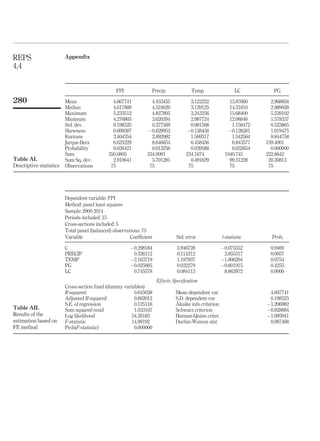
logarithms (except for PG) to facilitate the estimation procedure. The descriptive statistics,
mean value, standard deviation and coefficient of variation of these variables are given in
Table AI.
5. Post regression diagnostic tests
Our model has been estimated with EViews 10. Choice has been made among fixed effects
(FE) and random effects (RE); as they represent the two alternative methods in our case for
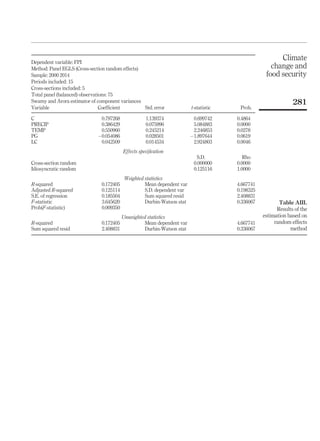
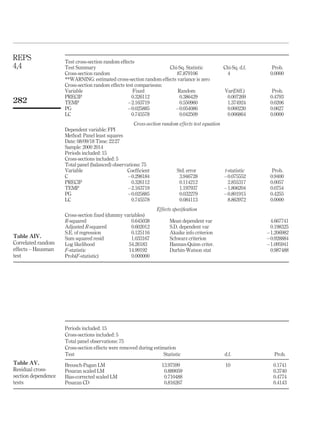
estimating static panel models. Tables AII and AIII show the results of each one of them. It
is worth noting that Pooled OLS method hasn’t been used as it does not account for the
unobserved heterogeneity of countries. On the other hand, FE (Table AII) and/or random
effects (Table AIII) estimators have successfully addressed this problem (Baltagi, 2005)[7].
Therefore, decision should be made whether to rely on FE method or RE method.
Accordingly, Hausman test has been used and it shows that the FE method is more suitable
than the random effect method for our model (Table AIV)[8].
To identify the cross sectional independence in panel data set, Pesaran’s test shows that
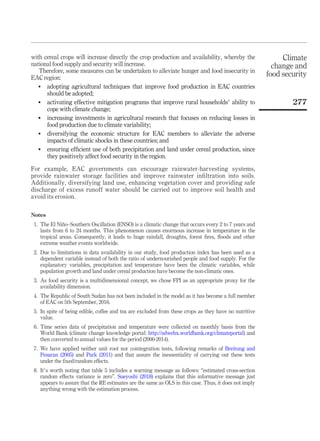
there is no cross-section correlation in residuals of our model (Table AV). Also, Jarque-Bera
normality test assures the normality of errors at 5 per cent significance level (Figure 1). With
respect to serial correlation (autocorrelation), Durbin-Watson statistic value shows that
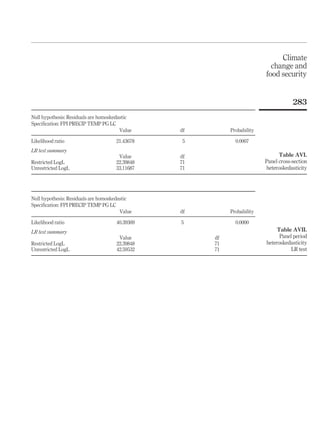
there is a first-order autocorrelation. Finally, Tables AVI and AVII show that the model
suffers from heteroskedasticity. So, to deal with the problems of heteroskedasticity and
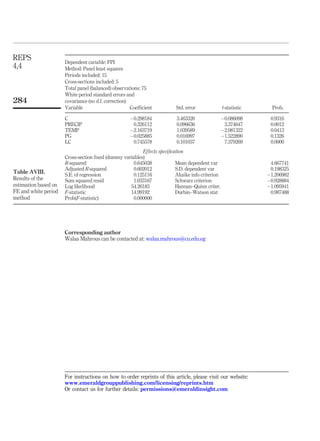
serial correlation, White period method is used in re-estimating our FE regression model
(Table AVIII)[9].
6. Results
Table AVIII shows that climatic factors – compared to non-climatic factors – play major role
in determining food security in EAC region as both rainfall and temperature have
significant impact on our dependent variable while land under cereal production is the only
non-climatic variable that has a significant effect.
Climate
change and
food security
275
Regarding the specific impact for each one of the climatic variables, results indicate that
rainfall has a positive effect; food security may go up by 0.32 per cent due to 1 per cent
increase in annual precipitation. On the contrary, temperature has a negative impact; food
security decreases by 2.16 per cent due to 1 per cent increase in annual temperature. The
positive impact for precipitation can be justified by the fact that rainfall is an important
source of agriculture in EAC countries. As rain-fed agriculture is widespread in East Africa,
any increase in rainfall might cause an increment in agricultural/food production,
households’ incomes and food security. With respect to temperature, its sign shows that
temperature variability adversely affects agricultural production. Consequently, the
economic growth rates of these countries will fall and they will have limited ability to import
food. Hence, this can lead to a shortage in the national food supply and an increase in food
insecurity as Dell et al. (2008) show. This implies that changing temperature patterns could
be a threatening source for attaining food security in EAC countries.
With respect to non-climatic variables, findings show that land under cereal production
has a positive and significant effect on food security; every 1 per cent increase in land area
harvested with cereals may raise food security by 0.32 per cent. This agrees with findings of
Barrios et al. (2008). Hence, increasing the lands cultivated with cereal crops will increase
directly the crop production and availability, whereby the national food supply and security
will increase. Thus, agricultural policies that encourage the use of lands for cereal
cultivation increase food supply and security. Also, there is an insignificant impact for
population growth on our dependent variable. Therefore, claims of Neo-Malthusian
economists (Ehrlich and Ehrlich, 1991) that population growth could exert a high pressure
on agricultural resources, negatively affect agricultural productivity and reduce food
supply, does not apply to EAC area.
7. Conclusion
This paper analyzes the effects of climatic variability on food security for EAC region, over
the period (2000-2014), using panel data. The estimation results show that rainfall has a
positive and significant impact on food security in the region while temperature has a
negative and significant effect. Hence, increase in rainfall might cause an increment in food
production and food security while changing temperature patterns could be a challenge for
attaining food security in EAC countries. Also, findings indicate that there is an
insignificant impact for population growth on our dependent variable whereas land under
cereal production has a positive and significant effect. Thus, increasing the lands cultivated
Figure 1.
Results of normality
test
0
2
4
6
8
10
12
–0.3 –0.2 –0.1 0.0 0.1 0.2 0.3
Series: Standardized Residuals
Sample 2000 2014
Observations 75
Mean –3.00e-17
Median –0.011909
Maximum 0.291124
Minimum –0.290284
Std. Dev. 0.118160
Skewness 0.228994
Kurtosis 3.157295
Jarque-Bera 0.732795
Probability 0.693227
REPS
4,4
276
with cereal crops will increase directly the crop production and availability, whereby the
national food supply and security will increase.
Therefore, some measures can be undertaken to alleviate hunger and food insecurity in
EAC region:
 adopting agricultural techniques that improve food production in EAC countries
should be adopted;
 activating effective mitigation programs that improve rural households’ ability to
cope with climate change;
 increasing investments in agricultural research that focuses on reducing losses in
food production due to climate variability;
 diversifying the economic structure for EAC members to alleviate the adverse
impacts of climatic shocks in these countries; and
 ensuring efficient use of both precipitation and land under cereal production, since
they positively affect food security in the region.
For example, EAC governments can encourage rainwater-harvesting systems,
provide rainwater storage facilities and improve rainwater infiltration into soils.
Additionally, diversifying land use, enhancing vegetation cover and providing safe
discharge of excess runoff water should be carried out to improve soil health and
avoid its erosion.
Notes
1. The El Niño–Southern Oscillation (ENSO) is a climatic change that occurs every 2 to 7 years and
lasts from 6 to 24 months. This phenomenon causes enormous increase in temperature in the
tropical areas. Consequently, it leads to huge rainfall, droughts, forest fires, floods and other
extreme weather events worldwide.
2. Due to limitations in data availability in our study, food production index has been used as a
dependent variable instead of both the ratio of undernourished people and food supply. For the
explanatory variables, precipitation and temperature have been the climatic variables, while
population growth and land under cereal production have become the non-climatic ones.
3. As food security is a multidimensional concept, we chose FPI as an appropriate proxy for the
availability dimension.
4. The Republic of South Sudan has not been included in the model as it has become a full member
of EAC on 5th September, 2016.
5. In spite of being edible, coffee and tea are excluded from these crops as they have no nutritive
value.
6. Time series data of precipitation and temperature were collected on monthly basis from the
World Bank (climate change knowledge portal: http://sdwebx.worldbank.org/climateportal) and
then converted to annual values for the period (2000-2014).
7. We have applied neither unit root nor cointegration tests, following remarks of Breitung and
Pesaran (2005) and Park (2011) and that assure the inessentiality of carrying out these tests
under the fixed/random effects.
8. It’s worth noting that table 5 includes a warning message as follows: “estimated cross-section
random effects variance is zero”. Sueyoshi (2018) explains that this informative message just
appears to assure that the RE estimates are the same as OLS in this case. Thus, it does not imply
anything wrong with the estimation process.
Climate
change and
food security
277
9. The White period method presumes that the errors for a cross-section are serially correlated and
heteroskedastic. Thus, estimation results given by this method are robust to autocorrelation and
heteroskedasticity. For further details, refer to: IHS Global Inc.: EViews 10 User’s Guide II, 2017.
References
Arshed, N. and Abduqayumov, S. (2016), “Economic impact of climate change on wheat and cotton in
major districts of Punjab”, International Journal of Economics and Financial Research, Vol. 2
No. 10, pp. 183-191.
Badolo, F. and Kinda, S.R. (2014), “Climatic variability and food security in developing countries”,
Centre d’Etudes et de Recherches sur le Développement International (CERDI), Etudes et
Document, No. 5, CERDI, Clermont Ferrand.
Baltagi, B.H. (2005), Econometric Analysis of Panel Data, 3rd Ed., John Wiley and Sons, West Sussex.
Barrios, S., et al. (2008), “The impact of climatic change on agricultural production: is it different for
Africa?”, Food Policy, Vol. 33 No. 4, pp. 287-298.
Ben Zaied, Y. and Zouabi, O. (2015), “Climate change impacts on agriculture: a panel cointegration
approach and application to Tunis”, MPRA Paper No. 64711.
Breitung, J. and Pesaran, M.H. (2005), “Unit roots and cointegration in panels”, CESIFO Working Paper
No. 1565.
Dell, M., Jones, B.F. and Olken, B.A. (2008), “Climate change and economic growth: evidence from the
last half century”, National Bureau of Economic Research, Working Paper Series No. 14132.
Demeke, A.B., et al. (2011), “Using panel data to estimate the effect of rainfall shocks on smallholders
food security and vulnerability in rural Ethiopia”, Climatic Change, Vol. 108 Nos 1/2, pp. 185-206.
EAC (2010), EAC Climate Change Policy Framework – East African Community, EAC Secretariat,
Arusha.
EAC (2011), EAC Food Security Action Plan (2011-2015), EAC Secretariat, Arusha.
EAC (2017), EAC Development Strategy (2016/17-2020/21), EAC Secretariat, Arusha.
Ehrlich, P.R. and Ehrlich, A.H. (1991), The Population Explosion, Simon and Schuster, New York, NY.
FAO (1996), Rome Declaration on World Food Security and World Food Summit Plan of Action, World
Food Summit, 13-17 November, FAO, Rome.
FAO (2005), The State of Food and Agriculture, FAO, Rome.
FAO (2008), Climate Change and Food Security: A Framework Document, FAO, Rome.
FAO (2015), “The state of food insecurity in the world 2015”, Meeting the 2015 International Hunger
Targets: Taking Stock of Uneven Progress, FAO, Rome.
FAO (2017), “Regional overview of food security and nutrition in Africa 2016”, The Challenges of
Building Resilience to Shocks and Stresses, FAO, Accra.
FAO and ECA (2018), “Regional overview of food security and nutrition”, Addressing the Threat from
Climate Variability and Extremes for Food Security and Nutrition, FAO and ECA, Accra.
Geffersa, A.G. (2014), “Effects of climate shocks on household food security in rural Ethiopia: panel
data estimation”, Master Thesis, Wageningen University, Department of Social Sciences.
Hagos, S., et al. (2014), “Climate change, crop production and child under nutrition in Ethiopia; a
longitudinal panel study”, BMC Public Health, Vol. 14 No. 1, pp. 884-892.
Index Mundi (2018), “World-Food production index”, available at: www.indexmundi.com/facts/world/
food-production-index (accessed 17 July 2018).
IPCC (2007), “Climate change 2007: impacts, adaptation and vulnerability”, Contribution of Working
Group II to the Fourth Assessment Report of the Intergovernmental Panel on Climate Change,
available at: www.ipcc.ch/pdf/assessment-report/ar4/wg2/ar4_wg2_full_report.pdf
REPS
4,4
278
Kabubo-Mariara, J. and Kabara, M. (2015), “Climate change and food security in Kenya”, Environment
for Development, Discussion Paper Series No. 15-05.
Kinda, S.R. (2017), “Climatic shocks and food security: the role of foreign aid”, African Development
Bank, Working Paper Series No. 286.
Kordi, M.A., et al. (2015), “Studying the effects of climate change of precipitation and temperature on
yield of Iran’s irrigated wheat using the dynamic panel method”, Biological Forum – an
International Journal, Vol. 7 No. 2, pp. 22-28.
Kumar, A. and Sharma, P. (2013), Impact of Climate Variation on Agricultural Productivity and Food
Security in Rural India, Kiel Institute for the World Economy, Economics Discussion Papers, No.
2013-43.
Mendelsohn, R. (2009), “The impact of climate change on agriculture in developing countries”, Journal
of Natural Resources Policy Research, Vol. 1 No. 1, pp. 5-19.
Namande, G. (2018), East Africa holds a Regional Climate Change Technical Working Group Meeting,
UNFCCC Regional Collaboration Centre, Nairobi, available at: https://unfccc.int/sites/default/files/
resource/RCC%20newsletter%20articleEAC%20CCTWG%20meeting%20%28002%29.pdf
Park, H.M. (2011), “Practical guides to panel data modeling: a step-by-step analysis using Stata”,
Tutorial Working Paper, Graduate School of International Relations, International University of
Japan.
Roessig, J.M., et al. (2004), “Effects of global climate change on marine and estuarine fishes and
fisheries”, Reviews in Fish Biology and Fisheries, Vol. 14 No. 2, pp. 251-275.
Singh, A. (2018), “Influence of climate and Non-Climatic factors on global food security index: a cross-
sectional country-wise analysis”, Socialsci Journal, Vol. 1 No. 1, pp. 22-35.
Sueyoshi, G. (2018), “Hausman test correlated random effects”, available at: http://forums.eviews.com/
viewtopic.php?f=18t=2688
Tokunaga, S., et al. (2015), “Dynamic panel data analysis of the impacts of climate change on
agricultural production in Japan”, Japan Agricultural Research Quarterly: Jarq, Vol. 49 No. 2,
pp. 149-157.
United Nations Framework Convention on Climate Change (UNFCC) (2007), Climate Change – Uganda
National Adaptation Programme of Action, UNFCC Secretariat, Bonn.
World Bank (2018a), “Climate change knowledge portal”, available at: http://sdwebx.worldbank.org/
climateportal/index.cfm?page=why_climate_change (accessed 15 July 2018).
World Bank (2018b), “World development indicators”, available at: www.worldbank.org (accessed 15
July 2018).
WWF-Worldwide Fund for Nature (2006), “Climate change impacts on East Africa: a review of the
scientific literature”, Gland, WWF.
Further reading
FAO (2016), Climate Change and Food Security: Risks and Responses, FAO, Rome.
IHS Global Inc (2017), EViews 10 User’s Guide II, IHS Global, CA.
Climate
change and
food security
279
Appendix
Table AI.
Descriptive statistics
FPI Precip Temp LC PG
Mean 4.667741 4.453455 3.122232 13.87660 2.968856
Median 4.617889 4.524620 3.139125 14.31810 2.989028
Maximum 5.233512 4.827805 3.243256 15.68400 5.539102
Minimum 4.276805 3.620394 2.987724 12.08846 1.578337
Std. dev. 0.198325 0.277569 0.081508 1.158472 0.523865
Skewness 0.699387 0.829952 0.138456 0.128281 1.019475
Kurtosis 3.404354 2.892082 1.589317 1.542564 9.844758
Jarque-Bera 6.625229 8.646654 6.458456 6.843577 159.4001
Probability 0.036421 0.013256 0.039588 0.032654 0.000000
Sum 350.0805 334.0091 234.1674 1040.745 222.6642
Sum Sq. dev. 2.910641 5.701281 0.491629 99.31228 20.30813
Observations 75 75 75 75 75
Table AII.
Results of the
estimation based on
FE method
Dependent variable: FPI
Method: panel least squares
Sample: 2000 2014
Periods included: 15
Cross-sections included: 5
Total panel (balanced) observations: 75
Variable Coefficient Std. error t-statistic Prob.
C 0.298184 3.946728 0.075552 0.9400
PRECIP 0.326112 0.114212 2.855317 0.0057
TEMP 2.163719 1.197937 1.806204 0.0754
PG 0.025885 0.032279 0.801915 0.4255
LC 0.745578 0.084113 8.863972 0.0000
Effects Specification
Cross-section fixed (dummy variables)
R-squared 0.645038 Mean dependent var 4.667741
Adjusted R-squared 0.602012 S.D. dependent var 0.198325
S.E. of regression 0.125116 Akaike info criterion 1.206982
Sum squared resid 1.033167 Schwarz criterion 0.928884
Log likelihood 54.26183 Hannan-Quinn criter. 1.095941
F-statistic 14.99192 Durbin-Watson stat 0.987488
Prob(F-statistic) 0.000000
REPS
4,4
280
Table AIII.
Results of the
estimation based on
random effects
method
Dependent variable: FPI
Method: Panel EGLS (Cross-section random effects)
Sample: 2000 2014
Periods included: 15
Cross-sections included: 5
Total panel (balanced) observations: 75
Swamy and Arora estimator of component variances
Variable Coefficient Std. error t-statistic Prob.
C 0.797268 1.139374 0.699742 0.4864
PRECIP 0.386429 0.075996 5.084883 0.0000
TEMP 0.550960 0.245214 2.246853 0.0278
PG 0.054086 0.028501 1.897644 0.0619
LC 0.042509 0.014534 2.924803 0.0046
Effects specification
S.D. Rho
Cross-section random 0.000000 0.0000
Idiosyncratic random 0.125116 1.0000
Weighted statistics
R-squared 0.172405 Mean dependent var 4.667741
Adjusted R-squared 0.125114 S.D. dependent var 0.198325
S.E. of regression 0.185504 Sum squared resid 2.408831
F-statistic 3.645620 Durbin-Watson stat 0.336067
Prob(F-statistic) 0.009350
Unweighted statistics
R-squared 0.172405 Mean dependent var 4.667741
Sum squared resid 2.408831 Durbin-Watson stat 0.336067
Climate
change and
food security
281
Table AIV.
Correlated random
effects – Hausman
test
Test cross-section random effects
Test Summary Chi-Sq. Statistic Chi-Sq. d.f. Prob.
Cross-section random 87.879106 4 0.0000
**WARNING: estimated cross-section random effects variance is zero
Cross-section random effects test comparisons:
Variable Fixed Random Var(Diff.) Prob.
PRECIP 0.326112 0.386429 0.007269 0.4793
TEMP 2.163719 0.550960 1.374924 0.0206
PG 0.025885 0.054086 0.000230 0.0627
LC 0.745578 0.042509 0.006864 0.0000
Cross-section random effects test equation
Dependent variable: FPI
Method: Panel least squares
Date: 08/09/18 Time: 22:27
Sample: 2000 2014
Periods included: 15
Cross-sections included: 5
Total panel (balanced) observations: 75
Variable Coefficient Std. error t-statistic Prob.
C 0.298184 3.946728 0.075552 0.9400
PRECIP 0.326112 0.114212 2.855317 0.0057
TEMP 2.163719 1.197937 1.806204 0.0754
PG 0.025885 0.032279 0.801915 0.4255
LC 0.745578 0.084113 8.863972 0.0000
Effects specification
Cross-section fixed (dummy variables)
R-squared 0.645038 Mean dependent var 4.667741
Adjusted R-squared 0.602012 S.D. dependent var 0.198325
S.E. of regression 0.125116 Akaike info criterion 1.206982
Sum squared resid 1.033167 Schwarz criterion 0.928884
Log likelihood 54.26183 Hannan-Quinn criter. 1.095941
F-statistic 14.99192 Durbin-Watson stat 0.987488
Prob(F-statistic) 0.000000
Table AV.
Residual cross-
section dependence
tests
Periods included: 15
Cross-sections included: 5
Total panel observations: 75
Cross-section effects were removed during estimation
Test Statistic d.f. Prob.
Breusch-Pagan LM 13.97599 10 0.1741
Pesaran scaled LM 0.889059 0.3740
Bias-corrected scaled LM 0.710488 0.4774
Pesaran CD 0.816267 0.4143
REPS
4,4
282
Table AVI.
Panel cross-section
heteroskedasticity
Null hypothesis: Residuals are homoskedastic
Specification: FPI PRECIP TEMP PG LC
Value df Probability
Likelihood ratio 21.43678 5 0.0007
LR test summary
Value df
Restricted LogL 22.39848 71
Unrestricted LogL 33.11687 71
Table AVII.
Panel period
heteroskedasticity
LR test
Null hypothesis: Residuals are homoskedastic
Specification: FPI PRECIP TEMP PG LC
Value df Probability
Likelihood ratio 40.39369 5 0.0000
LR test summary
Value df
Restricted LogL 22.39848 71
Unrestricted LogL 42.59532 71
Climate
change and
food security
283
Corresponding author
Walaa Mahrous can be contacted at: walaa.mahrous@cu.edu.eg
For instructions on how to order reprints of this article, please visit our website:
www.emeraldgrouppublishing.com/licensing/reprints.htm
Or contact us for further details: permissions@emeraldinsight.com
Table AVIII.
Results of the
estimation based on
FE and white period
method
Dependent cariable: FPI
Method: Panel least squares
Periods included: 15
Cross-sections included: 5
Total panel (balanced) observations: 75
White period standard errors and
covariance (no d.f. correction)
Variable Coefficient Std. error t-statistic Prob.
C 0.298184 3.463320 0.086098 0.9316
PRECIP 0.326112 0.096636 3.374647 0.0012
TEMP 2.163719 1.039589 2.081322 0.0413
PG 0.025885 0.016997 1.522890 0.1326
LC 0.745578 0.101037 7.379269 0.0000
Effects specification
Cross-section fixed (dummy variables)
R-squared 0.645038 Mean dependent var 4.667741
Adjusted R-squared 0.602012 S.D. dependent var 0.198325
S.E. of regression 0.125116 Akaike info criterion 1.206982
Sum squared resid 1.033167 Schwarz criterion 0.928884
Log likelihood 54.26183 Hannan–Quinn criter. 1.095941
F-statistic 14.99192 Durbin–Watson stat 0.987488
Prob(F-statistic) 0.000000
REPS
4,4
284

1.climate change and food security in eac region a panel data analysis

  • 1.
    Climate change andfood security in EAC region: a panel data analysis Walaa Mahrous Department of Political Science and Economics, Cairo University Institute of African Researches and Studies, Giza, Egypt Abstract Purpose – This study aims to analyze the impact of global climate change on food security in the East African Community (EAC) region, using panel data analysis for five countries, over 2000-2014. Design/methodology/approach – The determinants of food security are expressed as a function of rainfall, temperature, land area under cereal production, and population size. The paper used pooled fixed effects to estimate the relationship among these variables. Findings – Findings show that food security in EAC is adversely affected by temperature. However, precipitation and increasing areas cultivated with cereal crops will be beneficial to ensure everyone’s food security. Originality/value – Actions for mitigating global warming are important for EAC to consolidate the region’s economic, political and social development/stability. Keywords Climate change, Panel data analysis, Food security, EAC Paper type Research paper 1. Introduction Putting an end to hunger and malnutrition is considered to be a serious challenge for achieving sustainable development in developing countries. For instance, about 500 million people who are food insecure are still in Africa and Southern Asia. In addition, a high percentage of those people are directly or indirectly dependent on agriculture [Food and Agriculture Organization of the United Nations (FAO), 2015]. The Intergovernmental Panel on Climate Change (IPCC), in its fifth assessment report, remarks that climate change is negatively affecting crops, livestock, and fisheries. Also, climatic variability is threatening the agriculture sector and food security through the loss of rural livelihoods, the loss of marine ecosystems, inland water ecosystems, and the breakdown of food systems (IPCC, 2014). For example, disasters that hit tropical areas destroy the stability and food security of communities living there. Therefore, these tropical zones often witness food insecurity crises; especially that agriculture sector in these regions employs from 30 to over 80 per cent of the population (FAO, 2015). In the IPCC’s fourth assessment report, the agriculture sector in Africa was expected to experience periods of prolonged droughts and floods. Consequently, there would be reduction in the fertile agricultural land, expansion of arid/semi-arid land, and vast decrease © Walaa Mahrous. Published in Review of Economics and Political Science. Published by Emerald Publishing Limited. This article is published under the Creative Commons Attribution (CC BY 4.0) licence. Anyone may reproduce, distribute, translate and create derivative works of this article (for both commercial and non-commercial purposes), subject to full attribution to the original publication and authors. The full terms of this licence may be seen at http://creativecommons.org/licences/by/4.0/ legalcode REPS 4,4 270 Received 20 December 2018 Revised 27 April 2019 3 June 2019 Accepted 4 August 2019 Review of Economics and Political Science Vol. 4 No. 4, 2019 pp. 270-284 EmeraldPublishingLimited 2631-3561 DOI 10.1108/REPS-12-2018-0039 The current issue and full text archive of this journal is available on Emerald Insight at: www.emeraldinsight.com/2631-3561.htm
  • 2.
    in the productivityof fisheries (IPCC, 2007). In recent years, drought and elevated temperatures, as evidence of climate change, have adversely affected all the agricultural sub-sectors in the Horn of Africa and other African regions. As a result, estimates of the prevalence of severe food insecurity in the whole African Region is increasing, particularly for middle and eastern Africa (FAO, 2017). With respect to FAO (1996), food security is attained when: [. . .] all people, at all times, have physical and economic access to sufficient, safe and nutritious food that meets their dietary needs and food preferences for an active and healthy life. Thus, food security concept encompasses four main dimensions: food availability, economical and physical accessibility, utilization and stability. Accordingly, not only enough food being produced worldwide is needed but also everyone should have the ability to timely get this food, in the proper quantity and quality. The East African Community (EAC) is a regional intergovernmental organization of six Partner States: Burundi, Kenya, Rwanda, South Sudan, Uganda and Tanzania. Through this community, these members cooperate together in political, economic, and social fields. They established a Customs Union in 2005, then a Common Market in 2010. In 2013, The East African Monetary Union (EAMU) Protocol was signed and set the ground for a monetary union within 10 years. Finally, in 2017, the EAC Heads of State agreed on reaching Political Federation by carrying out the Political Confederation as a transitional phase (EAC, 2017). In spite of having a big capacity to produce enough food for its population, the EAC region frequently suffers from food shortages and hunger. There are a lot of factors that stand behind such a critical state, such as: prevalence of rain-fed farming systems; inadequate food access among the vulnerable and poor population; frequency and severity of global warming impacts on food production; modest prices paid to food producers; social unrest and political instability; and poor technologies applied by farmers (EAC, 2011). Still, empirical studies that assess impacts of global climate change on food security in African regions like EAC are limited. Such research is needed by policy makers to design agricultural policies that can adapt to climate change and ensure food security simultaneously (Mendelsohn, 2009). Thus, this paper tries to estimate the relationship between food production and different climate-change factors (namely precipitation and temperature) in EAC States. It also tries to explore ways that enable the adaptation of agriculture sector in these countries to climate change and mitigate the effect of this change on food. The rest of this study is organized as follows. Section 2 presents a literature review on the various impacts of global warming on food security in both developed and developing countries. Section 3 illustrates facts on relationship between climate change and food security in EAC. Sections 4 and 5 show the methodology, data sources, and the diagnostic tests used. Section 6 provides the empirical results. Finally, Section 7 concludes the paper. 2. Literature review Recently, the impacts of climatic variability on food security have become debatable. Many researchers have analyzed this relationship empirically and consequently mixed findings Climate change and food security 271
  • 3.
    have been reached.Some studies have indicated that climate change has a negative impact on agricultural production, food availability, and could result in food insecurity. While others have reported that positive and negative impacts of climate change may occur on different crops. Therefore, according to the latter group, the adverse effect of climate variability on food security is inconclusive (FAO, 2008). Thereby, this section reviews empirical studies carried out in this field, in both developed and developing countries, by giving details on the main variables and findings. In Africa, some studies investigated empirically the relationship between climate change and food security in North and East Africa. For example, in Kenya, Kabubo-Mariara and Kabara (2015) estimated the effects of climate change on food insecurity for the period (1975- 2012). The paper focused on the food availability, as one of the main dimensions for food security, of four major food crops; maize, beans, sorghum and millet. Results showed that food insecurity would get increased by climate change. In addition, climate variables had a non-linear relationship with food insecurity. For example, increased seasonal precipitation was associated with reduced food insecurity, but excessive precipitation would increase insecurity as this might damage the crops. In Tunisia, Ben Zaied and Zouabi (2015) estimated the long run impact of climate variability on olive crop in Tunisia, using data for 24 regions from 1980 till 2012. Empirical results showed that temperature increase and rainfall shortages had negative long-run effects on olive production, across regions, over the last three decades. In Ethiopia, Geffersa (2014) investigated the impact of climate change on households’ food security in 15 Ethiopian villages in rural areas, over the period (1994-2009). The empirical results indicated that climate change negatively and significantly affected food security through time. Findings also assured that other elements, such as land and livestock, could play an essential role in guaranteeing the households’ food security. Also, Hagos et al. (2014) analyzed the impact of weather variables on the children under nutrition in Ethiopia, through the period (1996-2004). The study collected data on rainfall, temperature, children stunting, wasting, and underweight for three different zones. Results showed that for a given area, child stunting and underweight were positively affected by rainfall and temperature. However, wasting was found to be insignificantly affected by the climatic factors. Furthermore, Demeke et al. (2011) analyzed the effect of rainwater variation on food insecurity for rural households in Ethiopia, over the period (1994-2004). Results showed that food security and vulnerability were significantly affected by the level and variability of rainfall. In addition, there was a range of other factors (e.g. household size and livestock ownership) that could positively affect food security in Ethiopia. With respect to the continent of Asia, some papers measured the impacts of climate change variables on food security there. For instance, Tokunaga et al. (2015) studied empirically the impact of global warming (measured by temperature, solar radiation, and precipitation) on Japan’s agricultural production (rice, vegetable, and potato) using data for 8 regions in Japan throughout the period (1995-2006). By applying both static and dynamic panel data analyses, the study found that the rice production in Japan was reduced by the falling solar radiation while the vegetable and potato production were reduced by rising temperatures and precipitation. In addition, Wang (2010) measured the impact of climate change on food security, by using a sample of 27 provinces in China, for the period (1985- 2007). The empirical findings indicated that the rural per capita food consumption was adversely affected by the agricultural disaster area, as a proxy for climate change. Therefore, climate change would lead to a shortage in food supply and consequently could have a negative impact on the food security in China. REPS 4,4 272
  • 4.
    Also, Arshed andAbduqayumov (2016) measured long-run impact of climate change on the productivity of both wheat and cotton in 12 major districts of Punjab, for the period (1970-2010). The study used annual temperature and average rainfall as proxies for climate change. The results showed that cotton productivity was positively affected by increasing temperature while wheat productivity was positively impacted by increasing precipitation. While in Iran, Kordi et al. (2015) measured the effects of average annual temperature and total annual rainfall, as proxies for climate change, along with other variables (fertilizers, seeds, machinery and labor) on wheat production. The study used data for 11 provinces from 1991 till 2011 to estimate its model. The results showed that there was a non-linear relationship between climate change variables and wheat production in Iran. For example, temperature had a positive effect on wheat yield before the maximum annual temperature and then had a negative effect. Moreover, in India, Kumar and Sharma (2013) studied the impact of climate change on both agricultural production and food security in India. The paper collected data for 13 states through the period (1980-2009). Regression model showed that both agricultural production and state-wise food security index composed in this study were negatively affected by climatic fluctuations Finally, for a sample of 71 developing countries all over the world, Badolo and Kinda (2014) investigated the nexus between climatic variability and food security. This model has traced the influence of climatic variability on food security and succeeded in analyzing the causal relationship between these variables for 71 developing countries. Due to the limited availability of data that are needed to compose food security index in developing countries, the model has chosen the ratio of undernourished people and food supply alternatively as proxies for food security index. Rainfall, arable land, land under cereal production and food prices were the main explanatory variables included in their model. This study was carried out over the period (1960-2008). Empirical findings showed that global warming reduced the food supply and increased the percentage of undernourished people in these countries. However, this negative impact was higher in Sub-Saharan economies than for other developing ones. Also, the negative effects of climate change were intensified by the outbreaks of civil wars and vulnerability to food price shocks. 3. Food security and climate change in East African Community In EAC region, the water sector has been adversely affected by global warming. For instance, scientists have observed a rise in EAC lakes’ deepwater temperature, besides lake- level fluctuations and volatility, since the 1960s. Also, the region witnessed periods of severe drought and rainfalls in late 1997. Moreover, flow of some rivers in the area has started to decline due to shortages in regional rainfall. For example, the Pangani Basin, which is inhabited by approximately 3.7 million people, is considered to be one of Tanzania’s most prominent regions in agricultural and hydropower production. Because of raising temperatures and lessening rainfalls during dry months, the annual flow of River Pangani may be reduced by 6-9 per cent (IPCC, 2007). Also, the region has gone through temperature increase and precipitation decrease recently. This has adversely affected long-cycle crops (such as sorghum and maize) and consequently led to significant shortage in food supply (WWF-Worldwide Fund for Nature, 2006). Additionally, EAC countries have been threatened by the devastating impacts of climate change on their agriculture; as they have been frequently hit by weather-related food emergencies (FAO, 2005). Furthermore, climate change has negative effects on livestock and fisheries in EAC area. For instance, the “cattle corridor” in Uganda was hit by prolonged and severe drought in 1999/2000. This has led consequently to a big loss in animals, drop in milk production, Climate change and food security 273
  • 5.
    increase in foodprices, food insecurity, and sharp decline in economic growth [United Nations Framework Convention on Climate Change (UNFCC), 2007]. Besides, scientists have observed that the productivity of fisheries in the region has decreased over the past 200 years. This is due to climatic impact on lakes’ ecosystems that has caused a decline in fish abundance in East African lakes (Roessig et al., 2004). As climate change is threatening the quality and availability of the region’s resources, in 2010, EAC countries developed the EAC Climate Change Policy to guide their governments and other concerned groups on adaptation and mitigation actions to address climate change. This policy assured that goals of food security and economic development could not be attained without considering mitigation and adaptation measures to climate change in the area. Thus, with respect to adaptation, the policy focused on consolidating meteorological services, developing early warning systems, improving irrigation and protecting vulnerable ecosystems (such as wetlands, coastal, marine and forestry ecosystems). Concerning mitigation measures included in this policy, they were as follows: increasing pro- environmental energy resources, applying efficient crop and livestock production system, capturing opportunities in emission reductions, and engaging in reforestation in the region (EAC, 2010). Moreover, the EAC countries tried in 2011 to achieve food security and rational agricultural production across the region, by applying the EAC Agriculture and Rural Development Policy. By focusing on increasing agricultural production, processing, storage and marketing, this policy aims at eradicating poverty and ensuring food security within the region (EAC, 2011). In 2015-2016, Eastern Africa witnessed huge losses in the production of crops and livestock as it was severely affected by El Niño–Southern Oscillation[1]. As a result, the number of people suffering from undernourishment in the region increased from 121.4m to 132.2m; most of them were in Kenya and Uganda. In 2017, due to worsening climatic conditions, eastern Kenya, South Sudan and Uganda were hit by recurrent drought that destroyed major crops and raised food prices in these countries (FAO and ECA, 2018). Subsequently, in June 2018, a meeting was held by the regional East African Climate Change Technical Working Group, the GIZ Global Carbon Markets Programme, and the UNFCCC Regional Collaboration Centre. This assembly discussed ways for funding climate change mitigation and adaptation actions in EAC region, through global carbon markets and climate finance agreements (Namande, 2018). 4. Empirical analysis 4.1 Empirical model As previously illustrated in the literature review section, Badolo and Kinda (2014) has succeeded in analyzing the causal relationship between climatic variability and food security for 71 developing countries. Later on, some papers have adopted the same model to study climate change impacts on food security in African countries (Kinda, 2017; Singh, 2018). However, the main shortage of this model is that it has not studied the four dimensions of food security. This has been due to the limited availability of data that are needed to compose food security index in developing countries. Our paper has adopted the same framework, with some modifications in both dependent and explanatory variables due to some data limitations[2]. Thus, the following single multivariate equation is used to examine the relationship between food security in EAC and both climatic and non-climatic factors over the period (2000-2014): REPS 4,4 274
  • 6.
    Yit ¼ aiþ b Xit þ «it (1) With X it the matrix of explanatory variables (precipitation, temperature, population growth and land under cereal production), in a country i at the period t. ai comprises unobserved country-specific effects and «it is the error term. Yit is the food production index (FPI) as a proxy for food security[3]. 4.2 Data sources and variables description The data range used in this paper starts from 2000 till 2014 for the five countries in EAC: Burundi, Kenya, Rwanda, Tanzania and Uganda[4]. This data range has been chosen to get balanced panel data for our model. The annual data on food production index, precipitation, temperature, population growth and land under cereal production are obtained from Climate Change Knowledge Portal and the World Development Indicators Database; both provided by the World Bank (World Bank, 2018a, 2018b). Food production index (FPI), by covering food crops that are edible and contain nutrients [5], calculates the changes in the production of food in a given year relative to the base year (Index Mundi, 2018). Population growth (PG) is the annual growth rate in population size while land under cereal production (LC) is measured in hectares. With respect to climatic factors, precipitation (Precipt) is measured in millimeter and temperature (Tempt) is measured in Celsius degree centigrade[6]. Data on these variables are converted into natural logarithms (except for PG) to facilitate the estimation procedure. The descriptive statistics, mean value, standard deviation and coefficient of variation of these variables are given in Table AI. 5. Post regression diagnostic tests Our model has been estimated with EViews 10. Choice has been made among fixed effects (FE) and random effects (RE); as they represent the two alternative methods in our case for estimating static panel models. Tables AII and AIII show the results of each one of them. It is worth noting that Pooled OLS method hasn’t been used as it does not account for the unobserved heterogeneity of countries. On the other hand, FE (Table AII) and/or random effects (Table AIII) estimators have successfully addressed this problem (Baltagi, 2005)[7]. Therefore, decision should be made whether to rely on FE method or RE method. Accordingly, Hausman test has been used and it shows that the FE method is more suitable than the random effect method for our model (Table AIV)[8]. To identify the cross sectional independence in panel data set, Pesaran’s test shows that there is no cross-section correlation in residuals of our model (Table AV). Also, Jarque-Bera normality test assures the normality of errors at 5 per cent significance level (Figure 1). With respect to serial correlation (autocorrelation), Durbin-Watson statistic value shows that there is a first-order autocorrelation. Finally, Tables AVI and AVII show that the model suffers from heteroskedasticity. So, to deal with the problems of heteroskedasticity and serial correlation, White period method is used in re-estimating our FE regression model (Table AVIII)[9]. 6. Results Table AVIII shows that climatic factors – compared to non-climatic factors – play major role in determining food security in EAC region as both rainfall and temperature have significant impact on our dependent variable while land under cereal production is the only non-climatic variable that has a significant effect. Climate change and food security 275
  • 7.
    Regarding the specificimpact for each one of the climatic variables, results indicate that rainfall has a positive effect; food security may go up by 0.32 per cent due to 1 per cent increase in annual precipitation. On the contrary, temperature has a negative impact; food security decreases by 2.16 per cent due to 1 per cent increase in annual temperature. The positive impact for precipitation can be justified by the fact that rainfall is an important source of agriculture in EAC countries. As rain-fed agriculture is widespread in East Africa, any increase in rainfall might cause an increment in agricultural/food production, households’ incomes and food security. With respect to temperature, its sign shows that temperature variability adversely affects agricultural production. Consequently, the economic growth rates of these countries will fall and they will have limited ability to import food. Hence, this can lead to a shortage in the national food supply and an increase in food insecurity as Dell et al. (2008) show. This implies that changing temperature patterns could be a threatening source for attaining food security in EAC countries. With respect to non-climatic variables, findings show that land under cereal production has a positive and significant effect on food security; every 1 per cent increase in land area harvested with cereals may raise food security by 0.32 per cent. This agrees with findings of Barrios et al. (2008). Hence, increasing the lands cultivated with cereal crops will increase directly the crop production and availability, whereby the national food supply and security will increase. Thus, agricultural policies that encourage the use of lands for cereal cultivation increase food supply and security. Also, there is an insignificant impact for population growth on our dependent variable. Therefore, claims of Neo-Malthusian economists (Ehrlich and Ehrlich, 1991) that population growth could exert a high pressure on agricultural resources, negatively affect agricultural productivity and reduce food supply, does not apply to EAC area. 7. Conclusion This paper analyzes the effects of climatic variability on food security for EAC region, over the period (2000-2014), using panel data. The estimation results show that rainfall has a positive and significant impact on food security in the region while temperature has a negative and significant effect. Hence, increase in rainfall might cause an increment in food production and food security while changing temperature patterns could be a challenge for attaining food security in EAC countries. Also, findings indicate that there is an insignificant impact for population growth on our dependent variable whereas land under cereal production has a positive and significant effect. Thus, increasing the lands cultivated Figure 1. Results of normality test 0 2 4 6 8 10 12 –0.3 –0.2 –0.1 0.0 0.1 0.2 0.3 Series: Standardized Residuals Sample 2000 2014 Observations 75 Mean –3.00e-17 Median –0.011909 Maximum 0.291124 Minimum –0.290284 Std. Dev. 0.118160 Skewness 0.228994 Kurtosis 3.157295 Jarque-Bera 0.732795 Probability 0.693227 REPS 4,4 276
  • 8.
    with cereal cropswill increase directly the crop production and availability, whereby the national food supply and security will increase. Therefore, some measures can be undertaken to alleviate hunger and food insecurity in EAC region: adopting agricultural techniques that improve food production in EAC countries should be adopted; activating effective mitigation programs that improve rural households’ ability to cope with climate change; increasing investments in agricultural research that focuses on reducing losses in food production due to climate variability; diversifying the economic structure for EAC members to alleviate the adverse impacts of climatic shocks in these countries; and ensuring efficient use of both precipitation and land under cereal production, since they positively affect food security in the region. For example, EAC governments can encourage rainwater-harvesting systems, provide rainwater storage facilities and improve rainwater infiltration into soils. Additionally, diversifying land use, enhancing vegetation cover and providing safe discharge of excess runoff water should be carried out to improve soil health and avoid its erosion. Notes 1. The El Niño–Southern Oscillation (ENSO) is a climatic change that occurs every 2 to 7 years and lasts from 6 to 24 months. This phenomenon causes enormous increase in temperature in the tropical areas. Consequently, it leads to huge rainfall, droughts, forest fires, floods and other extreme weather events worldwide. 2. Due to limitations in data availability in our study, food production index has been used as a dependent variable instead of both the ratio of undernourished people and food supply. For the explanatory variables, precipitation and temperature have been the climatic variables, while population growth and land under cereal production have become the non-climatic ones. 3. As food security is a multidimensional concept, we chose FPI as an appropriate proxy for the availability dimension. 4. The Republic of South Sudan has not been included in the model as it has become a full member of EAC on 5th September, 2016. 5. In spite of being edible, coffee and tea are excluded from these crops as they have no nutritive value. 6. Time series data of precipitation and temperature were collected on monthly basis from the World Bank (climate change knowledge portal: http://sdwebx.worldbank.org/climateportal) and then converted to annual values for the period (2000-2014). 7. We have applied neither unit root nor cointegration tests, following remarks of Breitung and Pesaran (2005) and Park (2011) and that assure the inessentiality of carrying out these tests under the fixed/random effects. 8. It’s worth noting that table 5 includes a warning message as follows: “estimated cross-section random effects variance is zero”. Sueyoshi (2018) explains that this informative message just appears to assure that the RE estimates are the same as OLS in this case. Thus, it does not imply anything wrong with the estimation process. Climate change and food security 277
  • 9.
    9. The Whiteperiod method presumes that the errors for a cross-section are serially correlated and heteroskedastic. Thus, estimation results given by this method are robust to autocorrelation and heteroskedasticity. For further details, refer to: IHS Global Inc.: EViews 10 User’s Guide II, 2017. References Arshed, N. and Abduqayumov, S. (2016), “Economic impact of climate change on wheat and cotton in major districts of Punjab”, International Journal of Economics and Financial Research, Vol. 2 No. 10, pp. 183-191. Badolo, F. and Kinda, S.R. (2014), “Climatic variability and food security in developing countries”, Centre d’Etudes et de Recherches sur le Développement International (CERDI), Etudes et Document, No. 5, CERDI, Clermont Ferrand. Baltagi, B.H. (2005), Econometric Analysis of Panel Data, 3rd Ed., John Wiley and Sons, West Sussex. Barrios, S., et al. (2008), “The impact of climatic change on agricultural production: is it different for Africa?”, Food Policy, Vol. 33 No. 4, pp. 287-298. Ben Zaied, Y. and Zouabi, O. (2015), “Climate change impacts on agriculture: a panel cointegration approach and application to Tunis”, MPRA Paper No. 64711. Breitung, J. and Pesaran, M.H. (2005), “Unit roots and cointegration in panels”, CESIFO Working Paper No. 1565. Dell, M., Jones, B.F. and Olken, B.A. (2008), “Climate change and economic growth: evidence from the last half century”, National Bureau of Economic Research, Working Paper Series No. 14132. Demeke, A.B., et al. (2011), “Using panel data to estimate the effect of rainfall shocks on smallholders food security and vulnerability in rural Ethiopia”, Climatic Change, Vol. 108 Nos 1/2, pp. 185-206. EAC (2010), EAC Climate Change Policy Framework – East African Community, EAC Secretariat, Arusha. EAC (2011), EAC Food Security Action Plan (2011-2015), EAC Secretariat, Arusha. EAC (2017), EAC Development Strategy (2016/17-2020/21), EAC Secretariat, Arusha. Ehrlich, P.R. and Ehrlich, A.H. (1991), The Population Explosion, Simon and Schuster, New York, NY. FAO (1996), Rome Declaration on World Food Security and World Food Summit Plan of Action, World Food Summit, 13-17 November, FAO, Rome. FAO (2005), The State of Food and Agriculture, FAO, Rome. FAO (2008), Climate Change and Food Security: A Framework Document, FAO, Rome. FAO (2015), “The state of food insecurity in the world 2015”, Meeting the 2015 International Hunger Targets: Taking Stock of Uneven Progress, FAO, Rome. FAO (2017), “Regional overview of food security and nutrition in Africa 2016”, The Challenges of Building Resilience to Shocks and Stresses, FAO, Accra. FAO and ECA (2018), “Regional overview of food security and nutrition”, Addressing the Threat from Climate Variability and Extremes for Food Security and Nutrition, FAO and ECA, Accra. Geffersa, A.G. (2014), “Effects of climate shocks on household food security in rural Ethiopia: panel data estimation”, Master Thesis, Wageningen University, Department of Social Sciences. Hagos, S., et al. (2014), “Climate change, crop production and child under nutrition in Ethiopia; a longitudinal panel study”, BMC Public Health, Vol. 14 No. 1, pp. 884-892. Index Mundi (2018), “World-Food production index”, available at: www.indexmundi.com/facts/world/ food-production-index (accessed 17 July 2018). IPCC (2007), “Climate change 2007: impacts, adaptation and vulnerability”, Contribution of Working Group II to the Fourth Assessment Report of the Intergovernmental Panel on Climate Change, available at: www.ipcc.ch/pdf/assessment-report/ar4/wg2/ar4_wg2_full_report.pdf REPS 4,4 278
  • 10.
    Kabubo-Mariara, J. andKabara, M. (2015), “Climate change and food security in Kenya”, Environment for Development, Discussion Paper Series No. 15-05. Kinda, S.R. (2017), “Climatic shocks and food security: the role of foreign aid”, African Development Bank, Working Paper Series No. 286. Kordi, M.A., et al. (2015), “Studying the effects of climate change of precipitation and temperature on yield of Iran’s irrigated wheat using the dynamic panel method”, Biological Forum – an International Journal, Vol. 7 No. 2, pp. 22-28. Kumar, A. and Sharma, P. (2013), Impact of Climate Variation on Agricultural Productivity and Food Security in Rural India, Kiel Institute for the World Economy, Economics Discussion Papers, No. 2013-43. Mendelsohn, R. (2009), “The impact of climate change on agriculture in developing countries”, Journal of Natural Resources Policy Research, Vol. 1 No. 1, pp. 5-19. Namande, G. (2018), East Africa holds a Regional Climate Change Technical Working Group Meeting, UNFCCC Regional Collaboration Centre, Nairobi, available at: https://unfccc.int/sites/default/files/ resource/RCC%20newsletter%20articleEAC%20CCTWG%20meeting%20%28002%29.pdf Park, H.M. (2011), “Practical guides to panel data modeling: a step-by-step analysis using Stata”, Tutorial Working Paper, Graduate School of International Relations, International University of Japan. Roessig, J.M., et al. (2004), “Effects of global climate change on marine and estuarine fishes and fisheries”, Reviews in Fish Biology and Fisheries, Vol. 14 No. 2, pp. 251-275. Singh, A. (2018), “Influence of climate and Non-Climatic factors on global food security index: a cross- sectional country-wise analysis”, Socialsci Journal, Vol. 1 No. 1, pp. 22-35. Sueyoshi, G. (2018), “Hausman test correlated random effects”, available at: http://forums.eviews.com/ viewtopic.php?f=18t=2688 Tokunaga, S., et al. (2015), “Dynamic panel data analysis of the impacts of climate change on agricultural production in Japan”, Japan Agricultural Research Quarterly: Jarq, Vol. 49 No. 2, pp. 149-157. United Nations Framework Convention on Climate Change (UNFCC) (2007), Climate Change – Uganda National Adaptation Programme of Action, UNFCC Secretariat, Bonn. World Bank (2018a), “Climate change knowledge portal”, available at: http://sdwebx.worldbank.org/ climateportal/index.cfm?page=why_climate_change (accessed 15 July 2018). World Bank (2018b), “World development indicators”, available at: www.worldbank.org (accessed 15 July 2018). WWF-Worldwide Fund for Nature (2006), “Climate change impacts on East Africa: a review of the scientific literature”, Gland, WWF. Further reading FAO (2016), Climate Change and Food Security: Risks and Responses, FAO, Rome. IHS Global Inc (2017), EViews 10 User’s Guide II, IHS Global, CA. Climate change and food security 279
  • 11.
    Appendix Table AI. Descriptive statistics FPIPrecip Temp LC PG Mean 4.667741 4.453455 3.122232 13.87660 2.968856 Median 4.617889 4.524620 3.139125 14.31810 2.989028 Maximum 5.233512 4.827805 3.243256 15.68400 5.539102 Minimum 4.276805 3.620394 2.987724 12.08846 1.578337 Std. dev. 0.198325 0.277569 0.081508 1.158472 0.523865 Skewness 0.699387 0.829952 0.138456 0.128281 1.019475 Kurtosis 3.404354 2.892082 1.589317 1.542564 9.844758 Jarque-Bera 6.625229 8.646654 6.458456 6.843577 159.4001 Probability 0.036421 0.013256 0.039588 0.032654 0.000000 Sum 350.0805 334.0091 234.1674 1040.745 222.6642 Sum Sq. dev. 2.910641 5.701281 0.491629 99.31228 20.30813 Observations 75 75 75 75 75 Table AII. Results of the estimation based on FE method Dependent variable: FPI Method: panel least squares Sample: 2000 2014 Periods included: 15 Cross-sections included: 5 Total panel (balanced) observations: 75 Variable Coefficient Std. error t-statistic Prob. C 0.298184 3.946728 0.075552 0.9400 PRECIP 0.326112 0.114212 2.855317 0.0057 TEMP 2.163719 1.197937 1.806204 0.0754 PG 0.025885 0.032279 0.801915 0.4255 LC 0.745578 0.084113 8.863972 0.0000 Effects Specification Cross-section fixed (dummy variables) R-squared 0.645038 Mean dependent var 4.667741 Adjusted R-squared 0.602012 S.D. dependent var 0.198325 S.E. of regression 0.125116 Akaike info criterion 1.206982 Sum squared resid 1.033167 Schwarz criterion 0.928884 Log likelihood 54.26183 Hannan-Quinn criter. 1.095941 F-statistic 14.99192 Durbin-Watson stat 0.987488 Prob(F-statistic) 0.000000 REPS 4,4 280
  • 12.
    Table AIII. Results ofthe estimation based on random effects method Dependent variable: FPI Method: Panel EGLS (Cross-section random effects) Sample: 2000 2014 Periods included: 15 Cross-sections included: 5 Total panel (balanced) observations: 75 Swamy and Arora estimator of component variances Variable Coefficient Std. error t-statistic Prob. C 0.797268 1.139374 0.699742 0.4864 PRECIP 0.386429 0.075996 5.084883 0.0000 TEMP 0.550960 0.245214 2.246853 0.0278 PG 0.054086 0.028501 1.897644 0.0619 LC 0.042509 0.014534 2.924803 0.0046 Effects specification S.D. Rho Cross-section random 0.000000 0.0000 Idiosyncratic random 0.125116 1.0000 Weighted statistics R-squared 0.172405 Mean dependent var 4.667741 Adjusted R-squared 0.125114 S.D. dependent var 0.198325 S.E. of regression 0.185504 Sum squared resid 2.408831 F-statistic 3.645620 Durbin-Watson stat 0.336067 Prob(F-statistic) 0.009350 Unweighted statistics R-squared 0.172405 Mean dependent var 4.667741 Sum squared resid 2.408831 Durbin-Watson stat 0.336067 Climate change and food security 281
  • 13.
    Table AIV. Correlated random effects– Hausman test Test cross-section random effects Test Summary Chi-Sq. Statistic Chi-Sq. d.f. Prob. Cross-section random 87.879106 4 0.0000 **WARNING: estimated cross-section random effects variance is zero Cross-section random effects test comparisons: Variable Fixed Random Var(Diff.) Prob. PRECIP 0.326112 0.386429 0.007269 0.4793 TEMP 2.163719 0.550960 1.374924 0.0206 PG 0.025885 0.054086 0.000230 0.0627 LC 0.745578 0.042509 0.006864 0.0000 Cross-section random effects test equation Dependent variable: FPI Method: Panel least squares Date: 08/09/18 Time: 22:27 Sample: 2000 2014 Periods included: 15 Cross-sections included: 5 Total panel (balanced) observations: 75 Variable Coefficient Std. error t-statistic Prob. C 0.298184 3.946728 0.075552 0.9400 PRECIP 0.326112 0.114212 2.855317 0.0057 TEMP 2.163719 1.197937 1.806204 0.0754 PG 0.025885 0.032279 0.801915 0.4255 LC 0.745578 0.084113 8.863972 0.0000 Effects specification Cross-section fixed (dummy variables) R-squared 0.645038 Mean dependent var 4.667741 Adjusted R-squared 0.602012 S.D. dependent var 0.198325 S.E. of regression 0.125116 Akaike info criterion 1.206982 Sum squared resid 1.033167 Schwarz criterion 0.928884 Log likelihood 54.26183 Hannan-Quinn criter. 1.095941 F-statistic 14.99192 Durbin-Watson stat 0.987488 Prob(F-statistic) 0.000000 Table AV. Residual cross- section dependence tests Periods included: 15 Cross-sections included: 5 Total panel observations: 75 Cross-section effects were removed during estimation Test Statistic d.f. Prob. Breusch-Pagan LM 13.97599 10 0.1741 Pesaran scaled LM 0.889059 0.3740 Bias-corrected scaled LM 0.710488 0.4774 Pesaran CD 0.816267 0.4143 REPS 4,4 282
  • 14.
    Table AVI. Panel cross-section heteroskedasticity Nullhypothesis: Residuals are homoskedastic Specification: FPI PRECIP TEMP PG LC Value df Probability Likelihood ratio 21.43678 5 0.0007 LR test summary Value df Restricted LogL 22.39848 71 Unrestricted LogL 33.11687 71 Table AVII. Panel period heteroskedasticity LR test Null hypothesis: Residuals are homoskedastic Specification: FPI PRECIP TEMP PG LC Value df Probability Likelihood ratio 40.39369 5 0.0000 LR test summary Value df Restricted LogL 22.39848 71 Unrestricted LogL 42.59532 71 Climate change and food security 283
  • 15.
    Corresponding author Walaa Mahrouscan be contacted at: walaa.mahrous@cu.edu.eg For instructions on how to order reprints of this article, please visit our website: www.emeraldgrouppublishing.com/licensing/reprints.htm Or contact us for further details: permissions@emeraldinsight.com Table AVIII. Results of the estimation based on FE and white period method Dependent cariable: FPI Method: Panel least squares Periods included: 15 Cross-sections included: 5 Total panel (balanced) observations: 75 White period standard errors and covariance (no d.f. correction) Variable Coefficient Std. error t-statistic Prob. C 0.298184 3.463320 0.086098 0.9316 PRECIP 0.326112 0.096636 3.374647 0.0012 TEMP 2.163719 1.039589 2.081322 0.0413 PG 0.025885 0.016997 1.522890 0.1326 LC 0.745578 0.101037 7.379269 0.0000 Effects specification Cross-section fixed (dummy variables) R-squared 0.645038 Mean dependent var 4.667741 Adjusted R-squared 0.602012 S.D. dependent var 0.198325 S.E. of regression 0.125116 Akaike info criterion 1.206982 Sum squared resid 1.033167 Schwarz criterion 0.928884 Log likelihood 54.26183 Hannan–Quinn criter. 1.095941 F-statistic 14.99192 Durbin–Watson stat 0.987488 Prob(F-statistic) 0.000000 REPS 4,4 284