PLC
Programming Languages
Liju G Chacko
Liju G Chacko PLC Programming Languages 1 / 25
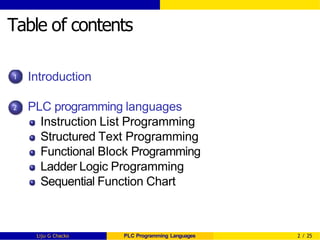
Table of contents
1 Introduction
2 PLC programming languages
Instruction List Programming
Structured Text Programming
Functional Block Programming
Ladder Logic Programming
Sequential Function Chart
Liju G Chacko PLC Programming Languages 2 / 25
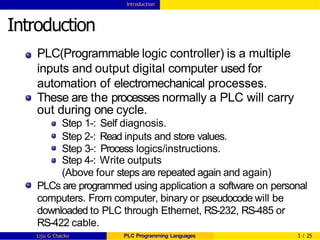
Introduction
Introduction
PLC(Programmable logic controller) is a multiple
inputs and output digital computer used for
automation of electromechanical processes.
These are the processes normally a PLC will carry
out during one cycle.
Step 1-: Self diagnosis.
Step 2-: Read inputs and store values.
Step 3-: Process logics/instructions.
Step 4-: Write outputs
(Above four steps are repeated again and again)
PLCs are programmed using application a software on personal
computers. From computer, binary or pseudocode will be
downloaded to PLC through Ethernet, RS-232, RS-485 or
RS-422 cable.
Liju G Chacko PLC Programming Languages 3 / 25
PLC programming languages
PLC Programming languages mentioned in IEC
61131-3
Instruction List Programming
Structured Text Programming
Functional Block Programming
Ladder Logic Programming
Sequential Function Charts
Liju G Chacko PLC Programming Languages 4 / 25
PLC programming languages Instruction List Programming
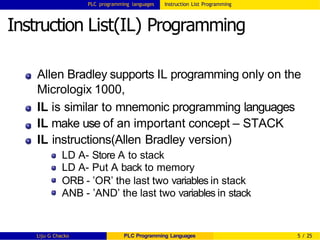
Instruction List(IL) Programming
Allen Bradley supports IL programming only on the
Micrologix 1000,
IL is similar to mnemonic programming languages
IL make use of an important concept – STACK
IL instructions(Allen Bradley version)
LD A- Store A to stack
LD A- Put A back to memory
ORB - ’OR’ the last two variables in stack
ANB - ’AND’ the last two variables in stack
Liju G Chacko PLC Programming Languages 5 / 25
PLC programming languages Instruction List Programming
Instruction List Programming
Liju G Chacko PLC Programming Languages 6 / 25
PLC programming languages Structured Text Programming
Structured Text Programming
Similar to high level language, such as Basic or C
Example-
Average of 5 numbers
F8:10 := 0;
WHILE (N7:0 < 5) DO
F8:10 := F8:10 + F8:[N7:0];
N7:0 := N7:0 + 1;
END_WHILE;
Liju G Chacko PLC Programming Languages 7 / 25
PLC programming languages Structured Text Programming
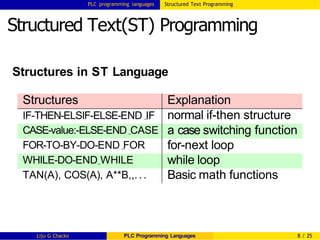
Structured Text(ST) Programming
Structures in ST Language
Structures Explanation
IF-THEN-ELSIF-ELSE-END IF normal if-then structure
CASE-value:-ELSE-END CASE a case switching function
FOR-TO-BY-DO-END FOR for-next loop
WHILE-DO-END WHILE while loop
TAN(A), COS(A), A**B,,. . . Basic math functions
Liju G Chacko PLC Programming Languages 8 / 25
PLC programming languages Functional Block Programming
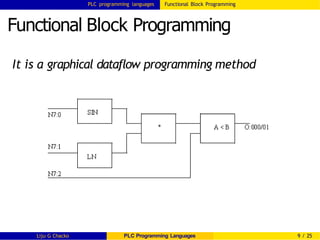
Functional Block Programming
It is a graphical dataflow programming method
Liju G Chacko PLC Programming Languages 9 / 25
PLC programming languages Ladder Logic Programming
Ladder Logic Programming
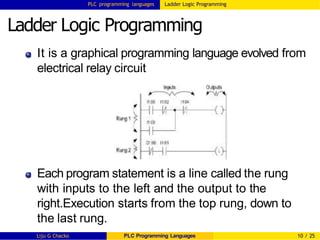
It is a graphical programming language evolved from
electrical relay circuit
Each program statement is a line called the rung
with inputs to the left and the output to the
right.Execution starts from the top rung, down to
the last rung.
Liju G Chacko PLC Programming Languages 10 / 25
PLC programming languages Ladder Logic Programming
Ladder Logic Programming
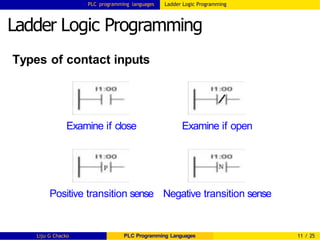
Types of contact inputs
Examine if close Examine if open
Positive transition sense Negative transition sense
Liju G Chacko PLC Programming Languages 11 / 25
PLC programming languages Ladder Logic Programming
Ladder Logic Programming
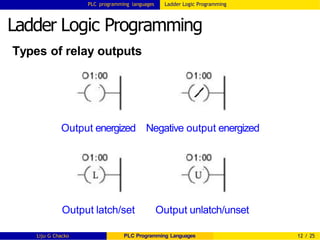
Types of relay outputs
Output energized Negative output energized
Output latch/set Output unlatch/unset
Liju G Chacko PLC Programming Languages 12 / 25
PLC programming languages Ladder Logic Programming
Ladder Logic Programming
Function Blocks
On Delay Timer Off Delay Timer
Liju G Chacko PLC Programming Languages 13 / 25
PLC programming languages Sequential Function Chart
SEQUENTIAL FUNCTION CHART
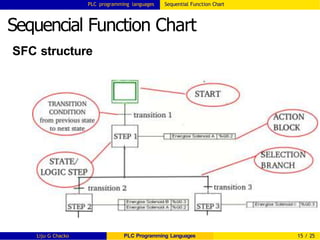
Sequential Function Charts (SFCs) are a graphical
technique for writing concurrent control programs
SFC is based on GRAFCET (GRAphe Fonctionnel
de Commande Etapses/Transitions) [itself based on
binary petri nets]
Main components of SFC are:
Steps with associated actions
Transitions with associated logic conditions
Directed links between steps and transitions
Liju G Chacko PLC Programming Languages 14 / 25
PLC programming languages Sequential Function Chart
Sequencial Function Chart
SFC structure
Liju G Chacko PLC Programming Languages 15 / 25
PLC programming languages Sequential Function Chart
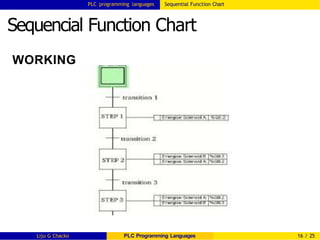
Sequencial Function Chart
WORKING
Liju G Chacko PLC Programming Languages 16 / 25
PLC programming languages Sequential Function Chart
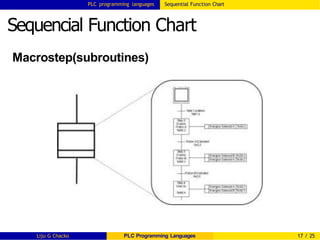
Sequencial Function Chart
Macrostep(subroutines)
Liju G Chacko PLC Programming Languages 17 / 25
PLC programming languages Sequential Function Chart
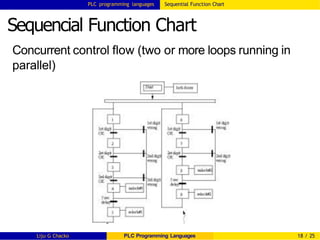
Sequencial Function Chart
Concurrent control flow (two or more loops running in
parallel)
Liju G Chacko PLC Programming Languages 18 / 25
PLC programming languages Sequential Function Chart
Sequencial Function Chart
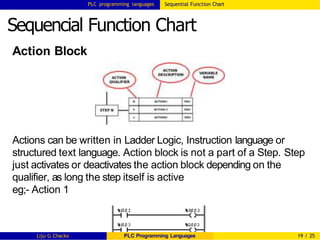
Action Block
Actions can be written in Ladder Logic, Instruction language or
structured text language. Action block is not a part of a Step. Step
just activates or deactivates the action block depending on the
qualifier, as long the step itself is active
eg;- Action 1
Liju G Chacko PLC Programming Languages 19 / 25
PLC programming languages Sequential Function Chart
Sequencial Function Chart
Action Qualifiers
Non-store(N)
Action is executed as long as the step is active
Set(S)
The action starts execution as soon as the step is active,
continues till R qualifier is executed .
Liju G Chacko PLC Programming Languages 20 / 25
PLC programming languages Sequential Function Chart
Sequencial Function Chart
Action Qualifiers(Continue...)
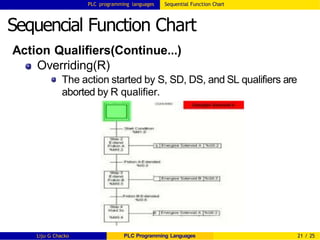
Overriding(R)
The action started by S, SD, DS, and SL qualifiers are
aborted by R qualifier.
Liju G Chacko PLC Programming Languages 21 / 25
PLC programming languages Sequential Function Chart
Sequencial Function Chart
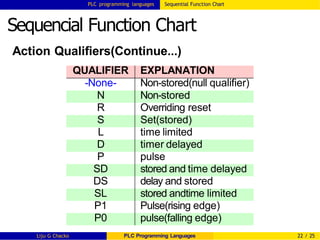
Action Qualifiers(Continue...)
QUALIFIER EXPLANATION
-None- Non-stored(null qualifier)
N Non-stored
R Overriding reset
S Set(stored)
L time limited
D timer delayed
P pulse
SD stored and time delayed
DS delay and stored
SL stored andtime limited
P1 Pulse(rising edge)
P0 pulse(falling edge)
Liju G Chacko PLC Programming Languages 22 / 25
PLC programming languages Sequential Function Chart
Sequencial Function Chart
Important rules for SFC evolution[IEC 61131-3]
1 Evolution of active states of steps shall take place
along the directed links.(i.e, transition from one step
to another should take place along the connected
lines only )
The clearing time of transitions(transition condition)
should be as short as possible. Clear the transition
condition as soon as the next step is activated.
2
Liju G Chacko PLC Programming Languages 23 / 25
PLC programming languages Sequential Function Chart
References
1 IEC 61131
2 Automated Manufacturing Systems PLCs, by Hugh
Jack
3 http://en.wikipedia.org/wiki/
Programmable logic controller
Liju G Chacko PLC Programming Languages 24 / 25
THANK YOU

plclanguages-131108224019-phpapp02 (2).pptx

  • 1.
    PLC Programming Languages Liju GChacko Liju G Chacko PLC Programming Languages 1 / 25
  • 2.
    Table of contents 1Introduction 2 PLC programming languages Instruction List Programming Structured Text Programming Functional Block Programming Ladder Logic Programming Sequential Function Chart Liju G Chacko PLC Programming Languages 2 / 25
  • 3.
    Introduction Introduction PLC(Programmable logic controller)is a multiple inputs and output digital computer used for automation of electromechanical processes. These are the processes normally a PLC will carry out during one cycle. Step 1-: Self diagnosis. Step 2-: Read inputs and store values. Step 3-: Process logics/instructions. Step 4-: Write outputs (Above four steps are repeated again and again) PLCs are programmed using application a software on personal computers. From computer, binary or pseudocode will be downloaded to PLC through Ethernet, RS-232, RS-485 or RS-422 cable. Liju G Chacko PLC Programming Languages 3 / 25
  • 4.
    PLC programming languages PLCprogramming languages PLC Programming languages mentioned in IEC 61131-3 Instruction List Programming Structured Text Programming Functional Block Programming Ladder Logic Programming Sequential Function Charts Liju G Chacko PLC Programming Languages 4 / 25
  • 5.
    PLC programming languagesInstruction List Programming Instruction List(IL) Programming Allen Bradley supports IL programming only on the Micrologix 1000, IL is similar to mnemonic programming languages IL make use of an important concept – STACK IL instructions(Allen Bradley version) LD A- Store A to stack LD A- Put A back to memory ORB - ’OR’ the last two variables in stack ANB - ’AND’ the last two variables in stack Liju G Chacko PLC Programming Languages 5 / 25
  • 6.
    PLC programming languagesInstruction List Programming Instruction List Programming Liju G Chacko PLC Programming Languages 6 / 25
  • 7.
    PLC programming languagesStructured Text Programming Structured Text Programming Similar to high level language, such as Basic or C Example- Average of 5 numbers F8:10 := 0; WHILE (N7:0 < 5) DO F8:10 := F8:10 + F8:[N7:0]; N7:0 := N7:0 + 1; END_WHILE; Liju G Chacko PLC Programming Languages 7 / 25
  • 8.
    PLC programming languagesStructured Text Programming Structured Text(ST) Programming Structures in ST Language Structures Explanation IF-THEN-ELSIF-ELSE-END IF normal if-then structure CASE-value:-ELSE-END CASE a case switching function FOR-TO-BY-DO-END FOR for-next loop WHILE-DO-END WHILE while loop TAN(A), COS(A), A**B,,. . . Basic math functions Liju G Chacko PLC Programming Languages 8 / 25
  • 9.
    PLC programming languagesFunctional Block Programming Functional Block Programming It is a graphical dataflow programming method Liju G Chacko PLC Programming Languages 9 / 25
  • 10.
    PLC programming languagesLadder Logic Programming Ladder Logic Programming It is a graphical programming language evolved from electrical relay circuit Each program statement is a line called the rung with inputs to the left and the output to the right.Execution starts from the top rung, down to the last rung. Liju G Chacko PLC Programming Languages 10 / 25
  • 11.
    PLC programming languagesLadder Logic Programming Ladder Logic Programming Types of contact inputs Examine if close Examine if open Positive transition sense Negative transition sense Liju G Chacko PLC Programming Languages 11 / 25
  • 12.
    PLC programming languagesLadder Logic Programming Ladder Logic Programming Types of relay outputs Output energized Negative output energized Output latch/set Output unlatch/unset Liju G Chacko PLC Programming Languages 12 / 25
  • 13.
    PLC programming languagesLadder Logic Programming Ladder Logic Programming Function Blocks On Delay Timer Off Delay Timer Liju G Chacko PLC Programming Languages 13 / 25
  • 14.
    PLC programming languagesSequential Function Chart SEQUENTIAL FUNCTION CHART Sequential Function Charts (SFCs) are a graphical technique for writing concurrent control programs SFC is based on GRAFCET (GRAphe Fonctionnel de Commande Etapses/Transitions) [itself based on binary petri nets] Main components of SFC are: Steps with associated actions Transitions with associated logic conditions Directed links between steps and transitions Liju G Chacko PLC Programming Languages 14 / 25
  • 15.
    PLC programming languagesSequential Function Chart Sequencial Function Chart SFC structure Liju G Chacko PLC Programming Languages 15 / 25
  • 16.
    PLC programming languagesSequential Function Chart Sequencial Function Chart WORKING Liju G Chacko PLC Programming Languages 16 / 25
  • 17.
    PLC programming languagesSequential Function Chart Sequencial Function Chart Macrostep(subroutines) Liju G Chacko PLC Programming Languages 17 / 25
  • 18.
    PLC programming languagesSequential Function Chart Sequencial Function Chart Concurrent control flow (two or more loops running in parallel) Liju G Chacko PLC Programming Languages 18 / 25
  • 19.
    PLC programming languagesSequential Function Chart Sequencial Function Chart Action Block Actions can be written in Ladder Logic, Instruction language or structured text language. Action block is not a part of a Step. Step just activates or deactivates the action block depending on the qualifier, as long the step itself is active eg;- Action 1 Liju G Chacko PLC Programming Languages 19 / 25
  • 20.
    PLC programming languagesSequential Function Chart Sequencial Function Chart Action Qualifiers Non-store(N) Action is executed as long as the step is active Set(S) The action starts execution as soon as the step is active, continues till R qualifier is executed . Liju G Chacko PLC Programming Languages 20 / 25
  • 21.
    PLC programming languagesSequential Function Chart Sequencial Function Chart Action Qualifiers(Continue...) Overriding(R) The action started by S, SD, DS, and SL qualifiers are aborted by R qualifier. Liju G Chacko PLC Programming Languages 21 / 25
  • 22.
    PLC programming languagesSequential Function Chart Sequencial Function Chart Action Qualifiers(Continue...) QUALIFIER EXPLANATION -None- Non-stored(null qualifier) N Non-stored R Overriding reset S Set(stored) L time limited D timer delayed P pulse SD stored and time delayed DS delay and stored SL stored andtime limited P1 Pulse(rising edge) P0 pulse(falling edge) Liju G Chacko PLC Programming Languages 22 / 25
  • 23.
    PLC programming languagesSequential Function Chart Sequencial Function Chart Important rules for SFC evolution[IEC 61131-3] 1 Evolution of active states of steps shall take place along the directed links.(i.e, transition from one step to another should take place along the connected lines only ) The clearing time of transitions(transition condition) should be as short as possible. Clear the transition condition as soon as the next step is activated. 2 Liju G Chacko PLC Programming Languages 23 / 25
  • 24.
    PLC programming languagesSequential Function Chart References 1 IEC 61131 2 Automated Manufacturing Systems PLCs, by Hugh Jack 3 http://en.wikipedia.org/wiki/ Programmable logic controller Liju G Chacko PLC Programming Languages 24 / 25
  • 25.