MUSIC STYLES AND TRENDS:
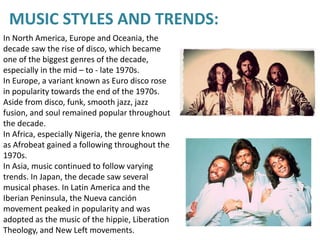
In North America, Europe and Oceania, the
decade saw the rise of disco, which became
one of the biggest genres of the decade,
especially in the mid – to - late 1970s.
In Europe, a variant known as Euro disco rose
in popularity towards the end of the 1970s.
Aside from disco, funk, smooth jazz, jazz
fusion, and soul remained popular throughout
the decade.
In Africa, especially Nigeria, the genre known
as Afrobeat gained a following throughout the
1970s.
In Asia, music continued to follow varying
trends. In Japan, the decade saw several
musical phases. In Latin America and the
Iberian Peninsula, the Nueva canción
movement peaked in popularity and was
adopted as the music of the hippie, Liberation
Theology, and New Left movements.
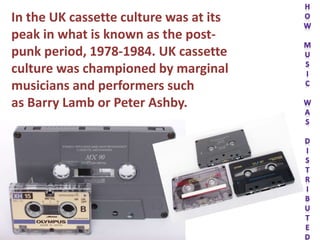
In the UK cassette culture was at its
peak in what is known as the post-
punk period, 1978-1984. UK cassette
culture was championed by marginal
musicians and performers such
as Barry Lamb or Peter Ashby.
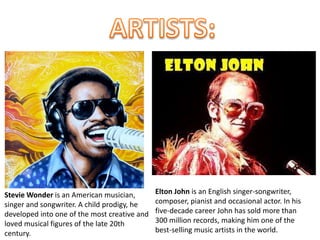
Stevie Wonder is an American musician,
singer and songwriter. A child prodigy, he
developed into one of the most creative and
loved musical figures of the late 20th
century.
Elton John is an English singer-songwriter,
composer, pianist and occasional actor. In his
five-decade career John has sold more than
300 million records, making him one of the
best-selling music artists in the world.
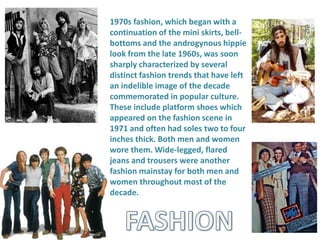
1970s fashion, which began with a
continuation of the mini skirts, bell-
bottoms and the androgynous hippie
look from the late 1960s, was soon
sharply characterized by several
distinct fashion trends that have left
an indelible image of the decade
commemorated in popular culture.
These include platform shoes which
appeared on the fashion scene in
1971 and often had soles two to four
inches thick. Both men and women
wore them. Wide-legged, flared
jeans and trousers were another
fashion mainstay for both men and
women throughout most of the
decade.
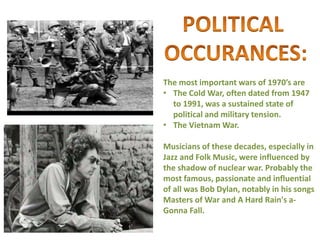
The most important wars of 1970’s are
• The Cold War, often dated from 1947
to 1991, was a sustained state of
political and military tension.
• The Vietnam War.
Musicians of these decades, especially in
Jazz and Folk Music, were influenced by
the shadow of nuclear war. Probably the
most famous, passionate and influential
of all was Bob Dylan, notably in his songs
Masters of War and A Hard Rain's a-
Gonna Fall.
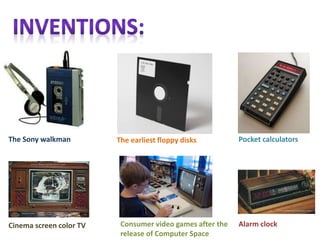
Alarm clock
Pocket calculators
The Sony walkman
Consumer video games after the
release of Computer Space
The earliest floppy disks
Cinema screen color TV
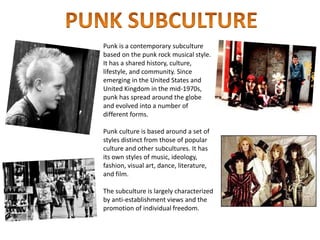
Punk is a contemporary subculture
based on the punk rock musical style.
It has a shared history, culture,
lifestyle, and community. Since
emerging in the United States and
United Kingdom in the mid-1970s,
punk has spread around the globe
and evolved into a number of
different forms.
Punk culture is based around a set of
styles distinct from those of popular
culture and other subcultures. It has
its own styles of music, ideology,
fashion, visual art, dance, literature,
and film.
The subculture is largely characterized
by anti-establishment views and the
promotion of individual freedom.
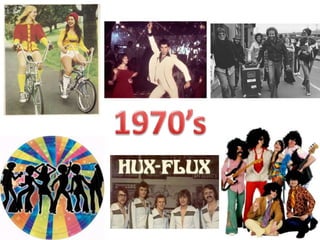
1970's

1970's

  • 2.
    MUSIC STYLES ANDTRENDS: In North America, Europe and Oceania, the decade saw the rise of disco, which became one of the biggest genres of the decade, especially in the mid – to - late 1970s. In Europe, a variant known as Euro disco rose in popularity towards the end of the 1970s. Aside from disco, funk, smooth jazz, jazz fusion, and soul remained popular throughout the decade. In Africa, especially Nigeria, the genre known as Afrobeat gained a following throughout the 1970s. In Asia, music continued to follow varying trends. In Japan, the decade saw several musical phases. In Latin America and the Iberian Peninsula, the Nueva canción movement peaked in popularity and was adopted as the music of the hippie, Liberation Theology, and New Left movements.
  • 3.
    In the UKcassette culture was at its peak in what is known as the post- punk period, 1978-1984. UK cassette culture was championed by marginal musicians and performers such as Barry Lamb or Peter Ashby.
  • 4.
    Stevie Wonder isan American musician, singer and songwriter. A child prodigy, he developed into one of the most creative and loved musical figures of the late 20th century. Elton John is an English singer-songwriter, composer, pianist and occasional actor. In his five-decade career John has sold more than 300 million records, making him one of the best-selling music artists in the world.
  • 5.
    1970s fashion, whichbegan with a continuation of the mini skirts, bell- bottoms and the androgynous hippie look from the late 1960s, was soon sharply characterized by several distinct fashion trends that have left an indelible image of the decade commemorated in popular culture. These include platform shoes which appeared on the fashion scene in 1971 and often had soles two to four inches thick. Both men and women wore them. Wide-legged, flared jeans and trousers were another fashion mainstay for both men and women throughout most of the decade.
  • 6.
    The most importantwars of 1970’s are • The Cold War, often dated from 1947 to 1991, was a sustained state of political and military tension. • The Vietnam War. Musicians of these decades, especially in Jazz and Folk Music, were influenced by the shadow of nuclear war. Probably the most famous, passionate and influential of all was Bob Dylan, notably in his songs Masters of War and A Hard Rain's a- Gonna Fall.
  • 7.
    Alarm clock Pocket calculators TheSony walkman Consumer video games after the release of Computer Space The earliest floppy disks Cinema screen color TV
  • 8.
    Punk is acontemporary subculture based on the punk rock musical style. It has a shared history, culture, lifestyle, and community. Since emerging in the United States and United Kingdom in the mid-1970s, punk has spread around the globe and evolved into a number of different forms. Punk culture is based around a set of styles distinct from those of popular culture and other subcultures. It has its own styles of music, ideology, fashion, visual art, dance, literature, and film. The subculture is largely characterized by anti-establishment views and the promotion of individual freedom.