MUSIC IN THE 1950 S
HOW DID AUDIENCES CONSUME MUSIC?
 Radio—Before the rise of the internet (on demand
music), radio was important in getting artists
airplay, which then meant they‟d be more likely
to sell many records.
 Television—Music videos, as we now know
them, did not exist in the ‟50s.
 Records Albums & Tape—These were purchased
directly by the audience and could be listened to
on demand. The Compact Disk (CD) hadn‟t been
invented them to people listened to music on
„Vinyls.‟
WHICH ARTISTS AND
GENRES WERE POPULAR?

Emergence of Rock‟n‟Roll—this
included artists such as Elvis Presley
and Chuck Berry.
Classic Pop—artists such as Frank
Sinatra.
Blues & Jazz—Ray Charles, Nina
Simone.
Folk & Country Music—Johnny Cash
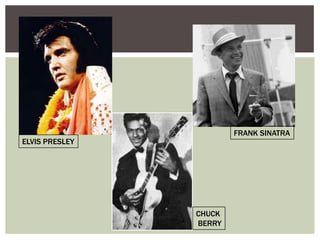
FRANK SINATRA

ELVIS PRESLEY

CHUCK
BERRY
WHY WERE GENRES POPULAR?
 Classic Pop music was popular because it provided familiar
sounding music. There was more of an emphasis on the
artist‟s voice than there is nowadays.
 Artists like Chuck Berry made Rock„n‟Roll influential by
incorporating things that weren‟t popular before the 1950s,
such as: electric guitars, guitar solos, showmanship, and a
focus on teen life (which appeal to the youth.) Rock‟n‟Roll
was also considered to be quite rebellious and
unconventional (Elvis Presley interpreted many African
American songs) which again appealed to the youth.
 Blues artists focused more on upbeat, rather than
melancholy, music.
 Rockabilly spawned from Country Music, where there was
more of an emphasis on catchy beats, electric guitar, and
acoustic bass.
SUBCULTURES AND TRENDS
 Especially within the youth, subcultures based around
gang culture or „greasers‟ emerged in the 1950s. This led
to rejection of authority, and therefore meant they‟d
prefer to listen to more unconventional styles of
music, namely Rock „n‟ Roll.
 A lot of this rebellion came about due to the Beat
Generation: this was the name given to a group of writers
who emerged in the 1950s. Their style was based around
innovation, nonconformity, and a more progressive
stance on drugs and sexuality.
 The best selling single in the 1950s in the UK, “Rock
Around The Clock”, sold 1.39m copies. The best selling
single of all time in the UK, “Candle In The Wind”, has
sold 4.91m copies.
MUSIC INSTITUTIONS IN
THE „50 S
HOW WERE NEW ARTISTS FOUND AND
DEVELOPED?
 During the mid 20 th century, aspiring artists started small;
they performed locally, hoping they would be discovered. They
were seen busking and working in low end jobs to go to
Hollywood/Tinsletown for their chance.
 In some ways, this does occur today. There are thousands of
artists who are talented; they write, sing, produce but simply
can‟t be discovered because record labels construct artists for
guaranteed chart and financial success
HOW WAS MUSIC MARKETED (CROSSMEDIA SYNERGY)?
 Musicians would also rely on radios playing their songs
(“airplay”) as marketing for their music.
 Musicians had to market their image as well as their voice.
This would be done by starring in their own movies, often
featuring their current music. This is an example of cross
media synergy; Elvis was a big advocate of this.
 When not making movies, rock stars would have their own
teen-aimed television series such as American Bandstand.
 Musicians would continuously be on the road; to reach new
audiences in dif ferent countries and regions.
MAINSTREAM VS UNDERGROUND
 In the United Kingdom during the 1950s and 1960s, the major
record companies had so much power that independent labels
struggled to become established.
 Several British producers and artists launched independent
labels as outlets for their work and artists they liked, but the
majority failed as commercial ventures or were swallowed up
by the majors
 In the United States, independent labels and distributors often
banded together to form organizations to promote trade and
also to simply match up to the big labels

The Music Industry - 1950s

  • 1.
  • 2.
    HOW DID AUDIENCESCONSUME MUSIC?  Radio—Before the rise of the internet (on demand music), radio was important in getting artists airplay, which then meant they‟d be more likely to sell many records.  Television—Music videos, as we now know them, did not exist in the ‟50s.  Records Albums & Tape—These were purchased directly by the audience and could be listened to on demand. The Compact Disk (CD) hadn‟t been invented them to people listened to music on „Vinyls.‟
  • 3.
    WHICH ARTISTS AND GENRESWERE POPULAR? Emergence of Rock‟n‟Roll—this included artists such as Elvis Presley and Chuck Berry. Classic Pop—artists such as Frank Sinatra. Blues & Jazz—Ray Charles, Nina Simone. Folk & Country Music—Johnny Cash
  • 4.
  • 5.
    WHY WERE GENRESPOPULAR?  Classic Pop music was popular because it provided familiar sounding music. There was more of an emphasis on the artist‟s voice than there is nowadays.  Artists like Chuck Berry made Rock„n‟Roll influential by incorporating things that weren‟t popular before the 1950s, such as: electric guitars, guitar solos, showmanship, and a focus on teen life (which appeal to the youth.) Rock‟n‟Roll was also considered to be quite rebellious and unconventional (Elvis Presley interpreted many African American songs) which again appealed to the youth.  Blues artists focused more on upbeat, rather than melancholy, music.  Rockabilly spawned from Country Music, where there was more of an emphasis on catchy beats, electric guitar, and acoustic bass.
  • 6.
    SUBCULTURES AND TRENDS Especially within the youth, subcultures based around gang culture or „greasers‟ emerged in the 1950s. This led to rejection of authority, and therefore meant they‟d prefer to listen to more unconventional styles of music, namely Rock „n‟ Roll.  A lot of this rebellion came about due to the Beat Generation: this was the name given to a group of writers who emerged in the 1950s. Their style was based around innovation, nonconformity, and a more progressive stance on drugs and sexuality.  The best selling single in the 1950s in the UK, “Rock Around The Clock”, sold 1.39m copies. The best selling single of all time in the UK, “Candle In The Wind”, has sold 4.91m copies.
  • 8.
  • 9.
    HOW WERE NEWARTISTS FOUND AND DEVELOPED?  During the mid 20 th century, aspiring artists started small; they performed locally, hoping they would be discovered. They were seen busking and working in low end jobs to go to Hollywood/Tinsletown for their chance.  In some ways, this does occur today. There are thousands of artists who are talented; they write, sing, produce but simply can‟t be discovered because record labels construct artists for guaranteed chart and financial success
  • 10.
    HOW WAS MUSICMARKETED (CROSSMEDIA SYNERGY)?  Musicians would also rely on radios playing their songs (“airplay”) as marketing for their music.  Musicians had to market their image as well as their voice. This would be done by starring in their own movies, often featuring their current music. This is an example of cross media synergy; Elvis was a big advocate of this.  When not making movies, rock stars would have their own teen-aimed television series such as American Bandstand.  Musicians would continuously be on the road; to reach new audiences in dif ferent countries and regions.
  • 11.
    MAINSTREAM VS UNDERGROUND In the United Kingdom during the 1950s and 1960s, the major record companies had so much power that independent labels struggled to become established.  Several British producers and artists launched independent labels as outlets for their work and artists they liked, but the majority failed as commercial ventures or were swallowed up by the majors  In the United States, independent labels and distributors often banded together to form organizations to promote trade and also to simply match up to the big labels