Tally
P O W E R O F S I M P L I C I T Y
TALLY.ERP
9
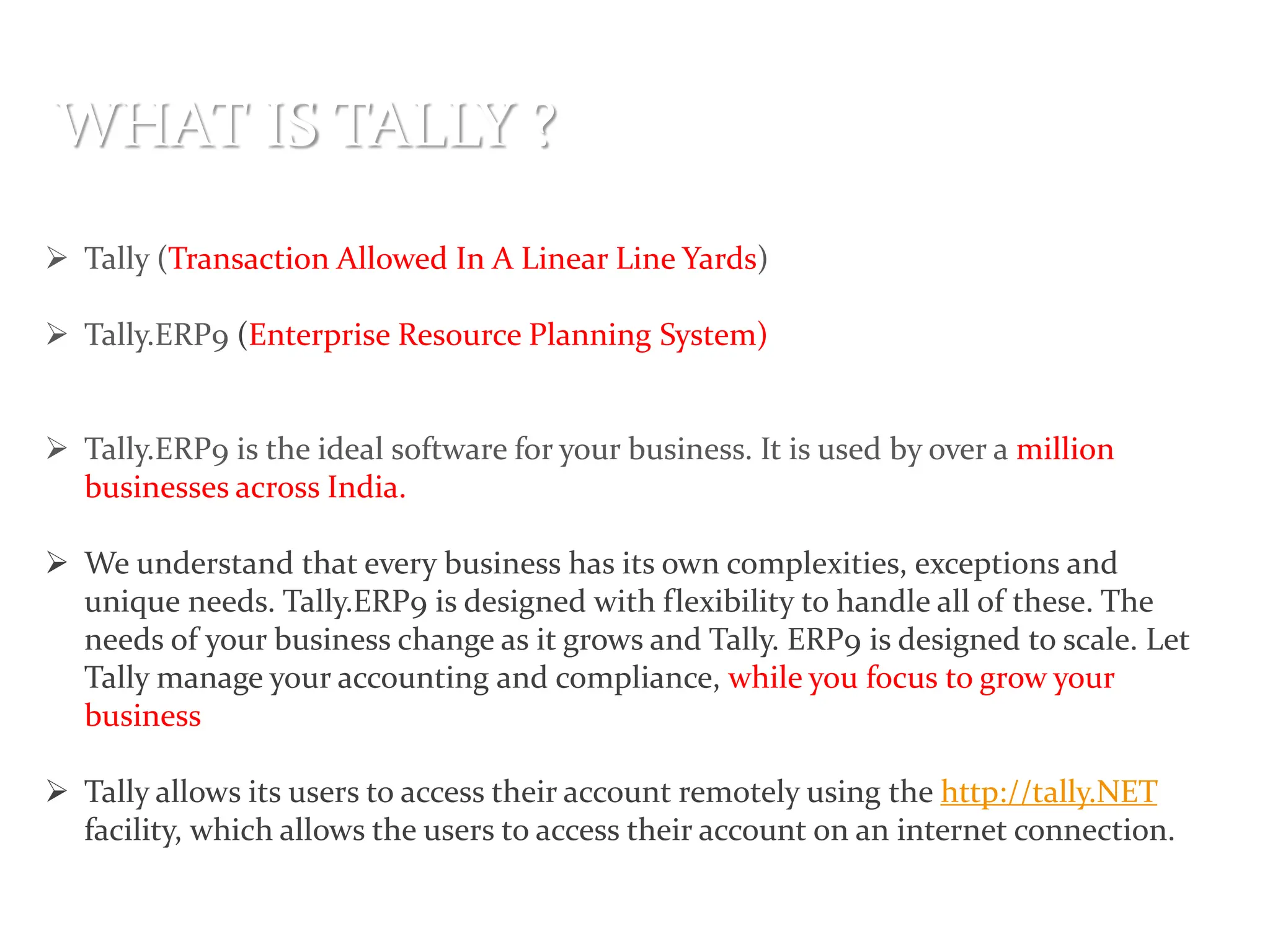
WHAT IS TALLY ?
 Tally (Transaction Allowed In A Linear Line Yards)
 Tally.ERP9 (Enterprise Resource Planning System)
 Tally.ERP9 is the ideal software for your business. It is used by over a million
businesses across India.
 We understand that every business has its own complexities, exceptions and
unique needs. Tally.ERP9 is designed with flexibility to handle all of these. The
needs of your business change as it grows and Tally. ERP9 is designed to scale. Let
Tally manage your accounting and compliance, while you focus to grow your
business
 Tally allows its users to access their account remotely using the http://tally.NET
facility, which allows the users to access their account on an internet connection.
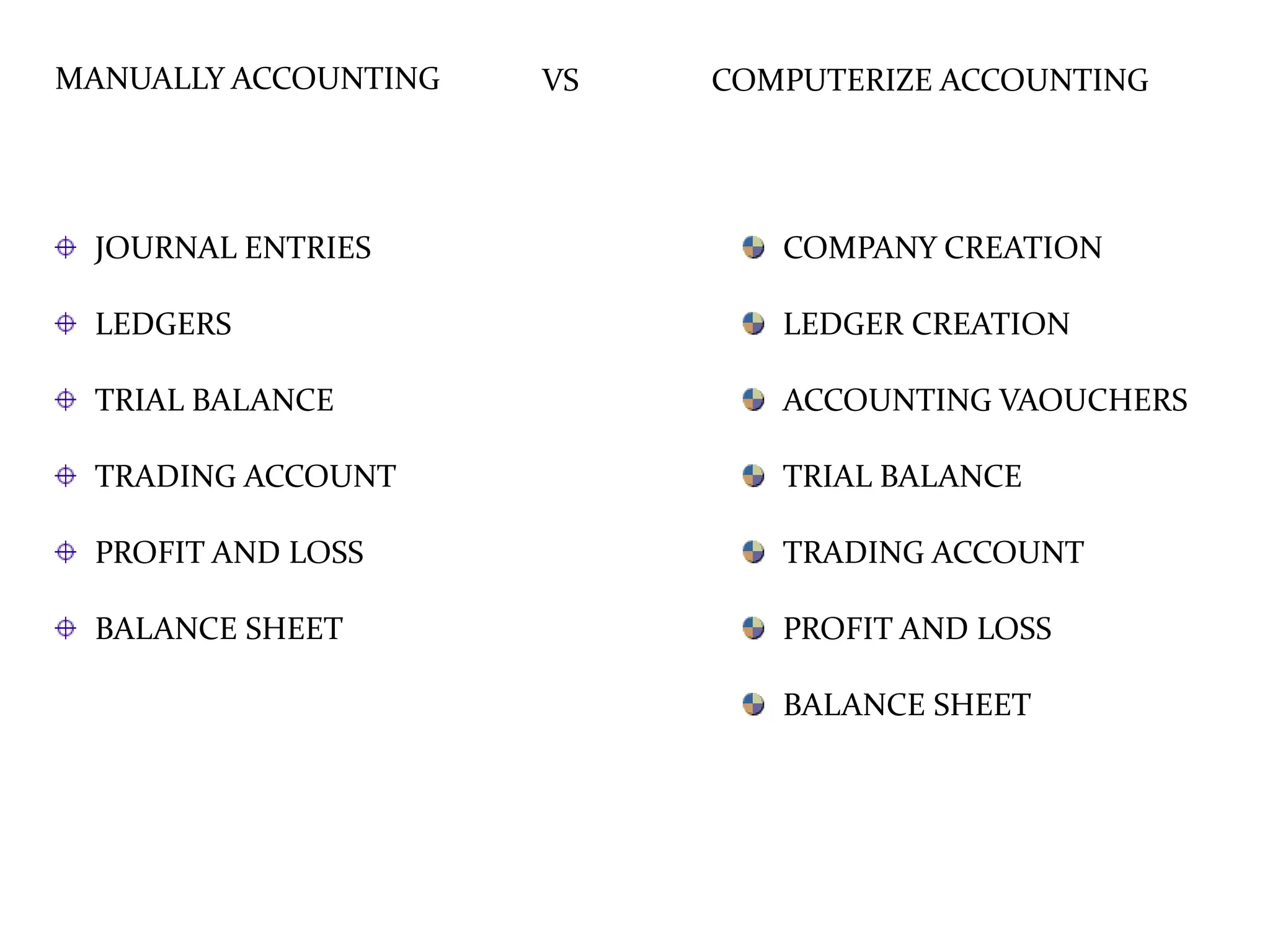
MANUALLY ACCOUNTING COMPUTERIZE ACCOUNTING
JOURNAL ENTRIES
LEDGERS
TRIAL BALANCE
TRADING ACCOUNT
PROFIT AND LOSS
BALANCE SHEET
COMPANY CREATION
LEDGER CREATION
ACCOUNTING VAOUCHERS
TRIAL BALANCE
TRADING ACCOUNT
PROFIT AND LOSS
BALANCE SHEET
VS
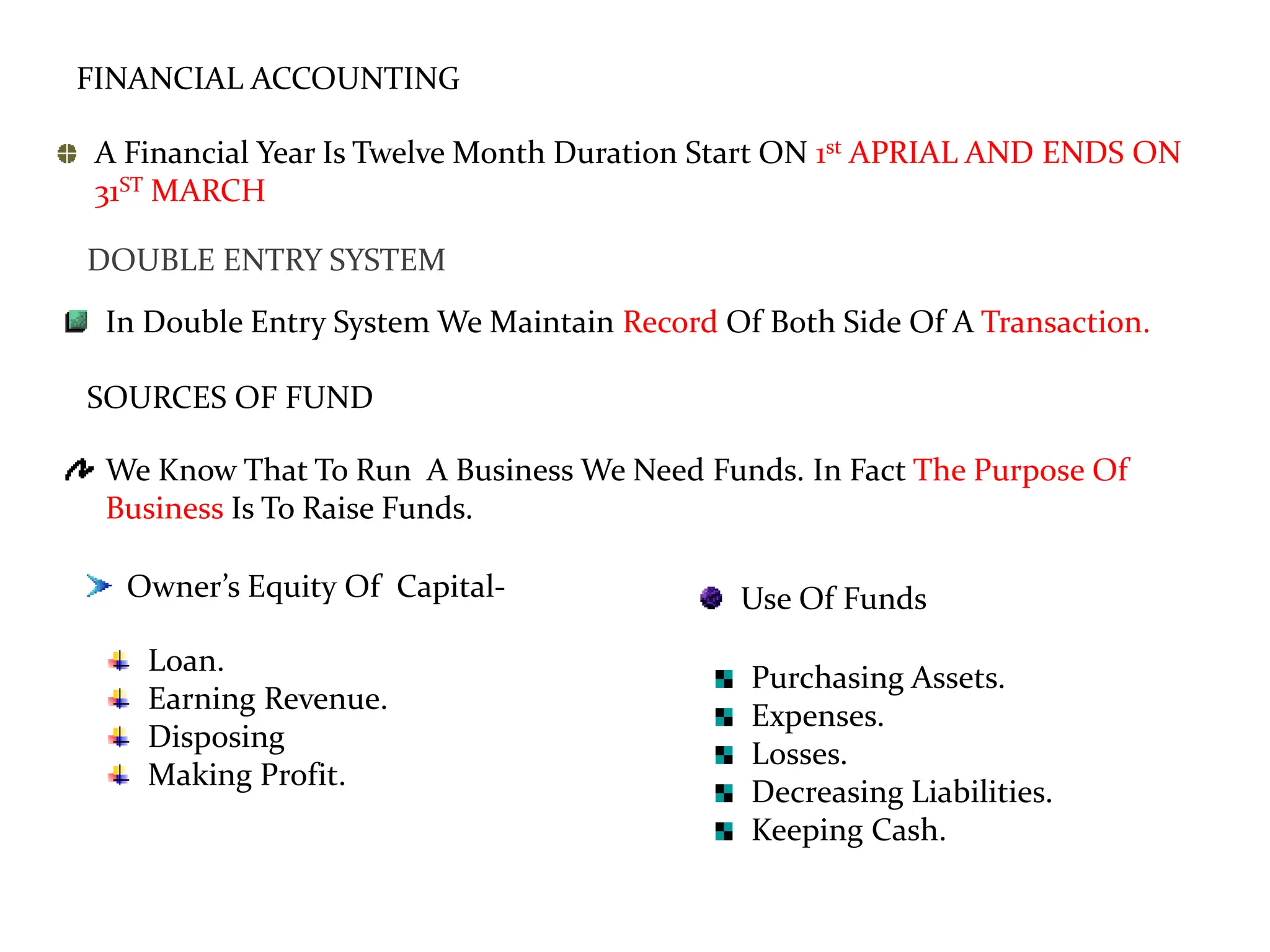
FINANCIAL ACCOUNTING
A Financial Year Is Twelve Month Duration Start ON 1st APRIAL AND ENDS ON
31ST MARCH
DOUBLE ENTRY SYSTEM
In Double Entry System We Maintain Record Of Both Side Of A Transaction.
SOURCES OF FUND
We Know That To Run A Business We Need Funds. In Fact The Purpose Of
Business Is To Raise Funds.
Owner’s Equity Of Capital-
Loan.
Earning Revenue.
Disposing
Making Profit.
Use Of Funds
Purchasing Assets.
Expenses.
Losses.
Decreasing Liabilities.
Keeping Cash.
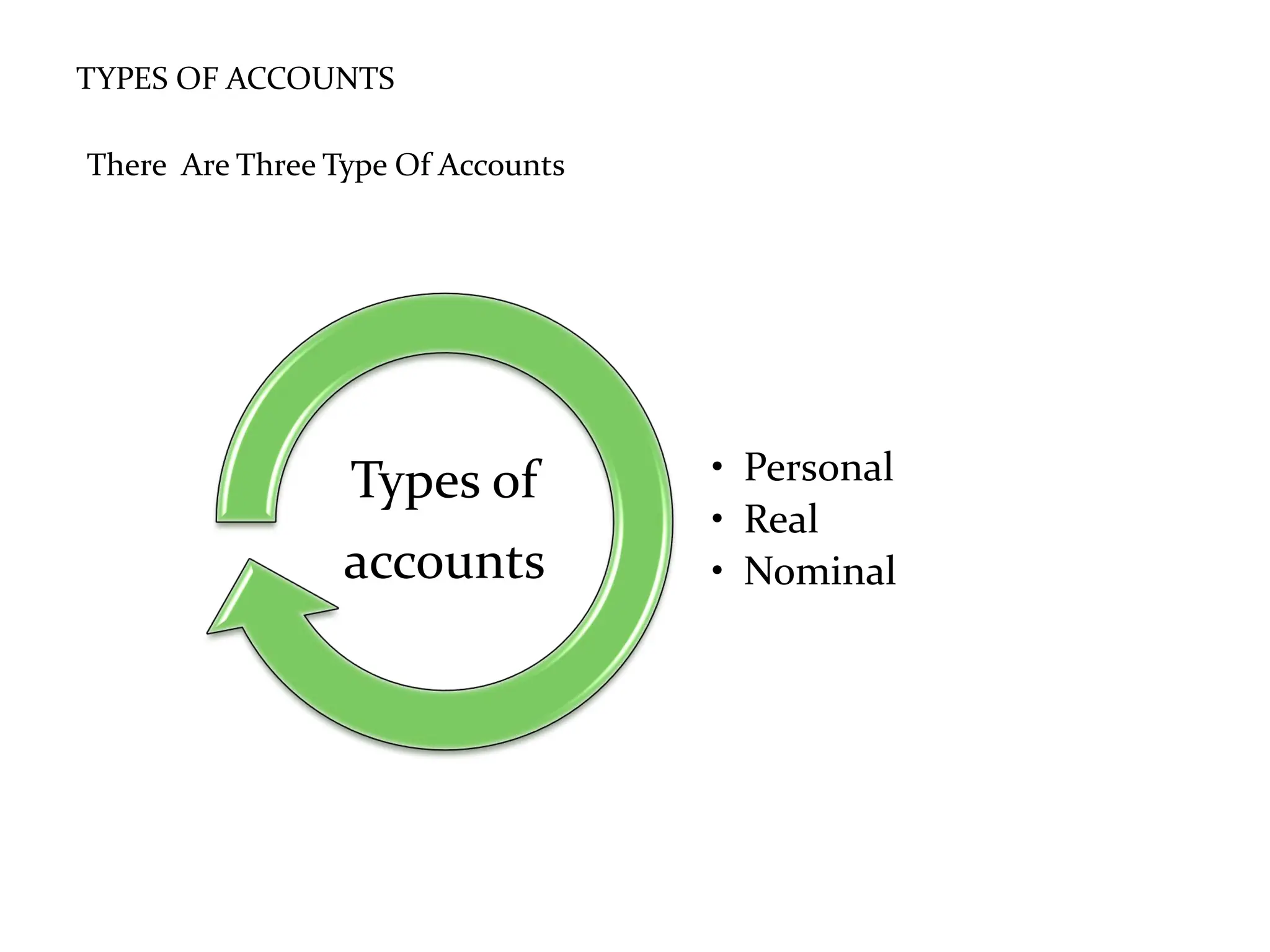
TYPES OF ACCOUNTS
There Are Three Type Of Accounts
• Personal
• Real
• Nominal
Types of
accounts
Personal Accounts
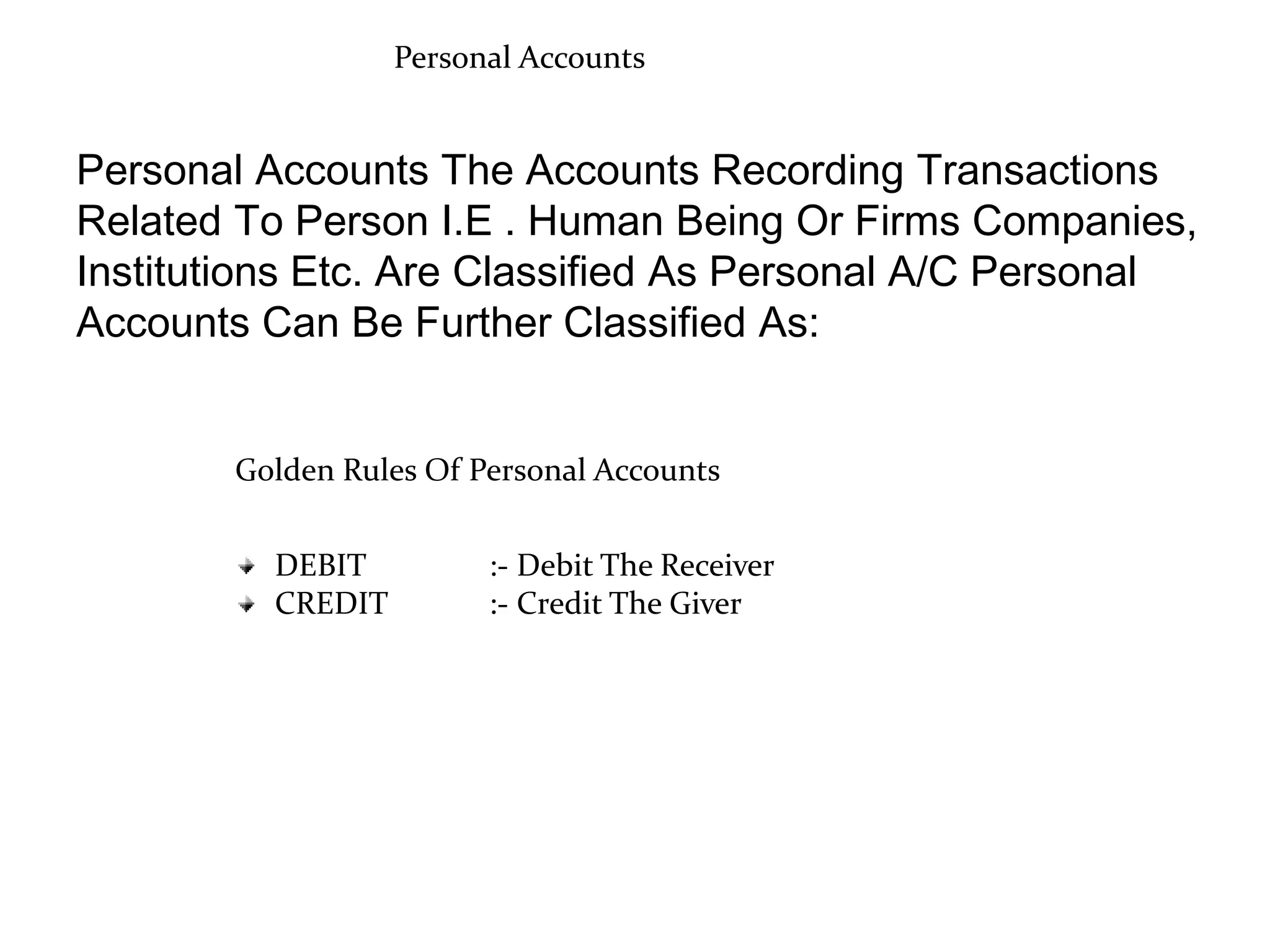
Personal Accounts The Accounts Recording Transactions
Related To Person I.E . Human Being Or Firms Companies,
Institutions Etc. Are Classified As Personal A/C Personal
Accounts Can Be Further Classified As:
Golden Rules Of Personal Accounts
DEBIT :- Debit The Receiver
CREDIT :- Credit The Giver
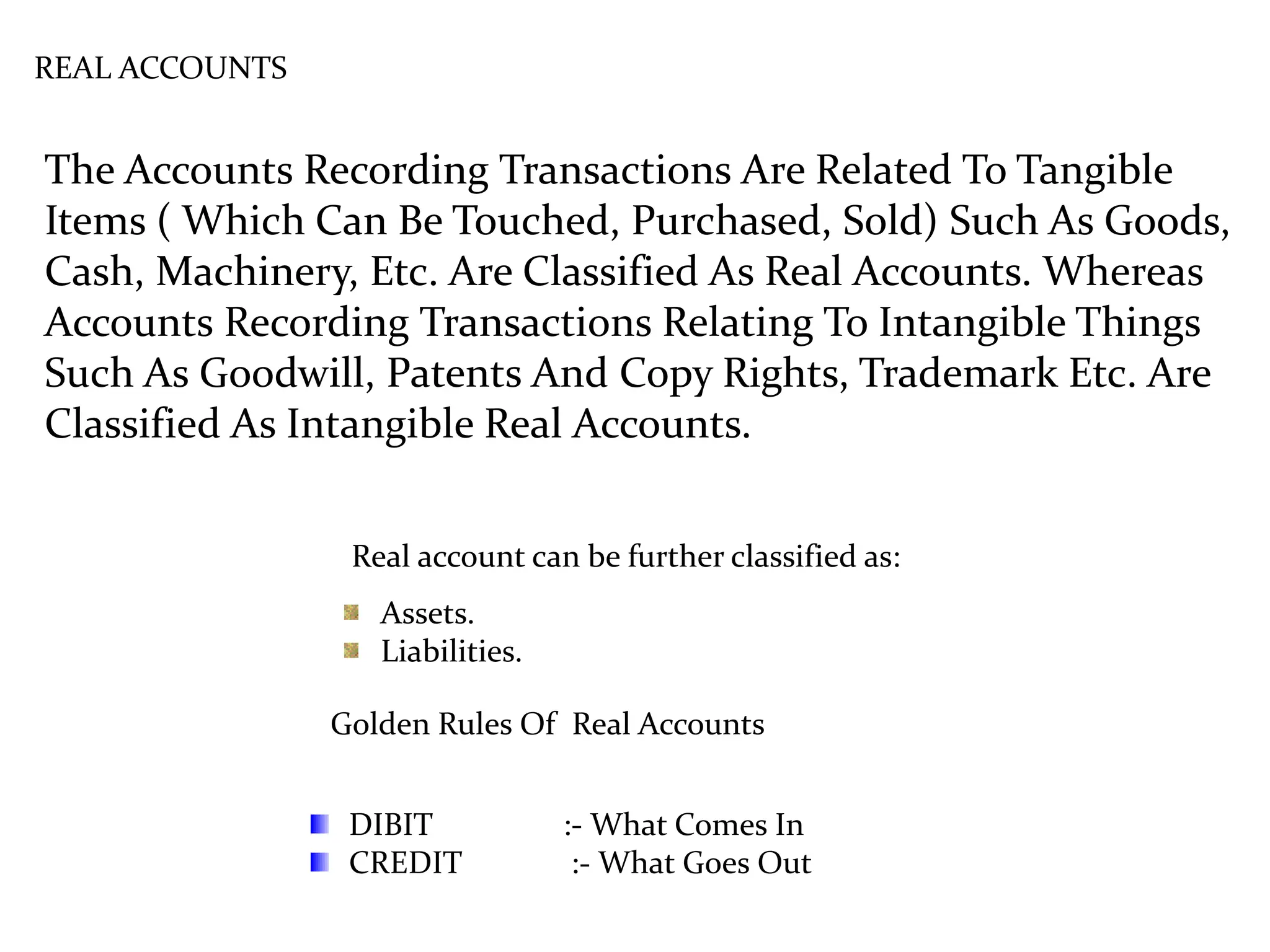
REAL ACCOUNTS
The Accounts Recording Transactions Are Related To Tangible
Items ( Which Can Be Touched, Purchased, Sold) Such As Goods,
Cash, Machinery, Etc. Are Classified As Real Accounts. Whereas
Accounts Recording Transactions Relating To Intangible Things
Such As Goodwill, Patents And Copy Rights, Trademark Etc. Are
Classified As Intangible Real Accounts.
Golden Rules Of Real Accounts
Real account can be further classified as:
Assets.
Liabilities.
DIBIT :- What Comes In
CREDIT :- What Goes Out
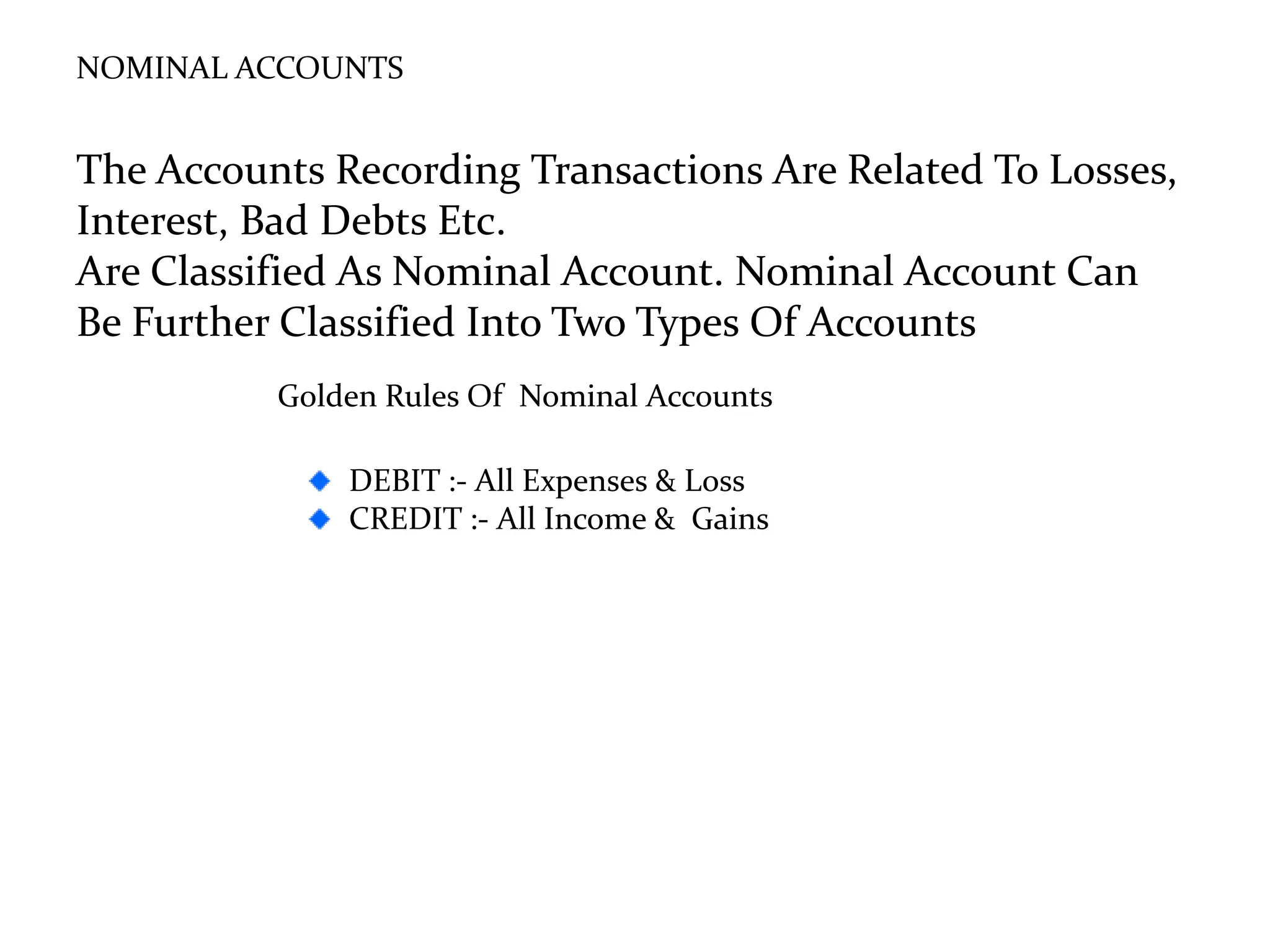
NOMINAL ACCOUNTS
The Accounts Recording Transactions Are Related To Losses,
Interest, Bad Debts Etc.
Are Classified As Nominal Account. Nominal Account Can
Be Further Classified Into Two Types Of Accounts
Golden Rules Of Nominal Accounts
DEBIT :- All Expenses & Loss
CREDIT :- All Income & Gains
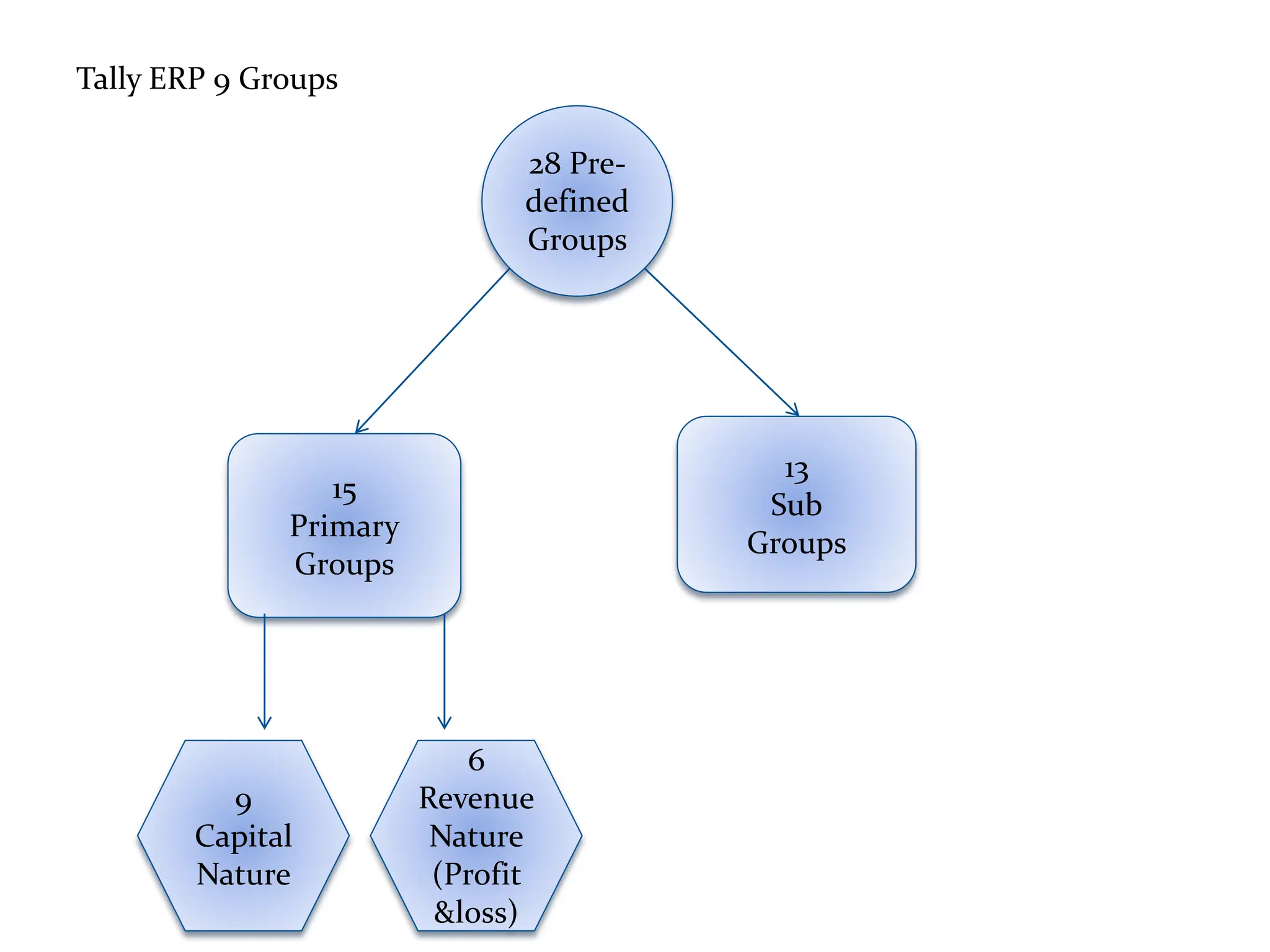
Tally ERP 9 Groups
28 Pre-
defined
Groups
15
Primary
Groups
13
Sub
Groups
9
Capital
Nature
6
Revenue
Nature
(Profit
&loss)
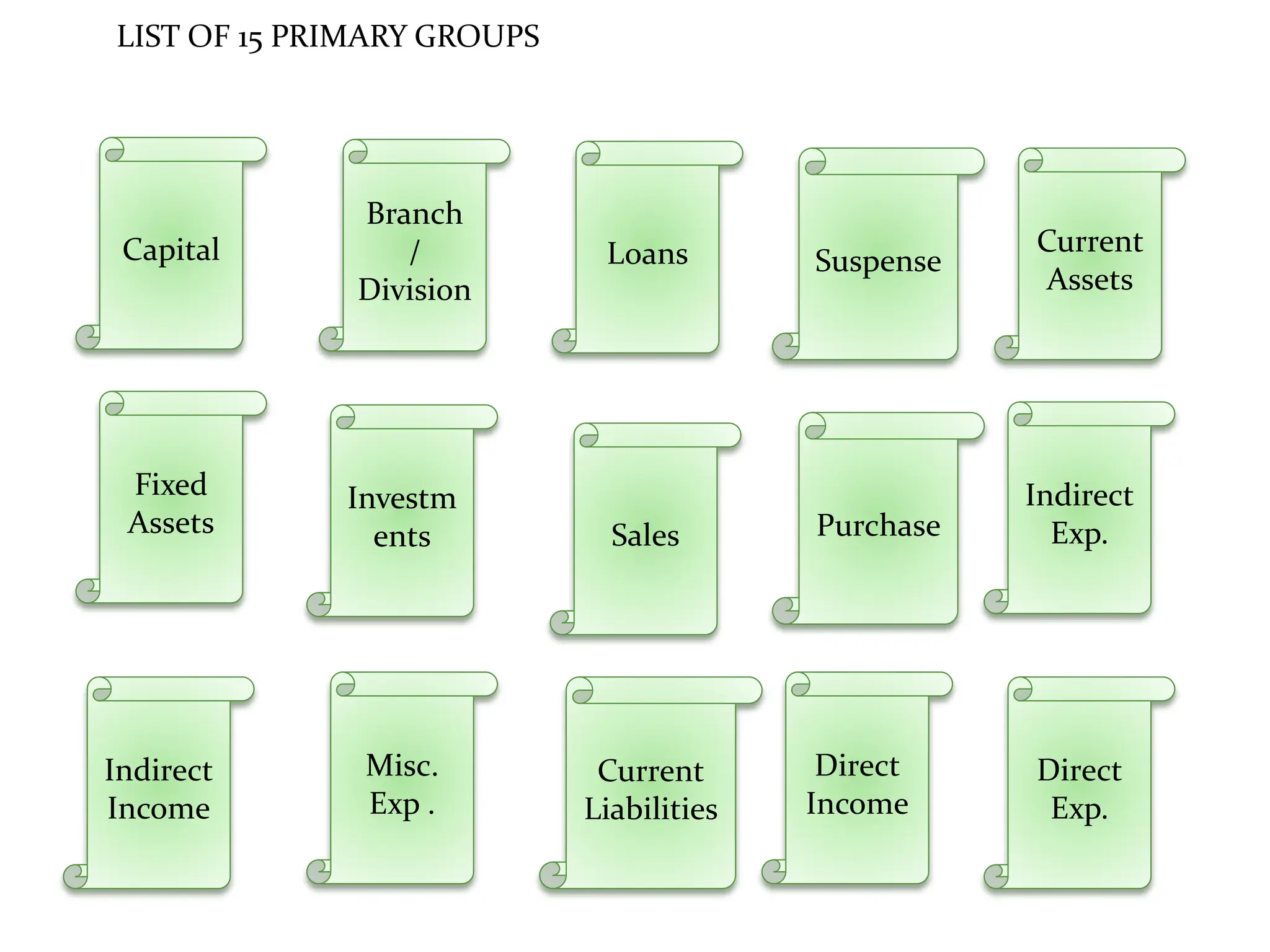
LIST OF 15 PRIMARY GROUPS
Capital
Branch
/
Division
Loans Suspense
Current
Assets
Fixed
Assets
Indirect
Exp.
Purchase
Sales
Investm
ents
Indirect
Income
Misc.
Exp .
Current
Liabilities
Direct
Income
Direct
Exp.
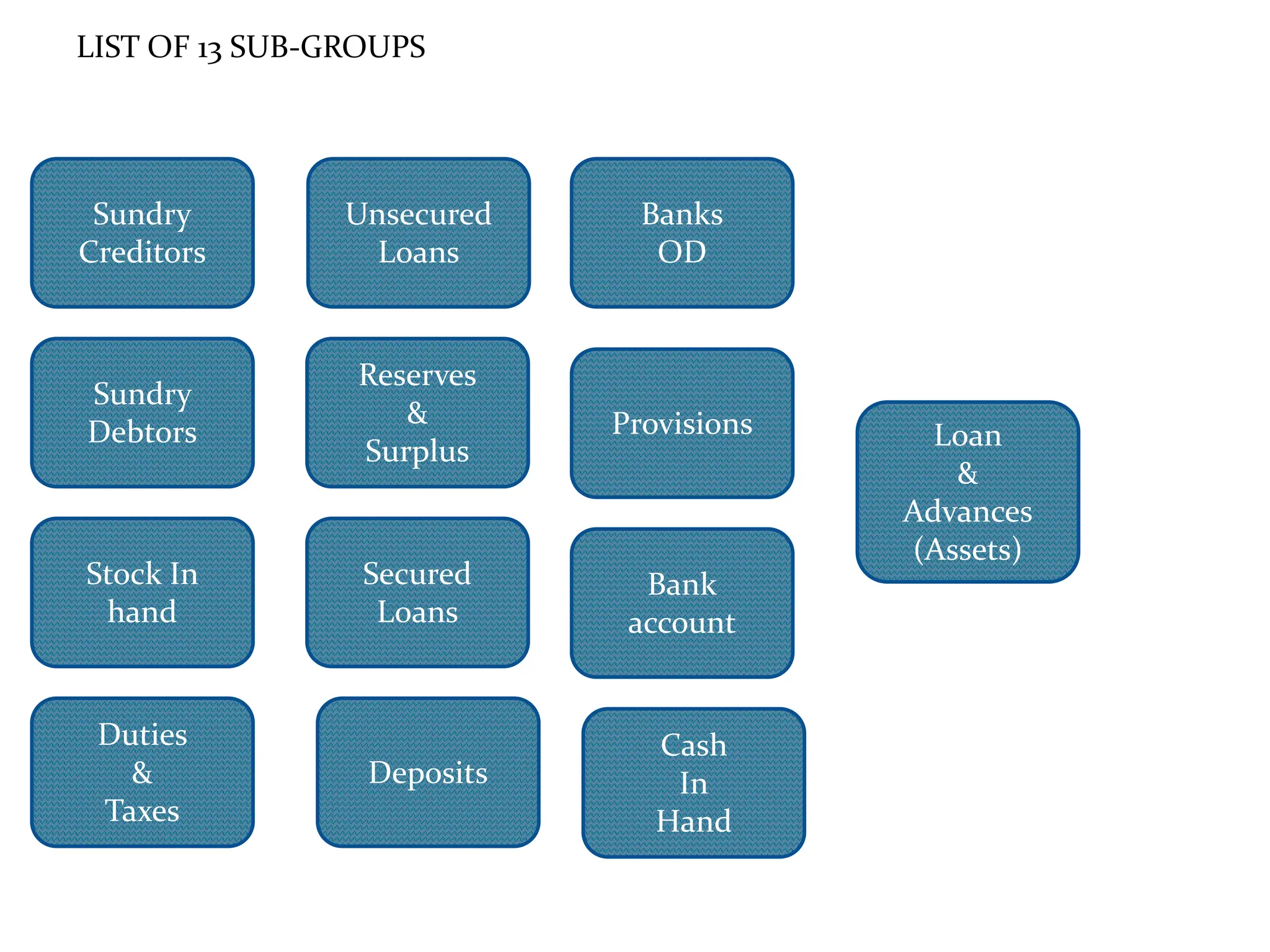
LIST OF 13 SUB-GROUPS
Sundry
Creditors
Unsecured
Loans
Deposits
Loan
&
Advances
(Assets)
Sundry
Debtors
Reserves
&
Surplus
Stock In
hand
Banks
OD
Secured
Loans
Bank
account
Provisions
Cash
In
Hand
Duties
&
Taxes
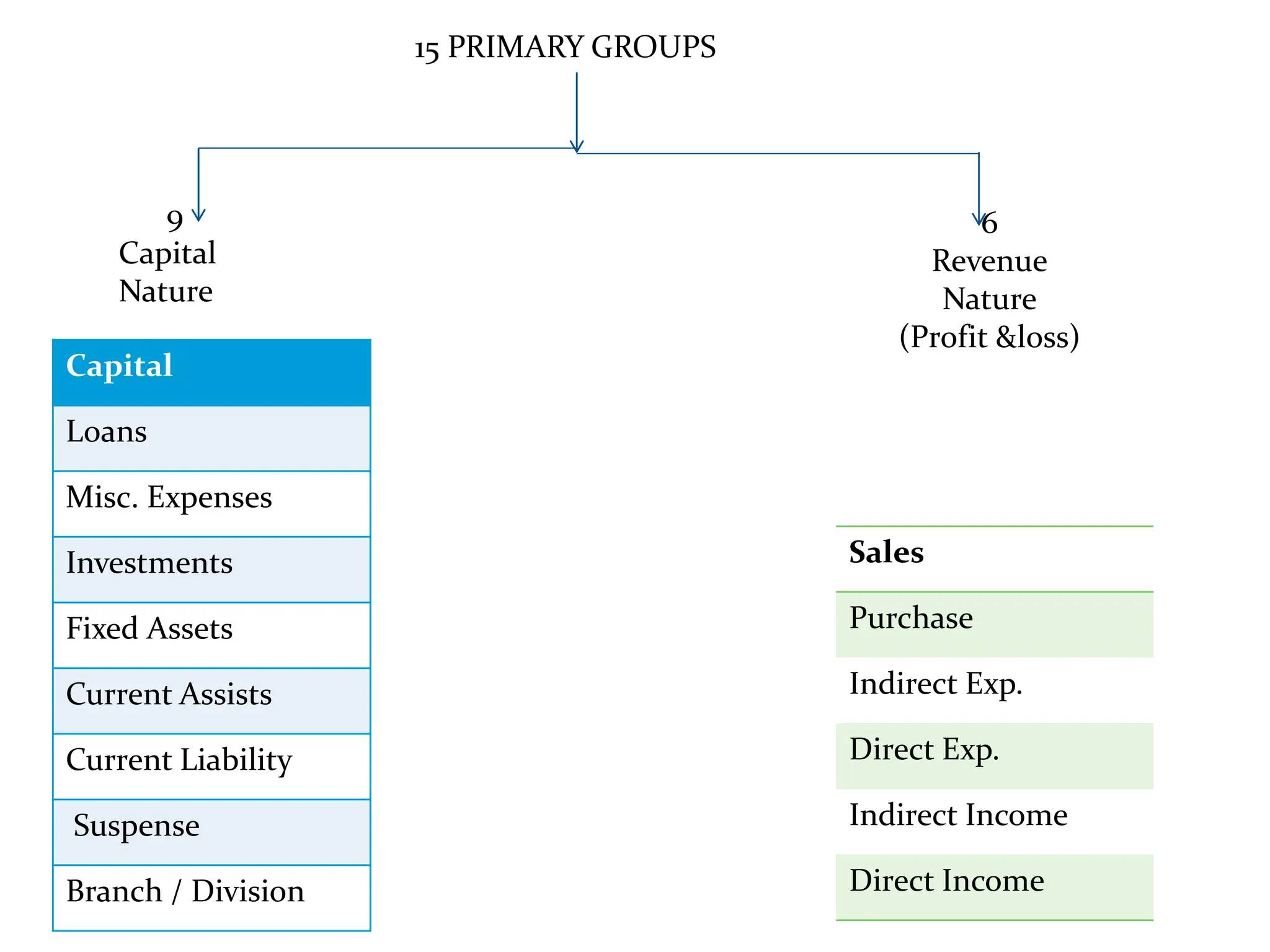
15 PRIMARY GROUPS
Capital
Loans
Misc. Expenses
Investments
Fixed Assets
Current Assists
Current Liability
Suspense
Branch / Division
Sales
Purchase
Indirect Exp.
Direct Exp.
Indirect Income
Direct Income
9
Capital
Nature
6
Revenue
Nature
(Profit &loss)
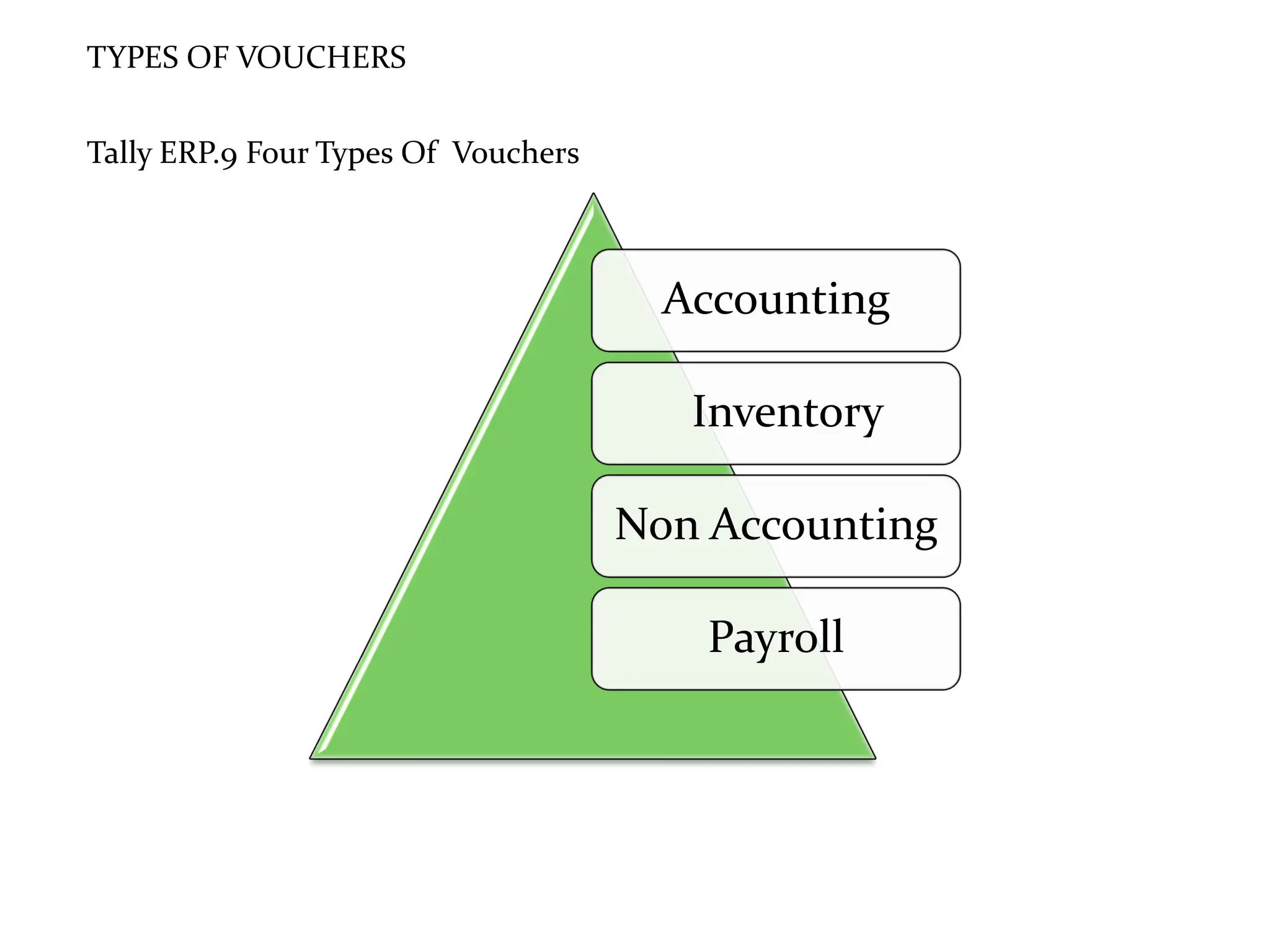
TYPES OF VOUCHERS
Tally ERP.9 Four Types Of Vouchers
Accounting
Inventory
Non Accounting
Payroll
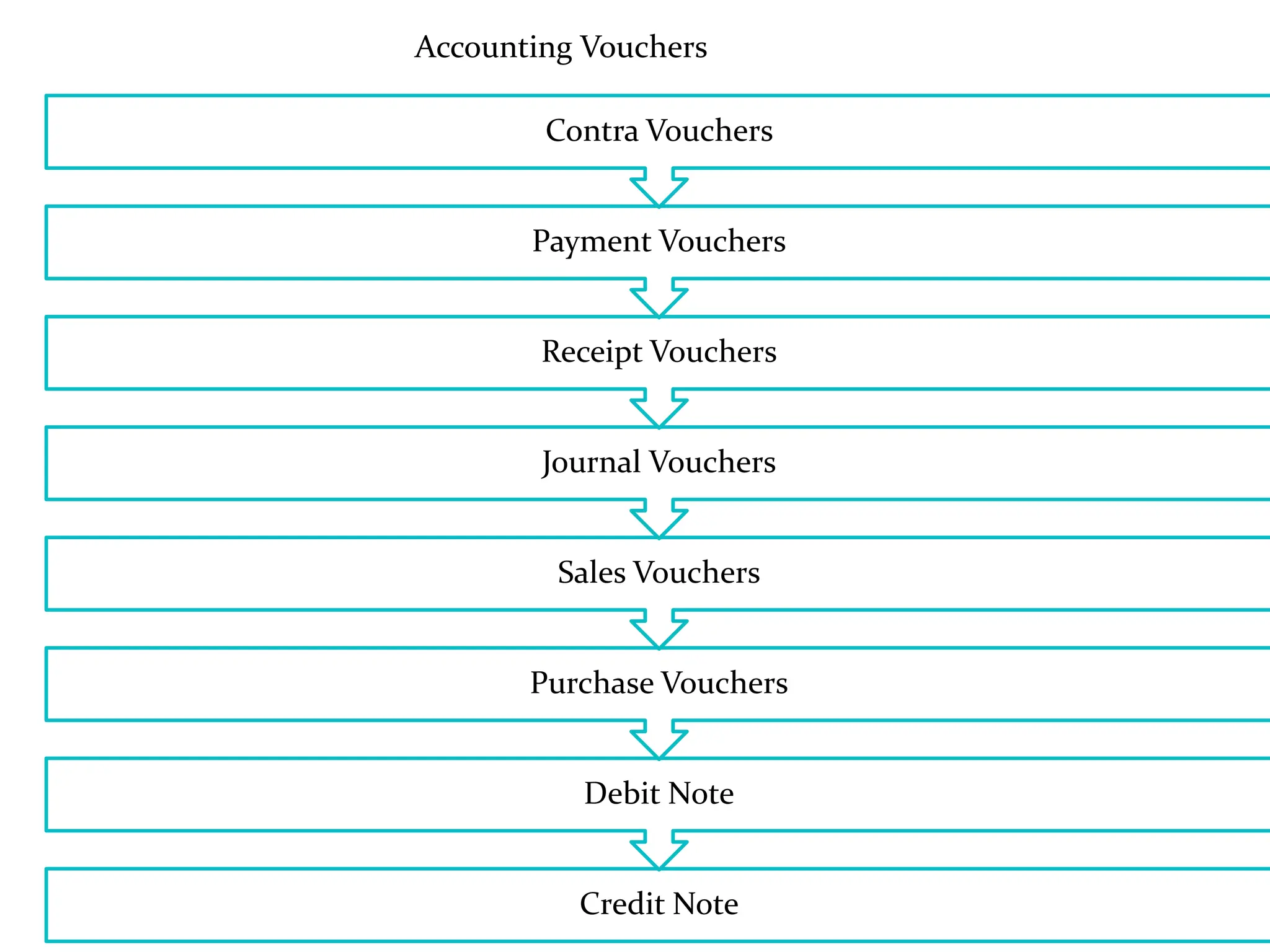
Accounting Vouchers
Credit Note
Debit Note
Purchase Vouchers
Sales Vouchers
Journal Vouchers
Receipt Vouchers
Payment Vouchers
Contra Vouchers
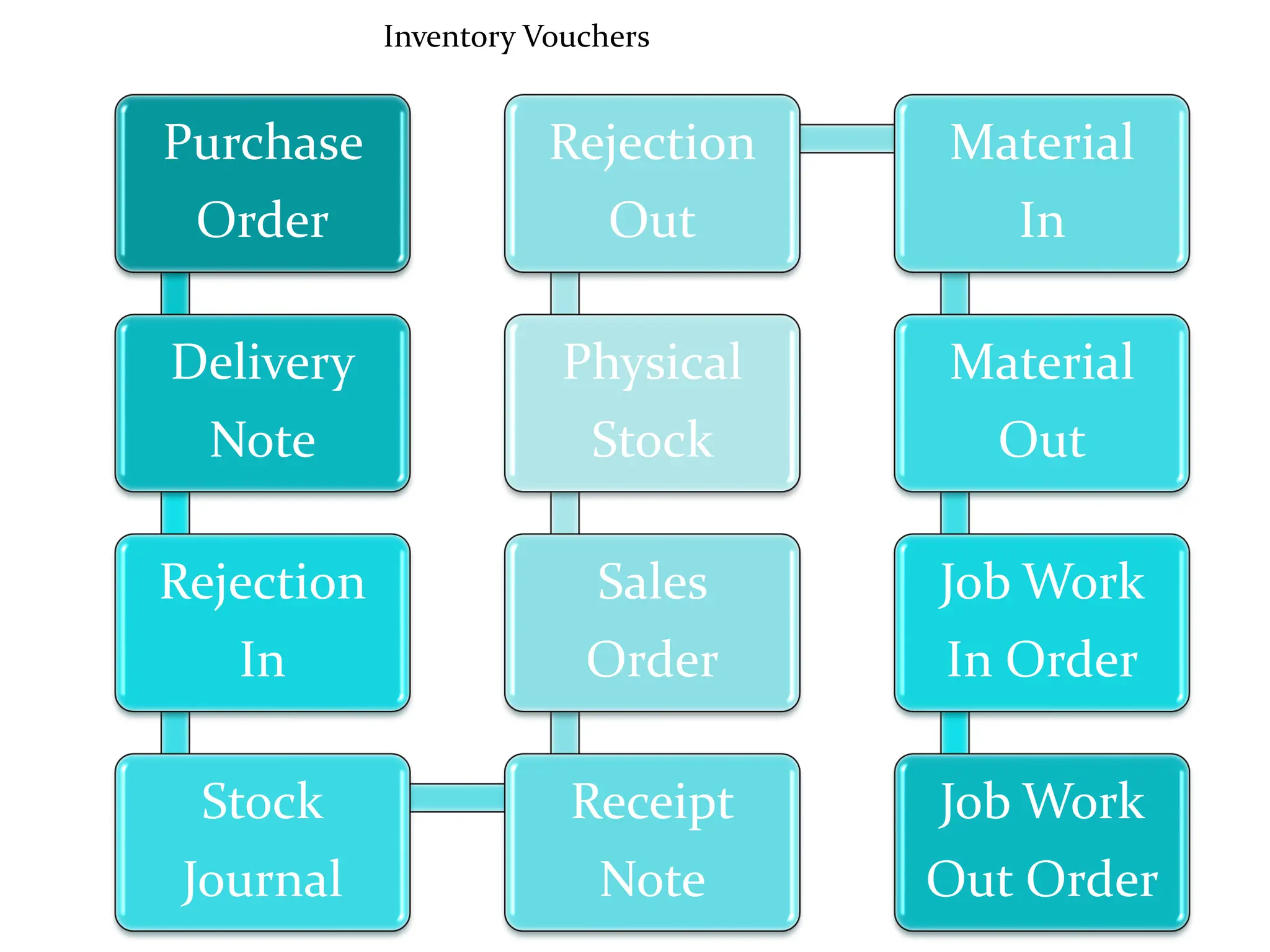
Inventory Vouchers
Purchase
Order
Delivery
Note
Rejection
In
Stock
Journal
Receipt
Note
Sales
Order
Physical
Stock
Rejection
Out
Material
In
Material
Out
Job Work
In Order
Job Work
Out Order
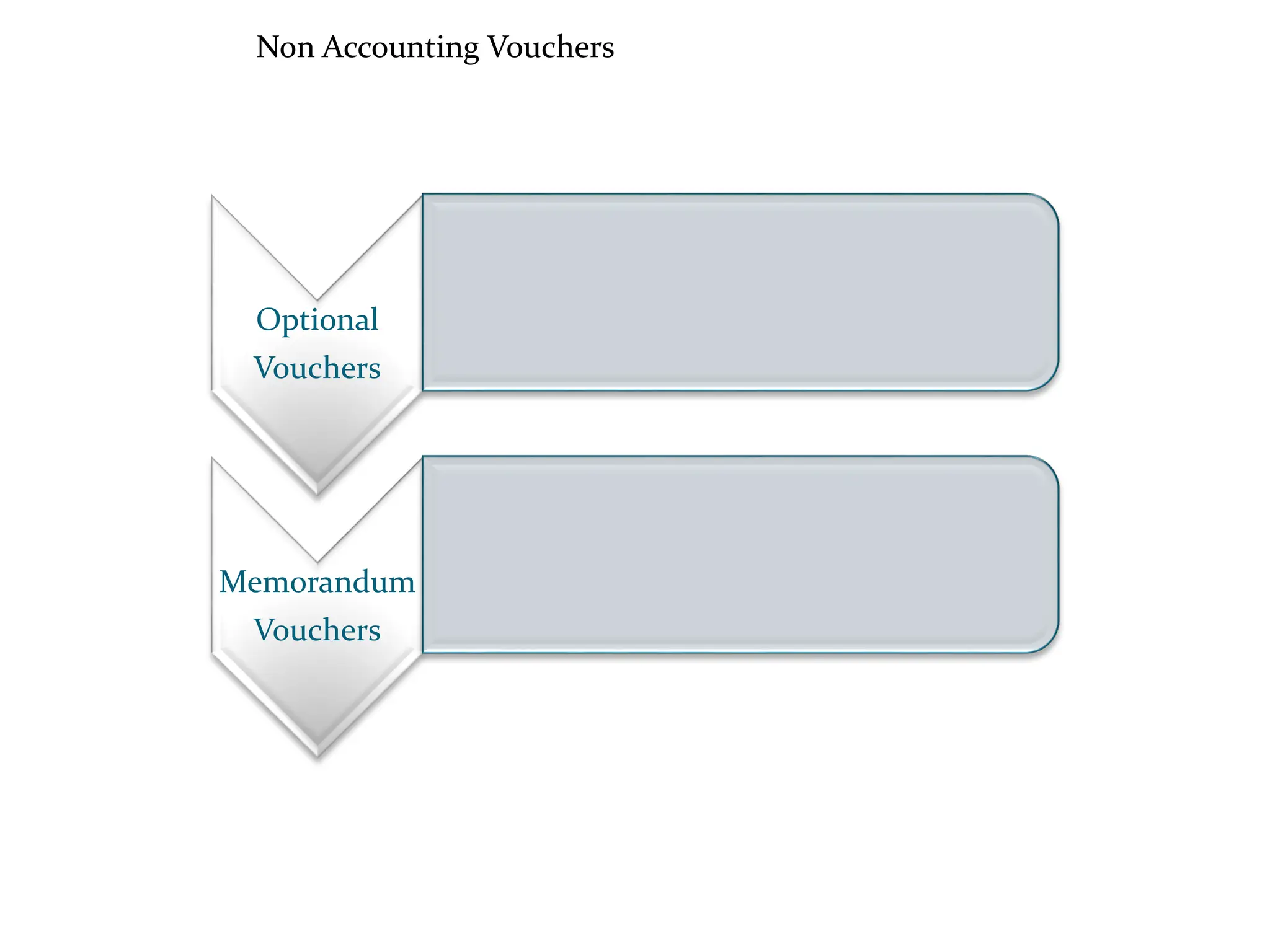
Non Accounting Vouchers
Optional
Vouchers
Memorandum
Vouchers
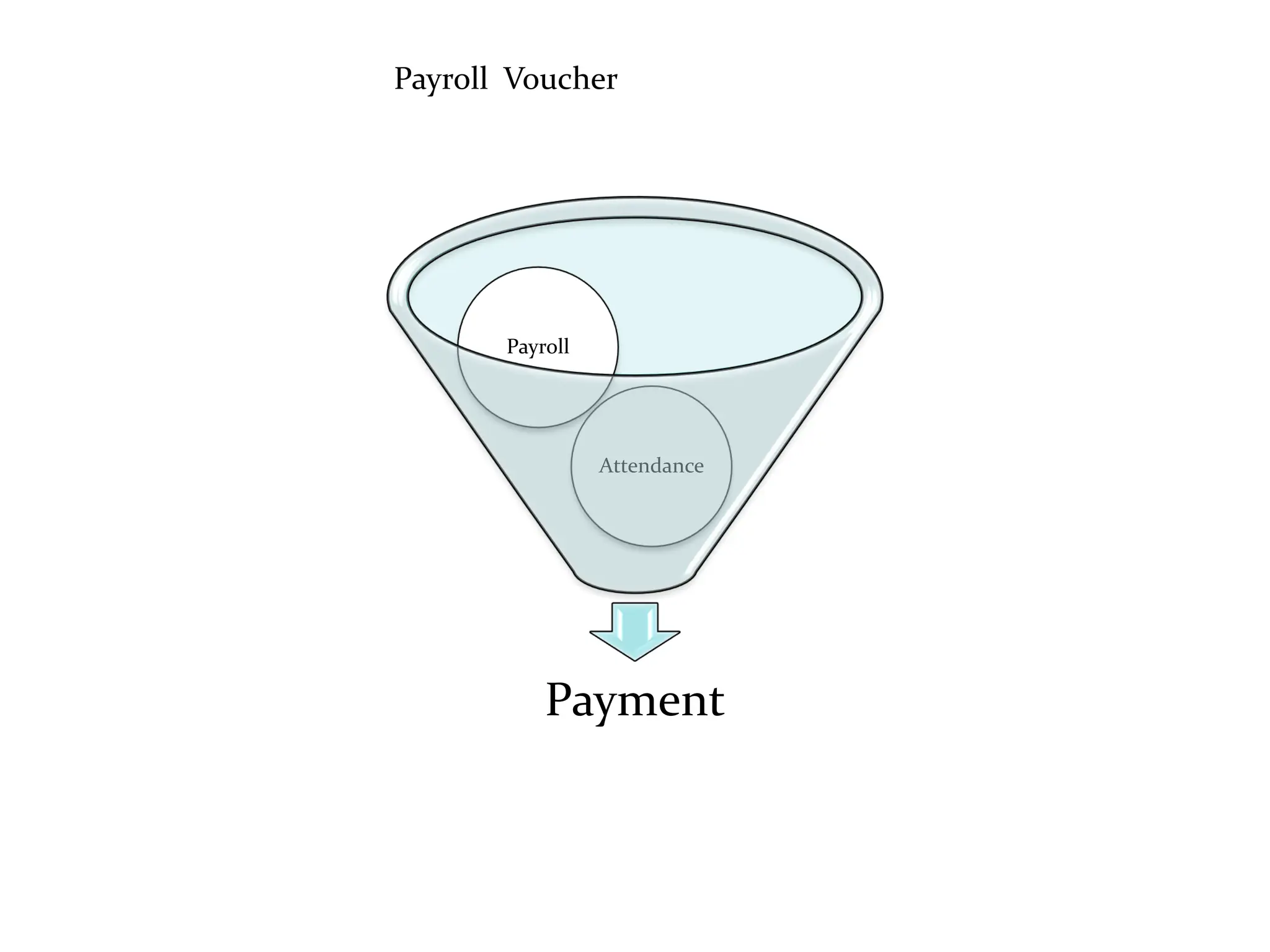
Payroll Voucher
Payment
Attendance
Payroll
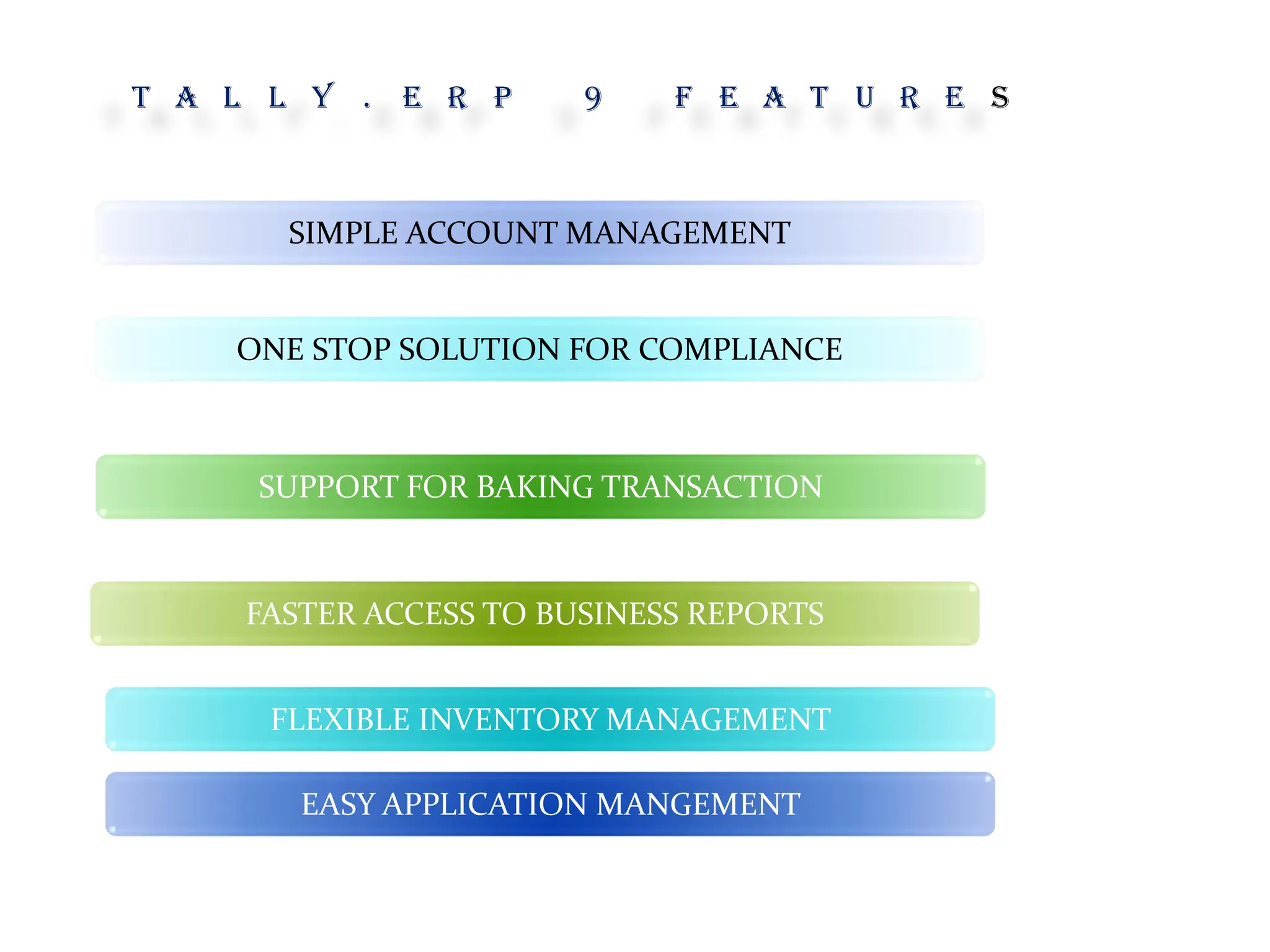
T a l l y . E R P 9 F e a t u r e s
SIMPLE ACCOUNT MANAGEMENT
ONE STOP SOLUTION FOR COMPLIANCE
SUPPORT FOR BAKING TRANSACTION
FASTER ACCESS TO BUSINESS REPORTS
FLEXIBLE INVENTORY MANAGEMENT
EASY APPLICATION MANGEMENT
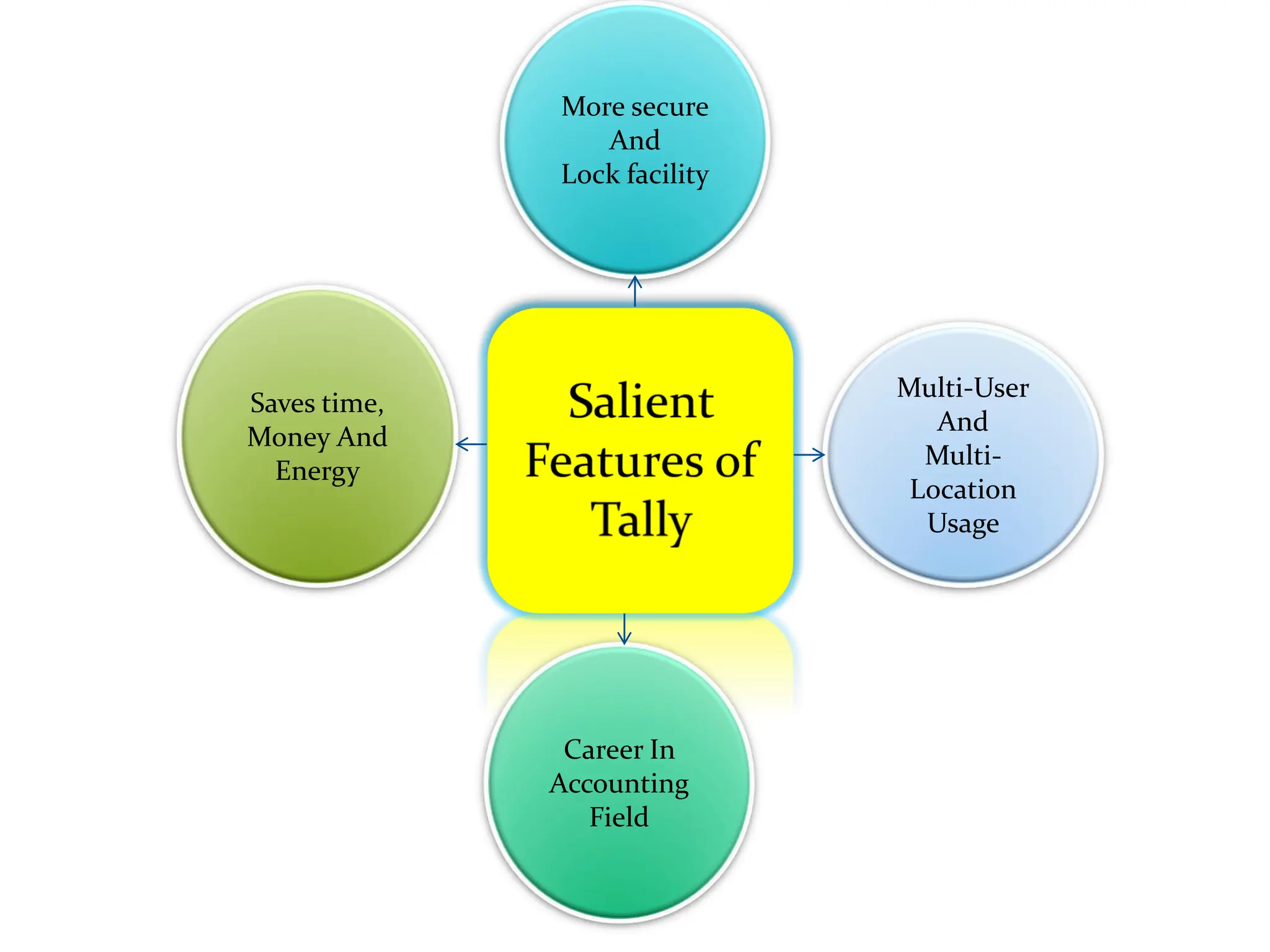
Saves time,
Money And
Energy
More secure
And
Lock facility
Multi-User
And
Multi-
Location
Usage
Career In
Accounting
Field
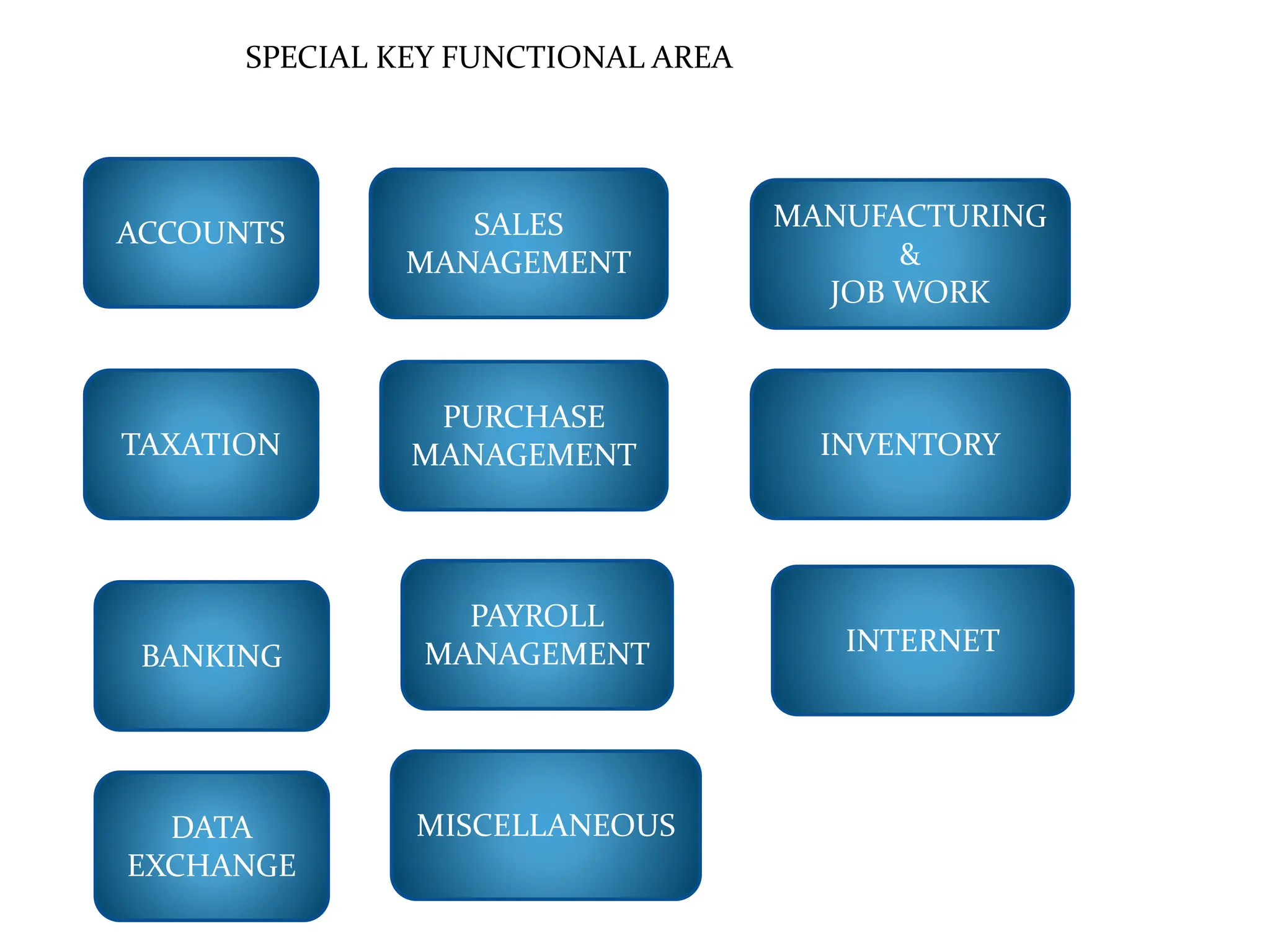
SPECIAL KEY FUNCTIONAL AREA
ACCOUNTS
TAXATION
BANKING
SALES
MANAGEMENT
PURCHASE
MANAGEMENT
PAYROLL
MANAGEMENT
MANUFACTURING
&
JOB WORK
INVENTORY
INTERNET
DATA
EXCHANGE
MISCELLANEOUS
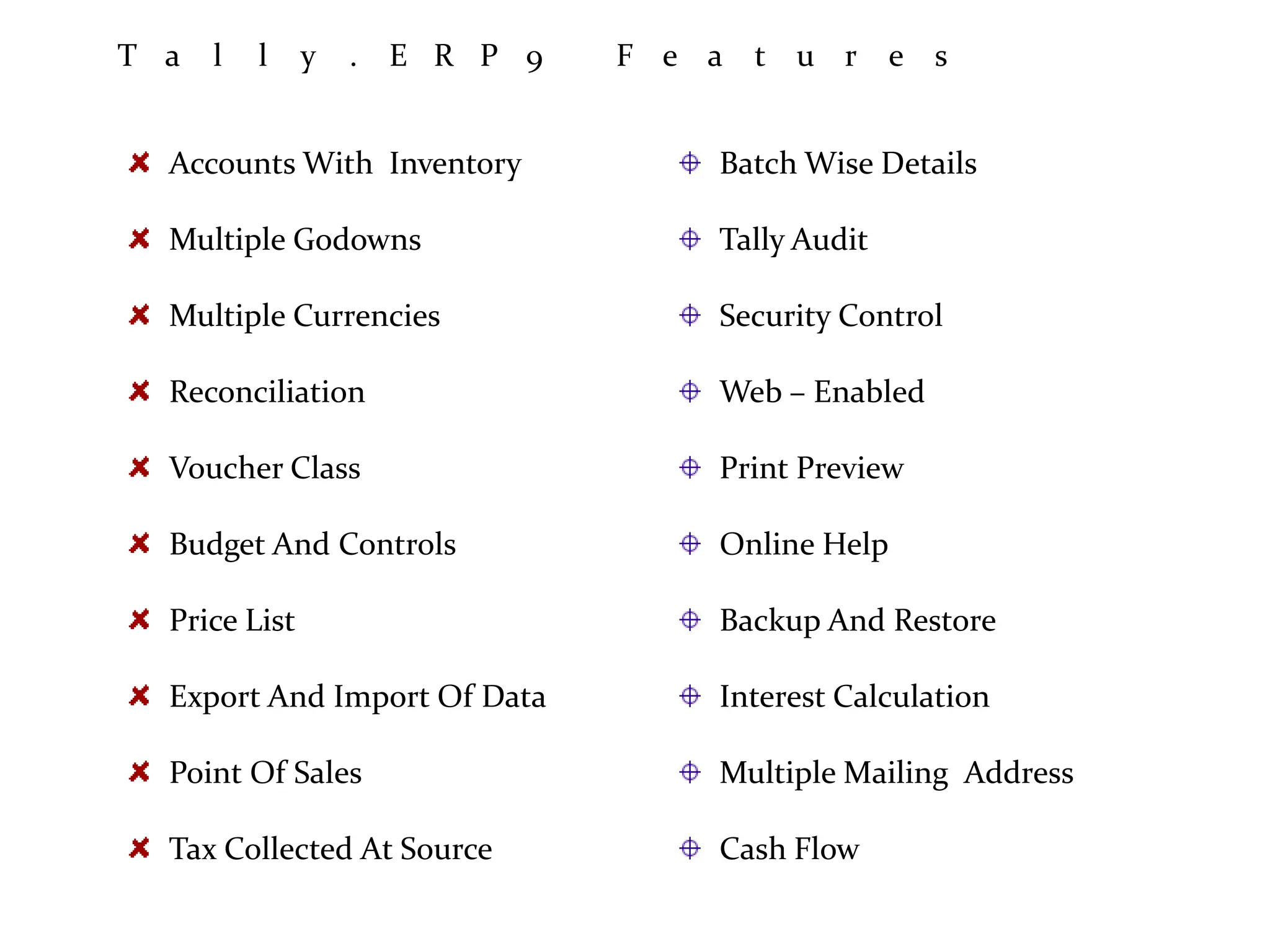
T a l l y . E R P 9 F e a t u r e s
Accounts With Inventory
Multiple Godowns
Multiple Currencies
Reconciliation
Voucher Class
Budget And Controls
Price List
Export And Import Of Data
Point Of Sales
Tax Collected At Source
Batch Wise Details
Tally Audit
Security Control
Web – Enabled
Print Preview
Online Help
Backup And Restore
Interest Calculation
Multiple Mailing Address
Cash Flow
T a l l y . E R P 9 F e a t u r e s
Bill Wise Details
Cost Centers And Cost Category
Debit Note And Credit Note
Reversing Joumals and Optional
Cheque Printing
Post Dated
Tracking Number
Delivery Note
Receipt Note
Goods And Services Tax
Zero Valued Transactions
Company Logo
Changed Vouchers
Stock Categories
Actual And Billed Quantity
Purchase Order Processing
Sales Order Processing
Discount Invoices
Rejection Out And In
Tax Deducted At Source
W h a t I s G S T ?
GST (Goods And Services Tax)
GST Stands For Goods And Services Tax . It Is An Indirect Tax
Which Introduced To Replacing Host Of Other Indirect Taxes
Such As Value Added Tax, Purchase Tax, Excise
Duty, And So On. GST Levied On The Supple Of Certain
Goods And Services In India. It Is One Tax That Is Applicable
All Over India.
History Of GST !
On July 1st 2017 The Good And Services Tax Implemented In India. But The
Process
Of Implementing The New Tax Regime Commenced A Long Time Ago. In
2000 Atal Bihari Vajpayee. Then Prime Minister Of India, Set Up A
Committee To Draft The Gst
Law, In 2004 A Task Force Force Concluded That The New Tax Strcture
Should Put In Place To Enhance The Tax Regime At The Time.
In 2006 Finance Minister Proposed The Introduction Of Gst From 1st April
2010 And In 2011 The Constitution Amendment Bill Passed To Enable The
Introduction Of The Gst Law. In 2012 The Standing Committee Started
Discussions About Gst, And Tabled Its Report On Gst A Year Later. In 2014
The New Finance Minister At The Time Arun Jaitley Reintroduced The Gst
Bill In Parliament And Passed The Bill In Lok Sabha In 2015 Yet The
Implementation Of The Law Delayed As It Was Not Passed In Rajya Sabha.
Gst Went Live In 2016, And The Amended Model Gst Law Passed In Both The
House. The President Of India Also Gave Assent. In 2017 The Passing Of 4
Supplementary Gst Bills In Cabinet. Rajya Sabha Then 4 Supplementary Gst
Bills And The New Tax Regime Implemented On 1st July 2017.
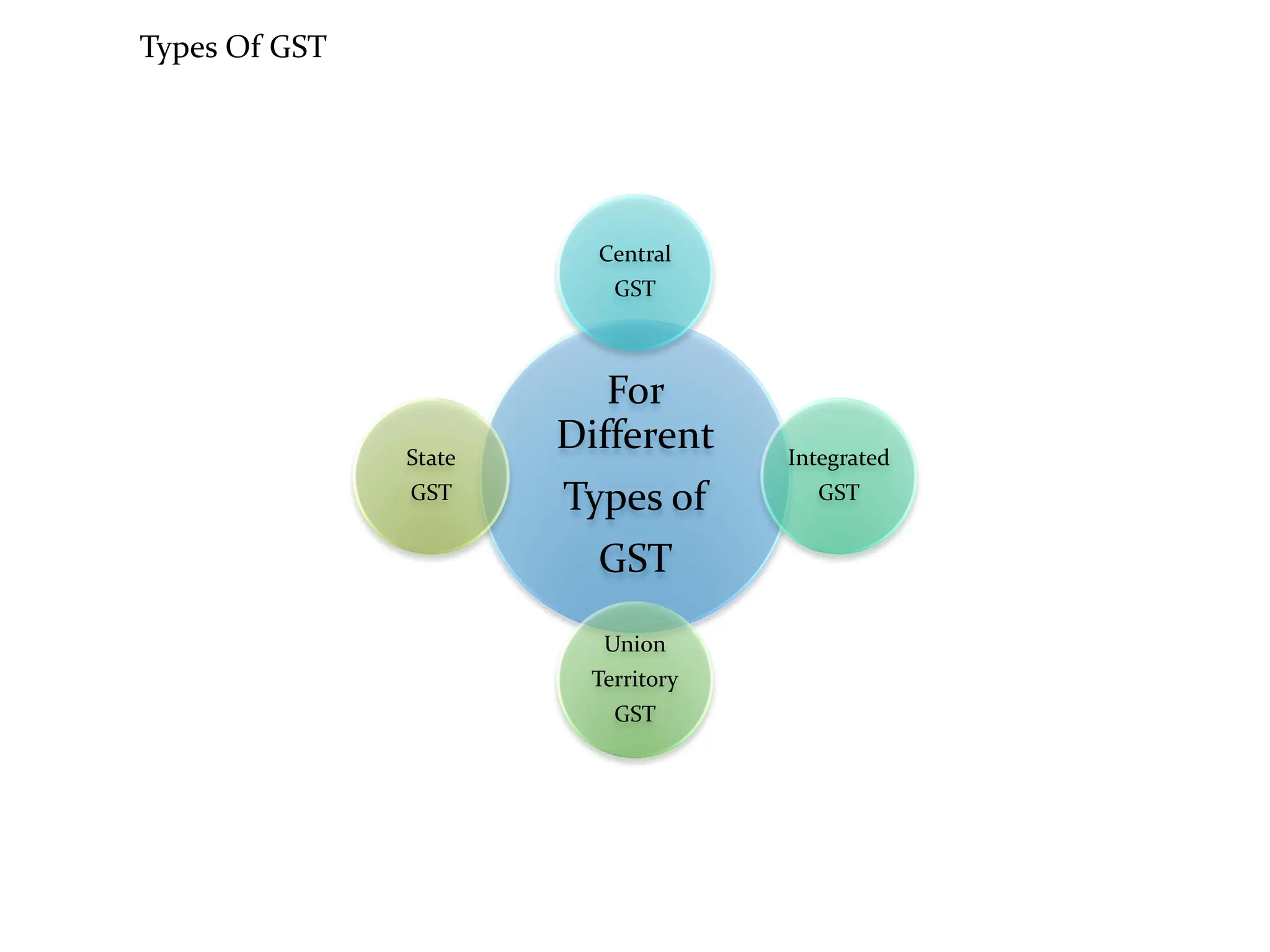
Types Of GST
For
Different
Types of
GST
Central
GST
Integrated
GST
Union
Territory
GST
State
GST
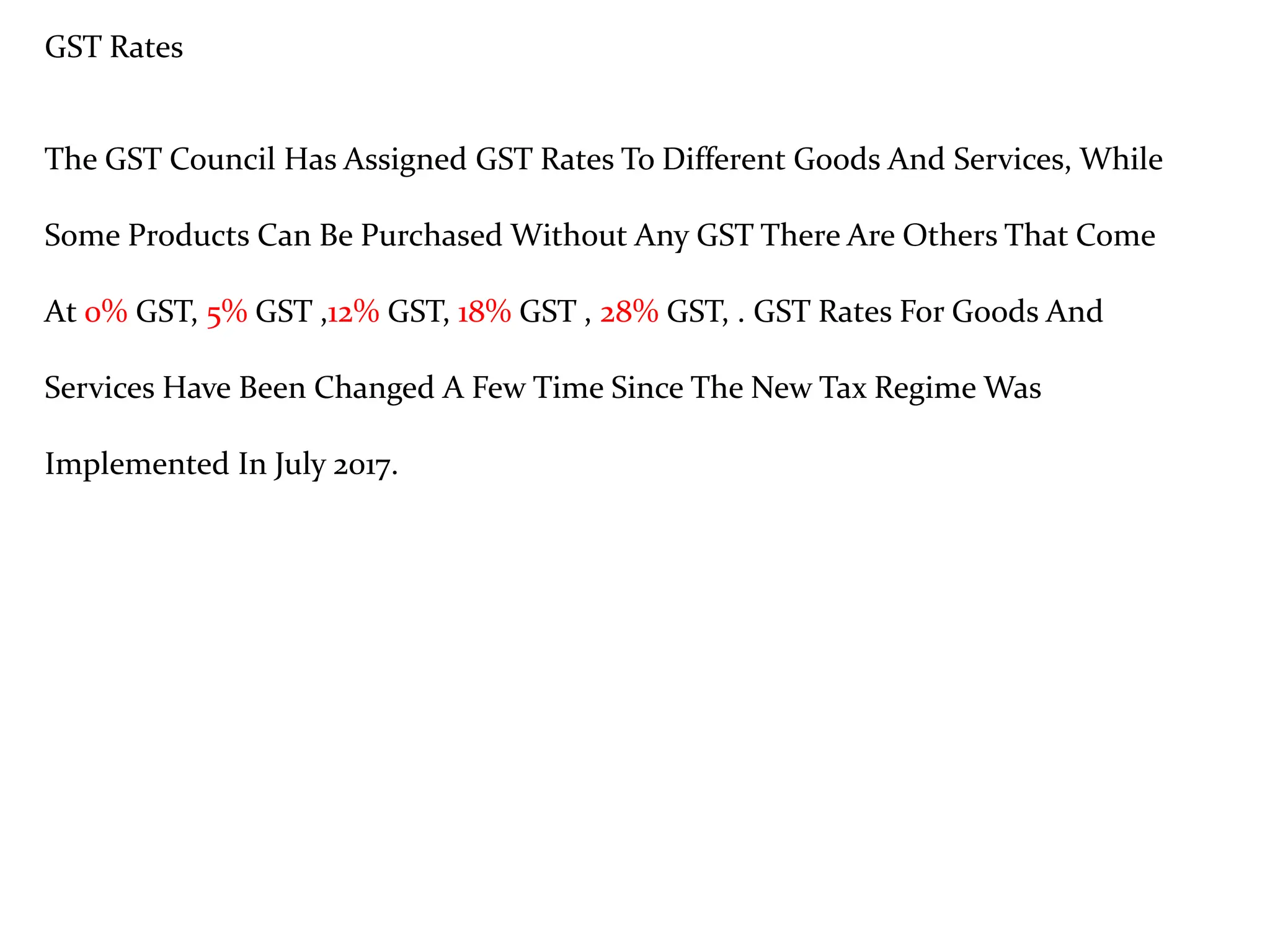
GST Rates
The GST Council Has Assigned GST Rates To Different Goods And Services, While
Some Products Can Be Purchased Without Any GST There Are Others That Come
At 0% GST, 5% GST ,12% GST, 18% GST , 28% GST, . GST Rates For Goods And
Services Have Been Changed A Few Time Since The New Tax Regime Was
Implemented In July 2017.
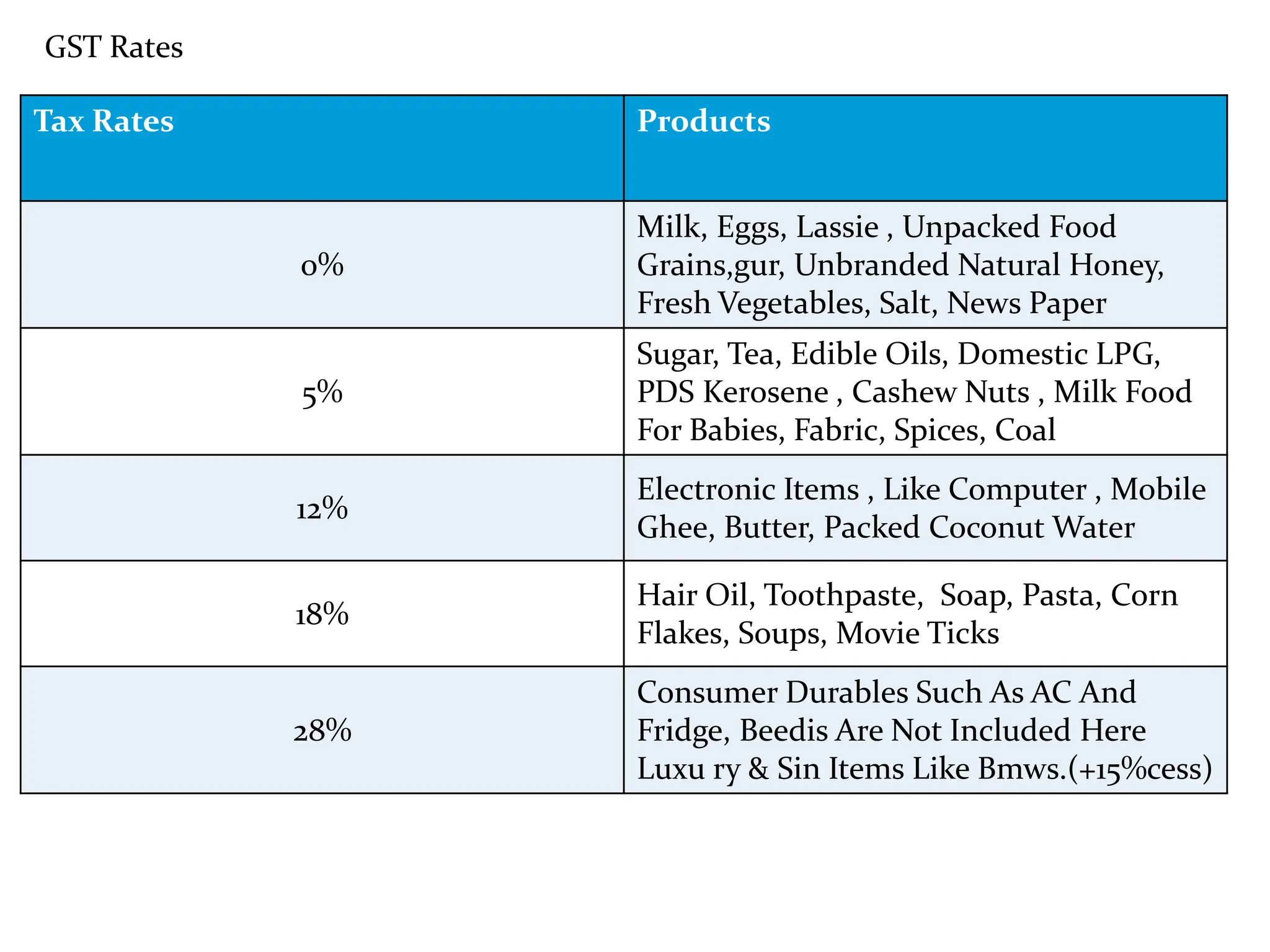
GST Rates
Tax Rates Products
0%
Milk, Eggs, Lassie , Unpacked Food
Grains,gur, Unbranded Natural Honey,
Fresh Vegetables, Salt, News Paper
5%
Sugar, Tea, Edible Oils, Domestic LPG,
PDS Kerosene , Cashew Nuts , Milk Food
For Babies, Fabric, Spices, Coal
12%
Electronic Items , Like Computer , Mobile
Ghee, Butter, Packed Coconut Water
18%
Hair Oil, Toothpaste, Soap, Pasta, Corn
Flakes, Soups, Movie Ticks
28%
Consumer Durables Such As AC And
Fridge, Beedis Are Not Included Here
Luxu ry & Sin Items Like Bmws.(+15%cess)
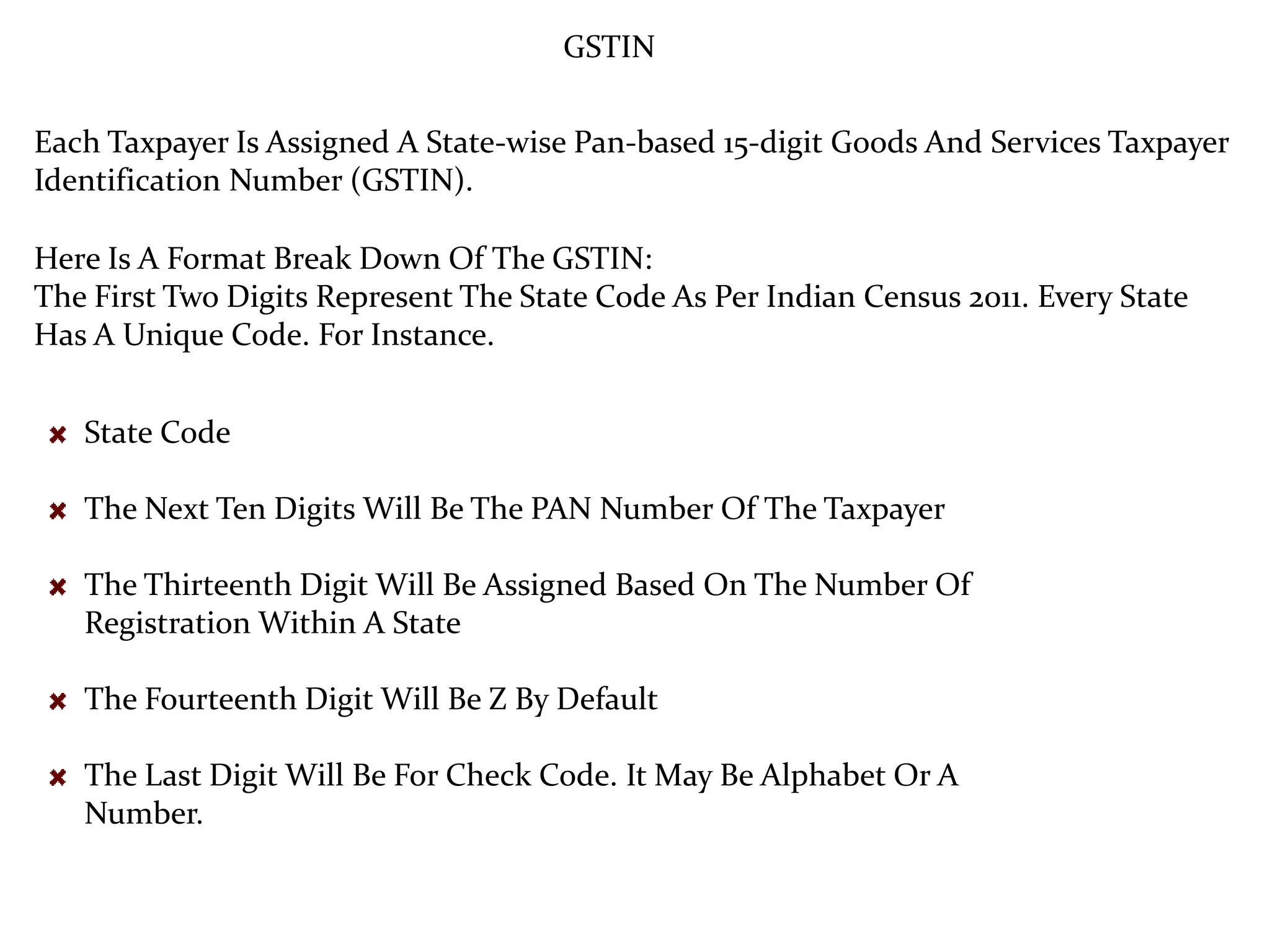
GSTIN
Each Taxpayer Is Assigned A State-wise Pan-based 15-digit Goods And Services Taxpayer
Identification Number (GSTIN).
Here Is A Format Break Down Of The GSTIN:
The First Two Digits Represent The State Code As Per Indian Census 2011. Every State
Has A Unique Code. For Instance.
State Code
The Next Ten Digits Will Be The PAN Number Of The Taxpayer
The Thirteenth Digit Will Be Assigned Based On The Number Of
Registration Within A State
The Fourteenth Digit Will Be Z By Default
The Last Digit Will Be For Check Code. It May Be Alphabet Or A
Number.
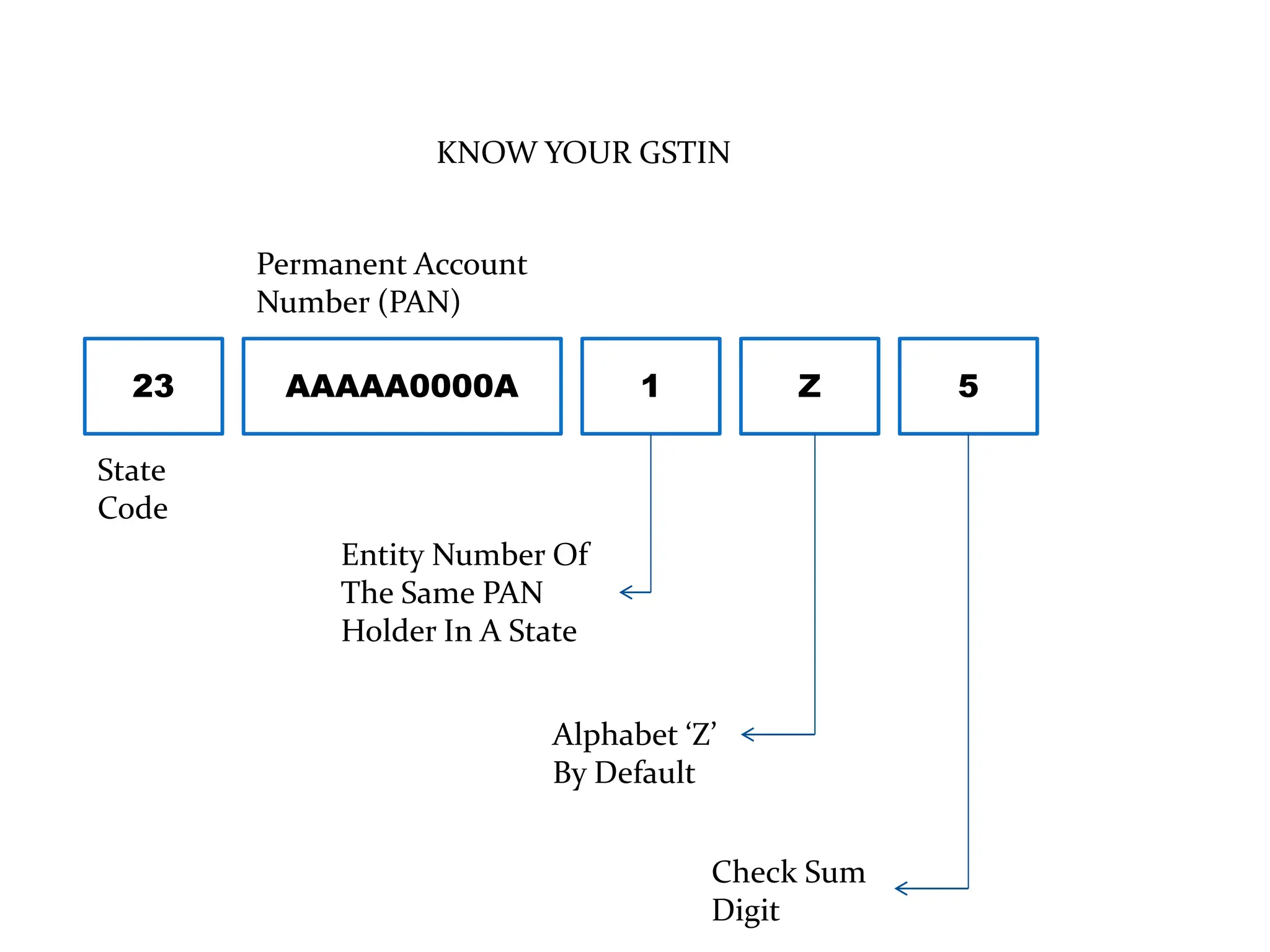
KNOW YOUR GSTIN
23 AAAAA0000A 1 Z 5
Permanent Account
Number (PAN)
State
Code
Entity Number Of
The Same PAN
Holder In A State
Alphabet ‘Z’
By Default
Check Sum
Digit
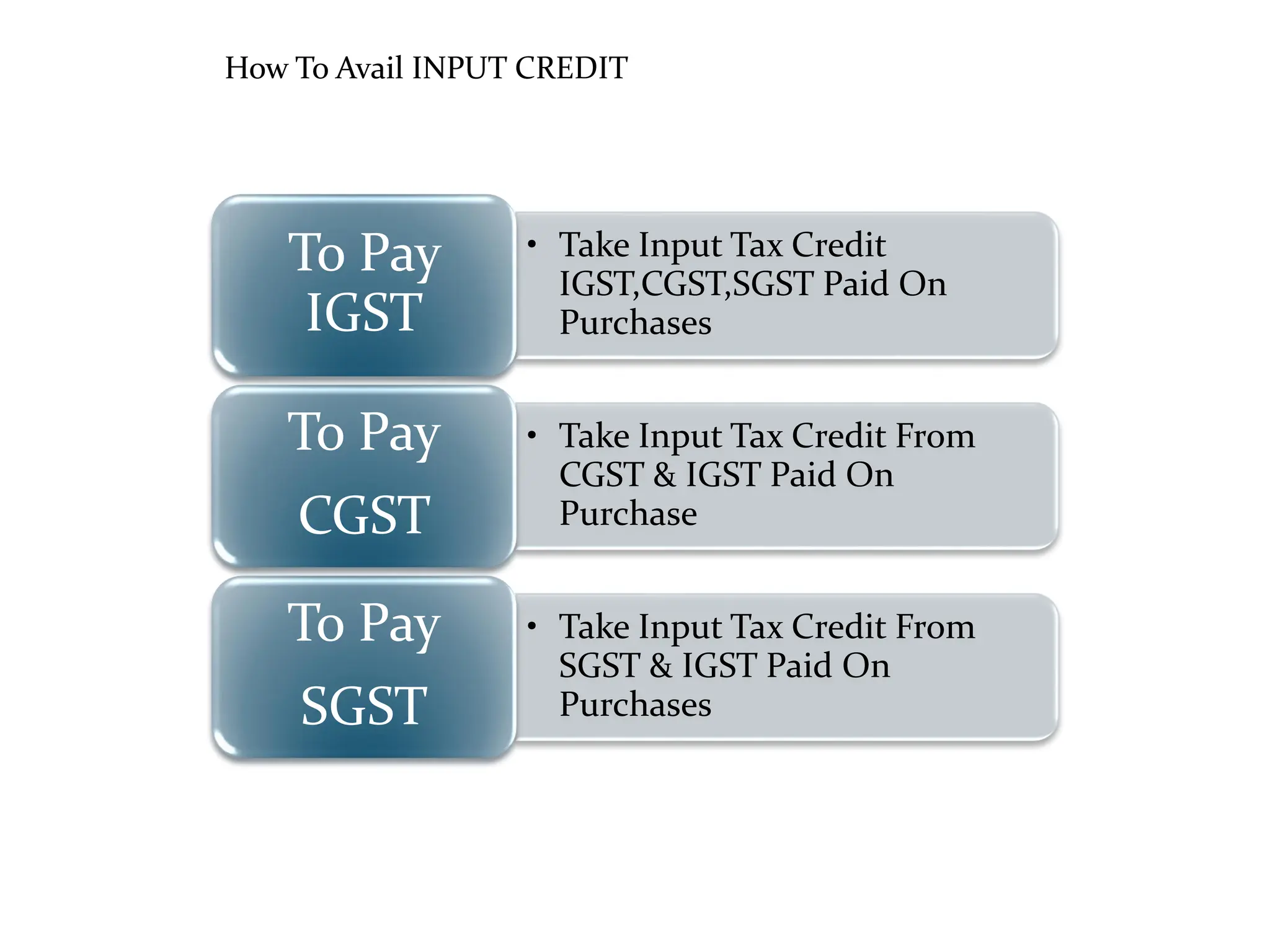
How To Avail INPUT CREDIT
• Take Input Tax Credit
IGST,CGST,SGST Paid On
Purchases
To Pay
IGST
• Take Input Tax Credit From
CGST & IGST Paid On
Purchase
To Pay
CGST
• Take Input Tax Credit From
SGST & IGST Paid On
Purchases
To Pay
SGST

tally software detailed presentation .pdf

  • 1.
    Tally P O WE R O F S I M P L I C I T Y TALLY.ERP 9
  • 2.
    WHAT IS TALLY?  Tally (Transaction Allowed In A Linear Line Yards)  Tally.ERP9 (Enterprise Resource Planning System)  Tally.ERP9 is the ideal software for your business. It is used by over a million businesses across India.  We understand that every business has its own complexities, exceptions and unique needs. Tally.ERP9 is designed with flexibility to handle all of these. The needs of your business change as it grows and Tally. ERP9 is designed to scale. Let Tally manage your accounting and compliance, while you focus to grow your business  Tally allows its users to access their account remotely using the http://tally.NET facility, which allows the users to access their account on an internet connection.
  • 3.
    MANUALLY ACCOUNTING COMPUTERIZEACCOUNTING JOURNAL ENTRIES LEDGERS TRIAL BALANCE TRADING ACCOUNT PROFIT AND LOSS BALANCE SHEET COMPANY CREATION LEDGER CREATION ACCOUNTING VAOUCHERS TRIAL BALANCE TRADING ACCOUNT PROFIT AND LOSS BALANCE SHEET VS
  • 4.
    FINANCIAL ACCOUNTING A FinancialYear Is Twelve Month Duration Start ON 1st APRIAL AND ENDS ON 31ST MARCH DOUBLE ENTRY SYSTEM In Double Entry System We Maintain Record Of Both Side Of A Transaction. SOURCES OF FUND We Know That To Run A Business We Need Funds. In Fact The Purpose Of Business Is To Raise Funds. Owner’s Equity Of Capital- Loan. Earning Revenue. Disposing Making Profit. Use Of Funds Purchasing Assets. Expenses. Losses. Decreasing Liabilities. Keeping Cash.
  • 5.
    TYPES OF ACCOUNTS ThereAre Three Type Of Accounts • Personal • Real • Nominal Types of accounts
  • 6.
    Personal Accounts Personal AccountsThe Accounts Recording Transactions Related To Person I.E . Human Being Or Firms Companies, Institutions Etc. Are Classified As Personal A/C Personal Accounts Can Be Further Classified As: Golden Rules Of Personal Accounts DEBIT :- Debit The Receiver CREDIT :- Credit The Giver
  • 7.
    REAL ACCOUNTS The AccountsRecording Transactions Are Related To Tangible Items ( Which Can Be Touched, Purchased, Sold) Such As Goods, Cash, Machinery, Etc. Are Classified As Real Accounts. Whereas Accounts Recording Transactions Relating To Intangible Things Such As Goodwill, Patents And Copy Rights, Trademark Etc. Are Classified As Intangible Real Accounts. Golden Rules Of Real Accounts Real account can be further classified as: Assets. Liabilities. DIBIT :- What Comes In CREDIT :- What Goes Out
  • 8.
    NOMINAL ACCOUNTS The AccountsRecording Transactions Are Related To Losses, Interest, Bad Debts Etc. Are Classified As Nominal Account. Nominal Account Can Be Further Classified Into Two Types Of Accounts Golden Rules Of Nominal Accounts DEBIT :- All Expenses & Loss CREDIT :- All Income & Gains
  • 9.
    Tally ERP 9Groups 28 Pre- defined Groups 15 Primary Groups 13 Sub Groups 9 Capital Nature 6 Revenue Nature (Profit &loss)
  • 10.
    LIST OF 15PRIMARY GROUPS Capital Branch / Division Loans Suspense Current Assets Fixed Assets Indirect Exp. Purchase Sales Investm ents Indirect Income Misc. Exp . Current Liabilities Direct Income Direct Exp.
  • 11.
    LIST OF 13SUB-GROUPS Sundry Creditors Unsecured Loans Deposits Loan & Advances (Assets) Sundry Debtors Reserves & Surplus Stock In hand Banks OD Secured Loans Bank account Provisions Cash In Hand Duties & Taxes
  • 12.
    15 PRIMARY GROUPS Capital Loans Misc.Expenses Investments Fixed Assets Current Assists Current Liability Suspense Branch / Division Sales Purchase Indirect Exp. Direct Exp. Indirect Income Direct Income 9 Capital Nature 6 Revenue Nature (Profit &loss)
  • 13.
    TYPES OF VOUCHERS TallyERP.9 Four Types Of Vouchers Accounting Inventory Non Accounting Payroll
  • 14.
    Accounting Vouchers Credit Note DebitNote Purchase Vouchers Sales Vouchers Journal Vouchers Receipt Vouchers Payment Vouchers Contra Vouchers
  • 15.
  • 16.
  • 17.
  • 18.
    T a ll y . E R P 9 F e a t u r e s SIMPLE ACCOUNT MANAGEMENT ONE STOP SOLUTION FOR COMPLIANCE SUPPORT FOR BAKING TRANSACTION FASTER ACCESS TO BUSINESS REPORTS FLEXIBLE INVENTORY MANAGEMENT EASY APPLICATION MANGEMENT
  • 19.
    Saves time, Money And Energy Moresecure And Lock facility Multi-User And Multi- Location Usage Career In Accounting Field
  • 20.
    SPECIAL KEY FUNCTIONALAREA ACCOUNTS TAXATION BANKING SALES MANAGEMENT PURCHASE MANAGEMENT PAYROLL MANAGEMENT MANUFACTURING & JOB WORK INVENTORY INTERNET DATA EXCHANGE MISCELLANEOUS
  • 21.
    T a ll y . E R P 9 F e a t u r e s Accounts With Inventory Multiple Godowns Multiple Currencies Reconciliation Voucher Class Budget And Controls Price List Export And Import Of Data Point Of Sales Tax Collected At Source Batch Wise Details Tally Audit Security Control Web – Enabled Print Preview Online Help Backup And Restore Interest Calculation Multiple Mailing Address Cash Flow
  • 22.
    T a ll y . E R P 9 F e a t u r e s Bill Wise Details Cost Centers And Cost Category Debit Note And Credit Note Reversing Joumals and Optional Cheque Printing Post Dated Tracking Number Delivery Note Receipt Note Goods And Services Tax Zero Valued Transactions Company Logo Changed Vouchers Stock Categories Actual And Billed Quantity Purchase Order Processing Sales Order Processing Discount Invoices Rejection Out And In Tax Deducted At Source
  • 23.
    W h at I s G S T ? GST (Goods And Services Tax) GST Stands For Goods And Services Tax . It Is An Indirect Tax Which Introduced To Replacing Host Of Other Indirect Taxes Such As Value Added Tax, Purchase Tax, Excise Duty, And So On. GST Levied On The Supple Of Certain Goods And Services In India. It Is One Tax That Is Applicable All Over India.
  • 24.
    History Of GST! On July 1st 2017 The Good And Services Tax Implemented In India. But The Process Of Implementing The New Tax Regime Commenced A Long Time Ago. In 2000 Atal Bihari Vajpayee. Then Prime Minister Of India, Set Up A Committee To Draft The Gst Law, In 2004 A Task Force Force Concluded That The New Tax Strcture Should Put In Place To Enhance The Tax Regime At The Time. In 2006 Finance Minister Proposed The Introduction Of Gst From 1st April 2010 And In 2011 The Constitution Amendment Bill Passed To Enable The Introduction Of The Gst Law. In 2012 The Standing Committee Started Discussions About Gst, And Tabled Its Report On Gst A Year Later. In 2014 The New Finance Minister At The Time Arun Jaitley Reintroduced The Gst Bill In Parliament And Passed The Bill In Lok Sabha In 2015 Yet The Implementation Of The Law Delayed As It Was Not Passed In Rajya Sabha. Gst Went Live In 2016, And The Amended Model Gst Law Passed In Both The House. The President Of India Also Gave Assent. In 2017 The Passing Of 4 Supplementary Gst Bills In Cabinet. Rajya Sabha Then 4 Supplementary Gst Bills And The New Tax Regime Implemented On 1st July 2017.
  • 25.
    Types Of GST For Different Typesof GST Central GST Integrated GST Union Territory GST State GST
  • 26.
    GST Rates The GSTCouncil Has Assigned GST Rates To Different Goods And Services, While Some Products Can Be Purchased Without Any GST There Are Others That Come At 0% GST, 5% GST ,12% GST, 18% GST , 28% GST, . GST Rates For Goods And Services Have Been Changed A Few Time Since The New Tax Regime Was Implemented In July 2017.
  • 27.
    GST Rates Tax RatesProducts 0% Milk, Eggs, Lassie , Unpacked Food Grains,gur, Unbranded Natural Honey, Fresh Vegetables, Salt, News Paper 5% Sugar, Tea, Edible Oils, Domestic LPG, PDS Kerosene , Cashew Nuts , Milk Food For Babies, Fabric, Spices, Coal 12% Electronic Items , Like Computer , Mobile Ghee, Butter, Packed Coconut Water 18% Hair Oil, Toothpaste, Soap, Pasta, Corn Flakes, Soups, Movie Ticks 28% Consumer Durables Such As AC And Fridge, Beedis Are Not Included Here Luxu ry & Sin Items Like Bmws.(+15%cess)
  • 28.
    GSTIN Each Taxpayer IsAssigned A State-wise Pan-based 15-digit Goods And Services Taxpayer Identification Number (GSTIN). Here Is A Format Break Down Of The GSTIN: The First Two Digits Represent The State Code As Per Indian Census 2011. Every State Has A Unique Code. For Instance. State Code The Next Ten Digits Will Be The PAN Number Of The Taxpayer The Thirteenth Digit Will Be Assigned Based On The Number Of Registration Within A State The Fourteenth Digit Will Be Z By Default The Last Digit Will Be For Check Code. It May Be Alphabet Or A Number.
  • 29.
    KNOW YOUR GSTIN 23AAAAA0000A 1 Z 5 Permanent Account Number (PAN) State Code Entity Number Of The Same PAN Holder In A State Alphabet ‘Z’ By Default Check Sum Digit
  • 30.
    How To AvailINPUT CREDIT • Take Input Tax Credit IGST,CGST,SGST Paid On Purchases To Pay IGST • Take Input Tax Credit From CGST & IGST Paid On Purchase To Pay CGST • Take Input Tax Credit From SGST & IGST Paid On Purchases To Pay SGST