BUSINESS ACTIVITY
STATEMENTTRAINING
11/18/2020 Annual Review 2
 Introduction to GST
 Types of GST Codes
 Introduction to BAS
 Checklist before preparing BAS
 GST Payable
 Review/Prepare BAS
 Group Lodgements
Agenda
11/18/2020 Annual Review 3
Introduction to GST
GST means Good and Services Tax. It is a broad-based tax
of 10% imposed most goods and services.
Businesses needs to register for GST if their GST turnover
is $75000 or more and for NFP GST turnover is $150000
or more.
Businesses need to include GST charge in the price they
charge for goods and services and claim credits for GST
paid in the price they paid for good and services used for
business.
Taxable Sales (GST on expenses) Sales includes GST price:
a) Sales must be payment of some kind.
b) Sales be made in course of operating business.
c) Sales connected with Australia.
11/18/2020 Annual Review 4
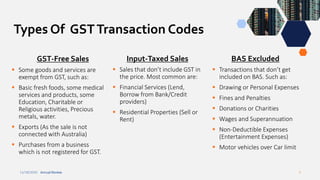
Types Of GSTTransaction Codes
GST-Free Sales
 Some goods and services are
exempt from GST, such as:
 Basic fresh foods, some medical
services and products, some
Education, Charitable or
Religious activities, Precious
metals, water.
 Exports (As the sale is not
connected with Australia)
 Purchases from a business
which is not registered for GST.
Input-Taxed Sales
 Sales that don’t include GST in
the price. Most common are:
 Financial Services (Lend,
Borrow from Bank/Credit
providers)
 Residential Properties (Sell or
Rent)
BAS Excluded
 Transactions that don’t get
included on BAS. Such as:
 Drawing or Personal Expenses
 Fines and Penalties
 Donations or Charities
 Wages and Superannuation
 Non-Deductible Expenses
(Entertainment Expenses)
 Motor vehicles over Car limit
11/18/2020 Annual Review 5
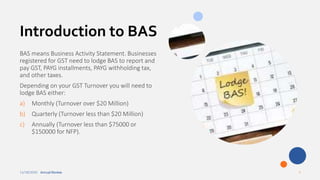
BAS means Business Activity Statement. Businesses
registered for GST need to lodge BAS to report and
pay GST, PAYG installments, PAYG withholding tax,
and other taxes.
Depending on your GST Turnover you will need to
lodge BAS either:
a) Monthly (Turnover over $20 Million)
b) Quarterly (Turnover less than $20 Million)
c) Annually (Turnover less than $75000 or
$150000 for NFP).
Introduction to BAS
11/18/2020 Annual Review 6
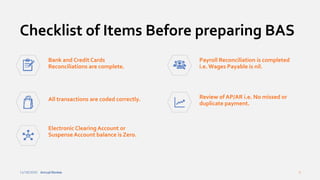
Checklist of Items Before preparing BAS
Bank and Credit Cards
Reconciliations are complete.
Payroll Reconciliation is completed
i.e. Wages Payable is nil.
All transactions are coded correctly. Review of AP/AR i.e. No missed or
duplicate payment.
Electronic Clearing Account or
Suspense Account balance is Zero.
11/18/2020 Annual Review 7
As a GST-registered business, we need to issue tax
invoices to customers, the GST charged by us is recorded
in account called GST Collected.
The GST we paid to our suppliers for goods and services
we used for business is recorded in account called GST
Paid.
When lodging a BAS we report and pay GST collected and
claim credits for GST paid. The amount of GST collected,
and GST paid determines whether we need to make a
payment to or receive a refund from ATO. To record this
we need to create a manual journal.
GST Payable is shown in Balance Sheet as the closing
balance for un-lodged BAS or un-reported GST.
GST Payable
11/18/2020 Annual Review 8
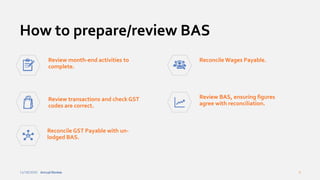
How to prepare/review BAS
Review month-end activities to
complete.
Reconcile Wages Payable.
Review transactions and check GST
codes are correct.
Review BAS, ensuring figures
agree with reconciliation.
Reconcile GST Payable with un-
lodged BAS.
11/18/2020 Annual Review 9
A GST group is two or more associated business
entities that operate as a single business for GST
purposes.
BAS is prepared separately for each entity and the
amounts are added together to form group BAS.
Need to eliminate intra-group transactions. As a
group, business is not liable to pay GST on sales
from other group members and can't claim GST
credits for purchases from other group members.
ATO only needs information about sales from
external parties and purchases from external
parties.
Group Lodgements

BAS training Australia

  • 1.
  • 2.
    11/18/2020 Annual Review2  Introduction to GST  Types of GST Codes  Introduction to BAS  Checklist before preparing BAS  GST Payable  Review/Prepare BAS  Group Lodgements Agenda
  • 3.
    11/18/2020 Annual Review3 Introduction to GST GST means Good and Services Tax. It is a broad-based tax of 10% imposed most goods and services. Businesses needs to register for GST if their GST turnover is $75000 or more and for NFP GST turnover is $150000 or more. Businesses need to include GST charge in the price they charge for goods and services and claim credits for GST paid in the price they paid for good and services used for business. Taxable Sales (GST on expenses) Sales includes GST price: a) Sales must be payment of some kind. b) Sales be made in course of operating business. c) Sales connected with Australia.
  • 4.
    11/18/2020 Annual Review4 Types Of GSTTransaction Codes GST-Free Sales  Some goods and services are exempt from GST, such as:  Basic fresh foods, some medical services and products, some Education, Charitable or Religious activities, Precious metals, water.  Exports (As the sale is not connected with Australia)  Purchases from a business which is not registered for GST. Input-Taxed Sales  Sales that don’t include GST in the price. Most common are:  Financial Services (Lend, Borrow from Bank/Credit providers)  Residential Properties (Sell or Rent) BAS Excluded  Transactions that don’t get included on BAS. Such as:  Drawing or Personal Expenses  Fines and Penalties  Donations or Charities  Wages and Superannuation  Non-Deductible Expenses (Entertainment Expenses)  Motor vehicles over Car limit
  • 5.
    11/18/2020 Annual Review5 BAS means Business Activity Statement. Businesses registered for GST need to lodge BAS to report and pay GST, PAYG installments, PAYG withholding tax, and other taxes. Depending on your GST Turnover you will need to lodge BAS either: a) Monthly (Turnover over $20 Million) b) Quarterly (Turnover less than $20 Million) c) Annually (Turnover less than $75000 or $150000 for NFP). Introduction to BAS
  • 6.
    11/18/2020 Annual Review6 Checklist of Items Before preparing BAS Bank and Credit Cards Reconciliations are complete. Payroll Reconciliation is completed i.e. Wages Payable is nil. All transactions are coded correctly. Review of AP/AR i.e. No missed or duplicate payment. Electronic Clearing Account or Suspense Account balance is Zero.
  • 7.
    11/18/2020 Annual Review7 As a GST-registered business, we need to issue tax invoices to customers, the GST charged by us is recorded in account called GST Collected. The GST we paid to our suppliers for goods and services we used for business is recorded in account called GST Paid. When lodging a BAS we report and pay GST collected and claim credits for GST paid. The amount of GST collected, and GST paid determines whether we need to make a payment to or receive a refund from ATO. To record this we need to create a manual journal. GST Payable is shown in Balance Sheet as the closing balance for un-lodged BAS or un-reported GST. GST Payable
  • 8.
    11/18/2020 Annual Review8 How to prepare/review BAS Review month-end activities to complete. Reconcile Wages Payable. Review transactions and check GST codes are correct. Review BAS, ensuring figures agree with reconciliation. Reconcile GST Payable with un- lodged BAS.
  • 9.
    11/18/2020 Annual Review9 A GST group is two or more associated business entities that operate as a single business for GST purposes. BAS is prepared separately for each entity and the amounts are added together to form group BAS. Need to eliminate intra-group transactions. As a group, business is not liable to pay GST on sales from other group members and can't claim GST credits for purchases from other group members. ATO only needs information about sales from external parties and purchases from external parties. Group Lodgements