The Driving Forces of Fashion
from 1926-1945
Technology (Cinemas)
Clara Bow was deemed the
“It Girl” after her
appearances in American
Cinemas.
Myrna Loy Claudette Colbert
Technology (Radio)
King Edward VIII and Wallis
Simpson were deemed fashion
icons because of their British
Royalty exploits on the radio.
Social and Cultural Conditions
1920s
-The cinema was a new industry that started to provide new idols for people
to aspire to,
-Silent films were abandoned and sound films started to arise in 1927.
-Mass media continued its expansion with the first commercial radio
station. And by the end of the decade most Americans owned or had access
to their own radio station.
-1929 the stock market crashed causing ten somber years and a loss of
prosperity.
Social and Cultural Conditions Cont.
1930s
-Hollywood started to provide a relief from by news through the glamour of musicals, comedies,
gangster films, and the exploits of British royalty
-The economic woes of the decade lessened as industries in the United States and abroad began
getting ready for war.
1940s
-The roles of men and women shifted society towards loosening formality and convention.
-The film industry still provided an escape from wartime headlines.
-After 1946 traditional family values began to resurface with the coming home of soldiers.
1925-1945 Historical Events
1925- 1945 “the jazz age”
1920’s are the beginning of the surrealist
movement and the art deco movement
1925- Prohibition was still in effect since 1920
1925 – Phonograph records are developed
1925- The process for frozen foods was invented
1926- First flight of liquid fueled rocket
1927- Jukeboxes introduced
1927- Electric razor was patented
1927- 1st talkie film The Jazz Singer, Lights
of New York 1928
1927- Charles Lindbergh flys solo across
atlantic ocean nyc to paris
1929- Black Tuesday oct 29th 1929 market
crashes great depression
1925-1945 Historical Events
1930’s- the great depression is still going on
1930- first frozen foods are sold
1930- warner brothers produces the first all talking full color film Song
of the Flame
1930’s- talkie films major phenomenon
1930- Mickey mouse comic strip makes 1st appearance
Franklin D Roosevelt elected president “New Deal”
1931-1936- n an effort to reduce unemployment the government created work
projects such as the Civilian Conservation Corps (CCC) which was a public work
relief program that operated from 1933 to 1942 to maintain National Parks and
build roads. Other major government work projects included Hoover Dam.
1932- Amelia Mary Earhart fly’s solo nonstop across the atlantic ocean
1933- Prohibition ends in US
1933- Hitler becomes chancellor of germany
1934- Hitler becomes leader and chancellor
1937- Hindenburh explodes
1937- Amelia Mary Earhart disappears during her around the world
flight
1939- world war II breaks out
1939- the great depression ends
1925-1945 Historical Events
1941- Pearl Harbor is attacked
1941- USA enters WWII after pearl harbor attacks
1941- Colossus was the name of a series of computers that were code breakers in 1943-45 to break German code
1942-1946- the Manhattan Project- development of Nuclear weapons ( 2 types of Atom Bomb, trinity test)
1944- the holocaust claims 6 million European Jews
1945- bombs over japan’s Hiroshima and Nagasaki
1945- World War II ends
Designers 1920’s
- In the postwar period Parisian designers flourished
- This was the time of Coco Chanel’s greatest success
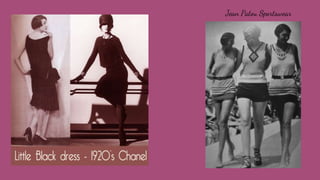
- Chanel introduced the little black dress
- This became a stape in every woman’s wardrobe and still is today
- This also pioneered the use of casual fabrics and chic sportswear separates
- Jean Patou also designed new sports wear
- This included pleated skirts and pullover tops, which were worn by sports stars and cafe society
Designers 1920’s continued...
- Madeleine Vionnet created inventive styles with handkerchief and asymmetrical hems, geometric
shapes and cowl and halter necklines
- Jeanne Lanvin’s beautiful gowns became longer and fuller
- She also designed tubular dresses and coordinated separates
- Edward Molyneux, another important designer from Paris, designed modern, streamlined suits
- French designers began to pay attention to what American consumers were buying
- Ready to wear was becoming more popular and they were making knock-off versions of Parisian
looks
Jean Patou Sportswear
Designers 1930’s
- American designers in NY and the West Coast began to achieve prominence
- Elizabeth Hawes and Clare Potter made clothes that were suitable for the active lifestyle by
creating sportswear and softer, casual designs
- Dressmakers Hattie Carnegie and Nettie Rosenstein were hugely successful at this time
- Muriel King designed costumes for films
- Mainbocher, who was an American designer, successfully established himself in Paris
- He designed elegant evening gowns which the Duchess of Windsor wore
- He joined the dominant fashion group which included Chanel and Elsa Schiaparelli
Mainbocher dress
Hattie Carnegie dress
Designers 1940’s
-During the 1940’s the designers in occupied Paris were effectively shut down
-Claire McCardell worked with rationing guidelines to produce dresses and play clothes
-Tina Leser, Norman Norell, Mildred Orrick & Hattie Carnegie’s ready-to-wear business looks
thrived
-Later in the 1940’s, Paris regained its foothold as a design center
-Christian Dior, Pierre Balmain, Jaques Fath and Nina Ricci would all make significant
contributions to the feminine and more styles of the 1950’s
Balmain
Dior
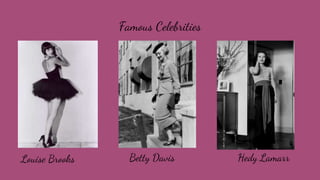
Famous Celebrities
Louise Brooks Betty Davis Hedy Lamarr
1920’s what the celebrities wore
-long strands of beads ,short skirts, and
chemise dresses
-costume look
-cloche hats
- T strap shoes
â—Ź F. Scott Fitzgerald considered his wife as
“first Flapper”
Zelda Sayre( Fitzgerald)
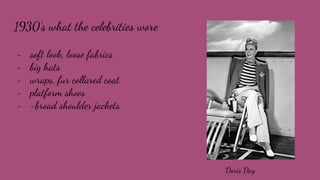
1930’s what the celebrities wore
- soft look, loose fabrics
- big hats
- wraps, fur collared coat
- platform shoes
- -broad shoulder jackets
Doris Day
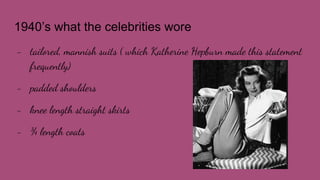
1940’s what the celebrities wore
- tailored, mannish suits ( which Katherine Hepburn made this statement
frequently)
- padded shoulders
- knee length straight skirts
- Âľ length coats

1926-1945

  • 1.
    The Driving Forcesof Fashion from 1926-1945
  • 2.
    Technology (Cinemas) Clara Bowwas deemed the “It Girl” after her appearances in American Cinemas. Myrna Loy Claudette Colbert
  • 3.
    Technology (Radio) King EdwardVIII and Wallis Simpson were deemed fashion icons because of their British Royalty exploits on the radio.
  • 4.
    Social and CulturalConditions 1920s -The cinema was a new industry that started to provide new idols for people to aspire to, -Silent films were abandoned and sound films started to arise in 1927. -Mass media continued its expansion with the first commercial radio station. And by the end of the decade most Americans owned or had access to their own radio station. -1929 the stock market crashed causing ten somber years and a loss of prosperity.
  • 5.
    Social and CulturalConditions Cont. 1930s -Hollywood started to provide a relief from by news through the glamour of musicals, comedies, gangster films, and the exploits of British royalty -The economic woes of the decade lessened as industries in the United States and abroad began getting ready for war. 1940s -The roles of men and women shifted society towards loosening formality and convention. -The film industry still provided an escape from wartime headlines. -After 1946 traditional family values began to resurface with the coming home of soldiers.
  • 6.
    1925-1945 Historical Events 1925-1945 “the jazz age” 1920’s are the beginning of the surrealist movement and the art deco movement 1925- Prohibition was still in effect since 1920 1925 – Phonograph records are developed 1925- The process for frozen foods was invented 1926- First flight of liquid fueled rocket 1927- Jukeboxes introduced 1927- Electric razor was patented 1927- 1st talkie film The Jazz Singer, Lights of New York 1928 1927- Charles Lindbergh flys solo across atlantic ocean nyc to paris 1929- Black Tuesday oct 29th 1929 market crashes great depression
  • 7.
    1925-1945 Historical Events 1930’s-the great depression is still going on 1930- first frozen foods are sold 1930- warner brothers produces the first all talking full color film Song of the Flame 1930’s- talkie films major phenomenon 1930- Mickey mouse comic strip makes 1st appearance Franklin D Roosevelt elected president “New Deal” 1931-1936- n an effort to reduce unemployment the government created work projects such as the Civilian Conservation Corps (CCC) which was a public work relief program that operated from 1933 to 1942 to maintain National Parks and build roads. Other major government work projects included Hoover Dam. 1932- Amelia Mary Earhart fly’s solo nonstop across the atlantic ocean 1933- Prohibition ends in US 1933- Hitler becomes chancellor of germany 1934- Hitler becomes leader and chancellor 1937- Hindenburh explodes 1937- Amelia Mary Earhart disappears during her around the world flight 1939- world war II breaks out 1939- the great depression ends
  • 8.
    1925-1945 Historical Events 1941-Pearl Harbor is attacked 1941- USA enters WWII after pearl harbor attacks 1941- Colossus was the name of a series of computers that were code breakers in 1943-45 to break German code 1942-1946- the Manhattan Project- development of Nuclear weapons ( 2 types of Atom Bomb, trinity test) 1944- the holocaust claims 6 million European Jews 1945- bombs over japan’s Hiroshima and Nagasaki 1945- World War II ends
  • 9.
    Designers 1920’s - Inthe postwar period Parisian designers flourished - This was the time of Coco Chanel’s greatest success - Chanel introduced the little black dress - This became a stape in every woman’s wardrobe and still is today - This also pioneered the use of casual fabrics and chic sportswear separates - Jean Patou also designed new sports wear - This included pleated skirts and pullover tops, which were worn by sports stars and cafe society
  • 10.
    Designers 1920’s continued... -Madeleine Vionnet created inventive styles with handkerchief and asymmetrical hems, geometric shapes and cowl and halter necklines - Jeanne Lanvin’s beautiful gowns became longer and fuller - She also designed tubular dresses and coordinated separates - Edward Molyneux, another important designer from Paris, designed modern, streamlined suits - French designers began to pay attention to what American consumers were buying - Ready to wear was becoming more popular and they were making knock-off versions of Parisian looks
  • 11.
  • 12.
    Designers 1930’s - Americandesigners in NY and the West Coast began to achieve prominence - Elizabeth Hawes and Clare Potter made clothes that were suitable for the active lifestyle by creating sportswear and softer, casual designs - Dressmakers Hattie Carnegie and Nettie Rosenstein were hugely successful at this time - Muriel King designed costumes for films - Mainbocher, who was an American designer, successfully established himself in Paris - He designed elegant evening gowns which the Duchess of Windsor wore - He joined the dominant fashion group which included Chanel and Elsa Schiaparelli
  • 13.
  • 14.
    Designers 1940’s -During the1940’s the designers in occupied Paris were effectively shut down -Claire McCardell worked with rationing guidelines to produce dresses and play clothes -Tina Leser, Norman Norell, Mildred Orrick & Hattie Carnegie’s ready-to-wear business looks thrived -Later in the 1940’s, Paris regained its foothold as a design center -Christian Dior, Pierre Balmain, Jaques Fath and Nina Ricci would all make significant contributions to the feminine and more styles of the 1950’s
  • 15.
  • 16.
    Famous Celebrities Louise BrooksBetty Davis Hedy Lamarr
  • 17.
    1920’s what thecelebrities wore -long strands of beads ,short skirts, and chemise dresses -costume look -cloche hats - T strap shoes ● F. Scott Fitzgerald considered his wife as “first Flapper” Zelda Sayre( Fitzgerald)
  • 18.
    1930’s what thecelebrities wore - soft look, loose fabrics - big hats - wraps, fur collared coat - platform shoes - -broad shoulder jackets Doris Day
  • 19.
    1940’s what thecelebrities wore - tailored, mannish suits ( which Katherine Hepburn made this statement frequently) - padded shoulders - knee length straight skirts - ¾ length coats