LANGUAGE IN THE
1920S
NEW WORDS ADDED TO THE
DICTIONARY IN THE 1920S
Facelift - the earliest evidence for the word ‘facelift’ comes from a
1926 newspaper headline: ‘woman asks $50,00. face-lift is lopsided’
Makeover – comes from ‘Woman’s World’ magazine in 1925
Press-up – currently dated to 1928
It girl/It boy – ‘It girl’ is first found in a may 1927 issue of the Los
Angeles Times
Skint – colloquial synonym for penniless
Achiral – molecule or crystal structure
KEY EVENTS IN THE 1920S
The end of World War One in 1918 left a youth who wanted to enjoy
themselves after the traumas the war had left behind, so for the
leisured and the wealthy this was the decade of the black bottom, the
Charleston, the camel walk, the heebie-jeebie and the shimmy.
The 1920s saw the first beauticians and beauty salons and also the
first beauty queens – face lifting was now possible.
People were finding it easier to talk about sex – words such as sexy,
sex appeal, sexpert and sexationalism were created in the 1920s.
The words homosexual and lesbian are first recorded as nouns in
the 20s but homophobia was still the orthodoxy as fag, pansy and
queer are also 20s words.
The technology of radio transmission had developed to a stage at
which public broadcasting could begin. Listeners soon became
familiar with words such as news reader, outside broadcast and on
the air, commentary and commentate, broadcast and programme.
In the 1920s people suddenly went mad for the pogo stick.
The 20s saw the coming age of the blend (a word formed by two
words merged together) introducing words such as brunch and motel.
MEDIA USED IN THE 1920S
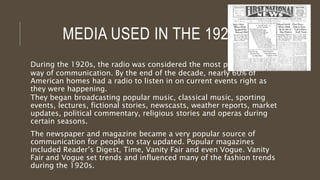
During the 1920s, the radio was considered the most powerful
way of communication. By the end of the decade, nearly 60% of
American homes had a radio to listen in on current events right as
they were happening.
They began broadcasting popular music, classical music, sporting
events, lectures, fictional stories, newscasts, weather reports, market
updates, political commentary, religious stories and operas during
certain seasons.
The newspaper and magazine became a very popular source of
communication for people to stay updated. Popular magazines
included Reader’s Digest, Time, Vanity Fair and even Vogue. Vanity
Fair and Vogue set trends and influenced many of the fashion trends
during the 1920s.
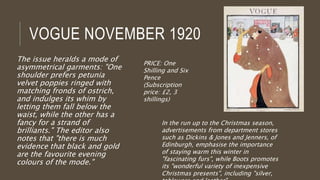
VOGUE NOVEMBER 1920
The issue heralds a mode of
asymmetrical garments: "One
shoulder prefers petunia
velvet poppies ringed with
matching fronds of ostrich,
and indulges its whim by
letting them fall below the
waist, while the other has a
fancy for a strand of
brilliants." The editor also
notes that "there is much
evidence that black and gold
are the favourite evening
colours of the mode."
In the run up to the Christmas season,
advertisements from department stores
such as Dickins & Jones and Jenners, of
Edinburgh, emphasise the importance
of staying warm this winter in
"fascinating furs", while Boots promotes
its "wonderful variety of inexpensive
Christmas presents", including "silver,
PRICE: One
Shilling and Six
Pence
(Subscription
price: £2, 3
shillings)

1920s

  • 1.
  • 2.
    NEW WORDS ADDEDTO THE DICTIONARY IN THE 1920S Facelift - the earliest evidence for the word ‘facelift’ comes from a 1926 newspaper headline: ‘woman asks $50,00. face-lift is lopsided’ Makeover – comes from ‘Woman’s World’ magazine in 1925 Press-up – currently dated to 1928 It girl/It boy – ‘It girl’ is first found in a may 1927 issue of the Los Angeles Times Skint – colloquial synonym for penniless Achiral – molecule or crystal structure
  • 3.
    KEY EVENTS INTHE 1920S The end of World War One in 1918 left a youth who wanted to enjoy themselves after the traumas the war had left behind, so for the leisured and the wealthy this was the decade of the black bottom, the Charleston, the camel walk, the heebie-jeebie and the shimmy. The 1920s saw the first beauticians and beauty salons and also the first beauty queens – face lifting was now possible. People were finding it easier to talk about sex – words such as sexy, sex appeal, sexpert and sexationalism were created in the 1920s. The words homosexual and lesbian are first recorded as nouns in the 20s but homophobia was still the orthodoxy as fag, pansy and queer are also 20s words.
  • 4.
    The technology ofradio transmission had developed to a stage at which public broadcasting could begin. Listeners soon became familiar with words such as news reader, outside broadcast and on the air, commentary and commentate, broadcast and programme. In the 1920s people suddenly went mad for the pogo stick. The 20s saw the coming age of the blend (a word formed by two words merged together) introducing words such as brunch and motel.
  • 5.
    MEDIA USED INTHE 1920S During the 1920s, the radio was considered the most powerful way of communication. By the end of the decade, nearly 60% of American homes had a radio to listen in on current events right as they were happening. They began broadcasting popular music, classical music, sporting events, lectures, fictional stories, newscasts, weather reports, market updates, political commentary, religious stories and operas during certain seasons. The newspaper and magazine became a very popular source of communication for people to stay updated. Popular magazines included Reader’s Digest, Time, Vanity Fair and even Vogue. Vanity Fair and Vogue set trends and influenced many of the fashion trends during the 1920s.
  • 6.
    VOGUE NOVEMBER 1920 Theissue heralds a mode of asymmetrical garments: "One shoulder prefers petunia velvet poppies ringed with matching fronds of ostrich, and indulges its whim by letting them fall below the waist, while the other has a fancy for a strand of brilliants." The editor also notes that "there is much evidence that black and gold are the favourite evening colours of the mode." In the run up to the Christmas season, advertisements from department stores such as Dickins & Jones and Jenners, of Edinburgh, emphasise the importance of staying warm this winter in "fascinating furs", while Boots promotes its "wonderful variety of inexpensive Christmas presents", including "silver, PRICE: One Shilling and Six Pence (Subscription price: £2, 3 shillings)