Roaring 20’s
Emily Evans
HIST 102-S95
Thesis
• The 1920’s also known as ’The Roaring Twenties’ was a time for some
major changes in America. During this era the nation experienced
change in areas such as political and social and economical. The 20’s
was a turning point for America.
Major Changes!
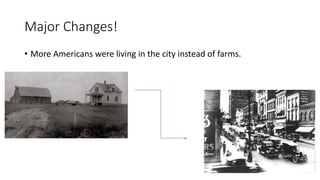
• More Americans were living in the city instead of farms.
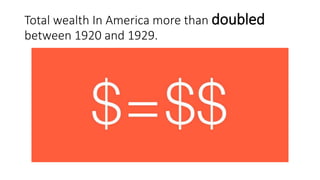
Total wealth In America more than doubled
between 1920 and 1929.
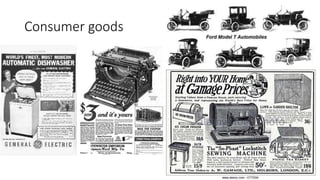
Consumer Society
• Americans were soon thrown into an unfamiliar and new consumer
market. Americans now had extra money to spend on new consumer
goods like appliances.
Consumer goods
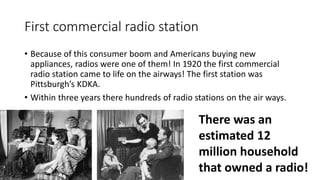
First commercial radio station
• Because of this consumer boom and Americans buying new
appliances, radios were one of them! In 1920 the first commercial
radio station came to life on the airways! The first station was
Pittsburgh’s KDKA.
• Within three years there hundreds of radio stations on the air ways.
There was an
estimated 12
million household
that owned a radio!
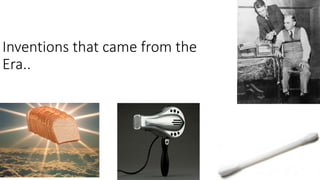
Inventions that came from the
Era..
Sliced bread..
• Believe it or not, sliced bread
was invented in the late 1920’s.
1928 to be exact.
• A man named Otto Frederick
Rohwedder in Iowa invented the
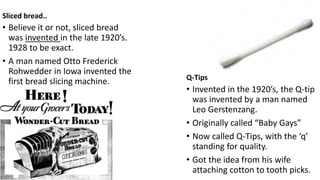
first bread slicing machine. Q-Tips
• Invented in the 1920’s, the Q-tip
was invented by a man named
Leo Gerstenzang.
• Originally called “Baby Gays”
• Now called Q-Tips, with the ‘q’
standing for quality.
• Got the idea from his wife
attaching cotton to tooth picks.
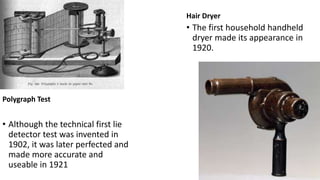
Polygraph Test
• Although the technical first lie
detector test was invented in
1902, it was later perfected and
made more accurate and
useable in 1921
Hair Dryer
• The first household handheld
dryer made its appearance in
1920.
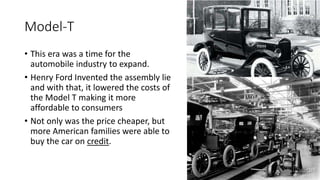
Model-T
• This era was a time for the
automobile industry to expand.
• Henry Ford Invented the assembly lie
and with that, it lowered the costs of
the Model T making it more
affordable to consumers
• Not only was the price cheaper, but
more American families were able to
buy the car on credit.
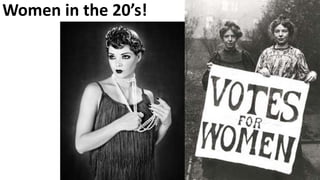
Women in the 20’s!
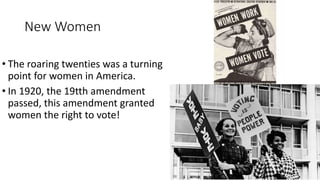
New Women
• The roaring twenties was a turning
point for women in America.
• In 1920, the 19tth amendment
passed, this amendment granted
women the right to vote!
Flappers
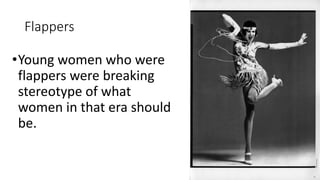
•Young women who were
flappers were breaking
stereotype of what
women in that era should
be.
What were ‘flappers’?
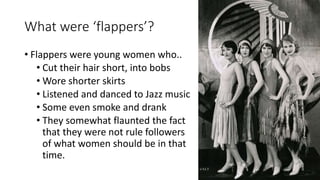
• Flappers were young women who..
• Cut their hair short, into bobs
• Wore shorter skirts
• Listened and danced to Jazz music
• Some even smoke and drank
• They somewhat flaunted the fact
that they were not rule followers
of what women should be in that
time.
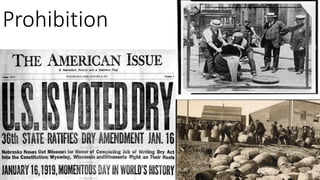
Prohibition
What was prohibition?
• Prohibition was a nation wide ban on alcohol in America.
• It was a ban on the production, transportation, importation, along
with the sale of alcohol.
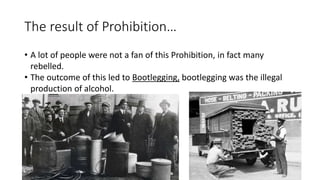
The result of Prohibition…
• A lot of people were not a fan of this Prohibition, in fact many
rebelled.
• The outcome of this led to Bootlegging, bootlegging was the illegal
production of alcohol.
Speakeasies
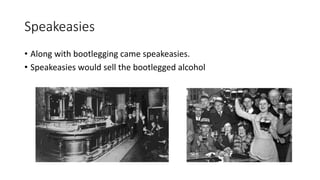
• Along with bootlegging came speakeasies.
• Speakeasies would sell the bootlegged alcohol
The end of prohibition
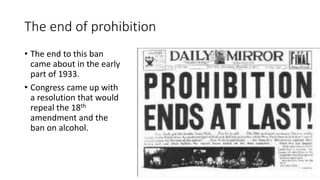
• The end to this ban
came about in the early
part of 1933.
• Congress came up with
a resolution that would
repeal the 18th
amendment and the
ban on alcohol.
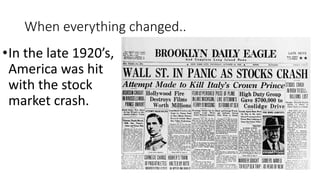
When everything changed..
•In the late 1920’s,
America was hit
with the stock
market crash.
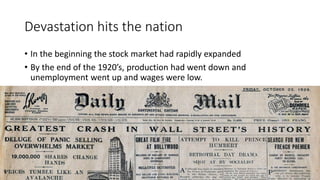
Devastation hits the nation
• In the beginning the stock market had rapidly expanded
• By the end of the 1920’s, production had went down and
unemployment went up and wages were low.
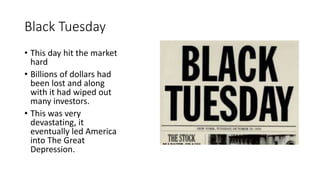
Black Tuesday
• This day hit the market
hard
• Billions of dollars had
been lost and along
with it had wiped out
many investors.
• This was very
devastating, it
eventually led America
into The Great
Depression.
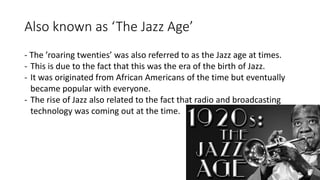
Also known as ‘The Jazz Age’
- The ’roaring twenties’ was also referred to as the Jazz age at times.
- This is due to the fact that this was the era of the birth of Jazz.
- It was originated from African Americans of the time but eventually
became popular with everyone.
- The rise of Jazz also related to the fact that radio and broadcasting
technology was coming out at the time.
How did the 1920’s fit into the daily life of
America during the era?
• This time period was a time for great changes in America. New
inventions were coming about and America as a whole was
expanding. Women finally had the right to vote and it seemed as
though America was changing for the better.
How the 1920’s is unique to America
• The roaring twenties is a unique period in American history, many
things were changing. The prohibition act, women’s right to vote, and
inventions such as the car, polygraph test, q-tips, and even sliced
bread are still used to this day. Overall this era was unique as it was a
turning point for America after the war.
If I had been alive during this era..
• I think if I was a young women living in this era, I would enjoy seeing
America on the rise. I would have just been granted the right to vote, I
would have been able to afford a vehicle. I think overall I could have
enjoyed it, experiencing the Jazz age would have been cool. But it
would not have been fun having to go through things like having no
rights at first and the stock market crash eventually leading to the
great depression.
How have things changed over the years?
• America eventually got back on its feet after the stock market crash
• Vehicles are still around to this day but have adapted along the way
becoming more modern as time goes on.
• Not only do women have the right to vote, but so does any citizen of
the United States that is at least 18.
• Q-tips are still used
• Sliced bread is still very much enjoyed.
New information I learned..
• The new information I learned was about the inventions of the time, I
had no idea so much of what we know and use today was invented
and used back then! I also learned new more in depth information
about the era as a whole!
Works Cited
• “1920-30.Com.” The 1920s - Also Known as the Roaring Twenties,
www.1920-30.com/.
• Amadeo, Kimberly. “What Made the 1920s Roar?” The Balance,
www.thebalance.com/roaring-twenties-4060511.
• Boundless. “A Culture of Change.” A Culture of Change | Boundless US
History, courses.lumenlearning.com/boundless-ushistory/chapter/a-
culture-of-change/.
• History.com Staff. “The Roaring Twenties.” History.com, A&E Television
Networks, 2010, www.history.com/topics/roaring-twenties.
• Pettinger, Tejvan. “Roaring Twenties Definition and Facts | .” Biography
Online, 16 Jan. 2017, www.biographyonline.net/roaring-twenties/.
• “Stock Market Crashes.” History.com, A&E Television Networks,
www.history.com/this-day-in-history/stock-market-crashes.

5 p

  • 1.
  • 2.
    Thesis • The 1920’salso known as ’The Roaring Twenties’ was a time for some major changes in America. During this era the nation experienced change in areas such as political and social and economical. The 20’s was a turning point for America.
  • 3.
    Major Changes! • MoreAmericans were living in the city instead of farms.
  • 4.
    Total wealth InAmerica more than doubled between 1920 and 1929.
  • 5.
    Consumer Society • Americanswere soon thrown into an unfamiliar and new consumer market. Americans now had extra money to spend on new consumer goods like appliances.
  • 6.
  • 7.
    First commercial radiostation • Because of this consumer boom and Americans buying new appliances, radios were one of them! In 1920 the first commercial radio station came to life on the airways! The first station was Pittsburgh’s KDKA. • Within three years there hundreds of radio stations on the air ways. There was an estimated 12 million household that owned a radio!
  • 8.
    Inventions that camefrom the Era..
  • 9.
    Sliced bread.. • Believeit or not, sliced bread was invented in the late 1920’s. 1928 to be exact. • A man named Otto Frederick Rohwedder in Iowa invented the first bread slicing machine. Q-Tips • Invented in the 1920’s, the Q-tip was invented by a man named Leo Gerstenzang. • Originally called “Baby Gays” • Now called Q-Tips, with the ‘q’ standing for quality. • Got the idea from his wife attaching cotton to tooth picks.
  • 10.
    Polygraph Test • Althoughthe technical first lie detector test was invented in 1902, it was later perfected and made more accurate and useable in 1921 Hair Dryer • The first household handheld dryer made its appearance in 1920.
  • 11.
    Model-T • This erawas a time for the automobile industry to expand. • Henry Ford Invented the assembly lie and with that, it lowered the costs of the Model T making it more affordable to consumers • Not only was the price cheaper, but more American families were able to buy the car on credit.
  • 12.
    Women in the20’s!
  • 13.
    New Women • Theroaring twenties was a turning point for women in America. • In 1920, the 19tth amendment passed, this amendment granted women the right to vote!
  • 14.
    Flappers •Young women whowere flappers were breaking stereotype of what women in that era should be.
  • 15.
    What were ‘flappers’? •Flappers were young women who.. • Cut their hair short, into bobs • Wore shorter skirts • Listened and danced to Jazz music • Some even smoke and drank • They somewhat flaunted the fact that they were not rule followers of what women should be in that time.
  • 16.
  • 17.
    What was prohibition? •Prohibition was a nation wide ban on alcohol in America. • It was a ban on the production, transportation, importation, along with the sale of alcohol.
  • 18.
    The result ofProhibition… • A lot of people were not a fan of this Prohibition, in fact many rebelled. • The outcome of this led to Bootlegging, bootlegging was the illegal production of alcohol.
  • 19.
    Speakeasies • Along withbootlegging came speakeasies. • Speakeasies would sell the bootlegged alcohol
  • 20.
    The end ofprohibition • The end to this ban came about in the early part of 1933. • Congress came up with a resolution that would repeal the 18th amendment and the ban on alcohol.
  • 21.
    When everything changed.. •Inthe late 1920’s, America was hit with the stock market crash.
  • 22.
    Devastation hits thenation • In the beginning the stock market had rapidly expanded • By the end of the 1920’s, production had went down and unemployment went up and wages were low.
  • 23.
    Black Tuesday • Thisday hit the market hard • Billions of dollars had been lost and along with it had wiped out many investors. • This was very devastating, it eventually led America into The Great Depression.
  • 24.
    Also known as‘The Jazz Age’ - The ’roaring twenties’ was also referred to as the Jazz age at times. - This is due to the fact that this was the era of the birth of Jazz. - It was originated from African Americans of the time but eventually became popular with everyone. - The rise of Jazz also related to the fact that radio and broadcasting technology was coming out at the time.
  • 25.
    How did the1920’s fit into the daily life of America during the era? • This time period was a time for great changes in America. New inventions were coming about and America as a whole was expanding. Women finally had the right to vote and it seemed as though America was changing for the better.
  • 26.
    How the 1920’sis unique to America • The roaring twenties is a unique period in American history, many things were changing. The prohibition act, women’s right to vote, and inventions such as the car, polygraph test, q-tips, and even sliced bread are still used to this day. Overall this era was unique as it was a turning point for America after the war.
  • 27.
    If I hadbeen alive during this era.. • I think if I was a young women living in this era, I would enjoy seeing America on the rise. I would have just been granted the right to vote, I would have been able to afford a vehicle. I think overall I could have enjoyed it, experiencing the Jazz age would have been cool. But it would not have been fun having to go through things like having no rights at first and the stock market crash eventually leading to the great depression.

  • 28.
    How have thingschanged over the years? • America eventually got back on its feet after the stock market crash • Vehicles are still around to this day but have adapted along the way becoming more modern as time goes on. • Not only do women have the right to vote, but so does any citizen of the United States that is at least 18. • Q-tips are still used • Sliced bread is still very much enjoyed.
  • 29.
    New information Ilearned.. • The new information I learned was about the inventions of the time, I had no idea so much of what we know and use today was invented and used back then! I also learned new more in depth information about the era as a whole!
  • 30.
    Works Cited • “1920-30.Com.”The 1920s - Also Known as the Roaring Twenties, www.1920-30.com/. • Amadeo, Kimberly. “What Made the 1920s Roar?” The Balance, www.thebalance.com/roaring-twenties-4060511. • Boundless. “A Culture of Change.” A Culture of Change | Boundless US History, courses.lumenlearning.com/boundless-ushistory/chapter/a- culture-of-change/. • History.com Staff. “The Roaring Twenties.” History.com, A&E Television Networks, 2010, www.history.com/topics/roaring-twenties. • Pettinger, Tejvan. “Roaring Twenties Definition and Facts | .” Biography Online, 16 Jan. 2017, www.biographyonline.net/roaring-twenties/. • “Stock Market Crashes.” History.com, A&E Television Networks, www.history.com/this-day-in-history/stock-market-crashes.