Placentation and
Endocrinology of
Gestation
Prof. Dr. Nasim Ahmad
THER 608
Chap. 14 1
2
3
4
5
Placentation
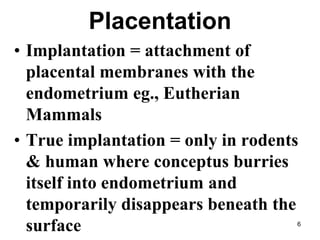
• Implantation = attachment of
placental membranes with the
endometrium eg., Eutherian
Mammals
• True implantation = only in rodents
& human where conceptus burries
itself into endometrium and
temporarily disappears beneath the
surface 6
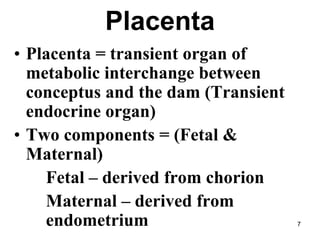
• Placenta = transient organ of
metabolic interchange between
conceptus and the dam (Transient
endocrine organ)
• Two components = (Fetal &
Maternal)
Fetal – derived from chorion
Maternal – derived from
endometrium
Placenta
7
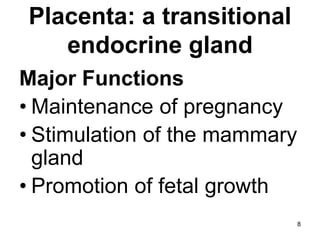
Placenta: a transitional
endocrine gland
Major Functions
• Maintenance of pregnancy
• Stimulation of the mammary
gland
• Promotion of fetal growth
8
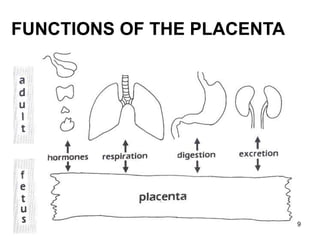
FUNCTIONS OF THE PLACENTA
9
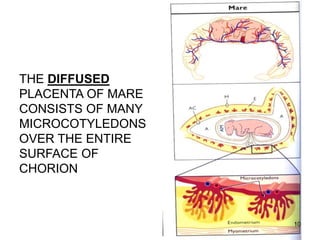
THE DIFFUSED
PLACENTA OF MARE
CONSISTS OF MANY
MICROCOTYLEDONS
OVER THE ENTIRE
SURFACE OF
CHORION
10
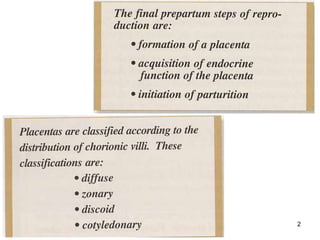
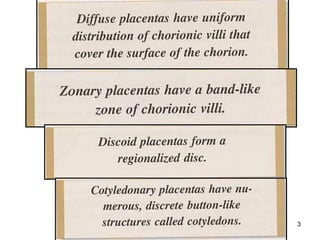
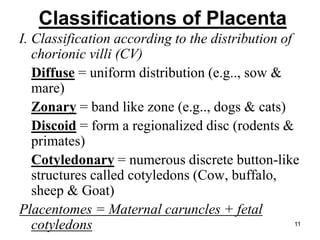
Classifications of Placenta
I. Classification according to the distribution of
chorionic villi (CV)
Diffuse = uniform distribution (e.g.., sow &
mare)
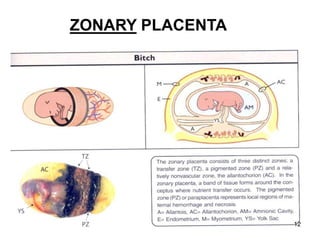
Zonary = band like zone (e.g.., dogs & cats)
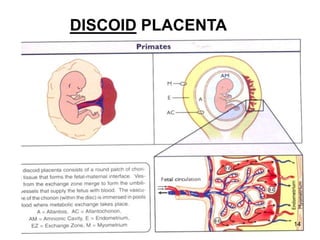
Discoid = form a regionalized disc (rodents &
primates)
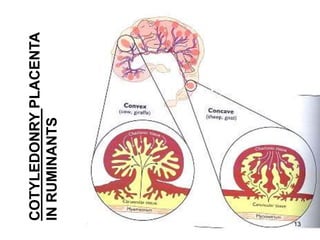
Cotyledonary = numerous discrete button-like
structures called cotyledons (Cow, buffalo,
sheep & Goat)
Placentomes = Maternal caruncles + fetal
cotyledons 11
ZONARY PLACENTA
12
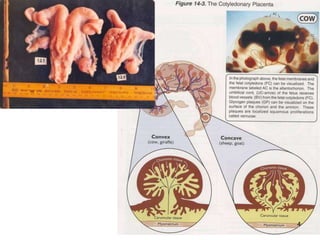
COTYLEDONRYPLACENTA
INRUMINANTS
13
DISCOID PLACENTA
14
II. Classification based on separation of the
fetal and maternal blood
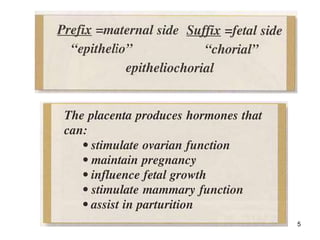
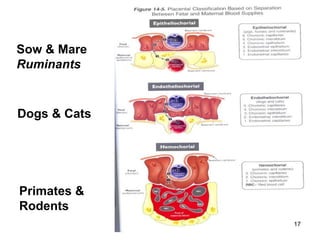
• Epitheliochorial (Sow & Mare)
Epithelium of endometrium & CV are
intact.
• Syndesmochorial (Ruminants)
1. Epith of Endometrium transiently erodes
and then regorws causing intermittant
exposure of maternal capillaries to the
chorionic epith.
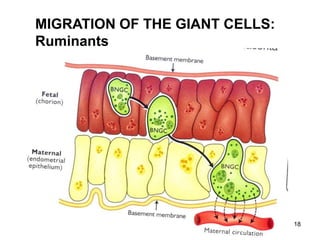
2. Binucleate giant cells (BNGC) originating
from the trophoblastic cells are formed
continuously; 20 % placenta 15
3. BNGC secrete placental Lactogen and
Pregnancy Specific Protein B (PSPB) and
steroids (Progesterone/ estrogens)
• Endotheliochorial (Dogs & Cats)
Complete erosion of endomet epith and
underlying interstitium. So maternal capill
are directly exposed to epith cells of
chorion.
• Haemochorial (Primates & Rodents)
Chorionic epith is in direct apposition to
maternal pools of blood.
16
Sow & Mare
Ruminants
Dogs & Cats
Primates &
Rodents
17
MIGRATION OF THE GIANT CELLS:
Ruminants
18
Regulation of Exchange Between
Fetus and Dam
1. Simple diffusion
Gases and water pass from ↑ to ↓ conc.
2. Facilitated diffusion
Glucose & other metabolically important
material, i.e., amino acids are
transported by facilitated diffusion
through specific carrier molecules.
3. Active transport (AT)
Placenta contains AT pumps for Na, K &
Ca
19
THE SUBSTANCES WHICH CAN OR
CANNOT PASS THROUGH PLACENTA
• Glucose pass easily
• Proteins don't cross placental barrier.
• Lipid don’t cross placenta. Large
peptide hormones (TSH, ACTH and
GH) Insulin and glucagon don’t cross
placenta.
• Hormones with smaller mol wt.
(steroids, thyroid hormones) and the
catecholamines (epinephrine and
norepinephrine) cross the placenta
with relative ease 20
• Vitamins/ minerals are transferred at
variable rates. Fat soluble vitamins don’t
cross placenta with relative ease, while
water soluble vitamins (B&K) can cross.
• Toxic/pathogenic materials (Ethyl
alcohol, lead, mercury & Phosphorus)
cross placenta easily. Opiate drugs and
barbiturates and antibiotics can cross
placenta
• Viruses (measles, Herpes and HIV) can
be transmitted from pregnant mother to
fetus.
• Bacteria (syphilis) can also be transmitted
to fetus. 21
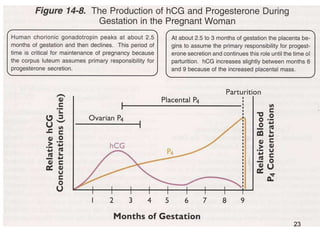
human Chorionic Gonadotropin
(hCG) (LH like)
• Secreted by trophoblastic cells of
chorion as early as blastocyst hatches
• Can be detected in urine & blood of
pregnant woman as early as day 8-10 of
gestation
• Luteotropic stimulus for ovulatory CL
• Luteal LH receptors bind to hCG →
sustained progesterone production
• hCG inj. to non-primate → LH-like action
(ovulation)
22
23
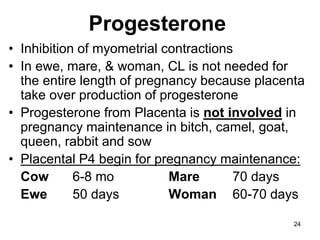
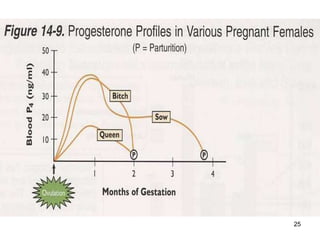
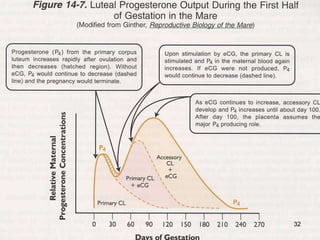
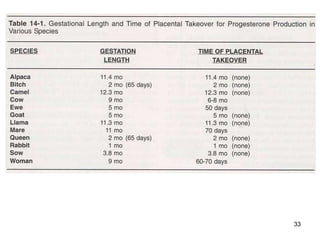
Progesterone
• Inhibition of myometrial contractions
• In ewe, mare, & woman, CL is not needed for
the entire length of pregnancy because placenta
take over production of progesterone
• Progesterone from Placenta is not involved in
pregnancy maintenance in bitch, camel, goat,
queen, rabbit and sow
• Placental P4 begin for pregnancy maintenance:
Cow 6-8 mo Mare 70 days
Ewe 50 days Woman 60-70 days
24
25
26
Estrogen
• It is an important product of placenta
particularly during last part of
gestation
• Peak of estrogen in most spp. signals
early preparturient period
27
Placental Lactogen
(Somatomammotropin)
• Polypeptide in ewe, goat, cow & human
• Secreted by BNGC
• Similar to GH, so promote growth of fetus
• Lactogenic activity
• In cow and goat, both the properties are
equivalent.
• In ewe and woman, lactogenic activity is
very much pronounced than the
somatotropic activity
28
Relaxin
• Secreted in human, mare, cat, dog,
pig, rabbit, monkey
• In rabbit, entirely by placenta and not
at all by ovary.
• During parturition, other than rabbit, it
is secreted by both placenta and
ovary.
• Not produced by bovine placenta at
any stage of gestation? 29
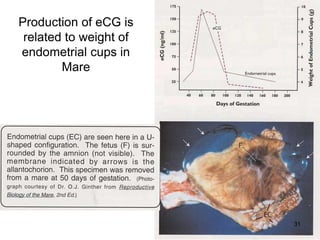
equine chorionic gonadotropin
(eCG) or PMSG (like FSH)
• Secreted by endometrial cups of the
placenta at time of attachment of
conceptus to endometrium
• Luteotropin (production of P4)
• Control formation of accessory CL
formed by ovulation at day 40-70 of
pregnancy
• Lutenization of antral follicles that don’t
ovulate
• Used for superovulation in other spp.
30
Production of eCG is
related to weight of
endometrial cups in
Mare
31
32
33
Thank You
34
35
Gravid Horn
Non-Gravid Horn
36
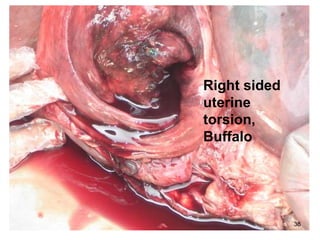
Right sided
uterine
torsion,
Buffalo
37
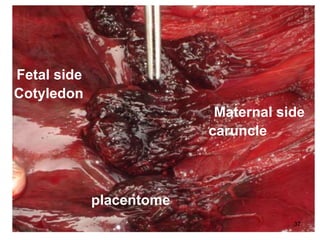
Cotyledon
Fetal side
Maternal side
caruncle
placentome
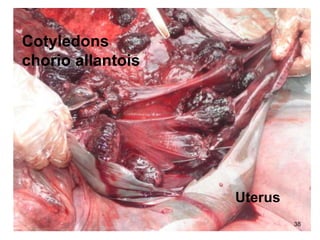
38
Cotyledons
chorio allantois
Uterus
39
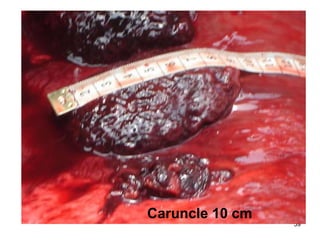
Caruncle 10 cm
40
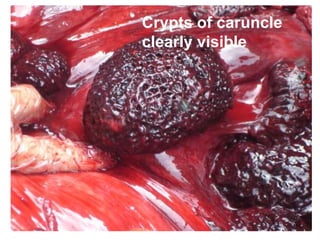
Crypts of caruncle
clearly visible
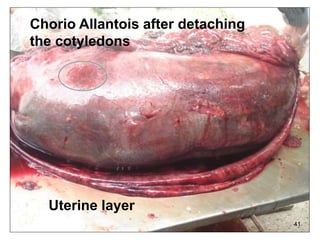
41
Uterine layer
Chorio Allantois after detaching
the cotyledons
42
43
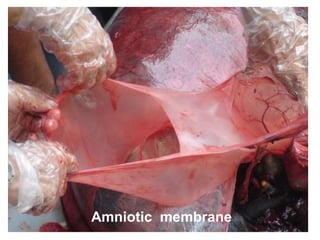
Amniotic membrane
44
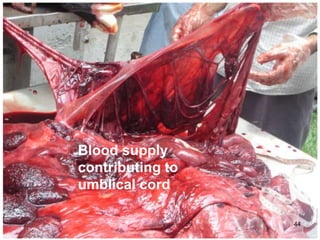
Blood supply
contributing to
umblical cord
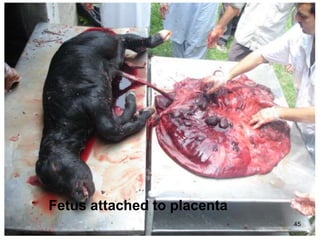
45
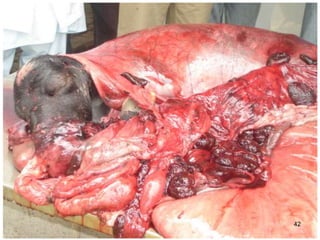
Fetus attached to placenta

19 ther 608 placentation & gestation

  • 1.
    Placentation and Endocrinology of Gestation Prof.Dr. Nasim Ahmad THER 608 Chap. 14 1
  • 2.
  • 3.
  • 4.
  • 5.
  • 6.
    Placentation • Implantation =attachment of placental membranes with the endometrium eg., Eutherian Mammals • True implantation = only in rodents & human where conceptus burries itself into endometrium and temporarily disappears beneath the surface 6
  • 7.
    • Placenta =transient organ of metabolic interchange between conceptus and the dam (Transient endocrine organ) • Two components = (Fetal & Maternal) Fetal – derived from chorion Maternal – derived from endometrium Placenta 7
  • 8.
    Placenta: a transitional endocrinegland Major Functions • Maintenance of pregnancy • Stimulation of the mammary gland • Promotion of fetal growth 8
  • 9.
    FUNCTIONS OF THEPLACENTA 9
  • 10.
    THE DIFFUSED PLACENTA OFMARE CONSISTS OF MANY MICROCOTYLEDONS OVER THE ENTIRE SURFACE OF CHORION 10
  • 11.
    Classifications of Placenta I.Classification according to the distribution of chorionic villi (CV) Diffuse = uniform distribution (e.g.., sow & mare) Zonary = band like zone (e.g.., dogs & cats) Discoid = form a regionalized disc (rodents & primates) Cotyledonary = numerous discrete button-like structures called cotyledons (Cow, buffalo, sheep & Goat) Placentomes = Maternal caruncles + fetal cotyledons 11
  • 12.
  • 13.
  • 14.
  • 15.
    II. Classification basedon separation of the fetal and maternal blood • Epitheliochorial (Sow & Mare) Epithelium of endometrium & CV are intact. • Syndesmochorial (Ruminants) 1. Epith of Endometrium transiently erodes and then regorws causing intermittant exposure of maternal capillaries to the chorionic epith. 2. Binucleate giant cells (BNGC) originating from the trophoblastic cells are formed continuously; 20 % placenta 15
  • 16.
    3. BNGC secreteplacental Lactogen and Pregnancy Specific Protein B (PSPB) and steroids (Progesterone/ estrogens) • Endotheliochorial (Dogs & Cats) Complete erosion of endomet epith and underlying interstitium. So maternal capill are directly exposed to epith cells of chorion. • Haemochorial (Primates & Rodents) Chorionic epith is in direct apposition to maternal pools of blood. 16
  • 17.
    Sow & Mare Ruminants Dogs& Cats Primates & Rodents 17
  • 18.
    MIGRATION OF THEGIANT CELLS: Ruminants 18
  • 19.
    Regulation of ExchangeBetween Fetus and Dam 1. Simple diffusion Gases and water pass from ↑ to ↓ conc. 2. Facilitated diffusion Glucose & other metabolically important material, i.e., amino acids are transported by facilitated diffusion through specific carrier molecules. 3. Active transport (AT) Placenta contains AT pumps for Na, K & Ca 19
  • 20.
    THE SUBSTANCES WHICHCAN OR CANNOT PASS THROUGH PLACENTA • Glucose pass easily • Proteins don't cross placental barrier. • Lipid don’t cross placenta. Large peptide hormones (TSH, ACTH and GH) Insulin and glucagon don’t cross placenta. • Hormones with smaller mol wt. (steroids, thyroid hormones) and the catecholamines (epinephrine and norepinephrine) cross the placenta with relative ease 20
  • 21.
    • Vitamins/ mineralsare transferred at variable rates. Fat soluble vitamins don’t cross placenta with relative ease, while water soluble vitamins (B&K) can cross. • Toxic/pathogenic materials (Ethyl alcohol, lead, mercury & Phosphorus) cross placenta easily. Opiate drugs and barbiturates and antibiotics can cross placenta • Viruses (measles, Herpes and HIV) can be transmitted from pregnant mother to fetus. • Bacteria (syphilis) can also be transmitted to fetus. 21
  • 22.
    human Chorionic Gonadotropin (hCG)(LH like) • Secreted by trophoblastic cells of chorion as early as blastocyst hatches • Can be detected in urine & blood of pregnant woman as early as day 8-10 of gestation • Luteotropic stimulus for ovulatory CL • Luteal LH receptors bind to hCG → sustained progesterone production • hCG inj. to non-primate → LH-like action (ovulation) 22
  • 23.
  • 24.
    Progesterone • Inhibition ofmyometrial contractions • In ewe, mare, & woman, CL is not needed for the entire length of pregnancy because placenta take over production of progesterone • Progesterone from Placenta is not involved in pregnancy maintenance in bitch, camel, goat, queen, rabbit and sow • Placental P4 begin for pregnancy maintenance: Cow 6-8 mo Mare 70 days Ewe 50 days Woman 60-70 days 24
  • 25.
  • 26.
  • 27.
    Estrogen • It isan important product of placenta particularly during last part of gestation • Peak of estrogen in most spp. signals early preparturient period 27
  • 28.
    Placental Lactogen (Somatomammotropin) • Polypeptidein ewe, goat, cow & human • Secreted by BNGC • Similar to GH, so promote growth of fetus • Lactogenic activity • In cow and goat, both the properties are equivalent. • In ewe and woman, lactogenic activity is very much pronounced than the somatotropic activity 28
  • 29.
    Relaxin • Secreted inhuman, mare, cat, dog, pig, rabbit, monkey • In rabbit, entirely by placenta and not at all by ovary. • During parturition, other than rabbit, it is secreted by both placenta and ovary. • Not produced by bovine placenta at any stage of gestation? 29
  • 30.
    equine chorionic gonadotropin (eCG)or PMSG (like FSH) • Secreted by endometrial cups of the placenta at time of attachment of conceptus to endometrium • Luteotropin (production of P4) • Control formation of accessory CL formed by ovulation at day 40-70 of pregnancy • Lutenization of antral follicles that don’t ovulate • Used for superovulation in other spp. 30
  • 31.
    Production of eCGis related to weight of endometrial cups in Mare 31
  • 32.
  • 33.
  • 34.
  • 35.
  • 36.
  • 37.
  • 38.
  • 39.
  • 40.
  • 41.
    41 Uterine layer Chorio Allantoisafter detaching the cotyledons
  • 42.
  • 43.
  • 44.
  • 45.