@lanettecream
@Lanettecream
@lanettecream
Lanette Creamer


How to Coach Exploratory Testing Sessions
@Lanettecream
@lanettecream
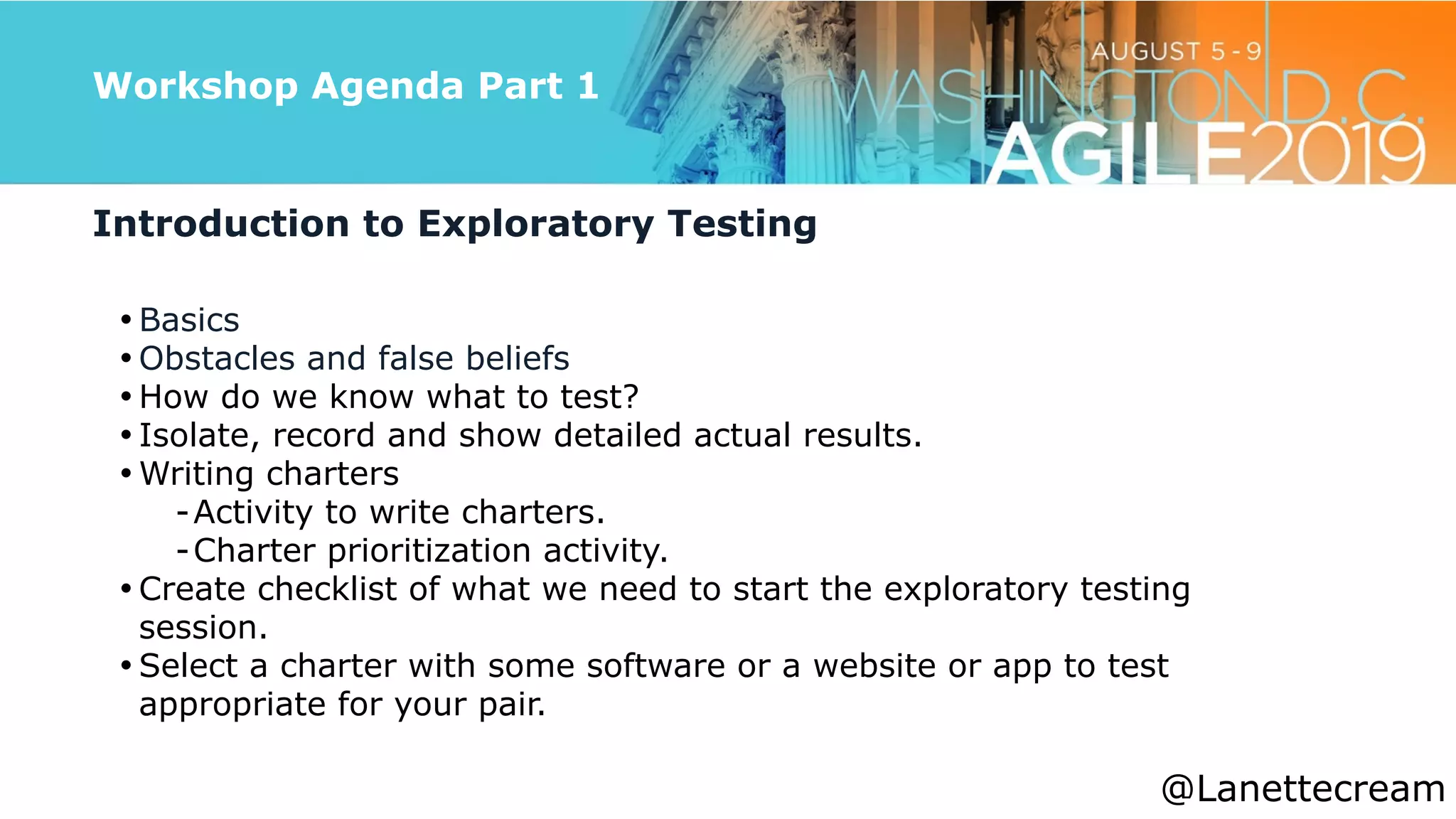
Workshop Agenda Part 1
Introduction to Exploratory Testing


• Basics


• Obstacles and false beliefs


• How do we know what to test?


• Isolate, record and show detailed actual results.


• Writing charters


-Activity to write charters.


-Charter prioritization activity.


• Create checklist of what we need to start the exploratory testing
session.


• Select a charter with some software or a website or app to test
appropriate for your pair.
@Lanettecream
@lanettecream
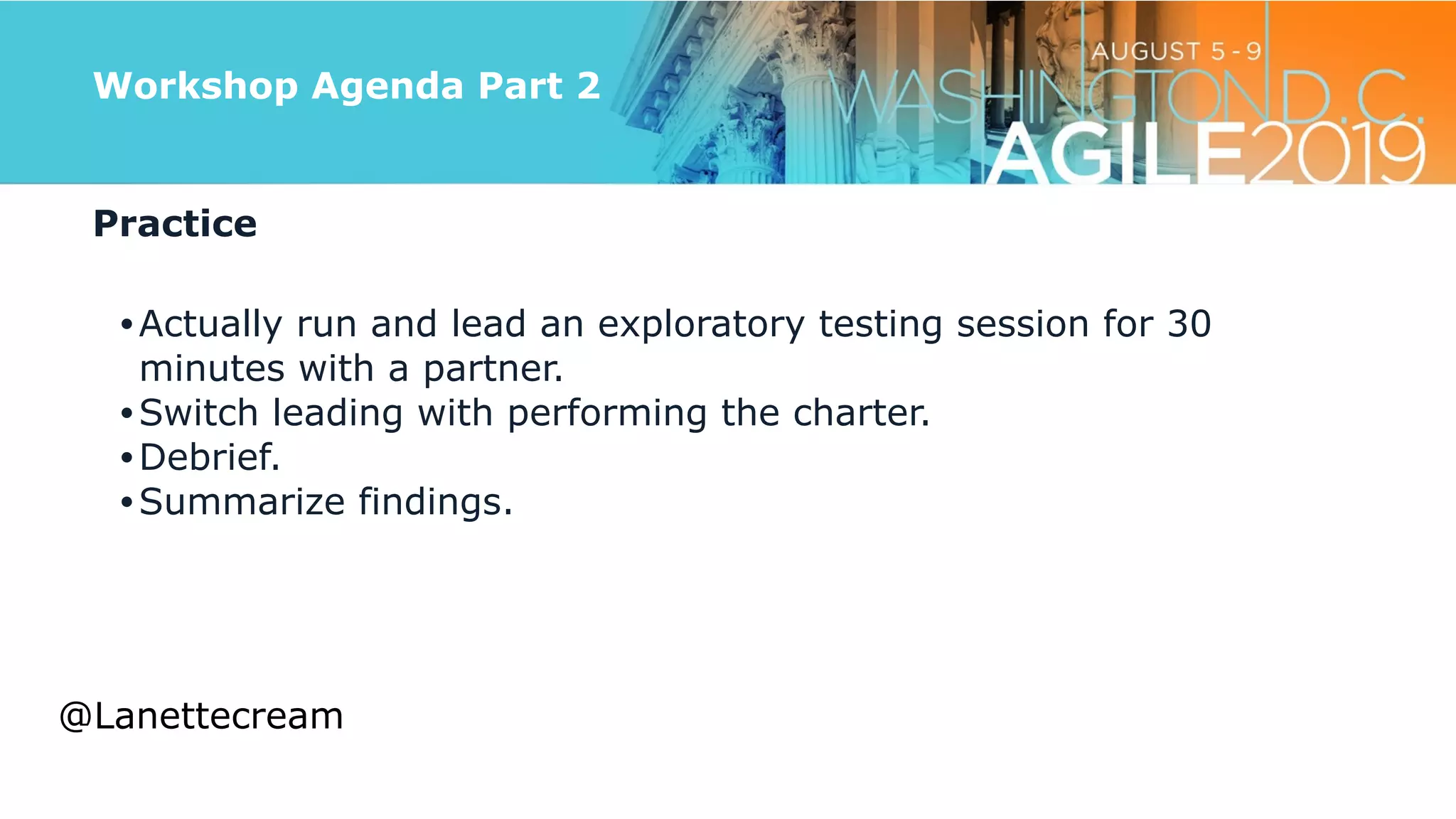
Workshop Agenda Part 2
Practice


•Actually run and lead an exploratory testing session for 30
minutes with a partner.


•Switch leading with performing the charter.


•Debrief.


•Summarize findings.
@Lanettecream
@lanettecream
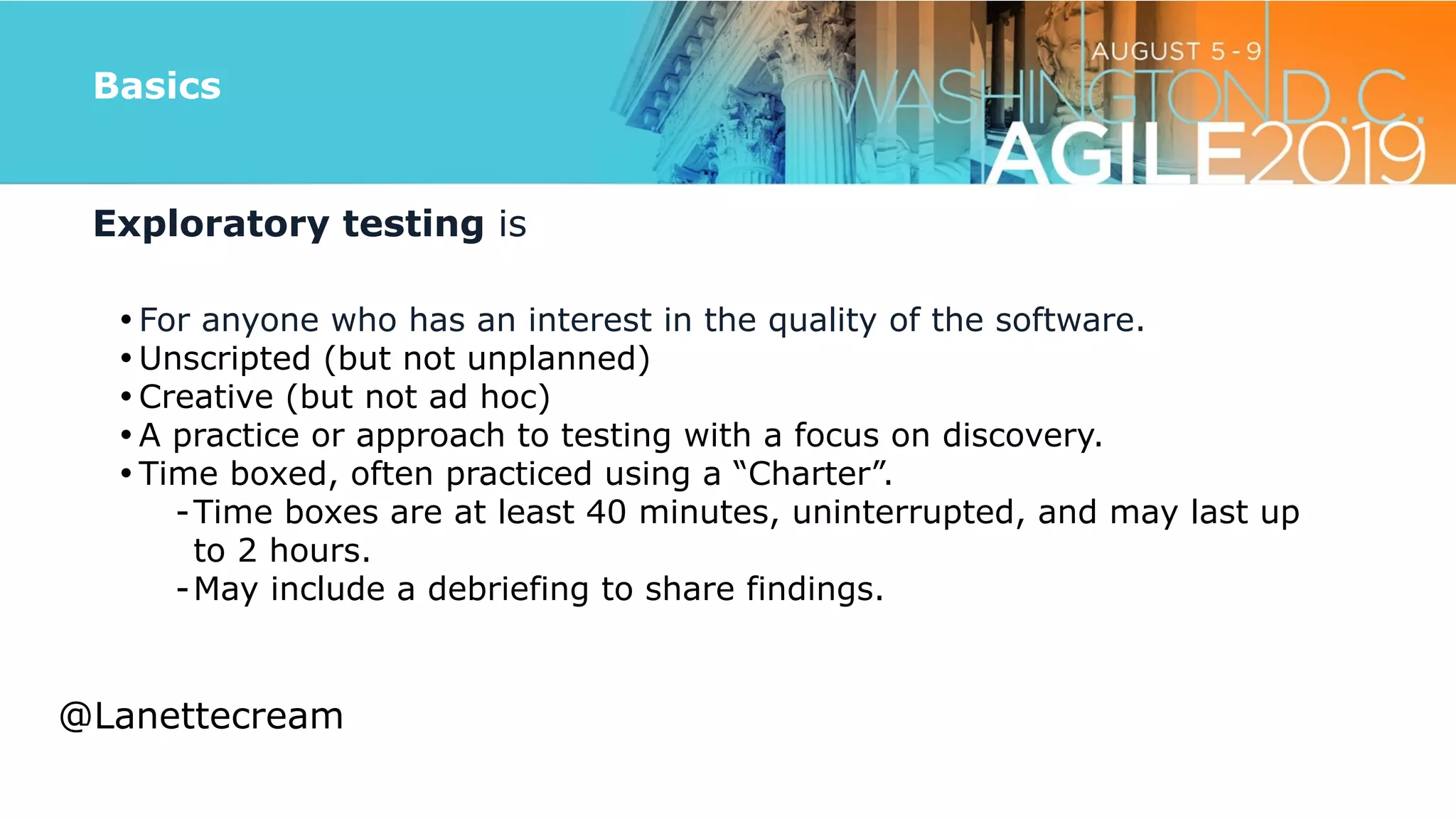
Basics
Exploratory testing is


• For anyone who has an interest in the quality of the software.


• Unscripted (but not unplanned)


• Creative (but not ad hoc)


• A practice or approach to testing with a focus on discovery.


• Time boxed, often practiced using a “Charter”.


-Time boxes are at least 40 minutes, uninterrupted, and may last up
to 2 hours.


-May include a debriefing to share findings.
@Lanettecream
@lanettecream
Activity 1: Ad Hoc test for 5 minutes
Start Testing


https://lingojam.com/ExtraThiccText


@Lanettecream
@lanettecream
Activity 1: 2 minute debrief
What was that like? Learn anything? How did it feel?


@Lanettecream
@lanettecream
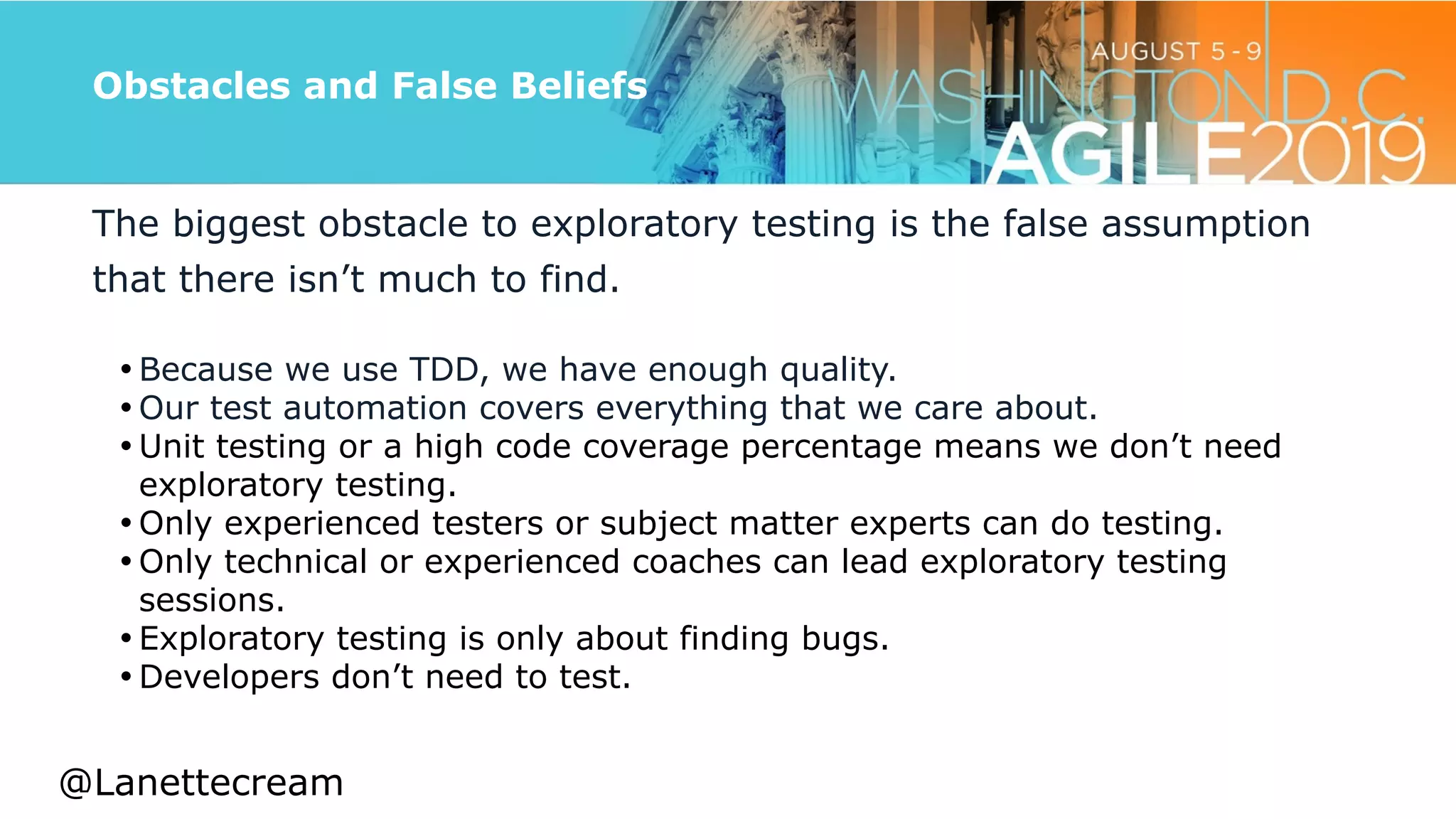
Obstacles and False Beliefs
The biggest obstacle to exploratory testing is the false assumption
that there isn’t much to find.


• Because we use TDD, we have enough quality.


• Our test automation covers everything that we care about.


• Unit testing or a high code coverage percentage means we don’t need
exploratory testing.


• Only experienced testers or subject matter experts can do testing.


• Only technical or experienced coaches can lead exploratory testing
sessions.


• Exploratory testing is only about finding bugs.


• Developers don’t need to test.


@Lanettecream
@lanettecream
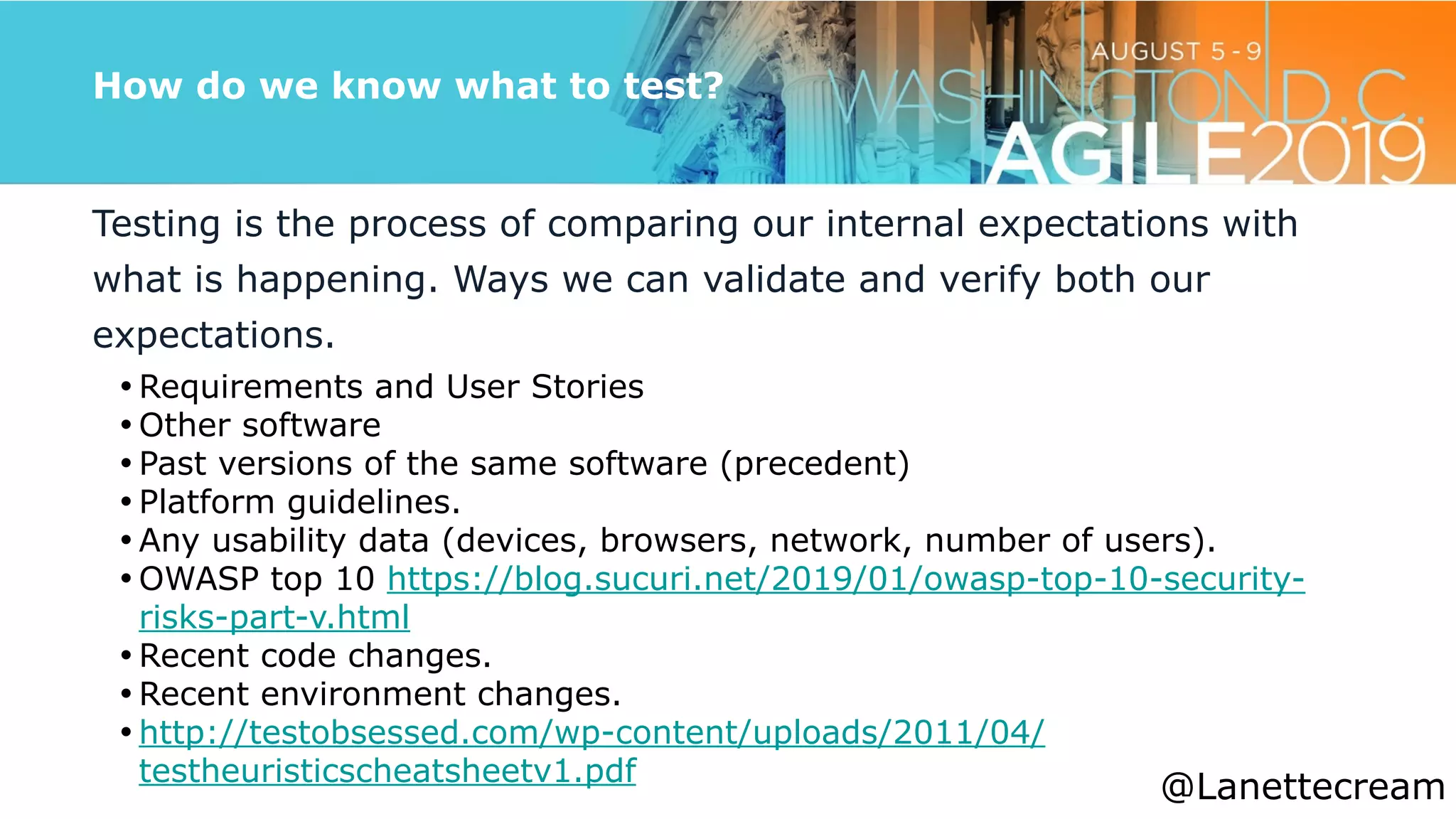
How do we know what to test?
Testing is the process of comparing our internal expectations with
what is happening. Ways we can validate and verify both our
expectations.


• Requirements and User Stories


• Other software


• Past versions of the same software (precedent)


• Platform guidelines.


• Any usability data (devices, browsers, network, number of users).


• OWASP top 10 https://blog.sucuri.net/2019/01/owasp-top-10-security-
risks-part-v.html


• Recent code changes.


• Recent environment changes.


• http://testobsessed.com/wp-content/uploads/2011/04/
testheuristicscheatsheetv1.pdf


@Lanettecream
@lanettecream
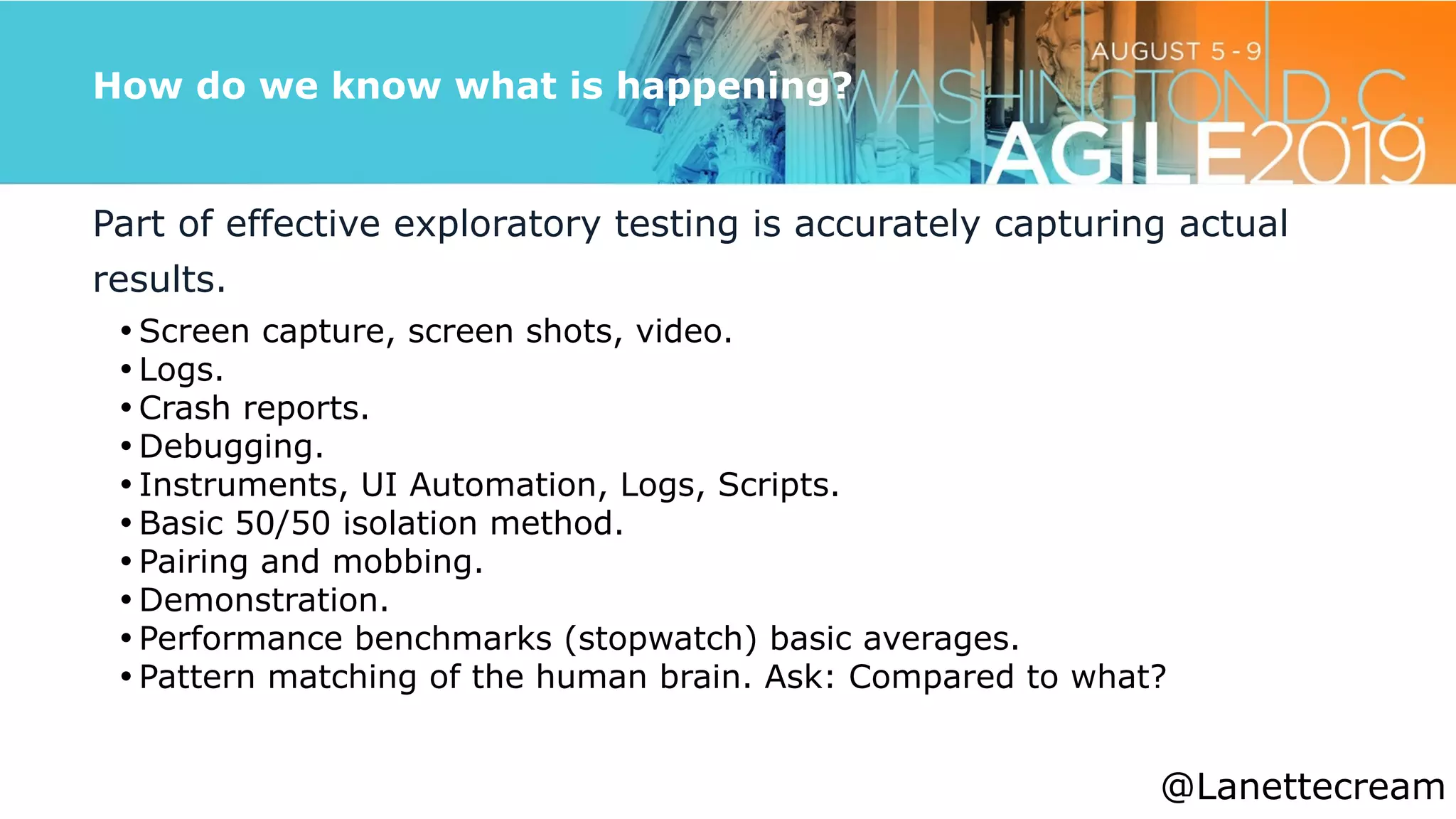
How do we know what is happening?
Part of effective exploratory testing is accurately capturing actual
results.


• Screen capture, screen shots, video.


• Logs.


• Crash reports.


• Debugging.


• Instruments, UI Automation, Logs, Scripts.


• Basic 50/50 isolation method.


• Pairing and mobbing.


• Demonstration.


• Performance benchmarks (stopwatch) basic averages.


• Pattern matching of the human brain. Ask: Compared to what?


@Lanettecream
@lanettecream
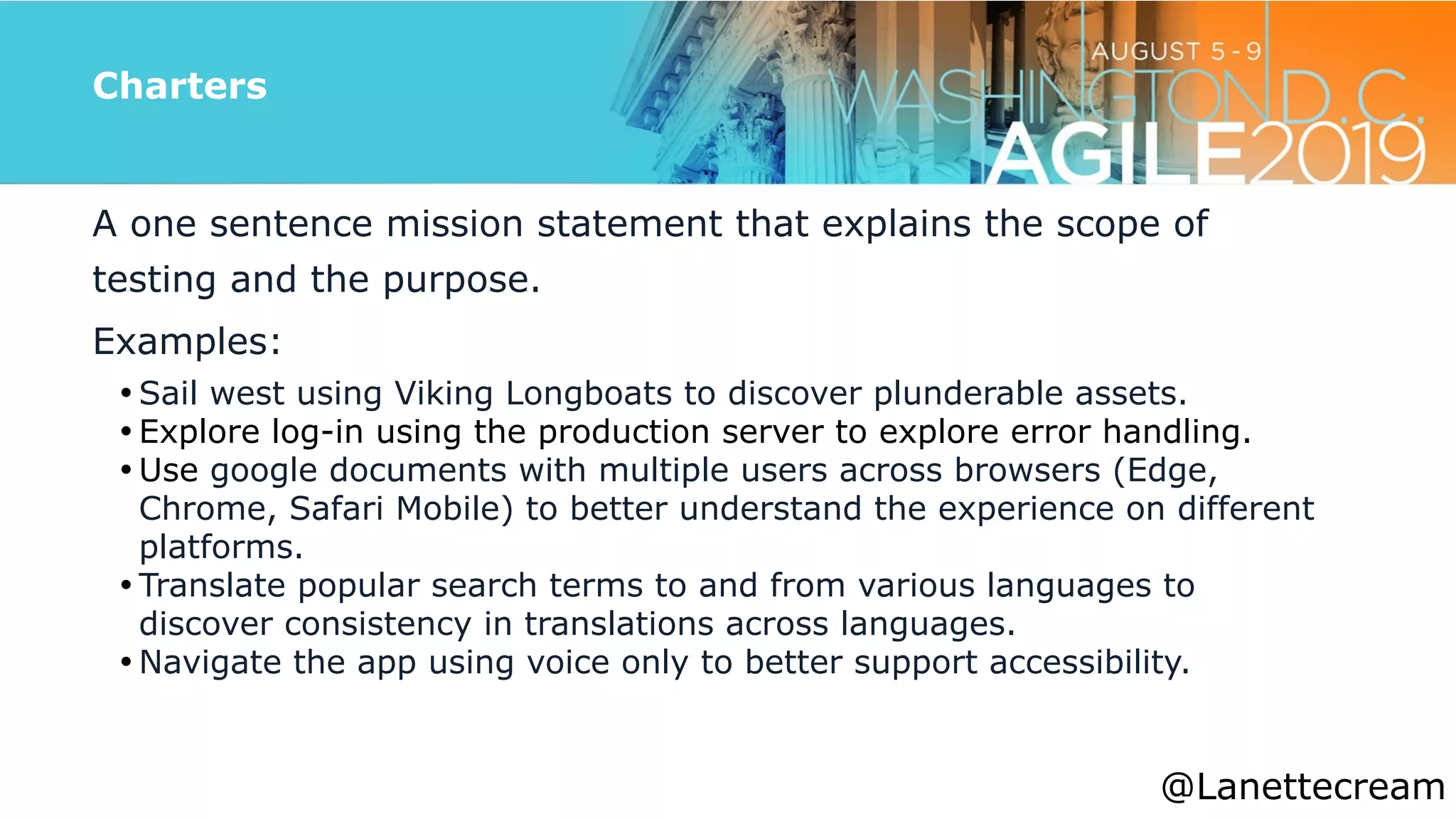
Charters
A one sentence mission statement that explains the scope of
testing and the purpose.


Examples:


• Sail west using Viking Longboats to discover plunderable assets.


• Explore log-in using the production server to explore error handling.


• Use google documents with multiple users across browsers (Edge,
Chrome, Safari Mobile) to better understand the experience on different
platforms.


• Translate popular search terms to and from various languages to
discover consistency in translations across languages.


• Navigate the app using voice only to better support accessibility.
@Lanettecream
@lanettecream
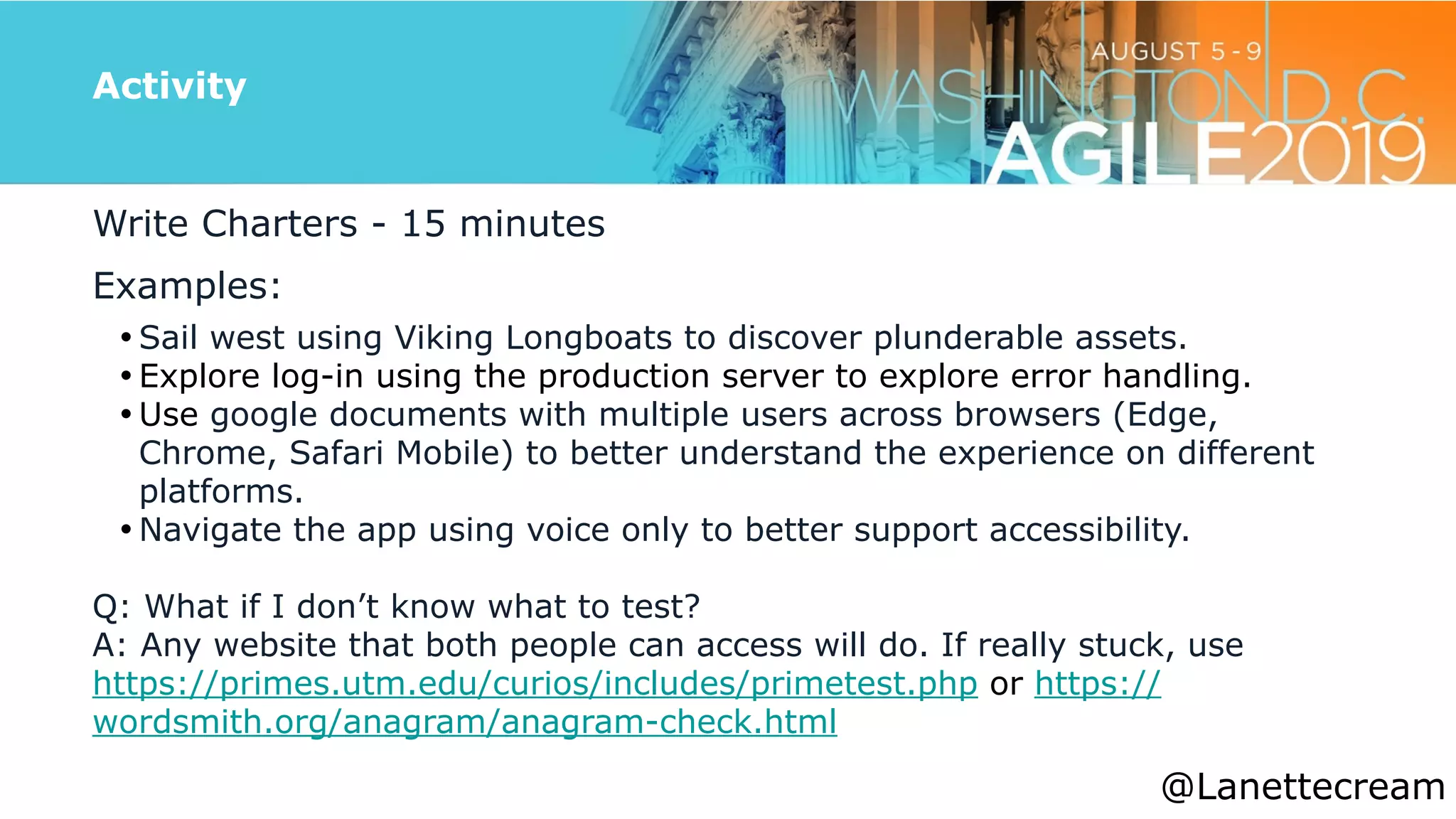
Activity
Write Charters - 15 minutes


Examples:


• Sail west using Viking Longboats to discover plunderable assets.


• Explore log-in using the production server to explore error handling.


• Use google documents with multiple users across browsers (Edge,
Chrome, Safari Mobile) to better understand the experience on different
platforms.


• Navigate the app using voice only to better support accessibility.


Q: What if I don’t know what to test?


A: Any website that both people can access will do. If really stuck, use
https://primes.utm.edu/curios/includes/primetest.php or https://
wordsmith.org/anagram/anagram-check.html
@Lanettecream
@lanettecream
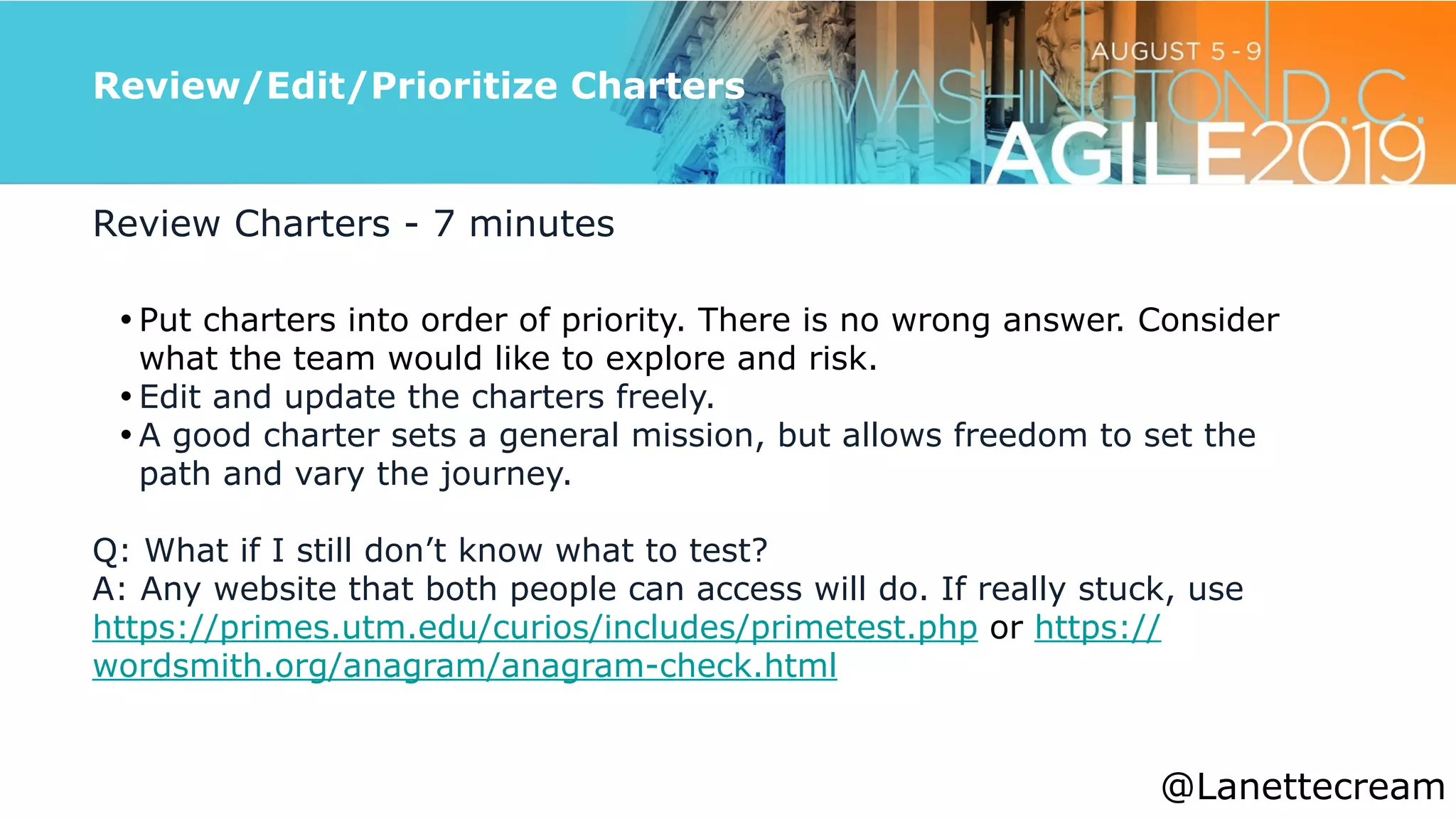
Review/Edit/Prioritize Charters
Review Charters - 7 minutes


• Put charters into order of priority. There is no wrong answer. Consider
what the team would like to explore and risk.


• Edit and update the charters freely.


• A good charter sets a general mission, but allows freedom to set the
path and vary the journey.


Q: What if I still don’t know what to test?


A: Any website that both people can access will do. If really stuck, use
https://primes.utm.edu/curios/includes/primetest.php or https://
wordsmith.org/anagram/anagram-check.html
@Lanettecream
@lanettecream
Activity - Prepare for Session
Consider use of containers to help sessions start with a setup
environment. Cloud and container solutions are useful here.


Make sure both partners have what is needed to test.


• Access to the software under test.


• Ability to take notes.


• Understanding of the charter.


• A working connection (application, build) & supported viewport.


• All distractions put away. This means phones, chat, email and social
media, just for the time box.


@Lanettecream
@lanettecream
What does the coach do?
Make sure both partners have what is needed to test.


• Plan and preflight the test setup.


• Make sure everyone has access to the environments and accounts
needed.


• Helps isolate bugs as needed.


• Helps any participant get unstuck when needed.


• Tests the charter while not helping anyone else.


• Keeps track of the time so everyone else can focus.


• Moves the charters & reports non-bug results at the end.
@Lanettecream
@lanettecream
What does the participant do?
Test following the charter as a main mission, but wander
strategically.


•Avoid distractions.


• Ask the coach if stuck.


• Isolate and report findings.


• Debrief by sharing findings with the coach.


• Enter final isolated bug reports in whichever way is best for your team.
Some do this at the end, some do this during the testing process.


@Lanettecream
@lanettecream
Lanette Creamer


How to Coach Exploratory Testing Sessions Part 2
@Lanettecream
@lanettecream
Run Exploratory Testing Session - 25 minutes
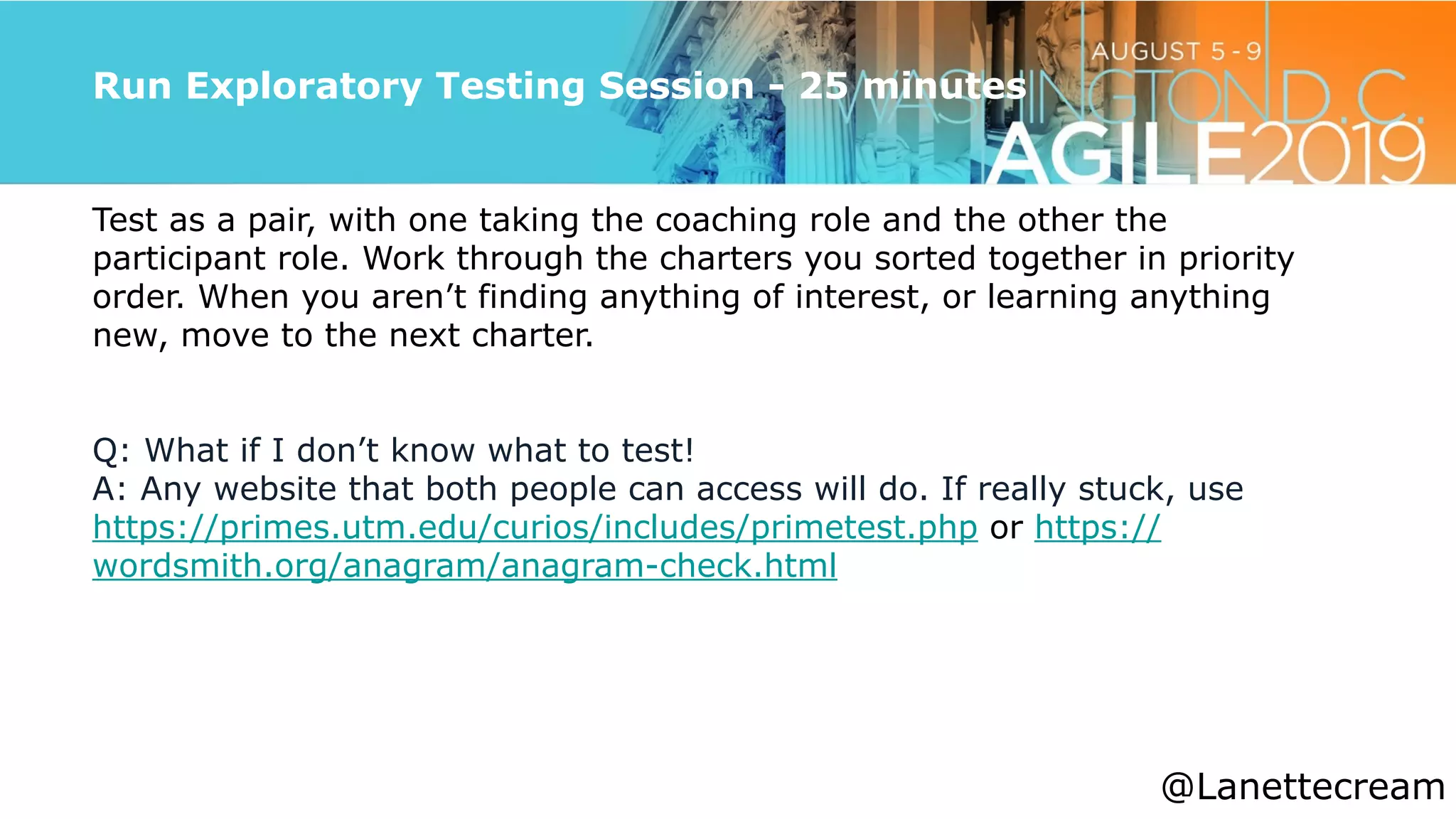
Test as a pair, with one taking the coaching role and the other the
participant role. Work through the charters you sorted together in priority
order. When you aren’t finding anything of interest, or learning anything
new, move to the next charter.


Q: What if I don’t know what to test!


A: Any website that both people can access will do. If really stuck, use
https://primes.utm.edu/curios/includes/primetest.php or https://
wordsmith.org/anagram/anagram-check.html
@Lanettecream
@lanettecream
Run Exploratory Testing Session - 25 minutes
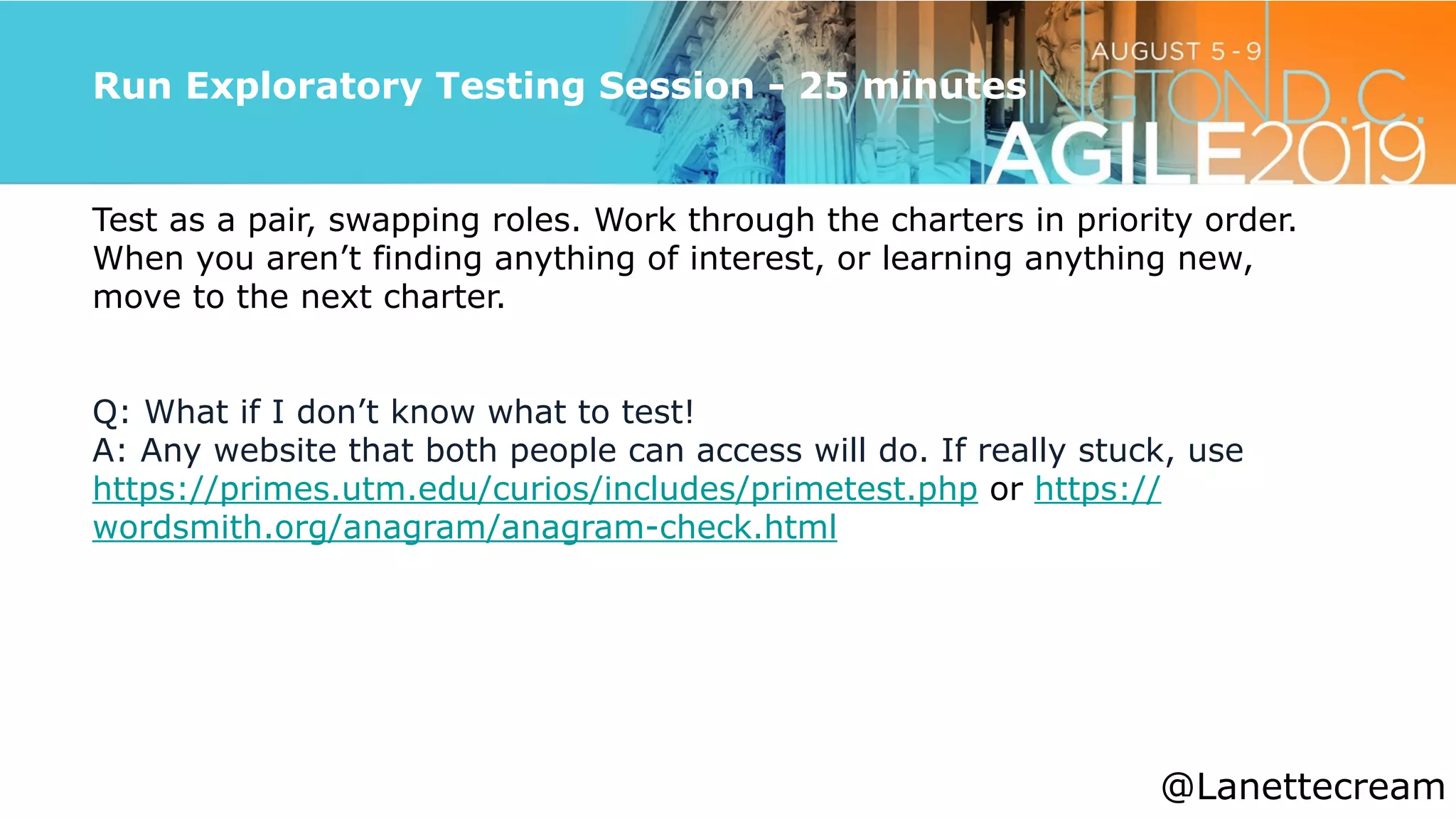
Test as a pair, swapping roles. Work through the charters in priority order.
When you aren’t finding anything of interest, or learning anything new,
move to the next charter.


Q: What if I don’t know what to test!


A: Any website that both people can access will do. If really stuck, use
https://primes.utm.edu/curios/includes/primetest.php or https://
wordsmith.org/anagram/anagram-check.html
@Lanettecream
@lanettecream
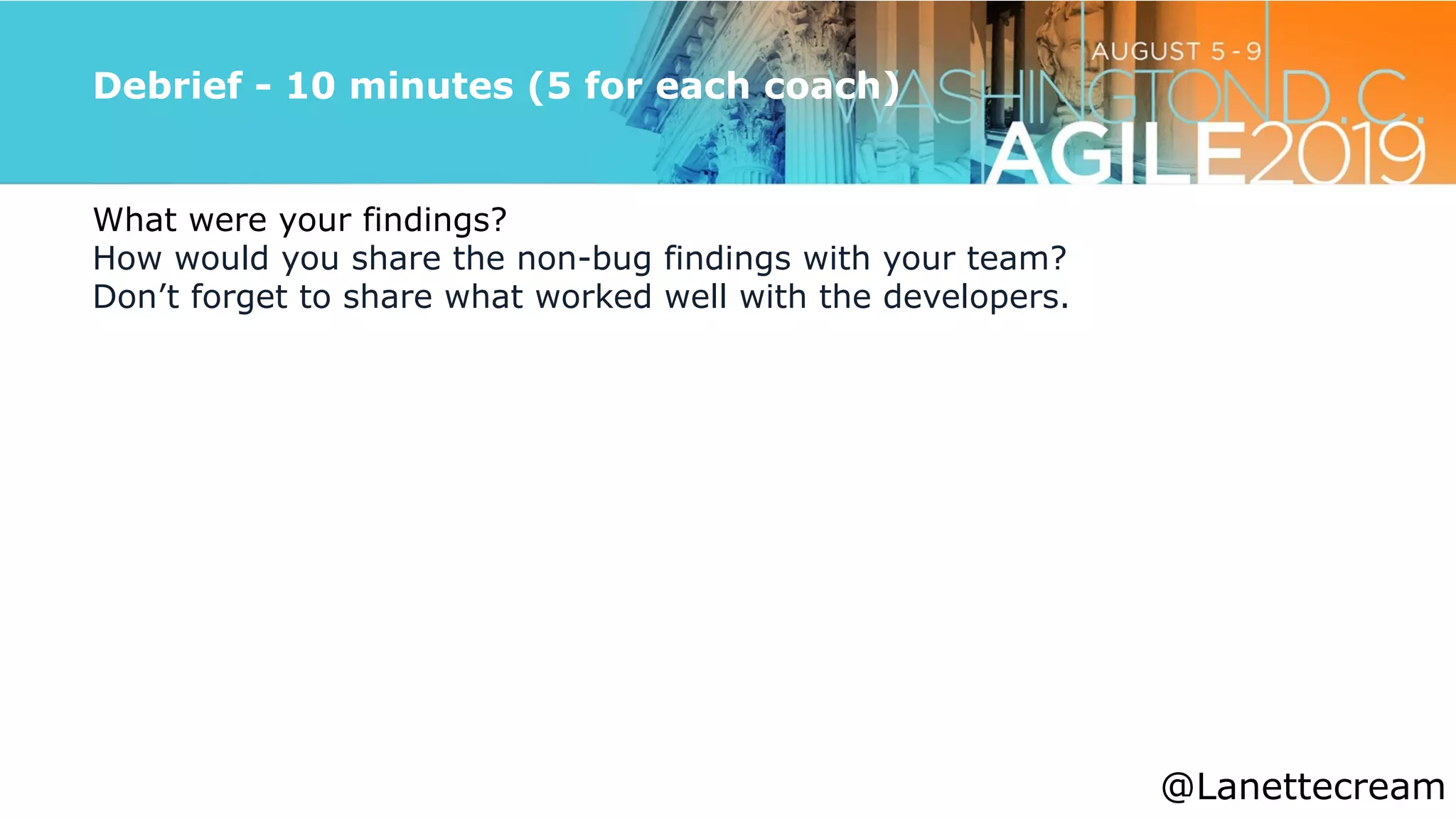
Debrief - 10 minutes (5 for each coach)
What were your findings?


How would you share the non-bug findings with your team?


Don’t forget to share what worked well with the developers.


@Lanettecream
@lanettecream
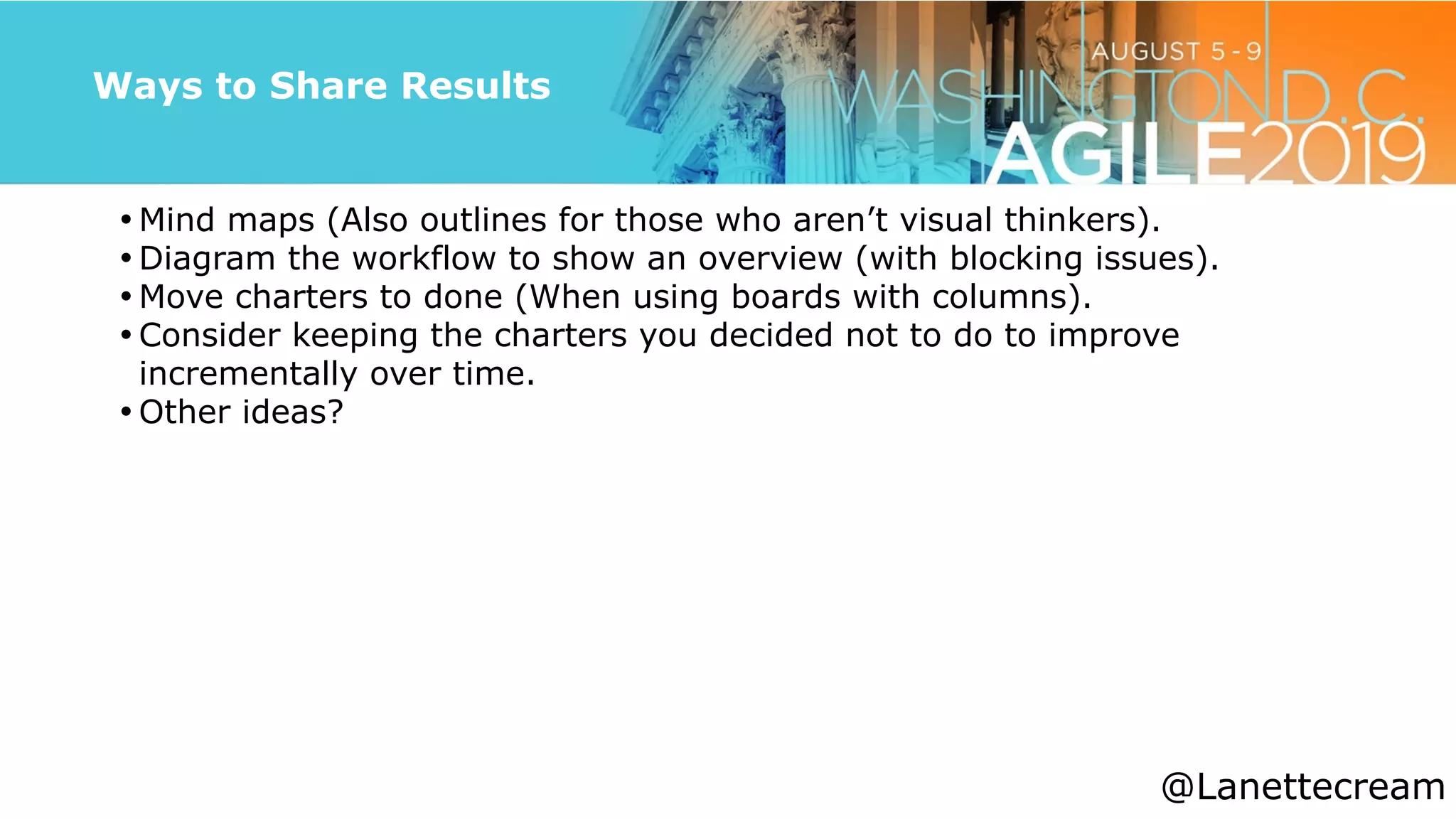
Ways to Share Results
• Mind maps (Also outlines for those who aren’t visual thinkers).


• Diagram the workflow to show an overview (with blocking issues).


• Move charters to done (When using boards with columns).


• Consider keeping the charters you decided not to do to improve
incrementally over time.


• Other ideas?


@Lanettecream
@lanettecream
Lanette Creamer


Questions/Discussion
@Lanettecream

19 creamer et workshop-agile2019-wash_pp_16-9_1

  • 1.
  • 2.
    @lanettecream Lanette Creamer 
 How toCoach Exploratory Testing Sessions @Lanettecream
  • 3.
    @lanettecream Workshop Agenda Part1 Introduction to Exploratory Testing • Basics • Obstacles and false beliefs • How do we know what to test? • Isolate, record and show detailed actual results. • Writing charters -Activity to write charters. -Charter prioritization activity. • Create checklist of what we need to start the exploratory testing session. • Select a charter with some software or a website or app to test appropriate for your pair. @Lanettecream
  • 4.
    @lanettecream Workshop Agenda Part2 Practice •Actually run and lead an exploratory testing session for 30 minutes with a partner. •Switch leading with performing the charter. •Debrief. •Summarize findings. @Lanettecream
  • 5.
    @lanettecream Basics Exploratory testing is •For anyone who has an interest in the quality of the software. • Unscripted (but not unplanned) • Creative (but not ad hoc) • A practice or approach to testing with a focus on discovery. • Time boxed, often practiced using a “Charter”. -Time boxes are at least 40 minutes, uninterrupted, and may last up to 2 hours. -May include a debriefing to share findings. @Lanettecream
  • 6.
    @lanettecream Activity 1: AdHoc test for 5 minutes Start Testing https://lingojam.com/ExtraThiccText @Lanettecream
  • 7.
    @lanettecream Activity 1: 2minute debrief What was that like? Learn anything? How did it feel? @Lanettecream
  • 8.
    @lanettecream Obstacles and FalseBeliefs The biggest obstacle to exploratory testing is the false assumption that there isn’t much to find. • Because we use TDD, we have enough quality. • Our test automation covers everything that we care about. • Unit testing or a high code coverage percentage means we don’t need exploratory testing. • Only experienced testers or subject matter experts can do testing. • Only technical or experienced coaches can lead exploratory testing sessions. • Exploratory testing is only about finding bugs. • Developers don’t need to test. @Lanettecream
  • 9.
    @lanettecream How do weknow what to test? Testing is the process of comparing our internal expectations with what is happening. Ways we can validate and verify both our expectations. • Requirements and User Stories • Other software • Past versions of the same software (precedent) • Platform guidelines. • Any usability data (devices, browsers, network, number of users). • OWASP top 10 https://blog.sucuri.net/2019/01/owasp-top-10-security- risks-part-v.html • Recent code changes. • Recent environment changes. • http://testobsessed.com/wp-content/uploads/2011/04/ testheuristicscheatsheetv1.pdf @Lanettecream
  • 10.
    @lanettecream How do weknow what is happening? Part of effective exploratory testing is accurately capturing actual results. • Screen capture, screen shots, video. • Logs. • Crash reports. • Debugging. • Instruments, UI Automation, Logs, Scripts. • Basic 50/50 isolation method. • Pairing and mobbing. • Demonstration. • Performance benchmarks (stopwatch) basic averages. • Pattern matching of the human brain. Ask: Compared to what? @Lanettecream
  • 11.
    @lanettecream Charters A one sentencemission statement that explains the scope of testing and the purpose. Examples: • Sail west using Viking Longboats to discover plunderable assets. • Explore log-in using the production server to explore error handling. • Use google documents with multiple users across browsers (Edge, Chrome, Safari Mobile) to better understand the experience on different platforms. • Translate popular search terms to and from various languages to discover consistency in translations across languages. • Navigate the app using voice only to better support accessibility. @Lanettecream
  • 12.
    @lanettecream Activity Write Charters -15 minutes Examples: • Sail west using Viking Longboats to discover plunderable assets. • Explore log-in using the production server to explore error handling. • Use google documents with multiple users across browsers (Edge, Chrome, Safari Mobile) to better understand the experience on different platforms. • Navigate the app using voice only to better support accessibility. Q: What if I don’t know what to test? A: Any website that both people can access will do. If really stuck, use https://primes.utm.edu/curios/includes/primetest.php or https:// wordsmith.org/anagram/anagram-check.html @Lanettecream
  • 13.
    @lanettecream Review/Edit/Prioritize Charters Review Charters- 7 minutes • Put charters into order of priority. There is no wrong answer. Consider what the team would like to explore and risk. • Edit and update the charters freely. • A good charter sets a general mission, but allows freedom to set the path and vary the journey. Q: What if I still don’t know what to test? A: Any website that both people can access will do. If really stuck, use https://primes.utm.edu/curios/includes/primetest.php or https:// wordsmith.org/anagram/anagram-check.html @Lanettecream
  • 14.
    @lanettecream Activity - Preparefor Session Consider use of containers to help sessions start with a setup environment. Cloud and container solutions are useful here. Make sure both partners have what is needed to test. • Access to the software under test. • Ability to take notes. • Understanding of the charter. • A working connection (application, build) & supported viewport. • All distractions put away. This means phones, chat, email and social media, just for the time box. @Lanettecream
  • 15.
    @lanettecream What does thecoach do? Make sure both partners have what is needed to test. • Plan and preflight the test setup. • Make sure everyone has access to the environments and accounts needed. • Helps isolate bugs as needed. • Helps any participant get unstuck when needed. • Tests the charter while not helping anyone else. • Keeps track of the time so everyone else can focus. • Moves the charters & reports non-bug results at the end. @Lanettecream
  • 16.
    @lanettecream What does theparticipant do? Test following the charter as a main mission, but wander strategically. •Avoid distractions. • Ask the coach if stuck. • Isolate and report findings. • Debrief by sharing findings with the coach. • Enter final isolated bug reports in whichever way is best for your team. Some do this at the end, some do this during the testing process. @Lanettecream
  • 17.
    @lanettecream Lanette Creamer 
 How toCoach Exploratory Testing Sessions Part 2 @Lanettecream
  • 18.
    @lanettecream Run Exploratory TestingSession - 25 minutes Test as a pair, with one taking the coaching role and the other the participant role. Work through the charters you sorted together in priority order. When you aren’t finding anything of interest, or learning anything new, move to the next charter. Q: What if I don’t know what to test! A: Any website that both people can access will do. If really stuck, use https://primes.utm.edu/curios/includes/primetest.php or https:// wordsmith.org/anagram/anagram-check.html @Lanettecream
  • 19.
    @lanettecream Run Exploratory TestingSession - 25 minutes Test as a pair, swapping roles. Work through the charters in priority order. When you aren’t finding anything of interest, or learning anything new, move to the next charter. Q: What if I don’t know what to test! A: Any website that both people can access will do. If really stuck, use https://primes.utm.edu/curios/includes/primetest.php or https:// wordsmith.org/anagram/anagram-check.html @Lanettecream
  • 20.
    @lanettecream Debrief - 10minutes (5 for each coach) What were your findings? How would you share the non-bug findings with your team? Don’t forget to share what worked well with the developers. @Lanettecream
  • 21.
    @lanettecream Ways to ShareResults • Mind maps (Also outlines for those who aren’t visual thinkers). • Diagram the workflow to show an overview (with blocking issues). • Move charters to done (When using boards with columns). • Consider keeping the charters you decided not to do to improve incrementally over time. • Other ideas? @Lanettecream
  • 22.