Selenium (Se) was first observed in 1817 in a
laboratory (Greenwood et al., 1984). The
discovery of selenium was made by the
Swedish chemist J.J. Berzelius and J.G. Gahn,
who isolated selenium from a red residue in
sulphuric acid from pyrite mined at Fahlun,
Sweden. Selenium was named from the Greek
word selene (moon), since it resembled
tellurium, which had been discovered a few
years earlier and named from the Latin word
tellus (Earth).
After the first observation of selenium in
the laboratory, selenium received considerable
interest. In 1954, E.P. Kaiser pointed out that
Se is enriched in sulphide ores and often
associated with Bi, Co, Sn etc. (Kaiser 1954).
In 1959, Hawley and Nichol investigated
selenium in Canadian sulphide minerals, and
presented the content of selenium in sulphide
from several deposits of different types. They
also proposed that Se is enriched in low-
temperature hydrothermal pyrite (Hawley and
Nichol, 1959). The thermodynamic conditions
for forming native selenium and selenium
minerals in sedimentary rocks were discussed,
as well as geochemical behaviour of selenium
near the oxidation zones of sulphides in the
1970s (Howard III, 1977; Zhu et al., 2003).
Zhu et al. examined the morphology, features,
and genesis of native selenium from Yutangba,
Enshi City, Hubei Province, China in 2004, and
pointed out, from the different forms of native
Se, that selenium can be
activated,transformed, remobilized, and
enriched at sites such as in the unsaturated
subsurface zone or in the saturated zone (Zhu
et al., 2005). The transport and deposition of
selenium in felsic volcanic-hosted massive
sulphide deposits of the Yukon Territory,
Canada was studied and reported by Layton-
Matthews et al. (2005).
Selenium is a comparatively rare and
greatly dispersed element. The average
selenium content in the Earth's crust is
considered to vary between 0.05 and 0.09 g/g
(Lakin 1972; Greenwood et al., 1984; Jiajun et
al., 1997). Elemental selenium is seldom
found in nature; industrially, selenium is
obtained as a by-product of mining other
metals such as copper, iron, and lead (Fishbein
1983; Wen and Qiu 1999). It is produced
primarily from the anode slimes of copper
refineries (Butterman et al., 2004). There are
various reports in the literature on the
treatment of copper anode slimes to recover
selenium (Hoffmann 1989; Cooper 1990).
In this paper, we provide an overview of
selenium minerals, as well as the recovery of
selenium from copper refinery anode slimes.
Our focus is on the occurrence of selenium
minerals and selenium deposits. We also
examined the research work reported in the
literature on the treatment of copper refinery
anode slimes for the recovery of selenium.
In 1956, Thompson et al. discovered felty
Selenium minerals and the recovery of
selenium from copper refinery anode
slimes
by C. Wang*, S. Li*, H. Wang*, and J. Fu*
Since it was first identified in 1817, selenium has received considerable
interest. Native selenium and a few selenium minerals were discovered
several decades later. With the increasing number of selenium minerals,
the occurrence of selenium minerals became the focus of much research. A
great number of selenium deposits were reported all over the world,
although few independent selenium deposits were discovered. Selenium is
obtained mainly as a byproduct of other metals, and is produced primarily
from the anode mud of copper refineries. This paper presents a compre-
hensive review of selenium minerals, as well as the treatment of copper
refinery anode slimes for the recovery of selenium. Our focus is on the
selenium minerals, including their discovery and occurrence, and the
distribution of selenium resources. In addition, the main methods of
recovering selenium from copper anode slimes are summarized.
selenium, selenium minerals, anode slimes.
* School of Mining Engineering, University of the
Witwatersrand, Johannesburg, South Africa.
© The Southern African Institute of Mining and
Metallurgy, 2016. ISSN 2225-6253. Paper received
Dec. 2012; revised paper received Feb. 2016.
593VOLUME 116
L
http://dx.doi.org/10.17159/2411-9717/2016/v116n6a16
Selenium minerals and the recovery of selenium from copper refinery anode slimes
native selenium, which is violet acicular crystal. Coleman and
Delevaux (1957) investigated the occurrence of selenium in
sulphide from sandstone-type uranium ores in the western
USA, and discovered trigonal and monoclinic native
selenium, as well as clausthalite and ferroselite (Thompson et
al,. 1956; Coleman and Delevaux, 1957). The occurrence of
large particle of native selenium up to 20–30 mm in length in
coal seams was reported by Zhu et al. (2005). In 1990,
spherical and tubular native selenium was discovered in a
hydrothermal U-Se-Re polymetallic deposit (Zhu et al.,
2003).
The selenide deposits in the eastern Harz Mountains,
Germany were intensively studied. The selenide-bearing
deposits at Tilkerode, Lerbach, Clausthal, Zorge, St.
Andreasberg, and Trogthal, are recognized as typical selenide
vein deposits of telethermal origin (Simon et al., 1997). The
polymetallic selenide mineralization at Tilkerode, Zorge,
Lerbach, and Trogthal occurs mainly as small deposits not
associated with larger base-metal deposits, while the selenide
minerals at Clausthal and St. Andreasberg are associated with
larger deposits mined primarily for silver, lead, zinc, and
copper. The series of selenides from Tilkerode was identified
mainly by Tischendorf: clausthalite (PbSe), naumannite
(Ag2Se), tiemannite (HgSe), eskebornite (CuFeSe2), trogtalite
(CoSe2), hastite (CoSe2), freboldite (CoSe), bornhardtite
(Co3Se4), berzelianite (Cu2Se), umangite (Cu3Se2),
klockmannite (CuSe), and stibiopalladinite (Pd5Sb2) (Davis et
al., 1977; Stanley et al., 2002). Two unidentified minerals,
noted by Tischendorf in 1958, represented two new species:
chrisstanleyite (Ag2Pd3Se4) and tischendorfite (Pd8Hg3Se9)
(Stanley et al., 1990, 2002). Wallis described a number of
additional mineral species in the Tilkerode selenide
assemblage: kruˇtaite (CuSe2), athabascaite (Cu5Se4),
temagamite (Pd3HgTe3), eucairite (CuAgSe), trüstedtite
(Ni3Se4), penroseite ((Ni,Co,Cu)Se2), and geffroyite
((Ag,Cu,Fe)9(S,Se)8) (Stanley et al., 2002).
Davis et al. (1977) reported a new selenide of palladium,
palladseite (Pd17Se15), which occurs in the residual concen-
trates from gold washing at Itabira, Minas Gerais, Brazil and
is associated with arsenopalladinite, isomertieite, and
atheneite.
Selenian miargyrite (AgSb(Se0.6S1.4)2), a new variety of
miargyrite, was found in gold-bearing quartz veins in
middle-lower Silurian quartzite of the Ailaoshan metamorphic
belt, Yunnan province, China. It is intimately associated with
freibergite, stibnite, ullmannite, and native gold and occurs
as grains from 0.1 to 0.02 mm in diameter (Yunfen et al.,
1990).
Stanley et al. (1990) examined the precious and base
metal selenide mineralization at Hope’s Nose, Torquay,
Devon, England. The selenide assemblage consists of
clausthalite (PbSe), tiemannite (HgSe), klockmannite (CuSe),
umangite (Cu3Se2), tyrrellite ((Cu,Co,Ni)3Se4), trustedtite
(Ni3Se4), penroseite (NiSe2), naumannite (Ag2Se), eucairite
(AgCuSe), and fischesserite (Ag3AuSe2). A new mineral,
chrisstanleyite (Ag2Pd3Se4), was discovered in gold-bearing
carbonate veins in Middle Devonian limestones at Hope's
Nose. It is associated with palladian and argentian gold,
fischesserite, clausthalite, eucairite, tiemannite, umangite,
cerussite, calcite, and bromian chlorargyrite (Paar et al.,
1998).
Selenio-sulfantimonide was discovered in the Laerma
gold-copper-uranium deposit in China in 1993. It is
associated with native gold, tiemannite, clasthalite, lautite,
aurostibite, gersdorffite, quartz, barite, etc. and occurs as fine
grains, about 0.01–0.5 mm (Minghua et al., 1993).
As many selenium minerals were identified and
discovered, numerous investigators conducted imvestigations
on selenium minerals. More than 90 selenium minerals had
been identified by 1998. Wen and co-workers reviewed the
selenium minerals and their occurrence (Huayun, 1998).
Recently, a new series of selenium minerals was
discovered. Stanley et al. (2002) reported a new mineral
species from the Eskaborner Stollen at Tilkerode, Harz
Mountains, Germany. Tischendorfite occurs as aggregates in
a carbonate matrix, together with the associated metallic
minerals clausthalite, tiemannite, chrisstanleyite, stibiopalla-
dinite, and gold.
Schlemaite, a new mineral species from the
Niederschlema–Alberoda vein-type uranium deposit, was
discovered at Hartenstein, Erzgebirge, Germany. It occurs in
aggregates of up to several hundred micrometres across, with
berzelianite, eucairite, and clausthalite in a dolomite-ankerite
matrix. Of the three vein-type uranium deposits in the
Schneeberg-Schlema-Alberoda ore district, Niederschlema-
Alberoda is considered the major occurrence of selenides in
the Erzgebirge of Germany. In addition, rare selenides of Cu,
Bi, Hg, Ni, and other elements were reported (Förster et al.,
2003).
Jaguéite, the copper analogue of chrisstanleyite, was
discovered in a telethermal selenide vein-type deposit at the
El Chire prospect, Los Llantenes District of La Rioja Province,
Argentina. The new species is generally associated with
chrisstanleyite, particularly in intimate intergrowths,
clausthalite, naumannite, tiemannite, klockmannite,
berzelianite, umangite, and aguilarite. In addition, two
unnamed compounds, chemically (Ag, Cu)6Hg2Pb2Se3 and
(Ag, Cu)8Hg3(S, Se)7, occur as rare constituents (Paar et al.,
2004).
Jolliffeite, previously known only from Lake Athabasca,
Saskatchewan, Canad was reported from the Niederschlema–
Alberoda uranium deposit in the Erzgebirge region of
Germany. Jolliffeite, an exotic mineral, is associated with
haematite, Ni–Co–Se-bearing löllingite, clausthalite,
tiemannite, mercurian hakite–giraudite solid solutions,
sulphurian berzelianite, sulphurian umangite, hessite, Ni-Co-
As-bearing pyrite, and Se-rich chalcopyrite (Förster et al.,
2004).
Three occurrences of clausthalite were reported in Poland,
in abandoned polymetallic deposits at Kowary and Kletno and
the Fore-Sudetic copper deposits (Thompson et al., 1956;
Kucha, 1982). A new occurrence of clausthalite, together with
uraninite, was reported in the Sudetes, southwest Poland.
Clausthalite forms veinlets in a breccia comprising <50% calc-
silicate rock fragments (Thompson et al., 1956).
Plumboselite, a new selenite from the Tsumeb mine,
Namibia, occurs as fibres on clausthalite and is associated
with smithsonite, mimetite, and vaterite. It occurs in
subparallel to divergent clusters of thin, flattened, colourless
fibres up to 0.3 mm in length (Kampf et al., 2011).
All the reported selenium minerals are shown in Tables I–
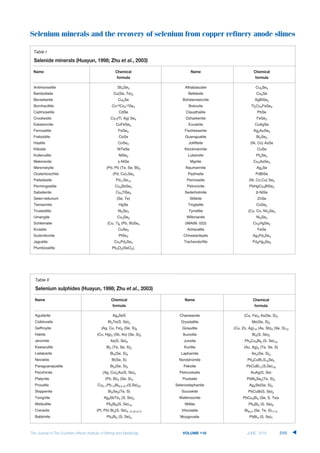
III. The minerals are mainly selenides, selenium sulphides
L
594 VOLUME 116
Selenium minerals and the recovery of selenium from copper refinery anode slimes
595VOLUME 116
L
Table I
Antimonselite Sb2Se3 Athabascaite Cu5Se4
Bambollaite Cu(Se, Te)2 Bellidoite Cu2Se
Berzelianite Cu2Se Bohdanowiczite AgBiSe2
Bornhardtite Co+2Co2
+3Se4 Bukovite Tl2Cu3FeSe4
Cadmoselite CdSe Clausthalite PbSe
Crookesite Cu7(Tl, Ag) Se4 Dzharkenite FeSe2
Eskebornite CuFeSe2 Eucairite CuAgSe
Ferroselite FeSe2 Fischesserite Ag3AuSe2
Freboldite CoSe Guanajuatite Bi2Se3
Hastite CoSe2 Jolliffeite (Ni, Co) AsSe
Kitkaite NiTeSe Klockmannite CuSe
Kullerudite NiSe2 Luberoite Pt5Se4
Makinenite γ-NiSe Mgriite Cu3AsSe3
Merenskyite (Pd, Pt) (Te, Se, Bi)2 Naumannite Ag2Se
Oosterboschite (Pd, Cu)7Se3 Padmaite PdBiSe
Palladseite Pd17Se15 Penroseite (Ni, Co,Cu) Se2
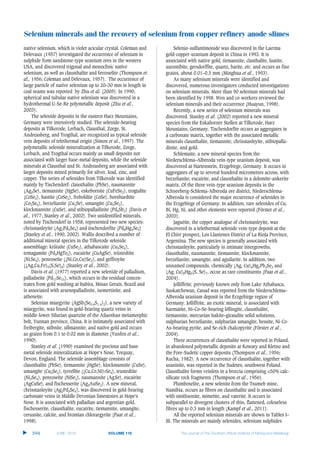
Permingeatite Cu3SbSe4 Petrovicite PbHgCu3BiSe5
Sabatierite Cu4TlSe3 Sederholmite β-NiSe
Selen-tellurium (Se, Te) Stilleite ZnSe
Tiemannite HgSe Trogtalite CoSe2
Trustedtite Ni3Se4 Tyrrellite (Cu, Co, Ni)3Se4
Umangite Cu3Se2 Wilkmanite Ni3Se4
Schlemaite (Cu, ?)6 (Pb, Bi)Se4 (IMA99. 023) Cu2HgSe2
Krutaite CuSe2 Achavalite FeSe
Sudovikovite PtSe2 Chrisstanleyite Ag2Pd3Se4
Jaguéite Cu2Pd3Se4 Tischendorfite Pd8Hg3Se9
Plumboselite Pb3O2(SeO3),
Table II
Aguilarite Ag4SeS Chameanite (Cu, Fe)4 As(Se, S)4
Csiklovaite Bi2Te(S, Se)2 Drysdallite Mo(Se, S)2
Geffroyite (Ag, Cu, Fe)9 (Se, S)8 Giraudite (Cu, Zn, Ag)12 (As, Sb)4 (Se, S)13
Hakite (Cu, Hg)3 (Sb, As) (Se, S)3 Ikunolite Bi4(S, Se)3
Jeromite As(S, Se)2 Junoite Pb3Cu2Bi8 (S, Se)16
Kawazulite Bi2 (Te, Se, S)3 Kurilite (Au, Ag)2 (Te, Se, S)
Laitakarite Bi4(Se, S)3 Laphamite As2(Se, S)3
Nevskite Bi(Se, S) Nordstromite Pb3CuBi7S10Se4
Paraguanajuatite Bi2(Se, S)3 Pekoite PbCuBi11(S,Se)18
Penzhinite (Ag, Cu)4Au(S, Se)4 Petrovskaite AuAg(S, Se)
Platynite (Pb, Bi)3 (Se, S)4 Poubaite PbBi2Se2(Te, S)2
Proudite Cu0~1Pb7.5Bi9.3~9.7(S,Se)22 Selenostephanite Ag5Sb(Se, S)4
Skippenite Bi2Se2(Te, S) Soucekite PbCuBi(S, Se)3
Tsnigriite Ag9SbTe3 (S, Se)3 Watkinsonite PbCu2Bi4 (Se, S, Te)8
Weibullite Pb6Bi8(S, Se)18 Wittite Pb3Bi4 (S, Se)9
Crerarite (Pt, Pb) Bi3(S, Se)4 –X (X~0.7) Vihorlatite Bi8+X (Se, Te, S)11-X
Babkinite Pb2Bi2 (S, Se)3 Mozgovaite PbBi4 (S, Se)7
Selenium minerals and the recovery of selenium from copper refinery anode slimes
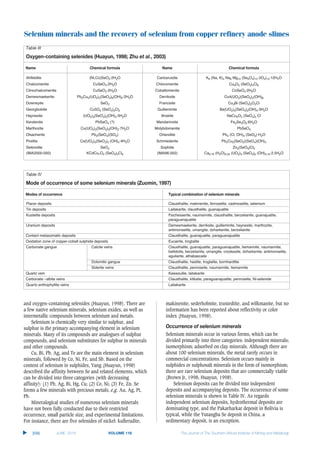
and oxygen-containing selenides (Huayun, 1998). There are
a few native selenium minerals, selenium oxides, as well as
intermetallic compounds between selenium and metals.
Selenium is chemically very similar to sulphur, and
sulphur is the primary accompanying element in selenium
minerals. Many of its compounds are analogues of sulphur
compounds, and selenium substitutes for sulphur in minerals
and other compounds.
Cu, Bi, Pb, Ag, and Te are the main element in selenium
minerals, followed by Co, Ni, Fe, and Sb. Based on the
content of selenium in sulphides, Yang (Huayun, 1998)
described the affinity between Se and related elements, which
can be divided into three categories (with decreasing
affinity): (1) Pb, Ag, Bi, Hg, Cu; (2) Co, Ni; (3) Fe, Zn. Se
forms a few minerals with precious metals, e.g. Au, Ag, Pt,
Pb.
Mineralogical studies of numerous selenium minerals
have not been fully conducted due to their restricted
occurrence, small particle size, and experimental limitations.
For instance, there are five selenides of nickel: kullerudite,
makinenite, sederholmite, trustedtite, and wilkmanite, but no
information has been reported about reflectivity or color
index (Huayun, 1998).
Selenium minerals occur in various forms, which can be
divided primarily into three categories: independent minerals;
isomorphism; adsorbed on clay minerals. Although there are
about 100 selenium minerals, the metal rarely occurs in
commercial concentrations. Selenium occurs mainly in
sulphides or sulphosalt minerals in the form of isomorphism;
there are rare selenium deposits that are commercially viable
(Brown Jr, 1998; Huayun, 1998).
Selenium deposits can be divided into independent
deposits and accompanying deposits. The occurrence of some
selenium minerals is shown in Table IV. As regards
independent selenium deposits, hydrothermal deposits are
dominating type, and the Pakarharkar deposit in Bolivia is
typical, while the Yutangba Se deposit in China, a
sedimentary deposit, is an exception.
L
596 VOLUME 116
Table III
Ahlfeldite (Ni,Co)SeO3·2H2O Carlosruizite K6 (Na, K)4 Na6 Mg10 (Se6O4)12 (IO3)12·12H2O
Chalcomenite CuSeO3·2H2O Chloromenite Cu9O2 (SeO3)4Cl6
Clinochalcomenite CuSeO3·2H2O Cobaltomenite CoSeO3·2H2O
Demesmaekerite Pb2Cu5(UO2)2(SeO3)6(OH)6·2H2O Derriksite Cu4(UO2)(SeO3)2(OH)6
Downeyite SeO2 Francisite Cu3Bi (SeO3)2O2Cl
Georgbokiite Cu5O2 (SeO3)2Cl2 Guilleminite Ba(UO2)3(SeO3)2(OH)4·3H2O
Haynesite (UO2)3(SeO3)2(OH)2·5H2O Ilinskite NaCu5O2 (SeO3)2 Cl
Kerstenite PbSeO4 (?) Mandarinoite Fe2Se3O9·6H2O
Marthozite Cu(UO2)3(SeO3)3(OH)2·7H2O Molybdomenite PbSeO3
Olsacherite Pb2(SeO4)(SO4) Orlandiite Pb3 (Cl, OH)4 (SeO3)·H2O
Piretite Ca(UO2)3(SeO3)2 (OH)4·4H2O Schmiederite Pb2Cu2(SeO3)(SeO4)(OH)4
Selenolite SeO2 Sophiite Zn2(SeO3)Cl2
(IMA2000-050) KCdCu7O2 (SeO3)2Cl9 (IMA96.002) Ca0.75 (H3O)0.25 (UO2)3 (SeO3)2 (OH)3.75·2.5H2O
Table IV
Placer deposits Clausthalite, makinenite, ferroselite, cadmoselite, selenium
Tin deposits Laitakarite, clausthalite, guanajuatite
Kustelite deposits Fischesserite, naumannite, clausthalite, berzelianite, guanajuatite,
paraguanajuatite
Uranium deposits Demesmaekerite, derriksite, guilleminite, haynesite, marthozite,
antimonselite, umangite, dzharkenite, berzelianite
Contact metasomatic deposits Clausthalite, guanajuatite, paraguanajuatite
Oxidation zone of copper-cobalt sulphide deposits Eucairite, trogtalite
Carbonate gangue Calcite veins Clausthalite, guanajuatite, paraguanajuatite, tiemannite, naumannite,
bellidoite, berzelianite, umangite, crookesite, dzharkenite, antimonselite,
aguilarite, athabascaite
Dolomitic gangue Clausthalite, hastite, trogtalite, bornhardtite
Siderite veins Clausthalite, penroseite, naumannite, tiemannite
Quartz vein Kawazulite, laitakarite
Carbonate –albite veins Clausthalite, kitkaite, paraguanajuatite, penroseite, Ni-selenide
Quartz-anthophyllite veins Laitakarite
Selenium resources occur mainly in combined deposit,
which can be divided into several industrial types, i.e.
magmatic, porphyry, skarn, hydrothermal, volcanogenic-
sedimentary, and sedimentary. Among these, magmatic,
porphyry, hydrothermal, and sedimentary type deposits are
dominant.
Selenium minerals are often closely associated with other
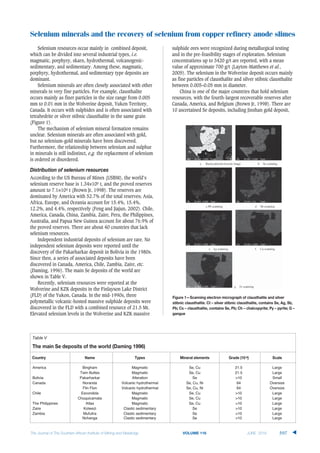
minerals in very fine particles. For example, clausthalite
occurs mainly as finer particles in the size range from 0.005
mm to 0.01 mm in the Wolverine deposit, Yukon Territory,
Canada. It occurs with sulphides and is often associated with
tetrahedrite or silver stibnic clausthalite in the same grain
(Figure 1).
The mechanism of selenium mineral formation remains
unclear. Selenium minerals are often associated with gold,
but no selenium-gold minerals have been discovered.
Furthermore, the relationship between selenium and sulphur
in minerals is still indistinct, e.g. the replacement of selenium
is ordered or disordered.
According to the US Bureau of Mines (USBM), the world’s
selenium reserve base is 1.34×10⁵ t, and the proved reserves
amount to 7.1×10⁴ t (Brown Jr, 1998). The reserves are
dominated by America with 52.7% of the total reserves; Asia,
Africa, Europe, and Oceania account for 15.4%, 15.4%,
12.2%, and 4.4%, respectively (Feng and Jiajun, 2002). Chile,
America, Canada, China, Zambia, Zaire, Peru, the Philippines,
Australia, and Papua New Guinea account for about 76.9% of
the proved reserves. There are about 40 countries that lack
selenium resources.
Independent industrial deposits of selenium are rare. No
independent selenium deposits were reported until the
discovery of the Pakarharkar deposit in Bolivia in the 1980s.
Since then, a series of associated deposits have been
discovered in Canada, America, Chile, Zambia, Zaire, etc.
(Daming, 1996). The main Se deposits of the world are
shown in Table V.
Recently, selenium resources were reported at the
Wolverine and KZK deposits in the Finlayson Lake District
(FLD) of the Yukon, Canada. In the mid-1990s, three
polymetallic volcanic-hosted massive sulphide deposits were
discovered in the FLD with a combined resource of 21.5 Mt.
Elevated selenium levels in the Wolverine and KZK massive
sulphide ores were recognized during metallurgical testing
and in the pre-feasibility stages of exploration. Selenium
concentrations up to 3420 g/t are reported, with a mean
value of approximate 700 g/t (Layton-Matthews et al.,
2005). The selenium in the Wolverine deposit occurs mainly
as fine particles of clausthalite and silver stibnic clausthalite
between 0.005–0.05 mm in diameter.
China is one of the major countries that hold selenium
resources, with the fourth-largest recoverable reserves after
Canada, America, and Belgium (Brown Jr, 1998). There are
10 ascertained Se deposits, including Jinshan gold deposit,
Selenium minerals and the recovery of selenium from copper refinery anode slimes
VOLUME 116 597
L
Table V
America Bingham Magmatic Se, Cu 21.5 Large
Twin Buttes Magmatic Se, Cu 21.5 Large
Bolivia Pakarharkar Alteration Se >10 Small
Canada Noranda Volcanic hydrothermal Se, Cu, Ni 64 Oversize
Flin Flon Volcanic hydrothermal Se, Cu, Ni 64 Oversize
Chile Escondida Magmatic Se, Cu >10 Large
Chuquicamata Magmatic Se, Cu >10 Large
The Philippines Atlas Magmatic Se, Cu >10 Large
Zaire Kolwezi Clastic sedimentary Se >10 Large
Zambia Mufulira Clastic sedimentary Se >10 Large
Nchanga Clastic sedimentary Se >10 Large
Selenium minerals and the recovery of selenium from copper refinery anode slimes
Baijiazuizi Cu-Ni deposit, and Chengmenshan copper deposit
(Zuomin, 1997). In addition, some independent selenium
deposits have been discovered in China, i.e. the Yutangba Se
deposit and Laerma Se-Au deposit (Wen and Qiu, 1999).
Proven reserves of selenium occur mainly with copper and
nickel ores, and are distributed in the northwest of China and
the Lower Yangtze region. The main Se deposits of China are
shown in Table VI.
The largest source of selenium is the anode slimes formed
during the electrolytic refining of copper (Elkin and
Margrave, 1982). Production usually begins by oxidation to
produce selenium dioxide at an appropriate temperature. The
selenium dioxide is then dissolved in water and the solution
is acidified to form selenous acid (oxidation step). Selenous
acid is sparged with sulphur dioxide (reduction step) to yield
elemental selenium. In South Africa, Se is mostly removed to
about 1 mg/L before the leach solution is sent to copper
electrowinning. In South African refineries, Se is recovered
mostly by precipitation using sulphurous acid. Different
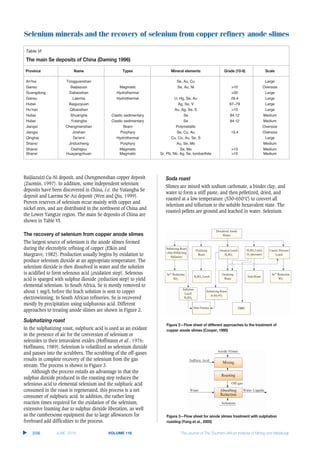
approaches to treating anode slimes are shown in Figure 2.
In the sulphatizing roast, sulphuric acid is used as an oxidant
in the presence of air for the conversion of selenium or
selenides to their tetravalent oxides (Hoffmann et al., 1976;
Hoffmann, 1989). Selenium is volatilized as selenium dioxide
and passes into the scrubbers. The scrubbing of the off-gases
results in complete recovery of the selenium from the gas
stream. The process is shown in Figure 3.
Although the process entails an advantage in that the
sulphur dioxide produced in the roasting step reduces the
selenious acid to elemental selenium and the sulphuric acid
consumed in the roast is regenerated, this process is a net
consumer of sulphuric acid. In addition, the rather long
reaction times required for the oxidation of the selenium,
extensive foaming due to sulphur dioxide liberation, as well
as the cumbersome equipment due to large allowances for
freeboard add difficulties to the process.
Slimes are mixed with sodium carbonate, a binder clay, and
water to form a stiff paste, and then pelletized, dried, and
roasted at a low temperature (530–650°C) to convert all
selenium and tellurium to the soluble hexavalent state. The
roasted pellets are ground and leached in water. Selenium
L
598 VOLUME 116
Table VI
An’hui Tongguanshan Se, Au, Cu Large
Gansu Baijiazuizi Magmatic Se, Au, Ni >10 Oversize
Guangdong Dabaoshan Hydrothermal >30 Large
Gansu Laerma Hydrothermal U, Hg, Se, Au 29.4 Large
Hubei Baiguoyuan Ag, Se, V 67~79 Large
Hu’nan Qibaoshan Au, Ag, Se, S >10 Large
Hubei Shuanghe Clastic sedimentary Se 84.12 Medium
Hubei Yutangba Clastic sedimentary Se 84.12 Medium
Jiangxi Chengmenshan Skarn Polymetallic Oversize
Jiangxi Jinshan Porphyry Se, Cu, Au 15.4 Oversize
Qinghai De’erni Hydrothermal Cu, Co, Au, Se, S Large
Shanxi Jinduicheng Porphyry Au, Se, Mo Medium
Shanxi Dashigou Magmatic Se, Mo >10 Medium
Shanxi Huayangchuan Magmatic Sr, Pb, Nb, Ag, Se, tombarthite >10 Medium
Mixing
Sulfatizing Roast
in So2+O2
Dore Furnace TBRC
Soda Roast
Oxidizing
Roast
Caustic Pressure
Leach
Se4+
Reduction
SO2
Se4+
Reduction
SO2
Sulfation
Leach
H2SO4
Oxidizing
Roast
H2SO4 Leach
H2SO4 Leach
O2 (pressure)
Aeration Leach
H2SO4
Sulfatizing Roast
(Also Pellitiziing
Sulfation)
Dewatered Anode
Slimes
Roasting
Absorbing
Reduction
goes into solution (as the selenate Na2SeO4), while tellurium
is insoluble in the alkaline solution; thus the two elements
are separated in this stage (Figure 4).
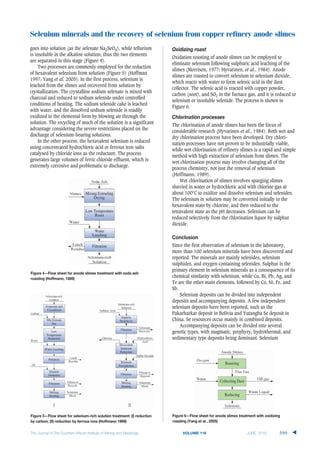
Two processes are commonly employed for the reduction
of hexavalent selenium from solution (Figure 5) (Hoffman
1997; Yang et al. 2005). In the first process, selenium is
leached from the slimes and recovered from solution by
crystallization. The crystalline sodium selenate is mixed with
charcoal and reduced to sodium selenide under controlled
conditions of heating. The sodium selenide cake is leached
with water, and the dissolved sodium selenide is readily
oxidized to the elemental form by blowing air through the
solution. The recycling of much of the solution is a significant
advantage considering the severe restrictions placed on the
discharge of selenium-bearing solutions.
In the other process, the hexavalent selenium is reduced
using concentrated hydrochloric acid or ferrous iron salts
catalysed by chloride ions as the reductant. The process
generates large volumes of ferric chloride effluent, which is
extremely corrosive and problematic to discharge.
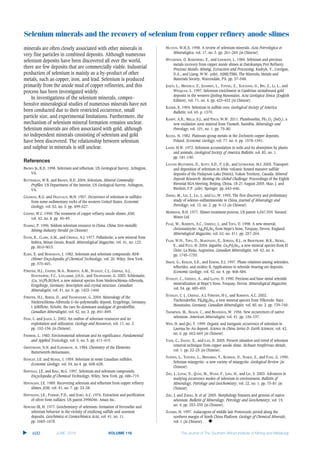
Oxidation roasting of anode slimes can be employed to
eliminate selenium following sulphuric acid leaching of the
slimes (Morrison, 1977; Hyvarinen, et al., 1984). Anode
slimes are roasted to convert selenium to selenium dioxide,
which reacts with water to form selenic acid in the dust
collector. The selenic acid is reacted with copper powder,
carbon (soot), and SO2 in the furnace gas, and it is reduced to
selenium or insoluble selenide. The process is shown in
Figure 6.
The chlorination of anode slimes has been the focus of
considerable research (Hyvarinen et al., 1984). Both wet and
dry chlorination process have been developed. Dry chlori-
nation processes have not proven to be industrially viable,
while wet chlorination of refinery slimes is a rapid and simple
method with high extraction of selenium from slimes. The
wet chlorination process may involve changing all of the
process chemistry, not just the removal of selenium
(Hoffmann, 1989).
Wet chlorination of slimes involves sparging slimes
slurried in water or hydrochloric acid with chlorine gas at
about 100°C to oxidize and dissolve selenium and selenides.
The selenium in solution may be converted initially to the
hexavalent state by chlorine, and then reduced to the
tetravalent state as the pH decreases. Selenium can be
reduced selectively from the chlorination liquor by sulphur
dioxide.
Since the first observation of selenium in the laboratory,
more than 100 selenium minerals have been discovered and
reported. The minerals are mainly selenides, selenium
sulphides, and oxygen-containing selenides. Sulphur is the
primary element in selenium minerals as a consequence of its
chemical similarity with selenium, while Cu, Bi, Pb, Ag, and
Te are the other main elements, followed by Co, Ni, Fe, and
Sb.
Selenium deposits can be divided into independent
deposits and accompanying deposits. A few independent
selenium deposits have been reported, such as the
Pakarharkar deposit in Bolivia and Yutangba Se deposit in
China. Se resources occur mainly in combined deposits.
Accompanying deposits can be divided into several
genetic types, with magmatic, porphyry, hydrothermal, and
sedimentary type deposits being dominant. Selenium
Selenium minerals and the recovery of selenium from copper refinery anode slimes
VOLUME 116 599
L
Collecting Dust
Reducing
Filtration
Mixing Extruding
Drying
Impurity
Hydrolysis
Filtration
Filtration
Melting
Shotting
Selenide
Oxidation
Filtration
Melting
Shotting
Filtration
Water Leaching
Low
Temperature
Reduction
Hexavalent
Selenium
Reduction
Selenium
Precipitation
Mix Extrude
Dry
Evaporate and
Crystallized
Low Temperature
Roast
Water
Leaching
Roasting
Selenium minerals and the recovery of selenium from copper refinery anode slimes
minerals are often closely associated with other minerals in
very fine particles in combined deposits. Although numerous
selenium deposits have been discovered all over the world,
there are few deposits that are commercially viable. Industrial
production of selenium is mainly as a by-product of other
metals, such as copper, iron, and lead. Selenium is produced
primarily from the anode mud of copper refineries, and this
process has been investigated widely.
In investigations of the selenium minerals, compre-
hensive mineralogical studies of numerous minerals have not
been conducted due to their restricted occurrence, small
particle size, and experimental limitations. Furthermore, the
mechanism of selenium mineral formation remains unclear.
Selenium minerals are often associated with gold, although
no independent minerals consisting of selenium and gold
have been discovered. The relationship between selenium
and sulphur in minerals is still unclear.
BROWN JR, R.D. 1998. Selenium and tellurium. US Geological Survey, Arlington,
VA.
BUTTERMAN, W.R. and BROWN, R.D. 2004. Selenium. Mineral Commodity
Profiles. US Department of the Interior, US Geological Survey, Arlington,
VA.
COLEMAN, R.G. and DELEVAUX, M.H. 1957. Occurrence of selenium in sulfides
from some sedimentary rocks of the western United States. Economic
Geology, vol. 52, no. 5. pp. 499–527.
COOPER, W.C. 1990. The treatment of copper refinery anode slimes. JOM,
vol. 42, no. 8. pp. 45–49.
DAMING, P. 1996. Seldom selenium resource in China. China Non-metallic
Mining Industry Herald (in Chinese)
DAVIS, R., CLARK, A.M., and CRIDDLE, A.J. 1977. Palladseite, a new mineral from
Itabira, Minas Gerais, Brazil. Mineralogical Magazine, vol. 41, no. 123.
pp. M10–M13.
ELKIN, E. and MARGRAVE, J. 1982. Selenium and selenium compounds. Kirk-
Othmer Encyclopedia of Chemical Technology, vol. 20. Wiley, New York.
pp. 575–601.
FÖRSTER, H.J., COOPER, M.A., ROBERTS, A.M., STANLEY, C.J., CRIDDLE, A.J.,
HAWTHORNE, F.C., LAFLAMME, J.H.G., and TISCHENDORF, G. 2003. Schlemaite,
(Cu, )6(Pb,Bi)Se4, a new mineral species from Niederschlema–Alberoda,
Erzgebirge, Germany: description and crystal structure. Canadian
Mineralogist, vol. 41, no. 6. pp. 1433–1444.
FÖRSTER, H.J., RHEDE, D., and TISCHENDORF, G. 2004. Mineralogy of the
Niederschlema–Alberoda U–Se–polymetallic deposit, Erzgebirge, Germany.
I. Jolliffeite, NiAsSe, the rare Se-dominant analogue of gersdorffite.
Canadian Mineralogist, vol. 42, no. 3. pp. 841–849.
FENG, C. and JIAJUN, L. 2002. An outline of selenium resources and its
exploitation and utilization. Geology and Resources, vol. 11, no. 3.
pp. 152–156 (in Chinese).
FISHBEIN, L. 1983. Environmental selenium and its significance. Fundamental
and Applied Toxicology, vol. 3, no. 5. pp. 411–419.
GREENWOOD, N.N. and EARNSHAW, A. 1984. Chemistry of the Elements.
Butterworth-Heinemann.
HAWLEY, J.E. and NICHOL, I. 1959. Selenium in some Canadian sulfides.
Economic Geology, vol. 54, no.4. pp. 608–628.
HOFFMAN, J.E. and KING, M.G. 1997. Selenium and selenium compounds.
Encyclopedia of Chemical Technology. Wiley, New York. pp. 686–719.
HOFFMANN, J.E. 1989. Recovering selenium and tellurium from copper refinery
slimes. JOM, vol. 41, no. 7. pp. 33–38.
HOFFMANN, J.E., PARKER, P.D., and SABO, A.C. 1976. Extraction and purification
of silver from sulfates. US patent 3996046. Amax Inc.
HOWARD III, H. 1977. Geochemistry of selenium: formation of ferroselite and
selenium behavior in the vicinity of oxidizing sulfide and uranium
deposits. Geochimica et Cosmochimica Acta, vol. 41, no. 11.
pp. 1665–1678.
HUAYUN, W.H.X. 1998. A review of selenium minerals. Acta Petrrologica et
Mineralogica, vol. 17, no. 3. pp. 261–265 (in Chinese).
HYVARINEN, O. ROSENBERG, E., and LINDROOS, L. 1984. Selenium and precious
metals recovery from copper anode slimes at Outokumpu Pori Refinery.
Precious Metals: Mining, Extraction and Processing. Kudryk, V., Corrigan,
D.A., and Liang, W.W. (eds). AIME/TMS, The Minerals, Metals and
Materials Society, Warrendale, PA. pp. 37–548.
JIAJUN, L., MINGHUA, Z., JIANMING, L., YUFENG, Z., XUEXIANG, G., BIN, Z., LI, L., and
WENQUAN, L. 1997. Selenium enrichment in Cambrian stratabound gold
deposits in the western Qinling Mountains. Acta Geologica Sinica (English
Edition), vol. 71, no. 4. pp. 423–432 (in Chinese).
KAISER, E. 1954. Selenium in sulfide ores. Geological Society of America
Bulletin, vol. 65. p. 1379.
KAMPF, A.R., MILLS, S.J., and PINCH, W.W. 2011. Plumboselite, Pb3 O2 (SeO3), a
new oxidation-zone mineral from Tsumeb, Namibia. Mineralogy and
Petrology, vol. 101, no. 1. pp. 75–80.
KUCHA, H. 1982. Platinum-group metals in the Zechstein copper deposits,
Poland. Economic Geology, vol. 77, no. 6. pp. 1578–1591.
LAKIN, H.W. 1972. Selenium accumulation in soils and its absorption by plants
and animals. Geological Society of America Bulletin, vol. 83, no. 1.
pp. 181–190.
LAYTON-MATTHEWS, D., SCOTT, S.D., P, J.M., and LEYBOURNE, M.I. 2005. Transport
and deposition of selenium in felsic volcanic-hosted massive sulfide
deposits of the Finlayson Lake District, Yukon Territory, Canada. Mineral
Deposit Research: Meeting the Global Challenge. Proceedings of the Eighth
Biennial SGA Meeting, Beijing, China, 18-21 August 2005. Mao, J. and
Bierlein, F.P. (eds). Springer. pp. 643–646.
ZHENG, M., LIU, J., LIU, J., and LU, W. 1993. The first discovery and preliminary
study of selenio-sulfantimonide in China. Journal of Mineralogy and
Petrology, vol. 13, no. 2. pp. 9–13 (in Chinese).
MORRISON, B.H. 1977. Slimes treatment process. US patent 4,047,939. Norand
Mines Ltd.
PAAR, W., ROBERTS, A.C., CRIDDLE, J., and TOPA, D. 1998. A new mineral,
chrisstanleyite, Ag2Pd3Se4 from Hope's Nose, Torquay, Devon, England.
Mineralogical Magazine, vol. 62, no. 411. pp. 257–264.
PAAR, W.H., TOPA, D., MAKOVICKY, E., SUREDA, R.J., DE BRODTKORB, M.K., NICKEL,
E., and PUTZ, H. 2004. Jaguéite, Cu2Pd3Se4, a new mineral species from El
Chire, La Rioja, Argentina. Canadian Mineralogist, vol. 42, no. 6.
pp. 1745–1755.
SIMON, G., KESLER, S.E., and ESSENE, E.J. 1997. Phase relations among selenides,
tellurides, and oxides; II, Applications to selenide-bearing ore deposits.
Economic Geology, vol. 92, no. 4. pp. 468–484.
STANLEY, C., CRIDDLE, A., and LLOYD, D. 1990. Precious and base metal selenide
mineralization at Hope’s Nose, Torquay, Devon. Mineralogical Magazine,
vol. 54. pp. 485–493.
STANLEY, C. J., CRIDDLE, A.J. FÖRSTER, H-J., and ROBERTS, A.C. 2002.
Tischendorfite, Pd8Hg3Se9, a new mineral species from Tilkerode, Harz
Mountains, Germany. Canadian Mineralogist, vol. 40, no. 2. pp. 739–745.
THOMPSON, M., ROACH, C., and BRADDOCK, W. 1956. New occurrences of native
selenium. American Mineralogist, vol. 41. pp. 156–157.
WEN, H. and QIU, Y. 1999. Organic and inorganic occurrence of selenium in
Laerma Se-Au deposit. Science in China Series D: Earth Sciences, vol. 42,
no. 6. pp. 662–669 (in Chinese).
YANG, C., ZHANG, X., and LAN, D. 2005. Present situation and trend of selenium
removal technique from copper anode slime. Sichuan Nonferrous Metals,
vol. 1. pp. 22–25 (in Chinese).
YUNFEN, L., YUEYING, L., MINGMING, Y., KUISHOU, D., NAIJUE, Z., and FANG, G. 1990.
Selenian miargyrite--a new variety of miargyrite. Geological Review (in
Chinese).
ZHU, J., LIANG, X., QANG, M., WANG, F., LING, H., and LIU, S. 2003. Advances in
studying occurrence modes of selenium in environment. Bulletin of
Mineralogy, Petrology and Geochemistry, vol. 22, no. 1. pp. 75–81 (in
Chinese).
ZHU, J. and ZHENG, B. et al. 2005. Morphology features and genesis of native
selenium. Bulletin of Mineralogy, Petrology and Geochemistry, vol. 19,
no. 4. pp. 353–355 (in Chinese).
ZUOMIN, H. 1997. Aulacogens of middle late Proterozoic period along the
northern margin of North China Platform. Geology of Chemical Minerals,
vol. 1 (in Chinese). N
L
600 VOLUME 116

18

  • 1.
    Selenium (Se) wasfirst observed in 1817 in a laboratory (Greenwood et al., 1984). The discovery of selenium was made by the Swedish chemist J.J. Berzelius and J.G. Gahn, who isolated selenium from a red residue in sulphuric acid from pyrite mined at Fahlun, Sweden. Selenium was named from the Greek word selene (moon), since it resembled tellurium, which had been discovered a few years earlier and named from the Latin word tellus (Earth). After the first observation of selenium in the laboratory, selenium received considerable interest. In 1954, E.P. Kaiser pointed out that Se is enriched in sulphide ores and often associated with Bi, Co, Sn etc. (Kaiser 1954). In 1959, Hawley and Nichol investigated selenium in Canadian sulphide minerals, and presented the content of selenium in sulphide from several deposits of different types. They also proposed that Se is enriched in low- temperature hydrothermal pyrite (Hawley and Nichol, 1959). The thermodynamic conditions for forming native selenium and selenium minerals in sedimentary rocks were discussed, as well as geochemical behaviour of selenium near the oxidation zones of sulphides in the 1970s (Howard III, 1977; Zhu et al., 2003). Zhu et al. examined the morphology, features, and genesis of native selenium from Yutangba, Enshi City, Hubei Province, China in 2004, and pointed out, from the different forms of native Se, that selenium can be activated,transformed, remobilized, and enriched at sites such as in the unsaturated subsurface zone or in the saturated zone (Zhu et al., 2005). The transport and deposition of selenium in felsic volcanic-hosted massive sulphide deposits of the Yukon Territory, Canada was studied and reported by Layton- Matthews et al. (2005). Selenium is a comparatively rare and greatly dispersed element. The average selenium content in the Earth's crust is considered to vary between 0.05 and 0.09 g/g (Lakin 1972; Greenwood et al., 1984; Jiajun et al., 1997). Elemental selenium is seldom found in nature; industrially, selenium is obtained as a by-product of mining other metals such as copper, iron, and lead (Fishbein 1983; Wen and Qiu 1999). It is produced primarily from the anode slimes of copper refineries (Butterman et al., 2004). There are various reports in the literature on the treatment of copper anode slimes to recover selenium (Hoffmann 1989; Cooper 1990). In this paper, we provide an overview of selenium minerals, as well as the recovery of selenium from copper refinery anode slimes. Our focus is on the occurrence of selenium minerals and selenium deposits. We also examined the research work reported in the literature on the treatment of copper refinery anode slimes for the recovery of selenium. In 1956, Thompson et al. discovered felty Selenium minerals and the recovery of selenium from copper refinery anode slimes by C. Wang*, S. Li*, H. Wang*, and J. Fu* Since it was first identified in 1817, selenium has received considerable interest. Native selenium and a few selenium minerals were discovered several decades later. With the increasing number of selenium minerals, the occurrence of selenium minerals became the focus of much research. A great number of selenium deposits were reported all over the world, although few independent selenium deposits were discovered. Selenium is obtained mainly as a byproduct of other metals, and is produced primarily from the anode mud of copper refineries. This paper presents a compre- hensive review of selenium minerals, as well as the treatment of copper refinery anode slimes for the recovery of selenium. Our focus is on the selenium minerals, including their discovery and occurrence, and the distribution of selenium resources. In addition, the main methods of recovering selenium from copper anode slimes are summarized. selenium, selenium minerals, anode slimes. * School of Mining Engineering, University of the Witwatersrand, Johannesburg, South Africa. © The Southern African Institute of Mining and Metallurgy, 2016. ISSN 2225-6253. Paper received Dec. 2012; revised paper received Feb. 2016. 593VOLUME 116 L http://dx.doi.org/10.17159/2411-9717/2016/v116n6a16
  • 2.
    Selenium minerals andthe recovery of selenium from copper refinery anode slimes native selenium, which is violet acicular crystal. Coleman and Delevaux (1957) investigated the occurrence of selenium in sulphide from sandstone-type uranium ores in the western USA, and discovered trigonal and monoclinic native selenium, as well as clausthalite and ferroselite (Thompson et al,. 1956; Coleman and Delevaux, 1957). The occurrence of large particle of native selenium up to 20–30 mm in length in coal seams was reported by Zhu et al. (2005). In 1990, spherical and tubular native selenium was discovered in a hydrothermal U-Se-Re polymetallic deposit (Zhu et al., 2003). The selenide deposits in the eastern Harz Mountains, Germany were intensively studied. The selenide-bearing deposits at Tilkerode, Lerbach, Clausthal, Zorge, St. Andreasberg, and Trogthal, are recognized as typical selenide vein deposits of telethermal origin (Simon et al., 1997). The polymetallic selenide mineralization at Tilkerode, Zorge, Lerbach, and Trogthal occurs mainly as small deposits not associated with larger base-metal deposits, while the selenide minerals at Clausthal and St. Andreasberg are associated with larger deposits mined primarily for silver, lead, zinc, and copper. The series of selenides from Tilkerode was identified mainly by Tischendorf: clausthalite (PbSe), naumannite (Ag2Se), tiemannite (HgSe), eskebornite (CuFeSe2), trogtalite (CoSe2), hastite (CoSe2), freboldite (CoSe), bornhardtite (Co3Se4), berzelianite (Cu2Se), umangite (Cu3Se2), klockmannite (CuSe), and stibiopalladinite (Pd5Sb2) (Davis et al., 1977; Stanley et al., 2002). Two unidentified minerals, noted by Tischendorf in 1958, represented two new species: chrisstanleyite (Ag2Pd3Se4) and tischendorfite (Pd8Hg3Se9) (Stanley et al., 1990, 2002). Wallis described a number of additional mineral species in the Tilkerode selenide assemblage: kruˇtaite (CuSe2), athabascaite (Cu5Se4), temagamite (Pd3HgTe3), eucairite (CuAgSe), trüstedtite (Ni3Se4), penroseite ((Ni,Co,Cu)Se2), and geffroyite ((Ag,Cu,Fe)9(S,Se)8) (Stanley et al., 2002). Davis et al. (1977) reported a new selenide of palladium, palladseite (Pd17Se15), which occurs in the residual concen- trates from gold washing at Itabira, Minas Gerais, Brazil and is associated with arsenopalladinite, isomertieite, and atheneite. Selenian miargyrite (AgSb(Se0.6S1.4)2), a new variety of miargyrite, was found in gold-bearing quartz veins in middle-lower Silurian quartzite of the Ailaoshan metamorphic belt, Yunnan province, China. It is intimately associated with freibergite, stibnite, ullmannite, and native gold and occurs as grains from 0.1 to 0.02 mm in diameter (Yunfen et al., 1990). Stanley et al. (1990) examined the precious and base metal selenide mineralization at Hope’s Nose, Torquay, Devon, England. The selenide assemblage consists of clausthalite (PbSe), tiemannite (HgSe), klockmannite (CuSe), umangite (Cu3Se2), tyrrellite ((Cu,Co,Ni)3Se4), trustedtite (Ni3Se4), penroseite (NiSe2), naumannite (Ag2Se), eucairite (AgCuSe), and fischesserite (Ag3AuSe2). A new mineral, chrisstanleyite (Ag2Pd3Se4), was discovered in gold-bearing carbonate veins in Middle Devonian limestones at Hope's Nose. It is associated with palladian and argentian gold, fischesserite, clausthalite, eucairite, tiemannite, umangite, cerussite, calcite, and bromian chlorargyrite (Paar et al., 1998). Selenio-sulfantimonide was discovered in the Laerma gold-copper-uranium deposit in China in 1993. It is associated with native gold, tiemannite, clasthalite, lautite, aurostibite, gersdorffite, quartz, barite, etc. and occurs as fine grains, about 0.01–0.5 mm (Minghua et al., 1993). As many selenium minerals were identified and discovered, numerous investigators conducted imvestigations on selenium minerals. More than 90 selenium minerals had been identified by 1998. Wen and co-workers reviewed the selenium minerals and their occurrence (Huayun, 1998). Recently, a new series of selenium minerals was discovered. Stanley et al. (2002) reported a new mineral species from the Eskaborner Stollen at Tilkerode, Harz Mountains, Germany. Tischendorfite occurs as aggregates in a carbonate matrix, together with the associated metallic minerals clausthalite, tiemannite, chrisstanleyite, stibiopalla- dinite, and gold. Schlemaite, a new mineral species from the Niederschlema–Alberoda vein-type uranium deposit, was discovered at Hartenstein, Erzgebirge, Germany. It occurs in aggregates of up to several hundred micrometres across, with berzelianite, eucairite, and clausthalite in a dolomite-ankerite matrix. Of the three vein-type uranium deposits in the Schneeberg-Schlema-Alberoda ore district, Niederschlema- Alberoda is considered the major occurrence of selenides in the Erzgebirge of Germany. In addition, rare selenides of Cu, Bi, Hg, Ni, and other elements were reported (Förster et al., 2003). Jaguéite, the copper analogue of chrisstanleyite, was discovered in a telethermal selenide vein-type deposit at the El Chire prospect, Los Llantenes District of La Rioja Province, Argentina. The new species is generally associated with chrisstanleyite, particularly in intimate intergrowths, clausthalite, naumannite, tiemannite, klockmannite, berzelianite, umangite, and aguilarite. In addition, two unnamed compounds, chemically (Ag, Cu)6Hg2Pb2Se3 and (Ag, Cu)8Hg3(S, Se)7, occur as rare constituents (Paar et al., 2004). Jolliffeite, previously known only from Lake Athabasca, Saskatchewan, Canad was reported from the Niederschlema– Alberoda uranium deposit in the Erzgebirge region of Germany. Jolliffeite, an exotic mineral, is associated with haematite, Ni–Co–Se-bearing löllingite, clausthalite, tiemannite, mercurian hakite–giraudite solid solutions, sulphurian berzelianite, sulphurian umangite, hessite, Ni-Co- As-bearing pyrite, and Se-rich chalcopyrite (Förster et al., 2004). Three occurrences of clausthalite were reported in Poland, in abandoned polymetallic deposits at Kowary and Kletno and the Fore-Sudetic copper deposits (Thompson et al., 1956; Kucha, 1982). A new occurrence of clausthalite, together with uraninite, was reported in the Sudetes, southwest Poland. Clausthalite forms veinlets in a breccia comprising <50% calc- silicate rock fragments (Thompson et al., 1956). Plumboselite, a new selenite from the Tsumeb mine, Namibia, occurs as fibres on clausthalite and is associated with smithsonite, mimetite, and vaterite. It occurs in subparallel to divergent clusters of thin, flattened, colourless fibres up to 0.3 mm in length (Kampf et al., 2011). All the reported selenium minerals are shown in Tables I– III. The minerals are mainly selenides, selenium sulphides L 594 VOLUME 116
  • 3.
    Selenium minerals andthe recovery of selenium from copper refinery anode slimes 595VOLUME 116 L Table I Antimonselite Sb2Se3 Athabascaite Cu5Se4 Bambollaite Cu(Se, Te)2 Bellidoite Cu2Se Berzelianite Cu2Se Bohdanowiczite AgBiSe2 Bornhardtite Co+2Co2 +3Se4 Bukovite Tl2Cu3FeSe4 Cadmoselite CdSe Clausthalite PbSe Crookesite Cu7(Tl, Ag) Se4 Dzharkenite FeSe2 Eskebornite CuFeSe2 Eucairite CuAgSe Ferroselite FeSe2 Fischesserite Ag3AuSe2 Freboldite CoSe Guanajuatite Bi2Se3 Hastite CoSe2 Jolliffeite (Ni, Co) AsSe Kitkaite NiTeSe Klockmannite CuSe Kullerudite NiSe2 Luberoite Pt5Se4 Makinenite γ-NiSe Mgriite Cu3AsSe3 Merenskyite (Pd, Pt) (Te, Se, Bi)2 Naumannite Ag2Se Oosterboschite (Pd, Cu)7Se3 Padmaite PdBiSe Palladseite Pd17Se15 Penroseite (Ni, Co,Cu) Se2 Permingeatite Cu3SbSe4 Petrovicite PbHgCu3BiSe5 Sabatierite Cu4TlSe3 Sederholmite β-NiSe Selen-tellurium (Se, Te) Stilleite ZnSe Tiemannite HgSe Trogtalite CoSe2 Trustedtite Ni3Se4 Tyrrellite (Cu, Co, Ni)3Se4 Umangite Cu3Se2 Wilkmanite Ni3Se4 Schlemaite (Cu, ?)6 (Pb, Bi)Se4 (IMA99. 023) Cu2HgSe2 Krutaite CuSe2 Achavalite FeSe Sudovikovite PtSe2 Chrisstanleyite Ag2Pd3Se4 Jaguéite Cu2Pd3Se4 Tischendorfite Pd8Hg3Se9 Plumboselite Pb3O2(SeO3), Table II Aguilarite Ag4SeS Chameanite (Cu, Fe)4 As(Se, S)4 Csiklovaite Bi2Te(S, Se)2 Drysdallite Mo(Se, S)2 Geffroyite (Ag, Cu, Fe)9 (Se, S)8 Giraudite (Cu, Zn, Ag)12 (As, Sb)4 (Se, S)13 Hakite (Cu, Hg)3 (Sb, As) (Se, S)3 Ikunolite Bi4(S, Se)3 Jeromite As(S, Se)2 Junoite Pb3Cu2Bi8 (S, Se)16 Kawazulite Bi2 (Te, Se, S)3 Kurilite (Au, Ag)2 (Te, Se, S) Laitakarite Bi4(Se, S)3 Laphamite As2(Se, S)3 Nevskite Bi(Se, S) Nordstromite Pb3CuBi7S10Se4 Paraguanajuatite Bi2(Se, S)3 Pekoite PbCuBi11(S,Se)18 Penzhinite (Ag, Cu)4Au(S, Se)4 Petrovskaite AuAg(S, Se) Platynite (Pb, Bi)3 (Se, S)4 Poubaite PbBi2Se2(Te, S)2 Proudite Cu0~1Pb7.5Bi9.3~9.7(S,Se)22 Selenostephanite Ag5Sb(Se, S)4 Skippenite Bi2Se2(Te, S) Soucekite PbCuBi(S, Se)3 Tsnigriite Ag9SbTe3 (S, Se)3 Watkinsonite PbCu2Bi4 (Se, S, Te)8 Weibullite Pb6Bi8(S, Se)18 Wittite Pb3Bi4 (S, Se)9 Crerarite (Pt, Pb) Bi3(S, Se)4 –X (X~0.7) Vihorlatite Bi8+X (Se, Te, S)11-X Babkinite Pb2Bi2 (S, Se)3 Mozgovaite PbBi4 (S, Se)7
  • 4.
    Selenium minerals andthe recovery of selenium from copper refinery anode slimes and oxygen-containing selenides (Huayun, 1998). There are a few native selenium minerals, selenium oxides, as well as intermetallic compounds between selenium and metals. Selenium is chemically very similar to sulphur, and sulphur is the primary accompanying element in selenium minerals. Many of its compounds are analogues of sulphur compounds, and selenium substitutes for sulphur in minerals and other compounds. Cu, Bi, Pb, Ag, and Te are the main element in selenium minerals, followed by Co, Ni, Fe, and Sb. Based on the content of selenium in sulphides, Yang (Huayun, 1998) described the affinity between Se and related elements, which can be divided into three categories (with decreasing affinity): (1) Pb, Ag, Bi, Hg, Cu; (2) Co, Ni; (3) Fe, Zn. Se forms a few minerals with precious metals, e.g. Au, Ag, Pt, Pb. Mineralogical studies of numerous selenium minerals have not been fully conducted due to their restricted occurrence, small particle size, and experimental limitations. For instance, there are five selenides of nickel: kullerudite, makinenite, sederholmite, trustedtite, and wilkmanite, but no information has been reported about reflectivity or color index (Huayun, 1998). Selenium minerals occur in various forms, which can be divided primarily into three categories: independent minerals; isomorphism; adsorbed on clay minerals. Although there are about 100 selenium minerals, the metal rarely occurs in commercial concentrations. Selenium occurs mainly in sulphides or sulphosalt minerals in the form of isomorphism; there are rare selenium deposits that are commercially viable (Brown Jr, 1998; Huayun, 1998). Selenium deposits can be divided into independent deposits and accompanying deposits. The occurrence of some selenium minerals is shown in Table IV. As regards independent selenium deposits, hydrothermal deposits are dominating type, and the Pakarharkar deposit in Bolivia is typical, while the Yutangba Se deposit in China, a sedimentary deposit, is an exception. L 596 VOLUME 116 Table III Ahlfeldite (Ni,Co)SeO3·2H2O Carlosruizite K6 (Na, K)4 Na6 Mg10 (Se6O4)12 (IO3)12·12H2O Chalcomenite CuSeO3·2H2O Chloromenite Cu9O2 (SeO3)4Cl6 Clinochalcomenite CuSeO3·2H2O Cobaltomenite CoSeO3·2H2O Demesmaekerite Pb2Cu5(UO2)2(SeO3)6(OH)6·2H2O Derriksite Cu4(UO2)(SeO3)2(OH)6 Downeyite SeO2 Francisite Cu3Bi (SeO3)2O2Cl Georgbokiite Cu5O2 (SeO3)2Cl2 Guilleminite Ba(UO2)3(SeO3)2(OH)4·3H2O Haynesite (UO2)3(SeO3)2(OH)2·5H2O Ilinskite NaCu5O2 (SeO3)2 Cl Kerstenite PbSeO4 (?) Mandarinoite Fe2Se3O9·6H2O Marthozite Cu(UO2)3(SeO3)3(OH)2·7H2O Molybdomenite PbSeO3 Olsacherite Pb2(SeO4)(SO4) Orlandiite Pb3 (Cl, OH)4 (SeO3)·H2O Piretite Ca(UO2)3(SeO3)2 (OH)4·4H2O Schmiederite Pb2Cu2(SeO3)(SeO4)(OH)4 Selenolite SeO2 Sophiite Zn2(SeO3)Cl2 (IMA2000-050) KCdCu7O2 (SeO3)2Cl9 (IMA96.002) Ca0.75 (H3O)0.25 (UO2)3 (SeO3)2 (OH)3.75·2.5H2O Table IV Placer deposits Clausthalite, makinenite, ferroselite, cadmoselite, selenium Tin deposits Laitakarite, clausthalite, guanajuatite Kustelite deposits Fischesserite, naumannite, clausthalite, berzelianite, guanajuatite, paraguanajuatite Uranium deposits Demesmaekerite, derriksite, guilleminite, haynesite, marthozite, antimonselite, umangite, dzharkenite, berzelianite Contact metasomatic deposits Clausthalite, guanajuatite, paraguanajuatite Oxidation zone of copper-cobalt sulphide deposits Eucairite, trogtalite Carbonate gangue Calcite veins Clausthalite, guanajuatite, paraguanajuatite, tiemannite, naumannite, bellidoite, berzelianite, umangite, crookesite, dzharkenite, antimonselite, aguilarite, athabascaite Dolomitic gangue Clausthalite, hastite, trogtalite, bornhardtite Siderite veins Clausthalite, penroseite, naumannite, tiemannite Quartz vein Kawazulite, laitakarite Carbonate –albite veins Clausthalite, kitkaite, paraguanajuatite, penroseite, Ni-selenide Quartz-anthophyllite veins Laitakarite
  • 5.
    Selenium resources occurmainly in combined deposit, which can be divided into several industrial types, i.e. magmatic, porphyry, skarn, hydrothermal, volcanogenic- sedimentary, and sedimentary. Among these, magmatic, porphyry, hydrothermal, and sedimentary type deposits are dominant. Selenium minerals are often closely associated with other minerals in very fine particles. For example, clausthalite occurs mainly as finer particles in the size range from 0.005 mm to 0.01 mm in the Wolverine deposit, Yukon Territory, Canada. It occurs with sulphides and is often associated with tetrahedrite or silver stibnic clausthalite in the same grain (Figure 1). The mechanism of selenium mineral formation remains unclear. Selenium minerals are often associated with gold, but no selenium-gold minerals have been discovered. Furthermore, the relationship between selenium and sulphur in minerals is still indistinct, e.g. the replacement of selenium is ordered or disordered. According to the US Bureau of Mines (USBM), the world’s selenium reserve base is 1.34×10⁵ t, and the proved reserves amount to 7.1×10⁴ t (Brown Jr, 1998). The reserves are dominated by America with 52.7% of the total reserves; Asia, Africa, Europe, and Oceania account for 15.4%, 15.4%, 12.2%, and 4.4%, respectively (Feng and Jiajun, 2002). Chile, America, Canada, China, Zambia, Zaire, Peru, the Philippines, Australia, and Papua New Guinea account for about 76.9% of the proved reserves. There are about 40 countries that lack selenium resources. Independent industrial deposits of selenium are rare. No independent selenium deposits were reported until the discovery of the Pakarharkar deposit in Bolivia in the 1980s. Since then, a series of associated deposits have been discovered in Canada, America, Chile, Zambia, Zaire, etc. (Daming, 1996). The main Se deposits of the world are shown in Table V. Recently, selenium resources were reported at the Wolverine and KZK deposits in the Finlayson Lake District (FLD) of the Yukon, Canada. In the mid-1990s, three polymetallic volcanic-hosted massive sulphide deposits were discovered in the FLD with a combined resource of 21.5 Mt. Elevated selenium levels in the Wolverine and KZK massive sulphide ores were recognized during metallurgical testing and in the pre-feasibility stages of exploration. Selenium concentrations up to 3420 g/t are reported, with a mean value of approximate 700 g/t (Layton-Matthews et al., 2005). The selenium in the Wolverine deposit occurs mainly as fine particles of clausthalite and silver stibnic clausthalite between 0.005–0.05 mm in diameter. China is one of the major countries that hold selenium resources, with the fourth-largest recoverable reserves after Canada, America, and Belgium (Brown Jr, 1998). There are 10 ascertained Se deposits, including Jinshan gold deposit, Selenium minerals and the recovery of selenium from copper refinery anode slimes VOLUME 116 597 L Table V America Bingham Magmatic Se, Cu 21.5 Large Twin Buttes Magmatic Se, Cu 21.5 Large Bolivia Pakarharkar Alteration Se >10 Small Canada Noranda Volcanic hydrothermal Se, Cu, Ni 64 Oversize Flin Flon Volcanic hydrothermal Se, Cu, Ni 64 Oversize Chile Escondida Magmatic Se, Cu >10 Large Chuquicamata Magmatic Se, Cu >10 Large The Philippines Atlas Magmatic Se, Cu >10 Large Zaire Kolwezi Clastic sedimentary Se >10 Large Zambia Mufulira Clastic sedimentary Se >10 Large Nchanga Clastic sedimentary Se >10 Large
  • 6.
    Selenium minerals andthe recovery of selenium from copper refinery anode slimes Baijiazuizi Cu-Ni deposit, and Chengmenshan copper deposit (Zuomin, 1997). In addition, some independent selenium deposits have been discovered in China, i.e. the Yutangba Se deposit and Laerma Se-Au deposit (Wen and Qiu, 1999). Proven reserves of selenium occur mainly with copper and nickel ores, and are distributed in the northwest of China and the Lower Yangtze region. The main Se deposits of China are shown in Table VI. The largest source of selenium is the anode slimes formed during the electrolytic refining of copper (Elkin and Margrave, 1982). Production usually begins by oxidation to produce selenium dioxide at an appropriate temperature. The selenium dioxide is then dissolved in water and the solution is acidified to form selenous acid (oxidation step). Selenous acid is sparged with sulphur dioxide (reduction step) to yield elemental selenium. In South Africa, Se is mostly removed to about 1 mg/L before the leach solution is sent to copper electrowinning. In South African refineries, Se is recovered mostly by precipitation using sulphurous acid. Different approaches to treating anode slimes are shown in Figure 2. In the sulphatizing roast, sulphuric acid is used as an oxidant in the presence of air for the conversion of selenium or selenides to their tetravalent oxides (Hoffmann et al., 1976; Hoffmann, 1989). Selenium is volatilized as selenium dioxide and passes into the scrubbers. The scrubbing of the off-gases results in complete recovery of the selenium from the gas stream. The process is shown in Figure 3. Although the process entails an advantage in that the sulphur dioxide produced in the roasting step reduces the selenious acid to elemental selenium and the sulphuric acid consumed in the roast is regenerated, this process is a net consumer of sulphuric acid. In addition, the rather long reaction times required for the oxidation of the selenium, extensive foaming due to sulphur dioxide liberation, as well as the cumbersome equipment due to large allowances for freeboard add difficulties to the process. Slimes are mixed with sodium carbonate, a binder clay, and water to form a stiff paste, and then pelletized, dried, and roasted at a low temperature (530–650°C) to convert all selenium and tellurium to the soluble hexavalent state. The roasted pellets are ground and leached in water. Selenium L 598 VOLUME 116 Table VI An’hui Tongguanshan Se, Au, Cu Large Gansu Baijiazuizi Magmatic Se, Au, Ni >10 Oversize Guangdong Dabaoshan Hydrothermal >30 Large Gansu Laerma Hydrothermal U, Hg, Se, Au 29.4 Large Hubei Baiguoyuan Ag, Se, V 67~79 Large Hu’nan Qibaoshan Au, Ag, Se, S >10 Large Hubei Shuanghe Clastic sedimentary Se 84.12 Medium Hubei Yutangba Clastic sedimentary Se 84.12 Medium Jiangxi Chengmenshan Skarn Polymetallic Oversize Jiangxi Jinshan Porphyry Se, Cu, Au 15.4 Oversize Qinghai De’erni Hydrothermal Cu, Co, Au, Se, S Large Shanxi Jinduicheng Porphyry Au, Se, Mo Medium Shanxi Dashigou Magmatic Se, Mo >10 Medium Shanxi Huayangchuan Magmatic Sr, Pb, Nb, Ag, Se, tombarthite >10 Medium Mixing Sulfatizing Roast in So2+O2 Dore Furnace TBRC Soda Roast Oxidizing Roast Caustic Pressure Leach Se4+ Reduction SO2 Se4+ Reduction SO2 Sulfation Leach H2SO4 Oxidizing Roast H2SO4 Leach H2SO4 Leach O2 (pressure) Aeration Leach H2SO4 Sulfatizing Roast (Also Pellitiziing Sulfation) Dewatered Anode Slimes Roasting Absorbing Reduction
  • 7.
    goes into solution(as the selenate Na2SeO4), while tellurium is insoluble in the alkaline solution; thus the two elements are separated in this stage (Figure 4). Two processes are commonly employed for the reduction of hexavalent selenium from solution (Figure 5) (Hoffman 1997; Yang et al. 2005). In the first process, selenium is leached from the slimes and recovered from solution by crystallization. The crystalline sodium selenate is mixed with charcoal and reduced to sodium selenide under controlled conditions of heating. The sodium selenide cake is leached with water, and the dissolved sodium selenide is readily oxidized to the elemental form by blowing air through the solution. The recycling of much of the solution is a significant advantage considering the severe restrictions placed on the discharge of selenium-bearing solutions. In the other process, the hexavalent selenium is reduced using concentrated hydrochloric acid or ferrous iron salts catalysed by chloride ions as the reductant. The process generates large volumes of ferric chloride effluent, which is extremely corrosive and problematic to discharge. Oxidation roasting of anode slimes can be employed to eliminate selenium following sulphuric acid leaching of the slimes (Morrison, 1977; Hyvarinen, et al., 1984). Anode slimes are roasted to convert selenium to selenium dioxide, which reacts with water to form selenic acid in the dust collector. The selenic acid is reacted with copper powder, carbon (soot), and SO2 in the furnace gas, and it is reduced to selenium or insoluble selenide. The process is shown in Figure 6. The chlorination of anode slimes has been the focus of considerable research (Hyvarinen et al., 1984). Both wet and dry chlorination process have been developed. Dry chlori- nation processes have not proven to be industrially viable, while wet chlorination of refinery slimes is a rapid and simple method with high extraction of selenium from slimes. The wet chlorination process may involve changing all of the process chemistry, not just the removal of selenium (Hoffmann, 1989). Wet chlorination of slimes involves sparging slimes slurried in water or hydrochloric acid with chlorine gas at about 100°C to oxidize and dissolve selenium and selenides. The selenium in solution may be converted initially to the hexavalent state by chlorine, and then reduced to the tetravalent state as the pH decreases. Selenium can be reduced selectively from the chlorination liquor by sulphur dioxide. Since the first observation of selenium in the laboratory, more than 100 selenium minerals have been discovered and reported. The minerals are mainly selenides, selenium sulphides, and oxygen-containing selenides. Sulphur is the primary element in selenium minerals as a consequence of its chemical similarity with selenium, while Cu, Bi, Pb, Ag, and Te are the other main elements, followed by Co, Ni, Fe, and Sb. Selenium deposits can be divided into independent deposits and accompanying deposits. A few independent selenium deposits have been reported, such as the Pakarharkar deposit in Bolivia and Yutangba Se deposit in China. Se resources occur mainly in combined deposits. Accompanying deposits can be divided into several genetic types, with magmatic, porphyry, hydrothermal, and sedimentary type deposits being dominant. Selenium Selenium minerals and the recovery of selenium from copper refinery anode slimes VOLUME 116 599 L Collecting Dust Reducing Filtration Mixing Extruding Drying Impurity Hydrolysis Filtration Filtration Melting Shotting Selenide Oxidation Filtration Melting Shotting Filtration Water Leaching Low Temperature Reduction Hexavalent Selenium Reduction Selenium Precipitation Mix Extrude Dry Evaporate and Crystallized Low Temperature Roast Water Leaching Roasting
  • 8.
    Selenium minerals andthe recovery of selenium from copper refinery anode slimes minerals are often closely associated with other minerals in very fine particles in combined deposits. Although numerous selenium deposits have been discovered all over the world, there are few deposits that are commercially viable. Industrial production of selenium is mainly as a by-product of other metals, such as copper, iron, and lead. Selenium is produced primarily from the anode mud of copper refineries, and this process has been investigated widely. In investigations of the selenium minerals, compre- hensive mineralogical studies of numerous minerals have not been conducted due to their restricted occurrence, small particle size, and experimental limitations. Furthermore, the mechanism of selenium mineral formation remains unclear. Selenium minerals are often associated with gold, although no independent minerals consisting of selenium and gold have been discovered. The relationship between selenium and sulphur in minerals is still unclear. BROWN JR, R.D. 1998. Selenium and tellurium. US Geological Survey, Arlington, VA. BUTTERMAN, W.R. and BROWN, R.D. 2004. Selenium. Mineral Commodity Profiles. US Department of the Interior, US Geological Survey, Arlington, VA. COLEMAN, R.G. and DELEVAUX, M.H. 1957. Occurrence of selenium in sulfides from some sedimentary rocks of the western United States. Economic Geology, vol. 52, no. 5. pp. 499–527. COOPER, W.C. 1990. The treatment of copper refinery anode slimes. JOM, vol. 42, no. 8. pp. 45–49. DAMING, P. 1996. Seldom selenium resource in China. China Non-metallic Mining Industry Herald (in Chinese) DAVIS, R., CLARK, A.M., and CRIDDLE, A.J. 1977. Palladseite, a new mineral from Itabira, Minas Gerais, Brazil. Mineralogical Magazine, vol. 41, no. 123. pp. M10–M13. ELKIN, E. and MARGRAVE, J. 1982. Selenium and selenium compounds. Kirk- Othmer Encyclopedia of Chemical Technology, vol. 20. Wiley, New York. pp. 575–601. FÖRSTER, H.J., COOPER, M.A., ROBERTS, A.M., STANLEY, C.J., CRIDDLE, A.J., HAWTHORNE, F.C., LAFLAMME, J.H.G., and TISCHENDORF, G. 2003. Schlemaite, (Cu, )6(Pb,Bi)Se4, a new mineral species from Niederschlema–Alberoda, Erzgebirge, Germany: description and crystal structure. Canadian Mineralogist, vol. 41, no. 6. pp. 1433–1444. FÖRSTER, H.J., RHEDE, D., and TISCHENDORF, G. 2004. Mineralogy of the Niederschlema–Alberoda U–Se–polymetallic deposit, Erzgebirge, Germany. I. Jolliffeite, NiAsSe, the rare Se-dominant analogue of gersdorffite. Canadian Mineralogist, vol. 42, no. 3. pp. 841–849. FENG, C. and JIAJUN, L. 2002. An outline of selenium resources and its exploitation and utilization. Geology and Resources, vol. 11, no. 3. pp. 152–156 (in Chinese). FISHBEIN, L. 1983. Environmental selenium and its significance. Fundamental and Applied Toxicology, vol. 3, no. 5. pp. 411–419. GREENWOOD, N.N. and EARNSHAW, A. 1984. Chemistry of the Elements. Butterworth-Heinemann. HAWLEY, J.E. and NICHOL, I. 1959. Selenium in some Canadian sulfides. Economic Geology, vol. 54, no.4. pp. 608–628. HOFFMAN, J.E. and KING, M.G. 1997. Selenium and selenium compounds. Encyclopedia of Chemical Technology. Wiley, New York. pp. 686–719. HOFFMANN, J.E. 1989. Recovering selenium and tellurium from copper refinery slimes. JOM, vol. 41, no. 7. pp. 33–38. HOFFMANN, J.E., PARKER, P.D., and SABO, A.C. 1976. Extraction and purification of silver from sulfates. US patent 3996046. Amax Inc. HOWARD III, H. 1977. Geochemistry of selenium: formation of ferroselite and selenium behavior in the vicinity of oxidizing sulfide and uranium deposits. Geochimica et Cosmochimica Acta, vol. 41, no. 11. pp. 1665–1678. HUAYUN, W.H.X. 1998. A review of selenium minerals. Acta Petrrologica et Mineralogica, vol. 17, no. 3. pp. 261–265 (in Chinese). HYVARINEN, O. ROSENBERG, E., and LINDROOS, L. 1984. Selenium and precious metals recovery from copper anode slimes at Outokumpu Pori Refinery. Precious Metals: Mining, Extraction and Processing. Kudryk, V., Corrigan, D.A., and Liang, W.W. (eds). AIME/TMS, The Minerals, Metals and Materials Society, Warrendale, PA. pp. 37–548. JIAJUN, L., MINGHUA, Z., JIANMING, L., YUFENG, Z., XUEXIANG, G., BIN, Z., LI, L., and WENQUAN, L. 1997. Selenium enrichment in Cambrian stratabound gold deposits in the western Qinling Mountains. Acta Geologica Sinica (English Edition), vol. 71, no. 4. pp. 423–432 (in Chinese). KAISER, E. 1954. Selenium in sulfide ores. Geological Society of America Bulletin, vol. 65. p. 1379. KAMPF, A.R., MILLS, S.J., and PINCH, W.W. 2011. Plumboselite, Pb3 O2 (SeO3), a new oxidation-zone mineral from Tsumeb, Namibia. Mineralogy and Petrology, vol. 101, no. 1. pp. 75–80. KUCHA, H. 1982. Platinum-group metals in the Zechstein copper deposits, Poland. Economic Geology, vol. 77, no. 6. pp. 1578–1591. LAKIN, H.W. 1972. Selenium accumulation in soils and its absorption by plants and animals. Geological Society of America Bulletin, vol. 83, no. 1. pp. 181–190. LAYTON-MATTHEWS, D., SCOTT, S.D., P, J.M., and LEYBOURNE, M.I. 2005. Transport and deposition of selenium in felsic volcanic-hosted massive sulfide deposits of the Finlayson Lake District, Yukon Territory, Canada. Mineral Deposit Research: Meeting the Global Challenge. Proceedings of the Eighth Biennial SGA Meeting, Beijing, China, 18-21 August 2005. Mao, J. and Bierlein, F.P. (eds). Springer. pp. 643–646. ZHENG, M., LIU, J., LIU, J., and LU, W. 1993. The first discovery and preliminary study of selenio-sulfantimonide in China. Journal of Mineralogy and Petrology, vol. 13, no. 2. pp. 9–13 (in Chinese). MORRISON, B.H. 1977. Slimes treatment process. US patent 4,047,939. Norand Mines Ltd. PAAR, W., ROBERTS, A.C., CRIDDLE, J., and TOPA, D. 1998. A new mineral, chrisstanleyite, Ag2Pd3Se4 from Hope's Nose, Torquay, Devon, England. Mineralogical Magazine, vol. 62, no. 411. pp. 257–264. PAAR, W.H., TOPA, D., MAKOVICKY, E., SUREDA, R.J., DE BRODTKORB, M.K., NICKEL, E., and PUTZ, H. 2004. Jaguéite, Cu2Pd3Se4, a new mineral species from El Chire, La Rioja, Argentina. Canadian Mineralogist, vol. 42, no. 6. pp. 1745–1755. SIMON, G., KESLER, S.E., and ESSENE, E.J. 1997. Phase relations among selenides, tellurides, and oxides; II, Applications to selenide-bearing ore deposits. Economic Geology, vol. 92, no. 4. pp. 468–484. STANLEY, C., CRIDDLE, A., and LLOYD, D. 1990. Precious and base metal selenide mineralization at Hope’s Nose, Torquay, Devon. Mineralogical Magazine, vol. 54. pp. 485–493. STANLEY, C. J., CRIDDLE, A.J. FÖRSTER, H-J., and ROBERTS, A.C. 2002. Tischendorfite, Pd8Hg3Se9, a new mineral species from Tilkerode, Harz Mountains, Germany. Canadian Mineralogist, vol. 40, no. 2. pp. 739–745. THOMPSON, M., ROACH, C., and BRADDOCK, W. 1956. New occurrences of native selenium. American Mineralogist, vol. 41. pp. 156–157. WEN, H. and QIU, Y. 1999. Organic and inorganic occurrence of selenium in Laerma Se-Au deposit. Science in China Series D: Earth Sciences, vol. 42, no. 6. pp. 662–669 (in Chinese). YANG, C., ZHANG, X., and LAN, D. 2005. Present situation and trend of selenium removal technique from copper anode slime. Sichuan Nonferrous Metals, vol. 1. pp. 22–25 (in Chinese). YUNFEN, L., YUEYING, L., MINGMING, Y., KUISHOU, D., NAIJUE, Z., and FANG, G. 1990. Selenian miargyrite--a new variety of miargyrite. Geological Review (in Chinese). ZHU, J., LIANG, X., QANG, M., WANG, F., LING, H., and LIU, S. 2003. Advances in studying occurrence modes of selenium in environment. Bulletin of Mineralogy, Petrology and Geochemistry, vol. 22, no. 1. pp. 75–81 (in Chinese). ZHU, J. and ZHENG, B. et al. 2005. Morphology features and genesis of native selenium. Bulletin of Mineralogy, Petrology and Geochemistry, vol. 19, no. 4. pp. 353–355 (in Chinese). ZUOMIN, H. 1997. Aulacogens of middle late Proterozoic period along the northern margin of North China Platform. Geology of Chemical Minerals, vol. 1 (in Chinese). N L 600 VOLUME 116