XoS “is like a Router”
“a very fast Router”
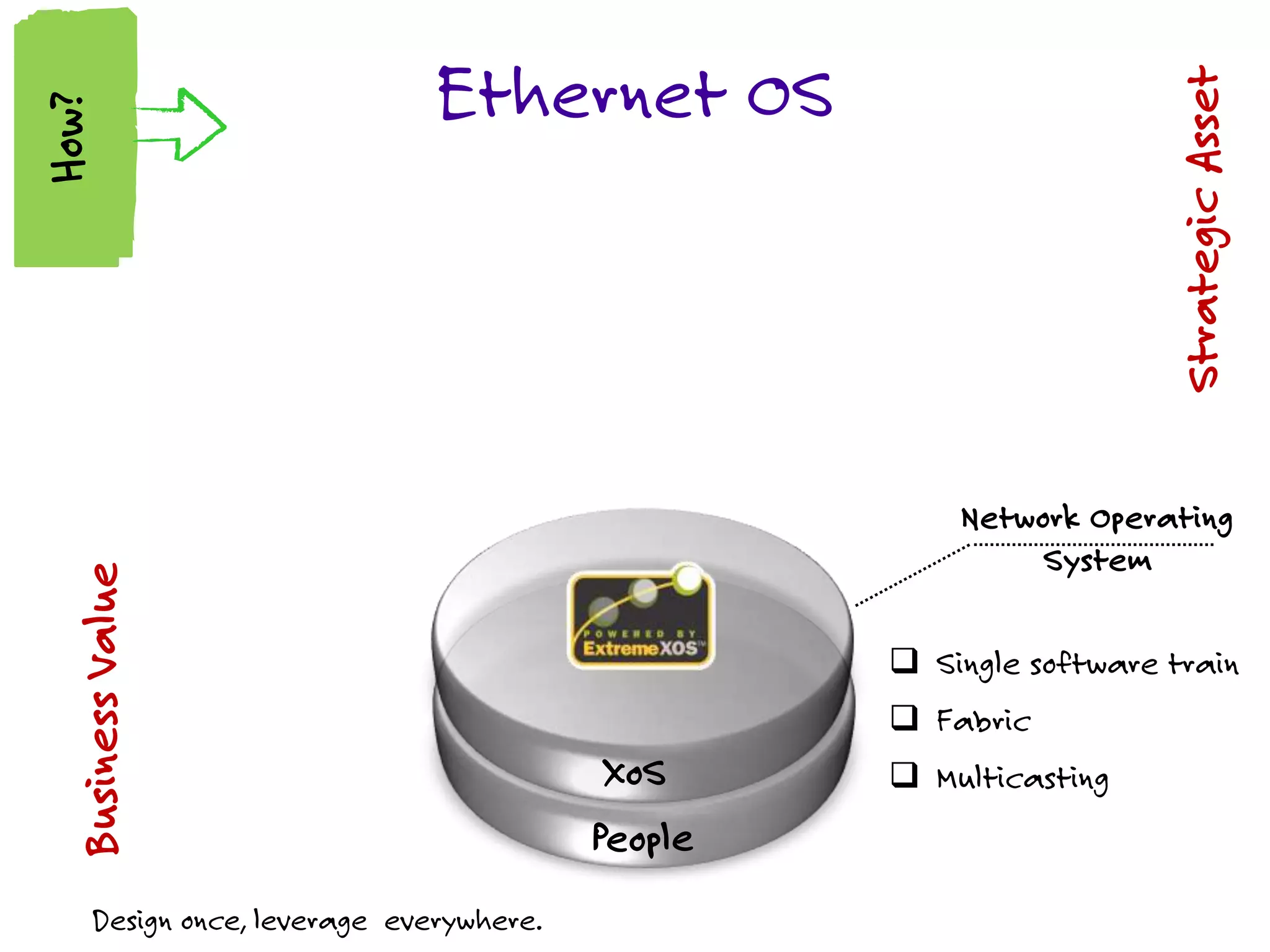
BusinessValue
StrategicAsset
Ethernet OS
 Single software train
 Fabric
 Multicasting
Network Operating
System
Design once, leverage everywhere.
Why?Why?How?
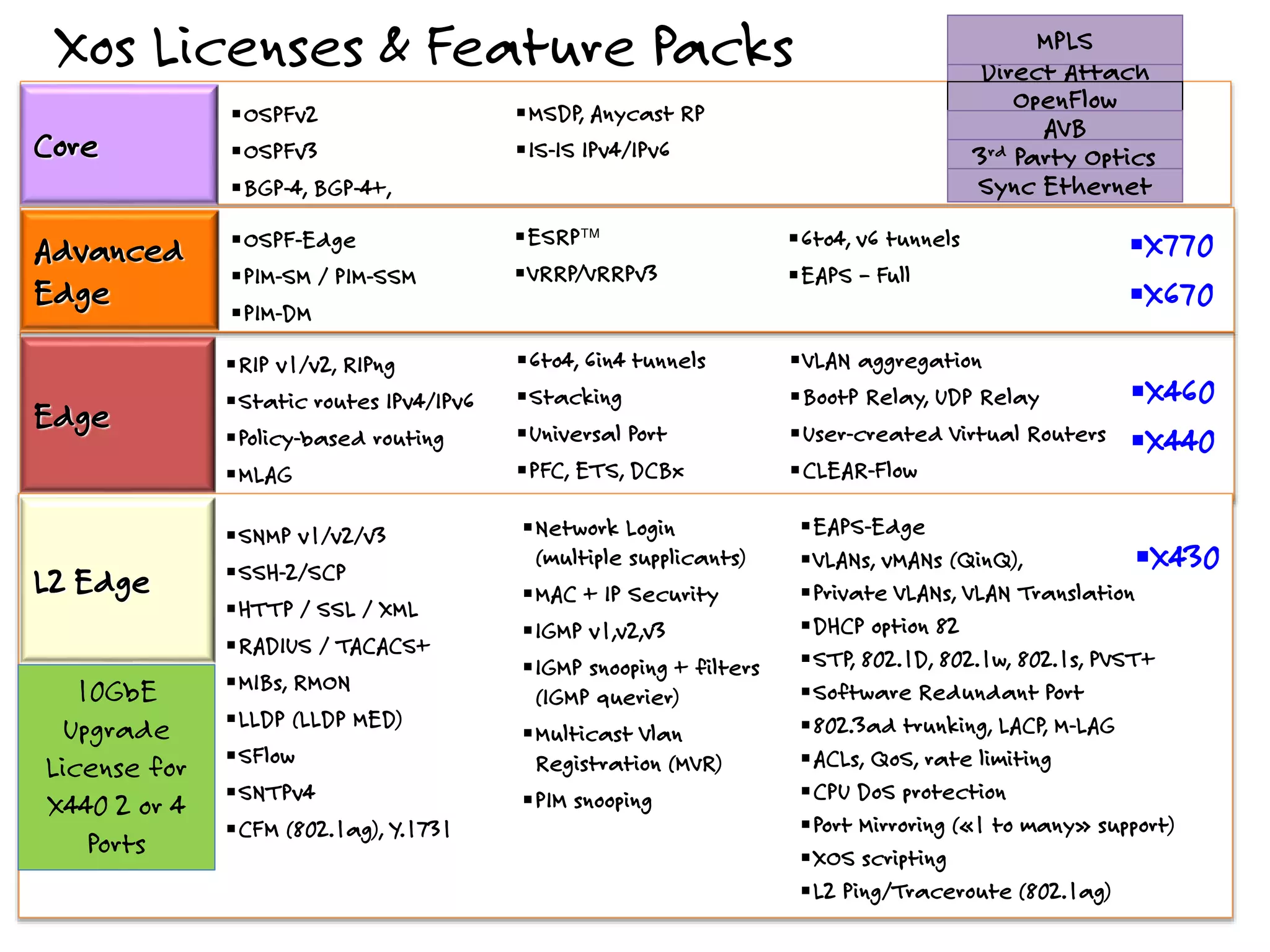
Xos Licenses & Feature Packs
OSPFv2
OSPFv3
BGP-4, BGP-4+,
MBGP
MSDP, Anycast RP
IS-IS IPv4/IPv6
OSPF-Edge
PIM-SM / PIM-SSM
PIM-DM
ESRP
VRRP/VRRPv3
6to4, v6 tunnels
EAPS – Full
Core
Edge
Advanced
Edge
SNMP v1/v2/v3
SSH-2/SCP
HTTP / SSL / XML
RADIUS / TACACS+
MIBs, RMON
LLDP (LLDP MED)
SFlow
SNTPv4
CFM (802.1ag), Y.1731
Network Login
(multiple supplicants)
MAC + IP Security
IGMP v1,v2,v3
IGMP snooping + filters
(IGMP querier)
Multicast Vlan
Registration (MVR)
PIM snooping
EAPS-Edge
VLANs, vMANs (QinQ),
Private VLANs, VLAN Translation
DHCP option 82
STP, 802.1D, 802.1w, 802.1s, PVST+
Software Redundant Port
802.3ad trunking, LACP, M-LAG
ACLs, QoS, rate limiting
CPU DoS protection
Port Mirroring («1 to many» support)
XOS scripting
L2 Ping/Traceroute (802.1ag)
L2 Edge
RIP v1/v2, RIPng
Static routes IPv4/IPv6
Policy-based routing
MLAG
6to4, 6in4 tunnels
Stacking
Universal Port
PFC, ETS, DCBx
VLAN aggregation
BootP Relay, UDP Relay
User-created Virtual Routers
CLEAR-Flow
X430
X460
X440
X770
X670
Direct Attach
MPLS
OpenFlow
AVB
3rd Party Optics
Sync Ethernet
10GbE
Upgrade
License for
X440 2 or 4
Ports
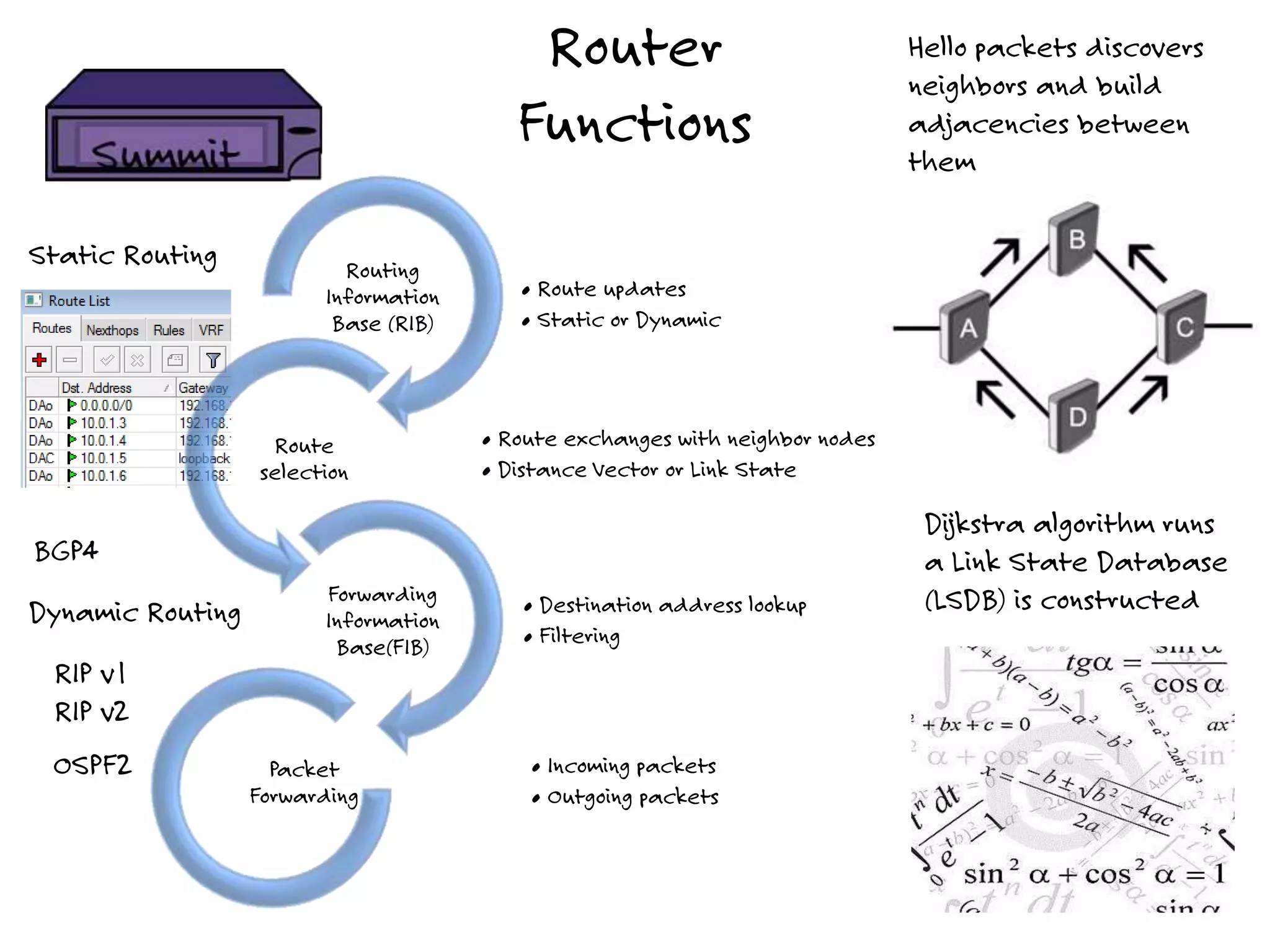
Router
Functions
• Route updates
• Static or Dynamic
Routing
Information
Base (RIB)
• Route exchanges with neighbor nodes
• Distance Vector or Link State
Route
selection
• Destination address lookup
• Filtering
Forwarding
Information
Base(FIB)
• Incoming packets
• Outgoing packets
Packet
Forwarding
Static Routing
Dynamic Routing
RIP v1
RIP v2
OSPF2
BGP4
Hello packets discovers
neighbors and build
adjacencies between
them
Dijkstra algorithm runs
a Link State Database
(LSDB) is constructed
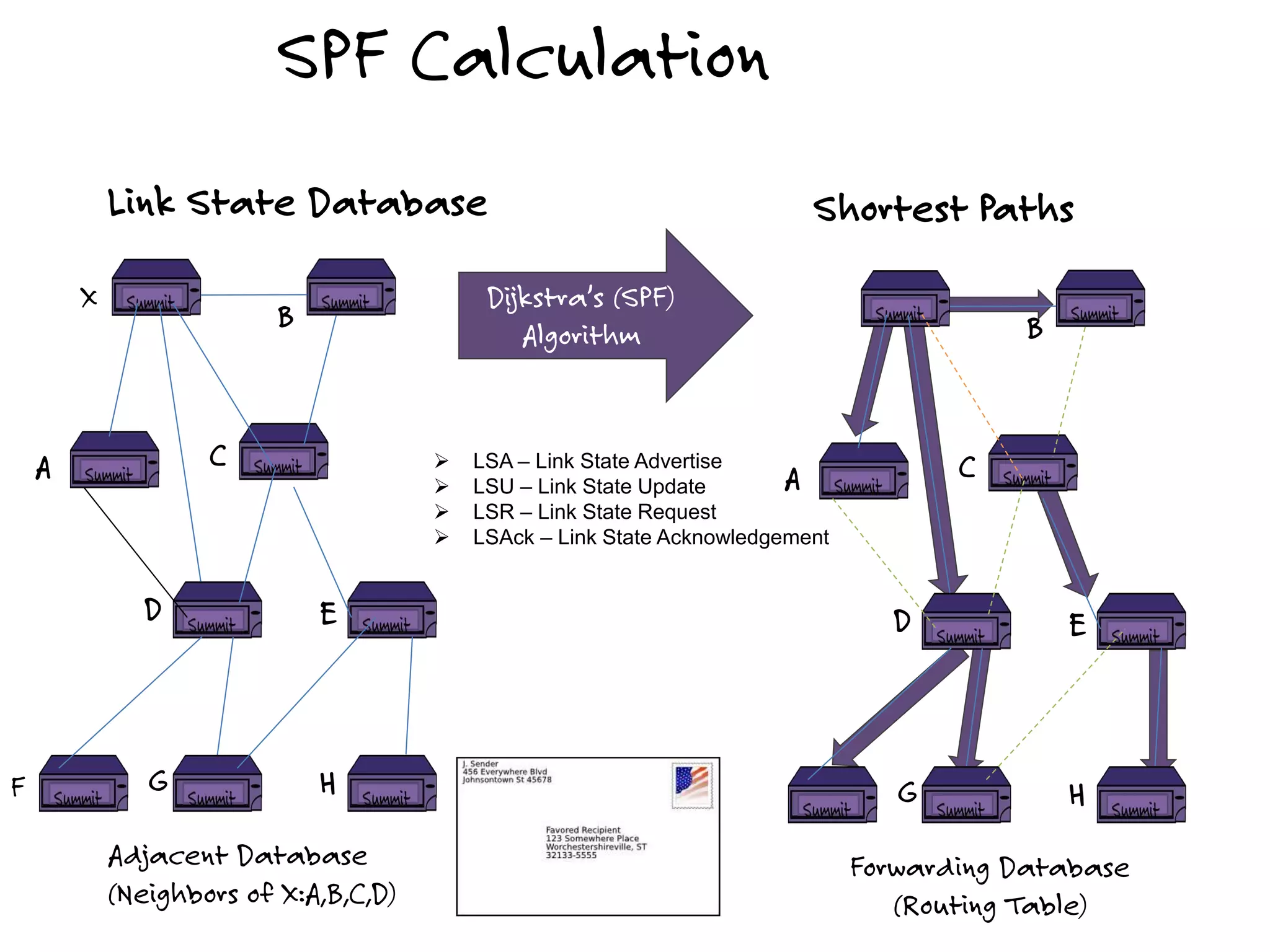
SPF Calculation
Link State Database
Dijkstra’s (SPF)
Algorithm
Adjacent Database
(Neighbors of X:A,B,C,D)
Shortest Paths
Forwarding Database
(Routing Table)
X
B
A C
D E
F G H
B
A C
D E
G H
 LSA – Link State Advertise
 LSU – Link State Update
 LSR – Link State Request
 LSAck – Link State Acknowledgement
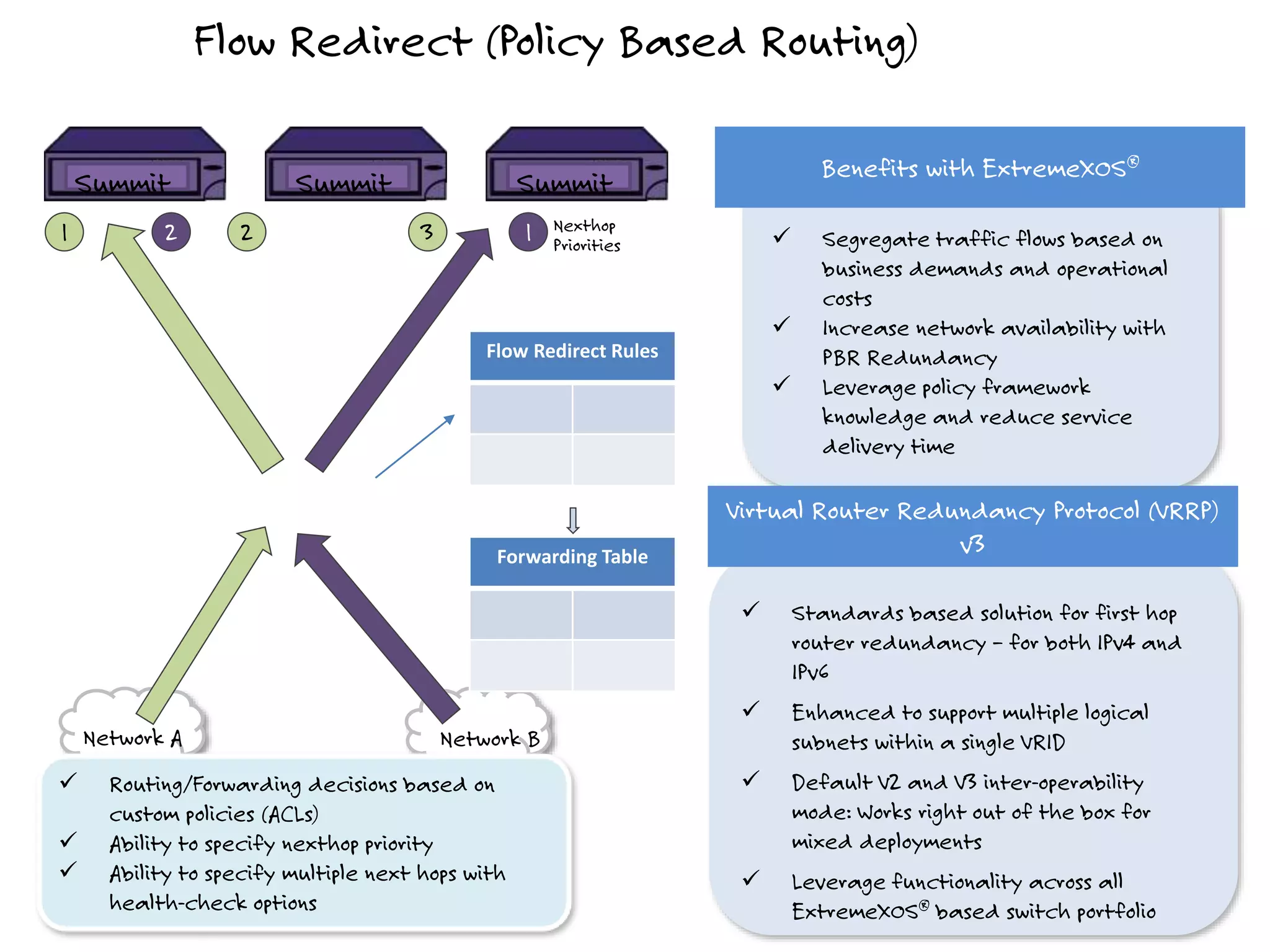
Flow Redirect (Policy Based Routing)
Forwarding Table
1 2 3 12
Flow Redirect Rules
 Routing/Forwarding decisions based on
custom policies (ACLs)
 Ability to specify nexthop priority
 Ability to specify multiple next hops with
health-check options
 Segregate traffic flows based on
business demands and operational
costs
 Increase network availability with
PBR Redundancy
 Leverage policy framework
knowledge and reduce service
delivery time
Benefits with ExtremeXOS®
Network A Network B
Nexthop
Priorities
 Standards based solution for first hop
router redundancy – for both IPv4 and
IPv6
 Enhanced to support multiple logical
subnets within a single VRID
 Default V2 and V3 inter-operability
mode: Works right out of the box for
mixed deployments
 Leverage functionality across all
ExtremeXOS® based switch portfolio
Virtual Router Redundancy Protocol (VRRP)
v3
Summit Summit Summit
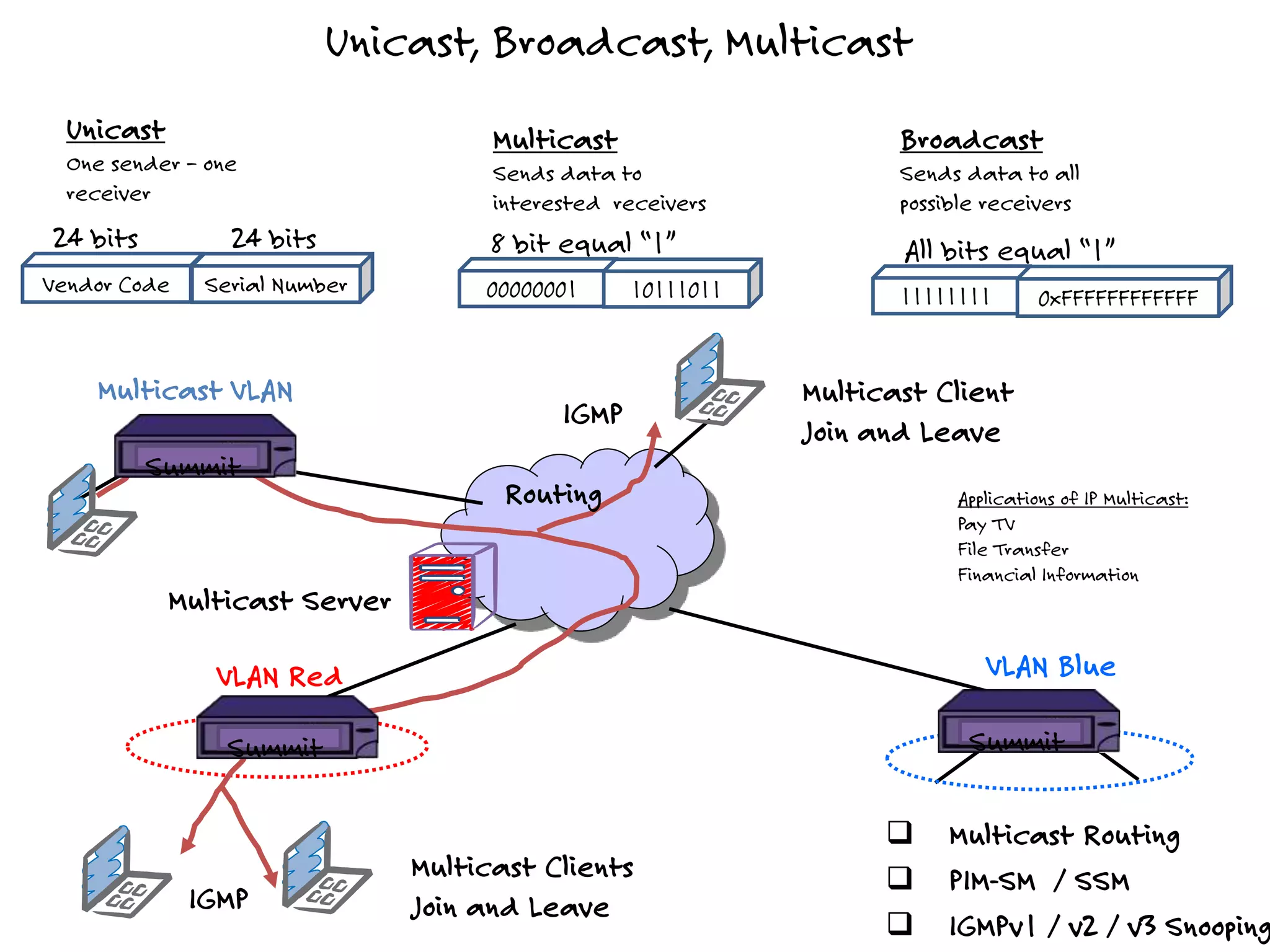
Unicast, Broadcast, Multicast
Unicast
One sender – one
receiver
Broadcast
Sends data to all
possible receivers
Multicast
Sends data to
interested receivers
VLAN Red VLAN Blue
Multicast VLAN
Multicast Server
Multicast Client
Join and Leave
 Multicast Routing
 PIM-SM / SSM
 IGMPv1 / v2 / v3 Snooping
IGMP
IGMP
Multicast Clients
Join and Leave
Routing
Summit
Summit Summit
Applications of IP Multicast:
Pay TV
File Transfer
Financial Information
Vendor Code Serial Number
24 bits 24 bits
00000001
8 bit equal “1”
10111011 11111111
All bits equal “1”
0xFFFFFFFFFFFF
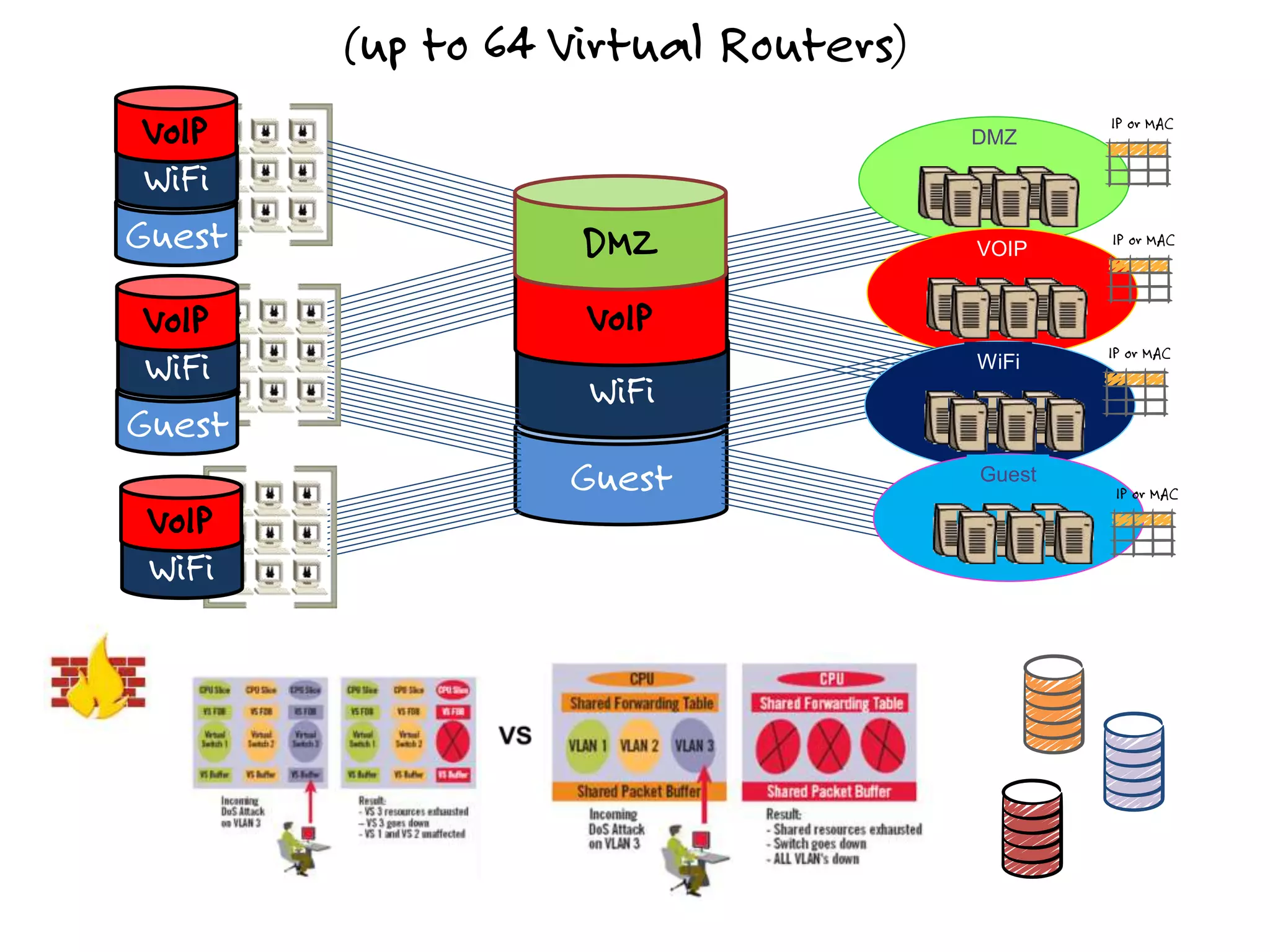
(up to 64 Virtual Routers)
DMZ
VOIP
Guest
WiFi
VoIP
DMZ
WiFi
Guest
Guest
WiFi
VoIP
Guest
WiFi
VoIP
WiFi
VoIP
IP or MAC
IP or MAC
IP or MAC
IP or MAC
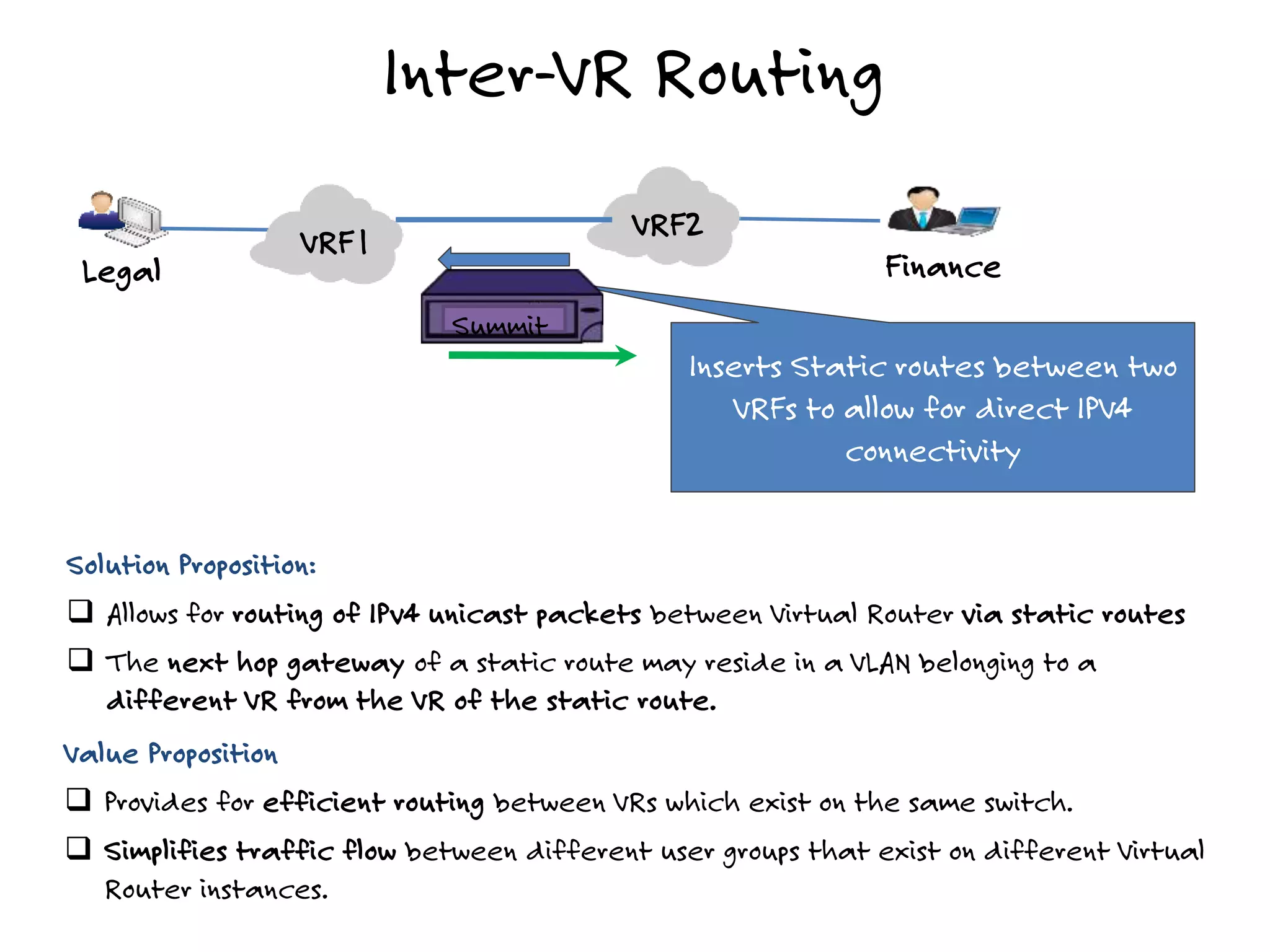
Inter-VR Routing
Legal Finance
VRF1
VRF2
Solution Proposition:
 Allows for routing of IPv4 unicast packets between Virtual Router via static routes
 The next hop gateway of a static route may reside in a VLAN belonging to a
different VR from the VR of the static route.
Value Proposition
 Provides for efficient routing between VRs which exist on the same switch.
 Simplifies traffic flow between different user groups that exist on different Virtual
Router instances.
Inserts Static routes between two
VRFs to allow for direct IPV4
connectivity
Summit
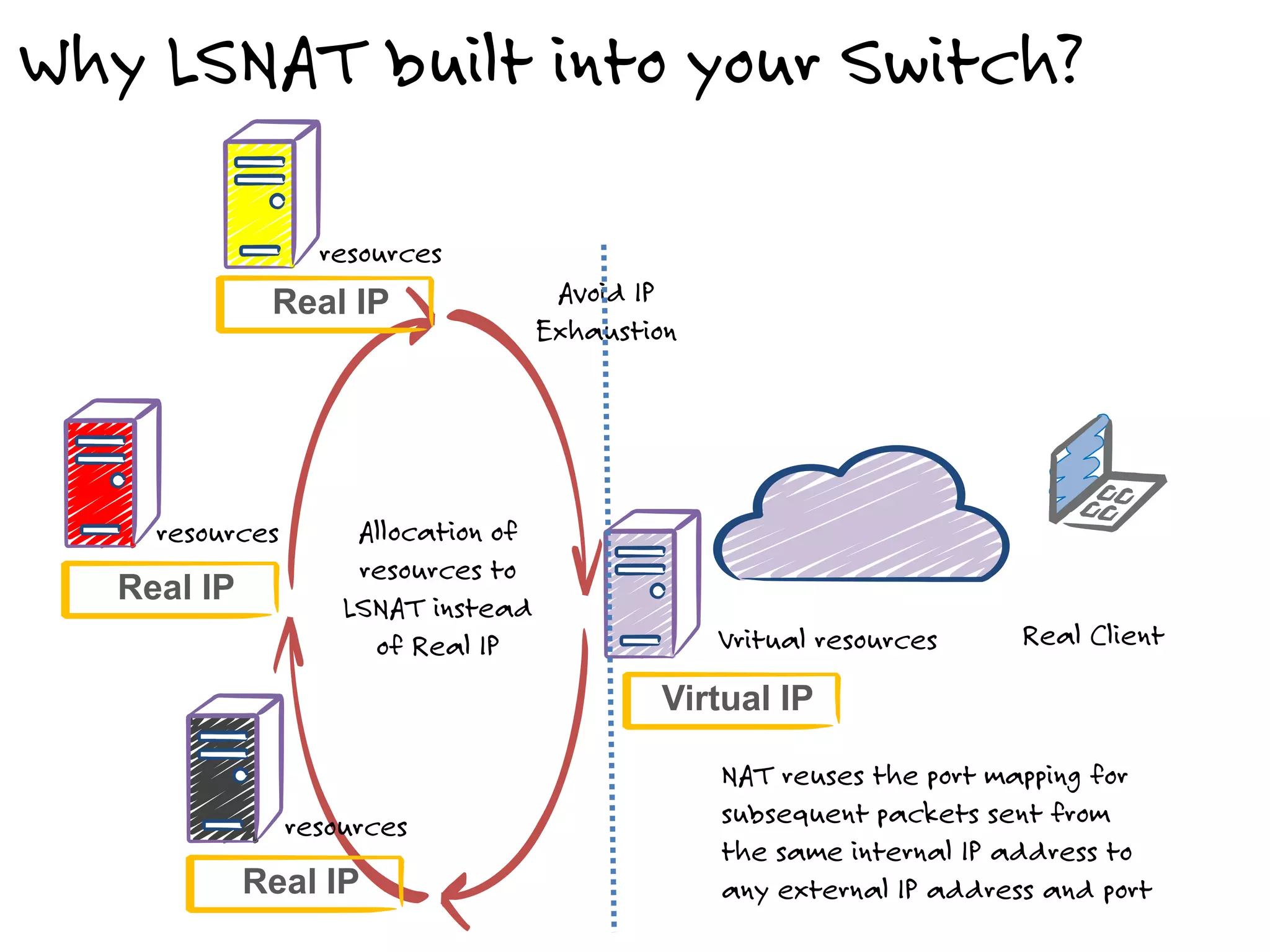
Why LSNAT built into your Switch?
Allocation of
resources to
LSNAT instead
of Real IP
Real IP
Virtual IP
Real IP
Real IP
Real Client
resources
resources
resources
Vritual resources
Avoid IP
Exhaustion
NAT reuses the port mapping for
subsequent packets sent from
the same internal IP address to
any external IP address and port
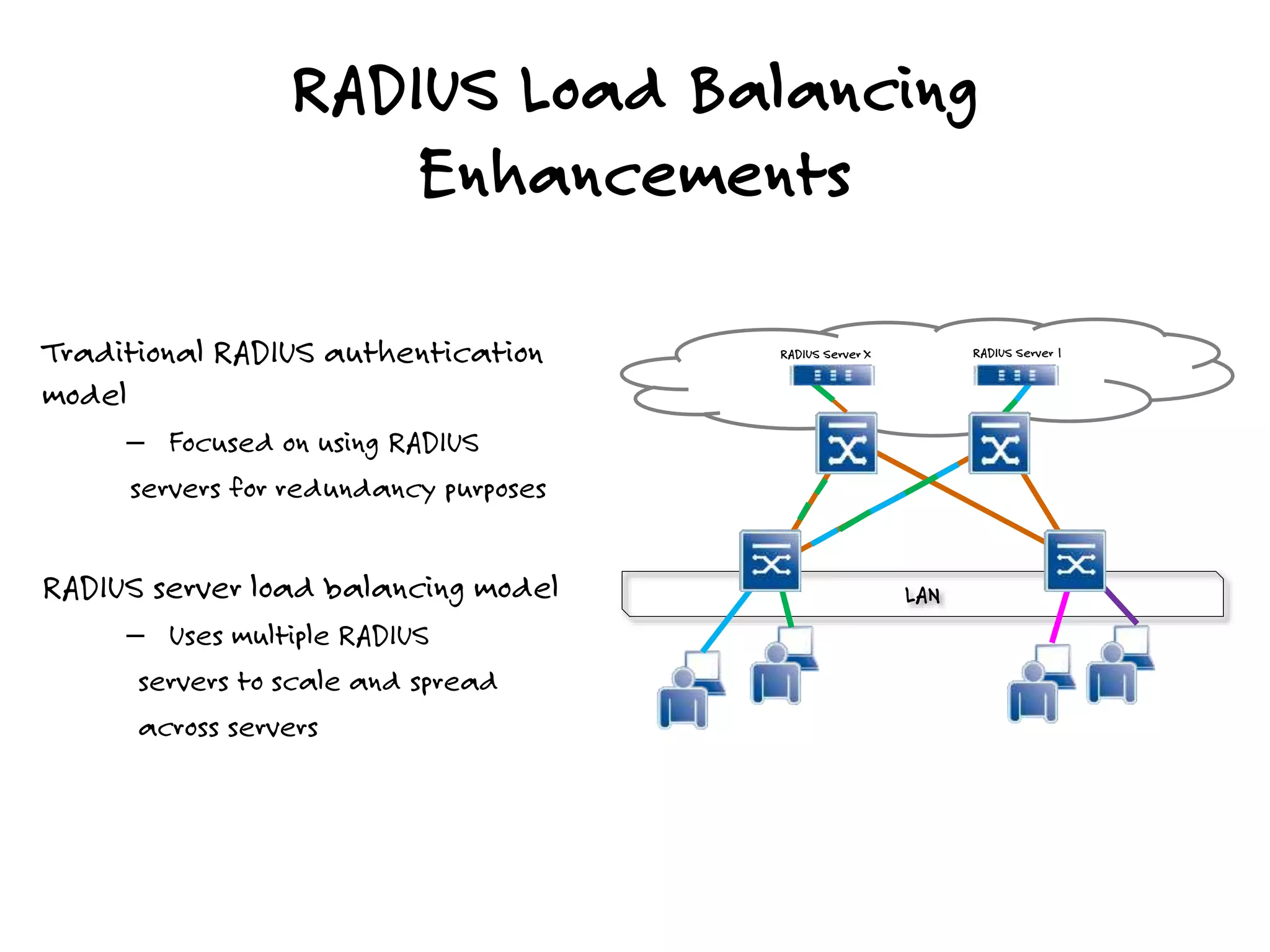
RADIUS Load Balancing
Enhancements
LAN
RADIUS Server 1RADIUS Server XTraditional RADIUS authentication
model
– Focused on using RADIUS
servers for redundancy purposes
RADIUS server load balancing model
– Uses multiple RADIUS
servers to scale and spread
across servers
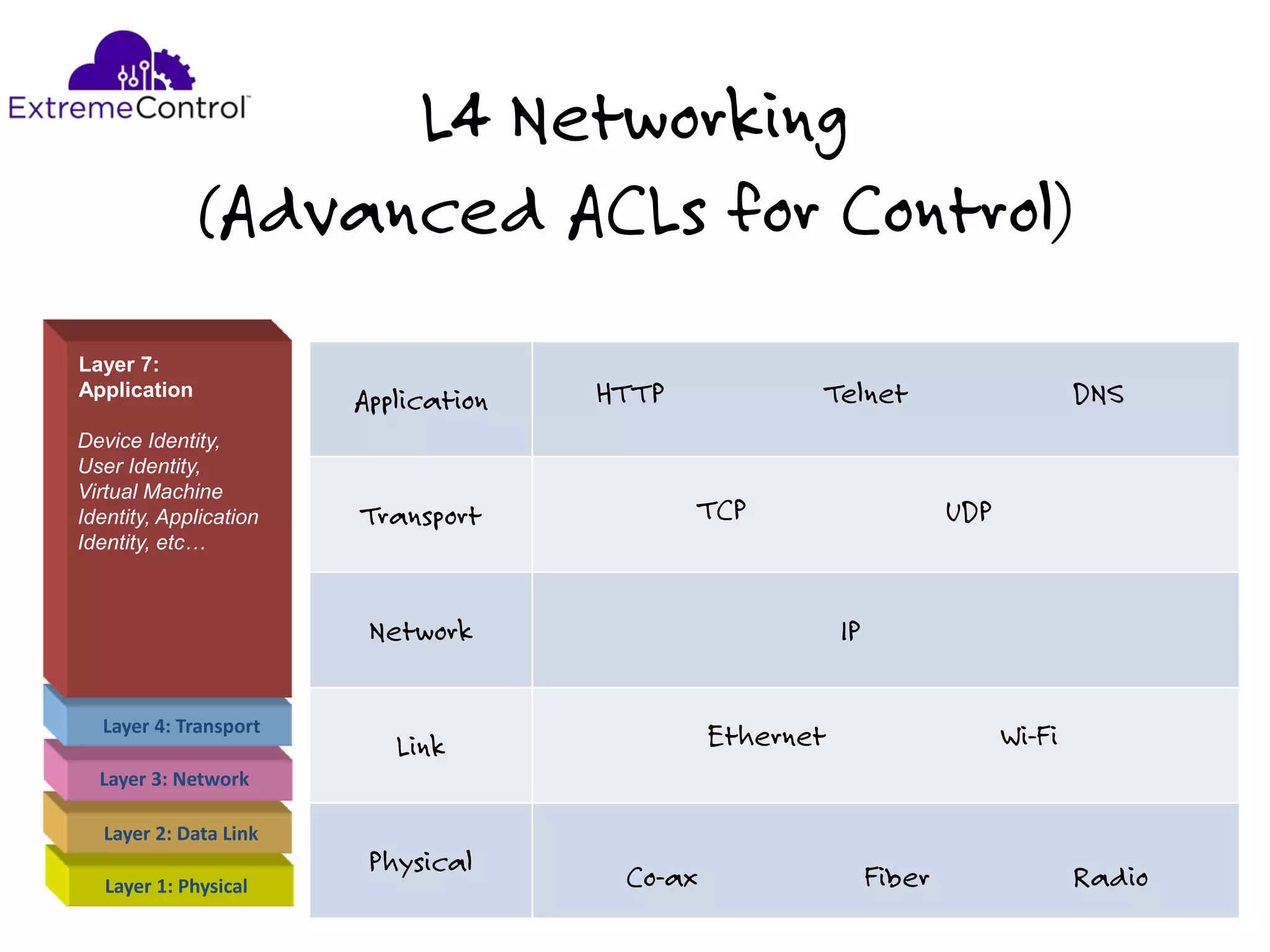
L4 Networking
(Advanced ACLs for Control)
Layer 1: Physical
Layer 2: Data Link
Layer 3: Network
Layer 4: Transport
Device Identity,
User Identity,
Virtual Machine
Identity, Application
Identity, etc…
Layer 7:
Application
Application
Transport
Network
Link
Physical Fiber
Telnet DNS
UDPTCP
IP
Ethernet Wi-Fi
Co-ax
HTTP
Radio
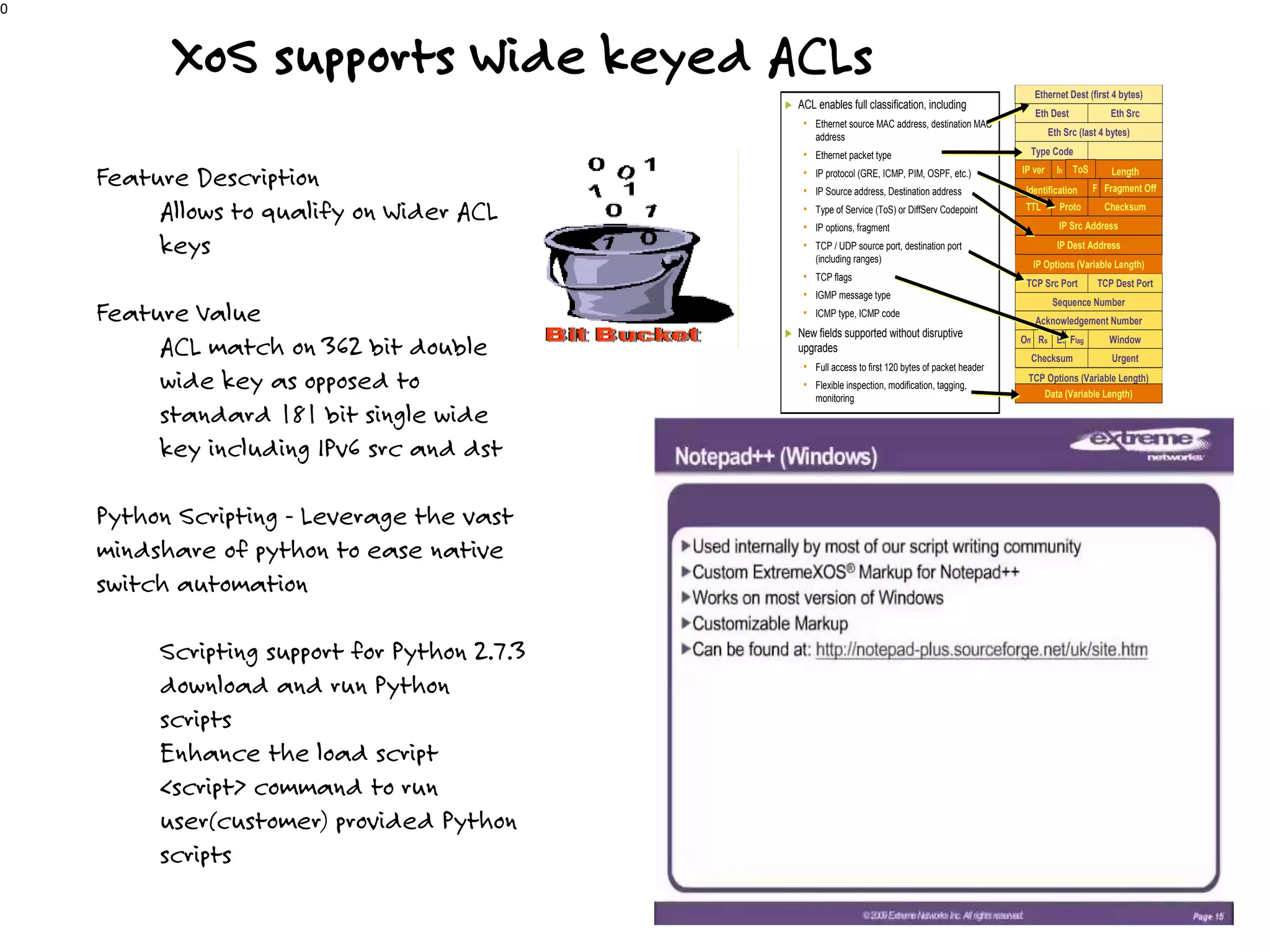
XoS supports Wide keyed ACLs
0
ACL enables full classification, including
• Ethernet source MAC address, destination MAC
address
• Ethernet packet type
• IP protocol (GRE, ICMP, PIM, OSPF, etc.)
• IP Source address, Destination address
• Type of Service (ToS) or DiffServ Codepoint
• IP options, fragment
• TCP / UDP source port, destination port
(including ranges)
• TCP flags
• IGMP message type
• ICMP type, ICMP code
New fields supported without disruptive
upgrades
• Full access to first 120 bytes of packet header
• Flexible inspection, modification, tagging,
monitoring
Ethernet Dest (first 4 bytes)
Eth Dest Eth Src
Eth Src (last 4 bytes)
Type Code
IP ver LengthIh
Identification Fragment OffF
TTL Proto Checksum
IP Src Address
TCP Src Port TCP Dest Port
Sequence Number
Acknowledgement Number
IP Dest Address
Off Ec WindowRs Flag
Checksum Urgent
IP Options (Variable Length)
TCP Options (Variable Length)
Data (Variable Length)
ToS
Feature Description
Allows to qualify on Wider ACL
keys
Feature Value
ACL match on 362 bit double
wide key as opposed to
standard 181 bit single wide
key including IPv6 src and dst
Python Scripting - Leverage the vast
mindshare of python to ease native
switch automation
Scripting support for Python 2.7.3
download and run Python
scripts
Enhance the load script
<script> command to run
user(customer) provided Python
scripts
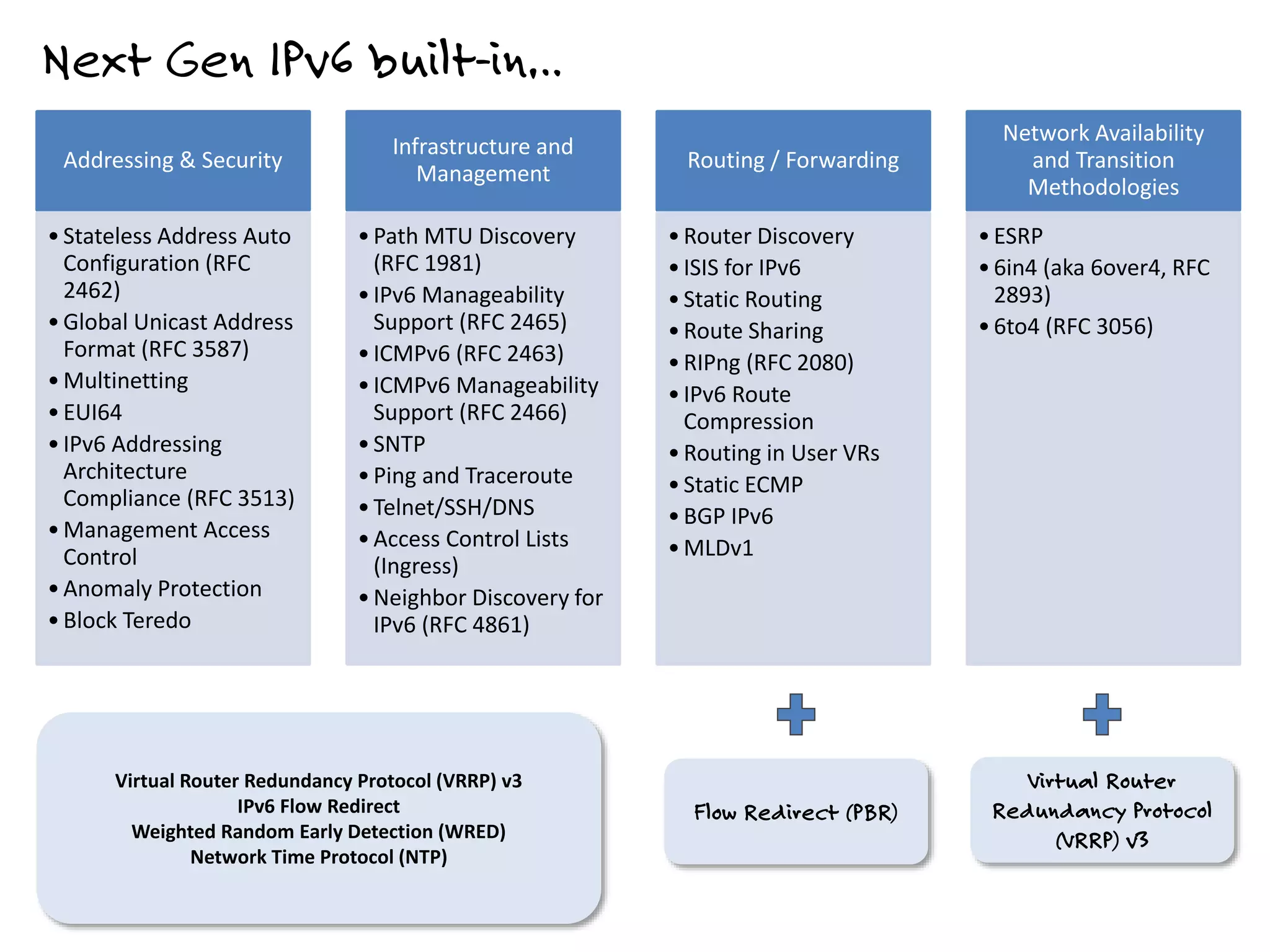
Next Gen IPv6 built-in…
Addressing & Security
•Stateless Address Auto
Configuration (RFC
2462)
•Global Unicast Address
Format (RFC 3587)
•Multinetting
•EUI64
•IPv6 Addressing
Architecture
Compliance (RFC 3513)
•Management Access
Control
•Anomaly Protection
•Block Teredo
Infrastructure and
Management
•Path MTU Discovery
(RFC 1981)
•IPv6 Manageability
Support (RFC 2465)
•ICMPv6 (RFC 2463)
•ICMPv6 Manageability
Support (RFC 2466)
•SNTP
•Ping and Traceroute
•Telnet/SSH/DNS
•Access Control Lists
(Ingress)
•Neighbor Discovery for
IPv6 (RFC 4861)
Routing / Forwarding
•Router Discovery
•ISIS for IPv6
•Static Routing
•Route Sharing
•RIPng (RFC 2080)
•IPv6 Route
Compression
•Routing in User VRs
•Static ECMP
•BGP IPv6
•MLDv1
Network Availability
and Transition
Methodologies
•ESRP
•6in4 (aka 6over4, RFC
2893)
•6to4 (RFC 3056)
Flow Redirect (PBR)
Virtual Router
Redundancy Protocol
(VRRP) v3
Virtual Router Redundancy Protocol (VRRP) v3
IPv6 Flow Redirect
Weighted Random Early Detection (WRED)
Network Time Protocol (NTP)
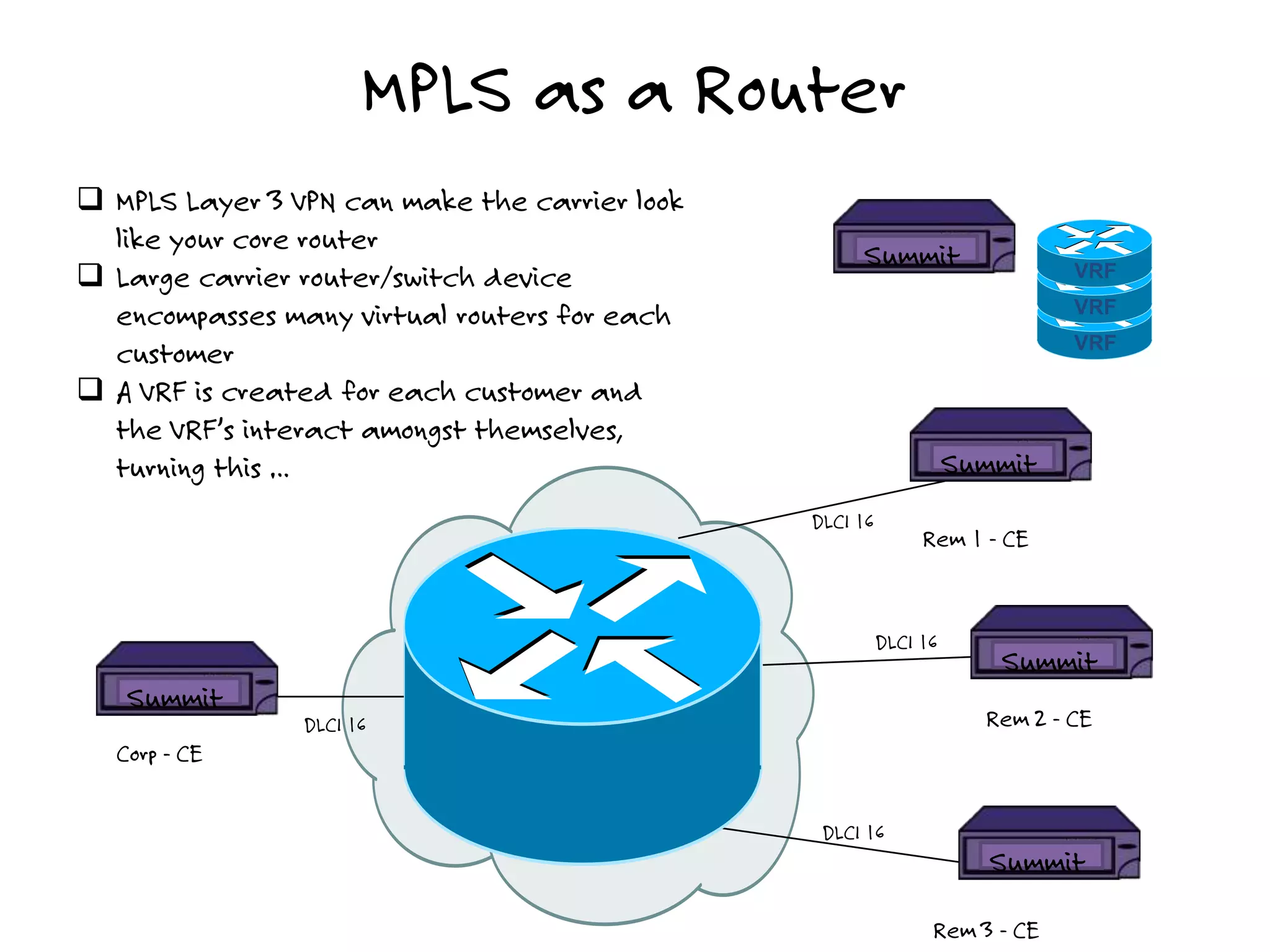
MPLS as a Router
Corp - CE
Rem 1 - CE
Rem 2 - CE
Rem 3 - CE
DLCI 16
DLCI 16
DLCI 16
DLCI 16
 MPLS Layer 3 VPN can make the carrier look
like your core router
 Large carrier router/switch device
encompasses many virtual routers for each
customer
 A VRF is created for each customer and
the VRF’s interact amongst themselves,
turning this …
VRF
VRF
VRF
Summit
Summit
Summit
Summit
Summit
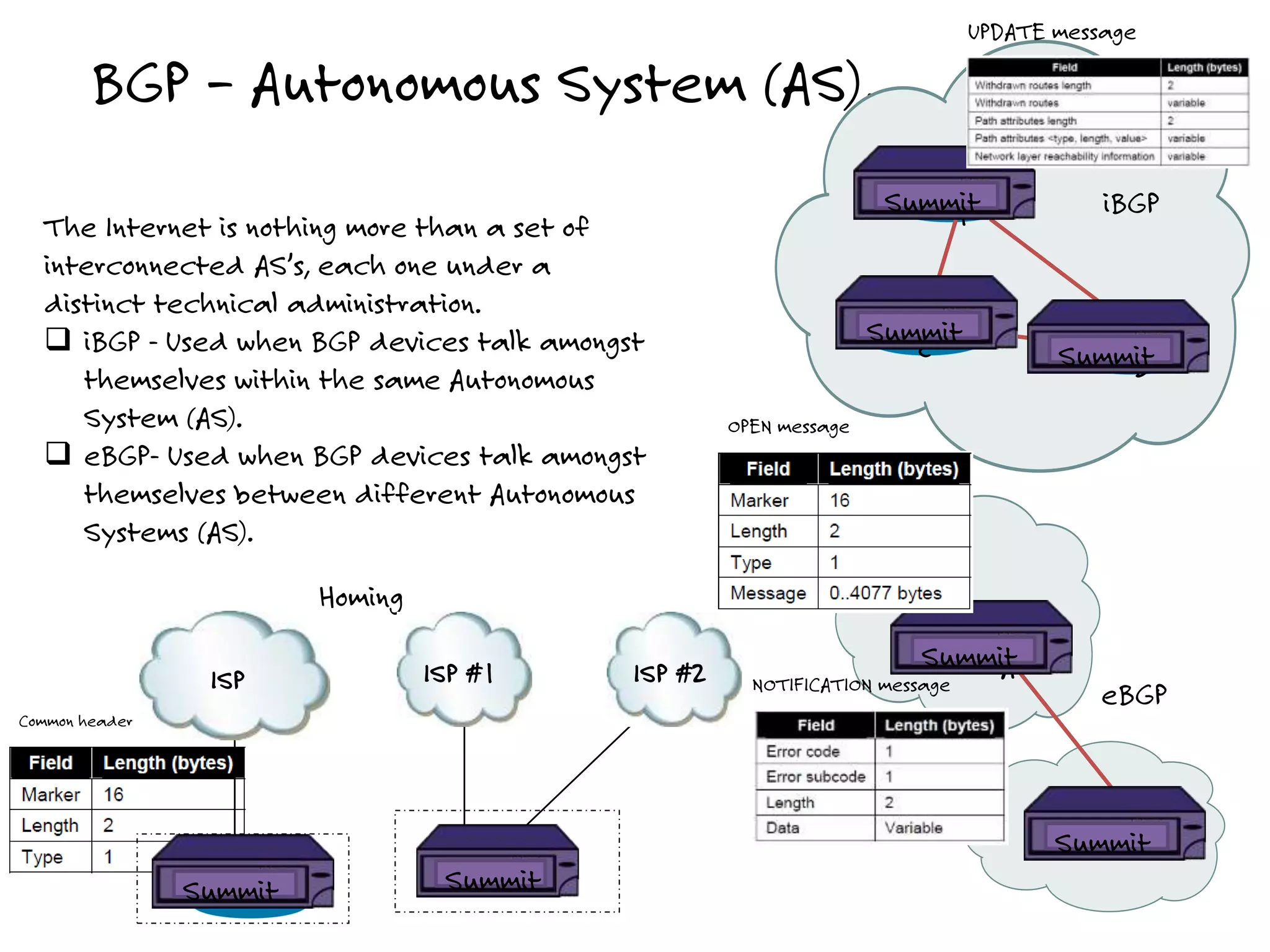
BGP – Autonomous System (AS),
The Internet is nothing more than a set of
interconnected AS’s, each one under a
distinct technical administration.
 iBGP - Used when BGP devices talk amongst
themselves within the same Autonomous
System (AS).
 eBGP- Used when BGP devices talk amongst
themselves between different Autonomous
Systems (AS).
Homing
ISP
Summit
ISP #1 ISP #2
Summit
B
A
c
Summit
Summit
Summit
iBGP
B
A
Summit
Summit
eBGP
Common header
OPEN message
NOTIFICATION message
UPDATE message
Page 17
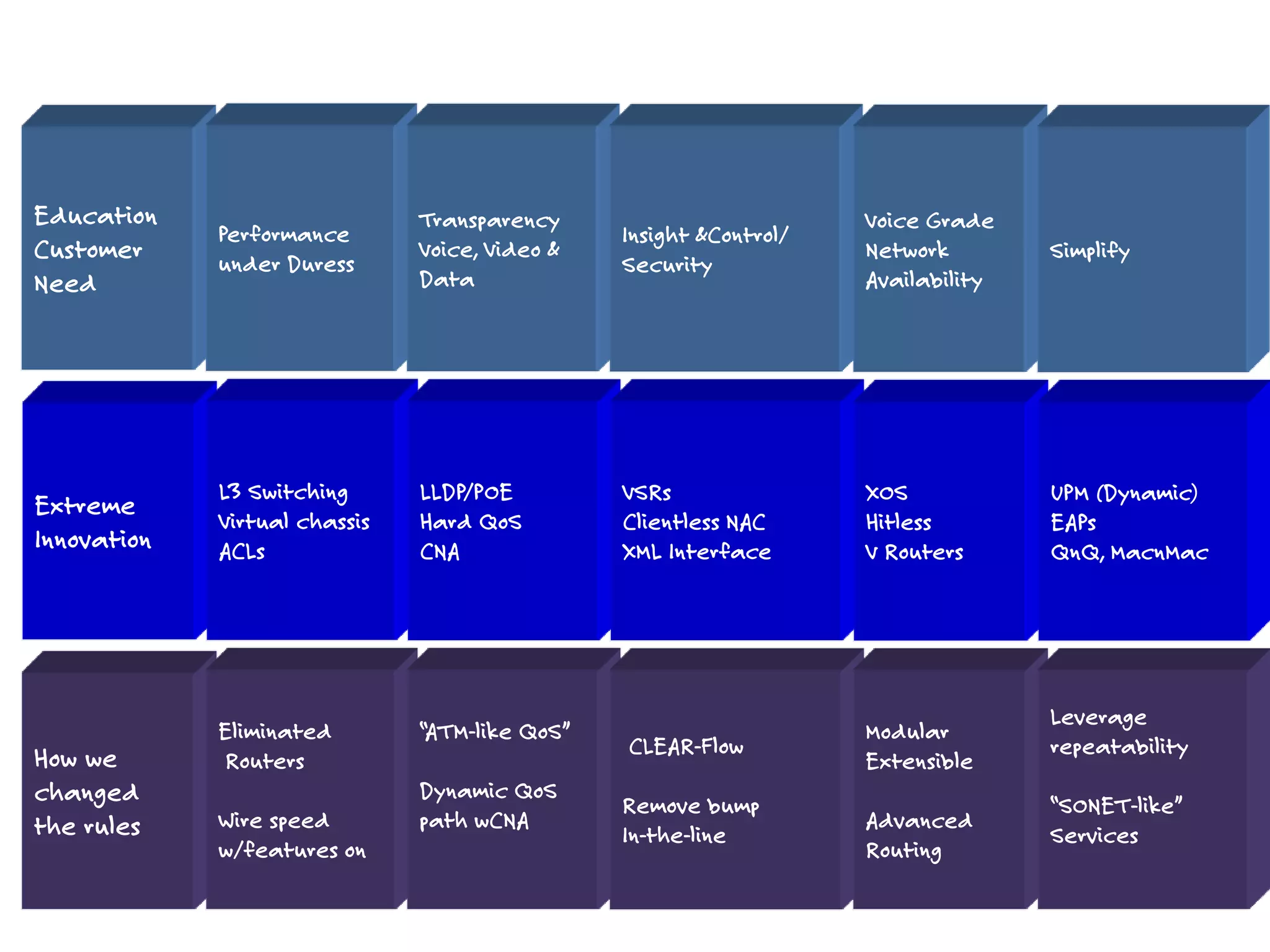
It’s not just about collision
(network
platform )
Extreme
Innovation
Education
Customer
Need
How we
changed
the rules
L3 Switching
Virtual chassis
ACLs
Performance
under Duress
Eliminated
Routers
Wire speed
w/features on
LLDP/POE
Hard QoS
CNA
Transparency
Voice, Video &
Data
“ATM-like QoS”
Dynamic QoS
path wCNA
VSRs
Clientless NAC
XML Interface
Insight &Control/
Security
CLEAR-Flow
Remove bump
In-the-line
XOS
Hitless
V Routers
Voice Grade
Network
Availability
Modular
Extensible
Advanced
Routing
UPM (Dynamic)
EAPs
QnQ, MacnMac
Simplify
Leverage
repeatability
“SONET-like”
Services

17.) layer 3 (advanced tcp ip routing)

  • 1.
    XoS “is likea Router” “a very fast Router”
  • 2.
    BusinessValue StrategicAsset Ethernet OS  Singlesoftware train  Fabric  Multicasting Network Operating System Design once, leverage everywhere. Why?Why?How?
  • 3.
    Xos Licenses &Feature Packs OSPFv2 OSPFv3 BGP-4, BGP-4+, MBGP MSDP, Anycast RP IS-IS IPv4/IPv6 OSPF-Edge PIM-SM / PIM-SSM PIM-DM ESRP VRRP/VRRPv3 6to4, v6 tunnels EAPS – Full Core Edge Advanced Edge SNMP v1/v2/v3 SSH-2/SCP HTTP / SSL / XML RADIUS / TACACS+ MIBs, RMON LLDP (LLDP MED) SFlow SNTPv4 CFM (802.1ag), Y.1731 Network Login (multiple supplicants) MAC + IP Security IGMP v1,v2,v3 IGMP snooping + filters (IGMP querier) Multicast Vlan Registration (MVR) PIM snooping EAPS-Edge VLANs, vMANs (QinQ), Private VLANs, VLAN Translation DHCP option 82 STP, 802.1D, 802.1w, 802.1s, PVST+ Software Redundant Port 802.3ad trunking, LACP, M-LAG ACLs, QoS, rate limiting CPU DoS protection Port Mirroring («1 to many» support) XOS scripting L2 Ping/Traceroute (802.1ag) L2 Edge RIP v1/v2, RIPng Static routes IPv4/IPv6 Policy-based routing MLAG 6to4, 6in4 tunnels Stacking Universal Port PFC, ETS, DCBx VLAN aggregation BootP Relay, UDP Relay User-created Virtual Routers CLEAR-Flow X430 X460 X440 X770 X670 Direct Attach MPLS OpenFlow AVB 3rd Party Optics Sync Ethernet 10GbE Upgrade License for X440 2 or 4 Ports
  • 4.
    Router Functions • Route updates •Static or Dynamic Routing Information Base (RIB) • Route exchanges with neighbor nodes • Distance Vector or Link State Route selection • Destination address lookup • Filtering Forwarding Information Base(FIB) • Incoming packets • Outgoing packets Packet Forwarding Static Routing Dynamic Routing RIP v1 RIP v2 OSPF2 BGP4 Hello packets discovers neighbors and build adjacencies between them Dijkstra algorithm runs a Link State Database (LSDB) is constructed
  • 5.
    SPF Calculation Link StateDatabase Dijkstra’s (SPF) Algorithm Adjacent Database (Neighbors of X:A,B,C,D) Shortest Paths Forwarding Database (Routing Table) X B A C D E F G H B A C D E G H  LSA – Link State Advertise  LSU – Link State Update  LSR – Link State Request  LSAck – Link State Acknowledgement
  • 6.
    Flow Redirect (PolicyBased Routing) Forwarding Table 1 2 3 12 Flow Redirect Rules  Routing/Forwarding decisions based on custom policies (ACLs)  Ability to specify nexthop priority  Ability to specify multiple next hops with health-check options  Segregate traffic flows based on business demands and operational costs  Increase network availability with PBR Redundancy  Leverage policy framework knowledge and reduce service delivery time Benefits with ExtremeXOS® Network A Network B Nexthop Priorities  Standards based solution for first hop router redundancy – for both IPv4 and IPv6  Enhanced to support multiple logical subnets within a single VRID  Default V2 and V3 inter-operability mode: Works right out of the box for mixed deployments  Leverage functionality across all ExtremeXOS® based switch portfolio Virtual Router Redundancy Protocol (VRRP) v3 Summit Summit Summit
  • 7.
    Unicast, Broadcast, Multicast Unicast Onesender – one receiver Broadcast Sends data to all possible receivers Multicast Sends data to interested receivers VLAN Red VLAN Blue Multicast VLAN Multicast Server Multicast Client Join and Leave  Multicast Routing  PIM-SM / SSM  IGMPv1 / v2 / v3 Snooping IGMP IGMP Multicast Clients Join and Leave Routing Summit Summit Summit Applications of IP Multicast: Pay TV File Transfer Financial Information Vendor Code Serial Number 24 bits 24 bits 00000001 8 bit equal “1” 10111011 11111111 All bits equal “1” 0xFFFFFFFFFFFF
  • 8.
    (up to 64Virtual Routers) DMZ VOIP Guest WiFi VoIP DMZ WiFi Guest Guest WiFi VoIP Guest WiFi VoIP WiFi VoIP IP or MAC IP or MAC IP or MAC IP or MAC
  • 9.
    Inter-VR Routing Legal Finance VRF1 VRF2 SolutionProposition:  Allows for routing of IPv4 unicast packets between Virtual Router via static routes  The next hop gateway of a static route may reside in a VLAN belonging to a different VR from the VR of the static route. Value Proposition  Provides for efficient routing between VRs which exist on the same switch.  Simplifies traffic flow between different user groups that exist on different Virtual Router instances. Inserts Static routes between two VRFs to allow for direct IPV4 connectivity Summit
  • 10.
    Why LSNAT builtinto your Switch? Allocation of resources to LSNAT instead of Real IP Real IP Virtual IP Real IP Real IP Real Client resources resources resources Vritual resources Avoid IP Exhaustion NAT reuses the port mapping for subsequent packets sent from the same internal IP address to any external IP address and port
  • 11.
    RADIUS Load Balancing Enhancements LAN RADIUSServer 1RADIUS Server XTraditional RADIUS authentication model – Focused on using RADIUS servers for redundancy purposes RADIUS server load balancing model – Uses multiple RADIUS servers to scale and spread across servers
  • 12.
    L4 Networking (Advanced ACLsfor Control) Layer 1: Physical Layer 2: Data Link Layer 3: Network Layer 4: Transport Device Identity, User Identity, Virtual Machine Identity, Application Identity, etc… Layer 7: Application Application Transport Network Link Physical Fiber Telnet DNS UDPTCP IP Ethernet Wi-Fi Co-ax HTTP Radio
  • 13.
    XoS supports Widekeyed ACLs 0 ACL enables full classification, including • Ethernet source MAC address, destination MAC address • Ethernet packet type • IP protocol (GRE, ICMP, PIM, OSPF, etc.) • IP Source address, Destination address • Type of Service (ToS) or DiffServ Codepoint • IP options, fragment • TCP / UDP source port, destination port (including ranges) • TCP flags • IGMP message type • ICMP type, ICMP code New fields supported without disruptive upgrades • Full access to first 120 bytes of packet header • Flexible inspection, modification, tagging, monitoring Ethernet Dest (first 4 bytes) Eth Dest Eth Src Eth Src (last 4 bytes) Type Code IP ver LengthIh Identification Fragment OffF TTL Proto Checksum IP Src Address TCP Src Port TCP Dest Port Sequence Number Acknowledgement Number IP Dest Address Off Ec WindowRs Flag Checksum Urgent IP Options (Variable Length) TCP Options (Variable Length) Data (Variable Length) ToS Feature Description Allows to qualify on Wider ACL keys Feature Value ACL match on 362 bit double wide key as opposed to standard 181 bit single wide key including IPv6 src and dst Python Scripting - Leverage the vast mindshare of python to ease native switch automation Scripting support for Python 2.7.3 download and run Python scripts Enhance the load script <script> command to run user(customer) provided Python scripts
  • 14.
    Next Gen IPv6built-in… Addressing & Security •Stateless Address Auto Configuration (RFC 2462) •Global Unicast Address Format (RFC 3587) •Multinetting •EUI64 •IPv6 Addressing Architecture Compliance (RFC 3513) •Management Access Control •Anomaly Protection •Block Teredo Infrastructure and Management •Path MTU Discovery (RFC 1981) •IPv6 Manageability Support (RFC 2465) •ICMPv6 (RFC 2463) •ICMPv6 Manageability Support (RFC 2466) •SNTP •Ping and Traceroute •Telnet/SSH/DNS •Access Control Lists (Ingress) •Neighbor Discovery for IPv6 (RFC 4861) Routing / Forwarding •Router Discovery •ISIS for IPv6 •Static Routing •Route Sharing •RIPng (RFC 2080) •IPv6 Route Compression •Routing in User VRs •Static ECMP •BGP IPv6 •MLDv1 Network Availability and Transition Methodologies •ESRP •6in4 (aka 6over4, RFC 2893) •6to4 (RFC 3056) Flow Redirect (PBR) Virtual Router Redundancy Protocol (VRRP) v3 Virtual Router Redundancy Protocol (VRRP) v3 IPv6 Flow Redirect Weighted Random Early Detection (WRED) Network Time Protocol (NTP)
  • 15.
    MPLS as aRouter Corp - CE Rem 1 - CE Rem 2 - CE Rem 3 - CE DLCI 16 DLCI 16 DLCI 16 DLCI 16  MPLS Layer 3 VPN can make the carrier look like your core router  Large carrier router/switch device encompasses many virtual routers for each customer  A VRF is created for each customer and the VRF’s interact amongst themselves, turning this … VRF VRF VRF Summit Summit Summit Summit Summit
  • 16.
    BGP – AutonomousSystem (AS), The Internet is nothing more than a set of interconnected AS’s, each one under a distinct technical administration.  iBGP - Used when BGP devices talk amongst themselves within the same Autonomous System (AS).  eBGP- Used when BGP devices talk amongst themselves between different Autonomous Systems (AS). Homing ISP Summit ISP #1 ISP #2 Summit B A c Summit Summit Summit iBGP B A Summit Summit eBGP Common header OPEN message NOTIFICATION message UPDATE message
  • 17.
    Page 17 It’s notjust about collision (network platform ) Extreme Innovation Education Customer Need How we changed the rules L3 Switching Virtual chassis ACLs Performance under Duress Eliminated Routers Wire speed w/features on LLDP/POE Hard QoS CNA Transparency Voice, Video & Data “ATM-like QoS” Dynamic QoS path wCNA VSRs Clientless NAC XML Interface Insight &Control/ Security CLEAR-Flow Remove bump In-the-line XOS Hitless V Routers Voice Grade Network Availability Modular Extensible Advanced Routing UPM (Dynamic) EAPs QnQ, MacnMac Simplify Leverage repeatability “SONET-like” Services