What we are
campaigning for


Dr Simon Duffy, Glasgow, April 2011
A note on Personalisation

• Not invented by government
• Only a new name for what we’ve all been
  fighting for years

• The term ‘Personalisation’ was invented by
  Charles Leadbeater for skeptical politicians in
  London

• In danger of becoming the ‘Emperors New
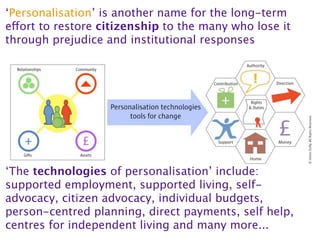
‘Personalisation’ is another name for the long-term
effort to restore citizenship to the many who lose it
through prejudice and institutional responses


‘The technologies of personalisation’ include:
supported employment, supported living, self-
advocacy, citizen advocacy, individual budgets,
person-centred planning, direct payments, self help,
centres for independent living and many more...
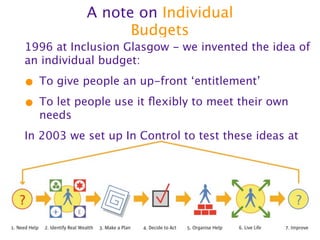
A note on Individual
                 Budgets
1996 at Inclusion Glasgow - we invented the idea of
an individual budget:

• To give people an up-front ‘entitlement’
• To let people use it flexibly to meet their own
  needs
In 2003 we set up In Control to test these ideas at
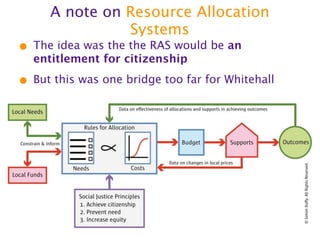
A note on Resource Allocation
               Systems
• The idea was the the RAS would be an
  entitlement for citizenship

• But this was one bridge too far for Whitehall
Lots of big questions still unanswered
• What is an eligible need?  - madness of FACS: even
  being a victim of abuse does not trigger an
  entitlement

• What is sufficient? - incontinence pads instead of
  personal care - what about citizenship?

• What about a right to control? - people’s plans are
  being stripped of anything imaginative or creative
If you don’t define what you mean by a need and if
there is no objective system for allocating resources
then Individual Budgets and Resource Allocation
Systems will just lead to the further abuse of people’s
rights.
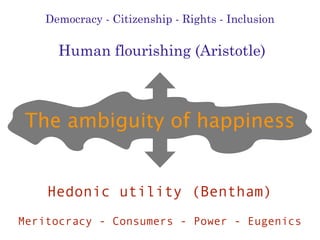
Democracy - Citizenship - Rights - Inclusion

      Human flourishing (Aristotle)


 The ambiguity of happiness


    Hedonic utility (Bentham)
Meritocracy - Consumers - Power - Eugenics
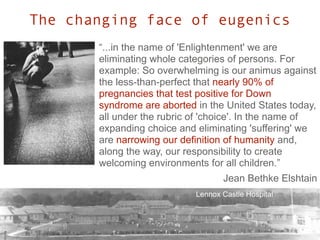
The changing face of eugenics
                         “...in the name of 'Enlightenment' we are
                         eliminating whole categories of persons. For
                         example: So overwhelming is our animus against
                         the less-than-perfect that nearly 90% of
                         pregnancies that test positive for Down
                         syndrome are aborted in the United States today,
                         all under the rubric of 'choice'. In the name of
                         expanding choice and eliminating 'suffering' we
                         are narrowing our definition of humanity and,
                         along the way, our responsibility to create
                         welcoming environments for all children.”
Christmas in Purgatory                               Jean Bethke Elshtain
                                              Lennox Castle Hospital
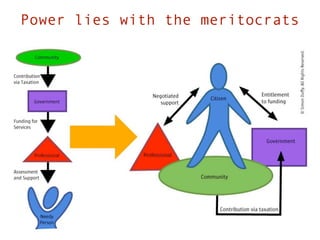
Power lies with the meritocrats
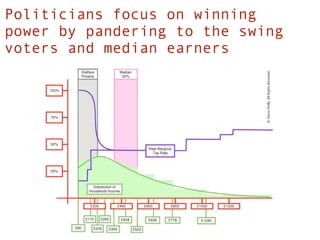
Politicians focus on winning
power by pandering to the swing
voters and median earners
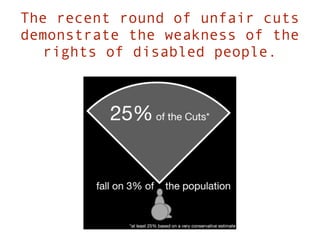
The recent round of unfair cuts
demonstrate the weakness of the
   rights of disabled people.
This is a pincer attack on the rights of disabled
people. If we just focus on the 1.5 million people
with the most significant disabilities - they will lose:
• £4.6 billion in social care support
• £4 billion in disability living allowance
• Termination of ILF
• Cuts to Supporting People
• Many further cuts in housing support and other
  benefits


So, more than £8 billion of the total £27 billion
(>>25%) which government is saving from
departmental budgets is being born by less than 3%
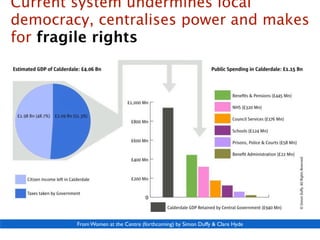
Current system undermines local
democracy, centralises power and makes
for fragile rights


        From Women at the Centre (forthcoming) by Simon Duffy & Clare Hyde
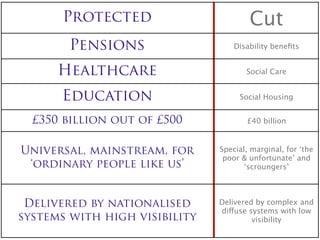
Protected                       Cut
        Pensions                   Disability benefits


      Healthcare                      Social Care


      Education                     Social Housing


  £350 billion out of £500            £40 billion


Universal, mainstream, for     Special, marginal, for ‘the
                                poor & unfortunate’ and
 ‘ordinary people like us’            ‘scroungers’


 Delivered by nationalised     Delivered by complex and
                               diffuse systems with low
systems with high visibility            visibility
The cuts are just a symptom - there
are long-standing problems to
address
•   Weak entitlements - eligibility thresholds high and
    rising, housing rights weak, legal rights weak
•   Super-taxation for disabled people - means-
    testing, charging
•   Poverty traps - benefit systems that punish
    families, savers, earners and disabled people
•   Weakened families - support focused on
    crises,family control undermined, families
    disrespected
•   Imprisonment for many - up to 20,000 people
    with learning difficulties in prison
•   Pre-birth and at-birth eugenics - 92% abortion
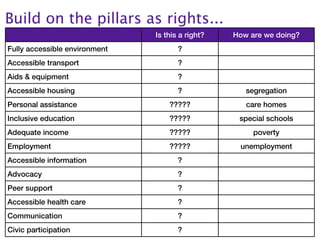
Build on the pillars as rights...
                               Is this a right?   How are we doing?
Fully accessible environment          ?
Accessible transport                  ?
Aids & equipment                      ?
Accessible housing                    ?              segregation
Personal assistance                ?????             care homes
Inclusive education                ?????           special schools
Adequate income                    ?????               poverty
Employment                         ?????           unemployment
Accessible information                ?
Advocacy                              ?
Peer support                          ?
Accessible health care                ?
Communication                         ?
Civic participation                   ?
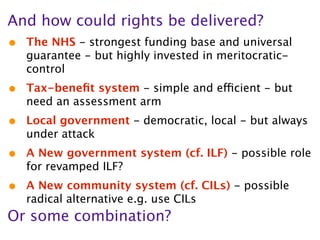
And how could rights be delivered?
•   The NHS - strongest funding base and universal
    guarantee - but highly invested in meritocratic-
    control
•   Tax-benefit system - simple and efficient - but
    need an assessment arm
•   Local government - democratic, local - but always
    under attack
•   A New government system (cf. ILF) - possible role
    for revamped ILF?
•   A New community system (cf. CILs) - possible
    radical alternative e.g. use CILs
Or some combination?
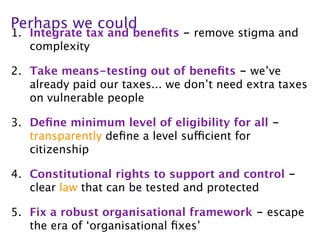
Perhaps we could
1. Integrate tax and benefits - remove stigma and
   complexity

2. Take means-testing out of benefits - we’ve
   already paid our taxes... we don’t need extra taxes
   on vulnerable people

3. Define minimum level of eligibility for all -
   transparently define a level sufficient for
   citizenship

4. Constitutional rights to support and control -
   clear law that can be tested and protected

5. Fix a robust organisational framework - escape
   the era of ‘organisational fixes’
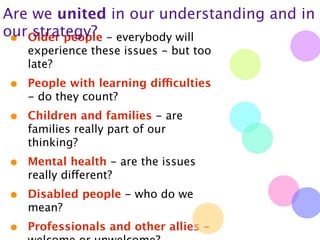
Are we united in our understanding and in
ourOlder people - everybody will
 •  strategy?
    experience these issues - but too
    late?
•   People with learning difficulties
    - do they count?
•   Children and families - are
    families really part of our
    thinking?
•   Mental health - are the issues
    really different?
•   Disabled people - who do we
    mean?
•   Professionals and other allies -
At the heart of our values


Everyone is equal, no matter their differences or
disabilities. A fair society sees each of its members as a
full citizen - a unique person with a life of their own. A
fair society is organised to support everyone to live a
full life, with meaning and respect.
Seven key principles...

1. Family - we give families the support they need to
   look after each other.
2. Citizenship - we are all of equal value and all have
   unique and positive contributions to make.
3. Community - we root support and services in local
   communities.
4. Connection - we all get chances to make friends
   and build relationships.
5. Capacity - we help each other to be the best that we
   can be.
6. Equality - we all share the same basic rights and
   entitlements.
Challenges
• Are we all in this together?
• Are we clear about what we
  want?
• Can we organise a collective
  voice?
• Can we engage the public and

(169) what we are fighting for (april 2011)

  • 1.
    What we are campaigningfor Dr Simon Duffy, Glasgow, April 2011
  • 2.
    A note onPersonalisation • Not invented by government • Only a new name for what we’ve all been fighting for years • The term ‘Personalisation’ was invented by Charles Leadbeater for skeptical politicians in London • In danger of becoming the ‘Emperors New
  • 3.
    ‘Personalisation’ is anothername for the long-term effort to restore citizenship to the many who lose it through prejudice and institutional responses ‘The technologies of personalisation’ include: supported employment, supported living, self- advocacy, citizen advocacy, individual budgets, person-centred planning, direct payments, self help, centres for independent living and many more...
  • 5.
    A note onIndividual Budgets 1996 at Inclusion Glasgow - we invented the idea of an individual budget: • To give people an up-front ‘entitlement’ • To let people use it flexibly to meet their own needs In 2003 we set up In Control to test these ideas at
  • 6.
    A note onResource Allocation Systems • The idea was the the RAS would be an entitlement for citizenship • But this was one bridge too far for Whitehall
  • 7.
    Lots of bigquestions still unanswered • What is an eligible need? - madness of FACS: even being a victim of abuse does not trigger an entitlement • What is sufficient? - incontinence pads instead of personal care - what about citizenship? • What about a right to control? - people’s plans are being stripped of anything imaginative or creative If you don’t define what you mean by a need and if there is no objective system for allocating resources then Individual Budgets and Resource Allocation Systems will just lead to the further abuse of people’s rights.
  • 8.
    Democracy - Citizenship- Rights - Inclusion Human flourishing (Aristotle) The ambiguity of happiness Hedonic utility (Bentham) Meritocracy - Consumers - Power - Eugenics
  • 9.
    The changing faceof eugenics “...in the name of 'Enlightenment' we are eliminating whole categories of persons. For example: So overwhelming is our animus against the less-than-perfect that nearly 90% of pregnancies that test positive for Down syndrome are aborted in the United States today, all under the rubric of 'choice'. In the name of expanding choice and eliminating 'suffering' we are narrowing our definition of humanity and, along the way, our responsibility to create welcoming environments for all children.” Christmas in Purgatory Jean Bethke Elshtain Lennox Castle Hospital
  • 10.
    Power lies withthe meritocrats
  • 11.
    Politicians focus onwinning power by pandering to the swing voters and median earners
  • 12.
    The recent roundof unfair cuts demonstrate the weakness of the rights of disabled people.
  • 13.
    This is apincer attack on the rights of disabled people. If we just focus on the 1.5 million people with the most significant disabilities - they will lose: • £4.6 billion in social care support • £4 billion in disability living allowance • Termination of ILF • Cuts to Supporting People • Many further cuts in housing support and other benefits So, more than £8 billion of the total £27 billion (>>25%) which government is saving from departmental budgets is being born by less than 3%
  • 14.
    Current system undermineslocal democracy, centralises power and makes for fragile rights From Women at the Centre (forthcoming) by Simon Duffy & Clare Hyde
  • 15.
    Protected Cut Pensions Disability benefits Healthcare Social Care Education Social Housing £350 billion out of £500 £40 billion Universal, mainstream, for Special, marginal, for ‘the poor & unfortunate’ and ‘ordinary people like us’ ‘scroungers’ Delivered by nationalised Delivered by complex and diffuse systems with low systems with high visibility visibility
  • 16.
    The cuts arejust a symptom - there are long-standing problems to address • Weak entitlements - eligibility thresholds high and rising, housing rights weak, legal rights weak • Super-taxation for disabled people - means- testing, charging • Poverty traps - benefit systems that punish families, savers, earners and disabled people • Weakened families - support focused on crises,family control undermined, families disrespected • Imprisonment for many - up to 20,000 people with learning difficulties in prison • Pre-birth and at-birth eugenics - 92% abortion
  • 17.
    Build on thepillars as rights... Is this a right? How are we doing? Fully accessible environment ? Accessible transport ? Aids & equipment ? Accessible housing ? segregation Personal assistance ????? care homes Inclusive education ????? special schools Adequate income ????? poverty Employment ????? unemployment Accessible information ? Advocacy ? Peer support ? Accessible health care ? Communication ? Civic participation ?
  • 18.
    And how couldrights be delivered? • The NHS - strongest funding base and universal guarantee - but highly invested in meritocratic- control • Tax-benefit system - simple and efficient - but need an assessment arm • Local government - democratic, local - but always under attack • A New government system (cf. ILF) - possible role for revamped ILF? • A New community system (cf. CILs) - possible radical alternative e.g. use CILs Or some combination?
  • 19.
    Perhaps we could 1.Integrate tax and benefits - remove stigma and complexity 2. Take means-testing out of benefits - we’ve already paid our taxes... we don’t need extra taxes on vulnerable people 3. Define minimum level of eligibility for all - transparently define a level sufficient for citizenship 4. Constitutional rights to support and control - clear law that can be tested and protected 5. Fix a robust organisational framework - escape the era of ‘organisational fixes’
  • 20.
    Are we unitedin our understanding and in ourOlder people - everybody will • strategy? experience these issues - but too late? • People with learning difficulties - do they count? • Children and families - are families really part of our thinking? • Mental health - are the issues really different? • Disabled people - who do we mean? • Professionals and other allies -
  • 21.
    At the heartof our values Everyone is equal, no matter their differences or disabilities. A fair society sees each of its members as a full citizen - a unique person with a life of their own. A fair society is organised to support everyone to live a full life, with meaning and respect.
  • 22.
    Seven key principles... 1.Family - we give families the support they need to look after each other. 2. Citizenship - we are all of equal value and all have unique and positive contributions to make. 3. Community - we root support and services in local communities. 4. Connection - we all get chances to make friends and build relationships. 5. Capacity - we help each other to be the best that we can be. 6. Equality - we all share the same basic rights and entitlements.
  • 23.
    Challenges • Are weall in this together? • Are we clear about what we want? • Can we organise a collective voice? • Can we engage the public and