After the post-war  welfare state: participation and equality  in times of austerity   Anna Coote new economics foundation London, January 2012
Building a ‘Big Society’ A force for good? demands more  engagement and participation  by individuals and small local organisations offers citizens  more control values  human resources and relationships , sees people as active contributers implies more  flexibility  and stronger  local   connections offers timely opportunity to make  public services fit for the 21 st  century
What is the intent? ‘ From state power to people power.. From big government to the big society.’   (Prime Minister) ‘ An audacious attempt to fashion a notion of social solidarity from the bricks of centre-right ideas… nothing less than to wean this country off its apparently unbreakable dependency on the state, centralism, welfare, and rule from Whitehall, the corrosive habits of half a century.’  (Steve Hilton, PM’s Director of Strategy)
The austerity programme Council grants cut by 27 per cent cut to 2014-5; 14 per cent fall in spending £18 billion cut from welfare bill Up to 500,000 job losses in public sector; more than one million overall Only £470 million over four years to help ‘civil society’, to include 5,000 organisers, national citizens’ service and £100 million for ‘transitional’ help.
Will the medicine work? ‘ Big financial crises cast long shadows. This one is unlikely to be an exception to the rule. Stagflation in the short run and weak growth in the longer run are an unappealing combination. The Nice (“non-inflationary, consistently expansionary”) decade once described by Mervyn King, governor of the Bank of England, is gone. Welcome to the Nasty (”nightmare of austere and stagflationary years”). Martin Wolf, Economics Editor, Financial Times,  (June 2011) ‘ In every case where governments have pursued austerity  measures to stave off the threat of the bond market, the ensuing contraction in their economies has increased market doubts about a default, leading to higher interest rates and therefore a vicious cycle of economic decline.’ Plan B: A good economy for a good society. (October 2011)
Potential scale of change Together, if implemented, the ‘Big Society’ and the spending cuts mark the  end of the post-war welfare settlement The ‘Big Society’  shifts responsibility  from the state to individuals and families, and from public services   to self-help, charity, local enterprise and global commerce. It is also a bid to  replace paid with unpaid labour  on a massive scale
Potential impact  More  unemployment, poverty, homelessness, insecurity, conflict Women set to lose more jobs and do more unpaid work Accumulation of risks for those already poor and powerless; families with children hardest hit Loss of ‘peripheral’ public services Hard-pressed local organisations will bear a bigger burden in poor areas.
Big enough for all? Capacity  to participate depends on  education, income, family, environment, knowledge, confidence, time, energy. Access  is varied because o rganisations have boundaries drawn by kinship, law, friendship, duty, tradition, geography, politics, and class…. they include some and exclude others … some are much more powerful.  Time  is  needed to  participate in the ‘Big Society’. Some have much more control over their time than others, especially low earners with big family responsibilities. Capacity, access and time... are all  unequally  distributed, so it may be much harder for those who are already  disadvantaged  to participate in the ‘Big Society’ or to benefit from it.
Civil society and big business Impact on ‘civil society’ organisations Forced voluntarism, marketisation, competition, mergers and growth; inadequate support, shrinking resources ...  what about diversity, spontaneity and ‘gift relationship’?  Role of business Big businesses are well-placed to take over state functions and provide high-volume services ... how much room will they leave for small, community-based organisations?
Role of the state? ‘ Big Society’, small state We need a state that is strong enough to protect the  rights of individuals,  protect  the weak against the strong guarantee access to  essential services provide   support  for local groups ensure fair distribution of resources. Accountability What happens when things go wrong... how can anyone judge how well it’s working... where does the buck stop?
A ‘flash in the pan’ or a real watershed? The ‘big society’ story makes the scale and speed of deficit reduction politically feasible and it’s high time for public service reform but the cuts make it impossible to realise the best ideals of the ‘big society’ ‘ U-turns’ are in season and there are strong vested interests in the status quo
Making the best of it Establish clear  goals:  social justice, well-being for all Tackle underlying causes of  inequalities  so that  everyone  has a fair chance to participate and benefit Make sure there is enduring, adequate  support  for community-based organisations Establish clear lines of  accountability Move towards a fairer distribution of  paid and unpaid time Invest in  ‘upstream’ interventions  to improve well-being and save unnecessary expenditure.
The key to ‘flourishing’  We can grow the ‘core economy’ by recognising, valuing and nurturing abundant human resources such as time, energy, wisdom, experience, knowledge, skills; love, empathy, watchfulness, teaching, learning and making more and better use of them to meet shared needs. We can do this by making  co-production  the standard way of getting things done.
Key features of co-production ... Equal partnership Recognising people as assets Building on people’s existing capabilities Promoting mutual aid and reciprocity Developing peer support networks Breaking down barriers between professionals and recipients Facilitating rather than delivering
It’s much more than... consultation volunteering personalisation It can help to … strengthen social networks Improve well-being prevent needs arising transform public services and make them sustainable
Future costs and benefits? Are the good ideas strong enough to prevail in spite of the cuts? How will the combined effects of the ‘big society’ and the cuts affect current and future generations? What are the likely impacts on  levels of participation social and economic inequalities?
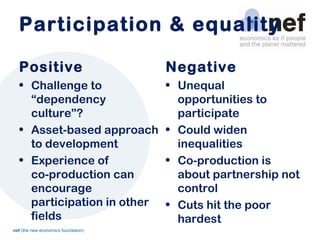
Participation & equality Positive Challenge to “dependency culture”? Asset-based approach to development Experience of  co-production can encourage participation in other fields Negative Unequal opportunities to participate Could widen inequalities Co-production is about partnership not control Cuts hit the poor hardest
www.neweconomics.org Thank you!